EP3237657B1 - Verfahren zum herstellen von nanofasergarn mit hoher zugfestigkeit - Google Patents
Verfahren zum herstellen von nanofasergarn mit hoher zugfestigkeit Download PDFInfo
- Publication number
- EP3237657B1 EP3237657B1 EP15872032.6A EP15872032A EP3237657B1 EP 3237657 B1 EP3237657 B1 EP 3237657B1 EP 15872032 A EP15872032 A EP 15872032A EP 3237657 B1 EP3237657 B1 EP 3237657B1
- Authority
- EP
- European Patent Office
- Prior art keywords
- nozzle
- jet
- alignment
- speed
- hydrogel
- Prior art date
- Legal status (The legal status is an assumption and is not a legal conclusion. Google has not performed a legal analysis and makes no representation as to the accuracy of the status listed.)
- Active
Links
Images

Classifications
-
- D—TEXTILES; PAPER
- D01—NATURAL OR MAN-MADE THREADS OR FIBRES; SPINNING
- D01D—MECHANICAL METHODS OR APPARATUS IN THE MANUFACTURE OF ARTIFICIAL FILAMENTS, THREADS, FIBRES, BRISTLES OR RIBBONS
- D01D5/00—Formation of filaments, threads, or the like
- D01D5/04—Dry spinning methods
-
- D—TEXTILES; PAPER
- D01—NATURAL OR MAN-MADE THREADS OR FIBRES; SPINNING
- D01F—CHEMICAL FEATURES IN THE MANUFACTURE OF ARTIFICIAL FILAMENTS, THREADS, FIBRES, BRISTLES OR RIBBONS; APPARATUS SPECIALLY ADAPTED FOR THE MANUFACTURE OF CARBON FILAMENTS
- D01F2/00—Monocomponent artificial filaments or the like of cellulose or cellulose derivatives; Manufacture thereof
-
- B—PERFORMING OPERATIONS; TRANSPORTING
- B82—NANOTECHNOLOGY
- B82Y—SPECIFIC USES OR APPLICATIONS OF NANOSTRUCTURES; MEASUREMENT OR ANALYSIS OF NANOSTRUCTURES; MANUFACTURE OR TREATMENT OF NANOSTRUCTURES
- B82Y30/00—Nanotechnology for materials or surface science, e.g. nanocomposites
-
- C—CHEMISTRY; METALLURGY
- C08—ORGANIC MACROMOLECULAR COMPOUNDS; THEIR PREPARATION OR CHEMICAL WORKING-UP; COMPOSITIONS BASED THEREON
- C08B—POLYSACCHARIDES; DERIVATIVES THEREOF
- C08B15/00—Preparation of other cellulose derivatives or modified cellulose, e.g. complexes
- C08B15/02—Oxycellulose; Hydrocellulose; Cellulosehydrate, e.g. microcrystalline cellulose
-
- C—CHEMISTRY; METALLURGY
- C08—ORGANIC MACROMOLECULAR COMPOUNDS; THEIR PREPARATION OR CHEMICAL WORKING-UP; COMPOSITIONS BASED THEREON
- C08J—WORKING-UP; GENERAL PROCESSES OF COMPOUNDING; AFTER-TREATMENT NOT COVERED BY SUBCLASSES C08B, C08C, C08F, C08G or C08H
- C08J3/00—Processes of treating or compounding macromolecular substances
- C08J3/02—Making solutions, dispersions, lattices or gels by other methods than by solution, emulsion or suspension polymerisation techniques
- C08J3/03—Making solutions, dispersions, lattices or gels by other methods than by solution, emulsion or suspension polymerisation techniques in aqueous media
- C08J3/05—Making solutions, dispersions, lattices or gels by other methods than by solution, emulsion or suspension polymerisation techniques in aqueous media from solid polymers
-
- D—TEXTILES; PAPER
- D01—NATURAL OR MAN-MADE THREADS OR FIBRES; SPINNING
- D01D—MECHANICAL METHODS OR APPARATUS IN THE MANUFACTURE OF ARTIFICIAL FILAMENTS, THREADS, FIBRES, BRISTLES OR RIBBONS
- D01D1/00—Treatment of filament-forming or like material
- D01D1/06—Feeding liquid to the spinning head
-
- D—TEXTILES; PAPER
- D01—NATURAL OR MAN-MADE THREADS OR FIBRES; SPINNING
- D01D—MECHANICAL METHODS OR APPARATUS IN THE MANUFACTURE OF ARTIFICIAL FILAMENTS, THREADS, FIBRES, BRISTLES OR RIBBONS
- D01D5/00—Formation of filaments, threads, or the like
- D01D5/06—Wet spinning methods
-
- D—TEXTILES; PAPER
- D01—NATURAL OR MAN-MADE THREADS OR FIBRES; SPINNING
- D01D—MECHANICAL METHODS OR APPARATUS IN THE MANUFACTURE OF ARTIFICIAL FILAMENTS, THREADS, FIBRES, BRISTLES OR RIBBONS
- D01D5/00—Formation of filaments, threads, or the like
- D01D5/12—Stretch-spinning methods
-
- D—TEXTILES; PAPER
- D01—NATURAL OR MAN-MADE THREADS OR FIBRES; SPINNING
- D01D—MECHANICAL METHODS OR APPARATUS IN THE MANUFACTURE OF ARTIFICIAL FILAMENTS, THREADS, FIBRES, BRISTLES OR RIBBONS
- D01D5/00—Formation of filaments, threads, or the like
- D01D5/12—Stretch-spinning methods
- D01D5/16—Stretch-spinning methods using rollers, or like mechanical devices, e.g. snubbing pins
-
- D—TEXTILES; PAPER
- D01—NATURAL OR MAN-MADE THREADS OR FIBRES; SPINNING
- D01F—CHEMICAL FEATURES IN THE MANUFACTURE OF ARTIFICIAL FILAMENTS, THREADS, FIBRES, BRISTLES OR RIBBONS; APPARATUS SPECIALLY ADAPTED FOR THE MANUFACTURE OF CARBON FILAMENTS
- D01F1/00—General methods for the manufacture of artificial filaments or the like
- D01F1/02—Addition of substances to the spinning solution or to the melt
-
- D—TEXTILES; PAPER
- D01—NATURAL OR MAN-MADE THREADS OR FIBRES; SPINNING
- D01F—CHEMICAL FEATURES IN THE MANUFACTURE OF ARTIFICIAL FILAMENTS, THREADS, FIBRES, BRISTLES OR RIBBONS; APPARATUS SPECIALLY ADAPTED FOR THE MANUFACTURE OF CARBON FILAMENTS
- D01F9/00—Artificial filaments or the like of other substances; Manufacture thereof; Apparatus specially adapted for the manufacture of carbon filaments
- D01F9/08—Artificial filaments or the like of other substances; Manufacture thereof; Apparatus specially adapted for the manufacture of carbon filaments of inorganic material
- D01F9/12—Carbon filaments; Apparatus specially adapted for the manufacture thereof
- D01F9/14—Carbon filaments; Apparatus specially adapted for the manufacture thereof by decomposition of organic filaments
- D01F9/16—Carbon filaments; Apparatus specially adapted for the manufacture thereof by decomposition of organic filaments from products of vegetable origin or derivatives thereof, e.g. from cellulose acetate
Definitions
- the present invention relates to a method for producing high tensile strength nanofiber yarn. Particularly, the present invention provides a method for producing such nanofiber yarn at high speed.
- Natural cellulose fiber has been utilized by human for thousands of years. Two major examples are paper from wood pulp and fabrics from cotton. In the last hundred years, synthetic fiber has gradually taken over due to its lower cost and excellent properties. However, for sustainable usage of earth resources, natural cellulose fibers have triggered more and more attraction. Wood is one of the most abundant sources of natural fiber. It was found that wood pulp can be disintegrated into nano fibrils through simple mechanical grinding. The tensile strength of nanocellulose fibril is estimated to be 2 - 3 GPa (Walther et al .), rendering it five times stronger than mild steel. Theoretically, it would be possible to align the nanofibers and produce long and strong fibers, surpassing that of wood and cotton (400 - 600 MPa).
- H ⁇ kanson et al. present a process combining hydrodynamic alignment with a dispersion-gel transition that produces homogeneous and smooth filaments from a low-concentration dispersion of cellulose nanofibrils in water.
- the hydrodynamic alignment was accomplished in a flow-focusing channel system.
- the preferential fibril orientation along the filament direction can be controlled by the process parameters.
- the specific ultimate strength is considerably higher than previously reported filaments made of cellulose nanofibrils; maximum tensile strength value is ⁇ 580 MPa and maximum Young's modulus 18.3 GPa. The strength is even in line with the strongest cellulose pulp fibers extracted from wood with the same degree of fibril alignment.
- WO 2010/043889 A1 relates to a method for spinning of a fibre comprising cellulose nanofibrils being aligned along the main axis of the fibre from a lyotropic suspension of cellulose nanofibrils, wherein the alignment is achieved through extension of the extruded fibre and the fibre is dried under extension and the aligned nanofibrils aggregate to form a continuous structure.
- EP 2 558 624 B1 relates to a continuous method for manufacturing cellulose based fibers of cellulose nanofibrils.
- these documents do not disclose for example a method for producing high tensile strength nanofiber yarn at exceptionally high speed.
- Cellulose has been used widely as a raw material for textile and composite reinforcement fibers.
- chemical processes such as dissolving and regeneration as well as cellulose derivatization are used. These methods however require chemicals and consume rather much energy.
- simpler processes which consume less chemicals and less energy, for producing long nanocellulose fibers with good mechanical properties preferably at high speed.
- the present invention provides advantages over known methods, since it e.g. allows the usage of low cost raw material such as non-modified nanocellulose. Upgrading of the raw-material to TEMPO-oxidized nanocellulose furthermore improves the mechanical properties of the fibers. In addition, the present method is able to produce nanofiber yarns continuously at a high speed, because the method does not use a traditional coagulation bath.
- the present invention discloses a method for producing high tensile strength nanofiber yarn by wet-extrusion.
- Nanofibers are defined in the art as fibers with diameters less than 100 nanometers. In textile industry, this definition is often extended to include fibers as large as 1000 nm diameter. Yarn on the other hand is a long continuous length of interlocked fibres, herein nanofibers, suitable for use e.g. in the production of textiles.
- the present invention is based on the combination of in-nozzle-alignment and on-surface-alignment, wherein individual nanocellulose fibers are aligned together by using high speed extrusion and simultaneous stretching technique in a wet state.
- the method for producing high tensile strength nanofiber yarn by wet-extrusion comprises aligning individual nanocellulose fibers together and forming a nanofiber network first by in-nozzle-alignment, wherein a nanocellulose hydrogel is extruded through a nozzle at high jet speed, after which the nanofiber network is stretched by on-surface-alignment, wherein a hydrogel jet from the nozzle is applied on a moving slippery surface.
- the nanocellulose hydrogel is prepared from natural and non-modified nanofibrillated cellulose.
- One suitable source of nanocellulose is bleached birch pulp.
- the moving surface is a drum, or alike, or a belt.
- the surface is preferably covered with a nonporous plastic film that has been pre-coated with oil, such as a vegetable oil, or a non-immiscible fluid, in order to achieve a slippery surface.
- oil such as a vegetable oil, or a non-immiscible fluid
- a contact angle hysteresis of less than 10° is achieved. If a porous surface is infused with lubricating fluid, even lower contact angle hysteresis ( ⁇ 2.5°) can be obtained.
- the produced fibers can then be removed from the drum together with the plastic film.
- inventions In “in-nozzle-alignment” individual nanocellulose fibers are aligned as shown in Figure 2 , which depicts the flow of nanocellulose hydrogel from a syringe, or alike, into a smaller nozzle and the forming of an extensional flow regime by the hydrogel flow.
- Figure 2 depicts the flow of nanocellulose hydrogel from a syringe, or alike, into a smaller nozzle and the forming of an extensional flow regime by the hydrogel flow.
- the network is efficiently stretched along the flow direction at high extensional rate.
- Such high extensional rate can be obtained by using high extrusion speed i.e. jet speed and small nozzle size.
- the jet speed is between 10 and 25 m/s.
- the nozzle has an inner diameter between 10 and 150 ⁇ m.
- on-surface-alignment a hydrogel jet from the nozzle is applied on a moving slippery surface, as stated above.
- surface speed is higher than jet speed
- the cross-sectional area of the wet filament becomes smaller after it has landed on the surface.
- the stretching created by the surface also enhances the fiber alignment.
- the cross-sectional area of the wet filament becomes larger and causes accumulation of the substrate. This results in reduction of orientation of the fibers in the yarns.
- the previously aligned fibers maybe disturbed due to the compression and strong impact with the substrate, whereas the resulting fibers become less aligned.
- the cross-section of the jet is preferably circular due to the shape of the nozzle.
- the vertical component of the jet speed directly causes a widening of the wet filament in cross direction.
- the horizontal component depending on its speed relative to the moving substrate, may either contribute to the shrinking or stretching of the filament length.
- the resulting filament then obtains a ribbon like cross-section.
- the hydrogel jet from the nozzle impinges on the moving surface at an impingement angle of between 90 and 20 degrees, wherein the jet is perpendicular to the surface at 90 degrees and tangential to the surface at 0 degree.
- the impingement angle is between 90 and 40 degrees, more preferably between 75 and 55 degrees.
- Compression of wet filament may be useful for gaining thick filaments having a high tensile strength. Particularly, when a thin jet impinges on a slow moving substrate, a thicker filament is formed. The number of defects due to non-uniformity can be reduced.
- the distance between the nozzle and the moving surface is short enough for enabling that a continuous water phase remains and that the wet filament formed has high uniformity. Since the wet filament on the substrate is few millimeters, such as 10 to 20 mm, away from the impingement point, it is in a low shear state.
- the flow of the gel is mainly driven by surface wetting, gravity, centrifugation force and shrinkage due to drying and minor water evaporation.
- the yield stress of the gel is high enough to efficiently slow down the flowing or deformation of the wet filament.
- the method provides a closely packed fiber network, the disordering of the nanofibrils due to dispersion and/or lack of orientation is unlikely.
- the application of oil coating on the substrate has clear benefit in controlling the wet fiber width.
- Oil coating is used to reduce the risk of the wet fiber adhering to the substrate and thus forming wide and thin ribbons, which are quite weak due to large amount of defects.
- the wet filament shrinks for example from 1.5 mm down to as small as 10s of microns as it is dried. This is related to the reduced contact angle hysteresis.
- the thickness to width ratio of the ribbon increases and in certain cases a close to circular cross-section can be obtained.
- the applied oil should have better wettability to the surface than the nanocellulose hydrogel, which consists of mainly water.
- the viscosity of the oil should also be sufficiently low in order to facilitate the lubrication.
- the stretching ratio is at least 0.1, preferably more than 1.
- a high jet speed and a high stretch ratio should both exist for the best fiber alignment.
- the inventors of the present invention have noticed that the 3% hydrogel does not allow higher than 16 m/s jet speed before the nozzle is clogged or the pressure would be too high for the extruder. Only at lower solids, higher jet speed is achievable.
- the consistency of the nanocellulose hydrogel is decreased e.g. from 3% to 1.64%, the operation window of stretch ratio is adversely shifted to the lower end. Higher stretch ratio would simply cause fiber to break. This in turn suggests a higher consistency. Thus, a compromise has to be made between consistency, nozzle speed and stretch ratio. Other parameters, such as humidity and drying speed, should be considered secondly.
- nanofiber yarn can be produced at speed between 120 and 660 m/min, which is the highest speed reported. Such speed is similar to the capacity of current paper making and coating production line, whereby conversion of the production line to fiber making is possible and furthermore improve the economy of the present method.
- the nanofiber yarn is produced at least at a speed of 500 m/min, such as at the speed between 550 and 700 m/min and in particular at the speed of about 660 m/min.
- a high molecular weight polymer additive may be used (added to the nanocellulose hydrogel) to ease up the extrusion, i.e. to reduce the extrusion pressure and prevent nozzle clogging.
- a high molecular weight polymer additive is a high molecular weight polyethylene oxide.
- nanofibers produced by the method as hereinbefore described is the textile industry.
- Such nanofibers may e.g. be used as composite reinforcement fibers or as precursors for carbon fibers.
- the nanofibrillated cellulose was prepared from bleached birch pulp.
- the pulp slurry was passed one time through mechanical grinding and 6 times through micro fluidizer.
- the resulting gel had a consistency of 1.64%.
- a 3% hydrogel was further prepared by using centrifugation to remove part of the water.
- TEMPO oxidized nanocellulose was also prepared from bleached birch pulp and fibrillated in microfluidizer in one pass. The solids content of the gel was 0.819%.
- the shear thinning viscosity of the TEMPO NFC was measured on a rotary rheometer (Anton Parr). Cone and plate measurement system was used. The sample was first presheared at 1500/s for 60 seconds. After pre-shearing, ramping up and down did not show apparent hysteresis.
- a polyethylene film was used as the carrier substrate and tightly wrapped on a rotating drum.
- Sunflower oil was coated to the substrate with a brush while the drum is rotating.
- the final coat weight of the oil was estimated to be 1 - 3 g/m 2 .
- FIG. 1 The schematic of the extrusion system is shown in Figure 1 .
- a custom made syringe pump extruder was used to extrude the hydrogel through a syringe needle.
- the inner diameter of the needle was 108 ⁇ m and the length of the needle was 8 mm.
- the extruder was horizontally mounted on the z-axis of a CNC machine and controlled as the 4th axis.
- EMC2 software was used to synchronize the x-y-z motion and the extruder.
- the speed of the jet coming out of the nozzle can vary between 240 - 1920 m/min.
- a rotating drum was driven horizontally in front of the needle by a high speed mixer.
- the diameter of the drum was 104 mm. By adjusting the speed of the mixer, the surface speed of the drum varied between 120 - 660 m/min, which was also the speed of the fiber production.
- oil coating is applied to a polyethylene film, which is attached on the rotating drum.
- the jet from the nozzle is then started and 10 meter of wet filament is extruded to clear up the nozzle and build up the pressure in the extruder.
- the nozzle then starts to move linearly along the drum. After another 10 meter of fiber is formed on the drum, the jet stops and the drum continues to rotate for a few minutes till the fibers are dried.
- a hot air dryer can be optionally used to shorten the drying time.
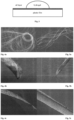
- the yarn's microstructure was investigated using a Zeiss Merlin Field-Emission SEM.
- For cross sectional analysis the yarns were cooled with liquid nitrogen and fractured.
- For surface analysis the yarns were settled on sample stub with a carbon tape. In both cases the samples were coated with thin layer of platinum using a sputter coater.
- the SEM was operated using 2 kV of acceleration voltage using both secondary electron and InLens detectors.
- the strength of the nanofiber yarn was measured on a custom made tensile tester.
- the fiber was attached to a block of metal with double sided tape.
- the other end of the fiber was pulled up at 50 micron/second using a geared stepper motor.
- the span of the fiber was 30 mm.
- the metal block was placed on a 4 digit Precisa balance and the weight is monitored at 10 Hz through serial communication with PC. The maximum force before the fiber break was then used to calculate the tensile strength.
- the measurement of tensile strength was performed in a controlled climate chamber.
- the temperature was held constant at 22°C.
- the relative humidity is controlled using moistured air at different humidity level.
- the lowest relative humidity level that could be achieved was 14%.
- the highest humidity level was 90%.
- the tensile tester was placed inside the chamber together with the sample. The sample was stored in the chamber for at least 2 hours before each measurement.
Landscapes
- Engineering & Computer Science (AREA)
- Chemical & Material Sciences (AREA)
- Textile Engineering (AREA)
- Mechanical Engineering (AREA)
- Chemical Kinetics & Catalysis (AREA)
- Nanotechnology (AREA)
- General Chemical & Material Sciences (AREA)
- Materials Engineering (AREA)
- General Physics & Mathematics (AREA)
- Composite Materials (AREA)
- Condensed Matter Physics & Semiconductors (AREA)
- Physics & Mathematics (AREA)
- Crystallography & Structural Chemistry (AREA)
- Medicinal Chemistry (AREA)
- Organic Chemistry (AREA)
- Polymers & Plastics (AREA)
- Health & Medical Sciences (AREA)
- Manufacturing & Machinery (AREA)
- Dispersion Chemistry (AREA)
- Biochemistry (AREA)
- Life Sciences & Earth Sciences (AREA)
- Artificial Filaments (AREA)
- Spinning Methods And Devices For Manufacturing Artificial Fibers (AREA)
- Polysaccharides And Polysaccharide Derivatives (AREA)
- Yarns And Mechanical Finishing Of Yarns Or Ropes (AREA)
- Nonwoven Fabrics (AREA)
- Chemical Or Physical Treatment Of Fibers (AREA)
Claims (9)
- Ein Verfahren zur Herstellung eines Nanofasergarns mit hoher Zugfestigkeit mittels Nassextrusion, dadurch gekennzeichnet, dass einzelne Zellulose-Nanofasern zunächst durch die Ausrichtung in einer Düse gemeinsam ausgerichtet werden und ein Nanofasernetzwerk bilden, wobei ein Zellulose-Nanohydrogel aus natürlicher und nicht modifizierter nanofibrillierter Zellulose hergestellt wird, wobei die Ausrichtung in der Düse das Einfließen des Zellulose-Hydrogels aus einer Spritze in eine Düse umfasst, die kleiner als die Spritze ist, und das Zellulose-Nanohydrogel mit einer Strahlgeschwindigkeit zwischen 4 und 32 m/s durch die Düse extrudiert wird, wobei die Düse einen Innendurchmesser zwischen 10 und 150 µm hat, wonach das Nanofasernetzwerk mittels Ausrichtung auf der Oberfläche gestreckt wird, wobei ein Hydrogelstrahl aus der Düse auf eine sich bewegende glatte Oberfläche aufgebracht wird und das durch eine Kombination aus der Ausrichtung in der Düse und der Ausrichtung auf der Oberfläche gebildete Nanofasergarn nach der Ausrichtung auf der Oberfläche auf der sich bewegenden Oberfläche luftgetrocknet wird.
- Das Verfahren nach Anspruch 1, dadurch gekennzeichnet, dass das Nanofasernetzwerk durch eine Wechselwirkung einer kontinuierlichen Wasserphase mit dem Nanofasernetzwerk entlang einer Strahlstromrichtung gestreckt wird.
- Ein Verfahren nach einem der vorangegangenen Ansprüche, dadurch gekennzeichnet, dass das Nanofasernetzwerk mit einem Streckverhältnis von mindestens 0,1, vorzugsweise mehr als 1, gestreckt wird.
- Das Verfahren nach einem der vorangegangenen Ansprüche, dadurch gekennzeichnet, dass die Strahlgeschwindigkeit im Bereich von 10 bis 25 m/s liegt.
- Ein Verfahren nach einem der vorangegangenen Ansprüche, dadurch gekennzeichnet, dass der Hydrogelstrahl aus der Düse in einem Aufprallwinkel zwischen 90 und 20 Grad auf die sich bewegende Oberfläche prallt, wobei der Strahl bei 90 Grad senkrecht zur Oberfläche und bei 0 Grad tangential zur Oberfläche steht.
- Das Verfahren nach Anspruch 5, dadurch gekennzeichnet, dass der Aufprallwinkel zwischen 90 und 40 Grad, vorzugsweise zwischen 75 und 55 Grad liegt.
- Das Verfahren nach einem der vorangegangenen Ansprüche, dadurch gekennzeichnet, dass der Abstand zwischen der Düse und der beweglichen Oberfläche so groß ist, dass er eine kontinuierliche Wasserphase und die Bildung eines einheitlichen nassen Fadens ermöglicht.
- Das Verfahren nach einem der vorangegangenen Ansprüche, dadurch gekennzeichnet, dass das Nanofasergarn mit einer Geschwindigkeit von mindestens 500 m/min hergestellt wird.
- Das Verfahren nach einem der vorangegangenen Ansprüche, dadurch gekennzeichnet, dass dem Zellulose-Nanohydrogel ein hochmolekulares Polymeradditiv zugesetzt wird, um den Extrusionsdruck zu verringern und ein Verstopfen der Düsen zu verhindern.
Applications Claiming Priority (2)
| Application Number | Priority Date | Filing Date | Title |
|---|---|---|---|
| FI20146148A FI127137B (en) | 2014-12-23 | 2014-12-23 | A method for producing high tensile strength nanofiber yarn |
| PCT/FI2015/050939 WO2016102782A1 (en) | 2014-12-23 | 2015-12-23 | Method for producing high tensile strength nanofiber yarn |
Publications (4)
| Publication Number | Publication Date |
|---|---|
| EP3237657A1 EP3237657A1 (de) | 2017-11-01 |
| EP3237657A4 EP3237657A4 (de) | 2018-06-20 |
| EP3237657C0 EP3237657C0 (de) | 2024-03-06 |
| EP3237657B1 true EP3237657B1 (de) | 2024-03-06 |
Family
ID=56149326
Family Applications (1)
| Application Number | Title | Priority Date | Filing Date |
|---|---|---|---|
| EP15872032.6A Active EP3237657B1 (de) | 2014-12-23 | 2015-12-23 | Verfahren zum herstellen von nanofasergarn mit hoher zugfestigkeit |
Country Status (12)
| Country | Link |
|---|---|
| US (1) | US10435819B2 (de) |
| EP (1) | EP3237657B1 (de) |
| JP (1) | JP6366860B2 (de) |
| CN (1) | CN107109706B (de) |
| BR (1) | BR112017013575B1 (de) |
| CA (1) | CA2971637C (de) |
| CL (1) | CL2017001644A1 (de) |
| ES (1) | ES2987652T3 (de) |
| FI (1) | FI127137B (de) |
| HK (1) | HK1244854A1 (de) |
| RU (1) | RU2660071C1 (de) |
| WO (1) | WO2016102782A1 (de) |
Families Citing this family (6)
| Publication number | Priority date | Publication date | Assignee | Title |
|---|---|---|---|---|
| PT3445900T (pt) | 2016-04-22 | 2022-09-19 | Fiberlean Tech Ltd | Fibras compreendendo celulose microfibrilada e métodos de fibras e materiais não tecidos das mesmas |
| US20200048794A1 (en) * | 2017-02-15 | 2020-02-13 | Ecco Sko A/S | Method and apparatus for manufacturing a staple fiber based on natural protein fiber, a raw wool based on the staple fiber, a fibrous yarn made of the staple fiber, a non-woven material made of the staple fiber and an item comprising the staple fiber. |
| JP6964861B2 (ja) * | 2017-05-22 | 2021-11-10 | エム・テックス株式会社 | ナノファイバー製造装置およびそれに用いられるヘッド |
| CN110820065B (zh) * | 2019-11-05 | 2021-08-10 | 东华大学 | 一种连续化制备高强度水凝胶纤维的方法 |
| US20240337046A1 (en) * | 2022-12-16 | 2024-10-10 | Regents Of The University Of Michigan | Aramid nanofiber filaments and related methods |
| JPWO2025047621A1 (de) * | 2023-08-25 | 2025-03-06 |
Family Cites Families (11)
| Publication number | Priority date | Publication date | Assignee | Title |
|---|---|---|---|---|
| JPH09157939A (ja) * | 1995-12-04 | 1997-06-17 | Toray Ind Inc | 太単糸繊度ポリエステル繊維の製造方法 |
| CN1922363B (zh) * | 2004-02-19 | 2011-04-13 | 东丽株式会社 | 纳米纤维配合溶液、乳液和凝胶状物及其制造方法,以及纳米纤维合成纸及其制造方法 |
| RS53433B (sr) * | 2008-10-14 | 2014-12-31 | Sappi Netherlands Services B.V. | Postupak za proizvodnju vlakana na bazi celuloze i tako dobijena vlakna |
| JP2011208015A (ja) * | 2010-03-30 | 2011-10-20 | Konica Minolta Holdings Inc | 繊維複合材料 |
| TWI545238B (zh) | 2010-04-13 | 2016-08-11 | 薩佩荷蘭服務有限公司 | 製造纖維素基纖維之方法及由此所得之纖維 |
| FI127301B (fi) * | 2011-02-10 | 2018-03-15 | Upm Kymmene Corp | Menetelmä nanoselluloosan käsittelemiseksi ja menetelmällä saatu tuote |
| JP6148178B2 (ja) * | 2011-02-10 | 2017-06-14 | ウーペーエム−キュンメネ コーポレイションUPM−Kymmene Corporation | 繊維状生成物および複合材料の製造方法 |
| JP5394469B2 (ja) * | 2011-12-01 | 2014-01-22 | 三菱レイヨン株式会社 | 多孔質電極基材の製造方法及び多孔質電極基材 |
| WO2013122209A1 (ja) | 2012-02-17 | 2013-08-22 | Dic株式会社 | 繊維強化樹脂複合体、及び繊維強化樹脂用の強化マトリクス樹脂 |
| BR112015008315B1 (pt) * | 2012-10-22 | 2021-11-16 | Innventia Ab | Método de fibras de fiação ou extrusão |
| CA2909453C (en) * | 2013-04-12 | 2018-05-15 | The Procter & Gamble Company | Hydroxyl polymer fiber structures comprising ammonium alkylsulfonate salts and methods for making same |
-
2014
- 2014-12-23 FI FI20146148A patent/FI127137B/en active IP Right Grant
-
2015
- 2015-12-23 WO PCT/FI2015/050939 patent/WO2016102782A1/en not_active Ceased
- 2015-12-23 RU RU2017125062A patent/RU2660071C1/ru active
- 2015-12-23 JP JP2017552239A patent/JP6366860B2/ja active Active
- 2015-12-23 ES ES15872032T patent/ES2987652T3/es active Active
- 2015-12-23 EP EP15872032.6A patent/EP3237657B1/de active Active
- 2015-12-23 CN CN201580070888.9A patent/CN107109706B/zh active Active
- 2015-12-23 HK HK18104216.0A patent/HK1244854A1/zh unknown
- 2015-12-23 US US15/538,931 patent/US10435819B2/en active Active
- 2015-12-23 BR BR112017013575-2A patent/BR112017013575B1/pt active IP Right Grant
- 2015-12-23 CA CA2971637A patent/CA2971637C/en active Active
-
2017
- 2017-06-21 CL CL2017001644A patent/CL2017001644A1/es unknown
Also Published As
| Publication number | Publication date |
|---|---|
| CA2971637A1 (en) | 2016-06-30 |
| BR112017013575A2 (pt) | 2018-03-06 |
| EP3237657A4 (de) | 2018-06-20 |
| EP3237657A1 (de) | 2017-11-01 |
| BR112017013575B1 (pt) | 2022-08-30 |
| CN107109706A (zh) | 2017-08-29 |
| EP3237657C0 (de) | 2024-03-06 |
| ES2987652T3 (es) | 2024-11-15 |
| CN107109706B (zh) | 2021-07-06 |
| CA2971637C (en) | 2018-12-04 |
| FI127137B (en) | 2017-12-15 |
| RU2660071C1 (ru) | 2018-07-04 |
| WO2016102782A1 (en) | 2016-06-30 |
| US10435819B2 (en) | 2019-10-08 |
| CL2017001644A1 (es) | 2018-02-16 |
| JP6366860B2 (ja) | 2018-08-01 |
| FI20146148A7 (fi) | 2016-06-24 |
| JP2018503008A (ja) | 2018-02-01 |
| US20170356102A1 (en) | 2017-12-14 |
| HK1244854A1 (zh) | 2018-08-17 |
Similar Documents
| Publication | Publication Date | Title |
|---|---|---|
| US10435819B2 (en) | Method for producing high tensile strength nanofiber yarn | |
| KR102132893B1 (ko) | 증가된 피브릴화 경향성을 지니는 폴리사카라이드 섬유 및 이의 제조 방법 | |
| Lu et al. | Parameter study and characterization for polyacrylonitrile nanofibers fabricated via centrifugal spinning process | |
| KR102132886B1 (ko) | 폴리사카라이드 섬유 및 이의 생산 방법 | |
| Wang et al. | Electrospun ultra-fine silk fibroin fibers from aqueous solutions | |
| Shen et al. | High velocity dry spinning of nanofibrillated cellulose (CNF) filaments on an adhesion controlled surface with low friction | |
| Liu et al. | Electrospinning of cellulose acetate in solvent mixture N, N-dimethylacetamide (DMAc)/acetone | |
| Huang et al. | Electrospinning of Bombyx mori silk fibroin nanofiber mats reinforced by cellulose nanowhiskers | |
| WO2016135385A1 (en) | Process for producing shaped articles based on cellulose | |
| Ali et al. | Online stretching of directly electrospun nanofiber yarns | |
| CN102232128B (zh) | 制造基于纤维素的纤维的方法和由此获得的纤维 | |
| Wang et al. | Strong fibrous filaments nanocellulose crystals prepared by self-twisting microfluidic spinning | |
| Dabirian et al. | The effects of operating parameters on the fabrication of polyacrylonitrile nanofibers in electro-centrifuge spinning | |
| Prasanth et al. | Electrospinning of cellulose: Process and applications | |
| CN110373729A (zh) | 初生纤维、聚丙烯腈纤维、聚丙烯腈基碳纤维及制备方法 | |
| Heseltine et al. | Fiber formation from silk fibroin using pressurized gyration | |
| CN111788340A (zh) | 具有粘胶样性质的莱赛尔纤维 | |
| IT202000002827A1 (it) | Composizione da elettrofilare | |
| KR101429686B1 (ko) | 고점도 고강력 산업용 폴리에스테르 섬유의 제작 | |
| CN105316792A (zh) | 超细锦纶与微细涤纶的双复合纤维的制造工艺 | |
| Perez-Rigueiro et al. | Supramolecular organization of regenerated silkworm silk fibers | |
| Luo et al. | Electrospinning short polymer micro-fibres with average aspect ratios in the range of 10–200 | |
| MXPA02010371A (es) | Procedimiento de soplado por fusion con atenuacion mecanica. | |
| CN100376733C (zh) | 一种高强度输送带及其所使用的涤纶纤维丝织物芯 | |
| Kamalha et al. | Effect of solvent concentration on morphology of electrospun Bombyx mori silk |
Legal Events
| Date | Code | Title | Description |
|---|---|---|---|
| STAA | Information on the status of an ep patent application or granted ep patent |
Free format text: STATUS: THE INTERNATIONAL PUBLICATION HAS BEEN MADE |
|
| PUAI | Public reference made under article 153(3) epc to a published international application that has entered the european phase |
Free format text: ORIGINAL CODE: 0009012 |
|
| STAA | Information on the status of an ep patent application or granted ep patent |
Free format text: STATUS: REQUEST FOR EXAMINATION WAS MADE |
|
| 17P | Request for examination filed |
Effective date: 20170704 |
|
| AK | Designated contracting states |
Kind code of ref document: A1 Designated state(s): AL AT BE BG CH CY CZ DE DK EE ES FI FR GB GR HR HU IE IS IT LI LT LU LV MC MK MT NL NO PL PT RO RS SE SI SK SM TR |
|
| AX | Request for extension of the european patent |
Extension state: BA ME |
|
| DAV | Request for validation of the european patent (deleted) | ||
| DAX | Request for extension of the european patent (deleted) | ||
| A4 | Supplementary search report drawn up and despatched |
Effective date: 20180523 |
|
| RIC1 | Information provided on ipc code assigned before grant |
Ipc: D01D 5/06 20060101ALI20180516BHEP Ipc: D01D 1/06 20060101ALI20180516BHEP Ipc: C08J 3/05 20060101ALI20180516BHEP Ipc: D01D 5/16 20060101ALI20180516BHEP Ipc: D01F 2/00 20060101AFI20180516BHEP Ipc: B82Y 30/00 20110101ALI20180516BHEP |
|
| REG | Reference to a national code |
Ref country code: HK Ref legal event code: DE Ref document number: 1244854 Country of ref document: HK |
|
| STAA | Information on the status of an ep patent application or granted ep patent |
Free format text: STATUS: EXAMINATION IS IN PROGRESS |
|
| 17Q | First examination report despatched |
Effective date: 20190813 |
|
| GRAP | Despatch of communication of intention to grant a patent |
Free format text: ORIGINAL CODE: EPIDOSNIGR1 |
|
| STAA | Information on the status of an ep patent application or granted ep patent |
Free format text: STATUS: GRANT OF PATENT IS INTENDED |
|
| RIC1 | Information provided on ipc code assigned before grant |
Ipc: D01F 9/16 20060101ALN20231108BHEP Ipc: B82Y 30/00 20110101ALI20231108BHEP Ipc: D01D 5/06 20060101ALI20231108BHEP Ipc: D01D 5/04 20060101ALI20231108BHEP Ipc: D01D 1/06 20060101ALI20231108BHEP Ipc: C08J 3/05 20060101ALI20231108BHEP Ipc: D01F 1/02 20060101ALI20231108BHEP Ipc: D01F 2/00 20060101AFI20231108BHEP |
|
| INTG | Intention to grant announced |
Effective date: 20231204 |
|
| GRAS | Grant fee paid |
Free format text: ORIGINAL CODE: EPIDOSNIGR3 |
|
| GRAA | (expected) grant |
Free format text: ORIGINAL CODE: 0009210 |
|
| STAA | Information on the status of an ep patent application or granted ep patent |
Free format text: STATUS: THE PATENT HAS BEEN GRANTED |
|
| RAP3 | Party data changed (applicant data changed or rights of an application transferred) |
Owner name: SPINNOVA OYJ |
|
| AK | Designated contracting states |
Kind code of ref document: B1 Designated state(s): AL AT BE BG CH CY CZ DE DK EE ES FI FR GB GR HR HU IE IS IT LI LT LU LV MC MK MT NL NO PL PT RO RS SE SI SK SM TR |
|
| REG | Reference to a national code |
Ref country code: GB Ref legal event code: FG4D |
|
| REG | Reference to a national code |
Ref country code: CH Ref legal event code: EP |
|
| REG | Reference to a national code |
Ref country code: IE Ref legal event code: FG4D |
|
| REG | Reference to a national code |
Ref country code: DE Ref legal event code: R096 Ref document number: 602015087844 Country of ref document: DE |
|
| U01 | Request for unitary effect filed |
Effective date: 20240320 |
|
| U07 | Unitary effect registered |
Designated state(s): AT BE BG DE DK EE FI FR IT LT LU LV MT NL PT SE SI Effective date: 20240327 |
|
| PG25 | Lapsed in a contracting state [announced via postgrant information from national office to epo] |
Ref country code: GR Free format text: LAPSE BECAUSE OF FAILURE TO SUBMIT A TRANSLATION OF THE DESCRIPTION OR TO PAY THE FEE WITHIN THE PRESCRIBED TIME-LIMIT Effective date: 20240607 |
|
| PG25 | Lapsed in a contracting state [announced via postgrant information from national office to epo] |
Ref country code: RS Free format text: LAPSE BECAUSE OF FAILURE TO SUBMIT A TRANSLATION OF THE DESCRIPTION OR TO PAY THE FEE WITHIN THE PRESCRIBED TIME-LIMIT Effective date: 20240606 Ref country code: HR Free format text: LAPSE BECAUSE OF FAILURE TO SUBMIT A TRANSLATION OF THE DESCRIPTION OR TO PAY THE FEE WITHIN THE PRESCRIBED TIME-LIMIT Effective date: 20240306 |
|
| PG25 | Lapsed in a contracting state [announced via postgrant information from national office to epo] |
Ref country code: RS Free format text: LAPSE BECAUSE OF FAILURE TO SUBMIT A TRANSLATION OF THE DESCRIPTION OR TO PAY THE FEE WITHIN THE PRESCRIBED TIME-LIMIT Effective date: 20240606 Ref country code: NO Free format text: LAPSE BECAUSE OF FAILURE TO SUBMIT A TRANSLATION OF THE DESCRIPTION OR TO PAY THE FEE WITHIN THE PRESCRIBED TIME-LIMIT Effective date: 20240606 Ref country code: HR Free format text: LAPSE BECAUSE OF FAILURE TO SUBMIT A TRANSLATION OF THE DESCRIPTION OR TO PAY THE FEE WITHIN THE PRESCRIBED TIME-LIMIT Effective date: 20240306 Ref country code: GR Free format text: LAPSE BECAUSE OF FAILURE TO SUBMIT A TRANSLATION OF THE DESCRIPTION OR TO PAY THE FEE WITHIN THE PRESCRIBED TIME-LIMIT Effective date: 20240607 |
|
| PG25 | Lapsed in a contracting state [announced via postgrant information from national office to epo] |
Ref country code: IS Free format text: LAPSE BECAUSE OF FAILURE TO SUBMIT A TRANSLATION OF THE DESCRIPTION OR TO PAY THE FEE WITHIN THE PRESCRIBED TIME-LIMIT Effective date: 20240706 |
|
| PG25 | Lapsed in a contracting state [announced via postgrant information from national office to epo] |
Ref country code: SM Free format text: LAPSE BECAUSE OF FAILURE TO SUBMIT A TRANSLATION OF THE DESCRIPTION OR TO PAY THE FEE WITHIN THE PRESCRIBED TIME-LIMIT Effective date: 20240306 |
|
| PG25 | Lapsed in a contracting state [announced via postgrant information from national office to epo] |
Ref country code: CZ Free format text: LAPSE BECAUSE OF FAILURE TO SUBMIT A TRANSLATION OF THE DESCRIPTION OR TO PAY THE FEE WITHIN THE PRESCRIBED TIME-LIMIT Effective date: 20240306 |
|
| PG25 | Lapsed in a contracting state [announced via postgrant information from national office to epo] |
Ref country code: PL Free format text: LAPSE BECAUSE OF FAILURE TO SUBMIT A TRANSLATION OF THE DESCRIPTION OR TO PAY THE FEE WITHIN THE PRESCRIBED TIME-LIMIT Effective date: 20240306 |
|
| PG25 | Lapsed in a contracting state [announced via postgrant information from national office to epo] |
Ref country code: SK Free format text: LAPSE BECAUSE OF FAILURE TO SUBMIT A TRANSLATION OF THE DESCRIPTION OR TO PAY THE FEE WITHIN THE PRESCRIBED TIME-LIMIT Effective date: 20240306 |
|
| PG25 | Lapsed in a contracting state [announced via postgrant information from national office to epo] |
Ref country code: SM Free format text: LAPSE BECAUSE OF FAILURE TO SUBMIT A TRANSLATION OF THE DESCRIPTION OR TO PAY THE FEE WITHIN THE PRESCRIBED TIME-LIMIT Effective date: 20240306 Ref country code: SK Free format text: LAPSE BECAUSE OF FAILURE TO SUBMIT A TRANSLATION OF THE DESCRIPTION OR TO PAY THE FEE WITHIN THE PRESCRIBED TIME-LIMIT Effective date: 20240306 Ref country code: RO Free format text: LAPSE BECAUSE OF FAILURE TO SUBMIT A TRANSLATION OF THE DESCRIPTION OR TO PAY THE FEE WITHIN THE PRESCRIBED TIME-LIMIT Effective date: 20240306 Ref country code: PL Free format text: LAPSE BECAUSE OF FAILURE TO SUBMIT A TRANSLATION OF THE DESCRIPTION OR TO PAY THE FEE WITHIN THE PRESCRIBED TIME-LIMIT Effective date: 20240306 Ref country code: IS Free format text: LAPSE BECAUSE OF FAILURE TO SUBMIT A TRANSLATION OF THE DESCRIPTION OR TO PAY THE FEE WITHIN THE PRESCRIBED TIME-LIMIT Effective date: 20240706 Ref country code: CZ Free format text: LAPSE BECAUSE OF FAILURE TO SUBMIT A TRANSLATION OF THE DESCRIPTION OR TO PAY THE FEE WITHIN THE PRESCRIBED TIME-LIMIT Effective date: 20240306 |
|
| REG | Reference to a national code |
Ref country code: ES Ref legal event code: FG2A Ref document number: 2987652 Country of ref document: ES Kind code of ref document: T3 Effective date: 20241115 |
|
| REG | Reference to a national code |
Ref country code: DE Ref legal event code: R097 Ref document number: 602015087844 Country of ref document: DE |
|
| U20 | Renewal fee for the european patent with unitary effect paid |
Year of fee payment: 10 Effective date: 20241128 |
|
| PLBE | No opposition filed within time limit |
Free format text: ORIGINAL CODE: 0009261 |
|
| STAA | Information on the status of an ep patent application or granted ep patent |
Free format text: STATUS: NO OPPOSITION FILED WITHIN TIME LIMIT |
|
| 26N | No opposition filed |
Effective date: 20241209 |
|
| PG25 | Lapsed in a contracting state [announced via postgrant information from national office to epo] |
Ref country code: MC Free format text: LAPSE BECAUSE OF FAILURE TO SUBMIT A TRANSLATION OF THE DESCRIPTION OR TO PAY THE FEE WITHIN THE PRESCRIBED TIME-LIMIT Effective date: 20240306 |
|
| REG | Reference to a national code |
Ref country code: HK Ref legal event code: WD Ref document number: 1244854 Country of ref document: HK |
|
| REG | Reference to a national code |
Ref country code: CH Ref legal event code: PL |
|
| PG25 | Lapsed in a contracting state [announced via postgrant information from national office to epo] |
Ref country code: CH Free format text: LAPSE BECAUSE OF NON-PAYMENT OF DUE FEES Effective date: 20241231 |
|
| PG25 | Lapsed in a contracting state [announced via postgrant information from national office to epo] |
Ref country code: IE Free format text: LAPSE BECAUSE OF NON-PAYMENT OF DUE FEES Effective date: 20241223 |
|
| U20 | Renewal fee for the european patent with unitary effect paid |
Year of fee payment: 11 Effective date: 20251120 |
|
| PGFP | Annual fee paid to national office [announced via postgrant information from national office to epo] |
Ref country code: GB Payment date: 20251219 Year of fee payment: 11 |
|
| PGFP | Annual fee paid to national office [announced via postgrant information from national office to epo] |
Ref country code: TR Payment date: 20251128 Year of fee payment: 11 |
|
| PGFP | Annual fee paid to national office [announced via postgrant information from national office to epo] |
Ref country code: ES Payment date: 20260122 Year of fee payment: 11 |
|
| PG25 | Lapsed in a contracting state [announced via postgrant information from national office to epo] |
Ref country code: CY Free format text: LAPSE BECAUSE OF FAILURE TO SUBMIT A TRANSLATION OF THE DESCRIPTION OR TO PAY THE FEE WITHIN THE PRESCRIBED TIME-LIMIT Effective date: 20240306 |