EP3222735B1 - Verfahren zur trennung von cobalt und magnesium aus einer nickelhaltigen extraktionszuführlösung - Google Patents
Verfahren zur trennung von cobalt und magnesium aus einer nickelhaltigen extraktionszuführlösung Download PDFInfo
- Publication number
- EP3222735B1 EP3222735B1 EP17161716.0A EP17161716A EP3222735B1 EP 3222735 B1 EP3222735 B1 EP 3222735B1 EP 17161716 A EP17161716 A EP 17161716A EP 3222735 B1 EP3222735 B1 EP 3222735B1
- Authority
- EP
- European Patent Office
- Prior art keywords
- extraction
- solution
- washing
- cobalt
- nickel
- Prior art date
- Legal status (The legal status is an assumption and is not a legal conclusion. Google has not performed a legal analysis and makes no representation as to the accuracy of the status listed.)
- Active
Links
Images

Classifications
-
- C—CHEMISTRY; METALLURGY
- C22—METALLURGY; FERROUS OR NON-FERROUS ALLOYS; TREATMENT OF ALLOYS OR NON-FERROUS METALS
- C22B—PRODUCTION AND REFINING OF METALS; PRETREATMENT OF RAW MATERIALS
- C22B3/00—Extraction of metal compounds from ores or concentrates by wet processes
- C22B3/20—Treatment or purification of solutions, e.g. obtained by leaching
- C22B3/26—Treatment or purification of solutions, e.g. obtained by leaching by liquid-liquid extraction using organic compounds
- C22B3/38—Treatment or purification of solutions, e.g. obtained by leaching by liquid-liquid extraction using organic compounds containing phosphorus
- C22B3/384—Pentavalent phosphorus oxyacids, esters thereof
- C22B3/3842—Phosphinic acid, e.g. H2P(O)(OH)
-
- C—CHEMISTRY; METALLURGY
- C22—METALLURGY; FERROUS OR NON-FERROUS ALLOYS; TREATMENT OF ALLOYS OR NON-FERROUS METALS
- C22B—PRODUCTION AND REFINING OF METALS; PRETREATMENT OF RAW MATERIALS
- C22B23/00—Obtaining nickel or cobalt
- C22B23/04—Obtaining nickel or cobalt by wet processes
- C22B23/0453—Treatment or purification of solutions, e.g. obtained by leaching
-
- B—PERFORMING OPERATIONS; TRANSPORTING
- B01—PHYSICAL OR CHEMICAL PROCESSES OR APPARATUS IN GENERAL
- B01D—SEPARATION
- B01D11/00—Solvent extraction
- B01D11/04—Solvent extraction of solutions which are liquid
-
- C—CHEMISTRY; METALLURGY
- C22—METALLURGY; FERROUS OR NON-FERROUS ALLOYS; TREATMENT OF ALLOYS OR NON-FERROUS METALS
- C22B—PRODUCTION AND REFINING OF METALS; PRETREATMENT OF RAW MATERIALS
- C22B23/00—Obtaining nickel or cobalt
- C22B23/04—Obtaining nickel or cobalt by wet processes
- C22B23/0476—Separation of nickel from cobalt
- C22B23/0484—Separation of nickel from cobalt in acidic type solutions
-
- C—CHEMISTRY; METALLURGY
- C22—METALLURGY; FERROUS OR NON-FERROUS ALLOYS; TREATMENT OF ALLOYS OR NON-FERROUS METALS
- C22B—PRODUCTION AND REFINING OF METALS; PRETREATMENT OF RAW MATERIALS
- C22B23/00—Obtaining nickel or cobalt
- C22B23/04—Obtaining nickel or cobalt by wet processes
- C22B23/0476—Separation of nickel from cobalt
- C22B23/0492—Separation of nickel from cobalt in ammoniacal type solutions
-
- C—CHEMISTRY; METALLURGY
- C22—METALLURGY; FERROUS OR NON-FERROUS ALLOYS; TREATMENT OF ALLOYS OR NON-FERROUS METALS
- C22B—PRODUCTION AND REFINING OF METALS; PRETREATMENT OF RAW MATERIALS
- C22B26/00—Obtaining alkali, alkaline earth metals or magnesium
- C22B26/20—Obtaining alkaline earth metals or magnesium
- C22B26/22—Obtaining magnesium
-
- Y—GENERAL TAGGING OF NEW TECHNOLOGICAL DEVELOPMENTS; GENERAL TAGGING OF CROSS-SECTIONAL TECHNOLOGIES SPANNING OVER SEVERAL SECTIONS OF THE IPC; TECHNICAL SUBJECTS COVERED BY FORMER USPC CROSS-REFERENCE ART COLLECTIONS [XRACs] AND DIGESTS
- Y02—TECHNOLOGIES OR APPLICATIONS FOR MITIGATION OR ADAPTATION AGAINST CLIMATE CHANGE
- Y02P—CLIMATE CHANGE MITIGATION TECHNOLOGIES IN THE PRODUCTION OR PROCESSING OF GOODS
- Y02P10/00—Technologies related to metal processing
- Y02P10/20—Recycling
Definitions
- the invention relates to a method according to the preamble of claim 1 for separating cobalt and magnesium from a nickel-bearing extraction feed solution.
- the hydrometallurgical refinement of nickel from impure raw materials into various pure nickel products comprises typically sub-processes such as: dissolution, solution purification, and manufacture of products.
- Raw materials for the refinement process may include nickel matte which is a product from smelting sulfidic nickel concentrates, an intermediate product from the hydrometallurgical refinement of various nickel ores, and/or secondary nickel compounds as byproducts from the refinement of other metals, and/or nickel-bearing recycled materials.
- the present invention relates generally speaking to a method of treating cobalt-, magnesium- and nickel-containing aqueous solutions in a manner to provide separate aqueous solutions containing primarily cobalt, magnesium and nickel.
- the cobalt and magnesium are extracted from the nickel-containing aqueous solution into separate aqueous solutions containing primarily cobalt and magnesium and into a cobalt- as well as magnesium-free, nickel-containing aqueous solution.
- the method according to the invention comprises separating cobalt, magnesium and nickel from each other with liquid-liquid extraction.
- the liquid-liquid extraction is commonly employed as a solution purification process for cleaning impurity metals from the dissolution-generated nickel solution prior to the manufacture of nickel products.
- Cobalt, magnesium and nickel make their way to a hydrometallurgical refinement process in raw materials and/or bulk supplies, whereby these metals end up in the nickel solution generated in dissolution. From the standpoint of the quality of nickel and cobalt products and the functionality of processes it is important to enable cobalt, magnesium and nickel to be separated from each other. Concentrations of these metals vary in the solution, depending on the employed raw material, bulk supplies, and pretreatment processes used for the same.
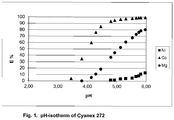
- the equilibrium concentrations of element speciations in the extraction reaction are primarily determined by pH of the aqueous solution, and for each metal can be determined a specific pH-isotherm.
- Fig. 1 shows how the metal extraction rate settles at each pH with Cyanex 272 as extraction reagent.
- the extraction of cobalt from an aqueous nickel solution is typically carried out at a pH value higher than 5 at which the extraction rate of cobalt is high and the extraction rate of nickel is low. In this case, however, some nickel and more magnesium become co-leached into the resulting extraction solution.
- Nickel is recovered from an extraction solution by washing the extraction solution with a cobalt-containing aqueous solution while pH is 4-5 and by returning the wash water to the extraction stage. In this case, however, most of the magnesium is also washed into the aqueous solution and tags along behind the nickel.
- Ni/Mg nickel-magnesium mass ratio
- the invention had a main objective of providing a liquid-liquid extraction method based on a cation-exchange mechanism, which would enable a thorough separation of magnesium out of an aqueous solution in such a manner that it does not follow the nickel into a raffinate or the cobalt into a product solution even if the extraction feed solution has a nickel-magnesium mass ratio (Ni/Mg) lower than 500.
- Ni/Mg nickel-magnesium mass ratio
- the invention relates to a method which comprises treating cobalt-, magnesium- and nickel-bearing aqueous solutions with liquid-liquid extraction so as to provide separate aqueous solutions containing primarily cobalt, magnesium and nickel.
- the invention relates to the method of fig. 2 for treating a cobalt-, magnesium- and nickel-bearing extraction feed solution 1 with liquid-liquid extraction, wherein a first extraction solution 2 contains some cation-exchange extraction reagent insoluble or poorly soluble in said extraction feed solution 1.
- the method according to the invention is defined in claim 1. It comprises at least the following method stages enabling cobalt and magnesium to be separated from a nickel-bearing extraction feed solution:
- the method further comprises a back-extraction stage D, in which the primarily cobalt-loaded fourth extraction solution is back-extracted with an aqueous solution of sulfuric acid or with an aqueous solution of some other mineral acid, i.e. with a back-extraction solution, whose acid content is 30-300 g/L, for providing a fifth extraction solution substantially free of metals and a primarily cobalt-containing product solution.
- the extraction feed solution, the first wash water and the second wash water are aqueous solutions.
- the washing solutions, the back-extraction solution and the product solution are also aqueous solutions.
- the aqueous solution of sulfuric acid can be replaced by using for example an aqueous solution of nitrogen acid or hydrochloric acid.
- the magnesium- and nickel-bearing aqueous solutions are processed with extraction in a manner to provide aqueous solutions which contain primarily cobalt, magnesium and nickel.
- the extraction reagent in the feed solution for a first extraction solution is bis(2,4,4-trimethylipentyl)phosphinic acid.
- the method according to the invention comprises separating cobalt, magnesium and nickel from each other.
- the extraction method according to the invention is based on bringing an aqueous solution with a content of metal salts, an extraction feed solution 1, in the extraction stage A into a blending contact with an extraction solution, whereby the cobalt and the magnesium, as well as some of the nickel, become extracted into the extraction solution and, after this stage, the aqueous solution is a nickel solution, a raffinate 3, which has been purified of magnesium and cobalt.
- the extraction stage A is followed by conducting the extraction solution to two washing stages B, C cross-currently linked relative to each other, the washing solution employed therein being a mixture of water, cobalt and sulfuric acid.
- the first washing stage B comprises washing nickel out of the extraction solution and the product resulting therefrom is a first wash water 6 which contains nickel and some magnesium.
- the first wash water 6 can be conducted into the extraction feed solution 1 which is on its way to the extraction stage A.
- the second washing stage C comprises washing magnesium out of the extraction solution and the obtained product is a second wash water 9 which contains magnesium, as well as some cobalt and nickel. From this solution it is further possible to recover the cobalt and the nickel by means of a separate subprocess.
- the washing stages B and C are followed by a back-extraction of cobalt from the extraction solution into the aqueous solution in a back-extraction stage D by lowering the pH value of this stage for example with sulfuric acid or some other mineral acid.
- the primarily cobalt-loaded fourth extraction solution is back-extracted with an aqueous solution of sulfuric acid or with an aqueous solution of some other mineral acid, i.e. with a back-extraction solution, whose acid content is 30-300 g/L, for providing a fifth extraction solution substantially free of metals and a primarily cobalt-containing product solution.
- the primarily nickel sulfate-containing first wash water can also be conducted to some process other than the liquid-liquid extraction process defined above in the extraction, washing and back-extraction stages (A, B, C and D).
- the primarily magnesium sulfate-containing second wash water is conducted to some process other than the liquid-liquid extraction process defined in the extraction, washing and back-extraction stages (A, B, C and D).
- a benefit of the presently developed method with respect to prior known liquid-liquid extraction methods used for separating cobalt and nickel resides in the capability of washing the co-extracting magnesium in isolation from cobalt and nickel and thus enabling a separation of cobalt, magnesium and nickel from each other in one and the same process.
- Cobalt, magnesium and nickel can be separated from each other for three discrete aqueous solution streams, whereby magnesium does not contaminate either a cobalt-containing product solution 12 or the nickel-containing raffinate 3 and therefrom is obtained a separate aqueous solution, the second wash water 9. This in turn increases a possibility of using magnesium-bearing raw materials and bulk supplies for the manufacture of pure nickel products.
- a considerable benefit specifically attained with the invention is that in a nickel-containing aqueous solution (raffinate) the nickel-magnesium and nickel-cobalt mass ratios can be brought to a value higher than 500, in a cobalt-containing aqueous solution the cobalt-magnesium and cobalt-nickel mass ratios can be brought to a value higher than 1000, as well as in a magnesium-containing aqueous solution the magnesium-nickel and magnesium-cobalt mass ratios can be brought to a value higher than 10.
- the extraction feed solution 1 has a nickel-magnesium mass ratio (Ni/Mg) of not lower than 70, but lower than 500.
- the nickel-magnesium mass ratio (Ni/Mg) in the extraction feed solution 1 can be 70 at its lowest, i.e. it is possible to thereby reduce the nickel-magnesium mass ratio (Ni/Mg) of the extraction feed solution 1 available for use in a liquid-liquid extraction method of the invention to become considerably lower than in prior known methods.
- the extraction stage A includes one or more extraction steps, which involve extracting cobalt and magnesium from the extraction feed solution at a pH range 4-6, preferably at a pH value 5,5.
- the washing of an extraction solution respectively in the washing stages B and C comprises one or more washing steps, wherein said respective extraction solution is washed with a washing solution containing water, cobalt and sulfuric acid.
- the washing process of an extraction solution with a washing solution both in washing stage B and in washing stage C comprises several washing steps with a target pH of 3-5. In washing stage C, the target pH is nevertheless lower than in washing stage B.
- the extraction solution washing stage is divided into two separate stages, in each of which stages the employed washing solution will be a mixture of water, cobalt and sulfuric acid.
- the extraction solution is washed to first remove nickel and then magnesium. It is by a pH adjustment of the washing stage that enables a desired metal to be selectively washed out of the extraction solution.
- the result is a nickel-containing first wash water 6 with some magnesium content and a magnesium-containing second wash water 9 with some cobalt and nickel content.
- the extraction feed solution 1 is an aqueous solution which contains cobalt, magnesium and nickel in bivalent ions while the counterion is a sulfate ion or some other ion.
- the extraction feed solution 1 can have for example a nickel content of 50-140 g/L. a magnesium content of 0,1-2 g/L, and a cobalt content of 0-5 g/L.
- the aqueous solution may contain other impurities such as sodium, calcium, copper, zinc, manganese and iron.
- the extraction reagent which is used in a water-insoluble aqueous solution, is a cation-exchange extraction reagent such as bis(2,4,4-trimethylpentyl)phosphinic acid with a trade name Cyanex 272 (manufactured by Cytec Solvay Group).
- Cyanex 272 manufactured by Cytec Solvay Group
- the pH isotherms of Cyanex 272 are shown in fig. 1 for various metals.
- the extraction reagent has been diluted into kerosene or some other appropriate organic inert solvent poorly soluble in water.
- the method has a process cycle consistent with fig. 2 .
- Various stages A, B, C and D of the process cycle may comprise one of more steps or extraction units.
- the cobalt and magnesium ions, as well as some of the nickel ions produce a water-insoluble organometallic complex with an extraction reagent and the acidity-inducing hydrogen ion, released from the extraction reagent into an aqueous solution, is neutralized with an appropriate neutralizing agent such as ammonia.
- the aqueous solution leaving the extraction stage A is referred to as a raffinate 3 and it is an aqueous solution of nickel sulfate purified of cobalt and magnesium.
- a cobalt-, magnesium- and nickel-loaded second extraction solution 4 passes to the washing stage B, wherein it is washed in a countercurrent fashion with a water-, cobalt- and sulfuric acid-containing first washing solution 5 whose pH has been adjusted to the range of 0,5-5.
- each step of the washing stage B may include an adjustment of pH with sulfuric acid water.
- the steps have a target pH within the range of 3-5.
- the nickel loaded in the second extraction solution 4 is replaced with cobalt and the first wash water 6 has primarily nickel left therein.
- the some cobalt- and magnesium-containing first wash water 6, leaving this stage can be conducted either to the extraction stage A by combining it with the extraction feed solution 1 of the extraction stage A as shown in the process cycle of fig. 2 , or to some other treatment, i.e. outside the liquid-liquid extraction process shown in fig. 2 .
- a third extraction solution 7 has a very low content of loaded nickel after the washing stage B, and it is next conducted to the washing stage C, wherein it is washed in a countercurrent manner with a water-, cobalt- and sulfuric acid-containing second washing solution 8 whose pH has been adjusted to the range of 0,5-5.
- each step of the washing stage C may include an adjustment of pH with sulfuric acid water.
- the steps have a target pH within the range of 3-5, yet lower than in the washing stage B.
- the magnesium, loaded in the third extraction solution 7 arriving at the washing stage C, and the rest of the nickel, will be replaced with cobalt.
- the second wash water 9 leaving the washing stage C contains magnesium as well as small amounts of cobalt and nickel. This impure, magnesium-containing aqueous solution is treated in a process other than those defined in stages A, B, C and D.
- a fourth extraction solution 10, leaving the washing stage C, has a content of loaded cobalt, but neither magnesium nor nickel, and it is conducted to the back-extraction stage D.
- the cobalt is back-extracted with a back-extraction solution 11, which contains water and sulfuric acid or some other mineral acid, thereby providing a cobalt-containing extraction product solution 12 and a fifth extraction solution 13 free of metals, the latter circulating back to the start of the process and being brought to a blending contact with the extraction feed solution 1 arriving in the extraction stage A.
- washing stage B of washing steps W1, W2 and W3, as well as washing stage C of washing steps W4, W5 and W6.
- Analyses for first and second washing solutions 5 and 8, pH for first and second wash waters 6 and 9, as well as analyses for second, third and fourth extraction solutions 4, 7 and 10 are presented in Table 2.
- Metal concentrations for first and second wash waters 6 and 9, leaving the washing stages B and C, are presented in Table 3.
- Test First washing solution 5 W1,W2,W3 Second washing solution 8 W4,W5,W6 W3 W6 Extraction solution [Co] aq mg/l pH [Co] aq mg/l pH pH pH [Ni] org E1 mg/l [Ni] org W6 mg/l W Ni % [Mg] org E1 mg/l [Mg] org W6 mg/l W Mg % [Co] org E1 mg/l [Co] org W6 mg/l 5 8 646 0,8 8 646 0,8 4,66 3,94 2 001 13 99,3 1 513 63 95,8 2 479 3 288 6 8 043 0,8 8 838 1,2 4,56 3,85 2 307 10 99,6 1 349 26 98,1 2 160 3 262 7 10 445 0,8 11 346 1,2 4,83 3,95 3 315 8 99,8 2 165 34 98,4 2 449 6 510 8 11 466 0,8 10 715 1,2 4,86 3,16 3 162 6 99,8 2 2
Landscapes
- Chemical & Material Sciences (AREA)
- Engineering & Computer Science (AREA)
- Metallurgy (AREA)
- Manufacturing & Machinery (AREA)
- Materials Engineering (AREA)
- Mechanical Engineering (AREA)
- Organic Chemistry (AREA)
- Geology (AREA)
- General Life Sciences & Earth Sciences (AREA)
- Environmental & Geological Engineering (AREA)
- Life Sciences & Earth Sciences (AREA)
- Geochemistry & Mineralogy (AREA)
- Chemical Kinetics & Catalysis (AREA)
- Manufacture And Refinement Of Metals (AREA)
- Extraction Or Liquid Replacement (AREA)
Claims (15)
- Verfahren zur Trennung von Cobalt und Magnesium aus einer nickelhaltigen Extraktionszuführlösung (1) mit Flüssig-Flüssig-Extraktion, wobei eine erste Extraktionslösung (2) als Extraktionsmittel eine bis(2,4,4-5-Trimethylpentyl)phosphinsäure enthält, die in der Zuführlösung (1) nicht oder schwerlöslich ist, dadurch gekennzeichnet, dass das Verfahren zumindest die folgenden Verfahrensstufen umfasst, mit denen sich Cobalt, Magnesium und Nickel in separate wässrige Lösungsströme auftrennen lassen:- in einer Extraktionsstufe (A) wird die wässrige Cobalt, Magnesium und Nickel enthaltende Extraktionszuführlösung (1) mit der ersten Extraktionslösung (2) extrahiert, die als Extraktionsmittel eine bis(2,4,4-Trimethylpentyl)phosphinsäure enthält, damit eine mit Cobalt, Magnesium und Nickel beladene zweite Extraktionslösung (4) und ein vorrangig Nickel enthaltendes wässriges Raffinat (3) bereitgestellt werden,- in einer Waschstufe (B) wird die mit Cobalt, Magnesium und Nickel beladene zweite Extraktionslösung (4) im Gegenstrom mit einer vorrangig Cobalt und Schwefelsäure enthaltenden ersten wässrigen Waschlösung (5) gewaschen, deren pH 0,5 bis 5 beträgt, wobei das Waschen der zweiten Extraktionslösung (4) mehrere Waschschritte umfasst, deren Ziel-pH 3 bis 5 beträgt, damit eine vorrangig mit Cobalt und Magnesium beladene dritte Extraktionslösung (7) und ein vorrangig Nickel enthaltendes erstes Waschwasser (6) bereitgestellt werden,- in einer Waschstufe (C) die vorrangig mit Cobalt und Magnesium beladene dritte Extraktionslösung (7) im Gegenstrom mit einer Wasser, Cobalt und Schwefelsäure enthaltenden zweiten wässrigen Waschlösung (8) gewaschen wird, deren pH 0,5 bis 5 beträgt,
wobei das Waschen der dritten Extraktionslösung (7) mehrere Waschschritte umfasst, deren Ziel-pH 3 bis 5 beträgt, jedoch geringer ist als in den Waschschritten von Waschstufe (B), damit eine vorrangig mit Cobalt beladene vierte Extraktionslösung (10) und ein vorrangig Magnesium enthaltendes zweites Waschwasser (9) bereitgestellt werden, und- in einer Rückextraktionsstufe (D) wird die vorrangig mit Cobalt beladene vierte Extraktionslösung (10) mit einer wässrigen Schwefelsäurelösung oder mit einer wässrigen Lösung einer anderen Mineralsäure rückextrahiert, d.h. mit einer Rückextraktionslösung (11), deren Säuregehalt 30 bis 300 g/l beträgt, damit eine fünfte Extraktionslösung (13), die im Wesentlichen keine Metalle aufweist, und eine vorrangig Cobalt enthaltende wässrigen Produktlösung (12) bereitgestellt werden. - Verfahren nach Anspruch 1, dadurch gekennzeichnet, dass die fünfte Extraktionslösung (13) ohne Metalle als erste Extraktionslösung (2) in der Extraktionsstufe (A) wiederverwendet wird.
- Verfahren nach Anspruch 1 oder 2, dadurch gekennzeichnet, dass die Extraktionszuführlösung (1), das Raffinat (3), das erste Waschwasser (6), das zweite Waschwasser (9), die Waschlösungen, die Rückextraktionslösung (11) und die Produktlösung (12) wässrige Lösungen sind.
- Verfahren nach Anspruch 1, dadurch gekennzeichnet, dass die Extraktionszuführlösung (1) ein Massenverhältnis Nickel-Magnesium (Ni/Mg) aufweist, das nicht unter 70, jedoch unter 500 liegt.
- Verfahren nach einem der vorhergehenden Ansprüche, dadurch gekennzeichnet, dass in der Waschstufe (B) beziehungsweise (C) das Waschen der zweiten und dritten Extraktionslösung (4, 7) einen oder mehrere Waschschritte umfasst, wobei die zweite beziehungsweise dritte Extraktionslösung (4, 7) mit der Wasser, Cobalt und Schwefelsäure enthaltenden ersten und zweiten Waschlösung (5, 8) gewaschen wird.
- Verfahren nach Anspruch 5, dadurch gekennzeichnet, dass das Waschen der zweiten Extraktionslösung (4) in der Waschstufe (B) mit der ersten Waschlösung (5) mehrere Waschschritte umfasst, deren Ziel-pH 3 bis 5 beträgt.
- Verfahren nach Anspruch 5, dadurch gekennzeichnet, dass das Waschen der dritten Extraktionslösung (7) in der Waschstufe (C) mit der zweiten Waschlösung (8) mehrere Waschschritte umfasst, deren Ziel-pH 3 bis 5 beträgt, jedoch geringer ist als in den Waschschritten von Waschstufe (B).
- Verfahren nach einem der Ansprüche 5 bis 7, dadurch gekennzeichnet, dass jede Waschstufe (B, C) in drei aufeinanderfolgende Waschschritte unterteilt ist.
- Verfahren nach einem der Ansprüche 5 bis 8, dadurch gekennzeichnet, dass der pH der Waschschritte mit einer wässrigen Schwefelsäurelösung eingestellt wird.
- Verfahren nach einem der vorhergehenden Ansprüche, dadurch gekennzeichnet, dass die erste Extraktionslösung (2) als Extraktionsmittel Alkylphosphinsäure und ein in Wasser unlösliches oder in Wasser schwerlösliches Lösungsmittel enthält.
- Verfahren nach Anspruch 10, dadurch gekennzeichnet, dass das Extraktionsmittel für die erste Extraktionslösung (2) bis(2,4,4-Trimethylpentyl)phosphinsäure ist.
- Verfahren nach einem der vorhergehenden Ansprüche, dadurch gekennzeichnet, dass das vorrangig Nickel enthaltende erste Waschwasser (6), das aus der ersten Waschstufe (B) erhalten wird, mit der Extraktionszuführlösung (1) für die Extraktionsstufe (A) vereinigt wird.
- Verfahren nach einem der vorhergehenden Ansprüche 1 bis 11, dadurch gekennzeichnet, dass das vorrangig Nickel enthaltende erste Waschwasser (6), das aus der ersten Waschstufe (B) erhalten wird, einem anderen Vorgang als dem zuvor definierten Flüssig-Flüssig-Extraktionsvorgang in der Extraktions-, Wasch- und Rückextraktionsstufe (A, B, C und D) zugeführt wird.
- Verfahren nach einem der vorhergehenden Ansprüche, dadurch gekennzeichnet, dass die Extraktionszuführlösung (1) in der Extraktionsstufe (A) mit der ersten Extraktionslösung (2) in Mischungskontakt gebracht wird und gleichzeitig der pH in einem oder mehreren Schritten auf über 4, vorzugsweise im Bereich von 4 bis 6 eingestellt wird.
- Verfahren nach einem der vorhergehenden Ansprüche, dadurch gekennzeichnet, dass die Extraktionszuführlösung (1) Cobalt-, Magnesium- und Nickelkationen enthält, während das Gegenion ein Sulfation ist.
Priority Applications (1)
| Application Number | Priority Date | Filing Date | Title |
|---|---|---|---|
| DE17161716.0T DE17161716T1 (de) | 2016-03-22 | 2017-03-17 | Verfahren zum Abtrennen von Kobalt und Magnesium aus einer Nickel-haltigen Extraktions- beschickungslösung |
Applications Claiming Priority (1)
| Application Number | Priority Date | Filing Date | Title |
|---|---|---|---|
| FI20160070A FI126968B (fi) | 2016-03-22 | 2016-03-22 | Menetelmä koboltin ja magnesiumin erottamiseksi nikkeliä sisältävästä uuton syöttöliuoksesta |
Publications (2)
| Publication Number | Publication Date |
|---|---|
| EP3222735A1 EP3222735A1 (de) | 2017-09-27 |
| EP3222735B1 true EP3222735B1 (de) | 2019-07-24 |
Family
ID=58360927
Family Applications (1)
| Application Number | Title | Priority Date | Filing Date |
|---|---|---|---|
| EP17161716.0A Active EP3222735B1 (de) | 2016-03-22 | 2017-03-17 | Verfahren zur trennung von cobalt und magnesium aus einer nickelhaltigen extraktionszuführlösung |
Country Status (6)
| Country | Link |
|---|---|
| EP (1) | EP3222735B1 (de) |
| AU (1) | AU2017201894B2 (de) |
| CA (1) | CA2961616C (de) |
| DE (1) | DE17161716T1 (de) |
| ES (1) | ES2645695T3 (de) |
| FI (1) | FI126968B (de) |
Cited By (1)
| Publication number | Priority date | Publication date | Assignee | Title |
|---|---|---|---|---|
| US12570542B2 (en) | 2021-12-20 | 2026-03-10 | Umicore | Process for preparing a high-purity nickel sulphate solution |
Families Citing this family (10)
| Publication number | Priority date | Publication date | Assignee | Title |
|---|---|---|---|---|
| JP6766838B2 (ja) * | 2018-03-12 | 2020-10-14 | 住友金属鉱山株式会社 | 溶媒抽出方法 |
| JP7127388B2 (ja) * | 2018-06-28 | 2022-08-30 | 住友金属鉱山株式会社 | 低Ni濃度塩化コバルト水溶液の製造方法 |
| CN111411228B (zh) * | 2020-05-28 | 2021-08-10 | 中钢天源股份有限公司 | 一种从镍钴镁混合溶液中萃取分离镍、钴、镁的方法 |
| CN113060778A (zh) * | 2021-03-16 | 2021-07-02 | 中国恩菲工程技术有限公司 | 电池级硫酸镍溶液的制备方法 |
| CN113430374A (zh) * | 2021-07-19 | 2021-09-24 | 衢州华友钴新材料有限公司 | 金属离子的提取方法及高纯钴盐的制备方法 |
| CN115286021B (zh) * | 2022-08-11 | 2024-05-03 | 衢州华友钴新材料有限公司 | 一种镍钴中间品浸出溶液中回收氧化镁的方法 |
| CN115259247B (zh) * | 2022-08-11 | 2024-08-20 | 重庆吉恩冶炼有限公司 | 一种基于硫酸镍生产的钴镁分离方法 |
| CA3265815A1 (en) | 2022-08-24 | 2024-02-29 | Umicore | PROCESS FOR PREPARING A HIGH-PURITY NICKEL SULFATE SOLUTION |
| CN115401054B (zh) * | 2022-09-16 | 2023-04-07 | 贵州中蓝环保科技有限公司 | 一种无害化处理电解锰渣的方法 |
| CN118880055B (zh) * | 2024-07-11 | 2026-01-02 | 宜昌邦普宜化新材料有限公司 | 一种硫酸镍原液的除杂方法及其应用 |
Family Cites Families (2)
| Publication number | Priority date | Publication date | Assignee | Title |
|---|---|---|---|---|
| CH651853A5 (de) * | 1981-09-29 | 1985-10-15 | Sulzer Ag | Verfahren zum herstellen von nickel, hochreinem magnesiumoxid und zement. |
| US5855858A (en) * | 1993-07-29 | 1999-01-05 | Cominco Engineering Services Ltd. | Process for the recovery of nickel and/or cobalt from an ore or concentrate |
-
2016
- 2016-03-22 FI FI20160070A patent/FI126968B/fi active IP Right Grant
-
2017
- 2017-03-17 ES ES17161716T patent/ES2645695T3/es active Active
- 2017-03-17 DE DE17161716.0T patent/DE17161716T1/de active Pending
- 2017-03-17 EP EP17161716.0A patent/EP3222735B1/de active Active
- 2017-03-21 CA CA2961616A patent/CA2961616C/en active Active
- 2017-03-21 AU AU2017201894A patent/AU2017201894B2/en active Active
Non-Patent Citations (1)
| Title |
|---|
| None * |
Cited By (1)
| Publication number | Priority date | Publication date | Assignee | Title |
|---|---|---|---|---|
| US12570542B2 (en) | 2021-12-20 | 2026-03-10 | Umicore | Process for preparing a high-purity nickel sulphate solution |
Also Published As
| Publication number | Publication date |
|---|---|
| AU2017201894A1 (en) | 2017-10-12 |
| DE17161716T1 (de) | 2018-02-22 |
| FI126968B (fi) | 2017-08-31 |
| CA2961616A1 (en) | 2017-09-22 |
| EP3222735A1 (de) | 2017-09-27 |
| ES2645695T3 (es) | 2020-04-01 |
| CA2961616C (en) | 2021-01-19 |
| ES2645695T1 (es) | 2017-12-07 |
| FI20160070A7 (fi) | 2017-08-31 |
| AU2017201894B2 (en) | 2020-01-02 |
Similar Documents
| Publication | Publication Date | Title |
|---|---|---|
| EP3222735A1 (de) | Verfahren zur trennung von cobalt und magnesium aus einer nickelhaltigen extraktionszuführlösung | |
| EP3093354B1 (de) | Rückgewinnungsverfahren für scandium | |
| Kongolo et al. | Cobalt and zinc recovery from copper sulphate solution by solvent extraction | |
| US8979976B2 (en) | Solvent extraction process for separating cobalt from nickel in aqueous solution | |
| EP2999803B1 (de) | Verfahren zur rückgewinnung von metallen | |
| US20010001650A1 (en) | Recovery of nickel and cobalt from ore | |
| JP2001515146A (ja) | 塩化物で補助される硫化物鉱石またはラテライト鉱石からのニッケル及びコバルトの湿式冶金的抽出方法 | |
| US10570480B2 (en) | Method for recovering scandium | |
| EP2212253B1 (de) | Herstellung von nickelhydroxid, das zur pelletisierung mit eisenhaltigem erz und zur herstellung von nichtrostendem stahl geeignet ist | |
| EP3550041A1 (de) | Ionenaustauschverarbeitungsverfahren und scandiumrückgewinnungsverfahren | |
| DE3854499T2 (de) | Trennung und gewinnung von nickel und kobalt in ammoniakalen systemen. | |
| CA2580120C (en) | Process for preparing nickel loaded organic extractant solution | |
| FI126210B (en) | Process for the recovery of copper and zinc | |
| US8916116B2 (en) | Separation of iron from value metals in leaching of laterite ores | |
| US4148631A (en) | Stripping of cobalt from nickel-cobalt loaded organic | |
| WO2016209178A1 (en) | Recovering scandium and derivatives thereof from a leach solution loaded with metals obtained as a result of leaching lateritic ores comprising nickel, cobalt and scandium, and secondary sources comprising scandium | |
| Kyuchoukov et al. | A new extractant mixture for recovery of copper from hydrochloric etching solution | |
| DE60122391T2 (de) | Lösungsmittelextraktion von verunreinigungen aus konzentrierten metallsulfatlösungen | |
| JP2013136830A (ja) | 銀の回収方法 | |
| CA2715470C (en) | Method for separating zinc, iron, calcium, copper and manganese from the aqueous solutions of cobalt and/or nickel | |
| CN112626337B (zh) | 一种含钴的铜萃余液处理工艺 | |
| JP7854278B2 (ja) | FeイオンとNiイオンの抽出方法、FeイオンとCuイオンの抽出方法及びCu製錬方法 | |
| CH645923A5 (en) | Process for extracting metallic copper and crystalline nickel sulphate from ammoniacal liquors | |
| AU2001273737B2 (en) | Solvent extraction of impurities from concentrated metal sulphate solutions | |
| JP2024108180A (ja) | 溶媒抽出方法および塩化コバルト水溶液の製造方法 |
Legal Events
| Date | Code | Title | Description |
|---|---|---|---|
| PUAI | Public reference made under article 153(3) epc to a published international application that has entered the european phase |
Free format text: ORIGINAL CODE: 0009012 |
|
| STAA | Information on the status of an ep patent application or granted ep patent |
Free format text: STATUS: THE APPLICATION HAS BEEN PUBLISHED |
|
| AK | Designated contracting states |
Kind code of ref document: A1 Designated state(s): AL AT BE BG CH CY CZ DE DK EE ES FI FR GB GR HR HU IE IS IT LI LT LU LV MC MK MT NL NO PL PT RO RS SE SI SK SM TR |
|
| AX | Request for extension of the european patent |
Extension state: BA ME |
|
| REG | Reference to a national code |
Ref country code: FR Ref legal event code: EL |
|
| REG | Reference to a national code |
Ref country code: DE Ref country code: DE Ref legal event code: R210 Ref document number: 602017005411 Country of ref document: DE |
|
| STAA | Information on the status of an ep patent application or granted ep patent |
Free format text: STATUS: REQUEST FOR EXAMINATION WAS MADE |
|
| 17P | Request for examination filed |
Effective date: 20180327 |
|
| RBV | Designated contracting states (corrected) |
Designated state(s): AL AT BE BG CH CY CZ DE DK EE ES FI FR GB GR HR HU IE IS IT LI LT LU LV MC MK MT NL NO PL PT RO RS SE SI SK SM TR |
|
| GRAP | Despatch of communication of intention to grant a patent |
Free format text: ORIGINAL CODE: EPIDOSNIGR1 |
|
| STAA | Information on the status of an ep patent application or granted ep patent |
Free format text: STATUS: GRANT OF PATENT IS INTENDED |
|
| INTG | Intention to grant announced |
Effective date: 20190204 |
|
| GRAS | Grant fee paid |
Free format text: ORIGINAL CODE: EPIDOSNIGR3 |
|
| GRAA | (expected) grant |
Free format text: ORIGINAL CODE: 0009210 |
|
| STAA | Information on the status of an ep patent application or granted ep patent |
Free format text: STATUS: THE PATENT HAS BEEN GRANTED |
|
| REG | Reference to a national code |
Ref country code: DE Ref legal event code: R082 Ref document number: 602017005411 Country of ref document: DE |
|
| AK | Designated contracting states |
Kind code of ref document: B1 Designated state(s): AL AT BE BG CH CY CZ DE DK EE ES FI FR GB GR HR HU IE IS IT LI LT LU LV MC MK MT NL NO PL PT RO RS SE SI SK SM TR |
|
| REG | Reference to a national code |
Ref country code: GB Ref legal event code: FG4D |
|
| REG | Reference to a national code |
Ref country code: CH Ref legal event code: EP |
|
| REG | Reference to a national code |
Ref country code: DE Ref legal event code: R096 Ref document number: 602017005411 Country of ref document: DE |
|
| REG | Reference to a national code |
Ref country code: AT Ref legal event code: REF Ref document number: 1158268 Country of ref document: AT Kind code of ref document: T Effective date: 20190815 |
|
| REG | Reference to a national code |
Ref country code: IE Ref legal event code: FG4D |
|
| REG | Reference to a national code |
Ref country code: NL Ref legal event code: MP Effective date: 20190724 |
|
| REG | Reference to a national code |
Ref country code: NO Ref legal event code: T2 Effective date: 20190724 |
|
| REG | Reference to a national code |
Ref country code: LT Ref legal event code: MG4D |
|
| REG | Reference to a national code |
Ref country code: AT Ref legal event code: MK05 Ref document number: 1158268 Country of ref document: AT Kind code of ref document: T Effective date: 20190724 |
|
| PG25 | Lapsed in a contracting state [announced via postgrant information from national office to epo] |
Ref country code: SE Free format text: LAPSE BECAUSE OF FAILURE TO SUBMIT A TRANSLATION OF THE DESCRIPTION OR TO PAY THE FEE WITHIN THE PRESCRIBED TIME-LIMIT Effective date: 20190724 Ref country code: HR Free format text: LAPSE BECAUSE OF FAILURE TO SUBMIT A TRANSLATION OF THE DESCRIPTION OR TO PAY THE FEE WITHIN THE PRESCRIBED TIME-LIMIT Effective date: 20190724 Ref country code: FI Free format text: LAPSE BECAUSE OF FAILURE TO SUBMIT A TRANSLATION OF THE DESCRIPTION OR TO PAY THE FEE WITHIN THE PRESCRIBED TIME-LIMIT Effective date: 20190724 Ref country code: PT Free format text: LAPSE BECAUSE OF FAILURE TO SUBMIT A TRANSLATION OF THE DESCRIPTION OR TO PAY THE FEE WITHIN THE PRESCRIBED TIME-LIMIT Effective date: 20191125 Ref country code: LT Free format text: LAPSE BECAUSE OF FAILURE TO SUBMIT A TRANSLATION OF THE DESCRIPTION OR TO PAY THE FEE WITHIN THE PRESCRIBED TIME-LIMIT Effective date: 20190724 Ref country code: NL Free format text: LAPSE BECAUSE OF FAILURE TO SUBMIT A TRANSLATION OF THE DESCRIPTION OR TO PAY THE FEE WITHIN THE PRESCRIBED TIME-LIMIT Effective date: 20190724 Ref country code: AT Free format text: LAPSE BECAUSE OF FAILURE TO SUBMIT A TRANSLATION OF THE DESCRIPTION OR TO PAY THE FEE WITHIN THE PRESCRIBED TIME-LIMIT Effective date: 20190724 Ref country code: BG Free format text: LAPSE BECAUSE OF FAILURE TO SUBMIT A TRANSLATION OF THE DESCRIPTION OR TO PAY THE FEE WITHIN THE PRESCRIBED TIME-LIMIT Effective date: 20191024 |
|
| PG25 | Lapsed in a contracting state [announced via postgrant information from national office to epo] |
Ref country code: IS Free format text: LAPSE BECAUSE OF FAILURE TO SUBMIT A TRANSLATION OF THE DESCRIPTION OR TO PAY THE FEE WITHIN THE PRESCRIBED TIME-LIMIT Effective date: 20191124 Ref country code: RS Free format text: LAPSE BECAUSE OF FAILURE TO SUBMIT A TRANSLATION OF THE DESCRIPTION OR TO PAY THE FEE WITHIN THE PRESCRIBED TIME-LIMIT Effective date: 20190724 Ref country code: AL Free format text: LAPSE BECAUSE OF FAILURE TO SUBMIT A TRANSLATION OF THE DESCRIPTION OR TO PAY THE FEE WITHIN THE PRESCRIBED TIME-LIMIT Effective date: 20190724 Ref country code: LV Free format text: LAPSE BECAUSE OF FAILURE TO SUBMIT A TRANSLATION OF THE DESCRIPTION OR TO PAY THE FEE WITHIN THE PRESCRIBED TIME-LIMIT Effective date: 20190724 Ref country code: GR Free format text: LAPSE BECAUSE OF FAILURE TO SUBMIT A TRANSLATION OF THE DESCRIPTION OR TO PAY THE FEE WITHIN THE PRESCRIBED TIME-LIMIT Effective date: 20191025 |
|
| REG | Reference to a national code |
Ref country code: ES Ref legal event code: FG2A Ref document number: 2645695 Country of ref document: ES Kind code of ref document: T3 Effective date: 20200401 |
|
| PG25 | Lapsed in a contracting state [announced via postgrant information from national office to epo] |
Ref country code: RO Free format text: LAPSE BECAUSE OF FAILURE TO SUBMIT A TRANSLATION OF THE DESCRIPTION OR TO PAY THE FEE WITHIN THE PRESCRIBED TIME-LIMIT Effective date: 20190724 Ref country code: EE Free format text: LAPSE BECAUSE OF FAILURE TO SUBMIT A TRANSLATION OF THE DESCRIPTION OR TO PAY THE FEE WITHIN THE PRESCRIBED TIME-LIMIT Effective date: 20190724 Ref country code: PL Free format text: LAPSE BECAUSE OF FAILURE TO SUBMIT A TRANSLATION OF THE DESCRIPTION OR TO PAY THE FEE WITHIN THE PRESCRIBED TIME-LIMIT Effective date: 20190724 Ref country code: IT Free format text: LAPSE BECAUSE OF FAILURE TO SUBMIT A TRANSLATION OF THE DESCRIPTION OR TO PAY THE FEE WITHIN THE PRESCRIBED TIME-LIMIT Effective date: 20190724 Ref country code: DK Free format text: LAPSE BECAUSE OF FAILURE TO SUBMIT A TRANSLATION OF THE DESCRIPTION OR TO PAY THE FEE WITHIN THE PRESCRIBED TIME-LIMIT Effective date: 20190724 |
|
| PG25 | Lapsed in a contracting state [announced via postgrant information from national office to epo] |
Ref country code: SM Free format text: LAPSE BECAUSE OF FAILURE TO SUBMIT A TRANSLATION OF THE DESCRIPTION OR TO PAY THE FEE WITHIN THE PRESCRIBED TIME-LIMIT Effective date: 20190724 Ref country code: CZ Free format text: LAPSE BECAUSE OF FAILURE TO SUBMIT A TRANSLATION OF THE DESCRIPTION OR TO PAY THE FEE WITHIN THE PRESCRIBED TIME-LIMIT Effective date: 20190724 Ref country code: SK Free format text: LAPSE BECAUSE OF FAILURE TO SUBMIT A TRANSLATION OF THE DESCRIPTION OR TO PAY THE FEE WITHIN THE PRESCRIBED TIME-LIMIT Effective date: 20190724 Ref country code: IS Free format text: LAPSE BECAUSE OF FAILURE TO SUBMIT A TRANSLATION OF THE DESCRIPTION OR TO PAY THE FEE WITHIN THE PRESCRIBED TIME-LIMIT Effective date: 20200224 |
|
| REG | Reference to a national code |
Ref country code: DE Ref legal event code: R097 Ref document number: 602017005411 Country of ref document: DE |
|
| PLBE | No opposition filed within time limit |
Free format text: ORIGINAL CODE: 0009261 |
|
| STAA | Information on the status of an ep patent application or granted ep patent |
Free format text: STATUS: NO OPPOSITION FILED WITHIN TIME LIMIT |
|
| PG2D | Information on lapse in contracting state deleted |
Ref country code: IS |
|
| 26N | No opposition filed |
Effective date: 20200603 |
|
| PG25 | Lapsed in a contracting state [announced via postgrant information from national office to epo] |
Ref country code: SI Free format text: LAPSE BECAUSE OF FAILURE TO SUBMIT A TRANSLATION OF THE DESCRIPTION OR TO PAY THE FEE WITHIN THE PRESCRIBED TIME-LIMIT Effective date: 20190724 |
|
| PG25 | Lapsed in a contracting state [announced via postgrant information from national office to epo] |
Ref country code: MC Free format text: LAPSE BECAUSE OF FAILURE TO SUBMIT A TRANSLATION OF THE DESCRIPTION OR TO PAY THE FEE WITHIN THE PRESCRIBED TIME-LIMIT Effective date: 20190724 |
|
| REG | Reference to a national code |
Ref country code: CH Ref legal event code: PL |
|
| PG25 | Lapsed in a contracting state [announced via postgrant information from national office to epo] |
Ref country code: LU Free format text: LAPSE BECAUSE OF NON-PAYMENT OF DUE FEES Effective date: 20200317 |
|
| PG25 | Lapsed in a contracting state [announced via postgrant information from national office to epo] |
Ref country code: CH Free format text: LAPSE BECAUSE OF NON-PAYMENT OF DUE FEES Effective date: 20200331 Ref country code: IE Free format text: LAPSE BECAUSE OF NON-PAYMENT OF DUE FEES Effective date: 20200317 Ref country code: LI Free format text: LAPSE BECAUSE OF NON-PAYMENT OF DUE FEES Effective date: 20200331 |
|
| PG25 | Lapsed in a contracting state [announced via postgrant information from national office to epo] |
Ref country code: MT Free format text: LAPSE BECAUSE OF FAILURE TO SUBMIT A TRANSLATION OF THE DESCRIPTION OR TO PAY THE FEE WITHIN THE PRESCRIBED TIME-LIMIT Effective date: 20190724 Ref country code: CY Free format text: LAPSE BECAUSE OF FAILURE TO SUBMIT A TRANSLATION OF THE DESCRIPTION OR TO PAY THE FEE WITHIN THE PRESCRIBED TIME-LIMIT Effective date: 20190724 |
|
| PG25 | Lapsed in a contracting state [announced via postgrant information from national office to epo] |
Ref country code: MK Free format text: LAPSE BECAUSE OF FAILURE TO SUBMIT A TRANSLATION OF THE DESCRIPTION OR TO PAY THE FEE WITHIN THE PRESCRIBED TIME-LIMIT Effective date: 20190724 |
|
| PGFP | Annual fee paid to national office [announced via postgrant information from national office to epo] |
Ref country code: ES Payment date: 20250403 Year of fee payment: 9 |
|
| PGFP | Annual fee paid to national office [announced via postgrant information from national office to epo] |
Ref country code: GB Payment date: 20260317 Year of fee payment: 10 |
|
| PGFP | Annual fee paid to national office [announced via postgrant information from national office to epo] |
Ref country code: NO Payment date: 20260323 Year of fee payment: 10 Ref country code: DE Payment date: 20260318 Year of fee payment: 10 |
|
| PGFP | Annual fee paid to national office [announced via postgrant information from national office to epo] |
Ref country code: BE Payment date: 20260317 Year of fee payment: 10 |
|
| PGFP | Annual fee paid to national office [announced via postgrant information from national office to epo] |
Ref country code: FR Payment date: 20260317 Year of fee payment: 10 |
|
| PGFP | Annual fee paid to national office [announced via postgrant information from national office to epo] |
Ref country code: TR Payment date: 20260224 Year of fee payment: 10 |