EP3204358B1 - Co-crystals of modulators of cystic fibrosis transmembrane conductance regulator - Google Patents
Co-crystals of modulators of cystic fibrosis transmembrane conductance regulator Download PDFInfo
- Publication number
- EP3204358B1 EP3204358B1 EP15849070.6A EP15849070A EP3204358B1 EP 3204358 B1 EP3204358 B1 EP 3204358B1 EP 15849070 A EP15849070 A EP 15849070A EP 3204358 B1 EP3204358 B1 EP 3204358B1
- Authority
- EP
- European Patent Office
- Prior art keywords
- compound
- triglyceride
- cftr
- crystal
- glyceryl
- Prior art date
- Legal status (The legal status is an assumption and is not a legal conclusion. Google has not performed a legal analysis and makes no representation as to the accuracy of the status listed.)
- Active
Links
- 0 CC(C)(C)c(c(*)c1)cc(C(C)(C)C)c1NC(C1=CNc2ccccc2C1=*1CC1)=[U] Chemical compound CC(C)(C)c(c(*)c1)cc(C(C)(C)C)c1NC(C1=CNc2ccccc2C1=*1CC1)=[U] 0.000 description 5
Images


Classifications
-
- C—CHEMISTRY; METALLURGY
- C07—ORGANIC CHEMISTRY
- C07D—HETEROCYCLIC COMPOUNDS
- C07D215/00—Heterocyclic compounds containing quinoline or hydrogenated quinoline ring systems
- C07D215/02—Heterocyclic compounds containing quinoline or hydrogenated quinoline ring systems having no bond between the ring nitrogen atom and a non-ring member or having only hydrogen atoms or carbon atoms directly attached to the ring nitrogen atom
- C07D215/16—Heterocyclic compounds containing quinoline or hydrogenated quinoline ring systems having no bond between the ring nitrogen atom and a non-ring member or having only hydrogen atoms or carbon atoms directly attached to the ring nitrogen atom with hetero atoms or with carbon atoms having three bonds to hetero atoms with at the most one bond to halogen, e.g. ester or nitrile radicals, directly attached to ring carbon atoms
- C07D215/48—Carbon atoms having three bonds to hetero atoms with at the most one bond to halogen
- C07D215/54—Carbon atoms having three bonds to hetero atoms with at the most one bond to halogen attached in position 3
- C07D215/56—Carbon atoms having three bonds to hetero atoms with at the most one bond to halogen attached in position 3 with oxygen atoms in position 4
-
- A—HUMAN NECESSITIES
- A61—MEDICAL OR VETERINARY SCIENCE; HYGIENE
- A61K—PREPARATIONS FOR MEDICAL, DENTAL OR TOILETRY PURPOSES
- A61K31/00—Medicinal preparations containing organic active ingredients
- A61K31/21—Esters, e.g. nitroglycerine, selenocyanates
- A61K31/215—Esters, e.g. nitroglycerine, selenocyanates of carboxylic acids
- A61K31/22—Esters, e.g. nitroglycerine, selenocyanates of carboxylic acids of acyclic acids, e.g. pravastatin
- A61K31/225—Polycarboxylic acids
-
- A—HUMAN NECESSITIES
- A61—MEDICAL OR VETERINARY SCIENCE; HYGIENE
- A61K—PREPARATIONS FOR MEDICAL, DENTAL OR TOILETRY PURPOSES
- A61K31/00—Medicinal preparations containing organic active ingredients
- A61K31/33—Heterocyclic compounds
- A61K31/395—Heterocyclic compounds having nitrogen as a ring hetero atom, e.g. guanethidine or rifamycins
- A61K31/435—Heterocyclic compounds having nitrogen as a ring hetero atom, e.g. guanethidine or rifamycins having six-membered rings with one nitrogen as the only ring hetero atom
- A61K31/44—Non condensed pyridines; Hydrogenated derivatives thereof
- A61K31/4418—Non condensed pyridines; Hydrogenated derivatives thereof having a carbocyclic group directly attached to the heterocyclic ring, e.g. cyproheptadine
-
- A—HUMAN NECESSITIES
- A61—MEDICAL OR VETERINARY SCIENCE; HYGIENE
- A61K—PREPARATIONS FOR MEDICAL, DENTAL OR TOILETRY PURPOSES
- A61K31/00—Medicinal preparations containing organic active ingredients
- A61K31/33—Heterocyclic compounds
- A61K31/395—Heterocyclic compounds having nitrogen as a ring hetero atom, e.g. guanethidine or rifamycins
- A61K31/435—Heterocyclic compounds having nitrogen as a ring hetero atom, e.g. guanethidine or rifamycins having six-membered rings with one nitrogen as the only ring hetero atom
- A61K31/47—Quinolines; Isoquinolines
-
- A—HUMAN NECESSITIES
- A61—MEDICAL OR VETERINARY SCIENCE; HYGIENE
- A61K—PREPARATIONS FOR MEDICAL, DENTAL OR TOILETRY PURPOSES
- A61K45/00—Medicinal preparations containing active ingredients not provided for in groups A61K31/00 - A61K41/00
- A61K45/06—Mixtures of active ingredients without chemical characterisation, e.g. antiphlogistics and cardiaca
-
- A—HUMAN NECESSITIES
- A61—MEDICAL OR VETERINARY SCIENCE; HYGIENE
- A61P—SPECIFIC THERAPEUTIC ACTIVITY OF CHEMICAL COMPOUNDS OR MEDICINAL PREPARATIONS
- A61P11/00—Drugs for disorders of the respiratory system
-
- A—HUMAN NECESSITIES
- A61—MEDICAL OR VETERINARY SCIENCE; HYGIENE
- A61P—SPECIFIC THERAPEUTIC ACTIVITY OF CHEMICAL COMPOUNDS OR MEDICINAL PREPARATIONS
- A61P27/00—Drugs for disorders of the senses
- A61P27/02—Ophthalmic agents
- A61P27/04—Artificial tears; Irrigation solutions
-
- A—HUMAN NECESSITIES
- A61—MEDICAL OR VETERINARY SCIENCE; HYGIENE
- A61P—SPECIFIC THERAPEUTIC ACTIVITY OF CHEMICAL COMPOUNDS OR MEDICINAL PREPARATIONS
- A61P43/00—Drugs for specific purposes, not provided for in groups A61P1/00-A61P41/00
-
- C—CHEMISTRY; METALLURGY
- C07—ORGANIC CHEMISTRY
- C07C—ACYCLIC OR CARBOCYCLIC COMPOUNDS
- C07C69/00—Esters of carboxylic acids; Esters of carbonic or haloformic acids
- C07C69/02—Esters of acyclic saturated monocarboxylic acids having the carboxyl group bound to an acyclic carbon atom or to hydrogen
- C07C69/12—Acetic acid esters
- C07C69/18—Acetic acid esters of trihydroxylic compounds
-
- C—CHEMISTRY; METALLURGY
- C07—ORGANIC CHEMISTRY
- C07C—ACYCLIC OR CARBOCYCLIC COMPOUNDS
- C07C69/00—Esters of carboxylic acids; Esters of carbonic or haloformic acids
- C07C69/02—Esters of acyclic saturated monocarboxylic acids having the carboxyl group bound to an acyclic carbon atom or to hydrogen
- C07C69/22—Esters of acyclic saturated monocarboxylic acids having the carboxyl group bound to an acyclic carbon atom or to hydrogen having three or more carbon atoms in the acid moiety
- C07C69/30—Esters of acyclic saturated monocarboxylic acids having the carboxyl group bound to an acyclic carbon atom or to hydrogen having three or more carbon atoms in the acid moiety esterified with trihydroxylic compounds
-
- C—CHEMISTRY; METALLURGY
- C07—ORGANIC CHEMISTRY
- C07C—ACYCLIC OR CARBOCYCLIC COMPOUNDS
- C07C69/00—Esters of carboxylic acids; Esters of carbonic or haloformic acids
- C07C69/34—Esters of acyclic saturated polycarboxylic acids having an esterified carboxyl group bound to an acyclic carbon atom
-
- C—CHEMISTRY; METALLURGY
- C07—ORGANIC CHEMISTRY
- C07C—ACYCLIC OR CARBOCYCLIC COMPOUNDS
- C07C69/00—Esters of carboxylic acids; Esters of carbonic or haloformic acids
- C07C69/52—Esters of acyclic unsaturated carboxylic acids having the esterified carboxyl group bound to an acyclic carbon atom
- C07C69/533—Monocarboxylic acid esters having only one carbon-to-carbon double bond
- C07C69/58—Esters of straight chain acids with eighteen carbon atoms in the acid moiety
-
- C—CHEMISTRY; METALLURGY
- C07—ORGANIC CHEMISTRY
- C07C—ACYCLIC OR CARBOCYCLIC COMPOUNDS
- C07C69/00—Esters of carboxylic acids; Esters of carbonic or haloformic acids
- C07C69/52—Esters of acyclic unsaturated carboxylic acids having the esterified carboxyl group bound to an acyclic carbon atom
- C07C69/587—Monocarboxylic acid esters having at least two carbon-to-carbon double bonds
-
- C—CHEMISTRY; METALLURGY
- C07—ORGANIC CHEMISTRY
- C07B—GENERAL METHODS OF ORGANIC CHEMISTRY; APPARATUS THEREFOR
- C07B2200/00—Indexing scheme relating to specific properties of organic compounds
- C07B2200/13—Crystalline forms, e.g. polymorphs
Definitions
- the present disclosure generally relates to co-crystals of N-[2,4-bis(1,1-dimethylethyl)-5-hydroxyphenyl]-1,4-dihydro-4-oxoquinoline-3-carboxamide (Compound 1).
- the invention is defined in the claims and relates to a pharmaceutical composition comprising these co-crystals, to uses of the pharmaceutical composition in treating or lessening the severity of CFTR-mediated diseases, and to methods of preparing the co-crystals.
- Cystic fibrosis is a recessive genetic disease that affects approximately 30,000 children and adults in the United States and approximately 30,000 children and adults in Europe. Despite progress in the treatment of CF, there is no cure.
- CF is caused by mutations in the cystic fibrosis transmembrane conductance regulator (CFTR) gene that encodes an epithelial chloride ion channel responsible for aiding in the regulation of salt and water absorption and secretion in various tissues.
- CFTR cystic fibrosis transmembrane conductance regulator
- Small molecule drugs known as potentiators that increase the probability of CFTR channel opening represent one potential therapeutic strategy to treat CF. Potentiators of this type are disclosed in WO 2006/002421 .
- Another potential therapeutic strategy involves small molecule drugs known as CF correctors that increase the number and function of CFTR channels. Correctors of this type are disclosed in WO 2005/075435 .
- CFTR is a cAMP/ATP-mediated anion channel that is expressed in a variety of cell types, including absorptive and secretory epithelial cells, where it regulates anion flux across the membrane, as well as the activity of other ion channels and proteins.
- epithelial cells normal functioning of CFTR is critical for the maintenance of electrolyte transport throughout the body, including respiratory and digestive tissue.
- CFTR is composed of approximately 1480 amino acids that encode a protein made up of a tandem repeat of transmembrane domains, each containing six transmembrane helices and a nucleotide binding domain. The two transmembrane domains are linked by a large, polar, regulatory (R)-domain with multiple phosphorylation sites that regulate channel activity and cellular trafficking.
- CFTR cystic fibrosis
- a defect in this gene causes mutations in CFTR resulting in cystic fibrosis ("CF"), the most common fatal genetic disease in humans. Cystic fibrosis affects approximately one in every 2,500 infants in the United States. Within the general United States population, up to 10 million people carry a single copy of the defective gene without apparent ill effects. In contrast, individuals with two copies of the CF associated gene suffer from the debilitating and fatal effects of CF, including chronic lung disease.
- CFTR endogenously expressed in respiratory epithelia leads to reduced apical anion secretion causing an imbalance in ion and fluid transport.
- anion transport contributes to enhanced mucus accumulation in the lung and the accompanying microbial infections that ultimately cause death in CF patients.
- CF patients In addition to respiratory disease, CF patients typically suffer from gastrointestinal problems and pancreatic insufficiency that, if left untreated, result in death.
- the majority of males with cystic fibrosis are infertile, and fertility is decreased among females with cystic fibrosis.
- individuals with a single copy of the CF associated gene exhibit increased resistance to cholera and to dehydration resulting from diarrhea - perhaps explaining the relatively high frequency of the CF gene within the population.
- the most prevalent mutation is a deletion of phenylalanine at position 508 of the CFTR amino acid sequence, and is commonly referred to as ⁇ F508-CFTR. This mutation occurs in approximately 70% of cystic fibrosis cases and is associated with a severe disease.
- CFTR transports a variety of molecules in addition to anions
- this role represents one element in an important mechanism of transporting ions and water across the epithelium.
- the other elements include the epithelial Na + channel (ENaC), Na + /2Cl - /K + co-transporter, Na + -K + -ATPase pump and the basolateral membrane K + channels that are responsible for the uptake of chloride into the cell.
- Chloride absorption takes place by the coordinated activity of ENaC and CFTR present on the apical membrane and the Na + -K + -ATPase pump and Cl - ion channels expressed on the basolateral surface of the cell.
- Secondary active transport of chloride from the luminal side leads to the accumulation of intracellular chloride, which can then passively leave the cell via Cl - channels, resulting in a vectorial transport.
- Compound 1 is a potent and selective CFTR potentiator of wild-type and mutant (including, but not limited to, e.g., ⁇ F508 CFTR, R117H CFTR, G551D CFTR, G178R CFTR, S549N CFTR, S549R CFTR, G551S CFTR, G970R CFTR, G1244E CFTR, S1251N CFTR, S1255P CFTR, and G1349D CFTR) forms of human CFTR.
- wild-type and mutant including, but not limited to, e.g., ⁇ F508 CFTR, R117H CFTR, G551D CFTR, G178R CFTR, S549N CFTR, S549R CFTR, G551S CFTR, G970R CFTR, G1244E CFTR, S1251N CFTR, S1255P CFTR, and G1349D CF
- N-[2,4-bis(1,1-dimethylethyl)-5-hydroxyphenyl]-1,4-dihydro-4-oxoquinoline-3-carboxamide is useful for treatment of patients age 6 years and older with cystic fibrosis and one of the following mutations in the CFTR gene: G551D CFTR, G1244E CFTR, G1349D CFTR, G178R CFTR, G551S CFTR, S1251N CFTR, S1255P CFTR, S549N CFTR, S549R CFTR, or R117H CFTR
- stable bioavailable forms of Compound 1 that can be manufactured easily including co-crystals comprising N-[2,4-bis(1,1-dimethylethyl)-5-hydroxyphenyl]-1,4-dihydro-4-oxoquinoline-3-carboxamide, and pharmaceutical compositions thereof, may be useful for developing products and/or methods for treating patients suffering from CF thereof.
- US 2012/0214841 A1 relates to solid state forms (an amorphous form and two crystalline forms designated Form A and Form B) of N-[2,4-bis(1,1-dimethylethyl)-5-hydroxyphenyl]-1,4-dihydro-4-oxoquinoline-3-carboxamide (Compound 1), pharmaceutical compositions thereof, and methods therewith.
- the invention provides a pharmaceutical composition
- a pharmaceutical composition comprising a therapeutically effective amount of Compound 1 and a pharmaceutically acceptable carrier or excipient, wherein Compound 1 is represented by the following formula: and further wherein at least 30 wt% of Compound 1 is present as a co-crystal comprising Compound 1 and a triglyceride, wherein the triglyceride chosen from the following structural formula: wherein R 1 , R 2 , and R 3 are independently C 1-29 aliphatic.
- the co-crystal is isolated.
- the stoichiometry of Compound 1 to the triglyceride ranges from 2 to 1 to 6 to 1.
- the stoichiometry of Compound 1 to the triglyceride in the co-crystal is 6 to 1.
- the stoichiometry of Compound 1 to the triglyceride in the co-crystal is about 6 to about 1.
- the stoichiometry of Compound 1 to the triglyceride in the co-crystal is 3 to 1.
- the stoichiometry of Compound 1 to the triglyceride in the co-crystal is about 3 to about 1.
- Compound 1 may form hexameric supermolecules (hexamers) in the co-crystal, wherein each of the hexamers contains six molecules of Compound 1 bound by hydrogen bonds as shown in Figure 1 .
- the co-crystals are capable of yielding a concentration of Compound 1 of greater than 0.4 mg/mL when dissolved in simulated intestinal fluid in fed state (FeSSIF).
- the co-crystals are capable of yielding a concentration of Compound 1 of greater than 0.4 mg/mL when dissolved in simulated intestinal fluid in fed state (FeSSIF) and the concentration is maintained for at least 10 hours.
- the co-crystals are characterized as having an X-ray powder diffraction pattern with characteristic peaks expressed in 2-theta ⁇ 0.2 degrees at the following positions: 3.5, 6.9, and 10.9.
- the co-crystals are characterized as having a 13 C ssNMR spectrum with characteristic peaks expressed in ppm ⁇ 0.1 at the following positions: 178.6, 155.0, and 119.4.
- the co-crystals are characterized as having a 13 C ssNMR spectrum with characteristic peaks expressed in ppm ⁇ 0.1 at the following positions: 178.6, 155.0, 130.5, and 119.4.
- the pharmaceutical composition further comprises an additional therapeutic agent.
- the additional therapeutic agent is selected from a mucolytic agent, a bronchodilator, an antibiotic, an anti-infective agent, an anti-inflammatory agent, a CFTR modulator other than Compound 1, or a nutritional agent, or combinations thereof.
- the additional therapeutic agent is a CFTR modulator other than Compound 1.
- the CFTR modulator is (3-(6-(1-(2,2-difluorobenzo[d][1,3]dioxol-5-yl) cyclopropanecarboxamido)-3-methylpyridin-2-yl)benzoic acid or (R)-1-(2,2-difluorobenzo[d][1,3]dioxol-5-yl)-N-(1-(2,3-dihydroxypropyl)-6-fluoro-2-(1-hydroxy-2-methylpropan-2-yl)-1H-indol-5-yl)cyclopropanecarboxamide.
- the present invention provides the pharmaceutical composition as defined above for use in a method of treating or lessening the severity of a disease in a patient, wherein said disease is selected from cystic fibrosis, hereditary emphysema, COPD, or dry-eye disease, and wherein the method comprises the step of administering to the patient an effective amount of any of the pharmaceutical composition defined above.
- the disease is cystic fibrosis.
- the method further comprises co-administering one or more additional therapeutic agents to the subject.
- the additional therapeutic agent is (3-(6-(1-(2,2-difluorobenzo[d][1,3]dioxol-5-yl) cyclopropanecarboxamido)-3-methylpyridin-2-yl)benzoic acid or (R)-1-(2,2-difluorobenzo[d][1,3]dioxol-5-yl)-N-(1-(2,3-dihydroxypropyl)-6-fluoro-2-(1-hydroxy-2-methylpropan-2-yl)-1H-indol-5-yl)cyclopropanecarboxamide.
- the additional therapeutic agent is administered concurrently with, prior to, or subsequent to the co-crystal.
- the invention provides a method of preparing a co-crystal comprising Compound 1 and a triglyceride, wherein Compound 1 is represented by the following structural formula: and wherein the triglyceride is chosen from the following structural formula: wherein R 1 , R 2 , and R 3 are independently C 1-29 aliphatic; comprising the steps of:
- a method of preparing a co-crystal comprising Compound 1 and a triglyceride, wherein Compound 1 is represented by the following structural formula: the triglyceride is chosen from the following structural formula: wherein R 1 , R 2 , and R 3 are independently C 1-29 aliphatic comprising the step of: combining Compound 1 and the triglycerideto form the co-crystal.
- a method of preparing a co-crystal comprising Compound 1 and a triglyceride, wherein Compound 1 is represented by the following structural formula: the triglyceride is chosen from the following structural formula: wherein R 1 , R 2 , and R 3 are independently C 1-29 aliphatic.
- a method of preparing co-crystals comprising Compound 1 and a triglyceride
- Compound 1 is represented by the following structural formula: the triglyceride is chosen from the following structural formula: wherein R 1 , R 2 , and R 3 are independently C 1-29 aliphatic. comprising the steps of:
- a method of preparing co-crystals comprising Compound 1 and a triglyceride
- Compound 1 is represented by the following structural formula: the triglyceride is chosen from the following structural formula: wherein R 1 , R 2 , and R 3 are independently C 1-29 aliphatic, comprising the steps of:
- a method of preparing co-crystals comprising Compound 1 and a triglyceride
- Compound 1 is represented by the following structural formula: the triglyceride is chosen from the following structural formula: wherein R 1 , R 2 , and R 3 are independently C 1-29 aliphatic; comprising the steps of:
- a method of preparing a co-crystal comprising Compound 1 and a triglyceride comprising the steps of:
- the mixture comprising Compound 1 and the triglyceride is heated for 12 hours. In other embodiments, the mixture comprising Compound 1 and the triglyceride is heated for at least 12 hours. In some embodiments, the mixture comprising Compound 1 and the triglyceride is heated for 24 hours. In other embodiments, the mixture comprising Compound 1 and the triglyceride is heated for at least 24 hours.
- co-crystals disclosed herein may exhibit several advantages.
- Compound 1 :triglyceride co-crystals may show a better maintenance of the supersaturation than both the neat amorphous and solid amorphous dispersed form of Compound 1 (Compound 1 SDD) over longer time periods.
- Compound 1 SDD neat amorphous and solid amorphous dispersed form of Compound 1
- in-vivo the Compound 1 :triglyceride co-crystals may be metabolized in the small intestine by lipid esterase (lipases), which would effectively remove the triglycerides and further boost the Compound 1 concentration according to Le-Chatelier's principle.
- co-crystals disclosed herein may have the following advantages over the solid amorphous dispersed form (Compound 1 SDD) of Compound 1: (1) the co-crystals may be formulated, stored, and used under conditions where they are thermodynamically stable; (2) a controlled crystallization may be developed that can reduces potential impurity levels (impurities include, but are not limited to, solvent); (3) a manufacturing process may be developed that is more efficient and cost effective (for example, less solvent can be used in manufacturing and a lower cost process than spray drying can be developed); and (4) a stabilizing polymer may not be required for formulating co-crystals.
- impurities include, but are not limited to, solvent
- a manufacturing process may be developed that is more efficient and cost effective (for example, less solvent can be used in manufacturing and a lower cost process than spray drying can be developed)
- a stabilizing polymer may not be required for formulating co-crystals.
- ABS-transporter as used herein means an ABC-transporter protein or a fragment thereof comprising a binding domain, wherein said protein or fragment thereof is present in vivo or in vitro.
- binding domain as used herein means a domain on the ABC-transporter that can bind to a modulator. See, e.g., Hwang, T. C. et al., J. Gen. Physiol. (1998): 111(3), 477-90 .
- CTR cystic fibrosis transmembrane conductance regulator
- mutants can refer to mutations in the CFTR gene or the CFTR protein.
- a “CFTR mutation” refers to a mutation in the CFTR gene, and a “CFTR mutation” refers to a mutation in the CFTR protein.
- Genetic defects or mutations include, but are not limited to, ⁇ F508 CFTR, R117H CFTR, G551D CFTR, G178R CFTR, S549N CFTR, S549R CFTR, G551S CFTR, G970R CFTR, G1244E CFTR, S1251N CFTR, S1255P CFTR, and G1349D CFTR or ⁇ F508 CFTR, R117H CFTR, G551D CFTR, G178R CFTR, S549N CFTR, S549R CFTR, G551S CFTR, G970R CFTR, G1244E CFTR, S1251N CFTR, S1255P CFTR, and G1349D CFTR (see, e.g., http://www.genet.sickkids.on.ca/app for CFTR mutations).
- a " ⁇ F508 mutation” or “F508del mutation” is a specific mutation within the CFTR protein.
- the mutation is a deletion of the three nucleotides that comprise the codon for amino acid phenylalanine at position 508, resulting in CFTR protein that lacks this phenylalanine residue.
- the mutated CFTR protein is commonly referred to as "F508del.”
- CFTR gating mutation means a CFTR mutation that results in the production of a CFTR protein for which the predominant defect is a low channel open probability compared to normal CFTR ( Van Goor, F., Hadida S. and Grootenhuis P., "Pharmacological Rescue of Mutant CFTR function for the Treatment of Cystic Fibrosis", Top. Med. Chem. 3: 91-120 (2008 )).
- Gating mutations include, but are not limited to, G551D, G178R, S549N, S549R, G551S, G970R, G1244E, S1251N, S1255P, and G1349D.
- a patient who is "homozygous" for a particular mutation e.g. F508del, has the same mutation on each allele.
- a patient who is "heterozygous" for a particular mutation e.g. F508del, has this mutation on one allele and a different mutation on the other allele.
- a modulator refers to a compound that increases the activity of a compound such as a protein.
- a CFTR modulator is a compound that increases the activity of CFTR.
- the increase in activity resulting from a CFTR modulator may be through a corrector mechanism, a potentiator mechanism, or through a dual corrector and potentiator mechanism.
- CFTR corrector refers to a compound that increases the amount of functional CFTR protein to the cell surface, resulting in enhanced ion transport.
- CFTR potentiator refers to a compound that increases the channel activity of CFTR protein located at the cell surface, resulting in enhanced ion transport.
- crystalline refers to solid materials comprising atoms, molecules, and/or ions arranged in ordered geometric patterns or lattices. Crystalline solids show definite melting points and have rigid long range order.
- co-crystal as used herein means a crystalline entity containing at least two molecules in either stoichiometric or nonstoichiometric ratio.
- the co-crystal may optionally further contain ions.
- the co-crystals typically comprise an active pharmaceutical ingredient (API) and a co-former.
- the co-former typically may be hydrogen-bonded directly to the API or may be hydrogen-bonded to an additional molecule that is bound to the API.
- Other modes of molecular recognition may also be present including, pi-stacking, guest-host complexation and van der Waals interactions.
- co-former refers to a molecule such as a triglyceride in a co-crystal other than an API.
- the co-former may or may not undergo any changes after forming co-crystal with an API.
- Compound 1 :triglyceride refers to co-crystals comprising Compound 1 and a triglyceride.
- Compound 1 :glyceryltrioctanoate is used herein to refer to co-crystals comprising Compound 1 and glyceryltrioctanoate.
- Compound 1 :glyceryltrioleate is used herein to refer to co-crystals comprising Compound 1 and glyceryltrioleate.
- Compound 1 :glyceryltrilinoleate is used herein to refer to co-crystals comprising Compound 1 and glyceryltrilinoleate.
- active pharmaceutical ingredient or “API” refers to a biologically active compound.
- pure as used herein means chemically pure or free from impurities detectable by routine chemical analysis, for example by HPLC.
- substantially pure as used herein means at least 70%, 75%, 80%, 85%, 90%, 95%, 97%, 98%, or 99% purity of the target material within a mixture.
- the term "isolated,” as in an isolated co-crystal, refers to a co-crystal that is separated away from other materials, such as other crystalline materials that may be distinguished from the target co-crystal through routine analysis such as XRPD.
- the co-crystals may be isolated or separated from other materials by filtration or centrifugation.
- an isolated co-crystal may be at least 50% pure.
- the isolated co-crystal may contain impurities such as, as non-limiting examples, residual co-former, solvent, or other materials presented in the medium in which the co-crystal was produced, which may be difficult to be removed from the co-crystal.
- an isolated co-crystal may be substantially pure.
- aliphatic encompasses substituted or unsubstituted alkyl, alkenyl, and alkynyl groups.
- An “alkyl” group refers to a saturated aliphatic hydrocarbon group containing 1-29 carbon atoms. An alkyl group can be straight or branched.
- an “alkenyl” group refers to an aliphatic carbon group that contains 2-29 carbon atoms and a double bond. Like an alkyl group, an alkenyl group can be straight or branched.
- an “alkynyl” group refers to an aliphatic carbon group that contains 2-29 carbon atoms and has a triple bond. An alkynyl group can be straight or branched.
- inducing refers to increasing CFTR activity, whether by the corrector, potentiator, or other mechanism.
- modulating means increasing or decreasing, e.g., activity, by a measurable amount.
- reduced CFTR or “reduced CFTR function” as used herein means less than normal CFTR or less than normal CFTR function.
- a "patient,” “subject” or “individual” are used interchangeably and refer to either a human or non-human animal.
- the term includes mammals such as humans.
- ⁇ dose or “effective amount” are used interchangeably herein and refer to that amount that produces the desired effect for which it is administered (e.g., improvement in CF or a symptom of CF or lessening the severity of CF or a symptom of CF).
- amount will depend on the purpose of the treatment, and will be ascertainable by one skilled in the art using known techniques (see, e.g., Lloyd (1999) The Art, Science and Technology of Pharmaceutical Compounding ).
- treatment generally mean the improvement of CF or its symptoms or lessening the severity of CF or its symptoms in a subject.
- Treatment includes, but is not limited to, the following: increased growth of the subject, increased weight gain, reduction of mucus in the lungs, improved pancreatic and/or liver function, reduced incidences of chest infections, and/or reduced instances of coughing or shortness of breath. Improvements in or lessening the severity of any of these conditions can be readily assessed according to standard methods and techniques known in the art.
- the term "in combination with” when referring to two or more compounds or agents means that the order of administration includes the compounds or agents being administered prior to, concurrent with, or subsequent to each other to the patient.
- Compound 1 provides co-crystals comprising N-[2,4-bis(1,1-dimethylethyl)-5-hydroxyphenyl]-1,4-dihydro-4-oxoquinoline-3-carboxamide (Compound 1). These co-crystals are present in the pharmaceutical compositions of the invention.
- Compound 1 has the structural formula:
- Compound 1 is described in International PCT publication WO2006002421 and has the molecular formula of C24H28N2O3.
- the present disclosure provides a co-crystal comprising Compound 1 and a triglyceride, wherein the triglyceride is chosen from the following structural formula: wherein R 1 , R 2 , and R 3 are independently C 1-29 aliphatic.
- the co-crystal is isolated.
- R1, R2, and R3 are independently C7-29 aliphatic.
- the triglyceride has an average molecular weight ranging from 470 to 1400 Da.
- the triglyceride is chosen from glyceryltrioleate, glyceryltristearate, glyceryltrihexanoate, glyceryltridecanoate, glyceryltrioctanoate, glyceryltrimyristate, glyceryltripalmitate, glyceryltributyrate, glyceryltrilinoleate, glyceryltridodecanoate, glyceryltripalmitoleate, glyceryltrierucate, glyceryltripropionate, palmitodiolein, triarachidonin, glyceryl trilinolenate, trierucin, glycerol triarachidate, glyceryl tri(cis-13-docosenoate), glyceryl tripetroselinate, glyceryl tribehenate, glyceryl trielaidate, glyceryl t
- the triglyceride is chosen from: and
- the triglyceride is chosen from: glyceryltrioleate, glyceryltristearate, glyceryltrihexanoate, glyceryltridecanoate, glyceroltrioctanoate, glyceryltrimyristate, glyceryltripalmitate, glyceryltrilinoleate, glyceryltridodecanoate,, glyceryltripalmitoleate, glyceroltrierucate, palmitodiolein, triarachidonin, glyceryl trilinolenate, trierucin, glycerol triarachidate, glyceryl tri(cis-13-docosenoate), glyceryl tripetroselinate, glyceryl tribehenate, and glyceryl trielaidate.
- the triglyceride is chosen from glyceryltrioctanoate, glyceryltrioleate, glyceryltrilinoleate, glyceryltrihexanoate, glyeryltristearate, glyceryltridecanoate, glycerltripalmitate, glyceryltrimyristate, glyceryltripalmitate, glyceryltristearate, and glyceryltridodecanoate.
- the triglyceride is chosen from glyceryltriacetate and glyceryltributyrate.
- the co-crystal of Compound 1 comprises only glyceryltrioctanoate, only glyceryltrioleate, only glyceryltrilinoleate, only glyceryltrihexanoate, only glyeryltristearate, only glyceryltridecanoate, only glycerltripalmitate, only glyceryltridodecanoate, only glyceryltriacetate, or only glyceryltributyrate.
- the co-crystal of Compound 1 comprises two triglycerides, such as (i) glyceryltrioctanoate and glyceryltrioleate; (ii) glyceryltrioleate and glyceryltrilinoleate; or (iii) glyceryltrioctanoate and glyceryltrilinoleate.
- the stoichiometry of Compound 1 to the triglyceride ranges from 2 to 1 to 6 to 1. In one embodiments, in the co-crystal, the stoichiometry of Compound 1 to the triglyceride ranges from 3 to 1 to 6 to 1. In one embodiments, in the co-crystal, the stoichiometry of Compound 1 to the triglyceride ranges from 4 to 1 to 6 to 1. In one embodiments, in the co-crystal, the stoichiometry of Compound 1 to the triglyceride ranges from 5 to 1 to 6 to 1.
- the stoichiometry of Compound 1 to the triglyceride is about 6 to about 1. In one embodiment, in the co-crystal, the stoichiometry of Compound 1 to the triglyceride is 6 to 1.
- the co-crystal of Compound 1 comprises a triglyceride chosen from glyceryltrioleate, glyceryltrilinoleate, glyceryltristearate, and glyceryltripalmitate, and the stoichiometry of Compound 1 to the triglyceride in the co-crystal is about 6 to about 1.
- the co-crystal comprises Compound 1 and glyceryltrioleate, wherein the stoichiometry of Compound 1 to glyceryltrioleate is about 6 to about 1.
- the co-crystal comprises Compound 1 and glyceryltrilinoleate, wherein the stoichiometry of Compound 1 to glyceryltrilinoleate is about 6 to about 1.
- the co-crystal comprises Compound 1 and glyceryltristearate, wherein the stoichiometry of Compound 1 to glyceryltristearate is about 6 to about 1.
- the co-crystal comprises Compound 1 and glyceryltripalmitate, wherein the stoichiometry of Compound 1 to glyceryltripalmitate is about 6 to about 1.
- the ratio or stoichiometry of Compound 1 to the triglyceride in Compound 1:triglyceride is 6 to 1.
- the stoichiometry of Compound 1 to the triglyceride in the co-crystal is about 3 to about 1. In one embodiment, the stoichiometry of Compound 1 to the triglyceride in the co-crystal is 3 to 1.
- the co-crystal of Compound 1 comprises a triglyceride chosen from glyceryltrioctanoate, glyceryltridodecanoate, and glyceryltridecanoate and the stoichiometry of Compound 1 to the triglyceride in the co-crystal is about 3 to about 1.
- the present disclosure provides for a co-crystal comprising Compound 1 and glyceryltrioctanoate, wherein the stoichiometry of Compound 1 to glyceryltrioctanoate is about 3 to about 1.
- the present disclosure provides a co-crystal comprising Compound 1 and glyceryltridodecanoate, wherein the stoichiometry of Compound 1 to glyceryltridodecanoate is about 3 to about 1.
- the present disclosure provides a co-crystal comprising Compound 1 and glyceryltridecanoate, wherein the stoichiometry of Compound 1 to glyceryltridecanote is about 3 to about 1.
- the ratio or stoichiometry of Compound 1 to triglyceride in Compound 1:triglyceride is 3 to 1.
- R 1 , R 2 , and R 3 are independently C 7-29 aliphatic and Compound 1 may be present in the form of a hexamer in the co-crystal.
- Compound 1 may be present in the form of a hexamer in the co-crystal, wherein each of the hexamers contains six molecules of Compound 1 bonded by hydrogen bonding as shown in Figure 1 .
- Compound 1 may be present in the form of a hexamer in the co-crystal, wherein each of the hexamers contains six molecules of Compound 1 bonded by hydrogen bonding as shown in Figure 1 , and further wherein R 1 , R 2 , and R 3 are independently C 7-29 aliphatic.
- three molecules of Compound 1 may bound by three hydrogen bonds to form a Compound trimer, and two Compound 1 trimers may further bound by additional, such as six, hydrogen bonds to form a Compound 1 hexamer, wherein each of Compound 1 molecules in a given trimer is bound to the corresponding Compound 1 molecule in the second trimer by two hydrogen bonds as shown in Figure 2 (right).
- intramolecular hydrogen bonds are present in the hexamer of Compound 1 as shown in Figure 2 (right).
- molecules of Compound 1 may be bound by the one or more of the following hydrogen bonds to form a hexamer:
- a Compound 1 hexamer in a Compound 1:triglyceride co-crystal is stabilized by the presence of the triglyceride.
- the co-crystals are capable of yielding a concentration of Compound 1 of greater than 0.4 mg/mL when dissolved in simulated intestinal fluid in fed state (FeSSIF).
- the co-crystals are capable of yielding a concentration of Compound 1 of greater than 0.4 mg/mL when dissolved in simulated intestinal fluid in fed state (FeSSIF) and the concentration is maintained for at least 10 hours.
- the co-crystals are characterized as having an X-ray powder diffraction pattern with characteristic peaks expressed in 2-theta ⁇ 0.2 degrees at the following positions: 3.5, 6.9, and 10.9.
- the co-crystals are characterized as having an X-ray powder diffraction pattern with characteristic peaks expressed in 2-theta ⁇ 0.2 degrees at the following positions: 3.5, 6.9, 9.2, 10.9, 16.9, and 18.0.
- the co-crystals are characterized as having an X-ray powder diffraction pattern with characteristic peaks expressed in 2-theta ⁇ 0.2 degrees at the following positions: 3.5, 6.9, 9.2, 10.9, 16.9, 18.0, and 23.8.
- the co-crystals are characterized as having a 13C ssNMR spectrum with characteristic peaks expressed in ppm ⁇ 0.1 at the following positions: 178.6, 155.0, and 119.4.
- the co-crystals are characterized as having a 13C ssNMR spectrum with characteristic peaks expressed in ppm ⁇ 0.1 at the following positions: 178.6, 155.0, 130.5, and 119.4.
- the present disclosure also provides a co-crystal comprising Compound 1 and a triglyceride selected from the group consisting of glyceryltrioctanoate, glyceryltrioleate, and glyceryltrilinoleate, wherein Compound 1 is represented by the following structural formula:
- the co-crystal described in the paragraph immediately above dissolves in simulated intestinal fluid in fed state (FeSSIF) to yield a concentration of Compound 1 of greater than 0.4 mg/mL and the concentration is maintained for at least 10 hours.
- FeSSIF simulated intestinal fluid in fed state
- the triglyceride is glyceryltrioctanoate.
- the stoichiometry of Compound 1 to glyceryltrioctanoate is 3 to 1.
- the co-crystal is characterized as having an X-ray powder diffraction pattern with characteristic peaks expressed in 2-theta ⁇ 0.2 degrees at the following positions: 3.5, 6.9, and 10.9.
- the co-crystal is characterized as having an X-ray powder diffraction pattern with characteristic peaks expressed in 2-theta ⁇ 0.2 degrees at the following positions: 3.5, 6.0, 6.9, 9.1, 10.9, 16.9, 18.0, and 23.8.
- the co-crystal is characterized as having a 13C ssNMR spectrum with characteristic peaks expressed in ppm ⁇ 0.1 at the following positions: 178.6, 155.0, and 119.4.
- the co-crystal is characterized as having an endothermic peak in differential scanning calorimetry (DSC) at 186.7 ⁇ 0.5°C.
- the triglyceride is glyceryltrioleate.
- the stoichiometry of Compound 1 to glyceryltrioleate is 6 to 1.
- the co-crystal is characterized as having an X-ray powder diffraction pattern with characteristic peaks expressed in 2-theta ⁇ 0.2 degrees at the following positions: 3.5, 6.9, and 10.9.
- the co-crystal is characterized as having an X-ray powder diffraction pattern with characteristic peaks expressed in 2-theta ⁇ 0.2 degrees at the following positions: 3.5, 6.9, 9.2, 10.9, 16.9, 18.1 and 23.8.
- the co-crystal is characterized as having a 13C ssNMR spectrum with characteristic peaks expressed in ppm ⁇ 0.1 at the following positions: 178.6, 155.0, 130.5, and 119.4.
- the co-crystal is characterized as having an endothermic peak in differential scanning calorimetry (DSC) at 197.5 ⁇ 0.5°C.
- the triglyceride is glyceryltrilinoleate.
- the stoichiometry of Compound 1 to glyceryltrilinoleate is 6 to 1.
- the co-crystal is characterized as having an X-ray powder diffraction pattern with characteristic peaks expressed in 2-theta ⁇ 0.2 degrees at the following positions: 3.5, 6.9, and 10.9.
- the co-crystal is characterized as having an X-ray powder diffraction pattern with characteristic peaks expressed in 2-theta ⁇ 0.2 degrees at the following positions: 3.5, 6.0, 6.9, 9.2, 10.9, 17.0, 18.1, and 23.8.
- the co-crystal is characterized as having a 13C ssNMR spectrum with characteristic peaks expressed in ppm ⁇ 0.1 at the following positions: 178.5, 155.0, 130.6, and 119.3.
- the co-crystal is characterized as having an endothermic peak in differential scanning calorimetry (DSC) at 182.3 ⁇ 0.5°C.
- deuterium (2H) may be incorporated into Compound 1 to manipulate the oxidative metabolism of the compound by way of the primary kinetic isotope effect.
- the primary kinetic isotope effect is a change of the rate for a chemical reaction that results from exchange of isotopic nuclei, which in turn is caused by the change in ground state energies necessary for covalent bond formation after this isotopic exchange.
- Exchange of a heavier isotope usually results in a lowering of the ground state energy for a chemical bond and thus causes a reduction in the rate-limiting bond breakage. If the bond breakage occurs in or in the vicinity of a saddle-point region along the coordinate of a multi-product reaction, the product distribution ratios can be altered substantially.
- At least one hydrogen atoms in Compound 1 are replaced by deuterium atoms to provide a deuterated compound.
- one or both of the t-butyl groups in Compound 1 is replaced by d9-t-butyl.
- the t-butyl group adjacent to the OH group in Compound 1 is replaced d9-t-butyl (Compound 2).
- Co-crystals of Compound 2 may be formed using the methods described herein.
- deuterium-hydrogen exchange in Compound 1 can also be used to achieve a favorable modification of the metabolite spectrum of the starting compound in order to diminish or eliminate undesired toxic metabolites. For example, if a toxic metabolite arises through oxidative carbon-hydrogen (C-H) bond cleavage, it can reasonably be assumed that the deuterated compound will greatly diminish or eliminate production of the unwanted metabolite, even if the particular oxidation is not a rate-determining step. Further information on the state of the art with respect to deuterium-hydrogen exchange may be found, for example in Hanzlik et al., J. Org. Chem. 55, 3992-3997, 1990 , Reider et al., J.
- the co-crystal comprising Compound 1 and glyceryltrioctanoate is hereinafter referred to as "Compound 1:glyceryltrioctanoate”.
- Figure 3 is an examplary X-Ray Powder Diffraction (XRPD) pattern of Compound 1:glyceryltrioctanoate.
- Figure 4 is an examplary 13C solid state nuclear magnetic resonance spectroscopy (13C ssNMR) spectrum of Compound 1:glyceryltrioctanoate.
- Figure 5 is an examplary thermal gravimetric analysis (TGA) trace Compound 1:glyceryltrioctanoate.
- Figure 6 is an examplary Differential Scanning Calorimetry (DSC) thermogram of Compound 1:glyceryltrioctanoate.
- Figure 7 is an examplary 1H Nuclear Magnetic Resonance (1H NMR) spectrum of Compound 1:glyceryltrioctanoate in DMSO-d6.
- Compound 1:glyceryltrioctanoate is characterized as having an X-ray powder diffraction (XRPD) pattern with one or more characteristic peaks expressed in 2-theta ⁇ 0.2 degrees at the following positions: 3.5, 6.0, 6.9, 9.1, 10.9, 12.0, 12.5, 13.2, 13.7, 15.0, 16.2, 16.9, 18.0, 19.3, 20.2, 21.7, 22.5, 23.8, 25.8, 27.0, 27.6, 28.3, 30.0, 31.0, and 32.6.
- XRPD X-ray powder diffraction
- Compound 1:glyceryltrioctanoate is characterized as having an X-ray powder diffraction pattern with characteristic peaks expressed in 2-theta ⁇ 0.2 degrees at the following positions: 3.5, 6.9, and 10.9.
- Compound 1:glyceryltrioctanoate is characterized as having a X-ray powder diffraction pattern with characteristic peaks expressed in 2-theta ⁇ 0.2 degrees at the following positions: 3.5, 6.0, 6.9, 9.1, 10.9, 16.9, 18.0, and 23.8.
- Compound 1:glyceryltrioctanoate is characterized as having an X-ray powder diffraction pattern with characteristic peaks expressed in 2-theta ⁇ 0.2 degrees at the following positions: 3.5, 6.0, 6.9, 9.1, 10.9, 12.0, 12.5, 13.2, 13.7, 15.0, 16.2, 16.9, 18.0, 19.3, 20.2, 21.7, 22.5, 23.8, 25.8, 27.0, 27.6, 28.3, 30.0, 31.0, and 32.6.
- Compound 1:glyceryltrioctanoate is characterized as having an X-ray powder diffraction pattern substantially the same as shown in Figure 3 .
- the X-ray powder diffraction patterns are obtained at room temperature using Cu K alpha radiation.
- Compound 1:glyceryltrioctanoate is characterized as having a 13C solid state nuclear magnetic resonance (13C ssNMR) spectrum with one or more characteristic peaks expressed in ppm ⁇ 0.1 selected from: 178.6, 172.9, 171.6, 169.9, 165.1, 155.0, 143.2, 139.4, 137.3, 134.6, 133.0, 126.0, 119.4, 117.7, 112.1, 67.3, 64.0, 62.0, 59.6, 54.2, 35.8, 34.8, 31.7, 30.5, 23.5, and 14.6.
- 13C solid state nuclear magnetic resonance (13C ssNMR) spectrum with one or more characteristic peaks expressed in ppm ⁇ 0.1 selected from: 178.6, 172.9, 171.6, 169.9, 165.1, 155.0, 143.2, 139.4, 137.3, 134.6, 133.0, 126.0, 119.4, 117.7, 112.1, 67.3, 64.0, 62.0, 59.6, 54.2
- Compound 1:glyceryltrioctanoate is characterized as having a 13C ssNMR spectrum with characteristic peaks expressed in ppm ⁇ 0.1 at the following positions: 178.6, 155.0, and 119.4.
- Compound 1:glyceryltrioctanoate is characterized by having a 13C ssNMR spectrum with characteristic peaks expressed in ppm ⁇ 0.1 at the following positions 178.6, 155.0, 134.6, 126.0, 119.4, and 35.8.
- Compound 1:glyceryltrioctanoate is characterized as having a 13C ssNMR spectrum with characteristic peaks expressed in ppm ⁇ 0.1 at the following positions: 178.6, 172.9, 171.6, 169.9, 165.1, 155.0, 143.2, 139.4, 137.3, 134.6, 133.0, 126.0, 119.4, 117.7, 112.1, 67.3, 64.0, 62.0, 59.6, 54.2, 35.8, 34.8, 31.7, 30.5, 23.5, and 14.6.
- Compound 1:glyceryltrioctanoate is characterized as having an endothermic peak in differential scanning calorimetry (DSC) at 186.7°C. In another embodiments, Compound 1:glyceryltrioctanoate is characterized as having an endothermic peak in differential scanning calorimetry (DSC) at 186.7 ⁇ 0.2 °C. In another embodiments, Compound 1:glyceryltrioctanoate is characterized as having an endothermic peak in differential scanning calorimetry (DSC) at 186.7 ⁇ 0.5 °C.
- the ratio or stoichiometry of Compound 1 to glyceryltrioctanoate in Compound 1:glyceryltrioctanoate is 3:1. In some embodiments, the ratio or stoichiometry of Compound 1 to glyceryltrioctanoate in Compound 1:glyceryltrioctanoate is about 3 to about 1.
- Figure 8 is an examplary XRPD pattern of Compound 1:glyceryltrioleate.
- Figure 9 is an examplary 13C ssNMR spectrum of Compound 1:glyceryltrioleate.
- Figure 10 is an examplary TGA trace Compound 1:glyceryltrioleate.
- Figure 11 is an examplary DSC thermogram of Compound 1:glyceryltrioleate.
- Figure 12 is an examplary 1H NMR spectrum of Compound 1:glyceryltrioleate in acetone-d6.
- Compound 1:glyceryltrioleate is characterized as having an X-ray powder diffraction pattern with one or more characteristic peaks expressed in 2-theta ⁇ 0.2 degrees at the following positions: 3.5, 6.9, 9.2, 9.8, 10.4, 10.9, 12.0, 12.7, 13.3, 13.8, 15.1, 16.3, 16.9, 18.1, 18.5, 19.4, 19.9, 20.2, 21.2, 21.8, 22.6, 23.8, 26.0, 27.0, 27.8, 28.5, 30.0, 30.7, and 32.7.
- Compound 1:glyceryltrioleate is characterized as having an X-ray powder diffraction pattern with characteristic peaks expressed in 2-theta ⁇ 0.2 degrees at the following positions: 3.5, 6.9, and 10.9.
- Compound 1:glyceryltrioleate is characterized as having a X-ray powder diffraction pattern with characteristic peaks expressed in 2-theta ⁇ 0.2 degrees at the following positions: 3.5, 6.9, 9.2, 10.9, 16.9, 18.1 and 23.8.
- Compound 1:glyceryltrioleate is characterized as having an X-ray powder diffraction pattern with characteristic peaks expressed in 2-theta ⁇ 0.2 degrees at the following positions: 3.5, 6.9, 9.2, 9.8, 10.9, 12.0, 12.7, 13.3, 13.8, 15.1, 16.3, 16.9, 18.1, 18.5, 19.4, 19.9, 20.2, 21.2, 21.8, 22.6, 23.8, 26.0, 27.0, 27.8, 28.5, 30.0, 30.7, and 32.7.
- Compound 1:glyceryltrioleate is characterized as having an X-ray powder diffraction pattern with characteristic peaks expressed in 2-theta ⁇ 0.2 degrees at the following positions: 3.5, 6.9, 9.2, 9.8, 10.4, 10.9, 12.0, 12.7, 13.3, 13.8, 15.1, 16.3, 16.9, 18.1, 18.5, 19.4, 19.9, 20.2, 21.2, 21.8, 22.6, 23.8, 26.0, 27.0, 27.8, 28.5, 30.0, 30.7, and 32.7.
- Compound 1:glyceryltrioleate is characterized as having an XRPD powder diffraction pattern substantially the same as shown in Figure 8 .
- the X-ray powder diffraction patterns are obtained at room temperature using Cu K alpha radiation.
- Compound 1:glyceryltrioleate is characterized as having a 13C solid state nuclear magnetic resonance (13C ssNMR) spectrum with one or more characteristic peaks expressed in ppm ⁇ 0.1 selected from: 178.6, 172.9, 171.6, 169.9, 165.0, 155.0, 142.9, 139.3, 137.4, 134.5, 133.0, 130.5, 127.3, 126.0, 119.4, 117.7, 112.1, 67.2, 63.9, 59.6, 35.8, 34.8, 31.7, 30.5, 28.2, 24.6, 23.6, and 14.7.
- 13C ssNMR 13C solid state nuclear magnetic resonance
- Compound 1:glyceryltrioleate is characterized as having a 13C ssNMR spectrum with characteristic peaks expressed in ppm ⁇ 0.1 at the following positions: 178.6, 155.0, 130.5, and 119.4.
- Compound 1:glyceryltrioleate is characterized by having a 13C ssNMR spectrum with characteristic peaks expressed in ppm ⁇ 0.1 at the following positions: 178.6, 155.0, 134.5, 130.5, 126.0, 119.4, and 35.8.
- Compound 1:glyceryltrioleate is characterized as having a 13C ssNMR spectrum with characteristic peaks expressed in ppm ⁇ 0.1 at the following positions: 178.6, 172.9, 171.6, 169.9, 165.0, 155.0, 142.9, 139.3, 137.4, 134.5, 133.0, 130.5, 127.3, 126.0, 119.4, 117.7, 112.1, 67.2, 63.9, 59.6, 35.8, 34.8, 31.7, 30.5, 28.2, 24.6, 23.6, and 14.7.
- Compound 1:glyceryltrioleate is characterized as having an endothermic peak in differential scanning calorimetry (DSC) at 197.5°C. In another embodiment, Compound 1:glyceryltrioleate is characterized as having an endothermic peak in differential scanning calorimetry (DSC) at 197.5 ⁇ 0.2 °C.. In another embodiment, Compound 1:glyceryltrioleate is characterized as having an endothermic peak in differential scanning calorimetry (DSC) at 197.5 ⁇ 0.5 °C.
- the ratio or stoichiometry of Compound 1 to glyceryltrioleate in Compound 1: glyceryltrioleate is 6:1. In some embodiments, the ratio or stoichiometry of Compound 1 to glyceryltrioleate in Compound 1: glyceryltrioleate is about 6 to about 1.
- the co-crystal comprising Compound 1 and glyceryltrilinoleate is hereinafter referred to as "Compound 1:glyceryltrilinoleate”.
- Figure 13 is an examplary XRPD pattern of Compound 1:glyceryltrilinoleate.
- Figure 14 is an examplary 13C ssNMR spectrum of Compound 1:glyceryltrilinoleate.
- Figure 15 is an examplary TGA trace Compound 1:glyceryltrilinoleate.
- Figure 16 is an examplary DSC thermogram of Compound 1:glyceryltrilinoleate.
- Figure 17 is an examplary 1H NMR spectrum of Compound 1:glyceryltrilinoleate in acetone-d6.
- Compound 1:glyceryltrilinoleate is characterized as having an X-ray powder diffraction pattern with one or more characteristic peaks expressed in 2-theta ⁇ 0.2 degrees at the following positions: 3.5, 6.0, 6.9, 9.2, 10.9, 12.0, 12.5, 13.8, 15.1, 16.3, 17.0, 18.1, 19.4, 20.2, 21.8, 22.6, 23.8, 25.9, 27.1, 27.8, 28.4, and 32.7.
- Compound 1:glyceryltrilinoleate is characterized as having an X-ray powder diffraction pattern with characteristic peaks expressed in 2-theta ⁇ 0.2 degrees at the following positions: 3.5, 6.9, and 10.9.
- Compound 1:glyceryltrilinoleate is characterized as having a X-ray powder diffraction pattern with characteristic peaks expressed in 2-theta ⁇ 0.2 degrees at the following positions: 3.5, 6.0, 6.9, 9.2, 10.9, 17.0, 18.1, and 23.8.
- Compound 1:glyceryltrilinoleate is characterized as having an X-ray powder diffraction pattern with characteristic peaks expressed in 2-theta ⁇ 0.2 degrees at the following positions: 3.5, 6.0, 6.9, 9.2, 10.9, 12.0, 12.5, 13.8, 15.1, 16.3, 17.0, 18.1, 19.4, 20.2, 21.8, 22.6, 23.8, 25.9, 27.1, 27.8, 28.4, and 32.7.
- Compound 1:glyceryltrilinoleate is characterized as having an XRPD powder diffraction pattern substantially the same as shown in Figure 13 .
- the X-ray powder diffraction patterns are obtained at room temperature using Cu K alpha radiation.
- Compound 1:glyceryltrilinoleate is characterized as having a 13C solid state nuclear magnetic resonance (13C ssNMR) spectrum with one or more characteristic peaks expressed in ppm ⁇ 0.1 selected from: 178.6, 172.8, 171.5, 169.8, 165.1, 155.0, 142.9, 139.3, 137.4, 134.4, 133.1, 130.6, 126.0, 119.4, 117.6, 112.0, 86.5, 67.2, 63.9, 59.7, 35.8, 34.8, 31.7, 30.6, 28.2, and 14.8.
- 13C solid state nuclear magnetic resonance (13C ssNMR) spectrum with one or more characteristic peaks expressed in ppm ⁇ 0.1 selected from: 178.6, 172.8, 171.5, 169.8, 165.1, 155.0, 142.9, 139.3, 137.4, 134.4, 133.1, 130.6, 126.0, 119.4, 117.6, 112.0, 86.5, 67.2, 63.9, 59.7, 35.8, 3
- Compound 1:glyceryltrilinoleate is characterized as having a 13C ssNMR spectrum with characteristic peaks expressed in ppm ⁇ 0.1 at the following positions: 178.6, 155.0, 130.6, and 119.4.
- Compound 1:glyceryltrioleate is characterized by having a 13C ssNMR spectrum with characteristic peaks expressed in ppm ⁇ 0.1 at the following positions 178.6, 155.0, 134.4, 130.6, 126.0, 119.4, and 35.8.
- Compound 1:glyceryltrilinoleate is characterized as having a 13C ssNMR spectrum with characteristic peaks expressed in ppm ⁇ 0.1 at the following positions: 178.6, 172.8, 171.5, 169.8, 165.1, 155.0, 142.9, 139.3, 137.4, 134.4, 133.1, 130.6, 126.0, 119.4, 117.6, 112.0, 86.5, 67.2, 63.9, 59.7, 35.8, 34.8, 31.7, 30.6, 28.2, and 14.8.
- Compound 1:glyceryltrilinoleate is characterized as having an endothermic peak in differential scanning calorimetry (DSC) at 182.3°C. In another embodiment, Compound 1:glyceryltrilinoleate is characterized as having an endothermic peak in differential scanning calorimetry (DSC) at 182.3 ⁇ 0.2 °C. In another embodiment, Compound 1:glyceryltrilinoleate is characterized as having an endothermic peak in differential scanning calorimetry (DSC) at 182.3 ⁇ 0.5 °C.
- the ratio or stoichiometry of Compound 1 to glyceryltrilinoleate in Compound 1: glyceryltrilinoleate is 6:1. In some embodiments, the ratio or stoichiometry of Compound 1 to glyceryltrilinoleate in Compound 1: glyceryltrilinoleate is about 6 to about 1.
- the co-crystal comprising Compound 1 and glyceryltriaceatate (triacetin) is hereinafter referred to as "Compound 1:glyceryltriaceate” or "Compound 1:triacetin”.
- Figure 18 is an examplary XRPD pattern of Compound 1:triacetin.
- Figure 19 is a 13C ssNMR spectrum of Compound 1:triacetin.
- Figure 20 is a DSC thermogram of Compound 1:triacetin.
- Compound 1:triacetin is characterized as having an X-ray powder diffraction pattern with one or more characteristic peaks expressed in 2-theta ⁇ 0.2 degrees at the following positions: 4.9, 9.5, 9.8, and 14.7.
- Compound 1:triacetin is characterized as having an X-ray powder diffraction pattern with one or more characteristic peaks expressed in 2-theta ⁇ 0.2 degrees at the following positions: 4.9, 9.5, 9.8, 14.7, 16.5, 18.2, and 23.1.
- Compound 1:triacetin is characterized as having an XRPD powder diffraction pattern substantially the same as shown in Figure 18 .
- the X-ray powder diffraction patterns are obtained at room temperature using Cu K alpha radiation.
- Compound 1:triacetin is characterized as having a 13C ssNMR spectrum with characteristic peaks expressed in ppm ⁇ 0.1 at the following positions: 178.2, 155.1, 154.8, 119.7, and 119.2.
- Compound 1:triacetin is characterized as having a 13C ssNMR spectrum with characteristic peaks expressed in ppm ⁇ 0.1 at the following positions: 178.2, 155.1, 154.8, 134.1, 125.9, 125.6, 119.7, 119.2, and 35.3.
- Compound 1:triacetin is characterized as having a 13C ssNMR spectrum with characteristic peaks expressed in ppm ⁇ 0.1 at the following positions: 178.2, 165.4, 164.3, 155.1, 154.8, 154.1, 149.4, 146.8, 145.6, 140.0, 134.1, 133.2, 132.3, 127.0, 125.9, 125.6, 124.3, 120.6, 119.7, 119.2, 118.3, 117.6, 111.9, 111.1, 110.4, 35.3, 35.0, 31.8, 29.8, 21.9, 20.4, and 18.9.
- Compound 1:triacetin is characterized as having an endothermic peak in differential scanning calorimetry (DSC) at 123.9°C (peak) that corresponds to the melting of the Compound 1:glyceryltritriacetin co-crystal. This event is followed by another endotherm at 141.9°C and yet another endotherm at 193.8 °C.
- DSC differential scanning calorimetry
- the co-crystal comprising Compound 1 and glyceryltributyrate is hereinafter referred to as "Compound 1: glyceryltributyrate”.
- Compound 1:glyceryltributyrate is characterized as having an X-ray powder diffraction pattern with one or more characteristic peaks expressed in 2-theta ⁇ 0.2 degrees at the following positions: 6.8, 9.5, and 22.6.
- Compound 1:glyceryltributyrate is characterized as having an X-ray powder diffraction pattern with one or more characteristic peaks expressed in 2-theta ⁇ 0.2 degrees at the following positions: 4.8, 4.9, 6.8, 9.5, 9.6, 14.3, 18.0, 19.0, 19.8, 21.4, 22.6, and 23.8.
- Compound 1:glyceryltributyrate is characterized as having an XRPD powder diffraction pattern substantially the same as shown in Figure 21 .
- the X-ray powder diffraction patterns are obtained at room temperature using Cu K alpha radiation.
- the co-crystal comprising Compound 1 and glyceryltristearate is hereinafter referred to as "Compound 1: glyceryltristearate”.
- Figure 22 is an examplary XRPD pattern of Compound 1: glyceryltristearate.
- Figure 23 is a 13C ssNMR spectrum of Compound 1:glyceryltristearate.
- Figure 24 is a DSC thermogram of Compound 1:glyceryltristearate.
- Compound 1:glyceryltristearate is characterized as having an X-ray powder diffraction pattern with one or more characteristic peaks expressed in 2-theta ⁇ 0.2 degrees at the following positions: 3.6, 6.9, and 11.0.
- Compound 1:glyceryltristearate is characterized as having an X-ray powder diffraction pattern with one or more characteristic peaks expressed in 2-theta ⁇ 0.2 degrees at the following positions: 3.6, 6.2, 6.9, 9.3, 11.0, 17.0, and 18.2.
- Compound 1:glyceryltristearate is characterized as having an X-ray powder diffraction pattern with one or more characteristic peaks expressed in 2-theta ⁇ 0.2 degrees at the following positions: 3.6, 5.4, 6.2, 6.9, 9.3, 11.0, 12.1, 12.6, 13.4, 13.9, 15.4, 16.4, 17.0, 18.2, 18.5, 19.4, 20.0, 20.4, 21.8, 23.8, 26.0, 27.0, 28.4, 29.1, 29.9, 31.2, and 32.8.
- Compound 1:glyceryltristearate is characterized as having an XRPD powder diffraction pattern substantially the same as shown in Figure 22 .
- the X-ray powder diffraction patterns are obtained at room temperature using Cu K alpha radiation.
- Compound 1:glyceryltristearate is characterized as having a 13C ssNMR spectrum with characteristic peaks expressed in ppm ⁇ 0.1 at the following positions: 178.5, 155.0, and 119.5.
- Compound 1:glyceryltristearate is characterized as having a 13C ssNMR spectrum with characteristic peaks expressed in ppm ⁇ 0.1 at the following positions: 178.5, 155.0, 134.4, 126.1, 119.5, and 35.7.
- Compound 1:glyceryltristearate is characterized as having a 13C ssNMR spectrum with characteristic peaks expressed in ppm ⁇ 0.1 at the following positions: 178.5, 172.9, 171.6, 169.9, 165.0, 155.0, 143.6, 139.4, 137.2, 135.1, 134.4, 133.0, 127.3, 126.1, 119.5, 117.6, 112.0, 67.3, 64.1, 59.6, 35.7, 34.7, 31.7, 30.6, 23.6, and 14.8.
- Compound 1:glyceryltristearate is characterized as having an endothermic peak in differential scanning calorimetry (DSC) at 55.1°C that corresponds to the eutectic melt of Compound 1:glyceryltrilstearate co-crystal and glyceryltristearate. This event is followed by another endotherm at 71.3 °C, corresponding to the melt of neat glyceryltristearate. Overlapping endotherm at 201.3°C and exotherm at 208.1°C correspond to the cocrystal melt and crystallization of neat Compound 1, respectively. Another endotherm at 284.7°C corresponds to the melt of a neat form of Compound 1.
- DSC differential scanning calorimetry
- Compound 1 glyceryltripalmitate
- Figure 25 is an examplary XRPD pattern of Compound 1: glyceryltripalmitate.
- Figure 26 is a 13C ssNMR spectrum of Compound 1:glyceryltripalmitate.
- Figure 27 is a DSC thermogram of Compound 1:glyceryltripalmitate.
- Compound 1:glyceryltripalmitate is characterized as having an X-ray powder diffraction pattern with one or more characteristic peaks expressed in 2-theta ⁇ 0.2 degrees at the following positions: 3.5, 6.9, and 11.0.
- Compound 1:glyceryltripalmitate is characterized as having an X-ray powder diffraction pattern with one or more characteristic peaks expressed in 2-theta ⁇ 0.2 degrees at the following positions: 3.5, 6.0, 6.9, 9.3, 17.0, 18.2, and 23.7.
- Compound 1:glyceryltripalmitate is characterized as having an X-ray powder diffraction pattern with one or more characteristic peaks expressed in 2-theta ⁇ 0.2 degrees at the following positions: 3.5, 6.0, 6.9, 9.3, 11.0, 13.8, 15.1, 16.3, 17.0, 18.2, 19.4, 19.9, 20.3, 21.8, and 23.7.
- Compound 1:glyceryltripalmitate is characterized as having an XRPD powder diffraction pattern substantially the same as shown in Figure 25 .
- the X-ray powder diffraction patterns are obtained at room temperature using Cu K alpha radiation.
- Compound 1:glyceryltripalmitate is characterized as having a 13C ssNMR spectrum with characteristic peaks expressed in ppm ⁇ 0.1 at the following positions: 178.4, 155.0, 144.0, and 119.6.
- Compound 1:glyceryltripalmitate is characterized as having a 13C ssNMR spectrum with characteristic peaks expressed in ppm ⁇ 0.1 at the following positions: 178.4, 155.0, 134.5, 126.0, 119.6, and 35.7.
- Compound 1:glyceryltripalmitate is characterized as having a 13C ssNMR spectrum with characteristic peaks expressed in ppm ⁇ 0.1 at the following positions: 178.4, 173.0, 169.9, 165.0, 155.0, 144.0, 139.5, 137.2, 134.5, 133.0, 127.2, 126.0, 119.6, 117.5, 112.0, 67.2, 64.0, 59.7, 35.7, 34.6, 31.7, 30.6, 23.7, and 14.8.
- Compound 1:glyceryltripalmitate is characterized as having an endothermic peak in differential scanning calorimetry (DSC) at 47.7°C (peak) that corresponds to the eutectic melt of ivacaftor:glyceryltripalmitate co-crystal and glyceryltripalmitate. This event is followed by another endotherm at 63.0 °C (peak), corresponding to the melt of neat glyceryltripalmitate. Overlapping endotherm at 174.9°C (peak) and exotherm at 186.7°C (peak) correspond to the cocrystal melt and crystallization of neat ivacaftor, respectively. Another endotherm at 266.2°C (peak) corresponds to the melt of a neat form of ivacaftor.
- DSC differential scanning calorimetry
- the co-crystal comprising Compound 1 and glyceryltridodecanoate is hereinafter referred to as "Compound 1: glyceryltridodecanoate”.
- Figure 28 is an examplary XRPD pattern of Compound 1:glyceryltridodecanoate.
- Figure 29 is a 13C ssNMR spectrum of Compound 1:glyceryltridodecanoate.
- Compound 1:glyceryltridodecanoate is characterized as having an X-ray powder diffraction pattern with one or more characteristic peaks expressed in 2-theta ⁇ 0.2 degrees at the following positions: 3.5, 4.4, 6.1, 6.9, 8.6, 9.3, 11.0, 12.1, 12.6, 13.2, 13.8, 15.0, 16.3, 17.0, 18.1, 19.5, 20.3, 21.9, 23.3, 23.9, 24.8, and 30.2.
- Compound 1:glyceryltridodecanoate is characterized as having an X-ray powder diffraction pattern with one or more characteristic peaks expressed in 2-theta ⁇ 0.2 degrees at the following positions: 3.5, 6.9, and 11.0.
- Compound 1:glyceryltridodecanoate is characterized as having an X-ray powder diffraction pattern with one or more characteristic peaks expressed in 2-theta ⁇ 0.2 degrees at the following positions: 3.5, 6.1, 6.9, 9.3, 11.0, 17.0, 18.1, and 23.3.
- Compound 1:glyceryltridodecanoate is characterized as having an XRPD powder diffraction pattern substantially the same as shown in Figure 28 .
- the X-ray powder diffraction patterns are obtained at room temperature using Cu K alpha radiation.
- Compound 1:glyceryltridodecanoate is characterized as having a 13C ssNMR spectrum with characteristic peaks expressed in ppm ⁇ 0.1 at the following positions: 178.4, 155.0, and 119.6.
- Compound 1:glyceryltridodecanoate is characterized as having a 13C ssNMR spectrum with characteristic peaks expressed in ppm ⁇ 0.1 at the following positions: 178.4, 155.0, 134.6, 126.1, 119.6, and 35.6.
- Compound 1:glyceryltridodecanoate is characterized as having a 13C ssNMR spectrum with characteristic peaks expressed in ppm ⁇ 0.1 at the following positions: 178.4, 173.1, 171.5, 169.8, 165.0, 155.0, 143.0, 139.4, 137.2, 134.6, 133.0, 127.3, 126.1, 119.6, 117.6, 112.1, 67.1, 63.9, 59.7, 35.6, 31.7, 30.6, and 23.6.
- the co-crystal comprising Compound 1 and glyceryltrimyristate is hereinafter referred to as "Compound 1: glyceryltrimyristate”.
- Figure 30 is an examplary XRPD pattern of Compound 1:glyceryltrimyristate.
- Figure 31 is a 13C ssNMR spectrum of Compound 1:glyceryltrimyristate.
- Figure 32 is a DSC thermogram of Compound 1:glyceryltrimyristate.
- Compound 1:glyceryltrimyristate is characterized as having an X-ray powder diffraction pattern with one or more characteristic peaks expressed in 2-theta ⁇ 0.2 degrees at the following positions: 3.5, 6.8, and 10.9.
- Compound 1:glyceryltrimyristate is characterized as having an X-ray powder diffraction pattern with one or more characteristic peaks expressed in 2-theta ⁇ 0.2 degrees at the following positions: 3.5, 6.0, 6.8, 9.2, 10.9, 16.9, and 18.0.
- Compound 1:glyceryltrimyristate is characterized as having an X-ray powder diffraction pattern with one or more characteristic peaks expressed in 2-theta ⁇ 0.2 degrees at the following positions: 3.5, 6.0, 6.8, 7.4, 8.3, 9.2, 9.9, 10.9, 12.0, 12.5, 13.2, 13.7, 14.9, 16.2, 16.9, 17.6, 18.0, 18.5, 19.4, 20.0, 21.2, 22.1, 23.2, 24.1, 25.1, 26.4, 27.2, 27.7, 28.3, 29.2, 29.7, 31.0, and 32.7.
- Compound 1:glyceryltrimyristate is characterized as having an XRPD powder diffraction pattern substantially the same as shown in Figure 30 .
- the X-ray powder diffraction patterns are obtained at room temperature using Cu K alpha radiation.
- Compound 1:glyceryltrimyristate is characterized as having a 13C ssNMR spectrum with characteristic peaks expressed in ppm ⁇ 0.1 at the following positions: 178.1, 155.0, and 119.9,
- Compound 1:glyceryltrimyristate is characterized as having a 13C ssNMR spectrum with characteristic peaks expressed in ppm ⁇ 0.1 at the following positions: 178.1, 155.0, 134.6, 126.0, 119.9, and 35.6.
- Compound 1:glyceryltrimyristate is characterized as having a 13C ssNMR spectrum with characteristic peaks expressed in ppm ⁇ 0.1 at the following positions: 178.1, 171.4, 169.8, 165.0, 155.0, 142.9, 139.5, 137.2, 134.6, 133.1, 127.3, 126.0, 119.9, 117.4, 112.0, 67.0, 63.7, 61.4, and 35.6.
- Compound 1:glyceryltrimyristate is characterized as having an endothermic peak in differential scanning calorimetry (DSC) at 59.2 °C that corresponds to the melt of glyceryltrimyristate. This event is followed by a broad exotherm at 134.4 °C that is overlapping with an endotherm. This event is followed by an exotherm at 171.3 °C corresponding to the crystallization of neat Compound 1. Another endotherm at 280.1 °C corresponds to the melt of a neat form of Compound 1.
- DSC differential scanning calorimetry
- the co-crystal comprising Compound 1 and glyceryltrihexanoate is hereinafter referred to as "Compound 1:glyceryltrihexanoate”.
- Figure 33 is an examplary XRPD pattern of Compound 1: glyceryltrihexanoate.
- Compound 1:glyceryltrihexanoate is characterized as having an X-ray powder diffraction pattern with one or more characteristic peaks expressed in 2-theta ⁇ 0.2 degrees at the following positions: 6.5, 9.2, and 21.4.
- Compound 1:glyceryltrihexanoate is characterized as having an X-ray powder diffraction pattern with one or more characteristic peaks expressed in 2-theta ⁇ 0.2 degrees at the following positions: 4.7, 6.5, 9.2, 14.5, 17.4, 18.7, 19.9, 21.4, and 24.4.
- Compound 1 glyceryltrihexanoate is characterized as having an X-ray powder diffraction pattern with one or more characteristic peaks expressed in 2-theta ⁇ 0.2 degrees at the following positions: 4.7, 6.5, 9.2, 9.9, 11.8, 12.5, 14.5, 15.1, 15.6, 17.4, 18.7, 19.9, 21.4, 23.0, 24.4, 25.2, 26.5, 28.3, 29.1, 30.5, and 35.6.
- Compound 1:glyceryltrihexanoate is characterized as having an XRPD powder diffraction pattern substantially the same as shown in Figure 33 .
- the X-ray powder diffraction patterns are obtained at room temperature using Cu K alpha radiation.
- the co-crystal comprising Compound 1 and glyceryltridecanoate is hereinafter referred to as "Compound 1:glyceryltridecanoate”.
- Figure 34 is an examplary XRPD pattern of Compound 1:glyceryltridecanoate.
- Figure 35 is a 13C ssNMR spectrum of Compound 1:glyceryltridecanoate.
- Compound 1:glyceryltridecanoate is characterized as having an X-ray powder diffraction pattern with one or more characteristic peaks expressed in 2-theta ⁇ 0.2 degrees at the following positions: 3.5, 6.9, and 10.9.
- Compound 1:glyceryltridecanoate is characterized as having an X-ray powder diffraction pattern with one or more characteristic peaks expressed in 2-theta ⁇ 0.2 degrees at the following positions: 3.5, 6.1, 6.9, 9.2, 10.9, 16.9, 18.1, and 23.9.
- Compound 1:glyceryltridecanoate is characterized as having an X-ray powder diffraction pattern with one or more characteristic peaks expressed in 2-theta ⁇ 0.2 degrees at the following positions: 3.5, 6.1, 6.9, 9.2, 10.9, 11.8, 12.1, 12.6, 13.2, 13.8, 14.9, 16.3, 16.9, 18.1, 18.5, 19.4, 19.8, 20.3, 21.7, 23.4, 23.9, 25.2, 25.8, 27.2, and 28.4.
- Compound 1:glyceryltridecanoate is characterized as having an XRPD powder diffraction pattern substantially the same as shown in Figure 34 .
- the X-ray powder diffraction patterns are obtained at room temperature using Cu K alpha radiation.
- Compound 1:glyceryltridecanoate is characterized as having a 13C ssNMR spectrum with characteristic peaks expressed in ppm ⁇ 0.1 at the following positions: 178.5, 155.0, and 119.5.
- Compound 1:glyceryltridecanoate is characterized as having a 13C ssNMR spectrum with characteristic peaks expressed in ppm ⁇ 0.1 at the following positions: 178.5, 155.0, 134.9, 126.1, and 35.7.
- Compound 1:glyceryltridecanoate is characterized as having a 13C ssNMR spectrum with characteristic peaks expressed in ppm ⁇ 0.1 at the following positions: 178.5, 171.6, 169.9, 165.0, 155.0, 143.3, 139.5, 137.2, 134.9, 133.0, 127.3, 126.1, 119.5, 117.6, 112.1, 67.2, 64.0, 59.8, 35.7, 34.7, 31.7, 30.5, and 25.8, 23.5.
- the Compound 1 :triglyceride co-crystals have similar performance in terms of dissolution rate and maintenance of the high solution concentrations in FeSSIF to each other.
- the Compound 1:triglyceride co-crystals also show a better maintenance of the supersaturation than both the neat amorphous and solid amorphous dispersed form of Compound 1 (Compound 1 SDD) over longer time periods.
- the Compound 1:triglyceride co-crystals should be metabolized in the small intestine by lipid esterase (lipases), which would effectively remove the triglycerides and further boost the Compound 1 concentration according to Le-Chatelier's principle.
- the crystalline Compound 1:triglyceride co-crystals may have the following advantages over the solid amorphous dispersed form (Compound 1 SDD) of Compound 1: (1) the co-crystals can be formulated, stored and used under conditions where they are thermodynamically stable; (2) a controlled crystallization can be developed that can reduces potential impurity levels (impurities include, but are not limited to, solvent); (3) a manufacturing process can be developed that is more efficient and cost effective (for example, less solvent can be used in manufacturing and a lower cost process than spray drying can be developed); and (4) a stabilizing polymer is not required for co-crystals.
- impurities include, but are not limited to, solvent
- a manufacturing process can be developed that is more efficient and cost effective (for example, less solvent can be used in manufacturing and a lower cost process than spray drying can be developed)
- (4) a stabilizing polymer is not required for co-crystals.
- the co-crystal dissolves in simulated intestinal fluid in fed state (FeSSIF) to yield a concentration of Compound 1 of greater than 0.4 mg/mL. In another embodiment, the co-crystal dissolves in simulated intestinal fluid in fed state (FeSSIF) to yield a concentration of Compound 1 of greater than 0.4 mg/mL and the concentration is maintained for at least 10 hours. In another embodiment, the co-crystal dissolves in simulated intestinal fluid in fed state (FeSSIF) at a temperature of 37°C to yield a concentration of Compound 1 of greater than 0.4 mg/mL and the concentration is maintained for at least 10 hours.
- FeSSIF simulated intestinal fluid in fed state
- the co-crystal dissolves in simulated intestinal fluid in fed state (FeSSIF) to yield a concentration of Compound 1 of greater than 0.4 mg/mL within 2 hours.
- the co-crystal dissolves in simulated intestinal fluid in fed state (FeSSIF) to yield a concentration of Compound 1 of greater than 0.4 mg/mL and the concentration is maintained for at least 10 hours without need for a stabilizing polymer.
- the stabilizing polymer is HPMCAS.
- the present invention is directed to a method of preparing a co-crystal comprising Compound 1 and a triglyceride, wherein the triglyceride is chosen from the following structural formula: wherein R 1 , R 2 , and R 3 are independently C 1-29 aliphatic, wherein Compound 1 is represented by the following structural formula: comprising the steps of:
- R 1 , R 2 , and R 3 are independently C 7-29 aliphatic
- the triglyceride has an average molecular weight between 470 and 1400 Da.
- the triglyceride is chosen from glyceryl trioleate, glyceryl tristearate, glycerol tridecanoate, glycerol trihexanoate, glyceryl tritridecanoate, glycerol trioctanoate, glyceryl trimyristate, glyceryl tripalmitate, glyceryl tributyrate, glyceryl trilinoleate, glyceryl tridodecanoate, glyceryl decanoate, glyceryl tripalmitoleate, glycerol trierucate, glyceryl tripropionate, palmitodiolein, triarachidonin, glyceryl trilinolenate, trierucin, glycerol triarachidate, glyceryl tri(cis-13-docosenoate), glyceryl tripetroselinate, glyceryl triole
- the triglyceride is chosen from and
- Compound 1 is neat amorphous. In another embodiment, the triglyceride is neat. In one embodiment, Compound 1 and the triglyceride are stirred for at least 0.5 hours. In another embodiment, Compound 1 and triglycerideare stirred for 18 hours. In yet another embodiment, Compound 1 and the triglycerideare stirred for at least 18 hours. In one embodiment, Compound 1 and the triglycerideare stirred for more than 0.5 hours (including, but not limited to, 1 hour, 2 hours, 3 hours, 4 hours, 5 hours, 6 hours, 7 hours, 8 hours, 9 hours, 10 hours, 11 hours, 12 hours, 13 hours, 14 hours, 15 hours, 16 hours, 17 hours or 18 hours).
- Compound 1 and the triglyceride are stirred at 40 °C. In another embodiment, Compound 1 and the triglyceride are stirred at about 40 °C. In yet other embodiments, Compound 1 and the triglyceride are stirred at 35-45 °C (for example, at 35 °C, 36 °C, 37 °C, 38 °C, 39 °C, 40 °C, 41 °C, 42 °C, 43 °C, 44 °C or 45 °C). In one embodiment, Compound 1 and the triglyceride are stirred for at least 18 hours at 40°C. In one embodiment, Compound 1 and the triglyceride are stirred for at least 0.5 hours at 40°C. In one embodiment, Compound 1 and the triglyceride are stirred for at least 18 hours at 40°C.
- Compound 1 and glyceryltrioctanoate are stirred for at least 0.5 hours; in yet one embodiment, Compound 1 and glyceryltrioctanoate are stirred for 0.5 hours; in yet another embodiment, Compound 1 and glyceryltrioctanoate are stirred for at least 0.5 hours at 40°C; in also yet another embodiment, Compound 1 and glyceryltrioctanoate are stirred for 0.5 hours at 40°C.
- the present disclosure provides a method of preparing a co-crystal comprising Compound 1 and a triglyceride, wherein Compound 1 is represented by the following structural formula: wherein the triglyceride is chosen from the following structural formula: wherein R 1 , R 2 , and R 3 are independently C 1-29 aliphatic, comprising the steps of:
- the method optionally, further comprises, the steps of:
- One aspect of the present invention provides for a method of preparing a co-crystal comprising Compound 1 and a triglyceride, wherein Compound 1 is represented by the following structural formula: and wherein the triglyceride is chosen from the following structural formula: wherein R 1 , R 2 , and R 3 are independently C 1-29 aliphatic; comprising the steps of:
- One aspect of the present disclosure provides for a method of preparing a co-crystal comprising Compound 1 and a triglyceride, wherein Compound 1 is represented by the following structural formula: the triglyceride is chosen from the following structural formula: wherein R 1 , R 2 , and R 3 are independently C 1-29 aliphatic, comprising the steps of:
- Compound 1 and the triglyceride are heated to 80°C for 12 hours. In yet another embodiment, Compound 1 and the triglyceride are heated to 80°C for 24 hours.
- One aspect of the present disclosure provides for a method of preparing a co-crystal comprising Compound 1 and a triglyceride, wherein Compound 1 is represented by the following structural formula: wherein the triglyceride is chosen from the following structural formula: wherein R 1 , R 2 , and R 3 are independently C 1-29 aliphatic, comprising the steps of:
- Compound 1 and the triglyceride are heated to about 80°C. In another embodiment, Compound 1 and the triglyceride are heated to about 80°C and cooled down to about 40°C. In one embodiment, Compound 1 and the triglyceride are heated to 80°C. In another embodiment, Compound 1 and the triglyceride are heated to 80°C and cooled down to 40°C. In another embodiment, Compound 1 and the triglyceride are heated to 80°C for 12 hours. In another embodiment, Compound 1 and the triglyceride are heated to 80°C for 24 hours. In yet another embodiment, Compound 1 and the triglyceride are heated to 80°C for 12 hours and cooled down to about 40°C.
- Compound 1 and the triglyceride are heated to 80°C for 12 hours. In yet another embodiment, Compound 1 and the triglyceride are heated to 80°C for 24 hours and cooled down to about 40°C. In any of the above embodiments, the steps of heating and cooling are repeated.
- Another aspect of the present disclosure provides for a method of preparing a co-crystal comprising Compound 1 and a triglyceride, wherein Compound 1 is represented by the following structural formula: wherein the triglyceride is chosen from the following structural formula: wherein R 1 , R 2 , and R 3 are independently C 1-29 aliphatic, comprising the steps of:
- Compound 1 and the triglyceride are cooled down to 40°C.
- Another aspect of the present disclosure provides for a method of preparing a co-crystal comprising Compound 1 and a triglyceride, wherein Compound 1 is represented by the following structural formula: wherein the triglyceride is chosen from the following structural formula: wherein R 1 , R 2 , and R 3 are independently C 1-29 aliphatic, comprising the steps of:
- triglyceride can be prepared by slurrying Compound 1 and a triglyceride in a suitable solvent at a slurry composition at which the co-crystal is stable in the ternary phase diagram, for example: by co-grinding Compound 1 and a triglyceride, by co-grinding Compound 1 and a triglyceride and adding a small amount of suitable solvent, by co-grinding Compound 1 and a triglyceride and subsequently annealing, by co-grinding Compound 1 and a triglyceride and subsequently annealing at elevated temperature, by co-grinding Compound 1 and a triglyceride and subsequently annealing at elevated humidity, by co-grinding Compound 1 and a triglyceride and subsequently annealing at elevated temperature and humidity, by mixing Compound 1 and a triglyceride at a temperature where at least the triglyceride is
- the co-crystals are collected by centrifugal filtration at a temperature above the melting temperature of the triglyceride.
- the co-crystals are washed after filtration to remove excess triglyceride.
- Co-crystals produced by any of the methods above are isolated or purified. Co-crystals are pure as measured by HPLC. In one embodiment, the co-crystal is over 99% (w/w). In another embodiment, the Compound 1:triglyceride co-crystal is over 99.5% (w/w). In one embodiment, the Compound 1:triglyceride co-crystal is 99.5% (w/w). In another embodiment, the Compound 1:triglyceride co-crystal is 99.6% (w/w). In another embodiment, the Compound 1:triglyceride co-crystal is 99.7% (w/w).
- the Compound 1:triglyceride co-crystal is 99.8% (w/w). In another embodiment, the Compound 1:triglyceride co-crystal is 99.9% (w/w)). In one embodiment, the Compound 1:glyceryltrioctanoate co-crystal is 99.9% (w/w). In another embodiment, the Compound 1:glyceryltrioleate co-crystal is 99.9% (w/w). In yet another embodiment, the Compound 1:glyceryltrilinoleate co-crystal is 99.5% (w/w). The detection limit for impurities by HPLC is 0.005%.
- the present disclosure also provides a method of preparing a co-crystal comprising Compound 1 and a triglyceride selected from the group consisting of glyceryltrioctanoate, glyceryltrioleate, and glyceryltrilinoleate, wherein Compound 1 is represented by the following structural formula: comprising the step of: stirring Compound 1 and the triglyceride to form the co-crystal.
- the triglyceride is glyceryltrioctanoate.
- the triglyceride is glyceryltrioleate.
- the triglyceride is glyceryltrilinoleate.
- the present disclosure also provides a method of preparing a co-crystal comprising Compound 1 and a triglyceride selected from the group consisting of glyceryltrioctanoate, glyceryltrioleate, and glyceryltrilinoleate, wherein Compound 1 is represented by the following structural formula: comprising the steps of: adding Compound 1 and the triglyceride together; and heating.
- compositions are provided.
- compositions as defined in claim 1 and the associated dependent claims are provided, wherein these compositions comprise co-crystal of any one of the embodiments above and a pharmaceutically acceptable carrier or excipient.
- At least 30% of Compound 1 present in the pharmaceutically acceptable compositions are in the form of Compound 1 :triglyceride co-crystals described herein.
- at least 30%, 40%, 50%, 60%, 70%, 80%, 85%, 90%, 92.5%, 95%, 97.5%, 98%, or 99% of Compound 1 are present in the form of Compound 1 :triglyceride co-crystals described herein.
- compositions optionally further comprise one or more additional therapeutic agents.
- the pharmaceutically acceptable compositions of the present disclosure additionally comprise a pharmaceutically acceptable carrier, adjuvant, or vehicle, which, as used herein, includes any and all solvents, diluents, or other liquid vehicle, dispersion or suspension aids, surface active agents, isotonic agents, thickening or emulsifying agents, preservatives, solid binders, lubricants and the like, as suited to the particular dosage form desired.
- a pharmaceutically acceptable carrier, adjuvant, or vehicle which, as used herein, includes any and all solvents, diluents, or other liquid vehicle, dispersion or suspension aids, surface active agents, isotonic agents, thickening or emulsifying agents, preservatives, solid binders, lubricants and the like, as suited to the particular dosage form desired.
- Remington's Pharmaceutical Sciences, Sixteenth Edition, E. W. Martin (Mack Publishing Co., Easton, Pa., 1980 ) discloses various carriers used in formulating pharmaceutically acceptable composition
- any conventional carrier medium is incompatible with the compounds of the disclosure, such as by producing any undesirable biological effect or otherwise interacting in a deleterious manner with any other component(s) of the pharmaceutically acceptable composition, its use is contemplated to be within the scope of this disclosure.
- materials which can serve as pharmaceutically acceptable carriers include, but are not limited to, ion exchangers, alumina, aluminum stearate, lecithin, serum proteins, such as human serum albumin, buffer substances such as phosphates, glycine, sorbic acid, or potassium sorbate, partial glyceride mixtures of saturated vegetable fatty acids, water, salts or electrolytes, such as protamine sulfate, disodium hydrogen phosphate, potassium hydrogen phosphate, sodium chloride, zinc salts, colloidal silica, magnesium trisilicate, polyvinyl pyrrolidone, polyacrylates, waxes, polyethylene-polyoxypropylene-block polymers, wool fat, sugars such as lactose, glucose and sucrose; starches such as corn starch and potato starch; cellulose and its derivatives such as sodium carboxymethyl cellulose, ethyl cellulose and cellulose acetate; powdered tragacanth; malt; gelatin; talc
- COPD chronic obstructive pulmonary disease
- COPD dry eye disease
- Sjögren's Syndrome a chronic obstructive pulmonary disease
- COPD chronic obstructive pulmonary disease
- CFTR dry eye disease
- Sjögren's Syndrome a chronic obstructive pulmonary disease
- COPD is characterized by airflow limitation that is progressive and not fully reversible. The airflow limitation is due to mucus hypersecretion, emphysema, and bronchiolitis.
- Activators of mutant or wild-type CFTR offer a potential treatment of mucus hypersecretion and impaired mucociliary clearance that is common in COPD.
- CFTR Dry eye disease
- tear aqueous production and abnormal tear film lipid, protein and mucin profiles There are many causes of dry eye, some of which include age, Lasik eye surgery, arthritis, medications, chemical/thermal burns, allergies, and diseases, such as cystic fibrosis and Sjögrens's syndrome.
- Increasing anion secretion via CFTR would enhance fluid transport from the corneal endothelial cells and secretory glands surrounding the eye to increase corneal hydration.
- Sjögrens's syndrome is an autoimmune disease in which the immune system attacks moisture-producing glands throughout the body, including the eye, mouth, skin, respiratory tissue, liver, vagina, and gut. Symptoms, include, dry eye, mouth, and vagina, as well as lung disease. The disease is also associated with rheumatoid arthritis, systemic lupus, systemic sclerosis, and polymypositis/dermatomyositis. Defective protein trafficking is believed to cause the disease, for which treatment options are limited. Augmenters or inducers of CFTR activity may hydrate the various organs afflicted by the disease and help to elevate the associated symptoms.
- Disclosed herein is a method of treating or lessening the severity of a disease in a patient comprising administering to said patient co-crystals of any one of the embodiments described above, and said disease is selected from cystic fibrosis, asthma, smoke induced COPD, chronic bronchitis, rhinosinusitis, constipation, pancreatitis, pancreatic insufficiency, male infertility caused by congenital bilateral absence of the vas deferens (CBAVD), mild pulmonary disease, idiopathic pancreatitis, allergic bronchopulmonary aspergillosis (ABPA), liver disease, hereditary emphysema, hereditary hemochromatosis, coagulation-fibrinolysis deficiencies, such as protein C deficiency, Type 1 hereditary angioedema, lipid processing deficiencies, such as familial hypercholesterolemia, Type 1 chylomicronemia, abetalipoproteinemia, lysosomal storage
- a pharmaceutical composition for use in a method for treating or lessening the severity of cystic fibrosis in a patient comprises administering to said patient a co-crystal of any one of the embodiments described above.
- the co-crystal is a Compound 1 :triglyceride co-crystal as described herein.
- the patient possesses mutant forms of human CFTR.
- the patient possesses one or more of the following mutations ⁇ F508, R117H, and G551D of human CFTR.
- the method includes treating or lessening the severity of cystic fibrosis in a patient possessing the ⁇ F508 mutation of human CFTR comprising administering to said patient Compound 1 :triglyceride co-crystals described herein. In one embodiment, the method includes treating or lessening the severity of cystic fibrosis in a patient possessing the G551D mutation of human CFTR comprising administering to said patient Compound 1 :triglyceride co-crystals described herein.
- the method includes treating or lessening the severity of cystic fibrosis in a patient possessing the ⁇ F508 mutation of human CFTR on one allele comprising administering to said patient Compound 1 :triglyceride co-crystals described herein. In one embodiment, the method includes treating or lessening the severity of cystic fibrosis in a patient possessing the ⁇ F508 mutation of human CFTR on both alleles comprising administering to said patient Compound 1 :triglyceride co-crystals described herein.
- the method includes treating or lessening the severity of cystic fibrosis in a patient possessing the G551D mutation of human CFTR on allele comprising administering to said patient Compound 1 :triglyceride co-crystals described herein. In one embodiment, the method includes treating or lessening the severity of cystic fibrosis in a patient possessing the G551D mutation of human CFTR on both alleles comprising administering to said patient Compound 1 :triglyceride co-crystals described herein.
- Disclosed herein is a method of treating or lessening the severity of a condition, disease, or disorder implicated by CFTR mutation.
- a method of treating a condition, disease, or disorder implicated by a deficiency of the CFTR activity comprising administering a composition comprising co-crystals of any one of the embodiments described above, to a subject, preferably a mammal, in need thereof.
- the co-crystal is a Compound 1 :triglyceride co-crystal as described herein.
- Disclosed herein is a method of treating diseases associated with reduced CFTR function due to mutations in the gene encoding CFTR or environmental factors (e.g., smoke).
- diseases include, cystic fibrosis, chronic bronchitis, recurrent bronchitis, acute bronchitis, male infertility caused by congenital bilateral absence of the vas deferens (CBAVD), female infertility caused by congenital absence of the uterus and vagina (CAUV), idiopathic chronic pancreatitis (ICP), idiopathic recurrent pancreatitis, idiopathic acute pancreatitis, chronic rhinosinusitis, primary sclerosing cholangitis, allergic bronchopulmonary aspergillosis, diabetes, dry eye, constipation, allergic bronchopulmonary aspergillosis (ABPA), bone diseases (e.g., osteoporosis), and asthma, comprising administering to said patient a co-cry
- COPD chronic obstructive pulmonary disease
- CBAVD congenital bilateral absence of the vas deferens
- mild pulmonary disease idiopathic pancreatitis, liver disease, hereditary emphysema, gallstones, gastroesophageal reflux disease, gastrointestinal malignancies, inflammatory bowel disease, constipation, diabetes, arthritis, osteoporosis, and osteopenia, comprising administering to said patient co-crystals of any one of the embodiments described above.
- the co-crystals are Compound 1 :trigly
- a method for treating diseases associated with normal CFTR function including hereditary hemochromatosis, coagulation-fibrinolysis deficiencies, such as protein C deficiency, Type 1 hereditary angioedema, lipid processing deficiencies, such as familial hypercholesterolemia, Type 1 chylomicronemia, abetalipoproteinemia, lysosomal storage diseases, such as I-cell disease/pseudo-Hurler, mucopolysaccharidoses, Sandhof/Tay-Sachs, Crigler-Najjar type II, polyendocrinopathy/hyperinsulinemia, Diabetes mellitus, Laron dwarfism, myeloperoxidase deficiency, primary hypoparathyroidism, melanoma, glycanosis CDG type 1, congenital hyperthyroidism, osteogenesis imperfecta, hereditary hypofibrinogenemia, ACT deficiency, Diabetes insipidus (
- a pharmaceutical composition comprising Compound 1 :triglyceride co-crystals described herein for use in a method of treating cystic fibrosis is provided, wherein the method comprises the step of administering to said mammal an effective amount of the composition comprising Compound 1 :triglyceride co-crystals described herein.
- an "effective amount" of Compound 1 :triglyceride co-crystals, or a pharmaceutically acceptable composition thereof is that amount effective for treating or lessening the severity of one or more of the diseases, disorders or conditions as recited above.
- Compound 1 :triglyceride co-crystals described herein, or a pharmaceutically acceptable composition thereof may be administered using any amount and any route of administration effective for treating or lessening the severity of one or more of the diseases, disorders or conditions as recited above.
- Compound 1:triglyceride co-crystals described herein, or a pharmaceutically acceptable composition thereof is useful for treating or lessening the severity of cystic fibrosis in patients who exhibit residual CFTR activity in the apical membrane of respiratory and non-respiratory epithelia.
- the presence of residual CFTR activity at the epithelial surface can be readily detected using methods known in the art, e.g., standard electrophysiological, biochemical, or histochemical techniques. Such methods identify CFTR activity using in vivo or ex vivo electrophysiological techniques, measurement of sweat or salivary Cl- concentrations, or ex vivo biochemical or histochemical techniques to monitor cell surface density. Using such methods, residual CFTR activity can be readily detected in patients heterozygous or homozygous for a variety of different mutations, including patients homozygous or heterozygous for the most common mutation, ⁇ F508.
- Compound 1:triglyceride co-crystals described herein, described herein or a pharmaceutically acceptable composition thereof is useful for treating or lessening the severity of cystic fibrosis in patients who have residual CFTR activity induced or augmented using pharmacological methods or gene therapy. Such methods increase the amount of CFTR present at the cell surface, thereby inducing a hitherto absent CFTR activity in a patient or augmenting the existing level of residual CFTR activity in a patient.
- Compound 1 :triglyceride co-crystals described herein, or a pharmaceutically acceptable composition thereof is useful for treating or lessening the severity of cystic fibrosis in patients within certain genotypes exhibiting residual CFTR activity, e.g., class III mutations (impaired regulation or gating), class IV mutations (altered conductance), or class V mutations (reduced synthesis) ( Lee R. Choo-Kang, Pamela L., Zeitlin, Type I, II, III, IV, and V cystic fibrosis Transmembrane Conductance Regulator Defects and Opportunities of Therapy; Current Opinion in Pulmonary Medicine 6:521 - 529, 2000 ).
- Other patient genotypes that exhibit residual CFTR activity include patients homozygous for one of these classes or heterozygous with any other class of mutations, including class I mutations, class II mutations, or a mutation that lacks classification.
- Compound 1:triglyceride co-crystals described herein, or a pharmaceutically acceptable composition thereof is useful for treating or lessening the severity of cystic fibrosis in patients within certain clinical phenotypes, e.g., a moderate to mild clinical phenotype that typically correlates with the amount of residual CFTR activity in the apical membrane of epithelia.
- phenotypes include patients exhibiting pancreatic insufficiency or patients diagnosed with idiopathic pancreatitis and congenital bilateral absence of the vas deferens, or mild lung disease.
- the exact amount required will vary from subject to subject, depending on the species, age, and general condition of the subject, the severity of the infection, the particular agent, its mode of administration, and the like.
- the compounds of the disclosure are preferably formulated in dosage unit form for ease of administration and uniformity of dosage.
- dosage unit form refers to a physically discrete unit of agent appropriate for the patient to be treated. It will be understood, however, that the total daily usage of the compounds and compositions of the present disclosure will be decided by the attending physician within the scope of sound medical judgment.
- the specific effective dose level for any particular patient or organism will depend upon a variety of factors including the disorder being treated and the severity of the disorder; the activity of the specific compound employed; the specific composition employed; the age, body weight, general health, sex and diet of the patient; the time of administration, route of administration, and rate of excretion of the specific compound employed; the duration of the treatment; drugs used in combination or coincidental with the specific compound employed, and like factors well known in the medical arts.
- patient means an animal, preferably a mammal, and most preferably a human.
- compositions of this disclosure can be administered to humans and other animals orally, rectally, parenterally, intracisternally, intravaginally, intraperitoneally, topically (as by powders, ointments, drops or patch), bucally, as an oral or nasal spray, or the like, depending on the severity of the infection being treated.
- the compounds of the disclosure may be administered orally or parenterally at dosage levels of about 0.01 mg/kg to about 50 mg/kg and preferably from about 0.5 mg/kg to about 25 mg/kg, of subject body weight per day, one or more times a day, to obtain the desired therapeutic effect.
- Liquid dosage forms for oral administration include, but are not limited to, pharmaceutically acceptable emulsions, microemulsions, solutions, suspensions, syrups and elixirs.
- the liquid dosage forms may contain inert diluents commonly used in the art such as, for example, water or other solvents, solubilizing agents and emulsifiers such as ethyl alcohol, isopropyl alcohol, ethyl carbonate, ethyl acetate, benzyl alcohol, benzyl benzoate, propylene glycol, 1,3-butylene glycol, dimethylformamide, oils (in particular, cottonseed, groundnut, corn, germ, olive, castor, and sesame oils), glycerol, tetrahydrofurfuryl alcohol, polyethylene glycols and fatty acid esters of sorbitan, and mixtures thereof.
- the oral compositions can also include adjuvants such as, for example, water or other solvents, solubil
- sterile injectable aqueous or oleaginous suspensions may be formulated according to the known art using suitable dispersing or wetting agents and suspending agents.
- the sterile injectable preparation may also be a sterile injectable solution, suspension or emulsion in a nontoxic parenterally acceptable diluent or solvent, for example, as a solution in 1,3-butanediol.
- acceptable vehicles and solvents that may be employed are water, Ringer's solution, U.S.P. and isotonic sodium chloride solution.
- sterile, fixed oils are conventionally employed as a solvent or suspending medium.
- any bland fixed oil can be employed including synthetic mono- or diglycerides.
- fatty acids such as oleic acid are used in the preparation of injectables.
- the injectable formulations can be sterilized, for example, by filtration through a bacterial-retaining filter, or by incorporating sterilizing agents in the form of sterile solid compositions which can be dissolved or dispersed in sterile water or other sterile injectable medium prior to use.
- the rate of compound release can be controlled.
- biodegradable polymers include poly(orthoesters) and poly(anhydrides).
- Depot injectable formulations are also prepared by entrapping the compound in liposomes or microemulsions that are compatible with body tissues.
- compositions for rectal or vaginal administration are preferably suppositories which can be prepared by mixing the compounds of this disclosure with suitable non-irritating excipients or carriers such as cocoa butter, polyethylene glycol or a suppository wax which are solid at ambient temperature but liquid at body temperature and therefore melt in the rectum or vaginal cavity and release the active compound.
- suitable non-irritating excipients or carriers such as cocoa butter, polyethylene glycol or a suppository wax which are solid at ambient temperature but liquid at body temperature and therefore melt in the rectum or vaginal cavity and release the active compound.
- Solid dosage forms for oral administration include capsules, tablets, pills, powders, and granules.
- the active compound is mixed with inert, pharmaceutically acceptable excipient or carrier such as sodium citrate or dicalcium phosphate and/or a) fillers or extenders such as starches, lactose, sucrose, glucose, mannitol, and silicic acid, b) binders such as, for example, carboxymethylcellulose, alginates, gelatin, polyvinylpyrrolidinone, sucrose, and acacia, c) humectants such as glycerol, d) disintegrating agents such as agar--agar, calcium carbonate, potato or tapioca starch, alginic acid, certain silicates, and sodium carbonate, e) solution retarding agents such as paraffin, f) absorption accelerators such as quaternary ammonium compounds, g) wetting agents such as, for example, cetyl alcohol and glycerol
- Solid compositions of a similar type may also be employed as fillers in soft and hard-filled gelatin capsules using such excipients as lactose or milk sugar as well as high molecular weight polyethylene glycols and the like.
- the solid dosage forms of tablets, dragees, capsules, pills, and granules can be prepared with coatings and shells such as enteric coatings and other coatings well known in the pharmaceutical formulating art. They may optionally contain opacifying agents and can also be of a composition that they release the active ingredient(s) only, or preferentially, in a certain part of the intestinal tract, optionally, in a delayed manner. Examples of embedding compositions that can be used include polymeric substances and waxes. Solid compositions of a similar type may also be employed as fillers in soft and hard-filled gelatin capsules using such excipients as lactose or milk sugar as well as high molecular weight polethylene glycols and the like.
- the active compounds can also be in microencapsulated form with one or more excipients as noted above.
- the solid dosage forms of tablets, dragees, capsules, pills, and granules can be prepared with coatings and shells such as enteric coatings, release controlling coatings and other coatings well known in the pharmaceutical formulating art.
- the active compound may be admixed with a inert diluent such as sucrose, lactose or starch.
- Such dosage forms may also comprise additional substances other than inert diluents, e.g., tableting lubricants and other tableting aids such a magnesium stearate and microcrystalline cellulose.
- the dosage forms may also comprise buffering agents.
- opacifying agents may optionally contain opacifying agents and can also be of a composition that they release the active ingredient(s) only, or preferentially, in a certain part of the intestinal tract, optionally, in a delayed manner.
- embedding compositions include polymeric substances and waxes.
- Dosage forms for topical or transdermal administration of a compound of this disclosure include ointments, pastes, creams, lotions, gels, powders, solutions, sprays, inhalants or patches.
- the active component is admixed under sterile conditions with a pharmaceutically acceptable carrier and any needed preservatives or buffers as may be required.
- Ophthalmic formulation, eardrops, and eye drops are also contemplated as being within the scope of this disclosure.
- the present disclosure contemplates the use of transdermal patches, which have the added advantage of providing controlled delivery of a compound to the body.
- Such dosage forms are prepared by dissolving or dispensing the compound in the proper medium.
- Absorption enhancers can also be used to increase the flux of the compound across the skin. The rate can be controlled by either providing a rate controlling membrane or by dispersing the compound in a polymer matrix or gel.
- co-crystals of any one of the embodiments described above can be employed in combination therapies, that is, co-crystals of any of the embodiments described above (e.g., Compound 1 :triglyceride co-crystals described herein) or a pharmaceutically acceptable composition thereof, can be administered concurrently with, prior to, or subsequent to, one or more other desired therapeutics or medical procedures.
- the particular combination of therapies (therapeutics or procedures) to employ in a combination regimen will take into account compatibility of the desired therapeutics and/or procedures and the desired therapeutic effect to be achieved.
- the therapies employed may achieve a desired effect for the same disorder (for example, an inventive compound may be administered concurrently with another agent used to treat the same disorder), or they may achieve different effects (e.g., control of any adverse effects).
- additional therapeutic agents that are normally administered to treat or prevent a particular disease, or condition are known as "appropriate for the disease, or condition, being treated.”
- the additional therapeutic agent is selected from a mucolytic agent, bronchodilator, an anti-biotic, an anti-infective agent, an antiinflammatory agent, a CFTR modulator other than a compound of the present disclosure, or a nutritional agent.
- the additional therapeutic agent is a compound that stabilizes the presence of CFTR at the cell surface such as activators of Racl signaling, of which hepatocyte growth factor (HGF) is an example.
- HGF hepatocyte growth factor
- the additional therapeutic agent is an antibiotic.
- Examplary antibiotics useful herein include tobramycin, including tobramycin inhaled powder (TIP), azithromycin, cayston, aztreonam, including the aerosolized form of aztreonam, amikacin, including liposomal formulations thereof, ciprofloxacin, including formulations thereof suitable for administration by inhalation, levoflaxacin, including aerosolized formulations thereof, and combinations of two antibiotics, e.g., fosfomycin and tobramycin.
- TIP tobramycin inhaled powder
- azithromycin including cayston
- aztreonam including the aerosolized form of aztreonam
- amikacin including liposomal formulations thereof
- ciprofloxacin including formulations thereof suitable for administration by inhalation
- levoflaxacin including aerosolized formulations thereof
- combinations of two antibiotics e.g., fosfomycin and tobramycin.
- the additional therapeutic agent is a mucolyte.
- Examplary mucolytes useful herein includes Pulmozyme®.
- the additional therapeutic agent is a bronchodialator.
- Examplary bronchodialtors include albuterol, metaprotenerol sulfate, pirbuterol acetate, salmeterol, or tetrabuline sulfate.
- the additional therapeutic agent is effective in restoring lung airway surface liquid.
- Such agents improve the movement of salt in and out of cells, allowing mucus in the lung airway to be more hydrated and, therefore, cleared more easily.
- Examplary such agents include hypertonic saline, denufosol tetrasodium ([[(3S,5R)-5-(4-amino-2-oxopyrimidin-1-yl)-3-hydroxyoxolan-2-yl]methoxy-hydroxyphosphoryl] [[[(2R,3S,4R,5R)-5-(2,4-dioxopyrimidin-1-yl)-3, 4-dihydroxyoxolan-2-yl]methoxy-hydroxyphosphoryl]oxy-hydroxyphosphoryl] hydrogen phosphate), or bronchitol (inhaled formulation of mannitol).
- the additional therapeutic agent is an antiinflammatory agent, i.e., an agent that can reduce the inflammation in the lungs.
- an antiinflammatory agent i.e., an agent that can reduce the inflammation in the lungs.
- agents useful herein include ibuprofen, docosahexanoic acid (DHA), sildenafil, inhaled glutathione, pioglitazone, hydroxychloroquine, or simavastatin.
- the additional therapeutic agent is a compound that augments or induces CFTR activity other than a co-crystal of Compound 1.
- Examplary such agents include ataluren (“PTC124®”; 3-[5-(2-fluorophenyl)-1,2,4-oxadiazol-3-yl]benzoic acid), sinapultide, lancovutide, depelestat (a human recombinant neutrophil elastase inhibitor), and cobiprostone (7- ⁇ (2R, 4aR, 5R, 7aR)-2-[(3S)-1,1-difluoro-3-methylpentyl]-2-hydroxy-6-oxooctahydrocyclopenta[b]pyran-5-yl ⁇ heptanoic acid).
- the additional therapeutic agent is a nutritional agent.
- Examplary nutritional agents include pancrelipase (pancreating enzyme replacement), including Pancrease®, Pancreacarb®, Ultrase®, or Creon®, Liprotomase® (formerly Trizytek®), Aquadeks®, or glutathione inhalation.
- the additional nutritional agent is pancrelipase.
- the additional therapeutic agent is a compound selected from gentamicin, curcumin, cyclophosphamide, 4-phenylbutyrate, miglustat, felodipine, nimodipine, Philoxin B, geniestein, Apigenin, cAMP/cGMP augmenters or inducers such as rolipram, sildenafil, milrinone, tadalafil, amrinone, isoproterenol, albuterol, and almeterol, deoxyspergualin, HSP 90 inhibitors, HSP 70 inhibitors, proteosome inhibitors such as epoxomicin, lactacystin, etc.
- inducers such as rolipram, sildenafil, milrinone, tadalafil, amrinone, isoproterenol, albuterol, and almeterol, deoxyspergualin, HSP 90 inhibitors, HSP 70 inhibitors, proteosome inhibitors
- the additional therapeutic agent reduces the activity of the epithelial sodium channel blocker (ENaC) either directly by blocking the channel or indirectly by modulation of proteases that lead to an increase in ENaC activity (e.g., seine proteases, channel-activating proteases).
- Examplary such agents include camostat (a trypsin-like protease inhibitor), QAU145, 552-02, GS-9411, INO-4995, Aerolytic, and amiloride.
- Additional therapeutic agents that reduce the activity of the epithelial sodium channel blocker (ENaC) can be found, for example in PCT Publication No. WO2009/074575 .
- CFTR modulators such as Compound 1 :triglyceride co-crystals described herein, and agents that reduce the activity of ENaC are used for treating Liddle's syndrome, cystic fibrosis, primary ciliary dyskinesia, chronic bronchitis, chronic obstructive pulmonary disease, asthma, respiratory tract infections, lung carcinoma, xerostomia and keratoconjunctivitis sire, respiratory tract infections (acute and chronic; viral and bacterial) and lung carcinoma.
- Combinations of CFTR modulators, such as Compound 1 :triglyceride co-crystals described herein, and agents that reduce the activity of ENaC are also useful for treating diseases mediated by blockade of the epithelial sodium channel also include diseases other than respiratory diseases that are associated with abnormal fluid regulation across an epithelium, perhaps involving abnormal physiology of the protective surface liquids on their surface, e.g., xerostomia (dry mouth) or keratoconjunctivitis sire (dry eye).
- blockade of the epithelial sodium channel in the kidney could be used to promote diuresis and thereby induce a hypotensive effect.
- Chronic obstructive pulmonary disease includes chronic bronchitis or dyspnea associated therewith, emphysema, as well as exacerbation of airways hyperreactivity consequent to other drug therapy, in particular, other inhaled drug therapy.
- the combinations of CFTR modulators, such as Compound 1 :triglyceride co-crystals described herein, and agents that reduce the activity of ENaC are useful for the treatment of bronchitis of whatever type or genesis including, e.g., acute, arachidic, catarrhal, croupus, chronic or phthinoid bronchitis.
- the additional therapeutic agent is a CFTR modulator other than Compound 1 :triglyceride co-crystals described herein, i.e., an agent that has the effect of modulating CFTR activity.
- Examplary such agents include ataluren ("PTC124®”; 3-[5-(2-fluorophenyl)-1,2,4-oxadiazol-3-yl]benzoic acid), sinapultide, lancovutide, depelestat (a human recombinant neutrophil elastase inhibitor), cobiprostone (7- ⁇ (2R, 4aR, 5R, 7aR)-2-[(3S)-1,1-difluoro-3-methylpentyl]-2-hydroxy-6-oxooctahydrocyclopenta[b]pyran-5-yl ⁇ heptanoic acid), (3-(6-(1-(2,2-difluorobenzo[d][1,3]dioxol-5
- the additional therapeutic agent is (3-(6-(1-(2,2-difluorobenzo[d][1,3]dioxol-5-yl)cyclopropanecarboxamido)-3-methylpyridin-2-yl)benzoic acid, or (R)-1-(2,2-difluorobenzo[d][1,3]dioxol-5-yl)-N-(1-(2,3-dihydroxypropyl)-6-fluoro-2-(1-hydroxy-2-methylpropan-2-yl)-1H-indol-5-yl)cyclopropanecarboxamide.
- the additional therapeutic agent is (3-(6-(1-(2,2-difluorobenzo[d][1,3]dioxol-5-yl)cyclopropanecarboxamido)-3-methylpyridin-2-yl)benzoic acid.
- the additional therapeutic agent is (R)-1-(2,2-difluorobenzo[d][1,3]dioxol-5-yl)-N-(1-(2,3-dihydroxypropyl)-6-fluoro-2-(1-hydroxy-2-methylpropan-2-yl)-1H-indol-5-yl)cyclopropanecarboxamide.
- the additional therapeutic agent is a CFTR modulator other than a compound of the present disclosure.
- the amount of additional therapeutic agent present in the compositions of this disclosure will be no more than the amount that would normally be administered in a composition comprising that therapeutic agent as the only active agent.
- the amount of additional therapeutic agent in the presently disclosed compositions will range from about 50 % to 100 % of the amount normally present in a composition comprising that agent as the only therapeutically active agent.
- Co-crystals of any of the embodiments described above may also be incorporated into compositions for coating an implantable medical device, such as prostheses, artificial valves, vascular grafts, stents and catheters.
- an implantable medical device such as prostheses, artificial valves, vascular grafts, stents and catheters.
- a composition for coating an implantable device comprising a compound of the present disclosure as described generally above, and in classes and subclasses herein, and a carrier suitable for coating said implantable device.
- an implantable device coated with a composition comprising a compound of the present disclosure as described generally above, and in classes and subclasses herein, and a carrier suitable for coating said implantable device.
- Suitable coatings and the general preparation of coated implantable devices are described in US Patents 6,099,562 ; 5,886,026 ; and 5,304,121 .
- the coatings are typically biocompatible polymeric materials such as a hydrogel polymer, polymethyldisiloxane, polycaprolactone, polyethylene glycol, polylactic acid, ethylene vinyl acetate, and mixtures thereof.
- the coatings may optionally be further covered by a suitable topcoat of fluorosilicone, polysaccarides, polyethylene glycol, phospholipids or combinations thereof to impart controlled release characteristics in the composition.
- kits comprising a tablet of the present disclosure, and a separate therapeutic agent or pharmaceutical composition thereof.
- the additional therapeutic agent is a CFTR corrector.
- the therapeutic agent is (3-(6-(1-(2,2-difluorobenzo[d][1,3]dioxol-5-yl)cyclopropanecarboxamido)-3-methylpyridin-2-yl)benzoic acid or (R)-1-(2,2-difluorobenzo[d][1,3]dioxol-5-yl)-N-(1-(2,3-dihydroxypropyl)-6-fluoro-2-(1-hydroxy-2-methylpropan-2-yl)-1H-indol-5-yl)cyclopropanecarboxamide.
- the therapeutic agent is (3-(6-(1-(2,2-difluorobenzo[d][1,3]dioxol-5-yl)cyclopropanecarboxamido)-3-methylpyridin-2-yl)benzoic acid.
- the therapeutic agent is (R)-1-(2,2-difluorobenzo[d][1,3]dioxol-5-yl)-N-(1-(2,3-dihydroxypropyl)-6-fluoro-2-(1-hydroxy-2-methylpropan-2-yl)-1H-indol-5-yl)cyclopropanecarboxamide.
- the tablet and the therapeutic agent are in separate containers.
- kits of the present disclosure are drawn to kits wherein the compunds or pharmaceutical compositions of the present disclosure and the one or more additional therapeutic agents) are in separate containers.
- the separate containers are bottles.
- the separate containers are vials.
- the separate containers are blister packs.
- the container is a bottle, vial, or blister pack or combination thereof.
- a method of modulating CFTR activity in a biological sample or a patient comprises administering to the patient, or contacting said biological sample co-crystals of any of the embodiments described above (e.g., Compound 1:triglyceride co-crystals described herein) or a pharmaceutically acceptable composition thereof.
- biological sample includes, without limitation, cell cultures or extracts thereof; biopsied material obtained from a mammal or extracts thereof; and blood, saliva, urine, feces, semen, tears, or other body fluids or extracts thereof.
- Modulation of CFTR in a biological sample is useful for a variety of purposes that are known to one of skill in the art. Examples of such purposes include, but are not limited to, the study of CFTR in biological and pathological phenomena; and the comparative evaluation of new modulators of CFTR.
- a method of modulating activity of an anion channel in vitro or in vivo comprising the step of contacting said channel with Compound 1 :triglyceride co-crystals described herein or a pharmaceutically acceptable composition thereof.
- the anion channel is a chloride channel or a bicarbonate channel. In other embodiments, the anion channel is a chloride channel.
- the present disclosure provides a method of increasing the number of functional CFTR in a membrane of a cell, comprising the step of contacting said cell with co-crystals of any one of the embodiments described above (e.g., Compound 1 :triglyceride co-crystals described herein) or a pharmaceutically acceptable composition thereof.
- the activity of the CFTR is measured by measuring the transmembrane voltage potential.
- Means for measuring the voltage potential across a membrane in the biological sample may employ any of the known methods in the art, such as optical membrane potential assay or other electrophysiological methods.
- the optical membrane potential assay utilizes voltage-sensitive FRET sensors described by Gonzalez and Tsien (See, Gonzalez, J. E. and R. Y. Tsien (1995) "Voltage sensing by fluorescence resonance energy transfer in single cells.” Biophys J 69(4): 1272-80 , and Gonzalez, J. E. and R. Y. Tsien (1997); "Improved indicators of cell membrane potential that use fluorescence resonance energy transfer” Chem Biol 4(4): 269-77 ) in combination with instrumentation for measuring fluorescence changes such as the Voltage/Ion Probe Reader (VIPR) (See, Gonzalez, J. E., K. Oades, et al. (1999) "Cell-based assays and instrumentation for screening ion-channel targets” Drug Discov Today 4(9): 431-439 ).
- VIPR Voltage/Ion Probe Reader
- These voltage sensitive assays are based on the change in fluorescence resonant energy transfer (FRET) between the membrane-soluble, voltage-sensitive dye, DiSBAC2(3), and a fluorescent phospholipid, CC2-DMPE, which is attached to the outer leaflet of the plasma membrane and acts as a FRET donor.
- FRET fluorescence resonant energy transfer
- CC2-DMPE fluorescent phospholipid
- Changes in membrane potential (Vm) cause the negatively charged DiSBAC2(3) to redistribute across the plasma membrane and the amount of energy transfer from CC2-DMPE changes accordingly.
- the changes in fluorescence emission can be monitored using VIPRTM II, which is an integrated liquid handler and fluorescent detector designed to conduct cell-based screens in 96- or 384-well microtiter plates.
- kits for use in measuring the activity of CFTR or a fragment thereof in a biological sample in vitro or in vivo comprising (i) a composition comprising any of the co-crystals of the embodiments described above (e.g., Compound 1:triglyceride co-crystals described herein); and (ii) instructions for a) contacting the composition with the biological sample and b) measuring activity of said CFTR or a fragment thereof.
- the kit further comprises instructions for a) contacting an additional composition with the biological sample; b) measuring the activity of said CFTR or a fragment thereof in the presence of said additional compound, and c) comparing the activity of the CFTR in the presence of the additional compound with the density of the CFTR in the presence of co-crystals of any of the embodiments described above (e.g., Compound 1 :triglyceride co-crystals described herein).
- the kit is used to measure the density of CFTR.
- kits for use in measuring the activity of CFTR or a fragment thereof in a biological sample in vitro or in vivo comprising:
- kit further comprises instructions for:
- the step of comparing the activity of said CFTR, or fragment thereof provides a measure of the density of said CFTR, or fragment thereof
- Compound 1 was prepared as described in WO 2010/18162 , US 2010/0267768 and US 8,476,442 . The preparation is also described below.
- the reaction mixture was washed with water (10.0 vol.) 3 times. 2-MeTHF was charged to bring the total volume of reaction to 40.0 vol. (-16.5 vol. charged). Residual water was removed by continuous distillation at 35.0 °C +/- 5 °C from 40 vol. to 30 vol. with 2-MeTHF until in-process control testing using the Karl Fisher method shows the water content to be no more than 1.0% w/w.
- the solution was cooled to 20.0 °C +/- 5.0 °C. To this solution was charged NaOMe/MeOH (1.7 equiv) to perform the hydrolysis of the carbonate. The reaction was stirred for no less than 1.0 hours, and checked for completion by HPLC.
- Spray drying was performed on a Buchi Mini Spray Dryer B-290 with dehumidifier B-296 and Inert Loop B-295 using the parameters used in Table B.
- the system was saturated with solvent that was to be sprayed, and inlet and outlet temperatures were allowed to equilibrate before spray drying.
- the powder from the collection vessel and the cyclone were combined in a shallow dish and dried in a vacuum oven with slight nitrogen purge for 7 days.
- the amorphous material was then dried in a vacuum oven at 75 to 80 °C and a pressure of approximately 0.1 mmHg until the MEK concentration was reduced to ⁇ 1.0% w/w by 1H NMR (50 hours). The material was removed from the vacuum after cooling under N2 50°C.
- Table B Spray Drying Parameters INLET Temperature 110 °C OUTLET Temperature 50-60 °C Nitrogen Pressure 120 psi Aspirator 100 % Pump Rate 45 % Nozzle 1mm Atomizer 35 mm Filter Pressure -50 to -70 mbar Condenser Temperature -5°C Run Time 40 min.
- Method 1 All pure Compound 1 co-crystals were prepared by slurrying or stirring neat amorphous Compound 1 in neat triglyceride at a 5%-10% weight to volume solids load for at least 18 hours at 40°C or 5°C -10 °C above the triglyceride melting point in a HEL Polyblock synthesizer. The completion of the conversion was determined by birefringence of the suspended particles with polarized light microscopy. Crude co-crystals were isolated by centrifugal filtration using Millipore 2ml centrifugation devices.
- the mother liquor was collected for preparation of additional Compound 1 co-crystal to increase yield with respect to the triglyceride. This was achieved by slurrying or stirring neat amorphous Compound 1 at a 5%-10% weight to volume ratio in the mother liquor for at least 18 hours. The mother liquor was used not more than two times for additional conversions. The crude co-crystals of subsequent conversions were combined into 2ml centrifugation devices and heptane was added at a 1.5 to 2 volume to weight ratio. After briefly vortexing of the mixture, the heptane was filtered by centrifugal filtration and the solids collected. Excess heptane was removed by drying in vacuum at 40 to 45°C for at least 18 hours.
- the heptane content was checked periodically by 1H solution state NMR and drying was continued until the heptane was at acceptable levels, e.g., until there was no further decrease in the overlapping triglyceride and heptane CH3 resonance observed.
- Method 2 Approximately 50 mg neat amorphous Compound 1 was added to approximately 1 g triglyceride, heated to 80 °C and kept at this temperature for at least 1 hour. The solution was then cooled to a temperature above the melting point of the triglyceride to crystallize the Compound 1 co-crystal. In order to improve crystal quality and size the system was heated again to 80 °C and cooled down. The temperature cycling was repeated until crystals of suitable size for analysis were obtained. All Compound 1 co-crystals were isolated by centrifugal filtration at temperatures above the melting point of the triglyceride.
- X-Ray Powder Diffraction (XPRD) Analysis The XRPD patterns were acquired at room temperature in reflection mode using a Pananalytical Empyrean II or a Bruker D8 Advance diffractometer. The powder sample were placed in a Pananalytical stainless steel sample holder or a Bruker shallow cavity sample holder and spun at 15 rpm, respectively. Instrument parameters are listed in the table below.
- 13 C Solid State Nuclear Magnetic Resonance Spectroscopy ( 13 C ssNMR): A Bruker-Biospin 400 MHz wide-bore AVance III spectrometer equipped with Bruker-Biospin 4mm HFX probe was used for all 13 C ssNMR experiments. Samples were packed into 4mm ZrO2 rotors and spun under magic angle spinning (MAS) condition with spinning speed of 12.5 kHz. The CP contact time of carbon CPMAS experiment was set to 2 ms. A CP proton pulse with linear ramp (from 50% to 100%) was employed. The Hartmann-Hahn match was optimized on external reference sample (glycine). TPPM15 decoupling sequence was used with the field strength of approximately 100 kHz.
- MAS magic angle spinning
- the relaxation delay was set to 5s in all 13C CPMAS experiments. 1H T1 values were measured using a saturation recovery sequence. All spectra were reference externally to the upfield resonance of adamantine at 29.5 ppm. The temperature of the sample was controlled to 275 K.
- TGA Thermogravimetric Analysis: Thermal gravimetric analysis (TGA) was conducted on a TA Instruments model Q5000 V3.8 thermogravimetric analyzer. Approximately 5-15 mg of solid sample was placed in a platinum sample pan and heated in a 60 mL/min sample and a 40mL/min balance nitrogen stream at 10°C/min from ambient to 350°C. All thermograms were analyzed using TA Instruments Universal Analysis 2000 software V4.4A.
- DSC Differential Scanning Calorimetry
- the ratio of integrated intensity for protons in Compound 1 :glyceryltrioctanoate in the 1 H NMR spectra indicate a stoichiometry of 3:1 (Compound 1:triglyceride) in the co-crystal, whereas the integrated intensity of the Compound 1:glyceryltrioleate and Compound 1:glyceryltrilinoleate integrated intensities indicate a 6:1 (Compound 1:triglyceride) stoichiometry in the respective co-crystals.
- the stoichiometry determined by solution state 1 H NMR is consistent with the stoichiometry determined by thermogravimetric analysis for the Compound 1 :glyceryltrioctanoate co-crystal.
- the 1 H NMR results are consistent with high performance liquid chromatography analysis of the co-crystals.
- the assay values were determined to be 72.1 % (w:w), 72.4 % (w:w) and 68.6 % (w:w) Compound 1 for the Compound 1:glyceryltrioctanoate, Compound 1:glyceryltrioleate and Compound 1:trilinoleate co-crystals. Impurities were found to be less than 0.5 % total using UV detection.
- Mass Spectrometry Analysis The mass spectrometry analysis was done as outlined for each complex below.
- Single Crystal X-Ray Crystallography The single crystal was prepared by dissolving 56 mg of amorphous Compound 1 in 1000 mg triglyceride in an oven set to 80°C. Upon crystallization, a few crystals were removed for single crystal X-ray analysis. Diffraction data were acquired at ESFR synchrotron source with wavelength 0.70158 ⁇ at 100K temperature (reference number Phil Pattison 130813). The structure was solved and refined using SHELX program ( Sheldrick, G.M., Acta Cryst., (2008) A64, 112-122 ).
- XRPD X-Ray Powder Diffraction
- TGA thermal gravimetric analysis
- thermogram of Compound 1 :glyceryltrioctanoate is shown in Figure 6 .
- the thermogram had an endotherm at 186.7°C that corresponds to the melting of the Compound 1 :glyceryltrioctanoate.
- the error in the thermogram measurement is ⁇ 0.2 °C. This endotherm was followed by an exotherm corresponding to a recrystallization to a neat form of Compound 1 which then melted in a later endothermic event.
- Table E and Table F summarize the 1 H NMR data and assign the Compound 1 and glyceryltrioctanoate hydrogens, respectively.
- the numbering system used for assignment of hydrogens in Compound 1 is as follows:
- Mass Spectrometry Analysis The accurate mass of Compound 1:glyceryltrioctanoate was determined on the Agilent 6210 time of flight mass spectrometer. The sample was dissolved to approximately 0.1 mg/ml in MeOH and injected by direct flow injection using a syringe pump. A zero volume blank nut was used to do direct inject analysis.
- FIG. 9 An examplary 13 C ssNMR spectrum for Compound 1:glyceryltrioleate is shown in Figure 9 .
- Table H Peak # 13 C Chemical Shift ( ⁇ 0.1 ppm) 1 178.6 2 172.9 3 171.6 4 169.9 5 165.0 6 155.0 7 142.9 8 139.3 9 137.4 10 134.5 11 133.0 12 130.5 13 127.3 14 126.0 15 119.3 16 117.7 17 112.1 18 67.2 19 63.9 20 59.6 21 35.8 22 34.8 23 31.7 24 30.5 25 28.2 26 24.6 27 23.6 28 14.7
- thermogram of Compound 1:glyceryltrioleate is shown in Figure 11 .
- the thermogram had an endotherm at 197.5°C that corresponds to the melting of Compound 1:glyceryltrioleate.
- the error in the endotherm measurement is ⁇ 0.2°C.
- This endothermic event was followed by an exotherm, corresponding to the crystallization of a neat form of Compound 1.
- Another endotherm corresponding to the melting of this neat form of Compound 1 was observed.
- Another later exothermic recrystallization to a second neat form of Compound 1 was observed.
- a later endotherm corresponds to melting of this second form of Compound 1.
- Table I and Table J summarize the 1H NMR data and assign the Compound 1 and glyceryltrioleate hydrogens, respectively.
- the numbering system used for assignment of hydrogens in Compound 1 was as previously shown above.
- the accurate mass of this complex was determined on a Thermo LTQ Orbi Trap XL mass spectrometer.
- the sample was dissolved to approximately 0.1 mg/ml in MeOH and infused by direct flow injection using a syringe pump at a rate of 50 ⁇ l/s. 50 scans were collected using the FTMS analyzer at a 30000 resolution setting.
- FIG. 14 An examplary 13 C ssNMR spectrum for Compound 1 :glyceryltrilinoleate is shown in Figure 14 .
- a listing of some of the 13 C ssNMR peaks for Compound 1 :glyceryltrilinoleate are provided in Table L below.
- Table L Peak # 13 C Chemical Shift ( ⁇ 0.1 ppm) 1 178.5 2 172.8 3 171.5 4 169.8 5 165.1 6 155.0 7 142.9 8 139.3 9 137.4 10 134.4 11 133.1 12 130.6 13 126.0 14 119.3 15 117.6 16 112.0 17 86.5 18 67.2 19 63.9 20 59.7 21 35.8 22 34.8 23 31.7 24 30.6 25 28.2 26 14.8
- thermogram for Compound 1:glyceryltrilinoleate is shown in Figure 16 .
- the thermogram of Compound 1:glyceryltrilinoleate in Figure 16 had an endotherm at 182.3°C that corresponds to the melting of Compound 1:glyceryltrilinoleate.
- the error in the endotherm measurement is ⁇ 0.2 °C.
- This endothermic event was followed by an exotherm, corresponding to the crystallization of a neat form of Compound 1. Another endotherm corresponding to the melting of this neat form was observed.
- Another later exothermic recrystallization to a second neat form of Compound 1 was observed.
- a later endotherm corresponds to melting of this second form of Compound 1.
- Table M and Table N summarize the 1H NMR data and assign the Compound 1 and glyceryltrioleate hydrogens, respectively.
- the numbering system used for assignment of hydrogens in Compound 1 was previously shown above. Integration was calibrated to yield 2.00 units for the combined integrated intensity for position 3 and 6 of Compound 1.
- the accurate mass of this complex was determined on a LTQ Orbi Trap XL mass spectrometer.
- the sample was dissolved to approximately 0.1 mg/ml in MeOH and infused by direct flow injection using a syringe pump at a rate of 2 ⁇ l/s. 50 scans were collected using the FTMS analyzer at a 30000 resolution setting.
- thermogram for Compound 1:triacetin is shown in Figure 20 .
- the thermogram of Compound 1:triacetin an endotherm at 123.9°C that corresponds to the melting of the Compound 1:glyceryltritriacetin co-crystal. This event is followed by another endotherm at 141.9°C and yet another endotherm at 193.8 °C.
- FIG. 23 An examplary 13 C ssNMR spectrum for Compound 1:glyceryltristearate is shown in Figure 23 .
- thermogram for Compound 1:glyceryltristearate is shown in Figure 24 .
- the thermogram of Compound 1:glyceryltristearate in Figure 24 has an endotherm at 55.1°C that corresponds to the eutectic melt of Compound 1:glyceryltrilstearate co-crystal and glyceryltristearate. This event is followed by another endotherm at 71.3 °C, corresponding to the melt of neat glyceryltristearate.
- Overlapping endotherm at 201.3°C and exotherm at 208.1°C (peak) correspond to the cocrystal melt and crystallization of neat Compound 1, respectively.
- Another endotherm at 284.7°C corresponds to the melt of a neat form of Compound 1.
- FIG. 26 An examplary 13 C ssNMR spectrum for Compound 1:glyceryltripalmitate is shown in Figure 26 .
- Table U Peak # 13 C Chemical Shift ( ⁇ 0.1 ppm) 1 178.4 2 173.0 3 169.9 4 165.0 5 155.0 6 144.0 7 139.5 8 137.2 9 134.5 10 133.0 11 127.2 12 126.0 13 119.6 14 117.5 15 112.0 16 67.2 17 64.0 18 59.7 19 35.7 20 34.6 21 31.7 22 30.6 23 23.7 24 14.8
- thermogram for Compound 1:glyceryltripalmitate is shown in Figure 27 .
- the thermogram of Compound 1 :glyceryltripalmitate in Figure 27 has an endotherm at 47.7°C that corresponds to the eutectic melt of Compound 1:glyceryltripalmitate co-crystal and glyceryltripalmitate. This event is followed by another endotherm at 63.0 °C, corresponding to the melt of neat glyceryltripalmitate.
- Overlapping endotherm at 174.9°C and exotherm at 186.7°C correspond to the cocrystal melt and crystallization of neat Compound 1, respectively.
- Another endotherm at 266.2°C corresponds to the melt of a neat form of Compound 1.
- FIG. 29 An examplary 13 C ssNMR spectrum for Compound 1 :glyceryltridodecanoate is shown in Figure 29 .
- a listing of some of the 13 C ssNMR peaks for Compound 1:glyceryltridodecanoate are provided in Table W below.
- All esds are estimated using the full covariance matrix.
- the cell esds are taken into account individually in the estimation of esds in distances, angles and torsion angles; correlations between esds in cell parameters are only used when they are defined by crystal symmetry.
- An approximate (isotropic) treatment of cell esds is used for estimating esds involving l.s. planes.
- Refinement Refinement of F 2 against ALL reflections.
- the weighted R-factor wR and goodness of fit S are based on F 2
- conventional R-factors R are based on F, with F set to zero for negative F 2 .
- the threshold expression of F 2 > 2sigma(F 2 ) is used only for calculating R-factors(gt) etc. and is not relevant to the choice of reflections for refinement.
- R-factors based on F 2 are statistically about twice as large as those based on F, and R- factors based on ALL data will be even larger.
- FIG. 31 An examplary 13 C ssNMR spectrum for Compound 1:glyceryltrimyristate is shown in Figure 31 .
- thermogram for Compound 1 :glyceryltristearate is shown in Figure 32 .
- the thermogram of Compound 1 :glyceryltrimyristate in Figure 32 has an endotherm at 59.2°C that corresponds to the melt of glyceryltrimyristate. This event is followed by a broad exotherm at 134.4 °C that is overlapping with an endotherm. This event is followed by an exotherm at 171.3 °C corresponding to the crystallization of neat Compound 1. Another endotherm at 280.1°C corresponds to the melt of a neat form of Compound 1.
- FIG. 35 An examplary 13 C ssNMR spectrum for Compound 1:glyceryltridecanoate is shown in Figure 35 .
- a listing of some of the 13 C ssNMR peaks for Compound 1 :glyceryltridodecanoate are provided in Table AB below.
- the Compound 1-glyceryltrioleate and Compound 1-glyceryltrilinoleate sample preparations did not dissolve completely. These two sample preparations were each sonicated for 15 minutes and then shaken for 30 minutes at 200 motion/sec. The two sample preparations were still not dissolved. 8 ml of acetonitrile was added to each and the sample preparations were sonicated for 15 minutes and then shaken for 30 minutes at 200 motion/sec. The two sample preparations were still not dissolved. 1 ml of methanol was added to each and the two sample preparations were sonicated for 15 minutes and then shaken for 30 minutes at 200 motion/sec. The two sample preparations were still not dissolved.
- sample preparations were allowed to return to room temperature, diluted to volume with methanol and mixed well. Both sample preparations were cloudy. An aliquot of the solutions were filtered through a 0.45 ⁇ m Whatman PVDF filter. The first 2 mL of the filtrate was discarded before collecting in amber HPLC vials for analysis.
- the HPLC was done using a Waters Symmetry Shield RP18, 4.6 x 50 mm, 3.5 ⁇ m column (P/N 186000177) column on an Agilent 1260 HPLC instrument.
- the diluent was 70:30 Acetonitrile:Water.
- the flow rate was 1.5 mL/minute.
- Column temperature was 35 °C.
- the needle wash used was 90:10 (Acetonitrile: Water).
- Injection volume was 10 ⁇ L.
- the detector wavelength was 235 nM.
- Data acquisition time was 10.0 minutes.
- the vial temperature was ambient or 25 °C. Run time was 16 minutes.
- the syringe filter used was a 0.45 ⁇ m PVDF Syringe Filter. Sample and standard stability were both 2 days. Two standards of Compound 1 were prepared and used (75.12 mg of Compound 1 in 250 mL of diluent and 75.29 mg of Compound 1 in 250 mL of diluent).
- the purity was determined for each co-crystal by totaling the relative integrated intensities of the impurity peaks and subtracting from 100%.
- the Compound 1:glyceryltrioctanoate co-crystal and the Compound 1 :glyceryltrioleate co-crystal were each 99.9% (w/w).
- the Compound 1:glyceryltrilinoleate co-crystal was 99.5% (w/w).
- the detection limit for impurities by HPLC is 0.005%.
- the assay utilizes fluorescent voltage sensing dyes to measure changes in membrane potential using a fluorescent plate reader (e.g., FLIPR III, Molecular Devices, Inc.) as a readout for increase in functional ⁇ F508-CFTR in NIH 3T3 cells.
- a fluorescent plate reader e.g., FLIPR III, Molecular Devices, Inc.
- the driving force for the response is the creation of a chloride ion gradient in conjunction with channel activation by a single liquid addition step after the cells have previously been treated with compounds and subsequently loaded with a voltage sensing dye.
- HTS assay utilizes fluorescent voltage sensing dyes to measure changes in membrane potential on the FLIPR III as a measurement for increase in gating (conductance) of ⁇ F508 CFTR in temperature-corrected ⁇ F508 CFTR NIH 3T3 cells.
- the driving force for the response is a Cl - ion gradient in conjunction with channel activation with forskolin in a single liquid addition step using a fluorescent plate reader such as FLIPR III after the cells have previously been treated with potentiator compounds (or DMSO vehicle control) and subsequently loaded with a redistribution dye.
- Bath Solution #1 (in mM) NaCl 160, KCl 4.5, CaCl 2 2, MgCl 2 1, HEPES 10, pH 7.4 with NaOH.
- Chloride-free bath solution Chloride salts in Bath Solution #1 (above) are substituted with gluconate salts.
- NIH3T3 mouse fibroblasts stably expressing ⁇ F508-CFTR are used for optical measurements of membrane potential.
- the cells are maintained at 37 °C in 5% CO 2 and 90 % humidity in Dulbecco's modified Eagle's medium supplemented with 2 mM glutamine, 10 % fetal bovine serum, 1 X NEAA, ⁇ -ME, 1 X pen/strep, and 25 mM HEPES in 175 cm 2 culture flasks.
- the cells were seeded at ⁇ 20,000/well in 384-well matrigel-coated plates and cultured for 2 hrs at 37 °C before culturing at 27 °C for 24 hrs. for the potentiator assay.
- the cells are cultured at 27 °C or 37 °C with and without compounds for 16 - 24 hours.
- Electrophysiological Assays for assaying ⁇ F508-CFTR modulation properties of compounds are Electrophysiological Assays for assaying ⁇ F508-CFTR modulation properties of compounds.
- Non-CF and CF airway epithelia were isolated from bronchial tissue, cultured as previously described ( Galietta, L.J.V., Lantero, S., Gazzolo, A., Sacco, O., Romano, L., Rossi, G.A., & Zegarra-Moran, O. (1998) In vitro Cell. Dev. Biol. 34, 478-481 ), and plated onto Costar® SnapwellTM filters that were precoated with NIH3T3-conditioned media.
- Non-CF HBE were isolated from non-smokers that did not have any known lung disease.
- CF-HBE were isolated from patients homozygous for ⁇ F508-CFTR.
- the basolateral solution contained (in mM) 145 NaCl, 0.83 K2HPO4, 3.3 KH2PO4, 1.2 MgCl2, 1.2 CaCl2, 10 Glucose, 10 HEPES (pH adjusted to 7.35 with NaOH) and the apical solution contained (in mM) 145 NaGluconate, 1.2 MgCl2, 1.2 CaCl2, 10 glucose, 10 HEPES (pH adjusted to 7.35 with NaOH).
- Typical protocol utilized a basolateral to apical membrane Cl - concentration gradient. To set up this gradient, normal ringers was used on the basolateral membrane, whereas apical NaCl was replaced by equimolar sodium gluconate (titrated to pH 7.4 with NaOH) to give a large Cl - concentration gradient across the epithelium. Forskolin (10 ⁇ M) and all test compounds were added to the apical side of the cell culture inserts. The efficacy of the putative ⁇ F508-CFTR potentiators was compared to that of the known potentiator, genistein.
- the pipette solution contained (in mM) 150 N -methyl-D-glucamine (NMDG)-Cl, 2 MgCl 2 , 2 CaCl 2 , 10 EGTA, 10 HEPES, and 240 ⁇ g/mL amphotericin-B (pH adjusted to 7.35 with HCl).
- the extracellular medium contained (in mM) 150 NMDG-Cl, 2 MgCl 2 , 2 CaCl 2 , 10 HEPES (pH adjusted to 7.35 with HCl).
- Pulse generation, data acquisition, and analysis were performed using a PC equipped with a Digidata 1320 A/D interface in conjunction with Clampex 8 (Axon Instruments Inc.). To activate ⁇ F508-CFTR, 10 ⁇ M forskolin and 20 ⁇ M genistein were added to the bath and the current-voltage relation was monitored every 30 sec.
- ⁇ F508-CFTR potentiators to increase the macroscopic ⁇ F508-CFTR Cl - current (I ⁇ F508 ) in NIH3T3 cells stably expressing ⁇ F508-CFTR was also investigated using perforated-patch-recording techniques.
- the potentiators identified from the optical assays evoked a dose-dependent increase in I ⁇ F508 with similar potency and efficacy observed in the optical assays.
- the reversal potential before and during potentiator application was around -30 mV, which is the calculated E Cl (-28 mV).
- NIH3T3 mouse fibroblasts stably expressing ⁇ F508-CFTR are used for whole-cell recordings .
- the cells are maintained at 37 °C in 5% CO 2 and 90 % humidity in Dulbecco's modified Eagle's medium supplemented with 2 mM glutamine, 10 % fetal bovine serum, 1 X NEAA, ⁇ -ME, 1 X pen/strep, and 25 mM HEPES in 175 cm 2 culture flasks.
- 2,500 - 5,000 cells were seeded on poly-L-lysine-coated glass coverslips and cultured for 24 - 48 hrs at 27 °C before use to test the activity of potentiators; and incubated with or without the correction compound at 37 °C for measuring the activity of correctors.
- the pipette contained (in mM): 150 NMDG, 150 aspartic acid, 5 CaCl 2 , 2 MgCl 2 , and 10 HEPES (pH adjusted to 7.35 with Tris base).
- the bath contained (in mM): 150 NMDG-Cl, 2 MgCl 2 , 5 EGTA, 10 TES, and 14 Tris base (pH adjusted to 7.35 with HCl).
- both wt- and ⁇ F508-CFTR were activated by adding 1 mM Mg-ATP, 75 nM of the catalytic subunit of cAMP-dependent protein kinase (PKA; Promega Corp.
- PKA cAMP-dependent protein kinase
- NIH3T3 mouse fibroblasts stably expressing ⁇ F508-CFTR are used for excised-membrane patch-clamp recordings.
- the cells are maintained at 37 °C in 5% CO 2 and 90 % humidity in Dulbecco's modified Eagle's medium supplemented with 2 mM glutamine, 10 % fetal bovine serum, 1 X NEAA, ⁇ -ME, 1 X pen/strep, and 25 mM HEPES in 175 cm 2 culture flasks.
- 2,500 - 5,000 cells were seeded on poly-L-lysine-coated glass coverslips and cultured for 24 - 48 hrs at 27 °C before use.
- the assay utilizes fluorescent voltage sensing dyes to measure changes in membrane potential using a fluorescent plate reader (e.g., FLIPR III, Molecular Devices, Inc.) as a readout for increase in functional ⁇ F508-CFTR in NIH 3T3 cells.
- a fluorescent plate reader e.g., FLIPR III, Molecular Devices, Inc.
- the driving force for the response is the creation of a chloride ion gradient in conjunction with channel activation by a single liquid addition step after the cells have previously been treated with compounds and subsequently loaded with a voltage sensing dye.
- HTS assay utilizes fluorescent voltage sensing dyes to measure changes in membrane potential on the FLIPR III as a measurement for increase in gating (conductance) of ⁇ F508 CFTR in temperature-corrected ⁇ F508 CFTR NIH 3T3 cells.
- the driving force for the response is a Cl - ion gradient in conjunction with channel activation with forskolin in a single liquid addition step using a fluorescent plate reader such as FLIPR III after the cells have previously been treated with potentiator compounds (or DMSO vehicle control) and subsequently loaded with a redistribution dye.
- Bath Solution #1 (in mM) NaCl 160, KCl 4.5, CaCl 2 2, MgCl 2 1, HEPES 10, pH 7.4 with NaOH.
- Chloride-free bath solution Chloride salts in Bath Solution #1 (above) are substituted with gluconate salts.
- NIH3T3 mouse fibroblasts stably expressing ⁇ F508-CFTR are used for optical measurements of membrane potential.
- the cells are maintained at 37 °C in 5% CO 2 and 90 % humidity in Dulbecco's modified Eagle's medium supplemented with 2 mM glutamine, 10 % fetal bovine serum, 1 X NEAA, ⁇ -ME, 1 X pen/strep, and 25 mM HEPES in 175 cm 2 culture flasks.
- the cells were seeded at ⁇ 20,000/well in 384-well matrigel-coated plates and cultured for 2 hrs at 37 °C before culturing at 27 °C for 24 hrs. for the potentiator assay.
- the cells are cultured at 27 °C or 37 °C with and without compounds for 16 - 24 hours.
- Electrophysiological Assays for assaying ⁇ F508-CFTR modulation properties of compounds are Electrophysiological Assays for assaying ⁇ F508-CFTR modulation properties of compounds.
- Non-CF and CF airway epithelia were isolated from bronchial tissue, cultured as previously described ( Galietta, L.J.V., Lantero, S., Gazzolo, A., Sacco, O., Romano, L., Rossi, G.A., & Zegarra-Moran, O. (1998) In vitro Cell. Dev. Biol. 34, 478-481 ), and plated onto Costar® SnapwellTM filters that were precoated with NIH3T3-conditioned media.
- Non-CF HBE were isolated from non-smokers that did not have any known lung disease.
- CF-HBE were isolated from patients homozygous for ⁇ F508-CFTR.
- the basolateral solution contained (in mM) 145 NaCl, 0.83 K 2 HPO 4 , 3.3 KH 2 PO 4 , 1.2 MgCl 2 , 1.2 CaCl 2 , 10 Glucose, 10 HEPES (pH adjusted to 7.35 with NaOH) and the apical solution contained (in mM) 145 NaGluconate, 1.2 MgCl 2 , 1.2 CaCl 2 , 10 glucose, 10 HEPES (pH adjusted to 7.35 with NaOH).
- Typical protocol utilized a basolateral to apical membrane Cl - concentration gradient. To set up this gradient, normal ringers was used on the basolateral membrane, whereas apical NaCl was replaced by equimolar sodium gluconate (titrated to pH 7.4 with NaOH) to give a large Cl - concentration gradient across the epithelium. Forskolin (10 ⁇ M) and all test compounds were added to the apical side of the cell culture inserts. The efficacy of the putative ⁇ F508-CFTR potentiators was compared to that of the known potentiator, genistein.
- the pipette solution contained (in mM) 150 N -methyl-D-glucamine (NMDG)-Cl, 2 MgCl 2 , 2 CaCl 2 , 10 EGTA, 10 HEPES, and 240 ⁇ g/mL amphotericin-B (pH adjusted to 7.35 with HCl).
- the extracellular medium contained (in mM) 150 NMDG-Cl, 2 MgCl 2 , 2 CaCl 2 , 10 HEPES (pH adjusted to 7.35 with HCl).
- Pulse generation, data acquisition, and analysis were performed using a PC equipped with a Digidata 1320 A/D interface in conjunction with Clampex 8 (Axon Instruments Inc.). To activate ⁇ F508-CFTR, 10 ⁇ M forskolin and 20 ⁇ M genistein were added to the bath and the current-voltage relation was monitored every 30 sec.
- ⁇ F508-CFTR potentiators to increase the macroscopic ⁇ F508-CFTR Cl - current (I ⁇ F508 ) in NIH3T3 cells stably expressing ⁇ F508-CFTR was also investigated using perforated-patch-recording techniques.
- the potentiators identified from the optical assays evoked a dose-dependent increase in I ⁇ F508 with similar potency and efficacy observed in the optical assays.
- the reversal potential before and during potentiator application was around -30 mV, which is the calculated E Cl (-28 mV).
- NIH3T3 mouse fibroblasts stably expressing ⁇ F508-CFTR are used for whole-cell recordings.
- the cells are maintained at 37 °C in 5% CO 2 and 90 % humidity in Dulbecco's modified Eagle's medium supplemented with 2 mM glutamine, 10 % fetal bovine serum, 1 X NEAA, ⁇ -ME, 1 X pen/strep, and 25 mM HEPES in 175 cm 2 culture flasks.
- 2,500 - 5,000 cells were seeded on poly-L-lysine-coated glass coverslips and cultured for 24 - 48 hrs at 27 °C before use to test the activity of potentiators; and incubated with or without the correction compound at 37 °C for measuring the activity of correctors.
- the pipette contained (in mM): 150 NMDG, 150 aspartic acid, 5 CaCl 2 , 2 MgCl 2 , and 10 HEPES (pH adjusted to 7.35 with Tris base).
- the bath contained (in mM): 150 NMDG-Cl, 2 MgCl 2 , 5 EGTA, 10 TES, and 14 Tris base (pH adjusted to 7.35 with HCl).
- both wt- and ⁇ F508-CFTR were activated by adding 1 mM Mg-ATP, 75 nM of the catalytic subunit of cAMP-dependent protein kinase (PKA; Promega Corp.
- PKA cAMP-dependent protein kinase
- NIH3T3 mouse fibroblasts stably expressing ⁇ F508-CFTR are used for excised-membrane patch-clamp recordings.
- the cells are maintained at 37 °C in 5% CO 2 and 90 % humidity in Dulbecco's modified Eagle's medium supplemented with 2 mM glutamine, 10 % fetal bovine serum, 1 X NEAA, ⁇ -ME, 1 X pen/strep, and 25 mM HEPES in 175 cm 2 culture flasks.
- 2,500 - 5,000 cells were seeded on poly-L-lysine-coated glass coverslips and cultured for 24 - 48 hrs at 27 °C before use.
- Dissolution tests of Compound 1 co-crystals were run in 50ml amber bottles placed in jacketed vessels. The temperature of the jacketed vessel was controlled by an Iso Temp 360 water bath/chiller and set to 37°C. Twenty milliliters of simulated fed intestinal fluids were placed in the bottles and allowed to equilibrate to 37°C for one hour while stirring at 125 rpm. Pre-weighed amounts (See Table AD, target concentration of Compound 1 ⁇ 1mg/ml) of Compound 1:triglyceride co-crystal were then added to each bottle and allowed to stir at 37°C for the duration of the dissolution study. One microliter samples were collected at selected time points (5 and 30 minutes, and 1, 2, 3, 4, 6, 16, and 24 hours). The samples were filtered using Millex®-LH 0.45 ⁇ m PTFE syringe filters and analyzed by HPLC for concentration levels.
- Dissolution tests of Compound 1 SDD and Compound 1 amorphous were run in a Varian VK700 dissolution system.
- the temperature of the dissolution bath was controlled and set to 37°C.
- Five hundred milliliters of simulated fed intestinal fluids were placed in the dissolution vessels and allowed to equilibrate to 37°C while stirring.
- Pre-weighed amounts (target concentration of Compound 1 ⁇ 1mg/mL) of Compound 1 were then added to each vessel and allowed to stir at 37°C for the duration of the dissolution study.
- Three milliliter samples were collected at selected time points (0.5, 1, 1.5, 3, 6, 9, 12, 18, 24, 48 hours).
- the samples were filtered using Whatman 25mm with 0.45 ⁇ m PTFE syringe filters and analyzed by HPLC for concentration levels.
- Table AF Weights of Compound added to each vessel for dissolution experiment # of Compound 1:triglyceride co-crystal [mg] 1 2 31.6 3 32.0 4 33.1 5 32.5 6 31.2
- Figure 36 shows the comparison of dissolution profiles up to 24 hours of Compound 1 :glyceryltrioctanoate, Compound 1:glyceryltrioleate and Compound 1:glyceryltrilinoleate with amorphous Compound 1 and Compound 1 SDD in FeSSIF.
- Abbot Iron fortified infant formula was mixed with amorphous Compound 1 at approximate 7% w/v solids ratio (i.e., 7g of amorphous Compound 1 in 100 ml of reconstituted formula).
- the suspension was slurried at ambient conditions and solids were isolated by vacuum filtration. The recovered solids were air dried for at least 1 hour prior to analysis.
- Figure 37 shows examplary low angle XRPD patterns of co-crystals of Compound 1 with different pure triglycerides and solid materials isolated from the mixture of infant formula and Compound 1.
- the solid materials isolated from the mixture of infant formula and Compound 1 may consist either of a mixture of different cocrystals of Compound 1:triglycerides or a cocrystal of Compound 1 with a range of triglycerides in the crystal structure.
Landscapes
- Chemical & Material Sciences (AREA)
- Organic Chemistry (AREA)
- Health & Medical Sciences (AREA)
- Animal Behavior & Ethology (AREA)
- Veterinary Medicine (AREA)
- Public Health (AREA)
- Medicinal Chemistry (AREA)
- General Health & Medical Sciences (AREA)
- Pharmacology & Pharmacy (AREA)
- Life Sciences & Earth Sciences (AREA)
- Epidemiology (AREA)
- General Chemical & Material Sciences (AREA)
- Nuclear Medicine, Radiotherapy & Molecular Imaging (AREA)
- Engineering & Computer Science (AREA)
- Chemical Kinetics & Catalysis (AREA)
- Bioinformatics & Cheminformatics (AREA)
- Emergency Medicine (AREA)
- Pulmonology (AREA)
- Ophthalmology & Optometry (AREA)
- Pharmaceuticals Containing Other Organic And Inorganic Compounds (AREA)
- Quinoline Compounds (AREA)
- Medicines That Contain Protein Lipid Enzymes And Other Medicines (AREA)
- Acyclic And Carbocyclic Compounds In Medicinal Compositions (AREA)
Description
- The present disclosure generally relates to co-crystals of N-[2,4-bis(1,1-dimethylethyl)-5-hydroxyphenyl]-1,4-dihydro-4-oxoquinoline-3-carboxamide (Compound 1). The invention is defined in the claims and relates to a pharmaceutical composition comprising these co-crystals, to uses of the pharmaceutical composition in treating or lessening the severity of CFTR-mediated diseases, and to methods of preparing the co-crystals.
- Cystic fibrosis (CF) is a recessive genetic disease that affects approximately 30,000 children and adults in the United States and approximately 30,000 children and adults in Europe. Despite progress in the treatment of CF, there is no cure.
- CF is caused by mutations in the cystic fibrosis transmembrane conductance regulator (CFTR) gene that encodes an epithelial chloride ion channel responsible for aiding in the regulation of salt and water absorption and secretion in various tissues. Small molecule drugs known as potentiators that increase the probability of CFTR channel opening represent one potential therapeutic strategy to treat CF. Potentiators of this type are disclosed in
WO 2006/002421 . Another potential therapeutic strategy involves small molecule drugs known as CF correctors that increase the number and function of CFTR channels. Correctors of this type are disclosed inWO 2005/075435 . - Specifically, CFTR is a cAMP/ATP-mediated anion channel that is expressed in a variety of cell types, including absorptive and secretory epithelial cells, where it regulates anion flux across the membrane, as well as the activity of other ion channels and proteins. In epithelial cells, normal functioning of CFTR is critical for the maintenance of electrolyte transport throughout the body, including respiratory and digestive tissue. CFTR is composed of approximately 1480 amino acids that encode a protein made up of a tandem repeat of transmembrane domains, each containing six transmembrane helices and a nucleotide binding domain. The two
transmembrane domains are linked by a large, polar, regulatory (R)-domain with multiple phosphorylation sites that regulate channel activity and cellular trafficking. - The gene encoding CFTR has been identified and sequenced (See Gregory, R. J. et al. (1990) Nature 347:382-386; Rich, D. P. et al. (1990) Nature 347:358-362), (Riordan, J. R. et al. (1989) Science 245:1066-1073). A defect in this gene causes mutations in CFTR resulting in cystic fibrosis ("CF"), the most common fatal genetic disease in humans. Cystic fibrosis affects approximately one in every 2,500 infants in the United States. Within the general United States population, up to 10 million people carry a single copy of the defective gene without apparent ill effects. In contrast, individuals with two copies of the CF associated gene suffer from the debilitating and fatal effects of CF, including chronic lung disease.
- In patients with CF, mutations in CFTR endogenously expressed in respiratory epithelia leads to reduced apical anion secretion causing an imbalance in ion and fluid transport. The resulting decrease in anion transport contributes to enhanced mucus accumulation in the lung and the accompanying microbial infections that ultimately cause death in CF patients. In addition to respiratory disease, CF patients typically suffer from gastrointestinal problems and pancreatic insufficiency that, if left untreated, result in death. In addition, the majority of males with cystic fibrosis are infertile, and fertility is decreased among females with cystic fibrosis. In contrast to the severe effects of two copies of the CF associated gene, individuals with a single copy of the CF associated gene exhibit increased resistance to cholera and to dehydration resulting from diarrhea - perhaps explaining the relatively high frequency of the CF gene within the population.
- Sequence analysis of the CFTR gene of CF chromosomes has revealed a variety of disease causing mutations (Cutting, G. R. et al. (1990) Nature 346:366-369; Dean, M. et al. (1990) Cell 61:863:870; and Kerem, B-S. et al. (1989) Science 245:1073-1080; Kerem, B-S et al. (1990) Proc. Natl. Acad. Sci. USA 87:8447-8451). To date, greater than 1000 disease causing mutations in the CF gene have been identified (http://www.genet.sickkids.on.ca/cftr/app). The most prevalent mutation is a deletion of phenylalanine at position 508 of the CFTR amino acid sequence, and is commonly referred to as ΔF508-CFTR. This mutation occurs in approximately 70% of cystic fibrosis cases and is associated with a severe disease.
- The deletion of residue 508 in ΔF508-CFTR prevents the nascent protein from folding correctly. This results in the inability of the mutant protein to exit the ER, and traffic to the plasma membrane. As a result, the number of channels present in the membrane is far less than observed in cells expressing wild-type CFTR. In addition to impaired trafficking, the mutation results in defective channel gating. Together, the reduced number of channels in the membrane and the defective gating lead to reduced anion transport across epithelia leading to defective ion and fluid transport. (Quinton, P. M. (1990), FASEB J. 4: 2709-2727). Studies have shown, however, that the reduced numbers of ΔF508-CFTR in the membrane are functional, albeit less than wild-type CFTR. (Dalemans et al. (1991), Nature Lond. 354: 526-528; Denning et al., supra; Pasyk and Foskett (1995), J. Cell. Biochem. 270: 12347-50). In addition to ΔF508-CFTR, other disease causing mutations in CFTR that result in defective trafficking, synthesis, and/or channel gating could be up- or downregulated to alter anion secretion and modify disease progression and/or severity.
- Although CFTR transports a variety of molecules in addition to anions, it is clear that this role (the transport of anions) represents one element in an important mechanism of transporting ions and water across the epithelium. The other elements include the epithelial Na+ channel (ENaC), Na+/2Cl-/K+ co-transporter, Na+-K+-ATPase pump and the basolateral membrane K+ channels that are responsible for the uptake of chloride into the cell.
- These elements work together to achieve directional transport across the epithelium via their selective expression and localization within the cell. Chloride absorption takes place by the coordinated activity of ENaC and CFTR present on the apical membrane and the Na+-K+-ATPase pump and Cl- ion channels expressed on the basolateral surface of the cell. Secondary active transport of chloride from the luminal side leads to the accumulation of intracellular chloride, which can then passively leave the cell via Cl- channels, resulting in a vectorial transport. Arrangement of Na+/2Cl-/K+ co-transporter, Na+-K+-ATPase pump and the basolateral membrane K+ channels on the basolateral surface and CFTR on the luminal side coordinate the secretion of chloride via CFTR on the luminal side. Because water is probably never actively transported itself, its flow across epithelia depends on tiny transepithelial osmotic gradients generated by the bulk flow of sodium and chloride.
- As discussed above, it is believed that the deletion of residue 508 inF508-CFTR prevents the nascent protein from folding correctly, resulting in the inability of this mutant protein to exit the ER and traffic to the plasma membrane. As a result, insufficient amounts of the mature protein are present at the plasma membrane and chloride transport within epithelial tissues is significantly reduced. In fact, this cellular phenomenon of defective ER processing of ABC transporters by the ER machinery has been shown to be the underlying basis not only for CF disease but for a wide range of other isolated and inherited diseases.

- N-[2,4-bis(1,1-dimethylethyl)-5-hydroxyphenyl]-1,4-dihydro-4-oxoquinoline-3-carboxamide (Compound 1) is a potent and selective CFTR potentiator of wild-type and mutant (including, but not limited to, e.g., ΔF508 CFTR, R117H CFTR, G551D CFTR, G178R CFTR, S549N CFTR, S549R CFTR, G551S CFTR, G970R CFTR, G1244E CFTR, S1251N CFTR, S1255P CFTR, and G1349D CFTR) forms of human CFTR. N-[2,4-bis(1,1-dimethylethyl)-5-hydroxyphenyl]-1,4-dihydro-4-oxoquinoline-3-carboxamide is useful for treatment of
patients age 6 years and older with cystic fibrosis and one of the following mutations in the CFTR gene: G551D CFTR, G1244E CFTR, G1349D CFTR, G178R CFTR, G551S CFTR, S1251N CFTR, S1255P CFTR, S549N CFTR, S549R CFTR, or R117H CFTR - Accordingly, stable bioavailable forms of
Compound 1 that can be manufactured easily, including co-crystals comprising N-[2,4-bis(1,1-dimethylethyl)-5-hydroxyphenyl]-1,4-dihydro-4-oxoquinoline-3-carboxamide, and pharmaceutical compositions thereof, may be useful for developing products and/or methods for treating patients suffering from CF thereof.US 2012/0214841 A1 relates to solid state forms (an amorphous form and two crystalline forms designated Form A and Form B) of N-[2,4-bis(1,1-dimethylethyl)-5-hydroxyphenyl]-1,4-dihydro-4-oxoquinoline-3-carboxamide (Compound 1), pharmaceutical compositions thereof, and methods therewith. - In one aspect, the invention provides a pharmaceutical composition comprising a therapeutically effective amount of
Compound 1 and a pharmaceutically acceptable carrier or excipient, wherein Compound 1 is represented by the following formula:
further wherein at least 30 wt% ofCompound 1 is present as aco-crystal comprising Compound 1 and a triglyceride, wherein the triglyceride chosen from the following structural formula:
- In some embodiments, the co-crystal is isolated.
- In some embodiments, in the co-crystal, the stoichiometry of
Compound 1 to the triglyceride ranges from 2 to 1 to 6 to 1. - In some embodiments, the stoichiometry of
Compound 1 to the triglyceride in the co-crystal is 6 to 1. - In some embodiments, the stoichiometry of
Compound 1 to the triglyceride in the co-crystal is about 6 to about 1. - In some embodiments, the stoichiometry of
Compound 1 to the triglyceride in the co-crystal is 3 to 1. - In some embodiments, the stoichiometry of
Compound 1 to the triglyceride in the co-crystal is about 3 to about 1. - In some embodiments,
Compound 1 may form hexameric supermolecules (hexamers) in the co-crystal, wherein each of the hexamers contains six molecules ofCompound 1 bound by hydrogen bonds as shown inFigure 1 . - In some embodiments, the co-crystals are capable of yielding a concentration of
Compound 1 of greater than 0.4 mg/mL when dissolved in simulated intestinal fluid in fed state (FeSSIF). - In some embodiments, the co-crystals are capable of yielding a concentration of
Compound 1 of greater than 0.4 mg/mL when dissolved in simulated intestinal fluid in fed state (FeSSIF) and the concentration is maintained for at least 10 hours. - In some embodiments, the co-crystals are characterized as having an X-ray powder diffraction pattern with characteristic peaks expressed in 2-theta ± 0.2 degrees at the following positions: 3.5, 6.9, and 10.9.
- In yet some embodiments, the co-crystals are characterized as having a 13C ssNMR spectrum with characteristic peaks expressed in ppm ± 0.1 at the following positions: 178.6, 155.0, and 119.4.
- In yet some other embodiments, the co-crystals are characterized as having a 13C ssNMR spectrum with characteristic peaks expressed in ppm ± 0.1 at the following positions: 178.6, 155.0, 130.5, and 119.4.
- .
- In some embodiments, the pharmaceutical composition further comprises an additional therapeutic agent.
- For example, in one embodiment, the additional therapeutic agent is selected from a mucolytic agent, a bronchodilator, an antibiotic, an anti-infective agent, an anti-inflammatory agent, a CFTR modulator other than
Compound 1, or a nutritional agent, or combinations thereof. In another embodiment, the additional therapeutic agent is a CFTR modulator other thanCompound 1. - Further as an example, in one embodiment, the CFTR modulator is (3-(6-(1-(2,2-difluorobenzo[d][1,3]dioxol-5-yl) cyclopropanecarboxamido)-3-methylpyridin-2-yl)benzoic acid or (R)-1-(2,2-difluorobenzo[d][1,3]dioxol-5-yl)-N-(1-(2,3-dihydroxypropyl)-6-fluoro-2-(1-hydroxy-2-methylpropan-2-yl)-1H-indol-5-yl)cyclopropanecarboxamide.
- In another aspect, the present invention provides the pharmaceutical composition as defined above for use in a method of treating or lessening the severity of a disease in a patient, wherein said disease is selected from cystic fibrosis, hereditary emphysema, COPD, or dry-eye disease, and wherein the method comprises the step of administering to the patient an effective amount of any of the pharmaceutical composition defined above. For example, in one embodiment, the disease is cystic fibrosis.
- In some embodiments, the method further comprises co-administering one or more additional therapeutic agents to the subject. For example, in one embodiment, the additional therapeutic agent is (3-(6-(1-(2,2-difluorobenzo[d][1,3]dioxol-5-yl) cyclopropanecarboxamido)-3-methylpyridin-2-yl)benzoic acid or (R)-1-(2,2-difluorobenzo[d][1,3]dioxol-5-yl)-N-(1-(2,3-dihydroxypropyl)-6-fluoro-2-(1-hydroxy-2-methylpropan-2-yl)-1H-indol-5-yl)cyclopropanecarboxamide. In another embodiment, the additional therapeutic agent is administered concurrently with, prior to, or subsequent to the co-crystal.
- In another aspect, the invention provides a method of preparing a
co-crystal comprising Compound 1 and a triglyceride, whereinCompound 1 is represented by the following structural formula:

comprising the steps of: - (a) preparing a
mixture comprising Compound 1 and the triglyceride ; and - (b) heating the mixture.
- Disclosed herein is a method of preparing a
co-crystal comprising Compound 1 and a triglyceride, whereinCompound 1 is represented by the following structural formula:

comprising the step of:
combiningCompound 1 and the triglycerideto form the co-crystal. - Disclosed herein is a method of preparing a
co-crystal comprising Compound 1 and a triglyceride, whereinCompound 1 is represented by the following structural formula:

- In some embodiments, a method of preparing
co-crystals comprising Compound 1 and a triglyceride is provided, whereinCompound 1 is represented by the following structural formula:

comprising the steps of: - (a) preparing a
mixture comprising Compound 1 and the triglyceride; and - (b) heating the mixture to 80°C.
- In some embodiments, a method of preparing
co-crystals comprising Compound 1 and a triglyceride is provided, whereinCompound 1 is represented by the following structural formula:

comprising the steps of: - (a) preparing a
mixture comprising Compound 1 and the triglyceride; and - (b) heating the mixture to a temperature that is about 5 to 10 °C higher than the melting point of the triglyceride.
- In some embodiments, a method of preparing
co-crystals comprising Compound 1 and a triglyceride is provided, whereinCompound 1 is represented by the following structural formula:

comprising the steps of: - (a) preparing a
mixture comprising Compound 1 and the triglyceride; - (b) heating the mixture;
- (c) cooling down the mixture; and
- (d) repeating step (b) and (c).
- In some embodiments, a method of preparing a
co-crystal comprising Compound 1 and a triglyceride is provided, whereinCompound 1 is represented by the following structural formula:

comprising the steps of: - (a) preparing a
mixture comprising Compound 1 and the triglyceride; - (b) heating the mixture to 80°C;
- (c) cooling the mixture down to 40°C; and
- (d) repeating step (b) and (c).
- In some embodiments, the
mixture comprising Compound 1 and the triglyceride is heated for 12 hours. In other embodiments, themixture comprising Compound 1 and the triglyceride is heated for at least 12 hours. In some embodiments, themixture comprising Compound 1 and the triglyceride is heated for 24 hours. In other embodiments, themixture comprising Compound 1 and the triglyceride is heated for at least 24 hours. - In some embodiments, co-crystals disclosed herein, such as Compound 1 :triglyceride co-crystals, may exhibit several advantages. For example, Compound 1 :triglyceride co-crystals may show a better maintenance of the supersaturation than both the neat amorphous and solid amorphous dispersed form of Compound 1 (
Compound 1 SDD) over longer time periods. Further as an example, in-vivo the Compound 1 :triglyceride co-crystals may be metabolized in the small intestine by lipid esterase (lipases), which would effectively remove the triglycerides and further boost theCompound 1 concentration according to Le-Chatelier's principle. - In some embodiments, co-crystals disclosed herein, such as Compound 1:triglyceride co-crystals, may have the following advantages over the solid amorphous dispersed form (
Compound 1 SDD) of Compound 1: (1) the co-crystals may be formulated, stored, and used under conditions where they are thermodynamically stable; (2) a controlled crystallization may be developed that can reduces potential impurity levels (impurities include, but are not limited to, solvent); (3) a manufacturing process may be developed that is more efficient and cost effective (for example, less solvent can be used in manufacturing and a lower cost process than spray drying can be developed); and (4) a stabilizing polymer may not be required for formulating co-crystals. -
-
Figure 1 shows structural features of the Compound 1:triglyceride co-crystal in some embodiments.Figure 1 (left) shows a hexamer (six molecules of Compound 1) which are present in a Compound 1:triglyceride co-crystal.Figure 1 (right) shows a hexamer made of two trimers (A and B) each formed by three molecules of Compound 1 (trimer A: A1, A2, and A3; and trimer B: B1, B2, and B3). -
Figure 2 shows examples of hydrogen bonding in a Compound 1:triglyceride co-crystal in some embodiments.Figure 2 (left) shows a trimer A ofcompound 1 and the hydrogen bonds that may be present between the molecules of Compound 1 (A1, A2, and A3) within a trimer [R3,3(18) >b>b>b].Figure 2 (right) depicts hydrogen bonds that may be present within a molecule of compound 1 [S1,1(6)a], and hydrogen bonds that may be present in between two molecules ofcompound 1 from two trimers (A and B) [R2,2(20) >c>c]. Trimers A and B form a hexamer. -
Figure 3 is an examplary X-Ray Powder Diffraction (XRPD) pattern of Compound 1 :glyceryltrioctanoate. -
Figure 4 is an examplary 13C solid state nuclear magnetic resonance spectroscopy (13C ssNMR) spectrum of Compound 1:glyceryltrioctanoate. -
Figure 5 is an examplary thermal gravimetric analysis (TGA) trace Compound 1 :glyceryltrioctanoate. -
Figure 6 is an examplary Differential Scanning Calorimetry (DSC) thermogram of Compound 1:glyceryltrioctanoate. -
Figure 7 is an examplary 1H Nuclear Magnetic Resonance (1H NMR) spectrum of Compound 1 :glyceryltrioctanoate in DMSO-d6. -
Figure 8 is an examplary XRPD pattern of Compound 1:glyceryltrioleate. -
Figure 9 is an examplary 13C ssNMR spectrum of Compound 1:glyceryltrioleate. -
Figure 10 is an examplary TGA trace Compound 1:glyceryltrioleate. -
Figure 11 is an examplary DSC thermogram of Compound 1:glyceryltrioleate. -
Figure 12 is an examplary 1H NMR spectrum of Compound 1:glyceryltrioleate in acetone-d6. -
Figure 13 is an examplary XRPD pattern of Compound 1:glyceryltrilinoleate. -
Figure 14 is an examplary 13C ssNMR spectrum of Compound 1:glyceryltrilinoleate. -
Figure 15 is an examplary TGA trace Compound 1:glyceryltrilinoleate. -
Figure 16 is an examplary DSC thermogram of Compound 1:glyceryltrilinoleate. -
Figure 17 is an examplary 1H NMR spectrum of Compound 1:glyceryltrilinoleate in acetone-d6. -
Figure 18 is an examplary XPRD diffraction pattern of cocrystals ofCompound 1 with glyceryltriacetate. -
Figure 19 is an examplary 13C ssNMR spectrium of Compound 1:triacetin. -
Figure 20 is an examplary DSC thermogram of Compound 1:glyceryltiacetin. -
Figure 21 is an examplary XPRD diffraction pattern of cocrystals ofCompound 1 with glyceryltributyrate. -
Figure 22 is an examplary XRPD diffraction pattern of cocrystals ofCompound 1 with glyceryltristearate. -
Figure 23 is an examplary 13C ssNMR spectrium of Compound 1:glyceryltristearate. -
Figure 24 is an examplary DSC thermogram of Compound 1:glyceryltristearate. -
Figure 25 is an examplary XRPD diffraction pattern of cocrystals ofCompound 1 with glyceryltripalmitate. -
Figure 26 is an examplary 13C ssNMR spectrium of Compound 1:glyceryltripalmitate. -
Figure 27 is an examplary DSC thermogram of Compound 1:glyceryltripalmitate. -
Figure 28 is an examplary XRPD diffraction pattern of cocrystals ofCompound 1 with glyceryltridodecanoate. -
Figure 29 is an examplary 13C ssNMR spectrium of Compound 1:glyceryltridodecanoate. -
Figure 30 is an examplary XRPD diffraction pattern of cocrystals ofCompound 1 with glyceryltrimyristate. -
Figure 31 is an examplary 13C ssNMR spectrium of Compound 1:glyceryltrimyristate. -
Figure 32 is an examplary DSC thermogram of Compound 1:glyceryltrimyristate. -
Figure 33 is an examplary XRPD diffraction pattern of cocrystals ofCompound 1 with glyceryltrihexanoate. -
Figure 34 is an examplary XRPD diffraction pattern of cocrystals ofCompound 1 with glyceryltridecanoate. -
Figure 35 is an examplary 13C ssNMR spectrium of Compound 1: glyceryltridecanoate. -
Figure 36 is a comparison of examplary dissolution profiles in FeSSIF of Compound 1 :glyceryltrioctanoate (filled circles) Compound 1:glyceryltrioleate (filled squares), and Compound 1:glyceryltrilinoleate (filled triangles) with amorphous Compound 1 (filled diamonds),Compound 1 spray dried dispersion (SDD) (filled upside-down triangles). -
Figure 37 is an examplary XRPD diffraction patterns of cocrystals ofCompound 1 with different pure triglycerides and cocrytals isolated from mixture of infant formula and Compuond. - As used herein, the following definitions shall apply unless otherwise indicated.
- As used herein, "a", "an", and "at least one" each means "one or more than one."
- The term "ABC-transporter" as used herein means an ABC-transporter protein or a fragment thereof comprising a binding domain, wherein said protein or fragment thereof is present in vivo or in vitro. The term "binding domain" as used herein means a domain on the ABC-transporter that can bind to a modulator. See, e.g., Hwang, T. C. et al., J. Gen. Physiol. (1998): 111(3), 477-90.
- As used herein, "CFTR" stands for cystic fibrosis transmembrane conductance regulator.
- As used herein, "mutations" can refer to mutations in the CFTR gene or the CFTR protein. A "CFTR mutation" refers to a mutation in the CFTR gene, and a "CFTR mutation" refers to a mutation in the CFTR protein. A genetic defect or mutation, or a change in the nucleotides in a gene in general results in a mutation in the CFTR protein translated from that gene. Genetic defects or mutations include, but are not limited to, ΔF508 CFTR, R117H CFTR, G551D CFTR, G178R CFTR, S549N CFTR, S549R CFTR, G551S CFTR, G970R CFTR, G1244E CFTR, S1251N CFTR, S1255P CFTR, and G1349D CFTR or ΔF508 CFTR, R117H CFTR, G551D CFTR, G178R CFTR, S549N CFTR, S549R CFTR, G551S CFTR, G970R CFTR, G1244E CFTR, S1251N CFTR, S1255P CFTR, and G1349D CFTR (see, e.g., http://www.genet.sickkids.on.ca/app for CFTR mutations).
- As used herein, a "ΔF508 mutation" or "F508del mutation" is a specific mutation within the CFTR protein. The mutation is a deletion of the three nucleotides that comprise the codon for amino acid phenylalanine at position 508, resulting in CFTR protein that lacks this phenylalanine residue. The mutated CFTR protein is commonly referred to as "F508del."
- The term "CFTR gating mutation" as used herein means a CFTR mutation that results in the production of a CFTR protein for which the predominant defect is a low channel open probability compared to normal CFTR (Van Goor, F., Hadida S. and Grootenhuis P., "Pharmacological Rescue of Mutant CFTR function for the Treatment of Cystic Fibrosis", Top. Med. Chem. 3: 91-120 (2008)). Gating mutations include, but are not limited to, G551D, G178R, S549N, S549R, G551S, G970R, G1244E, S1251N, S1255P, and G1349D.
- As used herein, a patient who is "homozygous" for a particular mutation, e.g. F508del, has the same mutation on each allele.
- As used herein, a patient who is "heterozygous" for a particular mutation, e.g. F508del, has this mutation on one allele and a different mutation on the other allele.
- As used herein, the term "modulator" refers to a compound that increases the activity of a compound such as a protein. For example, a CFTR modulator is a compound that increases the activity of CFTR. The increase in activity resulting from a CFTR modulator may be through a corrector mechanism, a potentiator mechanism, or through a dual corrector and potentiator mechanism.
- As used herein, the term "CFTR corrector" refers to a compound that increases the amount of functional CFTR protein to the cell surface, resulting in enhanced ion transport.
- As used herein, the term "CFTR potentiator" refers to a compound that increases the channel activity of CFTR protein located at the cell surface, resulting in enhanced ion transport.
- The term "crystalline" refers to solid materials comprising atoms, molecules, and/or ions arranged in ordered geometric patterns or lattices. Crystalline solids show definite melting points and have rigid long range order.
- The term "co-crystal" as used herein means a crystalline entity containing at least two molecules in either stoichiometric or nonstoichiometric ratio. The co-crystal may optionally further contain ions.
- The co-crystals typically comprise an active pharmaceutical ingredient (API) and a co-former. The co-former typically may be hydrogen-bonded directly to the API or may be hydrogen-bonded to an additional molecule that is bound to the API. Other modes of molecular recognition may also be present including, pi-stacking, guest-host complexation and van der Waals interactions.
- As used herein, the term "co-former", or alternatively "co-crystal former," refers to a molecule such as a triglyceride in a co-crystal other than an API. The co-former may or may not undergo any changes after forming co-crystal with an API.
- "Compound 1 :triglyceride" refers to
co-crystals comprising Compound 1 and a triglyceride. For example, "Compound 1 :glyceryltrioctanoate" is used herein to refer toco-crystals comprising Compound 1 and glyceryltrioctanoate. "Compound 1 :glyceryltrioleate" is used herein to refer toco-crystals comprising Compound 1 and glyceryltrioleate. "Compound 1 :glyceryltrilinoleate" is used herein to refer toco-crystals comprising Compound 1 and glyceryltrilinoleate. - As used herein, the term "active pharmaceutical ingredient" or "API" refers to a biologically active compound.
- The term "pure" as used herein means chemically pure or free from impurities detectable by routine chemical analysis, for example by HPLC.
- "Substantially pure" as used herein means at least 70%, 75%, 80%, 85%, 90%, 95%, 97%, 98%, or 99% purity of the target material within a mixture.
- As used herein, the term "isolated," as in an isolated co-crystal, refers to a co-crystal that is separated away from other materials, such as other crystalline materials that may be distinguished from the target co-crystal through routine analysis such as XRPD. In some embodiments, the co-crystals may be isolated or separated from other materials by filtration or centrifugation. In some embodiments, an isolated co-crystal may be at least 50% pure. In some embodiments, the isolated co-crystal may contain impurities such as, as non-limiting examples, residual co-former, solvent, or other materials presented in the medium in which the co-crystal was produced, which may be difficult to be removed from the co-crystal. In other embodiments, an isolated co-crystal may be substantially pure.
- As used herein, the term "aliphatic" encompasses substituted or unsubstituted alkyl, alkenyl, and alkynyl groups. An "alkyl" group refers to a saturated aliphatic hydrocarbon group containing 1-29 carbon atoms. An alkyl group can be straight or branched. As used herein, an "alkenyl" group refers to an aliphatic carbon group that contains 2-29 carbon atoms and a double bond. Like an alkyl group, an alkenyl group can be straight or branched. As used herein, an "alkynyl" group refers to an aliphatic carbon group that contains 2-29 carbon atoms and has a triple bond. An alkynyl group can be straight or branched.
- As used herein, the term "inducing," as in inducing CFTR activity, refers to increasing CFTR activity, whether by the corrector, potentiator, or other mechanism.
- The term "modulating" as used herein means increasing or decreasing, e.g., activity, by a measurable amount.
- The term "reduced CFTR" or "reduced CFTR function" as used herein means less than normal CFTR or less than normal CFTR function.
- A "patient," "subject" or "individual" are used interchangeably and refer to either a human or non-human animal. The term includes mammals such as humans.
- The terms "effective dose" or "effective amount" are used interchangeably herein and refer to that amount that produces the desired effect for which it is administered (e.g., improvement in CF or a symptom of CF or lessening the severity of CF or a symptom of CF). The exact amount will depend on the purpose of the treatment, and will be ascertainable by one skilled in the art using known techniques (see, e.g., Lloyd (1999) The Art, Science and Technology of Pharmaceutical Compounding).
- As used herein, the terms "treatment," "treating," and the like generally mean the improvement of CF or its symptoms or lessening the severity of CF or its symptoms in a subject. "Treatment," as used herein, includes, but is not limited to, the following: increased growth of the subject, increased weight gain, reduction of mucus in the lungs, improved pancreatic and/or liver function, reduced incidences of chest infections, and/or reduced instances of coughing or shortness of breath. Improvements in or lessening the severity of any of these conditions can be readily assessed according to standard methods and techniques known in the art.
- As used herein, the term "in combination with" when referring to two or more compounds or agents means that the order of administration includes the compounds or agents being administered prior to, concurrent with, or subsequent to each other to the patient.
- The present disclosure provides co-crystals comprising N-[2,4-bis(1,1-dimethylethyl)-5-hydroxyphenyl]-1,4-dihydro-4-oxoquinoline-3-carboxamide (Compound 1). These co-crystals are present in the pharmaceutical compositions of the invention.
Compound 1 has the structural formula:
-
Compound 1 is described in InternationalPCT publication WO2006002421 and has the molecular formula of C24H28N2O3. - In one aspect, the present disclosure provides a
co-crystal comprising Compound 1 and a triglyceride, wherein the triglyceride is chosen from the following structural formula:
- In some embodiments, the co-crystal is isolated.
- In some embodiments, R1, R2, and R3 are independently C7-29 aliphatic.
- In some embodiments, the triglyceride has an average molecular weight ranging from 470 to 1400 Da.
- In some embodiments, the triglyceride is chosen from glyceryltrioleate, glyceryltristearate, glyceryltrihexanoate, glyceryltridecanoate, glyceryltrioctanoate, glyceryltrimyristate, glyceryltripalmitate, glyceryltributyrate, glyceryltrilinoleate, glyceryltridodecanoate, glyceryltripalmitoleate, glyceryltrierucate, glyceryltripropionate, palmitodiolein, triarachidonin, glyceryl trilinolenate, trierucin, glycerol triarachidate, glyceryl tri(cis-13-docosenoate), glyceryl tripetroselinate, glyceryl tribehenate, glyceryl trielaidate, glyceryltriacetate (triacetin), glyceryltributyrate .
- In some embodiments, the triglyceride is chosen from:





- In some embodiments, the triglyceride is chosen from: glyceryltrioleate, glyceryltristearate, glyceryltrihexanoate, glyceryltridecanoate, glyceroltrioctanoate, glyceryltrimyristate, glyceryltripalmitate, glyceryltrilinoleate, glyceryltridodecanoate,, glyceryltripalmitoleate, glyceroltrierucate, palmitodiolein, triarachidonin, glyceryl trilinolenate, trierucin, glycerol triarachidate, glyceryl tri(cis-13-docosenoate), glyceryl tripetroselinate, glyceryl tribehenate, and glyceryl trielaidate.
- In some embodiments, the triglyceride is chosen from glyceryltrioctanoate, glyceryltrioleate, glyceryltrilinoleate, glyceryltrihexanoate, glyeryltristearate, glyceryltridecanoate, glycerltripalmitate, glyceryltrimyristate, glyceryltripalmitate, glyceryltristearate, and glyceryltridodecanoate.
- In some embodiments, the triglyceride is chosen from glyceryltriacetate and glyceryltributyrate.
- In some embodiments, only one triglyceride is present in the co-crystal. As non-limiting examples, the co-crystal of
Compound 1 comprises only glyceryltrioctanoate, only glyceryltrioleate, only glyceryltrilinoleate, only glyceryltrihexanoate, only glyeryltristearate, only glyceryltridecanoate, only glycerltripalmitate, only glyceryltridodecanoate, only glyceryltriacetate, or only glyceryltributyrate. - In some embodiments, more than one, such as two, three, four, five, or six triglycerides are present in the co-crystal. As non-limiting examples, the co-crystal of
Compound 1 comprises two triglycerides, such as (i) glyceryltrioctanoate and glyceryltrioleate; (ii) glyceryltrioleate and glyceryltrilinoleate; or (iii) glyceryltrioctanoate and glyceryltrilinoleate. - In some embodiments, in the co-crystal, the stoichiometry of
Compound 1 to the triglyceride ranges from 2 to 1 to 6 to 1. In one embodiments, in the co-crystal, the stoichiometry ofCompound 1 to the triglyceride ranges from 3 to 1 to 6 to 1. In one embodiments, in the co-crystal, the stoichiometry ofCompound 1 to the triglyceride ranges from 4 to 1 to 6 to 1. In one embodiments, in the co-crystal, the stoichiometry ofCompound 1 to the triglyceride ranges from 5 to 1 to 6 to 1. - In one embodiment, in the co-crystal, the stoichiometry of
Compound 1 to the triglyceride is about 6 to about 1. In one embodiment, in the co-crystal, the stoichiometry ofCompound 1 to the triglyceride is 6 to 1. - As non-limiting examples, the co-crystal of
Compound 1 comprises a triglyceride chosen from glyceryltrioleate, glyceryltrilinoleate, glyceryltristearate, and glyceryltripalmitate, and the stoichiometry ofCompound 1 to the triglyceride in the co-crystal is about 6 to about 1. Further as non-limiting examples, in one embodiment, the co-crystal comprisesCompound 1 and glyceryltrioleate, wherein the stoichiometry ofCompound 1 to glyceryltrioleate is about 6 to about 1. In another embodiment, the co-crystal comprisesCompound 1 and glyceryltrilinoleate, wherein the stoichiometry ofCompound 1 to glyceryltrilinoleate is about 6 to about 1. In another embodiment, the co-crystal comprisesCompound 1 and glyceryltristearate, wherein the stoichiometry ofCompound 1 to glyceryltristearate is about 6 to about 1. In another embodiment, the co-crystal comprisesCompound 1 and glyceryltripalmitate, wherein the stoichiometry ofCompound 1 to glyceryltripalmitate is about 6 to about 1. In any of the above embodiments, the ratio or stoichiometry ofCompound 1 to the triglyceride in Compound 1:triglyceride is 6 to 1. - In some embodiments, the stoichiometry of
Compound 1 to the triglyceride in the co-crystal is about 3 to about 1. In one embodiment, the stoichiometry ofCompound 1 to the triglyceride in the co-crystal is 3 to 1. - As non-limiting examples, the co-crystal of
Compound 1 comprises a triglyceride chosen from glyceryltrioctanoate, glyceryltridodecanoate, and glyceryltridecanoate and the stoichiometry ofCompound 1 to the triglyceride in the co-crystal is about 3 to about 1. - Further as non-limiting examples, in one embodiment, the present disclosure provides for a
co-crystal comprising Compound 1 and glyceryltrioctanoate, wherein the stoichiometry ofCompound 1 to glyceryltrioctanoate is about 3 to about 1. In another embodiment, the present disclosure provides aco-crystal comprising Compound 1 and glyceryltridodecanoate, wherein the stoichiometry ofCompound 1 to glyceryltridodecanoate is about 3 to about 1. In another embodiment, the present disclosure provides aco-crystal comprising Compound 1 and glyceryltridecanoate, wherein the stoichiometry ofCompound 1 to glyceryltridecanote is about 3 to about 1. In any of the above embodiments, the ratio or stoichiometry ofCompound 1 to triglyceride in Compound 1:triglyceride is 3 to 1. - In some embodiments, R1, R2, and R3 are independently C7-29 aliphatic and
Compound 1 may be present in the form of a hexamer in the co-crystal. - In some embodiments,
Compound 1 may be present in the form of a hexamer in the co-crystal, wherein each of the hexamers contains six molecules ofCompound 1 bonded by hydrogen bonding as shown inFigure 1 . - In some embodiments,
Compound 1 may be present in the form of a hexamer in the co-crystal, wherein each of the hexamers contains six molecules ofCompound 1 bonded by hydrogen bonding as shown inFigure 1 , and further wherein R1, R2, and R3 are independently C7-29 aliphatic. - As a non-limiting example, as shown in
Figure 2 (left), in one embodiment, three molecules of Compound 1 (A1, A2, A3) may bound by three hydrogen bonds to form a Compound trimer, and twoCompound 1 trimers may further bound by additional, such as six, hydrogen bonds to form aCompound 1 hexamer, wherein each ofCompound 1 molecules in a given trimer is bound to thecorresponding Compound 1 molecule in the second trimer by two hydrogen bonds as shown inFigure 2 (right). In one embodiment, intramolecular hydrogen bonds are present in the hexamer ofCompound 1 as shown inFigure 2 (right). - In one embodiment, molecules of
Compound 1 may be bound by the one or more of the following hydrogen bonds to form a hexamer: - S1,1(6) a;
- R2,2(20) >c>c;
- R3,3(18) >b>b>b;
- R4,4(28) >b>c>b>c;
- R4,4(30) >b>c>b<c;
- R4,4(32) >b<c>b<c;
- R5,5(36) >b>b<c<b<c;
- R5,5(36) >b>b<c<b>c;
- R5,5(36) >b>b>c<b<c;
- R5,5(36) >b>b>c<b>c;
- R6,6(40) >b>b>c>b>b>c;
- R6,6(42) >b>b>c>b>b<c;
- R6,6(44) >b>b<c>b>b<c.
- A description of graph set notation may be found in Bernstein, J., Davis, R. E., Shimoni, L. & Chang, N.-L, "Patterns in Hydrogen Bonding: Functionality and Graph Set Analysis in Crystals," Angew. Chem. Int. Ed. Engl. 34, 1555-1573 (1995); W. D. S. Motherwell, G. P. Shields, and F. H. Allen, "Automated assignment of graph-set descriptors for crystallographically symmetric molecules," Acta. Cryst. B56, 466-473 (2000), and M. C. Etter, "Encoding and decoding hydrogen-bond patterns of organic compounds," Acc. Chem. Res., 23, 120-126 (1990).
- In yet another embodiment, a
Compound 1 hexamer in a Compound 1:triglyceride co-crystal is stabilized by the presence of the triglyceride. - In some embodiments, the co-crystals are capable of yielding a concentration of
Compound 1 of greater than 0.4 mg/mL when dissolved in simulated intestinal fluid in fed state (FeSSIF). - In some embodiments, the co-crystals are capable of yielding a concentration of
Compound 1 of greater than 0.4 mg/mL when dissolved in simulated intestinal fluid in fed state (FeSSIF) and the concentration is maintained for at least 10 hours. - In some embodiments, the co-crystals are characterized as having an X-ray powder diffraction pattern with characteristic peaks expressed in 2-theta ± 0.2 degrees at the following positions: 3.5, 6.9, and 10.9.
- In some embodiments, the co-crystals are characterized as having an X-ray powder diffraction pattern with characteristic peaks expressed in 2-theta ± 0.2 degrees at the following positions: 3.5, 6.9, 9.2, 10.9, 16.9, and 18.0.
- In some embodiments, the co-crystals are characterized as having an X-ray powder diffraction pattern with characteristic peaks expressed in 2-theta ± 0.2 degrees at the following positions: 3.5, 6.9, 9.2, 10.9, 16.9, 18.0, and 23.8.
- In yet some embodiments, the co-crystals are characterized as having a 13C ssNMR spectrum with characteristic peaks expressed in ppm ± 0.1 at the following positions: 178.6, 155.0, and 119.4.
- In also yet some embodiments, the co-crystals are characterized as having a 13C ssNMR spectrum with characteristic peaks expressed in ppm ± 0.1 at the following positions: 178.6, 155.0, 130.5, and 119.4.
- The present disclosure also provides a
co-crystal comprising Compound 1 and a triglyceride selected from the group consisting of glyceryltrioctanoate, glyceryltrioleate, and glyceryltrilinoleate, whereinCompound 1 is represented by the following structural formula:
- In some embodiments, the co-crystal described in the paragraph immediately above dissolves in simulated intestinal fluid in fed state (FeSSIF) to yield a concentration of
Compound 1 of greater than 0.4 mg/mL and the concentration is maintained for at least 10 hours. - In one embodiment, the triglyceride is glyceryltrioctanoate.
- In one embodiment, the stoichiometry of
Compound 1 to glyceryltrioctanoate is 3 to 1. - In one embodiment, the co-crystal is characterized as having an X-ray powder diffraction pattern with characteristic peaks expressed in 2-theta ± 0.2 degrees at the following positions: 3.5, 6.9, and 10.9.
- In one embodiment, the co-crystal is characterized as having an X-ray powder diffraction pattern with characteristic peaks expressed in 2-theta ± 0.2 degrees at the following positions: 3.5, 6.0, 6.9, 9.1, 10.9, 16.9, 18.0, and 23.8.
- In one embodiment, the co-crystal is characterized as having a 13C ssNMR spectrum with characteristic peaks expressed in ppm ± 0.1 at the following positions: 178.6, 155.0, and 119.4.
- In one embodiment, the co-crystal is characterized as having an endothermic peak in differential scanning calorimetry (DSC) at 186.7 ± 0.5°C.
- In some embodiments, the triglyceride is glyceryltrioleate.
- In one embodiment, the stoichiometry of
Compound 1 to glyceryltrioleate is 6 to 1. - In one embodiment, the co-crystal is characterized as having an X-ray powder diffraction pattern with characteristic peaks expressed in 2-theta ± 0.2 degrees at the following positions: 3.5, 6.9, and 10.9.
- In one embodiment, the co-crystal is characterized as having an X-ray powder diffraction pattern with characteristic peaks expressed in 2-theta ± 0.2 degrees at the following positions: 3.5, 6.9, 9.2, 10.9, 16.9, 18.1 and 23.8.
- In one embodiment, the co-crystal is characterized as having a 13C ssNMR spectrum with characteristic peaks expressed in ppm ± 0.1 at the following positions: 178.6, 155.0, 130.5, and 119.4.
- In one embodiment, the co-crystal is characterized as having an endothermic peak in differential scanning calorimetry (DSC) at 197.5 ± 0.5°C.
- In some embodiments, the triglyceride is glyceryltrilinoleate.
- In one embodiment, the stoichiometry of
Compound 1 to glyceryltrilinoleate is 6 to 1. - In one embodiment, the co-crystal is characterized as having an X-ray powder diffraction pattern with characteristic peaks expressed in 2-theta ± 0.2 degrees at the following positions: 3.5, 6.9, and 10.9.
- In one embodiment, the co-crystal is characterized as having an X-ray powder diffraction pattern with characteristic peaks expressed in 2-theta ± 0.2 degrees at the following positions: 3.5, 6.0, 6.9, 9.2, 10.9, 17.0, 18.1, and 23.8.
- In one embodiment, the co-crystal is characterized as having a 13C ssNMR spectrum with characteristic peaks expressed in ppm ± 0.1 at the following positions: 178.5, 155.0, 130.6, and 119.3.
- In one embodiment, the co-crystal is characterized as having an endothermic peak in differential scanning calorimetry (DSC) at 182.3 ± 0.5°C.
- In alternative embodiments, deuterium (2H) may be incorporated into
Compound 1 to manipulate the oxidative metabolism of the compound by way of the primary kinetic isotope effect. The primary kinetic isotope effect is a change of the rate for a chemical reaction that results from exchange of isotopic nuclei, which in turn is caused by the change in ground state energies necessary for covalent bond formation after this isotopic exchange. Exchange of a heavier isotope usually results in a lowering of the ground state energy for a chemical bond and thus causes a reduction in the rate-limiting bond breakage. If the bond breakage occurs in or in the vicinity of a saddle-point region along the coordinate of a multi-product reaction, the product distribution ratios can be altered substantially. For explanation: if deuterium is bonded to a carbon atom at a non-exchangeable position, rate differences of kM/kD = 2-7 are typical. If this rate difference is successfully applied toCompound 1, the profile of this compound in vivo can be drastically modified and result in improved pharmacokinetic properties. For a further discussion, see S. L. Harbeson and R. D. Tung, Deuterium In Drug Discovery and Development, Ann. Rep. Med. Chem. 2011, 46, 403-417. - When discovering and developing therapeutic agents, a person skilled in the art attempts to optimize pharmacokinetic parameters while retaining desirable in vitro properties. It is reasonable to assume that many compounds with poor pharmacokinetic profiles are susceptible to oxidative metabolism. In vitro liver microsomal assays currently available provide valuable information on the course of oxidative metabolism of this type, which in turn permits the rational design of deuterated compounds of
Compound 1 with improved stability through resistance to such oxidative metabolism. Significant improvements in the pharmacokinetic profiles ofCompound 1 are thereby obtained and can be expressed quantitatively in terms of
increases in the in vivo half-life (tl/2), concentration at maximum therapeutic effect (Cmax), area under the dose response curve (AUC), and bioavailability; and in terms of reduced clearance, dose and materials costs. - For example, in one alternative embodiment, at least one hydrogen atoms in
Compound 1 are replaced by deuterium atoms to provide a deuterated compound. In one alternative embodiment, one or both of the t-butyl groups inCompound 1 is replaced by d9-t-butyl. In another alternative embodiment, the t-butyl group adjacent to the OH group inCompound 1 is replaced d9-t-butyl (Compound 2). Co-crystals ofCompound 2 may be formed using the methods described herein. A person skilled in the art would understand that the XRPD pattern of a co-crystal ofCompound 2 and a triglyceride, or a co-crystal of any other of the deuterated compounds in these alternative embodiments and a triglyceride, would have the same characteristic peaks as a Compound 1:triglyceride co-crystal. Half-life determinations enable favorable and accurate determination of the extent to which resistance to oxidative metabolism has improved. - In some alternative embodiments, deuterium-hydrogen exchange in
Compound 1 can also be used to achieve a favorable modification of the metabolite spectrum of the starting compound in order to diminish or eliminate undesired toxic metabolites. For example, if a toxic metabolite arises through oxidative carbon-hydrogen (C-H) bond cleavage, it can reasonably be assumed that the deuterated compound will greatly diminish or eliminate production of the unwanted metabolite, even if the particular oxidation is not a rate-determining step. Further information on the state of the art with respect to deuterium-hydrogen exchange may be found, for example in Hanzlik et al., J. Org. Chem. 55, 3992-3997, 1990, Reider et al., J. Org. Chem. 52, 3326-3334, 1987, Foster, Adv. Drug Res. 14, 1-40, 1985, Gillette et al, Biochemistry 33(10) 2927-2937, 1994, and Jarman et al. Carcinogenesis 16(4), 683-688, 1993. - The
co-crystal comprising Compound 1 and glyceryltrioctanoate is hereinafter referred to as "Compound 1:glyceryltrioctanoate". - The characterization of Compound 1:glyceryltrioctanoate is detailed later in the Example section.
Figure 3 is an examplary X-Ray Powder Diffraction (XRPD) pattern of Compound 1:glyceryltrioctanoate.Figure 4 is an examplary 13C solid state nuclear magnetic resonance spectroscopy (13C ssNMR) spectrum of Compound 1:glyceryltrioctanoate.Figure 5 is an examplary thermal gravimetric analysis (TGA) trace Compound 1:glyceryltrioctanoate.Figure 6 is an examplary Differential Scanning Calorimetry (DSC) thermogram of Compound 1:glyceryltrioctanoate.Figure 7 is an examplary 1H Nuclear Magnetic Resonance (1H NMR) spectrum of Compound 1:glyceryltrioctanoate in DMSO-d6. - In one embodiment, Compound 1:glyceryltrioctanoate is characterized as having an X-ray powder diffraction (XRPD) pattern with one or more characteristic peaks expressed in 2-theta ± 0.2 degrees at the following positions: 3.5, 6.0, 6.9, 9.1, 10.9, 12.0, 12.5, 13.2, 13.7, 15.0, 16.2, 16.9, 18.0, 19.3, 20.2, 21.7, 22.5, 23.8, 25.8, 27.0, 27.6, 28.3, 30.0, 31.0, and 32.6.
- In one embodiment, Compound 1:glyceryltrioctanoate is characterized as having an X-ray powder diffraction pattern with characteristic peaks expressed in 2-theta ± 0.2 degrees at the following positions: 3.5, 6.9, and 10.9.
- In another embodiment, Compound 1:glyceryltrioctanoate is characterized as having a X-ray powder diffraction pattern with characteristic peaks expressed in 2-theta ± 0.2 degrees at the following positions: 3.5, 6.0, 6.9, 9.1, 10.9, 16.9, 18.0, and 23.8.
- In yet another embodiment, Compound 1:glyceryltrioctanoate is characterized as having an X-ray powder diffraction pattern with characteristic peaks expressed in 2-theta ± 0.2 degrees at the following positions: 3.5, 6.0, 6.9, 9.1, 10.9, 12.0, 12.5, 13.2, 13.7, 15.0, 16.2, 16.9, 18.0, 19.3, 20.2, 21.7, 22.5, 23.8, 25.8, 27.0, 27.6, 28.3, 30.0, 31.0, and 32.6.
- In another embodiment, Compound 1:glyceryltrioctanoate is characterized as having an X-ray powder diffraction pattern substantially the same as shown in
Figure 3 . The X-ray powder diffraction patterns are obtained at room temperature using Cu K alpha radiation. - In one embodiment, Compound 1:glyceryltrioctanoate is characterized as having a 13C solid state nuclear magnetic resonance (13C ssNMR) spectrum with one or more characteristic peaks expressed in ppm ± 0.1 selected from: 178.6, 172.9, 171.6, 169.9, 165.1, 155.0, 143.2, 139.4, 137.3, 134.6, 133.0, 126.0, 119.4, 117.7, 112.1, 67.3, 64.0, 62.0, 59.6, 54.2, 35.8, 34.8, 31.7, 30.5, 23.5, and 14.6.
- In one embodiment, Compound 1:glyceryltrioctanoate is characterized as having a 13C ssNMR spectrum with characteristic peaks expressed in ppm ± 0.1 at the following positions: 178.6, 155.0, and 119.4.
- In another embodiment, Compound 1:glyceryltrioctanoate is characterized by having a 13C ssNMR spectrum with characteristic peaks expressed in ppm ± 0.1 at the following positions 178.6, 155.0, 134.6, 126.0, 119.4, and 35.8.
- In yet another embodiment, Compound 1:glyceryltrioctanoate is characterized as having a 13C ssNMR spectrum with characteristic peaks expressed in ppm ± 0.1 at the following positions: 178.6, 172.9, 171.6, 169.9, 165.1, 155.0, 143.2, 139.4, 137.3, 134.6, 133.0, 126.0, 119.4, 117.7, 112.1, 67.3, 64.0, 62.0, 59.6, 54.2, 35.8, 34.8, 31.7, 30.5, 23.5, and 14.6.
- In one embodiment, Compound 1:glyceryltrioctanoate is characterized as having an endothermic peak in differential scanning calorimetry (DSC) at 186.7°C. In another embodiments, Compound 1:glyceryltrioctanoate is characterized as having an endothermic peak in differential scanning calorimetry (DSC) at 186.7 ± 0.2 °C. In another embodiments, Compound 1:glyceryltrioctanoate is characterized as having an endothermic peak in differential scanning calorimetry (DSC) at 186.7 ± 0.5 °C.
- In some embodiments, the ratio or stoichiometry of
Compound 1 to glyceryltrioctanoate in Compound 1:glyceryltrioctanoate is 3:1. In some embodiments, the ratio or stoichiometry ofCompound 1 to glyceryltrioctanoate in Compound 1:glyceryltrioctanoate is about 3 to about 1. - The
co-crystal comprising Compound 1 and glyceryltrioleate is hereinafter referred to as "Compound 1:glyceryltrioleate". - The characterization of Compound 1:glyceryltrioleate is detailed later in the Example section.
Figure 8 is an examplary XRPD pattern of Compound 1:glyceryltrioleate.Figure 9 is an examplary 13C ssNMR spectrum of Compound 1:glyceryltrioleate.Figure 10 is an examplary TGA trace Compound 1:glyceryltrioleate.Figure 11 is an examplary DSC thermogram of Compound 1:glyceryltrioleate.Figure 12 is an examplary 1H NMR spectrum of Compound 1:glyceryltrioleate in acetone-d6. - In one embodiment, Compound 1:glyceryltrioleate is characterized as having an X-ray powder diffraction pattern with one or more characteristic peaks expressed in 2-theta ± 0.2 degrees at the following positions: 3.5, 6.9, 9.2, 9.8, 10.4, 10.9, 12.0, 12.7, 13.3, 13.8, 15.1, 16.3, 16.9, 18.1, 18.5, 19.4, 19.9, 20.2, 21.2, 21.8, 22.6, 23.8, 26.0, 27.0, 27.8, 28.5, 30.0, 30.7, and 32.7.
- In one specific embodiment, Compound 1:glyceryltrioleate is characterized as having an X-ray powder diffraction pattern with characteristic peaks expressed in 2-theta ± 0.2 degrees at the following positions: 3.5, 6.9, and 10.9.
- In another embodiment, Compound 1:glyceryltrioleate is characterized as having a X-ray powder diffraction pattern with characteristic peaks expressed in 2-theta ± 0.2 degrees at the following positions: 3.5, 6.9, 9.2, 10.9, 16.9, 18.1 and 23.8.
- In yet another embodiment, Compound 1:glyceryltrioleate is characterized as having an X-ray powder diffraction pattern with characteristic peaks expressed in 2-theta ± 0.2 degrees at the following positions: 3.5, 6.9, 9.2, 9.8, 10.9, 12.0, 12.7, 13.3, 13.8, 15.1, 16.3, 16.9, 18.1, 18.5, 19.4, 19.9, 20.2, 21.2, 21.8, 22.6, 23.8, 26.0, 27.0, 27.8, 28.5, 30.0, 30.7, and 32.7. In one embodiment, Compound 1:glyceryltrioleate is characterized as having an X-ray powder diffraction pattern with characteristic peaks expressed in 2-theta ± 0.2 degrees at the following positions: 3.5, 6.9, 9.2, 9.8, 10.4, 10.9, 12.0, 12.7, 13.3, 13.8, 15.1, 16.3, 16.9, 18.1, 18.5, 19.4, 19.9, 20.2, 21.2, 21.8, 22.6, 23.8, 26.0, 27.0, 27.8, 28.5, 30.0, 30.7, and 32.7.
- In another embodiment, Compound 1:glyceryltrioleate is characterized as having an XRPD powder diffraction pattern substantially the same as shown in
Figure 8 . The X-ray powder diffraction patterns are obtained at room temperature using Cu K alpha radiation. - In one embodiment, Compound 1:glyceryltrioleate is characterized as having a 13C solid state nuclear magnetic resonance (13C ssNMR) spectrum with one or more characteristic peaks expressed in ppm ± 0.1 selected from: 178.6, 172.9, 171.6, 169.9, 165.0, 155.0, 142.9, 139.3, 137.4, 134.5, 133.0, 130.5, 127.3, 126.0, 119.4, 117.7, 112.1, 67.2, 63.9, 59.6, 35.8, 34.8, 31.7, 30.5, 28.2, 24.6, 23.6, and 14.7.
- In one embodiment, Compound 1:glyceryltrioleate is characterized as having a 13C ssNMR spectrum with characteristic peaks expressed in ppm ± 0.1 at the following positions: 178.6, 155.0, 130.5, and 119.4.
- In another embodiment, Compound 1:glyceryltrioleate is characterized by having a 13C ssNMR spectrum with characteristic peaks expressed in ppm ± 0.1 at the following positions: 178.6, 155.0, 134.5, 130.5, 126.0, 119.4, and 35.8.
- In yet another embodiment, Compound 1:glyceryltrioleate is characterized as having a 13C ssNMR spectrum with characteristic peaks expressed in ppm ± 0.1 at the following positions: 178.6, 172.9, 171.6, 169.9, 165.0, 155.0, 142.9, 139.3, 137.4, 134.5, 133.0, 130.5, 127.3, 126.0, 119.4, 117.7, 112.1, 67.2, 63.9, 59.6, 35.8, 34.8, 31.7, 30.5, 28.2, 24.6, 23.6, and 14.7.
- In one embodiment, Compound 1:glyceryltrioleate is characterized as having an endothermic peak in differential scanning calorimetry (DSC) at 197.5°C. In another embodiment, Compound 1:glyceryltrioleate is characterized as having an endothermic peak in differential scanning calorimetry (DSC) at 197.5 ± 0.2 °C.. In another embodiment, Compound 1:glyceryltrioleate is characterized as having an endothermic peak in differential scanning calorimetry (DSC) at 197.5 ± 0.5 °C.
- In some embodiments, the ratio or stoichiometry of
Compound 1 to glyceryltrioleate in Compound 1: glyceryltrioleate is 6:1. In some embodiments, the ratio or stoichiometry ofCompound 1 to glyceryltrioleate in Compound 1: glyceryltrioleate is about 6 to about 1. - The
co-crystal comprising Compound 1 and glyceryltrilinoleate is hereinafter referred to as "Compound 1:glyceryltrilinoleate". - The characterization of Compound 1:glyceryltrilinoleate is detailed later in the Example section.
Figure 13 is an examplary XRPD pattern of Compound 1:glyceryltrilinoleate.Figure 14 is an examplary 13C ssNMR spectrum of Compound 1:glyceryltrilinoleate.Figure 15 is an examplary TGA trace Compound 1:glyceryltrilinoleate.Figure 16 is an examplary DSC thermogram of Compound 1:glyceryltrilinoleate.Figure 17 is an examplary 1H NMR spectrum of Compound 1:glyceryltrilinoleate in acetone-d6. - In one embodiment, Compound 1:glyceryltrilinoleate is characterized as having an X-ray powder diffraction pattern with one or more characteristic peaks expressed in 2-theta ± 0.2 degrees at the following positions: 3.5, 6.0, 6.9, 9.2, 10.9, 12.0, 12.5, 13.8, 15.1, 16.3, 17.0, 18.1, 19.4, 20.2, 21.8, 22.6, 23.8, 25.9, 27.1, 27.8, 28.4, and 32.7.
- In one specific embodiment, Compound 1:glyceryltrilinoleate is characterized as having an X-ray powder diffraction pattern with characteristic peaks expressed in 2-theta ± 0.2 degrees at the following positions: 3.5, 6.9, and 10.9.
- In another embodiment, Compound 1:glyceryltrilinoleate is characterized as having a X-ray powder diffraction pattern with characteristic peaks expressed in 2-theta ± 0.2 degrees at the following positions: 3.5, 6.0, 6.9, 9.2, 10.9, 17.0, 18.1, and 23.8.
- In yet another embodiment, Compound 1:glyceryltrilinoleate is characterized as having an X-ray powder diffraction pattern with characteristic peaks expressed in 2-theta ± 0.2 degrees at the following positions: 3.5, 6.0, 6.9, 9.2, 10.9, 12.0, 12.5, 13.8, 15.1, 16.3, 17.0, 18.1, 19.4, 20.2, 21.8, 22.6, 23.8, 25.9, 27.1, 27.8, 28.4, and 32.7.
- In another embodiment, Compound 1:glyceryltrilinoleate is characterized as having an XRPD powder diffraction pattern substantially the same as shown in
Figure 13 . The X-ray powder diffraction patterns are obtained at room temperature using Cu K alpha radiation. - In one embodiment, Compound 1:glyceryltrilinoleate is characterized as having a 13C solid state nuclear magnetic resonance (13C ssNMR) spectrum with one or more characteristic peaks expressed in ppm ± 0.1 selected from: 178.6, 172.8, 171.5, 169.8, 165.1, 155.0, 142.9, 139.3, 137.4, 134.4, 133.1, 130.6, 126.0, 119.4, 117.6, 112.0, 86.5, 67.2, 63.9, 59.7, 35.8, 34.8, 31.7, 30.6, 28.2, and 14.8.
- In one embodiment, Compound 1:glyceryltrilinoleate is characterized as having a 13C ssNMR spectrum with characteristic peaks expressed in ppm ± 0.1 at the following positions: 178.6, 155.0, 130.6, and 119.4.
- In another embodiment, Compound 1:glyceryltrioleate is characterized by having a 13C ssNMR spectrum with characteristic peaks expressed in ppm ± 0.1 at the following positions 178.6, 155.0, 134.4, 130.6, 126.0, 119.4, and 35.8.
- In yet another embodiment, Compound 1:glyceryltrilinoleate is characterized as having a 13C ssNMR spectrum with characteristic peaks expressed in ppm ± 0.1 at the following positions: 178.6, 172.8, 171.5, 169.8, 165.1, 155.0, 142.9, 139.3, 137.4, 134.4, 133.1, 130.6, 126.0, 119.4, 117.6, 112.0, 86.5, 67.2, 63.9, 59.7, 35.8, 34.8, 31.7, 30.6, 28.2, and 14.8.
- In one embodiment, Compound 1:glyceryltrilinoleate is characterized as having an endothermic peak in differential scanning calorimetry (DSC) at 182.3°C. In another embodiment, Compound 1:glyceryltrilinoleate is characterized as having an endothermic peak in differential scanning calorimetry (DSC) at 182.3 ± 0.2 °C. In another embodiment, Compound 1:glyceryltrilinoleate is characterized as having an endothermic peak in differential scanning calorimetry (DSC) at 182.3 ± 0.5 °C.
- In some embodiments, the ratio or stoichiometry of
Compound 1 to glyceryltrilinoleate in Compound 1: glyceryltrilinoleate is 6:1. In some embodiments, the ratio or stoichiometry ofCompound 1 to glyceryltrilinoleate in Compound 1: glyceryltrilinoleate is about 6 to about 1. - The
co-crystal comprising Compound 1 and glyceryltriaceatate (triacetin) is hereinafter referred to as "Compound 1:glyceryltriaceate" or "Compound 1:triacetin". - The characterization of Compound 1:triacetin is detailed later in the Example section.
Figure 18 is an examplary XRPD pattern of Compound 1:triacetin.Figure 19 is a 13C ssNMR spectrum of Compound 1:triacetin.Figure 20 is a DSC thermogram of Compound 1:triacetin. - In one embodiment, Compound 1:triacetin is characterized as having an X-ray powder diffraction pattern with one or more characteristic peaks expressed in 2-theta ± 0.2 degrees at the following positions: 4.9, 9.5, 9.8, and 14.7.
- In one embodiment, Compound 1:triacetin is characterized as having an X-ray powder diffraction pattern with one or more characteristic peaks expressed in 2-theta ± 0.2 degrees at the following positions: 4.9, 9.5, 9.8, 14.7, 16.5, 18.2, and 23.1.
- In another embodiment, Compound 1:triacetin is characterized as having an XRPD powder diffraction pattern substantially the same as shown in
Figure 18 . The X-ray powder diffraction patterns are obtained at room temperature using Cu K alpha radiation. - In one embodiment, Compound 1:triacetin is characterized as having a 13C ssNMR spectrum with characteristic peaks expressed in ppm ± 0.1 at the following positions: 178.2, 155.1, 154.8, 119.7, and 119.2.
- In one embodiment, Compound 1:triacetin is characterized as having a 13C ssNMR spectrum with characteristic peaks expressed in ppm ± 0.1 at the following positions: 178.2, 155.1, 154.8, 134.1, 125.9, 125.6, 119.7, 119.2, and 35.3.
- In one embodiment, Compound 1:triacetin is characterized as having a 13C ssNMR spectrum with characteristic peaks expressed in ppm ± 0.1 at the following positions: 178.2, 165.4, 164.3, 155.1, 154.8, 154.1, 149.4, 146.8, 145.6, 140.0, 134.1, 133.2, 132.3, 127.0, 125.9, 125.6, 124.3, 120.6, 119.7, 119.2, 118.3, 117.6, 111.9, 111.1, 110.4, 35.3, 35.0, 31.8, 29.8, 21.9, 20.4, and 18.9.
- In one embodiment, Compound 1:triacetin is characterized as having an endothermic peak in differential scanning calorimetry (DSC) at 123.9°C (peak) that corresponds to the melting of the Compound 1:glyceryltritriacetin co-crystal. This event is followed by another endotherm at 141.9°C and yet another endotherm at 193.8 °C.
- The
co-crystal comprising Compound 1 and glyceryltributyrate is hereinafter referred to as "Compound 1: glyceryltributyrate". - The characterization of Compound 1: glyceryltributyrate is detailed later in the Example section.
Figure 21 is an examplary XRPD pattern of Compound 1: glyceryltributyrate. - In one embodiment, Compound 1:glyceryltributyrate is characterized as having an X-ray powder diffraction pattern with one or more characteristic peaks expressed in 2-theta ± 0.2 degrees at the following positions: 6.8, 9.5, and 22.6.
- In one embodiment, Compound 1:glyceryltributyrate is characterized as having an X-ray powder diffraction pattern with one or more characteristic peaks expressed in 2-theta ± 0.2 degrees at the following positions: 4.8, 4.9, 6.8, 9.5, 9.6, 14.3, 18.0, 19.0, 19.8, 21.4, 22.6, and 23.8.
- In another embodiment, Compound 1:glyceryltributyrate is characterized as having an XRPD powder diffraction pattern substantially the same as shown in
Figure 21 . The X-ray powder diffraction patterns are obtained at room temperature using Cu K alpha radiation. - The
co-crystal comprising Compound 1 and glyceryltristearate is hereinafter referred to as "Compound 1: glyceryltristearate". - The characterization of Compound 1:glyceryltristearate is detailed later in the Example section.
Figure 22 is an examplary XRPD pattern of Compound 1: glyceryltristearate.Figure 23 is a 13C ssNMR spectrum of Compound 1:glyceryltristearate.Figure 24 is a DSC thermogram of Compound 1:glyceryltristearate. - In one embodiment, Compound 1:glyceryltristearate is characterized as having an X-ray powder diffraction pattern with one or more characteristic peaks expressed in 2-theta ± 0.2 degrees at the following positions: 3.6, 6.9, and 11.0.
- In one embodiment, Compound 1:glyceryltristearate is characterized as having an X-ray powder diffraction pattern with one or more characteristic peaks expressed in 2-theta ± 0.2 degrees at the following positions: 3.6, 6.2, 6.9, 9.3, 11.0, 17.0, and 18.2.
- In one embodiment, Compound 1:glyceryltristearate is characterized as having an X-ray powder diffraction pattern with one or more characteristic peaks expressed in 2-theta ± 0.2 degrees at the following positions: 3.6, 5.4, 6.2, 6.9, 9.3, 11.0, 12.1, 12.6, 13.4, 13.9, 15.4, 16.4, 17.0, 18.2, 18.5, 19.4, 20.0, 20.4, 21.8, 23.8, 26.0, 27.0, 28.4, 29.1, 29.9, 31.2, and 32.8.
- In another embodiment, Compound 1:glyceryltristearate is characterized as having an XRPD powder diffraction pattern substantially the same as shown in
Figure 22 . The X-ray powder diffraction patterns are obtained at room temperature using Cu K alpha radiation. - In one embodiment, Compound 1:glyceryltristearate is characterized as having a 13C ssNMR spectrum with characteristic peaks expressed in ppm ± 0.1 at the following positions: 178.5, 155.0, and 119.5.
- In one embodiment, Compound 1:glyceryltristearate is characterized as having a 13C ssNMR spectrum with characteristic peaks expressed in ppm ± 0.1 at the following positions: 178.5, 155.0, 134.4, 126.1, 119.5, and 35.7.
- In one embodiment, Compound 1:glyceryltristearate is characterized as having a 13C ssNMR spectrum with characteristic peaks expressed in ppm ± 0.1 at the following positions: 178.5, 172.9, 171.6, 169.9, 165.0, 155.0, 143.6, 139.4, 137.2, 135.1, 134.4, 133.0, 127.3, 126.1, 119.5, 117.6, 112.0, 67.3, 64.1, 59.6, 35.7, 34.7, 31.7, 30.6, 23.6, and 14.8.
- In one embodiment, Compound 1:glyceryltristearate is characterized as having an endothermic peak in differential scanning calorimetry (DSC) at 55.1°C that corresponds to the eutectic melt of Compound 1:glyceryltrilstearate co-crystal and glyceryltristearate. This event is followed by another endotherm at 71.3 °C, corresponding to the melt of neat glyceryltristearate. Overlapping endotherm at 201.3°C and exotherm at 208.1°C correspond to the cocrystal melt and crystallization of
neat Compound 1, respectively. Another endotherm at 284.7°C corresponds to the melt of a neat form ofCompound 1. - The
co-crystal comprising Compound 1 and glyceryltripalmitate is hereinafter referred to as "Compound 1: glyceryltripalmitate". - The characterization of Compound 1: glyceryltripalmitate is detailed later in the Example section.
Figure 25 is an examplary XRPD pattern of Compound 1: glyceryltripalmitate.Figure 26 is a 13C ssNMR spectrum of Compound 1:glyceryltripalmitate.Figure 27 is a DSC thermogram of Compound 1:glyceryltripalmitate. - In another embodiment, Compound 1:glyceryltripalmitate is characterized as having an X-ray powder diffraction pattern with one or more characteristic peaks expressed in 2-theta ± 0.2 degrees at the following positions: 3.5, 6.9, and 11.0.
- In one embodiment, Compound 1:glyceryltripalmitate is characterized as having an X-ray powder diffraction pattern with one or more characteristic peaks expressed in 2-theta ± 0.2 degrees at the following positions: 3.5, 6.0, 6.9, 9.3, 17.0, 18.2, and 23.7.
- In one embodiment, Compound 1:glyceryltripalmitate is characterized as having an X-ray powder diffraction pattern with one or more characteristic peaks expressed in 2-theta ± 0.2 degrees at the following positions: 3.5, 6.0, 6.9, 9.3, 11.0, 13.8, 15.1, 16.3, 17.0, 18.2, 19.4, 19.9, 20.3, 21.8, and 23.7.
- In another embodiment, Compound 1:glyceryltripalmitate is characterized as having an XRPD powder diffraction pattern substantially the same as shown in
Figure 25 . The X-ray powder diffraction patterns are obtained at room temperature using Cu K alpha radiation. - In one embodiment, Compound 1:glyceryltripalmitate is characterized as having a 13C ssNMR spectrum with characteristic peaks expressed in ppm ± 0.1 at the following positions: 178.4, 155.0, 144.0, and 119.6.
- In one embodiment, Compound 1:glyceryltripalmitate is characterized as having a 13C ssNMR spectrum with characteristic peaks expressed in ppm ± 0.1 at the following positions: 178.4, 155.0, 134.5, 126.0, 119.6, and 35.7.
- In one embodiment, Compound 1:glyceryltripalmitate is characterized as having a 13C ssNMR spectrum with characteristic peaks expressed in ppm ± 0.1 at the following positions: 178.4, 173.0, 169.9, 165.0, 155.0, 144.0, 139.5, 137.2, 134.5, 133.0, 127.2, 126.0, 119.6, 117.5, 112.0, 67.2, 64.0, 59.7, 35.7, 34.6, 31.7, 30.6, 23.7, and 14.8.
- In one embodiment, Compound 1:glyceryltripalmitate is characterized as having an endothermic peak in differential scanning calorimetry (DSC) at 47.7°C (peak) that corresponds to the eutectic melt of ivacaftor:glyceryltripalmitate co-crystal and glyceryltripalmitate. This event is followed by another endotherm at 63.0 °C (peak), corresponding to the melt of neat glyceryltripalmitate. Overlapping endotherm at 174.9°C (peak) and exotherm at 186.7°C (peak) correspond to the cocrystal melt and crystallization of neat ivacaftor, respectively. Another endotherm at 266.2°C (peak) corresponds to the melt of a neat form of ivacaftor.
- The
co-crystal comprising Compound 1 and glyceryltridodecanoate is hereinafter referred to as "Compound 1: glyceryltridodecanoate". - The characterization of Compound 1:glyceryltridodecanoate is detailed later in the Example section.
Figure 28 is an examplary XRPD pattern of Compound 1:glyceryltridodecanoate.Figure 29 is a 13C ssNMR spectrum of Compound 1:glyceryltridodecanoate. - In one embodiment, Compound 1:glyceryltridodecanoate is characterized as having an X-ray powder diffraction pattern with one or more characteristic peaks expressed in 2-theta ± 0.2 degrees at the following positions: 3.5, 4.4, 6.1, 6.9, 8.6, 9.3, 11.0, 12.1, 12.6, 13.2, 13.8, 15.0, 16.3, 17.0, 18.1, 19.5, 20.3, 21.9, 23.3, 23.9, 24.8, and 30.2.
- In another embodiment, Compound 1:glyceryltridodecanoate is characterized as having an X-ray powder diffraction pattern with one or more characteristic peaks expressed in 2-theta ± 0.2 degrees at the following positions: 3.5, 6.9, and 11.0.
- In another embodiment, Compound 1:glyceryltridodecanoate is characterized as having an X-ray powder diffraction pattern with one or more characteristic peaks expressed in 2-theta ± 0.2 degrees at the following positions: 3.5, 6.1, 6.9, 9.3, 11.0, 17.0, 18.1, and 23.3.
- In another embodiment, Compound 1:glyceryltridodecanoate is characterized as having an XRPD powder diffraction pattern substantially the same as shown in
Figure 28 . The X-ray powder diffraction patterns are obtained at room temperature using Cu K alpha radiation. - In one embodiment, Compound 1:glyceryltridodecanoate is characterized as having a 13C ssNMR spectrum with characteristic peaks expressed in ppm ± 0.1 at the following positions: 178.4, 155.0, and 119.6.
- In one embodiment, Compound 1:glyceryltridodecanoate is characterized as having a 13C ssNMR spectrum with characteristic peaks expressed in ppm ± 0.1 at the following positions: 178.4, 155.0, 134.6, 126.1, 119.6, and 35.6.
- In one embodiment, Compound 1:glyceryltridodecanoate is characterized as having a 13C ssNMR spectrum with characteristic peaks expressed in ppm ± 0.1 at the following positions: 178.4, 173.1, 171.5, 169.8, 165.0, 155.0, 143.0, 139.4, 137.2, 134.6, 133.0, 127.3, 126.1, 119.6, 117.6, 112.1, 67.1, 63.9, 59.7, 35.6, 31.7, 30.6, and 23.6.
- The
co-crystal comprising Compound 1 and glyceryltrimyristate is hereinafter referred to as "Compound 1: glyceryltrimyristate". - The characterization of Compound 1:glyceryltrimyristate is detailed later in the Example section.
Figure 30 is an examplary XRPD pattern of Compound 1:glyceryltrimyristate.Figure 31 is a 13C ssNMR spectrum of Compound 1:glyceryltrimyristate.Figure 32 is a DSC thermogram of Compound 1:glyceryltrimyristate. - In one embodiment, Compound 1:glyceryltrimyristate is characterized as having an X-ray powder diffraction pattern with one or more characteristic peaks expressed in 2-theta ± 0.2 degrees at the following positions: 3.5, 6.8, and 10.9.
- In one embodiment, Compound 1:glyceryltrimyristate is characterized as having an X-ray powder diffraction pattern with one or more characteristic peaks expressed in 2-theta ± 0.2 degrees at the following positions: 3.5, 6.0, 6.8, 9.2, 10.9, 16.9, and 18.0.
- In one embodiment, Compound 1:glyceryltrimyristate is characterized as having an X-ray powder diffraction pattern with one or more characteristic peaks expressed in 2-theta ± 0.2 degrees at the following positions: 3.5, 6.0, 6.8, 7.4, 8.3, 9.2, 9.9, 10.9, 12.0, 12.5, 13.2, 13.7, 14.9, 16.2, 16.9, 17.6, 18.0, 18.5, 19.4, 20.0, 21.2, 22.1, 23.2, 24.1, 25.1, 26.4, 27.2, 27.7, 28.3, 29.2, 29.7, 31.0, and 32.7.
- In another embodiment, Compound 1:glyceryltrimyristate is characterized as having an XRPD powder diffraction pattern substantially the same as shown in
Figure 30 . The X-ray powder diffraction patterns are obtained at room temperature using Cu K alpha radiation. - In one embodiment, Compound 1:glyceryltrimyristate is characterized as having a 13C ssNMR spectrum with characteristic peaks expressed in ppm ± 0.1 at the following positions: 178.1, 155.0, and 119.9,
- In one embodiment, Compound 1:glyceryltrimyristate is characterized as having a 13C ssNMR spectrum with characteristic peaks expressed in ppm ± 0.1 at the following positions: 178.1, 155.0, 134.6, 126.0, 119.9, and 35.6.
- In one embodiment, Compound 1:glyceryltrimyristate is characterized as having a 13C ssNMR spectrum with characteristic peaks expressed in ppm ± 0.1 at the following positions: 178.1, 171.4, 169.8, 165.0, 155.0, 142.9, 139.5, 137.2, 134.6, 133.1, 127.3, 126.0, 119.9, 117.4, 112.0, 67.0, 63.7, 61.4, and 35.6.
- In one embodiment, Compound 1:glyceryltrimyristate is characterized as having an endothermic peak in differential scanning calorimetry (DSC) at 59.2 °C that corresponds to the melt of glyceryltrimyristate. This event is followed by a broad exotherm at 134.4 °C that is overlapping with an endotherm. This event is followed by an exotherm at 171.3 °C corresponding to the crystallization of
neat Compound 1. Another endotherm at 280.1 °C corresponds to the melt of a neat form ofCompound 1. - The
co-crystal comprising Compound 1 and glyceryltrihexanoate is hereinafter referred to as "Compound 1:glyceryltrihexanoate". - The characterization of Compound 1:glyceryltrihexanoate is detailed later in the Example section.
Figure 33 is an examplary XRPD pattern of Compound 1: glyceryltrihexanoate. - In one embodiment, Compound 1:glyceryltrihexanoate is characterized as having an X-ray powder diffraction pattern with one or more characteristic peaks expressed in 2-theta ± 0.2 degrees at the following positions: 6.5, 9.2, and 21.4.
- In one embodiment, Compound 1:glyceryltrihexanoate is characterized as having an X-ray powder diffraction pattern with one or more characteristic peaks expressed in 2-theta ± 0.2 degrees at the following positions: 4.7, 6.5, 9.2, 14.5, 17.4, 18.7, 19.9, 21.4, and 24.4.
- In one embodiment, Compound 1: glyceryltrihexanoate is characterized as having an X-ray powder diffraction pattern with one or more characteristic peaks expressed in 2-theta ± 0.2 degrees at the following positions: 4.7, 6.5, 9.2, 9.9, 11.8, 12.5, 14.5, 15.1, 15.6, 17.4, 18.7, 19.9, 21.4, 23.0, 24.4, 25.2, 26.5, 28.3, 29.1, 30.5, and 35.6.
- In another embodiment, Compound 1:glyceryltrihexanoate is characterized as having an XRPD powder diffraction pattern substantially the same as shown in
Figure 33 . The X-ray powder diffraction patterns are obtained at room temperature using Cu K alpha radiation. - The
co-crystal comprising Compound 1 and glyceryltridecanoate is hereinafter referred to as "Compound 1:glyceryltridecanoate". - The characterization of Compound 1:glyceryltridecanoate is detailed later in the Example section.
Figure 34 is an examplary XRPD pattern of Compound 1:glyceryltridecanoate.Figure 35 is a 13C ssNMR spectrum of Compound 1:glyceryltridecanoate. - In one embodiment, Compound 1:glyceryltridecanoate is characterized as having an X-ray powder diffraction pattern with one or more characteristic peaks expressed in 2-theta ± 0.2 degrees at the following positions: 3.5, 6.9, and 10.9.
- In one embodiment, Compound 1:glyceryltridecanoate is characterized as having an X-ray powder diffraction pattern with one or more characteristic peaks expressed in 2-theta ± 0.2 degrees at the following positions: 3.5, 6.1, 6.9, 9.2, 10.9, 16.9, 18.1, and 23.9.
- In one embodiment, Compound 1:glyceryltridecanoate is characterized as having an X-ray powder diffraction pattern with one or more characteristic peaks expressed in 2-theta ± 0.2 degrees at the following positions: 3.5, 6.1, 6.9, 9.2, 10.9, 11.8, 12.1, 12.6, 13.2, 13.8, 14.9, 16.3, 16.9, 18.1, 18.5, 19.4, 19.8, 20.3, 21.7, 23.4, 23.9, 25.2, 25.8, 27.2, and 28.4.
- In another embodiment, Compound 1:glyceryltridecanoate is characterized as having an XRPD powder diffraction pattern substantially the same as shown in
Figure 34 . The X-ray powder diffraction patterns are obtained at room temperature using Cu K alpha radiation. - In one embodiment, Compound 1:glyceryltridecanoate is characterized as having a 13C ssNMR spectrum with characteristic peaks expressed in ppm ± 0.1 at the following positions: 178.5, 155.0, and 119.5.
- In one embodiment, Compound 1:glyceryltridecanoate is characterized as having a 13C ssNMR spectrum with characteristic peaks expressed in ppm ± 0.1 at the following positions: 178.5, 155.0, 134.9, 126.1, and 35.7.
- In one embodiment, Compound 1:glyceryltridecanoate is characterized as having a 13C ssNMR spectrum with characteristic peaks expressed in ppm ± 0.1 at the following positions: 178.5, 171.6, 169.9, 165.0, 155.0, 143.3, 139.5, 137.2, 134.9, 133.0, 127.3, 126.1, 119.5, 117.6, 112.1, 67.2, 64.0, 59.8, 35.7, 34.7, 31.7, 30.5, and 25.8, 23.5.
- A comparison of the dissolution profiles in FeSSIF of the Compound 1:glyceryltrioctanoate, Compound 1 :glyceryltrioleate, and Compound 1:glyceryltrilinoleate with
amorphous Compound 1 andCompound 1 SDD (amorphous Compound 1 dispersed in HPMCAS (hydroxypropyl methylcellulose acetate succinate or hypromellose acetate succinate) (i.e., spray dried dispersion (SDD)) is shown inFigure 36 .Compound 1 has a solubility-limited oral bioavailability, and maintenance of high solution concentration in FeSSIF is required for any solid form ofCompound 1 to be viable for oral dosage form development. The Compound 1 :triglyceride co-crystals have similar performance in terms of dissolution rate and maintenance of the high solution concentrations in FeSSIF to each other. The Compound 1:triglyceride co-crystals also show a better maintenance of the supersaturation than both the neat amorphous and solid amorphous dispersed form of Compound 1 (Compound 1 SDD) over longer time periods. Furthermore, in-vivo the Compound 1:triglyceride co-crystals should be metabolized in the small intestine by lipid esterase (lipases), which would effectively remove the triglycerides and further boost theCompound 1 concentration according to Le-Chatelier's principle. - In addition, the crystalline Compound 1:triglyceride co-crystals may have the following advantages over the solid amorphous dispersed form (
Compound 1 SDD) of Compound 1: (1) the co-crystals can be formulated, stored and used under conditions where they are thermodynamically stable; (2) a controlled crystallization can be developed that can reduces potential impurity levels (impurities include, but are not limited to, solvent); (3) a manufacturing process can be developed that is more efficient and cost effective (for example, less solvent can be used in manufacturing and a lower cost process than spray drying can be developed); and (4) a stabilizing polymer is not required for co-crystals. - In one embodiment, the co-crystal dissolves in simulated intestinal fluid in fed state (FeSSIF) to yield a concentration of
Compound 1 of greater than 0.4 mg/mL. In another embodiment, the co-crystal dissolves in simulated intestinal fluid in fed state (FeSSIF) to yield a concentration ofCompound 1 of greater than 0.4 mg/mL and the concentration is maintained for at least 10 hours. In another embodiment, the co-crystal dissolves in simulated intestinal fluid in fed state (FeSSIF) at a temperature of 37°C to yield a concentration ofCompound 1 of greater than 0.4 mg/mL and the concentration is maintained for at least 10 hours. In some embodiments, the co-crystal dissolves in simulated intestinal fluid in fed state (FeSSIF) to yield a concentration ofCompound 1 of greater than 0.4 mg/mL within 2 hours. In another embodiment, the co-crystal dissolves in simulated intestinal fluid in fed state (FeSSIF) to yield a concentration ofCompound 1 of greater than 0.4 mg/mL and the concentration is maintained for at least 10 hours without need for a stabilizing polymer. In some embodiments, the stabilizing polymer is HPMCAS. - In one aspect, the present invention is directed to a method of preparing a
co-crystal comprising Compound 1 and a triglyceride, wherein the triglyceride is chosen from the following structural formula:
Compound 1 is represented by the following structural formula: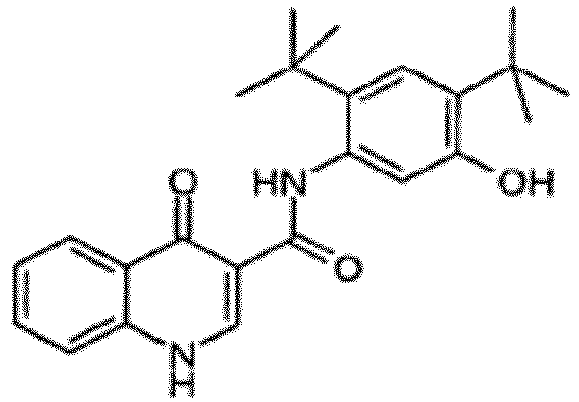
- (a) preparing a
mixture comprising Compound 1 and the triglyceride ; and - (b) heating the mixture.
- In some embodiments, R1, R2, and R3 are independently C7-29 aliphatic
- In some embodiments, the triglyceride has an average molecular weight between 470 and 1400 Da.
- In some embodiments, the triglycerideis chosen from glyceryl trioleate, glyceryl tristearate, glycerol tridecanoate, glycerol trihexanoate, glyceryl tritridecanoate, glycerol trioctanoate, glyceryl trimyristate, glyceryl tripalmitate, glyceryl tributyrate, glyceryl trilinoleate, glyceryl tridodecanoate, glyceryl decanoate, glyceryl tripalmitoleate, glycerol trierucate, glyceryl tripropionate, palmitodiolein, triarachidonin, glyceryl trilinolenate, trierucin, glycerol triarachidate, glyceryl tri(cis-13-docosenoate), glyceryl tripetroselinate, glyceryl tribehenate, glyceryl trielaidate, and triacetin.
- In some embodiments, the triglyceride is chosen from


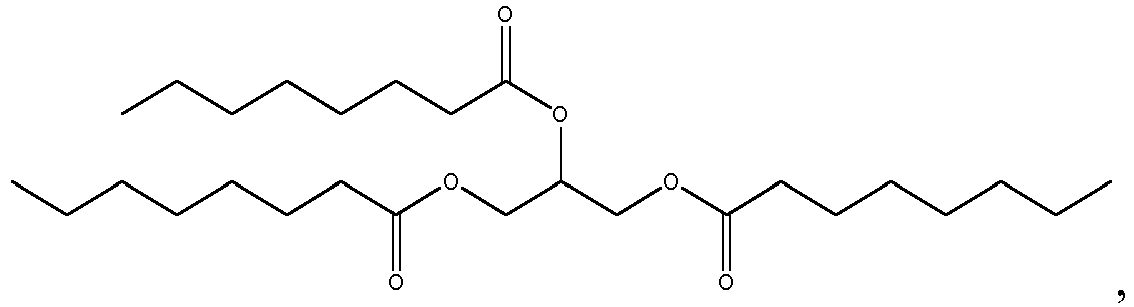


- In one embodiment,
Compound 1 is neat amorphous. In another embodiment, the triglyceride is neat. In one embodiment,Compound 1 and the triglyceride are stirred for at least 0.5 hours. In another embodiment,Compound 1 and triglycerideare stirred for 18 hours. In yet another embodiment,Compound 1 and the triglycerideare stirred for at least 18 hours. In one embodiment,Compound 1 and the triglycerideare stirred for more than 0.5 hours (including, but not limited to, 1 hour, 2 hours, 3 hours, 4 hours, 5 hours, 6 hours, 7 hours, 8 hours, 9 hours, 10 hours, 11 hours, 12 hours, 13 hours, 14 hours, 15 hours, 16 hours, 17 hours or 18 hours). In another embodiment,Compound 1 and the triglyceride are stirred at 40 °C. In another embodiment,Compound 1 and the triglyceride are stirred at about 40 °C. In yet other embodiments,Compound 1 and the triglyceride are stirred at 35-45 °C (for example, at 35 °C, 36 °C, 37 °C, 38 °C, 39 °C, 40 °C, 41 °C, 42 °C, 43 °C, 44 °C or 45 °C). In one embodiment,Compound 1 and the triglyceride are stirred for at least 18 hours at 40°C. In one embodiment,Compound 1 and the triglyceride are stirred for at least 0.5 hours at 40°C. In one embodiment,Compound 1 and the triglyceride are stirred for at least 18 hours at 40°C. - As non-limiting examples, in one embodiment,
Compound 1 and glyceryltrioctanoate are stirred for at least 0.5 hours; in yet one embodiment,Compound 1 and glyceryltrioctanoate are stirred for 0.5 hours; in yet another embodiment,Compound 1 and glyceryltrioctanoate are stirred for at least 0.5 hours at 40°C; in also yet another embodiment,Compound 1 and glyceryltrioctanoate are stirred for 0.5 hours at 40°C. - In one embodiment, the present disclosure provides a method of preparing a
co-crystal comprising Compound 1 and a triglyceride,
whereinCompound 1 is represented by the following structural formula: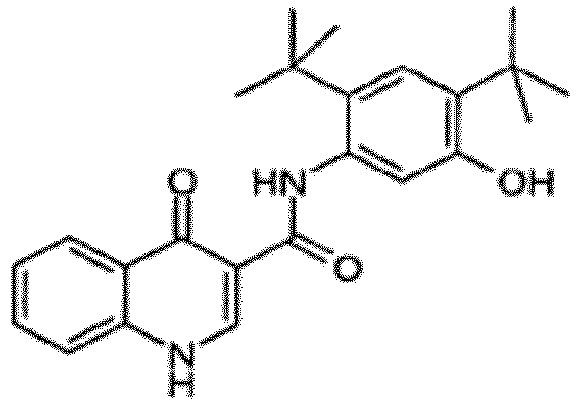

comprising the steps of: - (a) preparing a
mixture comprising Compound 1 and the triglyceride to form the co-crystal; and - (b) collecting the co-crystals by filtration.
- In another embodiment, the method optionally, further comprises, the steps of:
- (c) collecting mother liquor;
- (d) stirring
Compound 1 with the collected mother liquor for at least 18 hours; and - (e) collecting the co-crystals.
- One aspect of the present invention provides for a method of preparing a
co-crystal comprising Compound 1 and a triglyceride, whereinCompound 1 is represented by the following structural formula:

comprising the steps of: - (a) preparing a
mixture comprising Compound 1 and the triglyceride; and - (b) heating the mixture.
- In one embodiment,
Compound 1 and the triglycerideare heated to about 80°C. In one embodiment,Compound 1 and the triglycerideare heated to 80°C. In another embodiment,Compound 1 and the triglycerideare heated to about 80°C for 12 hours. In yet another embodiment,Compound 1 and the triglycerideare heated to 80°C for 12 hours. In another embodiment,Compound 1 and the triglyceride are heated to about 80°C for 24 hours. In yet another embodiment,Compound 1 and the triglyceride are heated to 80°C for 24 hours. - One aspect of the present disclosure provides for a method of preparing a
co-crystal comprising Compound 1 and a triglyceride, whereinCompound 1 is represented by the following structural formula:

comprising the steps of: - (c) preparing a
mixture comprising Compound 1 and the triglyceride; and - (d) heating the mixture to 80°C.
- In yet another embodiment,
Compound 1 and the triglycerideare heated to 80°C for 12 hours. In yet another embodiment,Compound 1 and the triglyceride are heated to 80°C for 24 hours. - Further another aspect of the present disclosure provides for a method of preparing
co-crystals comprising Compound 1 and a triglyceride, whereinCompound 1 is represented by the following structural formula:

comprising the steps of: - (a) preparing a
mixture comprising Compound 1 and the triglyceride; and - (b) heating the mixture to a temperature that is about 5 to 10 °C higher than the melting point of the triglyceride.
- One aspect of the present disclosure provides for a method of preparing a
co-crystal comprising Compound 1 and a triglyceride, whereinCompound 1 is represented by the following structural formula:

comprising the steps of: - (a) preparing a
mixture comprising Compound 1 and the triglyceride; - (b) heating the mixture;
- (c) cooling the mixture down; and
- (d) repeating step (b) and (c).
- In one embodiment,
Compound 1 and the triglyceride are heated to about 80°C. In another embodiment,Compound 1 and the triglyceride are heated to about 80°C and cooled down to about 40°C. In one embodiment,Compound 1 and the triglyceride are heated to 80°C. In another embodiment,Compound 1 and the triglyceride are heated to 80°C and cooled down to 40°C. In another embodiment,Compound 1 and the triglyceride are heated to 80°C for 12 hours. In another embodiment,Compound 1 and the triglyceride are heated to 80°C for 24 hours. In yet another embodiment,Compound 1 and the triglyceride are heated to 80°C for 12 hours and cooled down to about 40°C. In another embodiment,Compound 1 and the triglyceride are heated to 80°C for 12 hours. In yet another embodiment,Compound 1 and the triglyceride are heated to 80°C for 24 hours and cooled down to about 40°C. In any of the above embodiments, the steps of heating and cooling are repeated. - Another aspect of the present disclosure provides for a method of preparing a
co-crystal comprising Compound 1 and a triglyceride, whereinCompound 1 is represented by the following structural formula:

comprising the steps of: - (a) preparing a
mixture comprising Compound 1 and the triglyceride; - (b) heating the mixture to about 80°C;
- (c) cooling the mixture down; and
- (d) repeating step (b) and (c).
- In another embodiment,
Compound 1 and the triglyceride are cooled down to 40°C. - Another aspect of the present disclosure provides for a method of preparing a
co-crystal comprising Compound 1 and a triglyceride, whereinCompound 1 is represented by the following structural formula:

comprising the steps of: - (a) adding
Compound 1 and the triglyceride; - (b) heating to about 80°C;
- (c) cooling down to about 40°C; and
- (d) repeating step (b) and (c).
- In some embodiments, triglyceride can be prepared by
slurrying Compound 1 and a triglyceride in a suitable solvent at a slurry composition at which the co-crystal is stable in the ternary phase diagram, for example: byco-grinding Compound 1 and a triglyceride, byco-grinding Compound 1 and a triglyceride and adding a small amount of suitable solvent, byco-grinding Compound 1 and a triglyceride and subsequently annealing, byco-grinding Compound 1 and a triglyceride and subsequently annealing at elevated temperature, byco-grinding Compound 1 and a triglyceride and subsequently annealing at elevated humidity, byco-grinding Compound 1 and a triglyceride and subsequently annealing at elevated temperature and humidity, by mixingCompound 1 and a triglyceride at a temperature where at least the triglyceride is liquid, by mixingCompound 1 and a triglyceride at a temperature where at least the triglyceride is liquid and subsequent cooling after a crystallization period, by extrudingCompound 1 and a triglyceride at a temperature and triglyceride composition at which the triglyceride is stable, or by dissolvingCompound 1 and a triglyceride in suitable solvent, and evaporating the solvent. Co-crystals may be made with multiple triglyceride in a similar manner. - In one embodiment, the co-crystals are collected by centrifugal filtration at a temperature above the melting temperature of the triglyceride.
- In another embodiment, the co-crystals are washed after filtration to remove excess triglyceride.
- Co-crystals produced by any of the methods above are isolated or purified. Co-crystals are pure as measured by HPLC. In one embodiment, the co-crystal is over 99% (w/w). In another embodiment, the Compound 1:triglyceride co-crystal is over 99.5% (w/w). In one embodiment, the Compound 1:triglyceride co-crystal is 99.5% (w/w). In another embodiment, the Compound 1:triglyceride co-crystal is 99.6% (w/w). In another embodiment, the Compound 1:triglyceride co-crystal is 99.7% (w/w). In another embodiment, the Compound 1:triglyceride co-crystal is 99.8% (w/w). In another embodiment, the Compound 1:triglyceride co-crystal is 99.9% (w/w)). In one embodiment, the Compound 1:glyceryltrioctanoate co-crystal is 99.9% (w/w). In another embodiment, the Compound 1:glyceryltrioleate co-crystal is 99.9% (w/w). In yet another embodiment, the Compound 1:glyceryltrilinoleate co-crystal is 99.5% (w/w). The detection limit for impurities by HPLC is 0.005%.
- The present disclosure also provides a method of preparing a
co-crystal comprising Compound 1 and a triglyceride selected from the group consisting of glyceryltrioctanoate, glyceryltrioleate, and glyceryltrilinoleate, whereinCompound 1 is represented by the following structural formula:
stirringCompound 1 and the triglyceride to form the co-crystal. - In some embodiments, the triglyceride is glyceryltrioctanoate.
- In some embodiments, the triglyceride is glyceryltrioleate.
- In some embodiments, the triglyceride is glyceryltrilinoleate.
- The present disclosure also provides a method of preparing a
co-crystal comprising Compound 1 and a triglyceride selected from the group consisting of glyceryltrioctanoate, glyceryltrioleate, and glyceryltrilinoleate, whereinCompound 1 is represented by the following structural formula:
addingCompound 1 and the triglyceride together; and
heating. - In one aspect of the present invention, pharmaceutically acceptable compositions as defined in
claim 1 and the associated dependent claims are provided, wherein these compositions comprise co-crystal of any one of the embodiments above and a pharmaceutically acceptable carrier or excipient. - At least 30% of
Compound 1 present in the pharmaceutically acceptable compositions are in the form of Compound 1 :triglyceride co-crystals described herein. As non-limiting example, at least 30%, 40%, 50%, 60%, 70%, 80%, 85%, 90%, 92.5%, 95%, 97.5%, 98%, or 99% ofCompound 1 are present in the form of Compound 1 :triglyceride co-crystals described herein. - In certain embodiments, these compositions optionally further comprise one or more additional therapeutic agents.
- As described above, the pharmaceutically acceptable compositions of the present disclosure additionally comprise a pharmaceutically acceptable carrier, adjuvant, or vehicle, which, as used herein, includes any and all solvents, diluents, or other liquid vehicle, dispersion or suspension aids, surface active agents, isotonic agents, thickening or emulsifying agents, preservatives, solid binders, lubricants and the like, as suited to the particular dosage form desired. Remington's Pharmaceutical Sciences, Sixteenth Edition, E. W. Martin (Mack Publishing Co., Easton, Pa., 1980) discloses various carriers used in formulating pharmaceutically acceptable compositions and known techniques for the preparation thereof. Except insofar as any conventional carrier medium is incompatible with the compounds of the disclosure, such as by producing any undesirable biological effect or otherwise interacting in a deleterious manner with any other component(s) of the pharmaceutically acceptable composition, its use is contemplated to be within the scope of this disclosure. Some examples of materials which can serve as pharmaceutically acceptable carriers include, but are not limited to, ion exchangers, alumina, aluminum stearate, lecithin, serum proteins, such as human serum albumin, buffer substances such as phosphates, glycine, sorbic acid, or potassium sorbate, partial glyceride mixtures of saturated vegetable fatty acids, water, salts or electrolytes, such as protamine sulfate, disodium hydrogen phosphate, potassium hydrogen phosphate, sodium chloride, zinc salts, colloidal silica, magnesium trisilicate, polyvinyl pyrrolidone, polyacrylates, waxes, polyethylene-polyoxypropylene-block polymers, wool fat, sugars such as lactose, glucose and sucrose; starches such as corn starch and potato starch; cellulose and its derivatives such as sodium carboxymethyl cellulose, ethyl cellulose and cellulose acetate; powdered tragacanth; malt; gelatin; talc; excipients such as cocoa butter and suppository waxes; oils such as peanut oil, cottonseed oil; safflower oil; sesame oil; olive oil; corn oil and soybean oil; glycols; such a propylene glycol or polyethylene glycol; esters such as ethyl oleate and ethyl laurate; agar; buffering agents such as magnesium hydroxide and aluminum hydroxide; alginic acid; pyrogen-free water; isotonic saline; Ringer's solution; ethyl alcohol, and phosphate buffer solutions, as well as other non-toxic compatible lubricants such as sodium lauryl sulfate and magnesium stearate, as well as coloring agents, releasing agents, coating agents, sweetening, flavoring and perfuming agents, preservatives and antioxidants can also be present in the composition, according to the judgment of the formulator.
- In addition to cystic fibrosis, modulation of CFTR activity may be beneficial for other diseases not directly caused by mutations in CFTR, such as secretory diseases and other protein folding diseases mediated by CFTR. These include, but are not limited to, chronic obstructive pulmonary disease (COPD), dry eye disease, and Sjögren's Syndrome. COPD is characterized by airflow limitation that is progressive and not fully reversible. The airflow limitation is due to mucus hypersecretion, emphysema, and bronchiolitis. Activators of mutant or wild-type CFTR offer a potential treatment of mucus hypersecretion and impaired mucociliary clearance that is common in COPD. Specifically, increasing anion secretion across CFTR may facilitate fluid transport into the airway surface liquid to hydrate the mucus and optimized periciliary fluid viscosity. This would lead to enhanced mucociliary clearance and a reduction in the symptoms associated with COPD. Dry eye disease is characterized by a decrease in tear aqueous production and abnormal tear film lipid, protein and mucin profiles. There are many causes of dry eye, some of which include age, Lasik eye surgery, arthritis, medications, chemical/thermal burns, allergies, and diseases, such as cystic fibrosis and Sjögrens's syndrome. Increasing anion secretion via CFTR would enhance fluid transport from the corneal endothelial cells and secretory glands surrounding the eye to increase corneal hydration. This would help to alleviate the symptoms associated with dry eye disease. Sjögrens's syndrome is an autoimmune disease in which the immune system attacks moisture-producing glands throughout the body, including the eye, mouth, skin, respiratory tissue, liver, vagina, and gut. Symptoms, include, dry eye, mouth, and vagina, as well as lung disease. The disease is also associated with rheumatoid arthritis, systemic lupus, systemic sclerosis, and polymypositis/dermatomyositis. Defective protein trafficking is believed to cause the disease, for which treatment options are limited. Augmenters or inducers of CFTR activity may hydrate the various organs afflicted by the disease and help to elevate the associated symptoms.
- Disclosed herein is a method of treating or lessening the severity of a disease in a patient comprising administering to said patient co-crystals of any one of the embodiments described above, and said disease is selected from cystic fibrosis, asthma, smoke induced COPD, chronic bronchitis, rhinosinusitis, constipation, pancreatitis, pancreatic insufficiency, male infertility caused by congenital bilateral absence of the vas deferens (CBAVD), mild pulmonary disease, idiopathic pancreatitis, allergic bronchopulmonary aspergillosis (ABPA), liver disease, hereditary emphysema, hereditary hemochromatosis, coagulation-fibrinolysis deficiencies, such as protein C deficiency, Type 1 hereditary angioedema, lipid processing deficiencies, such as familial hypercholesterolemia, Type 1 chylomicronemia, abetalipoproteinemia, lysosomal storage diseases, such as I-cell disease/pseudo-Hurler, mucopolysaccharidoses, Sandhof/Tay-Sachs, Crigler-Najjar type II, polyendocrinopathy/hyperinsulinemia, Diabetes mellitus, Laron dwarfism, myeloperoxidase deficiency, primary hypoparathyroidism, melanoma, glycanosis CDG type 1, congenital hyperthyroidism, osteogenesis imperfecta, hereditary hypofibrinogenemia, ACT deficiency, Diabetes insipidus (DI), neurohypophyseal DI, nephrogenic DI, Charcot-Marie Tooth syndrome, Pelizaeus-Merzbacher disease, neurodegenerative diseases such as Alzheimer's disease, Parkinson's disease, amyotrophic lateral sclerosis, progressive supranuclear palsy, Pick's disease, several polyglutamine neurological disorders such as Huntington's, spinocerebellar ataxia type I, spinal and bulbar muscular atrophy, dentatorubral pallidoluysian atrophy, and myotonic dystrophy, as well as spongiform encephalopathies, such as hereditary Creutzfeldt-Jakob disease (due to prion protein processing defect), Fabry disease, Sträussler-Scheinker syndrome, COPD, dry-eye disease, or Sjogren's disease, Osteoporosis, Osteopenia, bone healing and bone growth (including bone repair, bone regeneration, reducing bone resorption and increasing bone deposition), Gorham's Syndrome, chloride channelopathies such as myotonia congenita (Thomson and Becker forms), Bartter's syndrome type III, Dent's disease, epilepsy, hyperekplexia, lysosomal storage disease, Angelman syndrome, and Primary Ciliary Dyskinesia (PCD), a term for inherited disorders of the structure and/or function of cilia, including PCD with situs inversus (also known as Kartagener syndrome), PCD without situs inversus and ciliary aplasia. In some embodiments, the co-crystal is a Compound 1 :triglyceride co-crystal as described herein.
- In some embodiments, a pharmaceutical composition for use in a method for treating or lessening the severity of cystic fibrosis in a patient is provided, wherein the method comprises administering to said patient a co-crystal of any one of the embodiments described above. In some embodiments, the co-crystal is a Compound 1 :triglyceride co-crystal as described herein. In certain embodiments, the patient possesses mutant forms of human CFTR. In other embodiments, the patient possesses one or more of the following mutations ΔF508, R117H, and G551D of human CFTR. In one embodiment, the method includes treating or lessening the severity of cystic fibrosis in a patient possessing the ΔF508 mutation of human CFTR comprising administering to said patient Compound 1 :triglyceride co-crystals described herein. In one embodiment, the method includes treating or lessening the severity of cystic fibrosis in a patient possessing the G551D mutation of human CFTR comprising administering to said patient Compound 1 :triglyceride co-crystals described herein. In one embodiment, the method includes treating or lessening the severity of cystic fibrosis in a patient possessing the ΔF508 mutation of human CFTR on one allele comprising administering to said patient Compound 1 :triglyceride co-crystals described herein. In one embodiment, the method includes treating or lessening the severity of cystic fibrosis in a patient possessing the ΔF508 mutation of human CFTR on both alleles comprising administering to said patient Compound 1 :triglyceride co-crystals described herein. In one embodiment, the method includes treating or lessening the severity of cystic fibrosis in a patient possessing the G551D mutation of human CFTR on allele comprising administering to said patient Compound 1 :triglyceride co-crystals described herein. In one embodiment, the method includes treating or lessening the severity of cystic fibrosis in a patient possessing the G551D mutation of human CFTR on both alleles comprising administering to said patient Compound 1 :triglyceride co-crystals described herein.
- Disclosed herein is a method of treating or lessening the severity of a condition, disease, or disorder implicated by CFTR mutation. Disclosed herein is a method of treating a condition, disease, or disorder implicated by a deficiency of the CFTR activity, the method comprising administering a composition comprising co-crystals of any one of the embodiments described above, to a subject, preferably a mammal, in need thereof. In some embodiments, the co-crystal is a Compound 1 :triglyceride co-crystal as described herein.
- Disclosed herein is a method of treating diseases associated with reduced CFTR function due to mutations in the gene encoding CFTR or environmental factors (e.g., smoke). These diseases include, cystic fibrosis, chronic bronchitis, recurrent bronchitis, acute bronchitis, male infertility caused by congenital bilateral absence of the vas deferens (CBAVD), female infertility caused by congenital absence of the uterus and vagina (CAUV), idiopathic chronic pancreatitis (ICP), idiopathic recurrent pancreatitis, idiopathic acute pancreatitis, chronic rhinosinusitis, primary sclerosing cholangitis, allergic bronchopulmonary aspergillosis, diabetes, dry eye, constipation, allergic bronchopulmonary aspergillosis (ABPA), bone diseases (e.g., osteoporosis), and asthma, comprising administering to said patient a co-crystal of any one of the embodiments described above. In some embodiments, the co-crystal is a Compound 1 :triglyceride co-crystal as described herein.
- Disclosed herein is a method for treating diseases associated with normal CFTR function. These diseases include, chronic obstructive pulmonary disease (COPD), chronic bronchitis, recurrent bronchitis, acute bronchitis, rhinosinusitis, constipation, pancreatitis including chronic pancreatitis, recurrent pancreatitis, and acute pancreatitis, pancreatic insufficiency, male infertility caused by congenital bilateral absence of the vas deferens (CBAVD), mild pulmonary disease, idiopathic pancreatitis, liver disease, hereditary emphysema, gallstones, gastroesophageal reflux disease, gastrointestinal malignancies, inflammatory bowel disease, constipation, diabetes, arthritis, osteoporosis, and osteopenia, comprising administering to said patient co-crystals of any one of the embodiments described above. In some embodiments, the co-crystals are Compound 1 :triglyceride co-crystals as described herein.
- Disclosed herein is a method for treating diseases associated with normal CFTR function including hereditary hemochromatosis, coagulation-fibrinolysis deficiencies, such as protein C deficiency, Type 1 hereditary angioedema, lipid processing deficiencies, such as familial hypercholesterolemia, Type 1 chylomicronemia, abetalipoproteinemia, lysosomal storage diseases, such as I-cell disease/pseudo-Hurler, mucopolysaccharidoses, Sandhof/Tay-Sachs, Crigler-Najjar type II, polyendocrinopathy/hyperinsulinemia, Diabetes mellitus, Laron dwarfism, myeloperoxidase deficiency, primary hypoparathyroidism, melanoma, glycanosis CDG type 1, congenital hyperthyroidism, osteogenesis imperfecta, hereditary hypofibrinogenemia, ACT deficiency, Diabetes insipidus (DI), neurohypophyseal DI, nephrogenic DI, Charcot-Marie Tooth syndrome, Pelizaeus-Merzbacher disease, neurodegenerative diseases such as Alzheimer's disease, Parkinson's disease, amyotrophic lateral sclerosis, progressive supranuclear palsy, Pick's disease, several polyglutamine neurological disorders such as Huntington's, spinocerebellar ataxia type I, spinal and bulbar muscular atrophy, dentatorubral pallidoluysian atrophy, and myotonic dystrophy, as well as spongiform encephalopathies, such as hereditary Creutzfeldt-Jakob disease (due to prion protein processing defect), Fabry disease, Sträussler-Scheinker syndrome, Gorham's Syndrome, chloride channelopathies, myotonia congenita (Thomson and Becker forms), Bartter's syndrome type III, Dent's disease, epilepsy, hyperekplexia, lysosomal storage disease, Angelman syndrome, Primary Ciliary Dyskinesia (PCD), PCD with situs inversus (also known as Kartagener syndrome), PCD without situs inversus and ciliary aplasia, or Sjogren's disease, comprising the step of administering to said mammal an effective amount of co-crystals of any of the embodiments described above. In some embodiments, the co-crystals are Compound 1 :triglyceride co-crystals as described herein.
- According to an alternative embodiment, a pharmaceutical composition comprising Compound 1 :triglyceride co-crystals described herein for use in a method of treating cystic fibrosis is provided, wherein the method comprises the step of administering to said mammal an effective amount of the composition comprising Compound 1 :triglyceride co-crystals described herein.
- According to the disclosure an "effective amount" of Compound 1 :triglyceride co-crystals, or a pharmaceutically acceptable composition thereof is that amount effective for treating or lessening the severity of one or more of the diseases, disorders or conditions as recited above.
- Compound 1 :triglyceride co-crystals described herein, or a pharmaceutically acceptable composition thereof may be administered using any amount and any route of administration effective for treating or lessening the severity of one or more of the diseases, disorders or conditions as recited above.
- In certain embodiments, Compound 1:triglyceride co-crystals described herein, or a pharmaceutically acceptable composition thereof is useful for treating or lessening the severity of cystic fibrosis in patients who exhibit residual CFTR activity in the apical membrane of respiratory and non-respiratory epithelia. The presence of residual CFTR activity at the epithelial surface can be readily detected using methods known in the art, e.g., standard electrophysiological, biochemical, or histochemical techniques. Such methods identify CFTR activity using in vivo or ex vivo electrophysiological techniques, measurement of sweat or salivary Cl- concentrations, or ex vivo biochemical or histochemical techniques to monitor cell surface density. Using such methods, residual CFTR activity can be readily detected in patients heterozygous or homozygous for a variety of different mutations, including patients homozygous or heterozygous for the most common mutation, ΔF508.
- In another embodiment, Compound 1:triglyceride co-crystals described herein, described herein or a pharmaceutically acceptable composition thereof, is useful for treating or lessening the severity of cystic fibrosis in patients who have residual CFTR activity induced or augmented using pharmacological methods or gene therapy. Such methods increase the amount of CFTR present at the cell surface, thereby inducing a hitherto absent CFTR activity in a patient or augmenting the existing level of residual CFTR activity in a patient.
- In one embodiment, Compound 1 :triglyceride co-crystals described herein, or a pharmaceutically acceptable composition thereof, is useful for treating or lessening the severity of cystic fibrosis in patients within certain genotypes exhibiting residual CFTR activity, e.g., class III mutations (impaired regulation or gating), class IV mutations (altered conductance), or class V mutations (reduced synthesis) (Lee R. Choo-Kang, Pamela L., Zeitlin, Type I, II, III, IV, and V cystic fibrosis Transmembrane Conductance Regulator Defects and Opportunities of Therapy; Current Opinion in Pulmonary Medicine 6:521 - 529, 2000). Other patient genotypes that exhibit residual CFTR activity include patients homozygous for one of these classes or heterozygous with any other class of mutations, including class I mutations, class II mutations, or a mutation that lacks classification.
- In one embodiment, Compound 1:triglyceride co-crystals described herein, or a pharmaceutically acceptable composition thereof, is useful for treating or lessening the severity of cystic fibrosis in patients within certain clinical phenotypes, e.g., a moderate to mild clinical phenotype that typically correlates with the amount of residual CFTR activity in the apical membrane of epithelia. Such phenotypes include patients exhibiting pancreatic insufficiency or patients diagnosed with idiopathic pancreatitis and congenital bilateral absence of the vas deferens, or mild lung disease.
- The exact amount required will vary from subject to subject, depending on the species, age, and general condition of the subject, the severity of the infection, the particular agent, its mode of administration, and the like. The compounds of the disclosure are preferably formulated in dosage unit form for ease of administration and uniformity of dosage. The expression "dosage unit form" as used herein refers to a physically discrete unit of agent appropriate for the patient to be treated. It will be understood, however, that the total daily usage of the compounds and compositions of the present disclosure will be decided by the attending physician within the scope of sound medical judgment. The specific effective dose level for any particular patient or organism will depend upon a variety of factors including the disorder being treated and the severity of the disorder; the activity of the specific compound employed; the specific composition employed; the age, body weight, general health, sex and diet of the patient; the time of administration, route of administration, and rate of excretion of the specific compound employed; the duration of the treatment; drugs used in combination or coincidental with the specific compound employed, and like factors well known in the medical arts. The term "patient", as used herein, means an animal, preferably a mammal, and most preferably a human.
- The pharmaceutically acceptable compositions of this disclosure can be administered to humans and other animals orally, rectally, parenterally, intracisternally, intravaginally, intraperitoneally, topically (as by powders, ointments, drops or patch), bucally, as an oral or nasal spray, or the like, depending on the severity of the infection being treated. In certain embodiments, the compounds of the disclosure may be administered orally or parenterally at dosage levels of about 0.01 mg/kg to about 50 mg/kg and preferably from about 0.5 mg/kg to about 25 mg/kg, of subject body weight per day, one or more times a day, to obtain the desired therapeutic effect.
- Liquid dosage forms for oral administration include, but are not limited to, pharmaceutically acceptable emulsions, microemulsions, solutions, suspensions, syrups and elixirs. In addition to the active compounds, the liquid dosage forms may contain inert diluents commonly used in the art such as, for example, water or other solvents, solubilizing agents and emulsifiers such as ethyl alcohol, isopropyl alcohol, ethyl carbonate, ethyl acetate, benzyl alcohol, benzyl benzoate, propylene glycol, 1,3-butylene glycol, dimethylformamide, oils (in particular, cottonseed, groundnut, corn, germ, olive, castor, and sesame oils), glycerol, tetrahydrofurfuryl alcohol, polyethylene glycols and fatty acid esters of sorbitan, and mixtures thereof. Besides inert diluents, the oral compositions can also include adjuvants such as wetting agents, emulsifying and suspending agents, sweetening, flavoring, and perfuming agents.
- Injectable preparations, for example, sterile injectable aqueous or oleaginous suspensions may be formulated according to the known art using suitable dispersing or wetting agents and suspending agents. The sterile injectable preparation may also be a sterile injectable solution, suspension or emulsion in a nontoxic parenterally acceptable diluent or solvent, for example, as a solution in 1,3-butanediol. Among the acceptable vehicles and solvents that may be employed are water, Ringer's solution, U.S.P. and isotonic sodium chloride solution. In addition, sterile, fixed oils are conventionally employed as a solvent or suspending medium. For this purpose any bland fixed oil can be employed including synthetic mono- or diglycerides. In addition, fatty acids such as oleic acid are used in the preparation of injectables.
- The injectable formulations can be sterilized, for example, by filtration through a bacterial-retaining filter, or by incorporating sterilizing agents in the form of sterile solid compositions which can be dissolved or dispersed in sterile water or other sterile injectable medium prior to use.
- In order to prolong the effect of a compound of the present disclosure, it is often desirable to slow the absorption of the compound from subcutaneous or intramuscular injection. This may be accomplished by the use of a liquid suspension of crystalline or amorphous material with poor water solubility. The rate of absorption of the compound then depends upon its rate of dissolution that, in turn, may depend upon crystal size and crystalline form. Alternatively, delayed absorption of a parenterally administered compound form is accomplished by dissolving or suspending the compound in an oil vehicle. Injectable depot forms are made by forming microencapsule matrices of the compound in biodegradable polymers such as polylactide-polyglycolide. Depending upon the ratio of compound to polymer and the nature of the particular polymer employed, the rate of compound release can be controlled. Examples of other biodegradable polymers include poly(orthoesters) and poly(anhydrides). Depot injectable formulations are also prepared by entrapping the compound in liposomes or microemulsions that are compatible with body tissues.
- Compositions for rectal or vaginal administration are preferably suppositories which can be prepared by mixing the compounds of this disclosure with suitable non-irritating excipients or carriers such as cocoa butter, polyethylene glycol or a suppository wax which are solid at ambient temperature but liquid at body temperature and therefore melt in the rectum or vaginal cavity and release the active compound.
- Solid dosage forms for oral administration include capsules, tablets, pills, powders, and granules. In such solid dosage forms, the active compound is mixed with inert, pharmaceutically acceptable excipient or carrier such as sodium citrate or dicalcium phosphate and/or a) fillers or extenders such as starches, lactose, sucrose, glucose, mannitol, and silicic acid, b) binders such as, for example, carboxymethylcellulose, alginates, gelatin, polyvinylpyrrolidinone, sucrose, and acacia, c) humectants such as glycerol, d) disintegrating agents such as agar--agar, calcium carbonate, potato or tapioca starch, alginic acid, certain silicates, and sodium carbonate, e) solution retarding agents such as paraffin, f) absorption accelerators such as quaternary ammonium compounds, g) wetting agents such as, for example, cetyl alcohol and glycerol monostearate, h) absorbents such as kaolin and bentonite clay, and i) lubricants such as talc, calcium stearate, magnesium stearate, solid polyethylene glycols, sodium lauryl sulfate, and mixtures thereof. In the case of capsules, tablets and pills, the dosage form may also comprise buffering agents.
- Solid compositions of a similar type may also be employed as fillers in soft and hard-filled gelatin capsules using such excipients as lactose or milk sugar as well as high molecular weight polyethylene glycols and the like. The solid dosage forms of tablets, dragees, capsules, pills, and granules can be prepared with coatings and shells such as enteric coatings and other coatings well known in the pharmaceutical formulating art. They may optionally contain opacifying agents and can also be of a composition that they release the active ingredient(s) only, or preferentially, in a certain part of the intestinal tract, optionally, in a delayed manner. Examples of embedding compositions that can be used include polymeric substances and waxes. Solid compositions of a similar type may also be employed as fillers in soft and hard-filled gelatin capsules using such excipients as lactose or milk sugar as well as high molecular weight polethylene glycols and the like.
- The active compounds can also be in microencapsulated form with one or more excipients as noted above. The solid dosage forms of tablets, dragees, capsules, pills, and granules can be prepared with coatings and shells such as enteric coatings, release controlling coatings and other coatings well known in the pharmaceutical formulating art. In such solid dosage forms the active compound may be admixed with a inert diluent such as sucrose, lactose or starch. Such dosage forms may also comprise additional substances other than inert diluents, e.g., tableting lubricants and other tableting aids such a magnesium stearate and microcrystalline cellulose. In the case of capsules, tablets and pills, the dosage forms may also comprise buffering agents. They may optionally contain opacifying agents and can also be of a composition that they release the active ingredient(s) only, or preferentially, in a certain part of the intestinal tract, optionally, in a delayed manner. Examples of embedding compositions that can be used include polymeric substances and waxes.
- Dosage forms for topical or transdermal administration of a compound of this disclosure include ointments, pastes, creams, lotions, gels, powders, solutions, sprays, inhalants or patches. The active component is admixed under sterile conditions with a pharmaceutically acceptable carrier and any needed preservatives or buffers as may be required. Ophthalmic formulation, eardrops, and eye drops are also contemplated as being within the scope of this disclosure. Additionally, the present disclosure contemplates the use of transdermal patches, which have the added advantage of providing controlled delivery of a compound to the body. Such dosage forms are prepared by dissolving or dispensing the compound in the proper medium. Absorption enhancers can also be used to increase the flux of the compound across the skin. The rate can be controlled by either providing a rate controlling membrane or by dispersing the compound in a polymer matrix or gel.
- It will also be appreciated that the co-crystals of any one of the embodiments described above (e.g., Compound 1 :triglyceride co-crystals described herein) or a pharmaceutically acceptable composition thereof can be employed in combination therapies, that is, co-crystals of any of the embodiments described above (e.g., Compound 1 :triglyceride co-crystals described herein) or a pharmaceutically acceptable composition thereof, can be administered concurrently with, prior to, or subsequent to, one or more other desired therapeutics or medical procedures. The particular combination of therapies (therapeutics or procedures) to employ in a combination regimen will take into account compatibility of the desired therapeutics and/or procedures and the desired therapeutic effect to be achieved. It will also be appreciated that the therapies employed may achieve a desired effect for the same disorder (for example, an inventive compound may be administered concurrently with another agent used to treat the same disorder), or they may achieve different effects (e.g., control of any adverse effects). As used herein, additional therapeutic agents that are normally administered to treat or prevent a particular disease, or condition, are known as "appropriate for the disease, or condition, being treated."
- In one embodiment, the additional therapeutic agent is selected from a mucolytic agent, bronchodilator, an anti-biotic, an anti-infective agent, an antiinflammatory agent, a CFTR modulator other than a compound of the present disclosure, or a nutritional agent.
- In one embodiment, the additional therapeutic agent is a compound that stabilizes the presence of CFTR at the cell surface such as activators of Racl signaling, of which hepatocyte growth factor (HGF) is an example.
- In one embodiment, the additional therapeutic agent is an antibiotic. Examplary antibiotics useful herein include tobramycin, including tobramycin inhaled powder (TIP), azithromycin, cayston, aztreonam, including the aerosolized form of aztreonam, amikacin, including liposomal formulations thereof, ciprofloxacin, including formulations thereof suitable for administration by inhalation, levoflaxacin, including aerosolized formulations thereof, and combinations of two antibiotics, e.g., fosfomycin and tobramycin.
- In another embodiment, the additional therapeutic agent is a mucolyte. Examplary mucolytes useful herein includes Pulmozyme®.
- In another embodiment, the additional therapeutic agent is a bronchodialator. Examplary bronchodialtors include albuterol, metaprotenerol sulfate, pirbuterol acetate, salmeterol, or tetrabuline sulfate.
- In another embodiment, the additional therapeutic agent is effective in restoring lung airway surface liquid. Such agents improve the movement of salt in and out of cells, allowing mucus in the lung airway to be more hydrated and, therefore, cleared more easily. Examplary such agents include hypertonic saline, denufosol tetrasodium ([[(3S,5R)-5-(4-amino-2-oxopyrimidin-1-yl)-3-hydroxyoxolan-2-yl]methoxy-hydroxyphosphoryl] [[[(2R,3S,4R,5R)-5-(2,4-dioxopyrimidin-1-yl)-3, 4-dihydroxyoxolan-2-yl]methoxy-hydroxyphosphoryl]oxy-hydroxyphosphoryl] hydrogen phosphate), or bronchitol (inhaled formulation of mannitol).
- In another embodiment, the additional therapeutic agent is an antiinflammatory agent, i.e., an agent that can reduce the inflammation in the lungs. Examplary such agents useful herein include ibuprofen, docosahexanoic acid (DHA), sildenafil, inhaled glutathione, pioglitazone, hydroxychloroquine, or simavastatin.
- In another embodiment, the additional therapeutic agent is a compound that augments or induces CFTR activity other than a co-crystal of
Compound 1. Examplary such agents include ataluren ("PTC124®"; 3-[5-(2-fluorophenyl)-1,2,4-oxadiazol-3-yl]benzoic acid), sinapultide, lancovutide, depelestat (a human recombinant neutrophil elastase inhibitor), and cobiprostone (7-{(2R, 4aR, 5R, 7aR)-2-[(3S)-1,1-difluoro-3-methylpentyl]-2-hydroxy-6-oxooctahydrocyclopenta[b]pyran-5-yl}heptanoic acid). - In another embodiment, the additional therapeutic agent is a nutritional agent. Examplary nutritional agents include pancrelipase (pancreating enzyme replacement), including Pancrease®, Pancreacarb®, Ultrase®, or Creon®, Liprotomase® (formerly Trizytek®), Aquadeks®, or glutathione inhalation. In one embodiment, the additional nutritional agent is pancrelipase.
- In another embodiment, the additional therapeutic agent is a compound selected from gentamicin, curcumin, cyclophosphamide, 4-phenylbutyrate, miglustat, felodipine, nimodipine, Philoxin B, geniestein, Apigenin, cAMP/cGMP augmenters or inducers such as rolipram, sildenafil, milrinone, tadalafil, amrinone, isoproterenol, albuterol, and almeterol, deoxyspergualin,
HSP 90 inhibitors,HSP 70 inhibitors, proteosome inhibitors such as epoxomicin, lactacystin, etc. - In another embodiment, the additional therapeutic agent reduces the activity of the epithelial sodium channel blocker (ENaC) either directly by blocking the channel or indirectly by modulation of proteases that lead to an increase in ENaC activity (e.g., seine proteases, channel-activating proteases). Examplary such agents include camostat (a trypsin-like protease inhibitor), QAU145, 552-02, GS-9411, INO-4995, Aerolytic, and amiloride. Additional therapeutic agents that reduce the activity of the epithelial sodium channel blocker (ENaC) can be found, for example in
PCT Publication No. WO2009/074575 . - Amongst other diseases described herein, combinations of CFTR modulators, such as Compound 1 :triglyceride co-crystals described herein, and agents that reduce the activity of ENaC are used for treating Liddle's syndrome, cystic fibrosis, primary ciliary dyskinesia, chronic bronchitis, chronic obstructive pulmonary disease, asthma, respiratory tract infections, lung carcinoma, xerostomia and keratoconjunctivitis sire, respiratory tract infections (acute and chronic; viral and bacterial) and lung carcinoma.
- Combinations of CFTR modulators, such as Compound 1 :triglyceride co-crystals described herein, and agents that reduce the activity of ENaC are also useful for treating diseases mediated by blockade of the epithelial sodium channel also include diseases other than respiratory diseases that are associated with abnormal fluid regulation across an epithelium, perhaps involving abnormal physiology of the protective surface liquids on their surface, e.g., xerostomia (dry mouth) or keratoconjunctivitis sire (dry eye). Furthermore, blockade of the epithelial sodium channel in the kidney could be used to promote diuresis and thereby induce a hypotensive effect.
- Chronic obstructive pulmonary disease includes chronic bronchitis or dyspnea associated therewith, emphysema, as well as exacerbation of airways hyperreactivity consequent to other drug therapy, in particular, other inhaled drug therapy. In some embodiments, the combinations of CFTR modulators, such as Compound 1 :triglyceride co-crystals described herein, and agents that reduce the activity of ENaC are useful for the treatment of bronchitis of whatever type or genesis including, e.g., acute, arachidic, catarrhal, croupus, chronic or phthinoid bronchitis.
- In another embodiment, the additional therapeutic agent is a CFTR modulator other than Compound 1 :triglyceride co-crystals described herein, i.e., an agent that has the effect of modulating CFTR activity. Examplary such agents include ataluren ("PTC124®"; 3-[5-(2-fluorophenyl)-1,2,4-oxadiazol-3-yl]benzoic acid), sinapultide, lancovutide, depelestat (a human recombinant neutrophil elastase inhibitor), cobiprostone (7-{(2R, 4aR, 5R, 7aR)-2-[(3S)-1,1-difluoro-3-methylpentyl]-2-hydroxy-6-oxooctahydrocyclopenta[b]pyran-5-yl}heptanoic acid), (3-(6-(1-(2,2-difluorobenzo[d][1,3]dioxol-5-yl) cyclopropanecarboxamido)-3-methylpyridin-2-yl)benzoic acid, or (R)-1-(2,2-difluorobenzo[d][1,3]dioxol-5-yl)-N-(1-(2,3-dihydroxypropyl)-6-fluoro-2-(1-hydroxy-2-methylpropan-2-yl)-1H-indol-5-yl)cyclopropanecarboxamide. In one embodiment, the additional therapeutic agent is (3-(6-(1-(2,2-difluorobenzo[d][1,3]dioxol-5-yl)cyclopropanecarboxamido)-3-methylpyridin-2-yl)benzoic acid, or (R)-1-(2,2-difluorobenzo[d][1,3]dioxol-5-yl)-N-(1-(2,3-dihydroxypropyl)-6-fluoro-2-(1-hydroxy-2-methylpropan-2-yl)-1H-indol-5-yl)cyclopropanecarboxamide. In another embodiment, the additional therapeutic agent is (3-(6-(1-(2,2-difluorobenzo[d][1,3]dioxol-5-yl)cyclopropanecarboxamido)-3-methylpyridin-2-yl)benzoic acid. In another embodiment, the additional therapeutic agent is (R)-1-(2,2-difluorobenzo[d][1,3]dioxol-5-yl)-N-(1-(2,3-dihydroxypropyl)-6-fluoro-2-(1-hydroxy-2-methylpropan-2-yl)-1H-indol-5-yl)cyclopropanecarboxamide.
- In one embodiment, the additional therapeutic agent is a CFTR modulator other than a compound of the present disclosure.
- The amount of additional therapeutic agent present in the compositions of this disclosure will be no more than the amount that would normally be administered in a composition comprising that therapeutic agent as the only active agent. Preferably the amount of additional therapeutic agent in the presently disclosed compositions will range from about 50 % to 100 % of the amount normally present in a composition comprising that agent as the only therapeutically active agent.
- Co-crystals of any of the embodiments described above (e.g., Compound 1:triglyceride co-crystals described herein) or a pharmaceutically acceptable composition thereof, may also be incorporated into compositions for coating an implantable medical device, such as prostheses, artificial valves, vascular grafts, stents and catheters. Disclosed herein is a composition for coating an implantable device comprising a compound of the present disclosure as described generally above, and in classes and subclasses herein, and a carrier suitable for coating said implantable device. Disclosed herein is an implantable device coated with a composition comprising a compound of the present disclosure as described generally above, and in classes and subclasses herein, and a carrier suitable for coating said implantable device. Suitable coatings and the general preparation of coated implantable devices are described in
US Patents 6,099,562 ;5,886,026 ; and5,304,121 . The coatings are typically biocompatible polymeric materials such as a hydrogel polymer, polymethyldisiloxane, polycaprolactone, polyethylene glycol, polylactic acid, ethylene vinyl acetate, and mixtures thereof. The coatings may optionally be further covered by a suitable topcoat of fluorosilicone, polysaccarides, polyethylene glycol, phospholipids or combinations thereof to impart controlled release characteristics in the composition. - Disclosed herein is a kit comprising a tablet of the present disclosure, and a separate therapeutic agent or pharmaceutical composition thereof. In one embodiment, the additional therapeutic agent is a CFTR corrector. In another embodiment, the therapeutic agent is (3-(6-(1-(2,2-difluorobenzo[d][1,3]dioxol-5-yl)cyclopropanecarboxamido)-3-methylpyridin-2-yl)benzoic acid or (R)-1-(2,2-difluorobenzo[d][1,3]dioxol-5-yl)-N-(1-(2,3-dihydroxypropyl)-6-fluoro-2-(1-hydroxy-2-methylpropan-2-yl)-1H-indol-5-yl)cyclopropanecarboxamide. In another embodiment, the therapeutic agent is (3-(6-(1-(2,2-difluorobenzo[d][1,3]dioxol-5-yl)cyclopropanecarboxamido)-3-methylpyridin-2-yl)benzoic acid. In another embodiment, the therapeutic agent is (R)-1-(2,2-difluorobenzo[d][1,3]dioxol-5-yl)-N-(1-(2,3-dihydroxypropyl)-6-fluoro-2-(1-hydroxy-2-methylpropan-2-yl)-1H-indol-5-yl)cyclopropanecarboxamide. In another embodiment, the tablet and the therapeutic agent are in separate containers. In another embodiment, the kits of the present disclosure are drawn to kits wherein the compunds or pharmaceutical compositions of the present disclosure and the one or more additional therapeutic agents) are in separate containers. In one embodiment, the separate containers are bottles. In another embodiment, the separate containers are vials. In another embodiment, the separate containers are blister packs. In another embodiment, the container is a bottle, vial, or blister pack or combination thereof.
- Disclosed herein is a method of modulating CFTR activity in a biological sample or a patient (e.g., in vitro or in vivo), which method comprises administering to the patient, or contacting said biological sample co-crystals of any of the embodiments described above (e.g., Compound 1:triglyceride co-crystals described herein) or a pharmaceutically acceptable composition thereof. The term "biological sample", as used herein, includes, without limitation, cell cultures or extracts thereof; biopsied material obtained from a mammal or extracts thereof; and blood, saliva, urine, feces, semen, tears, or other body fluids or extracts thereof.
- Modulation of CFTR in a biological sample is useful for a variety of purposes that are known to one of skill in the art. Examples of such purposes include, but are not limited to, the study of CFTR in biological and pathological phenomena; and the comparative evaluation of new modulators of CFTR.
- In yet another embodiment, a method of modulating activity of an anion channel in vitro or in vivo, is provided comprising the step of contacting said channel with Compound 1 :triglyceride co-crystals described herein or a pharmaceutically acceptable composition thereof. In some embodiments, the anion channel is a chloride channel or a bicarbonate channel. In other embodiments, the anion channel is a chloride channel.
- According to an alternative embodiment, the present disclosure provides a method of increasing the number of functional CFTR in a membrane of a cell, comprising the step of contacting said cell with co-crystals of any one of the embodiments described above (e.g., Compound 1 :triglyceride co-crystals described herein) or a pharmaceutically acceptable composition thereof.
- According to another embodiment, the activity of the CFTR is measured by measuring the transmembrane voltage potential. Means for measuring the voltage potential across a membrane in the biological sample may employ any of the known methods in the art, such as optical membrane potential assay or other electrophysiological methods.
- The optical membrane potential assay utilizes voltage-sensitive FRET sensors described by Gonzalez and Tsien (See, Gonzalez, J. E. and R. Y. Tsien (1995) "Voltage sensing by fluorescence resonance energy transfer in single cells." Biophys J 69(4): 1272-80, and Gonzalez, J. E. and R. Y. Tsien (1997); "Improved indicators of cell membrane potential that use fluorescence resonance energy transfer" Chem Biol 4(4): 269-77) in combination with instrumentation for measuring fluorescence changes such as the Voltage/Ion Probe Reader (VIPR) (See, Gonzalez, J. E., K. Oades, et al. (1999) "Cell-based assays and instrumentation for screening ion-channel targets" Drug Discov Today 4(9): 431-439).
- These voltage sensitive assays are based on the change in fluorescence resonant energy transfer (FRET) between the membrane-soluble, voltage-sensitive dye, DiSBAC2(3), and a fluorescent phospholipid, CC2-DMPE, which is attached to the outer leaflet of the plasma membrane and acts as a FRET donor. Changes in membrane potential (Vm) cause the negatively charged DiSBAC2(3) to redistribute across the plasma membrane and the amount of energy transfer from CC2-DMPE changes accordingly. The changes in fluorescence emission can be monitored using VIPRTM II, which is an integrated liquid handler and fluorescent detector designed to conduct cell-based screens in 96- or 384-well microtiter plates.
- Disclosed herein is a kit for use in measuring the activity of CFTR or a fragment thereof in a biological sample in vitro or in vivo comprising (i) a composition comprising any of the co-crystals of the embodiments described above (e.g., Compound 1:triglyceride co-crystals described herein); and (ii) instructions for a) contacting the composition with the biological sample and b) measuring activity of said CFTR or a fragment thereof. In one embodiment, the kit further comprises instructions for a) contacting an additional composition with the biological sample; b) measuring the activity of said CFTR or a fragment thereof in the presence of said additional compound, and c) comparing the activity of the CFTR in the presence of the additional compound with the density of the CFTR in the presence of co-crystals of any of the embodiments described above (e.g., Compound 1 :triglyceride co-crystals described herein). In some embodiments, the kit is used to measure the density of CFTR.
- Disclosed herein is a kit for use in measuring the activity of CFTR or a fragment thereof in a biological sample in vitro or in vivo, comprising:
- (i) a composition comprising co-crystals of any of the embodiments described above (e.g., Compound 1:triglyceride co-crystals);
- (ii) instructions for:
- (a) contacting the composition with the biological sample;
- (b) measuring activity of said CFTR or a fragment thereof.
- In one embodiment, the kit further comprises instructions for:
- i. contacting an additional composition with the biological sample;
- ii. measuring the activity of said CFTR, or a fragment thereof, in the presence of said additional compound; and
- iii. comparing the activity of the CFTR, or fragment thereof, in the presence of the additional compound with the density of CFTR, or fragment thereof, in the presence of co-crystals of any of the embodiments described above (e.g., Compound 1:triglyceride co-crystals).
- In another embodiment, the step of comparing the activity of said CFTR, or fragment thereof, provides a measure of the density of said CFTR, or fragment thereof
- In order that the disclosure described herein may be more fully understood, the following examples are set forth. It should be understood that these examples are for illustrative purposes only and are not to be construed as limiting this disclosure in any manner. The invention is defined in the appended claims.
-
Compound 1 was prepared as described inWO 2010/18162 US 2010/0267768 andUS 8,476,442 . The preparation is also described below.
- Compound A (1.0 eq.) and Compound B (1.1 eq.) were charged to a reactor. 2-MeTHF (4.0 vol., relative to Compound A) was added followed by
T3P® 50% solution in EtOAc (2.5 eq.). The T3P charge vessel was washed with 2-MeTHF (3.5 vol.). Pyridine (2.0 eq.) was then charged. The resulting suspension was heated to 45.0 to 50.0 °C and held at this temperature for 15 hours. A sample was taken and checked for completion by HPLC. Once complete, the resulting mixture was cooled to 20.0 °C +/- 5.0 °C. 2-MeTHF was charged (12.5 vol.) to dilute the mixture. The reaction mixture was washed with water (10.0 vol.) 3 times. 2-MeTHF was charged to bring the total volume of reaction to 40.0 vol. (-16.5 vol. charged). Residual water was removed by continuous distillation at 35.0 °C +/- 5 °C from 40 vol. to 30 vol. with 2-MeTHF until in-process control testing using the Karl Fisher method shows the water content to be no more than 1.0% w/w. The solution was cooled to 20.0 °C +/- 5.0 °C. To this solution was charged NaOMe/MeOH (1.7 equiv) to perform the hydrolysis of the carbonate. The reaction was stirred for no less than 1.0 hours, and checked for completion by HPLC. Once complete, the reaction was quenched with 1 N HCl/H2O (10.0 vol.), and washed with 0.1 N HCl (10.0 vol.). The organic solution was polish filtered to remove any particulates and placed in a second flask. The filtered solution was concentrated at 25.0 °C +/- 5.0 °C under reduced pressure to 20 vol. CH3CN was added to 40 vol. and the solution concentrated at 25.0 °C +/-5.0 °C to 20 vol. The addition of CH3CN and concentration was repeated 2 more times for a total of 3 additions of CH3CN and 4 concentrations to 20 vol. After the final concentration to 20 vol., 16.0 vol. of CH3CN was charged followed by 4.0 vol. of H2O to make a final concentration of 40 vol. of 10% H2O/CH3CN relative to Compound A. This slurry was refluxed for 5 hours. The slurry was cooled to 20.0 °C +/- 5 °C and filtered. The cake was washed with CH3CN (5 vol.) 2 times. The resulting solid was dried in a vacuum oven at 50.0 °C +/- 5.0 °C until a constant weight is attained. - The following solution was prepared by stirring
Compound 1, as prepared above, into 90% MEK/10% water according to Table A.Table A (MEK/Water = 90/10) Weight (g) MEK 360.00 Water 40.00 Compound 1 (as prepared above) 35.00 Total Solution Weight 400.00 Solids Loading 35.00 - Spray drying was performed on a Buchi Mini Spray Dryer B-290 with dehumidifier B-296 and Inert Loop B-295 using the parameters used in Table B. The system was saturated with solvent that was to be sprayed, and inlet and outlet temperatures were allowed to equilibrate before spray drying. The powder from the collection vessel and the cyclone were combined in a shallow dish and dried in a vacuum oven with slight nitrogen purge for 7 days. The amorphous material was then dried in a vacuum oven at 75 to 80 °C and a pressure of approximately 0.1 mmHg until the MEK concentration was reduced to <1.0% w/w by 1H NMR (50 hours). The material was removed from the vacuum after cooling under
N2 50°C.Table B: Spray Drying Parameters INLET Temperature 110 °C OUTLET Temperature 50-60 ° C Nitrogen Pressure 120 psi Aspirator 100 % Pump Rate 45 % Nozzle 1mm Atomizer 35 mm Filter Pressure -50 to -70 mbar Condenser Temperature -5° C Run Time 40 min. - Method 1: All
pure Compound 1 co-crystals were prepared by slurrying or stirring neatamorphous Compound 1 in neat triglyceride at a 5%-10% weight to volume solids load for at least 18 hours at 40°C or 5°C -10 °C above the triglyceride melting point in a HEL Polyblock synthesizer. The completion of the conversion was determined by birefringence of the suspended particles with polarized light microscopy. Crude co-crystals were isolated by centrifugal filtration using Millipore 2ml centrifugation devices. - In some cases the mother liquor was collected for preparation of
additional Compound 1 co-crystal to increase yield with respect to the triglyceride. This was achieved by slurrying or stirring neatamorphous Compound 1 at a 5%-10% weight to volume ratio in the mother liquor for at least 18 hours. The mother liquor was used not more than two times for additional conversions. The crude co-crystals of subsequent conversions were combined into 2ml centrifugation devices and heptane was added at a 1.5 to 2 volume to weight ratio. After briefly vortexing of the mixture, the heptane was filtered by centrifugal filtration and the solids collected. Excess heptane was removed by drying in vacuum at 40 to 45°C for at least 18 hours. The heptane content was checked periodically by 1H solution state NMR and drying was continued until the heptane was at acceptable levels, e.g., until there was no further decrease in the overlapping triglyceride and heptane CH3 resonance observed. - Method 2: Approximately 50 mg neat
amorphous Compound 1 was added to approximately 1 g triglyceride, heated to 80 °C and kept at this temperature for at least 1 hour. The solution was then cooled to a temperature above the melting point of the triglyceride to crystallize theCompound 1 co-crystal. In order to improve crystal quality and size the system was heated again to 80 °C and cooled down. The temperature cycling was repeated until crystals of suitable size for analysis were obtained. AllCompound 1 co-crystals were isolated by centrifugal filtration at temperatures above the melting point of the triglyceride. - X-Ray Powder Diffraction (XPRD) Analysis: The XRPD patterns were acquired at room temperature in reflection mode using a Pananalytical Empyrean II or a Bruker D8 Advance diffractometer. The powder sample were placed in a Pananalytical stainless steel sample holder or a Bruker shallow cavity sample holder and spun at 15 rpm, respectively. Instrument parameters are listed in the table below.
XRD System Bruker D8 Advance Panalytical Empyrean Generator Voltage, kV 40 45 Generator Current, mA 40 40 Incident beam Divergence slit Variable at 12 mm Programmable at 14 mm Scan start (°2Θ) 3 2.9989 Scan end (°2Θ) 40 40 Step size (°2Θ) 0.0144531 0.0131303 Nominal number of detector channels Default 255 Detector VANTEC-1 PIXcel ID Scan Type Locked Coupled Locked Coupled Number of Steps 2560 2818 Time per step (sec) 0.25 49.725 Incident Anti Scatter Slit (°) 0.5 2 Rotation Speed (rpm) 15 7.5 Filter Nickel Nickel Beam Knife Yes Yes Incident Solar Slit (RAD) N/A 0.04 Incident Mask (mm) N/ A 10 Diffracted Anti Scatter Slit Default Automatic @ 14 mm Diffracted Solar Slit (RAD) N/A 0.04 Scan Speed (°/sec) Default 0.067335 - 13C Solid State Nuclear Magnetic Resonance Spectroscopy (13C ssNMR): A Bruker-Biospin 400 MHz wide-bore AVance III spectrometer equipped with Bruker-Biospin 4mm HFX probe was used for all 13C ssNMR experiments. Samples were packed into 4mm ZrO2 rotors and spun under magic angle spinning (MAS) condition with spinning speed of 12.5 kHz. The CP contact time of carbon CPMAS experiment was set to 2 ms. A CP proton pulse with linear ramp (from 50% to 100%) was employed. The Hartmann-Hahn match was optimized on external reference sample (glycine). TPPM15 decoupling sequence was used with the field strength of approximately 100 kHz. The relaxation delay was set to 5s in all 13C CPMAS experiments. 1H T1 values were measured using a saturation recovery sequence. All spectra were reference externally to the upfield resonance of adamantine at 29.5 ppm. The temperature of the sample was controlled to 275 K.
- Thermogravimetric Analysis (TGA): Thermal gravimetric analysis (TGA) was conducted on a TA Instruments model Q5000 V3.8 thermogravimetric analyzer. Approximately 5-15 mg of solid sample was placed in a platinum sample pan and heated in a 60 mL/min sample and a 40mL/min balance nitrogen stream at 10°C/min from ambient to 350°C. All thermograms were analyzed using TA
Instruments Universal Analysis 2000 software V4.4A. - Differential Scanning Calorimetry (DSC): The DSC traces were obtained using TA Instruments DSC Q2000 equipped with
Universal Analysis 2000 software. An amount of 0.5 - 2 mg ofCompound 1 co-crystal was weighed into an aluminum pan and sealed with a pinhole lid. The samples were heated from ambient to 350°C or 300°C at 10°C/min. - 1H solution Nuclear Magnetic Resonance Spectroscopy (1H NMR): A Bruker narrow bore 400MHz AvanceIII Nanobay spectrometer equipped with a Bruker-Biospin 5mm broadband probe was used for all experiments. Approximately 0.5 - 2mg of
Compound 1 co-crystal samples were dissolved in 0.65ml acetone-d6 (for Compound 1:glycereyltrioleate and Compound 1:glyceryltrilinoleate) or DMSO-d6 (for Compound 1 :glyceryltrioctanoate) in a 5mm NMR tube. A relaxation delay of 60 s was chosen to minimize differential relaxation of 1H between different proton positions onCompound 1 and triglyceride. All spectra are referenced using a tetramethylsilane internal standard at 0.0 ppm. - All 1H NMR solution state spectra are in accord with the presence of both
Compound 1 and the respective triglyceride and are consistent with chemically pure co-crystals. Significant shifts are absent in the spectra of the dissolved co-crystals for bothCompound 1 and the triglycerides when compared to the spectra of the pure components individually. This provides evidence for dissociation of the co-crystals components in solution and confirms the weak association ofCompound 1 and triglyceride association in the solid. The ratio of integrated intensity for protons in Compound 1 :glyceryltrioctanoate in the 1H NMR spectra indicate a stoichiometry of 3:1 (Compound 1:triglyceride) in the co-crystal,
whereas the integrated intensity of the Compound 1:glyceryltrioleate and Compound 1:glyceryltrilinoleate integrated intensities indicate a 6:1 (Compound 1:triglyceride) stoichiometry in the respective co-crystals. The stoichiometry determined by solution state 1H NMR is consistent with the stoichiometry determined by thermogravimetric analysis for the Compound 1 :glyceryltrioctanoate co-crystal. - The 1H NMR results are consistent with high performance liquid chromatography analysis of the co-crystals. The assay values were determined to be 72.1 % (w:w), 72.4 % (w:w) and 68.6 % (w:w)
Compound 1 for the Compound 1:glyceryltrioctanoate, Compound 1:glyceryltrioleate and Compound 1:trilinoleate co-crystals. Impurities were found to be less than 0.5 % total using UV detection. - Mass Spectrometry Analysis: The mass spectrometry analysis was done as outlined for each complex below.
- Single Crystal X-Ray Crystallography: The single crystal was prepared by dissolving 56 mg of
amorphous Compound 1 in 1000 mg triglyceride in an oven set to 80°C. Upon crystallization, a few crystals were removed for single crystal X-ray analysis. Diffraction data were acquired at ESFR synchrotron source with wavelength 0.70158Å at 100K temperature (reference number Phil Pattison 130813). The structure was solved and refined using SHELX program (Sheldrick, G.M., Acta Cryst., (2008) A64, 112-122). - An examplary X-Ray Powder Diffraction (XRPD) pattern of Compound 1:glyceryltrioctanoate in
Figure 3 was acquired using the Panalytical Empyrean II diffractometer. XRPD Representative peaks for Compound 1:glyceryltrioctanoate as observed in the XRPD pattern are provided in Table C below. All peaks listed below are greater than 5% of the maximum peak intensity.Table C Peak # Angle 2θ, in degrees (±0.2°) 1 3.5 2 6.0 3 6.9 4 9.1 5 10.9 6 12.0 7 12.5 8 13.2 9 13.7 10 15.0 11 16.2 12 16.9 13 18.0 14 19.3 15 20.2 16 21.7 17 22.5 18 23.8 19 25.8 20 27.0 21 27.6 22 28.3 23 30.0 24 31.0 25 32.6 - An examplary 13C solid state nuclear magnetic resonance spectroscopy (13C ssNMR) spectrum of Compound 1:glyceryltrioctanoate is shown in
Figure 4 . A listing of some of the 13C ssNMR peaks for Compound 1:glyceryltrioctanoate are provided in Table D below.Table D Peak # 13C Chemical Shift (± 0.1 ppm) 1 178.6 2 172.9 3 171.6 4 169.9 5 165.1 6 155.0 7 143.2 8 139.4 9 137.3 10 134.6 11 133.0 12 126.0 13 119.4 14 117.7 15 112.1 16 67.3 17 64.0 18 62.0 19 59.6 20 54.2 21 35.8 22 34.8 23 31.7 24 30.5 25 23.5 26 14.6 - An examplary thermal gravimetric analysis (TGA) trace of Compound 1:glyceryltrioctanoate is shown in
Figure 5 . A weight loss of 28.3% corresponding to the evaporation of glyceryltriocanoate was observed from 150°C to 300°C for Compound 1:glyceryltrioctanoate. Thecalculated Compound 1 to glyceryltrioctanoate mole ratio based on the weight loss in the material is 1:3.1. - An examplary Differential Scanning Calorimetry (DSC) thermogram of Compound 1 :glyceryltrioctanoate is shown in
Figure 6 . The thermogram had an endotherm at 186.7°C that corresponds to the melting of the Compound 1 :glyceryltrioctanoate. The error in the thermogram measurement is ±0.2 °C. This endotherm was followed by an exotherm corresponding to a recrystallization to a neat form ofCompound 1 which then melted in a later endothermic event. - An examplary 1H Nuclear Magnetic Resonance (1H NMR) spectrum of Compound 1 :glyceryltrioctanoate in DMSO-d6 is shown in
Figure 7 . - Table E and Table F summarize the 1H NMR data and assign the
Compound 1 and glyceryltrioctanoate hydrogens, respectively. The numbering system used for assignment of hydrogens inCompound 1 is as follows:
- The numbering system used for assignment of hydrogens in glyceryltrioctanoate is as follows:

Table E Atom Number 1H- Chemical Shift (ppm) # of Protons Multiplicity (J value) 3 7.17 1 s 6 7.11 1 s 8 1.36 3x3 s 10 1.38 3x3 s 11 9.18 1 s 12 11.81 1 s 17 8.33 1 d, J= 8.01 Hz 18 7.52 1 t, J = 7.46 Hz 19 7.80 1 t, J=7.91 Hz 20 7.75 1 d, J = 8.21 Hz 22 12.86 1 s, broad 23 8.87 1 s Table F Atom Number 1H- Chemical Shift (ppm) # of Protons Multiplicity (J value) Theoretical signal intensity for 3:1 stoichiometry Measured integrated signal intensity 10 0.85 3 t, J=7 Hz 3.00 3.06 6-9 1.24 8 m, (overlapped) 8.00 8.39 5 1.5 2 m, (overlapped) 2.00 2.19 4 2.27 0.67 t, J=7.3 Hz 0.67 2.03 4 2.28 1.33 t, J=7.3 Hz 1.33 combined value reported above 2a 4.12 0.67 dd (J=6.6, J=12.0) 0.67 0.68 2b 4.26 0.67 dd (J=12.0, J=3.6 Hz) 0.67 0.68 1 5.19 0.33 tt (J=3.6Hz, J=6.6 Hz) 0.33 0.33 - Integration was calibrated to yield 2.00 units for the combined integrated intensity for
position Compound 1. - Mass Spectrometry Analysis: The accurate mass of Compound 1:glyceryltrioctanoate was determined on the Agilent 6210 time of flight mass spectrometer. The sample was dissolved to approximately 0.1 mg/ml in MeOH and injected by direct flow injection using a syringe pump. A zero volume blank nut was used to do direct inject analysis.
- The following masses were found and confirm the identity of the molecular components of the Compound 1:glyceryltriocanoate:
- Compound 1: HRMS (ESI-TOF) m/z: [M +H]+ Calculated for C24H29N2O3+ 393.2173; Found 393.2179.
- Glyceryltrioctanoate: HRMS (ESI-TOF) m/z: [M + NH3]+ Calculated for C27H54NO6+ 488.3947; Found 488.3951
-

- An examplary XRPD pattern for Compound 1 :glyceryltrioleate shown in
Figure 8 was acquired using the Panalytical Empyrean II diffractometer. Representative peaks for Compound 1 :glyceryltrioleate as observed in the XRPD pattern are provided in Table G below. All peaks listed below are greater than 5% of the maximum peak intensity.Table G Peak # Angle 2θ, in degrees (±0.2°) 1 3.5 2 6.9 3 9.2 4 9.8 5 10.4 6 10.9 7 12.0 8 12.7 9 13.3 10 13.8 11 15.1 12 16.3 13 16.9 14 18.1 15 18.5 16 19.4 17 19.9 18 20.2 19 21.2 20 21.8 21 22.6 22 23.8 23 26.0 24 27.0 25 27.8 26 28.5 27 30.0 28 30.6 29 32.7 - An examplary 13C ssNMR spectrum for Compound 1:glyceryltrioleate is shown in
Figure 9 . A listing of some of the 13C ssNMR peaks for Compound 1 :glyceryltrioleate are provided in Table H below.Table H Peak # 13C Chemical Shift (± 0.1 ppm) 1 178.6 2 172.9 3 171.6 4 169.9 5 165.0 6 155.0 7 142.9 8 139.3 9 137.4 10 134.5 11 133.0 12 130.5 13 127.3 14 126.0 15 119.3 16 117.7 17 112.1 18 67.2 19 63.9 20 59.6 21 35.8 22 34.8 23 31.7 24 30.5 25 28.2 26 24.6 27 23.6 28 14.7 - An examplary TGA trace of Compound 1:glyceryltrioleate is shown in
Figure 10 . A weight loss of 1.1% was observed from 150°C to 300°C for Compound 1:glyceryltrioleate. Evaporation of glyceryltrioleate was not observed due to its high boiling point. - An examplary DSC thermogram of Compound 1:glyceryltrioleate is shown in
Figure 11 . The thermogram had an endotherm at 197.5°C that corresponds to the melting of Compound 1:glyceryltrioleate. The error in the endotherm measurement is ±0.2°C. This endothermic event was followed by an exotherm, corresponding to the crystallization of a neat form ofCompound 1. Another endotherm corresponding to the melting of this neat form ofCompound 1 was observed. Another later exothermic recrystallization to a second neat form ofCompound 1 was observed. A later endotherm corresponds to melting of this second form ofCompound 1. - An examplary 1H NMR spectrum of Compound 1:glyceryltrioleate is shown in
Figure 12 . - Table I and Table J summarize the 1H NMR data and assign the
Compound 1 and glyceryltrioleate hydrogens, respectively. The numbering system used for assignment of hydrogens inCompound 1 was as previously shown above. - The numbering system used for assignment of hydrogens in glyceryltrioleate is as follows:

Table I Atom Number 1H- Chemical Shift (ppm) # of Protons Multiplicity (J value) 3 7.34 1 d(1.1Hz) 6 7.29 1 s 8 1.41 3x3 s 10 1.47 3x3 s 23 8.95 1 d, J=6.8 Hz (overlapped)1 22 11.7 1 s, broad 17 8.44 1 d, J = 8.2 Hz 18 7.53 1 ddd, J = 1.6 Hz, J = 6.6 Hz, J = 8.2 Hz 19 7.8 1 t, J = 7.6 Hz 20 7.75 1 d, J = 8.21 Hz 12 11.9 1 s 11 8.18 1 s Table J Atom Number 1H - Chemical Shift (ppm) Multiplicity (J value) # of Protons Theoretical signal intensity for 6:1 stoichiometry Measured integrated signal intensity 20 0.89 t, J=7 Hz 9 1.50 1.69 6-9,14-19 1.34/1.30 m, (overlapped) 60 10.00 11.34 5 1.61 m, (overlapped) 6 1.00 1.18 10,13 overlapped w/solvent 2.06 m, overlapped with acetone-d6 12 2.00 n/a 4 2.32 t, J=7.4 Hz 6 1.00 1.06 2a 4.18 dd, J=6.1, J=12.0 2 0.33 0.36 2b 4.34 dd, J=4.0, J=12.0 2 0.33 0.36 1 5.28 m 1 0.17 0.19 11,12 5.36 m 6 1.00 1.06 - Integration was calibrated to yield 2.00 units for the combined integrated intensity for
position Compound 1. Slow H-D exchange atposition 22 ofCompound 1 results in observation of both doublet (position 22 H) and singlet (position 22 D) for H23 forCompound 1. - The accurate mass of this complex was determined on a Thermo LTQ Orbi Trap XL mass spectrometer. The sample was dissolved to approximately 0.1 mg/ml in MeOH and infused by direct flow injection using a syringe pump at a rate of 50µl/s. 50 scans were collected using the FTMS analyzer at a 30000 resolution setting.
- The following masses were found and confirm the identity of the molecular components of the Compound 1:glyceryltrioleate:
- Compound 1: HRMS (ESI-TOF) m/z: [M + H]+ Calculated for C24H29N2O3+ 393.2173; Found 393.2170.
- Glyceryltrioleate: HRMS (ESI-TOF) m/z: [M +
Compound 1 + H]+ Calculated for C81H133N2O9+ 1278.0006; Found 1277.9991. -

- An examplary XRPD pattern for Compound 1:glyceryltrilinoleate shown in
Figure 13 was acquired using the Panalytical Empyrean II diffractometer. Representative peaks for Compound 1:glyceryltrilinoleate as observed in the XRPD pattern are provided in Table K below. All peaks listed below are greater than 5% of the maximum peak intensity.Table K Peak # Angle 2θ, in degrees (±0.2°) 1 3.5 2 6.0 3 6.9 4 9.2 5 10.9 6 12.0 7 12.5 8 13.8 9 15.1 10 16.3 11 16.9 12 18.1 13 19.4 14 20.2 15 21.8 16 22.6 17 23.8 18 25.9 19 27.1 20 27.8 21 28.4 22 32.7 - An examplary 13C ssNMR spectrum for Compound 1 :glyceryltrilinoleate is shown in
Figure 14 . A listing of some of the 13C ssNMR peaks for Compound 1 :glyceryltrilinoleate are provided in Table L below.Table L Peak # 13C Chemical Shift (± 0.1 ppm) 1 178.5 2 172.8 3 171.5 4 169.8 5 165.1 6 155.0 7 142.9 8 139.3 9 137.4 10 134.4 11 133.1 12 130.6 13 126.0 14 119.3 15 117.6 16 112.0 17 86.5 18 67.2 19 63.9 20 59.7 21 35.8 22 34.8 23 31.7 24 30.6 25 28.2 26 14.8 - An examplary TGA trace of Compound 1 :glyceryltrilinoleate is shown in
Figure 15 . A weight loss of 1.7% was observed from 40 °C to 190 °C for Compound 1:glyceryltrlinioleate. Evaporation of glyceryltrilinoleate was not observed due to its high boiling point. - An examplary DSC thermogram for Compound 1:glyceryltrilinoleate is shown in
Figure 16 . The thermogram of Compound 1:glyceryltrilinoleate inFigure 16 had an endotherm at 182.3°C that corresponds to the melting of Compound 1:glyceryltrilinoleate. The error in the endotherm measurement is ±0.2 °C. This endothermic event was followed by an exotherm, corresponding to the crystallization of a neat form ofCompound 1. Another endotherm corresponding to the melting of this neat form was observed. Another later exothermic recrystallization to a second neat form ofCompound 1 was observed. A later endotherm corresponds to melting of this second form ofCompound 1. - An examplary 1H NMR spectrum of Compound 1:glyceryltrioleate is shown in
Figure 17 . - Table M and Table N summarize the 1H NMR data and assign the
Compound 1 and glyceryltrioleate hydrogens, respectively. The numbering system used for assignment of hydrogens inCompound 1 was previously shown above. Integration was calibrated to yield 2.00 units for the combined integrated intensity forposition Compound 1. - The numbering system for the assignment of hydrogens in glyceryltrioleate is as follows:
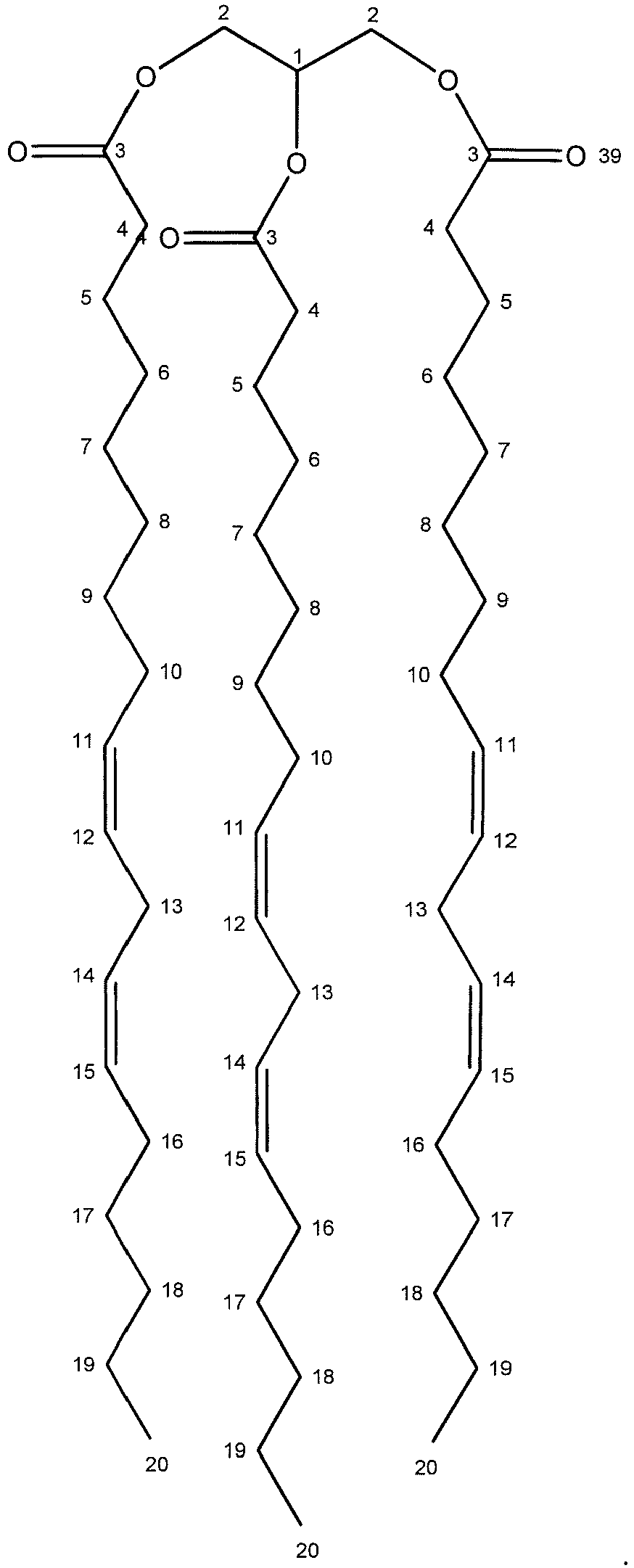
Table M Atom Number 1H- Chemical Shift (ppm) # of Protons Multiplicity (J value) 3 7.33 1 s 6 7.29 1 s 8 1.4 3x3 s 10 1.47 3x3 s 23 8.95 1 d, J=6.8 Hz (overlapped)1 22 11.7 1 s, broad 17 8.44 1 d, J = 8.2 Hz 18 7.53 1 ddd, J = 1.6 Hz, J = 6.6 Hz, J = 8.2 Hz 19 7.8 1 t, J = 7.6 Hz 20 7.76 1 d, J = 7.8 Hz 12 11.9 1 s 11 8.2 1 s Table N Atom Number 1H- Chemical Shift (ppm) Multiplicity (J value) # of Protons Theoretical signal intensity for 6:1 stoichiometry Measured integrated signal intensity1) 20 0.89 t, J=7 Hz 9 1.50 1.42 6-9, 17-19 1.34 m (overlapped) 42 7.00 6.01 5 1.61 m (overlapped) 6 1.00 1.33 10,16 2.08 overlapped with acetone-d6 12 2.00 n/a 4 2.32 t, J=7.4 Hz 6 1.00 0.91 13 2.80 overlapped w/HOD D, J=12Hz 6 1.00 n/a 2a 4.18 dd, J=6.1, J=12.0 2 0.33 0.31 2b 4.34 dd, J=4.0, J=12.0 2 0.33 0.34 1 5.28 m 1 0.17 0.14 11,12,13,14 5.36 m 12 2.00 1.08 - Integration was calibrated to yield 2.00 units for the combined integrated intensity for
position Compound 1. Slow H-D exchange atposition 22 ofCompound 1 results in observation of both doublet (position 22 H) and singlet (position 22 D) for H23 forCompound 1. - The accurate mass of this complex was determined on a LTQ Orbi Trap XL mass spectrometer. The sample was dissolved to approximately 0.1 mg/ml in MeOH and infused by direct flow injection using a syringe pump at a rate of 2µl/s. 50 scans were collected using the FTMS analyzer at a 30000 resolution setting.
- The following masses were found and confirm the identity of the molecular components of Compound 1:glyceryltrilinoleate:
- Compound 1: HRMS (ESI-TOF) m/z: [M + H]+ Calculated for C24H29N2O3+ 393.2173; Found 393.2176.
- Glyceryltrilinoleate: HRMS (ESI-TOF) m/z: [M +
Compound 1 + H]+ Calculated for C81H127N2O9+ 1271.9536; Found 1271.9541 -

- An examplary XRPD pattern for Compound 1:triacetin shown in
Figure 18 was acquired using the Panalytical Empyrean II diffractometer. Representative peaks for Compound 1:triacetin as observed in the XRPD pattern are provided in Table O below. All peaks listed below are greater than 5% of the maximum peak intensity.Table O Peak # Angle 2θ, in degrees (±0.2°) 1 4.9 2 9.5 3 9.8 4 14.7 5 16.5 6 18.2 7 23.1 - An examplary 13C ssNMR spectrum for Compound 1 :triacetin is shown in
Figure 19 . A listing of some of the 13C ssNMR peaks for Compound 1 :glyceryltriacetate are provided in Table P below.Table P Peak # 13C Chemical Shift (± 0.1 ppm) 1 178.2 2 165.4 3 164.3 4 155.1 5 154.8 6 154.1 7 149.4 8 146.8 9 145.6 10 140.0 11 134.1 12 133.2 13 132.3 14 127.0 15 125.9 16 125.6 17 124.3 18 120.6 19 119.7 20 119.2 21 118.3 22 117.6 23 111.9 24 111.1 25 110.4 26 35.3 27 35.0 28 31.8 29 29.8 30 21.9 31 20.4 32 18.9 - An examplary DSC thermogram for Compound 1:triacetin is shown in
Figure 20 . The thermogram of Compound 1:triacetin an endotherm at 123.9°C that corresponds to the melting of the Compound 1:glyceryltritriacetin co-crystal. This event is followed by another endotherm at 141.9°C and yet another endotherm at 193.8 °C. - An examplary XRPD pattern for Compound 1:glyceryltributyrate shown in
Figure 21 was acquired using the Panalytical Empyrean II diffractometer. Representative peaks for Compound 1:glyceryltributyrate as observed in the XRPD pattern are provided in Table Q below. All peaks listed below are greater than 5% of the maximum peak intensity.Table Q Peak # Angle 2θ, in degrees (±0.2°) 1 4.8 2 4.9 3 6.8 4 9.5 5 9.6 6 14.3 7 18.0 8 19.0 9 19.8 10 21.4 11 22.6 12 23.8 - An examplary XRPD pattern for Compound 1 :glyceryltristearate shown in
Figure 22 was acquired using the Bruker D8 Advance diffractometer. Representative peaks for Compound 1:glyceryltristearate as observed in the XRPD pattern are provided in Table R below. All peaks listed below are equal to or greater than 1% of the maximum peak intensity.Table R Peak # Angle 2θ, in degrees (±0.2°) 1 3.6 2 5.4 3 6.2 4 6.9 5 9.3 6 11.0 7 12.1 8 12.6 9 13.4 10 13.9 11 15.4 12 16.4 13 17.0 14 18.2 15 18.5 16 19.4 17 20.0 18 20.4 19 21.8 20 23.8 21 26.0 22 27.0 23 28.4 24 29.1 25 29.9 26 31.2 27 32.8 - An examplary 13C ssNMR spectrum for Compound 1:glyceryltristearate is shown in
Figure 23 . A listing of some of the 13C ssNMR peaks for Compound 1 :glyceryltristearate are provided in Table S below.Table S Peak # 13C Chemical Shift (± 0.1 ppm) 1 178.5 2 172.9 3 171.6 4 169.9 5 165.0 6 155.0 7 143.6 8 139.4 9 137.2 10 135.1 11 134.4 12 133.0 13 127.3 14 126.1 15 119.5 16 117.6 17 112.0 18 67.3 19 64.1 20 59.6 21 35.7 22 34.7 23 31.7 24 30.6 25 23.6 26 14.8 - An examplary DSC thermogram for Compound 1:glyceryltristearate is shown in
Figure 24 . The thermogram of Compound 1:glyceryltristearate inFigure 24 has an endotherm at 55.1°C that corresponds to the eutectic melt of Compound 1:glyceryltrilstearate co-crystal and glyceryltristearate. This event is followed by another endotherm at 71.3 °C, corresponding to the melt of neat glyceryltristearate. Overlapping endotherm at 201.3°C and exotherm at 208.1°C (peak) correspond to the cocrystal melt and crystallization ofneat Compound 1, respectively. Another endotherm at 284.7°C corresponds to the melt of a neat form ofCompound 1. - An examplary XRPD pattern for Compound 1:glyceryltripalmitate shown in
Figure 25 was acquired using the Bruker D8 Advance diffractometer. Representative peaks for Compound 1:glyceryltripalmitate as observed in the XRPD pattern are provided in Table T below. All peaks listed below are greater than 1% of the maximum peak intensity.Table T Peak # Angle 2θ, in degrees (±0.2°) 1 3.5 2 6.0 3 6.9 4 9.3 5 11.0 6 13.8 7 15.1 8 16.3 9 17.0 10 18.2 11 19.4 12 19.9 13 20.3 14 21.8 15 23.7 - An examplary 13C ssNMR spectrum for Compound 1:glyceryltripalmitate is shown in
Figure 26 . A listing of some of the 13C ssNMR peaks for Compound 1:glyceryltripalmitate are provided in Table U below.Table U Peak # 13C Chemical Shift (± 0.1 ppm) 1 178.4 2 173.0 3 169.9 4 165.0 5 155.0 6 144.0 7 139.5 8 137.2 9 134.5 10 133.0 11 127.2 12 126.0 13 119.6 14 117.5 15 112.0 16 67.2 17 64.0 18 59.7 19 35.7 20 34.6 21 31.7 22 30.6 23 23.7 24 14.8 - An examplary DSC thermogram for Compound 1:glyceryltripalmitate is shown in
Figure 27 . The thermogram of Compound 1 :glyceryltripalmitate inFigure 27 has an endotherm at 47.7°C that corresponds to the eutectic melt of Compound 1:glyceryltripalmitate co-crystal and glyceryltripalmitate. This event is followed by another endotherm at 63.0 °C, corresponding to the melt of neat glyceryltripalmitate. Overlapping endotherm at 174.9°C and exotherm at 186.7°C correspond to the cocrystal melt and crystallization ofneat Compound 1, respectively. Another endotherm at 266.2°C corresponds to the melt of a neat form ofCompound 1. - An examplary XRPD pattern for Compound 1:glyceryldodecanoate is shown
Figure 28 was acquired using the Bruker D8 Advance diffractometer. Representative peaks for Compound 1:glyceryltridodecanoate as observed in the XRPD pattern are provided in Table V below. All peaks listed below are equal to or greater than 1% of the maximum peak intensity.Table V Peak # Angle 2θ, in degrees (±0.2°) 1 3.5 2 6.1 3 6.9 4 9.2 6 10.9 7 11.8 8 12.1 9 12.6 10 13.2 11 13.8 12 14.9 13 16.3 14 16.9 15 18.1 16 18.5 17 19.4 18 19.8 19 20.3 20 21.7 21 23.4 22 23.9 23 25.2 24 25.8 25 27.2 26 28.4 - An examplary 13C ssNMR spectrum for
Compound 1 :glyceryltridodecanoate is shown inFigure 29 . A listing of some of the 13C ssNMR peaks for Compound 1:glyceryltridodecanoate are provided in Table W below.Table W Peak # 13C Chemical Shift (± 0.1 ppm) 1 178.4 2 173.1 3 171.5 4 169.8 5 165.0 6 155.0 7 143.0 8 139.4 9 137.2 10 134.6 11 133.0 12 127.3 13 126.1 14 119.6 15 117.6 16 112.1 17 67.1 18 63.9 19 59.7 20 35.6 21 31.7 22 30.6 23 23.6 - Representative single crystal x-ray crystallography data for Compound 1:glyceryl tridodecanoate is provided in Tables X-i to X-vii.
Table X-i: Crystal data C37H52.67N2O5 F(000) = 3944 Mr = 605.48 D x = 1.099 g cm-3 Hexagonal, P- 31c Synchrotron radiation, λ = 0.70158 Å a = 29.1507 (10) Å µ = 0.07 mm-1 c = 14.9118 (6) Å T = 100 K V = 10973.8 (7) Å3 Rod, colorless Z = 12 Table X-ii: Data collection Radiation source: synchrotron R int = 0.076 Graphite monochromator θmax = 24.3°, θmin = 1.6° 66577 measured reflections h = -34→32 5709 independent reflections k = -33→34 4610 reflections with I > 2σ(I) l = -17→14 Table X-iii: Refinement Refinement on F 2 Primary atom site location: structure-invariant direct methods Least-squares matrix: full Secondary atom site location: difference Fourier map R[F2 > 2□(F 2)] = 0.226 Hydrogen site location: inferred from neighbouring sites wR(F2 ) = 0.545 H atoms treated by a mixture of independent and constrained refinement S = 2.03 w = 1/[σ(F o 2) + (0.2P)2] where P = (F o 2 + 2F c 2)/3 5709 reflections (Δ/σ)max = 3.947 361 parameters Δ〉max = 0.54 e Å-3 19 restraints Δ〉min = -0.35 e Å-3 Table X-iv: Special details Geometry. All esds (except the esd in the dihedral angle between two l.s. planes) are estimated using the full covariance matrix. The cell esds are taken into account individually in the estimation of esds in distances, angles and torsion angles; correlations between esds in cell parameters are only used when they are defined by crystal symmetry. An approximate (isotropic) treatment of cell esds is used for estimating esds involving l.s. planes. Refinement. Refinement of F2 against ALL reflections. The weighted R-factor wR and goodness of fit S are based on F2, conventional R-factors R are based on F, with F set to zero for negative F2. The threshold expression of F2 > 2sigma(F2) is used only for calculating R-factors(gt) etc. and is not relevant to the choice of reflections for refinement. R-factors based on F2 are statistically about twice as large as those based on F, and R- factors based on ALL data will be even larger. Table X-v: Fractional atomic coordinates and isotropic or equivalent isotropic displacement parameters (Å2) x y z U iso*/U eq C1 0.2708 (3) 0.8168 (4) 0.1302 (11) 0.197 (5) C2 0.3516 (3) 0.8099 (3) 0.1185 (11) 0.197 (5) C3 0.2429 (3) 0.7620 (4) 0.1281 (9) 0.183 (4) N1 0.4387 (3) 0.8802 (2) 0.0983 (10) 0.226 (5) H1 0.4223 0.8979 0.0865 0.271* C4 0.4097 (3) 0.8311 (3) 0.1168 (11) 0.209 (6) C5 0.3276 (3) 0.8423 (3) 0.1157 (13) 0.217 (6) O2 0.4277 (2) 0.7989 (2) 0.1347 (11) 0.274 (6) C6 0.3197 (3) 0.7569 (3) 0.1298 (9) 0.173 (4) H6 0.3356 0.7356 0.1372 0.208* O1 0.3551 (2) 0.8934 (2) 0.1076 (9) 0.228 (5) N2 0.2668 (2) 0.7333 (2) 0.1311 (6) 0.164 (3) H2 0.2477 0.6986 0.1340 0.197* C7 0.1863 (4) 0.7341 (5) 0.1360 (15) 0.244 (8) H7 0.1667 0.6965 0.1396 0.292* C8 0.5250 (4) 0.9194 (3) 0.1741 (16) 0.228 (8) H8 0.5060 0.9049 0.2282 0.274* C9 0.2438 (4) 0.8470 (4) 0.1279 (14) 0.233 (7) H9 0.2629 0.8843 0.1202 0.280* O3 0.6057 (3) 0.9569 (3) 0.2587 (12) 0.253 (6) H3 0.5836 0.9407 0.2996 0.380* C10 0.1619 (5) 0.7629 (6) 0.1383 (17) 0.270 (9) H10 0.1243 0.7450 0.1410 0.324* Cll 0.1907 (4) 0.8204 (5) 0.1369 (16) 0.263 (9) H11 0.1721 0.8393 0.1422 0.316* C12 0.6673 (4) 1.0096 (4) 0.1039 (14) 0.227 (7) C13 0.6068 (4) 0.9709 (4) 0.1014 (15) 0.220 (7) C14 0.6792 (3) 1.0569 (4) 0.1638 (14) 0.229 (7) H14A 0.6564 1.0445 0.2170 0.344* H14B 0.6723 1.0818 0.1304 0.344* H14C 0.7164 1.0747 0.1823 0.344* C15 0.5781 (4) 0.9486 (3) 0.1736 (16) 0.228 (8) C37 0.5243 (15) 0.9305 (18) -0.1442 (11) 0.57 (3) H37A 0.5473 0.9689 -0.1506 0.857* H37B 0.4974 0.9174 -0.1915 0.857* H37C 0.5457 0.9132 -0.1493 0.857* C17 0.5782 (4) 0.9571 (5) 0.0208 (16) 0.279 (12) H17 0.5998 0.9664 -0.0312 0.334* C18 0.5182 (5) 0.9296 (5) 0.0001 (12) 0.289 (10) C19 0.6974 (4) 0.9824 (4) 0.1357 (16) 0.247 (8) H19A 0.7322 1.0090 0.1585 0.371* H19B 0.7020 0.9634 0.0855 0.371* H19C 0.6774 0.9572 0.1836 0.371* C20 0.6882 (5) 1.0244 (10) 0.007 (2) 0.336 (17) H20A 0.6658 0.9950 -0.0336 0.504* H20B 0.7247 1.0313 0.0039 0.504* H20C 0.6873 1.0562 -0.0118 0.504* C21 0.4997 (5) 0.9114 (4) 0.0947 (14) 0.209 (7) C22 0.5057 (8) 0.9220 (8) -0.0808 (11) 0.266 (9) C23 0.4695 (12) 0.864 (2) -0.109 (5) 0.68 (7) H23A 0.4703 0.8408 -0.0635 1.018* H23B 0.4818 0.8581 -0.1666 1.018* H23C 0.4332 0.8577 -0.1161 1.018* C24 0.4561 (6) 0.9358 (7) -0.0824 (14) 0.252 (8) H24A 0.4709 0.9742 -0.0812 0.378* H24B 0.4334 0.9199 -0.0298 0.378* H24C 0.4351 0.9212 -0.1370 0.378* C31 0.3177 (9) 0.7343 (12) 0.873 (2) 0.333 (15) C32 0.2650 (16) 0.731 (2) 0.856 (6) 0.64 (7) C33 0.267 (2) 0.7790 (16) 0.891 (2) 0.78 (9) C35 0.190 (2) 0.8034 (12) 0.892 (4) 1.05 (18) C36 0.1312 (16) 0.7838 (11) 0.889 (3) 0.325 (16) C34 0.214 (2) 0.770 (2) 0.864 (2) 0.53 (4) C38 0.3078 (14) 0.6793 (14) 0.898 (3) 0.40 (2) C41 0.1040 (18) 0.8161 (9) 0.885 (2) 1.05 (7) C42 0.077 (3) 0.846 (3) 0.884 (5) 0.73 (8) O51 0.3333 0.6667 0.024 (2) 0.325 (13) O52 0.152 (5) 0.937 (4) 0.186 (6) 0.97 (13) Table X-vi: Atomic displacement parameters (Å2) U 11 U 22 U 33 U 12 U 13 U 23 C1 0.058 (4) 0.076 (5) 0.449 (17) 0.027 (4) 0.016 (7) 0.001 (7) C2 0.075 (4) 0.062 (4) 0.453 (16) 0.033 (3) -0.024 (7) -0.083 (7) C3 0.060 (4) 0.077 (5) 0.400 (14) 0.026 (4) 0.019 (6) -0.012 (7) N1 0.054 (3) 0.062 (3) 0.550 (16) 0.020 (3) 0.024 (6) -0.045 (6) C4 0.058 (4) 0.059 (4) 0.501 (17) 0.022 (3) 0.005 (7) -0.063 (7) C5 0.059 (4) 0.057 (4) 0.527 (19) 0.023 (3) -0.009 (7) -0.036 (7) O2 0.065 (3) 0.067 (3) 0.684 (19) 0.030 (3) -0.002 (6) -0.084 (6) C6 0.067 (4) 0.060 (4) 0.380 (13) 0.023 (3) 0.001 (6) 0.006 (6) O1 0.067 (3) 0.059 (3) 0.555 (14) 0.029 (2) 0.057 (5) -0.008 (5) N2 0.066 (3) 0.054 (3) 0.359 (9) 0.022 (3) 0.033 (4) 0.016 (4) C7 0.056 (4) 0.104 (7) 0.56 (2) 0.030 (5) 0.017 (9) 0.026 (11) C8 0.067 (5) 0.052 (4) 0.57 (3) 0.036 (4) 0.000 (10) -0.038 (8) C9 0.061 (4) 0.092 (6) 0.54 (2) 0.032 (4) 0.034 (9) 0.023 (9) O3 0.054 (4) 0.077 (4) 0.614 (19) 0.022 (3) 0.042 (7) 0.033 (7) C10 0.076 (6) 0.127 (9) 0.57 (3) 0.020 (7) 0.021 (11) 0.021 (14) C11 0.072 (5) 0.108 (7) 0.62 (3) 0.050 (5) 0.050 (11) 0.021 (12) C12 0.059 (5) 0.100 (7) 0.52 (2) 0.036 (5) 0.049 (9) 0.004 (10) C13 0.050 (5) 0.074 (5) 0.53 (2) 0.022 (5) 0.024 (10) -0.057 (10) C14 0.061 (4) 0.077 (5) 0.53 (2) 0.016 (4) 0.009 (8) -0.061 (9) C15 0.050 (5) 0.041 (4) 0.58 (3) 0.014 (4) 0.073 (11) -0.022 (8) C37 0.55 (5) 1.09 (9) 0.138 (9) 0.46 (6) 0.021 (16) -0.21 (2) C17 0.057 (6) 0.150 (10) 0.58 (3) 0.017 (6) 0.097 (12) -0.125 (15) C18 0.239 (14) 0.157 (8) 0.45 (2) 0.085 (8) 0.227 (15) -0.110 (10) C19 0.065 (4) 0.096 (6) 0.59 (3) 0.046 (4) -0.008 (9) -0.014 (10) C20 0.072 (7) 0.26 (3) 0.63 (5) 0.053 (11) 0.022 (15) -0.10 (3) C21 0.080 (6) 0.090 (6) 0.48 (2) 0.057 (5) 0.005 (10) -0.056 (9) C22 0.314 (17) 0.332 (18) 0.194 (10) 0.193 (14) 0.098 (11) -0.123 (11) C23 0.25 (4) 1.05 (18) 0.89 (11) 0.45 (8) -0.23(6) -0.40 (12) C24 0.136 (10) 0.189 (13) 0.384 (18) 0.046 (10) 0.038 (11) -0.106 (14) C31 0.159 (17) 0.27 (3) 0.48 (3) 0.035 (19) 0.089 (18) 0.06 (3) C32 0.20 (3) 0.28 (6) 1.3 (2) -0.01 (3) -0.09 (6) 0.16 (9) C33 1.19 (18) 0.21 (3) 0.32 (3) -0.11 (6) -0.30 (6) 0.11 (3) C35 2.0 (4) 0.083 (14) 0.53 (7) 0.12 (6) -0.40 (17) 0.00 (2) C36 0.33 (4) 0.136 (18) 0.53 (4) 0.13 (2) -0.06 (3) -0.07 (2) C34 0.78 (11) 0.36 (5) 0.41 (4) 0.26 (6) -0.34 (6) -0.05 (4) C38 0.25 (3) 0.29 (3) 0.58 (5) 0.07 (2) 0.11 (3) 0.26 (4) C41 1.81 (15) 0.26 (2) 0.64 (5) 0.19 (5) -0.35 (7) 0.34 (3) C42 0.78 (13) 0.47 (9) 0.86 (13) 0.25 (9) 0.12 (10) 0.45 (10) O51 0.274 (18) 0.274 (18) 0.43 (3) 0.137 (9) 0.000 0.000 O52 1.3 (4) 1.1 (3) 0.99 (16) 1.0 (3) -0.23 (16) -0.40 (15) Table X-vii: Geometric parameters (Å, °) for (hexe) C1-C3 1.383 (13) C12-C14 1.531 (19) C1--C9 1.445 (14) C12-C20 1.55 (3) C1-C5 1.453 (12) C13-C15 1.32 (2) C2-C6 1.357 (12) C13-C17 1.40 (2) C2-C5 1.431 (12) C37-C22 1.06 (2) C2-C4 1.483 (11) C17-C18 1.55 (2) C3-N2 1.332 (10) C18-C22 1.25 (2) C3-C7 1.433 (13) C18-C21 1.51 (2) N1-C4 1.276 (12) C22-C23 1.53 (4) N1-C21 1.541 (15) C22-C24 1.68 (2) C4-O2 1.311 (13) C31-C32 1.51 (4) C5-O1 1.296 (10) C31-C38 1.53 (4) C6-N2 1.337 (11) C32-C33 1.47 (5) C7-C10 1.35 (2) C33-C34 1.49 (5) C8-C15 1.342 (15) C35-C34 1.50 (4) C8-C21 1.35 (2) C35-C36 1.51 (5) C9--C11 1.348 (15) C36-C41 1.51 (4) O3--C15 1.46 (2) C38-C38i 1.70 (6) C10-C11 1.45 (2) C38-C38ii 1.70 (6) C12-C19 1.524 (16) C41-C42 1.45 (5) C12-C13 1.546 (15) C3--C1--C9 121.1 (7) C15-C13-C17 114.7 (13) C3-C1-C5 116.8 (7) C15--C13-C12 123.4 (18) C9-C1-C5 120.9 (8) C17--C13-C12 121.9 (16) C6-C2-C5 118.1 (7) C13-C15-C8 124 (2) C6-C2-C4 117.9 (7) C13-C15-O3 117.9 (11) C5-C2-C4 123.9 (7) C8--C15--O3 117.8 (18) N2-C3-C1 122.2 (7) C13-C17-C18 132.6 (14) N2-C3-C7 117.1 (8) C22-C18-C21 145.1 (12) C1-C3-C7 120.1 (8) C22-C18-C17 116.1 (12) C4-N1-C21 126.4 (8) C21-C18-C17 96.2 (15) N1-C4-O2 124.6 (7) C8-C21-C18 133.6 (13) N1-C4-C2 116.8 (8) C8--C21--N1 116.1 (14) O2--C4--C2 118.6 (8) C18-C21-N1 110.1 (15) O1-C5-C2 122.4 (7) C37-C22-C18 139 (2) O1-C5-C1 119.6 (7) C37-C22-C23 90 (3) C2-C5-C1 117.8 (8) C18-C22-C23 116 (3) N2-C6-C2 123.1 (7) C37-C22-C24 110 (2) C6-N2-C3 120.5 (6) C 18-C22-C24 100.4 (10) C10--C7--C3 117.6 (9) C23-C22-C24 93.1 (17) C15-C8-C21 117.5 (19) C32-C31-C38 109 (3) C11-C9-C1 117.9 (9) C33-C32-C31 109 (5) C11-C10-C7 122.8 (10) C32-C33-C34 102 (3) C10-C11-C9 119.9 (9) C34-C35-C36 123 (3) C19-C12-C13 111.8 (9) C35-C36-C41 128 (3) C19-C12-C14 111.0 (14) C35-C34-C33 126 (4) C13--C12--C14 109.5 (10) C31--C38--C38i 155 (2) C19-C12-C20 100.8 (14) C31-C38-C38ii 99 (3) C13-C12-C20 109.1 (15) C38i-C38-C38ii 60.000 (18) C14-C12-C20 114.5 (14) C42-C41-C36 178 (3) Symmetry codes: (i) -y+1, x-y+1, z; (ii) -x+y, -x+1, z. - An examplary XRPD pattern for Compound 1: glyceryltrimyristate shown in
Figure 30 was acquired using the Panalytical Empyrean II diffractometer. Representative peaks for Compound 1: glyceryltrimyristate as observed in the XRPD pattern are provided in Table X below. All peaks listed below are greater than 1% of the maximum peak intensity.Table X Peak # Angle 2θ, in degrees (±0.2°) 1 3.5 2 6.0 3 6.8 4 7.4 5 8.3 6 9.2 7 9.9 8 10.9 9 12.0 10 12.5 11 13.2 12 13.7 13 14.9 14 16.2 15 16.9 16 17.6 17 18.0 18 18.5 19 19.4 20 20.0 21 21.2 22 22.1 23 23.2 24 24.1 25 25.1 26 26.4 27 27.2 28 27.7 29 28.3 30 29.2 31 29.7 32 31.0 36 32.7 - An examplary 13C ssNMR spectrum for Compound 1:glyceryltrimyristate is shown in
Figure 31 . A listing of some of the 13C ssNMR peaks for Compound 1:glyceryltrimyristate are provided in Table Y below.Table Y Peak # 13C Chemical Shift (± 0.1 ppm) 1 178.1 2 171.4 3 169.8 4 165.0 5 155.0 6 142.9 7 139.5 8 137.2 9 134.6 10 133.1 11 127.3 12 126.0 13 119.9 14 117.4 15 112.0 16 67.0 17 63.7 18 61.4 19 35.6 - An examplary DSC thermogram for Compound 1 :glyceryltristearate is shown in
Figure 32 . The thermogram of Compound 1 :glyceryltrimyristate inFigure 32 has an endotherm at 59.2°C that corresponds to the melt of glyceryltrimyristate. This event is followed by a broad exotherm at 134.4 °C that is overlapping with an endotherm. This event is followed by an exotherm at 171.3 °C corresponding to the crystallization ofneat Compound 1. Another endotherm at 280.1°C corresponds to the melt of a neat form ofCompound 1. - An examplary XRPD pattern for Compound 1: glyceryltrihexanoate shown in
Figure 33 was acquired using the Panalytical Empyrean II diffractometer . Representative peaks for Compound 1: glyceryltrihexanoate as observed in the XRPD pattern are provided in Table Z below. All peaks listed below are greater than 1% of the maximum peak intensity.Table Z Peak # Angle 2θ, in degrees (±0.2°) 1 4.7 2 6.5 3 9.2 4 9.9 5 11.8 6 12.5 7 14.5 8 15.1 9 15.6 10 17.4 11 18.7 12 19.9 13 21.4 14 23.0 15 24.4 16 25.2 17 26.5 18 28.3 19 29.1 20 30.5 21 35.6 - An examplary XRPD pattern for Compound 1: glyceryltridecanoate shown in
Figure 34 was acquired using the Bruker D8 Advance diffractometer. Representative peaks for Compound 1: glyceryltridecanoate as observed in the XRPD pattern are provided in Table AA below. All peaks listed below are greater than 1% of the maximum peak intensity.Table AA No. Angle 2θ, in degrees (±0.2°) 1 3.5 2 6.1 3 6.9 4 9.2 6 10.9 7 11.8 8 12.1 9 12.6 10 13.2 12 13.8 12 14.9 13 16.3 14 16.9 15 18.1 16 18.5 17 19.4 18 19.8 19 20.3 20 21.7 21 23.4 22 23.9 23 25.2 24 25.8 25 27.2 26 28.4 - An examplary 13C ssNMR spectrum for Compound 1:glyceryltridecanoate is shown in
Figure 35 . A listing of some of the 13C ssNMR peaks for Compound 1 :glyceryltridodecanoate are provided in Table AB below.Table AB Peak # 13C Chemical Shift (± 0.1 ppm) 1 178.5 2 171.6 3 169.9 4 165.0 5 155.0 6 143.3 7 139.5 8 137.2 9 134.9 10 133.0 11 127.3 12 126.1 13 119.5 14 117.6 15 112.1 16 67.2 17 64.0 18 59.8 19 35.7 20 34.7 21 31.7 22 30.5 23 25.8 24 23.5 - 30 mg Compound 1-triglyceride co-crystal samples were weighed and quantitatively transferred into a 100 mL amber volumetric flasks. 50ml of diluent was added, and the sample preparation was sonicated for 15 minutes. Each sample preparation was then shaken on a mechanical shaker for 30 minutes at 200 motion/sec. Another 40ml of diluent was added and the sample preparation was shaken on a mechanical shaker for 30 minutes at 200 motion/sec. The Compound 1-glyceryltrioctanoate sample preparation dissolved completely, was allowed to return to room temperature, then diluted to volume with diluent, and mixed well. The Compound 1-glyceryltrioleate and Compound 1-glyceryltrilinoleate sample preparations did not dissolve completely. These two sample preparations were each sonicated for 15 minutes and then shaken for 30 minutes at 200 motion/sec. The two sample preparations were still not dissolved. 8 ml of acetonitrile was added to each and the sample preparations were sonicated for 15 minutes and then shaken for 30 minutes at 200 motion/sec. The two sample preparations were still not dissolved. 1 ml of methanol was added to each and the two sample preparations were sonicated for 15 minutes and then shaken for 30 minutes at 200 motion/sec. The two sample preparations were still not dissolved. The sample preparations were allowed to return to room temperature, diluted to volume with methanol and mixed well. Both sample preparations were cloudy. An aliquot of the solutions were filtered through a 0.45 µm Whatman PVDF filter. The first 2 mL of the filtrate was discarded before collecting in amber HPLC vials for analysis.
- Sample preparations were made for the HPLC method described below.
- Samples were analyzed using the method parameters described below. Mobile Phase A was 0.1% Phosphoric Acid in Water. Mobile Phase B was 0.1 % Phosphoric Acid in Acetonitrile. Table AC below shows the gradient program used.
Table AC: Gradient program for the HPLC method. Time (min.) %A %B 0.0 80 20 7.0 40 60 9.0 40 60 9.1 0 100 12.0 0 100 12.1 80 20 16.0 80 20 - The HPLC was done using a Waters Symmetry Shield RP18, 4.6 x 50 mm, 3.5 µm column (P/N 186000177) column on an Agilent 1260 HPLC instrument. The diluent was 70:30 Acetonitrile:Water. The flow rate was 1.5 mL/minute. Column temperature was 35 °C. The needle wash used was 90:10 (Acetonitrile: Water). Injection volume was 10 µL. The detector wavelength was 235 nM. Data acquisition time was 10.0 minutes. The vial temperature was ambient or 25 °C. Run time was 16 minutes. The syringe filter used was a 0.45µm PVDF Syringe Filter. Sample and standard stability were both 2 days. Two standards of
Compound 1 were prepared and used (75.12 mg ofCompound 1 in 250 mL of diluent and 75.29 mg ofCompound 1 in 250 mL of diluent). - The purity was determined for each co-crystal by totaling the relative integrated intensities of the impurity peaks and subtracting from 100%. The Compound 1:glyceryltrioctanoate co-crystal and the Compound 1 :glyceryltrioleate co-crystal were each 99.9% (w/w). The Compound 1:glyceryltrilinoleate co-crystal was 99.5% (w/w). The detection limit for impurities by HPLC is 0.005%.
- The stoichiometry for each co-crystal was also determined from this HPLC assay. As shown in Table AD below, the stoichiometry determined was consistent with the results from solution state 1H NMR and thermogravimetric analysis.
TABLE AD Compound 1 : glvceryltrioctanoate Compound 1 % w:w Stoichiometry Compound 1: Triglyeride Note Solution 1H NMR 71.9 3.1 Compound 1 % w:w calculated based on observed stoichiomtryTGA weight loss 71.8 3.1 Stoichiometry calculated based on observed glyceryltrioctanoate % weight loss HPLC Assay 72.1 3.1 Stoichiometry calculated based on observed Ivacaftor %w:w Compound 1: glyceryltrioleate Compound 1 % w:w Stoichiometry Compound 1: Triglyeride Note Solution 1H NMR 71.4 5.6 Compound 1 % w:w calculated based on observed stoichiomtryHPLC Assay 72.4 5.9 Stoichiometry calculated based on observed Ivacaftor %w:w Compound 1 : glyceryltrilinoleate Compound 1 % w:w Stoichiometry Compound 1: Triglyeride Note Solution 1H NMR 71.6 5.7 Compound 1 % w:w calculated based on observed stoichiomtryHPLC Assay 68.6 4.9 Stoichiometry calculated based on observed Ivacaftor %w:w - The assay utilizes fluorescent voltage sensing dyes to measure changes in membrane potential using a fluorescent plate reader (e.g., FLIPR III, Molecular Devices, Inc.) as a readout for increase in functional ΔF508-CFTR in NIH 3T3 cells. The driving force for the response is the creation of a chloride ion gradient in conjunction with channel activation by a single liquid addition step after the cells have previously been treated with compounds and subsequently loaded with a voltage sensing dye.
- To identify potentiators of ΔF508-CFTR, a double-addition HTS assay format was developed. This HTS assay utilizes fluorescent voltage sensing dyes to measure changes in membrane potential on the FLIPR III as a measurement for increase in gating (conductance) of ΔF508 CFTR in temperature-corrected ΔF508 CFTR NIH 3T3 cells. The driving force for the response is a Cl- ion gradient in conjunction with channel activation with forskolin in a single liquid addition step using a fluorescent plate reader such as FLIPR III after the cells have previously been treated with potentiator compounds (or DMSO vehicle control) and subsequently loaded with a redistribution dye.
- Bath Solution #1: (in mM)
NaCl 160, KCl 4.5,CaCl 2 2,MgCl 2 1,HEPES 10, pH 7.4 with NaOH. - Chloride-free bath solution: Chloride salts in Bath Solution #1 (above) are substituted with gluconate salts.
- NIH3T3 mouse fibroblasts stably expressing ΔF508-CFTR are used for optical measurements of membrane potential. The cells are maintained at 37 °C in 5% CO2 and 90 % humidity in Dulbecco's modified Eagle's medium supplemented with 2 mM glutamine, 10 % fetal bovine serum, 1 X NEAA, β-ME, 1 X pen/strep, and 25 mM HEPES in 175 cm2 culture flasks. For all optical assays, the cells were seeded at ∼20,000/well in 384-well matrigel-coated plates and cultured for 2 hrs at 37 °C before culturing at 27 °C for 24 hrs. for the potentiator assay. For the correction assays, the cells are cultured at 27 °C or 37 °C with and without compounds for 16 - 24 hours.
- Electrophysiological Assays for assaying ΔF508-CFTR modulation properties of compounds.
- Ussing chamber experiments were performed on polarized airway epithelial cells expressing ΔF508-CFTR to further characterize the ΔF508-CFTR modulators identified in the optical assays. Non-CF and CF airway epithelia were isolated from bronchial tissue, cultured as previously described (Galietta, L.J.V., Lantero, S., Gazzolo, A., Sacco, O., Romano, L., Rossi, G.A., & Zegarra-Moran, O. (1998) In vitro Cell. Dev. Biol. 34, 478-481), and plated onto Costar® Snapwell™ filters that were precoated with NIH3T3-conditioned media. After four days the apical media was removed and the cells were grown at an air liquid interface for > 14 days prior to use. This resulted in a monolayer of fully differentiated columnar cells that were ciliated, features that are characteristic of airway epithelia. Non-CF HBE were isolated from non-smokers that did not have any known lung disease. CF-HBE were isolated from patients homozygous for ΔF508-CFTR.
- HBE grown on Costar® Snapwell™ cell culture inserts were mounted in an Using chamber (Physiologic Instruments, Inc., San Diego, CA), and the transepithelial resistance and short-circuit current in the presence of a basolateral to apical Cl- gradient (ISC) were measured using a voltage-clamp system (Department of Bioengineering, University of Iowa, IA). Briefly, HBE were examined under voltage-clamp recording conditions (Vhold = 0 mV) at 37 °C. The basolateral solution contained (in mM) 145 NaCl, 0.83 K2HPO4, 3.3 KH2PO4, 1.2 MgCl2, 1.2 CaCl2, 10 Glucose, 10 HEPES (pH adjusted to 7.35 with NaOH) and the apical solution contained (in mM) 145 NaGluconate, 1.2 MgCl2, 1.2 CaCl2, 10 glucose, 10 HEPES (pH adjusted to 7.35 with NaOH).
- Typical protocol utilized a basolateral to apical membrane Cl- concentration gradient. To set up this gradient, normal ringers was used on the basolateral membrane, whereas apical NaCl was replaced by equimolar sodium gluconate (titrated to pH 7.4 with NaOH) to give a large Cl- concentration gradient across the epithelium. Forskolin (10 µM) and all test compounds were added to the apical side of the cell culture inserts. The efficacy of the putative ΔF508-CFTR potentiators was compared to that of the known potentiator, genistein.
- Total Cl- current in ΔF508-NIH3T3 cells was monitored using the perforated-patch recording configuration as previously described (Rae, J., Cooper, K., Gates, P., & Watsky, M. (1991) J. Neurosci. Methods 37, 15-26). Voltage-clamp recordings were performed at 22 °C using an Axopatch 200B patch-clamp amplifier (Axon Instruments Inc., Foster City, CA). The pipette solution contained (in mM) 150 N-methyl-D-glucamine (NMDG)-Cl, 2 MgCl2, 2 CaCl2, 10 EGTA, 10 HEPES, and 240 µg/mL amphotericin-B (pH adjusted to 7.35 with HCl). The extracellular medium contained (in mM) 150 NMDG-Cl, 2 MgCl2, 2 CaCl2, 10 HEPES (pH adjusted to 7.35 with HCl). Pulse generation, data acquisition, and analysis were performed using a PC equipped with a Digidata 1320 A/D interface in conjunction with Clampex 8 (Axon Instruments Inc.). To activate ΔF508-CFTR, 10 µM forskolin and 20 µM genistein were added to the bath and the current-voltage relation was monitored every 30 sec.
- The ability of ΔF508-CFTR potentiators to increase the macroscopic ΔF508-CFTR Cl- current (IΔF508) in NIH3T3 cells stably expressing ΔF508-CFTR was also investigated using perforated-patch-recording techniques. The potentiators identified from the optical assays evoked a dose-dependent increase in IΔF508 with similar potency and efficacy observed in the optical assays. In all cells examined, the reversal potential before and during potentiator application was around -30 mV, which is the calculated ECl (-28 mV).
- NIH3T3 mouse fibroblasts stably expressing ΔF508-CFTR are used for whole-cell recordings. The cells are maintained at 37 °C in 5% CO2 and 90 % humidity in Dulbecco's modified Eagle's medium supplemented with 2 mM glutamine, 10 % fetal bovine serum, 1 X NEAA, β-ME, 1 X pen/strep, and 25 mM HEPES in 175 cm2 culture flasks. For whole-cell recordings, 2,500 - 5,000 cells were seeded on poly-L-lysine-coated glass coverslips and cultured for 24 - 48 hrs at 27 °C before use to test the activity of potentiators; and incubated with or without the correction compound at 37 °C for measuring the activity of correctors.
- Gating activity of wt-CFTR and temperature-corrected ΔF508-CFTR expressed in NIH3T3 cells was observed using excised inside-out membrane patch recordings as previously described (Dalemans, W., Barbry, P., Champigny, G., Jallat, S., Dott, K., Dreyer, D., Crystal, R.G., Pavirani, A., Lecocq, J-P., Lazdunski, M. (1991) Nature 354, 526 - 528) using an Axopatch 200B patch-clamp amplifier (Axon Instruments Inc.). The pipette contained (in mM): 150 NMDG, 150 aspartic acid, 5 CaCl2, 2 MgCl2, and 10 HEPES (pH adjusted to 7.35 with Tris base). The bath contained (in mM): 150 NMDG-Cl, 2 MgCl2, 5 EGTA, 10 TES, and 14 Tris base (pH adjusted to 7.35 with HCl). After excision, both wt- and ΔF508-CFTR were activated by adding 1 mM Mg-ATP, 75 nM of the catalytic subunit of cAMP-dependent protein kinase (PKA; Promega Corp. Madison, WI), and 10 mM NaF to inhibit protein phosphatases, which prevented current rundown. The pipette potential was maintained at 80 mV. Channel activity was analyzed from membrane patches containing ≤ 2 active channels. The maximum number of simultaneous openings determined the number of active channels during the course of an experiment. To determine the single-channel current amplitude, the data recorded from 120 sec of ΔF508-CFTR activity was filtered "off-line" at 100 Hz and then used to construct all-point amplitude histograms that were fitted with multigaussian functions using Bio-Patch Analysis software (Bio-Logic Comp. France). The total microscopic current and open probability (Po) were determined from 120 sec of channel activity. The Po was determined using the Bio-Patch software or from the relationship Po = I/i(N), where I = mean current, i = single-channel current amplitude, and N = number of active channels in patch.
- NIH3T3 mouse fibroblasts stably expressing ΔF508-CFTR are used for excised-membrane patch-clamp recordings. The cells are maintained at 37 °C in 5% CO2 and 90 % humidity in Dulbecco's modified Eagle's medium supplemented with 2 mM glutamine, 10 % fetal bovine serum, 1 X NEAA, β-ME, 1 X pen/strep, and 25 mM HEPES in 175 cm2 culture flasks. For single channel recordings, 2,500 - 5,000 cells were seeded on poly-L-lysine-coated glass coverslips and cultured for 24 - 48 hrs at 27 °C before use.
- Compounds of the present disclosure are useful as modulators of ATP binding cassette transporters. Table AD below illustrates the EC50 and relative efficacy of certain embodiments in Table 1. In Table AE below, the following meanings apply. EC50: "+++" means <10 uM; "++" means between 10uM to 25 uM; "+" means between 25 uM to 60uM. % Efficacy: "+" means < 25%; "++" means between 25% to 100%; "+++" means > 100%.
TABLE AE Cmpd # EC50 (uM) % Activity 1 +++ ++ - The assay utilizes fluorescent voltage sensing dyes to measure changes in membrane potential using a fluorescent plate reader (e.g., FLIPR III, Molecular Devices, Inc.) as a readout for increase in functional ΔF508-CFTR in NIH 3T3 cells. The driving force for the response is the creation of a chloride ion gradient in conjunction with channel activation by a single liquid addition step after the cells have previously been treated with compounds and subsequently loaded with a voltage sensing dye.
- To identify potentiators of ΔF508-CFTR, a double-addition HTS assay format was developed. This HTS assay utilizes fluorescent voltage sensing dyes to measure changes in membrane potential on the FLIPR III as a measurement for increase in gating (conductance) of ΔF508 CFTR in temperature-corrected ΔF508 CFTR NIH 3T3 cells. The driving force for the response is a Cl- ion gradient in conjunction with channel activation with forskolin in a single liquid addition step using a fluorescent plate reader such as FLIPR III after the cells have previously been treated with potentiator compounds (or DMSO vehicle control) and subsequently loaded with a redistribution dye.
- Bath Solution #1: (in mM)
NaCl 160, KCl 4.5,CaCl 2 2,MgCl 2 1,HEPES 10, pH 7.4 with NaOH. - Chloride-free bath solution: Chloride salts in Bath Solution #1 (above) are substituted with gluconate salts.
- NIH3T3 mouse fibroblasts stably expressing ΔF508-CFTR are used for optical measurements of membrane potential. The cells are maintained at 37 °C in 5% CO2 and 90 % humidity in Dulbecco's modified Eagle's medium supplemented with 2 mM glutamine, 10 % fetal bovine serum, 1 X NEAA, β-ME, 1 X pen/strep, and 25 mM HEPES in 175 cm2 culture flasks. For all optical assays, the cells were seeded at ∼20,000/well in 384-well matrigel-coated plates and cultured for 2 hrs at 37 °C before culturing at 27 °C for 24 hrs. for the potentiator assay. For the correction assays, the cells are cultured at 27 °C or 37 °C with and without compounds for 16 - 24 hours.
- Electrophysiological Assays for assaying ΔF508-CFTR modulation properties of compounds.
- Ussing chamber experiments were performed on polarized airway epithelial cells expressing ΔF508-CFTR to further characterize the ΔF508-CFTR modulators identified in the optical assays. Non-CF and CF airway epithelia were isolated from bronchial tissue, cultured as previously described (Galietta, L.J.V., Lantero, S., Gazzolo, A., Sacco, O., Romano, L., Rossi, G.A., & Zegarra-Moran, O. (1998) In vitro Cell. Dev. Biol. 34, 478-481), and plated onto Costar® Snapwell™ filters that were precoated with NIH3T3-conditioned media. After four days the apical media was removed and the cells were grown at an air liquid interface for > 14 days prior to use. This resulted in a monolayer of fully differentiated columnar cells that were ciliated, features that are characteristic of airway epithelia. Non-CF HBE were isolated from non-smokers that did not have any known lung disease. CF-HBE were isolated from patients homozygous for ΔF508-CFTR.
- HBE grown on Costar® Snapwell™ cell culture inserts were mounted in an Using chamber (Physiologic Instruments, Inc., San Diego, CA), and the transepithelial resistance and short-circuit current in the presence of a basolateral to apical Cl- gradient (ISC) were measured using a voltage-clamp system (Department of Bioengineering, University of Iowa, IA). Briefly, HBE were examined under voltage-clamp recording conditions (Vhold = 0 mV) at 37 °C. The basolateral solution contained (in mM) 145 NaCl, 0.83 K2HPO4, 3.3 KH2PO4, 1.2 MgCl2, 1.2 CaCl2, 10 Glucose, 10 HEPES (pH adjusted to 7.35 with NaOH) and the apical solution contained (in mM) 145 NaGluconate, 1.2 MgCl2, 1.2 CaCl2, 10 glucose, 10 HEPES (pH adjusted to 7.35 with NaOH).
- Typical protocol utilized a basolateral to apical membrane Cl- concentration gradient. To set up this gradient, normal ringers was used on the basolateral membrane, whereas apical NaCl was replaced by equimolar sodium gluconate (titrated to pH 7.4 with NaOH) to give a large Cl- concentration gradient across the epithelium. Forskolin (10 µM) and all test compounds were added to the apical side of the cell culture inserts. The efficacy of the putative ΔF508-CFTR potentiators was compared to that of the known potentiator, genistein.
- Total Cl- current in ΔF508-NIH3T3 cells was monitored using the perforated-patch recording configuration as previously described (Rae, J., Cooper, K., Gates, P., & Watsky, M. (1991) J. Neurosci. Methods 37, 15-26). Voltage-clamp recordings were performed at 22 °C using an Axopatch 200B patch-clamp amplifier (Axon Instruments Inc., Foster City, CA). The pipette solution contained (in mM) 150 N-methyl-D-glucamine (NMDG)-Cl, 2 MgCl2, 2 CaCl2, 10 EGTA, 10 HEPES, and 240 µg/mL amphotericin-B (pH adjusted to 7.35 with HCl). The extracellular medium contained (in mM) 150 NMDG-Cl, 2 MgCl2, 2 CaCl2, 10 HEPES (pH adjusted to 7.35 with HCl). Pulse generation, data acquisition, and analysis were performed using a PC equipped with a Digidata 1320 A/D interface in conjunction with Clampex 8 (Axon Instruments Inc.). To activate ΔF508-CFTR, 10 µM forskolin and 20 µM genistein were added to the bath and the current-voltage relation was monitored every 30 sec.
- The ability of ΔF508-CFTR potentiators to increase the macroscopic ΔF508-CFTR Cl- current (IΔF508) in NIH3T3 cells stably expressing ΔF508-CFTR was also investigated using perforated-patch-recording techniques. The potentiators identified from the optical assays evoked a dose-dependent increase in IΔF508 with similar potency and efficacy observed in the optical assays. In all cells examined, the reversal potential before and during potentiator application was around -30 mV, which is the calculated ECl (-28 mV).
- NIH3T3 mouse fibroblasts stably expressing ΔF508-CFTR are used for whole-cell recordings. The cells are maintained at 37 °C in 5% CO2 and 90 % humidity in Dulbecco's modified Eagle's medium supplemented with 2 mM glutamine, 10 % fetal bovine serum, 1 X NEAA, β-ME, 1 X pen/strep, and 25 mM HEPES in 175 cm2 culture flasks. For whole-cell recordings, 2,500 - 5,000 cells were seeded on poly-L-lysine-coated glass coverslips and cultured for 24 - 48 hrs at 27 °C before use to test the activity of potentiators; and incubated with or without the correction compound at 37 °C for measuring the activity of correctors.
- Gating activity of wt-CFTR and temperature-corrected ΔF508-CFTR expressed in NIH3T3 cells was observed using excised inside-out membrane patch recordings as previously described (Dalemans, W., Barbry, P., Champigny, G., Jallat, S., Dott, K., Dreyer, D., Crystal, R.G., Pavirani, A., Lecocq, J-P., Lazdunski, M. (1991) Nature 354, 526 - 528) using an Axopatch 200B patch-clamp amplifier (Axon Instruments Inc.). The pipette contained (in mM): 150 NMDG, 150 aspartic acid, 5 CaCl2, 2 MgCl2, and 10 HEPES (pH adjusted to 7.35 with Tris base). The bath contained (in mM): 150 NMDG-Cl, 2 MgCl2, 5 EGTA, 10 TES, and 14 Tris base (pH adjusted to 7.35 with HCl). After excision, both wt- and ΔF508-CFTR were activated by adding 1 mM Mg-ATP, 75 nM of the catalytic subunit of cAMP-dependent protein kinase (PKA; Promega Corp. Madison, WI), and 10 mM NaF to inhibit protein phosphatases, which prevented current rundown. The pipette potential was maintained at 80 mV. Channel activity was analyzed from membrane patches containing ≤ 2 active channels. The maximum number of simultaneous openings determined the number of active channels during the course of an experiment. To determine the single-channel current amplitude, the data recorded from 120 sec of ΔF508-CFTR activity was filtered "off-line" at 100 Hz and then used to construct all-point amplitude histograms that were fitted with multigaussian functions using Bio-Patch Analysis software (Bio-Logic Comp. France). The total microscopic current and open probability (Po) were determined from 120 sec of channel activity. The Po was determined using the Bio-Patch software or from the relationship Po = I/i(N), where I = mean current, i = single-channel current amplitude, and N = number of active channels in patch.
- NIH3T3 mouse fibroblasts stably expressing ΔF508-CFTR are used for excised-membrane patch-clamp recordings. The cells are maintained at 37 °C in 5% CO2 and 90 % humidity in Dulbecco's modified Eagle's medium supplemented with 2 mM glutamine, 10 % fetal bovine serum, 1 X NEAA, β-ME, 1 X pen/strep, and 25 mM HEPES in 175 cm2 culture flasks. For single channel recordings, 2,500 - 5,000 cells were seeded on poly-L-lysine-coated glass coverslips and cultured for 24 - 48 hrs at 27 °C before use.
- Dissolution tests of
Compound 1 co-crystals were run in 50ml amber bottles placed in jacketed vessels. The temperature of the jacketed vessel was controlled by an Iso Temp 360 water bath/chiller and set to 37°C. Twenty milliliters of simulated fed intestinal fluids were placed in the bottles and allowed to equilibrate to 37°C for one hour while stirring at 125 rpm. Pre-weighed amounts (See Table AD, target concentration ofCompound 1 ∼ 1mg/ml) of Compound 1:triglyceride co-crystal were then added to each bottle and allowed to stir at 37°C for the duration of the dissolution study. One microliter samples were collected at selected time points (5 and 30 minutes, and 1, 2, 3, 4, 6, 16, and 24 hours). The samples were filtered using Millex®-LH 0.45 µm PTFE syringe filters and analyzed by HPLC for concentration levels. - Dissolution tests of
Compound 1 SDD andCompound 1 amorphous were run in a Varian VK700 dissolution system. The temperature of the dissolution bath was controlled and set to 37°C. Five hundred milliliters of simulated fed intestinal fluids were placed in the dissolution vessels and allowed to equilibrate to 37°C while stirring. Pre-weighed amounts (target concentration ofCompound 1 ∼ 1mg/mL) ofCompound 1 were then added to each vessel and allowed to stir at 37°C for the duration of the dissolution study. Three milliliter samples were collected at selected time points (0.5, 1, 1.5, 3, 6, 9, 12, 18, 24, 48 hours). The samples were filtered using Whatman 25mm with 0.45 µm PTFE syringe filters and analyzed by HPLC for concentration levels.Table AF: Weights of Compound added to each vessel for dissolution experiment # of Compound 1:triglyceride co-crystal [mg] 1 2 31.6 3 32.0 4 33.1 5 32.5 6 31.2 7 30.2 8 32.0 9 34.1 -
Figure 36 shows the comparison of dissolution profiles up to 24 hours of Compound 1 :glyceryltrioctanoate, Compound 1:glyceryltrioleate and Compound 1:glyceryltrilinoleate withamorphous Compound 1 andCompound 1 SDD in FeSSIF. - Abbot Iron fortified infant formula was mixed with
amorphous Compound 1 at approximate 7% w/v solids ratio (i.e., 7g ofamorphous Compound 1 in 100 ml of reconstituted formula). The suspension was slurried at ambient conditions and solids were isolated by vacuum filtration. The recovered solids were air dried for at least 1 hour prior to analysis. -
Figure 37 shows examplary low angle XRPD patterns of co-crystals ofCompound 1 with different pure triglycerides and solid materials isolated from the mixture of infant formula andCompound 1. Based on the data shown inFigure 37 , the solid materials isolated from the mixture of infant formula andCompound 1 may consist either of a mixture of different cocrystals of Compound 1:triglycerides or a cocrystal ofCompound 1 with a range of triglycerides in the crystal structure. - In addition, based on
aromatic Compound 1 signal intensity in 13C CPMAS spectra, an average amount of 22% ofCompound 1 was present in the form of the solid materials isolated from the mixture of infant formula during contacts ranging from 1 hour to 24 hours.
Claims (15)
- A pharmaceutical composition comprising a therapeutic effective amount of Compound 1 and a pharmaceutically acceptable carrier or excipient, wherein Compound 1 is represented by the following structural formula:

further wherein at least 30% of Compound 1 is present as a co-crystal comprising Compound 1 and a triglyceride, wherein the triglyceride is chosen from the following structural formula:
- The pharmaceutical composition of claim 1, wherein the co-crystal is characterized as having an X-ray powder diffraction pattern with characteristic peaks expressed in 2-theta ± 0.2 degrees at the following positions: 3.5, 6.9, and 10.9; or
wherein the co-crystal is characterized as having an X-ray powder diffraction pattern with characteristic peaks expressed in 2-theta ±0.2 degrees at the following positions: 3.5, 6.9, 9.2, 10.9, 16.9, 18.0, and 23.8. - The pharmaceutical composition of claim 1 or claim 2, wherein the co-crystal is characterized as having a 13C ssNMR spectrum with characteristic peaks expressed in ppm ± 0.1 at the following positions: 178.6, 155.0, and 119.4; or wherein the co-crystal is characterized as having a 13C ssNMR spectrum with characteristic peaks expressed in ppm ± 0.1 at the following positions: 178.6, 155.0, 130.5, and 119.4.
- The pharmaceutical composition of any of claims 1-3, wherein the stoichiometry of Compound 1 to the triglyceride in the co-crystal is 3 to 1 or 6 to 1.
- The pharmaceutical composition of any of claims 1-4, wherein Compound 1 forms a hexamer in the co-crystal and further wherein R1, R2, and R3 are independently C7-29 aliphatic.
- The pharmaceutical composition of claim 1, wherein the triglyceride is chosen from: glyceryl trioleate, glyceryl tristearate, glycerol tridecanoate, glycerol trihexanoate, glyceryl tritridecanoate, glycerol trioctanoate, glyceryl trimyristate, glyceryl tripalmitate, glyceryl tributyrate, glyceryl trilinoleate, glyceryl tridodecanoate, glyceryl decanoate, glyceryl tripalmitoleate, glycerol trierucate, glyceryl tripropionate, palmitodiolein, triarachidonin, glyceryl trilinolenate, trierucin, glycerol triarachidate, glyceryl tri(cis-13-docosenoate), glyceryl tripetroselinate, glyceryl tribehenate, glyceryl trielaidate, and triacetin.
- The pharmaceutical composition of any of claims 1-6, wherein the pharmaceutical composition is a solid dosage form for oral administration.
- The pharmaceutical composition of claim 7, wherein the solid dosage form for oral administration is a capsule, a tablet, a pill, a powder, or a granule.
- The pharmaceutical composition of any of claims 1-8, further comprising an additional therapeutic agent selected from a mucolytic agent, a bronchodilator, an antibiotic, an anti-infective agent, an anti-inflammatory agent, a CFTR modulator other than Compound 1, or a nutritional agent, or combinations thereof,
preferably wherein the additional therapeutic agent is a CFTR modulator other than Compound 1. - The pharmaceutical composition according to claim 9, wherein the CFTR modulator is (3-(6-(1-(2,2-difluorobenzo[d][1,3]dioxol-5-yl) cyclopropanecarboxamido)-3-methylpyridin-2-yl)benzoic acid or (R)-1-(2,2-difluorobenzo[d][1,3]dioxol-5-yl)-N-(1-(2,3-dihydroxypropyl)-6-fluoro-2-(1-hydroxy-2-methylpropan-2-yl)-1H-indol-5-yl)cyclopropanecarboxamide.
- A pharmaceutical composition of any of claims 1-10 for use in a method of treating or lessening the severity of a disease in a patient, wherein said disease is selected from cystic fibrosis, hereditary emphysema, COPD, or dry-eye disease, and wherein the method comprises the step of administering to the patient a therapeutic effective amount of the pharmaceutical composition of any of claims 1-10.
- The pharmaceutical composition for use according to claim 11, wherein the disease is cystic fibrosis.
- The pharmaceutical composition for use according to claim 11 or claim 12,
wherein the method further comprising co-administering one or more additional therapeutic agents to the patient,
preferably wherein the additional therapeutic agent is (3-(6-(1-(2,2-difluorobenzo[d][1,3]dioxol-5-yl)cyclopropanecarboxamido)-3-methylpyridin-2-yl)benzoic acid or (R)-1-(2,2-difluorobenzo[d][1,3]dioxo1-5-yl)-N-(1-(2,3-dihydroxypropyl)-6-fluoro-2-(1-hydroxy-2-methylpropan-2-yl)-1H-indol-5-yl)cyclopropanecarboxamide. - The pharmaceutical composition for use according to claim 13, wherein the additional therapeutic agent is administered concurrently with, prior to, or subsequent to the pharmaceutical composition.
- A method of preparing a co-crystal comprising Compound 1 and a triglyceride, wherein Compound 1 is represented by the following structural formula:


comprising the steps of:(a) preparing a mixture comprising Compound 1 and the triglyceride ; and(b) heating the mixture.
Applications Claiming Priority (2)
| Application Number | Priority Date | Filing Date | Title |
|---|---|---|---|
| US201462060828P | 2014-10-07 | 2014-10-07 | |
| PCT/US2015/054577 WO2016057730A1 (en) | 2014-10-07 | 2015-10-07 | Co-crystals of modulators of cystic fibrosis transmembrane conductance regulator |
Publications (3)
| Publication Number | Publication Date |
|---|---|
| EP3204358A1 EP3204358A1 (en) | 2017-08-16 |
| EP3204358A4 EP3204358A4 (en) | 2017-08-16 |
| EP3204358B1 true EP3204358B1 (en) | 2018-09-19 |
Family
ID=55653742
Family Applications (1)
| Application Number | Title | Priority Date | Filing Date |
|---|---|---|---|
| EP15849070.6A Active EP3204358B1 (en) | 2014-10-07 | 2015-10-07 | Co-crystals of modulators of cystic fibrosis transmembrane conductance regulator |
Country Status (12)
| Country | Link |
|---|---|
| US (1) | US9701639B2 (en) |
| EP (1) | EP3204358B1 (en) |
| JP (1) | JP6746569B2 (en) |
| KR (1) | KR20170063954A (en) |
| CN (1) | CN107250113B (en) |
| AU (1) | AU2015330923B2 (en) |
| CA (1) | CA2963945C (en) |
| ES (1) | ES2702288T3 (en) |
| IL (1) | IL251623B (en) |
| MX (1) | MX370450B (en) |
| RU (1) | RU2749213C2 (en) |
| WO (1) | WO2016057730A1 (en) |
Cited By (1)
| Publication number | Priority date | Publication date | Assignee | Title |
|---|---|---|---|---|
| US10858346B2 (en) * | 2017-10-17 | 2020-12-08 | Apotex Inc. | Crystalline form of lumacaftor |
Families Citing this family (53)
| Publication number | Priority date | Publication date | Assignee | Title |
|---|---|---|---|---|
| US7977322B2 (en) | 2004-08-20 | 2011-07-12 | Vertex Pharmaceuticals Incorporated | Modulators of ATP-binding cassette transporters |
| CN101891680B (en) | 2004-06-24 | 2014-10-29 | 沃泰克斯药物股份有限公司 | Modulators of ATP-binding cassette transporters |
| ATE512145T1 (en) | 2005-08-11 | 2011-06-15 | Vertex Pharma | CYSTIC FIBROSIS TRANSMEMBRANE CONDUCTANCE REGULATOR MODULATORS |
| EP2774925B1 (en) | 2005-11-08 | 2016-12-28 | Vertex Pharmaceuticals Incorporated | Heterocyclic modulators of ATP-binding cassette transporters |
| DK3219705T3 (en) | 2005-12-28 | 2020-04-14 | Vertex Pharma | PHARMACEUTICAL COMPOSITIONS OF THE AMORPHIC FORM OF N- [2,4-BIS (1,1-DIMETHYLETHYL) -5-HYDROXYPHENYL] -1,4-DIHYDRO-4-OXOQUINOLIN-3-CARBOXAMIDE |
| US7776905B2 (en) | 2006-04-07 | 2010-08-17 | Vertex Pharmaceuticals Incorporated | Modulators of ATP-binding cassette transporters |
| US7645789B2 (en) | 2006-04-07 | 2010-01-12 | Vertex Pharmaceuticals Incorporated | Indole derivatives as CFTR modulators |
| US10022352B2 (en) | 2006-04-07 | 2018-07-17 | Vertex Pharmaceuticals Incorporated | Modulators of ATP-binding cassette transporters |
| USRE50453E1 (en) | 2006-04-07 | 2025-06-10 | Vertex Pharmaceuticals Incorporated | Indole derivatives as CFTR modulators |
| US8563573B2 (en) | 2007-11-02 | 2013-10-22 | Vertex Pharmaceuticals Incorporated | Azaindole derivatives as CFTR modulators |
| WO2008141119A2 (en) | 2007-05-09 | 2008-11-20 | Vertex Pharmaceuticals Incorporated | Modulators of cftr |
| HRP20140103T1 (en) | 2007-11-16 | 2014-05-09 | Vertex Pharmaceuticals Inc. | Isoquinoline modulators of atp-binding cassette transporters |
| HUE031913T2 (en) | 2007-12-07 | 2017-08-28 | Vertex Pharma | 3- (6- (1- (2,2-difluorobenzo [d] [1,3] dioxol-5-yl) cyclopropanecarboxamide) -3-methylpyridin-2-yl) benzoic acid solid forms |
| PL2231606T3 (en) | 2007-12-07 | 2013-07-31 | Vertex Pharma | METHODS OF MAKING CYCLOALKYL CARBOXYAMIDOPYRIDINOBENZOIC ACIDS |
| JP5523352B2 (en) | 2008-02-28 | 2014-06-18 | バーテックス ファーマシューティカルズ インコーポレイテッド | Heteroaryl derivatives as CFTR modifiers |
| US12458635B2 (en) | 2008-08-13 | 2025-11-04 | Vertex Pharmaceuticals Incorporated | Pharmaceutical composition and administrations thereof |
| US20100074949A1 (en) | 2008-08-13 | 2010-03-25 | William Rowe | Pharmaceutical composition and administration thereof |
| KR101727762B1 (en) | 2009-03-20 | 2017-04-17 | 버텍스 파마슈티칼스 인코포레이티드 | Process for making modulators of cystic fibrosis transmembrane conductance regulator |
| US8802868B2 (en) | 2010-03-25 | 2014-08-12 | Vertex Pharmaceuticals Incorporated | Solid forms of (R)-1(2,2-difluorobenzo[D][1,3]dioxo1-5-yl)-N-(1-(2,3-dihydroxypropyl-6-fluoro-2-(1-hydroxy-2-methylpropan2-yl)-1H-Indol-5-yl)-Cyclopropanecarboxamide |
| RS62767B1 (en) | 2010-04-07 | 2022-01-31 | Vertex Pharma | Pharmaceutical compositions of 3-(6-(1-(2,2-difluorobenzo[d][1,3]dioxol-5-yl) cyclopropanecarboxamido)-3-methylpyriodin-2-yl)benzoic acid and administration thereof |
| CN105130948A (en) | 2010-04-22 | 2015-12-09 | 弗特克斯药品有限公司 | Pharmaceutical compositions and administrations thereof |
| HUE047354T2 (en) | 2011-05-18 | 2020-04-28 | Vertex Pharmaceuticals Europe Ltd | Deuterated derivatives of ivacaftor |
| MX355183B (en) | 2012-01-25 | 2018-04-09 | Vertex Pharma | ACID FORMULATIONS 3- (6- (1- (2.2- DIFLUOROBENZO [D] [1,3] DIOXOL-5-IL) CYCLOPROPANCARBOXAMIDE) -3- METHYLPIRIDIN-2-IL) BENZOIC. |
| JP2015511583A (en) | 2012-02-27 | 2015-04-20 | バーテックス ファーマシューティカルズ インコーポレイテッドVertex Pharmaceuticals Incorporated | Pharmaceutical composition and its administration |
| CA2878057A1 (en) | 2012-07-16 | 2014-01-23 | Rossitza Gueorguieva Alargova | Pharmaceutical compositions of (r)-1-(2,2-difluorobenzo[d][1,3]dioxol-5-yl)-n-(1-(2,3-dihydroxypropyl)-6-fluoro-2-(1-hydroxy-2-methylpropan-2-yl)-1h-indol-5-yl) cyclopropanecarboxamide and administration thereof |
| HRP20210516T2 (en) | 2013-11-12 | 2021-10-01 | Vertex Pharmaceuticals Incorporated | PROCEDURE FOR PRODUCTION OF PHARMACEUTICAL PREPARATIONS FOR THE TREATMENT OF CFTR-MEDIATED DISEASES |
| JP6543268B2 (en) | 2014-04-15 | 2019-07-10 | バーテックス ファーマシューティカルズ インコーポレイテッドVertex Pharmaceuticals Incorporated | Pharmaceutical composition for treating a disease mediated by a cystic fibrosis transmembrane conductance regulator |
| RS60906B1 (en) | 2014-10-06 | 2020-11-30 | Vertex Pharma | Modulators of cystic fibrosis transmembrane conductance regulator |
| CN107250113B (en) | 2014-10-07 | 2019-03-29 | 弗特克斯药品有限公司 | Co-crystals of modulators of cystic fibrosis transmembrane conductance regulator proteins |
| KR102576006B1 (en) | 2014-11-18 | 2023-09-06 | 버텍스 파마슈티칼스 인코포레이티드 | Process of conducting high throughput testing high performance liquid chromatography |
| EP3352758A4 (en) | 2015-09-25 | 2018-08-01 | Vertex Pharmaceuticals (Europe) Limited | Deuterated cftr potentiators |
| LT3519401T (en) | 2016-09-30 | 2021-11-25 | Vertex Pharmaceuticals Incorporated | Modulator of cystic fibrosis transmembrane conductance regulator, pharmaceutical compositions, methods of treatment, and process for making the modulator |
| PT3551622T (en) | 2016-12-09 | 2020-11-12 | Vertex Pharma | Modulator of cystic fibrosis transmembrane conductance regulator, pharmaceutical compositions, methods of treatment, and process for making the modulator |
| US11253509B2 (en) | 2017-06-08 | 2022-02-22 | Vertex Pharmaceuticals Incorporated | Methods of treatment for cystic fibrosis |
| WO2019018395A1 (en) | 2017-07-17 | 2019-01-24 | Vertex Pharmaceuticals Incorporated | Methods of treatment for cystic fibrosis |
| TWI799435B (en) | 2017-08-02 | 2023-04-21 | 美商維泰克斯製藥公司 | Processes for preparing compounds |
| US10654829B2 (en) | 2017-10-19 | 2020-05-19 | Vertex Pharmaceuticals Incorporated | Crystalline forms and compositions of CFTR modulators |
| CN117924170A (en) | 2017-12-01 | 2024-04-26 | 弗特克斯药品有限公司 | Methods for preparing modulators of cystic fibrosis transmembrane conductance regulator |
| CA3085006A1 (en) | 2017-12-08 | 2019-06-13 | Vertex Pharmaceuticals Incorporated | Processes for making modulators of cystic fibrosis transmembrane conductance regulator |
| TWI810243B (en) | 2018-02-05 | 2023-08-01 | 美商維泰克斯製藥公司 | Pharmaceutical compositions for treating cystic fibrosis |
| CA3088577A1 (en) | 2018-02-15 | 2019-08-22 | Vertex Pharmaceuticals Incorporated | Macrocycles as modulators of cystic fibrosis transmembrane conductance regulator, pharmaceutical compositions thereof, their use in the treatment of cycstic fibrosis, and process for making them |
| US11414439B2 (en) | 2018-04-13 | 2022-08-16 | Vertex Pharmaceuticals Incorporated | Modulators of cystic fibrosis transmembrane conductance regulator, pharmaceutical compositions, methods of treatment, and process for making the modulator |
| TWI848092B (en) | 2019-04-03 | 2024-07-11 | 美商維泰克斯製藥公司 | Cystic fibrosis transmembrane conductance regulator modulating agents |
| TWI867024B (en) | 2019-08-14 | 2024-12-21 | 美商維泰克斯製藥公司 | Modulators of cystic fibrosis transmembrane conductance regulator |
| US11873300B2 (en) | 2019-08-14 | 2024-01-16 | Vertex Pharmaceuticals Incorporated | Crystalline forms of CFTR modulators |
| TWI899097B (en) | 2019-08-14 | 2025-10-01 | 美商維泰克斯製藥公司 | Process of making cftr modulators |
| CR20230120A (en) | 2020-08-07 | 2023-09-01 | Vertex Pharma | Modulators of cystic fibrosis transmembrane conductance regulator |
| WO2022036060A1 (en) | 2020-08-13 | 2022-02-17 | Vertex Pharmaceuticals Incorporated | Crystalline forms of cftr modulators |
| US12612416B2 (en) | 2020-10-07 | 2026-04-28 | Vertex Pharmaceuticals Incorporated | Modulators of cystic fibrosis transmembrane conductance regulator |
| US11384054B2 (en) | 2020-10-22 | 2022-07-12 | Scinopharm Taiwan, Ltd. | Crystalline form of ivacaftor and a process for preparing the same |
| US12324802B2 (en) | 2020-11-18 | 2025-06-10 | Vertex Pharmaceuticals Incorporated | Modulators of cystic fibrosis transmembrane conductance regulator |
| IL303519A (en) | 2020-12-10 | 2023-08-01 | Vertex Pharma | Methods of treatment for cystic fibrosis |
| CN116410131B (en) * | 2021-12-31 | 2025-09-23 | 山东新时代药业有限公司 | Milrinone drug co-crystal and preparation method thereof |
Family Cites Families (415)
| Publication number | Priority date | Publication date | Assignee | Title |
|---|---|---|---|---|
| FR960299A (en) | 1950-04-15 | |||
| US3812094A (en) | 1964-11-05 | 1974-05-21 | Pennwalt Corp | Tertiary aliphatic alpha-(imido)azo compounds |
| US5874424A (en) | 1995-12-20 | 1999-02-23 | Vertex Pharmaceuticals Incorporated | Inhibitors of interleukin-1β converting enzyme |
| US3524858A (en) | 1967-05-18 | 1970-08-18 | Warner Lambert Pharmaceutical | 1,4 - dihydro-1-substituted alkyl-6,7-methylenedioxy - 4 - oxoquinoline-3-carboxylic acid |
| US3751406A (en) | 1967-07-24 | 1973-08-07 | Polaroid Corp | Azo compounds useful in photographic processes |
| DE1908548A1 (en) | 1968-02-29 | 1970-11-05 | Warner Lambert Co | Quinoline derivatives |
| BE757639A (en) | 1969-10-17 | 1971-04-16 | Roussel Uclaf | NEW CEPHALOSPORIN DERIVATIVES AND PREPARATION PROCESS |
| AT308173B (en) | 1970-02-03 | 1973-06-25 | Maurer Friedrich Soehne | Bridging device for expansion joints in bridges or the like. |
| US4110355A (en) | 1972-12-26 | 1978-08-29 | Polaroid Corporation | Anthraquinone compounds useful in photographic processes |
| US3931145A (en) | 1972-12-27 | 1976-01-06 | Gaf Corporation | Keto-amido containing phenylazophenyl dyestuffs |
| GB1433774A (en) | 1973-02-26 | 1976-04-28 | Allen & Hanburys Ltd | Heterocyclic compounds apparatus for conveying articles |
| GB1433151A (en) | 1973-04-05 | 1976-04-22 | Allen & Hanburys Ltd | Benzo-ij-quinolizines |
| FR2281761A1 (en) | 1974-08-13 | 1976-03-12 | Roussel Uclaf | NEW DERIVATIVES OF 3-QUINOLEINE CARBOXYLIC ACID, THEIR METHOD OF PREPARATION AND THEIR APPLICATION AS A MEDICINAL PRODUCT |
| FR2324304A2 (en) | 1975-09-22 | 1977-04-15 | Roussel Uclaf | Analgesic (4)-hydroxy-quinoline-(3)-amides - prepd. from a quinoline-(3)-carboxyl chloride and an amine |
| FR2340092A2 (en) | 1976-02-09 | 1977-09-02 | Roussel Uclaf | Analgesic (N)-thiazolyl-quinoline carboxamides - prepd. from the corresp. quinoline carboxylic acid and (2)-amino-thiazole |
| FR2340735A1 (en) | 1976-02-11 | 1977-09-09 | Roussel Uclaf | NEW DERIVATIVES OF 3-QUINOLEINE CARBOXYLIC ACID, THEIR METHOD OF PREPARATION AND THEIR APPLICATION AS A MEDICINAL PRODUCT |
| EP0000291B1 (en) | 1977-06-28 | 1981-09-30 | University of Strathclyde | A pharmaceutical composition for tropical diseases |
| DE2808070A1 (en) | 1978-02-24 | 1979-08-30 | Bayer Ag | PROCESS FOR THE PRODUCTION OF 4-PYRIDONE-3-CARBONIC ACIDS AND / OR DERIVATIVES |
| FR2443467A1 (en) | 1978-12-08 | 1980-07-04 | Roussel Uclaf | NOVEL 3-QUINOLEINE CARBOXYLIC ACID DERIVATIVES, PROCESS FOR THEIR PREPARATION AND THEIR APPLICATION AS MEDICAMENT |
| US4312870A (en) | 1979-06-21 | 1982-01-26 | Ciba-Geigy Corporation | Pyrazoloquinolines |
| JPS56110612A (en) | 1980-02-08 | 1981-09-01 | Yamanouchi Pharmaceut Co Ltd | Readily disintegrable and absorbable compression molded article of slightly soluble drug |
| HU190796B (en) | 1981-06-12 | 1986-11-28 | Roussel Uclaf,Fr | Process for producing n-dihydrothiazolyl-3-quinoline-carboxamide derivatives |
| FR2509728A1 (en) | 1981-07-17 | 1983-01-21 | Roussel Uclaf | NOVEL QUINOLINE DERIVATIVES, THEIR SALTS, PREPARATION METHOD, MEDICAMENT APPLICATION AND COMPOSITIONS COMPRISING THE SAME |
| US5281612A (en) | 1982-09-09 | 1994-01-25 | Warner-Lambert Company | Naphthyridine antibacterial agents |
| US4638067A (en) | 1982-09-09 | 1987-01-20 | Warner-Lambert Co. | Antibacterial agents |
| FR2537140B1 (en) | 1982-12-07 | 1986-07-18 | Roussel Uclaf | NOVEL 4-HYDROXY-3-QUINOLEINE CARBOXAMIDE DERIVATIVES, SALTS THEREOF, PROCESS FOR THEIR PREPARATION, APPLICATION AS MEDICAMENTS, AND COMPOSITIONS CONTAINING THEM |
| SU1360584A3 (en) | 1983-08-12 | 1987-12-15 | Варнер-Ламберт Компани (Фирма) | Method of producing naphthyrydine quinoline- or benzoxazine carbolic acids or their pharmaceutically acceptable salts of acid addition |
| US4845105A (en) | 1984-10-30 | 1989-07-04 | Roussel Uclaf | 4-OH-quinoline carboxylic acid amides having analgesic and anti-inflammatory activity |
| US4687539A (en) | 1986-10-29 | 1987-08-18 | International Business Machines Corp. | End point detection and control of laser induced dry chemical etching |
| DE3702393A1 (en) | 1987-01-28 | 1988-08-11 | Bayer Ag | 8-CYANO-1-CYCLOPROPYL-1,4-DIHYDRO-4-OXO- 3-CHINOLINE CARBONIC ACIDS, METHOD FOR THEIR PRODUCTION AND ANTIBACTERIAL AGENTS CONTAINING THEM |
| US4777252A (en) | 1987-08-13 | 1988-10-11 | E. R. Squibb & Sons, Inc. | 2-oxo-1-[[(substituted sulfonyl)amino]-carbonyl]azetidines |
| DE3827253A1 (en) | 1987-08-20 | 1989-03-02 | Sandoz Ag | Esters and amides of cyclic carboxylic acids and cyclic alcohols and amines, processes for their preparation and therapeutic compositions containing them |
| PL156390B1 (en) | 1987-08-27 | 1992-03-31 | Suitomo Chemical Co Ltdjp | Method for manufacturing a new 2-fluoro-4-(1,1,2,2-tetrafluoroethoxy)-aniline |
| DE3731516A1 (en) | 1987-09-18 | 1989-03-30 | Bayer Ag | N-ARYL NITROGEN HETEROCYCLES |
| DE3811341A1 (en) | 1987-10-09 | 1989-04-27 | Bayer Ag | 7-POSITION C-LINKED CHINOLONIC AND 1,8-NAPHTHYRIDINE-4-ON-CARBONIC ACID AND A METHOD FOR THE PRODUCTION THEREOF |
| US4786644A (en) | 1987-11-27 | 1988-11-22 | Hoechst-Roussel Pharmaceuticals Inc. | 1-aryl-3-quinolinecarboxamide |
| DE3808117A1 (en) | 1988-03-11 | 1989-09-21 | Bayer Ag | N-CYCLOPROPYLANILINE AND THE USE THEREOF IN METHOD FOR THE PRODUCTION OF 1-CYCLOPROPYL-CHINOLONIC CARBONIC ACIDS AND THEIR DERIVATIVES |
| DE3808118A1 (en) | 1988-03-11 | 1989-09-21 | Bayer Ag | METHOD FOR PRODUCING 1-CYCLOPROPYL-QUINOLON CARBONIC ACIDS AND THEIR DERIVATIVES |
| DE3816119A1 (en) | 1988-05-11 | 1989-11-23 | Bayer Ag | 7-SUBSTITUTED CHINOLON AND NAPHTHYRIDONE CARBONIC ACID DERIVATIVES |
| DK273689A (en) | 1988-06-06 | 1989-12-07 | Sanofi Sa | 4-AMINO-3-CARBOXYQUINOLINES AND -NAPHTHYRIDINES, PROCEDURES FOR THEIR PREPARATION AND USE OF THEM IN PHARMACEUTICALS |
| DE3827221A1 (en) | 1988-08-11 | 1990-02-15 | Bayer Ag | SUBSTITUTED N-PHENYL NITROGEN OR NITROGEN-SULFUR HETEROCYCLES, METHODS AND CORRESPONDING HETEROCYCLIC PHENOL DERIVATIVES, PHENYLISO (THIO) CYANATES AND CARBAMATES AS INTERMEDIATE PRODUCTS FOR THEIR PRODUCTION, THEIR USE IN PLANTING PLANT |
| US5491139A (en) | 1988-10-24 | 1996-02-13 | The Procter & Gamble Company | Antimicrobial quinolonyl lactams |
| DE3903799A1 (en) | 1989-02-09 | 1990-08-16 | Bayer Ag | N-ARYL NITROGEN HETEROCYCLES |
| JPH0334977A (en) | 1989-06-29 | 1991-02-14 | Yoshitomi Pharmaceut Ind Ltd | Imidazolylbenzolactam compound |
| DE3924052A1 (en) | 1989-07-21 | 1991-01-24 | Bayer Ag | N- (INDOL-6-YL) HETEROCYCLEN |
| FR2659552B2 (en) | 1989-10-20 | 1994-11-04 | Oreal | PROCESS FOR DYEING KERATINIC FIBERS WITH AMINOINDOLES, COMPOSITION AND DEVICE FOR IMPLEMENTING SAME. |
| US5254135A (en) | 1989-10-20 | 1993-10-19 | L'oreal | Methods for dyeing keratinous fibres with aminoindoles, compositions and devices for use |
| LU87611A1 (en) | 1989-10-20 | 1991-05-07 | Oreal | TINCTORIAL COMPOSITION FOR KERATINIC FIBERS CONTAINING OXIDATION DYE PRECURSORS AND AMINO INDOLIC COUPLERS, DYEING METHODS USING SAID COMPOSITIONS AND COMPOUNDS |
| FR2662713B1 (en) | 1990-05-29 | 1994-04-08 | Oreal | PROCESS FOR DYEING KERATINIC FIBERS WITH AN AMINOINDOLE ASSOCIATED WITH A QUINON DERIVATIVE. |
| DE4017516A1 (en) | 1990-05-31 | 1991-12-05 | Wella Ag | OXIDATION HAIR COLORING AGENT CONTAINING 3-AMINOPHENOL DERIVATIVES, METHOD FOR THE OXIDATIVE COLORING OF HAIR AND NEW 3-AMINOPHENOL DERIVATIVES |
| US5409503A (en) | 1990-05-31 | 1995-04-25 | Wella Aktiengesellschaft | Oxidation hair dye with a content of 5-aminophenyl derivatives, process for oxidative dyeing of hair and new 5-aminophenol derivatives |
| DE4026530A1 (en) | 1990-08-22 | 1992-02-27 | Basf Ag | SYNERGISTIC AGENTS FOR REGULATING PLANT GROWTH |
| JPH06502845A (en) | 1990-09-07 | 1994-03-31 | シェリング・コーポレーション | Antiviral and antihypertensive compounds |
| JPH07110853B2 (en) | 1990-09-07 | 1995-11-29 | シェリング・コーポレーション | Antiviral and antihypertensive compounds |
| US5175151A (en) | 1990-09-07 | 1992-12-29 | Schering Corporation | Antiviral compounds and antihypertensive compounds |
| IL100917A0 (en) | 1991-02-16 | 1992-11-15 | Fisons Plc | Pyridinone and pyrimidinone derivatives,their preparation and pharmaceutical compositions containing them |
| RU1796623C (en) | 1991-03-11 | 1993-02-23 | Институт химии Башкирского научного центра Уральского отделения АН СССР | Process for producing 6 |
| CA2065106A1 (en) | 1991-04-04 | 1992-10-05 | Junichi Fukawa | Silver halide photographic light-sensitive material and photographic product for film-making process |
| US5938792A (en) | 1991-04-18 | 1999-08-17 | L'oreal | Process for dyeing keratinous fibers with aminoindoles and oxidation dye precursors at basic Ph's and dyeing agents |
| FR2675380A1 (en) | 1991-04-18 | 1992-10-23 | Oreal | PROCESS FOR DYING KERATIN FIBERS WITH AMINOINDOLES, BASIC PH, COMPOSITIONS IMPLEMENTED AND NOVEL COMPOUNDS. |
| GB9108547D0 (en) | 1991-04-22 | 1991-06-05 | Fujisawa Pharmaceutical Co | Quinoline derivatives |
| CA2075154A1 (en) | 1991-08-06 | 1993-02-07 | Neelakantan Balasubramanian | Peptide aldehydes as antithrombotic agents |
| JPH05345780A (en) | 1991-12-24 | 1993-12-27 | Kumiai Chem Ind Co Ltd | Pyrimidine or triazine derivatives and herbicides |
| AU668180B2 (en) | 1992-05-20 | 1996-04-26 | Merck & Co., Inc. | 17-ethers and thioethers of 4-aza-steroids |
| CA2135173A1 (en) | 1992-05-20 | 1993-11-25 | Bruce E. Witzel | Ester derivatives of 4-aza-steroids |
| JPH0672979A (en) | 1992-06-08 | 1994-03-15 | Hiroyoshi Hidaka | Aminobenzyl derivative |
| US5352690A (en) | 1992-07-01 | 1994-10-04 | Eli Lilly And Company | 1,2,4-trioxygenated benzene derivatives useful as leukotriene antagonists |
| US5663179A (en) | 1992-07-10 | 1997-09-02 | Laboratoires Glaxo Sa | Certain isoquinoline derivatives having anti-tumor properties |
| US5322847A (en) | 1992-11-05 | 1994-06-21 | Pfizer Inc. | Azabenzimidazoles in the treatment of asthma, arthritis and related diseases |
| WO1994014797A1 (en) | 1992-12-23 | 1994-07-07 | Smithkline Beecham Corporation | Quinoline compounds and the treatment of leucotriene related diseases therewith |
| US5750754A (en) | 1993-03-29 | 1998-05-12 | Zeneca Limited | Heterocyclic compounds |
| JP3760474B2 (en) | 1993-04-22 | 2006-03-29 | ダイキン工業株式会社 | Method and apparatus for generating electric energy, and compound having NF bond used therefor |
| JPH0733729A (en) | 1993-07-26 | 1995-02-03 | Kirin Brewery Co Ltd | Process for producing N-cyano-N'-substituted-aryl carboximidamide compound |
| JPH0782498A (en) | 1993-09-17 | 1995-03-28 | Fuji Photo Film Co Ltd | Bisazo compound |
| GB9420590D0 (en) | 1993-10-22 | 1994-11-30 | Zeneca Ltd | Pyridazino quinoline compounds |
| JPH07179407A (en) | 1993-11-12 | 1995-07-18 | Green Cross Corp:The | Novel fused ring compound or salt thereof, and pharmaceutical use thereof |
| ES2132430T3 (en) | 1994-02-25 | 1999-08-16 | Aranda Lab Sa De Cv | DERIVATIVES OF CHINOLONYL CARBOXAMIDOCEPHALOSPORIN AND PHARMACEUTICAL COMPOSITIONS THAT CONTAIN THEM. |
| FR2720397B1 (en) | 1994-05-24 | 1996-08-23 | Laphal Laboratoires Sa | New oxathiolanes, process for their preparation and pharmaceutical compositions containing them. |
| ITMI941099A1 (en) | 1994-05-27 | 1995-11-27 | Smithkline Beecham Farma | KINOLINIC DERIVATIVES |
| RO114445B1 (en) | 1994-05-27 | 1999-04-30 | Smithkline Beecham S.P.A. | Quinoline derivatives, antagonists of nk3 tachiquinine receptor, process for preparation, pharmaceutical compositions containing the same and method of treatment |
| EP0705835A1 (en) | 1994-09-01 | 1996-04-10 | Ciba-Geigy Ag | Quinoxalic-2,3-diones with an oxa or thiaheterocyclic fused ring |
| WO1996015099A1 (en) | 1994-11-09 | 1996-05-23 | Novo Nordisk A/S | Heterocyclic compounds, their preparation and use |
| WO1996019239A1 (en) | 1994-12-21 | 1996-06-27 | Yamanouchi Pharmaceutical Co., Ltd. | Solid composition with improved solubility and absorbability |
| GB9501567D0 (en) | 1995-01-26 | 1995-03-15 | Pharmacia Spa | Hydrosoluble 3-arylidene-2-oxindole derivatives as tyrosine kinase inhibitors |
| JPH08208824A (en) | 1995-01-31 | 1996-08-13 | Idemitsu Kosan Co Ltd | Method for producing polycarbonate |
| JPH08301849A (en) | 1995-05-01 | 1996-11-19 | Takeda Chem Ind Ltd | Heteroring compound and its production |
| JPH0971534A (en) | 1995-06-26 | 1997-03-18 | Tanabe Seiyaku Co Ltd | Pharmaceutical composition |
| DE19601142A1 (en) | 1995-07-13 | 1997-01-16 | Agfa Gevaert Ag | Colour photographic process and material using masked developer - combining high colour densities with decreased fogging and sensitivity to process variations, also allowing use of developer free baths |
| PT841929E (en) | 1995-08-02 | 2003-09-30 | Darwin Discovery Ltd | QUINOLONES AND THEIR THERAPEUTIC UTILIZATION |
| ES2211965T3 (en) | 1995-08-02 | 2004-07-16 | Darwin Discovery Limited | QUINOLONAS AND ITS THERAPEUTIC USE. |
| DE19532235A1 (en) | 1995-08-31 | 1997-03-06 | Keppler Bernhard K Priv Doz Dr | New antibacterial contg. osteotropic mol. fragments |
| AU7333496A (en) | 1995-10-19 | 1997-05-07 | Takeda Chemical Industries Ltd. | Quinoline derivatives as gnrh antagonists |
| NZ325248A (en) | 1995-12-23 | 1999-09-29 | Pfizer Res & Dev | Quinoline and quinazoline compounds useful in therapy |
| EP0882046A1 (en) | 1996-02-21 | 1998-12-09 | Darwin Discovery Limited | Quinolones and their therapeutic use |
| US6215016B1 (en) | 1996-03-27 | 2001-04-10 | Toray Industries, Inc. | Ketone derivatives and medical application thereof |
| DE19615262A1 (en) | 1996-04-18 | 1997-10-23 | Bayer Ag | Hetero-linked phenylglycinolamides |
| NZ332341A (en) | 1996-05-20 | 2000-05-26 | Darwin Discovery Ltd | Quinoline carboxamides as TNF inhibitors and as PDE-IV inhibitors |
| WO1997044322A1 (en) | 1996-05-20 | 1997-11-27 | Darwin Discovery Limited | Quinoline sulfonamides as tnf inhibitors and as pde-iv inhibitors |
| WO1997048694A1 (en) | 1996-06-20 | 1997-12-24 | Board Of Regents, The University Of Texas System | Compounds and methods for providing pharmacologically active preparations and uses thereof |
| EP0918761B1 (en) | 1996-07-23 | 2003-05-02 | Neurogen Corporation | Certain amido- and amino-substituted benzylamine derivatives; a new class of neuropeptite y1 specific ligands |
| GB9717576D0 (en) | 1997-08-19 | 1997-10-22 | Xenova Ltd | Pharmaceutical compounds |
| US6069151A (en) | 1996-11-06 | 2000-05-30 | Darwin Discovery, Ltd. | Quinolines and their therapeutic use |
| DE19651099A1 (en) | 1996-12-09 | 1998-06-10 | Consortium Elektrochem Ind | Multi-component system for changing, breaking down or bleaching lignin, lignin-containing materials or similar substances as well as methods for their use |
| WO1998031226A1 (en) | 1997-01-15 | 1998-07-23 | Novartis Ag | Herbicidal agent |
| US5948814A (en) | 1997-02-20 | 1999-09-07 | The Curators Of The University Of Missouri | Genistein for the treatment of cystic fibrosis |
| ZA986594B (en) | 1997-07-25 | 1999-01-27 | Abbott Lab | Urokinase inhibitors |
| US6258822B1 (en) | 1997-08-06 | 2001-07-10 | Abbott Laboratories | Urokinase inhibitors |
| DK0901786T3 (en) | 1997-08-11 | 2007-10-08 | Pfizer Prod Inc | Solid pharmaceutical dispersions with increased bioavailability |
| NZ501248A (en) | 1997-08-26 | 2001-06-29 | Aventis Pharma Inc | Pharmaceutical composition for combination of piperidinoalkanol-decongestant |
| US6429207B1 (en) | 1997-11-21 | 2002-08-06 | Nps Pharmaceuticals, Inc. | Metabotropic glutamate receptor antagonists and their use for treating central nervous system diseases |
| EP1049664B1 (en) | 1997-12-22 | 2005-03-16 | Bayer Pharmaceuticals Corporation | Inhibition of raf kinase using symmetrical and unsymmetrical substituted diphenyl ureas |
| WO1999046267A1 (en) | 1998-03-12 | 1999-09-16 | Novo Nordisk A/S | Modulators of protein tyrosine phosphatases (ptpases) |
| EP1080068A1 (en) | 1998-03-12 | 2001-03-07 | Novo Nordisk A/S | Modulators of protein tyrosine phosphatases |
| DE19818614A1 (en) | 1998-04-20 | 1999-10-21 | Basf Ag | New benzamide derivatives useful as cysteine protease inhibitors for treating neurodegenerative diseases, neuronal damage, stroke, cranial trauma, Alzheimer's disease, etc. |
| JP2000016982A (en) | 1998-06-30 | 2000-01-18 | Kumiai Chem Ind Co Ltd | Quinoline derivatives and herbicides containing the same as active ingredients |
| US6133285A (en) | 1998-07-15 | 2000-10-17 | Active Biotech Ab | Quinoline derivatives |
| WO2000006549A1 (en) | 1998-07-28 | 2000-02-10 | Nihon Nohyaku Co., Ltd. | Fused-heterocycle dicarboxylic diamide derivatives or salts thereof, herbicides and usage thereof |
| NZ509243A (en) | 1998-08-03 | 2002-11-26 | Applied Research Systems | Process for the synthesis of (1H)-benzo[C]quinolizin-3-ones derivatives |
| US7001770B1 (en) | 1998-10-15 | 2006-02-21 | Canji, Inc. | Calpain inhibitors and their applications |
| JP2002528533A (en) | 1998-10-29 | 2002-09-03 | ブリストル−マイヤーズ スクイブ カンパニー | Novel inhibitors of the enzyme IMPDH |
| FR2786483B1 (en) | 1998-12-01 | 2001-02-16 | Rhodia Chimie Sa | PROCESS FOR THE PREPARATION OF 4-HYDROXYQUINOLEINS AND / OR TAUTOMERIC FORMS |
| US6248739B1 (en) | 1999-01-08 | 2001-06-19 | Pharmacia & Upjohn Company | Quinolinecarboxamides as antiviral agents |
| US6248736B1 (en) | 1999-01-08 | 2001-06-19 | Pharmacia & Upjohn Company | 4-oxo-1,4-dihydro-3-quinolinecarboxamides as antiviral agents |
| EP1033364B1 (en) | 1999-03-01 | 2005-02-23 | Pfizer Products Inc. | Cyano containing oxamic acids and derivatives as thyroid receptor ligands |
| JP2000256358A (en) | 1999-03-10 | 2000-09-19 | Yamanouchi Pharmaceut Co Ltd | Pyrazole derivative |
| WO2000068202A1 (en) | 1999-05-06 | 2000-11-16 | Neurogen Corporation | Substituted 4-oxo-quinoline-3-carboxamides: gaba brain receptor ligands |
| CO5200844A1 (en) | 1999-09-17 | 2002-09-27 | Novartis Ag | A COMBINATION THAT INCLUDES NATEGLINED AND WHEN AT LEAST ANOTHER ANTI-DIABETIC COMPOUND USED FOR THE TREATMENT OF METABOLIC DISORDERS, ESPECIALLY DIABETES, OR OF A DISEASE OR CONDITION ASSOCIATED WITH DIBETES |
| SE0002320D0 (en) | 1999-10-25 | 2000-06-21 | Active Biotech Ab | Malignant tumors |
| PL199781B1 (en) | 1999-10-25 | 2008-10-31 | Active Biotech Ab | Drugs for the treatment of malignant tumours |
| CN1414951A (en) | 1999-10-28 | 2003-04-30 | 基本治疗公司 | Drug discharge pump inhibitor |
| JP2001199965A (en) | 1999-11-08 | 2001-07-24 | Sankyo Co Ltd | Nitrogen-containing heterocyclic derivative |
| AU1302301A (en) | 1999-11-08 | 2001-06-06 | Sankyo Company Limited | Nitrogenous heterocycle derivatives |
| UA75055C2 (en) | 1999-11-30 | 2006-03-15 | Пфайзер Продактс Інк. | Benzoimidazole derivatives being used as antiproliferative agent, pharmaceutical composition based thereon |
| DOP2000000107A (en) | 1999-12-01 | 2002-09-16 | Agouron Pharmaceutical Inc | COMPOUNDS, COMPOSITIONS AND METHODS TO STIMULATE THE GROWTH AND LENGTH OF NEURONS |
| EP1244660B1 (en) | 1999-12-23 | 2006-03-22 | AstraZeneca AB | Methods and compositions for the treatment of pain |
| JP2001233859A (en) | 2000-02-23 | 2001-08-28 | Yamanouchi Pharmaceut Co Ltd | New method for producing anti-helicobacter pylori compound and its intermediate |
| GB0011409D0 (en) | 2000-05-11 | 2000-06-28 | Smithkline Beecham Plc | Novel compounds |
| AU2001267442B2 (en) | 2000-05-17 | 2004-07-01 | Syngenta Participations Ag | Process for the preparation of aniline compounds |
| US6800297B2 (en) | 2000-06-15 | 2004-10-05 | Acusphere, Inc. | Porous COX-2 inhibitor matrices and methods of manufacture thereof |
| AU2001268691A1 (en) | 2000-06-29 | 2002-01-21 | Clairol Incorporated | Iodo-containing organic couplers for use in oxidative hair dyeing |
| AU2001269516B2 (en) | 2000-07-13 | 2006-09-14 | Takeda Pharmaceutical Company Limited | Lipid-rich plaque regressing agents |
| AU2001277731A1 (en) | 2000-08-09 | 2002-02-18 | Welfide Corporation | Fused bicyclic amide compounds and medicinal use thereof |
| AU2002212102A1 (en) | 2000-11-08 | 2002-05-21 | Aeromatic-Fielder Ag | A process for production of particles for pharmaceutical compositions having increased bioavailability |
| JP2002212179A (en) | 2001-01-15 | 2002-07-31 | Wakunaga Pharmaceut Co Ltd | New anilide derivative or salt thereof and medicine containing the same |
| GB2372986A (en) | 2001-01-17 | 2002-09-11 | Xenova Ltd | 2-oxo, 4-hydroxy pyrroles and quinolines |
| GB0102687D0 (en) | 2001-02-02 | 2001-03-21 | Pharmacia & Upjohn Spa | Oxazolyl-pyrazole derivatives active as kinase inhibitors,process for their preparation and pharmaceutical compositions comprising them |
| TWI243164B (en) | 2001-02-13 | 2005-11-11 | Aventis Pharma Gmbh | Acylated indanyl amines and their use as pharmaceuticals |
| DE10108271A1 (en) | 2001-02-21 | 2002-08-22 | Schering Ag | New oxo substituted quinoline, isoquinoline and phthalazine derivatives useful as GnRH antagonists in male fertility control, female infertility and contraception and tumor control |
| US6515001B2 (en) | 2001-03-05 | 2003-02-04 | Chemokine Therapeutic Corporation | IL-8 receptor ligands-drugs for inflammatory and autoimmune diseases |
| DE10110750A1 (en) | 2001-03-07 | 2002-09-12 | Bayer Ag | Novel aminodicarboxylic acid derivatives with pharmaceutical properties |
| SI1859798T1 (en) | 2001-03-29 | 2016-07-29 | Eli Lilly And Company | N-(2-arylethyl) benzylamines as antagonists of the 5-ht6 receptor |
| JP2002296731A (en) | 2001-03-30 | 2002-10-09 | Fuji Photo Film Co Ltd | Heat developable color image recording material |
| US6878713B2 (en) | 2001-04-25 | 2005-04-12 | Wockhardt Limited | Generation triple-targeting, chiral, broad-spectrum antimicrobial 7-substituted piperidino-quinolone carboxylic acid derivatives, their preparation, compositions and use as medicaments |
| JP2002322054A (en) | 2001-04-26 | 2002-11-08 | Dai Ichi Seiyaku Co Ltd | Drug discharging pump inhibitor |
| JP2002322154A (en) | 2001-04-27 | 2002-11-08 | Dai Ichi Seiyaku Co Ltd | Antifungal compound |
| JP2002326935A (en) | 2001-05-07 | 2002-11-15 | Sankyo Co Ltd | Medicine containing nitrogen-containing heterocyclic derivative |
| JPWO2002094809A1 (en) | 2001-05-24 | 2004-09-09 | 山之内製薬株式会社 | 3-quinolin-2 (1H) -ylideneindoline-2-one derivatives |
| JP2003012667A (en) | 2001-06-26 | 2003-01-15 | Rrf Kenkyusho:Kk | Antimicrobial agent having quinolin carboxamide skelton |
| AU2002349882A1 (en) | 2001-09-21 | 2003-04-01 | Case Western Reserve University | Q4n2neg2 enhances cftr activity |
| WO2003032999A1 (en) | 2001-10-12 | 2003-04-24 | Warner-Lambert Company Llc | Alkyne matrix metalloproteinase inhibitors |
| JP3748222B2 (en) | 2001-11-07 | 2006-02-22 | 株式会社リコー | Reversible thermosensitive coloring composition and reversible recording medium using the same |
| TW200300349A (en) | 2001-11-19 | 2003-06-01 | Sankyo Co | A 4-oxoqinoline derivative |
| CA2468015A1 (en) | 2001-11-27 | 2003-06-05 | Merck & Co., Inc. | 2-aminoquinoline compounds |
| CA2468544A1 (en) | 2001-12-10 | 2003-06-19 | Amgen Inc. | Vanilloid receptor ligands |
| US20030187026A1 (en) | 2001-12-13 | 2003-10-02 | Qun Li | Kinase inhibitors |
| JP2005523260A (en) | 2002-02-01 | 2005-08-04 | ファイザー・プロダクツ・インク | Method for producing homogeneous spray-dried solid amorphous drug dispersion using pressure nozzle |
| JP2003238413A (en) | 2002-02-14 | 2003-08-27 | Kyowa Hakko Kogyo Co Ltd | Steroid sulfatase inhibitor |
| DE20221945U1 (en) | 2002-03-15 | 2009-10-15 | Wella Aktiengesellschaft | Quinolinium salt-containing colorants |
| US6930131B2 (en) | 2002-04-10 | 2005-08-16 | Wyeth | Aryl substituted 3-ethoxy phenyl trifluoromethane sulfonamides for the treatment of non-insulin dependent diabetes mellitus (NIDDM) |
| US7718663B2 (en) | 2002-04-26 | 2010-05-18 | Nippon Shinyaku Co., Ltd. | Quinazoline derivatives and medicaments |
| US7037913B2 (en) | 2002-05-01 | 2006-05-02 | Bristol-Myers Squibb Company | Bicyclo 4.4.0 antiviral derivatives |
| CA2484308A1 (en) | 2002-05-14 | 2003-11-27 | The Regents Of The University Of California | Substituted quinolone carboxylic acids, their derivatives, site of action, and uses thereof |
| CA2485430C (en) | 2002-05-14 | 2011-12-06 | Xenova Limited | Process for the preparation of a hydrate of an anthranilic acid derivative |
| SE0201669D0 (en) | 2002-06-03 | 2002-06-03 | Pharmacia Ab | New formulation and use thereof |
| KR20050029209A (en) | 2002-07-15 | 2005-03-24 | 미리어드 제네틱스, 인크. | Compounds, compositions, and methods employing same |
| US20040033959A1 (en) | 2002-07-19 | 2004-02-19 | Boehringer Ingelheim Pharmaceuticals, Inc. | Pharmaceutical compositions for hepatitis C viral protease inhibitors |
| JP2006503008A (en) | 2002-08-13 | 2006-01-26 | ワーナー−ランバート カンパニー リミティド ライアビリティー カンパニー | 4-Hydroxyquinoline derivatives as matrix metalloproteinase inhibitors |
| TWI314041B (en) | 2002-10-21 | 2009-09-01 | Sankyo Agro Co Ltd | Quinolyl-3-carboxamide compound |
| AR042206A1 (en) | 2002-11-26 | 2005-06-15 | Novartis Ag | PHENYLACETIC ACIDS AND DERIVATIVES |
| JP2004189738A (en) | 2002-11-29 | 2004-07-08 | Nippon Nohyaku Co Ltd | Substituted anilide derivatives, intermediates thereof, agricultural and horticultural agents, and methods of using the same |
| US20050113423A1 (en) | 2003-03-12 | 2005-05-26 | Vangoor Frederick F. | Modulators of ATP-binding cassette transporters |
| WO2004105779A2 (en) | 2003-05-27 | 2004-12-09 | Cesare Montecucco | Green tea and oplyphenol inhibitors of bacterial proteases |
| ATE440825T1 (en) | 2003-06-06 | 2009-09-15 | Vertex Pharma | PYRIMIDINE DERIVATIVES FOR USE AS MODULATORS OF ATP-BINDING CASSETTE TRANSPORTERS |
| US7488739B2 (en) | 2003-07-24 | 2009-02-10 | Astellas Pharma Inc. | Quinolone derivative or salt thereof |
| CN1191252C (en) | 2003-08-11 | 2005-03-02 | 中国药科大学 | 3-position substituted quinolone derivativers and its use in pharmacy |
| MXPA06002567A (en) | 2003-09-06 | 2006-09-04 | Vertex Pharma | Modulators of atp-binding cassette transporters. |
| US20050059035A1 (en) | 2003-09-09 | 2005-03-17 | Quest Diagnostics Incorporated | Methods and compositions for the amplification of mutations in the diagnosis of cystic fibrosis |
| ES2401769T5 (en) | 2003-09-12 | 2020-07-01 | Amgen Inc | Fast dissolving formulation of cinacalcet HCl |
| WO2005028467A1 (en) | 2003-09-15 | 2005-03-31 | Anadys Pharmaceuticals, Inc. | Antibacterial 3,5-diaminopiperidine-substitute aromatic and heteroaromatic compounds |
| ZA200603515B (en) | 2003-10-08 | 2007-11-28 | Vertex Pharma | Modulators of ATP-binding cassette transporters |
| CN101664411A (en) | 2003-11-14 | 2010-03-10 | 味之素株式会社 | Solid dispersion or medicinal solid dispersion preparation of phenylalanine derivative |
| RU2006120549A (en) | 2003-11-14 | 2007-12-27 | Вертекс Фармасьютикалз Инкорпорейтед (Us) | THIAZOLES AND OXAZOLES USED AS MODULATORS OF ART-BINDING CASSETTE TRANSPORTERS |
| US20050208095A1 (en) | 2003-11-20 | 2005-09-22 | Angiotech International Ag | Polymer compositions and methods for their use |
| EP1727520A2 (en) | 2003-12-09 | 2006-12-06 | Medcrystalforms, Llc | Method of preparation of mixed phase co-crystals with active agents |
| AU2003297904A1 (en) | 2003-12-12 | 2005-07-14 | University Of Maryland, Baltimore | Immunomodulatory compounds that target and inhibit the py+3 binding site of tyrosene kinase p56 lck sh2 domain |
| WO2005075435A1 (en) | 2004-01-30 | 2005-08-18 | Vertex Pharmaceuticals Incorporated | Modulators of atp-binding cassette transporters |
| US7977322B2 (en) | 2004-08-20 | 2011-07-12 | Vertex Pharmaceuticals Incorporated | Modulators of ATP-binding cassette transporters |
| US20050186261A1 (en) | 2004-01-30 | 2005-08-25 | Angiotech International Ag | Compositions and methods for treating contracture |
| SE0400235D0 (en) | 2004-02-06 | 2004-02-06 | Active Biotech Ab | New composition containing quinoline compounds |
| WO2005094805A1 (en) | 2004-04-01 | 2005-10-13 | Institute Of Medicinal Molecular Design. Inc. | Imine derivative and amide derivative |
| JP2006206612A (en) | 2004-05-27 | 2006-08-10 | Ono Pharmaceut Co Ltd | Composition for solid preparation |
| WO2005120497A2 (en) | 2004-06-04 | 2005-12-22 | The Regents Of The University Of California | Compounds having activity in increasing ion transport by mutant-cftr and uses thereof |
| US20140343098A1 (en) | 2004-06-24 | 2014-11-20 | Vertex Pharmaceuticals Incorporated | Modulators of atp-binding cassette transporters |
| CN101891680B (en) | 2004-06-24 | 2014-10-29 | 沃泰克斯药物股份有限公司 | Modulators of ATP-binding cassette transporters |
| US8354427B2 (en) | 2004-06-24 | 2013-01-15 | Vertex Pharmaceutical Incorporated | Modulators of ATP-binding cassette transporters |
| US8715727B2 (en) | 2004-07-02 | 2014-05-06 | Shionogi Inc. | Tablet for pulsed delivery |
| US20060035890A1 (en) | 2004-08-10 | 2006-02-16 | Amit Banerjee | Compounds and methods for the treatment of ubiquitin conjugating disorders |
| JP2008520741A (en) | 2004-11-23 | 2008-06-19 | ピーティーシー セラピューティクス, インコーポレイテッド | Tetrahydrocarbazole as an activator to inhibit translation-controlled VEGF production |
| WO2006099256A2 (en) | 2005-03-11 | 2006-09-21 | Vertex Pharmaceuticals Incorporated | Modulators of atp-binding cassette transporters |
| JP2008538107A (en) | 2005-03-18 | 2008-10-09 | ザ リージェンツ オブ ザ ユニバーシティ オブ カリフォルニア | Compounds having activity in correcting mutant CFTR processing and uses thereof |
| JP5426878B2 (en) | 2005-05-24 | 2014-02-26 | バーテックス ファーマシューティカルズ インコーポレイテッド | ATP-binding cassette transporter modulator |
| CN101287732A (en) | 2005-08-11 | 2008-10-15 | 沃泰克斯药物股份有限公司 | Modulators of cystic fibrosis transmembrane conductance regulators |
| ATE512145T1 (en) | 2005-08-11 | 2011-06-15 | Vertex Pharma | CYSTIC FIBROSIS TRANSMEMBRANE CONDUCTANCE REGULATOR MODULATORS |
| RU2008118001A (en) | 2005-10-06 | 2009-11-20 | Вертекс Фармасьютикалз Инкорпорейтед (Us) | MODULATORS OF ATF-DEPENDENT TRANSPORTERS |
| US20120232059A1 (en) | 2005-11-08 | 2012-09-13 | Vertex Pharmaceuticals Incorporated | Modulators of ATP-Binding Cassette Transporters |
| EP2774925B1 (en) | 2005-11-08 | 2016-12-28 | Vertex Pharmaceuticals Incorporated | Heterocyclic modulators of ATP-binding cassette transporters |
| US20080057047A1 (en) | 2005-11-29 | 2008-03-06 | Benedikt Sas | Use of bacillus amyloliquefaciens PB6 for the prophylaxis or treatment of gastrointestinal and immuno-related diseases |
| US7989430B2 (en) | 2005-12-06 | 2011-08-02 | Regents Of The University Of Minnesota | Antibacterial agents |
| CN101374849A (en) | 2005-12-24 | 2009-02-25 | 沃泰克斯药物股份有限公司 | Quinoline-4-ketones derivates as ABC transport protein regulation/control agent |
| AU2006331565A1 (en) | 2005-12-27 | 2007-07-05 | Vertex Pharmaceuticals Incorporated | Compounds useful in CFTR assays and methods therewith |
| EP1978939A2 (en) | 2005-12-27 | 2008-10-15 | Jubilant Organosys Limited | Mouth dissolving pharmaceutical composition and process for preparing the same using a high amount of silicon dioxine |
| DK3219705T3 (en) | 2005-12-28 | 2020-04-14 | Vertex Pharma | PHARMACEUTICAL COMPOSITIONS OF THE AMORPHIC FORM OF N- [2,4-BIS (1,1-DIMETHYLETHYL) -5-HYDROXYPHENYL] -1,4-DIHYDRO-4-OXOQUINOLIN-3-CARBOXAMIDE |
| US7671221B2 (en) | 2005-12-28 | 2010-03-02 | Vertex Pharmaceuticals Incorporated | Modulators of ATP-Binding Cassette transporters |
| AU2006336504C9 (en) | 2005-12-28 | 2015-05-14 | Vertex Pharmaceuticals Incorporated | 1-(benzo [D] [1,3] dioxol-5-yl) -N- (phenyl) cyclopropane- carboxamide derivatives and related compounds as modulators of ATP-Binding Cassette transporters for the treatment of Cystic Fibrosis |
| UY30118A1 (en) | 2006-01-31 | 2007-06-29 | Tanabe Seiyaku Co | AMIS TRISUSTITUDE COMPUTER |
| WO2007106537A2 (en) | 2006-03-13 | 2007-09-20 | Activx Biosciences, Inc. | Aminoquinolones as gsk-3 inhibitors |
| WO2007106957A1 (en) | 2006-03-21 | 2007-09-27 | Laboratoires Smb S.A. | Multiple units controlled-release floating dosage forms |
| US7776905B2 (en) | 2006-04-07 | 2010-08-17 | Vertex Pharmaceuticals Incorporated | Modulators of ATP-binding cassette transporters |
| US7645789B2 (en) | 2006-04-07 | 2010-01-12 | Vertex Pharmaceuticals Incorporated | Indole derivatives as CFTR modulators |
| US10022352B2 (en) | 2006-04-07 | 2018-07-17 | Vertex Pharmaceuticals Incorporated | Modulators of ATP-binding cassette transporters |
| AU2007249269A1 (en) | 2006-05-12 | 2007-11-22 | Vertex Pharmaceuticals Incorporated | Compositions of N-[2,4-bis(1,1-dimethylethyl)-5-hydroxyphenyl)-1,4-dihydro-4-oxoquinoline-3-carboxamide |
| CL2007002618A1 (en) | 2006-09-12 | 2008-03-14 | Glaxo Group Ltd | PHARMACEUTICAL COMPOSITION OF ORAL MODIFIED RELEASE UNDERSTANDING A MINI-COMPRESSED PLURALITY WITH A DIAMETER LESS THAN 5 MM AND UNDERSTANDING AN XA FACTOR INHIBITOR WITHIN A MATRIX OF ONE OR MORE POLYMERS; PREPARATION PROCEDURE |
| US8563573B2 (en) | 2007-11-02 | 2013-10-22 | Vertex Pharmaceuticals Incorporated | Azaindole derivatives as CFTR modulators |
| NZ576642A (en) | 2006-11-03 | 2011-11-25 | Vertex Pharma | Azaindole derivatives as cftr modulators |
| US7754739B2 (en) | 2007-05-09 | 2010-07-13 | Vertex Pharmaceuticals Incorporated | Modulators of CFTR |
| WO2008083130A2 (en) | 2006-12-26 | 2008-07-10 | Dr. Reddy's Laboratories Limited | Amorphous and crystalline form a of carvedilol phosphate |
| WO2008141119A2 (en) | 2007-05-09 | 2008-11-20 | Vertex Pharmaceuticals Incorporated | Modulators of cftr |
| AU2008256717B2 (en) | 2007-05-25 | 2013-11-21 | Vertex Pharmaceuticals Incorporated | Modulators of cystic fibrosis transmembrane conductance regulator |
| JP4834699B2 (en) | 2007-07-30 | 2011-12-14 | 田辺三菱製薬株式会社 | Pharmaceutical composition |
| JP4846769B2 (en) | 2007-07-30 | 2011-12-28 | 田辺三菱製薬株式会社 | Pharmaceutical composition |
| WO2009023509A2 (en) | 2007-08-09 | 2009-02-19 | Vertex Pharmaceuticals Incorporated | Therapeutic combinations useful in treating cftr related diseases |
| WO2009038913A2 (en) | 2007-08-24 | 2009-03-26 | Vertex Pharmaceuticals Incorporated | Isothiazolopyridinones useful for the treatment of (inter alia) cystic fibrosis |
| CA2699292A1 (en) * | 2007-09-14 | 2009-03-26 | Vertex Pharmaceuticals Incorporated | Solid forms of n-[2,4-bis(1,1-dimethylethyl)-5-hydroxyphenyl]-1,4-dihydro-4-oxoquinoline-3-carboxamide |
| JP5461405B2 (en) | 2007-09-14 | 2014-04-02 | バーテックス ファーマシューティカルズ インコーポレイテッド | Regulators of cystic fibrosis membrane conductance regulator |
| HRP20140103T1 (en) | 2007-11-16 | 2014-05-09 | Vertex Pharmaceuticals Inc. | Isoquinoline modulators of atp-binding cassette transporters |
| US20090176839A1 (en) | 2007-12-07 | 2009-07-09 | Ali Keshavarz-Shokri | Formulations of 3-(6-(1-(2,2-difluorobenzo[d][1,3]dioxol-5-yl) cyclopropanecarboxamido)-3-methylpyridin-2-yl)benzoic acid |
| PL2231606T3 (en) | 2007-12-07 | 2013-07-31 | Vertex Pharma | METHODS OF MAKING CYCLOALKYL CARBOXYAMIDOPYRIDINOBENZOIC ACIDS |
| US20100036130A1 (en) | 2007-12-07 | 2010-02-11 | Vertex Pharmaceuticals Incorporated | Processes for producing cycloalkylcarboxamido-pyridine benzoic acids |
| HUE031913T2 (en) | 2007-12-07 | 2017-08-28 | Vertex Pharma | 3- (6- (1- (2,2-difluorobenzo [d] [1,3] dioxol-5-yl) cyclopropanecarboxamide) -3-methylpyridin-2-yl) benzoic acid solid forms |
| WO2009076593A1 (en) | 2007-12-13 | 2009-06-18 | Vertex Pharmaceuticals Incorporated | Modulators of cystic fibrosis transmembrane conductance regulator |
| JP5523352B2 (en) | 2008-02-28 | 2014-06-18 | バーテックス ファーマシューティカルズ インコーポレイテッド | Heteroaryl derivatives as CFTR modifiers |
| DK2615085T3 (en) | 2008-03-31 | 2015-10-05 | Vertex Pharma | Pyridyl derivatives as CFTR modulators |
| KR20110042356A (en) * | 2008-08-13 | 2011-04-26 | 버텍스 파마슈티칼스 인코포레이티드 | Pharmaceutical Compositions and Their Administration |
| US20100074949A1 (en) | 2008-08-13 | 2010-03-25 | William Rowe | Pharmaceutical composition and administration thereof |
| US20100256184A1 (en) | 2008-08-13 | 2010-10-07 | Vertex Pharmaceuticals Incorporated | Pharmaceutical composition and administrations thereof |
| EP2328609A1 (en) | 2008-08-26 | 2011-06-08 | Cystic Fibrosis Foundation Therapeutics, Inc. | Rapidly disintegrating tablets comprising lipase, amylase, and protease |
| AU2009296271A1 (en) | 2008-09-29 | 2010-04-01 | Vertex Pharmaceuticals Incorporated | Dosage units of 3-(6-(1-(2,2-difluorobenzo [d] [1,3] dioxol-5-yl) cyclopropanecarboxamido)-3-methylpyridin-2-yl)benzoic acid |
| CA2739897C (en) | 2008-10-07 | 2017-10-03 | Mpex Pharmaceuticals, Inc. | Aerosol fluoroquinolone formulations for improved pharmacokinetics |
| US8629139B2 (en) | 2008-10-07 | 2014-01-14 | Mpex Pharmaceuticals, Inc. | Topical use of Levofloxacin for reducing lung inflammation |
| US9333235B2 (en) | 2008-10-22 | 2016-05-10 | Trustees Of Dartmouth College | Combination therapy and kit for the prevention and treatment of cystic fibrosis |
| US20110257223A1 (en) | 2008-10-23 | 2011-10-20 | Vertex Pharmaceuticals Incorporated | Modulators of Cystic Fibrosis Transmembrane Conductance Regulator |
| EP2358680B1 (en) | 2008-10-23 | 2013-03-20 | Vertex Pharmaceuticals Incorporated | Solid forms of n-(4-(7-azabicyclo[2.2.1]heptan-7-yl)-2-(trifluoromethyl)phenyl)-4-oxo-5-(trifluoromethyl)-1,4-dihydroquinoline-3-carboxamide |
| US8314239B2 (en) | 2008-10-23 | 2012-11-20 | Vertex Pharmaceutical Incorporated | Modulators of cystic fibrosis transmembrane conductance regulator |
| TWI465449B (en) | 2008-10-23 | 2014-12-21 | Vertex Pharma | Modulators of cystic fibrosis transmembrane conductance regulator |
| UA104876C2 (en) | 2008-11-06 | 2014-03-25 | Вертекс Фармасьютікалз Інкорпорейтед | Modulators of atp-binding cassette transporters |
| DK2365972T3 (en) | 2008-11-06 | 2015-01-19 | Vertex Pharma | Modulators of atp-binding cassette conveyors |
| EP2382197B1 (en) | 2008-12-30 | 2016-10-05 | Vertex Pharmaceuticals Incorporated | Modulators of cystic fibrosis transmembrane conductance regulator |
| GB201111244D0 (en) | 2011-06-30 | 2011-08-17 | Konink Nl Akademie Van Wetenschappen Knaw | Culture media for stem cells |
| WO2010107957A2 (en) | 2009-03-19 | 2010-09-23 | Merck Sharp & Dohme Corp. | RNA INTERFERENCE MEDIATED INHIBITION OF GATA BINDING PROTEIN 3 (GATA3) GENE EXPRESSION USING SHORT INTERFERING NUCLEIC ACID (siNA) |
| WO2010107958A1 (en) | 2009-03-19 | 2010-09-23 | Merck Sharp & Dohme Corp. | RNA INTERFERENCE MEDIATED INHIBITION OF SIGNAL TRANSDUCER AND ACTIVATOR OF TRANSCRIPTION 6 (STAT6) GENE EXPRESSION USING SHORT INTERFERING NUCLEIC ACID (siNA) |
| JP2012520683A (en) | 2009-03-19 | 2012-09-10 | メルク・シャープ・エンド・ドーム・コーポレイション | RNA interference-mediated inhibition of connective tissue growth factor (CTGF) gene expression using small interfering nucleic acids (siNA) |
| CA2755773A1 (en) | 2009-03-19 | 2010-09-23 | Merck Sharp & Dohme Corp. | Rna interference mediated inhibition of btb and cnc homology 1, basic leucine zipper transcription factor 1 (bach 1) gene expression using short interfering nucleic acid (sina) |
| SMT201800416T1 (en) | 2009-03-20 | 2018-09-13 | Vertex Pharma | Modulators of cystic fibrosis transmembrane conductance regulator |
| KR101727762B1 (en) | 2009-03-20 | 2017-04-17 | 버텍스 파마슈티칼스 인코포레이티드 | Process for making modulators of cystic fibrosis transmembrane conductance regulator |
| MX2011010072A (en) | 2009-03-27 | 2011-10-06 | Merck Sharp & Dohme | RNA INTERFERENCE MEDIATED INHIBITION OF THE INTERCELLULAR ADHESION MOLECULE 1 (ICAM-1)GENE EXPRESSION USING SHORT INTERFERING NUCLEIC ACID (siNA). |
| WO2010111471A2 (en) | 2009-03-27 | 2010-09-30 | Merck Sharp & Dohme Corp. | RNA INTERFERENCE MEDIATED INHIBITION OF SIGNAL TRANSDUCER AND ACTIVATOR OF TRANSCRIPTION 1 (STAT1) GENE EXPRESSION USING SHORT INTERFERING NUCLEIC ACID (siNA) |
| WO2010111468A2 (en) | 2009-03-27 | 2010-09-30 | Merck Sharp & Dohme Corp. | RNA INTERFERENCE MEDIATED INHIBITION OF THE NERVE GROWTH FACTOR BETA CHAIN (NGFß) GENE EXPRESSION USING SHORT INTERFERING NUCLEIC ACID (SINA) |
| EP2411520A2 (en) | 2009-03-27 | 2012-02-01 | Merck Sharp&Dohme Corp. | RNA INTERFERENCE MEDIATED INHIBITION OF THE THYMIC STROMAL LYMPHOPOIETIN (TSLP) GENE EXPRESSION USING SHORT INTERFERING NUCLEIC ACID (siNA) |
| US20120010272A1 (en) | 2009-03-27 | 2012-01-12 | Merck Sharp & Dohme Corp. | RNA Interference Mediated Inhibition of Apoptosis Signal-Regulating Kinase 1 (ASK1) Gene Expression Using Short Interfering Nucleic Acid (siNA) |
| EP2411518A2 (en) | 2009-03-27 | 2012-02-01 | Merck Sharp&Dohme Corp. | Rna interference mediated inhibition of the high affinity ige receptor alpha chain (fcerla) gene expression using short interfering nucleic acid (sina) |
| CN102498112B (en) | 2009-09-17 | 2015-05-20 | 沃泰克斯药物股份有限公司 | Process for preparing azabicyclic compounds |
| EP2813227A1 (en) | 2009-10-22 | 2014-12-17 | Vertex Pharmaceuticals Incorporated | Compositions for treatment of cystic fibrosis and other chronic diseases |
| JP5789611B2 (en) | 2009-10-23 | 2015-10-07 | バーテックス ファーマシューティカルズ インコーポレイテッドVertex Pharmaceuticals Incorporated | Process for preparing modulators of cystic fibrosis membrane conductance regulators |
| KR20120102645A (en) | 2009-10-23 | 2012-09-18 | 버텍스 파마슈티칼스 인코포레이티드 | Solid forms of n-(4-(7-azabicyclo[2.2.1]heptan-7-yl)-2-(trifluoromethyl)phenyl)-4-oxo-5-(trifluoromethyl)-1,4-dihydroquinoline-3-carboxamide |
| WO2011056477A2 (en) | 2009-10-26 | 2011-05-12 | Zhe Lu | Methods for treating inflammation and oxidative stress related diseases |
| AU2010327936B2 (en) | 2009-12-11 | 2015-08-20 | Nono Inc. | Agents and methods for treating ischemic and other diseases |
| US20110183948A1 (en) | 2010-01-15 | 2011-07-28 | Infinity Pharmaceuticals, Inc. | Treatment of fibrotic conditions using hedgehog inhibitors |
| US20150152348A1 (en) | 2010-02-26 | 2015-06-04 | Sharps Compliance, Inc. | Systems and methods for collecting, transporting and repurposing or destroying unused pharmaceuticals |
| US8471029B2 (en) | 2010-03-19 | 2013-06-25 | Vertex Pharmaceutical Incorporated | Solid forms of N-[2,4-bis(1,1-dimethylethyl)-5-hydroxyphenyl]-1,4-dihydro-4-oxoquinoline-3-carboxamide |
| LT2826776T (en) | 2010-03-25 | 2021-01-11 | Vertex Pharmaceuticals Incorporated | Solid dispersion of amorphous form of (r)-1(2,2-difluorobenzo(d)(1,3)dioxol-5-yl)-n-(1-(2,3-dihydroxypropyl)-6-fluoro-2-(1-hydroxy-2-methylpropan-2-yl)-1h-indol-5-yl)-cyclopropanecarboxamide |
| US8802868B2 (en) | 2010-03-25 | 2014-08-12 | Vertex Pharmaceuticals Incorporated | Solid forms of (R)-1(2,2-difluorobenzo[D][1,3]dioxo1-5-yl)-N-(1-(2,3-dihydroxypropyl-6-fluoro-2-(1-hydroxy-2-methylpropan2-yl)-1H-Indol-5-yl)-Cyclopropanecarboxamide |
| NZ602795A (en) | 2010-04-07 | 2015-01-30 | Vertex Pharma | Solid forms of 3-(6-(1-(2,2-difluorobenzo[d][1,3]dioxol-5-yl) cyclopropanecarboxamido)-3-methylpyridin-2-yl)benzoic acid |
| RS62767B1 (en) | 2010-04-07 | 2022-01-31 | Vertex Pharma | Pharmaceutical compositions of 3-(6-(1-(2,2-difluorobenzo[d][1,3]dioxol-5-yl) cyclopropanecarboxamido)-3-methylpyriodin-2-yl)benzoic acid and administration thereof |
| CA2796646A1 (en) | 2010-04-22 | 2011-10-27 | Vertex Pharmaceuticals Incorporated | Pharmaceutical compositions and administrations thereof |
| EP2560650A1 (en) | 2010-04-22 | 2013-02-27 | Vertex Pharmaceuticals Incorporated | Pharmaceutical compositions and administrations thereof |
| CN105130948A (en) | 2010-04-22 | 2015-12-09 | 弗特克斯药品有限公司 | Pharmaceutical compositions and administrations thereof |
| AU2011242452A1 (en) | 2010-04-22 | 2012-11-08 | Vertex Pharmaceuticals Incorporated | Pharmaceutical compositions and administrations thereof |
| AU2011255237A1 (en) | 2010-05-20 | 2012-11-29 | Vertex Pharmaceuticals Incorporated | Pharmaceutical compositions and administrations thereof |
| AR081920A1 (en) | 2010-05-20 | 2012-10-31 | Vertex Pharma | PRODUCTION PROCESSES OF TRANSMEMBRANE CHEMICAL FIBROSIS DRIVER REGULATOR MODULATORS |
| US8563593B2 (en) | 2010-06-08 | 2013-10-22 | Vertex Pharmaceuticals Incorporated | Formulations of (R)-1-(2,2-difluorobenzo[D] [1,3] dioxol-5-yl)-N-(1-(2,3-dihydroxypropyl)-6-fluoro-2-(1-hydroxy-2-methylpropan-2-yl)-1H-indol-5-yl)cyclopropanecarboxamide |
| US20120046330A1 (en) | 2010-08-23 | 2012-02-23 | Vertex Pharmaceuticals Incorporated | Pharmaceutical compositions of (r)-1-(2,2-difluorobenzo[d] [1,3]dioxol-5-yl)-n-(1-(2,3-dihydroxypropyl)-6-fluoro-2-(1-hydroxy-2-methylpropan-2-yl)-1h-indol-5-yl) cyclopropanecarboxamide and administration thereof |
| NZ607494A (en) | 2010-08-27 | 2015-04-24 | Vertex Pharma | Pharmaceutical composition and administrations thereof |
| CA2809666C (en) | 2010-08-30 | 2020-09-22 | Michael M. Lipp | Dry powder formulations and methods for treating pulmonary diseases |
| EP2464346A1 (en) | 2010-08-30 | 2012-06-20 | Pulmatrix, Inc. | Treatment of cystic fibrosis using calcium lactate, leucine and sodium chloride in a respiraple dry powder |
| US9050339B2 (en) | 2010-09-17 | 2015-06-09 | Novartis Ag | Pyrazine derivatives as ENaC blockers |
| US8372845B2 (en) | 2010-09-17 | 2013-02-12 | Novartis Ag | Pyrazine derivatives as enac blockers |
| US8802700B2 (en) | 2010-12-10 | 2014-08-12 | Vertex Pharmaceuticals Incorporated | Modulators of ATP-Binding Cassette transporters |
| US20140031547A1 (en) | 2010-12-14 | 2014-01-30 | Electrophoretics Limited | CASEIN KINASE 1delta (CK 1delta) INHIBITORS AND THEIR USE IN THE TREATMENT OF NEURODE-GENERATIVE DISEASES SUCH AS TAUOPATHIES |
| US9249087B2 (en) | 2011-02-01 | 2016-02-02 | The Board Of Trustees Of The University Of Illinois | HDAC inhibitors and therapeutic methods using the same |
| WO2012148953A1 (en) | 2011-04-25 | 2012-11-01 | Stc.Unm | Solid compositions for pharmaceutical use |
| US20130072473A1 (en) | 2011-05-09 | 2013-03-21 | Proteostasis Therapeutics, Inc. | Compounds for treating protein folding disorders |
| DK3235812T3 (en) | 2011-05-18 | 2019-11-25 | Vertex Pharmaceuticals Europe Ltd | DEUTERATED DERIVATIVES OF IVACAFTOR |
| US8945605B2 (en) | 2011-06-07 | 2015-02-03 | Parion Sciences, Inc. | Aerosol delivery systems, compositions and methods |
| ITMI20111068A1 (en) | 2011-06-14 | 2012-12-15 | Azienda Ospedaliera Universitaria I Ntegrata Di Ve | TRIMETHYLANGELICINE AS A CFTR CORRECTOR IN BRONCHIAL EPITHELIUM CELLS |
| KR101317656B1 (en) | 2011-06-30 | 2013-10-15 | 연세대학교 산학협력단 | Novel composition preventing or treating hepatitis C through control of viral RNA polymerase phosphorylation |
| US9056877B2 (en) | 2011-07-19 | 2015-06-16 | Infinity Pharmaceuticals, Inc. | Heterocyclic compounds and uses thereof |
| JP6027610B2 (en) | 2011-07-19 | 2016-11-16 | インフィニティー ファーマシューティカルズ, インコーポレイテッド | Heterocyclic compounds and uses thereof |
| EP2751093A1 (en) | 2011-08-29 | 2014-07-09 | Infinity Pharmaceuticals, Inc. | Heterocyclic compounds and uses thereof |
| WO2013052844A1 (en) | 2011-10-07 | 2013-04-11 | Pulmatrix, Inc. | Methods for treating and diagnosing respiratory tract infections |
| HRP20171614T1 (en) | 2011-11-02 | 2017-12-01 | Boehringer Ingelheim International Gmbh | HETEROCYCLIC COMPOUNDS, THE MEDICINAL PRODUCTS CONTAINING THESE COMPOUNDS, THEIR APPLICATIONS AND THE PROCEDURES FOR THEIR PRODUCTION |
| WO2013067410A1 (en) | 2011-11-02 | 2013-05-10 | Vertex Pharmaceuticals Incorporated | Use of (n- [2, 4 -bis (1, 1 -dimethylethyl) - 5 - hydroxyphenyl] - 1, 4 - dihydro - 4 - oxoquinoline - 3 - ca rboxamide) for treating cftr mediated diseases |
| EP2776437B1 (en) | 2011-11-07 | 2018-09-26 | Sunovion Pharmaceuticals Inc. | Modulators of opioid receptors and methods of use thereof |
| US20140127901A1 (en) | 2012-11-08 | 2014-05-08 | Taiwan Semiconductor Manufacturing Company, Ltd. | Low-k damage free integration scheme for copper interconnects |
| RU2640420C2 (en) | 2011-11-08 | 2018-01-09 | Вертекс Фармасьютикалз Инкорпорейтед | Modulators of atp-binding cartridge transporters |
| BR112014014674A2 (en) | 2011-12-16 | 2017-06-13 | Tarix Pharmaceuticals Ltd | angiotensins for fibrosis treatment |
| ES2561604T3 (en) | 2011-12-19 | 2016-02-29 | Umc Utrecht Holding B.V. | A rapid quantitative trial to measure the function of CFTR in a primary intestinal culture model |
| US8859559B2 (en) | 2011-12-20 | 2014-10-14 | Boehringer Ingelheim International Gmbh | Substituted pyrazines and their use in the treatment of disease |
| MX355183B (en) | 2012-01-25 | 2018-04-09 | Vertex Pharma | ACID FORMULATIONS 3- (6- (1- (2.2- DIFLUOROBENZO [D] [1,3] DIOXOL-5-IL) CYCLOPROPANCARBOXAMIDE) -3- METHYLPIRIDIN-2-IL) BENZOIC. |
| JP2015511583A (en) | 2012-02-27 | 2015-04-20 | バーテックス ファーマシューティカルズ インコーポレイテッドVertex Pharmaceuticals Incorporated | Pharmaceutical composition and its administration |
| JP2015509788A (en) | 2012-02-29 | 2015-04-02 | パルマトリックス,インコーポレイテッド | Dry powder suitable for inhalation |
| US8809340B2 (en) | 2012-03-19 | 2014-08-19 | Novartis Ag | Crystalline form |
| AU2013243857A1 (en) | 2012-04-06 | 2014-10-16 | The Uab Research Foundation | Methods for increasing CFTR activity |
| US8940742B2 (en) | 2012-04-10 | 2015-01-27 | Infinity Pharmaceuticals, Inc. | Heterocyclic compounds and uses thereof |
| WO2013157018A1 (en) | 2012-04-18 | 2013-10-24 | Indian Institute Of Technology Madras | A process for the preparation of the core structure in quinolone and napthyridone class of antibiotics |
| WO2013158121A1 (en) * | 2012-04-20 | 2013-10-24 | Vertex Pharmaceuticals Incorporated | Solid forms of n-[2,4-bis(1,1-dimethylethyl)-5-hydroxyphenyl]-1,4-dihydro-4-oxoquinoline-3-carboxamide |
| US8674108B2 (en) | 2012-04-20 | 2014-03-18 | Vertex Pharmaceuticals Incorporated | Solid forms of N-[2,4-bis(1,1-dimethylethy)-5-hydroxyphenyl]-1,4-dihydro-4-oxoquinoline-3-carboxamide |
| EP2659890A1 (en) | 2012-04-30 | 2013-11-06 | Orphan Synergy Europe - Pharma | Methods and compositions for the treatment of fibrosis |
| PT2664326T (en) | 2012-05-17 | 2018-01-19 | I E R F C European Institute For Cystic Fibrosis Res | COMBINED THERAPY FOR CYSTIC FIBROSIS |
| FR2990859B1 (en) | 2012-05-24 | 2014-05-23 | Gaetan Terrasse | USE OF AN AGONIST H4 MOLECULE FOR THE TREATMENT OF MUCOVISCIDOSIS |
| JP6204977B2 (en) | 2012-05-25 | 2017-09-27 | ベーリンガー インゲルハイム インターナショナル ゲゼルシャフト ミット ベシュレンクテル ハフツング | Tertiary amines, drugs containing said amines, their use and methods for their preparation |
| CN109529028A (en) | 2012-06-01 | 2019-03-29 | 西奈山伊坎医学院 | Ceramide levels in the treatment and prevention of infection |
| DE102012209520A1 (en) | 2012-06-06 | 2013-12-12 | Osram Opto Semiconductors Gmbh | Metal complexes as p-dopants for organic electronic matrix materials |
| DE102012209523A1 (en) | 2012-06-06 | 2013-12-12 | Osram Opto Semiconductors Gmbh | Main group metal complexes as p-dopants for organic electronic matrix materials |
| EP2858645A1 (en) | 2012-06-08 | 2015-04-15 | Vertex Pharmaceuticals Incorporated | Pharmaceuticl compositions for the treatment of cftr -mediated disorders |
| US8828998B2 (en) | 2012-06-25 | 2014-09-09 | Infinity Pharmaceuticals, Inc. | Treatment of lupus, fibrotic conditions, and inflammatory myopathies and other disorders using PI3 kinase inhibitors |
| WO2014011050A1 (en) | 2012-07-12 | 2014-01-16 | Proqr Therapeutics B.V. | Exon replacement with stabilized artificial rnas |
| US9605255B2 (en) | 2012-07-12 | 2017-03-28 | Proqr Therapeutics Ii B.V. | Oligonucleotides for making a change in the sequence of a target RNA molecule present in a living cell |
| CA2878057A1 (en) | 2012-07-16 | 2014-01-23 | Rossitza Gueorguieva Alargova | Pharmaceutical compositions of (r)-1-(2,2-difluorobenzo[d][1,3]dioxol-5-yl)-n-(1-(2,3-dihydroxypropyl)-6-fluoro-2-(1-hydroxy-2-methylpropan-2-yl)-1h-indol-5-yl) cyclopropanecarboxamide and administration thereof |
| ES2716008T3 (en) | 2012-07-18 | 2019-06-07 | Sunshine Lake Pharma Co Ltd | Heterocyclic nitrogen derivatives and their application in drugs |
| DK2875003T3 (en) | 2012-07-20 | 2017-02-20 | Bayer Pharma AG | NEW 5-AMINOTETRAHYDROQUINOLINE-2-CARBOXYLIC ACIDS AND THE USE OF IT |
| HK1211282A1 (en) | 2012-07-20 | 2016-05-20 | Bayer Pharma Aktiengesellschaft | Substituted aminoindane-and aminotetralincarboxylic acids and use thereof |
| EP2877159B8 (en) | 2012-07-27 | 2018-02-14 | Izumi Technology, LLC. | Efflux inhibitor compositions and methods of treatment using the same |
| WO2014026959A1 (en) | 2012-08-13 | 2014-02-20 | INSERM (Institut National de la Santé et de la Recherche Médicale) | Methods and pharmaceutical compositions for treatment of cystic fibrosis |
| US9566310B2 (en) | 2012-09-10 | 2017-02-14 | Board Of Regents Of The Nevada System Of Higher Education On Behalf Of The University Of Nevada, Reno | Methods of treating muscular dystrophy |
| EP2898072A1 (en) | 2012-09-24 | 2015-07-29 | Yissum Research Development Company of the Hebrew University of Jerusalem Ltd. | Restoration of the cftr function by splicing modulation |
| EP2897940B1 (en) | 2012-09-24 | 2019-05-01 | Boehringer Ingelheim International GmbH | Heterocyclic compounds, medicaments containing said compounds, use thereof and processes for the preparation thereof |
| WO2014058974A1 (en) | 2012-10-10 | 2014-04-17 | Emory University | Methods of managing inflammation using glycolysis pathway inhibitors |
| US20150258043A1 (en) | 2012-10-15 | 2015-09-17 | Yeda Research And Development Co. Ltd. | Use of sphingoid long chain bases and their analogs in treating and preventing bacterial infections |
| US20140120060A1 (en) | 2012-11-01 | 2014-05-01 | Infinity Pharmaceuticals, Inc. | Treatment of rheumatoid arthritis and asthma using pi3 kinase inhibitors |
| SMT202500078T1 (en) | 2012-11-02 | 2025-03-12 | Vertex Pharma | Pharmaceutical compositions for the treatment of cftr mediated diseases |
| JP6146990B2 (en) | 2012-11-16 | 2017-06-14 | コンサート ファーマシューティカルズ インコーポレイテッド | Deuterated CFTR enhancer |
| WO2014078842A1 (en) | 2012-11-19 | 2014-05-22 | Concert Pharmaceuticals, Inc. | Deuterated cftr potentiators |
| EP2922853A4 (en) | 2012-11-20 | 2016-11-23 | Discoverybiomed Inc | Small Molecule Bicyclic and Tricyclic CFTR Correctors |
| WO2014081820A1 (en) | 2012-11-20 | 2014-05-30 | Discoverybiomed, Inc. | Small molecule cftr correctors |
| US10034988B2 (en) | 2012-11-28 | 2018-07-31 | Fontem Holdings I B.V. | Methods and devices for compound delivery |
| US20150346185A1 (en) | 2012-12-05 | 2015-12-03 | Institut National De La Sante Et De La Recherche Medicale (Inserm) | Diagnosis of cystic fibrosis |
| US20140158127A1 (en) | 2012-12-07 | 2014-06-12 | Parion Sciences, Inc. | Nasal cannula for delivery of aerosolized medicaments |
| MX2015007797A (en) | 2012-12-17 | 2015-10-05 | Parion Sciences Inc | 3,5-diamino-6-chloro-n-(n-(4-phenylbutyl)carbamimidoyl) pyrazine-2- carboxamide compounds. |
| SMT201800230T1 (en) | 2012-12-21 | 2018-07-17 | Plexxikon Inc | Compounds and methods for kinase modulation, and indications therefor |
| CN103044263A (en) | 2013-01-14 | 2013-04-17 | 中国药科大学 | Preparing method for medicament midbody for treating cystic fibrosis |
| US20140221424A1 (en) | 2013-01-30 | 2014-08-07 | Vertex Pharmaceuticals Incorporated | Pharmaceutical compositions for use in the treatment of cystic fibrosis |
| US9550735B2 (en) | 2013-01-31 | 2017-01-24 | Glenmark Pharmaceuticals Limited | Process for the preparation of ivacaftor and solvates thereof |
| US9573902B2 (en) | 2013-02-15 | 2017-02-21 | Laurus Labs Private Ltd. | Process for the preparation of Ivacaftor and its intermediates |
| SG10201803131TA (en) | 2013-02-18 | 2018-06-28 | Univ Health Network | Methods for generating hepatocytes and cholangiocytes from pluripotent stem cells |
| CN104030981A (en) | 2013-03-06 | 2014-09-10 | 上海特化医药科技有限公司 | Preparation method and intermediate of Ivacaftor |
| CN105307655B (en) | 2013-03-13 | 2019-05-03 | 弗拉特利发现实验室有限责任公司 | Pyridazinone compound and its application for preparing medicament for treating cystic fibrosis |
| US20140371238A1 (en) | 2013-03-13 | 2014-12-18 | Flatley Discovery Lab | Compounds and methods for the treatment of cystic fibrosis |
| US9452139B2 (en) | 2013-03-14 | 2016-09-27 | Novartis Ag | Respirable agglomerates of porous carrier particles and micronized drug |
| US20160024051A1 (en) | 2013-03-15 | 2016-01-28 | Infinity Pharmaceuticals, Inc. | Salts and solid forms of isoquinolinones and composition comprising and methods of using the same |
| WO2014145735A2 (en) | 2013-03-15 | 2014-09-18 | Orpro Therapeutics, Inc. | Product and process for mucus viscosity normalization |
| US20140296164A1 (en) | 2013-03-29 | 2014-10-02 | Calista Therapeutics, Inc. | Compositions and methods of use for cell targeted inhibitors of the Cystic Fibrosis transmembrane regulator associated ligand |
| CN103224466A (en) | 2013-04-15 | 2013-07-31 | 北京大学 | Compound with beta-secretase inhibition function, its preparation method and application |
| WO2014186704A2 (en) | 2013-05-17 | 2014-11-20 | N30 Pharmaceuticals, Inc. | Novel compounds for the treatment of cystic fibrosis |
| EP2815749A1 (en) | 2013-06-20 | 2014-12-24 | IP Gesellschaft für Management mbH | Solid form of 4-amino-2-(2,6-dioxopiperidine-3-yl)isoindoline-1,3-dione having specified X-ray diffraction pattern |
| MX2015017532A (en) | 2013-06-26 | 2016-10-26 | Proteostasis Therapeutics Inc | Methods of modulating cftr activity. |
| WO2015007516A1 (en) | 2013-07-15 | 2015-01-22 | Boehringer Ingelheim International Gmbh | Novel 5-substituted benzimidazolium compounds |
| JP6461134B2 (en) | 2013-07-15 | 2019-01-30 | ベーリンガー インゲルハイム インターナショナル ゲゼルシャフト ミット ベシュレンクテル ハフツング | New benzimidazolium compounds |
| WO2015007517A1 (en) | 2013-07-15 | 2015-01-22 | Boehringer Ingelheim International Gmbh | Novel tetra- and pentasubstituted benzimidazolium compounds |
| US10265314B2 (en) | 2013-07-25 | 2019-04-23 | Bayer Pharma Aktiengesellschaft | SGC stimulators in combination with additional treatment for the therapy of cystic fibrosis |
| EP2835423A1 (en) | 2013-08-09 | 2015-02-11 | Commissariat à l'Énergie Atomique et aux Énergies Alternatives | Ligase E3 RNF185 inhibitors and uses thereof |
| WO2015036552A1 (en) | 2013-09-12 | 2015-03-19 | INSERM (Institut National de la Santé et de la Recherche Médicale) | Methods and pharmaceutical compositions for treatment of cystic fibrosis |
| US20150099270A1 (en) | 2013-10-04 | 2015-04-09 | Thomas C. DOWLING | Method of screening pharmaceuticals for drug interactions and nephrotoxicity |
| PE20160685A1 (en) | 2013-10-04 | 2016-07-23 | Infinity Pharmaceuticals Inc | HETEROCYCLIC COMPOUNDS AND USES OF THEM |
| US9751888B2 (en) | 2013-10-04 | 2017-09-05 | Infinity Pharmaceuticals, Inc. | Heterocyclic compounds and uses thereof |
| FR3011467B1 (en) | 2013-10-08 | 2016-02-12 | Centre Nat Rech Scient | COMPOUNDS AND COMPOSITIONS COMPRISING SUCH COMPOUNDS FOR THE PREVENTION OR TREATMENT OF DYSLIPIDEMIA |
| WO2015061204A1 (en) | 2013-10-21 | 2015-04-30 | Infinity Pharmaceuticals, Inc. | Heterocyclic compounds and uses thereof |
| US9809551B2 (en) | 2013-11-13 | 2017-11-07 | Apotex Inc. | Solid forms of Ivacaftor and processes for the preparation thereof |
| CN112043835B (en) | 2013-12-06 | 2022-10-21 | 韩捷 | Bioreversible introducing group for nitrogen and hydroxyl-containing drugs |
| US9902712B2 (en) | 2013-12-19 | 2018-02-27 | Sunshine Lake Pharma Co., Ltd. | Nitrogenous heterocyclic derivatives and their application in drugs |
| WO2015100025A1 (en) | 2013-12-23 | 2015-07-02 | Nitric Solutions Inc. | Cystic fibrosis treatment comprising nitric oxide |
| US20150216237A1 (en) | 2014-01-22 | 2015-08-06 | E-Nicotine Technology, Inc. | Methods and devices for smoking urge relief |
| WO2015120110A2 (en) | 2014-02-07 | 2015-08-13 | Auspex Pharmaceuticals, Inc. | Novel pharmaceutical formulations |
| CN103787968B (en) | 2014-02-27 | 2016-04-13 | 上海湖发化学技术有限公司 | The preparation method of compound |
| WO2015128882A2 (en) * | 2014-02-27 | 2015-09-03 | Msn Laboratories Private Limited | Crystalline forms of n-(2,4-di-tert-butyl-5-hydroxyphenyl)-1,4-dihydro-4-oxoquinoline-3-carboxamide and process for the preparation thereof |
| AU2015229188A1 (en) | 2014-03-13 | 2016-09-29 | Proteostasis Therapeutics, Inc. | Compounds, compositions, and methods for increasing CFTR activity |
| CA2942387A1 (en) | 2014-03-13 | 2015-09-17 | Proteostasis Therapeutics, Inc. | Compounds, compositions and methods of increasing cftr actvity |
| SG10201808053XA (en) | 2014-03-19 | 2018-10-30 | Infinity Pharmaceuticals Inc | Heterocyclic compounds for use in the treatment of pi3k-gamma mediated disorders |
| JP6543268B2 (en) | 2014-04-15 | 2019-07-10 | バーテックス ファーマシューティカルズ インコーポレイテッドVertex Pharmaceuticals Incorporated | Pharmaceutical composition for treating a disease mediated by a cystic fibrosis transmembrane conductance regulator |
| CN104530417B (en) | 2014-10-01 | 2017-09-08 | 厦门赛诺邦格生物科技股份有限公司 | A kind of multiple functionalized H types polyethyleneglycol derivative and preparation method thereof |
| CN104530415B (en) | 2014-10-01 | 2017-09-01 | 厦门赛诺邦格生物科技股份有限公司 | A kind of different functionalization Y types polyethyleneglycol derivative, preparation method and its bio-related substance |
| CN104725628B (en) | 2014-10-01 | 2018-04-17 | 厦门赛诺邦格生物科技股份有限公司 | A kind of single functionalization branched polyethylene glycol, preparation method and its bio-related substance containing degradable group |
| CN104530413B (en) | 2014-10-01 | 2017-08-25 | 厦门赛诺邦格生物科技股份有限公司 | A kind of bio-related substance of multiple functionalized H types polyethyleneglycol derivative modification |
| RS60906B1 (en) | 2014-10-06 | 2020-11-30 | Vertex Pharma | Modulators of cystic fibrosis transmembrane conductance regulator |
| CN107250113B (en) | 2014-10-07 | 2019-03-29 | 弗特克斯药品有限公司 | Co-crystals of modulators of cystic fibrosis transmembrane conductance regulator proteins |
| CN104725314A (en) | 2015-03-23 | 2015-06-24 | 上海皓元化学科技有限公司 | New crystal form of Ivacaftor and preparation method thereof |
-
2015
- 2015-10-07 CN CN201580066442.9A patent/CN107250113B/en active Active
- 2015-10-07 AU AU2015330923A patent/AU2015330923B2/en active Active
- 2015-10-07 KR KR1020177012315A patent/KR20170063954A/en not_active Ceased
- 2015-10-07 ES ES15849070T patent/ES2702288T3/en active Active
- 2015-10-07 CA CA2963945A patent/CA2963945C/en active Active
- 2015-10-07 US US14/877,914 patent/US9701639B2/en active Active
- 2015-10-07 WO PCT/US2015/054577 patent/WO2016057730A1/en not_active Ceased
- 2015-10-07 MX MX2017004631A patent/MX370450B/en active IP Right Grant
- 2015-10-07 JP JP2017518552A patent/JP6746569B2/en active Active
- 2015-10-07 RU RU2017115925A patent/RU2749213C2/en active
- 2015-10-07 EP EP15849070.6A patent/EP3204358B1/en active Active
-
2017
- 2017-04-06 IL IL251623A patent/IL251623B/en active IP Right Grant
Non-Patent Citations (1)
| Title |
|---|
| None * |
Cited By (1)
| Publication number | Priority date | Publication date | Assignee | Title |
|---|---|---|---|---|
| US10858346B2 (en) * | 2017-10-17 | 2020-12-08 | Apotex Inc. | Crystalline form of lumacaftor |
Also Published As
| Publication number | Publication date |
|---|---|
| EP3204358A1 (en) | 2017-08-16 |
| KR20170063954A (en) | 2017-06-08 |
| IL251623A0 (en) | 2017-05-29 |
| MX2017004631A (en) | 2017-06-19 |
| RU2749213C2 (en) | 2021-06-07 |
| CN107250113B (en) | 2019-03-29 |
| MX370450B (en) | 2019-12-13 |
| NZ730805A (en) | 2021-11-26 |
| ES2702288T3 (en) | 2019-02-28 |
| CA2963945A1 (en) | 2016-04-14 |
| CN107250113A (en) | 2017-10-13 |
| US20160096807A1 (en) | 2016-04-07 |
| EP3204358A4 (en) | 2017-08-16 |
| AU2015330923A1 (en) | 2017-05-25 |
| IL251623B (en) | 2018-07-31 |
| RU2017115925A3 (en) | 2019-05-14 |
| AU2015330923B2 (en) | 2020-03-12 |
| JP6746569B2 (en) | 2020-08-26 |
| CA2963945C (en) | 2023-01-10 |
| RU2017115925A (en) | 2018-11-15 |
| JP2017530175A (en) | 2017-10-12 |
| WO2016057730A1 (en) | 2016-04-14 |
| US9701639B2 (en) | 2017-07-11 |
Similar Documents
| Publication | Publication Date | Title |
|---|---|---|
| US9701639B2 (en) | Co-crystals of modulators of cystic fibrosis transmembrane conductance regulator | |
| US8674108B2 (en) | Solid forms of N-[2,4-bis(1,1-dimethylethy)-5-hydroxyphenyl]-1,4-dihydro-4-oxoquinoline-3-carboxamide | |
| US8741922B2 (en) | Solid forms of N-(4-(7-azabicyclo[2.2,1]heptan-7-yl)-2-trifluoromethyl)phenyl)-4-oxo-5-(trifluoromethyl)-1,4-dihydroquinoline-3-carboxamide | |
| TWI475023B (en) | Process for preparing modulators of cystic fibrosis transmembrane conductance regulator | |
| EP2358680B1 (en) | Solid forms of n-(4-(7-azabicyclo[2.2.1]heptan-7-yl)-2-(trifluoromethyl)phenyl)-4-oxo-5-(trifluoromethyl)-1,4-dihydroquinoline-3-carboxamide | |
| AU2012377446A1 (en) | Solid forms of N-[2,4-bis(1,1-dimethylethyl)-5-hydroxyphenyl]-1,4-dihydro-4-oxoquinoline-3-carboxamide | |
| CN103180298A (en) | Solid form of n-[2,4-bis(1,1-dimethylethyl)-5-hydroxyphenyl]-1,4-dihydr o-4-oxoquinoline-3-carboxamide | |
| HK1240935B (en) | Co-crystals of modulators of cystic fibrosis transmembrane conductance regulator | |
| HK1240935A1 (en) | Co-crystals of modulators of cystic fibrosis transmembrane conductance regulator | |
| NZ730805B2 (en) | Co-crystals of modulators of cystic fibrosis transmembrane conductance regulator | |
| HK1158650B (en) | Solid forms of n-(4-(7-azabicyclo[2.2.1]heptan-7-yl)-2-(trifluoromethyl)phenyl)-4-oxo-5-(trifluoromethyl)-1,4-dihydroquinoline-3-carboxamide |
Legal Events
| Date | Code | Title | Description |
|---|---|---|---|
| PUAI | Public reference made under article 153(3) epc to a published international application that has entered the european phase |
Free format text: ORIGINAL CODE: 0009012 |
|
| 17P | Request for examination filed |
Effective date: 20170508 |
|
| A4 | Supplementary search report drawn up and despatched |
Effective date: 20170705 |
|
| AK | Designated contracting states |
Kind code of ref document: A1 Designated state(s): AL AT BE BG CH CY CZ DE DK EE ES FI FR GB GR HR HU IE IS IT LI LT LU LV MC MK MT NL NO PL PT RO RS SE SI SK SM TR |
|
| AX | Request for extension of the european patent |
Extension state: BA ME |
|
| GRAP | Despatch of communication of intention to grant a patent |
Free format text: ORIGINAL CODE: EPIDOSNIGR1 |
|
| RIC1 | Information provided on ipc code assigned before grant |
Ipc: A61K 31/4704 20060101ALI20180216BHEP Ipc: A61P 11/00 20060101ALI20180216BHEP Ipc: C07D 215/56 20060101AFI20180216BHEP |
|
| INTG | Intention to grant announced |
Effective date: 20180323 |
|
| RIN1 | Information on inventor provided before grant (corrected) |
Inventor name: MIAO, HAI Inventor name: CAESAR, JR., JOHN P. Inventor name: ZHANG, YUEGANG Inventor name: LUSS-LUSIS, EDUARD Inventor name: NTI-ADDAE, KWAME WIREDU Inventor name: MEDEK, ALES Inventor name: CONNELLY, PATRICK RAYMOND Inventor name: MCCLAIN, BRIAN R. Inventor name: STROHMEIER, MARK Inventor name: FAWAZ, MAJED Inventor name: YIN, PING |
|
| REG | Reference to a national code |
Ref country code: HK Ref legal event code: DE Ref document number: 1240935 Country of ref document: HK |
|
| GRAS | Grant fee paid |
Free format text: ORIGINAL CODE: EPIDOSNIGR3 |
|
| GRAA | (expected) grant |
Free format text: ORIGINAL CODE: 0009210 |
|
| AK | Designated contracting states |
Kind code of ref document: B1 Designated state(s): AL AT BE BG CH CY CZ DE DK EE ES FI FR GB GR HR HU IE IS IT LI LT LU LV MC MK MT NL NO PL PT RO RS SE SI SK SM TR |
|
| AX | Request for extension of the european patent |
Extension state: BA ME |
|
| REG | Reference to a national code |
Ref country code: GB Ref legal event code: FG4D |
|
| REG | Reference to a national code |
Ref country code: CH Ref legal event code: EP |
|
| REG | Reference to a national code |
Ref country code: AT Ref legal event code: REF Ref document number: 1043088 Country of ref document: AT Kind code of ref document: T Effective date: 20181015 |
|
| REG | Reference to a national code |
Ref country code: IE Ref legal event code: FG4D |
|
| REG | Reference to a national code |
Ref country code: DE Ref legal event code: R096 Ref document number: 602015016793 Country of ref document: DE |
|
| REG | Reference to a national code |
Ref country code: NL Ref legal event code: FP |
|
| PG25 | Lapsed in a contracting state [announced via postgrant information from national office to epo] |
Ref country code: GR Free format text: LAPSE BECAUSE OF FAILURE TO SUBMIT A TRANSLATION OF THE DESCRIPTION OR TO PAY THE FEE WITHIN THE PRESCRIBED TIME-LIMIT Effective date: 20181220 Ref country code: BG Free format text: LAPSE BECAUSE OF FAILURE TO SUBMIT A TRANSLATION OF THE DESCRIPTION OR TO PAY THE FEE WITHIN THE PRESCRIBED TIME-LIMIT Effective date: 20181219 Ref country code: RS Free format text: LAPSE BECAUSE OF FAILURE TO SUBMIT A TRANSLATION OF THE DESCRIPTION OR TO PAY THE FEE WITHIN THE PRESCRIBED TIME-LIMIT Effective date: 20180919 Ref country code: LT Free format text: LAPSE BECAUSE OF FAILURE TO SUBMIT A TRANSLATION OF THE DESCRIPTION OR TO PAY THE FEE WITHIN THE PRESCRIBED TIME-LIMIT Effective date: 20180919 Ref country code: NO Free format text: LAPSE BECAUSE OF FAILURE TO SUBMIT A TRANSLATION OF THE DESCRIPTION OR TO PAY THE FEE WITHIN THE PRESCRIBED TIME-LIMIT Effective date: 20181219 Ref country code: FI Free format text: LAPSE BECAUSE OF FAILURE TO SUBMIT A TRANSLATION OF THE DESCRIPTION OR TO PAY THE FEE WITHIN THE PRESCRIBED TIME-LIMIT Effective date: 20180919 Ref country code: SE Free format text: LAPSE BECAUSE OF FAILURE TO SUBMIT A TRANSLATION OF THE DESCRIPTION OR TO PAY THE FEE WITHIN THE PRESCRIBED TIME-LIMIT Effective date: 20180919 |
|
| REG | Reference to a national code |
Ref country code: LT Ref legal event code: MG4D |
|
| PG25 | Lapsed in a contracting state [announced via postgrant information from national office to epo] |
Ref country code: LV Free format text: LAPSE BECAUSE OF FAILURE TO SUBMIT A TRANSLATION OF THE DESCRIPTION OR TO PAY THE FEE WITHIN THE PRESCRIBED TIME-LIMIT Effective date: 20180919 Ref country code: AL Free format text: LAPSE BECAUSE OF FAILURE TO SUBMIT A TRANSLATION OF THE DESCRIPTION OR TO PAY THE FEE WITHIN THE PRESCRIBED TIME-LIMIT Effective date: 20180919 Ref country code: HR Free format text: LAPSE BECAUSE OF FAILURE TO SUBMIT A TRANSLATION OF THE DESCRIPTION OR TO PAY THE FEE WITHIN THE PRESCRIBED TIME-LIMIT Effective date: 20180919 |
|
| REG | Reference to a national code |
Ref country code: ES Ref legal event code: FG2A Ref document number: 2702288 Country of ref document: ES Kind code of ref document: T3 Effective date: 20190228 |
|
| REG | Reference to a national code |
Ref country code: AT Ref legal event code: MK05 Ref document number: 1043088 Country of ref document: AT Kind code of ref document: T Effective date: 20180919 |
|
| PG25 | Lapsed in a contracting state [announced via postgrant information from national office to epo] |
Ref country code: AT Free format text: LAPSE BECAUSE OF FAILURE TO SUBMIT A TRANSLATION OF THE DESCRIPTION OR TO PAY THE FEE WITHIN THE PRESCRIBED TIME-LIMIT Effective date: 20180919 Ref country code: PL Free format text: LAPSE BECAUSE OF FAILURE TO SUBMIT A TRANSLATION OF THE DESCRIPTION OR TO PAY THE FEE WITHIN THE PRESCRIBED TIME-LIMIT Effective date: 20180919 Ref country code: IS Free format text: LAPSE BECAUSE OF FAILURE TO SUBMIT A TRANSLATION OF THE DESCRIPTION OR TO PAY THE FEE WITHIN THE PRESCRIBED TIME-LIMIT Effective date: 20190119 Ref country code: EE Free format text: LAPSE BECAUSE OF FAILURE TO SUBMIT A TRANSLATION OF THE DESCRIPTION OR TO PAY THE FEE WITHIN THE PRESCRIBED TIME-LIMIT Effective date: 20180919 Ref country code: RO Free format text: LAPSE BECAUSE OF FAILURE TO SUBMIT A TRANSLATION OF THE DESCRIPTION OR TO PAY THE FEE WITHIN THE PRESCRIBED TIME-LIMIT Effective date: 20180919 Ref country code: CZ Free format text: LAPSE BECAUSE OF FAILURE TO SUBMIT A TRANSLATION OF THE DESCRIPTION OR TO PAY THE FEE WITHIN THE PRESCRIBED TIME-LIMIT Effective date: 20180919 |
|
| PG25 | Lapsed in a contracting state [announced via postgrant information from national office to epo] |
Ref country code: PT Free format text: LAPSE BECAUSE OF FAILURE TO SUBMIT A TRANSLATION OF THE DESCRIPTION OR TO PAY THE FEE WITHIN THE PRESCRIBED TIME-LIMIT Effective date: 20190119 Ref country code: SM Free format text: LAPSE BECAUSE OF FAILURE TO SUBMIT A TRANSLATION OF THE DESCRIPTION OR TO PAY THE FEE WITHIN THE PRESCRIBED TIME-LIMIT Effective date: 20180919 Ref country code: SK Free format text: LAPSE BECAUSE OF FAILURE TO SUBMIT A TRANSLATION OF THE DESCRIPTION OR TO PAY THE FEE WITHIN THE PRESCRIBED TIME-LIMIT Effective date: 20180919 |
|
| REG | Reference to a national code |
Ref country code: CH Ref legal event code: PL |
|
| REG | Reference to a national code |
Ref country code: DE Ref legal event code: R097 Ref document number: 602015016793 Country of ref document: DE |
|
| PG25 | Lapsed in a contracting state [announced via postgrant information from national office to epo] |
Ref country code: LU Free format text: LAPSE BECAUSE OF NON-PAYMENT OF DUE FEES Effective date: 20181007 |
|
| PLBE | No opposition filed within time limit |
Free format text: ORIGINAL CODE: 0009261 |
|
| STAA | Information on the status of an ep patent application or granted ep patent |
Free format text: STATUS: NO OPPOSITION FILED WITHIN TIME LIMIT |
|
| PG25 | Lapsed in a contracting state [announced via postgrant information from national office to epo] |
Ref country code: DK Free format text: LAPSE BECAUSE OF FAILURE TO SUBMIT A TRANSLATION OF THE DESCRIPTION OR TO PAY THE FEE WITHIN THE PRESCRIBED TIME-LIMIT Effective date: 20180919 Ref country code: MC Free format text: LAPSE BECAUSE OF FAILURE TO SUBMIT A TRANSLATION OF THE DESCRIPTION OR TO PAY THE FEE WITHIN THE PRESCRIBED TIME-LIMIT Effective date: 20180919 |
|
| 26N | No opposition filed |
Effective date: 20190620 |
|
| PG25 | Lapsed in a contracting state [announced via postgrant information from national office to epo] |
Ref country code: CH Free format text: LAPSE BECAUSE OF NON-PAYMENT OF DUE FEES Effective date: 20181031 Ref country code: LI Free format text: LAPSE BECAUSE OF NON-PAYMENT OF DUE FEES Effective date: 20181031 |
|
| PG25 | Lapsed in a contracting state [announced via postgrant information from national office to epo] |
Ref country code: SI Free format text: LAPSE BECAUSE OF FAILURE TO SUBMIT A TRANSLATION OF THE DESCRIPTION OR TO PAY THE FEE WITHIN THE PRESCRIBED TIME-LIMIT Effective date: 20180919 |
|
| PG25 | Lapsed in a contracting state [announced via postgrant information from national office to epo] |
Ref country code: MT Free format text: LAPSE BECAUSE OF NON-PAYMENT OF DUE FEES Effective date: 20181007 |
|
| PG25 | Lapsed in a contracting state [announced via postgrant information from national office to epo] |
Ref country code: TR Free format text: LAPSE BECAUSE OF FAILURE TO SUBMIT A TRANSLATION OF THE DESCRIPTION OR TO PAY THE FEE WITHIN THE PRESCRIBED TIME-LIMIT Effective date: 20180919 |
|
| PG25 | Lapsed in a contracting state [announced via postgrant information from national office to epo] |
Ref country code: MK Free format text: LAPSE BECAUSE OF NON-PAYMENT OF DUE FEES Effective date: 20180919 Ref country code: CY Free format text: LAPSE BECAUSE OF FAILURE TO SUBMIT A TRANSLATION OF THE DESCRIPTION OR TO PAY THE FEE WITHIN THE PRESCRIBED TIME-LIMIT Effective date: 20180919 Ref country code: HU Free format text: LAPSE BECAUSE OF FAILURE TO SUBMIT A TRANSLATION OF THE DESCRIPTION OR TO PAY THE FEE WITHIN THE PRESCRIBED TIME-LIMIT; INVALID AB INITIO Effective date: 20151007 |
|
| VS25 | Lapsed in a validation state [announced via postgrant information from nat. office to epo] |
Ref country code: MA Free format text: LAPSE BECAUSE OF FAILURE TO SUBMIT A TRANSLATION OF THE DESCRIPTION OR TO PAY THE FEE WITHIN THE PRESCRIBED TIME-LIMIT Effective date: 20180919 |
|
| P01 | Opt-out of the competence of the unified patent court (upc) registered |
Effective date: 20230528 |
|
| PGFP | Annual fee paid to national office [announced via postgrant information from national office to epo] |
Ref country code: NL Payment date: 20251026 Year of fee payment: 11 |
|
| PGFP | Annual fee paid to national office [announced via postgrant information from national office to epo] |
Ref country code: DE Payment date: 20251029 Year of fee payment: 11 |
|
| PGFP | Annual fee paid to national office [announced via postgrant information from national office to epo] |
Ref country code: GB Payment date: 20251027 Year of fee payment: 11 |
|
| PGFP | Annual fee paid to national office [announced via postgrant information from national office to epo] |
Ref country code: IT Payment date: 20251021 Year of fee payment: 11 |
|
| PGFP | Annual fee paid to national office [announced via postgrant information from national office to epo] |
Ref country code: FR Payment date: 20251027 Year of fee payment: 11 |
|
| PGFP | Annual fee paid to national office [announced via postgrant information from national office to epo] |
Ref country code: BE Payment date: 20251027 Year of fee payment: 11 |
|
| PGFP | Annual fee paid to national office [announced via postgrant information from national office to epo] |
Ref country code: IE Payment date: 20251027 Year of fee payment: 11 |
|
| PGFP | Annual fee paid to national office [announced via postgrant information from national office to epo] |
Ref country code: ES Payment date: 20251103 Year of fee payment: 11 |