EP3202639B1 - Steering system - Google Patents
Steering system Download PDFInfo
- Publication number
- EP3202639B1 EP3202639B1 EP17154035.4A EP17154035A EP3202639B1 EP 3202639 B1 EP3202639 B1 EP 3202639B1 EP 17154035 A EP17154035 A EP 17154035A EP 3202639 B1 EP3202639 B1 EP 3202639B1
- Authority
- EP
- European Patent Office
- Prior art keywords
- yoke
- shaft
- steering
- angle
- intermediate shaft
- Prior art date
- Legal status (The legal status is an assumption and is not a legal conclusion. Google has not performed a legal analysis and makes no representation as to the accuracy of the status listed.)
- Active
Links
Images




Classifications
-
- F—MECHANICAL ENGINEERING; LIGHTING; HEATING; WEAPONS; BLASTING
- F16—ENGINEERING ELEMENTS AND UNITS; GENERAL MEASURES FOR PRODUCING AND MAINTAINING EFFECTIVE FUNCTIONING OF MACHINES OR INSTALLATIONS; THERMAL INSULATION IN GENERAL
- F16D—COUPLINGS FOR TRANSMITTING ROTATION; CLUTCHES; BRAKES
- F16D3/00—Yielding couplings, i.e. with means permitting movement between the connected parts during the drive
- F16D3/16—Universal joints in which flexibility is produced by means of pivots or sliding or rolling connecting parts
- F16D3/26—Hooke's joints or other joints with an equivalent intermediate member to which each coupling part is pivotally or slidably connected
- F16D3/38—Hooke's joints or other joints with an equivalent intermediate member to which each coupling part is pivotally or slidably connected with a single intermediate member with trunnions or bearings arranged on two axes perpendicular to one another
- F16D3/382—Hooke's joints or other joints with an equivalent intermediate member to which each coupling part is pivotally or slidably connected with a single intermediate member with trunnions or bearings arranged on two axes perpendicular to one another constructional details of other than the intermediate member
- F16D3/387—Fork construction; Mounting of fork on shaft; Adapting shaft for mounting of fork
-
- B—PERFORMING OPERATIONS; TRANSPORTING
- B62—LAND VEHICLES FOR TRAVELLING OTHERWISE THAN ON RAILS
- B62D—MOTOR VEHICLES; TRAILERS
- B62D1/00—Steering controls, i.e. means for initiating a change of direction of the vehicle
- B62D1/02—Steering controls, i.e. means for initiating a change of direction of the vehicle vehicle-mounted
- B62D1/16—Steering columns
- B62D1/20—Connecting steering column to steering gear
-
- F—MECHANICAL ENGINEERING; LIGHTING; HEATING; WEAPONS; BLASTING
- F16—ENGINEERING ELEMENTS AND UNITS; GENERAL MEASURES FOR PRODUCING AND MAINTAINING EFFECTIVE FUNCTIONING OF MACHINES OR INSTALLATIONS; THERMAL INSULATION IN GENERAL
- F16D—COUPLINGS FOR TRANSMITTING ROTATION; CLUTCHES; BRAKES
- F16D1/00—Couplings for rigidly connecting two coaxial shafts or other movable machine elements
- F16D1/06—Couplings for rigidly connecting two coaxial shafts or other movable machine elements for attachment of a member on a shaft or on a shaft-end
- F16D1/08—Couplings for rigidly connecting two coaxial shafts or other movable machine elements for attachment of a member on a shaft or on a shaft-end with clamping hub; with hub and longitudinal key
- F16D1/0847—Couplings for rigidly connecting two coaxial shafts or other movable machine elements for attachment of a member on a shaft or on a shaft-end with clamping hub; with hub and longitudinal key with radial clamping due to a radial screw
-
- F—MECHANICAL ENGINEERING; LIGHTING; HEATING; WEAPONS; BLASTING
- F16—ENGINEERING ELEMENTS AND UNITS; GENERAL MEASURES FOR PRODUCING AND MAINTAINING EFFECTIVE FUNCTIONING OF MACHINES OR INSTALLATIONS; THERMAL INSULATION IN GENERAL
- F16D—COUPLINGS FOR TRANSMITTING ROTATION; CLUTCHES; BRAKES
- F16D1/00—Couplings for rigidly connecting two coaxial shafts or other movable machine elements
- F16D1/06—Couplings for rigidly connecting two coaxial shafts or other movable machine elements for attachment of a member on a shaft or on a shaft-end
- F16D1/08—Couplings for rigidly connecting two coaxial shafts or other movable machine elements for attachment of a member on a shaft or on a shaft-end with clamping hub; with hub and longitudinal key
- F16D1/0852—Couplings for rigidly connecting two coaxial shafts or other movable machine elements for attachment of a member on a shaft or on a shaft-end with clamping hub; with hub and longitudinal key with radial clamping between the mating surfaces of the hub and shaft
- F16D1/0864—Couplings for rigidly connecting two coaxial shafts or other movable machine elements for attachment of a member on a shaft or on a shaft-end with clamping hub; with hub and longitudinal key with radial clamping between the mating surfaces of the hub and shaft due to tangential loading of the hub, e.g. a split hub
-
- F—MECHANICAL ENGINEERING; LIGHTING; HEATING; WEAPONS; BLASTING
- F16—ENGINEERING ELEMENTS AND UNITS; GENERAL MEASURES FOR PRODUCING AND MAINTAINING EFFECTIVE FUNCTIONING OF MACHINES OR INSTALLATIONS; THERMAL INSULATION IN GENERAL
- F16C—SHAFTS; FLEXIBLE SHAFTS; ELEMENTS OR CRANKSHAFT MECHANISMS; ROTARY BODIES OTHER THAN GEARING ELEMENTS; BEARINGS
- F16C3/00—Shafts; Axles; Cranks; Eccentrics
- F16C3/02—Shafts; Axles
- F16C3/03—Shafts; Axles telescopic
-
- F—MECHANICAL ENGINEERING; LIGHTING; HEATING; WEAPONS; BLASTING
- F16—ENGINEERING ELEMENTS AND UNITS; GENERAL MEASURES FOR PRODUCING AND MAINTAINING EFFECTIVE FUNCTIONING OF MACHINES OR INSTALLATIONS; THERMAL INSULATION IN GENERAL
- F16D—COUPLINGS FOR TRANSMITTING ROTATION; CLUTCHES; BRAKES
- F16D1/00—Couplings for rigidly connecting two coaxial shafts or other movable machine elements
- F16D1/06—Couplings for rigidly connecting two coaxial shafts or other movable machine elements for attachment of a member on a shaft or on a shaft-end
- F16D1/08—Couplings for rigidly connecting two coaxial shafts or other movable machine elements for attachment of a member on a shaft or on a shaft-end with clamping hub; with hub and longitudinal key
- F16D1/0894—Couplings for rigidly connecting two coaxial shafts or other movable machine elements for attachment of a member on a shaft or on a shaft-end with clamping hub; with hub and longitudinal key with other than axial keys, e.g. diametral pins, cotter pins and no other radial clamping
-
- F—MECHANICAL ENGINEERING; LIGHTING; HEATING; WEAPONS; BLASTING
- F16—ENGINEERING ELEMENTS AND UNITS; GENERAL MEASURES FOR PRODUCING AND MAINTAINING EFFECTIVE FUNCTIONING OF MACHINES OR INSTALLATIONS; THERMAL INSULATION IN GENERAL
- F16D—COUPLINGS FOR TRANSMITTING ROTATION; CLUTCHES; BRAKES
- F16D1/00—Couplings for rigidly connecting two coaxial shafts or other movable machine elements
- F16D1/10—Quick-acting couplings in which the parts are connected by simply bringing them together axially
- F16D1/108—Quick-acting couplings in which the parts are connected by simply bringing them together axially having retaining means rotating with the coupling and acting by interengaging parts, i.e. positive coupling
- F16D1/116—Quick-acting couplings in which the parts are connected by simply bringing them together axially having retaining means rotating with the coupling and acting by interengaging parts, i.e. positive coupling the interengaging parts including a continuous or interrupted circumferential groove in the surface of one of the coupling parts
-
- F—MECHANICAL ENGINEERING; LIGHTING; HEATING; WEAPONS; BLASTING
- F16—ENGINEERING ELEMENTS AND UNITS; GENERAL MEASURES FOR PRODUCING AND MAINTAINING EFFECTIVE FUNCTIONING OF MACHINES OR INSTALLATIONS; THERMAL INSULATION IN GENERAL
- F16D—COUPLINGS FOR TRANSMITTING ROTATION; CLUTCHES; BRAKES
- F16D1/00—Couplings for rigidly connecting two coaxial shafts or other movable machine elements
- F16D1/10—Quick-acting couplings in which the parts are connected by simply bringing them together axially
- F16D2001/103—Quick-acting couplings in which the parts are connected by simply bringing them together axially the torque is transmitted via splined connections
-
- F—MECHANICAL ENGINEERING; LIGHTING; HEATING; WEAPONS; BLASTING
- F16—ENGINEERING ELEMENTS AND UNITS; GENERAL MEASURES FOR PRODUCING AND MAINTAINING EFFECTIVE FUNCTIONING OF MACHINES OR INSTALLATIONS; THERMAL INSULATION IN GENERAL
- F16D—COUPLINGS FOR TRANSMITTING ROTATION; CLUTCHES; BRAKES
- F16D2250/00—Manufacturing; Assembly
- F16D2250/0061—Joining
-
- F—MECHANICAL ENGINEERING; LIGHTING; HEATING; WEAPONS; BLASTING
- F16—ENGINEERING ELEMENTS AND UNITS; GENERAL MEASURES FOR PRODUCING AND MAINTAINING EFFECTIVE FUNCTIONING OF MACHINES OR INSTALLATIONS; THERMAL INSULATION IN GENERAL
- F16D—COUPLINGS FOR TRANSMITTING ROTATION; CLUTCHES; BRAKES
- F16D2250/00—Manufacturing; Assembly
- F16D2250/0061—Joining
- F16D2250/0076—Welding, brazing
Definitions
- the invention relates to a method for assembling a steering system.
- a steering system generally includes an intermediate shaft that couples a steering shaft on which a steering wheel is installed to a pinion shaft of a steering gear.
- a universal joint is interposed between the intermediate shaft and the steering shaft and between the intermediate shaft and the pinion shaft. See, for example, Japanese Patent Application Publication No. 2015-110988 ( JP 2015-110988 A ).
- An object of the invention is to provide a steering system that can be more efficiently assembled in a vehicle body.
- a method for assembling a steering system including an intermediate shaft to which a turning force of a steering member is transmitted through a first end of the intermediate shaft, a first universal joint coupled to the first end of the intermediate shaft, and a second universal joint coupled to a second end of the intermediate shaft.
- the first universal joint includes a first yoke coupled to the intermediate shaft and a second yoke paired with the first yoke
- the second universal joint includes a third yoke coupled to the intermediate shaft, a fourth yoke paired with the third yoke, and a shaft attachment portion coupled to the fourth yoke and via which a shaft is attached to the fourth yoke.
- a bolt insertion hole is formed in the shaft attachment portion to allow the shaft to be clamped.
- the steering system can be more efficiently assembled into the vehicle body.
- a pair of arm portions of the first yoke may be arranged in a vertical direction or a lateral direction when the steering member is in a steering neutral position.
- the arm portions of the first yoke are arranged in the vertical direction or the lateral direction.
- a torsional rigidity of the intermediate shaft varies in the same manner regardless of whether a driver of a vehicle steers the steering member rightward or leftward with respect to the steering neutral position.
- the driver of the vehicle have the same steering feeling regardless of whether the driver steers the steering member rightward or leftward with respect to the steering neutral position. This allows the steering system to be more efficiently assembled into the vehicle body without undermining the driver's favorable steering feeling.
- the fourth yoke and the shaft attachment portion may be serration-fitted together.
- the junction angle between the fourth yoke and the shaft attachment portion can be easily adjusted.
- the fourth yoke and the shaft attachment portion may be joined together.
- the fourth yoke and the shaft attachment portion are joined together and thus firmly fixed together.
- FIG. 1 is a schematic diagram of a steering system 1 used in a method according to a first embodiment of the invention.
- the steering system 1 includes an intermediate shaft 4 to which a turning force of a steering member 2 such as a steering wheel is transmitted through a first end 4A via a steering shaft 3 to which the steering member 2 is coupled at a first end of the steering shaft 3.
- the intermediate shaft 4 transmits the turning force to a steering operation mechanism A which steers steered wheels W.
- the steering system 1 further includes a first universal joint 9 coupled to the first end 4A (the end closer to the steering member 2) and the steering shaft 3 and a second universal joint 10 coupled to a second end 4B (an end opposite to the steering member 2) of the intermediate shaft 4 and a pinion shaft 5 of the steering operation mechanism A.
- the intermediate shaft 4 is extendable and retractable in an axial direction X of the intermediate shaft 4 and includes a first shaft 11 and a second shaft 12 fitted together by, for example, splining, so as to be relatively movable and integrally rotatable.
- the first universal joint 9 is coupled to the first shaft 11, and the second universal joint 10 is coupled to the second shaft 12.
- a pinion 5A is formed which meshes with a rack 6A formed on a rack shaft 6 forming the steering operation mechanism A along with the pinion shaft 5.
- the rack shaft 6 is shaped like a rod that is elongate in a lateral direction H and that extends horizontally rightward and leftward in the vehicle.
- the rack shaft 6 is inserted through a rack housing 7.
- the lateral direction H corresponds to a vehicle width direction.
- Tie rods 8 are coupled to respective ends of the rack shaft 6 in the lateral direction H.
- the tie rods 8 are coupled to the steered wheels W via respective knuckle arms (not depicted in the drawings).
- FIG. 2 is a side view depicting a periphery of the intermediate shaft 4.
- members of the steering system are illustrated with the lateral direction H set to coincide with a direction perpendicular to the sheet of the drawing.
- a rotating direction S hereinafter refers to a rotating direction around a central axis C1 of the steering shaft 3, a rotating direction around a central axis C2 of the intermediate shaft 4, and a rotating direction around a central axis C3 of the pinion shaft 5.
- the rotating direction S is a direction around the axial direction of the steering shaft 3, the intermediate shaft 4, and the pinion shaft 5.
- the first universal joint 9 includes a first yoke 20 coupled to the intermediate shaft 4, a second yoke 30 paired with the first yoke 20, and a joint spider 40 that couples the first yoke 20 and the second yoke 30 together so as to make the first yoke 20 and the second yoke 30 relatively displaceable.
- the first yoke 20 integrally includes a flange portion 22 fixed to the first end 4A of the intermediate shaft 4 by welding or the like and a pair of first arm portions 21 extending in the axial direction X from the first end 4A and facing each other across the central axis C2.
- the second yoke 30 includes a tubular portion 31 through which the steering shaft 3 is inserted and a pair of clamping plates 32 extending from the tubular portion 31 and clamping the steering shaft 3 via the tubular portion 31.
- the second yoke 30 further includes a pair of second arm portions 34 extending from the tubular portion 31 in an axial direction thereof and facing each other across the central axis C1 at a position displaced from the position of the first arm portions 21 in the rotating direction S by 90° along the rotating direction S.
- the tubular portion 31, the clamping plates 32, and the second arm portions 34 are integrally formed.
- a clamping bolt 36 is inserted through the clamping plates 32 to clamp the steering shaft 3.
- the clamping bolt 36 clamps the clamping plates 32 together to clamp the steering shaft 3 in the tubular portion 31.
- the second universal joint 10 includes a third yoke 50 coupled to the intermediate shaft 4, a fourth yoke 60 paired with the third yoke 50, a shaft attachment portion 70 joined to the fourth yoke 60 and via which the pinion shaft 5 is attached to the fourth yoke 60, and a joint spider 80 that couples the third yoke 50 and the fourth yoke 60 together so as to make the third yoke 50 and the fourth yoke 60 relatively displaceable.
- the fourth yoke 60 and the shaft attachment portion 70 are serration-fitted together and joined together by welding.
- the third yoke 50 integrally includes a flange portion 52 fixed to a second end 4B of the intermediate shaft 4 by welding or the like and a pair of third arm portions 51 extending in the axial direction X from the flange portion 52 and facing each other across the central axis C2.
- the fourth yoke 60 includes a flange portion 62 joined to the shaft attachment portion 70 and a pair of fourth arm portions 63 extending in an axial direction Z in which the central axis C3 extends and facing each other at a position displaced from the position of the third arm portions 51 by 90° in the rotating direction S.
- An angle between the intermediate shaft 4 and the steering shaft 3 as viewed in the lateral direction H is designated as an angle ⁇ .
- the angle ⁇ is 0° when the steering shaft 3 and the intermediate shaft 4 are arranged coaxially and adjacent to each other in the axial direction X.
- An angle between the intermediate shaft 4 and the pinion shaft 5 as viewed in the lateral direction H is designated as an angle ⁇ .
- the angle ⁇ is 0° when the intermediate shaft 4 and the pinion shaft 5 are arranged coaxially and adjacent to each other in the axial direction X.
- the angle ⁇ is set to an angle ⁇ 1 preset in accordance with specifications or the like, the angle ⁇ is set to an angle ⁇ 2 preset in accordance with the specifications or the like, and the first universal joint 9 and the second universal joint 10 are arranged at predetermined positions in the rotating direction S. Then, the pinion shaft 5 is inserted through the shaft attachment portion 70 of the second universal joint 10, and the pinion shaft 5 is attached to the shaft attachment portion 70 with the clamping bolt 74.
- the following description relates to a coupling structure for the second universal joint 10 and the pinion shaft 5, and the positions of the first universal joint 9 and the second universal joint 10 in the rotating direction S.
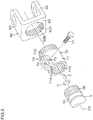
- FIG. 3 is an exploded perspective view of a periphery of the fourth yoke 60 and the shaft attachment portion 70 of the second universal joint 10.
- the shaft attachment portion 70 integrally includes a tubular portion 71 externally fitted over a shaft such as the pinion shaft 5 and a pair of clamping plates 72 extending from the tubular portion 71 and configured to clamp a shaft such as the pinion shaft 5 via the tubular portion 71; the tubular portion 71 and the clamping plates 72 are formed into a single member.
- a slit 71A is formed which extends along the axial direction Z of the tubular portion 71 between the clamping plates 72.
- an internal serration 71B is formed which is serration-fitted to an external serration 5B formed at an end of the pinion shaft 5.
- a bolt insertion hole 73 is formed in each of the clamping plates 72 to allow the shaft such as the pinion shaft 5 to be clamped.
- a clamping bolt 74 is inserted through the bolt insertion holes 73.
- the clamping bolt 74 is fitted in a peripheral groove 5C of the pinion shaft 5 (see also FIG. 2 ).
- the clamping bolt 74 allows retaining of the pinion shaft 5 in the tubular portion 71 to be achieved.
- the clamping bolt 74 clamps the clamping plates 72 together to clamp the pinion shaft 5 in the tubular portion 71.
- the tubular portion 71 is serration-fitted to the flange portion 62.
- An external serration 71C is formed in a portion of an outer peripheral surface of the tubular portion 71 that is closer to the flange portion 62 than the clamping plates 72.
- an insertion hole 62A is formed through which the tubular portion 71 is inserted.
- an internal serration 62B is formed which is serration-fitted to the external serration 71C.
- the fourth yoke 60 and the shaft attachment portion 70 are not limited to junction based on welding but may be joined together by clinching or friction welding.
- the clinching is performed on the fourth yoke 60 and the shaft attachment portion 70 serration fitted together, by plastically deforming the flange portion 62 of the fourth yoke 60 or the tubular portion 71 of the shaft attachment portion 70 to couple the flange portion 62 and the tubular portion 71 together.
- the length of the serration fitting between the tubular portion 71 and the flange portion 62 is adjusted to allow adjustment of the sum (yoke length) of the lengths of the fourth yoke 60 and the shaft attachment portion 70 in the axial direction.
- the fourth yoke 60 and the shaft attachment portion 70 may be joined together by clinching or frictional welding with the yoke length adjusted.
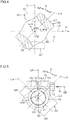
- FIG. 4 is a schematic sectional view taken along line IV-IV in FIG. 2 .
- illustration of the joint spider 80 is omitted for convenience of description.
- the first arm portions 21 of the first yoke 20 are depicted by a long dashed double-short dashed line for convenience of description.
- a clockwise direction along the rotating direction S as viewed from a side opposite to the steering member 2 is designated as an S1 direction.
- a counterclockwise direction along the rotating direction S as viewed from the side opposite to the steering member 2 is designated as an S2 direction.
- a line L0 hereinafter indicates a virtual line intersecting the central axis C2 and extending horizontally (in the lateral direction H).
- a line L1 indicates a virtual line intersecting the central axis C2 and extending in a direction in which the first arm portions 21 face each other.
- the line L1 is displaced from the line L0 by an around-axis angle ⁇ in the S1 direction.
- the around-axis angle ⁇ is represented by an angle smaller than 360° (0° ⁇ ⁇ ⁇ 360°).
- the around-axis angle is set to the angle ⁇ 1 preset in accordance with the specifications or the like.
- the angle ⁇ 1 is set such that, with the steering member 2 located in the steering neutral position, the around-axis angle ⁇ is 90° or 270°.
- the steering neutral position refers to the position of the steering member 2 in the rotating direction S during straight traveling of the vehicle.
- the first arm portions 21 are arranged in the vertical direction (the direction orthogonal to the lateral direction H). In this state, the line L1 and the line L0 are orthogonal to each other.
- a line L3 indicates a virtual line intersecting the central axis C2 and extending in a direction in which the third arm portions 51 face each other.
- the line L3 is displaced from the line L1 by a phase angle ⁇ in the S1 direction (0° ⁇ ⁇ ⁇ 360°).
- the phase angle ⁇ is set to an angle ⁇ 3 at which a turning force from the steering shaft 3 can be efficiently transmitted to the pinion shaft 5.
- FIG. 5 is a schematic diagram of a periphery of the second universal joint 10 as viewed in the direction of arrow V in FIG. 2 .
- illustration of the pinion shaft 5 and the third yoke 50 is omitted for convenience of description.
- the line L3 extending in the direction in which the third arm portions 51 face each other is depicted for convenience of description.
- a line L4 indicates a virtual line intersecting the central axis C3 and extending in a direction in which the fourth arm portions 63 face each other.
- the fourth arm portions 63 face each other at a position displaced from the position of the third arm portions 51 by 90°, and thus, the line L4 is orthogonal to the line L3.
- a line L5 indicates a virtual line intersecting the central axis C3 and a central axis CB of the bolt insertion hole 73.
- a bolt insertion direction B in which the clamping bolt 74 is inserted into the bolt insertion hole 73 extends along the central axis CB.
- the angle between the line L0 and the line L5 is designated as an around-axis angle ⁇ of the bolt insertion hole 73 in the rotating direction S.
- the around-axis angle ⁇ is represented by an angle smaller than 360° (0° ⁇ ⁇ ⁇ 360°).
- the around-axis angle ⁇ of the bolt insertion hole 73 in the rotating direction S is set to an angle ⁇ 2 preset in accordance with the specifications or the like.
- the angle ⁇ 2 refers to an angle to which the bolt insertion direction B is preset so as to facilitate an operation of inserting the clamping bolt 74 into the second universal joint 10.
- the angle ⁇ between the intermediate shaft 4 and the steering shaft 3 is set to the preset angle ⁇ 1 and the angle ⁇ between the intermediate shaft 4 and the pinion shaft 5 is set to the preset angle ⁇ 2, that is, when the phase angle ⁇ is set to the angle ⁇ 3 and the around-axis angle ⁇ of the first arm portions 21 of the first yoke 20 is set to the preset angle ⁇ 1, a junction angle ⁇ between the fourth yoke 60 and the shaft attachment portion 70 in the rotating direction S is adjusted (0° ⁇ ⁇ ⁇ 360°) so as to set the around-axis angle ⁇ of the bolt insertion hole 73 in the shaft attachment portion 70 in the rotating direction S to the angle ⁇ 2.
- the junction angle ⁇ refers to an angle between the line L4 and the line L5.
- the junction angle ⁇ between the fourth yoke 60 and the shaft attachment portion 70 in the rotating direction S can be adjusted so as to set the around-axis angle ⁇ of the bolt insertion hole 73 in the shaft attachment portion 70 in the rotating direction S to the angle ⁇ 2, at which the operation of inserting the clamping bolt 74 into the bolt insertion hole 73 is facilitated.
- the steering system 1 can be more efficiently assembled into the vehicle body.
- the shaft attachment portion 70 with the bolt insertion hole 73 formed therein is serration-fitted to the fourth arm portions 63 to enable the around-axis angle ⁇ of the bolt insertion hole 73 in the rotating direction S to be set to the angle ⁇ 2. Consequently, the junction angle ⁇ between the fourth yoke 60 and the shaft attachment portion 70 can be easily adjusted.
- the fourth yoke 60 and the shaft attachment portion 70 are joined together by weld clinching, friction welding, or the like. Thus, the fourth yoke 60 and the shaft attachment portion 70 can be firmly fixed together.
- FIG. 6 is a graph illustrating a relation between the around-axis angle ⁇ of the first yoke 20 and torsional rigidity of the intermediate shaft 4.
- an axis of abscissas represents the around-axis angle (°) ⁇
- an axis of ordinate represents the torsional rigidity (Nm/°) of the intermediate shaft 4.
- the torsional rigidity of the intermediate shaft 4 varies with a period of 180°, and thus, illustration of a part of the graph in which the around-axis angle ⁇ is larger than 180° is omitted.
- the torsional rigidity of the intermediate shaft 4 is highest when the around-axis angle ⁇ is 90°, and is lowest when the around-axis angle ⁇ is 180°.
- the first arm portions 21 of the first yoke 20 are arranged in the vertical direction when the steering member 2 is in the steering neutral position.
- the around-axis angle ⁇ is 90° when the steering member 2 is in the steering neutral position.
- the torsional rigidity of the intermediate shaft 4 is highest when the steering member 2 is in the steering neutral position, and decreases when the steering member 2 is steered with respect to the steering neutral position such that the manner of the decrease is the same regardless of whether the steering member 2 is steered rightward or leftward.
- the driver of the vehicle has the same stable steering feeling regardless of whether the steering member 2 is steered rightward or leftward with respect to the steering neutral position. This allows the steering system 1 to be more efficiently assembled into the vehicle body without undermining the driver's favorable steering feeling.
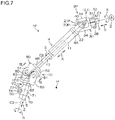
- FIG. 7 is a side view depicting a periphery of the intermediate shaft 4 in the steering system 1P.
- members of the steering system are illustrated with the lateral direction H set to coincide with a direction perpendicular to the sheet of the drawing.
- FIG. 8 is a schematic sectional view taken along line VIII-VIII in FIG. 7 .
- members of the second embodiment similar to the corresponding members described above are denoted by the same reference numerals and will thus not be described.
- the steering system 1P according to the second embodiment is different from the steering system 1 according to the first embodiment (see FIG. 2 ) in that first arm portions 21P of a first yoke 20P of a first universal joint 9P are arranged in the lateral direction H when the steering member 2 is in the steering neutral position.
- a line LIP indicates a virtual line intersecting the central axis C2 and extending in a direction in which first arm portions 21P face each other.
- the line L1P is located at a position displaced from the line L0 by the around-axis angle ⁇ in the S1 direction.
- the around-axis angle ⁇ is represented by an angle smaller than 360° (0° ⁇ ⁇ ⁇ 360°).
- the around-axis angle ⁇ is set to the preset angle ⁇ 1.
- the angle ⁇ 1 is set such that the around-axis angle ⁇ is 0° or 180° when the steering member 2 (see FIG. 7 ) is in the steering neutral position. In this state, the line LIP overlaps the line L0.
- the virtual line L3 extending in the direction in which the third arm portions 51 of the third yoke 50 in the rotating direction S face each other is located at a position displaced from the line LIP by the phase angle ⁇ in the S2 direction (0° ⁇ ⁇ ⁇ 360°).
- the angle ⁇ 1 is set such that the around-axis angle ⁇ is 0° or 180° when the steering member 2 is in the steering neutral position.
- the second embodiment produces the same effects as those of the first embodiment. That is, when the angle ⁇ is set to ⁇ 1, the around-axis angle ⁇ is set to ⁇ 1, and the angle ⁇ is set to ⁇ 2, the junction angle ⁇ between the fourth yoke 60 and the shaft attachment portion 70 can be adjusted so as to set the around-axis angle ⁇ of the bolt insertion hole 73 in the shaft attachment portion 70 in the rotating direction S to the angle ⁇ 2, at which the operation of inserting the clamping bolt 74 into the bolt insertion hole 73 is facilitated.
- the steering system 1 can be more efficiently assembled into the vehicle body.
- the first arm portions 21P of the first yoke 20P are arranged in the lateral direction when the steering member 2 is in the steering neutral position.
- the around-axis angle ⁇ is 0° or 180° when the steering member 2 is in the steering neutral position.
- the torsional rigidity of the intermediate shaft 4 is lowest when the steering member 2 is in the steering neutral position (see FIG. 6 ), and increases when the steering member 2 is steered with respect to the steering neutral position such that the manner of the increases is the same regardless of whether the steering member 2 is steered rightward or leftward.
- the driver of the vehicle has the same smooth steering feeling regardless of whether the steering member 2 is steered rightward or leftward with respect to the steering neutral position. This allows the steering system 1 to be more efficiently assembled into the vehicle body without undermining the driver's favorable steering feeling.
- the external serration 71C may be omitted from the tubular portion 71
- the internal serration 62B may be omitted from the flange portion 62.
- the tubular portion 71 and the flange portion 62 are joined together while being supported with a jig or the like with the junction angle ⁇ adjusted to set the around-axis angle ⁇ of the bolt insertion hole 73 in the rotating direction S to the angle ⁇ 2.
- Examples of a method for the junction include welding and clinching.
- the fourth yoke 60 may be a casting with the junction angle ⁇ pre-adjusted to set the around-axis angle ⁇ of the bolt insertion hole 73 in the rotating direction S to the angle ⁇ 2.
- the angle ⁇ 1 need not necessarily be set so as to arrange the first arm portions 21, 21P in the vertical direction or the lateral direction at the steering neutral position.
- the angle ⁇ 1 may be set so as to minimize adverse effects of vibration input through the steered wheels W or the like. This enables a reduction in the degree of elimination of possible backlash between the members of the steering system 1 and also enables a reduction in rubber (not depicted in the drawings) or the like provided in the steering system 1 to prevent possible vibration.
Landscapes
- Engineering & Computer Science (AREA)
- General Engineering & Computer Science (AREA)
- Mechanical Engineering (AREA)
- Chemical & Material Sciences (AREA)
- Combustion & Propulsion (AREA)
- Transportation (AREA)
- Steering Controls (AREA)
- Vehicle Body Suspensions (AREA)
Applications Claiming Priority (1)
| Application Number | Priority Date | Filing Date | Title |
|---|---|---|---|
| JP2016017256A JP2017136889A (ja) | 2016-02-01 | 2016-02-01 | ステアリング装置 |
Publications (2)
| Publication Number | Publication Date |
|---|---|
| EP3202639A1 EP3202639A1 (en) | 2017-08-09 |
| EP3202639B1 true EP3202639B1 (en) | 2019-09-18 |
Family
ID=57956146
Family Applications (1)
| Application Number | Title | Priority Date | Filing Date |
|---|---|---|---|
| EP17154035.4A Active EP3202639B1 (en) | 2016-02-01 | 2017-01-31 | Steering system |
Country Status (4)
| Country | Link |
|---|---|
| US (2) | US20170219016A1 (enExample) |
| EP (1) | EP3202639B1 (enExample) |
| JP (1) | JP2017136889A (enExample) |
| CN (1) | CN107054442A (enExample) |
Cited By (1)
| Publication number | Priority date | Publication date | Assignee | Title |
|---|---|---|---|---|
| WO2026086984A1 (de) * | 2024-10-21 | 2026-04-30 | Schaeffler Technologies AG & Co. KG | Gelenkgabel für eine hinterachslenkung |
Families Citing this family (5)
| Publication number | Priority date | Publication date | Assignee | Title |
|---|---|---|---|---|
| CN109533005A (zh) * | 2018-11-27 | 2019-03-29 | 南京金龙新能源汽车研究院有限公司 | 一种转向管柱带中间轴总成 |
| CN109630555A (zh) * | 2018-12-05 | 2019-04-16 | 兰州飞行控制有限责任公司 | 一种齿轮传动组件 |
| JP7587974B2 (ja) | 2020-12-09 | 2024-11-21 | 日本精工株式会社 | ヨーク一体型シャフト |
| JP2022143667A (ja) * | 2021-03-18 | 2022-10-03 | 本田技研工業株式会社 | 車両用ステアリング装置及びその組立方法 |
| KR20240020580A (ko) * | 2022-08-08 | 2024-02-15 | 남양넥스모 주식회사 | 차량용 조향 장치의 인텀 샤프트 |
Family Cites Families (14)
| Publication number | Priority date | Publication date | Assignee | Title |
|---|---|---|---|---|
| JP2534772B2 (ja) * | 1989-07-07 | 1996-09-18 | 日本精工株式会社 | 自在継手のヨ−クの製造方法 |
| JPH05286444A (ja) * | 1992-04-09 | 1993-11-02 | Mazda Motor Corp | 車両のステアリング装置 および 組付け方法 |
| US5366316A (en) * | 1992-06-02 | 1994-11-22 | General Motors Corporation | Intermediate steering shaft assembly and method |
| JPH06270819A (ja) * | 1993-01-22 | 1994-09-27 | Toyota Motor Corp | ステアリングシャフトの組み付け方法及びステアリング機構 |
| JPH06321118A (ja) * | 1993-05-19 | 1994-11-22 | Toyota Motor Corp | 自動車用操舵装置 |
| DE102005001082A1 (de) * | 2004-12-13 | 2006-06-14 | Rempel Stanztechnik Gmbh & Co.Kg | Verfahren zur Herstellung eines Gelenkkörpers und ein nach dem Verfahren hergestellter Gelenkkörper |
| JP4271176B2 (ja) * | 2005-09-15 | 2009-06-03 | 本田技研工業株式会社 | 車両用ステアリング装置 |
| WO2007092764A1 (en) * | 2006-02-03 | 2007-08-16 | Drivesol Worldwide, Inc. | Assembly aid for a steering column |
| CN102549581B (zh) * | 2010-10-06 | 2014-12-03 | 日本精工株式会社 | 转向装置的设计辅助装置及转向装置设计辅助方法 |
| JP2013133898A (ja) * | 2011-12-27 | 2013-07-08 | Nsk Ltd | 回転軸と自在継手のヨークとの結合部及び回転軸の製造方法 |
| JP6016005B2 (ja) * | 2012-02-08 | 2016-10-26 | 株式会社ジェイテクト | 自在継手およびヨーク |
| JP2014105773A (ja) * | 2012-11-27 | 2014-06-09 | Jtekt Corp | シャフトと自在継手ヨークの結合構造及び結合方法並びにインターミディエイトシャフト |
| JP6182874B2 (ja) * | 2013-01-22 | 2017-08-23 | 株式会社ジェイテクト | ステアリング装置の連結装置 |
| JP2015110988A (ja) * | 2013-06-14 | 2015-06-18 | 日本精工株式会社 | 継手と軸の結合構造 |
-
2016
- 2016-02-01 JP JP2016017256A patent/JP2017136889A/ja active Pending
-
2017
- 2017-01-24 CN CN201710059788.7A patent/CN107054442A/zh active Pending
- 2017-01-25 US US15/414,724 patent/US20170219016A1/en not_active Abandoned
- 2017-01-31 EP EP17154035.4A patent/EP3202639B1/en active Active
-
2019
- 2019-06-21 US US16/448,644 patent/US20190309802A1/en not_active Abandoned
Non-Patent Citations (1)
| Title |
|---|
| None * |
Cited By (1)
| Publication number | Priority date | Publication date | Assignee | Title |
|---|---|---|---|---|
| WO2026086984A1 (de) * | 2024-10-21 | 2026-04-30 | Schaeffler Technologies AG & Co. KG | Gelenkgabel für eine hinterachslenkung |
Also Published As
| Publication number | Publication date |
|---|---|
| CN107054442A (zh) | 2017-08-18 |
| US20170219016A1 (en) | 2017-08-03 |
| EP3202639A1 (en) | 2017-08-09 |
| US20190309802A1 (en) | 2019-10-10 |
| JP2017136889A (ja) | 2017-08-10 |
Similar Documents
| Publication | Publication Date | Title |
|---|---|---|
| US20190309802A1 (en) | Steering system | |
| US9469332B2 (en) | Coupling structure for coupling shaft to universal joint yoke, coupling method for coupling shaft to universal joint yoke, and intermediate shaft | |
| JP5788829B2 (ja) | ステアリング装置 | |
| US9039041B2 (en) | Steering column anti-rotation pin | |
| US9765823B2 (en) | Steering apparatus | |
| US8517422B2 (en) | Steering wheel alignment system | |
| WO2014119630A1 (ja) | ステアリングコラム | |
| JP2017136889A5 (enExample) | ||
| EP3315381A1 (en) | Outer column with bracket, steering column with bracket, and steering device | |
| JP7400731B2 (ja) | トルク伝達軸 | |
| JP6673308B2 (ja) | ステアリング用トルク伝達軸 | |
| JP2008189223A (ja) | ステアリング装置用シャフト及びその製造方法 | |
| JP6673309B2 (ja) | トルク伝達軸 | |
| JP6642551B2 (ja) | トルク伝達軸 | |
| JP7119284B2 (ja) | 自在継手および該自在継手を備えたステアリング装置 | |
| JP2008202742A (ja) | ヨークとシャフトとの連結構造及びこれを使用したステアリング装置 | |
| JP7099157B2 (ja) | シャフトとのクランプ部材との結合部、および、シャフトとクランプ部材との結合部の製造方法 | |
| JP2008303980A (ja) | 継手 | |
| JP7314951B2 (ja) | ステアリングコラムおよびステアリング装置 | |
| JP7375768B2 (ja) | ステアリングコラムおよびステアリング装置 | |
| EP2740649B1 (en) | Steering device | |
| JP5636828B2 (ja) | 自在継手およびその加工方法 | |
| JP4736929B2 (ja) | 自在継手と軸の結合構造 | |
| JP4952962B2 (ja) | 自在継手と軸の結合構造 | |
| JP2014169732A (ja) | シャフトと自在継手のヨークの結合構造及び車両用操舵装置 |
Legal Events
| Date | Code | Title | Description |
|---|---|---|---|
| PUAI | Public reference made under article 153(3) epc to a published international application that has entered the european phase |
Free format text: ORIGINAL CODE: 0009012 |
|
| STAA | Information on the status of an ep patent application or granted ep patent |
Free format text: STATUS: THE APPLICATION HAS BEEN PUBLISHED |
|
| AK | Designated contracting states |
Kind code of ref document: A1 Designated state(s): AL AT BE BG CH CY CZ DE DK EE ES FI FR GB GR HR HU IE IS IT LI LT LU LV MC MK MT NL NO PL PT RO RS SE SI SK SM TR |
|
| AX | Request for extension of the european patent |
Extension state: BA ME |
|
| STAA | Information on the status of an ep patent application or granted ep patent |
Free format text: STATUS: REQUEST FOR EXAMINATION WAS MADE |
|
| 17P | Request for examination filed |
Effective date: 20180208 |
|
| RBV | Designated contracting states (corrected) |
Designated state(s): AL AT BE BG CH CY CZ DE DK EE ES FI FR GB GR HR HU IE IS IT LI LT LU LV MC MK MT NL NO PL PT RO RS SE SI SK SM TR |
|
| GRAP | Despatch of communication of intention to grant a patent |
Free format text: ORIGINAL CODE: EPIDOSNIGR1 |
|
| STAA | Information on the status of an ep patent application or granted ep patent |
Free format text: STATUS: GRANT OF PATENT IS INTENDED |
|
| RIC1 | Information provided on ipc code assigned before grant |
Ipc: F16D 1/08 20060101ALI20181026BHEP Ipc: F16C 3/03 20060101ALI20181026BHEP Ipc: B62D 1/20 20060101AFI20181026BHEP Ipc: F16D 3/38 20060101ALI20181026BHEP |
|
| INTG | Intention to grant announced |
Effective date: 20181127 |
|
| RIN1 | Information on inventor provided before grant (corrected) |
Inventor name: KOBAYASHI, MASANORI Inventor name: KOYAMA, TAKESHI Inventor name: TSUJI, NAOKI |
|
| GRAJ | Information related to disapproval of communication of intention to grant by the applicant or resumption of examination proceedings by the epo deleted |
Free format text: ORIGINAL CODE: EPIDOSDIGR1 |
|
| STAA | Information on the status of an ep patent application or granted ep patent |
Free format text: STATUS: REQUEST FOR EXAMINATION WAS MADE |
|
| GRAP | Despatch of communication of intention to grant a patent |
Free format text: ORIGINAL CODE: EPIDOSNIGR1 |
|
| STAA | Information on the status of an ep patent application or granted ep patent |
Free format text: STATUS: GRANT OF PATENT IS INTENDED |
|
| INTG | Intention to grant announced |
Effective date: 20190402 |
|
| GRAS | Grant fee paid |
Free format text: ORIGINAL CODE: EPIDOSNIGR3 |
|
| GRAA | (expected) grant |
Free format text: ORIGINAL CODE: 0009210 |
|
| STAA | Information on the status of an ep patent application or granted ep patent |
Free format text: STATUS: THE PATENT HAS BEEN GRANTED |
|
| AK | Designated contracting states |
Kind code of ref document: B1 Designated state(s): AL AT BE BG CH CY CZ DE DK EE ES FI FR GB GR HR HU IE IS IT LI LT LU LV MC MK MT NL NO PL PT RO RS SE SI SK SM TR |
|
| REG | Reference to a national code |
Ref country code: GB Ref legal event code: FG4D |
|
| REG | Reference to a national code |
Ref country code: CH Ref legal event code: EP |
|
| REG | Reference to a national code |
Ref country code: DE Ref legal event code: R096 Ref document number: 602017007049 Country of ref document: DE |
|
| REG | Reference to a national code |
Ref country code: AT Ref legal event code: REF Ref document number: 1180948 Country of ref document: AT Kind code of ref document: T Effective date: 20191015 |
|
| REG | Reference to a national code |
Ref country code: IE Ref legal event code: FG4D |
|
| REG | Reference to a national code |
Ref country code: NL Ref legal event code: MP Effective date: 20190918 |
|
| PG25 | Lapsed in a contracting state [announced via postgrant information from national office to epo] |
Ref country code: BG Free format text: LAPSE BECAUSE OF FAILURE TO SUBMIT A TRANSLATION OF THE DESCRIPTION OR TO PAY THE FEE WITHIN THE PRESCRIBED TIME-LIMIT Effective date: 20191218 Ref country code: LT Free format text: LAPSE BECAUSE OF FAILURE TO SUBMIT A TRANSLATION OF THE DESCRIPTION OR TO PAY THE FEE WITHIN THE PRESCRIBED TIME-LIMIT Effective date: 20190918 Ref country code: NO Free format text: LAPSE BECAUSE OF FAILURE TO SUBMIT A TRANSLATION OF THE DESCRIPTION OR TO PAY THE FEE WITHIN THE PRESCRIBED TIME-LIMIT Effective date: 20191218 Ref country code: SE Free format text: LAPSE BECAUSE OF FAILURE TO SUBMIT A TRANSLATION OF THE DESCRIPTION OR TO PAY THE FEE WITHIN THE PRESCRIBED TIME-LIMIT Effective date: 20190918 Ref country code: HR Free format text: LAPSE BECAUSE OF FAILURE TO SUBMIT A TRANSLATION OF THE DESCRIPTION OR TO PAY THE FEE WITHIN THE PRESCRIBED TIME-LIMIT Effective date: 20190918 Ref country code: FI Free format text: LAPSE BECAUSE OF FAILURE TO SUBMIT A TRANSLATION OF THE DESCRIPTION OR TO PAY THE FEE WITHIN THE PRESCRIBED TIME-LIMIT Effective date: 20190918 |
|
| REG | Reference to a national code |
Ref country code: LT Ref legal event code: MG4D |
|
| PG25 | Lapsed in a contracting state [announced via postgrant information from national office to epo] |
Ref country code: RS Free format text: LAPSE BECAUSE OF FAILURE TO SUBMIT A TRANSLATION OF THE DESCRIPTION OR TO PAY THE FEE WITHIN THE PRESCRIBED TIME-LIMIT Effective date: 20190918 Ref country code: AL Free format text: LAPSE BECAUSE OF FAILURE TO SUBMIT A TRANSLATION OF THE DESCRIPTION OR TO PAY THE FEE WITHIN THE PRESCRIBED TIME-LIMIT Effective date: 20190918 Ref country code: LV Free format text: LAPSE BECAUSE OF FAILURE TO SUBMIT A TRANSLATION OF THE DESCRIPTION OR TO PAY THE FEE WITHIN THE PRESCRIBED TIME-LIMIT Effective date: 20190918 Ref country code: GR Free format text: LAPSE BECAUSE OF FAILURE TO SUBMIT A TRANSLATION OF THE DESCRIPTION OR TO PAY THE FEE WITHIN THE PRESCRIBED TIME-LIMIT Effective date: 20191219 |
|
| REG | Reference to a national code |
Ref country code: AT Ref legal event code: MK05 Ref document number: 1180948 Country of ref document: AT Kind code of ref document: T Effective date: 20190918 |
|
| PG25 | Lapsed in a contracting state [announced via postgrant information from national office to epo] |
Ref country code: PT Free format text: LAPSE BECAUSE OF FAILURE TO SUBMIT A TRANSLATION OF THE DESCRIPTION OR TO PAY THE FEE WITHIN THE PRESCRIBED TIME-LIMIT Effective date: 20200120 Ref country code: IT Free format text: LAPSE BECAUSE OF FAILURE TO SUBMIT A TRANSLATION OF THE DESCRIPTION OR TO PAY THE FEE WITHIN THE PRESCRIBED TIME-LIMIT Effective date: 20190918 Ref country code: AT Free format text: LAPSE BECAUSE OF FAILURE TO SUBMIT A TRANSLATION OF THE DESCRIPTION OR TO PAY THE FEE WITHIN THE PRESCRIBED TIME-LIMIT Effective date: 20190918 Ref country code: ES Free format text: LAPSE BECAUSE OF FAILURE TO SUBMIT A TRANSLATION OF THE DESCRIPTION OR TO PAY THE FEE WITHIN THE PRESCRIBED TIME-LIMIT Effective date: 20190918 Ref country code: NL Free format text: LAPSE BECAUSE OF FAILURE TO SUBMIT A TRANSLATION OF THE DESCRIPTION OR TO PAY THE FEE WITHIN THE PRESCRIBED TIME-LIMIT Effective date: 20190918 Ref country code: RO Free format text: LAPSE BECAUSE OF FAILURE TO SUBMIT A TRANSLATION OF THE DESCRIPTION OR TO PAY THE FEE WITHIN THE PRESCRIBED TIME-LIMIT Effective date: 20190918 Ref country code: PL Free format text: LAPSE BECAUSE OF FAILURE TO SUBMIT A TRANSLATION OF THE DESCRIPTION OR TO PAY THE FEE WITHIN THE PRESCRIBED TIME-LIMIT Effective date: 20190918 Ref country code: EE Free format text: LAPSE BECAUSE OF FAILURE TO SUBMIT A TRANSLATION OF THE DESCRIPTION OR TO PAY THE FEE WITHIN THE PRESCRIBED TIME-LIMIT Effective date: 20190918 |
|
| PG25 | Lapsed in a contracting state [announced via postgrant information from national office to epo] |
Ref country code: IS Free format text: LAPSE BECAUSE OF FAILURE TO SUBMIT A TRANSLATION OF THE DESCRIPTION OR TO PAY THE FEE WITHIN THE PRESCRIBED TIME-LIMIT Effective date: 20200224 Ref country code: SM Free format text: LAPSE BECAUSE OF FAILURE TO SUBMIT A TRANSLATION OF THE DESCRIPTION OR TO PAY THE FEE WITHIN THE PRESCRIBED TIME-LIMIT Effective date: 20190918 Ref country code: CZ Free format text: LAPSE BECAUSE OF FAILURE TO SUBMIT A TRANSLATION OF THE DESCRIPTION OR TO PAY THE FEE WITHIN THE PRESCRIBED TIME-LIMIT Effective date: 20190918 Ref country code: SK Free format text: LAPSE BECAUSE OF FAILURE TO SUBMIT A TRANSLATION OF THE DESCRIPTION OR TO PAY THE FEE WITHIN THE PRESCRIBED TIME-LIMIT Effective date: 20190918 |
|
| REG | Reference to a national code |
Ref country code: DE Ref legal event code: R097 Ref document number: 602017007049 Country of ref document: DE |
|
| PLBE | No opposition filed within time limit |
Free format text: ORIGINAL CODE: 0009261 |
|
| STAA | Information on the status of an ep patent application or granted ep patent |
Free format text: STATUS: NO OPPOSITION FILED WITHIN TIME LIMIT |
|
| PG2D | Information on lapse in contracting state deleted |
Ref country code: IS |
|
| PG25 | Lapsed in a contracting state [announced via postgrant information from national office to epo] |
Ref country code: IS Free format text: LAPSE BECAUSE OF FAILURE TO SUBMIT A TRANSLATION OF THE DESCRIPTION OR TO PAY THE FEE WITHIN THE PRESCRIBED TIME-LIMIT Effective date: 20200119 Ref country code: DK Free format text: LAPSE BECAUSE OF FAILURE TO SUBMIT A TRANSLATION OF THE DESCRIPTION OR TO PAY THE FEE WITHIN THE PRESCRIBED TIME-LIMIT Effective date: 20190918 |
|
| 26N | No opposition filed |
Effective date: 20200619 |
|
| PG25 | Lapsed in a contracting state [announced via postgrant information from national office to epo] |
Ref country code: MC Free format text: LAPSE BECAUSE OF FAILURE TO SUBMIT A TRANSLATION OF THE DESCRIPTION OR TO PAY THE FEE WITHIN THE PRESCRIBED TIME-LIMIT Effective date: 20190918 Ref country code: SI Free format text: LAPSE BECAUSE OF FAILURE TO SUBMIT A TRANSLATION OF THE DESCRIPTION OR TO PAY THE FEE WITHIN THE PRESCRIBED TIME-LIMIT Effective date: 20190918 |
|
| REG | Reference to a national code |
Ref country code: CH Ref legal event code: PL |
|
| REG | Reference to a national code |
Ref country code: BE Ref legal event code: MM Effective date: 20200131 |
|
| PG25 | Lapsed in a contracting state [announced via postgrant information from national office to epo] |
Ref country code: LU Free format text: LAPSE BECAUSE OF NON-PAYMENT OF DUE FEES Effective date: 20200131 |
|
| PG25 | Lapsed in a contracting state [announced via postgrant information from national office to epo] |
Ref country code: CH Free format text: LAPSE BECAUSE OF NON-PAYMENT OF DUE FEES Effective date: 20200131 Ref country code: LI Free format text: LAPSE BECAUSE OF NON-PAYMENT OF DUE FEES Effective date: 20200131 Ref country code: BE Free format text: LAPSE BECAUSE OF NON-PAYMENT OF DUE FEES Effective date: 20200131 |
|
| PG25 | Lapsed in a contracting state [announced via postgrant information from national office to epo] |
Ref country code: IE Free format text: LAPSE BECAUSE OF NON-PAYMENT OF DUE FEES Effective date: 20200131 |
|
| GBPC | Gb: european patent ceased through non-payment of renewal fee |
Effective date: 20210131 |
|
| PG25 | Lapsed in a contracting state [announced via postgrant information from national office to epo] |
Ref country code: GB Free format text: LAPSE BECAUSE OF NON-PAYMENT OF DUE FEES Effective date: 20210131 |
|
| PG25 | Lapsed in a contracting state [announced via postgrant information from national office to epo] |
Ref country code: TR Free format text: LAPSE BECAUSE OF FAILURE TO SUBMIT A TRANSLATION OF THE DESCRIPTION OR TO PAY THE FEE WITHIN THE PRESCRIBED TIME-LIMIT Effective date: 20190918 Ref country code: MT Free format text: LAPSE BECAUSE OF FAILURE TO SUBMIT A TRANSLATION OF THE DESCRIPTION OR TO PAY THE FEE WITHIN THE PRESCRIBED TIME-LIMIT Effective date: 20190918 Ref country code: CY Free format text: LAPSE BECAUSE OF FAILURE TO SUBMIT A TRANSLATION OF THE DESCRIPTION OR TO PAY THE FEE WITHIN THE PRESCRIBED TIME-LIMIT Effective date: 20190918 |
|
| PG25 | Lapsed in a contracting state [announced via postgrant information from national office to epo] |
Ref country code: MK Free format text: LAPSE BECAUSE OF FAILURE TO SUBMIT A TRANSLATION OF THE DESCRIPTION OR TO PAY THE FEE WITHIN THE PRESCRIBED TIME-LIMIT Effective date: 20190918 |
|
| PGFP | Annual fee paid to national office [announced via postgrant information from national office to epo] |
Ref country code: FR Payment date: 20251128 Year of fee payment: 10 |
|
| PGFP | Annual fee paid to national office [announced via postgrant information from national office to epo] |
Ref country code: DE Payment date: 20251210 Year of fee payment: 10 |