EP3199038B1 - Überzogener brösel für das panieren von lebensmittelprodukten - Google Patents
Überzogener brösel für das panieren von lebensmittelprodukten Download PDFInfo
- Publication number
- EP3199038B1 EP3199038B1 EP17153530.5A EP17153530A EP3199038B1 EP 3199038 B1 EP3199038 B1 EP 3199038B1 EP 17153530 A EP17153530 A EP 17153530A EP 3199038 B1 EP3199038 B1 EP 3199038B1
- Authority
- EP
- European Patent Office
- Prior art keywords
- crumb
- coating
- particles
- batter
- coated
- Prior art date
- Legal status (The legal status is an assumption and is not a legal conclusion. Google has not performed a legal analysis and makes no representation as to the accuracy of the status listed.)
- Active
Links
- 238000000576 coating method Methods 0.000 title claims description 201
- 239000011248 coating agent Substances 0.000 title claims description 197
- 239000002245 particle Substances 0.000 title claims description 168
- 235000013305 food Nutrition 0.000 title claims description 54
- 239000000843 powder Substances 0.000 claims description 64
- 238000011049 filling Methods 0.000 claims description 55
- 239000000758 substrate Substances 0.000 claims description 38
- 239000011247 coating layer Substances 0.000 claims description 37
- 238000000034 method Methods 0.000 claims description 24
- 239000007787 solid Substances 0.000 claims description 23
- 229920002472 Starch Polymers 0.000 claims description 20
- 239000000203 mixture Substances 0.000 claims description 19
- 239000007788 liquid Substances 0.000 claims description 17
- 235000018102 proteins Nutrition 0.000 claims description 17
- 102000004169 proteins and genes Human genes 0.000 claims description 17
- 108090000623 proteins and genes Proteins 0.000 claims description 17
- 235000019698 starch Nutrition 0.000 claims description 17
- 239000008107 starch Substances 0.000 claims description 17
- XLYOFNOQVPJJNP-UHFFFAOYSA-N water Substances O XLYOFNOQVPJJNP-UHFFFAOYSA-N 0.000 claims description 17
- 239000010410 layer Substances 0.000 claims description 12
- 235000019482 Palm oil Nutrition 0.000 claims description 11
- 239000002540 palm oil Substances 0.000 claims description 11
- 108010046377 Whey Proteins Proteins 0.000 claims description 9
- 239000000463 material Substances 0.000 claims description 9
- 235000021119 whey protein Nutrition 0.000 claims description 9
- 102000007544 Whey Proteins Human genes 0.000 claims description 8
- 238000010411 cooking Methods 0.000 claims description 8
- 235000012813 breadcrumbs Nutrition 0.000 claims description 7
- 150000003839 salts Chemical class 0.000 claims description 7
- 235000002639 sodium chloride Nutrition 0.000 claims description 7
- 238000005507 spraying Methods 0.000 claims description 7
- 238000002844 melting Methods 0.000 claims description 6
- 230000008018 melting Effects 0.000 claims description 6
- 229920002907 Guar gum Polymers 0.000 claims description 5
- 239000000665 guar gum Substances 0.000 claims description 5
- 235000010417 guar gum Nutrition 0.000 claims description 5
- 229960002154 guar gum Drugs 0.000 claims description 5
- 229920001285 xanthan gum Polymers 0.000 claims description 5
- 239000000230 xanthan gum Substances 0.000 claims description 5
- 235000010493 xanthan gum Nutrition 0.000 claims description 5
- 229940082509 xanthan gum Drugs 0.000 claims description 5
- 108010000912 Egg Proteins Proteins 0.000 claims description 4
- 102000002322 Egg Proteins Human genes 0.000 claims description 4
- 239000000428 dust Substances 0.000 claims description 4
- 210000000991 chicken egg Anatomy 0.000 claims description 3
- 235000010855 food raising agent Nutrition 0.000 claims description 3
- 238000002156 mixing Methods 0.000 claims description 3
- 101710109488 Salt stress-induced protein Proteins 0.000 claims description 2
- 229910052799 carbon Inorganic materials 0.000 claims description 2
- 238000001035 drying Methods 0.000 claims description 2
- 150000004676 glycans Chemical class 0.000 claims description 2
- 229920001282 polysaccharide Polymers 0.000 claims description 2
- 239000005017 polysaccharide Substances 0.000 claims description 2
- 239000000047 product Substances 0.000 description 59
- 239000003925 fat Substances 0.000 description 50
- 235000019197 fats Nutrition 0.000 description 50
- 235000011888 snacks Nutrition 0.000 description 22
- 235000012054 meals Nutrition 0.000 description 15
- 239000003921 oil Substances 0.000 description 13
- 235000019198 oils Nutrition 0.000 description 13
- 235000019871 vegetable fat Nutrition 0.000 description 10
- 240000007594 Oryza sativa Species 0.000 description 9
- 235000007164 Oryza sativa Nutrition 0.000 description 9
- 235000013351 cheese Nutrition 0.000 description 9
- 238000002474 experimental method Methods 0.000 description 9
- 235000009566 rice Nutrition 0.000 description 9
- 241000251468 Actinopterygii Species 0.000 description 7
- 241000209140 Triticum Species 0.000 description 7
- 235000021307 Triticum Nutrition 0.000 description 7
- 239000003795 chemical substances by application Substances 0.000 description 7
- 235000014113 dietary fatty acids Nutrition 0.000 description 7
- 239000000194 fatty acid Substances 0.000 description 7
- 229930195729 fatty acid Natural products 0.000 description 7
- 235000019688 fish Nutrition 0.000 description 7
- 235000019486 Sunflower oil Nutrition 0.000 description 6
- 235000013330 chicken meat Nutrition 0.000 description 6
- 238000009826 distribution Methods 0.000 description 6
- 150000004665 fatty acids Chemical class 0.000 description 6
- 235000013312 flour Nutrition 0.000 description 6
- 239000002600 sunflower oil Substances 0.000 description 6
- 239000002562 thickening agent Substances 0.000 description 6
- 241000287828 Gallus gallus Species 0.000 description 5
- 238000011156 evaluation Methods 0.000 description 5
- 239000000796 flavoring agent Substances 0.000 description 5
- 238000004519 manufacturing process Methods 0.000 description 5
- 238000007873 sieving Methods 0.000 description 5
- 238000012360 testing method Methods 0.000 description 5
- 229920002261 Corn starch Polymers 0.000 description 4
- 235000019759 Maize starch Nutrition 0.000 description 4
- 240000008042 Zea mays Species 0.000 description 4
- 235000016383 Zea mays subsp huehuetenangensis Nutrition 0.000 description 4
- 235000002017 Zea mays subsp mays Nutrition 0.000 description 4
- 235000012785 bread rolls Nutrition 0.000 description 4
- 239000012141 concentrate Substances 0.000 description 4
- 235000008504 concentrate Nutrition 0.000 description 4
- 238000007710 freezing Methods 0.000 description 4
- 235000009973 maize Nutrition 0.000 description 4
- 235000013372 meat Nutrition 0.000 description 4
- 238000003860 storage Methods 0.000 description 4
- -1 various gums Polymers 0.000 description 4
- 240000004160 Capsicum annuum Species 0.000 description 3
- 235000008534 Capsicum annuum var annuum Nutrition 0.000 description 3
- OKTJSMMVPCPJKN-UHFFFAOYSA-N Carbon Chemical group [C] OKTJSMMVPCPJKN-UHFFFAOYSA-N 0.000 description 3
- 235000014375 Curcuma Nutrition 0.000 description 3
- 244000164480 Curcuma aromatica Species 0.000 description 3
- 229920001353 Dextrin Polymers 0.000 description 3
- PEDCQBHIVMGVHV-UHFFFAOYSA-N Glycerine Chemical compound OCC(O)CO PEDCQBHIVMGVHV-UHFFFAOYSA-N 0.000 description 3
- 235000010469 Glycine max Nutrition 0.000 description 3
- 239000001511 capsicum annuum Substances 0.000 description 3
- 230000001186 cumulative effect Effects 0.000 description 3
- VFLDPWHFBUODDF-FCXRPNKRSA-N curcumin Chemical compound C1=C(O)C(OC)=CC(\C=C\C(=O)CC(=O)\C=C\C=2C=C(OC)C(O)=CC=2)=C1 VFLDPWHFBUODDF-FCXRPNKRSA-N 0.000 description 3
- 230000000694 effects Effects 0.000 description 3
- 239000003995 emulsifying agent Substances 0.000 description 3
- 238000010438 heat treatment Methods 0.000 description 3
- 239000001788 mono and diglycerides of fatty acids Substances 0.000 description 3
- 235000015097 nutrients Nutrition 0.000 description 3
- 239000008601 oleoresin Substances 0.000 description 3
- 235000014594 pastries Nutrition 0.000 description 3
- 230000008569 process Effects 0.000 description 3
- 235000002316 solid fats Nutrition 0.000 description 3
- 235000013311 vegetables Nutrition 0.000 description 3
- 229940100445 wheat starch Drugs 0.000 description 3
- MIDXCONKKJTLDX-UHFFFAOYSA-N 3,5-dimethylcyclopentane-1,2-dione Chemical compound CC1CC(C)C(=O)C1=O MIDXCONKKJTLDX-UHFFFAOYSA-N 0.000 description 2
- 235000001674 Agaricus brunnescens Nutrition 0.000 description 2
- XXXSILNSXNPGKG-ZHACJKMWSA-N Crotoxyphos Chemical compound COP(=O)(OC)O\C(C)=C\C(=O)OC(C)C1=CC=CC=C1 XXXSILNSXNPGKG-ZHACJKMWSA-N 0.000 description 2
- 239000004375 Dextrin Substances 0.000 description 2
- 241001465754 Metazoa Species 0.000 description 2
- GXCLVBGFBYZDAG-UHFFFAOYSA-N N-[2-(1H-indol-3-yl)ethyl]-N-methylprop-2-en-1-amine Chemical compound CN(CCC1=CNC2=C1C=CC=C2)CC=C GXCLVBGFBYZDAG-UHFFFAOYSA-N 0.000 description 2
- 108010058846 Ovalbumin Proteins 0.000 description 2
- 235000019484 Rapeseed oil Nutrition 0.000 description 2
- 240000004808 Saccharomyces cerevisiae Species 0.000 description 2
- 244000061456 Solanum tuberosum Species 0.000 description 2
- 235000002595 Solanum tuberosum Nutrition 0.000 description 2
- 235000015278 beef Nutrition 0.000 description 2
- 235000008429 bread Nutrition 0.000 description 2
- 235000013736 caramel Nutrition 0.000 description 2
- 125000003178 carboxy group Chemical group [H]OC(*)=O 0.000 description 2
- 229920002678 cellulose Polymers 0.000 description 2
- 235000010980 cellulose Nutrition 0.000 description 2
- 235000015228 chicken nuggets Nutrition 0.000 description 2
- 239000003086 colorant Substances 0.000 description 2
- 235000013365 dairy product Nutrition 0.000 description 2
- 235000019425 dextrin Nutrition 0.000 description 2
- 239000012467 final product Substances 0.000 description 2
- 235000015168 fish fingers Nutrition 0.000 description 2
- 235000003599 food sweetener Nutrition 0.000 description 2
- 238000007654 immersion Methods 0.000 description 2
- 230000006872 improvement Effects 0.000 description 2
- 239000011159 matrix material Substances 0.000 description 2
- 230000005012 migration Effects 0.000 description 2
- 238000013508 migration Methods 0.000 description 2
- 238000004806 packaging method and process Methods 0.000 description 2
- 229920001592 potato starch Polymers 0.000 description 2
- 230000009467 reduction Effects 0.000 description 2
- 229940100486 rice starch Drugs 0.000 description 2
- 235000015067 sauces Nutrition 0.000 description 2
- 239000013049 sediment Substances 0.000 description 2
- 239000005364 simax Substances 0.000 description 2
- 235000013599 spices Nutrition 0.000 description 2
- 239000007858 starting material Substances 0.000 description 2
- 235000000346 sugar Nutrition 0.000 description 2
- 239000003765 sweetening agent Substances 0.000 description 2
- OMDQUFIYNPYJFM-XKDAHURESA-N (2r,3r,4s,5r,6s)-2-(hydroxymethyl)-6-[[(2r,3s,4r,5s,6r)-4,5,6-trihydroxy-3-[(2s,3s,4s,5s,6r)-3,4,5-trihydroxy-6-(hydroxymethyl)oxan-2-yl]oxyoxan-2-yl]methoxy]oxane-3,4,5-triol Chemical compound O[C@@H]1[C@@H](O)[C@@H](O)[C@@H](CO)O[C@@H]1OC[C@@H]1[C@@H](O[C@H]2[C@H]([C@@H](O)[C@H](O)[C@@H](CO)O2)O)[C@H](O)[C@H](O)[C@H](O)O1 OMDQUFIYNPYJFM-XKDAHURESA-N 0.000 description 1
- PZNPLUBHRSSFHT-RRHRGVEJSA-N 1-hexadecanoyl-2-octadecanoyl-sn-glycero-3-phosphocholine Chemical compound CCCCCCCCCCCCCCCCCC(=O)O[C@@H](COP([O-])(=O)OCC[N+](C)(C)C)COC(=O)CCCCCCCCCCCCCCC PZNPLUBHRSSFHT-RRHRGVEJSA-N 0.000 description 1
- FFRBMBIXVSCUFS-UHFFFAOYSA-N 2,4-dinitro-1-naphthol Chemical compound C1=CC=C2C(O)=C([N+]([O-])=O)C=C([N+]([O-])=O)C2=C1 FFRBMBIXVSCUFS-UHFFFAOYSA-N 0.000 description 1
- AWFYPPSBLUWMFQ-UHFFFAOYSA-N 2-[5-[2-(2,3-dihydro-1H-inden-2-ylamino)pyrimidin-5-yl]-1,3,4-oxadiazol-2-yl]-1-(1,4,6,7-tetrahydropyrazolo[4,3-c]pyridin-5-yl)ethanone Chemical compound C1C(CC2=CC=CC=C12)NC1=NC=C(C=N1)C1=NN=C(O1)CC(=O)N1CC2=C(CC1)NN=C2 AWFYPPSBLUWMFQ-UHFFFAOYSA-N 0.000 description 1
- SATHPVQTSSUFFW-UHFFFAOYSA-N 4-[6-[(3,5-dihydroxy-4-methoxyoxan-2-yl)oxymethyl]-3,5-dihydroxy-4-methoxyoxan-2-yl]oxy-2-(hydroxymethyl)-6-methyloxane-3,5-diol Chemical compound OC1C(OC)C(O)COC1OCC1C(O)C(OC)C(O)C(OC2C(C(CO)OC(C)C2O)O)O1 SATHPVQTSSUFFW-UHFFFAOYSA-N 0.000 description 1
- RSIWALKZYXPAGW-NSHDSACASA-N 6-(3-fluorophenyl)-3-methyl-7-[(1s)-1-(7h-purin-6-ylamino)ethyl]-[1,3]thiazolo[3,2-a]pyrimidin-5-one Chemical compound C=1([C@@H](NC=2C=3N=CNC=3N=CN=2)C)N=C2SC=C(C)N2C(=O)C=1C1=CC=CC(F)=C1 RSIWALKZYXPAGW-NSHDSACASA-N 0.000 description 1
- HRPVXLWXLXDGHG-UHFFFAOYSA-N Acrylamide Chemical compound NC(=O)C=C HRPVXLWXLXDGHG-UHFFFAOYSA-N 0.000 description 1
- 229920000945 Amylopectin Polymers 0.000 description 1
- 229920000856 Amylose Polymers 0.000 description 1
- 101001053395 Arabidopsis thaliana Acid beta-fructofuranosidase 4, vacuolar Proteins 0.000 description 1
- 239000001904 Arabinogalactan Substances 0.000 description 1
- 229920000189 Arabinogalactan Polymers 0.000 description 1
- 244000017106 Bixa orellana Species 0.000 description 1
- 240000002791 Brassica napus Species 0.000 description 1
- 235000006008 Brassica napus var napus Nutrition 0.000 description 1
- FBPFZTCFMRRESA-FSIIMWSLSA-N D-Glucitol Natural products OC[C@H](O)[C@H](O)[C@@H](O)[C@H](O)CO FBPFZTCFMRRESA-FSIIMWSLSA-N 0.000 description 1
- 108010082495 Dietary Plant Proteins Proteins 0.000 description 1
- 206010013911 Dysgeusia Diseases 0.000 description 1
- 241000196324 Embryophyta Species 0.000 description 1
- 229920000926 Galactomannan Polymers 0.000 description 1
- 239000001828 Gelatine Substances 0.000 description 1
- WQZGKKKJIJFFOK-GASJEMHNSA-N Glucose Natural products OC[C@H]1OC(O)[C@H](O)[C@@H](O)[C@@H]1O WQZGKKKJIJFFOK-GASJEMHNSA-N 0.000 description 1
- 235000019687 Lamb Nutrition 0.000 description 1
- 229920000161 Locust bean gum Polymers 0.000 description 1
- 229920002774 Maltodextrin Polymers 0.000 description 1
- 239000005913 Maltodextrin Substances 0.000 description 1
- 240000003183 Manihot esculenta Species 0.000 description 1
- 235000016735 Manihot esculenta subsp esculenta Nutrition 0.000 description 1
- 102000014171 Milk Proteins Human genes 0.000 description 1
- 108010011756 Milk Proteins Proteins 0.000 description 1
- 235000019483 Peanut oil Nutrition 0.000 description 1
- 235000019774 Rice Bran oil Nutrition 0.000 description 1
- 235000014680 Saccharomyces cerevisiae Nutrition 0.000 description 1
- 235000018936 Vitellaria paradoxa Nutrition 0.000 description 1
- 229920002494 Zein Polymers 0.000 description 1
- 238000010521 absorption reaction Methods 0.000 description 1
- 239000002253 acid Substances 0.000 description 1
- 239000002535 acidifier Substances 0.000 description 1
- 235000010443 alginic acid Nutrition 0.000 description 1
- 229920000615 alginic acid Polymers 0.000 description 1
- 235000021120 animal protein Nutrition 0.000 description 1
- 239000010362 annatto Substances 0.000 description 1
- 235000012665 annatto Nutrition 0.000 description 1
- 235000019312 arabinogalactan Nutrition 0.000 description 1
- OGBUMNBNEWYMNJ-UHFFFAOYSA-N batilol Chemical class CCCCCCCCCCCCCCCCCCOCC(O)CO OGBUMNBNEWYMNJ-UHFFFAOYSA-N 0.000 description 1
- 230000008901 benefit Effects 0.000 description 1
- 230000001680 brushing effect Effects 0.000 description 1
- 125000004432 carbon atom Chemical group C* 0.000 description 1
- 150000001732 carboxylic acid derivatives Chemical class 0.000 description 1
- 235000010418 carrageenan Nutrition 0.000 description 1
- 239000000679 carrageenan Substances 0.000 description 1
- 229920001525 carrageenan Polymers 0.000 description 1
- 229940113118 carrageenan Drugs 0.000 description 1
- 239000001913 cellulose Substances 0.000 description 1
- 239000003240 coconut oil Substances 0.000 description 1
- 235000019864 coconut oil Nutrition 0.000 description 1
- 230000001427 coherent effect Effects 0.000 description 1
- 230000003750 conditioning effect Effects 0.000 description 1
- 238000012790 confirmation Methods 0.000 description 1
- 238000002425 crystallisation Methods 0.000 description 1
- 235000019961 diglycerides of fatty acid Nutrition 0.000 description 1
- 235000013399 edible fruits Nutrition 0.000 description 1
- 150000002148 esters Chemical class 0.000 description 1
- 239000000835 fiber Substances 0.000 description 1
- 235000019634 flavors Nutrition 0.000 description 1
- 235000013355 food flavoring agent Nutrition 0.000 description 1
- 229920000159 gelatin Polymers 0.000 description 1
- 235000019322 gelatine Nutrition 0.000 description 1
- 239000008103 glucose Substances 0.000 description 1
- PCHJSUWPFVWCPO-UHFFFAOYSA-N gold Chemical compound [Au] PCHJSUWPFVWCPO-UHFFFAOYSA-N 0.000 description 1
- 239000010931 gold Substances 0.000 description 1
- 229910052737 gold Inorganic materials 0.000 description 1
- 235000015220 hamburgers Nutrition 0.000 description 1
- 230000036541 health Effects 0.000 description 1
- 235000008216 herbs Nutrition 0.000 description 1
- 230000036571 hydration Effects 0.000 description 1
- 238000006703 hydration reaction Methods 0.000 description 1
- 235000010979 hydroxypropyl methyl cellulose Nutrition 0.000 description 1
- 229920003088 hydroxypropyl methyl cellulose Polymers 0.000 description 1
- 230000001788 irregular Effects 0.000 description 1
- 150000002632 lipids Chemical class 0.000 description 1
- 235000010420 locust bean gum Nutrition 0.000 description 1
- 229940035034 maltodextrin Drugs 0.000 description 1
- 235000021239 milk protein Nutrition 0.000 description 1
- 235000010935 mono and diglycerides of fatty acids Nutrition 0.000 description 1
- 235000019960 monoglycerides of fatty acid Nutrition 0.000 description 1
- 235000012149 noodles Nutrition 0.000 description 1
- 235000016709 nutrition Nutrition 0.000 description 1
- 235000019895 oat fiber Nutrition 0.000 description 1
- 239000004006 olive oil Substances 0.000 description 1
- 235000008390 olive oil Nutrition 0.000 description 1
- 239000003973 paint Substances 0.000 description 1
- 239000011236 particulate material Substances 0.000 description 1
- 239000000312 peanut oil Substances 0.000 description 1
- 229920000728 polyester Polymers 0.000 description 1
- 229920005862 polyol Polymers 0.000 description 1
- 150000003077 polyols Chemical class 0.000 description 1
- 235000015277 pork Nutrition 0.000 description 1
- 229940116317 potato starch Drugs 0.000 description 1
- 244000144977 poultry Species 0.000 description 1
- 235000013594 poultry meat Nutrition 0.000 description 1
- 238000002360 preparation method Methods 0.000 description 1
- 238000004321 preservation Methods 0.000 description 1
- 239000011253 protective coating Substances 0.000 description 1
- 235000004252 protein component Nutrition 0.000 description 1
- 235000021251 pulses Nutrition 0.000 description 1
- 235000020995 raw meat Nutrition 0.000 description 1
- 230000003014 reinforcing effect Effects 0.000 description 1
- 239000008165 rice bran oil Substances 0.000 description 1
- 235000009561 snack bars Nutrition 0.000 description 1
- 239000000600 sorbitol Substances 0.000 description 1
- 239000008347 soybean phospholipid Substances 0.000 description 1
- 239000003381 stabilizer Substances 0.000 description 1
- 230000000087 stabilizing effect Effects 0.000 description 1
- 239000006188 syrup Substances 0.000 description 1
- 235000020357 syrup Nutrition 0.000 description 1
- 238000012546 transfer Methods 0.000 description 1
- 150000003626 triacylglycerols Chemical class 0.000 description 1
- 150000005691 triesters Chemical class 0.000 description 1
- 238000002604 ultrasonography Methods 0.000 description 1
- 239000002966 varnish Substances 0.000 description 1
- 235000015112 vegetable and seed oil Nutrition 0.000 description 1
- 239000005418 vegetable material Substances 0.000 description 1
- 239000008158 vegetable oil Substances 0.000 description 1
- 235000019723 vegetarian product Nutrition 0.000 description 1
- 235000013618 yogurt Nutrition 0.000 description 1
- 239000005019 zein Substances 0.000 description 1
- 229940093612 zein Drugs 0.000 description 1
- UHVMMEOXYDMDKI-JKYCWFKZSA-L zinc;1-(5-cyanopyridin-2-yl)-3-[(1s,2s)-2-(6-fluoro-2-hydroxy-3-propanoylphenyl)cyclopropyl]urea;diacetate Chemical compound [Zn+2].CC([O-])=O.CC([O-])=O.CCC(=O)C1=CC=C(F)C([C@H]2[C@H](C2)NC(=O)NC=2N=CC(=CC=2)C#N)=C1O UHVMMEOXYDMDKI-JKYCWFKZSA-L 0.000 description 1
Images
Classifications
-
- A—HUMAN NECESSITIES
- A23—FOODS OR FOODSTUFFS; TREATMENT THEREOF, NOT COVERED BY OTHER CLASSES
- A23P—SHAPING OR WORKING OF FOODSTUFFS, NOT FULLY COVERED BY A SINGLE OTHER SUBCLASS
- A23P20/00—Coating of foodstuffs; Coatings therefor; Making laminated, multi-layered, stuffed or hollow foodstuffs
- A23P20/10—Coating with edible coatings, e.g. with oils or fats
-
- A—HUMAN NECESSITIES
- A23—FOODS OR FOODSTUFFS; TREATMENT THEREOF, NOT COVERED BY OTHER CLASSES
- A23L—FOODS, FOODSTUFFS OR NON-ALCOHOLIC BEVERAGES, NOT OTHERWISE PROVIDED FOR; PREPARATION OR TREATMENT THEREOF
- A23L29/00—Foods or foodstuffs containing additives; Preparation or treatment thereof
- A23L29/20—Foods or foodstuffs containing additives; Preparation or treatment thereof containing gelling or thickening agents
- A23L29/206—Foods or foodstuffs containing additives; Preparation or treatment thereof containing gelling or thickening agents of vegetable origin
- A23L29/212—Starch; Modified starch; Starch derivatives, e.g. esters or ethers
-
- A—HUMAN NECESSITIES
- A23—FOODS OR FOODSTUFFS; TREATMENT THEREOF, NOT COVERED BY OTHER CLASSES
- A23L—FOODS, FOODSTUFFS OR NON-ALCOHOLIC BEVERAGES, NOT OTHERWISE PROVIDED FOR; PREPARATION OR TREATMENT THEREOF
- A23L29/00—Foods or foodstuffs containing additives; Preparation or treatment thereof
- A23L29/20—Foods or foodstuffs containing additives; Preparation or treatment thereof containing gelling or thickening agents
- A23L29/206—Foods or foodstuffs containing additives; Preparation or treatment thereof containing gelling or thickening agents of vegetable origin
- A23L29/212—Starch; Modified starch; Starch derivatives, e.g. esters or ethers
- A23L29/225—Farinaceous thickening agents other than isolated starch or derivatives
-
- A—HUMAN NECESSITIES
- A23—FOODS OR FOODSTUFFS; TREATMENT THEREOF, NOT COVERED BY OTHER CLASSES
- A23L—FOODS, FOODSTUFFS OR NON-ALCOHOLIC BEVERAGES, NOT OTHERWISE PROVIDED FOR; PREPARATION OR TREATMENT THEREOF
- A23L7/00—Cereal-derived products; Malt products; Preparation or treatment thereof
- A23L7/10—Cereal-derived products
- A23L7/157—Farinaceous granules for dressing meat, fish or the like
Definitions
- Snack products are often consumed. Many of such snack products consist of a filling that is coated with a layer of breadcrumb or crumb layer. Such snack products are used both at catering facilities (e.g. snack bars, cafés, sports canteens) and at consumers' homes. The snack products are usually stored deep-frozen for sale after production. They are baked/prepared for consumption by means of deep-frying. A way of improving health is by consuming less fat and oil. Thus there is a demand for snack products that can be baked in ways other than deep-frying. There are snack products on the market that can be baked in an oven or microwave oven, for example, or that can be grilled, but consumers often do not find them tasty or crispy.
- WO 94/13160 A discloses a composition for a coating comprising a film-forming composition selected from various celluloses, various gums, carrageenan, arabinogalactan, alginates and zein.
- US 5266340 A discloses a cold temperature setting batter that forms a matrix of protein and starch that prevents the migration of water.
- the invention relates to a coated crumb particle comprising a crumb particle which is at least 80% covered with a coating layer, said coating layer comprising a fat composition.
- a plurality of crumb particles constitute a crumb that can be used to coat food products with a crumb coating.
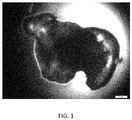
- Fig. 1 is a photo of a coated crumb particle.
- crumb as used herein means: a plurality of crumb particles
- crumb coating as used herein means: a coating of crumbs on an edible substrate for preparing a food product
- coated crumb particle means: a crumb particle having a coating layer or a covering layer on at least part of its outer surface
- coating layer as used herein means: a layer of a fat composition that surrounds at least part of the outer surface of crumb particles
- coverage as used herein means: the amount of the outer surface of a crumb particle that is covered with a coating layer, expressed as a percentage (%), wherein the average coverage can be measured by determining the percentage of 5 grams of crumb particles that sediments in an amount of water of 100 ml at 12°C during a period of time of at most 600 seconds.
- the term "powder coating” as used herein means: a layer of powder (dust) or (fine) crumb particles that is applied to the filling/the substrate with or without a preceding batter coating;
- the term “batter coating” as used herein means: a layer made of liquid batter applied to the filling/the substrate with our without a preceding powder coating;
- the term “filling” as used herein means: a (soft) filling that may be a mixture of several components such as a ragout for croquettes;
- the term “substrate” as used herein means: a (solid) piece of food or food product, such as a piece of chicken (product), fish (product) or meat (product) or a vegetarian product;
- the term “fat” as used herein means: solid fats (melting point above 20°C) and also liquid
- fats/oils are fatty acid triglycerides that occur either naturally in animal and vegetable materials or also in adapted, randomized and interesterified fats/oils.
- solid fat as used herein means: a fat as explained above, having a melting point above 20°C (the melting point of a fat being understood to mean that the fat has an SFC or Solid Fat Content of at least 60% at 20°C).
- fatty acid as used herein means: an organic carboxylic acid having a chain of at least two carbon atoms and one carboxyl group (COOH).
- the term "producing without deep-frying” as used herein means: the food product is produced for sale or for storage or for cooking without use being made of deep-frying in the production process; • the term “preparing without deep-frying” as used herein means: the food product is prepared for consumption (baked) without deep-frying; • the term “deep-frying” as used herein means: frying through immersion in oil or fat; • the term “particle size of 300 and 1600 micron” as used herein means: a plurality of particles which, when tested according to a sieving method in which 100 grams of particles is successively shaken on progressively finer mesh sieves and the percentage of particles falling through is calculated in a cumulative way: 1600 micron mesh size (1.6 millimetres): at least 98% of the particles fall through this, so in total 98% of the particles are smaller than 1600 micron and 2% of the particles are larger than 1600 micron; 1400 micron mesh size (1.4 millimetres): at least 94% of the remaining 98% particles fall through this, so in total 92% of the
- a coated crumb particle comprising a crumb particle which is at least 80% covered with a coating layer, the coating layer comprising a fat composition, can be used in a crumb coating for a food product such as a snack. After baking in the oven, a crumb coating of such crumb particles produces a tasty product with a crispy crust even without any use of deep-frying. When deep-frying is used, a crispy crust is produced.
- the coating of preferably solid fat surrounding the crumb particles according to this aspect ensures that a crispy crust is obtained also without deep-frying.
- the coating of preferably solid fat provides a protective coating around the crumb particles to protect them from moisture that is attracted to the crumb particles from the surrounding area or from the filling.
- the covering layer prevents the absorption of water during storage in a refrigerator or deepfreeze.
- Crumb particles are usually porous and hydrophilic, absorbing moisture from the surrounding area. This is prevented by the fat coating according to this aspect.
- the coating of preferably solid fat gives the snack product a crispy taste after cooking.
- the application of a cover layer to the crumb particles improves their crispiness. The taste, bite and look of the food product cooked without deep-frying are more like those of food products that are cooked by deep-frying.
- the amount of oil/fat that is consumed can be substantially reduced, for example by 10%. Cooking food by deep-frying can also lead to the presence of harmful acrylamide in the food, which can be significantly reduced by cooking in an oven.
- a food product In the process of deep-frying, a food product is given a certain firmness and crispiness by immersing it in oil.
- a product When a product is cooked in a (microwave) oven the product and its crumb coating are only heated, so the firmness and crispiness must be obtained via the components of the crumb coating, in this case the coating of preferably solid fat.
- the food product according to one aspect may comprise one or more of the following elements, viewed from the inside to the outside:
- the food product/snack product comprises a substrate or a filling.
- the substrate or the filling may be of animal origin, for example meat or fish or poultry, such as chicken, lamb, beef, pork, veal or fish, possibly in combination with a dough or a starch filling (e.g. ragout).
- meat or fish or poultry such as chicken, lamb, beef, pork, veal or fish
- a starch filling e.g. ragout
- examples of this are a chicken nugget, a fish stick, a bitterbal or a croquette.
- the substrate or the filling may comprise a dairy product (e.g. yoghurt or cheese), possibly in combination with a dough or a starch filling (e.g. ragout).
- dairy product e.g. yoghurt or cheese
- a starch filling e.g. ragout
- examples of this are a cheese croquette or cheese soufflé.
- the substrate or the filling may be of plant origin (such as vegetable or fruit), possibly in combination with a dough or a starch filling (e.g. ragout). Examples of this include a vegetable croquette.
- the substrate or the filling may be a combination of the above, possibly in combination with a spice or a sauce, such as fish with sauce.
- the food product to be prepared is a croquette (for example a meet croquette, a potato croquette, a cheese croquette, a fish croquette et cetera), a cheese soufflé (consisting of a dough envelope and a soft or liquid cheese filling), a nugget (for example a chicken nugget, a fish stick, a meat nugget with a chicken, fish or meat substrate, respectively), a snack (for example a block-shape or disc-shaped snack with a filling of noodles (in Dutch "bamischijf") or fried rice (in Dutch "nasischijf”)).
- a croquette for example a meet croquette, a potato croquette, a cheese croquette, a fish croquette et cetera
- a cheese soufflé consisting of a dough envelope and a soft or liquid cheese filling
- a nugget for example a chicken nugget, a fish stick, a meat nugget with a chicken,
- the substrate has the shape of a hamburger, a nugget, a bar, a cylinder or a ring.
- the filling / substrate comprises between 75 and 85% of the total weight of the food products.
- the food product is provided with a batter coating, after which the crumb coating is coated onto the batter coating.
- the batter provides sufficient adhesion of the crumb coating to the filling/the substrate; the crumb coating is held on the filling / substrate and will not break or fall off.
- the batter coating is a liquid coating, onto which the crumb coating is coated.
- the batter consists of a solid component and a liquid component.
- the solid component comprises a protein and a thickening agent, possibly a flavouring and possibly a starch-containing material.
- the liquid component comprises water and possibly oil and optionally protein.
- the starch-containing material of the batter comprises one or more of a meal or flour or a starch.
- the meal are wheat meal, maize meal, rice meal or soy flour.
- the starch are wheat starch, potato starch (for example amylopectin starch), rice starch, maize starch (for example high-amylose-content maize starch with an amylose content of at least 70 wt.%).
- a combination of wheat meal and maize meal is used in the batter.
- the protein in the batter is selected from animal protein, such as egg protein (for example chicken egg protein in liquid or dried powder form; also called egg albumin, which may be of the so-called high-gel type, for example), dairy protein, such as milk protein (for example whey protein or whey protein concentrate; also known as WPC or Whey Protein Concentrate, containing for example 80% protein on a dry matter basis) or vegetable protein, such as rice protein, for example so-called "instantized and agglomerated" rice protein powder containing 80% protein on a dry matter basis, or maize protein powder.
- animal protein such as egg protein (for example chicken egg protein in liquid or dried powder form; also called egg albumin, which may be of the so-called high-gel type, for example), dairy protein, such as milk protein (for example whey protein or whey protein concentrate; also known as WPC or Whey Protein Concentrate, containing for example 80% protein on a dry matter basis) or vegetable protein, such as rice protein, for example so-called “instantized and agglomer
- the batter comprises water, protein, guar gum and xanthan gum, salt and whey protein.
- the batter comprises a flavouring or aroma such as salt and/or herbs or spices.
- the thickening agent is selected from the group consisting of a gelatine, a cellulose (for example HPMC), or a polysaccharide such as a galactomannan (for example guar gum, carob bean gum) or xanthan gum.
- a thickening agent is used, so that a 1% solution of the thickening agent in water will have a viscosity of between 4800-5800 mPa.s, measured by Brookfield RVF, spindle No. 4 with a speed of 20 revolutions per minute, for 2 hours at a temperature of about 25 °C.
- the batter is made by mixing the dry components with the one or more liquid components.
- the batter has a viscosity of 12-15 sec measured according to Simax 6 din as described in the examples.
- the batter may contain nutrient fibres.
- nutrient fibres examples of this are wheat fibres and oat fibres or a combination thereof.
- the presence of nutrient fibres in the batter may lead to fibre enrichment, which is a nutritional improvement. It may also lead to fat reduction, reduction of the caloric value, improvement of the texture and increased moisture migration control.
- the batter may contain an adhesion-enhancing agent; it imparts film-forming and stabilizing properties to the batter, so that the batter will form a uniform film on the filling/the substrate.
- adhesion-enhancing agent examples include dextrin, such as potato dextrin (for example so-called “high-viscos dextrin”), or tapioca starch or maize starch.
- the batter may contain an emulsifying agent.
- an emulsifying agent in the batter may lead to an enhanced crispiness of the final food product.
- emulsifying agents are a combination of mono-glycerides and diglycerides of fatty acids, such as E471 or soy lecithin.
- the batter may further comprise a preservation agent, a colourant, a nutrient, a stabilising agent, an agent that adds texture, a pH-controlling agent, an acidifying agent, a raising agent, an anticaking agent, a moisturising agent, a reinforcing dough and a conditioning dough, or a sweetener or one or more combinations thereof.
- sweeteners are maltodextrin, dried glucose syrup and sorbitol.
- oil that may be present in the batter as the liquid component are sunflower oil, rice bran oil, rape seed oil, olive oil, peanut oil and one or more combinations thereof.
- the batter can be applied by immersing the substrate/the filling in the batter to form a batter coating.
- the batter coating can be dried or hardened (for example by heating). This makes the batter coating strong and better suited for storage. This hardening of the batter coating can take place in a special oven using dry air and a high air speed of 750 to 1250 m/s (for example 1000 m/s), with a dew point of 40 °C and a temperature of, for example, 220 °C, for a baking period of 1 to 15 minutes (for example 5 minutes). Following that, an additional batter coating and crumb coating may be applied.
- the batter coating has a thickness of between 0.05 and 1.0 mm, preferably 0.1 to 0.3 mm, for example 0.2 mm, prior to the application of a crumb coating and prior to the possible hardening. If more than one batter coating is applied, each batter coating may have such a thickness.
- the batter comprises between 2 and 20%, preferably between 4 and 15% of the total weight of the food product.
- application of a batter coating and crumb coating takes place three times (i.e. powder coating, batter coating, crumb coating, batter coating, crumb coating, batter coating, crumb coating; without intermediate hardening).
- a batter coating and crumb coating are applied four times (i.e. powder coating, batter coating, crumb coating, batter coating, crumb coating, batter coating, crumb coating, batter coating crumb coating; without intermediate hardening) in one embodiment, a batter coating and crumb coating are applied five times (i.e. powder coating, batter coating, crumb coating, batter coating, crumb coating, batter coating, crumb coating, batter coating, crumb coating, batter coating, crumb coating; without intermediate hardening).
- the powder coating is also called dust or dust coating.
- This powder coating provides adhesion of the batter coating to the filling/the substrate.
- This powder coating is optional and can be applied directly around the filling.
- the powder coating can also be applied after a first batter coating has first been applied. In one aspect, a (second) batter coating is applied after the application of the powder coating.
- the powder coating consists of ground crumb particles according to the present invention, which have been reduced to an average particle size of at most between 300 and 1600 micron or at most between 150 and 2500 micron; the sieving curves of these particle size distributions are shown in the Examples.
- the powder coating has a thickness of between 1.0 and 2.0 mm, preferably between 1.2 and 1.5 mm. In one embodiment, the powder coating comprises between 4 and 25% of the total weight of the food product, preferably between 9 and 18%.
- the crumb particles are breadcrumb particles. In one embodiment, the crumb particles are obtained by baking a dough and crumbing the baked dough.
- the dough used for the preparation of crumb particles comprises a starch-containing material, a raising agent, a flavouring and a colourant.
- the starch-containing material has been selected from the group consisting of a meal or a starch or a combination thereof.
- the meal has been selected from the group consisting of wheat meal, maize meal, rice meal or soy meal.
- the starch has been selected from the group consisting of wheat starch, potato starch, rice starch, maize starch, soy starch and one or more combinations thereof.
- the starch-containing material is a combination of wheat meal and wheat starch.
- a powder coating is applied after the application of a first crumb coating.
- a second crumb coating is applied after the application of the powder coating.
- a powder coating is applied and subsequently a first batter coating is applied followed by a first crumb coating; following that, a second batter coating and a second crumb coating are applied.
- the coating of the coated crumb particle consists of a fat composition, which fat composition comprises at least 80 wt.%, or at least 90 wt.%, in another aspect at least 99 wt.% or even 100 wt.% solid fat, based on the total weight of the fat composition.
- the fat composition is pure, solid fat or a mixture of pure, solid fats.
- the coating layer comprises at least 80 wt.%, at least 90 wt.%, at least 99 wt.% or even 100 wt.% solid fat, based on the total weight of the coating layer.
- the coating layer is pure, solid fat or a mixture of pure solid fats.
- the crumb particle coating has a thickness of 0.1 to 0.3 mm. It will be understood that the shape of these particles may be irregular, for example if bread particles are used as the crumb particles. As a result, the thickness of the coating may not be uniform over the surface of the crumb particles. In other words, the thickness of the coating layer may vary over the surface of the crumb particles.
- the phrase "a coating with a thickness of 0.1 to 0.3 mm" is understood to mean that the thickness of the coating ranges between 0.1 and 0.3 mm over at least 80%, or at least 90%, or at least 95%, for example at least 99% of the surface.
- the thickness of the coating layer can be determined, for example, by making use of a thickness gauge as commonly used for determining the layer thickness of paint and varnish (for example according to ISO 2808 (2007)). Without wishing to be bound to a theory, according to the inventor, the thickness gauge operates on the basis of ultrasound pulses.
- a thickness gauge as commonly used for determining the layer thickness of paint and varnish (for example according to ISO 2808 (2007)).
- the thickness gauge operates on the basis of ultrasound pulses.
- a non-limitative example of an apparatus that can be used for this purpose is the QuintSonic 7 from Elektrophysik.
- the coating layer covers at least 80%, or at least 90%, or at least 95%, for example at least 99%, of the surface of the crumb particle.
- Figure 1 shows a photo of a coated crumb particle, from the round contours of which it can be seen that it is largely covered with a coating layer.
- the fat is a vegetable fat or a combination of one or more vegetable fats. In one embodiment, the fat is a vegetable fat containing an amount of at least 95 wt.% long fatty acids (C12-C18), based on the total weight of the vegetable fat.
- the vegetable fat comprises less than 5 wt.%, preferably less than 3 wt.%, in particular less than 2 wt.% fatty acids having a carbon chain length of C14 or less, based on the total weight of the vegetable fat.
- the vegetable fat comprises less than 3 wt.%, preferably less than 2 wt.%, in particular less than 1 wt.% fatty acids having a carbon chain length of C20 or more, based on the total weight of the vegetable fat.
- the vegetable fat comprises at least 92 wt.%, in particular at least 95 wt.%, more in particular at least 98 wt.%, fatty acids having a carbon chain length of C16 or C18, based on the total weight of the vegetable fat.
- the fat has been selected from the group consisting of palm oil, coconut oil, Shea oil, colza oil, rape seed oil (for example hydrogenated), sunflower oil (for example hydrogenated such as double hardened), and one or more combinations thereof. If a vegetable oil having a melting point of less than 25 °C is used, it is preferable to use a hydrogenated (or double-hardened) oil.
- the fat has a melting point of at least 20 °C, preferably between 25 °C and 100 °C, preferably between 35 °C and 80 °C, in particular between 25 °C and 65 °C.
- the crumb particle comprises 5-30% fat, for example 5-25%, such as 10-20% fat, for example 12-17% fat, such as 15% fat, based on the total weight of the crumb particle.
- a part of the appearance of snack products with a crumb coating is the colour after baking. It is important that the snack is aesthetically attractive after heating/baking.
- the snack can have various colours, which are measured by means of a colour scale. Examples of colours that are often perceived in baked crumb-coated food products are brown, gold and orange. This colour is given in part by the colour of the crumb coating that is used and in part by the deep-frying process.
- one or more colourants may be added to the crumb.
- a colourant is used. This colourant may be added to the dough used for making the crumb. This colourant makes the final product look better.
- Snack products prepared by deep-frying often obtain a nice golden yellow, brown or red-brown colour. If snack products are prepared in the oven, however, the colour is often less attractive and consumers find the product to be less tasty. In some cases the final product may become dull after being deep-frozen, this can be prevented by using a colourant.
- Colourants that may be used are, for example, caramel (powder), burnt sugar, paprika, curcuma, malt flour, and one or more combinations thereof. By varying the amounts and combinations, it is possible to obtain the desired colour resembling the colour of deep-fried snacks.
- the colourant added to the dough is selected from the group consisting of: paprika (powder or oleoresin), curcuma (powder or oleoresin), caramel (powder), annatto (powder or oleoresin), malt flour, burnt sugar.
- paprika powder or oleoresin
- curcuma powder or oleoresin
- caramel powder
- annatto powder or oleoresin
- malt flour burnt sugar
- the crumb particles have a particle size distribution with an average particle size of 300-1600, a particle size distribution of 300-3500 or a particle size distribution of 150-2500. In one embodiment, the average particle size of said crumb particle ranges between 300 and 1600 (see definitions).
- the crumb coating comprises between 10 and 45% of the total weight of the food product, for example between 20 and 35%, depending on the size of the substrate/filling, among other things.
- the crumb coating comprises a mixture of a plurality of first coated crumb particles and a plurality of second coated crumb particles, wherein the first and second coated crumb particles are different from each other as regards the material of the crumb particles and/or the coating layer.
- the food product according to one aspect of this description is a snack or part of a menu.
- the food product comprises a filling / substrate, a powder coating, a batter coating and a crumb coating. In one embodiment, the food product comprises a filling /substrate, a first batter coating, a powder coating, a second batter coating and a crumb coating. In one embodiment, the food products comprises a filling / substrate, a batter coating and a crumb coating.
- the invention relates to a method for preparing a coated crumb particle, the method comprising i) providing a plurality of crumb particles, ii) fluidising the particles in an air flow, iii) spraying a liquid fat composition having a temperature of at least 65 °C onto the fluidised particles so as to provide at least part of the outer surface of the particles with a coating layer.
- crumb particles for example breadcrumb particles.
- crumb particles for example breadcrumb particles.
- the crumb particles are provided with a fat coating by spraying the fat onto the particles when they are in motion. This makes it possible to provide the individual particles with a coating, so that a better coverage of the particles can be obtained.
- the particles are set in motion by means of an air flow, using a fluidised bed method, after which spraying takes place.
- use is made of a fat which is liquid at the temperature of application to the particle, which fat is sprayed onto the crumb particles. In this way a uniform coating is obtained.
- use is made of a fat that becomes liquid at a higher temperature (in other words, a solid fat); in that case the fat needs to be melted by heating before this van be sprayed.
- the advantage of using a fat which is solid at room temperature is that the coating becomes solid after the coated crumb particles have been produced and the particles can be easily stored before being used as crumb coating. Subsequently, a liquid fat composition is sprayed on the particles that have been set in motion by means of an air flow using a fluidised bed method.
- the crumb particles can be produced by making a dough, baking this dough and crumbling this.
- the solid starting materials such as (wheat) flour or meal, yeast, flavourings and/or colourants
- water a dough
- said moisture in part comprising water and in part water in which flavourings and/or colourants are dissolved.
- the dough is developed by being kneaded to the desired condition.
- bread rolls/dough pieces are formed, which have a thickness of for example 6 - 10 cm (e.g. 8 cm), a width of 7 to 13 cm (e.g. 10 cm) and a length of 10 to 20 cm (e.g. 14 cm).
- the dough pieces are allowed to rise at room temperature (21 °C) or at a higher temperature, for example for 5 to 25 minutes, such as 15 minutes.
- the dough pieces are then baked. In one aspect, it is ensured that a heat transfer takes place such that there will be no crustation. Baking is for example carried out at a temperature of 180 - 240 °C, such as 200, 210 or 220 °C. In one aspect, baking takes place for a period of 30 to 40 minutes. In one aspect, the temperature of the core of the bread rolls/dough piece after baking is at least 90 °C.
- the bread rolls are cooled to a core temperature of about 45 °C after baking.
- the bread rolls/dough pieces are then ground and dried, for example in a fluidised bed drying device, for example to a moisture content of at most 10%.
- the particles can be further ground to the desired particle size using a roller mill.
- the desired particle size distribution can be obtained by sieving.
- the food product can be prepared in a usual manner.
- the steps to be carried out in this production method are for example the following:
- the method for preparing a food product comprises i) portioning the substrate/preparing the filling, ii) applying a powder coating to the portioned substrate or the prepared filling, iii) applying a batter coating to the product obtained in step ii), and iv) applying a crumb coating to the product obtained in step iii).
- the method for preparing a food product comprises i) portioning the substrate/preparing the filling, ii) applying a first batter coating to the portioned substrate or the prepared filling, iii) applying a powder coating to the product obtained in step ii), iv) applying a second batter coating to the product obtained in step iii), and v) applying a crumb coating to the product obtained in step iv).
- the batter coating can be carried out using known methods such as spraying, passage through a batter curtain, immersion and brushing.
- the substrate/the prepared filling or the coated product may be immersed in the batter, for example.
- the product may be allowed to drain so as to remove any excess batter.
- the batter coating can also be applied by passing the substrate/the filling or the batter-coated products through a device comprising a batter bath, using a conveyor belt.
- the powder coating can take place, for example, by passing the coated product through a device comprising a flow of powder, using a conveyor belt.
- the powder coating can also be applied by passing the substrate/the filling, possibly provided with a batter coating, through a device comprising a treatment chamber containing particulate material.
- the crumb coating can take place, for example, by passing the batter-coated product through a device comprising a flow of powder, using a conveyor belt.
- the crumb coating can also be applied by passing the batter-coated product through a device comprising a treatment chamber containing particular material.
- the method for preparing a food product comprises pre-cooking or pre-baking the obtained product.
- Said pre-cooking or pre-baking of the food product can be done by deep-frying the product.
- the coated food products can be heated in an oven at a temperature between 160 and 270 °C, preferably between 180 and 250 °C, for a period of 1 to 10 minutes, for example 5 minutes.
- the oven has a high air speed of 750 to 1250 m/s (e.g. 1000 m/s), with a dew point of 40 °C.
- the method for preparing a food product comprises deep-freezing the obtained product after said product has been pre-cooked or pre-baked. In one embodiment, the method for preparing a food product comprises storing the product at a temperature of 0 to -40 °C, for example -15 to -20 °C, after the product has been deep-frozen.
- the method for preparing a food product comprises packaging and storing the product.
- Ground breadcrumb obtained from ground bread that is sieved, was used as the powder for the powder coating.
- batter type gives which characteristics
- a number of batter types were used for the batter coating, which types are shown in the table below.
- the same crumb type was used in all the experiments of this series, so that only the batter was variable; this in order to be able to correctly evaluate the effect thereof.
- a fine, gold-coloured breadcrumb was used as the crumb in examples 1-7, which crumb was obtained by making, baking and crumbing.
- a dough was prepared on the basis of wheat flour (95 wt.%), salt (1.5 wt.%), paprika powder (1 wt.%), yeast (1 wt.%), sunflower oil (1 wt.%), curcuma powder (0.5 wt.%), each weight percentage being based on the dry matter of the dough. This was mixed with sufficient water to form a coherent dough.
- the dough was mixed and kneaded at a temperature of 35 °C, with dough pieces measuring 14x10x7 cm being formed. The dough was allowed to rise at room temperature (21 °C) for 15 minutes.
- the risen dough pieces were baked at a temperature of 200 °C for 40 minutes, then cooled and coarsely ground using a hammer mill with an 80 mm matrix. Following that, the crumb particles were dried at a temperature of 110 °C to a moisture content of 10 wt.% and subsequently cooled at room temperature for 10 minutes. The particles were then further reduced using a roller mill.
- the particle size distribution ranged between 300 and 1600 particle size.
- the crumb particles were provided with a palm oil coating layer, with 3 wt.% palm oil (based on the total weight of the coated crumb particles) being applied to the crumb and at least 90% of the surface of at least 80% of the crumb particles being covered with palm oil. This was determined by microscopic examination.
- the protein component to be used for the batter of examples 1-7 was selected from chicken egg protein powder (also called egg albumin, of the "high gel” type), a whey protein powder (a whey protein concentrate comprising 80% protein, based on the dry matter content, also called whey protein concentrate 80% or WPC 80%), a rice protein powder (a so-called “instantized & agglomerized” rice protein powder comprising 80% protein, based on the dry matter content) and one or more combinations thereof.
- guar gum and xanthan gum or a combination thereof was used as the thickening agent in all cases.
- Other thickening agents or combinations are also possible, of course.
- the same amount of salt was used as the flavouring agent in all cases.
- Table 1 solid batter components (total 100 wt.% based on the dry weight of the batter) Batter Chicken-protein powder Whey-protein powder Rice-protein powder Guar gum Xanthan gum Salt A 94 0 0 1,5 0,5 4 B 0 94 0 1,5 0,5 4 C 0 0 94 1,5 0,5 4 D 31,3 31,3 31,3 1,5 0,5 4 E 62,7 31,3 0 1,5 0,5 4 F 62,7 31,3 0 0 2 4 G 62,7 31,3 2 2 0 4
- the total amount was 1000 g, and after 5 minutes of rest the liquid was allowed to pass through a 6 mm aperture and, using a stopwatch, the time it took for the cup to empty completely was noted; the recorded time ranged between 12 and 14 seconds for all batter types.
- Beef ragout in the form of a croquette was used as the filling in all cases; which is known to the skilled person in this field; this filling was rolled through the powder to form a powder coating and then immersed in the batter, excess batter was allowed to drip off from the filling. Subsequently, the filling provided with the batter was rolled through the crumb coating until a complete crumb coating had been formed.
- the croquette that was formed was visually evaluated for a number of criteria, viz the adhesion of the batter to the filling, the adhesion of the crumb to the batter and the crispiness of the crumb coating after baking in an oven of 200 °C for 10 minutes.
- the duration of the baking process in the oven of 200 °C depends on the weight of the croquette; with a weight of about 70 g this is 10 minutes, but for a croquette of about 90g it is 15 minutes.
- the adhesion of the batter to the filling was visually evaluated for the following criteria: - little adhesion / o reasonable adhesion / + good adhesion.
- the adhesion of the crumb to the batter was visually evaluated for the following criteria: - little adhesion / o reasonable adhesion / + good adhesion.
- the crispiness of the crumb coating was evaluated for the following criteria: - poor (does not feel crispy) / o moderate (feels moderately crispy) / + good (feels crispy).
- batter E gives a good crispiness of the crumb coating.
- a number of crumb types were used for the crumb coating, which types are shown below. All these crumb types were tested with batter E so as to show the effect of the particular type of crumb.
- the same powder as used in examples 1-7 was used.
- a ragout filling in the form of a croquette was again used as the filling, which was passed through a powder so as to apply a powder coating, then through the batter and subsequently a crumb coating; the latter two steps (batter and crumb coating) were repeated a number of times.
- the croquette that was formed was baked in an oven at 200°C for 10 minutes and subsequently evaluated for a number of criteria. The duration of the baking in the oven at 200 °C depends on the weight of the croquette; for a weight of about 70 g this is 10 minutes, but for a croquette that weighs about 90 g it is 15 minutes.
- the cohesion of the crumb coating was evaluated for the following criteria: - crumbly /little cohesion; o sandy; + brittle / crispy
- the firmness of the crumb coating was evaluated for the following criteria: - croquette bursts open and filling comes out; o croquette remains closed but exhibits some cracks and weak spots; + firmness good.
- the crispiness of the crumb coating was evaluated for the following criteria: - poor (does not feel crispy); o moderate (feels moderately crispy); + good (feels crispy). From this it can be derived that in particular experiments 14-17 give the best results as regards cohesion and crispiness and experiments 24-27 give the best results on all parts.
- Taste tests were carried out using a human test panel consisting of 8-12 selected and trained persons. These persons tested the food products at four levels: viz 1) appearance, 2) feel, 3) taste, 4) overall evaluation. For appearance, each product was evaluated for the overall appearance on a scale from 1 (not attractive) to 10 (attractive). For appearance, each product was moreover evaluated for crumb coating on a scale from 1 (insufficient) to 10 (sufficient). For appearance, each product was moreover evaluated for colour intensity on a scale from 1 (too light) to 5 (good) to 10 (too dark). For appearance, each product was moreover evaluated for crumb particle size on a scale from 1 (too fine) to 5 (good) to 10 (also coarse).
- each product was evaluated for adhesion of the crumb coating to the filling / substrate on a scale from 1 (insufficient) to 10 (sufficient). For feel, each product was moreover evaluated for firmness on a scale from 1 (not firm) to 10 (firm). For feel, each product was moreover evaluated for layer thickness of the crumb coating on a scale from 1 (too thin) to 5 (good) to 10 (too thick). For feel, each product was moreover evaluated for greasiness on a scale from 1 (too dry) to 5 (good) to 10 (too greasy).
- each product was evaluated for confirmation of the overall taste on a scale from 1 (insufficient) to 10 (sufficient).
- each product was moreover evaluated for crispiness on a scale from 1 (hard) to 10 (crispy).
- each product was moreover evaluated for greasiness on a scale from 1 (too dry) to 5 (good) to 10 (too greasy).
- the filling that was used was a ragout, or a chicken filling or cheese-filled puff pastry or fried rice (nasi) or bakmi or various vegetable-based fillings and mushrooms in puff pastry, or various potato variants.
- Eight different products were tested with different fillings, viz a croquette (Examples 28-37), a cheese soufflé (Examples 38-39), puff pastry with mushrooms and cheese (Examples 40-41), chicken fillet (Examples 42-43) - which is pre-cooked, chicken pieces (Examples 44-45), bakmi snack (bamischijf) (Examples 46-47), fried rice snack (nasischijf) (Examples 48-49).
Landscapes
- Chemical & Material Sciences (AREA)
- Life Sciences & Earth Sciences (AREA)
- Engineering & Computer Science (AREA)
- Food Science & Technology (AREA)
- Polymers & Plastics (AREA)
- Health & Medical Sciences (AREA)
- Nutrition Science (AREA)
- Dispersion Chemistry (AREA)
- Oil, Petroleum & Natural Gas (AREA)
- Zoology (AREA)
- Grain Derivatives (AREA)
Claims (15)
- Beschichteter Krümelpartikel, der einen Krümelpartikel umfasst, der wenigstens teilweise mit einer Überzugsschicht bedeckt ist, wobei die Überzugsschicht eine Fettzusammensetzung umfasst, wobei die Überzugsschicht wenigstens 80 %, bevorzugt wenigstens 90 % der Oberfläche des Krümelpartikels bedeckt.
- Beschichteter Krümelpartikel nach Anspruch 1, wobei die Überzugsschicht aus wenigstens 95 Gew.-% Fett, bevorzugt wenigstens 95 Gew.-% Festfett besteht.
- Beschichteter Krümelpartikel nach einem oder mehreren der vorherigen Ansprüche, wobei die Überzugsschicht wenigstens 95 %, insbesondere wenigstens 99 % der Oberfläche des Krümelpartikels bedeckt.
- Beschichteter Krümelpartikel nach einem oder mehreren der vorherigen Ansprüche, wobei das Fett ein Festfett ist, das bevorzugt einen Schmelzpunkt von wenigstens 20 °C, bevorzugt zwischen 25 °C und 100 °C, bevorzugt zwischen 35 °C und 80 °C, insbesondere zwischen 25 °C und 65 °C hat, wobei bevorzugt Palmöl als Fett benutzt wird.
- Beschichteter Krümelpartikel nach einem oder mehreren der vorherigen Ansprüche, wobei die Überzugsschicht eine Dicke zwischen 0,1 und 0,3 mm hat.
- Beschichteter Krümelpartikel nach einem oder mehreren der vorherigen Ansprüche, wobei die Krümelpartikel Fett in einer Menge von 12 % bis 25 % auf der Basis des Gesamtgewichts des Krümelpartikels umfassen.
- Beschichteter Krümelpartikel nach einem oder mehreren der vorherigen Ansprüche, wobei der Krümelpartikel ein Brotkrümelpartikel ist.
- Nahrungsmittelprodukt, das von der Mitte nach außen Folgendes umfasst:eine Füllung oder ein Substrat;einen Teigüberzug, bevorzugt gebildet aus einem Teig, der Wasser, Protein, ein Polysaccharid und Salz umfasst;einen Krümelüberzug, bestehend aus einer Schicht aus beschichteten Krümelpartikeln nach einem der Ansprüche 1 bis 7.
- Nahrungsmittelprodukt nach Anspruch 8, wobei der Krümelüberzug 20 % bis 35 % des Gesamtgewichts des Nahrungsprodukts ausmacht.
- Nahrungsmittelprodukt nach einem oder beiden der Ansprüche 8-9, wobei der Krümelüberzug Brotkrümel umfasst.
- Nahrungsmittelprodukt nach einem oder mehreren der Ansprüche 8-10, wobei der Teigüberzug Wasser, Hühnereiweiß, Guargummi und Xanthangummi, Salz und Molkeeiweiß umfasst.
- Verfahren zur Herstellung eines beschichteten Krümelpartikels nach einem oder mehreren der Ansprüche 1-7, wobei das Verfahren Folgendes umfasst: i) Bereitstellen einer Vielzahl von Krümelpartikeln, ii) Fluidisieren der Partikel in einem Luftstrom, iii) Sprühen einer flüssigen Fettzusammensetzung mit einer Temperatur von bevorzugt wenigstens 65 °C auf die fluidisierten Partikel, um wenigstens einen Teil der Außenfläche der Partikel mit einer Überzugsschicht zu versehen.
- Verfahren zur Herstellung eines beschichteten Krümelpartikels nach einem oder mehreren der Ansprüche 1-7, wobei das Verfahren Folgendes umfasst: I) Mischen eines stärkehaltigen Materials, eines Treibmittels, eines Aromastoffs, eines Farbstoffs und Wasser, um einen Teig herzustellen; II) Backen des Teigs; III) Reduzieren des gebackenen Teigs, um Krümelpartikel zu bilden; IV) optional Trocknen der Krümelpartikel; ii) Fluidisieren der Partikel in einem Luftstrom, iii) Sprühen einer flüssigen Fettzusammensetzung mit einer Temperatur von bevorzugt wenigstens 65 °C auf die fluidisierten Partikel, um wenigstens einen Teil der Außenfläche der Partikel mit einer Überzugsschicht zu versehen.
- Verfahren zur Herstellung eines Nahrungsprodukts, das die folgenden Schritte umfasst:a) Bereitstellen einer Füllung/eines Substrats;b) möglicherweise Aufbringen eines Teigüberzugs und eines Pulverüberzugs ("Staub") oder Bereitstellen eines Pulverüberzugs auf der Füllung/dem Substrat;c) Aufbringen eines Teigüberzugs;d) Aufbringen eines Krümelüberzugs bestehend aus einer Schicht von beschichteten Krümelpartikeln nach einem oder mehreren der Ansprüche 1-7 auf den Teigüberzug aus Schritt c);e) möglicherweise Vorkochen des mit Krümeln beschichteten Produkts, um ein Nahrungsmittelprodukt herzustellen.
- Verwendung der beschichteten Krümelpartikel nach einem oder mehreren der Ansprüche 1-7 zum Aufbringen eines Krümelüberzugs auf eine Füllung/ein Substrat zwecks Herstellung eines Nahrungsmittelprodukts, das ohne Frittieren hergestellt werden kann.
Applications Claiming Priority (1)
| Application Number | Priority Date | Filing Date | Title |
|---|---|---|---|
| NL2016173A NL2016173B1 (nl) | 2016-01-28 | 2016-01-28 | Gecoat kruimdeeltje voor het bedekken van voedingsmiddelen. |
Publications (2)
| Publication Number | Publication Date |
|---|---|
| EP3199038A1 EP3199038A1 (de) | 2017-08-02 |
| EP3199038B1 true EP3199038B1 (de) | 2019-01-23 |
Family
ID=58016540
Family Applications (1)
| Application Number | Title | Priority Date | Filing Date |
|---|---|---|---|
| EP17153530.5A Active EP3199038B1 (de) | 2016-01-28 | 2017-01-27 | Überzogener brösel für das panieren von lebensmittelprodukten |
Country Status (2)
| Country | Link |
|---|---|
| EP (1) | EP3199038B1 (de) |
| NL (1) | NL2016173B1 (de) |
Families Citing this family (3)
| Publication number | Priority date | Publication date | Assignee | Title |
|---|---|---|---|---|
| JP6976771B2 (ja) * | 2017-08-22 | 2021-12-08 | 月島食品工業株式会社 | コロッケ風スナック菓子及びその製造方法 |
| WO2020161172A1 (en) | 2019-02-08 | 2020-08-13 | Crisp Sensation Holding B.V. | Ovenable frozen crumb-coated snack |
| CN114929029A (zh) * | 2019-12-10 | 2022-08-19 | 松脆感技术公司 | 适用于烤箱烘焙的面包屑包覆小吃 |
Family Cites Families (4)
| Publication number | Priority date | Publication date | Assignee | Title |
|---|---|---|---|---|
| US5266340A (en) | 1991-07-23 | 1993-11-30 | Campbell Soup Company | Process for preparing batter-coated, chilled food products |
| WO1994013160A1 (en) | 1992-12-16 | 1994-06-23 | Pfizer Inc. | Food coating composition containing a film-forming and a hydrophobic component |
| CA2102725A1 (en) * | 1993-11-09 | 1995-05-10 | Allan D. Samson | Vegetable oils having fried and savory flavors and method of use |
| DE10055317A1 (de) * | 2000-11-08 | 2002-05-29 | Univ Muenchen Tech | Verfahren und Vorrichtung zum Anreichern von Pulver mit Fettkomponenten |
-
2016
- 2016-01-28 NL NL2016173A patent/NL2016173B1/nl active
-
2017
- 2017-01-27 EP EP17153530.5A patent/EP3199038B1/de active Active
Non-Patent Citations (1)
| Title |
|---|
| None * |
Also Published As
| Publication number | Publication date |
|---|---|
| EP3199038A1 (de) | 2017-08-02 |
| NL2016173B1 (nl) | 2017-07-31 |
Similar Documents
| Publication | Publication Date | Title |
|---|---|---|
| US5718931A (en) | Fabricated fruit pieces and method of preparation | |
| JPS6319142B2 (de) | ||
| EP3170405B1 (de) | Tempura-backteigmischung | |
| GB2029687A (en) | Preparation of coated frozen food portions | |
| GB2109218A (en) | Wrap food coating mix | |
| US4367242A (en) | Roast poultry coating mix and process | |
| EP3199038B1 (de) | Überzogener brösel für das panieren von lebensmittelprodukten | |
| EP0109226A1 (de) | Produkt und Verfahren um gebackenen Nahrungsmitteln einen Frittiergeschmack zu verleihen | |
| EP0612480A2 (de) | Teigähnliche Beschichtung | |
| JPWO2018181749A1 (ja) | 揚げ物用衣材 | |
| EP3170407B1 (de) | Tempura-backteigmischung | |
| EP3900547B1 (de) | Mehlmischung zum bestäuben von frittierten speisen | |
| JP2717413B2 (ja) | フライ用食品及びその製造方法 | |
| JPH0216937A (ja) | 電子レンジ調理用フライ様食品及びその製造方法 | |
| JP6851759B2 (ja) | 揚げ物用バッターミックス、及び揚げ物の製造方法 | |
| JP4657230B2 (ja) | 麺皮用油脂組成物 | |
| EP3578058B1 (de) | Brotkrumengemisch | |
| JP7406493B2 (ja) | 衣付き食品の製造方法 | |
| JP7402384B1 (ja) | 揚げ物食品 | |
| JPS5889152A (ja) | ベ−キング用被覆調味料組成物 | |
| JP7406494B2 (ja) | 揚げ物食品の製造方法 | |
| NZ299661A (en) | Bread crumb coating mix compositions for vegetables to produce golden brown textured surface with the taste of fried coated food | |
| HK40119813A (zh) | 带面衣油炸食品的制造方法 | |
| KR20250056836A (ko) | 옷부착 튀김식품의 제조 방법 | |
| JP7126335B2 (ja) | 加工パン粉 |
Legal Events
| Date | Code | Title | Description |
|---|---|---|---|
| PUAI | Public reference made under article 153(3) epc to a published international application that has entered the european phase |
Free format text: ORIGINAL CODE: 0009012 |
|
| STAA | Information on the status of an ep patent application or granted ep patent |
Free format text: STATUS: THE APPLICATION HAS BEEN PUBLISHED |
|
| AK | Designated contracting states |
Kind code of ref document: A1 Designated state(s): AL AT BE BG CH CY CZ DE DK EE ES FI FR GB GR HR HU IE IS IT LI LT LU LV MC MK MT NL NO PL PT RO RS SE SI SK SM TR |
|
| AX | Request for extension of the european patent |
Extension state: BA ME |
|
| STAA | Information on the status of an ep patent application or granted ep patent |
Free format text: STATUS: REQUEST FOR EXAMINATION WAS MADE |
|
| 17P | Request for examination filed |
Effective date: 20180123 |
|
| RBV | Designated contracting states (corrected) |
Designated state(s): AL AT BE BG CH CY CZ DE DK EE ES FI FR GB GR HR HU IE IS IT LI LT LU LV MC MK MT NL NO PL PT RO RS SE SI SK SM TR |
|
| STAA | Information on the status of an ep patent application or granted ep patent |
Free format text: STATUS: EXAMINATION IS IN PROGRESS |
|
| 17Q | First examination report despatched |
Effective date: 20180629 |
|
| GRAP | Despatch of communication of intention to grant a patent |
Free format text: ORIGINAL CODE: EPIDOSNIGR1 |
|
| STAA | Information on the status of an ep patent application or granted ep patent |
Free format text: STATUS: GRANT OF PATENT IS INTENDED |
|
| INTG | Intention to grant announced |
Effective date: 20180928 |
|
| GRAS | Grant fee paid |
Free format text: ORIGINAL CODE: EPIDOSNIGR3 |
|
| GRAA | (expected) grant |
Free format text: ORIGINAL CODE: 0009210 |
|
| STAA | Information on the status of an ep patent application or granted ep patent |
Free format text: STATUS: THE PATENT HAS BEEN GRANTED |
|
| RAP1 | Party data changed (applicant data changed or rights of an application transferred) |
Owner name: KOOPMANS KONINKLIJKE MEELFABRIEKEN B.V. |
|
| RIN1 | Information on inventor provided before grant (corrected) |
Inventor name: GROENEVELD, HEIN PIETER Inventor name: KRIJGSHELD, JAN Inventor name: KAH, JUDITH |
|
| AK | Designated contracting states |
Kind code of ref document: B1 Designated state(s): AL AT BE BG CH CY CZ DE DK EE ES FI FR GB GR HR HU IE IS IT LI LT LU LV MC MK MT NL NO PL PT RO RS SE SI SK SM TR |
|
| REG | Reference to a national code |
Ref country code: GB Ref legal event code: FG4D |
|
| REG | Reference to a national code |
Ref country code: CH Ref legal event code: EP |
|
| REG | Reference to a national code |
Ref country code: AT Ref legal event code: REF Ref document number: 1090769 Country of ref document: AT Kind code of ref document: T Effective date: 20190215 |
|
| REG | Reference to a national code |
Ref country code: IE Ref legal event code: FG4D |
|
| REG | Reference to a national code |
Ref country code: DE Ref legal event code: R096 Ref document number: 602017001827 Country of ref document: DE |
|
| REG | Reference to a national code |
Ref country code: NL Ref legal event code: MP Effective date: 20190123 |
|
| PG25 | Lapsed in a contracting state [announced via postgrant information from national office to epo] |
Ref country code: NL Free format text: LAPSE BECAUSE OF FAILURE TO SUBMIT A TRANSLATION OF THE DESCRIPTION OR TO PAY THE FEE WITHIN THE PRESCRIBED TIME-LIMIT Effective date: 20190123 |
|
| PG25 | Lapsed in a contracting state [announced via postgrant information from national office to epo] |
Ref country code: ES Free format text: LAPSE BECAUSE OF FAILURE TO SUBMIT A TRANSLATION OF THE DESCRIPTION OR TO PAY THE FEE WITHIN THE PRESCRIBED TIME-LIMIT Effective date: 20190123 Ref country code: PL Free format text: LAPSE BECAUSE OF FAILURE TO SUBMIT A TRANSLATION OF THE DESCRIPTION OR TO PAY THE FEE WITHIN THE PRESCRIBED TIME-LIMIT Effective date: 20190123 Ref country code: LT Free format text: LAPSE BECAUSE OF FAILURE TO SUBMIT A TRANSLATION OF THE DESCRIPTION OR TO PAY THE FEE WITHIN THE PRESCRIBED TIME-LIMIT Effective date: 20190123 Ref country code: FI Free format text: LAPSE BECAUSE OF FAILURE TO SUBMIT A TRANSLATION OF THE DESCRIPTION OR TO PAY THE FEE WITHIN THE PRESCRIBED TIME-LIMIT Effective date: 20190123 Ref country code: SE Free format text: LAPSE BECAUSE OF FAILURE TO SUBMIT A TRANSLATION OF THE DESCRIPTION OR TO PAY THE FEE WITHIN THE PRESCRIBED TIME-LIMIT Effective date: 20190123 Ref country code: NO Free format text: LAPSE BECAUSE OF FAILURE TO SUBMIT A TRANSLATION OF THE DESCRIPTION OR TO PAY THE FEE WITHIN THE PRESCRIBED TIME-LIMIT Effective date: 20190423 Ref country code: PT Free format text: LAPSE BECAUSE OF FAILURE TO SUBMIT A TRANSLATION OF THE DESCRIPTION OR TO PAY THE FEE WITHIN THE PRESCRIBED TIME-LIMIT Effective date: 20190523 |
|
| REG | Reference to a national code |
Ref country code: AT Ref legal event code: MK05 Ref document number: 1090769 Country of ref document: AT Kind code of ref document: T Effective date: 20190123 |
|
| PG25 | Lapsed in a contracting state [announced via postgrant information from national office to epo] |
Ref country code: HR Free format text: LAPSE BECAUSE OF FAILURE TO SUBMIT A TRANSLATION OF THE DESCRIPTION OR TO PAY THE FEE WITHIN THE PRESCRIBED TIME-LIMIT Effective date: 20190123 Ref country code: RS Free format text: LAPSE BECAUSE OF FAILURE TO SUBMIT A TRANSLATION OF THE DESCRIPTION OR TO PAY THE FEE WITHIN THE PRESCRIBED TIME-LIMIT Effective date: 20190123 Ref country code: BG Free format text: LAPSE BECAUSE OF FAILURE TO SUBMIT A TRANSLATION OF THE DESCRIPTION OR TO PAY THE FEE WITHIN THE PRESCRIBED TIME-LIMIT Effective date: 20190423 Ref country code: GR Free format text: LAPSE BECAUSE OF FAILURE TO SUBMIT A TRANSLATION OF THE DESCRIPTION OR TO PAY THE FEE WITHIN THE PRESCRIBED TIME-LIMIT Effective date: 20190424 Ref country code: LV Free format text: LAPSE BECAUSE OF FAILURE TO SUBMIT A TRANSLATION OF THE DESCRIPTION OR TO PAY THE FEE WITHIN THE PRESCRIBED TIME-LIMIT Effective date: 20190123 Ref country code: IS Free format text: LAPSE BECAUSE OF FAILURE TO SUBMIT A TRANSLATION OF THE DESCRIPTION OR TO PAY THE FEE WITHIN THE PRESCRIBED TIME-LIMIT Effective date: 20190523 |
|
| PG25 | Lapsed in a contracting state [announced via postgrant information from national office to epo] |
Ref country code: LU Free format text: LAPSE BECAUSE OF NON-PAYMENT OF DUE FEES Effective date: 20190127 |
|
| REG | Reference to a national code |
Ref country code: BE Ref legal event code: MM Effective date: 20190131 |
|
| REG | Reference to a national code |
Ref country code: DE Ref legal event code: R097 Ref document number: 602017001827 Country of ref document: DE |
|
| REG | Reference to a national code |
Ref country code: IE Ref legal event code: MM4A |
|
| PG25 | Lapsed in a contracting state [announced via postgrant information from national office to epo] |
Ref country code: EE Free format text: LAPSE BECAUSE OF FAILURE TO SUBMIT A TRANSLATION OF THE DESCRIPTION OR TO PAY THE FEE WITHIN THE PRESCRIBED TIME-LIMIT Effective date: 20190123 Ref country code: SK Free format text: LAPSE BECAUSE OF FAILURE TO SUBMIT A TRANSLATION OF THE DESCRIPTION OR TO PAY THE FEE WITHIN THE PRESCRIBED TIME-LIMIT Effective date: 20190123 Ref country code: RO Free format text: LAPSE BECAUSE OF FAILURE TO SUBMIT A TRANSLATION OF THE DESCRIPTION OR TO PAY THE FEE WITHIN THE PRESCRIBED TIME-LIMIT Effective date: 20190123 Ref country code: CZ Free format text: LAPSE BECAUSE OF FAILURE TO SUBMIT A TRANSLATION OF THE DESCRIPTION OR TO PAY THE FEE WITHIN THE PRESCRIBED TIME-LIMIT Effective date: 20190123 Ref country code: AL Free format text: LAPSE BECAUSE OF FAILURE TO SUBMIT A TRANSLATION OF THE DESCRIPTION OR TO PAY THE FEE WITHIN THE PRESCRIBED TIME-LIMIT Effective date: 20190123 Ref country code: MC Free format text: LAPSE BECAUSE OF FAILURE TO SUBMIT A TRANSLATION OF THE DESCRIPTION OR TO PAY THE FEE WITHIN THE PRESCRIBED TIME-LIMIT Effective date: 20190123 Ref country code: IT Free format text: LAPSE BECAUSE OF FAILURE TO SUBMIT A TRANSLATION OF THE DESCRIPTION OR TO PAY THE FEE WITHIN THE PRESCRIBED TIME-LIMIT Effective date: 20190123 Ref country code: DK Free format text: LAPSE BECAUSE OF FAILURE TO SUBMIT A TRANSLATION OF THE DESCRIPTION OR TO PAY THE FEE WITHIN THE PRESCRIBED TIME-LIMIT Effective date: 20190123 |
|
| PG25 | Lapsed in a contracting state [announced via postgrant information from national office to epo] |
Ref country code: SM Free format text: LAPSE BECAUSE OF FAILURE TO SUBMIT A TRANSLATION OF THE DESCRIPTION OR TO PAY THE FEE WITHIN THE PRESCRIBED TIME-LIMIT Effective date: 20190123 Ref country code: BE Free format text: LAPSE BECAUSE OF NON-PAYMENT OF DUE FEES Effective date: 20190131 |
|
| PLBE | No opposition filed within time limit |
Free format text: ORIGINAL CODE: 0009261 |
|
| STAA | Information on the status of an ep patent application or granted ep patent |
Free format text: STATUS: NO OPPOSITION FILED WITHIN TIME LIMIT |
|
| PG25 | Lapsed in a contracting state [announced via postgrant information from national office to epo] |
Ref country code: AT Free format text: LAPSE BECAUSE OF FAILURE TO SUBMIT A TRANSLATION OF THE DESCRIPTION OR TO PAY THE FEE WITHIN THE PRESCRIBED TIME-LIMIT Effective date: 20190123 |
|
| 26N | No opposition filed |
Effective date: 20191024 |
|
| PG25 | Lapsed in a contracting state [announced via postgrant information from national office to epo] |
Ref country code: IE Free format text: LAPSE BECAUSE OF NON-PAYMENT OF DUE FEES Effective date: 20190127 |
|
| PG25 | Lapsed in a contracting state [announced via postgrant information from national office to epo] |
Ref country code: SI Free format text: LAPSE BECAUSE OF FAILURE TO SUBMIT A TRANSLATION OF THE DESCRIPTION OR TO PAY THE FEE WITHIN THE PRESCRIBED TIME-LIMIT Effective date: 20190123 |
|
| PG25 | Lapsed in a contracting state [announced via postgrant information from national office to epo] |
Ref country code: TR Free format text: LAPSE BECAUSE OF FAILURE TO SUBMIT A TRANSLATION OF THE DESCRIPTION OR TO PAY THE FEE WITHIN THE PRESCRIBED TIME-LIMIT Effective date: 20190123 |
|
| PG25 | Lapsed in a contracting state [announced via postgrant information from national office to epo] |
Ref country code: MT Free format text: LAPSE BECAUSE OF NON-PAYMENT OF DUE FEES Effective date: 20190127 |
|
| REG | Reference to a national code |
Ref country code: CH Ref legal event code: PL |
|
| PG25 | Lapsed in a contracting state [announced via postgrant information from national office to epo] |
Ref country code: CH Free format text: LAPSE BECAUSE OF NON-PAYMENT OF DUE FEES Effective date: 20200131 Ref country code: LI Free format text: LAPSE BECAUSE OF NON-PAYMENT OF DUE FEES Effective date: 20200131 |
|
| PG25 | Lapsed in a contracting state [announced via postgrant information from national office to epo] |
Ref country code: CY Free format text: LAPSE BECAUSE OF FAILURE TO SUBMIT A TRANSLATION OF THE DESCRIPTION OR TO PAY THE FEE WITHIN THE PRESCRIBED TIME-LIMIT Effective date: 20190123 |
|
| PG25 | Lapsed in a contracting state [announced via postgrant information from national office to epo] |
Ref country code: HU Free format text: LAPSE BECAUSE OF FAILURE TO SUBMIT A TRANSLATION OF THE DESCRIPTION OR TO PAY THE FEE WITHIN THE PRESCRIBED TIME-LIMIT; INVALID AB INITIO Effective date: 20170127 |
|
| PG25 | Lapsed in a contracting state [announced via postgrant information from national office to epo] |
Ref country code: MK Free format text: LAPSE BECAUSE OF FAILURE TO SUBMIT A TRANSLATION OF THE DESCRIPTION OR TO PAY THE FEE WITHIN THE PRESCRIBED TIME-LIMIT Effective date: 20190123 |
|
| PGFP | Annual fee paid to national office [announced via postgrant information from national office to epo] |
Ref country code: DE Payment date: 20250121 Year of fee payment: 9 |
|
| PGFP | Annual fee paid to national office [announced via postgrant information from national office to epo] |
Ref country code: FR Payment date: 20250127 Year of fee payment: 9 |
|
| PGFP | Annual fee paid to national office [announced via postgrant information from national office to epo] |
Ref country code: GB Payment date: 20250128 Year of fee payment: 9 |