EP3191069B1 - Procédé et dispositif de production d'un produit d'extrusion - Google Patents
Procédé et dispositif de production d'un produit d'extrusion Download PDFInfo
- Publication number
- EP3191069B1 EP3191069B1 EP15770435.4A EP15770435A EP3191069B1 EP 3191069 B1 EP3191069 B1 EP 3191069B1 EP 15770435 A EP15770435 A EP 15770435A EP 3191069 B1 EP3191069 B1 EP 3191069B1
- Authority
- EP
- European Patent Office
- Prior art keywords
- extrusion
- container
- extrusion container
- starting products
- rotation axis
- Prior art date
- Legal status (The legal status is an assumption and is not a legal conclusion. Google has not performed a legal analysis and makes no representation as to the accuracy of the status listed.)
- Active
Links
Images




Classifications
-
- A—HUMAN NECESSITIES
- A61—MEDICAL OR VETERINARY SCIENCE; HYGIENE
- A61J—CONTAINERS SPECIALLY ADAPTED FOR MEDICAL OR PHARMACEUTICAL PURPOSES; DEVICES OR METHODS SPECIALLY ADAPTED FOR BRINGING PHARMACEUTICAL PRODUCTS INTO PARTICULAR PHYSICAL OR ADMINISTERING FORMS; DEVICES FOR ADMINISTERING FOOD OR MEDICINES ORALLY; BABY COMFORTERS; DEVICES FOR RECEIVING SPITTLE
- A61J3/00—Devices or methods specially adapted for bringing pharmaceutical products into particular physical or administering forms
- A61J3/08—Devices or methods specially adapted for bringing pharmaceutical products into particular physical or administering forms into the form of suppositories or sticks
-
- A—HUMAN NECESSITIES
- A61—MEDICAL OR VETERINARY SCIENCE; HYGIENE
- A61J—CONTAINERS SPECIALLY ADAPTED FOR MEDICAL OR PHARMACEUTICAL PURPOSES; DEVICES OR METHODS SPECIALLY ADAPTED FOR BRINGING PHARMACEUTICAL PRODUCTS INTO PARTICULAR PHYSICAL OR ADMINISTERING FORMS; DEVICES FOR ADMINISTERING FOOD OR MEDICINES ORALLY; BABY COMFORTERS; DEVICES FOR RECEIVING SPITTLE
- A61J3/00—Devices or methods specially adapted for bringing pharmaceutical products into particular physical or administering forms
-
- B—PERFORMING OPERATIONS; TRANSPORTING
- B29—WORKING OF PLASTICS; WORKING OF SUBSTANCES IN A PLASTIC STATE IN GENERAL
- B29B—PREPARATION OR PRETREATMENT OF THE MATERIAL TO BE SHAPED; MAKING GRANULES OR PREFORMS; RECOVERY OF PLASTICS OR OTHER CONSTITUENTS OF WASTE MATERIAL CONTAINING PLASTICS
- B29B7/00—Mixing; Kneading
- B29B7/30—Mixing; Kneading continuous, with mechanical mixing or kneading devices
- B29B7/34—Mixing; Kneading continuous, with mechanical mixing or kneading devices with movable mixing or kneading devices
- B29B7/38—Mixing; Kneading continuous, with mechanical mixing or kneading devices with movable mixing or kneading devices rotary
-
- B—PERFORMING OPERATIONS; TRANSPORTING
- B29—WORKING OF PLASTICS; WORKING OF SUBSTANCES IN A PLASTIC STATE IN GENERAL
- B29C—SHAPING OR JOINING OF PLASTICS; SHAPING OF MATERIAL IN A PLASTIC STATE, NOT OTHERWISE PROVIDED FOR; AFTER-TREATMENT OF THE SHAPED PRODUCTS, e.g. REPAIRING
- B29C48/00—Extrusion moulding, i.e. expressing the moulding material through a die or nozzle which imparts the desired form; Apparatus therefor
- B29C48/02—Small extruding apparatus, e.g. handheld, toy or laboratory extruders
-
- B—PERFORMING OPERATIONS; TRANSPORTING
- B29—WORKING OF PLASTICS; WORKING OF SUBSTANCES IN A PLASTIC STATE IN GENERAL
- B29C—SHAPING OR JOINING OF PLASTICS; SHAPING OF MATERIAL IN A PLASTIC STATE, NOT OTHERWISE PROVIDED FOR; AFTER-TREATMENT OF THE SHAPED PRODUCTS, e.g. REPAIRING
- B29C48/00—Extrusion moulding, i.e. expressing the moulding material through a die or nozzle which imparts the desired form; Apparatus therefor
- B29C48/25—Component parts, details or accessories; Auxiliary operations
- B29C48/30—Extrusion nozzles or dies
- B29C48/301—Extrusion nozzles or dies having reciprocating, oscillating or rotating parts
-
- B—PERFORMING OPERATIONS; TRANSPORTING
- B29—WORKING OF PLASTICS; WORKING OF SUBSTANCES IN A PLASTIC STATE IN GENERAL
- B29C—SHAPING OR JOINING OF PLASTICS; SHAPING OF MATERIAL IN A PLASTIC STATE, NOT OTHERWISE PROVIDED FOR; AFTER-TREATMENT OF THE SHAPED PRODUCTS, e.g. REPAIRING
- B29C48/00—Extrusion moulding, i.e. expressing the moulding material through a die or nozzle which imparts the desired form; Apparatus therefor
- B29C48/25—Component parts, details or accessories; Auxiliary operations
- B29C48/36—Means for plasticising or homogenising the moulding material or forcing it through the nozzle or die
- B29C48/475—Means for plasticising or homogenising the moulding material or forcing it through the nozzle or die using pistons, accumulators or press rams
-
- B—PERFORMING OPERATIONS; TRANSPORTING
- B29—WORKING OF PLASTICS; WORKING OF SUBSTANCES IN A PLASTIC STATE IN GENERAL
- B29C—SHAPING OR JOINING OF PLASTICS; SHAPING OF MATERIAL IN A PLASTIC STATE, NOT OTHERWISE PROVIDED FOR; AFTER-TREATMENT OF THE SHAPED PRODUCTS, e.g. REPAIRING
- B29C48/00—Extrusion moulding, i.e. expressing the moulding material through a die or nozzle which imparts the desired form; Apparatus therefor
- B29C48/25—Component parts, details or accessories; Auxiliary operations
- B29C48/78—Thermal treatment of the extrusion moulding material or of preformed parts or layers, e.g. by heating or cooling
- B29C48/86—Thermal treatment of the extrusion moulding material or of preformed parts or layers, e.g. by heating or cooling at the nozzle zone
- B29C48/865—Heating
-
- D—TEXTILES; PAPER
- D01—NATURAL OR MAN-MADE THREADS OR FIBRES; SPINNING
- D01D—MECHANICAL METHODS OR APPARATUS IN THE MANUFACTURE OF ARTIFICIAL FILAMENTS, THREADS, FIBRES, BRISTLES OR RIBBONS
- D01D1/00—Treatment of filament-forming or like material
- D01D1/02—Preparation of spinning solutions
-
- D—TEXTILES; PAPER
- D01—NATURAL OR MAN-MADE THREADS OR FIBRES; SPINNING
- D01D—MECHANICAL METHODS OR APPARATUS IN THE MANUFACTURE OF ARTIFICIAL FILAMENTS, THREADS, FIBRES, BRISTLES OR RIBBONS
- D01D5/00—Formation of filaments, threads, or the like
- D01D5/18—Formation of filaments, threads, or the like by means of rotating spinnerets
-
- A—HUMAN NECESSITIES
- A61—MEDICAL OR VETERINARY SCIENCE; HYGIENE
- A61J—CONTAINERS SPECIALLY ADAPTED FOR MEDICAL OR PHARMACEUTICAL PURPOSES; DEVICES OR METHODS SPECIALLY ADAPTED FOR BRINGING PHARMACEUTICAL PRODUCTS INTO PARTICULAR PHYSICAL OR ADMINISTERING FORMS; DEVICES FOR ADMINISTERING FOOD OR MEDICINES ORALLY; BABY COMFORTERS; DEVICES FOR RECEIVING SPITTLE
- A61J2200/00—General characteristics or adaptations
- A61J2200/20—Extrusion means, e.g. for producing pharmaceutical forms
-
- A—HUMAN NECESSITIES
- A61—MEDICAL OR VETERINARY SCIENCE; HYGIENE
- A61J—CONTAINERS SPECIALLY ADAPTED FOR MEDICAL OR PHARMACEUTICAL PURPOSES; DEVICES OR METHODS SPECIALLY ADAPTED FOR BRINGING PHARMACEUTICAL PRODUCTS INTO PARTICULAR PHYSICAL OR ADMINISTERING FORMS; DEVICES FOR ADMINISTERING FOOD OR MEDICINES ORALLY; BABY COMFORTERS; DEVICES FOR RECEIVING SPITTLE
- A61J3/00—Devices or methods specially adapted for bringing pharmaceutical products into particular physical or administering forms
- A61J3/06—Devices or methods specially adapted for bringing pharmaceutical products into particular physical or administering forms into the form of pills, lozenges or dragees
-
- A—HUMAN NECESSITIES
- A61—MEDICAL OR VETERINARY SCIENCE; HYGIENE
- A61J—CONTAINERS SPECIALLY ADAPTED FOR MEDICAL OR PHARMACEUTICAL PURPOSES; DEVICES OR METHODS SPECIALLY ADAPTED FOR BRINGING PHARMACEUTICAL PRODUCTS INTO PARTICULAR PHYSICAL OR ADMINISTERING FORMS; DEVICES FOR ADMINISTERING FOOD OR MEDICINES ORALLY; BABY COMFORTERS; DEVICES FOR RECEIVING SPITTLE
- A61J3/00—Devices or methods specially adapted for bringing pharmaceutical products into particular physical or administering forms
- A61J3/10—Devices or methods specially adapted for bringing pharmaceutical products into particular physical or administering forms into the form of compressed tablets
Definitions
- the present invention relates to a method and an apparatus for producing an extrudate according to the preamble of independent claim 1 and independent claim 6, respectively.
- hot-melt extrusion in which a medicament is mixed or melted homogeneously into a specific (eg water-soluble) polymer (with, for example, the additional action, such as an emulsifier).
- a specific (eg water-soluble) polymer with, for example, the additional action, such as an emulsifier.
- the verification of the effectiveness is usually carried out so that various polymers and various drugs and possibly additives such as emulsifiers are prepared under various conditions.
- hot melt usually continuous hot melt (hot melt”) extruders are used.
- DE 10 2004 032 051 A1 discloses a method and an apparatus for producing an extrudate from at least two starting products by means of a planetary roller extruder, wherein the starting products comprise at least one active substance and one polymer, which are mixed together and heated.
- the object of the invention is to provide a method for producing an extrudate and a corresponding device which work very quickly and efficiently and also allow the processing of very small amounts of substance.
- the method should preferably create the conditions for automatic handling.
- the method should be as scalable as possible so that the method (and the corresponding device) can be used not only in research and development but also for production.
- the method and the corresponding device should not only be usable for the melting of pharmaceutical active substances, but, for example, also to fix flavors in polymers in order to subsequently release them under controlled conditions.
- the method and the corresponding device should also generally be suitable for the production of extrudates from polymer blends.
- the essence of the invention is as follows: In a process for producing an extrudate, at least two starting products, at least one of which is a hot-melting starting material, are introduced into an extruding container, heated and homogeneously mixed with one another. For mixing the starting materials of the Dual-asymmetrically centrifuged extruding container, wherein the extruding container is rotated about a running outside the extruding container primary axis of rotation and at the same time about a running through the extruding and to the primary axis of rotation at an acute angle stationary secondary axis of rotation. The mixed starting materials are finally extruded together from the extruding container.
- the mixing of the starting products is not carried out in the classical manner by mechanical movement of the starting products within the extrusion container, but rather diffusion-based, ie. by accelerated diffusion of the usually difficult to mix starting materials into each other.
- the diffusion of the usually viscous, hot substance mixture is achieved by combining the acceleration forces acting in two different planes during dual asymmetric centrifuging.
- the use according to the invention of the principle of dual asymmetric centrifugation intensifies and considerably accelerates the production of products in the hot-melt extrusion process, the actual mixing process only taking very little time (typically about 1 minute or less).
- Another significant advantage of this method is that no mechanical elements in the extrusion container are required for the mixing of the starting products, so that it can be very easily cleaned or even formed as a disposable container.
- Another significant advantage of the method according to the invention is that even very small amounts of substance can be processed with it.
- the starting materials are usually in flowable or free-flowing form, especially in powder form, present starting materials.
- a container equipped with a lockable extrusion opening preferably a substantially cup-shaped container, is used as the extruding container, the extrusion opening being kept closed during the dual asymmetrical centrifuging and opened prior to the extrusion.
- a lockable extrusion opening preferably a substantially cup-shaped container
- the extruding of the starting materials, which are mixed in the extruding container takes place by means of a piston movably arranged in the extruding container, in particular a screw or threaded piston.
- a piston movably arranged in the extruding container, in particular a screw or threaded piston.
- Such a piston has a relatively small contact surface with the mixed starting materials, which facilitates cleaning.
- the extruded starting materials which are mixed in the extruding container are extruded by uniaxial centrifuging of the extruding container.
- the mixing of the starting materials located in the extruding container is carried out in a dual asymmetric centrifuging device and the extruding of the starting materials in the extrusion after mixing in the same device, wherein the device during centrifugation centrifuged only about one of the two axes of rotation.
- This process variant is particularly advantageous in terms of apparatus and simplifies handling.
- the apparatus comprises holding means for removably receiving and holding the extrusion container, which allows easy removal and replacement of the extrusion container.
- the device comprises shut-off means for opening and closing the extrusion opening of the extrusion container. This allows a simple dual asymmetric centrifugation and subsequent extrusion.
- the extruding means comprise a piston arranged movably in the extruding container for ejecting the starting materials, which are mixed in the extruding container, through the extruding opening.
- the piston is advantageously designed as vorschiebbarer by rotation in the extrusion screw or threaded piston.
- the piston is advantageously removable from the extruding container. Dermassen formed extruding agent and Extrudier employer are structurally simple and suitable for very small amounts of substance and can be easily cleaned.
- the piston is provided with a preferably openable and closable vent opening.
- the device comprises drive means for the movement of the piston relative to the extrusion container.
- the latter is convertible between a first and a second mode of operation, wherein in the first mode of operation the extruder container rotates about both axes of rotation and in the second mode of operation the extruder container rotates only about one of the two axes of rotation.
- the device is preferably designed to be located in the extruding, co-extruded starting materials with extruded opening to extrude by uniaxial centrifugation around the primary axis of rotation of the extruding container.
- the device expediently has first drive means for rotationally driving the extrusion container about the primary rotation axis and second drive means which can be coupled and uncoupled with the first drive means for rotationally driving the extrusion container about the secondary rotation axis.
- the extruding opening opens essentially radially out of the extruding container, relative to the primary axis of rotation.
- the device has collecting means for emerging from the extruding extrudate.
- a substantially rotationally symmetrical, cup-shaped extrusion container 1 provided with its open end upwards.
- An axis of the extrusion container is denoted by la.
- the extrusion container 1 contains in its bottom 11 an extrusion opening 12, which is initially closed by means of a shut-off means in the form of a screw-in and screw-out screw 13.
- the capacity of the extrusion container 1 is for example only a few cm3, but of course can be larger.
- starting materials are introduced.
- Fig. 1 symbolically only two starting products AP 1 and AP 2 are shown, but of course more than two starting materials may be required, depending on the extrudate to be produced.
- At least one of the starting products is hot melt, in particular a hot melt polymer.
- Flowable or pourable is here and below understood to mean powdery, granular, thin, viscous and viscous.
- pulverulent or granular starting materials are used in the process according to the invention.
- at least one of the starting products is a hot melt polymer and another starting material is a pharmaceutical active substance to be tested or a formulation thereof.
- the extruding container 1 After filling with the starting products, the extruding container 1 is closed by means of a screw-in piston 14, which can be screwed into the open end of the extruding container 1 ( Fig. 2 ). An external thread 15 of the screw 14 engages in an internal thread 16 in the extrusion 1 a.
- the starting materials AP 1 and AP 2 located in the extruding container 1 are heated while being brought to a temperature close to or above the melting point of the hot-melting starting product.
- the extrusion container 1 is introduced, for example, in a heating jacket 2020 ( Fig. 3 ). Instead of the heating jacket 2020, any other heating means may be used.
- the centrifuge device designated as a whole by 1000, comprises a turntable 1003 which can be driven in rotation by a motor 1001 by means of a shaft 1002.
- a deflection gear 1004 is arranged on the turntable 1003, which has a drive shaft 1005 and an output shaft 1006.
- On the output shaft 1006 is rotatably connected to this connected a holding means in the form of a cup-like version 1007, in which the extrusion container 1 is removably mounted.
- an unbalance compensation weight 1008 is arranged under the turntable 1003.
- the motor 1001 driven shaft 1002 engages through a rotationally fixed coupling part 1009 and a freely rotatable on the shaft 1002 pulley 1010 therethrough.
- On the drive shaft 1005 of the reversing gear 1004 is rotatably connected to this another pulley 1011.
- the two pulleys 1010 and 1011 are coupled via a drive belt 1012 to rotate with each other.
- the axes of rotation of the shaft 1002 or the turntable 1003 and the output shaft 1006 of the reversing gear 1004 form a primary axis of rotation A 1 and a secondary axis of rotation A 2 .
- the secondary axis of rotation A 2 passes through the extrusion container 1 and preferably falls with its own axis 1 a (FIG. Fig. 1 ) together.
- the secondary axis of rotation A 2 is spatially oriented so that it has with the primary axis of rotation A 1 an acute angle ⁇ of between 10 ° and 80 °, preferably between 20 ° and 70 °, more preferably between 30 ° and 60 °, typically ca. 40 °, including.
- the motor 1001, the shaft 1002 and the turntable 1003 form first drive means for rotationally driving the extrusion container 1 about the primary axis A 1 .
- the rotary or rotary movement of the extrusion container is symbolized by an arrow P 1 .
- the reversing gear 1004, the output shaft 1006, the drive shaft 1005, the pulley 1011, the drive belt 1012 and the pulley 1010 form with the first drive means coupled or uncoupled second drive means for rotationally driving the extrusion container 1 about the secondary axis A 2 and itself, this rotation being indicated by the arrow P 2 .
- the centrifuging device 1000 is, as will be explained in more detail below, designed convertible between a first and a second mode of operation.
- the centrifugal device operating mode the fixed coupling part 1009 is connected to the pulley 1010 so that it can not rotate.
- the diverter 1004 moves in a circular orbit about the fixed pulley 1010, thereby driving the pulley 1011.
- the rotational movement of the pulley 1011 is transmitted to the Extrudier matterserarea registered 1007 and thus to the Extrudier variouser 1.
- the extrusion container 1 simultaneously rotates about two axes, namely the primary axis of rotation A 1 and the secondary axis of rotation A 2 (or itself).
- the corresponding rotational movements are symbolized by arrows P 1 and P 2 .
- the centrifuging device in this mode of operation is a dual asymmetrically operating centrifuge.
- the extrusion container 1 is now centrifugally dual asymmetrically centrifuged over a certain period of time by means of the centrifuging device 1000.
- the starting materials contained in it are mixed in a very intensive manner in a very short time homogeneous.
- the rotational speeds about the two axes of rotation A 1 and A 2 are adjusted empirically so that on the one hand the highest possible centrifugal accelerations and short mixing times (Zentrifug einsdauern) are achieved, but without thereby damaging the mix (the starting materials) thermally.
- Centrifugal acceleration values of 30 to 5000 m / s 2 , preferably 2500 to 3500 m / s 2 are practical values. This allows mixing times of about 1 minute or even less.
- the heating of the starting products located in the extruding container 1 can also take place only in the centrifuging apparatus 1000 or during the dual asymmetric centrifuging.
- the centrifuging device 1000 would then have to be provided with corresponding heating means, e.g. be equipped on or in the cup-like version 1007.
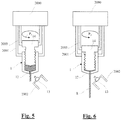
- the extrusion container 1 is removed from the centrifuging device 1000. This can preferably be done by means of a gripper 2001 of a computer-controlled handling device 2000 ( Fig. 5 ). Another gripper 2002 of the handling device 2000 screws the screw 13 from the bottom 11 of the extrusion container 1 and thus opens the extrusion opening 12th
- the screwing piston 14 is rotated into the extrusion container 1 (arrow P 3 ), whereby the starting materials homogeneously mixed with one another are extruded through the extrusion opening 12 from the extruding container 1 ( Fig. 6 ).
- the resulting, at lower ambient temperature usually solidifying extrudate E is collected in a suitable manner and then fed to the analysis or other use.
- the extrusion orifice 12 of the extrusion container 1 may be suitably shaped to impart a desired cross-sectional shape to the extrudate.
- the threaded piston 114 is provided with an axial venting channel 117, which is closed by a removable threaded pin 118.
- the extrusion opening is closed by means of a shut-off means in the form of a screw-in screw 113 which can be screwed in and out.
- the shut-off means for the extrusion opening 212 is formed as an openable and closable valve 213.
- the screw is designated 214.
- the extruding container 401 of Fig. 10 is specifically designed for use in the further embodiments of the inventive method explained below. It has an extrusion opening 412, which laterally obliquely downward opens and is provided with an openable and closable valve 413. Furthermore, the screw 414 has a venting channel 417 with a valve 418.
- extrusion container 1, 101, 201, 301 and 401 may also be equipped with a pressure release means, such as a pressure relief valve.
- the actual extrusion process takes place with an open extrusion opening by uniaxial centrifugation of the extrusion container, as described below in connection with FIGS FIGS. 11 and 12 or 13 and 14 is explained.
- the centrifuging device 1000 is, as already mentioned, configured to switch between a first and a second mode of operation.
- Fig. 11 the centrifuging device 1000 is shown again with adjusted first mode of operation in which it operates as a dual asymmetric centrifuge.
- the extruding 401 of Fig. 10 held with respect to the primary axis of rotation A 1 radially ausmündender extrusion, wherein the extruding 401 is not shown in detail.
- the valve 413 is closed. In this mode of operation of the centrifuging the mixing of the starting products as in connection with Fig. 4 described.
- the fixed coupling part 1009 is decoupled from the pulley 1010, which is indicated in the drawing by an axially slightly displaced position of the coupling part 1009.
- the pulley 1010 is now free to rotate on the shaft 1002.
- the pulley 1010 now rotates with the orbital motion of the pulley 1011 and thus can no longer drive the latter in rotation.
- the extrusion container 401 no longer rotates about the secondary axis of rotation A 2 or itself, but only about the primary axis of rotation A 1 , wherein the Rotational movement about this axis is symbolized by the arrow P 1 .
- the centrifuging device operates as a classical uniaxial centrifuge.
- the changeover between the two modes of operation of the centrifuging device takes place constructively very simply by coupling or decoupling of pulley 1010 and coupling part 1009.
- the coupling can e.g. be realized on an electromagnetic basis.
- the valve 413 at the extrusion opening 412 as well as the valve 418 at the venting channel 417 open.
- the starting materials which are homogeneously mixed with one another in the extruding container 401 are expelled from the extruding container 401 through the extruding opening 412 and are thereby extruded.
- the extrusion opening 412 opens, like the FIG. 12 shows, relative to the primary axis of rotation A 1 radially out.
- the extrudate E is collected in a collecting cup 1015 arranged on the turntable 1003 and therefore stationary with respect to the extruding container 401 ( Fig. 12 ).
- FIGS. 13 and 14 shown further two embodiments of the inventive device differ from the embodiment according to FIGS. 11 and 12 only by the way the extrudate E is caught.
- a collecting container arranged on the turntable 1003
- a stationary trough 1016 enclosing the turntable 1003 and the components mounted on or on it is provided in these exemplary embodiments.
- a cutting block 1017 is arranged, which divides the extrudate strand E into small pieces.
- a great advantage of the device according to the invention is that both the mixing step taking place under dual asymmetric centrifugation and the actual extrusion can be carried out by classical centrifuging in one and the same centrifuging device, so that on the one hand for these two process steps no separate devices are required and on the other hand, the handling is much easier.
- the method according to the invention and the device according to the invention are particularly suitable for the production of extrudates in which a pharmaceutical active substance is melted into a polymer. However, they can also be used for the production of extrudates in which e.g. Flavorings are fixed in polymers.
- the method and the apparatus are generally also suitable for the production of extrudates from polymer blends. The method and the device are especially suitable for small and very small amounts of substance needed above all in research and development, but can easily be scaled to production conditions with larger amounts of substance.
- a plurality of extruding containers can be combined to form an extruder container block and centrifuged together in a dual asymmetric manner.
- the actual extrusion process can also be done simultaneously for all extruding container. This allows several extrudates in one pass, e.g. produce with different starting materials or different proportions thereof.
Landscapes
- Engineering & Computer Science (AREA)
- Mechanical Engineering (AREA)
- Health & Medical Sciences (AREA)
- Animal Behavior & Ethology (AREA)
- General Health & Medical Sciences (AREA)
- Veterinary Medicine (AREA)
- Public Health (AREA)
- Life Sciences & Earth Sciences (AREA)
- Chemical & Material Sciences (AREA)
- Medicinal Chemistry (AREA)
- Pharmacology & Pharmacy (AREA)
- Textile Engineering (AREA)
- Clinical Laboratory Science (AREA)
- Thermal Sciences (AREA)
- Physics & Mathematics (AREA)
- Manufacturing & Machinery (AREA)
- Mixers With Rotating Receptacles And Mixers With Vibration Mechanisms (AREA)
- Extrusion Moulding Of Plastics Or The Like (AREA)
- Processing And Handling Of Plastics And Other Materials For Molding In General (AREA)
Claims (15)
- Procédé pour la production d'un produit extrudé (E), dans lequel au moins deux produits de départ (AP1, AP2), dont l'un au moins est un produit de départ en fusion à chaud, sont introduits dans un réservoir d'extrusion (1; 101; 201; 301; 401), les produits de départ (AP1, AP2) sont chauffés et sont mélangés l'un à l'autre de façon homogène, et les produits de départ (AP1, AP2) mélangés l'un à l'autre sont finalement extrudés conjointement hors du réservoir d'extrusion (1; 101; 201; 301; 401), caractérisé en ce que pour mélanger les produits de départ (AP1, AP2), le réservoir d'extrusion (1; 101; 201; 301; 401) qui contient les produits de départ (AP1, AP2) est centrifugé de manière doublement asymétrique, de sorte que le réservoir d'extrusion (1; 101; 201; 301; 401) est mis en rotation autour d'un axe de rotation primaire (A1) s'étendant à l'extérieur du réservoir d'extrusion, et simultanément autour d'un axe de rotation secondaire (A2) passant à travers le réservoir d'extrusion et disposé sous un angle aigu (α) par rapport à l'axe de rotation primaire (A1).
- Procédé selon la revendication 1, caractérisé en ce que l'on emploie à titre de réservoir d'extrusion un réservoir (1; 101; 201; 301; 401) doté d'une ouverture d' extrusion (12; 112; 212; 312; 412) susceptible d'être obturée, dans lequel l'ouverture d'extrusion (12; 112; 212; 312; 412) est maintenue fermée pendant la centrifugation doublement asymétrique, et est ouverte avant l'extrusion.
- Procédé selon la revendication 1 ou 2, caractérisé en ce que l'extrusion des produits de départ (AP1, AP2) mélangés l'un à l'autre qui se trouvent dans le réservoir d'extrusion (1; 101; 201; 301; 401) a lieu au moyen d'un piston, en particulier d'un piston à vis (14; 114; 214; 314; 414), agencé déplaçable dans le réservoir d'extrusion (1; 101; 201; 301; 401).
- Procédé selon la revendication 1 ou 2, caractérisé en ce que l'extrusion des produits de départ (AP1, AP2) mélangés l'un à l'autre qui se trouvent dans le réservoir d'extrusion (401) a lieu au moyen d'une centrifugation monoaxiale du réservoir d'extrusion (401).
- Procédé selon la revendication 4, caractérisé en ce que le mélange des produits de départ (AP1, AP2) qui se trouvent dans le réservoir d'extrusion (401) est exécuté dans un appareil de centrifugation doublement asymétrique (1000) autour de deux axes de rotation (A1, A2), et en ce que l'extrusion des produits de départ (AP1, AP2) qui se trouvent dans le réservoir d'extrusion (401) est exécutée après les avoir mélangés dans le même appareil (1000), et l'appareil (1000) effectue pendant l'extrusion une centrifugation uniquement autour de l'un des deux axes de rotation (A1).
- Appareil pour la production d'un produit extrudé (E) à partir d'au moins deux produits de départ (AP1, AP2), dont l'un au moins est un produit de départ en fusion à chaud, comprenant- un réservoir d'extrusion (1; 101; 201; 301; 401) comportant une ouverture d'extrusion (12; 112; 212; 312; 412) pour la réception des produits de départ (AP1, AP2),- un moyen de chauffage (2020) pour échauffer les produits de départ (AP1, AP2) qui se trouvent dans le réservoir d'extrusion (1; 101; 201; 301; 401), et- un moyen d'extrusion (14; 114; 214; 314; 414) pour extruder hors du réservoir d'extrusion (1; 101; 201; 301; 401) les produits de départ (AP1, AP2) qui se trouvent dans le réservoir d'extrusion (1; 101; 201; 301; 401),caractérisé par
un moyen de centrifugation (1000) pour la centrifugation doublement asymétrique du réservoir d'extrusion (1; 101; 201; 301; 401) autour d'un axe de rotation primaire (A1) et d'un axe de rotation secondaire (A2), dans lequel l'axe de rotation primaire (A1) s'étend à l'extérieur du réservoir d'extrusion (1; 101; 201; 301; 401) et l'axe de rotation secondaire (A2) s'étend à travers le réservoir d'extrusion (1; 101; 201; 301; 401) et est disposé sous un angle aigu (α) par rapport à l'axe de rotation primaire (A1). - Appareil selon la revendication 6, caractérisé en ce qu'il inclut un moyen d'obturation (13; 113; 213; 313; 413) pour ouvrir et pour fermer l'ouverture d'extrusion (12; 112; 212; 312; 412) du réservoir d'extrusion (1; 101; 201; 301; 401).
- Appareil selon la revendication 6 ou 7, caractérisé en ce que le moyen d'extrusion inclut un piston, agencé déplaçable dans le réservoir d'extrusion (1; 101; 201; 301; 401) pour éjecter les produits de départ (AP1, AP2), mélangés l'un à l'autre qui se trouvent dans le réservoir d'extrusion (1; 101; 201; 301; 401), à travers l'ouverture d'extrusion (12; 112; 212; 312; 412), dans lequel le piston est de préférence réalisé sous la forme d'un piston à vis (14; 114; 214; 314; 414) avancé par rotation dans le réservoir d'extrusion (1; 101; 201; 301; 401).
- Appareil selon la revendication 8, caractérisé en ce que le piston (114; 314; 414) est doté d'une ouverture de purge d'air (117; 317; 417), qui est de préférence susceptible d'être ouverte et fermée.
- Appareil selon la revendication 8 ou 9, caractérisé en ce qu'il inclut un moyen d'entraînement (2000, 2001, 2003) pour le déplacement du piston (14; 114; 214; 314; 414) par rapport au réservoir d'extrusion (1; 101; 201; 301; 401).
- Appareil selon l'une des revendications 6 à 10, caractérisé en ce qu'il est réalisé de manière à être inversé entre un premier et un second mode de fonctionnement, tel que, dans le premier mode de fonctionnement, le réservoir d'extrusion (1; 101; 201; 301; 401) est mis en rotation autour des deux axes de rotation (A1, A2) et, dans le second mode de fonctionnement, le réservoir d'extrusion (1; 101; 201; 301; 401) est mis en rotation uniquement autour de l'un des deux axes de rotation (A1, A2).
- Appareil selon l'une des revendications 6 à 11, caractérisé en ce qu'il comprend un premier moyen d'entraînement (1001, 1002, 1003) pour l'entraînement en rotation du réservoir d'extrusion (1; 101; 201; 301; 401) autour de l'axe de rotation primaire (A1), et un second moyen d'entraînement (1004, 1005, 1006, 1010, 1011, 1012) susceptible d'être couplé et découplé du premier moyen d'entraînement pour l'entraînement en rotation du réservoir d'extrusion (1; 101; 201; 301; 401) autour de l'axe de rotation secondaire (A2).
- Appareil selon l'une des revendications 6 à 12, caractérisé en ce qu'il est réalisé afin d'extruder hors du réservoir d'extrusion (401) les produits de départ (AP1, AP2) mélangés l'un à l'autre qui se trouvent dans le réservoir extrusion (401) alors que l'ouverture d'extrusion (412) est ouverte, par centrifugation monoaxiale autour de l'axe de rotation primaire (A1).
- Appareil selon l'une des revendications 6 à 13, caractérisé en ce que, par référence à l'axe de rotation primaire (A1), l'ouverture d'extrusion (412) débouche essentiellement radialement hors du réservoir d'extrusion (401) .
- Appareil selon l'une des revendications 6 à 14, caractérisé en ce qu'il comprend un moyen de collecte (1015; 1016) pour du produit extrudé (E) sortant du réservoir d'extrusion (401).
Applications Claiming Priority (2)
| Application Number | Priority Date | Filing Date | Title |
|---|---|---|---|
| CH01386/14A CH710097A2 (de) | 2014-09-12 | 2014-09-12 | Verfahren und Vorrichtung zur Herstellung eines Extrudats. |
| PCT/CH2015/000130 WO2016037294A1 (fr) | 2014-09-12 | 2015-09-08 | Procédé et dispositif de production d'un produit d'extrusion |
Publications (2)
| Publication Number | Publication Date |
|---|---|
| EP3191069A1 EP3191069A1 (fr) | 2017-07-19 |
| EP3191069B1 true EP3191069B1 (fr) | 2018-12-26 |
Family
ID=54196738
Family Applications (1)
| Application Number | Title | Priority Date | Filing Date |
|---|---|---|---|
| EP15770435.4A Active EP3191069B1 (fr) | 2014-09-12 | 2015-09-08 | Procédé et dispositif de production d'un produit d'extrusion |
Country Status (4)
| Country | Link |
|---|---|
| US (1) | US10894000B2 (fr) |
| EP (1) | EP3191069B1 (fr) |
| CH (1) | CH710097A2 (fr) |
| WO (1) | WO2016037294A1 (fr) |
Families Citing this family (4)
| Publication number | Priority date | Publication date | Assignee | Title |
|---|---|---|---|---|
| US20190351599A1 (en) * | 2018-05-17 | 2019-11-21 | The Boeing Company | Method and apparatus for consolidating a bulk molding compound |
| CN109405266B (zh) * | 2018-11-28 | 2023-06-16 | 大连医雅科技有限公司 | 一种中医用中药汤剂加热装置及方法 |
| WO2023023177A2 (fr) * | 2021-08-17 | 2023-02-23 | Flacktek Speedmixer, Inc. | Dispositif de mélange centrifuge compact et ses procédés d'utilisation |
| CN115056451B (zh) * | 2022-06-20 | 2023-10-13 | 江苏奇鹰电线电缆有限公司 | 一种用于电缆保护管的锥形双螺杆挤出装置 |
Family Cites Families (8)
| Publication number | Priority date | Publication date | Assignee | Title |
|---|---|---|---|---|
| US1318928A (en) * | 1919-10-14 | Grease and oil injector | ||
| US2904830A (en) * | 1957-07-26 | 1959-09-22 | Continental Diamond Fibre Corp | Air relief valve for a plastics extrusion ram |
| US5965161A (en) | 1994-11-04 | 1999-10-12 | Euro-Celtique, S.A. | Extruded multi-particulates |
| DE19855440A1 (de) * | 1998-12-01 | 2000-06-08 | Basf Ag | Verfahren zum Herstellen fester Darreichungsformen mittels Schmelzextrusion |
| JP3870106B2 (ja) * | 2002-02-22 | 2007-01-17 | ソニーケミカル&インフォメーションデバイス株式会社 | 接着方法 |
| DE102004032051A1 (de) | 2004-07-01 | 2006-01-19 | Grünenthal GmbH | Verfahren zur Herstellung einer gegen Missbrauch gesicherten, festen Darreichungsform |
| TW200848561A (en) * | 2006-12-22 | 2008-12-16 | Body Organ Biomedical Corp | Device for manufacturing fibrils |
| US20090281663A1 (en) * | 2008-05-06 | 2009-11-12 | Boston Scientific Scimed, Inc. | Device and method for mixing materials |
-
2014
- 2014-09-12 CH CH01386/14A patent/CH710097A2/de not_active Application Discontinuation
-
2015
- 2015-09-08 US US15/510,279 patent/US10894000B2/en active Active
- 2015-09-08 WO PCT/CH2015/000130 patent/WO2016037294A1/fr not_active Ceased
- 2015-09-08 EP EP15770435.4A patent/EP3191069B1/fr active Active
Non-Patent Citations (1)
| Title |
|---|
| None * |
Also Published As
| Publication number | Publication date |
|---|---|
| US20170258684A1 (en) | 2017-09-14 |
| WO2016037294A1 (fr) | 2016-03-17 |
| US10894000B2 (en) | 2021-01-19 |
| EP3191069A1 (fr) | 2017-07-19 |
| CH710097A2 (de) | 2016-03-15 |
Similar Documents
| Publication | Publication Date | Title |
|---|---|---|
| DE3150719C2 (de) | Schneckenextruder | |
| DE68902085T2 (de) | Vierfluegelige rotoren fuer innenmischer. | |
| EP0046569A2 (fr) | Procédé et appareil pour mélanger des solides avec des liquides | |
| DE2052480B2 (de) | Mischvorrichtung | |
| WO2016037294A1 (fr) | Procédé et dispositif de production d'un produit d'extrusion | |
| EP3585179A1 (fr) | Dispositif de conchage et procédé pour le conchage d'une masse de produit | |
| DE102004047265A1 (de) | Verfahren und Vorrichtung zum Schneiden eines kontinuierlich geführten Strangs in strangförmige Artikel variabler Länge | |
| EP1157736A1 (fr) | Dispositif et procédé pour le traitement quasi-continu d'un produit granulaire | |
| DE1142840B (de) | Vorrichtung zum Homogenisieren fliessfaehiger Stoffe oder Stoffgemische | |
| AT511564B1 (de) | Mischvorrichtung und verfahren zum mischen eines schüttgutes oder einer pastösen masse | |
| EP0450012B1 (fr) | Installation et procede de malaxage et/ou de granulation d'un produit | |
| DE1118959B (de) | Verfahren und Vorrichtung zur Aufbereitung von Thermoplasten oder Duroplasten | |
| EP2158961A1 (fr) | Dispositif de mélange et agencement de dispositif de mélange | |
| DE19643206A1 (de) | Verfahren und Vorrichtung zum Herstellen von Teig | |
| DE2001301A1 (de) | Vorrichtung zum Mischen von zumindest zwei Substanzen | |
| DE2108181B2 (de) | Vorrichtung zum Aufbereiten, Mischen, Auflockern, Zerteilen oder Kühlen von körnigem Material, insbesondere Gießsand | |
| DE102009013080A1 (de) | Verfahren und Vorrichtung zum Verpacken von portionierten, pastösen Produkten | |
| WO1992009361A1 (fr) | Dispositif pour melanger, homogeneiser ou faire reagir au moins deux composants | |
| DE69908471T2 (de) | Kontinuierlich arbeitende Knetmaschine | |
| DE19540287C1 (de) | Siebrundbeschicker | |
| DE2350746B2 (de) | Verfahren und vorrichtungen zur herstellung von granulaten aus pulverfoermigem, koernigem oder teigigem gut | |
| DE2246672C3 (de) | Probennehmer zur Entnahme von Proben aus einem bei erhöhter Temperatur flüssigen, bei Umgebungstemperatur jedoch festen Material | |
| WO2005011386A1 (fr) | Dispositif et procede de production d'un boudin de pate sans abimer la pate | |
| DE29713578U1 (de) | Schraubkruke als Abgabegefäß für mit einem Rührwerk herstellbare pharmazeutische und/oder kosmetische Salben o.dgl. | |
| DE2930312A1 (de) | Siebzentrifuge |
Legal Events
| Date | Code | Title | Description |
|---|---|---|---|
| STAA | Information on the status of an ep patent application or granted ep patent |
Free format text: STATUS: THE INTERNATIONAL PUBLICATION HAS BEEN MADE |
|
| PUAI | Public reference made under article 153(3) epc to a published international application that has entered the european phase |
Free format text: ORIGINAL CODE: 0009012 |
|
| STAA | Information on the status of an ep patent application or granted ep patent |
Free format text: STATUS: REQUEST FOR EXAMINATION WAS MADE |
|
| 17P | Request for examination filed |
Effective date: 20170330 |
|
| AK | Designated contracting states |
Kind code of ref document: A1 Designated state(s): AL AT BE BG CH CY CZ DE DK EE ES FI FR GB GR HR HU IE IS IT LI LT LU LV MC MK MT NL NO PL PT RO RS SE SI SK SM TR |
|
| AX | Request for extension of the european patent |
Extension state: BA ME |
|
| DAV | Request for validation of the european patent (deleted) | ||
| DAX | Request for extension of the european patent (deleted) | ||
| RIC1 | Information provided on ipc code assigned before grant |
Ipc: A61J 3/08 20060101AFI20180424BHEP Ipc: B29C 47/36 20060101ALN20180424BHEP Ipc: A61J 3/00 20060101ALI20180424BHEP Ipc: A61J 3/10 20060101ALN20180424BHEP Ipc: A61J 3/06 20060101ALN20180424BHEP Ipc: B29B 7/38 20060101ALN20180424BHEP |
|
| GRAP | Despatch of communication of intention to grant a patent |
Free format text: ORIGINAL CODE: EPIDOSNIGR1 |
|
| STAA | Information on the status of an ep patent application or granted ep patent |
Free format text: STATUS: GRANT OF PATENT IS INTENDED |
|
| RIC1 | Information provided on ipc code assigned before grant |
Ipc: A61J 3/06 20060101ALN20180704BHEP Ipc: A61J 3/10 20060101ALN20180704BHEP Ipc: B29B 7/38 20060101ALN20180704BHEP Ipc: A61J 3/00 20060101ALI20180704BHEP Ipc: A61J 3/08 20060101AFI20180704BHEP Ipc: B29C 47/36 20060101ALN20180704BHEP |
|
| INTG | Intention to grant announced |
Effective date: 20180717 |
|
| GRAS | Grant fee paid |
Free format text: ORIGINAL CODE: EPIDOSNIGR3 |
|
| GRAA | (expected) grant |
Free format text: ORIGINAL CODE: 0009210 |
|
| STAA | Information on the status of an ep patent application or granted ep patent |
Free format text: STATUS: THE PATENT HAS BEEN GRANTED |
|
| AK | Designated contracting states |
Kind code of ref document: B1 Designated state(s): AL AT BE BG CH CY CZ DE DK EE ES FI FR GB GR HR HU IE IS IT LI LT LU LV MC MK MT NL NO PL PT RO RS SE SI SK SM TR |
|
| REG | Reference to a national code |
Ref country code: GB Ref legal event code: FG4D Free format text: NOT ENGLISH |
|
| REG | Reference to a national code |
Ref country code: CH Ref legal event code: EP |
|
| REG | Reference to a national code |
Ref country code: AT Ref legal event code: REF Ref document number: 1080421 Country of ref document: AT Kind code of ref document: T Effective date: 20190115 |
|
| REG | Reference to a national code |
Ref country code: DE Ref legal event code: R096 Ref document number: 502015007459 Country of ref document: DE |
|
| REG | Reference to a national code |
Ref country code: IE Ref legal event code: FG4D Free format text: LANGUAGE OF EP DOCUMENT: GERMAN |
|
| PG25 | Lapsed in a contracting state [announced via postgrant information from national office to epo] |
Ref country code: BG Free format text: LAPSE BECAUSE OF FAILURE TO SUBMIT A TRANSLATION OF THE DESCRIPTION OR TO PAY THE FEE WITHIN THE PRESCRIBED TIME-LIMIT Effective date: 20190326 Ref country code: NO Free format text: LAPSE BECAUSE OF FAILURE TO SUBMIT A TRANSLATION OF THE DESCRIPTION OR TO PAY THE FEE WITHIN THE PRESCRIBED TIME-LIMIT Effective date: 20190326 Ref country code: FI Free format text: LAPSE BECAUSE OF FAILURE TO SUBMIT A TRANSLATION OF THE DESCRIPTION OR TO PAY THE FEE WITHIN THE PRESCRIBED TIME-LIMIT Effective date: 20181226 Ref country code: LT Free format text: LAPSE BECAUSE OF FAILURE TO SUBMIT A TRANSLATION OF THE DESCRIPTION OR TO PAY THE FEE WITHIN THE PRESCRIBED TIME-LIMIT Effective date: 20181226 Ref country code: LV Free format text: LAPSE BECAUSE OF FAILURE TO SUBMIT A TRANSLATION OF THE DESCRIPTION OR TO PAY THE FEE WITHIN THE PRESCRIBED TIME-LIMIT Effective date: 20181226 Ref country code: HR Free format text: LAPSE BECAUSE OF FAILURE TO SUBMIT A TRANSLATION OF THE DESCRIPTION OR TO PAY THE FEE WITHIN THE PRESCRIBED TIME-LIMIT Effective date: 20181226 |
|
| REG | Reference to a national code |
Ref country code: NL Ref legal event code: MP Effective date: 20181226 |
|
| REG | Reference to a national code |
Ref country code: LT Ref legal event code: MG4D |
|
| PG25 | Lapsed in a contracting state [announced via postgrant information from national office to epo] |
Ref country code: SE Free format text: LAPSE BECAUSE OF FAILURE TO SUBMIT A TRANSLATION OF THE DESCRIPTION OR TO PAY THE FEE WITHIN THE PRESCRIBED TIME-LIMIT Effective date: 20181226 Ref country code: RS Free format text: LAPSE BECAUSE OF FAILURE TO SUBMIT A TRANSLATION OF THE DESCRIPTION OR TO PAY THE FEE WITHIN THE PRESCRIBED TIME-LIMIT Effective date: 20181226 Ref country code: AL Free format text: LAPSE BECAUSE OF FAILURE TO SUBMIT A TRANSLATION OF THE DESCRIPTION OR TO PAY THE FEE WITHIN THE PRESCRIBED TIME-LIMIT Effective date: 20181226 Ref country code: GR Free format text: LAPSE BECAUSE OF FAILURE TO SUBMIT A TRANSLATION OF THE DESCRIPTION OR TO PAY THE FEE WITHIN THE PRESCRIBED TIME-LIMIT Effective date: 20190327 |
|
| PG25 | Lapsed in a contracting state [announced via postgrant information from national office to epo] |
Ref country code: NL Free format text: LAPSE BECAUSE OF FAILURE TO SUBMIT A TRANSLATION OF THE DESCRIPTION OR TO PAY THE FEE WITHIN THE PRESCRIBED TIME-LIMIT Effective date: 20181226 |
|
| PG25 | Lapsed in a contracting state [announced via postgrant information from national office to epo] |
Ref country code: PL Free format text: LAPSE BECAUSE OF FAILURE TO SUBMIT A TRANSLATION OF THE DESCRIPTION OR TO PAY THE FEE WITHIN THE PRESCRIBED TIME-LIMIT Effective date: 20181226 Ref country code: PT Free format text: LAPSE BECAUSE OF FAILURE TO SUBMIT A TRANSLATION OF THE DESCRIPTION OR TO PAY THE FEE WITHIN THE PRESCRIBED TIME-LIMIT Effective date: 20190426 Ref country code: ES Free format text: LAPSE BECAUSE OF FAILURE TO SUBMIT A TRANSLATION OF THE DESCRIPTION OR TO PAY THE FEE WITHIN THE PRESCRIBED TIME-LIMIT Effective date: 20181226 Ref country code: CZ Free format text: LAPSE BECAUSE OF FAILURE TO SUBMIT A TRANSLATION OF THE DESCRIPTION OR TO PAY THE FEE WITHIN THE PRESCRIBED TIME-LIMIT Effective date: 20181226 Ref country code: IT Free format text: LAPSE BECAUSE OF FAILURE TO SUBMIT A TRANSLATION OF THE DESCRIPTION OR TO PAY THE FEE WITHIN THE PRESCRIBED TIME-LIMIT Effective date: 20181226 |
|
| PG25 | Lapsed in a contracting state [announced via postgrant information from national office to epo] |
Ref country code: RO Free format text: LAPSE BECAUSE OF FAILURE TO SUBMIT A TRANSLATION OF THE DESCRIPTION OR TO PAY THE FEE WITHIN THE PRESCRIBED TIME-LIMIT Effective date: 20181226 Ref country code: SM Free format text: LAPSE BECAUSE OF FAILURE TO SUBMIT A TRANSLATION OF THE DESCRIPTION OR TO PAY THE FEE WITHIN THE PRESCRIBED TIME-LIMIT Effective date: 20181226 Ref country code: EE Free format text: LAPSE BECAUSE OF FAILURE TO SUBMIT A TRANSLATION OF THE DESCRIPTION OR TO PAY THE FEE WITHIN THE PRESCRIBED TIME-LIMIT Effective date: 20181226 Ref country code: SK Free format text: LAPSE BECAUSE OF FAILURE TO SUBMIT A TRANSLATION OF THE DESCRIPTION OR TO PAY THE FEE WITHIN THE PRESCRIBED TIME-LIMIT Effective date: 20181226 Ref country code: IS Free format text: LAPSE BECAUSE OF FAILURE TO SUBMIT A TRANSLATION OF THE DESCRIPTION OR TO PAY THE FEE WITHIN THE PRESCRIBED TIME-LIMIT Effective date: 20190426 |
|
| REG | Reference to a national code |
Ref country code: DE Ref legal event code: R097 Ref document number: 502015007459 Country of ref document: DE |
|
| PG25 | Lapsed in a contracting state [announced via postgrant information from national office to epo] |
Ref country code: DK Free format text: LAPSE BECAUSE OF FAILURE TO SUBMIT A TRANSLATION OF THE DESCRIPTION OR TO PAY THE FEE WITHIN THE PRESCRIBED TIME-LIMIT Effective date: 20181226 |
|
| PLBE | No opposition filed within time limit |
Free format text: ORIGINAL CODE: 0009261 |
|
| STAA | Information on the status of an ep patent application or granted ep patent |
Free format text: STATUS: NO OPPOSITION FILED WITHIN TIME LIMIT |
|
| REG | Reference to a national code |
Ref country code: CH Ref legal event code: NV Representative=s name: BOHEST AG, CH |
|
| 26N | No opposition filed |
Effective date: 20190927 |
|
| PG25 | Lapsed in a contracting state [announced via postgrant information from national office to epo] |
Ref country code: SI Free format text: LAPSE BECAUSE OF FAILURE TO SUBMIT A TRANSLATION OF THE DESCRIPTION OR TO PAY THE FEE WITHIN THE PRESCRIBED TIME-LIMIT Effective date: 20181226 |
|
| PG25 | Lapsed in a contracting state [announced via postgrant information from national office to epo] |
Ref country code: TR Free format text: LAPSE BECAUSE OF FAILURE TO SUBMIT A TRANSLATION OF THE DESCRIPTION OR TO PAY THE FEE WITHIN THE PRESCRIBED TIME-LIMIT Effective date: 20181226 |
|
| PG25 | Lapsed in a contracting state [announced via postgrant information from national office to epo] |
Ref country code: MC Free format text: LAPSE BECAUSE OF FAILURE TO SUBMIT A TRANSLATION OF THE DESCRIPTION OR TO PAY THE FEE WITHIN THE PRESCRIBED TIME-LIMIT Effective date: 20181226 |
|
| PG25 | Lapsed in a contracting state [announced via postgrant information from national office to epo] |
Ref country code: IE Free format text: LAPSE BECAUSE OF NON-PAYMENT OF DUE FEES Effective date: 20190908 Ref country code: LU Free format text: LAPSE BECAUSE OF NON-PAYMENT OF DUE FEES Effective date: 20190908 |
|
| REG | Reference to a national code |
Ref country code: BE Ref legal event code: MM Effective date: 20190930 |
|
| PG25 | Lapsed in a contracting state [announced via postgrant information from national office to epo] |
Ref country code: BE Free format text: LAPSE BECAUSE OF NON-PAYMENT OF DUE FEES Effective date: 20190930 |
|
| PG25 | Lapsed in a contracting state [announced via postgrant information from national office to epo] |
Ref country code: CY Free format text: LAPSE BECAUSE OF FAILURE TO SUBMIT A TRANSLATION OF THE DESCRIPTION OR TO PAY THE FEE WITHIN THE PRESCRIBED TIME-LIMIT Effective date: 20181226 |
|
| PG25 | Lapsed in a contracting state [announced via postgrant information from national office to epo] |
Ref country code: HU Free format text: LAPSE BECAUSE OF FAILURE TO SUBMIT A TRANSLATION OF THE DESCRIPTION OR TO PAY THE FEE WITHIN THE PRESCRIBED TIME-LIMIT; INVALID AB INITIO Effective date: 20150908 Ref country code: MT Free format text: LAPSE BECAUSE OF FAILURE TO SUBMIT A TRANSLATION OF THE DESCRIPTION OR TO PAY THE FEE WITHIN THE PRESCRIBED TIME-LIMIT Effective date: 20181226 |
|
| REG | Reference to a national code |
Ref country code: AT Ref legal event code: MM01 Ref document number: 1080421 Country of ref document: AT Kind code of ref document: T Effective date: 20200908 |
|
| PG25 | Lapsed in a contracting state [announced via postgrant information from national office to epo] |
Ref country code: AT Free format text: LAPSE BECAUSE OF NON-PAYMENT OF DUE FEES Effective date: 20200908 |
|
| PG25 | Lapsed in a contracting state [announced via postgrant information from national office to epo] |
Ref country code: MK Free format text: LAPSE BECAUSE OF FAILURE TO SUBMIT A TRANSLATION OF THE DESCRIPTION OR TO PAY THE FEE WITHIN THE PRESCRIBED TIME-LIMIT Effective date: 20181226 |
|
| P01 | Opt-out of the competence of the unified patent court (upc) registered |
Effective date: 20230510 |
|
| REG | Reference to a national code |
Ref country code: CH Ref legal event code: U11 Free format text: ST27 STATUS EVENT CODE: U-0-0-U10-U11 (AS PROVIDED BY THE NATIONAL OFFICE) Effective date: 20251001 |
|
| PGFP | Annual fee paid to national office [announced via postgrant information from national office to epo] |
Ref country code: DE Payment date: 20250912 Year of fee payment: 11 |
|
| PGFP | Annual fee paid to national office [announced via postgrant information from national office to epo] |
Ref country code: GB Payment date: 20250829 Year of fee payment: 11 |
|
| PGFP | Annual fee paid to national office [announced via postgrant information from national office to epo] |
Ref country code: FR Payment date: 20250901 Year of fee payment: 11 |
|
| PGFP | Annual fee paid to national office [announced via postgrant information from national office to epo] |
Ref country code: CH Payment date: 20251001 Year of fee payment: 11 |