EP3169768B1 - Gentechnisch veränderte hefe mit verbessertem glycerol-katabolismus - Google Patents
Gentechnisch veränderte hefe mit verbessertem glycerol-katabolismus Download PDFInfo
- Publication number
- EP3169768B1 EP3169768B1 EP15744499.3A EP15744499A EP3169768B1 EP 3169768 B1 EP3169768 B1 EP 3169768B1 EP 15744499 A EP15744499 A EP 15744499A EP 3169768 B1 EP3169768 B1 EP 3169768B1
- Authority
- EP
- European Patent Office
- Prior art keywords
- glycerol
- yeast cell
- genetically modified
- dehydrogenase
- dihydroxyacetone
- Prior art date
- Legal status (The legal status is an assumption and is not a legal conclusion. Google has not performed a legal analysis and makes no representation as to the accuracy of the status listed.)
- Active
Links
Images
Classifications
-
- C—CHEMISTRY; METALLURGY
- C12—BIOCHEMISTRY; BEER; SPIRITS; WINE; VINEGAR; MICROBIOLOGY; ENZYMOLOGY; MUTATION OR GENETIC ENGINEERING
- C12N—MICROORGANISMS OR ENZYMES; COMPOSITIONS THEREOF; PROPAGATING, PRESERVING, OR MAINTAINING MICROORGANISMS; MUTATION OR GENETIC ENGINEERING; CULTURE MEDIA
- C12N9/00—Enzymes; Proenzymes; Compositions thereof; Processes for preparing, activating, inhibiting, separating or purifying enzymes
- C12N9/0004—Oxidoreductases (1.)
- C12N9/0006—Oxidoreductases (1.) acting on CH-OH groups as donors (1.1)
-
- C—CHEMISTRY; METALLURGY
- C07—ORGANIC CHEMISTRY
- C07K—PEPTIDES
- C07K14/00—Peptides having more than 20 amino acids; Gastrins; Somatostatins; Melanotropins; Derivatives thereof
- C07K14/37—Peptides having more than 20 amino acids; Gastrins; Somatostatins; Melanotropins; Derivatives thereof from fungi
- C07K14/39—Peptides having more than 20 amino acids; Gastrins; Somatostatins; Melanotropins; Derivatives thereof from fungi from yeasts
- C07K14/395—Peptides having more than 20 amino acids; Gastrins; Somatostatins; Melanotropins; Derivatives thereof from fungi from yeasts from Saccharomyces
-
- C—CHEMISTRY; METALLURGY
- C12—BIOCHEMISTRY; BEER; SPIRITS; WINE; VINEGAR; MICROBIOLOGY; ENZYMOLOGY; MUTATION OR GENETIC ENGINEERING
- C12N—MICROORGANISMS OR ENZYMES; COMPOSITIONS THEREOF; PROPAGATING, PRESERVING, OR MAINTAINING MICROORGANISMS; MUTATION OR GENETIC ENGINEERING; CULTURE MEDIA
- C12N1/00—Microorganisms; Compositions thereof; Processes of propagating, maintaining or preserving microorganisms or compositions thereof; Processes of preparing or isolating a composition containing a microorganism; Culture media therefor
- C12N1/32—Processes using, or culture media containing, lower alkanols, i.e. C1 to C6
-
- C—CHEMISTRY; METALLURGY
- C12—BIOCHEMISTRY; BEER; SPIRITS; WINE; VINEGAR; MICROBIOLOGY; ENZYMOLOGY; MUTATION OR GENETIC ENGINEERING
- C12N—MICROORGANISMS OR ENZYMES; COMPOSITIONS THEREOF; PROPAGATING, PRESERVING, OR MAINTAINING MICROORGANISMS; MUTATION OR GENETIC ENGINEERING; CULTURE MEDIA
- C12N9/00—Enzymes; Proenzymes; Compositions thereof; Processes for preparing, activating, inhibiting, separating or purifying enzymes
- C12N9/10—Transferases (2.)
- C12N9/12—Transferases (2.) transferring phosphorus containing groups, e.g. kinases (2.7)
- C12N9/1205—Phosphotransferases with an alcohol group as acceptor (2.7.1), e.g. protein kinases
-
- C—CHEMISTRY; METALLURGY
- C12—BIOCHEMISTRY; BEER; SPIRITS; WINE; VINEGAR; MICROBIOLOGY; ENZYMOLOGY; MUTATION OR GENETIC ENGINEERING
- C12P—FERMENTATION OR ENZYME-USING PROCESSES TO SYNTHESISE A DESIRED CHEMICAL COMPOUND OR COMPOSITION OR TO SEPARATE OPTICAL ISOMERS FROM A RACEMIC MIXTURE
- C12P7/00—Preparation of oxygen-containing organic compounds
- C12P7/02—Preparation of oxygen-containing organic compounds containing a hydroxy group
- C12P7/04—Preparation of oxygen-containing organic compounds containing a hydroxy group acyclic
-
- C—CHEMISTRY; METALLURGY
- C12—BIOCHEMISTRY; BEER; SPIRITS; WINE; VINEGAR; MICROBIOLOGY; ENZYMOLOGY; MUTATION OR GENETIC ENGINEERING
- C12P—FERMENTATION OR ENZYME-USING PROCESSES TO SYNTHESISE A DESIRED CHEMICAL COMPOUND OR COMPOSITION OR TO SEPARATE OPTICAL ISOMERS FROM A RACEMIC MIXTURE
- C12P7/00—Preparation of oxygen-containing organic compounds
- C12P7/02—Preparation of oxygen-containing organic compounds containing a hydroxy group
- C12P7/04—Preparation of oxygen-containing organic compounds containing a hydroxy group acyclic
- C12P7/18—Preparation of oxygen-containing organic compounds containing a hydroxy group acyclic polyhydric
-
- C—CHEMISTRY; METALLURGY
- C12—BIOCHEMISTRY; BEER; SPIRITS; WINE; VINEGAR; MICROBIOLOGY; ENZYMOLOGY; MUTATION OR GENETIC ENGINEERING
- C12P—FERMENTATION OR ENZYME-USING PROCESSES TO SYNTHESISE A DESIRED CHEMICAL COMPOUND OR COMPOSITION OR TO SEPARATE OPTICAL ISOMERS FROM A RACEMIC MIXTURE
- C12P7/00—Preparation of oxygen-containing organic compounds
- C12P7/40—Preparation of oxygen-containing organic compounds containing a carboxyl group including Peroxycarboxylic acids
- C12P7/44—Polycarboxylic acids
- C12P7/46—Dicarboxylic acids having four or less carbon atoms, e.g. fumaric acid, maleic acid
-
- C—CHEMISTRY; METALLURGY
- C12—BIOCHEMISTRY; BEER; SPIRITS; WINE; VINEGAR; MICROBIOLOGY; ENZYMOLOGY; MUTATION OR GENETIC ENGINEERING
- C12Y—ENZYMES
- C12Y101/00—Oxidoreductases acting on the CH-OH group of donors (1.1)
- C12Y101/01—Oxidoreductases acting on the CH-OH group of donors (1.1) with NAD+ or NADP+ as acceptor (1.1.1)
- C12Y101/01006—Glycerol dehydrogenase (1.1.1.6)
-
- C—CHEMISTRY; METALLURGY
- C12—BIOCHEMISTRY; BEER; SPIRITS; WINE; VINEGAR; MICROBIOLOGY; ENZYMOLOGY; MUTATION OR GENETIC ENGINEERING
- C12Y—ENZYMES
- C12Y207/00—Transferases transferring phosphorus-containing groups (2.7)
- C12Y207/01—Phosphotransferases with an alcohol group as acceptor (2.7.1)
- C12Y207/01029—Glycerone kinase (2.7.1.29), i.e. dihydroxyacetone kinase
-
- C—CHEMISTRY; METALLURGY
- C12—BIOCHEMISTRY; BEER; SPIRITS; WINE; VINEGAR; MICROBIOLOGY; ENZYMOLOGY; MUTATION OR GENETIC ENGINEERING
- C12Y—ENZYMES
- C12Y207/00—Transferases transferring phosphorus-containing groups (2.7)
- C12Y207/01—Phosphotransferases with an alcohol group as acceptor (2.7.1)
- C12Y207/0103—Glycerol kinase (2.7.1.30)
-
- Y—GENERAL TAGGING OF NEW TECHNOLOGICAL DEVELOPMENTS; GENERAL TAGGING OF CROSS-SECTIONAL TECHNOLOGIES SPANNING OVER SEVERAL SECTIONS OF THE IPC; TECHNICAL SUBJECTS COVERED BY FORMER USPC CROSS-REFERENCE ART COLLECTIONS [XRACs] AND DIGESTS
- Y02—TECHNOLOGIES OR APPLICATIONS FOR MITIGATION OR ADAPTATION AGAINST CLIMATE CHANGE
- Y02E—REDUCTION OF GREENHOUSE GAS [GHG] EMISSIONS, RELATED TO ENERGY GENERATION, TRANSMISSION OR DISTRIBUTION
- Y02E50/00—Technologies for the production of fuel of non-fossil origin
- Y02E50/10—Biofuels, e.g. bio-diesel
Definitions
- the invention relates to a genetically modified yeast with improved glycerol catabolism.
- Biodiesel is an alternative fuel that is currently largely derived from rapeseed in Germany and can reduce greenhouse gas emissions by up to 60% compared to fossil diesel according to a survey by the German Biofuels Industry Association (e.V.).
- used cooking oils can also be used.
- the potential use of fats or oils produced by microalgae or other microorganisms (Gong and Jiang, 2011, Shi et al., 2011) is under discussion, but has so far played no commercial role.
- Biodiesel is mainly produced by the transesterification of fats and vegetable oils in the presence of an alcohol (mostly methanol), which leads to the formation of a fatty acid methyl ester (biodiesel) and glycerol (as a by-product).
- Biodiesel production and thus the amount of crude glycerol produced in parallel, has increased dramatically in recent years. 10 weight units of crude glycerol are produced per 100 weight units of biodiesel produced (Yazdani & Gonzalez, 2007). In Germany, 200,000 t of raw glycerol were produced in the course of biodiesel production in 2011 (Market Analysis Renewable Resources, FNR, Series of Renewable Raw Materials 34, 2014).
- Baker's yeast Saccharomyces cerevisiae
- glycerol as a carbon source.
- supplements such as amino acids and nucleobases
- glycerol For metabolism, glycerol must first be taken up in the cell.
- first type relies on facilitated diffusion, requires no energy, and depends on glycerol facilitators.
- second type is an energy-dependent active transport based on a glycerol / H + -symporter. It has long been controversial how glycerol in the S. cerevisiae cell (Neves et al., 2004).
- an active transport system encoded by STL1 is critically important (Ferreira et al., 2005).
- a FPS1- encoded glycerol facilitator is also available in S. cerevisiae does not appear to play a crucial role in glycerol uptake in this species.
- the glycerol-3-phosphate pathway (also G3P pathway or phosphorylation pathway) leads, via the glycerol glycerol through the glycerol kinase, to L-glycerol-3-phosphate (G3P), which is converted by the glycerol-3-phosphate dehydrogenase to dihydroxyacetone phosphate (DHAP) is oxidized.
- G3P L-glycerol-3-phosphate
- DHAP dihydroxyacetone phosphate
- the DHA pathway (also oxidation pathway) leads, via the glycerol dehydrogenase-catalyzed oxidation of glycerol, to dihydroxyacetone (DHA), which is phosphorylated by dihydroxacetonone kinase to form dihydroxyacetone phosphate (DHAP).
- DHA dihydroxyacetone
- DHAP dihydroxyacetone phosphate
- the glyceraldehyde pathway leads via glyceraldehyde to glyceraldehyde-3-phosphate, which can be enzymatically converted to DHAP.
- the oxidative glycerol degradation pathway via DHA appears to be present in Neurospora crassa in parallel to the phosphorylation pathway (Tom et al., 1978).
- An NAD + -dependent glycerol dehydrogenase has been found in some species of the genera and Candida , Torulopsis and Hansenula (Hofmann and Babel, 1979); later also in Schizosaccharomyces pombe (May & Sloan, 1981).
- Babel and Hofmann (1982) were able to measure a particularly high activity of this enzyme in Candida valida .
- cerevisiae improved the glycerol utilization 1.22-fold compared to the wild-type strain, ie genetically engineered strain consumed 5.18 g / L of 12.62 g / L glycerol after 96 hours of culture, whereas the control consumed only 4.24 g / L in the same time.
- the WO 2012/067510 A1 describes the modification of a yeast cell by increasing the activity of an NAD-dependent glycerol dehydrogenase and a dihydroxyacetone kinase.
- the object of the present invention is to improve the ability of yeast to utilize glycerol as a carbon source.
- the inventively provided combination of genetic engineering changes to Saccharomyces cells causes efficient uptake and channeling of glycerol by the now established or at least enhanced DHA pathway.
- the integration of a heterologous glycerol facilitator promotes the uptake of glycerol without the need for energy.
- the blockade of the glycerol-3-phosphate pathway causes glycerol incorporated into the cell to be degraded either via the DHA pathway, with the introduction of a heterologous glycerol dehydrogenase or overexpression of a native enzyme having glycerol dehydrogenase activity as a possible lack of natural glycerol dehydrogenase activity is compensated, or alternatively via the then optimized by overexpression of the enzymes involved or introduction of heterologous enzyme variants Glycerinaldehyd way.
- the FAD-dependent glycerol-3-phosphate dehydrogenase involved in the glycerol-3-phosphate pathway is located on the outside of the inner mitochondrial membrane (Gancedo et al., 1968; Klingenberg 1970) and directs electrons from the oxidation of glycerol-3-phosphate directly into the mitochondrial respiratory chain, which is disadvantageous when reducing equivalents are needed, for example, for subsequent production of reduced compounds, for example, 1,2-propanediol.
- the DHA pathway provides valuable reduction equivalents in the form of NADH, the glyceraldehyde pathway in the form of NADPH.
- glycerol-3-phosphate pathway By the term “glycerol-3-phosphate pathway”, “glycerol-3-phosphate pathway”, “G3P pathway” or “phosphorylation pathway”, the reaction of glycerol via L-glycerol-3-phosphate (G3P) is added Dihydroxacetonphosphate (DHAP) understood.
- DHAP Dihydroxacetonphosphate
- the reactions are catalyzed by glycerol kinase and mitochondrial (FAD-dependent) glycerol-3-phosphate dehydrogenase (GPD-M, mGPD, EC 1.1.5.3).
- GPD-M mitochondrial
- glycerol-3-phosphate dehydrogenase GUT1
- GUT2 glycerol-3-phosphate dehydrogenase
- DHA pathway DHA pathway
- DHA pathway DHA pathway
- oxidation pathway is understood as meaning the conversion of glycerol via dihydroxyacetone (DHA) to dihydroxaceton phosphate (DHAP).
- the reactions are catalyzed by glycerol dehydrogenase and dihydroxyacetone kinase.
- glycosyde pathway is meant the reaction of glycerol via D-glyceraldehyde to give D-glyceraldehyde-3-phosphate (GAP). Understood.
- NADP-dependent glycerol dehydrogenase NADP-glycerol dehydrogenase
- NADP-GDH NADP-glycerol dehydrogenase
- triokinase triosekinase, EC 2.7.1.28
- a "synthetic route for the recovery of glycerol from dihydroxyacetone phosphate” is meant the reaction of dihydroxyacetone phosphate over glycerol-3-phosphate to glycerol.
- DHAP DHAP to glycerol-3-phosphate
- GPD-C cytosolic NAD-dependent glycerol-3-phosphate dehydrogenase
- GPD1 cytosolic NAD-dependent glycerol-3-phosphate dehydrogenase
- GPD2 cytosolic NAD-dependent glycerol-3-phosphate dehydrogenase
- the isoforms are encoded by the genes GPD1 and GPD2, respectively.
- the dephosphorylation of glycerol-3-phosphate to glycerol is catalyzed by glycerol-3-phosphatase (GPP, EC 3.1.3.21), which also occurs in two isoforms encoded by GPP1 and GPP2 .
- heterologous is used herein in its meaning known to those skilled in the art and refers to the foreign origin of an element, for example an enzyme or other protein. "Foreign" means that the element thus does not occur in the target cell, and for example comes from a cell or an organism with different genetic makeup, such as an organism of a different kind.
- glycosycerol uptake facilitator protein or "glycerol facilitator” for short is understood to mean a transmembrane protein which facilitates the transport of glycerol into a cell, for example a Saccharomyces cell, by facilitated diffusion.
- Glycerol dehydrogenase (GDH for short) is understood here to mean a cytosolic glycerol: NAD + oxidoreductase (EC 1.1.1.6), which catalyzes the oxidation of glycerol to dihydroxyacetone by means of NAD + as a cofactor.
- a "heterologous glycerol dehydrogenase” is understood to mean a cytosolic foreign glycerol dehydrogenase, ie a glycerol dehydrogenase derived from another organism, eg of another species, genus, etc., but which catalyzes the same reaction, optionally with the use of another cofactor.
- NADP glycerol dehydrogenase (abbreviated to “NADP-GDH”) is understood here to mean a glycerol: NADP + oxidoreductase (EC 1.1.1.72), which oxidizes glycerol to D-glyceraldehyde, where NADP + functions as a cofactor.
- dihydroxyacetone kinase or "DHA kinase” is understood here to mean an ATP: dihydroxyacetone phosphotransferase (EC 2.7.1.29) which catalyzes the phosphorylation of dihydroxaceton by means of ATP.
- MDH methanol dehydrogenase
- DHA synthase also referred to as “formaldehyde transketolase” or “transketolase”
- D-xylulose-5-phosphate formaldehyde-glycolaldehyde transferase (EC 2.2.1.3) which catalyses the formation of formaldehyde and D-xylulose-5-phosphate from dihydroxyacetone and glyceraldehyde-3-phosphate.
- expression is meant here the conversion of a genetic information into a product, for example the formation of a protein or a nucleic acid on the basis of the genetic information.
- the term encompasses the biosynthesis of proteins based on the genetic information including previous processes such as transcription, i. the formation of mRNA based on a DNA template.
- the term expressing a heterologous protein / enzyme implies that the protein / enzyme is overexpressed in the target cell in otherwise the same conditions as the average expression level of the protein / enzyme in the source cell.
- the term also includes that the protein / enzyme is expressed under the control of any promoter, including a promoter that may be different from the promoter that is linked in the source cell to the protein / enzyme or that in the target cell with a any orthologous protein / enzyme is linked.
- the person skilled in the art knows how to effect overexpression of a protein / enzyme.
- One possibility is, for example, the introduction of additional copies of the gene coding for the protein / enzyme into a cell and / or the replacement of the natural promoter, under whose control the gene is expressed, by a stronger promoter.
- blockade or “blocking” of a metabolic pathway, ie a chain of reactions with a parent compound, at least one intermediate and one end product (which itself may again be the parent compound for another metabolic pathway) is understood here to mean that Formation of at least the first intermediate of the way is prevented or substantially reduced.
- Blockade or “blocking” herein means in particular that, compared to a yeast cell in which the metabolic pathway is not blocked, the formation of the first intermediate product by at least 75%, preferably at least 80%, at least 85%, at least 90%, at least 95% or at least 98% is reduced.
- a blockade is therefore understood to mean that at least the degradation of glycerol to glycerol-3-phosphate is blocked by the glycerol kinase.
- a blockade means that at least the reduction of DHAP to glycerol-3-phosphate by glycerol-3-phosphate dehydrogenase or at least the reduction of glycerol-3-phosphate to glycerol is blocked by glycerol-3-phosphatase.
- the term also includes that all intermediate steps on the way to the final product are blocked, for example by deleting or mutating the genes of all the enzymes involved in the pathway so that no functional gene product or only a substantially restricted in its function gene product, ie enzyme results .
- the term may also mean that the formation of functional enzyme is reduced by the abovementioned percentages, for example, by exchanging the natural promoters with correspondingly weaker ones, or by forming only such an amount of a functionally restricted enzyme that the formation of the enzyme Intermediate as defined above is reduced.
- Means for modifying a metabolic pathway by way of "metabolic engineering" are well known to those skilled in the art (see, for example, Nevoigt 2008, Mapelli 2014).
- a metabolic pathway may be blocked by deleting or deactivating a gene or a DNA segment relevant to the regulation of a gene, for example, by targeted mutation become.
- a modification to express a heterologous enzyme can be achieved by genetic engineering techniques known to those skilled in the art, for example by introducing a suitable expression vector with an enzyme-encoding gene (together with a suitable promoter and terminator) into the cell.
- DHA kinase dihydroxyacetone kinase
- the term also encompasses an enzyme which, in addition to at least one other enzyme activity, also has at least the corresponding enzyme activity.
- a "DHA kinase”, for example, is therefore also understood as meaning an enzyme with DHA kinase activity which, in addition, has at least one other enzyme activity, for example a triosephosphate isomerase activity.
- Bdh1 2,3-butanediol dehydrogenase from Saccharomyces cerevisiae , which has been shown to also have glycerol dehydrogenase activity (Gonzalez et al., 2000). Therefore, when we speak of the overexpression of a native glycerol dehydrogenase, this also includes, for example, the overexpression of Bdh1 or another native enzyme with corresponding activity.
- the genetically modified yeast cell according to the present invention is preferably a yeast cell of the species Saccharomyces cerevisiae .
- the features d), e) and c1) can be implemented individually or in any combination or all together with the features a), b), c) and f).
- Feature c1) is preferably realized only together with the features a), b), c) and f), wherein in addition the features d) and e) can each be implemented individually, in any combination or cumulatively.
- the additional blockade of the glyceraldehyde pathway is advantageous, for example, for the preparation of fermentation products, for which reduction equivalents are needed only in the form of NADH, e.g. Succinate.
- Blocking the expression of the natural active transporter encoded by STL1 avoids unnecessary consumption of ATP, particularly under conditions where the cells may not be able to provide sufficient ATP, for example, oxygen limitation.
- the expression of the heterologous glycerol facilitator still allows the uptake of glycerol in the yeast cell.
- the preparation of an STL1 deletion mutant is described, for example, in Liu et al. 2013 and Swinnen et al. 2013 described.
- the blockade of the synthesis route for the reformation of glycerol from dihydroxyacetone phosphate additionally prevents dihydroxyacetone phosphate formed via the DHA path from being converted back to glycerol-3-phosphate or even glycerol, which avoids, in particular, an unnecessary outflow of reduction equivalents can be.
- the blockade can be achieved, for example, by deletion of the genes ( GPD1 / 2 and / or GPP1 / 2 ) which code for the enzymes catalyzing the reformation. Deletions of GPD1 and GPD2 , respectively, are described in Hubmann et al. (2011). The deletion of GPP1 or GPP2 is described in Pählmann et al. (2001).
- the natural promoters can be replaced by much weaker ones as previously described for GPD1 and GPD2, respectively (Hubmann et al., 2011).
- a shutdown of GPD1 / 2 alternatively, a shutdown of GUT2 and thus a blockade of the expression of the FAD-dependent mitochondrial glycerol-3-phosphate dehydrogenase (mGDP) can be made. This would avoid the loss of electrons via the glycerol-3-phosphate / DHAP shuttle system, especially in aerobic cultivation.
- heterologous DHA kinase may be used instead of or in addition to native, i. naturally occurring in the cell, DHA kinase done.
- a heterologous DHA kinase is used with a higher activity (higher turnover rate) compared to the native DHA kinase, or the DHA kinase is overexpressed.
- the yeast cell is genetically engineered such that the degradation of glycerol to dihydroxyacetone phosphate via the glycerol-3-phosphate pathway is blocked by inhibiting the expression of glycerol kinase and / or mitochondrial glycerol-3-phosphate.
- Dehydrogenase (mGDP) is blocked. It is preferred that both the expression of the glycerol kinase and the mitochondrial glycerol-3-phosphate dehydrogenase is blocked. This can be accomplished by various methods known to those skilled in the art, for example, by deleting the genes encoding the enzymes (see, e.g., Swinnen et al., 2013).
- the heterologous glycerol uptake facilitator protein is Fps1 or Fps2, preferably Fps2 from Pachysolen tannophilus (see Liu et al., 2013; PtFPS1: GenBank: JQ481631.1 GI: 394996125, AFN43530.1 GI: 394996126; PtFPS2 : JQ481632.1 GI: 394996127, AFN43531.1 GI: 394996128).
- Fps1 from Pichia pastoris , Pichia jadinii or Yarrowia lipolytica .
- the heterologous glycerol dehydrogenase is preferably a Glycerol dehydrogenase from Ogataea angusta (see Jung et al., 2011, GenBank: AB185335.1 GI: 50582511, BAD32688.1 GI: 50582512).
- GenBank: AB185335.1 GI: 50582511, BAD32688.1 GI: 50582512 instead of introducing a heterologous glycerol dehydrogenase, the Bdh1 naturally occurring in Saccharomyces cerevisiae and having glycerol dehydrogenase activity can also be overexpressed.
- Heterologous DHA kinases are preferably derived from organisms that have been shown to naturally utilize the DHA pathway, eg Dak1 from Schizosaccharomyces pombe (see Itoh et al., 1999, UniProtKB / Swiss-Prot 013902, Ver 98, 1106.2014.).
- a suitable heterologous replacement for the NADP + -dependent glycerol dehydrogenase of the glyceraldehyde route is, for example, the product of the gene gldB from Aspergillus ( Emericella ) nidulans (de Vries et al., 2003, UniProtKB / Swiss-Prot Q7Z8L1, Ver 64, 11.06.2014 ).
- triosekinase is also a heterologous DHA kinase.
- those for the triosekinases Dak1 or Dak2 in S. cerevisiae genes DAK1 and / or DAK2 are overexpressed.
- the yeast cell according to the invention is modified in such a way that it is particularly suitable for the production of reduced fermentation products.
- the DHA pathway is activated and / or amplified
- succinate can be realized particularly advantageously, since the two NADHs required in the redox balance are generated here.
- the yeast cell can be manipulated accordingly so that the necessary number and type of reduction equivalents is produced. This also includes, for example, activating and / or enhancing the DHA pathway in such a way as to provide NADPH. For this purpose, it may be advantageous to make further changes to the yeast cell.
- the yeast cell is genetically engineered such that a heterologous formate dehydrogenase (FDH) is expressed in the yeast cell or the native formate dehydrogenase is overexpressed.
- heterologous formate dehydrogenases are bacterial formate dehydrogenases, for example from E. coli , in question.
- formate dehydrogenases of eukaryotic origin for example from Candida (eg FDH1 from Candida boidinii , UniProtKB / Swiss-Prot 013437 (FDH_CANBO), Ver 72, 04.16.14).
- the overexpressed formate dehydrogenase may also be the formate dehydrogenase from Saccharomyces cerevisiae encoded by the FDH1 gene.
- additional reduction equivalents can be obtained, which may be advantageous, for example, when using the yeast for the production of particular 1,2-propanediol or other greatly reduced products.
- Formate (used as a co-substrate) can act as an additional electron donor in this context.
- 1,2-PDO formation can also be carried out with NADPH, and alternatively to formate dehydrogenase, a native glucose Dehydrogenase overexpressed or heterologous glucose dehydrogenase introduced and glucose are used as co-substrate.
- the yeast cell according to the invention is also genetically engineered such that a native formaldehyde transketolase catalysing the formation of formaldehyde from dihydroxyacetone is overexpressed in the yeast cell or a heterologous formaldehyde transketolase catalysing the formation of formaldehyde from dihydroxyacetone is expressed in the yeast cell or is overexpressed, and a preferably NAD + -dependent heterologous methanol dehydrogenase (MDH) is expressed in the yeast cell or overexpressed.
- MDH NAD + -dependent heterologous methanol dehydrogenase
- This embodiment of a yeast cell according to the invention is particularly suitable for the production of methanol from glycerol.
- a heterologous formaldehyde transketolase may be expressed.
- glycerol accumulates in the production of biodiesel.
- methanol is usually used to transesterify the fats and oils. It would therefore be advantageous to be able to recover methanol in a biotechnological process from the accumulating glycerol at least partially.
- the second step finds itself lacking a native one Methanol dehydrogenase only occurs when a heterologous methanol dehydrogenase is introduced into the yeast cell.
- Methanol dehydrogenases are known, for example, from gram-negative and gram-positive methylotrophic bacteria (Hanson & Hanson 1996, Duine et al., 1986).
- An example of a suitable methanol dehydrogenase is the NAD + -dependent methanol dehydrogenase from the gram-positive bacterium Bacillus methanolicus (Arfman et al., 1997).
- NAD + -dependent methanol dehydrogenase is preferred because in this way the degradation of glycerol to methanol is balanced with respect to the consumed and generated reduction equivalents.
- the reduced NAD + in the oxidation of glycerol to DHA is recovered in the reduction of formaldehyde.
- Baker's yeast has two homologous formaldehyde transketolases, transketolase 1 (Tkl1, YPR074C, see http://www.yeastgenome.org/locus/S000006278/overview) and transketolase 2 (Tkl2, YBR117C, see http: // www.yeastgenome.org/locus/S000000321/overview) to the first Catalyze step in the above reaction equation (Molin and Blomberg 2006).
- the overexpression of one or both transketolases can be carried out in a manner known to the person skilled in the art, for example by introducing further gene copies or a stronger promoter.
- GAP glyceraldehyde-3-phosphate
- the glyceraldehyde-3-phosphate (GAP) required for the transketolase reaction is available via the central carbon metabolism in the yeast.
- GAP can also be obtained, for example, when DHA is converted to DHAP by means of the DHA kinase naturally present in yeast and encoded by DAK1 and DAK2 and further converted to GAP by means of the TPI1- encoded triosephosphate isomerase (EC 5.3.1.1). This route is particularly preferred when the degradation of glycerol to glyceraldehyde-3-phosphate is blocked via the glyceraldehyde pathway.
- the yeast cell is also genetically engineered to inhibit native DHA kinase or decrease expression of native DHA kinase.
- a reduction in the gene expression of the genes DAK1 and / or DAK2 can be achieved , for example, by introducing a weaker promoter (Nevoigt et al., 2006).
- a reduction in the activity of the DHA kinase in the yeast cell of the invention in a suitable manner and to a suitable extent makes it possible to control the conversion of DHA such that GAP formation and methanol formation are in a ratio suitable for methanol production.
- DHA and formaldehyde are cytotoxic.
- Formaldehyde is used by S. cerevisiae, therefore, for the detoxification via formate to carbon dioxide dissimliert (Molin and Blomberg 2006; Molin et al 2003), wherein the respective steps of a protein encoded by SFA1 glutathione-dependent formaldehyde dehydrogenase (EC 1.1.1.284) and a (encoded by FDH1 formate dehydrogenase EC 1.2. 1.2) are catalyzed.
- the yeast cell according to the invention is therefore genetically engineered such that this detoxification route is either blocked or, which is preferred, is genetically engineered such that the expression of the SFA1 gene is reduced or is switched off when the formaldehyde content in the cell is low enough to cause unwanted toxic effects in the cell, or alternatively the expression of the SFA1 gene is turned on or amplified as soon as the formaldehyde content in the cell threatens to exceed a level that is undesirable toxic Effects in the cell. Genetic engineering methods for carrying out these modifications are known to the person skilled in the art (see, for example, Borodina and Nielsen 2014). Alternatively or additionally, it is also possible to implement so-called "metabolic channeling". Here, enzymes that catalyze sequential reactions are arranged in a common complex to prevent intermediates from entering the cytosol (see Dueber, JE et al., 2009).
- the present invention also relates to a process for producing a fermentation product from glycerol, wherein a genetically modified yeast cell according to the invention according to the aspect described above cultivated in a glycerol-containing culture medium under suitable fermentation conditions and the fermentation product is separated from the culture medium.
- fermentation products are succinate, 1,2-propanediol and methanol.
- 1,2-propanediol (1,2-PDO) it is particularly preferred if the yeast cell used contains a heterologous formate dehydrogenase and / or a native formate dehydrogenase which is overexpressed.
- a yeast cell can be used which is optimized for the particular purpose, in particular with regard to the redox balance.
- Biodiesel biorefinery opportunities and challenges for microbial production of fuels and chemicals from glycerol waste. Biotechnol Biofuels, 5 (1), 48 ,
- a member of the sugar transporter family Stl1p is the glycerol / H + symporter in Saccharomyces cerevisiae. Mol Biol Cell, 16 (4), 2068-76 , Gancedo, C., Gancedo, JM, Sols, A. 1968. Glycerol metabolism in yeasts. Pathways of utilization and production. Eur J Biochem, 5 (2), 165-72 ,
- Intracellular glycerol influences resistance to freeze stress in Saccharomyces cerevisiae: analysis of a quadruple mutant in glycerol dehydrogenase genes and glycerol-enriched cells. Appl Microbiol Biotechnol, 66 (1), 108-14 ,
- yeast glycerol 3-phosphatases Gpplp and Gpp2p are required for glycerol biosynthesis and differentially involved in cellular responses to osmotic, anaerobic, and oxidative stress. J Biol Chem 276 (5): 3555-563 ,
Landscapes
- Chemical & Material Sciences (AREA)
- Organic Chemistry (AREA)
- Life Sciences & Earth Sciences (AREA)
- Health & Medical Sciences (AREA)
- Engineering & Computer Science (AREA)
- Zoology (AREA)
- Wood Science & Technology (AREA)
- Genetics & Genomics (AREA)
- Bioinformatics & Cheminformatics (AREA)
- Biochemistry (AREA)
- General Health & Medical Sciences (AREA)
- General Engineering & Computer Science (AREA)
- Microbiology (AREA)
- Biotechnology (AREA)
- Molecular Biology (AREA)
- Medicinal Chemistry (AREA)
- Biomedical Technology (AREA)
- Chemical Kinetics & Catalysis (AREA)
- General Chemical & Material Sciences (AREA)
- Mycology (AREA)
- Biophysics (AREA)
- Gastroenterology & Hepatology (AREA)
- Proteomics, Peptides & Aminoacids (AREA)
- Tropical Medicine & Parasitology (AREA)
- Virology (AREA)
- Micro-Organisms Or Cultivation Processes Thereof (AREA)
- Preparation Of Compounds By Using Micro-Organisms (AREA)
Description
- Die Erfindung betrifft eine gentechnisch veränderte Hefe mit verbessertem Glycerol-Katabolismus.
- Die Herstellung von Biokraftstoffen und Chemikalien aus erneuerbaren Ressourcen ist notwendig, um den Energiebedarf in einer Welt zu decken, in der mineralölbasierte Kraftstoffe immer knapper und teurer werden. Biodiesel ist ein alternativer Kraftstoff, der in Deutschland derzeit größtenteils aus Raps gewonnen wird und nach einer Umfrage des Verbands der Deutschen Biokraftstoffindustrie e.V. die Treibhausgasemission im Vergleich zu fossilem Diesel bis zu 60% reduzieren kann. Prinzipiell können auch Altspeisefette verwendet werden. Die potentielle Nutzung von Fetten bzw. Ölen, die durch Mikroalgen bzw. anderen Mikroorganismen produziert werden (Gong and Jiang, 2011; Shi et al., 2011), sind in der Diskussion, spielen aber kommerziell bisher keine Rolle. Biodiesel wird hauptsächlich hergestellt durch die Umesterung von Fetten und pflanzlichen Ölen in Gegenwart eines Alkohols (meist Methanol), was zur Bildung eines Fettsäuremethylesters (Biodiesel) und Glycerol (als Nebenprodukt) führt. Die Biodieselproduktion und damit auch die Menge an Rohglycerol, die parallel erzeugt wird, hat in den letzten Jahren stark zugenommen. Pro 100 Gewichtseinheiten hergestelltem Biodiesel fallen 10 Gewichtseinheiten Rohglycerol an (Yazdani & Gonzalez, 2007). In Deutschland wurden im Jahr 2011 200.000 t Rohglycerol im Zuge der Biodieselherstellung produziert (Marktanalyse Nachwachsende Rohstoffe, FNR, Schriftenreihe Nachwachsende Rohstoffe 34, 2014). Die Aufreinigung der Glycerolfraktion aus Rohglycerol in einer Weise, dass es die Standards der Lebensmittel-, Pharma- oder Kosmetikindustrie erfüllt, ist nicht wirtschaftlich, so dass andere Wege beschritten werden müssen, um Rohglycerol zu verwerten. Eine Möglichkeit ist die Verwendung als Ausgangsmaterial für mikrobielle Umwandlungsverfahren (Almeida et al., 2012).
- Die Bäckerhefe (Saccharomyces cerevisiae) ist ein beliebtes Objekt des Metabolic Engineering sowie ein attraktiver Produktionsorganismus in der industriellen Biotechnologie. Es wurden zahlreiche Ansätze verfolgt, um diesen Organismus zur Herstellung von industriell relevanten Produkten wie Biokraftstoffen, Grund- und Feinchemikalien (einschließlich Arzneimitteln) sowie Proteinwirkstoffen nutzbar zu machen (Borodina & Nielsen, 2014; Hong & Nielsen, 2012; Nevoigt, 2008). S. cerevisiae wächst jedoch nur schlecht auf Glycerol als Kohlenstoffquelle. Zwei Studien haben gezeigt, dass die häufig in der Forschung und industriell verwendeten S.-cerevisiae-Stämme die Zugabe von Ergänzungsstoffen (wie Aminosäuren und Nukleobasen) erfordern, um auf Glycerol zu wachsen (Merico et al 2011; Swinnen et al., 2013). Lediglich einzelne Isolate sind in der Lage, Glycerol ohne solche Medienzusätze als Kohlenstoffquelle zu nutzen (Swinnen et al. 2013).
- Zur Metabolisierung muss Glycerol zunächst in die Zelle aufgenommen werden. Bei Mikroorganismen sind grundsätzlich zwei Arten von Transportsystemen gefunden worden (s. Fakas et al. 2009 und Lin et al. 1976). Der erste Typ beruht auf erleichterter Diffusion, benötigt keine Energie und hängt von Glycerol-Facilitatoren ab. Im Gegensatz dazu ist der zweite Typ ein energieabhängiger aktiver Transport auf Basis eines Glycerol/H+-Symporters. Es war lange umstritten, wie Glycerol in den S. cerevisiae Zelle transportiert wird (Neves et al. 2004). Schließlich hat sich gezeigt, dass ein durch STL1 codiertes aktives Transportsystem von entscheidender Bedeutung ist (Ferreira et al. 2005). Ein von FPS1 codierter Glycerol-Facilitator ist natürlichweise auch in S. cerevisiae vorhanden, scheint bei dieser Art aber keine entscheidende Rolle für die Glycerol-Aufnahme zu spielen.
- Generell erfolgt der initiale Abbau von Glycerol in Mikroorganismen auf drei Wegen (s. Fakas et al. 2009). Der Glycerol-3-Phosphat-Weg (auch G3P-Weg oder Phosphorylierungsweg) führt über die Phosphorylierung von Glycerol durch die Glycerolkinase zu L-Glycerol-3-phosphat (G3P), welches durch die Glycerol-3-phosphat-Dehydrogenase zu Dihydroxyacetonphosphat (DHAP) oxidiert wird. Der DHA-Weg (auch Oxidationsweg) führt über die durch Glyceroldehydrogenase katalysierte Oxidation von Glycerol zu Dihydroxyaceton (DHA), welches von der Dihydroxacetonkinase zu Dihydroxyacetonphosphat (DHAP) phosphoryliert wird. Der Glycerinaldehyd-Weg führt über Glycerinaldehyd zu Glycerinaldeyd-3-Phosphat, das enzymatisch zu DHAP umgewandelt werden kann.
- Experimentelle Daten deuten darauf hin, dass S. cerevisiae Glycerol ausschließlich über den Phosphorylierungsweg, d.h. über L-Glycerin-3-phosphat, abbaut, d.h. lediglich die von GUT1 und GUT2 codierten Enzyme Glycerolkinase und Glycerol-3-Phosphat-Dehydrogenase verwendet. Experimentelle Beweise für die Bedeutung von Gutl und Gut2 für das Wachstum von S. cerevisiae auf Glycerol wurden erstmalig von Sprague und Cronan (1977) bereitgestellt.
- Die Studien von Ferreira et al. (2005) zur Bedeutung des Stl1 Transporters bzw. von Sprague und Cronan (1977) zur Rolle von Gut1 und Gut2 für die Glycerolverwertung von S. cerevisiae wurden in Medien durchgeführt, die komplexe Zusätze wie mehrere Aminosäuren und Nukleobasen enthielt. Swinnen et al. 2013 konnten allerdings zeigen, dass die Gene STL1, GUT1 und GUT2 auch eine entscheidende und exklusive Rolle für das Wachstum von S. cerevisiae in Glycerol-haltigem Medium ohne Zusätze haben.
- Der oxidative Glycerol-Abbauweg über DHA scheint bei Neurospora crassa parallel zum Phosphorylierungsweg vorhanden zu sein (Tom et al., 1978). Eine NAD+-abhängige Glyceroldehydrogenase wurde in einigen Arten der Gattungen und Candida, Torulopsis und Hansenula gefunden (Hofmann und Babel, 1979); später auch in Schizosaccharomyces pombe (May & Sloan, 1981). Babel und Hofmann (1982) konnten bei Candida valida eine besonders hohe Aktivität dieses Enzyms messen. Es ist allerdings unklar, ob der oxidative Weg in S. cerevisiae natürlicherweise funktional ist. In der Tat zeigten weder eine GUT1- noch eine GUT2-Deletionsmutante signifikantes Wachstum auf Glycerol (Swinnen et al. 2013), ein Ergebnis, das eine wichtige Rolle des DHA-Weges für diese Funktion ausschließt. Darüber hinaus konnten weder Norbeck und Blomberg (1997) noch Nguyen und Nevoigt (2009) eine native Glycerol-Dehydrogenase-Aktivität in S. cerevisiae messen. Im Gegensatz dazu schlagen andere Autoren vor, dass Glycerol durch eine NADP+-abhängige Glycerin-Dehydrogenase (GDH) zu Dihydroxyaceton umgewandelt wird, wobei die Gene ARA1, GCY1, GRE3 und YPR1 beteiligt sein sollen (Izawa et al., 2004). Zwar gibt es Zweifel an der Existenz einer natürlichen Glyceroldehydrogenase in S. cerevisiae, eine messbare Aktivität des zweiten Enzyms des DHA-Wegs, der durch die Gene und DAK1 und DAK2 codierten Dihydroxyacetonkinase, ist in S. cerevisiae jedoch natürlicherweise vorhanden (Molin et al., 2003). Eine Studie von Jung et al. 2011 hat kürzlich im Übrigen gezeigt, dass die Expression einer heterologen Glycerol-Dehydrogenase aus Ogataea angusta (Syn. Pichia angusta, Hansenula polymorpha) in S. cerevisiae die Glycerol-Nutzung im Vergleich zum Wildtyp-Stamm 1,22-fach verbesserte, d.h. der gentechnisch veränderte Stamm verbrauchte nach 96 h Kultivierung 5,18 g/l von 12,62 g/l Glycerol, während die Kontrolle im Vergleich dazu in der gleichen Zeit nur 4,24 g/l verbrauchte.
- Die
WO 2012/067510 A1 beschreibt die Modifikation einer Hefezelle durch Aktivitätserhöhung einer NAD-abhängigen Glyceroldehydrogenase und einer Dihydroxyacetonkinase. - In dem Artikel "Enhancement of yxlitol production in glycerol kinase disrupted Candida tropicalis by co-expression of three genes involved in glycerol metabolic pathway" von Isshad Ahmad, Woo Yong Shim und Jung-Hoe Kim in "Bioprocess Biosyst Eng" (2013) 36: 1279-1284 wird eine Blockade des G3P-Weges in einer Hefezelle durch Ausschaltung von GUT1 (Glycerolkinase, gk) beschrieben.
- Aufgabe der vorliegenden Erfindung ist es, die Fähigkeit von Hefe, Glycerol als Kohlenstoffquelle zu nutzen, zu verbessern.
- Gelöst wird die Aufgabe durch eine gentechnisch veränderte Hefezelle der Gattung Saccharomyces mit verbessertem Glycerol-Katabolismus, wobei die Hefezelle dahingehend gentechnisch verändert ist, dass
- a) der Abbau von Glycerol zu Dihydroxyacetonphosphat über den Glycerol-3-Phosphat-Weg blockiert ist,
- b) ein heterologes Glycerolaufnahme-Facilitator-Protein exprimiert wird, und
- c) eine die Oxidation von Glycerol zu Dihydroxyaceton katalysierende heterologe NAD-abhängige Glyceroldehydrogenase exprimiert oder eine die Oxidation von Glycerol zu Dihydroxyaceton katalysierende heterologe NADH-abhängige Glyceroldehydrogenase überexprimiert wird, und
- f) eine heterologe Dihydroxyacetonkinase exprimiert oder die native Dihydroxyacetonkinase überexprimiert wird.
- Die erfindungsgemäß vorgesehene Kombination von gentechnischen Veränderungen an Saccharomyces-Zellen bewirkt eine effiziente Aufnahme und Kanalisierung von Glycerol durch den nunmehr etablierten oder zumindest verstärkten DHA-Stoffwechselweg. Beschrieben werden außerdem Zellen, in denen der Glycerolkatabolismus über den Glycerinaldehyd-Weg etabliert oder optimiert, indem mindestens eines, vorzugsweise sämtliche der an diesem Weg bis hin zum Glycerinaldehyd-3-Phosphat beteiligten natürlichen (nativen) Enzyme überexprimiert oder durch ein heterologes Enzym mit der gleichen Enzymaktivität ersetzt wird. In diesen Zellen ist es nicht erforderlich und auch nicht bevorzugt, den DHA-Weg zu manipulieren. Die Integration eines heterologen Glycerol-Facilitators fördert die Aufnahme von Glycerol, ohne dass hierfür Energie benötigt wird. Die Blockade des Glycerol-3-phosphat-Wegs führt dazu, dass in die Zelle aufgenommenes Glycerol entweder über den DHA-Weg abgebaut wird, wobei durch die Einführung einer heterologen Glyceroldehydrogenase oder die Überexpression eines nativen Enzyms mit Glyceroldehydrogenaseaktivität der etwaige Mangel an einer natürlichen Glyceroldehydrogenaseaktivität kompensiert ist, oder alternativ über den dann durch Überexpression der beteiligten Enzyme oder Einführung heterologer Enzymvarianten optimierten Glycerinaldehyd-Weg. Die am Glycerol-3-Phosphat-Weg beteiligte FADabhängige Glycerol-3-phosphat-Dehydrogenase ist auf der Außenseite der der inneren Mitochondrienmembran lokalisiert (Gancedo et al. 1968; Klingenberg 1970) und leitet Elektronen aus der Oxidation von Glycerol-3-phosphat direkt in die mitochondriale Atmungskette, was nachteilig ist, wenn Reduktionsäquivalente beispielsweise für eine nachfolgende Herstellung reduzierter Verbindungen, beispielsweise 1,2-Propandiol, benötigt werden. Demgegenüber liefert der DHA-Weg wertvolle Reduktionsäquivalente in Form von NADH, der Glycerinaldehyd-Weg in Form von NADPH.
- Unter dem Begriff "Glycerol-3-Phosphat-Weg", "Glycerol-3-Phosphat-Stoffwechselweg", "G3P-Weg" oder auch "Phosphorylierungsweg" wird die Umsetzung von Glycerol über L-Glycerol-3-phosphat (G3P) zu Dihydroxacetonphosphat (DHAP) verstanden.

- Die Reaktionen werden von der Glycerolkinase und der mitochondrialen (FAD-abhängigen) Glycerol-3-phosphat-Dehydrogenase (GPD-M, mGPD, EC 1.1.5.3) katalysiert. In der Hefe Saccharomyces cerevisiae wird die Glycerolkinase durch das Gen GUT1, die Glycerol-3-phosphat-Dehydrogenase durch GUT2 kodiert.
- Unter dem "DHA-Weg", "DHA-Stoffwechselweg" oder "Oxidationsweg" wird die Umsetzung von Glycerol über Dihydroxyaceton (DHA) zu Dihydroxacetonphosphat (DHAP) verstanden.

- Die Reaktionen werden von der Glyceroldehydrogenase und der Dihydroxyacetonkinase katalysiert.
- Unter dem Begriff "Glycerinaldehyd-Weg" wird die Umsetzung von Glycerol über D-Glycerinaldehyd zu D-Glycerinaldehyd-3-Phosphat (GAP)
verstanden.
- Die Reaktionen werden von einer NADP-abhängigen Glyceroldehydrogenase (NADP-Glyceroldehydrogenase, NADP-GDH) und einer Glycerinaldehyd-Kinase (Triokinase, Triosekinase, EC 2.7.1.28) katalysiert.
- Wenn hier von einem "Syntheseweg zur Rückbildung von Glycerol aus Dihydroxyacetonphosphat" gesprochen wird, ist damit die Umsetzung von Dihydroxyacetonphosphat über Glycerol-3-phosphat zu Glycerol gemeint.

- Die Reduktion von DHAP zu Glycerol-3-phosphat wird durch die in zwei Isoformen vorkommende cytosolische NAD-abhängige Glycerol-3-phosphat-Dehydrogenase (GPD-C, cGPD, EC 1.1.1.8) katalysiert. Die Isoformen werden von den Genen GPD1 bzw. GPD2 kodiert. Die Dephosphorylierung von Glycerol-3-phosphat zu Glycerol wird von der Glycerol-3-phosphatase (GPP, EC 3.1.3.21) katalysiert, die ebenfalls in zwei Isoformen vorkommt, die von GPP1 und GPP2 kodiert werden.
- Der Begriff "heterolog" wird hier in seiner dem Fachmann bekannten Bedeutung verwendet, und bezieht sich auf die fremde Herkunft eines Elements, beispielsweise eines Enzyms oder anderen Proteins. "Fremd" bedeutet, dass das Element so in der Zielzelle nicht vorkommt, und beispielsweise aus einer Zelle oder einem Organismus mit abweichender genetischer Ausstattung, beispielsweise einem Organismus einer anderen Art, stammt.
- Unter einem "Glycerolaufnahme-Facilitator-Protein" oder kurz "Glycerol-Facilitator" wird ein Transmembranprotein verstanden, das den Transport von Glycerol in eine Zelle, beispielsweie eine Saccharomyces-Zelle, mittels erleichterter Diffusion ermöglicht.
- Unter "Glyceroldehydrogenase" (kurz GDH) wird hier eine cytosolische Glycerol:NAD+-Oxidoreduktase (EC 1.1.1.6) verstanden, welche die Oxidation von Glycerol zu Dihydroxyaceton mittels NAD+ als Kofaktor katalysiert. Unter einer "heterologen Glyceroldehydrogenase" wird eine cytosolische Fremd-Glyceroldehydrogenase verstanden, d.h. eine aus einem anderen Organismus, z.B. einer anderen Art, Gattung etc., stammende Glyceroldehydrogenase, die jedoch dieselbe Reaktion katalysiert, gegebenenfalls unter Nutzung eines anderen Kofaktors.
- Unter dem Begriff "NADP-Glyceroldehydrogenase" (abgekürzt auch "NADP-GDH") wird hier eine Glycerol:NADP+-Oxidoreductase (EC 1.1.1.72) verstanden, die Glycerol zu D-Glycerinaldehyd oxidiert, wobei NADP+ als Kofaktor fungiert.
- Unter dem Begriff "Dihydroxyacetonkinase" oder "DHA-Kinase" wird hier eine ATP:Dihydroxyaceton-Phosphotransferase (EC 2.7.1.29) verstanden, die die Phosphorylierung von Dihydroxaceton mittels ATP katalysiert.
- Unter dem Begriff "Methanoldehydrogenase" (kurz MDH) wird hier ein die Reduktion von Formaldehyd zu Methanol (MeOH) katalysierendes Enzym (EC 1.1.1.244, EC 1.1.2.7, EC 1.1.2.8, 1.1.99.37) verstanden, vorzugsweise eine Methanol:NAD+-Oxidoreduktase (EC 1.1.1.244).
- Unter einer "Dihydroxyaceton-Synthase" oder "DHA-Synthase", synonym auch als "Formaldehyd-Transketolase" oder "Transketolase" bezeichnet, wird eine D-Xylulose-5-phosphat:Formaldehyd-Glycolaldehydetransferase (EC 2.2.1.3) verstanden, die die Bildung von Formaldehyd und D-Xylulose-5-phosphat aus Dihydroxyaceton und Glycerinaldehyd-3-phosphat katalysiert.
- Unter "Expression" wird hier die Umsetzung einer genetischen Information in ein Produkt verstanden, beispielsweise die Bildung eines Proteins oder einer Nukleinsäure anhand der genetischen Information. Der Begriff umfasst insbesondere die Biosynthese von Proteinen anhand der genetischen Information einschließlich vorangehender Prozesse wie der Transkription, d.h. der Bildung von mRNA auf Basis einer DNA-Vorlage.
- Der Ausdruck, dass ein heterologes Protein/Enzym exprimiert wird, schließt ein, dass das Protein/Enzym im Vergleich zum durchschnittlichen Expressionsniveau des Proteins/Enzyms in der Herkunftszelle in der Zielzelle unter ansonsten gleichen Bedingungen überexprimiert wird. Der Ausdruck schließt auch ein, dass das Protein/Enzym unter Kontrolle eines beliebigen Promotors exprimiert wird, also auch eines Promotors, der von dem Promotor verschieden sein kann, der in der Herkunftszelle mit dem Protein/Enzym verknüpft ist oder der in der Zielzelle mit einem etwaigen orthologen Protein/Enzym verknüft ist. Dem Fachmann ist bekannt, wie er eine Überexpression eines Proteins/Enzyms bewirken kann. Eine Möglichkeit ist beispielsweise die Einführung zusätzlicher Kopien des für das Protein/Enzym kodierenden Gens in eine Zelle und/oder die Ersetzung des natürlichen Promotors, unter dessen Kontrolle die Expressin des Gens erfolgt, durch einen stärkeren Promotor.
- Unter dem Begriff der "Blockade" oder des "Blockierens" eines Stoffwechselweges, d.h. einer Kette von Reaktionen mit einer Ausgangsverbindung, mindestens einem Zwischenprodukt und einem Endprodukt (das selbst auch wieder die Ausgangsverbindung für einen anderen Stoffwechselweg sein kann) wird hier verstanden, dass die Bildung zumindest des ersten Zwischenproduktes des Weges unterbunden oder wesentlich vermindert ist. "Blockade" oder "Blockieren" bedeutet hier insbesondere, dass im Vergleich zu einer Hefezelle, bei der der Stoffwechselweg nicht blockiert ist, die Bildung des ersten Zwischenprodukts um mindestens 75 %, vorzugsweise mindestens 80 %, mindestens 85 %, mindestens 90 %, mindestens 95 % oder mindestens 98 % vermindert ist. In Bezug auf den Glycerol-3-Phosphat-Stoffwechselweg wird unter einer Blockade daher verstanden, dass zumindest der Abbau von Glycerol zu Glycerol-3-Phosphat durch die Glycerolkinase blockiert ist. In Bezug auf den Syntheseweg zur Rückbildung von Glycerol aus Dihydroxyacetonphosphat (DHAP) wird unter einer Blockade verstanden, dass zumindest die Reduktion von DHAP zu Glycerol-3-Phosphat durch Glycerol-3-phosphat-Dehydrogenase oder zumindest die Reduktion von Glycerol-3-Phosphat zu Glycerol durch Glycerol-3-phosphatase blockiert ist. Der Begriff schließt auch ein, dass sämtliche Zwischenschritte auf dem Weg zum Endprodukt blockiert sind, beispielweise durch Deletieren oder Mutieren der Gene sämtlicher an dem Weg beteiligter Enzyme, so dass kein funktionsfähiges Genprodukt oder nur ein in seiner Funktion wesentlich eingeschränktes Genprodukt, d.h. Enzym, resultiert. Der Begriff kann auch bedeuten, dass die Bildung von funktionsfähigem Enzym um die oben genannten Prozentzahlen vermindert ist, indem beispielsweise die natürlichen Promotoren durch entsprechend schwächere ausgetauscht werden, oder dass nur eine solche Menge eines in seiner Funktionalität eingeschränkten Enzyms gebildet wird, dass die Bildung des Zwischenproduktes wie oben definiert vermindert ist. Mittel zur Modifizierung eines Stoffwechselweges im Wege des "Metabolic Engineering" sind dem Fachmann gut bekannt (s. z.B. Nevoigt 2008; Mapelli 2014). Beispielsweise kann ein Stoffwechselweg durch Deletieren oder Deaktivieren eines Gens oder eines für die Regulation eines Gens relevanten DNA-Abschnitts, beispielsweise mittels zielgerichteter Mutation, blockiert werden. Eine Modifikation dahingehend, dass ein heterologes Enzym exprimiert wird, kann durch dem Fachmann bekannte gentechnische Verfahren erreicht werden, beispielsweise indem ein geeigneter Expressionsvektor mit einem das Enzym kodierenden Gen (zusammen mit einem geeigneten Promoter und Terminator) in die Zelle eingebracht wird.
- Wenn hier von einem Enzym mit einer bestimmten Enzymaktivität gesprochen wird, z.B. von einer Dihydroxyaceton-Kinase (DHA-Kinase), wird von dem Begriff auch ein Enzym erfasst, das neben mindestens einer anderen Enzymaktivität zumindest auch die entsprechende Enzymaktivität hat. Unter einer "DHA-Kinase" beispielsweise wird daher auch ein Enzym mit DHA-Kinase-Aktivität verstanden, dass daneben noch mindestens eine andere Enzymaktivität, beispielsweise eine Triosephosphatisomeraseaktivität, besitzt. Ein konkretes Beispiel hierfür ist die 2,3-Butandioldehydrogenase (Bdh1) aus Saccharomyces cerevisiae, von der gezeigt wurde, dass sie auch Glyceroldehydrogenaseaktivität aufweist (Gonzalez et al., 2000). Wenn hier von der Überexpression einer nativen Glyceroldehydrogenase gesprochen wird, umfasst dies daher auch beispielsweise die Überexpression der Bdh1 oder eines anderen nativen Enzyms mit entsprechender Aktivität.
- Bei der gentechnisch veränderten Hefezelle gemäß der vorliegenden Erfindung handelt es sich vorzugsweise um eine Hefezelle der Art Saccharomyces cerevisiae.
- In einer besonders bevorzugten Ausführungsform ist die erfindungsgemäße gentechnisch veränderte Hefezelle weiterhin dahingehend gentechnisch verändert, dass c1) der Abbau von Glycerol zu Glycerinaldehyd-3-Phosphat über den Glycerinaldehyd-Weg blockiert ist, und/oder
- d) die Expression des durch STL1 kodierten natürlichen aktiven Glycerol-Transporters blockiert ist, und/oder
- e) der Syntheseweg zur Rückbildung von Glycerol aus Dihydroxyacetonphosphat ist blockiert ist.
- Die Merkmale d), e) und c1) können einzeln oder in beliebiger Kombination oder auch alle zusammen mit den Merkmalen a), b), c) und f) verwirklicht sein. Merkmal c1) ist vorzugsweise nur zusammen mit den Merkmalen a), b), c) und f) verwirklicht, wobei zusätzlich die Merkmale d) und e) jeweils einzeln, in beliebiger Kombination oder kumuliert verwirklicht sein können.
- Die zusätzliche Blockade des Glycerinaldehyd-Wegs ist beispielsweise für die Herstellung von Fermentationsprodukten vorteilhaft, für die Reduktionsäquivalente nur in Form von NADH benötigt werden, z.B. Succinat.
- Durch die Blockade der Expression des natürlichen aktiven durch STL1 kodierten Transporters wird ein unnötiger Verbrauch von ATP vermieden, insbesondere unter Bedingungen, bei denen die Zellen möglicherweise nicht genügend ATP liefern können, beispielsweise unter Sauerstofflimitierung. Die Expression des heterologen Glycerol-Facilitators ermöglicht dennoch die Aufnahme von Glycerol in die Hefezelle. Die Herstellung einer STL1-Deletionsmutante ist beispielsweise in Liu et al. 2013 und Swinnen et al. 2013 beschrieben.
- Die Blockade des Synthesewegs zur Rückbildung von Glycerol aus Dihydroxyacetonphosphat verhindert zusätzlich, dass über den DHA-Weg gebildetes Dihydroxyacetonphosphat wieder zu Glycerol-3-Phosphat oder gar Glycerol umgesetzt wird, wodurch insbesondere ein unnötiger Abfluss von Reduktionsäquivalenten vermieden werden kann. Die Blockade kann beispielsweise durch Deletion der Gene (GPD1/2 und/oder GPP1/2) erreicht werden, welche für die die Rückbildung katalysierenden Enzyme kodieren. Deletionen von GPD1 bzw. GPD2 sind in Hubmann et al. (2011) beschrieben. Die Deletion von GPP1 bzw. GPP2 ist in Pählmann et al. (2001) beschrieben. Alternativ können die natürlichen Promotoren durch sehr viel schwächere ausgetauscht werden, wie es für GPD1 bzw. GPD2 bereits beschrieben wurde (Hubmann et al., 2011). Anstelle einer Abschaltung von GPD1/2 kann weiter alternativ auch eine Abschaltung von GUT2 und damit eine Blockade der Expression der FAD-abhängigen mitochondrialen Glycerol-3-Phosphat-Dehydrogenase (mGDP) vorgenommen werden. Damit würde insbesondere bei aerober Anzucht der Verlust von Elektronen über das Glycerin-3-phosphat/DHAP-Shuttlesystem vermieden.
- Die Expression einer heterologen DHA-Kinase kann anstatt oder zusätzlich zur nativen, d.h. natürlicherweise in der Zelle vorhandenen, DHA-Kinase erfolgen. Vorzugsweise wird eine heterologe DHA-Kinase mit einer im Vergleich zur nativen DHA-Kinase höheren Aktivität (höheren Umsatzrate) verwendet, oder die DHA-Kinase wird überexprimiert. In einer bevorzugten Ausführungsform der vorliegenden Erfindung ist die Hefezelle dahingehend gentechnisch verändert, dass der Abbau von Glycerol zu Dihydroxyacetonphosphat über den Glycerol-3-Phosphat-Weg dadurch blockiert ist, dass die Expression der Glycerolkinase und/oder der mitochondrialen Glycerol-3-Phosphat-Dehydrogenase (mGDP) blockiert ist. Bevorzugt ist, dass sowohl die Expression der Glycerolkinase als auch der mitochondrialen Glycerol-3-Phosphat-Dehydrogenase blockiert ist. Dies kann mit verschiedenen Methoden erreicht werden, die dem Fachmann bekannt sind, beispielsweise durch Deletion der für die Enzyme kodierenden Gene (s. z.B. Swinnen et al. 2013).
- Bevorzugt handelt es sich bei dem heterologen Glycerolaufnahme-Facilitator-Protein um Fps1 oder Fps2, vorzugsweise Fps2 aus Pachysolen tannophilus (s. Liu et al. 2013; PtFPSl: GenBank: JQ481631.1 GI:394996125, AFN43530.1 GI:394996126; PtFPS2: JQ481632.1 GI:394996127, AFN43531.1 GI:394996128). Andere Proteine kommen jedoch ebenfalls in Frage, z.B. Fps1 aus Pichia pastoris, Pichia jadinii oder Yarrowia lipolytica. Bei der heterologen Glyceroldehydrogenase handelt es sich bevorzugt um eine Glyceroldehydrogenase aus Ogataea angusta (s. Jung et al. 2011, GenBank: AB185335.1 GI:50582511, BAD32688.1 GI:50582512). Anstelle der Einführung einer heterologen Glyceroldehydrogenase kann auch die in Saccharomyces cerevisiae natürlicherweise vorkommende und Glyceroldehydrogenaseaktivität aufweisende Bdh1 überexprimiert werden. Heterologe DHA-Kinasen stammen vorzugsweise aus Organismen, die nachweislich natürlicherweise den DHA-Weg benutzen, z.B. Dak1 aus Schizosaccharomyces pombe (s. Itoh et al., 1999, UniProtKB/Swiss-Prot 013902, Ver 98, 1106.2014.). Als heterologer Ersatz für die NADP+-abhängige Glyceroldehydrogenase des Glycerinaldehyd-Wegs kommt beispielsweise das Produkt des Gens gldB aus Aspergillus (Emericella) nidulans in Frage (de Vries et al. 2003, UniProtKB/Swiss-Prot Q7Z8L1, Ver 64, 11.06.2014). Als Ersatz für die Triosekinase kommt auch eine heterologe DHA-Kinase in Betracht. Alternativ oder zusätzlich können die für die Triosekinasen Dak1 oder Dak2 in S. cerevisiae kodierenden Gene DAK1 und/oder DAK2 überexprimiert werden.
- Die erfindungsgemäße Hefezelle ist derart modifiziert, dass sie für die Herstellung reduzierter Fermentationsprodukte besonders geeignet ist. In der Ausgestaltung, in der der DHA-Weg aktiviert und/oder verstärkt ist, ist beispielsweise die Herstellung von Succinat besonders vorteilhaft realisierbar, weil hier die in der Redoxbilanz benötigten zwei NADH erzeugt werden. Je nach gewünschtem Fermentationsprodukt kann die Hefezelle entsprechend so manipuliert werden, dass die nötige Anzahl und Art von Reduktionsäquivalenten erzeugt wird. Dies schließt beispielsweise auch ein, dass der DHA-Weg in einer Weise aktiviert und/oder verstärkt wird, dass er NADPH liefert. Hierzu kann es vorteilhaft sein, noch weitere Veränderungen an der Hefezelle vorzunehmen.
- So ist die Hefezelle in einer weiteren Ausführungsform der vorliegenden Erfindung dahingehend gentechnisch verändert, dass eine heterologe Formiatdehydrogenase (FDH) in der Hefezelle exprimiert oder die native Formiatdehydrogenase überexprimiert wird. Als heterologe Formiatdehydrogenasen kommen beispielsweise bakterielle Formiatdehydrogenasen, beispielsweise aus E. coli, in Frage. Bevorzugt sind jedoch Formiatdehydrogenasen eukaryotischen Ursprungs, beispielsweise aus Candida (z.B. FDH1 aus Candida boidinii, UniProtKB/Swiss-Prot 013437 (FDH_CANBO), Ver 72, 16.04.14). Bei der überexprimierten Formiatdehydrogenase kann es sich auch um die vom FDH1-Gen kodierte Formiatdehydrogenase aus Saccharomyces cerevisiae handeln. Bei Kultivierung einer derart veränderten Hefezelle mit Formiat als Kosubstrat können zusätzliche Reduktionsäquivalente gewonnen werden, die beispielsweise bei Verwendung der Hefe zur Herstellung von insbesondere 1,2-Propandiol oder anderen stark reduzierten Produkten vorteilhaft sein können. Formiat (als Ko-Substrat verwendet) kann in diesem Zusammenhang als zusätzlicher Elektronendonator fungieren. Für den Fall, dass der Glycerinaldehyd-Weg durch Überexpression der relevanten Enzyme oder Einführung heterologer Varianten optimiert ist und daher NADPH als Reduktionsäquivalent anfällt, kann die 1,2-PDO Bildung auch mit NADPH betrieben werden, und alternativ zur Formatdehydrogenase könnte eine native Glucose-Dehydrogenase überexprimiert oder heterologe Glucose-Dehydrogenase eingeführt und Glucose als Co-Substrat eingesetzt werden.
- In einer weiteren bevorzugten Ausführungsform ist die erfindungsgemäße Hefezelle darüber hinaus derart gentechnisch verändert, dass eine die Bildung von Formaldehyd aus Dihydroxyaceton katalysierende native Formaldehyd-Transketolase in der Hefezelle überexprimiert oder eine die Bildung von Formaldehyd aus Dihydroxyaceton katalysierende heterologe Formaldehyd-Transketolase in der Hefezelle exprimiert oder überexprimiert wird, und eine vorzugsweise NAD+-abhänige heterologe Methanoldehydrogenase (MDH) in der Hefezelle exprimiert oder überexprimiert wird. Diese Ausführungsform einer erfindungsgemäßen Hefezelle ist besonders geeignet für die Herstellung von Methanol aus Glycerol. Gegebenenfalls kann anstelle oder zusätzlich zu der (den) nativen Formaldehyd-Transketolase(n) eine heterologe Formaldehyd-Transketolase exprimiert werden.
- Wie in der Beschreibungseinleitung bereits erwähnt, fällt Glycerol bei der Herstellung von Biodiesel an. Gleichzeitig wird hierbei in der Regel Methanol zur Umesterung der Fette und Öle eingesetzt. Es wäre daher vorteilhaft, Methanol in einem biotechnologischen Prozess aus dem anfallenden Glycerol zumindest teilweise zurückgewinnen zu können. Dies wird mit Hilfe dieser Ausführungsform einer erfindungsgemäß gentechnisch veränderten Hefezelle ermöglicht. Die Hefezelle ist dabei gentechnisch derart verändert, dass sie die folgende Umsetzung von Dihydroxyaceton (DHA) zu Methanol durchführt bzw. durchführen kann (GAP = Glycerinaldehyd-3-phosphat, XP5 = Xylulose-5-phosphat):

- Während der erste Schritt, d.h. die Bildung von Formaldehyd aus DHA, in Saccharomyces cerevisiae natürlicherweise auch im Wildtyp auftritt (Molin und Blomberg 2006), und es daher bevorzugt ist, das oder die daran beteiligten Enzyme zu überexprimieren, findet der zweite Schritt mangels einer nativen Methanoldehydrogenase nur statt, wenn eine heterologe Methanoldehydrogenase in die Hefezelle eingeführt wird. Hierfür kommen insbesondere bakterielle Methanoldehydrogenasen in Frage. Methanoldehydrogenasen sind beispielsweise aus gram-negativen und gram-positiven methylotrophen Bakterien bekannt (Hanson & Hanson 1996; Duine et al. 1986). Ein Beispiel für eine geeignete Methanoldehydrogenase ist die NAD+-abhängige Methanoldehydrogenase aus dem gram-positiven Bakterium Bacillus methanolicus (Arfman et al. 1997).
- Eine NAD+-abhängige Methanoldehydrogenase ist bevorzugt, weil auf diese Weise der Abbau von Glycerol zu Methanol hinsichtlich der verbrauchten und erzeugten Reduktionsäquivalente ausbalanciert ist. Das bei der Oxidation von Glycerol zu DHA reduzierte NAD+ wird bei der Reduktion des Formaldehyds zurückgewonnen.
- Die Bäckerhefe verfügt über zwei homologe Formaldehyd-Transketolasen, die Transketolase 1 (Tkl1, YPR074C, s. http://www.yeastgenome.org/locus/S000006278/overview) und Transketolase 2 (Tkl2, YBR117C, s. http://www.yeastgenome.org/locus/S000000321/overview), um den ersten Schritt in der obigen Reaktionsgleichung zu katalysieren (Molin und Blomberg 2006). Die Überexpression eines oder beider Transketolasen kann in dem Fachmann bekannter Weise, beispielsweise durch Einführen weiterer Genkopien oder eines stärkeren Promotors, erfolgen.
- Das für die Transketolase-Reaktion benötigte Glycerinaldehyd-3-phosphat (GAP) steht über den zentralen Kohlenstoffmetabolismus in der Hefe zur Verfügung. GAP kann beispielsweise auch erhalten werden, wenn DHA mittels der natürlicherweise in Hefe vorhandenen und von DAK1 und DAK2 codierten DHA-Kinase zu DHAP und mittels der von TPI1 kodierten Triosephosphatisomerase (EC 5.3.1.1) weiter zu GAP umgesetzt wird. Dieser Weg ist besonders bevorzugt, wenn der Abbau von Glycerol zu Glycerinaldehyd-3-Phosphat über den Glycerinaldehyd-Weg blockiert ist.
- Bei dieser Ausführungsform ist es besonders bevorzugt, wenn die Hefezelle ferner dahingehend gentechnisch verändert ist, dass die native DHA-Kinase gehemmt oder die Expression der nativen DHA-Kinase vermindert ist. Eine Verminderung der Genexpression der Gene DAK1 und/oder DAK2 kann beispielsweise durch Einführen eines schwächeren Promotors erfolgen (Nevoigt et al. 2006). Eine Verminderung der Aktivität der DHA-Kinase in der erfindungsgemäßen Hefezelle in geeigneter Weise und in geeignetem Ausmaß ermöglicht es, die Umsetzung von DHA so zu steuern, dass GAP-Bildung und Methanolbildung in einem für die Methanolherstellung geeigneten Verhältnis stehen.
- In diesem Zusammenhang ist zu beachten, dass sowohl DHA als auch Formaldehyd zytotoxisch sind. Formaldehyd wird von S. cerevisiae daher zur Detoxifizierung über Formiat zu Kohlendioxid dissimliert (Molin und Blomberg 2006; Molin et al 2003), wobei die entsprechenden Schritte von einer durch SFA1 codierten Glutathion-abhängigen Formaldehyddehydrogenase (EC 1.1.1.284) und einer durch FDH1 codierten Formiatdehydrogenase (EC 1.2.1.2) katalysiert werden. In einer weiteren bevorzugten Ausführungsform ist die erfindungsgemäße Hefezelle daher dahingehend gentechnisch verändert, dass dieser Detoxifizierungsweg entweder blockiert ist oder, was bevorzugt ist, derart gentechnisch modifiziert ist, dass die Expression des SFA1-Gens vermindert oder ausgeschaltet wird, wenn der Formaldehydgehalt in der Zelle niedrig genug ist, um unerwünschte toxische Wirkungen in der Zelle hervorzurufen, oder alternativ die Expression des SFA1-Gens angeschaltet oder verstärkt wird, sobald der Formaldehydgehalt in der Zelle ein Niveau zu überschreiten droht, das unerwünschte toxische Wirkungen in der Zelle hervorufen kann. Gentechnische Verfahren, um diese Modikationen vorzunehmen, sind dem Fachmann bekannt (s. z.B. Borodina und Nielsen 2014). Alternativ oder gegebenenfalls zusätzlich kommt auch in Betracht, ein so genanntes "Metabolic Channelling" zu implementieren. Hierbei werden Enzyme, die aufeinanderfolgende Reaktion katalysieren, in einem gemeinsamen Komplex angeordnet, so dass verhindert wird, dass Zwischenprodukte in das Cytosol gelangen (s. Dueber, J.E. et al. 2009).
- In einem weiteren Aspekt betrifft die vorliegende Erfindung auch ein Verfahren zur Herstellung eines Fermentationsproduktes aus Glycerol, wobei eine erfindungsgemäß gentechnisch veränderte Hefezelle nach dem oben beschriebenen Aspekt in einem glycerolhaltigen Kulturmedium unter geeigneten Fermentationsbedingungen kultiviert und das Fermentationsprodukt von dem Kulturmedium abgetrennt wird. Beispiele für Fermentationsprodukte sind Succinat, 1,2-Propandiol und Methanol. Im Fall von 1,2-Propandiol (1,2-PDO) ist es besonders bevorzugt, wenn die eingesetzte Hefezelle eine heterologe Formiatdehydrogenase und/oder eine native Formiatdehydrogenase enthält, die überexprimiert wird. Je nach gewünschtem Fermentationsprodukt kann eine Hefezelle eingesetzt werden, die für den jeweiligen Zweck insbesondere hinsichtlich der Redoxbilanz optimiert ist.
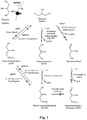
- Die Erfindung wird im Folgenden anhand der beigefügten Figur beispielhaft näher erläutert.
-
Fig. 1 Schematische Darstellung des Abbaus von Glycerol in einer Ausführungsform einer erfindungsgemäßen gentechnisch veränderten Hefezelle. -
Fig. 1 zeigt schematisch den Abbau von Glycerol in einer bevorzugten Ausführungsform einer erfindungsgemäßen gentechnisch veränderten Hefezelle. Dargestellt sind der Glycerol-3-Phosphat-Weg (links), der DHA-Weg (Mitte) und der Glycerinaldehyd-Weg (rechts), also jene drei Stoffwechselwege, die grundsätzlich zu einem Glycerolabbau führen können. Bei der Hefezelle wurde die Expression des natürlichen Transportproteins Stl1 durch Deletion des entsprechenden Gens blockiert. Darüber hinaus wurde die Zelle dahingehend gentechnisch verändert, dass ein heterologer Glycerol-Facilitator, hier Fps2 aus Pachysolen tannophilus, exprimiert wird. Der Glycerol-3-Phosphat-Weg ist durch Deletion der Gene für Glycerolkinase (GUT1) und die mitochondriale Glycerol-3-Phosphat-Dehydrogenase (GUT2) blockiert. Darüber hinaus ist auch die Rückreaktion über die NAD-abhängige Glycerol-3-Phosphat-Dehydrogenase und die Glycerol-3-Phosphatase durch Deletion der hierfür kodierenden Gene (GPD1, GPD2, GPP1, GPP2) blockiert. In die Zelle über den Glycerol-Facilitator transportiertes Glycerol wird damit über den in der Mitte dargestellten DHA-Weg über Dihydroxyaceton zu Dihydroxyacetonphosphat (DHAP) umgesetzt. In der Hefezelle wird eine heterologe Glyceroldehydrogenase, hier eine Glyceroldehydrogenase aus Ogataea angusta, exprimiert. Des Weiteren ist vorzugsweise auch der Glycerinaldehyd-Weg bei dieser Ausführungsform vollständig durch Deletion der kodierenden Enzyme blockiert. Diese Ausführungsform ist besonders vorteilhaft für den Fall, dass Reduktionsäquivalente ausschließlich in Form von NADH benötigt werden, wie beispielsweise bei der Herstellung von Succinat. Die Bildung bzw. der Verbrauch von Reduktionsäquivalenten oder ATP ist nur für den DHA-Weg und den Glycerinaldehyd-Weg dargestellt. - Almeida, J.R., Favaro, L.C., Quirino, B.F. 2012. Biodiesel biorefinery: opportunities and challenges for microbial production of fuels and chemicals from glycerol waste. Biotechnol Biofuels, 5(1), 48.
- Arfman, N., Hektor, HJ., Bystrykh, L.V., Govorukhina, NI., Dijkhuizen, L., Frank, J. ( 1997. Properties of an NAD(H)-containing methanol dehydrogenase and its activator protein from Bacillus methanolicus. Eur. J. Biochem. 244: 426-433.
- Babel, W., Hofmann, K.H. 1982. The relation between assimilation of methanol and glycerol in yeast. Arch Microbiol, 132, 179-184.
- Borodina, I., Nielsen, Advances in metabolic engineering of yeast Saccharomyces cerevisiae for production of chemicals. J., Biotechnol J. 2014 May;9(5):609-620. doi: 10.1002/biot.201300445.
- De Vries RP, Flitter SJ, van de Vondervoort PJ, Chaveroche MK, Fontaine T, Fillinger S, Ruijter GJ, d'Enfert C, Visser J. 2003. Glycerol dehydrogenase, encoded by gldB is essential for osmotolerance in Aspergillus nidulans. Mol Microbiol. 49(1):131-41. Dueber J.E., Wu G.C., Malmirchegini G.R., Moon T.S., Petzold C.J., Ullal A.V., Prather K.L., Keasling J.D. 2009. Synthetic protein scaffolds provide modular control over metabolic flux. Nat. Biotechnol. 27, 753-759
- Duine, J.A., Frank Jzn., J., Jongejan J.A. 1986. PQQ and quinoprotein enzymes in microbial oxidations. FEMS Microbiol. Lett. 32: 165-178.
- Fakas, S., Makri, A., Bellou, S., Aggelis, G. 2009. Pathways to aerobic glycerol catabolism and their regulation. in: Microbial conversions of raw glycerol, (Ed.) G. Aggelis, Nova Science Publishers, Inc. New York, pp. 9-18.
- Ferreira, C., van Voorst, F., Martins, A., Neves, L., Oliveira, R., Kielland-Brandt, M.C., Lucas, C., Brandt, A. 2005. A member of the sugar transporter family, Stl1p is the glycerol/H+ symporter in Saccharomyces cerevisiae. Mol Biol Cell, 16(4), 2068-76. Gancedo, C., Gancedo, J.M., Sols, A. 1968. Glycerol metabolism in yeasts. Pathways of utilization and production. Eur J Biochem, 5(2), 165-72.
- Gonzalez, E., Fernandez, M.R., Larroy, C., Sola, L., Pericas, M.A., Pares, X., Biosca, J.A. 2000. Characterization of a (2R,3R)-2,3-butanediol dehydrogenase as the Saccharomyces cerevisiae YAL060W gene product. Disruption and induction of the gene. J Biol Chem, 275(46), 35876-85.
- Hanson, RS., Hanson, TE. 1996. Methanotrophic bacteria. Microbiol. Rev. 60: 439-471. Hofmann KH, Babel W (1979) Synthese und Akkumulation der Glycerin-Dehydrogenase in Candida valida H 122 in Abhängigkeit von der C-Quelle. VII. Reinhardsbrunner Symposium der Sektion Mikrobiologie der Biologischen Gesellschaft der DDR, vom 6. bis 12. Mai. In: Abhandl Akad Wiss DDR (N3):229-234. Berlin, Akademie-Verlag 1981 Hong, K.K., Nielsen, J. 2012. Metabolic engineering of Saccharomyces cerevisiae: a key cell factory platform for future biorefineries. Cell Mol Life Sci, 69(16), 2671-90.Hubmann, G, Guillouet, S., Nevoigt, E. 2011. Gpd1 and Gpd2 Fine-Tuning for Sustainable Reduction of Glycerol Formation in Saccharomyces cerevisiae. Appl. Env. Microbiol. 77, 5857-5867.
- Itoh N, Tujibata Y, Liu JQ 1999. Cloning and overexpression in Escherichia coli of the gene encoding dihydroxyacetone kinase isoenzyme I from Schizosaccharomyces pombe, and its application to dihydroxyacetone phosphate production. Appl Microbiol Biotechnol. 51(2):193-200.
- Izawa, S., Sato, M., Yokoigawa, K., Inoue, Y. 2004. Intracellular glycerol influences resistance to freeze stress in Saccharomyces cerevisiae: analysis of a quadruple mutant in glycerol dehydrogenase genes and glycerol-enriched cells. Appl Microbiol Biotechnol, 66(1), 108-14.
- Jung, J.Y., Yun, H.S., Lee, J., Oh, M.K. 2011. Production of 1,2-propanediol from glycerol in Saccharomyces cerevisiae. J Microbiol Biotechnol, 21(8), 846-53.
- Klingenberg, M. 1970. Localization of the glycerol-phosphate dehydrogenase in the outer phase of the mitochondrial inner membrane. Eur J Biochem, 13(2), 247-52.
- Lin, E.C. 1976. Glycerol dissimilation and its regulation in bacteria. Annu Rev Microbiol, 30, 535-78.
- Liu, X., Mortensen, U.H., Workman, M. 2013. Expression and functional studies of genes involved in transport and metabolism of glycerol in Pachysolen tannophilus. Microb Cell Fact, 12, 27.
- Marktanalyse Nachwachsende Rohstoffe 2014, Schriftenreihe Nachwachsende Rohstoffe 34, Fachagentur Nachwachsende Rohstoffe e.V. (FNR)
- May, JW, Sloan J., 1981. Glycerol utilization by Schizosaccharomyces pompedehydrogenation as the initial step. J Gen Microbiol 123:182-186
- Merico, A., Ragni, E., Galafassi, S., Popolo, L., Compagno, C. 2011. Generation of an evolved Saccharomyces cerevisiae strain with a high freeze tolerance and an improved ability to grow on glycerol. J Ind Microbiol Biotechnol, 38(8), 1037-44.
- Molin, M., Norbeck, J., Blomberg, A. 2003. Dihydroxyacetone kinases in Saccharomyces cerevisiae are involved in detoxification of dihydroxyacetone. J Biol Chem, 278(3), 1415-23.
- Molin, M., Blomberg, A. 2006. Dihydroxyacetone detoxification in Saccharomyces cerevisiae involves formaldehyde dissimilation. Mol. Microbiol. 60: 925-938.
- Neves, L., Lages, F., Lucas, C. 2004. New insights on glycerol transport in Saccharomyces cerevisiae. FEBS Lett, 565(1-3), 160-2.
- Nevoigt, E., Kohnke, J., Fischer, CR., Alper, H., Stahl, U., Stephanopoulos, G. 2006. Engineering of promoter replacement cassettes for fine-tuning of gene expression in Saccharomyces cerevisiae. Appl. Environ. Microbiol. 72: 5266-5273
- Nevoigt, E. 2008. Progress in metabolic engineering of Saccharomyces cerevisiae. Microbiol Mol Biol Rev, 72(3), 379-412.
- Nguyen, H.T., Nevoigt, E. 2009. Engineering of Saccharomyces cerevisiae for the production of dihydroxyacetone (DHA) from sugars: a proof of concept. Metab Eng, 11(6), 335-46.
- Norbeck, J., Blomberg, A. 1997. Metabolic and regulatory changes associated with growth of Saccharomyces cerevisiae in 1.4 M NaCl. Evidence for osmotic induction of glycerol dissimilation via the dihydroxyacetone pathway. J Biol Chem, 272(9), 5544-54.
- Påhlman AK, Granath K, Ansell R, Hohmann S, Adler L. 2001. The yeast glycerol 3-phosphatases Gpplp and Gpp2p are required for glycerol biosynthesis and differentially involved in the cellular responses to osmotic, anaerobic, and oxidative stress. J Biol Chem 276(5):3555-563.
- Shi, S., Valle-Rodriguez, J.O., Siewers, V., Nielson, J. 2011. Prospects for microbial biodiesel production. Biotechnol. J. 6: 277-285.
- Sprague, G.F., Cronan, J.E. 1977. Isolation and characterization of Saccharomyces cerevisiae mutants defective in glycerol catabolism. J Bacteriol, 129(3), 1335-42. Swinnen, S., Klein, M., Carrillo, M., McInnes, J., Nguyen, H.T., Nevoigt, E. 2013. Reevaluation of glycerol utilization in Saccharomyces cerevisiae: characterization of an isolate that grows on glycerol without supporting supplements. Biotechnol Biofuels, 6(1), 157.
- Tom GD, Viswanath-Reddy M, Howe Jr, Branch H (1978) Effect of carbon source on enzymes involved in glycerol metabolism in Neurospora crassa. Arch Microbiol 117: 259-263
- Yazdani, S.S., Gonzalez, R. 2007. Anaerobic fermentation of glycerol: a path to economic viability for the biofuels industry. Curr Opin Biotechnol, 18(3), 213-9.
Claims (12)
- Gentechnisch veränderte Hefezelle der Gattung Saccharomyces mit verbessertem Glycerol-Katabolismus, wobei die Hefezelle dahingehend gentechnisch verändert ist, dassa) der Abbau von Glycerol zu Dihydroxyacetonphosphat über den Glycerol-3-Phosphat-Weg blockiert ist, undb) ein heterologes Glycerolaufnahme-Facilitator-Protein exprimiert wird, undc) eine die Oxidation von Glycerol zu Dihydroxyaceton katalysierende heterologe NAD-abhängige Glyceroldehydrogenase exprimiert oder eine die Oxidation von Glycerol zu Dihydroxyaceton katalysierende heterologe NADH-abhängige Glyceroldehydrogenase überexprimiert wird, undf) eine heterologe Dihydroxyacetonkinase exprimiert oder die native Dihydroxyacetonkinase überexprimiert wird.
- Gentechnisch veränderte Hefezelle nach Anspruch 1, wobei die Hefezelle eine Hefezelle der Art Saccharomyces cerevisiae ist.
- Gentechnisch veränderte Hefezelle nach Anspruch 1 oder 2, wobei zusätzlich c1) der Abbau von Glycerol zu Glycerinaldehyd-3-Phosphat über den Glycerinaldehyd-Weg blockiert ist, und/oderd) die Expression des durch STL1 kodierten natürlichen aktiven Glycerol-Transporters blockiert ist, und/odere) der Syntheseweg zur Rückbildung von Glycerol aus Dihydroxyacetonphosphat blockiert ist.
- Gentechnisch veränderte Hefezelle nach einem der vorhergehenden Ansprüche, wobei der Abbau von Glycerol zu Dihydroxyacetonphosphat über den Glycerol-3-Phosphat-Weg dadurch blockiert ist, dass die Expression der Glycerolkinase und/oder der mitochondrialen Glycerol-3-Phosphat-Dehydrogenase blockiert ist.
- Gentechnisch veränderte Hefezelle nach einem der vorhergehenden Ansprüche, wobei das heterologe Glycerolaufnahme-Facilitator-Protein Fps1 oder Fps2 aus Pachysolen tannophilus, oder Fps1 aus Pichia pastoris, Pichia jadinii oder Yarrowia lipolytica ist, und die heterologe Glyceroldehydrogenase eine Glyceroldehydrogenase aus Ogataea angusta ist.
- Gentechnisch veränderte Hefezelle nach einem der vorhergehenden Ansprüche, wobei die Hefezelle darüber hinaus dahingehend gentechnisch verändert ist, dass eine heterologe Formiatdehydrogenase in der Hefezelle exprimiert oder die native Formiatdehydrogenase überexprimiert wird.
- Gentechnisch veränderte Hefezelle nach einem der Ansprüche 1 bis 5, wobei die Hefezelle darüber hinaus dahingehend gentechnisch verändert ist, dass eine die Bildung von Formaldehyd aus Dihydroxyaceton katalysierende native Formaldehyd-Transketolase in der Hefezelle überexprimiert oder eine die Bildung von Formaldehyd aus Dihydroxyaceton katalysierende heterologe Formaldehyd-Transketolase in der Hefezelle exprimiert oder überexprimiert wird, und eine vorzugsweise NAD+-abhänige heterologe Methanoldehydrogenase in der Hefezelle exprimiert oder überexprimiert wird.
- Gentechnisch veränderte Hefezelle nach Anspruch 7, wobei die Hefezelle darüber hinaus dahingehend gentechnisch verändert ist, dass die native Dihydroxyacetonkinase gehemmt oder die Expression der nativen Dihydroxyacetonkinase vermindert ist.
- Verfahren zur Herstellung eines Fermentationsproduktes aus Glycerol, wobei eine gentechnisch veränderte Hefezelle nach einem der vorhergehenden Ansprüche in einem glycerolhaltigen Kulturmedium unter geeigneten Fermentationsbedingungen kultiviert und das Fermentationsprodukt von dem Kulturmedium abgetrennt wird.
- Verfahren nach Anspruch 9, wobei die Hefezelle eine gentechnisch veränderte Hefezelle nach Anspruch 6 ist und die Hefezelle mit Formiat als Kosubstrat kultiviert wird.
- Verfahren nach Anspruch 9 oder 10, wobei das Fermentationsprodukt Succinat oder 1,2-Propandiol ist.
- Verfahren nach Anspruch 9 oder10, wobei das Fermentationsprodukt Methanol ist.
Applications Claiming Priority (3)
| Application Number | Priority Date | Filing Date | Title |
|---|---|---|---|
| DE102014109858.7A DE102014109858A1 (de) | 2014-07-14 | 2014-07-14 | Gentechnisch veränderte Hefe mit verbessertem Glycerol-Katabolismus |
| EP14192729 | 2014-11-11 | ||
| PCT/EP2015/065839 WO2016008819A1 (de) | 2014-07-14 | 2015-07-10 | Gentechnisch veränderte hefe mit verbessertem glycerol-katabolismus |
Publications (2)
| Publication Number | Publication Date |
|---|---|
| EP3169768A1 EP3169768A1 (de) | 2017-05-24 |
| EP3169768B1 true EP3169768B1 (de) | 2018-09-26 |
Family
ID=53762138
Family Applications (1)
| Application Number | Title | Priority Date | Filing Date |
|---|---|---|---|
| EP15744499.3A Active EP3169768B1 (de) | 2014-07-14 | 2015-07-10 | Gentechnisch veränderte hefe mit verbessertem glycerol-katabolismus |
Country Status (3)
| Country | Link |
|---|---|
| EP (1) | EP3169768B1 (de) |
| DE (1) | DE112015003261B4 (de) |
| WO (1) | WO2016008819A1 (de) |
Cited By (1)
| Publication number | Priority date | Publication date | Assignee | Title |
|---|---|---|---|---|
| WO2025230691A1 (en) * | 2024-05-01 | 2025-11-06 | Cargill, Incorporated | Genetically modified yeast and fermentation processes for the production of xylitol |
Families Citing this family (7)
| Publication number | Priority date | Publication date | Assignee | Title |
|---|---|---|---|---|
| DE102016115425A1 (de) | 2016-08-19 | 2018-02-22 | Jacobs University Bremen Ggmbh | Gentechnisch veränderte Hefe zur Fermentation von Glycerol |
| WO2018114762A1 (en) * | 2016-12-23 | 2018-06-28 | Dsm Ip Assets B.V. | Improved glycerol free ethanol production |
| WO2018127572A1 (en) * | 2017-01-05 | 2018-07-12 | Danmarks Tekniske Universitet | A method for improved glycerol utilization in yeast |
| CA3073329A1 (en) * | 2017-09-26 | 2019-04-04 | Dsm Ip Assets B.V. | Improved process for ethanol production |
| CN109370969B (zh) * | 2018-11-12 | 2020-09-04 | 江南大学 | 一种重组克雷伯氏杆菌在制备1,3-丙二醇中的应用 |
| DE102021113602A1 (de) | 2021-05-26 | 2022-12-01 | Jacobs University Bremen Ggmbh | Gentechnisch veränderte hefe zur biotechnologischen herstellung von bernsteinsäure aus glycerol |
| DE102023114310A1 (de) | 2023-05-31 | 2024-12-05 | Constructor University Bremen Ggmbh | Gentechnisch veränderte hefezelle |
Family Cites Families (11)
| Publication number | Priority date | Publication date | Assignee | Title |
|---|---|---|---|---|
| JP2010110217A (ja) * | 2007-02-22 | 2010-05-20 | Ajinomoto Co Inc | L−アミノ酸生産菌及びl−アミノ酸の製造法 |
| WO2010019882A1 (en) * | 2008-08-15 | 2010-02-18 | Edeniq, Inc. | Genetically-engineered yeast and methods of making and using |
| EP2467490A1 (de) * | 2009-08-21 | 2012-06-27 | Mascoma Corporation | Herstellung von propanolen, alkoholen und polyolen in konsolidierten bioprocessing-organismen |
| US20110250664A1 (en) | 2010-04-08 | 2011-10-13 | Tianjin University | Yeast having improved ethanol yield |
| WO2011132890A2 (ko) | 2010-04-19 | 2011-10-27 | 고려대학교 산학협력단 | 바이오 에탄올 생산 향상용 형질전환체 및 그 균주를 이용한 에탄올 생성방법 |
| WO2011149353A1 (en) * | 2010-05-27 | 2011-12-01 | C5 Yeast Company B.V. | Yeast strains engineered to produce ethanol from acetic acid and glycerol |
| FR2962133B1 (fr) * | 2010-07-01 | 2014-09-12 | Agronomique Inst Nat Rech | Optimisation de la synthese et de l'accumulation de lipides |
| DK2663645T3 (da) * | 2010-11-18 | 2015-03-23 | Dsm Ip Assets Bv | Gærstammer, der er modificeret til produktion af ethanol fra glycerol |
| MX2014006446A (es) * | 2011-11-30 | 2014-09-01 | Dsm Ip Assets Bv | Cepas de levadura manipuladas para producir etanol a partir de acido acetico y glicerol. |
| CA2889890C (en) * | 2012-11-09 | 2023-03-28 | Lallemand Hungary Liquidity Management Llc | Method for acetate consumption during ethanolic fermentation of cellulosic feedstocks |
| AR097479A1 (es) * | 2013-08-29 | 2016-03-16 | Dsm Ip Assets Bv | Células convertidoras de glicerol y ácido acético con un transporte de glicerol mejorado |
-
2015
- 2015-07-10 DE DE112015003261.4T patent/DE112015003261B4/de active Active
- 2015-07-10 WO PCT/EP2015/065839 patent/WO2016008819A1/de not_active Ceased
- 2015-07-10 EP EP15744499.3A patent/EP3169768B1/de active Active
Non-Patent Citations (1)
| Title |
|---|
| None * |
Cited By (1)
| Publication number | Priority date | Publication date | Assignee | Title |
|---|---|---|---|---|
| WO2025230691A1 (en) * | 2024-05-01 | 2025-11-06 | Cargill, Incorporated | Genetically modified yeast and fermentation processes for the production of xylitol |
Also Published As
| Publication number | Publication date |
|---|---|
| EP3169768A1 (de) | 2017-05-24 |
| DE112015003261A5 (de) | 2017-04-27 |
| DE112015003261B4 (de) | 2025-04-10 |
| WO2016008819A1 (de) | 2016-01-21 |
Similar Documents
| Publication | Publication Date | Title |
|---|---|---|
| DE112015003261B4 (de) | Gentechnisch veränderte Hefe mit verbessertem Glycerol-Katabolismus | |
| DE60029971T2 (de) | Verfahren zur biologischen herstellung von 1,3-propandiol | |
| DE69736070T2 (de) | Rekombinantes Herstellungsverfahren für 1,3-Propandiol | |
| Mirończuk et al. | A two-stage fermentation process of erythritol production by yeast Y. lipolytica from molasses and glycerol | |
| CA2825267C (en) | Recombinant clostridium bacterium and uses thereof in isopropanol production | |
| DE112015003962B4 (de) | 3-Hydroxypropionsäure erzeugende rekombinante Hefe und Verfahren zum Herstellen von 3-Hydroxypropionsäure unter Nutzung derselben | |
| JP7240329B2 (ja) | 目的分子を産生するための遺伝的に最適化された微生物 | |
| US20190309268A1 (en) | Glycerol free ethanol production | |
| JP7117307B2 (ja) | 化合物の生合成用のメチニコビア種 | |
| CA2798452A1 (en) | Detoxification of biomass derived acetate via metabolic conversion to ethanol, acetone, isopropanol, or ethyl acetate | |
| EP3455362A1 (de) | Mutante hefestämme mit erhöhter produktion von erythritol oder erythrulose | |
| WO2016012561A1 (en) | Method for producing acetoin | |
| KR20120099315A (ko) | 3-하이드록시프로피온산 및 1,3-프로판디올 동시 생산용 재조합미생물 | |
| EP4680760A2 (de) | Verfahren zur herstellung einer wässerigen lösung enthaltend d-psicose | |
| EP3500674B1 (de) | Gentechnisch veränderte hefe zur fermentation von glycerol | |
| CN111712576A (zh) | 微生物菌株及其用途 | |
| DE102014109858A1 (de) | Gentechnisch veränderte Hefe mit verbessertem Glycerol-Katabolismus | |
| EP4095230A1 (de) | Gentechnisch veränderte hefe zur biotechnologischen herstellung von bernsteinsäure aus glycerin | |
| DE102021101004B3 (de) | Verfahren zur Herstellung von 2,4-Dihydroxybutyrat oder L-Threonin unter Nutzung eines mikrobiellen Stoffwechselweges | |
| US9127323B2 (en) | Isolated yeast strain having high xylose consumption rate and process for production of ethanol using the strain | |
| JP2020506678A (ja) | アラビノースを代謝するための高性能酵母株を得ること | |
| KR102687444B1 (ko) | 갈조류의 동시당화 및 발효공정을 통한 바이오에탄올 생산 방법 | |
| Immanuel et al. | Genetically engineered marine microbes for the production of bioethanol | |
| DE102023114310A1 (de) | Gentechnisch veränderte hefezelle | |
| EP4464786A1 (de) | Verfahren zur herstellung von wässerigen lösungen enthaltend d-psicose oder l-psicose |
Legal Events
| Date | Code | Title | Description |
|---|---|---|---|
| STAA | Information on the status of an ep patent application or granted ep patent |
Free format text: STATUS: THE INTERNATIONAL PUBLICATION HAS BEEN MADE |
|
| PUAI | Public reference made under article 153(3) epc to a published international application that has entered the european phase |
Free format text: ORIGINAL CODE: 0009012 |
|
| STAA | Information on the status of an ep patent application or granted ep patent |
Free format text: STATUS: REQUEST FOR EXAMINATION WAS MADE |
|
| 17P | Request for examination filed |
Effective date: 20170214 |
|
| AK | Designated contracting states |
Kind code of ref document: A1 Designated state(s): AL AT BE BG CH CY CZ DE DK EE ES FI FR GB GR HR HU IE IS IT LI LT LU LV MC MK MT NL NO PL PT RO RS SE SI SK SM TR |
|
| AX | Request for extension of the european patent |
Extension state: BA ME |
|
| DAV | Request for validation of the european patent (deleted) | ||
| DAX | Request for extension of the european patent (deleted) | ||
| STAA | Information on the status of an ep patent application or granted ep patent |
Free format text: STATUS: EXAMINATION IS IN PROGRESS |
|
| 17Q | First examination report despatched |
Effective date: 20171124 |
|
| GRAP | Despatch of communication of intention to grant a patent |
Free format text: ORIGINAL CODE: EPIDOSNIGR1 |
|
| STAA | Information on the status of an ep patent application or granted ep patent |
Free format text: STATUS: GRANT OF PATENT IS INTENDED |
|
| INTG | Intention to grant announced |
Effective date: 20180704 |
|
| GRAS | Grant fee paid |
Free format text: ORIGINAL CODE: EPIDOSNIGR3 |
|
| GRAA | (expected) grant |
Free format text: ORIGINAL CODE: 0009210 |
|
| STAA | Information on the status of an ep patent application or granted ep patent |
Free format text: STATUS: THE PATENT HAS BEEN GRANTED |
|
| AK | Designated contracting states |
Kind code of ref document: B1 Designated state(s): AL AT BE BG CH CY CZ DE DK EE ES FI FR GB GR HR HU IE IS IT LI LT LU LV MC MK MT NL NO PL PT RO RS SE SI SK SM TR |
|
| REG | Reference to a national code |
Ref country code: GB Ref legal event code: FG4D Free format text: NOT ENGLISH |
|
| REG | Reference to a national code |
Ref country code: CH Ref legal event code: EP |
|
| REG | Reference to a national code |
Ref country code: AT Ref legal event code: REF Ref document number: 1046069 Country of ref document: AT Kind code of ref document: T Effective date: 20181015 |
|
| REG | Reference to a national code |
Ref country code: IE Ref legal event code: FG4D Free format text: LANGUAGE OF EP DOCUMENT: GERMAN |
|
| REG | Reference to a national code |
Ref country code: DE Ref legal event code: R096 Ref document number: 502015006116 Country of ref document: DE |
|
| REG | Reference to a national code |
Ref country code: NL Ref legal event code: MP Effective date: 20180926 |
|
| PG25 | Lapsed in a contracting state [announced via postgrant information from national office to epo] |
Ref country code: BG Free format text: LAPSE BECAUSE OF FAILURE TO SUBMIT A TRANSLATION OF THE DESCRIPTION OR TO PAY THE FEE WITHIN THE PRESCRIBED TIME-LIMIT Effective date: 20181226 Ref country code: SE Free format text: LAPSE BECAUSE OF FAILURE TO SUBMIT A TRANSLATION OF THE DESCRIPTION OR TO PAY THE FEE WITHIN THE PRESCRIBED TIME-LIMIT Effective date: 20180926 Ref country code: GR Free format text: LAPSE BECAUSE OF FAILURE TO SUBMIT A TRANSLATION OF THE DESCRIPTION OR TO PAY THE FEE WITHIN THE PRESCRIBED TIME-LIMIT Effective date: 20181227 Ref country code: RS Free format text: LAPSE BECAUSE OF FAILURE TO SUBMIT A TRANSLATION OF THE DESCRIPTION OR TO PAY THE FEE WITHIN THE PRESCRIBED TIME-LIMIT Effective date: 20180926 Ref country code: NO Free format text: LAPSE BECAUSE OF FAILURE TO SUBMIT A TRANSLATION OF THE DESCRIPTION OR TO PAY THE FEE WITHIN THE PRESCRIBED TIME-LIMIT Effective date: 20181226 Ref country code: FI Free format text: LAPSE BECAUSE OF FAILURE TO SUBMIT A TRANSLATION OF THE DESCRIPTION OR TO PAY THE FEE WITHIN THE PRESCRIBED TIME-LIMIT Effective date: 20180926 Ref country code: LT Free format text: LAPSE BECAUSE OF FAILURE TO SUBMIT A TRANSLATION OF THE DESCRIPTION OR TO PAY THE FEE WITHIN THE PRESCRIBED TIME-LIMIT Effective date: 20180926 |
|
| REG | Reference to a national code |
Ref country code: LT Ref legal event code: MG4D |
|
| PG25 | Lapsed in a contracting state [announced via postgrant information from national office to epo] |
Ref country code: LV Free format text: LAPSE BECAUSE OF FAILURE TO SUBMIT A TRANSLATION OF THE DESCRIPTION OR TO PAY THE FEE WITHIN THE PRESCRIBED TIME-LIMIT Effective date: 20180926 Ref country code: AL Free format text: LAPSE BECAUSE OF FAILURE TO SUBMIT A TRANSLATION OF THE DESCRIPTION OR TO PAY THE FEE WITHIN THE PRESCRIBED TIME-LIMIT Effective date: 20180926 Ref country code: HR Free format text: LAPSE BECAUSE OF FAILURE TO SUBMIT A TRANSLATION OF THE DESCRIPTION OR TO PAY THE FEE WITHIN THE PRESCRIBED TIME-LIMIT Effective date: 20180926 |
|
| PG25 | Lapsed in a contracting state [announced via postgrant information from national office to epo] |
Ref country code: IT Free format text: LAPSE BECAUSE OF FAILURE TO SUBMIT A TRANSLATION OF THE DESCRIPTION OR TO PAY THE FEE WITHIN THE PRESCRIBED TIME-LIMIT Effective date: 20180926 Ref country code: EE Free format text: LAPSE BECAUSE OF FAILURE TO SUBMIT A TRANSLATION OF THE DESCRIPTION OR TO PAY THE FEE WITHIN THE PRESCRIBED TIME-LIMIT Effective date: 20180926 Ref country code: PL Free format text: LAPSE BECAUSE OF FAILURE TO SUBMIT A TRANSLATION OF THE DESCRIPTION OR TO PAY THE FEE WITHIN THE PRESCRIBED TIME-LIMIT Effective date: 20180926 Ref country code: RO Free format text: LAPSE BECAUSE OF FAILURE TO SUBMIT A TRANSLATION OF THE DESCRIPTION OR TO PAY THE FEE WITHIN THE PRESCRIBED TIME-LIMIT Effective date: 20180926 Ref country code: NL Free format text: LAPSE BECAUSE OF FAILURE TO SUBMIT A TRANSLATION OF THE DESCRIPTION OR TO PAY THE FEE WITHIN THE PRESCRIBED TIME-LIMIT Effective date: 20180926 Ref country code: CZ Free format text: LAPSE BECAUSE OF FAILURE TO SUBMIT A TRANSLATION OF THE DESCRIPTION OR TO PAY THE FEE WITHIN THE PRESCRIBED TIME-LIMIT Effective date: 20180926 Ref country code: ES Free format text: LAPSE BECAUSE OF FAILURE TO SUBMIT A TRANSLATION OF THE DESCRIPTION OR TO PAY THE FEE WITHIN THE PRESCRIBED TIME-LIMIT Effective date: 20180926 Ref country code: IS Free format text: LAPSE BECAUSE OF FAILURE TO SUBMIT A TRANSLATION OF THE DESCRIPTION OR TO PAY THE FEE WITHIN THE PRESCRIBED TIME-LIMIT Effective date: 20190126 |
|
| PG25 | Lapsed in a contracting state [announced via postgrant information from national office to epo] |
Ref country code: SK Free format text: LAPSE BECAUSE OF FAILURE TO SUBMIT A TRANSLATION OF THE DESCRIPTION OR TO PAY THE FEE WITHIN THE PRESCRIBED TIME-LIMIT Effective date: 20180926 Ref country code: SM Free format text: LAPSE BECAUSE OF FAILURE TO SUBMIT A TRANSLATION OF THE DESCRIPTION OR TO PAY THE FEE WITHIN THE PRESCRIBED TIME-LIMIT Effective date: 20180926 Ref country code: PT Free format text: LAPSE BECAUSE OF FAILURE TO SUBMIT A TRANSLATION OF THE DESCRIPTION OR TO PAY THE FEE WITHIN THE PRESCRIBED TIME-LIMIT Effective date: 20190126 |
|
| REG | Reference to a national code |
Ref country code: DE Ref legal event code: R097 Ref document number: 502015006116 Country of ref document: DE |
|
| PG25 | Lapsed in a contracting state [announced via postgrant information from national office to epo] |
Ref country code: DK Free format text: LAPSE BECAUSE OF FAILURE TO SUBMIT A TRANSLATION OF THE DESCRIPTION OR TO PAY THE FEE WITHIN THE PRESCRIBED TIME-LIMIT Effective date: 20180926 |
|
| PLBE | No opposition filed within time limit |
Free format text: ORIGINAL CODE: 0009261 |
|
| STAA | Information on the status of an ep patent application or granted ep patent |
Free format text: STATUS: NO OPPOSITION FILED WITHIN TIME LIMIT |
|
| 26N | No opposition filed |
Effective date: 20190627 |
|
| PG25 | Lapsed in a contracting state [announced via postgrant information from national office to epo] |
Ref country code: SI Free format text: LAPSE BECAUSE OF FAILURE TO SUBMIT A TRANSLATION OF THE DESCRIPTION OR TO PAY THE FEE WITHIN THE PRESCRIBED TIME-LIMIT Effective date: 20180926 |
|
| PG25 | Lapsed in a contracting state [announced via postgrant information from national office to epo] |
Ref country code: MC Free format text: LAPSE BECAUSE OF FAILURE TO SUBMIT A TRANSLATION OF THE DESCRIPTION OR TO PAY THE FEE WITHIN THE PRESCRIBED TIME-LIMIT Effective date: 20180926 |
|
| PG25 | Lapsed in a contracting state [announced via postgrant information from national office to epo] |
Ref country code: TR Free format text: LAPSE BECAUSE OF FAILURE TO SUBMIT A TRANSLATION OF THE DESCRIPTION OR TO PAY THE FEE WITHIN THE PRESCRIBED TIME-LIMIT Effective date: 20180926 |
|
| REG | Reference to a national code |
Ref country code: BE Ref legal event code: MM Effective date: 20190731 |
|
| PG25 | Lapsed in a contracting state [announced via postgrant information from national office to epo] |
Ref country code: LU Free format text: LAPSE BECAUSE OF NON-PAYMENT OF DUE FEES Effective date: 20190710 Ref country code: BE Free format text: LAPSE BECAUSE OF NON-PAYMENT OF DUE FEES Effective date: 20190731 |
|
| PG25 | Lapsed in a contracting state [announced via postgrant information from national office to epo] |
Ref country code: IE Free format text: LAPSE BECAUSE OF NON-PAYMENT OF DUE FEES Effective date: 20190710 |
|
| PG25 | Lapsed in a contracting state [announced via postgrant information from national office to epo] |
Ref country code: CY Free format text: LAPSE BECAUSE OF FAILURE TO SUBMIT A TRANSLATION OF THE DESCRIPTION OR TO PAY THE FEE WITHIN THE PRESCRIBED TIME-LIMIT Effective date: 20180926 |
|
| PG25 | Lapsed in a contracting state [announced via postgrant information from national office to epo] |
Ref country code: HU Free format text: LAPSE BECAUSE OF FAILURE TO SUBMIT A TRANSLATION OF THE DESCRIPTION OR TO PAY THE FEE WITHIN THE PRESCRIBED TIME-LIMIT; INVALID AB INITIO Effective date: 20150710 Ref country code: MT Free format text: LAPSE BECAUSE OF FAILURE TO SUBMIT A TRANSLATION OF THE DESCRIPTION OR TO PAY THE FEE WITHIN THE PRESCRIBED TIME-LIMIT Effective date: 20180926 |
|
| REG | Reference to a national code |
Ref country code: AT Ref legal event code: MM01 Ref document number: 1046069 Country of ref document: AT Kind code of ref document: T Effective date: 20200710 |
|
| PG25 | Lapsed in a contracting state [announced via postgrant information from national office to epo] |
Ref country code: AT Free format text: LAPSE BECAUSE OF NON-PAYMENT OF DUE FEES Effective date: 20200710 |
|
| PG25 | Lapsed in a contracting state [announced via postgrant information from national office to epo] |
Ref country code: MK Free format text: LAPSE BECAUSE OF FAILURE TO SUBMIT A TRANSLATION OF THE DESCRIPTION OR TO PAY THE FEE WITHIN THE PRESCRIBED TIME-LIMIT Effective date: 20180926 |
|
| REG | Reference to a national code |
Ref country code: DE Ref legal event code: R081 Ref document number: 502015006116 Country of ref document: DE Owner name: CONSTRUCTOR UNIVERSITY BREMEN GGMBH, DE Free format text: FORMER OWNER: JACOBS UNIVERSITY BREMEN GMBH, 28759 BREMEN, DE |
|
| P01 | Opt-out of the competence of the unified patent court (upc) registered |
Effective date: 20230530 |
|
| PGFP | Annual fee paid to national office [announced via postgrant information from national office to epo] |
Ref country code: DE Payment date: 20250425 Year of fee payment: 11 |
|
| PGFP | Annual fee paid to national office [announced via postgrant information from national office to epo] |
Ref country code: GB Payment date: 20250724 Year of fee payment: 11 |
|
| PGFP | Annual fee paid to national office [announced via postgrant information from national office to epo] |
Ref country code: FR Payment date: 20250723 Year of fee payment: 11 |
|
| PGFP | Annual fee paid to national office [announced via postgrant information from national office to epo] |
Ref country code: CH Payment date: 20250801 Year of fee payment: 11 |