EP3166993B1 - Verfahren zur verarbeitung von polyethylenterephthalat - Google Patents
Verfahren zur verarbeitung von polyethylenterephthalat Download PDFInfo
- Publication number
- EP3166993B1 EP3166993B1 EP15736470.4A EP15736470A EP3166993B1 EP 3166993 B1 EP3166993 B1 EP 3166993B1 EP 15736470 A EP15736470 A EP 15736470A EP 3166993 B1 EP3166993 B1 EP 3166993B1
- Authority
- EP
- European Patent Office
- Prior art keywords
- pet
- drying
- bottle
- intrinsic viscosity
- air
- Prior art date
- Legal status (The legal status is an assumption and is not a legal conclusion. Google has not performed a legal analysis and makes no representation as to the accuracy of the status listed.)
- Active
Links
Images



Classifications
-
- B—PERFORMING OPERATIONS; TRANSPORTING
- B29—WORKING OF PLASTICS; WORKING OF SUBSTANCES IN A PLASTIC STATE IN GENERAL
- B29B—PREPARATION OR PRETREATMENT OF THE MATERIAL TO BE SHAPED; MAKING GRANULES OR PREFORMS; RECOVERY OF PLASTICS OR OTHER CONSTITUENTS OF WASTE MATERIAL CONTAINING PLASTICS
- B29B13/00—Conditioning or physical treatment of the material to be shaped
- B29B13/06—Conditioning or physical treatment of the material to be shaped by drying
- B29B13/065—Conditioning or physical treatment of the material to be shaped by drying of powder or pellets
-
- B—PERFORMING OPERATIONS; TRANSPORTING
- B29—WORKING OF PLASTICS; WORKING OF SUBSTANCES IN A PLASTIC STATE IN GENERAL
- B29C—SHAPING OR JOINING OF PLASTICS; SHAPING OF MATERIAL IN A PLASTIC STATE, NOT OTHERWISE PROVIDED FOR; AFTER-TREATMENT OF THE SHAPED PRODUCTS, e.g. REPAIRING
- B29C45/00—Injection moulding, i.e. forcing the required volume of moulding material through a nozzle into a closed mould; Apparatus therefor
- B29C45/0001—Injection moulding, i.e. forcing the required volume of moulding material through a nozzle into a closed mould; Apparatus therefor characterised by the choice of material
-
- B—PERFORMING OPERATIONS; TRANSPORTING
- B29—WORKING OF PLASTICS; WORKING OF SUBSTANCES IN A PLASTIC STATE IN GENERAL
- B29C—SHAPING OR JOINING OF PLASTICS; SHAPING OF MATERIAL IN A PLASTIC STATE, NOT OTHERWISE PROVIDED FOR; AFTER-TREATMENT OF THE SHAPED PRODUCTS, e.g. REPAIRING
- B29C49/00—Blow-moulding, i.e. blowing a preform or parison to a desired shape within a mould; Apparatus therefor
- B29C49/0005—Blow-moulding, i.e. blowing a preform or parison to a desired shape within a mould; Apparatus therefor characterised by the material
-
- B—PERFORMING OPERATIONS; TRANSPORTING
- B29—WORKING OF PLASTICS; WORKING OF SUBSTANCES IN A PLASTIC STATE IN GENERAL
- B29C—SHAPING OR JOINING OF PLASTICS; SHAPING OF MATERIAL IN A PLASTIC STATE, NOT OTHERWISE PROVIDED FOR; AFTER-TREATMENT OF THE SHAPED PRODUCTS, e.g. REPAIRING
- B29C49/00—Blow-moulding, i.e. blowing a preform or parison to a desired shape within a mould; Apparatus therefor
- B29C49/02—Combined blow-moulding and manufacture of the preform or the parison
- B29C49/06—Injection blow-moulding
-
- B—PERFORMING OPERATIONS; TRANSPORTING
- B29—WORKING OF PLASTICS; WORKING OF SUBSTANCES IN A PLASTIC STATE IN GENERAL
- B29C—SHAPING OR JOINING OF PLASTICS; SHAPING OF MATERIAL IN A PLASTIC STATE, NOT OTHERWISE PROVIDED FOR; AFTER-TREATMENT OF THE SHAPED PRODUCTS, e.g. REPAIRING
- B29C49/00—Blow-moulding, i.e. blowing a preform or parison to a desired shape within a mould; Apparatus therefor
- B29C49/42—Component parts, details or accessories; Auxiliary operations
- B29C49/4252—Auxiliary operations prior to the blow-moulding operation not otherwise provided for
-
- B—PERFORMING OPERATIONS; TRANSPORTING
- B29—WORKING OF PLASTICS; WORKING OF SUBSTANCES IN A PLASTIC STATE IN GENERAL
- B29C—SHAPING OR JOINING OF PLASTICS; SHAPING OF MATERIAL IN A PLASTIC STATE, NOT OTHERWISE PROVIDED FOR; AFTER-TREATMENT OF THE SHAPED PRODUCTS, e.g. REPAIRING
- B29C49/00—Blow-moulding, i.e. blowing a preform or parison to a desired shape within a mould; Apparatus therefor
- B29C49/42—Component parts, details or accessories; Auxiliary operations
- B29C49/4273—Auxiliary operations after the blow-moulding operation not otherwise provided for
-
- B—PERFORMING OPERATIONS; TRANSPORTING
- B29—WORKING OF PLASTICS; WORKING OF SUBSTANCES IN A PLASTIC STATE IN GENERAL
- B29C—SHAPING OR JOINING OF PLASTICS; SHAPING OF MATERIAL IN A PLASTIC STATE, NOT OTHERWISE PROVIDED FOR; AFTER-TREATMENT OF THE SHAPED PRODUCTS, e.g. REPAIRING
- B29C49/00—Blow-moulding, i.e. blowing a preform or parison to a desired shape within a mould; Apparatus therefor
- B29C49/02—Combined blow-moulding and manufacture of the preform or the parison
- B29C2049/023—Combined blow-moulding and manufacture of the preform or the parison using inherent heat of the preform, i.e. 1 step blow moulding
-
- B—PERFORMING OPERATIONS; TRANSPORTING
- B29—WORKING OF PLASTICS; WORKING OF SUBSTANCES IN A PLASTIC STATE IN GENERAL
- B29K—INDEXING SCHEME ASSOCIATED WITH SUBCLASSES B29B, B29C OR B29D, RELATING TO MOULDING MATERIALS OR TO MATERIALS FOR MOULDS, REINFORCEMENTS, FILLERS OR PREFORMED PARTS, e.g. INSERTS
- B29K2067/00—Use of polyesters or derivatives thereof, as moulding material
- B29K2067/003—PET, i.e. poylethylene terephthalate
-
- B—PERFORMING OPERATIONS; TRANSPORTING
- B29—WORKING OF PLASTICS; WORKING OF SUBSTANCES IN A PLASTIC STATE IN GENERAL
- B29L—INDEXING SCHEME ASSOCIATED WITH SUBCLASS B29C, RELATING TO PARTICULAR ARTICLES
- B29L2031/00—Other particular articles
- B29L2031/712—Containers; Packaging elements or accessories, Packages
- B29L2031/7158—Bottles
Definitions
- the invention relates to PET (polyethylene terephthalate) processing.
- PET relates to the processing of PET between its supply in raw form, e.g. PET chips, and its molding to form a preform or a container such as a bottle. It focuses on the processing steps before PET molding, and more particularly on a process for drying PET.
- PET is a thermoplastic polymer resin of the polyester family and is commonly used in beverage, food and other liquid containers.
- one or two-step molding methods may be used. For example, in a two-step method a preform is injection-molded. Next, on a second machine, the preform is inflated into its final shape using stretch blow molding.
- PET is commonly supplied in the form of PET chips or flakes.
- the PET chip material is brought to a high temperature to be molded.
- An extruder provides the melted PET material to a preform mold.
- PET has a high hygroscopic behavior. PET chips absorb moisture from the atmosphere until equilibrium is achieved.
- the PET chips supplied for processing are water-saturated, and may contain up to 0.6% water by weight. During plasticizing in the extruder, the presence of moisture breaks polymer chains. Any water present at this stage rapidly hydrolyses the polymer, thereby reducing its molecular weight and damaging its physical properties.
- breaking polymer chains of PET results in a drop in IV (intrinsic viscosity) of the PET.
- IV intrinsic viscosity
- the intrinsic viscosity is commonly used to characterize PET material. It is a measure of the polymer molecular weight. The longer the polymer chains and the more entanglements between chains the higher the viscosity.
- a drop in IV may result in defects in the molded preform or container, such as growth of bubbles, streaks, or a hazy appearance.
- degradation through hydrolysis of PET may cause acetaldehyde, benzene, and/or formaldehyde generation. Typically, acetaldehyde can cause an off-taste in bottled water: that is why its generation must be avoided.
- PET has to be dried to very low moisture content before molding. Indeed, the moisture content is reduced to a maximum of 0.005% (50 ppm) by weight, and preferably about 0.003% (30ppm).
- Drying is performed in a PET dryer.
- Typical PET dryers use a closed loop in which hot and dry air circulates. PET chips or flakes are placed in a hopper, and hot dry air flows onto the material, from which it absorbs moisture. The air is next conducted into a drying unit where it is cooled and de-humidified. De-humidifying is carried out using a desiccant bed (generally in a desiccation tower) that must be periodically regenerated. De-humidified air is next heated again before being passed through the hopper again.
- a desiccant bed generally in a desiccation tower
- the residence time of the PET in the hopper (drying time) is a fourth important parameter in PET drying. Indeed, because of the hygroscopic behavior of PET, moisture is present inside the PET chips. Usually a residence time of about six hours at 180°C and a dew point of -60°C is necessary to bring the material to less than 50ppm of water in weight.
- the PET may be degraded through oxidative degradation and thermal degradation.
- the drying temperature generally used is around 170°C, and should not exceed 190°C, also depending whether recycled PET (rPET) chips or flakes are used.
- the drying temperature is the temperature of air used for drying the PET, and also corresponds to the temperature of the PET at the hopper exit.
- the air dew point (representing air dryness) should be around -60°C.
- the drying parameters of PET chips must be carefully controlled according to strict and well established rules.
- PET manufacturers sell PET in the form of chips or flakes. Customers' (e.g. container manufacturers') demand for PET having a high intrinsic viscosity (IV) has grown in the past years. PET having a high IV (hereafter "high-IV PET”) has better mechanical properties, and bottles used to contain sparkling beverages have to be made of high-IV PET. Typical high-IV PET which is available on the market has an IV of 0.80 dL/g or above.
- PET having a lower IV typically between 0.72 dL/g and 0.76 dL/g
- still beverage bottles such as still water bottles.
- PET which was formerly widely available on the market is now rare and expensive. This is because the demand for high IV PET is much greater than the demand for low-IV PET, and also because a significant quantity of recycled PET, which has a high IV, is commonly incorporated into the material of the PET flakes.
- low IV PET has some advantages over high IV PET. It is easier to inject for molding. It allows a better, more homogeneous, distribution in the mold in which it is injected. It allows manufacture of preforms having a wall thickness of less than 2mm, which difficult if not is impossible with high-IV PET. A preform having a small wall thickness is needed to obtain a lightweight thin-walled bottle.
- PET polyethylene terephthalate
- the drop of intrinsic viscosity obtained through hydrolysis of PET during plasticization results in an easier injection of a more fluid plasticized material.
- the drawbacks of hydrolytic degradation of PET formation of acetaldehyde, loss of physical properties, etc.
- injection molding may be performed at a lower temperature, and/or the molded part may be thinner or have a more constant thickness. Less energy is needed. Old or less powerful injection equipment may be used.
- a particular embodiment of this method may comprise, before drying the PET raw material, determining the target moisture level based on the intrinsic viscosity of the supplied PET raw material and a targeted intrinsic viscosity of the PET after plasticization.
- the targeted intrinsic viscosity is set between 0.70 dL/g and 0.76 dL/g.
- the supplied raw material has an intrinsic viscosity comprised between 0.80 dL/g and 0.85 dL/g.
- drying is performed at 150°C or below. Drying is performed using drying air having a dew point of -40°C or higher and preferably about -30°C. Drying is performed using a residence time of the PET raw material in a dryer comprised between one and four hours, and preferably between one and three hours.
- the PET may be injection-molded to form a container preform.
- the container is a bottle.
- a method for forming a bottle comprising using a method as previously described to provide a preform of a bottle, and obtaining the bottle using blow molding.
- the obtained bottle may have a wall thickness of less than 100 microns over at least 50 percent of its surface.
- the invention also relates to a method of packaging a still beverage comprising using a method to provide a bottle according to the above-described second aspect of the invention, and next filling said bottle with a beverage.
- intrinsic viscosity is a measure of the average molecular weight of the polymer. Indeed, in polymer chemistry intrinsic viscosity is related to molar mass through the Mark-Houwink equation. It denotes the average length of a molecular chain.
- dew point refers to the temperature at which water vapor from the air begins to form droplets and condenses on surfaces that are colder than the dew-point of the air. It is expressed in oF or oC. The dryness of air may be expressed in dew point. The lower the dew point, the higher is the dryness of the air.
- relative humidity As used herein, “relative humidity”, “moisture content”, or “moisture level” of the PET is the ratio of the weight of water contained in the PET material to the weight of said PET material. It is expressed in percentage or in part per million (ppm).
- the term “residence time” refers to the time during which hot air is sent into the hopper to remove moisture from the dried material.
- air temperature refers to the temperature of the air introduced in the hopper for material drying. Air temperature is a fundamental drying parameter for all polymers. Hygroscopic materials such as polymers have a strong attraction for water, so that the water molecules are bound to the material and the forces that bind the water molecules to the polymer chains are weakened above a certain temperature. Air temperature may be expressed in °C or °F.
- crystallinity refers to the degree of structural order in a solid, e.g. a polymer such has PET.
- the degree of crystallinity has a big influence on hardness, density, transparency and diffusion.
- FIG. 1 is a schematic representation of a PET processing line.
- PET is supplied in the form of PET chips or flakes.
- the PET chips are introduced into a hopper 1, where they are dried.
- the PET dryer comprises said hopper 1 and a drying unit 2.
- the drying unit comprises means 3 configured to cool and dehumidify air which is extracted from the hopper 1.
- Said means 3 may comprise a desiccation tower.
- the dryers typically have two desiccant-filled towers with switching valves that direct the air flow to one of the two towers: while one of the towers is drying the air the other is in a regeneration mode in which the collected moisture is flushed to the ambient air.
- An air heater 4 is configured to bring the de-humidified air to high temperature. The hot and dry air next returns in the hopper 1, where it takes water contained in the PET chips.
- a closed-loop of air is thus formed in the PET dryer.
- the hopper 1 After having been dried for several hours, the hopper 1 is opened and PET reaches an extruder 5. Plasticization of the PET happens in the extruder. The plasticized material is next introduced into a mold 6 where it takes the desired form. The PET is cooled and returns to a solid state in the mold 6.
- This process is in particular used to obtain preforms of PET containers such as bottles.
- a so obtained preform is next blow molded to take its final shape (e.g. the shape of a bottle, a thin-walled container, etc.).
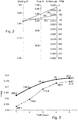
- Figure 2 is a nomograph (also called nomogram, alignment chart or abaque) representing the relation between IV of PET before drying and injection molding and IV of PET after drying and plasticization, depending on the moisture content of PET after drying.
- This chart which represents well known information in a convenient manner, has been established by Plastic Technologies, Inc. (PTI®).
- This chart comprises three vertical scales.
- the left scale represents the IV of PET before processing, i.e. the IV (in dL/g) of the PET constituting the PET chips as provided from the PET manufacturer.
- the center scale represents the IV (in dL/g) of PET after plasticization in the extruder, which is also the final IV of the molded PET.
- the right scale represents the moisture content of PET after drying, expressed in weight percentage.
- This chart is read by drafting a straight line between two given values of two different scales, making thus possible to determine the corresponding value on the third scale. For example (see line A in figure 2 ), if a PET having an IV of 0.82 dL/g is provided, and the sought final IV value is 0.80 dL/g, a maximum moisture content of 0.002% (or 20 ppm) must be reached after drying. These are typical values used to manufacture beverage bottles, for example sparkling water bottles requiring use of high-IV PET.
- Loss of IV occurs mainly during plasticization of PET in the extruder. This loss is due to a reversible and/or non-reversible degradation of the PET (breaking of polymer chains).
- Degradation is a chemical process which affects not only the chemical composition of the polymer but also the physical parameters such as the color of the polymer, its chain conformation, its molecular weight, its molecular weight distribution and its crystallinity.
- the degradation has three origins: hydrolytic, thermo-oxidative, and thermal.
- the thermal degradation is due to the overheating of the material during the injection process. It results in discoloration, chain scissions resulting in reduced molecular weight, formation of acetaldehyde and finally poor mechanical characteristics of the products.
- thermo-oxidative degradation is due to reaction with oxygen. It results in a degradation of the material causing a loss of IV, formation of acetaldehyde, discoloration and loss of mechanical properties.
- the hydrolytic degradation is caused by the presence of water (moisture) in the material which leads to hydrolysis of the polymer. It results in reduction of the molecular weight (intrinsic viscosity reduction), loss of mechanical properties and formation of acetaldehyde.
- the impact of hydrolytic degradation is 5000 times greater than the impact of oxidative degradation and 10 000 greater than the impact of thermal degradation.
- the hydrolysis reaction leads to molecular chain scission at the ester bond.
- the molecular weight decreases such that the melt viscosity and intrinsic viscosity also drop.
- the content of carbonyl end groups (such as acetaldehyde; benzene and formaldehyde) increases.
- PET drying PET to a moisture content value above 50 ppm makes it possible to obtain PET having a low-IV (typically between 0.70 dL/g and 0.75 dL/g) from PET having a high-IV.
- a low-IV typically between 0.70 dL/g and 0.75 dL/g
- a final IV of 0.74 dL/g may be obtained by drying PET to 0.010% of moisture (see line B in Figure 2 ).
- 0.74dL/g is sufficient for making bottles intended to contain still water, while PET having such a low IV is easier to mold, because it requires a lower pressure for injection molding, and has a more homogeneous distribution in the mold. It allows preforms to be manufactured having a wall thickness of less than 2mm, making possible to obtain small lightweight thin-walled bottles after blow-molding, having typically a wall thickness of less than 200 micron, or even less than 100 micron.
- a controlled drop in IV during plasticization of the PET may typically be obtained by leaving a moisture content between 60ppm and 250ppm after drying, depending on the IV of the PET before drying and the sought final IV.
- FIG. 2 A third example is shown in Figure 2 .
- the line denoted C illustrates that, starting from a PET having an IV of 0.84 dL/g, a moisture content of 150ppm leads to a final IV of 0.72dL/g.
- Figures 3 to 5 illustrate how the drying parameters may be adapted to obtain a target moisture level.
- Figure 3 schematically illustrates the influence on PET drying of the dew point of the air used for drying. Drying time (or residence time of PET in the hopper) in hours is shown on the abscissa. The intrinsic viscosity in dL/g is shown on the ordinate.
- Curve D corresponds to drying with air having a temperature of 170°C and a dew point of -40°C.
- Curve E corresponds to drying with air having the same temperature of 170°C and a dew point of -30°C. All other drying parameters are equal.
- the moisture content or relative humidity is measured each hour.
- the value of relative humidity is written next to the corresponding measurement point.
- the first measurement is performed after one hour of drying. It is known that during the first hour of drying, IV dramatically decreases before it rises again and then stabilizes at a value depending on the drying parameters (mainly air temperature and dew point).
- an air temperature of 170°C and a dew point of -40°C are used to obtain, after five hour of drying, a relative humidity of about 30ppm (here 33.4ppm). This value remains stable or decreases very slowly if the drying is continued after five hours.
- Curve E illustrates PET drying under the same drying conditions, except that air having a dew point of -30°C is used (which means that the air which is used for drying is slightly more humid than the air used for the drying step illustrated by curve D).
- air having a dew point of -30°C is used (which means that the air which is used for drying is slightly more humid than the air used for the drying step illustrated by curve D).
- with a dew point of -30°C relative humidity of PET stabilizes at around 60ppm (here 61.2 ppm after 5 hours of drying).
- drying PET to 60 ppm of water may for example be used to make a material having an initial IV of 0.80 dL/g reach a final IV of 0.75dL/g.
- FIG. 4 schematically illustrates the influence of drying time on PET drying. Drying time (or residence time of PET in hopper) in hours is shown on the abscissa. The relative humidity (RH) in ppm is shown on the ordinate. Curve F represents the change in the Relative Humidity of PET over five hours drying, starting from a relative humidity of 1667 pmm of water in PET. Curve G represents the change in the relative Humidity of PET over five hours drying, starting from a relative humidity of 680 pmm of water in PET. Both drying operations are performed under the same conditions (air temperature of 170°C and dew point of -40°C). This graph shows that four to five hours are necessary to obtain the same very low relative humidity of 25 ppm, regardless of the initial relative humidity.
- the drying time may be a parameter adapted to obtain the wanted relative humidity of PET.
- a drying time limited to about two hours (this time being empirically finely adjusted) in conventional drying conditions may be used to obtain PET having a relative humidity of 100ppm of water.
- drying PET to 100 ppm of water may for example be used to make a material having an initial IV of 0.82 dL/g reach a final IV of 0.74dL/g.
- the applicant has found that, using a PET material having 100ppm of water after drying does not (or almost not) impair the mechanical properties of the final product (after injection-molding and, if appropriate, blow-molding).
- Figure 5 shows a comparison between two PET drying processes using different parameters. Drying time (or residence time of PET in hopper) in hours is shown on the abscissa. The relative humidity (RH) in ppm is shown on the ordinate. Curve H represents the evolution of the Relative Humidity of PET over five hours drying, starting from a relative humidity of 2147 ppm of water, using drying air having a temperature of 140°C and a dew point of -45°C. Curve I represents the evolution of the Relative Humidity of PET over five hours drying, starting from a relative humidity of 1957 ppm of water, using drying air having a temperature of 160°C and a dew point of -25°C.
- Air temperature and air dew point are the most important parameters for drying. However, after three hours drying the relative humidity of PET dried under relatively high temperature (e.g. 160°C) and PET dried under a lower temperature but a very low dew point (e.g. -45°C) is the same.
- Producing hot air is energy consuming. Producing dry air requires an effective desiccant, which has to be periodically regenerated.
- the last degrees of temperature and the last percent of dryness are the most expensive to obtain. That is why, in addition to the advantages brought by the controlled loss of intrinsic viscosity obtained in the invention, using colder air compared to standard drying conditions (e.g. a temperature of 170°C and a dew point of -40°C) like in the example represented by curve H, and/or air having a higher dew point like in the example represented by curve I may be cost efficient.
- a temperature of about 170°C must be used, at least because a lower temperature could lead to difficulties in the extruder, which should require heating the PET again.
- a drying temperature of 150°C may be used with success. This arises from the fact that the loss of IV generated in the extruder compensates for the higher viscosity due to a lower temperature of PET.
- Figure 6 schematically illustrates an example of fluctuation of IV during PET drying. Drying time (or residence time of PET in hopper) in hours is shown on the abscissa. The intrinsic viscosity in dL/g is shown on the ordinate. The moisture content or relative humidity is measured each hour. The value of relative humidity is written next to the corresponding point of measurement.
- the graph shown in Figure 6 corresponds to PET drying using air at 160°C having a dew point of -40°C. This is slightly colder than the generally used temperature of 170°C.
- the intrinsic viscosity drops drastically.
- the intrinsic viscosity rises and stabilizes after 5 to 6 hours. This also corresponds to a stabilization of the moisture content in the PET.
- the moisture content stabilizes around 74 ppm, causing an IV loss of 0.04 dL/g (which is much more than the maximum of 0.01 to 0.02 dL/g commonly accepted).
- This may for example be used to make PET having an initial IV of 0.80 dL/g reach a final IV of 0.76dL/g.
- Figure 7 schematically illustrates an example of fluctuation of IV during PET drying. Drying time (or residence time of PET in the hopper) in hours is shown on the abscissa. The intrinsic viscosity in dL/g is shown on the ordinate. The moisture content or relative humidity is measured each hour. The value of relative humidity is written next to the corresponding point of measurement.
- the graph shown in Figure 7 corresponds to PET drying using air at 150°C having a dew point of -40°C. This is colder than the generally used temperature of 170°C.
- the intrinsic viscosity drops drastically.
- the intrinsic viscosity rises and stabilizes after about 2 hours. This also corresponds to a stabilization of the moisture content in the PET.
- the moisture content stabilizes around 100 ppm, causing an IV loss of 0.06 dL/g (which is much more than the maximum of 0.01 to 0.02 dL/g commonly accepted).
- This may for example be used to make PET having an initial IV of 0.80 dL/g reach a final IV of 0.74dL/g.
- FIG 8 is a block diagram representing a process according to an embodiment of the invention.
- PET raw material is supplied in a first step S1.
- PET is commonly supplied in the form of PET chips which are water-saturated.
- the intrinsic viscosity of the supplied PET material is known, or determined in an IV determining step S2.
- a target moisture level is determined in a third step S3.
- the target moisture level is preferably based on the intrinsic viscosity of the supplied PET raw material, determined at the determining step S2 of the represented embodiment of the invention, and a targeted intrinsic viscosity of the PET after plasticization.
- the target moisture level is between 60ppm and 250ppm.
- the PET chips are then dried during a drying step S4. After the drying step, the PET material has reached the target moisture level determined at the third step S3.
- the dried PET is then placed in an extruder in which it is plasticized in a plasticization step S5.
- a plasticization step S5 hydrolysis of PET occurs, leading to a drop of intrinsic viscosity, dependent on the moisture level of the PET after the drying step S3.
- the plasticized PET is injected into a mold.
- a preform may be injection molded, the preform being configured for obtaining a bottle by blow-molding.
- the invention makes it possible to use cheap high-IV PET even when such high IV is not necessary (for example for making still water bottles).
- Lower cost compared to the standard processing of high-IV PET is obtained by the use of drying air being colder and/or having a higher dew point than drying air generally used for drying PET.
- PET residence time in the drying hopper may also be shortened.
- Relatively old injection-molding devices comprising an extruder and a mold
- the invention thus makes it possible to reduce the costs for providing energy all along the manufacturing process of a container such as a bottle, and makes it possible to reduce the costs related to the used material, while maintaining the physical properties of the obtained container.
- a controlled loss of IV of the PET may also facilitate obtaining preforms having a small wall thickness such as less than 2mm.
- a preform is needed to obtain a lightweight thin-walled bottle, having walls having a thickness of less than 200 microns and preferably less than 100 microns, e.g. between 50 microns and 100 microns.
- Such a thickness is preferably present for the majority of the bottle walls, i.e. more than 50 percent of the surface of the bottle.
Landscapes
- Engineering & Computer Science (AREA)
- Mechanical Engineering (AREA)
- Manufacturing & Machinery (AREA)
- Processing And Handling Of Plastics And Other Materials For Molding In General (AREA)
- Polyesters Or Polycarbonates (AREA)
- Injection Moulding Of Plastics Or The Like (AREA)
Claims (7)
- Verfahren zur Verarbeitung von Polyethylenterephthalat (PET), umfassend:- Zuführen von PET-Rohmaterial (S1) mit einer Grenzviskosität zwischen 0,80 dl/g und 0,85 dl/g;- Trocknen des PET-Rohmaterials (S4) bei einer Temperatur von 150 °C oder darunter auf einen Soll-Feuchtigkeitsgrad zwischen 60 ppm und 250 ppm, das Trocknen des PET mithilfe von Trocknungsluft mit einem Taupunkt von -40 °C oder höher, vorzugsweise ungefähr -30 °C, und einer Verweilzeit des PET-Rohmaterials in einem Trockner zwischen einer und vier Stunden, vorzugsweise zwischen einer und drei Stunden;- Weichmachen des PET (S5) mit einem Feuchtigkeitsgrad zwischen 60 ppm und 250 ppm, um eine Hydrolyse von PET während der Weichmachung (S5) zu erzeugen, was zu einem kontrollierten Abfall der Grenzviskosität des PET führt, um eine Soll-Grenzviskosität zwischen 0,70 dl/g und 0,76 dl/g zu erreichen; und- Einspritzen des weich gemachten PET (S6) in eine Form (6).
- Verfahren nach Anspruch 1, ferner umfassend vor dem Trocknen des PET-Rohmaterials (S4) das Bestimmen des Soll-Feuchtigkeitsgrads (S3) auf der Basis der Grenzviskosität des zugeführten PET-Rohmaterials und einer Soll-Grenzviskosität des PET nach Weichmachung.
- Verfahren nach einem der vorstehenden Ansprüche, wobei PET spritzgegossen wird, um einen Behältervorformling zu bilden.
- Verfahren nach Anspruch 3, wobei der Behälter eine Flasche ist.
- Verfahren zum Bilden einer Flasche, umfassend das Verwenden eines Verfahrens nach Anspruch 4 zum Bereitstellen eines Vorformlings einer Flasche und Erhalten der Flasche mithilfe von Blasformen.
- Verfahren zum Bilden einer Flasche nach Anspruch 5, wobei die Flasche über mindestens 50 Prozent ihrer Oberfläche eine Wanddicke von weniger als 100 Mikrometer aufweist.
- Verfahren zum Verpacken eines stillen Getränks, umfassend das Verwenden eines Verfahrens nach Anspruch 5 oder Anspruch 6 zum Bereitstellen einer Flasche und Füllen der Flasche mit dem stillen Getränk.
Priority Applications (1)
| Application Number | Priority Date | Filing Date | Title |
|---|---|---|---|
| PL15736470T PL3166993T3 (pl) | 2014-07-10 | 2015-07-09 | Sposób przetwarzania poli(tereftalanu etylenu) |
Applications Claiming Priority (2)
| Application Number | Priority Date | Filing Date | Title |
|---|---|---|---|
| EP14176604 | 2014-07-10 | ||
| PCT/EP2015/065691 WO2016005493A1 (en) | 2014-07-10 | 2015-07-09 | Method for processing polyethylene terephthalate |
Publications (2)
| Publication Number | Publication Date |
|---|---|
| EP3166993A1 EP3166993A1 (de) | 2017-05-17 |
| EP3166993B1 true EP3166993B1 (de) | 2019-04-17 |
Family
ID=51205212
Family Applications (1)
| Application Number | Title | Priority Date | Filing Date |
|---|---|---|---|
| EP15736470.4A Active EP3166993B1 (de) | 2014-07-10 | 2015-07-09 | Verfahren zur verarbeitung von polyethylenterephthalat |
Country Status (7)
| Country | Link |
|---|---|
| US (1) | US10343323B2 (de) |
| EP (1) | EP3166993B1 (de) |
| CN (1) | CN106470815B (de) |
| ES (1) | ES2727085T3 (de) |
| PL (1) | PL3166993T3 (de) |
| TR (1) | TR201907421T4 (de) |
| WO (1) | WO2016005493A1 (de) |
Families Citing this family (3)
| Publication number | Priority date | Publication date | Assignee | Title |
|---|---|---|---|---|
| US10525615B2 (en) * | 2017-10-11 | 2020-01-07 | Novatec, Inc. | Water regulated temperature controlled resin drying |
| CN108481713A (zh) * | 2018-04-04 | 2018-09-04 | 广东星联精密机械有限公司 | 一种瓶胚熔胶注塑工艺 |
| EP3722219B1 (de) | 2019-04-12 | 2024-11-27 | Société Anonyme des Eaux Minérales d'Evian et en Abrégé "S.A.E.M.E" | Dünnwandiger behälter aus recyceltem material |
Family Cites Families (10)
| Publication number | Priority date | Publication date | Assignee | Title |
|---|---|---|---|---|
| GB1176135A (en) * | 1966-03-11 | 1970-01-01 | Nat Res Dev | Improvements in or relating to Control Apparatus for a Drying Plant |
| NL8003047A (nl) * | 1979-10-22 | 1981-04-24 | Mathis Systemtechnik Gmbh | Werkwijze en inrichting voor het drogen van stort- materiaal. |
| IT1252491B (it) | 1991-03-06 | 1995-06-19 | Dorn Co V | Sistema, metodo ed apparato per processo monostadio per produrre contenitori di polietilentereftalato (pet) destinati ad accogliere liquidi caldi |
| JP2001079917A (ja) * | 1999-09-13 | 2001-03-27 | Nissho Giken:Kk | 回収ペットボトル粉砕フレークの改質成形方法 |
| AUPQ294699A0 (en) * | 1999-09-17 | 1999-10-14 | Visy Plastics Pty Ltd | Process for preparing food contact grade polyethylene terephthalate resin from waste pet containers |
| DE10140370A1 (de) * | 2001-08-23 | 2003-03-06 | Buehler Ag | Verfahren zur Verarbeitung eines Polykondensats in einem Mehrwellen-Extruder |
| US6655043B1 (en) * | 2001-09-21 | 2003-12-02 | Apac Inc. | Dryer moisture indicator |
| DE102005004533A1 (de) * | 2005-01-31 | 2006-08-10 | Mann + Hummel Protec Gmbh | Verfahren zum Trocknen von Kunststoffgranulat |
| CN100545047C (zh) * | 2007-01-01 | 2009-09-30 | 周世均 | 一种编织袋及其生产工艺和装置 |
| EP2065164A1 (de) * | 2007-11-27 | 2009-06-03 | Aisapack Holding SA | Herstellungsverfahren einer Verpackung für Heißabfüllung sowie eine solche Verpackung |
-
2015
- 2015-07-09 EP EP15736470.4A patent/EP3166993B1/de active Active
- 2015-07-09 TR TR2019/07421T patent/TR201907421T4/tr unknown
- 2015-07-09 WO PCT/EP2015/065691 patent/WO2016005493A1/en not_active Ceased
- 2015-07-09 US US15/324,933 patent/US10343323B2/en active Active
- 2015-07-09 PL PL15736470T patent/PL3166993T3/pl unknown
- 2015-07-09 CN CN201580037085.3A patent/CN106470815B/zh not_active Expired - Fee Related
- 2015-07-09 ES ES15736470T patent/ES2727085T3/es active Active
Non-Patent Citations (1)
| Title |
|---|
| None * |
Also Published As
| Publication number | Publication date |
|---|---|
| US10343323B2 (en) | 2019-07-09 |
| TR201907421T4 (tr) | 2019-06-21 |
| ES2727085T3 (es) | 2019-10-14 |
| US20170210050A1 (en) | 2017-07-27 |
| PL3166993T3 (pl) | 2019-08-30 |
| EP3166993A1 (de) | 2017-05-17 |
| CN106470815B (zh) | 2019-09-27 |
| WO2016005493A1 (en) | 2016-01-14 |
| CN106470815A (zh) | 2017-03-01 |
Similar Documents
| Publication | Publication Date | Title |
|---|---|---|
| US12434422B2 (en) | Container and method of manufacture | |
| CN102971358B (zh) | 用于挤出吹塑的超高iv聚酯及其生产方法 | |
| US11014280B2 (en) | Preform for producing a plastic container, production of the preform and plastic container produced from the preform, as well as its production | |
| US20100140280A1 (en) | Bottle made from bioresin | |
| US10343323B2 (en) | Method for processing polyethylene terephthalate | |
| US7247698B2 (en) | Methods for making polyethylene terephthalate (PET) preforms and containers such as food bottles, containers and intermediate preforms obtained | |
| US20250312962A1 (en) | Container and method of manufacture | |
| US20100143625A1 (en) | Preform for blow molding a bottle from bioresin | |
| US20090213682A1 (en) | Method of Decreasing Acetaldehyde Level in a Molded Article | |
| KR101091168B1 (ko) | 폴리에틸렌테레프탈레이트 수지 조성물, 이의 성형방법 및용기 | |
| JP2012136292A (ja) | 透明容器及び透明容器の製造方法 | |
| US20250296273A1 (en) | Container and method of manufacture | |
| WO2023014333A1 (en) | Silica added pet bottle and production method | |
| WO2010065016A1 (en) | Bottle made from bioresin | |
| CA2651391A1 (en) | Method of blow molding a bottle from bioresin | |
| WO2010065021A1 (en) | Method of blow molding a bottle from bioresin | |
| KR20060078017A (ko) | 다층용기용 프리폼의 제조방법 | |
| BR112019013728B1 (pt) | Regranulado de pet, recipiente, e, método para produção de um regranulado de pet | |
| HK1071327A (en) | Processes for producing pet preforms and containers such as food bottles, containers and intermediate preforms obtained | |
| WO2010065020A1 (en) | Preform for blow molding a bottle from bioresin | |
| KR19980058631A (ko) | 폴리에틸렌테레프탈레이트 프리폼의 사출성형방법 |
Legal Events
| Date | Code | Title | Description |
|---|---|---|---|
| STAA | Information on the status of an ep patent application or granted ep patent |
Free format text: STATUS: THE INTERNATIONAL PUBLICATION HAS BEEN MADE |
|
| PUAI | Public reference made under article 153(3) epc to a published international application that has entered the european phase |
Free format text: ORIGINAL CODE: 0009012 |
|
| STAA | Information on the status of an ep patent application or granted ep patent |
Free format text: STATUS: REQUEST FOR EXAMINATION WAS MADE |
|
| 17P | Request for examination filed |
Effective date: 20170210 |
|
| AK | Designated contracting states |
Kind code of ref document: A1 Designated state(s): AL AT BE BG CH CY CZ DE DK EE ES FI FR GB GR HR HU IE IS IT LI LT LU LV MC MK MT NL NO PL PT RO RS SE SI SK SM TR |
|
| AX | Request for extension of the european patent |
Extension state: BA ME |
|
| DAV | Request for validation of the european patent (deleted) | ||
| DAX | Request for extension of the european patent (deleted) | ||
| RAP1 | Party data changed (applicant data changed or rights of an application transferred) |
Owner name: NESTEC S.A. |
|
| GRAP | Despatch of communication of intention to grant a patent |
Free format text: ORIGINAL CODE: EPIDOSNIGR1 |
|
| STAA | Information on the status of an ep patent application or granted ep patent |
Free format text: STATUS: GRANT OF PATENT IS INTENDED |
|
| INTG | Intention to grant announced |
Effective date: 20181114 |
|
| GRAS | Grant fee paid |
Free format text: ORIGINAL CODE: EPIDOSNIGR3 |
|
| GRAA | (expected) grant |
Free format text: ORIGINAL CODE: 0009210 |
|
| STAA | Information on the status of an ep patent application or granted ep patent |
Free format text: STATUS: THE PATENT HAS BEEN GRANTED |
|
| AK | Designated contracting states |
Kind code of ref document: B1 Designated state(s): AL AT BE BG CH CY CZ DE DK EE ES FI FR GB GR HR HU IE IS IT LI LT LU LV MC MK MT NL NO PL PT RO RS SE SI SK SM TR |
|
| REG | Reference to a national code |
Ref country code: GB Ref legal event code: FG4D |
|
| REG | Reference to a national code |
Ref country code: CH Ref legal event code: EP |
|
| REG | Reference to a national code |
Ref country code: DE Ref legal event code: R096 Ref document number: 602015028472 Country of ref document: DE |
|
| REG | Reference to a national code |
Ref country code: AT Ref legal event code: REF Ref document number: 1121479 Country of ref document: AT Kind code of ref document: T Effective date: 20190515 Ref country code: IE Ref legal event code: FG4D |
|
| REG | Reference to a national code |
Ref country code: NL Ref legal event code: FP |
|
| REG | Reference to a national code |
Ref country code: NL Ref legal event code: PD Owner name: SOCIETE DES PRODUITS NESTLE S.A.; CH Free format text: DETAILS ASSIGNMENT: CHANGE OF OWNER(S), MERGE Effective date: 20190620 |
|
| RAP2 | Party data changed (patent owner data changed or rights of a patent transferred) |
Owner name: SOCIETE DES PRODUITS NESTLE S.A. |
|
| REG | Reference to a national code |
Ref country code: CH Ref legal event code: PCOW |
|
| REG | Reference to a national code |
Ref country code: GB Ref legal event code: 732E Free format text: REGISTERED BETWEEN 20190801 AND 20190807 |
|
| REG | Reference to a national code |
Ref country code: LT Ref legal event code: MG4D |
|
| REG | Reference to a national code |
Ref country code: ES Ref legal event code: FG2A Ref document number: 2727085 Country of ref document: ES Kind code of ref document: T3 Effective date: 20191014 |
|
| PG25 | Lapsed in a contracting state [announced via postgrant information from national office to epo] |
Ref country code: PT Free format text: LAPSE BECAUSE OF FAILURE TO SUBMIT A TRANSLATION OF THE DESCRIPTION OR TO PAY THE FEE WITHIN THE PRESCRIBED TIME-LIMIT Effective date: 20190817 Ref country code: AL Free format text: LAPSE BECAUSE OF FAILURE TO SUBMIT A TRANSLATION OF THE DESCRIPTION OR TO PAY THE FEE WITHIN THE PRESCRIBED TIME-LIMIT Effective date: 20190417 Ref country code: LT Free format text: LAPSE BECAUSE OF FAILURE TO SUBMIT A TRANSLATION OF THE DESCRIPTION OR TO PAY THE FEE WITHIN THE PRESCRIBED TIME-LIMIT Effective date: 20190417 Ref country code: NO Free format text: LAPSE BECAUSE OF FAILURE TO SUBMIT A TRANSLATION OF THE DESCRIPTION OR TO PAY THE FEE WITHIN THE PRESCRIBED TIME-LIMIT Effective date: 20190717 Ref country code: FI Free format text: LAPSE BECAUSE OF FAILURE TO SUBMIT A TRANSLATION OF THE DESCRIPTION OR TO PAY THE FEE WITHIN THE PRESCRIBED TIME-LIMIT Effective date: 20190417 Ref country code: SE Free format text: LAPSE BECAUSE OF FAILURE TO SUBMIT A TRANSLATION OF THE DESCRIPTION OR TO PAY THE FEE WITHIN THE PRESCRIBED TIME-LIMIT Effective date: 20190417 Ref country code: HR Free format text: LAPSE BECAUSE OF FAILURE TO SUBMIT A TRANSLATION OF THE DESCRIPTION OR TO PAY THE FEE WITHIN THE PRESCRIBED TIME-LIMIT Effective date: 20190417 |
|
| PGFP | Annual fee paid to national office [announced via postgrant information from national office to epo] |
Ref country code: TR Payment date: 20190702 Year of fee payment: 5 |
|
| PG25 | Lapsed in a contracting state [announced via postgrant information from national office to epo] |
Ref country code: RS Free format text: LAPSE BECAUSE OF FAILURE TO SUBMIT A TRANSLATION OF THE DESCRIPTION OR TO PAY THE FEE WITHIN THE PRESCRIBED TIME-LIMIT Effective date: 20190417 Ref country code: LV Free format text: LAPSE BECAUSE OF FAILURE TO SUBMIT A TRANSLATION OF THE DESCRIPTION OR TO PAY THE FEE WITHIN THE PRESCRIBED TIME-LIMIT Effective date: 20190417 Ref country code: BG Free format text: LAPSE BECAUSE OF FAILURE TO SUBMIT A TRANSLATION OF THE DESCRIPTION OR TO PAY THE FEE WITHIN THE PRESCRIBED TIME-LIMIT Effective date: 20190717 Ref country code: GR Free format text: LAPSE BECAUSE OF FAILURE TO SUBMIT A TRANSLATION OF THE DESCRIPTION OR TO PAY THE FEE WITHIN THE PRESCRIBED TIME-LIMIT Effective date: 20190718 |
|
| REG | Reference to a national code |
Ref country code: AT Ref legal event code: MK05 Ref document number: 1121479 Country of ref document: AT Kind code of ref document: T Effective date: 20190417 |
|
| PG25 | Lapsed in a contracting state [announced via postgrant information from national office to epo] |
Ref country code: IS Free format text: LAPSE BECAUSE OF FAILURE TO SUBMIT A TRANSLATION OF THE DESCRIPTION OR TO PAY THE FEE WITHIN THE PRESCRIBED TIME-LIMIT Effective date: 20190817 |
|
| REG | Reference to a national code |
Ref country code: DE Ref legal event code: R097 Ref document number: 602015028472 Country of ref document: DE |
|
| PG25 | Lapsed in a contracting state [announced via postgrant information from national office to epo] |
Ref country code: CZ Free format text: LAPSE BECAUSE OF FAILURE TO SUBMIT A TRANSLATION OF THE DESCRIPTION OR TO PAY THE FEE WITHIN THE PRESCRIBED TIME-LIMIT Effective date: 20190417 Ref country code: AT Free format text: LAPSE BECAUSE OF FAILURE TO SUBMIT A TRANSLATION OF THE DESCRIPTION OR TO PAY THE FEE WITHIN THE PRESCRIBED TIME-LIMIT Effective date: 20190417 Ref country code: RO Free format text: LAPSE BECAUSE OF FAILURE TO SUBMIT A TRANSLATION OF THE DESCRIPTION OR TO PAY THE FEE WITHIN THE PRESCRIBED TIME-LIMIT Effective date: 20190417 Ref country code: EE Free format text: LAPSE BECAUSE OF FAILURE TO SUBMIT A TRANSLATION OF THE DESCRIPTION OR TO PAY THE FEE WITHIN THE PRESCRIBED TIME-LIMIT Effective date: 20190417 Ref country code: DK Free format text: LAPSE BECAUSE OF FAILURE TO SUBMIT A TRANSLATION OF THE DESCRIPTION OR TO PAY THE FEE WITHIN THE PRESCRIBED TIME-LIMIT Effective date: 20190417 Ref country code: SK Free format text: LAPSE BECAUSE OF FAILURE TO SUBMIT A TRANSLATION OF THE DESCRIPTION OR TO PAY THE FEE WITHIN THE PRESCRIBED TIME-LIMIT Effective date: 20190417 |
|
| REG | Reference to a national code |
Ref country code: DE Ref legal event code: R082 Ref document number: 602015028472 Country of ref document: DE Representative=s name: MITSCHERLICH, PATENT- UND RECHTSANWAELTE PARTM, DE Ref country code: DE Ref legal event code: R081 Ref document number: 602015028472 Country of ref document: DE Owner name: SOCIETE DES PRODUITS NESTLE S.A., CH Free format text: FORMER OWNER: NESTEC S.A., VEVEY, CH |
|
| PLBE | No opposition filed within time limit |
Free format text: ORIGINAL CODE: 0009261 |
|
| STAA | Information on the status of an ep patent application or granted ep patent |
Free format text: STATUS: NO OPPOSITION FILED WITHIN TIME LIMIT |
|
| PG25 | Lapsed in a contracting state [announced via postgrant information from national office to epo] |
Ref country code: MC Free format text: LAPSE BECAUSE OF FAILURE TO SUBMIT A TRANSLATION OF THE DESCRIPTION OR TO PAY THE FEE WITHIN THE PRESCRIBED TIME-LIMIT Effective date: 20190417 Ref country code: SM Free format text: LAPSE BECAUSE OF FAILURE TO SUBMIT A TRANSLATION OF THE DESCRIPTION OR TO PAY THE FEE WITHIN THE PRESCRIBED TIME-LIMIT Effective date: 20190417 |
|
| 26N | No opposition filed |
Effective date: 20200120 |
|
| REG | Reference to a national code |
Ref country code: BE Ref legal event code: MM Effective date: 20190731 |
|
| PG25 | Lapsed in a contracting state [announced via postgrant information from national office to epo] |
Ref country code: SI Free format text: LAPSE BECAUSE OF FAILURE TO SUBMIT A TRANSLATION OF THE DESCRIPTION OR TO PAY THE FEE WITHIN THE PRESCRIBED TIME-LIMIT Effective date: 20190417 Ref country code: BE Free format text: LAPSE BECAUSE OF NON-PAYMENT OF DUE FEES Effective date: 20190731 Ref country code: LU Free format text: LAPSE BECAUSE OF NON-PAYMENT OF DUE FEES Effective date: 20190709 |
|
| PG25 | Lapsed in a contracting state [announced via postgrant information from national office to epo] |
Ref country code: IE Free format text: LAPSE BECAUSE OF NON-PAYMENT OF DUE FEES Effective date: 20190709 |
|
| PGFP | Annual fee paid to national office [announced via postgrant information from national office to epo] |
Ref country code: NL Payment date: 20200715 Year of fee payment: 6 |
|
| PG25 | Lapsed in a contracting state [announced via postgrant information from national office to epo] |
Ref country code: CY Free format text: LAPSE BECAUSE OF FAILURE TO SUBMIT A TRANSLATION OF THE DESCRIPTION OR TO PAY THE FEE WITHIN THE PRESCRIBED TIME-LIMIT Effective date: 20190417 |
|
| PG25 | Lapsed in a contracting state [announced via postgrant information from national office to epo] |
Ref country code: HU Free format text: LAPSE BECAUSE OF FAILURE TO SUBMIT A TRANSLATION OF THE DESCRIPTION OR TO PAY THE FEE WITHIN THE PRESCRIBED TIME-LIMIT; INVALID AB INITIO Effective date: 20150709 Ref country code: MT Free format text: LAPSE BECAUSE OF FAILURE TO SUBMIT A TRANSLATION OF THE DESCRIPTION OR TO PAY THE FEE WITHIN THE PRESCRIBED TIME-LIMIT Effective date: 20190417 |
|
| REG | Reference to a national code |
Ref country code: NL Ref legal event code: MM Effective date: 20210801 |
|
| PG25 | Lapsed in a contracting state [announced via postgrant information from national office to epo] |
Ref country code: NL Free format text: LAPSE BECAUSE OF NON-PAYMENT OF DUE FEES Effective date: 20210801 |
|
| PG25 | Lapsed in a contracting state [announced via postgrant information from national office to epo] |
Ref country code: TR Free format text: LAPSE BECAUSE OF NON-PAYMENT OF DUE FEES Effective date: 20200709 Ref country code: MK Free format text: LAPSE BECAUSE OF FAILURE TO SUBMIT A TRANSLATION OF THE DESCRIPTION OR TO PAY THE FEE WITHIN THE PRESCRIBED TIME-LIMIT Effective date: 20190417 |
|
| P01 | Opt-out of the competence of the unified patent court (upc) registered |
Effective date: 20230527 |
|
| PGFP | Annual fee paid to national office [announced via postgrant information from national office to epo] |
Ref country code: PL Payment date: 20250612 Year of fee payment: 11 |
|
| PGFP | Annual fee paid to national office [announced via postgrant information from national office to epo] |
Ref country code: GB Payment date: 20250529 Year of fee payment: 11 |
|
| PGFP | Annual fee paid to national office [announced via postgrant information from national office to epo] |
Ref country code: FR Payment date: 20250610 Year of fee payment: 11 |
|
| PGFP | Annual fee paid to national office [announced via postgrant information from national office to epo] |
Ref country code: ES Payment date: 20250805 Year of fee payment: 11 |
|
| PGFP | Annual fee paid to national office [announced via postgrant information from national office to epo] |
Ref country code: DE Payment date: 20250604 Year of fee payment: 11 |
|
| PGFP | Annual fee paid to national office [announced via postgrant information from national office to epo] |
Ref country code: IT Payment date: 20250623 Year of fee payment: 11 |
|
| PGFP | Annual fee paid to national office [announced via postgrant information from national office to epo] |
Ref country code: CH Payment date: 20250801 Year of fee payment: 11 |