EP3145948B1 - Production commerciale de l'allergène amb a1 par expression transitoire chez les plantes - Google Patents
Production commerciale de l'allergène amb a1 par expression transitoire chez les plantes Download PDFInfo
- Publication number
- EP3145948B1 EP3145948B1 EP15732775.0A EP15732775A EP3145948B1 EP 3145948 B1 EP3145948 B1 EP 3145948B1 EP 15732775 A EP15732775 A EP 15732775A EP 3145948 B1 EP3145948 B1 EP 3145948B1
- Authority
- EP
- European Patent Office
- Prior art keywords
- amb
- plant cell
- pectate lyase
- plant
- expression
- Prior art date
- Legal status (The legal status is an assumption and is not a legal conclusion. Google has not performed a legal analysis and makes no representation as to the accuracy of the status listed.)
- Active
Links
Images


Classifications
-
- C—CHEMISTRY; METALLURGY
- C12—BIOCHEMISTRY; BEER; SPIRITS; WINE; VINEGAR; MICROBIOLOGY; ENZYMOLOGY; MUTATION OR GENETIC ENGINEERING
- C12N—MICROORGANISMS OR ENZYMES; COMPOSITIONS THEREOF; PROPAGATING, PRESERVING, OR MAINTAINING MICROORGANISMS; MUTATION OR GENETIC ENGINEERING; CULTURE MEDIA
- C12N9/00—Enzymes; Proenzymes; Compositions thereof; Processes for preparing, activating, inhibiting, separating or purifying enzymes
- C12N9/88—Lyases (4.)
-
- A—HUMAN NECESSITIES
- A61—MEDICAL OR VETERINARY SCIENCE; HYGIENE
- A61P—SPECIFIC THERAPEUTIC ACTIVITY OF CHEMICAL COMPOUNDS OR MEDICINAL PREPARATIONS
- A61P37/00—Drugs for immunological or allergic disorders
- A61P37/08—Antiallergic agents
-
- C—CHEMISTRY; METALLURGY
- C07—ORGANIC CHEMISTRY
- C07K—PEPTIDES
- C07K14/00—Peptides having more than 20 amino acids; Gastrins; Somatostatins; Melanotropins; Derivatives thereof
- C07K14/415—Peptides having more than 20 amino acids; Gastrins; Somatostatins; Melanotropins; Derivatives thereof from plants
-
- C—CHEMISTRY; METALLURGY
- C12—BIOCHEMISTRY; BEER; SPIRITS; WINE; VINEGAR; MICROBIOLOGY; ENZYMOLOGY; MUTATION OR GENETIC ENGINEERING
- C12N—MICROORGANISMS OR ENZYMES; COMPOSITIONS THEREOF; PROPAGATING, PRESERVING, OR MAINTAINING MICROORGANISMS; MUTATION OR GENETIC ENGINEERING; CULTURE MEDIA
- C12N15/00—Mutation or genetic engineering; DNA or RNA concerning genetic engineering, vectors, e.g. plasmids, or their isolation, preparation or purification; Use of hosts therefor
- C12N15/09—Recombinant DNA-technology
- C12N15/63—Introduction of foreign genetic material using vectors; Vectors; Use of hosts therefor; Regulation of expression
- C12N15/79—Vectors or expression systems specially adapted for eukaryotic hosts
- C12N15/82—Vectors or expression systems specially adapted for eukaryotic hosts for plant cells, e.g. plant artificial chromosomes (PACs)
-
- C—CHEMISTRY; METALLURGY
- C12—BIOCHEMISTRY; BEER; SPIRITS; WINE; VINEGAR; MICROBIOLOGY; ENZYMOLOGY; MUTATION OR GENETIC ENGINEERING
- C12N—MICROORGANISMS OR ENZYMES; COMPOSITIONS THEREOF; PROPAGATING, PRESERVING, OR MAINTAINING MICROORGANISMS; MUTATION OR GENETIC ENGINEERING; CULTURE MEDIA
- C12N15/00—Mutation or genetic engineering; DNA or RNA concerning genetic engineering, vectors, e.g. plasmids, or their isolation, preparation or purification; Use of hosts therefor
- C12N15/09—Recombinant DNA-technology
- C12N15/63—Introduction of foreign genetic material using vectors; Vectors; Use of hosts therefor; Regulation of expression
- C12N15/79—Vectors or expression systems specially adapted for eukaryotic hosts
- C12N15/82—Vectors or expression systems specially adapted for eukaryotic hosts for plant cells, e.g. plant artificial chromosomes (PACs)
- C12N15/8241—Phenotypically and genetically modified plants via recombinant DNA technology
- C12N15/8242—Phenotypically and genetically modified plants via recombinant DNA technology with non-agronomic quality (output) traits, e.g. for industrial processing; Value added, non-agronomic traits
- C12N15/8257—Phenotypically and genetically modified plants via recombinant DNA technology with non-agronomic quality (output) traits, e.g. for industrial processing; Value added, non-agronomic traits for the production of primary gene products, e.g. pharmaceutical products, interferon
-
- C—CHEMISTRY; METALLURGY
- C12—BIOCHEMISTRY; BEER; SPIRITS; WINE; VINEGAR; MICROBIOLOGY; ENZYMOLOGY; MUTATION OR GENETIC ENGINEERING
- C12N—MICROORGANISMS OR ENZYMES; COMPOSITIONS THEREOF; PROPAGATING, PRESERVING, OR MAINTAINING MICROORGANISMS; MUTATION OR GENETIC ENGINEERING; CULTURE MEDIA
- C12N2510/00—Genetically modified cells
- C12N2510/02—Cells for production
-
- C—CHEMISTRY; METALLURGY
- C12—BIOCHEMISTRY; BEER; SPIRITS; WINE; VINEGAR; MICROBIOLOGY; ENZYMOLOGY; MUTATION OR GENETIC ENGINEERING
- C12N—MICROORGANISMS OR ENZYMES; COMPOSITIONS THEREOF; PROPAGATING, PRESERVING, OR MAINTAINING MICROORGANISMS; MUTATION OR GENETIC ENGINEERING; CULTURE MEDIA
- C12N2511/00—Cells for large scale production
-
- C—CHEMISTRY; METALLURGY
- C12—BIOCHEMISTRY; BEER; SPIRITS; WINE; VINEGAR; MICROBIOLOGY; ENZYMOLOGY; MUTATION OR GENETIC ENGINEERING
- C12N—MICROORGANISMS OR ENZYMES; COMPOSITIONS THEREOF; PROPAGATING, PRESERVING, OR MAINTAINING MICROORGANISMS; MUTATION OR GENETIC ENGINEERING; CULTURE MEDIA
- C12N2800/00—Nucleic acids vectors
- C12N2800/22—Vectors comprising a coding region that has been codon optimised for expression in a respective host
-
- C—CHEMISTRY; METALLURGY
- C12—BIOCHEMISTRY; BEER; SPIRITS; WINE; VINEGAR; MICROBIOLOGY; ENZYMOLOGY; MUTATION OR GENETIC ENGINEERING
- C12N—MICROORGANISMS OR ENZYMES; COMPOSITIONS THEREOF; PROPAGATING, PRESERVING, OR MAINTAINING MICROORGANISMS; MUTATION OR GENETIC ENGINEERING; CULTURE MEDIA
- C12N2820/00—Vectors comprising a special origin of replication system
- C12N2820/55—Vectors comprising a special origin of replication system from bacteria
Definitions
- the present invention relates to a plant cell comprising a DNA molecule comprising at least one heterologous nucleotide sequence coding for a preproprotein of a pectate lyase chosen from Amb a 1, the alpha subunit of Amb a 1, the sub -beta unit of Amb a 1, and the homologs of Amb a 1, operably linked to a strong promoter, said DNA molecule not being integrated into the genome of the plant cell.
- the invention also relates to a process for the production of pectate lyase using the plant cell.
- Ragweed in particular Ambrosia artemisiifolia, is an annual plant, which belongs to the family of tubuliflorous compounds (or Asteraceae). This wild plant, native to North America, flowers from the end of summer until autumn. Its pollen has a very high allergenic power. Thus, ragweed is the leading cause of pollen allergy in the United States, with approximately 30 million people out of 40 million suffering from pollinosis. Unintentionally introduced into France in the 19th century, ragweed is a highly invasive plant which quickly progressed from the Rhône- Switzerland region to the north of France. Thus, in 2011, ragweeds were found in the Ile de France.
- the pollen of this plant causes in sensitive people an allergic reaction characterized by its severity. Overall, rhinitis allergic to ragweed is much more severe than that caused by other pollens. Symptoms such as pruritus, anosmia (loss or reduced sensitivity to odors), rhinorrhea, sneezing and nasal obstruction are more prominent. In addition, in 50% of cases, this allergy develops into asthma, often more severe than that caused by other pollens. These symptoms are all the more pronounced the higher the pollen level in the air.
- symptomatic treatments either locally (drops, eye drops, sprays), or generally (tablets, capsules), relieve symptoms during the period when pollens are present in the air. But the symptoms return quickly as soon as the treatment is stopped.
- allergen immunotherapy or desensitization
- This therapeutic route makes it possible to treat the cause of the allergy unlike so-called "symptomatic” drugs.
- the extracts used today for the desensitization of patients allergic to ragweed are of insufficient quality for this treatment to be effective.
- ragweed allergens have been characterized, in particular Amb a 1 which is responsible for more than 80% of cases of ragweed allergy.
- Amb a 1 is a complex plant protein with typically plant post-translational maturation, and only a plant expression system will be able to produce this allergen in a form which can be used and is effective in allergen immunotherapy.
- the inventors have now discovered that the production of the allergen Amb a 1, although toxic in vivo, in recombinant form is possible, by transient expression in plants.
- This production which takes place in a plant cell, allows the allergen Amb a 1 to be obtained in mature and active form, with good yield, in a very simple and reproducible manner.
- the allergen Amb a 1 obtained is not contaminated by proteases and / or other contaminants of plant origin. The inventors were thus able to obtain production, at commercially acceptable levels, of the allergen Amb a 1.
- the subject of the invention is therefore a plant cell comprising a DNA molecule comprising at least one heterologous nucleotide sequence coding for a preproprotein of a pectate lyase chosen from Amb a 1, the alpha subunit of Amb a 1, the beta subunit of Amb a 1, and the homologs of Amb a 1, operably linked to a strong promoter, preferably a 35S promoter.
- a strong promoter preferably a 35S promoter.
- said plant cell is a Nicotiana benthamiana cell .
- the plant cell according to the invention comprises a DNA molecule comprising at least one heterologous nucleotide sequence coding for a pectate lyase preproprotein operably linked to a strong promoter, preferably a 35S promoter, said molecule of DNA not being integrated into the genome of the plant cell.
- a strong promoter preferably a 35S promoter
- pectate lyase chosen from Amb a 1, the alpha subunit of Amb a 1, the beta subunit of Amb a 1, and the homologs of Amb a 1 is called “pectate lyase according to the invention” in this application.
- the invention also relates to a plant comprising at least one plant cell according to the invention.
- Another object of the invention is to provide a process for the production of a pectate lyase, comprising the expression of said pectate lyase in a plant cell according to the invention, or in a plant comprising such a cell.
- a pectate lyase capable of being obtained by the method according to the invention, with a plant cell according to the invention, or with a plant according to the invention can be used as a medicament. It can also be used in allergic immunotherapy, alone or in combination with at least one other allergen of Asteraceae. It can also be used in the diagnosis of allergies, and be integrated into an allergy diagnostic kit.
- the plant cell according to the invention comprises a DNA molecule operably linked to a strong promoter, preferably a 35S promoter.
- a strong promoter preferably a 35S promoter.
- operably linked is meant that the DNA molecule is fused with the strong promoter, so that the strong promoter induces transcription of the DNA molecule.
- transient expression allows the expression of said DNA molecule in transient form, ie without integration of DNA, in particular cDNA, into the genome of the plant cell.
- the use of the transient expression in a plant cell or a plant according to the invention makes it possible to increase the production yields of the pectate lyase according to the invention in active form up to high levels, compatible with commercial exploitation, but incompatible with the survival of a plant which would express these toxic pectate lyases in a stable manner.
- the harvesting of the plant biomass takes place during the peak of expression of the recombinant protein, ie typically 4 to 6 days after the transfection.
- the plant cell according to the invention comprises an expression vector comprising at least one heterologous nucleotide sequence coding for a preproprotein of a pectate lyase according to the invention operably linked to a strong promoter, preferably a 35S promoter .
- Amb a 1 is a pectate lyase from Ambrosia artemisiifolia. Recognized by more than 80% of patients sensitized to ragweed, this allergen is responsible for more than 90% of the allergenic activity of ragweed pollen. It is a 38 kDa protein described as non-glycosylated belonging to the family of pectate lyases. Twelve isoforms of Amb to 1 are listed, from Amb to 1.0101 to Amb to 1.0502 (according to the site www.allergome.org).
- the nucleic acid and amino acid sequences of the twelve isoforms are detailed in Table 1 below: ⁇ i> Table 1: the twelve isoforms of Amb a 1, their nucleic and protein sequences ⁇ /i> isoallergens Accession number (GenBank) Nucleic sequence Accession number (UniProt) Amino acid sequence Amb a 1.0101 M80558 P27759 Amb to 1.0201 M62981 P27760 Amb to 1.0202 FR669658 E1XUL3 Amb a 1.0301 M62961 P27761 Amb a 1.0302 P27761 (variant L48Y) Amb a 1.0303 M80560 P27761 (variant H392R) Amb a 1.0304 FR669659 E1XUL4 Amb a 1.0305 FR669660 E1XUL5 Amb a 1.0401 M80562 P28744 Amb a 1.0402 FR669664 E1XUL9 Amb
- Amb a 1 according to the invention is meant the twelve isoforms mentioned above in Table 1 above.
- the protein sequences described in this table 1 correspond to the preproproteins of the various isoforms.
- Amb a 1 undergoes proteolysis in the pollen grain and / or during the extraction or purification process resulting in two chains, alpha (26 kDa) and beta (12 kDa), associated in a non-covalent manner (King et al , 1974, 1981).
- the alpha and beta substrings of Amb a 1 have a different reactivity on IgE and T lymphocytes.
- Amb a 1 beta contains a significant number of epitopes fixing IgE, while Amb a 1 alpha behaves as a hypoallergenic and stimulates T cell activity
- Amb a 1 has the protein sequence SEQ ID NO: 7 (preproprotein).
- the beta subunit has the protein sequence SEQ ID NO: 8.
- the alpha subunit has the protein sequence SEQ ID NO: 9.
- Amb a 1 homologs proteins from the Asteraceae family which have at least 57% identity, preferably at least 60% identity, preferably at least 64% identity, with one of the isoforms of Amb a 1.
- the homolog of Amb a 1 is a plant protein of the genus Ambrosia or Artemisia, more preferably Artemisia vulgaris, Ambrosia psilostachya or Ambrosia trifida, which has at least 57% identity, preferably at least 60% identity, preferably at least 64% identity, with one of the isoforms of Amb a 1.
- the homolog of Amb a 1 is chosen from Amb p 1 (from Ambrosia psilostachya, with accession code 9064 on www.allergome.org) and Art v 6 (from Artemisia vulgaris, with accession number A0PJ16 in Uniprot).
- percentage of identity between two amino acid sequences within the meaning of the present invention is meant a percentage of identical amino acid residues between the two sequences to be compared, obtained after the best alignment, this percentage being purely statistics and the differences between the two sequences being distributed randomly and over their entire length.
- best alignment or “optimal alignment” is meant the alignment for which the percentage of identity determined as below is the highest.
- Sequence comparisons between two amino acid sequences are traditionally carried out by comparing these sequences after having optimally aligned them, said comparison being carried out by segment or by "comparison window” to identify and compare the local regions of sequence similarity. .
- the optimal alignment of the sequences for comparison can be achieved, in addition to manually, by means of the local homology algorithm. Smith and Waterman (1981, J.
- the pectate lyase according to the invention is chosen from Amb a 1.0101, Amb a 1.0201, Amb a 1.0202, Amb a 1.0301, Amb a 1.0302, Amb a 1.0303, Amb a 1.0304, Amb a 1.0305, Amb a 1.0401 , Amb a 1.0402, Amb a 1.0501, Amb a 1.0502, the alpha subunit of Amb a 1, the beta subunit of Amb a 1 and the proteins of the Asteraceae family which have at least 57% of identity, preferably at least 60% identity, preferably at least 64% identity, with one of the isoforms of Amb a 1.
- the pectate lyase according to the invention is chosen from Amb a 1.0101, Amb a 1.0201, Amb a 1.0202, Amb a 1.0301, Amb a 1.0302, Amb a 1.0303, Amb a 1.0304, Amb a 1.0305, Amb a 1.0401, Amb a 1.0402, Amb a 1.0501, Amb a 1.0502, the alpha subunit of Amb a 1, the beta subunit of Amb a 1 and the proteins of Artemisia vulgaris, Ambrosia psilostachya or Ambrosia trifida, which have at least 57% identity, preferably at least 60% identity, preferably at least 64% identity, with one of the isoforms of Amb a 1.
- the DNA molecule comprises at least one heterologous nucleotide sequence coding for a preproprotein of pectate lyase according to the invention.
- the pectate lyase preproprotein according to the invention comprises a signal peptide, a propeptide and mature pectate lyase.
- the heterologous nucleotide sequence encoding the preproprotein according to the invention therefore comprises a sequence encoding the signal peptide, a sequence encoding the propeptide and a sequence encoding the mature pectate lyase.
- the heterologous nucleotide sequence encoding the preproprotein according to the invention comprises a sequence encoding the signal peptide, a sequence encoding the propeptide of the subunit beta, a sequence encoding the beta subunit, a sequence encoding the propeptide of the alpha subunit and a sequence encoding the alpha subunit.
- the signal peptide is in particular any signal peptide recognized by the plant cell, whether or not originating from a pectate lyase. It targets in particular the pectate lyase according to the invention in the intercellular medium.
- the signal peptide is that of tobacco chitinase, or the natural signal peptide of pectate lyase.
- the propeptide is, for its part, the natural propeptide of a pectate lyase, or else the propeptide of a C1A peptidase.
- the propeptide is a propeptide of C1A peptidases, in particular of mites or of plant origin.
- the peptidase propeptide C1A is the natural propeptide or the mutated or not propeptide of Der p1.
- the peptidase propeptide C1A is chosen from the natural peptidase propeptide C1A and the sequence SEQ ID NO: 6 (ie amino acids 19 to 98 of the Uniprot sequence p08176).
- the pectate lyase according to the invention is produced in fusion with its own propeptide or in fusion with the propeptide of peptidase C1A of mites or in fusion with a propeptide of peptidase C1A vegetable, in order increase protein production yields.
- the sequence of the pectate lyase preproprotein is chosen from the protein sequences listed in Table 1 above and the sequences having at least 57%, preferably at least 60%, preferably at least 64% identity with one of these.
- the heterologous nucleotide sequence coding for the preproprotein is chosen from SEQ ID NO: 1 to 5.
- its sequence is SEQ ID NO: 1, SEQ ID NO: 2, SEQ ID NO: 3, SEQ ID NO: 4 or SEQ ID NO: 5.
- the heterologous nucleotide sequence encoding the preproprotein can be obtained from a known gene already cloned encoding a pectate lyase according to the invention, or else by screening a cDNA library with anti- pectate lyase.
- the methods used are well known to those skilled in the art, and include in particular the identification of the gene by hybridization with probes, PCR, sequencing and molecular cloning. It is also possible to synthesize the gene to reflect the use of preferred codons in plants; in this case, we speak of codon optimization, often useful for strong expression of selected proteases ( Murray et al, Nucleic Acid Res. 17: 477 498 (1980 )).
- the heterologous nucleotide sequence encoding the preproprotein further comprises a sequence, called an intracellular addressing sequence.
- This sequence makes it possible to target a pectate lyase storage compartment according to the invention, in order to control its maturation. This maturation is necessary to obtain pectate lyases in the form most suitable for the diagnosis of allergy and immunotherapy.
- this peptide addressing sequence targets the pectate lyase according to the invention in soluble or membrane form towards the endoplasmic reticulum or the various compartments constituting the endomembrane secretory system of the plant cell.
- the promoters used to control the expression of pectate lysis are strong promoters, and can be promoters of plant genes, such as, for example, the ubiquitin promoter, the promoter of the small ribulose subunit. -1, 5-bis-phosphate carboxylase, Agrobacterium tumefaciens promoters, nopaline synthase and octopine synthase promoters, or viral promoters such as cauliflower mosaic virus 19S and 35S (CaMV).
- the strong promoter is 35S.
- the pectate lyase according to the invention is typically expressed in an amount equal to at least 0.1% of the total soluble proteins of the plant, but often in a much higher amount, which can reach 5 to 10%.
- the plant comprising the plant cells according to the invention can be a whole plant, but can also be a part of a plant, such as leaves.
- the plant or plant cells according to the invention can be used as such, as a medicament.
- the plant or plant cells according to the invention can be used as such, for applications as biofuel, in animal nutrition, or also in the production of paper or textile (cotton fibers in particular).
- the recombinant pectate lyase is purified after extraction from the plant or plant cells which express it.
- the enzyme may be expressed in fusion with tags (His6, GST, MBP, FLAG, etc.) which will be preferably located in the N- or C-terminal position of the mature protein.
- the pectate lyase capable of being obtained by the process according to the invention, with a plant cell according to the invention, or with a plant according to the invention, can be used as a medicament. It can also be used in allergic immunotherapy, alone or in combination with at least one other allergen of Asteraceae. This other Asteracea allergen can be chosen from Amb a 11, Amb a 5 and their mixtures. It can also be used in the diagnosis of allergies, especially pollen allergies.
- the present description therefore also discloses an allergy diagnostic kit, comprising the pectate lyase capable of being obtained by the method according to the invention, with a plant cell according to the invention, or with a plant according to the invention, and means for measuring the antibodies directed against this protein.
- an allergy diagnostic kit comprising pectate lyase capable of being obtained by the method according to the invention, with a plant cell according to the invention, or with a plant according to the invention, means for measuring antibodies directed against this protein, and means for measuring antibodies directed against another allergen of Asteraceae, for example the allergen Amb a 11 or Amb a 5.
- the cDNAs are synthesized in native form, by optimizing the use of codons for their recognition by the plant system or by harmonizing the use of codons (reintroduction of rare codons to rhythm the synthesis of the protein).
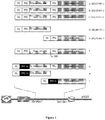
- the preferred optimization is the optimization for an expression in Nicotiana benthamiana, as indicated in Figure 1 .
- Restriction sites Xba I / kpn I and Sal I / Sac I are respectively integrated at the 5 ′ and 3 ′ ends of the cDNA during the synthesis. These sites are then used in order to clone the cDNAs in the binary expression vector pAG01 ( Figure 1 ).
- the cDNAs are cloned upstream of a 35S (35S) promoter and downstream of a nopaline synthase (Tnos) termination sequence; the vector pAG01 also contains an expression cassette making it possible to express the silencing inhibitor p19 simultaneously with the recombinant protein in order to increase the production yields.
- the vectors are then used to transform the LBA4404 strain of Agrobacterium tumefaciens.
- Agobacterium tumefaciens LBA4404 is used for the transfer of a cDNA encoding pectate lyase without the gene of interest being integrated into the genome of the plant cell: we are talking here about transfection and not transgenesis.
- the plants are grown in hydroponic conditions in the presence of a nutrient medium (GHE, floragrow, floramicro, florabloom, 10mL / 15mL / 5mL for 10 L of reverse osmosis water) and under LED lighting.
- GHE nutrient medium
- the agrobacterium is transferred into the leaf tissue by agro-infiltration according to two processes.
- the agrobacteria are injected manually using a syringe applied against the epidermis of the underside of the leaf.
- Leaf discs taken from the leaves 4 to 6 days after agro-infiltration are used for the analysis of the different prototypes of pectate lyases. This screening step makes it possible to define the expression vector which will be used to obtain a pectate lyase of optimal quality.
- the expressed proteins are active. Indeed, the expression of Amb a 1 causes significant necrosis from the 4 th day of expression compared to control plants. These necroses are due to a strong pectate lyase activity (Liu et al, 2010).
- the pectates lyases are extracted from fresh or frozen biomass and then purified on an IMAC column (HisTrap Excell).
- This purification allows the production of the precursor form (preproprotein) and the alpha subunit.
Landscapes
- Health & Medical Sciences (AREA)
- Life Sciences & Earth Sciences (AREA)
- Genetics & Genomics (AREA)
- Chemical & Material Sciences (AREA)
- Engineering & Computer Science (AREA)
- Organic Chemistry (AREA)
- Bioinformatics & Cheminformatics (AREA)
- Zoology (AREA)
- Wood Science & Technology (AREA)
- Molecular Biology (AREA)
- Biomedical Technology (AREA)
- Biotechnology (AREA)
- General Engineering & Computer Science (AREA)
- General Health & Medical Sciences (AREA)
- Biochemistry (AREA)
- Medicinal Chemistry (AREA)
- Microbiology (AREA)
- Biophysics (AREA)
- Plant Pathology (AREA)
- Physics & Mathematics (AREA)
- Cell Biology (AREA)
- Pharmacology & Pharmacy (AREA)
- Botany (AREA)
- Gastroenterology & Hepatology (AREA)
- Proteomics, Peptides & Aminoacids (AREA)
- Pulmonology (AREA)
- Immunology (AREA)
- Chemical Kinetics & Catalysis (AREA)
- General Chemical & Material Sciences (AREA)
- Nuclear Medicine, Radiotherapy & Molecular Imaging (AREA)
- Animal Behavior & Ethology (AREA)
- Public Health (AREA)
- Veterinary Medicine (AREA)
- Peptides Or Proteins (AREA)
- Micro-Organisms Or Cultivation Processes Thereof (AREA)
- Breeding Of Plants And Reproduction By Means Of Culturing (AREA)
Applications Claiming Priority (2)
| Application Number | Priority Date | Filing Date | Title |
|---|---|---|---|
| FR1454653A FR3021328B1 (fr) | 2014-05-23 | 2014-05-23 | Production commerciale de l'allergene amb a1 par expression transitoire chez les plantes |
| PCT/FR2015/051319 WO2015177464A1 (fr) | 2014-05-23 | 2015-05-20 | Production commerciale de l'allergène amb a1 par expression transitoire chez les plantes |
Publications (2)
| Publication Number | Publication Date |
|---|---|
| EP3145948A1 EP3145948A1 (fr) | 2017-03-29 |
| EP3145948B1 true EP3145948B1 (fr) | 2020-01-01 |
Family
ID=51830398
Family Applications (1)
| Application Number | Title | Priority Date | Filing Date |
|---|---|---|---|
| EP15732775.0A Active EP3145948B1 (fr) | 2014-05-23 | 2015-05-20 | Production commerciale de l'allergène amb a1 par expression transitoire chez les plantes |
Country Status (7)
| Country | Link |
|---|---|
| US (1) | US20170159037A1 (da) |
| EP (1) | EP3145948B1 (da) |
| CA (1) | CA2949875C (da) |
| DK (1) | DK3145948T3 (da) |
| ES (1) | ES2781861T3 (da) |
| FR (1) | FR3021328B1 (da) |
| WO (1) | WO2015177464A1 (da) |
Families Citing this family (1)
| Publication number | Priority date | Publication date | Assignee | Title |
|---|---|---|---|---|
| WO2017218696A1 (en) * | 2016-06-14 | 2017-12-21 | Blomquist Richard | Spacecraft and control method |
Family Cites Families (5)
| Publication number | Priority date | Publication date | Assignee | Title |
|---|---|---|---|---|
| FR1255510A (fr) | 1960-01-28 | 1961-03-10 | S E B A M | Charnière invisible pour porte de meuble |
| PL347904A1 (en) * | 1998-10-07 | 2002-04-22 | Syngenta Participations Ag | Therapeutically active proteins in plants |
| FR2809413B1 (fr) * | 2000-05-29 | 2004-10-22 | Tabacs & Allumettes Ind | Production d'allergenes recombinants dans des cellules vegetales |
| KR20090079258A (ko) | 2006-11-08 | 2009-07-21 | 상뜨르 나쇼날 드 라 러쉐르쉬 샹띠피끄 (쎄엔알에스) | 타겟팅 발현 및 재조합 폴리펩타이드의 번역 후 변형 조절을 위한 서열 세트 |
| EP2692732A1 (en) * | 2012-08-03 | 2014-02-05 | Stallergenes S.A. | Novel allergen from ragweed pollen and uses thereof |
-
2014
- 2014-05-23 FR FR1454653A patent/FR3021328B1/fr active Active
-
2015
- 2015-05-20 ES ES15732775T patent/ES2781861T3/es active Active
- 2015-05-20 WO PCT/FR2015/051319 patent/WO2015177464A1/fr not_active Ceased
- 2015-05-20 CA CA2949875A patent/CA2949875C/fr active Active
- 2015-05-20 DK DK15732775.0T patent/DK3145948T3/da active
- 2015-05-20 US US15/313,802 patent/US20170159037A1/en not_active Abandoned
- 2015-05-20 EP EP15732775.0A patent/EP3145948B1/fr active Active
Non-Patent Citations (1)
| Title |
|---|
| None * |
Also Published As
| Publication number | Publication date |
|---|---|
| US20170159037A1 (en) | 2017-06-08 |
| FR3021328A1 (fr) | 2015-11-27 |
| ES2781861T3 (es) | 2020-09-08 |
| FR3021328B1 (fr) | 2018-01-05 |
| CA2949875A1 (fr) | 2015-11-26 |
| WO2015177464A1 (fr) | 2015-11-26 |
| CA2949875C (fr) | 2023-09-12 |
| DK3145948T3 (da) | 2020-04-06 |
| EP3145948A1 (fr) | 2017-03-29 |
Similar Documents
| Publication | Publication Date | Title |
|---|---|---|
| JP5517309B2 (ja) | コラーゲン生産植物及びその作成方法及びその使用 | |
| US7253341B2 (en) | Denaturant stable and/or protease resistant, chaperone-like oligomeric proteins, polynucleotides encoding same, their uses and methods of increasing a specific activity thereof | |
| KR101216762B1 (ko) | 식물에서 인슐린의 생산 방법 | |
| Dash et al. | Isolation, purification and characterization of silk protein sericin from cocoon peduncles of tropical tasar silkworm, Antheraea mylitta | |
| EP1523558B1 (en) | Production of peptides and proteins by accumulation in plant endoplasmic reticulum-derived protein bodies | |
| BR112012012563A2 (pt) | Expressao de gene em plantas | |
| CA2778695C (en) | Methods and compositions for enhancing polypeptide production | |
| EP3145948B1 (fr) | Production commerciale de l'allergène amb a1 par expression transitoire chez les plantes | |
| EP2627667B1 (fr) | Obtention de plantes ayant une tolérance améliorée à un déficit hydrique | |
| JP5497353B2 (ja) | 外来タンパク質の分泌方法 | |
| FR2841906A1 (fr) | Molecule d'acide nucleique codant une preproproteine d'allergene d'un acarien du genre dermatophagoides ou euroglyphus et son utilisation pour la production dudit allergene dans les plantes | |
| Philips et al. | Functional characterization of the grapevine γ-glutamyl transferase/transpeptidase (EC 2.3. 2.2) gene family reveals a single functional gene whose encoded protein product is not located in either the vacuole or apoplast | |
| Zielonka et al. | Characterization of five subgroups of the sieve element occlusion gene family in Glycine max reveals genes encoding non-forisome P-proteins, forisomes and forisome tails | |
| CA2366217A1 (fr) | Promoteur inductible comtii, gene chimere le comprenant et plantes transformees | |
| JP2015188442A (ja) | セサミン生産用植物培養細胞およびそれを用いるセサミン製造方法 | |
| EP2986728B1 (fr) | Production commerciale de peptidases c1a par expression transitoire chez les plantes | |
| CA3171517A1 (fr) | Enzyme pour la conversion d'acide chlorogenique en acide isochlorogenique | |
| KR102435211B1 (ko) | 알부민을 고효율로 생산하는 식물 세포주 및 이의 용도 | |
| FR2906818A1 (fr) | Procede de production de proteines recombinantes a l'aide de plantes carnivores | |
| EP1138771A1 (fr) | Endo-Mannanase de café | |
| FR2995613A1 (fr) | Promoteurs de genes de cafeier et leurs applications | |
| EP1433854A1 (fr) | Plante génétiquement modifiée présentant une floraison accélérée | |
| WO2001051637A1 (fr) | Promoteur de plante fruit specifique |
Legal Events
| Date | Code | Title | Description |
|---|---|---|---|
| STAA | Information on the status of an ep patent application or granted ep patent |
Free format text: STATUS: THE INTERNATIONAL PUBLICATION HAS BEEN MADE |
|
| PUAI | Public reference made under article 153(3) epc to a published international application that has entered the european phase |
Free format text: ORIGINAL CODE: 0009012 |
|
| STAA | Information on the status of an ep patent application or granted ep patent |
Free format text: STATUS: REQUEST FOR EXAMINATION WAS MADE |
|
| 17P | Request for examination filed |
Effective date: 20161219 |
|
| AK | Designated contracting states |
Kind code of ref document: A1 Designated state(s): AL AT BE BG CH CY CZ DE DK EE ES FI FR GB GR HR HU IE IS IT LI LT LU LV MC MK MT NL NO PL PT RO RS SE SI SK SM TR |
|
| AX | Request for extension of the european patent |
Extension state: BA ME |
|
| RIN1 | Information on inventor provided before grant (corrected) |
Inventor name: FAYE, LOIC Inventor name: FITCHETTE, ANNE-CATHERINE Inventor name: GOMORD, VERONIQUE Inventor name: CATALA, VIRGINIE |
|
| DAV | Request for validation of the european patent (deleted) | ||
| DAX | Request for extension of the european patent (deleted) | ||
| STAA | Information on the status of an ep patent application or granted ep patent |
Free format text: STATUS: EXAMINATION IS IN PROGRESS |
|
| 17Q | First examination report despatched |
Effective date: 20180123 |
|
| RAP1 | Party data changed (applicant data changed or rights of an application transferred) |
Owner name: ANGANY INC. |
|
| GRAP | Despatch of communication of intention to grant a patent |
Free format text: ORIGINAL CODE: EPIDOSNIGR1 |
|
| STAA | Information on the status of an ep patent application or granted ep patent |
Free format text: STATUS: GRANT OF PATENT IS INTENDED |
|
| INTG | Intention to grant announced |
Effective date: 20190731 |
|
| GRAS | Grant fee paid |
Free format text: ORIGINAL CODE: EPIDOSNIGR3 |
|
| GRAA | (expected) grant |
Free format text: ORIGINAL CODE: 0009210 |
|
| STAA | Information on the status of an ep patent application or granted ep patent |
Free format text: STATUS: THE PATENT HAS BEEN GRANTED |
|
| AK | Designated contracting states |
Kind code of ref document: B1 Designated state(s): AL AT BE BG CH CY CZ DE DK EE ES FI FR GB GR HR HU IE IS IT LI LT LU LV MC MK MT NL NO PL PT RO RS SE SI SK SM TR |
|
| REG | Reference to a national code |
Ref country code: GB Ref legal event code: FG4D Free format text: NOT ENGLISH |
|
| REG | Reference to a national code |
Ref country code: CH Ref legal event code: EP Ref country code: AT Ref legal event code: REF Ref document number: 1219679 Country of ref document: AT Kind code of ref document: T Effective date: 20200115 |
|
| REG | Reference to a national code |
Ref country code: DE Ref legal event code: R096 Ref document number: 602015044651 Country of ref document: DE |
|
| REG | Reference to a national code |
Ref country code: IE Ref legal event code: FG4D Free format text: LANGUAGE OF EP DOCUMENT: FRENCH |
|
| REG | Reference to a national code |
Ref country code: DK Ref legal event code: T3 Effective date: 20200331 |
|
| REG | Reference to a national code |
Ref country code: NL Ref legal event code: FP |
|
| REG | Reference to a national code |
Ref country code: LT Ref legal event code: MG4D |
|
| PG25 | Lapsed in a contracting state [announced via postgrant information from national office to epo] |
Ref country code: CZ Free format text: LAPSE BECAUSE OF FAILURE TO SUBMIT A TRANSLATION OF THE DESCRIPTION OR TO PAY THE FEE WITHIN THE PRESCRIBED TIME-LIMIT Effective date: 20200101 Ref country code: LT Free format text: LAPSE BECAUSE OF FAILURE TO SUBMIT A TRANSLATION OF THE DESCRIPTION OR TO PAY THE FEE WITHIN THE PRESCRIBED TIME-LIMIT Effective date: 20200101 Ref country code: PT Free format text: LAPSE BECAUSE OF FAILURE TO SUBMIT A TRANSLATION OF THE DESCRIPTION OR TO PAY THE FEE WITHIN THE PRESCRIBED TIME-LIMIT Effective date: 20200527 Ref country code: FI Free format text: LAPSE BECAUSE OF FAILURE TO SUBMIT A TRANSLATION OF THE DESCRIPTION OR TO PAY THE FEE WITHIN THE PRESCRIBED TIME-LIMIT Effective date: 20200101 Ref country code: NO Free format text: LAPSE BECAUSE OF FAILURE TO SUBMIT A TRANSLATION OF THE DESCRIPTION OR TO PAY THE FEE WITHIN THE PRESCRIBED TIME-LIMIT Effective date: 20200401 Ref country code: RS Free format text: LAPSE BECAUSE OF FAILURE TO SUBMIT A TRANSLATION OF THE DESCRIPTION OR TO PAY THE FEE WITHIN THE PRESCRIBED TIME-LIMIT Effective date: 20200101 |
|
| PG25 | Lapsed in a contracting state [announced via postgrant information from national office to epo] |
Ref country code: GR Free format text: LAPSE BECAUSE OF FAILURE TO SUBMIT A TRANSLATION OF THE DESCRIPTION OR TO PAY THE FEE WITHIN THE PRESCRIBED TIME-LIMIT Effective date: 20200402 Ref country code: BG Free format text: LAPSE BECAUSE OF FAILURE TO SUBMIT A TRANSLATION OF THE DESCRIPTION OR TO PAY THE FEE WITHIN THE PRESCRIBED TIME-LIMIT Effective date: 20200401 Ref country code: HR Free format text: LAPSE BECAUSE OF FAILURE TO SUBMIT A TRANSLATION OF THE DESCRIPTION OR TO PAY THE FEE WITHIN THE PRESCRIBED TIME-LIMIT Effective date: 20200101 Ref country code: SE Free format text: LAPSE BECAUSE OF FAILURE TO SUBMIT A TRANSLATION OF THE DESCRIPTION OR TO PAY THE FEE WITHIN THE PRESCRIBED TIME-LIMIT Effective date: 20200101 Ref country code: IS Free format text: LAPSE BECAUSE OF FAILURE TO SUBMIT A TRANSLATION OF THE DESCRIPTION OR TO PAY THE FEE WITHIN THE PRESCRIBED TIME-LIMIT Effective date: 20200501 Ref country code: LV Free format text: LAPSE BECAUSE OF FAILURE TO SUBMIT A TRANSLATION OF THE DESCRIPTION OR TO PAY THE FEE WITHIN THE PRESCRIBED TIME-LIMIT Effective date: 20200101 |
|
| REG | Reference to a national code |
Ref country code: ES Ref legal event code: FG2A Ref document number: 2781861 Country of ref document: ES Kind code of ref document: T3 Effective date: 20200908 |
|
| REG | Reference to a national code |
Ref country code: DE Ref legal event code: R097 Ref document number: 602015044651 Country of ref document: DE |
|
| PG25 | Lapsed in a contracting state [announced via postgrant information from national office to epo] |
Ref country code: RO Free format text: LAPSE BECAUSE OF FAILURE TO SUBMIT A TRANSLATION OF THE DESCRIPTION OR TO PAY THE FEE WITHIN THE PRESCRIBED TIME-LIMIT Effective date: 20200101 Ref country code: SM Free format text: LAPSE BECAUSE OF FAILURE TO SUBMIT A TRANSLATION OF THE DESCRIPTION OR TO PAY THE FEE WITHIN THE PRESCRIBED TIME-LIMIT Effective date: 20200101 Ref country code: EE Free format text: LAPSE BECAUSE OF FAILURE TO SUBMIT A TRANSLATION OF THE DESCRIPTION OR TO PAY THE FEE WITHIN THE PRESCRIBED TIME-LIMIT Effective date: 20200101 Ref country code: SK Free format text: LAPSE BECAUSE OF FAILURE TO SUBMIT A TRANSLATION OF THE DESCRIPTION OR TO PAY THE FEE WITHIN THE PRESCRIBED TIME-LIMIT Effective date: 20200101 |
|
| PLBE | No opposition filed within time limit |
Free format text: ORIGINAL CODE: 0009261 |
|
| STAA | Information on the status of an ep patent application or granted ep patent |
Free format text: STATUS: NO OPPOSITION FILED WITHIN TIME LIMIT |
|
| REG | Reference to a national code |
Ref country code: AT Ref legal event code: MK05 Ref document number: 1219679 Country of ref document: AT Kind code of ref document: T Effective date: 20200101 |
|
| 26N | No opposition filed |
Effective date: 20201002 |
|
| PG25 | Lapsed in a contracting state [announced via postgrant information from national office to epo] |
Ref country code: AT Free format text: LAPSE BECAUSE OF FAILURE TO SUBMIT A TRANSLATION OF THE DESCRIPTION OR TO PAY THE FEE WITHIN THE PRESCRIBED TIME-LIMIT Effective date: 20200101 Ref country code: MC Free format text: LAPSE BECAUSE OF FAILURE TO SUBMIT A TRANSLATION OF THE DESCRIPTION OR TO PAY THE FEE WITHIN THE PRESCRIBED TIME-LIMIT Effective date: 20200101 |
|
| PG25 | Lapsed in a contracting state [announced via postgrant information from national office to epo] |
Ref country code: SI Free format text: LAPSE BECAUSE OF FAILURE TO SUBMIT A TRANSLATION OF THE DESCRIPTION OR TO PAY THE FEE WITHIN THE PRESCRIBED TIME-LIMIT Effective date: 20200101 Ref country code: PL Free format text: LAPSE BECAUSE OF FAILURE TO SUBMIT A TRANSLATION OF THE DESCRIPTION OR TO PAY THE FEE WITHIN THE PRESCRIBED TIME-LIMIT Effective date: 20200101 |
|
| PG25 | Lapsed in a contracting state [announced via postgrant information from national office to epo] |
Ref country code: LU Free format text: LAPSE BECAUSE OF NON-PAYMENT OF DUE FEES Effective date: 20200520 |
|
| PG25 | Lapsed in a contracting state [announced via postgrant information from national office to epo] |
Ref country code: IE Free format text: LAPSE BECAUSE OF NON-PAYMENT OF DUE FEES Effective date: 20200520 |
|
| PG25 | Lapsed in a contracting state [announced via postgrant information from national office to epo] |
Ref country code: TR Free format text: LAPSE BECAUSE OF FAILURE TO SUBMIT A TRANSLATION OF THE DESCRIPTION OR TO PAY THE FEE WITHIN THE PRESCRIBED TIME-LIMIT Effective date: 20200101 Ref country code: MT Free format text: LAPSE BECAUSE OF FAILURE TO SUBMIT A TRANSLATION OF THE DESCRIPTION OR TO PAY THE FEE WITHIN THE PRESCRIBED TIME-LIMIT Effective date: 20200101 Ref country code: CY Free format text: LAPSE BECAUSE OF FAILURE TO SUBMIT A TRANSLATION OF THE DESCRIPTION OR TO PAY THE FEE WITHIN THE PRESCRIBED TIME-LIMIT Effective date: 20200101 |
|
| PG25 | Lapsed in a contracting state [announced via postgrant information from national office to epo] |
Ref country code: MK Free format text: LAPSE BECAUSE OF FAILURE TO SUBMIT A TRANSLATION OF THE DESCRIPTION OR TO PAY THE FEE WITHIN THE PRESCRIBED TIME-LIMIT Effective date: 20200101 Ref country code: AL Free format text: LAPSE BECAUSE OF FAILURE TO SUBMIT A TRANSLATION OF THE DESCRIPTION OR TO PAY THE FEE WITHIN THE PRESCRIBED TIME-LIMIT Effective date: 20200101 |
|
| P01 | Opt-out of the competence of the unified patent court (upc) registered |
Effective date: 20230519 |
|
| PGFP | Annual fee paid to national office [announced via postgrant information from national office to epo] |
Ref country code: NL Payment date: 20250429 Year of fee payment: 11 |
|
| PGFP | Annual fee paid to national office [announced via postgrant information from national office to epo] |
Ref country code: DE Payment date: 20250513 Year of fee payment: 11 |
|
| PGFP | Annual fee paid to national office [announced via postgrant information from national office to epo] |
Ref country code: GB Payment date: 20250521 Year of fee payment: 11 Ref country code: ES Payment date: 20250610 Year of fee payment: 11 Ref country code: DK Payment date: 20250428 Year of fee payment: 11 |
|
| PGFP | Annual fee paid to national office [announced via postgrant information from national office to epo] |
Ref country code: BE Payment date: 20250527 Year of fee payment: 11 Ref country code: IT Payment date: 20250508 Year of fee payment: 11 |
|
| PGFP | Annual fee paid to national office [announced via postgrant information from national office to epo] |
Ref country code: FR Payment date: 20250422 Year of fee payment: 11 |
|
| PGFP | Annual fee paid to national office [announced via postgrant information from national office to epo] |
Ref country code: CH Payment date: 20250601 Year of fee payment: 11 |