EP3115397B1 - Polymère complexe de silsesquioxane et procédé de préparation associé - Google Patents
Polymère complexe de silsesquioxane et procédé de préparation associé Download PDFInfo
- Publication number
- EP3115397B1 EP3115397B1 EP15755903.0A EP15755903A EP3115397B1 EP 3115397 B1 EP3115397 B1 EP 3115397B1 EP 15755903 A EP15755903 A EP 15755903A EP 3115397 B1 EP3115397 B1 EP 3115397B1
- Authority
- EP
- European Patent Office
- Prior art keywords
- methyl
- group
- phenyl
- glyp
- pomma
- Prior art date
- Legal status (The legal status is an assumption and is not a legal conclusion. Google has not performed a legal analysis and makes no representation as to the accuracy of the status listed.)
- Active
Links
- 0 CC(*)(C1(C)*)[Si]2(*)O[Si]1(*)OC(C)(*)C2(C)* Chemical compound CC(*)(C1(C)*)[Si]2(*)O[Si]1(*)OC(C)(*)C2(C)* 0.000 description 1
Classifications
-
- C—CHEMISTRY; METALLURGY
- C08—ORGANIC MACROMOLECULAR COMPOUNDS; THEIR PREPARATION OR CHEMICAL WORKING-UP; COMPOSITIONS BASED THEREON
- C08G—MACROMOLECULAR COMPOUNDS OBTAINED OTHERWISE THAN BY REACTIONS ONLY INVOLVING UNSATURATED CARBON-TO-CARBON BONDS
- C08G77/00—Macromolecular compounds obtained by reactions forming a linkage containing silicon with or without sulfur, nitrogen, oxygen or carbon in the main chain of the macromolecule
- C08G77/04—Polysiloxanes
-
- C—CHEMISTRY; METALLURGY
- C08—ORGANIC MACROMOLECULAR COMPOUNDS; THEIR PREPARATION OR CHEMICAL WORKING-UP; COMPOSITIONS BASED THEREON
- C08L—COMPOSITIONS OF MACROMOLECULAR COMPOUNDS
- C08L83/00—Compositions of macromolecular compounds obtained by reactions forming in the main chain of the macromolecule a linkage containing silicon with or without sulfur, nitrogen, oxygen or carbon only; Compositions of derivatives of such polymers
- C08L83/04—Polysiloxanes
-
- C—CHEMISTRY; METALLURGY
- C09—DYES; PAINTS; POLISHES; NATURAL RESINS; ADHESIVES; COMPOSITIONS NOT OTHERWISE PROVIDED FOR; APPLICATIONS OF MATERIALS NOT OTHERWISE PROVIDED FOR
- C09D—COATING COMPOSITIONS, e.g. PAINTS, VARNISHES OR LACQUERS; FILLING PASTES; CHEMICAL PAINT OR INK REMOVERS; INKS; CORRECTING FLUIDS; WOODSTAINS; PASTES OR SOLIDS FOR COLOURING OR PRINTING; USE OF MATERIALS THEREFOR
- C09D183/00—Coating compositions based on macromolecular compounds obtained by reactions forming in the main chain of the macromolecule a linkage containing silicon, with or without sulfur, nitrogen, oxygen, or carbon only; Coating compositions based on derivatives of such polymers
- C09D183/04—Polysiloxanes
-
- C—CHEMISTRY; METALLURGY
- C08—ORGANIC MACROMOLECULAR COMPOUNDS; THEIR PREPARATION OR CHEMICAL WORKING-UP; COMPOSITIONS BASED THEREON
- C08G—MACROMOLECULAR COMPOUNDS OBTAINED OTHERWISE THAN BY REACTIONS ONLY INVOLVING UNSATURATED CARBON-TO-CARBON BONDS
- C08G2261/00—Macromolecular compounds obtained by reactions forming a carbon-to-carbon link in the main chain of the macromolecule
- C08G2261/50—Physical properties
Definitions
- the present invention relates to a silsesquioxane complex polymer and a method for preparing same, and more specifically, to a silsesquioxane complex polymer of which processability and physical properties are maximized by including, in a single polymer, a silsesquioxane ladder chain, a complex chain, and a cage-type silsesquioxane, which have a specific structure.
- Silsesquioxane has been used for several purposes in various fields. In particular, several attempts have been made to improve processability and maximize mechanical and physical properties, and researches and development are continuing up to now. However, the silsesquioxane polymers developed so far are still insufficient to satisfy processability and mechanical, physical properties at the same time.
- a cage-type silsesquioxane has been applied in various fields by displaying physical properties capable of forming a siloxane bond, but it has a limitation in solubility during solution process since it exists as a crystal structure, and the outcome itself applied from the cage type undergoes realignment at its molecular level such as recrystallization, causing the problem of not insuring performance reproduction.
- a ladder silsesquioxane is a linear structure and has excellent solution processability, so it is a structure capable of compensating the shortcomings of the cage type structure, but it has its own shortcomings because its physical properties are inferior to the crystal cage type structure.
- a random type silsesquioxane undergoes freestyle polymerization, and thus it has a limitation that it has to be applied by gelation by using Si-OH, Si-alkoxy, etc. that are present unstably in the polymer, and it is difficult to guarantee its reproduction.
- Patent EP 2 174 974 discloses the preparation of a silsesquioxane polymer which comprises a cage structure but also unit in which the cage structure has been cleaved to provide diol functionalities.
- the inventors have designed a polymer structure of silsesquioxane having a particular structure as a result of studying to compensate the shortcomings of the silsesquioxane and maximize the advantages thereof, and introduced an easy curing process by using organic functional groups of the thus obtained polymer.
- excellent physical properties could be continued for a long time, and it could be utilized in various industrial fields as a main material, additive material, coating material, etc., and thus completed the invention.
- silsesquioxane complex polymer of which processability and physical properties are maximized by including, in a single polymer, a silsesquioxane ladder chain, a complex chain, and a cage-type silsesquioxane, which have a specific structure.
- silsesquioxane coating composition comprising the silsesquioxane complex polymer.
- the present invention provides a silsesquioxane complex polymer represented by any one of the following chemical formulae 1 to 3: wherein, A is D is E is
- the invention provides a method for preparing silsesquioxane complex polymer represented by the above chemical formula 1, comprising a step 1 of mixing a basic catalyst and an organic solvent in a reactor and then adding an organic silane compound to prepare the following chemical formula 4 of two types of which the condensation rate is controlled; a step 2 of adding an acidic catalyst to the reactor to adjust the reaction solution to acidic state in order to incorporate [B]b structure and [D]d(OR 2 ) 2 structure into the chemical formula 4 obtained from the above step 1 and then adding an organic silane compound and stirring them; a step 3 of adding a basic catalyst to the reactor after each reaction of the above step 2 to convert the reaction solution into its basic state and performing condensation reaction; and a step 4 of condensing two or more substances obtained through the above step 3 under basic condition to connect them: wherein, R 1 , R 2 , R 6 , B, D, a, b, and d are as defined in the chemical formulae 1 to 3.
- the invention provides a method for preparing silsesquioxane complex polymer represented by the above chemical formula 2, comprising a step 1 of mixing a basic catalyst and an organic solvent in a reactor and then adding an organic silane compound to prepare the following chemical formula 4 of two types of which the condensation rate is controlled; a step 2 of adding an acidic catalyst to the reactor to adjust the reaction solution to acidic state in order to incorporate [B]b structure and [D]d(OR 4 ) 2 structure into the chemical formula 4 obtained from the above step 1 and then adding an organic silane compound and stirring them; a step 3 of adding a basic catalyst to the reactor after each reaction of the above step 2 to convert the reaction solution into its basic state and performing condensation reaction; a step 4 of condensing two or more substances obtained through the above step 3 under basic condition to connect them; a step 5 of adding an acidic catalyst to the reactor to adjust the reaction solution to acidic state in order to incorporate [D]d(OR 3 ) 2 structure after the above step 4 and then adding an organic silane compound and
- the invention provides a method for preparing silsesquioxane complex polymer represented by the above chemical formula 3, comprising a step 1 of mixing a basic catalyst and an organic solvent in a reactor and then adding an organic silane compound to prepare the following chemical formula 4 of two types of which the condensation rate is controlled; a step 2 of adding an acidic catalyst to the reactor to adjust the reaction solution to acidic state in order to incorporate [B]b structure into the chemical formula 4 obtained from the above step 1 and then adding an organic silane compound and stirring them; a step 3 of adding a basic catalyst to the reactor after each reaction of the above step 2 to convert the reaction solution into its basic state and performing condensation reaction; a step 4 of condensing two or more substances obtained through the above step 3 under basic condition to connect them; a step 5 of adding an acidic catalyst to the reactor to adjust the reaction solution to acidic state in order to incorporate [D]d(OR 5 ) 2 structure after the above step 4 and then adding an organic silane compound and stirring them; a step 6 of adding a basic
- the invention provides a silsesquioxane coating composition comprising the above silsesquioxane complex polymer.
- the silsesquioxane complex polymer in accordance with the present invention has easy processability of the silsesquioxane ladder type and complex chain and excellent physical properties of the cage type silsesquioxane at the same time, so that when prepared into a coating solution, it can give excellent physical properties, optical properties, heat resistance properties, etc. to various materials through a simple curing process.
- the present invention provides a silsesquioxane complex polymer represented by any one of the following chemical formulae 1 to 3: wherein, A is B is D is E is
- the silsesquioxane complex polymer represented by any one of the above chemical formulae 1 to 3 has an organic functional group represented by R, R 1 , R 2 , R 3 , R 4 , R 5 , R 6 , R 7 , R 8 , R 9 , R 10 , R 11 , or R 12 , its repeat unit consists of a, b and d, and it is a complex silsesquioxane polymer capable of selectively incorporating e as an end unit.
- n of the structure [(SiO 3/2 R) 4+2n O] incorporated into the repeat unit d of the above chemical formula 1 or 2 may be substituted by an integer of 1 to 20, preferably it may be 3 to 10, and more preferably the average n value is 4 to 5, for example when n is 4, the substituted structure may be represented by the following formula 5: wherein, R is as defined as above.
- n of the structure [(SiO 3/2 R) 4+2n R] incorporated into the repeat unit b or e of the above chemical formula 3 may be substituted by 1 to 20, preferably it may be 3 to 10, and more preferably the average n value is 4 to 5, for example when n is 4, the substituted structure may be represented by the following formula 6: wherein, R is as defined as above.
- the silsesquioxane complex polymer of the chemical formula 1 may be polymers listed in Tables 1 and 2 below.
- ECHE refers to (epoxycyclohexyl)ethyl
- GlyP refers to glycidoxypropyl
- POMMA refers to (methacryloyloxy)propyl, and when two or more are listed, it refers to the use of mixture.
- the silsesquioxane complex polymer of the chemical formula 2 may be polymers listed in Tables 3 and 4 below.
- the silsesquioxane complex polymer of the chemical formula 3 may be polymers listed in Tables 5 and 6 below.
- the condensation rate of the silsesquioxane complex polymer of the present invention may be adjusted to 1 to 99.9% or more to obtain a wide range of applicability by ensuring excellent storage stability. That is, the content of terminal and center SiOR or Si-OR 1 may be adjusted to 50% to 0.01% with regard to the entire couplers of the polymer.
- the silsesquioxane complex polymer of the invention may have a weight average molecular weight of 1,000 to 1,000,000, preferably 5,000 to 100,000, and more preferably 7,000 to 50,000. Within this range, the processability and physical properties of the silsesquioxane can be simultaneously enhanced.
- the silsesquioxane complex polymer of the invention may be prepared by successively adjusting basicity and acidity using a basic catalyst and an acidic catalyst, and it may employ any one of the manufacturing methods as described below.
- It comprises a step 1 of mixing a basic catalyst and an organic solvent in a reactor and then adding an organic silane compound to prepare the following two types of chemical formula 4 of which the condensation rate is controlled; a step 2 of adding an acidic catalyst to the reactor to adjust the reaction solution to acidic state in order to incorporate [B]b structure and [D]d(OR 2 ) 2 structure into the chemical formula 4 obtained from the above step 1 and then adding an organic silane compound and stirring them; a step 3 of adding a basic catalyst to the reactor after each reaction of the above step 2 to convert the reaction solution into its basic state and performing condensation reaction; and a step 4 of condensing two or more substances obtained through the above step 3 under basic condition to connect them.
- the prepared silsesquioxane complex polymer has a structure of the following chemical formula 1-1: wherein, R, R 1 , R 2 , R 6 , R 7 , R 8 , R 9 , X, Y, a, b, and d are as defined in the formulae 1 to 3.
- It comprises a step 1 of mixing a basic catalyst and an organic solvent in a reactor and then adding an organic silane compound to prepare the following chemical formula 4 of two types of which the condensation rate is controlled; a step 2 of adding an acidic catalyst to the reactor to adjust the reaction solution to acidic state in order to incorporate [B]b structure and [D]d(OR 4 ) 2 structure into the chemical formula 4 obtained from the above step 1 and then adding an organic silane compound and stirring them; a step 3 of adding a basic catalyst to the reactor after each reaction of the above step 2 to convert the reaction solution into its basic state and performing condensation reaction; a step 4 of condensing two or more substances obtained through the above step 3 under basic condition to connect them; a step 5 of adding an acidic catalyst to the reactor to adjust the reaction solution to acidic state in order to incorporate [D]d(OR 3 ) 2 structure after the above step 4 and then adding an organic silane compound and stirring them; and a step 6 of adding a basic catalyst to the reactor after the reaction of the above step 5 to convert the reaction solution
- the prepared silsesquioxane complex polymer has a structure of the following chemical formula 2-1: wherein, R, R 1 , R 2 , R 3 , R 4 , R 6 , R 7 , R 8 , R 9 , B, D, X, Y, a, b, and d are as defined in the formulae 1 to 3.
- It comprises a step 1 of mixing a basic catalyst and an organic solvent in a reactor and then adding an organic silane compound to prepare the following chemical formula 4 of two types of which the condensation rate is controlled; a step 2 of adding an acidic catalyst to the reactor to adjust the reaction solution to acidic state in order to incorporate [B]b structure into the chemical formula 4 obtained from the above step 1 and then adding an organic silane compound and stirring them; a step 3 of adding a basic catalyst to the reactor after each reaction of the above step 2 to convert the reaction solution into its basic state and performing condensation reaction; a step 4 of condensing two or more substances obtained through the above step 3 under basic condition to connect them; a step 5 of adding an acidic catalyst to the reactor to adjust the reaction solution to acidic state in order to incorporate [D]d(OR 5 ) 2 structure after the above step 4 and then adding an organic silane compound and stirring them; a step 6 of adding a basic catalyst to the reactor after the reaction of the above step 5 to convert the reaction solution into its basic state and performing condensation reaction; and a step
- the prepared silsesquioxane complex polymer has a structure of the following chemical formula 3-1: wherein, R, R 1 , R 2 , R 5 , R 6 , R 7 , R 8 , R 9 , B, D, E, X, Y, a, b, d, and e are as defined in the formulae 1 to 3.
- the basic catalyst preferably may use a mixture catalyst of two or more basic catalysts, and it is neutralized and acidified with an acidic catalyst to induce re-hydrolysis, followed by condensation process under basic condition using a mixture catalyst of two or more basic catalysts again, whereby acidity and basicity can be successively adjusted in a single reactor.
- the basic catalyst may be prepared by suitably combining two or more substance selected from a metal type basic catalyst selected from the group consisting of Li, Na, K, Ca and Ba, and an amine type basic catalyst.
- a metal type basic catalyst selected from the group consisting of Li, Na, K, Ca and Ba
- an amine type basic catalyst Preferably, the amine type basic catalyst may be tetramethylammonium hydroxide (TMAH), and the metal basic catalyst may be potassium hydroxide (KOH) or sodium bicarbonate (NaHCO 3 ).
- TMAH tetramethylammonium hydroxide
- KOH potassium hydroxide
- NaHCO 3 sodium bicarbonate
- the content of each component may be optionally adjusted within such a range that the ratio of the amine type basic catalyst and the metal type basic catalyst can be 10 to 90: 10 to 90 parts by weight.
- the above acidic catalyst may use any acidic substances ordinarily used in the pertinent art, and for example, it may use common acidic substances such as HCl, H 2 SO 4 , HNO 3 , and CH 3 COOH, or use organic acidic substances such as lactic acid, tartaric acid, maleic acid, citric acid, and so on.
- the organic solvent may use any organic solvent ordinarily used in the pertinent art, and for example, it may use alcohols such as methyl alcohol, ethyl alcohol, isopropyl alcohol, butyl alcohol, and cellosolve types, ketones such as acetone, and methyl (isobutyl) ethylketone, glycols such as ethyleneglycol, furans such as tetrahydrofuran, polar solvents such as dimethylformaldehyde, dimethylacetamide and N-methyl-2-pyrrolidone, and various solvents such as hexane, cyclohexane, cyclohexanone, toluene, xylene, cresol, chloroform, dichlorobenzene, dimethylbenzene, trimethylbenzene, pyridine, methylnaphthalene, nitromethane, acrylonitrile, methylene chloride
- the organic silane-based compound may use an organic silane comprising R, R 1 , R 2 , R 3 , R 4 , R 5 , R 6 , R 7 , R 8 , R 9 , R 10 , R 11 , or R 12 of chemical formulae 1 to 3 of the silsesquioxane complex polymer of the present invention, and in particular, it may use an organic silane compound comprising a phenyl group or amino group which is effective for improving the non-swelling property by increasing the chemical resistance of the silsesquioxane complex polymer, or an organic silane compound comprising an epoxy group or (meth)acryl group which is effective for improving mechanical strength and hardness of the cured layer by increasing the curing density of the complex polymer.
- organic silane-based compound may include (3-glycidoxypropyl) trimethoxysilane, (3-glycidoxypropyl) triethoxysilane, (3-glycidoxypropyl) methyl dimethoxysilane, (3-glycidoxypropyl) dimethyl silane, 3-(methacryloxypropyl) trimethoxysilane, 3,4-epoxy-butyl trimethoxysilane, 3,4-epoxy-butyl triethoxysilane, 2-(3,4-epoxycyclohexyl) ethyl trimethoxysilane, 2-(3,4-epoxycyclohexyl) ethyl triethoxysilane, aminopropyl triethoxysilane, vinyl trimethoxysilane, vinyl tri-t-butoxy silane, vinyl tri isobutoxy silane, vinyl tri-isopropoxy silane, vinyl tri-phenoxy silane, phenyl
- the pH of the reaction solution of the step 1 of the present invention may be 9 to 11.5, the pH of the reaction solution of the step 2 may be 2 to 4, the pH of the reaction solution of the step 3 may be 8 to 11.5, the pH of the reaction solution of the step 4 may be 9 to 11.5, the pH of the reaction solution of the step 5 may be 2 to 4, the pH of the reaction solution of the step 6 may be 8 to 11.5, and the pH of the reaction solution of the step 7 of preparing the chemical formula 3 may be 1.5 to 4.
- the silsesquioxane complex polymer may be prepared at a high yield and it can also improve the mechanical properties of the prepared silsesquioxane complex polymer.
- the present invention provides a coating composition
- a coating composition comprising the silsesquioxane complex polymer represented by any one of the above chemical formulae 1 to 3.
- the coating composition may be applied alone as a solvent-free type, and in the case of solid phase, it can be constituted by including an organic solvent.
- the coating composition may further comprise an initiator or a curing agent.
- the coating composition may comprise the silsesquioxane complex polymer represented by any one of the above chemical formulae 1 to 3, an organic solvent typically used in the pertinent art which is compatible with the complex polymer, and an initiator, and further optionally comprise additives such as a curing agent, a plasticizer, a sunscreen, other functional additives to improve curing properties, heat resistance, UV block, plasticity effects, etc.
- additives such as a curing agent, a plasticizer, a sunscreen, other functional additives to improve curing properties, heat resistance, UV block, plasticity effects, etc.
- the silsesquioxane complex polymer may be included at least 5 parts by weight, preferably 5 to 90 parts by weight, and more preferably 10 to 50 parts by weight with regard to 100 parts by weight of the coating composition. Within the above ranges, the mechanical properties of the cured film of the coating composition may be further improved.
- the organic solvent may use not only alcohols such as methyl alcohol, isopropyl alcohol, and cellosolve type, lactates, ketones such as acetone and methyl(isobutyl)ethylketone, glycols such as ethylene glycol, furans such as tetrahydrofuran, and polar solvents such as dimethylformamide, dimethylacetamide, and N-methyl-2-pyrrolidone, but also various solvents such as hexane, cyclohexane, cyclohexanone, toluene, xylene, cresol, chloroform, dichlorobenzene, dimethylbenzene, trimethylbenzene, pyridine, methylnaphthalene, nitromethane, acrylonitrile arc, methylene chloride, octadecylamine, aniline, dimethyl sulfoxide, benzyl alcohol and the like, but is not limited thereto.
- the amount of the organic solvent
- the initiator or the curing agent may be suitably selected according to the organic functional groups included in the silsesquioxane complex polymer.
- the initiators may be preferably included at 0.1-10 parts by weight with regard to the total weight 100 parts by weight of the composition, and when it is included within the above ranges, it can satisfy transmission rate and coating stability at the same time after the curing.
- a radical initiator may be used, and the radical initiator may include photo radical initiators such as trichloro acetophenone, diethoxy acetophenone, 1-phenyl-2-hydroxyl-2-methylpropane-1-one, 1-hydroxycyclohexylphenylketone, 2-methyl-1-(4-methyl thiophenyl)-2-morpholinopropane-1-one, 2,4,6-trimethyl benzoyl diphenylphosphine oxide, camphor quinine, 2,2'-azobis(2-methylbutyronitrile), dimethyl-2,2'-azobis(2-methyl butylrate), 3,3-dimethyl-4-methoxy-benzophenone, p-methoxybenzophenone, 2,2-diethoxy acetophenone, and 2,2-dimethoxy-1,2-diphenyl ethan-1-one, thermal radical initiators such as t-butylper
- sulfoniums such as triphenylsulfonium and diphenyl-4-(phenylthio) sulfonium
- iodoniums such as diphenyl iodonium or bis (dodecyl phenyl) iodonium
- diazoniums such as phenyl diazonium
- ammoniums such as 1-benzyl-2-cyano-pyridinium or 1-(naphthylmethyl)-2-cyano pyridinium, (4-methylphenyl) [4-(2-methylpropyl)phenyl]-hexafluorophosphate iodonium, bis(4-t-butylphenyl) iodonium hexafluoro phosphate, diphenyl iodonium hexafluorophosphate, diphenyl iodonium hexafluorophosphate, diphenyl iodonium hexafluor
- the cationic initiators which act by heat may include cationic or protonic catalysts such as triple acid salts, boron trifluoride ether complex and boron trifluoride, various onium salts such as ammonium salt, phosphonium salt and sulfonium salt, and methyltriphenyl phosphonium bromide, ethyltriphenyl phosphonium bromide, phenyltriphenyl phosphonium bromide, etc., and these initiators can also be added in various mixture forms and they can further be mixed with the various radical initiators described in the above.
- cationic or protonic catalysts such as triple acid salts, boron trifluoride ether complex and boron trifluoride
- various onium salts such as ammonium salt, phosphonium salt and sulfonium salt
- methyltriphenyl phosphonium bromide ethyltriphenyl phosphonium bromide
- amine curing agents such as ethylene diamine, triethylene tetramine, tetraethylene pentamine, 1,3-diaminopropane, dipropylene triamine, 3-(2-aminoethyl)amino-propylamine, N,N'-bis(3-aminopropyl)ethylenediamine, 4,9-dioxadodecan-1,12-diamine, 4,7,10-trioxatridecan-1,13-diamine, hexamethylene diamine, 2-methylpentamethylenediamine, 1,3-bisaminomethylcyclohexane, bis(4-aminocyclo-hexyl)methane, norbornenediamine, 1,2-diaminocyclohexane and the like.
- amine curing agents such as ethylene diamine, triethylene tetramine, tetraethylene pentamine, 1,3-diaminopropane, dipropylene triamine,
- a curing accelerator for promoting the curing action there can be used triazine based compounds such as acetoguanamine, benzoguanamine and 2,4-diamino-6-vinyl-s-triazine, imidazole based compounds such as imidazole, 2-methylimidazole , 2-ethyl-4-methylimidazole, 2-phenyl imidazole, 2-phenyl-4-methylimidazole, vinyl imidazole and 1-methylimidazole, 1,5-diazabicyclo [4.3.0] nonen-5,1,8--diazabicyclo [5.4.0] undecene-7, triphenylphosphine, diphenyl (p-trill) phosphine, tris(alkylphenyl) phosphine, tris(alkoxyphenyl) phosphine, ethyl triphenyl phosphonium phosphate, tetrabutylphosphonium hydrox
- acid anhydride curing agents such as phthalic anhydride, trimellitic anhydride, pyromellitic anhydride, maleic anhydride, tetrahydrophthalic anhydride, methylhexahydrophthalic anhydride, methyltetrahydrophthalic anhydride, nadic methyl anhydride, nadic hydrogenated methyl anhydride, trialkyltetrahydrophthalic anhydride, dodecenyl succinic anhydride, 2,4-diethyl glutaric anhydride and the like may also be used widely.
- acid anhydride curing agents such as phthalic anhydride, trimellitic anhydride, pyromellitic anhydride, maleic anhydride, tetrahydrophthalic anhydride, methylhexahydrophthalic anhydride, methyltetrahydrophthalic anhydride, nadic methyl anhydride, nadic hydrogenated methyl anhydride, trialkylte
- the curing agent may be preferably included at 0.1-10 parts by weight with regard to 100 parts by weight of the composition.
- the present invention may further comprise additives such as a UV absorber, an antioxidant, an anti-foaming agent, a leveling agent, a water repellent, a flame retardant, an adhesion improver and the like for the purpose of improving hardness, strength, durability, and moldability through the curing process or post-reaction.
- additives such as a UV absorber, an antioxidant, an anti-foaming agent, a leveling agent, a water repellent, a flame retardant, an adhesion improver and the like for the purpose of improving hardness, strength, durability, and moldability through the curing process or post-reaction.
- the use of the additives is not particularly restricted, but they may be suitably added within such a range that is not detrimental to the characteristics of the substrate, that is, the physical properties such as flexibility, transparency, heat resistance, hardness, strength and the like.
- the additives may be each independently included at 0.1-10 parts by weight with regard to 100 parts by weight of the composition.
- polyether-modified polydimethylsiloxane for example, BYK company products BYK-300, BYK-301, BYK-302, BYK-331, BYK-335, BYK-306, BYK-330, BYK-341, BYK-344, BYK-307, BYK-333, BYK-310, etc.
- polyether modified hydroxyfunctional poly-dimethyl-siloxane for example, BYK-308, BYK-373, etc.
- methylalkylpolysiloxane for example, BYK-077, BYK-085, etc.
- polyether modified methylalkylpolysiloxane for example, BYK-320, BYK-325, etc.
- polyester modified poly-methyl-alkyl-siloxane for example, BYK-315, etc.
- aralkyl modified methylalkyl polysiloxane for example, BYK company products BYK-
- the coating composition of the present invention can be applied to various materials to improve high surface hardness, mechanical strength and heat resistance.
- the thickness of coating can be optionally adjusted, and it may be 0.01 to 500 um, preferably 0.1 to 300 um, and more preferably 1 to 100 um.
- the above materials may be metals, ceramics, plastics, woods, paper, glass or fiber, and more specifically, as a specific article coated onto a certain material, it may be a protective film for cellular phones or displays.
- a method for coating the coating composition may be optionally selected and carried out by those skilled in the art among known methods such as spin coating, bar coating, slit coating, dip coating, a natural coating, reverse coating, roll coating, spin coating, curtain coating, spray coating, a gravure coating, and so on.
- the silsesquioxane complex polymer prepared in accordance with the present invention can have easy processability of the linear and complex polymer and excellent physical properties of the crystal silsesquioxane at the same time by comprising the silsesquioxane ladder chain and complex chain consisting of linear silsesquioxane polymers, and the cage type silsesquioxane chain, and can be applied widely in the industry where organic-inorganic hybrid polymers are to be applied by having an easy curing process through the organic functional groups included in the structure. Also, it can be widely used as a main material, an additive or various coating materials by basically possessing excellent optical properties of silicon, physical properties, heat resistance properties, etc.
- catalyst 1a was prepared by mixing tetramethylammonium hydroxide (TMAH) 25 wt% aqueous solution with 10 wt% potassium hydroxide (KOH) aqueous solution.
- TMAH tetramethylammonium hydroxide
- KOH potassium hydroxide
- Example 1-a 5 Parts by weight of distilled water, 15 parts by weight of tetrahydrofuran, and 1 part by weight of the catalyst prepared in Example 1-a were dropwise added in a dry flask equipped with a cooling tube and a stirrer, and stirred at a room temperature for one hour, and after that, 20 parts by weight of 2-(3,4-epoxycyclohexyl)ethyltrimethoxysilane were dropwise added thereto and 15 parts by weight of tetrahydrofuran were dropwise added again, and then the mixture was further stirred for 5 hours.
- the stirring mixture solution was taken and rinsed twice to remove the catalyst and impurities, and after filtration, it was confirmed that SI-OH functional groups were generated at the terminal group through the IR analysis (3200 cm -1 ) and as a result of measuring its molecular weight, it was confirmed that silsesquioxane of a linear structure has a styrene-converted molecular weight of 6,000.
- Example 1-a 5 Parts by weight of distilled water, 40 parts by weight of tetrahydrofuran, and 0.5 part by weight of the catalyst prepared in Example 1-a were dropwise added in a dry flask equipped with a cooling tube and a stirrer and stirred at a room temperature for one hour, and after that, 10 parts by weight of 2-(3,4-epoxycyclohexyl)ethyltrimethoxysilane were dropwise added thereto and 20 parts by weight of tetrahydrofuran were dropwise added again, and then the mixture was further stirred for 2 hours.
- the stirring mixture solution was taken and rinsed twice to remove the catalyst and impurities, and after filtration, a linear silsesquioxane where residual alkoxy group is 0.1 mmol/g or less through 1 H-NMR analysis was obtained, which is a portion used to subsequently generate a cage type by a successive reaction.
- the configuration analysis of the linear structure was done through XRD analysis, which confirmed that its overall structure was a linear structure. As a result of measuring its molecular weight, it was confirmed that the silsesquioxane of a linear structure has a styrene-converted molecular weight of 8,000.
- Example 1-a 5 Parts by weight of distilled water, 5 parts by weight of tetrahydrofuran, and 10 part by weight of the catalyst prepared in Example 1-a were dropwise added in a dry flask equipped with a cooling tube and a stirrer and stirred at a room temperature for one hour, and after that, 20 parts by weight of Example 1-b precursor and 1-c precursor respectively were dropwise added thereto and 10 parts by weight of tetrahydrofuran were dropwise added again, and then the mixture was further stirred for 24 hours.
- Example 1-d 5 Parts by weight of 0.36 wt% HCl aqueous solution were very slowly dropwise added to the above Example 1-d mixture solution to adjust pH to acidic condition and stirred at a temperature of 4 °C for 30 min. Thereafter, 5 parts by weight of diphenyltetramethoxydisiloxane were dropwise added at a time to achieve stable hydrolysis, and after one-hour stirring, 7 parts by weight of the catalyst prepared in Example 1-a were added again to adjust the pH of the mixture solution to basic condition. In this process, unlikely the linear polymer, a precursor of D structure where alkoxy is open was formed.
- the organic layer of the outcome obtained in the above Example 1-e was prepared without any separate purification and then its terminal was converted into a cage structure using a 3-functional monomer.
- 100 parts by weight of the substance obtained in Example 1-e were dissolved in 50 parts by weight of tetrahydrofuran and then 5 parts by weight of distilled water were added thereto to prepare a mixture solution.
- 10 parts by weight of 0.36 wt% HCl were added to the prepared mixture solution, stirred for 10 min and then, 3 parts by weight of methyltrimethoxysilane were dropwise added at a time to achieve stable hydrolysis.
- 3 parts by weight of the catalyst prepared in Example 1-a were added again to adjust the pH of the mixture solution to basic condition.
- the polymer of chemical formula 1 was obtained without several by-products using vacuum under a reduced pressure.
- the GPC results and NMR results it was confirmed, from the fact that a cage type in a sharp form was obtained as a resultant without any low molecules obtained alone from the growth of the polymer of each step, that the complex polymer could be obtained without any problems.
- the molecular weight was 24,000 in styrene conversion value.
- silsesquioxane complex polymers were prepared by applying monomers listed in the following Table 7. The methods used in the above Example 1 were equally applied for their preparation. Table 7 Method Monomer applied in 1-b,c methods Monomer applied in 1-e method Monomer applied in 1-f method Molecular weight (Mw) 1 ECHETMS PTMDS MTMS 24,000 1-1 PTMS PTMDS PTMS 11,000 1-2 MTMS MTMDS METMS 13,000 1-3 GPTMS GPTMDS GPTMS 23,000 1-4 MAPTMS MAPTM DS MAPTMS 14,500 1-5 ECHETMS ECHETMDS ECHETMS 12,500 1-6 ECHETMS MTMDS MTMS 53,000 1-7 ECHETMS GPTMDS GPTMS 11,000 1-8 ECHETMS MAPTM DS MAPTMS 9,000 1-9 PTMS ECHETMDS ECHETMS 48,000 1-10 PTMS MTMDS MTMS 90,000 1-11 PTMS GPTMDS GPTMS 32,000 1-12 PTMS MAP
- ECHETMS refers to 2-(3,4-epoxycyclohexyl) ethyltrimethoxysilane
- GPTMS refers to glycidoxypropytrimethoxysilane
- MAPTMS refers to (methacryloyloxy) propyltrimethoxysilane
- PTMS refers to phenyltrimethoxysilane
- MTMS refers to Methyltrimethoxysilane
- ECHETMDS refers to di(epoxycyclohexyethyl) tetramethoxy disiloxane
- GPTMDS refers to di (glycidoxypropyl) tetramethoxy disiloxane
- MAPTMDS refers to di (methacryloyloxy) propy
- PTMDS refers to di (phenyl) tetramethoxy disiloxane
- MTMDS refers to di(methyl) tetrameth
- Example 1-d 15 Parts by weight of 0.36 wt% HCl aqueous solution were very slowly added to the mixture solution of Example 1-d of which the reaction was in progress, to adjust pH to acidic condition, and stirred at the temperature of 4 °C for 30 min. Thereafter, diphenyltetramethoxydisiloxane was prepared in an amount of 25 parts by weight which is 5 times of Example 1-e and dropwise added at a time, and after one-hour stirring, 20 parts by weight of the catalyst prepared in Example 1-a were added again to adjust the pH of the mixture solution to basic condition. After the reaction was complete, the temperature was changed into a room temperature, tetrahydrofuran in the mixture solution was eliminated using vacuum to convert the whole reactants into an aqueous solution mixture.
- the organic layer of the outcome obtained in the above Example 2-a was prepared without any separate purification and then its terminal was converted into a cage structure using a 3-functional monomer.
- 100 parts by weight of the substance obtained in Example 2-a were dissolved in 50 parts by weight of tetrahydrofuran and then 5 parts by weight of distilled water were added thereto to prepare a mixture solution.
- 10 parts by weight of 0.36 wt% HCl were added to the prepared mixture solution, stirred for 10 min and then, 3 parts by weight of methyltrimethoxysilane were dropwise added at a time to achieve stable hydrolysis.
- 3 parts by weight of the catalyst prepared in Example 1-a were added again to adjust the pH of the mixture solution to basic condition.
- silsesquioxane complex polymers were prepared by applying monomers listed in the following Table 8. The methods used in the above Example 2 were equally applied for their preparation. Table 8 Method No. Monomer applied in 1-b,c methods Monomer applied in 2-a method Monomer applied in 2-b method Molecular weight (Mw) 2 ECHETMS PTMDS MTMS 36,000 2-1 PTMS PTMDS PTMS 14,000 2-2 MTMS MTMDS MTMS 18,000 2-3 GPTMS GPTMDS GPTMS 27,000 2-4 MAPTMS MAPTMDS MAPTMS 19,500 2-5 ECHETMS ECHETMDS ECHETMS 19,500 2-6 ECHETMS MTMDS MTMS 58,000 2-7 ECHETMS GPTMDS GPTMS 19,000 2-8 ECHETMS MAPTM DS MAPTMS 12,000 2-9 PTMS ECHETMDS ECHETMS 53,000 2-10 PTMS MTMDS MTMS 113,000 2-11 PTMS GPTMDS GPTMS 42,000 2-12 PTMS MAPTM
- ECHETMS refers to 2-(3,4-epoxycyclohexyl) ethyltrimethoxysilane
- GPTMS refers to glycidoxypropytrimethoxysilane
- MAPTMS refers to (methacryloyloxy) propyltrimethoxysilane
- PTMS refers to phenyltrimethoxysilane
- MTMS refers to methyltrimethoxysilane
- ECHETMDS refers to di(epoxycyclohexyethyl) tetramethoxy disiloxane
- GPTMDS refers to di (glycidoxypropyl) tetramethoxy disiloxane
- MAPTMDS refers to di (methacryloyloxy) propy
- PTMDS refers to di(phenyl) tetramethoxy disiloxane
- MTMDS refers to di(methyl) tetramethoxy dis
- Example 3-a The organic layer of the outcome obtained in the above Example 3-a was prepared without any separate purification and then its terminal was converted into a cage structure using a 3-functional monomer.
- 3 Parts by weight of methyltrimethoxysilane were dropwise added at a time to the mixture solution of Example 3-a of which the reaction was in progress, to achieve stable hydrolysis.
- 3 parts by weight of the catalyst prepared in Example 1-a were added again to adjust the pH of the mixture solution to basic condition.
- a cage type polymer was incorporated into the terminal of E structure, and reaction occurred successively in the reactor to form a polymer such as chemical formula 3.
- the temperature was changed into a room temperature, and tetrahydrofuran in the mixture solution was eliminated using vacuum to prepare purification.
- Example 3-b After the mixture of which the reaction was complete in the above Example 3-b was obtained, it was washed with distilled water, and when the pH of the distilled water layer indicated neutral, the solvent was completely eliminated using vacuum under a reduced pressure. Thereafter, the product was precipitated twice in methanol to remove unreacted monomers, and after 30 parts by weight were dissolved in a solvent where tetrahydrofuran and aqueous solution were mixed at a weight ratio of 9.5:0.5, it was stored at the temperature of -20 °C for two days. This was done to make purification easy by promoting the recrystallization of the substances which were not incorporated into the polymer and were closed as a cage structure.
- silsesquioxane complex polymers were prepared by applying monomers listed in the following Table 9. The methods used in the above Example 3 were equally applied for their preparation. Table 9 Method No. Monomer applied in 1-b,c methods Monomer applied in 1-e method Monomer applied in 3-a method Monomer applied in 3-b method Mw 3 ECHETMS PTMDS MTMDS MAPTMS 28,000 3-1 ECHETMS ECHETMDS ECHETMDS ECHETMS 24,000 3-2 PTMS PTMDS PTMDS PTMS 21,000 3-3 MTMS MTMDS MTMDS MTMS 36,000 3-4 GPTMS ECHETMDS GPTMDS GPTMS 62,000 3-5 MAPTMS MAPTMDS MAPTMS 153,000 3-6 ECHETMS ECHETMDS PTMDS PTMS 24,000 3-7 ECHETMS ECHETMDS MTMDS MTMS 19,000 3-8 ECHETMS ECHETMDS GPTMDS GPTMS 26,000 3-9 ECHETMS ECHETMDS MAPTMDS MAPTMDS MAP
- ECHETMS refers to 2-(3,4-epoxycyclohexyl) ethyltrimethoxysilane
- GPTMS refers to glycidoxypropytrimethoxysilane
- MAPTMS refers to (methacryloyloxy) propyltrimethoxysilane
- PTMS refers to phenyltrimethoxysilane
- MTMS refers to methyltrimethoxysilane
- ECHETMDS refers to di(epoxycyclohexyethyl) tetramethoxy disiloxane
- GPTMDS refers to di (glycidoxypropyl) tetramethoxy disiloxane
- MAPTMDS refers to di (methacryloyloxy) propy
- PTMDS refers to di(phenyl) tetramethoxy disiloxane
- MTMDS refers to di(methyl) tetramethoxy dis
- silsesquioxane complex polymers obtained in Examples 1, 2 and 3 were used to induce a self-curing process, or to prepare a coating composition.
- Example 4-a The coating composition prepared in Example 4-a was applied to SKC-SG00L 250 um film which was an SKC Company PET film, and Mayer coating was performed with No.30-50 rod which was divided into five units. Thereafter, the solvent was eliminated at the temperature of 80 °C for 10 min, and the product was UV-irradiated under 100 mW/cm 2 lamp using a UV machine for 10 sec. to give an outcome.
- a coating composition of 100 g 50 G of the silsesquioxane complex polymer represented by the above chemical formula 3-1 was dissolved at 50 wt% in methylethylketone to prepare a coating composition of 100 g. Thereafter, 3 parts by weight of 1,3-diaminopropane, and 1 part by weight of BYK-357 and BYK-348, respectively were added to 100 part by weight of the prepared coating composition, and stirred for 10 min. to prepare a thermosetting coating composition.
- Example 4-c The coating composition prepared in Example 4-c was applied to SKC-SG00L 250 um film which was an SKC Company PET film, and Mayer coating was performed with No.30-50 rod which was divided into five units. After the coating, it was cured in a dry oven of 80 °C for 10 min. to give an outcome.
- a weight average molecular weight and molecular weight distribution of the silsesquioxane resins prepared through Example 1-g were measured using JASCO PU-2080 plus SEC system equipped with RI-2031 plus refractive index detector and UV-2075 plus UV detector (254 detection wavelength). THF was used with the flow rate of 1 at 40 °C, and samples were separated via 4 columns (Shodex-GPC KF-802, KF-803, KF-804 and KF-805). As a result, it was confirmed that the obtained silsesquioxane had the weight average molecular weight of 24,000 by SEC analysis and the molecular weight distribution of 2.7.
- IR was measured using ATR mode of Perkin-Elmer FT-IR system Spectrum-GX.
- FT-IR analysis a wide bi-modal (successive double shapes) absorption peak from the structure taken at a small amount in Examples 1-b and 1-d processes appeared at 950 to 1200 cm -1 , which was derived from the stretching vibration of siloxane bonds at vertical (-Si-O-Si-R) and horizontal (-Si-O-Si-) directions among the silsesquioxane chains.
- the thermal stability of the structures prepared through Example 4 was examined using a TGA (thermal gravimetric analyzer), and in particular, the complex polymer obtained in 1-g was measured.
- the measurement was carried out through the TGA at 10 °C/min scan speed of 50-800 °C under nitrogen. As a result of the measurement, it was confirmed that by the degradation amount of Si-OH and Si-OR which were degraded between 100-200 °C was remarkably reduced by replacing a basket type structure at the terminal.
- the coating compositions were coated using the polymer resins listed in the above Tables 7 to 9 onto PC (Glastic polycarbonate product of i-components company), PET of SKC company, and PMMA (OAS-800 product of COPAN company) transparent substrates in accordance with the same method as the method described in Example 4, and cured to measure surface characteristics.
- PC General polycarbonate product of i-components company
- PET of SKC company PET of SKC company
- PMMA OF-800 product of COPAN company
- the coating compositions of the present invention showed very excellent surface hardness and optical characteristics and at the same time, they were excellent in other properties.
- the silsesquioxane complex polymer in accordance with the present invention has easy processability of the silsesquioxane ladder type and complex chain and excellent physical properties of the cage type silsesquioxane at the same time, so that when prepared into a coating solution, it can give excellent physical properties, optical properties, heat resistance properties, etc. to various materials through a simple curing process.
Landscapes
- Chemical & Material Sciences (AREA)
- Chemical Kinetics & Catalysis (AREA)
- Organic Chemistry (AREA)
- Health & Medical Sciences (AREA)
- Medicinal Chemistry (AREA)
- Polymers & Plastics (AREA)
- Life Sciences & Earth Sciences (AREA)
- Engineering & Computer Science (AREA)
- Materials Engineering (AREA)
- Wood Science & Technology (AREA)
- Silicon Polymers (AREA)
- Paints Or Removers (AREA)
Claims (16)
- Polymère complexe de silsesquioxane représenté par l'une quelconque des formules chimiques 1 à 3 suivantes :


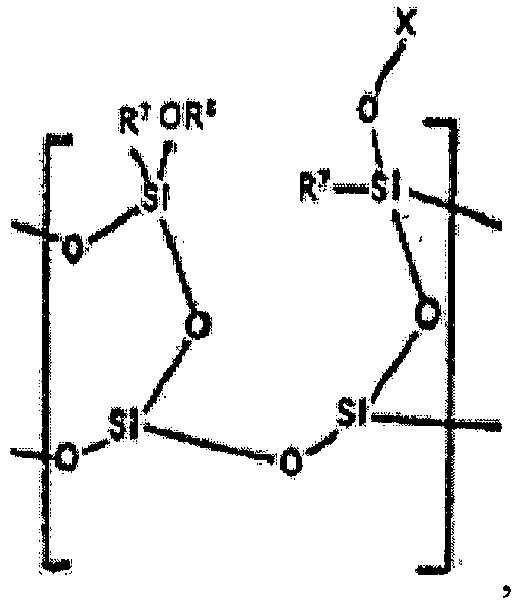


chaque X représente indépendamment un groupement R12 ou un groupement [(SiO3/2R)4+2nR], avec comme condition qu'au moins un de ces constituants soit le groupement [(SiO3/2R)4+2nR],
R, R1, R2, R3, R4, R5, R6, R7, R8, R9, R10, R11, et R12 représentent chacun indépendamment un atome d'hydrogène ; un atome de deutérium ; un atome d'halogène ; un groupement aminé ; un groupement époxy ; un groupement cyclohexyl époxy ; un groupement (méth)acrylique ; un groupement thiol ; un groupement isocyanate ; un groupement nitrile ; un groupement nitro ; un groupement phényle ; ou un groupement alkyle en C1 à C40; un groupement alcényle en C2 à C40 ; un groupement alcoxy en C1 à C40; un groupement cycloalkyle en C3 à C40 ; un groupement hétérocycloalkyle en C3 à C40 ; un groupement aryle en C6 à C40 ; un groupement hétéroaryle en C3 à C40 ; un groupement aralkyle en C3 à C40 ; un groupement aryloxy en C3 à C40 ; ou un groupement arylthiol en C3 à C40 substitué ou non substitué par un atome de deutérium, un atome d'halogène, un groupement amine, un groupement époxy, un groupement (méth)acrylique, un groupement thiol, un groupement isocyanate, un groupement nitrile, un groupement nitro, ou un groupement phényle,
a et d représentent chacun indépendamment un nombre entier allant de 1 à 100 000,
b représente un nombre entier allant de 1 à 500,
e prend une valeur entre 1 et 2, et
n représente un nombre entier allant de 1 à 20. - Polymère complexe de silsesquioxane selon la revendication 1, dans lequel R comprend un groupement alkyle en C1 à C40 ou un groupement alcényle en C2 à C40 substitué ou non substitué par un atome de deutérium, un atome d'halogène, un groupement amine, un groupement (méth)acrylique, un groupement thiol, un groupement isocyanate, un groupement nitrile, un groupement nitro, un groupement phényle ou un groupement cyclohéxyl époxy, un groupement amine, un groupement époxy, un groupement cyclohéxyl époxy, un groupement (méth)acrylique, un groupement thiol, un groupement phényle, ou un groupement isocyanate.
- Polymère complexe de silsesquioxane selon la revendication 1, dans lequel a prend une valeur entre 3 et 1 000, b prend une valeur entre 1 et 500, et d prend une valeur entre 1 et 500.
- Polymère complexe de silsesquioxane selon la revendication 1, dans lequel chaque d prend indépendamment une valeur entre 2 et 100.
- Polymère complexe de silsesquioxane selon la revendication 1, dans lequel la moyenne des valeurs de n se situe entre 4 et 5.
- Polymère complexe de silsesquioxane selon la revendication 1, dans lequel la masse moléculaire moyenne en poids du polymère complexe linéaire de silsesquioxane selon la formule chimique 1 se situe entre 1 000 et 1 000 000,
dans lequel la masse moléculaire moyenne en poids est mesurée en utilisant un système de chromatographie d'exclusion stérique SEC à une longueur d'onde de détection de 254, comme indiqué dans l'exemple 1. - Procédé destiné à la préparation d'un polymère complexe de silsesquioxane représenté par la formule chimique 1, comprenant une étape 1 de mélange d'un catalyseur basique et d'un solvant organique dans un réacteur et ensuite l'addition d'un composé de silane organique pour préparer la formule chimique 4 suivante des deux espèces dont le taux de condensation est contrôlé ; une étape 2 d'addition d'un catalyseur acide dans le réacteur pour ajuster la solution réactionnelle à l'état acide afin d'incorporer la structure [B]b et la structure [D]d(OR2)2 dans la formule chimique 4 obtenue à partir de l'étape 1 ci-dessus et pour ensuite ajouter un composé de silane organique et les agiter ; une étape 3 d'addition d'un catalyseur basique dans le réacteur après chaque réaction de l'étape 2 ci-dessus pour amener la solution réactionnelle à l'état basique et effectuer la réaction de condensation ; et une étape 4 de condensation de deux ou de plusieurs produits obtenus par le biais de l'étape 3 ci-dessus dans des conditions basiques pour les assembler :


- Procédé destiné à la préparation d'un polymère complexe de silsesquioxane représenté par la formule chimique 2, comprenant une étape 1 de mélange d'un catalyseur basique et d'un solvant organique dans un réacteur et ensuite l'addition d'un composé de silane organique pour préparer la formule chimique 4 suivante des deux espèces dont le taux de condensation est contrôlé ; une étape 2 d'addition d'un catalyseur acide dans le réacteur pour ajuster la solution réactionnelle à l'état acide afin d'incorporer la structure [B]b et la structure [D]d(OR4)2 dans la formule chimique 4 obtenue à partir de l'étape 1 ci-dessus et pour ensuite ajouter un composé de silane organique et les agiter ; une étape 3 d'addition d'un catalyseur basique dans le réacteur après chaque réaction de l'étape 2 ci-dessus pour amener la solution réactionnelle à l'état basique et effectuer la réaction de condensation ; une étape 4 de condensation de deux ou de plusieurs produits obtenus par le biais de l'étape 3 ci-dessus dans des conditions basiques pour les assembler ; une étape 5 d'addition d'un catalyseur acide dans le réacteur pour ajuster la solution réactionnelle à l'état acide afin d'incorporer la structure [D]d(OR3)2 après l'étape 4 ci-dessus et pour ensuite ajouter un composé de silane organique et les agiter ; et une étape 6 d'addition d'un catalyseur basique dans le réacteur après la réaction de l'étape 5 ci-dessus pour amener la solution réactionnelle à l'état basique et effectuer la réaction de condensation :


- Procédé destiné à la préparation d'un polymère complexe de silsesquioxane représenté par la formule chimique 3, comprenant une étape 1 de mélange d'un catalyseur basique et d'un solvant organique dans un réacteur et ensuite l'addition d'un composé de silane organique pour préparer la formule chimique 4 suivante des deux espèces dont le taux de condensation est contrôlé ; une étape 2 d'addition d'un catalyseur acide dans le réacteur pour ajuster la solution réactionnelle à l'état acide afin d'incorporer la structure [B]b dans la formule chimique 4 obtenue à partir de l'étape 1 ci-dessus et pour ensuite ajouter un composé de silane organique et les agiter ; une étape 3 d'addition d'un catalyseur basique dans le réacteur après chaque réaction de l'étape 2 ci-dessus pour amener la solution réactionnelle à l'état basique et effectuer la réaction de condensation ; une étape 4 de condensation de deux ou de plusieurs produits obtenus par le biais de l'étape 3 ci-dessus dans des conditions basiques pour les assembler ; une étape 5 d'addition d'un catalyseur acide dans le réacteur pour ajuster la solution réactionnelle à l'état acide afin d'incorporer la structure [D]d(OR5)2 après l'étape 4 ci-dessus et pour ensuite ajouter un composé de silane organique et les agiter ; une étape 6 d'addition d'un catalyseur basique dans le réacteur après la réaction de l'étape 5 ci-dessus pour amener la solution réactionnelle à l'état basique et effectuer la réaction de condensation ; et une étape 7 d'addition d'un catalyseur acide dans le réacteur pour amener la solution réactionnelle dans une atmosphère acide afin d'incorporer la structure [E]eX2 à l'extrémité du polymère complexe après l'étape 6 ci-dessus et pour ensuite mélanger un composé de silane organique et les agiter :


- Procédé destiné à la préparation d'un polymère complexe de silsesquioxane selon l'une quelconque des revendications 7 à 9, dans lequel le catalyseur de mélange comprend un catalyseur basique de type métallique et un catalyseur basique de type amine.
- Procédé destiné à la préparation d'un polymère complexe de silsesquioxane selon la revendication 10, dans lequel le ratio entre le catalyseur basique de type amine et le catalyseur basique de type métallique est de 10 à 90 : 10 à 90 parties en poids.
- Composition de revêtement comprenant le polymère complexe de silsesquioxane selon la revendication 1.
- Composition de revêtement selon la revendication 12, dans laquelle la composition du revêtement est de type sans solvant.
- Composition de revêtement selon la revendication 12, dans laquelle elle comprend le polymère complexe de silsesquioxane selon la revendication 1 ; un initiateur ; et un solvant organique.
- Composition de revêtement selon la revendication 14, dans laquelle le polymère complexe de silsesquioxane est présent à hauteur de 5 à 90 parties en poids par rapport aux 100 parties en poids de la composition du revêtement.
- Composition de revêtement selon la revendication 14, dans laquelle la composition du revêtement comprend en outre un agent de réticulation, un plastifiant, ou un écran solaire.
Applications Claiming Priority (3)
| Application Number | Priority Date | Filing Date | Title |
|---|---|---|---|
| KR20140024548 | 2014-02-28 | ||
| KR1020150027582A KR102363819B1 (ko) | 2014-02-28 | 2015-02-26 | 실세스퀴옥산 복합 고분자 및 이의 제조방법 |
| PCT/KR2015/001970 WO2015130145A1 (fr) | 2014-02-28 | 2015-02-27 | Polymère complexe de silsesquioxane et procédé de préparation associé |
Publications (3)
| Publication Number | Publication Date |
|---|---|
| EP3115397A1 EP3115397A1 (fr) | 2017-01-11 |
| EP3115397A4 EP3115397A4 (fr) | 2017-10-25 |
| EP3115397B1 true EP3115397B1 (fr) | 2018-12-19 |
Family
ID=54243523
Family Applications (1)
| Application Number | Title | Priority Date | Filing Date |
|---|---|---|---|
| EP15755903.0A Active EP3115397B1 (fr) | 2014-02-28 | 2015-02-27 | Polymère complexe de silsesquioxane et procédé de préparation associé |
Country Status (5)
| Country | Link |
|---|---|
| EP (1) | EP3115397B1 (fr) |
| JP (1) | JP7207845B2 (fr) |
| KR (1) | KR102363819B1 (fr) |
| CN (1) | CN106062042B (fr) |
| TW (1) | TWI657103B (fr) |
Families Citing this family (12)
| Publication number | Priority date | Publication date | Assignee | Title |
|---|---|---|---|---|
| KR102325278B1 (ko) * | 2014-03-07 | 2021-11-16 | 주식회사 동진쎄미켐 | 실세스퀴옥산 복합 고분자를 포함하는 열가소성 수지 조성물 |
| WO2016167892A1 (fr) | 2015-04-13 | 2016-10-20 | Honeywell International Inc. | Formulations de polysiloxane et revêtements pour applications optoélectroniques |
| WO2019098622A1 (fr) * | 2017-11-16 | 2019-05-23 | 주식회사 동진쎄미켐 | Polymère de silsesquioxane et composition de revêtement comprenant de dernier |
| US11015082B2 (en) | 2017-12-19 | 2021-05-25 | Honeywell International Inc. | Crack-resistant polysiloxane dielectric planarizing compositions, methods and films |
| US10947412B2 (en) | 2017-12-19 | 2021-03-16 | Honeywell International Inc. | Crack-resistant silicon-based planarizing compositions, methods and films |
| KR102784211B1 (ko) * | 2018-12-31 | 2025-03-21 | 주식회사 동진쎄미켐 | 합성 수지 코팅 조성물 및 이를 이용한 합성 수지 기재 제조 방법 |
| KR102772069B1 (ko) * | 2018-12-31 | 2025-02-25 | 주식회사 동진쎄미켐 | 실리콘계 코팅 조성물 및 이를 이용한 태양전지 블록 |
| CN112442175A (zh) * | 2019-09-03 | 2021-03-05 | 东北林业大学 | 一种八氨丙基笼型八聚硅倍半氧烷制备方法 |
| KR102492231B1 (ko) * | 2020-10-05 | 2023-01-26 | 주식회사 티에프제이 | 연잎을 활용한 친환경적 초소수성 표면처리 조성물, 이의 제조 방법 및 이를 사용하여 표면처리된 물품 |
| WO2023162587A1 (fr) * | 2022-02-25 | 2023-08-31 | 日本電気硝子株式会社 | Agent de revêtement |
| KR102587608B1 (ko) * | 2022-08-02 | 2023-10-12 | 주식회사 크레파머티리얼즈 | 내스크레치성이 우수한 고경도 코팅조성물 |
| CN116218410B (zh) * | 2022-12-27 | 2024-12-06 | 超威电源集团有限公司 | 一种环氧树脂基的铜粉导电胶及铝电极 |
Family Cites Families (13)
| Publication number | Priority date | Publication date | Assignee | Title |
|---|---|---|---|---|
| JPS59108033A (ja) * | 1982-12-10 | 1984-06-22 | Dainippon Ink & Chem Inc | 高分子量ラダ−型ポリフエニルシロキサンの製造方法 |
| JPS60258517A (ja) * | 1984-06-06 | 1985-12-20 | Dainippon Ink & Chem Inc | 液晶表示素子 |
| JP4118973B2 (ja) * | 1997-03-14 | 2008-07-16 | 新日鐵化学株式会社 | シリコーン化合物及びその製造方法 |
| DE19901191A1 (de) * | 1999-01-14 | 2000-08-03 | Wacker Chemie Gmbh | Basische Kondensationskatalysatorsysteme für Siloxane |
| US6911518B2 (en) * | 1999-12-23 | 2005-06-28 | Hybrid Plastics, Llc | Polyhedral oligomeric -silsesquioxanes, -silicates and -siloxanes bearing ring-strained olefinic functionalities |
| CN1214034C (zh) * | 1999-08-04 | 2005-08-10 | 杂混复合塑料公司 | 形成多面体低聚倍半硅氧烷的方法 |
| JP4381636B2 (ja) * | 2001-11-05 | 2009-12-09 | 新日鐵化学株式会社 | シリコーン樹脂組成物及びシリコーン樹脂成形体 |
| JP4256756B2 (ja) * | 2002-09-30 | 2009-04-22 | 新日鐵化学株式会社 | 官能基を有するかご型シルセスキオキサン樹脂の製造方法 |
| JP5275589B2 (ja) * | 2007-08-02 | 2013-08-28 | 日本曹達株式会社 | シルセスキオキサンを含有する組成物及びシルセスキオキサン含有ヒドロキシアルキルセルロース樹脂組成物 |
| EP2542559B1 (fr) * | 2010-03-01 | 2016-07-06 | Evonik Degussa GmbH | Ligands de phosphine et de carbène à base d'imidazole à liaison polysilsesquioxane (poss) pour catalyseurs de métal de transition |
| KR20110112641A (ko) * | 2010-04-07 | 2011-10-13 | 한국과학기술연구원 | 광활성 그룹을 측쇄로 가지는 사다리 구조의 폴리실세스퀴옥산 및 이의 제조방법 |
| KR102004493B1 (ko) * | 2012-03-27 | 2019-07-26 | 주식회사 동진쎄미켐 | 사다리형 실세스퀴옥산 고분자를 포함하는 광학필름용 수지 조성물 |
| EP3450962A4 (fr) * | 2016-04-28 | 2019-11-20 | National University Corporation Nagoya University | Sonde fluorescente pour cytométrie en flux et procédé de criblage de cellules marquées par fluorescence |
-
2015
- 2015-02-26 KR KR1020150027582A patent/KR102363819B1/ko active Active
- 2015-02-27 JP JP2016553894A patent/JP7207845B2/ja not_active Ceased
- 2015-02-27 CN CN201580011149.2A patent/CN106062042B/zh active Active
- 2015-02-27 EP EP15755903.0A patent/EP3115397B1/fr active Active
- 2015-03-02 TW TW104106519A patent/TWI657103B/zh active
Non-Patent Citations (1)
| Title |
|---|
| None * |
Also Published As
| Publication number | Publication date |
|---|---|
| EP3115397A1 (fr) | 2017-01-11 |
| KR102363819B1 (ko) | 2022-02-17 |
| CN106062042B (zh) | 2019-10-29 |
| JP2017512231A (ja) | 2017-05-18 |
| TW201546126A (zh) | 2015-12-16 |
| KR20150102862A (ko) | 2015-09-08 |
| JP7207845B2 (ja) | 2023-01-18 |
| TWI657103B (zh) | 2019-04-21 |
| CN106062042A (zh) | 2016-10-26 |
| EP3115397A4 (fr) | 2017-10-25 |
Similar Documents
| Publication | Publication Date | Title |
|---|---|---|
| EP3115397A1 (fr) | Polymère complexe de silsesquioxane et procédé de préparation associé | |
| KR102708914B1 (ko) | 적층체 및 이의 제조방법 | |
| KR20150102860A (ko) | 실세스퀴옥산 복합 고분자 및 이의 제조방법 | |
| US10280336B2 (en) | Coating method for preventing bending phenomenon of substrate | |
| KR102363818B1 (ko) | 실세스퀴옥산 복합 고분자 및 이의 제조방법 | |
| TWI669351B (zh) | 使用矽倍半氧烷複合高分子的塑膠塗佈方法 | |
| KR20180110105A (ko) | 플루오로폴리에터기 함유 폴리머 변성 실레인, 표면처리제 및 물품 | |
| US11236251B2 (en) | Resin composition for coating, and coating film comprising cured product thereof as coating layer | |
| TWI656028B (zh) | 表面強化透明基板及其製造方法 | |
| KR102363820B1 (ko) | 실세스퀴옥산 복합 고분자 및 이의 제조방법 | |
| TW202126724A (zh) | 含氟硬化性組成物及物品 | |
| TW201602264A (zh) | 使用矽倍半氧烷複合高分子之陶瓷塗佈方法 | |
| TW201546205A (zh) | 使用矽倍半氧烷複合高分子的金屬塗覆方法 | |
| WO2015130145A1 (fr) | Polymère complexe de silsesquioxane et procédé de préparation associé | |
| TW201707925A (zh) | 塗布製品及高硬度曲面硬塗布方法 | |
| WO2015130143A1 (fr) | Polymère complexe de silsesquioxane et son procédé de préparation | |
| TW201546207A (zh) | 使用矽倍半氧烷複合高分子之纖維塗佈方法 | |
| TW201546206A (zh) | 使用矽倍半氧烷複合高分子的木材及木漿塗佈方法 |
Legal Events
| Date | Code | Title | Description |
|---|---|---|---|
| PUAI | Public reference made under article 153(3) epc to a published international application that has entered the european phase |
Free format text: ORIGINAL CODE: 0009012 |
|
| STAA | Information on the status of an ep patent application or granted ep patent |
Free format text: STATUS: REQUEST FOR EXAMINATION WAS MADE |
|
| 17P | Request for examination filed |
Effective date: 20160819 |
|
| AK | Designated contracting states |
Kind code of ref document: A1 Designated state(s): AL AT BE BG CH CY CZ DE DK EE ES FI FR GB GR HR HU IE IS IT LI LT LU LV MC MK MT NL NO PL PT RO RS SE SI SK SM TR |
|
| AX | Request for extension of the european patent |
Extension state: BA ME |
|
| DAX | Request for extension of the european patent (deleted) | ||
| A4 | Supplementary search report drawn up and despatched |
Effective date: 20170925 |
|
| RIC1 | Information provided on ipc code assigned before grant |
Ipc: C08G 77/04 20060101AFI20170919BHEP Ipc: C09D 183/04 20060101ALI20170919BHEP Ipc: C08L 83/04 20060101ALI20170919BHEP |
|
| GRAP | Despatch of communication of intention to grant a patent |
Free format text: ORIGINAL CODE: EPIDOSNIGR1 |
|
| STAA | Information on the status of an ep patent application or granted ep patent |
Free format text: STATUS: GRANT OF PATENT IS INTENDED |
|
| INTG | Intention to grant announced |
Effective date: 20180625 |
|
| GRAS | Grant fee paid |
Free format text: ORIGINAL CODE: EPIDOSNIGR3 |
|
| GRAA | (expected) grant |
Free format text: ORIGINAL CODE: 0009210 |
|
| STAA | Information on the status of an ep patent application or granted ep patent |
Free format text: STATUS: THE PATENT HAS BEEN GRANTED |
|
| AK | Designated contracting states |
Kind code of ref document: B1 Designated state(s): AL AT BE BG CH CY CZ DE DK EE ES FI FR GB GR HR HU IE IS IT LI LT LU LV MC MK MT NL NO PL PT RO RS SE SI SK SM TR |
|
| REG | Reference to a national code |
Ref country code: GB Ref legal event code: FG4D |
|
| REG | Reference to a national code |
Ref country code: CH Ref legal event code: EP |
|
| REG | Reference to a national code |
Ref country code: IE Ref legal event code: FG4D |
|
| REG | Reference to a national code |
Ref country code: DE Ref legal event code: R096 Ref document number: 602015021923 Country of ref document: DE |
|
| REG | Reference to a national code |
Ref country code: AT Ref legal event code: REF Ref document number: 1078625 Country of ref document: AT Kind code of ref document: T Effective date: 20190115 |
|
| REG | Reference to a national code |
Ref country code: NL Ref legal event code: MP Effective date: 20181219 |
|
| PG25 | Lapsed in a contracting state [announced via postgrant information from national office to epo] |
Ref country code: NO Free format text: LAPSE BECAUSE OF FAILURE TO SUBMIT A TRANSLATION OF THE DESCRIPTION OR TO PAY THE FEE WITHIN THE PRESCRIBED TIME-LIMIT Effective date: 20190319 Ref country code: LT Free format text: LAPSE BECAUSE OF FAILURE TO SUBMIT A TRANSLATION OF THE DESCRIPTION OR TO PAY THE FEE WITHIN THE PRESCRIBED TIME-LIMIT Effective date: 20181219 Ref country code: FI Free format text: LAPSE BECAUSE OF FAILURE TO SUBMIT A TRANSLATION OF THE DESCRIPTION OR TO PAY THE FEE WITHIN THE PRESCRIBED TIME-LIMIT Effective date: 20181219 Ref country code: LV Free format text: LAPSE BECAUSE OF FAILURE TO SUBMIT A TRANSLATION OF THE DESCRIPTION OR TO PAY THE FEE WITHIN THE PRESCRIBED TIME-LIMIT Effective date: 20181219 Ref country code: HR Free format text: LAPSE BECAUSE OF FAILURE TO SUBMIT A TRANSLATION OF THE DESCRIPTION OR TO PAY THE FEE WITHIN THE PRESCRIBED TIME-LIMIT Effective date: 20181219 Ref country code: BG Free format text: LAPSE BECAUSE OF FAILURE TO SUBMIT A TRANSLATION OF THE DESCRIPTION OR TO PAY THE FEE WITHIN THE PRESCRIBED TIME-LIMIT Effective date: 20190319 |
|
| REG | Reference to a national code |
Ref country code: LT Ref legal event code: MG4D |
|
| REG | Reference to a national code |
Ref country code: AT Ref legal event code: MK05 Ref document number: 1078625 Country of ref document: AT Kind code of ref document: T Effective date: 20181219 |
|
| PG25 | Lapsed in a contracting state [announced via postgrant information from national office to epo] |
Ref country code: GR Free format text: LAPSE BECAUSE OF FAILURE TO SUBMIT A TRANSLATION OF THE DESCRIPTION OR TO PAY THE FEE WITHIN THE PRESCRIBED TIME-LIMIT Effective date: 20190320 Ref country code: AL Free format text: LAPSE BECAUSE OF FAILURE TO SUBMIT A TRANSLATION OF THE DESCRIPTION OR TO PAY THE FEE WITHIN THE PRESCRIBED TIME-LIMIT Effective date: 20181219 Ref country code: SE Free format text: LAPSE BECAUSE OF FAILURE TO SUBMIT A TRANSLATION OF THE DESCRIPTION OR TO PAY THE FEE WITHIN THE PRESCRIBED TIME-LIMIT Effective date: 20181219 Ref country code: RS Free format text: LAPSE BECAUSE OF FAILURE TO SUBMIT A TRANSLATION OF THE DESCRIPTION OR TO PAY THE FEE WITHIN THE PRESCRIBED TIME-LIMIT Effective date: 20181219 |
|
| PG25 | Lapsed in a contracting state [announced via postgrant information from national office to epo] |
Ref country code: NL Free format text: LAPSE BECAUSE OF FAILURE TO SUBMIT A TRANSLATION OF THE DESCRIPTION OR TO PAY THE FEE WITHIN THE PRESCRIBED TIME-LIMIT Effective date: 20181219 |
|
| PG25 | Lapsed in a contracting state [announced via postgrant information from national office to epo] |
Ref country code: PL Free format text: LAPSE BECAUSE OF FAILURE TO SUBMIT A TRANSLATION OF THE DESCRIPTION OR TO PAY THE FEE WITHIN THE PRESCRIBED TIME-LIMIT Effective date: 20181219 Ref country code: ES Free format text: LAPSE BECAUSE OF FAILURE TO SUBMIT A TRANSLATION OF THE DESCRIPTION OR TO PAY THE FEE WITHIN THE PRESCRIBED TIME-LIMIT Effective date: 20181219 Ref country code: CZ Free format text: LAPSE BECAUSE OF FAILURE TO SUBMIT A TRANSLATION OF THE DESCRIPTION OR TO PAY THE FEE WITHIN THE PRESCRIBED TIME-LIMIT Effective date: 20181219 Ref country code: PT Free format text: LAPSE BECAUSE OF FAILURE TO SUBMIT A TRANSLATION OF THE DESCRIPTION OR TO PAY THE FEE WITHIN THE PRESCRIBED TIME-LIMIT Effective date: 20190419 Ref country code: IT Free format text: LAPSE BECAUSE OF FAILURE TO SUBMIT A TRANSLATION OF THE DESCRIPTION OR TO PAY THE FEE WITHIN THE PRESCRIBED TIME-LIMIT Effective date: 20181219 |
|
| PG25 | Lapsed in a contracting state [announced via postgrant information from national office to epo] |
Ref country code: EE Free format text: LAPSE BECAUSE OF FAILURE TO SUBMIT A TRANSLATION OF THE DESCRIPTION OR TO PAY THE FEE WITHIN THE PRESCRIBED TIME-LIMIT Effective date: 20181219 Ref country code: SM Free format text: LAPSE BECAUSE OF FAILURE TO SUBMIT A TRANSLATION OF THE DESCRIPTION OR TO PAY THE FEE WITHIN THE PRESCRIBED TIME-LIMIT Effective date: 20181219 Ref country code: SK Free format text: LAPSE BECAUSE OF FAILURE TO SUBMIT A TRANSLATION OF THE DESCRIPTION OR TO PAY THE FEE WITHIN THE PRESCRIBED TIME-LIMIT Effective date: 20181219 Ref country code: IS Free format text: LAPSE BECAUSE OF FAILURE TO SUBMIT A TRANSLATION OF THE DESCRIPTION OR TO PAY THE FEE WITHIN THE PRESCRIBED TIME-LIMIT Effective date: 20190419 Ref country code: RO Free format text: LAPSE BECAUSE OF FAILURE TO SUBMIT A TRANSLATION OF THE DESCRIPTION OR TO PAY THE FEE WITHIN THE PRESCRIBED TIME-LIMIT Effective date: 20181219 |
|
| REG | Reference to a national code |
Ref country code: DE Ref legal event code: R097 Ref document number: 602015021923 Country of ref document: DE |
|
| REG | Reference to a national code |
Ref country code: CH Ref legal event code: PL |
|
| PLBE | No opposition filed within time limit |
Free format text: ORIGINAL CODE: 0009261 |
|
| STAA | Information on the status of an ep patent application or granted ep patent |
Free format text: STATUS: NO OPPOSITION FILED WITHIN TIME LIMIT |
|
| PG25 | Lapsed in a contracting state [announced via postgrant information from national office to epo] |
Ref country code: LU Free format text: LAPSE BECAUSE OF NON-PAYMENT OF DUE FEES Effective date: 20190227 Ref country code: DK Free format text: LAPSE BECAUSE OF FAILURE TO SUBMIT A TRANSLATION OF THE DESCRIPTION OR TO PAY THE FEE WITHIN THE PRESCRIBED TIME-LIMIT Effective date: 20181219 Ref country code: AT Free format text: LAPSE BECAUSE OF FAILURE TO SUBMIT A TRANSLATION OF THE DESCRIPTION OR TO PAY THE FEE WITHIN THE PRESCRIBED TIME-LIMIT Effective date: 20181219 Ref country code: MC Free format text: LAPSE BECAUSE OF FAILURE TO SUBMIT A TRANSLATION OF THE DESCRIPTION OR TO PAY THE FEE WITHIN THE PRESCRIBED TIME-LIMIT Effective date: 20181219 |
|
| REG | Reference to a national code |
Ref country code: BE Ref legal event code: MM Effective date: 20190228 |
|
| 26N | No opposition filed |
Effective date: 20190920 |
|
| GBPC | Gb: european patent ceased through non-payment of renewal fee |
Effective date: 20190319 |
|
| REG | Reference to a national code |
Ref country code: IE Ref legal event code: MM4A |
|
| PG25 | Lapsed in a contracting state [announced via postgrant information from national office to epo] |
Ref country code: CH Free format text: LAPSE BECAUSE OF NON-PAYMENT OF DUE FEES Effective date: 20190228 Ref country code: LI Free format text: LAPSE BECAUSE OF NON-PAYMENT OF DUE FEES Effective date: 20190228 |
|
| PG25 | Lapsed in a contracting state [announced via postgrant information from national office to epo] |
Ref country code: GB Free format text: LAPSE BECAUSE OF NON-PAYMENT OF DUE FEES Effective date: 20190319 Ref country code: IE Free format text: LAPSE BECAUSE OF NON-PAYMENT OF DUE FEES Effective date: 20190227 |
|
| PG25 | Lapsed in a contracting state [announced via postgrant information from national office to epo] |
Ref country code: FR Free format text: LAPSE BECAUSE OF NON-PAYMENT OF DUE FEES Effective date: 20190228 Ref country code: BE Free format text: LAPSE BECAUSE OF NON-PAYMENT OF DUE FEES Effective date: 20190228 Ref country code: SI Free format text: LAPSE BECAUSE OF FAILURE TO SUBMIT A TRANSLATION OF THE DESCRIPTION OR TO PAY THE FEE WITHIN THE PRESCRIBED TIME-LIMIT Effective date: 20181219 |
|
| PG25 | Lapsed in a contracting state [announced via postgrant information from national office to epo] |
Ref country code: TR Free format text: LAPSE BECAUSE OF FAILURE TO SUBMIT A TRANSLATION OF THE DESCRIPTION OR TO PAY THE FEE WITHIN THE PRESCRIBED TIME-LIMIT Effective date: 20181219 |
|
| PG25 | Lapsed in a contracting state [announced via postgrant information from national office to epo] |
Ref country code: MT Free format text: LAPSE BECAUSE OF NON-PAYMENT OF DUE FEES Effective date: 20190227 |
|
| PG25 | Lapsed in a contracting state [announced via postgrant information from national office to epo] |
Ref country code: CY Free format text: LAPSE BECAUSE OF FAILURE TO SUBMIT A TRANSLATION OF THE DESCRIPTION OR TO PAY THE FEE WITHIN THE PRESCRIBED TIME-LIMIT Effective date: 20181219 |
|
| PG25 | Lapsed in a contracting state [announced via postgrant information from national office to epo] |
Ref country code: HU Free format text: LAPSE BECAUSE OF FAILURE TO SUBMIT A TRANSLATION OF THE DESCRIPTION OR TO PAY THE FEE WITHIN THE PRESCRIBED TIME-LIMIT; INVALID AB INITIO Effective date: 20150227 |
|
| PG25 | Lapsed in a contracting state [announced via postgrant information from national office to epo] |
Ref country code: MK Free format text: LAPSE BECAUSE OF FAILURE TO SUBMIT A TRANSLATION OF THE DESCRIPTION OR TO PAY THE FEE WITHIN THE PRESCRIBED TIME-LIMIT Effective date: 20181219 |
|
| PGFP | Annual fee paid to national office [announced via postgrant information from national office to epo] |
Ref country code: DE Payment date: 20260102 Year of fee payment: 12 |