EP3114080B1 - Methods for producing a hydroxyapatite composition - Google Patents
Methods for producing a hydroxyapatite composition Download PDFInfo
- Publication number
- EP3114080B1 EP3114080B1 EP15758348.5A EP15758348A EP3114080B1 EP 3114080 B1 EP3114080 B1 EP 3114080B1 EP 15758348 A EP15758348 A EP 15758348A EP 3114080 B1 EP3114080 B1 EP 3114080B1
- Authority
- EP
- European Patent Office
- Prior art keywords
- hydroxyapatite
- particles
- suspension
- sorbent
- particle size
- Prior art date
- Legal status (The legal status is an assumption and is not a legal conclusion. Google has not performed a legal analysis and makes no representation as to the accuracy of the status listed.)
- Active
Links
Images



Classifications
-
- B—PERFORMING OPERATIONS; TRANSPORTING
- B01—PHYSICAL OR CHEMICAL PROCESSES OR APPARATUS IN GENERAL
- B01J—CHEMICAL OR PHYSICAL PROCESSES, e.g. CATALYSIS OR COLLOID CHEMISTRY; THEIR RELEVANT APPARATUS
- B01J20/00—Solid sorbent compositions or filter aid compositions; Sorbents for chromatography; Processes for preparing, regenerating or reactivating thereof
- B01J20/02—Solid sorbent compositions or filter aid compositions; Sorbents for chromatography; Processes for preparing, regenerating or reactivating thereof comprising inorganic material
- B01J20/04—Solid sorbent compositions or filter aid compositions; Sorbents for chromatography; Processes for preparing, regenerating or reactivating thereof comprising inorganic material comprising compounds of alkali metals, alkaline earth metals or magnesium
- B01J20/048—Solid sorbent compositions or filter aid compositions; Sorbents for chromatography; Processes for preparing, regenerating or reactivating thereof comprising inorganic material comprising compounds of alkali metals, alkaline earth metals or magnesium containing phosphorus, e.g. phosphates, apatites, hydroxyapatites
-
- B—PERFORMING OPERATIONS; TRANSPORTING
- B01—PHYSICAL OR CHEMICAL PROCESSES OR APPARATUS IN GENERAL
- B01J—CHEMICAL OR PHYSICAL PROCESSES, e.g. CATALYSIS OR COLLOID CHEMISTRY; THEIR RELEVANT APPARATUS
- B01J20/00—Solid sorbent compositions or filter aid compositions; Sorbents for chromatography; Processes for preparing, regenerating or reactivating thereof
- B01J20/28—Solid sorbent compositions or filter aid compositions; Sorbents for chromatography; Processes for preparing, regenerating or reactivating thereof characterised by their form or physical properties
- B01J20/28002—Solid sorbent compositions or filter aid compositions; Sorbents for chromatography; Processes for preparing, regenerating or reactivating thereof characterised by their form or physical properties characterised by their physical properties
- B01J20/28004—Sorbent size or size distribution, e.g. particle size
-
- B—PERFORMING OPERATIONS; TRANSPORTING
- B01—PHYSICAL OR CHEMICAL PROCESSES OR APPARATUS IN GENERAL
- B01J—CHEMICAL OR PHYSICAL PROCESSES, e.g. CATALYSIS OR COLLOID CHEMISTRY; THEIR RELEVANT APPARATUS
- B01J20/00—Solid sorbent compositions or filter aid compositions; Sorbents for chromatography; Processes for preparing, regenerating or reactivating thereof
- B01J20/28—Solid sorbent compositions or filter aid compositions; Sorbents for chromatography; Processes for preparing, regenerating or reactivating thereof characterised by their form or physical properties
- B01J20/28002—Solid sorbent compositions or filter aid compositions; Sorbents for chromatography; Processes for preparing, regenerating or reactivating thereof characterised by their form or physical properties characterised by their physical properties
- B01J20/28011—Other properties, e.g. density, crush strength
-
- B—PERFORMING OPERATIONS; TRANSPORTING
- B01—PHYSICAL OR CHEMICAL PROCESSES OR APPARATUS IN GENERAL
- B01J—CHEMICAL OR PHYSICAL PROCESSES, e.g. CATALYSIS OR COLLOID CHEMISTRY; THEIR RELEVANT APPARATUS
- B01J20/00—Solid sorbent compositions or filter aid compositions; Sorbents for chromatography; Processes for preparing, regenerating or reactivating thereof
- B01J20/28—Solid sorbent compositions or filter aid compositions; Sorbents for chromatography; Processes for preparing, regenerating or reactivating thereof characterised by their form or physical properties
- B01J20/28014—Solid sorbent compositions or filter aid compositions; Sorbents for chromatography; Processes for preparing, regenerating or reactivating thereof characterised by their form or physical properties characterised by their form
- B01J20/28016—Particle form
- B01J20/28019—Spherical, ellipsoidal or cylindrical
-
- B—PERFORMING OPERATIONS; TRANSPORTING
- B01—PHYSICAL OR CHEMICAL PROCESSES OR APPARATUS IN GENERAL
- B01J—CHEMICAL OR PHYSICAL PROCESSES, e.g. CATALYSIS OR COLLOID CHEMISTRY; THEIR RELEVANT APPARATUS
- B01J20/00—Solid sorbent compositions or filter aid compositions; Sorbents for chromatography; Processes for preparing, regenerating or reactivating thereof
- B01J20/28—Solid sorbent compositions or filter aid compositions; Sorbents for chromatography; Processes for preparing, regenerating or reactivating thereof characterised by their form or physical properties
- B01J20/28054—Solid sorbent compositions or filter aid compositions; Sorbents for chromatography; Processes for preparing, regenerating or reactivating thereof characterised by their form or physical properties characterised by their surface properties or porosity
- B01J20/28069—Pore volume, e.g. total pore volume, mesopore volume, micropore volume
- B01J20/28071—Pore volume, e.g. total pore volume, mesopore volume, micropore volume being less than 0.5 ml/g
-
- B—PERFORMING OPERATIONS; TRANSPORTING
- B01—PHYSICAL OR CHEMICAL PROCESSES OR APPARATUS IN GENERAL
- B01J—CHEMICAL OR PHYSICAL PROCESSES, e.g. CATALYSIS OR COLLOID CHEMISTRY; THEIR RELEVANT APPARATUS
- B01J20/00—Solid sorbent compositions or filter aid compositions; Sorbents for chromatography; Processes for preparing, regenerating or reactivating thereof
- B01J20/28—Solid sorbent compositions or filter aid compositions; Sorbents for chromatography; Processes for preparing, regenerating or reactivating thereof characterised by their form or physical properties
- B01J20/28054—Solid sorbent compositions or filter aid compositions; Sorbents for chromatography; Processes for preparing, regenerating or reactivating thereof characterised by their form or physical properties characterised by their surface properties or porosity
- B01J20/28078—Pore diameter
- B01J20/28085—Pore diameter being more than 50 nm, i.e. macropores
-
- B—PERFORMING OPERATIONS; TRANSPORTING
- B01—PHYSICAL OR CHEMICAL PROCESSES OR APPARATUS IN GENERAL
- B01J—CHEMICAL OR PHYSICAL PROCESSES, e.g. CATALYSIS OR COLLOID CHEMISTRY; THEIR RELEVANT APPARATUS
- B01J20/00—Solid sorbent compositions or filter aid compositions; Sorbents for chromatography; Processes for preparing, regenerating or reactivating thereof
- B01J20/281—Sorbents specially adapted for preparative, analytical or investigative chromatography
- B01J20/282—Porous sorbents
-
- B—PERFORMING OPERATIONS; TRANSPORTING
- B01—PHYSICAL OR CHEMICAL PROCESSES OR APPARATUS IN GENERAL
- B01J—CHEMICAL OR PHYSICAL PROCESSES, e.g. CATALYSIS OR COLLOID CHEMISTRY; THEIR RELEVANT APPARATUS
- B01J20/00—Solid sorbent compositions or filter aid compositions; Sorbents for chromatography; Processes for preparing, regenerating or reactivating thereof
- B01J20/30—Processes for preparing, regenerating, or reactivating
- B01J20/3021—Milling, crushing or grinding
-
- B—PERFORMING OPERATIONS; TRANSPORTING
- B01—PHYSICAL OR CHEMICAL PROCESSES OR APPARATUS IN GENERAL
- B01J—CHEMICAL OR PHYSICAL PROCESSES, e.g. CATALYSIS OR COLLOID CHEMISTRY; THEIR RELEVANT APPARATUS
- B01J20/00—Solid sorbent compositions or filter aid compositions; Sorbents for chromatography; Processes for preparing, regenerating or reactivating thereof
- B01J20/30—Processes for preparing, regenerating, or reactivating
- B01J20/3028—Granulating, agglomerating or aggregating
-
- B—PERFORMING OPERATIONS; TRANSPORTING
- B01—PHYSICAL OR CHEMICAL PROCESSES OR APPARATUS IN GENERAL
- B01J—CHEMICAL OR PHYSICAL PROCESSES, e.g. CATALYSIS OR COLLOID CHEMISTRY; THEIR RELEVANT APPARATUS
- B01J20/00—Solid sorbent compositions or filter aid compositions; Sorbents for chromatography; Processes for preparing, regenerating or reactivating thereof
- B01J20/30—Processes for preparing, regenerating, or reactivating
- B01J20/3085—Chemical treatments not covered by groups B01J20/3007 - B01J20/3078
-
- C—CHEMISTRY; METALLURGY
- C01—INORGANIC CHEMISTRY
- C01B—NON-METALLIC ELEMENTS; COMPOUNDS THEREOF; METALLOIDS OR COMPOUNDS THEREOF NOT COVERED BY SUBCLASS C01C
- C01B25/00—Phosphorus; Compounds thereof
- C01B25/16—Oxyacids of phosphorus; Salts thereof
- C01B25/26—Phosphates
- C01B25/32—Phosphates of magnesium, calcium, strontium, or barium
- C01B25/322—Preparation by neutralisation of orthophosphoric acid
Definitions
- the present invention relates to methods of preparation of nanostructured synthetic hydroxyapatite compositions.
- the synthetic hydroxyapatite compositions obtained therewith have highly spherical particles and porous structures with excellent mechanical strength and durability under high pressure, and are useful as a chromatographic sorbent.
- Hydroxyapatite having a formula of Ca 10 (PO 4 ) 6 ⁇ (OH) 2 , is an inorganic ingredient of bone and teeth.
- As a nontoxic and biocompatible material it is generally used as a packing material to be filled in columns for chromatographic separation of biomolecules, for example, proteins, enzymes, vaccines and nucleic acids. Its ability to adsorb these biomolecules depends on both the structures of chromatography sorbent particles and the concentration of active sites on the exposed surfaces.
- hydroxyapatite usable for column chromatography was first developed by Tiselius et al. [Arch. Biochem. Biophys., 65:132-155 (1956 )]. Hydroxyapatite packed in columns for chromatographic use has been prepared by various methods. Conventionally, crystalline hydroxyapatite is synthesized by wet synthesis in which a water-soluble calcium salt and a phosphate are allowed to react in an aqueous solution. Then, the hydroxyapatite formed is granulated to obtain micro-particles.
- the hydroxyapatite produced by conventional processes has the following disadvantages: 1) irregularity in particle shape and size, 2) low mechanical strength, and 3) a low level of active sites on the crystal surface after heat treatment. Due to the irregularities in particle shape and size, the hydroxyapatite particles cannot be packed uniformly or densely in the column for chromatographic separation. Due to its low mechanical strength, the hydroxyapatite packed into a column bed tends to be destroyed during the use for purification, finally leading to the bed collapse. Thus, the use of hydroxyapatite for chromatographic separation is dramatically limited.
- hydroxyapatite a ceramic material
- hydroxyapatite is hard but mechanically fragile.
- hydroxyapatite is usually treated at high temperatures.
- the surface active sites which are proportional to the capacity of hydroxyapatite sorbent to bind biomolecules, are greatly reduced.
- hydroxyapatite sorbent meeting all fundamental requirements is difficult to prepare.
- US 2012/285880 discloses a hydroxyapatite composition with hydroxyapatite particles having a sphericity of at least 0.97 and a median particle size of 40 ⁇ m.
- US 2012/285880 also discloses a method of producing a hydroxyapatite composition, comprising the following steps: (a) reacting an aqueous suspension comprising calcium hydroxide powder with an aqueous solution comprising a phosphoric acid to obtain a hydroxyapatite suspension comprising primary particles of hydroxyapatite; (b) milling the primary particles of hydroxyapatite in the suspension; (c) spray-drying the suspension to obtain consolidated secondary particles of hydroxyapatite; and (d) sintering the consolidated secondary particles to obtain sintered hydroxyapatite particles.
- US 5,858,318 discloses a method of producing a hydroxyapatite composition, comprising the following steps: reacting an aqueous suspension comprising calcium hydroxide powder with an aqueous solution comprising phosphoric acid and a phosphate salt to obtain a hydroxyapatite suspension comprising primary particles of hydroxyapatite; spray-drying the suspension to obtain consolidated secondary particles of hydroxyapatite; and sintering the consolidated secondary particles to obtain sintered hydroxyapatite particles.
- Further methods for preparing hydroxyapatite in solution we know from Fujino et al. [Research Institute for Science and Technology, pages 39-46 (2002 )]; JP H09 20508 and JP 2007 314356 .
- hydroxyapatite sorbents that provide desirable separation capabilities, yet retain their shape, binding capacity, and chemical and mechanical properties during the use for chromatographic separation.
- hydroxyapatite sorbent should have pore sizes sufficient to allow fast mass transfer of large biomolecules.
- the manufacturing process from batch to batch should be reproducible to ensure chromatographic performance and physical characteristics of the hydroxyapatite sorbents. Hydroxyapatite materials having excellent mechanical strength and chromatographic characteristics as described above have not been reported.
- the present invention provides a method of producing a hydroxyapatite composition comprising hydroxyapatite particles, wherein bulk density of the hydroxyapatite particles is about 0.5 to 0.9 g/cm 3 , and wherein the hydroxyapatite particles further comprise consolidated secondary particles having spherical shape and porous structures, the method comprising the following steps:
- the hydroxyapatite suspension formed in the method of the present invention has a pH in the range of 8 to 11.
- the dispersant is selected from inorganic compounds, short-chain organic electrolytes and surfactants, polymers, and combinations thereof.
- the inorganic compound is selected from the group consisting of phosphates, silicates, and carbonates; and the polymer is selected from the group consisting of polymer electrolytes and polymer nonelectrolytes.
- said milling in step (b) can be any suitable milling technique known to a person skilled in the art, including ball milling.
- the mean particle size of the hydroxyapatite particles obtained from the milling step (b) is in the range of 1.0 to 5.0 ⁇ m.
- the temperature used for said sintering is in the range of 450 to 800 °C, preferably 550 to 750 °C, and more preferably about 650 °C.
- classification of resultant hydroxyapatite particles can be done by any suitable sifting technique known to a person skilled in the art, including ultrasonic sifting.
- the present invention aims to provide a method of producing a sorbent with mechanical stability, and capable of exhibiting excellent performance in chromatographic separation when used as an adsorbent to be packed into a column. Furthermore, the present invention also aims to provide a reliable method that can produce the sorbent in large scale to meet the demand for industrial applications.
- chromatographic sorbent having the chemical composition of hydroxyapatite, which combines the separation capabilities of crystals with the strength of its own framework as support.
- the chromatographic medium shows superior properties in substance separation when used as adsorbent packed or charged into a column.
- substance separation for substances having a small difference in structure from one another or chemically identical, such as monomers and aggregates, good selectivity and high precision separation can be achieved by chromatography using the medium as the adsorbent.
- the medium can be chosen for those high purity separations that are otherwise difficult to achieve with the use of existing adsorbents.
- Substances that can be separated by the medium include biomolecules such as proteins, including immunoglobulin or enzyme, nucleic acids, such as RNA and DNA, and vaccines.
- the medium used at the final polishing step in downstream bioprocesses is indispensable for obtaining useful drug substances of high purity.
- the chromatographic medium is comprised of micro-sized hydroxyapatite beads, characterized by nanostructured network, high mean pore diameter, good sphericity and narrow distribution in bead size, good binding capacity, and enduring mechanical stability.
- the hydroxyapatite sorbent has a high bulk density and much less small beads that facilitate the packing of fixed-bed column with reproducible column separation performance.
- the running cycles for chromatographic separation are increased accordingly when packed in the column of large bed volume (for example > 50 1), and thus the operational cost is greatly reduced for industrial production.
- the present invention provides a method for the synthesis of nanostructured hydroxyapatite crystal as defined herein before, which may be used as precursor for producing chromatographic sorbent. Due to its network structure composed of nanorods, the hydroxyapatite synthesized has high surface areas, ensuring good binding capacity for biomolecules when adsorbed on the surface of crystals.
- the raw materials are mainly inorganic, which are inexpensive and commercially available.
- the reaction conditions are mild and easy to control without need to use a specific type of equipment. Meanwhile, the by-products produced are nontoxic and environmentally friendly.
- the method of the present invention comprises adding a solution containing two raw materials, i.e., ammonium phosphate monobasic and phosphoric acid, into a suspension containing a solid raw material calcium hydroxide with vigorous stirring.
- the resultant suspension with the content of hydroxyapatite nanocrystals at a pH of 7 to 12 is then obtained.
- the optimum pH value of the resultant suspension is in the range of 8 to 11.
- the hydroxyapatite primary particles in the above resultant suspension are milled into smaller particles.
- a ball-mill method may be applied by continuously pumping the suspension containing hydroxyapatite particles into a closed cylinder filled with zirconia beads.
- the median size of the milled particles is 1 ⁇ m (D50) or higher, preferably in the range of 1 to 5 ⁇ m, more preferably in the range of 1 to 3 ⁇ m.
- the method of the present invention can reliably produce final hydroxyapatite sorbent comprising consolidated secondary particles having a bulk density of in the range of 0.5 to 0.9 g/cm 3 , in particular 0.55 to 0.82 g/cm 3 .
- the method of the present invention is suitable for making highly spherical porous hydroxyapatite microspheres composed of consolidated secondary particles.
- an appropriate amount of dispersant is added into the above milled suspension to lower the viscosity of suspension and thus greatly improve the liquid flowability.
- the consolidated hydroxyapatite secondary particles are obtained by spray drying the droplets containing the hydroxyapatite primary particles inside a heated vertical chamber.
- the sphericity of the consolidated hydroxyapatite secondary particles thus obtained is greatly improved when compared with the product obtained without use of any dispersant.
- the dispersants used to improve the flowability of suspension include inorganic compounds, short chain organic electrolytes and surfactants and polymers.
- the method of the present invention is suitable for treating the hydroxyapatite powders obtained by spray drying at a high temperature and further classifying the powders to obtain various final sorbent products with different mean particle sizes.
- the treatment temperature is adjusted to ensure their mechanical stability, good binding capability and pore openings big enough for overcoming the potential hindrance of mass transfer of biomolecules to the final sorbents.
- an ultrasonic sifting method is applied for the classification of particles of a wide distribution of particle size. As a result, the final sorbent products obtained have narrow particle size distributions.
- the method of the present invention comprises spray drying the ball-milled synthesized hydroxyapatite (Ca 10 (PO 4 ) 6 (OH) 2 ) primary particles, followed by high temperature treatment and particle classification.
- the sorbent obtained by the method according to the present invention has a narrow distribution of particle size and a bulk density in the range of 0.5 to 0.9 g/cm 3 , typically 0.55-0.82 g/cm 3 and a pore volume of 0.1-0.5 cm 3 /g.
- the sorbent is chemically and mechanically stable, especially useful in packed bed, fluidized bed or stirred batch adsorption, or chromatographic separation and purification of biomolecules.
- the highly spherical sorbent that can be obtained using the method of the present invention is a hydroxyapatite.
- Hydroxyapatite is nontoxic and biocompatible. Therefore, hydroxyapatite is an ideal biomaterial for biomedical applications, such as artificial bone and tooth, and matrix for drug delivery system. Furthermore, as a ceramic material with functional groups on the crystal surfaces, hydroxyapatite not only has superior adsorption capability to various biomolecules, but also can serve as a support material as chromatographic medium.
- nanostructured hydroxyapatite which is used as a precursor for producing spherical particles, is synthesized by a reaction of mixing a solution with a suspension.
- the solution contains a mixture of two raw materials and the suspension contains one raw material.
- the suspension is vigorously stirred and a circulating bath is set at a temperature to maintain the reaction temperature inside the vessel.
- the primary hydroxyapatite particles with nanorod structure are obtained.
- a solution containing two raw materials i.e., ammonium phosphate monobasic and phosphoric acid, dissolved in water, is slowly added into a suspension containing a solid raw material calcium hydroxide in water while vigorously stirring.
- the stoichiometric ratio of Ca/P for the raw materials used is 1.67.
- the batch size of manufacturing hydroxyapatite is up-scalable without any impact on the physicochemical properties of hydroxyapatite.
- the size of reaction vessel is from 10 1 to 10,000 1, more preferably 50 1 to 5,000 1.
- the initial temperature of the suspension in the reaction vessel may be set between 20 to 50 °C, and preferably the circulating bath temperature is maintained at the initial temperature during the course of reaction. In another preferable embodiment, the initial temperature is set at 35 °C, as shown in Example 1. When the bath circulation temperature is held at 35 °C, the variation of reaction temperature during the course of reaction caused mainly by the exothermic neutralization between the raw materials may be minimized. In some embodiments, in order to avoid the temperature excursion, the addition rate of the solution should be controlled during the mixing of the solution containing ammonium phosphate monobasic and phosphoric acid with calcium hydroxide suspension in the reactor.
- the excursion temperature is controlled within about 5 °C of the initial reaction temperature, which is important to ensure reproducible manufacturing from batch to batch so as to obtain consistent properties of hydroxyapatite nanocrystals in this synthesis step.
- the addition time of the solution containing ammonium phosphate monobasic and phosphoric acid is from 10 to 24 h, preferably about 16 h. After the completion of solution addition, the mixture is continuously stirred for additional 1 to 5 h, preferably about 2 h, while maintaining the temperature the same as initial temperature, ensuring that the reaction goes to completion.
- the pH of the resultant suspension at the end of reaction is critical.
- the pH of the resultant suspension should be in the range of 7 to 12, preferably 8 to 11.
- DCP dicalcium phosphate
- TCP tricalcium phosphate
- the pH will change dramatically when approaching the end of reaction, which potentially produces some by-products such as DCP and TCP.
- the formation of DCP and TCP is not desirable in producing high purity hydroxyapatite nanocrystals.
- the pH could be much lower than 7 and a large amount of by-products including DCP and TCP would be produced.
- the present invention also uses ammonium phosphate monobasic as one of the raw materials to provide the phosphate source together with phosphoric acid.
- ammonium phosphate monobasic is that when the reaction is approaching the end, the reaction occurs in a system with buffering capability so that the potential dramatic change in pH can be avoided.
- ammonium phosphate monobasic as a raw material enables the reaction to occur in a more moderate and controllable way, introducing less temperature excursion of the reaction system. Unlike the exothermic neutralization reaction between calcium hydroxide and phosphoric acid, which is more drastic, the reaction of ammonium phosphate monobasic with calcium hydroxide produces less heat and thus is more tepid. These conditions are helpful to producing hydroxyapatite having consistent material properties.
- the amount of solid calcium hydroxide suspended in water and the amount of phosphoric acid and ammonium phosphate monobasic dissolved in water may vary as long as the suspension in the reactor could be easily stirred without substantial hindrance during the course of reaction.
- the ratio of calcium hydroxide : water is 1:10 (weight/weight).
- the ratio of phosphoric acid (85% w/w) : ammonium phosphate monobasic : water is 17:1:50 (weight/weight/weight).
- the relative amount of phosphoric acid and ammonium phosphate monobasic can vary as long as the stoichiometric ratio of Ca/P is about 1.67.
- the sorbent obtained is very loose and has a low bulk density. As a result, the mechanical strength is low. When packed in the column bed, the sorbent tends to collapse under pressure. In order to increase bulk density and mechanical stability of the sorbent, it is necessary to mill the hydroxyapatite primary particles contained in the above resultant suspension into smaller particles so as to obtain tight consolidated secondary particles.
- the present invention provides a method of preparing fine hydroxyapatite particles by ball mill method.
- the ball mill method is cost efficient, easy for operation and maintenance, and suitable for large-scale production of a suspension sample. Meanwhile, the particle size obtained meets the requirements of process in the following steps. Briefly, the ball mill method is applied by continuously feeding the hydroxyapatite suspension into a closed cylinder chamber filled with spherical zirconia beads and mechanically rotating the beads.
- the procedure of a ball-mill method is detailed as follows.
- the hydroxyapatite suspension is pumped, e.g., by a mechanical means, into a closed cylinder chamber filled with zirconia beads, which have a mean bead size of, e.g., about 0.8 mm.
- the primary particles are milled into smaller particles inside the chamber when both zirconia beads and suspension are mechanically rotated quickly under high pressure.
- the milled suspension is continuously eluted out from an opening at the end of cylinder and is collected in a container. Because a lot of heat is produced during the course of operation inside the chamber, a cold water circulation surrounding the cylinder chamber is applied to remove the heat, thus avoiding the potential damage of equipment. To obtain the targeted size of crushed particles, the running cycles of the operation may be adjusted accordingly.
- the method could reliably crush the primary particles, and thus the final product (hydroxyapatite sorbent) will be reliably obtained by the further manufacturing process.
- the median particle size of the crushed particles obtained is 1 ⁇ m or more, preferably 1 to 5 ⁇ m, and more preferably 1 to 3 ⁇ m.
- the pore size of the final product is directly related to the sizes of crushed particles, which determine the empty space between the particles of consolidated secondary particles obtained from the step of spray-drying process. When the median particle size of the crushed particles is in these ranges, it is possible to reliably produce the powder of chromatographic sorbent with appropriate bulk density, sufficient mechanical stability, and enough pore size for the binding of biomolecules.
- the present invention provides a method of making a hydroxyapatite composition comprising spherical particles by a modified spray-drying method as defined hereinbefore.
- the procedure of the method of present invention requires the addition of a dispersant in the milled hydroxyapatite suspension before the spray-drying method is applied.
- an appropriate amount of dispersant added is necessary to improve the spherical shape of powder particles.
- the sphericity of consolidated hydroxyapatite secondary particles is higher than the product obtained without use of a dispersant.
- the amount of dispersant(s) used should be tightly controlled, because too much or too little dispersant added in the milled suspension could deteriorate the shape of consolidated particles obtained.
- a calculated amount of dispersant is added slowly into the above milled suspension in a vessel while vigorously stirring under ambient conditions.
- the suspension becomes less dense and its viscosity is lowered.
- the flowability of the suspension is also greatly improved, which helps the formation of a smooth film on the top of revolving disk in the step of spray-drying.
- the use of dispersant also reduces the surface tension of droplets formed by the breakdown of the film on the revolving disk when rotated at a high speed. All above advantageous factors provide a reliable method of making consolidated secondary particles with high sphericity obtained by spray-drying process.
- the amount of dispersant used is calculated and expressed in percentage of the ratio of dispersant (weight): suspension (weight) (%w/w).
- the amount of dispersant used can be in the range of 0.005% to 1% (w/w), preferably in the range of 0.01% to 0.2% (w/w).
- the use of appropriate amount of dispersant is critical to obtain the consolidated secondary particles with good product quality and performance. In this regard, addition of an insufficient amount of dispersant may not reduce the viscosity of suspension sufficiently. Meanwhile, addition of too much dispersant could lead to the re-aggregation of dispersed particles. As a result, an inhomogeneous suspension is formed and tends to precipitate out, which is not desirable.
- the dispersants useful for the present invention include inorganic compounds, short-chain organic electrolytes or surfactants, and polymers.
- inorganic compound dispersants include phosphates (such as sodium hexametaphosphate), silicates and carbonates.
- short-chain organic electrolytes include citrate and short-chain organic surfactants include tween® 20, tween® 80, sodium dodecyl sulfate (SDS) and CTAB.
- polymer dispersants include polymer electrolytes (such as polyacrylate) and polymer nonelectrolytes (such as polyacrylic acid and PVA).
- the next step is to make spherical secondary particles by spray drying the above well dispersed suspension.
- the above suspension is injected into a vertical drying chamber through an atomization device, such as a revolving disk, a spray nozzle, together with a hot gas stream, e.g., air or nitrogen.
- the hot gas stream causes rapid evaporation of water from the micro droplets, which are formed by the revolving disk, and release from the spray nozzle.
- the gas is typically injected at 140 to 220 °C and exits the dryer at a temperature slightly above 100 °C.
- the fine particles of hydroxyapatite formed from the micro droplets are consolidated into individual aggregates of highly spherical shape.
- the resultant hydroxyapatite microsphere powder, collected at the bottom of spray-drying machine is comprised of particles in the range from 10 to 90 ⁇ m of particle size, with a majority amount of particles at around 40 ⁇ m of particle size.
- Hydroxyapatite is known to be a fragile ceramic material. In order to improve its mechanical strength, the hydroxyapatite needs to be heated at an elevated temperature for a period of time. When the dried hydroxyapatite powder obtained from the above step is treated at a high temperature, the rod-spherical primary particles shrink and tend to interweave together and form a tighter network structure. As a result, the surface pore opening size of the resultant hydroxyapatite sorbent is increased and the mechanical strength of the microsphere powder is enhanced accordingly. The increase of the pore opening size corresponds with the increase of the sintering temperature.
- the pore size may increase until it reaches a maximum with the sintering time.
- the surface area of the sintered powder decreases with the increase of the sintering temperature.
- the surface area of the hydroxyapatite sorbent which is directly related to the surface active sites, determines its binding capacity of biomolecules.
- a person skilled in the art would be able to optimize the process parameters, such as sintering temperature and time, for desired performance.
- the sintering is carried out in the presence of an air flow so as to burn out the organic dispersant.
- the powder is placed in an oven exposed to air flow.
- the powder is gradually heated to 650 °C and maintained at 650 °C for 4 h.
- the powder is then cooled down and removed from the oven.
- heating and cooling resulted in the volume variation of crystalline particles, the sorbent beads do not show any crack after these processes.
- the above operation results in the formation of stable beads with enlarged pore sizes.
- the above powder obtained by the high temperature treatment has a wide range of particle size distributions.
- sorbents of more uniform particle sizes may be preferable. Therefore, in some embodiments, it is necessary to classify the above-obtained powder to obtain the sorbents with narrower particle size distributions.
- Various classification methods including screen sifting and cyclone classification, may be used in the method of the present invention.
- the cyclone classification method is unable to completely eliminate all unwanted smaller and larger particles.
- the particle size cut-off is determined by the opening size of screens, which are easily custom-designed commercially.
- the ultrasonic sifting method is more reliable for obtaining particles with a specifically desired narrow particle size distribution.
- the present invention provides a method of classifying hydroxyapatite particles by use of an ultrasonic vibrating sifter. This method is reliable with good manufacturing reproducibility, and provides final sorbent products with consistent performance. Since the sintered powder is mechanically strong, the integrity of consolidated secondary particles is well maintained when the classification is performed at this stage. For secondary particles obtained by spray-drying, their mechanical stability is weaker than the sintered powder.
- the classification process in particular, the process using the method of cyclone classification, is applied to the dried powder prior to sintering process, some particles tend to break down, which potentially leads to the formation of defects on the classified particles and affects the particle integrity. Therefore, the present invention also provides an ultrasonic sifting method to classify the sintered powder instead of applying such a process to the powder without sintering.
- an ultrasonic vibrating sifter is installed with two screens having opening sizes of 35 ⁇ m and 45 ⁇ m, respectively.
- the screens are equipped with an ultrasonic system, which is particularly useful for the powder with density of less than 1 g/cm 3 , for example, the hydroxyapatite powder obtained by the method of present invention. Briefly, some sintered powder is placed on the top of a 45 ⁇ m screen.
- the powder between two screens i.e., below the 45 ⁇ m screen and on the top of the 35 ⁇ m screen, is collected to obtain the final hydroxyapatite sorbent product.
- the product has a mean particle size of 40 ⁇ 2 ⁇ m.
- the final sorbent products obtained are specifically designated as, e.g., 20, 40, 60, and 80 ⁇ m in mean particle sizes.
- the final products obtained from the present invention are highly spherical with sphericity of at least 0.95 and typically at least 0.97.
- the bulk density of the hydroxyapatite sorbent is in the range of 0.5 to 0.9 g/cm 3 , typically 0.55 to 0.82 g/cm 3 , and preferably 0.62 to 0.75 g/cm 3 .
- the device and apparatus includes, for example, a chromatography column itself or an automated machine containing such a chromatography column as an integral component.
- the organic samples analyzed or separated can be any compositions or mixtures containing a synthetic or natural organic compound.
- the biological samples analyzed or separated can include any compositions or mixtures comprising proteins, enzymes or nucleic acids.
- Use of a chromatography column to analyze or separate these samples is well known to a person skilled in the art, but the superior characteristics of the chromatography sorbent obtained by the method according to the present invention enables more efficient analysis and/or separation.
- nanostructured hydroxyapatite 3 kg of calcium hydroxide powder was added slowly into 30 1 of water to form a calcium hydroxide suspension, with mechanical stirring to ensure that the suspension was evenly dispersed in the reaction vessel. The suspension temperature was maintained at 35 °C while stirring. Then an aqueous solution (5 1) containing 2.7 kg of phosphoric acid (85%w/w) and 0.1 kg of ammonium phosphate monobasic was added into the above suspension over a period of 16 h, while the reaction temperature was maintained at 35 °C. After the completion of addition of the above solution, the suspension was stirred continuously for additional 4 h to obtain the nanostructured hydroxyapatite. The pH of the resultant suspension was measured to be 8.5.
- the pH of the final suspension was controlled within the range of 7 to 12, preferably 8 to 11.
- a varying amount of the aqueous solution containing phosphoric acid and ammonium phosphate monobasic was added to adjust pH of the final suspension to fall within the above range.
- the reaction temperature was kept constant to ensure manufacturing reproducibility.
- Example 2 the hydroxyapatite primary particles obtained from Example 1 were further milled into smaller particles. A ball-mill method was applied, and zirconia beads of 0.8 mm particle size were used in the equipment.
- Example 1 the hydroxyapatite suspension obtained in Example 1 was continuously pumped into a milling chamber filled with zirconium beads. The milling chamber was maintained under a high pressure. To remove the heat produced during the course of milling, circulated cold water was applied. The milled hydroxyapatite suspension was collected in a separate container. The above milling process was repeated for about 20 times to obtain the milled suspension sample.
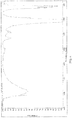
- FIG. 1 shows particle size distribution curve of the un-milled hydroxyapatite suspension obtained in Example 1.
- FIG. 2 shows particle size distribution curve of the milled hydroxyapatite suspension obtained in Example 2. The results are shown in Table 1. After the process of ball milling, the median particle size of primary particles was reduced from 5.6 ⁇ m (D50) to 1.8 ⁇ m (D50).
- the median particle size of the milled hydroxyapatite suspension was controlled to be in the range from 1 to 5 ⁇ m.
- the milled particle size of 1 to 3 ⁇ m enables the formation of microspheres with sufficient pore sizes as a chromatographic medium for the separation of biomolecules.
- Table 1 Mean particle size of hydroxyapatite particles Sample ID Mean particle size ( ⁇ m) Example 1 5.6 Example 2 1.8
- the highly spherical hydroxyapatite particles were obtained using spray drying method. It is desirable to form highly spherical particles which would greatly enhance the particles' mechanical strength. To achieve this object, it was found to be necessary that an appropriate amount of dispersant be added into the suspension before spray drying.
- the above suspension was then pumped into a vertical drying chamber through an atomization device equipped with revolving disk and spray nozzle, together with a hot air gas stream.
- the inlet temperature of air gas stream was set at 165 °C and the exiting air gas stream had a temperature of 110 °C.
- the fine particles of hydroxyapatite were consolidated into individual aggregates of highly spherical shape inside the vertical drying chamber.
- the dried hydroxyapatite powder was collected at the bottom of the drying chamber.
- the collected powder was placed in an oven exposed to an air flow.
- the oven was gradually heated from the ambient temperature to 650 °C, and maintained at 650 °C for 4 h.
- the powder was then slowly cooled down and removed from the oven.
- the sintered powder was classified by an ultrasonic vibrating sifting method. Specifically, two screens with opening size of 35 ⁇ m and 45 ⁇ m, respectively, were installed on an ultrasonic vibrating sifter. Both screens were equipped with the ultrasonic system. The 45 ⁇ m screen was stacked right on top of the 35 ⁇ m screen. The sintered powder obtained above was placed on the top of 45 ⁇ m screen. After the sifting operation for 10 min, the powder between two screens was collected to obtain the final 40 ⁇ m hydroxyapatite powder product.
- the 40 ⁇ m hydroxyapatite sorbent was obtained by the same method as described in Example 4, except that the suspension obtained in example 1 was directly spray dried without undergoing the ball milling and the sintering temperatures were 475 °C and 650 °C, respectively.
- the 40 ⁇ m hydroxyapatite sorbent was obtained by the same method as described in Example 4, except that the treatment temperature was 475 °C.
- Table 2 shows the bulk density of hydroxyapatite sorbent produced under different process conditions. As shown in Table 2, the bulk density of the sorbent obtained in Example 4 is about 30% more than that of sorbent obtained in Comparative Example 1. The increase of bulk density may improve the mechanical strength of the sorbent so as to meet the fundamental requirements for its use as a packed medium for chromatographic separation. Table 2. Bulk density of hydroxyapatite sorbent Sample ID Bulk Density (g/cm 3 ) Dried Sample Sample with Sintering Temperature 475 °C Sample with Sintering Temperature 650 °C Example 4 0.68 -- 0.70 Comp Example 1 0.51 0.51 0.53 Example 4a 0.68 0.68 --
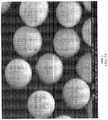
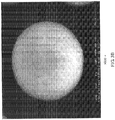
- FIG. 3 shows scanning electron microscope (SEM) images of hydroxyapatite sorbent (40 ⁇ m particle size) obtained in Example 4.
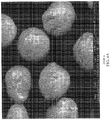
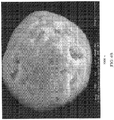
- FIG. 4 shows scanning electron microscope (SEM) images of hydroxyapatite sorbent (40 ⁇ m particle size), obtained in Comparative Example 1 with a sintering temperature of 650 °C. The mean particle size was determined by laser scattering diffraction to be 40 ⁇ m within the specified range of 40 ⁇ 2 ⁇ m.
- the SEM images show that the hydroxyapatite sorbent beads obtained in Example 4 are highly spherical in shape and uniform in size, and the surface of beads is also very smooth. The sphericity of the sorbent beads was determined to be greater than 0.99.
- the sorbent beads obtained in Comparative Example 1 were barely spherical but with roughness and defects on their surface.
- the sorbent obtained in Example 4 was also characterized by liquid nitrogen adsorption-desorption isotherm measurement. An average pore size and a pore volume of the consolidated secondary particles were determined to be about 80 nm and 0.2 cm 3 /g, respectively.
- FIG. 5 shows the x-ray diffraction pattern (XRD) of the 40 ⁇ m hydroxyapatite sorbent obtained in Example 4.
- FIG. 6 shows the FT-IR spectrum of the 40 ⁇ m hydroxyapatite sorbent obtained in Example 4. The results of both XRD and FI-IR spectra show that the 40 ⁇ m hydroxyapatite sorbent is consistent with the structure of hydroxyapatite crystal.
- the mechanical stability of hydroxyapatite sorbent beads was also evaluated when the sorbent was packed in an adjustable empty column.
- the dimension of sorbent packed in the column was 11 mm (i.d.) ⁇ 200 mm (length).
- the packed column was installed on a GE AKTA protein purification system.
- FIG. 7 shows the curve of column pressure versus time for the sample obtained in Example 4. Hydroxyapatite was slowly dissolved under slightly acidic condition (pH ⁇ 7). As a result, if the sorbent were not mechanically strong, the sorbent would tend to slowly dissolve, leading to the collapse of column bed and dramatically increasing the column pressure.
- FIG. 7 demonstrates that after 72 h, the column pressure was almost the same as the initial pressure.
- the particles were also examined under a microscope, indicating that after 72 h the particle shape and size were identical to those of the sorbent prior to packing and no small pieces of broken spherical particles were observed.
- the pressure was observed to increase dramatically after 2 h, and the evaluation test had to be stopped.
- the results show that the sorbent (40 ⁇ m) from Example 4 is mechanically more stable than the sample obtained in Comparative Example 1, thus meeting the requirements of sorbent for use in chromatographic separation.
- the 20 ⁇ m hydroxyapatite sorbent was obtained by the same method as described in Example 4, except using two screens having opening sizes of 15 ⁇ m and 25 ⁇ m to replace the two screens having opening sizes of 35 ⁇ m and 45 ⁇ m, respectively.
- the 60 ⁇ m hydroxyapatite sorbent was obtained by the same method as described in Example 4, except using two screens with opening sizes of 50 ⁇ m and 70 ⁇ m to replace the two screens having opening sizes of 35 ⁇ m and 45 ⁇ m, respectively.
- the 80 ⁇ m hydroxyapatite sorbent was obtained by the same method as described in Example 4, except using two screens having opening sizes of 70 ⁇ m and 90 ⁇ m to replace the two screens having opening sizes of 35 ⁇ m and 45 ⁇ m, respectively.
- Example 8 Production of 40 ⁇ m Hydroxyapatite Sorbent using Sodium Hexametaphosphate Dispersant
- the 40 ⁇ m hydroxyapatite sorbent was obtained by the same method as described in Example 4, except that sodium polyacrylate was replaced with sodium hexametaphosphate, as shown in Example 3.
- the 40 ⁇ m hydroxyapatite sorbent was obtained by the same method as described in Example 4, except that sodium polyacrylate was replaced with SDS, as shown in Example 3.
- All sorbents obtained in Examples 5-9 had a high sphericity and similar bulk density to that the sorbent obtained in Example 4.
- the median particle sizes were in the range of 20 ⁇ 4 ⁇ m, 60 ⁇ 4 ⁇ m, 80 ⁇ 4 ⁇ m, 40 ⁇ 4 ⁇ m, and 40 ⁇ 4 ⁇ m, respectively.
- Their mechanical stability was also evaluated to be as good as the sorbent obtained in Example 4.
Landscapes
- Chemical & Material Sciences (AREA)
- Organic Chemistry (AREA)
- Analytical Chemistry (AREA)
- Chemical Kinetics & Catalysis (AREA)
- Inorganic Chemistry (AREA)
- Engineering & Computer Science (AREA)
- Nanotechnology (AREA)
- Solid-Sorbent Or Filter-Aiding Compositions (AREA)
- Treatment Of Liquids With Adsorbents In General (AREA)
Applications Claiming Priority (2)
| Application Number | Priority Date | Filing Date | Title |
|---|---|---|---|
| US201461947128P | 2014-03-03 | 2014-03-03 | |
| PCT/US2015/018449 WO2015134469A1 (en) | 2014-03-03 | 2015-03-03 | Spherical porous hydroxyapatite sorbent and methods thereof |
Publications (3)
| Publication Number | Publication Date |
|---|---|
| EP3114080A1 EP3114080A1 (en) | 2017-01-11 |
| EP3114080A4 EP3114080A4 (en) | 2017-11-01 |
| EP3114080B1 true EP3114080B1 (en) | 2021-08-25 |
Family
ID=54055785
Family Applications (1)
| Application Number | Title | Priority Date | Filing Date |
|---|---|---|---|
| EP15758348.5A Active EP3114080B1 (en) | 2014-03-03 | 2015-03-03 | Methods for producing a hydroxyapatite composition |
Country Status (5)
| Country | Link |
|---|---|
| US (1) | US10914712B2 (enExample) |
| EP (1) | EP3114080B1 (enExample) |
| JP (2) | JP6752724B2 (enExample) |
| CN (1) | CN106458585B (enExample) |
| WO (1) | WO2015134469A1 (enExample) |
Families Citing this family (19)
| Publication number | Priority date | Publication date | Assignee | Title |
|---|---|---|---|---|
| CZ307111B6 (cs) * | 2016-01-26 | 2018-01-17 | Vakos Xt A.S. | Sorbent se zabudovaným hydroxylapatitem a způsob jeho výroby |
| JP7164884B2 (ja) * | 2017-06-07 | 2022-11-02 | 国立大学法人 新潟大学 | 吸着剤の製造方法および処理方法 |
| US10744226B2 (en) * | 2017-12-08 | 2020-08-18 | Johnson & Johnson Consumer Inc. | High-throughput method for detecting tooth stain prevention and removal |
| CN109529110A (zh) * | 2018-12-10 | 2019-03-29 | 上海摩漾生物科技有限公司 | 多孔纳米羟基磷灰石缓释凝胶制备方法 |
| CN109529111A (zh) * | 2018-12-12 | 2019-03-29 | 上海摩漾生物科技有限公司 | 高孔隙率多孔纳米羟基磷灰石微球及其制备方法 |
| JP7294260B2 (ja) * | 2020-07-09 | 2023-06-20 | 日東紡績株式会社 | ハイドロキシアパタイト粒子分散液及びハイドロキシアパタイト付着基材の製造方法 |
| CN112551926B (zh) * | 2020-11-27 | 2023-03-21 | 广州润虹医药科技股份有限公司 | 一种磷酸钙颗粒的制备方法 |
| CN112619614B (zh) * | 2020-12-03 | 2022-11-04 | 云南中烟工业有限责任公司 | 一种羟基磷灰石复合多孔材料、其制备方法及用途 |
| CN112945727B (zh) * | 2021-01-29 | 2022-09-13 | 浙江大学 | 一种软土热固结模型试验装置及方法 |
| CN112875665B (zh) * | 2021-02-07 | 2022-11-01 | 吉林大学 | 用于注射填充制剂的羟基磷灰石微球及其制备方法 |
| KR102711590B1 (ko) * | 2021-05-06 | 2024-09-30 | 충북대학교 산학협력단 | 약물 담지용 다공성 수산화아파타이트 구조체의 제조 방법, 및 이로부터 제조된 약물 담지체 |
| CN113600123B (zh) * | 2021-07-20 | 2023-09-15 | 煤炭科学技术研究院有限公司 | 一种掺杂高分散羟基磷灰石的红土基球型除氟滤料的制备方法 |
| KR102727802B1 (ko) * | 2021-12-27 | 2024-11-07 | 한국세라믹기술원 | 비표면적이 향상된 다공성 수산화아파타이트 분말 및 이의 제조 방법 |
| KR102775142B1 (ko) * | 2022-05-18 | 2025-02-28 | 충북대학교 산학협력단 | 구형의 수산화아파타이트 입자 및 분무열분해 방법을 이용한 이의 제조방법 |
| CN115159483A (zh) * | 2022-06-30 | 2022-10-11 | 苏州大学 | 一种形貌、尺寸可调控的羟基磷灰石微球及其制备方法 |
| CN115477535A (zh) * | 2022-09-09 | 2022-12-16 | 晞华生物科技(上海)有限公司 | 一种层析用陶瓷羟基磷灰石及其制备方法、用途 |
| WO2024229225A1 (en) | 2023-05-02 | 2024-11-07 | Bio-Rad Laboratories, Inc. | Polymer-hydroxyapatite composite membranes |
| CN118637571B (zh) * | 2024-08-19 | 2024-11-08 | 合肥启灏医疗科技有限公司 | 一种羟基磷灰石钙微球及其制备方法 |
| CN120622429B (zh) * | 2025-05-08 | 2026-07-07 | 杭州彗搏科技有限公司 | 一种皮肤注射充填用羟基磷灰石微球及其制备方法 |
Citations (4)
| Publication number | Priority date | Publication date | Assignee | Title |
|---|---|---|---|---|
| JPH0920508A (ja) * | 1995-07-06 | 1997-01-21 | Tomita Seiyaku Kk | 歯磨き配合用ヒドロキシアパタイト及びその製造法 |
| US5858318A (en) * | 1996-11-27 | 1999-01-12 | Luo; Ping | Methods of synthesizing hydroxyapatite powders and bulk materials |
| JP2007314356A (ja) * | 2006-05-23 | 2007-12-06 | Okayama Univ | 結晶性ヒドロキシアパタイト微粒子の製造方法 |
| US20120285880A1 (en) * | 2009-09-28 | 2012-11-15 | Hoya Corporation | Powder, method of producing powder and adsorption apparatus |
Family Cites Families (17)
| Publication number | Priority date | Publication date | Assignee | Title |
|---|---|---|---|---|
| US5039408A (en) | 1986-07-05 | 1991-08-13 | Asahi Kogaku Kogyo K.K. | Packing material for liquid chromatography |
| US4267065A (en) * | 1978-08-01 | 1981-05-12 | Bell Telephone Laboratories, Incorporated | Dispersants for a ceramic slurry |
| US4301020A (en) * | 1978-08-01 | 1981-11-17 | Bell Telephone Laboratories, Incorporated | Process of slurrying and spray drying ceramic oxides with polyethyleneimine dispersants |
| JPS5645814A (en) | 1979-09-25 | 1981-04-25 | Kureha Chem Ind Co Ltd | Hydroxyapatite, its ceramic material and its manufacture |
| JPH0788205B2 (ja) * | 1985-09-23 | 1995-09-27 | 東燃株式会社 | クロマトグラフイ−分離用リン酸カルシウム系ヒドロキシアパタイト及びその製造方法 |
| JPH01230413A (ja) | 1988-03-11 | 1989-09-13 | Kanto Chem Co Inc | 球形ヒドロキシアパタイト焼結体の製造方法、並びに該球形とヒドロキシアパタイト焼結体から成るクロマトグラフイ用充填剤 |
| US4849193A (en) * | 1988-05-02 | 1989-07-18 | United States Gypsum Company | Process of preparing hydroxylapatite |
| JPH02180707A (ja) * | 1988-12-31 | 1990-07-13 | Tonen Corp | リン酸化合物粒子集合体の製造方法 |
| JP2514746B2 (ja) | 1990-11-09 | 1996-07-10 | 積水化成品工業株式会社 | 多孔質球状アパタイト粒子の製造方法 |
| CN1942396B (zh) * | 2004-03-15 | 2010-09-01 | 苏黎世联合高等工业学校 | 金属盐纳米颗粒,特别是包含钙和磷酸根的纳米颗粒的火焰合成 |
| US7695740B2 (en) * | 2005-06-29 | 2010-04-13 | Iain Ronald Gibson | Synthetic calcium phosphate comprising silicon and trivalent cation |
| GB2442000A (en) * | 2006-06-07 | 2008-03-26 | Apatech Ltd | Biomedical materials containing gadolinium |
| US7878430B2 (en) * | 2006-11-20 | 2011-02-01 | The University Of Western Ontario | Method and apparatus for uniformly dispersing additive particles in fine powders |
| US8721443B2 (en) | 2009-05-11 | 2014-05-13 | Disney Enterprises, Inc. | System and method for interaction in a virtual environment |
| IT1400739B1 (it) | 2009-06-02 | 2013-07-02 | Hoya Corp | Metodo per la produzione di polvere, polvere e apparecchio di adsorbimento |
| CN102464307A (zh) * | 2010-11-12 | 2012-05-23 | 中国科学院上海硅酸盐研究所 | 一种羟基磷灰石纳米晶粒的制备方法 |
| CN103560246B (zh) | 2013-11-25 | 2015-12-02 | 四川科能锂电有限公司 | 一种锂离子电池正极材料磷酸铁锂的制备方法 |
-
2015
- 2015-03-03 CN CN201580022238.7A patent/CN106458585B/zh active Active
- 2015-03-03 US US15/123,307 patent/US10914712B2/en active Active
- 2015-03-03 EP EP15758348.5A patent/EP3114080B1/en active Active
- 2015-03-03 JP JP2016573669A patent/JP6752724B2/ja active Active
- 2015-03-03 WO PCT/US2015/018449 patent/WO2015134469A1/en not_active Ceased
-
2020
- 2020-08-20 JP JP2020139306A patent/JP2020203827A/ja active Pending
Patent Citations (4)
| Publication number | Priority date | Publication date | Assignee | Title |
|---|---|---|---|---|
| JPH0920508A (ja) * | 1995-07-06 | 1997-01-21 | Tomita Seiyaku Kk | 歯磨き配合用ヒドロキシアパタイト及びその製造法 |
| US5858318A (en) * | 1996-11-27 | 1999-01-12 | Luo; Ping | Methods of synthesizing hydroxyapatite powders and bulk materials |
| JP2007314356A (ja) * | 2006-05-23 | 2007-12-06 | Okayama Univ | 結晶性ヒドロキシアパタイト微粒子の製造方法 |
| US20120285880A1 (en) * | 2009-09-28 | 2012-11-15 | Hoya Corporation | Powder, method of producing powder and adsorption apparatus |
Non-Patent Citations (1)
| Title |
|---|
| OSAMU FUJINO ET AL: "The Basic Study on the Synthesis of Hydroxyapatite in Solution", RESEARCH INSTITUTE FOR SCIENCE AND TECHNOLOGY, 28 November 2002 (2002-11-28), pages 39 - 46, XP055683402 * |
Also Published As
| Publication number | Publication date |
|---|---|
| CN106458585B (zh) | 2021-04-23 |
| WO2015134469A1 (en) | 2015-09-11 |
| US10914712B2 (en) | 2021-02-09 |
| JP2017514784A (ja) | 2017-06-08 |
| US20180209947A1 (en) | 2018-07-26 |
| CN106458585A (zh) | 2017-02-22 |
| EP3114080A1 (en) | 2017-01-11 |
| JP2020203827A (ja) | 2020-12-24 |
| EP3114080A4 (en) | 2017-11-01 |
| JP6752724B2 (ja) | 2020-09-09 |
Similar Documents
| Publication | Publication Date | Title |
|---|---|---|
| US10914712B2 (en) | Spherical porous hydroxyapatite sorbent and methods thereof | |
| US12161988B2 (en) | Powder, method of producing powder and adsorption apparatus | |
| US11180375B2 (en) | Porous halloysite powder and method for producing halloysite powder | |
| EA028588B1 (ru) | Сферические агломераты на основе цеолитов, способ их получения и их применение в процессах адсорбции или в катализе | |
| Navarrete-Segado et al. | Tailoring hydroxyapatite microspheres by spray-drying for powder bed fusion feedstock | |
| US12330952B2 (en) | Metahalloysite powder and production method therefor | |
| EP1948564B1 (en) | Dry liquids and processes for their preparation | |
| JP7042754B2 (ja) | 高強度成形アルミナ及び該高強度成形アルミナの製造方法 | |
| JP4782440B2 (ja) | リン酸カルシウム系吸着剤及びその製造方法 | |
| US12281020B2 (en) | Metahalloysite powder and metahalloysite powder production method | |
| JP7104656B2 (ja) | ハロイサイト粉末およびハロイサイト粉末の製造方法 | |
| KR102833695B1 (ko) | 다공질 구상 실리카, 촉매 담체, 화장품, 분석 칼럼, 연마제, 수지 조성물, 및, 다공질 구상 실리카의 제조 방법 | |
| US20250205674A1 (en) | Adsorbent and method of manufacturing adsorbent | |
| JP2026036409A (ja) | 粉末および粉末の製造方法 | |
| JPH10259012A (ja) | ヒドロキシアパタイト多孔体及びその製造方法 |
Legal Events
| Date | Code | Title | Description |
|---|---|---|---|
| STAA | Information on the status of an ep patent application or granted ep patent |
Free format text: STATUS: THE INTERNATIONAL PUBLICATION HAS BEEN MADE |
|
| PUAI | Public reference made under article 153(3) epc to a published international application that has entered the european phase |
Free format text: ORIGINAL CODE: 0009012 |
|
| STAA | Information on the status of an ep patent application or granted ep patent |
Free format text: STATUS: REQUEST FOR EXAMINATION WAS MADE |
|
| 17P | Request for examination filed |
Effective date: 20160922 |
|
| AK | Designated contracting states |
Kind code of ref document: A1 Designated state(s): AL AT BE BG CH CY CZ DE DK EE ES FI FR GB GR HR HU IE IS IT LI LT LU LV MC MK MT NL NO PL PT RO RS SE SI SK SM TR |
|
| AX | Request for extension of the european patent |
Extension state: BA ME |
|
| DAV | Request for validation of the european patent (deleted) | ||
| DAX | Request for extension of the european patent (deleted) | ||
| REG | Reference to a national code |
Ref country code: DE Ref legal event code: R079 Ref document number: 602015072620 Country of ref document: DE Free format text: PREVIOUS MAIN CLASS: C01B0015160000 Ipc: B01J0020040000 |
|
| A4 | Supplementary search report drawn up and despatched |
Effective date: 20171005 |
|
| RIC1 | Information provided on ipc code assigned before grant |
Ipc: B01J 20/28 20060101ALI20170928BHEP Ipc: C01B 15/16 20060101ALI20170928BHEP Ipc: B01J 20/282 20060101ALI20170928BHEP Ipc: B01J 20/30 20060101ALI20170928BHEP Ipc: B01J 20/04 20060101AFI20170928BHEP Ipc: C01B 25/32 20060101ALI20170928BHEP |
|
| STAA | Information on the status of an ep patent application or granted ep patent |
Free format text: STATUS: EXAMINATION IS IN PROGRESS |
|
| RAP1 | Party data changed (applicant data changed or rights of an application transferred) |
Owner name: BIO-RAD LABORATORIES, INC. |
|
| 17Q | First examination report despatched |
Effective date: 20191127 |
|
| TPAC | Observations filed by third parties |
Free format text: ORIGINAL CODE: EPIDOSNTIPA |
|
| GRAP | Despatch of communication of intention to grant a patent |
Free format text: ORIGINAL CODE: EPIDOSNIGR1 |
|
| STAA | Information on the status of an ep patent application or granted ep patent |
Free format text: STATUS: GRANT OF PATENT IS INTENDED |
|
| INTG | Intention to grant announced |
Effective date: 20210310 |
|
| RAP3 | Party data changed (applicant data changed or rights of an application transferred) |
Owner name: BIO-RAD LABORATORIES, INC. |
|
| GRAS | Grant fee paid |
Free format text: ORIGINAL CODE: EPIDOSNIGR3 |
|
| GRAA | (expected) grant |
Free format text: ORIGINAL CODE: 0009210 |
|
| STAA | Information on the status of an ep patent application or granted ep patent |
Free format text: STATUS: THE PATENT HAS BEEN GRANTED |
|
| AK | Designated contracting states |
Kind code of ref document: B1 Designated state(s): AL AT BE BG CH CY CZ DE DK EE ES FI FR GB GR HR HU IE IS IT LI LT LU LV MC MK MT NL NO PL PT RO RS SE SI SK SM TR |
|
| REG | Reference to a national code |
Ref country code: CH Ref legal event code: EP |
|
| REG | Reference to a national code |
Ref country code: DE Ref legal event code: R096 Ref document number: 602015072620 Country of ref document: DE |
|
| REG | Reference to a national code |
Ref country code: IE Ref legal event code: FG4D Ref country code: AT Ref legal event code: REF Ref document number: 1423228 Country of ref document: AT Kind code of ref document: T Effective date: 20210915 |
|
| REG | Reference to a national code |
Ref country code: LT Ref legal event code: MG9D |
|
| REG | Reference to a national code |
Ref country code: NL Ref legal event code: MP Effective date: 20210825 |
|
| REG | Reference to a national code |
Ref country code: AT Ref legal event code: MK05 Ref document number: 1423228 Country of ref document: AT Kind code of ref document: T Effective date: 20210825 |
|
| PG25 | Lapsed in a contracting state [announced via postgrant information from national office to epo] |
Ref country code: HR Free format text: LAPSE BECAUSE OF FAILURE TO SUBMIT A TRANSLATION OF THE DESCRIPTION OR TO PAY THE FEE WITHIN THE PRESCRIBED TIME-LIMIT Effective date: 20210825 Ref country code: SE Free format text: LAPSE BECAUSE OF FAILURE TO SUBMIT A TRANSLATION OF THE DESCRIPTION OR TO PAY THE FEE WITHIN THE PRESCRIBED TIME-LIMIT Effective date: 20210825 Ref country code: RS Free format text: LAPSE BECAUSE OF FAILURE TO SUBMIT A TRANSLATION OF THE DESCRIPTION OR TO PAY THE FEE WITHIN THE PRESCRIBED TIME-LIMIT Effective date: 20210825 Ref country code: LT Free format text: LAPSE BECAUSE OF FAILURE TO SUBMIT A TRANSLATION OF THE DESCRIPTION OR TO PAY THE FEE WITHIN THE PRESCRIBED TIME-LIMIT Effective date: 20210825 Ref country code: AT Free format text: LAPSE BECAUSE OF FAILURE TO SUBMIT A TRANSLATION OF THE DESCRIPTION OR TO PAY THE FEE WITHIN THE PRESCRIBED TIME-LIMIT Effective date: 20210825 Ref country code: BG Free format text: LAPSE BECAUSE OF FAILURE TO SUBMIT A TRANSLATION OF THE DESCRIPTION OR TO PAY THE FEE WITHIN THE PRESCRIBED TIME-LIMIT Effective date: 20211125 Ref country code: ES Free format text: LAPSE BECAUSE OF FAILURE TO SUBMIT A TRANSLATION OF THE DESCRIPTION OR TO PAY THE FEE WITHIN THE PRESCRIBED TIME-LIMIT Effective date: 20210825 Ref country code: FI Free format text: LAPSE BECAUSE OF FAILURE TO SUBMIT A TRANSLATION OF THE DESCRIPTION OR TO PAY THE FEE WITHIN THE PRESCRIBED TIME-LIMIT Effective date: 20210825 Ref country code: PT Free format text: LAPSE BECAUSE OF FAILURE TO SUBMIT A TRANSLATION OF THE DESCRIPTION OR TO PAY THE FEE WITHIN THE PRESCRIBED TIME-LIMIT Effective date: 20211227 Ref country code: NO Free format text: LAPSE BECAUSE OF FAILURE TO SUBMIT A TRANSLATION OF THE DESCRIPTION OR TO PAY THE FEE WITHIN THE PRESCRIBED TIME-LIMIT Effective date: 20211125 |
|
| PG25 | Lapsed in a contracting state [announced via postgrant information from national office to epo] |
Ref country code: PL Free format text: LAPSE BECAUSE OF FAILURE TO SUBMIT A TRANSLATION OF THE DESCRIPTION OR TO PAY THE FEE WITHIN THE PRESCRIBED TIME-LIMIT Effective date: 20210825 Ref country code: LV Free format text: LAPSE BECAUSE OF FAILURE TO SUBMIT A TRANSLATION OF THE DESCRIPTION OR TO PAY THE FEE WITHIN THE PRESCRIBED TIME-LIMIT Effective date: 20210825 Ref country code: GR Free format text: LAPSE BECAUSE OF FAILURE TO SUBMIT A TRANSLATION OF THE DESCRIPTION OR TO PAY THE FEE WITHIN THE PRESCRIBED TIME-LIMIT Effective date: 20211126 |
|
| PG25 | Lapsed in a contracting state [announced via postgrant information from national office to epo] |
Ref country code: NL Free format text: LAPSE BECAUSE OF FAILURE TO SUBMIT A TRANSLATION OF THE DESCRIPTION OR TO PAY THE FEE WITHIN THE PRESCRIBED TIME-LIMIT Effective date: 20210825 |
|
| PG25 | Lapsed in a contracting state [announced via postgrant information from national office to epo] |
Ref country code: DK Free format text: LAPSE BECAUSE OF FAILURE TO SUBMIT A TRANSLATION OF THE DESCRIPTION OR TO PAY THE FEE WITHIN THE PRESCRIBED TIME-LIMIT Effective date: 20210825 |
|
| REG | Reference to a national code |
Ref country code: DE Ref legal event code: R097 Ref document number: 602015072620 Country of ref document: DE |
|
| PG25 | Lapsed in a contracting state [announced via postgrant information from national office to epo] |
Ref country code: SM Free format text: LAPSE BECAUSE OF FAILURE TO SUBMIT A TRANSLATION OF THE DESCRIPTION OR TO PAY THE FEE WITHIN THE PRESCRIBED TIME-LIMIT Effective date: 20210825 Ref country code: SK Free format text: LAPSE BECAUSE OF FAILURE TO SUBMIT A TRANSLATION OF THE DESCRIPTION OR TO PAY THE FEE WITHIN THE PRESCRIBED TIME-LIMIT Effective date: 20210825 Ref country code: RO Free format text: LAPSE BECAUSE OF FAILURE TO SUBMIT A TRANSLATION OF THE DESCRIPTION OR TO PAY THE FEE WITHIN THE PRESCRIBED TIME-LIMIT Effective date: 20210825 Ref country code: EE Free format text: LAPSE BECAUSE OF FAILURE TO SUBMIT A TRANSLATION OF THE DESCRIPTION OR TO PAY THE FEE WITHIN THE PRESCRIBED TIME-LIMIT Effective date: 20210825 Ref country code: CZ Free format text: LAPSE BECAUSE OF FAILURE TO SUBMIT A TRANSLATION OF THE DESCRIPTION OR TO PAY THE FEE WITHIN THE PRESCRIBED TIME-LIMIT Effective date: 20210825 Ref country code: AL Free format text: LAPSE BECAUSE OF FAILURE TO SUBMIT A TRANSLATION OF THE DESCRIPTION OR TO PAY THE FEE WITHIN THE PRESCRIBED TIME-LIMIT Effective date: 20210825 |
|
| PLBE | No opposition filed within time limit |
Free format text: ORIGINAL CODE: 0009261 |
|
| STAA | Information on the status of an ep patent application or granted ep patent |
Free format text: STATUS: NO OPPOSITION FILED WITHIN TIME LIMIT |
|
| PG25 | Lapsed in a contracting state [announced via postgrant information from national office to epo] |
Ref country code: IT Free format text: LAPSE BECAUSE OF FAILURE TO SUBMIT A TRANSLATION OF THE DESCRIPTION OR TO PAY THE FEE WITHIN THE PRESCRIBED TIME-LIMIT Effective date: 20210825 |
|
| 26N | No opposition filed |
Effective date: 20220527 |
|
| PG25 | Lapsed in a contracting state [announced via postgrant information from national office to epo] |
Ref country code: SI Free format text: LAPSE BECAUSE OF FAILURE TO SUBMIT A TRANSLATION OF THE DESCRIPTION OR TO PAY THE FEE WITHIN THE PRESCRIBED TIME-LIMIT Effective date: 20210825 |
|
| PG25 | Lapsed in a contracting state [announced via postgrant information from national office to epo] |
Ref country code: MC Free format text: LAPSE BECAUSE OF FAILURE TO SUBMIT A TRANSLATION OF THE DESCRIPTION OR TO PAY THE FEE WITHIN THE PRESCRIBED TIME-LIMIT Effective date: 20210825 |
|
| REG | Reference to a national code |
Ref country code: CH Ref legal event code: PL |
|
| REG | Reference to a national code |
Ref country code: BE Ref legal event code: MM Effective date: 20220331 |
|
| PG25 | Lapsed in a contracting state [announced via postgrant information from national office to epo] |
Ref country code: LU Free format text: LAPSE BECAUSE OF NON-PAYMENT OF DUE FEES Effective date: 20220303 Ref country code: LI Free format text: LAPSE BECAUSE OF NON-PAYMENT OF DUE FEES Effective date: 20220331 Ref country code: IE Free format text: LAPSE BECAUSE OF NON-PAYMENT OF DUE FEES Effective date: 20220303 Ref country code: CH Free format text: LAPSE BECAUSE OF NON-PAYMENT OF DUE FEES Effective date: 20220331 |
|
| PG25 | Lapsed in a contracting state [announced via postgrant information from national office to epo] |
Ref country code: BE Free format text: LAPSE BECAUSE OF NON-PAYMENT OF DUE FEES Effective date: 20220331 |
|
| P01 | Opt-out of the competence of the unified patent court (upc) registered |
Effective date: 20230426 |
|
| PG25 | Lapsed in a contracting state [announced via postgrant information from national office to epo] |
Ref country code: HU Free format text: LAPSE BECAUSE OF FAILURE TO SUBMIT A TRANSLATION OF THE DESCRIPTION OR TO PAY THE FEE WITHIN THE PRESCRIBED TIME-LIMIT; INVALID AB INITIO Effective date: 20150303 |
|
| PG25 | Lapsed in a contracting state [announced via postgrant information from national office to epo] |
Ref country code: MK Free format text: LAPSE BECAUSE OF FAILURE TO SUBMIT A TRANSLATION OF THE DESCRIPTION OR TO PAY THE FEE WITHIN THE PRESCRIBED TIME-LIMIT Effective date: 20210825 Ref country code: CY Free format text: LAPSE BECAUSE OF FAILURE TO SUBMIT A TRANSLATION OF THE DESCRIPTION OR TO PAY THE FEE WITHIN THE PRESCRIBED TIME-LIMIT Effective date: 20210825 |
|
| PG25 | Lapsed in a contracting state [announced via postgrant information from national office to epo] |
Ref country code: TR Free format text: LAPSE BECAUSE OF FAILURE TO SUBMIT A TRANSLATION OF THE DESCRIPTION OR TO PAY THE FEE WITHIN THE PRESCRIBED TIME-LIMIT Effective date: 20210825 |
|
| PG25 | Lapsed in a contracting state [announced via postgrant information from national office to epo] |
Ref country code: MT Free format text: LAPSE BECAUSE OF FAILURE TO SUBMIT A TRANSLATION OF THE DESCRIPTION OR TO PAY THE FEE WITHIN THE PRESCRIBED TIME-LIMIT Effective date: 20210825 |
|
| PGFP | Annual fee paid to national office [announced via postgrant information from national office to epo] |
Ref country code: GB Payment date: 20260427 Year of fee payment: 12 |
|
| PGFP | Annual fee paid to national office [announced via postgrant information from national office to epo] |
Ref country code: DE Payment date: 20260427 Year of fee payment: 12 |
|
| PGFP | Annual fee paid to national office [announced via postgrant information from national office to epo] |
Ref country code: FR Payment date: 20260527 Year of fee payment: 12 |