EP3105202B1 - Graphennanobänder mit kontrollierter zickzackkante und ausgebuchteter kantenkonfiguration - Google Patents
Graphennanobänder mit kontrollierter zickzackkante und ausgebuchteter kantenkonfiguration Download PDFInfo
- Publication number
- EP3105202B1 EP3105202B1 EP15749267.9A EP15749267A EP3105202B1 EP 3105202 B1 EP3105202 B1 EP 3105202B1 EP 15749267 A EP15749267 A EP 15749267A EP 3105202 B1 EP3105202 B1 EP 3105202B1
- Authority
- EP
- European Patent Office
- Prior art keywords
- alkyl
- hydrogen
- carbon atoms
- mmol
- gnr
- Prior art date
- Legal status (The legal status is an assumption and is not a legal conclusion. Google has not performed a legal analysis and makes no representation as to the accuracy of the status listed.)
- Active
Links
Images

Classifications
-
- C—CHEMISTRY; METALLURGY
- C01—INORGANIC CHEMISTRY
- C01B—NON-METALLIC ELEMENTS; COMPOUNDS THEREOF; METALLOIDS OR COMPOUNDS THEREOF NOT COVERED BY SUBCLASS C01C
- C01B32/00—Carbon; Compounds thereof
- C01B32/15—Nano-sized carbon materials
- C01B32/182—Graphene
- C01B32/184—Preparation
-
- C—CHEMISTRY; METALLURGY
- C07—ORGANIC CHEMISTRY
- C07C—ACYCLIC OR CARBOCYCLIC COMPOUNDS
- C07C15/00—Cyclic hydrocarbons containing only six-membered aromatic rings as cyclic parts
- C07C15/20—Polycyclic condensed hydrocarbons
-
- C—CHEMISTRY; METALLURGY
- C07—ORGANIC CHEMISTRY
- C07C—ACYCLIC OR CARBOCYCLIC COMPOUNDS
- C07C25/00—Compounds containing at least one halogen atom bound to a six-membered aromatic ring
- C07C25/18—Polycyclic aromatic halogenated hydrocarbons
- C07C25/22—Polycyclic aromatic halogenated hydrocarbons with condensed rings
-
- C—CHEMISTRY; METALLURGY
- C08—ORGANIC MACROMOLECULAR COMPOUNDS; THEIR PREPARATION OR CHEMICAL WORKING-UP; COMPOSITIONS BASED THEREON
- C08G—MACROMOLECULAR COMPOUNDS OBTAINED OTHERWISE THAN BY REACTIONS ONLY INVOLVING UNSATURATED CARBON-TO-CARBON BONDS
- C08G61/00—Macromolecular compounds obtained by reactions forming a carbon-to-carbon link in the main chain of the macromolecule
- C08G61/02—Macromolecular compounds containing only carbon atoms in the main chain of the macromolecule, e.g. polyxylylenes
- C08G61/10—Macromolecular compounds containing only carbon atoms in the main chain of the macromolecule, e.g. polyxylylenes only aromatic carbon atoms, e.g. polyphenylenes
-
- C—CHEMISTRY; METALLURGY
- C01—INORGANIC CHEMISTRY
- C01B—NON-METALLIC ELEMENTS; COMPOUNDS THEREOF; METALLOIDS OR COMPOUNDS THEREOF NOT COVERED BY SUBCLASS C01C
- C01B2204/00—Structure or properties of graphene
- C01B2204/06—Graphene nanoribbons
-
- C—CHEMISTRY; METALLURGY
- C08—ORGANIC MACROMOLECULAR COMPOUNDS; THEIR PREPARATION OR CHEMICAL WORKING-UP; COMPOSITIONS BASED THEREON
- C08G—MACROMOLECULAR COMPOUNDS OBTAINED OTHERWISE THAN BY REACTIONS ONLY INVOLVING UNSATURATED CARBON-TO-CARBON BONDS
- C08G2261/00—Macromolecular compounds obtained by reactions forming a carbon-to-carbon link in the main chain of the macromolecule
- C08G2261/30—Monomer units or repeat units incorporating structural elements in the main chain
- C08G2261/31—Monomer units or repeat units incorporating structural elements in the main chain incorporating aromatic structural elements in the main chain
- C08G2261/312—Non-condensed aromatic systems, e.g. benzene
-
- C—CHEMISTRY; METALLURGY
- C08—ORGANIC MACROMOLECULAR COMPOUNDS; THEIR PREPARATION OR CHEMICAL WORKING-UP; COMPOSITIONS BASED THEREON
- C08G—MACROMOLECULAR COMPOUNDS OBTAINED OTHERWISE THAN BY REACTIONS ONLY INVOLVING UNSATURATED CARBON-TO-CARBON BONDS
- C08G2261/00—Macromolecular compounds obtained by reactions forming a carbon-to-carbon link in the main chain of the macromolecule
- C08G2261/30—Monomer units or repeat units incorporating structural elements in the main chain
- C08G2261/31—Monomer units or repeat units incorporating structural elements in the main chain incorporating aromatic structural elements in the main chain
- C08G2261/314—Condensed aromatic systems, e.g. perylene, anthracene or pyrene
-
- C—CHEMISTRY; METALLURGY
- C08—ORGANIC MACROMOLECULAR COMPOUNDS; THEIR PREPARATION OR CHEMICAL WORKING-UP; COMPOSITIONS BASED THEREON
- C08G—MACROMOLECULAR COMPOUNDS OBTAINED OTHERWISE THAN BY REACTIONS ONLY INVOLVING UNSATURATED CARBON-TO-CARBON BONDS
- C08G2261/00—Macromolecular compounds obtained by reactions forming a carbon-to-carbon link in the main chain of the macromolecule
- C08G2261/70—Post-treatment
- C08G2261/72—Derivatisation
-
- C—CHEMISTRY; METALLURGY
- C08—ORGANIC MACROMOLECULAR COMPOUNDS; THEIR PREPARATION OR CHEMICAL WORKING-UP; COMPOSITIONS BASED THEREON
- C08G—MACROMOLECULAR COMPOUNDS OBTAINED OTHERWISE THAN BY REACTIONS ONLY INVOLVING UNSATURATED CARBON-TO-CARBON BONDS
- C08G2261/00—Macromolecular compounds obtained by reactions forming a carbon-to-carbon link in the main chain of the macromolecule
- C08G2261/70—Post-treatment
- C08G2261/72—Derivatisation
- C08G2261/724—Hydrogenation
Definitions
- the present invention relates to aromatic monomer compounds by which graphene nanoribbons with controlled zig-zag edge and cove edge configuration can be prepared.
- Graphene an atomically thin layer of graphite, is attracting considerable interest in material science since the recent discovery of its appealing electronic properties such as high charge carrier mobility, ambipolar switching capability and the quantum Hall effect.
- the conjunction with its chemical robustness and superior mechanical properties makes graphene an ideal candidate for a number of applications that require ultrathin but yet stable and highly conductive layers or large specific areas as for instance in energy storage applications.
- Cove type GNRs can be described as a special case of ZGNR in which carbon atoms have been added, respectively removed from the perfect zigzag edge resulting in the characteristic cove type structure elements.
- ZGNR in CGNR the localized states belonging to the two opposed edges couple antiferromagnetically to each other and allow for an efficient spatial separation of spin up and spin down electrons to the opposite respective edges.
- WO 2013/175342 A1 describes a graphene nanoribbon, comprising a repeating unit RU1 which comprises at least one modification, wherein the modification is selected from a heteroatom subsitution, a vacancy, a sp 3 hybridization, a Stone-Wales defect, an inverse Stone-Wales defect, and a hexagonal sp 2 hybridized carbon network ring size modification.
- At least two general types of precisely controlled linear nanoribbon structures can be distinguished.
- the edges are forming a straight line along the nanoribbon, while in another type, sometimes called 'chevron' type or 'nanowiggles' (described e.g. in Phys. Rev. Lett. 2011 (107), 135501 or in J. Am. Chem. Soc. 2012 (134), 18169 ), the edges are lying on a corrugated or saw-toothed line.
- the latter case can also be described as a periodic repetition of alternatingly aligned graphitic nanoribbon subunits seamlessly stitched together without structural defects.
- edges of the graphene nanoribbons may be terminated either with hydrogen atoms and/or with any other organic or inorganic groups.
- a polymer is typically prepared in a first step which is subsequently converted into the graphitic structure by Scholl-type oxidative cyclodehydrogenation.
- All of the reported solution based methods yield graphene nanoribbons with exclusively armchair type edge carbon atoms (with exception of both ends of the GNR) or armchair type edge carbon atoms and cove type edge carbon atoms (with exception of both ends of the GNR), whereby in the latter case the proportion of unambiguously assignable cove type edge carbon atoms is less than 20% of the sum of all edge carbon atoms.
- a further object of this invention is a process for preparing such a graphene nanoribbon.
- One aspect of the present invention is an aromatic monomer compound of formula I to X: wherein
- graphene nanoribbons can be prepared wherein the position of zigzag type edge carbon atoms and the distance between zigzag type edge carbon atoms as well as the number of zigzag type edge carbon atoms per repeating unit can be precisely controlled.
- graphene nanoribbons can be prepared wherein the position of armchair type edge carbon atoms and the distance between armchair type edge carbon atoms as well as the number of armchair type edge carbon atoms per repeating unit can be precisely controlled.
- graphene nanoribbons can be prepared wherein the position of cove type edge carbon atoms and the distance between cove type edge carbon atoms as well as the number of cove type edge carbon atoms per repeating unit can be precisely controlled.
- the present invention provides a process for preparing a graphene nanoribbon comprising a repeating unit RU1 which comprises at least 20% of edge carbons which can unambiguously be assigned as zigzag or cove type carbon atom, wherein the process comprises:
- the present invention relates to the use of the aromatic monomer compounds as described above for preparing a graphene nanoribbon having a defined structure.
- the graphene nanoribbon obtainable by the aromatic monomer compound of the present invention comprises a repeating unit RU1.
- Such repeating unit RU1 comprises at least 20% of edge carbons which can unambiguously be assigned as zigzag type carbon atoms or unambiguously be assigned as cove type carbon atoms, or both.
- the following formula shows an exemplary GNR structure which contains only armchair edges (with exception of both ends of the GNR).
- all carbon atoms at the edge can be assigned as armchair type carbon atoms: wherein x is an integer greater or equal to 1.
- the following formula shows an exemplary GNR which contains only zigzag edges (with exception of both ends of the GNR).
- all carbon atoms at the edges can be assigned as zigzag type carbon atoms.
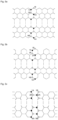
- Some GNR structures do contain edge elements which cannot be assigned unambiguously as either armchair or zigzag ore cove type carbon atoms and some GNR structures do contain edge elements which can neither be assigned as armchair, zigzag, nor cove type (see following formulae for three illustrations of one and the same GNR structure, highlighting armchair type edge carbon atoms (top), cove type edge carbon atoms (middle), respectively the non-ambiguously assignable edge carbon atoms denoted Y (bottom) and the edge carbon atoms Z which can neither be assigned as armchair type or zigzag type, nor as cove type.
- the graphene nanoribbon being obtainable by the aromatic monomer compounds of the present invention has its specific repeating unit.
- the term “repeating unit” relates to the part of the nanoribbon whose repetition would produce either the complete ribbon (except for the ends) or, if the GNR is made of two or more segments, one of these segments (except for the ends).
- the term “repeating unit” presupposes that there is at least one repetition of said unit.
- the repeating unit is referred to as RU1
- the GNR or one of its segments is made of n RU1 units with n ⁇ 2 (i.e. (RU1) n with n ⁇ 2).
- the upper limit depends on the desired final properties of the graphene nanoribbon and/or the process conditions, and can be, without limitation, e.g. n ⁇ 2500.
- the graphene nanoribbon may comprise just one repeating unit RU1 (with n repetitions as indicated above). However, it is also possible that the graphene nanoribbon comprises two or more different repeating units RU1, RU2, ising RUm, thereby resulting in a segmented graphene nanoribbon.
- the graphene nanoribbon may be non-segmented.
- the graphene nanoribbon may be a segmented graphene nanoribbon which comprises at least two different graphene segments S1 and S2 covalently linked to each other, wherein the neighbouring segments S1 and S2 have different repeating units RU1 and RU2.
- the repeating unit RU1 may comprise just one type of edge carbon atoms (e.g. only zigzag type edge carbon atoms or only cove type edge carbon atoms).
- the repeating unit may contain two or three types of edge carbon atoms (i.e. zigzag type carbon edge atoms and/or cove type carbon edge atoms and/or armchair type edge carbon atoms).
- zigzag type carbon edge atoms and/or cove type carbon edge atoms and/or armchair type edge carbon atoms In some cases a specific carbon edge atom cannot unambiguously be assigned as armchair type or zigzag type or cove type carbon atom because it is fulfilling the conditions for more than one type of edge carbon atoms.
- Such a carbon edge atom is for instance an armchair type edge atom and a cove type edge atom at the same time, i.e. a non-ambiguously assignable edge carbon atom.
- the number of zigzag type edge carbon atoms within the graphene nanoribbon repeating unit RU1 may vary over a broad range, depending on the desired final properties of the GNR.
- the number of cove type edge carbon atoms within the graphene nanoribbon repeating unit RU1 may vary over a broad range, depending on the desired final properties of the GNR.
- the number of armchair type edge carbon atoms within the graphene nanoribbon repeating unit RU1 may vary over a broad range, depending on the desired final properties of the GNR.
- the number of zigzag type edge carbon atoms of the repeating unit is high.
- the ratio of the number of zigzag type and/or cove type edge carbon atoms to the number of all edge carbon atoms in the repeating unit RU1 is 0.2 or more, preferably 0.4 or more, most preferably 0.6 or more.
- the graphene nanoribbon may have exclusively zigzag type edge carbon atoms (with exception of both ends of the GNR).
- the graphene nanoribbon may have exclusively cove type edge carbon atoms (with exception of both ends of the GNR).
- the graphene nanoribbon may have exclusively zigzag type and cove type edge carbon atoms (with exception of both ends of the GNR).
- the graphene nanoribbon containing zigzag type edge carbon atoms and/or cove type carbon atoms are obtained by polymerizing at least one aromatic monomer compound of the present invention, followed by partial or complete cyclodehydrogenation of the polymer.
- the aromatic monomer compound has one of the following formulas I to X: wherein
- two groups R a , R b and R c may together with the carbon atoms they are attached to, form a 5-8-membered cycle or heterocycle;
- the average width of the graphene nanoribbon can be varied over a broad range, depending on the desired final properties.
- the graphene nanoribbon or a segment of the graphene nanoribbon made of the repeating unit RU1 has a width of 20 nm or less, more preferably 15 nm or less, even more preferably 10 nm or less, even more preferably 7 nm or less, most preferably 4 nm or less.
- the GNR width and type of edge carbon structure is determined with scanning tunneling microscopy (STM).
- STM scanning tunneling microscopy
- the apparent width is corrected for the finite tip radius by STM simulation as explained in WO 2013/072292 .
- the width of a graphene nanoribbon maybe expressed by the number N of dimer lines across the width ( K. Wakabayashi et al., Sci. Technol. Adv. Mater. 11 (2010) 054504 ).
- the determination of N for the zig-zag, cove and armchair type GNRs, respectively, is shown in Fig. 5 .
- the repeating unit RU1 of the graphene nanoribbon may have a number N of dimer lines across the width of from 3 to 38, more preferably of from 3 to 21, or of from 5 to 20.
- the graphene nanoribbon comprises further repeating units RU2, RU3, .
- the preferred width values indicated above apply to these additional repeating units as well.
- the aromatic monomer compound may preferably be selected from the monomers of the following formulae 1-12: Table 1: Overview of monomer structures of the present invention Monomer Structure (compound No.) GNR Structure edge carbons per repeating unit zigzag edges per repeating unit (unambiguous / ambiguous) cove edges per repeating unit (unambiguous / ambiguous) armchair edges per repeating unit (unambiguous / ambiguous) Unambiguous / ambiguous edges per repeating unit I (9) i 24 10 (4 / 6) 16(10/6) 10(0/10) 14/10 41.7% (16.7% /25%) 66.7% (41.7%/25% ) 41.7% (0%/41.7%) II (10) ii 20 18 (10/8) 0 10 (2 / 8) 12/8 90% (50%/40%) 50% (10%/40%) III (6, 7) iii 24 0 24 (24 / 0) 0 24/0 100% (100%/0%) IV (5) iv 24 24 (24 / 0) 0
- the present invention provides a process for preparing the graphene nanoribbon as disclosed above, which comprises:
- step (a) includes providing the at least one aromatic monomer compound of the present invention on a solid substrate.
- steps (a), (b) and (c) of the process is not processed on the solid substrate, but in solution.
- steps (a), (b) and (c) of the process are processed not on the solid substrate, but in solution.
- any solid substrate enabling the deposition of the aromatic monomer compound of the present invention and subsequent polymerization on its surface may be used.
- the solid substrate has a flat surface.
- the solid substrate on which the monomer compound is deposited may have a metal surface such as for example a Au, Ag, Cu, Al, W, Ni, Pt, or a Pd surface (which may e.g. be reconstructed or vicinal).
- the surface can be completely flat or patterned or stepped. Such patterned or stepped surfaces and manufacturing methods thereof are known to the skilled person. On patterned surfaces the growth of graphene nanoribbons may be directed by the surface pattern.
- the solid substrate may also have a metal oxide surface such as silicon oxide, silicon oxynitride, hafnium silicate, nitrided hafnium silicates (HfSiON), zirconium silicate, hafnium (di)oxide and zirconium dioxide, or aluminium oxide, copper oxide, iron oxide.
- a metal oxide surface such as silicon oxide, silicon oxynitride, hafnium silicate, nitrided hafnium silicates (HfSiON), zirconium silicate, hafnium (di)oxide and zirconium dioxide, or aluminium oxide, copper oxide, iron oxide.
- the surface may also be made of a semiconducting material such as silicon, germanium, gallium arsenide, silicon carbide, and molybdenum disulfide.
- the surface may also be a material such as boron nitride, sodium chloride, or calcite.
- the surface may be electrically conducting, semiconducting, or insulating.
- the surface may be non-magnetic or magnetic (ferro- or anti-ferromagnetic).
- the deposition on the surface may be done by any process suitable for providing organic compounds on a surface.
- the process may e.g. be a vacuum deposition (sublimation) process, a solution based process such as spin coating, spray coating, dip coating, printing, electrospray deposition, or a laser induced desorption or transfer process.
- the deposition process may also be a direct surface to surface transfer.
- the deposition is done by a vacuum deposition process.
- it is a vacuum sublimation process.
- the vacuum may be in the range of 10 -1 to 10 -11 mbar.
- step (b) of the process of the present invention includes polymerization of the aromatic monomer compound of the present invention so as to form at least one polymer (herein also referred to as "GNR precursor polymer") on the surface of the solid substrate.
- the polymerization in step (b) is induced by thermal activation.
- any other energy input which induces polymerization of the aromatic monomer compound such as radiation can be used as well.
- the activation temperature is dependent on the employed surface and the monomer and can be in the range of from 0 to 500°C.
- step (a) and/or step (b) can be repeated at least once before carrying out partial or complete cyclodehydrogenation in step (c).
- step (a) and (b) the same monomer compound or a different aromatic monomer compound of the present invention can be used.
- step (c) of the process of the present invention includes at least partially cyclodehydrogenating the one or more GNR precursor polymers of step (b).
- the polymer of step (b) is subjected to complete cyclodehydrogenation.
- At least two different monomer compounds are provided on the solid substrate in step (a).
- two or more different monomer compounds preferably having similar reactivity, are provided on the surface of the solid substrate, followed by inducing polymerization to form a co-polymer. Subsequently, a partial or complete cyclodehydrogenation reaction is carried out leading to a segmented graphene nanoribbon.
- a first aromatic monomer compound is deposited on the surface of the solid substrate, followed by inducing polymerization to form a polymer.
- a second monomer is then deposited on the same substrate surface, followed by inducing polymerization to form a block co-polymer.
- This step may optionally be repeated several times, either with identical or different monomer compounds to yield a multi block copolymer.
- the block co-polymer is subjected to a partial or complete cyclodehydrogenation reaction leading to a segmented graphene nanoribbon.
- the partial or complete cyclodehydrogenation reaction is induced by a spatially controlled external stimulus.
- the external stimulus may be an electrical current, heat, an ion beam, oxidative plasma, microwave, light or electromagnetic radiation in general or it may be an oxidative chemical reagent.
- the spatial control of the activation may be done using a highly focused activation stimulus whose position versus the substrate can be controlled.
- the spatially confined activation stimulus may originate from a nano sized electrode, such as e.g. a tip of a tunneling microscope or from highly focused electromagnetic radiation such as e.g. a focused laser beam, or from a highly focused electron beam such as in an electron microscope.
- the spatial control of the activation may also be done using a nanostructured mask to direct the impact of the activation stimulus, such as e.g. a photo mask.
- a further step (d) may be performed comprising at least partially coupling the methyl substituent of a cove type edge element of the one or more polymers of step (b) to an adjacent aryl group.
- a cove type edge element is converted into a zigzag type edge element.
- coupling is shown in the conversion of monomer VIII to structure viii. This coupling step is also further illustrated in the examples.
- step (d) may be performed before, after or along with step (c).
- the graphene nanoribbon may also be prepared via a solution based process, as already mentioned above and generally known to those skilled in the art.
- the process preferably comprises a solution polymerization of the at least one aromatic monomer compound of the present invention to an oligo-phenylene precursor polymer which can then be transformed into graphene nanoribbon using a solution based process such as cyclodehydrogenation (e.g. Scholl-type oxidative cyclodehydrogenation).
- cyclodehydrogenation e.g. Scholl-type oxidative cyclodehydrogenation
- the polymerization and cyclodehydrogenization processs is preferably done with monomers comprising long alkyl or alkoxy chain substituents, e.g. in position R b of monomers defined above, in order to improve the solubility of the resulting GNR.
- Graphene nanoribbon structures i-ix which are non limiting examples that are thus formed from monomers I-X are shown by the following structures, wherein
- Graphene nanoribbon structure i contains cove type edges and zigzag type edges in the repeating unit RU1.
- Graphene nanoribbon structure ii contains zigzag type edges and armchair type edges in the repeating unit RU1.
- Graphene nanoribbon structure iii contains exclusively cove type edges in the repeating unit RU1.
- Graphene nanoribbon structure iv contains exclusively zigzag type edges in the repeating unit RU1.
- Graphene nanoribbon structure v contains exclusively zigzag type edges in the repeating unit RU1.
- Graphene nanoribbon structure vi contains zigzag type edges and edges which can neither be assigned as zigzag, armchair, nor cove type edges in the repeating unit RU1.
- Graphene nanoribbon structure vii contains cove type edges and zigzag type edges in the repeating unit RU1.
- Graphene nanoribbon structure viii is derived of monomer VIII or X and contains exclusively zigzag type edges in the repeating unit RU1.
- Graphene nanoribbon structure ix is derived of monomer IX and contains zigzag type edges and cove type edges in the repeating unit RU1.
- aromatic groups in the GNR structures above or substituents R b and/or R c may react with other groups so as to form a 5 membered carbocyclic ring.
- the two carbon atoms substituted with hydrogen may form a 5-membered carbocyclic ring by cycloannelation (see e.g. in GNR structure vii),
- the resulting graphene nanoribbons may be used directly on the substrate on which they are prepared or they may be transferred to another substrate.
- Bromonaphthol 101 (2.7 g) and 3',5'-Dimethylbiphenyl-4-Carbaldehyde 102 (1.27 g) were added together with p-Toluenesulfonic acid (25 mg) in a microwave reactor and heated to 130 °C under stirring. After 4 h at this temperature, the reaction mixture was cooled to room temperature and washed with a mixture of water and ethanol (3:1). The red solid was recrystallized from ethanol and the white powder filtered and washed with cold ethanol to give product 103 (2.62 g, 70%).
- the Xanthenol 104 (2.00 g) was dissolved in Toluene (5 mL) and acetic acid anhydride (15 mL) and the solution cooled to 0 °C. Tetrafluoroboric acid (50 w%, 1.2 mL) was added carefully to precipitate the red product. It was stirred for 1 h and the product filtered and washed with 100 mL cold diethylether and a 2:1-mixture of petroleum ether and dichloromethane to yield 105 (1.58 g, 65%).
- the Xanthenium-Tetrafluoroborate 105 (1 g) was suspended together with sodium-2-phenylacetate (900 mg) in 12 mL acetic acid anhydride. It was stirred for 5 h at 155 °C and the solvent removed under reduced pressure. The brown residue was dissolved in Dichlormethane and purified via column chromatography (DCM:PE, 1:4). The yellow product 1 was recrystallized from chloroform (314 mg, 32%).
- 2-decyltetradecan-1-ol (30 g, 84.5 mmol) and triphenylphosphine (45 g, 169 mmol) were dissolved in dichloromethane (100 ml) and cooled to 0 °C.
- Polymer 119 is transformed into the corresponding GNR by cyclodehyrogenation reaction in solution as described in WO2013/061258 .
- reaction tube containing PtCl 2 (0.07 mmol) was dried in vacuo for 1 h, and vacuum was filled with nitrogen with a nitrogen balloon.
- compound 136 (0.74 mmol) and toluene (74 mL), and the mixture was stirred at 25°C for 5 min before it was heated at 90°C for 24 h.
- a Au(111) single crystal (Surface Preparation Laboratory, Netherlands) was used as the substrate for the growth of the GNR structures v, vi and vii from the corresponding monomers 5, 6 and 7, respectively.
- the Au surface was cleaned under ultra-high vacuum conditions (UHV, pressure 1 ⁇ 10 -10 mbar) by repeated cycles of argon ion bombardment and annealing to 470 °C. Once the surface was clean, the precursor monomers were deposited onto the substrate held at 200 °C by sublimation at rates of ⁇ 0.1 nm/min. After monomer deposition, the Au(111) substrate was kept at this temperature for a few minutes (1-15 min) to complete polymerization.
- VT-STM variable-temperature STM
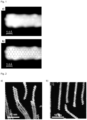
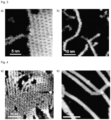
- Figures 2 , 3 and 4 show STM images of the polymer structures obtained after monomer deposition (a) and of the final GNR structures (b) obtained after cyclodehydrogenation.
- the characteristic apparent height of the final GNR structures is of 0.17 to 0.20 nm, in agreement with other GNR structures [e.g. Nature 466, 470-473 (2010 )].
- the Au surface was cleaned under ultra-high vacuum conditions (UHV, pressure 1 ⁇ 10 -10 mbar) by repeated cycles of argon ion bombardment and annealing to 470 °C. Once the surface was clean, the precursor monomers 3 were deposited onto the substrate held at 200 °C by sublimation at rates of ⁇ 0.1 nm/min. After monomer deposition, the Au(111) substrate was kept at this temperature for a few minutes (1-15 min) to complete polymerization.
- LT-STM low-temperature scanning tunneling microscope
- Figure 1 b) shows the same STM image with a chemical model of the corresponding GNR structure iii overlaid.
- a Au(111) single crystal (Surface Preparation Laboratory, Netherlands) was used as the substrate for the growth of the GNR structure i from monomer 9.
- the Au surface was cleaned under ultra-high vacuum conditions (UHV, pressure 1 ⁇ 10 -10 mbar) by repeated cycles of argon ion bombardment and annealing to 470 °C. Once the surface was clean, the precursor monomers 9 were deposited onto the substrate held at 170 °C by sublimation at rates of ⁇ 0.1 nm/min. After monomer deposition, the Au(111) substrate was kept at this temperature for a few minutes (1-15 min) to complete polymerization.
- VT-STM variable-temperature STM
Landscapes
- Chemical & Material Sciences (AREA)
- Organic Chemistry (AREA)
- Health & Medical Sciences (AREA)
- Chemical Kinetics & Catalysis (AREA)
- Medicinal Chemistry (AREA)
- Polymers & Plastics (AREA)
- Engineering & Computer Science (AREA)
- Materials Engineering (AREA)
- Nanotechnology (AREA)
- Inorganic Chemistry (AREA)
- Carbon And Carbon Compounds (AREA)
- Organic Low-Molecular-Weight Compounds And Preparation Thereof (AREA)
- Polyoxymethylene Polymers And Polymers With Carbon-To-Carbon Bonds (AREA)
Claims (9)
- Aromatische Monomerverbindung der Formel I-X:


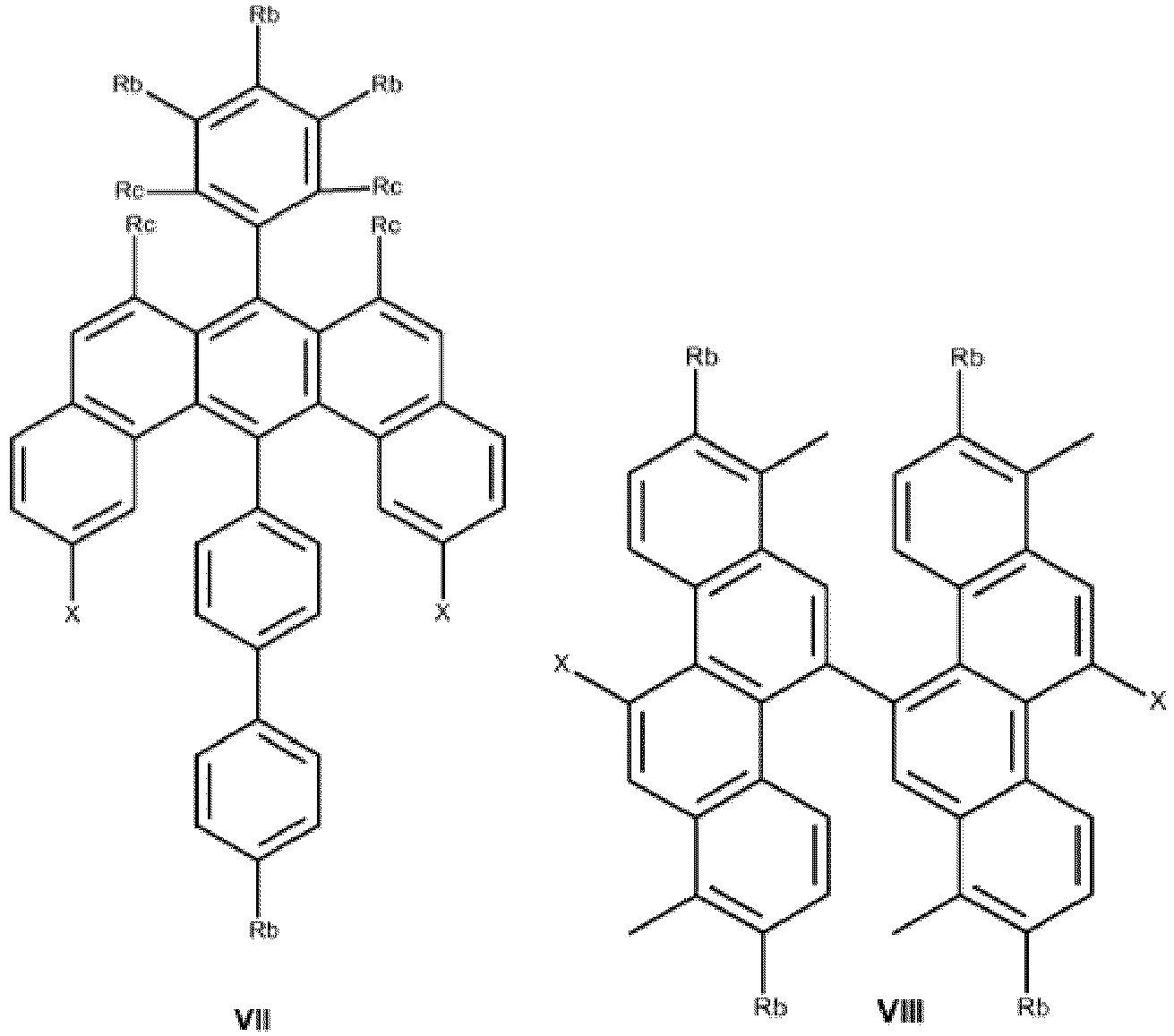
 X unabhängig voneinander Br oder I sind;Ra unabhängig voneinander Wasserstoff oder lineares oder verzweigtes oder cyclisches C1-C30-Alkyl, vorzugsweise Wasserstoff oder Methyl, sind;Rb unabhängig voneinander Wasserstoff; lineares oder verzweigtes oder cyclisches C1-C30-Alkyl,das unsubstituiert oder mit einem oder mehreren OH, C1-C4-Alkoxy, Phenyl oder mit CN substituiert ist; C2-C12-Alkyl, das durch ein oder mehrere nicht aufeinanderfolgende O unterbrochen ist; Halogen; OH; OR3; SR3; CN; NO2; NR1R2; (CO)R3; (CO) OR3; O(CO)OR3; O(CO)NR1R2; O(CO)R3; C1-C12-Alkoxy; C1-C12-Alkylthio; (C1-C6-Alkyl)-NR7R8 oder -O-(C1-C6-Alkyl)NR1R2; Aryl oder Heteroaryl; wobei Aryl vorzugsweise Phenyl, Biphenyl, Naphthyl oder Anthryl ist, die alle unsubstituiert oder mit einem oder mehreren C1-C4-Alkyl, CN, OR3, SR3, CH2OR3, (CO) OR3, (CO)NR1R2 oder Halogen substituiert sind, sind;Rc unabhängig voneinander Wasserstoff; lineares oder verzweigtes oder cyclisches C1-C30-Alkyl, das unsubstituiert oder mit einem oder mehreren OH, C1-C4-Alkoxy, Phenyl oder mit CN substituiert ist; C2-C12-Alkyl, das durch ein oder mehrere nicht aufeinanderfolgende O unterbrochen ist; Halogen; OH; OR3; SR3; CN; NO2; NR1R2; (CO)R3; (CO) OR3; O(CO)OR3; O(CO)NR1R2; O(CO)R3; C1-C12-Alkoxy; C1-C12-Alkylthio; (C1-C6-Alkyl)-NR7R8 oder -O-(C1-C6-Alkyl)NR1R2, sind;oder zwei Gruppen Ra, Rb und Rc zusammen mit den Kohlenstoffatomen, an die sie gebunden sind, einen 5-bis 8-gliedrigen Cyclus oder Heterocyclus bilden können; R1 und R2 unabhängig voneinander Wasserstoff, lineares oder verzweigtes C1-C6-Alkyl oder Phenyl sind, oder R1 und R2 zusammen mit dem Stickstoffatom, an das sie gebunden sind, eine Gruppe bilden, ausgewählt aus
 R3 aus H, C1-C30-Alkyl und Phenyl ausgewählt ist, das unsubstituiert oder mit einem oder mehreren C1-C4-Alkyl, Phenyl, Halogen, C1-C4-Alkoxy oder C1-C4-Alkylthio substituiert sein kann.
 - Aromatische Monomerverbindung nach Anspruch 1, wobeiRa unabhängig voneinander Wasserstoff oder Methyl sind;Rb aus Wasserstoff, linearem oder verzweigtem C1-C30-Alkyl, OR3 und NR1R2 ausgewählt ist;Rc unabhängig voneinander Wasserstoff oder C10-Alkyl sind;R1 und R2 unabhängig voneinander Wasserstoff oder C1-C4-Alkyl sind oder R1 und R2 zusammen mit dem Stickstoffatom, an das sie gebunden sind, eine Gruppe bilden, ausgewählt aus
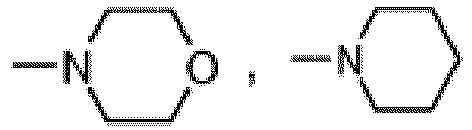
 R3 aus Wasserstoff und C1-C30-Alkyl ausgewählt ist.
 - Aromatische Monomerverbindung nach Anspruch 1 oder 2, die aus den Formeln 1-12 ausgewählt ist


- Verwendung der aromatischen Monomerverbindung nach einem der Ansprüche 1 bis 3 zur Herstellung eines Graphennanobandes.
- Verfahren zur Herstellung eines Graphennanobandes, umfassend eine Wiederholungseinheit RU1, die mindestens 20 % Kantenkohlenstoffatome umfasst, die eindeutig als Kohlenstoffatome vom Zickzack- oder Buchtentyp zugeordnet werden können, wobei das Verfahren umfasst:(a) Bereitstellen mindestens einer aromatischen Monomerverbindung nach einem der Ansprüche 1 bis 3 auf einem festen Substrat,(b) Polymerisation der aromatischen Monomerverbindung, um mindestens ein Polymer auf der Oberfläche des festen Substrats zu bilden,(c) mindestens teilweises Cyclodehydrieren des einen oder der mehreren Polymere von Schritt (b).
- Verfahren nach Anspruch 5, wobei ein weiterer Schritt (d) vor, nach oder zusammen mit Schritt (c) durchgeführt wird, wobei Schritt (d) das mindestens teilweise Koppeln des Methylsubstituenten eines Kantenelements vom Buchtentyp des einen oder der mehreren Polymere von Schritt (b) an eine benachbarte Arylgruppe umfasst, um das Kantenelement vom Buchtentyp in ein Kantenelement vom Zickzacktyp umzuwandeln.
- Verfahren nach Anspruch 5 oder 6, wobei die Polymerisation in Schritt (b) durch thermische Aktivierung induziert wird.
- Verfahren zur Herstellung eines Graphennanobandes, umfassend eine Wiederholungseinheit RU1, die mindestens 20 % Kantenkohlenstoffatome umfasst, die eindeutig als Kohlenstoffatome vom Zickzack- oder Buchtentyp zugeordnet werden können, wobei das Verfahren umfasst:(a) Bereitstellen mindestens einer aromatischen Monomerverbindung nach einem der Ansprüche 1 bis 3 in Lösung,(b) Polymerisation der aromatischen Monomerverbindung, um mindestens ein Polymer zu bilden,(c) mindestens teilweises Cyclodehydrieren des einen oder der mehreren Polymere von Schritt (b).
- Verfahren nach einem der Ansprüche 5 bis 8, wobei das Graphennanoband aus einer der folgenden Strukturen i-ix ausgewählt ist:


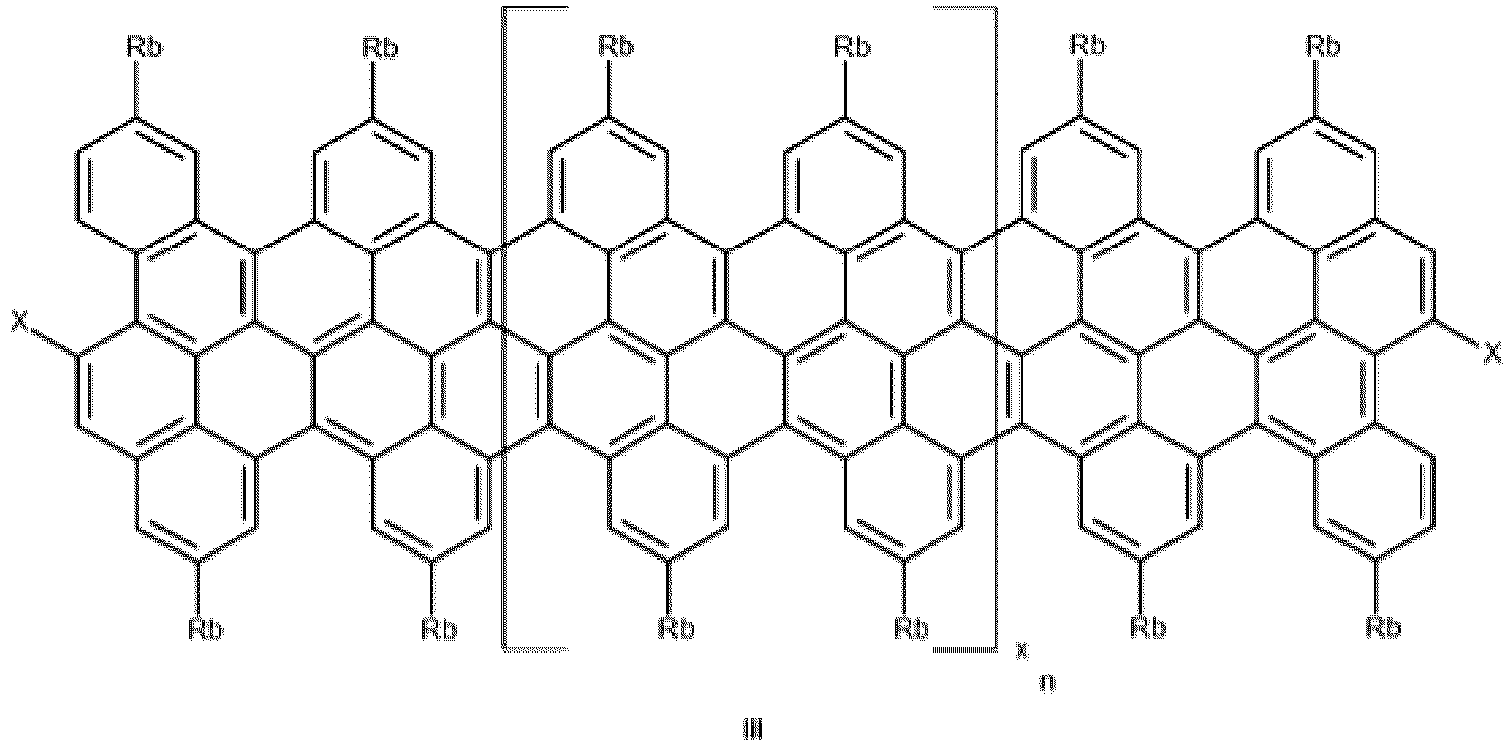


 Rb und Rc die gleiche Bedeutung wie in Anspruch 1 definiert aufweisen,oder, wenn in dem GNR-Vorläuferpolymer zwei benachbarte Gruppen Rc Wasserstoff sind, die zwei mit Wasserstoff substituierten Kohlenstoffatome durch Cycloannelierung einen 5-gliedrigen carbocyclischen Ring bilden können,oder, wenn in dem GNR-Vorläuferpolymer eine von zwei direkt benachbarten Gruppen Rb ein alpha-Wasserstoffsubstituiertes Aryl, vorzugsweise Phenyl, ist und die andere Wasserstoff ist, die zwei mit Wasserstoff substituierten Kohlenstoffatome durch Cycloannellierung einen 5-gliedrigen carbocyclischen Ring bilden können,oder, wenn in dem GNR-Vorläuferpolymer eine Gruppe Rb ein mit einem alpha-Wasserstoff substituiertes Aryl ist, sie durch Cycloannellierung zusammen mit einem benachbarten, mit Wasserstoff substituierten Kantenkohlenstoff einen 5-gliedrigen carbocyclischen Ring bilden kann,X aus Br, I und H ausgewählt ist,n eine ganze Zahl von 2 bis 2500 ist.
Applications Claiming Priority (2)
| Application Number | Priority Date | Filing Date | Title |
|---|---|---|---|
| EP14155067.3A EP2907791A1 (de) | 2014-02-13 | 2014-02-13 | Graphennanobänder mit kontrollierter Zickzackkante und ausgebuchteter Kantenkonfiguration |
| PCT/IB2015/050951 WO2015121785A1 (en) | 2014-02-13 | 2015-02-09 | Graphene nanoribbons with controlled zig-zag edge and cove edge configuration |
Publications (4)
| Publication Number | Publication Date |
|---|---|
| EP3105202A1 EP3105202A1 (de) | 2016-12-21 |
| EP3105202A4 EP3105202A4 (de) | 2017-08-30 |
| EP3105202B1 true EP3105202B1 (de) | 2024-11-13 |
| EP3105202C0 EP3105202C0 (de) | 2024-11-13 |
Family
ID=50150562
Family Applications (2)
| Application Number | Title | Priority Date | Filing Date |
|---|---|---|---|
| EP14155067.3A Withdrawn EP2907791A1 (de) | 2014-02-13 | 2014-02-13 | Graphennanobänder mit kontrollierter Zickzackkante und ausgebuchteter Kantenkonfiguration |
| EP15749267.9A Active EP3105202B1 (de) | 2014-02-13 | 2015-02-09 | Graphennanobänder mit kontrollierter zickzackkante und ausgebuchteter kantenkonfiguration |
Family Applications Before (1)
| Application Number | Title | Priority Date | Filing Date |
|---|---|---|---|
| EP14155067.3A Withdrawn EP2907791A1 (de) | 2014-02-13 | 2014-02-13 | Graphennanobänder mit kontrollierter Zickzackkante und ausgebuchteter Kantenkonfiguration |
Country Status (7)
| Country | Link |
|---|---|
| US (1) | US10329378B2 (de) |
| EP (2) | EP2907791A1 (de) |
| JP (1) | JP6759101B2 (de) |
| KR (1) | KR102333861B1 (de) |
| CN (1) | CN106103392B (de) |
| TW (1) | TWI680100B (de) |
| WO (1) | WO2015121785A1 (de) |
Families Citing this family (8)
| Publication number | Priority date | Publication date | Assignee | Title |
|---|---|---|---|---|
| WO2019158694A1 (en) | 2018-02-15 | 2019-08-22 | Fundació Institut Català De Nanociència I Nanotecnologia | A nanoporous graphene structure and method for preparation thereof |
| KR102901200B1 (ko) * | 2019-03-12 | 2025-12-16 | 타오카 케미컬 컴퍼니 리미티드 | 그래핀 나노리본 및 그 제조 방법 |
| WO2020243435A2 (en) * | 2019-05-31 | 2020-12-03 | The Regents Of The University Of California | Low band gap graphene nanoribbon electronic devices |
| CN110204691B (zh) * | 2019-06-18 | 2021-11-12 | 南京邮电大学 | 一种基于稠环石墨烯纳米带及制备方法 |
| CN115210245B (zh) * | 2020-03-04 | 2025-04-25 | 国立大学法人东海国立大学机构 | 萘基噻咯类的制备方法、及具有杂环式基团的萘基噻咯类及具有杂环式基团的石墨烯纳米带 |
| CN114057187B (zh) * | 2021-10-28 | 2023-04-11 | 广东墨睿科技有限公司 | 一种针尖诱导合成一维石墨烯的方法 |
| CN115676812A (zh) * | 2022-07-04 | 2023-02-03 | 昆明理工大学 | 一种在Au(111)基底上制备手性石墨烯纳米带的方法 |
| CN118908210B (zh) * | 2024-07-19 | 2025-01-28 | 重庆工商大学 | 一种复合多孔碳的制备方法及应用 |
Family Cites Families (17)
| Publication number | Priority date | Publication date | Assignee | Title |
|---|---|---|---|---|
| US5989737A (en) * | 1997-02-27 | 1999-11-23 | Xerox Corporation | Organic electroluminescent devices |
| JP2006052323A (ja) * | 2004-08-12 | 2006-02-23 | Sony Corp | 有機材料、有機電界発光素子、および表示装置 |
| KR101040967B1 (ko) | 2008-08-22 | 2011-06-16 | 한국과학기술연구원 | 그라핀 리본의 제조 방법 |
| KR101096518B1 (ko) | 2009-10-23 | 2011-12-20 | 한국과학기술연구원 | 구조제어된 그라핀 리본의 제조 방법 |
| US20110274928A1 (en) * | 2009-12-11 | 2011-11-10 | University Of Utah | Magnetic nanostructures |
| US20110244661A1 (en) | 2010-04-04 | 2011-10-06 | The Board Of Trustees Of The Leland Stanford Junior University | Large Scale High Quality Graphene Nanoribbons From Unzipped Carbon Nanotubes |
| US8236626B2 (en) * | 2010-04-15 | 2012-08-07 | The Board Of Trustees Of The Leland Stanford Junior University | Narrow graphene nanoribbons from carbon nanotubes |
| KR101082335B1 (ko) | 2010-05-19 | 2011-11-10 | 한국화학연구원 | 그라펜 나노리본를 이용한 박막트랜지스터 제조방법 |
| US20120261644A1 (en) | 2011-04-18 | 2012-10-18 | International Business Machines Corporation | Structure and method of making graphene nanoribbons |
| WO2012149257A2 (en) | 2011-04-28 | 2012-11-01 | Cornell University | Graphene nanoribbons, methods of making same, and uses thereof |
| EP2771308A4 (de) | 2011-10-26 | 2015-06-03 | Basf Se | Oligophenylen-monomere und polymere vorläufer zur herstellung von graphennanobändern |
| KR20150000860A (ko) | 2011-10-26 | 2015-01-05 | 바스프 에스이 | 그라펜 나노리본 전구체 및 그의 제조에 적합한 단량체 |
| US9394177B2 (en) * | 2011-10-27 | 2016-07-19 | Wisconsin Alumni Research Foundation | Nanostructured graphene with atomically-smooth edges |
| TWI562960B (en) | 2011-11-14 | 2016-12-21 | Basf Se | Segmented graphene nanoribbons |
| EP2794476A4 (de) | 2011-12-20 | 2015-06-03 | Basf Se | Polymervorläufer zur herstellung von graphennanobändern und verfahren zu ihrer herstellung |
| KR102134716B1 (ko) | 2012-05-24 | 2020-07-17 | 바스프 에스이 | 조절된 변형을 갖는 그래핀 나노리본 |
| CN102701196B (zh) | 2012-06-25 | 2014-04-30 | 北京大学 | 一种石墨烯纳米带的制备方法 |
-
2014
- 2014-02-13 EP EP14155067.3A patent/EP2907791A1/de not_active Withdrawn
-
2015
- 2015-02-09 CN CN201580007772.0A patent/CN106103392B/zh active Active
- 2015-02-09 EP EP15749267.9A patent/EP3105202B1/de active Active
- 2015-02-09 JP JP2016552272A patent/JP6759101B2/ja active Active
- 2015-02-09 KR KR1020167024906A patent/KR102333861B1/ko active Active
- 2015-02-09 WO PCT/IB2015/050951 patent/WO2015121785A1/en not_active Ceased
- 2015-02-09 US US15/118,796 patent/US10329378B2/en active Active
- 2015-02-11 TW TW104104481A patent/TWI680100B/zh active
Also Published As
| Publication number | Publication date |
|---|---|
| EP2907791A1 (de) | 2015-08-19 |
| EP3105202A1 (de) | 2016-12-21 |
| CN106103392B (zh) | 2020-06-26 |
| CN106103392A (zh) | 2016-11-09 |
| JP2017507890A (ja) | 2017-03-23 |
| EP3105202C0 (de) | 2024-11-13 |
| WO2015121785A1 (en) | 2015-08-20 |
| TWI680100B (zh) | 2019-12-21 |
| EP3105202A4 (de) | 2017-08-30 |
| JP6759101B2 (ja) | 2020-09-23 |
| US10329378B2 (en) | 2019-06-25 |
| US20170051101A1 (en) | 2017-02-23 |
| TW201538423A (zh) | 2015-10-16 |
| KR102333861B1 (ko) | 2021-12-01 |
| KR20160123335A (ko) | 2016-10-25 |
Similar Documents
| Publication | Publication Date | Title |
|---|---|---|
| US10329378B2 (en) | Graphene nanoribbons with controlled zig-zag edge and cove edge configuration | |
| EP2855344B1 (de) | Graphennanobänder mit kontrollierten änderungen | |
| Xiao et al. | Metastable Copper‐Phthalocyanine Single‐Crystal Nanowires and Their Use in Fabricating High‐Performance Field‐Effect Transistors | |
| EP2780280B1 (de) | Segmentierte graphennanobänder | |
| TWI579316B (zh) | 用於製造石墨烯奈米帶之聚合性先質及其製備方法 | |
| JP2017520618A (ja) | グラフェンナノリボンの製造のためのオルト−テルフェニル | |
| He et al. | Molecular phase engineering of organic semiconductors based on a [1] benzothieno [3, 2-b][1] benzothiophene core | |
| Chen et al. | Temperature‐Triggered Supramolecular Assembly of Organic Semiconductors | |
| JP2013004965A (ja) | 電子デバイス | |
| JP4752269B2 (ja) | ポルフィリン化合物及びその製造方法、有機半導体膜、並びに半導体装置 | |
| CN104936932A (zh) | 用于制备石墨烯纳米带的聚合物前体和用于制备它们的合适低聚亚苯基单体 | |
| KR102346048B1 (ko) | 2 차원 구조체 및 이의 제조 방법 | |
| Ma et al. | Graphene Nanoribbons from Tetraphenylethene‐Based Polymeric Precursor: Chemical Synthesis and Application in Thin‐Film Field‐Effect Transistor | |
| WO2020243435A2 (en) | Low band gap graphene nanoribbon electronic devices | |
| JP7480943B2 (ja) | グラフェンナノリボン及びその製造方法、グラフェンナノリボン前駆体、並びに半導体装置 | |
| Müller | Carpet Beater Molecules: Synthesis and Properties of Functional Hexa-peri-Benzocoronene Alkyne Coupling Products | |
| Yang et al. | Intramolecular oxidative cyclodehydrogenation route for the synthesis of strap-like conjugated polymers | |
| Abdi et al. | Developments in Synthesis and Potential Electronic and Magnetic Applications of Pristine and Doped Graphynes. Nanomaterials 2021, 11, 2268 | |
| Yang | Bottom-up synthesis of graphene nanoribbons and nanographene molecules with new types of periphery | |
| Yan | Solution-processable graphene quantum dots | |
| Aebischer | Controlling the supramolecular assembly of perfluorinated polycondensed aromatic hydrocarbons by side chain engineering |
Legal Events
| Date | Code | Title | Description |
|---|---|---|---|
| PUAI | Public reference made under article 153(3) epc to a published international application that has entered the european phase |
Free format text: ORIGINAL CODE: 0009012 |
|
| STAA | Information on the status of an ep patent application or granted ep patent |
Free format text: STATUS: REQUEST FOR EXAMINATION WAS MADE |
|
| 17P | Request for examination filed |
Effective date: 20160913 |
|
| AK | Designated contracting states |
Kind code of ref document: A1 Designated state(s): AL AT BE BG CH CY CZ DE DK EE ES FI FR GB GR HR HU IE IS IT LI LT LU LV MC MK MT NL NO PL PT RO RS SE SI SK SM TR |
|
| AX | Request for extension of the european patent |
Extension state: BA ME |
|
| DAX | Request for extension of the european patent (deleted) | ||
| A4 | Supplementary search report drawn up and despatched |
Effective date: 20170802 |
|
| RIC1 | Information provided on ipc code assigned before grant |
Ipc: C07C 13/62 20060101ALI20170727BHEP Ipc: C07C 25/22 20060101ALI20170727BHEP Ipc: C01B 32/184 20170101AFI20170727BHEP Ipc: C08G 61/10 20060101ALI20170727BHEP Ipc: C07C 15/20 20060101ALI20170727BHEP |
|
| RIC1 | Information provided on ipc code assigned before grant |
Ipc: C08G 61/10 20060101ALI20170727BHEP Ipc: C01B 32/184 20170101AFI20170727BHEP Ipc: C07C 15/20 20060101ALI20170727BHEP Ipc: C07C 13/62 20060101ALI20170727BHEP Ipc: C07C 25/22 20060101ALI20170727BHEP |
|
| RIC1 | Information provided on ipc code assigned before grant |
Ipc: C07C 13/62 20060101ALI20170727BHEP Ipc: C07C 25/22 20060101ALI20170727BHEP Ipc: C01B 32/184 20170101AFI20170727BHEP Ipc: C08G 61/10 20060101ALI20170727BHEP Ipc: C07C 15/20 20060101ALI20170727BHEP |
|
| STAA | Information on the status of an ep patent application or granted ep patent |
Free format text: STATUS: EXAMINATION IS IN PROGRESS |
|
| 17Q | First examination report despatched |
Effective date: 20190306 |
|
| GRAP | Despatch of communication of intention to grant a patent |
Free format text: ORIGINAL CODE: EPIDOSNIGR1 |
|
| STAA | Information on the status of an ep patent application or granted ep patent |
Free format text: STATUS: GRANT OF PATENT IS INTENDED |
|
| INTG | Intention to grant announced |
Effective date: 20240607 |
|
| GRAS | Grant fee paid |
Free format text: ORIGINAL CODE: EPIDOSNIGR3 |
|
| GRAA | (expected) grant |
Free format text: ORIGINAL CODE: 0009210 |
|
| STAA | Information on the status of an ep patent application or granted ep patent |
Free format text: STATUS: THE PATENT HAS BEEN GRANTED |
|
| AK | Designated contracting states |
Kind code of ref document: B1 Designated state(s): AL AT BE BG CH CY CZ DE DK EE ES FI FR GB GR HR HU IE IS IT LI LT LU LV MC MK MT NL NO PL PT RO RS SE SI SK SM TR |
|
| REG | Reference to a national code |
Ref country code: GB Ref legal event code: FG4D |
|
| REG | Reference to a national code |
Ref country code: CH Ref legal event code: EP |
|
| REG | Reference to a national code |
Ref country code: IE Ref legal event code: FG4D |
|
| REG | Reference to a national code |
Ref country code: DE Ref legal event code: R096 Ref document number: 602015090393 Country of ref document: DE |
|
| U01 | Request for unitary effect filed |
Effective date: 20241206 |
|
| RAP4 | Party data changed (patent owner data changed or rights of a patent transferred) |
Owner name: MAX-PLANCK-GESELLSCHAFT ZUR FOERDERUNG DERWISSENSCHAFTEN E.V. Owner name: EMPA EIDGENOESSISCHE MATERIALPRUEFUNGS- UNDFORSCHUNGSANSTALT Owner name: BASF SE |
|
| U07 | Unitary effect registered |
Designated state(s): AT BE BG DE DK EE FI FR IT LT LU LV MT NL PT RO SE SI Effective date: 20241219 |
|
| U20 | Renewal fee for the european patent with unitary effect paid |
Year of fee payment: 11 Effective date: 20250226 |
|
| PG25 | Lapsed in a contracting state [announced via postgrant information from national office to epo] |
Ref country code: HR Free format text: LAPSE BECAUSE OF FAILURE TO SUBMIT A TRANSLATION OF THE DESCRIPTION OR TO PAY THE FEE WITHIN THE PRESCRIBED TIME-LIMIT Effective date: 20241113 Ref country code: IS Free format text: LAPSE BECAUSE OF FAILURE TO SUBMIT A TRANSLATION OF THE DESCRIPTION OR TO PAY THE FEE WITHIN THE PRESCRIBED TIME-LIMIT Effective date: 20250313 |
|
| PG25 | Lapsed in a contracting state [announced via postgrant information from national office to epo] |
Ref country code: ES Free format text: LAPSE BECAUSE OF FAILURE TO SUBMIT A TRANSLATION OF THE DESCRIPTION OR TO PAY THE FEE WITHIN THE PRESCRIBED TIME-LIMIT Effective date: 20241113 |
|
| PG25 | Lapsed in a contracting state [announced via postgrant information from national office to epo] |
Ref country code: NO Free format text: LAPSE BECAUSE OF FAILURE TO SUBMIT A TRANSLATION OF THE DESCRIPTION OR TO PAY THE FEE WITHIN THE PRESCRIBED TIME-LIMIT Effective date: 20250213 |
|
| PG25 | Lapsed in a contracting state [announced via postgrant information from national office to epo] |
Ref country code: GR Free format text: LAPSE BECAUSE OF FAILURE TO SUBMIT A TRANSLATION OF THE DESCRIPTION OR TO PAY THE FEE WITHIN THE PRESCRIBED TIME-LIMIT Effective date: 20250214 |
|
| PG25 | Lapsed in a contracting state [announced via postgrant information from national office to epo] |
Ref country code: PL Free format text: LAPSE BECAUSE OF FAILURE TO SUBMIT A TRANSLATION OF THE DESCRIPTION OR TO PAY THE FEE WITHIN THE PRESCRIBED TIME-LIMIT Effective date: 20241113 |
|
| PG25 | Lapsed in a contracting state [announced via postgrant information from national office to epo] |
Ref country code: RS Free format text: LAPSE BECAUSE OF FAILURE TO SUBMIT A TRANSLATION OF THE DESCRIPTION OR TO PAY THE FEE WITHIN THE PRESCRIBED TIME-LIMIT Effective date: 20250213 |
|
| PG25 | Lapsed in a contracting state [announced via postgrant information from national office to epo] |
Ref country code: SM Free format text: LAPSE BECAUSE OF FAILURE TO SUBMIT A TRANSLATION OF THE DESCRIPTION OR TO PAY THE FEE WITHIN THE PRESCRIBED TIME-LIMIT Effective date: 20241113 |
|
| PG25 | Lapsed in a contracting state [announced via postgrant information from national office to epo] |
Ref country code: SK Free format text: LAPSE BECAUSE OF FAILURE TO SUBMIT A TRANSLATION OF THE DESCRIPTION OR TO PAY THE FEE WITHIN THE PRESCRIBED TIME-LIMIT Effective date: 20241113 |
|
| PG25 | Lapsed in a contracting state [announced via postgrant information from national office to epo] |
Ref country code: CZ Free format text: LAPSE BECAUSE OF FAILURE TO SUBMIT A TRANSLATION OF THE DESCRIPTION OR TO PAY THE FEE WITHIN THE PRESCRIBED TIME-LIMIT Effective date: 20241113 |
|
| PG25 | Lapsed in a contracting state [announced via postgrant information from national office to epo] |
Ref country code: MC Free format text: LAPSE BECAUSE OF FAILURE TO SUBMIT A TRANSLATION OF THE DESCRIPTION OR TO PAY THE FEE WITHIN THE PRESCRIBED TIME-LIMIT Effective date: 20241113 |
|
| PLBE | No opposition filed within time limit |
Free format text: ORIGINAL CODE: 0009261 |
|
| STAA | Information on the status of an ep patent application or granted ep patent |
Free format text: STATUS: NO OPPOSITION FILED WITHIN TIME LIMIT |
|
| 26N | No opposition filed |
Effective date: 20250814 |
|
| PG25 | Lapsed in a contracting state [announced via postgrant information from national office to epo] |
Ref country code: IE Free format text: LAPSE BECAUSE OF NON-PAYMENT OF DUE FEES Effective date: 20250209 |
|
| REG | Reference to a national code |
Ref country code: CH Ref legal event code: U11 Free format text: ST27 STATUS EVENT CODE: U-0-0-U10-U11 (AS PROVIDED BY THE NATIONAL OFFICE) Effective date: 20260301 |
|
| U20 | Renewal fee for the european patent with unitary effect paid |
Year of fee payment: 12 Effective date: 20260213 |
|
| PGFP | Annual fee paid to national office [announced via postgrant information from national office to epo] |
Ref country code: GB Payment date: 20260219 Year of fee payment: 12 |
|
| PGFP | Annual fee paid to national office [announced via postgrant information from national office to epo] |
Ref country code: CH Payment date: 20260301 Year of fee payment: 12 |