EP3102558B1 - Method for producing carbonates - Google Patents
Method for producing carbonates Download PDFInfo
- Publication number
- EP3102558B1 EP3102558B1 EP15704440.5A EP15704440A EP3102558B1 EP 3102558 B1 EP3102558 B1 EP 3102558B1 EP 15704440 A EP15704440 A EP 15704440A EP 3102558 B1 EP3102558 B1 EP 3102558B1
- Authority
- EP
- European Patent Office
- Prior art keywords
- tube
- catalyst
- phosgene
- reactor
- diameter
- Prior art date
- Legal status (The legal status is an assumption and is not a legal conclusion. Google has not performed a legal analysis and makes no representation as to the accuracy of the status listed.)
- Active
Links
Images




Classifications
-
- C—CHEMISTRY; METALLURGY
- C07—ORGANIC CHEMISTRY
- C07C—ACYCLIC OR CARBOCYCLIC COMPOUNDS
- C07C68/00—Preparation of esters of carbonic or haloformic acids
- C07C68/02—Preparation of esters of carbonic or haloformic acids from phosgene or haloformates
-
- B—PERFORMING OPERATIONS; TRANSPORTING
- B01—PHYSICAL OR CHEMICAL PROCESSES OR APPARATUS IN GENERAL
- B01J—CHEMICAL OR PHYSICAL PROCESSES, e.g. CATALYSIS OR COLLOID CHEMISTRY; THEIR RELEVANT APPARATUS
- B01J19/00—Chemical, physical or physico-chemical processes in general; Their relevant apparatus
- B01J19/24—Stationary reactors without moving elements inside
- B01J19/245—Stationary reactors without moving elements inside placed in series
-
- B—PERFORMING OPERATIONS; TRANSPORTING
- B01—PHYSICAL OR CHEMICAL PROCESSES OR APPARATUS IN GENERAL
- B01J—CHEMICAL OR PHYSICAL PROCESSES, e.g. CATALYSIS OR COLLOID CHEMISTRY; THEIR RELEVANT APPARATUS
- B01J8/00—Chemical or physical processes in general, conducted in the presence of fluids and solid particles; Apparatus for such processes
- B01J8/02—Chemical or physical processes in general, conducted in the presence of fluids and solid particles; Apparatus for such processes with stationary particles, e.g. in fixed beds
- B01J8/0285—Heating or cooling the reactor
-
- B—PERFORMING OPERATIONS; TRANSPORTING
- B01—PHYSICAL OR CHEMICAL PROCESSES OR APPARATUS IN GENERAL
- B01J—CHEMICAL OR PHYSICAL PROCESSES, e.g. CATALYSIS OR COLLOID CHEMISTRY; THEIR RELEVANT APPARATUS
- B01J8/00—Chemical or physical processes in general, conducted in the presence of fluids and solid particles; Apparatus for such processes
- B01J8/02—Chemical or physical processes in general, conducted in the presence of fluids and solid particles; Apparatus for such processes with stationary particles, e.g. in fixed beds
- B01J8/04—Chemical or physical processes in general, conducted in the presence of fluids and solid particles; Apparatus for such processes with stationary particles, e.g. in fixed beds the fluid passing successively through two or more beds
- B01J8/0403—Chemical or physical processes in general, conducted in the presence of fluids and solid particles; Apparatus for such processes with stationary particles, e.g. in fixed beds the fluid passing successively through two or more beds the fluid flow within the beds being predominantly horizontal
- B01J8/0423—Chemical or physical processes in general, conducted in the presence of fluids and solid particles; Apparatus for such processes with stationary particles, e.g. in fixed beds the fluid passing successively through two or more beds the fluid flow within the beds being predominantly horizontal through two or more otherwise shaped beds
- B01J8/0438—Chemical or physical processes in general, conducted in the presence of fluids and solid particles; Apparatus for such processes with stationary particles, e.g. in fixed beds the fluid passing successively through two or more beds the fluid flow within the beds being predominantly horizontal through two or more otherwise shaped beds the beds being placed next to each other
-
- B—PERFORMING OPERATIONS; TRANSPORTING
- B01—PHYSICAL OR CHEMICAL PROCESSES OR APPARATUS IN GENERAL
- B01J—CHEMICAL OR PHYSICAL PROCESSES, e.g. CATALYSIS OR COLLOID CHEMISTRY; THEIR RELEVANT APPARATUS
- B01J8/00—Chemical or physical processes in general, conducted in the presence of fluids and solid particles; Apparatus for such processes
- B01J8/02—Chemical or physical processes in general, conducted in the presence of fluids and solid particles; Apparatus for such processes with stationary particles, e.g. in fixed beds
- B01J8/04—Chemical or physical processes in general, conducted in the presence of fluids and solid particles; Apparatus for such processes with stationary particles, e.g. in fixed beds the fluid passing successively through two or more beds
- B01J8/0403—Chemical or physical processes in general, conducted in the presence of fluids and solid particles; Apparatus for such processes with stationary particles, e.g. in fixed beds the fluid passing successively through two or more beds the fluid flow within the beds being predominantly horizontal
- B01J8/0423—Chemical or physical processes in general, conducted in the presence of fluids and solid particles; Apparatus for such processes with stationary particles, e.g. in fixed beds the fluid passing successively through two or more beds the fluid flow within the beds being predominantly horizontal through two or more otherwise shaped beds
- B01J8/0442—Chemical or physical processes in general, conducted in the presence of fluids and solid particles; Apparatus for such processes with stationary particles, e.g. in fixed beds the fluid passing successively through two or more beds the fluid flow within the beds being predominantly horizontal through two or more otherwise shaped beds the beds being placed in separate reactors
-
- B—PERFORMING OPERATIONS; TRANSPORTING
- B01—PHYSICAL OR CHEMICAL PROCESSES OR APPARATUS IN GENERAL
- B01J—CHEMICAL OR PHYSICAL PROCESSES, e.g. CATALYSIS OR COLLOID CHEMISTRY; THEIR RELEVANT APPARATUS
- B01J8/00—Chemical or physical processes in general, conducted in the presence of fluids and solid particles; Apparatus for such processes
- B01J8/02—Chemical or physical processes in general, conducted in the presence of fluids and solid particles; Apparatus for such processes with stationary particles, e.g. in fixed beds
- B01J8/06—Chemical or physical processes in general, conducted in the presence of fluids and solid particles; Apparatus for such processes with stationary particles, e.g. in fixed beds in tube reactors; the solid particles being arranged in tubes
- B01J8/067—Heating or cooling the reactor
-
- C—CHEMISTRY; METALLURGY
- C01—INORGANIC CHEMISTRY
- C01B—NON-METALLIC ELEMENTS; COMPOUNDS THEREOF; METALLOIDS OR COMPOUNDS THEREOF NOT COVERED BY SUBCLASS C01C
- C01B32/00—Carbon; Compounds thereof
- C01B32/80—Phosgene
-
- C—CHEMISTRY; METALLURGY
- C07—ORGANIC CHEMISTRY
- C07C—ACYCLIC OR CARBOCYCLIC COMPOUNDS
- C07C69/00—Esters of carboxylic acids; Esters of carbonic or haloformic acids
- C07C69/96—Esters of carbonic or haloformic acids
-
- F—MECHANICAL ENGINEERING; LIGHTING; HEATING; WEAPONS; BLASTING
- F28—HEAT EXCHANGE IN GENERAL
- F28F—DETAILS OF HEAT-EXCHANGE AND HEAT-TRANSFER APPARATUS, OF GENERAL APPLICATION
- F28F1/00—Tubular elements; Assemblies of tubular elements
- F28F1/02—Tubular elements of cross-section which is non-circular
- F28F1/025—Tubular elements of cross-section which is non-circular with variable shape, e.g. with modified tube ends, with different geometrical features
-
- F—MECHANICAL ENGINEERING; LIGHTING; HEATING; WEAPONS; BLASTING
- F28—HEAT EXCHANGE IN GENERAL
- F28F—DETAILS OF HEAT-EXCHANGE AND HEAT-TRANSFER APPARATUS, OF GENERAL APPLICATION
- F28F1/00—Tubular elements; Assemblies of tubular elements
- F28F1/08—Tubular elements crimped or corrugated in longitudinal section
-
- F—MECHANICAL ENGINEERING; LIGHTING; HEATING; WEAPONS; BLASTING
- F28—HEAT EXCHANGE IN GENERAL
- F28F—DETAILS OF HEAT-EXCHANGE AND HEAT-TRANSFER APPARATUS, OF GENERAL APPLICATION
- F28F1/00—Tubular elements; Assemblies of tubular elements
- F28F1/10—Tubular elements and assemblies thereof with means for increasing heat-transfer area, e.g. with fins, with projections, with recesses
-
- F—MECHANICAL ENGINEERING; LIGHTING; HEATING; WEAPONS; BLASTING
- F28—HEAT EXCHANGE IN GENERAL
- F28F—DETAILS OF HEAT-EXCHANGE AND HEAT-TRANSFER APPARATUS, OF GENERAL APPLICATION
- F28F1/00—Tubular elements; Assemblies of tubular elements
- F28F1/10—Tubular elements and assemblies thereof with means for increasing heat-transfer area, e.g. with fins, with projections, with recesses
- F28F1/12—Tubular elements and assemblies thereof with means for increasing heat-transfer area, e.g. with fins, with projections, with recesses the means being only outside the tubular element
- F28F1/14—Tubular elements and assemblies thereof with means for increasing heat-transfer area, e.g. with fins, with projections, with recesses the means being only outside the tubular element and extending longitudinally
- F28F1/16—Tubular elements and assemblies thereof with means for increasing heat-transfer area, e.g. with fins, with projections, with recesses the means being only outside the tubular element and extending longitudinally the means being integral with the element, e.g. formed by extrusion
-
- F—MECHANICAL ENGINEERING; LIGHTING; HEATING; WEAPONS; BLASTING
- F28—HEAT EXCHANGE IN GENERAL
- F28F—DETAILS OF HEAT-EXCHANGE AND HEAT-TRANSFER APPARATUS, OF GENERAL APPLICATION
- F28F1/00—Tubular elements; Assemblies of tubular elements
- F28F1/10—Tubular elements and assemblies thereof with means for increasing heat-transfer area, e.g. with fins, with projections, with recesses
- F28F1/12—Tubular elements and assemblies thereof with means for increasing heat-transfer area, e.g. with fins, with projections, with recesses the means being only outside the tubular element
- F28F1/24—Tubular elements and assemblies thereof with means for increasing heat-transfer area, e.g. with fins, with projections, with recesses the means being only outside the tubular element and extending transversely
-
- F—MECHANICAL ENGINEERING; LIGHTING; HEATING; WEAPONS; BLASTING
- F28—HEAT EXCHANGE IN GENERAL
- F28F—DETAILS OF HEAT-EXCHANGE AND HEAT-TRANSFER APPARATUS, OF GENERAL APPLICATION
- F28F1/00—Tubular elements; Assemblies of tubular elements
- F28F1/10—Tubular elements and assemblies thereof with means for increasing heat-transfer area, e.g. with fins, with projections, with recesses
- F28F1/12—Tubular elements and assemblies thereof with means for increasing heat-transfer area, e.g. with fins, with projections, with recesses the means being only outside the tubular element
- F28F1/34—Tubular elements and assemblies thereof with means for increasing heat-transfer area, e.g. with fins, with projections, with recesses the means being only outside the tubular element and extending obliquely
-
- F—MECHANICAL ENGINEERING; LIGHTING; HEATING; WEAPONS; BLASTING
- F28—HEAT EXCHANGE IN GENERAL
- F28F—DETAILS OF HEAT-EXCHANGE AND HEAT-TRANSFER APPARATUS, OF GENERAL APPLICATION
- F28F1/00—Tubular elements; Assemblies of tubular elements
- F28F1/10—Tubular elements and assemblies thereof with means for increasing heat-transfer area, e.g. with fins, with projections, with recesses
- F28F1/12—Tubular elements and assemblies thereof with means for increasing heat-transfer area, e.g. with fins, with projections, with recesses the means being only outside the tubular element
- F28F1/38—Tubular elements and assemblies thereof with means for increasing heat-transfer area, e.g. with fins, with projections, with recesses the means being only outside the tubular element and being staggered to form tortuous fluid passages
-
- F—MECHANICAL ENGINEERING; LIGHTING; HEATING; WEAPONS; BLASTING
- F28—HEAT EXCHANGE IN GENERAL
- F28F—DETAILS OF HEAT-EXCHANGE AND HEAT-TRANSFER APPARATUS, OF GENERAL APPLICATION
- F28F1/00—Tubular elements; Assemblies of tubular elements
- F28F1/10—Tubular elements and assemblies thereof with means for increasing heat-transfer area, e.g. with fins, with projections, with recesses
- F28F1/40—Tubular elements and assemblies thereof with means for increasing heat-transfer area, e.g. with fins, with projections, with recesses the means being only inside the tubular element
-
- F—MECHANICAL ENGINEERING; LIGHTING; HEATING; WEAPONS; BLASTING
- F28—HEAT EXCHANGE IN GENERAL
- F28F—DETAILS OF HEAT-EXCHANGE AND HEAT-TRANSFER APPARATUS, OF GENERAL APPLICATION
- F28F1/00—Tubular elements; Assemblies of tubular elements
- F28F1/10—Tubular elements and assemblies thereof with means for increasing heat-transfer area, e.g. with fins, with projections, with recesses
- F28F1/42—Tubular elements and assemblies thereof with means for increasing heat-transfer area, e.g. with fins, with projections, with recesses the means being both outside and inside the tubular element
- F28F1/424—Means comprising outside portions integral with inside portions
- F28F1/426—Means comprising outside portions integral with inside portions the outside portions and the inside portions forming parts of complementary shape, e.g. concave and convex
-
- F—MECHANICAL ENGINEERING; LIGHTING; HEATING; WEAPONS; BLASTING
- F28—HEAT EXCHANGE IN GENERAL
- F28F—DETAILS OF HEAT-EXCHANGE AND HEAT-TRANSFER APPARATUS, OF GENERAL APPLICATION
- F28F13/00—Arrangements for modifying heat-transfer, e.g. increasing, decreasing
- F28F13/06—Arrangements for modifying heat-transfer, e.g. increasing, decreasing by affecting the pattern of flow of the heat-exchange media
- F28F13/08—Arrangements for modifying heat-transfer, e.g. increasing, decreasing by affecting the pattern of flow of the heat-exchange media by varying the cross-section of the flow channels
-
- B—PERFORMING OPERATIONS; TRANSPORTING
- B01—PHYSICAL OR CHEMICAL PROCESSES OR APPARATUS IN GENERAL
- B01J—CHEMICAL OR PHYSICAL PROCESSES, e.g. CATALYSIS OR COLLOID CHEMISTRY; THEIR RELEVANT APPARATUS
- B01J2208/00—Processes carried out in the presence of solid particles; Reactors therefor
- B01J2208/00008—Controlling the process
- B01J2208/00017—Controlling the temperature
- B01J2208/00106—Controlling the temperature by indirect heat exchange
- B01J2208/00168—Controlling the temperature by indirect heat exchange with heat exchange elements outside the bed of solid particles
- B01J2208/00185—Fingers
-
- B—PERFORMING OPERATIONS; TRANSPORTING
- B01—PHYSICAL OR CHEMICAL PROCESSES OR APPARATUS IN GENERAL
- B01J—CHEMICAL OR PHYSICAL PROCESSES, e.g. CATALYSIS OR COLLOID CHEMISTRY; THEIR RELEVANT APPARATUS
- B01J2208/00—Processes carried out in the presence of solid particles; Reactors therefor
- B01J2208/00008—Controlling the process
- B01J2208/00017—Controlling the temperature
- B01J2208/00106—Controlling the temperature by indirect heat exchange
- B01J2208/00168—Controlling the temperature by indirect heat exchange with heat exchange elements outside the bed of solid particles
- B01J2208/00194—Tubes
-
- B—PERFORMING OPERATIONS; TRANSPORTING
- B01—PHYSICAL OR CHEMICAL PROCESSES OR APPARATUS IN GENERAL
- B01J—CHEMICAL OR PHYSICAL PROCESSES, e.g. CATALYSIS OR COLLOID CHEMISTRY; THEIR RELEVANT APPARATUS
- B01J2208/00—Processes carried out in the presence of solid particles; Reactors therefor
- B01J2208/00008—Controlling the process
- B01J2208/00017—Controlling the temperature
- B01J2208/00106—Controlling the temperature by indirect heat exchange
- B01J2208/00168—Controlling the temperature by indirect heat exchange with heat exchange elements outside the bed of solid particles
- B01J2208/00212—Plates; Jackets; Cylinders
- B01J2208/00221—Plates; Jackets; Cylinders comprising baffles for guiding the flow of the heat exchange medium
-
- B—PERFORMING OPERATIONS; TRANSPORTING
- B01—PHYSICAL OR CHEMICAL PROCESSES OR APPARATUS IN GENERAL
- B01J—CHEMICAL OR PHYSICAL PROCESSES, e.g. CATALYSIS OR COLLOID CHEMISTRY; THEIR RELEVANT APPARATUS
- B01J2208/00—Processes carried out in the presence of solid particles; Reactors therefor
- B01J2208/00008—Controlling the process
- B01J2208/00017—Controlling the temperature
- B01J2208/00106—Controlling the temperature by indirect heat exchange
- B01J2208/00168—Controlling the temperature by indirect heat exchange with heat exchange elements outside the bed of solid particles
- B01J2208/00212—Plates; Jackets; Cylinders
- B01J2208/00238—Adjusting the heat-exchange profile by adapting catalyst tubes or the distribution thereof, e.g. by using inserts in some of the tubes or adding external fins
-
- B—PERFORMING OPERATIONS; TRANSPORTING
- B01—PHYSICAL OR CHEMICAL PROCESSES OR APPARATUS IN GENERAL
- B01J—CHEMICAL OR PHYSICAL PROCESSES, e.g. CATALYSIS OR COLLOID CHEMISTRY; THEIR RELEVANT APPARATUS
- B01J2208/00—Processes carried out in the presence of solid particles; Reactors therefor
- B01J2208/00008—Controlling the process
- B01J2208/00017—Controlling the temperature
- B01J2208/00513—Controlling the temperature using inert heat absorbing solids in the bed
-
- B—PERFORMING OPERATIONS; TRANSPORTING
- B01—PHYSICAL OR CHEMICAL PROCESSES OR APPARATUS IN GENERAL
- B01J—CHEMICAL OR PHYSICAL PROCESSES, e.g. CATALYSIS OR COLLOID CHEMISTRY; THEIR RELEVANT APPARATUS
- B01J2208/00—Processes carried out in the presence of solid particles; Reactors therefor
- B01J2208/02—Processes carried out in the presence of solid particles; Reactors therefor with stationary particles
-
- B—PERFORMING OPERATIONS; TRANSPORTING
- B01—PHYSICAL OR CHEMICAL PROCESSES OR APPARATUS IN GENERAL
- B01J—CHEMICAL OR PHYSICAL PROCESSES, e.g. CATALYSIS OR COLLOID CHEMISTRY; THEIR RELEVANT APPARATUS
- B01J2208/00—Processes carried out in the presence of solid particles; Reactors therefor
- B01J2208/06—Details of tube reactors containing solid particles
- B01J2208/065—Heating or cooling the reactor
-
- B—PERFORMING OPERATIONS; TRANSPORTING
- B01—PHYSICAL OR CHEMICAL PROCESSES OR APPARATUS IN GENERAL
- B01J—CHEMICAL OR PHYSICAL PROCESSES, e.g. CATALYSIS OR COLLOID CHEMISTRY; THEIR RELEVANT APPARATUS
- B01J2219/00—Chemical, physical or physico-chemical processes in general; Their relevant apparatus
- B01J2219/00002—Chemical plants
- B01J2219/00004—Scale aspects
- B01J2219/00015—Scale-up
-
- B—PERFORMING OPERATIONS; TRANSPORTING
- B01—PHYSICAL OR CHEMICAL PROCESSES OR APPARATUS IN GENERAL
- B01J—CHEMICAL OR PHYSICAL PROCESSES, e.g. CATALYSIS OR COLLOID CHEMISTRY; THEIR RELEVANT APPARATUS
- B01J2219/00—Chemical, physical or physico-chemical processes in general; Their relevant apparatus
- B01J2219/19—Details relating to the geometry of the reactor
- B01J2219/192—Details relating to the geometry of the reactor polygonal
-
- B—PERFORMING OPERATIONS; TRANSPORTING
- B01—PHYSICAL OR CHEMICAL PROCESSES OR APPARATUS IN GENERAL
- B01J—CHEMICAL OR PHYSICAL PROCESSES, e.g. CATALYSIS OR COLLOID CHEMISTRY; THEIR RELEVANT APPARATUS
- B01J2219/00—Chemical, physical or physico-chemical processes in general; Their relevant apparatus
- B01J2219/19—Details relating to the geometry of the reactor
- B01J2219/192—Details relating to the geometry of the reactor polygonal
- B01J2219/1923—Details relating to the geometry of the reactor polygonal square or square-derived
-
- B—PERFORMING OPERATIONS; TRANSPORTING
- B01—PHYSICAL OR CHEMICAL PROCESSES OR APPARATUS IN GENERAL
- B01J—CHEMICAL OR PHYSICAL PROCESSES, e.g. CATALYSIS OR COLLOID CHEMISTRY; THEIR RELEVANT APPARATUS
- B01J2219/00—Chemical, physical or physico-chemical processes in general; Their relevant apparatus
- B01J2219/19—Details relating to the geometry of the reactor
- B01J2219/194—Details relating to the geometry of the reactor round
-
- B—PERFORMING OPERATIONS; TRANSPORTING
- B01—PHYSICAL OR CHEMICAL PROCESSES OR APPARATUS IN GENERAL
- B01J—CHEMICAL OR PHYSICAL PROCESSES, e.g. CATALYSIS OR COLLOID CHEMISTRY; THEIR RELEVANT APPARATUS
- B01J2219/00—Chemical, physical or physico-chemical processes in general; Their relevant apparatus
- B01J2219/19—Details relating to the geometry of the reactor
- B01J2219/194—Details relating to the geometry of the reactor round
- B01J2219/1941—Details relating to the geometry of the reactor round circular or disk-shaped
- B01J2219/1943—Details relating to the geometry of the reactor round circular or disk-shaped cylindrical
-
- B—PERFORMING OPERATIONS; TRANSPORTING
- B01—PHYSICAL OR CHEMICAL PROCESSES OR APPARATUS IN GENERAL
- B01J—CHEMICAL OR PHYSICAL PROCESSES, e.g. CATALYSIS OR COLLOID CHEMISTRY; THEIR RELEVANT APPARATUS
- B01J2219/00—Chemical, physical or physico-chemical processes in general; Their relevant apparatus
- B01J2219/19—Details relating to the geometry of the reactor
- B01J2219/194—Details relating to the geometry of the reactor round
- B01J2219/1941—Details relating to the geometry of the reactor round circular or disk-shaped
- B01J2219/1944—Details relating to the geometry of the reactor round circular or disk-shaped spiral
-
- B—PERFORMING OPERATIONS; TRANSPORTING
- B01—PHYSICAL OR CHEMICAL PROCESSES OR APPARATUS IN GENERAL
- B01J—CHEMICAL OR PHYSICAL PROCESSES, e.g. CATALYSIS OR COLLOID CHEMISTRY; THEIR RELEVANT APPARATUS
- B01J2219/00—Chemical, physical or physico-chemical processes in general; Their relevant apparatus
- B01J2219/19—Details relating to the geometry of the reactor
- B01J2219/194—Details relating to the geometry of the reactor round
- B01J2219/1941—Details relating to the geometry of the reactor round circular or disk-shaped
- B01J2219/1946—Details relating to the geometry of the reactor round circular or disk-shaped conical
-
- B—PERFORMING OPERATIONS; TRANSPORTING
- B01—PHYSICAL OR CHEMICAL PROCESSES OR APPARATUS IN GENERAL
- B01J—CHEMICAL OR PHYSICAL PROCESSES, e.g. CATALYSIS OR COLLOID CHEMISTRY; THEIR RELEVANT APPARATUS
- B01J2219/00—Chemical, physical or physico-chemical processes in general; Their relevant apparatus
- B01J2219/19—Details relating to the geometry of the reactor
- B01J2219/194—Details relating to the geometry of the reactor round
- B01J2219/1947—Details relating to the geometry of the reactor round oval or ellipsoidal
-
- F—MECHANICAL ENGINEERING; LIGHTING; HEATING; WEAPONS; BLASTING
- F28—HEAT EXCHANGE IN GENERAL
- F28F—DETAILS OF HEAT-EXCHANGE AND HEAT-TRANSFER APPARATUS, OF GENERAL APPLICATION
- F28F2210/00—Heat exchange conduits
- F28F2210/02—Heat exchange conduits with particular branching, e.g. fractal conduit arrangements
Definitions
- Diaryl carbonates have been used for the production of polycarbonates.
- the production of diaryl carbonates can proceed by production of phosgene and subsequent reaction of phosgene with monophenols.
- phosgene used for the production of diaryl carbonates may contain impurities such as carbon tetrachloride that results in the formation of organic chlorides as impurities in the produced diaryl carbonates, particularly diphenyl carbonate.
- Diphenyl carbonates containing high levels of organic chlorides are unsuitable for use in polycarbonate synthesis as they adversely impact the polymerization reaction and may also result in adverse color.
- phosgene having low levels of organic chloride compounds for the synthesis of diaryl carbonates in general and diphenyl carbonate in particular.
- carbon monoxide is reacted with chlorine in the presence of a carbon-comprising catalyst such as activated carbon or silicon carbide.
- a carbon-comprising catalyst such as activated carbon or silicon carbide.
- the reaction is strongly exothermic and is usually performed in a reactor such as a multi-tubular reactor that has been designed similarly to conventional shell and tube heat exchangers.
- a carbon tetrachloride by-product can result from the phosgene reaction and can be present in an amount of 50 to 300 parts per million (ppm) by volume or higher.
- Carbon tetrachloride can be formed in the phosgene reaction via multiple reaction routes, one of which involves the direct chlorination of catalyst carbon.
- the presence of high levels of carbon tetrachloride in phosgene as an impurity can be disadvantageous in the production of diaryl carbonates. Presence of high amounts of carbon tetrachloride leads to an increase of organic impurities in the diaryl carbonate which might cause a reduction of the catalytic activity in the polymerization reaction as well as discoloration issues in the final polycarbonate resin.
- 1 ppm of chlorinated impurities is sufficient to inhibit the polymerization reaction, whereas less than 1 ppb is preferably in order to synthesize an uncolored polycarbonate with perfect transparency.
- Disclosed is a method of producing carbonate.
- a method of producing a carbonate comprises reacting carbon monoxide and chlorine in a phosgene reactor in the presence of a catalyst to produce a first product comprising phosgene; wherein carbon tetrachloride is present in the first product in an amount of 0 to 10 ppm by volume based on the total volume of phosgene; and reacting a monohydroxy compound with the phosgene to produce the carbonate; wherein the phosgene reactor comprises a tube, a shell, and a space located between the tube and the shell; wherein the tube comprises one or more of a mini-tube section and a second tube section; a first concentric tube concentrically located in the shell; a twisted tube; an internal scaffold; and an external scaffold.
- Phosgene is typically produced in packed bed multi-tubular reactors.
- a typical multi-tubular reactor e.g., for use as a phosgene reactor, consists of a shell housing a number of tubes packed with a catalyst and a cooling medium circulating between the tubes and the shell to remove the heat of the reaction. Because typical catalysts have poor thermal conductivity and the multi-tubular design is limited in terms of effective heat transfer area, the multi-tubular reactor can have high peak tube temperatures (hot spots) in the range of 400 to 800 degrees Celsius (°C).
- the formation of carbon tetrachloride is directly related to the peak reaction temperature in the packed bed, and without being bound by theory, it is believed that the formation of carbon tetrachloride primarily occurs in these hot spots.
- the Applicants therefore developed a novel phosgene reactor that results in a reduced amount of carbon tetrachloride production and that can be used on an industrial scale.
- the phosgene reaction can produce greater than or equal to 2,000 kilograms per hour (kg/hr), specifically, greater than or equal to 4,000 k/hr, more specifically, 4,000 to 13,000 kg/hr or 4,000 to 9,000 kg/hr of product.
- US Patent No. 6,500,984 discloses synthesis of high purity phosgene containing less than 10 ppmv carbon tetrachloride as an impurity in a packed bed tubular reactor comprising a composite catalyst bed, where the relative activity towards phosgene of a second catalyst bed located at the outlet end of the composite reactor is higher than that of a first catalyst bed located at the inlet end.
- US Patent No. 6,500,984 discloses that the use of composite catalyst beds can lower the amount of carbon tetrachloride formed in phosgene synthesis by about 2 at low temperature and about 5 times lower at high temperature in comparison with the uniform catalyst bed of high activity alone.
- a packed tube having an outside diameter of 0.5 inches fitted with a moving thermocouple in an axial slide tube (0.125 inches diameter) was employed to demonstrate proof of concept.
- C pv is the volumetric specific heat of the reaction mixture
- V r is the reactor volume
- a h is the heat transfer area
- U is the overall heat transfer coefficient for the catalyst bed.
- This reactor configuration comprises increasing the available heat transfer area per unit reactor volume by using a) internally finned reactors having extended internal surface area and/or inserts that can provide higher effective heat transfer area per unit reactor volume, b) use of high heat conductivity inert fillers in the catalyst bed, c) catalyst modification to improve pellet heat conductivity, and d) tube designs with extended external surface area through finned tubes to improve external heat transfer to the cooling medium, e) inducing greater turbulence in flow internally or externally to the tube for improved overall heat transfer, and f) a combination comprising one or more of the foregoing.
- a typical commercial multi-tubular phosgene reactor has an effective heat transfer area per unit volume of the order of 100 meters squared per meters cubed (m 2 /m 3 ).
- At least one of the following techniques can be used to achieve high heat transfer rates to mitigate or eliminate hot spot formation that contributes to higher levels of carbon tetrachloride in phosgene: a) use of a modified reactor design greater heat transfer area per unit volume as compared with conventional multi-tubular reactors, for example, a heat transfer area per unit volume of 100 to 10,000 m 2 /m 3 ; and b) use of a modified reactor design to increase wall contact area per unit volume to increase bed-to-reactor wall heat transfer.
- At least one of the following techniques can be used to achieve high heat transfer rates to mitigate or eliminate hot spot formation that contributes to higher levels of carbon tetrachloride in phosgene: a) use of extended internal area reactors having significantly greater heat transfer area per unit volume, for example, a heat transfer area per unit volume of 100 to 10,000 m 2 /m 3 through the use of internal fins or inserts ; b) use of a packed catalyst bed having higher radial and axial thermal conductivity through the use of high thermal conductivity inert fillers; c) use of catalyst pellets that have higher thermal conductivity and d) tube designs with extended external surface area through externally finned tubes to improve external heat transfer to the cooling medium, and e) inducing greater turbulence in flow internally or externally to the tube for improved overall heat transfer , for instance, through the use of twisted tubes.
- phosgene can be prepared by the reaction of carbon monoxide and chlorine reaction gas in a phosgene reactor. It was surprisingly found that a phosgene reactor configuration that better facilitates heat removal can result in a reduction in the concentration of carbon tetrachloride.
- the phosgene reactor can have a heat transfer area per unit volume of 100 to 10,000 m 2 /m 3 , for example, 250 to 10,000 m 2 /m 3 , or 100 to 10,000 m 2 /m 3 , or 500 to 8,000 m 2 /m 3 , or 1,000 to 5,000 m 2 /m 3 .
- the phosgene reactor (also referred to as “tube reactor”) can comprise any number of tubes, for example, 1 to 1,200, or 2 to 250, or 3 to 200, or 1 to 200 or 1 to 150, or 1 to 100 tubes located within an outer tube (also referred to as a "shell").
- a cooling medium can be located between the shell and the tube(s).
- the tubes can comprise one or more mini-tubes that can each independently have an average cross-sectional diameter on the order of millimeters (mm), for example, 0.1 to 10 mm, 0.1 to 6 mm, 0.5 to 8 mm, or 0.5 to 5 mm, or 0.1 to 5 mm.
- the cross-sectional shape of the mini-tubes can each independently be rectangular, square, round, ovoid, elliptical, multi-petal, or any other regular or irregular geometry.
- the "average tube cross-sectional diameter" refers to the diameter of a circle having the same area as the actual cross-sectional shape.
- the tube can comprise a tube section that can have an average diameter of greater than 6 millimeters, greater than 8 millimeters, greater than 10 millimeters, or greater than 12 millimeters.
- the tube section can have an average diameter of less than or equal to 500 mm, less than or equal to 250 mm, less than or equal to 100 mm, or less than or equal to 50 mm.
- the phosgene reactor can comprise two or more reactors in series that can be located within the same or different shell.
- the outlet of a mini-tube (a first reactor) can feed into the inlet of a tube section with an increased diameter (a second reactor).
- the feed from two or more mini-tubes can be fed to the inlet of one tube section with an increased diameter.
- a reactor such as a MIPROWATM reactor commercially available from Bayer Technology Services
- a middle reactor such as a packed bed reactor
- an end reactor such as a standard multi-tubular reactor
- Tube reactors can be advantageous as it can provide an order of magnitude higher heat transfer area for a given volume as compared with conventional multi-tubular reactors and hence better heat removal can be achieved.
- Tube reactors also have the advantage of being scalable for different size reactors, as the number of tubes, for example, mini-tubes can be increased and the effective length scale of the system, i.e., the channel size, does not have to change with scale-up.
- One or more mini-tubes can be combined with a tube section with an increased diameter as one continuous tube having different dimensions at the feed end and the outlet end.
- a section of the tube at the feed end can be a mini-tube having a diameter of 0.1 to 10 mm, 0.1 to 6 mm, 0.5 to 8 mm, or 0.5 to 5 mm for a first length
- a section of the tube at the outlet end can have an increased diameter of greater than 6 mm, e.g., 10 mm or greater for a second length.
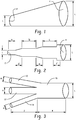
- the increase in diameter from the mini-tube to the increased diameter tube can be gradual as shown in FIG. 1 or stepwise as shown in FIG. 2.
- FIG. 1 illustrates that the increase of diameter 1 from mini-tube end 2 to diameter L at tube end 4 can be gradual in that the increase in diameter from 1 to L is defined by a smooth function, for example, linear function. It is noted that mini-tube end 2 and tube end 4 could likewise be concentric.
- FIG. 2 illustrates that the length of each section of different diameter can differ (for example, a vs. b) or be the same (for example, b and c). Similarly the transition from one diameter to another can be gradual or abrupt (e vs. f), and of the same or different length or angle.
- a single mini-tube can be combined with a single tube of larger diameter as shown in FIG. 1 and FIG. 2 , or a plurality of mini-tubes can be combined with a single tube of larger diameter as shown in FIG. 3.
- FIG. 3 illustrates that a plurality of mini-tubes 10, 12, and 14 can be present at mini-tube end 2 that can join tube 16 at tube end 4.
- Tubes 10, 12, and 14 can have a diameter of m, n, and o, respectively, where m, n, and o can each individually be the same or different.
- the combined tube(s) can be located within a shell, with a cooling medium located between the shell and the tube.
- the tube can have a concentric tube configuration located within a shell, where the shell can be the outer-most tube of the reactor.
- the concentric tube configuration comprises at least one first, inner concentric tube with an internal diameter, d 1 , concentrically located within a second, outer tube with a diameter d 2 wherein d 2 > d 1 .
- the term "concentric” and "concentrically located” mean that the first, inner tube is located within the second, outer tube, with the centerline of the first tube being substantially parallel to that of the other tube.
- the center line of each concentric tube may be coincident; or the centerline of the inner concentric tube may be offset from the centerline of the outer tube.
- substantially parallel means that the centerline of each tube can be at a relative angle of 0° to 20°, 0° to 10°, or 0° to 5°.
- the centerline of each tube can be coincident, that is, overlap.
- the innermost concentric tube of the reactor can have a cross-sectional diameter (where the cross-sectional diameter is the diameter of a circle with the same area as the area of the first inner tube) on the order of millimeters (mm), for example, 20 mm or greater, 40 mm or greater, 80 mm or greater, or higher, or less than 50 mm, or 20 to 40 mm depending on the throughput of the reaction and other factors known in the art.
- the outer tube can be sized to accommodate the innermost tube, together with cooling medium or catalyst.
- the cross-section of the first, inner concentric tube, the second, outer concentric tube, or the third concentric tube can have a rectangular, square, round, ovoid, elliptical, or any other regular or irregular geometry.
- the cross-section of the inner concentric tube can have a round or multi-petal geometry.
- the "average microtube channel cross-sectional diameter" refers to the diameter of a circle having the same area as the actual cross-sectional shape.
- Each concentric tube can have the same or different cross-sectional geometry.
- both the first and second concentric tubes (and any additional tubes) can have a circular cross-section, or the inner concentric tube can have a multi-petal cross-sectional geometry and the outer tube can have a circular cross-sectional geometry.
- FIG. 4 illustrates a concentric tube configuration comprising a second, outer concentric tube 22 having inner diameter d 2 with an inner wall 24, together with a first, inner concentric tube with a four-petal geometry 26 located concentrically within the outer concentric tube 22.
- the first tube has an outer wall 28.
- the diameter of the inner concentric tube is described by the diameter, d 1 , of the circle 20 that has the same area as the area of the first inner concentric tube with the four-petal geometry 26.
- the first, inner concentric tube can be a packed bed reactor with a catalyst located therein, and the outer tube can comprise a cooling medium.
- the cooling medium can flow in a region located between an outer wall of the first concentric tube containing the catalyst and an inner wall of the second concentric tube.
- the cooling medium can be located in the first, inner concentric tube, and the catalyst can be located between the outer wall of the first concentric tube and the inner wall of the second concentric tube.
- a plurality of each set of the concentric tubes can be located in a shell of a multi-tube reactor.
- a single set of concentric, for example, coincident, tubes can be surrounded by a third concentric tube having an inner diameter d 3 , where d 3 > d 2 > d 1 .
- a cooling medium can be located between an outer wall of the second concentric tube and an inner wall of the third concentric tube.
- the three-tube embodiment can be used as a phosgene reactor, or a plurality of each set of three concentric tubes can be located in a shell of a phosgene reactor.
- the concentric tube configuration can provide improved heat removal compared with a conventional multi-tubular reactor by providing a higher heat transfer area between the catalyst and the cooling medium, and hence lower peak tube temperature.
- the tube can comprise a twisted tube, where one or more twisted tubes containing the catalyst are employed.
- the twisted tube configuration can provide improved heat removal compared with a conventional multi-tubular reactor by providing a higher heat transfer area between the catalyst and the cooling medium, and hence lower peak tube temperature.
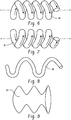
- the twisted tube can have, for example, a smooth helical shape (where a tangent line at any point on an outer surface of the tube makes a constant angle with a fixed line), a jagged helical shape (where a tangent line at any point on an outer surface of the tube does not make a constant angle with a fixed line), a wavy shape, a bulging shape, or the like, or a combination comprising one or more of the foregoing.
- FIG. 5 is an illustration of smooth helical twisted tube 32 that is twisting on axis x.
- FIG. 6 is an illustration of corkscrew twisted tube 34 that is twisting around axis x.
- FIG. 7 is an illustration of jagged helical twisted tube 36 that is twisting on axis x. It is noted that while jagged helical twisted tube 36 is illustrated to maintain rotation around center axis x, it could likewise deviate from the axis.
- FIG. 8 is an illustration of wavy twisted tube 38.
- FIG. 9 is an illustration of bulging twisted tube 40.
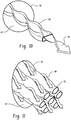
- FIG. 10 is an illustration of a single smooth helical twisted tube 32 located in outer shell 46. Cooling medium can flow in the opening (also referred to herein as the area or the space) 42 between outer shell 46 and smooth helical twisted tube 32. Arrow 44 illustrates the improved tubeside flow that arises within the twisted tube.
- FIG. 11 is an illustration of a plurality of smooth helical twisted tubes 32 located in outer shell 46. Cooling medium can flow in the opening 42 between outer shell 46 and smooth helical twisted tube 32. Arrow 48 illustrates the improved shellside flow that arises in the opening.
- the twisted tube can be configured to provide an improved tubeside flow as shown in FIG. 10 and/or a shellside flow as shown in FIG. 11 .
- the twisted tube configuration can lower internal and external resistance to heat transfer by enhancing turbulence both within twisted tube and within the larger surrounding shell.
- An example of a twisted tube that can be used is the tube in the Twisted TubeTM heat exchanger commercially available from Koch Heat Transfer Company.
- any combination of the above-described twisted tube configurations can be used, including a combination with a tube having a different cross-sectional configuration.
- the shape of the cross-section of each twisted tube independently can be, for example, circular or non-circular (such as ovoid, multi-petal, elliptical, or rectangular (for example, with rounded edges), or any other regular or irregular geometry), where the cross-section can change orientation and/or shape with distance along the twisted tube.
- the cross-section can be circular, in the twisted tube configurations.
- Each twisted tube of the reactor independently can have an average cross-sectional diameter on the order of millimeters (mm), for example, 20 mm or greater, 40 mm or greater, 80 mm or greater, or higher.
- Each twisted tube of the reactor independently can have a major diameter and a minor diameter that can be measured via a center point of the cross-section as the longest diameter and the shortest diameter, respectively.
- the major diameter and the minor diameter can be on the order of millimeters (mm), for example, 20 mm or greater, specifically, 40 mm or greater, specifically, or 80 mm or greater, or less than 50 mm, or 20 to 40 mm and the major diameter can be larger than the minor diameter.
- the major diameter and the minor diameter can each independently be greater than or equal to 5 mm, specifically, 20 to 1,000 mm, more specifically, 40 to 500 mm, even more specifically, 80 to 150 mm.
- a ratio of the major diameter to the minor diameter can be 1:1 to 20:1, specifically, 1.1:1 to 10:1, more specifically, 2:1 to 5:1.
- FIG. 5 illustrates an example of major diameter D and minor diameter d of smooth helical twisted tube 32.
- the tube can be modified to comprise internal scaffolding.
- a tube of a conventional multi-tubular reactor, a mini-tube, a concentric tube, and a twisted tube can be modified to comprise internal scaffolding.
- the internal scaffolding can be in the form of one or both of internal inserts and internal fins that can function to increase the contact area between the tube and the catalyst in order to enhance heat transfer.
- the internal inserts are internally located inserts that can be in direct contact with an inner wall of a tube and can be loosely connected thereto.
- the internal fins are fins that are internally extended surfaces that are integral to the tube design, where, for example, the fins can be welded thereon or can be formed during the forming of the tube itself.
- the internal scaffolding can act to expose more of the catalyst particles to direct contact with the inner tube inner wall, which can facilitate heat transfer to the cooling medium.
- the internal scaffolding can comprise internal scaffolding elements that can be, for example, curved, wavy, or straight, that can have various shapes and lengths.
- the internal scaffolding element can comprise a perpendicular element 64, an inner element, an angled element, or a combination comprising one or more of the foregoing.
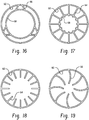
- Some examples of internal scaffoldings that can be in direct contact with or can be integrally attached to the inner tube inner wall 60 are shown in the inner tube cross-sections illustrated in FIG.s 12-19 .
- the internal scaffolding can comprise a perpendicular element 64, where at least one element end is perpendicular to a line tangent to the contact point 62 of the inner tube inner wall 60 (see FIG.s 12-15 , 17, and 18 ).
- the internal scaffolding can comprise an inner element 68, where the inner element 68 does not come in direct contact with the inner tube inner wall 60 (see FIG.s 16 and 17 ).
- the internal scaffolding can comprise an angled element 66, where at least one end of the angled element is at a non-ninety degree angle to a line tangent to the inner tube inner wall (see FIG.s 16 and 19 ).
- the tube can be modified to comprise external scaffolding.
- a tube of a conventional multi-tubular reactor, a mini-tube, a concentric tube, and a twisted tube can be modified to comprise external scaffolding.
- the external scaffolding can be in the form of one or both of external inserts and external fins that can function to further enhance the heat transfer from inner tube externally to cooling fluid.
- the external inserts are located between the outer wall of a first tube and the inner wall of a second tube, or the outer wall of a second tube and an inner wall of a third tube.
- the external inserts can be in direct contact with the outer wall and can optionally be loosely connected thereto.
- the external fins are fins that are externally extended surfaces that can be integral to the tube design, where, for example, the fins can be welded thereon or can be formed during the forming of the tube itself.
- the external scaffolding can comprise external scaffolding elements that can be, for example, curved, wavy, or straight, and can have various shapes and lengths.
- Some examples of external scaffoldings that can be in direct contact with or that can be integrally attached to the inner tube outer wall 78 are shown in FIGs. 20 to 29 , where the images on the left are embodiments of side view images of an inner tube with a surrounding external scaffolding and the images on the right are embodiments of cross-sectional or top down views of the inner tube and with similar external scaffolding.
- FIG. 20 illustrates that the external scaffolding can comprise a helical element 80 that is helically located on the outer wall 78 of the inner tube.
- FIG. 21 illustrates that the external scaffolding can comprise an annular element 82.
- FIG. 22 illustrates that the external scaffolding can comprise a studded element 84.
- FIG. 23 illustrates that the external scaffolding can comprise a serrated element 86.
- FIG. 24 illustrates that the external scaffolding can comprise a wire element 88.
- FIG. 25 illustrates that the external scaffolding can comprise a cut helical element 90.
- FIG. 26 illustrates that the external scaffolding can comprise a cut annular element 92.
- FIG. 27 illustrates that the external scaffolding can comprise a wavy helical element 94.
- FIG. 28 illustrates that the external scaffolding can comprise a slotted wavy helical element 96.
- FIG. 29 illustrates that the external scaffolding can comprise a slotted helical element 98.
- the location of the catalyst in the reactor can significantly affect the heat transfer from the reaction to the cooling liquid.
- the catalyst can be deposited on (i.e., can be in direct contact with) a wall of reactor tube, for example, an inner wall of a mini-tube, a twisted tube, a concentric tube, or a combination comprising one or more of the foregoing.
- the deposited catalyst can be used in combination with a packed bed.
- the catalyst can be disposed in the tube as a packed bed.
- better heat transfer can be obtained where the deposited catalyst is the only catalyst used in the reaction to produce phosgene.
- the fact that the catalyst can be deposited on a tube or channel wall instead of being packed within the tubes or channels can result in a reduction in plugging. Without being bound by theory, it is believed that the deposited catalyst can facilitate heat removal from the reactor because the catalyst particles are in direct contact with the reactor wall rather than primarily in contact with each other.
- Deposited catalyst can be used in any of the above reactor and tube configurations, and further can be used in a conventional multi-tubular reactor.
- catalyst can be deposited on the inner surfaces of the tubes of a multi-tube reactor.
- the catalyst can be deposited on the surfaces of the channels of a microtube reactor.
- the catalyst can be deposited, for example, by coating.
- the catalyst can be deposited to completely cover the intended surface, or deposited in a pattern. For example, less catalyst can be deposited at the feed end of the tube, and more catalyst deposited at the outlet end.
- the catalyst can be a carbon-comprising catalyst such as activated charcoal.
- the carbon can be from, for example, wood, peat, coal, coconut shells, bones, lignite, petroleum-based residues, sugar, and the like, or a combination comprising one or more of the foregoing.
- the carbon catalyst can be in particulate forms such as powder, granules, pellets, and the like, or a combination comprising one or more of the foregoing.
- the carbon surface area as determined by Brunauer-Emmett-Teller (BET) measurement can be greater than or equal to 100 square meters per gram (m 2 /g), specifically, greater than or equal to 300 m 2 /g, more specifically, greater than or equal to 1,000 m 2 /g.
- the carbon surface area as determined by BET measurement can be 100 to 2,000 m 2 /g, specifically, 550 to 1,000 m 2 /g.
- Examples of commercially available carbon catalysts include Barnebey SutcliffeTM, DarcoTM, NucharTM, Columbia JXNTM, Columbia LCKTM, Calgon PCBTM, Calgon BPLTM, WestvacoTM, NoritTM, and Barnebey Cheny NBTM.
- the catalyst can be an oxidatively stable catalyst.
- Oxidatively stable means that the catalyst loses less than or equal to 12 wt% when sequentially heated in air for the following times and temperatures; 125°C for 30 minutes, 200°C for 30 minutes, 300°C for 30 minutes, 350°C for 45 minutes, 400°C for 45 minutes, 450°C for 45 minutes, and finally at 500°C for 30 minutes.
- This sequence of time and temperature conditions for evaluating the effect of heating carbon samples in air can be run using thermal gravimetric analysis (TGA).
- the catalyst can comprise an active metal content of less than or equal to 1,000 ppm by weight.
- the active metal can comprise one or more transition metals of Groups 3 to 10 of the Periodic Table, boron, aluminum, silicon, or a combination comprising one or more of the foregoing.
- the catalyst can be free of iron, where free of iron can mean that the catalyst comprises less than or equal to 100 ppm by weight, specifically, 0 to 50 ppm by weight of iron.
- the catalyst can comprise less than or equal to 200 ppm by weight, specifically, less than or equal 100 ppm by weight of sulfur and/or less than or equal to 200 ppm by weight, specifically, less than or equal 100 ppm by weight of phosphorus.
- Carbon catalysts that comprise less than or equal to 1,000 ppm of active metals can be obtained by acid washing (for example, carbons that have been treated with hydrochloric acid or hydrochloric acid followed by hydrofluoric acid).
- the catalyst can be a composite carbon comprising a porous carbonaceous material with a three dimensional matrix obtained by introducing gaseous or vaporous carbon-containing compounds (for example, hydrocarbons) into a mass of granules of a carbonaceous material (for example, carbon black); decomposing the carbon-containing compounds to deposit carbon on the surface of the granules; and treating the resulting material with an activator gas comprising steam to provide the porous carbonaceous material.
- a carbon-carbon composite material is thus formed, which is suitable as a catalyst.
- Such porous carbon-carbon composites can have a surface area as determined by BET measurement of greater than or equal to 10 m 2 /g, and can include (1) a micropore to macropore ratio of less than or equal to 3.5, specifically, less than or equal to 2.0, more specifically, less than or equal to 1.0, even more specifically, 0 to 1.0; and (2) a loss of less than or equal to 16% of its weight, specifically, less than or equal to 10% of its weight, more specifically, less than or equal to 5% of its weight when sequentially heated in air for the following times and temperatures: 125°C for 30 minutes, 200°C for 30 minutes, 300°C for 30 minutes, 350°C for 45 minutes, 400°C for 45 minutes, 450°C for 45 minutes, and finally at 500°C for 30 minutes.
- Such a catalyst can comprise an active metal content greater than or equal to 1,000 ppm.
- the sequence of time and temperature conditions for evaluating the effect of heating carbon samples in air can be run using TGA.
- the term "micropore” means a pore size of less than or equal to 20 angstroms ( ⁇ ) and the term “macropore” means a pore size of greater than 20 ⁇ .
- the total pore volume and the pore volume distribution can be determined, for example, by porosimetry.
- the micropore volume centimeters cubed per gram (cc/g)) can be subtracted from the total pore volume (cc/g) to determine the macropore volume.
- the ratio of micropores to macropores can then be calculated. Examples of commercially available porous carbons include Calgon X-BCPTM and CalsicatTM.
- the catalyst can comprise a silicon carbide catalyst.
- the silicon carbide catalyst can have a surface area as determined by BET measurement of greater than or equal to 10 square meters per gram (m 2 /g), specifically, greater than or equal 20 m 2 /g, more specifically, greater than or equal to 100 m 2 /g, more specifically, greater than or equal to 300 m 2 /g.
- the silicon content can be less than or equal to 10 wt%, specifically, less than or equal to 5 wt%.
- the silicon carbide catalyst can be manufactured using, for example, a process that comprises contacting silicon monoxide with finely divided carbon (such as one comprising an ash content of less than or equal to 0.1 wt%) or by reacting vapors of silicon monoxide (SiO) with carbon.
- the thermally conductive coating can be a thin coating having, for example, a thickness of 0.001 micrometer to 500 micrometers, or 0.01 micrometer to 100 micrometers, or 0.1 micrometer to 10 micrometers.
- the thermally conductive coating can be deposited on the exterior surface of the catalyst, for example, during the activation treatment of said catalyst. Any thermally conductive material can be used provided that it is sufficiently thermally conductive, can be coated on the catalyst particles or pellets, and is essentially inert to chlorine, carbon monoxide, and phosgene.
- Exemplary materials include metals such as titanium, or nickel, or metal alloys such as stainless steel, corrosion resistant stainless steels such as any of the duplex grades, nickel alloys comprising iron and chromium (such as INCONEL), or nickel alloys comprising molybdenum and chromium (such as HASTELLOY)).
- metals such as titanium, or nickel, or metal alloys such as stainless steel, corrosion resistant stainless steels such as any of the duplex grades, nickel alloys comprising iron and chromium (such as INCONEL), or nickel alloys comprising molybdenum and chromium (such as HASTELLOY)).
- the reactor can comprise one or more catalyst zones.
- the tube when the catalyst is deposited on a surface of a tube, the tube can comprise a first catalyst zone located at or toward the feed end that comprises less catalyst.
- the tube can further comprise a second catalyst zone located at or toward the outlet end that can comprise the same or different catalyst, at a higher concentration than the first catalyst.
- the two catalyst zones can be sequentially located.
- the deposition can be gradually increased so that catalyst concentration forms a smooth (for example, a linear or a non-linear gradient) or step gradient along each catalyst zone, with the lower activity being present at the beginning of the first catalyst zone and the higher activity being located at the second catalyst zone.
- the reactor can comprise a first catalyst zone located at or toward the feed end that comprises a first catalyst having a first activity.
- the reactor can further comprise a second catalyst zone located at or toward the outlet end that can comprise the same or different catalyst, having a second activity higher than the activity of the first catalyst.
- the two catalyst zones can be sequentially located.
- at least a portion of the first catalyst can be intermixed with the second catalyst, such that the activity of the catalyst forms a smooth or step gradient along each catalyst zone, with the lower activity being present at the beginning of the first catalyst zone and the higher activity being located at the second catalyst zone.
- the reactor can comprise a first catalyst zone located in the feed end that comprises a catalyst diluted with inert filler that does not itself react under the reaction conditions and that does not catalyze or otherwise inhibit the phosgene synthesis reaction.
- the reactor can further comprise a second catalyst zone located at the outlet end that can comprise the same or different catalyst, which is diluted with less inert filler than in the first catalyst zone.
- the reactor can comprise a first catalyst zone that contains catalyst diluted with inert filler and a second catalyst zone that contains the same or different catalyst that is not diluted with inert filler.
- the inert filler can be evenly distributed among catalyst particles and the two catalyst zones can be sequentially loaded with catalyst containing inert filler in a first catalyst zone followed by catalyst in a second catalyst zone containing less inert filler.
- inert filler can be distributed in a gradient among catalyst particles in each catalyst zone with the highest concentration of inert filler being present at the beginning of a first catalyst zone and the concentration of inert filler gradually decreasing until the lowest concentration of inert filler is attained at an end of a second catalyst zone.
- the inert filler can be distributed in a gradient among catalyst particles in a first catalyst zone with the highest concentration of inert filler being present at the beginning of a first catalyst zone and the concentration of inert filler gradually decreasing until the lowest concentration of inert filler is attained at an end of a first catalyst zone, and the second catalyst zone contains no inert filler.
- a proportion of catalyst near the outlet or exit point of product gases from a catalyst bed can be undiluted with inert filler, while any remaining portion of catalyst nearer the initial point of contact of catalyst with reactant gases can be diluted with inert filler.
- the inert filler can comprise a low porosity material, such as a ceramic, graphite, glassy carbon, glass, quartz, a metal, or a combination comprising one or more of the foregoing.
- the material can have a porosity of less than or equal to 0.8 pore volume per volume of material (vol/vol), less than or equal to 0.6 vol/vol, or 0.1 to 0.5 vol/vol, for example, 0.4 vol/vol.
- Suitable metals comprise those that are not reactive under the reaction conditions and more specifically that are not reactive toward chlorine, carbon monoxide, or phosgene under the reaction conditions.
- inert metal fillers can comprise stainless steel; titanium; nickel; metal alloys, including, but not limited to, nickel alloys comprising iron and chromium (such as INCONELTM), or nickel alloys comprising molybdenum and chromium (such as HASTELLOYTM); or a combination comprising one or more of the foregoing.
- Suitable inert fillers are at least substantially inert in that they do not themselves react at an appreciable rate under the reaction conditions and do not catalyze or otherwise inhibit the phosgene synthesis reaction. Substantially inert in the present context means that a filler does not produce a level of byproducts that is outside a specification range for phosgene product.
- the carbon monoxide and the chlorine gas used to prepare the phosgene can be high purity grades.
- the carbon monoxide can be supplied from an on-site generating plant and can comprise trace amounts of impurities such as hydrogen, methane, volatile sulfur compounds, and nitrogen.
- Recycled carbon monoxide recovered from a phosgene product stream can also be employed as part of the carbon monoxide-comprising feed stream.
- the carbon monoxide and the chlorine can be introduced to the reactor in an equimolar amount or in a molar excess of chlorine.
- the molar ratio of carbon monoxide to chlorine can be 1.00:1 to 1.25:1, specifically, 1.01 to 1.20:1, more specifically, 1.01:1 to 1.21:1, even more specifically, 1.02:1 to 1.12:1, still more specifically, 1.02:1 to 1.06:1.
- the initial feed to the reactor can comprise all of the carbon monoxide and all of the chlorine reactants.
- all of the chlorine can be added, where a first amount of carbon monoxide can be introduced to a first stage reaction zone and a second amount of carbon monoxide can be introduced to at least one downstream reaction zone.
- At least one downstream reaction zone can be in serial communicating relationship with the first reaction zone and the initial molar ratio of carbon monoxide to chlorine can be less than one, specifically, 0.999:1 to 0.2:1, more specifically, 0.999:1 to 0.5:1, even more specifically, 0.999:1 to 0.8:1, more specifically, 0.999:1 to 0.95:1, more specifically, 0.999:1 to 0.98:1.
- the reactor can comprise a corrosion resistant material or can be lined with a corrosion resistant material.
- a corrosion resistant material is one that is essentially inert to chlorine, carbon monoxide, and phosgene (such as ceramic, stainless steel, titanium, nickel, or metal alloys, including, but not limited to, nickel alloys comprising iron and chromium (such as INCONEL), or nickel alloys comprising molybdenum and chromium (such as HASTELLOY)).
- the phosgene produced by this method can be used in a variety of industrial processes, for example, the manufacture of polycarbonates, ureas, carbamates, and the like.
- a method of producing a diaryl carbonate comprises reacting an aromatic monohydroxy compound with phosgene produced according to the methods disclosed herein.
- Phosgene can be used in the liquid state, gaseous state or in an inert solvent.
- Aromatic monohydroxy compounds include C 6-12 aromatic monohydroxy compounds which can be unsubstituted or substituted with 1 to 3 halogen, C 1-6 alkoxy, cyano, C 1-6 alkoxycarbonyl, C 6-12 aryloxycarbonyl, C 1-6 acyloxy, or nitro groups, provided that the valence of any substituted carbon is not exceeded.
- Examples include phenol, o-, m- or p-cresol, o-, m- or p-chlorophenol, o-, m- or p-bromophenol, 2,4-dichlorophenol, 2,4,6-tribromophenol, o-, m- or p-methoxyphenol, 2,6-dimethylphenol, 2,4-dimethylphenol, 3,4-dimethylphenol, p-tert-butylphenol, p-cumylphenol, p-n-octylphenol, p-isooctylphenol, p-n-nonylphenol, p-isononylphenol, 1-naphthol, 2-naphthol, and methyl salicylate. Phenol can be specifically mentioned.
- reaction conditions are not particularly limited and include those that have been disclosed in the art.
- the reaction of phosgene and the aromatic monohydroxy compound is conducted in a phase boundary process, in which, phosgene is reacted with the aromatic monohydroxy compound in the presence of a base and optionally a basic catalyst.
- Bases for the reaction of the aromatic monohydroxy compound with phosgene are, for example, alkali metal hydroxides, such as, Na, K, and/or Li hydroxide.
- alkali metal hydroxides such as, Na, K, and/or Li hydroxide.
- Sodium hydroxide solution is specifically mentioned.
- the base can be used as 10 to 25% strength by weight aqueous solution.
- the basic catalyst used can be open-chain or cyclic, and include tertiary amines, N-alkylpiperidines, and/or onium salts.
- the catalyst can be used as 1 to 55% strength by weight solution.
- the amount of the catalyst added can be 0.0001 mol to 0.1 mol, based on the total moles of the aromatic monohydroxy compound used.
- Onium salts refer to compounds such as NR 4 X, wherein the radicals R, independently of one another, can be H and/or an alkyl and/or aryl radical and X is an anion, such as, for example, chloride, bromide or iodide.
- nitrogenous catalysts for example, tributylamine, triethylamine, and N-ethylpiperidine.
- an inert organic solvent can be present.
- solvents include aromatic solvents, halogenated, (specifically chlorinated), aliphatic or aromatic solvents, or combinations comprising at least one of the foregoing. These are, for example, toluene, dichloromethane, the various dichloroethane and chloropropane compounds, chlorobenzene and chlorotoluene, or combinations comprising at least one of the foregoing. Dichloromethane is specifically mentioned.
- the reaction of phosgene and the aromatic monohydroxy compound can be conducted in the presence of heterogeneous catalysts.
- Heterogeneous catalysts are known and have been described in EP 483632 , US Patent Nos. 5,478,961 , US 5,239,105 and US 5,136, 077 .
- a method of producing a dialkyl carbonate comprises reacting an alkyl monohydroxy compound with the phosgene.
- Phosgene can be used in the liquid state, gaseous state or in an inert solvent.
- Alkyl monohydroxy compounds include all isomers of linear and branched C 1-12 aliphatic alcohols and C 4-8 cycloaliphatic alcohols, each of which can be unsubstituted or substituted with 1 to 3 halogen, C 1-6 alkoxy, cyano, C 1-6 alkoxycarbonyl, C 6-12 aryloxycarbonyl, C 1-6 acyloxy, or nitro groups, provided that the valence of any substituted carbon is not exceeded.
- alkanols include methanol, ethanol, 1-propanol, 2-propanol, allyl alcohol, 1-butanol, 2-butanol, 3-buten-1-ol, amyl alcohol, 1-hexanol, 2-hexanol, 3-hexanol, 1-heptanol, 2-heptanol, 3-heptanol, and 4-heptanol, cyclopentanol, cyclohexanol, cycloheptanol, cyclooctanol, 3-methylcyclopentanol, 3-ethylcyclopentanol, 3-methylcyclohexanol, 2-ethylcyclohexanol (isomers), 2,3-dimethylcyclohexanol, 1,3-diethylcyclohexanol, 3-phenylcyclohexanol, benzyl alcohol, 2-phenethyl alcohol, and 3-phenylpropanol,
- reaction conditions are not particularly limited and are known to a person skilled in the art without undue experimentation.
- the dialkyl carbonate can be converted to a diaryl carbonate.
- a dialkyl carbonate can react with an aromatic monohydroxy compound such as those described herein including phenol in the presence of a transesterification catalyst, to produce an alkyl aryl carbonate (e.g., phenyl methyl carbonate (“PMC”)) and an aliphatic monohydric alcohol (e.g., methanol).
- PMC phenyl methyl carbonate
- methanol aliphatic monohydric alcohol
- two molecules of the alkyl aryl carbonate undergo a disproportionation reaction to produce one molecule of diaryl carbonate (e.g., DPC) and one molecule of the starting material dialkyl carbonate (e.g., DMC).
- the catalyst examples include alkali metals and alkaline earth metals such as lithium, sodium, potassium, magnesium, calcium, and barium; basic compounds of alkali metals and alkaline earth metals such as hydrides, hydroxides, alkoxides, aryloxides, and amides; basic compounds of alkali metals and alkaline earth metals such as carbonates, bicarbonates, and organic acid salts; tertiary amines such as triethylamine, tributylamine, trihexylamine, and benzyldiethylamine; nitrogen-containing heteroaromatic compounds such as N-alkylpyrroles, N-alkylindoles, oxazoles, N-alkylimidazoles, N-alkylpyrazoles, oxadiazoles, pyridines, quinolines, isoquinolines, acridines, phenanthrolines, pyrimidines, pyrazine, and triazines; cyclic amid
- catalysts include titanium compounds such as titanium tetraphenoxide, titanium isopropylate, titanium tetrachloride, organotin compounds, and compounds of copper, lead, zinc, iron, and zirconium, and combinations comprising at least one of the foregoing.
- catalysts include titanium compounds such as titanium tetraphenoxide, titanium isopropylate, titanium tetrachloride, organotin compounds, and compounds of copper, lead, zinc, iron, and zirconium, and combinations comprising at least one of the foregoing.
- a dihydroxy compound in the polymerization of a polycarbonate, can be used as a reactant with phosgene as a carbonate source (also referred to as a carbonate precursor).
- phosgene as a carbonate source
- Polycarbonate as used herein means a homopolymer or copolymer having repeating structural carbonate units of formula (1) wherein at least 60 percent of the total number of R 1 groups are aromatic, or each R 1 contains at least one C 6-30 aromatic group.
- each R 1 can be derived from a dihydroxy compound such as an aromatic dihydroxy compound of formula (2) or a bisphenol of formula (3).
- each R h is independently a halogen atom, for example, bromine, a C 1-10 hydrocarbyl group such as a C 1-10 alkyl, a halogen-substituted C 1-10 alkyl, a C 6-10 aryl, or a halogen-substituted C 6-10 aryl, and n is 0 to 4.
- R a and R b are each independently a halogen, C 1-12 alkoxy, or C 1-12 alkyl; and p and q are each independently integers of 0 to 4, such that when p or q is less than 4, the valence of each carbon of the ring is filled by hydrogen.
- p and q is each 0, or p and q is each 1
- R a and R b are each a C 1-3 alkyl group, specifically methyl, disposed meta to the hydroxy group on each arylene group.
- X a is a bridging group connecting the two hydroxy-substituted aromatic groups, where the bridging group and the hydroxy substituent of each C 6 arylene group are disposed ortho, meta, or para (specifically para) to each other on the C 6 arylene group, for example, a single bond, -O-, -S-, -S(O)-, - S(O) 2 -, -C(O)-, or a C 1-18 organic group, which can be cyclic or acyclic, aromatic or nonaromatic, and can further comprise heteroatoms such as halogens, oxygen, nitrogen, sulfur, silicon, or phosphorous.
- dihydroxy compounds include the following: bisphenol compounds such as 4,4'-dihydroxybiphenyl, 1,6-dihydroxynaphthalene, 2,6-dihydroxynaphthalene, bis(4-hydroxyphenyl)methane, bis(4-hydroxyphenyl)diphenylmethane, bis(4-hydroxyphenyl)-1-naphthylmethane, 1,2-bis(4-hydroxyphenyl)ethane, 1,1-bis(4-hydroxyphenyl)-1-phenylethane, 2-(4-hydroxyphenyl)-2-(3-hydroxyphenyl)propane, bis(4-hydroxyphenyl)phenylmethane, 2,2-bis(4-hydroxy-3-bromophenyl)propane, 1,1-bis(hydroxyphenyl)cyclopentane, 1,1-bis(4-hydroxyphenyl)cyclohexane, 1,1-bis(4-hydroxyphenyl)isobuten
- dihydroxy compounds include resorcinol, 2,2-bis(4-hydroxyphenyl) propane (“bisphenol A” or "BPA”, in which each of A 1 and A 2 is p-phenylene and Y 1 is isopropylidene in formula (3)), 3,3-bis(4-hydroxyphenyl) phthalimidine, 2-phenyl-3,3'-bis(4-hydroxyphenyl) phthalimidine (also known as N-phenyl phenolphthalein bisphenol, "PPPBP”, or 3,3-bis(4-hydroxyphenyl)-2-phenylisoindolin-1-one), 1,1-bis(4-hydroxy-3-methylphenyl)cyclohexane (DMBPC), and 1,1-bis(4-hydroxy-3-methylphenyl)-3,3,5-trimethylcyclohexane (isophorone bisphenol).
- BPA 2,2-bis(4-hydroxyphenyl) propane
- BPA bisphenol A
- a 1 and A 2 is p-phenylene and
- Polycarbonates as used herein include homopolycarbonates (wherein each R 1 in the polymer is the same), copolymers comprising different R 1 moieties in the carbonate (“copolycarbonates”), copolymers comprising carbonate units, and other types of polymer units, such as polysiloxane units, ester units, and the like.
- the polycarbonate can be made by an interfacial polymerization process or in a melt polymerization process, which can be a continuous melt process.
- reaction conditions for interfacial polymerization can vary, an exemplary process generally involves dissolving or dispersing a dihydric phenol reactant in aqueous NaOH or KOH, adding the resulting mixture to a water-immiscible solvent medium, and contacting the reactants with a carbonate precursor in the presence of a catalyst such as, for example, a tertiary amine or a phase transfer catalyst, under controlled pH conditions, e.g., 8 to 10.
- the water immiscible solvent can be, for example, methylene chloride, ethylene dichloride, 1,2-dichloroethane, chlorobenzene, toluene, and the like.
- phase transfer catalysts that can be used are catalysts of the formula (R 3 ) 4 Q + X, wherein each R 3 is the same or different, and is a C 1-10 alkyl group; Q is a nitrogen or phosphorus atom; and X is a halogen atom or a C 1-8 alkoxy group or C 6-18 aryloxy group.
- phase transfer catalysts examples include (CH 3 (CH 2 ) 3 ) 4 NX, (CH 3 (CH 2 ) 3 ) 4 PX, (CH 3 (CH 2 ) 5 ) 4 NX, (CH 3 (CH 2 ) 6 ) 4 NX, (CH 3 (CH 2 ) 4 ) 4 NX, CH 3 (CH 3 (CH 2 ) 3 ) 3 NX, and CH 3 (CH 3 (CH 2 ) 2 ) 3 NX, wherein X is Cl - , Br - , a C 1-8 alkoxy group or a C 6-18 aryloxy group.
- An effective amount of a phase transfer catalyst can be 0.1 to 10 weight percent (wt%), or 0.5 to 2 wt%, each based on the weight of bisphenol in the phosgenation mixture.
- melt processes can be used to make the polycarbonates.
- polycarbonates can be prepared by co-reacting, in a molten state, a dihydroxy reactant and a diaryl carbonate in the presence of a transesterification catalyst.
- the reaction can be carried out in typical polymerization equipment, such as a continuously stirred reactor (CSTR), plug flow reactor, wire wetting fall polymerizers, free fall polymerizers, wiped film polymerizers, BANBURY mixers, single or twin screw extruders, or a combination comprising any of the foregoing.
- Volatile monohydric phenol is removed from the molten reactants by distillation and the polymer is isolated as a molten residue.
- melt polymerization can be conducted as a batch process or as a continuous process.
- the melt polymerization conditions used can comprise two or more distinct reaction stages, for example, a first reaction stage in which the starting dihydroxy aromatic compound and diaryl carbonate are converted into an oligomeric polycarbonate, and a second reaction stage wherein the oligomeric polycarbonate formed in the first reaction stage is converted to high molecular weight polycarbonate.
- Such "staged" polymerization reaction conditions are especially suitable for use in continuous polymerization systems wherein the starting monomers are oligomerized in a first reaction vessel and the oligomeric polycarbonate formed therein is continuously transferred to one or more downstream reactors in which the oligomeric polycarbonate is converted to high molecular weight polycarbonate.
- the oligomeric polycarbonate produced has a number average molecular weight of 1,000 to 7,500 Daltons.
- the number average molecular weight (Mn) of the polycarbonate is increased to between 8,000 and 25,000 Daltons (using polycarbonate standard).
- solvents are not used in the process, and the reactants dihydroxy aromatic compound and the diaryl carbonate are in a molten state.
- the reaction temperature can be 100°C to 350°C, specifically 180°C to 310°C.
- the pressure can be at atmospheric pressure, supra-atmospheric pressure, or a range of pressures from atmospheric pressure to 15 torr in the initial stages of the reaction, and at a reduced pressure at later stages, for example, 0.2 to 15 torr.
- the reaction time is generally 0.1 hours to 10 hours.
- Catalysts used in the melt transesterification polymerization production of polycarbonates can include one or both of a first catalyst comprising one or both of a phosphonium salt and an ammonium salt and an alkali catalyst comprising a source of one or both of alkali and alkaline earth ions.
- the first catalyst is typically volatile and degrades at elevated temperatures. The first catalyst is therefore preferred for use at early low-temperature polymerization stages.
- the alkali catalyst is typically more thermally stable and less volatile than the first catalyst.
- the alkali catalyst can comprise a source of one or both of alkali or alkaline earth ions.
- the sources of these ions include alkali metal hydroxides such as lithium hydroxide, sodium hydroxide, and potassium hydroxide, as well as alkaline earth hydroxides such as magnesium hydroxide and calcium hydroxide.
- alkali metal hydroxides such as lithium hydroxide, sodium hydroxide, and potassium hydroxide
- alkaline earth hydroxides such as magnesium hydroxide and calcium hydroxide.
- Other possible sources of alkali and alkaline earth metal ions include the corresponding salts of carboxylic acids (such as sodium acetate) and derivatives of ethylene diamine tetraacetic acid (EDTA) (such as EDTA tetrasodium salt, and EDTA magnesium disodium salt).
- carboxylic acids such as sodium acetate
- EDTA ethylene diamine tetraacetic acid
- alkali transesterification catalysts include alkali or alkaline earth metal salts of carbonate, such as CS 2 CO 3 , NaHCO 3 , Na 2 CO 3 , and the like, non-volatile inorganic acid such as NaH 2 PO 3 , NaH 2 PO 4 , Na 2 HPO 3 , KH 2 PO 4 , CsH 2 PO 4 , Cs 2 HPO 4 , and the like, or mixed salts of phosphoric acid, such as NaKHPO 4 , CsNaHPO 4 , CsKHPO 4 , and the like. Combinations comprising at least one of any of the foregoing catalysts can be used.
- alkali or alkaline earth metal salts of carbonate such as CS 2 CO 3 , NaHCO 3 , Na 2 CO 3 , and the like
- non-volatile inorganic acid such as NaH 2 PO 3 , NaH 2 PO 4 , Na 2 HPO 3 , KH 2 PO 4 , CsH 2
- Possible first catalysts can comprise a quaternary ammonium compound, a quaternary phosphonium compound, or a combination comprising at least one of the foregoing.
- the quaternary ammonium compound can be a compound of the structure (R 4 ) 4 N + X - , wherein each R 4 is the same or different, and is a C 1-20 alkyl, a C 4-20 cycloalkyl, or a C 4-20 aryl; and X - is an organic or inorganic anion, for example, a hydroxide, halide, carboxylate, sulfonate, sulfate, formate, carbonate, or bicarbonate.
- organic quaternary ammonium compounds include tetramethyl ammonium hydroxide, tetrabutyl ammonium hydroxide, tetramethyl ammonium acetate, tetramethyl ammonium formate, tetrabutyl ammonium acetate, and combinations comprising at least one of the foregoing. Tetramethyl ammonium hydroxide is often used.
- the quaternary phosphonium compound can be a compound of the structure (R 5 ) 4 P + X - , wherein each R 5 is the same or different, and is a C 1-20 alkyl, a C 4-20 cycloalkyl, or a C 4-20 aryl; and X - is an organic or inorganic anion, for example, a hydroxide, phenoxide, halide, carboxylate such as acetate or formate, sulfonate, sulfate, formate, carbonate, or bicarbonate.
- X - is a polyvalent anion such as carbonate or sulfate
- X - represents 2(CO 3 -2 ) .
- organic quaternary phosphonium compounds include tetramethyl phosphonium hydroxide, tetramethyl phosphonium acetate, tetramethyl phosphonium formate, tetrabutyl phosphonium hydroxide, tetrabutyl phosphonium acetate (TBPA), tetraphenyl phosphonium acetate, tetraphenyl phosphonium phenoxide, and combinations comprising at least one of the foregoing.
- TBPA is often used.
- the amount of first catalyst and alkali catalyst used can be based upon the total number of moles of dihydroxy compound used in the polymerization reaction.
- first catalyst for example, a phosphonium salt
- the alkali catalyst can be used in an amount sufficient to provide 1 x 10 -2 to 1 x 10 -8 moles, specifically, 1 x 10 -4 to 1 x 10 -7 moles of metal per mole of the dihydroxy compounds used.
- the amount of first catalyst can be 1 x 10 -2 to 1 x 10 -5 , specifically 1 x 10 -3 to 1 x 10 -4 moles per total mole of the dihydroxy compounds in the reaction mixture.
- Quenching of the transesterification catalysts and any reactive catalyst residues with an acidic compound after polymerization is completed can also be useful in some melt polymerization processes. Removal of catalyst residues and/or quenching agent and other volatile residues from the melt polymerization reaction after polymerization is completed can also be useful in some melt polymerization processes.
- Phosgene can also be used in the synthesis of carbamates and ureas, which can be synthesized by reaction of phosgene with two amines or an amine and an alcohol.
- the compounds can be synthesized by reacting HNR 1 R 2 , and HNR 3 R 4 or HOR 5 with an ester-substituted diaryl carbonate to form the compound under transesterification conditions.
- the optional substituents can each independently be chemical functional groups that are not reactive under the transesterification conditions used to prepare the further derivatized carbamate species. Such optional substituents include halogen, vinyl, carbonyl, ether, cycloether, azo, sulfide/thio, alcohol, and heterocyclic substituents.
- the ester-substituted diaryl carbonate can be bismethylsalicylcarbonate (BMSC).
- BMSC bismethylsalicylcarbonate
- the compound can be subjected to a pyrolysis reaction to form an isocyanate.
- a method of producing phosgene comprises: passing a feed comprising carbon monoxide and chlorine over a catalyst disposed in a microtube of a microtube reactor, wherein the microtube has an average diameter of 00.1 to 10 mm, 0.1 to 6 mm, 0.5 to 8 mm, or 0.5 to 5 mm, to produce a first product composition comprising phosgene; and passing at least a portion of the first product composition over a catalyst disposed in a tube of a tube reactor, wherein the tube comprises an average diameter of greater than the microtube, for example, greater than 6 millimeters or greater than 10 millimeters, to produce a product composition comprising phosgene, wherein carbon tetrachloride is present in the product composition in an amount of 0 to 10 ppm by volume based on the volume of phosgene.
- the catalyst is disposed on an inner wall of the microtube, the tube, or both; the catalyst is disposed in the microtube, the tube, or both as a packed bed; the catalyst varies in concentration, activity, or both from a feed end of the microtube, the tube, or both, to an outlet end of the microtube, the tube, or both, and the variance, optionally a smooth gradient, is from low activity, concentration, or both at the feed end to relatively higher concentration, activity, or both, at the outlet end; the microtube reactor comprises a plurality of the microtubes and the first product composition from the plurality of the microtubes are fed to one inlet of the tube of the tube reactor; the tube reactor comprises a plurality of the tubes; a peak temperature in the microtube reactor, the tube reactor, or both is less than 800°C; a peak tempera t ure in the microtube reactor, the tube reactor, or both is less than or equal to 400°C; the microtube reactor
- An apparatus for producing phosgene comprises a microtube reactor comprising a shell, a microtube located within the shell, and a cooling medium located between the shell and the microtube, wherein the microtube has an average diameter of 0.1 to 10 mm, 0.1 to 6 mm, 0.5 to 8 mm, or 0.5 to 5 mm, a feed inlet, and a product mixture outlet; and a tube reactor comprising a shell, a tube located within the shell, and a cooling medium located between the shell and the tube, wherein the tube has an average diameter of greater than the microtube, for example, greater than 6 millimeters or greater than 10 millimeters, a feed inlet, and a product composition outlet, wherein the product mixture outlet of the microtube reactor feeds into the feed inlet of the tube reactor.
- one or more of the following conditions can apply: a catalyst effective to convert carbon monoxide and chlorine to phosgene is disposed on an inner wall of the microtube, the tube, or both; a catalyst effective to convert carbon monoxide and chlorine to phosgene is disposed in the microtube, the tube, or both as a packed bed; the catalyst varies in concentration, activity, or both from a feed end of the microtube, the tube, or both, to an outlet end of the microtube, the tube, or both, and wherein the variance is from low activity, concentration, or both at the feed end to relatively higher concentration, activity, or both, at the outlet end; the microtube reactor comprises a plurality of the microtubes; the plurality of the microtubes feed into one inlet of the tube reactor; the tube reactor comprises a plurality of the tubes; the microtube reactor has a heat transfer area per unit volume of 250 to 10,000 m 2 /m 3 ; or the microtube reactor has a heat transfer area per unit volume of
- a method of producing phosgene in a tubular reactor comprises: passing a feed comprising carbon monoxide and chlorine over a catalyst disposed in a tube of the tubular reactor, wherein the tube is continuous and comprises a feed end and an outlet end, wherein a section of the tube at the feed end is a microtube having a diameter of 0.1 to 10 mm, 0.1 to 6 mm, 0.5 to 8 mm, or 0.5 to 5 mm for a first length, and a section of the tube at the outlet end having a diameter of greater than the microtube, for example, greater than 6 millimeters or greater than 10 millimeters, for a second length, to produce a product composition comprising phosgene, wherein carbon tetrachloride is present in the product composition in an amount of 0 to 10 ppm by volume, based on the volume of phosgene.
- the catalyst is disposed on an inner wall of the tube; the catalyst is disposed in the tube as a packed bed; the catalyst varies in concentration, activity, or both from the feed end to the outlet end, and the variance, optionally a smooth gradient, is from low activity, concentration, or both at the feed end to relatively higher concentration, activity, or both, at the outlet end; a plurality of the tube sections having a first length are continuous with and feed into the section of the tube having a second length; the tubular reactor comprises a plurality of the tubes; a peak temperature in the reactor is less than 800°C; a peak temperature in the reactor is less than or equal to 400°C; the reactor has a heat transfer area per unit volume of 250 to 10,000 m 2 /m 3 ; or the reactor has a heat transfer area per unit volume of 500 to 10,000 m 2 /m 3 .
- a tubular reactor for producing phosgene comprises a shell and a tube located within the shell, with a cooling medium located between the shell and the tube, wherein the tube is continuous and comprises a feed end and an outlet end, wherein a section of the tube at the feed end is a microtube having a diameter of 0.1 to 10 mm, 0.1 to 6 mm, 0.5 to 8 mm, or 0.5 to 5 mm for a first length, and a section of the tube at the outlet end having a diameter of greater than the microtube reactor, for example, greater than 6 millimeters or greater than 10 millimeters for a second length.
- one or more of the following conditions can apply: a catalyst effective to convert carbon monoxide and chlorine to phosgene is disposed on an inner wall of the tube; a catalyst effective to convert carbon monoxide and chlorine to phosgene is disposed in the tube as a packed bed; the catalyst disposed on an inner wall of the tube or disposed in the tube as a packed bed varies in concentration, activity, or both from the feed end to the outlet end, and the variance, optionally a smooth gradient, is from low activity, concentration, or both at the feed end to relatively higher concentration, activity, or both, at the outlet end; a plurality of the tube sections having a first length are continuous with and feed into the section of the tube having a second length; the tubular reactor comprises a plurality of the tubes; the tubular reactor has a heat transfer area per unit volume of 250 to 10,000 m 2 /m 3 ; or the reactor has a heat transfer area per unit volume of 500 to 10,000 m 2 /m 3 .
- the heat removal rate varies inversely with the tube diameter and that the peak tube temperature increases with the increase in tube diameter, for example, from a lab scale operation performed in a tube with an outer diameter 0.5 to an industrial tube with an outer diameter of 2 inches.
- a 1-D model was developed in Aspen custom modeler to show the effect of reactor dimensions on the process performance.
- reaction that is being modeled can be written as CO + Cl 2 ⁇ COCl 2 where the feed to the reactor comprise a mixture of CO and Cl 2 with a molar ratio of CO to Cl 2 of 1:1.
- feed to the reactor comprise a mixture of CO and Cl 2 with a molar ratio of CO to Cl 2 of 1:1.
- a simple 1-D plug flow model was written for the material and energy conservation equations using the following:
- Equations (1) and (2) were reformulated into a non-dimensional form.
- A is the reaction rate constant
- a 0 is the kinetic parameter in rate equation
- a 1 is the kinetic parameter in rate equation
- C p g is the specific heat capacity of gas (J/kg/K)
- f is the molar ratio of CO to Cl 2
- K is the reaction rate constant
- k 0 is the kinetic parameter in rate equation
- k 1 is the kinetic parameter in rate equation
- k 0mod the kinetic parameter in rate equation
- L is the length of reactor (m)
- P is the pressure (p
- T in T c
- T in is the inlet temperature (K)
- T ref is the reference temperature (K)
- T * is the normalized temperature [( T-T c )/ (T ref -T c )]
- T ref is a reference temperature which is sufficiently large and in the current simulation studies it has been assumed to be 700 K)
- U is the heat transfer coefficient (W/m 2 K)
- ⁇ b is the bulk density (Kg/m 3 )
- ⁇ H R is the change in heat of reaction (Joules)
- Q is the volumetric flow rate (standard cubic meters per second)
- N 1 and N 2 are molar flow rates (moles per second)
- m is mass flow rate (kilograms per second).
- the kinetic parameters were estimated using a Newton's method based least square estimation procedure within the simulation tool Aspen custom modeler.
- the kinetic parameters determined are shown in Table 2 and the validation of the kinetic parameters is shown in Table 3, where the experimental temperature is compared to the model temperature, T model , for volumetric flow rates of 100 and 175 SCCM.
- Table 2 k 0 k 1 A 0 A 1 1648 1.786 10010 18.792
- the model was employed to predict the results for a large scale industrial unit.
- the base case which has been considered for scale up corresponds to a flow rate of 250 SCCM at an inlet temperature of 300°C and for a schedule 160, 0.5 inch outer diameter pipe.
- the linear velocity corresponding to the base case has been assumed for a larger 2 inch outer diameter pipe.
- the model was used to simulate the temperature profile for a 7 foot long reactor. A comparison of the temperature profiles is shown in FIG. 30 , where the dashed line is the lab scale tube with an outer diameter of 0.5 inches and the solid line in the industrial scale tube with an outer diameter of 2 inches.
- FIG. 30 shows that scale-up of the lab scale tube results in an unacceptable, almost 100% increase in temperature in near the beginning of the tube.
- the carbon tetrachloride in phosgene increases by more than four times the observed value at lab scale for a given set of operating conditions upon scale-up from a 0.5 inch outer diameter tube reactor to the 2 inch tube used commonly in industrial multi-tubular reactors.
- This model clearly establishes our assertion that the carbon tetrachloride in phosgene would go up several times upon scale-up unless fundamental design changes are made to reactor design to improve heat transfer in industrial scale multitubular reactors.
- the invention may alternately comprise, consist of, or consist essentially of, any appropriate components herein disclosed.
- the invention may additionally, or alternatively, be formulated so as to be devoid, or substantially free, of any components, materials, ingredients, adjuvants or species used in the prior art compositions or that are otherwise not necessary to the achievement of the function and/or objectives of the present invention.
Landscapes
- Physics & Mathematics (AREA)
- Engineering & Computer Science (AREA)
- Chemical & Material Sciences (AREA)
- Organic Chemistry (AREA)
- Mechanical Engineering (AREA)
- General Engineering & Computer Science (AREA)
- Thermal Sciences (AREA)
- Geometry (AREA)
- Chemical Kinetics & Catalysis (AREA)
- Fluid Mechanics (AREA)
- Inorganic Chemistry (AREA)
- Organic Low-Molecular-Weight Compounds And Preparation Thereof (AREA)
- Devices And Processes Conducted In The Presence Of Fluids And Solid Particles (AREA)
- Low-Molecular Organic Synthesis Reactions Using Catalysts (AREA)
Applications Claiming Priority (5)
| Application Number | Priority Date | Filing Date | Title |
|---|---|---|---|
| EP14382036 | 2014-02-04 | ||
| EP14382039 | 2014-02-04 | ||
| EP14382037 | 2014-02-04 | ||
| EP14382035 | 2014-02-04 | ||
| PCT/US2015/014345 WO2015119981A2 (en) | 2014-02-04 | 2015-02-04 | Method for producing carbonates |
Publications (2)
| Publication Number | Publication Date |
|---|---|
| EP3102558A2 EP3102558A2 (en) | 2016-12-14 |
| EP3102558B1 true EP3102558B1 (en) | 2019-07-03 |
Family
ID=52469934
Family Applications (1)
| Application Number | Title | Priority Date | Filing Date |
|---|---|---|---|
| EP15704440.5A Active EP3102558B1 (en) | 2014-02-04 | 2015-02-04 | Method for producing carbonates |
Country Status (6)
| Country | Link |
|---|---|
| US (1) | US9695106B2 (https=) |
| EP (1) | EP3102558B1 (https=) |
| JP (1) | JP6316446B2 (https=) |
| KR (1) | KR101859207B1 (https=) |
| CN (1) | CN105980346B (https=) |
| WO (1) | WO2015119981A2 (https=) |
Families Citing this family (22)
| Publication number | Priority date | Publication date | Assignee | Title |
|---|---|---|---|---|
| EP3024782B1 (en) | 2013-07-26 | 2019-06-12 | SABIC Global Technologies B.V. | Method and apparatus for producing high purity phosgene |
| WO2015013655A1 (en) | 2013-07-26 | 2015-01-29 | Sabic Innovative Plastics Ip B.V. | Method and apparatus for producing high purity phosgene |
| EP3024813B1 (en) | 2014-02-04 | 2017-03-29 | SABIC Global Technologies B.V. | Method for producing carbonates |
| JP1541388S (https=) * | 2015-05-21 | 2016-01-12 | ||
| JP1541387S (https=) * | 2015-05-21 | 2016-01-12 | ||
| DE102015113432A1 (de) * | 2015-08-14 | 2017-02-16 | Karlsruher Institut für Technologie | Strömungsleitelemente in einem Kanal |
| US10889762B2 (en) * | 2016-12-09 | 2021-01-12 | Velocys Technologies Limited | Process for operating a highly productive tubular reactor |
| JP6848456B2 (ja) * | 2017-01-16 | 2021-03-24 | 株式会社Ihi | 反応装置 |
| US20180202724A1 (en) * | 2017-01-19 | 2018-07-19 | Dong Yong Hot Water System Inc. | Conductive structure of heat exchange pipe |
| CN106679467B (zh) * | 2017-02-28 | 2019-04-05 | 郑州大学 | 具有外接管箱的管壳式换热器 |
| CN106855367B (zh) * | 2017-02-28 | 2024-01-26 | 郑州大学 | 具有分布性出入口的管壳式换热器 |
| CN111448237B (zh) * | 2017-12-18 | 2022-12-23 | 科思创德国股份有限公司 | 使用基于氯代烃的有机溶剂制备聚碳酸酯的方法 |
| EP3498752A1 (de) * | 2017-12-18 | 2019-06-19 | Covestro Deutschland AG | Verfahren zur herstellung eines polycarbonats unter verwendung eines organischen lösungsmittels auf der grundlage von chlorkohlenwasserstoffen |
| US10563932B2 (en) | 2017-12-21 | 2020-02-18 | Uop Llc | Process and apparatus for cooling catalyst |
| CN108355601A (zh) * | 2018-03-16 | 2018-08-03 | 邱洪 | 顺-反螺纹管道与压凸管道交替的连续流反应器 |
| WO2019202557A1 (en) * | 2018-04-19 | 2019-10-24 | Koch Heat Transfer Company, Lp | Heat exchanging apparatus and method of supporting tube bundle within heat exchanger |
| FR3088994B1 (fr) * | 2018-11-28 | 2020-12-25 | Liebherr Aerospace Toulouse Sas | Échangeur de chaleur et système de refroidissement d’un fluide comprenant un tel échangeur de chaleur |
| CN111760581B (zh) | 2019-08-30 | 2021-07-23 | 万华化学(宁波)有限公司 | 制备光气的催化剂及其制备方法和光气制备与能源综合利用的方法 |
| TWI744725B (zh) * | 2019-09-27 | 2021-11-01 | 財團法人工業技術研究院 | 高溫分流組件及利用其之熱交換器與重組機構 |
| US11656032B2 (en) * | 2019-09-27 | 2023-05-23 | Industrial Technology Research Institute | High temperature flow splitting component and heat exchanger and reforming means using the same |
| KR102751369B1 (ko) * | 2019-12-30 | 2025-01-06 | 에스케이이노베이션 주식회사 | 유동층 반응기 및 이를 이용한 리튬 이차 전지의 활성 금속 회수 방법 |
| EP3855107B1 (en) | 2020-01-24 | 2025-07-30 | Hamilton Sundstrand Corporation | Fractal heat exchanger |
Family Cites Families (57)
| Publication number | Priority date | Publication date | Assignee | Title |
|---|---|---|---|---|
| DE1642959A1 (de) | 1968-03-14 | 1971-06-03 | Basf Ag | Reaktor zur Ausfuehrung von endo- und exothermen Reaktionen |
| FR2113249A5 (https=) | 1970-11-03 | 1972-06-23 | Getters Spa | |
| DE2509036C2 (de) | 1975-03-01 | 1986-05-28 | Bayer Ag, 5090 Leverkusen | Verfahren zur Herstellung von symmetrischen Diarylcarbonaten |
| DE3327274A1 (de) * | 1983-07-28 | 1985-02-07 | Bayer Ag, 5090 Leverkusen | Verfahren zur herstellung von phosgen unter gleichzeitiger erzeugung von dampf |
| US4792620A (en) * | 1983-10-14 | 1988-12-20 | Bp Chemicals Limited | Carbonylation catalysts |
| GB2164438B (en) * | 1984-09-14 | 1988-07-27 | Aisin Seiki | Heat exchangers |
| US4697034A (en) | 1985-11-15 | 1987-09-29 | General Electric Company | Process for making diaryl carbonates |
| US4839458A (en) | 1986-06-18 | 1989-06-13 | Mitsubishi Chemical Industries Ltd. | Preparation with controlled amounts of polycarbonate carbon tetrachloride |
| US5136077A (en) | 1989-12-18 | 1992-08-04 | The Dow Chemical Company | Process for the preparation of diaryl carbonates |
| JP3100051B2 (ja) * | 1990-02-19 | 2000-10-16 | 株式会社ノリタケカンパニーリミテド | 熱交換用管体及び熱交換器 |
| DE4034717A1 (de) | 1990-11-01 | 1992-05-07 | Bayer Ag | Verfahren zur herstellung von arylcarbonaten |
| US5167946A (en) | 1990-12-27 | 1992-12-01 | The Dow Chemical Company | Diaryl carbonate process |
| US5239105A (en) | 1992-01-30 | 1993-08-24 | The Dow Chemical Company | Catalytic formation of diarylcarbonates |
| US5498319A (en) | 1993-06-29 | 1996-03-12 | General Electric Company | Process for purifying diaryl carbonates |
| DE4324153A1 (de) | 1993-07-19 | 1995-01-26 | Bayer Ag | Verfahren zur Herstellung von Arylcarbonaten |
| US5424473A (en) | 1994-03-16 | 1995-06-13 | The Dow Chemical Company | Process for the preparation of aryl haloformates and diaryl carbonates |
| JP3124455B2 (ja) | 1994-12-01 | 2001-01-15 | 出光石油化学株式会社 | ホスゲンの製造方法 |
| JPH08198816A (ja) | 1995-01-23 | 1996-08-06 | Mitsubishi Gas Chem Co Inc | 炭酸ジフェニルの精製方法 |
| DE19600631A1 (de) | 1996-01-10 | 1997-07-17 | Bayer Ag | Verfahren zur Reinigung von Kohlensäurediarylestern |
| BR9612505A (pt) | 1996-02-21 | 1999-07-20 | Du Pont | Plocesso para produção de fosgênio |
| DE19606384A1 (de) | 1996-02-21 | 1997-08-28 | Bayer Ag | Verfahren zur kontinuierlichen Herstellung von Arylcarbonaten |
| EP0912443B1 (en) | 1996-06-28 | 2001-09-19 | E.I. Du Pont De Nemours And Company | Phosgene manufacturing process |
| WO1998028227A1 (en) | 1996-12-20 | 1998-07-02 | E.I. Du Pont De Nemours And Company | Phosgene manufacturing process |
| US6852667B2 (en) | 1998-02-16 | 2005-02-08 | Sumitomo Chemical Company Limited | Process for producing chlorine |
| DE19848668A1 (de) | 1998-10-22 | 2000-04-27 | Bayer Ag | Tetrachlorkohlenstoffarmes Phosgen |
| DE19909340A1 (de) | 1999-03-03 | 2000-09-07 | Basf Ag | Rohrbündelreaktor mit gestuftem Innendurchmesser |
| DE19916856A1 (de) | 1999-04-14 | 1999-09-23 | Eckert Gmbh Dr | Verfahren zur Herstellung von Carbonyldichlorid aus Chlor und Kohlenmonoxid |
| WO2001040352A1 (en) | 1999-12-03 | 2001-06-07 | Teijin Limited | Aromatic polycarbonate, process for producing the same, and molded article |
| EP1112997B1 (en) | 1999-12-28 | 2009-05-13 | Mitsubishi Chemical Corporation | Process for producing diaryl carbonate |
| DE10063297A1 (de) | 2000-12-19 | 2002-06-20 | Bayer Ag | Kontinuierliches Verfahren zur Herstellung von Kohlensäurediarylester |
| DE10063296A1 (de) | 2000-12-19 | 2002-06-20 | Bayer Ag | Verfahren zur Herstellung von Kohlensäurediarylester |
| DE10063869A1 (de) | 2000-12-21 | 2002-06-27 | Bayer Ag | Kontinuierliches Verfahren zur Herstellung von Kohlensäurediarylester |
| EP1234845B1 (en) | 2001-02-26 | 2008-11-12 | Mitsubishi Chemical Corporation | Process for producing diphenyl carbonate and process for producing aromatic polycarbonates |
| US6399823B1 (en) * | 2001-04-30 | 2002-06-04 | General Electric Company | Method for producing phosgene |
| US7096931B2 (en) * | 2001-06-08 | 2006-08-29 | Exxonmobil Research And Engineering Company | Increased heat exchange in two or three phase slurry |
| IN237581B (https=) * | 2002-02-27 | 2010-01-01 | Basf Ag | |
| GB0306179D0 (en) | 2003-03-18 | 2003-04-23 | Imp College Innovations Ltd | Piping |
| DE10332697A1 (de) | 2003-07-18 | 2005-02-03 | Bayer Materialscience Ag | Methode zur Abtrennung von metallischen Katalysatorbestandteilen aus Reaktionsmischungen der Herstellung aromatischer Carbonate |
| US7250530B2 (en) | 2003-07-30 | 2007-07-31 | General Electric Company | Processes and systems for making phosgene |
| BRPI0514564B1 (pt) | 2004-08-25 | 2015-06-09 | Asahi Kasei Chemicals Corp | Processo industrial para produção de carbonato de difenila de pureza elevada e aparelho para produzir carbonato de difenila de pureza elevada |
| DE102004041777A1 (de) | 2004-08-28 | 2006-03-02 | Bayer Materialscience Ag | Verfahren und Vorrichtung zur Herstellung von Phosgen |
| US7081597B2 (en) | 2004-09-03 | 2006-07-25 | The Esab Group, Inc. | Electrode and electrode holder with threaded connection |
| JP4205035B2 (ja) * | 2004-09-27 | 2009-01-07 | 住友化学株式会社 | 接触気相反応用多管式反応装置 |
| JP4292214B2 (ja) | 2004-10-14 | 2009-07-08 | 旭化成ケミカルズ株式会社 | 高純度ジアリールカーボネートの製造方法 |
| DE102006022629A1 (de) | 2006-05-12 | 2007-11-15 | Spörl KG | Wärmetauschvorrichtung für einen Wärmeaustausch zwischen Medien und Webstruktur |
| JP4765073B2 (ja) * | 2006-07-05 | 2011-09-07 | 国立大学法人広島大学 | リグノセルロースの水熱加水分解方法 |
| DE102007057462A1 (de) | 2007-11-29 | 2009-06-10 | Bayer Materialscience Ag | Verfahren zur Herstellung von Phosgen mit reduzierter CO-Emission |
| DE102007058701A1 (de) | 2007-12-06 | 2009-06-10 | Bayer Materialscience Ag | Verfahren zur Herstellung von Diarylcarbonat |
| CN102348639A (zh) | 2009-03-11 | 2012-02-08 | 巴斯夫欧洲公司 | 制备光气的方法 |
| JP2011104507A (ja) * | 2009-11-17 | 2011-06-02 | Sumitomo Chemical Co Ltd | 多管式反応器用伝熱管 |
| JP2011106728A (ja) * | 2009-11-17 | 2011-06-02 | Sumitomo Chemical Co Ltd | 多管式反応器用伝熱管 |
| SG174715A1 (en) | 2010-03-30 | 2011-10-28 | Bayer Materialscience Ag | Process for preparing diaryl carbonates and polycarbonates |
| WO2012076532A1 (en) | 2010-12-08 | 2012-06-14 | Shell Internationale Research Maatschappij B.V. | Process for purifying aryl group containing carbonates |
| EP2591851A1 (en) * | 2011-11-08 | 2013-05-15 | Alfa Laval Corporate AB | A tube module |
| WO2015013655A1 (en) | 2013-07-26 | 2015-01-29 | Sabic Innovative Plastics Ip B.V. | Method and apparatus for producing high purity phosgene |
| EP3024782B1 (en) | 2013-07-26 | 2019-06-12 | SABIC Global Technologies B.V. | Method and apparatus for producing high purity phosgene |
| EP3024813B1 (en) | 2014-02-04 | 2017-03-29 | SABIC Global Technologies B.V. | Method for producing carbonates |
-
2015
- 2015-02-04 US US15/104,573 patent/US9695106B2/en active Active
- 2015-02-04 WO PCT/US2015/014345 patent/WO2015119981A2/en not_active Ceased
- 2015-02-04 CN CN201580007123.0A patent/CN105980346B/zh active Active
- 2015-02-04 JP JP2016549722A patent/JP6316446B2/ja active Active
- 2015-02-04 EP EP15704440.5A patent/EP3102558B1/en active Active
- 2015-02-04 KR KR1020167018802A patent/KR101859207B1/ko active Active
Non-Patent Citations (1)
| Title |
|---|
| None * |
Also Published As
| Publication number | Publication date |
|---|---|
| KR101859207B1 (ko) | 2018-05-18 |
| KR20160118228A (ko) | 2016-10-11 |
| CN105980346B (zh) | 2018-05-18 |
| US20170001943A1 (en) | 2017-01-05 |
| JP6316446B2 (ja) | 2018-04-25 |
| EP3102558A2 (en) | 2016-12-14 |
| US9695106B2 (en) | 2017-07-04 |
| CN105980346A (zh) | 2016-09-28 |
| WO2015119981A3 (en) | 2015-12-03 |
| JP2017509598A (ja) | 2017-04-06 |
| WO2015119981A2 (en) | 2015-08-13 |
Similar Documents
| Publication | Publication Date | Title |
|---|---|---|
| EP3102558B1 (en) | Method for producing carbonates | |
| EP3024813B1 (en) | Method for producing carbonates | |
| EP3024782B1 (en) | Method and apparatus for producing high purity phosgene | |
| CN100335528C (zh) | 通过熔融酯交换工艺连续生产聚碳酸酯的方法 | |
| US9663373B2 (en) | Method and apparatus for producing high purity phosgene | |
| EP2816068B1 (en) | Process for the manufacture of polycarbonate compositions | |
| EP2970096B1 (en) | Process for purification of diphenyl carbonate for the manufacturing of high quality polycarbonate | |
| US7126022B2 (en) | Method and apparatus for preparing monofunctional aromatic chloroformates suitable for use as chainstopping agents | |
| CN1309699C (zh) | 用于制备碳酸二烷酯的方法和装置 | |
| JP2009511585A (ja) | ジアルキルカーボネートの製造方法、並びにジアリールカーボネート及びポリカーボネートの製造におけるその使用 |
Legal Events
| Date | Code | Title | Description |
|---|---|---|---|
| PUAI | Public reference made under article 153(3) epc to a published international application that has entered the european phase |
Free format text: ORIGINAL CODE: 0009012 |
|
| STAA | Information on the status of an ep patent application or granted ep patent |
Free format text: STATUS: REQUEST FOR EXAMINATION WAS MADE |
|
| 17P | Request for examination filed |
Effective date: 20151111 |
|
| AK | Designated contracting states |
Kind code of ref document: A2 Designated state(s): AL AT BE BG CH CY CZ DE DK EE ES FI FR GB GR HR HU IE IS IT LI LT LU LV MC MK MT NL NO PL PT RO RS SE SI SK SM TR |
|
| AX | Request for extension of the european patent |
Extension state: BA ME |
|
| DAX | Request for extension of the european patent (deleted) | ||
| STAA | Information on the status of an ep patent application or granted ep patent |
Free format text: STATUS: EXAMINATION IS IN PROGRESS |
|
| 17Q | First examination report despatched |
Effective date: 20180319 |
|
| RAP3 | Party data changed (applicant data changed or rights of an application transferred) |
Owner name: SABIC GLOBAL TECHNOLOGIES B.V. |
|
| GRAP | Despatch of communication of intention to grant a patent |
Free format text: ORIGINAL CODE: EPIDOSNIGR1 |
|
| STAA | Information on the status of an ep patent application or granted ep patent |
Free format text: STATUS: GRANT OF PATENT IS INTENDED |
|
| INTG | Intention to grant announced |
Effective date: 20190122 |
|
| GRAS | Grant fee paid |
Free format text: ORIGINAL CODE: EPIDOSNIGR3 |
|
| GRAA | (expected) grant |
Free format text: ORIGINAL CODE: 0009210 |
|
| STAA | Information on the status of an ep patent application or granted ep patent |
Free format text: STATUS: THE PATENT HAS BEEN GRANTED |
|
| AK | Designated contracting states |
Kind code of ref document: B1 Designated state(s): AL AT BE BG CH CY CZ DE DK EE ES FI FR GB GR HR HU IE IS IT LI LT LU LV MC MK MT NL NO PL PT RO RS SE SI SK SM TR |
|
| REG | Reference to a national code |
Ref country code: GB Ref legal event code: FG4D |
|
| REG | Reference to a national code |
Ref country code: CH Ref legal event code: EP Ref country code: AT Ref legal event code: REF Ref document number: 1150826 Country of ref document: AT Kind code of ref document: T Effective date: 20190715 |
|
| REG | Reference to a national code |
Ref country code: DE Ref legal event code: R096 Ref document number: 602015033069 Country of ref document: DE |
|
| REG | Reference to a national code |
Ref country code: IE Ref legal event code: FG4D |
|
| REG | Reference to a national code |
Ref country code: NL Ref legal event code: MP Effective date: 20190703 |
|
| REG | Reference to a national code |
Ref country code: LT Ref legal event code: MG4D |
|
| REG | Reference to a national code |
Ref country code: AT Ref legal event code: MK05 Ref document number: 1150826 Country of ref document: AT Kind code of ref document: T Effective date: 20190703 |
|
| PG25 | Lapsed in a contracting state [announced via postgrant information from national office to epo] |
Ref country code: NO Free format text: LAPSE BECAUSE OF FAILURE TO SUBMIT A TRANSLATION OF THE DESCRIPTION OR TO PAY THE FEE WITHIN THE PRESCRIBED TIME-LIMIT Effective date: 20191003 Ref country code: AT Free format text: LAPSE BECAUSE OF FAILURE TO SUBMIT A TRANSLATION OF THE DESCRIPTION OR TO PAY THE FEE WITHIN THE PRESCRIBED TIME-LIMIT Effective date: 20190703 Ref country code: NL Free format text: LAPSE BECAUSE OF FAILURE TO SUBMIT A TRANSLATION OF THE DESCRIPTION OR TO PAY THE FEE WITHIN THE PRESCRIBED TIME-LIMIT Effective date: 20190703 Ref country code: BG Free format text: LAPSE BECAUSE OF FAILURE TO SUBMIT A TRANSLATION OF THE DESCRIPTION OR TO PAY THE FEE WITHIN THE PRESCRIBED TIME-LIMIT Effective date: 20191003 Ref country code: SE Free format text: LAPSE BECAUSE OF FAILURE TO SUBMIT A TRANSLATION OF THE DESCRIPTION OR TO PAY THE FEE WITHIN THE PRESCRIBED TIME-LIMIT Effective date: 20190703 Ref country code: LT Free format text: LAPSE BECAUSE OF FAILURE TO SUBMIT A TRANSLATION OF THE DESCRIPTION OR TO PAY THE FEE WITHIN THE PRESCRIBED TIME-LIMIT Effective date: 20190703 Ref country code: PT Free format text: LAPSE BECAUSE OF FAILURE TO SUBMIT A TRANSLATION OF THE DESCRIPTION OR TO PAY THE FEE WITHIN THE PRESCRIBED TIME-LIMIT Effective date: 20191104 Ref country code: CZ Free format text: LAPSE BECAUSE OF FAILURE TO SUBMIT A TRANSLATION OF THE DESCRIPTION OR TO PAY THE FEE WITHIN THE PRESCRIBED TIME-LIMIT Effective date: 20190703 Ref country code: HR Free format text: LAPSE BECAUSE OF FAILURE TO SUBMIT A TRANSLATION OF THE DESCRIPTION OR TO PAY THE FEE WITHIN THE PRESCRIBED TIME-LIMIT Effective date: 20190703 Ref country code: FI Free format text: LAPSE BECAUSE OF FAILURE TO SUBMIT A TRANSLATION OF THE DESCRIPTION OR TO PAY THE FEE WITHIN THE PRESCRIBED TIME-LIMIT Effective date: 20190703 |
|
| PG25 | Lapsed in a contracting state [announced via postgrant information from national office to epo] |
Ref country code: GR Free format text: LAPSE BECAUSE OF FAILURE TO SUBMIT A TRANSLATION OF THE DESCRIPTION OR TO PAY THE FEE WITHIN THE PRESCRIBED TIME-LIMIT Effective date: 20191004 Ref country code: ES Free format text: LAPSE BECAUSE OF FAILURE TO SUBMIT A TRANSLATION OF THE DESCRIPTION OR TO PAY THE FEE WITHIN THE PRESCRIBED TIME-LIMIT Effective date: 20190703 Ref country code: IS Free format text: LAPSE BECAUSE OF FAILURE TO SUBMIT A TRANSLATION OF THE DESCRIPTION OR TO PAY THE FEE WITHIN THE PRESCRIBED TIME-LIMIT Effective date: 20191103 Ref country code: RS Free format text: LAPSE BECAUSE OF FAILURE TO SUBMIT A TRANSLATION OF THE DESCRIPTION OR TO PAY THE FEE WITHIN THE PRESCRIBED TIME-LIMIT Effective date: 20190703 Ref country code: LV Free format text: LAPSE BECAUSE OF FAILURE TO SUBMIT A TRANSLATION OF THE DESCRIPTION OR TO PAY THE FEE WITHIN THE PRESCRIBED TIME-LIMIT Effective date: 20190703 Ref country code: AL Free format text: LAPSE BECAUSE OF FAILURE TO SUBMIT A TRANSLATION OF THE DESCRIPTION OR TO PAY THE FEE WITHIN THE PRESCRIBED TIME-LIMIT Effective date: 20190703 |
|
| PG25 | Lapsed in a contracting state [announced via postgrant information from national office to epo] |
Ref country code: TR Free format text: LAPSE BECAUSE OF FAILURE TO SUBMIT A TRANSLATION OF THE DESCRIPTION OR TO PAY THE FEE WITHIN THE PRESCRIBED TIME-LIMIT Effective date: 20190703 |
|
| PG25 | Lapsed in a contracting state [announced via postgrant information from national office to epo] |
Ref country code: DK Free format text: LAPSE BECAUSE OF FAILURE TO SUBMIT A TRANSLATION OF THE DESCRIPTION OR TO PAY THE FEE WITHIN THE PRESCRIBED TIME-LIMIT Effective date: 20190703 Ref country code: IT Free format text: LAPSE BECAUSE OF FAILURE TO SUBMIT A TRANSLATION OF THE DESCRIPTION OR TO PAY THE FEE WITHIN THE PRESCRIBED TIME-LIMIT Effective date: 20190703 Ref country code: RO Free format text: LAPSE BECAUSE OF FAILURE TO SUBMIT A TRANSLATION OF THE DESCRIPTION OR TO PAY THE FEE WITHIN THE PRESCRIBED TIME-LIMIT Effective date: 20190703 Ref country code: EE Free format text: LAPSE BECAUSE OF FAILURE TO SUBMIT A TRANSLATION OF THE DESCRIPTION OR TO PAY THE FEE WITHIN THE PRESCRIBED TIME-LIMIT Effective date: 20190703 Ref country code: PL Free format text: LAPSE BECAUSE OF FAILURE TO SUBMIT A TRANSLATION OF THE DESCRIPTION OR TO PAY THE FEE WITHIN THE PRESCRIBED TIME-LIMIT Effective date: 20190703 |
|
| PG25 | Lapsed in a contracting state [announced via postgrant information from national office to epo] |
Ref country code: SK Free format text: LAPSE BECAUSE OF FAILURE TO SUBMIT A TRANSLATION OF THE DESCRIPTION OR TO PAY THE FEE WITHIN THE PRESCRIBED TIME-LIMIT Effective date: 20190703 Ref country code: IS Free format text: LAPSE BECAUSE OF FAILURE TO SUBMIT A TRANSLATION OF THE DESCRIPTION OR TO PAY THE FEE WITHIN THE PRESCRIBED TIME-LIMIT Effective date: 20200224 Ref country code: SM Free format text: LAPSE BECAUSE OF FAILURE TO SUBMIT A TRANSLATION OF THE DESCRIPTION OR TO PAY THE FEE WITHIN THE PRESCRIBED TIME-LIMIT Effective date: 20190703 |
|
| REG | Reference to a national code |
Ref country code: DE Ref legal event code: R097 Ref document number: 602015033069 Country of ref document: DE |
|
| PLBE | No opposition filed within time limit |
Free format text: ORIGINAL CODE: 0009261 |
|
| STAA | Information on the status of an ep patent application or granted ep patent |
Free format text: STATUS: NO OPPOSITION FILED WITHIN TIME LIMIT |
|
| PG2D | Information on lapse in contracting state deleted |
Ref country code: IS |
|
| 26N | No opposition filed |
Effective date: 20200603 |
|
| PG25 | Lapsed in a contracting state [announced via postgrant information from national office to epo] |
Ref country code: SI Free format text: LAPSE BECAUSE OF FAILURE TO SUBMIT A TRANSLATION OF THE DESCRIPTION OR TO PAY THE FEE WITHIN THE PRESCRIBED TIME-LIMIT Effective date: 20190703 |
|
| REG | Reference to a national code |
Ref country code: CH Ref legal event code: PL |
|
| GBPC | Gb: european patent ceased through non-payment of renewal fee |
Effective date: 20200204 |
|
| REG | Reference to a national code |
Ref country code: BE Ref legal event code: MM Effective date: 20200229 |
|
| PG25 | Lapsed in a contracting state [announced via postgrant information from national office to epo] |
Ref country code: LU Free format text: LAPSE BECAUSE OF NON-PAYMENT OF DUE FEES Effective date: 20200204 Ref country code: MC Free format text: LAPSE BECAUSE OF FAILURE TO SUBMIT A TRANSLATION OF THE DESCRIPTION OR TO PAY THE FEE WITHIN THE PRESCRIBED TIME-LIMIT Effective date: 20190703 |
|
| PG25 | Lapsed in a contracting state [announced via postgrant information from national office to epo] |
Ref country code: LI Free format text: LAPSE BECAUSE OF NON-PAYMENT OF DUE FEES Effective date: 20200229 Ref country code: CH Free format text: LAPSE BECAUSE OF NON-PAYMENT OF DUE FEES Effective date: 20200229 |
|
| PG25 | Lapsed in a contracting state [announced via postgrant information from national office to epo] |
Ref country code: GB Free format text: LAPSE BECAUSE OF NON-PAYMENT OF DUE FEES Effective date: 20200204 Ref country code: FR Free format text: LAPSE BECAUSE OF NON-PAYMENT OF DUE FEES Effective date: 20200229 Ref country code: IE Free format text: LAPSE BECAUSE OF NON-PAYMENT OF DUE FEES Effective date: 20200204 |
|
| PG25 | Lapsed in a contracting state [announced via postgrant information from national office to epo] |
Ref country code: BE Free format text: LAPSE BECAUSE OF NON-PAYMENT OF DUE FEES Effective date: 20200229 |
|
| PG25 | Lapsed in a contracting state [announced via postgrant information from national office to epo] |
Ref country code: MT Free format text: LAPSE BECAUSE OF FAILURE TO SUBMIT A TRANSLATION OF THE DESCRIPTION OR TO PAY THE FEE WITHIN THE PRESCRIBED TIME-LIMIT Effective date: 20190703 Ref country code: CY Free format text: LAPSE BECAUSE OF FAILURE TO SUBMIT A TRANSLATION OF THE DESCRIPTION OR TO PAY THE FEE WITHIN THE PRESCRIBED TIME-LIMIT Effective date: 20190703 |
|
| PG25 | Lapsed in a contracting state [announced via postgrant information from national office to epo] |
Ref country code: MK Free format text: LAPSE BECAUSE OF FAILURE TO SUBMIT A TRANSLATION OF THE DESCRIPTION OR TO PAY THE FEE WITHIN THE PRESCRIBED TIME-LIMIT Effective date: 20190703 |
|
| P01 | Opt-out of the competence of the unified patent court (upc) registered |
Effective date: 20230529 |
|
| PGFP | Annual fee paid to national office [announced via postgrant information from national office to epo] |
Ref country code: DE Payment date: 20260227 Year of fee payment: 12 |