EP3102273B1 - Mit einer feder montierte katheterspitze - Google Patents
Mit einer feder montierte katheterspitze Download PDFInfo
- Publication number
- EP3102273B1 EP3102273B1 EP14732634.2A EP14732634A EP3102273B1 EP 3102273 B1 EP3102273 B1 EP 3102273B1 EP 14732634 A EP14732634 A EP 14732634A EP 3102273 B1 EP3102273 B1 EP 3102273B1
- Authority
- EP
- European Patent Office
- Prior art keywords
- spring element
- catheter tip
- distal
- catheter
- distal end
- Prior art date
- Legal status (The legal status is an assumption and is not a legal conclusion. Google has not performed a legal analysis and makes no representation as to the accuracy of the status listed.)
- Active
Links
Images


Classifications
-
- A—HUMAN NECESSITIES
- A61—MEDICAL OR VETERINARY SCIENCE; HYGIENE
- A61M—DEVICES FOR INTRODUCING MEDIA INTO, OR ONTO, THE BODY; DEVICES FOR TRANSDUCING BODY MEDIA OR FOR TAKING MEDIA FROM THE BODY; DEVICES FOR PRODUCING OR ENDING SLEEP OR STUPOR
- A61M25/00—Catheters; Hollow probes
-
- A—HUMAN NECESSITIES
- A61—MEDICAL OR VETERINARY SCIENCE; HYGIENE
- A61M—DEVICES FOR INTRODUCING MEDIA INTO, OR ONTO, THE BODY; DEVICES FOR TRANSDUCING BODY MEDIA OR FOR TAKING MEDIA FROM THE BODY; DEVICES FOR PRODUCING OR ENDING SLEEP OR STUPOR
- A61M25/00—Catheters; Hollow probes
- A61M25/0043—Catheters; Hollow probes characterised by structural features
- A61M25/0054—Catheters; Hollow probes characterised by structural features with regions for increasing flexibility
-
- A—HUMAN NECESSITIES
- A61—MEDICAL OR VETERINARY SCIENCE; HYGIENE
- A61M—DEVICES FOR INTRODUCING MEDIA INTO, OR ONTO, THE BODY; DEVICES FOR TRANSDUCING BODY MEDIA OR FOR TAKING MEDIA FROM THE BODY; DEVICES FOR PRODUCING OR ENDING SLEEP OR STUPOR
- A61M25/00—Catheters; Hollow probes
- A61M25/0067—Catheters; Hollow probes characterised by the distal end, e.g. tips
-
- A—HUMAN NECESSITIES
- A61—MEDICAL OR VETERINARY SCIENCE; HYGIENE
- A61M—DEVICES FOR INTRODUCING MEDIA INTO, OR ONTO, THE BODY; DEVICES FOR TRANSDUCING BODY MEDIA OR FOR TAKING MEDIA FROM THE BODY; DEVICES FOR PRODUCING OR ENDING SLEEP OR STUPOR
- A61M25/00—Catheters; Hollow probes
- A61M25/0067—Catheters; Hollow probes characterised by the distal end, e.g. tips
- A61M25/0068—Static characteristics of the catheter tip, e.g. shape, atraumatic tip, curved tip or tip structure
- A61M25/0069—Tip not integral with tube
-
- A—HUMAN NECESSITIES
- A61—MEDICAL OR VETERINARY SCIENCE; HYGIENE
- A61M—DEVICES FOR INTRODUCING MEDIA INTO, OR ONTO, THE BODY; DEVICES FOR TRANSDUCING BODY MEDIA OR FOR TAKING MEDIA FROM THE BODY; DEVICES FOR PRODUCING OR ENDING SLEEP OR STUPOR
- A61M25/00—Catheters; Hollow probes
- A61M25/0067—Catheters; Hollow probes characterised by the distal end, e.g. tips
- A61M25/008—Strength or flexibility characteristics of the catheter tip
-
- A—HUMAN NECESSITIES
- A61—MEDICAL OR VETERINARY SCIENCE; HYGIENE
- A61M—DEVICES FOR INTRODUCING MEDIA INTO, OR ONTO, THE BODY; DEVICES FOR TRANSDUCING BODY MEDIA OR FOR TAKING MEDIA FROM THE BODY; DEVICES FOR PRODUCING OR ENDING SLEEP OR STUPOR
- A61M25/00—Catheters; Hollow probes
- A61M25/10—Balloon catheters
- A61M2025/1043—Balloon catheters with special features or adapted for special applications
- A61M2025/1093—Balloon catheters with special features or adapted for special applications having particular tip characteristics
Definitions
- the present invention relates to an endovascular catheter, in particular a flexible catheter tip for use, for example, for stent delivery and percutaneous angioplasty.
- the catheter tip of the invention is specially designed to have features especially useful in percutaneous procedures in which the catheter must traverse stenotic blood vessels, tortuous vessels, or vessels containing previously deployed stents.
- the proximal portion of the catheter is manufactured from materials that make it relatively stiff or inflexible, which endows the catheter with adequate pushability.
- the distal portion of the catheter is manufactured to be rather flexible to allow adequate deliverability of the stent through tortuous vessels to the desired target.
- the balloon which is located at the distal portion of the catheter, is delivered in a deflated state, wrapped around the catheter's inner inflation tube and covered by a crimped stent.
- the balloon distal shoulder may be fused to the catheter's inner inflation tube.
- the whole catheter is designed to glide on a guide wire, with the catheter tip serving as the leading part of the catheter to, for example, penetrate a lesion, navigate through a curved vessel, or pass through an already deployed stent within the vessel.
- the properties of the catheter tip determine to a large extent whether or not the catheter will catch on the rough surface of the vessel, the surface of vessel lesion or obstruction, or the struts of a previously deployed stent.
- the catheter tip may be designed to have longitudinal flexibility to accommodate tortuous vessels, and/or the tip shape and its radial rigidity may be modified to avoid collapse of the distal edge of the tip and/or kinking of the proximal neck of the catheter tip when obstacles are encountered. Optimizing both parameters simultaneously in a catheter tip is problematic, as longitudinal flexibility requires a very thin or flexible material, while pushability and radial rigidity require a thick or stiff material.
- the catheter tip of US 2007/260224 A1 includes a body portion having a base that is attached to a catheter and a head that is attached to the body portion.
- An outer surface of the head is shaped in a predetermined manner to control the magnitude of deflection of a second guidewire that is often twisted about the first guidewire in the lumen so as to prevent catheter obstruction by the guidewires during catheter procedures.
- US 20057154443 A1 discloses a stent delivery device comprises a tip that can be configured for percutaneous insertion into a body lumen.
- WO 0/151114 A2 shows a catheter tip formed of a coil having a plurality of helically wound strands.
- JP 2002 224 221 A shows a catheter tip consisting of a coil spring.
- an endovascular catheter tip that is longitudinally flexible and pushable and has radial rigidity at its distal end - in particular at the distal edge, to optimize deliverability of the catheter.
- the apparatus of the invention may be used, for example, for intravascular delivery of prosthetic devices, such as a stent, or for balloon angioplasty.
- the catheter tip constitutes the portion of the catheter distal to the balloon.
- the catheter tip of the invention may be mounted at the end of the expandable catheter to lead the catheter through the biliary duct.
- the catheter tip may extend a few millimeters beyond the distal edge of such a catheter.
- another desirable effect of the catheter tip of the invention is higher radio-opacity, which may provide the operator with valuable feedback regarding position of the catheter tip during insertion of the catheter into the anatomy to be treated.
- the apparatus of the invention provides a catheter tip having longitudinal flexibility, pushability and radial rigidity.
- the catheter tip of the invention includes a spring element that is not only longitudinally flexible, but also can provide pushability to the catheter tip and may also have radial rigidity, meaning that it can provide radial support to the catheter tip.
- the catheter tip of the invention includes a distal end.
- the distal end preferably is made of a material that confers pushability to the tip and has a tapered shape and sufficient radial rigidity to prevent or minimize flaring at the distal edge of the catheter tip, while gliding over a curved guide wire.
- the distal end of the catheter tip may be the distal portion of the spring element.
- the distal end of the catheter tip may include a structure that extends beyond the distal end of the spring element.
- the spring element has an external diameter that tapers from the proximal end to the distal end.
- the lumen of the spring element may have a constant inner diameter or may also taper distally but at a lesser degree than the outer diameter.
- the spring element may be partially covered or embedded.
- the covering or embedding material extends over the proximal portion of the spring element, but preferably the distal end or a distal portion of the spring element including the distal end is left exposed.
- the covering or embedding material may connect the spring element and balloon shoulder or may include a mediating portion, like a spacer, that extends between the spring element and the balloon shoulder.
- the spring element further comprises tightly packed coils to provide pushability to the catheter tip.
- the spring element includes in a proximal region of the spring two or more coils with pitch spaces between them.
- pitch space means, in general terms, space between adjacent coils, "pitch” being the width of one complete helix turn as measured along the axis of the spring element.
- novel combined features of the present invention permit an operator to guide an endovascular catheter over a guide wire through tortuous vessels, lesioned or stenotic vessels, or stented vessels with minimal risk of having the distal edge of the catheter tip catch on rough surfaces of the lumen wall or a previously implanted stent and also minimize the risk that the flexible catheter tip will buckle or collapse against the resistance of a vessel stenosis or occlusion.
- the catheter tip of the invention includes a spring element, which provides not only longitudinal flexibility, but also pushability to the catheter tip.
- the spring element may also confer radial rigidity to the catheter tip.
- An embodiment of the catheter tip 20 of the invention is illustrated in FIGS. 1 and 1A on a balloon-expandable stent delivery system. Depicted in FIG. 1 are a balloon 80, a balloon-expandable stent 85, optional radiopaque markers 15, and the catheter tip 20 including a spring element 30. While illustrated here on a balloon-expandable stent system, the catheter tip 20 may be used on any catheter used to navigate tortuous or partially obstructed lumens. As shown in more detail in FIG. 1A , this embodiment of catheter tip 20 of the invention includes a spring element 30, such as, in this embodiment, an extension spring.
- the spring element 30 is located distal of the balloon 80 and in this embodiment tapers distally.
- the spring element 30 may abut the balloon shoulder, as shown in FIG. 1 .
- the spring element 30 may be positioned a distance away from the balloon shoulder, in the distal direction, for example 1 or 2 mm, or in the proximal direction, up to the middle of the balloon or the proximal fuse section (i.e., juncture between the proximal end of the balloon and the outer tube of the catheter).
- the catheter tip 20 of the present invention has a spring element 30 that extends to the distal edge 45 of the catheter tip 20 and provides both pushability and radial rigidity to the distal end portion 40 of the catheter tip 20.
- the distal edge 45 of the catheter tip 20 may include a short structure attached to the distal end of the spring element (see Fig. 5B ) and made of a polymer, such as a plastic or polyamide.
- the spring element 30 may have an outer diameter that tapers toward the distal end of the catheter tip.
- the catheter tip 20 may include a spacer portion (not shown) that bridges the distance between the distal end of the balloon 80 and the proximal end of the spring element 30.
- the spacer portion connects the distal end of the balloon shoulder to the proximal end of the spring element 30 and preferably is longitudinally flexible.
- Materials used to manufacture the spacer portion may include, for example, a block co-polymer, such as polyether block amide (PEBAX) polyurethane, or similar appropriate materials.
- PEBAX polyether block amide
- the spacer portion and spring element 30 may be connected by thermal fusing.
- the spring element 30 may be covered by or embedded in a jacket 38 (as described below for FIG.
- the jacket 38 may extend beyond the proximal end of the spring element 30 to the shoulder of the balloon, thereby providing a spacer or mediating portion 39 (see FIG. 6B ) between the spring element 30 and balloon 80.
- Suitable materials for the jacket 38 include polyurethane, a block co- polymer, such as PEBAX or other suitable materials.
- the jacket 38 may be pre-connected to the distal shoulder of the balloon, for example by fusing or gluing.
- the spring element may be connected to the jacket by thermal heat.
- the catheter tip 120 includes a spring element 130 that is fully or partially covered by a jacket 38.
- the jacket 38 may connect the spring element 130 directly with the distal fuse section 81 or it may include a mediating portion that provides a flexible structure between the balloon shoulder and the spring element.
- the spring element 130 may be positioned a distance away from the balloon shoulder, in the distal direction, for example 1 or 2 mm.
- the jacket 38 connects the balloon 80 and the spring element 130 without a mediating portion, as illustrated in FIG.
- the spring element 130 may abut the balloon shoulder, i.e., at the distal fuse section 81.
- the spring element may continue proximally past the proximal end of the jacket, for example up to the middle of the balloon 80 or to the proximal fuse section (not shown), i.e., the juncture between the balloon and the outer tube of the catheter body.
- the jacket 38 may thereby provide an adequate bond between the spring element 130 at the distal fuse section 81 of the balloon 80 to affix the spring element 130 to the balloon 80 and main body of the catheter.
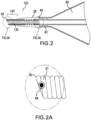
- the particular jacket 38 embodiment illustrated in FIG. 2 does not include a mediating portion (spacer) and therefore connects the spring element 130 to the balloon shoulder at the distal fuse section 81.
- the jacket 38 may help maintain the spring's natural characteristics while at the same time provide a strong embedding material. Because the jacket 38 covers all or part of the spring element, the distal end 140 of the spring element 130 may be left entirely exposed.
- the length of the exposed portion of the spring element 130 may vary considerably, for example, between about 30 to about 70% of the spring's length, or between about 30% to about 50% of the spring's length, or between about 50% to about 70% of the spring's length, or between about 40% to about 60% of the spring's length, or between about 30% to about 40% of the spring's length.
- Any spring element for example spring elements 30, 130, 230, 330 illustrated in FIGS. 1 , 2 , 3 and 4 , may be partially or fully covered or embedded by a jacket 38 in this manner, in accordance with the catheter tip of the invention.
- the spring element 30, 130, 230, 330 may be a wire coil that extends to the distal edge 45 of the catheter tip 20, 120 and is the de facto distal end 40, 140 of the catheter tip.
- the spring element 30, 130, 230, 330 may be a wire coil that extends to the distal edge 45 of the catheter tip 20, 120 and is the de facto distal end 40, 140 of the catheter tip.
- there may be a need to smooth the end of the wire coil because the distal edge 45 of the catheter tip may come in direct contact with a vessel wall. It may also be desirable to smooth the proximal end of the wire coil.
- One solution for smoothing the ends of the wire coil spring element, not illustrated, is to apply a laser polish/weld on the coil end(s), thereby smoothing the ends(s) and at the same time affix the end of the wire coil to the neighboring or adjacent coil 47 of the spring element.
- the "adjacent coil” 47 may be either the most distal or most proximal coil, depending on whether the distal end or proximal end of the wire coil is being smoothed.
- An alternative solution is to use an adhesive or any other type of bond 48 to connect the coil wire edge to a neighboring coil 47, as illustrated in FIG. 2A .
- the bond 48 acts to eliminate the free edge wire coil end, to smooth sharp edges on the end of the wire coil and to affix the end to an adjacent coil.
- the laser weld or other bond preferably should leave no excess material flow, which - like sharp edges - may cause trauma to the tissue.
- the spring element 30, 130, 230, 330 is tapered distally in order to decrease the crossing profile of the distal edge 45 of the catheter tip. Tapering will result in a decreased entry profile and thereby improve deliverability and crossability through narrowed and/or stenosed vessels and/or calcified lesions.
- the inner diameter of the tapered spring element does not itself taper.
- the spring element has an inner diameter (lumen diameter) that is constant along the entire length of the spring element. In other words, the inner diameter is the same along the spring length, while the outer diameter gradually decreases in the distal direction.
- the inner diameter of the spring element may narrow distally, but at a lower rate than the narrowing of the outer diameter, i.e., having less taper than the outer diameter. It is the narrowing (rate of decrease) of the outer diameter that determines the actual extent of tapering of the spring element and catheter tip.
- One advantage in having a spring with constant or near-constant inner diameter is that it may control and limit internal friction between the spring element and the guide wire that passes therethrough. Another advantage lies in limiting the friction between the spring element and the mandrel on which the catheter is mounted during manufacturing. Exemplary embodiments of tapered spring elements having a constant inner diameter for use in the catheter tips of the invention are illustrated in FIGS. 3 and 4 .
- tapered wire is meant a wire having a decreasing cross-sectional diameter 31 along its length.
- the cross-sectional diameter 31 of the wire is 0.1 mm at a first end (proximal end 46 of the wire coil) and the cross-sectional diameter 31 of the wire is 0.05 mm at a second end (distal end 45 of the wire coil).
- Other gradations of wire cross-sectional diameter 31 may be used, depending on the degree of taper desired for the spring element 230.
- the cross-sectional diameter of the tapered wire may decrease by about 30- 70% between the first end and second end.
- Obtaining a tapered outer diameter while maintaining a constant inner, luminal diameter for the spring element 230 formed from a tapered wire may be ensured during manufacturing by winding the tapered wire on a fixed diameter mandrel.
- the inner, luminal diameter of the resultant wire coil spring element 230 remains constant or near constant, and the effect of the decreasing wire diameter will translate into a reduced outer diameter for the resultant spring element 230.
- an inner, luminal diameter having a lesser taper than the outer diameter may be achieved during manufacture by winding the tapered wire on a mandrel having a taper rate less than that of the cross-sectional diameter of the tapered wire.
- FIG. 4 illustrates another embodiment of a tapered spring element 330 having a distally tapering outer diameter and a constant or near constant inner (lumen) diameter.
- a method for producing the embodiment of FIG. 4 involves starting with a non-tapered spring element (e.g., a coil having a constant outer diameter along its length), and exposing the outer surface of the spring element to laser radiation or chemical etching, or any other means of grinding or abrading the outer surface of the wire coil, to produce a gradually reduced cross-sectional diameter 31 a of the wire coil toward the distal end 45.
- the coil of the spring element 330 is thereby rendered to taper distally on its outer surface, while the inner luminal diameter remains substantially constant.
- the starting wire cross-sectional diameter may be, for example, 100 micrometers and may be reduced in the distal direction by between about 30-70% from the proximal end 46 to the distal end 45 of the spring element 330.
- the spring element 330 may be polished to effect a smooth surface to minimize damage to vessel walls.
- the spring elements 130, 230 depicted in FIGS. 2 and 3 further illustrate another feature that is incorporated into the catheter tip of the invention: spaced coils. Coils in a first proximal region B of the spring element of the invention are packed tightly with no pitch spaces. The tightly packed coils provide pushability to the catheter tip. However, in one embodiment, a few coils of the spring element 130, 230 have spaces between them. Such spaced coils may be located near the proximal end 46 of the spring element 130, 230 where it is fused to the balloon shoulder or spacer. The number of spaced coils of such a spring element 130, 230 may be in the range of 2-10 coils. Thus, as illustrated in FIG.
- a first region B of the spring element 230 includes pitch spaces and a second region C has tightly packed coils.
- the second region is distal of the first region.
- the embodiment illustrated in FIG. 2 has a small number of coils with pitch spaces. Exemplary spacing between neighboring spaced coils may be in the range of 0.5 - 2 times the cross-sectional diameter of the wire.
- pitch space in a portion of the spring element is to increase the bond strength at the point of connection with the balloon shoulder, the distal fuse section 81.
- the bond strength may be enhanced because the jacket 38 ( FIG. 2 ) may be pressed into the spaces between the coils. This increases the contact area between the jacket and the spring element, thereby increasing the friction between the spring and jacket, resulting in an increased bond strength in that area.
- FIGS. 5A-7B illustrate advantages of the catheter tip of the invention over conventional catheter tips.
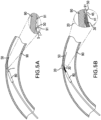
- FIG. 5A depicts how a conventional catheter tip made of a stiff material to achieve good pushability may catch on the rough surface of the lumen of a curved vessel.
- a conventional catheter tip 1 Depicted in FIG. 5A is a conventional catheter tip 1; a balloon 80 of a balloon- catheter on which the conventional catheter tip 1 is mounted for illustration; and a guide wire 50.
- the guide wire 50 contacts a curved portion of a vessel wall 90, it tends to bend longitudinally as shown in FIG. 5A .
- the conventional catheter tip 1 has less longitudinal flexibility than the guide wire 50.
- the distal edge 5 of the conventional stiff catheter tip 1 protrudes away from the bent guide wire 50 toward the vessel wall where it can catch on the rough surface 91 of the lumen of the vessel wall 90, making deliverability of the catheter difficult and potentially causing damage to the vessel wall 90.
- the protruding distal edge 5 of such a conventional device can catch on struts or other structures of the previously deployed stent.
- FIG. 5B illustrates features of an embodiment of the present invention that minimize the risk that the distal edge of the catheter tip will catch on the rough surface of the lumen wall of a curved vessel.
- FIG. 5B shows a catheter tip 20 including a spring element 30 in a curved vessel, and a balloon 80 of a balloon- catheter on which the catheter tip 20 is mounted for illustration.
- the spring element 30 is flexible yet has pushability characteristics because of the tight coils, and it is radially rigid.
- the spring element 30 does not extend to the distal edge 45 of the catheter tip 20, but the catheter tip includes a short structure 41 attached to the distal end of the spring element 30, for example by gluing or fusing.
- the short structure 41 attached to the end coil of the spring element 30 may be made of a polymer, such as a plastic or polyamide.
- the inset of FIG. 5B shows in greater detail the longitudinal flexibility of the spring element 30.
- the longitudinal flexibility of the spring element 30 permits the catheter tip 20 to flex easily with the guide wire 50 as it flexes laterally with the curve of the vessel lumen, so that the short structure 41 can track tightly with the guide wire 50 and the distal edge 45 does not protrude and catch on the rough surface 91 of the lumen of the vessel wall 90.
- the spring element 30 and the short structure 41 are tapered, as illustrated in the inset of FIG.
- the spring element 30 may be partially or fully covered with or embedded in a layer of a flexible polymer or similar material, a jacket, to create a smooth surface and improve trackability of the structure without altering the flexible properties of the spring. Examples of materials for such coverings include polyurethane and PEBAX.
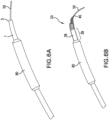
- FIG. 6A illustrates a conventional catheter tip 1 mounted on a balloon-angioplasty system, also showing the balloon 80, and the problem in the art of protrusion of the distal edge 5 of the catheter tip 1.
- the lack of flexibility and the radial rigidity along the length of the conventional catheter tip 1 tends to cause the distal edge 5a of the conventional catheter tip 1 to protrude away from the guide wire 50 as it curves through the vessel.
- the large inner diameter and thick walls of the distal end of the conventional catheter tip may further contribute to the problem of the protruding distal edge.
- FIG. 6B illustrates how the combination of flexibility and radial rigidity of a catheter tip 20 in accordance with the invention minimizes flaring of the distal edge 45 in an embodiment of the catheter tip of the invention (also mounted on a catheter of a balloon-angioplasty system).
- a catheter tip 20 including a jacket 38 and a tapered spring element 30; the balloon 80 of the balloon-angioplasty system; and a guide wire 50.
- the jacket 38 partially covers the spring element 30 and has a mediating portion 39.
- the mediating portion 39 of the jacket 38 extends proximal of the spring element 30 to the distal shoulder of the balloon 80.
- the radial rigidity and the tapered shape of the spring element 30 in combination with the flexibility of the spring element 30 limits protrusion of the distal edge 45 beyond the guide wire.
- the longitudinal flexibility of the spring element 30 permits the catheter tip 20 to bend with the guide wire, minimizing force on the distal edge 45 from the guide wire, and the radial rigidity of the spring element 30, which extends to the distal edge 45, minimizes plastic deformation. As shown in FIG. 6B , bending of the guide wire 50 does not result in protrusion of the distal edge 45 of such a catheter tip 20 from the guide wire 50.
- the spring element 30 extends to the distal edge 45 of the catheter tip 20 and comprises tightly packed coils, it provides both pushability and radial rigidity to the distal end of the catheter tip 20.
- the spring element 30 has a distally tapered outer diameter.
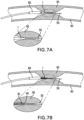
- the estimated compromise between rigidity and elasticity maintained by a conventional catheter tip may result in kinking when the catheter tip encounters a stenotic portion of a vessel, as illustrated in FIG. 7A .
- kinking may occur near the distal end of the balloon or any other localized soft or elastic point within the catheter tip.
- a conventional catheter tip on a balloon catheter is shown in FIG. 7A being pushed through a blood vessel 90 having a stenosis 95.
- the balloon 80 for the balloon-angioplasty balloon on which the conventional catheter tip 1 is mounted for illustration, and a guide wire 50.
- the stenotic material causes friction or resistance against the catheter tip, causing the conventional catheter tip 1 to give way to the harder material of the vessel plaque, causing it to kink or buckle, as shown in the insert of FIG. 7A .
- the flexible catheter tip of the invention provides greater pushability, and it exhibits no kinking because of its flexible body.
- FIG. 7B where an embodiment of the invention mounted on a balloon catheter is shown being pushed through a stenotic vessel.
- a catheter tip including a spring element 30 extending to the distal edge 45; the balloon 80 of a balloon-angioplasty system on which the catheter tip is mounted for illustration; and a guide wire 50.
- the spring element 30 is a wire coil that includes pitch space between a few coils in a first region, but not in a second region, the second region being distal of the first region. Because the spring element 30 may provide not only longitudinal flexibility and radial support, but also improved pushability to the catheter tip 20, the friction exerted by the stenosis 95 against the catheter tip of the invention will not cause the catheter tip 20 to kink.
- any structure that has the desired properties of longitudinal flexibility, radial rigidity and pushability is suitable as a spring element in accordance with the invention.
- a spring element include an extension spring, an accordion plastic tube, and a braided-accordion plastic tube.
- Some springs, including for example compression springs, are not preferred as spring elements.
- Extension springs have a predominantly tightly packed coil that is conducive to flexion along the longitudinal axis, without permitting spring compression or deformation, which could negatively impact the pushability of the catheter or control of the catheter tip when the catheter is pushed.
- Suitable materials for the spring element include, for example, stainless steel, cobalt chromium, Nitinol or other appropriate materials that would be apparent to one skilled in the art from the description herein.
- the spring element is made of a coiled wire - for example, a stainless steel wire - the diameter of the wire may be in the range of 0.025-0.3 mm, preferably, 0.06-0.2 mm.
- the spring element may be constructed using radiopaque materials to provide the catheter tip with higher radiopacity, thereby allowing improved imaging of the catheter tip.
- catheter tips of the invention are illustrated and described herein mounted on catheters of balloon-expandable stent systems and balloon angioplasty systems. However, it is contemplated the catheter tips may be used on any intravascular catheters, including for example self-expanding stent systems, intravascular catheters used to deliver other intravascular prosthetic devices, or other therapeutic intravascular catheters.
Landscapes
- Health & Medical Sciences (AREA)
- Life Sciences & Earth Sciences (AREA)
- Biophysics (AREA)
- Pulmonology (AREA)
- Engineering & Computer Science (AREA)
- Anesthesiology (AREA)
- Biomedical Technology (AREA)
- Heart & Thoracic Surgery (AREA)
- Hematology (AREA)
- Animal Behavior & Ethology (AREA)
- General Health & Medical Sciences (AREA)
- Public Health (AREA)
- Veterinary Medicine (AREA)
- Media Introduction/Drainage Providing Device (AREA)
Claims (20)
- Flexible Katheterspitze (20, 120) mit einem proximalen Ende und einem distalen Ende, mit: einem Federelement (130, 230), das sich distal verjüngt; wobei das Federelement (130, 230) eine Drahtspule mit einem Freiraum zwischen 2 oder mehreren Spulen in einem ersten Bereich (B) und eng gepackten Spulen in einem zweiten Bereich (C) ist,
dadurch gekennzeichnet, dass der zweite Bereich (C) zu dem ersten Bereich (B) distal ist. - Flexible Katheterspitze (20, 120) nach Anspruch 1, ferner aufweisend:
einen Mantel (38), der das Federelement (30, 130, 230, 330) teilweise abdeckt, so dass ein distaler Abschnitt (40, 140) des Federelements (30, 130, 230, 330) freiliegt. - Flexible Katheterspitze (20, 120) nach Anspruch 1, wobei
das Federelement (130, 230) einen Außendurchmesser, der sich distal mit einer ersten Rate zu einem distalen Rand (45) des distalen Endes der Katheterspitze (20, 120) verjüngt, und einen inneren Luminaldurchmesser, der sich nicht mit der ersten Rate verjüngt, aufweist. - Flexible Katheterspitze (20, 120) nach Anspruch 1, ferner mit:
einem Mantel (38), der teilweise das Federelement (130, 230) einbettet, so dass ein distaler Abschnitt (40, 140) des Federelements (130, 230) freiliegt. - Katheterspitze (20, 120) nach einem der Ansprüche 1-4, wobei das Federelement (30, 130, 230, 330) eine Verlängerungsfeder ist.
- Katheterspitze (20, 120) nach einem der Ansprüche 1, 2, 4 oder 5, wobei das Federelement (30, 130, 230, 330) einen Außendurchmesser, der sich distal mit einer ersten Rate zu einem distalen Rand (45) des distalen Endes (40, 140) der Katheterspitze (20, 120) verjüngt, und einen inneren Luminaldurchmesser, der sich nicht mit der ersten Rate verjüngt, aufweist.
- Katheterspitze (20, 120) nach einem der Ansprüche 1-5, wobei das Federelement (30, 130, 230, 330) einen Außendurchmesser, der sich distal mit einer ersten Rate zu einem distalen Rand (45) des distalen Endes (40, 140) der Katheterspitze (20, 120) verjüngt, und einen inneren Luminaldurchmesser, der im Wesentlichen konstant ist, aufweist.
- Katheterspitze (20, 120) nach einem der Ansprüche 1-5, wobei das Federelement (30, 130, 230, 330) einen Außendurchmesser, der sich distal mit einer ersten Rate zu einem distalen Rand (45) des distalen Endes (40, 140) der Katheterspitze (20, 120) verjüngt, und einen inneren Luminaldurchmesser, der sich distal mit einer zweiten Rate verjüngt, aufweist, wobei die zweite Rate niedriger ist als die erste Rate.
- Katheterspitze (20, 120) nach einem der Ansprüche 1-8, wobei die Katheterspitze (20, 120) einen Mantel (38) beinhaltet, der einen proximalen Abschnitt, nicht aber einen distalen Abschnitt (40, 140) des Federelements (30, 130, 230, 330) abdeckt, wobei das distale Ende (40, 140) der Katheterspitze (20, 120) ein freiliegendes Federelement (30, 130, 230, 330) aufweist.
- Katheterspitze (20, 120) nach Anspruch 2, 4 oder 9, wobei der Mantel (38) den proximalen Abschnitt des Federelements (30, 130, 230, 330) einbettet.
- Katheterspitze (20, 120) nach Anspruch 9 oder 10, wobei der Mantel (38) einen Mittlungsabschnitt (39) aufweist, der proximal zu einem proximalen Ende (46) des Federelements (30, 130, 230, 330) angeordnet ist.
- Katheterspitze (20, 120) nach einem der Ansprüche 1, 2 oder 4, wobei das Federelement (30, 130, 230, 330) sich zu einem distalen Rand (45) des distalen Endes der Katheterspitze (20, 120) verjüngt.
- Katheterspitze (20, 120) nach einem der Ansprüche 1, 2 oder 4, ferner aufweisend eine distale Randstruktur (41), die an einem distalen Rand (45) des distalen Endes der Katheterspitze (20, 120) positioniert ist, wobei das Federelement (30, 130, 230, 330) sich zu einem proximalen Ende der distalen Randstruktur (41) verjüngt, wobei die distale Randstruktur (41) an einem distalen Ende des Federelements (30, 130, 230, 330) befestigt ist.
- Katheterspitze (20, 120) nach Anspruch 13, wobei das Federelement (30, 130, 230, 330) und die distale Randstruktur (41) sich distal verjüngen.
- Katheterspitze (20, 120) nach einem der Ansprüche 1-4, wobei das Federelement (30, 130, 230, 330) eine Drahtspule mit einem von einem proximalen Ende (46) des Federelements (30, 130, 230, 330) zu einem distalen Ende (45) des Federelements (30, 130, 230, 330) abnehmenden Querschnittsdurchmesser (31) ist, und wobei das Federelement (30, 130, 230, 330) einen Außendurchmesser, der sich distal verjüngt, und einen inneren Luminaldurchmesser, der im Wesentlichen konstant ist, aufweist.
- Katheterspitze (20, 120) nach einem der Ansprüche 1-4, wobei eine Außenoberfläche des Federelements (30, 130, 230, 330) einen von einem proximalen Ende (46) des Federelements (30, 130, 230, 330) zu einem distalen Ende (45) des Federelements (30, 230, 330) abnehmenden Querschnittsdurchmesser (31a) aufweist, und wobei das Federelement (30, 130, 230, 330) einen Außendurchmesser, der sich distal verjüngt, und einen inneren Luminaldurchmesser, der im Wesentlichen konstant ist, aufweist.
- Katheterspitze (20, 120) nach Anspruch 1-4, wobei der erste Bereich (B) der beabstandeten Spulen ungefähr 2-10 Spulen aufweist.
- Katheterspitze (20, 120) nach Anspruch 17, wobei die Drahtspule einen Querschnittsdurchmesser aufweist, wobei der Freiraum eine Distanz von ungefähr 0,5 bis 2 Mal den Querschnittsdurchmesser der Drahtspulen beträgt.
- Katheterspitze (20, 120) nach einem der Ansprüche 1, 2-4 oder 17+18, wobei die Drahtspule ferner eine Klebung (48) an einem Ende der Drahtspule aufweist.
- Katheterspitze (20, 120) nach einem der Ansprüche 1, 2-4 oder 17+18, wobei die Drahtspule ferner eine Laserschweißnaht an einem Ende der Drahtspule aufweist.
Applications Claiming Priority (1)
| Application Number | Priority Date | Filing Date | Title |
|---|---|---|---|
| PCT/IB2014/000699 WO2015114398A1 (en) | 2014-02-03 | 2014-02-03 | Catheter tip assembled with a spring |
Publications (2)
| Publication Number | Publication Date |
|---|---|
| EP3102273A1 EP3102273A1 (de) | 2016-12-14 |
| EP3102273B1 true EP3102273B1 (de) | 2024-08-07 |
Family
ID=50982939
Family Applications (1)
| Application Number | Title | Priority Date | Filing Date |
|---|---|---|---|
| EP14732634.2A Active EP3102273B1 (de) | 2014-02-03 | 2014-02-03 | Mit einer feder montierte katheterspitze |
Country Status (9)
| Country | Link |
|---|---|
| EP (1) | EP3102273B1 (de) |
| JP (1) | JP6526027B2 (de) |
| CN (1) | CN105960259B (de) |
| AU (2) | AU2014380904B2 (de) |
| CA (1) | CA2938741C (de) |
| ES (1) | ES2986372T3 (de) |
| IL (1) | IL246949B (de) |
| RU (1) | RU2673106C1 (de) |
| WO (1) | WO2015114398A1 (de) |
Families Citing this family (8)
| Publication number | Priority date | Publication date | Assignee | Title |
|---|---|---|---|---|
| JP6462542B2 (ja) * | 2015-09-15 | 2019-01-30 | 朝日インテック株式会社 | バルーンカテーテル |
| CN108272450A (zh) * | 2017-01-05 | 2018-07-13 | 四川锦江电子科技有限公司 | 一种微型多极标测导管 |
| CN108514677A (zh) * | 2018-04-28 | 2018-09-11 | 业聚医疗器械(深圳)有限公司 | 一种微导管 |
| CH715110A2 (de) * | 2018-06-19 | 2019-12-30 | Tecpharma Licensing Ag | Injektionsvorrichtung zum Verabreichen einer medizinischen Substanz, umfassend eine Schraubenfeder, sowie eine solche Schraubenfeder. |
| RU2710216C1 (ru) * | 2018-09-13 | 2019-12-25 | Общество с ограниченной ответственностью "СЕВЕН САНС" | Корпус устройства для позиционирования коронарного стента или коронарного баллона в коронарных артериях |
| CN114533129B (zh) * | 2018-12-27 | 2024-08-27 | 深圳北芯生命科技股份有限公司 | 具有弹簧结构的血管内超声导管 |
| CN115414574B (zh) * | 2022-08-17 | 2023-04-07 | 广东博迈医疗科技股份有限公司 | 一种导管尖端、球囊导管及血管介入装置 |
| CN117731921B (zh) * | 2023-09-19 | 2024-07-02 | 中国人民解放军总医院第三医学中心 | 一种应用于输尿管的oct球囊导管 |
Citations (1)
| Publication number | Priority date | Publication date | Assignee | Title |
|---|---|---|---|---|
| JP2002224221A (ja) * | 2001-02-05 | 2002-08-13 | Asahi Optical Co Ltd | 内視鏡用カテーテル |
Family Cites Families (15)
| Publication number | Priority date | Publication date | Assignee | Title |
|---|---|---|---|---|
| US3981297A (en) * | 1975-03-03 | 1976-09-21 | Sorenson Research Co., Inc. | Gas sampling catheter assembly and method |
| SU1528505A1 (ru) * | 1986-08-05 | 1989-12-15 | Севастопольская 1-Я Городская Больница Им.Н.И.Пирогова | Уретральный катетер |
| US20050245894A1 (en) * | 1996-05-20 | 2005-11-03 | Medtronic Vascular, Inc. | Methods and apparatuses for drug delivery to an intravascular occlusion |
| US6322586B1 (en) * | 2000-01-10 | 2001-11-27 | Scimed Life Systems, Inc. | Catheter tip designs and method of manufacture |
| JP4898993B2 (ja) * | 2000-01-28 | 2012-03-21 | クック メディカル テクノロジーズ エルエルシー | 複数本のワイヤを備えている脈管内医療装置 |
| US9254213B2 (en) * | 2004-01-09 | 2016-02-09 | Rubicon Medical, Inc. | Stent delivery device |
| US8535293B2 (en) * | 2004-04-13 | 2013-09-17 | Gyrus Acmi, Inc. | Atraumatic ureteral access sheath |
| CN101001658A (zh) * | 2004-08-10 | 2007-07-18 | 株式会社钟化 | 医疗用导管及其制造方法 |
| JP2006271901A (ja) * | 2005-03-30 | 2006-10-12 | Nippon Zeon Co Ltd | コイル状造影マーカーとその製造方法、及びカテーテル |
| CN101926667B (zh) * | 2005-05-25 | 2012-12-05 | 泰科保健集团有限合伙公司 | 用于在血管内输送和展开封堵器的系统和方法 |
| US20070260224A1 (en) * | 2006-03-09 | 2007-11-08 | Abbott Laboratories | Flexible catheter tip having a shaped head |
| US20100049167A1 (en) * | 2008-08-20 | 2010-02-25 | Cook Incorporated | Introducer sheath having reinforced distal taper |
| EP2533839B1 (de) * | 2010-02-09 | 2021-05-05 | Medinol Ltd. | Mit einer feder montierte katheterspitze |
| JP4896245B2 (ja) * | 2010-03-31 | 2012-03-14 | 朝日インテック株式会社 | ガイドワイヤ |
| US20110245775A1 (en) * | 2010-04-01 | 2011-10-06 | Cook Incorporated | Tapered sheath |
-
2014
- 2014-02-03 EP EP14732634.2A patent/EP3102273B1/de active Active
- 2014-02-03 RU RU2016129732A patent/RU2673106C1/ru active
- 2014-02-03 JP JP2016549295A patent/JP6526027B2/ja active Active
- 2014-02-03 CN CN201480074809.7A patent/CN105960259B/zh active Active
- 2014-02-03 ES ES14732634T patent/ES2986372T3/es active Active
- 2014-02-03 AU AU2014380904A patent/AU2014380904B2/en not_active Ceased
- 2014-02-03 CA CA2938741A patent/CA2938741C/en not_active Expired - Fee Related
- 2014-02-03 WO PCT/IB2014/000699 patent/WO2015114398A1/en not_active Ceased
-
2016
- 2016-07-26 IL IL246949A patent/IL246949B/en active IP Right Grant
-
2017
- 2017-12-20 AU AU2017279644A patent/AU2017279644B2/en not_active Ceased
Patent Citations (1)
| Publication number | Priority date | Publication date | Assignee | Title |
|---|---|---|---|---|
| JP2002224221A (ja) * | 2001-02-05 | 2002-08-13 | Asahi Optical Co Ltd | 内視鏡用カテーテル |
Also Published As
| Publication number | Publication date |
|---|---|
| AU2017279644B2 (en) | 2019-02-21 |
| RU2673106C1 (ru) | 2018-11-22 |
| CN105960259A (zh) | 2016-09-21 |
| ES2986372T3 (es) | 2024-11-11 |
| AU2014380904A1 (en) | 2016-08-04 |
| IL246949A0 (en) | 2016-09-29 |
| EP3102273A1 (de) | 2016-12-14 |
| CA2938741A1 (en) | 2015-08-06 |
| CN105960259B (zh) | 2021-07-09 |
| WO2015114398A1 (en) | 2015-08-06 |
| JP2017506942A (ja) | 2017-03-16 |
| CA2938741C (en) | 2019-05-14 |
| JP6526027B2 (ja) | 2019-06-05 |
| IL246949B (en) | 2021-02-28 |
| AU2017279644A1 (en) | 2018-01-18 |
| AU2014380904B2 (en) | 2017-10-19 |
Similar Documents
| Publication | Publication Date | Title |
|---|---|---|
| US11458284B2 (en) | Catheter tip assembled with a spring | |
| US20210031003A1 (en) | Catheter tip assembled with a spring | |
| EP3102273B1 (de) | Mit einer feder montierte katheterspitze | |
| US20210008351A1 (en) | Integrated coil vascular devices | |
| JP6982025B2 (ja) | 可撓性カテーテル | |
| HK1227780B (en) | Catheter tip assembled with a spring | |
| HK1227780A1 (en) | Catheter tip assembled with a spring | |
| HK1173401A (en) | Catheter tip assembled with a spring | |
| HK1173401B (en) | Catheter tip assembled with a spring | |
| HK1248154B (en) | Catheter tip assembled with a spring |
Legal Events
| Date | Code | Title | Description |
|---|---|---|---|
| STAA | Information on the status of an ep patent application or granted ep patent |
Free format text: STATUS: THE INTERNATIONAL PUBLICATION HAS BEEN MADE |
|
| PUAI | Public reference made under article 153(3) epc to a published international application that has entered the european phase |
Free format text: ORIGINAL CODE: 0009012 |
|
| STAA | Information on the status of an ep patent application or granted ep patent |
Free format text: STATUS: REQUEST FOR EXAMINATION WAS MADE |
|
| 17P | Request for examination filed |
Effective date: 20160728 |
|
| AK | Designated contracting states |
Kind code of ref document: A1 Designated state(s): AL AT BE BG CH CY CZ DE DK EE ES FI FR GB GR HR HU IE IS IT LI LT LU LV MC MK MT NL NO PL PT RO RS SE SI SK SM TR |
|
| AX | Request for extension of the european patent |
Extension state: BA ME |
|
| DAX | Request for extension of the european patent (deleted) | ||
| REG | Reference to a national code |
Ref country code: HK Ref legal event code: DE Ref document number: 1227780 Country of ref document: HK |
|
| STAA | Information on the status of an ep patent application or granted ep patent |
Free format text: STATUS: EXAMINATION IS IN PROGRESS |
|
| 17Q | First examination report despatched |
Effective date: 20180719 |
|
| GRAP | Despatch of communication of intention to grant a patent |
Free format text: ORIGINAL CODE: EPIDOSNIGR1 |
|
| STAA | Information on the status of an ep patent application or granted ep patent |
Free format text: STATUS: GRANT OF PATENT IS INTENDED |
|
| INTG | Intention to grant announced |
Effective date: 20240226 |
|
| P01 | Opt-out of the competence of the unified patent court (upc) registered |
Effective date: 20240226 |
|
| GRAS | Grant fee paid |
Free format text: ORIGINAL CODE: EPIDOSNIGR3 |
|
| GRAA | (expected) grant |
Free format text: ORIGINAL CODE: 0009210 |
|
| STAA | Information on the status of an ep patent application or granted ep patent |
Free format text: STATUS: THE PATENT HAS BEEN GRANTED |
|
| AK | Designated contracting states |
Kind code of ref document: B1 Designated state(s): AL AT BE BG CH CY CZ DE DK EE ES FI FR GB GR HR HU IE IS IT LI LT LU LV MC MK MT NL NO PL PT RO RS SE SI SK SM TR |
|
| REG | Reference to a national code |
Ref country code: GB Ref legal event code: FG4D |
|
| REG | Reference to a national code |
Ref country code: CH Ref legal event code: EP |
|
| REG | Reference to a national code |
Ref country code: NL Ref legal event code: FP Ref country code: IE Ref legal event code: FG4D |
|
| REG | Reference to a national code |
Ref country code: DE Ref legal event code: R096 Ref document number: 602014090645 Country of ref document: DE |
|
| REG | Reference to a national code |
Ref country code: ES Ref legal event code: FG2A Ref document number: 2986372 Country of ref document: ES Kind code of ref document: T3 Effective date: 20241111 |
|
| REG | Reference to a national code |
Ref country code: LT Ref legal event code: MG9D |
|
| PG25 | Lapsed in a contracting state [announced via postgrant information from national office to epo] |
Ref country code: NO Free format text: LAPSE BECAUSE OF FAILURE TO SUBMIT A TRANSLATION OF THE DESCRIPTION OR TO PAY THE FEE WITHIN THE PRESCRIBED TIME-LIMIT Effective date: 20241107 |
|
| REG | Reference to a national code |
Ref country code: AT Ref legal event code: MK05 Ref document number: 1710268 Country of ref document: AT Kind code of ref document: T Effective date: 20240807 |
|
| PG25 | Lapsed in a contracting state [announced via postgrant information from national office to epo] |
Ref country code: FI Free format text: LAPSE BECAUSE OF FAILURE TO SUBMIT A TRANSLATION OF THE DESCRIPTION OR TO PAY THE FEE WITHIN THE PRESCRIBED TIME-LIMIT Effective date: 20240807 Ref country code: PL Free format text: LAPSE BECAUSE OF FAILURE TO SUBMIT A TRANSLATION OF THE DESCRIPTION OR TO PAY THE FEE WITHIN THE PRESCRIBED TIME-LIMIT Effective date: 20240807 Ref country code: PT Free format text: LAPSE BECAUSE OF FAILURE TO SUBMIT A TRANSLATION OF THE DESCRIPTION OR TO PAY THE FEE WITHIN THE PRESCRIBED TIME-LIMIT Effective date: 20241209 Ref country code: GR Free format text: LAPSE BECAUSE OF FAILURE TO SUBMIT A TRANSLATION OF THE DESCRIPTION OR TO PAY THE FEE WITHIN THE PRESCRIBED TIME-LIMIT Effective date: 20241108 |
|
| PG25 | Lapsed in a contracting state [announced via postgrant information from national office to epo] |
Ref country code: BG Free format text: LAPSE BECAUSE OF FAILURE TO SUBMIT A TRANSLATION OF THE DESCRIPTION OR TO PAY THE FEE WITHIN THE PRESCRIBED TIME-LIMIT Effective date: 20240807 |
|
| PG25 | Lapsed in a contracting state [announced via postgrant information from national office to epo] |
Ref country code: LV Free format text: LAPSE BECAUSE OF FAILURE TO SUBMIT A TRANSLATION OF THE DESCRIPTION OR TO PAY THE FEE WITHIN THE PRESCRIBED TIME-LIMIT Effective date: 20240807 |
|
| PG25 | Lapsed in a contracting state [announced via postgrant information from national office to epo] |
Ref country code: IS Free format text: LAPSE BECAUSE OF FAILURE TO SUBMIT A TRANSLATION OF THE DESCRIPTION OR TO PAY THE FEE WITHIN THE PRESCRIBED TIME-LIMIT Effective date: 20241207 Ref country code: AT Free format text: LAPSE BECAUSE OF FAILURE TO SUBMIT A TRANSLATION OF THE DESCRIPTION OR TO PAY THE FEE WITHIN THE PRESCRIBED TIME-LIMIT Effective date: 20240807 |
|
| PG25 | Lapsed in a contracting state [announced via postgrant information from national office to epo] |
Ref country code: HR Free format text: LAPSE BECAUSE OF FAILURE TO SUBMIT A TRANSLATION OF THE DESCRIPTION OR TO PAY THE FEE WITHIN THE PRESCRIBED TIME-LIMIT Effective date: 20240807 |
|
| PG25 | Lapsed in a contracting state [announced via postgrant information from national office to epo] |
Ref country code: RS Free format text: LAPSE BECAUSE OF FAILURE TO SUBMIT A TRANSLATION OF THE DESCRIPTION OR TO PAY THE FEE WITHIN THE PRESCRIBED TIME-LIMIT Effective date: 20241107 |
|
| PG25 | Lapsed in a contracting state [announced via postgrant information from national office to epo] |
Ref country code: RS Free format text: LAPSE BECAUSE OF FAILURE TO SUBMIT A TRANSLATION OF THE DESCRIPTION OR TO PAY THE FEE WITHIN THE PRESCRIBED TIME-LIMIT Effective date: 20241107 Ref country code: PT Free format text: LAPSE BECAUSE OF FAILURE TO SUBMIT A TRANSLATION OF THE DESCRIPTION OR TO PAY THE FEE WITHIN THE PRESCRIBED TIME-LIMIT Effective date: 20241209 Ref country code: PL Free format text: LAPSE BECAUSE OF FAILURE TO SUBMIT A TRANSLATION OF THE DESCRIPTION OR TO PAY THE FEE WITHIN THE PRESCRIBED TIME-LIMIT Effective date: 20240807 Ref country code: NO Free format text: LAPSE BECAUSE OF FAILURE TO SUBMIT A TRANSLATION OF THE DESCRIPTION OR TO PAY THE FEE WITHIN THE PRESCRIBED TIME-LIMIT Effective date: 20241107 Ref country code: LV Free format text: LAPSE BECAUSE OF FAILURE TO SUBMIT A TRANSLATION OF THE DESCRIPTION OR TO PAY THE FEE WITHIN THE PRESCRIBED TIME-LIMIT Effective date: 20240807 Ref country code: IS Free format text: LAPSE BECAUSE OF FAILURE TO SUBMIT A TRANSLATION OF THE DESCRIPTION OR TO PAY THE FEE WITHIN THE PRESCRIBED TIME-LIMIT Effective date: 20241207 Ref country code: HR Free format text: LAPSE BECAUSE OF FAILURE TO SUBMIT A TRANSLATION OF THE DESCRIPTION OR TO PAY THE FEE WITHIN THE PRESCRIBED TIME-LIMIT Effective date: 20240807 Ref country code: GR Free format text: LAPSE BECAUSE OF FAILURE TO SUBMIT A TRANSLATION OF THE DESCRIPTION OR TO PAY THE FEE WITHIN THE PRESCRIBED TIME-LIMIT Effective date: 20241108 Ref country code: FI Free format text: LAPSE BECAUSE OF FAILURE TO SUBMIT A TRANSLATION OF THE DESCRIPTION OR TO PAY THE FEE WITHIN THE PRESCRIBED TIME-LIMIT Effective date: 20240807 Ref country code: BG Free format text: LAPSE BECAUSE OF FAILURE TO SUBMIT A TRANSLATION OF THE DESCRIPTION OR TO PAY THE FEE WITHIN THE PRESCRIBED TIME-LIMIT Effective date: 20240807 Ref country code: AT Free format text: LAPSE BECAUSE OF FAILURE TO SUBMIT A TRANSLATION OF THE DESCRIPTION OR TO PAY THE FEE WITHIN THE PRESCRIBED TIME-LIMIT Effective date: 20240807 |
|
| PGFP | Annual fee paid to national office [announced via postgrant information from national office to epo] |
Ref country code: NL Payment date: 20250227 Year of fee payment: 12 |
|
| PG25 | Lapsed in a contracting state [announced via postgrant information from national office to epo] |
Ref country code: RO Free format text: LAPSE BECAUSE OF FAILURE TO SUBMIT A TRANSLATION OF THE DESCRIPTION OR TO PAY THE FEE WITHIN THE PRESCRIBED TIME-LIMIT Effective date: 20240807 Ref country code: DK Free format text: LAPSE BECAUSE OF FAILURE TO SUBMIT A TRANSLATION OF THE DESCRIPTION OR TO PAY THE FEE WITHIN THE PRESCRIBED TIME-LIMIT Effective date: 20240807 Ref country code: SM Free format text: LAPSE BECAUSE OF FAILURE TO SUBMIT A TRANSLATION OF THE DESCRIPTION OR TO PAY THE FEE WITHIN THE PRESCRIBED TIME-LIMIT Effective date: 20240807 |
|
| PGFP | Annual fee paid to national office [announced via postgrant information from national office to epo] |
Ref country code: ES Payment date: 20250303 Year of fee payment: 12 |
|
| PGFP | Annual fee paid to national office [announced via postgrant information from national office to epo] |
Ref country code: IE Payment date: 20250227 Year of fee payment: 12 |
|
| PG25 | Lapsed in a contracting state [announced via postgrant information from national office to epo] |
Ref country code: EE Free format text: LAPSE BECAUSE OF FAILURE TO SUBMIT A TRANSLATION OF THE DESCRIPTION OR TO PAY THE FEE WITHIN THE PRESCRIBED TIME-LIMIT Effective date: 20240807 |
|
| PG25 | Lapsed in a contracting state [announced via postgrant information from national office to epo] |
Ref country code: CZ Free format text: LAPSE BECAUSE OF FAILURE TO SUBMIT A TRANSLATION OF THE DESCRIPTION OR TO PAY THE FEE WITHIN THE PRESCRIBED TIME-LIMIT Effective date: 20240807 |
|
| PGFP | Annual fee paid to national office [announced via postgrant information from national office to epo] |
Ref country code: FR Payment date: 20250225 Year of fee payment: 12 |
|
| PG25 | Lapsed in a contracting state [announced via postgrant information from national office to epo] |
Ref country code: SK Free format text: LAPSE BECAUSE OF FAILURE TO SUBMIT A TRANSLATION OF THE DESCRIPTION OR TO PAY THE FEE WITHIN THE PRESCRIBED TIME-LIMIT Effective date: 20240807 |
|
| PGFP | Annual fee paid to national office [announced via postgrant information from national office to epo] |
Ref country code: GB Payment date: 20250227 Year of fee payment: 12 |
|
| REG | Reference to a national code |
Ref country code: DE Ref legal event code: R097 Ref document number: 602014090645 Country of ref document: DE |
|
| PLBE | No opposition filed within time limit |
Free format text: ORIGINAL CODE: 0009261 |
|
| STAA | Information on the status of an ep patent application or granted ep patent |
Free format text: STATUS: NO OPPOSITION FILED WITHIN TIME LIMIT |
|
| 26N | No opposition filed |
Effective date: 20250508 |
|
| REG | Reference to a national code |
Ref country code: DE Ref legal event code: R119 Ref document number: 602014090645 Country of ref document: DE |
|
| PG25 | Lapsed in a contracting state [announced via postgrant information from national office to epo] |
Ref country code: SE Free format text: LAPSE BECAUSE OF FAILURE TO SUBMIT A TRANSLATION OF THE DESCRIPTION OR TO PAY THE FEE WITHIN THE PRESCRIBED TIME-LIMIT Effective date: 20240807 |
|
| PG25 | Lapsed in a contracting state [announced via postgrant information from national office to epo] |
Ref country code: MC Free format text: LAPSE BECAUSE OF FAILURE TO SUBMIT A TRANSLATION OF THE DESCRIPTION OR TO PAY THE FEE WITHIN THE PRESCRIBED TIME-LIMIT Effective date: 20240807 |
|
| REG | Reference to a national code |
Ref country code: CH Ref legal event code: PL |
|
| PG25 | Lapsed in a contracting state [announced via postgrant information from national office to epo] |
Ref country code: LU Free format text: LAPSE BECAUSE OF NON-PAYMENT OF DUE FEES Effective date: 20250203 |
|
| PG25 | Lapsed in a contracting state [announced via postgrant information from national office to epo] |
Ref country code: CH Free format text: LAPSE BECAUSE OF NON-PAYMENT OF DUE FEES Effective date: 20250228 |
|
| REG | Reference to a national code |
Ref country code: BE Ref legal event code: MM Effective date: 20250228 |
|
| PG25 | Lapsed in a contracting state [announced via postgrant information from national office to epo] |
Ref country code: DE Free format text: LAPSE BECAUSE OF NON-PAYMENT OF DUE FEES Effective date: 20250902 |
|
| PG25 | Lapsed in a contracting state [announced via postgrant information from national office to epo] |
Ref country code: IT Free format text: LAPSE BECAUSE OF NON-PAYMENT OF DUE FEES Effective date: 20250203 |
|
| PG25 | Lapsed in a contracting state [announced via postgrant information from national office to epo] |
Ref country code: BE Free format text: LAPSE BECAUSE OF NON-PAYMENT OF DUE FEES Effective date: 20250228 |