EP3087147B1 - Gleitlackbeschichtung und gleitlager-schichtverbundwerkstoff mit solcher beschichtung - Google Patents
Gleitlackbeschichtung und gleitlager-schichtverbundwerkstoff mit solcher beschichtung Download PDFInfo
- Publication number
- EP3087147B1 EP3087147B1 EP14815769.6A EP14815769A EP3087147B1 EP 3087147 B1 EP3087147 B1 EP 3087147B1 EP 14815769 A EP14815769 A EP 14815769A EP 3087147 B1 EP3087147 B1 EP 3087147B1
- Authority
- EP
- European Patent Office
- Prior art keywords
- sliding
- lacquer coating
- layer
- bearing
- coating
- Prior art date
- Legal status (The legal status is an assumption and is not a legal conclusion. Google has not performed a legal analysis and makes no representation as to the accuracy of the status listed.)
- Active
Links
Images


Classifications
-
- C—CHEMISTRY; METALLURGY
- C09—DYES; PAINTS; POLISHES; NATURAL RESINS; ADHESIVES; COMPOSITIONS NOT OTHERWISE PROVIDED FOR; APPLICATIONS OF MATERIALS NOT OTHERWISE PROVIDED FOR
- C09D—COATING COMPOSITIONS, e.g. PAINTS, VARNISHES OR LACQUERS; FILLING PASTES; CHEMICAL PAINT OR INK REMOVERS; INKS; CORRECTING FLUIDS; WOODSTAINS; PASTES OR SOLIDS FOR COLOURING OR PRINTING; USE OF MATERIALS THEREFOR
- C09D5/00—Coating compositions, e.g. paints, varnishes or lacquers, characterised by their physical nature or the effects produced; Filling pastes
-
- C—CHEMISTRY; METALLURGY
- C08—ORGANIC MACROMOLECULAR COMPOUNDS; THEIR PREPARATION OR CHEMICAL WORKING-UP; COMPOSITIONS BASED THEREON
- C08K—Use of inorganic or non-macromolecular organic substances as compounding ingredients
- C08K3/00—Use of inorganic substances as compounding ingredients
- C08K3/38—Boron-containing compounds
-
- C—CHEMISTRY; METALLURGY
- C09—DYES; PAINTS; POLISHES; NATURAL RESINS; ADHESIVES; COMPOSITIONS NOT OTHERWISE PROVIDED FOR; APPLICATIONS OF MATERIALS NOT OTHERWISE PROVIDED FOR
- C09D—COATING COMPOSITIONS, e.g. PAINTS, VARNISHES OR LACQUERS; FILLING PASTES; CHEMICAL PAINT OR INK REMOVERS; INKS; CORRECTING FLUIDS; WOODSTAINS; PASTES OR SOLIDS FOR COLOURING OR PRINTING; USE OF MATERIALS THEREFOR
- C09D171/00—Coating compositions based on polyethers obtained by reactions forming an ether link in the main chain; Coating compositions based on derivatives of such polymers
-
- C—CHEMISTRY; METALLURGY
- C09—DYES; PAINTS; POLISHES; NATURAL RESINS; ADHESIVES; COMPOSITIONS NOT OTHERWISE PROVIDED FOR; APPLICATIONS OF MATERIALS NOT OTHERWISE PROVIDED FOR
- C09D—COATING COMPOSITIONS, e.g. PAINTS, VARNISHES OR LACQUERS; FILLING PASTES; CHEMICAL PAINT OR INK REMOVERS; INKS; CORRECTING FLUIDS; WOODSTAINS; PASTES OR SOLIDS FOR COLOURING OR PRINTING; USE OF MATERIALS THEREFOR
- C09D179/00—Coating compositions based on macromolecular compounds obtained by reactions forming in the main chain of the macromolecule a linkage containing nitrogen, with or without oxygen, or carbon only, not provided for in groups C09D161/00 - C09D177/00
- C09D179/04—Polycondensates having nitrogen-containing heterocyclic rings in the main chain; Polyhydrazides; Polyamide acids or similar polyimide precursors
- C09D179/08—Polyimides; Polyester-imides; Polyamide-imides; Polyamide acids or similar polyimide precursors
-
- C—CHEMISTRY; METALLURGY
- C09—DYES; PAINTS; POLISHES; NATURAL RESINS; ADHESIVES; COMPOSITIONS NOT OTHERWISE PROVIDED FOR; APPLICATIONS OF MATERIALS NOT OTHERWISE PROVIDED FOR
- C09D—COATING COMPOSITIONS, e.g. PAINTS, VARNISHES OR LACQUERS; FILLING PASTES; CHEMICAL PAINT OR INK REMOVERS; INKS; CORRECTING FLUIDS; WOODSTAINS; PASTES OR SOLIDS FOR COLOURING OR PRINTING; USE OF MATERIALS THEREFOR
- C09D7/00—Features of coating compositions, not provided for in group C09D5/00; Processes for incorporating ingredients in coating compositions
- C09D7/40—Additives
- C09D7/60—Additives non-macromolecular
- C09D7/61—Additives non-macromolecular inorganic
-
- C—CHEMISTRY; METALLURGY
- C09—DYES; PAINTS; POLISHES; NATURAL RESINS; ADHESIVES; COMPOSITIONS NOT OTHERWISE PROVIDED FOR; APPLICATIONS OF MATERIALS NOT OTHERWISE PROVIDED FOR
- C09D—COATING COMPOSITIONS, e.g. PAINTS, VARNISHES OR LACQUERS; FILLING PASTES; CHEMICAL PAINT OR INK REMOVERS; INKS; CORRECTING FLUIDS; WOODSTAINS; PASTES OR SOLIDS FOR COLOURING OR PRINTING; USE OF MATERIALS THEREFOR
- C09D7/00—Features of coating compositions, not provided for in group C09D5/00; Processes for incorporating ingredients in coating compositions
- C09D7/40—Additives
- C09D7/65—Additives macromolecular
-
- C—CHEMISTRY; METALLURGY
- C09—DYES; PAINTS; POLISHES; NATURAL RESINS; ADHESIVES; COMPOSITIONS NOT OTHERWISE PROVIDED FOR; APPLICATIONS OF MATERIALS NOT OTHERWISE PROVIDED FOR
- C09D—COATING COMPOSITIONS, e.g. PAINTS, VARNISHES OR LACQUERS; FILLING PASTES; CHEMICAL PAINT OR INK REMOVERS; INKS; CORRECTING FLUIDS; WOODSTAINS; PASTES OR SOLIDS FOR COLOURING OR PRINTING; USE OF MATERIALS THEREFOR
- C09D7/00—Features of coating compositions, not provided for in group C09D5/00; Processes for incorporating ingredients in coating compositions
- C09D7/40—Additives
- C09D7/66—Additives characterised by particle size
- C09D7/68—Particle size between 100-1000 nm
-
- C—CHEMISTRY; METALLURGY
- C10—PETROLEUM, GAS OR COKE INDUSTRIES; TECHNICAL GASES CONTAINING CARBON MONOXIDE; FUELS; LUBRICANTS; PEAT
- C10M—LUBRICATING COMPOSITIONS; USE OF CHEMICAL SUBSTANCES EITHER ALONE OR AS LUBRICATING INGREDIENTS IN A LUBRICATING COMPOSITION
- C10M125/00—Lubricating compositions characterised by the additive being an inorganic material
- C10M125/22—Compounds containing sulfur, selenium or tellurium
-
- C—CHEMISTRY; METALLURGY
- C10—PETROLEUM, GAS OR COKE INDUSTRIES; TECHNICAL GASES CONTAINING CARBON MONOXIDE; FUELS; LUBRICANTS; PEAT
- C10M—LUBRICATING COMPOSITIONS; USE OF CHEMICAL SUBSTANCES EITHER ALONE OR AS LUBRICATING INGREDIENTS IN A LUBRICATING COMPOSITION
- C10M157/00—Lubricating compositions characterised by the additive being a mixture of two or more macromolecular compounds covered by more than one of the main groups C10M143/00 - C10M155/00, each of these compounds being essential
- C10M157/02—Lubricating compositions characterised by the additive being a mixture of two or more macromolecular compounds covered by more than one of the main groups C10M143/00 - C10M155/00, each of these compounds being essential at least one of them being a halogen-containing compound
-
- F—MECHANICAL ENGINEERING; LIGHTING; HEATING; WEAPONS; BLASTING
- F16—ENGINEERING ELEMENTS AND UNITS; GENERAL MEASURES FOR PRODUCING AND MAINTAINING EFFECTIVE FUNCTIONING OF MACHINES OR INSTALLATIONS; THERMAL INSULATION IN GENERAL
- F16C—SHAFTS; FLEXIBLE SHAFTS; ELEMENTS OR CRANKSHAFT MECHANISMS; ROTARY BODIES OTHER THAN GEARING ELEMENTS; BEARINGS
- F16C33/00—Parts of bearings; Special methods for making bearings or parts thereof
- F16C33/02—Parts of sliding-contact bearings
- F16C33/04—Brasses; Bushes; Linings
- F16C33/06—Sliding surface mainly made of metal
- F16C33/10—Construction relative to lubrication
- F16C33/1095—Construction relative to lubrication with solids as lubricant, e.g. dry coatings, powder
-
- F—MECHANICAL ENGINEERING; LIGHTING; HEATING; WEAPONS; BLASTING
- F16—ENGINEERING ELEMENTS AND UNITS; GENERAL MEASURES FOR PRODUCING AND MAINTAINING EFFECTIVE FUNCTIONING OF MACHINES OR INSTALLATIONS; THERMAL INSULATION IN GENERAL
- F16C—SHAFTS; FLEXIBLE SHAFTS; ELEMENTS OR CRANKSHAFT MECHANISMS; ROTARY BODIES OTHER THAN GEARING ELEMENTS; BEARINGS
- F16C33/00—Parts of bearings; Special methods for making bearings or parts thereof
- F16C33/02—Parts of sliding-contact bearings
- F16C33/04—Brasses; Bushes; Linings
- F16C33/20—Sliding surface consisting mainly of plastics
- F16C33/201—Composition of the plastic
-
- F—MECHANICAL ENGINEERING; LIGHTING; HEATING; WEAPONS; BLASTING
- F16—ENGINEERING ELEMENTS AND UNITS; GENERAL MEASURES FOR PRODUCING AND MAINTAINING EFFECTIVE FUNCTIONING OF MACHINES OR INSTALLATIONS; THERMAL INSULATION IN GENERAL
- F16C—SHAFTS; FLEXIBLE SHAFTS; ELEMENTS OR CRANKSHAFT MECHANISMS; ROTARY BODIES OTHER THAN GEARING ELEMENTS; BEARINGS
- F16C9/00—Bearings for crankshafts or connecting-rods; Attachment of connecting-rods
- F16C9/02—Crankshaft bearings
-
- F—MECHANICAL ENGINEERING; LIGHTING; HEATING; WEAPONS; BLASTING
- F16—ENGINEERING ELEMENTS AND UNITS; GENERAL MEASURES FOR PRODUCING AND MAINTAINING EFFECTIVE FUNCTIONING OF MACHINES OR INSTALLATIONS; THERMAL INSULATION IN GENERAL
- F16C—SHAFTS; FLEXIBLE SHAFTS; ELEMENTS OR CRANKSHAFT MECHANISMS; ROTARY BODIES OTHER THAN GEARING ELEMENTS; BEARINGS
- F16C9/00—Bearings for crankshafts or connecting-rods; Attachment of connecting-rods
- F16C9/04—Connecting-rod bearings; Attachments thereof
-
- C—CHEMISTRY; METALLURGY
- C08—ORGANIC MACROMOLECULAR COMPOUNDS; THEIR PREPARATION OR CHEMICAL WORKING-UP; COMPOSITIONS BASED THEREON
- C08K—Use of inorganic or non-macromolecular organic substances as compounding ingredients
- C08K3/00—Use of inorganic substances as compounding ingredients
- C08K3/30—Sulfur-, selenium- or tellurium-containing compounds
- C08K2003/3009—Sulfides
-
- C—CHEMISTRY; METALLURGY
- C08—ORGANIC MACROMOLECULAR COMPOUNDS; THEIR PREPARATION OR CHEMICAL WORKING-UP; COMPOSITIONS BASED THEREON
- C08K—Use of inorganic or non-macromolecular organic substances as compounding ingredients
- C08K3/00—Use of inorganic substances as compounding ingredients
- C08K3/30—Sulfur-, selenium- or tellurium-containing compounds
- C08K2003/3009—Sulfides
- C08K2003/3036—Sulfides of zinc
-
- C—CHEMISTRY; METALLURGY
- C08—ORGANIC MACROMOLECULAR COMPOUNDS; THEIR PREPARATION OR CHEMICAL WORKING-UP; COMPOSITIONS BASED THEREON
- C08K—Use of inorganic or non-macromolecular organic substances as compounding ingredients
- C08K3/00—Use of inorganic substances as compounding ingredients
- C08K3/30—Sulfur-, selenium- or tellurium-containing compounds
- C08K2003/3045—Sulfates
-
- C—CHEMISTRY; METALLURGY
- C08—ORGANIC MACROMOLECULAR COMPOUNDS; THEIR PREPARATION OR CHEMICAL WORKING-UP; COMPOSITIONS BASED THEREON
- C08K—Use of inorganic or non-macromolecular organic substances as compounding ingredients
- C08K3/00—Use of inorganic substances as compounding ingredients
- C08K3/38—Boron-containing compounds
- C08K2003/382—Boron-containing compounds and nitrogen
- C08K2003/385—Binary compounds of nitrogen with boron
-
- C—CHEMISTRY; METALLURGY
- C08—ORGANIC MACROMOLECULAR COMPOUNDS; THEIR PREPARATION OR CHEMICAL WORKING-UP; COMPOSITIONS BASED THEREON
- C08K—Use of inorganic or non-macromolecular organic substances as compounding ingredients
- C08K2201/00—Specific properties of additives
- C08K2201/002—Physical properties
- C08K2201/003—Additives being defined by their diameter
-
- C—CHEMISTRY; METALLURGY
- C08—ORGANIC MACROMOLECULAR COMPOUNDS; THEIR PREPARATION OR CHEMICAL WORKING-UP; COMPOSITIONS BASED THEREON
- C08K—Use of inorganic or non-macromolecular organic substances as compounding ingredients
- C08K3/00—Use of inorganic substances as compounding ingredients
- C08K3/30—Sulfur-, selenium- or tellurium-containing compounds
-
- C—CHEMISTRY; METALLURGY
- C10—PETROLEUM, GAS OR COKE INDUSTRIES; TECHNICAL GASES CONTAINING CARBON MONOXIDE; FUELS; LUBRICANTS; PEAT
- C10M—LUBRICATING COMPOSITIONS; USE OF CHEMICAL SUBSTANCES EITHER ALONE OR AS LUBRICATING INGREDIENTS IN A LUBRICATING COMPOSITION
- C10M2201/00—Inorganic compounds or elements as ingredients in lubricant compositions
- C10M2201/003—Inorganic compounds or elements as ingredients in lubricant compositions used as base material
-
- C—CHEMISTRY; METALLURGY
- C10—PETROLEUM, GAS OR COKE INDUSTRIES; TECHNICAL GASES CONTAINING CARBON MONOXIDE; FUELS; LUBRICANTS; PEAT
- C10M—LUBRICATING COMPOSITIONS; USE OF CHEMICAL SUBSTANCES EITHER ALONE OR AS LUBRICATING INGREDIENTS IN A LUBRICATING COMPOSITION
- C10M2201/00—Inorganic compounds or elements as ingredients in lubricant compositions
- C10M2201/04—Elements
- C10M2201/041—Carbon; Graphite; Carbon black
-
- C—CHEMISTRY; METALLURGY
- C10—PETROLEUM, GAS OR COKE INDUSTRIES; TECHNICAL GASES CONTAINING CARBON MONOXIDE; FUELS; LUBRICANTS; PEAT
- C10M—LUBRICATING COMPOSITIONS; USE OF CHEMICAL SUBSTANCES EITHER ALONE OR AS LUBRICATING INGREDIENTS IN A LUBRICATING COMPOSITION
- C10M2201/00—Inorganic compounds or elements as ingredients in lubricant compositions
- C10M2201/06—Metal compounds
- C10M2201/062—Oxides; Hydroxides; Carbonates or bicarbonates
-
- C—CHEMISTRY; METALLURGY
- C10—PETROLEUM, GAS OR COKE INDUSTRIES; TECHNICAL GASES CONTAINING CARBON MONOXIDE; FUELS; LUBRICANTS; PEAT
- C10M—LUBRICATING COMPOSITIONS; USE OF CHEMICAL SUBSTANCES EITHER ALONE OR AS LUBRICATING INGREDIENTS IN A LUBRICATING COMPOSITION
- C10M2201/00—Inorganic compounds or elements as ingredients in lubricant compositions
- C10M2201/06—Metal compounds
- C10M2201/065—Sulfides; Selenides; Tellurides
-
- C—CHEMISTRY; METALLURGY
- C10—PETROLEUM, GAS OR COKE INDUSTRIES; TECHNICAL GASES CONTAINING CARBON MONOXIDE; FUELS; LUBRICANTS; PEAT
- C10M—LUBRICATING COMPOSITIONS; USE OF CHEMICAL SUBSTANCES EITHER ALONE OR AS LUBRICATING INGREDIENTS IN A LUBRICATING COMPOSITION
- C10M2201/00—Inorganic compounds or elements as ingredients in lubricant compositions
- C10M2201/08—Inorganic acids or salts thereof
- C10M2201/084—Inorganic acids or salts thereof containing sulfur, selenium or tellurium
-
- C—CHEMISTRY; METALLURGY
- C10—PETROLEUM, GAS OR COKE INDUSTRIES; TECHNICAL GASES CONTAINING CARBON MONOXIDE; FUELS; LUBRICANTS; PEAT
- C10M—LUBRICATING COMPOSITIONS; USE OF CHEMICAL SUBSTANCES EITHER ALONE OR AS LUBRICATING INGREDIENTS IN A LUBRICATING COMPOSITION
- C10M2209/00—Organic macromolecular compounds containing oxygen as ingredients in lubricant compositions
- C10M2209/10—Macromolecular compoundss obtained otherwise than by reactions only involving carbon-to-carbon unsaturated bonds
- C10M2209/103—Polyethers, i.e. containing di- or higher polyoxyalkylene groups
-
- C—CHEMISTRY; METALLURGY
- C10—PETROLEUM, GAS OR COKE INDUSTRIES; TECHNICAL GASES CONTAINING CARBON MONOXIDE; FUELS; LUBRICANTS; PEAT
- C10M—LUBRICATING COMPOSITIONS; USE OF CHEMICAL SUBSTANCES EITHER ALONE OR AS LUBRICATING INGREDIENTS IN A LUBRICATING COMPOSITION
- C10M2213/00—Organic macromolecular compounds containing halogen as ingredients in lubricant compositions
- C10M2213/06—Perfluoro polymers
- C10M2213/062—Polytetrafluoroethylene [PTFE]
- C10M2213/0623—Polytetrafluoroethylene [PTFE] used as base material
-
- C—CHEMISTRY; METALLURGY
- C10—PETROLEUM, GAS OR COKE INDUSTRIES; TECHNICAL GASES CONTAINING CARBON MONOXIDE; FUELS; LUBRICANTS; PEAT
- C10M—LUBRICATING COMPOSITIONS; USE OF CHEMICAL SUBSTANCES EITHER ALONE OR AS LUBRICATING INGREDIENTS IN A LUBRICATING COMPOSITION
- C10M2217/00—Organic macromolecular compounds containing nitrogen as ingredients in lubricant compositions
- C10M2217/04—Macromolecular compounds from nitrogen-containing monomers obtained otherwise than by reactions only involving carbon-to-carbon unsaturated bonds
- C10M2217/044—Polyamides
-
- C—CHEMISTRY; METALLURGY
- C10—PETROLEUM, GAS OR COKE INDUSTRIES; TECHNICAL GASES CONTAINING CARBON MONOXIDE; FUELS; LUBRICANTS; PEAT
- C10M—LUBRICATING COMPOSITIONS; USE OF CHEMICAL SUBSTANCES EITHER ALONE OR AS LUBRICATING INGREDIENTS IN A LUBRICATING COMPOSITION
- C10M2229/00—Organic macromolecular compounds containing atoms of elements not provided for in groups C10M2205/00, C10M2209/00, C10M2213/00, C10M2217/00, C10M2221/00 or C10M2225/00 as ingredients in lubricant compositions
- C10M2229/02—Unspecified siloxanes; Silicones
-
- C—CHEMISTRY; METALLURGY
- C10—PETROLEUM, GAS OR COKE INDUSTRIES; TECHNICAL GASES CONTAINING CARBON MONOXIDE; FUELS; LUBRICANTS; PEAT
- C10N—INDEXING SCHEME ASSOCIATED WITH SUBCLASS C10M RELATING TO LUBRICATING COMPOSITIONS
- C10N2040/00—Specified use or application for which the lubricating composition is intended
- C10N2040/02—Bearings
-
- F—MECHANICAL ENGINEERING; LIGHTING; HEATING; WEAPONS; BLASTING
- F16—ENGINEERING ELEMENTS AND UNITS; GENERAL MEASURES FOR PRODUCING AND MAINTAINING EFFECTIVE FUNCTIONING OF MACHINES OR INSTALLATIONS; THERMAL INSULATION IN GENERAL
- F16C—SHAFTS; FLEXIBLE SHAFTS; ELEMENTS OR CRANKSHAFT MECHANISMS; ROTARY BODIES OTHER THAN GEARING ELEMENTS; BEARINGS
- F16C2208/00—Plastics; Synthetic resins, e.g. rubbers
- F16C2208/20—Thermoplastic resins
- F16C2208/30—Fluoropolymers
- F16C2208/32—Polytetrafluorethylene [PTFE]
-
- F—MECHANICAL ENGINEERING; LIGHTING; HEATING; WEAPONS; BLASTING
- F16—ENGINEERING ELEMENTS AND UNITS; GENERAL MEASURES FOR PRODUCING AND MAINTAINING EFFECTIVE FUNCTIONING OF MACHINES OR INSTALLATIONS; THERMAL INSULATION IN GENERAL
- F16C—SHAFTS; FLEXIBLE SHAFTS; ELEMENTS OR CRANKSHAFT MECHANISMS; ROTARY BODIES OTHER THAN GEARING ELEMENTS; BEARINGS
- F16C33/00—Parts of bearings; Special methods for making bearings or parts thereof
- F16C33/02—Parts of sliding-contact bearings
- F16C33/04—Brasses; Bushes; Linings
- F16C33/20—Sliding surface consisting mainly of plastics
- F16C33/203—Multilayer structures, e.g. sleeves comprising a plastic lining
- F16C33/205—Multilayer structures, e.g. sleeves comprising a plastic lining with two layers
-
- F—MECHANICAL ENGINEERING; LIGHTING; HEATING; WEAPONS; BLASTING
- F16—ENGINEERING ELEMENTS AND UNITS; GENERAL MEASURES FOR PRODUCING AND MAINTAINING EFFECTIVE FUNCTIONING OF MACHINES OR INSTALLATIONS; THERMAL INSULATION IN GENERAL
- F16C—SHAFTS; FLEXIBLE SHAFTS; ELEMENTS OR CRANKSHAFT MECHANISMS; ROTARY BODIES OTHER THAN GEARING ELEMENTS; BEARINGS
- F16C33/00—Parts of bearings; Special methods for making bearings or parts thereof
- F16C33/02—Parts of sliding-contact bearings
- F16C33/04—Brasses; Bushes; Linings
- F16C33/20—Sliding surface consisting mainly of plastics
- F16C33/203—Multilayer structures, e.g. sleeves comprising a plastic lining
- F16C33/206—Multilayer structures, e.g. sleeves comprising a plastic lining with three layers
Definitions
- the invention relates to a lubricating lacquer coating with a binder and with fillers which promote the sliding behavior.
- the invention further relates to a plain bearing layer composite material with such a sliding lacquer coating and further to the use of such a plain bearing layer composite material in a bearing element for an internal combustion engine, in particular in a bearing shell of a crankshaft bearing or a connecting rod bearing, in a connecting rod bushing or on a thrust washer.
- Sliding elements in internal combustion engines usually consist of multi-layer materials with specially modified surfaces that optimize their sliding properties.
- the surfaces of plain bearings are metallic layers, for example based on lead, tin or aluminum, which are applied by galvanic processes, vapor deposition or by mechanical plating.
- Non-metallic sliding layers are also known which have a synthetic resin base and which can be adapted to the requirements of the bearing point within certain limits with regard to their sliding properties, resilience and wear resistance.
- Resin based coatings have been used for many years as a tool to reduce the friction of mechanical components.
- metal, plastic and rubber parts are coated, which must be easily and permanently movable without further lubrication.
- the loads are rather low and the boundary conditions such as temperature and media contact are not critical.
- lubricating varnishes also in the internal combustion engine, for. B. can be used as a crankshaft bearing.
- a copper or aluminum alloy is usually found as the substrate in such bearings.
- the binder also called matrix material, usually consists of PAI, PI, epoxy resin, phenolic resin or PBI, cf. EP 1 775 487 A2 , In the EP 0 984 182 A1
- PEI, PEEK, aromatic polyamides, PTFE and other fluoropolymers such as PFA, ETFE and FEP are mentioned as plastics for coating with sliding material, whereby in this context, however, no sliding lacquers, but pasty applied, usually thicker plastic layers are addressed, which are under pressure are introduced into an open-pore structure of the substrate, for example into the pores of a metallic sintered structure, and thus anchor the sliding layer in the substrate.
- Such a coating is for example in the EP 1 390 629 B1 described. It does not fall under the present class of anti-friction coatings.
- the most prominent representative of such plastic layers are those based on PTFE. In addition, these are not sufficiently load-bearing, so that they cannot be considered for heavily loaded bearings.
- Sliding lacquers are distinguished by the fact that they are present in a low-viscosity state when applied, for example in solution or dispersion, or pass through one, for example by melting, so that they form a smooth, closed surface without the action of pressure.
- the lubricating lacquer coating is applied by spraying or printing processes and then thermally hardening or hardening under UV light. During the subsequent drying or curing process, the binder of a lubricating varnish changes into a more difficult to dissolve or meltable form through chemical or physical crosslinking or chemical conversion, so that the sliding layer forms a dimensionally stable and highly resilient thin layer on a substrate.
- the smooth surface that forms itself i.e.
- Typical functional fillers are solid lubricants such as MoS 2 , WS 2 , BN, PTFE, ceramic powders such as oxides, nitrides, carbides, silicates, metals such as Al, Cu, Ag, W, Ni, Au and Fe 2 O 3 , cf. WO2010 / 076306 or US 6,305,847 B1 ,
- BaSO 4 or ZnS are already known as additional fillers in tribologically stressed layers.
- a composition which consists of a plastic matrix with at most 20% PTFE and additions of 5% to 15% barium sulfate or zinc sulfide.
- the EP 1 716 342 B1 presents for example a material with increased pore volume and a plastic matrix made of 50 vol.% PVDF or 60 vol.% PA, PS or PPS, in which over 5 vol.% PTFE and at least 5 vol.%, preferably 8 to 12 vol .-% zinc sulfide or barium sulfate are included.
- the EP 1 526 296 A2 describes a material based on PEEK, PPS or PA with a hard particle component and carbon fibers, without PTFE, with a ZnS or BaSO 4 content from 5 to 15% by weight, specifically only compositions with ZnS are given.
- EP 1 716 342 B1 A plain bearing composite material with a polymer-based sliding layer is specified, which contains zinc sulfide and / or barium sulfate in a proportion of at least 5% by volume and preferably 8-12% by volume, whereby only compositions are specified that contain either ZnS or BaSO 4 contain.
- the filler combination of zinc sulfide and barium sulfate, optionally with other fillers, is also known.
- the DE 36 01 569 A1 discloses the addition of finely divided ZnS and BaSO 4 as an additive for polymers in plastic composite plain bearings, with up to 5% by volume of BaSO 4 based on the matrix material in a proportion of 5 to 40% by volume the zinc sulfide particles can be included.
- the exemplary embodiments are chosen such that either only zinc sulfide or only barium sulfate or zinc sulfide with small proportions of 0.5% by volume barium sulfate are used.
- the specified writings all relate to self-lubricating materials based on PTFE, that is, in turn to pasty materials which, for the reasons given above, are not suitable for the applications in question and are also not among the types of lubricating lacquer coatings.
- the object of the invention is to achieve a further improvement in the wear resistance and resilience of lubricating lacquer coatings based on synthetic resin.
- the object is achieved by a lubricating lacquer coating with at least 25% by volume of a binder and with fillers which comprise zinc sulfide and barium sulfate and optionally further fillers, the volume ratio of zinc sulfide to barium sulfate being between 0.1 and 15.7, preferably between 0 , 8 and 4.88 and particularly preferably between 1.5 and 3.44.
- the peak load-bearing capacity can be reduced over the entire stressed range of the volume ratio of zinc sulfide to barium sulfate with only one of the two components, ZnS or BaSO 4 , compared to sliding coating.
- the load capacity improves by up to 12 MPa and in the narrowest range of the ratio between 1.5 and 3.44 the load capacity improves by up to 25 MPa.
- the BaSO 4 / ZnS mixture improves the effectiveness of the lubricating film, thereby reducing the increase in the wear rate with the specific bearing load. This increases the load limit, which in turn significantly increases the operational safety of the bearings when the load is below the load limit.
- the zinc sulfide and the barium sulfate are preferably contained in the lubricating lacquer coating together in a proportion of 2 to 35% by volume and particularly preferably 5 to 25% by volume.
- the overall composition is preferably optimized by adding further fillers.
- fillers are all components except the binder.
- the total amount of filler that is to say the proportion of zinc sulfide, barium sulfate and the other fillers, is preferably at most 75% by volume, particularly preferably not more than 60% by volume, of the total composition of the lubricating lacquer coating.
- the zinc sulfide and the barium sulfate are in powder form with a d50 value in the range from 0.1 ⁇ m to 1.0 ⁇ m.
- the primary grain sizes i.e. the sizes of the individual grains, not those of agglomerates, of BaSO 4 and ZnS, should be between 0.01 ⁇ m and 5 ⁇ m.
- the wear rate can be effectively reduced.
- the dispersibility of the fillers in the lubricating lacquer coating is very good, which means that a homogeneous lubricating lacquer coating can be ensured in a simple manner.
- the zinc sulfide and barium sulfate content is particularly preferably in the form of lithopone.
- Lithopone is a mixture produced by co-precipitation of zinc sulfide and barium sulfate and is available in compositions from 10:90 to 60:40, which corresponds to a volume ratio of zinc sulfide to barium sulfate of 0.11 to 1.5.
- the binder is particularly preferably selected from the group consisting of PAI, PI, epoxy resins, PBI, silicone resins and highly aromatic thermoplastics, in particular polyarylates, PEEK and PES.
- the thickness of the lubricating lacquer coating is preferably 1 ⁇ m to 40 ⁇ m. It should be noted here that the layer thickness should be adapted to the component size. It is particularly the case that a radial layer with a diameter of up to 100 mm has a layer thickness of 5 to 25 ⁇ m is preferred. In the case of large bearings with a diameter of more than 100 mm, a layer thickness of up to 40 ⁇ m, in exceptional cases even up to 50 ⁇ m, is preferred because the large bearings regularly experience increased wear due to geometry errors and / or larger tolerances.
- a particularly preferred embodiment of the lubricating lacquer coating provides that the further fillers contain at least one solid lubricant.
- the solid lubricant fraction should preferably be at least as large as the ZnS / BaSO 4 fraction, and particularly preferably in the 1- to 5.7-fold amount of the ZnS / BaSO 4 mixture.
- the solid lubricants are furthermore preferably selected from a group comprising metal sulfides with a layer structure, graphite, hexagonal boron nitride and PTFE.
- the further fillers contain at least one hard material with a total proportion of not more than 10% by volume, based on the lubricating lacquer coating. contain.
- the hard material or materials serve as wear reducers in contact with the counter-rotor, in the case of a radial bearing, for example a shaft, for conditioning the same.
- unevenness and / or excessive roughness of the shaft surface are quickly removed in a run-in phase until the shaft surface is adapted to the surface of the bearing sliding layer of the bearing.
- the hard material proportions should not exceed 10% by volume, since they otherwise have an excessively abrasive effect on the running surface of the counter-rotor and impair the overall sliding properties of the bearing.
- the at least one hard material is preferably selected from a group comprising nitrides, carbides, borides, oxides, in particular SiC, Si 3 N 4 , B 4 C 3 , c-BN (cubic boron nitride), TiO 2 , and SiO 2 .
- the further fillers contain at least one metal powder with a total proportion of not more than 30% by volume, based on the sliding coating.
- Such metal powders serve to increase the thermal conductivity and thus to a lower equilibrium temperature, which in particular significantly increases the long-term load capacity of thermally highly stressed slide bearings in internal combustion engines.
- the volume fraction of the metal powder should, if possible, not exceed 30%, since larger proportions are difficult to disperse in the lubricating varnish and therefore have a negative effect on its processability.
- the at least one metal powder is preferably selected from a group comprising the elements Ag, Pb, Au, Sn, Al, Bi, Cu and alloys of these elements.
- the lubricating lacquer coating very particularly preferably has up to 15% by volume, preferably 1 to 10% by volume, of iron (III) oxide as a further filler.
- This filler has proven to be particularly useful for reducing the wear rate in connection with the fillers zinc sulfide and barium sulfate in the proportions according to the invention.
- the above-mentioned fillers can be present in total in a maximum amount of 75% by volume, based on the entire lubricating lacquer coating and in each case within the specified range limits in the lubricating lacquer coating.
- the object is further achieved by means of a composite coating layer with at least two coating coatings of different compositions within the parameter ranges specified above.
- the invention provides a sliding bearing layer composite material with at least one metal layer and a sliding lacquer coating applied to the surface of the metal layer or a sliding lacquer layer composite applied to the surface of the metal layer with the features mentioned above.
- the at least one metal layer forms the substrate, on the surface of which, according to an advantageous development, a bonded coating layer composite is formed a lower lubricating coating applied to the metal layer and an upper lubricating coating applied to the lower lubricating coating.
- a sliding lacquer layer composite is arranged on the surface of the metal layer with a lower sliding lacquer coating with solid lubricants and / or metal powder applied on the metal layer and an upper sliding lacquer coating with hard materials applied on the lower sliding lacquer coating.
- the upper lubricating lacquer coating which comes into contact with the counter-rotor first, is functionally designed as a running-in layer, which serves to condition the counter-rotor (the shaft) through the use of hard particles.
- the underlying lubricating lacquer coating is designed as a lifetime layer and, within the limits specified above, has a higher proportion of metal powders and solid lubricants and essentially no or fewer hard materials and is therefore much more wear-resistant.
- a sliding lacquer layer composite is arranged on the surface of the metal layer with a lower sliding lacquer coating applied to the metal layer and an upper sliding lacquer coating applied to the lower sliding lacquer coating with a reduced proportion of the binder compared to the lower sliding lacquer coating.
- the filler composition can be the same, but also different.
- the upper lubricating lacquer coating which is again designed as a running-in layer, experiences an accelerated adaptation to geometric conditions, such as an oblique position or a deflection of the shaft, due to the lower proportion of binder, as a result of which local overloads, for example in the edge region of the bearing elements, are reduced or avoided.
- the plain bearing layer composite may also be under the life layer, i.e. H. have an additional sliding lacquer coating in direct contact with the surface of the metal layer, which further increases the operational reliability of the bearings by optimizing them in particular with regard to their wear resistance, d. H. especially delay a complete run through to the bearing material after the lifetime layer has worn out. This is e.g. achieved by an increased proportion of the binder and / or an increased amount of wear-resistant hard particles.
- an additional layer can be provided between the metal layer and the lower lubricating lacquer coating, which is optimized with regard to the adhesion of the lubricating lacquer layer composite to the metal layer.
- This has the effect of a primer and can usually be achieved by a very thin, in particular a few ⁇ m thick layer, which has little or no fillers at all.
- the bonded varnish layer composite can be realized in the form of discrete layers of lubricated varnish coatings of different compositions or as a gradient layer in which the layer composition and thus the layer properties continuously merge.
- the slide bearing layer composite material according to the invention is preferably further developed in that the surface of the at least one metal layer on which the lubricating lacquer coating is applied has a roughness R Z of 1 ⁇ m to 10 mm, preferably 3 ⁇ m to 8 ⁇ m.
- the advantageous surface roughness can be generated by mechanical abrasion of the metal surface, for example by sandblasting or grinding, or by chemical removal, for example by phosphating or etching.
- regular substrate structures which can arise, for example, from drilling, broaching or embossing, are also to be understood as roughness in the sense of this embodiment.
- the plain bearing layer composite material is advantageously further developed such that the at least one metal layer is a bearing metal layer or a cover layer made of an alloy based on one of the elements selected from the group consisting of Cu, Al, Ni, Sn, Zn, Ag, Au, Bi and Fe.
- the metal layer can therefore be designed both as a comparatively thick base layer and as a thin cover layer, the lubricating lacquer coating, depending on the composition, being able to be designed as an additional running-in layer for adapting or conditioning the counter-rotating element or as an independent sliding layer with a long service life.
- the at least one metal layer is particularly preferably a bearing metal layer or cover layer made of an alloy selected from the group consisting of CuSn, CuNiSi, CuZn, CuSnZn, AlSn, AISi, AlSnSi and AlZn.
- Individual particularly preferred candidates are the alloys CuNi2Si, CuSn8Ni, CuSn10Bi3, CuPb23Sn, AlSn10Mn2NiCu, AlSn6Si4CuMnCr and AlNi2MnCu.
- a further advantageous embodiment of the slide bearing layer composite material with a bearing metal layer and / or a cover layer of the type described above is characterized in that the at least one metal layer further comprises a steel support layer, thereon the bearing metal layer and / or cover layer and optionally an intermediate layer of Ni applied to the bearing metal layer , Ag, Cu or Fe, the lubricating lacquer coating or the lubricating lacquer layer composite being applied to a surface of the bearing metal layer or top layer or, if present, to the intermediate layer on the side facing away from the steel support layer.
- the cover layer in such a sliding bearing layer composite material is very particularly preferably designed as a highly resilient AlSn sputter layer, the sliding coating or the sliding coating layer composite being designed functionally in particular as a running-in layer, i. that is, comprises at least one hard material of the type mentioned above and / or has a binder content in the lower range according to the invention.
- the object is further achieved by using a plain bearing layer composite material according to the type described above in a bearing element for an internal combustion engine, in particular as a bearing shell of a crankshaft bearing, as a bearing shell of a connecting rod bearing, as a connecting rod bushing or as a thrust washer.
- Figure 1 is a simple structure with a lubricating lacquer coating 12 according to the invention on a substrate 14 not specified in detail shown schematically simplified.
- the geometric relationships, in particular the layer thicknesses, are not drawn to scale for purposes of illustration.
- the lubricating lacquer coating 12 consists of a binder 16 as a matrix component, in which a plurality of fillers is embedded. According to the invention, zinc sulfide 18 and barium sulfate 20 are contained as fillers.
- the lubricating lacquer coating 12 shown contains hard material particles 22, metal powder particles 24 and solid lubricant particles 26 as optional fillers.
- FIG 2 An exemplary structure of a sliding varnish layer composite 10 consisting of a lower lubricating varnish coating 11 and an upper lubricating varnish coating 13 is shown.
- the lower lubricating varnish coating 11 is applied to a substrate 14 and, more precisely, to its surface 15 and the upper lubricating varnish coating 13 to the lower lubricating varnish coating 11.
- both lubricating varnish coatings 11 and 13 have the fillers zinc sulfide 18 and barium sulfate 20 and Fe 2 according to the invention O 3 28, but otherwise contain different additional filler compositions.
- the two filler coatings 11 and 13 again contain the optional fillers hard material particles 22, metal powder particles 24 and solid lubricant particles 26, but with different focal points.
- the matrix of the lower lubricating lacquer coating 11 contains a higher proportion of solid lubricant particles 26 and hardly any hard material particles 22, the situation is exactly the opposite with the upper lubricating lacquer coating 13.
- This composition is selected such that the upper lubricating lacquer coating 13, which first comes into contact with the counter-rotor when the bearing is put into operation, has an abrasive effect due to the hard materials and promotes running-in of the sliding partners.
- the lower lubricating lacquer coating 11, on the other hand, only comes into contact with the counter-rotor after the running-in process, ie after the upper lubricating lacquer coating 13 has worn out, and has a friction-reducing effect due to the higher proportion of solid lubricant. Small amounts of hard material are useful to delay the wear of the layer.
- the hard particles can also be dispensed with entirely in the lower lubricating lacquer coating 11 and / or the solid lubricant in the upper lubricating lacquer coating 13.
- the focus here is on the increased proportion of hard materials in the upper lubricating lacquer coating and the increased proportion of solid lubricants and / or metal powder particles in the lower one.
- FIG. 3 An alternative structure of a sliding lacquer layer composite 30 consisting of a lower sliding lacquer coating 31 and an upper sliding lacquer coating 33 is shown.
- the lower lubricating varnish coating 31 is applied to a substrate 14 and more precisely to its surface 15 and the upper lubricating varnish coating 33 to the lower lubricating varnish coating 31.
- both lubricating varnish coatings 31 and 33 have the fillers zinc sulfide 18 and barium sulfate 20 and Fe 2 according to the invention O 3 28, but otherwise contain different additional filler compositions.
- the two filler coatings 31 and 33 again contain the optional fillers, metal powder particles 24 and solid lubricant particles 26 as examples.
- hard material particles 22 are again contained in the matrix of the lower lubricating lacquer coating 31.
- the upper lubricating lacquer coating 33 contains a lower proportion of binder and no hard material particles. This composition is selected such that the upper lubricating lacquer coating 33, which first comes into contact with the counter-rotating element when the bearing is started up, can adapt more quickly to the counter-rotating partner due to the lower binder content.
- the lower lubricating lacquer coating 31, on the other hand only comes into contact with the counter-rotor after the running-in process, ie after the upper lubricating lacquer coating 33 has worn out, and has a higher wear resistance and resilience due to the higher binder content.
- a hard material component can also be contained in the upper lubricating lacquer coating 33.
- the focus here is on the lower proportion of the binder.
- Figure 4 shows a bearing shell 38 in a perspective view, in which a plain bearing layer composite material according to the invention is used.
- the layer structure of the plain bearing layer composite material is limited to the fact that the sliding lacquer coating 11 is applied to a substrate 14 which is not differentiated.
- the substrate itself consists of at least one Metal layer, the function of which can be varied.
- the bearing metal layer takes on the bearing function of the bearing in both cases. Thanks to its emergency running properties and embedding ability for dirt particles, it can also be designed for direct contact with the sliding partner. Then there is possibly a sliding or cover layer made of metal.
- the lubricating lacquer coating 11 takes on the function of a running-in layer alone. Otherwise, the sliding lacquer coating 11 can function as a sliding layer even if suitable fillers are selected.
- a lubricating lacquer layer composite with different functions can be provided, as described above with reference to FIGS Figure 2 and Figure 3 explained.
- All lubricating varnishes are low-viscosity, so that they form a smooth surface when applied, particularly by spraying, without the application of pressure.
- the binder of the lubricating varnish is cross-linked or chemically or physically converted so that the sliding layer forms a dimensionally stable, largely insoluble and highly resilient thin layer on the substrate.
- the smooth surface which forms itself without the action of pressure, enables the application of a lubricating lacquer coating even on already formed sliding elements, such as the one in Figure 3 bearing shells shown.
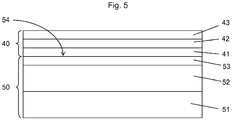
- Figure 5 shows a schematic diagram to illustrate the layer structure of a plain bearing layer composite material according to the invention, in which several of the above-mentioned layer combinations are summarized as an example.
- the sliding bearing layer composite material comprises on the one hand a sliding lacquer layer composite 40 with a plurality of sliding lacquer coatings 41, 42, 43 and on the other hand a substrate 50 composed of a plurality of metal layers 51, 52, 53.
- a steel support layer 51 is provided as a stabilizing element.
- a bearing metal layer 52 is arranged on this.
- An intermediate layer 53 is arranged on the bearing metal layer 52 as an adhesion promoter to the overlying varnish layer composite 40.
- this adhesion promoter can also be dispensed with if the bearing metal layer forms an adequate adhesive base, for example has sufficient roughness.
- the sliding lacquer layer composite 40 is applied on the upper side, that is to say on the surface 54 of the intermediate layer 53 facing away from the steel support layer 51.
- This has a first lubricating lacquer coating 41, which is applied directly to the surface 54.
- the lubricating lacquer coating 41 can be designed functionally differently. Depending on the properties of the bearing metal or the intermediate layer, it can also serve as an adhesion promoter for the overlay coating. In this case, it may contain little or no filler content and would therefore not necessarily be included in the anti-friction coatings according to the invention.
- the lower lubricating lacquer coating 42 has zinc sulfide and barium sulfate and also solid lubricants and / or metal powder, optionally also hard material particles and / or iron (III) oxide, in a composition which is the best compromise for load-bearing capacity and wear resistance on the one hand and adaptability, friction and seizure resistance on the other hand forms and thus creates a long-term stable layer under the specified conditions of use.
- the upper lubricating lacquer coating is then applied to the lower lubricating lacquer coating 42, which is the same as that in connection with Figure 2 equivalent.
- Table 1 shows the test results for plain bearing layered composite materials with steel backing and a CuNi2Si bearing metal as substrate and various anti-friction coatings based on a PAI binder and without an intermediate layer.
- the comparison shows three comparison materials R1 to R3, which either contained only barium sulfate, only zinc sulfide or neither of both fillers, and examples according to the invention with different ratios of barium sulfate to zinc sulfide.
- the proportions of filler were otherwise the same in each case based on the lubricating lacquer coatings.
- the ratios of BaSO 4 to ZnS are selected in Table 1 so that the effectiveness of the areas advantageous according to the invention becomes clear.
- the load capacities are higher than those of the ratios not according to the invention, here at 95 MPa or more.
- the following table 2 shows the test results for plain bearing layer composite materials with steel backing and a CuSn8Ni bearing metal as substrate and various anti-friction coatings based on a PAI binder and without an intermediate layer.
- Three reference examples not belonging to the invention are compared with four examples according to the invention with approximately the same ratio of barium sulfate to zinc sulfide but different total contents of barium sulfate and zinc sulfide and partly different additional filler proportions of the solid lubricant MoS 2 .
- the total amounts of the BaSO 4 - ZnS mixture are selected in Table 2 so that the effectiveness of the areas advantageous according to the invention is clear.
- the load capacities are higher than the ratios not according to the invention or less advantageous according to the invention, as the comparison of Examples 9, 10, 11 with reference examples R4 and R5 shows.
- the effect of an overdose of the content of all fillers together is demonstrated by the comparison of R6 (78 vol.%) With Example 8 (73 vol.%).
- the load capacity of Example 8 is rather low at 45 MPa, but this may be sufficient for a running-in layer, for example in a multi-layer system.
- Example 8 is furthermore significantly better than the example R6 not according to the invention, in which the total amount of filler exceeds the limit value of 75%.
- Table 3 shows the test results for plain bearing layered composite materials with steel backing and a CuNi2Si bearing metal as substrate and various anti-friction coatings based on a PAI binder and without an intermediate layer.
- Four examples according to the invention are compared with essentially the same ratios and the same total contents of barium sulfate and zinc sulfide, but in two cases these fillers were added in the form of lithopones with a BaSO 4 / ZnS volume ratio of 2.13 (quantitative details with "L").
- the solid lubricant was also varied, but its share in the overall composition of the lubricating varnish coating remained the same.
- Fe 2 O 3 was used in three examples.
- Table 3 shows that further improvements can be achieved by using Lithopone instead of a mixture of BaSO 4 and ZnS and using Fe 2 O 3, optimally up to a load capacity of 120 MPa.
- Table 4 shows the test results for plain bearing layered composite materials with steel backing and a CuNi2Si bearing metal as substrate and various anti-friction coatings based on different matrix materials without an intermediate layer.
- Opposite are 10 comparison materials, identified by the prefix "R”, which contain neither barium sulfate nor zinc sulfide, and in each case an assigned material according to the invention with an identical total amount of filler but different filler compositions.
- R 10 comparison materials, identified by the prefix "R”, which contain neither barium sulfate nor zinc sulfide, and in each case an assigned material according to the invention with an identical total amount of filler but different filler compositions.
- barium sulfate and zinc sulfide were added in the form of lithopone (identification "L”) in one case.
- Table 5 shows the test results for plain bearing layer composites with a steel back and CuSn10Bi3 bearing metal as substrate and various anti-friction coatings based on a PAI binder with two different intermediate layers.
- Opposite are three comparison materials, identified by the prefix "R", which contain neither barium sulfate nor zinc sulfide, and each an associated material according to the invention with different filler compositions.
- R three comparison materials, identified by the prefix "R”, which contain neither barium sulfate nor zinc sulfide, and each an associated material according to the invention with different filler compositions.
- barium sulfate and zinc sulfide were added in the form of lithopone in one case (identification "L").
- Example 26 shows that changing the substrate from CuNi2Si to CuSn10Bi3 with an Ni intermediate layer also improves the load-bearing capacity.
- Table 6 shows the test results for plain bearing layered composite materials with various aluminum-based substrates and various anti-friction coatings based on different matrix materials without an intermediate layer. Contrasted are 6 examples according to the invention with different ratios of barium sulfate to zinc sulfide and different total proportions of these fillers. The other filler proportions were also varied. Finally, barium sulfate and zinc sulfide in the form of lithopone (identification "L”) were also added in one case.
Landscapes
- Chemical & Material Sciences (AREA)
- Engineering & Computer Science (AREA)
- Organic Chemistry (AREA)
- General Engineering & Computer Science (AREA)
- Life Sciences & Earth Sciences (AREA)
- Materials Engineering (AREA)
- Wood Science & Technology (AREA)
- Mechanical Engineering (AREA)
- Chemical Kinetics & Catalysis (AREA)
- Inorganic Chemistry (AREA)
- Oil, Petroleum & Natural Gas (AREA)
- General Chemical & Material Sciences (AREA)
- Nanotechnology (AREA)
- Health & Medical Sciences (AREA)
- Medicinal Chemistry (AREA)
- Polymers & Plastics (AREA)
- Sliding-Contact Bearings (AREA)
- Paints Or Removers (AREA)
- Shafts, Cranks, Connecting Bars, And Related Bearings (AREA)
- Lubricants (AREA)
Applications Claiming Priority (2)
| Application Number | Priority Date | Filing Date | Title |
|---|---|---|---|
| DE102013227186.7A DE102013227186B4 (de) | 2013-12-27 | 2013-12-27 | Gleitlackbeschichtung und Gleitlager-Schichtverbundwerkstoff mit einer solchen |
| PCT/EP2014/079009 WO2015097159A1 (de) | 2013-12-27 | 2014-12-22 | Gleitlackbeschichtung und gleitlager-schichtverbundwerkstoff mit einer solchen |
Publications (2)
| Publication Number | Publication Date |
|---|---|
| EP3087147A1 EP3087147A1 (de) | 2016-11-02 |
| EP3087147B1 true EP3087147B1 (de) | 2020-01-15 |
Family
ID=52134213
Family Applications (1)
| Application Number | Title | Priority Date | Filing Date |
|---|---|---|---|
| EP14815769.6A Active EP3087147B1 (de) | 2013-12-27 | 2014-12-22 | Gleitlackbeschichtung und gleitlager-schichtverbundwerkstoff mit solcher beschichtung |
Country Status (7)
| Country | Link |
|---|---|
| US (1) | US20170081522A1 (https=) |
| EP (1) | EP3087147B1 (https=) |
| JP (1) | JP6486373B2 (https=) |
| KR (1) | KR20160111372A (https=) |
| CN (1) | CN106029794A (https=) |
| DE (1) | DE102013227186B4 (https=) |
| WO (1) | WO2015097159A1 (https=) |
Families Citing this family (34)
| Publication number | Priority date | Publication date | Assignee | Title |
|---|---|---|---|---|
| JP6333305B2 (ja) | 2016-04-28 | 2018-05-30 | 大同メタル工業株式会社 | 摺動部材 |
| GB2552997B (en) * | 2016-08-19 | 2022-01-05 | Mahle Int Gmbh | Sliding component and method |
| US11644064B2 (en) * | 2017-02-24 | 2023-05-09 | Vibracoustic Se | Bearing bush |
| ES2971866T3 (es) | 2017-06-13 | 2024-06-10 | Hymmen Gmbh Maschinen & Anlagenbau | Procedimiento y dispositivo de producción de una superficie estructurada |
| US10683463B2 (en) | 2017-06-13 | 2020-06-16 | Ggb, Inc. | Solid lubricant compositions and bearings incorporating the same |
| CN110832210B (zh) * | 2017-07-03 | 2022-12-16 | H.E.F.公司 | 包括联接至轴承的轴的机械系统以及制造这种系统的方法 |
| FR3068428B1 (fr) | 2017-07-03 | 2019-08-23 | H.E.F. | Axe couple a un palier, procede de fabrication d'un tel axe, et systeme mecanique comprenant un tel axe |
| DE102017216110A1 (de) | 2017-09-12 | 2019-03-14 | Federal-Mogul Wiesbaden Gmbh | Gleitlack, Gleitelement mit einem solchen und dessen Verwendung |
| DE102017216109A1 (de) | 2017-09-12 | 2019-03-14 | Federal-Mogul Wiesbaden Gmbh | Gleitlack, Verfahren zu dessen Herstellung, Gleitelement mit einem solchen und dessen Verwendung |
| WO2019117244A1 (ja) * | 2017-12-15 | 2019-06-20 | 千住金属工業株式会社 | 摺動部材及び軸受 |
| EP3734097B1 (en) * | 2017-12-28 | 2022-02-09 | Nissan Motor Co., Ltd. | Low-friction sliding mechanism |
| DE102018100659B3 (de) | 2018-01-12 | 2019-02-07 | Ks Gleitlager Gmbh | Gleitlagerelement |
| JP7075251B2 (ja) | 2018-03-22 | 2022-05-25 | 大同メタル工業株式会社 | 摺動部材 |
| JP6959171B2 (ja) * | 2018-03-28 | 2021-11-02 | 大同メタル工業株式会社 | 摺動部材及びその製造方法 |
| DE102018107471B3 (de) | 2018-03-28 | 2019-03-28 | Ks Gleitlager Gmbh | Metall/Kunststoff-Gleitlagerverbundwerkstoff |
| US11231067B2 (en) * | 2018-05-10 | 2022-01-25 | Nissan Motor Co., Ltd. | Bearing member |
| JP7092636B2 (ja) * | 2018-10-22 | 2022-06-28 | 大同メタル工業株式会社 | 摺動部材及びこれを用いる軸受装置 |
| JP7274850B2 (ja) * | 2018-10-22 | 2023-05-17 | 大同メタル工業株式会社 | 摺動部材及びこれを用いる軸受装置 |
| JP7222690B2 (ja) * | 2018-12-17 | 2023-02-15 | 大豊工業株式会社 | 摺動部材 |
| JP7140667B2 (ja) * | 2018-12-17 | 2022-09-21 | 大豊工業株式会社 | 摺動部材 |
| CN109666378A (zh) * | 2019-01-04 | 2019-04-23 | 福建龙溪轴承(集团)股份有限公司 | 一种高稳定性耐腐蚀自润滑涂料、涂层及制备方法 |
| TWI764109B (zh) * | 2019-03-22 | 2022-05-11 | 美商聖高拜塑膠製品公司 | 複合軸承及其製造與使用方法 |
| DE102019206431A1 (de) | 2019-05-03 | 2020-11-05 | Hymmen GmbH Maschinen- und Anlagenbau | Verfahren zum Herstellen einer Struktur auf einer Oberfläche |
| JP6677896B1 (ja) * | 2019-06-12 | 2020-04-08 | 千住金属工業株式会社 | 摺動部材及び軸受 |
| DE102019118700A1 (de) * | 2019-07-10 | 2020-11-12 | Schaeffler Technologies AG & Co. KG | Federbeinlager |
| KR102241852B1 (ko) * | 2019-12-31 | 2021-04-20 | 주식회사 이노션테크 | 친환경 하이브리드 자동차 부품용 코팅재 및 코팅 시스템 |
| JP2021116842A (ja) * | 2020-01-24 | 2021-08-10 | トヨタ自動車株式会社 | 車両用動力伝達機構 |
| US11549554B2 (en) * | 2020-04-16 | 2023-01-10 | General Electric Company | Bearings with visually distinct wear indicators |
| GB2599119B (en) * | 2020-09-24 | 2023-02-01 | Mahle Int Gmbh | Bearing material with solid lubricant |
| CN113025157B (zh) * | 2021-02-28 | 2022-12-20 | 濮阳市顺康石油工程技术有限公司 | 一种自润滑耐磨涂层及其制备工艺 |
| US12590262B2 (en) | 2021-06-23 | 2026-03-31 | Dupont Specialty Products Usa, Llc | Anti-friction composite material |
| CN113958611B (zh) * | 2021-11-11 | 2024-05-07 | 嘉兴双腾轴承股份有限公司 | 一种边界润滑轴承材料及其生产工艺 |
| US20230366434A1 (en) * | 2022-05-11 | 2023-11-16 | Magna Closures Inc. | Sealer for bearing bushings for hinges of a vehicle |
| JP7300604B1 (ja) * | 2023-02-02 | 2023-06-30 | 千住金属工業株式会社 | 摺動部材及び軸受 |
Family Cites Families (23)
| Publication number | Priority date | Publication date | Assignee | Title |
|---|---|---|---|---|
| US4191801A (en) * | 1977-02-08 | 1980-03-04 | The Lubrizol Corporation | Hot melt metal working lubricants |
| PL132666B1 (en) * | 1981-12-19 | 1985-03-30 | Os Bad Rozwojowy Stosowania I | Sliding compound and method of making the same |
| US4487135A (en) * | 1982-07-01 | 1984-12-11 | John Van Ryn | Tool and implement carrier |
| DE3601569A1 (de) * | 1986-01-21 | 1987-07-23 | Kolbenschmidt Ag | Verbund-gleitlagerwerkstoff |
| US4847135A (en) * | 1986-01-21 | 1989-07-11 | Kolbenschmidt Aktiengesellschaft | Composite material for sliding surface bearings |
| DE3601568A1 (de) * | 1986-01-21 | 1987-07-23 | Kolbenschmidt Ag | Gleitlagerwerkstoff |
| JP3354567B2 (ja) * | 1990-07-17 | 2002-12-09 | 大豊工業株式会社 | すべり軸受 |
| US6770381B2 (en) * | 1998-02-24 | 2004-08-03 | Taiho Kogyo Co., Ltd. | Sliding bearing for internal combustion engine |
| US6305847B1 (en) * | 1998-12-22 | 2001-10-23 | Daido Metal Company Ltd. | Sliding bearing |
| DE10126460A1 (de) * | 2001-05-31 | 2003-02-06 | Ks Gleitlager Gmbh | Gleitlagerverbundwerkstoff mit einer metallischen Stützschicht |
| JP4000448B2 (ja) * | 2002-02-19 | 2007-10-31 | Jsr株式会社 | 摺動部材用コーティング組成物および摺動部材 |
| DE502004009120D1 (de) * | 2003-10-20 | 2009-04-23 | Ks Gleitlager Gmbh | Formkörper für gleitende Beanspruchung |
| DE102004008633A1 (de) * | 2004-02-21 | 2005-09-08 | Ks Gleitlager Gmbh | Gleitlagerverbundwerkstoff |
| JP4541954B2 (ja) * | 2005-04-01 | 2010-09-08 | 大豊工業株式会社 | すべり軸受 |
| JP2007107589A (ja) * | 2005-10-12 | 2007-04-26 | Daido Metal Co Ltd | すべり軸受 |
| DE102006048311A1 (de) * | 2006-10-02 | 2008-04-03 | Ks Gleitlager Gmbh | Gleitlagerverbundwerkstoff |
| AT506181B1 (de) * | 2007-12-11 | 2012-07-15 | Miba Gleitlager Gmbh | Lagerelement |
| DE102008055194A1 (de) * | 2008-12-30 | 2010-07-08 | Federal-Mogul Wiesbaden Gmbh | Gleitelement |
| DE102008055195B4 (de) * | 2008-12-30 | 2013-02-28 | Federal-Mogul Wiesbaden Gmbh | Gleitelement und Verfahren zu seiner Herstellung |
| ES2403007A1 (es) * | 2009-07-01 | 2013-05-13 | Adc Telecommunications, Inc | Concentrador de distribución de fibra para montaje en pared. |
| DE102009043435A1 (de) * | 2009-09-29 | 2011-03-31 | Schaeffler Technologies Gmbh & Co. Kg | Gleitlack zur Beschichtung eines Metallbauteils oder aufgebracht auf ein Metallbauteil |
| FR2999980A1 (fr) * | 2012-12-20 | 2014-06-27 | Bluestar Silicones France | Article presentant des proprietes antisalissures et destine a etre utilise dans des applications aquatiques en particulier marines |
| DE102013227187B4 (de) * | 2013-12-27 | 2016-08-18 | Federal-Mogul Wiesbaden Gmbh | Gleitlagerwerkstoff und Gleitlager-Verbundwerkstoff mit Zinksulfid und Bariumsulfat |
-
2013
- 2013-12-27 DE DE102013227186.7A patent/DE102013227186B4/de not_active Expired - Fee Related
-
2014
- 2014-12-22 JP JP2016542901A patent/JP6486373B2/ja active Active
- 2014-12-22 US US15/106,917 patent/US20170081522A1/en not_active Abandoned
- 2014-12-22 CN CN201480061417.7A patent/CN106029794A/zh active Pending
- 2014-12-22 EP EP14815769.6A patent/EP3087147B1/de active Active
- 2014-12-22 WO PCT/EP2014/079009 patent/WO2015097159A1/de not_active Ceased
- 2014-12-22 KR KR1020167017042A patent/KR20160111372A/ko not_active Ceased
Non-Patent Citations (1)
| Title |
|---|
| None * |
Also Published As
| Publication number | Publication date |
|---|---|
| KR20160111372A (ko) | 2016-09-26 |
| DE102013227186A1 (de) | 2015-07-02 |
| WO2015097159A1 (de) | 2015-07-02 |
| JP2017509837A (ja) | 2017-04-06 |
| DE102013227186B4 (de) | 2016-08-18 |
| CN106029794A (zh) | 2016-10-12 |
| EP3087147A1 (de) | 2016-11-02 |
| US20170081522A1 (en) | 2017-03-23 |
| JP6486373B2 (ja) | 2019-03-20 |
Similar Documents
| Publication | Publication Date | Title |
|---|---|---|
| EP3087147B1 (de) | Gleitlackbeschichtung und gleitlager-schichtverbundwerkstoff mit solcher beschichtung | |
| EP2853760B1 (de) | Gleitelement | |
| EP3087283B1 (de) | Gleitlagerwerkstoff und gleitlager-verbundwerkstoff mit zinksulfid und bariumsulfat | |
| EP2532905B1 (de) | Gleitlagerverbundwerkstoff und hieraus hergestelltes Gleitlagerelement | |
| EP3681956A1 (de) | Gleitlack, gleitelement mit einem solchen und dessen verwendung | |
| AT501878A1 (de) | Lagerelement | |
| EP1475449B1 (de) | Aluminiumknetlegierung | |
| WO2008014531A1 (de) | Gleitlack | |
| WO2011127509A1 (de) | Getriebe für eine windkraftanlage | |
| AT502546A1 (de) | Lagerelement | |
| AT510190A1 (de) | Verfahren zum herstellen eines mehrschichtigen gleitlagers | |
| DE102005045701A1 (de) | Gleitlagerverbundwerkstoff | |
| DE102008015790A1 (de) | Gleitlager | |
| WO2019052905A1 (de) | Gleitlack, verfahren zu dessen herstellung, gleitelement mit einem solchen und dessen verwendung | |
| EP2171109B1 (de) | Bleifreier gesinterter gleitlagerwerkstoff und sinterpulver zur herstellung desselben | |
| EP1933022A2 (de) | Kolben für eine Brennkraftmaschine | |
| AT501811A1 (de) | Lagerelement | |
| AT505226B1 (de) | Gleitlack und damit hergestelltes lagerelement | |
| EP1886038B1 (de) | Gleitlagerschale für motorische anwendungen | |
| EP3825119A1 (de) | Mehrschichtgleitlagerelement | |
| WO2022159997A1 (de) | Mehrschichtgleitlagerelement | |
| DE202011102802U1 (de) | Anlaufscheibe | |
| AT505257A1 (de) | Verfahren zur herstellung einer bindeschicht für ein lagerelement | |
| DE102017102189A1 (de) | Gleitlagerverbundwerkstoff | |
| AT17656U1 (de) | Gleitlagerelement |
Legal Events
| Date | Code | Title | Description |
|---|---|---|---|
| PUAI | Public reference made under article 153(3) epc to a published international application that has entered the european phase |
Free format text: ORIGINAL CODE: 0009012 |
|
| 17P | Request for examination filed |
Effective date: 20160707 |
|
| AK | Designated contracting states |
Kind code of ref document: A1 Designated state(s): AL AT BE BG CH CY CZ DE DK EE ES FI FR GB GR HR HU IE IS IT LI LT LU LV MC MK MT NL NO PL PT RO RS SE SI SK SM TR |
|
| AX | Request for extension of the european patent |
Extension state: BA ME |
|
| DAX | Request for extension of the european patent (deleted) | ||
| GRAP | Despatch of communication of intention to grant a patent |
Free format text: ORIGINAL CODE: EPIDOSNIGR1 |
|
| RIC1 | Information provided on ipc code assigned before grant |
Ipc: C08K 3/30 20060101ALI20190619BHEP Ipc: C09D 5/00 20060101AFI20190619BHEP Ipc: F16C 33/20 20060101ALI20190619BHEP Ipc: C09D 7/61 20180101ALI20190619BHEP |
|
| STAA | Information on the status of an ep patent application or granted ep patent |
Free format text: STATUS: GRANT OF PATENT IS INTENDED |
|
| INTG | Intention to grant announced |
Effective date: 20190725 |
|
| GRAS | Grant fee paid |
Free format text: ORIGINAL CODE: EPIDOSNIGR3 |
|
| GRAA | (expected) grant |
Free format text: ORIGINAL CODE: 0009210 |
|
| STAA | Information on the status of an ep patent application or granted ep patent |
Free format text: STATUS: THE PATENT HAS BEEN GRANTED |
|
| AK | Designated contracting states |
Kind code of ref document: B1 Designated state(s): AL AT BE BG CH CY CZ DE DK EE ES FI FR GB GR HR HU IE IS IT LI LT LU LV MC MK MT NL NO PL PT RO RS SE SI SK SM TR |
|
| REG | Reference to a national code |
Ref country code: GB Ref legal event code: FG4D Free format text: NOT ENGLISH Ref country code: CH Ref legal event code: EP |
|
| REG | Reference to a national code |
Ref country code: IE Ref legal event code: FG4D Free format text: LANGUAGE OF EP DOCUMENT: GERMAN |
|
| REG | Reference to a national code |
Ref country code: AT Ref legal event code: REF Ref document number: 1225122 Country of ref document: AT Kind code of ref document: T Effective date: 20200215 |
|
| REG | Reference to a national code |
Ref country code: DE Ref legal event code: R096 Ref document number: 502014013503 Country of ref document: DE |
|
| REG | Reference to a national code |
Ref country code: NL Ref legal event code: MP Effective date: 20200115 |
|
| REG | Reference to a national code |
Ref country code: LT Ref legal event code: MG4D |
|
| PG25 | Lapsed in a contracting state [announced via postgrant information from national office to epo] |
Ref country code: NO Free format text: LAPSE BECAUSE OF FAILURE TO SUBMIT A TRANSLATION OF THE DESCRIPTION OR TO PAY THE FEE WITHIN THE PRESCRIBED TIME-LIMIT Effective date: 20200415 Ref country code: RS Free format text: LAPSE BECAUSE OF FAILURE TO SUBMIT A TRANSLATION OF THE DESCRIPTION OR TO PAY THE FEE WITHIN THE PRESCRIBED TIME-LIMIT Effective date: 20200115 Ref country code: NL Free format text: LAPSE BECAUSE OF FAILURE TO SUBMIT A TRANSLATION OF THE DESCRIPTION OR TO PAY THE FEE WITHIN THE PRESCRIBED TIME-LIMIT Effective date: 20200115 Ref country code: PT Free format text: LAPSE BECAUSE OF FAILURE TO SUBMIT A TRANSLATION OF THE DESCRIPTION OR TO PAY THE FEE WITHIN THE PRESCRIBED TIME-LIMIT Effective date: 20200607 Ref country code: FI Free format text: LAPSE BECAUSE OF FAILURE TO SUBMIT A TRANSLATION OF THE DESCRIPTION OR TO PAY THE FEE WITHIN THE PRESCRIBED TIME-LIMIT Effective date: 20200115 |
|
| PG25 | Lapsed in a contracting state [announced via postgrant information from national office to epo] |
Ref country code: HR Free format text: LAPSE BECAUSE OF FAILURE TO SUBMIT A TRANSLATION OF THE DESCRIPTION OR TO PAY THE FEE WITHIN THE PRESCRIBED TIME-LIMIT Effective date: 20200115 Ref country code: GR Free format text: LAPSE BECAUSE OF FAILURE TO SUBMIT A TRANSLATION OF THE DESCRIPTION OR TO PAY THE FEE WITHIN THE PRESCRIBED TIME-LIMIT Effective date: 20200416 Ref country code: LV Free format text: LAPSE BECAUSE OF FAILURE TO SUBMIT A TRANSLATION OF THE DESCRIPTION OR TO PAY THE FEE WITHIN THE PRESCRIBED TIME-LIMIT Effective date: 20200115 Ref country code: SE Free format text: LAPSE BECAUSE OF FAILURE TO SUBMIT A TRANSLATION OF THE DESCRIPTION OR TO PAY THE FEE WITHIN THE PRESCRIBED TIME-LIMIT Effective date: 20200115 Ref country code: IS Free format text: LAPSE BECAUSE OF FAILURE TO SUBMIT A TRANSLATION OF THE DESCRIPTION OR TO PAY THE FEE WITHIN THE PRESCRIBED TIME-LIMIT Effective date: 20200515 Ref country code: BG Free format text: LAPSE BECAUSE OF FAILURE TO SUBMIT A TRANSLATION OF THE DESCRIPTION OR TO PAY THE FEE WITHIN THE PRESCRIBED TIME-LIMIT Effective date: 20200415 |
|
| REG | Reference to a national code |
Ref country code: DE Ref legal event code: R097 Ref document number: 502014013503 Country of ref document: DE |
|
| PG25 | Lapsed in a contracting state [announced via postgrant information from national office to epo] |
Ref country code: ES Free format text: LAPSE BECAUSE OF FAILURE TO SUBMIT A TRANSLATION OF THE DESCRIPTION OR TO PAY THE FEE WITHIN THE PRESCRIBED TIME-LIMIT Effective date: 20200115 Ref country code: LT Free format text: LAPSE BECAUSE OF FAILURE TO SUBMIT A TRANSLATION OF THE DESCRIPTION OR TO PAY THE FEE WITHIN THE PRESCRIBED TIME-LIMIT Effective date: 20200115 Ref country code: CZ Free format text: LAPSE BECAUSE OF FAILURE TO SUBMIT A TRANSLATION OF THE DESCRIPTION OR TO PAY THE FEE WITHIN THE PRESCRIBED TIME-LIMIT Effective date: 20200115 Ref country code: SM Free format text: LAPSE BECAUSE OF FAILURE TO SUBMIT A TRANSLATION OF THE DESCRIPTION OR TO PAY THE FEE WITHIN THE PRESCRIBED TIME-LIMIT Effective date: 20200115 Ref country code: RO Free format text: LAPSE BECAUSE OF FAILURE TO SUBMIT A TRANSLATION OF THE DESCRIPTION OR TO PAY THE FEE WITHIN THE PRESCRIBED TIME-LIMIT Effective date: 20200115 Ref country code: SK Free format text: LAPSE BECAUSE OF FAILURE TO SUBMIT A TRANSLATION OF THE DESCRIPTION OR TO PAY THE FEE WITHIN THE PRESCRIBED TIME-LIMIT Effective date: 20200115 Ref country code: DK Free format text: LAPSE BECAUSE OF FAILURE TO SUBMIT A TRANSLATION OF THE DESCRIPTION OR TO PAY THE FEE WITHIN THE PRESCRIBED TIME-LIMIT Effective date: 20200115 Ref country code: EE Free format text: LAPSE BECAUSE OF FAILURE TO SUBMIT A TRANSLATION OF THE DESCRIPTION OR TO PAY THE FEE WITHIN THE PRESCRIBED TIME-LIMIT Effective date: 20200115 |
|
| PLBE | No opposition filed within time limit |
Free format text: ORIGINAL CODE: 0009261 |
|
| STAA | Information on the status of an ep patent application or granted ep patent |
Free format text: STATUS: NO OPPOSITION FILED WITHIN TIME LIMIT |
|
| 26N | No opposition filed |
Effective date: 20201016 |
|
| PG25 | Lapsed in a contracting state [announced via postgrant information from national office to epo] |
Ref country code: IT Free format text: LAPSE BECAUSE OF FAILURE TO SUBMIT A TRANSLATION OF THE DESCRIPTION OR TO PAY THE FEE WITHIN THE PRESCRIBED TIME-LIMIT Effective date: 20200115 |
|
| PG25 | Lapsed in a contracting state [announced via postgrant information from national office to epo] |
Ref country code: PL Free format text: LAPSE BECAUSE OF FAILURE TO SUBMIT A TRANSLATION OF THE DESCRIPTION OR TO PAY THE FEE WITHIN THE PRESCRIBED TIME-LIMIT Effective date: 20200115 Ref country code: SI Free format text: LAPSE BECAUSE OF FAILURE TO SUBMIT A TRANSLATION OF THE DESCRIPTION OR TO PAY THE FEE WITHIN THE PRESCRIBED TIME-LIMIT Effective date: 20200115 |
|
| REG | Reference to a national code |
Ref country code: CH Ref legal event code: PL |
|
| GBPC | Gb: european patent ceased through non-payment of renewal fee |
Effective date: 20201222 |
|
| PG25 | Lapsed in a contracting state [announced via postgrant information from national office to epo] |
Ref country code: MC Free format text: LAPSE BECAUSE OF FAILURE TO SUBMIT A TRANSLATION OF THE DESCRIPTION OR TO PAY THE FEE WITHIN THE PRESCRIBED TIME-LIMIT Effective date: 20200115 |
|
| REG | Reference to a national code |
Ref country code: BE Ref legal event code: MM Effective date: 20201231 |
|
| REG | Reference to a national code |
Ref country code: DE Ref legal event code: R082 Ref document number: 502014013503 Country of ref document: DE Representative=s name: WSL PATENTANWAELTE PARTNERSCHAFT MBB, DE |
|
| PG25 | Lapsed in a contracting state [announced via postgrant information from national office to epo] |
Ref country code: IE Free format text: LAPSE BECAUSE OF NON-PAYMENT OF DUE FEES Effective date: 20201222 Ref country code: LU Free format text: LAPSE BECAUSE OF NON-PAYMENT OF DUE FEES Effective date: 20201222 Ref country code: FR Free format text: LAPSE BECAUSE OF NON-PAYMENT OF DUE FEES Effective date: 20201231 |
|
| PG25 | Lapsed in a contracting state [announced via postgrant information from national office to epo] |
Ref country code: LI Free format text: LAPSE BECAUSE OF NON-PAYMENT OF DUE FEES Effective date: 20201231 Ref country code: CH Free format text: LAPSE BECAUSE OF NON-PAYMENT OF DUE FEES Effective date: 20201231 Ref country code: GB Free format text: LAPSE BECAUSE OF NON-PAYMENT OF DUE FEES Effective date: 20201222 |
|
| PG25 | Lapsed in a contracting state [announced via postgrant information from national office to epo] |
Ref country code: TR Free format text: LAPSE BECAUSE OF FAILURE TO SUBMIT A TRANSLATION OF THE DESCRIPTION OR TO PAY THE FEE WITHIN THE PRESCRIBED TIME-LIMIT Effective date: 20200115 Ref country code: MT Free format text: LAPSE BECAUSE OF FAILURE TO SUBMIT A TRANSLATION OF THE DESCRIPTION OR TO PAY THE FEE WITHIN THE PRESCRIBED TIME-LIMIT Effective date: 20200115 Ref country code: CY Free format text: LAPSE BECAUSE OF FAILURE TO SUBMIT A TRANSLATION OF THE DESCRIPTION OR TO PAY THE FEE WITHIN THE PRESCRIBED TIME-LIMIT Effective date: 20200115 |
|
| PG25 | Lapsed in a contracting state [announced via postgrant information from national office to epo] |
Ref country code: MK Free format text: LAPSE BECAUSE OF FAILURE TO SUBMIT A TRANSLATION OF THE DESCRIPTION OR TO PAY THE FEE WITHIN THE PRESCRIBED TIME-LIMIT Effective date: 20200115 Ref country code: AL Free format text: LAPSE BECAUSE OF FAILURE TO SUBMIT A TRANSLATION OF THE DESCRIPTION OR TO PAY THE FEE WITHIN THE PRESCRIBED TIME-LIMIT Effective date: 20200115 |
|
| PG25 | Lapsed in a contracting state [announced via postgrant information from national office to epo] |
Ref country code: BE Free format text: LAPSE BECAUSE OF NON-PAYMENT OF DUE FEES Effective date: 20201231 |
|
| P01 | Opt-out of the competence of the unified patent court (upc) registered |
Effective date: 20230528 |
|
| PGFP | Annual fee paid to national office [announced via postgrant information from national office to epo] |
Ref country code: DE Payment date: 20251126 Year of fee payment: 12 |
|
| PGFP | Annual fee paid to national office [announced via postgrant information from national office to epo] |
Ref country code: AT Payment date: 20251121 Year of fee payment: 12 |