EP3080438B1 - Method to drive corona ignition system - Google Patents
Method to drive corona ignition system Download PDFInfo
- Publication number
- EP3080438B1 EP3080438B1 EP14825212.5A EP14825212A EP3080438B1 EP 3080438 B1 EP3080438 B1 EP 3080438B1 EP 14825212 A EP14825212 A EP 14825212A EP 3080438 B1 EP3080438 B1 EP 3080438B1
- Authority
- EP
- European Patent Office
- Prior art keywords
- time delay
- signal
- current
- current signal
- timer
- Prior art date
- Legal status (The legal status is an assumption and is not a legal conclusion. Google has not performed a legal analysis and makes no representation as to the accuracy of the status listed.)
- Active
Links
- 238000000034 method Methods 0.000 title claims description 26
- 230000001143 conditioned effect Effects 0.000 claims description 45
- 230000000630 rising effect Effects 0.000 claims description 26
- 230000004044 response Effects 0.000 claims description 9
- 230000005684 electric field Effects 0.000 claims description 7
- 230000000977 initiatory effect Effects 0.000 claims description 7
- 230000001934 delay Effects 0.000 claims description 6
- 238000013461 design Methods 0.000 claims description 4
- 230000003213 activating effect Effects 0.000 claims description 3
- 239000000203 mixture Substances 0.000 description 6
- 238000012545 processing Methods 0.000 description 6
- 230000008569 process Effects 0.000 description 4
- 230000008901 benefit Effects 0.000 description 3
- 238000002485 combustion reaction Methods 0.000 description 3
- 230000015572 biosynthetic process Effects 0.000 description 2
- 238000004891 communication Methods 0.000 description 2
- 230000000052 comparative effect Effects 0.000 description 2
- 238000001514 detection method Methods 0.000 description 2
- 238000010586 diagram Methods 0.000 description 2
- 238000000926 separation method Methods 0.000 description 2
- 230000015556 catabolic process Effects 0.000 description 1
- 239000000446 fuel Substances 0.000 description 1
- 238000009434 installation Methods 0.000 description 1
- 238000005259 measurement Methods 0.000 description 1
- 239000002184 metal Substances 0.000 description 1
- 238000012986 modification Methods 0.000 description 1
- 230000004048 modification Effects 0.000 description 1
- 238000012544 monitoring process Methods 0.000 description 1
- 238000005070 sampling Methods 0.000 description 1
- 230000001960 triggered effect Effects 0.000 description 1
Images

Classifications
-
- H—ELECTRICITY
- H01—ELECTRIC ELEMENTS
- H01T—SPARK GAPS; OVERVOLTAGE ARRESTERS USING SPARK GAPS; SPARKING PLUGS; CORONA DEVICES; GENERATING IONS TO BE INTRODUCED INTO NON-ENCLOSED GASES
- H01T19/00—Devices providing for corona discharge
-
- F—MECHANICAL ENGINEERING; LIGHTING; HEATING; WEAPONS; BLASTING
- F02—COMBUSTION ENGINES; HOT-GAS OR COMBUSTION-PRODUCT ENGINE PLANTS
- F02P—IGNITION, OTHER THAN COMPRESSION IGNITION, FOR INTERNAL-COMBUSTION ENGINES; TESTING OF IGNITION TIMING IN COMPRESSION-IGNITION ENGINES
- F02P23/00—Other ignition
- F02P23/04—Other physical ignition means, e.g. using laser rays
-
- F—MECHANICAL ENGINEERING; LIGHTING; HEATING; WEAPONS; BLASTING
- F02—COMBUSTION ENGINES; HOT-GAS OR COMBUSTION-PRODUCT ENGINE PLANTS
- F02P—IGNITION, OTHER THAN COMPRESSION IGNITION, FOR INTERNAL-COMBUSTION ENGINES; TESTING OF IGNITION TIMING IN COMPRESSION-IGNITION ENGINES
- F02P3/00—Other installations
- F02P3/02—Other installations having inductive energy storage, e.g. arrangements of induction coils
- F02P3/04—Layout of circuits
- F02P3/0407—Opening or closing the primary coil circuit with electronic switching means
-
- F—MECHANICAL ENGINEERING; LIGHTING; HEATING; WEAPONS; BLASTING
- F02—COMBUSTION ENGINES; HOT-GAS OR COMBUSTION-PRODUCT ENGINE PLANTS
- F02P—IGNITION, OTHER THAN COMPRESSION IGNITION, FOR INTERNAL-COMBUSTION ENGINES; TESTING OF IGNITION TIMING IN COMPRESSION-IGNITION ENGINES
- F02P5/00—Advancing or retarding ignition; Control therefor
- F02P5/04—Advancing or retarding ignition; Control therefor automatically, as a function of the working conditions of the engine or vehicle or of the atmospheric conditions
- F02P5/145—Advancing or retarding ignition; Control therefor automatically, as a function of the working conditions of the engine or vehicle or of the atmospheric conditions using electrical means
- F02P5/15—Digital data processing
- F02P5/1502—Digital data processing using one central computing unit
-
- G—PHYSICS
- G01—MEASURING; TESTING
- G01M—TESTING STATIC OR DYNAMIC BALANCE OF MACHINES OR STRUCTURES; TESTING OF STRUCTURES OR APPARATUS, NOT OTHERWISE PROVIDED FOR
- G01M15/00—Testing of engines
- G01M15/02—Details or accessories of testing apparatus
-
- G—PHYSICS
- G01—MEASURING; TESTING
- G01N—INVESTIGATING OR ANALYSING MATERIALS BY DETERMINING THEIR CHEMICAL OR PHYSICAL PROPERTIES
- G01N27/00—Investigating or analysing materials by the use of electric, electrochemical, or magnetic means
- G01N27/02—Investigating or analysing materials by the use of electric, electrochemical, or magnetic means by investigating impedance
-
- H—ELECTRICITY
- H01—ELECTRIC ELEMENTS
- H01T—SPARK GAPS; OVERVOLTAGE ARRESTERS USING SPARK GAPS; SPARKING PLUGS; CORONA DEVICES; GENERATING IONS TO BE INTRODUCED INTO NON-ENCLOSED GASES
- H01T15/00—Circuits specially adapted for spark gaps, e.g. ignition circuits
-
- F—MECHANICAL ENGINEERING; LIGHTING; HEATING; WEAPONS; BLASTING
- F02—COMBUSTION ENGINES; HOT-GAS OR COMBUSTION-PRODUCT ENGINE PLANTS
- F02N—STARTING OF COMBUSTION ENGINES; STARTING AIDS FOR SUCH ENGINES, NOT OTHERWISE PROVIDED FOR
- F02N2300/00—Control related aspects of engine starting
- F02N2300/20—Control related aspects of engine starting characterised by the control method
- F02N2300/2011—Control involving a delay; Control involving a waiting period before engine stop or engine start
-
- F—MECHANICAL ENGINEERING; LIGHTING; HEATING; WEAPONS; BLASTING
- F02—COMBUSTION ENGINES; HOT-GAS OR COMBUSTION-PRODUCT ENGINE PLANTS
- F02P—IGNITION, OTHER THAN COMPRESSION IGNITION, FOR INTERNAL-COMBUSTION ENGINES; TESTING OF IGNITION TIMING IN COMPRESSION-IGNITION ENGINES
- F02P17/00—Testing of ignition installations, e.g. in combination with adjusting; Testing of ignition timing in compression-ignition engines
-
- Y—GENERAL TAGGING OF NEW TECHNOLOGICAL DEVELOPMENTS; GENERAL TAGGING OF CROSS-SECTIONAL TECHNOLOGIES SPANNING OVER SEVERAL SECTIONS OF THE IPC; TECHNICAL SUBJECTS COVERED BY FORMER USPC CROSS-REFERENCE ART COLLECTIONS [XRACs] AND DIGESTS
- Y02—TECHNOLOGIES OR APPLICATIONS FOR MITIGATION OR ADAPTATION AGAINST CLIMATE CHANGE
- Y02T—CLIMATE CHANGE MITIGATION TECHNOLOGIES RELATED TO TRANSPORTATION
- Y02T10/00—Road transport of goods or passengers
- Y02T10/10—Internal combustion engine [ICE] based vehicles
- Y02T10/40—Engine management systems
Definitions
- This invention relates generally to a corona discharge ignition system, and more particularly to methods for controlling energy supplied to the corona igniter system.
- Corona discharge ignition systems provide an alternating voltage and current, reversing high and low potential electrodes in rapid succession which enhances the formation of corona discharge and minimizes the opportunity for arc formation.
- the system includes a corona igniter with a central electrode charged to a high radio frequency voltage potential and creating a strong radio frequency electric field in a combustion chamber.
- the electric field causes a portion of a mixture of fuel and air in the combustion chamber to ionize and begin dielectric breakdown, facilitating combustion of the fuel-air mixture, which is referred to as an ignition event.
- the electric field is preferably controlled so that the fuel-air mixture maintains dielectric properties and corona discharge occurs, also referred to as a non-thermal plasma.
- the ionized portion of the fuel-air mixture forms a flame front which then becomes self-sustaining and combusts the remaining portion of the fuel-air mixture.
- the electric field is controlled so that the fuel-air mixture does not lose all dielectric properties, which would create a thermal plasma and an electric are between the electrode and grounded cylinder walls, piston, metal shell, or other portion of the igniter.
- preferred corona discharge ignition systems operate such that the corona igniter is driven at its resonant frequency, because resonant frequency operation allows the corona igniter to provide a high output and efficiency.
- accurately controlling the drive frequency of the corona igniter to be equal or close to the resonant frequency presents challenges; especially since the design of the corona igniter is constantly developing and improving, leading to changes in the resonant frequency.
- one recently developed method used in effort to achieve resonant frequency operation require multiple cycles in order to achieve a lock to the correct frequency and is unable to accurately follow rapid frequency changes, Another method allows operation over only a limited range of frequencies.
- a third method utilizes a programmable digital or mixed-signal controller to control switches of the system with suitable timing and accuracy, but this type of controller requires complex specifications leading to high overhead and thus high costs.
- a known corona discharge ignition system is shown in WO2012/138674 .
- One aspect of the invention provides a corona ignition system capable of operating at or near the resonant frequency of a corona igniter, and capable of quickly adjusting to changes in the resonant frequency, without a costly controller.
- the system includes the corona igniter receiving current at a radio frequency and providing a radio frequency electric field.
- a current sensor obtains an unfiltered current signal including information about the current received by the corona igniter.
- At least one of a signal filter and a signal conditioner receives the unfiltered current signal from the current sensor and provides a conditioned current signal, wherein the conditioned current signal includes a falling edge occurring at the end of a first time delay following a first zero crossing of the unfiltered current signal.
- a first timer receives the conditioned current signal and initiates a second time delay in response to the falling edge of the conditioned current signal.
- the first timer also provides a first timer signal, wherein the first timer signal includes a falling edge at the end of the second time delay, and the second time delay ends before a second zero crossing of the unfiltered current signal following the first zero crossing.
- a second timer receives the first timer signal from the first timer and provides a first output signal.
- a third time delay starts at the end of the second time delay at the falling edge of the first timer signal, and the first output signal includes a rising edge at the start of the third time delay,
- a first switch receives the first output signal and is activated at the end of the third time delay, wherein the third time delay ends at or after the second zero crossing of the unfiltered current signal The activated first switch allows the current to flow from an energy supply to the corona igniter.
- the method includes providing energy to a corona igniter at a radio frequency; and obtaining an unfiltered current signal including information about the current received by the corona igniter.
- the method further includes providing a conditioned current signal which includes a falling edge occurring at the end of a first time delay following a first zero crossing of the unfiltered current signal; initiating a second time delay in response to the falling edge of the conditioned current signal and providing a first timer signal, wherein the first timer signal includes a falling edge at the end of the second time delay and the second time delay ends before a second zero crossing of the unfiltered current signal following the first zero crossing; and providing an output signal which includes a rising edge at the start of a third time delay, wherein the third time delay starts at the end of the second time delay at the falling edge of the first timer signal.
- the method then includes activating a first switch by the first output signal at the end of the third time delay, wherein the third time delay ends at or after the second zero crossing of the unfiltered current signal, and the activated first switch allows the current to flow from an energy supply to the corona igniter,
- the system and method provides for control of the timing of the switches based on the detection of a single zero crossing of the current and hence can quickly lock on to the correct frequency and quickly respond to changes in the resonant frequency.
- the timers used to activate the switches can be programmed over a wide range of intervals allowing a wide range of drive frequencies to be accommodated.
- the generation of timing signals by the timers to activate the switches is independent from the other functions of the controller, for example, communication with the vehicle, management of power supplies and so on. This separation allows the computational load on the controller to be greatly reduced, and thus allows the use of fewer and/or cheaper controllers. Accordingly, the present invention provides a more cost effective system and method for maintaining the drive frequency at or close to the resonant frequency of the corona igniter, while still allowing for high resolution control.
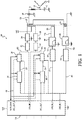
- One aspect of the invention provides a cost effective corona ignition system 20 for accurately maintaining a drive frequency approximately equal to the resonant frequency of a corona igniter 22 of the system 20.
- the system 20 also includes a current sensor 24, at least two cascaded timers 26, 28, 30, 32 which are electrically independent of a controller 34, and at least two switches 36, 38.
- the current sensor 24 measures the current at an input 40 of the corona igniter 22.
- a conditioned current signal S3 including information related to the current ultimately activates a pair of the timers 26, 28, 30, 32 which in turn control and drive one of the switches 36, 38.
- the conditioned current signal S3 is not processed by the controller 34 before driving the switch 36 or 38.
- the system 20 and method provides for control of the timing of the switches 36, 38 based on the detection of a single zero crossing of the current and hence can quickly lock on to the correct frequency and quickly respond to changes in the resonant frequency.
- the timers 26, 28, 30, 32 used to activate the switches 36, 38 can be programmed over a wide range of intervals allowing a wide range of drive frequencies to be accommodated.
- the generation of output signals S5 from the timers 26, 28, 30, 32 to activate the switches 36, 38 is independent from the other functions of the controller 34, for example, communication with the vehicle, management of power supplies and so on. This separation allows the computational load on the controller 34 to be greatly reduced, and thus allows the use of fewer and/or cheaper controllers 34. Accordingly, a more cost effective system 20 and method for maintaining the drive frequency at or close to the resonant frequency of the corona igniter 22, while still allowing for high resolution control, is achieved.
- Figure 1 illustrates a corona ignition system 20 according to an exemplary embodiment of the invention which accommodates a wide range of drive frequencies, for example 700 kHz to 2 MHz, but requires a less costly controller 34, without compromising the performance of the system 20.
- the system 20 of Figure 1 includes an energy supply +V3 for providing energy to a transformer 42 and then to the corona igniter 22.
- the controller 34 initiates an enable signal 46 to one of the timers 26, 28, 30, 32 to activate the first switch 36 and allow current to flow from the energy supply +V3 through the transformer 42 and to the corona igniter 22 .
- the corona igniter 22 receives current at a radio frequency and provides a radio frequency electric field, referred to as corona discharge 44 .
- the current sensor 24 obtains information about the current provided to the corona igniter 22 at an output of the transformer 42, also referred to as an input 40 of the corona igniter 22.
- the current sensor 24 obtains this information in the form of an unfiltered current signal S1 which includes high frequency noise.
- the current sensor 24 conveys the unfiltered current signal S1 to at least one of a signal filter 48, such as a low-pass filter, and a signal conditioner 50.
- the signal filter 48 can remove high frequency noise from the signal, if required.
- the signal conditioner 50 can extract information about the phase of the current.
- a conditioned current signal S3 is provided, which typically contains only information relating to the phase (direction of current flow) at the input 40 offset by a time delay due to the current sensor 24, signal filter 48, and signal conditioner 50.
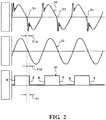
- Figure 2 includes graphs showing current signals S1, S2, S3 which include information about the current at the input 40 to the corona igniter 22.
- the conditioned current signal S3 includes a falling edge F occurring at the end of a first time delay T1 following a first zero crossing X1 of the unfiltered current signal S1.
- the first time delay T1 is caused by a time delay T1A of the current sensor 24 and a time delay T1B of the signal filter 48. Both T1A and T1B are known and can be compensated for by the controller 34, The time delays T1A and T1B added together equal the first time delay T1.
- the first time delay T1 is deterministic and may be known and therefore compensated by the controller 34 .
- the conditioned current signal S3 is not sent to the controller 34 to be processed and to produce signals that drive the switches 36, 38. Rather, the current information is used to directly trigger a pair of the the cascaded timers 26, 28, 30, 32 which in turn control the timing of one of the switches 36, 38 through a driver 52 or 54.
- the cascaded timers 26, 28, 30, 32 are electrically independent of the controller 34, and thus the resolution of the timers 26, 28, 30, 32 is independent of the clock speed of the processing unit of the controller 34.
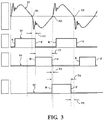
- a first timer 26 receives the conditioned current signal S3 and initiates a second time delay T2 in response to the falling edge F of the conditioned current signal S3.
- the first timer 26 also provides a first timer signal S4, wherein the first timer signal S4 includes a falling edge F at the end of the second time delay T2.
- the second time delay T2 ends before a second zero crossing X2 of the unfiltered current signal S1 following the first zero crossing X1.
- a second timer 28 receives the first timer signal S4 from the first timer 26 and provides a first output signal S5 .
- a third time delay T3 starts at the end of the second time delay T2 at the falling edge F of the first timer signal S4, and the first output signal S5 includes a rising edge R at the start of the third time delay T3.
- the first switch 36 receives the first output signal S5 and is activated at the end of the third time delay T3, In this exemplary embodiment, the third time delay T3 ends at or after the second zero crossing X2 of the unfiltered current signal S1 .
- the activated first switch 36 allows the current to flow from an energy supply +V3 to the corona igniter 22.
- the second timer 28 also initiates a fourth time delay T4 starting at the rising edge R of the first output signal S5 and ending at a falling edge F of the first output signal S5.
- the end of the fourth time delay T4 occurs before a third zero crossing X3 of the unfiltered current signal S1 .
- the first switch 36 is deactivated at the end of a fifth time delay T5 which starts at the falling edge F of the first output signal S5 and ends before or at the third zero crossing X3.
- the controller 34 sets the second time delay T2 and the fourth time delay T4 so that the first switch 36 activated or deactivated at or adjacent one of the zero crossings X1, X2, X3 of the current received by the corona igniter 22.
- the conditioned current signal S3 is sampled by the controller 34 via the digital input (DIG IN) and compared to the voltage to determine whether adjustments to the second time delay T2 or the fourth time delay T4 should be made.
- a voltage sensor 56 can be used to measure the voltage at the input 40 to the corona igniter 22 and then provide an unfiltered voltage signal V1 , which is filtered to provide a filtered voltage signal V2, conditioned to provide a conditioned voltage signal V3, and conveyed in the conditioned voltage signal V3 to the controller 34.
- the controller 34 compares the conditioned voltage signal V3 to the conditioned current signal S3, adjusts at least one of the second time delay T2 and the fourth time delay T4 if zero crossings X1, X2, X3 of the unfiltered current signal S1 are not simultaneous with the zero crossings of the unfiltered voltage signal V1 at the input 40 .
- the controller 34 only needs to check for errors and make adjustments from time to time, not every cycle.
- the conditioned current signal S3 is conveyed from the current sensor 24 to the first switch 36 without being conveyed to the controller 34 prior to being conveyed to the first switch 36.
- a sixth time delay follows the fifth time delay T5, and the conditioned current signal S3 includes a rising edge occurring at the end of the sixth time delay following a fourth zero crossing of the unfiltered current signal S1 .
- the duration of the sixth time delay is equal to the duration of the first time delay T1 .
- a third timer 30 receives the conditioned current signal S3 and initiates a seventh time delay in response to a rising edge of the conditioned current signal S3 and provides a second timer signal S4.
- the seventh time delay is equal to the second time delay T2
- the second timer signal S4 includes a rising edge at the end of the seventh time delay
- the seventh time delay ends before a fifth zero crossing of the unfiltered current signal S1 following the fourth zero crossing.
- the fourth timer 32 receives the timer signal S4 from the third timer 30 and provides a second output signal S5.
- An eighth time delay starts at the end of the seventh time delay at the rising edge of the timer signal S4 .
- the eighth time delay is equal to the third time delay T3, and the second output signal S5 includes a falling edge F at the start of the eighth time delay.
- the second switch 38 receives the second output signal S 5 and is activated at the end of the eighth time delay, wherein the eighth time delay ends at or after the fifth zero crossing of the unfiltered current signal S1 , and the activated second switch 38 allows the current to flow from the energy supply +V3 to the corona igniter 22.
- the fourth timer 32 initiates a ninth time delay starting at the falling edge F of the second output signal S5 and ending at a rising edge of the second output signal S5.
- the ninth time delay is equal to the fourth time delay T4, and the end of the ninth time delay occurs before a sixth zero crossing of the unfiltered current signal S1 .
- the second switch 38 is deactivated at the end of a tenth time delay which starts at the rising edge R of the second output signal S5 and ends before or at the sixth zero crossing.
- the tenth time delay is equal to the fifth time delay T5,
- the controller 34 sets the seventh time delay and the ninth time delay so that the switch is activated or deactivated at or adjacent one of the zero crossings of the unfiltered current signal S1 , just like the third time delay T3 and the fifth time delay T5.
- the first, third, fifth, sixth, eighth, and tenth time delays are fixed and based at least in part on design of the current sensor 24, the signal filter 48 and/or the signal conditioner 50, the timers 26, 28, 30, 32 and the switches 36, 38,
- the controller 34 however adjusts at least one of the second time delay T2 and the fourth time delay T4 if zero crossings of the voltage received by the corona igniter 22 are not simultaneous with the zero crossings of the unfiltered current signal S1 which represents the current received by the corona igniter 22.
- the voltage sampling may be omitted if the controller 34 is adequately able to compensate for delays T1, T2, T3, T4, T5 in all elements of the current control loop, including the current sensor 24, signal filter 48, signal conditioner 50, timers 26, 28, 30, 32, switches 36 , 38 , drivers 52, 54, and the transformer 42.
- one or more of the elements in the loop may be omitted or modified depending on the requirements of the specific installation.
- the timers 26, 28, 30, 32 may be able to operate the switches 36, 38 without the use of the separate drivers 52, 54.
- the timers 26, 28, 30, 32 are physically located in the controller 34, while still being electrically independent from the processing unit.
- the current sensor 24 has suitable frequency response characteristics and thus the signal filter 48 is not required.
- the timers 26, 28, 30, 32 may be driven using a clock of different, and typically higher, speed than the controller 34 in order to achieve the required accuracy without requiring a faster and hence more expensive controller 34.
- a dead-time may be included when using the switches 52, 54 in this configuration.
- the dead-time is a brief period of time that occurs while changing from one switch 52, 54 to another to allow conduction in one switch 52, 54 to completely cut off before enabling conduction in another to avoid overlap of current flow through both switches 52, 54 at the same time.
- This dead-time may easily be implemented in this scheme by adjustment of the timer intervals T4 and T6.
- FIG. 4 shows a corona discharge 44 ignition system 20 according to another exemplary embodiment of the invention.
- a separate phase detector 58 compares the phase difference between the conditioned current signal S3 and the conditioned voltage signal to identify errors, for example if the current passes through zero before or after the voltage passes through zero, in which case the system 20 is not at resonance, The phase detector 58 provides the identified error and a direction signal which is passed to the controller 34 via the digital inputs. The controller 34 can then adjust the fourth time delay T4 and the sixth time delay T6 accordingly to correct the error, for example speed up or slow down the process, so that the current and voltage cross through zero simultaneously.
- phase detector 58 can be selected from those well known in the art, as phase detectors 58 are commonly used in circuits to control a phase-locked loop (PLL), for example.
- This phase detector 58 may compare the phase of the conditioned current signal S3 with the phase of the conditioned voltage signal.
- the phase detector 58 can compare the phase of the conditioned current signal S3 with the voltage phase derived from any other point in the loop as previously described, for example, at the timer signal or output signal S5 .
- the system 20 of the present invention includes cascaded timers 26, 28, 30, 32 which are electrically independent from the controller 34 of the system 20 and can be triggered directly by hardware signals derived from measurements of the behavior of the current and voltage in the corona igniter 22. These timers 26, 28, 30, 32 then directly activate switches 36, 38 controlling the circuit which drives the frequency of the power fed to the corona igniter 22 .
- the controller 34 only needs to supervise the timers 26, 28, 30, 32 to ensure they are properly configured, instead of having to monitor feedback signals and correctly activate the switches 36, 38 directly.
- the resolution of the timers 26, 28, 30, 32 is therefore independent of the clock speed of the processing unit of the controller 34.
- the cascaded timers 26, 28, 30, 32 also allow for a slower, cheaper processing unit to be used in the controller 34 without compromising system performance. Thus, the processing overhead is greatly reduced.
- a programmable digital or mixed-signal controller 34 to ensure accurate frequency control offers several advantages, the high accuracy required in frequency control leads to a high resolution requirement in the controller 34, often leading to a high computational load on the processing unit, and requiring a high clock speed and hence higher costs.
- the timers 26, 28, 30, 32 can be programmed over a wide range of intervals which allows a wide range of drive frequencies to be used.
Landscapes
- Engineering & Computer Science (AREA)
- Chemical & Material Sciences (AREA)
- Physics & Mathematics (AREA)
- Combustion & Propulsion (AREA)
- Mechanical Engineering (AREA)
- General Engineering & Computer Science (AREA)
- General Physics & Mathematics (AREA)
- Plasma & Fusion (AREA)
- Optics & Photonics (AREA)
- Theoretical Computer Science (AREA)
- Signal Processing (AREA)
- General Health & Medical Sciences (AREA)
- Biochemistry (AREA)
- Life Sciences & Earth Sciences (AREA)
- Health & Medical Sciences (AREA)
- Immunology (AREA)
- Pathology (AREA)
- Electrochemistry (AREA)
- Chemical Kinetics & Catalysis (AREA)
- Analytical Chemistry (AREA)
- Ignition Installations For Internal Combustion Engines (AREA)
- Power Engineering (AREA)
- Plasma Technology (AREA)
- Inverter Devices (AREA)
Applications Claiming Priority (6)
| Application Number | Priority Date | Filing Date | Title |
|---|---|---|---|
| US201361915088P | 2013-12-12 | 2013-12-12 | |
| US201461931131P | 2014-01-24 | 2014-01-24 | |
| US201461950991P | 2014-03-11 | 2014-03-11 | |
| US201462072530P | 2014-10-30 | 2014-10-30 | |
| US201462090096P | 2014-12-10 | 2014-12-10 | |
| PCT/US2014/069974 WO2015089378A1 (en) | 2013-12-12 | 2014-12-12 | Relay-mode method to drive corona ignition system |
Publications (2)
| Publication Number | Publication Date |
|---|---|
| EP3080438A1 EP3080438A1 (en) | 2016-10-19 |
| EP3080438B1 true EP3080438B1 (en) | 2018-03-28 |
Family
ID=53368067
Family Applications (4)
| Application Number | Title | Priority Date | Filing Date |
|---|---|---|---|
| EP14825212.5A Active EP3080438B1 (en) | 2013-12-12 | 2014-12-12 | Method to drive corona ignition system |
| EP14825515.1A Withdrawn EP3080439A1 (en) | 2013-12-12 | 2014-12-12 | Control system for corona ignition power supply |
| EP14825006.1A Withdrawn EP3080437A1 (en) | 2013-12-12 | 2014-12-12 | Method for resonant frequency detection in corona ignition systems |
| EP14825004.6A Active EP3080436B1 (en) | 2013-12-12 | 2014-12-12 | Method for resonant frequency detection in corona ignition systems |
Family Applications After (3)
| Application Number | Title | Priority Date | Filing Date |
|---|---|---|---|
| EP14825515.1A Withdrawn EP3080439A1 (en) | 2013-12-12 | 2014-12-12 | Control system for corona ignition power supply |
| EP14825006.1A Withdrawn EP3080437A1 (en) | 2013-12-12 | 2014-12-12 | Method for resonant frequency detection in corona ignition systems |
| EP14825004.6A Active EP3080436B1 (en) | 2013-12-12 | 2014-12-12 | Method for resonant frequency detection in corona ignition systems |
Country Status (7)
| Country | Link |
|---|---|
| US (5) | US10193313B2 (enExample) |
| EP (4) | EP3080438B1 (enExample) |
| JP (5) | JP2017500480A (enExample) |
| KR (4) | KR20160097354A (enExample) |
| CN (4) | CN106414994B (enExample) |
| BR (4) | BR112016013369A2 (enExample) |
| WO (4) | WO2015089367A1 (enExample) |
Families Citing this family (15)
| Publication number | Priority date | Publication date | Assignee | Title |
|---|---|---|---|---|
| EP2935867B1 (en) * | 2012-12-21 | 2019-07-31 | Federal-Mogul Ignition LLC | Inter-event control strategy for corona ignition systems |
| CN106414994B (zh) * | 2013-12-12 | 2018-02-23 | 费德罗-莫格尔点火公司 | 用于电晕点火供电的控制系统 |
| US10871139B2 (en) * | 2015-05-14 | 2020-12-22 | Eldor Corporation S.P.A. | Electronic ignition system for an internal combustion engine and control method for said electronic ignition system |
| MX2018008762A (es) | 2016-02-16 | 2018-09-12 | Hubbell Inc | Control remoto para molde para reaccion exotermica. |
| DE112017004113B4 (de) * | 2016-08-17 | 2024-10-24 | Mitsubishi Electric Corporation | Zündvorrichtung vom Barriere-Entladungstyp |
| EP3252547B1 (de) * | 2017-05-02 | 2019-07-03 | Primetals Technologies Austria GmbH | Verfahren zum steuern einer bewegung eines beweglich gelagerten körpers eines mechanischen systems |
| US10738999B2 (en) | 2017-10-03 | 2020-08-11 | Hubbell Incorporated | Trigger devices for exothermix welds |
| US10608418B2 (en) * | 2018-02-19 | 2020-03-31 | The Boeing Company | Spark-based combustion test system |
| CN110873822A (zh) * | 2018-09-02 | 2020-03-10 | 青岛鼎信通讯股份有限公司 | 一种馈线终端交流采样中频率计算的方法 |
| WO2020115899A1 (ja) * | 2018-12-07 | 2020-06-11 | 三菱電機株式会社 | 点火装置 |
| WO2021210158A1 (ja) * | 2020-04-17 | 2021-10-21 | 三菱電機株式会社 | 点火システム |
| JP2022057146A (ja) * | 2020-09-30 | 2022-04-11 | 日本特殊陶業株式会社 | 駆動装置 |
| CN116073235B (zh) * | 2023-03-27 | 2023-06-09 | 吉林省建研科技有限责任公司 | 一种火花塞的火花电特性测试系统及火花能量计算方法 |
| CN116774624B (zh) * | 2023-05-18 | 2025-11-07 | 苏州瀚川智能科技股份有限公司 | 一种用于tvs可靠触发的双反馈控制电路 |
| CN120490554B (zh) * | 2025-07-17 | 2025-09-16 | 陕西中测智能科技有限公司 | 一种信号模拟器及模拟方法 |
Family Cites Families (74)
| Publication number | Priority date | Publication date | Assignee | Title |
|---|---|---|---|---|
| US1022584A (en) * | 1903-07-08 | 1912-04-09 | Nat Electric Signaling Company | Method of determining frequency of periodic impulses. |
| US2600186A (en) * | 1945-10-03 | 1952-06-10 | Jr Alfredo Banos | Cavity resonator |
| US2598301A (en) * | 1946-10-19 | 1952-05-27 | Rca Corp | Method of and means for indicating frequency by resonance of charged particles |
| US2660711A (en) * | 1948-12-17 | 1953-11-24 | Westinghouse Electric Corp | Self-tuning resonant cavity |
| US2967996A (en) * | 1955-04-25 | 1961-01-10 | U S Electronics Corp | Magnetron tester |
| US3034064A (en) * | 1958-04-09 | 1962-05-08 | Csf | Storing device for ultra high frequency pulses |
| US3090018A (en) * | 1959-10-06 | 1963-05-14 | Varian Associates | Reference cavity resonator |
| US3085199A (en) * | 1961-01-16 | 1963-04-09 | Varian Associates | Tunable microwave cavity resonator with calibrated dial |
| US3833492A (en) * | 1971-09-22 | 1974-09-03 | Pollution Control Ind Inc | Method of producing ozone |
| US3883413A (en) * | 1972-09-25 | 1975-05-13 | Avco Corp | Ozone generator using pulsed electron beam and decaying electric field |
| US4208992A (en) | 1978-03-20 | 1980-06-24 | Benito Polo | Electronic ignition system |
| US4495043A (en) * | 1980-03-06 | 1985-01-22 | Trailigaz, Compagnie Generale De L'ozone | Process for supplying electric power to an ozonizer |
| US5149940A (en) * | 1983-02-24 | 1992-09-22 | Beckworth Davis International Inc. | Method for controlling and synchronizing a welding power supply |
| US4682266A (en) * | 1985-04-22 | 1987-07-21 | National Distillers And Chemical Corporation | Ozonator power supply employing a current source inverter |
| US4629977A (en) * | 1985-06-03 | 1986-12-16 | Tektronix, Inc. | Method and apparatus for measuring the resonant frequency of a high Q resonator |
| FR2649759B1 (fr) | 1989-07-13 | 1994-06-10 | Siemens Bendix Automotive Elec | Dispositif d'allumage pour moteur a combustion interne |
| US5269893A (en) * | 1990-06-14 | 1993-12-14 | Conrad Richard H | Method of powering corona discharge in ozone generators with bipolar pulses and a precharge pulse |
| US5130003A (en) * | 1990-06-14 | 1992-07-14 | Conrad Richard H | method of powering corona discharge in ozone generators |
| US5513618A (en) | 1992-09-17 | 1996-05-07 | Enox Technologies, Inc. | High performance ignition apparatus and method |
| US5361737A (en) | 1992-09-30 | 1994-11-08 | West Virginia University | Radio frequency coaxial cavity resonator as an ignition source and associated method |
| JPH06141552A (ja) * | 1992-10-26 | 1994-05-20 | Kasuga Denki Kk | 高周波高圧電源の電力制御装置 |
| US5568801A (en) | 1994-05-20 | 1996-10-29 | Ortech Corporation | Plasma arc ignition system |
| JPH08200190A (ja) * | 1995-01-18 | 1996-08-06 | Technova:Kk | 内燃機関点火装置 |
| DE19747701C2 (de) | 1997-10-29 | 1999-12-23 | Volkswagen Ag | Plasmastrahl-Zündung für Verbrennungskraftmaschinen |
| US6758199B2 (en) | 2001-04-05 | 2004-07-06 | Mide Technology Corporation | Tuned power ignition system |
| JP2003085905A (ja) * | 2001-09-13 | 2003-03-20 | Fujitsu Ltd | 情報記録及び/又は再生装置の共振周波数測定方法、及び、情報記録及び/又は再生装置並びにフィルタ |
| CN1286349C (zh) * | 2002-02-20 | 2006-11-22 | 松下电工株式会社 | 等离子体处理装置与等离子体处理方法 |
| US6883507B2 (en) * | 2003-01-06 | 2005-04-26 | Etatech, Inc. | System and method for generating and sustaining a corona electric discharge for igniting a combustible gaseous mixture |
| DE102005036968A1 (de) | 2005-08-05 | 2007-02-15 | Siemens Ag | Plasma-Zündsystem und Verfahren zu dessen Betrieb |
| FR2895169B1 (fr) | 2005-12-15 | 2008-08-01 | Renault Sas | Optimisation de la frequence d'excitation d'un resonateur |
| AT504010B1 (de) * | 2006-05-12 | 2008-10-15 | Ge Jenbacher Gmbh & Co Ohg | Zündeinrichtung für eine brennkraftmaschine |
| JP2009537730A (ja) | 2006-05-18 | 2009-10-29 | ノース−ウエスト ユニヴァーシティ | 点火装置 |
| US8228071B2 (en) * | 2006-07-24 | 2012-07-24 | Newire, Inc. | Electrical safety devices and systems for use with electrical wiring, and methods for using same |
| FR2905538B1 (fr) | 2006-08-30 | 2008-10-31 | Renault Sas | Generateur de signal logique pseudoperiodique. |
| CA2625789C (en) | 2006-09-20 | 2017-03-21 | Imagineering, Inc. | Ignition apparatus and plug comprising a microwave source |
| FR2913298B1 (fr) | 2007-03-01 | 2009-04-17 | Renault Sas | Pilotage d'une pluralite de bobines bougies via un unique etage de puissance |
| FR2913299B1 (fr) | 2007-03-01 | 2009-04-17 | Renault Sas | Pilotage d'une pluralite de bobines bougies via un unique etage de puissance. |
| FR2913297B1 (fr) | 2007-03-01 | 2014-06-20 | Renault Sas | Optimisation de la generation d'une etincelle d'allumage radio-frequence |
| FR2914530B1 (fr) | 2007-03-28 | 2014-06-20 | Renault Sas | Pilotage optimal a la frequence de resonance d'un resonateur d'un allumage radiofrequence. |
| FR2917565B1 (fr) | 2007-06-12 | 2014-05-16 | Renault Sas | Dispositif de mesure dans un systeme d'allumage radiofrequence pour un moteur a combustion interne |
| FR2923272B1 (fr) * | 2007-11-05 | 2009-11-13 | Renault Sas | Dispositif de mesure du courant d'ionisation dans un systeme d'allumage radiofrequence pour un moteur a combustion interne. |
| US20090122583A1 (en) | 2007-11-13 | 2009-05-14 | Bruce Gelerter | Corona discharge apparatus |
| US8887683B2 (en) | 2008-01-31 | 2014-11-18 | Plasma Igniter LLC | Compact electromagnetic plasma ignition device |
| US8783220B2 (en) | 2008-01-31 | 2014-07-22 | West Virginia University | Quarter wave coaxial cavity igniter for combustion engines |
| US7721697B2 (en) | 2008-01-31 | 2010-05-25 | West Virginia University | Plasma generating ignition system and associated method |
| US8746218B2 (en) | 2008-07-23 | 2014-06-10 | Borgwarner, Inc. | Igniting combustible mixtures |
| CN102224650B (zh) * | 2008-10-03 | 2013-10-30 | 费德罗-莫格尔点火公司 | 用于空气/燃料混合物及其发动机的点火器和将其装入汽缸盖的方法 |
| DE102009013877A1 (de) | 2009-03-16 | 2010-09-23 | Beru Ag | Verfahren und System zum Zünden eines Brennstoff-Luft-Gemisches einer Verbrennungskammer, insbesondere in einem Verbrennungsmotor durch Erzeugen einer Korona-Entladung |
| US9413314B2 (en) | 2009-05-08 | 2016-08-09 | Federal-Mogul Ignition Company | Corona ignition with self-tuning power amplifier |
| KR101657972B1 (ko) * | 2009-05-08 | 2016-09-20 | 페더럴-모굴 이그니션 컴퍼니 | 셀프 튜닝 전력 증폭기에 의한 코로나 점화 |
| US10170895B2 (en) * | 2009-05-08 | 2019-01-01 | Tenneco Inc. | Corona ignition with self-tuning power amplifier |
| FR2955710B1 (fr) | 2010-01-22 | 2012-01-13 | Renault Sa | Bougie, systeme d'allumage, moteur et procede d'allumage pour le moteur. |
| DE102010015344B4 (de) | 2010-04-17 | 2013-07-25 | Borgwarner Beru Systems Gmbh | Verfahren zum Zünden eines Brennstoff-Luft-Gemisches einer Verbrennungskammer, insbesondere in einem Verbrennungsmotor durch Erzeugen einer Korona-Entladung |
| DE102010045044B4 (de) * | 2010-06-04 | 2012-11-29 | Borgwarner Beru Systems Gmbh | Verfahren zum Zünden eines Brennstoff-Luft-Gemisches einer Verbrennungskammer, insbesondere in einem Verbrennungsmotor, durch Erzeugen einer Korona-Entladung |
| CN103109078B (zh) * | 2010-08-31 | 2015-06-17 | 费德罗-莫格尔点火公司 | 混合动力点火装置的电气布置 |
| DE102010045168B4 (de) | 2010-09-04 | 2012-11-29 | Borgwarner Beru Systems Gmbh | Zündanlage und Verfahren zum Zünden von Brennstoff in einem Fahrzeugmotor durch eine Koronaentladung |
| DE102011052096B4 (de) * | 2010-09-04 | 2019-11-28 | Borgwarner Ludwigsburg Gmbh | Verfahren zum Erregen eines HF-Schwingkreises, welcher als Bestandteil einen Zünder zum Zünden eines Brennstoff-Luft-Gemisches in einer Verbrennungskammer hat |
| DE102010062304A1 (de) | 2010-12-01 | 2012-06-06 | Robert Bosch Gmbh | Verfahren zur Bestimmung von Nebenschlüssen an einer Elektrodenspitze einer Korona-Zündvorrichtung und eine Korona-Zündsystem |
| DE102010062305A1 (de) | 2010-12-01 | 2012-06-06 | Robert Bosch Gmbh | Korona-Zündsystem für einen Verbrennungsmotor eines Kraftfahrzeuges |
| JP6145045B2 (ja) | 2010-12-14 | 2017-06-07 | フェデラル−モーグル・イグニション・カンパニーFederal−Mogul Ignition Company | マルチイベントコロナ放電点火アセンブリ、ならびに制御および操作の方法 |
| DE102010055568B3 (de) * | 2010-12-21 | 2012-06-21 | Borgwarner Beru Systems Gmbh | Verfahren zum Zünden von Brennstoff mittels einer Korona-Entladung |
| US8726871B2 (en) | 2011-01-13 | 2014-05-20 | Federal-Mogul Ignition Company | Corona ignition system having selective enhanced arc formation |
| US9093904B2 (en) | 2011-02-01 | 2015-07-28 | Fuji Electric Co., Ltd. | Resonant switching power supply device |
| US8760067B2 (en) * | 2011-04-04 | 2014-06-24 | Federal-Mogul Ignition Company | System and method for controlling arc formation in a corona discharge ignition system |
| JP2013019301A (ja) | 2011-07-11 | 2013-01-31 | Diamond Electric Mfg Co Ltd | 高周波点火装置の動作状態判定方法 |
| JP5873709B2 (ja) | 2011-08-22 | 2016-03-01 | 株式会社日本自動車部品総合研究所 | 高周波プラズマ生成システム及びこれを用いた高周波プラズマ点火装置。 |
| TWI499214B (zh) | 2012-05-14 | 2015-09-01 | Etron Technology Inc | 延遲鎖相迴路及延遲鎖相迴路產生應用時脈的方法 |
| EP2935867B1 (en) * | 2012-12-21 | 2019-07-31 | Federal-Mogul Ignition LLC | Inter-event control strategy for corona ignition systems |
| KR20150129832A (ko) * | 2013-03-15 | 2015-11-20 | 페더럴-모굴 이그니션 컴퍼니 | 자가 조절형 파워 증폭기를 통한 코로나 점화 |
| DE102013108705B4 (de) * | 2013-08-12 | 2017-04-27 | Borgwarner Ludwigsburg Gmbh | Koronazündsystem und Verfahren zum Steuern einer Koronazündeinrichtung |
| DE102013111062B4 (de) * | 2013-10-07 | 2017-03-16 | Borgwarner Ludwigsburg Gmbh | Verfahren zum Einstellen einer Anregungsfrequenz eines Schwingkreises einer Koronazündeinrichtung |
| DE102013111806B3 (de) * | 2013-10-25 | 2015-01-15 | Borgwarner Beru Systems Gmbh | Verfahren zum Steuern einer Koronazündeinrichtung und Koronazündeinrichtung |
| CN106414994B (zh) * | 2013-12-12 | 2018-02-23 | 费德罗-莫格尔点火公司 | 用于电晕点火供电的控制系统 |
| US9525274B2 (en) * | 2014-04-29 | 2016-12-20 | Federal-Mogul Ignition Company | Distribution of corona igniter power signal |
-
2014
- 2014-12-12 CN CN201480073574.XA patent/CN106414994B/zh not_active Expired - Fee Related
- 2014-12-12 EP EP14825212.5A patent/EP3080438B1/en active Active
- 2014-12-12 KR KR1020167018764A patent/KR20160097354A/ko not_active Ceased
- 2014-12-12 JP JP2016538756A patent/JP2017500480A/ja active Pending
- 2014-12-12 KR KR1020167018656A patent/KR20160097339A/ko not_active Ceased
- 2014-12-12 JP JP2016538651A patent/JP6449887B2/ja not_active Expired - Fee Related
- 2014-12-12 KR KR1020167018660A patent/KR20160097340A/ko not_active Ceased
- 2014-12-12 BR BR112016013369A patent/BR112016013369A2/pt not_active Application Discontinuation
- 2014-12-12 EP EP14825515.1A patent/EP3080439A1/en not_active Withdrawn
- 2014-12-12 BR BR112016013374A patent/BR112016013374A2/pt not_active Application Discontinuation
- 2014-12-12 WO PCT/US2014/069947 patent/WO2015089367A1/en not_active Ceased
- 2014-12-12 US US14/568,219 patent/US10193313B2/en active Active
- 2014-12-12 JP JP2016538778A patent/JP6416909B2/ja not_active Expired - Fee Related
- 2014-12-12 BR BR112016013376A patent/BR112016013376A2/pt not_active Application Discontinuation
- 2014-12-12 US US14/568,266 patent/US9831639B2/en not_active Expired - Fee Related
- 2014-12-12 EP EP14825006.1A patent/EP3080437A1/en not_active Withdrawn
- 2014-12-12 WO PCT/US2014/069974 patent/WO2015089378A1/en not_active Ceased
- 2014-12-12 EP EP14825004.6A patent/EP3080436B1/en active Active
- 2014-12-12 BR BR112016013368A patent/BR112016013368A2/pt not_active Application Discontinuation
- 2014-12-12 US US14/568,438 patent/US9716371B2/en active Active
- 2014-12-12 CN CN201480074758.8A patent/CN105980697B/zh not_active Expired - Fee Related
- 2014-12-12 CN CN201480073235.1A patent/CN105917112B/zh active Active
- 2014-12-12 US US14/568,330 patent/US9991681B2/en active Active
- 2014-12-12 WO PCT/US2014/069958 patent/WO2015089371A1/en not_active Ceased
- 2014-12-12 JP JP2016538727A patent/JP2017502197A/ja active Pending
- 2014-12-12 CN CN201480074681.4A patent/CN105940216B/zh active Active
- 2014-12-12 KR KR1020167018771A patent/KR20160097355A/ko not_active Ceased
- 2014-12-12 WO PCT/US2014/069952 patent/WO2015089369A1/en not_active Ceased
-
2018
- 2018-12-17 US US16/222,690 patent/US11050222B2/en not_active Expired - Fee Related
-
2019
- 2019-04-18 JP JP2019079540A patent/JP2019178681A/ja active Pending
Also Published As
Similar Documents
| Publication | Publication Date | Title |
|---|---|---|
| EP3080438B1 (en) | Method to drive corona ignition system | |
| CN103443446B (zh) | 用于在电晕放电点火系统中检测电弧形成的系统和方法 | |
| JP6619057B2 (ja) | スイッチング信号の同期システムおよび同期方法 | |
| US6740207B2 (en) | Electric supply unit and method for reducing arcing during sputtering | |
| EP3386275B1 (en) | Frequency control for a frequency generator of an ion engine | |
| US6771138B1 (en) | Method of forming a bi-directional synchronization controller | |
| US20140034032A1 (en) | Smart ignition coil with integrated controller | |
| JPH0698456A (ja) | 電源遮断回路 |
Legal Events
| Date | Code | Title | Description |
|---|---|---|---|
| PUAI | Public reference made under article 153(3) epc to a published international application that has entered the european phase |
Free format text: ORIGINAL CODE: 0009012 |
|
| 17P | Request for examination filed |
Effective date: 20160606 |
|
| AK | Designated contracting states |
Kind code of ref document: A1 Designated state(s): AL AT BE BG CH CY CZ DE DK EE ES FI FR GB GR HR HU IE IS IT LI LT LU LV MC MK MT NL NO PL PT RO RS SE SI SK SM TR |
|
| AX | Request for extension of the european patent |
Extension state: BA ME |
|
| DAX | Request for extension of the european patent (deleted) | ||
| GRAP | Despatch of communication of intention to grant a patent |
Free format text: ORIGINAL CODE: EPIDOSNIGR1 |
|
| STAA | Information on the status of an ep patent application or granted ep patent |
Free format text: STATUS: GRANT OF PATENT IS INTENDED |
|
| RIC1 | Information provided on ipc code assigned before grant |
Ipc: F02P 17/00 20060101ALN20171108BHEP Ipc: F02P 5/15 20060101ALN20171108BHEP Ipc: F02P 3/04 20060101ALN20171108BHEP Ipc: F02P 23/04 20060101AFI20171108BHEP |
|
| INTG | Intention to grant announced |
Effective date: 20171208 |
|
| RIC1 | Information provided on ipc code assigned before grant |
Ipc: F02P 3/04 20060101ALN20171124BHEP Ipc: F02P 17/00 20060101ALN20171124BHEP Ipc: F02P 5/15 20060101ALN20171124BHEP Ipc: F02P 23/04 20060101AFI20171124BHEP |
|
| GRAS | Grant fee paid |
Free format text: ORIGINAL CODE: EPIDOSNIGR3 |
|
| GRAA | (expected) grant |
Free format text: ORIGINAL CODE: 0009210 |
|
| STAA | Information on the status of an ep patent application or granted ep patent |
Free format text: STATUS: THE PATENT HAS BEEN GRANTED |
|
| AK | Designated contracting states |
Kind code of ref document: B1 Designated state(s): AL AT BE BG CH CY CZ DE DK EE ES FI FR GB GR HR HU IE IS IT LI LT LU LV MC MK MT NL NO PL PT RO RS SE SI SK SM TR |
|
| REG | Reference to a national code |
Ref country code: GB Ref legal event code: FG4D |
|
| REG | Reference to a national code |
Ref country code: CH Ref legal event code: EP |
|
| REG | Reference to a national code |
Ref country code: AT Ref legal event code: REF Ref document number: 983682 Country of ref document: AT Kind code of ref document: T Effective date: 20180415 |
|
| REG | Reference to a national code |
Ref country code: IE Ref legal event code: FG4D |
|
| REG | Reference to a national code |
Ref country code: DE Ref legal event code: R096 Ref document number: 602014023120 Country of ref document: DE |
|
| PG25 | Lapsed in a contracting state [announced via postgrant information from national office to epo] |
Ref country code: HR Free format text: LAPSE BECAUSE OF FAILURE TO SUBMIT A TRANSLATION OF THE DESCRIPTION OR TO PAY THE FEE WITHIN THE PRESCRIBED TIME-LIMIT Effective date: 20180328 Ref country code: NO Free format text: LAPSE BECAUSE OF FAILURE TO SUBMIT A TRANSLATION OF THE DESCRIPTION OR TO PAY THE FEE WITHIN THE PRESCRIBED TIME-LIMIT Effective date: 20180628 Ref country code: FI Free format text: LAPSE BECAUSE OF FAILURE TO SUBMIT A TRANSLATION OF THE DESCRIPTION OR TO PAY THE FEE WITHIN THE PRESCRIBED TIME-LIMIT Effective date: 20180328 Ref country code: LT Free format text: LAPSE BECAUSE OF FAILURE TO SUBMIT A TRANSLATION OF THE DESCRIPTION OR TO PAY THE FEE WITHIN THE PRESCRIBED TIME-LIMIT Effective date: 20180328 |
|
| REG | Reference to a national code |
Ref country code: NL Ref legal event code: MP Effective date: 20180328 |
|
| REG | Reference to a national code |
Ref country code: LT Ref legal event code: MG4D |
|
| PG25 | Lapsed in a contracting state [announced via postgrant information from national office to epo] |
Ref country code: SE Free format text: LAPSE BECAUSE OF FAILURE TO SUBMIT A TRANSLATION OF THE DESCRIPTION OR TO PAY THE FEE WITHIN THE PRESCRIBED TIME-LIMIT Effective date: 20180328 Ref country code: LV Free format text: LAPSE BECAUSE OF FAILURE TO SUBMIT A TRANSLATION OF THE DESCRIPTION OR TO PAY THE FEE WITHIN THE PRESCRIBED TIME-LIMIT Effective date: 20180328 Ref country code: GR Free format text: LAPSE BECAUSE OF FAILURE TO SUBMIT A TRANSLATION OF THE DESCRIPTION OR TO PAY THE FEE WITHIN THE PRESCRIBED TIME-LIMIT Effective date: 20180629 Ref country code: RS Free format text: LAPSE BECAUSE OF FAILURE TO SUBMIT A TRANSLATION OF THE DESCRIPTION OR TO PAY THE FEE WITHIN THE PRESCRIBED TIME-LIMIT Effective date: 20180328 Ref country code: BG Free format text: LAPSE BECAUSE OF FAILURE TO SUBMIT A TRANSLATION OF THE DESCRIPTION OR TO PAY THE FEE WITHIN THE PRESCRIBED TIME-LIMIT Effective date: 20180628 |
|
| PG25 | Lapsed in a contracting state [announced via postgrant information from national office to epo] |
Ref country code: RO Free format text: LAPSE BECAUSE OF FAILURE TO SUBMIT A TRANSLATION OF THE DESCRIPTION OR TO PAY THE FEE WITHIN THE PRESCRIBED TIME-LIMIT Effective date: 20180328 Ref country code: EE Free format text: LAPSE BECAUSE OF FAILURE TO SUBMIT A TRANSLATION OF THE DESCRIPTION OR TO PAY THE FEE WITHIN THE PRESCRIBED TIME-LIMIT Effective date: 20180328 Ref country code: AL Free format text: LAPSE BECAUSE OF FAILURE TO SUBMIT A TRANSLATION OF THE DESCRIPTION OR TO PAY THE FEE WITHIN THE PRESCRIBED TIME-LIMIT Effective date: 20180328 Ref country code: PL Free format text: LAPSE BECAUSE OF FAILURE TO SUBMIT A TRANSLATION OF THE DESCRIPTION OR TO PAY THE FEE WITHIN THE PRESCRIBED TIME-LIMIT Effective date: 20180328 Ref country code: NL Free format text: LAPSE BECAUSE OF FAILURE TO SUBMIT A TRANSLATION OF THE DESCRIPTION OR TO PAY THE FEE WITHIN THE PRESCRIBED TIME-LIMIT Effective date: 20180328 Ref country code: ES Free format text: LAPSE BECAUSE OF FAILURE TO SUBMIT A TRANSLATION OF THE DESCRIPTION OR TO PAY THE FEE WITHIN THE PRESCRIBED TIME-LIMIT Effective date: 20180328 |
|
| PG25 | Lapsed in a contracting state [announced via postgrant information from national office to epo] |
Ref country code: CZ Free format text: LAPSE BECAUSE OF FAILURE TO SUBMIT A TRANSLATION OF THE DESCRIPTION OR TO PAY THE FEE WITHIN THE PRESCRIBED TIME-LIMIT Effective date: 20180328 Ref country code: SK Free format text: LAPSE BECAUSE OF FAILURE TO SUBMIT A TRANSLATION OF THE DESCRIPTION OR TO PAY THE FEE WITHIN THE PRESCRIBED TIME-LIMIT Effective date: 20180328 Ref country code: SM Free format text: LAPSE BECAUSE OF FAILURE TO SUBMIT A TRANSLATION OF THE DESCRIPTION OR TO PAY THE FEE WITHIN THE PRESCRIBED TIME-LIMIT Effective date: 20180328 |
|
| REG | Reference to a national code |
Ref country code: AT Ref legal event code: MK05 Ref document number: 983682 Country of ref document: AT Kind code of ref document: T Effective date: 20180328 |
|
| PG25 | Lapsed in a contracting state [announced via postgrant information from national office to epo] |
Ref country code: PT Free format text: LAPSE BECAUSE OF FAILURE TO SUBMIT A TRANSLATION OF THE DESCRIPTION OR TO PAY THE FEE WITHIN THE PRESCRIBED TIME-LIMIT Effective date: 20180730 |
|
| REG | Reference to a national code |
Ref country code: DE Ref legal event code: R097 Ref document number: 602014023120 Country of ref document: DE |
|
| PG25 | Lapsed in a contracting state [announced via postgrant information from national office to epo] |
Ref country code: DK Free format text: LAPSE BECAUSE OF FAILURE TO SUBMIT A TRANSLATION OF THE DESCRIPTION OR TO PAY THE FEE WITHIN THE PRESCRIBED TIME-LIMIT Effective date: 20180328 Ref country code: AT Free format text: LAPSE BECAUSE OF FAILURE TO SUBMIT A TRANSLATION OF THE DESCRIPTION OR TO PAY THE FEE WITHIN THE PRESCRIBED TIME-LIMIT Effective date: 20180328 |
|
| PLBE | No opposition filed within time limit |
Free format text: ORIGINAL CODE: 0009261 |
|
| STAA | Information on the status of an ep patent application or granted ep patent |
Free format text: STATUS: NO OPPOSITION FILED WITHIN TIME LIMIT |
|
| 26N | No opposition filed |
Effective date: 20190103 |
|
| PG25 | Lapsed in a contracting state [announced via postgrant information from national office to epo] |
Ref country code: SI Free format text: LAPSE BECAUSE OF FAILURE TO SUBMIT A TRANSLATION OF THE DESCRIPTION OR TO PAY THE FEE WITHIN THE PRESCRIBED TIME-LIMIT Effective date: 20180328 |
|
| REG | Reference to a national code |
Ref country code: CH Ref legal event code: PL |
|
| GBPC | Gb: european patent ceased through non-payment of renewal fee |
Effective date: 20181212 |
|
| PG25 | Lapsed in a contracting state [announced via postgrant information from national office to epo] |
Ref country code: MC Free format text: LAPSE BECAUSE OF FAILURE TO SUBMIT A TRANSLATION OF THE DESCRIPTION OR TO PAY THE FEE WITHIN THE PRESCRIBED TIME-LIMIT Effective date: 20180328 Ref country code: LU Free format text: LAPSE BECAUSE OF NON-PAYMENT OF DUE FEES Effective date: 20181212 |
|
| REG | Reference to a national code |
Ref country code: IE Ref legal event code: MM4A |
|
| REG | Reference to a national code |
Ref country code: BE Ref legal event code: MM Effective date: 20181231 |
|
| PG25 | Lapsed in a contracting state [announced via postgrant information from national office to epo] |
Ref country code: IE Free format text: LAPSE BECAUSE OF NON-PAYMENT OF DUE FEES Effective date: 20181212 |
|
| PG25 | Lapsed in a contracting state [announced via postgrant information from national office to epo] |
Ref country code: BE Free format text: LAPSE BECAUSE OF NON-PAYMENT OF DUE FEES Effective date: 20181231 |
|
| PG25 | Lapsed in a contracting state [announced via postgrant information from national office to epo] |
Ref country code: LI Free format text: LAPSE BECAUSE OF NON-PAYMENT OF DUE FEES Effective date: 20181231 Ref country code: CH Free format text: LAPSE BECAUSE OF NON-PAYMENT OF DUE FEES Effective date: 20181231 Ref country code: GB Free format text: LAPSE BECAUSE OF NON-PAYMENT OF DUE FEES Effective date: 20181212 |
|
| PG25 | Lapsed in a contracting state [announced via postgrant information from national office to epo] |
Ref country code: MT Free format text: LAPSE BECAUSE OF NON-PAYMENT OF DUE FEES Effective date: 20181212 |
|
| PG25 | Lapsed in a contracting state [announced via postgrant information from national office to epo] |
Ref country code: TR Free format text: LAPSE BECAUSE OF FAILURE TO SUBMIT A TRANSLATION OF THE DESCRIPTION OR TO PAY THE FEE WITHIN THE PRESCRIBED TIME-LIMIT Effective date: 20180328 |
|
| PG25 | Lapsed in a contracting state [announced via postgrant information from national office to epo] |
Ref country code: MK Free format text: LAPSE BECAUSE OF NON-PAYMENT OF DUE FEES Effective date: 20180328 Ref country code: CY Free format text: LAPSE BECAUSE OF FAILURE TO SUBMIT A TRANSLATION OF THE DESCRIPTION OR TO PAY THE FEE WITHIN THE PRESCRIBED TIME-LIMIT Effective date: 20180328 Ref country code: HU Free format text: LAPSE BECAUSE OF FAILURE TO SUBMIT A TRANSLATION OF THE DESCRIPTION OR TO PAY THE FEE WITHIN THE PRESCRIBED TIME-LIMIT; INVALID AB INITIO Effective date: 20141212 |
|
| PG25 | Lapsed in a contracting state [announced via postgrant information from national office to epo] |
Ref country code: IS Free format text: LAPSE BECAUSE OF FAILURE TO SUBMIT A TRANSLATION OF THE DESCRIPTION OR TO PAY THE FEE WITHIN THE PRESCRIBED TIME-LIMIT Effective date: 20180728 |
|
| REG | Reference to a national code |
Ref country code: DE Ref legal event code: R081 Ref document number: 602014023120 Country of ref document: DE Owner name: FEDERAL-MOGUL IGNITION LLC (N. D. GES. D. STAA, US Free format text: FORMER OWNER: FEDERAL-MOGUL IGNITION CO., SOUTHFIELD, MICH., US |
|
| PGFP | Annual fee paid to national office [announced via postgrant information from national office to epo] |
Ref country code: FR Payment date: 20211117 Year of fee payment: 8 |
|
| P01 | Opt-out of the competence of the unified patent court (upc) registered |
Effective date: 20230528 |
|
| PG25 | Lapsed in a contracting state [announced via postgrant information from national office to epo] |
Ref country code: FR Free format text: LAPSE BECAUSE OF NON-PAYMENT OF DUE FEES Effective date: 20221231 |
|
| PGFP | Annual fee paid to national office [announced via postgrant information from national office to epo] |
Ref country code: DE Payment date: 20241121 Year of fee payment: 11 |
|
| PGFP | Annual fee paid to national office [announced via postgrant information from national office to epo] |
Ref country code: IT Payment date: 20241121 Year of fee payment: 11 |