EP3068254B1 - Schmuckstein mit sternförmigem erscheinungsbild - Google Patents
Schmuckstein mit sternförmigem erscheinungsbild Download PDFInfo
- Publication number
- EP3068254B1 EP3068254B1 EP14809746.2A EP14809746A EP3068254B1 EP 3068254 B1 EP3068254 B1 EP 3068254B1 EP 14809746 A EP14809746 A EP 14809746A EP 3068254 B1 EP3068254 B1 EP 3068254B1
- Authority
- EP
- European Patent Office
- Prior art keywords
- gemstone
- facets
- girdle
- group
- crown
- Prior art date
- Legal status (The legal status is an assumption and is not a legal conclusion. Google has not performed a legal analysis and makes no representation as to the accuracy of the status listed.)
- Active
Links
Images



Classifications
-
- A—HUMAN NECESSITIES
- A44—HABERDASHERY; JEWELLERY
- A44C—PERSONAL ADORNMENTS, e.g. JEWELLERY; COINS
- A44C17/00—Gems or the like
-
- A—HUMAN NECESSITIES
- A44—HABERDASHERY; JEWELLERY
- A44C—PERSONAL ADORNMENTS, e.g. JEWELLERY; COINS
- A44C17/00—Gems or the like
- A44C17/001—Faceting gems
-
- A—HUMAN NECESSITIES
- A44—HABERDASHERY; JEWELLERY
- A44C—PERSONAL ADORNMENTS, e.g. JEWELLERY; COINS
- A44C17/00—Gems or the like
- A44C17/02—Settings for holding gems or the like, e.g. for ornaments or decorations
-
- A—HUMAN NECESSITIES
- A44—HABERDASHERY; JEWELLERY
- A44C—PERSONAL ADORNMENTS, e.g. JEWELLERY; COINS
- A44C17/00—Gems or the like
- A44C17/04—Setting gems in jewellery; Setting-tools
-
- A—HUMAN NECESSITIES
- A44—HABERDASHERY; JEWELLERY
- A44C—PERSONAL ADORNMENTS, e.g. JEWELLERY; COINS
- A44C17/00—Gems or the like
- A44C17/007—Special types of gems
Definitions
- the present invention relates to a gemstone with a star-shaped appearance with the features of the preamble of claim 1 and an arrangement with such a gemstone.
- a gemstone with a star-shaped appearance is described. From the state of the art gemstones cut to star shape are known. For this purpose, the material areas between the rays of the star must be removed from an example, 5-cornered basic shape of a stone. So it takes elaborate grinding technology to grind the often very small gems to the star shape. Furthermore, gems are known with so-called chaton. Such a gemstone is for example in the EP 2 505 096 A1 described.
- a gemstone with a chaton section has a crown, also called upper part, with a defined number of lateral facets (crown facets) and a flat board, as well as a pavilion, also called lower part, with a defined number of facets (pavilion facets) on.
- the opposite end of the chalkboard can be designed as a tip or as a rounded tip in the form of a so-called caliber.
- Rondiste peripheral edge
- the gemstone can be ground symmetrically or asymmetrically. Another important factor for the subject invention is the light yield.
- the light yield is a measure of how much light that strikes the gemstone from a predefined, relatively wide solid angle range, in a relatively narrow (opening angle 3 °) directed solid angle range on the viewer substantially along the symmetry axis of the Stein falls back.
- the light output is based on countless internal light reflections. These light reflections are caused by the individual facets, which stand in special angular relationships characterizing the respective cut.
- To calculate the luminous efficacy refer to the EP 2 505 096 A1 directed.
- the gemstone according to the EP 2 505 096 A1 has a particularly high light output.
- contrast Luminous efficacy in the lighter areas minus light output in the darker areas / Luminous efficacy in the lighter areas.
- the gemstone has a crown with a plurality of crown facets, and a first group of tapered to a Rondiste crown facets an angle ⁇ of 22.5 ° ⁇ 3 °, preferably 22.5 ° ⁇ 2 ° to the Rondistenebene has and a second group of crown facets, which adjoin with their broad side on the Rondiste, an angle ⁇ of 34 ° ⁇ 3 °, preferably 34 ° ⁇ 2 ° to the Rondistenebene, resulting solely by the so-achieved course of light intensity a star-shaped appearance of the gem without the removal of material required by the prior art.
- the gemstone has a pavilion with a plurality of pavilion facets, wherein a first group of facet pavilion facets tapering towards a rondist makes an angle of 43.5 ° ⁇ 3 °, preferably 43 ° , 5 ° ⁇ 2 ° to the rondistine plane and a second group of Pavilion facets with their broadside adjacent to the rondis, an angle of 50 ° ⁇ 3 °, preferably 50 ° ⁇ 2 ° to the Rondistenebene has.
- the gemstone has a pentagonal outline in plan view.
- the gemstone consists of a transparent to the visible spectrum of the light material and has a refractive index of 2.0 to 2.4.
- the gem consists of cubic zirconia ("cubic zirconia").
- the contrast of the luminous efficacy between the first group of facets tapering towards the rim strip and the second group of facets tapering toward the middle is determined in each case at a radially outwardly measured from the longitudinal axis of the gemstone Position of two-thirds of the radius of a circumference surrounding the outline of the gem in the respective bisector of each facet is at least 50%.
- a socket is provided for the gem, then it is preferably provided that the claws of the socket, which serve to fix the gemstone, are arranged in the region of that group of facets which adjoin the rondis with their broad side. Due to the inventive design of the facets of the gemstone in the area of those facets appears darker, with its broad side adjacent to the Rondiste. By covering the darker appearing areas of the gem the star-shaped impression is enhanced.
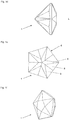
- Fig. 1a shows an embodiment of a gemstone 1 according to the invention in a side view.
- the Rondiste is the area between the crown and pavilion, where the stone has its largest cross-sectional dimension.
- Schematically, the Rondistenebene E is shown, that is the plane whose normal vector is parallel to the longitudinal axis L of the stone and in which the gemstone has its largest cross-sectional dimension.
- Fig. 1b shows a gemstone 1 according to the invention in a further side view.
- Fig. 1c shows a gemstone 1 according to the invention in a plan view of the crown 2. It can be seen two types of crown facets 6, 7. It border five Kronenfacetten 6 with its tip to the Rondiste. Another five crown facets 7 border with a broadside on the Rondiste 4.
- Fig. 1d shows a gemstone 1 according to the invention in a further side view.
- Fig. 1e shows a gemstone 1 according to the invention in plan view of the pavilion 3.
- the pavilion 3 has two types of pavilion facets 8, 9.
- the pavilion facets of group 8 are bounded by their lace to the rondist.
- Further pavilion facets of group 9 border with a broadside on the Rondiste 4. For the sake of clarity was omitted to provide all facets with reference numerals.
- Fig. 1f shows a gemstone 1 according to the invention in a perspective view of the crown. 2
- Fig. 1g shows a gemstone 1 according to the invention in a further side view.
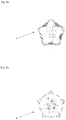
- Fig. 2a shows an arrangement of a gemstone according to the invention 1 and a socket 10 and 11 Krappe in cross section.
- the Fig. 2b shows an arrangement of a gemstone 1 and a socket 10 according to the invention in plan view.
- the frame is designed so that the prongs 11 cover the darker areas of the gemstone 1 and so underline the impression of a star. For the sake of clarity, only 2 of the prongs are provided with reference numerals.
- Fig. 3 shows a schematic representation of a gemstone 1 according to the invention for defining the angular position of the facets to the Rondistenebene E.
- the angle of a facet to the Rondistenebene is thus measured between the projecting appearing facet and the Rondistenebene.
- the angles present in the figure do not have to correspond to the values according to the invention.
- Fig. 4 shows the course of the light output ("Light Return") along an imaginary section AB through a gem, which is designed for comparison as a conventional gemstone or as inventive gemstone 1.
- the solid curve shows the course of the luminous efficacy for a conventionally cut gemstone, while the dashed curve represents the course of the luminous efficacy of a gemstone 1 according to the invention.
- the amount of luminous efficacy in the edge regions is substantially smaller than in the case of a conventionally ground gemstone.
- the contrast between the luminous efficacy in the region of one of the rays of the star and in the region between two rays of the star is greater than in the prior art. This results in the gemstone 1 of the invention the visual impression of a star.
- Fig. 5 shows the position L 'of the measuring line AB for the diagram of the luminous efficacy ("Light Return") in Fig. 4 ,
- the measurement line is approximately half the height of the triangle CDE, where the height between C and the base DE is meant.
- Fig. 6 shows the course of the light output ("Light Return") along an imaginary section EF along a circle through a gem, which is designed for comparison as a conventional gemstone or as inventive gemstone 1.
- the solid curve shows the course of the luminous efficacy for a conventionally cut gemstone, while the dashed curve represents the course of the luminous efficacy of a gemstone 1 according to the invention.
- the amount of light output in the regions of the facets tapering towards the center is substantially lower than in the regions of the facets tapering towards the rim 4.
- the luminous efficiency varies azimuthally periodically, whereby the visual impression of a star is formed.
- the luminous efficacy along the imaginary section EF does not show any pronounced periodic changes, so that no such impression is created in the prior art gemstone.
- Fig. 7 shows the position L "of the measuring line EF along a circle for the diagram of the light yield (" Light Return ”) Fig. 6 ,
- the measuring line EF lies on a center circle with respect to the center axis on a measured from the inside outward position of about two-thirds of the radius of a circumference of the gemstone (1) surrounding the circumference.
- Fig. 8 is a diagram illustrating the light rays emerging from a gemstone for the diagram of the light yield in FIGS. 4 and 6 ,
- Fig. 9a shows a photographic representation of a gemstone according to the invention 1. Clearly, the darker areas between the symmetry axes can be seen. This results in the gemstone 1 of the invention, the visual impression of a star.
- Fig. 9b shows a photographic representation of a gem stone according to the prior art, in which no visual impression of a star is created.
Landscapes
- Adornments (AREA)
- Crystals, And After-Treatments Of Crystals (AREA)
- Low-Molecular Organic Synthesis Reactions Using Catalysts (AREA)
Description
- Die vorliegende Erfindung betrifft einen Schmuckstein mit sternförmigem Erscheinungsbild mit den Merkmalen des Oberbegriffs des Anspruchs 1 und eine Anordnung mit einem solchen Schmuckstein. In der
US 5,072,549 wird ein Schmuckstein mit sternförmigen Erscheinungsbild beschrieben. Aus dem Stand der Technik sind zu Sternform geschliffene Schmucksteine bekannt.
Dazu müssen aus einer beispielsweise 5-eckigen Grundform eines Steines die Materialbereiche zwischen den Strahlen des Sternes entfernt werden.
Es bedarf also aufwendiger Schleiftechnik, um die häufig sehr kleinen Schmucksteine zur Sternform zu schleifen.
Weiters sind Schmucksteine mit so genanntem Chatonschliff bekannt. Ein solcher Schmuckstein ist beispielsweise in derEP 2 505 096 A1 beschrieben.
Ein Schmuckstein mit einem Chatonschliff weist eine Krone, auch Oberteil genannt, mit einer definierten Anzahl an seitlichen Facetten (Kronenfacetten) und einer ebenen Tafel, sowie ein Pavillon, auch Unterteil genannt, mit einer definierten Anzahl an Facetten (Pavillonfacetten), auf. Das der Tafel gegenüber liegende Ende des Schmucksteins kann als Spitze oder als abgerundete Spitze in Form einer so genannten Kalette ausgebildet sein.
Zwischen Ober- und Unterteil kann eine so genannte Rondiste (Umfangsrand) angeordnet sein. Der Schmuckstein kann symmetrisch oder asymmetrisch geschliffen sein.
Eine weitere, für die gegenständliche Erfindung bedeutende Größe ist die Lichtausbeute ("Light Return"). Die Lichtausbeute ("Light Return") ist ein Maß dafür, wie viel Licht, das aus einem vordefinierten, relativ breiten Raumwinkelbereich auf den Schmuckstein auftrifft, in einem relativ engen (Öffnungswinkel 3°) gerichteten Raumwinkelbereich auf den Betrachter im Wesentlichen entlang der Symmetrieachse des Steines zurückfällt.
Die Lichtausbeute beruht auf zahllosen inneren Lichtreflexionen. Diese Lichtreflexionen werden an den einzelnen Facetten hervorgerufen, die in speziellen, den jeweiligen Schliff charakterisierenden Winkelverhältnissen zueinander stehen.
Zur Berechnung der Lichtausbeute sei auf dieEP 2 505 096 A1 verwiesen. Der Schmuckstein gemäß derEP 2 505 096 A1 weist eine besonders hohe Lichtausbeute auf. - Als Kontrast zwischen heller und dunkler erscheinenden Bereichen des Schmucksteines wird das Verhältnis der Lichtausbeute in den helleren Bereichen abzüglich der Lichtausbeute in den dunkleren Bereichen, gebrochen durch die Lichtausbeute in den helleren Bereichen verstanden. Multipliziert man diesen Wert mit 100, so erhält man den Kontrast in Prozent.
- Als Formel ausgedrückt, gilt zur Berechnung des Kontrasts:

- Bei Schmucksteinen nach Stand der Technik wird eine gleichmäßige Lichtausbeute ("Light Return") über die gesamte Steinfläche angestrebt. Schmucksteine nach Stand der Technik weisen daher kein sternförmiges Erscheinungsbild auf.
- Es ist Aufgabe der vorliegenden Erfindung einen Schmuckstein mit sternförmigem Erscheinungsbild wirtschaftlicher als durch Erzeugen einer sternförmigen Außenkontur herzustellen.
- Diese Aufgabe wird durch einen Schmuckstein mit den Merkmalen des Anspruchs 1 und eine Anordnung mit den Merkmalen des Anspruchs 7 gelöst.
- Dadurch, dass der Schmuckstein eine Krone mit einer Vielzahl von Kronenfacetten aufweist, und eine erste Gruppe von sich zu einer Rondiste hin verjüngenden Kronenfacetten einen Winkel α von 22,5° ± 3°, vorzugsweise 22,5° ± 2° zur Rondistenebene aufweist und eine zweite Gruppe von Kronenfacetten, die mit ihrer Breitseite an die Rondiste angrenzen, einen Winkel β von 34° ± 3°, vorzugsweise 34° ± 2° zur Rondistenebene aufweist, ergibt sich allein durch den so erreichten Verlauf der Lichtintensität ein sternförmiges Erscheinungsbild des Schmucksteins, ohne die beim Stand der Technik erforderliche Entfernung von Material.
- Vorteilhafte Ausführungsformen der Erfindung sind in den abhängigen Ansprüchen definiert.
- Häufig weisen Schmucksteine einen unterhalb der Krone angeordneten Pavillon auf. Es hat sich heraus gestellt, dass der oben beschriebene Effekt bei solchen Steinen noch verstärkt werden kann, wenn auch für die Pavillonfacetten spezielle Winkel gewählt werden. Besonders vorteilhaft hat sich dabei heraus gestellt, wenn vorgesehen ist, dass der Schmuckstein einen Pavillon mit einer Vielzahl von Pavillonfacetten aufweist, wobei eine erste Gruppe von sich zu einer Rondiste hin verjüngenden Facetten Pavillonfacetten einen Winkel von 43,5° ± 3°, vorzugweise 43,5° ± 2° zur Rondistenebene aufweist und eine zweite Gruppe von Pavillonfacetten, die mit ihrer Breitseite an die Rondiste angrenzen, einen Winkel von 50° ± 3°, vorzugweise 50° ± 2° zur Rondistenebene aufweist.
- Grundsätzlich ist vorgesehen, dass sämtliche Pavillon- bzw. Kronenfacetten der jeweils einen oder anderen Gruppe von sich zur Rondiste verjüngenden bzw. an der Rondiste eine Breitseite aufweisenden Facetten mit oben genannten Winkellagen angehören, es ist jedoch auch vorstellbar, dass es noch zusätzliche Facetten anderer Winkellagen gibt, solange dies das gewünschte Erscheinungsbild nicht wesentlich beeinträchtigt.
- In einer weiteren bevorzugten Ausführungsform kann vorgesehen sein, dass der Schmuckstein in der Draufsicht einen fünfeckigen Umriss aufweist.
- Bevorzugt kann weiters vorgesehen sein, dass der Schmuckstein aus einem für das sichtbare Spektrum des Lichtes transparenten Material besteht und einen Brechungsindex von 2,0 bis 2,4 aufweist.
- Besonders bevorzugt kann vorgesehen sein, dass der Schmuckstein aus kubischem Zirkonoxid ("cubic zirconia") besteht.
- In einer weiteren bevorzugten Ausführungsform kann vorgesehen sein, dass der Kontrast der Lichtausbeute zwischen der ersten Gruppe von sich zur Rondiste hin verjüngenden Facetten und der zweiten Gruppe von sich zur Mitte hin verjüngenden Facetten, ermittelt jeweils an einer radial von der Längsachse des Schmucksteines nach außen gemessenen Position von zwei Drittel des Radius eines den Umriss des Schmucksteins umgebenden Umkreises in der jeweiligen Winkelhalbierenden der jeweiligen Facette mindestens 50% beträgt.
- Ist eine Fassung für den Schmuckstein vorgesehen, so ist bevorzugt vorgesehen, dass die Krappen der Fassung, welche der Fixierung des Schmucksteins dienen, im Bereich jener Gruppe von Facetten angeordnet sind, welche mit ihrer Breitseite an die Rondiste angrenzen. Durch die erfindungsgemäße Ausgestaltung der Facetten erscheint der Schmuckstein im Bereich jener Facetten dunkler, mit ihrer Breitseite an die Rondiste angrenzen. Durch die Abdeckung der dunkler erscheinenden Bereiche des Schmucksteins wird der sternförmige Eindruck noch verstärkt.
- Weitere Vorteile der Erfindung ergeben sich anhand der Figuren und der dazu gehörigen Figurenbeschreibung. Dabei zeigen:
- Fig.1a bis 1g
- Ansichten eines Ausführungsbeispieles der Erfindung aus verschiedenen Blickrichtungen,
- Fig. 2a bis 2b
- Ansichten einer Anordnung des Schmucksteines nach
Fig. 1 mit einer Fassung - Fig. 3
- eine schematische Darstellung zur Definition der Lage der Facettenwinkel
- Fig. 4
- ein Diagramm zur Darstellung der Lichtausbeute ("Light Return") für einen geraden Schnitt durch den Schmuckstein nach
Fig. 5 - Fig. 5
- eine Darstellung zur Veranschaulichung der Lage der Messlinie für das Diagramm der Lichtausbeute ("Light Return") in
Fig. 4 - Fig. 6
- ein Diagramm zur Darstellung der Lichtausbeute ("Light Return") für einen Schnitt durch den Schmuckstein entlang eines Kreises nach
Fig. 7 - Fig. 7
- eine Darstellung zur Veranschaulichung der Lage der Messlinie für das Diagramm der Lichtausbeute ("Light Return") in
Fig. 6 - Fig. 8
- eine Darstellung zur Veranschaulichung der aus dem Schmuckstein austretenden Lichtstrahlen für das Diagramm der Lichtausbeute ("Light Return")
- Fig. 9a
- eine fotographische Darstellung des Erscheinungsbildes eines erfindungsgemäßen Schmucksteines und
- Fig. 9b
- eine fotographische Darstellung des Erscheinungsbildes eines Schmucksteines nach Stand der Technik.
-
Fig. 1a zeigt ein Ausführungsbeispiel eines erfindungsgemäßen Schmucksteins 1 in einer Seitenansicht. Zu erkennen sind die Krone 2, auch Oberteil genannt, der Pavillon 3, auch Unterteil genannt, die Rondiste 4 die Tafel 5. Die Rondiste ist jener Bereich zwischen Krone und Pavillon, an der der Stein seine größte Querschnittsausdehnung aufweist. Schematisch ist die Rondistenebene E dargestellt, das ist jene Ebene, deren Normalenvektor parallel zur Längsachse L des Steines liegt und in welcher der Schmuckstein seine größte Querschnittsausdehnung aufweist. -
Fig. 1b zeigt einen erfindungsgemäßen Schmuckstein 1 in einer weiteren Seitenansicht. -
Fig. 1c zeigt einen erfindungsgemäßen Schmuckstein 1 in Draufsicht auf die Krone 2. Dabei erkennbar sind zwei Arten von Kronenfacetten 6, 7. Dabei grenzen fünf Kronenfacetten 6 mit ihrer Spitze an die Rondiste an. Weitere fünf Kronenfacetten 7 grenzen mit einer Breitseite an die Rondiste 4. -
Fig. 1d zeigt einen erfindungsgemäßen Schmuckstein 1 in einer weiteren Seitenansicht. -
Fig. 1e zeigt einen erfindungsgemäßen Schmuckstein 1 in Draufsicht auf den Pavillon 3. Der Pavillon 3 weist zwei Arten von Pavillonfacetten 8, 9 auf. Dabei grenzen die Pavillonfacetten der Gruppe 8 mit ihrer Spitze an die Rondiste an. Weitere Pavillonfacetten der Gruppe 9 grenzen mit einer Breitseite an die Rondiste 4. Der Übersichtlichkeit halber wurde darauf verzichtet, sämtliche Facetten mit Bezugszeichen zu versehen. -
Fig. 1f zeigt einen erfindungsgemäßen Schmuckstein 1 in einer perspektivischen Ansicht auf die Krone 2. -
Fig. 1g zeigt einen erfindungsgemäßen Schmuckstein 1 in einer weiteren Seitenansicht. -
Fig. 2a zeigt eine Anordnung eines erfindungsgemäßen Schmucksteins 1 und einer Fassung 10 und Krappe 11 im Querschnitt. - Die
Fig. 2b zeigt eine Anordnung eines erfindungsgemäßen Schmucksteins 1 und einer Fassung 10 in der Draufsicht. Die Fassung ist so gestaltet, dass die Krappen 11 die jeweils dunkleren Bereiche des Schmucksteines 1 abdecken und so den Eindruck eines Sternes unterstreichen. Der Übersichtlichkeit halber sind nur 2 der Krappen mit Bezugszeichen versehen. -
Fig. 3 zeigt eine schematische Darstellung eines erfindungsgemäßen Schmucksteins 1 zur Definition der Winkellage der Facetten zur Rondistenebene E. Der Winkel einer Facette zur Rondistenebene wird also zwischen der projizierend erscheinenden Facette und der Rondistenebene gemessen. Die in der Figur vorliegenden Winkel müssen nicht den erfindungsgemäßen Werten entsprechen. -
Fig. 4 zeigt den Verlauf der Lichtausbeute ("Light Return") entlang eines gedachten Schnittes AB durch einen Schmuckstein, welcher zum Vergleich als konventioneller Schmuckstein bzw. als erfindungsgemäßer Schmuckstein 1 ausgeführt ist. Dabei zeigt die ausgezogene Kurve den Verlauf der Lichtausbeute für einen konventionell geschliffenen Schmuckstein, während die gestrichelte Kurve den Verlauf der Lichtausbeute eines erfindungsgemäßen Schmucksteins 1 wiedergibt. Es wird deutlich, dass beim erfindungsgemäßen Schmuckstein 1 der Betrag der Lichtausbeute in den Randbereichen wesentlich kleiner ist als bei einem konventionell geschliffenen Schmuckstein. Mit anderen Worten ist beim erfindungsgemäßen Schmuckstein der Kontrast zwischen der Lichtausbeute im Bereich eines der Strahlen des Sterns und im Bereich zwischen zweier Strahlen des Sterns größer als beim Stand der Technik. Dadurch entsteht beim erfindungsgemäßen Schmuckstein 1 der optische Eindruck eines Sterns. -
Fig. 5 zeigt die Lage L' der Messlinie A-B für das Diagramm der Lichtausbeute ("Light Return") inFig. 4 . Die Messlinie liegt etwa bei der Hälfte der Höhe des Dreiecks CDE, wobei die Höhe zwischen C und der Basis DE gemeint ist. -
Fig. 6 zeigt den Verlauf der Lichtausbeute ("Light Return") entlang eines gedachten Schnittes E-F entlang eines Kreises durch einen Schmuckstein, welcher zum Vergleich als konventioneller Schmuckstein bzw. als erfindungsgemäßer Schmuckstein 1 ausgeführt ist. Dabei zeigt die ausgezogene Kurve den Verlauf der Lichtausbeute für einen konventionell geschliffenen Schmuckstein, während die gestrichelte Kurve den Verlauf der Lichtausbeute eines erfindungsgemäßen Schmucksteins 1 wiedergibt. Es wird deutlich, dass beim erfindungsgemäßen Schmuckstein 1 der Betrag der Lichtausbeute in den Bereichen der sich zur Mitte hin verjüngenden Facetten wesentlich geringer ist als in den Bereichen der sich zur Rondiste 4 verjüngenden Facetten. Beim erfindungsgemäßen Schmuckstein 1 variiert die Lichtausbeute azimutal periodisch, wodurch der optische Eindruck eines Sterns entsteht.
Bei einem Schmuckstein nach Stand der Technik hingegen zeigt die Lichtausbeute entlang des gedachten Schnittes E-F keine ausgeprägten periodischen Änderungen, sodass beim Schmuckstein nach Stand der Technik kein solcher Eindruck entsteht. -
Fig. 7 zeigt die Lage L" der Messlinie E-F entlang eines Kreises für das Diagramm der Lichtausbeute ("Light Return") inFig. 6 .
Die Messlinie E-F liegt auf einem bezüglich der Mittelachse zentrierten Kreis auf einer von innen nach außen gemessenen Position von etwa zwei Drittel des Radius eines den Umriss des Schmucksteins (1) umgebenden Umkreises. -
Fig. 8 ist eine Darstellung zur Veranschaulichung der aus einem Schmuckstein austretenden Lichtstrahlen für das Diagramm der Lichtausbeute ("Light Return") inFiguren 4 und6 . -
Fig. 9a zeigt eine fotographische Darstellung eines erfindungsgemäßen Schmucksteines 1. Deutlich sind die dunkleren Bereiche zwischen den Symmetrieachsen zu erkennen. Dadurch entsteht beim erfindungsgemäßen Schmuckstein 1 der optische Eindruck eines Sternes. -
Fig. 9b zeigt eine fotographische Darstellung einen Schmuckstein nach Stand der Technik, bei dem kein optischer Eindruck eines Sternes entsteht. - Der Vollständigkeit halber sei angemerkt, dass bei Winkelangaben ein Vollwinkel 360° entspricht.
Claims (8)
- Schmuckstein mit einem sternförmigen Erscheinungsbild, wobei der Schmuckstein (1) eine Krone (2) mit einer Vielzahl von Kronenfacetten aufweist, dadurch gekennzeichnet, dass eine erste Gruppe (6) von sich zu einer Rondiste (4) hin verjüngenden Kronenfacetten einen Winkel (α) von 22,5° ± 3°, vorzugsweise 22,5° ± 2° zur Rondistenebene (E) aufweist und eine zweite Gruppe (7) von Kronenfacetten, die mit ihrer Breitseite an die Rondiste (4) angrenzen, einen Winkel (β) von 34° ± 3°, vorzugsweise 34° ± 2° zur Rondistenebene (E) aufweist.
- Schmuckstein nach Anspruch 1, dadurch gekennzeichnet, dass der Schmuckstein (1) einen Pavillon (3) mit einer Vielzahl von Pavillonfacetten aufweist, wobei eine erste Gruppe (8) von sich zu einer Rondiste (4) hin verjüngenden Pavillonfacetten einen Winkel (γ) von 43,5° ± 3°, vorzugweise 43,5° ± 2° zur Rondistenebene (E) aufweist und eine zweite Gruppe (9) von Pavillonfacetten, die mit einer Breitseite an die Rondiste angrenzen, einen Winkel (δ) von 50° ± 3°, vorzugweise 50° ± 2° zur Rondistenebene (E) aufweist.
- Schmuckstein nach wenigstens einem der vorhergegangenen Ansprüche, dadurch gekennzeichnet, dass der Schmuckstein (1) in der Draufsicht einen fünfeckigen Umriss aufweist.
- Schmuckstein nach wenigstens einem der vorhergegangenen Ansprüche, dadurch gekennzeichnet, dass der Schmuckstein (1) aus einem für das sichtbare Spektrum des Lichtes transparenten Material besteht und einen Brechungsindex von 2,0 bis 2,4 aufweist.
- Schmuckstein nach wenigstens einem der vorhergegangenen Ansprüche, dadurch gekennzeichnet, dass der Schmuckstein (1) aus kubischem Zirkonoxid ("cubic zirconia") besteht.
- Schmuckstein nach wenigstens einem der vorhergegangenen Ansprüche, dadurch gekennzeichnet, dass der Kontrast der Lichtausbeute zwischen der ersten Gruppe (6) von sich zur Rondiste (4) hin verjüngenden Facetten und der zweiten Gruppe (7) von sich zur Mitte hin verjüngenden Facetten, ermittelt jeweils an einer radial von der Längsachse des Schmucksteines (1) nach außen gemessenen Position von zwei Drittel des Radius eines den Umriss des Schmucksteins (1) umgebenden Umkreises in der jeweiligen Winkelhalbierenden der jeweiligen Facette mindestens 50%, vorzugsweise min-destens 70%, besonders bevorzugt mindestens 80% beträgt.
- Anordnung mit:- einem Schmuckstein nach wenigstens einem der vorhergegangenen Ansprüche,- einer Fassung, wobei Krappen der Fassung den Rand des Schmucksteines übergreifen,dadurch gekennzeichnet, dass die Krappen (11) so geformt und vorzugsweise im Bereich der zweiten Gruppe (7) von Kronenfacetten angeordnet sind, dass die sichtbare Fläche des Schmucksteines (1) von einer alternierend konvexen und konkaven Randlinie begrenzt wird.
- Anordnung nach Anspruch 7,
dadurch gekennzeichnet, dass die sichtbare Fläche des Schmucksteines (1) die Fläche eines fünfstrahligen Sternes bildet.
Applications Claiming Priority (2)
| Application Number | Priority Date | Filing Date | Title |
|---|---|---|---|
| ATA888/2013A AT515136B1 (de) | 2013-11-15 | 2013-11-15 | Schmuckstein mit sternförmigem Erscheinungsbild |
| PCT/AT2014/000192 WO2015070266A2 (de) | 2013-11-15 | 2014-10-27 | Schmuckstein mit sternförmigem erscheinungsbild |
Publications (2)
| Publication Number | Publication Date |
|---|---|
| EP3068254A2 EP3068254A2 (de) | 2016-09-21 |
| EP3068254B1 true EP3068254B1 (de) | 2018-05-23 |
Family
ID=52020871
Family Applications (1)
| Application Number | Title | Priority Date | Filing Date |
|---|---|---|---|
| EP14809746.2A Active EP3068254B1 (de) | 2013-11-15 | 2014-10-27 | Schmuckstein mit sternförmigem erscheinungsbild |
Country Status (5)
| Country | Link |
|---|---|
| US (1) | US20160249714A1 (de) |
| EP (1) | EP3068254B1 (de) |
| CN (1) | CN105744852B (de) |
| AT (1) | AT515136B1 (de) |
| WO (1) | WO2015070266A2 (de) |
Families Citing this family (3)
| Publication number | Priority date | Publication date | Assignee | Title |
|---|---|---|---|---|
| CN108497638B (zh) * | 2017-02-27 | 2023-12-05 | 深圳鸳鸯金楼珠宝股份有限公司 | 钻石及其亭部加工方法、钻石及其亭部结构 |
| EP3378346B1 (de) * | 2017-03-21 | 2023-01-18 | Omega SA | Stein und sein herstellungsverfahren |
| TWD195924S (zh) * | 2017-09-21 | 2019-02-11 | 日商貞松股份有限公司 | 寶石 |
Family Cites Families (30)
| Publication number | Priority date | Publication date | Assignee | Title |
|---|---|---|---|---|
| US3788097A (en) * | 1971-03-30 | 1974-01-29 | Colorant Schmuckstein Gmbh Fa | Brilliant having plural rings of facets, each having an odd number of facets |
| US5072549A (en) * | 1986-09-22 | 1991-12-17 | Harold Johnston | Method of cutting gemstones and product |
| USD375914S (en) * | 1994-07-05 | 1996-11-26 | Fancoldi, R.T. | Diamond |
| DE19734036A1 (de) * | 1997-08-06 | 1999-02-11 | Helmut Buerger | Verfahren zur Festlegung eines Edelsteinschliffs mit hoher Reflektion, Verfahren zum Schleifen eines Edelsteins mit hoher Reflektion sowie geschliffener Edelstein mit hoher Reflektion |
| USD411133S (en) * | 1998-09-01 | 1999-06-22 | Noe Alvarado | Hexagon shaped diamond |
| US6430963B1 (en) * | 2000-08-30 | 2002-08-13 | Simka Diamonds Corporation | Diamond cut |
| IL146079A (en) * | 2001-10-19 | 2004-06-20 | Michael Kedem | Rounded precious stone |
| US6578380B1 (en) * | 2002-01-24 | 2003-06-17 | Diaco | Hexagonal brilliant cut diamond |
| USD481327S1 (en) * | 2002-06-04 | 2003-10-28 | Nelson Jewellery Arts Company Ltd. | Pentagonal cutting diamond |
| US6990833B2 (en) * | 2002-09-23 | 2006-01-31 | Smith Allen L | Faceted circular cut diamond |
| CN1223442C (zh) * | 2002-12-17 | 2005-10-19 | 全球股份有限公司 | 宝石饰品、钻石及方形锆及它们的切割方法 |
| US20050011226A1 (en) * | 2003-07-14 | 2005-01-20 | David So | Precious stone cut and method of making |
| US20050081563A1 (en) * | 2003-08-18 | 2005-04-21 | Yair Riemer | Gemstone cut |
| US7225642B2 (en) * | 2003-09-09 | 2007-06-05 | Simka Diamonds | Diamond cut |
| US20050144980A1 (en) * | 2004-01-05 | 2005-07-07 | Robert Shaw | Setting for diamonds or diamond shaped stones |
| USD513393S1 (en) * | 2004-04-28 | 2006-01-03 | Gitanjali Gems Limited | Jupiter cut jewel |
| US20060026991A1 (en) * | 2004-07-20 | 2006-02-09 | Naotake Shuto | Method for cutting diamond and diamond proportion |
| USD550116S1 (en) * | 2004-12-02 | 2007-09-04 | Mordechay Torgeman | Gemstone |
| US20070261440A1 (en) * | 2006-05-09 | 2007-11-15 | Mark Webb | Liberty cut gemstone |
| US20150052947A9 (en) * | 2006-08-08 | 2015-02-26 | Zev W. Weitman | Gemstone cut |
| JP2008054838A (ja) * | 2006-08-30 | 2008-03-13 | Komiya:Kk | ダイアモンド |
| USD567138S1 (en) * | 2007-05-04 | 2008-04-22 | Sundiamond Usa, Corp. | Hexagon shaped diamond or similar article |
| US8353181B2 (en) * | 2007-05-04 | 2013-01-15 | Worldwide Diamond Trademarks Ltd. | Heart shaped diamond cut having hearts and arrows pattern |
| JP3138424U (ja) * | 2007-06-01 | 2008-01-10 | ヴァーグ株式会社 | 72面カットのプロポーションのダイヤモンド |
| JP2009100857A (ja) * | 2007-10-22 | 2009-05-14 | Nidec Sankyo Corp | 装飾品 |
| EP2245951A1 (de) * | 2008-01-09 | 2010-11-03 | Hohoemi Brains, Inc. | Zierdiamant mit zweistufigem pavillon |
| US20120079853A1 (en) * | 2010-10-01 | 2012-04-05 | Blasbichler Guenther | Gem with brilliant cut |
| AT12644U1 (de) * | 2011-03-07 | 2012-09-15 | Swarovski D Kg | Brilliantschliff |
| US20130291589A1 (en) * | 2012-05-03 | 2013-11-07 | Anthony Ritchie | Silicon Carbide Princess Cut Gemstone |
| US20160166021A1 (en) * | 2014-12-11 | 2016-06-16 | Hasenfeld-Stein, Inc. | Round cut gemstone exhibiting excellent optical brilliance |
-
2013
- 2013-11-15 AT ATA888/2013A patent/AT515136B1/de active
-
2014
- 2014-10-27 CN CN201480062099.6A patent/CN105744852B/zh active Active
- 2014-10-27 EP EP14809746.2A patent/EP3068254B1/de active Active
- 2014-10-27 WO PCT/AT2014/000192 patent/WO2015070266A2/de not_active Ceased
-
2016
- 2016-05-13 US US15/154,241 patent/US20160249714A1/en not_active Abandoned
Non-Patent Citations (1)
| Title |
|---|
| None * |
Also Published As
| Publication number | Publication date |
|---|---|
| CN105744852A (zh) | 2016-07-06 |
| EP3068254A2 (de) | 2016-09-21 |
| US20160249714A1 (en) | 2016-09-01 |
| AT515136A1 (de) | 2015-06-15 |
| WO2015070266A3 (de) | 2015-07-30 |
| WO2015070266A2 (de) | 2015-05-21 |
| AT515136B1 (de) | 2016-12-15 |
| CN105744852B (zh) | 2018-10-26 |
Similar Documents
| Publication | Publication Date | Title |
|---|---|---|
| DE60012463T2 (de) | Geschliffener Edelstein, insbesondere geschliffener Diamant | |
| DE2720267C2 (de) | Zum Brillanten verarbeiteter Diamant mit Stufenschliff | |
| EP0562141B1 (de) | Schmucksteinfassung | |
| EP2505096B1 (de) | Schmuckstein mit Chatonschliff | |
| DE2158857A1 (de) | Geschliffener Diamant und Verfahren zu seiner Herstellung | |
| DE3878384T2 (de) | Fassungstraeger fuer schmucksteine, insbesondere fuer diamanten, fassung fuer einen derartigen schmuckstein und fassungsstraeger, verfahren und werkzeug zur formung eines derartigen fassungstraegers. | |
| AT515136B1 (de) | Schmuckstein mit sternförmigem Erscheinungsbild | |
| EP2436281A1 (de) | Schmuckstein mit Brillantschliff | |
| DE60025718T2 (de) | Gesichtsschutzschirm | |
| EP2906073B1 (de) | Schliff für schmuckstein | |
| DE202014000870U1 (de) | Zerkleinerungsvorrichtung | |
| DE102014000778B3 (de) | Tafelbarren mit Lang- und Kurznuten | |
| DE3447020C2 (de) | Patrize zur Herstellung einer Form für einen Rückstrahler und Verfahren zur Herstellung des Rückstrahlers | |
| DE2236167C2 (de) | Streuscheibe und Verfahren zum Herstellen einer Gießform für die Fertigung der Streuscheibe | |
| DE2736331B2 (de) | Zylinderschloß mit in einem Zylindergehäuse drehbaren Zylinderkern | |
| AT526341B1 (de) | Fassung für Schmuckgegenstände | |
| DE102018129155B4 (de) | Verfahren zum Erzeugen eines Schmuckstückes | |
| DE102011000649A1 (de) | Flacher transparenter Gegenstand mit verbesserter Brillanz | |
| EP2548649A2 (de) | Werkzeug für eine Zerkleinerungsvorrichtung | |
| DE202017103704U1 (de) | Schmuckstück und Werkzeug zur Herstellung des Schmuckstücks | |
| DE19702782C2 (de) | Ringförmiges Schmuckteil | |
| DE10209896B4 (de) | Verfahren und Vorrichtung zur Herstellung eines mit einer Verzahnung versehenen, rotationssymmetrischen Getriebeteiles | |
| AT508111B1 (de) | Schmuckstein mit konvexem rand | |
| CH712506B1 (de) | Gliederarmband. | |
| DE9404602U1 (de) | Lichtdurchlässiger Schmuckstein |
Legal Events
| Date | Code | Title | Description |
|---|---|---|---|
| PUAI | Public reference made under article 153(3) epc to a published international application that has entered the european phase |
Free format text: ORIGINAL CODE: 0009012 |
|
| 17P | Request for examination filed |
Effective date: 20160610 |
|
| AK | Designated contracting states |
Kind code of ref document: A2 Designated state(s): AL AT BE BG CH CY CZ DE DK EE ES FI FR GB GR HR HU IE IS IT LI LT LU LV MC MK MT NL NO PL PT RO RS SE SI SK SM TR |
|
| AX | Request for extension of the european patent |
Extension state: BA ME |
|
| DAX | Request for extension of the european patent (deleted) | ||
| GRAP | Despatch of communication of intention to grant a patent |
Free format text: ORIGINAL CODE: EPIDOSNIGR1 |
|
| STAA | Information on the status of an ep patent application or granted ep patent |
Free format text: STATUS: GRANT OF PATENT IS INTENDED |
|
| RIC1 | Information provided on ipc code assigned before grant |
Ipc: A44C 17/04 20060101ALI20171116BHEP Ipc: A44C 17/02 20060101ALI20171116BHEP Ipc: A44C 17/00 20060101AFI20171116BHEP |
|
| INTG | Intention to grant announced |
Effective date: 20171208 |
|
| GRAS | Grant fee paid |
Free format text: ORIGINAL CODE: EPIDOSNIGR3 |
|
| GRAA | (expected) grant |
Free format text: ORIGINAL CODE: 0009210 |
|
| STAA | Information on the status of an ep patent application or granted ep patent |
Free format text: STATUS: THE PATENT HAS BEEN GRANTED |
|
| AK | Designated contracting states |
Kind code of ref document: B1 Designated state(s): AL AT BE BG CH CY CZ DE DK EE ES FI FR GB GR HR HU IE IS IT LI LT LU LV MC MK MT NL NO PL PT RO RS SE SI SK SM TR |
|
| REG | Reference to a national code |
Ref country code: GB Ref legal event code: FG4D Free format text: NOT ENGLISH |
|
| REG | Reference to a national code |
Ref country code: CH Ref legal event code: EP |
|
| REG | Reference to a national code |
Ref country code: IE Ref legal event code: FG4D Free format text: LANGUAGE OF EP DOCUMENT: GERMAN |
|
| REG | Reference to a national code |
Ref country code: AT Ref legal event code: REF Ref document number: 1000789 Country of ref document: AT Kind code of ref document: T Effective date: 20180615 |
|
| REG | Reference to a national code |
Ref country code: DE Ref legal event code: R096 Ref document number: 502014008355 Country of ref document: DE |
|
| REG | Reference to a national code |
Ref country code: NL Ref legal event code: MP Effective date: 20180523 |
|
| REG | Reference to a national code |
Ref country code: LT Ref legal event code: MG4D |
|
| REG | Reference to a national code |
Ref country code: FR Ref legal event code: PLFP Year of fee payment: 5 |
|
| PG25 | Lapsed in a contracting state [announced via postgrant information from national office to epo] |
Ref country code: NO Free format text: LAPSE BECAUSE OF FAILURE TO SUBMIT A TRANSLATION OF THE DESCRIPTION OR TO PAY THE FEE WITHIN THE PRESCRIBED TIME-LIMIT Effective date: 20180823 Ref country code: ES Free format text: LAPSE BECAUSE OF FAILURE TO SUBMIT A TRANSLATION OF THE DESCRIPTION OR TO PAY THE FEE WITHIN THE PRESCRIBED TIME-LIMIT Effective date: 20180523 Ref country code: LT Free format text: LAPSE BECAUSE OF FAILURE TO SUBMIT A TRANSLATION OF THE DESCRIPTION OR TO PAY THE FEE WITHIN THE PRESCRIBED TIME-LIMIT Effective date: 20180523 Ref country code: SE Free format text: LAPSE BECAUSE OF FAILURE TO SUBMIT A TRANSLATION OF THE DESCRIPTION OR TO PAY THE FEE WITHIN THE PRESCRIBED TIME-LIMIT Effective date: 20180523 Ref country code: FI Free format text: LAPSE BECAUSE OF FAILURE TO SUBMIT A TRANSLATION OF THE DESCRIPTION OR TO PAY THE FEE WITHIN THE PRESCRIBED TIME-LIMIT Effective date: 20180523 Ref country code: BG Free format text: LAPSE BECAUSE OF FAILURE TO SUBMIT A TRANSLATION OF THE DESCRIPTION OR TO PAY THE FEE WITHIN THE PRESCRIBED TIME-LIMIT Effective date: 20180823 |
|
| PG25 | Lapsed in a contracting state [announced via postgrant information from national office to epo] |
Ref country code: HR Free format text: LAPSE BECAUSE OF FAILURE TO SUBMIT A TRANSLATION OF THE DESCRIPTION OR TO PAY THE FEE WITHIN THE PRESCRIBED TIME-LIMIT Effective date: 20180523 Ref country code: RS Free format text: LAPSE BECAUSE OF FAILURE TO SUBMIT A TRANSLATION OF THE DESCRIPTION OR TO PAY THE FEE WITHIN THE PRESCRIBED TIME-LIMIT Effective date: 20180523 Ref country code: NL Free format text: LAPSE BECAUSE OF FAILURE TO SUBMIT A TRANSLATION OF THE DESCRIPTION OR TO PAY THE FEE WITHIN THE PRESCRIBED TIME-LIMIT Effective date: 20180523 Ref country code: LV Free format text: LAPSE BECAUSE OF FAILURE TO SUBMIT A TRANSLATION OF THE DESCRIPTION OR TO PAY THE FEE WITHIN THE PRESCRIBED TIME-LIMIT Effective date: 20180523 Ref country code: GR Free format text: LAPSE BECAUSE OF FAILURE TO SUBMIT A TRANSLATION OF THE DESCRIPTION OR TO PAY THE FEE WITHIN THE PRESCRIBED TIME-LIMIT Effective date: 20180824 |
|
| PG25 | Lapsed in a contracting state [announced via postgrant information from national office to epo] |
Ref country code: SK Free format text: LAPSE BECAUSE OF FAILURE TO SUBMIT A TRANSLATION OF THE DESCRIPTION OR TO PAY THE FEE WITHIN THE PRESCRIBED TIME-LIMIT Effective date: 20180523 Ref country code: PL Free format text: LAPSE BECAUSE OF FAILURE TO SUBMIT A TRANSLATION OF THE DESCRIPTION OR TO PAY THE FEE WITHIN THE PRESCRIBED TIME-LIMIT Effective date: 20180523 Ref country code: EE Free format text: LAPSE BECAUSE OF FAILURE TO SUBMIT A TRANSLATION OF THE DESCRIPTION OR TO PAY THE FEE WITHIN THE PRESCRIBED TIME-LIMIT Effective date: 20180523 Ref country code: DK Free format text: LAPSE BECAUSE OF FAILURE TO SUBMIT A TRANSLATION OF THE DESCRIPTION OR TO PAY THE FEE WITHIN THE PRESCRIBED TIME-LIMIT Effective date: 20180523 Ref country code: RO Free format text: LAPSE BECAUSE OF FAILURE TO SUBMIT A TRANSLATION OF THE DESCRIPTION OR TO PAY THE FEE WITHIN THE PRESCRIBED TIME-LIMIT Effective date: 20180523 |
|
| REG | Reference to a national code |
Ref country code: DE Ref legal event code: R097 Ref document number: 502014008355 Country of ref document: DE |
|
| PG25 | Lapsed in a contracting state [announced via postgrant information from national office to epo] |
Ref country code: SM Free format text: LAPSE BECAUSE OF FAILURE TO SUBMIT A TRANSLATION OF THE DESCRIPTION OR TO PAY THE FEE WITHIN THE PRESCRIBED TIME-LIMIT Effective date: 20180523 |
|
| PLBE | No opposition filed within time limit |
Free format text: ORIGINAL CODE: 0009261 |
|
| STAA | Information on the status of an ep patent application or granted ep patent |
Free format text: STATUS: NO OPPOSITION FILED WITHIN TIME LIMIT |
|
| 26N | No opposition filed |
Effective date: 20190226 |
|
| PG25 | Lapsed in a contracting state [announced via postgrant information from national office to epo] |
Ref country code: SI Free format text: LAPSE BECAUSE OF FAILURE TO SUBMIT A TRANSLATION OF THE DESCRIPTION OR TO PAY THE FEE WITHIN THE PRESCRIBED TIME-LIMIT Effective date: 20180523 |
|
| REG | Reference to a national code |
Ref country code: BE Ref legal event code: MM Effective date: 20181031 |
|
| PG25 | Lapsed in a contracting state [announced via postgrant information from national office to epo] |
Ref country code: LU Free format text: LAPSE BECAUSE OF NON-PAYMENT OF DUE FEES Effective date: 20181027 Ref country code: MC Free format text: LAPSE BECAUSE OF FAILURE TO SUBMIT A TRANSLATION OF THE DESCRIPTION OR TO PAY THE FEE WITHIN THE PRESCRIBED TIME-LIMIT Effective date: 20180523 |
|
| REG | Reference to a national code |
Ref country code: IE Ref legal event code: MM4A |
|
| PG25 | Lapsed in a contracting state [announced via postgrant information from national office to epo] |
Ref country code: BE Free format text: LAPSE BECAUSE OF NON-PAYMENT OF DUE FEES Effective date: 20181031 |
|
| PG25 | Lapsed in a contracting state [announced via postgrant information from national office to epo] |
Ref country code: IE Free format text: LAPSE BECAUSE OF NON-PAYMENT OF DUE FEES Effective date: 20181027 |
|
| PG25 | Lapsed in a contracting state [announced via postgrant information from national office to epo] |
Ref country code: AL Free format text: LAPSE BECAUSE OF FAILURE TO SUBMIT A TRANSLATION OF THE DESCRIPTION OR TO PAY THE FEE WITHIN THE PRESCRIBED TIME-LIMIT Effective date: 20180523 |
|
| PG25 | Lapsed in a contracting state [announced via postgrant information from national office to epo] |
Ref country code: MT Free format text: LAPSE BECAUSE OF FAILURE TO SUBMIT A TRANSLATION OF THE DESCRIPTION OR TO PAY THE FEE WITHIN THE PRESCRIBED TIME-LIMIT Effective date: 20180523 |
|
| PG25 | Lapsed in a contracting state [announced via postgrant information from national office to epo] |
Ref country code: TR Free format text: LAPSE BECAUSE OF FAILURE TO SUBMIT A TRANSLATION OF THE DESCRIPTION OR TO PAY THE FEE WITHIN THE PRESCRIBED TIME-LIMIT Effective date: 20180523 |
|
| PG25 | Lapsed in a contracting state [announced via postgrant information from national office to epo] |
Ref country code: PT Free format text: LAPSE BECAUSE OF FAILURE TO SUBMIT A TRANSLATION OF THE DESCRIPTION OR TO PAY THE FEE WITHIN THE PRESCRIBED TIME-LIMIT Effective date: 20180523 |
|
| PG25 | Lapsed in a contracting state [announced via postgrant information from national office to epo] |
Ref country code: MK Free format text: LAPSE BECAUSE OF NON-PAYMENT OF DUE FEES Effective date: 20180523 Ref country code: HU Free format text: LAPSE BECAUSE OF FAILURE TO SUBMIT A TRANSLATION OF THE DESCRIPTION OR TO PAY THE FEE WITHIN THE PRESCRIBED TIME-LIMIT; INVALID AB INITIO Effective date: 20141027 Ref country code: CY Free format text: LAPSE BECAUSE OF FAILURE TO SUBMIT A TRANSLATION OF THE DESCRIPTION OR TO PAY THE FEE WITHIN THE PRESCRIBED TIME-LIMIT Effective date: 20180523 |
|
| PG25 | Lapsed in a contracting state [announced via postgrant information from national office to epo] |
Ref country code: IS Free format text: LAPSE BECAUSE OF FAILURE TO SUBMIT A TRANSLATION OF THE DESCRIPTION OR TO PAY THE FEE WITHIN THE PRESCRIBED TIME-LIMIT Effective date: 20180923 |
|
| REG | Reference to a national code |
Ref country code: CH Ref legal event code: U11 Free format text: ST27 STATUS EVENT CODE: U-0-0-U10-U11 (AS PROVIDED BY THE NATIONAL OFFICE) Effective date: 20251101 |
|
| PGFP | Annual fee paid to national office [announced via postgrant information from national office to epo] |
Ref country code: DE Payment date: 20251020 Year of fee payment: 12 |
|
| PGFP | Annual fee paid to national office [announced via postgrant information from national office to epo] |
Ref country code: GB Payment date: 20251024 Year of fee payment: 12 |
|
| PGFP | Annual fee paid to national office [announced via postgrant information from national office to epo] |
Ref country code: AT Payment date: 20251021 Year of fee payment: 12 |
|
| PGFP | Annual fee paid to national office [announced via postgrant information from national office to epo] |
Ref country code: IT Payment date: 20251031 Year of fee payment: 12 |
|
| PGFP | Annual fee paid to national office [announced via postgrant information from national office to epo] |
Ref country code: FR Payment date: 20251027 Year of fee payment: 12 |
|
| PGFP | Annual fee paid to national office [announced via postgrant information from national office to epo] |
Ref country code: CH Payment date: 20251101 Year of fee payment: 12 |
|
| PGFP | Annual fee paid to national office [announced via postgrant information from national office to epo] |
Ref country code: CZ Payment date: 20251015 Year of fee payment: 12 |