EP3067178B1 - Betonfliese und formmasse dafür - Google Patents
Betonfliese und formmasse dafür Download PDFInfo
- Publication number
- EP3067178B1 EP3067178B1 EP14860813.6A EP14860813A EP3067178B1 EP 3067178 B1 EP3067178 B1 EP 3067178B1 EP 14860813 A EP14860813 A EP 14860813A EP 3067178 B1 EP3067178 B1 EP 3067178B1
- Authority
- EP
- European Patent Office
- Prior art keywords
- tile
- fibers
- molding material
- alkali
- fiber
- Prior art date
- Legal status (The legal status is an assumption and is not a legal conclusion. Google has not performed a legal analysis and makes no representation as to the accuracy of the status listed.)
- Active
Links
Images

Classifications
-
- E—FIXED CONSTRUCTIONS
- E04—BUILDING
- E04D—ROOF COVERINGS; SKY-LIGHTS; GUTTERS; ROOF-WORKING TOOLS
- E04D3/00—Roof covering by making use of flat or curved slabs or stiff sheets
- E04D3/24—Roof covering by making use of flat or curved slabs or stiff sheets with special cross-section, e.g. with corrugations on both sides, with ribs, flanges, or the like
- E04D3/26—Roof covering by making use of flat or curved slabs or stiff sheets with special cross-section, e.g. with corrugations on both sides, with ribs, flanges, or the like of concrete or ceramics
-
- B—PERFORMING OPERATIONS; TRANSPORTING
- B28—WORKING CEMENT, CLAY, OR STONE
- B28B—SHAPING CLAY OR OTHER CERAMIC COMPOSITIONS; SHAPING SLAG; SHAPING MIXTURES CONTAINING CEMENTITIOUS MATERIAL, e.g. PLASTER
- B28B1/00—Producing shaped prefabricated articles from the material
- B28B1/52—Producing shaped prefabricated articles from the material specially adapted for producing articles from mixtures containing fibres, e.g. asbestos cement
-
- B—PERFORMING OPERATIONS; TRANSPORTING
- B28—WORKING CEMENT, CLAY, OR STONE
- B28B—SHAPING CLAY OR OTHER CERAMIC COMPOSITIONS; SHAPING SLAG; SHAPING MIXTURES CONTAINING CEMENTITIOUS MATERIAL, e.g. PLASTER
- B28B11/00—Apparatus or processes for treating or working the shaped or preshaped articles
- B28B11/14—Apparatus or processes for treating or working the shaped or preshaped articles for dividing shaped articles by cutting
- B28B11/16—Apparatus or processes for treating or working the shaped or preshaped articles for dividing shaped articles by cutting for extrusion or for materials supplied in long webs
-
- B—PERFORMING OPERATIONS; TRANSPORTING
- B28—WORKING CEMENT, CLAY, OR STONE
- B28B—SHAPING CLAY OR OTHER CERAMIC COMPOSITIONS; SHAPING SLAG; SHAPING MIXTURES CONTAINING CEMENTITIOUS MATERIAL, e.g. PLASTER
- B28B3/00—Producing shaped articles from the material by using presses; Presses specially adapted therefor
- B28B3/12—Producing shaped articles from the material by using presses; Presses specially adapted therefor wherein one or more rollers exert pressure on the material
- B28B3/123—Producing shaped articles from the material by using presses; Presses specially adapted therefor wherein one or more rollers exert pressure on the material on material in moulds or on moulding surfaces moving continuously underneath or between the rollers, e.g. on an endless belt
-
- B—PERFORMING OPERATIONS; TRANSPORTING
- B28—WORKING CEMENT, CLAY, OR STONE
- B28B—SHAPING CLAY OR OTHER CERAMIC COMPOSITIONS; SHAPING SLAG; SHAPING MIXTURES CONTAINING CEMENTITIOUS MATERIAL, e.g. PLASTER
- B28B5/00—Producing shaped articles from the material in moulds or on moulding surfaces, carried or formed by, in or on conveyors irrespective of the manner of shaping
- B28B5/02—Producing shaped articles from the material in moulds or on moulding surfaces, carried or formed by, in or on conveyors irrespective of the manner of shaping on conveyors of the endless-belt or chain type
- B28B5/026—Producing shaped articles from the material in moulds or on moulding surfaces, carried or formed by, in or on conveyors irrespective of the manner of shaping on conveyors of the endless-belt or chain type the shaped articles being of indefinite length
- B28B5/028—Producing shaped articles from the material in moulds or on moulding surfaces, carried or formed by, in or on conveyors irrespective of the manner of shaping on conveyors of the endless-belt or chain type the shaped articles being of indefinite length the moulding surfaces being of definite length, e.g. succession of moving pallets, and being continuously fed
-
- C—CHEMISTRY; METALLURGY
- C04—CEMENTS; CONCRETE; ARTIFICIAL STONE; CERAMICS; REFRACTORIES
- C04B—LIME, MAGNESIA; SLAG; CEMENTS; COMPOSITIONS THEREOF, e.g. MORTARS, CONCRETE OR LIKE BUILDING MATERIALS; ARTIFICIAL STONE; CERAMICS; REFRACTORIES; TREATMENT OF NATURAL STONE
- C04B16/00—Use of organic materials as fillers, e.g. pigments, for mortars, concrete or artificial stone; Treatment of organic materials specially adapted to enhance their filling properties in mortars, concrete or artificial stone
- C04B16/04—Macromolecular compounds
- C04B16/06—Macromolecular compounds fibrous
- C04B16/0616—Macromolecular compounds fibrous from polymers obtained by reactions only involving carbon-to-carbon unsaturated bonds
- C04B16/0625—Polyalkenes, e.g. polyethylene
- C04B16/0633—Polypropylene
-
- C—CHEMISTRY; METALLURGY
- C04—CEMENTS; CONCRETE; ARTIFICIAL STONE; CERAMICS; REFRACTORIES
- C04B—LIME, MAGNESIA; SLAG; CEMENTS; COMPOSITIONS THEREOF, e.g. MORTARS, CONCRETE OR LIKE BUILDING MATERIALS; ARTIFICIAL STONE; CERAMICS; REFRACTORIES; TREATMENT OF NATURAL STONE
- C04B16/00—Use of organic materials as fillers, e.g. pigments, for mortars, concrete or artificial stone; Treatment of organic materials specially adapted to enhance their filling properties in mortars, concrete or artificial stone
- C04B16/04—Macromolecular compounds
- C04B16/06—Macromolecular compounds fibrous
- C04B16/0616—Macromolecular compounds fibrous from polymers obtained by reactions only involving carbon-to-carbon unsaturated bonds
- C04B16/0641—Polyvinylalcohols; Polyvinylacetates
-
- C—CHEMISTRY; METALLURGY
- C04—CEMENTS; CONCRETE; ARTIFICIAL STONE; CERAMICS; REFRACTORIES
- C04B—LIME, MAGNESIA; SLAG; CEMENTS; COMPOSITIONS THEREOF, e.g. MORTARS, CONCRETE OR LIKE BUILDING MATERIALS; ARTIFICIAL STONE; CERAMICS; REFRACTORIES; TREATMENT OF NATURAL STONE
- C04B28/00—Compositions of mortars, concrete or artificial stone, containing inorganic binders or the reaction product of an inorganic and an organic binder, e.g. polycarboxylate cements
- C04B28/02—Compositions of mortars, concrete or artificial stone, containing inorganic binders or the reaction product of an inorganic and an organic binder, e.g. polycarboxylate cements containing hydraulic cements other than calcium sulfates
-
- E—FIXED CONSTRUCTIONS
- E04—BUILDING
- E04D—ROOF COVERINGS; SKY-LIGHTS; GUTTERS; ROOF-WORKING TOOLS
- E04D1/00—Roof covering by making use of tiles, slates, shingles, or other small roofing elements
- E04D1/02—Grooved or vaulted roofing elements
- E04D1/04—Grooved or vaulted roofing elements of ceramics, glass or concrete, with or without reinforcement
-
- E—FIXED CONSTRUCTIONS
- E04—BUILDING
- E04D—ROOF COVERINGS; SKY-LIGHTS; GUTTERS; ROOF-WORKING TOOLS
- E04D1/00—Roof covering by making use of tiles, slates, shingles, or other small roofing elements
- E04D1/12—Roofing elements shaped as plain tiles or shingles, i.e. with flat outer surface
- E04D1/16—Roofing elements shaped as plain tiles or shingles, i.e. with flat outer surface of ceramics, glass or concrete, with or without reinforcement
-
- C—CHEMISTRY; METALLURGY
- C04—CEMENTS; CONCRETE; ARTIFICIAL STONE; CERAMICS; REFRACTORIES
- C04B—LIME, MAGNESIA; SLAG; CEMENTS; COMPOSITIONS THEREOF, e.g. MORTARS, CONCRETE OR LIKE BUILDING MATERIALS; ARTIFICIAL STONE; CERAMICS; REFRACTORIES; TREATMENT OF NATURAL STONE
- C04B2111/00—Mortars, concrete or artificial stone or mixtures to prepare them, characterised by specific function, property or use
- C04B2111/00034—Physico-chemical characteristics of the mixtures
- C04B2111/00129—Extrudable mixtures
-
- C—CHEMISTRY; METALLURGY
- C04—CEMENTS; CONCRETE; ARTIFICIAL STONE; CERAMICS; REFRACTORIES
- C04B—LIME, MAGNESIA; SLAG; CEMENTS; COMPOSITIONS THEREOF, e.g. MORTARS, CONCRETE OR LIKE BUILDING MATERIALS; ARTIFICIAL STONE; CERAMICS; REFRACTORIES; TREATMENT OF NATURAL STONE
- C04B2111/00—Mortars, concrete or artificial stone or mixtures to prepare them, characterised by specific function, property or use
- C04B2111/00474—Uses not provided for elsewhere in C04B2111/00
- C04B2111/00586—Roofing materials
- C04B2111/00594—Concrete roof tiles
-
- C—CHEMISTRY; METALLURGY
- C04—CEMENTS; CONCRETE; ARTIFICIAL STONE; CERAMICS; REFRACTORIES
- C04B—LIME, MAGNESIA; SLAG; CEMENTS; COMPOSITIONS THEREOF, e.g. MORTARS, CONCRETE OR LIKE BUILDING MATERIALS; ARTIFICIAL STONE; CERAMICS; REFRACTORIES; TREATMENT OF NATURAL STONE
- C04B2111/00—Mortars, concrete or artificial stone or mixtures to prepare them, characterised by specific function, property or use
- C04B2111/20—Resistance against chemical, physical or biological attack
- C04B2111/2023—Resistance against alkali-aggregate reaction
Definitions
- the present invention relates to a concrete tile manufactured by an extrusion molding method (roller/slipper system), and relates to a molding material for manufacturing the concrete tile.
- Patent Document 1 intends to improve the strength by the use of silica fume, it is difficult to sufficiently increase the strength of the concrete tile with very fine particles of silica fume.
- a roof tile is partially provided with a layer containing fibers mixed therein in order to reduce the weight while maintaining the strength.
- the tile of Patent Document 2 still includes a fiber-free mortar layer, and thus, is not sufficiently strong. Further, with a two-layer structure composed of a fiber-mixed layer and a mortar layer, it is impossible to reduce the total thickness of the tile, resulting in inferior reduction of weight and thickness.
- An object of the present invention is to provide a concrete tile having satisfactory strength and light weight, wherein the tile includes fibers in its entire body in a state free of fiber-containing granular bodies.
- Still another object of the present invention is to provide a method for manufacturing a concrete tile by using such a molding material.
- a first configuration of the present invention is a concrete tile in accordance with claim 1.
- a specific gravity of the tile body may be about 1.5 to 2.2.
- a surface of the tile body substantially does not have a protrusion due to the presence of fiber-containing granular body.
- the alkali-resistant fibers may be polyvinyl alcohol fibers.
- the concrete tile passes EN490 standard of a tile bending test performed in accordance with EN491:2011.
- the concrete tile is not substantially split-broken in a falling ball test performed according to JIS A 1408.
- the molding material may further include a functional aggregate.
- the tile body includes alkali-resistant fibers 7 in its entire portion in a state substantially free of fiber-containing granular bodies including the alkali-resistant fiber 7.
- “including the alkali-resistant fibers 7 in the entire portion” means a state where the alkali-resistant fibers are dispersed in the tile body throughout the entire thickness of the tile body.
- "A state substantially free of a fiber-containing granular body including the alkali-resistant fiber” means a state where a fiber-containing granular body having a circle equivalent diameter of not less than 3 mm (preferably not less than 5 mm, and in particular, not less than 10 mm) cannot be observed at the cut face of the tile cut at a randomly-chosen position. Details of an evaluation method are described in below-described Examples.
- the concrete tile can be usefully used as a light-weight concrete tile.
- the weight of the tile may be not greater than 40 kg/m 2 (for example, 15 to 38 kg/m 2 ), and preferably not greater than 37 kg/m 2 (for example, 20 to 36 kg/m 2 ).
- An overlapped portion (or coupled portion) to be overlapped with adjacent tile may be formed on a rim of the upper face of the tile in one side, an overlapping portion (or coupling portion) to overlap the adjacent tile may be formed on a rim of the lower face of the tile in the other side.
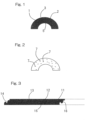
- Fig. 3 is a schematic front view for explaining a concrete tile having an F shape.
- This concrete tile has: a substantially rectangular tile body 12 having a cut end face 11 in at least one side; an overlapped portion 14 formed on an upper face 13 of the tile body 12; and an overlapping portion 16 formed on a lower face 15 of the tile body 12.
- the cut end face 11 formed during the manufacturing process of the concrete tile has a rough-surface shape caused by the cutting.
- the overlapped portion 14 has a groove for engaging with the overlapping portion 16, and surface shape of the overlapping portion 16 is reversal to the surface shape of the grooved overlapped portion 14.
- an adjacent tile is indicated by dotted lines.
- the overlapped portion 14 may be overlapped with the overlapping portion 16 of the adjacent tile substantially without any gap therebetween.
- "overlapping state substantially without any gap therebetween” means a state where the overlapped portion and the overlapping portion are engaged with each other without a gap of 10 mm or greater therebetween. Details of an evaluation method are described in the below described Examples.
- the concrete tile of the first constitution of the present invention is preferably excellent in strength, and preferably passes the EN490 standard in a tile bending test performed in accordance with EN491:2011.
- "pass a tile bending test” means that, in the case of a plate tile, tile strength is not less than 1200 N (preferably not less than 1500 N, and more preferably not less than 1800 N) in a load test performed in accordance with EN491:2011.
- the upper limit in the tile bending test is not particularly limited, but is about 4000 N in many cases.
- the numerical values obtained in the tile bending test indicate the values measured according to the method described in below described Example.
- the concrete tile is excellent in strength, and thus, can be thinned.
- the thickness of the thinnest part in the tile body may be about 8 to 100 mm, preferably about 10 to 95 mm, and more preferably about 15 to 90 mm.
- the specific gravity of the concrete tile of the present invention may be about 1.5 to 2.2, preferably about 1.6 to 2.1, and more preferably about 1.7 to 2.0. It should be noted that the specific gravity represents a comparative weight of a material of 1 cubic centimeter in volume shown by a ratio to the weight of water of 1 cubic centimeter in volume at 4°C where the weight of 1 cubic centimeter of water at 4°C is defined as "1".
- the concrete tile is excellent in tenacity, and preferably is not substantially split-broken in a falling ball test performed in reference to JIS A 1408.
- the expression “is not substantially split-broken” means that the tile is not completely broken and does not split into two or more large pieces (where a volume of at least one piece is 20% to 80% of the volume of the entire tile before the breakage). That is, surface fracture due to cracking and loss of small pieces caused by surface chipping are not considered as a state where the tile is split-broken substantially.
- a concrete tile can be manufactured from a predetermined molding material by using a roller/slipper system.
- the manufacturing method includes at least:
- the projections/recesses may constitute a tile shape, shapes of coupled (coupling) portion, shapes of non-coupled portion, and pattern on the tile surface or the like.
- the conveyor C moves toward the downstream side from the hopper at the upstream side.
- the molding material M is extruded, and filled and compressed in the pallet P while being made flat by the roller R and the slipper S.
- the molding material in the hopper H is filled into the pallet P due to the weight of the molding material itself, rotation in the arrow direction of the roller R, and the like, and the molding material M extruded into the pallet P is made flat by the roller R and the slipper S, whereby a tile upper surface is formed.
- the conveyor may be moved by use of various kinds of drivers that are used in the technical field.
- the conveyor may be movable by drivers such as a motor or the like.
- moving mechanism of the pallets is not particularly limited. It is possible to use a device other than the above-explained moving device to move the pallet.
- a molding material for manufacturing a concrete tile according to another constitution of the present invention includes at least a cement, an aggregate, an alkali-resistant fiber, and water, and the water cement ratio (W/C) may be, in percentage by mass, about 20 to 50%, preferably may be 20 to 45% (for example, 35 to 45%), and more preferably 20 to 40% (for example, 35 to 40%).
- W/C water cement ratio
- the alkali-resistant fiber is not substantially present as a fiber-containing granular body in the molding material.
- a fiber-containing granular body formed of the alkali-resistant fiber in the molding material can be confirmed by the fact that a fiber-containing granular body having a circle equivalent diameter of not less than 3 mm (preferably not less than 5 mm, and in particular, not less than 10 mm) cannot be observed at a cut face formed by cutting the tile at a randomly selected position. Details of an evaluation method are described in below-described Examples.
- the proportion of the alkali-resistant fiber relative to the solid content in the molding material may be about 0.1 to 2 % by mass, preferably about 0.3 to 1.8 % by mass, and more preferably about 0.5 to 1.6 % by mass, so as to suppress formation of fiber-containing granular bodies.
- the alkali-resistant fibers used in the present invention may be at least one alkali-resistant organic fibers selected from the group consisting of polyvinyl alcohol (hereinafter also referred as PVA) fibers, polyolefin-based fibers (polyethylene fibers, polypropylene fibers, and the like), ultra high molecular weight polyethylene fibers, polyamide fibers (polyamide 6, polyamide 6,6, polyamide 6,10, and the like), aramid fibers (in particular, para-aramid fibers), and acrylic fibers.
- PVA polyvinyl alcohol
- polyolefin-based fibers polyethylene fibers, polypropylene fibers, and the like
- ultra high molecular weight polyethylene fibers polyamide fibers (polyamide 6, polyamide 6,6, polyamide 6,10, and the like), aramid fibers (in particular, para-aramid fibers), and acrylic fibers.
- PVA polyvinyl alcohol
- polyolefin-based fibers polyethylene fibers, polypropylene fibers
- PVA fibers are useful for manufacturing the above-described concrete tile.
- PVA fibers are particularly preferable because of the following reasons.
- PVA fibers can be advantageously used because of the concrete reinforcing property and low production cost.
- PVA fibers have excellent adhessibility to cement.
- the alkali-resistant fibers have aspect ratios of 100 to 800 so as to suppress formation of fiber-containing granular bodies and to provide a predetermined strength to the tile.
- the aspect ratio denotes a ratio of fiber length (L) to fiber diameter (D).
- the strength of the tile as a whole can be enhanced as the fiber has high strength.
- the fiber strength may be not less than 8 cN/dtex, preferably not less than 9 cN/dtex, and more preferably not less than 10 cN/dtex.
- the upper limit of the fiber strength is not particularly limited, and can be set to an appropriate value depending on the selection of fiber.
- the upper limit of the fiber strength may be about 30DcN/dtex.
- the fiber strength denotes a value measured according to the method described in the below-described Examples.
- the alkali-resistant fibers to be admixed into the molding material have an average diameter of about 5 to 100 ⁇ m.
- Such a fiber can be selected arbitrarily and used by a skilled person in the art as long as the formation of fiber-containing granular bodies in the molding material is suppressed.
- the fiber is used as short cut fibers formed by cutting a fiber bundle.
- the short cut fibers easily form fiber-agglomerates during the step of cutting the fiber, the step of compressing the fiber into a fiber bale, and the like.
- the fiber bale may be preliminarily roughly disentangled by using a bale opener or the like, fiber-agglomerates tend to remain in many cases.
- Examples of the cement include: portland cements such as ordinary portland cements, high early strength portland cements, ultra-high early strength portland cements, and moderate heat portland cements; aluminous cements; blast furnace cements; silica cements; and fly ash cements. It is possible to use single type cement selected from these examples or two or more types in combination.
- portland cements such as ordinary portland cements, high early strength portland cements, ultra-high early strength portland cements, and moderate heat portland cements
- aluminous cements blast furnace cements
- silica cements silica cements
- fly ash cements It is possible to use single type cement selected from these examples or two or more types in combination.
- Fine aggregates used in manufacture of the concrete tile may be aggregates having a particle size of not greater than 5 mm.
- the fine aggregates may include: sands having a particle size of not greater than 5 mm; fine aggregates formed by powdering or granulating inorganic materials such as silica stone, fly ash, blast furnace slag, volcanic ash-based shirasu, various kinds of sludge, rocks or minerals; and the like. It is possible to use single type aggregate selected from these examples or two or more types in combination.
- sands examples include river sand, mountain sand, sea sand, crushed sand, silica sand, slag, glass sand, iron sand, ash sand, calcium carbonate, artificial sand, and the like.
- the molding material may be blended with a natural light-weight aggregate such as volcanic gravel, expanded slag, or cinder; or an artificial light-weight aggregate such as expanded pearlstone, expanded perlite, expanded obsidian, vermiculite, or shirasu balloon. Since the concrete tile of the present invention can maintain strength even where the tile has a small thickness, it is possible to reduce the amount of the light-weight aggregate that is easily crushed during the manufacturing step, and to reduce the weight of the concrete tile of the present invention at the same time. Therefore, the proportion of the amount of the light-weight aggregate in the amount of the aggregate is reduced to not greater than 10%, and preferably not greater than 5%.
- a natural light-weight aggregate such as volcanic gravel, expanded slag, or cinder
- an artificial light-weight aggregate such as expanded pearlstone, expanded perlite, expanded obsidian, vermiculite, or shirasu balloon. Since the concrete tile of the present invention can maintain strength even where the tile has a small thickness, it is possible to reduce the amount of the light-
- a functional aggregate may be added.
- the functional aggregate include colored aggregates, hard aggregates, elastic aggregates, and aggregates having specific shapes, and the functional aggregate may be a phyllosilicate (for example, mica, talc, kaolin), alumina, silica, or the like.
- the proportion of the functional aggregate relative to the fine aggregate can be set at an appropriate value depending on the selected material.
- phyllosilicate is preferably added.
- the flake diameter of the phyllosilicate may be, for example, about 10 to 800 ⁇ m, and preferably about 20 to 700 ⁇ m.
- mica is a kind of phyllosilicate and is mainly composed of SiO 2 , Al 2 O 3 , K 2 O, and crystal water.
- examples of preferable mica include muscovite, phlogopite, and the like.
- the weight average flake diameter of the phyllosilicate may be, for example, about 50 to 800 ⁇ m, and preferably 100 to 700 ⁇ m.
- the weight average flake diameter indicates a value obtained by sieving the phyllosilicates using standard sieves of different mesh sizes, plotting the result of sieving on a Rosin-Rammlar chart, thereby determining a mesh size through which 50% by weight of the phyllosilicate subjected to the measurement passes, and multiply the determined mesh size by square root (that is, the length of diagonal of square mesh).
- the proportion of the functional aggregate (in particular, phyllosilicate) relative to the alkali-resistant fiber can be set at an appropriate value depending on the selected species.
- the cement and the aggregate are mixed during the mixing.
- the cement and the aggregate may be mixed in a dry process, and subsequently, the dry mixture may be kneaded with water added afterwards.
- Comparative Example 1 since no fiber is included, satisfactory result was not obtained in any of cut piece flexural strength test, tile bending test, and the falling ball test.
- the concrete tile of the present invention can be usefully used as various types of roof materials, and also can be used as a wall tile, a floor tile, or the like.
Landscapes
- Engineering & Computer Science (AREA)
- Chemical & Material Sciences (AREA)
- Ceramic Engineering (AREA)
- Structural Engineering (AREA)
- Mechanical Engineering (AREA)
- Manufacturing & Machinery (AREA)
- Architecture (AREA)
- Civil Engineering (AREA)
- Chemical Kinetics & Catalysis (AREA)
- Materials Engineering (AREA)
- Organic Chemistry (AREA)
- Inorganic Chemistry (AREA)
- Curing Cements, Concrete, And Artificial Stone (AREA)
- Press-Shaping Or Shaping Using Conveyers (AREA)
- Finishing Walls (AREA)
Claims (12)
- Betonformstein mit einem Formsteinkörper (2),wobei der Formsteinkörper eine durch formfreie Formgebung gehärtete Oberseite (3), eine durch formgebundene Formgebung gehärtete Unterseite (5) und eine Seitenfläche hat, die eine geschnittene Stirnfläche (1) in mindestens einer Seite des Formsteinkörpers aufweist,wobei der Formsteinkörper laugenbeständige Fasern (7) in einer gesamten Dicke davon in einem Zustand enthält, der im Wesentlichen frei von faserhaltigen granularen Körpern ist;wobei die laugenbeständigen Fasern mindestens eine Komponente aufweisen, die aus der Gruppe ausgewählt ist, die aus Fasern auf Polyvinylalkoholbasis, Polyethylenfasern, Polypropylenfasern, Acrylfasern und Aramidfasern besteht, wobei ein mittlerer Durchmesser der laugenbeständigen Fasern 5 bis 100 µm beträgt und ein Aspektverhältnis jeder der laugenbeständigen Fasern 100 bis 800 beträgt;wobei der Formsteinkörper aus einer Formmasse hergestellt ist, in der die laugenbeständigen Fasern in einer Menge von 0,1 bis 2 Masse-% relativ zum Feststoffgehalt der Formmasse vorhanden sind; unddie Formmasse ferner einen Zuschlagstoff aufweist und der Zuschlagstoff einen Leichtzuschlagstoff in einem Anteil von höchstens 10 % bezogen auf eine Menge des Zuschlagstoffs aufweist.
- Betonformstein nach Anspruch 1, wobei
eine Oberfläche des Formsteinkörpers im Wesentlichen frei von Vorsprüngen ist, die durch Vorhandensein der faserhaltigen granularen Körper verursacht werden. - Betonformstein nach Anspruch 1 oder 2, wobei eine relative Dichte des Formsteinkörpers 1,5 bis 2,2 beträgt.
- Betonformstein nach einem der Ansprüche 1 bis 3, wobei ein Anteil der laugenbeständigen Fasern relativ zum Feststoffgehalt in der Formmasse 0,3 bis 1,8 Masse-%, vorzugsweise 0,5 bis 1,6 Masse-% beträgt.
- Betonformstein nach einem der Ansprüche 1 bis 4, wobei die laugenbeständigen Fasern Polyvinylalkoholfasern sind.
- Betonformstein nach einem der Ansprüche 1 bis 5, der die Norm EN490 in einem Formstein-Biegeversuch erfüllt, der in Übereinstimmung mit EN491:2011 durchgeführt wird.
- Betonformstein nach einem der Ansprüche 1 bis 6, wobei der Formsteinkörper in einem nach JIS A 1408 durchgeführten Kugelfallversuch im Wesentlichen nicht durch Zerspalten bricht.
- Betonformstein-Formmasse zur Herstellung des Betonformsteins nach einem der Ansprüche 1 bis 7,wobei die Formmasse mindestens einen Zement, einen Zuschlagstoff, laugenbeständige Fasern und Wasser aufweist, wobei der Zuschlagstoff einen Leichtzuschlagstoff in einem Anteil von höchstens 10 % bezogen auf eine Menge des Zuschlagstoffs aufweist,wobei ein Wasser-Zement-Verhältnis (W/Z) 20 bis 50 Masse-% beträgt,die laugenbeständigen Fasern mindestens eine Komponente aufweisen, die aus der Gruppe ausgewählt ist, die aus Fasern auf Polyvinylalkoholbasis, Polyethylenfasern, Polypropylenfasern, Acrylfasern und Aramidfasern besteht, wobei ein mittlerer Durchmesser der laugenbeständigen Fasern 5 bis 100 µm beträgt und ein Aspektverhältnis jeder der laugenbeständigen Fasern 100 bis 800 beträgt,ein Anteil der laugenbeständigen Fasern in einem Feststoffgehalt 0,1 bis 2 Masse-% beträgt unddie laugenbeständigen Fasern im Wesentlichen nicht als faserhaltige granulare Körper in der Betonformstein-Formmasse vorliegen.
- Betonformstein-Formmasse nach Anspruch 8, wobei ein Anteil der laugenbeständigen Fasern relativ zum Feststoffgehalt in der Formmasse 0,3 bis 1,8 Masse-%, vorzugsweise 0,5 bis 1,6 Masse-% beträgt.
- Betonformstein-Formmasse nach Anspruch 8 oder 9, wobei die laugenbeständigen Fasern in einem Trockenvorgang entwirrt sind.
- Betonformstein-Formmasse nach einem der Ansprüche 8 bis 10, die ferner einen Funktionszuschlagstoff aufweist.
- Verfahren zur Herstellung eines Betonformsteins durch ein Walzen/Gleitstück-Verfahren, wobei das Verfahren mindestens aufweist:einen Schritt des Zuführens der Formmasse nach einem der Ansprüche 8 bis 11 zu einem Trichter eines Extruders vom Walzen/Gleitstück-Typ;einen Schritt des Einfüllens der aus einem unteren Abschnitt des Trichters zugeführten Formmasse in mehrere aneinandergrenzende Paletten;einen Schritt des Verdichtens der eingefüllten Formmasse mit Hilfe einer Walze und eines Gleitstücks, um einen bandförmigen Körper zu bilden, der auf den aneinandergrenzenden Paletten kontinuierlich platziert wird; undeinen Schritt des Schneidens des bandförmigen Körpers mit einem Schneidmesser, um einzelne Rohformsteine auf einzelnen Paletten zu bilden,wobeider Schritt des Zuführens der Formmasse einen Vorbereitungsvorgang der Formmasse aufweist undder Vorbereitungsvorgang mindestens einen Schritt des Dispergierens der laugenbeständigen Fasern in einer Mischung mit einem Zement, einem Zuschlagstoff und Wasser aufweist, während wesentliches Auftreten der laugenbeständigen Fasern als faserhaltiger granularer Körper vermieden wird.
Applications Claiming Priority (2)
| Application Number | Priority Date | Filing Date | Title |
|---|---|---|---|
| JP2013230576 | 2013-11-06 | ||
| PCT/JP2014/079179 WO2015068679A1 (ja) | 2013-11-06 | 2014-11-04 | コンクリート瓦およびその成形材料 |
Publications (3)
| Publication Number | Publication Date |
|---|---|
| EP3067178A1 EP3067178A1 (de) | 2016-09-14 |
| EP3067178A4 EP3067178A4 (de) | 2017-08-09 |
| EP3067178B1 true EP3067178B1 (de) | 2025-03-26 |
Family
ID=53041456
Family Applications (1)
| Application Number | Title | Priority Date | Filing Date |
|---|---|---|---|
| EP14860813.6A Active EP3067178B1 (de) | 2013-11-06 | 2014-11-04 | Betonfliese und formmasse dafür |
Country Status (8)
| Country | Link |
|---|---|
| US (1) | US10851545B2 (de) |
| EP (1) | EP3067178B1 (de) |
| JP (1) | JP6491603B2 (de) |
| AU (2) | AU2014344915B2 (de) |
| BR (1) | BR112016009843B1 (de) |
| ES (1) | ES3023532T3 (de) |
| MX (1) | MX378602B (de) |
| WO (1) | WO2015068679A1 (de) |
Families Citing this family (2)
| Publication number | Priority date | Publication date | Assignee | Title |
|---|---|---|---|---|
| DE102015113328A1 (de) * | 2015-08-12 | 2017-02-16 | Monier Roofing Gmbh | Verfahren zur Herstellung eines Dachsteins mit einer Wassersperre und Dachstein mit angeformter Wassersperre |
| US20230286860A1 (en) * | 2022-03-08 | 2023-09-14 | The Board Of Trustees Of The University Of Alabama | Treatment of reinforcements to improve the interface transition zone in concretes |
Family Cites Families (11)
| Publication number | Priority date | Publication date | Assignee | Title |
|---|---|---|---|---|
| GB8421605D0 (en) | 1984-08-24 | 1984-09-26 | Marley Roof Tile | Lightweight concrete roof tiles |
| EP0173553B1 (de) | 1984-08-24 | 1990-04-25 | Marley Tile AG | Leichtbetondachziegel |
| CA1300918C (en) | 1987-06-12 | 1992-05-19 | Masataka Kamitani | Cement tile reinforced with fibers and a method for the production of the same |
| JPH01242446A (ja) * | 1988-03-24 | 1989-09-27 | Sekisui Chem Co Ltd | ビニロン繊維補強セメント瓦 |
| GB8813894D0 (en) * | 1988-06-11 | 1988-07-13 | Redland Roof Tiles Ltd | Process for production of concrete building products |
| JPH04179502A (ja) | 1990-11-15 | 1992-06-26 | Asahi Chem Ind Co Ltd | 軽量コンクリート平板瓦及びその製造方法 |
| JP2736205B2 (ja) * | 1992-05-19 | 1998-04-02 | 株式会社クボタ | セメント瓦の製造装置 |
| JPH05318434A (ja) * | 1992-05-26 | 1993-12-03 | Kubota Corp | セメント瓦の製造方法 |
| GB2302839B (en) * | 1995-07-05 | 1997-09-10 | Redland Technology Ltd | Improvements in the manufacture of roof tiles |
| JP2002361620A (ja) * | 2001-06-07 | 2002-12-18 | Kubota Corp | 屋根瓦の製造方法 |
| JP6445400B2 (ja) | 2015-06-24 | 2018-12-26 | 株式会社クラレ | モルタルコンクリート補強用ポリビニルアルコール繊維、およびそれを含むモルタルコンクリート |
-
2014
- 2014-11-04 EP EP14860813.6A patent/EP3067178B1/de active Active
- 2014-11-04 AU AU2014344915A patent/AU2014344915B2/en active Active
- 2014-11-04 ES ES14860813T patent/ES3023532T3/es active Active
- 2014-11-04 BR BR112016009843-9A patent/BR112016009843B1/pt not_active IP Right Cessation
- 2014-11-04 JP JP2015546638A patent/JP6491603B2/ja active Active
- 2014-11-04 WO PCT/JP2014/079179 patent/WO2015068679A1/ja not_active Ceased
- 2014-11-04 MX MX2016005701A patent/MX378602B/es unknown
-
2016
- 2016-04-28 US US15/141,232 patent/US10851545B2/en active Active
-
2018
- 2018-06-21 AU AU2018204490A patent/AU2018204490B2/en active Active
Also Published As
| Publication number | Publication date |
|---|---|
| BR112016009843A2 (de) | 2017-08-01 |
| EP3067178A1 (de) | 2016-09-14 |
| AU2014344915B2 (en) | 2018-03-22 |
| JPWO2015068679A1 (ja) | 2017-03-09 |
| EP3067178A4 (de) | 2017-08-09 |
| AU2014344915A1 (en) | 2016-05-19 |
| US20160237686A1 (en) | 2016-08-18 |
| ES3023532T3 (en) | 2025-06-02 |
| AU2018204490B2 (en) | 2018-12-06 |
| WO2015068679A1 (ja) | 2015-05-14 |
| MX378602B (es) | 2025-03-11 |
| MX2016005701A (es) | 2016-08-12 |
| AU2018204490A1 (en) | 2018-07-12 |
| US10851545B2 (en) | 2020-12-01 |
| BR112016009843B1 (pt) | 2022-09-13 |
| JP6491603B2 (ja) | 2019-03-27 |
Similar Documents
| Publication | Publication Date | Title |
|---|---|---|
| Silva et al. | Strength improvement of mortar composites reinforced with newly hybrid-blended fibres: Influence of fibres geometry and morphology | |
| Arroyo et al. | Lightweight structural eco-mortars made with polyurethane wastes and non-Ionic surfactants | |
| EP3129201B1 (de) | Verfahren zur herstellung von mauerwerkverbundstoffmaterialien | |
| AU2018204490B2 (en) | Concrete tile and molding material for same | |
| Kuqo et al. | Use of dry mixing-spraying process for the production of geopolymer-bonded wood and seagrass fibreboards | |
| JP2020112021A (ja) | 繊維含有瓦、ならびに繊維含有瓦を製造するための成形材料およびその製造方法 | |
| CN104529334A (zh) | 废弃烧结砖再生c35合成纤维混凝土及其制备方法 | |
| PL234158B1 (pl) | Kompozytowy materiał włóknisto-cementowy z dodatkiem pyłu keramzytowego i jego zastosowanie | |
| EP4168611B1 (de) | Polymerfasern für die betonverstärkung | |
| EP2723543B1 (de) | Verfahren zur in hoher produktionsfrequenz erfolgenden herstellung dünner zementplatten von hoher festigkeit und langer lebensdauer | |
| JP2000044301A (ja) | 人工軽量骨材の製造方法およびこの方法により得られた人工軽量骨材 | |
| US8435342B2 (en) | Concrete composition | |
| Shlla | Effect of Aspect Ratio of Recycled Plastic Strips on Mechanical Behavior of Concrete at Different Ages. | |
| Zhu et al. | Research on the mix proportion design and mechanical properties of C60 hybrid fiber‐reinforced high‐strength concrete | |
| HK40079955A (en) | Polymer fibers for concrete reinforcement | |
| JP2514460B2 (ja) | 無機質製品の押出成形方法 | |
| JPH02243549A (ja) | 石こう成形板の製造方法 | |
| Hasanzadeh et al. | Experimental Investigation on Mechanical Properties of WGP-Metakaolin Cement Mortars | |
| JP2006213564A (ja) | 繊維補強水硬性硬化体組成物からなる締結用部材 |
Legal Events
| Date | Code | Title | Description |
|---|---|---|---|
| PUAI | Public reference made under article 153(3) epc to a published international application that has entered the european phase |
Free format text: ORIGINAL CODE: 0009012 |
|
| 17P | Request for examination filed |
Effective date: 20160528 |
|
| AK | Designated contracting states |
Kind code of ref document: A1 Designated state(s): AL AT BE BG CH CY CZ DE DK EE ES FI FR GB GR HR HU IE IS IT LI LT LU LV MC MK MT NL NO PL PT RO RS SE SI SK SM TR |
|
| AX | Request for extension of the european patent |
Extension state: BA ME |
|
| DAX | Request for extension of the european patent (deleted) | ||
| A4 | Supplementary search report drawn up and despatched |
Effective date: 20170707 |
|
| RIC1 | Information provided on ipc code assigned before grant |
Ipc: E04D 1/04 20060101ALI20170704BHEP Ipc: B28B 1/52 20060101ALI20170704BHEP Ipc: C04B 16/06 20060101AFI20170704BHEP Ipc: C04B 28/02 20060101ALI20170704BHEP Ipc: B28B 5/02 20060101ALI20170704BHEP |
|
| STAA | Information on the status of an ep patent application or granted ep patent |
Free format text: STATUS: EXAMINATION IS IN PROGRESS |
|
| 17Q | First examination report despatched |
Effective date: 20210325 |
|
| P01 | Opt-out of the competence of the unified patent court (upc) registered |
Effective date: 20230512 |
|
| REG | Reference to a national code |
Ref country code: DE Ref legal event code: R079 Free format text: PREVIOUS MAIN CLASS: C04B0016060000 Ipc: B28B0001520000 Ref country code: DE Ref legal event code: R079 Ref document number: 602014091730 Country of ref document: DE Free format text: PREVIOUS MAIN CLASS: C04B0016060000 Ipc: B28B0001520000 |
|
| GRAP | Despatch of communication of intention to grant a patent |
Free format text: ORIGINAL CODE: EPIDOSNIGR1 |
|
| STAA | Information on the status of an ep patent application or granted ep patent |
Free format text: STATUS: GRANT OF PATENT IS INTENDED |
|
| RIC1 | Information provided on ipc code assigned before grant |
Ipc: E04D 1/16 20060101ALI20241014BHEP Ipc: E04D 1/04 20060101ALI20241014BHEP Ipc: C04B 28/02 20060101ALI20241014BHEP Ipc: B28B 5/02 20060101ALI20241014BHEP Ipc: B28B 3/12 20060101ALI20241014BHEP Ipc: B28B 1/52 20060101AFI20241014BHEP |
|
| INTG | Intention to grant announced |
Effective date: 20241105 |
|
| GRAS | Grant fee paid |
Free format text: ORIGINAL CODE: EPIDOSNIGR3 |
|
| GRAA | (expected) grant |
Free format text: ORIGINAL CODE: 0009210 |
|
| STAA | Information on the status of an ep patent application or granted ep patent |
Free format text: STATUS: THE PATENT HAS BEEN GRANTED |
|
| AK | Designated contracting states |
Kind code of ref document: B1 Designated state(s): AL AT BE BG CH CY CZ DE DK EE ES FI FR GB GR HR HU IE IS IT LI LT LU LV MC MK MT NL NO PL PT RO RS SE SI SK SM TR |
|
| REG | Reference to a national code |
Ref country code: GB Ref legal event code: FG4D |
|
| REG | Reference to a national code |
Ref country code: CH Ref legal event code: EP |
|
| REG | Reference to a national code |
Ref country code: DE Ref legal event code: R096 Ref document number: 602014091730 Country of ref document: DE |
|
| REG | Reference to a national code |
Ref country code: IE Ref legal event code: FG4D |
|
| REG | Reference to a national code |
Ref country code: ES Ref legal event code: FG2A Ref document number: 3023532 Country of ref document: ES Kind code of ref document: T3 Effective date: 20250602 |
|
| PG25 | Lapsed in a contracting state [announced via postgrant information from national office to epo] |
Ref country code: RS Free format text: LAPSE BECAUSE OF FAILURE TO SUBMIT A TRANSLATION OF THE DESCRIPTION OR TO PAY THE FEE WITHIN THE PRESCRIBED TIME-LIMIT Effective date: 20250626 |
|
| PG25 | Lapsed in a contracting state [announced via postgrant information from national office to epo] |
Ref country code: FI Free format text: LAPSE BECAUSE OF FAILURE TO SUBMIT A TRANSLATION OF THE DESCRIPTION OR TO PAY THE FEE WITHIN THE PRESCRIBED TIME-LIMIT Effective date: 20250326 |
|
| REG | Reference to a national code |
Ref country code: LT Ref legal event code: MG9D |
|
| PG25 | Lapsed in a contracting state [announced via postgrant information from national office to epo] |
Ref country code: NO Free format text: LAPSE BECAUSE OF FAILURE TO SUBMIT A TRANSLATION OF THE DESCRIPTION OR TO PAY THE FEE WITHIN THE PRESCRIBED TIME-LIMIT Effective date: 20250626 |
|
| PG25 | Lapsed in a contracting state [announced via postgrant information from national office to epo] |
Ref country code: HR Free format text: LAPSE BECAUSE OF FAILURE TO SUBMIT A TRANSLATION OF THE DESCRIPTION OR TO PAY THE FEE WITHIN THE PRESCRIBED TIME-LIMIT Effective date: 20250326 |
|
| PG25 | Lapsed in a contracting state [announced via postgrant information from national office to epo] |
Ref country code: LV Free format text: LAPSE BECAUSE OF FAILURE TO SUBMIT A TRANSLATION OF THE DESCRIPTION OR TO PAY THE FEE WITHIN THE PRESCRIBED TIME-LIMIT Effective date: 20250326 |
|
| PG25 | Lapsed in a contracting state [announced via postgrant information from national office to epo] |
Ref country code: GR Free format text: LAPSE BECAUSE OF FAILURE TO SUBMIT A TRANSLATION OF THE DESCRIPTION OR TO PAY THE FEE WITHIN THE PRESCRIBED TIME-LIMIT Effective date: 20250627 Ref country code: BG Free format text: LAPSE BECAUSE OF FAILURE TO SUBMIT A TRANSLATION OF THE DESCRIPTION OR TO PAY THE FEE WITHIN THE PRESCRIBED TIME-LIMIT Effective date: 20250326 |
|
| REG | Reference to a national code |
Ref country code: NL Ref legal event code: MP Effective date: 20250326 |
|
| PG25 | Lapsed in a contracting state [announced via postgrant information from national office to epo] |
Ref country code: NL Free format text: LAPSE BECAUSE OF FAILURE TO SUBMIT A TRANSLATION OF THE DESCRIPTION OR TO PAY THE FEE WITHIN THE PRESCRIBED TIME-LIMIT Effective date: 20250326 |
|
| PG25 | Lapsed in a contracting state [announced via postgrant information from national office to epo] |
Ref country code: SE Free format text: LAPSE BECAUSE OF FAILURE TO SUBMIT A TRANSLATION OF THE DESCRIPTION OR TO PAY THE FEE WITHIN THE PRESCRIBED TIME-LIMIT Effective date: 20250326 |
|
| REG | Reference to a national code |
Ref country code: AT Ref legal event code: MK05 Ref document number: 1778614 Country of ref document: AT Kind code of ref document: T Effective date: 20250326 |
|
| PG25 | Lapsed in a contracting state [announced via postgrant information from national office to epo] |
Ref country code: SM Free format text: LAPSE BECAUSE OF FAILURE TO SUBMIT A TRANSLATION OF THE DESCRIPTION OR TO PAY THE FEE WITHIN THE PRESCRIBED TIME-LIMIT Effective date: 20250326 |
|
| PG25 | Lapsed in a contracting state [announced via postgrant information from national office to epo] |
Ref country code: PT Free format text: LAPSE BECAUSE OF FAILURE TO SUBMIT A TRANSLATION OF THE DESCRIPTION OR TO PAY THE FEE WITHIN THE PRESCRIBED TIME-LIMIT Effective date: 20250728 |
|
| PG25 | Lapsed in a contracting state [announced via postgrant information from national office to epo] |
Ref country code: PL Free format text: LAPSE BECAUSE OF FAILURE TO SUBMIT A TRANSLATION OF THE DESCRIPTION OR TO PAY THE FEE WITHIN THE PRESCRIBED TIME-LIMIT Effective date: 20250326 |
|
| PG25 | Lapsed in a contracting state [announced via postgrant information from national office to epo] |
Ref country code: AT Free format text: LAPSE BECAUSE OF FAILURE TO SUBMIT A TRANSLATION OF THE DESCRIPTION OR TO PAY THE FEE WITHIN THE PRESCRIBED TIME-LIMIT Effective date: 20250326 |
|
| PGFP | Annual fee paid to national office [announced via postgrant information from national office to epo] |
Ref country code: FR Payment date: 20250930 Year of fee payment: 12 |
|
| PG25 | Lapsed in a contracting state [announced via postgrant information from national office to epo] |
Ref country code: EE Free format text: LAPSE BECAUSE OF FAILURE TO SUBMIT A TRANSLATION OF THE DESCRIPTION OR TO PAY THE FEE WITHIN THE PRESCRIBED TIME-LIMIT Effective date: 20250326 |
|
| PG25 | Lapsed in a contracting state [announced via postgrant information from national office to epo] |
Ref country code: RO Free format text: LAPSE BECAUSE OF FAILURE TO SUBMIT A TRANSLATION OF THE DESCRIPTION OR TO PAY THE FEE WITHIN THE PRESCRIBED TIME-LIMIT Effective date: 20250326 |
|
| PG25 | Lapsed in a contracting state [announced via postgrant information from national office to epo] |
Ref country code: SK Free format text: LAPSE BECAUSE OF FAILURE TO SUBMIT A TRANSLATION OF THE DESCRIPTION OR TO PAY THE FEE WITHIN THE PRESCRIBED TIME-LIMIT Effective date: 20250326 |
|
| PG25 | Lapsed in a contracting state [announced via postgrant information from national office to epo] |
Ref country code: IS Free format text: LAPSE BECAUSE OF FAILURE TO SUBMIT A TRANSLATION OF THE DESCRIPTION OR TO PAY THE FEE WITHIN THE PRESCRIBED TIME-LIMIT Effective date: 20250726 |
|
| PGFP | Annual fee paid to national office [announced via postgrant information from national office to epo] |
Ref country code: DE Payment date: 20250930 Year of fee payment: 12 |
|
| PGFP | Annual fee paid to national office [announced via postgrant information from national office to epo] |
Ref country code: GB Payment date: 20251001 Year of fee payment: 12 |
|
| PG25 | Lapsed in a contracting state [announced via postgrant information from national office to epo] |
Ref country code: DK Free format text: LAPSE BECAUSE OF FAILURE TO SUBMIT A TRANSLATION OF THE DESCRIPTION OR TO PAY THE FEE WITHIN THE PRESCRIBED TIME-LIMIT Effective date: 20250326 |
|
| PGFP | Annual fee paid to national office [announced via postgrant information from national office to epo] |
Ref country code: IT Payment date: 20251022 Year of fee payment: 12 |
|
| PG25 | Lapsed in a contracting state [announced via postgrant information from national office to epo] |
Ref country code: CZ Free format text: LAPSE BECAUSE OF FAILURE TO SUBMIT A TRANSLATION OF THE DESCRIPTION OR TO PAY THE FEE WITHIN THE PRESCRIBED TIME-LIMIT Effective date: 20250326 |
|
| PGFP | Annual fee paid to national office [announced via postgrant information from national office to epo] |
Ref country code: ES Payment date: 20251212 Year of fee payment: 12 |
|
| PLBE | No opposition filed within time limit |
Free format text: ORIGINAL CODE: 0009261 |
|
| STAA | Information on the status of an ep patent application or granted ep patent |
Free format text: STATUS: NO OPPOSITION FILED WITHIN TIME LIMIT |
|
| REG | Reference to a national code |
Ref country code: CH Ref legal event code: L10 Free format text: ST27 STATUS EVENT CODE: U-0-0-L10-L00 (AS PROVIDED BY THE NATIONAL OFFICE) Effective date: 20260211 |