EP3063318B1 - Sheets and fibrids comprising a mixture of poly(m-phenylene isophthalamide) and copolymer made from (6)-amino-2-(p-aminophenyl)benzimidazole - Google Patents
Sheets and fibrids comprising a mixture of poly(m-phenylene isophthalamide) and copolymer made from (6)-amino-2-(p-aminophenyl)benzimidazole Download PDFInfo
- Publication number
- EP3063318B1 EP3063318B1 EP14796975.2A EP14796975A EP3063318B1 EP 3063318 B1 EP3063318 B1 EP 3063318B1 EP 14796975 A EP14796975 A EP 14796975A EP 3063318 B1 EP3063318 B1 EP 3063318B1
- Authority
- EP
- European Patent Office
- Prior art keywords
- polymer
- fibrids
- mixture
- mpd
- solution
- Prior art date
- Legal status (The legal status is an assumption and is not a legal conclusion. Google has not performed a legal analysis and makes no representation as to the accuracy of the status listed.)
- Active
Links
Images
Classifications
-
- D—TEXTILES; PAPER
- D21—PAPER-MAKING; PRODUCTION OF CELLULOSE
- D21H—PULP COMPOSITIONS; PREPARATION THEREOF NOT COVERED BY SUBCLASSES D21C OR D21D; IMPREGNATING OR COATING OF PAPER; TREATMENT OF FINISHED PAPER NOT COVERED BY CLASS B31 OR SUBCLASS D21G; PAPER NOT OTHERWISE PROVIDED FOR
- D21H21/00—Non-fibrous material added to the pulp, characterised by its function, form or properties; Paper-impregnating or coating material, characterised by its function, form or properties
- D21H21/14—Non-fibrous material added to the pulp, characterised by its function, form or properties; Paper-impregnating or coating material, characterised by its function, form or properties characterised by function or properties in or on the paper
- D21H21/18—Reinforcing agents
- D21H21/20—Wet strength agents
-
- D—TEXTILES; PAPER
- D01—NATURAL OR MAN-MADE THREADS OR FIBRES; SPINNING
- D01D—MECHANICAL METHODS OR APPARATUS IN THE MANUFACTURE OF ARTIFICIAL FILAMENTS, THREADS, FIBRES, BRISTLES OR RIBBONS
- D01D5/00—Formation of filaments, threads, or the like
- D01D5/40—Formation of filaments, threads, or the like by applying a shearing force to a dispersion or solution of filament formable polymers, e.g. by stirring
-
- C—CHEMISTRY; METALLURGY
- C08—ORGANIC MACROMOLECULAR COMPOUNDS; THEIR PREPARATION OR CHEMICAL WORKING-UP; COMPOSITIONS BASED THEREON
- C08G—MACROMOLECULAR COMPOUNDS OBTAINED OTHERWISE THAN BY REACTIONS ONLY INVOLVING UNSATURATED CARBON-TO-CARBON BONDS
- C08G69/00—Macromolecular compounds obtained by reactions forming a carboxylic amide link in the main chain of the macromolecule
- C08G69/02—Polyamides derived from amino-carboxylic acids or from polyamines and polycarboxylic acids
- C08G69/26—Polyamides derived from amino-carboxylic acids or from polyamines and polycarboxylic acids derived from polyamines and polycarboxylic acids
- C08G69/32—Polyamides derived from amino-carboxylic acids or from polyamines and polycarboxylic acids derived from polyamines and polycarboxylic acids from aromatic diamines and aromatic dicarboxylic acids with both amino and carboxylic groups aromatically bound
-
- C—CHEMISTRY; METALLURGY
- C08—ORGANIC MACROMOLECULAR COMPOUNDS; THEIR PREPARATION OR CHEMICAL WORKING-UP; COMPOSITIONS BASED THEREON
- C08G—MACROMOLECULAR COMPOUNDS OBTAINED OTHERWISE THAN BY REACTIONS ONLY INVOLVING UNSATURATED CARBON-TO-CARBON BONDS
- C08G73/00—Macromolecular compounds obtained by reactions forming a linkage containing nitrogen with or without oxygen or carbon in the main chain of the macromolecule, not provided for in groups C08G12/00 - C08G71/00
- C08G73/06—Polycondensates having nitrogen-containing heterocyclic rings in the main chain of the macromolecule
- C08G73/18—Polybenzimidazoles
-
- C—CHEMISTRY; METALLURGY
- C08—ORGANIC MACROMOLECULAR COMPOUNDS; THEIR PREPARATION OR CHEMICAL WORKING-UP; COMPOSITIONS BASED THEREON
- C08L—COMPOSITIONS OF MACROMOLECULAR COMPOUNDS
- C08L77/00—Compositions of polyamides obtained by reactions forming a carboxylic amide link in the main chain; Compositions of derivatives of such polymers
- C08L77/10—Polyamides derived from aromatically bound amino and carboxyl groups of amino-carboxylic acids or of polyamines and polycarboxylic acids
-
- C—CHEMISTRY; METALLURGY
- C08—ORGANIC MACROMOLECULAR COMPOUNDS; THEIR PREPARATION OR CHEMICAL WORKING-UP; COMPOSITIONS BASED THEREON
- C08L—COMPOSITIONS OF MACROMOLECULAR COMPOUNDS
- C08L79/00—Compositions of macromolecular compounds obtained by reactions forming in the main chain of the macromolecule a linkage containing nitrogen with or without oxygen or carbon only, not provided for in groups C08L61/00 - C08L77/00
- C08L79/04—Polycondensates having nitrogen-containing heterocyclic rings in the main chain; Polyhydrazides; Polyamide acids or similar polyimide precursors
-
- D—TEXTILES; PAPER
- D01—NATURAL OR MAN-MADE THREADS OR FIBRES; SPINNING
- D01F—CHEMICAL FEATURES IN THE MANUFACTURE OF ARTIFICIAL FILAMENTS, THREADS, FIBRES, BRISTLES OR RIBBONS; APPARATUS SPECIALLY ADAPTED FOR THE MANUFACTURE OF CARBON FILAMENTS
- D01F6/00—Monocomponent artificial filaments or the like of synthetic polymers; Manufacture thereof
- D01F6/78—Monocomponent artificial filaments or the like of synthetic polymers; Manufacture thereof from copolycondensation products
- D01F6/80—Monocomponent artificial filaments or the like of synthetic polymers; Manufacture thereof from copolycondensation products from copolyamides
- D01F6/805—Monocomponent artificial filaments or the like of synthetic polymers; Manufacture thereof from copolycondensation products from copolyamides from aromatic copolyamides
-
- D—TEXTILES; PAPER
- D01—NATURAL OR MAN-MADE THREADS OR FIBRES; SPINNING
- D01F—CHEMICAL FEATURES IN THE MANUFACTURE OF ARTIFICIAL FILAMENTS, THREADS, FIBRES, BRISTLES OR RIBBONS; APPARATUS SPECIALLY ADAPTED FOR THE MANUFACTURE OF CARBON FILAMENTS
- D01F6/00—Monocomponent artificial filaments or the like of synthetic polymers; Manufacture thereof
- D01F6/88—Monocomponent artificial filaments or the like of synthetic polymers; Manufacture thereof from mixtures of polycondensation products as major constituent with other polymers or low-molecular-weight compounds
- D01F6/90—Monocomponent artificial filaments or the like of synthetic polymers; Manufacture thereof from mixtures of polycondensation products as major constituent with other polymers or low-molecular-weight compounds of polyamides
- D01F6/905—Monocomponent artificial filaments or the like of synthetic polymers; Manufacture thereof from mixtures of polycondensation products as major constituent with other polymers or low-molecular-weight compounds of polyamides of aromatic polyamides
-
- D—TEXTILES; PAPER
- D21—PAPER-MAKING; PRODUCTION OF CELLULOSE
- D21H—PULP COMPOSITIONS; PREPARATION THEREOF NOT COVERED BY SUBCLASSES D21C OR D21D; IMPREGNATING OR COATING OF PAPER; TREATMENT OF FINISHED PAPER NOT COVERED BY CLASS B31 OR SUBCLASS D21G; PAPER NOT OTHERWISE PROVIDED FOR
- D21H13/00—Pulp or paper, comprising synthetic cellulose or non-cellulose fibres or web-forming material
- D21H13/10—Organic non-cellulose fibres
- D21H13/20—Organic non-cellulose fibres from macromolecular compounds obtained otherwise than by reactions only involving carbon-to-carbon unsaturated bonds
- D21H13/26—Polyamides; Polyimides
-
- D—TEXTILES; PAPER
- D21—PAPER-MAKING; PRODUCTION OF CELLULOSE
- D21H—PULP COMPOSITIONS; PREPARATION THEREOF NOT COVERED BY SUBCLASSES D21C OR D21D; IMPREGNATING OR COATING OF PAPER; TREATMENT OF FINISHED PAPER NOT COVERED BY CLASS B31 OR SUBCLASS D21G; PAPER NOT OTHERWISE PROVIDED FOR
- D21H15/00—Pulp or paper, comprising fibres or web-forming material characterised by features other than their chemical constitution
- D21H15/02—Pulp or paper, comprising fibres or web-forming material characterised by features other than their chemical constitution characterised by configuration
- D21H15/10—Composite fibres
-
- D—TEXTILES; PAPER
- D21—PAPER-MAKING; PRODUCTION OF CELLULOSE
- D21H—PULP COMPOSITIONS; PREPARATION THEREOF NOT COVERED BY SUBCLASSES D21C OR D21D; IMPREGNATING OR COATING OF PAPER; TREATMENT OF FINISHED PAPER NOT COVERED BY CLASS B31 OR SUBCLASS D21G; PAPER NOT OTHERWISE PROVIDED FOR
- D21H17/00—Non-fibrous material added to the pulp, characterised by its constitution; Paper-impregnating material characterised by its constitution
- D21H17/20—Macromolecular organic compounds
- D21H17/33—Synthetic macromolecular compounds
- D21H17/46—Synthetic macromolecular compounds obtained otherwise than by reactions only involving carbon-to-carbon unsaturated bonds
- D21H17/54—Synthetic macromolecular compounds obtained otherwise than by reactions only involving carbon-to-carbon unsaturated bonds obtained by reactions forming in the main chain of the macromolecule a linkage containing nitrogen
- D21H17/56—Polyamines; Polyimines; Polyester-imides
-
- D—TEXTILES; PAPER
- D21—PAPER-MAKING; PRODUCTION OF CELLULOSE
- D21H—PULP COMPOSITIONS; PREPARATION THEREOF NOT COVERED BY SUBCLASSES D21C OR D21D; IMPREGNATING OR COATING OF PAPER; TREATMENT OF FINISHED PAPER NOT COVERED BY CLASS B31 OR SUBCLASS D21G; PAPER NOT OTHERWISE PROVIDED FOR
- D21H21/00—Non-fibrous material added to the pulp, characterised by its function, form or properties; Paper-impregnating or coating material, characterised by its function, form or properties
- D21H21/14—Non-fibrous material added to the pulp, characterised by its function, form or properties; Paper-impregnating or coating material, characterised by its function, form or properties characterised by function or properties in or on the paper
- D21H21/28—Colorants ; Pigments or opacifying agents
-
- D—TEXTILES; PAPER
- D01—NATURAL OR MAN-MADE THREADS OR FIBRES; SPINNING
- D01F—CHEMICAL FEATURES IN THE MANUFACTURE OF ARTIFICIAL FILAMENTS, THREADS, FIBRES, BRISTLES OR RIBBONS; APPARATUS SPECIALLY ADAPTED FOR THE MANUFACTURE OF CARBON FILAMENTS
- D01F6/00—Monocomponent artificial filaments or the like of synthetic polymers; Manufacture thereof
- D01F6/58—Monocomponent artificial filaments or the like of synthetic polymers; Manufacture thereof from homopolycondensation products
- D01F6/60—Monocomponent artificial filaments or the like of synthetic polymers; Manufacture thereof from homopolycondensation products from polyamides
- D01F6/605—Monocomponent artificial filaments or the like of synthetic polymers; Manufacture thereof from homopolycondensation products from polyamides from aromatic polyamides
-
- D—TEXTILES; PAPER
- D01—NATURAL OR MAN-MADE THREADS OR FIBRES; SPINNING
- D01F—CHEMICAL FEATURES IN THE MANUFACTURE OF ARTIFICIAL FILAMENTS, THREADS, FIBRES, BRISTLES OR RIBBONS; APPARATUS SPECIALLY ADAPTED FOR THE MANUFACTURE OF CARBON FILAMENTS
- D01F6/00—Monocomponent artificial filaments or the like of synthetic polymers; Manufacture thereof
- D01F6/58—Monocomponent artificial filaments or the like of synthetic polymers; Manufacture thereof from homopolycondensation products
- D01F6/74—Monocomponent artificial filaments or the like of synthetic polymers; Manufacture thereof from homopolycondensation products from polycondensates of cyclic compounds, e.g. polyimides, polybenzimidazoles
-
- Y—GENERAL TAGGING OF NEW TECHNOLOGICAL DEVELOPMENTS; GENERAL TAGGING OF CROSS-SECTIONAL TECHNOLOGIES SPANNING OVER SEVERAL SECTIONS OF THE IPC; TECHNICAL SUBJECTS COVERED BY FORMER USPC CROSS-REFERENCE ART COLLECTIONS [XRACs] AND DIGESTS
- Y10—TECHNICAL SUBJECTS COVERED BY FORMER USPC
- Y10T—TECHNICAL SUBJECTS COVERED BY FORMER US CLASSIFICATION
- Y10T428/00—Stock material or miscellaneous articles
- Y10T428/29—Coated or structually defined flake, particle, cell, strand, strand portion, rod, filament, macroscopic fiber or mass thereof
- Y10T428/2982—Particulate matter [e.g., sphere, flake, etc.]
Definitions
- the invention concerns sheet structures, such as papers, comprising either floc or fibrids made from a mixture of at least two polymers, wherein at least one polymer comprises poly(metaphenylene isophthalamide) (MPD-I) and the other polymer is a copolymer made from the diamine monomer 5(6)-amino-2-(p-aminophenyl)benzimidazole (DAPBI), and methods of making the same.
- MPD-I poly(metaphenylene isophthalamide)
- DAPBI diamine monomer 5(6)-amino-2-(p-aminophenyl)benzimidazole
- Papers containing aramid fiber and fibrids made from homopolymer solutions of MPD-I have been commercially sold under the name of Nomex® by E. I. du Pont de Nemours and Company. However, it has been found that by coagulating a polymer solution containing a homogeneous mixture of MPD-I with a copolymer having charge characteristics opposite to MPD-I, made from the monomer (DAPBI), a shaped article can be made that only accepts acid dyes. This characteristic is due to a surprising sheath-core-like structure formed from that homogeneous composite polymer solution during coagulation. Shaped articles in the form of fiber and/or fibrids, when used in sheets such as papers, are also believed to provide new coloration properties for those sheets.
- the faster coagulating MPD-I homopolymer forces the slower coagulating DAPBI-based copolymer to migrate to the surface of the shaped article during the shaping process.
- the shaped articles (and items containing the shaped articles) are believed to present the improved properties of the more expensive DAPBI copolymer while containing a significant amount of the less expensive MPD-I homopolymer.
- the shaped articles are believed to have a dielectric strength similar to articles made solely with the DAPBI copolymer, which has a higher dielectric strength than MPD-I homopolymer,
- the shaped articles also have improved thermal stability reflective of the limiting oxygen index (L.O.I.) of 45 for DAPBI, versus the lower L.O.I.of about 30 for MPD-I.
- L.O.I. limiting oxygen index
- This invention relates to a sheet structure comprising fibers and fibrids, the fibrids bonding individual fibers together to provide wet and/or dry strength to the sheet, wherein either the fibers and/or the fibrids comprise(s) a mixture of at least a first polymer and a second polymer; the first polymer having a structure derived from the reaction of one or more amine monomers and a plurality of acid monomers, wherein
- This invention also relates to fibrids comprising the same mixture described above of at least a first and second polymer.
- the invention concerns a sheet structure, such as a paper, that comprises fibers and fibrids, the fibers acting as a binder used for bonding the individual fibers together to provide wet and/or dry strength to the sheet.
- the shaped articles used in the sheets namely the fibers and/or fibrids, comprise a mixture of at least a first polymer and a second polymer.
- the first polymer preferably is dyeable with acid dyes while the second polymer preferably is dyeable with basic dyes.
- the first polymer has a structure derived from the reaction of one or more amine monomers and a plurality of acid monomers, wherein the one or more amine monomers includes at least 60 mole percent 5(6)-amino-2-(p-aminophenyl)benzimidazole (DAPBI), based on the total amount of amine monomers.
- DAPBI dip-aminophenyl
- One preferred first polymer is made substantially from 60 to 80 mole percent DAPBI diamine monomer.
- the one or more amine monomers is 100 mole percent 5(6)-amino-2-(p-aminophenyl) benzimidazole (DAPBI).
- the one or more amine monomers include metaphenylene diamine (MPD) in addition to the DAPBI.
- the DAPBI is combined with 20 to 40 mole percent MPD amine monomer, with 60/40 DAPBI/MPD being a most preferred combination.
- the one or more amine monomers are copolymerized with a plurality of acid monomers in a compatible solvent to create a copolymer.
- the plurality of acid monomers includes those having a structure of Cl-CO-Ar 1 -CO-Cl & Cl-CO-Ar 2 -CO-Cl
- Useful general techniques for making the monomer 5(6)-amino-2-(p-aminophenyl)benzimidazole (DAPBI) and the first polymer include those disclosed in, for example, Russian Federation Pat. Nos. 2,345,988 to Vulakh et al. and 2,180,369 to Machalaba et al. ; Great British Pat. No. 1,381,181 to Kudryavtsev et al. ; and United States Pat. Nos. 3,511,819 to Bleasdale and 3,354,127 to Hill et al.
- the first polymer can be dyed with one or more acidic dyes; that is, the polymer accepts and can be colored by a dye having a negative-charge-seeking positive (or electron-deficient) center.
- the second polymer has a structure derived from the reaction of metaphenylene diamine and isophthaloyl chloride.
- the preferred second polymer is poly(metaphenylene isophthamide) in the form of a a polyamide homopolymer.
- As an aramid it has at least 85% of the amide (-CONH-) linkages attached directly to two aromatic rings. The rings can be unsubstituted or substituted.
- the preferred second polymer is a meta-aramid, wherein the two rings or radicals are meta-oriented with respect to each other along the molecular chain.
- the second polymer derived from the reaction of metaphenylene diamine and isophthaloyl chloride has no more than 10 percent of other diamines substituted for a primary metaphenylene diamine used in forming the polymer or no more than 10 percent of other diacid chlorides substituted for a primary isophthaloyl chloride used in forming the polymer.
- Useful general techniques for making the second polymer, and specifically poly(meta-phenylene isophthalamide)(MPD-I), include those disclosed in, for example, U.S. Patent Nos. 3,063,966 ; 3,227,793 ; 3,287,324 ; 3,414,645 ; and 5,667,743 .
- the second polymer can be dyed with one or more basic dyes; that is, the polymer accepts and can be colored by a dye having a positive-charge-seeking negative (or electron-rich) center.
- the homogeneous mixture of at least a first polymer and a second polymer used to make the shaped articles preferably contains 25 to 80 weight percent of the first polymer, based on the total amount of first polymer and second polymer.
- the shaped article preferably contains 25 to 80 weight percent of the first polymer and 20 to 75 weight percent of the second polymer.
- the homogeneous mixture of at least a first polymer and a second polymer used to make the shaped article preferably contains 25 to 50 weight percent of the first polymer, based on the total amount of first polymer and second polymer.
- the mixture contains only the first copolymer combined with the second homopolymer.
- the at least a first polymer and second polymer can preferably be independently made via polycondensation of one or more types of diamine monomer with one or more types of chloride monomers in a dialkyl amide solvent such as N-methyl pyrrolidone, dimethyl acetamide, or mixtures thereof.
- a dialkyl amide solvent such as N-methyl pyrrolidone, dimethyl acetamide, or mixtures thereof.
- the preferred solvent is dimethyl acetamide.
- an inorganic salt such as lithium chloride or calcium chloride is also present.
- the polymer can be isolated by precipitation with non-solvent such as water, neutralized, washed, and dried.
- the polymer can also be made via interfacial polymerization that produces polymer powder directly that can then be dissolved in a solvent for fiber production.
- Fiber is spun from a homogeneous mixture of at least a first polymer and second polymer in a solution.
- a solution suitable for spinning fibers containing the homogeneous mixture can be achieved by a number of ways. These include polymerizing the first polymer in a solvent and isolating that first polymer as a solid, and then polymerizing separately the second polymer in a solvent and isolating that second polymer as a solid. The two solids are then mixed to form a mixture of solids and dissolved in a suitable solvent in amount that forms a homogeneous solution of the polymers suitable for spinning fibers.
- the first polymer can be polymerized in a solvent to form a first polymer solution and the second polymer can be polymerized in a solvent to form a second polymer solution.
- the two solutions can then be mixed to form a homogeneous solution of polymers suitable for spinning fibers.
- Other combinations of these methods are possible, as is other possible methods of forming a solution that is suitable for spinning fibers that contains a homogeneous mixture of at least the first polymer and second polymer.
- Fiber spinning can be accomplished through a multi-hole spinneret by wet spinning, dry spinning, or dry-jet wet spinning (also known as airgap spinning) to create a multi-filament yarn or tow as is known in the art.
- the fibers in the multi-filament yarn or tow after spinning can then be treated to neutralize, wash, dry, or heat treat the fibers as needed using conventional techniques to make stable and useful fibers.
- Exemplary dry, wet, and dry-jet wet spinning processes are disclosed U.S. Patent Nos. 3,063,966 ; 3,227,793 ; 3,287,324 ; 3,414,645 ; 3,869,430 ; 3,869,429 ; 3,767,756 ; and 5,667,743 .
- the filaments that are formed have a surprising sheath-core-like structure. Surprisingly, this structure is believed to be formed during coagulation of the dope filaments and does not require special sheath-core designed spinneret holes or capillaries.
- the fiber when spun from a single homogeneous solution containing a mixture of polymers, has differing amounts of those polymers distributed radially in that fiber.
- the term "fiber” is defined as a relatively flexible, macroscopically homogeneous body having a high ratio of length to the width of the cross-sectional area perpendicular to that length.
- the fiber cross section can be any shape, but is typically round.
- the fibers are generally solid without macroscopic voids or holes or annular open regions.
- filament or “continuous filament” is used interchangeably with the term “fiber.”
- a cross-section of the coagulated fiber reveals the fiber has a first polymer-rich zone for the sheath, a second polymer-rich zone for the core, and a transition zone having a combination of the first and second polymers.
- the thickness of the first polymer-rich zone sheath and the second polymer-rich zone is determined by the relative amounts of first polymer and the second polymer in the homogeneous solution.
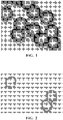
- the surprising sheath-core structure is illustrated in Fig 1 and Fig 2.
- Fig 1 is a photographic representation of coagulated filaments made from a homogeneous mixture of 50 weight percent MPD-I polymer and 50 weight percent DABPI-I/T (60/40 mole %) copolymer that has in turn been dyed with acidic dye.
- the first is a MPD-I rich zone at the center or core of the filaments that is uncolored or undyed by the acidic dye.
- the second is a DAPBI-I/T rich zone that forms the outer sheath and that is significantly dyed a dark shade, representative of the ability to color or dye that copolymer with acid dyes.
- Between the uncolored core and the colored sheath is a partially colored or dyed transition zone that contains a mixture of the two polymers.
- Fig 2 is a photographic representation of cross-sections similarly dyed filaments made from same first and second polymers; however these polymers are made from a mixture of 65 weight percentage MPD-I and 35 weight percentage DAPBI-I/T (60/40 mole%).
- the resultant fibers have a larger core zone and a smaller sheath zone due to the relative increase in the amount of core polymer versus the sheath polymer.
- this surprising sheath-core structure is the result of differing rates of solvent removal from the individual polymers in the mixture during coagulation and/or quenching.
- Coagulation rate of the MPD-I polymer is believed to be significantly higher than the coagulation rate of either the DAPBI-I/T copolymer or DAPBI/MPD-I/T copolymer, meaning the core material (MPD-I) coagulates first, pushing the slower coagulating copolymer (DAPBI-I/T or DAPBI/MPD-I/T) to the filament surface.
- the preferred process is to conduct this multi-stage coagulation using wet spinning, where the combination of preferred coagulant (water) and residence time in the coagulation bath is sufficient to allow the slower coagulating and more mobile copolymer to be forced to the surface of the filament during coagulation.
- any fiber spinning arrangement could be used, assuming a suitable coagulation system, involving a suitable coagulant and suitable residence time was used.
- fibrids made by fibridation and that fibrids formed from the homogeneous mixture have the same three zones, namely a MPD-I rich zone at the fibird center that is uncolored or undyed by the acidic dye; a DAPBI-I/T rich zone that forms the outer fibrid shell and that is significantly dyed a dark shade, representative of the ability to color or dye that copolymer with acid dyes; and between the center and the shell is a transition zone having a mixture of DAPBI-I/T & MPD-I. Further it is believed in the transition zone the mixture has a higher weight percentage of the MPD-I polymer nearer the center and a higher weight percentage of the DAPBI-/I/T copolymer nearer the shell.
- the filaments can be collected as continuous filament fibers and multifilament yarns of continuous filaments by processes well known to those skilled in the art.
- multifilament continuous filament yarns can be made by winding filament thread lines directly on a bobbin, with or without twist; or if needed, combining multiple filament thread lines to form higher denier yarns.
- the filaments can be converted into fibers known commonly as floc.
- floc is meant a fiber having a length of 2 to 25 millimeters, preferably 3 to 7 millimeters and a diameter of 3 to 20 micrometers, preferably 5 to 14 micrometers. If the floc length is less than 3 millimeters, it is believed it will not provide adequate final sheet structure strength and if it is more than 25 millimeters, it is difficult to form a uniform web by a wet-laid method. If the floc diameter is less than 5 micrometers, it can be difficult to produce it with enough uniformity and reproducibility and if it is more than 20 micrometers, it is very difficult to form uniform paper of light to medium basis weights. Floc is generally made by cutting continuous spun filaments into specific-length pieces.
- the homogeneous mixture of the first polymer and second polymer can be used to make fibrids.
- fibrids means a very finely-divided polymer product of small, filmy, essentially two-dimensional particles having a length and width on the order of 100 to 1000 micrometers and a thickness only on the order of 0.1 to 1 micrometer.
- Fibrids are not fibers, but they are fibrous in that they have fiber-like regions connected by webs. Some fibrids have an aspect ratio of 5:1 to 10:1. Undried fibrids can be used wet and can be deposited as a binder physically entwined about the floc in the sheet structure. "Aspect ratio" means the maximum dimension of the fibrid, divided by the maximum width of that fibrid in any plane containing the maximum dimension where the maximum width is perpendicular to the maximum dimension.
- Fibrids are typically made by streaming a polymer solution into a coagulating bath of liquid that is immiscible with the solvent of the solution. The stream of polymer solution is subjected to strenuous shearing forces and turbulence as the polymer is coagulated. Fibrids can be prepared by precipitating and shearing a polymer solution in a single step using for example the methods and devices such as those disclosed in U.S. Pat. Nos. 2,988,782 ; 2,999,788 ; & 3,018,091 . The Canadian Standard Freeness (CSF) of fibrids made in this manner ranges from about 180 to greater than 800.
- CSF Canadian Standard Freeness
- the sheet structure can be formed by dry-laid or wet-laid methods.
- the wet-laid method is used to form a paper on equipment of any scale from laboratory screens to commercial-sized papermaking machinery, such as Fourdrinier, cylinder machines, or inclined wire machines.
- the general process involves making a dispersion of fibrids, floc and other possible ingredients in an aqueous liquid, draining the liquid from the dispersion to yield a wet composition and drying the wet paper composition.
- the dispersion can be made either by dispersing the floc and then adding the fibrids or by dispersing the fibrids and then adding the floc.
- the dispersion can also be made by combining a dispersion of floc with a dispersion of fibrids.
- concentration of floc in the dispersion can range from 0.01 to 1.0 weight percent based on the total weight of the dispersion.
- concentration of the fibrids in the dispersion can be up to 90 weight percent based on the total weight of solids. Additional ingredients for the adjustment of properties, etc., in powder or fibrous form, can be added to the composition.
- the aqueous liquid of the dispersion is generally water, but may include various other materials such as pH-adjusting materials, forming aids, surfactants, defoamers and the like.
- the aqueous liquid is usually drained from the dispersion by conducting the dispersion onto a screen or other perforated support, retaining the dispersed solids and passing the liquid to yield a wet paper composition.
- the wet paper composition once formed on the support, is usually further dewatered by vacuum or other pressure forces and further dried by evaporating the remaining liquid to form a sheet structure.
- the paper has a weight ratio of fibrids to floc in the paper composition of from 95:5 to 10:90.
- the paper has a weight ratio of fibrids to floc in the paper composition of from 60:40 to 10:90.
- the sheet structures contain at least 10 weight percent fibrids, with the remainder generally being floc.
- the thickness of the sheet structure is typically from 1 to 5 mils.
- the basis weight of the sheet structure is from 0.5 to 6 ounces per square yard.
- the sheet structures including papers and the fibrids are useful as a part of electrical insulation systems for different electrical devices including motors, generators, and transformers, and, also, for different structural composites including cores and face sheets for sandwich panels.
- the sheet structures or papers can be used either with or without impregnating resins, as desired.
- Multiple layers of the sheet structures or papers can be laminated or bonded together to create thicker papers or board, such as those known as pressboard.
- the floc and/or fibrids can be colored using such methods as those disclosed in, for example, U. S. Patent Nos. 4,668,234 ; 4,755,335 ; 4,883,496 ; and 5,096,459 , and can be used to make colored sheet structures including paper. It is believed the floc and/or fibrids can be colored prior to being used in a sheet structure. Alternatively, the floc and/or fibrids can be made into a sheet structure, and this sheet structure can then be dyed. A dye assist agent, also known as a dye carrier, may be used to help increase dye pick up by the floc and/or fibrids. By dyeing the floc and/or fibrids with the use of a dye carrier the crystallinity of the fibers may be increased.
- Useful dye carriers include aryl ether, benzyl alcohol, or acetophenone.
- Dyeing Procedure Make up the dye module with 300 ml of de-ionized water, 50 ml of benzyl alcohol (carrier) and 0.2180 grams of sample and close the cap tight. Place the dye module in heating chamber of the dyeing machine Ahiba Polymat by Data Color Type PM 80086. Set the temperature at 70°C, and run for 10 minutes. Take out the dye module from the machine, and add 2 weight percent dye, based on the weight of the sample, and dissolve in the solution. Place the dye module back in the dyeing machine and set the temperature at 130°C and run for one hour. Cool the dye bath to room temperature and open the machine. Remove the module from the machine and open. Take out the sample and rinse with de-ionized water several times. Scour the sample with detergent thoroughly and squeeze out the excess water. Dry the sample in an oven at 120°C overnight.
- Canadian Standard Freeness (CSF) of the fibrids is a measure of the rate, at which a dilute suspension of fibrids may be drained, and was determined in accordance with TAPPI Test Method T 227.
- the relative amount of polymer and copolymer provided in a mixture is represented in weight percent, based on the total amount of the polymer and copolymer mixed together, and the relative amount of amine or acid monomers used in the copolymers is provided in mole percent based on the total amount of that type of monomer (amine or acid monomer) in the copolymer.
- a polymer solution having a MPD-I polymer concentration of 19.3% by weight was made in the following manner. 214.2 grams of DMAc and 18.168 grams (0.168 moles) of 1,3-phenylenediamine (MPD) were added to a 1-liter reaction kettle, equipped with a basket stirrer and a nitrogen inlet/outlet. The contents were stirred under a nitrogen blanket at room temperature until solid particles of MPD were completely dissolved. The kettle was then placed in an ice-water bath and while stirring, the contents were cooled to ⁇ 10°C. The kettle was removed from the ice-water bath. 38.098 grams (0.168 moles) of isophthaloyl dichloride (ICI) was added to the reaction mixture in the kettle all at once.
- ICI isophthaloyl dichloride
- Example 2 80 grams of the DAPBI/MPD (80/20)-I/T(70/30) copolymer solution (8 g of polymer) of Example 2 was added to a reaction kettle equipped with disc stirrer and nitrogen inlet/outlet. 150 grams of the MPD-I homopolymer solution (28.95 g of polymer) of Example 1 was added and stirred for one hour at high speed. The solution temperature was controlled below 55°C. The mixture solution was placed in vacuum oven at room temperature overnight to remove bubbles generated during the mixing. The resultant solution was transparent and clear showing that the blend was compatible and was capable of being spun into fibers.
- Example 3 120 grams of the DAPBI-I/T (60/40) copolymer solution (7.24 g of polymer) of Example 3 was added to a reaction kettle equipped with disc stirrer and nitrogen inlet/outlet. 150 grams of the MPD-I homopolymer solution (28.95 g of polymer) of Example 1 was added and stirred for one hour at high speed. The solution temperature was controlled below 55°C. The mixture solution was placed in vacuum oven at room temperature overnight to remove bubbles generated during the mixing. The resultant solution was transparent and clear showing that the blend was compatible and was capable of being spun into fibers.
- Example 3 475 grams of the DAPBI-I/T(60/40) copolymer solution (28.95 grams of polymer) of Example 3 was added to a reaction kettle equipped with disc stirrer and nitrogen inlet/outlet. 150 grams of the MPD-I solution (28.95 g of polymer) of Example 1 was added and stirred for one hour at high speed. The solution temperature was controlled below 55°C. The mixture solution was placed in vacuum oven at room temperature overnight to remove bubbles generated during the mixing. The resultant solution was transparent and clear showing that the blend was compatible and was capable of being spun into fibers.
- a DAPBI/MPD (50/50)-I/T(25/75) copolymer was made as follows. 297.1 grams of DMAc and 11.242 grams of CaCl 2 were added to a1 liter reaction kettle, equipped with a basket stirrer and a nitrogen inlet/outlet, and then heated to 70° C to completely dissolve the CaCl 2 . 7.571 grams (0.034 moles) of DAPBI was added to the hot solution and stirred until the DAPBI was completely dissolved. To this solution, 3.651 grams (0.034 moles) of MPD was added and dissolved. The solution was cooled to room temperature (25°C) with stirring.
- the clear 78/22 polymer mixture of DAPBI/MPD (80/20)-I/T(70/30) Copolymer and MPD-I Homopolymer of Example 4 was charged into the metal syringe very carefully to prevent entrapment of air bubbles.
- the syringe filled was placed onto the syringe wet-spinning unit and the roomtemperature polymer mixture was pumped out of the syringe through a136-hole spinneret having 2.5 mil diameter capillaries. Once the system was completely filled with the solution and full flow established from the spinneret, the spinneret was immersed beneath the surface of a water coagulation bath maintained at room temperature.
- the wet-spun extruded filaments passed through the coagulation bath at 5 yards per minute and were wound up on a perforated metal bobbin. Filament linear density was approximately 2 to 3 denier per filament.
- the resulting bobbin was then placed in de-ionized water to extract the solvent, and the water was changed several times to insure good removal of the solvent.
- the filaments were dried in a hot tube at 250°C and collected on a bobbin.
- Dried filaments on a bobbin were made as in Example 7 using the 20/80 Polymer Mixture of DAPBI-I/T (60/40) Copolymer and the MPD-I homopolymer of Example 5.
- Dried filaments on a bobbin were made as in Example 7 using the 50/50 Polymer Mixture of DAPBI-I/T (60/40) Copolymer and MPD-I homopolymer of Example 6.
- Example 7 To further examine the effect of dye type, the fiber spinning process of Example 7 was used to spin a first control fiber utilizing 100% of the DAPBI-T/I (40/60) Copolymer of Example 3. A second control fiber was also made using the fiber spinning process of Example 7, utilizing 100% of the MPD-I homopolymer of Example 1.
- Example 5 Following the procedures of Example 5 and 6, a 35%/65% polymer mixture of the DAPBI-T/I (40/60) Copolymer of Example 3 and the MPD-I homopolymer of Example 1 was made, and fiber was spun from that Polymer mixture using the process of Example 7.
- the resulting fiber was placed in dyeing machine and dyed with basic dyes using the same Dyeing Procedure test method. As a control, 100% MPD-I fiber was also dyed with basic dyes using the same Dyeing Procedure test method.
- the fiber made from the blend of polyacrylonitrile homopolymer/MPD-I was colored or dyed as well as 100% MPD-I fiber. This indicates sheath/core separation of the polymer components in the polyacrylonitrile homopolymer/MPD-I blend did not occur, because polyacrylonitrile homopolymer by itself is not dyeable with basic dyes. If a sheath/core fiber had been formed with polyacrylonitrile homopolymer in the sheath, it should not have been dyeable.
- Example 4 Four samples of the 78/22 polymer mixture in solution of Example 4 are further diluted by the addition of DMAc to form four individual solutions containing 2, 4,6, and 12 weight percent solids. The four solutions are then heated to 70 °C in hot-water bath for more than three hours. This provides proper solution viscosities for laboratory fibridation.
- a precipitant solution is prepared by adding 60 grams of DMAc into 240 grams of de-ionized water (1:4 weight ratio). The precipitant solution is then poured into a Waring® blender container. The polymer solution is added slowly into the precipitant solution while the blender is set at a steady-state/medium speed. The polymer solution stream is maintained less than 5 mm wide as it enters the blender. After two minutes of continuous stirring, the blender is stopped. Longer stirring flocculates the fibrid particles into undesirable species.
- the entire content of the blender container is poured into a Buchner funnel with a size 54 filter and the liquid is removed.
- the filtered content is then washed several times with deionized water to completely remove the solvent (DMAc and CaCl 2 )
- the resulting wet fibrids are transferred into plastic bag and are stored wet for the paper making process.
- the Canadian Standard Freeness (CSF) of fibrids made in this manner ranges from about 180 to greater than 800. The fibrids accept coloration from acid dyes.
- Example 12 is repeated using the 20/80 polymer mixture in solution of Example 5.
- the Canadian Standard Freeness (CSF) of fibrids made in this manner ranges from about 180 to greater than 800.
- the fibrids accept coloration from acid dyes.
- Example 12 is repeated using the 50/50 polymer mixture in solution of Example 6.
- the Canadian Standard Freeness (CSF) of fibrids made in this manner ranges from about 180 to greater than 800.
- the fibrids accept coloration from acid dyes.
- the slurry is then poured, with 4 additional liters of water, into an approximately 21 x 21 cm "hand-sheet mold" and a wet-laid sheet is formed as water is drained by gravity.
- the sheet is then placed between two pieces of blotting paper, is hand couched with a rolling pin, and is dried in a hand-sheet dryer at 180°C.
- the dried sheet is calendered using a plate press at 300°C (572°F) and linear pressure of about 800 psi.
- the paper accepts coloration from acid dyes.
- Example 15 is repeated; however the fibrids are replaced with the fibrids of Example 13.
- the paper accepts coloration from acid dyes.
- Example 15 is repeated; however the fibrids are replaced with the fibrids of Example 14.
- the paper accepts coloration from acid dyes.
- a paper composed of 50 weight percent floc, made from the fiber of Example 7, and 50 weight percent of the MPD-I fibrids, made using the process of Example 12 but using MPD-I homopolymer, is made in the following manner.
- the fiber of Example 7 is cut to 1 ⁇ 4" lengths to make floc and 2.5 grams of this floc along with 2.5 grams of wet MPD-I fibrids are dispersed in 2500 ml of deionized water and are added into a laboratory mixer (British pulp evaluation apparatus). The mixture is agitated for 2 minutes into a well-dispersed slurry.
- the slurry is then poured, with 4 additional liters of water, into an approximately 21 x 21 cm "hand-sheet mold" and a wet-laid sheet is formed as water is drained by gravity.
- the sheet is then placed between two pieces of blotting paper, is hand couched with a rolling pin, and is dried in a hand-sheet dryer at 180°C.
- the dried sheet is calendered using a plate press at 300°C (572°F) and linear pressure of about 800 psi.
- the paper accepts coloration from acid dyes.
- Example 18 is repeated; however the floc is replaced by floc made from the fiber of Example 8.
- the paper accepts coloration from acid dyes.
- Example 18 is repeated; however the floc is replaced by floc made from the fiber of Example 9.
- the paper accepts coloration from acid dyes.
- Example 18 is repeated; however the fibrids are replaced by the fibrids of Example 12.
- the paper accepts coloration from acid dyes.
- Example 18 is repeated; however the fibrids are replaced by the fibrids of Example 13.
- the paper accepts coloration from acid dyes.
- Example 18 is repeated; however the fibrids are replaced by the fibrids of Example 14.
- the paper accepts coloration from acid dyes.
Landscapes
- Chemical & Material Sciences (AREA)
- Chemical Kinetics & Catalysis (AREA)
- Medicinal Chemistry (AREA)
- Organic Chemistry (AREA)
- Polymers & Plastics (AREA)
- Health & Medical Sciences (AREA)
- Engineering & Computer Science (AREA)
- Textile Engineering (AREA)
- General Chemical & Material Sciences (AREA)
- Dispersion Chemistry (AREA)
- Mechanical Engineering (AREA)
- Artificial Filaments (AREA)
- Paints Or Removers (AREA)
- Paper (AREA)
Applications Claiming Priority (2)
| Application Number | Priority Date | Filing Date | Title |
|---|---|---|---|
| US201361897608P | 2013-10-30 | 2013-10-30 | |
| PCT/US2014/062872 WO2015066160A1 (en) | 2013-10-30 | 2014-10-29 | Sheets and fibrids comprising a mixture of poly(m-phenylene isophthalamide) and copolymer made from (6)-amino-2-(p-aminophenyl)benzimidazole |
Publications (2)
| Publication Number | Publication Date |
|---|---|
| EP3063318A1 EP3063318A1 (en) | 2016-09-07 |
| EP3063318B1 true EP3063318B1 (en) | 2017-05-17 |
Family
ID=51897468
Family Applications (1)
| Application Number | Title | Priority Date | Filing Date |
|---|---|---|---|
| EP14796975.2A Active EP3063318B1 (en) | 2013-10-30 | 2014-10-29 | Sheets and fibrids comprising a mixture of poly(m-phenylene isophthalamide) and copolymer made from (6)-amino-2-(p-aminophenyl)benzimidazole |
Country Status (7)
| Country | Link |
|---|---|
| US (1) | US9663875B2 (enExample) |
| EP (1) | EP3063318B1 (enExample) |
| JP (1) | JP6356238B2 (enExample) |
| KR (1) | KR102351348B1 (enExample) |
| CN (1) | CN105705689B (enExample) |
| BR (1) | BR112016009683B8 (enExample) |
| WO (1) | WO2015066160A1 (enExample) |
Families Citing this family (5)
| Publication number | Priority date | Publication date | Assignee | Title |
|---|---|---|---|---|
| US11078627B2 (en) * | 2018-08-14 | 2021-08-03 | Dupont Safety & Construction, Inc. | High tensile strength paper suitable for use in electrochemical cells |
| EP4077506B1 (en) * | 2019-12-20 | 2026-03-04 | Teijin Aramid B.V. | Continuous process for recycling |
| KR102918069B1 (ko) * | 2020-12-14 | 2026-01-23 | 코오롱인더스트리 주식회사 | 파라아라미드 공중합체, 이의 제조 방법 및 이를 이용한 파라아라미드 섬유의 제조 방법 |
| CN115652477B (zh) * | 2022-12-29 | 2023-04-25 | 泰和新材集团股份有限公司 | 一种高伸长间位芳香族聚酰胺纤维及制备方法和装置 |
| US20260049422A1 (en) * | 2024-06-24 | 2026-02-19 | Dupont Safety & Construction, Inc. | Papers Having High Average Specific Modulus and Ultimate Tensile Strength |
Family Cites Families (41)
| Publication number | Priority date | Publication date | Assignee | Title |
|---|---|---|---|---|
| US2988785A (en) | 1955-05-17 | 1961-06-20 | Howa Machinery Ltd | Automatic can changing apparatus |
| US3063966A (en) | 1958-02-05 | 1962-11-13 | Du Pont | Process of making wholly aromatic polyamides |
| DE1111823B (de) | 1958-04-01 | 1961-07-27 | Gerhard Schwarz Dipl Chem | Verfahren und Vorrichtung zur kontinuierlichen Herstellung von ionenaustauschenden synthetischen stickstoffhaltigen Harzen in Kugelform |
| NL246230A (enExample) | 1958-12-09 | |||
| US2988782A (en) | 1958-12-09 | 1961-06-20 | Du Pont | Process for producing fibrids by precipitation and violent agitation |
| US3018091A (en) | 1959-04-10 | 1962-01-23 | Du Pont | Precipitation apparatus |
| US3227793A (en) | 1961-01-23 | 1966-01-04 | Celanese Corp | Spinning of a poly(polymethylene) terephthalamide |
| US3414645A (en) | 1964-06-19 | 1968-12-03 | Monsanto Co | Process for spinning wholly aromatic polyamide fibers |
| US3287324A (en) | 1965-05-07 | 1966-11-22 | Du Pont | Poly-meta-phenylene isophthalamides |
| US3354127A (en) | 1966-04-18 | 1967-11-21 | Du Pont | Aromatic copolyamides |
| US3511819A (en) | 1967-03-01 | 1970-05-12 | Du Pont | Thermally durable aromatic copolyamides |
| US3756908A (en) | 1971-02-26 | 1973-09-04 | Du Pont | Synthetic paper structures of aromatic polyamides |
| US3869429A (en) | 1971-08-17 | 1975-03-04 | Du Pont | High strength polyamide fibers and films |
| US3869430A (en) | 1971-08-17 | 1975-03-04 | Du Pont | High modulus, high tenacity poly(p-phenylene terephthalamide) fiber |
| GB1381181A (en) | 1972-03-25 | 1975-01-22 | Vnii Iskusstvennogo Volokna | Process for producing heat resistant fibres |
| US3767756A (en) | 1972-06-30 | 1973-10-23 | Du Pont | Dry jet wet spinning process |
| US4668234A (en) * | 1985-08-15 | 1987-05-26 | E. I. Du Pont De Nemours And Company | Aromatic polyamide fibers and process for stabilizing such fibers with surfactants |
| US4755335A (en) | 1986-09-12 | 1988-07-05 | E. I. Du Pont De Nemours And Company | Method of improving impregnation of poly (meta-phenylene isophthalamide) fibers |
| US4883496A (en) | 1988-02-14 | 1989-11-28 | E. I. Du Pont De Nemours And Company | Process for dyeing crystalline aromatic polyamide fibers with water-insoluble dyes |
| US5026456A (en) | 1990-06-14 | 1991-06-25 | E. I. Du Pont De Nemours And Company | Aramid papers containing aramid paper pulp |
| AU658827B2 (en) * | 1990-07-20 | 1995-05-04 | E.I. Du Pont De Nemours And Company | A process for preparing subdenier fibers, pulp-like short fibers, fibrids, rovings and mats from isotropic polymer solutions |
| US5096459A (en) | 1990-09-26 | 1992-03-17 | E. I. Du Pont De Nemours And Company | Method of dyeing aromatic polyamide fibers with water-soluble dyes |
| EP0678539A3 (de) * | 1994-04-06 | 1997-01-15 | Hoechst Ag | Aromatische Copolyamide, Verfahren zu deren Herstellung, geformte Gebilde und deren Herstellung. |
| US5667743A (en) | 1996-05-21 | 1997-09-16 | E. I. Du Pont De Nemours And Company | Wet spinning process for aramid polymer containing salts |
| KR100398482B1 (ko) * | 1997-06-10 | 2003-09-19 | 데이진 가부시키가이샤 | 내열성 섬유지 |
| CN101311396A (zh) | 1999-06-14 | 2008-11-26 | 纳幕尔杜邦公司 | 拉断法和产品 |
| RU2180369C2 (ru) | 2000-03-06 | 2002-03-10 | Государственное предприятие Всероссийский научно-исследовательский институт полимерных волокон с опытним заводом | Способ получения термостойкого волокна |
| JP2002302837A (ja) * | 2001-04-05 | 2002-10-18 | Teijin Ltd | 染色性の改良された全芳香族ポリアミド繊維構造物 |
| FR2843975B1 (fr) * | 2002-09-04 | 2008-11-14 | Kermel | Fibres et fibrides, leur procede d'obtention, articles obtenus a partir de ces fibres et/ou fibrides. |
| RU2345988C2 (ru) | 2006-06-30 | 2009-02-10 | Евгений Львович Вулах | Способ получения 5(6)-амино-2-(4-аминофенил)бензимидазола |
| JP4934151B2 (ja) * | 2006-12-15 | 2012-05-16 | 帝人テクノプロダクツ株式会社 | ヘテロ環含有芳香族ポリアミド繊維及びその製造方法、並びに該繊維から構成された布帛及び該繊維により補強された繊維強化複合材料 |
| JP2009120976A (ja) * | 2007-11-13 | 2009-06-04 | Teijin Techno Products Ltd | 易染色性メタ型全芳香族ポリアミド繊維 |
| US8114251B2 (en) * | 2007-12-21 | 2012-02-14 | E.I. Du Pont De Nemours And Company | Papers containing fibrids derived from diamino diphenyl sulfone |
| JP2010126826A (ja) * | 2008-11-26 | 2010-06-10 | Teijin Techno Products Ltd | 防刃衣料用布帛 |
| JP2010163506A (ja) * | 2009-01-14 | 2010-07-29 | Teijin Techno Products Ltd | 芳香族コポリアミドの製造方法 |
| JP2011226028A (ja) * | 2010-04-21 | 2011-11-10 | Teijin Techno Products Ltd | メタ型全芳香族ポリアミド繊維 |
| WO2013019598A1 (en) * | 2011-07-29 | 2013-02-07 | E. I. Du Pont De Nemours And Company | Process for forming an aramid copolymer |
| BR112014002094B8 (pt) * | 2011-07-29 | 2023-02-28 | Du Pont | Polímero |
| EP2736950B1 (en) * | 2011-07-29 | 2015-10-07 | E. I. du Pont de Nemours and Company | Process for forming an aramid copolymer |
| US9193841B2 (en) * | 2013-10-30 | 2015-11-24 | E I Du Pont De Nemours And Company | Film comprising a mixture of poly (M-phenylene isophthalamide) and copolymer made from (6)-amino-2-(P-aminophenyl) benzimidazole |
| KR102213424B1 (ko) * | 2013-10-30 | 2021-02-08 | 이 아이 듀폰 디 네모아 앤드 캄파니 | 폴리(m-페닐렌 아이소프탈아미드) 및 (6)-아미노-2-(p-아미노페닐)벤즈이미다졸로부터 제조된 공중합체의 혼합물을 포함하는 섬유 |
-
2014
- 2014-10-29 US US14/526,643 patent/US9663875B2/en active Active
- 2014-10-29 KR KR1020167011136A patent/KR102351348B1/ko active Active
- 2014-10-29 WO PCT/US2014/062872 patent/WO2015066160A1/en not_active Ceased
- 2014-10-29 JP JP2016525077A patent/JP6356238B2/ja active Active
- 2014-10-29 BR BR112016009683A patent/BR112016009683B8/pt active IP Right Grant
- 2014-10-29 EP EP14796975.2A patent/EP3063318B1/en active Active
- 2014-10-29 CN CN201480060823.1A patent/CN105705689B/zh active Active
Also Published As
| Publication number | Publication date |
|---|---|
| KR20160075542A (ko) | 2016-06-29 |
| EP3063318A1 (en) | 2016-09-07 |
| BR112016009683B8 (pt) | 2023-03-21 |
| JP6356238B2 (ja) | 2018-07-11 |
| US20150114582A1 (en) | 2015-04-30 |
| US9663875B2 (en) | 2017-05-30 |
| WO2015066160A1 (en) | 2015-05-07 |
| CN105705689A (zh) | 2016-06-22 |
| BR112016009683B1 (pt) | 2021-11-16 |
| JP2017502176A (ja) | 2017-01-19 |
| CN105705689B (zh) | 2017-11-07 |
| BR112016009683A2 (enExample) | 2017-08-01 |
| KR102351348B1 (ko) | 2022-01-17 |
Similar Documents
| Publication | Publication Date | Title |
|---|---|---|
| US9663875B2 (en) | Sheets and fibrids comprising a mixture of poly(m-phenylene isophthalamide) and copolymer made from 5(6)-amino-2-(p-aminophenyl)benzimidazole | |
| EP2227595B1 (en) | Papers containing fibrids derived from diamino diphenyl sulfone | |
| EP2222917B1 (en) | Papers containing fibrids derived from diamino diphenyl sulfone | |
| US7803247B2 (en) | Papers containing floc derived from diamino diphenyl sulfone | |
| EP1044719A1 (en) | Support for semipermeable membrane | |
| US9193841B2 (en) | Film comprising a mixture of poly (M-phenylene isophthalamide) and copolymer made from (6)-amino-2-(P-aminophenyl) benzimidazole | |
| EP3063319B1 (en) | Fiber comprising a mixture of poly(m-phenylene isophthalamide) and copolymer made from (6)-amino-2-(p-aminophenyl)benzimidazole | |
| JP2012069339A (ja) | 電池用セパレーター | |
| CN105986506B (zh) | 可用于电器绝缘的纸材、其制备方法及用途 | |
| KR101700827B1 (ko) | 적층 아라미드 종이 및 그 제조방법 | |
| JP2593241B2 (ja) | カレンダー加工方法 | |
| JPH07114825A (ja) | 耐熱絶縁シートの製造方法 |
Legal Events
| Date | Code | Title | Description |
|---|---|---|---|
| PUAI | Public reference made under article 153(3) epc to a published international application that has entered the european phase |
Free format text: ORIGINAL CODE: 0009012 |
|
| 17P | Request for examination filed |
Effective date: 20160311 |
|
| AK | Designated contracting states |
Kind code of ref document: A1 Designated state(s): AL AT BE BG CH CY CZ DE DK EE ES FI FR GB GR HR HU IE IS IT LI LT LU LV MC MK MT NL NO PL PT RO RS SE SI SK SM TR |
|
| AX | Request for extension of the european patent |
Extension state: BA ME |
|
| DAX | Request for extension of the european patent (deleted) | ||
| GRAP | Despatch of communication of intention to grant a patent |
Free format text: ORIGINAL CODE: EPIDOSNIGR1 |
|
| INTG | Intention to grant announced |
Effective date: 20170224 |
|
| GRAS | Grant fee paid |
Free format text: ORIGINAL CODE: EPIDOSNIGR3 |
|
| GRAA | (expected) grant |
Free format text: ORIGINAL CODE: 0009210 |
|
| AK | Designated contracting states |
Kind code of ref document: B1 Designated state(s): AL AT BE BG CH CY CZ DE DK EE ES FI FR GB GR HR HU IE IS IT LI LT LU LV MC MK MT NL NO PL PT RO RS SE SI SK SM TR |
|
| REG | Reference to a national code |
Ref country code: GB Ref legal event code: FG4D |
|
| REG | Reference to a national code |
Ref country code: CH Ref legal event code: EP |
|
| REG | Reference to a national code |
Ref country code: IE Ref legal event code: FG4D |
|
| REG | Reference to a national code |
Ref country code: AT Ref legal event code: REF Ref document number: 894560 Country of ref document: AT Kind code of ref document: T Effective date: 20170615 |
|
| REG | Reference to a national code |
Ref country code: DE Ref legal event code: R096 Ref document number: 602014010028 Country of ref document: DE |
|
| REG | Reference to a national code |
Ref country code: FR Ref legal event code: PLFP Year of fee payment: 4 |
|
| REG | Reference to a national code |
Ref country code: NL Ref legal event code: MP Effective date: 20170517 |
|
| REG | Reference to a national code |
Ref country code: LT Ref legal event code: MG4D |
|
| REG | Reference to a national code |
Ref country code: AT Ref legal event code: MK05 Ref document number: 894560 Country of ref document: AT Kind code of ref document: T Effective date: 20170517 |
|
| PG25 | Lapsed in a contracting state [announced via postgrant information from national office to epo] |
Ref country code: LT Free format text: LAPSE BECAUSE OF FAILURE TO SUBMIT A TRANSLATION OF THE DESCRIPTION OR TO PAY THE FEE WITHIN THE PRESCRIBED TIME-LIMIT Effective date: 20170517 Ref country code: GR Free format text: LAPSE BECAUSE OF FAILURE TO SUBMIT A TRANSLATION OF THE DESCRIPTION OR TO PAY THE FEE WITHIN THE PRESCRIBED TIME-LIMIT Effective date: 20170818 Ref country code: AT Free format text: LAPSE BECAUSE OF FAILURE TO SUBMIT A TRANSLATION OF THE DESCRIPTION OR TO PAY THE FEE WITHIN THE PRESCRIBED TIME-LIMIT Effective date: 20170517 Ref country code: NO Free format text: LAPSE BECAUSE OF FAILURE TO SUBMIT A TRANSLATION OF THE DESCRIPTION OR TO PAY THE FEE WITHIN THE PRESCRIBED TIME-LIMIT Effective date: 20170817 Ref country code: HR Free format text: LAPSE BECAUSE OF FAILURE TO SUBMIT A TRANSLATION OF THE DESCRIPTION OR TO PAY THE FEE WITHIN THE PRESCRIBED TIME-LIMIT Effective date: 20170517 Ref country code: FI Free format text: LAPSE BECAUSE OF FAILURE TO SUBMIT A TRANSLATION OF THE DESCRIPTION OR TO PAY THE FEE WITHIN THE PRESCRIBED TIME-LIMIT Effective date: 20170517 Ref country code: ES Free format text: LAPSE BECAUSE OF FAILURE TO SUBMIT A TRANSLATION OF THE DESCRIPTION OR TO PAY THE FEE WITHIN THE PRESCRIBED TIME-LIMIT Effective date: 20170517 |
|
| PG25 | Lapsed in a contracting state [announced via postgrant information from national office to epo] |
Ref country code: LV Free format text: LAPSE BECAUSE OF FAILURE TO SUBMIT A TRANSLATION OF THE DESCRIPTION OR TO PAY THE FEE WITHIN THE PRESCRIBED TIME-LIMIT Effective date: 20170517 Ref country code: IS Free format text: LAPSE BECAUSE OF FAILURE TO SUBMIT A TRANSLATION OF THE DESCRIPTION OR TO PAY THE FEE WITHIN THE PRESCRIBED TIME-LIMIT Effective date: 20170917 Ref country code: NL Free format text: LAPSE BECAUSE OF FAILURE TO SUBMIT A TRANSLATION OF THE DESCRIPTION OR TO PAY THE FEE WITHIN THE PRESCRIBED TIME-LIMIT Effective date: 20170517 Ref country code: RS Free format text: LAPSE BECAUSE OF FAILURE TO SUBMIT A TRANSLATION OF THE DESCRIPTION OR TO PAY THE FEE WITHIN THE PRESCRIBED TIME-LIMIT Effective date: 20170517 Ref country code: PL Free format text: LAPSE BECAUSE OF FAILURE TO SUBMIT A TRANSLATION OF THE DESCRIPTION OR TO PAY THE FEE WITHIN THE PRESCRIBED TIME-LIMIT Effective date: 20170517 Ref country code: SE Free format text: LAPSE BECAUSE OF FAILURE TO SUBMIT A TRANSLATION OF THE DESCRIPTION OR TO PAY THE FEE WITHIN THE PRESCRIBED TIME-LIMIT Effective date: 20170517 Ref country code: BG Free format text: LAPSE BECAUSE OF FAILURE TO SUBMIT A TRANSLATION OF THE DESCRIPTION OR TO PAY THE FEE WITHIN THE PRESCRIBED TIME-LIMIT Effective date: 20170817 |
|
| PG25 | Lapsed in a contracting state [announced via postgrant information from national office to epo] |
Ref country code: CZ Free format text: LAPSE BECAUSE OF FAILURE TO SUBMIT A TRANSLATION OF THE DESCRIPTION OR TO PAY THE FEE WITHIN THE PRESCRIBED TIME-LIMIT Effective date: 20170517 Ref country code: EE Free format text: LAPSE BECAUSE OF FAILURE TO SUBMIT A TRANSLATION OF THE DESCRIPTION OR TO PAY THE FEE WITHIN THE PRESCRIBED TIME-LIMIT Effective date: 20170517 Ref country code: RO Free format text: LAPSE BECAUSE OF FAILURE TO SUBMIT A TRANSLATION OF THE DESCRIPTION OR TO PAY THE FEE WITHIN THE PRESCRIBED TIME-LIMIT Effective date: 20170517 Ref country code: DK Free format text: LAPSE BECAUSE OF FAILURE TO SUBMIT A TRANSLATION OF THE DESCRIPTION OR TO PAY THE FEE WITHIN THE PRESCRIBED TIME-LIMIT Effective date: 20170517 Ref country code: SK Free format text: LAPSE BECAUSE OF FAILURE TO SUBMIT A TRANSLATION OF THE DESCRIPTION OR TO PAY THE FEE WITHIN THE PRESCRIBED TIME-LIMIT Effective date: 20170517 |
|
| REG | Reference to a national code |
Ref country code: DE Ref legal event code: R097 Ref document number: 602014010028 Country of ref document: DE |
|
| PG25 | Lapsed in a contracting state [announced via postgrant information from national office to epo] |
Ref country code: IT Free format text: LAPSE BECAUSE OF FAILURE TO SUBMIT A TRANSLATION OF THE DESCRIPTION OR TO PAY THE FEE WITHIN THE PRESCRIBED TIME-LIMIT Effective date: 20170517 Ref country code: SM Free format text: LAPSE BECAUSE OF FAILURE TO SUBMIT A TRANSLATION OF THE DESCRIPTION OR TO PAY THE FEE WITHIN THE PRESCRIBED TIME-LIMIT Effective date: 20170517 |
|
| PLBE | No opposition filed within time limit |
Free format text: ORIGINAL CODE: 0009261 |
|
| STAA | Information on the status of an ep patent application or granted ep patent |
Free format text: STATUS: NO OPPOSITION FILED WITHIN TIME LIMIT |
|
| 26N | No opposition filed |
Effective date: 20180220 |
|
| PG25 | Lapsed in a contracting state [announced via postgrant information from national office to epo] |
Ref country code: MC Free format text: LAPSE BECAUSE OF FAILURE TO SUBMIT A TRANSLATION OF THE DESCRIPTION OR TO PAY THE FEE WITHIN THE PRESCRIBED TIME-LIMIT Effective date: 20170517 |
|
| REG | Reference to a national code |
Ref country code: CH Ref legal event code: PL |
|
| REG | Reference to a national code |
Ref country code: IE Ref legal event code: MM4A |
|
| PG25 | Lapsed in a contracting state [announced via postgrant information from national office to epo] |
Ref country code: LU Free format text: LAPSE BECAUSE OF NON-PAYMENT OF DUE FEES Effective date: 20171029 Ref country code: LI Free format text: LAPSE BECAUSE OF NON-PAYMENT OF DUE FEES Effective date: 20171031 Ref country code: CH Free format text: LAPSE BECAUSE OF NON-PAYMENT OF DUE FEES Effective date: 20171031 |
|
| REG | Reference to a national code |
Ref country code: BE Ref legal event code: MM Effective date: 20171031 |
|
| PG25 | Lapsed in a contracting state [announced via postgrant information from national office to epo] |
Ref country code: BE Free format text: LAPSE BECAUSE OF NON-PAYMENT OF DUE FEES Effective date: 20171031 |
|
| REG | Reference to a national code |
Ref country code: FR Ref legal event code: PLFP Year of fee payment: 5 |
|
| PG25 | Lapsed in a contracting state [announced via postgrant information from national office to epo] |
Ref country code: MT Free format text: LAPSE BECAUSE OF NON-PAYMENT OF DUE FEES Effective date: 20171029 |
|
| PG25 | Lapsed in a contracting state [announced via postgrant information from national office to epo] |
Ref country code: IE Free format text: LAPSE BECAUSE OF NON-PAYMENT OF DUE FEES Effective date: 20171029 |
|
| PG25 | Lapsed in a contracting state [announced via postgrant information from national office to epo] |
Ref country code: HU Free format text: LAPSE BECAUSE OF FAILURE TO SUBMIT A TRANSLATION OF THE DESCRIPTION OR TO PAY THE FEE WITHIN THE PRESCRIBED TIME-LIMIT; INVALID AB INITIO Effective date: 20141029 |
|
| PG25 | Lapsed in a contracting state [announced via postgrant information from national office to epo] |
Ref country code: SI Free format text: LAPSE BECAUSE OF FAILURE TO SUBMIT A TRANSLATION OF THE DESCRIPTION OR TO PAY THE FEE WITHIN THE PRESCRIBED TIME-LIMIT Effective date: 20170517 |
|
| PG25 | Lapsed in a contracting state [announced via postgrant information from national office to epo] |
Ref country code: CY Free format text: LAPSE BECAUSE OF FAILURE TO SUBMIT A TRANSLATION OF THE DESCRIPTION OR TO PAY THE FEE WITHIN THE PRESCRIBED TIME-LIMIT Effective date: 20170517 |
|
| PG25 | Lapsed in a contracting state [announced via postgrant information from national office to epo] |
Ref country code: MK Free format text: LAPSE BECAUSE OF FAILURE TO SUBMIT A TRANSLATION OF THE DESCRIPTION OR TO PAY THE FEE WITHIN THE PRESCRIBED TIME-LIMIT Effective date: 20170517 |
|
| PG25 | Lapsed in a contracting state [announced via postgrant information from national office to epo] |
Ref country code: TR Free format text: LAPSE BECAUSE OF FAILURE TO SUBMIT A TRANSLATION OF THE DESCRIPTION OR TO PAY THE FEE WITHIN THE PRESCRIBED TIME-LIMIT Effective date: 20170517 |
|
| PG25 | Lapsed in a contracting state [announced via postgrant information from national office to epo] |
Ref country code: PT Free format text: LAPSE BECAUSE OF FAILURE TO SUBMIT A TRANSLATION OF THE DESCRIPTION OR TO PAY THE FEE WITHIN THE PRESCRIBED TIME-LIMIT Effective date: 20170517 |
|
| PG25 | Lapsed in a contracting state [announced via postgrant information from national office to epo] |
Ref country code: AL Free format text: LAPSE BECAUSE OF FAILURE TO SUBMIT A TRANSLATION OF THE DESCRIPTION OR TO PAY THE FEE WITHIN THE PRESCRIBED TIME-LIMIT Effective date: 20170517 |
|
| REG | Reference to a national code |
Ref country code: DE Ref legal event code: R081 Ref document number: 602014010028 Country of ref document: DE Owner name: DUPONT SAFETY & CONSTRUCTION, INC., WILMINGTON, US Free format text: FORMER OWNER: E.I. DU PONT DE NEMOURS AND COMPANY, WILMINGTON, DEL., US |
|
| REG | Reference to a national code |
Ref country code: GB Ref legal event code: 732E Free format text: REGISTERED BETWEEN 20221027 AND 20221102 |
|
| P01 | Opt-out of the competence of the unified patent court (upc) registered |
Effective date: 20230528 |
|
| PGFP | Annual fee paid to national office [announced via postgrant information from national office to epo] |
Ref country code: GB Payment date: 20250904 Year of fee payment: 12 |
|
| PGFP | Annual fee paid to national office [announced via postgrant information from national office to epo] |
Ref country code: FR Payment date: 20250908 Year of fee payment: 12 |
|
| PGFP | Annual fee paid to national office [announced via postgrant information from national office to epo] |
Ref country code: DE Payment date: 20250902 Year of fee payment: 12 |