EP3063033B1 - Warnhinweis bezüglich der benutzung von head-mounted displays im fahrzeug - Google Patents
Warnhinweis bezüglich der benutzung von head-mounted displays im fahrzeug Download PDFInfo
- Publication number
- EP3063033B1 EP3063033B1 EP14786627.1A EP14786627A EP3063033B1 EP 3063033 B1 EP3063033 B1 EP 3063033B1 EP 14786627 A EP14786627 A EP 14786627A EP 3063033 B1 EP3063033 B1 EP 3063033B1
- Authority
- EP
- European Patent Office
- Prior art keywords
- vehicle
- data glasses
- data
- radio signals
- input
- Prior art date
- Legal status (The legal status is an assumption and is not a legal conclusion. Google has not performed a legal analysis and makes no representation as to the accuracy of the status listed.)
- Active
Links
Images
Classifications
-
- G—PHYSICS
- G05—CONTROLLING; REGULATING
- G05D—SYSTEMS FOR CONTROLLING OR REGULATING NON-ELECTRIC VARIABLES
- G05D1/00—Control of position, course, altitude or attitude of land, water, air or space vehicles, e.g. using automatic pilots
- G05D1/0011—Control of position, course, altitude or attitude of land, water, air or space vehicles, e.g. using automatic pilots associated with a remote control arrangement
- G05D1/0016—Control of position, course, altitude or attitude of land, water, air or space vehicles, e.g. using automatic pilots associated with a remote control arrangement characterised by the operator's input device
-
- B—PERFORMING OPERATIONS; TRANSPORTING
- B60—VEHICLES IN GENERAL
- B60K—ARRANGEMENT OR MOUNTING OF PROPULSION UNITS OR OF TRANSMISSIONS IN VEHICLES; ARRANGEMENT OR MOUNTING OF PLURAL DIVERSE PRIME-MOVERS IN VEHICLES; AUXILIARY DRIVES FOR VEHICLES; INSTRUMENTATION OR DASHBOARDS FOR VEHICLES; ARRANGEMENTS IN CONNECTION WITH COOLING, AIR INTAKE, GAS EXHAUST OR FUEL SUPPLY OF PROPULSION UNITS IN VEHICLES
- B60K28/00—Safety devices for propulsion-unit control, specially adapted for, or arranged in, vehicles, e.g. preventing fuel supply or ignition in the event of potentially dangerous conditions
- B60K28/02—Safety devices for propulsion-unit control, specially adapted for, or arranged in, vehicles, e.g. preventing fuel supply or ignition in the event of potentially dangerous conditions responsive to conditions relating to the driver
-
- E—FIXED CONSTRUCTIONS
- E05—LOCKS; KEYS; WINDOW OR DOOR FITTINGS; SAFES
- E05F—DEVICES FOR MOVING WINGS INTO OPEN OR CLOSED POSITION; CHECKS FOR WINGS; WING FITTINGS NOT OTHERWISE PROVIDED FOR, CONCERNED WITH THE FUNCTIONING OF THE WING
- E05F15/00—Power-operated mechanisms for wings
- E05F15/70—Power-operated mechanisms for wings with automatic actuation
- E05F15/77—Power-operated mechanisms for wings with automatic actuation using wireless control
-
- E—FIXED CONSTRUCTIONS
- E05—LOCKS; KEYS; WINDOW OR DOOR FITTINGS; SAFES
- E05Y—INDEXING SCHEME ASSOCIATED WITH SUBCLASSES E05D AND E05F, RELATING TO CONSTRUCTION ELEMENTS, ELECTRIC CONTROL, POWER SUPPLY, POWER SIGNAL OR TRANSMISSION, USER INTERFACES, MOUNTING OR COUPLING, DETAILS, ACCESSORIES, AUXILIARY OPERATIONS NOT OTHERWISE PROVIDED FOR, APPLICATION THEREOF
- E05Y2900/00—Application of doors, windows, wings or fittings thereof
- E05Y2900/50—Application of doors, windows, wings or fittings thereof for vehicles
- E05Y2900/53—Type of wing
- E05Y2900/531—Doors
-
- E—FIXED CONSTRUCTIONS
- E05—LOCKS; KEYS; WINDOW OR DOOR FITTINGS; SAFES
- E05Y—INDEXING SCHEME ASSOCIATED WITH SUBCLASSES E05D AND E05F, RELATING TO CONSTRUCTION ELEMENTS, ELECTRIC CONTROL, POWER SUPPLY, POWER SIGNAL OR TRANSMISSION, USER INTERFACES, MOUNTING OR COUPLING, DETAILS, ACCESSORIES, AUXILIARY OPERATIONS NOT OTHERWISE PROVIDED FOR, APPLICATION THEREOF
- E05Y2900/00—Application of doors, windows, wings or fittings thereof
- E05Y2900/50—Application of doors, windows, wings or fittings thereof for vehicles
- E05Y2900/53—Type of wing
- E05Y2900/55—Windows
Definitions
- the invention relates to a device for motor vehicles, which serves to warn against the use of data glasses in the vehicle.
- data glasses sometimes called head-mounted displays
- data glasses are worn on the head by a user similar to ordinary glasses used as a visual aid.
- the display of the data glasses is in the field of vision of the wearer.
- Some data glasses include a display for only one eye, other data glasses include two part displays, each eye is associated with a partial display.
- data glasses can comprise a semi-transparent display. Such an indication allows the wearer to recognize both displayed information and the environment behind the display. This type of display is particularly well suited for contact-analog presentation of information. Data glasses have become known whose display does not lie in the central field of vision of the wearer.
- data glasses have transmit and receive units for wireless data transmission.
- these are devices for using WLAN (sometimes called WiFi), Bluetooth, or devices according to one or more of the 3GPP, LTE, or subsequent standards.
- WLAN sometimes called WiFi
- Bluetooth or devices according to one or more of the 3GPP, LTE, or subsequent standards.
- the representations on the display of the data glasses potentially pose a distraction from other activities. This is especially true when the wearer of the data glasses as driver drives a vehicle. This can be distracted by abruptly appearing messages or graphics, the driver's attention from his driving task, which endangers the traffic safety.
- the document US 2013/0147686 A1 discloses a transparent data goggle that allows seamlessly shifting content from the data goggle to a target computing device. For example, the user can view a movie running on the data glasses from a television without significantly disrupting the movie flow.
- the object on which the invention is based it is thus, only if there is a real danger that the driver of a vehicle could wear a data glasses to warn before using the data glasses.
- an apparatus for a vehicle includes: a transmitter and receiver unit for wireless data transmission; An electronic processing unit operatively coupled to the transmitting and receiving unit; Wherein the device is arranged to: receive radio signals from smart glasses using the transmitting and receiving unit from which no signals were previously received; Recognizing that the data glasses are related to the vehicle, comprising: detecting a temporal relationship between operation of the vehicle and receiving radio signals of the data glasses; the operation of the vehicle comprising in particular the unlocking of the vehicle, the movement of windows of the vehicle, the opening of a door of the vehicle or the actuation of controls of the vehicle; In response to detecting the reference: perform a predetermined function.
- the method may also explicitly include detecting that it is radio signals from data glasses.
- the transmitting and receiving unit may be a WLAN module, in particular a hotspot, a Bluetooth module or a mobile data transmission station according to the 3GPP, LTE or subsequent standards.
- the data glasses have corresponding means for wireless data transmission.
- receiving radio signals comprises: detecting an indication in the radio signals indicating that the radio signals originate from data glasses; wherein the indication in the radio signals corresponds in particular to a radio protocol.
- the detection or determination that the radio signals are radio signals from smart glasses can be based on an address (for example, a MAC address of a WLAN unit) of the transmitting and receiving unit of the data glasses and an assignment of the address to a product or manufacturer or to a device class using a list that provides a link between addresses and products, manufacturers, or device classes. It may also be provided on the basis of an indication of the class of equipment which is provided in the transmission protocol used, or which is informed by the device according to the invention of the data glasses on request, to make the determination that it is a data goggles.
- an address for example, a MAC address of a WLAN unit
- the detection comprises the fact that the data glasses are brought into relation to the vehicle: determining the distance and / or position of the data glasses with respect to the vehicle by means of the signal strength of the radio signals through the transmitting and receiving unit; wherein the transmitting and receiving unit comprises in particular a plurality of antennas at different positions, with the aid of which the signal strength and / or the direction of origin of the radio signals can be determined. It is thus proposed a location or only a distance determination based on the signal strength of the data glasses. This information is taken into account to detect the proximity of the data glasses to the vehicle. If appropriate, it can also be recognized in which direction the data glasses are moving, whether they are moving towards the vehicle or moving away from the vehicle.
- the function comprises: causing the output of a hint by an output device, in particular by a display and / or speakers; Receiving information about an input by a user into an input device; Receiving an input in response to the hint; Checking if the input satisfies a predetermined condition; As long as the input does not satisfy the predetermined condition: preventing another function, in particular preventing certain types of data transmissions from the vehicle to the data glasses or preventing the start of the engine of the vehicle. Thus, if it has been determined that the user spends data goggles into the vehicle, he or she may be warned and the driver may not be required to use the data goggles.
- This warning may be accompanied by a query in which the driver confirms not to wear the data glasses. Only then, for example, the transmission of entertainment data such as videos or news services from the Internet via the transmitting and receiving device of the device according to the invention, which is installed in the vehicle, are allowed. This is to prevent the driver wearing the data glasses and at the same time allows the use of data glasses by other passengers of the vehicle. It can also be provided to make the start of the engine of the vehicle dependent on the confirmation that the driver does not wear the data glasses.
- the input comprises the movement of the data glasses into the transmission range of a short-range communication, sometimes also called near-field communication or NFC.
- the data glasses comprise a component for NFC communication with a corresponding counter element (an NFC chip) in the vehicle.
- Communication between the two NFC devices takes place only when the NFC chip of the data glasses is sufficiently close to the NFC device of the vehicle, for example closer than 10 cm. Now it is possible to arrange the NFC chip of the vehicle at a position in the vehicle interior, which can be reached only from the seats for passengers (comfortable) and not from the driver's seat. By holding the data glasses to the NFC chip of the vehicle, it is confirmed that the data glasses are used by a passenger and the data transmission of entertainment data to this data glasses can be unlocked.
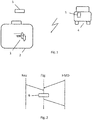
- Fig. 1 schematically shows a typical situation in which the device according to the invention is used.
- a future driver (not shown) of the vehicle 4 approaches the vehicle 4, carrying with it a bag 2 with a data pair 1 in it.
- the driver carries the radio key 3 of the vehicle 4 with him.
- the driver actuates the radio key 3 and thus unlocks the vehicle 4.
- the vehicle 4 has a transmitting and receiving unit 5 for Bluetooth.
- the data glasses 1 has a transmitting and receiving unit for Bluetooth.
- these two transmitting and receiving units establish a radio link in which the data glasses 1 and the vehicle 4 identify.
- the vehicle 4 sends an explicit request to the data glasses 1 to identify themselves or indicate the device class. This can be provided in particular if the connection protocol in itself or the address of the data glasses no identification of the class of equipment or the like provides or allows.
- the data glasses 1 and the vehicle 4 have already recorded radio contact before the data glasses 1 is in the vehicle 4.
- the recording of this radio contact happens in the present example even a few seconds before the vehicle 4 is unlocked with the key 3.
- the vehicle 4 records the times at which the unlocking command of the key 3 was received and the radio link to the data glasses 1 was established. If both times are less than 5 s, or for example less than 1 min apart, a reference of the data glasses 1 to the vehicle 4 is determined. As a result, a warning is displayed to the driver on a display of the vehicle 4 that data glasses may not be worn by the driver while driving and that a data connection for entertainment data offered by the vehicle will not be established until the driver suspends non-use of the vehicle Data glasses confirmed. If the driver now confirms the non-use of the data glasses, the data connection is allowed for entertainment data. Otherwise, the transmission of entertainment data is suppressed.
- Fig. 2 schematically shows the timing of the radio transmissions between the vehicle key “Key”, the vehicle “Fzg” and the data glasses “HMD” when approaching the driver to the vehicle.
- the wireless connection with the data glasses builds up, whereupon shortly after the unlocking command of the key is received.
- the vehicle displays the warning message confirmed by the driver in step 6, so that data transmission for entertainment information for smart glasses is allowed.
- the confirmation of the driver via an input to controls the vehicle. It is also conceivable, however, that the confirmation is not made by the driver of the vehicle, but by the fact that the data glasses are held to an NFC chip in the vicinity of one of the seats for passengers. This is also recognized as confirmation and the data transfer can be enabled.
Landscapes
- Engineering & Computer Science (AREA)
- Physics & Mathematics (AREA)
- Remote Sensing (AREA)
- General Physics & Mathematics (AREA)
- Mathematical Physics (AREA)
- Theoretical Computer Science (AREA)
- Aviation & Aerospace Engineering (AREA)
- Radar, Positioning & Navigation (AREA)
- Computer Networks & Wireless Communication (AREA)
- Computing Systems (AREA)
- Automation & Control Theory (AREA)
- Chemical & Material Sciences (AREA)
- Combustion & Propulsion (AREA)
- Transportation (AREA)
- Mechanical Engineering (AREA)
- Lock And Its Accessories (AREA)
- Transceivers (AREA)
Description
- Die Erfindung betrifft eine Vorrichtung für Kraftfahrzeuge, die dazu dient vor der Benutzung von Datenbrillen im Fahrzeug zu warnen.
- Heutzutage sind Datenbrillen, manchmal auch Head-mounted Displays genannt, bekannt, die eine Anzeige umfassen. Eine Datenbrille wird durch einen Benutzer ähnlich einer gewöhnlichen Brille, die als Sehhilfe verwendet wird, auf dem Kopf getragen. Die Anzeige der Datenbrille befindet sich dabei im Sichtfeld des Trägers. Manche Datenbrillen umfassen eine Anzeige für nur ein Auge, andere Datenbrillen umfassen zwei Teilanzeigen, wobei jedem Auge eine Teilanzeige zugeordnet ist.
- Weiterhin ist es bekannt, dass Datenbrillen eine halbtransparente Anzeige umfassen können. Eine solche Anzeige ermöglicht es dem Träger sowohl angezeigte Informationen als auch das Umfeld hinter der Anzeige zu erkennen. Diese Art an Anzeige ist besonders gut zur kontaktanalogen Darstellung von Informationen geeignet. Es sind Datenbrillen bekannt geworden, deren Anzeige nicht im zentralen Sichtfeld des Trägers liegt.
- Häufig verfügen Datenbrillen über Sende- und Empfangseinheiten zur drahtlosen Datenübertragung. Typischerweise sind dies Bauelemente zur Nutzung von WLAN (manchmal auch WiFi genannt), Bluetooth oder Bauelemente gemäß einem oder mehreren der Mobilfunkstandards 3GPP, LTE oder nachfolgenden Standards.
- Unabhängig davon, ob die Anzeige einer Datenbrille im zentralen oder nicht im zentralen Sichtfeld angeordnet ist, stellen die Darstellungen auf der Anzeige der Datenbrille potentiell eine Ablenkung von anderen Tätigkeiten dar. Dies gilt insbesondere dann, wenn der Träger der Datenbrille als Fahrer ein Fahrzeug führt. Hier kann durch unvermittelt auftauchende Mitteilungen oder Grafiken die Aufmerksamkeit des Fahrers von seiner Fahraufgabe abgelenkt werden, was die Verkehrssicherheit gefährdet.
- Im Falle einer Anzeige einer Datenbrille, die sich im zentralen Sichtfeld des Fahrers befindet, kann sogar die Sicht des Fahrers auf das Verkehrsgeschehen durch Darstellungen der Datenbrille behindert werden. Dies gefährdet ebenfalls die Verkehrssicherheit.
- Um den Fahrer eines Fahrzeugs vor den Risiken des Tragens von Datenbrillen zu warnen, ist es denkbar, Aufkleber im Fahrzeug anzubringen, die vor diesen Risiken warnen. Jedoch ist derzeit die Verbreitung von Datenbrillen unter den Fahrern von Kraftfahrzeugen noch relativ gering, so dass die Warnung für die meisten Fahrer irrelevant wäre und eine optische Störquelle darstellen würde.
- Das Dokument
US 2013/0147686 A1 offenbart eine Durchsicht-Datenbrille, die es erlaubt nahtlos Inhalte von der Datenbrille zu einer Zielrechenvorrichtung zu verschieben. Beispielsweise kann der Benutzer einen Film, der auf der Datenbrille läuft, von einem Fernseher anzeigen lassen, ohne den Filmfluss wesentlich zu unterbrechen. - Die Aufgabe, die der Erfindung zugrunde liegt, ist es somit, nur dann, wenn tatsächlich die Gefahr besteht, dass der Fahrer eines Fahrzeugs eine Datenbrille tragen könnte, vor der Benutzung der Datenbrille zu warnen.
- Die Aufgabe wird durch eine Vorrichtung für ein Fahrzeug und ein Fahrzeug gemäß den unabhängigen Patentansprüchen gelöst. Vorteilhafte Weiterentwicklungen sind in den abhängigen Ansprüchen definiert.
- In einem Aspekt umfasst eine Vorrichtung für ein Fahrzeug: Eine Sende- und Empfangseinheit zur drahtlosen Datenübertragung; Eine elektronische Recheneinheit, die mit der Sende- und Empfangseinheit operativ gekoppelt ist; Wobei die Vorrichtung zu Folgendem eingerichtet ist: Empfangen von Funksignalen von einer Datenbrille mithilfe der Sende- und Empfangseinheit, von der vorhergehend keine Signale empfangen wurden; Erkennen, dass die Datenbrille in Bezug zum Fahrzeug gebracht wird, umfassend: Erkennen eines zeitlichen Zusammenhangs zwischen einer Bedienung des Fahrzeugs und dem Empfangen von Funksignalen der Datenbrille; wobei die Bedienung des Fahrzeugs insbesondere die Entriegelung des Fahrzeugs, die Bewegung von Fenstern des Fahrzeugs, die Öffnung einer Tür des Fahrzeugs oder die Betätigung von Bedienelementen des Fahrzeugs umfasst; In Antwort auf das Erkennen des Bezugs: Ausführen einer vorbestimmten Funktion. Optional kann das Verfahren auch explizit das Erkennen, dass es sich um Funksignale von einer Datenbrille handelt, umfassen. Die Sende- und Empfangseinheit kann ein WLAN Modul sein, insbesondere ein Hotspot, ein Bluetooth-Modul oder eine Station für mobile Datenübertragung gemäß dem 3GPP, LTE oder nachfolgenden Standards. Die Datenbrille verfügt über entsprechende Mittel zur drahtlosen Datenübertragung.
- Es wird somit ermöglicht, den Fahrer eines Fahrzeugs nur dann vor den Gefahren der Benutzung der Datenbrille zu warnen, wenn tatsächlich eine Datenbrille verwendet werden könnte. Die Identifikation von Situationen, in denen eine Datenbrille im Fahrzeug verwendet werden könnte, geschieht über den zeitlichen Zusammenhang zwischen einer Bedienung des Fahrzeugs und dem erstmaligen bzw. nach einem Nicht-Empfang wieder auftretendem Empfang von Signalen von der Datenbrille. Treten beide Ereignisse gleichzeitig oder um einen akzeptablen Zeitversatz nacheinander auf (kleiner als ein Schwellwert, beispielsweise 10s oder 2 min), so besteht eine hohe Wahrscheinlichkeit, dass die Datenbrille von dem Fahrer oder einem anderen Passagier des Fahrzeugs mitgeführt wird und derart in die Nähe des Fahrzeugs gebracht wird, dass eine Funkverbindung aufgebaut werden kann. In einer solchen Situation erscheint beispielsweise die Ausgabe eines Warnhinweises (ein Beispiel für eine Funktion) angebracht. Besteht andererseits kein Anlass anzunehmen, dass eine Datenbrille in das Fahrzeug verbracht wird, so erscheint auch die Ausgabe eines Warnhinweises nicht nötig und würde den Fahrer stören.
- In einer Weiterbildung umfasst das Empfangen von Funksignalen: Erkennen einer Angabe in den Funksignalen, die anzeigt, dass die Funksignale von einer Datenbrille stammen; wobei die Angabe in den Funksignalen insbesondere einem Funkprotokoll entspricht.
- Die Erkennung bzw. Feststellung, dass es sich bei den Funksignalen um Funksignale von einer Datenbrille handelt, kann anhand einer Adresse (beispielsweise einer MAC Adresse einer WLAN-Einheit) der Sende- und Empfangseinheit der Datenbrille und einer Zuordnung der Adresse zu einem Produkt oder Hersteller oder zu einer Geräteklasse anhand einer Liste, die eine Verknüpfung zwischen Adressen und Produkten, Herstellern oder Geräteklassen bereitstellt, geschehen. Es kann auch vorgesehen sein, anhand einer Angabe zur Geräteklasse, die in dem verwendeten Übertragungsprotokoll vorgesehen ist, oder die auf Anfrage von der erfindungsgemäßen Vorrichtung von der Datenbrille mitgeteilt wird, die Feststellung zu treffen, dass es sich um eine Datenbrille handelt.
- In einer bevorzugten Weiterbildung umfasst das Erkennen, dass die Datenbrille in Bezug zum Fahrzeug gebracht wird: Bestimmen der Entfernung und/oder Position der Datenbrille in Bezug auf das Fahrzeug mithilfe der Signalstärke der Funksignale durch die Sende- und Empfangseinheit; wobei die Sende- und Empfangseinheit insbesondere mehrere Antennen an unterschiedlichen Positionen umfasst, mit deren Hilfe sich die Signalstärke und/oder die Herkunftsrichtung der Funksignale bestimmen lässt. Es wird somit eine Ortung bzw. nur eine Entfernungsbestimmung anhand der Signalstärke der Datenbrille vorgeschlagen. Diese Informationen werden berücksichtigt, um die Nähe der Datenbrille zum Fahrzeug zu erkennen. Gegebenenfalls kann auch erkannt werden, in welche Richtung sich die Datenbrille bewegt, ob sie sich zum Fahrzeug hin bewegt oder vom Fahrzeug weg bewegt. Dies sind weitere Indizien dafür, dass der Fahrer des Fahrzeugs die Datenbrille mit sich trägt.
In einer Weiterbildung umfasst die Funktion: Veranlassen der Ausgabe eines Hinweises durch eine Ausgabevorrichtung, insbesondere durch eine Anzeige und/oder Lautsprecher; Empfangen von Informationen über eine Eingabe durch einen Benutzer in eine Eingabevorrichtung; Empfangen einer Eingabe als Antwort auf den Hinweis; Prüfen, ob die Eingabe eine vorbestimmte Bedingung erfüllt; Solange die Eingabe die vorbestimmte Bedingung nicht erfüllt: Verhindern einer weiteren Funktion, insbesondere Verhindern von bestimmten Typen von Datenübertragungen von dem Fahrzeug zur Datenbrille oder Verhindern des Starts der Kraftmaschine des Fahrzeugs. Wenn also festgestellt wurde, dass der Benutzer eine Datenbrille in das Fahrzeug verbringt, kann diesem ein Warnhinweis gegeben werden und der Fahrer aufgefordert werden, die Datenbrille nicht zu benutzen. Dieser Warnhinweis kann mit einer Abfrage einhergehen, in der der Fahrer bestätigt, die Datenbrille nicht zu tragen. Erst daraufhin kann beispielsweise die Übertragung von Unterhaltungsdaten wie Videos oder Aktualitätendiensten aus dem Internet über die Sende- und Empfangseinrichtung der erfindungsgemäßen Vorrichtung, die im Fahrzeug verbaut ist, zugelassen werden. Dies soll verhindern, dass der Fahrer die Datenbrille trägt und ermöglicht gleichzeitig die Benutzung der Datenbrille durch andere Passagiere des Fahrzeugs. Ebenso kann vorgesehen sein, den Start der Kraftmaschine des Fahrzeugs von der Bestätigung abhängig zu machen, dass der Fahrer die Datenbrille nicht trägt.
In einer bevorzugten Weiterbildung umfasst die Eingabe das Verbringen der Datenbrille in den Sendebereich einer Nahbereichskommunikation, manchmal auch near-field communication bzw. NFC genannt. Dabei umfasst die Datenbrille einen Bauelement zur NFC Kommunikation mit einem entsprechenden Gegenelement (einem NFC Chip) im Fahrzeug. Eine Kommunikation zwischen den beiden NFC Bausteinen findet nur statt, wenn der NFC Chip der Datenbrille ausreichend nah an dem NFC Baustein des Fahrzeugs ist, beispielsweise näher als 10 cm. Nun ist es möglich, den NFC Chip des Fahrzeugs an einer Stelle im Fahrzeuginnenraum anzuordnen, der nur von den Sitzplätzen für Mitfahrer (bequem) erreicht werden kann und nicht von dem Fahrersitz. Durch das Halten der Datenbrille an den NFC Chip des Fahrzeugs wird bestätigt, dass die Datenbrille von einem Mitfahrer benutzt wird und die Datenübertragung von Unterhaltungsdaten zu dieser Datenbrille kann freigeschaltet werden. -
-
Fig. 1 zeigt schematisch eine typische Situation, in der die erfindungsgemäße Vorrichtung zum Einsatz kommt. -
Fig. 2 zeigt schematisch ein Ablaufdiagramm von Signalübertragungen zur erfindungsgemäßen Vorrichtung gemäß einem Ausführungsbeispiel. -
Fig. 1 zeigt schematisch eine typische Situation, in der die erfindungsgemäße Vorrichtung zum Einsatz kommt. Ein zukünftiger Fahrer (nicht gezeigt) des Fahrzeugs 4 nähert sich dem Fahrzeug 4 und führt dabei eine Tasche 2 mit einer sich darin befindlichen Datenbrille 1 mit. Ebenso führt der Fahrer den Funkschlüssel 3 des Fahrzeugs 4 mit sich. Während der Annäherung an das Fahrzeug 4 betätigt der Fahrer den Funkschlüssel 3 und entriegelt damit das Fahrzeug 4. Das Fahrzeug 4 verfügt über eine Sende- und Empfangseinheit 5 für Bluetooth. Ebenso verfügt die Datenbrille 1 über eine Sende- und Empfangseinheit für Bluetooth. Während der Annäherung des Fahrers an das Fahrzeug 4 stellen diese beiden Sende- und Empfangseinheiten eine Funkverbindung her, in der sich die Datenbrille 1 und das Fahrzeug 4 identifizieren. In manchen Implementierungen sendet das Fahrzeug 4 eine explizite Anfrage an die Datenbrille 1, sich zu identifizieren bzw. die Geräteklasse anzugeben. Dies kann insbesondere dann vorgesehen sein, wenn das Verbindungsprotokoll an sich oder die Adresse der Datenbrille keine Identifikation der Geräteklasse oder ähnliches vorsieht oder ermöglicht. - Die Datenbrille 1 und das Fahrzeug 4 haben also bereits Funkkontakt aufgenommen bevor sich die Datenbrille 1 im Fahrzeug 4 befindet. Die Aufnahme dieses Funkkontakts geschieht im vorliegenden Beispiel sogar einige Sekunden bevor das Fahrzeug 4 mit dem Schlüssel 3 entriegelt wird. Das Fahrzeug 4 zeichnet die Zeitpunkte auf, zu denen der Entriegelungsbefehl des Schlüssels 3 empfangen wurde und die Funkverbindung zur Datenbrille 1 aufgebaut wurde. Liegen beide Zeitpunkte weniger als 5s, oder beispielsweise auch weniger als 1 min, auseinander, so wird ein Bezug der Datenbrille 1 zum Fahrzeug 4 festgestellt. In der Folge wird dem Fahrer auf einer Anzeige des Fahrzeugs 4 ein Warnhinweis angezeigt, dass Datenbrillen nicht vom Fahrer während der Fahrt getragen werden dürfen und dass eine Datenverbindung für Unterhaltungsdaten, die das Fahrzeug anbietet, erst dann aufgebaut wird, wenn der Fahrer die Nichtbenutzung der Datenbrille bestätigt. Bestätigt nun der Fahrer die Nichtbenutzung der Datenbrille wird die Datenverbindung für Unterhaltungsdaten zugelassen. Andernfalls wird die Übertragung von Unterhaltungsdaten unterdrückt.
-
Fig. 2 zeigt schematisch den zeitlichen Ablauf der Funkübertragungen zwischen Fahrzeugschlüssel "Key", dem Fahrzeug "Fzg" und der Datenbrille "HMD" bei einer Annäherung des Fahrers an das Fahrzeug. Zunächst baut sich die Funkverbindung mit der Datenbrille auf, woraufhin kurz danach der Entriegelungsbefehl des Schlüssels empfangen wird. Das Fahrzeug zeigt im Schritt 6 den Warnhinweis an, der vom Fahrer bestätigt wird, so dass eine Datenübertragung für Unterhaltungsinformationen zur Datenbrille zugelassen wird. Die Bestätigung des Fahrers erfolgt über eine Eingabe an Bedienelementen des Fahrzeugs. Ebenfalls denkbar ist allerdings auch, dass die Bestätigung nicht durch den Fahrer des Fahrzeugs getätigt wird, sondern dadurch, dass die Datenbrille an einen NFC Chip in der Nähe eines der Sitzplätze für Mitfahrer gehalten wird. Dies wird ebenfalls als Bestätigung erkannt und die Datenübertragung kann freigeschaltet werden.
Claims (6)
- Vorrichtung für ein Fahrzeug, umfassend:Eine Sende- und Empfangseinheit zur drahtlosen Datenübertragung;Eine elektronische Recheneinheit, die mit der Sende- und Empfangseinheit operativ gekoppelt ist; wobei die Vorrichtung zu Folgendem eingerichtet ist:Empfangen von Funksignalen von einer Datenbrille mithilfe der Sende- und Empfangseinheit, von der vorhergehend keine Signale empfangen wurden;Erkennen, dass die Datenbrille in Bezug zum Fahrzeug gebracht wird, umfassend:Erkennen eines zeitlichen Zusammenhangs zwischen einer Bedienung des Fahrzeugs und dem Empfangen von Funksignalen der Datenbrille;wobei die Bedienung des Fahrzeugs insbesondere die Entriegelung des Fahrzeugs, die Bewegung von Fenstern des Fahrzeugs, die Öffnung einer Tür des Fahrzeugs oder die Betätigung von Bedienelementen des Fahrzeugs umfasst;In Antwort auf das Erkennen des Bezugs: Ausführen einer vorbestimmten Funktion.
- Vorrichtung nach einem der vorhergehenden Ansprüche, wobei das Empfangen von Funksignalen, umfasst:Erkennen einer Angabe in den Funksignalen, die anzeigt, dass die Funksignale von einer Datenbrille stammen; wobei die Angabe in den Funksignalen insbesondere den Vorgaben eines Funkprotokolls entspricht.
- Vorrichtung nach einem der vorhergehenden Ansprüche wobei das Erkennen, dass die Datenbrille in Bezug zum Fahrzeug gebracht wird, umfasst:Bestimmen der Entfernung und/oder Position der Datenbrille in Bezug auf das Fahrzeug mithilfe der Signalstärke der Funksignale durch die Sende-und Empfangseinheit; wobei die Sende- und Empfangseinheit insbesondere mehrere Antennen an unterschiedlichen Positionen umfasst, mit deren Hilfe sich die Signalstärke und/oder die Herkunftsrichtung der Funksignale bestimmen lässt.
- Vorrichtung nach einem der vorhergehenden Ansprüche, wobei die Funktion umfasst:Veranlassen der Ausgabe eines Hinweises durch eine Ausgabevorrichtung, insbesondere durch eine Anzeige und/oder Lautsprecher;Empfangen von Informationen über eine Eingabe durch einen Benutzer in eine Eingabevorrichtung;Empfangen einer Eingabe als Antwort auf den Hinweis;Prüfen, ob die Eingabe eine vorbestimmte Bedingung erfüllt;Solange die Eingabe die vorbestimmte Bedingung nicht erfüllt: Verhindern einer weiteren Funktion, insbesondere Verhindern von bestimmten Typen von Datenübertragungen von dem Fahrzeug zur Datenbrille oder Verhindern des Starts der Kraftmaschine des Fahrzeugs.
- Vorrichtung nach Anspruch 4, wobei die Eingabe das Verbringen der Datenbrille in den Sendebereich einer Nahbereichskommunikation umfasst, wobei die Eingabevorrichtung ein Bauelement der Nahbereichskommunikation ist.
- Kraftfahrzeug, umfassend eine Vorrichtung nach einem der vorhergehenden Ansprüche.
Applications Claiming Priority (2)
| Application Number | Priority Date | Filing Date | Title |
|---|---|---|---|
| DE201310221855 DE102013221855A1 (de) | 2013-10-28 | 2013-10-28 | Warnhinweis bezüglich der Benutzung von Head-mounted Displays im Fahrzeug |
| PCT/EP2014/071117 WO2015062805A1 (de) | 2013-10-28 | 2014-10-02 | Warnhinweis bezüglich der benutzung von head-mounted displays im fahrzeug |
Publications (2)
| Publication Number | Publication Date |
|---|---|
| EP3063033A1 EP3063033A1 (de) | 2016-09-07 |
| EP3063033B1 true EP3063033B1 (de) | 2017-12-06 |
Family
ID=51753192
Family Applications (1)
| Application Number | Title | Priority Date | Filing Date |
|---|---|---|---|
| EP14786627.1A Active EP3063033B1 (de) | 2013-10-28 | 2014-10-02 | Warnhinweis bezüglich der benutzung von head-mounted displays im fahrzeug |
Country Status (4)
| Country | Link |
|---|---|
| US (1) | US9964947B2 (de) |
| EP (1) | EP3063033B1 (de) |
| DE (1) | DE102013221855A1 (de) |
| WO (1) | WO2015062805A1 (de) |
Cited By (1)
| Publication number | Priority date | Publication date | Assignee | Title |
|---|---|---|---|---|
| DE102018206655A1 (de) | 2018-04-30 | 2019-10-31 | Audi Ag | Verfahren und System zur Personenbeförderung |
Families Citing this family (5)
| Publication number | Priority date | Publication date | Assignee | Title |
|---|---|---|---|---|
| KR20170004343A (ko) * | 2015-07-02 | 2017-01-11 | 삼성전자주식회사 | 사용자 단말기, 이를 포함하는 청소 로봇 및 그 제어 방법 |
| DE102017221871A1 (de) * | 2017-12-05 | 2019-06-06 | Volkswagen Aktiengesellschaft | Verfahren zur Berechnung der Bewegungsdaten des Kopfes eines Fahrers eines Fahrzeuges, Datenbrille sowie Fahrzeug zur Verwendung bei dem Verfahren und Computerprogramm |
| DE102024122782A1 (de) * | 2024-08-09 | 2026-02-12 | Bayerische Motoren Werke Aktiengesellschaft | Verfahren zum Betreiben eines elektronischen Sicherheitssystems eines Fahrzeugs, sowie elektronisches Sicherheitssystem und Fahrzeug |
| DE102024127961A1 (de) | 2024-09-26 | 2026-03-26 | Bayerische Motoren Werke Aktiengesellschaft | Verfahren zum Anwenden eines geteilten digitalen Schlüssels eines Fahrzeugs, Fahrzeugzugangssystem sowie digitaler Schlüssel für ein Fahrzeug |
| DE102024127962A1 (de) | 2024-09-26 | 2026-03-26 | Bayerische Motoren Werke Aktiengesellschaft | Digitaler Schlüssel für ein mobiles Endgerät, Verfahren zum Anwenden eines geteilten digitalen Schlüssels eines Fahrzeugs sowie Fahrzeugzugangssystem |
Family Cites Families (6)
| Publication number | Priority date | Publication date | Assignee | Title |
|---|---|---|---|---|
| EP1990674A1 (de) * | 2007-05-09 | 2008-11-12 | Harman Becker Automotive Systems GmbH | Am Kopf montierte Anzeigevorrichtung |
| JP5692578B2 (ja) | 2011-01-25 | 2015-04-01 | 日本精機株式会社 | 車両情報取得装置及び車両情報取得方法 |
| US20130147686A1 (en) * | 2011-12-12 | 2013-06-13 | John Clavin | Connecting Head Mounted Displays To External Displays And Other Communication Networks |
| DE102012201513A1 (de) | 2012-02-02 | 2013-08-08 | Bayerische Motoren Werke Aktiengesellschaft | Warneinrichtung in einem Kraftfahrzeug zum Warnen eines Fahrzeugführers |
| US9760698B2 (en) * | 2013-09-17 | 2017-09-12 | Toyota Motor Sales, U.S.A., Inc. | Integrated wearable article for interactive vehicle control system |
| US9697465B2 (en) * | 2014-04-30 | 2017-07-04 | Google Technology Holdings LLC | Drawing an inference of a usage context of a computing device using multiple sensors |
-
2013
- 2013-10-28 DE DE201310221855 patent/DE102013221855A1/de not_active Withdrawn
-
2014
- 2014-10-02 WO PCT/EP2014/071117 patent/WO2015062805A1/de not_active Ceased
- 2014-10-02 EP EP14786627.1A patent/EP3063033B1/de active Active
-
2016
- 2016-04-27 US US15/140,078 patent/US9964947B2/en active Active
Cited By (1)
| Publication number | Priority date | Publication date | Assignee | Title |
|---|---|---|---|---|
| DE102018206655A1 (de) | 2018-04-30 | 2019-10-31 | Audi Ag | Verfahren und System zur Personenbeförderung |
Also Published As
| Publication number | Publication date |
|---|---|
| US9964947B2 (en) | 2018-05-08 |
| DE102013221855A1 (de) | 2015-04-30 |
| EP3063033A1 (de) | 2016-09-07 |
| US20160239020A1 (en) | 2016-08-18 |
| WO2015062805A1 (de) | 2015-05-07 |
| WO2015062805A9 (de) | 2016-06-09 |
Similar Documents
| Publication | Publication Date | Title |
|---|---|---|
| EP3063033A1 (de) | Warnhinweis bezüglich der benutzung von head-mounted displays im fahrzeug | |
| DE102018107755A1 (de) | Fahrzeugereigniserkennung und -klassifizierung mithilfe von kontextbezogenen fahrzeugdaten | |
| DE102017103928A1 (de) | Systeme und Verfahren zum Einschätzen eines Fahrrisikoindex | |
| DE102010038640A1 (de) | Vorrichtung und Verfahren zur C2X-Kommunikation | |
| DE102010040803A1 (de) | Visuelles Fahrerinformations- und Warnsystem für einen Fahrer eines Kraftfahrzeugs | |
| DE102016205661B4 (de) | Verfahren zum Vermeiden einer Kollision und Fahrzeug | |
| DE102011112599A1 (de) | Fahrzeugkomfortsystem zum Nutzen und/oder Steuern von Fahrzeugfunktionen mithilfe eines Mobilgeräts | |
| DE102015016093A1 (de) | Einrichtung zum Verringern von Ablenkung des Fahrers über Nahbereichs- Fahrzeugkommunikation | |
| DE102013226336A1 (de) | Kommunikation zwischen autonomen Fahrzeugen und Menschen | |
| DE112015000702T5 (de) | Verfahren zum Abgeben von Fahrerfunkvorrichtungsaktivitäten an Passagiere über eine drahtlose Fahrzeugschnittstelle | |
| WO2015049232A1 (de) | Vorrichtung zur darstellung einer information über eine bevorstehende übernahme einer manuellen steuerung eines fahrzeugs | |
| DE102014208981A1 (de) | Kontextabhängige Tönung einer Brille und eines HMD | |
| DE102017208881A1 (de) | Mobile Sensorvorrichtung für ein in einem Fahrzeug einsetzbares am Kopf tragbares visuelles Ausgabegerät und Verfahren zum Betreiben eines Anzeigesystems | |
| DE102012213466A1 (de) | Verfahren und Vorrichtung zum Überwachen eines Fahrzeuginsassens | |
| EP3205078B1 (de) | Verfahren zum betreiben eines kraftfahrzeugs und kraftfahrzeug | |
| DE102014225833A1 (de) | System und Verfahren zum Erkennen einer Bewegung durch Analyse eines Funksignals | |
| DE102016225269A1 (de) | Verfahren und Vorrichtung zum Betreiben eines Anzeigesystems mit einer Datenbrille | |
| DE102016002703A1 (de) | Verfahren zur Kommunikation zwischen einem ersten Fahrzeug und einem zweiten Fahrzeug, Kommunikationseinrichtung für ein Fahrzeug, und entsprechendes Fahrzeug | |
| DE102012002563A1 (de) | Kraftfahrzeugvorrichtung mit einem Warndaten-Informationssystem | |
| DE102014003781B4 (de) | Fahrerassistenzsystem für ein Kraftfahrzeug und zugehöriges Betriebsverfahren | |
| DE102014009608A1 (de) | Betrieb einer AR-Brille im Kraftfahrzeug | |
| DE102014226187B4 (de) | Kommunikation mittels eines Luftstoßes | |
| DE102014214456A1 (de) | Kommunikation von Verkehrsteilnehmern | |
| DE102018208429A1 (de) | System zum Bereitstellen zumindest einer Positionsinformation zumindest eines dynamischen Objekts für ein Kraftfahrzeug sowie Verfahren | |
| EP3063603A1 (de) | Zuordnen eines head-mounted displays zu einem sitzplatz in einem fahrzeug |
Legal Events
| Date | Code | Title | Description |
|---|---|---|---|
| PUAI | Public reference made under article 153(3) epc to a published international application that has entered the european phase |
Free format text: ORIGINAL CODE: 0009012 |
|
| 17P | Request for examination filed |
Effective date: 20160324 |
|
| AK | Designated contracting states |
Kind code of ref document: A1 Designated state(s): AL AT BE BG CH CY CZ DE DK EE ES FI FR GB GR HR HU IE IS IT LI LT LU LV MC MK MT NL NO PL PT RO RS SE SI SK SM TR |
|
| AX | Request for extension of the european patent |
Extension state: BA ME |
|
| DAX | Request for extension of the european patent (deleted) | ||
| GRAP | Despatch of communication of intention to grant a patent |
Free format text: ORIGINAL CODE: EPIDOSNIGR1 |
|
| INTG | Intention to grant announced |
Effective date: 20170711 |
|
| GRAS | Grant fee paid |
Free format text: ORIGINAL CODE: EPIDOSNIGR3 |
|
| GRAA | (expected) grant |
Free format text: ORIGINAL CODE: 0009210 |
|
| AK | Designated contracting states |
Kind code of ref document: B1 Designated state(s): AL AT BE BG CH CY CZ DE DK EE ES FI FR GB GR HR HU IE IS IT LI LT LU LV MC MK MT NL NO PL PT RO RS SE SI SK SM TR |
|
| REG | Reference to a national code |
Ref country code: GB Ref legal event code: FG4D Free format text: NOT ENGLISH |
|
| REG | Reference to a national code |
Ref country code: AT Ref legal event code: REF Ref document number: 952064 Country of ref document: AT Kind code of ref document: T Effective date: 20171215 Ref country code: CH Ref legal event code: EP |
|
| REG | Reference to a national code |
Ref country code: IE Ref legal event code: FG4D Free format text: LANGUAGE OF EP DOCUMENT: GERMAN |
|
| REG | Reference to a national code |
Ref country code: DE Ref legal event code: R096 Ref document number: 502014006509 Country of ref document: DE |
|
| REG | Reference to a national code |
Ref country code: NL Ref legal event code: MP Effective date: 20171206 |
|
| REG | Reference to a national code |
Ref country code: LT Ref legal event code: MG4D |
|
| PG25 | Lapsed in a contracting state [announced via postgrant information from national office to epo] |
Ref country code: ES Free format text: LAPSE BECAUSE OF FAILURE TO SUBMIT A TRANSLATION OF THE DESCRIPTION OR TO PAY THE FEE WITHIN THE PRESCRIBED TIME-LIMIT Effective date: 20171206 Ref country code: FI Free format text: LAPSE BECAUSE OF FAILURE TO SUBMIT A TRANSLATION OF THE DESCRIPTION OR TO PAY THE FEE WITHIN THE PRESCRIBED TIME-LIMIT Effective date: 20171206 Ref country code: SE Free format text: LAPSE BECAUSE OF FAILURE TO SUBMIT A TRANSLATION OF THE DESCRIPTION OR TO PAY THE FEE WITHIN THE PRESCRIBED TIME-LIMIT Effective date: 20171206 Ref country code: LT Free format text: LAPSE BECAUSE OF FAILURE TO SUBMIT A TRANSLATION OF THE DESCRIPTION OR TO PAY THE FEE WITHIN THE PRESCRIBED TIME-LIMIT Effective date: 20171206 Ref country code: NO Free format text: LAPSE BECAUSE OF FAILURE TO SUBMIT A TRANSLATION OF THE DESCRIPTION OR TO PAY THE FEE WITHIN THE PRESCRIBED TIME-LIMIT Effective date: 20180306 |
|
| PG25 | Lapsed in a contracting state [announced via postgrant information from national office to epo] |
Ref country code: RS Free format text: LAPSE BECAUSE OF FAILURE TO SUBMIT A TRANSLATION OF THE DESCRIPTION OR TO PAY THE FEE WITHIN THE PRESCRIBED TIME-LIMIT Effective date: 20171206 Ref country code: BG Free format text: LAPSE BECAUSE OF FAILURE TO SUBMIT A TRANSLATION OF THE DESCRIPTION OR TO PAY THE FEE WITHIN THE PRESCRIBED TIME-LIMIT Effective date: 20180306 Ref country code: LV Free format text: LAPSE BECAUSE OF FAILURE TO SUBMIT A TRANSLATION OF THE DESCRIPTION OR TO PAY THE FEE WITHIN THE PRESCRIBED TIME-LIMIT Effective date: 20171206 Ref country code: HR Free format text: LAPSE BECAUSE OF FAILURE TO SUBMIT A TRANSLATION OF THE DESCRIPTION OR TO PAY THE FEE WITHIN THE PRESCRIBED TIME-LIMIT Effective date: 20171206 Ref country code: GR Free format text: LAPSE BECAUSE OF FAILURE TO SUBMIT A TRANSLATION OF THE DESCRIPTION OR TO PAY THE FEE WITHIN THE PRESCRIBED TIME-LIMIT Effective date: 20180307 |
|
| PG25 | Lapsed in a contracting state [announced via postgrant information from national office to epo] |
Ref country code: NL Free format text: LAPSE BECAUSE OF FAILURE TO SUBMIT A TRANSLATION OF THE DESCRIPTION OR TO PAY THE FEE WITHIN THE PRESCRIBED TIME-LIMIT Effective date: 20171206 |
|
| PG25 | Lapsed in a contracting state [announced via postgrant information from national office to epo] |
Ref country code: EE Free format text: LAPSE BECAUSE OF FAILURE TO SUBMIT A TRANSLATION OF THE DESCRIPTION OR TO PAY THE FEE WITHIN THE PRESCRIBED TIME-LIMIT Effective date: 20171206 Ref country code: CZ Free format text: LAPSE BECAUSE OF FAILURE TO SUBMIT A TRANSLATION OF THE DESCRIPTION OR TO PAY THE FEE WITHIN THE PRESCRIBED TIME-LIMIT Effective date: 20171206 Ref country code: SK Free format text: LAPSE BECAUSE OF FAILURE TO SUBMIT A TRANSLATION OF THE DESCRIPTION OR TO PAY THE FEE WITHIN THE PRESCRIBED TIME-LIMIT Effective date: 20171206 |
|
| PG25 | Lapsed in a contracting state [announced via postgrant information from national office to epo] |
Ref country code: SM Free format text: LAPSE BECAUSE OF FAILURE TO SUBMIT A TRANSLATION OF THE DESCRIPTION OR TO PAY THE FEE WITHIN THE PRESCRIBED TIME-LIMIT Effective date: 20171206 Ref country code: IT Free format text: LAPSE BECAUSE OF FAILURE TO SUBMIT A TRANSLATION OF THE DESCRIPTION OR TO PAY THE FEE WITHIN THE PRESCRIBED TIME-LIMIT Effective date: 20171206 Ref country code: RO Free format text: LAPSE BECAUSE OF FAILURE TO SUBMIT A TRANSLATION OF THE DESCRIPTION OR TO PAY THE FEE WITHIN THE PRESCRIBED TIME-LIMIT Effective date: 20171206 Ref country code: PL Free format text: LAPSE BECAUSE OF FAILURE TO SUBMIT A TRANSLATION OF THE DESCRIPTION OR TO PAY THE FEE WITHIN THE PRESCRIBED TIME-LIMIT Effective date: 20171206 |
|
| REG | Reference to a national code |
Ref country code: DE Ref legal event code: R097 Ref document number: 502014006509 Country of ref document: DE |
|
| PG25 | Lapsed in a contracting state [announced via postgrant information from national office to epo] |
Ref country code: MT Free format text: LAPSE BECAUSE OF FAILURE TO SUBMIT A TRANSLATION OF THE DESCRIPTION OR TO PAY THE FEE WITHIN THE PRESCRIBED TIME-LIMIT Effective date: 20171206 |
|
| PLBE | No opposition filed within time limit |
Free format text: ORIGINAL CODE: 0009261 |
|
| STAA | Information on the status of an ep patent application or granted ep patent |
Free format text: STATUS: NO OPPOSITION FILED WITHIN TIME LIMIT |
|
| REG | Reference to a national code |
Ref country code: FR Ref legal event code: PLFP Year of fee payment: 5 |
|
| 26N | No opposition filed |
Effective date: 20180907 |
|
| PG25 | Lapsed in a contracting state [announced via postgrant information from national office to epo] |
Ref country code: DK Free format text: LAPSE BECAUSE OF FAILURE TO SUBMIT A TRANSLATION OF THE DESCRIPTION OR TO PAY THE FEE WITHIN THE PRESCRIBED TIME-LIMIT Effective date: 20171206 Ref country code: SI Free format text: LAPSE BECAUSE OF FAILURE TO SUBMIT A TRANSLATION OF THE DESCRIPTION OR TO PAY THE FEE WITHIN THE PRESCRIBED TIME-LIMIT Effective date: 20171206 |
|
| REG | Reference to a national code |
Ref country code: CH Ref legal event code: PL |
|
| REG | Reference to a national code |
Ref country code: BE Ref legal event code: MM Effective date: 20181031 |
|
| PG25 | Lapsed in a contracting state [announced via postgrant information from national office to epo] |
Ref country code: MC Free format text: LAPSE BECAUSE OF FAILURE TO SUBMIT A TRANSLATION OF THE DESCRIPTION OR TO PAY THE FEE WITHIN THE PRESCRIBED TIME-LIMIT Effective date: 20171206 Ref country code: LU Free format text: LAPSE BECAUSE OF NON-PAYMENT OF DUE FEES Effective date: 20181002 |
|
| REG | Reference to a national code |
Ref country code: IE Ref legal event code: MM4A |
|
| PG25 | Lapsed in a contracting state [announced via postgrant information from national office to epo] |
Ref country code: LI Free format text: LAPSE BECAUSE OF NON-PAYMENT OF DUE FEES Effective date: 20181031 Ref country code: CH Free format text: LAPSE BECAUSE OF NON-PAYMENT OF DUE FEES Effective date: 20181031 Ref country code: BE Free format text: LAPSE BECAUSE OF NON-PAYMENT OF DUE FEES Effective date: 20181031 |
|
| PG25 | Lapsed in a contracting state [announced via postgrant information from national office to epo] |
Ref country code: IE Free format text: LAPSE BECAUSE OF NON-PAYMENT OF DUE FEES Effective date: 20181002 |
|
| PG25 | Lapsed in a contracting state [announced via postgrant information from national office to epo] |
Ref country code: TR Free format text: LAPSE BECAUSE OF FAILURE TO SUBMIT A TRANSLATION OF THE DESCRIPTION OR TO PAY THE FEE WITHIN THE PRESCRIBED TIME-LIMIT Effective date: 20171206 |
|
| PG25 | Lapsed in a contracting state [announced via postgrant information from national office to epo] |
Ref country code: PT Free format text: LAPSE BECAUSE OF FAILURE TO SUBMIT A TRANSLATION OF THE DESCRIPTION OR TO PAY THE FEE WITHIN THE PRESCRIBED TIME-LIMIT Effective date: 20171206 |
|
| PG25 | Lapsed in a contracting state [announced via postgrant information from national office to epo] |
Ref country code: MK Free format text: LAPSE BECAUSE OF NON-PAYMENT OF DUE FEES Effective date: 20171206 Ref country code: HU Free format text: LAPSE BECAUSE OF FAILURE TO SUBMIT A TRANSLATION OF THE DESCRIPTION OR TO PAY THE FEE WITHIN THE PRESCRIBED TIME-LIMIT; INVALID AB INITIO Effective date: 20141002 Ref country code: CY Free format text: LAPSE BECAUSE OF FAILURE TO SUBMIT A TRANSLATION OF THE DESCRIPTION OR TO PAY THE FEE WITHIN THE PRESCRIBED TIME-LIMIT Effective date: 20171206 |
|
| PG25 | Lapsed in a contracting state [announced via postgrant information from national office to epo] |
Ref country code: AL Free format text: LAPSE BECAUSE OF FAILURE TO SUBMIT A TRANSLATION OF THE DESCRIPTION OR TO PAY THE FEE WITHIN THE PRESCRIBED TIME-LIMIT Effective date: 20171206 Ref country code: IS Free format text: LAPSE BECAUSE OF FAILURE TO SUBMIT A TRANSLATION OF THE DESCRIPTION OR TO PAY THE FEE WITHIN THE PRESCRIBED TIME-LIMIT Effective date: 20180406 |
|
| REG | Reference to a national code |
Ref country code: AT Ref legal event code: MM01 Ref document number: 952064 Country of ref document: AT Kind code of ref document: T Effective date: 20191002 |
|
| PG25 | Lapsed in a contracting state [announced via postgrant information from national office to epo] |
Ref country code: AT Free format text: LAPSE BECAUSE OF NON-PAYMENT OF DUE FEES Effective date: 20191002 |
|
| P01 | Opt-out of the competence of the unified patent court (upc) registered |
Effective date: 20230502 |
|
| PGFP | Annual fee paid to national office [announced via postgrant information from national office to epo] |
Ref country code: DE Payment date: 20251021 Year of fee payment: 12 |
|
| PGFP | Annual fee paid to national office [announced via postgrant information from national office to epo] |
Ref country code: GB Payment date: 20251024 Year of fee payment: 12 |
|
| PGFP | Annual fee paid to national office [announced via postgrant information from national office to epo] |
Ref country code: FR Payment date: 20251029 Year of fee payment: 12 |