EP3058927A1 - Krankenfahrstuhl mit vibrationseinheit - Google Patents
Krankenfahrstuhl mit vibrationseinheit Download PDFInfo
- Publication number
- EP3058927A1 EP3058927A1 EP16000113.7A EP16000113A EP3058927A1 EP 3058927 A1 EP3058927 A1 EP 3058927A1 EP 16000113 A EP16000113 A EP 16000113A EP 3058927 A1 EP3058927 A1 EP 3058927A1
- Authority
- EP
- European Patent Office
- Prior art keywords
- ambulance
- vibration unit
- vibration
- vibrations
- patient
- Prior art date
- Legal status (The legal status is an assumption and is not a legal conclusion. Google has not performed a legal analysis and makes no representation as to the accuracy of the status listed.)
- Granted
Links
Images

Classifications
-
- A—HUMAN NECESSITIES
- A61—MEDICAL OR VETERINARY SCIENCE; HYGIENE
- A61H—PHYSICAL THERAPY APPARATUS, e.g. DEVICES FOR LOCATING OR STIMULATING REFLEX POINTS IN THE BODY; ARTIFICIAL RESPIRATION; MASSAGE; BATHING DEVICES FOR SPECIAL THERAPEUTIC OR HYGIENIC PURPOSES OR SPECIFIC PARTS OF THE BODY
- A61H23/00—Percussion or vibration massage, e.g. using supersonic vibration; Suction-vibration massage; Massage with moving diaphragms
- A61H23/02—Percussion or vibration massage, e.g. using supersonic vibration; Suction-vibration massage; Massage with moving diaphragms with electric or magnetic drive
- A61H23/0254—Percussion or vibration massage, e.g. using supersonic vibration; Suction-vibration massage; Massage with moving diaphragms with electric or magnetic drive with rotary motor
-
- A—HUMAN NECESSITIES
- A61—MEDICAL OR VETERINARY SCIENCE; HYGIENE
- A61G—TRANSPORT, PERSONAL CONVEYANCES, OR ACCOMMODATION SPECIALLY ADAPTED FOR PATIENTS OR DISABLED PERSONS; OPERATING TABLES OR CHAIRS; CHAIRS FOR DENTISTRY; FUNERAL DEVICES
- A61G5/00—Chairs or personal conveyances specially adapted for patients or disabled persons, e.g. wheelchairs
- A61G5/10—Parts, details or accessories
-
- A—HUMAN NECESSITIES
- A61—MEDICAL OR VETERINARY SCIENCE; HYGIENE
- A61G—TRANSPORT, PERSONAL CONVEYANCES, OR ACCOMMODATION SPECIALLY ADAPTED FOR PATIENTS OR DISABLED PERSONS; OPERATING TABLES OR CHAIRS; CHAIRS FOR DENTISTRY; FUNERAL DEVICES
- A61G5/00—Chairs or personal conveyances specially adapted for patients or disabled persons, e.g. wheelchairs
- A61G5/10—Parts, details or accessories
- A61G5/12—Rests specially adapted therefor, e.g. for the head or the feet
- A61G5/128—Rests specially adapted therefor, e.g. for the head or the feet for feet
-
- A—HUMAN NECESSITIES
- A61—MEDICAL OR VETERINARY SCIENCE; HYGIENE
- A61H—PHYSICAL THERAPY APPARATUS, e.g. DEVICES FOR LOCATING OR STIMULATING REFLEX POINTS IN THE BODY; ARTIFICIAL RESPIRATION; MASSAGE; BATHING DEVICES FOR SPECIAL THERAPEUTIC OR HYGIENIC PURPOSES OR SPECIFIC PARTS OF THE BODY
- A61H23/00—Percussion or vibration massage, e.g. using supersonic vibration; Suction-vibration massage; Massage with moving diaphragms
-
- A—HUMAN NECESSITIES
- A61—MEDICAL OR VETERINARY SCIENCE; HYGIENE
- A61H—PHYSICAL THERAPY APPARATUS, e.g. DEVICES FOR LOCATING OR STIMULATING REFLEX POINTS IN THE BODY; ARTIFICIAL RESPIRATION; MASSAGE; BATHING DEVICES FOR SPECIAL THERAPEUTIC OR HYGIENIC PURPOSES OR SPECIFIC PARTS OF THE BODY
- A61H2201/00—Characteristics of apparatus not provided for in the preceding codes
- A61H2201/01—Constructive details
- A61H2201/0119—Support for the device
- A61H2201/0138—Support for the device incorporated in furniture
- A61H2201/0149—Seat or chair
Definitions
- the invention relates to an ambulance with vibration unit, which is arranged in particular in or on the foot of the ambulance.
- Tilting tables are known from the prior art which transmit vibrations in the foot area via the feet to the patient. These vibrations are often generated by a tilting movement of the foot part. These tilting tables have only two patient positions, lying and standing; sitting is not possible. Primary goal of these generated vibrations, which have a frequency of 5 to 27 Hz, is the muscle, so an improvement of the muscular status of the leg and trunk muscles.
- the vibration is contrary to a sophisticated kinematics, as required in a device with free position adjustment between lying, sitting and standing position, contrary (resonant vibrations). Probably for this reason, the Galileo Delta tilting table is made of wood.
- the fitness area also uses a wide variety of vibration plates, which operate in the 10 to 50 Hz range and whose overall height is greater than 10 cm. These vibratory plates or vibration trainer are mainly used to improve muscle tissue and muscle tone.
- the known vibratory plates which are designed for operation on a horizontal surface, differ in particular in the manner of their movement. There are so-called vertical systems with a rigid vibrating surface, whereby the vibrating surface moves in the vertical direction.
- a related vibration plate which moves only horizontally, is not known for such applications.
- These vibratory plates are designed as stand alone devices and can not be integrated into other devices.
- the object of the invention is an ambulance with at least one Vibration unit to provide, the vibration unit is to be integrated in the ambulance of the kind that this does not have to be modified with respect to its optimized dimensions.
- the elevator lift should be possible with the elevator lift to transmit as possible only horizontal or parallel to the respective body surface of the patient vibrations to the patient.
- the ambulance should also be suitable for severely affected patients without postural control.
- the vibrations should also be tonus-reducing in spasticity (power dissolving), without unnecessarily burdening the joints or the skeleton.
- the object of the invention is achieved by a hospital elevator with vibration unit with the features of claim 1.
- the vibration unit generates horizontal vibrations or oscillations parallel to the respective body surface of the patient in the range from 1 to 100 Hz and the vibration unit is or are arranged in the area of the footrest, the seat and / or the backrest of the ambulance.
- the ambulance lift which is suitable for severely affected patients without postural control, is capable of steplessly verticalizing the patient, with intelligent kinematics avoiding excessive pressure loading on the rump region of pressure ulcer-compromised patients.
- the feet of the patients are in particular on the integrated in the footrest vibration unit or a footrest, in which a vibration unit is integrated.
- the integrated vibration unit which can be a vibration plate, it is for the first time possible for the patient's feet additionally to vibrate while sitting, standing up and standing.
- the vibration is not limited to the soles of the feet, but acts as so-called "whole-body vibration".
- the vibration according to the invention for example, with a frequency of 25 - 100 Hz, causes the verticalization inherent goals of pneumonia and thrombosis prophylaxis to reinforce, besides significant positive effects on the motor system, the sensor, muscle tone, alertness, consciousness and the Bone metabolism present.
- the basic effects of vibration are in particular:
- the tonic vibration reflex leads to a contraction of the musculature in a frequency range of 30 - 100 Hz
- the vibration stimulus additionally stimulates the lengthwise organs of the muscles, the so-called spindles, and the Golgi organs of the tendons, whose information via Ia- and II- Fibers are directed to the spinal cord and there activate mono- and polysynaptic reflexes with subsequent muscle contraction.
- the muscle can generate a greater force.
- Lower vibration frequencies, ie below 30 Hz lead to the opposite effect.
- the vibrational stimulus is felt by the so-called Pacinian corpuscles located in the subcutaneous tissue, they are differential receptors which, due to the constantly changing speed of the vibration stimulus and the associated acceleration of the skin displacement, do not saturate and fire constantly.
- the stimulus Via the peripheral nervous system, the stimulus is directed along the spinal cord, brain stem and thalamus relay station into the sensory cortex.
- the sensory and motor cortex are closely linked, which is why sensory stimulation plays an increasingly important role in motor rehabilitation. To consciously perceive the vibration, it is necessary to switch to sensory association areas that match the stimulus with previous experiences.
- the tonic vibration reflex strengthens the musculature, again it should be emphasized that the facilitatory effect applies to frequencies of 30 - 100 Hz.
- the vibration provides additional stimulation of the gluteal, thigh and calf muscles during the assisted stand-up procedure.
- the neurological correlate of wakefulness is the so-called formatio reticularis of the brainstem, whereas consciousness, as a perception of its self and interaction with the environment, is tied to the integrity of both major hemispheres.
- the vibration promotes wakefulness and the consciousness of severely affected patients.
- the cause is the non-saturating afferent flow through the various relay stations into the CNS.
- the thalamus is the gateway to consciousness.
- the vibration stimulates the activity of the osteoblasts, the bone-forming cells, thus preventing osteoporosis.
- frequencies in the range of 30 - 50 Hz are relevant
- vibration as a non-saturating sensory stimulus, namely sensomotor function (strengthening, tonus reduction, improvement of motor control), awareness and support of prophylaxis of pneumonia, thrombosis and otseoporosis.
- sensomotor function stressening, tonus reduction, improvement of motor control
- awareness and support of prophylaxis of pneumonia, thrombosis and otseoporosis a variety of positive effects are associated with vibration as a non-saturating sensory stimulus, namely sensomotor function (strengthening, tonus reduction, improvement of motor control), awareness and support of prophylaxis of pneumonia, thrombosis and otseoporosis.
- the vibration is thus an ideal complement to the early verticalization of the severely affected patient.
- the combination of the hospital lift which in particular has a footrest, a seat and a backrest, with at least one vibration unit, extends the functionality of wheelchairs, which are used in particular
- the vibrations with a value of 25 - 100 Hz, especially preferably 30-50 Hz, 30-100 or 40-100 Hz. This makes it possible that the respective frequency of the vibration on the individual needs of each patient, for example, in the context of initial and early mobilization, and the respective health status in a simple manner are tuned.
- the recommended frequencies for the reduction of spasticity and the promotion of motor control are for example 40-100 Hz and for those for pneumonia prophylaxis at about 30 Hz.
- Fig. 1 shows a vibration unit 1 in a perspective view.
- This vibration unit 1 is suitable to be integrated in a hospital elevator 7, there in the area of the footrest 8, the seat 9 and / or the backrest 10.
- the vibration unit 1 has an upper part 2 and a lower part 3, which are interconnected by four elastically deformable connecting elements 4, which for example consist of a rubber-like material, wherein the upper part 2 and the lower part 3 do not touch directly.
- the upper part 2 and the lower part 3 also do not touch each other in the case where the feet or another body part of the patient is or are arranged on the upper part 2 and thus exert pressure on the upper part 2 and thus on the balls 5.
- the upper part 2 and the lower part 3 form - in the closed state - a plate-shaped housing 6, which may be of the type that at least no splash water can penetrate into the interior of the housing 6 or such is at least greatly prevented.
- the height of the housing 6 is in the closed state between 3 to 4 cm, in Fig. 1 illustrated housing 6 3, 5 cm.
- an elastic sleeve in Fig. 1 not shown, in each case a ball 5 may be arranged.
- the ball 5 is preferably made of a solid material, which has little or no elastic deformability.
- a vibration module 11 is arranged and firmly connected to the upper part 2, so that vibrations can be transmitted.
- the vibration module 11, which has, for example, at least one conventional electric drive, which drives a rotatable body with an imbalance, causally generates the vibrations. If the vibration unit 1 is switched on, this generates a vibration directed parallel to the longitudinal axes of the upper part 2 and of the lower part 3, which thus are oscillations parallel to the respective body surface of the patient sitting in the ambulance. If the vibration unit 1 is arranged horizontally, this thus generates a horizontal vibration.
- a vibration unit 1 with an imbalance In a vibration unit 1 with an imbalance (In Fig.
- the vibration unit 1 can in a conventional manner gradually or continuously be switched by conventional electrical control units, so that, as desired, in particular the vibration unit 1 optionally generates vibrations with a value in the range of 1 to 100 Hz, 30 - 50 Hz, 30 - 100 or 40 - 100 Hz.
- the time duration of the generation of the vibrations can be determined and limited, for example to ten minutes.
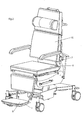
- Fig. 2 shows an embodiment of a hospital elevator 7 with at least one vibration unit 1 in a schematic perspective view.
- the mobile hospital chair 7 has at least one footrest 8, a seat 9 and a backrest 10.
- the hospital elevator 7 can fulfill known functionalities and possess the components, assemblies and control programs required in this regard in accordance with its respective equipment level.
- the ambulance 7 is suitable for first and early mobilization, especially in early neurological rehabilitation, which allows gradual and continuous verticalization from a sitting position. From lying, sitting to standing, a continuous movement can take place without the patient having to apply energy to change his position. This is done by a known continuously variable position change of the ambulance chair (in Fig. 2 not shown). Such a wheelchair 7 is suitable, for example, for severely affected patients without postural control.
- the ambulance 7 allows at least three patient positions, namely a sitting, lying or standing position. The patient sits, lies or stands in or on the ambulance, with his feet regularly touching the foot.
- the vibration unit 1, for example one according to Fig. 1 Can be arranged in the area of the footrest 8, the seat 9 and / or the backrest 10 of the ambulance 7. In the embodiment according to Fig. 2 the vibration unit 1 is arranged in the area of the footrest 8 and integrated in the footrest 8.
Landscapes
- Health & Medical Sciences (AREA)
- Life Sciences & Earth Sciences (AREA)
- Animal Behavior & Ethology (AREA)
- General Health & Medical Sciences (AREA)
- Public Health (AREA)
- Veterinary Medicine (AREA)
- Epidemiology (AREA)
- Pain & Pain Management (AREA)
- Physical Education & Sports Medicine (AREA)
- Rehabilitation Therapy (AREA)
- Percussion Or Vibration Massage (AREA)
- Rehabilitation Tools (AREA)
Abstract
Description
- Die Erfindung betrifft einen Krankenfahrstuhl mit Vibrationseinheit, welche insbesondere im oder am Fußteil des Krankenfahrstuhls angeordnet ist.
- Aus dem Stand der Technik sind Kipptische bekannt, welche im Fußbereich Schwingungen über die Füße auf den Patienten übertragen.
Diese Schwingungen werden dabei oft durch eine Kippbewegung des Fußteiles erzeugt. Diese Kipptische besitzen nur zwei Patientenpositionen, nämlich liegend und stehend; sitzend ist nicht möglich.
Primäres Ziel dieser erzeugten Schwingungen, welche eine Frequenz von 5 bis27 Hz besitzen, ist der Muskelaufbau, also eine Verbesserung des muskulären Statuses der Bein- und Rumpfmuskulatur. - Die Vibration läuft einer anspruchsvollen Kinematik, wie sie bei einem Gerät mit freier Positionsverstellung zwischen Liege-, Sitz- und Stehposition erforderlich ist, zuwider (Resonanzschwingungen). Wohl aus diesem Grund ist der Galileo Delta Kipptisch aus Holz gebaut.
- Im Fitness-Bereich werden außerdem unterschiedlichste Vibrationsplatten eingesetzt, welche im Bereich von 10 bis 50 Hz arbeiten und deren Bauhöhe größer als 10 cm ist. Diese Vibrationsplatten oder Vibrationstrainer werden überwiegend zur Verbesserung des Muskelgewebes und des Muskeltonus eingesetzt.
Die bekannten Vibrationsplatten, welche für einen Betrieb auf einer waagerechten Oberfläche konzipiert sind, unterscheiden sich insbesondere in der Art und Weise ihrer Bewegung.
Es gibt sogenannte vertikale Systeme mit einer starren Vibrationsfläche, wobei sich die Vibrationsfläche dabei in der Vertikalen bewegt. - Außerdem sind sogenannte 3D-Systerne am Markt, bei welchen sich die Vibrationsplatte zusätzlich horizontal bewegt.
- Eine diesbezügliche Vibrationsplatte, welche sich ausschließlich horizontal bewegt, ist für solche Anwendungen nicht bekannt.
Diese Vibrationsplatten sind als alleinstehende Geräte konzipiert und nicht in andere Geräte integrierbar. - Zentraler Bestandteil aller therapeutischen Ansätze ist die Mobilisation raus aus dem Bett über die Schritte: Sitzen im Bett, Sitzen an der Bettkante, Sitzen im Stuhl und anschließende Vertikalisation. Die frühestmögliche Vertikalisation vereint u.a. die Vorteile der Pneumonie-, Thrombose-, Kontrakturprophylaxe, der Anregung des Kreislaufs und nicht zuletzt das psychologische Moment der anderen Perspektive.
- Es sind Krankenfahrstühle zur Erst- und Frühmobilisation, insbesondere in der neurologische Frührehabilitation, bekannt, welche eine allmähliche und kontinuierliche Vertikalisation aus einer Sitzposition heraus ermöglichen. Vom Liegen, über das Sitzen bis zum Stand kann ein kontinuierlicher Bewegungsablauf erfolgen, ohne dass der Patient selbst Energie aufbringen muss, um seine Position zu verändern. Dies erfolgt durch eine stufenlos veränderliche Positionsänderung des Krankenfahrstuhls.
Ein solcher Krankenfahrstuhl ist beispielsweise für schwer betroffene Patienten ohne posturalen Kontrolle geeignet.
Die Firma Reha & Medi Hoffmann GmbH bietet beispielsweise einen solchen Krankenfahrstuhl unter Bezeichnung "Mobilizer® Medior" seit Jahren an. - Es besteht seit längerem ein Bedarf, weitere Funktionalitäten in Krankenfahrstühle zu integrieren, welche insbesondere eine Erst- und Frühmobilisation weiter wirksam unterstützen.
- Aufgabe der Erfindung ist es, einen Krankenfahrstuhl mit zumindest einer Vibrationseinheit bereit zu stellen, wobei die Vibrationseinheit im Krankenfahrstuhl der Art integriert werden soll, dass dieser bezüglich seiner optimierten Dimensionen nicht modifiziert werden muss. Außerdem soll mit dem Krankenfahrstuhl ermöglicht sein, möglichst ausschließlich horizontale bzw. zur jeweiligen Körperoberfläche des Patienten parallelverlaufende Schwingungen auf den Patienten zu übertragen.
Der Krankenfahrstuhl soll außerdem für schwer betroffene Patienten ohne posturalen Kontrolle geeignet sein.
Die Schwingungen sollen auch tonusmindernd bei Spastikern (kraftlösend) sein, ohne dabei die Gelenke bzw. das Skelett unnötig zu belasten. - Die Aufgabe der Erfindung wird durch einen Krankenfahrstuhl mit Vibrationseinheit mit den Merkmalen gemäß Anspruch 1 gelöst.
- Erfindungswesentlich ist, dass die Vibrationseinheit horizontale Schwingungen oder zur jeweiligen Körperoberfläche des Patienten parallelverlaufende Schwingungen im Bereich von 1 bis 100 Hz erzeugt und die Vibrationseinheit im Bereich der Fußstütze, des Sitzes und/oder der Rückenlehne des Krankenfahrstuhls angeordnet ist oder sind. Durch die horizontale Schwingungsebene oder zur jeweiligen Körperoberfläche des Patienten parallelverlaufende Schwingungen werden die Belastungen auf die Gelenke und das Skelett vermieden, die bei anders gerichteten Schwingungsvektoren als stark belastend bekannt sind.
- Mit dem erfindungsgemäßen Krankenfahrstuhl steht erstmals eine effektive Therapieoption zwecks allmählicher Vertikalisation in der neurologischen Frührehabilitation zur Verfügung. Der für schwer betroffene Patienten ohne posturale Kontrolle geeignete Krankenfahrstuhl ist in der Lage, den Patienten stufenlos zu vertikalsieren, wobei eine intelligente Kinematik eine übermäßige Druckbelastung der Steißregion der Dekubitus-gefährdeten Patienten vermeidet. Die Füße der Patienten stehen insbesondere auf der im Bereich der Fußstütze integrierten Vibrationseinheit oder einer Fußstütze, in welche eine Vibrationseinheit integriert ist.
- Neben den Vorteilen der Vertikalisation erfahrt der Patienten während des Aufstehens eine vermehrte Anspannung der Muskulatur, insbesondere der Gluteal- und Oberschenkelmuskulatur, welche auch beim natürlichen Aufstehen aktiviert werden, um den Körper zu sichern und aufstehen zu helfen.
Zusätzlich eröffnet die Ausstattung eines Krankenfahrstuhles mit Vibrationseinheit therapeutische Möglichkeiten beispielsweise zur Unterstützung der vegetativen Funktionen. Diese therapeutischen Möglichkeiten sind insbesondere für querschnittsgelähmte Patienten oder Patienten die ständig auf einen Rollstuhl angewiesen sind bedeutsam. - Mit der integrierten Vibrationseinheit, welche eine Vibrationsplatte sein kann, ist erstmals ermöglicht, dass die Füße des Patienten während des Sitzens, des Aufstehens und des Stehens zusätzlich vibrieren. Die Vibration beschränkt sich nicht nur auf die Fußsohlen, sondern wirkt als sog. "whole-body vibration".
Die erfindungsgemäße Vibration, beispielsweise mit einer Frequenz von 25 - 100 Hz, bewirkt, die der Vertikalisation immanenten Ziele der Pneumonie und Thromoseprophylaxe zu verstärken, daneben sind signifikante positive Effekte auf die Motorik, die Sensorik, den Muskeltonus, die Wachheit, das Bewusstsein und den Knochenstoffwechsel vorhanden.
Die grundlegenden Effekte der Vibration sind insbesondere: - Der tonische Vibrationsreflex führt in einem Frequenzband von 30 - 100 Hz zu einer Kontraktion der Muskulatur, der Vibrationsreiz regt die Längenorgane der Muskeln zusätzlich an, die sog. Spindeln, und die Golgi-Organe der Sehnen an, deren Information via Ia- und II-Fasern an das Rückenmark geleitet werden und dort mono- und polysynaptische Reflexe mit nachfolgender Muskelkontraktion aktivieren. Auch nach Ende der Vibration kann der Muskel eine größere Kraft generieren. Geringere Vibrationsfrequenzen, d. h. unter 30 Hz, führen zum gegenteiligen Effekt.
- Den Vibrationsreiz verspüren die in der Unterhaut angesiedelten sog. Pacinischen Körperchen, sie sind Differentialrezeptoren, die auf Grund der sich ständig ändernden Geschwindigkeit des Vibrationsreizes und der damit verbundenen Beschleunigung der Hautverschiebung nicht saturieren und konstant feuern. Über das periphere Nervensystem wird der Reiz entlang des Rückenmarks, Hirnstamm und der Relaisstation Thalamus in den sensorischen Kortex geleitet. Der sensorische und motorische Kortex sind eng miteinander verbunden, weswegen der sensorischen Reizung eine immer größere Rolle auch in der motorischen Rehabilitation zukommt. Um die Vibration bewusst wahrzunehmen ist eine Umschaltung auf sensorische Assoziationsareale erforderlich, die den Reiz mit zuvor gemachten Erfahrungen abgleichen.
- Aus den Effekten der Vibration auf das sensomotorische System leiten sich die folgenden intendierten Effekte ab:
- Der tonische Vibrationsreflex kräftigt die Muskulatur, noch einmal sei betont, dass der fazilitatorische Effekt für Frequenzen von 30 - 100 Hz gilt. Insbesondere ist durch die Vibration eine zusätzliche Anregung der Gluteal-, Oberschenkel- und Wadenmuskulatur während des assistierten Aufstehvorgangs gegeben.
- Läsionen des ZNS führen zu einer sog. Spastik, die in Extremfällen sich als Beuge-Strecktonus aller vier Extremitäten manifestieren kann. Eine Vibration im Frequenzband von 40 - 100 Hz mindert den Muskeltonus signifikant.
- Bei Patienten nach Schlaganfall bzw. ICP-Kinder erfolgte eine verbesserte motorische Kontrolle der spastisch gelähmten Extremitäten, diese können dann besser eingesetzt werden. Vermehrte sensorische Reizung induziert plastische Umbauvorgänge im motorischen Kortex.
- Das neurologische Korrelat der Wachheit ist die sog. Formatio reticularis des Hirnstamms, wohingegen das Bewusstsein als Wahrnehmung seiner Selbst und Interaktion mit der Umwelt an die Intaktheit beider Großhemisphären gebunden ist. Die Vibration fördert die Wachheit und das Bewusstsein schwer betroffener Patienten. Ursächlich ist der nicht saturierende afferente Flow über die verschiedenen Relaisstationen in das ZNS. Der Thalamus ist dabei das Tor zum Bewusstsein.
- Die Vibration regt die Tätigkeit der Osteoblasten, der knochenbildenden Zellen, an und beugt damit einer Osteoporose vor. Mehrere Untersuchungen konnten diesen Effekt bestätigen, wobei Frequenzen im Bereich von 30 - 50 Hz relevant sind
- Zusammenfassend sind mit der Vibration als nicht saturierendem sensorischen Reiz eine Vielzahl an positiven Effekten verbunden, namentlich auf die Sensomotorik (Kräftigung, Tonusminderung, Verbesserung der motorischen Kontrolle), das Bewusstsein und zur Unterstützung der Pneumonie-, Thrombose- und Otseoporoseprophylaxe. Die Vibration ist somit eine ideale Ergänzung der frühen Vertikalisation des schwer betroffenen Patienten. Die Kombination des Krankenfahrstuhls, welcher insbesondere eine Fußstütze, einen Sitz und eine Rückenlehne besitzt, mit zumindest einer Vibrationseinheit, erweitert die Funktionalität von Krankenfahrstühlen, welche insbesondere der Erst- und Frühmobilisation dienen.
- Die abhängigen Ansprüche 2 bis 8 enthalten vorteilhafte Ausgestaltungen der Erfindung ohne diese damit zu begrenzen.
- Bevorzugt ist, dass die Schwingungen mit einem Wert von 25 - 100 Hz, besonders bevorzugt 30 - 50 Hz, 30 - 100 oder 40 - 100 Hz, erzeugt werden.
Damit ist ermöglicht, dass die jeweilige Frequenz der Schwingung auf die individuellen Bedürfnisse des jeweiligen Patienten, beispielsweise im Rahmen der Erst- und Frühmobilisation, und des jeweiligen Gesundheitszustand in einfacher Art und Weise abstimmbar sind. - Die empfohlenen Frequenzen für die Minderung der Spastik und der Förderung der motorischen Kontrolle liegen beispielsweise bei 40 - 100 Hz und für die für die Pneumonieprophylaxe bei ca. 30 Hz.
- Weitere Merkmale, Eigenschaften und Vorteile der vorliegenden Erfindung ergeben sich aus der nachfolgenden Beschreibung von Ausführungsbeispielen unter Bezugnahme auf die
Figur 1 bis 2 . - Es zeigen:
- Fig. 1
- ein Ausführungsbeispiel einer Vibrationseinheit 1 in einer perspektivischen Ansicht, wobei das Gehäuse 6 geöffnet ist, und
- Fig. 2
- eine Ausführungsform eines Krankenfahrstuhls 7 mit zumindest einer Vibrationseinheit 1 in einer schematischen perspektivischen Ansicht.
-
Fig. 1 zeigt eine Vibrationseinheit 1 in einer perspektivischen Ansicht. Diese Vibrationseinheit 1 ist geeignet, in einen Krankenfahrstuhl 7, dort im Bereich der Fußstütze 8, des Sitzes 9 und/oder der Rückenlehne 10 integriert zu sein. - Die Vibrationseinheit 1 besitzt ein Oberteil 2 und ein Unterteil 3, welche durch vier elastisch verformbare Verbindungselemente 4, welche beispielsweise aus einem gummiartigen Material bestehen, miteinander verbunden sind, wobei sich das Oberteil 2 und das Unterteil 3 nicht direkt berühren. Das Oberteil 2 und das Unterteil 3 berühren sich auch nicht in dem Fall, wo die Füße oder ein anderer Körperteil des Patienten auf dem Oberteil 2 angeordnet ist oder sind und damit einen Druck auf das Oberteil 2 und damit auf die Kugeln 5 ausüben.
- Das Oberteil 2 und das Unterteil 3 bilden - im geschlossenen Zustand - ein plattenförmiges Gehäuse 6, welches der Art gestaltet sein kann, dass zumindest kein Spritzwasser in den Innenraum des Gehäuses 6 eindringen kann oder ein solches zumindest stark verhindert ist.
Die Bauhöhe des Gehäuses 6 beträgt im geschlossenen Zustand zwischen 3 bis 4 cm, im inFig. 1 dargestellten Gehäuse 6 3, 5 cm.
Im Unterteil 3 kann in jeweils einer elastischen Manschette, inFig. 1 nicht dargestellt, jeweils eine Kugel 5 angeordnet sein.
Die Kugel 5 besteht bevorzugt aus einem Vollmaterial, welches nur eine geringe oder keine elastische Verformbarkeit besitzt. Die Kugeln 5, inFigur 1 sind vier Kugeln 5 ersichtlich, berühren - im geschlossenen Zustand des Gehäuses 6 - somit gleichzeitig das Oberteil 2 und das Unterteil 3.
Am Oberteil 2 ist ein Vibrationsmodul 11 angeordnet und mit dem Oberteil 2 fest verbunden, so dass Schwingungen übertragbar sind. Das Vibrationsmodul 11, welches beispielsweise zumindest einen üblichen Elektroantrieb besitzt, welcher einen rotierbaren Körper mit einer Unwucht antreibt, erzeugt ursächlich die Schwingungen. Wird die Vibrationseinheit 1 eingeschaltet, erzeugt diese eine zu den Längsachsen des Oberteils 2 und des Unterteils 3 parallel gerichtete Schwingungen, welche damit zur jeweiligen Körperoberfläche des im Krankenfahrstuhl sitzenden Patienten parallelverlaufende Schwingungen sind.
Ist die Vibrationseinheit 1 horizontal angeordnet, erzeugt diese somit eine horizontale Schwingung.
Bei einer Vibrationseinheit 1 mit einer Unwucht (InFig. 1 nicht dargestellt) wird insbesondere eine rotierende Schwingung erzeugt. Dadurch wird das Oberteil 3 ausgelenkt und die Schwingungen beispielsweise auf die Füße des sitzenden Patienten übertragen.
Die jeweilige Frequenz, mit welcher das Oberteil 3 schwingt, wird in üblicher Art und Weise, insbesondere durch die Dimensionierung und Anordnung einer Unwucht, die Auswahl des Elektroantriebes und/oder durch die gewählte Drehzahl, bestimmt.
Die Vibrationseinheit 1 kann in üblicher Art und Weise stufenweise oder stufenlos durch übliche elektrische Steuereinheiten geschaltet werden, so dass, wie gewünscht, insbesondere die Vibrationseinheit 1 wahlweise Schwingungen mit einem Wert aus dem Bereich von 1 bis 100 Hz, 30 - 50 Hz, 30 - 100 oder 40 - 100 Hz erzeugt.
Außerdem kann in üblicher Art und Weise die zeitliche Dauer der Erzeugung der Schwingungen bestimmt und begrenzt werden, beispielsweise auf zehn Minuten. -
Fig. 2 zeigt eine Ausführungsform eines Krankenfahrstuhls 7 mit zumindest einer Vibrationseinheit 1 in einer schematischen perspektivischen Ansicht.
Der fahrbare Krankenfahrstuhl 7 besitzt zumindest eine Fußstütze 8, einen Sitz 9 und eine Rückenlehne 10. Ansonsten kann der Krankenfahrstuhl 7 bekannte Funktionalitäten erfüllen und die diesbezüglich erforderlichen Bauteile, Baugruppen und Steuerprogramme entsprechend seinem jeweiligen Ausstattungsgrad besitzen. - Der Krankenfahrstuhl 7 ist zur Erst- und Frühmobilisation, insbesondere in der neurologischen Frührehabilitation, geeignet, welche eine allmähliche und kontinuierliche Vertikalisation aus einer Sitzposition heraus ermöglichen. Vom Liegen, über das Sitzen bis zum Stand kann ein kontinuierlicher Bewegungsablauf erfolgen, ohne dass der Patient selbst Energie aufbringen muss, um seine Position zu verändern. Dies erfolgt durch eine bekannte stufenlos veränderliche Positionsänderung des Krankenfahrstuhls(in
Fig. 2 nicht dargestellt).
Ein solcher Krankenfahrstuhl 7 ist beispielsweise für schwer betroffene Patienten ohne posturalen Kontrolle geeignet.
Der Krankenfahrstuhl 7 ermöglicht zumindest drei Patientenpositionen, nämlich eine Sitz-, Liege- oder Standposition. Der Patient sitzt, liegt oder steht im oder auf dem Krankenfahrstuhl, wobei er mit den Füßen regelmäßig das Fußteil berührt.
Die Vibrationseinheit 1, beispielsweise eine gemäßFig. 1 , kann im Bereich der Fußstütze 8, des Sitzes 9 und/oder der Rückenlehne 10 des Krankenfahrstuhls 7 angeordnet sein. Im Ausführungsbeispiel gemäßFig. 2 ist die Vibrationseinheit 1 im Bereich der Fußstütze 8 angeordnet und in der Fußstütze 8 integriert. -
- Vibrationseinheit 1
- Oberteil 2
- Unterteil 3
- Verbindungselemente 4
- Kugel 5
- Gehäuse 6
- Krankenfahrstuhl 7
- Fußstütze 8
- Sitz 9
- Rückenlehne 10
- Vibrationsmodul 11
Claims (9)
- Krankenfahrstuhl mit Vibrationseinheit, dadurch gekennzeichnet, dass die Vibrationseinheit horizontale Schwingungen oder zur jeweiligen Körperoberfläche des Patienten parallelverlaufende Schwingungen im Bereich von 1 bis 100 Hz erzeugt und die Vibrationseinheit im Bereich der Fußstütze, des Sitzes und/oder der Rückenlehne des Krankenfahrstuhls angeordnet ist.
- Krankenfahrstuhl gemäß Anspruch 1, dadurch gekennzeichnet, dass die Schwingungen durch einen durch einen Elektroantrieb angetriebenen rotierenden Körper verursacht werden.
- Krankenfahrstuhl gemäß Anspruch 2, dadurch gekennzeichnet, dass der rotierende Körper eine Unwucht besitzt.
- Krankenfahrstuhl gemäß Anspruch 2, dadurch gekennzeichnet, dass der Elektroantrieb ein Unwuchtmotor ist.
- Krankenfahrstuhl gemäß Anspruch 1, dadurch gekennzeichnet, dass die Vibrationseinheit wahlweise Schwingungen mit einem Wert aus dem Bereich von 1 bis 100 Hz erzeugt.
- Krankenfahrstuhl gemäß Anspruch 1, dadurch gekennzeichnet, dass Schwingungen mit einem Wert von 25 - 100 Hz, besonders bevorzugt 30 - 50 Hz, 30 - 100 oder 40 - 100 Hz erzeugt werden.
- Krankenfahrstuhl gemäß Anspruch 1, dadurch gekennzeichnet, dass die Vibrationseinheit wahlweise für eine vorbestimmte Zeitdauer Schwingungen erzeugt.
- Krankenfahrstuhl gemäß Anspruch 1, dadurch gekennzeichnet, dass der Krankenfahrstuhl zumindest in eine Sitz-, Liege- und Standposition einstellbar ist.
- Verwendung eines Krankenfahrstuhls, gemäß zumindest einem der Ansprüche 1 bis 8, im Rahmen der Erst- und Frühmobilisation.
Priority Applications (1)
| Application Number | Priority Date | Filing Date | Title |
|---|---|---|---|
| PL16000113T PL3058927T3 (pl) | 2015-02-17 | 2016-01-19 | Wózek inwalidzki z jednostką wibracyjną |
Applications Claiming Priority (1)
| Application Number | Priority Date | Filing Date | Title |
|---|---|---|---|
| DE102015001846.9A DE102015001846B4 (de) | 2015-02-17 | 2015-02-17 | Krankenfahrstuhl mit Vibrationseinheit |
Publications (2)
| Publication Number | Publication Date |
|---|---|
| EP3058927A1 true EP3058927A1 (de) | 2016-08-24 |
| EP3058927B1 EP3058927B1 (de) | 2020-05-20 |
Family
ID=55221256
Family Applications (1)
| Application Number | Title | Priority Date | Filing Date |
|---|---|---|---|
| EP16000113.7A Active EP3058927B1 (de) | 2015-02-17 | 2016-01-19 | Krankenfahrstuhl mit vibrationseinheit |
Country Status (3)
| Country | Link |
|---|---|
| EP (1) | EP3058927B1 (de) |
| DE (1) | DE102015001846B4 (de) |
| PL (1) | PL3058927T3 (de) |
Families Citing this family (2)
| Publication number | Priority date | Publication date | Assignee | Title |
|---|---|---|---|---|
| DE102019000667A1 (de) | 2019-01-31 | 2020-08-06 | Reha & Medi Hoffmann Gmbh | Mobilisationsrollstuhl |
| DE202019002177U1 (de) | 2019-05-20 | 2019-06-14 | Reha & Medi Hoffmann Gmbh | Datenverarbeitungsanlage für einen elektromotorisch angetriebenen Krankenfahrstuhl oder Mobilisationsrollstuhl |
Citations (6)
| Publication number | Priority date | Publication date | Assignee | Title |
|---|---|---|---|---|
| US3854474A (en) * | 1973-06-25 | 1974-12-17 | E Carruth | All-purpose massager |
| CN2254745Y (zh) * | 1996-02-15 | 1997-05-28 | 鲁国庆 | 电动按摩椅 |
| WO2001032124A1 (en) * | 1999-11-04 | 2001-05-10 | A.D.M. Advanced Dialysis Methods | Vibrator for constipation |
| WO2009032120A1 (en) * | 2007-08-28 | 2009-03-12 | Stryker Development Llc | Apparatuses for and method of preventing decubitus ulcers |
| US20100022925A1 (en) * | 2008-07-28 | 2010-01-28 | Sergey Anikin | Thigh support with vibratory device for improved blood circulation |
| WO2014099527A1 (en) * | 2012-12-17 | 2014-06-26 | Theranova, Llc | Wearable apparatus for the treatment or prevention of osteopenia and osteoporosis, stimulating bone growth, preserving or improving bone mineral density, and inhibiting adipogenesis |
Family Cites Families (5)
| Publication number | Priority date | Publication date | Assignee | Title |
|---|---|---|---|---|
| DE10304494B4 (de) | 2003-02-05 | 2006-10-12 | Bernd Probst | Schwingungserzeugungseinrichtung für eine Vorrichtung zur Vibrationstherapie |
| DE102005059342A1 (de) | 2005-12-09 | 2007-06-14 | Eberhard P. Prof. Dr. Hofer | Mechanismus, Vorrichtung und Verfahren zur Erzeugung von physiologisch relevanten Kraftsignalen für die Stimulation der unteren Extremitäten |
| DE102008032232A1 (de) | 2008-07-09 | 2010-01-14 | Bär, Manfred | Behandlungsliege |
| DE102010022386B4 (de) | 2009-10-13 | 2015-10-29 | In-Tra-Tec GmbH | Entlordosierungsvorrichtung |
| DE102011111974A1 (de) | 2011-08-31 | 2013-02-28 | Paul Hettmer | Medizintechnische Apparatur zur optimierten Durchführung von Mobilisations- und Rehabilitations-Maßnahmen bei labilen, oft intensivmedizinisch betreuten Patienten |
-
2015
- 2015-02-17 DE DE102015001846.9A patent/DE102015001846B4/de active Active
-
2016
- 2016-01-19 PL PL16000113T patent/PL3058927T3/pl unknown
- 2016-01-19 EP EP16000113.7A patent/EP3058927B1/de active Active
Patent Citations (6)
| Publication number | Priority date | Publication date | Assignee | Title |
|---|---|---|---|---|
| US3854474A (en) * | 1973-06-25 | 1974-12-17 | E Carruth | All-purpose massager |
| CN2254745Y (zh) * | 1996-02-15 | 1997-05-28 | 鲁国庆 | 电动按摩椅 |
| WO2001032124A1 (en) * | 1999-11-04 | 2001-05-10 | A.D.M. Advanced Dialysis Methods | Vibrator for constipation |
| WO2009032120A1 (en) * | 2007-08-28 | 2009-03-12 | Stryker Development Llc | Apparatuses for and method of preventing decubitus ulcers |
| US20100022925A1 (en) * | 2008-07-28 | 2010-01-28 | Sergey Anikin | Thigh support with vibratory device for improved blood circulation |
| WO2014099527A1 (en) * | 2012-12-17 | 2014-06-26 | Theranova, Llc | Wearable apparatus for the treatment or prevention of osteopenia and osteoporosis, stimulating bone growth, preserving or improving bone mineral density, and inhibiting adipogenesis |
Also Published As
| Publication number | Publication date |
|---|---|
| EP3058927B1 (de) | 2020-05-20 |
| PL3058927T3 (pl) | 2020-11-16 |
| DE102015001846B4 (de) | 2018-03-15 |
| DE102015001846A1 (de) | 2016-08-18 |
Similar Documents
| Publication | Publication Date | Title |
|---|---|---|
| DE69801232T2 (de) | Vorrichtung zum erlangen des körperlichen gleichgewichts | |
| DE2212454C3 (de) | Massagevorrichtung für den menschlichen Körper | |
| EP3243495B1 (de) | Vorrichtung zur zeitweisen streckung und entlastung der wirbelsäule des menschlichen körpers | |
| DE202021102035U1 (de) | Multifunktions-Trainierstuhl zum Dehnen und Trainieren der Muskeln | |
| EP3019250A1 (de) | Bewegungs- und therapievorrichtung und therapieverfahren zur kurativen behandlung und prävention schmerzhafter zustände am bewegungsapparat einer person | |
| EP1307168B1 (de) | Vorrichtung zum schlankmachen | |
| EP3058927B1 (de) | Krankenfahrstuhl mit vibrationseinheit | |
| DE2551107A1 (de) | Zusatz- oder uebertragungsteil fuer elektrovibrations-massagegeraete | |
| DE102013105158B4 (de) | Massageliege | |
| DE102011111974A1 (de) | Medizintechnische Apparatur zur optimierten Durchführung von Mobilisations- und Rehabilitations-Maßnahmen bei labilen, oft intensivmedizinisch betreuten Patienten | |
| US20230233795A1 (en) | Systems and methods for altering neural response using sensory input reduction | |
| DE202011104086U1 (de) | Massagegerätekombination und Massagegeräte | |
| DE10001039C2 (de) | Physiotherapeutisches Gerät für eine Bewegungstherapie des menschlichen Knies | |
| EP4031091B1 (de) | Matratze mit vibration | |
| DE102009038604A1 (de) | Massagemodul | |
| DE202015005849U1 (de) | Trainings- und Therapieeinrichtung auf Schwingungsbasis | |
| DE202012100105U1 (de) | Einrichtung für Geh- und Bewegungsübungen für Patienten mit psychoneurologischen Störungen und Erkrankungen des Bewegungs- und Stützapparates | |
| DE8419209U1 (de) | Massageliege | |
| WO2008061867A1 (de) | Gerät zur biomechanischen stimulation | |
| DE20020092U1 (de) | Übungsgerät | |
| EP0774246A2 (de) | Massagevorrichtung | |
| AT12578U1 (de) | Fitnessgerät | |
| DE10040714A1 (de) | Therapeutischer Sitz | |
| DE102015217466A1 (de) | Gerät zur transkutanen elektrischen Stimulation von Muskeln und/oder Nerven am menschlichen Körper | |
| DE19601999C1 (de) | Gerät zur Bewegungstherapie |
Legal Events
| Date | Code | Title | Description |
|---|---|---|---|
| PUAI | Public reference made under article 153(3) epc to a published international application that has entered the european phase |
Free format text: ORIGINAL CODE: 0009012 |
|
| AK | Designated contracting states |
Kind code of ref document: A1 Designated state(s): AL AT BE BG CH CY CZ DE DK EE ES FI FR GB GR HR HU IE IS IT LI LT LU LV MC MK MT NL NO PL PT RO RS SE SI SK SM TR |
|
| AX | Request for extension of the european patent |
Extension state: BA ME |
|
| STAA | Information on the status of an ep patent application or granted ep patent |
Free format text: STATUS: REQUEST FOR EXAMINATION WAS MADE |
|
| 17P | Request for examination filed |
Effective date: 20170208 |
|
| RBV | Designated contracting states (corrected) |
Designated state(s): AL AT BE BG CH CY CZ DE DK EE ES FI FR GB GR HR HU IE IS IT LI LT LU LV MC MK MT NL NO PL PT RO RS SE SI SK SM TR |
|
| STAA | Information on the status of an ep patent application or granted ep patent |
Free format text: STATUS: EXAMINATION IS IN PROGRESS |
|
| 17Q | First examination report despatched |
Effective date: 20181024 |
|
| GRAP | Despatch of communication of intention to grant a patent |
Free format text: ORIGINAL CODE: EPIDOSNIGR1 |
|
| STAA | Information on the status of an ep patent application or granted ep patent |
Free format text: STATUS: GRANT OF PATENT IS INTENDED |
|
| INTG | Intention to grant announced |
Effective date: 20200310 |
|
| GRAS | Grant fee paid |
Free format text: ORIGINAL CODE: EPIDOSNIGR3 |
|
| GRAA | (expected) grant |
Free format text: ORIGINAL CODE: 0009210 |
|
| STAA | Information on the status of an ep patent application or granted ep patent |
Free format text: STATUS: THE PATENT HAS BEEN GRANTED |
|
| AK | Designated contracting states |
Kind code of ref document: B1 Designated state(s): AL AT BE BG CH CY CZ DE DK EE ES FI FR GB GR HR HU IE IS IT LI LT LU LV MC MK MT NL NO PL PT RO RS SE SI SK SM TR |
|
| REG | Reference to a national code |
Ref country code: GB Ref legal event code: FG4D Free format text: NOT ENGLISH |
|
| REG | Reference to a national code |
Ref country code: CH Ref legal event code: EP |
|
| REG | Reference to a national code |
Ref country code: DE Ref legal event code: R096 Ref document number: 502016009971 Country of ref document: DE |
|
| REG | Reference to a national code |
Ref country code: AT Ref legal event code: REF Ref document number: 1272145 Country of ref document: AT Kind code of ref document: T Effective date: 20200615 |
|
| REG | Reference to a national code |
Ref country code: LT Ref legal event code: MG4D |
|
| REG | Reference to a national code |
Ref country code: NL Ref legal event code: MP Effective date: 20200520 |
|
| PG25 | Lapsed in a contracting state [announced via postgrant information from national office to epo] |
Ref country code: PT Free format text: LAPSE BECAUSE OF FAILURE TO SUBMIT A TRANSLATION OF THE DESCRIPTION OR TO PAY THE FEE WITHIN THE PRESCRIBED TIME-LIMIT Effective date: 20200921 Ref country code: SE Free format text: LAPSE BECAUSE OF FAILURE TO SUBMIT A TRANSLATION OF THE DESCRIPTION OR TO PAY THE FEE WITHIN THE PRESCRIBED TIME-LIMIT Effective date: 20200520 Ref country code: LT Free format text: LAPSE BECAUSE OF FAILURE TO SUBMIT A TRANSLATION OF THE DESCRIPTION OR TO PAY THE FEE WITHIN THE PRESCRIBED TIME-LIMIT Effective date: 20200520 Ref country code: IS Free format text: LAPSE BECAUSE OF FAILURE TO SUBMIT A TRANSLATION OF THE DESCRIPTION OR TO PAY THE FEE WITHIN THE PRESCRIBED TIME-LIMIT Effective date: 20200920 Ref country code: GR Free format text: LAPSE BECAUSE OF FAILURE TO SUBMIT A TRANSLATION OF THE DESCRIPTION OR TO PAY THE FEE WITHIN THE PRESCRIBED TIME-LIMIT Effective date: 20200821 Ref country code: FI Free format text: LAPSE BECAUSE OF FAILURE TO SUBMIT A TRANSLATION OF THE DESCRIPTION OR TO PAY THE FEE WITHIN THE PRESCRIBED TIME-LIMIT Effective date: 20200520 Ref country code: NO Free format text: LAPSE BECAUSE OF FAILURE TO SUBMIT A TRANSLATION OF THE DESCRIPTION OR TO PAY THE FEE WITHIN THE PRESCRIBED TIME-LIMIT Effective date: 20200820 |
|
| PG25 | Lapsed in a contracting state [announced via postgrant information from national office to epo] |
Ref country code: BG Free format text: LAPSE BECAUSE OF FAILURE TO SUBMIT A TRANSLATION OF THE DESCRIPTION OR TO PAY THE FEE WITHIN THE PRESCRIBED TIME-LIMIT Effective date: 20200820 Ref country code: RS Free format text: LAPSE BECAUSE OF FAILURE TO SUBMIT A TRANSLATION OF THE DESCRIPTION OR TO PAY THE FEE WITHIN THE PRESCRIBED TIME-LIMIT Effective date: 20200520 Ref country code: LV Free format text: LAPSE BECAUSE OF FAILURE TO SUBMIT A TRANSLATION OF THE DESCRIPTION OR TO PAY THE FEE WITHIN THE PRESCRIBED TIME-LIMIT Effective date: 20200520 Ref country code: HR Free format text: LAPSE BECAUSE OF FAILURE TO SUBMIT A TRANSLATION OF THE DESCRIPTION OR TO PAY THE FEE WITHIN THE PRESCRIBED TIME-LIMIT Effective date: 20200520 |
|
| PG25 | Lapsed in a contracting state [announced via postgrant information from national office to epo] |
Ref country code: NL Free format text: LAPSE BECAUSE OF FAILURE TO SUBMIT A TRANSLATION OF THE DESCRIPTION OR TO PAY THE FEE WITHIN THE PRESCRIBED TIME-LIMIT Effective date: 20200520 Ref country code: AL Free format text: LAPSE BECAUSE OF FAILURE TO SUBMIT A TRANSLATION OF THE DESCRIPTION OR TO PAY THE FEE WITHIN THE PRESCRIBED TIME-LIMIT Effective date: 20200520 |
|
| PG25 | Lapsed in a contracting state [announced via postgrant information from national office to epo] |
Ref country code: EE Free format text: LAPSE BECAUSE OF FAILURE TO SUBMIT A TRANSLATION OF THE DESCRIPTION OR TO PAY THE FEE WITHIN THE PRESCRIBED TIME-LIMIT Effective date: 20200520 Ref country code: SM Free format text: LAPSE BECAUSE OF FAILURE TO SUBMIT A TRANSLATION OF THE DESCRIPTION OR TO PAY THE FEE WITHIN THE PRESCRIBED TIME-LIMIT Effective date: 20200520 Ref country code: DK Free format text: LAPSE BECAUSE OF FAILURE TO SUBMIT A TRANSLATION OF THE DESCRIPTION OR TO PAY THE FEE WITHIN THE PRESCRIBED TIME-LIMIT Effective date: 20200520 Ref country code: CZ Free format text: LAPSE BECAUSE OF FAILURE TO SUBMIT A TRANSLATION OF THE DESCRIPTION OR TO PAY THE FEE WITHIN THE PRESCRIBED TIME-LIMIT Effective date: 20200520 Ref country code: RO Free format text: LAPSE BECAUSE OF FAILURE TO SUBMIT A TRANSLATION OF THE DESCRIPTION OR TO PAY THE FEE WITHIN THE PRESCRIBED TIME-LIMIT Effective date: 20200520 Ref country code: ES Free format text: LAPSE BECAUSE OF FAILURE TO SUBMIT A TRANSLATION OF THE DESCRIPTION OR TO PAY THE FEE WITHIN THE PRESCRIBED TIME-LIMIT Effective date: 20200520 |
|
| REG | Reference to a national code |
Ref country code: DE Ref legal event code: R097 Ref document number: 502016009971 Country of ref document: DE |
|
| PG25 | Lapsed in a contracting state [announced via postgrant information from national office to epo] |
Ref country code: SK Free format text: LAPSE BECAUSE OF FAILURE TO SUBMIT A TRANSLATION OF THE DESCRIPTION OR TO PAY THE FEE WITHIN THE PRESCRIBED TIME-LIMIT Effective date: 20200520 |
|
| PLBE | No opposition filed within time limit |
Free format text: ORIGINAL CODE: 0009261 |
|
| STAA | Information on the status of an ep patent application or granted ep patent |
Free format text: STATUS: NO OPPOSITION FILED WITHIN TIME LIMIT |
|
| 26N | No opposition filed |
Effective date: 20210223 |
|
| PG25 | Lapsed in a contracting state [announced via postgrant information from national office to epo] |
Ref country code: SI Free format text: LAPSE BECAUSE OF FAILURE TO SUBMIT A TRANSLATION OF THE DESCRIPTION OR TO PAY THE FEE WITHIN THE PRESCRIBED TIME-LIMIT Effective date: 20200520 |
|
| REG | Reference to a national code |
Ref country code: DE Ref legal event code: R119 Ref document number: 502016009971 Country of ref document: DE |
|
| PG25 | Lapsed in a contracting state [announced via postgrant information from national office to epo] |
Ref country code: MC Free format text: LAPSE BECAUSE OF FAILURE TO SUBMIT A TRANSLATION OF THE DESCRIPTION OR TO PAY THE FEE WITHIN THE PRESCRIBED TIME-LIMIT Effective date: 20200520 |
|
| PG25 | Lapsed in a contracting state [announced via postgrant information from national office to epo] |
Ref country code: LU Free format text: LAPSE BECAUSE OF NON-PAYMENT OF DUE FEES Effective date: 20210119 |
|
| REG | Reference to a national code |
Ref country code: BE Ref legal event code: MM Effective date: 20210131 |
|
| PG25 | Lapsed in a contracting state [announced via postgrant information from national office to epo] |
Ref country code: DE Free format text: LAPSE BECAUSE OF NON-PAYMENT OF DUE FEES Effective date: 20210803 |
|
| PG25 | Lapsed in a contracting state [announced via postgrant information from national office to epo] |
Ref country code: IE Free format text: LAPSE BECAUSE OF NON-PAYMENT OF DUE FEES Effective date: 20210119 |
|
| REG | Reference to a national code |
Ref country code: AT Ref legal event code: MM01 Ref document number: 1272145 Country of ref document: AT Kind code of ref document: T Effective date: 20210119 |
|
| PG25 | Lapsed in a contracting state [announced via postgrant information from national office to epo] |
Ref country code: AT Free format text: LAPSE BECAUSE OF NON-PAYMENT OF DUE FEES Effective date: 20210119 |
|
| PG25 | Lapsed in a contracting state [announced via postgrant information from national office to epo] |
Ref country code: BE Free format text: LAPSE BECAUSE OF NON-PAYMENT OF DUE FEES Effective date: 20210131 |
|
| REG | Reference to a national code |
Ref country code: DE Ref legal event code: R081 Ref document number: 502016009971 Country of ref document: DE Owner name: REHA & MEDI HOFFMANN GMBH, DE Free format text: FORMER OWNER: REHA & MEDI HOFFMANN GMBH, 04683 NAUNHOF, DE |
|
| PG25 | Lapsed in a contracting state [announced via postgrant information from national office to epo] |
Ref country code: HU Free format text: LAPSE BECAUSE OF FAILURE TO SUBMIT A TRANSLATION OF THE DESCRIPTION OR TO PAY THE FEE WITHIN THE PRESCRIBED TIME-LIMIT; INVALID AB INITIO Effective date: 20160119 |
|
| PG25 | Lapsed in a contracting state [announced via postgrant information from national office to epo] |
Ref country code: CY Free format text: LAPSE BECAUSE OF FAILURE TO SUBMIT A TRANSLATION OF THE DESCRIPTION OR TO PAY THE FEE WITHIN THE PRESCRIBED TIME-LIMIT Effective date: 20200520 |
|
| P01 | Opt-out of the competence of the unified patent court (upc) registered |
Effective date: 20230530 |
|
| PG25 | Lapsed in a contracting state [announced via postgrant information from national office to epo] |
Ref country code: MK Free format text: LAPSE BECAUSE OF FAILURE TO SUBMIT A TRANSLATION OF THE DESCRIPTION OR TO PAY THE FEE WITHIN THE PRESCRIBED TIME-LIMIT Effective date: 20200520 |
|
| PG25 | Lapsed in a contracting state [announced via postgrant information from national office to epo] |
Ref country code: TR Free format text: LAPSE BECAUSE OF FAILURE TO SUBMIT A TRANSLATION OF THE DESCRIPTION OR TO PAY THE FEE WITHIN THE PRESCRIBED TIME-LIMIT Effective date: 20200520 |
|
| PG25 | Lapsed in a contracting state [announced via postgrant information from national office to epo] |
Ref country code: MT Free format text: LAPSE BECAUSE OF FAILURE TO SUBMIT A TRANSLATION OF THE DESCRIPTION OR TO PAY THE FEE WITHIN THE PRESCRIBED TIME-LIMIT Effective date: 20200520 |
|
| REG | Reference to a national code |
Ref country code: CH Ref legal event code: U11 Free format text: ST27 STATUS EVENT CODE: U-0-0-U10-U11 (AS PROVIDED BY THE NATIONAL OFFICE) Effective date: 20260201 |
|
| PGFP | Annual fee paid to national office [announced via postgrant information from national office to epo] |
Ref country code: GB Payment date: 20260122 Year of fee payment: 11 |
|
| PGFP | Annual fee paid to national office [announced via postgrant information from national office to epo] |
Ref country code: IT Payment date: 20260130 Year of fee payment: 11 |
|
| PGFP | Annual fee paid to national office [announced via postgrant information from national office to epo] |
Ref country code: FR Payment date: 20260123 Year of fee payment: 11 |
|
| PGFP | Annual fee paid to national office [announced via postgrant information from national office to epo] |
Ref country code: CH Payment date: 20260201 Year of fee payment: 11 |
|
| PGFP | Annual fee paid to national office [announced via postgrant information from national office to epo] |
Ref country code: PL Payment date: 20260107 Year of fee payment: 11 |