EP3055347B1 - Nanopartikel - Google Patents
Nanopartikel Download PDFInfo
- Publication number
- EP3055347B1 EP3055347B1 EP14784363.5A EP14784363A EP3055347B1 EP 3055347 B1 EP3055347 B1 EP 3055347B1 EP 14784363 A EP14784363 A EP 14784363A EP 3055347 B1 EP3055347 B1 EP 3055347B1
- Authority
- EP
- European Patent Office
- Prior art keywords
- nanoparticles
- organic
- aqueous composition
- optionally
- aqueous
- Prior art date
- Legal status (The legal status is an assumption and is not a legal conclusion. Google has not performed a legal analysis and makes no representation as to the accuracy of the status listed.)
- Active
Links
- 0 CC*CCC1(C)C=C(C2=CC(C)(*(CC)C*CC3C)C=C3S2)C2=*(C)CS*=C2C(C(C2)=C*(*(CC)CC)C=C2c2c(*C)cc(C3=C(C4(*)I)C=C(C)C=C*3*(CC)CC)c4c2)=C1 Chemical compound CC*CCC1(C)C=C(C2=CC(C)(*(CC)C*CC3C)C=C3S2)C2=*(C)CS*=C2C(C(C2)=C*(*(CC)CC)C=C2c2c(*C)cc(C3=C(C4(*)I)C=C(C)C=C*3*(CC)CC)c4c2)=C1 0.000 description 8
- RBXHVFHOBVTGEJ-UHFFFAOYSA-N CC(C)(C)c1c2OCCOc2c(C(C)(C)C)[s]1 Chemical compound CC(C)(C)c1c2OCCOc2c(C(C)(C)C)[s]1 RBXHVFHOBVTGEJ-UHFFFAOYSA-N 0.000 description 1
- YIUHGBNJJRTMIE-UHFFFAOYSA-N O=C(C1=C(c2ccc[s]2)N2)NC(c3ccc[s]3)=C1C2=O Chemical compound O=C(C1=C(c2ccc[s]2)N2)NC(c3ccc[s]3)=C1C2=O YIUHGBNJJRTMIE-UHFFFAOYSA-N 0.000 description 1
Images

Classifications
-
- C—CHEMISTRY; METALLURGY
- C08—ORGANIC MACROMOLECULAR COMPOUNDS; THEIR PREPARATION OR CHEMICAL WORKING-UP; COMPOSITIONS BASED THEREON
- C08J—WORKING-UP; GENERAL PROCESSES OF COMPOUNDING; AFTER-TREATMENT NOT COVERED BY SUBCLASSES C08B, C08C, C08F, C08G or C08H
- C08J3/00—Processes of treating or compounding macromolecular substances
- C08J3/12—Powdering or granulating
-
- C—CHEMISTRY; METALLURGY
- C08—ORGANIC MACROMOLECULAR COMPOUNDS; THEIR PREPARATION OR CHEMICAL WORKING-UP; COMPOSITIONS BASED THEREON
- C08G—MACROMOLECULAR COMPOUNDS OBTAINED OTHERWISE THAN BY REACTIONS ONLY INVOLVING UNSATURATED CARBON-TO-CARBON BONDS
- C08G61/00—Macromolecular compounds obtained by reactions forming a carbon-to-carbon link in the main chain of the macromolecule
- C08G61/02—Macromolecular compounds containing only carbon atoms in the main chain of the macromolecule, e.g. polyxylylenes
-
- C—CHEMISTRY; METALLURGY
- C08—ORGANIC MACROMOLECULAR COMPOUNDS; THEIR PREPARATION OR CHEMICAL WORKING-UP; COMPOSITIONS BASED THEREON
- C08G—MACROMOLECULAR COMPOUNDS OBTAINED OTHERWISE THAN BY REACTIONS ONLY INVOLVING UNSATURATED CARBON-TO-CARBON BONDS
- C08G61/00—Macromolecular compounds obtained by reactions forming a carbon-to-carbon link in the main chain of the macromolecule
- C08G61/12—Macromolecular compounds containing atoms other than carbon in the main chain of the macromolecule
- C08G61/121—Macromolecular compounds containing atoms other than carbon in the main chain of the macromolecule derived from organic halides
-
- C—CHEMISTRY; METALLURGY
- C08—ORGANIC MACROMOLECULAR COMPOUNDS; THEIR PREPARATION OR CHEMICAL WORKING-UP; COMPOSITIONS BASED THEREON
- C08G—MACROMOLECULAR COMPOUNDS OBTAINED OTHERWISE THAN BY REACTIONS ONLY INVOLVING UNSATURATED CARBON-TO-CARBON BONDS
- C08G61/00—Macromolecular compounds obtained by reactions forming a carbon-to-carbon link in the main chain of the macromolecule
- C08G61/12—Macromolecular compounds containing atoms other than carbon in the main chain of the macromolecule
- C08G61/122—Macromolecular compounds containing atoms other than carbon in the main chain of the macromolecule derived from five- or six-membered heterocyclic compounds, other than imides
- C08G61/123—Macromolecular compounds containing atoms other than carbon in the main chain of the macromolecule derived from five- or six-membered heterocyclic compounds, other than imides derived from five-membered heterocyclic compounds
-
- C—CHEMISTRY; METALLURGY
- C08—ORGANIC MACROMOLECULAR COMPOUNDS; THEIR PREPARATION OR CHEMICAL WORKING-UP; COMPOSITIONS BASED THEREON
- C08G—MACROMOLECULAR COMPOUNDS OBTAINED OTHERWISE THAN BY REACTIONS ONLY INVOLVING UNSATURATED CARBON-TO-CARBON BONDS
- C08G61/00—Macromolecular compounds obtained by reactions forming a carbon-to-carbon link in the main chain of the macromolecule
- C08G61/12—Macromolecular compounds containing atoms other than carbon in the main chain of the macromolecule
- C08G61/122—Macromolecular compounds containing atoms other than carbon in the main chain of the macromolecule derived from five- or six-membered heterocyclic compounds, other than imides
- C08G61/123—Macromolecular compounds containing atoms other than carbon in the main chain of the macromolecule derived from five- or six-membered heterocyclic compounds, other than imides derived from five-membered heterocyclic compounds
- C08G61/124—Macromolecular compounds containing atoms other than carbon in the main chain of the macromolecule derived from five- or six-membered heterocyclic compounds, other than imides derived from five-membered heterocyclic compounds with a five-membered ring containing one nitrogen atom in the ring
-
- C—CHEMISTRY; METALLURGY
- C08—ORGANIC MACROMOLECULAR COMPOUNDS; THEIR PREPARATION OR CHEMICAL WORKING-UP; COMPOSITIONS BASED THEREON
- C08G—MACROMOLECULAR COMPOUNDS OBTAINED OTHERWISE THAN BY REACTIONS ONLY INVOLVING UNSATURATED CARBON-TO-CARBON BONDS
- C08G61/00—Macromolecular compounds obtained by reactions forming a carbon-to-carbon link in the main chain of the macromolecule
- C08G61/12—Macromolecular compounds containing atoms other than carbon in the main chain of the macromolecule
- C08G61/122—Macromolecular compounds containing atoms other than carbon in the main chain of the macromolecule derived from five- or six-membered heterocyclic compounds, other than imides
- C08G61/123—Macromolecular compounds containing atoms other than carbon in the main chain of the macromolecule derived from five- or six-membered heterocyclic compounds, other than imides derived from five-membered heterocyclic compounds
- C08G61/126—Macromolecular compounds containing atoms other than carbon in the main chain of the macromolecule derived from five- or six-membered heterocyclic compounds, other than imides derived from five-membered heterocyclic compounds with a five-membered ring containing one sulfur atom in the ring
-
- H—ELECTRICITY
- H01—ELECTRIC ELEMENTS
- H01B—CABLES; CONDUCTORS; INSULATORS; SELECTION OF MATERIALS FOR THEIR CONDUCTIVE, INSULATING OR DIELECTRIC PROPERTIES
- H01B1/00—Conductors or conductive bodies characterised by the conductive materials; Selection of materials as conductors
- H01B1/06—Conductors or conductive bodies characterised by the conductive materials; Selection of materials as conductors mainly consisting of other non-metallic substances
- H01B1/12—Conductors or conductive bodies characterised by the conductive materials; Selection of materials as conductors mainly consisting of other non-metallic substances organic substances
- H01B1/124—Intrinsically conductive polymers
-
- H—ELECTRICITY
- H10—SEMICONDUCTOR DEVICES; ELECTRIC SOLID-STATE DEVICES NOT OTHERWISE PROVIDED FOR
- H10K—ORGANIC ELECTRIC SOLID-STATE DEVICES
- H10K71/00—Manufacture or treatment specially adapted for the organic devices covered by this subclass
- H10K71/10—Deposition of organic active material
- H10K71/12—Deposition of organic active material using liquid deposition, e.g. spin coating
-
- H—ELECTRICITY
- H10—SEMICONDUCTOR DEVICES; ELECTRIC SOLID-STATE DEVICES NOT OTHERWISE PROVIDED FOR
- H10K—ORGANIC ELECTRIC SOLID-STATE DEVICES
- H10K71/00—Manufacture or treatment specially adapted for the organic devices covered by this subclass
- H10K71/40—Thermal treatment, e.g. annealing in the presence of a solvent vapour
-
- H—ELECTRICITY
- H10—SEMICONDUCTOR DEVICES; ELECTRIC SOLID-STATE DEVICES NOT OTHERWISE PROVIDED FOR
- H10K—ORGANIC ELECTRIC SOLID-STATE DEVICES
- H10K85/00—Organic materials used in the body or electrodes of devices covered by this subclass
- H10K85/10—Organic polymers or oligomers
- H10K85/111—Organic polymers or oligomers comprising aromatic, heteroaromatic, or aryl chains, e.g. polyaniline, polyphenylene or polyphenylene vinylene
- H10K85/113—Heteroaromatic compounds comprising sulfur or selene, e.g. polythiophene
-
- H—ELECTRICITY
- H10—SEMICONDUCTOR DEVICES; ELECTRIC SOLID-STATE DEVICES NOT OTHERWISE PROVIDED FOR
- H10K—ORGANIC ELECTRIC SOLID-STATE DEVICES
- H10K85/00—Organic materials used in the body or electrodes of devices covered by this subclass
- H10K85/10—Organic polymers or oligomers
- H10K85/111—Organic polymers or oligomers comprising aromatic, heteroaromatic, or aryl chains, e.g. polyaniline, polyphenylene or polyphenylene vinylene
- H10K85/115—Polyfluorene; Derivatives thereof
-
- H—ELECTRICITY
- H10—SEMICONDUCTOR DEVICES; ELECTRIC SOLID-STATE DEVICES NOT OTHERWISE PROVIDED FOR
- H10K—ORGANIC ELECTRIC SOLID-STATE DEVICES
- H10K85/00—Organic materials used in the body or electrodes of devices covered by this subclass
- H10K85/10—Organic polymers or oligomers
- H10K85/151—Copolymers
-
- B—PERFORMING OPERATIONS; TRANSPORTING
- B82—NANOTECHNOLOGY
- B82Y—SPECIFIC USES OR APPLICATIONS OF NANOSTRUCTURES; MEASUREMENT OR ANALYSIS OF NANOSTRUCTURES; MANUFACTURE OR TREATMENT OF NANOSTRUCTURES
- B82Y30/00—Nanotechnology for materials or surface science, e.g. nanocomposites
-
- C—CHEMISTRY; METALLURGY
- C08—ORGANIC MACROMOLECULAR COMPOUNDS; THEIR PREPARATION OR CHEMICAL WORKING-UP; COMPOSITIONS BASED THEREON
- C08G—MACROMOLECULAR COMPOUNDS OBTAINED OTHERWISE THAN BY REACTIONS ONLY INVOLVING UNSATURATED CARBON-TO-CARBON BONDS
- C08G2261/00—Macromolecular compounds obtained by reactions forming a carbon-to-carbon link in the main chain of the macromolecule
- C08G2261/10—Definition of the polymer structure
- C08G2261/12—Copolymers
-
- C—CHEMISTRY; METALLURGY
- C08—ORGANIC MACROMOLECULAR COMPOUNDS; THEIR PREPARATION OR CHEMICAL WORKING-UP; COMPOSITIONS BASED THEREON
- C08G—MACROMOLECULAR COMPOUNDS OBTAINED OTHERWISE THAN BY REACTIONS ONLY INVOLVING UNSATURATED CARBON-TO-CARBON BONDS
- C08G2261/00—Macromolecular compounds obtained by reactions forming a carbon-to-carbon link in the main chain of the macromolecule
- C08G2261/10—Definition of the polymer structure
- C08G2261/12—Copolymers
- C08G2261/124—Copolymers alternating
-
- C—CHEMISTRY; METALLURGY
- C08—ORGANIC MACROMOLECULAR COMPOUNDS; THEIR PREPARATION OR CHEMICAL WORKING-UP; COMPOSITIONS BASED THEREON
- C08G—MACROMOLECULAR COMPOUNDS OBTAINED OTHERWISE THAN BY REACTIONS ONLY INVOLVING UNSATURATED CARBON-TO-CARBON BONDS
- C08G2261/00—Macromolecular compounds obtained by reactions forming a carbon-to-carbon link in the main chain of the macromolecule
- C08G2261/10—Definition of the polymer structure
- C08G2261/14—Side-groups
- C08G2261/141—Side-chains having aliphatic units
- C08G2261/1412—Saturated aliphatic units
-
- C—CHEMISTRY; METALLURGY
- C08—ORGANIC MACROMOLECULAR COMPOUNDS; THEIR PREPARATION OR CHEMICAL WORKING-UP; COMPOSITIONS BASED THEREON
- C08G—MACROMOLECULAR COMPOUNDS OBTAINED OTHERWISE THAN BY REACTIONS ONLY INVOLVING UNSATURATED CARBON-TO-CARBON BONDS
- C08G2261/00—Macromolecular compounds obtained by reactions forming a carbon-to-carbon link in the main chain of the macromolecule
- C08G2261/10—Definition of the polymer structure
- C08G2261/18—Definition of the polymer structure conjugated
-
- C—CHEMISTRY; METALLURGY
- C08—ORGANIC MACROMOLECULAR COMPOUNDS; THEIR PREPARATION OR CHEMICAL WORKING-UP; COMPOSITIONS BASED THEREON
- C08G—MACROMOLECULAR COMPOUNDS OBTAINED OTHERWISE THAN BY REACTIONS ONLY INVOLVING UNSATURATED CARBON-TO-CARBON BONDS
- C08G2261/00—Macromolecular compounds obtained by reactions forming a carbon-to-carbon link in the main chain of the macromolecule
- C08G2261/30—Monomer units or repeat units incorporating structural elements in the main chain
- C08G2261/31—Monomer units or repeat units incorporating structural elements in the main chain incorporating aromatic structural elements in the main chain
- C08G2261/314—Condensed aromatic systems, e.g. perylene, anthracene or pyrene
- C08G2261/3142—Condensed aromatic systems, e.g. perylene, anthracene or pyrene fluorene-based, e.g. fluorene, indenofluorene, or spirobifluorene
-
- C—CHEMISTRY; METALLURGY
- C08—ORGANIC MACROMOLECULAR COMPOUNDS; THEIR PREPARATION OR CHEMICAL WORKING-UP; COMPOSITIONS BASED THEREON
- C08G—MACROMOLECULAR COMPOUNDS OBTAINED OTHERWISE THAN BY REACTIONS ONLY INVOLVING UNSATURATED CARBON-TO-CARBON BONDS
- C08G2261/00—Macromolecular compounds obtained by reactions forming a carbon-to-carbon link in the main chain of the macromolecule
- C08G2261/30—Monomer units or repeat units incorporating structural elements in the main chain
- C08G2261/31—Monomer units or repeat units incorporating structural elements in the main chain incorporating aromatic structural elements in the main chain
- C08G2261/316—Monomer units or repeat units incorporating structural elements in the main chain incorporating aromatic structural elements in the main chain bridged by heteroatoms, e.g. N, P, Si or B
- C08G2261/3162—Arylamines
-
- C—CHEMISTRY; METALLURGY
- C08—ORGANIC MACROMOLECULAR COMPOUNDS; THEIR PREPARATION OR CHEMICAL WORKING-UP; COMPOSITIONS BASED THEREON
- C08G—MACROMOLECULAR COMPOUNDS OBTAINED OTHERWISE THAN BY REACTIONS ONLY INVOLVING UNSATURATED CARBON-TO-CARBON BONDS
- C08G2261/00—Macromolecular compounds obtained by reactions forming a carbon-to-carbon link in the main chain of the macromolecule
- C08G2261/30—Monomer units or repeat units incorporating structural elements in the main chain
- C08G2261/32—Monomer units or repeat units incorporating structural elements in the main chain incorporating heteroaromatic structural elements in the main chain
- C08G2261/322—Monomer units or repeat units incorporating structural elements in the main chain incorporating heteroaromatic structural elements in the main chain non-condensed
- C08G2261/3223—Monomer units or repeat units incorporating structural elements in the main chain incorporating heteroaromatic structural elements in the main chain non-condensed containing one or more sulfur atoms as the only heteroatom, e.g. thiophene
-
- C—CHEMISTRY; METALLURGY
- C08—ORGANIC MACROMOLECULAR COMPOUNDS; THEIR PREPARATION OR CHEMICAL WORKING-UP; COMPOSITIONS BASED THEREON
- C08G—MACROMOLECULAR COMPOUNDS OBTAINED OTHERWISE THAN BY REACTIONS ONLY INVOLVING UNSATURATED CARBON-TO-CARBON BONDS
- C08G2261/00—Macromolecular compounds obtained by reactions forming a carbon-to-carbon link in the main chain of the macromolecule
- C08G2261/30—Monomer units or repeat units incorporating structural elements in the main chain
- C08G2261/32—Monomer units or repeat units incorporating structural elements in the main chain incorporating heteroaromatic structural elements in the main chain
- C08G2261/324—Monomer units or repeat units incorporating structural elements in the main chain incorporating heteroaromatic structural elements in the main chain condensed
- C08G2261/3241—Monomer units or repeat units incorporating structural elements in the main chain incorporating heteroaromatic structural elements in the main chain condensed containing one or more nitrogen atoms as the only heteroatom, e.g. carbazole
-
- C—CHEMISTRY; METALLURGY
- C08—ORGANIC MACROMOLECULAR COMPOUNDS; THEIR PREPARATION OR CHEMICAL WORKING-UP; COMPOSITIONS BASED THEREON
- C08G—MACROMOLECULAR COMPOUNDS OBTAINED OTHERWISE THAN BY REACTIONS ONLY INVOLVING UNSATURATED CARBON-TO-CARBON BONDS
- C08G2261/00—Macromolecular compounds obtained by reactions forming a carbon-to-carbon link in the main chain of the macromolecule
- C08G2261/30—Monomer units or repeat units incorporating structural elements in the main chain
- C08G2261/32—Monomer units or repeat units incorporating structural elements in the main chain incorporating heteroaromatic structural elements in the main chain
- C08G2261/324—Monomer units or repeat units incorporating structural elements in the main chain incorporating heteroaromatic structural elements in the main chain condensed
- C08G2261/3243—Monomer units or repeat units incorporating structural elements in the main chain incorporating heteroaromatic structural elements in the main chain condensed containing one or more sulfur atoms as the only heteroatom, e.g. benzothiophene
-
- C—CHEMISTRY; METALLURGY
- C08—ORGANIC MACROMOLECULAR COMPOUNDS; THEIR PREPARATION OR CHEMICAL WORKING-UP; COMPOSITIONS BASED THEREON
- C08G—MACROMOLECULAR COMPOUNDS OBTAINED OTHERWISE THAN BY REACTIONS ONLY INVOLVING UNSATURATED CARBON-TO-CARBON BONDS
- C08G2261/00—Macromolecular compounds obtained by reactions forming a carbon-to-carbon link in the main chain of the macromolecule
- C08G2261/30—Monomer units or repeat units incorporating structural elements in the main chain
- C08G2261/32—Monomer units or repeat units incorporating structural elements in the main chain incorporating heteroaromatic structural elements in the main chain
- C08G2261/324—Monomer units or repeat units incorporating structural elements in the main chain incorporating heteroaromatic structural elements in the main chain condensed
- C08G2261/3246—Monomer units or repeat units incorporating structural elements in the main chain incorporating heteroaromatic structural elements in the main chain condensed containing nitrogen and sulfur as heteroatoms
-
- C—CHEMISTRY; METALLURGY
- C08—ORGANIC MACROMOLECULAR COMPOUNDS; THEIR PREPARATION OR CHEMICAL WORKING-UP; COMPOSITIONS BASED THEREON
- C08G—MACROMOLECULAR COMPOUNDS OBTAINED OTHERWISE THAN BY REACTIONS ONLY INVOLVING UNSATURATED CARBON-TO-CARBON BONDS
- C08G2261/00—Macromolecular compounds obtained by reactions forming a carbon-to-carbon link in the main chain of the macromolecule
- C08G2261/40—Polymerisation processes
- C08G2261/41—Organometallic coupling reactions
- C08G2261/411—Suzuki reactions
-
- C—CHEMISTRY; METALLURGY
- C08—ORGANIC MACROMOLECULAR COMPOUNDS; THEIR PREPARATION OR CHEMICAL WORKING-UP; COMPOSITIONS BASED THEREON
- C08G—MACROMOLECULAR COMPOUNDS OBTAINED OTHERWISE THAN BY REACTIONS ONLY INVOLVING UNSATURATED CARBON-TO-CARBON BONDS
- C08G2261/00—Macromolecular compounds obtained by reactions forming a carbon-to-carbon link in the main chain of the macromolecule
- C08G2261/40—Polymerisation processes
- C08G2261/41—Organometallic coupling reactions
- C08G2261/414—Stille reactions
-
- C—CHEMISTRY; METALLURGY
- C08—ORGANIC MACROMOLECULAR COMPOUNDS; THEIR PREPARATION OR CHEMICAL WORKING-UP; COMPOSITIONS BASED THEREON
- C08G—MACROMOLECULAR COMPOUNDS OBTAINED OTHERWISE THAN BY REACTIONS ONLY INVOLVING UNSATURATED CARBON-TO-CARBON BONDS
- C08G2261/00—Macromolecular compounds obtained by reactions forming a carbon-to-carbon link in the main chain of the macromolecule
- C08G2261/90—Applications
- C08G2261/91—Photovoltaic applications
-
- C—CHEMISTRY; METALLURGY
- C08—ORGANIC MACROMOLECULAR COMPOUNDS; THEIR PREPARATION OR CHEMICAL WORKING-UP; COMPOSITIONS BASED THEREON
- C08G—MACROMOLECULAR COMPOUNDS OBTAINED OTHERWISE THAN BY REACTIONS ONLY INVOLVING UNSATURATED CARBON-TO-CARBON BONDS
- C08G2261/00—Macromolecular compounds obtained by reactions forming a carbon-to-carbon link in the main chain of the macromolecule
- C08G2261/90—Applications
- C08G2261/92—TFT applications
-
- C—CHEMISTRY; METALLURGY
- C08—ORGANIC MACROMOLECULAR COMPOUNDS; THEIR PREPARATION OR CHEMICAL WORKING-UP; COMPOSITIONS BASED THEREON
- C08J—WORKING-UP; GENERAL PROCESSES OF COMPOUNDING; AFTER-TREATMENT NOT COVERED BY SUBCLASSES C08B, C08C, C08F, C08G or C08H
- C08J2300/00—Characterised by the use of unspecified polymers
- C08J2300/12—Polymers characterised by physical features, e.g. anisotropy, viscosity or electrical conductivity
-
- C—CHEMISTRY; METALLURGY
- C08—ORGANIC MACROMOLECULAR COMPOUNDS; THEIR PREPARATION OR CHEMICAL WORKING-UP; COMPOSITIONS BASED THEREON
- C08J—WORKING-UP; GENERAL PROCESSES OF COMPOUNDING; AFTER-TREATMENT NOT COVERED BY SUBCLASSES C08B, C08C, C08F, C08G or C08H
- C08J2365/00—Characterised by the use of macromolecular compounds obtained by reactions forming a carbon-to-carbon link in the main chain; Derivatives of such polymers
-
- C—CHEMISTRY; METALLURGY
- C09—DYES; PAINTS; POLISHES; NATURAL RESINS; ADHESIVES; COMPOSITIONS NOT OTHERWISE PROVIDED FOR; APPLICATIONS OF MATERIALS NOT OTHERWISE PROVIDED FOR
- C09D—COATING COMPOSITIONS, e.g. PAINTS, VARNISHES OR LACQUERS; FILLING PASTES; CHEMICAL PAINT OR INK REMOVERS; INKS; CORRECTING FLUIDS; WOODSTAINS; PASTES OR SOLIDS FOR COLOURING OR PRINTING; USE OF MATERIALS THEREFOR
- C09D165/00—Coating compositions based on macromolecular compounds obtained by reactions forming a carbon-to-carbon link in the main chain; Coating compositions based on derivatives of such polymers
-
- H—ELECTRICITY
- H10—SEMICONDUCTOR DEVICES; ELECTRIC SOLID-STATE DEVICES NOT OTHERWISE PROVIDED FOR
- H10K—ORGANIC ELECTRIC SOLID-STATE DEVICES
- H10K10/00—Organic devices specially adapted for rectifying, amplifying, oscillating or switching; Organic capacitors or resistors having potential barriers
- H10K10/20—Organic diodes
-
- H—ELECTRICITY
- H10—SEMICONDUCTOR DEVICES; ELECTRIC SOLID-STATE DEVICES NOT OTHERWISE PROVIDED FOR
- H10K—ORGANIC ELECTRIC SOLID-STATE DEVICES
- H10K10/00—Organic devices specially adapted for rectifying, amplifying, oscillating or switching; Organic capacitors or resistors having potential barriers
- H10K10/40—Organic transistors
- H10K10/46—Field-effect transistors, e.g. organic thin-film transistors [OTFT]
- H10K10/462—Insulated gate field-effect transistors [IGFETs]
- H10K10/464—Lateral top-gate IGFETs comprising only a single gate
-
- H—ELECTRICITY
- H10—SEMICONDUCTOR DEVICES; ELECTRIC SOLID-STATE DEVICES NOT OTHERWISE PROVIDED FOR
- H10K—ORGANIC ELECTRIC SOLID-STATE DEVICES
- H10K10/00—Organic devices specially adapted for rectifying, amplifying, oscillating or switching; Organic capacitors or resistors having potential barriers
- H10K10/40—Organic transistors
- H10K10/46—Field-effect transistors, e.g. organic thin-film transistors [OTFT]
- H10K10/462—Insulated gate field-effect transistors [IGFETs]
- H10K10/484—Insulated gate field-effect transistors [IGFETs] characterised by the channel regions
- H10K10/488—Insulated gate field-effect transistors [IGFETs] characterised by the channel regions the channel region comprising a layer of composite material having interpenetrating or embedded materials, e.g. a mixture of donor and acceptor moieties, that form a bulk heterojunction
-
- Y—GENERAL TAGGING OF NEW TECHNOLOGICAL DEVELOPMENTS; GENERAL TAGGING OF CROSS-SECTIONAL TECHNOLOGIES SPANNING OVER SEVERAL SECTIONS OF THE IPC; TECHNICAL SUBJECTS COVERED BY FORMER USPC CROSS-REFERENCE ART COLLECTIONS [XRACs] AND DIGESTS
- Y02—TECHNOLOGIES OR APPLICATIONS FOR MITIGATION OR ADAPTATION AGAINST CLIMATE CHANGE
- Y02E—REDUCTION OF GREENHOUSE GAS [GHG] EMISSIONS, RELATED TO ENERGY GENERATION, TRANSMISSION OR DISTRIBUTION
- Y02E10/00—Energy generation through renewable energy sources
- Y02E10/50—Photovoltaic [PV] energy
- Y02E10/549—Organic PV cells
-
- Y—GENERAL TAGGING OF NEW TECHNOLOGICAL DEVELOPMENTS; GENERAL TAGGING OF CROSS-SECTIONAL TECHNOLOGIES SPANNING OVER SEVERAL SECTIONS OF THE IPC; TECHNICAL SUBJECTS COVERED BY FORMER USPC CROSS-REFERENCE ART COLLECTIONS [XRACs] AND DIGESTS
- Y02—TECHNOLOGIES OR APPLICATIONS FOR MITIGATION OR ADAPTATION AGAINST CLIMATE CHANGE
- Y02P—CLIMATE CHANGE MITIGATION TECHNOLOGIES IN THE PRODUCTION OR PROCESSING OF GOODS
- Y02P70/00—Climate change mitigation technologies in the production process for final industrial or consumer products
- Y02P70/50—Manufacturing or production processes characterised by the final manufactured product
Definitions
- the present invention relates to nanoparticles. More specifically, the present invention relates to nanoparticles of ⁇ -conjugated polymers. The present invention also relates to an aqueous composition comprising these polymeric nanoparticles, to processes for making the nanoparticles, and to the use of these nanoparticles in the fabrication of electronic devices and components.
- ⁇ -conjugated materials have attracted considerable attention because they offer the potential for lower cost and more flexible approaches for the fabrication of components or devices, such as, for example, organic thin film transistors/organic field-effect transistors (OTFT/OFET), organic photovoltaic solar cells (OPV) or organic light emitting diodes (OLED).
- OFT/OFET organic thin film transistors/organic field-effect transistors
- OLED organic photovoltaic solar cells
- OLED organic light emitting diodes
- ⁇ -conjugated materials are much less expensive to generate compared to highly crystalline inorganic semi-conductors.
- the ⁇ -conjugated materials can also be used to make devices with relatively inexpensive fabrication methods.
- most organic materials used in device fabrication are soluble in one or more common organic solvent and this allows for the possibility of solution processing which can produce many devices at a fraction of the cost.
- most devices require an annealing step to reach high performance that is generally at high temperatures (at least 500°C for silicon), but the temperature required is much lower for organic semi-conductor materials.
- the lower annealing temperatures of organic materials allows for flexibility in the choice of substrate for organic devices, and thereby enables the use of materials such as transparent plastics that could not withstand the high annealing temperature of silicon.
- the present invention resides in the recognition that the nanoparticles of ⁇ -conjugated polymers can be used in aqueous media for the fabrication of the organic semi-conductive and photovoltaic devices or components.
- aqueous media circumvents the need to use harsh organic solvents during the fabrication of the organic semi-conductive and photovoltaic devices or components.
- the fabrication processes of the present invention also enable organic semi-conductive and photovoltaic devices to be fabricated from polymers that are not sufficiently soluble in organic solvents.
- a prior art method involves the preparation of hybrid inorganic-organic polyfluorene nanoparticles having particle sizes of less than 220 nm, wherein the nanoparticles are capable of forming stable, dilute aqueous dispersions.
- the method disclosed therein requires that the ⁇ -conjugated polyfluorene chains be first assembled and then subsequently cross-linked via an inorganic silica matrix, in order to prepare such nanoparticles.
- the present invention therefore provides an aqueous composition comprising a plurality of nanoparticles dispersed in an aqueous medium, wherein:
- the present invention further provides an aqueous composition comprising a plurality of nanoparticles dispersed in an aqueous medium, wherein:
- the present invention provides a method of forming an aqueous composition as defined herein, said method comprising:
- the nanoparticles are formed by a Stille or Suzuki polymerisation reaction.
- the present invention provides a method of forming nanoparticles as defined herein, said method comprising:
- the nanoparticles are formed by a Stille or Suzuki polymerisation reaction.
- the present invention provides a process for preparing an organic semi-conductor or photovoltaic device or component, said method comprising:
- the present invention provides a ⁇ -conjugated film obtainable by, obtained by or directly obtained by the process defined herein.
- the present invention provides the use of an aqueous composition as defined herein for the preparation of an organic semi-conductor or photovoltaic device or component.
- the present invention provides an organic semi-conductor or photovoltaic device or component obtainable by, obtained by or directly obtained by a process as defined herein.
- the present invention provides an organic semi-conductor or photovoltaic device or component comprising an organic semi-conductive film as defined herein.
- references to “organic” include organic and organometallic materials.
- references to “organic ⁇ -conjugated polymers” includes both organic ⁇ -conjugated polymers and organo-metallic ⁇ -conjugated polymers.
- Intrinsic semiconductor(s) refers to an almost pure semiconductor to which no impurities have been added and in which the electron and hole densities are equal at thermal equilibrium. Intrinsic semiconductors are also known in the art as i-type semiconductors or undoped semiconductors, i.e. a pure semiconductor without any significant dopant species present.
- particle size refers to either number or z-average particle size, when determined by dynamic light scattering techniques, such as, for example, using a Malvern Zetasizer. Number average particle sizes are quoted when referring to transmission electron microscopy (TEM) analysis.
- TEM transmission electron microscopy
- Stille reaction also known as Stille coupling
- Stille coupling refers to a well-known chemical reaction coupling involving an organotin compound with an sp 2 -hybridized organic halide catalyzed by palladium.
- the reaction is widely used in organic synthesis.
- the use of Stille polymerisation reactions for the production of conjugated polymer systems is described in, for example, Chem. Rev. 2011, 111, 1493-1528 .
- the general reaction scheme is shown below: (R) 3 Sn-R 1 + X-R 2 ⁇ R 1 -R 2 wherein
- Suzuki reactions refer to the well-known organic reaction of an aryl- or vinyl-boronic acid with an aryl- or vinyl-halide. Suzuki reactions are typically catalyzed by a palladium(0) complex catalyst. This reaction is well known in the chemical field and follows the general reaction scheme shown below: The reaction also works with pseudohalides, such as triflates (OTf), instead of halides. Boronic esters and organotrifluoroborate salts may be used instead of boronic acids. For polymer synthesis, R 1 and R 2 will represent monomeric units.
- alkyl includes both straight and branched chain alkyl groups. References to individual alkyl groups such as “propyl” are specific for the straight chain version only and references to individual branched chain alkyl groups such as “isopropyl” are specific for the branched chain version only.
- (1-20C)alkyl includes (1-14C)alkyl, (1-12C)alkyl, propyl, isopropyl and t -butyl. A similar convention applies to other radicals mentioned herein.
- alkenyl and alkynyl include both straight and branched chain alkenyl and alkynyl groups.
- halo refers to fluoro, chloro, bromo and iodo.
- fluoroalkyl means an alkyl group as defined herein which is substituted with one or more fluoro atoms, e.g. -CF 3 , or -CH 2 CF 3 and the like.
- aryl is used herein to denote phenyl, naphthalene or anthracene ring.
- an “aryl” is phenyl or naphthalene, and particularly is phenyl.
- heteroaryl or “heteroaromatic” means an aromatic mono-, bi-, or tri-cyclic ring incorporating one or more (for example 1-4, particularly 1, 2 or 3) heteroatoms selected from N, O, S, Si or Se.
- heteroaryl groups are monocyclic, bicyclic and tricyclic groups containing from five to eighteen ring members.
- the heteroaryl group can be, for example, a 5- or 6-membered monocyclic ring, a 8-, 9- or 10-membered bicyclic ring or a 15-, 16-, 17- or 18-membered tricyclic ring.
- each ring in a bicyclic or tricyclic ring system comprises five or six ring atoms.
- heterocyclyl means a non-aromatic saturated or partially saturated monocyclic, fused, bridged, or spiro bicyclic heterocyclic ring system(s).
- heterocyclyl includes both monovalent species and divalent species.
- Monocyclic heterocyclic rings contain from about 3 to 12 (suitably from 3 to 7) ring atoms, with from 1 to 5 (suitably 1, 2 or 3) heteroatoms selected from nitrogen, oxygen or sulfur in the ring.
- Bicyclic heterocycles contain from 7 to 17 member atoms, suitably 7 to 12 member atoms, in the ring.
- Bicyclic heterocycles contain from about 7 to about 17 ring atoms, suitably from 7 to 12 ring atoms. Bicyclic heterocyclic(s) rings may be fused, spiro, or bridged ring systems. As the skilled person would appreciate, any heterocycle may be linked to another group via any suitable atom, such as via a carbon or nitrogen atom.
- polymerisable group is used herein to refer to any functional group that can be polymerized.
- groups include oxirane, oxetane, acrylate, methacrylate, styrene or a heteroaryl group (especially thiophene) which is optionally substituted by (1-20C)alkyl.
- the present invention provides an aqueous composition comprising a plurality of nanoparticles dispersed in an aqueous medium, wherein:
- the present invention provides an aqueous composition comprising a plurality of nanoparticles dispersed in an aqueous medium, wherein:
- the core of the nanoparticles does not comprise any polymeric acid or polyanionic components.
- the cores of the nanoparticles consist essentially of the one or more non-cross-linked organic ⁇ -conjugated polymers defined herein.
- the cores of the nanoparticles consist of the one or more non-cross-linked organic ⁇ -conjugated polymers defined herein (i.e. they are formed only from the non-cross-linked organic ⁇ -conjugated polymer(s) and no other polymeric material is present in the core of the nanoparticle).
- the polymeric backbone of the non-cross-linked organic ⁇ -conjugated polymer(s) is uncharged. More suitably, the entire non-cross-linked organic ⁇ -conjugated polymer is uncharged.
- the nanoparticle core may be surrounded by a suitable stabiliser coating, e.g. a surfactant or emulsifying agent that serves to keep the nanoparticles dispersed or readily dispersible within the aqueous composition.
- a suitable stabiliser coating e.g. a surfactant or emulsifying agent that serves to keep the nanoparticles dispersed or readily dispersible within the aqueous composition.
- the nanoparticles comprise one or more non-cross-linked ⁇ -conjugated polymers. Any suitable ⁇ -conjugated polymer capable of forming nanoparticles may be used.
- the ⁇ -conjugated polymers of the present invention do not comprise any carbon-carbon triple bonds.
- the present invention relates to ⁇ -conjugated polymers that do not comprise any carbon-carbon triple bonds.
- the electrons in a carbon-carbon triple bond give rise to conformations in which the ⁇ -electrons are not fully delocalised.
- the monomeric units used to form the non-cross-linked ⁇ -conjugated polymers may comprise a selection of different chemical moieties that either alone or in combination provide a monomer having a ⁇ -conjugated ring system.
- Suitable ⁇ -conjugated ring systems that may be present in the monomer units, either alone or in any suitable combination, include mono-cyclic aryl groups (e.g. phenyl rings), polycyclic aryl ring systems (e.g. fluorene ring systems, naphthyl rings), mono-cyclic heteroaryl rings (e.g. thiophene rings) or polycyclic heteroaryl ring systems (e.g. benzothiazole, benzodiazathazole rings, thieno[3,2-b]thiophene, or pyrrolo[3,4-c]pyrrole) or other conjugated heterocyclic rings systems (e.g.
- mono-cyclic aryl groups e.g. phenyl rings
- polycyclic aryl ring systems e.g. fluorene ring systems, naphthyl rings
- mono-cyclic heteroaryl rings e.g. thiophene rings
- polycyclic heteroaryl ring systems
- each moiety is optionally substituted by one or more organic groups, e.g. hydrocarbyl substituent groups optionally comprising 1 to 30 carbon atoms and optionally comprising one or more heteroatoms (e.g. N, O, S, Si, or P), and, where two or more of such moieties are present, they may be linked together by a bond or via an amine linkage (e.g. such as in a bi-arylamine or tri-arylamine group).
- organic groups e.g. hydrocarbyl substituent groups optionally comprising 1 to 30 carbon atoms and optionally comprising one or more heteroatoms (e.g. N, O, S, Si, or P), and, where two or more of such moieties are present, they may be linked together by a bond or via an amine linkage (e.g. such as in a bi-arylamine or tri-arylamine group).
- the organic substituent groups are selected from the group consisting of (1-20C)alkyl, (2-20C)alkenyl, (2-20C)alkynyl, (2-20C)alkanoyl, or (1-20C)alkyl-SO 2 -; or a group -Z 1 -Q 1 wherein
- the non-cross-linked ⁇ -conjugated polymer comprises monomeric units selected from the group consisting of one or more of the following:
- the non-cross-linked ⁇ -conjugated polymer that forms the nanoparticles suitably has a degree of polymerization of between 10 and 1000.
- R, R 1 , R 2 , R 3 , R 4 , R 5 , R 6 and R 7 are each independently selected from hydrogen, (1-20C)alkyl, (2-20C)alkenyl, (2-20C)alkynyl, (2-20C)alkanoyl, (1-20C)alkyl-SO 2 -; or a group -Z 1 -Q 1
- R, R 1 , R 2 , R 3 , R 4 , R 5 , R 6 and R 7 are each independently selected from hydrogen or (1-20C)alkyl.
- R, R 1 , R 2 , R 3 , R 4 , R 5 , R 6 and R 7 are all (1-20C)alkyl, when present.
- the non-cross-linked ⁇ -conjugated polymer comprises monomeric units selected from the group consisting of one or more of the following: wherein each R, R 1 , R 2 and R 5 group present is independently as defined hereinbefore.
- the degree of polymerisation is suitably between 10 and 1000.
- non-cross-linked ⁇ -conjugated polymer comprises monomeric units selected from the group consisting of one or more of the following:
- the aqueous medium provides a water-based vehicle in which the nanoparticles are dispersed.
- the medium may comprise additional components, such as dissolved materials and other water-miscible solvents.
- the aqueous medium is water, particularly purified water.
- the nanoparticles have a particle size of less than 300nm and more suitably less than 250nm.
- the size of the nanoparticles is within the range of 30 to 400nm.
- the size of the nanoparticles is within the range of 30 to 300nm.
- the size of the nanoparticles is within the range of 50 to 250nm.
- the size of the nanoparticles is within the range of 100 to 250nm.
- concentrations quoted herein for the concentration of nanoparticles are based on the initial monomer concentrations used in the polymerisation reaction and assumes 100% conversion of the monomer to the polymer.
- the concentration of the nanoparticles in the aqueous medium is greater than or equal to 15 mM. In a further embodiment, the concentration of the nanoparticles in the aqueous medium is greater than or equal to 20 mM. In a further embodiment, the concentration of the nanoparticles in the aqueous medium is greater than or equal to 25 mM.
- the degree of polymerisation is suitably between 20 and 800, more suitably 30 to 600.
- the aqueous composition of the invention further comprises a stabiliser to maintain the particles in suspension.
- a stabiliser may be used such as, for example, non-ionic, cationic or anionic stabilisers known in the art.
- suitable stabilisers include non-ionic stabilisers, for example:
- the present invention provides a method of forming an aqueous composition as defined herein, said method comprising:
- the nanoparticles of the present invention may be formed by any suitable techniques known in the art.
- the nanoparticles are prepared by emulsion polymerisation or dispersion polymerisation techniques. Such techniques may use standard polymerisation reactions known in the art.
- the monomeric components are dissolved in a suitable organic solvent (e.g. chlorobenzene, toluene or xylenes) along with the catalyst (e.g. Pd(PPh 3 ) 4 , IPr ⁇ PdTEACl 2 or Pd 2 (dba) 3 /P( o -tol) 3 ).
- a suitable organic solvent e.g. chlorobenzene, toluene or xylenes
- the catalyst e.g. Pd(PPh 3 ) 4 , IPr ⁇ PdTEACl 2 or Pd 2 (dba) 3 /P( o -tol) 3
- This solution is then added to an aqueous medium of water and a suitable emulsifier.
- Any suitable emulsifier may be used, such as, for example, SDS, Triton X102, Brij L23, and/or Tween 20.
- the resultant emulsion may be stirred and/or ultrasonicated to form an emulsion, suitably a mini-emulsion.
- the emulsion mixture may then be gently heated to a temperature of between 30 and 100 °C (for Pd(PPh 3 ) 4 , Pd 2 (dba) 3 /P( o- tol) 3 suitably between 70 and 95 °C, and more suitably between 80 and 95 °C; and for IPr ⁇ PdTEACl 2 ideally 30°C) for period of time (e.g. from 1 hour to 2 days) to form the organic semi-conducting polymeric nanoparticles.
- a person skilled in the art will appreciate that the temperature of heating depends on catalyst system employed (as per the example section herein).
- the nanoparticles are formed by either Stille or Suzuki coupling reactions. Such coupling reactions are known in the art.
- step (ii) the aqueous suspension of nanoparticles formed following the emulsion or miniemulsion polymerisation reaction is optionally purified to remove any undesired component, e.g. the catalyst, unreacted reactants, surfactants used to stabilise the emulsion/dispersion etc.
- this purification step is employed in the process. Any suitable purification technique known in the art may be used.
- the suspension may be subject to metal scavenging procedures known in the art to remove metallic reagents that are present following the polymerisation reaction (e.g. catalysts).
- This may achieved by, for example, contacting the suspension from step (i), or the purified suspension from step (ii), with a mixture of SiliaMetS Thiourea and SiliaMetS TAAcONa. Dialysis and ultrafiltration techniques may also be used to remove certain components, e.g. any surfactant present.
- the nanoparticles may be separated or isolated from the aqueous suspension by any suitable separation technique known in the art.
- the nanoparticles are separated from the suspension by centrifugation.
- the isolated nanoparticles may then be redispersed in the desired aqueous medium.
- nanoparticles comprising one or more non-cross-linked organic ⁇ -conjugated polymers, wherein:
- the nanoparticles comprise one or more organic ⁇ -conjugated polymers having low organic solvent solubility, i.e. a solubility of less than 10 mg/ml in an organic solvent (e.g. chlorobenzene at room temperature). Any suitable ⁇ -conjugated polymer meeting this criteria may be used.
- the non-cross-linked organic ⁇ -conjugated polymers having low organic solubility have a solubility of less than 5 mg/ml in an organic solvent (e.g. chlorobenzene at room temperature).
- an organic solvent e.g. chlorobenzene at room temperature
- the non-cross-linked organic ⁇ -conjugated polymers having low organic solubility have a solubility which is less than 1 mg/ml in an organic solvent (e.g. chlorobenzene at room temperature).
- an organic solvent e.g. chlorobenzene at room temperature
- the monomeric units present in the non-cross-linked organic ⁇ -conjugated polymers are: wherein R 1 , R 2 , R 3 , R 4 , n, c, d, e, and f are as defined hereinbefore.
- the monomeric units present in the non-cross-linked organic semi-conductive polymers have the following structural formula: wherein R 1 and R 2 are as defined hereinbefore; and n is as defined hereinbefore.
- the monomeric units present in the non-cross-linked organic semi-conductive polymers are:
- the nanoparticles have a particle size of less than 300nm and more suitably less than 250nm.
- the size of the nanoparticles is within the range of 30 to 400nm.
- the size of the nanoparticles is within the range of 30 to 300nm.
- the size of the nanoparticles is within the range of 50 to 250nm.
- the size of the nanoparticles is within the range of 100 to 250nm.
- the present invention further provides a method of forming nanoparticles as defined herein, said method comprising:
- the nanoparticles are formed by the Stille polymerisation reaction.
- the reaction is suitably carried out as an emulsion or miniemulsion polymerisation reaction.
- the nanoparticles are prepared by Suzuki coupling reactions.
- the present invention provides a process for preparing an organic semi-conductor device or component, said method comprising:
- the process of the present invention provides device and components having good organic semi-conductor properties. Furthermore, the process involves the use of an aqueous composition rather than the harsh halogenated solvents that are conventionally used.
- the processes of the present invention also allow the solutions to be applied at lower temperatures (or even at ambient temperature) instead of conventional techniques whereby temperatures in excess of 100°C may be required throughout the process.
- the process of the present invention enables films to be formed from polymers that are poorly soluble in the solvents conventionally utilised.
- the present invention provides an organic semi-conductive film obtainable by, obtained by or directly obtained by the process defined herein.
- the present invention provides the use of an aqueous composition as defined for the preparation of an organic semi-conductor film.
- the present invention provides the use of an aqueous composition as defined for the preparation of an organic semi-conductor device or component.
- the present invention provides an organic semi-conductor film, device or component obtainable by, obtained by or directly obtained by a process as defined herein.
- the present invention provides an organic semi-conductor device or component comprising an organic semi-conductive film as defined herein.
- the organic semi-conductor component or device may be any suitable component or device known in the art.
- the component or device may be an optical or electro-optical component or device.
- suitable components or devices include an organic field effect transistor (OFET), thin film transistor (TFT), component of integrated circuitry (IC), radio frequency identification (RFID) tags, organic light emitting diodes (OLED), electroluminescence display, flat panel display, backlight, photodetector, sensor, logic circuit, memory element, capacitor, photovoltaic (PV) cell, photoconductor, and electrophotographic element.
- OFET organic field effect transistor
- TFT thin film transistor
- IC integrated circuitry
- RFID radio frequency identification
- OLED organic light emitting diodes
- electroluminescence display flat panel display, backlight, photodetector, sensor, logic circuit, memory element, capacitor, photovoltaic (PV) cell, photoconductor, and electrophotographic element.
- step (ii) of the process the substrate is typically heated to a temperature in excess of 100 °C.
- the nanoparticles of the present invention may be mixed with an electron acceptor (e.g. n-type semiconductor, Buckminsterfullerenes i.e C 60 , C 70 , PCBM) or the nanoparticles are prepared in the presence of an electron acceptor.
- an electron acceptor e.g. n-type semiconductor, Buckminsterfullerenes i.e C 60 , C 70 , PCBM
- Example 1 preparation of conjugated nanoparticles of Poly(2,5-bis(3-tetradecylthiophen-2-yl)thieno[3,2-b]thiophene) (PBTTT) and Poly(3,6-Di(2-thien-5-yl)-2,5-di(2-octyldodecyl)-pyrrolo[3,4-c ] pyrrole-1,4-dione)thieno[3,2-b]thiophene (PDPPTT)
- OFETs Organic Field Effect Transistors
- polymers were synthesised by a technique of miniemulsion polymerization made in two steps:
- Diisopropylamine (465 mg, 4.6 mmol) was added to 30 mL of THF and the solution was cooled to 0°C.
- a 1.6 M n -Buli solution (2.6 mL, 4.2 mmol) was added dropwise during 30 minutes.
- the resulting mixture was stirred at 0°C for another 30 min before cooling to -78°C and subsequent dropwise addition of a solution of 2-bromo-3-tetradecylthiophene (1.5 g, 4.2 mmol) in 5 mL dry THF.
- the reaction mixture was stirred 60 min at -78°C, before dried copper(II)chloride (0.46 g, 5 mmol) was added in one portion.
- the reaction mixture was kept at - 78°C for 30 min in which the color of the reaction mixture changed from clear green/turquoise to clear blue to clear purple to clear brown to turbid brown.
- the cooling was removed and the reaction mixture was allowed to warm up to room temperature overnight.
- the reaction mixture was worked up by acidification of the reaction mixture with dilute hydrochloric acid to neutral pH followed by extraction with ether (3 x 50 mL), washing the combined ether layers with water (2 x 50 mL) followed by drying of the ether layer over MgSO 4 .
- the solvent was removed under reduced pressure and the resulting brown oil was purified using column chromatography (silica gel, hexane) to give a crude product.
- Hexadecane (0.03 mL) was added to an aqueous solution (16 mL) of an ionic surfactant, sodium dodecyl sulfate (410 mg, 2 wt% in de-ionized water) in a Schlenk tube. The contents were then degassed at room temperature by carefully evacuating/refilling the Schlenk tube with argon (3 times) and then by bubbling argon through the stirred solution for 30 minutes.
- an ionic surfactant sodium dodecyl sulfate
- the monomers/catalyst mixture was finally added into the stirred surfactant solution and the resulting mixture was stirred for 10 minutes for preemulsification.
- the miniemulsion was prepared by ultrasonicating the mixture for 10 min. The mixture was then heated up to 85°C. This temperature was maintained at a stirring speed of 700 rpm under an argon atmosphere for 24 h.
- the nanoparticles suspension is then dialysed via dialysis membrane tubing immersed in 2 L of de-ionized water for 5 days (the water is replaced every day in order to be rid of the maximum of surfactant).
- the suspension is afterward poured in a beaker and a mixture of SiliaMetS® Thiourea (5 mg, loading 1.08 mmol/g) and SiliaMetS® TAAcONa (1188 mg, loading 0.47 mmol/g).
- Hexadecane (0.05 mL) was added to an aqueous solution (25 mL) of an ionic surfactant, sodium dodecyl sulfate (625 mg, 2 wt% in de-ionized water) in a Schlenk tube. The contents were then degassed at room temperature by carefully evacuating/refilling the Schlenk tube with argon (3 times) and then by bubbling argon through the stirred solution for 30 minutes.
- an ionic surfactant sodium dodecyl sulfate
- the monomer/catalyst solution was then degassed by bubbling argon through the stirred solution for 10 minutes.
- the monomers/catalyst mixture was finally added into the stirred surfactant solution and the resulting mixture was stirred for 10 minutes for preemulsification.
- the miniemulsion was prepared by ultrasonicating the mixture for 10 min.
- the mixture was then heated up to 85°C. This temperature was maintained at a stirring speed of 700 rpm under an argon atmosphere for 24 h.
- the nanoparticles suspension is then dialysed via dialysis membrane tubing immersed in 2 L of de-ionized water for 5 days (the water is replaced every day in order to be rid of the maximum of surfactant).
- the suspension is afterward poured in a beaker and a mixture of SiliaMetS® Thiourea (2 mg, loading 1.08 mmol/g) and SiliaMetS® TAAcONa (418 mg, loading 0.47 mmol/g). The mixture is stirred at room temperature for 24 h and then filtered through cotton.
- GPC CH 5 Cl
- Mn 13422 g/mol
- Mw 178131 g/mol
- Hexadecane (0.01 mL) was added to an aqueous solution (13 mL) of an ionic surfactant, sodium dodecyl sulfate (333 mg, 2 wt% in de-ionized water) in a Schlenk tube. The contents were then degassed at room temperature by carefully evacuating/refilling the Schlenk tube with argon (3 times) and then by bubbling argon through the stirred solution for 30 minutes.
- an ionic surfactant sodium dodecyl sulfate
- the monomer/catalyst solution was then degassed by bubbling argon through the stirred solution for 10 minutes.
- the monomers/catalyst mixture was finally added into the stirred surfactant solution and the resulting mixture was stirred for 10 minutes for preemulsification.
- the miniemulsion was prepared by ultrasonicating the mixture for 10 min.
- the mixture was then heated up to 85°C. This temperature was maintained at a stirring speed of 700 rpm under an argon atmosphere for 24 h.
- the nanoparticles are extracted by centrifugation (14000 rpm for 30 min) of 0.1 mL of the reaction mixture in a 1.5 mL eppendorf (supplemented with 1.4 mL de-ionized water).
- the particles are washed by re-suspending them in de-ionized water followed by centrifugation at 14000 rpm for 30 min (process is carried out three times).
- the particles are afterward resuspended in de-ionized water (10 mg/mL) and poured in a beaker and a mixture of SiliaMetS® Thiourea (2 mg, loading 1.08 mmol/g) and SiliaMetS® TAAcONa (334 mg, loading 0.47 mmol/g). The mixture is stirred at room temperature for 24 h and then filtered through cotton.
- Nanoparticle sample are prepared with withdrawing 1 mg of particles from the reaction mixture. Sample is washed with de-ionized water (overall volume of 1.5mL). The water is removed after the centrifugation of the sample (14000 rpm for 20 min). This process is done three times. The size and zeta potential of the nanoparticle dispersions were measured using a Malvern Zetasizer, Nano ZS, at a temperature of 20 °C.
- the particle size of the PBTTT particles (1A) was 166 nm (PDI 0.078).
- the particle size of the PDPPTT particles (1B) was 217 nm (PDI 0.272) and the size of the PDPPTT (10mg/ml) particles (1C) was 149 nm (PDI 0.202).
- a range of stable emulsions of conjugated polymer nanoparticles were synthesized via Suzuki cross-coupling reactions of 9, 9-dioctylfluorene-2, 7-diboronic acid bis (1, 3-propanediol) ester (1) with each of the dibromo monomeric structures (2, 3, 4 or 5) presented in Scheme 1 below.
- reaction A Typical Polymerization Reaction.
- Tetraethylammonium hydroxide solution (40% in water) (0.16 g, 0.4 mmol) was added to an aqueous solution (50 ml) of non-ionic surfactant, Triton X-102 (2.5 g, 5 wt % in de- ionised water) in a 100 ml three necked round bottom flask.
- the contents were then thoroughly degassed for 30 min by bubbling nitrogen gas through the solution, whilst being stirred using a D-shaped PTFE paddle powered by an overhead stirrer motor.
- the contents were mechanically stirred under nitrogen gas at 30 °C for 24 hours.
- the addition of the monomer / catalyst mixture causes the contents to become cloudy. After about one hour the reaction contents cleared as the nanoparticles formed and the colour of the dispersion progressively changed to pale yellow over the remaining reaction time.
- a sample of the final crude emulsion (0.5 ml) was added to a centrifuge vial and supplemented with 1.0 ml of methanol. The vial contents were then centrifuged at 14,000 rpm for 10 min. Polymeric material sedimented out and the supernatant liquid was decanted by pipette. Water (0.5 ml) was added to re-disperse the sample material, then methanol (1.0 ml) and a further centrifuge cycle at 14,000 rpm for 10 min was completed. The supernatant was again decanted from the vial and the polymer was left to dry under vacuum.
- TEM analysis of the PF8BT nanoparticulate emulsions indicated regular distributions of spherical nanoparticles with average particle size (d n ) of about 20 nm.
- Tetraethylammonium hydroxide solution (40% in water) (0.6268 g, 1.6 mmol), was added to an aqueous solution (50 ml) of non-ionic surfactant, Triton X-102 (10 g, 20 wt% in de-ionised water) in a 100 ml three necked round bottom flask. The contents were then thoroughly degassed for 30 mins by bubbling nitrogen gas through the mechanically stirred solution. Then a separate 10 ml two necked round bottom flask was used to mix together the monomers in the organic solvent prior to addition to the reaction flask.
- Triton X-102 10 g, 20 wt% in de-ionised water
- TEM analysis of the PF8TAA nanoparticulate emulsions indicated regular distribution of spherical nanoparticles with average particle size (d n ) of between 20 - 40 nm.
- b Approx. conjugated polymer concentration of emulsion upon complete conversion.
- c Determined by GPC in THF vs polystyrene standards.
- d DLS analysis of the z-average and number average particle (d z and d n ) sizes of emulsion particles at 25 °C; polydispersity index (PDI) of particles presented.
- PDI polydispersity index
- the Schlenk tube was resealed and the miniemulsion was heated to the reaction temperature (see table 3) and stirred for 16 hours. After cooling to room temperature, the cap of the reaction vessel was removed and the emulsion was stirred for 5 hours to remove the residual organic solvent. To remove residual SDS, the emulsion was transferred to dialysis tubing with a 25 KDa MWCO and dialysed against water for 7 days (changing with water twice daily). Table 3 Amounts and conditions for miniemulsion polymerisation reactions Reaction Polymer Monomer A (amount) Monomer B (amount) Catalyst (amount) Reaction temp.
- the linear polymer that comprised the nanoparticles of each sample was isolated by evaporating 250 ⁇ L of the aqueous dispersion to dryness and then dissolving the residue in THF (1.5 mL).
- the insoluble surfactant (SDS) was removed from this solution by filtration through a 0.45 ⁇ m filter.
- Gel permeation chromatography was carried out at 35 °C using a Viscotek GPCmax VE2001 solvent/sample module with 2 ⁇ PL gel 10 ⁇ m Mixed-B and PL gel 500A columns, a Viscotek VE3580 RI detector and a VE 3240 UV/VIS 50 multichannel detector.
- the flow rate was 1 mL/min and the system was calibrated with low polydispersity polystyrene standards in the range of 200 to 180 ⁇ 104 g/mol from Agilent.
- the analysed samples contained n-dodecane as a flow marker.
- Table 5 GPC analysis of polymer molecular weight within nanoparticles Reaction Polymer M n (KDa) M w (KDa) PdI DP 1 PFO 20.2 53.5 2.6 52 2 F8BT 10.3 25.3 2.5 20 3 PFO 5.8 16.0 2.8 15 4 F8BT 26.8 52.3 1.9 51
- UV-vis absorption and photoluminescence spectra samples of the as-prepared nanoparticle dispersions were diluted with deionised water until the optical density at ⁇ abs was ⁇ 1.
- UV-Vis absorption spectra of the nanoparticles dispersions were recorded on a Varian Cary 55 5000UV-Vis-NIR spectrophotometer at room temperature. Fluorescence spectra of the same were recorded on a Varian Cary Eclipse fluorimeter in either THF (linear polymer) or water (nanoparticles) at room temperature.
- CPNs conjugated polymer nanoparticles based on PFO with green (PFO-BT) and red emission (PFO-DBT) were synthesised by miniemulsion polymerisation via Suzuki coupling of 9,9-dioctyl-9H-fluorene-2,7-diboronic acid bis(pinacol) ester ( A ) with 9,9-dioctyl-2,7-dibromofluorene ( B ) and different loadings of 4,7-dibromo-2,1,3-benzothiadiazole ( C ) or 4,7-bis(2-bromo-5-thienyl)-2,1,3-benzothiadiazole ( D ) as acceptor units.
- C 4,7-dibromo-2,1,3-benzothiadiazole
- D 4,7-bis(2-bromo-5-thienyl)-2,1,3-benzothiadiazole
- tetrakis(triphenylphosphine)palladium (0) (2.2 mg, 9.13 x 10 -3 mmol) was added to the monomer mixture which was then injected to the SDS solution.
- the Schlenk tube was taken to an ice bath and the mixture was sonicated using an ultrasonicator fitted with microtip (Cole Parmer 750 W ultrasonicator, 22% amplitude) for 2 minutes. The tube was resealed and then heated up to 72 °C. Once reached this temperature, an aqueous solution of sodium hydroxide 1M (365 ⁇ L) was added and the reaction mixture was stirred for 16 h.
- the molecular weight of the polymers obtained from miniemulsion was determined by gel permeation chromatography in THF.
- the polymers were isolated by adding 750 ⁇ L of the crude miniemulsion in a 1.5 mL Eppendorf tube and filling the tube with methanol. The samples were centrifuged at 14,000 rpm for 10 min and decanted. The resulting precipitate for each sample was dried and dissolved in THF (1 mL), then filtered through a 0.45 ⁇ m filter.
- the GPC determination was carried out using a Viscotek GPCmax VE2001 solvent/sample module with 2 ⁇ PL gel 10 ⁇ m Mixed-B and PL gel 500A columns, a Viscotek VE3580 RI detector and a VE 3240 UV/VIS 50 multichannel detector.
- the flow rate was 1 mL/min and the system was calibrated with low polydispersity polystyrene standards in the range of 200 to 180 ⁇ 104 g/mol from Agilent.
- the fluorescence quantum yield (QY) was determined using an integration sphere fitted to a Fluorolog 3-22-iHR (Horiba) spectrofluorometer configured with double excitation and emission monochromators with a cooled R928P photomultiplier tube operated in photon-counting mode used as detector.
- P3HT nanoparticles were synthesised from an A-B type monomer functionalised with Br and a MIDA boronate via Suzuki coupling using miniemulsion polymerisation.
- the monomer mixture was injected to the SDS solution under stirring.
- the Schlenk tube was taken to an ice bath and the mixture was sonicated using an ultrasonicator fitted with microtip (Cole Parmer 750 W ultrasonicator, 22% amplitude) for 2 minutes. The tube was resealed and then heated up at 55 or 72 °C. Once reached the desired temperature, an aqueous solution of potassium phosphate 1M (375 ⁇ L) was added and the reaction mixture was stirred for 20 h. After cooling down to room temperature, the Schlenk tube was opened and the mixture was stirred for 5 h to remove the residual toluene.
- the molecular weight of the polymers obtained from miniemulsion was determined by gel permeation chromatography in THF as described in Example 4.
- UV-vis absorption spectra of the aqueous dispersion of the CPNs were recorded using a Varian Cary 55 5000UV-Vis-NIR spectrophotometer as mentioned in Example 4.
- P3HT nanoparticles The molecular weight, particle size and absorption maximum of P3HT nanoparticles are shown in table 9. Table 9. Characterisation of P3HT nanoparticles. Temperature (°C) Mn (KDa) Mw (KDa) PDI dz (nm) PdI Absorption ⁇ max (nm) 55 4,000 9,100 2.2 106 0.269 507 72 4,200 9,500 2.3 97 0.280 494
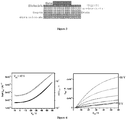
- FIG. 3 The schematic diagram of a top-gate /bottom contact OFET is shown in Figure 3 .
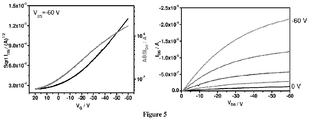
- Top-gate/bottom contact devices were fabricated according to the following method. Glass substrates were cleaned by sequential rinsing with methanol, acetone and isopropanol, followed by drying under a flow of nitrogen. The glass substrates were then exposed to UV/ozone for 20 min. and oxygen plasma (60 W) for 2 min. 3 nm of Cr was thermally evaporated followed by evaporation of 40 nm of Au. Substrates were immersed for 24h in ethanol solution of pentaflurobenzenethiol (PFBT) to form self-assembled monolayer (SAM) in which the molecules are chemisorbed to the gold by a thiolate link.
- PFBT pentaflurobenzenethiol
- the SAM-coated substrates were rinsed with solvent to remove physisorbed material before the nanoparticle PBTTT in water (10 mg/ml, ambient temperature) or linear PBTTT in 1,2-dichlorobenzene (7 mg/ml, heated to 100 °C) was spin-coated under ambient conditions or in the nitrogen glove box respectively, at 2000 rpm for 1 min. followed by annealing for 20 min. at 160 °C.
- poly(1,1,2,4,4,5,5,6,7,7-decafluoro-3-oxa-1,6-heptadiene), (200 ⁇ l, 9 wt% solution in perfluorotributylamine) was spin coated at 3000 rpm for 1 min. under ambient conditions.
Landscapes
- Chemical & Material Sciences (AREA)
- Chemical Kinetics & Catalysis (AREA)
- Medicinal Chemistry (AREA)
- Polymers & Plastics (AREA)
- Organic Chemistry (AREA)
- Health & Medical Sciences (AREA)
- Engineering & Computer Science (AREA)
- Materials Engineering (AREA)
- Manufacturing & Machinery (AREA)
- Physics & Mathematics (AREA)
- Spectroscopy & Molecular Physics (AREA)
- Polyoxymethylene Polymers And Polymers With Carbon-To-Carbon Bonds (AREA)
- Compositions Of Macromolecular Compounds (AREA)
- Photovoltaic Devices (AREA)
- Thin Film Transistor (AREA)
- Electroluminescent Light Sources (AREA)
- Light Receiving Elements (AREA)
- Nanotechnology (AREA)
- Composite Materials (AREA)
- Condensed Matter Physics & Semiconductors (AREA)
- General Physics & Mathematics (AREA)
- Crystallography & Structural Chemistry (AREA)
Claims (15)
- Wässrige Zusammensetzung, die eine Mehrzahl von Nanopartikeln umfasst, die in einem wässrigen Medium feinstverteilt sind, wobei:(i) die Nanopartikel einen aus einem oder mehreren nicht vernetzten organischen π-konjugierten Polymeren gebildeten Kern umfasst;(ii) die Nanopartikel eine Partikelgröße von weniger als 400 nm aufweisen; und(iii) die Konzentration der Nanopartikel in dem wässrigen Medium größer oder gleich 12 mM ist;und wobei die nicht vernetzten organischen π-konjugierten Polymere intrinsische Halbleiter sind, die keine Kohlenstoff-Kohlenstoff-Dreifachbindungen umfassen.
- Wässrige Zusammensetzung nach Anspruch 1, wobei der Kern der Nanopartikel im Wesentlichen aus dem einen oder mehreren nicht vernetzten organischen π-konjugierten Polymeren besteht.
- Wässrige Zusammensetzung nach Anspruch 1 oder Anspruch 2, wobei das polymere Rückgrat des nicht vernetzten organischen π-konjugierten Polymers ungeladen ist.
- Wässrige Zusammensetzung nach einem der vorstehenden Ansprüche, wobei die Kerne der Nanopartikel mit einem Stabilisator überzogen sind.
- Wässrige Zusammensetzung nach Anspruch 1, wobei die in den nicht vernetzten organischen π-konjugierten Polymeren enthaltenen monomeren Einheiten ausgewählt sind aus der Gruppe bestehend aus:


 wobei folgendes gilt: R, R1 und R2 sind Wasserstoff oder organische Substituentengruppen (z.B. eine Hydrocarbyl-Substituentengruppe, die optional 1 bis 30 Kohlenstoffatome umfasst sowie optional ein oder mehrere Heteroatome (z.B. N, O, S, Si oder P) oder eine aromatische oder heteroaromatische Gruppe);M ist ein Metall (z.B. Ir, Pt, Rh, Re, Ru, Os, Cr, Cu, Pd oder Au);L ist ein Ligand (z.B. ein Halid oder eine Hydrocarbyl-Substituentengruppe, die optional 1 bis 30 Kohlenstoffatome umfasst und optional ein oder mehrere Heteroatome (z.B. N, O, S, Si oder P) oder eine aromatische oder heteroaromatische Gruppe);und wobei jede der obigen Strukturen optional ferner substituiert ist mit einer oder mehreren organischen Substituentengruppen (z.B. einer Hydrocarbyl-Substituentengruppe, die optional 1 bis 30 Kohlenstoffatome umfasst und optional ein oder mehrere Heteroatome (z.B. N, O, S, Si oder P) oder eine aromatische oder heteroaromatische Gruppe).
 - Wässrige Zusammensetzung nach Anspruch 1, wobei die in den nicht vernetzten organischen π-konjugierten Polymeren enthaltenen monomeren Einheiten ausgewählt sind aus der Gruppe bestehend aus:


 wobei folgendes gilt: R, R1, R2, R3, R4, R5, R6 und R7 jeweils unabhängig ausgewählt sind aus Wasserstoff oder einer Hydrocarbyl-Substituentengruppe, die optional 1 bis 30 Kohlenstoffatome umfasst und optional ein oder mehrere Heteroatome (z.B. N, O, S, Si oder P);a ist 0, 1, 2 oder 3; b ist 0, 1, 2 oder 3; c und d sind 0, 1 oder 2; e und f sind 0 oder 1; x ist 0, 1, 2, 3 oder 4; y ist 0, 1, 2, 3 oder 4; und z ist 0, 1, 2, 3 oder 4.
 - Wässrige Zusammensetzung nach einem der vorstehenden Ansprüche, wobei das wässrige Medium Wasser ist.
- Wässrige Zusammensetzung nach einem der vorstehenden Ansprüche, wobei die Größe der Nanopartikel im Bereich von 30 bis 300 nm liegt.
- Wässrige Zusammensetzung nach einem der vorstehenden Ansprüche, wobei die Konzentration der Nanopartikel in dem wässrigen Medium größer oder gleich 15 mM ist.
- Verfahren zur Bildung einer wässrigen Zusammensetzung nach einem der Ansprüche 1 bis 9, wobei das Verfahren folgendes umfasst:(i) Bilden der Nanopartikel durch Emulsionspolymerisations- oder Miniemulsionspolymerisationstechniken, so dass eine wässrige Suspension aus Nanopartikeln gebildet wird; und(ii) optionales Aufreinigen der Nanopartikelsuspension;wobei die Nanopartikel durch eine Stille- oder Suzuki-Polymerisationsreaktion gebildet werden.
- Verfahren zur Erzeugung eines organischen Halbleiters oder einer photovoltaischen Vorrichtung oder Komponente, wobei das Verfahren folgendes umfasst:(i) Abscheiden einer Nanopartikel umfassenden wässrigen Zusammensetzung, wie in den Ansprüchen 1 bis 6 definiert, auf ein Substrat;(ii) Erhitzen des Substrats auf eine Temperatur oberhalb der Glasübergangstemperatur (Tg) der Nanopartikel, um auf dem Substrat einen Film aus organischem π-konjugiertem Polymer zu bilden.
- Organischer, halbleitfähiger Film, der durch das Verfahren aus Anspruch 11 erhalten werden kann.
- Verwendung einer wässrigen Zusammensetzung nach einem der Ansprüche 1 bis 9 zur Erzeugung eines organischen Halbleiters oder einer photovoltaischen Vorrichtung oder Komponente.
- Organischer Halbleiter oder photovoltaische Vorrichtung oder Komponente, der bzw. die durch ein Verfahren nach Anspruch 11 erhalten werden kann.
- Organischer Halbleiter oder photovoltaische Vorrichtung oder Komponente, der bzw. die einen organischen, halbleitfähigen Film nach Anspruch 12 umfasst.
Applications Claiming Priority (2)
| Application Number | Priority Date | Filing Date | Title |
|---|---|---|---|
| GBGB1317966.8A GB201317966D0 (en) | 2013-10-10 | 2013-10-10 | Nanoparticles |
| PCT/GB2014/053048 WO2015052529A1 (en) | 2013-10-10 | 2014-10-10 | Nanoparticles |
Publications (2)
| Publication Number | Publication Date |
|---|---|
| EP3055347A1 EP3055347A1 (de) | 2016-08-17 |
| EP3055347B1 true EP3055347B1 (de) | 2021-01-20 |
Family
ID=49679879
Family Applications (1)
| Application Number | Title | Priority Date | Filing Date |
|---|---|---|---|
| EP14784363.5A Active EP3055347B1 (de) | 2013-10-10 | 2014-10-10 | Nanopartikel |
Country Status (7)
| Country | Link |
|---|---|
| US (1) | US9834640B2 (de) |
| EP (1) | EP3055347B1 (de) |
| JP (2) | JP2016535801A (de) |
| KR (1) | KR102459989B1 (de) |
| CN (1) | CN105980451B (de) |
| GB (1) | GB201317966D0 (de) |
| WO (1) | WO2015052529A1 (de) |
Families Citing this family (6)
| Publication number | Priority date | Publication date | Assignee | Title |
|---|---|---|---|---|
| GB201601004D0 (en) | 2016-01-19 | 2016-03-02 | Chromition Ltd | Nanoparticle conjugates |
| GB201601007D0 (en) | 2016-01-19 | 2016-03-02 | Chromition Ltd | Nanoparticles for use in light emitting applications |
| CN109575244A (zh) * | 2018-12-04 | 2019-04-05 | 福州大学 | 一种含有-NH···O=C氢键作用的给体-受体结合的π-共轭聚合物及其制备方法 |
| CN111332502B (zh) * | 2020-03-12 | 2023-10-31 | 苏州纳飞卫星动力科技有限公司 | 一种及时填料加热固体碘颗粒提升装填密度的装置 |
| CN114539566B (zh) * | 2022-02-28 | 2023-09-12 | 山东建筑大学 | 一种聚(9,9-二正辛基芴基-2,7-二基)纳米颗粒的制备方法 |
| CN115058030B (zh) * | 2022-07-12 | 2024-07-09 | 中南大学 | 一种多形态各向异性半导体聚合物纳米结构的制备方法 |
Family Cites Families (24)
| Publication number | Priority date | Publication date | Assignee | Title |
|---|---|---|---|---|
| JPH02258832A (ja) * | 1989-03-31 | 1990-10-19 | Fuji Photo Film Co Ltd | ポリイソチアナフテン系水分散液の製造方法及びそれを用いた導電性高分子材料 |
| GB0125621D0 (en) * | 2001-10-25 | 2001-12-19 | Cambridge Display Technology | Polymer preparation |
| US20050234280A1 (en) | 2002-06-14 | 2005-10-20 | Georg Wittmann | Material for a thin and low-conductive funtional layer for an oled and production method therefor |
| US7056600B2 (en) | 2002-08-23 | 2006-06-06 | Agfa Gevaert | Layer configuration comprising an electron-blocking element |
| DE60322923D1 (de) | 2002-09-24 | 2008-09-25 | Du Pont | Wasserdispergierbare polythiophene hergestellt untäuren |
| US7390438B2 (en) | 2003-04-22 | 2008-06-24 | E.I. Du Pont De Nemours And Company | Water dispersible substituted polydioxythiophenes made with fluorinated polymeric sulfonic acid colloids |
| US7270871B2 (en) * | 2004-01-12 | 2007-09-18 | Air Products And Chemicals, Inc. | Dispersions and films comprising conducting polymer for optoelectronic devices |
| US20050175861A1 (en) | 2004-02-10 | 2005-08-11 | H.C. Starck Gmbh | Polythiophene compositions for improving organic light-emitting diodes |
| DE102004006583A1 (de) | 2004-02-10 | 2005-09-01 | H.C. Starck Gmbh | Polythiophenformulierungen zur Verbesserung von organischen Leuchtdioden |
| US7338620B2 (en) * | 2004-03-17 | 2008-03-04 | E.I. Du Pont De Nemours And Company | Water dispersible polydioxythiophenes with polymeric acid colloids and a water-miscible organic liquid |
| US7351358B2 (en) | 2004-03-17 | 2008-04-01 | E.I. Du Pont De Nemours And Company | Water dispersible polypyrroles made with polymeric acid colloids for electronics applications |
| JP4470175B2 (ja) * | 2005-03-29 | 2010-06-02 | アキレス株式会社 | 導電性微粒子水系分散体およびその製造方法 |
| JP4888643B2 (ja) * | 2006-04-28 | 2012-02-29 | アキレス株式会社 | 導電性高分子微粒子分散体及びそれを用いる導電性塗料 |
| KR100762014B1 (ko) | 2006-07-24 | 2007-10-04 | 제일모직주식회사 | 유기이온염을 포함하는 전도성 고분자 조성물 및 이를이용한 유기 광전 소자 |
| JP2008074894A (ja) | 2006-09-19 | 2008-04-03 | Chinretsu Kim | イオン液体を用いた伝導性高分子のナノ粒子の製造方法及びこれを用いた伝導性高分子コンポジット物質の製造方法 |
| US20080166564A1 (en) | 2006-12-28 | 2008-07-10 | Vsevolod Rostovtsev | Derivatized monomers for making conductive polymers, and devices made with such polymers |
| JP2009235127A (ja) * | 2008-03-25 | 2009-10-15 | Fujifilm Corp | 導電性高分子微粒子の製造方法、ならびにそれにより得られる導電性高分子微粒子およびその水系分散液 |
| JP5650108B2 (ja) * | 2008-07-02 | 2015-01-07 | ビーエーエスエフ ソシエタス・ヨーロピアBasf Se | 交互ドナーアクセプターコポリマー系の高性能で溶液加工可能な半導体ポリマー |
| KR101065241B1 (ko) * | 2009-05-13 | 2011-09-19 | 한국과학기술연구원 | 발광 고분자 나노 입자 및 그 제조 방법 |
| CN102791827B (zh) * | 2009-11-09 | 2016-11-16 | 华盛顿大学商业化中心 | 官能化发色聚合物点及其生物共轭体 |
| TW201221597A (en) | 2010-11-03 | 2012-06-01 | Cambrios Technologies Corp | Coating compositions for forming nanocomposite films |
| US20140110636A1 (en) | 2011-06-07 | 2014-04-24 | Ndsu Research Foundation | Template-free aqueous synthesis of conductive polymer nanoparticles |
| CN104364292B (zh) * | 2012-04-13 | 2018-02-02 | 韦克森林大学 | 低带隙结合聚合组合物及其应用 |
| CN102627776B (zh) * | 2012-04-19 | 2014-09-17 | 苏州大学 | 一种基于超支化共轭聚合物的手性荧光纳米粒子的制备方法 |
-
2013
- 2013-10-10 GB GBGB1317966.8A patent/GB201317966D0/en not_active Ceased
-
2014
- 2014-10-10 JP JP2016521748A patent/JP2016535801A/ja active Pending
- 2014-10-10 CN CN201480066955.5A patent/CN105980451B/zh active Active
- 2014-10-10 KR KR1020167012113A patent/KR102459989B1/ko active Active
- 2014-10-10 US US15/027,987 patent/US9834640B2/en active Active
- 2014-10-10 WO PCT/GB2014/053048 patent/WO2015052529A1/en not_active Ceased
- 2014-10-10 EP EP14784363.5A patent/EP3055347B1/de active Active
-
2020
- 2020-08-24 JP JP2020140695A patent/JP7026742B2/ja active Active
Non-Patent Citations (1)
| Title |
|---|
| JONATHAN M. BEHRENDT ET AL: "Fluorescent nanoparticles from PEGylated polyfluorenes", POLYMER CHEMISTRY, vol. 4, no. 5, 1 January 2013 (2013-01-01), GB, pages 1333, XP055483543, ISSN: 1759-9954, DOI: 10.1039/c3py21068e * |
Also Published As
| Publication number | Publication date |
|---|---|
| WO2015052529A1 (en) | 2015-04-16 |
| JP7026742B2 (ja) | 2022-02-28 |
| JP2016535801A (ja) | 2016-11-17 |
| JP2021006629A (ja) | 2021-01-21 |
| EP3055347A1 (de) | 2016-08-17 |
| KR20160068880A (ko) | 2016-06-15 |
| KR102459989B1 (ko) | 2022-10-27 |
| CN105980451B (zh) | 2018-11-23 |
| CN105980451A (zh) | 2016-09-28 |
| US9834640B2 (en) | 2017-12-05 |
| US20160237205A1 (en) | 2016-08-18 |
| GB201317966D0 (en) | 2013-11-27 |
Similar Documents
| Publication | Publication Date | Title |
|---|---|---|
| JP7653222B2 (ja) | 有機半導体化合物 | |
| EP3523836B1 (de) | Organische halbleitermaterialien | |
| JP7026742B2 (ja) | 水性組成物を形成する方法 | |
| US8389670B2 (en) | Dithienobenzo-thieno[3,2-B]thiophene-copolymer and its use as high performance solution processable semiconducting polymer | |
| US9543523B2 (en) | Cyclohexadiene fullerene derivatives | |
| CN109891616B (zh) | 有机半导体化合物 | |
| CN112236882B (zh) | 有机半导体化合物 | |
| CN108779128B (zh) | 有机半导体 | |
| CN103842402B (zh) | 共轭聚合物 | |
| US8394918B2 (en) | Five-ring fused heteroaromatic compounds and conjugated polymers thereof | |
| EP2553743A1 (de) | Annellierte dithiophen-copolymere | |
| US11637246B2 (en) | Organic semiconducting compounds | |
| CN103068829A (zh) | 二锡稠合噻吩化合物与聚合物及其制备方法 | |
| JP7599535B2 (ja) | 共役系高分子、製膜用組成物、有機薄膜、ならびに有機半導体素子 | |
| EP3070756A1 (de) | Halbleitermischungen mit nanopartikeln | |
| Truong et al. | Phenothiazine derivatives, diketopyrrolopyrrole-based conjugated polymers: synthesis, optical and organic field effect transistor properties | |
| CN112955456A (zh) | 有机半导体化合物 | |
| JP7116075B2 (ja) | 有機半導体化合物 | |
| US9799831B2 (en) | P-type semiconducting polymers and related methods | |
| US20160204348A1 (en) | Semiconducting polymers and ternary blends thereof | |
| Paek et al. | The influence of electron-deficient comonomer on chain alignment and OTFT characteristics of polythiophenes | |
| CN110372848A (zh) | 一种含氟代2,1,3-苯并硒二唑与二噻吩并环戊二烯的聚合物及其制备与应用 | |
| US10815256B2 (en) | Dithiophene compound, preparation and its application in organic photovoltaics thereof | |
| FARCAS | POLYROTAXANES CONSTRUCTED FROM CUCURBIT [7] URIL AND Π-CONJUGATED POLYMERS | |
| Lim | Studying the self-assembly of networks of conjugated oligomers |
Legal Events
| Date | Code | Title | Description |
|---|---|---|---|
| PUAI | Public reference made under article 153(3) epc to a published international application that has entered the european phase |
Free format text: ORIGINAL CODE: 0009012 |
|
| 17P | Request for examination filed |
Effective date: 20160414 |
|
| AK | Designated contracting states |
Kind code of ref document: A1 Designated state(s): AL AT BE BG CH CY CZ DE DK EE ES FI FR GB GR HR HU IE IS IT LI LT LU LV MC MK MT NL NO PL PT RO RS SE SI SK SM TR |
|
| AX | Request for extension of the european patent |
Extension state: BA ME |
|
| DAX | Request for extension of the european patent (deleted) | ||
| RAP1 | Party data changed (applicant data changed or rights of an application transferred) |
Owner name: CHROMITION LIMITED |
|
| STAA | Information on the status of an ep patent application or granted ep patent |
Free format text: STATUS: EXAMINATION IS IN PROGRESS |
|
| 17Q | First examination report despatched |
Effective date: 20180618 |
|
| GRAP | Despatch of communication of intention to grant a patent |
Free format text: ORIGINAL CODE: EPIDOSNIGR1 |
|
| STAA | Information on the status of an ep patent application or granted ep patent |
Free format text: STATUS: GRANT OF PATENT IS INTENDED |
|
| INTG | Intention to grant announced |
Effective date: 20200319 |
|
| GRAJ | Information related to disapproval of communication of intention to grant by the applicant or resumption of examination proceedings by the epo deleted |
Free format text: ORIGINAL CODE: EPIDOSDIGR1 |
|
| STAA | Information on the status of an ep patent application or granted ep patent |
Free format text: STATUS: EXAMINATION IS IN PROGRESS |
|
| GRAP | Despatch of communication of intention to grant a patent |
Free format text: ORIGINAL CODE: EPIDOSNIGR1 |
|
| STAA | Information on the status of an ep patent application or granted ep patent |
Free format text: STATUS: GRANT OF PATENT IS INTENDED |
|
| INTC | Intention to grant announced (deleted) | ||
| INTG | Intention to grant announced |
Effective date: 20200819 |
|
| GRAS | Grant fee paid |
Free format text: ORIGINAL CODE: EPIDOSNIGR3 |
|
| GRAA | (expected) grant |
Free format text: ORIGINAL CODE: 0009210 |
|
| STAA | Information on the status of an ep patent application or granted ep patent |
Free format text: STATUS: THE PATENT HAS BEEN GRANTED |
|
| AK | Designated contracting states |
Kind code of ref document: B1 Designated state(s): AL AT BE BG CH CY CZ DE DK EE ES FI FR GB GR HR HU IE IS IT LI LT LU LV MC MK MT NL NO PL PT RO RS SE SI SK SM TR |
|
| REG | Reference to a national code |
Ref country code: GB Ref legal event code: FG4D |
|
| REG | Reference to a national code |
Ref country code: CH Ref legal event code: EP |
|
| REG | Reference to a national code |
Ref country code: AT Ref legal event code: REF Ref document number: 1356367 Country of ref document: AT Kind code of ref document: T Effective date: 20210215 |
|
| REG | Reference to a national code |
Ref country code: IE Ref legal event code: FG4D |
|
| REG | Reference to a national code |
Ref country code: DE Ref legal event code: R096 Ref document number: 602014074400 Country of ref document: DE |
|
| REG | Reference to a national code |
Ref country code: NL Ref legal event code: MP Effective date: 20210120 |
|
| REG | Reference to a national code |
Ref country code: LT Ref legal event code: MG9D |
|
| REG | Reference to a national code |
Ref country code: AT Ref legal event code: MK05 Ref document number: 1356367 Country of ref document: AT Kind code of ref document: T Effective date: 20210120 |
|
| PG25 | Lapsed in a contracting state [announced via postgrant information from national office to epo] |
Ref country code: PT Free format text: LAPSE BECAUSE OF FAILURE TO SUBMIT A TRANSLATION OF THE DESCRIPTION OR TO PAY THE FEE WITHIN THE PRESCRIBED TIME-LIMIT Effective date: 20210520 Ref country code: LT Free format text: LAPSE BECAUSE OF FAILURE TO SUBMIT A TRANSLATION OF THE DESCRIPTION OR TO PAY THE FEE WITHIN THE PRESCRIBED TIME-LIMIT Effective date: 20210120 Ref country code: FI Free format text: LAPSE BECAUSE OF FAILURE TO SUBMIT A TRANSLATION OF THE DESCRIPTION OR TO PAY THE FEE WITHIN THE PRESCRIBED TIME-LIMIT Effective date: 20210120 Ref country code: HR Free format text: LAPSE BECAUSE OF FAILURE TO SUBMIT A TRANSLATION OF THE DESCRIPTION OR TO PAY THE FEE WITHIN THE PRESCRIBED TIME-LIMIT Effective date: 20210120 Ref country code: GR Free format text: LAPSE BECAUSE OF FAILURE TO SUBMIT A TRANSLATION OF THE DESCRIPTION OR TO PAY THE FEE WITHIN THE PRESCRIBED TIME-LIMIT Effective date: 20210421 Ref country code: BG Free format text: LAPSE BECAUSE OF FAILURE TO SUBMIT A TRANSLATION OF THE DESCRIPTION OR TO PAY THE FEE WITHIN THE PRESCRIBED TIME-LIMIT Effective date: 20210420 Ref country code: NO Free format text: LAPSE BECAUSE OF FAILURE TO SUBMIT A TRANSLATION OF THE DESCRIPTION OR TO PAY THE FEE WITHIN THE PRESCRIBED TIME-LIMIT Effective date: 20210420 Ref country code: NL Free format text: LAPSE BECAUSE OF FAILURE TO SUBMIT A TRANSLATION OF THE DESCRIPTION OR TO PAY THE FEE WITHIN THE PRESCRIBED TIME-LIMIT Effective date: 20210120 |
|
| PG25 | Lapsed in a contracting state [announced via postgrant information from national office to epo] |
Ref country code: SE Free format text: LAPSE BECAUSE OF FAILURE TO SUBMIT A TRANSLATION OF THE DESCRIPTION OR TO PAY THE FEE WITHIN THE PRESCRIBED TIME-LIMIT Effective date: 20210120 Ref country code: LV Free format text: LAPSE BECAUSE OF FAILURE TO SUBMIT A TRANSLATION OF THE DESCRIPTION OR TO PAY THE FEE WITHIN THE PRESCRIBED TIME-LIMIT Effective date: 20210120 Ref country code: PL Free format text: LAPSE BECAUSE OF FAILURE TO SUBMIT A TRANSLATION OF THE DESCRIPTION OR TO PAY THE FEE WITHIN THE PRESCRIBED TIME-LIMIT Effective date: 20210120 Ref country code: RS Free format text: LAPSE BECAUSE OF FAILURE TO SUBMIT A TRANSLATION OF THE DESCRIPTION OR TO PAY THE FEE WITHIN THE PRESCRIBED TIME-LIMIT Effective date: 20210120 Ref country code: AT Free format text: LAPSE BECAUSE OF FAILURE TO SUBMIT A TRANSLATION OF THE DESCRIPTION OR TO PAY THE FEE WITHIN THE PRESCRIBED TIME-LIMIT Effective date: 20210120 |
|
| PG25 | Lapsed in a contracting state [announced via postgrant information from national office to epo] |
Ref country code: IS Free format text: LAPSE BECAUSE OF FAILURE TO SUBMIT A TRANSLATION OF THE DESCRIPTION OR TO PAY THE FEE WITHIN THE PRESCRIBED TIME-LIMIT Effective date: 20210520 |
|
| REG | Reference to a national code |
Ref country code: DE Ref legal event code: R097 Ref document number: 602014074400 Country of ref document: DE |
|
| PG25 | Lapsed in a contracting state [announced via postgrant information from national office to epo] |
Ref country code: SM Free format text: LAPSE BECAUSE OF FAILURE TO SUBMIT A TRANSLATION OF THE DESCRIPTION OR TO PAY THE FEE WITHIN THE PRESCRIBED TIME-LIMIT Effective date: 20210120 Ref country code: CZ Free format text: LAPSE BECAUSE OF FAILURE TO SUBMIT A TRANSLATION OF THE DESCRIPTION OR TO PAY THE FEE WITHIN THE PRESCRIBED TIME-LIMIT Effective date: 20210120 Ref country code: EE Free format text: LAPSE BECAUSE OF FAILURE TO SUBMIT A TRANSLATION OF THE DESCRIPTION OR TO PAY THE FEE WITHIN THE PRESCRIBED TIME-LIMIT Effective date: 20210120 |
|
| PLBE | No opposition filed within time limit |
Free format text: ORIGINAL CODE: 0009261 |
|
| STAA | Information on the status of an ep patent application or granted ep patent |
Free format text: STATUS: NO OPPOSITION FILED WITHIN TIME LIMIT |
|
| PG25 | Lapsed in a contracting state [announced via postgrant information from national office to epo] |
Ref country code: ES Free format text: LAPSE BECAUSE OF FAILURE TO SUBMIT A TRANSLATION OF THE DESCRIPTION OR TO PAY THE FEE WITHIN THE PRESCRIBED TIME-LIMIT Effective date: 20210120 Ref country code: DK Free format text: LAPSE BECAUSE OF FAILURE TO SUBMIT A TRANSLATION OF THE DESCRIPTION OR TO PAY THE FEE WITHIN THE PRESCRIBED TIME-LIMIT Effective date: 20210120 Ref country code: SK Free format text: LAPSE BECAUSE OF FAILURE TO SUBMIT A TRANSLATION OF THE DESCRIPTION OR TO PAY THE FEE WITHIN THE PRESCRIBED TIME-LIMIT Effective date: 20210120 Ref country code: RO Free format text: LAPSE BECAUSE OF FAILURE TO SUBMIT A TRANSLATION OF THE DESCRIPTION OR TO PAY THE FEE WITHIN THE PRESCRIBED TIME-LIMIT Effective date: 20210120 |
|
| 26N | No opposition filed |
Effective date: 20211021 |
|
| PG25 | Lapsed in a contracting state [announced via postgrant information from national office to epo] |
Ref country code: AL Free format text: LAPSE BECAUSE OF FAILURE TO SUBMIT A TRANSLATION OF THE DESCRIPTION OR TO PAY THE FEE WITHIN THE PRESCRIBED TIME-LIMIT Effective date: 20210120 |
|
| PG25 | Lapsed in a contracting state [announced via postgrant information from national office to epo] |
Ref country code: SI Free format text: LAPSE BECAUSE OF FAILURE TO SUBMIT A TRANSLATION OF THE DESCRIPTION OR TO PAY THE FEE WITHIN THE PRESCRIBED TIME-LIMIT Effective date: 20210120 |
|
| PG25 | Lapsed in a contracting state [announced via postgrant information from national office to epo] |
Ref country code: IT Free format text: LAPSE BECAUSE OF FAILURE TO SUBMIT A TRANSLATION OF THE DESCRIPTION OR TO PAY THE FEE WITHIN THE PRESCRIBED TIME-LIMIT Effective date: 20210120 |
|
| REG | Reference to a national code |
Ref country code: CH Ref legal event code: PL |
|
| PG25 | Lapsed in a contracting state [announced via postgrant information from national office to epo] |
Ref country code: IS Free format text: LAPSE BECAUSE OF FAILURE TO SUBMIT A TRANSLATION OF THE DESCRIPTION OR TO PAY THE FEE WITHIN THE PRESCRIBED TIME-LIMIT Effective date: 20210520 |
|
| REG | Reference to a national code |
Ref country code: BE Ref legal event code: MM Effective date: 20211031 |
|
| PG25 | Lapsed in a contracting state [announced via postgrant information from national office to epo] |
Ref country code: MC Free format text: LAPSE BECAUSE OF FAILURE TO SUBMIT A TRANSLATION OF THE DESCRIPTION OR TO PAY THE FEE WITHIN THE PRESCRIBED TIME-LIMIT Effective date: 20210120 |
|
| PG25 | Lapsed in a contracting state [announced via postgrant information from national office to epo] |
Ref country code: LU Free format text: LAPSE BECAUSE OF NON-PAYMENT OF DUE FEES Effective date: 20211010 Ref country code: BE Free format text: LAPSE BECAUSE OF NON-PAYMENT OF DUE FEES Effective date: 20211031 |
|
| PG25 | Lapsed in a contracting state [announced via postgrant information from national office to epo] |
Ref country code: LI Free format text: LAPSE BECAUSE OF NON-PAYMENT OF DUE FEES Effective date: 20211031 Ref country code: CH Free format text: LAPSE BECAUSE OF NON-PAYMENT OF DUE FEES Effective date: 20211031 |
|
| PG25 | Lapsed in a contracting state [announced via postgrant information from national office to epo] |
Ref country code: IE Free format text: LAPSE BECAUSE OF NON-PAYMENT OF DUE FEES Effective date: 20211010 |
|
| PG25 | Lapsed in a contracting state [announced via postgrant information from national office to epo] |
Ref country code: HU Free format text: LAPSE BECAUSE OF FAILURE TO SUBMIT A TRANSLATION OF THE DESCRIPTION OR TO PAY THE FEE WITHIN THE PRESCRIBED TIME-LIMIT; INVALID AB INITIO Effective date: 20141010 |
|
| P01 | Opt-out of the competence of the unified patent court (upc) registered |
Effective date: 20230510 |
|
| PG25 | Lapsed in a contracting state [announced via postgrant information from national office to epo] |
Ref country code: CY Free format text: LAPSE BECAUSE OF FAILURE TO SUBMIT A TRANSLATION OF THE DESCRIPTION OR TO PAY THE FEE WITHIN THE PRESCRIBED TIME-LIMIT Effective date: 20210120 |
|
| PG25 | Lapsed in a contracting state [announced via postgrant information from national office to epo] |
Ref country code: MK Free format text: LAPSE BECAUSE OF FAILURE TO SUBMIT A TRANSLATION OF THE DESCRIPTION OR TO PAY THE FEE WITHIN THE PRESCRIBED TIME-LIMIT Effective date: 20210120 |
|
| PG25 | Lapsed in a contracting state [announced via postgrant information from national office to epo] |
Ref country code: TR Free format text: LAPSE BECAUSE OF FAILURE TO SUBMIT A TRANSLATION OF THE DESCRIPTION OR TO PAY THE FEE WITHIN THE PRESCRIBED TIME-LIMIT Effective date: 20210120 |
|
| PG25 | Lapsed in a contracting state [announced via postgrant information from national office to epo] |
Ref country code: MT Free format text: LAPSE BECAUSE OF FAILURE TO SUBMIT A TRANSLATION OF THE DESCRIPTION OR TO PAY THE FEE WITHIN THE PRESCRIBED TIME-LIMIT Effective date: 20210120 |
|
| PGFP | Annual fee paid to national office [announced via postgrant information from national office to epo] |
Ref country code: GB Payment date: 20250904 Year of fee payment: 12 |
|
| PGFP | Annual fee paid to national office [announced via postgrant information from national office to epo] |
Ref country code: DE Payment date: 20251008 Year of fee payment: 12 |
|
| PGFP | Annual fee paid to national office [announced via postgrant information from national office to epo] |
Ref country code: FR Payment date: 20251003 Year of fee payment: 12 |