EP3052688B1 - Flächengebilde mit hoher temperaturstabilität - Google Patents
Flächengebilde mit hoher temperaturstabilität Download PDFInfo
- Publication number
- EP3052688B1 EP3052688B1 EP14777512.6A EP14777512A EP3052688B1 EP 3052688 B1 EP3052688 B1 EP 3052688B1 EP 14777512 A EP14777512 A EP 14777512A EP 3052688 B1 EP3052688 B1 EP 3052688B1
- Authority
- EP
- European Patent Office
- Prior art keywords
- polymer
- sheet product
- range
- product according
- terephthalate
- Prior art date
- Legal status (The legal status is an assumption and is not a legal conclusion. Google has not performed a legal analysis and makes no representation as to the accuracy of the status listed.)
- Active
Links
Images




Classifications
-
- D—TEXTILES; PAPER
- D04—BRAIDING; LACE-MAKING; KNITTING; TRIMMINGS; NON-WOVEN FABRICS
- D04H—MAKING TEXTILE FABRICS, e.g. FROM FIBRES OR FILAMENTARY MATERIAL; FABRICS MADE BY SUCH PROCESSES OR APPARATUS, e.g. FELTS, NON-WOVEN FABRICS; COTTON-WOOL; WADDING ; NON-WOVEN FABRICS FROM STAPLE FIBRES, FILAMENTS OR YARNS, BONDED WITH AT LEAST ONE WEB-LIKE MATERIAL DURING THEIR CONSOLIDATION
- D04H1/00—Non-woven fabrics formed wholly or mainly of staple fibres or like relatively short fibres
- D04H1/40—Non-woven fabrics formed wholly or mainly of staple fibres or like relatively short fibres from fleeces or layers composed of fibres without existing or potential cohesive properties
- D04H1/42—Non-woven fabrics formed wholly or mainly of staple fibres or like relatively short fibres from fleeces or layers composed of fibres without existing or potential cohesive properties characterised by the use of certain kinds of fibres insofar as this use has no preponderant influence on the consolidation of the fleece
- D04H1/4326—Condensation or reaction polymers
- D04H1/435—Polyesters
-
- D—TEXTILES; PAPER
- D01—NATURAL OR MAN-MADE THREADS OR FIBRES; SPINNING
- D01F—CHEMICAL FEATURES IN THE MANUFACTURE OF ARTIFICIAL FILAMENTS, THREADS, FIBRES, BRISTLES OR RIBBONS; APPARATUS SPECIALLY ADAPTED FOR THE MANUFACTURE OF CARBON FILAMENTS
- D01F8/00—Conjugated, i.e. bi- or multicomponent, artificial filaments or the like; Manufacture thereof
- D01F8/04—Conjugated, i.e. bi- or multicomponent, artificial filaments or the like; Manufacture thereof from synthetic polymers
- D01F8/14—Conjugated, i.e. bi- or multicomponent, artificial filaments or the like; Manufacture thereof from synthetic polymers with at least one polyester as constituent
-
- D—TEXTILES; PAPER
- D04—BRAIDING; LACE-MAKING; KNITTING; TRIMMINGS; NON-WOVEN FABRICS
- D04H—MAKING TEXTILE FABRICS, e.g. FROM FIBRES OR FILAMENTARY MATERIAL; FABRICS MADE BY SUCH PROCESSES OR APPARATUS, e.g. FELTS, NON-WOVEN FABRICS; COTTON-WOOL; WADDING ; NON-WOVEN FABRICS FROM STAPLE FIBRES, FILAMENTS OR YARNS, BONDED WITH AT LEAST ONE WEB-LIKE MATERIAL DURING THEIR CONSOLIDATION
- D04H1/00—Non-woven fabrics formed wholly or mainly of staple fibres or like relatively short fibres
- D04H1/40—Non-woven fabrics formed wholly or mainly of staple fibres or like relatively short fibres from fleeces or layers composed of fibres without existing or potential cohesive properties
- D04H1/54—Non-woven fabrics formed wholly or mainly of staple fibres or like relatively short fibres from fleeces or layers composed of fibres without existing or potential cohesive properties by welding together the fibres, e.g. by partially melting or dissolving
- D04H1/541—Composite fibres, e.g. sheath-core, sea-island or side-by-side; Mixed fibres
-
- D—TEXTILES; PAPER
- D04—BRAIDING; LACE-MAKING; KNITTING; TRIMMINGS; NON-WOVEN FABRICS
- D04H—MAKING TEXTILE FABRICS, e.g. FROM FIBRES OR FILAMENTARY MATERIAL; FABRICS MADE BY SUCH PROCESSES OR APPARATUS, e.g. FELTS, NON-WOVEN FABRICS; COTTON-WOOL; WADDING ; NON-WOVEN FABRICS FROM STAPLE FIBRES, FILAMENTS OR YARNS, BONDED WITH AT LEAST ONE WEB-LIKE MATERIAL DURING THEIR CONSOLIDATION
- D04H1/00—Non-woven fabrics formed wholly or mainly of staple fibres or like relatively short fibres
- D04H1/40—Non-woven fabrics formed wholly or mainly of staple fibres or like relatively short fibres from fleeces or layers composed of fibres without existing or potential cohesive properties
- D04H1/54—Non-woven fabrics formed wholly or mainly of staple fibres or like relatively short fibres from fleeces or layers composed of fibres without existing or potential cohesive properties by welding together the fibres, e.g. by partially melting or dissolving
- D04H1/541—Composite fibres, e.g. sheath-core, sea-island or side-by-side; Mixed fibres
- D04H1/5412—Composite fibres, e.g. sheath-core, sea-island or side-by-side; Mixed fibres sheath-core
-
- D—TEXTILES; PAPER
- D04—BRAIDING; LACE-MAKING; KNITTING; TRIMMINGS; NON-WOVEN FABRICS
- D04H—MAKING TEXTILE FABRICS, e.g. FROM FIBRES OR FILAMENTARY MATERIAL; FABRICS MADE BY SUCH PROCESSES OR APPARATUS, e.g. FELTS, NON-WOVEN FABRICS; COTTON-WOOL; WADDING ; NON-WOVEN FABRICS FROM STAPLE FIBRES, FILAMENTS OR YARNS, BONDED WITH AT LEAST ONE WEB-LIKE MATERIAL DURING THEIR CONSOLIDATION
- D04H3/00—Non-woven fabrics formed wholly or mainly of yarns or like filamentary material of substantial length
- D04H3/005—Synthetic yarns or filaments
- D04H3/009—Condensation or reaction polymers
- D04H3/011—Polyesters
-
- D—TEXTILES; PAPER
- D04—BRAIDING; LACE-MAKING; KNITTING; TRIMMINGS; NON-WOVEN FABRICS
- D04H—MAKING TEXTILE FABRICS, e.g. FROM FIBRES OR FILAMENTARY MATERIAL; FABRICS MADE BY SUCH PROCESSES OR APPARATUS, e.g. FELTS, NON-WOVEN FABRICS; COTTON-WOOL; WADDING ; NON-WOVEN FABRICS FROM STAPLE FIBRES, FILAMENTS OR YARNS, BONDED WITH AT LEAST ONE WEB-LIKE MATERIAL DURING THEIR CONSOLIDATION
- D04H3/00—Non-woven fabrics formed wholly or mainly of yarns or like filamentary material of substantial length
- D04H3/08—Non-woven fabrics formed wholly or mainly of yarns or like filamentary material of substantial length characterised by the method of strengthening or consolidating
- D04H3/14—Non-woven fabrics formed wholly or mainly of yarns or like filamentary material of substantial length characterised by the method of strengthening or consolidating with bonds between thermoplastic yarns or filaments produced by welding
- D04H3/147—Composite yarns or filaments
-
- D—TEXTILES; PAPER
- D10—INDEXING SCHEME ASSOCIATED WITH SUBLASSES OF SECTION D, RELATING TO TEXTILES
- D10B—INDEXING SCHEME ASSOCIATED WITH SUBLASSES OF SECTION D, RELATING TO TEXTILES
- D10B2401/00—Physical properties
- D10B2401/04—Heat-responsive characteristics
-
- D—TEXTILES; PAPER
- D10—INDEXING SCHEME ASSOCIATED WITH SUBLASSES OF SECTION D, RELATING TO TEXTILES
- D10B—INDEXING SCHEME ASSOCIATED WITH SUBLASSES OF SECTION D, RELATING TO TEXTILES
- D10B2401/00—Physical properties
- D10B2401/06—Load-responsive characteristics
- D10B2401/061—Load-responsive characteristics elastic
-
- D—TEXTILES; PAPER
- D10—INDEXING SCHEME ASSOCIATED WITH SUBLASSES OF SECTION D, RELATING TO TEXTILES
- D10B—INDEXING SCHEME ASSOCIATED WITH SUBLASSES OF SECTION D, RELATING TO TEXTILES
- D10B2401/00—Physical properties
- D10B2401/06—Load-responsive characteristics
- D10B2401/062—Load-responsive characteristics stiff, shape retention
-
- D—TEXTILES; PAPER
- D10—INDEXING SCHEME ASSOCIATED WITH SUBLASSES OF SECTION D, RELATING TO TEXTILES
- D10B—INDEXING SCHEME ASSOCIATED WITH SUBLASSES OF SECTION D, RELATING TO TEXTILES
- D10B2505/00—Industrial
- D10B2505/12—Vehicles
Definitions
- the invention relates to a sheet, preferably with high temperature stability, as well as its use for producing a component for a means of transport.
- Sheet material of the type mentioned are already known from the prior art and are used in many fields, such as in the transport industry.
- Such fabrics usually contain a wide variety of materials, such as glass fibers, polyurethanes or polyesters.
- the US 3,966,526 describes a method for producing components for the automotive interior lining. These are made up of several foam-like layers of polystyrene resin. A disadvantage here is that these components are not recyclable and their disposal is therefore associated with high costs.
- the headliner has polyester bicomponent fibers with a low melting binder component and a high melting stabilizing polymer.
- the headliner contains partially stretched polyester fibers and has no binder.
- a lightweight headliner for automotive interior lining is described.
- This has a multilayer structure.
- a layer of polyurethane foam is used, wherein one side of the polyurethane foam layer is provided with a further polyurethane foam layer. The other side is impregnated with an elastomer solution.
- To dispose of the headliner a separation of the individual layers is necessary. This increases the disposal costs. Even recycling the foams is not possible due to the selected materials.
- the US 4 211 590 shows a thermoformable laminate of a thermoplastic foam core. After thermoforming, the laminate is hardened by cooling. Such a laminate is used for the interior lining of an automobile, in particular as a headliner.
- Another headliner for the automotive interior lining is from the US 5,660,908 known. This consists of polyethylene terephthalate and has reinforcing ribs. A disadvantage here is that it is insufficiently thermally stable. Sufficient thermal stability can be achieved by a complicated structure. This requires a complex and expensive manufacturing process.
- WO 2006/105836 A1 describes a thermally bonded nonwoven material containing a low shrinkage bicomponent core-sheath fiber comprised of a crystalline polyester core and a crystalline polyester sheath having a melting point at least 10 ° C lower than the core.
- the hot shrinkage of the fiber is less than 10% at 170 ° C.
- JP 2 977 679 B2 describes sheath-core conjugate fibers having a core component of polyethylene terephthalate and a polyethylene 2,6-naphthalate sheath component as a reinforcement for rubber.
- JP S 58 98426 A describes composite fibers consisting of a core component of polyethylene terephthalate and a shell component consisting of polycarbonate and polyethylene terephthalate in a certain ratio.
- An advantage of the composite fibers is their low dyeability and, associated with it, their ability to give an improved multi-color effect.
- the invention is therefore the object of a sheet of the type mentioned in such a way and further develop that this has a high bending stiffness at elevated temperature after cost-effective production, recyclable, mechanically strong and elastically yielding resilient.
- This sheet is intended to be used in particular as a component for a means of transport.
- the aforementioned sheet is characterized in that it comprises a base body of at least one layer, wherein the at least one layer comprises first fibers comprising a first polymer and second fibers comprising a second polymer or wherein the at least one layer comprises uniform fibers which a first and a second polymer, wherein a cold crystallization temperature of the first polymer is at the softening temperature of the second polymer or below the softening temperature of the second polymer, wherein at least one fiber contains at least two polymers, wherein the first polymer is in the form of at least one segment, which is embedded in a second polymer, wherein the base body comprises further fibers, and wherein the further fibers are a polymer selected from the group consisting of: polyester, polyolefins, polyamide, polyamide 66 (Nylon®), polyamide 6 (Perlon®), preferred Polyethylene terephthalate, poly propylene terephthalate, their copolymers and / or mixtures thereof.
- cold crystallization is meant a crystallization which occurs after heating above the softening or glass transition temperature.
- cold crystallization temperature is meant the temperature at which a first exothermic maximum of the free enthalpy occurs.
- exothermic is meant an energy release.
- softening temperature also called the glass transition temperature
- glass transition temperature is understood to mean the temperature at which wholly or partly amorphous polymers change from a highly viscous or rubber-elastic, flexible state into a glassy or hard-elastic state.
- the softening temperature is measured according to the invention according to DIN 53765.
- uniform fibers is meant that the fibers have the same polymers and fiber type.
- cold crystallization of the first polymer occurs at a softening temperature of the second polymer in the range of 70 to 150 ° C, preferably in the range of 80 to 140 ° C, more preferably in the range of 90 to 130 ° C on. Under these conditions, a sheet having high flexibility and elastic compliance at high temperatures is obtained. At these temperatures, stabilization of the second polymer occurs by crystallization of the first polymer.
- the difference between the cold crystallization temperature of the first polymer and the softening temperature of the second polymer could also be in the range from 1 to 100.degree. C., preferably in the range from 2 to 80.degree. C., more preferably in the range from 3 to 60.degree. Under these conditions, a particularly good stabilization of the second polymer is achieved by cold crystallization of the first polymer.
- the softening temperature and / or the melting temperature of the second polymer are above the softening temperature and / or the melting temperature of the first polymer.
- the difference between the softening temperatures measured according to DIN 53765 of the first and second polymers can vary within wide limits.
- the difference in softening temperatures of the first and second polymers is at least 15 ° C, preferably at least 20 ° C, more preferably at least 25 ° C.
- the difference in the melting temperatures of the first and the second polymer is at least 5 ° C., preferably at least 10 ° C., particularly preferably at least 15 ° C.
- the polymers are melt-spinnable.
- at least one of the polymers is a polyester selected from the group consisting of polyethylene terephthalate, polypropylene terephthalate, polytetramethylene terephthalate, poly (decamethylene) terephthalate, poly-1,4-cyclohexylenedimethyl terephthalate, polybutylene terephthalate, polyethylene naphthalate, polyglycolic acid, polylactides, polycaprolactones, polyethylene adipates, polyhydroxyalkanoates, Polyhydroxybutyrates, poly-3-hydroxybutyrate-co-3-hydroxyvalerate, polytrimethylene terephthalates, Vektrane, polyethylene naphthalate their copolymers and / or mixtures thereof. Sheets of the aforementioned polymers are easy to recycle.
- the first polymer is selected from the group consisting of polypropylene terephthalate, polytetramethylene terephthalate, poly (decamethylene) terephthalate, poly-1,4-cyclohexylenedimethyl terephthalate, polybutylene terephthalate, polyethylene terephthalate, more preferably Polypropylene terephthalate, polytetramethylene terephthalate, polyethylene terephthalate, their copolymers and / or mixtures thereof.
- the second polymer is selected from the group consisting of poly (decamethylene) terephthalate, poly-1,4-cyclohexylenedimethyl terephthalate, polybutylene terephthalate, polyethylene naphthalate, more preferably polyethylene naphthalate, polybutylene terephthalate, their copolymers, and / or mixtures thereof.
- poly (decamethylene) terephthalate poly-1,4-cyclohexylenedimethyl terephthalate, polybutylene terephthalate, polyethylene naphthalate, more preferably polyethylene naphthalate, polybutylene terephthalate, their copolymers, and / or mixtures thereof.
- the temperature stability and the mechanical properties, in particular the elasticity, deformability and strength of the fabric can be influenced. This allows a tailor-made use of the sheet with regard to the most diverse applications, preferably for applications of the sheet as a substrate for the inner lining of means of transport and as
- the first polymer is a polyester selected from the group consisting of polyglycolic acid, polylactides, polycaprolactones, polyethylene adipates, polyhydroxyalkanoates, polyhydroxybutyrates, poly-3-hydroxybutyrate-co-3-hydroxyvalerates, polyethylene terephthalate, polypropylene terephthalate, polybutylene terephthalate, polytrimethylene terephthalates, polyurethanes, polytetramethylene terephthalate , Poly (decamethylene) terephthalate, poly-1,4-cyclohexylenedimethyl terephthalate, polyethylene naphthalate, their copolymers and / or mixtures thereof, and the second polymer containing polyethylene naphthalate.
- polyglycolic acid polylactides
- polycaprolactones polyethylene adipates
- polyhydroxyalkanoates polyhydroxybutyrates
- poly-3-hydroxybutyrate-co-3-hydroxyvalerates poly
- the first polymer contains polyethylene terephthalate and / or co-polyethylene terephthalate and the second polymer contains polyethylene naphthalate.
- the first polymer has a cold crystallization temperature in the range of 70 to 150 ° C, more preferably in the range of 80 to 140 ° C, most preferably in the range of 90 to 130 ° C on.
- These polymers have a high temperature stability and lead to a good deflection behavior of the fabric.
- the second polymer has a softening temperature in the range of 70 to 150 ° C, more preferably in the range of 80 to 140 ° C, most preferably in the range of 90 to 130 ° C, on. In this case, a particularly good stabilization of the second polymer by cold crystallization of the first polymer occurs.
- the modulus of elasticity is a material characteristic from materials technology and describes the relationship between stress and strain in the deformation of a solid body with linear elastic behavior.
- the elastic modulus of the first polymer could be in the range from 400 to 1300 MPa, preferably in the range from 500 to 1200 MPa, more preferably in the range from 700 to 1000 MPa.
- the second polymer could have a high modulus of elasticity.
- the modulus of elasticity of the second polymer is 1400 to 3000 MPa, more preferably 1600 to 2500 MPa, particularly preferably 2000 to 2200 MPa.
- an excellent bending stiffness at elevated temperature is achieved.
- At least one fiber contains at least two polymers, wherein the first polymer is in the form of at least one segment which is embedded in the second polymer. This will be a Stabilization of the first polymer by the second polymer at high temperatures until cold crystallization of the first polymer occurs.
- the sheet segments of a first polymer are present, which are circular, oval, n-shaped, trilobal or multilobal in cross-section, which are embedded in the second polymer and / or at least partially bounded by the second polymer. Due to the alternating arrangement of the individual segments, an optimal and uniform arrangement of the first polymer in the form of segments embedded in the second polymer and / or at least partially bounded by the second polymer results. Preference is given to round segments, which are particularly preferably arranged coaxially. This isotropic arrangement causes a good force absorption behavior.
- the fibers could have a core / shell geometry.
- the first polymer in the core is surrounded by the second polymer as a strand of thread.
- the core contains polypropylene terephthalate, polytetramethylene terephthalate, poly (decamethylene) terephthalate, poly-1,4-cyclohexylenedimethyl terephthalate, polybutylene terephthalate, polyethylene terephthalate, more preferably polypropylene terephthalate, polytetramethylene terephthalate, polyethylene terephthalate, their copolymers and / or mixtures thereof, and the sheath preferably contains poly (decamethylene) terephthalate, poly-1,4-cyclohexylenedimethyl terephthalate, polybutylene terephthalate, polyethylene naphthalate, more preferably polyethylene naphthalate, polybutylene terephthalate, their copolymers and
- the fibers are configured as monofilaments.
- the second polymer is bonded to the first polymer and the first polymer as a binder fiber produces an adhesive bond between the fibers of the first and second polymers.
- the mechanical strength of the fabric can be increased.
- the fibers have a core / sheath geometry, the fibers containing only one polymer.
- the core has no polymer.
- These are hollow fibers. It is advantageous that a sheet with a low weight and a high mechanical strength is achieved.
- the polymer of the hollow fiber is a polyester selected from the group consisting of polypropylene terephthalate, polytetramethylene terephthalate, poly (decamethylene) terephthalate, poly-1,4-cyclohexylendimethylterephthalat, polybutylene terephthalate, polyethylene terephthalate, polypropylene terephthalate, polytetramethylene terephthalate, polyethylene terephthalate, polyethylene naphthalate whose copolymers and / or their mixtures.
- the polymer of the hollow fiber contains polyethylene naphthalate.
- the polymer of the hollow fiber has a softening temperature in the range of 70 to 150 ° C, more preferably in the range of 80 to 140 ° C, most preferably in the range of 90 to 130 ° C on. As a result, a particularly stable sheet with a low weight is obtained.
- the first to second polymer weight ratio is in a range of 50:50 to 95: 5, preferably in a range of 60:40 to 95: 5, more preferably in a range of 65:35 to 90:10.
- a small proportion of the polymer with a higher softening or melting temperature is sufficient to obtain optimum stabilization of the polymer with a lower softening or melting temperature.
- the manufacturing costs can be reduced with a low proportion of second polymer, since this is usually the more expensive component.
- the fiber diameter is in the range of 0.1 to 20 dtex, more preferably in the range of 1 to 15 dtex, most preferably in the range of 3 to 12 dtex.
- the second polymer is used as a minority component. It is advantageous that the usually expensive second polymer component can be used to save material in order to increase the stability of the fabric.
- the stability of the fabric can be further increased.
- the base body has further fibers. These fibers are preferably designed as monofilaments. Preferably, the proportion of further fibers, based on the total weight of the main body 1 to 80 wt .-%, more preferably 10 to 70 wt .-%, particularly preferably 20 to 60 wt .-%.
- the base body comprises further fibers, the other fibers being a polymer selected from the group consisting of: polyester, polyolefins, polyamide, polyamide 66 (nylon®), polyamide 6 (perlon®)
- the fibers could be designed as binding fibers.
- the binder fiber creates an adhesive bond, thereby increasing the strength of the fabric.
- the layers preferably the at least one layer and / or the further layers of the main body, could be configured as scrim, woven, knitted, knitted, film, foil, nonwoven or nonwoven fabric. As a result, a sheet with mechanical strength is obtained.
- the main body could comprise a composite containing the at least one layer. As a result, the mechanical strength of the fabric is increased.
- the sheet has a reinforcing layer.
- the sheet has no reinforcing layer. As a result, a sheet with high mechanical strength and low weight is obtained.
- the sheet has a basis weight according to DIN EN 29073-1 in the range of 50 to 4000 g / m 2 , more preferably in the range of 80 to 3000 g / m 2 , particularly preferably in the range of 100 to 2500 g / m 2 . Sheets of the above basis weights have excellent stability.
- the sheet is used as a substrate for a headliner.
- the sheet preferably has a basis weight in the range of 500 to 2500 g / m 2 , more preferably in the range of 100 to 1000 g / m 2 , most preferably in the range of 200 to 800 g / m 2 .
- the sheet has a thickness according to DIN EN 9073-2 of 0.5 to 300 mm, more preferably from 1 to 200 mm, particularly preferably from 1 to 150 mm.
- a thickness according to DIN EN 9073-2 of 0.5 to 300 mm, more preferably from 1 to 200 mm, particularly preferably from 1 to 150 mm.
- Such fabrics can be processed particularly well due to their small thickness and good formability.
- Another object of the present invention is the use of a bicomponent fiber containing a first and a second polymer, wherein a cold crystallization temperature of the first polymer is at the softening temperature of the second polymer or below the softening temperature of the second polymer, and wherein the fiber contains at least two polymers wherein the first polymer is in the form of at least one segment embedded in a second polymer to produce a thermoformed sheet.
- the mold could be heated to a temperature in the range of 20 to 300 ° C, preferably in the range of 20 to 250 ° C.
- the mold expediently has two half parts.
- the two half-parts of the molding tool can have the same distance or different distances from each other during pressing at different points of the pressing surface. Practical experiments have shown that under these conditions the thermoformable sheet is given increased flexural strength at elevated temperature.
- the bending stiffness of the fabric can vary widely.
- the sheet is used for producing a component for a means of transport, in particular as a substrate for a headliner.
- Such fabrics preferably have a flexural stiffness in the range of 1 to 40 N / mm 2 measured according to DIN EN ISO 14125 at a maximum bending stress, more preferably in the range of 1 to 25 N / mm 2 , particularly preferably in the range of 2 to 20 N / mm 2 , most preferably in the range of 4 to 15 N / mm 2 , on.
- Sheets with the aforementioned bending stiffness are characterized by sufficient deformability with sufficient stability.
- the bending stiffness of the thermoformed sheet can also be determined according to DIN / EN 310.
- the sample size to 90mm X 75mm, the support distance to 80mm and the pre-load on 3N bending stiffness in the range 1 to 40 N, preferably from 5 to 35 N and in particular from 10 to 30 N can be obtained.
- the thermoformed sheet designed as a substrate for a headliner a modulus of elasticity (modulus) in the range of 20 to 350 MPa measured according to EN ISO 14125 at a maximum bending stress, preferably in the range of 30 to 280 MPa, more preferably in the range of 40 up to 250 MPa.
- the modulus of elasticity is a material characteristic from materials technology and describes the relationship between stress and strain in the deformation of a solid body with linear elastic behavior.
- the elastic modulus of the thermoformed sheet can also be determined according to DIN EN ISO 178.
- the test speed to 20mm / min
- the sample size to 90mm X 75mm
- the sheet designed as a substrate for a headliner has a modulus of elasticity (modulus of elasticity) in the range of 10 to 350 MPa measured according to EN ISO 14125 or DIN EN ISO 178 at a maximum bending stress and a temperature of 120 ° C. , preferably in the range of 15 to 250 MPa, more preferably in the range of 20 to 200 MPa, on. It is advantageous that the sheet has an increased mechanical strength at high temperatures. Preferably, aging processes take place very slowly, so that the fabric also withstands the high demands on components in the automotive industry. For example, a surface may not show any color change or scarring over a period of several months when exposed to hot light at 120 ° C.
- the sheet is constructed in multiple layers.
- the fabric preferably contains further layers in addition to the main body.
- the further layers could be configured as spunbond layers or staple fiber layer.
- the further layers differ from one another by their function, type of production, fiber type, containing polymers and / or by their color.
- a combination of staple fiber layer and spunbonded layer leads to a voluminous fabric with the same basis weight.
- the fabric could have further layers, which are configured as spunbond or staple fiber layer. This improves the acoustic properties.
- the thermoformed sheet has a sandwich structure, wherein the outer layers contain the sheet according to the invention.
- the middle layer could have a staple fiber layer or another spunbonded layer.
- the sandwiched structure increases the flexural rigidity and gives the fabric excellent strength.
- SF stands for staple fiber layer and SL for a spunbonded layer: SF / SL / SF; SF / SL; SL / SF.
- the sheet according to the invention is due to its high bending stiffness at elevated temperature, its low weight and its sound absorption for the production of a component for a means of transport.
- the sheet is suitable as a substrate for the interior of a means of transport, more preferably as a substrate for a headliner, as a substrate for a door inner lining, as a substrate for a Hat rack and / or as a substrate in the outer region of a means of transport, more preferably as a substrate for a subfloor and as a substrate for a wheel arch.
- transport means cars, trucks, buses, trains, aircraft, ships, motor home, agricultural machinery and / or caravans.
- the sheet is used as a substrate for the interior lining of a bus, a caravan, a camper, a ship, an airplane or a train.
- the sheet is due to its mechanical strength and low weight for the aforementioned uses.
- the sheet as a substrate for an inner lining of ship cabins and / or aircraft cabins due to its low weight.
- the sheet material could be used to produce a component for a building, preferably as a substrate for mobile partitions in buildings. This use is due to the low weight of the sheet and its excellent acoustic properties.
- Example 1 Production of a fabric according to the invention
- PEN granules (Advanite 71001 from SASA) and copolyester granules (CS 123 N from FENC) are dried and then spun by means of a melt spinning process to give a mixture of monofibers and bicomponent fiber.
- the processing temperature for Advanite is 300 ° C and for CS 123 N at 270 ° C.
- the spinneret is a 195-hole nozzle with a 60% bicomponent fiber content.
- the PEN is incorporated only in the sheath of the bicomponent fiber and the copolyester both in the core of the bicomponent fiber and in the monofilament.
- FIGS. 7a-c Optical micrographs of the fiber cross sections of the above Bekomponentenmaschinen 1-3 are in the FIGS. 7a-c shown.
- thermo stability under temperature stress was examined as follows: A bicomponent fiber with a fiber length of 8 cm was stretched between two metal blocks with a distance of 4 cm and loaded centrally with a weight of 1 g. The fiber was tense.
- the temperature was raised to 100 ° C, which is above the Tg of the copolyester used and below the Tg of the PEN. Slack of the bicomponent fiber was not observed.
- the temperature was raised to 125 ° C, this temperature is in the softening range of the PEN. No sagging was observed.
- the temperature was raised to 140 ° C. This temperature is above the softening range of the polyester. At this temperature, only minimal sagging was observed.
- PET polyester mono-fiber
- either one or two spunbonded webs were joined together with a staple fiber layer by means of a needle chair.
- the staple fiber fleece was arranged in each case in the middle.
- Preserved hybrid materials Number of layers grammage 2 410 g / m 2 2 480 g / m 2 2 530 g / m 2 2 640 g / m 2 3 470 g / m 2 3 510 g / m 2
- the hybrid materials were solidified by means of a belt dryer.
- specimens of size 90mm X 75mm were punched out, and pressed at a temperature of 180 ° C to a thickness of 2.1-2.5 mm, the bending force according to DIN / EN 310 with a pre-load of 3 N and a Test speed of 20 mm, the modulus of elasticity according to DIN EN ISO 178 determined at the same Vorkraft and test speed.
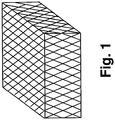
- Fig. 1 shows a sheet 1, comprising a base body of a layer 2, wherein the layer 2 contains fibers of two polymers.
- the layer 2 has a single-layered construction.
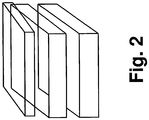
- Fig. 2 shows a schematic arrangement of a thermoformable sheet 1 '.
- the fabric 1 ' is multi-layered and contains in addition to the layer 2 more layers.
- the layer 2 is designed as a spunbonded layer.
- the fabric 1 ' has a layer 3 of staple fibers as the lowermost layer. On this layer 3, a layer 2 is arranged. On the layer 2 is another layer 3 of staple fibers.
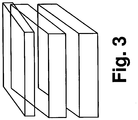
- Fig. 3 shows a further schematic arrangement of a thermoformable sheet 1 "
- the sheet 1 is constructed in several layers and contains next to the layer 2 more layers.
- the flat structure 1 "has as the lowermost layer the layer 2.
- a layer 3 of staple fibers is arranged on this layer 2.
- Fig. 4 shows yet another schematic arrangement of a thermoformable two-ply sheet 1 "'.
- the sheet 1"' has the lower layer 2.
- a staple fiber layer 3 is arranged on this layer 2.
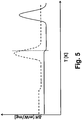
- Fig. 5 shows a diagram in which the heating curve of the first polymer is compared with the second polymer as a function of temperature.
- the upper curve 4 shows the heating behavior of the first polymer and the lower curve 5 describes the heating behavior of the second polymer.
- the softening temperature 6 of the first polymer is below the softening temperature 7 of the second polymer.
- the cold crystallization temperature 8 of the first polymer is below the softening temperature 7 of the second polymer.
- the cold crystallization temperature 9 of the second polymer is above the cold crystallization temperature 8 of the first polymer.
- Fig. 6 a shows in cross section a trilobal fiber containing two polymers, wherein the first polymer 10 is in the form of at least one segment embedded in a second polymer 11.
- Fig. 6b shows in cross section a trilobal fiber containing two polymers, wherein the first polymer 10 is in the form of at least one segment which is at least partially bounded by the second polymer 11.
Landscapes
- Engineering & Computer Science (AREA)
- Textile Engineering (AREA)
- Chemical & Material Sciences (AREA)
- Chemical Kinetics & Catalysis (AREA)
- General Chemical & Material Sciences (AREA)
- Nonwoven Fabrics (AREA)
- Laminated Bodies (AREA)
Description
- Die Erfindung betrifft ein Flächengebilde, bevorzugt mit hoher Temperaturstabilität, sowie dessen Verwendung zur Herstellung eines Bauteils für ein Transportmittel.
- Flächengebilde der eingangs genannten Art sind aus dem Stand der Technik bereits bekannt und finden auf vielen Gebieten Anwendung, wie beispielsweise in der Transportmittelindustrie. Derartige Flächengebilde enthalten üblicherweise die unterschiedlichsten Materialien, wie beispielsweise Glasfasern, Polyurethane oder Polyester.
- Die
US 3 966 526 beschreibt ein Verfahren zur Herstellung von Bauteilen für die Automobil-Innenauskleidung. Diese sind aus mehreren schaumartigen Schichten aus Polystyrolharz aufgebaut. Hierbei ist nachteilig, dass diese Bauteile nicht recyclingfähig sind und deren Entsorgung folglich mit hohen Kosten verbunden ist. - Ein weiteres Bauteil für die Automobilindustrie, nämlich ein Dachhimmel, wird in der
US 4 840 832 gezeigt. Der Dachhimmel weist Bikomponentenfasern aus Polyester mit einer niedrig schmelzenden Binderkomponente und einem hochschmelzenden stabilisierenden Polymer auf. - Aus der
US 5 275 865 ist ein weiterer Dachhimmel für die Automobilinnenauskleidung bekannt, wobei der Dachhimmel teilweise verstreckte Polyesterfasern enthält und kein Bindemittel aufweist. - In der
US 4 119 749 wird ein leichtgewichtiger Dachhimmel für die Automobilinnenauskleidung beschrieben. Dieser weist einen mehrschichtigen Aufbau auf. Als Kernelement wird eine Schicht aus Polyurethanschaumstoff eingesetzt, wobei eine Seite der Polyurethanschaumstoffschicht mit einer weiteren Polyurethanschaumstoffschicht versehen ist. Die andere Seite wird mit einer Elastomerlösung imprägniert. Zum Entsorgen des Dachhimmels ist eine Trennung der einzelnen Schichten notwendig. Dies erhöht die Entsorgungskosten. Auch ein Recyceln der Schaumstoffe ist aufgrund der ausgewählten Materialien nicht möglich. - Die
US 4 211 590 zeigt ein thermoverformbares Laminat aus einem thermoplastischen Schaumkern. Nach dem Thermoverformen wird das Laminat durch Kühlen verhärtet. Ein derartiges Laminat wird zur Innenauskleidung eines Automobils, insbesondere als Dachhimmel, verwendet. - Ein weiterer Dachhimmel für die Automobilinnenauskleidung ist aus der
US 5 660 908 bekannt. Dieser besteht aus Polyethylenterephthalat und weist Verstärkungsrippen auf. Hierbei ist nachteilig, dass dieser ungenügend thermisch stabil ist. Eine ausreichende thermische Stabilität kann durch einen komplizierten Aufbau erreicht werden. Dies erfordert ein aufwendiges und teures Herstellungsverfahren. - Flächengebilde der eingangs genannten Art haben üblicherweise eine geringe Biegesteifigkeit bei erhöhter Temperatur, sind nicht recyclebar oder weisen eine hohe Steifigkeit bei geringer Elastizität bzw. Verformbarkeit auf. Dies erschwert die Verarbeitung eines solchen Flächengebildes, insbesondere die Verarbeitung eines derartigen Flächengebildes zur Innenauskleidung eines Automobils, ist mit erheblichen Anstrengungen verbunden. Um eine ausreichende Stabilität bei gleichbleibender Elastizität des Flächengebildes zu erreichen, ist ein konstruktiver und mehrschichtiger Aufbau notwendig. Dies erfordert ein aufwendiges und teures Herstellungsverfahren.
-
WO 2006/105836 A1 beschreibt ein thermisch gebundenes Vliesmaterial, enthaltend eine schrumpfarme Zweikomponenten-Kern-Mantel-Faser, bestehend aus einem kristallinen Polyesterkern und einer kristallinen Polyesterhülle, die einen um mindestens 10 °C niedrigeren Schmelzpunkt als der Kern aufweist. Der Heissschrumpf der Faser beträgt weniger als 10% bei 170 °C. -
JP 2 977 679 B2 -
JP S 58 98426 A - Der Erfindung liegt daher die Aufgabe zugrunde, ein Flächengebilde der eingangs genannten Art derart auszugestalten und weiterzubilden, dass dieses nach kostengünstiger Fertigung eine hohe Biegesteifigkeit bei erhöhter Temperatur aufweist, recyclingfähig, mechanisch stark beanspruchbar und elastisch nachgiebig ist. Dieses Flächengebilde soll insbesondere als Bauteil für ein Transportmittel Verwendung finden.
- Die vorliegende Erfindung löst die zuvor genannte Aufgabe durch die Merkmale des Patentanspruchs 1.
- Danach zeichnet sich das eingangs genannte Flächengebilde dadurch aus, dass es einen Grundkörper aus mindestens einer Lage umfasst, wobei die mindestens eine Lage erste Fasern umfassend ein erstes Polymer und zweite Fasern umfassend ein zweites Polymer enthält oder wobei die mindestens eine Lage einheitliche Fasern umfasst, welche ein erstes und ein zweites Polymer enthalten, wobei eine Kaltkristallisationstemperatur des ersten Polymers bei der Erweichungstemperatur des zweiten Polymers oder unterhalb der Erweichungstemperatur des zweiten Polymers liegt, wobei mindestens eine Faser mindestens zwei Polymere enthält, wobei das erste Polymer in Form von mindestens einem Segment vorliegt, welches in einem zweiten Polymer eingebettet ist, wobei der Grundkörper weitere Fasern aufweist, und wobei die weiteren Fasern ein Polymer ausgewählt aus der Gruppe bestehend aus: Polyester, Polyolefinen, Polyamid, Polyamid 66 (Nylon®), Polyamid 6 (Perlon®), bevorzugt Polyethylenterephthalat, Polypropylenterephthalat, deren Copolymere und/oder deren Gemische enthalten.
- Unter Kaltkristallisation wird eine Kristallisation verstanden, die nach Erwärmen über die Erweichungs- bzw. Glasübergangstemperatur eintritt.
- Unter Kaltkristallisationstemperatur wird die Temperatur verstanden, bei der ein erstes exothermes Maximum der freien Enthalpie auftritt. Unter exotherm wird eine Energiefreisetzung verstanden.
- Unter Erweichungstemperatur, auch Glasübergangstemperatur genannt, wird die Temperatur verstanden, bei der ganz oder teilweise amorphe Polymere von einem hochviskosen oder gummielastischen, flexiblen Zustand in einen glasartigen oder hartelastischen Zustand übergehen. Die Erweichungstemperatur wird erfindungsgemäß gemessen nach DIN 53765.
- Unter einheitlichen Fasern wird verstanden, dass die Fasern die gleichen Polymere und den gleichen Fasertyp aufweisen.
- Erfindungsgemäß ist erkannt worden, dass durch die Kaltkristallisation des ersten Polymers eine Stabilisierung des zweiten Polymers bei der Erweichungstemperatur des zweiten Polymers oder unterhalb der Erweichungstemperatur des zweiten Polymers auftritt. Hierdurch wird ein Flächengebilde mit ausreichend hoher mechanischer Festigkeit bei hohen Temperaturen erreicht. Ferner zeichnet sich das Flächengebilde durch hervorragende akustische Eigenschaften und ein geringes Gewicht aus.
- Folglich ist die eingangs genannte Aufgabe gelöst.
- Bevorzugt tritt eine Kaltkristallisation des ersten Polymers bei einer Erweichungstemperatur des zweiten Polymers im Bereich von 70 bis 150 °C, bevorzugt im Bereich von 80 bis 140 °C, besonders bevorzugt im Bereich von 90 bis 130 °C, auf. Bei diesen Bedingungen wird ein Flächengebilde mit hoher Flexibilität und elastischer Nachgiebigkeit bei hohen Temperaturen erhalten. Bei diesen Temperaturen findet eine Stabilisierung des zweiten Polymers durch Kristallisation des ersten Polymers statt.
- Bevorzugt tritt keine Differenz zwischen der Kalkristallisationstemperatur des ersten Polymers und der Erweichungstemperatur des zweiten Polymers auf. Die Differenz zwischen der Kaltkristallisationstemperatur des ersten Polymers und der Erweichungstemperatur des zweiten Polymers könnte aber auch im Bereich von 1 bis 100 °C, bevorzugt im Bereich von 2 bis 80 °C, besonders bevorzugt im Bereich von 3 bis 60 °C, liegen. Bei diesen Bedingungen wird eine besonders gute Stabilisierung des zweiten Polymers durch Kaltkristallisation des ersten Polymers erzielt.
- Gemäß einer bevorzugten Ausführungsform liegen die Erweichungstemperatur und/oder die Schmelztemperatur des zweiten Polymers über der Erweichungstemperatur und/oder der Schmelztemperatur des ersten Polymers. Durch spezielle Auswahl der Polymere im Hinblick auf ihre Erweichungstemperaturen sowie ihre Schmelztemperaturen wird eine besonders gute Stabilisierung des ersten Polymers durch das zweite Polymer bis zur Erweichungstemperatur des zweiten Polymers erzielt. Ferner wird durch die spezielle Auswahl der Polymere und ihre Anordnung aufgrund der Kaltkristallisation des ersten Polymers eine Temperaturstabilität des Flächengebildes erreicht, die deutlich über der Erweichungstemperatur und der Schmelztemperatur beider Polymere liegt.
- Die Differenz zwischen den Erweichungstemperaturen gemessen nach DIN 53765 des ersten und zweiten Polymers kann in weiten Bereichen variieren. Zweckmäßigerweise beträgt die Differenz der Erweichungstemperaturen von dem erstem und dem zweitem Polymer mindestens 15 °C, bevorzugt mindestens 20 °C, besonders bevorzugt mindestens 25 °C. Bevorzugt werden Polymere mit einer Temperaturdifferenz von 15 bis 450 °C, bevorzugter von 20 bis 150 °C, besonders bevorzugt von 25 bis 100 °C, eingesetzt. Praktische Versuche haben gezeigt, dass bei diesen Werten eine besonders hohe Temperaturstabilität des Flächengebildes erreicht werden kann.
- Gemäß einer bevorzugten Ausführungsform beträgt die Differenz der Schmelztemperaturen von dem ersten und dem zweiten Polymer mindestens 5 °C, bevorzugt mindestens 10 °C, besonders bevorzugt mindestens 15 °C. Bevorzugt werden Polymere mit einer Temperaturdifferenz von 5 bis 200 °C, noch bevorzugter von 10 bis 150 °C, besonders bevorzugt von 15 bis 120 °C, verwendet. Diese Differenz der Schmelztemperaturen beider Polymere führt zu einer guten Temperaturstabilität und zu einem guten Durchbiegungsverhalten des Flächengebildes.
- Als Polymere können die verschiedensten Materialien eingesetzt werden. Vorzugsweise sind die Polymere schmelzspinnbar. Bevorzugt ist zu mindestens eines der Polymere ein Polyester ausgewählt aus der Gruppe bestehend aus Polyethylenterephthalat, Polypropylenterephthalat, Polytetramethylenterephthalat, Poly(decamethylen)-terephthalat, Poly-1,4-cyclohexylendimethylterephthalat, Polybutylenterephthalat, Polyethylennaphthalat, Polyglykolsäure, Polylaktide, Polycaprolactone, Polyethylenadipate, Polyhydroxyalkanoate, Polyhydroxybutyrate, Poly-3-hydroxybutyrat-co-3-hydroxyvalerate, Polytrimethylenterephthalate, Vektrane, Polyethylennaphthalat deren Copolymere und/oder deren Gemische. Flächengebilde aus den zuvor genannten Polymeren lassen sich gut recyceln.
- Höchst bevorzugt ist das erste Polymer ausgewählt aus der Gruppe bestehend aus Polypropylenterephthalat, Polytetramethylenterephthalat, Poly(decamethylen)-terephthalat, Poly-1,4-cyclohexylendimethylterephthalat, Polybutylenterephthalat, Polyethylenterephthalat, noch bevorzugter Polypropylenterephthalat, Polytetramethylenterephthalat, Polyethylenterephthalat, deren Copolymere und/oder deren Gemische.
- Weiterhin höchst bevorzugt ist das zweite Polymer ausgewählt aus der Gruppe bestehend aus Poly(decamethylen)terephthalat, Poly-1,4-cyclohexylendimethylterephthalat, Polybutylenterephthalat, Polyethylennaphthalat, bevorzugter Polyethylennaphthalat, Polybutylenterephthalat, deren Copolymere und/oder deren Gemische. Durch geeignete Wahl der verwendeten Polymere können die Temperaturstabilität sowie die mechanischen Eigenschaften, insbesondere die Elastizität, Verformbarkeit und Festigkeit des Flächengebildes, beeinflusst werden. Dies ermöglicht einen maßgeschneiderten Einsatz des Flächengebildes im Hinblick auf die unterschiedlichsten Anwendungen, bevorzugt für Anwendungen des Flächengebildes als Substrat zur Innenauskleidung von Transportmitteln und als Verkleidungsmaterial im Außenbereich.
- Ganz besonders bevorzugt ist das erste Polymer ein Polyester ausgewählt aus der Gruppe bestehend aus Polyglykolsäure, Polylaktide, Polycaprolactone, Polyethylenadipate, Polyhydroxyalkanoate, Polyhydroxybutyrate, Poly-3-hydroxybutyrat-co-3-hydroxyvalerate, Polyethylenterephthalat, Polypropylenterephthalat, Polybutylenterephthalat, Polytrimethylenterephthalate, Vektrane, Polytetramethylenterephthalat, Poly(decamethylen)-terephthalat, Poly-1,4-cyclohexylendimethylterephthalat, Polyethylennaphthalat, deren Copolymere und/oder deren Gemische und das zweite Polymer enthält Polyethylennaphthalat.
- Gemäß einer bevorzugten Ausführungsform enthält das erste Polymer Polyethylenterephthalat und/oder Co-Polyethylenterephthalat und das zweite Polymer enthält Polyethylennaphthalat.
- Bevorzugt weist das erste Polymer eine Kaltkristallisationstemperatur im Bereich von 70 bis 150 °C, bevorzugter im Bereich von 80 bis 140 °C, höchst bevorzugt im Bereich von 90 bis 130 °C, auf. Diese Polymere weisen eine hohe Temperaturstabilität auf und führen zu einem guten Durchbiegeverhalten des Flächengebildes.
- Gemäß einer weiteren bevorzugten Ausführungsform weist das zweite Polymer eine Erweichungstemperatur im Bereich von 70 bis 150 °C, bevorzugter im Bereich von 80 bis 140 °C, höchst bevorzugt im Bereich von 90 bis 130 °C, auf. Hierbei tritt eine besonders gute Stabilisierung des zweiten Polymers durch Kaltkristallisation des ersten Polymers auf.
- Praktische Versuche haben gezeigt, dass besonders hohe Steifigkeiten erreicht werden, wenn das erste Polymer einen geringeren Elastizitätsmodul als das zweite Polymer aufweist. Der Elastizitätsmodul ist ein Materialkennwert aus der Werkstofftechnik und beschreibt den Zusammenhang zwischen Spannung und Dehnung bei der Verformung eines festen Körpers bei linear elastischem Verhalten. Der Elastizitätsmodul des ersten Polymers könnte im Bereich von 400 bis 1300 MPa, bevorzugt im Bereich von 500 bis 1200 MPa, besonders bevorzugt im Bereich von 700 bis 1000 MPa, liegen.
- Das zweite Polymer könnte einen hohen Elastizitätsmodul aufweisen. Bevorzugt beträgt der Elastizitätsmodul des zweiten Polymers 1400 bis 3000 MPa, bevorzugter 1600 bis 2500 MPa, besonders bevorzugt 2000 bis 2200 MPa. Hierdurch wird eine hervorragende Biegesteifigkeit bei erhöhter Temperatur erreicht.
- Erfindungsgemäß enthält mindestens eine Faser mindestens zwei Polymere, wobei das erste Polymer in Form von mindestens einem Segment vorliegt, welches in dem zweiten Polymer eingebettet ist. Hierdurch wird eine Stabilisierung des ersten Polymers durch das zweite Polymer unter hohen Temperaturen erreicht bis eine Kaltkristallisation des ersten Polymers eintritt.
- Zweckmäßigerweise liegen im Flächengebilde Segmente aus einem ersten Polymer vor, die im Querschnitt kreisförmig, oval, n-eckig, trilobal oder multilobal ausgebildet sind, welche in dem zweiten Polymer eingebettet sind und/oder von dem zweiten Polymer zumindest teilweise berandet sind. Aufgrund der alternierenden Anordnung der einzelnen Segmente entsteht eine optimale und gleichmäßige Anordnung des ersten Polymers in Form von Segmenten, die im zweiten Polymer eingebettet sind und/oder von dem zweiten Polymer zumindest teilweise berandet sind. Bevorzugt sind runde Segmente, die besonders bevorzugt koaxial angeordnet sind. Diese isotrope Anordnung bewirkt ein gutes Kraftaufnahmeverhalten.
- Die Fasern könnten eine Kern/Mantel-Geometrie aufweisen. Bei einer Kern/Mantel-Geometrie wird das erste Polymer im Kern als ein Fadenstrang von dem zweiten Polymer umgeben. Bevorzugt enthält der Kern Polypropylenterephthalat, Polytetramethylenterephthalat, Poly(decamethylen)-terephthalat, Poly-1,4-cyclohexylendimethylterephthalat, Polybutylenterephthalat, Polyethylenterephthalat, bevorzugter Polypropylenterephthalat, Polytetramethylenterephthalat , Polyethylenterephthalat, deren Copolymere und/oder deren Gemische und der Mantel enthält bevorzugt Poly(decamethylen)terephthalat, Poly-1,4-cyclohexylendimethyl-terephthalat, Polybutylenterephthalat, Polyethylennaphthalat, noch bevorzugter Polyethylennaphthalat, Polybutylenterephthalat, deren Copolymere und/oder deren Gemische. Bei diesen Geometrien ist das erste Polymer vorteilhafterweise besonders homogen in dem zweiten Polymer eingebettet und diese Geometrien führen zu einer besonders dichten Struktur.
- Zweckmäßigerweise sind die Fasern als Monofasern ausgestaltet. Hierbei ist vorteilhaft, wenn das zweite Polymer mit dem ersten Polymer verklebt ist und das erste Polymer als Bindefaser eine adhäsive Bindung zwischen den Fasern des ersten und zweiten Polymers erzeugt. Hierdurch kann die mechanische Festigkeit des Flächengebildes erhöht werden.
- Gemäß einer weiteren bevorzugten Ausführungsform weisen die Fasern eine Kern/Mantel- Geometrie auf, wobei die Fasern nur ein Polymer enthalten. Bevorzugt weist der Kern kein Polymer auf. Hierbei handelt es sich um Hohlfasern. Hierbei ist vorteilhaft, dass ein Flächengebilde mit einem geringen Gewicht und einer hohen mechanischen Festigkeit erreicht wird.
- Weiterhin bevorzugt ist das Polymer der Hohlfaser ein Polyester ausgewählt aus der Gruppe bestehend aus Polypropylenterephthalat, Polytetramethylenterephthalat, Poly(decamethylen)-terephthalat, Poly-1,4-cyclohexylendimethylterephthalat, Polybutylenterephthalat, Polyethylenterephthalat, Polypropylenterephthalat, Polytetramethylenterephthalat , Polyethylenterephthalat, Polyethylennaphthalat deren Copolymere und/oder deren Gemische. Höchst bevorzugt enthält das Polymer der Hohlfaser Polyethylennaphthalat.
- Höchst bevorzugt weist das Polymer der Hohlfaser eine Erweichungstemperatur im Bereich von 70 bis 150 °C, bevorzugter im Bereich von 80 bis 140 °C, höchst bevorzugt im Bereich von 90 bis 130 °C, auf. Hierdurch wird ein besonders stabiles Flächengebilde mit einem geringen Gewicht erhalten.
- Gemäß einer bevorzugten Ausführungsform liegt das Gewichtsverhältnis aus erstem zu zweitem Polymer in einem Bereich von 50:50 bis 95:5, bevorzugt in einem Bereich von 60:40 bis 95:5, besonders bevorzugt in einem Bereich von 65:35 bis 90:10. Vorteilhafterweise reicht schon ein geringer Anteil des Polymers mit höherer Erweichungs- bzw. Schmelztemperatur aus, um eine optimale Stabilisierung des Polymers mit niedrigerer Erweichungs- bzw. Schmelztemperatur zu erhalten. Ferner können die Herstellungskosten mit einem geringen Anteil an zweitem Polymer reduziert werden, da es sich bei diesem üblicherweise um die teurere Komponente handelt.
- Bevorzugt liegt der Faserdurchmesser im Bereich von 0,1 bis 20 dtex, bevorzugter im Bereich von 1 bis 15 dtex, besonders bevorzugt im Bereich von 3 bis 12 dtex. Besonders bevorzugt wird das zweite Polymer als Minoritätskomponente eingesetzt. Hierbei ist vorteilhaft, dass die üblicherweise teure zweite Polymerkomponente materialsparend eingesetzt werden kann, um die Stabilität des Flächengebildes zu erhöhen.
- Desweiteren kann durch die Verwendung eines ersten Polymers, welches die Hohlräume zwischen den Fasern teilweise oder gänzlich ausfüllt, die Stabilität des Flächengebildes zusätzlich erhöht werden.
- Erfindungsgemäß weist der Grundkörper weitere Fasern auf. Diese Fasern sind bevorzugt als Monofasern ausgestaltet. Bevorzugt beträgt der Anteil an weiteren Fasern bezogen auf das Gesamtgewicht des Grundkörpers 1 bis 80 Gew.-%, bevorzugter 10 bis 70 Gew.-%, besonders bevorzugt 20 bis 60 Gew.-%.
- Erfindungsgemäß weist der Grundkörper weitere Fasern auf, wobei die weiteren Fasern ein Polymer ausgewählt aus der Gruppe bestehend aus: Polyester, Polyolefinen, Polyamid, Polyamid 66 (Nylon®), Polyamid 6 (Perlon®), bevorzugt
- Polyethylenterephthalat, Polypropylenterephthalat, deren Copolymere und/oder deren Gemische enthalten.
- Die Fasern könnten als Bindefasern ausgestaltet sein. Die Bindefaser erzeugt eine adhäsive Bindung, wodurch die Festigkeit des Flächengebildes erhöht wird.
- Die Lagen, bevorzugt die mindestens eine Lage und/oder die weiteren Lagen des Grundkörpers, könnten als Gelege, Gewebe, Gestricke, Gewirke, Film, Folie, Vlies, oder Vliesstoff ausgestaltet sein. Hierdurch wird ein Flächengebilde mit mechanischer Festigkeit erhalten.
- Der Grundkörper könnte einen Verbundstoff aufweisen, welcher die mindestens eine Lage enthält. Hierdurch wird die mechanische Festigkeit des Flächengebildes erhöht.
- Denkbar ist, dass das Flächengebilde eine Verstärkungslage aufweist. Bevorzugt weist das Flächengebilde keine Verstärkungslage auf. Hierdurch wird ein Flächengebilde mit hoher mechanischer Festigkeit und geringem Gewicht erhalten.
- Vor diesem Hintergrund ist auch denkbar, das Flächengebilde einer Behandlung oder Veredelung chemischer Art zu unterziehen, wie beispielsweise bedarfsweise einer Hydrophilierung, einer antistatischen Behandlung, einer Behandlung zur Verbesserung der Feuerfestigkeit oder der Lichtstabilität und/oder zur Veränderung der taktilen Eigenschaften oder des Glanzes, und/oder einer Behandlung zur Veränderung des Aussehens wie Färben oder Bedrucken.
Das Flächengewicht kann in weiten Bereichen schwanken. Bevorzugt weist das Flächengebilde ein Flächengewicht gemäß DIN EN 29073-1 im Bereich von 50 bis 4000 g/m2, bevorzugter im Bereich von 80 bis 3000 g/m2, besonders bevorzugt im Bereich von 100 bis 2500 g/m2 auf. Flächengebilde mit den zuvor genannten Flächengewichten verfügen über eine hervorragende Stabilität. - Gemäß einer bevorzugten Ausführungsform wird das Flächengebilde als Substrat für einen Dachhimmel verwendet. Bei dieser Verwendung weist das Flächengebilde bevorzugt ein Flächengewicht im Bereich von 500 bis 2500 g/m2, bevorzugter im Bereich von 100 bis 1000 g/m2, höchst bevorzugt im Bereich von 200 bis 800 g/m2, auf.
- Gemäß einer bevorzugten Ausführungsform weist das Flächengebilde eine Dicke gemäß DIN EN 9073-2 von 0,5 bis 300 mm, noch bevorzugter von 1 bis 200 mm, besonders bevorzugt von 1 bis 150 mm, auf. Derartige Flächengebilde lassen sich aufgrund ihrer geringen Dicke und guten Verformbarkeit besonders gut verarbeiten.
- Ein weiterer Gegenstand der vorliegenden Erfindung ist die Verwendung einer Bikomponentenfaser, welche ein erstes und ein zweites Polymer enthält, wobei eine Kaltkristallisationstemperatur des ersten Polymers bei der Erweichungstemperatur des zweiten Polymers oder unterhalb der Erweichungstemperatur des zweiten Polymers liegt, und wobei die Faser mindestens zwei Polymere enthält, wobei das erste Polymer in Form von mindestens einem Segment vorliegt, welches in einem zweiten Polymer eingebettet ist, zur Herstellung eines thermoverformten Flächengebildes.
- Gemäß einer bevorzugten Ausführungsform wird das Flächengebilde einer Thermoverformung unterworfen, wobei ein thermoverformtes Flächengebilde erhalten wurde. Beim Thermoformen werden thermoplastische Kunststoff umgeformt. Das thermoverformte Flächengebilde könnte durch ein Verfahren umfassend die folgenden Verfahrensschritte:
- a) Erhitzen des Flächengebildes,
- b) Einführen des Flächengebildes in ein Formwerkzeug,
- c) Verpressen im Formwerkzeug und
- d) Herauslösen des Flächengebildes aus dem Formwerkzeug,
- Das Formwerkzeug könnte auf eine Temperatur im Bereich von 20 bis 300 °C, bevorzugt im Bereich von 20 bis 250 °C erhitzt werden. Das Formwerkzeug weist zweckmäßigerweise zwei Halbteile auf. Die beiden Halbteile des Formwerkzeugs können beim Verpressen an verschiedenen Punkten der Verpressfläche den gleichen Abstand oder unterschiedliche Abstände zueinander aufweisen. Praktische Versuche haben gezeigt, dass dem thermoverformbaren Flächengebilde unter diesen Bedingungen eine erhöhte Biegesteifigkeit bei erhöhter Temperatur verliehen wird.
- Die Biegesteifigkeit des Flächengebildes kann in weiten Bereichen variieren. Bevorzugt wird das Flächengebilde zur Herstellung eines Bauteils für ein Transportmittel, insbesondere als Substrat für einen Dachhimmel verwendet. Derartige Flächengebilde weisen bevorzugt eine Biegesteifigkeit im Bereich von 1 bis 40 N/mm2 gemessen nach DIN EN ISO 14125 bei einer maximalen Biegespannung, bevorzugter im Bereich von 1 bis 25 N/mm2, besonders bevorzugt im Bereich von 2 bis 20 N/mm2, höchst bevorzugt im Bereich von 4 bis 15 N/mm2, auf. Flächengebilde mit den zuvor genannten Biegesteifigkeiten zeichnen sich bei ausreichender Stabilität durch eine hervorragende Verformbarkeit aus.
- Die Biegesteifigkeit des thermoverformten Flächengebildes kann auch gemäß DIN/EN 310 bestimmt werden. Bei Einstellung der Prüfgeschwindigkeit auf 20mm/min, der Probengröße auf 90mm X 75mm, der Auflagedistanz auf 80mm und der Vorkraft auf 3N können Biegesteifigkeiten im Bereich 1 bis 40 N, bevorzugt von 5 bis 35 N und insbesondere von 10 bis 30 N erhalten werden. Desweiteren könnte das thermoverformte Flächengebilde ausgestaltet als Substrat für einen Dachhimmel einen Elastizitätsmodul (E-Modul) im Bereich von 20 bis 350 MPa gemessen nach EN ISO 14125 bei einer maximalen Biegespannung, bevorzugt im Bereich von 30 bis 280 MPa, besonders bevorzugt im Bereich von 40 bis 250 MPa, aufweisen. Der Elastizitätsmodul ist ein Materialkennwert aus der Werkstofftechnik und beschreibt den Zusammenhang zwischen Spannung und Dehnung bei der Verformung eines festen Körpers bei linear elastischem Verhalten.
- Das Elastizitätsmodul des thermoverformten Flächengebildes kann auch gemäß Din EN ISO 178 bestimmt werden. Bei Einstellung der Prüfgeschwindigkeit auf 20mm/min, der Probengröße auf 90mm X 75mm, der Auflagedistanz auf 80mm und der Vorkraft auf 3N können Elastizitätsmodule im Bereich 20 bis 600 MPa, bevorzugt von 30 bis 500 MPa und insbesondere von 40 bis 450 MPa erhalten werden.
- Gemäß einer weiteren bevorzugten Ausführungsform weist das Flächengebilde ausgestaltet als Substrat für einen Dachhimmel einen Elastizitätsmodul (E-Modul) im Bereich von 10 bis 350 MPa gemessen nach EN ISO 14125 oder nach DIN EN ISO 178 bei einer maximalen Biegespannung und einer Temperatur von 120 °C, bevorzugt im Bereich von 15 bis 250 MPa, besonders bevorzugt im Bereich von 20 bis 200 MPa, auf. Hierbei ist vorteilhaft, dass das Flächengebilde bei hohen Temperaturen eine erhöhte mechanische Festigkeit besitzt. Bevorzugt laufen Alterungsprozesse sehr langsam ab, so dass das Flächengebilde auch den hohen Anforderungen an Bauteilen in der Automobilindustrie standhält. Eine Oberfläche darf beispielsweise bei einer Heißlichtalterung bei 120 °C über mehrere Monate keine Farbänderung oder Narbenbildung zeigen.
- Gemäß einer bevorzugten Ausführungsform ist das Flächengebilde mehrlagig aufgebaut. Bevorzugt enthält das Flächengebilde neben dem Grundkörper weitere Lagen. Die weiteren Lagen könnten als Spinnvlieslagen oder Stapelfaserlage ausgestaltet sein. Die weiteren Lagen unterscheiden sich voneinander durch ihre Funktion, Herstellungsart, Faserart, enthaltenden Polymere und/oder durch ihre Farbe. Eine Kombination aus Stapelfaserlage und Spinnvlieslage führt zu einem voluminösen Flächengebilde bei gleichem Flächengewicht. Ferner könnte das Flächengebilde weitere Lagen aufweisen, die als Spinnvlies- oder Stapelfaserlage ausgestaltet sind. Hierdurch werden die akustischen Eigenschaften verbessert.
- Gemäß einer weiteren bevorzugten Ausführungsform weist das thermoverformte Flächengebilde eine Sandwichstruktur auf, wobei die äußeren Lagen das erfindungsgemäße Flächengebilde enthalten. Die mittlere Lage könnte eine Stapelfaserlage oder eine weitere Spinnvlieslage aufweisen. Vorteilhafterweise erhöht der sandwichartige Aufbau die Biegesteifigkeit und verleiht dem Flächengebilde eine ausgezeichnete Festigkeit.
Folgende weitere Abfolgen sind denkbar. Im Folgenden steht SF für Stapelfaserlage und SL für eine Spinnvlieslage: SF/SL/SF; SF/SL; SL/SF. - Diese Abfolgen könnten auch mit Lagen kombiniert werden wie sie oben beschrieben sind.
- Das erfindungsgemäße Flächengebilde eignet sich aufgrund seiner hohen Biegesteifigkeit bei erhöhter Temperatur, seines geringen Gewichtes und seiner Schallabsorption zur Herstellung eines Bauteils für ein Transportmittel. Besonders bevorzugt eignet sich das Flächengebilde als Substrat für den Innenausbau eines Transportmittels, bevorzugter als Substrat für einen Dachhimmel, als Substrat für eine Türinnenverkleidung, als Substrat für eine Hutablage und/oder als Substrat im Außenbereich eines Transportmittels, bevorzugter als Substrat für einen Unterboden und als Substrat für einen Radkasten. Unter Transportmittel werden Autos, Lastkraftwagen, Busse, Bahnen, Flugzeuge, Schiffe, Wohnmobil, Agrarmaschinen und/oder Wohnwagen verstanden.
- Gemäß einer bevorzugten Ausführungsform wird das Flächengebilde als Substrat zur Innenauskleidung eines Busses, eines Wohnwagens, eines Wohnmobils, eines Schiffes, eines Flugzeuges oder einer Bahn verwendet. Das Flächengebilde eignet sich aufgrund seiner mechanischen Festigkeit und seines geringen Gewichts für die zuvor genannten Verwendungen.
- Weiter denkbar ist die Verwendung des Flächengebildes als Substrat für eine Innenauskleidung von Schiffskabinen und/oder Flugzeugkabinen aufgrund seines geringen Gewichts.
- Weiterhin könnte das Flächengebilde zur Herstellung eines Bauteils für ein Gebäude, bevorzugt als Substrat für mobile Zwischenwände in Gebäuden verwendet werden. Diese Verwendung beruht auf dem geringen Gewicht des Flächengebildes und seiner hervorragenden akustischen Eigenschaften.
- Im Folgenden wird die Erfindung anhand mehrerer die Erfindung nicht beschränkender Beispiele näher erläutert.
- PEN-Granulat (Advanite 71001 der Firma SASA) und Copolyestergranulat (CS 123 N der Firma FENC) wird getrocknet und anschließend mittels eines Schmelzspinnverfahrens zu einem Gemisch von Monofasern und Bikomponentenfaseran gesponnen.
- Die Verabeitungstemperatur für Advanite liegt bei 300 °C und für CS 123 N bei 270 °C.
- Als Spinndüse wird eine 195 Loch Düse verwendet mit einem Bikomponentenfaseranteil von 60 %. Das PEN wird ausschließlich in den Mantel der Bikomponentenfaser eingebracht und der Copolyester sowohl in den Kern der Bikomponentenfaser als auch in die Monofaser.
- Es werden drei unterschiedliche Verhältnisse an PEN/ Copolyester in der Bikomponentenfaser erzeugt.
- 1. 30 % PEN (Mantel) 70 % Copolyester (Kern)
- 2. 25 % PEN (Mantel) 85 % Copolyester (Kern)
- 3. 20 % PEN (Mantel) 80 % Copolyester (Kern)
- Lichtmikroskopische Aufnahmen der Faserquerschnitte der obigen Bekomponentenfasern 1-3 werden in den
Figuren 7a-c gezeigt. - Von den ersponnenen Bikomponentenfasern werden einige relevante Fasereigenschaften wie folgt bestimmt:
- Feinheit: 8,5 dtex
- Festigkeit: 21,54 cN/tex
- Dehnung: 10,19 %
- Kochschrumpf: 3,25 %
- Ferner wurde die thermische Stabilität unter Temperaturbelastung wie folgt untersucht:
Es wurde eine Bikomponentenfaser einer Faserlänge 8 cm zwischen zwei Metallblöcken mit dem Abstand 4 cm aufgespannt und mit einem Gewicht von 1 g mittig belastet. Die Faser war gespannt. - Hierauf wurde die Temperatur auf 100 °C erhöht, dies liegt überhalb des Tg des verwendeten Copolyester und unterhalb des Tg des PEN. Ein Durchhängen der Bikomponentenfaser wurde nicht beobachten. Im nächsten Schritt wurde die Temperatur auf 125 °C erhöht, diese Temperatur liegt im Erweichungsbereich des PEN. Es wurde ebenfalls kein Durchhängen beobachtet. Im letzten Schritt wurde die Temperatur auf 140 °C erhöht. Diese Temperatur liegt oberhalb des Erweichungsbereich des Polyesters. Bei dieser Temperatur wurde ein lediglich minimales Durchhängen beobachtet.
- Da der Copolyester bereits in einem Bereich von 55-65 °C erweicht, wurde als Referenz eine Standardpolyestermonofaser (PET) verwendet. Der durchgeführte Versuch hat gezeigt, dass bereits beim Erreichen von 100 °C ein deutliches Durchhängen der PET-Monofaser zu beobachten ist.
- Aus dem in Beispiel 1 hergestellten Spinnvlies wurde zusammen mit einer Stapelfaserlage als Verstärkungslage bestehend aus Bikomponentenfasern (LMF50 der Firma Huvis, PET/CoPET, 4,4 dtex, 64 mm) sowohl zweilagige als auch dreilagige Hybridmaterialien hergestellt.
- Hierzu wurde entweder eine oder zwei Spinnvliese zusammen mit einer Stapelfaserlage mit Hilfe eines Nadelstuhls verbunden. In den dreilagigen Hybridmaterialen wurde das Stapelfaservlies jeweils mittig angeordnet.
- Es wurden sechs unterschiedliche Hybridmaterialien mit folgenden Einstellungen für den Nadelstuhl hergestellt:
Hub 1000 min-1 Einstichtiefe 10 mm Geschwindigkeit 4 m Nadelbrett 15X18X40X3,5 (Singer) - Erhaltene Hybridmaterialien
Anzahl Lagen Flächengewicht 2 410 g/m2 2 480 g/m2 2 530 g/m2 2 640 g/m2 3 470 g/m2 3 510 g/m2 - Im Anschluss an die Vernadelung wurden die Hybridmaterialien mittels eines Bandtrockners verfestigt.
- Einstellung des Bandtrockners:
Geschw. 1 m Temp. Kammer 1 230 °C Temp. Kammer 2 230 °C Umluft 1 100% Umluft 2 100% Düsenverstellun g 1 1,5 cm Düsenverstellun g 2 1,5 cm Abluft 80% - Erhaltene verfestigte Hybridmaterialien
Anzahl Lagen Flächengewicht Massenzunahme / g Massenzunahme / % 2 440 g/m2 30 7,3 2 520 g/m2 40 8,3 2 580 g/m2 50 9,4 2 700 g/m2 60 8,6 3 510 g/m2 40 8,5 3 560 g/m2 50 9,8 - Aus den erhaltenen Hybridmaterialien wurden Probekörper der Größe 90mm X 75mm ausgestanzt, und bei einer Temperatur von 180 °C auf eine Dicke von 2,1-2,5 mm verpresst, die Biegekraft nach DIN/EN 310 mit einer Vorkraft von 3 N und einer Prüfgeschwindigkeit von 20 mm, das E-Modul nach DIN EN ISO 178 bei gleicher Vorkraft und Prüfgeschwindigkeit bestimmt.
Flächengewicht E-Modul / MPa Biegekraft / N Weg / mm 440 g/m2 105 4,7 4,4 520 g/m2 136 6,4 8,1 580 g/m2 171 7,9 10,2 700 g/m2 232 16,3 12,5 510 g/m2 151 6,5 8,3 560 g/m2 142 7,7 9,6 - In der Zeichnung zeigen
- Fig. 1
- ein Flächengebilde, umfassend einen Grundkörper aus einer Lage, wobei die Lage Fasern aus zwei Polymeren enthält,
- Fig. 2
- eine schematische Anordnung eines thermoverformbaren Flächengebildes,
- Fig. 3
- eine weitere schematische Anordnung eines thermoverformbaren Flächengebildes,
- Fig. 4
- eine schematische Anordnung eines zweilagigen thermoverformbaren Flächengebildes,
- Fig. 5
- ein Diagramm, in welchem die Aufheizkurve des ersten Polymers mit dem zweiten Polymer verglichen wird,
- Fig. 6a
- eine trilobale Faser im Querschnitt und
- Fig. 6 b
- eine weitere triloblae Faser im Querschnitt.
- Fig. 7 a-c
- Lichtmikroskopische Aufnahmen der Faserquerschnitte dreier Bekomponentenfasern
-
Fig. 1 zeigt ein Flächengebilde 1, umfassend einen Grundkörper aus einer Lage 2, wobei die Lage 2 Fasern aus zwei Polymeren enthält. - Die Lage 2 weist einen einlagigen Aufbau auf.
-
Fig. 2 zeigt eine schematische Anordnung eines thermoverformbaren Flächengebildes 1'. Das Flächengebilde 1' ist mehrlagig aufgebaut und enthält neben der Lage 2 weitere Lagen. Die Lage 2 ist als Spinnvlieslage ausgestaltet. Das Flächengebilde 1' weist als unterste Schicht eine Lage 3 aus Stapelfasern auf. Auf dieser Lage 3 ist eine Lage 2 angeordnet. Auf der Lage 2 befindet sich eine weitere Lage 3 aus Stapelfasern. -
Fig. 3 zeigt eine weitere schematische Anordnung eines thermoverformbaren Flächengebildes 1 ". Das Flächengebilde 1" ist mehrlagig aufgebaut und enthält neben der Lage 2 weitere Lagen. Das Flächengebilde 1" weist als unterste Schicht die Lage 2 auf. Auf dieser Lage 2 ist eine Lage 3 aus Stapelfasern angeordnet. Auf der Lage 3 aus Stapelfasern befindet sich eine weitere Lage 2. -
Fig. 4 zeigt noch eine weitere schematische Anordnung eines thermoverformbaren zweilagigen Flächengebildes 1"'. Das Flächengebilde 1"' weist als unterste Schicht die Lage 2 auf. Auf dieser Lage 2 ist eine Stapelfaserlage 3 angeordnet. -
Fig. 5 zeigt ein Diagramm, in welchem die Aufheizkurve des ersten Polymers mit dem zweiten Polymer in Abhängigkeit der Temperatur verglichen wird. - Die obere Kurve 4 zeigt das Aufheizverhalten des ersten Polymers und die untere Kurve 5 beschreibt das Aufheizverhalten des zweiten Polymers. Die Erweichungstemperatur 6 des ersten Polymers liegt unterhalb der Erweichungstemperatur 7 des zweiten Polymers.
- Die Kaltkristallisationstemperatur 8 des ersten Polymers liegt unterhalb der Erweichungstemperatur 7 des zweiten Polymers. Die Kaltkristallisationstemperatur 9 des zweiten Polymers liegt oberhalb der Kaltkristallisationstemperatur 8 des ersten Polymers.
-
Fig. 6 a zeigt im Querschnitt eine trilobale Faser, die zwei Polymere enthält, wobei das erste Polymer 10 in Form von mindestens einem Segment vorliegt, welches in einem zweiten Polymer 11 eingebettet ist. -
Fig. 6b zeigt im Querschnitt eine trilobale Faser, die zwei Polymere enthält, wobei das erste Polymer 10 in Form von mindestens einem Segment vorliegt, welches von dem zweiten Polymer 11 zumindest teilweise berandet ist.
Claims (16)
- Flächengebilde (1, 1', 1", 1'"), umfassend einen Grundkörper aus mindestens einer Lage (2,3), wobei die mindestens eine Lage (2,3) erste Fasern umfassend ein erstes Polymer (10) und zweite Fasern umfassend ein zweites Polymer (11) enthält oder wobei die mindestens eine Lage (2,3) einheitliche Fasern umfasst, welche ein erstes und ein zweites Polymer (10,11) enthalten, wobei eine Kaltkristallisationstemperatur (8) des ersten Polymers (10) bei der Erweichungstemperatur (7) des zweiten Polymers (11) oder unterhalb der Erweichungstemperatur (7) des zweiten Polymers (11) liegt, wobei mindestens eine Faser mindestens zwei Polymere enthält, wobei das erste Polymer (10) in Form von mindestens einem Segment vorliegt, welches in einem zweiten (11) Polymer eingebettet ist, dadurch gekennzeichnet, dass der Grundkörper weitere Fasern aufweist, wobei die weiteren Fasern ein Polymer ausgewählt aus der Gruppe bestehend aus: Polyester, Polyolefinen, Polyamid, Polyamid 66 (Nylon®), Polyamid 6 (Perlon®), bevorzugt Polyethylenterephthalat, Polypropylenterephthalat, deren Copolymere und/oder deren Gemischeenthalten.
- Flächengebilde nach Anspruch 1, dadurch gekennzeichnet, dass die Erweichungstemperatur (7) und/oder die Schmelztemperatur des zweiten Polymers (11) über der Erweichungstemperatur (6) und/oder der Schmelztemperatur des ersten Polymers (10) liegt.
- Flächengebilde nach Anspruch 1 oder 2, dadurch gekennzeichnet, dass die Differenz der Erweichungstemperaturen (6,7) von dem ersten und dem zweiten Polymer (10,11) gemessen nach DIN 53765 mindestens 15 °C beträgt, bevorzugt mindestens 20 °C, besonders bevorzugt mindestens 25 °C, beträgt.
- Flächengebilde nach Anspruch 2, dadurch gekennzeichnet, dass die Differenz der Schmelztemperaturen von dem ersten und dem zweiten Polymer (10,11) mindestens 5 °C, bevorzugt mindestens 10 °C, besonders bevorzugt mindestens 15 °C, beträgt.
- Flächengebilde nach einem der vorhergehenden Ansprüche, dadurch gekennzeichnet, dass zu mindestens eines der Polymere (10,11) ein Polyester ist ausgewählt aus der Gruppe bestehend aus Polyethylenterephthalat, Polypropylenterephthalat, Polytetramethylenterephthalat, Poly(decamethylen)-terephthalat, Poly-1,4-cyclohexylendimethylterephthalat, Polybutylenterephthalat, Polyethylennaphthalat, Polyglykolsäure, Polylaktide, Polycaprolactone, Polyethylenadipate, Polyhydroxyalkanoate, Polyhydroxybutyrate, Poly-3-hydroxybutyrat-co-3-hydroxyvalerate, Polytrimethylenterephthalate, Vektrane, Polyethylennaphthalat deren Copolymere und/oder deren Gemische.
- Flächengebilde nach einem der vorhergehenden Ansprüche, dadurch gekennzeichnet, dass das erste Polymer (10) eine Kaltkristallisationstemperatur (8) im Bereich von 70 bis 150 °C, bevorzugter im Bereich 80 bis 140 °C, höchst bevorzugt 90 bis 130 °C aufweist.
- Flächengebilde nach einem der vorhergehenden Ansprüche, dadurch gekennzeichnet, dass das zweite Polymer (11) eine Erweichungstemperatur (7) im Bereich von 70 bis 150 °C, bevorzugter im Bereich von 80 bis 140 °C, höchst bevorzugt im Bereich von 90 bis 130 °C, aufweist.
- Flächengebilde nach Anspruch 8, dadurch gekennzeichnet, dass im Flächengebilde Segmente aus dem ersten Polymer (10) vorliegen, die im Querschnitt kreisförmig, oval oder n-eckig, trilobal oder multilobal ausgebildet sind, welche in dem zweiten Polymer (11) eingebettet sind und/oder von dem zweiten Polymer (11) zumindest teilweise berandet sind.
- Flächengebilde nach einem der Ansprüche 8 oder 9, dadurch gekennzeichnet, dass die Fasern eine Kern/Mantel-Geometrie aufweisen.
- Flächengebilde nach einem der vorhergehenden Ansprüche, dadurch gekennzeichnet, dass das Gewichtsverhältnis aus erstem zu zweitem Polymer (10,11) in einem Bereich von 50:50 bis 95:5, bevorzugt in einem Bereich von 60:40 bis 95:5, besonders bevorzugt in einem Bereich von 65:35 bis 90:10, liegt.
- Flächengebilde nach einem der vorhergehenden Ansprüche, dadurch gekennzeichnet, dass die mindestens eine Lage (2,3) als Gelege, Gewebe, Gestricke, Gewirke, Film, Folie, Vlies oder Vliesstoff ausgestaltet ist.
- Flächengebilde nach einem der vorhergehenden Ansprüche, dadurch gekennzeichnet, dass der Grundkörper einen Verbundstoff aufweist, welcher die mindestens eine Lage (2,3) enthält.
- Flächengebilde nach einem der vorhergehenden Ansprüche, gekennzeichnet durch ein Flächengewicht gemessen nach DIN EN 29073-1 im Bereich von 50 bis 4000 g/m2, bevorzugt im Bereich von 80 bis 3000 g/m2, besonders bevorzugt im Bereich von 100 bis 2500 g/m2.
- Flächengebilde nach einem der vorhergehenden Ansprüche, dadurch gekennzeichnet, dass das Flächengebilde ein thermoverformtes Flächengebilde ist.
- Verwendung einer Bikomponentenfaser, welche ein erstes und ein zweites Polymer (10,11) enthält, wobei eine Kaltkristallisationstemperatur (8) des ersten Polymers (10) bei der Erweichungstemperatur (7) des zweiten Polymers (11) oder unterhalb der Erweichungstemperatur (7) des zweiten Polymers (11) liegt, dass die Faser mindestens zwei Polymere enthält, wobei das erste Polymer (10) in Form von mindestens einem Segment vorliegt, welches in einem zweiten (11) Polymer eingebettet ist, zur Herstellung eines thermoverformten Flächengebildes.
- Verwendung eines Flächengebildes nach einem der Ansprüche 1 bis 14 zur Herstellung eines Bauteils für ein Transportmittel.
Applications Claiming Priority (2)
| Application Number | Priority Date | Filing Date | Title |
|---|---|---|---|
| DE102013016293 | 2013-10-02 | ||
| PCT/EP2014/002469 WO2015049027A1 (de) | 2013-10-02 | 2014-09-12 | Flächengebilde mit hoher temperaturstabilität |
Publications (2)
| Publication Number | Publication Date |
|---|---|
| EP3052688A1 EP3052688A1 (de) | 2016-08-10 |
| EP3052688B1 true EP3052688B1 (de) | 2019-01-16 |
Family
ID=51655682
Family Applications (1)
| Application Number | Title | Priority Date | Filing Date |
|---|---|---|---|
| EP14777512.6A Active EP3052688B1 (de) | 2013-10-02 | 2014-09-12 | Flächengebilde mit hoher temperaturstabilität |
Country Status (6)
| Country | Link |
|---|---|
| US (1) | US20160222557A1 (de) |
| EP (1) | EP3052688B1 (de) |
| KR (1) | KR101849372B1 (de) |
| CN (1) | CN105593420B (de) |
| TW (1) | TW201525223A (de) |
| WO (1) | WO2015049027A1 (de) |
Families Citing this family (4)
| Publication number | Priority date | Publication date | Assignee | Title |
|---|---|---|---|---|
| KR101881006B1 (ko) * | 2016-07-29 | 2018-09-06 | 주식회사 휴비스 | 저융점 폴리에스테르 수지를 포함하는 자동차 내외장재 및 이의 제조방법 |
| US10590577B2 (en) | 2016-08-02 | 2020-03-17 | Fitesa Germany Gmbh | System and process for preparing polylactic acid nonwoven fabrics |
| US11441251B2 (en) | 2016-08-16 | 2022-09-13 | Fitesa Germany Gmbh | Nonwoven fabrics comprising polylactic acid having improved strength and toughness |
| DE102017004481A1 (de) * | 2017-05-11 | 2018-11-15 | Carl Freudenberg Kg | Textiles Flächengebilde für die Elektroisolation |
Citations (2)
| Publication number | Priority date | Publication date | Assignee | Title |
|---|---|---|---|---|
| JPS5898426A (ja) * | 1981-12-07 | 1983-06-11 | Teijin Ltd | 芯鞘型複合繊維 |
| JP2977679B2 (ja) * | 1992-09-25 | 1999-11-15 | 帝人株式会社 | 芯鞘型複合繊維およびその製造方法 |
Family Cites Families (13)
| Publication number | Priority date | Publication date | Assignee | Title |
|---|---|---|---|---|
| JPS521133A (en) * | 1976-06-18 | 1977-01-06 | Chisso Corp | Heat-bonding composite fibers and a process for manufacturing them |
| US5250245A (en) * | 1991-01-29 | 1993-10-05 | E. I. Du Pont De Nemours And Company | Process for preparing polyester fine filaments |
| US5082720A (en) * | 1988-05-06 | 1992-01-21 | Minnesota Mining And Manufacturing Company | Melt-bondable fibers for use in nonwoven web |
| JP2817269B2 (ja) * | 1989-10-25 | 1998-10-30 | 東レ株式会社 | 芯鞘複合繊維 |
| DE4011479A1 (de) * | 1990-04-09 | 1991-10-10 | Hoechst Ag | Thermisch stabiles, schmelzbinderverfestigtes spinnvlies |
| JPH11241261A (ja) * | 1998-02-26 | 1999-09-07 | Nippon Ester Co Ltd | 形状記憶能を有するポリエステル繊維構造体 |
| US6355557B2 (en) * | 1998-07-22 | 2002-03-12 | Applied Materials, Inc. | Oxide plasma etching process with a controlled wineglass shape |
| ATE286548T1 (de) * | 1999-09-15 | 2005-01-15 | Fiber Innovation Technology Inc | Teilbare mehrkomponentenfasern aus polyester |
| JP2001115340A (ja) | 1999-10-07 | 2001-04-24 | Unitika Ltd | ポリエステル系熱接着性複合短繊維及び不織布 |
| GB2367993B (en) * | 2000-10-11 | 2005-04-20 | Elekta Ab | Radiotherapy apparatus |
| US6704951B2 (en) * | 2001-07-03 | 2004-03-16 | Community Products, Llc | Crib |
| DE102005015550C5 (de) * | 2005-04-04 | 2013-02-07 | Carl Freudenberg Kg | Verwendung eines thermisch gebundenen Vliesstoffs |
| EP2414574B1 (de) * | 2009-03-31 | 2018-12-12 | 3M Innovative Properties Company | Formbeständige vliesfaserbahnen sowie verfahren zu ihrer herstellung und verwendung |
-
2014
- 2014-09-12 US US15/026,602 patent/US20160222557A1/en not_active Abandoned
- 2014-09-12 CN CN201480054675.2A patent/CN105593420B/zh active Active
- 2014-09-12 EP EP14777512.6A patent/EP3052688B1/de active Active
- 2014-09-12 KR KR1020167011382A patent/KR101849372B1/ko active Active
- 2014-09-12 WO PCT/EP2014/002469 patent/WO2015049027A1/de not_active Ceased
- 2014-09-24 TW TW103132890A patent/TW201525223A/zh unknown
Patent Citations (2)
| Publication number | Priority date | Publication date | Assignee | Title |
|---|---|---|---|---|
| JPS5898426A (ja) * | 1981-12-07 | 1983-06-11 | Teijin Ltd | 芯鞘型複合繊維 |
| JP2977679B2 (ja) * | 1992-09-25 | 1999-11-15 | 帝人株式会社 | 芯鞘型複合繊維およびその製造方法 |
Also Published As
| Publication number | Publication date |
|---|---|
| CN105593420A (zh) | 2016-05-18 |
| KR101849372B1 (ko) | 2018-04-16 |
| WO2015049027A1 (de) | 2015-04-09 |
| CN105593420B (zh) | 2018-01-23 |
| KR20160062149A (ko) | 2016-06-01 |
| US20160222557A1 (en) | 2016-08-04 |
| TW201525223A (zh) | 2015-07-01 |
| EP3052688A1 (de) | 2016-08-10 |
Similar Documents
| Publication | Publication Date | Title |
|---|---|---|
| EP0557580B1 (de) | Verfahren zur Herstellung eines Innen-Ausstattungsteils für Fahrzeuge und solcherart hergestelltes Austattungsteil | |
| EP2847378B1 (de) | Kraftfahrzeug-teppichboden | |
| DE102016220867B4 (de) | Faservliesplatte für den Außenbereich eines Fahrzeugs und Verfahren zum Herstellen derselben | |
| WO2013117743A1 (de) | Flächiger verbundswerkstoff | |
| DE19808933A1 (de) | Faserförmiges akustisches Material zur Verminderung der Geräuschübertragung und Verfahren zu seiner Herstellung | |
| EP0584445B1 (de) | Innenausstattungsteil für Fahrzeuge | |
| DE69820182T2 (de) | Bodenbelag und zugehöriges Herstellungsverfahren | |
| EP2050850A1 (de) | Velournadelvliesstoff und seine verwendung | |
| DE60121270T2 (de) | Mehrschichtiges Produkt, dessen Verwendung zur Herstellung leichter, schallisolierender, selbsttragender Artikel und daraus hergestellte Artikel | |
| EP1903135B1 (de) | Mehrlagiges Vliesverbundmaterial und Verfahren zur Herstellung eines mehrlagigen Vliesverbundmaterials | |
| DE102020108728A1 (de) | Innenverkleidung für ein Kraftfahrzeug, die einen Dachhimmel und einen Versteifungsrahmen aufweist, und Verfahren zu ihrer Herstellung | |
| EP3052688A1 (de) | Flächengebilde mit hoher temperaturstabilität | |
| EP2573244B1 (de) | Schallabsorptionsmaterial | |
| DE102020127588B4 (de) | Absorptive Schallisolation | |
| DE102014010332A1 (de) | Verbundwerkstoffe umfassend Wabenkerne auf Basis von thermoplastischen Synthesefaservliesen | |
| DE112013005933B4 (de) | Faserförmiges Polstermaterial mit guter Kompressionswiderstandsfähigkeit und Luftduchlässigkeit, welches Poly(1,4-Cyclohexan-Dimethylen-Terephthalat)-Hohlfasern enthält | |
| EP2871052B1 (de) | Kfz-innenverkleidungsteil | |
| DE112014003219B4 (de) | Material zur inneren Polsterung von Fahrzeugen | |
| DE102006035361A1 (de) | Geformter Artikel, Vliesstoff sowie deren Herstellung und Verwendung | |
| EP0797697B1 (de) | Selbstklebendes verstärkungsmaterial für textilfaservliese | |
| EP3227485B1 (de) | Textilprodukt, verfahren zur herstellung des textilproduktes sowie verwendungen des textilproduktes | |
| DE10007556C2 (de) | Trägerkomponente für Formteile | |
| WO2006066601A1 (de) | Thermoformbares trägerteil | |
| DE102004022464B4 (de) | Formteil für die Innenausstattung von Fahrzeugen | |
| DE202015101296U1 (de) | Unterbodenverkleidung mit alternativen Bindemitteln |
Legal Events
| Date | Code | Title | Description |
|---|---|---|---|
| PUAI | Public reference made under article 153(3) epc to a published international application that has entered the european phase |
Free format text: ORIGINAL CODE: 0009012 |
|
| 17P | Request for examination filed |
Effective date: 20160321 |
|
| AK | Designated contracting states |
Kind code of ref document: A1 Designated state(s): AL AT BE BG CH CY CZ DE DK EE ES FI FR GB GR HR HU IE IS IT LI LT LU LV MC MK MT NL NO PL PT RO RS SE SI SK SM TR |
|
| AX | Request for extension of the european patent |
Extension state: BA ME |
|
| DAX | Request for extension of the european patent (deleted) | ||
| STAA | Information on the status of an ep patent application or granted ep patent |
Free format text: STATUS: EXAMINATION IS IN PROGRESS |
|
| 17Q | First examination report despatched |
Effective date: 20170719 |
|
| RIN1 | Information on inventor provided before grant (corrected) |
Inventor name: RYU, SUNGYONG Inventor name: REIBEL, DENIS Inventor name: JARRE, GERALD Inventor name: GROTEN, ROBERT Inventor name: BOLD, ANKE |
|
| GRAP | Despatch of communication of intention to grant a patent |
Free format text: ORIGINAL CODE: EPIDOSNIGR1 |
|
| STAA | Information on the status of an ep patent application or granted ep patent |
Free format text: STATUS: GRANT OF PATENT IS INTENDED |
|
| INTG | Intention to grant announced |
Effective date: 20180726 |
|
| GRAS | Grant fee paid |
Free format text: ORIGINAL CODE: EPIDOSNIGR3 |
|
| GRAA | (expected) grant |
Free format text: ORIGINAL CODE: 0009210 |
|
| STAA | Information on the status of an ep patent application or granted ep patent |
Free format text: STATUS: THE PATENT HAS BEEN GRANTED |
|
| AK | Designated contracting states |
Kind code of ref document: B1 Designated state(s): AL AT BE BG CH CY CZ DE DK EE ES FI FR GB GR HR HU IE IS IT LI LT LU LV MC MK MT NL NO PL PT RO RS SE SI SK SM TR |
|
| REG | Reference to a national code |
Ref country code: GB Ref legal event code: FG4D Free format text: NOT ENGLISH |
|
| REG | Reference to a national code |
Ref country code: CH Ref legal event code: EP |
|
| REG | Reference to a national code |
Ref country code: IE Ref legal event code: FG4D Free format text: LANGUAGE OF EP DOCUMENT: GERMAN |
|
| REG | Reference to a national code |
Ref country code: AT Ref legal event code: REF Ref document number: 1089773 Country of ref document: AT Kind code of ref document: T Effective date: 20190215 |
|
| REG | Reference to a national code |
Ref country code: DE Ref legal event code: R096 Ref document number: 502014010673 Country of ref document: DE |
|
| REG | Reference to a national code |
Ref country code: NL Ref legal event code: MP Effective date: 20190116 |
|
| REG | Reference to a national code |
Ref country code: LT Ref legal event code: MG4D |
|
| PG25 | Lapsed in a contracting state [announced via postgrant information from national office to epo] |
Ref country code: NL Free format text: LAPSE BECAUSE OF FAILURE TO SUBMIT A TRANSLATION OF THE DESCRIPTION OR TO PAY THE FEE WITHIN THE PRESCRIBED TIME-LIMIT Effective date: 20190116 |
|
| PG25 | Lapsed in a contracting state [announced via postgrant information from national office to epo] |
Ref country code: LT Free format text: LAPSE BECAUSE OF FAILURE TO SUBMIT A TRANSLATION OF THE DESCRIPTION OR TO PAY THE FEE WITHIN THE PRESCRIBED TIME-LIMIT Effective date: 20190116 Ref country code: SE Free format text: LAPSE BECAUSE OF FAILURE TO SUBMIT A TRANSLATION OF THE DESCRIPTION OR TO PAY THE FEE WITHIN THE PRESCRIBED TIME-LIMIT Effective date: 20190116 Ref country code: FI Free format text: LAPSE BECAUSE OF FAILURE TO SUBMIT A TRANSLATION OF THE DESCRIPTION OR TO PAY THE FEE WITHIN THE PRESCRIBED TIME-LIMIT Effective date: 20190116 Ref country code: PT Free format text: LAPSE BECAUSE OF FAILURE TO SUBMIT A TRANSLATION OF THE DESCRIPTION OR TO PAY THE FEE WITHIN THE PRESCRIBED TIME-LIMIT Effective date: 20190516 Ref country code: NO Free format text: LAPSE BECAUSE OF FAILURE TO SUBMIT A TRANSLATION OF THE DESCRIPTION OR TO PAY THE FEE WITHIN THE PRESCRIBED TIME-LIMIT Effective date: 20190416 Ref country code: ES Free format text: LAPSE BECAUSE OF FAILURE TO SUBMIT A TRANSLATION OF THE DESCRIPTION OR TO PAY THE FEE WITHIN THE PRESCRIBED TIME-LIMIT Effective date: 20190116 Ref country code: PL Free format text: LAPSE BECAUSE OF FAILURE TO SUBMIT A TRANSLATION OF THE DESCRIPTION OR TO PAY THE FEE WITHIN THE PRESCRIBED TIME-LIMIT Effective date: 20190116 |
|
| PG25 | Lapsed in a contracting state [announced via postgrant information from national office to epo] |
Ref country code: IS Free format text: LAPSE BECAUSE OF FAILURE TO SUBMIT A TRANSLATION OF THE DESCRIPTION OR TO PAY THE FEE WITHIN THE PRESCRIBED TIME-LIMIT Effective date: 20190516 Ref country code: LV Free format text: LAPSE BECAUSE OF FAILURE TO SUBMIT A TRANSLATION OF THE DESCRIPTION OR TO PAY THE FEE WITHIN THE PRESCRIBED TIME-LIMIT Effective date: 20190116 Ref country code: GR Free format text: LAPSE BECAUSE OF FAILURE TO SUBMIT A TRANSLATION OF THE DESCRIPTION OR TO PAY THE FEE WITHIN THE PRESCRIBED TIME-LIMIT Effective date: 20190417 Ref country code: HR Free format text: LAPSE BECAUSE OF FAILURE TO SUBMIT A TRANSLATION OF THE DESCRIPTION OR TO PAY THE FEE WITHIN THE PRESCRIBED TIME-LIMIT Effective date: 20190116 Ref country code: RS Free format text: LAPSE BECAUSE OF FAILURE TO SUBMIT A TRANSLATION OF THE DESCRIPTION OR TO PAY THE FEE WITHIN THE PRESCRIBED TIME-LIMIT Effective date: 20190116 Ref country code: BG Free format text: LAPSE BECAUSE OF FAILURE TO SUBMIT A TRANSLATION OF THE DESCRIPTION OR TO PAY THE FEE WITHIN THE PRESCRIBED TIME-LIMIT Effective date: 20190416 |
|
| REG | Reference to a national code |
Ref country code: DE Ref legal event code: R097 Ref document number: 502014010673 Country of ref document: DE |
|
| PG25 | Lapsed in a contracting state [announced via postgrant information from national office to epo] |
Ref country code: AL Free format text: LAPSE BECAUSE OF FAILURE TO SUBMIT A TRANSLATION OF THE DESCRIPTION OR TO PAY THE FEE WITHIN THE PRESCRIBED TIME-LIMIT Effective date: 20190116 Ref country code: RO Free format text: LAPSE BECAUSE OF FAILURE TO SUBMIT A TRANSLATION OF THE DESCRIPTION OR TO PAY THE FEE WITHIN THE PRESCRIBED TIME-LIMIT Effective date: 20190116 Ref country code: CZ Free format text: LAPSE BECAUSE OF FAILURE TO SUBMIT A TRANSLATION OF THE DESCRIPTION OR TO PAY THE FEE WITHIN THE PRESCRIBED TIME-LIMIT Effective date: 20190116 Ref country code: EE Free format text: LAPSE BECAUSE OF FAILURE TO SUBMIT A TRANSLATION OF THE DESCRIPTION OR TO PAY THE FEE WITHIN THE PRESCRIBED TIME-LIMIT Effective date: 20190116 Ref country code: IT Free format text: LAPSE BECAUSE OF FAILURE TO SUBMIT A TRANSLATION OF THE DESCRIPTION OR TO PAY THE FEE WITHIN THE PRESCRIBED TIME-LIMIT Effective date: 20190116 Ref country code: DK Free format text: LAPSE BECAUSE OF FAILURE TO SUBMIT A TRANSLATION OF THE DESCRIPTION OR TO PAY THE FEE WITHIN THE PRESCRIBED TIME-LIMIT Effective date: 20190116 Ref country code: SK Free format text: LAPSE BECAUSE OF FAILURE TO SUBMIT A TRANSLATION OF THE DESCRIPTION OR TO PAY THE FEE WITHIN THE PRESCRIBED TIME-LIMIT Effective date: 20190116 |
|
| PLBE | No opposition filed within time limit |
Free format text: ORIGINAL CODE: 0009261 |
|
| STAA | Information on the status of an ep patent application or granted ep patent |
Free format text: STATUS: NO OPPOSITION FILED WITHIN TIME LIMIT |
|
| PG25 | Lapsed in a contracting state [announced via postgrant information from national office to epo] |
Ref country code: SM Free format text: LAPSE BECAUSE OF FAILURE TO SUBMIT A TRANSLATION OF THE DESCRIPTION OR TO PAY THE FEE WITHIN THE PRESCRIBED TIME-LIMIT Effective date: 20190116 |
|
| 26N | No opposition filed |
Effective date: 20191017 |
|
| PG25 | Lapsed in a contracting state [announced via postgrant information from national office to epo] |
Ref country code: SI Free format text: LAPSE BECAUSE OF FAILURE TO SUBMIT A TRANSLATION OF THE DESCRIPTION OR TO PAY THE FEE WITHIN THE PRESCRIBED TIME-LIMIT Effective date: 20190116 |
|
| PG25 | Lapsed in a contracting state [announced via postgrant information from national office to epo] |
Ref country code: TR Free format text: LAPSE BECAUSE OF FAILURE TO SUBMIT A TRANSLATION OF THE DESCRIPTION OR TO PAY THE FEE WITHIN THE PRESCRIBED TIME-LIMIT Effective date: 20190116 |
|
| PG25 | Lapsed in a contracting state [announced via postgrant information from national office to epo] |
Ref country code: MC Free format text: LAPSE BECAUSE OF FAILURE TO SUBMIT A TRANSLATION OF THE DESCRIPTION OR TO PAY THE FEE WITHIN THE PRESCRIBED TIME-LIMIT Effective date: 20190116 |
|
| REG | Reference to a national code |
Ref country code: CH Ref legal event code: PL |
|
| PG25 | Lapsed in a contracting state [announced via postgrant information from national office to epo] |
Ref country code: CH Free format text: LAPSE BECAUSE OF NON-PAYMENT OF DUE FEES Effective date: 20190930 Ref country code: LI Free format text: LAPSE BECAUSE OF NON-PAYMENT OF DUE FEES Effective date: 20190930 Ref country code: IE Free format text: LAPSE BECAUSE OF NON-PAYMENT OF DUE FEES Effective date: 20190912 Ref country code: LU Free format text: LAPSE BECAUSE OF NON-PAYMENT OF DUE FEES Effective date: 20190912 |
|
| REG | Reference to a national code |
Ref country code: BE Ref legal event code: MM Effective date: 20190930 |
|
| PG25 | Lapsed in a contracting state [announced via postgrant information from national office to epo] |
Ref country code: BE Free format text: LAPSE BECAUSE OF NON-PAYMENT OF DUE FEES Effective date: 20190930 |
|
| GBPC | Gb: european patent ceased through non-payment of renewal fee |
Effective date: 20190912 |
|
| PG25 | Lapsed in a contracting state [announced via postgrant information from national office to epo] |
Ref country code: FR Free format text: LAPSE BECAUSE OF NON-PAYMENT OF DUE FEES Effective date: 20190930 Ref country code: GB Free format text: LAPSE BECAUSE OF NON-PAYMENT OF DUE FEES Effective date: 20190912 |
|
| REG | Reference to a national code |
Ref country code: AT Ref legal event code: MM01 Ref document number: 1089773 Country of ref document: AT Kind code of ref document: T Effective date: 20190912 |
|
| PG25 | Lapsed in a contracting state [announced via postgrant information from national office to epo] |
Ref country code: AT Free format text: LAPSE BECAUSE OF NON-PAYMENT OF DUE FEES Effective date: 20190912 |
|
| PG25 | Lapsed in a contracting state [announced via postgrant information from national office to epo] |
Ref country code: CY Free format text: LAPSE BECAUSE OF FAILURE TO SUBMIT A TRANSLATION OF THE DESCRIPTION OR TO PAY THE FEE WITHIN THE PRESCRIBED TIME-LIMIT Effective date: 20190116 |
|
| PG25 | Lapsed in a contracting state [announced via postgrant information from national office to epo] |
Ref country code: MT Free format text: LAPSE BECAUSE OF FAILURE TO SUBMIT A TRANSLATION OF THE DESCRIPTION OR TO PAY THE FEE WITHIN THE PRESCRIBED TIME-LIMIT Effective date: 20190116 Ref country code: HU Free format text: LAPSE BECAUSE OF FAILURE TO SUBMIT A TRANSLATION OF THE DESCRIPTION OR TO PAY THE FEE WITHIN THE PRESCRIBED TIME-LIMIT; INVALID AB INITIO Effective date: 20140912 |
|
| PG25 | Lapsed in a contracting state [announced via postgrant information from national office to epo] |
Ref country code: MK Free format text: LAPSE BECAUSE OF FAILURE TO SUBMIT A TRANSLATION OF THE DESCRIPTION OR TO PAY THE FEE WITHIN THE PRESCRIBED TIME-LIMIT Effective date: 20190116 |
|
| PGFP | Annual fee paid to national office [announced via postgrant information from national office to epo] |
Ref country code: DE Payment date: 20250926 Year of fee payment: 12 |