EP3048481A1 - Elektronische vorrichtung, verfahren zur steuerung der elektronischen vorrichtung und speichermedium - Google Patents
Elektronische vorrichtung, verfahren zur steuerung der elektronischen vorrichtung und speichermedium Download PDFInfo
- Publication number
- EP3048481A1 EP3048481A1 EP14846345.8A EP14846345A EP3048481A1 EP 3048481 A1 EP3048481 A1 EP 3048481A1 EP 14846345 A EP14846345 A EP 14846345A EP 3048481 A1 EP3048481 A1 EP 3048481A1
- Authority
- EP
- European Patent Office
- Prior art keywords
- photographing
- acceleration
- electronic device
- camera
- timing
- Prior art date
- Legal status (The legal status is an assumption and is not a legal conclusion. Google has not performed a legal analysis and makes no representation as to the accuracy of the status listed.)
- Withdrawn
Links
Images




Classifications
-
- G—PHYSICS
- G03—PHOTOGRAPHY; CINEMATOGRAPHY; ANALOGOUS TECHNIQUES USING WAVES OTHER THAN OPTICAL WAVES; ELECTROGRAPHY; HOLOGRAPHY
- G03B—APPARATUS OR ARRANGEMENTS FOR TAKING PHOTOGRAPHS OR FOR PROJECTING OR VIEWING THEM; APPARATUS OR ARRANGEMENTS EMPLOYING ANALOGOUS TECHNIQUES USING WAVES OTHER THAN OPTICAL WAVES; ACCESSORIES THEREFOR
- G03B17/00—Details of cameras or camera bodies; Accessories therefor
- G03B17/38—Releasing-devices separate from shutter
-
- G—PHYSICS
- G06—COMPUTING OR CALCULATING; COUNTING
- G06F—ELECTRIC DIGITAL DATA PROCESSING
- G06F1/00—Details not covered by groups G06F3/00 - G06F13/00 and G06F21/00
- G06F1/16—Constructional details or arrangements
- G06F1/1613—Constructional details or arrangements for portable computers
- G06F1/1633—Constructional details or arrangements of portable computers not specific to the type of enclosures covered by groups G06F1/1615 - G06F1/1626
- G06F1/1684—Constructional details or arrangements related to integrated I/O peripherals not covered by groups G06F1/1635 - G06F1/1675
- G06F1/1686—Constructional details or arrangements related to integrated I/O peripherals not covered by groups G06F1/1635 - G06F1/1675 the I/O peripheral being an integrated camera
-
- G—PHYSICS
- G06—COMPUTING OR CALCULATING; COUNTING
- G06F—ELECTRIC DIGITAL DATA PROCESSING
- G06F1/00—Details not covered by groups G06F3/00 - G06F13/00 and G06F21/00
- G06F1/16—Constructional details or arrangements
- G06F1/1613—Constructional details or arrangements for portable computers
- G06F1/1633—Constructional details or arrangements of portable computers not specific to the type of enclosures covered by groups G06F1/1615 - G06F1/1626
- G06F1/1684—Constructional details or arrangements related to integrated I/O peripherals not covered by groups G06F1/1635 - G06F1/1675
- G06F1/1694—Constructional details or arrangements related to integrated I/O peripherals not covered by groups G06F1/1635 - G06F1/1675 the I/O peripheral being a single or a set of motion sensors for pointer control or gesture input obtained by sensing movements of the portable computer
-
- G—PHYSICS
- G06—COMPUTING OR CALCULATING; COUNTING
- G06F—ELECTRIC DIGITAL DATA PROCESSING
- G06F3/00—Input arrangements for transferring data to be processed into a form capable of being handled by the computer; Output arrangements for transferring data from processing unit to output unit, e.g. interface arrangements
- G06F3/01—Input arrangements or combined input and output arrangements for interaction between user and computer
- G06F3/017—Gesture based interaction, e.g. based on a set of recognized hand gestures
-
- G—PHYSICS
- G06—COMPUTING OR CALCULATING; COUNTING
- G06F—ELECTRIC DIGITAL DATA PROCESSING
- G06F3/00—Input arrangements for transferring data to be processed into a form capable of being handled by the computer; Output arrangements for transferring data from processing unit to output unit, e.g. interface arrangements
- G06F3/01—Input arrangements or combined input and output arrangements for interaction between user and computer
- G06F3/03—Arrangements for converting the position or the displacement of a member into a coded form
- G06F3/033—Pointing devices displaced or positioned by the user, e.g. mice, trackballs, pens or joysticks; Accessories therefor
- G06F3/0346—Pointing devices displaced or positioned by the user, e.g. mice, trackballs, pens or joysticks; Accessories therefor with detection of the device orientation or free movement in a three-dimensional [3D] space, e.g. 3D mice, 6-DOF [six degrees of freedom] pointers using gyroscopes, accelerometers or tilt-sensors
-
- H—ELECTRICITY
- H04—ELECTRIC COMMUNICATION TECHNIQUE
- H04N—PICTORIAL COMMUNICATION, e.g. TELEVISION
- H04N23/00—Cameras or camera modules comprising electronic image sensors; Control thereof
- H04N23/60—Control of cameras or camera modules
-
- G—PHYSICS
- G03—PHOTOGRAPHY; CINEMATOGRAPHY; ANALOGOUS TECHNIQUES USING WAVES OTHER THAN OPTICAL WAVES; ELECTROGRAPHY; HOLOGRAPHY
- G03B—APPARATUS OR ARRANGEMENTS FOR TAKING PHOTOGRAPHS OR FOR PROJECTING OR VIEWING THEM; APPARATUS OR ARRANGEMENTS EMPLOYING ANALOGOUS TECHNIQUES USING WAVES OTHER THAN OPTICAL WAVES; ACCESSORIES THEREFOR
- G03B2217/00—Details of cameras or camera bodies; Accessories therefor
- G03B2217/005—Blur detection
-
- G—PHYSICS
- G06—COMPUTING OR CALCULATING; COUNTING
- G06F—ELECTRIC DIGITAL DATA PROCESSING
- G06F2200/00—Indexing scheme relating to G06F1/04 - G06F1/32
- G06F2200/16—Indexing scheme relating to G06F1/16 - G06F1/18
- G06F2200/163—Indexing scheme relating to constructional details of the computer
- G06F2200/1636—Sensing arrangement for detection of a tap gesture on the housing
-
- H—ELECTRICITY
- H04—ELECTRIC COMMUNICATION TECHNIQUE
- H04M—TELEPHONIC COMMUNICATION
- H04M2250/00—Details of telephonic subscriber devices
- H04M2250/12—Details of telephonic subscriber devices including a sensor for measuring a physical value, e.g. temperature or motion
-
- H—ELECTRICITY
- H04—ELECTRIC COMMUNICATION TECHNIQUE
- H04M—TELEPHONIC COMMUNICATION
- H04M2250/00—Details of telephonic subscriber devices
- H04M2250/52—Details of telephonic subscriber devices including functional features of a camera
Definitions
- the present invention relates to an electronic device, a method for controlling an electronic device, and a storage medium.
- a mobile terminal provided with a camera function is disclosed in PTL 1.
- the mobile terminal displays an operation key such as a shutter key on a touch panel display, and performs photographing processing, in response to a touch operation on the operation key by a user.
- the present inventor has found a new problem in an electronic device provided with a camera function, as follows.
- a user in a case of photographing a subject beyond the crowd by fully stretching out a hand holding an electronic device in a crowd, or photographing a subject in a state that a hand holding an electronic device is inserted into a small interspace, a user is not able to visually recognize a photographic subject when photographing.
- a user needs to guess a position of an operation object by groping, using a positional relation with another part, or the like, and perform an operation on the operation object.
- a problem that the user cannot provide instruction input for photographing, or the user misses a shutter chance while locating an operation target may occur.
- a main object of the present invention is to enable a user to easily provide a photographing-instruction input, in a situation that an operation button provided on a case or an operation key displayed on a touch panel display is not able to be visually recognized.
- a main object of the present invention is to enable photographing appropriately at a predetermined timing, in accordance with a photographing-instruction input by the user, in a situation that it is difficult for the user to visually identify an operation target.
- an electronic device including: an acceleration sensor; a camera unit; photographing-instruction input acceptance means for detecting input of an instruction for camera photographing, in accordance with measurement data obtained from the acceleration sensor; and photographing timing monitor means for monitoring arrival of a start timing of the camera photographing that is performed at a predetermined timing after detecting input of the instruction for the camera photographing, is provided.
- the camera unit performs camera photographing accordingly, when the photographing-timing monitor means determines that the start timing arrives.
- a method for controlling an electronic device including an acceleration sensor and a camera unit, by a computer of the electronic device includes: detecting input of an instruction for camera photographing, in accordance with measurement data obtained from the acceleration sensor; monitoring arrival of a start timing of the camera photographing performed at a predetermined timing after detecting input of the instruction for the camera photographing; and performing camera photographing accordingly, on determining that the start timing arrives, in the monitoring arrival of the start timing.
- a computer-readable storage medium storing a program for a computer of an electronic device including an acceleration sensor and a camera unit.
- the program causing the computer to execute: processing of detecting input of an instruction for camera photographing, in accordance with measurement data obtained from the acceleration sensor; processing of monitoring arrival of a start timing of the camera photographing performed at a predetermined timing after detecting input of the instruction for the camera photographing; and processing of performing camera photographing accordingly on determining that the start timing arrives, in the processing of monitoring arrival of the start timing.
- the present invention enables a user to easily provide a photographing-instruction input in a situation that it is difficult for the user to visually recognize an operation button provided on a case or an operation key displayed on a touch panel display.
- the electronic device is a portable apparatus.
- Various units included in the electronic device according to the present exemplary embodiment are implemented by any combination of hardware and software, mainly including a Central Processing Unit (CPU), a memory, a program loaded into a memory, a storage unit such as a hard disk storing the program, and a network connection interface, in any computer.
- the program described above includes a program downloaded from a storage medium such as a compact disc (CD), a server connected to the Internet, and the like, in addition to a program stored in a memory at shipment of the apparatus.
- a storage medium such as a compact disc (CD), a server connected to the Internet, and the like
- Fig. 1 is a diagram conceptually illustrating an example of a hardware configuration of the electronic device according to the present exemplary embodiment.
- an apparatus according to the present exemplary embodiment includes, for example, a CPU 1 A, a Random Access Memory (RAM) 2A, a Read Only Memory (ROM) 3A, a display control unit 4A, a display 5A, an operation acceptance unit 6A, an operation unit 7A, an acceleration sensor 8A, a camera unit 9A, and the like, interconnected by a bus 10A.
- the apparatus may include an additional element such as an input/output interface (I/F) connected to an external device by wire, a communication unit for communicating with an external device by at least one of a wired and wireless communication method, a microphone, a speaker, or an auxiliary storage apparatus.
- I/F input/output interface
- the CPU 1A controls an entire computer in the electronic device along with various elements.
- the ROM 3A includes a storage area storing a program for operating the computer, various application programs, and various setting data used when those programs operate.
- the RAM 2A includes a storage area temporarily storing data, such as a work area for operation of the programs.
- the display 5A includes a display apparatus (such as a light emitting diode (LED) indicator, a liquid crystal display, and an organic electro luminescence (EL) display).
- the display 5A may be a touch panel display integrated with a touch pad.
- the display control unit 4A reads data stored in a video RAM (VRAM), performs a predetermined process on the read data, and, subsequently, transmits the data to the display 5A for various kinds of screen display.
- the operation acceptance unit 6A accepts various operations via the operation unit 7A.
- the operation unit 7A includes an operation key, an operation button, a switch, a jog dial, a touch panel display, and the like.
- the acceleration sensor 8A measures acceleration in a predetermined axial direction.
- the acceleration sensor 8A may be any one of a uniaxial sensor measuring acceleration in a uniaxial direction, a biaxial sensor measuring acceleration in orthogonal biaxial directions, and a triaxial sensor measuring acceleration in orthogonal triaxial directions. Further, the acceleration sensor 8A is not limited to the description above and may be a sensor measuring acceleration in a rotative direction (turning direction) with respect to any axis.
- the camera unit 9A is configured to photograph and store at least a still image.
- a functional block diagram used in the following description of the exemplary embodiment illustrates blocks representing functional elements instead of a configuration on hardware.
- the apparatus is described to be implemented on one device in the drawings, the implementation method is not limited thereto.
- a configuration capable of implementing the present exemplary embodiment may be a physically separated configuration or a logically separated configuration.
- the present inventor has examined an electronic device accepting a photographing-instruction input by use of an acceleration sensor. Specifically, the present inventor has examined an electronic device accepting an operation of tapping a finger on any location other than an operation object (an operation button or a touch panel display) of the electronic device, or an operation of shaking the electronic device, as a photographing-instruction input.
- an operation object an operation button or a touch panel display
- the electronic device is an electronic device accepting a photographing-instruction input by use of an acceleration sensor and provides solutions for the problem.
- a configuration of the electronic device according to the present exemplary embodiment will be described in detail below.
- Fig. 2 illustrates an example of a functional block diagram of an electronic device 10 according to the present exemplary embodiment.
- the electronic device 10 includes an acceleration sensor 11, a camera unit 12, a photographing-instruction input acceptance unit 13, and a photographing-timing monitor unit 14.
- the acceleration sensor 11 measures acceleration in a predetermined axial direction.
- the acceleration sensor 11 may be any one of a uniaxial sensor measuring acceleration in one measurement axis direction, a biaxial sensor measuring acceleration in two measurement axis directions, or a triaxial sensor measuring acceleration in three measurement axis directions.
- a configuration of the acceleration sensor 11 is not limited to particular technology, and any technology may be adopted.
- acceleration in another direction can be further calculated by use of these measured data.
- Time-series data (records) representing acceleration in directions different from one another are synchronized in certain timing by use of time information. In other words, a plurality of time-series data (i.e.
- each set of time-series data has time information data representing time when acceleration in each direction is measured, associated with data representing acceleration measured at the time.
- each set of time-series data can be synchronized with another set of time-series data, in accordance with time information data.
- the time information data described above may be data representing specific time (or a moment). Further, the time information described above may be data representing a specific timing (such as an operation clock of the CPU (1A) or elapsed time from a start of processing in the electronic device 10) in the electronic device 10.
- time-series data representing acceleration in directions different from one another are synchronized in accordance with time information data held by each set of the time-series data. More specifically, for example, a plurality of time-series data representing acceleration in directions different from one another may be synchronized by extracting time-series data having same time information data (data values) from the plurality of time-series.
- the camera unit 12 is configured to photograph at least a still image and to store the image.
- the photographing-instruction input acceptance unit 13 detects input of a photographing-instruction for camera, in accordance with measurement data (time-series data of acceleration in a measurement axis direction) obtained from the acceleration sensor 11. For example, the photographing-instruction input acceptance unit 13 obtains measurement data from the acceleration sensor 11 when the electronic device 10 is in a camera mode activating a camera function, and more specifically, when the electronic device 10 is in a photographing mode included in a camera mode, the photographing mode enabling to accept a photographing-instruction input. Then, the photographing-instruction input acceptance unit 13 performs processing of detecting input of the photographing-instruction for the camera.
- measurement data time-series data of acceleration in a measurement axis direction
- the photographing-instruction input acceptance unit 13 does not need to perform the detection processing in case of another mode.
- the photographing-instruction input acceptance unit 13 obtains measurement data from the acceleration sensor 11 in real time and detects input of the photographing-instruction for the camera.
- the photographing-instruction input acceptance unit 13 may detect a first acceleration pattern including at least a pattern in which acceleration in a predetermined direction becomes greater than or equal to a predetermined first value, as the photographing-instruction for the camera.
- the first value is not limited to a specific value and is appropriately selectable.
- the photographing-instruction input acceptance unit 13 may also detect the first acceleration pattern including at least a pattern in which acceleration in the predetermined direction exceeds the first value, as a camera photographing-instruction.
- the photographing-instruction input acceptance unit 13 generates time-series data of acceleration in a predetermined direction by use of measurement data. Then, the photographing-instruction input acceptance unit 13 monitors whether or not the first acceleration pattern is included in the time-series data of acceleration in the predetermined direction.
- the acceleration sensor 11 may be a sensor capable of measuring acceleration in a plurality of measurement axis directions. Consequently, the aforementioned predetermined direction may be direction appropriately selected among a plurality of directions.
- the predetermined direction may be a direction in which maximum acceleration is measured, a direction in which minimum acceleration is measured, or a direction in which acceleration greater than or equal to the first value is measured.
- the predetermined direction may be the measurement direction of the acceleration sensor 11 that is a uniaxial sensor.
- the predetermined direction may be one of the measurement directions of the acceleration sensor 11 that is a biaxial sensor (the predetermined direction may be a direction in which high acceleration is measured or a direction in which low acceleration is measured).
- the predetermined direction may be one of the measurement directions of the acceleration sensor 11 that is a triaxial sensor (the predetermined direction may be a direction in which maximum acceleration is measured, a direction in which minimum acceleration is measured, or a direction in which intermediate acceleration is measured).
- the first acceleration pattern may be, for example, a pattern in which acceleration in the predetermined direction becomes greater than or equal to the first value at least once.
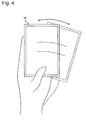
- a user operation for inputting such a first acceleration pattern an operation of tapping a finger on a predetermined location of the electronic device 10 as illustrated in Fig. 3 , or an operation of shaking the electronic device 10 in a predetermined direction as illustrated in Fig. 4 , can be conceivable.
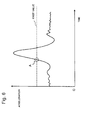
- the photographing-instruction input acceptance unit 13 determines that the first acceleration pattern occurs (i.e. a camera photographing-instruction is input) at a time point denoted as "A" illustrated in Fig. 6 (hereinafter referred to as the "time point A"), when acceleration in the predetermined direction becomes greater than or equal to the first value once.
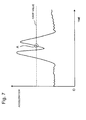
- the first acceleration pattern may be a pattern in which acceleration in a predetermined direction becomes greater than or equal to the first value, then becomes less than the first value, and subsequently becomes greater than or equal to the first value.
- Such a first acceleration pattern may further include a condition that a time interval between the time, at which the acceleration becomes greater than or equal to the first value for the first time, and the time, at which the acceleration becomes greater than or equal to the first value for the second time, is less than or equal to a predetermined time.
- a predetermined time is not limited to a specific value and may be an appropriately selectable setting value.
- the photographing-instruction input acceptance unit 13 determines that the first acceleration pattern occurs at a time point A (illustrated in Fig. 7 ) when acceleration in the predetermined direction becomes greater than or equal to the first value, after acceleration in the predetermined direction has become greater than or equal to the first value and, and then has become less than the first value. In other words, the photographing-instruction input acceptance unit 13 determines that a camera photographing-instruction input is provided at the time point A illustrated in Fig. 7 .
- the first acceleration pattern is also considered as, for example, a pattern in which acceleration in a predetermined direction increases to at least the aforementioned first value.
- the exemplification above is an example and the first acceleration pattern may include another pattern.
- the photographing-instruction input acceptance unit 13 holds data representing the first acceleration pattern in advance, and is able to execute the aforementioned processing by use of the data.
- the photographing-timing monitor unit 14 monitors arrival of a start timing of camera photographing performed at a predetermined timing after detection of a camera photographing-instruction input.
- a predetermined timing after detection of a camera photographing-instruction input by the photographing-instruction input acceptance unit 13, is the start timing of camera photographing. That is to say, the photographing-timing monitor unit 14 monitors the start timing of camera photographing that is a predetermined timing after detection of the camera photographing-instruction input by the photographing-instruction input acceptance unit 13.
- the camera unit 12 performs camera photographing, accordingly.
- the camera unit 12 may generate still image data (storable data) of an image that is displayed on the display at the time point, accordingly. Also, the camera unit 12 may generate still image data of a captured image of an area that can be photographed by the camera unit 12, whether or not the image is displayed on the display.
- the photographing-timing monitor unit 14 is capable of detecting arrival of the start timing of camera photographing, in accordance with measurement data obtained from the acceleration sensor 11.
- the photographing-timing monitor unit 14 is able to detect, as arrival of the start timing, a second acceleration pattern including at least a pattern in which acceleration in a predetermined direction becomes less than or equal to a predetermined second value.
- a second value is not limited to a specific value and may be appropriately selectable.
- Such a predetermined direction may be a direction appropriately selected from a plurality of directions, similarly to the aforementioned predetermined direction.
- the predetermined direction of the first acceleration pattern and the predetermined direction of the second acceleration pattern may be a same direction or different directions.
- the photographing-timing monitor unit 14 may also detect the second acceleration pattern including at least a pattern in which acceleration in every direction (predetermined direction) becomes less than or equal to the second value, as arrival of the start timing.
- the photographing-timing monitor unit 14 obtains measurement data from the acceleration sensor 11 in real time. Then, the photographing-timing monitor unit 14 generates time-series data of acceleration in the predetermined direction by use of the obtained measurement data. Subsequently, the photographing-timing monitor unit 14 monitors whether or not the second acceleration pattern is included in the time-series data of acceleration in the predetermined direction.
- a time point A (illustrated in Fig. 8 ), that is a time point when acceleration in the predetermined direction becomes greater than or equal to the first value once, is a time point detected by the photographing-instruction input acceptance unit 13, as a time point when a camera photographing-instruction input is provided.
- the second acceleration pattern is a pattern in which acceleration in the predetermined direction once becomes less than or equal to the second value
- the photographing-timing monitor unit 14 is able to detect a time point denoted as B (illustrated in Fig. 8 ) (hereinafter referred to as the time point B), as arrival of the start timing.
- the second acceleration pattern may include a pattern in which a state, that acceleration in a predetermined direction is less than or equal to a predetermined second value, continues for a predetermined time or more.
- a predetermined time is not limited to a specific value and may be an appropriately selectable set value.
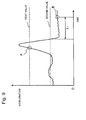
- the photographing-timing monitor unit 14 obtains data illustrated in Fig. 9 as time-series data of acceleration in a predetermined direction.
- a time point A (illustrated in Fig. 9 ) that is a time point when acceleration in the predetermined direction becomes greater than or equal to the first value once, is a time point detected by the photographing-instruction input acceptance unit 13, as a time point when a camera photographing-instruction input is provided.
- the photographing-timing monitor unit 14 is able to detect a time point B (illustrated in Fig. 9 ), that is a time point when a state that acceleration is less than or equal to the second value continues for a predetermined time t1, as arrival of the start timing.
- a time point B illustrated in Fig. 9
- the second acceleration pattern is also considered as, for example, a pattern in which acceleration in a predetermined direction decreases to at least the aforementioned second value.
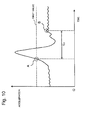
- the photographing-timing monitor unit 14 is able to detect arrival of the start timing of camera photographing without using measurement data obtained from the acceleration sensor 11. For example, the photographing-timing monitor unit 14 may detect, as arrival of the start timing, the timing after elapse of a predetermined time after detection of the camera photographing-instruction input. Such a predetermined time may be set to, for example, two seconds, but is not limited to this value, and the predetermined time may be an appropriately selectable set value. For example, assume that the photographing-instruction input acceptance unit 13 detects a time point A (illustrated in Fig.
- the photographing-timing monitor unit 14 is able to detect a time point B, that is a time point after elapse of a predetermined time t2 from the time point A, as arrival of the start timing.
- a photographing mode When a photographing mode is activated in response to a user operation (S10), an image of a photographic subject (a preview) is displayed on the display. Further, when the photographing mode is activated, the photographing-instruction input acceptance unit 13 obtains acceleration data from the acceleration sensor 11, and starts analysis of the obtained acceleration data (S20). For example, while being in the photographing mode, the photographing-instruction input acceptance unit 13 generates time-series data of acceleration in a predetermined direction by use of measurement data from the acceleration sensor 11. Then, the photographing-instruction input acceptance unit 13 continuously monitors whether or not the first acceleration pattern is included in the time-series data.
- the photographing-instruction input acceptance unit 13 detects the first acceleration pattern (S30).
- the photographing-timing monitor unit 14 starts monitoring of arrival of the start timing of camera photographing, that is performed at a predetermined timing after detection of a camera photographing-instruction input (S40).
- the photographing-instruction input acceptance unit 13 determines that the start timing arrives (S50). In this case, the camera unit 12 generates still image data of an image displayed on the display at that time point, accordingly (S60). The camera unit 12 may generate still image data of a captured image of an area that can be photographed by the camera unit 12, whether or not the image is displayed on the display.
- the electronic device 10 accepts a photographing-instruction input by use of the acceleration sensor 11.
- the electronic device 10 is able to accept an operation of tapping a finger on any location of the electronic device 10 or an operation of shaking the electronic device 10 as the photographing-instruction input.
- a user is able to easily provide the photographing-instruction input, even in the situation that the user is not able to visually recognize an operation target (an operation button or a touch panel display).
- the electronic device 10 according to the present exemplary embodiment is able to perform satisfactory photographing at a predetermined timing, in accordance with a photographing-instruction input by the user.
- the electronic device 10 performs camera photographing at a predetermined timing after detection of the camera photographing-instruction input, instead of performing camera photographing immediately after detection of the camera photographing-instruction input by using the detection as a trigger.
- the electronic device 10 moves by the operation of the instruction input. Then, when camera photographing is performed immediately after detection of an instruction input by using the detection as a trigger, photographing is performed while the electronic device 10 is in motion and a so-called "blurring" problem can occur.
- the electronic device 10 according to the present exemplary embodiment performs camera photographing at a predetermined timing after detection of the camera photographing-instruction input, instead of performing camera photographing immediately after detection of the camera photographing-instruction input using the detection as a trigger. Therefore, the electronic device 10 according to the present exemplary embodiment is able to mitigate such problem.
- the electronic device 10 detects a second acceleration pattern (a pattern including at least a pattern in which acceleration in a predetermined direction becomes less than or equal to a predetermined second value) as arrival of a start timing.
- a second acceleration pattern a pattern including at least a pattern in which acceleration in a predetermined direction becomes less than or equal to a predetermined second value
- photographing can be performed after the acceleration in the predetermined direction of the electronic device 10 converges to the second value or less. Consequently, the electronic device 10 according to the present exemplary embodiment is able to mitigate the so-called "blurring" problem.
- the electronic device 10 is capable of detecting a timing after elapse of a predetermined time after detection of a camera photographing-instruction input, as arrival of the start timing. It is widely known that a "blurring" problem occurs when the electronic device 10 is in motion when photographing. Thus, a user attempts to reduce movement of the electronic device 10 when photographing. However, in spite of such an attempt by the user, it is likely that the electronic device 10 is in motion immediately after a camera photographing-instruction input by the aforementioned user operation. However, the movement of the electronic device 10 may become smaller after elapse of a predetermined time. Therefore, the present exemplary embodiment is able to mitigate a so-called "blurring" problem by performing photographing at the timing after elapse of a predetermined time after detection of a camera photographing-instruction input.
- An electronic device including:
- the photographing-instruction input acceptance means detects a first acceleration pattern, including at least a pattern in which acceleration in a predetermined direction exceeds a first value, as the instruction for the camera photographing.
- the electronic device wherein the photographing-timing monitor means detects arrival of the start timing of the camera photographing, in accordance with measurement data obtained from the acceleration sensor.
- the photographing-timing monitor means detects a second acceleration pattern, including at least a pattern in which acceleration in a predetermined direction becomes less than or equal to a second value, as arrival of the start timing.
- the photographing-timing monitor means detects the second acceleration pattern, including at least a pattern in which acceleration in every direction becomes less than or equal to the second value, as arrival of the start timing.
- the photographing-timing monitor means detects a timing after elapse of a predetermined time from detecting input of the instruction for the camera photographing, as arrival of the start timing.
- the computer In the detecting input of a instruction for camera photographing, the computer detects a first acceleration pattern, including at least a pattern in which acceleration in a predetermined direction exceeds a first value, as the instruction for the camera photographing.
- the computer In the monitoring arrival of a start timing of the camera photographing, the computer detects arrival of the start timing of the camera photographing, in accordance with measurement data obtained from the acceleration sensor.
- the computer In the monitoring arrival of a start timing of the camera photographing, the computer detects a second acceleration pattern, including at least a pattern in which acceleration in a predetermined direction becomes less than or equal to a second value, as arrival of the start timing.
- the computer In the monitoring arrival of a start timing of the camera photographing, the computer detects the second acceleration pattern, including at least a pattern in which acceleration in every direction becomes less than or equal to the second value, as arrival of the start timing.
- the computer In the monitoring arrival of a start timing of the camera photographing, the computer detects a timing after elapse of a predetermined time from detecting input of the instruction for the camera photographing, as arrival of the start timing.
- the computer program according to Supplemental Note 8 allowing the computer to function as the photographing-instruction input acceptance means, wherein the photographing-instruction input acceptance means detects a first acceleration pattern, including at least a pattern in which acceleration in a predetermined direction exceeds a first value, as the instruction for the camera photographing.
- the computer program according to Supplemental Note 8-2 allowing the computer to function as the photographing-timing monitor means, wherein the photographing-timing monitor means detects arrival of the start timing of the camera photographing, in accordance with measurement data obtained from the acceleration sensor.
- the computer program according to Supplemental Note 8-3 allowing the computer to function as the photographing-timing monitor means, wherein the photographing-timing monitor means detects a second acceleration pattern, including at least a pattern in which acceleration in a predetermined direction becomes less than or equal to a second value, as arrival of the start timing.
- the computer program according to Supplemental Note 8-4 allowing the computer to function as the photographing-timing monitor means, wherein the photographing-timing monitor means detects the second acceleration pattern, including at least a pattern in which acceleration in every direction becomes less than or equal to the second value, as arrival of the start timing.
- the computer program according to Supplemental Note 8-2 allowing the computer to function as the photographing-timing monitor means, wherein the photographing-timing monitor means detects a timing after elapse of a predetermined time from detecting input of the instruction for the camera photographing, as arrival of the start timing.
Landscapes
- Engineering & Computer Science (AREA)
- Theoretical Computer Science (AREA)
- General Engineering & Computer Science (AREA)
- Physics & Mathematics (AREA)
- General Physics & Mathematics (AREA)
- Human Computer Interaction (AREA)
- Computer Hardware Design (AREA)
- Multimedia (AREA)
- Signal Processing (AREA)
- Studio Devices (AREA)
- Details Of Cameras Including Film Mechanisms (AREA)
- Telephone Function (AREA)
Applications Claiming Priority (2)
| Application Number | Priority Date | Filing Date | Title |
|---|---|---|---|
| JP2013194995 | 2013-09-20 | ||
| PCT/JP2014/004521 WO2015040809A1 (ja) | 2013-09-20 | 2014-09-03 | 電子機器、電子機器の制御方法及び記憶媒体 |
Publications (2)
| Publication Number | Publication Date |
|---|---|
| EP3048481A1 true EP3048481A1 (de) | 2016-07-27 |
| EP3048481A4 EP3048481A4 (de) | 2017-05-10 |
Family
ID=52688480
Family Applications (1)
| Application Number | Title | Priority Date | Filing Date |
|---|---|---|---|
| EP14846345.8A Withdrawn EP3048481A4 (de) | 2013-09-20 | 2014-09-03 | Elektronische vorrichtung, verfahren zur steuerung der elektronischen vorrichtung und speichermedium |
Country Status (5)
| Country | Link |
|---|---|
| US (1) | US20160202767A1 (de) |
| EP (1) | EP3048481A4 (de) |
| JP (1) | JPWO2015040809A1 (de) |
| CN (1) | CN105556386A (de) |
| WO (1) | WO2015040809A1 (de) |
Families Citing this family (1)
| Publication number | Priority date | Publication date | Assignee | Title |
|---|---|---|---|---|
| JP6142060B1 (ja) * | 2016-10-09 | 2017-06-07 | 好則 神山 | スマートフォン |
Family Cites Families (13)
| Publication number | Priority date | Publication date | Assignee | Title |
|---|---|---|---|---|
| JP4555589B2 (ja) * | 2004-03-31 | 2010-10-06 | 京セラ株式会社 | 携帯端末 |
| JP2009033566A (ja) * | 2007-07-27 | 2009-02-12 | Fujifilm Corp | セルフ撮影機能付きカメラ及びセルフ撮影処理方法 |
| JP5117288B2 (ja) * | 2008-06-12 | 2013-01-16 | オリンパスイメージング株式会社 | 撮影装置および撮影装置の設定方法 |
| JP5357800B2 (ja) * | 2009-02-12 | 2013-12-04 | キヤノン株式会社 | 電子機器およびその制御方法 |
| JP5230487B2 (ja) * | 2009-03-06 | 2013-07-10 | キヤノン株式会社 | 撮像装置、撮像装置の制御方法、プログラムおよび記録媒体 |
| EP2414798B1 (de) * | 2009-03-30 | 2018-01-10 | Kionix, Inc. | Direktionaler entnahmeerkennungsalgorithmus unter verwendung eines beschleunigungsmessers |
| JP2010268112A (ja) * | 2009-05-13 | 2010-11-25 | Olympus Imaging Corp | 撮像装置および撮影方法 |
| JP2011075831A (ja) * | 2009-09-30 | 2011-04-14 | Canon Inc | 撮像装置、その制御方法及びプログラム |
| JP5513078B2 (ja) * | 2009-11-05 | 2014-06-04 | オリンパスイメージング株式会社 | 撮像装置 |
| KR101613619B1 (ko) * | 2009-11-30 | 2016-04-29 | 삼성전자주식회사 | 디지털 촬영 장치, 그 제어 방법, 및 컴퓨터 판독가능 매체 |
| JP5596408B2 (ja) * | 2010-05-13 | 2014-09-24 | オリンパスイメージング株式会社 | デジタルカメラ、その制御方法、及びプログラム |
| JP5743559B2 (ja) * | 2011-01-13 | 2015-07-01 | キヤノン株式会社 | 情報処理装置、その制御方法及びプログラム並びに記録媒体 |
| JP5816571B2 (ja) | 2012-02-21 | 2015-11-18 | 京セラ株式会社 | 携帯端末、撮影キー制御プログラムおよび撮影キー制御方法 |
-
2014
- 2014-09-03 EP EP14846345.8A patent/EP3048481A4/de not_active Withdrawn
- 2014-09-03 JP JP2015537551A patent/JPWO2015040809A1/ja active Pending
- 2014-09-03 CN CN201480051064.2A patent/CN105556386A/zh active Pending
- 2014-09-03 WO PCT/JP2014/004521 patent/WO2015040809A1/ja not_active Ceased
- 2014-09-03 US US14/913,485 patent/US20160202767A1/en not_active Abandoned
Also Published As
| Publication number | Publication date |
|---|---|
| US20160202767A1 (en) | 2016-07-14 |
| WO2015040809A1 (ja) | 2015-03-26 |
| JPWO2015040809A1 (ja) | 2017-03-02 |
| CN105556386A (zh) | 2016-05-04 |
| EP3048481A4 (de) | 2017-05-10 |
Similar Documents
| Publication | Publication Date | Title |
|---|---|---|
| US11126275B2 (en) | Method and apparatus for presenting panoramic photo in mobile terminal, and mobile terminal | |
| US8854303B1 (en) | Display device and control method thereof | |
| US10075629B2 (en) | Electronic device for capturing images while user looks directly at camera | |
| RU2016112906A (ru) | Способ и устройство для взаимодействия с приложением | |
| US10432860B2 (en) | Camera operation mode control | |
| JP2015526168A5 (de) | ||
| JP2017138846A (ja) | 情報処理装置、その表示方法、及びコンピュータが実行可能なプログラム | |
| JP2017538228A (ja) | 指紋センサ割込み閾値を設定するための方法、装置、および端末装置 | |
| RU2019114979A (ru) | Способ и оборудование обработки изображений, электронное устройство и графический пользовательский интерфейс | |
| CN107395871B (zh) | 一种开启应用的方法、装置、存储介质及终端 | |
| JP2011159166A5 (ja) | 表示制御装置および表示制御装置の制御方法 | |
| KR101821692B1 (ko) | 이미지 수집 방법 및 장치 | |
| JP2019504566A5 (de) | ||
| CN104571916B (zh) | 一种执行终端操作信息的方法及装置 | |
| JP2015012417A5 (de) | ||
| JP2013225013A5 (de) | ||
| JPWO2018128047A1 (ja) | 電子機器 | |
| CN105827955A (zh) | 切换摄像头的方法及装置 | |
| EP3048481A1 (de) | Elektronische vorrichtung, verfahren zur steuerung der elektronischen vorrichtung und speichermedium | |
| US20160309093A1 (en) | Image display terminal, image display method, and non-transitory computer readable recording medium storing program | |
| JP2014182700A (ja) | タッチパネル制御装置、電子機器、タッチパネル制御方法及びタッチパネル制御プログラム | |
| JP2017156928A (ja) | 映像監視装置、映像監視方法、および映像監視システム | |
| US20140184832A1 (en) | Portable electronic device and method for activating camera device | |
| US20200142528A1 (en) | Display control apparatus and control method for the display control apparatus | |
| US20140016013A1 (en) | Image capture method |
Legal Events
| Date | Code | Title | Description |
|---|---|---|---|
| PUAI | Public reference made under article 153(3) epc to a published international application that has entered the european phase |
Free format text: ORIGINAL CODE: 0009012 |
|
| 17P | Request for examination filed |
Effective date: 20160331 |
|
| AK | Designated contracting states |
Kind code of ref document: A1 Designated state(s): AL AT BE BG CH CY CZ DE DK EE ES FI FR GB GR HR HU IE IS IT LI LT LU LV MC MK MT NL NO PL PT RO RS SE SI SK SM TR |
|
| AX | Request for extension of the european patent |
Extension state: BA ME |
|
| DAX | Request for extension of the european patent (deleted) | ||
| A4 | Supplementary search report drawn up and despatched |
Effective date: 20170410 |
|
| RIC1 | Information provided on ipc code assigned before grant |
Ipc: H04M 1/00 20060101ALI20170404BHEP Ipc: G06F 3/01 20060101ALN20170404BHEP Ipc: G03B 15/00 20060101ALI20170404BHEP Ipc: G03B 17/38 20060101AFI20170404BHEP Ipc: H04N 5/225 20060101ALI20170404BHEP |
|
| STAA | Information on the status of an ep patent application or granted ep patent |
Free format text: STATUS: THE APPLICATION IS DEEMED TO BE WITHDRAWN |
|
| 18D | Application deemed to be withdrawn |
Effective date: 20171109 |