EP3023367B1 - Coin carrying and guiding device of coin payment apparatus - Google Patents
Coin carrying and guiding device of coin payment apparatus Download PDFInfo
- Publication number
- EP3023367B1 EP3023367B1 EP15195938.4A EP15195938A EP3023367B1 EP 3023367 B1 EP3023367 B1 EP 3023367B1 EP 15195938 A EP15195938 A EP 15195938A EP 3023367 B1 EP3023367 B1 EP 3023367B1
- Authority
- EP
- European Patent Office
- Prior art keywords
- coin
- coins
- guiding wall
- carrying belt
- coin dispenser
- Prior art date
- Legal status (The legal status is an assumption and is not a legal conclusion. Google has not performed a legal analysis and makes no representation as to the accuracy of the status listed.)
- Active
Links
Images










Classifications
-
- G—PHYSICS
- G07—CHECKING-DEVICES
- G07D—HANDLING OF COINS OR VALUABLE PAPERS, e.g. TESTING, SORTING BY DENOMINATIONS, COUNTING, DISPENSING, CHANGING OR DEPOSITING
- G07D9/00—Counting coins; Handling of coins not provided for in the other groups of this subclass
-
- G—PHYSICS
- G07—CHECKING-DEVICES
- G07D—HANDLING OF COINS OR VALUABLE PAPERS, e.g. TESTING, SORTING BY DENOMINATIONS, COUNTING, DISPENSING, CHANGING OR DEPOSITING
- G07D1/00—Coin dispensers
-
- G—PHYSICS
- G07—CHECKING-DEVICES
- G07D—HANDLING OF COINS OR VALUABLE PAPERS, e.g. TESTING, SORTING BY DENOMINATIONS, COUNTING, DISPENSING, CHANGING OR DEPOSITING
- G07D9/00—Counting coins; Handling of coins not provided for in the other groups of this subclass
- G07D9/008—Feeding coins from bulk
-
- B—PERFORMING OPERATIONS; TRANSPORTING
- B65—CONVEYING; PACKING; STORING; HANDLING THIN OR FILAMENTARY MATERIAL
- B65G—TRANSPORT OR STORAGE DEVICES, e.g. CONVEYORS FOR LOADING OR TIPPING, SHOP CONVEYOR SYSTEMS OR PNEUMATIC TUBE CONVEYORS
- B65G47/00—Article or material-handling devices associated with conveyors; Methods employing such devices
- B65G47/02—Devices for feeding articles or materials to conveyors
- B65G47/04—Devices for feeding articles or materials to conveyors for feeding articles
- B65G47/12—Devices for feeding articles or materials to conveyors for feeding articles from disorderly-arranged article piles or from loose assemblages of articles
- B65G47/14—Devices for feeding articles or materials to conveyors for feeding articles from disorderly-arranged article piles or from loose assemblages of articles arranging or orientating the articles by mechanical or pneumatic means during feeding
- B65G47/1407—Devices for feeding articles or materials to conveyors for feeding articles from disorderly-arranged article piles or from loose assemblages of articles arranging or orientating the articles by mechanical or pneumatic means during feeding the articles being fed from a container, e.g. a bowl
- B65G47/1442—Devices for feeding articles or materials to conveyors for feeding articles from disorderly-arranged article piles or from loose assemblages of articles arranging or orientating the articles by mechanical or pneumatic means during feeding the articles being fed from a container, e.g. a bowl by means of movement of the bottom or a part of the wall of the container
- B65G47/1457—Rotating movement in the plane of the rotating part
Definitions
- the present invention relates to a coin carrying and guiding device of a coin payment apparatus that delivers coins of a plurality of denominations individually from coin dispensers one by one, drops the coins onto a single carrying belt, and carries the coins to a coin receiving opening by a pair of guiding walls, which are vertically standing at a predetermined interval therebetween on the carrying belt.
- the present invention relates to the coin carrying and guiding device of the coin payment apparatus that can prevent the coins, which are juxtaposed between the pair of guiding walls, from being sandwiched therebetween and not being carried to the coin receiving opening and that brings the coins quickly into surface contact with the carrying belt. More particularly, the present invention relates to the coin carrying and guiding device of the coin payment apparatus that prevents the coins, which are juxtaposed between the pair of guiding walls, from being sandwiched therebetween and not being carried to the coin receiving opening and is formed at low cost.
- the "coins” used in the present specification includes all the coins other than Japanese coins, US coins, and Euro coins.
- a coin payment apparatus in which a first coin dispenser row and a second coin dispenser row, in which a plurality of coin dispensers having the same structure having an ejecting opening for ejecting stored coins one by one are juxtaposed along a straight line intersecting with the lines of the ejecting directions, are juxtaposed at a predetermined interval therebetween so that the lines of the ejecting directions of the first coin dispenser row and the second coin dispenser row are directed to the opposing coin dispenser rows, a carrying belt which is moved toward a coin receiving opening is disposed between the first coin dispenser row and the second coin dispenser row, and a pair of vertically standing guiding walls are disposed in both sides of the carrying belt; so that the coin ejected from the coin dispenser constituting the first coin dispenser row or the second coin dispenser row is dropped onto the carrying belt, and the coin is then carried toward the coin receiving opening by the carrying belt while the coin is guided by the pair of guiding walls (for example, Japanese Patent JP4665087B .
- a carrying belt 14 is stretched between a pair of rollers 10 and 12, and a pair of a first guiding wall 16 and a second guiding wall 18, which are vertically standing with respect to the upper surface of the carrying belt 14, are disposed in parallel to each other at an interval wider than the maximum diameter of carried coins.
- coins C1 and C2 delivered from the upper side of the first guiding wall 16 or the second guiding wall 18 is dropped onto the carrying belt 14 and are carried toward a coin receiving opening 20 by arrow-direction movement of the carrying belt 14 while the coins are guided by the first guiding wall 16 and the second guiding wall 18.
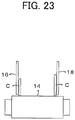
- the coins C1 and C2 (if there is large payment, more coins C) dropped onto the carrying belt 14 are brought into a standing state on the carrying belt 14 in a state that the coins C are leaning on the first guiding wall 16 or the second guiding wall 18 as shown in FIG. 23 because of the behavior that the coins are collided with the first guiding wall 16 or the second guiding wall 18 and rebounded in various directions and are jumped due to the back action of dropping onto the carrying belt 14, and the coins are rotated along with movement of the carrying belt 14. Therefore, a problem that the coins stay still at constant positions with respect to the carrying belt 14 and that the delivered coins are not dispensed to the coin receiving opening rarely occurs.
- the first guiding wall 16 and the second guiding wall 18 are disposed in parallel to each other in a macroscopic view; however, they are corrugated within an allowable range in a microscopic view.
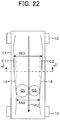
- a large interval part WD having a large interval in the direction orthogonal to a moving direction line MD of the carrying belt 14 and a small interval part NW having a small interval are present. Therefore, there is a problem of occurrence of a jamming phenomenon that, when the coins C1 and C2 are moved to the small diameter part NW in the downstream side after the two coins C1 and C2 are juxtaposed in the large interval part WD, the coins C1 and C2 are sandwiched and stopped like a wedge between the first guiding wall 16 and the second guiding wall 18, and the coins are not dispensed to the coin receiving opening 20 as a result. If at least one of the juxtaposed coins C has a jugged peripheral surface, this tendency is further increased. Similarly, in some cases, in a state in which one coin is in surface contact with the carrying belt 14 and another coin is standing on the carrying belt, the coins are sandwiched like a wedge between the first guiding wall 16 and the second guiding wall 18 and stopped.
- the allowed flatness of the first guiding wall 16 and the second guiding wall 18 is taken into consideration in order to solve these problems, it is conceivable to determine the first guiding wall 16 and the second guiding wall 18 so that, when two coins are juxtaposed, the coins are not sandwiched.
- coin diameters are set depending on the countries, and there are many combinations. Therefore, the interval between the first guiding wall 16 and the second guiding wall 18 has to be determined for each country, and this cannot be promptly employed for a global product, which is a problem. If the interval between the first guiding wall 16 and the second guiding wall 18 is determined for each country, an interval adjusting mechanism is required, and this measure cannot be promptly employed since cost is increased.
- the second conventional technique since the coins are inevitably tilted by a predetermined angle or more because the lower end parts of the guiding walls are tilted, the situation that the coins are rotated in the state in which the coins are leaning on the guiding walls and standing is eliminated.
- the problem that two coins in a juxtaposed state are sandwiched between the pair of guiding walls and cannot be dispensed to the coin receiving opening cannot be solved as well as the first conventional technique.
- the coin can be quickly carried to the coin receiving opening by the combination with the movement of the flat belt since the flat belt is disposed so that the front side thereof is lowered.
- the problem that the two coins in a juxtaposed state are sandwiched between the pair of guiding walls and cannot be dispensed to the coin receiving opening cannot be solved as well as the first conventional technique.
- the fourth conventional technique delay of dispensing or non-dispensing due to rotations can be eliminated since the coins rotating on the belt are brought into contact with and toppled by the string member.
- the guiding walls of the coins are disposed to be parallel to each other, the problem that the two coins in a juxtaposed state are sandwiched between the pair of guiding walls and cannot be dispensed to the coin receiving opening cannot be solved as well as the first conventional technique.
- the fifth conventional technique delay of dispensing or non-dispensing due to rotations can be eliminated since the coins rotating on the belt are brought into and toppled by the coin toppling member.
- the guiding walls of the coins are disposed to be parallel to each other, the problem that two coins in a juxtaposed state are sandwiched between the guiding walls and cannot be dispensed to the coin receiving opening cannot be solved as well as the first conventional technique.
- the lower end of the first guiding wall or the second guiding wall is formed so as to be more distant from the first guiding wall or the second guiding wall as it gets closer to the coin receiving opening.
- the lower end of the first guiding wall or the second guiding wall is formed so as to have a fan shape widened toward the moving direction of the carrying belt even when the allowed flatness of the guiding walls is taken into consideration.
- the interval between the first guiding wall and the second guiding wall is larger than the width of the juxtaposed coins in the coin-carrying-direction downstream position of the position at which the coins are juxtaposed; therefore, the phenomenon that the juxtaposed coins are sandwiched and stuck between the first guiding wall and the second guiding wall does not occur. Therefore, there is an advantage that the object of the invention of the present application that the coins are prevented from being sandwiched and stopped still between the pair of guiding walls even in the case in which the coins are juxtaposed on the carrying belt, can be achieved.
- the slope that sequentially gets closer to the opposing first guiding wall or second guiding wall as it gets closer to the lower side is formed on the lower part of at least one of the first guiding wall and the second guiding wall, and the angle of the slope is an angle that prevents the coin from rotating in the standing state.
- the coin in the state in which the standing coin is leaning on the slope, the coin cannot continue standing and is toppled, and, finally, the coin is brought into surface contact with the carrying belt and carried toward the coin receiving opening.
- the probability that the coin continues the standing state is reduced by half by a simple calculation; therefore, the coin is brought into surface contact with the carrying belt in a short period of time and is quickly dispensed to the coin receiving opening; therefore, there is an advantage that the second object serving as the subordinate object of the invention of the present application can be also achieved.
- the coins delivered one by one from the dispensing opening of the coin dispenser are dropped in the dispensing space, which is formed by the first guiding-wall and the second guiding wall disposed to be parallel to each other at a predetermined interval therebetween, and are dropped onto the carrying belt. The dropped coins are brought into surface contact with the carrying belt and dispensed.
- the coin dispensed from the coin dispenser at the position opposed to the slope is guided by the first guiding wall and the second guiding wall, which are disposed to be parallel to each other, at the beginning of the drop, and, then, the coin is guided by the slope.
- the coin delivery opening through which the coin from the coin dispenser passes can have a sufficient size is not required to have a special shape even when a buffer is disposed therebetween, production thereof is easy, and there is an advantage that the coin carrying and guiding device of the coin payment apparatus can be formed at low cost, which is the subordinate object of the present invention.
- a best mode of a coin dispenser of the present invention is a coin carrying and guiding device of a coin payment apparatus that has a first coin dispenser row and a second coin dispenser row, in which a plurality of coin dispensers having dispensing openings for delivering stored coins one by one are juxtaposed along a straight line intersecting with the delivery direction line, juxtaposed at a predetermined interval so that the delivery direction lines of the first coin dispenser row and the second coin dispenser row are directed toward the opposing coin dispenser row; has a carrying belt moved toward a coin receiving opening is disposed between the first coin dispenser row and the second coin dispenser row; has the carrying belt forming three-dimensional-box-shape dispensing space above the carrying belt by disposing a first guiding wall vertically standing below the dispensing opening of the first coin dispenser row and a second guiding wall disposed in parallel to the first guiding wall and vertically standing below the dispensing opening of the second coin dispenser row; and drops the coin delivered from the coin dispenser constituting the first coin dispenser row or the second coin dispenser row onto the
- the present first embodiment is an example of use as a coin carrying and guiding device for payment of a coin acceptance and payout apparatus, which receives coins of 8 denominations, i.e. , 2 euros, which is the currency of European Union, 1 euro, 50 cents, 20 cents, 10 cents, 5 cents, 2 cents, and 1 cent, stores them separately by the denominations, pays a predetermined number of coins of a predetermined denomination(s) based on a pay-out order from the above described equipment.
- a coin acceptance and payout apparatus which receives coins of 8 denominations, i.e. , 2 euros, which is the currency of European Union, 1 euro, 50 cents, 20 cents, 10 cents, 5 cents, 2 cents, and 1 cent, stores them separately by the denominations, pays a predetermined number of coins of a predetermined denomination(s) based on a pay-out order from the above described equipment.
- the coin acceptance and payout apparatus includes a coin receiving device 102 disposed in a frame 101, a coin separating and feeding device 104, a denomination discriminating device 106, a carrying device 108, a sorting unit 110, a coin storing unit 112, a payment device 114, and a coin receiving opening 116.
- the invention of the present application relates to a coin carrying and guiding device 118 and the buffer device 300 of the payment device 114.
- the coin receiving device 102 has a function to feed coins C of a plurality of denominations, which have been loaded in bulk into an inlet 120, to the coin separating and feeding device 104 of a next process within a range that the coins do not exceed a predetermined amount per unit time.
- the coin receiving device 102 includes a depositing flat belt 122, a collapsing roller 124, and a first electric motor 126 which drives the depositing flat belt 122.
- the depositing flat belt 122 has a width about two times a maximum coin diameter, is stretched between a pair of rollers, and is provided to slightly have an upward slope.
- the depositing flat belt 122 can be moved in a forward-rotation direction in which the coins are carried forward by the first electric motor 126 and in a backward-rotation direction in which the coins are returned.
- the collapsing roller 124 is disposed above an intermediate portion of the depositing flat belt 122 with a gap of about three times a thinnest coin provided between the roller and the depositing flat belt 122.
- the lower surface of the collapsing roller 124 is rotated in the opposite direction of the moving direction of the depositing flat belt 122; and the collapsing roller 124 is configured to be in a still state when the depositing flat belt 122 is moved in a returning direction.
- the coin separating and feeding device 104 can stably feed coins separately one by one without receiving the coins exceeding the full amount from the coin receiving device 102.
- photoelectric sensor 128 can be replaced by a magnetic sensor installed below the depositing flat belt 122.
- the coin separating and feeding device 104 has a function to separate the coins C of the plurality of denominations, which have been received in bulk from the coin receiving device 102, one by one and feed them to a next process.
- the coin separating and feeding device 104 is disposed below the coin receiving device 102 and includes a rotating disk 130, a coin storing container 132, a coin receiver 134, and the full sensor 136.
- the rotating disk 130 has a receiving unit 138, which receives the coins C one by one, is disposed to be tilted at a predetermined angle, and is rotated at a predetermined speed.
- a Y-shaped plate 146 in which three concave parts 142 are formed at regular intervals is fixed to the upper surface of a rotating disk 140 to be concentric with the rotating disk 140.
- the number of the receiving unit(s) 138 can be increased to 4 or more. If the diameter of the rotating disk 140 is reduced, the number of the receiving unit(s) 138 can be reduced to 2 or less.
- a pusher 148 which carries out pivotal motions, is disposed on one side of the concave part 142 (for example, see Japanese Patent No. 4784806 ).
- the receiving unit 138 which is approximately semicircular, is formed by the pushers 148 and the concave parts 142.
- the receiving unit 138 is set to have a size by which two juxtaposed minimum diameter coins cannot be received and only one maximum diameter coin can be received.
- the pusher 148 is normally positioned in a still state at a position close to one side of the concave part 142 so as to form the receiving unit 138.
- the pusher 148 carries out a pivotal motion and is moved to a predetermined position, the pusher 148 feeds the coin, which has been held, to the circumferential direction of the rotating disk 140.
- the receiving unit 138 receives the coins C, which have been stored in bulk, one by one by a lower part opposed to the coin storing container 132, and, at a predetermined position above the rotation center of the rotating disk 130, the pusher 148 pushes the coin C of the receiving unit 138 to the circumferential direction and passes the coin to the coin receiver 134 having a knife shape.
- the rotating disk 130 is rotated at a predetermined speed by an unshown electric motor via a decelerator.
- the full sensor 136 has a function to output a full signal when the amount of the coins in the coin storing container 132 becomes a predetermined amount or more and is, for example, a transmission-type photoelectric sensor.
- the denomination discriminating device 106 has a function to discriminate the authenticity and denomination of the coins C, which have been fed one by one from the coin separating and feeding device 104.
- the denomination discriminating device 106 has a function to discriminate the authenticity and denomination of the coins C based on detection data of physical information about the material, thickness, diameter, etc. of the coins obtained by a magnetic sensor 150.
- the denomination discriminating device 106 includes the magnetic sensor 150, a slide base (not shown) disposed in the same plane as the upper surface of the rotating disk 140, an impeller 152 for feeding the coins C, and a detection guide 154.
- the slide base has a function to guide one side of the coin C pushed by the impeller 152.
- the impeller 152 has a function to move the coins C received from the coin separating and feeding device 104 and passes the coins through a coin holding part 158 one by one.
- the impeller 152 has a function to pass the coins C, which have passed through the coin holding part 158, to the carrying device 108.
- the impeller 152 is parallel to the slide base, is rotatable in a close plane, forms the coin holding part 158 with three pushers 156 disposed at regular intervals by the same number as the receiving units 138, and has a Y-shape.
- the detection guide 154 has a function to linearly guide the coin C, which is opposed to the coin holding part 158 and passes therethrough, and fix the position of the coin C with respect to the magnetic sensor 150.
- the carrying device 108 has a function to carry the coins C, of which authenticity and denomination have been discriminated, to the sorting unit 110.
- the carrying device 108 includes an endless carrier 160, which is moved in one direction in a single plane; a slide plate 162, on which one side of the coin C pushed by the endless carrier 160 slides; and a straight guide rail 164, which guides the peripheral surface of the coin C.
- the slope angle of the slide plate 162 is preferred to be about 45 degrees in order to downsize the whole coin acceptance and payout apparatus.
- the endless carrier 160 is a chain 170 stretched between a first sprocket 166 and a second sprocket 168 disposed at a predetermined interval.
- the endless carrier 160 may be a belt.
- the chain 170 is installed in a flattened running-track shape, and the first sprocket 166 is disposed immediately lateral to the impeller 152 of the denomination discriminating device 106.
- the chain 170 is preferred to be a metal chain from the viewpoints of durability and cost, but may be made of resin.
- Pushing pins 172 are fixed to a lateral side of the chain 170 at predetermined intervals.
- the plurality of pushing pins 172 are attached to the chain 170 at the intervals corresponding to the intervals of the pushers 156.
- the first sprocket 166 is rotated at a predetermined speed, and the pushers 156 and the pushing pins 172 are set so that the coins C pushed to a carrying path 174 of the pushing pins 172 by the pushers 156 are immediately pushed by the pushing pins 172.
- the carrying path 174 is a path in which the coins C are guided by the guide rail 164 and, at the same time, pushed by the pushing pins 172.
- the guide rail 164 has a function to guide lower-end peripheral surfaces of the coins C so that the coins C, which are pushed by the pushing pins 172, are moved in the carrying path 174.
- the guide rail 164 is disposed along and slightly below the chain 170, which has the straight shape of the upper side of the running-track shape.
- the guide rail 164 is projecting in an orthogonal direction with respect to the slide plate 162 by slightly more than the maximum thickness of handled coins.
- the guide rail 164 also serves as a sorting unit as described later.
- the sorting unit 110 has a function to drop the coins C into predetermined coin sorting holes by denominations, respectively.
- the sorting unit 110 has an upper sorting unit 180, which is disposed in the upper side of the guide rail 164 along the guide rail 164, and a lower sorting unit 182, which is disposed in the lower side along the guide rail 164.
- a 2-cent-coin sorting hole 184 In the upper sorting unit 180, a 2-cent-coin sorting hole 184, a 5-cent-coin sorting hole 186, a 10-cent-coin sorting hole 188, a 20-cent-coin sorting hole 190, and an overflowed-coin sorting hole 192 are disposed sequentially toward the moving direction of the carrying device 108.
- a rejected-coin sorting hole 194 In the lower sorting unit 182, a rejected-coin sorting hole 194, a 1-cent-coin sorting hole 196, a 2-euro-coin sorting hole 198, a 50-cent-coin sorting hole 200, and a 1-euro-coin sorting hole 202 are disposed sequentially toward the moving direction of the carrying device 108.
- the coins C can be sorted at the same location of the carrying device 108 to the upper side and the lower side. Therefore, there are advantages that the carried distance of the coins can be shortened and that the coin acceptance and payout apparatus 100 can be downsized.
- Gate devices (not shown) actuated by electrical actuators are disposed at the coin sorting holes 184, 186, 188, 190, 194, 196, 198, 200, and 202, respectively.
- the gate devices of the coin sorting holes 194, 196, 198, 200, and 202 also serve as the guide rail 164.
- the guide rail 164 consists of a fixed guide fixed between the rejected-coin sorting hole 194, the 1-cent-coin sorting hole 196, the 2-euro-coin sorting hole 198, the 50-cent-coin sorting hole 200, and the 1-euro-coin sorting hole 202 and a movable guide which is electrically moved and normally has a single straight-line shape.
- the movable guide is moved from a normal position so that the carried coins are not guided to the movable guide but are dropped to the predetermined coin sorting holes (see Japanese Patent No. 4997374 ).
- the gate devices opposed to the coin sorting holes 184, 186, 188, 190, 194, 196, 198, 200, and 202 are selectively opened/closed based on timing signals from a timing sensor (not shown) and the authenticity and denomination discriminated according to the coin information detected by the coin holding part 158.
- the coins C carried by the carrying device 108 are dropped into the predetermined coin sorting holes corresponding to the denominations, respectively.
- the coin storing unit 112 has a function to store the coins C, which have been sorted by the sorting unit 110, separately by the denominations.
- the coin storing unit 112 is formed by arranging, in two rows, a first coin dispenser row 212 and a second coin dispenser row 214, which are parallely juxtaposed, wherein coin dispensers 210, which dispense the coins C one by one by rotating disks, are opposed to the upper sorting unit 180 and the lower sorting unit 182 respectively by the denominations below the sorting unit 110.
- first and second of the first coin dispenser row 212 and the second coin dispenser row 214 are imparted for distinguishing them and do not have particular meanings in terms of interpretation of rights.
- the coin dispensers 210 are shown by a reference sign 210 with the denominations thereof.
- the coin dispenser 210 has a function to sort and dispense the stored coins C one by one and a function to output detection signals of the dispensed coins C.
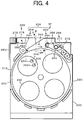
- the coin dispenser 210 includes a tubular coin storing container 216 for storing the coins C, a rotating disk 218 for sorting the coins C one by one disposed at a bottom part of the coin storing container 216, a flat-board-shaped base 220 on which the coins C rotated together by the rotating disk 218 slide, a second electric motor 222 for subjecting the rotating disk 218 to rotary drive, an ejector 224 which ejects the coins C, and a later-described coin detector 226.
- the coin storing container 216 has a vertical tubular shape as a whole, has an approximately rectangular upper end part, has a bottom end part which is a circular bottom hole 230, and has a function to store many coins C in bulk.
- the coin storing container 216 is detachably attached to the upper surface of a later-described base frame 232.
- the rotating disk 218 has a function to stir the coins C in the coin storing container 216 and sort the coins C one by one.
- the rotating disk 218 is rotatably disposed in a tilted state in a circular hole 234 of the base frame 232 in the lower side of the coin storing container 216.
- the rotating disk 218 has a plurality of through holes 236 disposed at predetermined intervals, a pyramidal stirrer 238 at a center part of the upper surface thereof, a first pusher 240 of the coins C on the lower surface thereof, and a second pusher 242.
- the coin C dropped into the through hole 236 is held on an upper surface 244 of the base 220.
- the coin is pushed by the first pusher 240 on the back side of the rotating disk 218, which is rotated forward in a counterclockwise direction in FIG. 4 , and is turned in the counterclockwise direction together with the rotating disk 218 while the circumferential edge thereof is guided by the circular hole 234.
- the circular hole 234 at this position is cut out to form a dispensing opening 250. Therefore, the pushed coin C can be moved to outside the circular hole 234.
- the pins 246 and 248 are biased by springs (not shown) so as to project from the lower side of the base 220 to the upper surface 244 , and slopes 252 and 254 are formed on upper end parts thereof in the opposite side of the side that is opposed to the forward-rotation direction of the rotating disk 218.
- the coins C are prevented from being moved over the pins 246 and 248, moved in the clockwise direction together with the rotating disk 218, and dispensed from the dispensing opening 250.
- the rotating disk 218 is attached to an upper end part of a rotating shaft 256, which is rotatably attached to penetrate through the base 220, so that the rotating disk 218 cannot be slid in the axial direction thereof and cannot be rotated with respect to the rotating shaft 256.
- the distance therebetween can be adjusted, and adjustment to the position of the rotating disk 218 corresponding to the thickness of the coins C can be carried out.
- the position adjuster of the rotating disk 218 with respect to the thickness of the coins C is the above described shim or can be changed to another device having the same function.
- the base 220 has a function to guide the coins C, which are rotated together by the rotating disk 218, by the flat upper surface 244.
- the base 220 is fixed in the circular hole 234 at the center of the upper surface of the base frame 232 having a rectangular box shape and is tilted within the range of about 30 degrees to 40 degrees so that the dispensing-opening-250 side is high.
- This slope angle is preferred to be smaller since the coin storage amount of the coin storing container 216 is increased.
- the minimum slope angle is about 30 degrees
- the maximum slope angle is about 60 degrees since a large slope angle reduces the dispensing efficiency of the coins.
- the circular hole 234 and the bottom hole 230 of the lower end part of the coin storing container 216 are formed to have the same diameter and are integrated with each other.
- the base frame 232 has a box shape, and the second electric motor 222, etc. are disposed in the space therein.
- the second electric motor 222 has a function to rotate the rotating disk 218 in the forward-rotation direction and the backward-rotation direction and a function to stop the rotating disk 218.
- the second electric motor 222 is disposed in the internal space of the base frame 232.
- An electric motor, an air motor, an oil motor, etc. can be used as the second electric motor 222, and the electric motor is the most preferred in terms of downsizing and controllability.
- the second electric motor 222 may use a power source of direct current or alternating current, and various motors such as an induction motor can be used as a motor type. However, since it can be rotated forward/backward and from the viewpoints of downsizing, maintainability, and durability, a brushless DC motor is preferred.
- the second electric motor 222 carries out forward rotation for dispensing the coins C, backward rotation for eliminating coin jamming, and stop or rapid stop by causing reverse-direction rotating force to work momentarily upon forward or backward rotation.
- An output shaft (not shown) of the second electric motor 222 rotates the rotating shaft 256, which is rotatably attached to the base frame 232 in a vertical state, via a deceleration mechanism (not shown).
- the rotating disk 218 is rotated in the forward-rotation direction by the forward rotation of the second electric motor 222, is rotated in the backward-rotation direction by the backward rotation thereof, and stops rotating when the second electric motor 222 is stopped.
- the ejector 224 has a function to eject the coins C one by one in a predetermined direction.
- the ejector 224 has a function to eject the coins C, which are fed one by one by the rotating disk 218, to the predetermined direction with momentum.
- the ejector 224 is disposed to be adjacent to the rotating disk 218 and opposed to the dispensing opening 250.
- the ejector 224 consists of a fixed roller 260 serving as a fixed guide 258, which has one side practically disposed in a fixed state with respect to the base 220, and a movable roller 264 serving as a movable guide 262, which is biased so as to get closer to the fixed-guide-258 side.
- a biasing device 266 Immediately after the diameter part of the coin C passes the part between the rollers, the coin C is swiftly ejected by the biasing force applied to the movable roller 264 by a biasing device 266.
- the ejecting direction of the coin C of the ejector 224 directs the direction of the ejecting direction line of an arrow X in FIG. 4 .
- the ejecting direction of the coin C is not limited to the direction of the ejecting direction line X, but is variously changed depending on, for example, the sandwiching condition of the coin C, the fixed roller 260, and the movable roller 264.
- the biasing device 266 has a function to apply predetermined biasing force to the movable guide 262.
- a lever 268 having a tip to which the movable roller 264 is rotatably attached is attached to a fixed shaft 269 so as to be able to carry out pivotal motions, and the lever 268 is biased by a spring 270 so as to get close to the fixed roller 260. Therefore, the spring 270 is the biasing device 266.
- the lever 268 is latched by a stopper 272 at a position where the movable roller 264 is close to the rotating disk 218, and the lever 268 is held at a standby position SP (the position shown in FIG. 4 ).
- the interval between the fixed roller 260 and the movable roller 264 is set to be smaller than the diameter of the coin C to be dispensed.
- the spring force of the spring 270 is accumulated along with the clockwise-direction turning of the lever 268.
- the lever 268 is rapidly turned in the counterclockwise direction by the spring force accumulated by the spring 270. Therefore, the coin C is ejected in the direction of the ejecting direction X and is ejected to dispensing space 274 through the dispensing opening 250, a coin delivery position 296, and a coin delivery opening 311.
- the coin C is ejected along the tilted base 220, the coin is ejected obliquely upward, is moved toward a later-described detection passage 282, is rarely collided with and rebounded by a rebounder 276, and is then dispensed.
- the coin detector 226 has a function to detect the coin C, which is ejected by the ejector 224, and output a coin signal CS.
- the coin detector 226 detects the coins C, which have been ejected one by one by rotation of the rotating disk 218 and the ejector 224, without contact and outputs the coin signals CS to the higher-level control device such as a POS register (not shown) and a control device of its own.
- the control device of its own detects the number of the coin signals CS of the number specified by the higher-level control device, the control device of its own stops power feed to the second electric motor 222 in order to prevent excessive dispensing of the coins.
- a photoelectric type, an electromagnetic type, a sound-wave type, etc. can be used as the coin detector 226.
- the electromagnetic coin detecting device 278 is attached to the base frame 232, which is lateral to the ejector 224, via a later-described bracket 280.
- the electromagnetic coin detecting device 278 a lower detecting part, which has a rod shape and is approximately horizontally disposed in the lower side, and an upper detecting part, which is juxtaposed with the lower detecting part with a predetermined interval therebetween.
- the lower detecting part and the upper detecting part are connected by a connecting part extending in a top-bottom direction.
- a detection passage 282 having a transverse gate shape is provided between the upper detecting part and the lower detecting part.
- the electromagnetic coin detecting device 278 is formed into a channel shape as a whole.
- the upper surface of the lower detecting part is positioned in the same plane as the upper surface of the base frame 232.
- the detection passage 282 is disposed to include a moving path of the coin C ejected by the ejector 224.
- the coin C is moved while being guided by the upper surface of the lower detecting part, the lower surface of the upper detecting part, and the rebounder 276.
- a sensor 284 for coin detection is disposed to be opposed to the lower detecting part and the upper detecting part.
- a magnetic coil is disposed.
- a phototransmitter/photoreceiver is disposed.
- the electromagnetic coin detecting device 278 is fixed to the bracket 280 made of metal, which is fixed to a lateral side of the base frame 232.
- the rebounder 276 has a function to collide with and rebound the coin C, which is ejected by the ejector 224.
- the rebounder 276 is formed into a rectangular flat-plate shape by projecting part of the bracket 280.
- the rebounder 276 is inserted in the detection passage 282 of the electromagnetic coin detecting device 278 and is disposed to be adjacent to a lateral side of the connecting part.
- the rebounder 276 is disposed in the back part of the detection passage 282 and entirely covers the lateral side of the connecting part.
- the rebounder 276 can be fixed to the lateral side of the connecting part and integrated with the electromagnetic coin detecting device 278.
- the second electric motor 222 is rotated, and the rotating disk 218 is rotated in the counterclockwise direction in FIG. 4 via the deceleration mechanism.
- the coin C is guided in the circumference direction of the rotating disk 218 by the pins 246 and 248 and ejected by the ejector 224.
- the coin C is guided by the base 220. Therefore, based on the slope of the base 220, the coin C is ejected approximately in the direction of the ejecting direction line X obliquely upward.
- the ejecting direction of the coin C is largely varied depending on various conditions.
- Some of the ejected coins C are moved to the detection passage 282 and collide with the rebounder 276 at an acute incident angle.
- the collided coins C are rebounded in a predetermined direction, in other words, at an angle approximately the same as the incident angle.
- the electromagnetic coin detecting device 278 When the coin C is opposed to the sensor 284, the electromagnetic coin detecting device 278 outputs the coin signal CS.
- the positional relation of the coin dispensers 210 which belong to the first coin dispenser row 212 and the second coin dispenser row 214 is set so that the distances from the coin receiving opening 116 are the same.
- the 5-cent coin dispenser 210-5C and the 1-cent coin dispenser 210-1C constitute a first coin dispenser pair 292-1 and are installed at the same first distance L1 from the coin receiving opening 116.
- the 5-cent coin dispenser 210-5C and the 1-cent coin dispenser 210-1C are disposed to be opposed to each other with the coin carrying and guiding device 118 (dispensing space 2 74) interposed therebetween, and the dispensing openings 250 thereof are deviated from each other along the coin carrying and guiding device 118, in other words, an extending direction line L of a later-described carrying belt 302.
- the extending direction line L is a straight line shown along the extending direction of the carrying belt 302 and may be, for example, the width-direction center line of the carrying belt 302. Therefore, as shown in FIG.
- the coin delivering openings 311 formed in a first guiding wall 306 and a second guiding wall 308 to correspond to the dispensing openings 250 are also disposed to be deviated from each other; however, part of them is overlapped.
- the coin delivering openings 311 corresponding to the coins C are shown by the reference sign 311 with respective denominations.
- the 2-euro coin dispenser 210-2E and the 10-cent coin dispenser 210-10C constitute a set of second coin dispensers 292-2 and are installed at the same second distance L2 from the coin receiving opening 116.
- the 20-cent coin dispenser 210-20C and the 50-cent coin dispenser 210-50C constitute a set of a third coin dispenser pair 292-3 and are installed at the same third distance L3 from the coin receiving opening 116.
- the 1-euro coin dispenser 210-1E and an overflow box 0F constitute a set of a fourth opposed device pair 292-4 and are installed at the same fourth distance L4 from the coin receiving opening 116.
- the coin dispensers 210 are disposed to be opposed to each other at the same distance from the coin receiving opening 116 in this manner, there is an advantage that the size of the coin acceptance and payout apparatus 100 can be reduced.
- the payment device 114 has a function to carry the coin C, which is delivered from the coin dispensers 210 of the respective denominations, to the coin receiving opening 116 as quickly as possible.
- the payment device 114 has a function to promptly converge the behavior of the coin C, which is ejected from the coin dispenser 210, quickly brings the coin to surface contact with the upper surface of the carrying belt 302, and carry the coin to the coin receiving opening 116 by the carrying belt 302.
- the payment device 114 includes the coin carrying and guiding device 118, a buffer device 300, and the carrying belt 302.
- the coin carrying and guiding device 118 has a function to guide the coin C, which is delivered from the coin dispensers 210, onto the carrying belt 302 and guide the coin C, which is carried by the carrying belt 302.
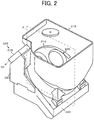
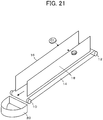
- the coin carrying and guiding device 118 consists of the first guiding wall 306 and the second guiding wall 308, which are a pair of guiding walls 304.
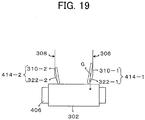
- the lower parts of the first guiding wall 306 and the second guiding wall 308 distant from the coin receiving opening 116 are formed so as to be sequentially tilted so as to get closer to the opposing first guiding wall 306 or second guiding wall 308 as they get closer to the lower side and get distant from the first guiding wall 306 or second guiding wall 308 as they get close to the coin receiving opening 116.
- the first guiding wall 306 and the second guiding wall 308 have the same structures, but merely disposed symmetrically. Therefore, the first guiding wall 306 will be representatively explained, and "-1" of the same reference signs can be replaced and explained by "-2".
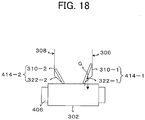
- the first guiding wall 306 is formed by a first vertical guiding wall 310-1, which is vertical with respect to the carrying belt 302, and a first slope 314-1 of a first toppler 312-1, which has a right-triangle cross section and is extending along the first vertical guiding wall 310-1.
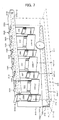
- the first vertical guiding wall 310-1 will be explained with reference to FIG. 6 and FIG. 7 .
- the first vertical guiding wall 310-1 is a transversely-rectangular flat plate and is preferred to employ a zinc-plating steel plate in terms of cost.
- the first vertical guiding wall 310-1 is disposed along the first coin dispenser row 212 and the carrying belt 302 and is disposed so as to be vertical with respect to the upper surface of the carrying belt 302.
- "Vertical" means approximately vertical and does not mean vertical in a strict sense.
- the coin delivery opening 311 On the extension along the upper surface 244 of the dispensing opening 250 of the first vertical guiding wall 310-1, the coin delivery opening 311, which is transversely rectangular, is formed.
- first vertical guiding wall 310-1 and the second vertical guiding wall 310-2 are parallelly vertical on the carrying belt 302 with a predetermined interval therebetween, and the space surrounded by them is the box-shaped dispensing space 274, which is long in the extending direction of the carrying belt 302.
- the coin C which is ejected by the coin dispenser 210, passes through the coin delivery opening 311 and reaches the dispensing space 274.
- the toppler 312-1 has a function to prevent, when the standing coin C leans on the first guiding wall 306, the coin C from continuing the standing state.
- the first toppler 312-1 has a function to, when the standing coin C leans on the first guiding wall 306, actively topple the coin C by causing the vertical line of the gravity center of the coin C to be significantly deviated from the width of the coin C, which is in contact with the later-described carrying belt 302.
- the first toppler 312-1 is a rod-like body having a right triangular cross section in the direction which is at the right angle with respect to the longitudinal thereof, and the first toppler 312-1 is disposed along the lower end part of the first guiding wall 306 and is integrated with the first guiding wall 306.
- the first toppler 312-1 of the present first embodiment is a thin long plate material formed into a V-shape, and a first relief part 316-1 thereof is fixed to the first guiding wall 306 in a state that the part is in close contact with the first guiding wall 306.
- a first lower edge part 318-1 is transversely (in the present embodiment, horizontally) extended by a predetermined length from the first guiding wall 306 toward the second-guiding-wall-308 side and is then connected to a first slope part 320-1, which is directed upward and to the first-guiding-wall-306 side and extended by a predetermined length, thereby forming a transverse V-shape.
- the first relief part 316-1 is formed between the tips of the first lower edge part 318-1 and the first slope part 320-1, thereby forming a triangular pyramidal shape as a whole.
- the tapered side thereof is disposed in the coin-receiving-opening-116 side.
- the first slope part 320-1 is extended in the longitudinal direction of the first toppler 312-1 to form a first slope 322-1.
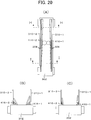
- a first lower edge 324-1 of the first slope 322-1 is formed so as to get away from the second guiding wall 308 as it gets closer to the coin receiving opening 116 even with consideration of linearity. Furthermore, in the present first embodiment, the width of the first slope 322-1 is also formed so as to be narrower as it gets closer to the coin receiving opening 116.
- the first guiding wall 306 is formed by the first vertical guiding wall 310-1 disposed in the upper side and the first slope 322-1 disposed in the lower side.
- the part between upper parts 326 of the first guiding wall 306 and the second guiding wall 308 is disposed in parallel with a predetermined interval therebetween to form the dispensing opening 274, and the part between lower parts 328 is set so as to get close to the first slope 322-1 or the second slope 322-2 as it gets closer to the lower side.
- an interval D1 between the first lower edge 324-1 of the first slope 322-1 and a second lower edge 324-2 of the second slope 322-2 is formed in a fan shape so that it is widened as it gets closer to the coin receiving opening 116.
- the lower edge part 318-1 is disposed with an interval of less than the thickness of the thinnest coin C between the lower edge part and the upper surface 402 of the carrying belt 302 so that the coin C does not enter this interval.
- the carrying belt 302 is tilted so that the front side thereof is lowered toward the coin-receiving-opening-116 side as described later, the first toppler 312-1 is similarly tilted so that the front side thereof is lowered toward the coin-receiving-opening-116 side.
- the interval D1 between the first lower edge 324-1 and the second lower edge 324-2 opposed to the coin dispenser 210, which is the farthest from the coin receiving opening 116, is set to the distance that exceeds the diameter of the coin C, which is delivered from the coin dispenser 210 and is slightly smaller than two times that. This is for a reason that, if the interval D1 exceeds the diameter of the coin C, in a situation that the coin C is horizontally dropped, the coin C is immediately brought into surface contact with the carrying belt 302, and, even if the two coins C are positioned, the two coins are not juxtaposed on the carrying belt 302.
- the coin dispenser 210 which is the farthest from the coin receiving opening 116, is for 1 euro; therefore, the interval is set with a range that is wider than the diameter 23.25 millimeters of a 1-euro coin and less than two times that.
- the interval D1 between the first lower edge 324-1 and the second lower edge 324-2 opposed to the coin dispenser 210, which is the farthest from the coin receiving opening 116, is preferred to be set in a range that is equal to or higher than the value obtained by adding the thickness of the coin to the diameter of the coin C, which is delivered at this position, to less than two times the diameter of the coin. This is for preventing the coins from being closely sandwiched in a situation that one of the coins C is in surface contact with the carrying belt 302 and the other coin C is standing.
- the side of the fourth opposed device pair 292-4 that is opposite to the coin receiving opening 116 is closed by a back-part guiding plate 325, which is lowered in the front side toward the coin receiving opening 116.
- Both of the first guiding wall 306 and the second guiding wall 308 are provided with the first slope 322-1 or the second slope 322-2.
- the first slope 322-1 or the second slope 322-2 may be provided in either one side. Therefore, either one of the first guiding wall 306 and the second guiding wall 308 is disposed in a vertical state with respect to the upper surface of the carrying belt 302 like conventional cases, and the coin C sometimes maintains a standing state; however, since the other one is formed into the first slope 322-1 or the second slope 322-2, the coin cannot maintain standing and is immediately toppled. Therefore, even by a simple calculation, there is an advantage that the probability of maintaining the standing state of the coin C can be reduced.
- the size of the apparatus is increased by the amount corresponding to the slopes; however, if there is only one of the first slope 322-1 and the second slope 322-2, there is an advantage that the size of the apparatus can be reduced. Therefore, when the interval D1 between the first lower edge 324-1 of the first guiding wall 306 and the lower edge 324-2 of the second guiding wall 308 which are the farthest from the coin receiving opening 116 is set to the value that exceeds the diameter of the maximum diameter coin, which is expected to be used, there is an advantage that the apparatus can be used for the coins all over the world without adjusting the interval.
- the coin C dropped onto the carrying belt 302 is carried toward the coin receiving opening 116 by movement of the carrying belt 302.
- the coin C stands and leans on the first guiding wall 306 or the second guiding wall 308, since the first slope 322-1 or the second slope 322-2 is disposed at the lower end part of the first guiding wall 306 or the second guiding wall 308, the coin C leans on the first slope 322-1 or the second slope 322-2.
- the coin C leans on the first slope 322-1 or the second slope 322-2, the coin C is largely tilted; therefore, the gravity center is thereof is significantly deviated in the lateral direction from the peripheral surface of the coin C, the coin cannot maintain the standing state and laid down, and the coin is laid down on the first slope 322-1 or the second slope 322-2. Since the first slope 322-1 and the second slope 322-2 are tilted, when the coin C is moved by the movement of the carrying belt 302, the part thereof that is in contact with the first slope 322-1 or the second slope 322-2 is slipped down to the lower side, and the surface of the coin C is finally brought into surface contact with the carrying belt 302. In other words, the coin C is promptly brought into surface contact with the carrying belt 302 and is quickly dispensed to the coin receiving opening 116.
- first lower edge part 318-1 and the second lower edge part 318-2 of the first slope 322-1 and the second slope 322-2 get closer to the coin receiving opening 116, the distance therebetween is widened. Therefore, even when the coins C are juxtaposed between the first lower edge part 318-1 and the second lower edge 318-2, since they are a fan shape in which the downstream side is wide with respect to the moving direction of the carrying belt 302, the coins C can be prevented from being jammed therebetween.
- the buffer device 300 will be explained with reference to FIGs. 6 to 15 .
- the buffer device 300 has a function to promptly eliminate the kinetic energy of the coins C, which are delivered from the coin dispensers 210, drop the coins C onto the carrying belt 302, and guide the coin C so that the coins C are dropped approximately vertically downward.
- the buffer device 300 is formed by attaching a plurality of buffers 288 to an attachment body 290 at predetermined positions in the dispensing space 274 sandwiched by the first guiding wall 306 and the second guiding wall 308 of the coin carrying and guiding device 118.
- the buffers 288 are formed by the attachment body 290, fixed supporting members 332, elastic members 334, and fixed members 336.
- Two types of the buffers 288, i.e., first buffers 288-1 serving as adjacent elastic partition walls 287-1 and second buffers 288-2 serving as inclined elastic partition walls 287-2 are present. However, most of the structures thereof are common, they will be explained together.
- the attachment body 290 has a function that the plurality of fixed supporting members 332 are fixed thereto and that the attachment body 290 per se is detachably attached to the coin acceptance and payout apparatus 100, and the attachment body 290 has a reversed gutter shape made of a metal plate.
- the attachment body 290 is formed into a reversely recessed shape in cross section by a first side wall 340-1 and a second side wall 340-2, which have both side ends of a flat-plate-shaped top plate 338 bent downward and vertically downwardly extended.
- Cylindrical pins 342 and 344 for latching are transversely fixed to front ends and rear ends of the first side wall 340-1 and the second side wall 340-2, respectively (the cylindrical pins in the first-side-wall-340-1 side are not shown since they cannot be seen).
- the cylindrical pins 342 and 344 are inserted in and latched by grooves 345-1 and 345-2 (the second-guiding-wall-308 side are not shown) formed at upper ends of the first guiding wall 306 and the second guiding wall 308, which are attached to the frame 101 of the coin acceptance and payout apparatus 100 in a fixed state, and are disposed in a fixed state at the upper end parts of the first guiding wall 306 and the second guiding wall 308.
- the fixed supporting member 332 has a function that the upper end thereof is fixed to the attachment body 290 and the elastic member 334 is attached to the lower end part thereof.
- the fixed supporting member 332 is a rectangular plate-shaped body made of resin, a stopper part 346 for attaching the attachment body 290 is formed at the upper end part thereof, and an attachment part 348 of the elastic member 334 is formed in the lower end part thereof. Therefore, the fixed supporting member 332 can be changed to another device having a similar function.
- the stopper part 346 has a function that the stopper part 346 can be easily attached by insertion into an attachment hole 350 formed in the attachment body 290 and can be easily detached therefrom.
- the stopper part 346 can be changed to another structure having a similar function.
- a first slit 352-1 and a second slit 352-2 are formed at a predetermined interval therebetween from the upper end surface of the fixed supporting member 332 in a vertically downward direction.
- the positioner 354 which is positioned at the center, and a first latching hook body 356-1 and a second latching hook body 356-2, which are disposed in both sides of the positioner 354, are vertically standing in cantilever plate shapes.
- the positioner 354 has a function that the tip thereof determines the fixed supporting member 332 by working together with a positioning hole 358, which is formed in the top plate 338.
- a positioning projection 360 having a rectangular shape in plane is projecting upward.
- the positioning hole 358 is formed into a rectangular shape in plane and is formed so that the positioning projection 360 can be tightly inserted therein.
- the positioning projection 360 is not limited to that of the present first embodiment as long as it has a similar function and can be formed into a star shape or a triangular shape. In such a case, the positioning hole 358 has to be formed into a corresponding star shape or triangular shape.
- an insertion regulating part 361 is formed.
- the insertion regulating part 361 has a function to prevent the positioner 354 (the positioning projection 360) from entering the positioning hole 358 by a predetermined distance or more.
- the insertion regulating part 361 is a flange-like rectangular ring-shaped body formed around the lower end of the positioning projection 360. Therefore, when the positioning projection 360 is inserted in the positioning hole 358 and the insertion regulating part 361 contacts the back side of the top board 338, the positioning projection 360 cannot be inserted more than that.
- a first latching edge 368-1 and a second latching edge 368-2 which will be described later, are positioned in the upper surface side of the top board 338; and, as a result, the fixed supporting member 332 is prevented from falling from the attachment body 290 by the cooperation of the first latching hook body 356-1 and the second latching hook body 356-2.
- a vertically-long rib-shaped first reinforcing rib 362-1 and a second reinforcing rib 362-2 are formed to a lower part of the fixing supporting member 332, and they are formed so as to prevent the fixing supporting member 332 from being practically deformed in the thickness direction thereof.
- the fixing supporting member 332 is not deformed, the first reinforcing rib 362-1 and the second reinforcing rib 362-2 are not required to be formed.
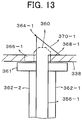
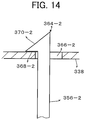
- the first latching hook body 356-1 and the second latching hook body 356-2 have a function to fix the fixed supporting member 332 to the top board 338 by latching with the attachment hole 350 formed in the top board 338, specifically, with a first latching hole 366-1 or a second latching hole 366-2.
- the first latching hook body 356-1 and the second latching hook body 356-2 have the same shape, but are different only in a point that the directions of the hook bodies are reverse directions. Therefore, the first latching hook 356-1 will be representatively explained.
- the first latching hook body 356-1 is a vertically-long plate-shaped body, has predetermined elastic force, and can be bent in the thickness direction thereof.
- a first latching hook 364-1 is formed at the tip thereof.
- the first latching hook 364-1 includes a first latching edge 368-1 which is formed in parallel to the top board 338 and a first insertion supporting slope 370-1 which forms an angle of about 45 degrees with respect to the first latching edge 368-1 when the first latching hook 364-1 is inserted in the rectangular first latching hole 366-1.
- the other end part of the first insertion supporting slope 370-1 is connected to the vertical back side of the first latching hook body 356-1.
- the upper end part of the first latching hook 364-1 is formed into a right triangular shape and is set in a relation that, when it is to be inserted in the first latching hole 366-1, the first insertion supporting slope 370-1 contacts the top board 338 at the peripheral edge of the first latching hole 366-1, thereby causing the component force for movement toward the center side of the first latching hole to act on the first insertion supporting slope 370-1, the first latching hook body 356-1 is deformed in the thickness direction thereof upon insertion, the tip part of the first latching hook 364-1 passes through the first latching hole 366-1, as a result, the first latching edge 368-1 is positioned in the upper surface side of the top board 338 and is returned by the elastic force caused by the deformation upon the insertion, and the first latching edge 368-1 is returned to the position opposed to the upper surface of the top board 338; thus, the first latching hook 364-1 or a second latching hook 364-2 is latched with the top board 338
- the tip of the first latching hook 364-1 and the second latching hook body 364-2 are formed so as to project to above the tip of the positioning projection 360. This is for causing the positioning projection 360 to be automatically opposed to the positioning hole 358 by inserting the tip part of the first latching hook 364-1 and the second latching hook 364-2 into the first lathing hole 366-1 and the second latching hole 366-2 and guiding it.
- the first insertion supporting slope 370-1 and a second insertion supporting slope 370-2 are determined so as to be in contact with the top board 338 immediately after the tip of the positioning projection 360 is moved to the positioning hole 358. This is for preventing the fixed supporting member 332 from being rotated by the reactive force that acts on the first insertion supporting slope 370-1 and the second insertion supporting slope 370-2.
- This structure has an advantage that the labor of attaching the fixed supporting member 332 to the attachment body 290 can be reduced.
- the tip of the first latching hook 364-1 is inserted in the first latching hole 366-1
- the tip of the second latching hook 364-2 is inserted in the second latching hole 366-2, they are then slightly pushed in, and the positioning projection 360 is inserted in the positioning hole 358.
- the first insertion supporting slope 370-1 contacts the top board 338 at the peripheral edge of the first latching hole 366-1. Therefore, the vector that moves the first latching hook body 356-1 to the center side of the first latching hole 366-1 is generated at the first insertion supporting slope 370-1.
- the first latching hook body 356-1 is deformed upon insertion by the vector, the first latching edge 368-1 passes through the latching hole 366-1 and is positioned in the upper surface side of the top board 338, and, then, the first latching edge 368-1 is moved to the position opposed to the upper surface of the top board 338 by the returning movement of the deformation caused upon insertion of the first latching hook body 356-1.
- the first latching hook 364-1 is latched with the first latching hole 366-1, therefore, with the attachment body 290.
- the second latching hook body 356-2 is also deformed almost at the same time.
- the second latching edge 368-2 is moved to the position opposed to the upper surface of the top board 338, the second latching hook 364-2 is latched with the second latching hole 366-2, therefore, with the attachment body 290.
- the fixed supporting member 332 is fixed in a state that the fixed supporting member 332 cannot be turned with respect to the attachment body 290 and cannot fall from the attachment body 290.
- the fixed supporting member 332 When the fixed supporting member 332 is to be detached from the attachment body 290, the fixed supporting member 332 can be detached by pulling after the first insertion supporting slope 370-1 and the second insertion supporting slope 370-2 are pushed to the center side of the first latching hole 366-1 and the second latching hole 366-2, respectively, to move the first latching edge 368-1 and the second latching edge 368-2 into the first latching hole 366-1 or the second latching hole 366-2 from above the top board 338.
- the elastic member 334 has a function to be fixed to the lower end part of the fixed supporting member 332, collide with the coins C ejected from the dispensing opening 250 of the coin dispenser 210, promptly eliminate the kinetic energy in the ejecting direction, and guide the dropped coins C.
- the elastic member 334 consists of a resin sheet 372 having elasticity and a predetermined thickness such as a urethane resin. Therefore, the elastic member 334 can be changed to a material that has a similar function. Two types of the resin sheets 372 are employed. However, they are not different in basic parts, but only the shapes thereof are different.
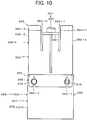
- a first resin sheet 374 shown in FIG. 10 is formed into a rectangular shape as a whole including the attachment part thereof, and a first circular hole 376-1 and a second circular hole 376-2 which are circular for attachment are formed in the upper end part thereof.
- a second resin sheet 378 is formed into a projecting shape as a whole.
- the second resin sheet 378 is formed into the projecting shape by widening the part below an intermediate part of the first resin sheet 374. It is widened in order to increase the guide range of the coins C.
- the structure provided with the first resin sheet 374 is the first buffer 288-1, and the structure provided with the second resin sheet is the second buffer 288-2.
- the fixing member 336 has a function to fix the elastic member 334 to the fixed supporting member 332.
- the fixing member 336 is a rectangular plate-shaped body 380. Therefore, the fixing member 336 can be changed to another member having a similar function.
- a first long groove 382-1 and a second long groove 382-2 having the same vertically-long slit shapes are formed at a predetermined interval therebetween, and a first wide part 384-1 and a second wide part 384-2 for fitting a first attachment pin 386-1 and a second attachment pin 386-2, which are transversely projecting from the lower end part of the fixed supporting member 332, are formed at intermediate part of the first long groove 382-1 and the second long groove 382-2.
- the first attachment pin 386-1 and the second attachment pin 386-2 are formed to be separated from the fixed supporting member 332 and are integrated by penetration through a first mounting hole 388-1 and a second mounting hole 388-2, which are formed in the lower end part of the fixed supporting member 332.
- first attachment pin 386-1 and the second attachment pin 386-2 have the same shapes, the first attachment pin 386-1 will be representatively explained.
- the first attachment pin 386-1 is formed by a disk-shaped first stopper part 390-1, a columnar first intermediate-diameter part 392-1 adjacent to the first stopper part 390-1 and having a smaller diameter than that of the first stopper part 390-1, a columnar first small-diameter part 394-1 adjacent to the first intermediate-diameter part 392-1 and having a smaller diameter than that of the first intermediate-diameter part 392-1, and a triangular-pyramidal first tip part 396-1 which has a base part apparently having a larger diameter than that of the first small-diameter part 394-1 and has a dividing groove at the center part thereof.
- the first intermediate-diameter part 392-1 of the first attachment pin 386-1 is tightly inserted in the first mounting hole 388-1, and the first stopper part 390-1 prevents the first attachment pin 386-1 from being further moved. Therefore, the first small-diameter part 394-1 and the first tip part 396-1 project to the front surface side of the fixed supporting member 332.
- the first attachment pin 386-1 and the second attachment pin 386-2 are respectively inserted in the first circular hole 376-1 and the second circular hole 376-2 formed in the elastic member 334 to mate the circular holes with the first small-diameter part 394-1 and the second small-diameter part 394-2.
- the elastic member 334 has elasticity, and the diameters of the first tip part 396-1 and a second tip part 396-2 are reduced since they have the dividing grooves; therefore, the first tip part 396-1 and the second tip part 396-2 apparently having the part of larger diameters than those of the first small-diameter part 394-1 and the second small-diameter part 394-2 can penetrate through the first circular hole 376-1 and the second circular hole 376-2.
- the lower-end-part openings of the first long groove 382-1 and the second long groove 382-2 of the plate-shaped body 380 are placed at the first small-diameter part 394-1 and the second small-diameter part 394-2 of the first attachment pin 386-1 and the second attachment pin 386-2 and pushed down.
- the first attachment pin 386-1 and the second attachment pin 386-2 are stopped and fixed when they are relatively moved to the first wide part 384-1 and the second wide part 384-2.
- the first buffers 288-1 are used for partitioning of the boundary of the coin dispenser 210-2C adjacent to the first coin dispenser pair 292-1, the boundary between the first coin dispenser pair 292-1 and the second coin dispenser pair 292-2, the boundary between the second coin dispenser pair 292-2 and the third coin dispenser pair 292-3, and the side of the third coin dispenser pair 292-3 opposite to the second coin dispenser pair 292-2.
- the first elastic members 334-1 are disposed so as to form a right angle with respect to the extending direction line L of the carrying belt 302 between the first coin dispenser pair 292-1 to the third coin dispenser pair 292-3.
- the first buffers 288-1 are disposed in the coin-receiving-opening-116 side of the first coin dispenser pair 292-1, between the first coin dispenser pair 292-1 and the second coin dispenser pair 292-2, between the second coin dispenser pair 292-2 and the third coin dispenser pair 292-3, and in the side of the third coin dispenser pair 292-3 opposite to the coin receiving opening 116.
- the first buffers 288-1 are disposed so as to form a right angle with respect to the first guiding wall 306 and the second guiding wall 308 in a planar view.
- the first buffer 288-1 is disposed also in the side of the 2-cent coin dispenser 210-2C opposite to the coin receiving opening 116. This is for guiding the coins C, which are delivered from the 2-cent coin dispenser 210-2C, so that the coins are smoothly dropped onto the carrying belt 302.
- the lower end part of the elastic member 334 is positioned right beside the coin delivery position 296 at a horizontal-line position, and the gaps between the elastic member 334 and the first guiding wall 306 and the second guiding wall 308 are set to be smaller than the diameter of the minimum diameter coin. This is for preventing the delivered coins C from contacting the adjacent denominations.
- the coin delivery position 296 is an upper end part of the base 220 opposed to the dispensing opening 250, and the straight line LC connecting the left/right coin delivery positions 296 constituting the first coin dispenser pair 292-1 is in a positional relation that the line is overlapped with a lower end part of the elastic member 334 when viewed in a horizontal direction.
- the gap between the lower end of the elastic member 334 and the later-described carrying belt 302 is set to be slightly smaller than the diameter of the coins C, which are delivered in the upstream side in the moving direction of the upper surface 402 of the carrying belt 302. This is for promptly laying down the coins C, which are delivered in the upstream side and standing, bringing the coins into surface contact with the carrying belt 302, and quickly feeding the coins to the coin receiving opening 116.
- the gaps between the lower ends of the elastic members 334 and the later-described carrying belt 302 may be uniformly set to be slightly smaller than the diameter of the coins C, which easily stand. This is for a reason that thick coins tend to stand on the carrying belt.
- the gap is set to 20 millimeters slightly smaller than the diameter of a thick coin, in the present example, the diameter 22.25 millimeters of the minimum-diameter 20-cent coin among the coins having the thickness of 2 millimeters.
- the gap between the lower end of the elastic member 334 and the upper surface 402 of the carrying belt 302 can be set to be larger than the diameter of the coins C, which are dispensed in the upstream side. This is for a reason that, when the carrying belt 302 is disposed to be tilted so that the front side thereof is lowered as described later, the coins C are automatically rolled to the coin receiving opening 116 side, therefore, the necessity of promptly bringing the coins into surface contact with the carrying belt 302 is reduced. Therefore, if various allocations of denominations to the coin dispensers 210 are expected, the gap between the lower end of the elastic member 334 and the upper surface 402 of the carrying belt 302 can be set to be slightly larger than the maximum diameter of a target coin.
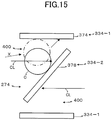
- the second buffers 288-2 are disposed to be oblique to the extending direction line L of the carrying belt 302 preferably to form 45 degrees between the first buffers 288-1. Furthermore, the first elastic member 334-1 of the first buffer 288-1 is parallel to the center line CL of the dispensing openings 250 from the coin dispensers 210, and the second elastic member 334-2 of the second buffer 288-2 is disposed so as to form 45 degrees with respect to the center line CL.
- the center part of the second elastic member 334-2 is positioned right beside at a horizontal-line position of the coin delivery position 296, and the gaps between the second elastic member 334-2 and the first guiding wall 306 and the second guiding wall 308 are set to be smaller than the diameter of the minimum diameter coin.
- the gap between the lower end of the second elastic member 334-2 and the carrying belt 302 is set to 20 millimeters as well as the first elastic member 334-1.
- the center line CL of the dispensing opening 250 is shown for the sake of explanation and is a straight line which is from an intermediate point MP of the fixed roller 260 and the movable roller 264 and is parallel to lateral edges of the base 220 as shown in FIG. 4 .
- the center lines CL of the dispensing openings 250 of the opposed coin dispensers are deviated from each other so that the center lines CL are positioned in the upstream side and the downstream side with respect to the extending direction line L, and the center lines CL are disposed so as to form 45 degrees with respect to the elastic member 334 of the second buffer 288-2. Therefore, the center lines CL are directed to the positions deviated from the center part of the elastic member 334 of the second buffer 288-2.
- tapered convergence space 400 is formed by the first buffer 288-1, the second buffer 288-2, the first elastic member 334-1, and the second elastic member 334-2 in a planar view.
- the convergence space 400 has a triangular prism shape approximately vertical to the carrying belt 302 immediately above the carrying belt 302.
- the convergence space 400 corresponding to the denominations are shown by the same reference sign 400 with the denominations.
- first buffer 288-1 and the second buffer 288-2 if the coin C, which is ejected obliquely upward by the ejector 224 and is moved to the convergence space 400 through the dispensing opening 250 of the coin dispenser 210 and the coin delivery opening 311, is moved along the center line CL, the coin C collides with the second elastic member 334-2; and, if the coin C is moved in the direction of the ejecting direction line X, first, the coin C collides with the first elastic member 334-1.
- the first elastic member 334-1 or the second elastic member 334-2 is deformed because of the elasticity thereof when the coin collides with the first elastic member 334-1 of the first buffer 288-1 or the second elastic member 334-2 of the second buffer 288-2. Therefore, the kinetic energy directed toward the ejecting direction of the coin C is eliminated by the deformation, and the coin C is dropped right below.
- the rebounded coin C collides with the opposed first elastic member 334-1 or second elastic member 334-2, the kinetic energy in the ejecting direction is further eliminated, and the coin C is dropped right below.
- the convergence space 400 has a tapered shape, the coin C immediately collides with the first elastic member 334-1 or the second elastic member 334-2 in a shorter period of time than that of the first time, the kinetic energy thereof is eliminated, and the coin C is dropped onto the carrying belt 302 in an extremely short period of time as a result; therefore, there is an advantage that it contributes to quick dispensing of the coin C.
- the coin C ejected by the ejector 224 collides with the first elastic member 334-1 or the second elastic member 334-2 consisting of an elastic material, there is an advantage that collision sound is low and noise generation is small compared with the case of collision with metal.
- the carrying belt 302 has a function to carry the coin C, which is dropped onto the upper surface 402 thereof, to the coin receiving opening 116.
- the carrying belt 302 is a flat belt 404 and is stretched between a pair of rollers 406 and 408, and the upper surface 402 thereof is disposed so that the front side thereof is lowered at a predetermined angle toward the coin-receiving-opening-116 side.
- the slope angle thereof is preferred to be an angle at which the standing coin C is rolled to the coin-receiving-opening-116 side. This is for quickly carrying the coin C to the coin receiving opening 116 by movement of the carrying belt 302 and rolling of the coin C.
- the condition of this slope angle is satisfied if the coin C starts rolling to the coin-receiving-opening-116 side when, after the coin C is pinched by fingertips and stopped still in a vertically standing state on the carrying belt 302 when visually checked, which is in a still state, the pinching is released.
- One of the rollers, the roller 406 in the present first embodiment, is selectively driven so that the upper surface 402 is moved toward the coin receiving opening 116 by a third electric motor 410.
- the coin C carried by the flat belt 404 is fed into the coin receiving opening 116 having a bowl shape.
- the third electric motor 410 starts rotating and, after the time sufficient for carrying elapses, stops rotating.
- the coins C delivered from the coin dispensers 210 are dropped in the convergence space 400 as described above and are dropped onto the upper surface 402 of the carrying belt 302 right therebelow.
- the coins C dropped onto the carrying belt 302 are brought into surface contact with the carrying belt 302 in the above described manner, carried toward the coin receiving opening 116 by movement of the carrying belt 302, and are dropped from the end part thereof to and stored in the coin receiving opening 116.
- the light axis of the photoelectric sensor 128 is interrupted by the coins C. Therefore, a coin detection signal is output, and the first electric motor 126 is rotated based on the coin detection signal.
- the coins C are dropped from the end part of the depositing flat belt 122 and dropped into the coin storing container 132 of the coin separating and feeding device 104.
- the dropped coins C are carried again toward the coin separating and feeding device 104 again by movement of the depositing flat belt 122 as well as the above description.
- the photoelectric sensor 128 When the photoelectric sensor 128 does not detect the coins C, the first electric motor 126 is stopped, and drive of the depositing flat belt 122 is stopped.
- an unshown motor is rotated by the coin detection signal of the photoelectric sensor 128, and the rotating disk 140 is rotated in the counterclockwise direction of FIG. 1 .
- the impeller 152 works together with the rotating disk 140 at a transmission ratio of 1 : 1 and is rotated in the clockwise direction of FIG. 1 .
- first sprocket 166 is rotated in the counterclockwise direction of FIG. 1 , and the chain 170 is circulated in the counterclockwise direction.
- the coins C dropped into the coin storing container 132 are stirred by the plate 146 and the pusher 148 to variously change the positions thereof. In the process of the change of the positions, only one coin C is received by the receiving unit 138.
- the coin C is positioned in the receiving unit 138 in the state in which one side of the coin C is in surface contact with the rotating disk 140, and the coin is pushed by a partial lateral surface of the plate 146 and rotated together with the rotation of the rotating disk 140.
- the pusher 148 carries out pivotal motion in the counterclockwise direction and is moved to the circumferential direction of the rotating disk 140.
- the coin C positioned in the receiving unit 138 is pushed to the circumferential direction of the rotating disk 140 by the pusher 148, and, immediately after guided by the coin receiver 134, the coin C is pushed by the pusher 156 of the impeller 152 rotated together with the rotating disk 140.
- the full signal is not output from the full sensor 136, and the photoelectric sensor 128 outputs a coin signal
- the first electric motor 126 is started again, and the coins C on the depositing flat belt 122 are fed to the coin separating and feeding device 104.
- the coin C pushed by the pusher 156 is moved in a moving passage while one side thereof is in contact with the slide base.
- the coin C is moved while the peripheral surface of the coin is pushed against the detection guide 154 by the centrifugal force of the coin per se.
- the coin C is opposed to the magnetic sensor 150, and information about the diameter, thickness, and material thereof is obtained.
- the coin C is opposed to the magnetic sensor 150, the coin C is pushed to the moving passage of the pushing pins 172 of the carrying device 108 by the pusher 156.
- the coin C is moved in the moving passage while the peripheral surface thereof is guided by the guide rail 164 and one side thereof is in surface contact with the slide plate 162.
- the gate device corresponding to the coin sorting hole is actuated based on, for example, the stored denomination and based on a timing signal from an unshown timing sensor, and the coin C of the predetermined denomination is dropped into the predetermined coin sorting hole.
- the gate of the rejected-coin sorting hole 194 is opened for a predetermined period of time, and the false coin moved along the guide rail 164 is dropped into the rejected-coin sorting hole 194, guided to an unshown chute, dropped onto the carrying belt 302, and returned to the coin receiving opening 116 by the carrying belt 302, which is activated by the coin signal of the photoelectric sensor 128 and carrying out carrying motion.
- the gate of the 2-cent-coin sorting hole 184 is opened for a predetermined period of time based on the timing signal, and the 2-cent coin 2C moved while being guided by the guide rail 164 is dropped into the 2-cent-coin sorting hole 184, is then guided by an unshown chute, and is stored in the 2-cent coin dispenser 210-2C.
- the gate of the 5-cent-coin sorting hole 186 is opened for a predetermined period of time based on a position signal output from the timing sensor, and the 5-cent coin 5C moved while being guided by the guide rail 164 is dropped into the 5-cent-coin sorting hole 186, is then guided by an unshown chute, and is stored in the 5-cent coin dispenser 210-5C.
- the gate of the 1-cent-coin sorting hole 196 is opened for a predetermined period of time based on a position signal output from the timing sensor. Therefore, the 1-cent coin 1C moved while being guided by the guide rail 164 is dropped into the 1-cent-coin sorting hole 196, is then guided by an unshown chute, and is stored in the 1-cent coin dispenser 210-1C.
- the gate of the 10-cent-coin sorting hole 188 is opened for a predetermined period of time based on a position signal output from the timing sensor, and the 10-cent coin 10C moved while being guided by the guide rail 164 is dropped into the 10-cent-coin sorting hole 188, is then guided by an unshown chute, and is stored in the 10-cent coin dispenser 210-10C.
- the gate of the 2-euro-coin sorting hole 198 is opened for a predetermined period of time based on a position signal output from a third timing sensor. Therefore, the 2-euro coin 2E moved while being guided by the guide rail 164 is dropped into the 2-euro-coin sorting hole 198, is then guided by an unshown chute, and is stored in the 2-euro coin dispenser 210-2E.
- the gate of the 20-cent sorting hole 190 is opened for a predetermined period of time based on a position signal output from the timing sensor, and the 20-cent coin 20C moved while being guided by the guide rail 164 is dropped into the 20-cent sorting hole 190, is then guided by an unshown chute, and is stored in the 20-cent coin dispenser 210-20C.
- the gate of the 50-cent sorting hole 200 is opened for a predetermined period of time based on a position signal output from the timing sensor, and the 50-cent coin 50C moved while being guided by the guide rail 164 is dropped into the 50-cent sorting hole 200, is then guided by an unshown chute, and is stored in the 50-cent coin dispenser 210-50C.
- the gate of the 1-euro sorting hole 202 is opened for a predetermined period of time based on a position signal output from the timing sensor, and the 1-euro coin 1E moved while being guided by the guide rail 164 is dropped into the 1-euro sorting hole 202, is then guided by an unshown chute, and is stored in the 1-euro coin dispenser 210-1E.
- the gate of the corresponding coin sorting hole is not opened.
- an example of a case in which the coins C are dispensed from all the coin dispensers 210, respectively, and all of them are dispensed at the same time for the is output from a higher-level apparatus such as a POS register.
- the rotating disk 218 of each of the coin dispensers 210 is rotated by this dispensing instruction. Furthermore, the third electric motor 410 is driven, and the upper surface 402 of the carrying belt 302 is moved toward the coin receiving opening 116.
- the coin C After the coin C is pushed into the part between the fixed roller 260 and the movable roller 264 by the rotation of the rotating disk 218, the coin C is ejected basically in the direction of the ejecting direction line X by the spring force of the biasing device 266 and, first, collides with the first elastic member 334-1.
- the ejecting direction of the coin C is changed by various conditions.
- the coin C is ejected in the extending direction of the center line CL and, first, collides with the second elastic member 334-2.
- the second elastic member 334-2 and the first elastic member 334-1 are elastically deformed and reduce the kinetic energy in the ejecting direction of the coin C.
- the coin C of which kinetic energy in the ejecting direction is approximately eliminated in the first collision is dropped approximately right below. If the kinetic energy in the ejecting direction cannot be significantly eliminated by the first collision, the collided coin C is rebounded like an obtuse angle, collides with the paired second elastic member 334-2 or first elastic member 334-1, eliminates the kinetic energy, and is dropped right below in the convergence space 400 separated for each coin.
- the coin C When the coin C is dropped and jumped up from the carrying belt 302, the coin C sometimes exhibits a standing state. Even in the state in which the coin C is standing, the coin C leans on the first slope 322-1 or the second slope 322-2; therefore, the coin C cannot maintain the standing state and is laid down so that the lower end thereof is on the carrying belt 302 and the upper end thereof is supported on the first slope 322-1 or the second slope 322-2. Then, the coin is dragged by the movement of the upper surface 402 of the carrying belt 302, the whole lower surface of the coin C is brought into surface contact with the carrying belt 302, and the coin C is quickly fed to the coin receiving opening 116.
- the distance between the lower end of the second elastic member 334-2 or the first elastic member 334-1 and the upper surface 402 of the carrying belt 302 is smaller than the diameter of the coin dispensed in the upstream side thereof, in other words, if the coin C is standing on the carrying belt 302, the upper part of the coin C contacts the second elastic member 334-2 or the first elastic member 334-1 in the immediately downstream of dispensing of the coin C, and the coin C is actively toppled since the movement thereof is interrupted. Therefore, the combination of these brings the coin C into surface contact with the carrying belt 302 in a short period of time; therefore, the coin is quickly carried to the coin receiving opening 116.
- Each of the coin dispensers 210 detects dispensing of the coin C by the coin detector 226 and outputs a detection signal. Therefore, excessive dispensing of the coins C is prevented by stopping power feed to the second electric motor 222 and rapidly stopping the rotation of the rotating disk 218. Next an example will be explained with reference to FIG. 16 to FIG. 19 .
- the second embodiment is an example in which the first guiding wall 306 and the second guiding wall 308 are formed by a single first guiding plate 414-1 and a second guiding plate 414-2, respectively.
- the first guiding plate 414-1 includes a first vertical guiding wall 310-1 and a first slope 322-1
- the second guiding plate 414-2 includes a second vertical guiding wall 310-2 and a second slope 322-2.
- the first guiding wall 306 and the second guiding wall 308 are formed by single plates, respectively; therefore, there is an advantage that the apparatus can be formed at low cost.
- the first guiding wall 306 and the second guiding wall 308 are respectively formed by a first vertical guiding wall 310-1 and a second vertical guiding wall 310-2, which are vertically standing with respect to the carrying belt 302, and a third toppler 416-1 and a fourth toppler 416-2, which are formed of an unprocessed wood material and have right triangular cross sections.
- the structure that the first toppler 416-1 and the second toppler 416-2 are formed of the unprocessed wood material is different.
- working effects are similar to those of the first embodiment.
Landscapes
- Physics & Mathematics (AREA)
- General Physics & Mathematics (AREA)
- Pinball Game Machines (AREA)
- Control Of Vending Devices And Auxiliary Devices For Vending Devices (AREA)
Applications Claiming Priority (2)
| Application Number | Priority Date | Filing Date | Title |
|---|---|---|---|
| JP2013180776A JP6041772B2 (ja) | 2013-08-31 | 2013-08-31 | 硬貨出金装置の硬貨搬送案内装置 |
| EP14181276.8A EP2842891B1 (en) | 2013-08-31 | 2014-08-18 | Coin carrying and guiding device of coin payment apparatus |
Related Parent Applications (2)
| Application Number | Title | Priority Date | Filing Date |
|---|---|---|---|
| EP14181276.8A Division EP2842891B1 (en) | 2013-08-31 | 2014-08-18 | Coin carrying and guiding device of coin payment apparatus |
| EP14181276.8A Division-Into EP2842891B1 (en) | 2013-08-31 | 2014-08-18 | Coin carrying and guiding device of coin payment apparatus |
Publications (2)
| Publication Number | Publication Date |
|---|---|
| EP3023367A1 EP3023367A1 (en) | 2016-05-25 |
| EP3023367B1 true EP3023367B1 (en) | 2018-01-31 |
Family
ID=51352458
Family Applications (2)
| Application Number | Title | Priority Date | Filing Date |
|---|---|---|---|
| EP15195938.4A Active EP3023367B1 (en) | 2013-08-31 | 2014-08-18 | Coin carrying and guiding device of coin payment apparatus |
| EP14181276.8A Active EP2842891B1 (en) | 2013-08-31 | 2014-08-18 | Coin carrying and guiding device of coin payment apparatus |
Family Applications After (1)
| Application Number | Title | Priority Date | Filing Date |
|---|---|---|---|
| EP14181276.8A Active EP2842891B1 (en) | 2013-08-31 | 2014-08-18 | Coin carrying and guiding device of coin payment apparatus |
Country Status (4)
| Country | Link |
|---|---|
| EP (2) | EP3023367B1 (enExample) |
| JP (1) | JP6041772B2 (enExample) |
| ES (1) | ES2564955T3 (enExample) |
| PL (1) | PL2842891T3 (enExample) |
Families Citing this family (5)
| Publication number | Priority date | Publication date | Assignee | Title |
|---|---|---|---|---|
| JP6002905B2 (ja) * | 2013-09-03 | 2016-10-05 | 旭精工株式会社 | 硬貨出金装置 |
| CN105976504B (zh) * | 2016-05-12 | 2018-10-02 | 重庆电子工程职业学院 | 一种钱币分类整理打包装置 |
| JP2018198008A (ja) | 2017-05-24 | 2018-12-13 | グローリー株式会社 | 硬貨処理装置 |
| JP2019192051A (ja) | 2018-04-27 | 2019-10-31 | グローリー株式会社 | 硬貨処理装置および硬貨処理方法 |
| CN117902263B (zh) * | 2024-03-19 | 2024-05-28 | 山西戴德测控技术股份有限公司 | 一种滚轮式在线皮带硬度检测装置 |
Family Cites Families (16)
| Publication number | Priority date | Publication date | Assignee | Title |
|---|---|---|---|---|
| US3399466A (en) * | 1967-06-21 | 1968-09-03 | Hartley Controls Corp | Sand hopper |
| US4650067A (en) * | 1985-12-16 | 1987-03-17 | Ventureprise, Inc. | Conveyor |
| JP2597102B2 (ja) | 1987-08-20 | 1997-04-02 | 株式会社セガ・エンタープライゼス | 画面クリッピング方法および装置 |
| JP2597102Y2 (ja) | 1993-01-19 | 1999-06-28 | 日本信号株式会社 | 硬貨処理装置 |
| JPH0881032A (ja) * | 1994-09-14 | 1996-03-26 | Kubota Corp | 搬送装置の被搬送物横漏れ防止構造 |
| JPH09231442A (ja) | 1996-02-26 | 1997-09-05 | Nippon Signal Co Ltd:The | 硬貨処理装置 |
| JPH1116025A (ja) | 1997-06-25 | 1999-01-22 | Toyo Commun Equip Co Ltd | 硬貨搬送路における硬貨自走防止機構 |
| JP2004334806A (ja) * | 2003-05-12 | 2004-11-25 | Takamisawa Cybernetics Co Ltd | 硬貨搬送装置、硬貨装填搬送装置及び硬貨処理装置 |
| EP1526483B1 (en) * | 2003-10-21 | 2011-11-30 | Asahi Seiko Co. Ltd. | Automatic coin aligning apparatus |
| JP4784806B2 (ja) | 2004-07-15 | 2011-10-05 | 旭精工株式会社 | コイン処理装置のコイン送り出し装置 |
| JP4665087B2 (ja) * | 2005-01-05 | 2011-04-06 | 旭精工株式会社 | 硬貨入出金装置 |
| JP4780494B2 (ja) * | 2005-06-14 | 2011-09-28 | 旭精工株式会社 | 硬貨金種判別装置 |
| JP4997374B2 (ja) * | 2005-10-19 | 2012-08-08 | 旭精工株式会社 | 硬貨の金種別振り分け装置 |
| JP4899084B2 (ja) * | 2005-12-27 | 2012-03-21 | 旭精工株式会社 | 硬貨処理装置の硬貨受入装置 |
| JP4960690B2 (ja) * | 2006-12-08 | 2012-06-27 | グローリー株式会社 | 硬貨入出金機 |
| JP2011003047A (ja) | 2009-06-19 | 2011-01-06 | Nippon Signal Co Ltd:The | 硬貨処理装置の硬貨倒し機構 |
-
2013
- 2013-08-31 JP JP2013180776A patent/JP6041772B2/ja active Active
-
2014
- 2014-08-18 PL PL14181276T patent/PL2842891T3/pl unknown
- 2014-08-18 ES ES14181276.8T patent/ES2564955T3/es active Active
- 2014-08-18 EP EP15195938.4A patent/EP3023367B1/en active Active
- 2014-08-18 EP EP14181276.8A patent/EP2842891B1/en active Active
Non-Patent Citations (1)
| Title |
|---|
| None * |
Also Published As
| Publication number | Publication date |
|---|---|
| EP2842891A1 (en) | 2015-03-04 |
| EP3023367A1 (en) | 2016-05-25 |
| JP6041772B2 (ja) | 2016-12-14 |
| ES2564955T3 (es) | 2016-03-30 |
| EP2842891B1 (en) | 2016-02-17 |
| PL2842891T3 (pl) | 2016-07-29 |
| JP2015049700A (ja) | 2015-03-16 |
Similar Documents
| Publication | Publication Date | Title |
|---|---|---|
| EP2842891B1 (en) | Coin carrying and guiding device of coin payment apparatus | |
| JP4665087B2 (ja) | 硬貨入出金装置 | |
| EP2951792B1 (en) | Conveying money items | |
| JP2015049700A5 (enExample) | ||
| US8961275B2 (en) | Coin depositing and dispensing machine | |
| US20070149102A1 (en) | Coin receiving device in coin processing apparatus | |
| US11361608B2 (en) | Coin separating and detecting device | |
| EP3170155B1 (en) | Money item handling device and conveyor | |
| EP2842893A1 (en) | Coin payment apparatus | |
| JP2015049782A5 (enExample) | ||
| JP7810221B1 (ja) | 硬貨処理装置 | |
| JP2026041071A (ja) | 硬貨処理装置 | |
| JP7294015B2 (ja) | 硬貨振分装置 | |
| JP6582254B2 (ja) | 硬貨払出装置 | |
| JP6405546B2 (ja) | 硬貨払出装置 | |
| JP5945786B2 (ja) | コイン搬送払出装置 | |
| JP5568802B2 (ja) | コイン選別装置 | |
| JP2019079318A (ja) | 硬貨処理装置 | |
| JP2015099490A5 (enExample) |
Legal Events
| Date | Code | Title | Description |
|---|---|---|---|
| AC | Divisional application: reference to earlier application |
Ref document number: 2842891 Country of ref document: EP Kind code of ref document: P |
|
| AK | Designated contracting states |
Kind code of ref document: A1 Designated state(s): AL AT BE BG CH CY CZ DE DK EE ES FI FR GB GR HR HU IE IS IT LI LT LU LV MC MK MT NL NO PL PT RO RS SE SI SK SM TR |
|
| AX | Request for extension of the european patent |
Extension state: BA ME |
|
| PUAI | Public reference made under article 153(3) epc to a published international application that has entered the european phase |
Free format text: ORIGINAL CODE: 0009012 |
|
| 17P | Request for examination filed |
Effective date: 20160418 |
|
| RBV | Designated contracting states (corrected) |
Designated state(s): AL AT BE BG CH CY CZ DE DK EE ES FI FR GB GR HR HU IE IS IT LI LT LU LV MC MK MT NL NO PL PT RO RS SE SI SK SM TR |
|
| 17Q | First examination report despatched |
Effective date: 20161005 |
|
| GRAP | Despatch of communication of intention to grant a patent |
Free format text: ORIGINAL CODE: EPIDOSNIGR1 |
|
| INTG | Intention to grant announced |
Effective date: 20171016 |
|
| GRAS | Grant fee paid |
Free format text: ORIGINAL CODE: EPIDOSNIGR3 |
|
| GRAA | (expected) grant |
Free format text: ORIGINAL CODE: 0009210 |
|
| AC | Divisional application: reference to earlier application |
Ref document number: 2842891 Country of ref document: EP Kind code of ref document: P |
|
| AK | Designated contracting states |
Kind code of ref document: B1 Designated state(s): AL AT BE BG CH CY CZ DE DK EE ES FI FR GB GR HR HU IE IS IT LI LT LU LV MC MK MT NL NO PL PT RO RS SE SI SK SM TR |
|
| REG | Reference to a national code |
Ref country code: GB Ref legal event code: FG4D Ref country code: CH Ref legal event code: EP |
|
| REG | Reference to a national code |
Ref country code: AT Ref legal event code: REF Ref document number: 967152 Country of ref document: AT Kind code of ref document: T Effective date: 20180215 |
|
| REG | Reference to a national code |
Ref country code: IE Ref legal event code: FG4D |
|
| REG | Reference to a national code |
Ref country code: DE Ref legal event code: R096 Ref document number: 602014020708 Country of ref document: DE |
|
| REG | Reference to a national code |
Ref country code: NL Ref legal event code: FP |
|
| REG | Reference to a national code |
Ref country code: LT Ref legal event code: MG4D |
|
| REG | Reference to a national code |
Ref country code: AT Ref legal event code: MK05 Ref document number: 967152 Country of ref document: AT Kind code of ref document: T Effective date: 20180131 |
|
| REG | Reference to a national code |
Ref country code: FR Ref legal event code: PLFP Year of fee payment: 5 |
|
| PG25 | Lapsed in a contracting state [announced via postgrant information from national office to epo] |
Ref country code: FI Free format text: LAPSE BECAUSE OF FAILURE TO SUBMIT A TRANSLATION OF THE DESCRIPTION OR TO PAY THE FEE WITHIN THE PRESCRIBED TIME-LIMIT Effective date: 20180131 Ref country code: LT Free format text: LAPSE BECAUSE OF FAILURE TO SUBMIT A TRANSLATION OF THE DESCRIPTION OR TO PAY THE FEE WITHIN THE PRESCRIBED TIME-LIMIT Effective date: 20180131 Ref country code: ES Free format text: LAPSE BECAUSE OF FAILURE TO SUBMIT A TRANSLATION OF THE DESCRIPTION OR TO PAY THE FEE WITHIN THE PRESCRIBED TIME-LIMIT Effective date: 20180131 Ref country code: NO Free format text: LAPSE BECAUSE OF FAILURE TO SUBMIT A TRANSLATION OF THE DESCRIPTION OR TO PAY THE FEE WITHIN THE PRESCRIBED TIME-LIMIT Effective date: 20180430 Ref country code: HR Free format text: LAPSE BECAUSE OF FAILURE TO SUBMIT A TRANSLATION OF THE DESCRIPTION OR TO PAY THE FEE WITHIN THE PRESCRIBED TIME-LIMIT Effective date: 20180131 |
|
| PG25 | Lapsed in a contracting state [announced via postgrant information from national office to epo] |
Ref country code: PL Free format text: LAPSE BECAUSE OF FAILURE TO SUBMIT A TRANSLATION OF THE DESCRIPTION OR TO PAY THE FEE WITHIN THE PRESCRIBED TIME-LIMIT Effective date: 20180131 Ref country code: RS Free format text: LAPSE BECAUSE OF FAILURE TO SUBMIT A TRANSLATION OF THE DESCRIPTION OR TO PAY THE FEE WITHIN THE PRESCRIBED TIME-LIMIT Effective date: 20180131 Ref country code: AT Free format text: LAPSE BECAUSE OF FAILURE TO SUBMIT A TRANSLATION OF THE DESCRIPTION OR TO PAY THE FEE WITHIN THE PRESCRIBED TIME-LIMIT Effective date: 20180131 Ref country code: GR Free format text: LAPSE BECAUSE OF FAILURE TO SUBMIT A TRANSLATION OF THE DESCRIPTION OR TO PAY THE FEE WITHIN THE PRESCRIBED TIME-LIMIT Effective date: 20180501 Ref country code: BG Free format text: LAPSE BECAUSE OF FAILURE TO SUBMIT A TRANSLATION OF THE DESCRIPTION OR TO PAY THE FEE WITHIN THE PRESCRIBED TIME-LIMIT Effective date: 20180430 Ref country code: IS Free format text: LAPSE BECAUSE OF FAILURE TO SUBMIT A TRANSLATION OF THE DESCRIPTION OR TO PAY THE FEE WITHIN THE PRESCRIBED TIME-LIMIT Effective date: 20180531 Ref country code: LV Free format text: LAPSE BECAUSE OF FAILURE TO SUBMIT A TRANSLATION OF THE DESCRIPTION OR TO PAY THE FEE WITHIN THE PRESCRIBED TIME-LIMIT Effective date: 20180131 Ref country code: SE Free format text: LAPSE BECAUSE OF FAILURE TO SUBMIT A TRANSLATION OF THE DESCRIPTION OR TO PAY THE FEE WITHIN THE PRESCRIBED TIME-LIMIT Effective date: 20180131 |
|
| PG25 | Lapsed in a contracting state [announced via postgrant information from national office to epo] |
Ref country code: AL Free format text: LAPSE BECAUSE OF FAILURE TO SUBMIT A TRANSLATION OF THE DESCRIPTION OR TO PAY THE FEE WITHIN THE PRESCRIBED TIME-LIMIT Effective date: 20180131 Ref country code: RO Free format text: LAPSE BECAUSE OF FAILURE TO SUBMIT A TRANSLATION OF THE DESCRIPTION OR TO PAY THE FEE WITHIN THE PRESCRIBED TIME-LIMIT Effective date: 20180131 Ref country code: EE Free format text: LAPSE BECAUSE OF FAILURE TO SUBMIT A TRANSLATION OF THE DESCRIPTION OR TO PAY THE FEE WITHIN THE PRESCRIBED TIME-LIMIT Effective date: 20180131 |
|
| REG | Reference to a national code |
Ref country code: DE Ref legal event code: R097 Ref document number: 602014020708 Country of ref document: DE |
|
| PG25 | Lapsed in a contracting state [announced via postgrant information from national office to epo] |
Ref country code: SK Free format text: LAPSE BECAUSE OF FAILURE TO SUBMIT A TRANSLATION OF THE DESCRIPTION OR TO PAY THE FEE WITHIN THE PRESCRIBED TIME-LIMIT Effective date: 20180131 Ref country code: CZ Free format text: LAPSE BECAUSE OF FAILURE TO SUBMIT A TRANSLATION OF THE DESCRIPTION OR TO PAY THE FEE WITHIN THE PRESCRIBED TIME-LIMIT Effective date: 20180131 Ref country code: SM Free format text: LAPSE BECAUSE OF FAILURE TO SUBMIT A TRANSLATION OF THE DESCRIPTION OR TO PAY THE FEE WITHIN THE PRESCRIBED TIME-LIMIT Effective date: 20180131 Ref country code: DK Free format text: LAPSE BECAUSE OF FAILURE TO SUBMIT A TRANSLATION OF THE DESCRIPTION OR TO PAY THE FEE WITHIN THE PRESCRIBED TIME-LIMIT Effective date: 20180131 |
|
| PLBE | No opposition filed within time limit |
Free format text: ORIGINAL CODE: 0009261 |
|
| STAA | Information on the status of an ep patent application or granted ep patent |
Free format text: STATUS: NO OPPOSITION FILED WITHIN TIME LIMIT |
|
| 26N | No opposition filed |
Effective date: 20181102 |
|
| PG25 | Lapsed in a contracting state [announced via postgrant information from national office to epo] |
Ref country code: SI Free format text: LAPSE BECAUSE OF FAILURE TO SUBMIT A TRANSLATION OF THE DESCRIPTION OR TO PAY THE FEE WITHIN THE PRESCRIBED TIME-LIMIT Effective date: 20180131 |
|
| PG25 | Lapsed in a contracting state [announced via postgrant information from national office to epo] |
Ref country code: MC Free format text: LAPSE BECAUSE OF FAILURE TO SUBMIT A TRANSLATION OF THE DESCRIPTION OR TO PAY THE FEE WITHIN THE PRESCRIBED TIME-LIMIT Effective date: 20180131 |
|
| REG | Reference to a national code |
Ref country code: CH Ref legal event code: PL |
|
| PG25 | Lapsed in a contracting state [announced via postgrant information from national office to epo] |
Ref country code: LU Free format text: LAPSE BECAUSE OF NON-PAYMENT OF DUE FEES Effective date: 20180818 Ref country code: CH Free format text: LAPSE BECAUSE OF NON-PAYMENT OF DUE FEES Effective date: 20180831 Ref country code: LI Free format text: LAPSE BECAUSE OF NON-PAYMENT OF DUE FEES Effective date: 20180831 |
|
| REG | Reference to a national code |
Ref country code: BE Ref legal event code: MM Effective date: 20180831 |
|
| REG | Reference to a national code |
Ref country code: IE Ref legal event code: MM4A |
|
| PG25 | Lapsed in a contracting state [announced via postgrant information from national office to epo] |
Ref country code: IE Free format text: LAPSE BECAUSE OF NON-PAYMENT OF DUE FEES Effective date: 20180818 |
|
| PG25 | Lapsed in a contracting state [announced via postgrant information from national office to epo] |
Ref country code: BE Free format text: LAPSE BECAUSE OF NON-PAYMENT OF DUE FEES Effective date: 20180831 |
|
| PG25 | Lapsed in a contracting state [announced via postgrant information from national office to epo] |
Ref country code: MT Free format text: LAPSE BECAUSE OF NON-PAYMENT OF DUE FEES Effective date: 20180818 |
|
| PG25 | Lapsed in a contracting state [announced via postgrant information from national office to epo] |
Ref country code: TR Free format text: LAPSE BECAUSE OF FAILURE TO SUBMIT A TRANSLATION OF THE DESCRIPTION OR TO PAY THE FEE WITHIN THE PRESCRIBED TIME-LIMIT Effective date: 20180131 |
|
| PG25 | Lapsed in a contracting state [announced via postgrant information from national office to epo] |
Ref country code: PT Free format text: LAPSE BECAUSE OF FAILURE TO SUBMIT A TRANSLATION OF THE DESCRIPTION OR TO PAY THE FEE WITHIN THE PRESCRIBED TIME-LIMIT Effective date: 20180131 |
|
| PG25 | Lapsed in a contracting state [announced via postgrant information from national office to epo] |
Ref country code: CY Free format text: LAPSE BECAUSE OF FAILURE TO SUBMIT A TRANSLATION OF THE DESCRIPTION OR TO PAY THE FEE WITHIN THE PRESCRIBED TIME-LIMIT Effective date: 20180131 Ref country code: MK Free format text: LAPSE BECAUSE OF NON-PAYMENT OF DUE FEES Effective date: 20180131 Ref country code: HU Free format text: LAPSE BECAUSE OF FAILURE TO SUBMIT A TRANSLATION OF THE DESCRIPTION OR TO PAY THE FEE WITHIN THE PRESCRIBED TIME-LIMIT; INVALID AB INITIO Effective date: 20140818 |
|
| P01 | Opt-out of the competence of the unified patent court (upc) registered |
Effective date: 20230509 |
|
| PGFP | Annual fee paid to national office [announced via postgrant information from national office to epo] |
Ref country code: NL Payment date: 20250704 Year of fee payment: 12 |
|
| PGFP | Annual fee paid to national office [announced via postgrant information from national office to epo] |
Ref country code: DE Payment date: 20250702 Year of fee payment: 12 |
|
| PGFP | Annual fee paid to national office [announced via postgrant information from national office to epo] |
Ref country code: IT Payment date: 20250722 Year of fee payment: 12 |
|
| PGFP | Annual fee paid to national office [announced via postgrant information from national office to epo] |
Ref country code: GB Payment date: 20250703 Year of fee payment: 12 |
|
| PGFP | Annual fee paid to national office [announced via postgrant information from national office to epo] |
Ref country code: FR Payment date: 20250703 Year of fee payment: 12 |