EP3011335B1 - Verfahren zur analyse von an immunglobulin g aus menschlichem blutplasma gebundenen n-glycanen und verwendung - Google Patents
Verfahren zur analyse von an immunglobulin g aus menschlichem blutplasma gebundenen n-glycanen und verwendung Download PDFInfo
- Publication number
- EP3011335B1 EP3011335B1 EP14739928.1A EP14739928A EP3011335B1 EP 3011335 B1 EP3011335 B1 EP 3011335B1 EP 14739928 A EP14739928 A EP 14739928A EP 3011335 B1 EP3011335 B1 EP 3011335B1
- Authority
- EP
- European Patent Office
- Prior art keywords
- glycans
- age
- igg
- immunoglobulin
- glycan
- Prior art date
- Legal status (The legal status is an assumption and is not a legal conclusion. Google has not performed a legal analysis and makes no representation as to the accuracy of the status listed.)
- Active
Links
Images



















Classifications
-
- G—PHYSICS
- G01—MEASURING; TESTING
- G01N—INVESTIGATING OR ANALYSING MATERIALS BY DETERMINING THEIR CHEMICAL OR PHYSICAL PROPERTIES
- G01N33/00—Investigating or analysing materials by specific methods not covered by groups G01N1/00 - G01N31/00
- G01N33/48—Biological material, e.g. blood, urine; Haemocytometers
- G01N33/50—Chemical analysis of biological material, e.g. blood, urine; Testing involving biospecific ligand binding methods; Immunological testing
- G01N33/68—Chemical analysis of biological material, e.g. blood, urine; Testing involving biospecific ligand binding methods; Immunological testing involving proteins, peptides or amino acids
- G01N33/6854—Immunoglobulins
-
- G—PHYSICS
- G01—MEASURING; TESTING
- G01N—INVESTIGATING OR ANALYSING MATERIALS BY DETERMINING THEIR CHEMICAL OR PHYSICAL PROPERTIES
- G01N33/00—Investigating or analysing materials by specific methods not covered by groups G01N1/00 - G01N31/00
- G01N33/48—Biological material, e.g. blood, urine; Haemocytometers
- G01N33/50—Chemical analysis of biological material, e.g. blood, urine; Testing involving biospecific ligand binding methods; Immunological testing
- G01N33/53—Immunoassay; Biospecific binding assay; Materials therefor
- G01N33/5308—Immunoassay; Biospecific binding assay; Materials therefor for analytes not provided for elsewhere, e.g. nucleic acids, uric acid, worms, mites
-
- G—PHYSICS
- G01—MEASURING; TESTING
- G01N—INVESTIGATING OR ANALYSING MATERIALS BY DETERMINING THEIR CHEMICAL OR PHYSICAL PROPERTIES
- G01N30/00—Investigating or analysing materials by separation into components using adsorption, absorption or similar phenomena or using ion-exchange, e.g. chromatography or field flow fractionation
- G01N30/02—Column chromatography
- G01N30/62—Detectors specially adapted therefor
- G01N30/72—Mass spectrometers
-
- G—PHYSICS
- G01—MEASURING; TESTING
- G01N—INVESTIGATING OR ANALYSING MATERIALS BY DETERMINING THEIR CHEMICAL OR PHYSICAL PROPERTIES
- G01N33/00—Investigating or analysing materials by specific methods not covered by groups G01N1/00 - G01N31/00
- G01N33/48—Biological material, e.g. blood, urine; Haemocytometers
- G01N33/50—Chemical analysis of biological material, e.g. blood, urine; Testing involving biospecific ligand binding methods; Immunological testing
- G01N33/68—Chemical analysis of biological material, e.g. blood, urine; Testing involving biospecific ligand binding methods; Immunological testing involving proteins, peptides or amino acids
- G01N33/6803—General methods of protein analysis not limited to specific proteins or families of proteins
- G01N33/6848—Methods of protein analysis involving mass spectrometry
- G01N33/6851—Methods of protein analysis involving laser desorption ionisation mass spectrometry
-
- G—PHYSICS
- G01—MEASURING; TESTING
- G01N—INVESTIGATING OR ANALYSING MATERIALS BY DETERMINING THEIR CHEMICAL OR PHYSICAL PROPERTIES
- G01N30/00—Investigating or analysing materials by separation into components using adsorption, absorption or similar phenomena or using ion-exchange, e.g. chromatography or field flow fractionation
- G01N30/02—Column chromatography
- G01N2030/022—Column chromatography characterised by the kind of separation mechanism
- G01N2030/027—Liquid chromatography
-
- G—PHYSICS
- G01—MEASURING; TESTING
- G01N—INVESTIGATING OR ANALYSING MATERIALS BY DETERMINING THEIR CHEMICAL OR PHYSICAL PROPERTIES
- G01N2333/00—Assays involving biological materials from specific organisms or of a specific nature
- G01N2333/90—Enzymes; Proenzymes
- G01N2333/914—Hydrolases (3)
- G01N2333/948—Hydrolases (3) acting on peptide bonds (3.4)
- G01N2333/976—Trypsin; Chymotrypsin
-
- G—PHYSICS
- G01—MEASURING; TESTING
- G01N—INVESTIGATING OR ANALYSING MATERIALS BY DETERMINING THEIR CHEMICAL OR PHYSICAL PROPERTIES
- G01N2400/00—Assays, e.g. immunoassays or enzyme assays, involving carbohydrates
- G01N2400/10—Polysaccharides, i.e. having more than five saccharide radicals attached to each other by glycosidic linkages; Derivatives thereof, e.g. ethers, esters
-
- G—PHYSICS
- G01—MEASURING; TESTING
- G01N—INVESTIGATING OR ANALYSING MATERIALS BY DETERMINING THEIR CHEMICAL OR PHYSICAL PROPERTIES
- G01N2440/00—Post-translational modifications [PTMs] in chemical analysis of biological material
- G01N2440/38—Post-translational modifications [PTMs] in chemical analysis of biological material addition of carbohydrates, e.g. glycosylation, glycation
-
- G—PHYSICS
- G01—MEASURING; TESTING
- G01N—INVESTIGATING OR ANALYSING MATERIALS BY DETERMINING THEIR CHEMICAL OR PHYSICAL PROPERTIES
- G01N2800/00—Detection or diagnosis of diseases
- G01N2800/52—Predicting or monitoring the response to treatment, e.g. for selection of therapy based on assay results in personalised medicine; Prognosis
-
- G—PHYSICS
- G01—MEASURING; TESTING
- G01N—INVESTIGATING OR ANALYSING MATERIALS BY DETERMINING THEIR CHEMICAL OR PHYSICAL PROPERTIES
- G01N2800/00—Detection or diagnosis of diseases
- G01N2800/70—Mechanisms involved in disease identification
- G01N2800/7042—Aging, e.g. cellular aging
Definitions
- the Invention refers to the method for the analysis of N-glycans attached to immunoglobulin G from human blood plasma for the purpose of: more precise prediction of biological and/or chronological age of a person; possibility to monitor efficacy of methods that slow down the ageing process; possibility to monitor progression of diseases that are developed as a result of the ageing process advancement, like: inflammatory diseases (including atherosclerosis), autoimmune diseases, tumours, diabetes, arthritis, osteoporosis, and Alzheimer disease; as well as evaluation of the overall condition/health of a body.
- the Invention solves technical problem of precise prediction of a human's biological age by means of quantitative analysis of two or more N-glycans attached to immunoglobulin G (IgG), out of the total of six of them that are most strongly correlated to age.
- IgG immunoglobulin G
- the Invention solves the technical problem of possibility to efficiently monitor efficacy of methods that slow down the ageing process; possibility to monitor progression of diseases that are developed as a result of the ageing process advancement, like: inflammatory diseases (including atherosclerosis), autoimmune diseases, tumours, diabetes, arthritis, osteoporosis, and Alzheimer disease; as well as evaluation of the overall condition/health of a body.
- diseases including atherosclerosis
- autoimmune diseases including atherosclerosis
- tumours including diabetes, arthritis, osteoporosis, and Alzheimer disease
- Alzheimer disease as well as evaluation of the overall condition/health of a body.
- Glycans are complex carbohydrates that are frequently attached to proteins and are involved in numerous physiological and pathological processes. Due to their involvement in a great number of biological processes, their diagnostic potential as biomarkers of overall health and the process of ageing is pronounced.
- Immunoglobulin G is the most abundant antibody in human blood plasma and has an important role in a body's defence against various antigens.
- Immunoglobulin G (IgG) is a glycoprotein and glycans attached to heavy chains of IgG molecules are crucial for its stability and function. IgG glycosylation depends on different physiological (age, sex, pregnancy) and pathological conditions (tumours, infections, autoimmune diseases).
- Ageing is a biological process accompanied by numerous changes on molecular level and its mechanism has still been largely unknown. Biological age is the result of various genetic and environmental factors and it does not necessarily coincide with chronological (calendar) age of an individual. Exactly due to these reasons, biological age is better indicator of health and overall condition of a body, as well as of life expectancy than chronological age. Because of complexity of the very process of ageing, there is no one parameter that could alone determine biological age of an individual. Reference is made to the following prior art documents.
- IgG immunoglobulin G
- UPLC ultra-performance liquid chromatography
- MS MALDI-TOF mass spectrometry
- Miyoshi and associates have discovered a diagnostic method for monitoring pancreatic cancer by means of analysing fucosylated N-glycans from haptoglobin from a biological sample that also included blood serum.
- This document also indicates possibility to diagnose cancer by means of analysing glycans, released from a glycoprotein, characteristic for that certain kind of tumour, see reference: (8) US2009/181461A1 : E. Miyoshi, N. Taniguchi, M. Nakano: Tumour marker for pancreatic cancer and method for testing the same; Wako Pure Chem. Ind. Ltd. (JP ).
- the Invention reveals a new method for analysis of N-glycans attached to immunoglobulin G (IgG) from human blood plasma, as well as usage of this method in: prediction of biological age of an individual; monitoring efficacy of methods that slow down the ageing process; monitoring progression of diseases that are developed as a result of the ageing process advancement, like: inflammatory diseases (including atherosclerosis), autoimmune diseases, tumours, diabetes, arthritis, osteoporosis, and Alzheimer disease; as well as evaluation of the overall condition/health of a body.
- IgG immunoglobulin G
- the Invention reveals a new method for the quantitative analysis of N-glycans attached to immunoglobulin G (IgG) from blood plasma of an individual, in which: :
- the Invention discloses a new method for the quantitative analysis of N-glycans attached to immunoglobulin G (IgG) from blood plasma of an individual in which:
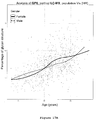
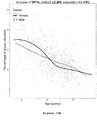
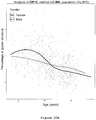
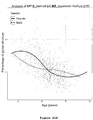
- IgG N-glycans analysis has been carried out among respondents from three different isolated populations: the island of Vis (Croatia/HR), the island of Kor ⁇ ula (Croatia/HR), and Orkney Isles (United Kingdom/UK).
- the population of Vis island included 890 respondents (521 women and 369 men), ranging in age from 18 to 93 (average age 56).
- the population of Kor ⁇ ula island included 915 respondents (595 women and 320 men), ranging in age from 18 to 98 (average age 56).
- the population of Orkney Isles included 1786 respondents (1082 women and 704 men), ranging in age from 16 to 100 (average age 54).
- the study of N-glycans attached to immunoglobulin (IgG) in human blood plasma from isolated populations and the procedure for IgG glycans analysis in accordance with the invention include the following steps:
- steps (iv) and (v) can be replaced with the procedure of treating the purified immunoglobulin G (IgG) with trypsin enzyme.
- IgG immunoglobulin G
- trypsin enzyme enzyme-activated glutathione
- released N-glycopeptides are purified by reverse phase solid-phase extraction (RP-SPE), with quantitative analysis of purified N-glycopeptides, i.e. glycoforms filtered in such a manner, which correspond to glycans characteristic for age.
- RP-SPE reverse phase solid-phase extraction
- Plasma samples are taken in accordance to good clinical practice, by collecting blood in test tubes with anticoagulant, and it is instantly being processed by centrifugation in order to isolate blood plasma. Blood plasma is stored at -70°C, see previously mentioned reference (5).
- the purification of immunoglobulin G (IgG) that contains various attached glycans is described in Example 1.
- Releasing glycans from their attachment to immunoglobulin G is executed by a favourable method known from the background of the Invention: hidrazinolysis or enzyme reaction catalysed by peptide-N4-(N-acetyl-beta-glucosaminyl)asparagine amidase (PNGase F), see references (3) and (6).
- PNGase F peptide-N4-(N-acetyl-beta-glucosaminyl)asparagine amidase
- Aromatic amine that is used for fluorescent derivatization of glycans according to the invention has been chosen from a group that consists of: 2-aminobenzamide (2AB), 9-aminopyrene-1 3 6-trisulfonic acid (APTS), ethyl 4-aminobenzoate, 2-aminopyridine, anthranillic acid, and other amines as it is noted in the reference: (9) A. Ceroni, K. Maass, H. Geyer, R. Geyer, A. Dell, S. M. Haslam: GlycoWorkbench: A Tool for the Computer-Assisted Annotation of Mass Spectra of Glycans, J. Proteome Res. 7 (2008) 1650-1659 .
- the reducing agent used in the procedure of glycan derivatization with ultraviolet absorbing amines by reductive amination, is chosen from a group that consists of: 2-picoline borane (2-CH 3 C 5 H 4 N ⁇ BH 3 ), sodium cyanoborohydride (NaBH 3 CN), sodium triacetoxyborohydride [NaBH(CH 3 COO) 3 ], or some other appropriate selective reducing agent.
- Quantitative analysis of derivatized glycans or glycopeptides has been executed by one of analytical techniques, chosen from a group that consists of: ultra performance liquid chromatography (UPLC), MALDI-TOF (matrix-assisted laser desorption/ionization time-of-flight) mass spectrometry, liquid chromatography-mass spectrometry (LC-MS), capillary electrophoresis (CE), or some other appropriate quantitative analytical technique.
- UPLC ultra performance liquid chromatography
- MALDI-TOF matrix-assisted laser desorption/ionization time-of-flight mass spectrometry
- LC-MS liquid chromatography-mass spectrometry
- CE capillary electrophoresis
- Example 4 UPLC
- Example 6 MALDI-TOF
- Example 7 LC-MS
- Example 8 CE
- a chromatogram is obtained, or electropherogram with a series of peaks (signals) that represent fluorescently active derivates of one or more related glycans.
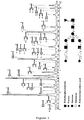
- Typical UPLC chromatogram of IgG glycans, derivatized by reductive amination reaction with 2-aminobenzamide (2AB) is shown in Figure 1 . Structures of all relevant IgG glycans are described in reference (5) .
- glycopeptides in other words glycoforms, which correspond to glycans characteristic for age and which are obtained by digesting IgG with help of trypsin enzyme with subsequent purification by reverse phase solid-phase extraction (RP-SPE).
- RP-SPE reverse phase solid-phase extraction
- Relative abundance of individual glycans attached to immunoglobulin G (in the study on different isolated human populations, as well as in testing blood plasma of any human in accordance with the invention) is determined by normalization of the area underneath the signal (chromatographic peak) of a certain fluorescently derivatized glycan with total area underneath all signals (peaks) of fluorescently derivatized glycans.
- abundance of individual glycoforms is determined by normalization of the sum of the intensity of isotopic peaks of a certain glycoform with total intensity of all glycoforms.
- Obtained values of IgG glycan structures are also normalized with regard to individual characteristics of the experiment for which it is known that they bring errors into the experiment, like for example: the plate on which the experiment has been carried out, instrument on which chromatographic analysis has been carried out, etc.
- a linear mixed model has been used, in which experimental variables are described as random effects.
- liquid chromatography-mass spectrometry of the nanoLC-ESI-MS nano liquid chromatography-electrospray ionization-mass spectrometry
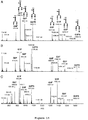
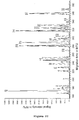
- a typical MS-spectrum is shown in Figure 15 and it shows signals (isotopic peaks) of IgG glycoforms, visible with help of this analytical technique, in other words signals of their molecular ions, described through mass-to-charge ratio (m/z). Above each signal, there is a corresponding glycan structure and here, peptide remnant is also schematically marked by abbreviation "pep".
- Figure 15 shows mass spectrums that show glycopeptides of individual IgG subclasses: IgG1 (spectrum A), IgG2, and IgG3 (spectrum B), as well as subclasses IgG4 (spectrum C).
- G0, G1, and G2 denote number of galactoses (G) or other monosaccharides in a glycan molecule: fucose (F), bisecting N-acetylglucosamine (N), N -acetylneuraminic acid (S).
- the listed structures are shown in spectrums A, B, and C two times because they have lower m/z, [M+3H] 3+ ions on the left side and higher m/z, [M+2H] 2+ ions on the right side.
- IgG glycans characteristic for age by analytical technique of capillary electrophoresis (CE).
- CE capillary electrophoresis
- Electropherogram in Figure 22 shows 25 signals (peaks) of APTS-derivatized IgG glycans that are described by different migration, in other words, retention times (maximum trans-mission unit; MTU), as well as intensities (relative fluorescence unit; RFU). Structures of these glycans are listed in Table 1. Table 1. Structures of IgG glycans that are visible by capillary electrophoresis (CE) technique, carried out under the conditions as described in Example 8, with the following markings used: No Glycan Mark Structure 1. A2G2S2 GP21 2. A2G2S2 GP21 3. A2BG2S2 GP22 4. FA2G2S2 GP23 5. FA2BG2S2 GP24 6.
- CE capillary electrophoresis
- A2G1S1 GP15 7. FA2G2S1[3] GP16b 8. A2G2S1[3] GP17 9. A2BG2S1 GP18a 10. A2BG2S1 GP18a 11 FA2G2S1 GP18b Man5 GP5 12. FA2BG2S1 GP19 A2 GP2 13. A2B GP3 14. FA2G0 GP4/5 15. A2G1[6] GP6/7 16. A2G1[3] GP6/7 17. FA2BG0 GP6/7 18. A2BG1 GP8a 19. FA2G1[6] GP 8a/b 20. FA2G1[3] GP9 21. FA2BG1[6] GP10 A2G2 GP12 22. FA2BG1[3] GP 11/12 23. A2BG2 GP13 24. FA2G2 GP13/14/15 25. FA2BG2 GP15
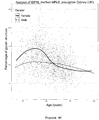
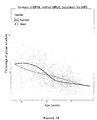
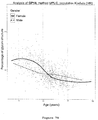
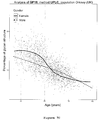
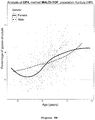
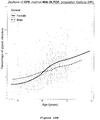
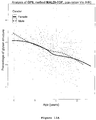
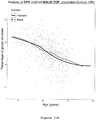
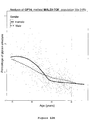
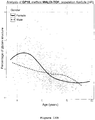
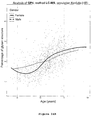
- Glycan Age Index (GAI) as a separate parameter, obtained by computation on the basis of the results of quantitative analysis of two or more glycans, characteristic for age ( GP4, GP6, GP8, GP14, GP15, GP18 ).
- Glycan Age Index (GAI) by an analogue manner also from any other combination of two or more mentioned characteristic IgG glycans, out of total six, for which a clear correlation with age and sex has been established.
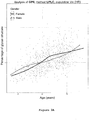
- Figure 23 shows comparison of chronological age and Glycan Age Index (GAI) in the population of Orkney Isles.
- Glycan Age Index (GAI) also correlates well with different phenotype markings related to biological age which introduces possibility to use Glycan Age Index (GAI) in analysis of biological age, see Table 2. Table 2. Review of the influence of phenotype markings on Glycan Age Index (GAI) after correction for chronological age. No Parameter R R 2 p.
- the method for the analysis of N-glycans from blood plasma of an individual according to the invention, as well as derived Glycan Age Index (GAI) have a significant diagnostic potential.
- the method may be used for:
- diseases are typically chosen from a group that consists of: inflammatory diseases (including atherosclerosis), autoimmune diseases, tumours, diabetes, arthritis, osteoporosis, and Alzheimer disease, which is well known from the previous art; see references:
- IgG N-glycans Names of IgG N-glycans that are crucial for the Invention: F(6)A2 ( GP4 ), F(6)A2B ( GP6 ), F(6)A2[6]G1 ( GP8 ), F(6)A2G2 ( GP14 ), F(6)A2BG2 ( GP15 ), F(6)A2G2S1 ( GP18 ), as well as of other glycans, have been derived according to the rules of Oxford nomenclature.
- the reaction mixture diluted with 400 ⁇ L of acetonitrile, is applied to cellulose. Excess of label is removed by washing cellulose 7 times with 200 ⁇ L of 80% acetonitrile.
- the labelled IgG glycans are eluted by washing cellulose 2 times with 100 ⁇ L of water. Eluates of IgG glycans derivatized with 2-aminobenzamide (2AB) are stored at -20°C until usage.
- UPLC analysis has been carried out in HILIC (hydrophilic interaction liquid chromatography) conditions: 2-aminobenzamide (2AB)-labelled IgG glycans are analysed on Waters Acquity UPLC instrument (Waters, MA, USA), equipped with fluorescence detector with excitation and emission wavelengths of 330 and 420 nm, respectively. Glycans are separated on a Waters BEH Glycan chromatography column (100x2.1 mm i.d.; 1.7 ⁇ m BEH). As a mobile phase, the following mixture is used:
- Example 5 The procedure of digesting IgG with help of trypsin enzyme and purification of released glycopeptides (among which are glycoforms that respond to glycans GP4, GP6, GP8, GP14, GP15, and GP18 ) with help of reverse phase solid-phase extraction
- Example 6 Analysis of IgG glycans by analysing the corresponding glycopeptides i.e. glycoforms that correspond to glycans GP4, GP6, GP8, GP14, GP15, and GP18 with help of MALDI-TOF mass spectrometry
- Typical MALDI TOF MS-spectrum is shown in Figure 8 .
- Example 7 Analysis of IgG glycans by analysis of the corresponding glycopeptides i.e. glycoforms that correspond to glycans GP4, GP6, GP8, GP14, GP15, and GP18, with help of liquid chromatography-mass spectrometry (LC-MS)
- LC-MS liquid chromatography-mass spectrometry
- IgG immunoglobulin G
- aliquot of purified IgG (approximately 100 ⁇ g; the product from Example 5) is dried in vacuum centrifuge until reaching constant mass. The dried eluate is resuspended and denatured with 30 ⁇ L of 1.33% SDS solution at 65°C for 10 minutes. After that, 10 ⁇ L of 4% NP-40 solution, 10 ⁇ L of 5x PBS, and 1.25 mU of enzyme PNGaze F (N-glycosidase F; ProZyme, CA, USA) ars added. The mixture is incubated at 37 °C overnight.
- PNGaze F N-glycosidase F; ProZyme, CA, USA
- N-glycans 2 ⁇ L are labelled by adding 2 ⁇ L 20 mM of 9-aminopyrene-1,3,6-trisulfonic acid (APTS) solution as fluorescent label in 3,6 M of citric acid solution with addition of 2 ⁇ L of 2-picoline borane solution in DMSO. The obtained reaction mixture is incubated at 37°C overnight. Excess of fluorescent label is removed by solid-phase extraction with help of microcrystalline cellulose, Sepharose, or Biogel P-10, in accordance with the procedure from the following reference: (14) L. R. Ruhaak, R.
- APTS 9-aminopyrene-1,3,6-trisulfonic acid
- ABI 3130xL genetic analyser equipped with 16 capillary filled with POP-7 Polymer (Life Technologies), is used. Electrophoresis is carried out at the potential of 15 kV, and the collection of data takes 45 minutes. Data analysis is carried out by glyXtool and glyXalign software packages. An electropherogram is obtained for every sample and it consists of 25 peaks which represent individual glycan structures. By integration of peaks, their area is obtained and it is divided with total area of the entire integrated electropherogram for the purpose of normalization. In this manner, abundance of an individual glycan is determined.
- Typical electropherogram of IgG glycan obtained by the described method is shown in Figure 22 .
- Example 9 Carrying out the study of investigating IgG N-glycans depending on age and sex in three different isolated populations: Vis island, Kor ⁇ ula island and Orkney Isles
- results of IgG glycan analysis of respondents from three populations are used: the island of Vis (CRO), the island of Kor ⁇ ula (CRO) and Orkney Isles (UK).
- the population of Vis island included 890 respondents (521 women and 369 men), ranging in age from 18 to 93 (average age 56) .
- the population of Kor ⁇ ula island included 915 respondents (595 women and 320 men), ranging in age from 18 to 98 (average age 56).
- the population of Orkney Isles included 1786 respondents (1082 women and 704 men), ranging in age from 16 to 100 (average age 54).
- Plasma samples are taken by collecting blood in test tubes with anticoagulant, and instantly being processed by centrifugation in order to isolate blood plasma. Blood plasma is stored at -70°C. The procedure of purification of immunoglobulin G (IgG) that contains various attached glycans from blood plasma is described in Example 1.
- IgG immunoglobulin G
- IgG immunoglobulin G
- PNGaza F peptide-N4-(N-acetyl-beta-glucosaminyl)asparagine amidase
- Fluorescent labelling of glycans by reductive amination is executed with 2-aminobenzamide (2AB) or with 9-aminopyrene-1 3 6-trisulfonic acid (APTS), using 2-picoline borane (2-CH 3 C 5 H 4 N ⁇ BH 3 ) as reducing agent, in accordance with the procedures described in Examples 3 and 8.
- purified immunoglobulin G (IgG) is treated with trypsine enzyme and released glycopeptides are subsequently purified by reverse phase solid-phase extraction with quantitative analysis by MALDI-TOF mass spectrometry and LC-MS, in accordance with the procedures described in Examples 6 and 7.
- Example 4 UPLC
- Example 6 MALDI-TOF
- Example 7 LC-MS
- CE Example 8
- a chromatogram, electropherogram, or mass spectrum are obtained with a series of peaks (signals) that represent one or more related glycan structures, i.e. glycopeptides ( Figures 1 , 8 , 15 , and 22 ).
- Relative abundance of individual IgG glycans is determined by normalization of the area underneath the signal (peak) with total area underneath all signals (peaks) of glycans.
- abundance of individual glycopeptides, i.e. glycoforms is determined by normalization of the sum of the intensity of isotopic peaks of a certain glycoform with total intensity of all glycoforms.
- Obtained values of IgG glycan structures are also normalized with regard to individual characteristics of the experiment for which it is known to bring errors into the experiment: the plate on which the experiment has been carried out, instrument on which chromatographic analysis has been carried out, etc.
- a linear mixed model has been used, in which experimental variables are described as random effects.
- the entire statistic data processing is executed with help of R programming language, designed for statistical computing and graphics.
- GUI version of the program R 3.0.0. for 64-bit Windows is used. All the functions used in statistical data processing are part of R basic package for statistical computing "stats," and R packaging for linear mixed models "lme4". Visualisation of data and results of statistical analysis is carried out by using R graphic package "ggplot2".
Landscapes
- Health & Medical Sciences (AREA)
- Life Sciences & Earth Sciences (AREA)
- Engineering & Computer Science (AREA)
- Molecular Biology (AREA)
- Immunology (AREA)
- Physics & Mathematics (AREA)
- Chemical & Material Sciences (AREA)
- Biomedical Technology (AREA)
- Urology & Nephrology (AREA)
- Hematology (AREA)
- Analytical Chemistry (AREA)
- Pathology (AREA)
- General Physics & Mathematics (AREA)
- General Health & Medical Sciences (AREA)
- Biochemistry (AREA)
- Bioinformatics & Computational Biology (AREA)
- Bioinformatics & Cheminformatics (AREA)
- Food Science & Technology (AREA)
- Medicinal Chemistry (AREA)
- Microbiology (AREA)
- Cell Biology (AREA)
- Biotechnology (AREA)
- Spectroscopy & Molecular Physics (AREA)
- Proteomics, Peptides & Aminoacids (AREA)
- Optics & Photonics (AREA)
- Biophysics (AREA)
- Tropical Medicine & Parasitology (AREA)
- Other Investigation Or Analysis Of Materials By Electrical Means (AREA)
- Investigating Or Analysing Biological Materials (AREA)
Claims (5)
- Verfahren zur Analyse von N-Glykanen, die an Immunglobulin G aus menschlichem Blutplasma gebunden sind, um den Glykan-Alter-Index (GAI) zu berechnen; wobei das Verfahren die folgenden Schritte umfasst:(i) quantitative Analyse von freigesetzten Glykanen: F (6) A2B (GP6), F (6) A2G2 (GP14) und F (6) A2BG2 (GP15) mit den folgenden chemischen Strukturen:
 F (6) A2B (GP6): R1 = GlcNAc; R2, R3, R4 = H;F (6) A2G2 (GP14): R1 = H; R2, R3 = Gal; R4 = H;F (6) A2BG2 (GP15): R1 = GlcNAc; R2, R3 = Gal; R4 = H;
undGlcNAc = N-AcetylglucosaminFuc = FucoseMan = MannoseNeuAc = N-AcetylneuraminsäureGal = Galactoseoder entsprechende N-Glykopeptide, die durch Digerieren von Immunglobulin G mit Hilfe von Trypsin-Enzym erhalten werden, in dem die relative Häufigkeit von jedem Glykan oder entsprechendem N-Glykopeptid durch Normierung erhalten wird, die ausgeführt wird, indem die Oberfläche unterhalb des Signals jedes der oben genannten Glykane oder entsprechenden N-Glykopeptide durch die Gesamtoberfläche aller Signale von Glykanen oder entsprechenden N-Glykopeptiden aus der Probe dividiert wird, was die Werte 〈GP6〉, 〈GP14〉 und 〈GP15〉 ergibt, die entsprechende relative Häufigkeiten der Glykane F (6) A2B (GP6), F (6) A2G2 (GP14) und F (6) A2BG2 (GP15) für ein Individuum repräsentieren; wobei die quantitative Analyse mit einem der Verfahren ausgeführt wird, das ausgewählt ist aus der Gruppe bestehend aus: Ultrahochleistungsflüssigkeitschromatographie, MALDI-TOF-Massenspektrometrie, Flüssigkeitschromatographie-Massenspektrometrie oder Kapillarelektrophorese; und(ii) Verwenden der erhaltenen Werte der relativen Häufigkeiten der Glykane 〈GP6〉, 〈GP14〉 und 〈GP15〉 für ein Individuum in Schritt (I) für die Berechnung des Glykan-Alter-Index (GAI), ausgedrückt in Jahren und bestimmt entsprechend der folgenden Formeln in Bezug auf das Geschlecht des Individuums, wobei die Formeln auf zuvor statistisch evaluierten Daten basieren:

- Verwendung des Verfahrens zur Analyse von N-Glykanen, die an Immunglobulin G gebunden sind oder entsprechenden Immunglobulin G N-Glykopeptiden aus menschlichem Blutplasma nach Anspruch 1, wobei der berechnete Glykan-Alter-Index (GAI) (F) oder (GAI) (M) zur Vorhersage des biologischen und chronologischen Alters eines getesteten Individuums verwendet wird.
- Verwendung des Verfahrens zur Analyse von N-Glykanen, die an Immunglobulin G gebunden sind oder entsprechenden Immunglobulin G N-Glykopeptiden aus menschlichem Blutplasma nach Anspruch 1, wobei der Glykan-Alter-Index (GAI) (F) oder (GAI) (M) zum Monitoring der Wirksamkeit der Verfahren verwendet wird, die den Alterungsprozess eines getesteten Individuums verlangsamen.
- Verwendung des Verfahrens zur Analyse von N-Glykanen, die an Immunglobulin G gebunden sind oder entsprechenden Immunglobulin G N-Glykopeptiden aus menschlichem Blutplasma nach Anspruch 1, wobei der Glykan-Alter-Index (GAI) (F) oder (GAI) (M) zum Monitoring des Fortschreitens von Erkrankungen verwendet wird, die sich als Ergebnis des Alterungsprozesses eines getesteten Individuums entwickeln.
- Verwendung des Verfahrens zur Analyse von N-Glykanen, die an Immunglobulin G gebunden sind oder entsprechenden Immunglobulin G N-Glykopeptiden aus menschlichem Blutplasma nach Anspruch 4, wobei Erkrankungen ausgewählt sind aus der Gruppe bestehend aus: entzündlichen Erkrankungen, einschließlich Atherosklerose, Autoimmunerkrankungen, Tumoren, Diabetes, Arthritis, Osteoporose und Alzheimer-Krankheit.
Applications Claiming Priority (2)
| Application Number | Priority Date | Filing Date | Title |
|---|---|---|---|
| HRP20130568AA HRPK20130568B3 (hr) | 2013-06-20 | 2013-06-20 | Postupak analize n-glikana vezanih na imunoglobulin g iz krvne plazme ljudi i njegova upotreba |
| PCT/HR2014/000022 WO2014203010A1 (en) | 2013-06-20 | 2014-06-11 | Method for the analysis of n-glycans attached to immunoglobulin g from human blood plasma and its use |
Publications (2)
| Publication Number | Publication Date |
|---|---|
| EP3011335A1 EP3011335A1 (de) | 2016-04-27 |
| EP3011335B1 true EP3011335B1 (de) | 2018-07-18 |
Family
ID=51210686
Family Applications (1)
| Application Number | Title | Priority Date | Filing Date |
|---|---|---|---|
| EP14739928.1A Active EP3011335B1 (de) | 2013-06-20 | 2014-06-11 | Verfahren zur analyse von an immunglobulin g aus menschlichem blutplasma gebundenen n-glycanen und verwendung |
Country Status (5)
| Country | Link |
|---|---|
| US (1) | US9910046B2 (de) |
| EP (1) | EP3011335B1 (de) |
| CN (1) | CN105579848A (de) |
| HR (1) | HRPK20130568B3 (de) |
| WO (1) | WO2014203010A1 (de) |
Cited By (4)
| Publication number | Priority date | Publication date | Assignee | Title |
|---|---|---|---|---|
| WO2022207537A2 (en) | 2021-03-30 | 2022-10-06 | Genos D.O.O. | DIAGNOSTIC PROCESS FOR THE DETERMINATION OF PERIMENOPAUSE OR MENOPAUSE STATUS VIA ANALYSIS OF THE IgG GLYCOME |
| WO2024041894A1 (en) | 2022-08-22 | 2024-02-29 | Genos D.O.O. | METHOD FOR ASSESSMENT OF LUNG DAMAGE CAUSED BY SMOKING BASED ON ANALYSIS OF IgG GLYCOMES FROM BLOOD PLASMA |
| WO2025031594A1 (en) | 2023-08-10 | 2025-02-13 | Medilab One D.O.O. | METHOD FOR PREDICTION OF FUTURE HbA1c PARAMETER VALUE BASED ON CURRENT HbA1c VALUE AND STATUS OF TOTAL PLASMA N-GLYCOME |
| US12440716B2 (en) | 2021-06-09 | 2025-10-14 | Im Development D.O.O. | Weightlifting assistance device with safety feature |
Families Citing this family (12)
| Publication number | Priority date | Publication date | Assignee | Title |
|---|---|---|---|---|
| CN107091885B (zh) * | 2016-02-18 | 2020-04-24 | 湖北生物医药产业技术研究院有限公司 | 测定蛋白质的唾液酸含量的方法 |
| HRP20160662A2 (hr) * | 2016-06-13 | 2017-12-15 | Genos D.O.O. | Postupak predviđanja razvoja dijabetesa tipa 2 putem analize n-glikana iz krvne plazme zdravih osoba |
| US11747271B2 (en) * | 2016-08-26 | 2023-09-05 | Dh Technologies Development Pte. Ltd. | Triple-internal standard based glycan structural assignment method for capillary electrophoresis analysis of carbohydrates |
| CN109596842B (zh) * | 2018-12-29 | 2022-02-22 | 江苏先思达生物科技有限公司 | 一种阿尔兹海默症检测试剂及其在阿尔兹海默症检测中的应用 |
| CN109932445A (zh) * | 2019-03-19 | 2019-06-25 | 北京泰德制药股份有限公司 | 一种糖蛋白多种电荷异构体n糖链结构的评价方法 |
| ES2984813T3 (es) * | 2020-04-28 | 2024-10-31 | Janssen Pharmaceuticals Inc | Método para la identificación y la cuantificación de polisacáridos en composiciones de glicoconjugados complejas |
| MX2022015461A (es) * | 2020-06-09 | 2023-01-16 | Regeneron Pharma | Metodo basado en espectrometria de masas y de alto rendimiento para cuantificar anticuerpos. |
| CN114994323B (zh) * | 2021-02-20 | 2024-12-24 | 中国医学科学院基础医学研究所 | IgG Fc N-糖肽作为确定或辅助肺癌治疗方案选择的标志物的用途 |
| CN113030305B (zh) * | 2021-03-02 | 2023-02-07 | 北京蛋白质组研究中心 | 一种健康人群n-糖肽生理丰度范围的构建方法及其应用 |
| US20240402187A1 (en) * | 2021-10-14 | 2024-12-05 | The Regents Of The University Of California | Glycan age prediction model |
| CN115524502B (zh) * | 2022-10-21 | 2026-04-28 | 山东第一医科大学(山东省医学科学院) | 基于血清中免疫球蛋白G Fc段N-糖基的食管癌辅助诊断模型的建立方法及其应用 |
| HUP2400268A1 (en) * | 2024-05-12 | 2025-11-28 | Pannon Egyetem | Method for predicting the effectiveness of chemotherapy treatment |
Family Cites Families (6)
| Publication number | Priority date | Publication date | Assignee | Title |
|---|---|---|---|---|
| JP3897063B2 (ja) | 1996-01-19 | 2007-03-22 | 株式会社中埜酢店 | 判別支援方法 |
| PT1495328E (pt) | 2002-04-16 | 2014-09-09 | Vlaams Interuniv Inst Biotech | Um marcador para medir cirrose hepática |
| WO2006058878A1 (en) * | 2004-12-01 | 2006-06-08 | Vib Vzw | Aging biomarker |
| EP2174132A2 (de) * | 2007-07-20 | 2010-04-14 | National Institute for Bioprocessing Research and Training Limited | Glycosylierungsmarker für krebs und chronische entzündungen |
| JP5358952B2 (ja) | 2008-01-10 | 2013-12-04 | 和光純薬工業株式会社 | 膵臓癌マーカーおよび膵臓癌の検査方法 |
| US20100003699A1 (en) * | 2008-01-18 | 2010-01-07 | Glykos Finland Ltd. | Tissue carbohydrate compositions and analysis thereof |
-
2013
- 2013-06-20 HR HRP20130568AA patent/HRPK20130568B3/hr not_active IP Right Cessation
-
2014
- 2014-06-11 CN CN201480037808.5A patent/CN105579848A/zh active Pending
- 2014-06-11 EP EP14739928.1A patent/EP3011335B1/de active Active
- 2014-06-11 WO PCT/HR2014/000022 patent/WO2014203010A1/en not_active Ceased
- 2014-06-11 US US14/892,299 patent/US9910046B2/en active Active
Non-Patent Citations (1)
| Title |
|---|
| None * |
Cited By (4)
| Publication number | Priority date | Publication date | Assignee | Title |
|---|---|---|---|---|
| WO2022207537A2 (en) | 2021-03-30 | 2022-10-06 | Genos D.O.O. | DIAGNOSTIC PROCESS FOR THE DETERMINATION OF PERIMENOPAUSE OR MENOPAUSE STATUS VIA ANALYSIS OF THE IgG GLYCOME |
| US12440716B2 (en) | 2021-06-09 | 2025-10-14 | Im Development D.O.O. | Weightlifting assistance device with safety feature |
| WO2024041894A1 (en) | 2022-08-22 | 2024-02-29 | Genos D.O.O. | METHOD FOR ASSESSMENT OF LUNG DAMAGE CAUSED BY SMOKING BASED ON ANALYSIS OF IgG GLYCOMES FROM BLOOD PLASMA |
| WO2025031594A1 (en) | 2023-08-10 | 2025-02-13 | Medilab One D.O.O. | METHOD FOR PREDICTION OF FUTURE HbA1c PARAMETER VALUE BASED ON CURRENT HbA1c VALUE AND STATUS OF TOTAL PLASMA N-GLYCOME |
Also Published As
| Publication number | Publication date |
|---|---|
| WO2014203010A1 (en) | 2014-12-24 |
| HRP20130568A2 (hr) | 2015-01-02 |
| US20160103137A1 (en) | 2016-04-14 |
| US9910046B2 (en) | 2018-03-06 |
| EP3011335A1 (de) | 2016-04-27 |
| HRPK20130568B3 (hr) | 2016-01-29 |
| CN105579848A (zh) | 2016-05-11 |
Similar Documents
| Publication | Publication Date | Title |
|---|---|---|
| US9910046B2 (en) | Method for the analysis of N-glycans attached to immunoglobulin G from human blood plasma and its use | |
| Huffman et al. | Comparative performance of four methods for high-throughput glycosylation analysis of immunoglobulin G in genetic and epidemiological research | |
| EP3729958B1 (de) | Identifizierung und überwachung von monoklonalen immunglobulinen nach molekülmasse | |
| US10393747B2 (en) | Diagnostic method for gastric cancer | |
| CN102422161A (zh) | 利用糖蛋白的糖基化的癌症诊断方法 | |
| EP1799861A2 (de) | Diagnose einer fötalen aneuploidie | |
| US8568993B2 (en) | Detection of glycopeptides and glycoproteins for medical diagnostics | |
| JP7561032B2 (ja) | 質量分析を用いる免疫グロブリンの同定 | |
| KR102100158B1 (ko) | N-당사슬 크로마토그램 피크의 상대정량에 의한 질병 스크리닝 방법 | |
| US20210263042A1 (en) | Tandem-paired column chemistry for high-throughput proteomic exosome analysis | |
| Qin et al. | Providing Bionic Glycome as internal standards by glycan reducing and isotope labeling for reliable and simple quantitation of N-glycome based on MALDI-MS | |
| Peng et al. | MS-based glycomics: An analytical tool to assess nervous system diseases | |
| EP2909626B1 (de) | Mittel und verfahren zur bestimmung einer clearance-normalisierten menge eines stoffwechselkrankheitbiomarkers in einer probe | |
| US20100216250A1 (en) | Methods for Predicting Trisomy 21 in a Fetus | |
| CN104764796A (zh) | 基于MALDI-ToF MS的血液中糖化血红蛋白含量检测方法 | |
| WO2009117666A1 (en) | Glycan markers of hepatocellular carcinoma | |
| WO2023185840A1 (zh) | 一种基于质谱检测体液样本里中低丰度蛋白的方法 | |
| CN107782896B (zh) | 乳腺癌标志物 | |
| CN107765017B (zh) | 乳腺癌标志物 | |
| JP7376048B2 (ja) | 大腸癌の診断を補助する方法、キット及びバイオマーカー | |
| US20140162903A1 (en) | Metabolite Biomarkers For Forecasting The Outcome of Preoperative Chemotherapy For Breast Cancer Treatment | |
| EP3816628B1 (de) | Marker zur bestimmung von pankreaskrebs | |
| KR101219516B1 (ko) | 암 진단용 펩티드 마커 및 이를 이용한 암 진단방법 | |
| EP3819639B1 (de) | Für prostatakrebs spezifische zuckerkette und testverfahren damit | |
| WO2006108051A2 (en) | Compositions and methods relating to alzheimer's disease |
Legal Events
| Date | Code | Title | Description |
|---|---|---|---|
| PUAI | Public reference made under article 153(3) epc to a published international application that has entered the european phase |
Free format text: ORIGINAL CODE: 0009012 |
|
| 17P | Request for examination filed |
Effective date: 20151113 |
|
| AK | Designated contracting states |
Kind code of ref document: A1 Designated state(s): AL AT BE BG CH CY CZ DE DK EE ES FI FR GB GR HR HU IE IS IT LI LT LU LV MC MK MT NL NO PL PT RO RS SE SI SK SM TR |
|
| AX | Request for extension of the european patent |
Extension state: BA ME |
|
| STAA | Information on the status of an ep patent application or granted ep patent |
Free format text: STATUS: EXAMINATION IS IN PROGRESS |
|
| 17Q | First examination report despatched |
Effective date: 20161020 |
|
| GRAP | Despatch of communication of intention to grant a patent |
Free format text: ORIGINAL CODE: EPIDOSNIGR1 |
|
| STAA | Information on the status of an ep patent application or granted ep patent |
Free format text: STATUS: GRANT OF PATENT IS INTENDED |
|
| INTG | Intention to grant announced |
Effective date: 20180326 |
|
| GRAS | Grant fee paid |
Free format text: ORIGINAL CODE: EPIDOSNIGR3 |
|
| GRAA | (expected) grant |
Free format text: ORIGINAL CODE: 0009210 |
|
| STAA | Information on the status of an ep patent application or granted ep patent |
Free format text: STATUS: THE PATENT HAS BEEN GRANTED |
|
| RIN1 | Information on inventor provided before grant (corrected) |
Inventor name: VUCKOVIC, FRANO Inventor name: PUCIC BAKOVIC, MAJA Inventor name: LAUC, GORDAN |
|
| AK | Designated contracting states |
Kind code of ref document: B1 Designated state(s): AL AT BE BG CH CY CZ DE DK EE ES FI FR GB GR HR HU IE IS IT LI LT LU LV MC MK MT NL NO PL PT RO RS SE SI SK SM TR |
|
| AX | Request for extension of the european patent |
Extension state: BA ME |
|
| REG | Reference to a national code |
Ref country code: GB Ref legal event code: FG4D |
|
| REG | Reference to a national code |
Ref country code: CH Ref legal event code: EP |
|
| REG | Reference to a national code |
Ref country code: IE Ref legal event code: FG4D |
|
| REG | Reference to a national code |
Ref country code: AT Ref legal event code: REF Ref document number: 1019915 Country of ref document: AT Kind code of ref document: T Effective date: 20180815 |
|
| REG | Reference to a national code |
Ref country code: DE Ref legal event code: R096 Ref document number: 602014028706 Country of ref document: DE |
|
| REG | Reference to a national code |
Ref country code: NL Ref legal event code: FP |
|
| REG | Reference to a national code |
Ref country code: LT Ref legal event code: MG4D |
|
| REG | Reference to a national code |
Ref country code: AT Ref legal event code: MK05 Ref document number: 1019915 Country of ref document: AT Kind code of ref document: T Effective date: 20180718 |
|
| PG25 | Lapsed in a contracting state [announced via postgrant information from national office to epo] |
Ref country code: BG Free format text: LAPSE BECAUSE OF FAILURE TO SUBMIT A TRANSLATION OF THE DESCRIPTION OR TO PAY THE FEE WITHIN THE PRESCRIBED TIME-LIMIT Effective date: 20181018 Ref country code: AT Free format text: LAPSE BECAUSE OF FAILURE TO SUBMIT A TRANSLATION OF THE DESCRIPTION OR TO PAY THE FEE WITHIN THE PRESCRIBED TIME-LIMIT Effective date: 20180718 Ref country code: SE Free format text: LAPSE BECAUSE OF FAILURE TO SUBMIT A TRANSLATION OF THE DESCRIPTION OR TO PAY THE FEE WITHIN THE PRESCRIBED TIME-LIMIT Effective date: 20180718 Ref country code: LT Free format text: LAPSE BECAUSE OF FAILURE TO SUBMIT A TRANSLATION OF THE DESCRIPTION OR TO PAY THE FEE WITHIN THE PRESCRIBED TIME-LIMIT Effective date: 20180718 Ref country code: PL Free format text: LAPSE BECAUSE OF FAILURE TO SUBMIT A TRANSLATION OF THE DESCRIPTION OR TO PAY THE FEE WITHIN THE PRESCRIBED TIME-LIMIT Effective date: 20180718 Ref country code: FI Free format text: LAPSE BECAUSE OF FAILURE TO SUBMIT A TRANSLATION OF THE DESCRIPTION OR TO PAY THE FEE WITHIN THE PRESCRIBED TIME-LIMIT Effective date: 20180718 Ref country code: GR Free format text: LAPSE BECAUSE OF FAILURE TO SUBMIT A TRANSLATION OF THE DESCRIPTION OR TO PAY THE FEE WITHIN THE PRESCRIBED TIME-LIMIT Effective date: 20181019 Ref country code: RS Free format text: LAPSE BECAUSE OF FAILURE TO SUBMIT A TRANSLATION OF THE DESCRIPTION OR TO PAY THE FEE WITHIN THE PRESCRIBED TIME-LIMIT Effective date: 20180718 Ref country code: NO Free format text: LAPSE BECAUSE OF FAILURE TO SUBMIT A TRANSLATION OF THE DESCRIPTION OR TO PAY THE FEE WITHIN THE PRESCRIBED TIME-LIMIT Effective date: 20181018 Ref country code: IS Free format text: LAPSE BECAUSE OF FAILURE TO SUBMIT A TRANSLATION OF THE DESCRIPTION OR TO PAY THE FEE WITHIN THE PRESCRIBED TIME-LIMIT Effective date: 20181118 |
|
| PG25 | Lapsed in a contracting state [announced via postgrant information from national office to epo] |
Ref country code: LV Free format text: LAPSE BECAUSE OF FAILURE TO SUBMIT A TRANSLATION OF THE DESCRIPTION OR TO PAY THE FEE WITHIN THE PRESCRIBED TIME-LIMIT Effective date: 20180718 Ref country code: HR Free format text: LAPSE BECAUSE OF FAILURE TO SUBMIT A TRANSLATION OF THE DESCRIPTION OR TO PAY THE FEE WITHIN THE PRESCRIBED TIME-LIMIT Effective date: 20180718 Ref country code: AL Free format text: LAPSE BECAUSE OF FAILURE TO SUBMIT A TRANSLATION OF THE DESCRIPTION OR TO PAY THE FEE WITHIN THE PRESCRIBED TIME-LIMIT Effective date: 20180718 |
|
| REG | Reference to a national code |
Ref country code: DE Ref legal event code: R097 Ref document number: 602014028706 Country of ref document: DE |
|
| PG25 | Lapsed in a contracting state [announced via postgrant information from national office to epo] |
Ref country code: CZ Free format text: LAPSE BECAUSE OF FAILURE TO SUBMIT A TRANSLATION OF THE DESCRIPTION OR TO PAY THE FEE WITHIN THE PRESCRIBED TIME-LIMIT Effective date: 20180718 Ref country code: RO Free format text: LAPSE BECAUSE OF FAILURE TO SUBMIT A TRANSLATION OF THE DESCRIPTION OR TO PAY THE FEE WITHIN THE PRESCRIBED TIME-LIMIT Effective date: 20180718 Ref country code: EE Free format text: LAPSE BECAUSE OF FAILURE TO SUBMIT A TRANSLATION OF THE DESCRIPTION OR TO PAY THE FEE WITHIN THE PRESCRIBED TIME-LIMIT Effective date: 20180718 Ref country code: IT Free format text: LAPSE BECAUSE OF FAILURE TO SUBMIT A TRANSLATION OF THE DESCRIPTION OR TO PAY THE FEE WITHIN THE PRESCRIBED TIME-LIMIT Effective date: 20180718 Ref country code: ES Free format text: LAPSE BECAUSE OF FAILURE TO SUBMIT A TRANSLATION OF THE DESCRIPTION OR TO PAY THE FEE WITHIN THE PRESCRIBED TIME-LIMIT Effective date: 20180718 |
|
| PLBE | No opposition filed within time limit |
Free format text: ORIGINAL CODE: 0009261 |
|
| STAA | Information on the status of an ep patent application or granted ep patent |
Free format text: STATUS: NO OPPOSITION FILED WITHIN TIME LIMIT |
|
| PG25 | Lapsed in a contracting state [announced via postgrant information from national office to epo] |
Ref country code: SK Free format text: LAPSE BECAUSE OF FAILURE TO SUBMIT A TRANSLATION OF THE DESCRIPTION OR TO PAY THE FEE WITHIN THE PRESCRIBED TIME-LIMIT Effective date: 20180718 Ref country code: SM Free format text: LAPSE BECAUSE OF FAILURE TO SUBMIT A TRANSLATION OF THE DESCRIPTION OR TO PAY THE FEE WITHIN THE PRESCRIBED TIME-LIMIT Effective date: 20180718 Ref country code: DK Free format text: LAPSE BECAUSE OF FAILURE TO SUBMIT A TRANSLATION OF THE DESCRIPTION OR TO PAY THE FEE WITHIN THE PRESCRIBED TIME-LIMIT Effective date: 20180718 |
|
| 26N | No opposition filed |
Effective date: 20190423 |
|
| PG25 | Lapsed in a contracting state [announced via postgrant information from national office to epo] |
Ref country code: SI Free format text: LAPSE BECAUSE OF FAILURE TO SUBMIT A TRANSLATION OF THE DESCRIPTION OR TO PAY THE FEE WITHIN THE PRESCRIBED TIME-LIMIT Effective date: 20180718 |
|
| PG25 | Lapsed in a contracting state [announced via postgrant information from national office to epo] |
Ref country code: MC Free format text: LAPSE BECAUSE OF FAILURE TO SUBMIT A TRANSLATION OF THE DESCRIPTION OR TO PAY THE FEE WITHIN THE PRESCRIBED TIME-LIMIT Effective date: 20180718 |
|
| REG | Reference to a national code |
Ref country code: BE Ref legal event code: MM Effective date: 20190630 |
|
| PG25 | Lapsed in a contracting state [announced via postgrant information from national office to epo] |
Ref country code: TR Free format text: LAPSE BECAUSE OF FAILURE TO SUBMIT A TRANSLATION OF THE DESCRIPTION OR TO PAY THE FEE WITHIN THE PRESCRIBED TIME-LIMIT Effective date: 20180718 |
|
| PG25 | Lapsed in a contracting state [announced via postgrant information from national office to epo] |
Ref country code: BE Free format text: LAPSE BECAUSE OF NON-PAYMENT OF DUE FEES Effective date: 20190630 |
|
| PG25 | Lapsed in a contracting state [announced via postgrant information from national office to epo] |
Ref country code: PT Free format text: LAPSE BECAUSE OF FAILURE TO SUBMIT A TRANSLATION OF THE DESCRIPTION OR TO PAY THE FEE WITHIN THE PRESCRIBED TIME-LIMIT Effective date: 20181118 |
|
| PG25 | Lapsed in a contracting state [announced via postgrant information from national office to epo] |
Ref country code: CY Free format text: LAPSE BECAUSE OF FAILURE TO SUBMIT A TRANSLATION OF THE DESCRIPTION OR TO PAY THE FEE WITHIN THE PRESCRIBED TIME-LIMIT Effective date: 20180718 |
|
| PG25 | Lapsed in a contracting state [announced via postgrant information from national office to epo] |
Ref country code: HU Free format text: LAPSE BECAUSE OF FAILURE TO SUBMIT A TRANSLATION OF THE DESCRIPTION OR TO PAY THE FEE WITHIN THE PRESCRIBED TIME-LIMIT; INVALID AB INITIO Effective date: 20140611 Ref country code: MT Free format text: LAPSE BECAUSE OF FAILURE TO SUBMIT A TRANSLATION OF THE DESCRIPTION OR TO PAY THE FEE WITHIN THE PRESCRIBED TIME-LIMIT Effective date: 20180718 |
|
| PG25 | Lapsed in a contracting state [announced via postgrant information from national office to epo] |
Ref country code: MK Free format text: LAPSE BECAUSE OF FAILURE TO SUBMIT A TRANSLATION OF THE DESCRIPTION OR TO PAY THE FEE WITHIN THE PRESCRIBED TIME-LIMIT Effective date: 20180718 |
|
| REG | Reference to a national code |
Ref country code: DE Ref legal event code: R081 Ref document number: 602014028706 Country of ref document: DE Owner name: GLYCANAGE LTD, GB Free format text: FORMER OWNER: GENOS D.O.O., OSIJEK, HR |
|
| REG | Reference to a national code |
Ref country code: LU Ref legal event code: PD Owner name: GLYCANAGE LTD; GB Free format text: FORMER OWNER: GENOS D.O.O. Effective date: 20230919 |
|
| REG | Reference to a national code |
Ref country code: NL Ref legal event code: PD Owner name: GLYCANAGE LTD; GB Free format text: DETAILS ASSIGNMENT: CHANGE OF OWNER(S), ASSIGNMENT; FORMER OWNER NAME: GENOS D.O.O. Effective date: 20230929 |
|
| REG | Reference to a national code |
Ref country code: GB Ref legal event code: 732E Free format text: REGISTERED BETWEEN 20231116 AND 20231122 |
|
| PGFP | Annual fee paid to national office [announced via postgrant information from national office to epo] |
Ref country code: DE Payment date: 20250626 Year of fee payment: 12 |
|
| PGFP | Annual fee paid to national office [announced via postgrant information from national office to epo] |
Ref country code: GB Payment date: 20250617 Year of fee payment: 12 |
|
| PGFP | Annual fee paid to national office [announced via postgrant information from national office to epo] |
Ref country code: LU Payment date: 20250624 Year of fee payment: 12 Ref country code: NL Payment date: 20250625 Year of fee payment: 12 |
|
| PGFP | Annual fee paid to national office [announced via postgrant information from national office to epo] |
Ref country code: FR Payment date: 20250623 Year of fee payment: 12 |
|
| PGFP | Annual fee paid to national office [announced via postgrant information from national office to epo] |
Ref country code: IE Payment date: 20250623 Year of fee payment: 12 |
|
| PGFP | Annual fee paid to national office [announced via postgrant information from national office to epo] |
Ref country code: CH Payment date: 20250701 Year of fee payment: 12 |