EP3007836B1 - Système de traitement destiné à déshydrater des déchets alimentaires - Google Patents
Système de traitement destiné à déshydrater des déchets alimentaires Download PDFInfo
- Publication number
- EP3007836B1 EP3007836B1 EP14735865.9A EP14735865A EP3007836B1 EP 3007836 B1 EP3007836 B1 EP 3007836B1 EP 14735865 A EP14735865 A EP 14735865A EP 3007836 B1 EP3007836 B1 EP 3007836B1
- Authority
- EP
- European Patent Office
- Prior art keywords
- condenser
- tank
- chamber
- extraction
- pump
- Prior art date
- Legal status (The legal status is an assumption and is not a legal conclusion. Google has not performed a legal analysis and makes no representation as to the accuracy of the status listed.)
- Active
Links
Images



Classifications
-
- B—PERFORMING OPERATIONS; TRANSPORTING
- B09—DISPOSAL OF SOLID WASTE; RECLAMATION OF CONTAMINATED SOIL
- B09B—DISPOSAL OF SOLID WASTE NOT OTHERWISE PROVIDED FOR
- B09B3/00—Destroying solid waste or transforming solid waste into something useful or harmless
- B09B3/40—Destroying solid waste or transforming solid waste into something useful or harmless involving thermal treatment, e.g. evaporation
-
- F—MECHANICAL ENGINEERING; LIGHTING; HEATING; WEAPONS; BLASTING
- F26—DRYING
- F26B—DRYING SOLID MATERIALS OR OBJECTS BY REMOVING LIQUID THEREFROM
- F26B25/00—Details of general application not covered by group F26B21/00 or F26B23/00
- F26B25/005—Treatment of dryer exhaust gases
-
- B—PERFORMING OPERATIONS; TRANSPORTING
- B01—PHYSICAL OR CHEMICAL PROCESSES OR APPARATUS IN GENERAL
- B01D—SEPARATION
- B01D5/00—Condensation of vapours; Recovering volatile solvents by condensation
- B01D5/0027—Condensation of vapours; Recovering volatile solvents by condensation by direct contact between vapours or gases and the cooling medium
-
- B—PERFORMING OPERATIONS; TRANSPORTING
- B01—PHYSICAL OR CHEMICAL PROCESSES OR APPARATUS IN GENERAL
- B01D—SEPARATION
- B01D5/00—Condensation of vapours; Recovering volatile solvents by condensation
- B01D5/0033—Other features
- B01D5/0039—Recuperation of heat, e.g. use of heat pump(s), compression
-
- F—MECHANICAL ENGINEERING; LIGHTING; HEATING; WEAPONS; BLASTING
- F26—DRYING
- F26B—DRYING SOLID MATERIALS OR OBJECTS BY REMOVING LIQUID THEREFROM
- F26B11/00—Machines or apparatus for drying solid materials or objects with movement which is non-progressive
- F26B11/12—Machines or apparatus for drying solid materials or objects with movement which is non-progressive in stationary drums or other mainly-closed receptacles with moving stirring devices
-
- F—MECHANICAL ENGINEERING; LIGHTING; HEATING; WEAPONS; BLASTING
- F26—DRYING
- F26B—DRYING SOLID MATERIALS OR OBJECTS BY REMOVING LIQUID THEREFROM
- F26B11/00—Machines or apparatus for drying solid materials or objects with movement which is non-progressive
- F26B11/12—Machines or apparatus for drying solid materials or objects with movement which is non-progressive in stationary drums or other mainly-closed receptacles with moving stirring devices
- F26B11/14—Machines or apparatus for drying solid materials or objects with movement which is non-progressive in stationary drums or other mainly-closed receptacles with moving stirring devices the stirring device moving in a horizontal or slightly-inclined plane
-
- F—MECHANICAL ENGINEERING; LIGHTING; HEATING; WEAPONS; BLASTING
- F26—DRYING
- F26B—DRYING SOLID MATERIALS OR OBJECTS BY REMOVING LIQUID THEREFROM
- F26B2200/00—Drying processes and machines for solid materials characterised by the specific requirements of the drying good
- F26B2200/02—Biomass, e.g. waste vegetative matter, straw
-
- F—MECHANICAL ENGINEERING; LIGHTING; HEATING; WEAPONS; BLASTING
- F26—DRYING
- F26B—DRYING SOLID MATERIALS OR OBJECTS BY REMOVING LIQUID THEREFROM
- F26B2200/00—Drying processes and machines for solid materials characterised by the specific requirements of the drying good
- F26B2200/04—Garbage
-
- Y—GENERAL TAGGING OF NEW TECHNOLOGICAL DEVELOPMENTS; GENERAL TAGGING OF CROSS-SECTIONAL TECHNOLOGIES SPANNING OVER SEVERAL SECTIONS OF THE IPC; TECHNICAL SUBJECTS COVERED BY FORMER USPC CROSS-REFERENCE ART COLLECTIONS [XRACs] AND DIGESTS
- Y02—TECHNOLOGIES OR APPLICATIONS FOR MITIGATION OR ADAPTATION AGAINST CLIMATE CHANGE
- Y02B—CLIMATE CHANGE MITIGATION TECHNOLOGIES RELATED TO BUILDINGS, e.g. HOUSING, HOUSE APPLIANCES OR RELATED END-USER APPLICATIONS
- Y02B30/00—Energy efficient heating, ventilation or air conditioning [HVAC]
- Y02B30/52—Heat recovery pumps, i.e. heat pump based systems or units able to transfer the thermal energy from one area of the premises or part of the facilities to a different one, improving the overall efficiency
-
- Y—GENERAL TAGGING OF NEW TECHNOLOGICAL DEVELOPMENTS; GENERAL TAGGING OF CROSS-SECTIONAL TECHNOLOGIES SPANNING OVER SEVERAL SECTIONS OF THE IPC; TECHNICAL SUBJECTS COVERED BY FORMER USPC CROSS-REFERENCE ART COLLECTIONS [XRACs] AND DIGESTS
- Y02—TECHNOLOGIES OR APPLICATIONS FOR MITIGATION OR ADAPTATION AGAINST CLIMATE CHANGE
- Y02P—CLIMATE CHANGE MITIGATION TECHNOLOGIES IN THE PRODUCTION OR PROCESSING OF GOODS
- Y02P60/00—Technologies relating to agriculture, livestock or agroalimentary industries
- Y02P60/80—Food processing, e.g. use of renewable energies or variable speed drives in handling, conveying or stacking
- Y02P60/85—Food storage or conservation, e.g. cooling or drying
Definitions
- the present invention relates to the field of waste treatment, and more particularly to a process for dehydrating food waste.
- the document WO 2009/139514 teaches a food waste drying system.
- the food waste is stored in a first tank heated by an oil bath at 80 ° C and comprising a device for stirring waste and supplying hot air. Water vapor created by heating food waste in the tank mixes with hot air.
- These gaseous effluents are evacuated in a pipe. They then pass through a filter to reach an indirect contact condenser.
- the condenser comprises a plurality of cooling ducts and a plurality of fans. The effluents are thus condensed in the condenser to store the condensate obtained in an additional tank.
- the incondensable effluents are pumped by a pump to be deodorized then mixed with outside air and heated to be reintroduced into the first tank.
- the system described in this document uses many devices such as filters, deodorizers, catalysts, etc. These devices require a lot of maintenance with significant maintenance. In addition, the entire system consumes a lot of energy compared to the amount of waste processed.
- the document WO 2005/099920 teaches a food waste treatment system.
- This device also includes multiple devices such as filters, a condenser, a heat exchanger, a radiator, a catalyst, a deodorizer, an ozonizer, etc.
- the operating temperatures of the system can be up to 800 ° C in some parts of the system. The high temperatures and the operation of the many devices used require a high energy consumption and maintenance.
- the document EP 1 821 054 also teaches a food waste treatment system.
- the food waste is stored in a tank comprising stirring means.
- the gaseous effluents are sucked by an air blower. Some of the effluents are reintroduced into the tank after passing through a heating means.
- the other part of the effluents is sucked by a suction fan after being deodorized by a deodorizer and a heating means which heats the effluents to a temperature of 350 ° C.
- the system of this document requires a large energy consumption even if the number of devices is less important.
- the recirculation of effluents in the tank makes the system inefficient.
- the document JP 2008-284483 teaches a device for drying waste.
- This device comprises a waste treatment tank, a heating device, a vacuum pump.
- a cooling device for cooling the gases generated in the tank and a cyclone separator device for removing the gasified components such as water and greases are arranged between the tank and the vacuum pump.
- This device requires several systems such as a cyclone separator and a cooling device that require significant maintenance.
- the object of the present invention is to obtain a simple, economical and reliable waste treatment system which overcomes one or more of the difficulties mentioned above.
- the direct contact heat exchange condenser is a jet condenser comprising the enclosure having a longitudinal axis perpendicular to the ground, the enclosure comprising, in the upper part of the enclosure, a shower device comprising at least one coolant inlet opening allowing the cooling liquid to fall into the enclosure from the top part to the lower part, the condensates composed of coolant and the condensed water vapor the coolant being extracted through the opening condensate extraction, the first pipe opening into the lower part of the enclosure.
- the condenser gas extraction opening of the condenser is connected to an incondensable extraction pump and the condensate extraction opening is connected to a condensate extraction pump.
- the shower device communicates with the lower part of the condenser chamber by a second pipe, a portion of the condensate being extracted from the lower part of the chamber by a condensate recirculation pump to be routed to the condenser chamber. shower device by this second pipe.
- the longitudinal axis of the tank is inclined relative to the ground and each fin is contained in a plane forming an angle ⁇ with the plane comprising the rotation shaft and the rod on which the fin is fixed, the orientation of the angle ⁇ being chosen in such a way that the food waste intended to be treated in the system is raised in the direction of the end of the rotation shaft farthest from the ground during the treatment of the food waste.
- the heating device comprises heating plates applied to the outer surface of the tank, the heating plates being regulated in temperature by regulation.
- the heating device further comprises a heat pump of which a specific condenser is fixed to the tank and of which a specific evaporator is fixed on the chamber of the condenser and / or on the second pipe to recover the heat of the condenser chamber and / or the second pipe to return it to the tank.
- the heating device further comprises a heat pump of which a specific condenser is fixed to the tank and of which a specific evaporator is inside the chamber of the condenser.
- the part of the first pipe closest to the condenser enclosure makes an acute angle ⁇ with the longitudinal axis of the enclosure.
- the primary vacuum is maintained by the condenser gas extraction pump of the condenser and / or the condensate extraction pump.
- the system further comprises a humidity sensor fixed in the tank, the sensor being connected to a control means, the control means being connected to the motor driving the rotation shaft, the pump or pumps. extraction and / or recirculation, the heating device and the heat pump, the control means stopping the motor of the rotation shaft, the heating device, the extraction and / or recirculation pump and the heat pump when the sensor detects a moisture content of the food waste less than a minimum humidity value in the tank.
- the system comprises at least one pressure sensor in the tank and / or in the condenser chamber, the sensor or sensors being connected to the control means, the control means being connected to at least one pump of extraction, the control means controlling the operation of the extraction pump or pumps to maintain the primary vacuum of the system and / or discharge the condensates.
- the tank has a discharge opening in the part closest to the ground.
- knives are fixed on the rotation shaft.
- the invention relates to a system (0) for treating food waste (4).
- the food waste (4) may be rejected waste, for example and without limitation, by the food industry, food businesses, supermarkets or restaurants.
- Food waste (4) may include organic waste and inorganic waste from, for example, food packaging that may be plastic, glass, metal, etc.
- the system (0) includes a device (200) for storing and heating food waste (4).
- the storage and heating device (200) comprises a reservoir (2) in which the food waste (4) to be treated is contained.
- a stirring device agitates the waste contained in the tank (2).
- the tank (2) has a shape partly in cylinder sector.
- the tank (2) can be stainless steel or black steel, or any other material compatible with the waste and their heating.
- the stirring device comprises a rotation shaft (17) driven by a motor (18).
- the rotation shaft (17) is parallel to the longitudinal axis (32) of the complete cylinder, a sector of which forms the reservoir (2).
- the axis (31) of the rotation shaft (17) and the longitudinal axis (32) of the complete cylinder are merged.
- the motor (18) driving the rotation shaft (17) is located outside the tank (2).
- the rotating shaft (17) extending right through the tank (2) through the wall of the tank (2) to be connected to the motor (18). Sealing means are used at the location (21) where the rotation shaft (17) passes through the wall of the tank (2) so that the food waste (4) does not come out of the tank (2) when are inside, including liquid materials contained in food waste (4), and to maintain a primary vacuum.
- the stirring device also comprises a plurality of rods (20) and a plurality of fins (19).
- One end of each rod (20) is attached to the rotation shaft (17).
- the fins (19) are attached to the other end of the rods (20).
- the assembly formed of a rod (20) and a fin (19) extends from the rotation shaft (17) to the vicinity of the wall of the reservoir (2) shaped cylinder sector.
- the length formed by the assembly formed of a rod (20) and a fin (19) is substantially less than the radius of the complete cylinder, a sector of which forms the reservoir (2) so that the fins (19) do not rub. on the inner wall of the cylinder sector portion of the tank (2).
- the rotation shaft (17) rotates with a slow rotation speed.
- the rotational speed of the rotation shaft (17) of the stirring device is equal, for example, to about 7.5 rpm.
- the storage and heating device (200) further comprises a heating device (11) for heating the food waste (4) in the tank (2) to allow the extraction of water from the waste in the form of steam. of water.
- the waste heating device (11) can be set between 50 ° C and 100 ° C. A preferred temperature of the waste may be 80 ° C. In this case the heating device (11) can preferably be set to 100 ° C to take into account the heat gradient in the walls of the tank (2).
- the heating device (11) can be arranged at the bottom of the tank (2).
- the heating device (11) may comprise heating plates (11a) or a heat recovery device (11b) extracted from a heat pump (6) or a combination of the heating plates (11a) and the heat recovery device (11a). heat (11b).
- the heating plates (11a) of the heater (11) provide heat (25a) to the tank (2). They may be flexible heating plates applied on the outer surface of the tank (2), preferably on the lower part of the cylinder sector. These heating plates have in their structure at least one electrical element forming a heating resistor embedded in a flexible material that is both thermally conductive and electrically insulating, which may be made of silicone or any other polymer, such as elastomer, having similar properties . This heating electric resistance is powered by at least one power supply means to enable it to provide a power of between 100 W and 10000 W depending on the volume of the tank to be heated. According to one embodiment, the heating plates used are temperature-controlled and / or all-or-nothing powered.
- the heat restorer (11b) of the heating device (11) may be a specific condenser connected to a heat pump (6).
- the heat pump (6) is, on the one hand, connected to the tank (2) and, on the other hand, connected to at least one heat recuperator (7, 8) such as a specific evaporator fixed on the enclosure (35) of the condenser (34) and / or on the second pipe (5) for recovering (23, 24) the heat from the enclosure (35) and / or the second pipe (5), then returning it (25b) to the tank at higher temperature (2) via the specific condenser (11b) of the heat pump.
- This heat pump can for example be supercritical carbon dioxide cycle type.
- this cycle makes it possible to be compatible with a preferred evaporator temperature (7, 8) of 15 ° C., for example, and a preferred condenser temperature (11b) of 100 ° C., for example, in contact with each other. of the tank wall (2).
- the specific condenser of the heat pump (6) is fixed against the tank (2) at its lower part, instead of or next to the preceding flexible heating plates.
- the heat recuperator (78) is inside the enclosure (35) of the condenser (34) to recover heat from inside the enclosure (35), then return it (25b) to a higher level tank temperature (2) by the specific condenser (11b) of the heat pump.
- the heat recovery unit (78) such as a specific evaporator, may be in the form of a serpentine duct.
- the cylinder sector portion (2a) of the reservoir (2) is a half-cylinder whose longitudinal axis (32) is inclined with respect to the ground (30) by an angle ⁇ , preferably in a range between 0 ° and 30 °, more preferably equal to 15 °.
- the reservoir (2) may also comprise a portion (2b) surmounting the half-cylindrical portion (2a) having a shape of right prism whose base is a rectangle trapezium. The angle made by the nonparallel opposite lines of the trapezium is equal to ⁇ .
- the assembly comprising the half-cylindrical portion (2a) and the portion (2b) forming a right prism form the reservoir (2).
- the reservoir (2) is closed by a cover (300) on the upper face of the portion (2b) having a shape of right prism opposite to the half-cylindrical portion.
- the lid can be opened, for example, to load food waste (4) in the tank (2).
- the lid can be closed, for example, during operation of the system (0).
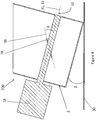
- each fin (19) is contained in a plane (38) forming an angle ⁇ with the plane (39) comprising the rotation shaft (17) and the rod (20) on which the fin ( 19) is fixed.
- the angle ⁇ is, for example, preferably between 0 ° and 60 °, more preferably equal to 30 °.
- the angle ⁇ can be generally equal to the angle ⁇ .
- the orientation of the angle ⁇ is chosen such that the food waste (4) to be processed in the system (0) is lifted in the direction of the end (21) of the rotation shaft (17). ) furthest from the ground (30) during the treatment of food waste (4) during the operation of the system (0) for the treatment of food waste (4). This prevents the food waste (4) from remaining accumulated in the part of the tank (2) closest to the ground (30) by gravity, which would make the operation of the agitation device ineffective.
- the motor (18) driving the rotation shaft (17) is placed at the end of the rotation shaft (17) furthest from the ground.
- the inclination of the longitudinal axis (31) of the half-cylindrical portion (2a) of this embodiment allows that the food waste (4) does not reach the sealing means used at the location (21). where the rotation shaft (17) passes through the wall of the tank (2). Indeed, food waste (4) can damage the sealing means by chemical or physical reactions occurring during the treatment of food waste (4).
- the tank (2) may have a discharge opening (400) in the area closest to the ground of the cylinder sector. This discharge opening (400) is normally closed during the drying of the waste, it is open for the unloading of the dried waste.
- the rotation shaft (17) of the stirring device rotates in a direction of rotation allowing the food waste (4) to be lifted thanks to the angle ⁇ that the fins (19) with the plane (39) comprising the rotation shaft (17) and the rod (20) on which the fin (19) is fixed.
- the remaining food waste (4) dried after the treatment can be easily discharged through the discharge opening (400) thanks to the fins (19) of the device stirring which push the residue towards the discharge opening.
- the rotation shaft (17) may further comprise knives fixed on the rotation shaft (17). These knives make it possible to shred the elements contained in the food waste (4) capable of wrapping around the rotation shaft (17), which interferes with the operation of the stirring device by blocking or slowing down the rotation of the rotation shaft (17).
- the elements contained in the food waste (4) capable of wrapping around the rotation shaft (17) can be for example plastic elements such as plastic packaging, plastic films or plastic bags.
- the system (0) for treating food waste (4) further includes a water vapor condenser (34) by direct contact heat exchange.
- a heat exchange with direct contact is an exchange in which no material separation exists between two fluids that exchange their heat.
- the direct contact exchange condenser (34) may be a jet condenser in which the cooling liquid, for example cold water, comes into direct contact with the water vapor contained in the gaseous effluents (22) produced by the food waste (4) which is then condensed in contact with this liquid.
- the coolant temperature is above 0 ° C and below 30 ° C. It is preferably 15 ° C, for example.
- This jet condenser comprises an enclosure (35) having a longitudinal axis (28) substantially perpendicular to the ground (30).
- the longitudinal axis (28) of the enclosure (35) may have an angle less than 5 ° with respect to the vertical.
- the elements of the jet condenser may be stainless steel or a black steel, or any other material compatible with the temperatures and pressures in the condenser, for example high-temperature PVC.
- a shower device (33) comprising at least one cooling liquid inlet opening (16) allows the cooling liquid (16) to fall into a shower (13) in the enclosure (35) from the upper part to a lower part.
- the chamber (35) further comprises, in the lower part, an opening (36) for extracting the condensate (600) composed of liquid (16) for cooling and steam of the gaseous effluents (22) condensed by the cooling liquid (16).
- the shower device (33) can communicate with the lower part of the enclosure (35) of the condenser (34). Part of the condensate is extracted from the bottom of the enclosure (35) by a condensate recirculation pump (100) to be directed to the shower device (33).
- the chamber (35) further comprises, in the upper part, an opening (37) for extracting the incondensable gases (700) contained in the gaseous effluents (22), which are extracted by an extraction pump (9). incondensables.
- the incondensable gas extraction opening (37) may further include an activated carbon filter (500) for deodorizing the non-condensable gases or a bubbling system coupled to an activated carbon filter.
- a catalytic converter can also be used for deodorization.
- the system (0) for treating food waste (4) further includes a first conduit (3) for direct communication between the storage device (200), more particularly the reservoir (2), and the condenser (34). to allow the passage of gaseous effluents (22) consisting of water vapor and incondensable gases produced by the heating of food waste (4) in the tank (2), to the condenser (34) heat exchange by contact direct.
- the first pipe (3) may be stainless steel or a black steel, or any other material compatible with the temperature and pressure levels, for example PVC High-temperature.
- This first pipe (3) opens into the lower part of the enclosure (35) through an opening (14) for introducing gases.
- a first portion (3a) of the first pipe (3), the closest to the enclosure (35), has a longitudinal axis (29) which makes an acute angle ⁇ with the longitudinal axis (28) of the enclosure (35) of the condenser (34) forming, for example, a bend between the enclosure (35) of the condenser (34) and the first pipe (3).
- the acute angle ⁇ may be within a range of, for example, between 30 ° and 60 °.
- the end of the first portion (3a) of the first pipe (3) opposite the end attached to the enclosure (35) of the condenser (34) extends away from the ground (30) to it reaches a height greater than the height of the opening (14) for introducing gaseous effluents (22). This end then joins a second portion (3b) of the second pipe which connects the first pipe (3) to the tank (2) of the device (200) for storing and heating waste.
- the inside of the chamber (35) of the condenser (34), the inside of the tank (2) and the first pipe (3) are airtight and maintained in a primary vacuum, for example, between 1 bar and 0.001 bar, preferably 0.7 bar.
- the primary vacuum in the system (0) makes it possible, among other things, to contain the bad odors in the system (0). This sealing also makes it possible to prohibit the entry of outside air in order to avoid unwanted oxidation of the elements of the system (0).
- the primary vacuum finally makes it possible to reduce the evaporation temperature of the water contained in the waste below 100 ° C, which saves heating energy.
- the water condensates collected at the bottom of the chamber (35) are extracted by at least one condensate extraction pump (10).
- this condensate extraction pump (10) is, for example, coupled to the same shaft as the uncondensable extraction pump (9).
- the pumps (9) and (10) are combined.
- the pump (9) for extracting incondensables is a liquid ring pump.
- the condensates extracted and collected at the bottom of the enclosure (35) of the condenser are used for the liquid ring to the pump (9) for extraction of incondensables.
- the pump (100) for recirculating the condensates and the cooling liquid can be coupled with the condensate extraction pump (9) and / or the condensate extraction pump (10).
- the system (0) may further comprise a humidity sensor (230) fixed in the reservoir (2).
- This sensor (230) can be connected to a control means connected at least to the motor (18) driving the rotation shaft (17).
- the control means can also be connected to at least the extraction and / or recirculation pump (9, 10, 100), the heating device (11a) and / or the heat pump (6),
- the control means stops the motor (18) of the rotation shaft (17) and the entire system (0) when the sensor (230) detects a humidity level below a minimum humidity value. , for example between 10% and 20% moisture, food waste (4) in the tank (2).
- the system (0) may comprise at least one pressure sensor (231) in the tank (2) and / or in the chamber (35) of the condenser (34).
- the sensor or sensors (231) can be connected to the control means.
- the control means is connected to at least the uncondensable extraction pump (9). The control means thus controls the operation of the uncondensable extraction pump (9) to maintain the primary vacuum of the system (0).
- the primary vacuum can be maintained by at least the uncondensable extraction pump (9).
- the condensate extraction pump (10) can also participate in maintaining the primary vacuum.
- the user of the system (0) opens the lid (300) of the tank (2) to load food waste (4) into the tank (2) and closes the lid.
- a primary vacuum is achieved in the system (0) after closing the lid by starting pumps (9) and (10) extraction.
- the recirculation pump (100) is turned on to draw coolant to the shower device (33).
- the incondensable gases for example air, possibly present at startup in the enclosure (35) of the condenser are evacuated by the pump (9) extraction of incondensables.
- the temperature and the pressure in the chamber (35) of the condenser (34) are then lower than the temperature and the pressure inside the tank (2). This creates a depression that allows gaseous effluents (22) including in particular the water vapor, produced by the heating of the waste in the tank (2) to be sucked into the enclosure (35) of the condenser (34) through the first driving (3).
- the possible fraction of incondensable gases is evacuated through the opening (37) for extracting the incondensable gases.
- the condensates mixed with the cooling liquid (16), for example water, are discharged through the opening (36) for extracting the condensates.
- the flow rate of the condensate extraction pump (10) is not sufficient to be able to evacuate all the liquids comprising the steam that has been condensed and the liquid (16) for cooling.
- All the liquids contained in the lower part of the chamber (35) of the condenser (34) then sees its level rise in the chamber (35) of the condenser (34) but also in the first pipe (3) which forms an angle ⁇ with the longitudinal axis (28) of the chamber (35) of the condenser (34). This angle ⁇ allows all the liquids not to go back to the tank (2).
- This geometric layout of the first pipe (3) thus makes it possible to automatically control the flow rate of gaseous effluents (22) sucked from the tank (2) to the enclosure (35) of the condenser (34) by construction, without the need for a control means, for example electronic.
- the heat pump (6) can return (25b) heat at a higher temperature to the tank (2) through the specific condenser (11b), the heat (23, 24) to lower temperature being recovered by the specific heat recovery evaporators (7, 8) fixed on the chamber (35) of the condenser (34) and / or on the second pipe (5).
- the energy consumption of the system can thus be reduced, for example in proportion to the coefficient of performance of the heat pump (6).
- Electronic control means can be used to control the active, mechanical or electrical elements of the system (0) such as the pumps (9, 10, 100), the heat pump (6), the motor (18) of the device. stirring, the heating resistor (11a).
- This control can be decided according to the data recovered by the humidity sensor (230) and / or the pressure sensor (231), as well as other sensors, for example temperature sensors.
- the system (0) according to the invention is an efficient system (0) with a few number of elements and parts.
- the system (0) also makes it possible to reduce the number of elements controlled by electronic control means which are sources of major failure. These elements are replaced by forms of construction of the system (0) and by the use of physical phenomena that can not fail. In addition, this system (0) saves large amounts of energy, for example, heating.
Landscapes
- Engineering & Computer Science (AREA)
- Mechanical Engineering (AREA)
- General Engineering & Computer Science (AREA)
- Chemical & Material Sciences (AREA)
- Chemical Kinetics & Catalysis (AREA)
- Physics & Mathematics (AREA)
- Thermal Sciences (AREA)
- Environmental & Geological Engineering (AREA)
- Processing Of Solid Wastes (AREA)
- Drying Of Solid Materials (AREA)
- Fertilizers (AREA)
Applications Claiming Priority (3)
| Application Number | Priority Date | Filing Date | Title |
|---|---|---|---|
| FR1355487A FR3006915B1 (fr) | 2013-06-13 | 2013-06-13 | Systeme de traitement destine a deshydrater des dechets alimentaires |
| FR1359330A FR3006916B1 (fr) | 2013-06-13 | 2013-09-27 | Systeme de traitement destine a deshydrater des dechets alimentaires |
| PCT/EP2014/062164 WO2014198795A1 (fr) | 2013-06-13 | 2014-06-11 | Système de traitement destiné à déshydrater des déchets alimentaires |
Publications (2)
| Publication Number | Publication Date |
|---|---|
| EP3007836A1 EP3007836A1 (fr) | 2016-04-20 |
| EP3007836B1 true EP3007836B1 (fr) | 2017-08-16 |
Family
ID=49237322
Family Applications (1)
| Application Number | Title | Priority Date | Filing Date |
|---|---|---|---|
| EP14735865.9A Active EP3007836B1 (fr) | 2013-06-13 | 2014-06-11 | Système de traitement destiné à déshydrater des déchets alimentaires |
Country Status (7)
| Country | Link |
|---|---|
| US (1) | US9976805B2 (enExample) |
| EP (1) | EP3007836B1 (enExample) |
| JP (1) | JP6393753B2 (enExample) |
| KR (1) | KR102231839B1 (enExample) |
| ES (1) | ES2647530T3 (enExample) |
| FR (2) | FR3006915B1 (enExample) |
| WO (1) | WO2014198795A1 (enExample) |
Cited By (3)
| Publication number | Priority date | Publication date | Assignee | Title |
|---|---|---|---|---|
| CN106843337A (zh) * | 2017-03-22 | 2017-06-13 | 东莞市升微机电设备科技有限公司 | 恒温恒湿试验箱的升温加湿控制系统及其控制方法 |
| DE102020123246A1 (de) | 2020-09-05 | 2022-03-10 | Alfred Kärcher SE & Co. KG | Kompostiervorrichtung |
| DE102020123245A1 (de) | 2020-09-05 | 2022-03-10 | Alfred Kärcher SE & Co. KG | Kompostiervorrichtung und Verfahren zum Bereitstellen von Kompostmaterial |
Families Citing this family (10)
| Publication number | Priority date | Publication date | Assignee | Title |
|---|---|---|---|---|
| US9895726B1 (en) | 2016-07-27 | 2018-02-20 | Whirlpool Corporation | Method for cleaning a food waste recycling bin of a food waste recycling appliance |
| USD1027351S1 (en) | 2016-03-09 | 2024-05-14 | Whirlpool Corporation | Food recycler |
| CN106839701A (zh) * | 2017-02-23 | 2017-06-13 | 华西能源工程有限公司 | 一种利用锅炉烟气余热烘干生物质燃料的装置 |
| CN109028914B (zh) * | 2018-07-09 | 2020-06-12 | 温州市骐邦环保科技有限公司 | 一种利用锅炉余热实现烘干的设备 |
| CN108759391A (zh) * | 2018-08-24 | 2018-11-06 | 浙江德清东衡孟頫酒业有限公司 | 一种高粱干燥装置 |
| CN109269252B (zh) * | 2018-10-22 | 2024-06-28 | 安徽国宜堂健康产业发展有限公司 | 一种水栀子果实烘干设备 |
| CN111469333A (zh) * | 2020-05-11 | 2020-07-31 | 辽宁金铠厦科技有限公司 | 一种制造聚氨酯发泡颗粒用恒温筒仓 |
| US20220178610A1 (en) * | 2020-09-21 | 2022-06-09 | Brian James | Biomass dryer |
| FR3128387A1 (fr) * | 2021-10-26 | 2023-04-28 | Serveco | Dispositif de traitement de dechets alimentaires |
| CN114001534B (zh) * | 2021-11-03 | 2022-08-30 | 河北同发铁路工程集团铭豪高速铁路器材制造有限公司 | 一种用于螺栓加工的干燥装置 |
Family Cites Families (16)
| Publication number | Priority date | Publication date | Assignee | Title |
|---|---|---|---|---|
| JPH0735952B2 (ja) * | 1993-03-01 | 1995-04-19 | 西部瓦斯株式会社 | 真空乾燥処理装置 |
| US6139793A (en) * | 1997-09-05 | 2000-10-31 | Hydroclave Systems Corporation | Waste treatment control system |
| KR100337475B1 (ko) * | 2000-05-08 | 2002-05-23 | 한필순 | 음식물 쓰레기 처리 장치 |
| JP2001340829A (ja) * | 2000-06-01 | 2001-12-11 | Shikoku Sobi Kk | 含水廃棄物乾燥装置 |
| JP3075310U (ja) * | 2000-07-31 | 2001-02-16 | 中央機工株式会社 | 有機廃棄物の乾燥処理装置 |
| JP2002102834A (ja) * | 2000-09-29 | 2002-04-09 | Toto Ltd | 廃棄物処理システム及びその運転方法 |
| JP2004262720A (ja) * | 2003-03-03 | 2004-09-24 | Eco Keikaku:Kk | 飼肥料化処理システム |
| US6892471B2 (en) * | 2003-07-02 | 2005-05-17 | Anders T. Ragnarsson | Sludge dryer |
| KR200355901Y1 (ko) * | 2004-04-19 | 2004-07-09 | 주식회사 가이아 | 교반기 |
| KR100706919B1 (ko) | 2006-02-15 | 2007-04-12 | 주식회사 루펜리 | 음식물 쓰레기 건조장치 |
| KR100759795B1 (ko) * | 2006-04-03 | 2007-10-04 | 주식회사 가이아 | 음식물 쓰레기 진공 건조 처리 시스템 |
| DE202007001123U1 (de) * | 2007-01-25 | 2007-06-06 | KRÜGER, Günter | Anlage zum Trocknen von organischen Massen |
| JP4405531B2 (ja) * | 2007-05-18 | 2010-01-27 | 株式会社エントロン | 乾燥装置 |
| EP2274112B1 (en) | 2008-05-16 | 2016-03-09 | Enic Co., Ltd. | Food garbage disposer |
| KR100926698B1 (ko) * | 2008-12-02 | 2009-11-17 | 주식회사 이엔아이씨 | 음식물쓰레기 처리장치 |
| KR20110016609A (ko) * | 2009-08-12 | 2011-02-18 | 한국기계연구원 | 바이오 원유 제조 시스템 및 방법 |
-
2013
- 2013-06-13 FR FR1355487A patent/FR3006915B1/fr not_active Expired - Fee Related
- 2013-09-27 FR FR1359330A patent/FR3006916B1/fr not_active Expired - Fee Related
-
2014
- 2014-06-11 WO PCT/EP2014/062164 patent/WO2014198795A1/fr not_active Ceased
- 2014-06-11 KR KR1020167000698A patent/KR102231839B1/ko not_active Expired - Fee Related
- 2014-06-11 JP JP2016518479A patent/JP6393753B2/ja not_active Expired - Fee Related
- 2014-06-11 ES ES14735865.9T patent/ES2647530T3/es active Active
- 2014-06-11 US US14/897,452 patent/US9976805B2/en active Active
- 2014-06-11 EP EP14735865.9A patent/EP3007836B1/fr active Active
Non-Patent Citations (1)
| Title |
|---|
| None * |
Cited By (5)
| Publication number | Priority date | Publication date | Assignee | Title |
|---|---|---|---|---|
| CN106843337A (zh) * | 2017-03-22 | 2017-06-13 | 东莞市升微机电设备科技有限公司 | 恒温恒湿试验箱的升温加湿控制系统及其控制方法 |
| DE102020123246A1 (de) | 2020-09-05 | 2022-03-10 | Alfred Kärcher SE & Co. KG | Kompostiervorrichtung |
| DE102020123245A1 (de) | 2020-09-05 | 2022-03-10 | Alfred Kärcher SE & Co. KG | Kompostiervorrichtung und Verfahren zum Bereitstellen von Kompostmaterial |
| WO2022048874A1 (de) | 2020-09-05 | 2022-03-10 | Alfred Kärcher SE & Co. KG | Kompostiervorrichtung |
| WO2022048875A1 (de) | 2020-09-05 | 2022-03-10 | Alfred Kärcher SE & Co. KG | Kompostiervorrichtung und verfahren zum bereitstellen von kompostmaterial |
Also Published As
| Publication number | Publication date |
|---|---|
| EP3007836A1 (fr) | 2016-04-20 |
| US20160131427A1 (en) | 2016-05-12 |
| WO2014198795A1 (fr) | 2014-12-18 |
| FR3006915B1 (fr) | 2015-06-26 |
| FR3006916A1 (fr) | 2014-12-19 |
| JP2016521636A (ja) | 2016-07-25 |
| JP6393753B2 (ja) | 2018-09-19 |
| FR3006915A1 (fr) | 2014-12-19 |
| ES2647530T3 (es) | 2017-12-22 |
| KR102231839B1 (ko) | 2021-03-24 |
| FR3006916B1 (fr) | 2020-01-17 |
| KR20160019517A (ko) | 2016-02-19 |
| US9976805B2 (en) | 2018-05-22 |
Similar Documents
| Publication | Publication Date | Title |
|---|---|---|
| EP3007836B1 (fr) | Système de traitement destiné à déshydrater des déchets alimentaires | |
| WO2007145187A1 (ja) | 蒸発装置 | |
| JP6308933B2 (ja) | 汚泥脱水方法および汚泥脱水装置 | |
| WO2016020829A1 (fr) | Procédé et installation de séchage thermique de produits pâteux | |
| KR101812104B1 (ko) | 가스를 열원으로 하는 열매체유 보일러를 이용한 악취방지용 폐쇄회로형 음식물 쓰레기 건조장치 | |
| KR102333064B1 (ko) | 음식물 처리기 | |
| FR2545388A1 (fr) | Procede de cuisson-deshydratation et de sterilisation-dessiccation de dechets organiques, et dispositif pour la mise en oeuvre de ce procede | |
| FR3014547A1 (fr) | Systeme de traitement destine a secher des dechets alimentaires | |
| JP6196824B2 (ja) | 真空冷却装置 | |
| JP6063196B2 (ja) | 乾燥・濃縮方法並びにその装置 | |
| JP6291211B2 (ja) | 乾燥・濃縮方法並びにその装置 | |
| TWI410597B (zh) | 含水物乾燥裝置 | |
| KR102333065B1 (ko) | 음식물 처리기 | |
| BE897116A (fr) | Procede de chauffage et appareil correspondant pour reduire la pression de l'air dans une chambre a un niveau regle, | |
| JP2012217977A (ja) | 食品廃棄物処理装置 | |
| EP2668457B1 (fr) | Procede et dispositif de traitement thermique du bois avec des gaz deshydrates et depoussieres | |
| JP3874631B2 (ja) | 生ごみ処理方法及びその装置 | |
| KR101236599B1 (ko) | 음식물쓰레기 처리장치 | |
| FR3067344B1 (fr) | Installation de decontamination comprenant une cuve de traitement thermique et procede de decontamination associe | |
| KR102333063B1 (ko) | 음식물 처리기 | |
| KR20150015879A (ko) | 음식폐기물 진공건조 감량장치 | |
| JPH1144484A (ja) | 乾燥装置及び乾燥方法 | |
| CN112136913A (zh) | 一种茶叶烘焙设备及方法 | |
| BE835702A (fr) | Appareil et procede pour la vaporisation instantanee adiabatique des liquides | |
| EP0384864A1 (fr) | Epurateur pour machine de nettoyage d'articles divers par un milieu solvant chaud et machine en faisant application |
Legal Events
| Date | Code | Title | Description |
|---|---|---|---|
| PUAI | Public reference made under article 153(3) epc to a published international application that has entered the european phase |
Free format text: ORIGINAL CODE: 0009012 |
|
| 17P | Request for examination filed |
Effective date: 20151221 |
|
| AK | Designated contracting states |
Kind code of ref document: A1 Designated state(s): AL AT BE BG CH CY CZ DE DK EE ES FI FR GB GR HR HU IE IS IT LI LT LU LV MC MK MT NL NO PL PT RO RS SE SI SK SM TR |
|
| AX | Request for extension of the european patent |
Extension state: BA ME |
|
| DAX | Request for extension of the european patent (deleted) | ||
| GRAP | Despatch of communication of intention to grant a patent |
Free format text: ORIGINAL CODE: EPIDOSNIGR1 |
|
| INTG | Intention to grant announced |
Effective date: 20170222 |
|
| GRAS | Grant fee paid |
Free format text: ORIGINAL CODE: EPIDOSNIGR3 |
|
| GRAJ | Information related to disapproval of communication of intention to grant by the applicant or resumption of examination proceedings by the epo deleted |
Free format text: ORIGINAL CODE: EPIDOSDIGR1 |
|
| GRAL | Information related to payment of fee for publishing/printing deleted |
Free format text: ORIGINAL CODE: EPIDOSDIGR3 |
|
| GRAR | Information related to intention to grant a patent recorded |
Free format text: ORIGINAL CODE: EPIDOSNIGR71 |
|
| GRAA | (expected) grant |
Free format text: ORIGINAL CODE: 0009210 |
|
| INTC | Intention to grant announced (deleted) | ||
| AK | Designated contracting states |
Kind code of ref document: B1 Designated state(s): AL AT BE BG CH CY CZ DE DK EE ES FI FR GB GR HR HU IE IS IT LI LT LU LV MC MK MT NL NO PL PT RO RS SE SI SK SM TR |
|
| INTG | Intention to grant announced |
Effective date: 20170711 |
|
| REG | Reference to a national code |
Ref country code: GB Ref legal event code: FG4D Free format text: NOT ENGLISH |
|
| REG | Reference to a national code |
Ref country code: CH Ref legal event code: EP |
|
| REG | Reference to a national code |
Ref country code: IE Ref legal event code: FG4D Free format text: LANGUAGE OF EP DOCUMENT: FRENCH |
|
| REG | Reference to a national code |
Ref country code: AT Ref legal event code: REF Ref document number: 918561 Country of ref document: AT Kind code of ref document: T Effective date: 20170915 |
|
| REG | Reference to a national code |
Ref country code: DE Ref legal event code: R096 Ref document number: 602014013231 Country of ref document: DE |
|
| REG | Reference to a national code |
Ref country code: CH Ref legal event code: NV Representative=s name: FIAMMENGHI-FIAMMENGHI, CH |
|
| REG | Reference to a national code |
Ref country code: NL Ref legal event code: MP Effective date: 20170816 |
|
| REG | Reference to a national code |
Ref country code: ES Ref legal event code: FG2A Ref document number: 2647530 Country of ref document: ES Kind code of ref document: T3 Effective date: 20171222 |
|
| REG | Reference to a national code |
Ref country code: LT Ref legal event code: MG4D |
|
| REG | Reference to a national code |
Ref country code: AT Ref legal event code: MK05 Ref document number: 918561 Country of ref document: AT Kind code of ref document: T Effective date: 20170816 |
|
| PG25 | Lapsed in a contracting state [announced via postgrant information from national office to epo] |
Ref country code: SE Free format text: LAPSE BECAUSE OF FAILURE TO SUBMIT A TRANSLATION OF THE DESCRIPTION OR TO PAY THE FEE WITHIN THE PRESCRIBED TIME-LIMIT Effective date: 20170816 Ref country code: NL Free format text: LAPSE BECAUSE OF FAILURE TO SUBMIT A TRANSLATION OF THE DESCRIPTION OR TO PAY THE FEE WITHIN THE PRESCRIBED TIME-LIMIT Effective date: 20170816 Ref country code: NO Free format text: LAPSE BECAUSE OF FAILURE TO SUBMIT A TRANSLATION OF THE DESCRIPTION OR TO PAY THE FEE WITHIN THE PRESCRIBED TIME-LIMIT Effective date: 20171116 Ref country code: FI Free format text: LAPSE BECAUSE OF FAILURE TO SUBMIT A TRANSLATION OF THE DESCRIPTION OR TO PAY THE FEE WITHIN THE PRESCRIBED TIME-LIMIT Effective date: 20170816 Ref country code: AT Free format text: LAPSE BECAUSE OF FAILURE TO SUBMIT A TRANSLATION OF THE DESCRIPTION OR TO PAY THE FEE WITHIN THE PRESCRIBED TIME-LIMIT Effective date: 20170816 Ref country code: LT Free format text: LAPSE BECAUSE OF FAILURE TO SUBMIT A TRANSLATION OF THE DESCRIPTION OR TO PAY THE FEE WITHIN THE PRESCRIBED TIME-LIMIT Effective date: 20170816 |
|
| PG25 | Lapsed in a contracting state [announced via postgrant information from national office to epo] |
Ref country code: IS Free format text: LAPSE BECAUSE OF FAILURE TO SUBMIT A TRANSLATION OF THE DESCRIPTION OR TO PAY THE FEE WITHIN THE PRESCRIBED TIME-LIMIT Effective date: 20171216 Ref country code: RS Free format text: LAPSE BECAUSE OF FAILURE TO SUBMIT A TRANSLATION OF THE DESCRIPTION OR TO PAY THE FEE WITHIN THE PRESCRIBED TIME-LIMIT Effective date: 20170816 Ref country code: GR Free format text: LAPSE BECAUSE OF FAILURE TO SUBMIT A TRANSLATION OF THE DESCRIPTION OR TO PAY THE FEE WITHIN THE PRESCRIBED TIME-LIMIT Effective date: 20171117 Ref country code: PL Free format text: LAPSE BECAUSE OF FAILURE TO SUBMIT A TRANSLATION OF THE DESCRIPTION OR TO PAY THE FEE WITHIN THE PRESCRIBED TIME-LIMIT Effective date: 20170816 Ref country code: BG Free format text: LAPSE BECAUSE OF FAILURE TO SUBMIT A TRANSLATION OF THE DESCRIPTION OR TO PAY THE FEE WITHIN THE PRESCRIBED TIME-LIMIT Effective date: 20171116 Ref country code: LV Free format text: LAPSE BECAUSE OF FAILURE TO SUBMIT A TRANSLATION OF THE DESCRIPTION OR TO PAY THE FEE WITHIN THE PRESCRIBED TIME-LIMIT Effective date: 20170816 |
|
| PG25 | Lapsed in a contracting state [announced via postgrant information from national office to epo] |
Ref country code: CZ Free format text: LAPSE BECAUSE OF FAILURE TO SUBMIT A TRANSLATION OF THE DESCRIPTION OR TO PAY THE FEE WITHIN THE PRESCRIBED TIME-LIMIT Effective date: 20170816 Ref country code: RO Free format text: LAPSE BECAUSE OF FAILURE TO SUBMIT A TRANSLATION OF THE DESCRIPTION OR TO PAY THE FEE WITHIN THE PRESCRIBED TIME-LIMIT Effective date: 20170816 Ref country code: DK Free format text: LAPSE BECAUSE OF FAILURE TO SUBMIT A TRANSLATION OF THE DESCRIPTION OR TO PAY THE FEE WITHIN THE PRESCRIBED TIME-LIMIT Effective date: 20170816 |
|
| REG | Reference to a national code |
Ref country code: DE Ref legal event code: R097 Ref document number: 602014013231 Country of ref document: DE |
|
| PG25 | Lapsed in a contracting state [announced via postgrant information from national office to epo] |
Ref country code: SK Free format text: LAPSE BECAUSE OF FAILURE TO SUBMIT A TRANSLATION OF THE DESCRIPTION OR TO PAY THE FEE WITHIN THE PRESCRIBED TIME-LIMIT Effective date: 20170816 Ref country code: EE Free format text: LAPSE BECAUSE OF FAILURE TO SUBMIT A TRANSLATION OF THE DESCRIPTION OR TO PAY THE FEE WITHIN THE PRESCRIBED TIME-LIMIT Effective date: 20170816 Ref country code: SM Free format text: LAPSE BECAUSE OF FAILURE TO SUBMIT A TRANSLATION OF THE DESCRIPTION OR TO PAY THE FEE WITHIN THE PRESCRIBED TIME-LIMIT Effective date: 20170816 |
|
| PLBE | No opposition filed within time limit |
Free format text: ORIGINAL CODE: 0009261 |
|
| STAA | Information on the status of an ep patent application or granted ep patent |
Free format text: STATUS: NO OPPOSITION FILED WITHIN TIME LIMIT |
|
| REG | Reference to a national code |
Ref country code: FR Ref legal event code: PLFP Year of fee payment: 5 |
|
| 26N | No opposition filed |
Effective date: 20180517 |
|
| PG25 | Lapsed in a contracting state [announced via postgrant information from national office to epo] |
Ref country code: SI Free format text: LAPSE BECAUSE OF FAILURE TO SUBMIT A TRANSLATION OF THE DESCRIPTION OR TO PAY THE FEE WITHIN THE PRESCRIBED TIME-LIMIT Effective date: 20170816 |
|
| PG25 | Lapsed in a contracting state [announced via postgrant information from national office to epo] |
Ref country code: MT Free format text: LAPSE BECAUSE OF FAILURE TO SUBMIT A TRANSLATION OF THE DESCRIPTION OR TO PAY THE FEE WITHIN THE PRESCRIBED TIME-LIMIT Effective date: 20170816 |
|
| REG | Reference to a national code |
Ref country code: BE Ref legal event code: MM Effective date: 20180630 |
|
| REG | Reference to a national code |
Ref country code: IE Ref legal event code: MM4A |
|
| PG25 | Lapsed in a contracting state [announced via postgrant information from national office to epo] |
Ref country code: MC Free format text: LAPSE BECAUSE OF FAILURE TO SUBMIT A TRANSLATION OF THE DESCRIPTION OR TO PAY THE FEE WITHIN THE PRESCRIBED TIME-LIMIT Effective date: 20170816 Ref country code: LU Free format text: LAPSE BECAUSE OF NON-PAYMENT OF DUE FEES Effective date: 20180611 |
|
| PG25 | Lapsed in a contracting state [announced via postgrant information from national office to epo] |
Ref country code: IE Free format text: LAPSE BECAUSE OF NON-PAYMENT OF DUE FEES Effective date: 20180611 |
|
| PG25 | Lapsed in a contracting state [announced via postgrant information from national office to epo] |
Ref country code: BE Free format text: LAPSE BECAUSE OF NON-PAYMENT OF DUE FEES Effective date: 20180630 |
|
| PG25 | Lapsed in a contracting state [announced via postgrant information from national office to epo] |
Ref country code: TR Free format text: LAPSE BECAUSE OF FAILURE TO SUBMIT A TRANSLATION OF THE DESCRIPTION OR TO PAY THE FEE WITHIN THE PRESCRIBED TIME-LIMIT Effective date: 20170816 |
|
| PG25 | Lapsed in a contracting state [announced via postgrant information from national office to epo] |
Ref country code: PT Free format text: LAPSE BECAUSE OF FAILURE TO SUBMIT A TRANSLATION OF THE DESCRIPTION OR TO PAY THE FEE WITHIN THE PRESCRIBED TIME-LIMIT Effective date: 20170816 |
|
| PG25 | Lapsed in a contracting state [announced via postgrant information from national office to epo] |
Ref country code: HU Free format text: LAPSE BECAUSE OF FAILURE TO SUBMIT A TRANSLATION OF THE DESCRIPTION OR TO PAY THE FEE WITHIN THE PRESCRIBED TIME-LIMIT; INVALID AB INITIO Effective date: 20140611 Ref country code: HR Free format text: LAPSE BECAUSE OF FAILURE TO SUBMIT A TRANSLATION OF THE DESCRIPTION OR TO PAY THE FEE WITHIN THE PRESCRIBED TIME-LIMIT Effective date: 20170816 Ref country code: MK Free format text: LAPSE BECAUSE OF NON-PAYMENT OF DUE FEES Effective date: 20170816 Ref country code: CY Free format text: LAPSE BECAUSE OF FAILURE TO SUBMIT A TRANSLATION OF THE DESCRIPTION OR TO PAY THE FEE WITHIN THE PRESCRIBED TIME-LIMIT Effective date: 20170816 |
|
| PG25 | Lapsed in a contracting state [announced via postgrant information from national office to epo] |
Ref country code: AL Free format text: LAPSE BECAUSE OF FAILURE TO SUBMIT A TRANSLATION OF THE DESCRIPTION OR TO PAY THE FEE WITHIN THE PRESCRIBED TIME-LIMIT Effective date: 20170816 |
|
| PGFP | Annual fee paid to national office [announced via postgrant information from national office to epo] |
Ref country code: GB Payment date: 20220628 Year of fee payment: 9 |
|
| PGFP | Annual fee paid to national office [announced via postgrant information from national office to epo] |
Ref country code: FR Payment date: 20220623 Year of fee payment: 9 |
|
| PGFP | Annual fee paid to national office [announced via postgrant information from national office to epo] |
Ref country code: IT Payment date: 20220721 Year of fee payment: 9 Ref country code: ES Payment date: 20220701 Year of fee payment: 9 Ref country code: DE Payment date: 20220629 Year of fee payment: 9 |
|
| PGFP | Annual fee paid to national office [announced via postgrant information from national office to epo] |
Ref country code: CH Payment date: 20220706 Year of fee payment: 9 |
|
| REG | Reference to a national code |
Ref country code: DE Ref legal event code: R119 Ref document number: 602014013231 Country of ref document: DE |
|
| REG | Reference to a national code |
Ref country code: CH Ref legal event code: PL |
|
| GBPC | Gb: european patent ceased through non-payment of renewal fee |
Effective date: 20230611 |
|
| PG25 | Lapsed in a contracting state [announced via postgrant information from national office to epo] |
Ref country code: DE Free format text: LAPSE BECAUSE OF NON-PAYMENT OF DUE FEES Effective date: 20240103 Ref country code: GB Free format text: LAPSE BECAUSE OF NON-PAYMENT OF DUE FEES Effective date: 20230611 Ref country code: CH Free format text: LAPSE BECAUSE OF NON-PAYMENT OF DUE FEES Effective date: 20230630 |
|
| PG25 | Lapsed in a contracting state [announced via postgrant information from national office to epo] |
Ref country code: FR Free format text: LAPSE BECAUSE OF NON-PAYMENT OF DUE FEES Effective date: 20230630 |
|
| REG | Reference to a national code |
Ref country code: ES Ref legal event code: FD2A Effective date: 20240729 |
|
| PG25 | Lapsed in a contracting state [announced via postgrant information from national office to epo] |
Ref country code: IT Free format text: LAPSE BECAUSE OF NON-PAYMENT OF DUE FEES Effective date: 20230611 |
|
| PG25 | Lapsed in a contracting state [announced via postgrant information from national office to epo] |
Ref country code: ES Free format text: LAPSE BECAUSE OF NON-PAYMENT OF DUE FEES Effective date: 20230612 |
|
| PG25 | Lapsed in a contracting state [announced via postgrant information from national office to epo] |
Ref country code: ES Free format text: LAPSE BECAUSE OF NON-PAYMENT OF DUE FEES Effective date: 20230612 |