EP2997613B1 - Redox-flow-zelle zur speicherung elektrischer energie und deren verwendung - Google Patents
Redox-flow-zelle zur speicherung elektrischer energie und deren verwendung Download PDFInfo
- Publication number
- EP2997613B1 EP2997613B1 EP15705198.8A EP15705198A EP2997613B1 EP 2997613 B1 EP2997613 B1 EP 2997613B1 EP 15705198 A EP15705198 A EP 15705198A EP 2997613 B1 EP2997613 B1 EP 2997613B1
- Authority
- EP
- European Patent Office
- Prior art keywords
- groups
- group
- constructed
- residues
- com1
- Prior art date
- Legal status (The legal status is an assumption and is not a legal conclusion. Google has not performed a legal analysis and makes no representation as to the accuracy of the status listed.)
- Active
Links
Images


Classifications
-
- H—ELECTRICITY
- H01—ELECTRIC ELEMENTS
- H01M—PROCESSES OR MEANS, e.g. BATTERIES, FOR THE DIRECT CONVERSION OF CHEMICAL ENERGY INTO ELECTRICAL ENERGY
- H01M4/00—Electrodes
- H01M4/02—Electrodes composed of, or comprising, active material
- H01M4/36—Selection of substances as active materials, active masses, active liquids
- H01M4/368—Liquid depolarisers
-
- H—ELECTRICITY
- H01—ELECTRIC ELEMENTS
- H01M—PROCESSES OR MEANS, e.g. BATTERIES, FOR THE DIRECT CONVERSION OF CHEMICAL ENERGY INTO ELECTRICAL ENERGY
- H01M4/00—Electrodes
- H01M4/02—Electrodes composed of, or comprising, active material
- H01M4/36—Selection of substances as active materials, active masses, active liquids
- H01M4/60—Selection of substances as active materials, active masses, active liquids of organic compounds
- H01M4/602—Polymers
-
- H—ELECTRICITY
- H01—ELECTRIC ELEMENTS
- H01M—PROCESSES OR MEANS, e.g. BATTERIES, FOR THE DIRECT CONVERSION OF CHEMICAL ENERGY INTO ELECTRICAL ENERGY
- H01M4/00—Electrodes
- H01M4/02—Electrodes composed of, or comprising, active material
- H01M4/36—Selection of substances as active materials, active masses, active liquids
- H01M4/60—Selection of substances as active materials, active masses, active liquids of organic compounds
- H01M4/602—Polymers
- H01M4/604—Polymers containing aliphatic main chain polymers
-
- H—ELECTRICITY
- H01—ELECTRIC ELEMENTS
- H01M—PROCESSES OR MEANS, e.g. BATTERIES, FOR THE DIRECT CONVERSION OF CHEMICAL ENERGY INTO ELECTRICAL ENERGY
- H01M4/00—Electrodes
- H01M4/02—Electrodes composed of, or comprising, active material
- H01M4/36—Selection of substances as active materials, active masses, active liquids
- H01M4/60—Selection of substances as active materials, active masses, active liquids of organic compounds
- H01M4/602—Polymers
- H01M4/606—Polymers containing aromatic main chain polymers
-
- H—ELECTRICITY
- H01—ELECTRIC ELEMENTS
- H01M—PROCESSES OR MEANS, e.g. BATTERIES, FOR THE DIRECT CONVERSION OF CHEMICAL ENERGY INTO ELECTRICAL ENERGY
- H01M4/00—Electrodes
- H01M4/02—Electrodes composed of, or comprising, active material
- H01M4/36—Selection of substances as active materials, active masses, active liquids
- H01M4/60—Selection of substances as active materials, active masses, active liquids of organic compounds
- H01M4/602—Polymers
- H01M4/606—Polymers containing aromatic main chain polymers
- H01M4/608—Polymers containing aromatic main chain polymers containing heterocyclic rings
-
- H—ELECTRICITY
- H01—ELECTRIC ELEMENTS
- H01M—PROCESSES OR MEANS, e.g. BATTERIES, FOR THE DIRECT CONVERSION OF CHEMICAL ENERGY INTO ELECTRICAL ENERGY
- H01M8/00—Fuel cells; Manufacture thereof
- H01M8/18—Regenerative fuel cells, e.g. redox flow batteries or secondary fuel cells
- H01M8/184—Regeneration by electrochemical means
- H01M8/188—Regeneration by electrochemical means by recharging of redox couples containing fluids; Redox flow type batteries
-
- H—ELECTRICITY
- H01—ELECTRIC ELEMENTS
- H01M—PROCESSES OR MEANS, e.g. BATTERIES, FOR THE DIRECT CONVERSION OF CHEMICAL ENERGY INTO ELECTRICAL ENERGY
- H01M2250/00—Fuel cells for particular applications; Specific features of fuel cell system
- H01M2250/20—Fuel cells in motive systems, e.g. vehicle, ship, plane
-
- Y—GENERAL TAGGING OF NEW TECHNOLOGICAL DEVELOPMENTS; GENERAL TAGGING OF CROSS-SECTIONAL TECHNOLOGIES SPANNING OVER SEVERAL SECTIONS OF THE IPC; TECHNICAL SUBJECTS COVERED BY FORMER USPC CROSS-REFERENCE ART COLLECTIONS [XRACs] AND DIGESTS
- Y02—TECHNOLOGIES OR APPLICATIONS FOR MITIGATION OR ADAPTATION AGAINST CLIMATE CHANGE
- Y02E—REDUCTION OF GREENHOUSE GAS [GHG] EMISSIONS, RELATED TO ENERGY GENERATION, TRANSMISSION OR DISTRIBUTION
- Y02E60/00—Enabling technologies; Technologies with a potential or indirect contribution to GHG emissions mitigation
- Y02E60/10—Energy storage using batteries
-
- Y—GENERAL TAGGING OF NEW TECHNOLOGICAL DEVELOPMENTS; GENERAL TAGGING OF CROSS-SECTIONAL TECHNOLOGIES SPANNING OVER SEVERAL SECTIONS OF THE IPC; TECHNICAL SUBJECTS COVERED BY FORMER USPC CROSS-REFERENCE ART COLLECTIONS [XRACs] AND DIGESTS
- Y02—TECHNOLOGIES OR APPLICATIONS FOR MITIGATION OR ADAPTATION AGAINST CLIMATE CHANGE
- Y02E—REDUCTION OF GREENHOUSE GAS [GHG] EMISSIONS, RELATED TO ENERGY GENERATION, TRANSMISSION OR DISTRIBUTION
- Y02E60/00—Enabling technologies; Technologies with a potential or indirect contribution to GHG emissions mitigation
- Y02E60/30—Hydrogen technology
- Y02E60/50—Fuel cells
-
- Y—GENERAL TAGGING OF NEW TECHNOLOGICAL DEVELOPMENTS; GENERAL TAGGING OF CROSS-SECTIONAL TECHNOLOGIES SPANNING OVER SEVERAL SECTIONS OF THE IPC; TECHNICAL SUBJECTS COVERED BY FORMER USPC CROSS-REFERENCE ART COLLECTIONS [XRACs] AND DIGESTS
- Y02—TECHNOLOGIES OR APPLICATIONS FOR MITIGATION OR ADAPTATION AGAINST CLIMATE CHANGE
- Y02T—CLIMATE CHANGE MITIGATION TECHNOLOGIES RELATED TO TRANSPORTATION
- Y02T90/00—Enabling technologies or technologies with a potential or indirect contribution to GHG emissions mitigation
- Y02T90/40—Application of hydrogen technology to transportation, e.g. using fuel cells
Definitions
- the invention relates to a redox flow cell, also commonly referred to as redox flow battery or redox flow battery, for storing electrical energy.
- the redox flow cell contains two electrode chambers, each containing liquid electrolytes containing or consisting of selected redox-active chemical compound (s), and which communicate with liquid reservoirs. In this way, two independent circuits are formed for the redox-active compounds dissolved, for example, in water or organic solvent, which are separated by a membrane between the polarity-specific chambers. This membrane is an ion exchange between the two chambers.
- the anode and cathode compartments are separated by selected membranes.
- the cathode compartment contains the catholyte as the electrolyte and is bounded by the cathode and the membrane surface which faces the cathode.
- the anode compartment contains the anolyte as electrolyte and is bounded by the anode and the membrane surface facing the anode.
- Electrons are e - symobolized.
- counterions are inorganic anions, such as halide ions (fluoride ion, chloride ion, bromide ion, iodide ion), hydroxide ions or anions of inorganic acids (eg phosphate ions, sulfate ions, nitrate ions, hexafluorophosphate ion, tetrafluoroborate ion, perchlorate ion, chlorate ion, hexafluoroantimonate ion, hexafluoroarsenate ion, cyanide ion) or organic Anions such as anions of organic acids (eg, acetate ions, formations, trifluoroacetic acid ions, trifluoromethanesulfonate ion, pentafluoroethanesulfonate ion, nonofluorobut
- inorganic cations mono- or polyvalent metal ions or organic cations such as ammonium, imidazolium, pyridinium, guanidinium, uronium, thiouronium, piperidinium, morpholinium or phosphonium in question
- H + hydrogen ions
- alkali metal or alkaline earth metal cations for example lithium, sodium, potassium, magnesium , Calcium
- substituted or unsubstituted ammonium cations eg, tetrabutylammonium, tetramethylammonium,
- the redox flow cells are particularly suitable for stationary storage applications, for example as a backup battery for wind turbines or as power and control reserves for load balancing in power grids, but also as a mobile energy storage, for example, for the operation of electric cars and electronic devices.
- RFB redox flow batteries
- the compounds necessary for the potential adjustment at the electrodes are dissolved, redox-active species which are converted into their respective other redox stage during the charging or discharging process in an electrochemical reactor.
- the electrolyte solutions catholyte, anolyte
- Anode and cathode compartment are separated in the reactor by an ion-selective membrane, which shows a high selectivity for protons.
- electrolyte solution is pumped, electricity can be taken.
- the loading process is then simply the reversal of the process.
- the amount of energy that can be stored in an RFB is directly proportional to the size of the storage tanks.
- the removable power is a function of the size of the electrochemical reactor.
- RFB have a complex system technology (BoP - Balance of Plant), which corresponds approximately to that of a fuel cell. Typical sizes of the individual reactors are in the range of approximately 2 to 50 kW. The reactors can be easily combined in a modular way, as well as the tank size can be adjusted almost arbitrarily. Of particular importance is RFBs, which work with vanadium compounds as a redox couple on both sides (VRFB). This system was first described in 1986 ( AU 575247 B ) and currently represents the technical standard.
- VRFB reactors are currently available in blocks from 1 to 20 kW. Modular interconnection results in higher performance. Each individual block contains several planar cells connected in series for higher voltage. This so-called Bipolarbau way largely corresponds to the design of a PEM fuel cell.
- the membrane used is a perfluorinated polymer having sulfonic acid groups, mostly DuPont Nafion® 117.
- Other polymers have been described, for example based on SPEEK (US Pat. Q. Luo, H. Zhang, J. Chen, D. You, C. Sun, Y. Zhang: "Nafion / SPEEK composite: Preparation and characterization of Nafion / SPEEK layered composite membrane and its application in vanadium redox flow battery", J.
- PVDF J. Qiu, J. Zhang, J. Chen, J. Peng, L. Xu, M. Zhai, J. Li, G. Wei: "Amphoteric ion exchange membrane synthesized by radiation-induced graft copolymerization of styrene and dimethylaminoethyl methacrylate into PVDF film for vanadium redox flow battery applications ", J. Memb. Sci. 334, 2009, 9-15 ), QPPEK ( S. Zhang, C. Yin, D. Xing, D. Yang, X.
- Batteries based on 2,3,6-trimethylquinoxaline also use expensive ion-selective Nafion® membranes ( FR Brushett, JT Vaughey, AN Jansen: "An All-Organic Non-aqueous Lithium Ion Redox Flow Battery,” Adv. Energy Mater. 2012, 2, 1390-1396 ).
- organic ligands are used which complex inorganic metal salts.
- Such ligands are for Example dipyridyl, terpyridyl, phenantroline, or imidazoles ( US 2012/0171541 A1 ).
- expensive ion-conducting membranes such as Nafion® or amine-functionalized polystyrene derivatives must be used.
- redox flow batteries based on low molecular weight ruthenium-bipyridine complexes which use, for example, the anion exchange membranes Neocepta®.
- Other membranes are permeable to these complexes and cause a low efficiency of the battery ( Y. Matsuda, K. Tanaka, M. Okada, Y. Takasu, M. Morita, T. Matsumura-Inoue: "A rechargeable redox battery utilizing ruthenium complexes with non-aqueous organic electrolyte", J. Applied Electrochem. 18, 1988, 909-914 ).
- EP 2 650 947 A1 describes a redox flow cell for storing electrical energy, in which a porous membrane of at least one high molecular weight organic plastic is used. Vanadium compounds are disclosed as redox-active components.
- redox flow cells for storing electrical energy which contain a reaction cell with two polarity-specific chambers for catholyte and anolyte, which are each in communication with a liquid storage and through a membrane are separated for the ion exchange, wherein the chambers are each filled with redox-active components, which are present in substance, dissolved or dispersed in an electrolyte solvent, as well as dissolved therein conductive salts and any other additives.
- These redox flow cells are characterized in that high molecular weight compounds are provided as redox-active components and a size exclusion membrane for separating the high molecular weight redox-active components present in substance, in dissolved form or in dispersed form.
- the invention is based on the object, by the use of new, especially polymer-based electrolytes as low as possible to create a cost-effective and durable redox flow cell, which also in the eventual accident with their redox-active compounds has little environmental impact.
- a redox flow cell for storing electrical energy according to claim 1. It contains a reaction cell with two catholyte and anolyte electrode chambers (1, 2), each communicating with at least one liquid reservoir separated by a membrane for ion exchange and equipped with electrodes (10, 11) the chambers (1, 2) are each filled with redox-active components according to claim 1 or contain the same, which are present in substance, dissolved or dispersed in an electrolyte solvent, and optionally dissolved therein conductive salts and any further additives, wherein the membrane is a size exclusion membrane (3) with a selectivity of at least 400 g / mol, both redox-active components have a molecular weight of at least 400 g / mol, preferably at least 500 g / mol, more preferably at least 600 g / mol, very particularly preferably from 600-25000 g / mol, and in particular preferably have from 600 to 15,000 g / mol and one of the structural units of the
- the redox potential of the redox-active component contained in the catholyte is in the range of 0.0V to + 3.0V; preferably from 0.3V to +2.0V, and the redox active component contained in the anolyte ranging from +0.5V to -3.1V, preferably from +0.3V to -2.5V, respectively against the standard hydrogen electrode.
- redox-active components having a molecular weight of the abovementioned values are used in both chambers (1, 2), which are separated from one another by a size-exclusion membrane and in bulk in the chambers, in dissolved or in emulsified form or in dispersed form, as nano- or microgel present.
- Microgels are typically crosslinked micrometer-sized polymer particles that are in the solvent swollen ( S. Seiffert: "Functional Microgels Tailored by Droplet-Based Microfluidics", Macromol. Rapid Commun. 2011, 32, 1600-1609 ).
- the electrolyte contains the redox-active polymer or oligomer with a molecular weight M N of> 400 g / mol. Furthermore, an organic solvent and / or water can be used. In addition, the electrolyte may contain at least one conductive salt. This can be dispensed with if the redox-active oligomer or polymer is a polyelectrolyte. In this case, the counterions of the polyelectrolyte take over the necessary charge balance. In addition, additives can be used. Examples are surfactants, viscosity modifiers, pesticides, buffers, stabilizers, catalysts, conductive additives, antifreeze, temperature stabilizers.
- the selection of the redox-active components is such that the redox-active component in the catholyte has a different, preferably higher, more positive redox potential than that of the redox-active component in the anolyte.
- redox-active component are meant all redox states associated with this component or all their reduction / oxidation states.
- the potential difference between the redox reactions of the redox-active components taking place in the anolyte and catholyte is between greater than 0 V and 4.0 V; preferably between 0.5 and 2.5 V; more preferably between 0.9 and 1.5 V.
- a compound can be used as a catholyte in one case and in another case as anolyte or a compound can be used both as a catholyte and as anolyte simultaneously.
- the redox potential of the redox-active component can be determined, for example, by cyclic voltammetry. This process is known to the person skilled in the art (cf. Allen J. Bard and Larry R. Faulkner, "Electrochemical Methods: Fundamentals and Applications", 2001, 2nd Edition, John Wiley & Sons ; Richard G. Compton, Craig E. Banks, "Understanding Voltammetry", 2010, 2nd Edition, Imperial College Press ).
- redox flow cells in which the chambers (1, 2) are each filled with redox-active components which are present in bulk or dissolved in water or an organic solvent.
- the membrane may be permeable to low molecular weight organic molecules.
- the retention principle of the membrane used according to the invention is based on the principle of geometrical size exclusion, i. the membrane distinguishes between the geometrically “large” redox-active components and the geometrically “small” ions of the conductive salt due to their size, which z. B. by the molecular weight (number average), number of repeating units, ion radius and / or radius of gyration can be described.
- selectivity is understood to mean the separation limit at which the molecules can no longer pass through the membrane efficiently. This means that at a given molecular weight of the molecule at least 90% of the molecules are retained by the membrane.
- the proposed size exclusion membrane for example a semipermeable membrane or a dialysis membrane, separates these high molecular weight redox-active components in the two chambers, preferably with a selectivity of at least 400 g / mol, with redox-active organic or organometallic substances having a molecular weight of greater than 400 g / m as high molecular weight components.
- mol find use, which accordingly have a molecular weight of at least the selectivity of the size exclusion membrane.
- the materials of the size exclusion membrane may consist of plastics, ceramics, glasses, metals or textile fabrics.
- materials are organic polymers, such as cellulose or modified cellulose, for example cellulose ethers or cellulose esters, polyethersulfone, polysulfone, polyvinylidene fluoride, polyesters, polyurethanes, polyamides, polypropylene, polyvinyl chloride, polyacrylonitrile, polystyrene, polyvinyl alcohol, polyphenylene oxide, polyimides, polytetrafluoroethylene and derivatives thereof, or furthermore ceramics, glasses or felts. Also made of several materials size exclusion membranes (composites) are possible.
- the z. B. are already known in the water treatment and can contain organic and / or inorganic constituents are used.
- the mechanically flexible, ceramic product-known under the trade name SEPARION® which is used in lithium-ion batteries, can furthermore be used (see http://nano.evonik.de/sites/nanotechnology/de/). technology / application / separion / pag es / default.aspx http://www.membrane-guide.com/firmenlisten/ employment/membrane-battery-separator_europe.htm).
- the size exclusion membranes and the resulting redox flow cells can be used in various forms. Examples are flat membranes, pocket filter construction, wound modules and hollow fiber module construction. These embodiments are known to the person skilled in the art. Flat membranes are preferably used.
- the size exclusion membrane used according to the invention can for better stability, for. B. by a sieve-shaped or perforated plastic material or - be supported.
- the thickness of the size exclusion membrane used according to the invention can vary within wide limits. Typical thicknesses are in the range between 1 .mu.m and 5 mm, particularly preferably between 10 .mu.m and 200 .mu.m.
- the separation limit of the membrane is chosen so that the redox-active substances, which are in the electrolyte of the two spaces for the positive and negative electrode, mix as little as possible.
- the separation limit of the membrane which largely corresponds to the pore diameter, is typically between 0.0001 ⁇ m to 10.0 ⁇ m; preferably between 0.0005 microns to 0.1 microns.
- the separation limit of the membrane can be adjusted in advance so targeted that the retention of ions or particles in the electrolyte - each of a certain size - succeeds. On the other hand, those particles whose migration through the membrane is actually desired allow passage through the membrane.
- the membrane can thus be as in PCT / EP2013 / 002206 as well as described in the present application act as a size exclusion membrane.
- the redox-active components used according to the invention have a structural unit of the formula I described below and of the formula II or of the formula I, of the formula II and of the formula III or of the formula IV, which may be present in at least two different stable oxidation states.
- the redox-active components used according to the invention have a molecular weight of at least 400 g / mol, so that they can not pass the size-exclusion membrane used according to the invention.
- redox-active components are compounds according to claim 1 having a molecular weight of at least 400 g / mol, which have as active moiety the following radicals: compounds which form nitroxide radicals or, 2,2-diphenyl-1-picrylhydrazyl radicals, Wurster Salts, quinones, compounds that can form galvinoxyl radicals, phenoxyl radicals, triarylmethyl radicals, polychlorotriphenylmethyl radicals, phenalenyl radicals, cyclopentadienyl radicals, iminoxyl radicals, verdazyl radicals, nitronyl nitroxide radicals, or thiazyl radicals, indigo , Disulfides, thiafulvalenes, thioethers, thiolanes, thiophenes, viologens, tetraketopiperazine, quinoxaline, triarylamine, calix [4] arene, anthraquinonylsulf
- the redox-active components used according to the invention may be polymers or oligomers, oligomers being understood as meaning compounds having a molar mass of 400 to 5000 g / mol (number average) and polymers being compounds having a molar mass of more than 5000 g / mol (number average).
- the number average molecular weight of the redox-active components is typically at least 400 g / mol, preferably at least 500 g / mol, more preferably at least 600 g / mol, and is more preferably 600 to 50,000 g / mol, more preferably 600-25,000 g / mol, and more preferably 600 to 15000 g / mol.
- oligomers or polymers having an average molecular weight of 600-800 g / mol and / or having an average molecular weight of 800-1500 g / mol and / or having an average molecular weight of 1500-3500 g / mol and / or with an average molecular weight of 3500-8000 g / mol and / or with an average molecular weight of 8000-15000 g / mol and / or with an average molecular weight of 15000-25000 g / mol.
- oligomers or polymers are used in the catholyte and anolyte, each having the same of the above-described molecular weight ranges or originating from different of the above-described molecular weight ranges.
- Redox-active components containing the structural units of the formulas I and II or of the formulas I, II and III form the following general structures:
- oligomers or polymers generally have at least one type of redox-active moiety in the side chain and carry one or more types of solubilizing side chain or functionalities derived from comonomer 1 and optionally comonomer 2.
- exemplary bi-and terpolymers are shown .
- the units designated PG1, PG2 and PG3 form the polymer backbone or portions thereof.
- Preferred structural units PG1, PG2 and PG3 include those derived from monomers for ring-opening polymerization, monomers for oxidative coupling, monomers for polycondensation or monomers for ring-opening metathesis polymerization, for radical polymerization or ionic polymerizations.
- Monomers for ring-opening metathesis polymerization are those of formulas M1 to M5 enumerated below, for free-radical and ionic polymerizations M6 to M20:
- Monomers for ring-opening polymerization are those of formulas M21 to M33 listed below:
- Monomers for the oxidative coupling are those of the following formulas M34 to M44:
- Monomers for the polycondensation are those of the formulas M45 to M59 listed below, of which in particular the monomers M50 to M59 are very particularly preferred:
- the polymer backbone PG1 is linked to the redox-active unit RAE1 via a linker LI1. It may be a covalent bond between two atoms or a divalent organic bridging group of the groups L1 to L26 mentioned below.
- redox-active units RAE1 are the groups RE1 to RE6 described below.
- redox-active oligomers or polymers contain structural units of the formula I with the monomer units listed in the table below to produce the polymer backbone RG1 and the units linker LI1 and redox-active unit RAE1.
- Redox-active oligomers and polymers used according to the invention contain, in addition to the structural unit of the formula I, further structural units of the formula II and optionally of the formula III with solubility-promoting side chains or functionalities.
- the units designated PG2 in formula II form parts of the polymer backbone in addition to the units PG1 derived from the units of formula I.
- Examples of preferred units PG2 are listed above in the description of the units PG1.
- Examples of particularly preferred solubilizing side groups COM1 which occur in the structural units of the formula II are the following groups CM1 to CM9 and CM15 to CM27.
- redox-active oligomers or polymers used in the redox flow cell of the present invention comprise, in addition to the abovementioned structural units of the formulas I and II, further structural units of the formula III with solubility-promoting side chains or functionalities.
- Structural units of the formula III consist, like structural units of the formula II, of polymer backbone PG3, linker LI3 and solubilizing side groups COM2.
- the groups PG3 of the formula III are preferably selected from the definitions for the abovementioned groups PG2 of the formula II.
- linkers LI3 of the formula III are preferably selected from the definitions for the abovementioned linkers L12 of the formula II.
- the solubilizing side groups COM2 of the formula III are preferably selected from the definitions for the above-mentioned solubilizing side groups COM1 of the formula II.
- Particularly preferred side solubilizing groups COM1 and COM2 are derived from acrylic acid, methacrylic acid, alkyl acrylates, alkyl methacrylates, oligoethylene glycol acrylates and methacrylates, styrene, styrenesulfonate and its salts, (vinylbenzyl) trimethylammonium chloride and comparable salts, butadiene, isoprene, ethylene oxide, propylene oxide, vinyl methyl ether, vinyl ethyl ether , Thiophene, 3-hexylthiophene, 3,4-ethylenedioxythiophene and pyrrole.
- a further group of the redox-active components used in the redox flow cell according to the invention are hyperbranched oligomers or polymers according to claim 1 having a molecular weight of at least 400 g / mol.
- hyperbranched oligomers or polymers which contain redox-active units having the structures RE1 to RE6 described below.
- hyperbranched oligomers or polymers which contain polymeric skeletons having the following structures P1 to P9:
- P3 PANAM dendrimers (polyamidoamines)
- polyesteramides (hyperbranched and dendrimer) (e.g., Hybrane from DSM) (e.g., Hybrane from DSM)
- P8 hyperbranched polypropyleneimine or polypropylene imine dendrimers (e.g., Astramol from DSM)
- P9 hyperbranched polyesters (e.g., Boltorn commercial systems)
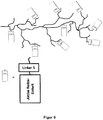
- oligomers or polymers according to claim 1 having a molecular weight of at least 400 g / mol, which contain the structural units of the formula I and which by functionalization according to the following Scheme have been prepared:
- a polymer base structure with a functional unit composed of linker 4 and redox-active unit is reacted to form a side chain oligomer or polymer.
- Preferred side-chain oligomers or polymers have linkers which have been generated by attachment via the reactive linker groups RG1 to RG12 described below to the polymer structures P10 to P21 described above:
- Preferred side chain oligomers or polymers have the redox-active moieties RE1 to RE6 described below which are covalently linked to the reactive linker groups RG1 to RG12.
- redox-active oligomers or polymers contain the combinations of polymer backbones P listed in the table below, which have been functionalized with reactive linker groups RG P10 to P12 RG1, RG4, RG5, RG7 to RG12 RE1 to RE6 P13 to P15 RG7 to RG12 RE1 to RE6 P16 RG2, RG7 to RG15 RE1 to RE6 P17 RG1, RG4, RG5, RG6, RG13 RE1 to RE6 P18 RG2, RG3, RG7 to RG13, RG15 RE1 to RE6 P19 to P20 RG1, RG4 to RG6, RG13 RE1 to RE6
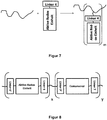
- the redox-active components with the structural unit of the formula IV are typically polymers with the in FIG. 8 illustrated structure.
- Preferably used oligomers or polymers with redox-active units on the main chain contain the redox-active units RE1-RE6 described below.
- the group of the redox-active unit RE1 includes substituted 4,4'-bipyridines (viologens) and their derivatives corresponding to the following structure: in which the substituents X 1 , X 2 , X 3 , X 4 , X 5 , X 6 , X 7 and X 8 independently of one another are hydrogen atoms, alkyl groups, alkenyl groups, alkynyl groups Alkynylcarbonyl groups, alkylcarboxylic ester groups, alkenylcarboxylic ester groups, alkynylcarboxylic acid ester groups, alkoxy groups, cycloalkyl groups, cycloalkoxy groups, aryl groups, heteroaryl groups, aryloxyl groups, aralkyl groups, halogen atoms, Cyano groups and / or nitro groups are, with the proviso that one or two of the binding sites X 1 , X 2 , X 3 , X 4
- the X substituents is 1, X 2, X 3, X 4, X 5, X 6, X 7 and X 8 independently of one another hydrogen atoms, halogen atoms, alkyl groups, alkoxy groups, cyano groups and / or nitro groups and one or two of the Binding sites X 1 , X 2 , X 3 , X 4 , X 5 , X 6 , X 7 and X 8 are bonded to one of the linker or polymerizable groups described above.
- Very particularly preferred redox-active units RE1 are those in which at least five of the substituents X 1 to X 8 are hydrogen atoms, 1-2 of the substituents Y1 and Y2 are binding sites that bind to one of the above-described linkers or polymerizable groups, and 0-2 the substituents X 1 to X 8 are non-hydrogen atoms, preferably halogen atoms, alkyl groups, alkoxy groups, cyano groups and / or nitro groups.
- the group of the redox-active unit RE2 includes compounds of the class of compounds of the quinones. These are preferably in which the substituents X 1 , X 2 , X 3 , X 4 , X 5 , X 6 , X 7 and X 8 independently of one another are hydrogen atoms, alkyl groups, alkenyl groups, alkynyl groups Alkynylcarbonyl groups, alkylcarboxylic ester groups, alkenylcarboxylic acid ester groups, alkynylcarboxylic ester groups, alkoxy groups, cycloalkyl groups, cycloalkoxy groups, aryl groups, heteroaryl groups, aryloxyl groups, aralkyl groups, halogen atoms, cyano groups and / or nitro groups, particularly preferably hydrogen atoms, halogen atoms, alkyl groups, alkoxy groups, cyano groups and / or nitro groups with the proviso that one or
- the X substituents is 1, X 2, X 3, X 4, X 5, X 6, X 7 and X 8 independently of one another hydrogen atoms, halogen atoms, alkyl groups, alkoxy groups, cyano groups and / or nitro groups and one or two of the Binding sites X 1 , X 2 , X 3 , X 4 , X 5 , X 6 , X 7 and X 8 are bonded to one of the linker or polymerizable groups described above.
- Very particularly preferred redox-active units RE2 are those in which at least two of the substituents X 1 to X 8 are hydrogen atoms, 1-2 of the substituents are binding sites that bind to one of the above-described linkers or polymerizable groups, and 0-2 of the substituents X 1 to X 8 are non-hydrogen atoms, preferably halogen atoms, alkyl groups, alkoxy groups, cyano groups and / or nitro groups.
- the substituents are X 1, X 2 and X 3 are independently hydrogen atoms, alkyl groups, aryl groups, heteroaryl and / or cycloalkyl groups and one or two of the binding sites of X 1, X 2 and X 3 are one of the linkers described above, or polymerizable groups bound.
- Very particularly preferred redox-active moieties RE3 are those in which 0-2 of the substituents X 1 to X 3 are alkyl groups or aryl groups, 1-2 of the substituents are bonding sites attached to one of those described above Linker or polymerizable groups bind, and 0-2 of the substituents X 1 to X 3 are hydrogen atoms, alkyl groups, aryl groups, heteroaryl groups and / or cycloalkyl groups.
- the radical Y is preferably a methylene group, a carbonyl group or a thioketone group.
- the group of the redox-active unit RE4 includes compounds of the class of nitryl nitroxide radicals and their derivatives corresponding to the following structure: wherein the substituents X 1 , X 2 , X 3 , X 4 and X 5 are independently hydrogen, alkyl, alkenyl, alkynyl, alkylthio, monoalkylamino, dialkylamino, haloalkyl, haloalkoxy, alkylcarbonyl, alkenylcarbonyl, alkynylcarbonyl, alkylcarboxylic, alkenylcarboxylic, alkynylcarboxylic, alkoxy groups, cycloalkyl groups, cycloalkoxy groups, aryl groups, heteroaryl groups, aryloxyl groups, aralkyl groups, halogen atoms, cyano groups and / or nitro groups, preferably hydrogen atoms, halogen atoms, alkyl groups, al
- the substituents X 1, X 2, X 3, X 4 and X 5 are independently hydrogen atoms, alkyl groups, aryl groups, heteroaryl groups, Aryloxyl groups, aralkyl groups, and / or alkoxy groups and one or two of X 1 , X 2 , X 3 , X 4 and X 5 are attached to one of the linker or polymerizable groups described above.
- the substituents are X 1, X 2, X 3 and X 4 are independently hydrogen atoms, alkyl groups, aryl groups, and / or alkoxy, X 5 represents an aryl group or a heteroaryl group, and one or two of the binding sites of X 1, X 2 , X 3 , X 4 and X 5 are bonded to one of the linker or polymerizable groups described above.
- Very particularly preferred redox-active units RE4 are those in which at least two of the substituents X 1 to X 5 are alkyl groups, 1-2 of the substituents are binding sites that bind to one of the above-described linkers or polymerizable groups, and 0-5 of the substituents X 1 to X 5 are hydrogen atoms or non-hydrogen atoms, preferably alkyl groups, aryl groups, heteroaryl groups, aryloxy groups, aralkyl groups, and / or alkoxy groups.
- the substituents X1 to X4 are alkyl groups and the substituent X5 is an aryl group, aralkyl group and / or a binding site which binds to any of the linker or polymerizable groups described above.
- the group of the redox-active unit RE5 includes compounds of the class of nitroxide radicals and their derivatives, as described in US Pat DE60123145T2 (NEC Corp., Tokyo, 2007), according to the following structure: wherein X 1 and X 2 are substituents of which at least one of an aliphatic group, an aromatic group, a hydroxy, an alkoxy, an aldehyde, a carboxyl, an alkoxycarbonyl, a cyan, an amino, a nitro, a nitroso, a halogen or a hydrogen, wherein when X 1 and X 2 have an aliphatic group, the aliphatic group is saturated and unsaturated, substituted or unsubstituted, straight, cyclic or branched, and at least one aliphatic group Oxygen, nitrogen, sulfur, silicon, phosphorus, boron or halogen atom, wherein when X 1 and X 2 have an aromatic group, the aromatic group may be substituted or
- the compound may form a substituted or an unsubstituted heterocycle corresponding to the following general structure: wherein Z is selected from the group of carbon, oxygen, nitrogen, sulfur, silicon, phosphorus or boron atoms, a plurality of Zs may be the same or different and Z is a saturated or unsaturated bond to one of those described above Linker or polymerizable groups is bonded.
- Z may form a bond with each substituent, which compound may be a polymer which may be straight, cyclic or branched.
- Z can be substituted, for example, by hydrogen atoms, alkyl groups, alkenyl groups, alkynyl groups, alkylthio groups, monoalkylamino groups, dialkylamino groups, haloalkyl groups, haloalkoxy groups, alkylcarbonyl groups, alkenylcarbonyl groups, alkynylcarbonyl groups, alkylcarboxylic ester groups, alkenylcarboxylic ester groups, alkynylcarboxylic ester groups, alkoxy groups, cycloalkyl groups, cycloalkoxy groups, aryl groups, heteroaryl groups, aryloxyl groups, aralkyl groups, Be bonded to halogen atoms, cyano groups or nitro groups.
- Index n is an integer from 2 to 10 inclusive.
- a compound belonging to the group of the redox-active unit RE5 may have a piperidinoxyl ring structure corresponding to the following general structure: where the substituents X 1 , X 2 , X 3 , X 4 and Y independently of one another are hydrogen atoms, alkyl groups, groups, cycloalkyl groups, cycloalkoxy groups, aryl groups, heteroaryl groups, aryloxyl groups, aralkyl groups, halogen atoms, cyano groups and / or nitro groups, preferably hydrogen atoms, halogen atoms, alkyl groups, alkoxy groups, cyano groups and / or nitro groups, with the proviso that one or two of the binding sites X 1 , X 2 , X 3 , X 4 and Y are bonded to one of the above-described linker or polymerizable groups.
- Preferred substituents X 1 , X 2 , X 3 and X 4 are hydrogen atoms, alkyl groups, aryl groups, heteroaryl groups, aryloxy groups, aralkyl groups and / or Alkoxy groups, provided that one or two of the X 1 , X 2 , X 3 and X 4 binding sites are attached to one of the linker or polymerizable groups described above.
- substituents X 1, X 2, X 3 and X 4 are aryl groups, alkyl groups and / or alkoxy and Y are bound via one of the linkers described above, or polymerizable groups.
- a compound belonging to the group of the redox-active unit RE5 can have a pyrrolidinoxyl ring structure corresponding to the following general structure: wherein the substituents X 1 , X 2 , X 3 , X 4 and Y independently of one another are hydrogen atoms, alkyl groups Alkoxy groups, cycloalkyl groups, cycloalkoxy groups, aryl groups, heteroaryl groups, aryloxyl groups, aralkyl groups, halogen atoms, cyano groups and / or nitro groups, particularly preferably hydrogen atoms, halogen atoms, alkyl groups, alkoxy groups, cyano groups and / or nitro groups, with the proviso that one or two of the binding sites X 1 , X 2 , X 3 , X 4 and Y are bonded to one of the above-described linker or polymerizable groups.
- Preferred substituents X 1 , X 2 , X 3 , X 4 and Y are hydrogen atoms, alkyl groups, aryl groups, heteroaryl groups, aryloxyl groups, aralkyl groups and / or alkoxy groups, with the proviso that one or two of the binding sites X 1 , X 2 , X 3 , X 4 and Y are bonded to one of the above-described linker or polymerizable groups.
- substituents X 1, X 2, X 3 and X 4 are aryl groups, alkyl groups and / or alkoxy and Y are bound via one of the linkers described above, or polymerizable groups.
- a compound belonging to the group of the redox-active unit RE5 may have a pyrrolinoxyl ring structure corresponding to the following general structure: wherein the substituents X 1 , X 2 , X 3 , X 4 and Y independently of one another represent hydrogen atoms, alkyl groups, alkenyl groups, alkynyl groups, alkylthio groups, monoalkylamino groups, dialkylamino groups, haloalkyl groups, haloalkoxy groups, alkylcarbonyl groups, alkenylcarbonyl groups, alkynylcarbonyl groups, alkylcarboxylic ester groups, alkenylcarboxylic ester groups, alkynylcarboxylic ester groups, alkoxy groups, Cycloalkyl groups, cycloalkoxy groups, aryl groups, heteroaryl groups, aryloxy groups, aralkyl groups, halogen atoms, cyano groups and / or
- Preferred substituents X 1 , X 2 , X 3 , X 4 and Y are hydrogen atoms, alkyl groups, aryl groups, heteroaryl groups, aryloxyl groups, aralkyl groups and / or alkoxy groups, with the proviso that one or two of the binding sites X 1 , X 2 , X 3 , X 4 and Y are attached to one of the above-described linker or polymerizable groups.
- substituents X 1, X 2, X 3 and X 4 are aryl groups, alkyl groups and / or alkoxy and Y are bound via one of the linkers described above, or polymerizable groups.
- these unsymmetrically substituted nitroxide radicals RE5 are those in which 1-2 of the substituents X 1 to X 4 bond sites that bind to one of the linkers or polymerizable groups described above, and 1-4 of the substituents X 1 to X 4 Non-hydrogen atoms, preferably Aryl groups, alkyl groups, cycloalkyl groups, cycloalkoxy groups, heteroaryl groups, aryloxy groups, aralkyl groups and / or alkoxy groups.
- a compound belonging to the group of the redox-active unit RE5 may have an unsymmetrically substituted nitroxide radical corresponding to the following general structure: wherein the substituents X 1 to X 6 are each independently hydrogen atoms, alkyl groups, alkenyl groups, alkynyl groups, alkylthio groups, monoalkylamino, dialkylamino, haloalkyl, haloalkoxy, alkylcarbonyl, alkenylcarbonyl groups, Alkinylcarbonyl prevalence, Alkylcarbonklareester tendency, Alkenylcarbonklareester tendency, Alkinylcarbonklar tendency, alkoxy groups, cycloalkyl groups, cycloalkoxy groups, aryl groups, Heteroaryl groups, aryloxyl groups, aralkyl groups, halogen atoms, cyano groups and / or nitro groups, preferably aryl groups, alkyl groups, cycloalkyl
- these unsymmetrically substituted nitroxide radicals RE5 are those in which 1-2 of the substituents X 1 to X 6 bond sites that bind to one of the linker or polymerizable groups described above, and 1-6 of the substituents X 1 to X 6 are non-hydrogen atoms, preferably aryl groups, alkyl groups, cycloalkyl groups, cycloalkoxy groups, heteroaryl groups, aryloxy groups, aralkyl groups and / or alkoxy groups.
- the group of the redox-active unit RE6 includes substituted Bordipyrromethene (BODIPY) and their derivatives according to the following structure (see DE102012015176 , Technical University Braunschweig Carolo-Wilhelmina): wherein the substituents X 1 , X 2 , X 3 , X 4 , X 5 , X 6 , X 7 , Z 1 and Z 2 are independently hydrogen, alkyl, alkenyl, alkynyl, alkylthio, monoalkylamino, dialkylamino, haloalkyl, haloalkoxy, alkylcarbonyl, alkenylcarbonyl , Alkynylcarbonyl groups, alkylcarboxylic ester groups, alkenylcarboxylic ester groups, alkynylcarboxylic acid ester groups, alkoxy groups, cycloalkyl groups, cycloalkoxy groups, aryl groups, heteroaryl groups
- the X substituents is 1, X 2, X 3, X 4, X 5, X 6 and X 7 are independently hydrogen atoms, alkyl groups, alkenyl groups, monoalkylamino groups, dialkylamino groups, haloalkyl groups, haloalkoxy groups, alkylcarbonyl groups, Alkylcarbonklareester phenomenon, Alkenylcarbonklareester phenomenon, alkoxy groups, cycloalkyl groups , Cycloalkoxy groups, aryl groups, heteroaryl groups, aryloxy groups, aralkyl groups, halogen atoms, cyano groups, sulfonate groups and / or nitro groups and one or two of the X 1 , X 2 , X 3 , X 4 , X 5 , X 6 and X 7 bonding sites are attached to one of bonded linker or polymerizable groups described above.
- the substituents Z 1 and Z 2 are particularly preferably independently of one another halogen atoms, very particularly preferably fluorine, or preferably aryl groups, heteroaryl groups, aryloxyl groups, aralkyl groups, alkenyl groups, alkynyl groups.
- these redox-active components RE6 are those in which, 1-2 of the substituents X 1 to X 7 bond sites that bind to one of the linker or polymerizable groups described above, and 0-6, most preferably 0-2, the Substituents X 1 to X 7 are hydrogen atoms, and 1-7, more preferably 5-7, of substituents X 1 to X 7 non-hydrogen atoms, preferably alkyl groups, alkenyl groups, monoalkylamino groups, dialkylamino groups, haloalkyl groups, haloalkoxy groups, alkylcarbonyl groups, alkylcarboxylic ester groups, alkenylcarboxylic ester groups , Alkoxy groups, cycloalkyl groups, cycloalkoxy groups, aryl groups, heteroaryl groups, aryloxy groups, aralkyl groups, halogen atoms, cyano groups, sulfonate groups and / or nitro
- n is defined as normal, i as iso, s as secondary, t as tertiary, c as cyclo, m as meta, p as para and o as ortho.
- an alkyl group may be both branched and unbranched.
- An alkyl group typically consists of one to thirty carbon atoms, preferably from one to twenty carbon atoms.
- Examples of an alkyl group are: methyl group, ethyl group, propyl group, isopropyl group, n-butyl group, sec-butyl group, tert -butyl group, pentyl group, n-hexyl group, n-heptyl group, 2-ethylhexyl group, n-octyl group, n-nonyl group, n Decyl, n-undecyl, n-dodecyl, n-tridecyl, n-tetradecyl, n-pentadecyl, n-hexadecyl, n-heptadecyl, n-octadecyl, n-nona
- an alkenyl group may be both branched and unbranched.
- An alkenyl group typically consists of two to thirty carbon atoms, preferably from two to twenty carbon atoms.
- Alkenyl groups typically have an unsaturated ethenylic group Double bond, the remaining portion of the alkenyl group is saturated. Two or more ethenylic unsaturated double bonds are possible. Most preferably, the unsaturated ethenylic double bond is at the alpha position of the alkenyl group.
- alkenyl groups are: vinyl group, allyl group, propenyl group, isopropenyl group, n-butenyl group, sec-butenyl group, pentenyl group, n-hexenyl group, n-heptenyl group, 2-ethylhexenyl group, n-octenyl group, n-nonenyl group, n-decenyl group, n- Undecenyl, n-dodecenyl, n-tridecenyl, n-tetradecenyl, n-pentadecenyl, n-hexadecenyl, n-heptadecenyl, n-octadecenyl, n-nonadecenyl or eicosenyl.
- an alkynyl group may be both branched and unbranched.
- An alkynyl group typically consists of two to thirty carbon atoms, preferably from two to twenty carbon atoms.
- Alkynyl groups typically have an unsaturated ethynylic triple bond, the remaining portion of the alkynyl group is saturated. Two or more ethynylic unsaturated triple bonds are possible but not preferred. Most preferably, the unsaturated ethynylic double bond is at the alpha position of the alkynyl group.
- alkynyl groups are: ethynyl group, propynyl group, butynyl group, pentynyl group, n-hexynyl group, n-heptinyl group, 2-ethylhexynyl group, n-octynyl group, n-nonynyl group, n-decynyl group, n-undecynyl group, n-dodecynyl group, n-tridecinyl group, n Tetradecinyl group, n-pentadecinyl group, n-hexadecinyl group, n-heptadecinyl group, n-octadecinyl group, n-nonadecinyl group or eicosinyl group.
- an alkylthio group may be both branched and unbranched.
- An alkylthio group typically consists of one to thirty carbon atoms and one or more sulfur atoms covalently bonded to two carbon atoms of the chain, preferably from one to twenty carbon atoms and one sulfur atom.
- alkylthio groups are methylthio group, ethylthio group, n-propylthio group, i-propylthio group, n-butylthio group, s-butylthio group, t-butylthio group, n-pentylthio group, 1-methylbutylthio group, 2-methylbutylthio group, 3-methylbutylthio group, 1,1-dimethylpropylthio group, 2, 2-dimethylpropylthio group, n-hexylthio group, 1-methylpentylthio group, 2-methylpentylthio group, 1,1-dimethylbutylthio group, 1-ethylbutylthio group, 1,1,2-trimethylpropylthio group, n-heptylthio group, n-octylthio group, 2-ethylhexylthio group, n-nonylthio group, n-
- a monoalkylamino group may be both branched and unbranched.
- a monoalkylamino group typically consists of one to thirty carbon atoms and one or more nitrogen atoms covalently bonded to two carbon atoms of the chain, preferably from one to twenty carbon atoms and one nitrogen atom.
- Examples of monoalkylamino groups are: methylamino, ethylamino, n-propylamino, i-propylamino, c-propylamino, n-butylamino, i-butylamino, s-butylamino, t-butylamino, c-butylamino, 1-methyl-c-propylamino, 2 Methyl-c-propylamino group, n-pentylamino group, 1-methyl-n-butylamino group, 2-methyl-n-butylamino group, 3-methyl-n-butylamino group, 1,1-dimethyl-n-propylamino group, 1,2-dimethyl n-propylamino group, 2,2-dimethyl-n-propylamino group, 1-ethyl-n-propylamino group, c-pentylamino group, 1-methyl-c-butylamino group,
- a dialkylamino group may be both branched and unbranched.
- a dialkylamino group typically consists of one to thirty carbon atoms and one or more nitrogen atoms covalently bonded to three carbon atoms of the chain, preferably from one to twenty carbon atoms and one nitrogen atom.
- dialkylamino groups are: di-i-propylamino group, di-c-propylamino group, di-n-butylamino group, di-i-butylamino group, di-s-butylamino group, di-t-butylamino group, di-c-butylamino group, di- ( 1-methyl-c-propyl) amino group, di (2-methyl-c-propyl) amino group, di-n-pentylamino group, di (1-methyl-n-butyl) amino group, di (2-methyl-n -butyl) amino group, di- (3-methyl-n-butyl) amino group, di (1,1-dimethyl-n-propyl) amino group, di (1,2-dimethyl-n-propyl) amino group, di- (2,2-dimethyl-n-propyl) amino group, di- (1-ethyl-n-propyl) amino group, di-c-pentylamino group,
- a haloalkyl group may be both branched and unbranched.
- a haloalkyl group typically consists of one to thirty carbon atoms, which in turn may be independently substituted with one or more halogen atoms, preferably from one to twenty carbon atoms.
- halogen atoms are fluorine atom, chlorine atom, bromine atom and iodine atom. Preferred are the fluorine atom and the chlorine atom.
- haloalkyl groups are: trifluoromethyl group, difluoromethoxy group, trifluoromethoxy group, bromodifluoromethoxy group, 2-chloroethoxy group, 2-bromoethoxy group, 1,1-difluoroethoxy group, 2,2,2-trifluoroethoxy group, 1,1,2,2-tetrafluoroethoxy group, 2-chloro -1,1,2-trifluoroethoxy group, pentafluoroethoxy group, 3-bromopropoxy group, 2,2,3,3-tetrafluoropropoxy group, 1,1,2,3,3,3-hexafluoropropoxy group, 1,1,1,3,3,3 Hexafluoropropoxy group, 3-bromo-2-methylpropoxy group, 4-bromobutoxy group, perfluoropentyloxy group.
- a haloalkoxy group may be both branched and unbranched.
- a haloalkoxy group typically consists of an oxygen atom to which is covalently bonded a chain consisting of one to thirty carbon atoms and which may be both branched and unbranched and the carbon atoms of which may in turn be independently substituted with one or more halogen atoms.
- this chain consists of one to twenty carbon atoms.
- halogen atoms are fluorine atom, chlorine atom, bromine atom and iodine atom. Preferred are the fluorine atom and the chlorine atom.
- haloalkoxyl groups are: difluoromethoxyl group, trifluoromethoxyl group, bromodifluoromethoxyl group, 2-chloroethoxyl group, 2-bromoethoxyl group, 1,1-difluoroethoxyl group, 2,2,2-trifluoroethoxyl group, 1,1,2,2-tetrafluoroethoxyl group, 2-chloro-1,1 , 2-trifluoro-ethoxyl group, pentafluoroethoxyl group, 3-bromopropoxyl group, 2,2,3,3-tetrafluoropropoxyl group, 1,1,2,3,3,3-hexafluoropropoxyl group, 1,1,1,3,3,3-hexafluoropropoxyl group , 3-bromo-2-methylpropoxyl group, 4-bromobutoxyl group, perfluoropentoxyl group.
- alkylcarbonyl group in this specification typically consists of a carbonyl carbon to which an alkyl group consisting of one to thirty carbon atoms is covalently bonded and which may be both branched and unbranched.
- this chain consists of one to twenty Carbon atoms.
- alkylcarbonyl groups are: methylcarbonyl group, ethylcarbonyl group, n-propylcarbonyl group, i-propylcarbonyl group, c-propylcarbonyl group, n-butylcarbonyl group, i-butylcarbonyl group, s-butylcarbonyl group, t-butylcarbonyl group, c-butylcarbonyl group, 1-methyl-c-propylcarbonyl group, 2 Methyl-c-propylcarbonyl group, n-pentylcarbonyl group, 1-methyl-n-butylcarbonyl group, 2-methyl-n-butylcarbonyl group, 3-methyl-n-butylcarbonyl group, 1,1-dimethyl-n-propylcarbonyl group, 1,2-dimethyl n-propylcarbonyl group, 2,2-dimethyl-n-propylcarbonyl group, 1-ethyl-n-propyl
- alkenylcarbonyl group in this specification typically consists of a carbonyl carbon to which an alkenyl group consisting of two to thirty carbon atoms is covalently bonded and which may be both branched and unbranched.
- this chain consists of two to twenty carbon atoms.
- alkenylcarbonyl groups are: ethenylcarbonyl group, 1-propenylcarbonyl group, 2-propenylcarbonyl group, 1-methyl-1-ethenylcarbonyl group, 1-butenylcarbonyl group, 2-butenylcarbonyl group, 3-butenylcarbonyl group, 2-methyl-1-propenylcarbonyl group, 2-methyl-2-propenylcarbonyl group , 1-ethylethenylcarbonyl group, 1-methyl-1-propenylcarbonyl group, 1-methyl-2-propenylcarbonyl group, 1-pentenylcarbonyl group, 2-pentenylcarbonyl group, 3-pentenylcarbonyl group, 4-pentenylcarbonyl group, 1-n-propylethenylcarbonyl group, 1-methyl-1-butenylcarbonyl group , 1-methyl-2-butenylcarbonyl group, 1-methyl-3-butenylcarbonyl group, 2-ethyl-2-prop
- An alkynylcarbonyl group in this specification typically consists of a carbonyl carbon to which an alkynyl group consisting of two to thirty carbon atoms is covalently bonded and which may be both branched and unbranched.
- this chain consists of two to twenty carbon atoms.
- alkynylcarbonyl groups are: ethynylcarbonyl group, 1-propynylcarbonyl group, 2-propynylcarbonyl group, 1-butynylcarbonyl group, 2-butynylcarbonyl group, 3-butynylcarbonyl group, 1-methyl-2-propynylcarbonyl group, 1-pentynylcarbonyl group, 2-pentynylcarbonyl group, 3-pentynylcarbonyl group, 4-pentynylcarbonyl group , 1-methyl-2-butynylcarbonyl group, 1-methyl-3-butynylcarbonyl group, 2-methyl-3-butynylcarbonyl group, 3-methyl-1-butynylcarbonyl group, 1,1-dimethyl-2-propynylcarbonyl group, 2-ethyl-2-propynylcarbonyl group , 1-hexynilcarbonyl group, 2-hexynilecarbonyl
- An alkylcarboxylic acid ester group in this specification typically consists of a carboxylic acid ester to which an alkyl group consisting of one to thirty carbon atoms is covalently bonded and which may be both branched and unbranched. Preferably, this chain consists of one to twenty carbon atoms.
- alkylcarboxylic ester groups are: methylcarboxylic ester group, ethylcarboxylic ester group, n-propylcarboxylic acid ester group, i-propylcarboxylic acid ester group, c-propylcarboxylic acid ester group, n-butylcarboxylic ester group, i-butylcarboxylic ester group, s-butylcarboxylic ester group, t-butylcarboxylic ester group, c-butylcarboxylic ester group, 1-methyl-c-propylcarboxylic ester group, 2 Methyl-c-propylcarboxylic acid ester group, n-pentylcarboxylic acid ester group, 1-methyl-n-butylcarboxylic ester group, 2-methyl-n-butylcarboxylic acid ester group, 3-methyl-n-butylcarboxylic acid ester group, 1,
- alkenylcarboxylic acid ester group in this specification typically consists of a carboxylic acid ester having an alkenyl group consisting of two to to thirty carbon atoms, covalently bonded and which may be both branched and unbranched. Preferably, this chain consists of two to twenty carbon atoms.
- alkenylcarboxylic ester groups are: ethenylcarboxylic ester group, 1-propenylcarboxylic ester group, 2-propenylcarboxylic ester group, 1-methyl-1-ethenylcarboxylic ester group, 1-butenylcarboxylic ester group, 2-butenylcarboxylic ester group, 3-butenylcarboxylic ester group, 2-methyl-1-propenylcarboxylic ester group, 2-methyl-2-propenylcarboxylic acid ester group , 1-ethylethenylcarboxylic ester group, 1-methyl-1-propenylcarboxylic ester group, 1-methyl-2-propenylcarboxylic ester group, 1-pentenylcarboxylic ester group, 2-pentenylcarboxylic ester group, 3-pentenylcarboxylic ester group, 4-pentenylcarboxylic ester group, 1-n-propylethenylcarbox
- alkynylcarboxylic ester group in this specification typically consists of a carboxylic acid ester to which an alkynyl group consisting of from two to thirty carbon atoms is covalently bonded and which may be both branched and unbranched.
- this chain consists of two to twenty carbon atoms.
- alkynylcarboxylic ester groups are: ethynylcarboxylic acid ester group, 1-propynylcarboxylic acid ester group, 2-propynylcarboxylic ester group, 1-butynylcarboxylic ester group, 2-butynylcarboxylic ester group, 3-butynylcarboxylic ester group, 1-methyl-2-propynylcarboxylic ester group, 1-pentynylcarboxylic ester group, 2-pentynylcarboxylic ester group, 3-pentynylcarboxylic ester group, 4- Pentynylcarboxylic ester group, 1-methyl-2-butynylcarboxylic ester group, 1-methyl-3-butynylcarboxylic ester group, 2-methyl-3-butynylcarboxylic ester group, 3-methyl-1-butynylcarboxylic ester group, 1,1-dimethyl-2-
- an alkoxy group may consist of an alkyl moiety, which may be both branched and unbranched.
- An alkoxy group typically consists of one to a thousand carbon atoms, preferably from one to ten thousand carbon atoms.
- An alkoxy group also typically consists of one to a thousand oxygen atoms, preferably from one to two hundred oxygen atoms.
- alkoxy groups are: methoxy group, Ethoxy group, isopropoxy group, n-butoxy group, sec-butoxy group, tert-butoxy group, pentyloxy group, n-hexyloxy group, n-heptyloxy group, 2-ethylhexyloxy group, n-octyloxy group, n-nonyloxy group, n-decyloxy group, n-tridecyloxy group, n- Tetradecyloxy group, n-pentadecyloxy group, n-hexadecyloxy group, n-octadecyloxy group, eicosyloxy group, diethylene glycol group, triethylene glycol group, polyethylene glycol groups or polyethylene oxide groups.
- alkoxy groups having one to six carbon atoms and one to four oxygen atoms in the alkyl moiety
- polyethylene glycol groups and polyethylene oxide groups having from twenty five to five hundred carbon atoms and fifteen to four hundred oxygen atoms in the alkyl moiety.
- a cycloalkyl group as described in this specification is typically a cyclic group consisting of five, six or seven carbon atoms, each of which may be independently substituted. Examples of these are alkyl groups or two alkyl groups, which form another ring together with the ring carbons to which they are attached. An example of a cycloalkyl group is a cyclohexyl group.
- a cycloalkoxy group as described in this specification is typically a cyclic group consisting of five, six or seven carbon atoms of which at least one is covalently bonded to an oxygen atom. These ring carbon atoms may each be independently substituted, for example, with alkyl groups or two alkyl groups which form another ring together with the ring carbons to which they are attached.
- An example of a cycloalkoxy group is a cyclohexyloxy group.
- An aryl group as described in this specification is typically a cyclic aromatic group consisting of five to fourteen carbon atoms, each of which may be independently substituted. Examples of these are alkyl groups or two alkyl groups, together with the ring carbons, to to which they are bound form another ring. Examples of an aryl group are phenyl, o-biphenylyl, m-biphenylyl, p-biphenylyl, 1-anthryl, 2-anthryl, 9-anthryl, 1-phenantolyl, 2-phenantolyl, 3-phenantolyl, 4-phenantolyl, 9-phenantolyl ,
- a heteroaryl group as described in this specification is typically a cyclic aromatic group consisting of four to ten carbon atoms and at least one ring heteroatom, each of which may be independently substituted. Examples of these are alkyl groups, or two alkyl groups which together with the ring carbons to which they are attached form another ring. Examples of heteroatoms here are an oxygen atom, nitrogen atom, phosphorus atom, boron atom, selenium atom or a sulfur atom. Examples of a heteroaryl group are furyl group, thienyl group, pyrrolyl group or imidazolyl group.
- An aryloxy group as described in this specification is typically an aryl group, with aryl previously defined which is covalently bonded to an oxygen atom.
- Examples of an aryloxyl group are phenyloxyl or naphthyloxyl.
- An aralkyl group as described in this specification is typically an aryl group wherein aryl has previously been defined which is covalently bonded to an alkyl group. This group may for example be substituted by alkyl groups or halogen atoms.
- An example of an aralyl group is benzyl.
- a halogen atom may be a covalently bonded fluorine, chlorine, bromine or iodine atom.
- the polymers containing redox-active components can be present as linear polymers or as branched polymers or as hyperbranched polymers, for example as comb or star polymers, dendrimers, ladder polymers, ring-shaped polymers, polycatenanes or polyrotaxanes.
- branched and highly branched polymers in particular comb or star polymers, dendrimers, ladder polymers, ring-shaped polymers, polycatenanes or polyrotaxanes. These types are characterized by an increased solubility and the viscosity of the solutions obtained is generally lower than that of corresponding linear polymers.
- the polymers are used in dissolved form.
- they may also be in gel form, in particular as nano- or microgel (i.e., crosslinked swollen polymer particles), as a particle suspension, in particular nanoparticles, as micelles, as an emulsion.
- the viscosity of the electrolyte used according to the invention is typically in the range from 1 mPas to 10 6 mPas, particularly preferably 10 2 to 10 4 mPas (measured at 25 ° C. with a rotational viscometer, plate / plate).
- solubility of the polymers containing redox-active components used according to the invention is achieved by co-polymerization or functionalization, e.g. with polyethylene glycol, polymethacrylic acid, polyacrylic acid, poly-2-methyloxazoline or polystyrenesulfonate.
- the preparation of the redox-active components used according to the invention can be carried out using the customary polymerization processes. Examples of these are the bulk polymerization, the polymerization in solution, the precipitation polymerization or the emulsion or suspension polymerization and also polymer-analogous functionalizations. The person skilled in these procedures are known.
- the redox flow cell according to the invention may contain, in addition to the components described above, further elements or components customary for such cells.
- the foregoing components of the electrolyte may be combined in any manner with the aforementioned redox-active components.
- the following conductive salts are used: LiPF 6 , LiBF 4 , NaBF 4 , NaPF 6 , NaClO 4 , NaSO 3 CF 3 , LiSO 3 CF 3 , (CH 3 ) 4 NOH, n-Bu 4 NOH, (CH 3 ) 4 NCl, n-Bu 4 NCl, n-Bu 4 NPF 6 , n-Bu 4 NBF 4 , n-Bu 4 NClO 4 .
- the following conductive salts are used: NaCl, KCl, NaClO 4 , NaOH, KOH, Na 3 PO 4 , K 3 PO 4 , Na 2 SO 4 , K 2 SO 4 , NaSO 3 CF 3 , LiSO 3 CF 3 .
- Coated electrode materials may employ the following known coating techniques: chemical vapor deposition (CVD), physical vapor deposition (PVD), electrodeposition, electroless plating from a liquid solution containing the metal in dissolved form and a reducing agent, and wherein the reducing agent controls the deposition of the catalyst desired metal on a surface causes.
- CVD chemical vapor deposition
- PVD physical vapor deposition
- electrodeposition electroless plating from a liquid solution containing the metal in dissolved form and a reducing agent, and wherein the reducing agent controls the deposition of the catalyst desired metal on a surface causes.
- the redox flow cells according to the invention contain current arresters as a further component. This has the task to produce the best possible electrical contact between the electrode material and the external power source or current sink.
- aluminum, aluminum alloys, stainless steel, Hastelloy, iron-chromium-nickel alloys, noble metal-coated titanium or tantalum, in particular platinum and / or iridium and / or ruthenium oxide coated titanium, niobium, Tantalum, hafnium, zirconium can be used.
- CVD chemical vapor deposition
- PVD physical vapor deposition
- electrodeposition electroless deposition from a liquid solution containing the metal in dissolved form and a reducing agent and wherein the reducing agent, the deposition of the desired metal on a Surface causes.
- the redox flow cell according to the invention can be used in a wide variety of fields. In the broadest sense, this can be the storage of electrical energy for mobile and stationary applications.
- the invention also relates to the use of the redox flow cell for these purposes.
- Examples of applications include electric mobility applications such as land vehicle, aerospace and marine storage, stationary backup storage, peak load balancing, and intermediate storage of electricity from renewable energy sources, particularly in the photovoltaic sector and wind power, from gas, coal, biomass, tidal, and marine power plants.
- electric mobility applications such as land vehicle, aerospace and marine storage, stationary backup storage, peak load balancing, and intermediate storage of electricity from renewable energy sources, particularly in the photovoltaic sector and wind power, from gas, coal, biomass, tidal, and marine power plants.
- the redox flow cell according to the invention is preferably used as stationary storage for electrical energy.
- the redox flow cells according to the invention can be interconnected in a manner known per se in a serial or parallel manner.
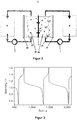
- FIG. 1 a redox flow cell according to the invention is shown as a basic circuit.
- the redox flow cell consists of two identical half-cells (1) and (2) produced as Teflon hollow bodies, the half cell (1) acting as the anolyte chamber and the half cell (2) as the catholyte chamber.
- the half-cells (1) and (2) As materials for the half-cells (1) and (2), other plastics (such as polypropylene, polyethylene and other, for example, under http://www.polyquick.de/DE/êt/ mentioned plastics and polymers) or metals for Application come.
- the two half-cells (1, 2) (shown in an exploded view for reasons of clarity) are connected via a size-exclusion membrane (3) here with an exclusion limit of 1000 g / mol.
- Each half cell (1, 2) has a Zuläufstutzen (4) and a discharge nozzle (5) via which the half-cells (1, 2) are connected by means of hoses in each case to a storage vessel (liquid storage), the anolyte or the catholyte for the corresponding half-cell (1) or (2) included (not shown in the drawing for reasons of clarity).
- the anolyte or catholyte is (in each case as a separate liquid circuit through the half-cells (1) and (2) of the redox flow cell) by a (also not shown for reasons of clarity) pump from the respective storage vessel during the charging / discharging by the corresponding half cell (1) or (2) pumped (indicated by arrow representations at the inlet and outlet nozzles (4, 5)).
- Each half-cell (1, 2) has in each case an internal electrode made of graphite / graphite felt, on each of which a known electrode reaction takes place in the half-cell (1, 2).
- These internal electrodes are each led out as a polarity-dependent current conductor (6) for the electrical connection from the half-cells (1, 2).
- the anode compartment was connected to a storage tank filled with a solution of 200 mg of Polymer A dissolved in a solution of tetrabutylammonium hexafluorophosphate in propylene carbonate (0.5 mol / L).
- the cathode compartment was connected to a storage tank filled with a solution of 200 mg of Polymer B dissolved in a solution of tetrabutylammonium hexafluorophosphate in propylene carbonate (0.5 mol / L).
- the solutions were purged with argon (inert gas) to remove oxygen and a slight stream of argon was passed over the solutions during operation of the cell.
- the solutions were recirculated by means of a peristaltic pump in the circuit between the storage tanks and the redox flow cell.
- Graphite electrodes were used as current conductors in the redox flow cell and graphite fleece as the electrode material.
- For charging a constant current of 10 mA was applied, with a charging limit voltage of 1.6 V was used.
- For discharging a constant current of 2 mA was applied, using a discharge limit voltage of 0.5V.
- FIG. 3 exemplary charge / discharge curves of this cell are shown.
- the membrane was installed in the redox flow cell so that it separates the space of the anode from the space of the cathode.
- the anode compartment was connected to a storage tank which with a solution of 200 mg of polymer C dissolved in a solution of sodium chloride in water (0.5 mol / L).
- the cathode compartment was connected to a storage tank filled with a solution of 200 mg of Polymer B dissolved in a solution of sodium chloride in water (0.5 mol / L).
- the solutions were purged with argon (inert gas) to remove oxygen and a slight stream of argon was passed over the solutions during operation of the cell.
- the solutions were recirculated by means of a peristaltic pump in the circuit between the storage tanks and the redox flow cell.
- Graphite electrodes were used as current conductors in the redox flow cell and graphite fleece as the electrode material.
- For charging a constant current of 10 mA was applied, with a charging limit voltage of 1.5 V was used.
- For discharge a constant current of 2 mA was applied, using a discharge limit voltage of 0.7V.
- the solvent was removed in vacuo.
- the product precipitates as a reddish solid having a molecular weight of 15,000 g / mol (number average determined by size exclusion chromatography, polystyrene standard).
- the product precipitates as an orange colored solid having a molecular weight of 18,000 g / mol (number average determined by size exclusion chromatography, polystyrene standard).
- the solution was frozen and lyophilized.
- the product is obtained as a readily water-soluble solid having a molecular weight of 18,000 g / mol (determined by analytical ultracentrifugation).
Landscapes
- Chemical & Material Sciences (AREA)
- Chemical Kinetics & Catalysis (AREA)
- Electrochemistry (AREA)
- General Chemical & Material Sciences (AREA)
- Life Sciences & Earth Sciences (AREA)
- Engineering & Computer Science (AREA)
- Manufacturing & Machinery (AREA)
- Sustainable Development (AREA)
- Sustainable Energy (AREA)
- Fuel Cell (AREA)
- Addition Polymer Or Copolymer, Post-Treatments, Or Chemical Modifications (AREA)
- Inert Electrodes (AREA)
Priority Applications (3)
| Application Number | Priority Date | Filing Date | Title |
|---|---|---|---|
| SI201530177T SI2997613T1 (en) | 2014-02-13 | 2015-02-07 | Redox flow cell for storing electrical energy and use thereof |
| HRP20180261TT HRP20180261T1 (hr) | 2014-02-13 | 2015-02-07 | Redoks-protočna ćelija za pohranu električne energije i njezina uporaba |
| PL15705198T PL2997613T3 (pl) | 2014-02-13 | 2015-02-07 | Przepływowe ogniwo akumulatorowe redoks do magazynowania energii elektrycznej i jego zastosowanie |
Applications Claiming Priority (2)
| Application Number | Priority Date | Filing Date | Title |
|---|---|---|---|
| DE102014001816.4A DE102014001816A1 (de) | 2014-02-13 | 2014-02-13 | Redox-Flow-Zelle zur Speicherung elektrischer Energie und deren Verwendung |
| PCT/EP2015/000261 WO2015120971A1 (de) | 2014-02-13 | 2015-02-07 | Redox-flow-zelle zur speicherung elektrischer energie und deren verwendung |
Publications (2)
| Publication Number | Publication Date |
|---|---|
| EP2997613A1 EP2997613A1 (de) | 2016-03-23 |
| EP2997613B1 true EP2997613B1 (de) | 2017-11-22 |
Family
ID=52484427
Family Applications (1)
| Application Number | Title | Priority Date | Filing Date |
|---|---|---|---|
| EP15705198.8A Active EP2997613B1 (de) | 2014-02-13 | 2015-02-07 | Redox-flow-zelle zur speicherung elektrischer energie und deren verwendung |
Country Status (12)
| Country | Link |
|---|---|
| EP (1) | EP2997613B1 (pl) |
| DE (1) | DE102014001816A1 (pl) |
| DK (1) | DK2997613T3 (pl) |
| ES (1) | ES2657763T3 (pl) |
| HR (1) | HRP20180261T1 (pl) |
| HU (1) | HUE038298T2 (pl) |
| LT (1) | LT2997613T (pl) |
| NO (1) | NO2751376T3 (pl) |
| PL (1) | PL2997613T3 (pl) |
| PT (1) | PT2997613T (pl) |
| SI (1) | SI2997613T1 (pl) |
| WO (1) | WO2015120971A1 (pl) |
Families Citing this family (12)
| Publication number | Priority date | Publication date | Assignee | Title |
|---|---|---|---|---|
| US9793566B2 (en) * | 2015-04-17 | 2017-10-17 | Battelle Memorial Institute | Aqueous electrolytes for redox flow battery systems |
| DE102015010083A1 (de) * | 2015-08-07 | 2017-02-09 | Friedrich-Schiller-Universität Jena | Redox-Flow-Zelle zur Speicherung elektrischer Energie und deren Verwendung |
| DE102015014828A1 (de) * | 2015-11-18 | 2017-05-18 | Friedrich-Schiller-Universität Jena | Hybrid-Flow-Zelle zur Speicherung elektrischer Energie und deren Verwendung |
| CN107171002B (zh) * | 2016-03-08 | 2020-02-07 | 北京好风光储能技术有限公司 | 一种半固态锂液流电池反应器、电池系统及工作方法 |
| CN108232267A (zh) * | 2016-12-15 | 2018-06-29 | 松下知识产权经营株式会社 | 液流电池 |
| WO2018114012A1 (de) | 2016-12-23 | 2018-06-28 | Ewe Gasspeicher Gmbh | Einrichtung und verfahren zum speichern von energie sowie verwendung einer kaverne |
| MX2020001819A (es) * | 2017-08-17 | 2020-09-25 | Univ Columbia | Baterias de flujo redox y compuestos para aplicacion de bateria. |
| CN110085372B (zh) * | 2019-05-21 | 2024-04-09 | 泰兴市宁辉锂电池有限公司 | 一种高分散性导电胶的制作设备及其制备方法 |
| CN112979894B (zh) * | 2019-12-13 | 2023-03-14 | 中国国家铁路集团有限公司 | 一种阳离子嵌段聚合物插层改性剂及其制备方法和在建筑功能材料中的应用 |
| WO2022184198A1 (de) * | 2021-03-03 | 2022-09-09 | Schaeffler Technologies AG & Co. KG | Redox-flow-zelle |
| DE102022107044A1 (de) | 2022-03-25 | 2023-06-15 | Schaeffler Technologies AG & Co. KG | Redox-Flusszelle |
| CN120261648B (zh) * | 2025-04-03 | 2025-10-14 | 宿迁时代储能科技有限公司 | 一种低成本的液流电池及其应用 |
Citations (1)
| Publication number | Priority date | Publication date | Assignee | Title |
|---|---|---|---|---|
| EP2650947A1 (en) * | 2010-12-10 | 2013-10-16 | Dalian Institute Of Chemical Physics, Chinese Academy Of Sciences | Use of porous membrane and composite membrane thereof in redox flow energy storage battery |
Family Cites Families (17)
| Publication number | Priority date | Publication date | Assignee | Title |
|---|---|---|---|---|
| DE3024611A1 (de) | 1980-06-28 | 1982-01-28 | Basf Ag, 6700 Ludwigshafen | Edelmetallfreie elektrode |
| IL67556A (en) * | 1981-12-28 | 1987-10-20 | Chevron Res | Batteries fabricated with electroactive polymers |
| EP0191726A3 (de) | 1985-01-17 | 1988-05-11 | Ciba-Geigy Ag | Polypyrrol-Polyimidzusammensetzungen |
| EP0206133B1 (de) | 1985-06-12 | 1991-07-31 | BASF Aktiengesellschaft | Verwendung von Polypyrrol zur Abscheidung von metallischem Kupfer auf elektrisch nichtleitende Materialen |
| AU575247B2 (en) | 1986-02-11 | 1988-07-21 | Pinnacle Vrb Limited | All vanadium redox battery |
| IT1241107B (it) | 1990-04-11 | 1993-12-29 | Separem Spa | Membrane da osmosi inversa a base di polipiperazinammide e procedimento di post-trattamento per la loro preparazione |
| FR2698631B1 (fr) * | 1992-12-01 | 1995-02-10 | Centre Nat Rech Scient | Copolymères à propriétés rédox et leur utilisation pour l'élaboration de matériaux à conduction mixte. |
| DE19744368A1 (de) | 1997-10-08 | 1999-05-20 | Lzh Laserzentrum Hannover Ev | Verfahren und Vorrichtung zur Mikrobearbeitung von Werkstücken mittels Laserstrahlung, insbesondere zum Bilden von im wesentlichen rotationssymmetrischen Ausnehmungen in Werkstücken |
| JP3687736B2 (ja) | 2000-02-25 | 2005-08-24 | 日本電気株式会社 | 二次電池 |
| DE60212637T2 (de) | 2001-07-20 | 2007-05-24 | Mcmaster University, Hamilton | Asymmetrische gelgefüllte mikroporöse membranen |
| WO2006051772A1 (ja) * | 2004-11-09 | 2006-05-18 | Ube Industries, Ltd. | 液体電解質 |
| US7927540B2 (en) | 2007-03-05 | 2011-04-19 | Bha Group, Inc. | Method of manufacturing a composite filter media |
| KR101793205B1 (ko) | 2010-12-31 | 2017-11-03 | 삼성전자 주식회사 | 레독스 플로우 전지 |
| US8080327B1 (en) | 2011-06-27 | 2011-12-20 | Vinazene, Inc. | Electrical storage device utilizing pyrazine-based cyanoazacarbons and polymers derived therefrom |
| JP2013034165A (ja) | 2011-06-27 | 2013-02-14 | Ntt Docomo Inc | 無線通信方法、無線通信システム及び移動局 |
| DE102012015176A1 (de) | 2012-08-02 | 2014-02-06 | Technische Universität Braunschweig Carolo-Wilhelmina | Redoxelektrolyt mit redoxaktiver Substanz für Redox-Flow-Batterien |
| DE102012016317A1 (de) * | 2012-08-14 | 2014-02-20 | Jenabatteries GmbH | Redox-Flow-Zelle zur Speicherung elektrischer Energie |
-
2012
- 2012-08-31 NO NO12780323A patent/NO2751376T3/no unknown
-
2014
- 2014-02-13 DE DE102014001816.4A patent/DE102014001816A1/de not_active Ceased
-
2015
- 2015-02-07 LT LTEP15705198.8T patent/LT2997613T/lt unknown
- 2015-02-07 PL PL15705198T patent/PL2997613T3/pl unknown
- 2015-02-07 WO PCT/EP2015/000261 patent/WO2015120971A1/de not_active Ceased
- 2015-02-07 SI SI201530177T patent/SI2997613T1/en unknown
- 2015-02-07 EP EP15705198.8A patent/EP2997613B1/de active Active
- 2015-02-07 PT PT157051988T patent/PT2997613T/pt unknown
- 2015-02-07 HU HUE15705198A patent/HUE038298T2/hu unknown
- 2015-02-07 ES ES15705198.8T patent/ES2657763T3/es active Active
- 2015-02-07 HR HRP20180261TT patent/HRP20180261T1/hr unknown
- 2015-02-07 DK DK15705198.8T patent/DK2997613T3/en active
Patent Citations (1)
| Publication number | Priority date | Publication date | Assignee | Title |
|---|---|---|---|---|
| EP2650947A1 (en) * | 2010-12-10 | 2013-10-16 | Dalian Institute Of Chemical Physics, Chinese Academy Of Sciences | Use of porous membrane and composite membrane thereof in redox flow energy storage battery |
Also Published As
| Publication number | Publication date |
|---|---|
| LT2997613T (lt) | 2018-02-12 |
| DE102014001816A1 (de) | 2015-08-13 |
| EP2997613A1 (de) | 2016-03-23 |
| PL2997613T3 (pl) | 2018-04-30 |
| DK2997613T3 (en) | 2018-03-05 |
| WO2015120971A1 (de) | 2015-08-20 |
| ES2657763T3 (es) | 2018-03-06 |
| PT2997613T (pt) | 2018-02-27 |
| HUE038298T2 (hu) | 2018-10-29 |
| HRP20180261T1 (hr) | 2018-03-23 |
| SI2997613T1 (en) | 2018-03-30 |
| NO2751376T3 (pl) | 2018-03-24 |
Similar Documents
| Publication | Publication Date | Title |
|---|---|---|
| EP2997613B1 (de) | Redox-flow-zelle zur speicherung elektrischer energie und deren verwendung | |
| EP3332438B1 (de) | Redox-flow-zelle zur speicherung elektrischer energie und deren verwendung | |
| EP2785442B1 (de) | Redox-flow-zelle mit hochmolekularen verbindungen als redoxpaar und!semipermeabler membran zur speicherung elektrischer energie | |
| EP3378115B1 (de) | Hybrid-flow-batterie zur speicherung elektrischer energie und deren verwendung | |
| Chang et al. | Shifting redox potential of nitroxyl radical by introducing an imidazolium substituent and its use in aqueous flow batteries | |
| EP3122789B1 (de) | 9,10-bis(1,3-dithiol-2-yliden)-9,10-dihydroanthracenpolymere und deren verwendung | |
| EP3114154B1 (de) | Neue tetracyanoanthrachinondimethanpolymere und deren verwendung | |
| EP3888163A2 (de) | Redox-flow-batterie zur speicherung von elektrischer energie in erdspeichern und deren verwendung | |
| EP0158047A1 (de) | Elektrochemische Zelle oder Batterie | |
| JP7619945B2 (ja) | 水性電解質、酸化還元フロー電池とその使用 | |
| DE112018003716B4 (de) | Redox-Flow Batterie | |
| KR20220017885A (ko) | 킬레이트화된 금속을 포함하는 전기화학 저장 장치 | |
| Braglia et al. | Electrochemical synthesis of thin, dense, and conformal anion exchange membranes with quaternary ammonium groups | |
| WO2017207325A1 (de) | Verfahren zur herstellung eines elektrodenmaterials | |
| Alkhayri et al. | Evaluation of two-electron bispyridinylidene anolytes and a TEMPO catholyte for non-aqueous redox flow batteries | |
| EP3510061B1 (de) | Verfahren zur verbesserten oxidation sekundärer amingruppen | |
| DE102012015176A1 (de) | Redoxelektrolyt mit redoxaktiver Substanz für Redox-Flow-Batterien | |
| WO2019210995A1 (de) | Sole-hybrid-redox-flow-batterie | |
| DE3328635A1 (de) | Elektrochemisches element oder batterie | |
| KR20170050651A (ko) | 슬러리 전극용 개질 활성탄의 제조 방법 및 개질 활성탄을 이용한 슬러리 전극의 제조 방법 | |
| EP3888162A1 (de) | Wässriger elektrolyt, redox-flow-batterie und deren verwendung | |
| DE102016005680A1 (de) | Anolyt und Katholyt für einen Redox-Fluss-Energiespeicher | |
| WO2025202358A1 (de) | Einsatz ketazin-basierter redoxspezies in elektrolyten für redox-flow-batterien |
Legal Events
| Date | Code | Title | Description |
|---|---|---|---|
| PUAI | Public reference made under article 153(3) epc to a published international application that has entered the european phase |
Free format text: ORIGINAL CODE: 0009012 |
|
| 17P | Request for examination filed |
Effective date: 20151215 |
|
| AK | Designated contracting states |
Kind code of ref document: A1 Designated state(s): AL AT BE BG CH CY CZ DE DK EE ES FI FR GB GR HR HU IE IS IT LI LT LU LV MC MK MT NL NO PL PT RO RS SE SI SK SM TR |
|
| AX | Request for extension of the european patent |
Extension state: BA ME |
|
| RIN1 | Information on inventor provided before grant (corrected) |
Inventor name: SCHUBERT, ULRICH S. Inventor name: JANOSCHKA, TOBIAS Inventor name: HAGER, MARTIN |
|
| 17Q | First examination report despatched |
Effective date: 20161221 |
|
| DAX | Request for extension of the european patent (deleted) | ||
| GRAP | Despatch of communication of intention to grant a patent |
Free format text: ORIGINAL CODE: EPIDOSNIGR1 |
|
| INTG | Intention to grant announced |
Effective date: 20170609 |
|
| RIC1 | Information provided on ipc code assigned before grant |
Ipc: H01M 4/60 20060101ALI20170526BHEP Ipc: H01M 8/18 20060101ALI20170526BHEP Ipc: H01M 4/36 20060101AFI20170526BHEP |
|
| GRAS | Grant fee paid |
Free format text: ORIGINAL CODE: EPIDOSNIGR3 |
|
| GRAA | (expected) grant |
Free format text: ORIGINAL CODE: 0009210 |
|
| AK | Designated contracting states |
Kind code of ref document: B1 Designated state(s): AL AT BE BG CH CY CZ DE DK EE ES FI FR GB GR HR HU IE IS IT LI LT LU LV MC MK MT NL NO PL PT RO RS SE SI SK SM TR |
|
| REG | Reference to a national code |
Ref country code: GB Ref legal event code: FG4D Free format text: NOT ENGLISH |
|
| REG | Reference to a national code |
Ref country code: CH Ref legal event code: EP |
|
| REG | Reference to a national code |
Ref country code: IE Ref legal event code: FG4D Free format text: LANGUAGE OF EP DOCUMENT: GERMAN |
|
| REG | Reference to a national code |
Ref country code: AT Ref legal event code: REF Ref document number: 949189 Country of ref document: AT Kind code of ref document: T Effective date: 20171215 |
|
| REG | Reference to a national code |
Ref country code: DE Ref legal event code: R096 Ref document number: 502015002399 Country of ref document: DE |
|
| REG | Reference to a national code |
Ref country code: HR Ref legal event code: TUEP Ref document number: P20180261 Country of ref document: HR |
|
| REG | Reference to a national code |
Ref country code: CH Ref legal event code: NV Representative=s name: PATENTANWAELTE SCHAAD, BALASS, MENZL AND PARTN, CH |
|
| REG | Reference to a national code |
Ref country code: FR Ref legal event code: PLFP Year of fee payment: 4 |
|
| REG | Reference to a national code |
Ref country code: PT Ref legal event code: SC4A Ref document number: 2997613 Country of ref document: PT Date of ref document: 20180227 Kind code of ref document: T Free format text: AVAILABILITY OF NATIONAL TRANSLATION Effective date: 20180220 |
|
| REG | Reference to a national code |
Ref country code: DK Ref legal event code: T3 Effective date: 20180227 |
|
| REG | Reference to a national code |
Ref country code: ES Ref legal event code: FG2A Ref document number: 2657763 Country of ref document: ES Kind code of ref document: T3 Effective date: 20180306 |
|
| REG | Reference to a national code |
Ref country code: NL Ref legal event code: FP |
|
| REG | Reference to a national code |
Ref country code: SE Ref legal event code: TRGR |
|
| REG | Reference to a national code |
Ref country code: HR Ref legal event code: T1PR Ref document number: P20180261 Country of ref document: HR |
|
| REG | Reference to a national code |
Ref country code: NO Ref legal event code: T2 Effective date: 20171122 |
|
| PG25 | Lapsed in a contracting state [announced via postgrant information from national office to epo] |
Ref country code: RS Free format text: LAPSE BECAUSE OF FAILURE TO SUBMIT A TRANSLATION OF THE DESCRIPTION OR TO PAY THE FEE WITHIN THE PRESCRIBED TIME-LIMIT Effective date: 20171122 Ref country code: BG Free format text: LAPSE BECAUSE OF FAILURE TO SUBMIT A TRANSLATION OF THE DESCRIPTION OR TO PAY THE FEE WITHIN THE PRESCRIBED TIME-LIMIT Effective date: 20180222 |
|
| REG | Reference to a national code |
Ref country code: GR Ref legal event code: EP Ref document number: 20180400363 Country of ref document: GR Effective date: 20180518 |
|
| PG25 | Lapsed in a contracting state [announced via postgrant information from national office to epo] |
Ref country code: CY Free format text: LAPSE BECAUSE OF FAILURE TO SUBMIT A TRANSLATION OF THE DESCRIPTION OR TO PAY THE FEE WITHIN THE PRESCRIBED TIME-LIMIT Effective date: 20171122 Ref country code: EE Free format text: LAPSE BECAUSE OF FAILURE TO SUBMIT A TRANSLATION OF THE DESCRIPTION OR TO PAY THE FEE WITHIN THE PRESCRIBED TIME-LIMIT Effective date: 20171122 Ref country code: CZ Free format text: LAPSE BECAUSE OF FAILURE TO SUBMIT A TRANSLATION OF THE DESCRIPTION OR TO PAY THE FEE WITHIN THE PRESCRIBED TIME-LIMIT Effective date: 20171122 Ref country code: SK Free format text: LAPSE BECAUSE OF FAILURE TO SUBMIT A TRANSLATION OF THE DESCRIPTION OR TO PAY THE FEE WITHIN THE PRESCRIBED TIME-LIMIT Effective date: 20171122 |
|
| REG | Reference to a national code |
Ref country code: DE Ref legal event code: R097 Ref document number: 502015002399 Country of ref document: DE |
|
| PG25 | Lapsed in a contracting state [announced via postgrant information from national office to epo] |
Ref country code: SM Free format text: LAPSE BECAUSE OF FAILURE TO SUBMIT A TRANSLATION OF THE DESCRIPTION OR TO PAY THE FEE WITHIN THE PRESCRIBED TIME-LIMIT Effective date: 20171122 Ref country code: RO Free format text: LAPSE BECAUSE OF FAILURE TO SUBMIT A TRANSLATION OF THE DESCRIPTION OR TO PAY THE FEE WITHIN THE PRESCRIBED TIME-LIMIT Effective date: 20171122 |
|
| PLBE | No opposition filed within time limit |
Free format text: ORIGINAL CODE: 0009261 |
|
| STAA | Information on the status of an ep patent application or granted ep patent |
Free format text: STATUS: NO OPPOSITION FILED WITHIN TIME LIMIT |
|
| REG | Reference to a national code |
Ref country code: HU Ref legal event code: AG4A Ref document number: E038298 Country of ref document: HU |
|
| 26N | No opposition filed |
Effective date: 20180823 |
|
| REG | Reference to a national code |
Ref country code: HR Ref legal event code: ODRP Ref document number: P20180261 Country of ref document: HR Payment date: 20190122 Year of fee payment: 5 |
|
| REG | Reference to a national code |
Ref country code: HR Ref legal event code: ODRP Ref document number: P20180261 Country of ref document: HR Payment date: 20200127 Year of fee payment: 6 |
|
| PG25 | Lapsed in a contracting state [announced via postgrant information from national office to epo] |
Ref country code: AL Free format text: LAPSE BECAUSE OF FAILURE TO SUBMIT A TRANSLATION OF THE DESCRIPTION OR TO PAY THE FEE WITHIN THE PRESCRIBED TIME-LIMIT Effective date: 20171122 |
|
| REG | Reference to a national code |
Ref country code: HR Ref legal event code: ODRP Ref document number: P20180261 Country of ref document: HR Payment date: 20210201 Year of fee payment: 7 |
|
| REG | Reference to a national code |
Ref country code: HR Ref legal event code: ODRP Ref document number: P20180261 Country of ref document: HR Payment date: 20220128 Year of fee payment: 8 |
|
| PGFP | Annual fee paid to national office [announced via postgrant information from national office to epo] |
Ref country code: MK Payment date: 20220121 Year of fee payment: 8 Ref country code: LV Payment date: 20220221 Year of fee payment: 8 Ref country code: LU Payment date: 20220216 Year of fee payment: 8 |
|
| REG | Reference to a national code |
Ref country code: HR Ref legal event code: ODRP Ref document number: P20180261 Country of ref document: HR Payment date: 20230130 Year of fee payment: 9 |
|
| PGFP | Annual fee paid to national office [announced via postgrant information from national office to epo] |
Ref country code: NL Payment date: 20230216 Year of fee payment: 9 |
|
| PGFP | Annual fee paid to national office [announced via postgrant information from national office to epo] |
Ref country code: NO Payment date: 20230220 Year of fee payment: 9 Ref country code: MC Payment date: 20230220 Year of fee payment: 9 Ref country code: LT Payment date: 20230124 Year of fee payment: 9 Ref country code: IE Payment date: 20230217 Year of fee payment: 9 Ref country code: FI Payment date: 20230224 Year of fee payment: 9 Ref country code: DK Payment date: 20230220 Year of fee payment: 9 Ref country code: CH Payment date: 20230307 Year of fee payment: 9 |
|
| PGFP | Annual fee paid to national office [announced via postgrant information from national office to epo] |
Ref country code: SI Payment date: 20230126 Year of fee payment: 9 Ref country code: SE Payment date: 20230216 Year of fee payment: 9 Ref country code: PL Payment date: 20230127 Year of fee payment: 9 Ref country code: IS Payment date: 20230210 Year of fee payment: 9 Ref country code: HU Payment date: 20230220 Year of fee payment: 9 Ref country code: HR Payment date: 20230130 Year of fee payment: 9 Ref country code: GR Payment date: 20230220 Year of fee payment: 9 Ref country code: BE Payment date: 20230216 Year of fee payment: 9 |
|
| PGFP | Annual fee paid to national office [announced via postgrant information from national office to epo] |
Ref country code: MT Payment date: 20230203 Year of fee payment: 9 |
|
| PG25 | Lapsed in a contracting state [announced via postgrant information from national office to epo] |
Ref country code: LU Free format text: LAPSE BECAUSE OF NON-PAYMENT OF DUE FEES Effective date: 20230207 |
|
| PG25 | Lapsed in a contracting state [announced via postgrant information from national office to epo] |
Ref country code: LV Free format text: LAPSE BECAUSE OF NON-PAYMENT OF DUE FEES Effective date: 20230207 |
|
| REG | Reference to a national code |
Ref country code: LT Ref legal event code: MM4D Effective date: 20240207 |
|
| REG | Reference to a national code |
Ref country code: HR Ref legal event code: PBON Ref document number: P20180261 Country of ref document: HR Effective date: 20240207 |
|
| REG | Reference to a national code |
Ref country code: DK Ref legal event code: EBP Effective date: 20240229 |
|
| PG25 | Lapsed in a contracting state [announced via postgrant information from national office to epo] |
Ref country code: MC Free format text: LAPSE BECAUSE OF NON-PAYMENT OF DUE FEES Effective date: 20240229 |
|
| REG | Reference to a national code |
Ref country code: CH Ref legal event code: PL |
|
| REG | Reference to a national code |
Ref country code: SE Ref legal event code: EUG |
|
| REG | Reference to a national code |
Ref country code: NL Ref legal event code: MM Effective date: 20240301 |
|
| PG25 | Lapsed in a contracting state [announced via postgrant information from national office to epo] |
Ref country code: FI Free format text: LAPSE BECAUSE OF NON-PAYMENT OF DUE FEES Effective date: 20240207 Ref country code: HR Free format text: LAPSE BECAUSE OF NON-PAYMENT OF DUE FEES Effective date: 20240207 Ref country code: LT Free format text: LAPSE BECAUSE OF NON-PAYMENT OF DUE FEES Effective date: 20240207 |
|
| PG25 | Lapsed in a contracting state [announced via postgrant information from national office to epo] |
Ref country code: GR Free format text: LAPSE BECAUSE OF NON-PAYMENT OF DUE FEES Effective date: 20240904 |
|
| PG25 | Lapsed in a contracting state [announced via postgrant information from national office to epo] |
Ref country code: CH Free format text: LAPSE BECAUSE OF NON-PAYMENT OF DUE FEES Effective date: 20240229 |
|
| PG25 | Lapsed in a contracting state [announced via postgrant information from national office to epo] |
Ref country code: SI Free format text: LAPSE BECAUSE OF NON-PAYMENT OF DUE FEES Effective date: 20240208 Ref country code: HU Free format text: LAPSE BECAUSE OF NON-PAYMENT OF DUE FEES Effective date: 20240208 |
|
| PG25 | Lapsed in a contracting state [announced via postgrant information from national office to epo] |
Ref country code: SI Free format text: LAPSE BECAUSE OF NON-PAYMENT OF DUE FEES Effective date: 20240208 Ref country code: NO Free format text: LAPSE BECAUSE OF NON-PAYMENT OF DUE FEES Effective date: 20240229 Ref country code: LT Free format text: LAPSE BECAUSE OF NON-PAYMENT OF DUE FEES Effective date: 20240207 Ref country code: HU Free format text: LAPSE BECAUSE OF NON-PAYMENT OF DUE FEES Effective date: 20240208 Ref country code: HR Free format text: LAPSE BECAUSE OF NON-PAYMENT OF DUE FEES Effective date: 20240207 Ref country code: GR Free format text: LAPSE BECAUSE OF NON-PAYMENT OF DUE FEES Effective date: 20240904 Ref country code: FI Free format text: LAPSE BECAUSE OF NON-PAYMENT OF DUE FEES Effective date: 20240207 Ref country code: CH Free format text: LAPSE BECAUSE OF NON-PAYMENT OF DUE FEES Effective date: 20240229 |
|
| REG | Reference to a national code |
Ref country code: GB Ref legal event code: 732E Free format text: REGISTERED BETWEEN 20241010 AND 20241016 |
|
| PG25 | Lapsed in a contracting state [announced via postgrant information from national office to epo] |
Ref country code: NL Free format text: LAPSE BECAUSE OF NON-PAYMENT OF DUE FEES Effective date: 20240301 |
|
| REG | Reference to a national code |
Ref country code: ES Ref legal event code: PC2A Owner name: JENA FLOW BATTERIES GMBH Effective date: 20241120 |
|
| PG25 | Lapsed in a contracting state [announced via postgrant information from national office to epo] |
Ref country code: NL Free format text: LAPSE BECAUSE OF NON-PAYMENT OF DUE FEES Effective date: 20240301 |
|
| REG | Reference to a national code |
Ref country code: BE Ref legal event code: MM Effective date: 20240229 |
|
| PG25 | Lapsed in a contracting state [announced via postgrant information from national office to epo] |
Ref country code: DK Free format text: LAPSE BECAUSE OF NON-PAYMENT OF DUE FEES Effective date: 20240229 |
|
| PG25 | Lapsed in a contracting state [announced via postgrant information from national office to epo] |
Ref country code: BE Free format text: LAPSE BECAUSE OF NON-PAYMENT OF DUE FEES Effective date: 20240229 |
|
| PG25 | Lapsed in a contracting state [announced via postgrant information from national office to epo] |
Ref country code: IE Free format text: LAPSE BECAUSE OF NON-PAYMENT OF DUE FEES Effective date: 20240207 |
|
| PG25 | Lapsed in a contracting state [announced via postgrant information from national office to epo] |
Ref country code: IE Free format text: LAPSE BECAUSE OF NON-PAYMENT OF DUE FEES Effective date: 20240207 Ref country code: DK Free format text: LAPSE BECAUSE OF NON-PAYMENT OF DUE FEES Effective date: 20240229 Ref country code: BE Free format text: LAPSE BECAUSE OF NON-PAYMENT OF DUE FEES Effective date: 20240229 |
|
| PGFP | Annual fee paid to national office [announced via postgrant information from national office to epo] |
Ref country code: DE Payment date: 20250218 Year of fee payment: 11 Ref country code: PT Payment date: 20250130 Year of fee payment: 11 |
|
| PGFP | Annual fee paid to national office [announced via postgrant information from national office to epo] |
Ref country code: ES Payment date: 20250313 Year of fee payment: 11 |
|
| PGFP | Annual fee paid to national office [announced via postgrant information from national office to epo] |
Ref country code: AT Payment date: 20250219 Year of fee payment: 11 |
|
| PGFP | Annual fee paid to national office [announced via postgrant information from national office to epo] |
Ref country code: FR Payment date: 20250221 Year of fee payment: 11 |
|
| PGFP | Annual fee paid to national office [announced via postgrant information from national office to epo] |
Ref country code: IT Payment date: 20250224 Year of fee payment: 11 Ref country code: GB Payment date: 20250219 Year of fee payment: 11 |
|
| PGFP | Annual fee paid to national office [announced via postgrant information from national office to epo] |
Ref country code: TR Payment date: 20250131 Year of fee payment: 11 |
|
| REG | Reference to a national code |
Ref country code: DE Ref legal event code: R082 Ref document number: 502015002399 Country of ref document: DE Representative=s name: DENNEMEYER & ASSOCIATES RECHTSANWALTSGESELLSCH, DE Ref country code: DE Ref legal event code: R081 Ref document number: 502015002399 Country of ref document: DE Owner name: JENA FLOW BATTERIES GMBH, DE Free format text: FORMER OWNER: JENABATTERIES GMBH, 07743 JENA, DE |
|
| PG25 | Lapsed in a contracting state [announced via postgrant information from national office to epo] |
Ref country code: PL Free format text: LAPSE BECAUSE OF NON-PAYMENT OF DUE FEES Effective date: 20240207 |
|
| PG25 | Lapsed in a contracting state [announced via postgrant information from national office to epo] |
Ref country code: SE Free format text: LAPSE BECAUSE OF NON-PAYMENT OF DUE FEES Effective date: 20240208 |
|
| REG | Reference to a national code |
Ref country code: AT Ref legal event code: PC Ref document number: 949189 Country of ref document: AT Kind code of ref document: T Owner name: JENA FLOW BATTERIES GMBH, DE Effective date: 20251013 |