EP2994293B1 - Einrichtung zum befestigen einer metallverstärkung an der austrittskante einer turbinenschaufel und verfahren zur verwendung solch einer einrichtung - Google Patents
Einrichtung zum befestigen einer metallverstärkung an der austrittskante einer turbinenschaufel und verfahren zur verwendung solch einer einrichtung Download PDFInfo
- Publication number
- EP2994293B1 EP2994293B1 EP14726703.3A EP14726703A EP2994293B1 EP 2994293 B1 EP2994293 B1 EP 2994293B1 EP 14726703 A EP14726703 A EP 14726703A EP 2994293 B1 EP2994293 B1 EP 2994293B1
- Authority
- EP
- European Patent Office
- Prior art keywords
- blade
- leading edge
- support
- reinforcement
- metal reinforcement
- Prior art date
- Legal status (The legal status is an assumption and is not a legal conclusion. Google has not performed a legal analysis and makes no representation as to the accuracy of the status listed.)
- Active
Links
Images





Classifications
-
- F—MECHANICAL ENGINEERING; LIGHTING; HEATING; WEAPONS; BLASTING
- F01—MACHINES OR ENGINES IN GENERAL; ENGINE PLANTS IN GENERAL; STEAM ENGINES
- F01D—NON-POSITIVE DISPLACEMENT MACHINES OR ENGINES, e.g. STEAM TURBINES
- F01D5/00—Blades; Blade-carrying members; Heating, heat-insulating, cooling or antivibration means on the blades or the members
- F01D5/12—Blades
- F01D5/28—Selecting particular materials; Particular measures relating thereto; Measures against erosion or corrosion
- F01D5/282—Selecting composite materials, e.g. blades with reinforcing filaments
-
- B—PERFORMING OPERATIONS; TRANSPORTING
- B29—WORKING OF PLASTICS; WORKING OF SUBSTANCES IN A PLASTIC STATE IN GENERAL
- B29C—SHAPING OR JOINING OF PLASTICS; SHAPING OF MATERIAL IN A PLASTIC STATE, NOT OTHERWISE PROVIDED FOR; AFTER-TREATMENT OF THE SHAPED PRODUCTS, e.g. REPAIRING
- B29C65/00—Joining or sealing of preformed parts, e.g. welding of plastics materials; Apparatus therefor
- B29C65/78—Means for handling the parts to be joined, e.g. for making containers or hollow articles, e.g. means for handling sheets, plates, web-like materials, tubular articles, hollow articles or elements to be joined therewith; Means for discharging the joined articles from the joining apparatus
- B29C65/7841—Holding or clamping means for handling purposes
- B29C65/7847—Holding or clamping means for handling purposes using vacuum to hold at least one of the parts to be joined
-
- B—PERFORMING OPERATIONS; TRANSPORTING
- B29—WORKING OF PLASTICS; WORKING OF SUBSTANCES IN A PLASTIC STATE IN GENERAL
- B29C—SHAPING OR JOINING OF PLASTICS; SHAPING OF MATERIAL IN A PLASTIC STATE, NOT OTHERWISE PROVIDED FOR; AFTER-TREATMENT OF THE SHAPED PRODUCTS, e.g. REPAIRING
- B29C66/00—General aspects of processes or apparatus for joining preformed parts
- B29C66/80—General aspects of machine operations or constructions and parts thereof
- B29C66/81—General aspects of the pressing elements, i.e. the elements applying pressure on the parts to be joined in the area to be joined, e.g. the welding jaws or clamps
- B29C66/814—General aspects of the pressing elements, i.e. the elements applying pressure on the parts to be joined in the area to be joined, e.g. the welding jaws or clamps characterised by the design of the pressing elements, e.g. of the welding jaws or clamps
- B29C66/8141—General aspects of the pressing elements, i.e. the elements applying pressure on the parts to be joined in the area to be joined, e.g. the welding jaws or clamps characterised by the design of the pressing elements, e.g. of the welding jaws or clamps characterised by the surface geometry of the part of the pressing elements, e.g. welding jaws or clamps, coming into contact with the parts to be joined
- B29C66/81411—General aspects of the pressing elements, i.e. the elements applying pressure on the parts to be joined in the area to be joined, e.g. the welding jaws or clamps characterised by the design of the pressing elements, e.g. of the welding jaws or clamps characterised by the surface geometry of the part of the pressing elements, e.g. welding jaws or clamps, coming into contact with the parts to be joined characterised by its cross-section, e.g. transversal or longitudinal, being non-flat
-
- F—MECHANICAL ENGINEERING; LIGHTING; HEATING; WEAPONS; BLASTING
- F01—MACHINES OR ENGINES IN GENERAL; ENGINE PLANTS IN GENERAL; STEAM ENGINES
- F01D—NON-POSITIVE DISPLACEMENT MACHINES OR ENGINES, e.g. STEAM TURBINES
- F01D25/00—Component parts, details, or accessories, not provided for in, or of interest apart from, other groups
- F01D25/28—Supporting or mounting arrangements, e.g. for turbine casing
- F01D25/285—Temporary support structures, e.g. for testing, assembling, installing, repairing; Assembly methods using such structures
-
- F—MECHANICAL ENGINEERING; LIGHTING; HEATING; WEAPONS; BLASTING
- F01—MACHINES OR ENGINES IN GENERAL; ENGINE PLANTS IN GENERAL; STEAM ENGINES
- F01D—NON-POSITIVE DISPLACEMENT MACHINES OR ENGINES, e.g. STEAM TURBINES
- F01D5/00—Blades; Blade-carrying members; Heating, heat-insulating, cooling or antivibration means on the blades or the members
- F01D5/12—Blades
- F01D5/14—Form or construction
- F01D5/147—Construction, i.e. structural features, e.g. of weight-saving hollow blades
-
- F—MECHANICAL ENGINEERING; LIGHTING; HEATING; WEAPONS; BLASTING
- F01—MACHINES OR ENGINES IN GENERAL; ENGINE PLANTS IN GENERAL; STEAM ENGINES
- F01D—NON-POSITIVE DISPLACEMENT MACHINES OR ENGINES, e.g. STEAM TURBINES
- F01D5/00—Blades; Blade-carrying members; Heating, heat-insulating, cooling or antivibration means on the blades or the members
- F01D5/12—Blades
- F01D5/28—Selecting particular materials; Particular measures relating thereto; Measures against erosion or corrosion
- F01D5/288—Protective coatings for blades
-
- F—MECHANICAL ENGINEERING; LIGHTING; HEATING; WEAPONS; BLASTING
- F04—POSITIVE - DISPLACEMENT MACHINES FOR LIQUIDS; PUMPS FOR LIQUIDS OR ELASTIC FLUIDS
- F04D—NON-POSITIVE-DISPLACEMENT PUMPS
- F04D29/00—Details, component parts, or accessories
- F04D29/02—Selection of particular materials
- F04D29/023—Selection of particular materials especially adapted for elastic fluid pumps
-
- F—MECHANICAL ENGINEERING; LIGHTING; HEATING; WEAPONS; BLASTING
- F04—POSITIVE - DISPLACEMENT MACHINES FOR LIQUIDS; PUMPS FOR LIQUIDS OR ELASTIC FLUIDS
- F04D—NON-POSITIVE-DISPLACEMENT PUMPS
- F04D29/00—Details, component parts, or accessories
- F04D29/26—Rotors specially for elastic fluids
- F04D29/32—Rotors specially for elastic fluids for axial flow pumps
- F04D29/321—Rotors specially for elastic fluids for axial flow pumps for axial flow compressors
- F04D29/324—Blades
-
- B—PERFORMING OPERATIONS; TRANSPORTING
- B23—MACHINE TOOLS; METAL-WORKING NOT OTHERWISE PROVIDED FOR
- B23Q—DETAILS, COMPONENTS, OR ACCESSORIES FOR MACHINE TOOLS, e.g. ARRANGEMENTS FOR COPYING OR CONTROLLING; MACHINE TOOLS IN GENERAL CHARACTERISED BY THE CONSTRUCTION OF PARTICULAR DETAILS OR COMPONENTS; COMBINATIONS OR ASSOCIATIONS OF METAL-WORKING MACHINES, NOT DIRECTED TO A PARTICULAR RESULT
- B23Q3/00—Devices holding, supporting, or positioning work or tools, of a kind normally removable from the machine
- B23Q3/02—Devices holding, supporting, or positioning work or tools, of a kind normally removable from the machine for mounting on a work-table, tool-slide, or analogous part
- B23Q3/06—Work-clamping means
- B23Q3/062—Work-clamping means adapted for holding workpieces having a special form or being made from a special material
- B23Q3/063—Work-clamping means adapted for holding workpieces having a special form or being made from a special material for holding turbine blades
-
- B—PERFORMING OPERATIONS; TRANSPORTING
- B29—WORKING OF PLASTICS; WORKING OF SUBSTANCES IN A PLASTIC STATE IN GENERAL
- B29C—SHAPING OR JOINING OF PLASTICS; SHAPING OF MATERIAL IN A PLASTIC STATE, NOT OTHERWISE PROVIDED FOR; AFTER-TREATMENT OF THE SHAPED PRODUCTS, e.g. REPAIRING
- B29C65/00—Joining or sealing of preformed parts, e.g. welding of plastics materials; Apparatus therefor
- B29C65/02—Joining or sealing of preformed parts, e.g. welding of plastics materials; Apparatus therefor by heating, with or without pressure
- B29C65/18—Joining or sealing of preformed parts, e.g. welding of plastics materials; Apparatus therefor by heating, with or without pressure using heated tools
-
- B—PERFORMING OPERATIONS; TRANSPORTING
- B29—WORKING OF PLASTICS; WORKING OF SUBSTANCES IN A PLASTIC STATE IN GENERAL
- B29C—SHAPING OR JOINING OF PLASTICS; SHAPING OF MATERIAL IN A PLASTIC STATE, NOT OTHERWISE PROVIDED FOR; AFTER-TREATMENT OF THE SHAPED PRODUCTS, e.g. REPAIRING
- B29C65/00—Joining or sealing of preformed parts, e.g. welding of plastics materials; Apparatus therefor
- B29C65/48—Joining or sealing of preformed parts, e.g. welding of plastics materials; Apparatus therefor using adhesives, i.e. using supplementary joining material; solvent bonding
-
- B—PERFORMING OPERATIONS; TRANSPORTING
- B29—WORKING OF PLASTICS; WORKING OF SUBSTANCES IN A PLASTIC STATE IN GENERAL
- B29C—SHAPING OR JOINING OF PLASTICS; SHAPING OF MATERIAL IN A PLASTIC STATE, NOT OTHERWISE PROVIDED FOR; AFTER-TREATMENT OF THE SHAPED PRODUCTS, e.g. REPAIRING
- B29C65/00—Joining or sealing of preformed parts, e.g. welding of plastics materials; Apparatus therefor
- B29C65/78—Means for handling the parts to be joined, e.g. for making containers or hollow articles, e.g. means for handling sheets, plates, web-like materials, tubular articles, hollow articles or elements to be joined therewith; Means for discharging the joined articles from the joining apparatus
- B29C65/7841—Holding or clamping means for handling purposes
-
- B—PERFORMING OPERATIONS; TRANSPORTING
- B29—WORKING OF PLASTICS; WORKING OF SUBSTANCES IN A PLASTIC STATE IN GENERAL
- B29C—SHAPING OR JOINING OF PLASTICS; SHAPING OF MATERIAL IN A PLASTIC STATE, NOT OTHERWISE PROVIDED FOR; AFTER-TREATMENT OF THE SHAPED PRODUCTS, e.g. REPAIRING
- B29C66/00—General aspects of processes or apparatus for joining preformed parts
- B29C66/01—General aspects dealing with the joint area or with the area to be joined
- B29C66/05—Particular design of joint configurations
- B29C66/10—Particular design of joint configurations particular design of the joint cross-sections
- B29C66/12—Joint cross-sections combining only two joint-segments; Tongue and groove joints; Tenon and mortise joints; Stepped joint cross-sections
- B29C66/124—Tongue and groove joints
- B29C66/1244—Tongue and groove joints characterised by the male part, i.e. the part comprising the tongue
- B29C66/12441—Tongue and groove joints characterised by the male part, i.e. the part comprising the tongue being a single wall
-
- B—PERFORMING OPERATIONS; TRANSPORTING
- B29—WORKING OF PLASTICS; WORKING OF SUBSTANCES IN A PLASTIC STATE IN GENERAL
- B29C—SHAPING OR JOINING OF PLASTICS; SHAPING OF MATERIAL IN A PLASTIC STATE, NOT OTHERWISE PROVIDED FOR; AFTER-TREATMENT OF THE SHAPED PRODUCTS, e.g. REPAIRING
- B29C66/00—General aspects of processes or apparatus for joining preformed parts
- B29C66/01—General aspects dealing with the joint area or with the area to be joined
- B29C66/05—Particular design of joint configurations
- B29C66/10—Particular design of joint configurations particular design of the joint cross-sections
- B29C66/12—Joint cross-sections combining only two joint-segments; Tongue and groove joints; Tenon and mortise joints; Stepped joint cross-sections
- B29C66/124—Tongue and groove joints
- B29C66/1244—Tongue and groove joints characterised by the male part, i.e. the part comprising the tongue
- B29C66/12449—Tongue and groove joints characterised by the male part, i.e. the part comprising the tongue being asymmetric
-
- B—PERFORMING OPERATIONS; TRANSPORTING
- B29—WORKING OF PLASTICS; WORKING OF SUBSTANCES IN A PLASTIC STATE IN GENERAL
- B29C—SHAPING OR JOINING OF PLASTICS; SHAPING OF MATERIAL IN A PLASTIC STATE, NOT OTHERWISE PROVIDED FOR; AFTER-TREATMENT OF THE SHAPED PRODUCTS, e.g. REPAIRING
- B29C66/00—General aspects of processes or apparatus for joining preformed parts
- B29C66/01—General aspects dealing with the joint area or with the area to be joined
- B29C66/05—Particular design of joint configurations
- B29C66/10—Particular design of joint configurations particular design of the joint cross-sections
- B29C66/12—Joint cross-sections combining only two joint-segments; Tongue and groove joints; Tenon and mortise joints; Stepped joint cross-sections
- B29C66/124—Tongue and groove joints
- B29C66/1246—Tongue and groove joints characterised by the female part, i.e. the part comprising the groove
- B29C66/12461—Tongue and groove joints characterised by the female part, i.e. the part comprising the groove being rounded, i.e. U-shaped or C-shaped
-
- B—PERFORMING OPERATIONS; TRANSPORTING
- B29—WORKING OF PLASTICS; WORKING OF SUBSTANCES IN A PLASTIC STATE IN GENERAL
- B29C—SHAPING OR JOINING OF PLASTICS; SHAPING OF MATERIAL IN A PLASTIC STATE, NOT OTHERWISE PROVIDED FOR; AFTER-TREATMENT OF THE SHAPED PRODUCTS, e.g. REPAIRING
- B29C66/00—General aspects of processes or apparatus for joining preformed parts
- B29C66/01—General aspects dealing with the joint area or with the area to be joined
- B29C66/05—Particular design of joint configurations
- B29C66/10—Particular design of joint configurations particular design of the joint cross-sections
- B29C66/12—Joint cross-sections combining only two joint-segments; Tongue and groove joints; Tenon and mortise joints; Stepped joint cross-sections
- B29C66/124—Tongue and groove joints
- B29C66/1246—Tongue and groove joints characterised by the female part, i.e. the part comprising the groove
- B29C66/12463—Tongue and groove joints characterised by the female part, i.e. the part comprising the groove being tapered
- B29C66/12464—Tongue and groove joints characterised by the female part, i.e. the part comprising the groove being tapered being V-shaped
-
- B—PERFORMING OPERATIONS; TRANSPORTING
- B29—WORKING OF PLASTICS; WORKING OF SUBSTANCES IN A PLASTIC STATE IN GENERAL
- B29C—SHAPING OR JOINING OF PLASTICS; SHAPING OF MATERIAL IN A PLASTIC STATE, NOT OTHERWISE PROVIDED FOR; AFTER-TREATMENT OF THE SHAPED PRODUCTS, e.g. REPAIRING
- B29C66/00—General aspects of processes or apparatus for joining preformed parts
- B29C66/01—General aspects dealing with the joint area or with the area to be joined
- B29C66/05—Particular design of joint configurations
- B29C66/10—Particular design of joint configurations particular design of the joint cross-sections
- B29C66/12—Joint cross-sections combining only two joint-segments; Tongue and groove joints; Tenon and mortise joints; Stepped joint cross-sections
- B29C66/124—Tongue and groove joints
- B29C66/1246—Tongue and groove joints characterised by the female part, i.e. the part comprising the groove
- B29C66/12469—Tongue and groove joints characterised by the female part, i.e. the part comprising the groove being asymmetric
-
- B—PERFORMING OPERATIONS; TRANSPORTING
- B29—WORKING OF PLASTICS; WORKING OF SUBSTANCES IN A PLASTIC STATE IN GENERAL
- B29C—SHAPING OR JOINING OF PLASTICS; SHAPING OF MATERIAL IN A PLASTIC STATE, NOT OTHERWISE PROVIDED FOR; AFTER-TREATMENT OF THE SHAPED PRODUCTS, e.g. REPAIRING
- B29C66/00—General aspects of processes or apparatus for joining preformed parts
- B29C66/01—General aspects dealing with the joint area or with the area to be joined
- B29C66/05—Particular design of joint configurations
- B29C66/301—Three-dimensional joints, i.e. the joined area being substantially non-flat
-
- B—PERFORMING OPERATIONS; TRANSPORTING
- B29—WORKING OF PLASTICS; WORKING OF SUBSTANCES IN A PLASTIC STATE IN GENERAL
- B29C—SHAPING OR JOINING OF PLASTICS; SHAPING OF MATERIAL IN A PLASTIC STATE, NOT OTHERWISE PROVIDED FOR; AFTER-TREATMENT OF THE SHAPED PRODUCTS, e.g. REPAIRING
- B29C66/00—General aspects of processes or apparatus for joining preformed parts
- B29C66/50—General aspects of joining tubular articles; General aspects of joining long products, i.e. bars or profiled elements; General aspects of joining single elements to tubular articles, hollow articles or bars; General aspects of joining several hollow-preforms to form hollow or tubular articles
- B29C66/51—Joining tubular articles, profiled elements or bars; Joining single elements to tubular articles, hollow articles or bars; Joining several hollow-preforms to form hollow or tubular articles
- B29C66/53—Joining single elements to tubular articles, hollow articles or bars
-
- B—PERFORMING OPERATIONS; TRANSPORTING
- B29—WORKING OF PLASTICS; WORKING OF SUBSTANCES IN A PLASTIC STATE IN GENERAL
- B29C—SHAPING OR JOINING OF PLASTICS; SHAPING OF MATERIAL IN A PLASTIC STATE, NOT OTHERWISE PROVIDED FOR; AFTER-TREATMENT OF THE SHAPED PRODUCTS, e.g. REPAIRING
- B29C66/00—General aspects of processes or apparatus for joining preformed parts
- B29C66/70—General aspects of processes or apparatus for joining preformed parts characterised by the composition, physical properties or the structure of the material of the parts to be joined; Joining with non-plastics material
- B29C66/72—General aspects of processes or apparatus for joining preformed parts characterised by the composition, physical properties or the structure of the material of the parts to be joined; Joining with non-plastics material characterised by the structure of the material of the parts to be joined
- B29C66/721—Fibre-reinforced materials
-
- B—PERFORMING OPERATIONS; TRANSPORTING
- B29—WORKING OF PLASTICS; WORKING OF SUBSTANCES IN A PLASTIC STATE IN GENERAL
- B29C—SHAPING OR JOINING OF PLASTICS; SHAPING OF MATERIAL IN A PLASTIC STATE, NOT OTHERWISE PROVIDED FOR; AFTER-TREATMENT OF THE SHAPED PRODUCTS, e.g. REPAIRING
- B29C66/00—General aspects of processes or apparatus for joining preformed parts
- B29C66/70—General aspects of processes or apparatus for joining preformed parts characterised by the composition, physical properties or the structure of the material of the parts to be joined; Joining with non-plastics material
- B29C66/72—General aspects of processes or apparatus for joining preformed parts characterised by the composition, physical properties or the structure of the material of the parts to be joined; Joining with non-plastics material characterised by the structure of the material of the parts to be joined
- B29C66/721—Fibre-reinforced materials
- B29C66/7212—Fibre-reinforced materials characterised by the composition of the fibres
-
- B—PERFORMING OPERATIONS; TRANSPORTING
- B29—WORKING OF PLASTICS; WORKING OF SUBSTANCES IN A PLASTIC STATE IN GENERAL
- B29C—SHAPING OR JOINING OF PLASTICS; SHAPING OF MATERIAL IN A PLASTIC STATE, NOT OTHERWISE PROVIDED FOR; AFTER-TREATMENT OF THE SHAPED PRODUCTS, e.g. REPAIRING
- B29C66/00—General aspects of processes or apparatus for joining preformed parts
- B29C66/70—General aspects of processes or apparatus for joining preformed parts characterised by the composition, physical properties or the structure of the material of the parts to be joined; Joining with non-plastics material
- B29C66/72—General aspects of processes or apparatus for joining preformed parts characterised by the composition, physical properties or the structure of the material of the parts to be joined; Joining with non-plastics material characterised by the structure of the material of the parts to be joined
- B29C66/721—Fibre-reinforced materials
- B29C66/7214—Fibre-reinforced materials characterised by the length of the fibres
- B29C66/72141—Fibres of continuous length
-
- B—PERFORMING OPERATIONS; TRANSPORTING
- B29—WORKING OF PLASTICS; WORKING OF SUBSTANCES IN A PLASTIC STATE IN GENERAL
- B29C—SHAPING OR JOINING OF PLASTICS; SHAPING OF MATERIAL IN A PLASTIC STATE, NOT OTHERWISE PROVIDED FOR; AFTER-TREATMENT OF THE SHAPED PRODUCTS, e.g. REPAIRING
- B29C66/00—General aspects of processes or apparatus for joining preformed parts
- B29C66/70—General aspects of processes or apparatus for joining preformed parts characterised by the composition, physical properties or the structure of the material of the parts to be joined; Joining with non-plastics material
- B29C66/74—Joining plastics material to non-plastics material
- B29C66/742—Joining plastics material to non-plastics material to metals or their alloys
-
- B—PERFORMING OPERATIONS; TRANSPORTING
- B29—WORKING OF PLASTICS; WORKING OF SUBSTANCES IN A PLASTIC STATE IN GENERAL
- B29C—SHAPING OR JOINING OF PLASTICS; SHAPING OF MATERIAL IN A PLASTIC STATE, NOT OTHERWISE PROVIDED FOR; AFTER-TREATMENT OF THE SHAPED PRODUCTS, e.g. REPAIRING
- B29C66/00—General aspects of processes or apparatus for joining preformed parts
- B29C66/80—General aspects of machine operations or constructions and parts thereof
- B29C66/81—General aspects of the pressing elements, i.e. the elements applying pressure on the parts to be joined in the area to be joined, e.g. the welding jaws or clamps
- B29C66/814—General aspects of the pressing elements, i.e. the elements applying pressure on the parts to be joined in the area to be joined, e.g. the welding jaws or clamps characterised by the design of the pressing elements, e.g. of the welding jaws or clamps
- B29C66/8141—General aspects of the pressing elements, i.e. the elements applying pressure on the parts to be joined in the area to be joined, e.g. the welding jaws or clamps characterised by the design of the pressing elements, e.g. of the welding jaws or clamps characterised by the surface geometry of the part of the pressing elements, e.g. welding jaws or clamps, coming into contact with the parts to be joined
- B29C66/81411—General aspects of the pressing elements, i.e. the elements applying pressure on the parts to be joined in the area to be joined, e.g. the welding jaws or clamps characterised by the design of the pressing elements, e.g. of the welding jaws or clamps characterised by the surface geometry of the part of the pressing elements, e.g. welding jaws or clamps, coming into contact with the parts to be joined characterised by its cross-section, e.g. transversal or longitudinal, being non-flat
- B29C66/81421—General aspects of the pressing elements, i.e. the elements applying pressure on the parts to be joined in the area to be joined, e.g. the welding jaws or clamps characterised by the design of the pressing elements, e.g. of the welding jaws or clamps characterised by the surface geometry of the part of the pressing elements, e.g. welding jaws or clamps, coming into contact with the parts to be joined characterised by its cross-section, e.g. transversal or longitudinal, being non-flat being convex or concave
- B29C66/81423—General aspects of the pressing elements, i.e. the elements applying pressure on the parts to be joined in the area to be joined, e.g. the welding jaws or clamps characterised by the design of the pressing elements, e.g. of the welding jaws or clamps characterised by the surface geometry of the part of the pressing elements, e.g. welding jaws or clamps, coming into contact with the parts to be joined characterised by its cross-section, e.g. transversal or longitudinal, being non-flat being convex or concave being concave
-
- B—PERFORMING OPERATIONS; TRANSPORTING
- B29—WORKING OF PLASTICS; WORKING OF SUBSTANCES IN A PLASTIC STATE IN GENERAL
- B29K—INDEXING SCHEME ASSOCIATED WITH SUBCLASSES B29B, B29C OR B29D, RELATING TO MOULDING MATERIALS OR TO MATERIALS FOR MOULDS, REINFORCEMENTS, FILLERS OR PREFORMED PARTS, e.g. INSERTS
- B29K2101/00—Use of unspecified macromolecular compounds as moulding material
-
- B—PERFORMING OPERATIONS; TRANSPORTING
- B29—WORKING OF PLASTICS; WORKING OF SUBSTANCES IN A PLASTIC STATE IN GENERAL
- B29K—INDEXING SCHEME ASSOCIATED WITH SUBCLASSES B29B, B29C OR B29D, RELATING TO MOULDING MATERIALS OR TO MATERIALS FOR MOULDS, REINFORCEMENTS, FILLERS OR PREFORMED PARTS, e.g. INSERTS
- B29K2105/00—Condition, form or state of moulded material or of the material to be shaped
- B29K2105/0097—Glues or adhesives, e.g. hot melts or thermofusible adhesives
-
- B—PERFORMING OPERATIONS; TRANSPORTING
- B29—WORKING OF PLASTICS; WORKING OF SUBSTANCES IN A PLASTIC STATE IN GENERAL
- B29L—INDEXING SCHEME ASSOCIATED WITH SUBCLASS B29C, RELATING TO PARTICULAR ARTICLES
- B29L2031/00—Other particular articles
- B29L2031/08—Blades for rotors, stators, fans, turbines or the like, e.g. screw propellers
-
- B—PERFORMING OPERATIONS; TRANSPORTING
- B29—WORKING OF PLASTICS; WORKING OF SUBSTANCES IN A PLASTIC STATE IN GENERAL
- B29L—INDEXING SCHEME ASSOCIATED WITH SUBCLASS B29C, RELATING TO PARTICULAR ARTICLES
- B29L2031/00—Other particular articles
- B29L2031/08—Blades for rotors, stators, fans, turbines or the like, e.g. screw propellers
- B29L2031/082—Blades, e.g. for helicopters
-
- F—MECHANICAL ENGINEERING; LIGHTING; HEATING; WEAPONS; BLASTING
- F05—INDEXING SCHEMES RELATING TO ENGINES OR PUMPS IN VARIOUS SUBCLASSES OF CLASSES F01-F04
- F05D—INDEXING SCHEME FOR ASPECTS RELATING TO NON-POSITIVE-DISPLACEMENT MACHINES OR ENGINES, GAS-TURBINES OR JET-PROPULSION PLANTS
- F05D2220/00—Application
- F05D2220/30—Application in turbines
- F05D2220/32—Application in turbines in gas turbines
- F05D2220/323—Application in turbines in gas turbines for aircraft propulsion, e.g. jet engines
-
- F—MECHANICAL ENGINEERING; LIGHTING; HEATING; WEAPONS; BLASTING
- F05—INDEXING SCHEMES RELATING TO ENGINES OR PUMPS IN VARIOUS SUBCLASSES OF CLASSES F01-F04
- F05D—INDEXING SCHEME FOR ASPECTS RELATING TO NON-POSITIVE-DISPLACEMENT MACHINES OR ENGINES, GAS-TURBINES OR JET-PROPULSION PLANTS
- F05D2230/00—Manufacture
- F05D2230/20—Manufacture essentially without removing material
- F05D2230/23—Manufacture essentially without removing material by permanently joining parts together
-
- F—MECHANICAL ENGINEERING; LIGHTING; HEATING; WEAPONS; BLASTING
- F05—INDEXING SCHEMES RELATING TO ENGINES OR PUMPS IN VARIOUS SUBCLASSES OF CLASSES F01-F04
- F05D—INDEXING SCHEME FOR ASPECTS RELATING TO NON-POSITIVE-DISPLACEMENT MACHINES OR ENGINES, GAS-TURBINES OR JET-PROPULSION PLANTS
- F05D2230/00—Manufacture
- F05D2230/30—Manufacture with deposition of material
-
- F—MECHANICAL ENGINEERING; LIGHTING; HEATING; WEAPONS; BLASTING
- F05—INDEXING SCHEMES RELATING TO ENGINES OR PUMPS IN VARIOUS SUBCLASSES OF CLASSES F01-F04
- F05D—INDEXING SCHEME FOR ASPECTS RELATING TO NON-POSITIVE-DISPLACEMENT MACHINES OR ENGINES, GAS-TURBINES OR JET-PROPULSION PLANTS
- F05D2230/00—Manufacture
- F05D2230/60—Assembly methods
-
- F—MECHANICAL ENGINEERING; LIGHTING; HEATING; WEAPONS; BLASTING
- F05—INDEXING SCHEMES RELATING TO ENGINES OR PUMPS IN VARIOUS SUBCLASSES OF CLASSES F01-F04
- F05D—INDEXING SCHEME FOR ASPECTS RELATING TO NON-POSITIVE-DISPLACEMENT MACHINES OR ENGINES, GAS-TURBINES OR JET-PROPULSION PLANTS
- F05D2230/00—Manufacture
- F05D2230/60—Assembly methods
- F05D2230/64—Assembly methods using positioning or alignment devices for aligning or centring, e.g. pins
- F05D2230/644—Assembly methods using positioning or alignment devices for aligning or centring, e.g. pins for adjusting the position or the alignment, e.g. wedges or eccenters
-
- F—MECHANICAL ENGINEERING; LIGHTING; HEATING; WEAPONS; BLASTING
- F05—INDEXING SCHEMES RELATING TO ENGINES OR PUMPS IN VARIOUS SUBCLASSES OF CLASSES F01-F04
- F05D—INDEXING SCHEME FOR ASPECTS RELATING TO NON-POSITIVE-DISPLACEMENT MACHINES OR ENGINES, GAS-TURBINES OR JET-PROPULSION PLANTS
- F05D2240/00—Components
- F05D2240/20—Rotors
- F05D2240/30—Characteristics of rotor blades, i.e. of any element transforming dynamic fluid energy to or from rotational energy and being attached to a rotor
- F05D2240/303—Characteristics of rotor blades, i.e. of any element transforming dynamic fluid energy to or from rotational energy and being attached to a rotor related to the leading edge of a rotor blade
-
- F—MECHANICAL ENGINEERING; LIGHTING; HEATING; WEAPONS; BLASTING
- F05—INDEXING SCHEMES RELATING TO ENGINES OR PUMPS IN VARIOUS SUBCLASSES OF CLASSES F01-F04
- F05D—INDEXING SCHEME FOR ASPECTS RELATING TO NON-POSITIVE-DISPLACEMENT MACHINES OR ENGINES, GAS-TURBINES OR JET-PROPULSION PLANTS
- F05D2300/00—Materials; Properties thereof
- F05D2300/10—Metals, alloys or intermetallic compounds
- F05D2300/13—Refractory metals, i.e. Ti, V, Cr, Zr, Nb, Mo, Hf, Ta, W
- F05D2300/133—Titanium
-
- F—MECHANICAL ENGINEERING; LIGHTING; HEATING; WEAPONS; BLASTING
- F05—INDEXING SCHEMES RELATING TO ENGINES OR PUMPS IN VARIOUS SUBCLASSES OF CLASSES F01-F04
- F05D—INDEXING SCHEME FOR ASPECTS RELATING TO NON-POSITIVE-DISPLACEMENT MACHINES OR ENGINES, GAS-TURBINES OR JET-PROPULSION PLANTS
- F05D2300/00—Materials; Properties thereof
- F05D2300/60—Properties or characteristics given to material by treatment or manufacturing
- F05D2300/603—Composites; e.g. fibre-reinforced
-
- Y—GENERAL TAGGING OF NEW TECHNOLOGICAL DEVELOPMENTS; GENERAL TAGGING OF CROSS-SECTIONAL TECHNOLOGIES SPANNING OVER SEVERAL SECTIONS OF THE IPC; TECHNICAL SUBJECTS COVERED BY FORMER USPC CROSS-REFERENCE ART COLLECTIONS [XRACs] AND DIGESTS
- Y02—TECHNOLOGIES OR APPLICATIONS FOR MITIGATION OR ADAPTATION AGAINST CLIMATE CHANGE
- Y02T—CLIMATE CHANGE MITIGATION TECHNOLOGIES RELATED TO TRANSPORTATION
- Y02T50/00—Aeronautics or air transport
- Y02T50/60—Efficient propulsion technologies, e.g. for aircraft
Definitions
- the present invention relates to the general field of turbine engine blades provided with a metal reinforcement on their leading edge. It relates more particularly to a tool and a method for fixing a metal reinforcement to the leading edge of a turbomachine blade made of composite material.
- turbomachine which are made of composite material with a metallic structural reinforcement extending over the entire height of the blade.
- Such reinforcement protects the composite blading during the impact on the fan of a foreign body such as a bird ingested by the turbomachine for example.
- a known method for fixing the metal reinforcement to the leading edge of the composite material blade is as follows.
- the blade is maintained in a support, a position marker in span of the leading edge of the blade is put in place.
- a film of adhesive is then applied to the surfaces of the leading edge of the blade and the metal reinforcement is pre-positioned manually on the leading edge of the blade.
- the glue is then polymerized in an autoclave.
- the document US 5,430,937 discloses the manufacture of a helicopter rotor blade made of composite material.
- the document EP 1777063 discloses a method of manufacturing a composite turbomachine blade.
- the main object of the present invention is therefore to propose a tool and a method for fixing an edge which do not have the aforementioned drawbacks.
- this object is achieved by means of a tool for fixing a metal reinforcement on the leading edge of a turbomachine blade comprising a blade support intended to receive a blade while leaving surfaces from the leading edge of the blade, and a support for reinforcing the leading edge on which the blade support is intended to be mounted and comprising two lateral shims between which the metal reinforcement of the leading edge of the blade the blade is intended to be positioned, the shims being able to be able to move towards and away from one another and each being provided with a suction grid intended to ensure a grip of the metal reinforcement, the support of leading edge reinforcement further comprising heating elements intended to allow a polymerization of a film of adhesive applied to surfaces of the leading edge of the blade when the latter is positioned on the metal reinforcement and shoulders ents forming abutments shaped to come into abutment against the blade, the blade support or the shims when the shims are brought together.
- Such a tool makes it possible to avoid relative positioning faults between the blade and the metal reinforcement and thus to ensure control and reproducibility of the positioning of the metal reinforcement on the leading edge of the blade.
- the adhesive thickness can be controlled.
- the presence at the level of the support for reinforcing the leading edge of shims which can deviate from one another makes it possible to open the wings of the reinforcement when the leading edge of the blade is put in place, which facilitates this operation.
- the force fitting of the reinforcement on the leading edge of the blade can be avoided, which guarantees integrity for the blade and for the adhesive film.
- the adhesive is polymerized outside of an autoclave using the tool's heating elements, which increases productivity and reduces thermal fatigue at dawn.
- the temperature during the entire polymerization cycle (rise, level, fall) can be easily controlled.
- the blade support comprises an upper half-shell having a shape imprint complementary to that of an upper surface of the blade, a lower half-shell having a shape imprint complementary to that of a lower surface of the blade, and means for applying a clamping force between the lower half-shell and the upper half-shell.
- the blade support further comprises wedges for clamping a trailing edge of the blade.
- This clamping complementary guarantees that the blade is held in place in the event of the blade being too thin.
- the use of several clamping blocks makes it possible to guarantee contact with the edge of the trailing edge of the blade at several points whatever the profile defects thereof.
- the support for reinforcing the leading edge further comprises end stops for the shims.
- end stops for the shims make it possible to limit the travel of the shims of the leading edge reinforcement support, in particular during the application of pressure on the wings of the metal reinforcement.
- aerodynamic continuity between the metal reinforcement and the blade in the case of a blade that is slightly too thick.
- the leading edge reinforcement support may include means for bringing the spacers closer or apart from one another.
- the heating elements of the leading edge reinforcement support may comprise a circuit for circulation of a heat transfer fluid.
- the invention also relates to a method of fixing a metal reinforcement to the leading edge of a turbomachine blade by means of a tool as defined above, the method comprising a step of positioning and clamping the blade in the blade support of the tool leaving the surfaces of the leading edge of the blade clear, a step of applying adhesive on the surfaces clear of the leading edge of the blade, a step of positioning and gripping the metal reinforcement in the support for reinforcing the leading edge of the tool, a step for positioning the metal reinforcement on the leading edge of the blade by mounting the blade support on the leading edge reinforcement support, a step of applying pressure to the wings of the metal reinforcement, and a step of polymerizing the adhesive applied to the surfaces exposed on the leading edge of the blade by the heating elements of the bo reinforcement support tool attack rd.
- Such a method has the advantage of being able to be automated without requiring complex interventions by an operator. Moreover, he ensures control and reproducibility of the positioning of the metal reinforcement on the leading edge of the blade.
- the step of positioning and clamping the blade in the blade support further comprises clamping a trailing edge of the blade.
- the step of positioning and gripping the metal reinforcement in the leading edge reinforcement support may successively comprise the spacing of one another of the lateral shims of the leading edge reinforcement support, the positioning of the metal reinforcement between the shims of the leading edge reinforcement support, the clamping of a beak of the metal reinforcement between the shims, and the suction of the wings of the metal reinforcement to ensure their grip.
- the method can include besides a step of spacing one from the other of the lateral shims of the support for reinforcing the leading edge to open the wings of the metal reinforcement.
- additional shims can be assembled on the leading edge reinforcement support in order to limit the spacing of said said shims.
- lateral wedges Prior to the step of spacing one from the other of the lateral shims of the leading edge reinforcement support, additional shims can be assembled on the leading edge reinforcement support in order to limit the spacing of said said shims.
- the blade can be made from a carbon fiber composite material and the metal reinforcement can be made from titanium.
- the invention also relates to an application of the method as defined above to the fixing of a metal reinforcement on the leading edge of a fan blade of a turbojet engine.
- the invention applies to the fixing of a metal reinforcement on the leading edge of any turbomachine blade. It finds a privileged application in the fixing of a reinforcement made of titanium on the leading edge of a fan blade of a turbojet engine made of carbon fiber composite material such as that illustrated on the figure 1 .
- a blade 2 of a turbojet fan made of composite material comprises an aerodynamic blade 4 having an upper surface 4a and a lower surface 4b.
- the lower and upper surfaces extend between a leading edge 6 and a trailing edge 8.
- the blade is further provided with a foot 10 intended to be mounted on a rotor disc.
- the blade 2 of composite material is obtained by draping or weaving a composite material.
- this composite material may be an assembly of carbon fibers woven and molded by an RTM vacuum injection process (for “Resin Transfer Molding”).
- the blade 2 further comprises a metallic structural reinforcement 300 which is glued to the leading edge 6 extending between the base 10 and the apex 12 of the blade.
- This tool is composed of two elements main independent, namely a blade support 100 and a leading edge reinforcement support 200.
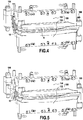
- the blade support 100 comprises an upper half-shell 102 ( figures 2 and 3 ) and a lower half-shell 104 (visible on the Figures 4 and 5 in particular) which are two independent elements coming to be fixed one on the other.
- the upper half-shell 102 has an imprint 106 of shape complementary to that of the upper surface 4a of the blade.
- the lower half-shell 104 also has an imprint (not shown in the figures) having a shape complementary to that of the lower surface of the blade.
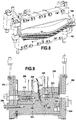
- the half-shells 102, 104 of the blade support 100 are configured so that, when the blade 2 is positioned between them as illustrated in the Figures 4 and 5 , only the lower and upper surfaces of the leading edge 6 of the blade remain clear of any influence. The extent of these surfaces corresponds to the area on which the metal reinforcement must be fixed.
- the half-shells 102, 104 of the blade support 100 can be assembled one on the other for example by means of screw / nut type systems 108 whose tightening makes it possible to clamp the blade 2 positioned between the half-shells.
- the support for reinforcing the leading edge 200 of the tooling comprises a base 202 forming the bottom, two lateral walls 204 fixed to the bottom 202 for example by means of screws 206, and two lateral shims 208 positioned at the inside the space delimited by the bottom 202 and the side walls 204.
- the two lateral wedges 208 are spaced laterally from one another by a space 210 whose general geometry corresponds substantially to the profile of the metal reinforcement of the leading edge of the blade to be used.
- the two lateral wedges 208 are able to be able to approach and move laterally apart from one another.
- the lateral displacement of the wedges 208 is carried out by means of springs 212 exerting a push on each lateral wedge to bring it closer to the other lateral wedge, these springs being held in the retracted position by retaining screws 214 for all of the phases of use outside that of pressurization.
- These springs 212 are calibrated and positioned according to the chosen level of pressure applied to the metal reinforcement positioned between the shims.
- the lateral wedges 208 are also each provided with a suction grid (or network) 216 which is positioned at their lateral face delimiting the space 210 for receiving the metallic reinforcement. These suction grids 216 are each connected to a suction circuit (not shown) opening out to the outside of the tool.
- a peripheral seal 218 can be positioned around the suction grid 216.
- leading edge reinforcement support 200 also includes heating elements 220 intended to allow a polymerization of a film of adhesive applied to the leading edge of the blade when the latter is positioned in the reinforcement. metallic.
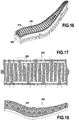
- these heating elements 220 are arranged inside the bottom 202 of the leading edge reinforcement support ( figure 17 which shows the bottom in sectional view) and within each lateral wedge 208 ( figure 18 which is a view in longitudinal section of a lateral wedge).
- these heating elements are in the form of a circulation circuit for a heat transfer fluid 220.
- a circuit resistive electric or induction heating circuit for example a circuit resistive electric or induction heating circuit.
- the leading edge reinforcement support 200 also includes a spout flange of the metal reinforcement 222 which is interposed between the bottom 202 and one of the lateral shims 208.
- This flange 222 has the function of ensuring a clamping in reference d 'a metal reinforcement spout when this is positioned in the leading edge reinforcement support.
- the blade 2 is positioned on the upper half-shell 102 of the blade support 100 by placing the upper surface 4a thereof on the imprint 106 of this half - upper surface shell ( figures 2 and 3 ).
- the next step consists in mounting the lower half-shell 104 on the blade by positioning the imprint of this half-shell on the lower surface 4b of the blade ( figure 4 ).
- a chock 110 of the blade root is then placed against the blade blade 10 ( figure 5 ) and the clamping of the blade in the blade support 100 is ensured by tightening systems of the screw / nut type 108. This tightening force is controlled by the use of a torque wrench.
- the next step in the process consists in clamping the trailing edge 8 of the blade.
- the blade support 100 comprises several wedges for clamping the trailing edge 112 which are inserted between the trailing edge of the blade and the lower half-shell 104 ( Figures 6 and 7 ).
- the clamping of the trailing edge of the blade ensures that the blade is held in place in the blade support in the event of its thickness being too small.
- the use of several wedges for clamping the trailing edge 112 makes it possible to guarantee contact with the edge of the trailing edge of the blade at several points whatever the profile defects thereof.
- the blade 2 is positioned and perfectly clamped in the blade support 100 of the tool while leaving the surfaces of the leading edge of the blade completely free.
- the metal reinforcement 300 intended to be fixed on the leading edge 6 of the blade is positioned in the leading edge reinforcement support 200 of the tool.
- the lateral shims 208 of the leading edge reinforcement support are spaced from one another (here manually) to allow the positioning of the metal reinforcement 300 between them in the space 210.
- the flange of beak of the metal reinforcement 222 makes it possible at this stage to ensure a reference clamping of a beak 302 of the metal reinforcement 300 between the shims.
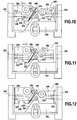
- the shims 208 are brought together manually one from the other so that their respective lateral faces come into contact with the wings 304 (or lateral faces) of the metal reinforcement and the suction grids of these shims are put into operation to ensure a gripping by suction of the wings 304 metal reinforcement ( figure 11 ).
- Additional shims 224 are then placed on the leading edge reinforcement support between the side walls 204 and the shims 208 ( figure 12 ). These additional shims make it possible to limit the spacing of said shims 208 of the leading edge reinforcement support during the next step of opening the wings of the metal reinforcement and to control the stroke of the pressurizing springs 212 and therefore the effort they generate.
- the wings 304 of the metal reinforcement 300 being maintained in contact with the lateral faces of the shims 208 by suction, the spacing of the shims 208 from one another during the next step causes said wings 304 of the metal reinforcement to open. to allow insertion of the leading edge of the blade ( Figures 13 and 14 ). To overcome the resistance of the wings of the metal reinforcement, this spacing is achieved by means of shim opening screws (not shown in the figures) which are accessible from the side walls 204 of the leading edge reinforcement support.
- a film glue can be applied to the leading edge of the blade.
- a paste adhesive can be applied to the bottom of the cavity of the metal reinforcement, the kinematics of the tool during assembly allowing the adhesive to creep over all of the surfaces of the leading edge to be bonded.
- a liquid glue can be injected once the metal reinforcement is in place on the leading edge of the blade.
- the positioning of the leading edge 6 of the blade 2 between the wings 304 of the metal reinforcement 300 is obtained by mounting the blade support 100 on the leading edge reinforcement support 200 ( figure 15 ). Given the twisting of the leading edge of the blade, this assembly requires a combined movement of translation and rotation.
- Clamping screws 114 then allow clamping between the blade support 100 and the leading edge reinforcement support 200, as well as pressurization under the spout 302 of the metal reinforcement 300. In this way, the film glue is compacted at the top of the metal reinforcement to the final dimension.
- the next step consists in bringing the shims 208 closer to the leading edge reinforcement support (by unscrewing the shim opening screws then unscrewing the screws 214 for holding the springs 212 ) to ensure pressurization of the wings 304 of the metal reinforcement.
- This pressurization can be adjusted as required by the number of springs 212, their stiffness and the level of compression chosen.
- each wedge 208 has a shoulder 226 forming an end-of-travel stop which comes to bear against the blade or the blade support when the wedges 20 are brought together.
- the bottom 202 of the leading edge reinforcement support also includes two shoulders 228 forming an end-of-travel stop against which the wedges 208 bear when they are brought together.
- the heating elements 220 of the leading edge reinforcement support 200 are put into operation (before or after the step of pressurizing the wings of the metal reinforcement) to trigger a polymerization cycle of the adhesive film (mounting, bearing, and temperature drop).
- the blade the leading edge of which is coated with the metal reinforcement, can be released from the tool.
- the shims of the leading edge reinforcement support are again separated from one another, the nozzle flange is released and the blade support is removed from the leading edge reinforcement support. Finally, the blade is released from the blade support by disassembling the two half-shells thereof.
Landscapes
- Engineering & Computer Science (AREA)
- Mechanical Engineering (AREA)
- General Engineering & Computer Science (AREA)
- Chemical & Material Sciences (AREA)
- Materials Engineering (AREA)
- Composite Materials (AREA)
- Architecture (AREA)
- Structures Of Non-Positive Displacement Pumps (AREA)
- Turbine Rotor Nozzle Sealing (AREA)
Claims (12)
- Werkzeug zum Befestigen einer Metallverstärkung (300) an der Vorderkante (6) einer Schaufel (2) einer Turbomaschine, umfassend:einen Schaufelhalter (100), der dazu bestimmt ist, eine Schaufel aufzunehmen, und gleichzeitig Oberflächen der Vorderkante der Schaufel frei lässt, undeinen Vorderkantenverstärkungshalter (200), an dem der Schaufelhalter angebracht werden soll und der zwei Seitenkeile (208) umfasst, zwischen denen die Metallverstärkung der Vorderkante der Schaufel positioniert werden soll, wobei die Keile geeignet sind, sich einander zu nähern und voneinander zu entfernen, und jeweils mit einem Sauggitter (216) versehen sind, das dazu bestimmt ist, ein Greifen der Metallverstärkung sicherzustellen, wobei der Vorderkantenverstärkungshalter ferner Heizelemente (220), welche dazu bestimmt sind, eine Polymerisation eines Klebstofffilms (14) zu ermöglichen, der auf Oberflächen der Vorderkante der Schaufel aufgebracht wird, wenn diese auf der Metallverstärkung positioniert wird, sowie Schultern umfasst, die Anschläge (226, 228) bilden, welche so geformt sind, dass sie an der Schaufel, dem Schaufelhalter oder den Keilen zur Anlage kommen, wenn die Keile (208) einander genähert werden.
- Werkzeug nach Anspruch 1, bei dem der Schaufelhalter (100) eine rückseitige Halbschale (102), welche eine Vertiefung (106) mit einer zu der Form einer rückseitigen Fläche der Schaufel komplementären Form aufweist, eine vorderseitige Halbschale (104), welche eine Vertiefung mit einer zu der Form einer vorderseitigen Fläche der Schaufel komplementären Form aufweist, sowie Mittel (108) zum Aufbringen einer Klemmkraft zwischen der vorderseitigen Halbschale und der rückseitigen Halbschale umfasst.
- Werkzeug nach einem der Ansprüche 1 und 2, bei dem der Schaufelhalter ferner Keile (112) zum Einspannen einer Hinterkante (8) der Schaufel (2) umfasst.
- Werkzeug nach einem der Ansprüche 1 bis 3, bei dem der Vorderkantenverstärkungshalter (200) Mittel umfasst, um die Keile einander zu nähern oder voneinander zu entfernen.
- Werkzeug nach einem der Ansprüche 1 bis 4, bei dem die Heizelemente des Vorderkantenverstärkungshalters (200) einen Zirkulationskreislauf eines Wärmeübertragungsfluids (220) umfassen.
- Verfahren zum Befestigen einer Metallverstärkung an der Vorderkante einer Schaufel einer Turbomaschine mittels eines Werkzeugs nach einem der Ansprüche 1 bis 5, umfassend:einen Schritt des Positionierens und Einspannens der Schaufel (2) in dem bzw. den Schaufelhalter (100) des Werkzeugs unter Freilassen der Oberflächen der Vorderkante (6) der Schaufel,einen Schritt des Aufbringens von Klebstoff (14) auf die freien Oberflächen der Vorderkante der Schaufel;einen Schritt des Positionierens und Greifens der Metallverstärkung (300) in dem Vorderkantenverstärkungshalter (200) des Werkzeugs,einen Schritt des Positionierens der Metallverstärkung an der Vorderkante der Schaufel durch Anbringen des Schaufelhalters an dem Vorderkantenverstärkungshalter,einen Schritt des Aufbringens eines Drucks auf die Flügel (304) der Metallverstärkung, undeinen Schritt des Polymerisierens des auf die freien Oberflächen an der Vorderkante der Schaufel aufgebrachten Klebstoffs durch die Heizelemente (220) des Vorderkantenverstärkungshalters des Werkzeugs.
- Verfahren nach Anspruch 6, bei dem der Schritt des Positionierens und Einspannens der Schaufel in dem bzw. den Schaufelhalter ferner das Einspannen einer Hinterkante (8) der Schaufel (2) umfasst.
- Verfahren nach einem der Ansprüche 6 und 7, bei dem der Schritt des Positionierens und Greifens der Metallverstärkung in dem Vorderkantenverstärkungshalter nacheinander das Entfernen der Seitenkeile (208) des Vorderkantenverstärkungshalters voneinander, das Positionieren der Metallverstärkung zwischen den Keilen des Vorderkantenverstärkungshalters, das Einspannen einer Spitze (302) der Metallverstärkung zwischen den Keilen sowie das Ansaugen der Flügel (304) der Metallverstärkung, um deren Greifen sicherzustellen, umfasst.
- Verfahren nach einem der Ansprüche 6 bis 8, das ferner nach dem Schritt des Positionierens und Greifens der Metallverstärkung in dem Vorderkantenverstärkungshalter und vor dem Schritt des Positionierens der Metallverstärkung an der Vorderkante der Schaufel einen Schritt des Entfernens der Seitenkeile des Vorderkantenverstärkungshalters voneinander umfasst, um die Flügel der Metallverstärkung zu öffnen.
- Verfahren nach Anspruch 9, bei dem vor dem Schritt des Entfernens der Seitenkeile (208) des Vorderkantenverstärkungshalters voneinander zusätzliche Keile (224) an den Vorderkantenverstärkungshalter montiert werden, um das Entfernen der Seitenkeile zu begrenzen.
- Verfahren nach einem der Ansprüche 6 bis 10, bei dem die Schaufel (2) aus Kohlenstofffaser-Verbundwerkstoff gefertigt ist und die Metallverstärkung (300) auf der Basis von Titan gefertigt ist.
- Anwendung des Verfahrens nach einem der Ansprüche 6 bis 11 auf das Befestigen einer Metallverstärkung an der Vorderkante einer Gebläseschaufel eines Turbostrahltriebwerks.
Applications Claiming Priority (2)
| Application Number | Priority Date | Filing Date | Title |
|---|---|---|---|
| FR1354147A FR3005280B1 (fr) | 2013-05-06 | 2013-05-06 | Outillage pour la fixation d'un renfort metallique sur le bord d'attaque d'une aube de turbomachine et procede utilisant un tel outillage |
| PCT/FR2014/051012 WO2014181055A1 (fr) | 2013-05-06 | 2014-04-28 | Outillage pour la fixation d'un renfort métallique sur le bord d'attaque d'une aube de turbomachine et procédé utilisant un tel outillage |
Publications (2)
| Publication Number | Publication Date |
|---|---|
| EP2994293A1 EP2994293A1 (de) | 2016-03-16 |
| EP2994293B1 true EP2994293B1 (de) | 2020-04-15 |
Family
ID=49209483
Family Applications (1)
| Application Number | Title | Priority Date | Filing Date |
|---|---|---|---|
| EP14726703.3A Active EP2994293B1 (de) | 2013-05-06 | 2014-04-28 | Einrichtung zum befestigen einer metallverstärkung an der austrittskante einer turbinenschaufel und verfahren zur verwendung solch einer einrichtung |
Country Status (8)
| Country | Link |
|---|---|
| US (1) | US10180070B2 (de) |
| EP (1) | EP2994293B1 (de) |
| CN (1) | CN105189090B (de) |
| BR (1) | BR112015028073B1 (de) |
| CA (1) | CA2911310C (de) |
| FR (1) | FR3005280B1 (de) |
| RU (1) | RU2665198C2 (de) |
| WO (1) | WO2014181055A1 (de) |
Families Citing this family (18)
| Publication number | Priority date | Publication date | Assignee | Title |
|---|---|---|---|---|
| US11346362B2 (en) | 2017-07-25 | 2022-05-31 | Raytheon Technologies Corporation | Processes and tooling associated with diffusion bonding |
| JP6875238B2 (ja) * | 2017-09-15 | 2021-05-19 | 三菱パワー株式会社 | 貼付治具及び動翼の製造方法 |
| WO2019182634A1 (en) * | 2018-03-21 | 2019-09-26 | Tpi Composites, Inc. | Mold with thermally conductive flanges |
| FR3079445B1 (fr) * | 2018-03-28 | 2020-04-24 | Safran | Procede de fabrication d'une aube en materiau composite a bord d'attaque metallique rapporte pour turbine a gaz |
| FR3093132B1 (fr) * | 2019-02-27 | 2021-02-12 | Safran Aircraft Engines | Assemblage d’une aube directrice de sortie pour turbomachine d’aéronef à l’aide d’une vessie gonflable |
| FR3102378B1 (fr) * | 2019-10-23 | 2021-11-12 | Safran Aircraft Engines | Procédé de fabrication d’une aube en matériau composite avec bord d’attaque métallique rapporté |
| GB202002429D0 (en) * | 2020-02-21 | 2020-04-08 | Rolls Royce Plc | A fixing apparatus |
| CN112360855B (zh) * | 2020-10-22 | 2022-08-09 | 中航复合材料有限责任公司 | 一种复合材料风扇叶片金属增强件胶接定位装置及方法 |
| CN112355948B (zh) * | 2020-10-29 | 2022-08-26 | 中国航发南方工业有限公司 | 导向叶片组装防护夹具 |
| US12179446B2 (en) * | 2021-04-28 | 2024-12-31 | Safran Aircraft Engines | Device for shaping a fibrous preform for producing a bladed part of a turbomachine |
| FR3130672B1 (fr) | 2021-12-16 | 2023-11-03 | Safran Aircraft Engines | Dispositif de mise en forme d’une preforme fibreuse pour la realisation d’une piece aubagee de turbomachine |
| CN116692405A (zh) * | 2022-02-28 | 2023-09-05 | 富联裕展科技(深圳)有限公司 | 组装设备和组装方法 |
| CN116690135A (zh) * | 2022-02-28 | 2023-09-05 | 富联裕展科技(深圳)有限公司 | 组装设备和组装方法 |
| CN114714119B (zh) * | 2022-05-05 | 2023-06-23 | 中国航发航空科技股份有限公司 | 一种中介机匣支板的夹持装置 |
| FR3136475B1 (fr) * | 2022-06-09 | 2024-06-14 | Safran | Procédé de fixation d’une pièce sur un support par transfert d’un film adhésif |
| CN115416310B (zh) * | 2022-07-29 | 2025-09-12 | 武汉航达航空科技发展有限公司 | 航空器的复合材料桨叶前缘保护靴粘接设备及其使用方法 |
| FR3141721B1 (fr) * | 2022-11-09 | 2025-07-11 | Safran | Support d’encollage de renfort et procédé d’encollage de renfort à l’aide d’un tel support d’encollage |
| GB202314723D0 (en) * | 2023-09-26 | 2023-11-08 | Rolls Royce Plc | System and method for coupling component of gas turbine engine |
Family Cites Families (10)
| Publication number | Priority date | Publication date | Assignee | Title |
|---|---|---|---|---|
| US5430937A (en) * | 1994-07-15 | 1995-07-11 | United Technologies Corporation | Apparatus and methods for fabricating a helicopter main rotor blade |
| US5836062A (en) * | 1997-04-16 | 1998-11-17 | Sikorsky Aircraft Corporation | Apparatus for assembling a helicopter main rotor blade subassembly |
| FR2892339B1 (fr) * | 2005-10-21 | 2009-08-21 | Snecma Sa | Procede de fabrication d'une aube de turbomachine composite, et aube obtenue par ce procede |
| FR2918919B1 (fr) * | 2007-07-17 | 2013-03-29 | Eurocopter France | Procede et dispositif pour coller la coiffe metallique d'un bord d'attaque d'une voiture |
| US7805839B2 (en) * | 2007-12-31 | 2010-10-05 | Turbine Engine Components Technologies Corporation | Method of manufacturing a turbine fan blade |
| CN102123849B (zh) * | 2008-06-20 | 2015-03-11 | 维斯塔斯风力系统有限公司 | 由具有横向于中间部分延伸的端部的元件制造用于风轮机的翼梁的方法 |
| US20100269979A1 (en) * | 2009-04-27 | 2010-10-28 | Spirit Aerosystems, Inc. | Bladder pressure bonding apparatus |
| RU2012127372A (ru) * | 2009-11-30 | 2014-01-10 | Снекма | Способ выполнения металлического усилительного элемента лопатки турбомашины |
| FR2954200B1 (fr) * | 2009-12-23 | 2012-03-02 | Snecma | Procede de realisation d'un renfort metallique d'aube de turbomachine |
| US20110194941A1 (en) * | 2010-02-05 | 2011-08-11 | United Technologies Corporation | Co-cured sheath for composite blade |
-
2013
- 2013-05-06 FR FR1354147A patent/FR3005280B1/fr active Active
-
2014
- 2014-04-28 CA CA2911310A patent/CA2911310C/fr active Active
- 2014-04-28 WO PCT/FR2014/051012 patent/WO2014181055A1/fr not_active Ceased
- 2014-04-28 EP EP14726703.3A patent/EP2994293B1/de active Active
- 2014-04-28 BR BR112015028073-0A patent/BR112015028073B1/pt active IP Right Grant
- 2014-04-28 RU RU2015152148A patent/RU2665198C2/ru active
- 2014-04-28 CN CN201480025711.2A patent/CN105189090B/zh active Active
- 2014-04-28 US US14/889,710 patent/US10180070B2/en active Active
Non-Patent Citations (1)
| Title |
|---|
| None * |
Also Published As
| Publication number | Publication date |
|---|---|
| US20160076387A1 (en) | 2016-03-17 |
| FR3005280A1 (fr) | 2014-11-07 |
| BR112015028073A2 (pt) | 2017-07-25 |
| RU2665198C2 (ru) | 2018-08-28 |
| CA2911310C (fr) | 2021-12-21 |
| EP2994293A1 (de) | 2016-03-16 |
| CN105189090B (zh) | 2018-10-19 |
| RU2015152148A (ru) | 2017-06-13 |
| BR112015028073B1 (pt) | 2020-10-20 |
| US10180070B2 (en) | 2019-01-15 |
| WO2014181055A1 (fr) | 2014-11-13 |
| CA2911310A1 (fr) | 2014-11-13 |
| FR3005280B1 (fr) | 2015-05-15 |
| CN105189090A (zh) | 2015-12-23 |
Similar Documents
| Publication | Publication Date | Title |
|---|---|---|
| EP2994293B1 (de) | Einrichtung zum befestigen einer metallverstärkung an der austrittskante einer turbinenschaufel und verfahren zur verwendung solch einer einrichtung | |
| EP2831425B1 (de) | Verfahren zur demontage einer verstärkung aus einem teil | |
| EP2869985B1 (de) | Verfahren zum befestigen einer metallstrukturverstärkung an einem teil einer gasturbinenschaufel und spritzgiessform zur durchführung solch eines verfahrens | |
| EP0984853B1 (de) | Gerät für in-situ-reparatur einer verbundmaterialstruktur mit beschädigter stellen und verfahren hierzu | |
| EP2932051B1 (de) | Abnehmbare akustische platten für ein gehäuse eines strahltriebwerks | |
| EP2416946B1 (de) | Verfahren zur herstellung einer aus einem thermoplastischen matrixverbundmaterial hergestellten versteiften platte und sich ergebende platte | |
| CA2838922C (fr) | Procede de renforcement local d'un panneau composite a renfort fibreux et panneau obtenu par un tel procede | |
| CA2870229A1 (fr) | Procede de realisation d'un renfort metallique avec insert pour la protection d'un bord d'attaque en materiau composite | |
| WO2015028750A1 (fr) | Procede de conformage a haute temperature d'un renfort metallique d'aube | |
| FR3042779A1 (fr) | Procede de reparation d'une structure d'aeronef a partir de plaques deformables | |
| EP2845707B1 (de) | Provisorische Befestigung eines Blechs auf einer Spritz-Form durch Verschweißungen | |
| EP3259083B1 (de) | Verfahren zum hochtemperaturschmieden eines vorgeformten metallteils und zum schmieden geeignete formgebungsausrüstung | |
| EP3959068B1 (de) | Verfahren zur reparatur einer aus verbundwerkstoff hergestellten schaufel | |
| CA2694812A1 (fr) | Procede d'assemblage d'un tapis degivreur sur une piece de voilure | |
| EP2950990B1 (de) | Formwerkzeug mit zwei hälften und mindestens einem schieber | |
| FR3158668A1 (fr) | Outillage de réparation locale ou de reprise de fabrication d’un bord d’une pièce en matériau composite | |
| EP3002746A1 (de) | Signalisierungsvorrichtung, die eine tafel umfasst, die mit einem profil zur befestigung an einer halterung ausgestattet ist |
Legal Events
| Date | Code | Title | Description |
|---|---|---|---|
| PUAI | Public reference made under article 153(3) epc to a published international application that has entered the european phase |
Free format text: ORIGINAL CODE: 0009012 |
|
| 17P | Request for examination filed |
Effective date: 20151112 |
|
| AK | Designated contracting states |
Kind code of ref document: A1 Designated state(s): AL AT BE BG CH CY CZ DE DK EE ES FI FR GB GR HR HU IE IS IT LI LT LU LV MC MK MT NL NO PL PT RO RS SE SI SK SM TR |
|
| AX | Request for extension of the european patent |
Extension state: BA ME |
|
| RIN1 | Information on inventor provided before grant (corrected) |
Inventor name: CHAUVIN, THIERRY Inventor name: VARIN, FRANCK, BERNARD, LEON |
|
| DAX | Request for extension of the european patent (deleted) | ||
| STAA | Information on the status of an ep patent application or granted ep patent |
Free format text: STATUS: EXAMINATION IS IN PROGRESS |
|
| 17Q | First examination report despatched |
Effective date: 20180309 |
|
| RAP1 | Party data changed (applicant data changed or rights of an application transferred) |
Owner name: SAFRAN AIRCRAFT ENGINES Owner name: SAFRAN |
|
| GRAP | Despatch of communication of intention to grant a patent |
Free format text: ORIGINAL CODE: EPIDOSNIGR1 |
|
| STAA | Information on the status of an ep patent application or granted ep patent |
Free format text: STATUS: GRANT OF PATENT IS INTENDED |
|
| RIC1 | Information provided on ipc code assigned before grant |
Ipc: F04D 29/02 20060101ALI20191030BHEP Ipc: B29L 31/08 20060101ALN20191030BHEP Ipc: F01D 5/28 20060101ALI20191030BHEP Ipc: B23Q 3/06 20060101ALN20191030BHEP Ipc: F01D 25/28 20060101ALI20191030BHEP Ipc: B29C 65/48 20060101AFI20191030BHEP Ipc: B29C 65/78 20060101ALI20191030BHEP Ipc: F04D 29/32 20060101ALI20191030BHEP Ipc: B29C 65/18 20060101ALN20191030BHEP |
|
| RIC1 | Information provided on ipc code assigned before grant |
Ipc: B29L 31/08 20060101ALN20191105BHEP Ipc: F04D 29/32 20060101ALI20191105BHEP Ipc: B23Q 3/06 20060101ALN20191105BHEP Ipc: B29C 65/18 20060101ALN20191105BHEP Ipc: F01D 25/28 20060101ALI20191105BHEP Ipc: F04D 29/02 20060101ALI20191105BHEP Ipc: F01D 5/28 20060101ALI20191105BHEP Ipc: B29C 65/78 20060101ALI20191105BHEP Ipc: B29C 65/48 20060101AFI20191105BHEP |
|
| INTG | Intention to grant announced |
Effective date: 20191128 |
|
| RIN1 | Information on inventor provided before grant (corrected) |
Inventor name: VARIN, FRANCK, BERNARD, LEON Inventor name: CHAUVIN, THIERRY |
|
| GRAS | Grant fee paid |
Free format text: ORIGINAL CODE: EPIDOSNIGR3 |
|
| GRAA | (expected) grant |
Free format text: ORIGINAL CODE: 0009210 |
|
| STAA | Information on the status of an ep patent application or granted ep patent |
Free format text: STATUS: THE PATENT HAS BEEN GRANTED |
|
| AK | Designated contracting states |
Kind code of ref document: B1 Designated state(s): AL AT BE BG CH CY CZ DE DK EE ES FI FR GB GR HR HU IE IS IT LI LT LU LV MC MK MT NL NO PL PT RO RS SE SI SK SM TR |
|
| REG | Reference to a national code |
Ref country code: CH Ref legal event code: EP |
|
| REG | Reference to a national code |
Ref country code: DE Ref legal event code: R096 Ref document number: 602014063773 Country of ref document: DE |
|
| REG | Reference to a national code |
Ref country code: IE Ref legal event code: FG4D Free format text: LANGUAGE OF EP DOCUMENT: FRENCH |
|
| REG | Reference to a national code |
Ref country code: AT Ref legal event code: REF Ref document number: 1256751 Country of ref document: AT Kind code of ref document: T Effective date: 20200515 |
|
| REG | Reference to a national code |
Ref country code: SE Ref legal event code: TRGR |
|
| REG | Reference to a national code |
Ref country code: NL Ref legal event code: MP Effective date: 20200415 |
|
| REG | Reference to a national code |
Ref country code: LT Ref legal event code: MG4D |
|
| PG25 | Lapsed in a contracting state [announced via postgrant information from national office to epo] |
Ref country code: GR Free format text: LAPSE BECAUSE OF FAILURE TO SUBMIT A TRANSLATION OF THE DESCRIPTION OR TO PAY THE FEE WITHIN THE PRESCRIBED TIME-LIMIT Effective date: 20200716 Ref country code: FI Free format text: LAPSE BECAUSE OF FAILURE TO SUBMIT A TRANSLATION OF THE DESCRIPTION OR TO PAY THE FEE WITHIN THE PRESCRIBED TIME-LIMIT Effective date: 20200415 Ref country code: NO Free format text: LAPSE BECAUSE OF FAILURE TO SUBMIT A TRANSLATION OF THE DESCRIPTION OR TO PAY THE FEE WITHIN THE PRESCRIBED TIME-LIMIT Effective date: 20200715 Ref country code: IS Free format text: LAPSE BECAUSE OF FAILURE TO SUBMIT A TRANSLATION OF THE DESCRIPTION OR TO PAY THE FEE WITHIN THE PRESCRIBED TIME-LIMIT Effective date: 20200815 Ref country code: NL Free format text: LAPSE BECAUSE OF FAILURE TO SUBMIT A TRANSLATION OF THE DESCRIPTION OR TO PAY THE FEE WITHIN THE PRESCRIBED TIME-LIMIT Effective date: 20200415 Ref country code: LT Free format text: LAPSE BECAUSE OF FAILURE TO SUBMIT A TRANSLATION OF THE DESCRIPTION OR TO PAY THE FEE WITHIN THE PRESCRIBED TIME-LIMIT Effective date: 20200415 Ref country code: PT Free format text: LAPSE BECAUSE OF FAILURE TO SUBMIT A TRANSLATION OF THE DESCRIPTION OR TO PAY THE FEE WITHIN THE PRESCRIBED TIME-LIMIT Effective date: 20200817 |
|
| REG | Reference to a national code |
Ref country code: AT Ref legal event code: MK05 Ref document number: 1256751 Country of ref document: AT Kind code of ref document: T Effective date: 20200415 |
|
| PG25 | Lapsed in a contracting state [announced via postgrant information from national office to epo] |
Ref country code: BG Free format text: LAPSE BECAUSE OF FAILURE TO SUBMIT A TRANSLATION OF THE DESCRIPTION OR TO PAY THE FEE WITHIN THE PRESCRIBED TIME-LIMIT Effective date: 20200715 Ref country code: HR Free format text: LAPSE BECAUSE OF FAILURE TO SUBMIT A TRANSLATION OF THE DESCRIPTION OR TO PAY THE FEE WITHIN THE PRESCRIBED TIME-LIMIT Effective date: 20200415 Ref country code: RS Free format text: LAPSE BECAUSE OF FAILURE TO SUBMIT A TRANSLATION OF THE DESCRIPTION OR TO PAY THE FEE WITHIN THE PRESCRIBED TIME-LIMIT Effective date: 20200415 Ref country code: LV Free format text: LAPSE BECAUSE OF FAILURE TO SUBMIT A TRANSLATION OF THE DESCRIPTION OR TO PAY THE FEE WITHIN THE PRESCRIBED TIME-LIMIT Effective date: 20200415 |
|
| REG | Reference to a national code |
Ref country code: CH Ref legal event code: PL |
|
| PG25 | Lapsed in a contracting state [announced via postgrant information from national office to epo] |
Ref country code: AL Free format text: LAPSE BECAUSE OF FAILURE TO SUBMIT A TRANSLATION OF THE DESCRIPTION OR TO PAY THE FEE WITHIN THE PRESCRIBED TIME-LIMIT Effective date: 20200415 |
|
| REG | Reference to a national code |
Ref country code: DE Ref legal event code: R097 Ref document number: 602014063773 Country of ref document: DE |
|
| PG25 | Lapsed in a contracting state [announced via postgrant information from national office to epo] |
Ref country code: DK Free format text: LAPSE BECAUSE OF FAILURE TO SUBMIT A TRANSLATION OF THE DESCRIPTION OR TO PAY THE FEE WITHIN THE PRESCRIBED TIME-LIMIT Effective date: 20200415 Ref country code: AT Free format text: LAPSE BECAUSE OF FAILURE TO SUBMIT A TRANSLATION OF THE DESCRIPTION OR TO PAY THE FEE WITHIN THE PRESCRIBED TIME-LIMIT Effective date: 20200415 Ref country code: EE Free format text: LAPSE BECAUSE OF FAILURE TO SUBMIT A TRANSLATION OF THE DESCRIPTION OR TO PAY THE FEE WITHIN THE PRESCRIBED TIME-LIMIT Effective date: 20200415 Ref country code: SM Free format text: LAPSE BECAUSE OF FAILURE TO SUBMIT A TRANSLATION OF THE DESCRIPTION OR TO PAY THE FEE WITHIN THE PRESCRIBED TIME-LIMIT Effective date: 20200415 Ref country code: CH Free format text: LAPSE BECAUSE OF NON-PAYMENT OF DUE FEES Effective date: 20200430 Ref country code: LU Free format text: LAPSE BECAUSE OF NON-PAYMENT OF DUE FEES Effective date: 20200428 Ref country code: MC Free format text: LAPSE BECAUSE OF FAILURE TO SUBMIT A TRANSLATION OF THE DESCRIPTION OR TO PAY THE FEE WITHIN THE PRESCRIBED TIME-LIMIT Effective date: 20200415 Ref country code: LI Free format text: LAPSE BECAUSE OF NON-PAYMENT OF DUE FEES Effective date: 20200430 Ref country code: RO Free format text: LAPSE BECAUSE OF FAILURE TO SUBMIT A TRANSLATION OF THE DESCRIPTION OR TO PAY THE FEE WITHIN THE PRESCRIBED TIME-LIMIT Effective date: 20200415 Ref country code: ES Free format text: LAPSE BECAUSE OF FAILURE TO SUBMIT A TRANSLATION OF THE DESCRIPTION OR TO PAY THE FEE WITHIN THE PRESCRIBED TIME-LIMIT Effective date: 20200415 Ref country code: CZ Free format text: LAPSE BECAUSE OF FAILURE TO SUBMIT A TRANSLATION OF THE DESCRIPTION OR TO PAY THE FEE WITHIN THE PRESCRIBED TIME-LIMIT Effective date: 20200415 |
|
| REG | Reference to a national code |
Ref country code: BE Ref legal event code: MM Effective date: 20200430 |
|
| PLBE | No opposition filed within time limit |
Free format text: ORIGINAL CODE: 0009261 |
|
| STAA | Information on the status of an ep patent application or granted ep patent |
Free format text: STATUS: NO OPPOSITION FILED WITHIN TIME LIMIT |
|
| PG25 | Lapsed in a contracting state [announced via postgrant information from national office to epo] |
Ref country code: PL Free format text: LAPSE BECAUSE OF FAILURE TO SUBMIT A TRANSLATION OF THE DESCRIPTION OR TO PAY THE FEE WITHIN THE PRESCRIBED TIME-LIMIT Effective date: 20200415 Ref country code: SK Free format text: LAPSE BECAUSE OF FAILURE TO SUBMIT A TRANSLATION OF THE DESCRIPTION OR TO PAY THE FEE WITHIN THE PRESCRIBED TIME-LIMIT Effective date: 20200415 Ref country code: BE Free format text: LAPSE BECAUSE OF NON-PAYMENT OF DUE FEES Effective date: 20200430 |
|
| 26N | No opposition filed |
Effective date: 20210118 |
|
| PG25 | Lapsed in a contracting state [announced via postgrant information from national office to epo] |
Ref country code: IE Free format text: LAPSE BECAUSE OF NON-PAYMENT OF DUE FEES Effective date: 20200428 |
|
| PG25 | Lapsed in a contracting state [announced via postgrant information from national office to epo] |
Ref country code: SI Free format text: LAPSE BECAUSE OF FAILURE TO SUBMIT A TRANSLATION OF THE DESCRIPTION OR TO PAY THE FEE WITHIN THE PRESCRIBED TIME-LIMIT Effective date: 20200415 |
|
| PG25 | Lapsed in a contracting state [announced via postgrant information from national office to epo] |
Ref country code: TR Free format text: LAPSE BECAUSE OF FAILURE TO SUBMIT A TRANSLATION OF THE DESCRIPTION OR TO PAY THE FEE WITHIN THE PRESCRIBED TIME-LIMIT Effective date: 20200415 Ref country code: MT Free format text: LAPSE BECAUSE OF FAILURE TO SUBMIT A TRANSLATION OF THE DESCRIPTION OR TO PAY THE FEE WITHIN THE PRESCRIBED TIME-LIMIT Effective date: 20200415 Ref country code: CY Free format text: LAPSE BECAUSE OF FAILURE TO SUBMIT A TRANSLATION OF THE DESCRIPTION OR TO PAY THE FEE WITHIN THE PRESCRIBED TIME-LIMIT Effective date: 20200415 |
|
| PG25 | Lapsed in a contracting state [announced via postgrant information from national office to epo] |
Ref country code: MK Free format text: LAPSE BECAUSE OF FAILURE TO SUBMIT A TRANSLATION OF THE DESCRIPTION OR TO PAY THE FEE WITHIN THE PRESCRIBED TIME-LIMIT Effective date: 20200415 |
|
| PGFP | Annual fee paid to national office [announced via postgrant information from national office to epo] |
Ref country code: SE Payment date: 20240320 Year of fee payment: 11 Ref country code: IT Payment date: 20240320 Year of fee payment: 11 |
|
| PGFP | Annual fee paid to national office [announced via postgrant information from national office to epo] |
Ref country code: DE Payment date: 20250417 Year of fee payment: 12 |
|
| PGFP | Annual fee paid to national office [announced via postgrant information from national office to epo] |
Ref country code: GB Payment date: 20250424 Year of fee payment: 12 |
|
| PGFP | Annual fee paid to national office [announced via postgrant information from national office to epo] |
Ref country code: FR Payment date: 20250422 Year of fee payment: 12 |
|
| REG | Reference to a national code |
Ref country code: SE Ref legal event code: EUG |