EP2987669A1 - Fahrerkabine für ein landwirtschaftliches fahrzeug - Google Patents
Fahrerkabine für ein landwirtschaftliches fahrzeug Download PDFInfo
- Publication number
- EP2987669A1 EP2987669A1 EP15182017.2A EP15182017A EP2987669A1 EP 2987669 A1 EP2987669 A1 EP 2987669A1 EP 15182017 A EP15182017 A EP 15182017A EP 2987669 A1 EP2987669 A1 EP 2987669A1
- Authority
- EP
- European Patent Office
- Prior art keywords
- roof
- cab
- insert
- cover module
- driver
- Prior art date
- Legal status (The legal status is an assumption and is not a legal conclusion. Google has not performed a legal analysis and makes no representation as to the accuracy of the status listed.)
- Granted
Links
Images

Classifications
-
- B—PERFORMING OPERATIONS; TRANSPORTING
- B60—VEHICLES IN GENERAL
- B60J—WINDOWS, WINDSCREENS, NON-FIXED ROOFS, DOORS, OR SIMILAR DEVICES FOR VEHICLES; REMOVABLE EXTERNAL PROTECTIVE COVERINGS SPECIALLY ADAPTED FOR VEHICLES
- B60J7/00—Non-fixed roofs; Roofs with movable panels, e.g. rotary sunroofs
- B60J7/08—Non-fixed roofs; Roofs with movable panels, e.g. rotary sunroofs of non-sliding type, i.e. movable or removable roofs or panels, e.g. let-down tops or roofs capable of being easily detached or of assuming a collapsed or inoperative position
- B60J7/10—Non-fixed roofs; Roofs with movable panels, e.g. rotary sunroofs of non-sliding type, i.e. movable or removable roofs or panels, e.g. let-down tops or roofs capable of being easily detached or of assuming a collapsed or inoperative position readily detachable, e.g. tarpaulins with frames, or fastenings for tarpaulins
- B60J7/11—Removable panels, e.g. sunroofs
-
- B—PERFORMING OPERATIONS; TRANSPORTING
- B60—VEHICLES IN GENERAL
- B60J—WINDOWS, WINDSCREENS, NON-FIXED ROOFS, DOORS, OR SIMILAR DEVICES FOR VEHICLES; REMOVABLE EXTERNAL PROTECTIVE COVERINGS SPECIALLY ADAPTED FOR VEHICLES
- B60J7/00—Non-fixed roofs; Roofs with movable panels, e.g. rotary sunroofs
- B60J7/08—Non-fixed roofs; Roofs with movable panels, e.g. rotary sunroofs of non-sliding type, i.e. movable or removable roofs or panels, e.g. let-down tops or roofs capable of being easily detached or of assuming a collapsed or inoperative position
- B60J7/16—Non-fixed roofs; Roofs with movable panels, e.g. rotary sunroofs of non-sliding type, i.e. movable or removable roofs or panels, e.g. let-down tops or roofs capable of being easily detached or of assuming a collapsed or inoperative position non-foldable and rigid, e.g. a one-piece hard-top or a single rigid roof panel
- B60J7/1628—Non-fixed roofs; Roofs with movable panels, e.g. rotary sunroofs of non-sliding type, i.e. movable or removable roofs or panels, e.g. let-down tops or roofs capable of being easily detached or of assuming a collapsed or inoperative position non-foldable and rigid, e.g. a one-piece hard-top or a single rigid roof panel for covering the passenger compartment
- B60J7/1635—Non-fixed roofs; Roofs with movable panels, e.g. rotary sunroofs of non-sliding type, i.e. movable or removable roofs or panels, e.g. let-down tops or roofs capable of being easily detached or of assuming a collapsed or inoperative position non-foldable and rigid, e.g. a one-piece hard-top or a single rigid roof panel for covering the passenger compartment of non-convertible vehicles
- B60J7/1642—Roof panels, e.g. sunroofs or hatches, movable relative to the main roof structure, e.g. by lifting or pivoting
Definitions
- the invention relates to a driver's cab of an agricultural vehicle according to the preamble of claim 1.
- Agricultural vehicles such as tractors or self-propelled harvesters
- a driver's cab for an operator of the agricultural vehicle.
- the driver's cab has one or more cab windows, which allow the operator to look outside and at the same time protect him from environmental influences, for example rain.
- the driver should allow the operator as trouble-free as possible view from the cab, which is why today's cabs often have a generous glazing with large cab windows.
- the cab is closed with a canopy that can protect the operator from rain and direct sunlight.
- the car roof may have a roof opening which is provided with a transparent cover.
- the protection of the operator from direct sunlight through the car roof is reduced.
- the sunlight through the cabin roof can dazzle the operator and lead to a stronger heating of the cab than a closed cabin roof.
- a roof hatch cover for a vehicle which comprises a panel and a window element with a transparent pane for covering a roof hatch, wherein both the window element and the aperture are pivotally connected about a common axis with the roof and wherein the Aperture is arranged at least partially above the window element.
- the roof hatch is provided with a double cover, whereby the roof not only requires a larger space, but caused by the complex structure with a variety of components and higher costs in the production and assembly.
- a cab for an agricultural vehicle has a cabin roof, wherein the cabin roof has at least one continuous roof opening.
- the canopy is designed and configured such that in the roof opening cooperating with the car roof removable insert can be arranged detachably, wherein the interchangeable insert is in the form of an opaque cover module or a substantially transparent cover module.
- the replacement insert can be designed as an opaque cover module or substantially transparent cover module, it is possible to produce both an intransparent state and an at least partially transparent state of the cabin roof by inserting, and / or in particular exchanging, the corresponding cover module.
- the roof In the transparent state, the roof can be made transparent, at least in the area of the roof opening.
- the respective interchangeable insert is in each case arranged on the same car roof.
- the transparent cover module can be replaced with an opaque cover module, so that the operator is protected against disturbing ambient light.
- a heating of the cab can be reduced by incident ambient light. Due to the fact that the respective changeover insert is arranged on the same canopy, only one variant of the canopy is needed for both the non-transparent and the transparent state of the canopy, so that the number of components required for the production can be reduced, whereby variant management is improved the manufacturing costs can be reduced. Due to the reduced number of components and the modular design with the interchangeable insert, the costs for assembly as well as for a conversion of the driver's cab can be reduced.
- At least one on the inside and / or outside of the car roof arranged fastening means for releasably securing the exchange insert is provided.
- the fastener may be formed in a manner that allows in particular a tool-free, easy release of the removable insert with a few simple steps. As a result, the changeover insert can be changed quickly by the operator in order to adapt the agricultural vehicle to the respective working conditions.
- the fastening means is designed and arranged such that the removable insert can be moved from a closed position into an open position.
- the introduction of the interchangeable insert in the open position offers the additional advantage that fresh air can be passed from the outside through the roof opening in the cab. Especially with the non-transparent cover module, this offers the possibility of supplying fresh air when shielding from disturbing ambient light.
- the fastening means is a tilting hinge, in particular arranged on the front side of the cabin roof.
- the tilt hinge allows easy opening of the roof opening by partially lifting the removable insert.
- a front-side arrangement of the tilt hinge has the advantage that an opening of the interchangeable insert does not occur counter to the direction of travel, and Therefore, even at higher speed, for example, when driving on the road, can be done safely.
- a roof opening is arranged on the front and / or rear side of the cabin roof.
- the roof openings may be the same or different. It is advantageous that the cab roof can be optimally adapted to the needs of the operator. With the same roof openings can be provided interchangeable interchangeable inserts.
- the invention further relates to an interchangeable insert which cooperates with the car roof in a position arranged in the roof opening, wherein the interchangeable insert is designed in the form of an intransparent cover module or in the form of a substantially transparent cover module.
- the replacement insert can be designed differently, for example as an intransparent cover module or transparent cover module.
- the intransparent cover module on the inside a, in particular arranged within the roof opening, space.
- the space which may be accessible from the inside of the cab, offers the possibility, for example, to provide additional storage space or space for technical equipment.
- the non-transparent cover module is designed such that in the closed position the fastening means and / or receptacles of the fastening means are covered by the non-transparent cover module.
- the changeover insert in a closed position on the inside and / or outside flush with the shape of the cabin roof is formed following.
- damage to the removable insert can be avoided, for example, by grazing while driving over the cabin roof branches.
- the invention further relates to an agricultural vehicle having a driver's cab as described and configured with at least one removable insert.
- the invention relates to an assembly method for a canopy of a driver's cab of an agricultural vehicle.
- a car roof is provided with a roof opening and at least one interchangeable insert for interacting with the car roof, wherein the interchangeable insert is designed in the form of an intransparent or substantially transparent cover module.
- the interchangeable insert is arranged to produce an opaque or at least partially transparent state of the canopy in the roof opening and releasably secured to the cabin roof.
- the driver's cab can be optimally adapted to the work to be carried out, so that, for example, when working with a front-mounted loader through the transparent cover module, the operator's view upwards, in particular on the front loader, can be improved.
- the transparent cover module can be replaced with a non-transparent cover module, thus protecting the operator against disturbing ambient light. Due to the fact that the respective exchange insert is arranged on the same canopy, only one variant of the canopy is needed for both the opaque and the transparent state of the canopy, so that the number of components required for the production can be reduced, whereby the variant management improves and the Reduced production costs can be. Due to the reduced number of components and the modular design with the interchangeable insert, the costs for assembly as well as for a conversion of the driver's cab can be reduced.
- a replacement insert arranged in the roof opening is dismantled.
- replacement insert By disassembling an already arranged in the roof opening exchange insert replacement of the removable insert can be carried out with little work Auswand.
- the replacement insert can be exchanged for a same or against a different replacement insert.
- one can be exchanged for a replacement insert in the form of a transparent cover module with a replacement insert in the form of an intransparent cover module with little installation and time.
- an agricultural vehicle 10 in the form of a tractor is shown schematically from the side, the basic construction of a tractor being considered as known to the person skilled in the art.
- An agricultural vehicle 10 may be any vehicle that can be used for agricultural work, such as a tractor, a front loader or a harvester such as a combine harvester or forage harvester.
- the tractor has a closed cab for receiving an operator 12, wherein within the driver's cab 12 usually display and controls (not shown) are arranged to operate the agricultural vehicle.
- the driver's cab 12 of the tractor has large-scale cab windows 14, which can also be designed in the form of a car door 16.
- the cab windows 14 are arranged substantially uninterrupted around underneath a cabin roof 18 of the driver's cab 12.
- a roof opening 20 is formed in a front region, whose position in the side view of the tractor 10 in FIG. 1 indicated by an arrow.
- FIG. 2 is the canopy 18 of the in FIG. 1 shown driver's cab 12 shown for explanatory purposes individually.
- the canopy 18 has a substantially square basic shape with outwardly curved edges.
- the cabin roof 18 may have on an outer side 22 channels that allow drainage, for example, rainwater.
- the continuous roof opening 20 is formed in the front.
- a corresponding roof opening may be arranged on the rear side of the canopy 18, for example in order to allow the operator a better view of a working implement attached to the rear of the tractor.
- a continuous roof opening 20 is to be understood as meaning an opening in the cabin roof 18 which extends from an inner side 24 of the cabin roof 18 to the outer side 22 of the cabin roof 18.
- the roof opening 20 has a substantially rectangular shape, wherein the dimensions of the roof opening 20 on the outside 22 and the inside 24 are different. Due to the different dimensions of the roof opening 20 on the inner and outer side 22,24 a conditional by the distance between the outer side 22 and inner side 24 of the canopy 18 wall 26 is formed inclined to a vertical. The inclination of the Wall 26 of the roof opening 20 is particularly pronounced at the front, and may be oriented in particular to a line of sight of the operator to allow the operator as unobstructed view, for example on a mounted front loader.
- the canopy 18 is designed and configured such that in the roof opening 20 cooperating with the car roof 18 removable insert 28 is detachably arrangeable ( Fig. 3 ).
- the removable insert 28 is arranged captive and detachable substantially within the roof opening 20 of the canopy 18.
- the replacement insert 28 is designed so that it, in particular in a closed position, the roof opening 20 of the canopy 18 completely covers, whereby, for example, an ingress of rain into the cab 12 can be avoided.
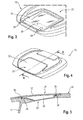
- the exchange insert 28 may be formed in different shapes. So is the in FIG. 3 shown removable insert 28 in the form of a substantially transparent cover module 30 is formed.
- the illustrated transparent cover 30 is fully transparent, ie transparent and / or transparent, formed. It is also conceivable that the transparent cover element 30 is transparent only in a partial area.
- the replacement insert is designed in the form of an opaque cover module 32, which in FIG. 4 is shown and will be discussed in more detail later.
- the transparent cover module 30 is made of a transparent material, for example glass or plastic, which may also be tinted. As a result, in addition to an additional light incidence into the driver's cab 12, the operator's view, for example, of an attached front-end loader (not shown) can be improved.
- the transparent cover member 30 is disposed within the roof opening 20 and shown in a closed state.
- the transparent cover member 30 is formed so that it follows the shape of the surface of the outer side 22 of the canopy 18 flush with the surface.
- two fastening means 34 are arranged on the outside, which are each connected to the car roof 18 and the transparent cover member 30.
- the fastening means 34 can be releasably connected both to the car roof and to the removable insert 28. In the FIG.
- fastening means 34 are formed as tilt hinges, which pivoting of the removable insert 28, and in particular of the transparent Covering element 30, allow from the illustrated closed position to an open position.
- the fastening means 34 opposite side of the removable insert 28 is raised.
- the illustrated transparent cover element 30 is held at the front by the fastening means 34, wherein in the closed position an additional locking (not shown), in particular on a side opposite the fastening means 34 side, the removable insert 28 can secure against unintentional movement in the open position.
- a support means acting between the car roof 18 and the interchangeable insert 28 may be provided which acts as a force aid in lifting and holding the cover member in the open position.
- a removable insert 28 in the form of an opaque cover module 32 is shown in FIG Fig. 4 shown.
- the non-transparent cover module 32 is shown in the closed position, wherein the non-transparent cover module 32 is formed on the outside following the shape of the cabin roof 18.
- the outer dimensions and the areas of the non-transparent cover module 32 cooperating with the canopy 18 can have substantially the same dimensions as the corresponding areas of the transparent cover module 30 in order to ensure interchangeability of the interchangeable inserts 28.
- a likewise non-transparent extension is provided, which can cover the cabin roof 18 outside at least partially.
- the non-transparent cover module 32 Due to the front-side extension of the non-transparent cover module 32, remaining fasteners 34 can be covered when the interchangeable inserts 28 are replaced after the transparent cover module 34 has been removed from the car roof 18. For example, the non-transparent cover module 32 can be locked completely against pivoting or loosening in the closed position on the inside.
- Fig. 5 is a cut along the line AA view of the opaque Abdeckmoduls 32 from Fig. 4 shown in a closed position.
- the non-transparent cover module 32 is arranged in the roof opening 20 in the cabin roof 18, and is on the inside and outside of the shape of the cabin roof 18 formed following.
- the non-transparent cover module 32 has at the front a likewise non-transparent extension, which covers the cabin roof 18 at least partially on the outside.
- a seal 36 is arranged circumferentially around the roof opening 20, which in a closed position of the interchangeable insert 28, a sealing of the cab 12 against environmental influences, such as rain, allows.
- the seal 36 can be arranged on a shoulder 38 formed in the car roof 18 and / or the roof opening 20, which can be designed to encircle the roof opening 20.
- the non-transparent cover module 32 has on the inside a space 40, which can be used for example for receiving devices and / or sound insulation.
- the installation space 40 is arranged and formed substantially within the roof opening 20 of the cabin roof 18.
Landscapes
- Engineering & Computer Science (AREA)
- Mechanical Engineering (AREA)
- Body Structure For Vehicles (AREA)
Abstract
Description
- Die Erfindung betrifft eine Fahrerkabine eines landwirtschaftlichen Fahrzeugs gemäß dem Oberbegriff des Anspruchs 1.
- Landwirtschaftliche Fahrzeuge, beispielsweise Traktoren oder selbstfahrende Erntemaschinen, sind üblicherweise mit einer Fahrerkabine für einen Bediener des landwirtschaftlichen Fahrzeuges ausgestattet. Die Fahrerkabine weist dabei eine oder mehrere Kabinenscheiben auf, welche dem Bediener eine Sicht nach draußen ermöglichen und ihn zugleich vor Umgebungseinflüssen, beispielsweise Regen, schützen können. Um die Übersichtlichkeit und somit auch die Sicherheit bei der Bedienung des landwirtschaftlichen Fahrzeuges zu erhöhen, soll die Fahrerkabine dem Bediener eine möglichst störungsfreie Sicht aus der Fahrerkabine hinaus ermöglichen, weswegen heutige Fahrerkabinen oft eine großzügige Verglasung mit großflächigen Kabinenscheiben aufweisen. Nach oben hin ist die Fahrerkabine mit einem Kabinendach abgeschlossen, welches den Bediener vor Regen und direkter Sonneneinstrahlung schützen kann.
- Um dem Bediener während des Betriebs des Fahrzeuges eine bessere Sicht nach oben zu ermöglichen, beispielsweise bei der Arbeit mit einem an das landwirtschaftliche Fahrzeug angebauten Frontlader, kann das Kabinendach eine Dachöffnung aufweisen, welche mit einer transparenten Abdeckung versehen ist. Dadurch kann die Sicht des Bedieners nach oben zwar verbessert werden, der Schutz des Bedieners vor direkter Sonneneinstrahlung durch das Kabinendach wird jedoch verringert. Bei einer Arbeit, welche die verbesserte Sicht nach oben nicht erfordert, beispielsweise bei der Bearbeitung eines Feldes, kann die Sonneneinstrahlung durch das Kabinendach den Bediener blenden und zu einer stärkeren Aufheizung der Fahrerkabine führen, als ein geschlossenes Kabinendach.
- Aus der
EP 1 288 044 A2 ist eine Dachlukenabdeckung für ein Fahrzeug bekannt, die eine Blende und ein Fensterelement mit einer durchsichtigen Scheibe zur Abdeckung einer Dachluke aufweist, wobei sowohl das Fensterelement als auch die Blende um eine gemeinsame Achse schwenkbar mit dem Dach verbunden sind und wobei die Blende zumindest bereichsweise oberhalb des Fensterelements angeordnet ist. Nachteilig ist dabei, dass die Dachluke mit einer doppelte Abdeckung versehen ist, wodurch das Dach nicht nur einen größeren Bauraum benötigt, sondern durch den komplexeren Aufbau mit einer Vielzahl von Bauteilen auch höherer Kosten bei der Herstellung sowie der Montage verursacht. - Es ist daher die Aufgabe der vorliegenden Erfindung eine Fahrerkabine der eingangs erwähnten Art für ein landwirtschaftliches Fahrzeug bereitzustellen, die im Hinblick auf die Sichtverhältnisse des Bedieners und störendes Umgebungslicht verbesserte Arbeitsbedingungen ermöglicht. Weiterhin soll eine kostengünstige Herstellung der Fahrerkabine ermöglicht werden.
- Die Lösung der Aufgabe erfolgt erfindungsgemäß durch die kennzeichnenden Merkmale des Anspruches 1. Vorteilhafte Ausgestaltungen der Erfindung sind in den Unteransprüchen angegeben.
- Eine Fahrerkabine für ein landwirtschaftliches Fahrzeug weist ein Kabinendach auf, wobei das Kabinendach mindestens eine durchgängige Dachöffnung aufweist. Erfindungsgemäß ist das Kabinendach derart ausgebildet und ausgestaltet, dass in der Dachöffnung ein mit dem Kabinendach zusammenwirkender Wechseleinsatz lösbar anordbar ist, wobei der Wechseleinsatz in Form eines intransparenten Abdeckmoduls oder eines im Wesentlichen transparenten Abdeckmoduls ausgebildet ist.
- Dadurch, dass der Wechseleinsatz als intransparentes Abdeckmodul oder im Wesentlichen transparentes Abdeckmodul ausgebildet sein kann, ist es möglich durch ein Einsetzten, und/oder insbesondere Austauschen, des entsprechenden Abdeckmoduls sowohl einen intransparenten Zustand als auch einen zumindest teilweise transparenten Zustand des Kabinendaches herzustellen. In dem transparenten Zustand kann das Dach zumindest in dem Bereich der Dachöffnung transparent ausgebildet sein. Der jeweilige Wechseleinsatz wird dabei jeweils an demselben Kabinendach angeordnet. Durch das Austauschen des Wechseleinsatzes kann die Fahrerkabine optimal an die durchzuführenden Arbeiten angepasst werden, so dass beispielsweise bei Arbeiten mit einem angebauten Frontlader durch das transparente Abdeckmodul die Sicht des Bedieners nach oben, insbesondere auf den Frontlader, verbessert werden kann. Für die Bearbeitung eines Feldes beispielsweise, bei der eine Sicht nach oben nicht erforderlich ist, kann das transparente Abdeckmodul gegen ein intransparentes Abdeckmodul ausgetauscht werden, so dass der Bediener gegen störendes Umgebungslicht geschützt ist. Zudem kann so ein Aufheizen der Fahrerkabine durch einfallendes Umgebungslicht reduziert werden. Dadurch, dass der jeweilige Wechseleinsatz an demselben Kabinendach angeordnet wird, wird nur eine Variante des Kabinendaches sowohl für den intransparenten als auch für den transparenten Zustand des Kabinendaches benötigt, so dass die Anzahl der zur Herstellung benötigten Bauteile reduziert werden können, wodurch das Variantenmanagement verbessert und die Herstellungskosten gesenkt werden können. Durch die reduzierte Bauteilanzahl und den modularen Aufbau mit dem Wechseleinsatz können zudem die Kosten für die Montage sowie für eine Umrüstung der Fahrerkabine gesenkt werden.
- In einer bevorzugten Ausgestaltung der Erfindung ist mindestens ein innenseitig und/oder außenseitig an dem Kabinendach angeordnetes Befestigungsmittel zum lösbaren Befestigen des Wechseleinsatzes vorgesehen. Das Befestigungsmittel kann dabei in einer Art ausgebildet sein, die insbesondere ein werkzeugloses, einfaches Lösen des Wechseleinsatzes mit wenigen Handgriffen ermöglicht. Dadurch kann der Wechseleinsatz von dem Bediener zügig gewechselt werden, um das landwirtschaftliche Fahrzeug an die jeweiligen Arbeitsbedingungen anzupassen.
- Besonders bevorzugt ist das Befestigungsmittel derart ausgebildet und angeordnet, dass der Wechseleinsatz von einer geschlossenen Position in eine geöffnete Position verbringbar ist. Das Verbringen des Wechseleinsatzes in die geöffnete Position bietet den zusätzlichen Vorteil, dass Frischluft von außen durch die Dachöffnung in die Fahrerkabine geleitet werden kann. Besonders bei dem intransparenten Abdeckmodul bietet dies die Möglichkeit, bei Abschirmung von störenden Umgebungslicht Frischluft zuzuführen.
- In einer bevorzugten Ausgestaltung der Erfindung ist das Befestigungsmittel ein insbesondere frontseitig an dem Kabinendach angeordnetes Kippscharnier. Das Kippscharnier ermöglicht ein einfaches Öffnen der Dachöffnung durch ein teilweises Anheben des Wechseleinsatzes. Eine frontseitige Anordnung des Kippscharniers hat den Vorteil, dass ein Öffnen des Wechseleinsatzes nicht entgegen der Fahrtrichtung erfolgt, und daher auch bei höherer Geschwindigkeit, beispielsweise bei einer Straßenfahrt, gefahrlos erfolgen kann.
- Ferner ist bevorzugt vorgesehen, dass eine Dachöffnung frontseitig und/oder heckseitig an dem Kabinendach angeordnet ist. Die Dachöffnungen können gleich oder unterschiedlich ausgebildet sein. Vorteilhaft ist dabei, dass das Kabinendach optimal an die jeweiligen Bedürfnisse des Bedieners angepasst werden kann. Bei gleich ausgebildeten Dachöffnungen können untereinander auswechselbare Wechseleinsätze vorgesehen sein.
- Die Erfindung betrifft weiterhin einen Wechseleinsatz, welcher in einer in der Dachöffnung angeordneten Position mit dem Kabinendach zusammenwirkt, wobei der Wechseleinsatz in Form eines intransparenten Abdeckmoduls oder in Form eines im Wesentlichen transparenten Abdeckmoduls ausgebildet ist. Der Wechseleinsatz kann unterschiedlich ausgebildet sein, beispielsweise als intransparentes Abdeckmodul oder transparentes Abdeckmodul. Dies bietet den Vorteil, dass bei einem unveränderten Kabinendach durch Einsetzten eines entsprechenden Wechseleinsatzes kostengünstig und auf einfache Weise sowohl ein intransparenter Zustand als auch ein zumindest teilweise transparenter Zustand des Kabinendaches herstellbar ist. Dies hat den Vorteil, dass beispielsweise je nach zu verrichtender Arbeit das Kabinendach umgerüstet werden kann.
- In einer bevorzugten Ausgestaltung der Erfindung weist das intransparente Abdeckmodul innenseitig einen, insbesondere innerhalb der Dachöffnung angeordneten, Bauraum auf. Der Bauraum, welcher von der Innenseite der Fahrerkabine zugänglich sein kann, bietet die Möglichkeit beispielsweise zusätzlichen Stauraum oder Platz für technische Geräte bereitzustellen.
- In einer weiter bevorzugten Ausgestaltung der Erfindung ist das intransparente Abdeckmodul derart ausgebildet, dass in der geschlossenen Position die Befestigungsmittel und/oder Aufnahmen der Befestigungsmittel durch das intransparente Abdeckmodul abgedeckt werden. Dadurch können bei einem Austausch des Wechseleinsatzes an dem Kabinendach verbleibende Befestigungsmittel, nicht genutzte Befestigungsmittel oder deren Aufnahmen an dem Kabinendach, abgedeckt werden, um beispielsweise ein Eindringen von Wasser oder Schmutz zu vermeiden. Dies kann besonders vorteilhaft sein, wenn ein Öffnen des Wechseleinsatzes nicht benötigt wird.
- In einer besonders bevorzugten Ausgestaltung der Erfindung ist der Wechseleinsatz in einer geschlossenen Position innenseitig und/oder außenseitig oberflächenbündig dem Formverlauf des Kabinendaches folgend ausgebildet. Dadurch können Beschädigungen des Wechseleinsatzes vermieden werden, beispielsweise durch während der Fahrt über das Kabinendach streifende Äste.
- Die Erfindung betrifft ferner ein landwirtschaftliches Fahrzeug mit einer wie oben beschriebenen und ausgestalteten Fahrerkabine mit mindestens einem Wechseleinsatz.
- Weiterhin betrifft die Erfindung ein Montageverfahren für ein Kabinendach einer Fahrerkabine eines landwirtschaftlichen Fahrzeuges. Erfindungsgemäß wird dafür ein Kabinendach mit einer Dachöffnung sowie mindestens ein Wechseleinsatz zum Zusammenwirken mit dem Kabinendach bereitgestellt, wobei der Wechseleinsatz in Form eines intransparenten oder im Wesentlichen transparenten Abdeckmoduls ausgebildet ist. Der Wechseleinsatz wird dabei zur Herstellung eines intransparenten oder zumindest teilweise transparenten Zustandes des Kabinendaches in der Dachöffnung angeordnet und lösbar mit dem Kabinendach befestigt.
- Durch den Einsatz des Wechseleinsatzes kann die Fahrerkabine optimal an die durchzuführenden Arbeiten angepasst werden, so dass beispielsweise bei Arbeiten mit einem angebauten Frontlader durch das transparente Abdeckmodul die Sicht des Bedieners nach oben, insbesondere auf den Frontlader, verbessert werden kann. Für die Bearbeitung eines Feldes beispielsweise, bei der eine Sicht nach oben nicht erforderlich ist, kann das transparente Abdeckmodul gegen ein intransparentes Abdeckmodul ausgetauscht werden, so dass der Bediener gegen störendes Umgebungslicht geschützt ist. Dadurch, dass der jeweilige Wechseleinsatz an demselben Kabinendach angeordnet wird, wird nur eine Variante des Kabinendaches sowohl für den intransparenten als auch für den transparente Zustand des Kabinendaches benötigt, so dass die Anzahl der zur Herstellung benötigten Bauteile reduziert werden, wodurch das Variantenmanagement verbessert und die Herstellungskosten gesenkt werden können. Durch die reduzierte Bauteilanzahl und den modularen Aufbau mit dem Wechseleinsatz können zudem die Kosten für die Montage sowie für eine Umrüstung der Fahrerkabine gesenkt werden.
- In einer vorteilhaften Weiterbildung des Verfahrens wird ein in der Dachöffnung angeordneter Wechseleinsatz demontiert. Durch die Demontage eines bereits in der Dachöffnung angeordneten Wechseleinsatzes kann ein Austausch des Wechseleinsatzes mit geringem Arbeitsauswand durchgeführt. Der Wechseleinsatz kann dabei gegen einen gleichen oder gegen einen unterschiedlichen Wechseleinsatz ausgetauscht werden. So kann beispielsweise eine mit einem Wechseleinsatz in Form eines intransparenten Abdeckmoduls mit geringem Montage- und Zeitaufwand gegen ein Wechseleinsatz in Form eines transparenten Abdeckmoduls ausgetauscht werden.
- Nachfolgend wird die Erfindung unter Bezugnahme auf die anliegenden Zeichnungen näher erläutert.
- Es zeigen:
- Fig. 1:
- eine schematische Seitenansicht eines landwirtschaftlichen Fahrzeuges mit einer erfindungsgemäßen Fahrerkabine;
- Fig. 2:
- eine schematische, perspektivische Ansicht eines Dachmoduls eines Kabinendaches;
- Fig. 3:
- eine schematische, perspektivische Ansicht eines Dachmoduls mit einem Wechseleinsatz in Form eines im Wesentlichen transparenten Abdeckmoduls;
- Fig. 4:
- eine schematische, perspektivische Ansicht eines Dachmoduls mit einem Wechseleinsatz in Form eines intransparenten Abdeckmoduls; und
- Fig. 5:
- eine geschnittene Seitenansicht des intransparenten Abdeckmoduls in
Fig. 4 . - In
Figur 1 ist ein landwirtschaftliches Fahrzeug 10 in Form eines Traktors schematisch von der Seite dargestellt, wobei der grundsätzliche Aufbau eines Traktors als dem Fachmann bekannt angesehen wird. Ein landwirtschaftliches Fahrzeug 10 kann jedes zur landwirtschaftlichen Arbeit einsetzbare Fahrzeug sein, beispielsweise ein Traktor, ein Frontlader oder eine Erntemaschine wie ein Mähdrescher oder Feldhäcksler. Der Traktor weist zur Aufnahme eines Bedieners eine geschlossene Fahrerkabine 12 auf, wobei innerhalb der Fahrerkabine 12 üblicherweise Anzeige- und Bedienelemente (nicht dargestellt) zur Bedienung des landwirtschaftlichen Fahrzeuges angeordnet sind. Um dem Bediener einen möglichst guten Überblick auf den Traktor 10 und angebaute Arbeitsgeräte aus der Fahrerkabine 12 zu ermöglichen, weist die Fahrerkabine 12 des Traktors großflächig ausgebildete Kabinenscheiben 14 auf, welche auch in Form einer Kabinentür 16 ausgebildet sein können. Die Kabinenscheiben 14 sind dabei im Wesentlichen unterbrechungsfrei rundherum unterhalb eines Kabinendaches 18 der Fahrerkabine 12 angeordnet. In dem Kabinendach 18 ist in einem vorderen Bereich eine Dachöffnung 20 ausgebildet, deren Position in der Seitenansicht der Traktors 10 inFigur 1 mit einem Pfeil angedeutet ist. - In
Figur 2 ist das Kabinendach 18 der inFigur 1 gezeigten Fahrerkabine 12 zu Erläuterungszwecken einzeln dargestellt. Das Kabinendach 18 weist ein eine im Wesentlichen quadratische Grundform mit nach außen gewölbten Kanten auf. Das Kabinendach 18 kann an einer Außenseite 22 Rinnen aufweisen, die in Ablaufen beispielsweise von Regenwasser ermöglichen. In dem vorderen, der Frontseite des Traktors zugewandten, Bereich des Kabinendaches 18 ist die durchgängige Dachöffnung 20 ausgebildet. Alternativ oder zusätzlich kann eine entsprechende Dachöffnung rückseitig an dem Kabinendach 18 angeordnet sein, beispielsweise um dem Bediener einen besseren Blick auf ein heckseitig an dem Traktor angebautes Arbeitsgerät zu ermöglichen. Unter einer durchgängigen Dachöffnung 20 ist eine Öffnung in dem Kabinendach 18 zu verstehen, die sich von einer Innenseite 24 des Kabinendaches 18 bis zu der Außenseite 22 des Kabinendaches 18 erstreckt. Die Dachöffnung 20 weist eine im Wesentlichen rechteckige Form auf, wobei die Abmessungen der Dachöffnung 20 an der Außenseite 22 und der Innenseite 24 unterschiedlich sind. Durch die unterschiedlichen Abmessungen der Dachöffnung 20 an der Innen- und Außenseite 22,24 ist eine durch den Abstand zwischen der Außenseite 22 und Innenseite 24 des Kabinendaches 18 bedingte Wandung 26 zu einer Lotrechten geneigt ausgebildet. Die Neigung der Wandung 26 der Dachöffnung 20 ist dabei frontseitig besonders stark ausgeprägt, und kann insbesondere an einer Sichtlinie des Bedieners orientiert sein, um für den Bediener eine möglichst ungehinderte Sicht beispielsweise auf einen angebauten Frontlader zu ermöglichen. - Erfindungsgemäß ist das Kabinendach 18 derart ausgebildet und ausgestaltet, dass in der Dachöffnung 20 ein mit dem Kabinendach 18 zusammenwirkender Wechseleinsatz 28 lösbar anordbar ist (
Fig. 3 ). Der Wechseleinsatz 28 ist dabei im Wesentlichen innerhalb der Dachöffnung 20 des Kabinendaches 18 verliersicher und lösbar angeordnet. Der Wechseleinsatz 28 ist dabei so ausgebildet, dass er, insbesondere in einer geschlossenen Position, die Dachöffnung 20 des Kabinendaches 18 vollständig abdeckt, wodurch beispielsweise ein Eindringen von Regen in die Fahrerkabine 12 vermieden werden kann. Der Wechseleinsatz 28 kann in unterschiedlichen Formen ausgebildet sein. So ist der inFigur 3 dargestellte Wechseleinsatz 28 in Form eines im Wesentlichen transparenten Abdeckmoduls 30 ausgebildet. Das dargestellte transparente Abdeckelement 30 ist dabei vollflächig transparent, also lichtdurchlässig und/oder durchsichtig, ausgebildet. Es ist ebenfalls denkbar, dass das transparente Abdeckelement 30 nur in einem Teilbereich transparent ist. In einer weiteren Ausgestaltung ist der Wechseleinsatz in Form eines intransparenten Abdeckmoduls 32 ausgebildet, welches inFigur 4 dargestellt ist und auf das später näher eingegangen werden wird. - Das transparente Abdeckmodul 30 ist aus einem transparenten Material, beispielsweise Glas oder Kunststoff, hergestellt, welches auch getönt sein kann. Dadurch kann neben einem zusätzlichen Lichteinfall in die Fahrerkabine 12 die Sicht des Bedieners beispielsweise auf einen angebauten Frontlader (nicht dargestellt) verbessert werden. Das transparente Abdeckelement 30 ist innerhalb der Dachöffnung 20 angeordnet und in einem geschlossenen Zustand dargestellt. Das transparente Abdeckelement 30 ist dabei so ausgebildet, dass es oberflächenbündig dem Formverlauf der Außenseite 22 des Kabinendaches 18 folgt. Frontseitig an dem Kabinendach 18 sind außenseitig zwei Befestigungsmittel 34 angeordnet, die jeweils mit dem Kabinendach 18 und dem transparenten Abdeckelement 30 verbunden sind. Die Befestigungsmittel 34 können sowohl mit dem Kabinendach als auch mit dem Wechseleinsatz 28 lösbar verbunden sein. Die in
Figur 3 dargestellten Befestigungsmittel 34 sind als Kippscharniere ausgebildet, die ein Verschwenken des Wechseleinsatzes 28, und insbesondere des transparenten Abdeckelementes 30, von der dargestellten geschlossenen Position in eine geöffnete Position ermöglichen. In der geöffneten Position des Wechseleinsatzes 28, insbesondere in Form des transparenten Abdeckelementes 30, wird die den Befestigungsmitteln 34 gegenüberliegende Seite des Wechseleinsatzes 28 angehoben. Das dargestellte transparente Abdeckelement 30 ist frontseitig durch die Befestigungsmittel 34 gehalten, wobei in der geschlossen Position eine zusätzlich Verriegelung (nicht dargestellt), insbesondere an einer den Befestigungsmitteln 34 gegenüberliegenden Seite, den Wechseleinsatz 28 gegen ein unbeabsichtigtes Verbringen in die geöffnete Position sichern kann. Zum Halten des Wechseleinsatzes 28 in der geöffneten Position kann eine zwischen dem Kabinendach 18 und dem Wechseleinsatz 28 wirkende Stützeinrichtung (nicht dargestellt) vorgesehen sein, die als Kraftunterstützung beim Heben und Halten des Abdeckelements in der geöffneten Position wirkt. - Ein Wechseleinsatz 28 in Form eines intransparenten Abdeckmoduls 32 ist in
Fig. 4 dargestellt. Das intransparente Abdeckmodul 32 ist dabei in der geschlossenen Position dargestellt, wobei das intransparente Abdeckmodul 32 außenseitig dem Formverlauf des Kabinendaches 18 folgend ausgebildet ist. Die äußeren Abmessungen sowie die mit dem Kabinendach 18 zusammenwirkenden Bereiche des intransparenten Abdeckmoduls 32 können dabei im Wesentlichen die gleichen Abmessungen wie die entsprechenden Bereiche des transparenten Abdeckmoduls 30 aufweisen, um eine Austauschbarkeit der Wechseleinsätze28 zu gewährleisten. An dem intransparente Abdeckmodul 32 inFig. 4 ist frontseitig eine ebenfalls intransparente Verlängerung vorgesehen, welche das Kabinendach 18 außenseitig zumindest teilweise abdecken kann. Durch die frontseitige Verlängerung des intransparenten Abdeckmoduls 32 können bei einem Austausch der Wechseleinsätze 28 nach einem Entfernen des transparenten Abdeckmoduls 34 an dem Kabinendach 18 verbleibende Befestigungsmittel 34 abgedeckt werden. Das intransparente Abdeckmodul 32 kann beispielsweise vollständig innenseitig gegen ein Verschwenken oder lösen in der geschlossenen Position verriegelt werden. - In
Fig. 5 ist eine entlang der Linie A-A geschnittene Ansicht des intransparenten Abdeckmoduls 32 ausFig. 4 in einer geschlossenen Position dargestellt. Das intransparente Abdeckmodul 32 ist in der Dachöffnung 20 in dem Kabinendach 18 angeordnet, und ist dabei innenseitig und außenseitig dem Formverlauf des Kabinendaches 18 folgend ausgebildet. Das intransparente Abdeckmodul 32 weist frontseitig eine ebenfalls intransparente Verlängerung auf, welche das Kabinendach 18 zumindest teilweise außenseitig abdeckt. Zwischen dem Wechseleinsatz 28 und dem Kabinendach 18 ist umlaufend um die Dachöffnung 20 eine Dichtung 36 angeordnet, welche in einer geschlossenen Position des Wechseleinsatzes 28 ein Abdichten der Fahrerkabine 12 gegen Umwelteinflüsse, beispielsweise Regen, ermöglicht. Die Dichtung 36 kann dabei an einem in dem Kabinendach 18 und/oder der Dachöffnung 20 ausgebildeten Absatz 38 angeordnet sein, welcher die Dachöffnung 20 umlaufend ausgebildet sein kann. Das intransparente Abdeckmodul 32 weist innenseitig einen Bauraum 40 auf, welcher beispielsweise zur Aufnahme von Geräten und/oder Schalldämmung genutzt werden kann. Der Bauraum 40 ist im Wesentlichen innerhalb der Dachöffnung 20 des Kabinendaches 18 angeordnet und ausgebildet. -
- 10
- landwirtschaftliches Fahrzeug
- 12
- Fahrerkabine
- 14
- Kabinenscheibe
- 16
- Kabinentür
- 18
- Kabinendach
- 20
- Dachöffnung
- 22
- Außenseite
- 24
- Innenseite
- 26
- Wandung
- 28
- Wechseleinsatz
- 30
- transparentes Abdeckmodul
- 32
- intransparentes Abdeckmodul
- 34
- Befestigungsmittel
- 36
- Dichtung
- 38
- Absatz
- 40
- Bauraum
Claims (12)
- Eine Fahrerkabine für ein landwirtschaftliches Fahrzeug (10) weist ein Kabinendach (18) auf, wobei das Kabinendach (18) mindestens eine durchgängige Dachöffnung (20) aufweist,
dadurch gekennzeichnet, dass
das Kabinendach (18) derart ausgebildet und ausgestaltet ist, dass in der Dachöffnung (20) ein mit dem Kabinendach (18) zusammenwirkender Wechseleinsatz (28) lösbar anordbar ist,
wobei der Wechseleinsatz (28) in Form eines intransparenten Abdeckmoduls (32) oder eines im Wesentlichen transparenten Abdeckmoduls (30) ausgebildet ist. - Fahrerkabine nach Anspruch 1, dadurch gekennzeichnet, dass mindestens ein innenseitig und/oder außenseitig an dem Kabinendach (18) angeordnetes Befestigungsmittel (34) zum lösbaren Befestigen des Wechseleinsatzes (28) vorgesehen ist.
- Fahrerkabine nach Anspruch 1 oder 2, dadurch gekennzeichnet, dass das Befestigungsmittel (34) derart ausgebildet und angeordnet ist, dass der Wechseleinsatz (28) von einer geschlossenen Position in eine geöffnete Position verbringbar ist.
- Fahrerkabine nach einem der vorherigen Ansprüche, dadurch gekennzeichnet, dass das Befestigungsmittel (34) ein, insbesondere frontseitig, an dem Kabinendach (18) angeordnetes Kippscharnier ist.
- Fahrerkabine nach einem der vorherigen Ansprüche, dadurch gekennzeichnet, dass eine Dachöffnung (20) frontseitig und/oder heckseitig an dem Kabinendach (18) angeordnet ist.
- Wechseleinsatz, welcher mit dem Kabinendach nach Anspruch 1 zusammenwirkt, dadurch gekennzeichnet, dass der Wechseleinsatz (28) in Form eines intransparenten Abdeckmoduls (32) oder in Form eines im Wesentlichen transparenten Abdeckmoduls (30) ausgebildet ist.
- Wechseleinsatz nach Anspruch 6, dadurch gekennzeichnet, dass das intransparente Abdeckmodul (32) innenseitig einen, insbesondere innerhalb der Dachöffnung (20) angeordneten, Bauraum (40) aufweist.
- Wechseleinsatz nach Anspruch 6 oder 7, dadurch gekennzeichnet, dass das intransparente Abdeckmodul (32) derart ausgebildet ist, dass in der geschlossenen Position die Befestigungsmittel (34) und/oder Aufnahmen der Befestigungsmittel (34) durch das intransparente Abdeckmodul (32) abgedeckt werden.
- Wechseleinsatz nach einem der Ansprüche 6 bis 8, dadurch gekennzeichnet, dass der Wechseleinsatz (28) in einer geschlossenen Position innenseitig und/oder außenseitig oberflächenbündig dem Formverlauf des Kabinendaches (18) folgend ausgebildet ist.
- Landwirtschaftliches Fahrzeug mit einer Fahrerkabine (12) und mindestens einem Wechseleinsatz (28) nach einem der vorherigen Ansprüche.
- Montageverfahren für ein Kabinendach (18) einer Fahrerkabine (12) eines landwirtschaftlichen Fahrzeuges (10),
dadurch gekennzeichnet, dass
ein Kabinendach (18) mit einer durchgängigen Dachöffnung (20) sowie mindestens ein Wechseleinsatz (28) zum Zusammenwirken mit dem Kabinendach (18) bereitgestellt wird,
wobei der Wechseleinsatz (28) in Form eines intransparenten Abdeckmoduls (32) oder eines im Wesentlichen transparenten Abdeckmoduls (30) ausgebildet ist, und dass der Wechseleinsatz (28) zur Herstellung eines intransparenten oder zumindest teilweise transparenten Zustandes des Kabinendaches (18) in der Dachöffnung (20) angeordnet und lösbar befestigt wird. - Montageverfahren für ein Kabinendach (18) nach Anspruch 11, dadurch gekennzeichnet, dass ein in der Dachöffnung (20) angeordneter Wechseleinsatz (28) demontiert wird.
Applications Claiming Priority (1)
| Application Number | Priority Date | Filing Date | Title |
|---|---|---|---|
| DE102014113536.9A DE102014113536A1 (de) | 2014-09-19 | 2014-09-19 | Fahrerkabine für ein landwirtschaftliches Fahrzeug |
Publications (2)
| Publication Number | Publication Date |
|---|---|
| EP2987669A1 true EP2987669A1 (de) | 2016-02-24 |
| EP2987669B1 EP2987669B1 (de) | 2021-06-09 |
Family
ID=54014508
Family Applications (1)
| Application Number | Title | Priority Date | Filing Date |
|---|---|---|---|
| EP15182017.2A Active EP2987669B1 (de) | 2014-09-19 | 2015-08-21 | Fahrerkabine für ein landwirtschaftliches fahrzeug |
Country Status (2)
| Country | Link |
|---|---|
| EP (1) | EP2987669B1 (de) |
| DE (1) | DE102014113536A1 (de) |
Citations (6)
| Publication number | Priority date | Publication date | Assignee | Title |
|---|---|---|---|---|
| GB1194910A (en) * | 1967-11-03 | 1970-06-17 | Ford Motor Co | Motor Vehicle Body |
| US4121870A (en) * | 1976-10-22 | 1978-10-24 | Edwin James Oakey | Removable transparent roof panel for motor vehicles |
| US4127302A (en) * | 1975-05-27 | 1978-11-28 | Empire Automotive, Inc. | Roof molding detachable sun roof panel for automobiles |
| US4394044A (en) * | 1980-10-08 | 1983-07-19 | Hough Louis E | Removable sunroof for vehicles |
| EP1288044A2 (de) | 2001-08-29 | 2003-03-05 | Deere & Company | Dachlukenanordnung für Fahrzeuge |
| EP2705965A2 (de) * | 2012-09-07 | 2014-03-12 | CLAAS Tractor SAS | Fahrerkabine eines landwirtschaftlichen Fahrzeugs |
-
2014
- 2014-09-19 DE DE102014113536.9A patent/DE102014113536A1/de not_active Ceased
-
2015
- 2015-08-21 EP EP15182017.2A patent/EP2987669B1/de active Active
Patent Citations (6)
| Publication number | Priority date | Publication date | Assignee | Title |
|---|---|---|---|---|
| GB1194910A (en) * | 1967-11-03 | 1970-06-17 | Ford Motor Co | Motor Vehicle Body |
| US4127302A (en) * | 1975-05-27 | 1978-11-28 | Empire Automotive, Inc. | Roof molding detachable sun roof panel for automobiles |
| US4121870A (en) * | 1976-10-22 | 1978-10-24 | Edwin James Oakey | Removable transparent roof panel for motor vehicles |
| US4394044A (en) * | 1980-10-08 | 1983-07-19 | Hough Louis E | Removable sunroof for vehicles |
| EP1288044A2 (de) | 2001-08-29 | 2003-03-05 | Deere & Company | Dachlukenanordnung für Fahrzeuge |
| EP2705965A2 (de) * | 2012-09-07 | 2014-03-12 | CLAAS Tractor SAS | Fahrerkabine eines landwirtschaftlichen Fahrzeugs |
Also Published As
| Publication number | Publication date |
|---|---|
| DE102014113536A1 (de) | 2016-03-24 |
| EP2987669B1 (de) | 2021-06-09 |
Similar Documents
| Publication | Publication Date | Title |
|---|---|---|
| EP1288044B1 (de) | Dachlukenanordnung für Fahrzeuge | |
| AT404925B (de) | Fenstereinheit für flugzeugkabinen | |
| DE112012003460B4 (de) | Wischervorrichtung, zu öffnendes/schließendes Schutzgitter mit Wischervorrichtung sowieFührerhaus für Baumaschine | |
| DE69919975T2 (de) | Türmodul | |
| EP0493774B1 (de) | Kabinentür für eine Fahrzeugkabine | |
| DE102007039808A1 (de) | Kraftfahrzeug | |
| DE60318095T2 (de) | Kombination einer hinteren tür und einer daran verschwenkbaren motorhaube | |
| DE4026217C2 (de) | Fahrzeugtür | |
| DE102014101449A1 (de) | Kabinenvorrichtung einer Arbeitsmaschine | |
| EP1039259B1 (de) | Luke für gepanzerte Fahrzeuge | |
| DE1278856B (de) | Schlepperverdeck | |
| DE10320107A1 (de) | Fahrzeug mit einer Heckklappe, in der eine Heckscheibe höhenverstellbar aufgenommen ist | |
| DE102016003757A1 (de) | Fahrzeugdach für einen Kraftwagen | |
| EP2987669B1 (de) | Fahrerkabine für ein landwirtschaftliches fahrzeug | |
| DE102018215147A1 (de) | Blendenbaugruppe für ein fahrzeug | |
| DE19714104C1 (de) | Fahrzeugdach | |
| DE10319783A1 (de) | Fahrzeugdach mit einer Dachöffnung | |
| WO2012167879A2 (de) | Fahrzeug-bauteil | |
| DE102005006690B4 (de) | Fahrerhaus für ein Nutzfahrzeug | |
| DE4300924C2 (de) | Abnehmbares Dachelement für Personenkraftwagen mit offenem Aufbau und Faltverdeck | |
| DE4226160C1 (en) | Opening mechanism for vehicle sliding-lifting sun roof - uses support frame for folding blind to move separate inner lining. | |
| DE9002260U1 (de) | Frontgetriebenes Kraftfahrzeug, insbesondere Kleinbus | |
| DE102016115457A1 (de) | Fahrerkabine mit Scheibenwischer | |
| DE2418259A1 (de) | Allwetterverdeck, insbesondere starre fahrerkabine fuer bau- bzw. zugmaschinen | |
| DE102011120896A1 (de) | Fahrzeug-Bauteil |
Legal Events
| Date | Code | Title | Description |
|---|---|---|---|
| PUAI | Public reference made under article 153(3) epc to a published international application that has entered the european phase |
Free format text: ORIGINAL CODE: 0009012 |
|
| AK | Designated contracting states |
Kind code of ref document: A1 Designated state(s): AL AT BE BG CH CY CZ DE DK EE ES FI FR GB GR HR HU IE IS IT LI LT LU LV MC MK MT NL NO PL PT RO RS SE SI SK SM TR |
|
| AX | Request for extension of the european patent |
Extension state: BA ME |
|
| 17P | Request for examination filed |
Effective date: 20160824 |
|
| RBV | Designated contracting states (corrected) |
Designated state(s): AL AT BE BG CH CY CZ DE DK EE ES FI FR GB GR HR HU IE IS IT LI LT LU LV MC MK MT NL NO PL PT RO RS SE SI SK SM TR |
|
| STAA | Information on the status of an ep patent application or granted ep patent |
Free format text: STATUS: EXAMINATION IS IN PROGRESS |
|
| 17Q | First examination report despatched |
Effective date: 20190502 |
|
| GRAP | Despatch of communication of intention to grant a patent |
Free format text: ORIGINAL CODE: EPIDOSNIGR1 |
|
| STAA | Information on the status of an ep patent application or granted ep patent |
Free format text: STATUS: GRANT OF PATENT IS INTENDED |
|
| INTG | Intention to grant announced |
Effective date: 20210112 |
|
| GRAS | Grant fee paid |
Free format text: ORIGINAL CODE: EPIDOSNIGR3 |
|
| GRAA | (expected) grant |
Free format text: ORIGINAL CODE: 0009210 |
|
| STAA | Information on the status of an ep patent application or granted ep patent |
Free format text: STATUS: THE PATENT HAS BEEN GRANTED |
|
| AK | Designated contracting states |
Kind code of ref document: B1 Designated state(s): AL AT BE BG CH CY CZ DE DK EE ES FI FR GB GR HR HU IE IS IT LI LT LU LV MC MK MT NL NO PL PT RO RS SE SI SK SM TR |
|
| REG | Reference to a national code |
Ref country code: GB Ref legal event code: FG4D Free format text: NOT ENGLISH |
|
| REG | Reference to a national code |
Ref country code: CH Ref legal event code: EP Ref country code: AT Ref legal event code: REF Ref document number: 1400175 Country of ref document: AT Kind code of ref document: T Effective date: 20210615 |
|
| REG | Reference to a national code |
Ref country code: DE Ref legal event code: R096 Ref document number: 502015014795 Country of ref document: DE |
|
| REG | Reference to a national code |
Ref country code: IE Ref legal event code: FG4D Free format text: LANGUAGE OF EP DOCUMENT: GERMAN |
|
| REG | Reference to a national code |
Ref country code: LT Ref legal event code: MG9D |
|
| PG25 | Lapsed in a contracting state [announced via postgrant information from national office to epo] |
Ref country code: FI Free format text: LAPSE BECAUSE OF FAILURE TO SUBMIT A TRANSLATION OF THE DESCRIPTION OR TO PAY THE FEE WITHIN THE PRESCRIBED TIME-LIMIT Effective date: 20210609 Ref country code: LT Free format text: LAPSE BECAUSE OF FAILURE TO SUBMIT A TRANSLATION OF THE DESCRIPTION OR TO PAY THE FEE WITHIN THE PRESCRIBED TIME-LIMIT Effective date: 20210609 Ref country code: BG Free format text: LAPSE BECAUSE OF FAILURE TO SUBMIT A TRANSLATION OF THE DESCRIPTION OR TO PAY THE FEE WITHIN THE PRESCRIBED TIME-LIMIT Effective date: 20210909 Ref country code: HR Free format text: LAPSE BECAUSE OF FAILURE TO SUBMIT A TRANSLATION OF THE DESCRIPTION OR TO PAY THE FEE WITHIN THE PRESCRIBED TIME-LIMIT Effective date: 20210609 |
|
| REG | Reference to a national code |
Ref country code: NL Ref legal event code: MP Effective date: 20210609 |
|
| PG25 | Lapsed in a contracting state [announced via postgrant information from national office to epo] |
Ref country code: NO Free format text: LAPSE BECAUSE OF FAILURE TO SUBMIT A TRANSLATION OF THE DESCRIPTION OR TO PAY THE FEE WITHIN THE PRESCRIBED TIME-LIMIT Effective date: 20210909 Ref country code: SE Free format text: LAPSE BECAUSE OF FAILURE TO SUBMIT A TRANSLATION OF THE DESCRIPTION OR TO PAY THE FEE WITHIN THE PRESCRIBED TIME-LIMIT Effective date: 20210609 Ref country code: RS Free format text: LAPSE BECAUSE OF FAILURE TO SUBMIT A TRANSLATION OF THE DESCRIPTION OR TO PAY THE FEE WITHIN THE PRESCRIBED TIME-LIMIT Effective date: 20210609 Ref country code: GR Free format text: LAPSE BECAUSE OF FAILURE TO SUBMIT A TRANSLATION OF THE DESCRIPTION OR TO PAY THE FEE WITHIN THE PRESCRIBED TIME-LIMIT Effective date: 20210910 Ref country code: LV Free format text: LAPSE BECAUSE OF FAILURE TO SUBMIT A TRANSLATION OF THE DESCRIPTION OR TO PAY THE FEE WITHIN THE PRESCRIBED TIME-LIMIT Effective date: 20210609 |
|
| PG25 | Lapsed in a contracting state [announced via postgrant information from national office to epo] |
Ref country code: SM Free format text: LAPSE BECAUSE OF FAILURE TO SUBMIT A TRANSLATION OF THE DESCRIPTION OR TO PAY THE FEE WITHIN THE PRESCRIBED TIME-LIMIT Effective date: 20210609 Ref country code: SK Free format text: LAPSE BECAUSE OF FAILURE TO SUBMIT A TRANSLATION OF THE DESCRIPTION OR TO PAY THE FEE WITHIN THE PRESCRIBED TIME-LIMIT Effective date: 20210609 Ref country code: CZ Free format text: LAPSE BECAUSE OF FAILURE TO SUBMIT A TRANSLATION OF THE DESCRIPTION OR TO PAY THE FEE WITHIN THE PRESCRIBED TIME-LIMIT Effective date: 20210609 Ref country code: EE Free format text: LAPSE BECAUSE OF FAILURE TO SUBMIT A TRANSLATION OF THE DESCRIPTION OR TO PAY THE FEE WITHIN THE PRESCRIBED TIME-LIMIT Effective date: 20210609 Ref country code: PT Free format text: LAPSE BECAUSE OF FAILURE TO SUBMIT A TRANSLATION OF THE DESCRIPTION OR TO PAY THE FEE WITHIN THE PRESCRIBED TIME-LIMIT Effective date: 20211011 Ref country code: RO Free format text: LAPSE BECAUSE OF FAILURE TO SUBMIT A TRANSLATION OF THE DESCRIPTION OR TO PAY THE FEE WITHIN THE PRESCRIBED TIME-LIMIT Effective date: 20210609 Ref country code: NL Free format text: LAPSE BECAUSE OF FAILURE TO SUBMIT A TRANSLATION OF THE DESCRIPTION OR TO PAY THE FEE WITHIN THE PRESCRIBED TIME-LIMIT Effective date: 20210609 Ref country code: ES Free format text: LAPSE BECAUSE OF FAILURE TO SUBMIT A TRANSLATION OF THE DESCRIPTION OR TO PAY THE FEE WITHIN THE PRESCRIBED TIME-LIMIT Effective date: 20210609 |
|
| PG25 | Lapsed in a contracting state [announced via postgrant information from national office to epo] |
Ref country code: PL Free format text: LAPSE BECAUSE OF FAILURE TO SUBMIT A TRANSLATION OF THE DESCRIPTION OR TO PAY THE FEE WITHIN THE PRESCRIBED TIME-LIMIT Effective date: 20210609 |
|
| REG | Reference to a national code |
Ref country code: DE Ref legal event code: R097 Ref document number: 502015014795 Country of ref document: DE |
|
| REG | Reference to a national code |
Ref country code: CH Ref legal event code: PL |
|
| PG25 | Lapsed in a contracting state [announced via postgrant information from national office to epo] |
Ref country code: MC Free format text: LAPSE BECAUSE OF FAILURE TO SUBMIT A TRANSLATION OF THE DESCRIPTION OR TO PAY THE FEE WITHIN THE PRESCRIBED TIME-LIMIT Effective date: 20210609 |
|
| PLBE | No opposition filed within time limit |
Free format text: ORIGINAL CODE: 0009261 |
|
| STAA | Information on the status of an ep patent application or granted ep patent |
Free format text: STATUS: NO OPPOSITION FILED WITHIN TIME LIMIT |
|
| PG25 | Lapsed in a contracting state [announced via postgrant information from national office to epo] |
Ref country code: LI Free format text: LAPSE BECAUSE OF NON-PAYMENT OF DUE FEES Effective date: 20210831 Ref country code: DK Free format text: LAPSE BECAUSE OF FAILURE TO SUBMIT A TRANSLATION OF THE DESCRIPTION OR TO PAY THE FEE WITHIN THE PRESCRIBED TIME-LIMIT Effective date: 20210609 Ref country code: CH Free format text: LAPSE BECAUSE OF NON-PAYMENT OF DUE FEES Effective date: 20210831 |
|
| 26N | No opposition filed |
Effective date: 20220310 |
|
| GBPC | Gb: european patent ceased through non-payment of renewal fee |
Effective date: 20210909 |
|
| PG25 | Lapsed in a contracting state [announced via postgrant information from national office to epo] |
Ref country code: LU Free format text: LAPSE BECAUSE OF NON-PAYMENT OF DUE FEES Effective date: 20210821 Ref country code: AL Free format text: LAPSE BECAUSE OF FAILURE TO SUBMIT A TRANSLATION OF THE DESCRIPTION OR TO PAY THE FEE WITHIN THE PRESCRIBED TIME-LIMIT Effective date: 20210609 |
|
| PG25 | Lapsed in a contracting state [announced via postgrant information from national office to epo] |
Ref country code: IT Free format text: LAPSE BECAUSE OF FAILURE TO SUBMIT A TRANSLATION OF THE DESCRIPTION OR TO PAY THE FEE WITHIN THE PRESCRIBED TIME-LIMIT Effective date: 20210609 Ref country code: IE Free format text: LAPSE BECAUSE OF NON-PAYMENT OF DUE FEES Effective date: 20210821 Ref country code: GB Free format text: LAPSE BECAUSE OF NON-PAYMENT OF DUE FEES Effective date: 20210909 |
|
| REG | Reference to a national code |
Ref country code: AT Ref legal event code: MM01 Ref document number: 1400175 Country of ref document: AT Kind code of ref document: T Effective date: 20210821 |
|
| PG25 | Lapsed in a contracting state [announced via postgrant information from national office to epo] |
Ref country code: AT Free format text: LAPSE BECAUSE OF NON-PAYMENT OF DUE FEES Effective date: 20210821 |
|
| PG25 | Lapsed in a contracting state [announced via postgrant information from national office to epo] |
Ref country code: HU Free format text: LAPSE BECAUSE OF FAILURE TO SUBMIT A TRANSLATION OF THE DESCRIPTION OR TO PAY THE FEE WITHIN THE PRESCRIBED TIME-LIMIT; INVALID AB INITIO Effective date: 20150821 |
|
| P01 | Opt-out of the competence of the unified patent court (upc) registered |
Effective date: 20230516 |
|
| PG25 | Lapsed in a contracting state [announced via postgrant information from national office to epo] |
Ref country code: CY Free format text: LAPSE BECAUSE OF FAILURE TO SUBMIT A TRANSLATION OF THE DESCRIPTION OR TO PAY THE FEE WITHIN THE PRESCRIBED TIME-LIMIT Effective date: 20210609 |
|
| PG25 | Lapsed in a contracting state [announced via postgrant information from national office to epo] |
Ref country code: MK Free format text: LAPSE BECAUSE OF FAILURE TO SUBMIT A TRANSLATION OF THE DESCRIPTION OR TO PAY THE FEE WITHIN THE PRESCRIBED TIME-LIMIT Effective date: 20210609 |
|
| PG25 | Lapsed in a contracting state [announced via postgrant information from national office to epo] |
Ref country code: MT Free format text: LAPSE BECAUSE OF FAILURE TO SUBMIT A TRANSLATION OF THE DESCRIPTION OR TO PAY THE FEE WITHIN THE PRESCRIBED TIME-LIMIT Effective date: 20210609 |
|
| PGFP | Annual fee paid to national office [announced via postgrant information from national office to epo] |
Ref country code: DE Payment date: 20250820 Year of fee payment: 11 |
|
| PGFP | Annual fee paid to national office [announced via postgrant information from national office to epo] |
Ref country code: BE Payment date: 20250820 Year of fee payment: 11 |
|
| PGFP | Annual fee paid to national office [announced via postgrant information from national office to epo] |
Ref country code: FR Payment date: 20250829 Year of fee payment: 11 |
|
| PG25 | Lapsed in a contracting state [announced via postgrant information from national office to epo] |
Ref country code: TR Free format text: LAPSE BECAUSE OF FAILURE TO SUBMIT A TRANSLATION OF THE DESCRIPTION OR TO PAY THE FEE WITHIN THE PRESCRIBED TIME-LIMIT Effective date: 20210609 |