EP2975636B1 - Process for forming organic semiconductor film - Google Patents
Process for forming organic semiconductor film Download PDFInfo
- Publication number
- EP2975636B1 EP2975636B1 EP14764302.7A EP14764302A EP2975636B1 EP 2975636 B1 EP2975636 B1 EP 2975636B1 EP 14764302 A EP14764302 A EP 14764302A EP 2975636 B1 EP2975636 B1 EP 2975636B1
- Authority
- EP
- European Patent Office
- Prior art keywords
- substrate
- organic semiconductor
- cover member
- semiconductor film
- solution
- Prior art date
- Legal status (The legal status is an assumption and is not a legal conclusion. Google has not performed a legal analysis and makes no representation as to the accuracy of the status listed.)
- Not-in-force
Links
Images


Classifications
-
- H—ELECTRICITY
- H10—SEMICONDUCTOR DEVICES; ELECTRIC SOLID-STATE DEVICES NOT OTHERWISE PROVIDED FOR
- H10K—ORGANIC ELECTRIC SOLID-STATE DEVICES
- H10K71/00—Manufacture or treatment specially adapted for the organic devices covered by this subclass
- H10K71/10—Deposition of organic active material
-
- H—ELECTRICITY
- H10—SEMICONDUCTOR DEVICES; ELECTRIC SOLID-STATE DEVICES NOT OTHERWISE PROVIDED FOR
- H10K—ORGANIC ELECTRIC SOLID-STATE DEVICES
- H10K71/00—Manufacture or treatment specially adapted for the organic devices covered by this subclass
- H10K71/10—Deposition of organic active material
- H10K71/12—Deposition of organic active material using liquid deposition, e.g. spin coating
- H10K71/15—Deposition of organic active material using liquid deposition, e.g. spin coating characterised by the solvent used
-
- H—ELECTRICITY
- H10—SEMICONDUCTOR DEVICES; ELECTRIC SOLID-STATE DEVICES NOT OTHERWISE PROVIDED FOR
- H10K—ORGANIC ELECTRIC SOLID-STATE DEVICES
- H10K71/00—Manufacture or treatment specially adapted for the organic devices covered by this subclass
- H10K71/10—Deposition of organic active material
- H10K71/191—Deposition of organic active material characterised by provisions for the orientation or alignment of the layer to be deposited
-
- H—ELECTRICITY
- H10—SEMICONDUCTOR DEVICES; ELECTRIC SOLID-STATE DEVICES NOT OTHERWISE PROVIDED FOR
- H10K—ORGANIC ELECTRIC SOLID-STATE DEVICES
- H10K71/00—Manufacture or treatment specially adapted for the organic devices covered by this subclass
- H10K71/20—Changing the shape of the active layer in the devices, e.g. patterning
-
- H—ELECTRICITY
- H10—SEMICONDUCTOR DEVICES; ELECTRIC SOLID-STATE DEVICES NOT OTHERWISE PROVIDED FOR
- H10K—ORGANIC ELECTRIC SOLID-STATE DEVICES
- H10K10/00—Organic devices specially adapted for rectifying, amplifying, oscillating or switching; Organic capacitors or resistors having potential barriers
- H10K10/40—Organic transistors
- H10K10/46—Field-effect transistors, e.g. organic thin-film transistors [OTFT]
- H10K10/462—Insulated gate field-effect transistors [IGFETs]
- H10K10/484—Insulated gate field-effect transistors [IGFETs] characterised by the channel regions
-
- H—ELECTRICITY
- H10—SEMICONDUCTOR DEVICES; ELECTRIC SOLID-STATE DEVICES NOT OTHERWISE PROVIDED FOR
- H10K—ORGANIC ELECTRIC SOLID-STATE DEVICES
- H10K71/00—Manufacture or treatment specially adapted for the organic devices covered by this subclass
-
- H—ELECTRICITY
- H10—SEMICONDUCTOR DEVICES; ELECTRIC SOLID-STATE DEVICES NOT OTHERWISE PROVIDED FOR
- H10K—ORGANIC ELECTRIC SOLID-STATE DEVICES
- H10K71/00—Manufacture or treatment specially adapted for the organic devices covered by this subclass
- H10K71/80—Manufacture or treatment specially adapted for the organic devices covered by this subclass using temporary substrates
-
- H—ELECTRICITY
- H10—SEMICONDUCTOR DEVICES; ELECTRIC SOLID-STATE DEVICES NOT OTHERWISE PROVIDED FOR
- H10K—ORGANIC ELECTRIC SOLID-STATE DEVICES
- H10K99/00—Subject matter not provided for in other groups of this subclass
Definitions
- the present invention relates to a method for forming an organic semiconductor film used in thin film transistors or the like using organic semiconductor materials.
- Organic semiconductor elements having organic semiconductor films (organic semiconductor layers) including organic semiconductor materials are used in devices using logical circuits such as thin film transistors (TFTs), RF tags (RFIDs), or memory used in liquid crystal displays or organic EL displays due to their ability to reduce weight, lower cost, and enhance flexibility.
- TFTs thin film transistors
- RFIDs RF tags
- memory used in liquid crystal displays or organic EL displays due to their ability to reduce weight, lower cost, and enhance flexibility.
- one known method of forming an organic semiconductor film is a wet process of forming an organic semiconductor film by applying a coating prepared by dissolving an organic semiconductor material in a solvent to a substrate and then drying the solution.
- This method for forming a wet organic semiconductor film has various advantages in that an organic semiconductor film can be formed inexpensively and that an organic semiconductor film can be formed in accordance with a large area.
- Patent Literature 1 describes a method of forming organic semiconductor crystals by forming a frame so as to enclose the formation position of an organic semiconductor film on a substrate, filling the frame with a solution in which an organic semiconductor material is dissolved, and then drying the solution.
- Patent Literature 2 describes a method of forming a crystalline organic semiconductor film by using a contact member having a contact surface to which a solution in which an organic semiconductor material is dissolved is adhered, arranging the contact member so that the contact surface has a specific relationship with respect to the surface of the substrate, and then holding and drying the solution on the contact surface of the contact member.
- a method of forming a crystalline organic semiconductor film by using a contact member having a contact surface erected vertically on a substrate, filling a corner part formed by the contact surface and the substrate with a solution, and then drying the solution is described.
- a method of forming a crystalline organic semiconductor film by using a contact member having a contact surface which slopes with respect to a substrate, arranging the contact surface and the substrate so as to be separated by a prescribed spacing, filling the space between the contact surface and the substrate with a solution in contact with both the contact surface and the substrate, and then drying the solution is described as another method.
- WO 2012/026333 A1 discloses a method for forming an organic thin film. After supplying an organic solution to a surface of a substrate which is supported by a support body with a controllable temperature, a moving body with a temperature that is controllable independently of the support body is moved along the surface of the support body while being kept in contact with the organic solution.
- WO 2013/024678 A1 discloses a compound for forming a self-assembled monomolecular film which forms an organic semiconductor layer and which imparts a substrate surface with good wettability with respect to a solvent.
- An object of the present invention is to solve the problems of such conventional technology and to provide a method for forming an organic semiconductor film capable of stably forming an organic semiconductor film having good crystallinity and high mobility.
- a method for forming an organic semiconductor film in which, when a solution in which an organic semiconductor material is dissolved is used so as to form an organic semiconductor film including the organic semiconductor material; the organic semiconductor film is formed by using a cover member which is disposed on a substrate for forming the organic semiconductor film and forms a space relative to the substrate, filling the space between the cover member and the substrate with the solution, and drying the filled solution; wherein defining an x-direction as an x-direction of a surface of the substrate and a y-direction as a y-direction of the surface of the substrate, the cover member has a control surface on which an uppermost part most separated from the substrate and a descending part provided on both sides in the y-direction of the uppermost part so as to descend from the uppermost part toward the substrate are formed; the cover member has a shape that opens in the x-direction orthogonal to the y-direction of the space where the control surface is formed; and the cover member is
- the surface area of a portion where the solution does not make contact with the substrate and the cover member is preferably at most 35% of the surface area of the entire solution.
- the surface area of a portion where the solution does not make contact with the substrate and the cover member is preferably at least 1% of the surface area of the entire solution.
- the apparent angle is preferably at least 3°.
- the ratio x/y is preferably at most 100,000.
- the cover member is preferably disposed so that the other end part in the y-direction partially makes contact with the substrate.
- the cover member is preferably disposed so that the entire area of both end parts in the y-direction makes contact with the substrate.
- the cover member preferably has a tabular shape.
- the cover member preferably has an area parallel to both end parts in the y-direction.
- an organic semiconductor film using a solution in which an organic semiconductor material is dissolved it is possible to stably form an organic semiconductor film with good crystallinity by properly controlling the evaporation of a solvent.
- FIG. 1 and FIG. 2 An example of the method for forming an organic semiconductor film of the present invention is illustrated conceptually in FIG. 1 and FIG. 2 .
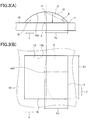
- FIG. 2 (A) is a front view when FIG. 1 is viewed from the direction of arrow x, (B) is a plan view when FIG. 1 is viewed from above.
- the method for forming an organic semiconductor film of the present invention forms an organic semiconductor film using a solution prepared by dissolving an organic semiconductor material serving as an organic semiconductor film in a solvent.
- an organic semiconductor film is formed by disposing a cover member 12 forming a space 16 relative to a substrate 10 on the substrate 10 for forming an organic semiconductor film, filling this space 16 with a solution (described as "coating solution E” hereafter) prepared by dissolving an organic semiconductor material serving as an organic semiconductor film in a solvent so as to make contact with the substrate 10 and the cover member 12, drying the coating solution E, and then removing the cover member 12.
- a solution described as "coating solution E” hereafter
- an organic semiconductor film is formed on the surface of the substrate 10. That is, the substrate 10 is a substrate or the like of an organic semiconductor element.
- Tabular substances made of various materials such as metals including silicon, ceramic, glass, or plastic can be used as the substrate 10 as long as an organic semiconductor film in which an organic semiconductor material is dissolved can be formed.
- substances of various constitutions can be used as the substrate for forming an organic semiconductor film in the production of an organic semiconductor element in addition to the simple tabular substances of the illustrated examples.
- the substrate may be a substance in which an insulating layer is formed on all or part of the surface of a supporting member (substrate of a semiconductor element), a substance in which a gate electrode is formed on a supporting member and the supporting member and gate electrode are covered to form an insulating layer, or a substance in which an insulating layer is formed on the surface of a supporting member serving as a gate electrode and a source electrode and a drain electrode are formed thereon.
- the method for forming an organic semiconductor film of the present invention can be used to form an organic semiconductor film (organic semiconductor layer) in the production process of various known organic semiconductor elements such as bottom gate/bottom contact type, top gate/bottom contact type, bottom gate/top contact type, and top gate/bottom contact type.
- the various substances illustrated as examples of the substrate 10 described above can be used as the supporting members of these substrates.
- the cover member 12 forms a space to be filled with a coating solution E serving as an organic semiconductor film between the surface of the substrate 10 on which the organic semiconductor film is formed (also called the “surface” hereafter) (that is, the cover member 12 regulates the coating region of the coating solution E) and controls the drying of the coating solution E (evaporation of the solvent).
- a coating solution E serving as an organic semiconductor film between the surface of the substrate 10 on which the organic semiconductor film is formed (also called the "surface” hereafter) (that is, the cover member 12 regulates the coating region of the coating solution E) and controls the drying of the coating solution E (evaporation of the solvent).
- the cover member has a control surface having an uppermost part separated most from the surface of the substrate 10 and a descending part provided on both sides of the uppermost part in the direction of arrow y so as to descend toward the surface of the substrate 10 from the uppermost part, and this control surface is disposed facing the substrate 10.
- the space formed by the control surface of the cover member together with the surface of the substrate 10 is open in the x-direction orthogonal to the y-direction.
- the cover member 12 has a shape formed by bending a square plate material (sheet-shaped substance/film) into an arc shape (peripheral surface shape of a cylinder).
- the concave surface of the arc forms a control surface 12a.
- the cover member 12 is mounted on the surface of the substrate 10 so that the concave surface of the control surface 12a faces the substrate 10 using the circumferential direction of the arc (direction orthogonal to the center line) as the y-direction. Accordingly, the x-direction orthogonal to the y-direction becomes parallel to the center line of this arc (in FIG. 2(A) , the x-direction is the direction orthogonal to the page).
- this cover member 12 is disposed so that the entire area on both ends in the y-direction makes contact with the surface of the substrate 10.
- the position indicated by the alternate long and short dash line in FIG. 2 is the uppermost part of the cover member 12 (uppermost part of the arc) .
- control surface 12a of the cover member 12 is configured so as to have a descending part facing both sides in the y-direction from the uppermost part indicated by the alternate long and short dash line so as to descend toward the surface of the substrate 10 in an arc shape.
- an end part in the y-direction, the entire area of which makes contact with the surface of the substrate 10, is used as a base end, and this base end side is filled with the coating solution E.
- this cover member 12 may use either end part in the y-direction as a base end.
- the right side is defined as the base end b, for example.
- an organic semiconductor film is formed by filling the base end b side of the space 16 formed by such a cover member 12 and the substrate 10 with the coating solution E so as to make contact with the cover member 12 and the substrate 10 and then drying the coating solution E.
- the space 16 is filled with the coating solution E so that at least one part of the end part in the y-direction on the opposite side from the base end b on the control surface 12a does not surpass the uppermost part - that is, the alternate long and short dash line - when viewed from the base end b.
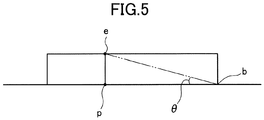
- the space 16 is filled with the coating solution E so that the apparent angle ⁇ , which is the angle formed by a line in the y-direction (alternate long and two short dashes line) connecting the base end b and a position e (also called the "separation position e" hereafter) where the coating solution E is most separated from the base end b in the y-direction on the control surface 12a and a line in the y-direction connecting the base end b and a point p where a perpendicular line dropped onto the substrate 10 from the separation position e intersects with the substrate 10, is at most 50°.
- the apparent angle ⁇ which is the angle formed by a line in the y-direction (alternate long and two short dashes line) connecting the base end b and a position e (also called the "separation position e" hereafter) where the coating solution E is most separated from the base end b in the y-direction on the control surface 12a and a line in the
- the space 16 is filled with the coating solution E so that the vertical angle on the base end b side of a right triangle forming a plane parallel to the y-direction connecting the base end b, the separation position e, and the point p is at most 50°.
- the space 16 is filled with the coating solution E so that the ratio x/y determined by dividing the length Lx in the x-direction by the length Ly in the y-direction is at least 0.2.
- an organic semiconductor film is formed by using such a cover member 12 having a prescribed shape, filling the space 16 formed by the substrate 10 and the cover member 12 with the coating solution E so as to satisfy the three conditions described above, and then drying the coating solution E.
- the present invention has such a configuration, it is possible to suitably adjust the drying rate of the coating solution E by increasing the solvent concentration in the evaporation space - that is, the space 16 - of the coating solution E so as to reduce the evaporation rate - that is, the drying rate - of the solvent of the coating solution E and controlling the contact area between the coating solution E and outside air (that is, the evaporation area of the solvent).
- the liquid surface of the coating solution E with which the space 16 is filled is illustrated in a flat shape in order to simplify the drawings and explanations, but the liquid surface of the coating solution E with which the space 16 is filled does not necessarily have a flat shape and often has a shape such as a convex shape or a concave shape.
- the liquid surface on the opposite side from the base end b in the y-direction may also have a convex shape.
- the liquid surface may also, conversely, have a concave shape.
- the separation position e the position most separated from the base end b in the y-direction on the liquid surface on the opposite side from the base end b on the control surface 12a is defined as the separation position e.
- control surface 12a of the cover member 12 has an uppermost part separated most from the substrate 10 and a descending part which extends from the uppermost part in the y-direction and descends from the uppermost part toward the surface of the substrate 10 on both sides in the y-direction of the uppermost part. That is, the control surface 12a of the cover member 12 has an area which descends from the uppermost part toward the substrate 10 on the other side of the uppermost part when viewed in the y-direction from the base end b filled with the coating solution E.
- control surface 12a of such a cover member 12 forms, together with the substrate 10, a space 16 with a convex shape using the uppermost part as a vertex facing upward (opposite side from the substrate 10). Therefore, the solvent evaporated from the coating solution E remains inside this convex space 16, and as a result, it is possible to increase the solvent concentration inside the space 16 and to reduce the drying rate of the coating solution E.
- Part of the end face in the x-direction of the space 16 formed by the substrate 10 and the cover member 12 may be opened, but it is preferable for the entire face to be opened, as in the illustrated example.
- At least part of the coating solution E with which the space 16 is filled is applied so as not to surpass the uppermost part on the control surface 12a when viewed from the base end b.
- the coating solution E with which the space 16 is filled is applied so as to completely surpass the uppermost part on the control surface 12a when viewed from the base end b, the coating solution E flows to the end part on the opposite side from the base end b in the y-direction. Therefore, the coating solution E is applied at a different position from the base end b side of the space 16 - that is, the location where the organic semiconductor film is to be formed - so the organic semiconductor film cannot be formed at the target position.
- the apparent angle ⁇ formed by the line (alternate long and two short dashes line) connecting the base end b and the separation position e and the line connecting the base end b and the point p where a perpendicular line from the separation position e and the substrate 10 intersect is specifically the apparent angle of the coating solution E with which the space 16 is filled with respect to the base end b.
- the space 16 is filled with the coating solution E so that this apparent angle ⁇ is at most 50°.
- the apparent angle ⁇ exceeds 50°, the contact area between the coating solution E and outside air becomes too large, and the drying rate of the coating solution E becomes too fast, which causes the crystallinity of the organic semiconductor to decrease.
- the apparent angle is preferably at most 40°, more preferably at most 30°, and particularly preferably at most 20°.
- the apparent angle ⁇ should be greater than 0°.
- the rate of drying of the coating solution decreases as the apparent angle ⁇ becomes smaller, so the productivity decreases, and fine crystals tend to be generated on the organic semiconductor film that is formed.
- the apparent angle ⁇ is preferably at least 3°, more preferably at least 5°, and particularly preferably at least 10°.
- the space 16 is filled with the coating solution E so that the ratio x/y determined by dividing the length Lx in the x-direction of the coating solution by the length Ly in the y-direction is at least 0.2.
- the ratio x/y is less than 0.2, the contact area between the coating solution E and outside air becomes too large, and the drying rate of the coating solution E becomes too fast, which causes the crystallinity of the organic semiconductor to decrease.
- the ratio x/y is at least 0.2, preferably at least 0.3, and more preferably at least 0.45.
- the ratio x/y may be larger.
- the ratio x/y is preferably at most 100,000, more preferably at most 10,000, even more preferably at most 1,000, and particularly preferably at most 100.
- the length Ly of the coating solution E in the y-direction is determined to be the distance in the y-direction between the base end b and the coating solution E at a position most separated from the base end b in the y-direction on the substrate 10.
- the length Lx in the x-direction of the coating solution E is determined to be the distance in the x-direction at a position where the liquid surface is most separated in the x-direction on the substrate 10.
- the surface area where the coating solution E makes contact with the outside air - that is, the surface area where the coating solution E does not make contact with the substrate 10 and the cover member 12 - is preferably at most 35%, more preferably at most 32%, even more preferably at most 30%, and particularly preferably at most 20% of the surface area of the entire coating solution E.
- the rate of drying of the coating solution decreases as the area where the coating solution E makes contact with the outside air becomes smaller, so the productivity decreases, and fine crystals tend to be generated on the organic semiconductor film that is formed.
- the surface area where the coating solution E makes contact with the outside air is preferably at least 1%, more preferably at least 5%, even more preferably at least 10%, and particularly preferably at least 15% of the surface area of the coating solution.
- the liquid surface of the coating solution E does not necessarily have a flat shape and often has a concave shape or a convex shape, so it is very difficult to accurately calculate the surface area of the coating solution.
- the liquid surface on the opposite side from the base end b in the y-direction of the coating solution E is considered to have a flat shape parallel to the x-direction at a position where the base end b and the coating solution E are separated most in the y-direction.
- the liquid surface of the coating solution E on both sides in the x-direction is considered to be a right triangle with a flat surface parallel to the y-direction connecting the base end b, the separation position e, and the point p using the liquid surface in the y-direction set in this way.
- the apparent surface area of the coating solution E which is calculated using the liquid surface set as described above, is defined as the surface area of the coating solution E.
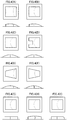
- members of various shapes may be used as the cover member in addition to the arc shape of the illustrated example in which both ends in the y-direction of the control surface 12a make contact with the substrate 10, as long as a convex space such as that described above can be formed.
- cover member may be disposed on the substrate 10 in various states.
- one end in the y-direction of an arc-shaped cover member may be configured so that it does not make contact with the substrate 10.
- the horizontal direction in the drawing is the y-direction in all of the examples.
- the side of the cover member that does not make contact with the substrate 10 may be supported by a columnar member as necessary.
- the side of the cover member that does not make contact with the substrate 10 may be suspended and supported from above.
- both ends in the y-direction of the cover member to make contact with the substrate 10
- an arc-shaped cover member similar to FIGS. 1 and 2 may have a configuration in which the entire area of one end part in the y-direction makes contact with the substrate 10 and the other end part partially makes contact with the substrate 10 while a portion does not make contact with the substrate 10.
- an arc-shaped cover member similar to FIGS. 1 and 2 may have a configuration in which the entire area of one end part in the y-direction makes contact with the substrate 10, while the other end part has a rectangular notch, and the end part excluding this notch makes contact with the substrate 10.
- This notch may have various shapes such as a triangular or circular shape in addition to a rectangular shape. Further, the notch may be formed at an end rather than in the center in the x-direction.
- the cover member may have a trapezoidal shape.
- the cover member has an area parallel to both end parts in the y-direction, as in the case of the square illustrated in FIG. 1 or the like, this trapezoid, or a rectangle, both ends in the y-direction of the cover member can be easily brought into contact with the substrate 10, and the entire area of both ends in the y-direction can preferably be brought into contact with the substrate 10.
- the cover member may have a shape not having a descending part which gradually approaches the substrate 10 from the uppermost part on both sides in the y-direction.
- a cover member of a shape in which the end parts of a rectangular parallelepiped are bent perpendicularly that is, a regular hexahedron shape in which the one largest surface and the two opposing side surfaces are opened
- the bent end parts are brought into contact with the substrate 10 using the bent sides as the y-direction.
- the uppermost part has a flat shape, and the portions bent perpendicularly become descending parts.
- the upper surface may have a portion which slopes in a triangular shape, as illustrated conceptually in FIG. 4(H) , or a portion which slopes toward the substrate 10 on the side of one of the descending parts, as illustrated conceptually in FIG. 4(I) .
- the aforementioned apparent angle ⁇ is, as described above, defined as the angle formed by the line connecting the base end b and the separation position e most separated from the base end b in the y-direction on the control surface and the line connecting the base end b and the point p where a perpendicular line from the separation position e intersects with the substrate 10, as illustrated conceptually in FIG. 5 .
- the cover member is not limited to a tabular member such as that illustrated in the drawings, and members of various shapes may be used as long as a control surface for forming a convex space such as that described above is formed.
- a concave part such as an arc columnar shape may be formed on one side of a block-shaped member such as a rectangular parallelepiped or a cube, and a space to be filled with a solution may be formed relative to the substrate 10 using this surface as a control surface.
- the cover member disposed on the surface of the substrate 10 is not limited to a single member, and an organic semiconductor film may be formed by disposing a plurality of cover members on the surface of a single substrate. Further, a single cover member may have a plurality of control surfaces corresponding to the shapes of a plurality of organic semiconductor films.
- the cover member 12 may be formed from various materials.
- liquid-repellent materials such as fluorene resins including polytetrafluoroethylene, polychlorotrifluoroethylene, trifluoride resins, polyvinylidene fluoride, polyvinyl fluoride, fluorinated resin copolymers, perfluoroalkoxy fluorine resins, ethylene tetrafluoride/propylene hexafluoride copolymers, ethylene/ethylene tetrafluoride copolymers, and ethylene/chlorotrifluoroethylene copolymers, and silicone resins are preferable.
- fluorene resins including polytetrafluoroethylene, polychlorotrifluoroethylene, trifluoride resins, polyvinylidene fluoride, polyvinyl fluoride, fluorinated resin copolymers, perfluoroalkoxy fluorine resins, ethylene tetrafluoride/propylene hexafluoride copolymers, ethylene/ethylene
- a material prepared by coating a surface of a resin or the like with a water-repellent resin or subjecting the surface to liquid-repellent treatment may also be preferably used as the cover member 12.
- the size of the cover member 12 should be determined appropriately in accordance with the organic semiconductor film to be formed.
- an organic semiconductor film is formed on the surface of a substrate 10 by disposing a cover member 12 on the surface of the substrate 10, filling the base end b side of a space 16 formed by the surface of the substrate 10 and the cover member 12 with a coating solution E prepared by dissolving an organic semiconductor material serving as an organic semiconductor film, drying the coating solution E, and removing the cover member 12.
- the surface of the substrate 10 may be subjected to various types of surface treatment such as treatment to enhance the wettability of the substrate 10 including UV ray irradiation or ozone treatment as necessary before the cover member 12 is disposed on the substrate 10.
- pentacenes such as 6,13-bis(triisopropylsilylethynyl)pentacene (TIPS pentacene), rubrenes, fullerenes, phthalocyanines, and TCNQ substances.
- the present invention is not limited to these organic semiconductor materials, and low molecular-type organic semiconductor materials are preferably used.
- various solvents can be used as the solvent contained in the coating solution E as long as the organic semiconductor material that is used can be dissolved.
- the organic semiconductor material is an acene such as TIPS pentacene
- preferable examples include toluene, anisole, n-butyl benzene, and acetone.
- the concentration of the organic semiconductor material in the coating solution E should be set appropriately in accordance with the type of the organic semiconductor material, the type of the solvent, the thickness of the organic semiconductor film to be formed, the shape of the cover member 12, and the like.
- the coating solution E may contain a surfactant, a polymer, or the like as necessary in addition to the organic semiconductor material and the solvent.
- the coating solution E contains components other than the organic semiconductor material and the solvent, the content thereof is preferably at most 50 mass%.
- n-type silicone substrate with an area of 20 ⁇ 20 mm and a thickness of 0.5 mm was prepared.
- the surface of this silicone substrate was heat-treated to form a thermal oxide film with a thickness of 300 nm, which was used as a substrate 10.
- the surface of the thermal oxide film was irradiated with UV rays to increase the wettability.
- Teflon sheet with an area of 16 ⁇ 16 mm and a thickness of 0.2 mm was prepared.
- This Teflon sheet was bent in one direction so as to form a cover member 12 with an arc shape (cylindrical peripheral surface shape) having a height of 1 mm, as illustrated in FIGS. 1 and 2 .
- TIPS pentacene was dissolved in toluene so as to prepare a coating solution E.
- the concentration of TIPS pentacene in the coating solution was set to 1 mass%.
- the cover member 12 was mounted on the substrate 10. Since the cover member 12 has an arc shape with a height of 1 mm, the height of the uppermost part of the cover member 12 is 1 mm.
- the base end b side of the space 16 was filled with the coating solution E using a syringe.
- the filling of the coating solution E was performed so that the position most separated from the base end b on the control surface 12a of the cover member 12 coincides with the uppermost part in the y-direction and so that it reaches the entire area of the cover member 12 in the x-direction. Accordingly, in this example, the coating solution E has a length Ly of 8 mm in the y-direction and a length Lx of 16 mm in the x-direction.
- the length Ly in the y-direction and the length Lx in the x-direction of the coating solution E, the apparent angle ⁇ [°], the surface area [mm 2 ] of the coating solution E, the contact area [mm 2 ] with the outside air and the percentage [%] of the area in contact with the outside air, and the ratio x/y in this state are shown in the table below.
- the substrate 10 and the cover member 12 filled with the coating solution E in this way were dried for ten minutes in a draft chamber.
- the substrate 10 was removed from the draft chamber, and the cover member 12 was removed to produce a substrate 10 having an organic semiconductor thin film formed on the surface.
- Two metal electrodes having square patterns of 1 mm on each side were formed at a spacing of 50 ⁇ m by vacuum deposition on the organic semiconductor film (TIPS pentacene film) formed in this way, and an organic semiconductor element (organic thin film transistor) was thereby produced.
- the silicon wafer acts as a gate electrode
- the thermal oxide film acts as a gate insulating film
- the two metal electrodes respectively acts as a source electrode and a drain electrode.
- the Teflon sheet serving as the cover member 12 was greater than the substrate 10
- a large n-type silicone substrate was used, and the cover member 12 was mounted in the center thereof.
- Organic semiconductor films were formed and organic semiconductor elements were produced in the same manner as in Working Example 1 with the exception that the length in the x-direction of the Teflon sheet serving as the cover member 12 was set to 1 mm (Comparative Example 1) and with the exception that the height of the arc of the cover member 12 was set to 7 mm (Comparative Example 2), respectively.
- An organic semiconductor element was produced in the same manner as in Working Example 1 with the exception that an organic semiconductor film of the same size as the organic semiconductor film formed in Working Example 1 was formed by dropping the coating solution onto the substrate 10 with a syringe without using a cover member.
- the Teflon sheet was not bent, and the entire area of one end was brought into contact with the substrate 10 in a flat state and erected on the substrate 10 at an angle of 7.2°.
- An organic semiconductor film was formed and an organic semiconductor element was produced in the same manner as in Working Example 1 with the exception that the end part side where the Teflon sheet and the substrate 10 make contact was filled with the coating solution E so that the length Ly in the y-direction was 8 mm.
- the length Ly in the y-direction and the length Lx in the x-direction of the coating solution E, the apparent angle ⁇ [°], the surface area [mm 2 ] of the coating solution E, the contact area [mm 2 ] with the outside air and the percentage [%] of the area in contact with the outside air, and the ratio x/y in the state in which the space 16 was filled with the coating solution E in each example of the Working Example 2 to Working Example 9 and the Comparative Example 1, Comparative Example 2, and Comparative Example 4 are shown in table below.
- Each electrode of each organic semiconductor element produced in this way was connected to each terminal of a manual prober connected to a 4155C produced by Agilent Technologies, and field effect transistor (FET) evaluations were performed. Specifically, the field effect mobility ([cm 2 /V ⁇ sec]) was calculated by measuring the characteristic of the drain current-gate voltage (Id-Vg).
- the semiconductor elements (TFTs) produced with the production method of the present invention all have good mobility since organic semiconductor elements can be formed while properly controlling the drying of the coating solution E.
- Comparative Example 1 in which the ratio x/y of the coating solution is too small, Comparative Example 2 in which the apparent angle of the coating solution E is too large, and Comparative Example 3 in which an organic semiconductor film was formed without using a cover member, the drying of the coating solution E cannot be controlled, and high mobility is not achieved.
- Comparative Example 4 which does not have a descending part which descends from the uppermost part toward the opposite side of the base end, the solvent that evaporates from the coating solution is discharged to the outside of the cover member, and the solvent concentration inside the cover member cannot be made high. Therefore, the drying of the coating solution E similarly cannot be controlled, and high mobility is not achieved.
- the present invention can be suitably used for the production of organic semiconductor elements using organic semiconductor materials such as TFTs.
Landscapes
- Engineering & Computer Science (AREA)
- Manufacturing & Machinery (AREA)
- Liquid Deposition Of Substances Of Which Semiconductor Devices Are Composed (AREA)
- Thin Film Transistor (AREA)
- Electroluminescent Light Sources (AREA)
Applications Claiming Priority (2)
| Application Number | Priority Date | Filing Date | Title |
|---|---|---|---|
| JP2013054250A JP6061743B2 (ja) | 2013-03-15 | 2013-03-15 | 有機半導体膜の形成方法 |
| PCT/JP2014/053930 WO2014141838A1 (ja) | 2013-03-15 | 2014-02-19 | 有機半導体膜の形成方法 |
Publications (3)
| Publication Number | Publication Date |
|---|---|
| EP2975636A1 EP2975636A1 (en) | 2016-01-20 |
| EP2975636A4 EP2975636A4 (en) | 2016-03-30 |
| EP2975636B1 true EP2975636B1 (en) | 2020-10-21 |
Family
ID=51536514
Family Applications (1)
| Application Number | Title | Priority Date | Filing Date |
|---|---|---|---|
| EP14764302.7A Not-in-force EP2975636B1 (en) | 2013-03-15 | 2014-02-19 | Process for forming organic semiconductor film |
Country Status (6)
| Country | Link |
|---|---|
| US (1) | US9472760B2 (OSRAM) |
| EP (1) | EP2975636B1 (OSRAM) |
| JP (1) | JP6061743B2 (OSRAM) |
| CN (1) | CN105144357B (OSRAM) |
| TW (1) | TWI595571B (OSRAM) |
| WO (1) | WO2014141838A1 (OSRAM) |
Families Citing this family (1)
| Publication number | Priority date | Publication date | Assignee | Title |
|---|---|---|---|---|
| EP3413338B1 (en) | 2016-02-03 | 2019-07-10 | FUJIFILM Corporation | Organic semiconductor film production device |
Family Cites Families (9)
| Publication number | Priority date | Publication date | Assignee | Title |
|---|---|---|---|---|
| JP5092269B2 (ja) * | 2006-04-26 | 2012-12-05 | コニカミノルタホールディングス株式会社 | 有機半導体薄膜および有機半導体デバイスの製造方法 |
| US20090184347A1 (en) * | 2006-05-24 | 2009-07-23 | Nissan Chemical Industries, Ltd. | Coating liquid for gate insulating film, gate insulating film and organic transistor |
| JP4316669B2 (ja) * | 2006-06-07 | 2009-08-19 | パナソニック株式会社 | 半導体素子の製造方法および電子デバイスの製造方法 |
| US9741901B2 (en) * | 2006-11-07 | 2017-08-22 | Cbrite Inc. | Two-terminal electronic devices and their methods of fabrication |
| EP2435598B1 (en) * | 2009-05-26 | 2017-11-29 | Imec | Method for forming an organic material layer on a substrate |
| US8921152B2 (en) * | 2009-10-02 | 2014-12-30 | Osaka University | Method for manufacturing organic semiconductor film, and organic semiconductor film array |
| JP5590659B2 (ja) * | 2010-03-01 | 2014-09-17 | 国立大学法人岩手大学 | 磁場中有機単結晶薄膜作成法及び作成装置 |
| US20130143357A1 (en) * | 2010-08-23 | 2013-06-06 | Sony Corporation | Method of forming organic thin film and organic thin film forming apparatus, as well as method of manufacturing organic device |
| JP2013040124A (ja) * | 2011-08-15 | 2013-02-28 | Osaka Univ | 自己組織化単分子膜形成用の化合物及びそれを用いた有機半導体素子 |
-
2013
- 2013-03-15 JP JP2013054250A patent/JP6061743B2/ja not_active Expired - Fee Related
-
2014
- 2014-02-19 CN CN201480011019.4A patent/CN105144357B/zh not_active Expired - Fee Related
- 2014-02-19 EP EP14764302.7A patent/EP2975636B1/en not_active Not-in-force
- 2014-02-19 WO PCT/JP2014/053930 patent/WO2014141838A1/ja not_active Ceased
- 2014-02-26 TW TW103106369A patent/TWI595571B/zh not_active IP Right Cessation
-
2015
- 2015-09-01 US US14/842,445 patent/US9472760B2/en not_active Expired - Fee Related
Non-Patent Citations (1)
| Title |
|---|
| None * |
Also Published As
| Publication number | Publication date |
|---|---|
| TWI595571B (zh) | 2017-08-11 |
| US20150372233A1 (en) | 2015-12-24 |
| JP6061743B2 (ja) | 2017-01-18 |
| EP2975636A1 (en) | 2016-01-20 |
| TW201440149A (zh) | 2014-10-16 |
| CN105144357A (zh) | 2015-12-09 |
| EP2975636A4 (en) | 2016-03-30 |
| WO2014141838A1 (ja) | 2014-09-18 |
| US9472760B2 (en) | 2016-10-18 |
| CN105144357B (zh) | 2017-07-14 |
| JP2014179568A (ja) | 2014-09-25 |
Similar Documents
| Publication | Publication Date | Title |
|---|---|---|
| CN102598232B (zh) | 有机半导体膜的制造方法及有机半导体膜阵列 | |
| CN111293067B (zh) | 成膜装置 | |
| WO2014136636A1 (ja) | 薄膜トランジスタ | |
| Li et al. | In situ purification to eliminate the influence of impurities in solution-processed organic crystals for transistor arrays | |
| US8895354B2 (en) | Method of forming organic semiconductor device that includes forming electrode contact layer by treating electrode surfaces with substance containing substituted arene | |
| KR101451301B1 (ko) | 주형을 이용한 패터닝된 자가조립식 유기 박막 전자 소자의 제조 방법 및 이를 통해 제조되는 패터닝된 자가조립식 유기 박막 전자 소자 | |
| Park et al. | Optimization of electrohydrodynamic-printed organic electrodes for bottom-contact organic thin film transistors | |
| US9070881B2 (en) | Method of manufacturing an organic semiconductor thin film | |
| US20160072086A1 (en) | Thin film transistor, transistor array, method of manufacturing thin film transistor, and method of manufacturing transistor array | |
| US10256164B2 (en) | Semiconductor film and field effect transistor having semiconductor and polymer portions stacked adjacent each other | |
| KR20180136324A (ko) | 투명 플렉시블 디스플레이용 저온에서 제조된 강유전성 공중합체를 전개한 고성능 용액 공정 아연-주석-산화물 박막 트랜지스터 및 그 zto tft 소자 봉지 공정 방법 | |
| EP2975636B1 (en) | Process for forming organic semiconductor film | |
| Gozzi et al. | Electrical characterization of thin-film transistors based on solution-processed metal oxides | |
| US20160336512A1 (en) | Method of forming organic semiconductor film and organic semiconductor film forming device | |
| US7855121B2 (en) | Method of forming organic thin film and method of manufacturing semiconductor device using the same | |
| US11165033B2 (en) | Active device | |
| US10193068B2 (en) | Method of manufacturing a specifically dimensioned thin film transistor, thin film transistor, and transistor array | |
| JP6202714B2 (ja) | 薄膜トランジスタ素子の製造方法及び塗布型半導体層のパターニング方法 | |
| KR102129435B1 (ko) | 정전척 시스템, 성막장치, 흡착방법, 성막방법 및 전자 디바이스의 제조방법 | |
| TWI678739B (zh) | 電晶體及電晶體的製造方法 | |
| KR20110127330A (ko) | 단결정 채널층을 가진 유기박막 트랜지스터 및 그의 제조방법 |
Legal Events
| Date | Code | Title | Description |
|---|---|---|---|
| PUAI | Public reference made under article 153(3) epc to a published international application that has entered the european phase |
Free format text: ORIGINAL CODE: 0009012 |
|
| 17P | Request for examination filed |
Effective date: 20150820 |
|
| AK | Designated contracting states |
Kind code of ref document: A1 Designated state(s): AL AT BE BG CH CY CZ DE DK EE ES FI FR GB GR HR HU IE IS IT LI LT LU LV MC MK MT NL NO PL PT RO RS SE SI SK SM TR |
|
| AX | Request for extension of the european patent |
Extension state: BA ME |
|
| A4 | Supplementary search report drawn up and despatched |
Effective date: 20160301 |
|
| RIC1 | Information provided on ipc code assigned before grant |
Ipc: H01L 51/05 20060101ALI20160224BHEP Ipc: H01L 29/786 20060101ALI20160224BHEP Ipc: H01L 21/368 20060101AFI20160224BHEP Ipc: H01L 51/40 20060101ALI20160224BHEP |
|
| DAX | Request for extension of the european patent (deleted) | ||
| GRAP | Despatch of communication of intention to grant a patent |
Free format text: ORIGINAL CODE: EPIDOSNIGR1 |
|
| STAA | Information on the status of an ep patent application or granted ep patent |
Free format text: STATUS: GRANT OF PATENT IS INTENDED |
|
| INTG | Intention to grant announced |
Effective date: 20190701 |
|
| GRAS | Grant fee paid |
Free format text: ORIGINAL CODE: EPIDOSNIGR3 |
|
| GRAJ | Information related to disapproval of communication of intention to grant by the applicant or resumption of examination proceedings by the epo deleted |
Free format text: ORIGINAL CODE: EPIDOSDIGR1 |
|
| GRAL | Information related to payment of fee for publishing/printing deleted |
Free format text: ORIGINAL CODE: EPIDOSDIGR3 |
|
| STAA | Information on the status of an ep patent application or granted ep patent |
Free format text: STATUS: REQUEST FOR EXAMINATION WAS MADE |
|
| INTC | Intention to grant announced (deleted) | ||
| STAA | Information on the status of an ep patent application or granted ep patent |
Free format text: STATUS: EXAMINATION IS IN PROGRESS |
|
| 17Q | First examination report despatched |
Effective date: 20191202 |
|
| GRAP | Despatch of communication of intention to grant a patent |
Free format text: ORIGINAL CODE: EPIDOSNIGR1 |
|
| STAA | Information on the status of an ep patent application or granted ep patent |
Free format text: STATUS: GRANT OF PATENT IS INTENDED |
|
| INTG | Intention to grant announced |
Effective date: 20200519 |
|
| GRAS | Grant fee paid |
Free format text: ORIGINAL CODE: EPIDOSNIGR3 |
|
| GRAA | (expected) grant |
Free format text: ORIGINAL CODE: 0009210 |
|
| STAA | Information on the status of an ep patent application or granted ep patent |
Free format text: STATUS: THE PATENT HAS BEEN GRANTED |
|
| RAP1 | Party data changed (applicant data changed or rights of an application transferred) |
Owner name: FUJIFILM CORPORATION |
|
| AK | Designated contracting states |
Kind code of ref document: B1 Designated state(s): AL AT BE BG CH CY CZ DE DK EE ES FI FR GB GR HR HU IE IS IT LI LT LU LV MC MK MT NL NO PL PT RO RS SE SI SK SM TR |
|
| REG | Reference to a national code |
Ref country code: GB Ref legal event code: FG4D |
|
| REG | Reference to a national code |
Ref country code: CH Ref legal event code: EP |
|
| REG | Reference to a national code |
Ref country code: DE Ref legal event code: R096 Ref document number: 602014071469 Country of ref document: DE |
|
| REG | Reference to a national code |
Ref country code: IE Ref legal event code: FG4D |
|
| REG | Reference to a national code |
Ref country code: AT Ref legal event code: REF Ref document number: 1326714 Country of ref document: AT Kind code of ref document: T Effective date: 20201115 |
|
| REG | Reference to a national code |
Ref country code: AT Ref legal event code: MK05 Ref document number: 1326714 Country of ref document: AT Kind code of ref document: T Effective date: 20201021 |
|
| REG | Reference to a national code |
Ref country code: NL Ref legal event code: MP Effective date: 20201021 |
|
| RAP4 | Party data changed (patent owner data changed or rights of a patent transferred) |
Owner name: FUJIFILM CORPORATION |
|
| PG25 | Lapsed in a contracting state [announced via postgrant information from national office to epo] |
Ref country code: GR Free format text: LAPSE BECAUSE OF FAILURE TO SUBMIT A TRANSLATION OF THE DESCRIPTION OR TO PAY THE FEE WITHIN THE PRESCRIBED TIME-LIMIT Effective date: 20210122 Ref country code: FI Free format text: LAPSE BECAUSE OF FAILURE TO SUBMIT A TRANSLATION OF THE DESCRIPTION OR TO PAY THE FEE WITHIN THE PRESCRIBED TIME-LIMIT Effective date: 20201021 Ref country code: RS Free format text: LAPSE BECAUSE OF FAILURE TO SUBMIT A TRANSLATION OF THE DESCRIPTION OR TO PAY THE FEE WITHIN THE PRESCRIBED TIME-LIMIT Effective date: 20201021 Ref country code: NL Free format text: LAPSE BECAUSE OF FAILURE TO SUBMIT A TRANSLATION OF THE DESCRIPTION OR TO PAY THE FEE WITHIN THE PRESCRIBED TIME-LIMIT Effective date: 20201021 Ref country code: NO Free format text: LAPSE BECAUSE OF FAILURE TO SUBMIT A TRANSLATION OF THE DESCRIPTION OR TO PAY THE FEE WITHIN THE PRESCRIBED TIME-LIMIT Effective date: 20210121 Ref country code: PT Free format text: LAPSE BECAUSE OF FAILURE TO SUBMIT A TRANSLATION OF THE DESCRIPTION OR TO PAY THE FEE WITHIN THE PRESCRIBED TIME-LIMIT Effective date: 20210222 |
|
| REG | Reference to a national code |
Ref country code: LT Ref legal event code: MG4D |
|
| PG25 | Lapsed in a contracting state [announced via postgrant information from national office to epo] |
Ref country code: LV Free format text: LAPSE BECAUSE OF FAILURE TO SUBMIT A TRANSLATION OF THE DESCRIPTION OR TO PAY THE FEE WITHIN THE PRESCRIBED TIME-LIMIT Effective date: 20201021 Ref country code: SE Free format text: LAPSE BECAUSE OF FAILURE TO SUBMIT A TRANSLATION OF THE DESCRIPTION OR TO PAY THE FEE WITHIN THE PRESCRIBED TIME-LIMIT Effective date: 20201021 Ref country code: IS Free format text: LAPSE BECAUSE OF FAILURE TO SUBMIT A TRANSLATION OF THE DESCRIPTION OR TO PAY THE FEE WITHIN THE PRESCRIBED TIME-LIMIT Effective date: 20210221 Ref country code: PL Free format text: LAPSE BECAUSE OF FAILURE TO SUBMIT A TRANSLATION OF THE DESCRIPTION OR TO PAY THE FEE WITHIN THE PRESCRIBED TIME-LIMIT Effective date: 20201021 Ref country code: BG Free format text: LAPSE BECAUSE OF FAILURE TO SUBMIT A TRANSLATION OF THE DESCRIPTION OR TO PAY THE FEE WITHIN THE PRESCRIBED TIME-LIMIT Effective date: 20210121 Ref country code: ES Free format text: LAPSE BECAUSE OF FAILURE TO SUBMIT A TRANSLATION OF THE DESCRIPTION OR TO PAY THE FEE WITHIN THE PRESCRIBED TIME-LIMIT Effective date: 20201021 Ref country code: AT Free format text: LAPSE BECAUSE OF FAILURE TO SUBMIT A TRANSLATION OF THE DESCRIPTION OR TO PAY THE FEE WITHIN THE PRESCRIBED TIME-LIMIT Effective date: 20201021 |
|
| PG25 | Lapsed in a contracting state [announced via postgrant information from national office to epo] |
Ref country code: HR Free format text: LAPSE BECAUSE OF FAILURE TO SUBMIT A TRANSLATION OF THE DESCRIPTION OR TO PAY THE FEE WITHIN THE PRESCRIBED TIME-LIMIT Effective date: 20201021 |
|
| REG | Reference to a national code |
Ref country code: DE Ref legal event code: R097 Ref document number: 602014071469 Country of ref document: DE |
|
| PG25 | Lapsed in a contracting state [announced via postgrant information from national office to epo] |
Ref country code: LT Free format text: LAPSE BECAUSE OF FAILURE TO SUBMIT A TRANSLATION OF THE DESCRIPTION OR TO PAY THE FEE WITHIN THE PRESCRIBED TIME-LIMIT Effective date: 20201021 Ref country code: RO Free format text: LAPSE BECAUSE OF FAILURE TO SUBMIT A TRANSLATION OF THE DESCRIPTION OR TO PAY THE FEE WITHIN THE PRESCRIBED TIME-LIMIT Effective date: 20201021 Ref country code: SK Free format text: LAPSE BECAUSE OF FAILURE TO SUBMIT A TRANSLATION OF THE DESCRIPTION OR TO PAY THE FEE WITHIN THE PRESCRIBED TIME-LIMIT Effective date: 20201021 Ref country code: CZ Free format text: LAPSE BECAUSE OF FAILURE TO SUBMIT A TRANSLATION OF THE DESCRIPTION OR TO PAY THE FEE WITHIN THE PRESCRIBED TIME-LIMIT Effective date: 20201021 Ref country code: EE Free format text: LAPSE BECAUSE OF FAILURE TO SUBMIT A TRANSLATION OF THE DESCRIPTION OR TO PAY THE FEE WITHIN THE PRESCRIBED TIME-LIMIT Effective date: 20201021 Ref country code: SM Free format text: LAPSE BECAUSE OF FAILURE TO SUBMIT A TRANSLATION OF THE DESCRIPTION OR TO PAY THE FEE WITHIN THE PRESCRIBED TIME-LIMIT Effective date: 20201021 |
|
| PLBE | No opposition filed within time limit |
Free format text: ORIGINAL CODE: 0009261 |
|
| STAA | Information on the status of an ep patent application or granted ep patent |
Free format text: STATUS: NO OPPOSITION FILED WITHIN TIME LIMIT |
|
| PG25 | Lapsed in a contracting state [announced via postgrant information from national office to epo] |
Ref country code: DK Free format text: LAPSE BECAUSE OF FAILURE TO SUBMIT A TRANSLATION OF THE DESCRIPTION OR TO PAY THE FEE WITHIN THE PRESCRIBED TIME-LIMIT Effective date: 20201021 |
|
| REG | Reference to a national code |
Ref country code: DE Ref legal event code: R119 Ref document number: 602014071469 Country of ref document: DE |
|
| 26N | No opposition filed |
Effective date: 20210722 |
|
| PG25 | Lapsed in a contracting state [announced via postgrant information from national office to epo] |
Ref country code: MC Free format text: LAPSE BECAUSE OF FAILURE TO SUBMIT A TRANSLATION OF THE DESCRIPTION OR TO PAY THE FEE WITHIN THE PRESCRIBED TIME-LIMIT Effective date: 20201021 |
|
| GBPC | Gb: european patent ceased through non-payment of renewal fee |
Effective date: 20210219 |
|
| REG | Reference to a national code |
Ref country code: BE Ref legal event code: MM Effective date: 20210228 |
|
| PG25 | Lapsed in a contracting state [announced via postgrant information from national office to epo] |
Ref country code: IT Free format text: LAPSE BECAUSE OF FAILURE TO SUBMIT A TRANSLATION OF THE DESCRIPTION OR TO PAY THE FEE WITHIN THE PRESCRIBED TIME-LIMIT Effective date: 20201021 Ref country code: LU Free format text: LAPSE BECAUSE OF NON-PAYMENT OF DUE FEES Effective date: 20210219 Ref country code: LI Free format text: LAPSE BECAUSE OF NON-PAYMENT OF DUE FEES Effective date: 20210228 Ref country code: AL Free format text: LAPSE BECAUSE OF FAILURE TO SUBMIT A TRANSLATION OF THE DESCRIPTION OR TO PAY THE FEE WITHIN THE PRESCRIBED TIME-LIMIT Effective date: 20201021 Ref country code: CH Free format text: LAPSE BECAUSE OF NON-PAYMENT OF DUE FEES Effective date: 20210228 |
|
| PG25 | Lapsed in a contracting state [announced via postgrant information from national office to epo] |
Ref country code: SI Free format text: LAPSE BECAUSE OF FAILURE TO SUBMIT A TRANSLATION OF THE DESCRIPTION OR TO PAY THE FEE WITHIN THE PRESCRIBED TIME-LIMIT Effective date: 20201021 |
|
| PG25 | Lapsed in a contracting state [announced via postgrant information from national office to epo] |
Ref country code: DE Free format text: LAPSE BECAUSE OF NON-PAYMENT OF DUE FEES Effective date: 20210901 Ref country code: GB Free format text: LAPSE BECAUSE OF NON-PAYMENT OF DUE FEES Effective date: 20210219 Ref country code: FR Free format text: LAPSE BECAUSE OF NON-PAYMENT OF DUE FEES Effective date: 20210228 Ref country code: IE Free format text: LAPSE BECAUSE OF NON-PAYMENT OF DUE FEES Effective date: 20210219 |
|
| PG25 | Lapsed in a contracting state [announced via postgrant information from national office to epo] |
Ref country code: IS Free format text: LAPSE BECAUSE OF FAILURE TO SUBMIT A TRANSLATION OF THE DESCRIPTION OR TO PAY THE FEE WITHIN THE PRESCRIBED TIME-LIMIT Effective date: 20210221 |
|
| PG25 | Lapsed in a contracting state [announced via postgrant information from national office to epo] |
Ref country code: BE Free format text: LAPSE BECAUSE OF NON-PAYMENT OF DUE FEES Effective date: 20210228 |
|
| PG25 | Lapsed in a contracting state [announced via postgrant information from national office to epo] |
Ref country code: HU Free format text: LAPSE BECAUSE OF FAILURE TO SUBMIT A TRANSLATION OF THE DESCRIPTION OR TO PAY THE FEE WITHIN THE PRESCRIBED TIME-LIMIT; INVALID AB INITIO Effective date: 20140219 |
|
| PG25 | Lapsed in a contracting state [announced via postgrant information from national office to epo] |
Ref country code: CY Free format text: LAPSE BECAUSE OF FAILURE TO SUBMIT A TRANSLATION OF THE DESCRIPTION OR TO PAY THE FEE WITHIN THE PRESCRIBED TIME-LIMIT Effective date: 20201021 |
|
| PG25 | Lapsed in a contracting state [announced via postgrant information from national office to epo] |
Ref country code: MK Free format text: LAPSE BECAUSE OF FAILURE TO SUBMIT A TRANSLATION OF THE DESCRIPTION OR TO PAY THE FEE WITHIN THE PRESCRIBED TIME-LIMIT Effective date: 20201021 |
|
| PG25 | Lapsed in a contracting state [announced via postgrant information from national office to epo] |
Ref country code: MT Free format text: LAPSE BECAUSE OF FAILURE TO SUBMIT A TRANSLATION OF THE DESCRIPTION OR TO PAY THE FEE WITHIN THE PRESCRIBED TIME-LIMIT Effective date: 20201021 |
|
| PG25 | Lapsed in a contracting state [announced via postgrant information from national office to epo] |
Ref country code: TR Free format text: LAPSE BECAUSE OF FAILURE TO SUBMIT A TRANSLATION OF THE DESCRIPTION OR TO PAY THE FEE WITHIN THE PRESCRIBED TIME-LIMIT Effective date: 20201021 |