EP2964291B1 - Safety device - Google Patents
Safety device Download PDFInfo
- Publication number
- EP2964291B1 EP2964291B1 EP14761024.0A EP14761024A EP2964291B1 EP 2964291 B1 EP2964291 B1 EP 2964291B1 EP 14761024 A EP14761024 A EP 14761024A EP 2964291 B1 EP2964291 B1 EP 2964291B1
- Authority
- EP
- European Patent Office
- Prior art keywords
- cap
- medical implement
- end portion
- inlet end
- safety device
- Prior art date
- Legal status (The legal status is an assumption and is not a legal conclusion. Google has not performed a legal analysis and makes no representation as to the accuracy of the status listed.)
- Not-in-force
Links
Images


Classifications
-
- A—HUMAN NECESSITIES
- A61—MEDICAL OR VETERINARY SCIENCE; HYGIENE
- A61M—DEVICES FOR INTRODUCING MEDIA INTO, OR ONTO, THE BODY; DEVICES FOR TRANSDUCING BODY MEDIA OR FOR TAKING MEDIA FROM THE BODY; DEVICES FOR PRODUCING OR ENDING SLEEP OR STUPOR
- A61M39/00—Tubes, tube connectors, tube couplings, valves, access sites or the like, specially adapted for medical use
- A61M39/20—Closure caps or plugs for connectors or open ends of tubes
-
- A—HUMAN NECESSITIES
- A61—MEDICAL OR VETERINARY SCIENCE; HYGIENE
- A61M—DEVICES FOR INTRODUCING MEDIA INTO, OR ONTO, THE BODY; DEVICES FOR TRANSDUCING BODY MEDIA OR FOR TAKING MEDIA FROM THE BODY; DEVICES FOR PRODUCING OR ENDING SLEEP OR STUPOR
- A61M25/00—Catheters; Hollow probes
-
- A—HUMAN NECESSITIES
- A61—MEDICAL OR VETERINARY SCIENCE; HYGIENE
- A61M—DEVICES FOR INTRODUCING MEDIA INTO, OR ONTO, THE BODY; DEVICES FOR TRANSDUCING BODY MEDIA OR FOR TAKING MEDIA FROM THE BODY; DEVICES FOR PRODUCING OR ENDING SLEEP OR STUPOR
- A61M39/00—Tubes, tube connectors, tube couplings, valves, access sites or the like, specially adapted for medical use
- A61M39/10—Tube connectors or tube couplings
- A61M39/1011—Locking means for securing connection; Additional tamper safeties
-
- A—HUMAN NECESSITIES
- A61—MEDICAL OR VETERINARY SCIENCE; HYGIENE
- A61M—DEVICES FOR INTRODUCING MEDIA INTO, OR ONTO, THE BODY; DEVICES FOR TRANSDUCING BODY MEDIA OR FOR TAKING MEDIA FROM THE BODY; DEVICES FOR PRODUCING OR ENDING SLEEP OR STUPOR
- A61M39/00—Tubes, tube connectors, tube couplings, valves, access sites or the like, specially adapted for medical use
- A61M39/10—Tube connectors or tube couplings
- A61M39/16—Tube connectors or tube couplings having provision for disinfection or sterilisation
- A61M39/162—Tube connectors or tube couplings having provision for disinfection or sterilisation with antiseptic agent incorporated within the connector
-
- A—HUMAN NECESSITIES
- A61—MEDICAL OR VETERINARY SCIENCE; HYGIENE
- A61M—DEVICES FOR INTRODUCING MEDIA INTO, OR ONTO, THE BODY; DEVICES FOR TRANSDUCING BODY MEDIA OR FOR TAKING MEDIA FROM THE BODY; DEVICES FOR PRODUCING OR ENDING SLEEP OR STUPOR
- A61M39/00—Tubes, tube connectors, tube couplings, valves, access sites or the like, specially adapted for medical use
- A61M39/10—Tube connectors or tube couplings
- A61M39/16—Tube connectors or tube couplings having provision for disinfection or sterilisation
- A61M39/165—Shrouds or protectors for aseptically enclosing the connector
-
- A—HUMAN NECESSITIES
- A61—MEDICAL OR VETERINARY SCIENCE; HYGIENE
- A61M—DEVICES FOR INTRODUCING MEDIA INTO, OR ONTO, THE BODY; DEVICES FOR TRANSDUCING BODY MEDIA OR FOR TAKING MEDIA FROM THE BODY; DEVICES FOR PRODUCING OR ENDING SLEEP OR STUPOR
- A61M25/00—Catheters; Hollow probes
- A61M2025/0018—Catheters; Hollow probes having a plug, e.g. an inflatable plug for closing catheter lumens
-
- A—HUMAN NECESSITIES
- A61—MEDICAL OR VETERINARY SCIENCE; HYGIENE
- A61M—DEVICES FOR INTRODUCING MEDIA INTO, OR ONTO, THE BODY; DEVICES FOR TRANSDUCING BODY MEDIA OR FOR TAKING MEDIA FROM THE BODY; DEVICES FOR PRODUCING OR ENDING SLEEP OR STUPOR
- A61M25/00—Catheters; Hollow probes
- A61M25/0043—Catheters; Hollow probes characterised by structural features
- A61M2025/0056—Catheters; Hollow probes characterised by structural features provided with an antibacterial agent, e.g. by coating, residing in the polymer matrix or releasing an agent out of a reservoir
-
- A—HUMAN NECESSITIES
- A61—MEDICAL OR VETERINARY SCIENCE; HYGIENE
- A61M—DEVICES FOR INTRODUCING MEDIA INTO, OR ONTO, THE BODY; DEVICES FOR TRANSDUCING BODY MEDIA OR FOR TAKING MEDIA FROM THE BODY; DEVICES FOR PRODUCING OR ENDING SLEEP OR STUPOR
- A61M25/00—Catheters; Hollow probes
- A61M25/01—Introducing, guiding, advancing, emplacing or holding catheters
- A61M25/06—Body-piercing guide needles or the like
- A61M25/0606—"Over-the-needle" catheter assemblies, e.g. I.V. catheters
Definitions
- a cannula or an intravenous (IV) catheter is inserted into the patient's body creating an administration route to the patient's vascular system.
- IV intravenous
- any exposed portion of the catheter including the access port is susceptible to contamination.
- harmful microbes or pathogens can be introduced into the patient's bloodstream. This not only places the patient in grave danger, but also increases the complexity and cost of treating the patient.
- the safety device is for use with a medical implement having a body with an inlet end portion
- the safety device comprises a bracket for mounting on the body of the medical implement; a cap supported by the bracket and sized to fit over and seal the inlet end portion of the medical implement in a safety position wherein the cap covers the medical implement; an elongate shaft having a longitudinal axis, the shaft being secured to the cap and being slidably and pivotally supported by the bracket so that the cap can be raised away from the inlet end portion of the medical implement and be pivoted about the longitudinal axis of the shaft away from the inlet end portion; and a biasing means for biasing the cap to the safety position.
- the safety device has been developed to be used with IV medication systems that administer medication or fluids through a catheter port using non-needle connections.
- the safety device when used with the needleless intravenous medication system ensures the access port is always disinfected regardless of the techniques used in catheter care. This device also decreases the possible incidences of access port contamination. Additionally, the device prevents microbial colonization by continuously bathing the port in an antimicrobial or antibacterial solution. The device provides a high level of protection even in the presence of heavy contamination. By keeping the access port sanitized, the chances of introducing infectious agents into a patient via a catheter access port are significantly reduced.
- the safety device further comprises a medical implement having a body where the bracket is molded as one piece with the body of the medical implement.
- the access ports or needles hubs do not have a "built-in" system in order to protect the exterior of the access port from pathogens.
- the safety device is integral with the medical implement the cap can be replaced once the effectiveness of the disinfectant wears off.
- a new cap having a new presoaked disinfecting pad attached to a shaft can be inserted or secured to the device having all the same functionality as the previous cap.
- the safety device further comprises a releasable lock, where the releasable lock temporarily secures the cap away from the inlet end portion of the medical implement.
- a "locking" mechanism keeps the cap displaced from the site making it easy for the practitioner to make the injection. This means the practitioner does not have to hold onto or put down the "disinfecting" tool while making an injection.
- the cap is rotated back toward the site, engages the "unlock” position and returns downward onto the surface of the access port into the safety position.
- the safety device requires two movements to dislocate the protective cap from the access port. For example, in the first movement, the cap is raised vertically away from the body and secondly the cap is rotated away from the access site. This is important because disinfecting devices that can automatically be removed from the injection site with little to no force may result in the access port being unintentionally exposed.
- patients routinely have an access system, IV or catheter, inserted for long periods of time. Patients are required to sleep, eat, use the restroom, and move around, all with the catheter attached.
- An automatic or easy to remove disinfecting apparatus can be easily dislodged exposing the site to contamination without the practitioner or patient ever knowing the injection site was exposed. The exposure may even remain unnoticed until the next infusion has to be made. This problem is avoided by having a safety device that requires two movements to remove the disinfecting device from the access port.
- the present invention provides for a cap that has an interior space defining an area for an antimicrobial agent.
- the interior space comprises an antimicrobial agent such that the antimicrobial agent is configured to contact the inlet end portion of the medical implement in the safety position.
- the antimicrobial agent is selected from the group comprising, alcohol, isopropyl alcohol, chlorohexidine and combinations thereof.
- the cap further comprises a rim, where the rim supports the antimicrobial agent.
- the present invention protects the access port from contamination by pathogens.
- the safety device is secured to the body of the medical implement and the cap is placed over the exposed portion of the access port in a safety or rest position. In this position, the access port is continuously bathed in the disinfecting solution protecting the surface of the access port from viruses and bacteria. This is achieved by the interior of the cap having a pad or other material presoaked with a disinfectant.
- the cap of the safety device When the cap of the safety device is in the safety position, the pad is in contact with the surface of the injection site and the access port is disinfected.
- the practitioner moves the cap away from the site the surface is "wiped” or “scrubbed” with the pad preparing the port for infusion.
- the cap further comprises a hinged door where the hinged door can be opened so that the antimicrobial agent can be removed or inserted.
- a portion of the cap can be opened.
- a new sponge material soaked in disinfectant can be inserted into the cap.
- the cap is then closed securing the sponge inside.
- a rim along the bottom of the cap holds the sponge in place so when the cap is displaced from the access site the sponge does not fall out.
- the safety device further comprises an indicator which visually signals a change in the antimicrobial agent.
- the visual indicator can alert the practitioner if there is an unexpected change in the antimicrobial agent or alternatively if the antimicrobial agent needs to be changed.
- the present invention provides for a method of preventing contamination of a medical implement having a body with an inlet end portion, the method comprises providing a safety device for the medical implement, the safety device comprising a bracket for mounting the device on the body of the medical implement, attaching the bracket to the body of the medical implement, and covering the inlet end portion of the medical implement with a cap supported by the bracket and sized to fit over the inlet end portion of the medical implement in a safety position.
- the method further comprises the steps of removing the cap from the inlet end portion of the medical implement by slidably raising the cap away from the inlet end portion of the medical implement and pivotally rotating the cap away from the medical implement and inserting or withdrawing fluids from the inlet end portion of the medical implement.
- the method further comprises the steps of after removing the cap from the inlet end portion of the medical implement by slidably raising the cap away from the inlet end portion of the medical implement and pivotally rotating the cap away from the medical implement, temporarily securing the cap away from the inlet end portion of the medical implement by engaging a lock and releasing the cap from the lock after inserting or withdrawing fluids from the inlet end portion of the medical implement.
- the cap has an interior space defining an area for an antimicrobial agent.
- the interior space can optionally comprise an antimicrobial agent such that the antimicrobial agent is configured to contact the inlet end portion of the medical implement in the safety position.
- the safety device is more reliable than other disinfecting techniques because the cap is attached to the medical implement and therefore it is not subject to being misplaced, lost or contaminated.
- a disinfecting device When a disinfecting device is not attached to the implement, the practitioner has to take extra steps to prepare the access port before making an infusion. For example, a disinfecting cap can be "screwed" onto the top of a needleless hub and rotated around to disinfect the port. The practitioner has to hold the port, grab the cap either from a box or strip, expose the disinfecting portion of the cap, place the cap over the port, rotate around the port and discard. In the event the cap can be reused, once the practitioner swabs the port with the cap, the practitioner either has to hold onto the cap while making the injection or put the cap down further exposing it to contamination.
- the practitioner can also forget to replace the sterilization cap altogether. Therefore, it is desirable to have the disinfecting device temporarily removable from the access port so that it is not exposed to contamination by being put down or possibly being misplaced. When the practitioner returns the cap to its safety position the exposed portion of the access port is once again covered, protecting the medical implement from contamination.
- the safety device disinfects the access port in a consistent manner.
- the device is designed so that even if the practitioner is distracted or hurried the injection site is effectively cleaned.
- the cleaning technique is subjective as to how the port is cleaned.
- the more intricate the design of the needleless catheter the more difficult it can be in reaching all surfaces to clean adequately before each use. Improper, hurried or sloppy cleaning procedures can lead to a greater chance of contamination.
- the safety device can be used over a period of 3 days before the disinfectant is no longer effective.
- the practitioner will have to replace the safety device on the medical implement to ensure the access port is effectively disinfected.
- nurses and other medical practitioners are short staffed, extremely busy and working under long arduous conditions. Therefore, safety measures that are less of a hassle and still keep the patient safe are most desirable.
- the present invention is directed toward a safety device and methods for using the same.
- numerous specific details are set forth to provide a more thorough description of embodiments of the invention. It will be apparent, however, to one skilled in the art, that the embodiments of the present invention may be practiced without these specific details. In other instances, well known features have not been described in detail so as not to obscure the invention.
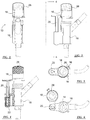
- a first form of the safety device 10 according to the invention is generally shown in Figure 1 .
- the safety device 10 is for a medical implement having a body 12 with an inlet end portion 14.
- the safety device 10 comprises a bracket 16 for mounting on the body 12 of the medical implement; a cap 18 supported by the bracket 16 and sized to fit over and seal the inlet end portion 14 of the medical implement in a safety position wherein the cap 18 covers the inlet end portion 14 of the medical implement.
- An elongate shaft 20 having a longitudinal axis, the shaft 20 being secured to the cap 18 and being slidably and pivotally supported by the bracket 16 so that the cap 18 can sequentially be raised away from the inlet end portion 14 of the medical implement and be pivoted about the longitudinal axis of the shaft 20 at least 180 degrees away from the inlet end portion 14 and a biasing means 22 biasing the cap 18 to the safety position.
- the inlet end portion 14 is the access port where a practitioner would introduce or withdraw fluids to or from a patient.
- the medical implement preferably comprises a needleless connector, hub or injection port and its uses are well known in the art.
- a wide variety of plastics are commonly used to manufacture the external housing and internal components of needleless connectors, although other materials such as silicone and stainless steel are also used. Likewise, these materials can also be used to manufacture the safety device 10.
- Plastics are lightweight, waterproof, moldable, and typically resistant to chemicals, and can be colorized.
- the biomaterials used in the manufacturing can include, but are not limited to, the following products: silicone, polyester, polyethylene, polycarbonates, and stainless steel.
- Polyethylene is a major synthetic thermoplastic polymer commonly used in IV administration sets.
- Polycarbonate is easy to work and mold but combines strength, impact and temperature resistance, toughness, and clarity, which are important characteristics.
- Another significant advantage to polycarbonate is that it can be sterilized by using the ethylene oxide, irradiation, or steam autoclaving methods.
- the safety device 10 is free of latex and di(2-ethylhexyl)phthalate.
- the bracket 16 is configured to engage the body 12 of the medical implement.
- the body 12 of a medical implement is tubular; therefore, in a preferred embodiment the bracket 16 is a horseshoe which securely engages the body 12 of the medical implement.
- the device 10 can be removably mounted on the body 12.
- bracket 16 when the bracket 16 is in a horseshoe configuration it does not add too much width to the medical implement making it uncomfortable for the patient. Additionally, the dimensions and configurations of medical implements can vary, specifically in the body 12. The shape and form of the bracket 16 can be appropriately sized and dimensioned to securely attach to the body 12 depending on the medical implement used. It is contemplated that there are many other methods known in the art to effectively attach the safety device 10 to the medical implement.
- Figure 3 illustrates another view of the safety device 10 which shows the bracket 16 also functioning to house the shaft 20 and biasing means 22.
- the elongate shaft 20 having a longitudinal axis is secured to the cap 18 and is slidably and pivotally supported by the bracket 16.
- the cap 18 can be raised away from the inlet end portion 14 of the medical implement and be pivoted about the longitudinal axis of the shaft 20 away from the inlet end portion 14.
- the cap 18 can be pivoted about the longitudinal axis of the shaft 20 at least 1 to 90 degrees away from the inlet end portion 14 of the medical implement.
- the cap 18 can be pivoted about the longitudinal axis of the shaft 20 at least 91 to 180 degrees away from the inlet end portion 14 of the medical implement.
- the top of the shaft 20 where the cap 18 is attached can be ergonomically modified so that it is suitable for moving the shaft 20 away from the inlet end portion 14. This is best illustrated in Figures 12A-12C .
- the surface can be larger in size to accommodate the finger(s) of the practitioner.
- the shaft 20 is mounted to the body 12 in a groove although any other suitable means for rotational displacement can be used.
- the biasing means as illustrated is a spring 22 although other forms for moving to a desired position can be used.
- the spring 22 is located at the bottom of the shaft 20 in the interior groove of the bracket 16.
- the spring 22 also provides height so that the shaft 20 can be lifted, thereby raising the cap 18 vertically above the inlet portion 14.
- the safety device 10 requires two sequential movements to dislocate the protective cap from the access port. For example, in the first movement, the cap is raised vertically away from the body 12 of the medical implement and secondly the cap 18 is pivoted or rotated away from the access site.
- the spring 22 biases the cap 18 back to the safety position by slidably raising the cap 18 away from the inlet end portion 14 of the medical implement.
- the spring 22 is the biasing means.
- the tensioning of the spring 22 increases, urging the cap 18 to the rest position.
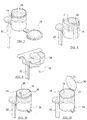
- the shaft 20 is appropriately mounted to the bracket 16 so that the cap 18 can be displaced from a safety position as shown in Figure 5 , to a position exposing the inlet end portion 14 as shown in Figure 6 .
- the practitioner is not required to "hold” the cap 18 in the displaced position.
- the cap 18 is raised and rotated back toward the inlet end portion 14 "unlocking" the shaft 20 which automatically lowers the cap 18 into the safety position.
- a pad 26 housed in the cap 18 bathes the surface of the inlet end portion 14 of the medical implement in disinfecting solution thereby sterilizing the access port.
- the cap 18 and shaft 20 are shown.
- the bottom portion of the elongate shaft 20 is narrower than the upper portion of the shaft 20. This provides a "locking" mechanism 24 so when the cap 18 is raised and displaced the cap 18 is not forcibly asserted toward the inlet end portion 14 or against the practitioner when making an injection. The placement of the locking mechanism 24 will determine how far the cap 18 can be pivoted about the longitudinal axis of the shaft 20 away from the inlet end portion 14 of the medical implement.
- the cap 18 of the safety device 10 is supported by the bracket 16 and sized to fit over and seal the inlet end portion 14 of the medical implement in a safety position wherein the cap 18 covers the medical implement.
- the cap 18 houses the pad 26, sponge, or any other material having disinfecting or anti-microbial properties.
- the pad 26 is presoaked with a disinfectant.
- disinfectants Common disinfectants that can be used are alcohol, isopropyl alcohol, chlorohexidine and combinations thereof.
- the cap 18 is in safety position the pad 26 is in contact with the inlet portion 14 of the medical implement keeping the access site safe and clean.
- the bottom portion of the cap 18 has a rim 28.
- the rim 28 creates a tighter fit around the inlet end portion 14 of the medical implement preventing contamination and the escape of the disinfecting fluid from evaporation.
- the rim 28 can also function to hold the pad 26 in place when the cap is displaced from the safety position.
- the effectiveness of the disinfectant can decrease with time. Therefore, it is desirable to have a visible indicator to signal when a "new" safety device 10 is required.
- the cap 18 can be partially or completely clear or opaque so the practitioner can see through the cap 18 to determine when the disinfectant solution is low in volume.
- the disinfectant can be dyed a color and as the disinfectant disappears, the color will become less vibrant indicating a need to change the safety device 10.
- the practitioner simply removes the bracket 16 from the body 12 of the medical implement and secures a new safety device 10 to the body 12.
- the bracket 16 of the safety device 10 can be molded as one piece with the body of the medical implement.
- the disinfectant will likely wear off before the need arises for a new medical implement.
- the safety device can be configured so that a new shaft 20 with cap 18 attached can be inserted into the safety device 10. For example once the disinfectant is no longer effective the practitioner can remove the shaft 20 from the safety device 10 and insert or attach a new shaft 20 with cap 18 attached.
- the cap 18 can have a hinged door 30 so that the pad 26 can be replaced.
- the hinged door 30 is located on the side of the cap 18 or in another alternative as seen in Figures 10 and 11 , the hinged door 30 when positioned on the top of the cap 18 will function as a lid.
- the hinged door is connected to the cap with a hinge 32 which is used to displace the hinged door from the cap 18.
- the hinged door 30 can be opened so that the practitioner can remove the pad 26 and insert a new pad 26.
- the rim 28 on the bottom portion of the cap 18 will function to hold the pad 26 in place.
- the pad 26 can have an adhesive on the non-disinfecting end. The adhesive can attach the pad 26 to the interior cavity of the cap 18. After the disinfectant is no longer effective, the practitioner can open the cap 18, remove the used pad 26 and insert a new pad 26 into the cap 18 without having to replace the entire safety device 10.
- FIGS 12A through 12C are illustrations of another embodiment of the safety device 10.
- a practitioner can attach the safety device 10 to a medical implement.
- the cap 18 is securely placed over the inlet end portion 14 of the medical implement.
- the practitioner will raise the shaft 20 vertically above the inlet end portion 14 high enough so the shaft 20 is raised above the locking mechanism 24.
- the practitioner rotates the cap 18 in either direction away from the inlet end portion 14 of the medical implement.
- the practitioner can make the injection, unlock the cap 18 and rotate the cap 18 back toward the inlet end portion 14.
- the cap 18 will automatically be lower covering the inlet end portion 14 of the medical implement.
Landscapes
- Health & Medical Sciences (AREA)
- Heart & Thoracic Surgery (AREA)
- Life Sciences & Earth Sciences (AREA)
- Hematology (AREA)
- General Health & Medical Sciences (AREA)
- Anesthesiology (AREA)
- Biomedical Technology (AREA)
- Pulmonology (AREA)
- Veterinary Medicine (AREA)
- Animal Behavior & Ethology (AREA)
- Engineering & Computer Science (AREA)
- Public Health (AREA)
- Epidemiology (AREA)
- Biophysics (AREA)
- Infusion, Injection, And Reservoir Apparatuses (AREA)
- Apparatus For Disinfection Or Sterilisation (AREA)
- External Artificial Organs (AREA)
Applications Claiming Priority (3)
| Application Number | Priority Date | Filing Date | Title |
|---|---|---|---|
| US201361773574P | 2013-03-06 | 2013-03-06 | |
| US13/953,393 US8721619B1 (en) | 2013-03-06 | 2013-07-29 | Safety device |
| PCT/US2014/020414 WO2014138122A2 (en) | 2013-03-06 | 2014-03-04 | Safety device |
Publications (3)
| Publication Number | Publication Date |
|---|---|
| EP2964291A2 EP2964291A2 (en) | 2016-01-13 |
| EP2964291A4 EP2964291A4 (en) | 2016-11-23 |
| EP2964291B1 true EP2964291B1 (en) | 2018-05-30 |
Family
ID=50635563
Family Applications (1)
| Application Number | Title | Priority Date | Filing Date |
|---|---|---|---|
| EP14761024.0A Not-in-force EP2964291B1 (en) | 2013-03-06 | 2014-03-04 | Safety device |
Country Status (6)
| Country | Link |
|---|---|
| US (3) | US8721619B1 (enExample) |
| EP (1) | EP2964291B1 (enExample) |
| JP (1) | JP6630934B2 (enExample) |
| AU (1) | AU2014225986B9 (enExample) |
| CA (1) | CA2904205C (enExample) |
| WO (1) | WO2014138122A2 (enExample) |
Families Citing this family (17)
| Publication number | Priority date | Publication date | Assignee | Title |
|---|---|---|---|---|
| US10143830B2 (en) * | 2013-03-13 | 2018-12-04 | Crisi Medical Systems, Inc. | Injection site information cap |
| US20150094694A1 (en) * | 2013-10-01 | 2015-04-02 | James W. Stone | Catheter Sterilization Cap |
| WO2016002113A1 (ja) * | 2014-07-04 | 2016-01-07 | テルモ株式会社 | 医療用コネクタ連結補助具及び医療用コネクタセット |
| EP4169564A1 (en) | 2014-09-29 | 2023-04-26 | Becton, Dickinson and Company | Medical device cap for drug transfer assembly |
| GB2535498A (en) * | 2015-02-18 | 2016-08-24 | Elcam Medical Agricultural Coop Ass Ltd | Pivotable cover |
| US11357966B2 (en) * | 2015-04-23 | 2022-06-14 | B. Braun Medical Inc. | Compounding device, system, kit, software, and method |
| US20200408350A1 (en) * | 2015-06-16 | 2020-12-31 | Juan Nepomuc Walterspiel | Tubing connector for decreased contamination |
| CN106075717B (zh) * | 2016-05-31 | 2019-03-12 | 潘丽 | 肝素帽消毒密封装置 |
| EP3570810B1 (en) * | 2017-01-17 | 2025-09-24 | Becton Dickinson and Company Limited | Syringe adapter with cap |
| EP3612266B1 (en) * | 2017-04-21 | 2023-12-20 | Becton, Dickinson And Company | Connector cap |
| US10687879B2 (en) | 2018-07-03 | 2020-06-23 | Warsaw Orthopedic, Inc. | Bone material dispensing device |
| WO2020112760A1 (en) * | 2018-11-30 | 2020-06-04 | Becton, Dickinson And Company | Integrated connector and disinfecting cap with reservoir |
| EP3677303B1 (en) * | 2019-01-04 | 2023-02-15 | Asset Medikal Tasarim Sanayi ve Ticaret A.S. | Vascular access catheter with swabbable needle-free iv connector |
| US11305030B2 (en) * | 2019-02-28 | 2022-04-19 | Drma Group International Llc | Disinfecting cap with top opening |
| US11648385B2 (en) * | 2019-05-30 | 2023-05-16 | Beeton, Dickinson and Company | Automatic disinfection of a vascular access device connector |
| JP7767104B2 (ja) * | 2021-10-22 | 2025-11-11 | 日機装株式会社 | 透析液取出装置及び血液浄化装置 |
| JP2023070240A (ja) * | 2021-11-09 | 2023-05-19 | ニプロ株式会社 | コネクタ洗浄器 |
Family Cites Families (18)
| Publication number | Priority date | Publication date | Assignee | Title |
|---|---|---|---|---|
| US4963132A (en) * | 1988-11-11 | 1990-10-16 | Gibson Roger M | Capped fluidic connector |
| US5554135A (en) | 1995-02-17 | 1996-09-10 | Menyhay; Steve Z. | Sterile medical injection port and cover method and apparatus |
| US6145688A (en) * | 1996-07-17 | 2000-11-14 | Smith; James C. | Closure device for containers |
| US5951519A (en) * | 1997-04-25 | 1999-09-14 | Dsu Medical Corporation | Aseptic female connector |
| US20080093381A1 (en) * | 2000-09-11 | 2008-04-24 | Rhonda Kerryn Smith | Dispensing Cap |
| US7682561B2 (en) | 2005-05-19 | 2010-03-23 | Sage Products, Inc. | Needleless hub disinfection device and method |
| WO2007097985A2 (en) | 2006-02-17 | 2007-08-30 | Buchman Alan L | Catheter cleaning devices |
| US9895526B2 (en) * | 2006-03-08 | 2018-02-20 | Ivaxis, Llc | Anti-contamination cover for fluid connections |
| EP1996274B1 (en) * | 2006-03-08 | 2016-09-14 | Dotted Intellectual Property LLC | Anti-contamination cover for fluid connections |
| US20080021392A1 (en) * | 2006-07-20 | 2008-01-24 | Lurvey Kent L | Medical fluid access site with antiseptic indicator |
| US7780794B2 (en) | 2006-07-21 | 2010-08-24 | Ivera Medical Corporation | Medical implement cleaning device |
| US8057431B2 (en) * | 2006-12-21 | 2011-11-15 | B. Braun Melsungen Ag | Hinged cap for needle device |
| US20080183153A1 (en) * | 2007-01-31 | 2008-07-31 | Benlan, Inc. | Enteral Feeding Tube Connector |
| US8245870B2 (en) * | 2008-03-18 | 2012-08-21 | Rubbermaid Incorporated | Container cap with tether |
| USD607325S1 (en) | 2008-09-05 | 2010-01-05 | Ivera Medical Corporation | Cleaning cap |
| US8231587B2 (en) | 2009-10-30 | 2012-07-31 | Catheter Connections | Disinfecting caps for medical male luer connectors |
| US20120078203A1 (en) | 2010-01-13 | 2012-03-29 | Gaube Gary J | Antimicrobial injection port barrier cover |
| US9480833B2 (en) | 2010-07-15 | 2016-11-01 | Becton, Dickinson And Company | Antimicrobial IV access cap |
-
2013
- 2013-07-29 US US13/953,393 patent/US8721619B1/en not_active Expired - Fee Related
-
2014
- 2014-03-04 AU AU2014225986A patent/AU2014225986B9/en not_active Ceased
- 2014-03-04 JP JP2015561561A patent/JP6630934B2/ja not_active Expired - Fee Related
- 2014-03-04 CA CA2904205A patent/CA2904205C/en not_active Expired - Fee Related
- 2014-03-04 WO PCT/US2014/020414 patent/WO2014138122A2/en not_active Ceased
- 2014-03-04 EP EP14761024.0A patent/EP2964291B1/en not_active Not-in-force
- 2014-04-01 US US14/242,703 patent/US9162043B2/en not_active Expired - Fee Related
-
2015
- 2015-09-04 US US14/846,692 patent/US10238857B2/en not_active Expired - Fee Related
Non-Patent Citations (1)
| Title |
|---|
| None * |
Also Published As
| Publication number | Publication date |
|---|---|
| US20140257235A1 (en) | 2014-09-11 |
| WO2014138122A3 (en) | 2014-11-06 |
| US8721619B1 (en) | 2014-05-13 |
| US20150374969A1 (en) | 2015-12-31 |
| US10238857B2 (en) | 2019-03-26 |
| EP2964291A4 (en) | 2016-11-23 |
| CA2904205A1 (en) | 2014-09-12 |
| WO2014138122A2 (en) | 2014-09-12 |
| CA2904205C (en) | 2021-01-12 |
| AU2014225986B2 (en) | 2017-12-14 |
| AU2014225986B9 (en) | 2017-12-21 |
| JP6630934B2 (ja) | 2020-01-15 |
| US9162043B2 (en) | 2015-10-20 |
| AU2014225986A1 (en) | 2015-10-22 |
| JP2016508839A (ja) | 2016-03-24 |
| EP2964291A2 (en) | 2016-01-13 |
Similar Documents
| Publication | Publication Date | Title |
|---|---|---|
| AU2014225986B9 (en) | Safety device | |
| ES2794026T3 (es) | Capuchón de limpieza, desinfección y protección antimicrobiana de conector sin aguja y puerta de acceso | |
| JP6333291B2 (ja) | 医療機器用部材のための焼結多孔質ポリマーのキャップ | |
| ES2640218T3 (es) | Tapa de acceso antimicrobiana IV | |
| CN107073252B (zh) | 药物转移套件的医疗器械帽 | |
| ES2947745T3 (es) | Tapón universal para conectores macho y hembra | |
| JP2010516342A (ja) | 分離されたコネクタ用の入れ子にできる滅菌状態保護キャップ | |
| CN104168894A (zh) | 具有抗菌组合物的胶粘贴片 | |
| CN106421848B (zh) | 一次性使用无针输液接头消毒装置 | |
| US10413715B2 (en) | DefensIV | |
| ES2914410T3 (es) | Tapa universal de un solo uso para conectores macho y hembra | |
| US11679247B2 (en) | Apparatus for protecting percutaneous connections and related methods | |
| US10576261B2 (en) | Device male port cleaner | |
| WO2012042202A2 (en) | Cover apparatus | |
| US20240226531A1 (en) | Universal Caps for Male and Female Connectors with an Inner Shaft and Outer Threaded Housing | |
| WO2014116883A1 (en) | Device for improved prevention of infectious contamination in intravenous ("iv") components | |
| CN120225245A (zh) | 冲洗前和冲洗后的血管内导管护理 | |
| CN221787887U (zh) | 构造成接合不同类型的母连接器的帽 | |
| Medher et al. | Microbial and Molecular Identification of Microbiota (Nosocomial Infection) In A Surgical Intensive Care Unit | |
| CN113195036B (zh) | 带储存器的集成连接器与消毒帽 | |
| Hellekson | AAP issues recommendations on infection control in physicians' offices | |
| TR201801849U5 (tr) | Hi̇jyeni̇k kullanim sağlayan i̇ntravenöz katater ve kanül kullanim kilifi |
Legal Events
| Date | Code | Title | Description |
|---|---|---|---|
| PUAI | Public reference made under article 153(3) epc to a published international application that has entered the european phase |
Free format text: ORIGINAL CODE: 0009012 |
|
| 17P | Request for examination filed |
Effective date: 20150930 |
|
| AK | Designated contracting states |
Kind code of ref document: A2 Designated state(s): AL AT BE BG CH CY CZ DE DK EE ES FI FR GB GR HR HU IE IS IT LI LT LU LV MC MK MT NL NO PL PT RO RS SE SI SK SM TR |
|
| AX | Request for extension of the european patent |
Extension state: BA ME |
|
| DAX | Request for extension of the european patent (deleted) | ||
| REG | Reference to a national code |
Ref country code: DE Ref legal event code: R079 Ref document number: 602014026280 Country of ref document: DE Free format text: PREVIOUS MAIN CLASS: A61M0005140000 Ipc: A61M0039160000 |
|
| A4 | Supplementary search report drawn up and despatched |
Effective date: 20161020 |
|
| RIC1 | Information provided on ipc code assigned before grant |
Ipc: A61M 39/16 20060101AFI20161014BHEP Ipc: A61M 39/20 20060101ALI20161014BHEP Ipc: A61M 25/00 20060101ALI20161014BHEP |
|
| RAP1 | Party data changed (applicant data changed or rights of an application transferred) |
Owner name: IVAXIS, LLC |
|
| GRAP | Despatch of communication of intention to grant a patent |
Free format text: ORIGINAL CODE: EPIDOSNIGR1 |
|
| STAA | Information on the status of an ep patent application or granted ep patent |
Free format text: STATUS: GRANT OF PATENT IS INTENDED |
|
| INTG | Intention to grant announced |
Effective date: 20171220 |
|
| GRAS | Grant fee paid |
Free format text: ORIGINAL CODE: EPIDOSNIGR3 |
|
| GRAA | (expected) grant |
Free format text: ORIGINAL CODE: 0009210 |
|
| STAA | Information on the status of an ep patent application or granted ep patent |
Free format text: STATUS: THE PATENT HAS BEEN GRANTED |
|
| AK | Designated contracting states |
Kind code of ref document: B1 Designated state(s): AL AT BE BG CH CY CZ DE DK EE ES FI FR GB GR HR HU IE IS IT LI LT LU LV MC MK MT NL NO PL PT RO RS SE SI SK SM TR |
|
| REG | Reference to a national code |
Ref country code: GB Ref legal event code: FG4D |
|
| REG | Reference to a national code |
Ref country code: CH Ref legal event code: EP |
|
| REG | Reference to a national code |
Ref country code: AT Ref legal event code: REF Ref document number: 1002983 Country of ref document: AT Kind code of ref document: T Effective date: 20180615 |
|
| REG | Reference to a national code |
Ref country code: IE Ref legal event code: FG4D |
|
| REG | Reference to a national code |
Ref country code: DE Ref legal event code: R096 Ref document number: 602014026280 Country of ref document: DE |
|
| REG | Reference to a national code |
Ref country code: NL Ref legal event code: MP Effective date: 20180530 |
|
| REG | Reference to a national code |
Ref country code: LT Ref legal event code: MG4D |
|
| PG25 | Lapsed in a contracting state [announced via postgrant information from national office to epo] |
Ref country code: LT Free format text: LAPSE BECAUSE OF FAILURE TO SUBMIT A TRANSLATION OF THE DESCRIPTION OR TO PAY THE FEE WITHIN THE PRESCRIBED TIME-LIMIT Effective date: 20180530 Ref country code: ES Free format text: LAPSE BECAUSE OF FAILURE TO SUBMIT A TRANSLATION OF THE DESCRIPTION OR TO PAY THE FEE WITHIN THE PRESCRIBED TIME-LIMIT Effective date: 20180530 Ref country code: CY Free format text: LAPSE BECAUSE OF FAILURE TO SUBMIT A TRANSLATION OF THE DESCRIPTION OR TO PAY THE FEE WITHIN THE PRESCRIBED TIME-LIMIT Effective date: 20180530 Ref country code: BG Free format text: LAPSE BECAUSE OF FAILURE TO SUBMIT A TRANSLATION OF THE DESCRIPTION OR TO PAY THE FEE WITHIN THE PRESCRIBED TIME-LIMIT Effective date: 20180830 Ref country code: NO Free format text: LAPSE BECAUSE OF FAILURE TO SUBMIT A TRANSLATION OF THE DESCRIPTION OR TO PAY THE FEE WITHIN THE PRESCRIBED TIME-LIMIT Effective date: 20180830 Ref country code: FI Free format text: LAPSE BECAUSE OF FAILURE TO SUBMIT A TRANSLATION OF THE DESCRIPTION OR TO PAY THE FEE WITHIN THE PRESCRIBED TIME-LIMIT Effective date: 20180530 Ref country code: SE Free format text: LAPSE BECAUSE OF FAILURE TO SUBMIT A TRANSLATION OF THE DESCRIPTION OR TO PAY THE FEE WITHIN THE PRESCRIBED TIME-LIMIT Effective date: 20180530 |
|
| PG25 | Lapsed in a contracting state [announced via postgrant information from national office to epo] |
Ref country code: GR Free format text: LAPSE BECAUSE OF FAILURE TO SUBMIT A TRANSLATION OF THE DESCRIPTION OR TO PAY THE FEE WITHIN THE PRESCRIBED TIME-LIMIT Effective date: 20180831 Ref country code: LV Free format text: LAPSE BECAUSE OF FAILURE TO SUBMIT A TRANSLATION OF THE DESCRIPTION OR TO PAY THE FEE WITHIN THE PRESCRIBED TIME-LIMIT Effective date: 20180530 Ref country code: HR Free format text: LAPSE BECAUSE OF FAILURE TO SUBMIT A TRANSLATION OF THE DESCRIPTION OR TO PAY THE FEE WITHIN THE PRESCRIBED TIME-LIMIT Effective date: 20180530 Ref country code: RS Free format text: LAPSE BECAUSE OF FAILURE TO SUBMIT A TRANSLATION OF THE DESCRIPTION OR TO PAY THE FEE WITHIN THE PRESCRIBED TIME-LIMIT Effective date: 20180530 |
|
| REG | Reference to a national code |
Ref country code: AT Ref legal event code: MK05 Ref document number: 1002983 Country of ref document: AT Kind code of ref document: T Effective date: 20180530 |
|
| PG25 | Lapsed in a contracting state [announced via postgrant information from national office to epo] |
Ref country code: NL Free format text: LAPSE BECAUSE OF FAILURE TO SUBMIT A TRANSLATION OF THE DESCRIPTION OR TO PAY THE FEE WITHIN THE PRESCRIBED TIME-LIMIT Effective date: 20180530 |
|
| PG25 | Lapsed in a contracting state [announced via postgrant information from national office to epo] |
Ref country code: PL Free format text: LAPSE BECAUSE OF FAILURE TO SUBMIT A TRANSLATION OF THE DESCRIPTION OR TO PAY THE FEE WITHIN THE PRESCRIBED TIME-LIMIT Effective date: 20180530 Ref country code: SK Free format text: LAPSE BECAUSE OF FAILURE TO SUBMIT A TRANSLATION OF THE DESCRIPTION OR TO PAY THE FEE WITHIN THE PRESCRIBED TIME-LIMIT Effective date: 20180530 Ref country code: RO Free format text: LAPSE BECAUSE OF FAILURE TO SUBMIT A TRANSLATION OF THE DESCRIPTION OR TO PAY THE FEE WITHIN THE PRESCRIBED TIME-LIMIT Effective date: 20180530 Ref country code: CZ Free format text: LAPSE BECAUSE OF FAILURE TO SUBMIT A TRANSLATION OF THE DESCRIPTION OR TO PAY THE FEE WITHIN THE PRESCRIBED TIME-LIMIT Effective date: 20180530 Ref country code: DK Free format text: LAPSE BECAUSE OF FAILURE TO SUBMIT A TRANSLATION OF THE DESCRIPTION OR TO PAY THE FEE WITHIN THE PRESCRIBED TIME-LIMIT Effective date: 20180530 Ref country code: AT Free format text: LAPSE BECAUSE OF FAILURE TO SUBMIT A TRANSLATION OF THE DESCRIPTION OR TO PAY THE FEE WITHIN THE PRESCRIBED TIME-LIMIT Effective date: 20180530 Ref country code: EE Free format text: LAPSE BECAUSE OF FAILURE TO SUBMIT A TRANSLATION OF THE DESCRIPTION OR TO PAY THE FEE WITHIN THE PRESCRIBED TIME-LIMIT Effective date: 20180530 |
|
| PG25 | Lapsed in a contracting state [announced via postgrant information from national office to epo] |
Ref country code: SM Free format text: LAPSE BECAUSE OF FAILURE TO SUBMIT A TRANSLATION OF THE DESCRIPTION OR TO PAY THE FEE WITHIN THE PRESCRIBED TIME-LIMIT Effective date: 20180530 |
|
| REG | Reference to a national code |
Ref country code: DE Ref legal event code: R097 Ref document number: 602014026280 Country of ref document: DE |
|
| REG | Reference to a national code |
Ref country code: DE Ref legal event code: R082 Ref document number: 602014026280 Country of ref document: DE Representative=s name: DEHMEL & BETTENHAUSEN PATENTANWAELTE PARTMBB, DE Ref country code: DE Ref legal event code: R081 Ref document number: 602014026280 Country of ref document: DE Owner name: NELLIN MEDICAL DEVICES, LLC, LA CANADA, US Free format text: FORMER OWNER: IVAXIS, LLC, MORRISVILLE, N.C., US |
|
| PLBE | No opposition filed within time limit |
Free format text: ORIGINAL CODE: 0009261 |
|
| STAA | Information on the status of an ep patent application or granted ep patent |
Free format text: STATUS: NO OPPOSITION FILED WITHIN TIME LIMIT |
|
| RAP2 | Party data changed (patent owner data changed or rights of a patent transferred) |
Owner name: NELLIN MEDICAL DEVICES, LLC |
|
| 26N | No opposition filed |
Effective date: 20190301 |
|
| REG | Reference to a national code |
Ref country code: GB Ref legal event code: 732E Free format text: REGISTERED BETWEEN 20190429 AND 20190502 |
|
| PG25 | Lapsed in a contracting state [announced via postgrant information from national office to epo] |
Ref country code: SI Free format text: LAPSE BECAUSE OF FAILURE TO SUBMIT A TRANSLATION OF THE DESCRIPTION OR TO PAY THE FEE WITHIN THE PRESCRIBED TIME-LIMIT Effective date: 20180530 |
|
| PG25 | Lapsed in a contracting state [announced via postgrant information from national office to epo] |
Ref country code: MC Free format text: LAPSE BECAUSE OF FAILURE TO SUBMIT A TRANSLATION OF THE DESCRIPTION OR TO PAY THE FEE WITHIN THE PRESCRIBED TIME-LIMIT Effective date: 20180530 |
|
| REG | Reference to a national code |
Ref country code: CH Ref legal event code: PL |
|
| PG25 | Lapsed in a contracting state [announced via postgrant information from national office to epo] |
Ref country code: AL Free format text: LAPSE BECAUSE OF FAILURE TO SUBMIT A TRANSLATION OF THE DESCRIPTION OR TO PAY THE FEE WITHIN THE PRESCRIBED TIME-LIMIT Effective date: 20180530 Ref country code: LU Free format text: LAPSE BECAUSE OF NON-PAYMENT OF DUE FEES Effective date: 20190304 |
|
| REG | Reference to a national code |
Ref country code: BE Ref legal event code: MM Effective date: 20190331 |
|
| PG25 | Lapsed in a contracting state [announced via postgrant information from national office to epo] |
Ref country code: CH Free format text: LAPSE BECAUSE OF NON-PAYMENT OF DUE FEES Effective date: 20190331 Ref country code: LI Free format text: LAPSE BECAUSE OF NON-PAYMENT OF DUE FEES Effective date: 20190331 |
|
| PG25 | Lapsed in a contracting state [announced via postgrant information from national office to epo] |
Ref country code: BE Free format text: LAPSE BECAUSE OF NON-PAYMENT OF DUE FEES Effective date: 20190331 |
|
| PG25 | Lapsed in a contracting state [announced via postgrant information from national office to epo] |
Ref country code: TR Free format text: LAPSE BECAUSE OF FAILURE TO SUBMIT A TRANSLATION OF THE DESCRIPTION OR TO PAY THE FEE WITHIN THE PRESCRIBED TIME-LIMIT Effective date: 20180530 |
|
| PG25 | Lapsed in a contracting state [announced via postgrant information from national office to epo] |
Ref country code: MT Free format text: LAPSE BECAUSE OF NON-PAYMENT OF DUE FEES Effective date: 20190304 Ref country code: PT Free format text: LAPSE BECAUSE OF FAILURE TO SUBMIT A TRANSLATION OF THE DESCRIPTION OR TO PAY THE FEE WITHIN THE PRESCRIBED TIME-LIMIT Effective date: 20181001 |
|
| PG25 | Lapsed in a contracting state [announced via postgrant information from national office to epo] |
Ref country code: IS Free format text: LAPSE BECAUSE OF FAILURE TO SUBMIT A TRANSLATION OF THE DESCRIPTION OR TO PAY THE FEE WITHIN THE PRESCRIBED TIME-LIMIT Effective date: 20180930 |
|
| PG25 | Lapsed in a contracting state [announced via postgrant information from national office to epo] |
Ref country code: HU Free format text: LAPSE BECAUSE OF FAILURE TO SUBMIT A TRANSLATION OF THE DESCRIPTION OR TO PAY THE FEE WITHIN THE PRESCRIBED TIME-LIMIT; INVALID AB INITIO Effective date: 20140304 |
|
| PGFP | Annual fee paid to national office [announced via postgrant information from national office to epo] |
Ref country code: IT Payment date: 20210903 Year of fee payment: 8 Ref country code: IE Payment date: 20210827 Year of fee payment: 8 Ref country code: FR Payment date: 20210825 Year of fee payment: 8 |
|
| PGFP | Annual fee paid to national office [announced via postgrant information from national office to epo] |
Ref country code: GB Payment date: 20210827 Year of fee payment: 8 Ref country code: DE Payment date: 20210827 Year of fee payment: 8 |
|
| PG25 | Lapsed in a contracting state [announced via postgrant information from national office to epo] |
Ref country code: MK Free format text: LAPSE BECAUSE OF FAILURE TO SUBMIT A TRANSLATION OF THE DESCRIPTION OR TO PAY THE FEE WITHIN THE PRESCRIBED TIME-LIMIT Effective date: 20180530 |
|
| REG | Reference to a national code |
Ref country code: DE Ref legal event code: R119 Ref document number: 602014026280 Country of ref document: DE |
|
| GBPC | Gb: european patent ceased through non-payment of renewal fee |
Effective date: 20220304 |
|
| PG25 | Lapsed in a contracting state [announced via postgrant information from national office to epo] |
Ref country code: IE Free format text: LAPSE BECAUSE OF NON-PAYMENT OF DUE FEES Effective date: 20220304 Ref country code: GB Free format text: LAPSE BECAUSE OF NON-PAYMENT OF DUE FEES Effective date: 20220304 Ref country code: FR Free format text: LAPSE BECAUSE OF NON-PAYMENT OF DUE FEES Effective date: 20220331 Ref country code: DE Free format text: LAPSE BECAUSE OF NON-PAYMENT OF DUE FEES Effective date: 20221001 |
|
| PG25 | Lapsed in a contracting state [announced via postgrant information from national office to epo] |
Ref country code: IT Free format text: LAPSE BECAUSE OF NON-PAYMENT OF DUE FEES Effective date: 20220304 |