EP2940758A1 - Structure for fixing battery post terminal - Google Patents
Structure for fixing battery post terminal Download PDFInfo
- Publication number
- EP2940758A1 EP2940758A1 EP14753790.6A EP14753790A EP2940758A1 EP 2940758 A1 EP2940758 A1 EP 2940758A1 EP 14753790 A EP14753790 A EP 14753790A EP 2940758 A1 EP2940758 A1 EP 2940758A1
- Authority
- EP
- European Patent Office
- Prior art keywords
- battery post
- bolt
- post terminal
- extended portions
- leg parts
- Prior art date
- Legal status (The legal status is an assumption and is not a legal conclusion. Google has not performed a legal analysis and makes no representation as to the accuracy of the status listed.)
- Granted
Links
Images








Classifications
-
- H—ELECTRICITY
- H01—ELECTRIC ELEMENTS
- H01R—ELECTRICALLY-CONDUCTIVE CONNECTIONS; STRUCTURAL ASSOCIATIONS OF A PLURALITY OF MUTUALLY-INSULATED ELECTRICAL CONNECTING ELEMENTS; COUPLING DEVICES; CURRENT COLLECTORS
- H01R11/00—Individual connecting elements providing two or more spaced connecting locations for conductive members which are, or may be, thereby interconnected, e.g. end pieces for wires or cables supported by the wire or cable and having means for facilitating electrical connection to some other wire, terminal, or conductive member, blocks of binding posts
- H01R11/11—End pieces or tapping pieces for wires, supported by the wire and for facilitating electrical connection to some other wire, terminal or conductive member
- H01R11/28—End pieces consisting of a ferrule or sleeve
- H01R11/281—End pieces consisting of a ferrule or sleeve for connections to batteries
- H01R11/283—Bolt, screw or threaded ferrule parallel to the battery post
-
- H—ELECTRICITY
- H01—ELECTRIC ELEMENTS
- H01M—PROCESSES OR MEANS, e.g. BATTERIES, FOR THE DIRECT CONVERSION OF CHEMICAL ENERGY INTO ELECTRICAL ENERGY
- H01M50/00—Constructional details or processes of manufacture of the non-active parts of electrochemical cells other than fuel cells, e.g. hybrid cells
- H01M50/50—Current conducting connections for cells or batteries
- H01M50/543—Terminals
- H01M50/564—Terminals characterised by their manufacturing process
- H01M50/567—Terminals characterised by their manufacturing process by fixing means, e.g. screws, rivets or bolts
-
- Y—GENERAL TAGGING OF NEW TECHNOLOGICAL DEVELOPMENTS; GENERAL TAGGING OF CROSS-SECTIONAL TECHNOLOGIES SPANNING OVER SEVERAL SECTIONS OF THE IPC; TECHNICAL SUBJECTS COVERED BY FORMER USPC CROSS-REFERENCE ART COLLECTIONS [XRACs] AND DIGESTS
- Y02—TECHNOLOGIES OR APPLICATIONS FOR MITIGATION OR ADAPTATION AGAINST CLIMATE CHANGE
- Y02E—REDUCTION OF GREENHOUSE GAS [GHG] EMISSIONS, RELATED TO ENERGY GENERATION, TRANSMISSION OR DISTRIBUTION
- Y02E60/00—Enabling technologies; Technologies with a potential or indirect contribution to GHG emissions mitigation
- Y02E60/10—Energy storage using batteries
Definitions
- the present invention relates to a fixing structure of a battery post terminal for fixing a battery post terminal to a battery post of a battery which is mounted on a vehicle.
- a battery post terminal is fixed to a battery post projecting from an upper surface of a battery mounted on a vehicle such as an automobile, and harnesses for power supply are connected to the battery post terminal.
- a structure of fixing the battery post terminal to the battery post there is one in which side surfaces of the projecting battery post are sandwiched, a bolt is inserted from a lateral direction and fastened to be fixed.
- the bolt is fastened from the lateral direction, it is sometimes difficult to perform the fastening work in an engine room with a large number of parts. Accordingly, a structure capable of making a bolt to be inserted from an up-and-down direction and fastening and fixing the bolt at an upper side of a battery post terminal, is proposed (refer to Patent Documents 1 and 2, for example).
- a force is applied in various directions due to a vibration or an impact during traveling of a vehicle, and the force is received by a battery post terminal. Accordingly, as a fixing structure of the battery post terminal, one capable of securing a fixing strength in a balanced manner with respect to the force which acts in multi-directions, is desired.
- the fixing structure it is preferable to employ one in which a bolt is fastened at an upper side, as disclosed in Patent Documents 1 and 2, when a workability of attachment is taken into consideration.
- the battery post terminal is desirably one having a simple structure requiring little machining of parts, by taking a cost of parts into consideration.
- the structure of Patent Document 1 described above is a structure in which the bolt is fastened at the upper side, the battery post terminal has a complicated shape requiring bending or the like, so that a simpler structure is desired.
- the fastening force is made to act from one side, so that it cannot be said that a balance at the time of fastening is good, and it is not possible to secure the fixing strength in a balanced manner with respect to the multi-directions.
- the present invention is made in view of the above-described circumstances, and an object thereof is to provide a fixing structure of a battery post terminal capable of receiving, in a balanced manner, a force that acts in multi-directions, and taking a workability of attachment and a cost of parts into consideration.
- a fixing structure of a battery post terminal of the present invention includes: a battery post terminal having left and right extended portions each having an inclined surface formed thereon, and an electrode fitting part integrally formed with the extended portions, and sandwiching, from both sides, side surfaces of a battery post by performing pressing to narrow a space between the left and right extended portions; a slope member having four leg parts each having a slope formed thereon whose inclination angle is the same as that of the inclined surface, and pressing the left and right extended portions by being moved in an up-and-down direction while making the slopes to be brought into contact with the inclined surfaces; and a bolt having a screw part inserted in the up-and-down direction between the left and right extended portions, and moving the slope member in the up-and-down direction by being fastened, in which the four leg parts are disposed with a space provided therebetween along an outer periphery of the screw part, the screw part being set as a center, when the battery post terminal is seen from a vertical direction.
- the left and right extended portions, the electrode fitting part, and the leg parts of the slope member are respectively disposed in a bilaterally symmetric manner relative to the bolt to be inserted, and the leg parts of the slope member are disposed in a symmetric manner in a front-and-rear direction relative to the bolt to be inserted.
- leg parts bump against a head part of the bolt in a state where the bolt is fastened.
- rotation prevention pieces which abut against the slope member at the time of the fastening may also be provided to the head part of the bolt.
- the four leg parts equally press the left and right extended portions in the state where the bolt is fastened. Accordingly, even when a force acts in multi-directions on the electrode fitting part sandwiching the side surfaces of the battery post to enlarge a space between the left and right extended portions, the force can be received by the four leg parts in a balanced manner.
- the screw part of the bolt is inserted in the up-and-down direction, so that a nut can be fastened at an upper side of the battery post terminal. For this reason, a workability of fastening is good.
- the battery post terminal can be set to have a simple structure.
- FIG. 1 is an exploded perspective view of a fixing structure of a battery post terminal.
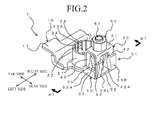
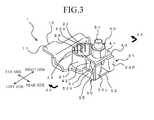
- FIG. 2 and Fig. 3 is a perspective view illustrating a result of assembling respective parts illustrated in Fig. 1 , in which Fig. 2 illustrates a state before a nut is fastened, and Fig. 3 illustrates a state after the nut is fastened.
- Fig. 4 is a sectional view taken along A1-A1 in Fig. 2 , and illustrating a state before the nut is fastened
- Fig. 5 is a sectional view taken along A2-A2 in Fig.
- a front-and-rear direction, a left-and-right (horizontal) direction, an up-and-down (vertical) direction, a direction on a near side, and a direction on a far side are set to indicate directions when seen from a front side (near side of the paper in Fig. 4 or Fig. 5 ).
- the fixing structure 1 of the battery post terminal assembles a battery post terminal 10 and a slope member 40 by fastening them in the up-and-down direction using a bolt 50 and a nut 60.
- the battery post terminal 10 made of a metal material having a conductivity, is formed of a connecting part 11 positioned on the far side, an electrode fitting part 21 positioned on the near side with respect to the connecting part 11, and a fixing part 31 positioned further on the near side with respect to the electrode fitting part 21, the parts being integrally formed, as illustrated in Fig. 1 to Fig. 3 .
- the connecting part 11 is incorporated in a case of a detection sensor (not illustrated) of a battery status detecting device. Harnesses for electrical components are attached in a form of having the detection sensor interposed therebetween. A shape of the connecting part 11 is arbitrarily formed in accordance with an attachment structure in the detection sensor. Further, the connecting part 11 also functions as a structural member that supports the detection sensor.
- the electrode fitting part 21 is for fixing the battery post terminal 10 to a battery post (not illustrated).
- the electrode fitting part 21 is formed in a truncated cone shape in accordance with a shape of the battery post having a truncated cone shape, and at a center of the electrode fitting part 21, a fitting hole 22 penetrating in the up-and-down direction is formed, as illustrated in Fig. 1 to Fig. 3 .
- An inner peripheral surface 22A of the fitting hole 22 is inclined so as to be brought into surface-contact with an inclined outer peripheral surface of the battery post.
- a plurality of grooves 24 are formed with a space provided therebetween in a circumferential direction, thereby increasing a gripping force for sandwiching the outer peripheral surface of the battery post.
- the electrode fitting part 21 is attached so as to put the fitting hole 22 on the battery post from above the battery post.
- the electrode fitting part 21 is continued to the connecting part 11 in an integral manner at a portion on the far side, and has a shape, at a portion on the near side, in which the part is branched (divided) into left and right portions with the fitting hole 22 sandwiched therebetween.
- the fixing part 31 is formed by being extended to the near side from respective tip portions 23L and 23R being the portions branched into the left and right sides.
- the fixing part 31 is formed of a left-side extended portion 32L extending to the near side from the tip portion 23L on the left side, and a right-side extended portion 32R disposed side by side with the left-side extended portion 32L with a center line S sandwiched therebetween and with a space provided therebetween, and extending to the near side from the tip portion 23R on the right side.
- the fixing part 31 has a bilaterally symmetric shape relative to the center line S, and accordingly, in the following description, only a structure on the left side of the fixing part 31 will be described, and a structure on the right side of the fixing part 31 will be omitted.
- an inclined surface 34 which inclines in the upper right direction so as to approach the center line S as tending from a lower side to an upper side, when seen from the near side illustrated in Fig. 4 or Fig. 5 .
- a boss portion 35 which is widened in an elliptical shape from the inside to the outside is formed, as illustrated in Fig. 1 .
- a position of the boss portion 35 corresponds to a position at which, in a state where the bolt 50 which will be described later in detail is attached, a screw part 51 of the bolt 50 is inserted.
- boss portion 35 is designed to project outward toward a place between leg parts 42 adjacent to each other in the front-and-rear direction, in a state where the later-described slope member 40 is assembled in the fixing part 31, as illustrated in Fig. 2 and Fig. 3 .
- the left-side extended portion 32L has an elasticity, and is designed to move elastically in the left-and-right direction by setting a portion on the far side of the electrode fitting part 21 as a base end portion.
- On a tip on the near side of the left-side extended portion 32L there is formed a folded-back portion 33L bent at a right angle in the left direction.
- the folded-back portion 33L is bent so that a length in the front-and-rear direction of the inclined surface 34 (a length from the tip portion 23L to the folded-back portion 33L) becomes substantially the same as a length in the front-and-rear direction of the later-described slope member 40.
- the slope member 40 is attached so as to be put on the fixing part 31 of the battery post terminal 10, from above the fixing part 31.
- the slope member 40 has a top surface part 41 having a substantially quadrangular shape, and four leg parts 42 extending downward from respective four corner portions of the top surface part 41.
- the side in the front-and-rear direction is formed to be shorter than the side in the left-and-right direction, as illustrated in Fig. 1 .
- an insertion hole 41A is formed at a center portion of the top surface part 41, and the screw part 51 of the bolt 50 to be described later is inserted into the insertion hole 41A.
- the four leg parts 42 are disposed in a symmetric manner in the front-and-rear direction and in the left-and-right direction relative to the insertion hole 41A, and a space between the leg parts 42 in the front-and-rear direction is narrower than a space between the leg parts in the left-and-right direction. Further, an upper surface of the top surface part 41 is formed in a flat surface state so that the nut 60 can be stably fastened.
- a slope 42A is formed, as illustrated in Fig. 4 and Fig. 5 .
- the slope 42A is formed to have an inclination angle same as that of the inclined surface 34 of each of the left and right extended portions 32L and 32R, and in a state where the slope member 40 is assembled in the fixing part 31, the inclined surface 34 and the slope 42A are brought into surface-contact with each other.
- Lower ends of the four leg parts 42 are designed to be bumped against an upper surface of a head part 52 of the bolt 50 which will be described later in detail, in a state where the nut 60 is completely fastened, as illustrated in Fig. 5 .
- lengths of the four leg parts 42 are determined based on a relationship with a fastening torque at a time of fastening the nut 60, and by designing such that the nut 60 is fastened until when the four leg parts 42 bump against the upper surface of the head part 52 of the bolt 50, an excess torque is prevented.
- the four leg parts 42 of the slope member 40 are disposed with a space provided therebetween along an outer periphery of the screw part 51, the screw part 51 of the bolt 50 being set as a center, and are disposed substantially evenly in a balanced manner so as to surround the outside of the screw part 51.
- the bolt 50 is formed of the screw part 51 extending in the up-and-down direction, and the head part 52 positioned at the lower side of the screw part 51.
- a rotation prevention piece 52A which rises upward from the head part 52 is provided.
- facing internal surfaces of the rotation prevention pieces 52A are designed to respectively abut against outer lower portions of the slope member 40, as illustrated in Fig. 4 and Fig. 5 . This prevents a co-rotation of the bolt 50 in a fastening direction, at a time of fastening the nut 60.
- a state before fixing the nut 60 corresponds to a state in which the slope member 40 is put on the fixing part 31, and the slopes 42A of the slope member 40 and the inclined surfaces 34 of the fixing part 31 are brought into surface-contact with each other, as illustrated in Fig. 2 and Fig. 4 .
- the bolt 50 is inserted from the lower side of the fixing part 31, and the screw part 51 passes through a part between the left and right extended portions 32L and 32R (more specifically, a part between the left and right boss portions 35) to be inserted into the insertion hole 41A of the slope member 40, and is temporarily fastened by the nut 60.
- a position of the slope member 40 in the left-and-right direction is regulated when the slopes 42A and the inclined surfaces 34 are respectively brought into surface-contact with each other. Further, a position of the slope member 40 in the front-and-rear direction is regulated when outer peripheral surfaces of the slope member 40 in the front-and-rear direction and the folded-back portions 33L and 33R of the fixing part 31 are respectively brought into contact with each other. Further, the position in the front-and-rear direction is regulated also by the internal surfaces of the leg parts 42 in the front-and-rear direction and the boss portions 35. Meanwhile, a position of the bolt 50 is regulated when the outer peripheral surfaces of the slope member 40 in the left-and-right direction and the rotation prevention pieces 52A are brought into contact with each other.
- the slope member 40 moves in a downward X direction (a fastening direction of the bolt 50, refer to Fig. 5 ), while being guided by the surface-contacts between the slopes 42A and the inclined surfaces 34 at the left and right sides. Further, the slope 42A presses the inclined surface 34 in an inward Y direction (refer to Fig. 5 ). Accordingly, the left and right extended portions 32L and 32R are elastically deformed in the inward Y directions so that a space provided therebetween in the left-and-right direction becomes narrow, and the battery post in the fitting hole 22 of the electrode fitting part 21 is fastened to be fixed.
- the inclined surface 34 and the slope 42A press each of the extended portions 32L and 32R while being brought into surface-contact with each other, so that there is no chance that the extended portions 32L and 32R are twisted by the pressing force. Accordingly, the fastening force of the nut 60 is stably transmitted to the extended portions 32L and 32R, resulting in that the extended portions 32L and 32R are pressed in a balanced manner.
- the four leg parts 42 are disposed with a space provided therebetween along the outer periphery of the screw part 51, the screw part 51 of the bolt 50 being set as a center, and are disposed substantially evenly in a balanced manner so as to surround the outside of the screw part 51. Accordingly, the four leg parts 42 press the left and right extended portions 32L and 32R in the inward Y directions with a substantially equal force. Accordingly, even if a force acts, from multi-directions, on the screw part 51 after fastening the bolt 50 and the nut 60, it becomes possible to secure a fixing strength which is equal to every direction.
- the four leg parts 42 are disposed with a space provided therebetween along the outer periphery of the screw part 51, the screw part 51 being set as a center. Accordingly, the four leg parts 42 equally press the left and right extended portions 32L and 32R by setting the screw part 51 of the bolt 50 as a center, in the state where the nut 60 is fastened. For this reason, even if a force acts, in multi-directions, on the electrode fitting part 21 sandwiching the side surfaces of the battery post to enlarge the space between the left and right extended portions 32L and 32R, the force can be received by the four leg parts 42 in a balanced manner.
- the screw part 51 of the bolt 50 is inserted in the up-and-down direction, so that the nut 60 can be fastened at the upper side of the battery post terminal 10. Accordingly, the workability is good since the work of fixing the battery post terminal 10 to the battery post can be conducted at the upper side of the battery post terminal 10.
- the battery post terminal 10 can be set to have a simple structure.
- the left and right extended portions 32L and 32R, the electrode fitting part 21, and the four leg parts 42 of the slope member 40 are respectively disposed in a bilaterally symmetric manner relative to the screw part 51 of the bolt 50 to be inserted, so that the fastening force of fastening the nut 60 can be made to act on the left and right extended portions 32L and 32R and the electrode fitting part 21 equally in a balanced manner.
- the four leg parts 42 are disposed in a symmetric manner in the front-and-rear direction relative to the screw part 51, a balance of fastening in the front-and-rear direction is also good.
- the respective inclined surfaces 34 of the left and right extended portions 32L and 32R are inclined so as to be directed toward the outside in the left-and-right direction as tending from the upper side to the lower side, corresponding to a moving direction of the slope member 40, so that with the use of the two leg parts 42 on the front side and the two leg parts 42 on the rear side, the extended portions 32L and 32R can be moved horizontally and inwardly with the same fastening force.
- the space between the leg parts 42 in the front-and-rear direction is set to be narrower than the space between the leg parts in the left-and-right direction (the member is disposed in a rectangular shape), so that a bias of force that acts on the leg parts on the front side and the rear side becomes small.
- a force that acts on the extended portions 32L and 32R a force that acts on the leg parts 42 on the front side becomes larger than a force that acts on the leg parts 42 on the rear side, as a distribution of the force with respect to the leg parts 42 on the front and rear sides, and a bias in the distributed force on the front and rear sides becomes smaller as the space between the leg parts 42 on the front and rear sides is reduced. Accordingly, by narrowing the space, it becomes possible that the four leg parts 42 can receive the force in a balanced manner.
- the boss portion 35 projecting toward the place between the leg parts 42 adjacent to each other is formed, so that by disposing the slope member 40 by sandwiching each of the boss portions 35 between the leg parts 42, it is possible to easily conduct a positioning of the slope member 40. Further, when the nut 60 is fastened, the leg parts 42 and the boss portions 35 abut against each other, resulting in that the slope member 40 can be prevented from being co-rotated together with the nut 60. Further, it is possible to increase the rigidity of the extended portions 32L and 32R.
- the rotation prevention pieces 52A which abut against the slope member 40 at the time of fastening the nut 60 are formed, so that when the slope member 40 and the rotation prevention pieces 52A abut against each other, it is possible to prevent the bolt 50 from being co-rotated together with the nut 60. Further, when the nut 60 is fastened, the leg parts 42 which abut against the upper surface of the head part 52 of the bolt 50 are prevented from being deformed in the left-and-right direction by the fastening force.
- the fixing structure 1 of the battery post terminal according to the first embodiment of the present invention is described above, and the present invention is not limited to the already-described embodiment, and various modifications and changes can be made based on the technical idea of the present invention.
- the bolt 50 is inserted from the lower side to the upper side, and the nut 60 is fastened at the upper side of the bolt 50, but, it is also possible to configure such that the nut and the bolt are made to be placed upside down.
- the nut is fixed at the lower side by welding or the like, the bolt is inserted from the upper side, and the bolt is fastened.
- it is also possible to insert the bolt in the up-and-down direction, and the worker can perform the fastening work at the upper side of the battery post terminal 10.
- the slope member 40 is attached so as to be put on the extended portions 32L and 32R from above the extended portions, it is also possible to design such that the slope member 40 is attached from the lower side of the extended portions 32L and 32R, and the slope member is pulled upward. In this case, it is only required to form each of the inclined surfaces 34 of the extended portions 32L and 32R, and the slopes 42A of the slope member 40 by inverting the inclination in the up-and-down direction. Also in this structure, it is possible to receive the force that acts in multi-directions in a balanced manner.
- Fig. 6 is an exploded perspective view of a fixing structure of a battery post terminal according to the second embodiment of the present invention.
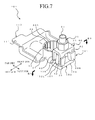
- Fig. 7 is a perspective view illustrating a result of assembling respective parts illustrated in Fig. 6 , and illustrating a state after a nut is fastened.
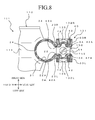
- Fig. 8 is a sectional view taken along B1-B1 in Fig. 7
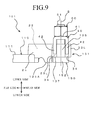
- Fig. 9 corresponds to a side view of Fig. 7 , and illustrates a state before the nut is fastened.
- a front-and-rear direction, a left-and-right (horizontal) direction, an up-and-down (vertical) direction, a direction on a near side, and a direction on a far side are set to indicate directions when seen from a front side (right side of the paper in Fig. 8 or Fig. 9 ).
- the fixing structure 101 of the battery post terminal assembles a battery post terminal 110 and the slope member 40 by fastening them in the up-and-down direction using a bolt 150 and the nut 60.
- the battery post terminal 110 is formed of a connecting part 111 positioned on the far side, the electrode fitting part 21 positioned on the near side with respect to the connecting part 111, and a fixing part 131 positioned further on the near side with respect to the electrode fitting part 21, the parts being integrally formed.
- the connecting part 111 is formed to have a length in a depth direction which is longer than that of the first embodiment, a function thereof to supply power by being incorporated in a case of a detection sensor (not illustrated), and a function thereof as a structural member for supporting the detection sensor, are the same as those of the first embodiment.
- the fixing part 131 is formed of a left-side extended portion 132L and a right-side extended portion 132R extending to the near side from the tip portions 23L and 23R, respectively, branched into left and right sides of the electrode fitting part 21.
- a stepped portion 137 cut-out toward the upper side with respect to a lower surface 121A of the electrode fitting part 21 (refer to Fig. 9 ).
- the stepped portion 137 is formed along the entire length in the front-and-rear direction of the left-side extended portion 132L and the right-side extended portion 132R, as illustrated in Fig. 9 , and has a shape enabling the entire head part 152 of the bolt 150 which will be described later in detail to enter the stepped portion 137.
- a boss portion 135 which continues from an upper end to a lower end of each of the inclined surfaces in the up-and-down direction is formed.
- the bolt 150 is formed of the screw part 51 and the head part 152.
- the head part 152 is not provided with the rotation prevention pieces 52A.
- it is designed such that, when the bolt 150 is fastened, the head part 152 enters the above-described stepped portion 137, and a front side surface of the head part 152 abuts against a side surface of the stepped portion 137 (a side surface at the lower side of the electrode fitting part 21), which prevents a co-rotation of the bolt 150, as illustrated in Fig. 9 .
- the stepped portion 137 at which the electrode fitting part 21 and the head part 152 of the bolt 150 abut against each other is provided to the left and right extended portions 132L and 132R, it is possible to prevent the bolt from being co-rotated in the fastening direction, at the time of fastening the bolt. Accordingly, there is no need to provide the rotation prevention pieces 52A to the head part 152 of the bolt 150, resulting in that the bolt 150 can be set to have a simple structure.
- boss portion 135 continues in the up-and-down direction from the upper end to the lower end of the inclined surface 34, it is used for performing positioning of the slope member 40, and can guide the slope member 40 in the up-and-down direction along the entire length along which the slope member 40 moves in the up-and-down direction.
- the fixing structure 101 of the battery post terminal according to the second embodiment of the present invention is described above, and the present invention is not limited to the already-described embodiment, and various modifications and changes can be made based on the technical idea of the present invention.
- Fig. 10 is a perspective view illustrating a modified example of the second embodiment, and illustrating a state before a nut is fastened.
- Fig. 11 is a front view of Fig. 10
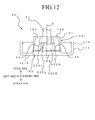
- Fig. 12 is a front view illustrating a state where a slope member and the nut are omitted from Fig. 11
- Fig. 13 is a right side view of Fig. 10 . Note that detailed explanation of the structure same as that of the second embodiment will be omitted by giving the same reference numerals in the description or the drawings.
- the folded-back portions 33L and 33R positioned at the tip portions on the near side of the extended portions 132L and 132R of the battery post terminal 110 are folded back in the left and right outer directions, respectively.
- a fixing structure 301 of a battery post terminal in a modified example of the second embodiment it is configured such that folded-back portions 333L and 333R are folded back in the left and right inner directions, at tips of extended portions 332L and 332R.
- the folded-back portion 333L on the left side is formed by folding back an upper side of a tip portion of the extended portion 332L on the left side in the inner direction.
- the folded-back portion 333R on the right side is formed by folding back a lower side of a tip portion of the extended portion 332R on the right side in the inner side, and the left and right folded-back portions 333L and 333R are formed by providing a space therebetween in the up-and-down direction so as not to interfere with each other.
- a fixing part 331 has a structure in which the left and right extended portions 332L and 332R are bilaterally symmetric relative to the center line S, except for the left and right folded-back portions 333L and 333R (refer to mainly Fig. 12 ).
- a battery post terminal 310 (the entire extended portions, in particular) can be set to have an outer shape which is as flat as possible. Accordingly, when a plurality of battery post terminals 310 are put in a plating tank to be plated, the folded-back portions 333L and 333R are not tangled with another battery post terminal 310, resulting in that the plating work can be efficiently conducted.
- the positioning of the slope member 40 in the front-and-rear direction is conducted by making the internal surfaces of the leg parts 42 abut against the boss portions 135 provided to the inclined surfaces 34 of the extended portions 332L and 332R.
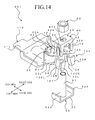
- Fig. 14 is an exploded perspective view of a fixing structure of a battery post terminal according to the third embodiment of the present invention.
- Fig. 15 is a perspective view illustrating a result of assembling respective parts illustrated in Fig. 14 , and illustrating a state after a nut is fastened.
- Fig. 16 is a sectional view taken along C1-C1 in Fig. 15
- Fig. 17 is a sectional view taken along C2-C2 in Fig. 15 .
- a front-and-rear direction, a left-and-right (horizontal) direction, an up-and-down (vertical) direction, a direction on a near side, and a direction on a far side are set to indicate directions when seen from a front side (near side of the paper in Fig. 17 ).
- the stepped portion 137 described in the second embodiment is formed, as illustrated in Fig. 14 and Fig. 17 .
- the head part 52 of the bolt 50 enters the stepped portion 137, and the front side surface of the head part 52 abuts against the side surface of the stepped portion 137 (the side surface at the lower side of the electrode fitting part 21), which prevents the bolt 50 from being co-rotated.
- it is designed such that the left and right rotation prevention pieces 52A of the head part 52 respectively abut against the outer lower portions of the slope member 40 in the state of being assembled. This also prevents the bolt 50 from being co-rotated in the fastening direction at the time of fastening the nut 60.
- the fixing structure 201 of the battery post terminal according to the third embodiment of the present invention since it is configured such that the co-rotation of the bolt 50 is prevented by three points of the stepped portion 137 and the rotation prevention pieces 52A, it is possible to perform the fastening work more securely and easily, when compared to the configuration of the second embodiment.
- the fixing structure 201 of the battery post terminal according to the third embodiment of the present invention is described above, and the present invention is not limited to the already-described embodiment, and various modifications and changes can be made based on the technical idea of the present invention.
- the folded-back portions 333L and 333R are formed to be folded back in the left and right inner directions, to prevent a plurality of battery post terminals from being tangled when plating is conducted in a plating tank.
Landscapes
- Engineering & Computer Science (AREA)
- Manufacturing & Machinery (AREA)
- Chemical & Material Sciences (AREA)
- Chemical Kinetics & Catalysis (AREA)
- Electrochemistry (AREA)
- General Chemical & Material Sciences (AREA)
- Connection Of Batteries Or Terminals (AREA)
Abstract
Description
- The present invention relates to a fixing structure of a battery post terminal for fixing a battery post terminal to a battery post of a battery which is mounted on a vehicle.
- A battery post terminal is fixed to a battery post projecting from an upper surface of a battery mounted on a vehicle such as an automobile, and harnesses for power supply are connected to the battery post terminal. As a structure of fixing the battery post terminal to the battery post, there is one in which side surfaces of the projecting battery post are sandwiched, a bolt is inserted from a lateral direction and fastened to be fixed. However, in the structure in which the bolt is fastened from the lateral direction, it is sometimes difficult to perform the fastening work in an engine room with a large number of parts. Accordingly, a structure capable of making a bolt to be inserted from an up-and-down direction and fastening and fixing the bolt at an upper side of a battery post terminal, is proposed (refer to
Patent Documents - Meanwhile, in recent years, there is a tendency that an electrical component such as a navigation device, electronic control devices of an engine, and the like are added, and a load with respect to a battery becomes large. Further, in order to deal with recent environmental problems, a number of vehicles provided with an idling stop function is also increasing. For this reason, a problem caused by a reduction in a charging rate of a battery is concerned, and it is desired to install a battery status detecting device which monitors a status of the battery. A detection sensor of the battery status detecting device is attached to a battery post terminal.
-
- Patent Document 1: Japanese Laid-open Patent Publication No.
H11-26053 - Patent Document 2: Japanese Laid-open Patent Publication No.
H11-26054 - To a detection sensor, a force is applied in various directions due to a vibration or an impact during traveling of a vehicle, and the force is received by a battery post terminal. Accordingly, as a fixing structure of the battery post terminal, one capable of securing a fixing strength in a balanced manner with respect to the force which acts in multi-directions, is desired.
- Further, as the fixing structure, it is preferable to employ one in which a bolt is fastened at an upper side, as disclosed in
Patent Documents Patent Document 1 described above is a structure in which the bolt is fastened at the upper side, the battery post terminal has a complicated shape requiring bending or the like, so that a simpler structure is desired. Further, in the structures ofPatent Documents - The present invention is made in view of the above-described circumstances, and an object thereof is to provide a fixing structure of a battery post terminal capable of receiving, in a balanced manner, a force that acts in multi-directions, and taking a workability of attachment and a cost of parts into consideration.
- In order to solve the above-described problems, a fixing structure of a battery post terminal of the present invention includes: a battery post terminal having left and right extended portions each having an inclined surface formed thereon, and an electrode fitting part integrally formed with the extended portions, and sandwiching, from both sides, side surfaces of a battery post by performing pressing to narrow a space between the left and right extended portions; a slope member having four leg parts each having a slope formed thereon whose inclination angle is the same as that of the inclined surface, and pressing the left and right extended portions by being moved in an up-and-down direction while making the slopes to be brought into contact with the inclined surfaces; and a bolt having a screw part inserted in the up-and-down direction between the left and right extended portions, and moving the slope member in the up-and-down direction by being fastened, in which the four leg parts are disposed with a space provided therebetween along an outer periphery of the screw part, the screw part being set as a center, when the battery post terminal is seen from a vertical direction.
- At this time, it is desirable that, when the battery post terminal is seen from a front, the left and right extended portions, the electrode fitting part, and the leg parts of the slope member are respectively disposed in a bilaterally symmetric manner relative to the bolt to be inserted, and the leg parts of the slope member are disposed in a symmetric manner in a front-and-rear direction relative to the bolt to be inserted.
- Further, it is also possible that a boss portion projecting toward a place between the leg parts adjacent to each other is formed on the inclined surface.
- Further, it is also possible to configure such that the leg parts bump against a head part of the bolt in a state where the bolt is fastened.
- Further, rotation prevention pieces which abut against the slope member at the time of the fastening, may also be provided to the head part of the bolt.
- Furthermore, it is also possible to provide a stepped portion against which the head part of the bolt abuts, at a lower side of the extended portions.
- In the fixing structure of the battery post terminal according to the present invention, when the screw part of the bolt is set as a center, the four leg parts equally press the left and right extended portions in the state where the bolt is fastened. Accordingly, even when a force acts in multi-directions on the electrode fitting part sandwiching the side surfaces of the battery post to enlarge a space between the left and right extended portions, the force can be received by the four leg parts in a balanced manner.
- Further, the screw part of the bolt is inserted in the up-and-down direction, so that a nut can be fastened at an upper side of the battery post terminal. For this reason, a workability of fastening is good.
- Further, since it is only required to match the inclination angle of the inclined surface of each of the extended portions and the inclination angle of the slope of the slope member, an amount of machining of parts of the extended portions is small. Accordingly, the battery post terminal can be set to have a simple structure.
-
-
Fig. 1 is an exploded perspective view of a fixing structure of a battery post terminal according to a first embodiment of the present invention; -
Fig. 2 is a perspective view illustrating a result of assembling respective parts illustrated inFig. 1 , and illustrating a state before a nut is fastened; -
Fig. 3 is a perspective view illustrating a result of assembling the respective parts illustrated inFig. 1 , and illustrating a state after the nut is fastened; -
Fig. 4 is a sectional view taken along A1-A1 inFig. 2 , and illustrating a state before the nut is fastened; -
Fig. 5 is a sectional view taken along A2-A2 inFig. 3 , and illustrating a state after the nut is fastened; -
Fig. 6 is an exploded perspective view of a fixing structure of a battery post terminal according to a second embodiment of the present invention; -
Fig. 7 is a perspective view illustrating a result of assembling respective parts illustrated inFig. 6 , and illustrating a state before a nut is fastened; -
Fig. 8 is a sectional view taken along B1-B1 inFig. 7 ; -
Fig. 9 is a view corresponding to a side view ofFig. 7 , and illustrating a state before the nut is fastened; -
Fig. 10 is a perspective view illustrating a modified example of the second embodiment, and illustrating a state before a nut is fastened; -
Fig. 11 is a front view ofFig. 10 ; -
Fig. 12 is a front view illustrating a state where a slope member and the nut are omitted fromFig. 11 ; -
Fig. 13 is a right side view ofFig. 10 ; -
Fig. 14 is an exploded perspective view of a fixing structure of a battery post terminal according to a third embodiment of the present invention; -
Fig. 15 is a perspective view illustrating a result of assembling respective parts illustrated inFig. 14 , and illustrating a state after a nut is fastened; -
Fig. 16 is a sectional view taken along C1-C1 inFig. 15 ; and -
Fig. 17 is a sectional view taken along C2-C2 inFig. 15 . - Hereinafter, a
fixing structure 1 of a battery post terminal according to a first embodiment of the present invention will be described in detail by using the drawings.Fig. 1 is an exploded perspective view of a fixing structure of a battery post terminal. Further, each ofFig. 2 andFig. 3 is a perspective view illustrating a result of assembling respective parts illustrated inFig. 1 , in whichFig. 2 illustrates a state before a nut is fastened, andFig. 3 illustrates a state after the nut is fastened. Further,Fig. 4 is a sectional view taken along A1-A1 inFig. 2 , and illustrating a state before the nut is fastened, andFig. 5 is a sectional view taken along A2-A2 inFig. 3 , and illustrating a state after the nut is fastened. Note that a front-and-rear direction, a left-and-right (horizontal) direction, an up-and-down (vertical) direction, a direction on a near side, and a direction on a far side used in the following description, are set to indicate directions when seen from a front side (near side of the paper inFig. 4 orFig. 5 ). - As illustrated in
Fig. 1 , thefixing structure 1 of the battery post terminal assembles abattery post terminal 10 and aslope member 40 by fastening them in the up-and-down direction using abolt 50 and anut 60. - The
battery post terminal 10, made of a metal material having a conductivity, is formed of a connectingpart 11 positioned on the far side, an electrode fittingpart 21 positioned on the near side with respect to the connectingpart 11, and a fixing part 31 positioned further on the near side with respect to theelectrode fitting part 21, the parts being integrally formed, as illustrated inFig. 1 to Fig. 3 . - The connecting
part 11 is incorporated in a case of a detection sensor (not illustrated) of a battery status detecting device. Harnesses for electrical components are attached in a form of having the detection sensor interposed therebetween. A shape of the connectingpart 11 is arbitrarily formed in accordance with an attachment structure in the detection sensor. Further, the connectingpart 11 also functions as a structural member that supports the detection sensor. - The electrode
fitting part 21 is for fixing thebattery post terminal 10 to a battery post (not illustrated). The electrodefitting part 21 is formed in a truncated cone shape in accordance with a shape of the battery post having a truncated cone shape, and at a center of theelectrode fitting part 21, afitting hole 22 penetrating in the up-and-down direction is formed, as illustrated inFig. 1 to Fig. 3 . An inner peripheral surface 22A of thefitting hole 22 is inclined so as to be brought into surface-contact with an inclined outer peripheral surface of the battery post. Further, on the inner peripheral surface 22A of thefitting hole 22, a plurality ofgrooves 24 are formed with a space provided therebetween in a circumferential direction, thereby increasing a gripping force for sandwiching the outer peripheral surface of the battery post. The electrodefitting part 21 is attached so as to put thefitting hole 22 on the battery post from above the battery post. - Further, the
electrode fitting part 21 is continued to the connectingpart 11 in an integral manner at a portion on the far side, and has a shape, at a portion on the near side, in which the part is branched (divided) into left and right portions with thefitting hole 22 sandwiched therebetween. The fixing part 31 is formed by being extended to the near side from respective tip portions 23L and 23R being the portions branched into the left and right sides. - As illustrated in
Fig. 1 , the fixing part 31 is formed of a left-side extended portion 32L extending to the near side from the tip portion 23L on the left side, and a right-side extended portion 32R disposed side by side with the left-side extended portion 32L with a center line S sandwiched therebetween and with a space provided therebetween, and extending to the near side from the tip portion 23R on the right side. Note that the fixing part 31 has a bilaterally symmetric shape relative to the center line S, and accordingly, in the following description, only a structure on the left side of the fixing part 31 will be described, and a structure on the right side of the fixing part 31 will be omitted. - On the left-side extended portion 32L, there is formed an
inclined surface 34 which inclines in the upper right direction so as to approach the center line S as tending from a lower side to an upper side, when seen from the near side illustrated inFig. 4 orFig. 5 . Further, on an upper portion at a center in the front-and-rear direction of theinclined surface 34, aboss portion 35 which is widened in an elliptical shape from the inside to the outside is formed, as illustrated inFig. 1 . As illustrated inFig. 2 andFig. 3 , a position of theboss portion 35 corresponds to a position at which, in a state where thebolt 50 which will be described later in detail is attached, ascrew part 51 of thebolt 50 is inserted. Further, theboss portion 35 is designed to project outward toward a place betweenleg parts 42 adjacent to each other in the front-and-rear direction, in a state where the later-describedslope member 40 is assembled in the fixing part 31, as illustrated inFig. 2 andFig. 3 . - Further, the left-side extended portion 32L has an elasticity, and is designed to move elastically in the left-and-right direction by setting a portion on the far side of the
electrode fitting part 21 as a base end portion. On a tip on the near side of the left-side extended portion 32L, there is formed a folded-back portion 33L bent at a right angle in the left direction. The folded-back portion 33L is bent so that a length in the front-and-rear direction of the inclined surface 34 (a length from the tip portion 23L to the folded-back portion 33L) becomes substantially the same as a length in the front-and-rear direction of the later-describedslope member 40. - As illustrated in
Fig. 1 , theslope member 40 is attached so as to be put on the fixing part 31 of thebattery post terminal 10, from above the fixing part 31. Theslope member 40 has atop surface part 41 having a substantially quadrangular shape, and fourleg parts 42 extending downward from respective four corner portions of thetop surface part 41. Regarding lengths of sides of thetop surface part 41, the side in the front-and-rear direction is formed to be shorter than the side in the left-and-right direction, as illustrated inFig. 1 . Further, an insertion hole 41A is formed at a center portion of thetop surface part 41, and thescrew part 51 of thebolt 50 to be described later is inserted into the insertion hole 41A. The fourleg parts 42 are disposed in a symmetric manner in the front-and-rear direction and in the left-and-right direction relative to the insertion hole 41A, and a space between theleg parts 42 in the front-and-rear direction is narrower than a space between the leg parts in the left-and-right direction. Further, an upper surface of thetop surface part 41 is formed in a flat surface state so that thenut 60 can be stably fastened. - On the inside of each of the left and right four
leg parts 42, aslope 42A is formed, as illustrated inFig. 4 andFig. 5 . Theslope 42A is formed to have an inclination angle same as that of theinclined surface 34 of each of the left and right extended portions 32L and 32R, and in a state where theslope member 40 is assembled in the fixing part 31, theinclined surface 34 and theslope 42A are brought into surface-contact with each other. - Lower ends of the four
leg parts 42 are designed to be bumped against an upper surface of ahead part 52 of thebolt 50 which will be described later in detail, in a state where thenut 60 is completely fastened, as illustrated inFig. 5 . Specifically, lengths of the fourleg parts 42 are determined based on a relationship with a fastening torque at a time of fastening thenut 60, and by designing such that thenut 60 is fastened until when the fourleg parts 42 bump against the upper surface of thehead part 52 of thebolt 50, an excess torque is prevented. - Further, when a state in which the
slope member 40 is attached is seen from the vertical direction, the fourleg parts 42 of theslope member 40 are disposed with a space provided therebetween along an outer periphery of thescrew part 51, thescrew part 51 of thebolt 50 being set as a center, and are disposed substantially evenly in a balanced manner so as to surround the outside of thescrew part 51. - As illustrated in
Fig. 1 , thebolt 50 is formed of thescrew part 51 extending in the up-and-down direction, and thehead part 52 positioned at the lower side of thescrew part 51. On each of both left and right ends of thehead part 52, a rotation prevention piece 52A which rises upward from thehead part 52 is provided. In a state where thebolt 50 is assembled, facing internal surfaces of the rotation prevention pieces 52A are designed to respectively abut against outer lower portions of theslope member 40, as illustrated inFig. 4 andFig. 5 . This prevents a co-rotation of thebolt 50 in a fastening direction, at a time of fastening thenut 60. - Next, an operation of the fixing structure in the first embodiment of the present invention will be described.
- A state before fixing the
nut 60 corresponds to a state in which theslope member 40 is put on the fixing part 31, and theslopes 42A of theslope member 40 and theinclined surfaces 34 of the fixing part 31 are brought into surface-contact with each other, as illustrated inFig. 2 andFig. 4 . Further, thebolt 50 is inserted from the lower side of the fixing part 31, and thescrew part 51 passes through a part between the left and right extended portions 32L and 32R (more specifically, a part between the left and right boss portions 35) to be inserted into the insertion hole 41A of theslope member 40, and is temporarily fastened by thenut 60. - A position of the
slope member 40 in the left-and-right direction is regulated when theslopes 42A and theinclined surfaces 34 are respectively brought into surface-contact with each other. Further, a position of theslope member 40 in the front-and-rear direction is regulated when outer peripheral surfaces of theslope member 40 in the front-and-rear direction and the folded-back portions 33L and 33R of the fixing part 31 are respectively brought into contact with each other. Further, the position in the front-and-rear direction is regulated also by the internal surfaces of theleg parts 42 in the front-and-rear direction and theboss portions 35. Meanwhile, a position of thebolt 50 is regulated when the outer peripheral surfaces of theslope member 40 in the left-and-right direction and the rotation prevention pieces 52A are brought into contact with each other. - When, from this state, the
nut 60 is fastened at an upper side of theslope member 40, theslope member 40 moves in a downward X direction (a fastening direction of thebolt 50, refer toFig. 5 ), while being guided by the surface-contacts between theslopes 42A and theinclined surfaces 34 at the left and right sides. Further, theslope 42A presses theinclined surface 34 in an inward Y direction (refer toFig. 5 ). Accordingly, the left and right extended portions 32L and 32R are elastically deformed in the inward Y directions so that a space provided therebetween in the left-and-right direction becomes narrow, and the battery post in thefitting hole 22 of theelectrode fitting part 21 is fastened to be fixed. - At this time, the
inclined surface 34 and theslope 42A press each of the extended portions 32L and 32R while being brought into surface-contact with each other, so that there is no chance that the extended portions 32L and 32R are twisted by the pressing force. Accordingly, the fastening force of thenut 60 is stably transmitted to the extended portions 32L and 32R, resulting in that the extended portions 32L and 32R are pressed in a balanced manner. - Further, when the
battery post terminal 10 is seen from the vertical direction, the fourleg parts 42 are disposed with a space provided therebetween along the outer periphery of thescrew part 51, thescrew part 51 of thebolt 50 being set as a center, and are disposed substantially evenly in a balanced manner so as to surround the outside of thescrew part 51. Accordingly, the fourleg parts 42 press the left and right extended portions 32L and 32R in the inward Y directions with a substantially equal force. Accordingly, even if a force acts, from multi-directions, on thescrew part 51 after fastening thebolt 50 and thenut 60, it becomes possible to secure a fixing strength which is equal to every direction. - With the use of the fixing
structure 1 of the battery post terminal according to the first embodiment of the present invention, when thebattery post terminal 10 is seen from the vertical direction, the fourleg parts 42 are disposed with a space provided therebetween along the outer periphery of thescrew part 51, thescrew part 51 being set as a center. Accordingly, the fourleg parts 42 equally press the left and right extended portions 32L and 32R by setting thescrew part 51 of thebolt 50 as a center, in the state where thenut 60 is fastened. For this reason, even if a force acts, in multi-directions, on theelectrode fitting part 21 sandwiching the side surfaces of the battery post to enlarge the space between the left and right extended portions 32L and 32R, the force can be received by the fourleg parts 42 in a balanced manner. - Further, the
screw part 51 of thebolt 50 is inserted in the up-and-down direction, so that thenut 60 can be fastened at the upper side of thebattery post terminal 10. Accordingly, the workability is good since the work of fixing thebattery post terminal 10 to the battery post can be conducted at the upper side of thebattery post terminal 10. - Further, since it is only required to match the inclination angle of the
inclined surface 34 of each of the extended portions 32L and 32R and the inclination angle of theslope 42A of theslope member 40, only a small amount of machining of parts of the extended portions 32L and 32R is required. Accordingly, thebattery post terminal 10 can be set to have a simple structure. - Further, when the
battery post terminal 10 is seen from the front, the left and right extended portions 32L and 32R, theelectrode fitting part 21, and the fourleg parts 42 of theslope member 40 are respectively disposed in a bilaterally symmetric manner relative to thescrew part 51 of thebolt 50 to be inserted, so that the fastening force of fastening thenut 60 can be made to act on the left and right extended portions 32L and 32R and theelectrode fitting part 21 equally in a balanced manner. Further, since the fourleg parts 42 are disposed in a symmetric manner in the front-and-rear direction relative to thescrew part 51, a balance of fastening in the front-and-rear direction is also good. For this reason, it becomes possible to achieve the fixing strength which is stable in the front-and-rear direction and in the left-and-right direction. Further, the respectiveinclined surfaces 34 of the left and right extended portions 32L and 32R are inclined so as to be directed toward the outside in the left-and-right direction as tending from the upper side to the lower side, corresponding to a moving direction of theslope member 40, so that with the use of the twoleg parts 42 on the front side and the twoleg parts 42 on the rear side, the extended portions 32L and 32R can be moved horizontally and inwardly with the same fastening force. - Further, in the
slope member 40, the space between theleg parts 42 in the front-and-rear direction is set to be narrower than the space between the leg parts in the left-and-right direction (the member is disposed in a rectangular shape), so that a bias of force that acts on the leg parts on the front side and the rear side becomes small. Specifically, regarding a force that acts on the extended portions 32L and 32R, a force that acts on theleg parts 42 on the front side becomes larger than a force that acts on theleg parts 42 on the rear side, as a distribution of the force with respect to theleg parts 42 on the front and rear sides, and a bias in the distributed force on the front and rear sides becomes smaller as the space between theleg parts 42 on the front and rear sides is reduced. Accordingly, by narrowing the space, it becomes possible that the fourleg parts 42 can receive the force in a balanced manner. - Further, on each of the
inclined surfaces 34, theboss portion 35 projecting toward the place between theleg parts 42 adjacent to each other is formed, so that by disposing theslope member 40 by sandwiching each of theboss portions 35 between theleg parts 42, it is possible to easily conduct a positioning of theslope member 40. Further, when thenut 60 is fastened, theleg parts 42 and theboss portions 35 abut against each other, resulting in that theslope member 40 can be prevented from being co-rotated together with thenut 60. Further, it is possible to increase the rigidity of the extended portions 32L and 32R. - Further, since it is designed such that in the state where the
nut 60 is fastened, theleg parts 42 bump against the upper surface of thehead part 52 of thebolt 50, when a worker fastens thenut 60, it is possible to output a predetermined fastening torque only by fastening thenut 60 until when theleg parts 42 bump against the head part of thebolt 50. For this reason, it is possible to prevent the excess torque, and further, there is no chance that the fastening torque varies depending on workers. Besides, since it is easy to control the torque, the workability is improved. - Furthermore, on the
head part 52 of thebolt 50, the rotation prevention pieces 52A which abut against theslope member 40 at the time of fastening thenut 60 are formed, so that when theslope member 40 and the rotation prevention pieces 52A abut against each other, it is possible to prevent thebolt 50 from being co-rotated together with thenut 60. Further, when thenut 60 is fastened, theleg parts 42 which abut against the upper surface of thehead part 52 of thebolt 50 are prevented from being deformed in the left-and-right direction by the fastening force. - The fixing
structure 1 of the battery post terminal according to the first embodiment of the present invention is described above, and the present invention is not limited to the already-described embodiment, and various modifications and changes can be made based on the technical idea of the present invention. - For example, in the first embodiment, it is designed such that the
bolt 50 is inserted from the lower side to the upper side, and thenut 60 is fastened at the upper side of thebolt 50, but, it is also possible to configure such that the nut and the bolt are made to be placed upside down. For example, it is designed such that the nut is fixed at the lower side by welding or the like, the bolt is inserted from the upper side, and the bolt is fastened. With this structure, it is also possible to insert the bolt in the up-and-down direction, and the worker can perform the fastening work at the upper side of thebattery post terminal 10. - Further, in the first embodiment, although the
slope member 40 is attached so as to be put on the extended portions 32L and 32R from above the extended portions, it is also possible to design such that theslope member 40 is attached from the lower side of the extended portions 32L and 32R, and the slope member is pulled upward. In this case, it is only required to form each of theinclined surfaces 34 of the extended portions 32L and 32R, and theslopes 42A of theslope member 40 by inverting the inclination in the up-and-down direction. Also in this structure, it is possible to receive the force that acts in multi-directions in a balanced manner. - Hereinafter, a fixing structure 101 of a battery post terminal according to a second embodiment of the present invention will be described in detail by using the drawings.
Fig. 6 is an exploded perspective view of a fixing structure of a battery post terminal according to the second embodiment of the present invention.Fig. 7 is a perspective view illustrating a result of assembling respective parts illustrated inFig. 6 , and illustrating a state after a nut is fastened. Further,Fig. 8 is a sectional view taken along B1-B1 inFig. 7 , andFig. 9 corresponds to a side view ofFig. 7 , and illustrates a state before the nut is fastened. Note that a front-and-rear direction, a left-and-right (horizontal) direction, an up-and-down (vertical) direction, a direction on a near side, and a direction on a far side used in the following description, are set to indicate directions when seen from a front side (right side of the paper inFig. 8 orFig. 9 ). - Further, in the following description, only a structure different from the structure described in the first embodiment will be described, and detailed explanation of the same structure will be omitted by giving the same reference numerals in the description or the drawings.
- As illustrated in
Fig. 1 , the fixing structure 101 of the battery post terminal assembles abattery post terminal 110 and theslope member 40 by fastening them in the up-and-down direction using abolt 150 and thenut 60. - As illustrated in
Fig. 6 to Fig. 9 , thebattery post terminal 110 is formed of a connecting part 111 positioned on the far side, theelectrode fitting part 21 positioned on the near side with respect to the connecting part 111, and a fixingpart 131 positioned further on the near side with respect to theelectrode fitting part 21, the parts being integrally formed. - Although the connecting part 111 is formed to have a length in a depth direction which is longer than that of the first embodiment, a function thereof to supply power by being incorporated in a case of a detection sensor (not illustrated), and a function thereof as a structural member for supporting the detection sensor, are the same as those of the first embodiment.
- The fixing
part 131 is formed of a left-side extended portion 132L and a right-side extended portion 132R extending to the near side from the tip portions 23L and 23R, respectively, branched into left and right sides of theelectrode fitting part 21. At a lower side of these left-side extended portion 132L and right-side extended portion 132R, there is formed a steppedportion 137 cut-out toward the upper side with respect to a lower surface 121A of the electrode fitting part 21 (refer toFig. 9 ). The steppedportion 137 is formed along the entire length in the front-and-rear direction of the left-side extended portion 132L and the right-side extended portion 132R, as illustrated inFig. 9 , and has a shape enabling the entire head part 152 of thebolt 150 which will be described later in detail to enter the steppedportion 137. - Further, on the
inclined surface 34 of each of the left-side extended portion 132L and the right-side extended portion 132R, aboss portion 135 which continues from an upper end to a lower end of each of the inclined surfaces in the up-and-down direction is formed. - As illustrated in
Fig. 6 , thebolt 150 is formed of thescrew part 51 and the head part 152. When compared to thehead part 52 of the first embodiment, the head part 152 is not provided with the rotation prevention pieces 52A. However, it is designed such that, when thebolt 150 is fastened, the head part 152 enters the above-described steppedportion 137, and a front side surface of the head part 152 abuts against a side surface of the stepped portion 137 (a side surface at the lower side of the electrode fitting part 21), which prevents a co-rotation of thebolt 150, as illustrated inFig. 9 . - With the use of the fixing structure 101 of the battery post terminal according to the second embodiment of the present invention, since the stepped
portion 137 at which theelectrode fitting part 21 and the head part 152 of thebolt 150 abut against each other, is provided to the left and right extended portions 132L and 132R, it is possible to prevent the bolt from being co-rotated in the fastening direction, at the time of fastening the bolt. Accordingly, there is no need to provide the rotation prevention pieces 52A to the head part 152 of thebolt 150, resulting in that thebolt 150 can be set to have a simple structure. - Further, since the
boss portion 135 continues in the up-and-down direction from the upper end to the lower end of theinclined surface 34, it is used for performing positioning of theslope member 40, and can guide theslope member 40 in the up-and-down direction along the entire length along which theslope member 40 moves in the up-and-down direction. - The fixing structure 101 of the battery post terminal according to the second embodiment of the present invention is described above, and the present invention is not limited to the already-described embodiment, and various modifications and changes can be made based on the technical idea of the present invention.
-
Fig. 10 is a perspective view illustrating a modified example of the second embodiment, and illustrating a state before a nut is fastened. Further,Fig. 11 is a front view ofFig. 10 ,Fig. 12 is a front view illustrating a state where a slope member and the nut are omitted fromFig. 11 , andFig. 13 is a right side view ofFig. 10 . Note that detailed explanation of the structure same as that of the second embodiment will be omitted by giving the same reference numerals in the description or the drawings. - In the above-described second embodiment, the folded-back portions 33L and 33R positioned at the tip portions on the near side of the extended portions 132L and 132R of the
battery post terminal 110 are folded back in the left and right outer directions, respectively. However, in a fixingstructure 301 of a battery post terminal in a modified example of the second embodiment, it is configured such that folded-back portions 333L and 333R are folded back in the left and right inner directions, at tips of extended portions 332L and 332R. - As illustrated in
Fig. 10 to Fig. 12 , the folded-back portion 333L on the left side is formed by folding back an upper side of a tip portion of the extended portion 332L on the left side in the inner direction. Meanwhile, the folded-back portion 333R on the right side is formed by folding back a lower side of a tip portion of the extended portion 332R on the right side in the inner side, and the left and right folded-back portions 333L and 333R are formed by providing a space therebetween in the up-and-down direction so as not to interfere with each other. A fixing part 331 has a structure in which the left and right extended portions 332L and 332R are bilaterally symmetric relative to the center line S, except for the left and right folded-back portions 333L and 333R (refer to mainlyFig. 12 ). - By folding back the respective left and right folded-back portions 333L and 333R inwardly, a battery post terminal 310 (the entire extended portions, in particular) can be set to have an outer shape which is as flat as possible. Accordingly, when a plurality of
battery post terminals 310 are put in a plating tank to be plated, the folded-back portions 333L and 333R are not tangled with anotherbattery post terminal 310, resulting in that the plating work can be efficiently conducted. - Note that when the
slope member 40 is assembled, the positioning of theslope member 40 in the front-and-rear direction is conducted by making the internal surfaces of theleg parts 42 abut against theboss portions 135 provided to theinclined surfaces 34 of the extended portions 332L and 332R. - Hereinafter, a fixing structure 101 of a battery post terminal according to a third embodiment of the present invention will be described in detail by using the drawings.
Fig. 14 is an exploded perspective view of a fixing structure of a battery post terminal according to the third embodiment of the present invention.Fig. 15 is a perspective view illustrating a result of assembling respective parts illustrated inFig. 14 , and illustrating a state after a nut is fastened. Further,Fig. 16 is a sectional view taken along C1-C1 inFig. 15 , andFig. 17 is a sectional view taken along C2-C2 inFig. 15 . Note that a front-and-rear direction, a left-and-right (horizontal) direction, an up-and-down (vertical) direction, a direction on a near side, and a direction on a far side used in the following description, are set to indicate directions when seen from a front side (near side of the paper inFig. 17 ). - Further, structures same as those of the first embodiment and the second embodiment are denoted by the same reference numerals in the description or the drawings.
- The configuration of the second embodiment in which the
bolt 50 of the first embodiment is used, corresponds to the third embodiment. For this reason, in the following description, only a part of thebolt 50 will be described, and detailed description regarding the other structure will be omitted. - On the
battery post terminal 110 used in a fixingstructure 201 of a battery post terminal, the steppedportion 137 described in the second embodiment is formed, as illustrated inFig. 14 andFig. 17 . Thehead part 52 of thebolt 50 enters the steppedportion 137, and the front side surface of thehead part 52 abuts against the side surface of the stepped portion 137 (the side surface at the lower side of the electrode fitting part 21), which prevents thebolt 50 from being co-rotated. Further, it is designed such that the left and right rotation prevention pieces 52A of thehead part 52 respectively abut against the outer lower portions of theslope member 40 in the state of being assembled. This also prevents thebolt 50 from being co-rotated in the fastening direction at the time of fastening thenut 60. - With the use of the fixing
structure 201 of the battery post terminal according to the third embodiment of the present invention, since it is configured such that the co-rotation of thebolt 50 is prevented by three points of the steppedportion 137 and the rotation prevention pieces 52A, it is possible to perform the fastening work more securely and easily, when compared to the configuration of the second embodiment. - The fixing
structure 201 of the battery post terminal according to the third embodiment of the present invention is described above, and the present invention is not limited to the already-described embodiment, and various modifications and changes can be made based on the technical idea of the present invention. - For example, it is also possible to design such that, as described in the modified example of the second embodiment, the folded-back portions 333L and 333R are formed to be folded back in the left and right inner directions, to prevent a plurality of battery post terminals from being tangled when plating is conducted in a plating tank.
-
- 1, 101, 201, 301
- Fixing structure of battery post terminal
- 10, 110
- Battery post terminal
- 11, 111
- Connecting part
- 21
- Electrode fitting part
- 22
- Fitting hole
- 22A
- Inner peripheral surface
- 23L, 23R
- Tip portion
- 24
- Groove
- 31, 131, 331
- Fixing part
- 32L, 132L, 332L
- Left-side extended portion
- 32R, 132R, 332R
- Right-side extended portion
- 33L, 33R, 333L, 333R
- Folded-back portion
- 34
- Inclined surface
- 35, 135
- Boss portion
- 40
- Slope member
- 41
- Top surface part
- 41 A
- Insertion hole
- 42
- Leg part
- 42A
- Slope
- 50, 150
- Bolt
- 51
- Screw part
- 52, 152
- Head part
- 52A
- Rotation prevention piece
- 60
- Nut
- 121A
- Lower surface of electrode fitting part
- 137
- Stepped portion
- S
- Center line
- X, Y
- Direction
Claims (6)
- A fixing structure of a battery post terminal, comprising:a battery post terminal having left and right extended portions each having an inclined surface formed thereon, and an electrode fitting part integrally formed with the left and right extended portions, and sandwiching, from both sides, side surfaces of a battery post by performing pressing to narrow a space between the left and right extended portions;a slope member having four leg parts each having a slope formed thereon whose inclination angle is the same as that of the inclined surface, and pressing the left and right extended portions by being moved in an up-and-down direction while making the slopes to be brought into contact with the inclined surfaces; anda bolt having a screw part inserted in the up-and-down direction between the left and right extended portions, and moving said slope member in the up-and-down direction by being fastened, whereinthe four leg parts are disposed with a space provided therebetween along an outer periphery of the screw part, the screw part being set as a center, when said battery post terminal is seen from a vertical direction.
- The fixing structure of the battery post terminal according to claim 1, wherein
when said battery post terminal is seen from a front, the left and right extended portions, the electrode fitting part, and the leg parts of said slope member are respectively disposed in a bilaterally symmetric manner relative to said bolt, and the leg parts of said slope member are disposed in a symmetric manner in a front-and-rear direction relative to said bolt. - The fixing structure of the battery post terminal according to claim 1 or 2, wherein
a boss portion projecting toward a place between the leg parts adjacent to each other is formed on the inclined surface. - The fixing structure of the battery post terminal according to any one of claims 1 to 3, wherein
the leg parts are configured to be bumped against a head part of said bolt in a state where said bolt is fastened. - The fixing structure of the battery post terminal according to any one of claims 1 to 4, wherein
rotation prevention pieces which abut against said slope member at the time of the fastening, are provided to the head part of said bolt. - The fixing structure of the battery post terminal according to any one of claims 1 to 5, wherein
a stepped portion against which the head part of said bolt abuts, is provided at a lower side of the extended portions.
Applications Claiming Priority (2)
| Application Number | Priority Date | Filing Date | Title |
|---|---|---|---|
| JP2013031542 | 2013-02-20 | ||
| PCT/JP2014/054011 WO2014129534A1 (en) | 2013-02-20 | 2014-02-20 | Structure for fixing battery post terminal |
Publications (3)
| Publication Number | Publication Date |
|---|---|
| EP2940758A1 true EP2940758A1 (en) | 2015-11-04 |
| EP2940758A4 EP2940758A4 (en) | 2016-08-24 |
| EP2940758B1 EP2940758B1 (en) | 2018-04-11 |
Family
ID=51391318
Family Applications (1)
| Application Number | Title | Priority Date | Filing Date |
|---|---|---|---|
| EP14753790.6A Active EP2940758B1 (en) | 2013-02-20 | 2014-02-20 | Structure for fixing battery post terminal |
Country Status (5)
| Country | Link |
|---|---|
| US (1) | US9590325B2 (en) |
| EP (1) | EP2940758B1 (en) |
| JP (1) | JP6278948B2 (en) |
| CN (1) | CN105009327B (en) |
| WO (1) | WO2014129534A1 (en) |
Cited By (6)
| Publication number | Priority date | Publication date | Assignee | Title |
|---|---|---|---|---|
| WO2016177719A1 (en) * | 2015-05-06 | 2016-11-10 | Hella Kgaa Hueck & Co. | Battery terminal |
| ITUA20164795A1 (en) * | 2016-06-30 | 2017-12-30 | Mta Spa | Clamp for a male terminal. |
| FR3060874A1 (en) * | 2016-12-19 | 2018-06-22 | Favi - Le Laiton Injecte | CONNECTING TERMINAL TO A BATTERY |
| EP3352304A1 (en) * | 2017-01-24 | 2018-07-25 | Continental Automotive GmbH | Battery terminal for reliable assembly |
| EP3436920A4 (en) * | 2016-03-31 | 2019-12-18 | INTEL Corporation | FABRIC RESILIENCE SUPPORT FOR ATOMIC WRITINGS OF MANY STORE OPERATIONS TO REMOTE NODES |
| EP4311015A4 (en) * | 2021-03-23 | 2024-10-30 | Furukawa Electric Co., Ltd. | BATTERY TERMINAL ASSEMBLY |
Families Citing this family (16)
| Publication number | Priority date | Publication date | Assignee | Title |
|---|---|---|---|---|
| DE202015100147U1 (en) * | 2015-01-14 | 2015-11-23 | Bremi Fahrzeug-Elektrik Gmbh + Co. Kg | Battery terminal for a motor vehicle |
| DE102015107044A1 (en) * | 2015-05-06 | 2016-11-10 | Hella Kgaa Hueck & Co. | Battery terminal and method for making a battery terminal |
| JP6510932B2 (en) * | 2015-08-20 | 2019-05-08 | 日本製鉄株式会社 | Method of manufacturing lining plate fastening device and lining plate fastening method |
| JP6596281B2 (en) * | 2015-09-15 | 2019-10-23 | 株式会社Subaru | Battery terminal |
| KR101769849B1 (en) | 2016-03-08 | 2017-08-21 | 주식회사 창환단자공업 | Vertical type Connecting Terminal for Storage Battery |
| KR101769850B1 (en) * | 2016-03-08 | 2017-08-30 | 주식회사 창환단자공업 | Vertical type Connecting Terminal for Storage Battery |
| JP6656120B2 (en) * | 2016-08-31 | 2020-03-04 | 三菱電機株式会社 | Switch-in connection device |
| JP6796447B2 (en) * | 2016-10-11 | 2020-12-09 | 矢崎総業株式会社 | Battery terminal |
| US9680238B1 (en) * | 2016-11-28 | 2017-06-13 | Sumitomo Wiring Systems, Ltd. | Vertical mount battery fuser terminal |
| JP6559169B2 (en) * | 2017-02-03 | 2019-08-14 | 矢崎総業株式会社 | Battery terminal |
| US9774110B1 (en) | 2017-02-10 | 2017-09-26 | Ema-Us, Inc. | Battery post terminal assembly |
| CN110473994B (en) * | 2018-05-10 | 2022-11-18 | 上海海拉电子有限公司 | Storage battery bolt of vehicle-mounted storage battery |
| DE102018217604A1 (en) * | 2018-10-15 | 2020-04-16 | Continental Automotive Gmbh | Method for manufacturing a battery pole clamp, battery pole clamp and battery sensor |
| JP7233277B2 (en) * | 2019-03-26 | 2023-03-06 | 古河電気工業株式会社 | Fixing structure for battery post terminals |
| US10938131B1 (en) * | 2019-09-25 | 2021-03-02 | Tyco Electronics Brasil LTD A | Insert for a battery terminal for increased retention |
| CN118099778B (en) * | 2024-04-23 | 2024-07-12 | 沈阳斯沃电器有限公司 | Terminal locking structure |
Family Cites Families (20)
| Publication number | Priority date | Publication date | Assignee | Title |
|---|---|---|---|---|
| US3116100A (en) * | 1962-06-08 | 1963-12-31 | Walter J Hunter | Battery terminal connector |
| JPH049736Y2 (en) * | 1985-07-08 | 1992-03-11 | ||
| JPS6212264A (en) | 1985-07-09 | 1987-01-21 | Nec Corp | Facsimile |
| JPH026053A (en) | 1988-06-21 | 1990-01-10 | Toshiba Corp | Electric heating member |
| JPH0597056A (en) | 1991-04-19 | 1993-04-20 | Yanmar Agricult Equip Co Ltd | Under carriage structure of agricultural working machine |
| JP2574235Y2 (en) * | 1992-06-09 | 1998-06-11 | 住友電装株式会社 | Battery terminal |
| JP2833362B2 (en) | 1992-07-31 | 1998-12-09 | 日本電気株式会社 | Image signal expansion device |
| JP2587000Y2 (en) * | 1992-09-10 | 1998-12-14 | 住友電装株式会社 | Battery terminal |
| EP0601521B1 (en) * | 1992-12-07 | 2000-03-08 | Sumitomo Wiring Systems, Ltd. | Battery terminal |
| JP2600044Y2 (en) * | 1993-01-07 | 1999-09-27 | 住友電装株式会社 | Battery terminal |
| JPH0668322U (en) * | 1993-03-09 | 1994-09-22 | 住友電装株式会社 | Battery terminal |
| DE4408622C1 (en) * | 1994-03-15 | 1995-05-04 | Daimler Benz Ag | Terminal, in particular a car battery pole terminal |
| JP3180723B2 (en) | 1997-07-01 | 2001-06-25 | 住友電装株式会社 | Battery terminal |
| JP3180722B2 (en) | 1997-07-01 | 2001-06-25 | 住友電装株式会社 | Battery terminal |
| JP2000082455A (en) * | 1998-09-07 | 2000-03-21 | Sumitomo Wiring Syst Ltd | Battery terminal |
| JP2003151651A (en) * | 2001-11-15 | 2003-05-23 | Sumitomo Wiring Syst Ltd | Battery terminal |
| JP4614637B2 (en) * | 2002-12-05 | 2011-01-19 | 矢崎総業株式会社 | Battery terminal |
| JP4557590B2 (en) * | 2004-04-12 | 2010-10-06 | 矢崎総業株式会社 | Battery terminal |
| JP2008243458A (en) * | 2007-03-26 | 2008-10-09 | Furukawa Electric Co Ltd:The | Battery terminal |
| IT1396337B1 (en) * | 2009-09-28 | 2012-11-16 | Viemme Srl | PERFECTED CLAMP OF CONNECTION TO THE POLES OF ELECTRIC ACCUMULATORS |
-
2014
- 2014-02-20 EP EP14753790.6A patent/EP2940758B1/en active Active
- 2014-02-20 WO PCT/JP2014/054011 patent/WO2014129534A1/en not_active Ceased
- 2014-02-20 JP JP2015501490A patent/JP6278948B2/en active Active
- 2014-02-20 CN CN201480009504.8A patent/CN105009327B/en active Active
-
2015
- 2015-08-19 US US14/830,703 patent/US9590325B2/en active Active
Cited By (10)
| Publication number | Priority date | Publication date | Assignee | Title |
|---|---|---|---|---|
| WO2016177719A1 (en) * | 2015-05-06 | 2016-11-10 | Hella Kgaa Hueck & Co. | Battery terminal |
| EP3436920A4 (en) * | 2016-03-31 | 2019-12-18 | INTEL Corporation | FABRIC RESILIENCE SUPPORT FOR ATOMIC WRITINGS OF MANY STORE OPERATIONS TO REMOTE NODES |
| ITUA20164795A1 (en) * | 2016-06-30 | 2017-12-30 | Mta Spa | Clamp for a male terminal. |
| EP3264534A1 (en) * | 2016-06-30 | 2018-01-03 | MTA S.p.A. | Clamp for a male electrical terminal |
| US9979104B2 (en) | 2016-06-30 | 2018-05-22 | Mta S.P.A. | Clamps for male terminals |
| FR3060874A1 (en) * | 2016-12-19 | 2018-06-22 | Favi - Le Laiton Injecte | CONNECTING TERMINAL TO A BATTERY |
| WO2018115672A1 (en) * | 2016-12-19 | 2018-06-28 | Favi - Le Laiton Injecté | Connector for connection to a battery |
| EP3352304A1 (en) * | 2017-01-24 | 2018-07-25 | Continental Automotive GmbH | Battery terminal for reliable assembly |
| EP4311015A4 (en) * | 2021-03-23 | 2024-10-30 | Furukawa Electric Co., Ltd. | BATTERY TERMINAL ASSEMBLY |
| US12586936B2 (en) | 2021-03-23 | 2026-03-24 | Furukawa Electric Co., Ltd. | Battery post terminal assembly |
Also Published As
| Publication number | Publication date |
|---|---|
| US20150357731A1 (en) | 2015-12-10 |
| CN105009327B (en) | 2017-12-08 |
| EP2940758B1 (en) | 2018-04-11 |
| CN105009327A (en) | 2015-10-28 |
| JPWO2014129534A1 (en) | 2017-02-02 |
| US9590325B2 (en) | 2017-03-07 |
| EP2940758A4 (en) | 2016-08-24 |
| JP6278948B2 (en) | 2018-02-14 |
| WO2014129534A1 (en) | 2014-08-28 |
Similar Documents
| Publication | Publication Date | Title |
|---|---|---|
| EP2940758A1 (en) | Structure for fixing battery post terminal | |
| US8981239B2 (en) | Capacitor module | |
| JP5871044B1 (en) | Terminal module | |
| US20170310032A1 (en) | Connector terminal with one or more top side contact portions and three linear bottom side contact portions | |
| EP2744047B1 (en) | Terminal connection joint and terminal block | |
| US9966683B2 (en) | Connector terminal | |
| CN105939590A (en) | Fixing device for a circuit plate to a carrier, circuit arrangement and method for fixing a circuit plate to a carrier | |
| JP7233277B2 (en) | Fixing structure for battery post terminals | |
| JP5809793B2 (en) | Battery terminal with current sensor | |
| US8641430B2 (en) | Bus bar edge structure of electric junction box | |
| US9972823B2 (en) | Fusible link | |
| KR20190074526A (en) | Wiring harness fastening apparatus using band cable equipped with rotation preventing function | |
| JP2016018613A (en) | Terminal connection structure | |
| US10141148B2 (en) | Affixed object, fusible link, and affixing structure for fusible link | |
| US20180076436A1 (en) | Battery terminal | |
| US20140094062A1 (en) | Connection structure of battery terminal | |
| JP2014112990A (en) | Structure for fixing substrates of a plurality of resin components | |
| JP5698967B2 (en) | Battery terminal | |
| JP7813773B2 (en) | Battery Post Terminal Assembly | |
| WO2015002305A1 (en) | Connector mounting structure | |
| KR102053273B1 (en) | Junction block | |
| JP3177075U (en) | Distribution board terminal mounting structure | |
| KR102029380B1 (en) | Junction block | |
| JP6230577B2 (en) | Battery post terminal fixing structure | |
| US20220071031A1 (en) | Vehicle-mounted electronic apparatus |
Legal Events
| Date | Code | Title | Description |
|---|---|---|---|
| PUAI | Public reference made under article 153(3) epc to a published international application that has entered the european phase |
Free format text: ORIGINAL CODE: 0009012 |
|
| 17P | Request for examination filed |
Effective date: 20150731 |
|
| AK | Designated contracting states |
Kind code of ref document: A1 Designated state(s): AL AT BE BG CH CY CZ DE DK EE ES FI FR GB GR HR HU IE IS IT LI LT LU LV MC MK MT NL NO PL PT RO RS SE SI SK SM TR |
|
| AX | Request for extension of the european patent |
Extension state: BA ME |
|
| DAX | Request for extension of the european patent (deleted) | ||
| A4 | Supplementary search report drawn up and despatched |
Effective date: 20160722 |
|
| RIC1 | Information provided on ipc code assigned before grant |
Ipc: H01R 11/28 20060101ALI20160718BHEP Ipc: H01M 2/30 20060101AFI20160718BHEP |
|
| GRAP | Despatch of communication of intention to grant a patent |
Free format text: ORIGINAL CODE: EPIDOSNIGR1 |
|
| STAA | Information on the status of an ep patent application or granted ep patent |
Free format text: STATUS: GRANT OF PATENT IS INTENDED |
|
| INTG | Intention to grant announced |
Effective date: 20171027 |
|
| GRAS | Grant fee paid |
Free format text: ORIGINAL CODE: EPIDOSNIGR3 |
|
| GRAA | (expected) grant |
Free format text: ORIGINAL CODE: 0009210 |
|
| STAA | Information on the status of an ep patent application or granted ep patent |
Free format text: STATUS: THE PATENT HAS BEEN GRANTED |
|
| AK | Designated contracting states |
Kind code of ref document: B1 Designated state(s): AL AT BE BG CH CY CZ DE DK EE ES FI FR GB GR HR HU IE IS IT LI LT LU LV MC MK MT NL NO PL PT RO RS SE SI SK SM TR |
|
| REG | Reference to a national code |
Ref country code: GB Ref legal event code: FG4D |
|
| REG | Reference to a national code |
Ref country code: CH Ref legal event code: EP |
|
| REG | Reference to a national code |
Ref country code: AT Ref legal event code: REF Ref document number: 988917 Country of ref document: AT Kind code of ref document: T Effective date: 20180415 |
|
| REG | Reference to a national code |
Ref country code: IE Ref legal event code: FG4D |
|
| REG | Reference to a national code |
Ref country code: DE Ref legal event code: R096 Ref document number: 602014023776 Country of ref document: DE |
|
| REG | Reference to a national code |
Ref country code: NL Ref legal event code: MP Effective date: 20180411 |
|
| REG | Reference to a national code |
Ref country code: LT Ref legal event code: MG4D |
|
| PG25 | Lapsed in a contracting state [announced via postgrant information from national office to epo] |
Ref country code: NL Free format text: LAPSE BECAUSE OF FAILURE TO SUBMIT A TRANSLATION OF THE DESCRIPTION OR TO PAY THE FEE WITHIN THE PRESCRIBED TIME-LIMIT Effective date: 20180411 |
|
| PG25 | Lapsed in a contracting state [announced via postgrant information from national office to epo] |
Ref country code: PL Free format text: LAPSE BECAUSE OF FAILURE TO SUBMIT A TRANSLATION OF THE DESCRIPTION OR TO PAY THE FEE WITHIN THE PRESCRIBED TIME-LIMIT Effective date: 20180411 Ref country code: SE Free format text: LAPSE BECAUSE OF FAILURE TO SUBMIT A TRANSLATION OF THE DESCRIPTION OR TO PAY THE FEE WITHIN THE PRESCRIBED TIME-LIMIT Effective date: 20180411 Ref country code: NO Free format text: LAPSE BECAUSE OF FAILURE TO SUBMIT A TRANSLATION OF THE DESCRIPTION OR TO PAY THE FEE WITHIN THE PRESCRIBED TIME-LIMIT Effective date: 20180711 Ref country code: ES Free format text: LAPSE BECAUSE OF FAILURE TO SUBMIT A TRANSLATION OF THE DESCRIPTION OR TO PAY THE FEE WITHIN THE PRESCRIBED TIME-LIMIT Effective date: 20180411 Ref country code: LT Free format text: LAPSE BECAUSE OF FAILURE TO SUBMIT A TRANSLATION OF THE DESCRIPTION OR TO PAY THE FEE WITHIN THE PRESCRIBED TIME-LIMIT Effective date: 20180411 Ref country code: BG Free format text: LAPSE BECAUSE OF FAILURE TO SUBMIT A TRANSLATION OF THE DESCRIPTION OR TO PAY THE FEE WITHIN THE PRESCRIBED TIME-LIMIT Effective date: 20180711 Ref country code: FI Free format text: LAPSE BECAUSE OF FAILURE TO SUBMIT A TRANSLATION OF THE DESCRIPTION OR TO PAY THE FEE WITHIN THE PRESCRIBED TIME-LIMIT Effective date: 20180411 Ref country code: AL Free format text: LAPSE BECAUSE OF FAILURE TO SUBMIT A TRANSLATION OF THE DESCRIPTION OR TO PAY THE FEE WITHIN THE PRESCRIBED TIME-LIMIT Effective date: 20180411 |
|
| PG25 | Lapsed in a contracting state [announced via postgrant information from national office to epo] |
Ref country code: RS Free format text: LAPSE BECAUSE OF FAILURE TO SUBMIT A TRANSLATION OF THE DESCRIPTION OR TO PAY THE FEE WITHIN THE PRESCRIBED TIME-LIMIT Effective date: 20180411 Ref country code: HR Free format text: LAPSE BECAUSE OF FAILURE TO SUBMIT A TRANSLATION OF THE DESCRIPTION OR TO PAY THE FEE WITHIN THE PRESCRIBED TIME-LIMIT Effective date: 20180411 Ref country code: GR Free format text: LAPSE BECAUSE OF FAILURE TO SUBMIT A TRANSLATION OF THE DESCRIPTION OR TO PAY THE FEE WITHIN THE PRESCRIBED TIME-LIMIT Effective date: 20180712 Ref country code: LV Free format text: LAPSE BECAUSE OF FAILURE TO SUBMIT A TRANSLATION OF THE DESCRIPTION OR TO PAY THE FEE WITHIN THE PRESCRIBED TIME-LIMIT Effective date: 20180411 |
|
| REG | Reference to a national code |
Ref country code: AT Ref legal event code: MK05 Ref document number: 988917 Country of ref document: AT Kind code of ref document: T Effective date: 20180411 |
|
| PG25 | Lapsed in a contracting state [announced via postgrant information from national office to epo] |
Ref country code: PT Free format text: LAPSE BECAUSE OF FAILURE TO SUBMIT A TRANSLATION OF THE DESCRIPTION OR TO PAY THE FEE WITHIN THE PRESCRIBED TIME-LIMIT Effective date: 20180813 |
|
| REG | Reference to a national code |
Ref country code: DE Ref legal event code: R097 Ref document number: 602014023776 Country of ref document: DE |
|
| PG25 | Lapsed in a contracting state [announced via postgrant information from national office to epo] |
Ref country code: AT Free format text: LAPSE BECAUSE OF FAILURE TO SUBMIT A TRANSLATION OF THE DESCRIPTION OR TO PAY THE FEE WITHIN THE PRESCRIBED TIME-LIMIT Effective date: 20180411 Ref country code: DK Free format text: LAPSE BECAUSE OF FAILURE TO SUBMIT A TRANSLATION OF THE DESCRIPTION OR TO PAY THE FEE WITHIN THE PRESCRIBED TIME-LIMIT Effective date: 20180411 Ref country code: SK Free format text: LAPSE BECAUSE OF FAILURE TO SUBMIT A TRANSLATION OF THE DESCRIPTION OR TO PAY THE FEE WITHIN THE PRESCRIBED TIME-LIMIT Effective date: 20180411 Ref country code: EE Free format text: LAPSE BECAUSE OF FAILURE TO SUBMIT A TRANSLATION OF THE DESCRIPTION OR TO PAY THE FEE WITHIN THE PRESCRIBED TIME-LIMIT Effective date: 20180411 Ref country code: CZ Free format text: LAPSE BECAUSE OF FAILURE TO SUBMIT A TRANSLATION OF THE DESCRIPTION OR TO PAY THE FEE WITHIN THE PRESCRIBED TIME-LIMIT Effective date: 20180411 Ref country code: RO Free format text: LAPSE BECAUSE OF FAILURE TO SUBMIT A TRANSLATION OF THE DESCRIPTION OR TO PAY THE FEE WITHIN THE PRESCRIBED TIME-LIMIT Effective date: 20180411 |
|
| PLBE | No opposition filed within time limit |
Free format text: ORIGINAL CODE: 0009261 |
|
| STAA | Information on the status of an ep patent application or granted ep patent |
Free format text: STATUS: NO OPPOSITION FILED WITHIN TIME LIMIT |
|
| PG25 | Lapsed in a contracting state [announced via postgrant information from national office to epo] |
Ref country code: IT Free format text: LAPSE BECAUSE OF FAILURE TO SUBMIT A TRANSLATION OF THE DESCRIPTION OR TO PAY THE FEE WITHIN THE PRESCRIBED TIME-LIMIT Effective date: 20180411 Ref country code: SM Free format text: LAPSE BECAUSE OF FAILURE TO SUBMIT A TRANSLATION OF THE DESCRIPTION OR TO PAY THE FEE WITHIN THE PRESCRIBED TIME-LIMIT Effective date: 20180411 |
|
| 26N | No opposition filed |
Effective date: 20190114 |
|
| PG25 | Lapsed in a contracting state [announced via postgrant information from national office to epo] |
Ref country code: SI Free format text: LAPSE BECAUSE OF FAILURE TO SUBMIT A TRANSLATION OF THE DESCRIPTION OR TO PAY THE FEE WITHIN THE PRESCRIBED TIME-LIMIT Effective date: 20180411 |
|
| REG | Reference to a national code |
Ref country code: CH Ref legal event code: PL |
|
| GBPC | Gb: european patent ceased through non-payment of renewal fee |
Effective date: 20190220 |
|
| PG25 | Lapsed in a contracting state [announced via postgrant information from national office to epo] |
Ref country code: LU Free format text: LAPSE BECAUSE OF NON-PAYMENT OF DUE FEES Effective date: 20190220 Ref country code: MC Free format text: LAPSE BECAUSE OF FAILURE TO SUBMIT A TRANSLATION OF THE DESCRIPTION OR TO PAY THE FEE WITHIN THE PRESCRIBED TIME-LIMIT Effective date: 20180411 |
|
| REG | Reference to a national code |
Ref country code: BE Ref legal event code: MM Effective date: 20190228 |
|
| REG | Reference to a national code |
Ref country code: IE Ref legal event code: MM4A |
|
| PG25 | Lapsed in a contracting state [announced via postgrant information from national office to epo] |
Ref country code: LI Free format text: LAPSE BECAUSE OF NON-PAYMENT OF DUE FEES Effective date: 20190228 Ref country code: CH Free format text: LAPSE BECAUSE OF NON-PAYMENT OF DUE FEES Effective date: 20190228 |
|
| PG25 | Lapsed in a contracting state [announced via postgrant information from national office to epo] |
Ref country code: GB Free format text: LAPSE BECAUSE OF NON-PAYMENT OF DUE FEES Effective date: 20190220 Ref country code: IE Free format text: LAPSE BECAUSE OF NON-PAYMENT OF DUE FEES Effective date: 20190220 |
|
| PG25 | Lapsed in a contracting state [announced via postgrant information from national office to epo] |
Ref country code: FR Free format text: LAPSE BECAUSE OF NON-PAYMENT OF DUE FEES Effective date: 20190228 Ref country code: BE Free format text: LAPSE BECAUSE OF NON-PAYMENT OF DUE FEES Effective date: 20190228 |
|
| PG25 | Lapsed in a contracting state [announced via postgrant information from national office to epo] |
Ref country code: TR Free format text: LAPSE BECAUSE OF FAILURE TO SUBMIT A TRANSLATION OF THE DESCRIPTION OR TO PAY THE FEE WITHIN THE PRESCRIBED TIME-LIMIT Effective date: 20180411 |
|
| PG25 | Lapsed in a contracting state [announced via postgrant information from national office to epo] |
Ref country code: MT Free format text: LAPSE BECAUSE OF NON-PAYMENT OF DUE FEES Effective date: 20190220 |
|
| REG | Reference to a national code |
Ref country code: DE Ref legal event code: R079 Ref document number: 602014023776 Country of ref document: DE Free format text: PREVIOUS MAIN CLASS: H01M0002300000 Ipc: H01M0050543000 |
|
| PG25 | Lapsed in a contracting state [announced via postgrant information from national office to epo] |
Ref country code: CY Free format text: LAPSE BECAUSE OF FAILURE TO SUBMIT A TRANSLATION OF THE DESCRIPTION OR TO PAY THE FEE WITHIN THE PRESCRIBED TIME-LIMIT Effective date: 20180411 |
|
| PG25 | Lapsed in a contracting state [announced via postgrant information from national office to epo] |
Ref country code: IS Free format text: LAPSE BECAUSE OF FAILURE TO SUBMIT A TRANSLATION OF THE DESCRIPTION OR TO PAY THE FEE WITHIN THE PRESCRIBED TIME-LIMIT Effective date: 20180811 |
|
| PG25 | Lapsed in a contracting state [announced via postgrant information from national office to epo] |
Ref country code: HU Free format text: LAPSE BECAUSE OF FAILURE TO SUBMIT A TRANSLATION OF THE DESCRIPTION OR TO PAY THE FEE WITHIN THE PRESCRIBED TIME-LIMIT; INVALID AB INITIO Effective date: 20140220 |
|
| PG25 | Lapsed in a contracting state [announced via postgrant information from national office to epo] |
Ref country code: MK Free format text: LAPSE BECAUSE OF FAILURE TO SUBMIT A TRANSLATION OF THE DESCRIPTION OR TO PAY THE FEE WITHIN THE PRESCRIBED TIME-LIMIT Effective date: 20180411 |
|
| P01 | Opt-out of the competence of the unified patent court (upc) registered |
Effective date: 20230512 |
|
| PGFP | Annual fee paid to national office [announced via postgrant information from national office to epo] |
Ref country code: DE Payment date: 20251230 Year of fee payment: 13 |