EP2935618B1 - Verfahren und primersätze zur pcr-hochdurchsatzsequenzierung - Google Patents
Verfahren und primersätze zur pcr-hochdurchsatzsequenzierung Download PDFInfo
- Publication number
- EP2935618B1 EP2935618B1 EP13814143.7A EP13814143A EP2935618B1 EP 2935618 B1 EP2935618 B1 EP 2935618B1 EP 13814143 A EP13814143 A EP 13814143A EP 2935618 B1 EP2935618 B1 EP 2935618B1
- Authority
- EP
- European Patent Office
- Prior art keywords
- sequence
- primer
- artificial sequence
- dna
- pcr
- Prior art date
- Legal status (The legal status is an assumption and is not a legal conclusion. Google has not performed a legal analysis and makes no representation as to the accuracy of the status listed.)
- Active
Links
Images


Classifications
-
- C—CHEMISTRY; METALLURGY
- C12—BIOCHEMISTRY; BEER; SPIRITS; WINE; VINEGAR; MICROBIOLOGY; ENZYMOLOGY; MUTATION OR GENETIC ENGINEERING
- C12Q—MEASURING OR TESTING PROCESSES INVOLVING ENZYMES, NUCLEIC ACIDS OR MICROORGANISMS; COMPOSITIONS OR TEST PAPERS THEREFOR; PROCESSES OF PREPARING SUCH COMPOSITIONS; CONDITION-RESPONSIVE CONTROL IN MICROBIOLOGICAL OR ENZYMOLOGICAL PROCESSES
- C12Q1/00—Measuring or testing processes involving enzymes, nucleic acids or microorganisms; Compositions therefor; Processes of preparing such compositions
- C12Q1/68—Measuring or testing processes involving enzymes, nucleic acids or microorganisms; Compositions therefor; Processes of preparing such compositions involving nucleic acids
- C12Q1/6869—Methods for sequencing
- C12Q1/6874—Methods for sequencing involving nucleic acid arrays, e.g. sequencing by hybridisation
-
- C—CHEMISTRY; METALLURGY
- C12—BIOCHEMISTRY; BEER; SPIRITS; WINE; VINEGAR; MICROBIOLOGY; ENZYMOLOGY; MUTATION OR GENETIC ENGINEERING
- C12Q—MEASURING OR TESTING PROCESSES INVOLVING ENZYMES, NUCLEIC ACIDS OR MICROORGANISMS; COMPOSITIONS OR TEST PAPERS THEREFOR; PROCESSES OF PREPARING SUCH COMPOSITIONS; CONDITION-RESPONSIVE CONTROL IN MICROBIOLOGICAL OR ENZYMOLOGICAL PROCESSES
- C12Q1/00—Measuring or testing processes involving enzymes, nucleic acids or microorganisms; Compositions therefor; Processes of preparing such compositions
- C12Q1/68—Measuring or testing processes involving enzymes, nucleic acids or microorganisms; Compositions therefor; Processes of preparing such compositions involving nucleic acids
- C12Q1/6844—Nucleic acid amplification reactions
- C12Q1/6848—Nucleic acid amplification reactions characterised by the means for preventing contamination or increasing the specificity or sensitivity of an amplification reaction
-
- C—CHEMISTRY; METALLURGY
- C12—BIOCHEMISTRY; BEER; SPIRITS; WINE; VINEGAR; MICROBIOLOGY; ENZYMOLOGY; MUTATION OR GENETIC ENGINEERING
- C12Q—MEASURING OR TESTING PROCESSES INVOLVING ENZYMES, NUCLEIC ACIDS OR MICROORGANISMS; COMPOSITIONS OR TEST PAPERS THEREFOR; PROCESSES OF PREPARING SUCH COMPOSITIONS; CONDITION-RESPONSIVE CONTROL IN MICROBIOLOGICAL OR ENZYMOLOGICAL PROCESSES
- C12Q1/00—Measuring or testing processes involving enzymes, nucleic acids or microorganisms; Compositions therefor; Processes of preparing such compositions
- C12Q1/68—Measuring or testing processes involving enzymes, nucleic acids or microorganisms; Compositions therefor; Processes of preparing such compositions involving nucleic acids
- C12Q1/6844—Nucleic acid amplification reactions
- C12Q1/6853—Nucleic acid amplification reactions using modified primers or templates
-
- C—CHEMISTRY; METALLURGY
- C12—BIOCHEMISTRY; BEER; SPIRITS; WINE; VINEGAR; MICROBIOLOGY; ENZYMOLOGY; MUTATION OR GENETIC ENGINEERING
- C12Q—MEASURING OR TESTING PROCESSES INVOLVING ENZYMES, NUCLEIC ACIDS OR MICROORGANISMS; COMPOSITIONS OR TEST PAPERS THEREFOR; PROCESSES OF PREPARING SUCH COMPOSITIONS; CONDITION-RESPONSIVE CONTROL IN MICROBIOLOGICAL OR ENZYMOLOGICAL PROCESSES
- C12Q1/00—Measuring or testing processes involving enzymes, nucleic acids or microorganisms; Compositions therefor; Processes of preparing such compositions
- C12Q1/68—Measuring or testing processes involving enzymes, nucleic acids or microorganisms; Compositions therefor; Processes of preparing such compositions involving nucleic acids
- C12Q1/6869—Methods for sequencing
Definitions
- PCR amplification strategy One major source for contamination is a two-step PCR amplification strategy, which is frequently used to generate PCR libraries suitable for NGS sequencing ( Baetens et al., Human Mutation 32, 1053-1062 (2011 )).
- the target nucleic acid sequence is amplified using specific primers flanked by a tail sequence (designated as m a in the context of the present specification; e.g. a M13 or T7 tail).
- a second (adaptor) primer pair amplifies the first amplificate producing the second amplificate, which can be used for sequencing.
- nucleic acid sequences required for NGS sequencing are introduced, employing primers complementary at their 3' end to the tail sequence of the first amplification primers.
- multiplexing of several samples for NGS sequencing can be performed (Baetens, ibid.) by introducing so-called barcodes or multiplex-identifiers in the middle or close to the 5' end of the second amplification primers.
- a two-step amplification strategy shows a high probability for cross-contamination by carry-over of amplicons from the first PCR to the re-amplification (C) due to the high number of amplicons generated in the first amplification reaction. Furthermore, PCR products of a second amplification may contaminate other second amplification reactions (D). In the case of amplicon isolation by gel extraction or PCR-purification kits, the risk of contamination is even higher. Table 1: Sources of cross-contamination and its prevention in a two-step PCR setting for NGS library generation.
- a & B Contaminations of the first amplification by PCR products derived from another first or second amplification can be prevented by the UTP/UNG system and detected by tail- or adaptor-specific primers (US5035996, also published as EP0401037, US6844155B2, US7914986B2).
- C & D Contaminations of the second amplification by PCR products derived from another first or second amplification can be prevented and detected by the "double contamination protection" described in the present invention.
- the objective of the present invention is to (i) avoid and/or to (ii) detect PCR-based contamination in applications employing massive parallel sequencing (NGS/HTS) techniques. This objective is attained by the subject matter of the independent claims.
- Nucleic acid sequences are given from 5' to 3' end.
- a sequence tract in the context used herein refers to a contiguous sequence; a sequence tract designator is a letter, optionally having a subscript or superscript, representing a sequence tract.
- k 1 , k 1 ', k 2 , k 2 ', s and s' are examples for sequence tract designators. Where sequences are given as a sequence of sequence tract designators, such sequences are understood to be ordered similarly in 5' to 3' order.
- a sequence tract is also called a sequence element.
- Nucleic acid target sequences may be DNA or RNA; in case of RNA being the target sequence for amplification and sequencing, RNA is transcribed into cDNA (by reverse transcriptase) prior to amplification.
- a “primer” in the context of the present specification refers to a single stranded DNA -or nucleic acid analogue building block- oligomer having a length between 8 and 100 nucleotides.
- Capable of forming a hybrid in the context of the present invention relates to sequences that are able to bind selectively to their target sequence under the conditions of a PCR or sequencing reaction (for example, 10 mmol/l Tris-HCl pH 8.3; 100 mmol/l KCI; 1.5 mmol/l MgCl 2 ; 0.2 mmol/l dNTP, each; primer annealing temperature of 40°C to 68°C).
- Such hybridizing sequences may be contiguously reverse-complimentary to the target sequence, or may comprise gaps, mismatches or additional non-matching nucleotides.
- the minimal length for a sequence to be capable of forming a hybrid depends on its composition, with C or G nucleotides contributing more to the energy of binding than A or T/U nucleotides, and on the backbone chemistry, with some modifications such as LNA having significantly higher binding energy and thus, shorter minimal lengths, compared to DNA.
- Nucleotide in the context of the present invention is a nucleic acid or nucleic acid analogue building block, an oligomer of which is capable of forming selective hybrids with an RNA or DNA sequence on the basis of base pairing.
- the term nucleotides in this context includes the classic ribonucleotide building blocks adenosine, guanosine, uridine (and ribosylthymine), cytidine, and the classic deoxyribonucleotides deoxyadenosine, deoxyguanosine, thymidine, deoxyuridine and deoxycytidine.
- nucleotides further includes analogues of nucleic acids, such as phosphorotioates, 2'O-methylphosphothioates, peptide nucleic acids (PNA; N-(2-aminoethyl)-glycine units linked by peptide linkage, with the nucleobase attached to the alpha-carbon of the glycine) or locked nucleic acids (LNA; 2'O, 4'C methylene bridged RNA building blocks).
- PNA peptide nucleic acids
- LNA locked nucleic acids
- a primer sequence as used in the context of the present specification may be composed of any of the above nucleotides, or mixtures thereof.
- a primer sequence is composed of deoxynucleotides, with the last (from the 3' position) 1, 2, 3 or 4 internucleotide bonds being phosporothioates.
- the last 4, 3, 2 or 1 nucleotides (counting from the 3'position) are LNA nucleotide analogues.
- the second nucleotide from the 3'position is a LNA nucleotide analogue.
- the second and third nucleotide from the 3'position is a LNA nucleotide analogue.
- the present invention provides guidelines for the design of three synergistically acting primer elements (designated generally as K-box with a capital "K”, subdivided into a k-box (written with a lower case "k”) for the forward primers and a k'-box for the reverse primers respectively) which in combination greatly improves the accuracy of PCR library preparations that can be analysed by methods including, but not restricted to, next generation sequencing (NGS).
- K-box with a capital "K” subdivided into a k-box (written with a lower case "k" for the forward primers and a k'-box for the reverse primers respectively
- NGS next generation sequencing
- the method of the invention makes use of two primer pairs.
- the first or initial primer pair amplifies the target sequence generating a first amplificate.
- a nested second (adaptor) primer pair amplifies the first amplificate producing the second amplificate, which can be used for sequencing.
- the invention introduces the use of "sets" of individualized primer pairs for the first and second amplification to avoid cross-contamination, i.e. for each individual sample a different set is used.
- a specific second primer pair is designed to only work together with a specific first primer pair within an individual set.
- the first and second primer pairs of an individualized primer set comprise a specially designed sequence tract referred to as K-box (K).
- K K-box
- Each K-box is specific for an individual primer set.
- the K-box of the (initial) primers for the first amplification step can comprise different elements k 1 , k 1 ', k 2 , k 2 ', s and s'.
- k 2 /k 2 ' serve to detect contaminations and k 1 /k 1 ', which are also present in the K-box of the second amplification primers, prevent contamination.
- matching k 1 /k 1 ' sequences enable the second primer pair to amplify the first amplificate only if the matching k 1 /k 1 ' sequences were comprised in the first primer of the same set that was used to generate the first amplificate.
- Primer pairs are arranged in corresponding and matching sets.
- a number of sets (e.g. set 1 - 300) represent a collection.
- a collection with N sets will allow processing N different samples without cross-contaminations in the second amplification reactions.
- All initial primers of the first amplification step of a collection amplify the same target sequence.
- Different collections, amplifying different target sequences i.e. in a multiplex PCR
- Definition of frequently used terms Term Description Set Within an individual set, a specific second primer pair is designed to work only together with a specific first primer pair.
- Collection A number of sets represent a collection.
- Multiplex collection A combination of different collections amplifying different target sequences.
- K-box K-box Comprises the sequence tracts k 1 /k 1 ', k 2 /k 2 ', s/s'. k-box K-box of the left (up-stream) first and second amplification primer.
- k'-box K-box of the right (down-stream) first and second amplification primer k 1 /k 1 ' K-box elements of first and second amplification primers for suppression of contaminations.
- s/s' K-box element present in first amplification primers to avoid a PCR bias possibly introduced by k 1 /k 1 ', k 2 /k 2 '.
- the "prime” or apostrophe (') indicates that a sequence tract or element has a similar functional characteristic as its non-prime counterpart, but is located on a primer on the other side of the target sequence, and is understood to work in reverse direction.
- the target nucleic acid sequences subject to amplification are described as t C -t V -t C '.
- t C /t C ' are the sequence tracts to which the forward (left) and reverse (right) primary amplification primer hybridizes, respectively.
- t V is a region of interest (the sequenced part likely to contain the variability that the sequencing seeks to elucidate) within a target nucleic acid sequence.
- the target nucleic acid sequence elements t n and t n ' are located in 5' and 3' position, respectively, of t C -t V -t C '.
- the target structure can also be described as t n -t C -t V -t C '-t n '.
- a primer for use in a method or collection of primers according to the invention is composed of at least two sequence tracts.
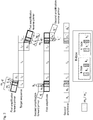
- a left first or initial primer used in the first round of amplification comprises (from 5' to 3' OH-end) a sequence tract m a -k-box (also designated as m a -K) and a sequence tract p C ( Fig. 1 ).
- Sequence tract p C provides target specificity
- m a -K provides a non-target-specific sequence tract, parts or all of which can be used for hybridization of a second "adaptor" primer.
- the sequence tract m a can comprise sequence elements necessary for sequencing purposes or consist of sequences such as M13
- the K-box comprises the K-box elements (k 1 /k 1 ', k 2 /k 2 ', s/s').
- the left adaptor (second) primer comprises distinct sequence tracts, designated a L and a P -a K , which are used for the second amplification.
- a L and 3 P confer functional features for high throughput sequencing, e.g. template sequences for sequencing primers and/or for attachment of the amplificate to a solid surface such as a slide or a bead.
- 3 P can consist of a sequence such as M13.
- the sequence tract a K comprises k 1 , which is a sequence element of the K-box.
- the reverse or right primers, of both the initial and adaptor primers comprise sequence tracts of similar characteristics, designated m a '-k'-box (also designated as m a -K') and p C ' for the right initial (first) primer.
- the right adaptor (second) primer comprises the sequence tracts a L ' and a P '-a K ' ( Fig. 1 ).
- Sequence elements a L and a P are used for sequencing purposes, such as, by way of nonlimiting example, sequencing primer hybridization sites and/or solid support attachment sites.
- Methods for high-throughput sequencing are well known in the art and include so called "Illumina" bridge PCR-sequencing methods, shown inter alia in US2011045541A1 , US2005100900A1 , US2002055100A1 ; pyrosequencing, shown inter alia in US6,274,320 , US 7,244,567 , US 7,264,929 ; US 7,323,305 and US 7,575,865 ; "2 base encoding" technology ( US4883750 , US5750341 ) and others.
- the primers of the invention provide particular sequence elements (K-boxes), which greatly reduce the likelihood that such contaminations occur and enable the recognition of amplicon contaminations within the sequencing results.
- K-box elements are designated k 1 , k 1 ', k 2 , k 2 ', s and s', and are selected by bioinformatics methods as one single K-box, the selection being made not to perform mismatches with the 3'ends of the primers employed.
- the three K-box elements are outlined in the following in detail separately:
- the k 1 /k 1 ' sequences are designed to prevent contamination from previous amplification reactions.
- the forward primer of the first PCR is composed of (i) a target-specific proportion p C , (ii) and the K-box sequence element k 1 , which is specific for each primer set and (iii) and a sequence element m a .
- the reverse primer of the first PCR is composed in the same way but in reverse-complement fashion.
- a specific k 1 and/or k 1 ' element is used for a particular reaction and is varied when the amplification reaction is performed repeatedly.
- a routine diagnostic amplification reaction e.g. the analysis of T-cell receptor beta (TCR ⁇ ) rearrangements or the analysis of cancer genes
- primers using different k 1/ k 1 ' elements may be used for each individual experiment until all variations of k 1 and k 1 ' have been consumed.
- the 3' end of the second (or adaptor) primer is chosen to hybridize to k 1 or k 1 ', respectively, along the entire length of k 1 (or k 1 ').
- pairs of first and second primers are formed, where the "left" adaptor primer hybridizes to sequence tract k 1 that was generated by the "left” initial primer, and the "right” adaptor primer hybridizes to the sequence tract k 1 ' that was generated by the "right” initial primer.
- the adaptor primer will hybridize not necessarily only to the tract generated by k 1 (or k 1 '), but - if k 1 (or k 1 ') does not provide sufficient length of hybridization tract - for the hybridization temperature selected for the reaction - also to a sequence tract adjacent to k 1 (or k 1 ') on its 5' end, namely m a and m a ' (see Fig. 1 ).
- five samples are processed in parallel with five different sets of first (initial) and second (adaptor) primers with a k 1 /k 1 ' element combination specific for each of the five samples.
- first (initial) and second (adaptor) primers with a k 1 /k 1 ' element combination specific for each of the five samples.
- the mismatch between the k 1 and/or k 1 ' element of the PCR product of sample 1 and the different k 1 and/or k 1 ' elements of the sample 2 primers will prevent the amplification of the contaminating material.
- Both, k 1 and k 1 ' can be of 1, 2, 3, 4, 5, 6, 7, 8, 9 or more bases in length. As shown in the proof of principle example below (Table 4) even a k 1 /k 1 ' sequence of one base reduces contamination. However since the number of permutations is relatively low and the discriminatory power (in the sense of contamination suppression) of a one-base mismatch not as great as that of longer mismatches, k 1 and k 1 ' elements of greater length, for example 2, 3, 4, 5, 6, 7, 8 or 9 have broader utility (Examples are given in Tables 16-19).
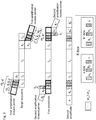
- a further K-box element is a sequence element k 2 or k 2 ', comprised in the sequence tract m a -K or m a -K', respectively, of the initial primer, but not in the corresponding sequence tract in the second amplification (adaptor) primer ( Fig. 2 ).
- k 2 and k 2 ' are characteristic of the initial primer only.
- the k 2 (or k 2 ') element is downstream (towards the 3' end) from the k 1 (or k 1 ') sequence element ( Fig. 2 ).
- the k 2 /k 2 ' sequences are designed to detect contamination from previous amplification reactions.
- the K-box elements s/s' prevent a possible PCR bias dependent on k 1 /k 1 ' and k 2 /k 2 ' sequences as outlined below.
- s separates the target-specific left initial primer sequence p C from the sequence tracts k 2 and/or k 1 .
- s' separates the target-specific right initial primer sequence p C ' from k 2 ' and/or k 1 ' (see Fig. 3-4 ).
- k 1 /k 1 ' and k 2 /k 2 ' vary among different primers used in subsequent amplifications, some variations of k 2 /k 2 ' and/or k 1 /k 1 ' may coincidentally match in their 3' end nucleotides the sequence of the target next to the hybridizing part of the initial primers p C or p C '
- the target sequence-matching tract of the initial primer would be longer for some targets than for others, leading to PCR bias resulting from higher annealing temperatures.
- a set within a multiplex collection addresses different target sequences for use in a multiplex PCR, but carries the same k 1 (and k 1 ') and, optionally, k 2 (and k 2 ') elements.
- different annealing temperatures might introduce a PCR bias that may significantly skew any quantitative interpretation of the results.
- a short (1, 2, 3 or 4 nucleotides) separator sequence s (s') is introduced into the k/k' sequence tract, immediately upstream of the p C /p C ' sequence tract, i.e., at the 3' terminal end of k/k'.
- s and s' are thus designed to prevent a hybrid formation with the template (target) sequence t n /t n ' adjacent to the primer-hybridizing sequence tract t C /t C ', as outlined in Fig. 3-4 .
- the three K-box elements work synergistically to achieve the overall goal of preventing PCR-based contamination in applications employing NGS/HTS techniques.
- k 2 /k 2 ' elements determine and therefore control the contamination suppression efficiency of k 1 /k 1 '.
- s/s' is the K-box family member that solves the problem of a possible PCR bias dependent on k 1 /k 1 ' and k 2 /k 2 ' sequences.
- all three K-box elements together must be designed bioinformatically as one unit and optimized not to form hybrids (e.g. more than 6 bp match within 10 bp) that might lead to mispriming with any primer sequence but especially at the 3' ends of the primers employed.
- a method for amplifying a target nucleic acid sequence t C -t V -t C ' comprised within a sequence tract t n -t C -t V -t C '-t n ' comprising conducting a plurality of polymerase chain reaction (PCR) amplification reactions.
- PCR polymerase chain reaction
- the invention is directed toward a method of repeatedly amplifying or sequencing the same target sequence (albeit in variation that may occur within a sequence tract of interest designated t V ).
- Each reaction comprises two PCR amplification steps: a first amplification step, in which a target nucleic acid sequence is amplified using a first ("initial") primer pair, and includes the reactants known to the skilled artisan as necessary for conducting a PCR reaction, i.e. nucleoside triphosphates (ATP, GTP, TTP, CTP), a suitable buffer and thermostable polymerase such as Taq polymerase.
- a first amplification step in which a target nucleic acid sequence is amplified using a first (“initial") primer pair, and includes the reactants known to the skilled artisan as necessary for conducting a PCR reaction, i.e. nucleoside triphosphates (ATP, GTP, TTP, CTP), a suitable buffer and thermostable polymerase such as Taq polymerase.
- This initial primer pair is composed of a left (forward) first (“initial") PCR primer having a sequence m a -K-p C composed of two sequence elements m a -K and p C in 5'-3' orientation, and a right (reverse) initial primer having a sequence ITI a -K'-p C ', similarly oriented from 5' to 3'.
- the product of the first amplification set is a first amplificate, comprising the target nucleic acid sequence flanked on either side by sequence tracts m a -K and m a -K', respectively ( Fig. 1 ).
- sequence t C -t V -t C ' constitutes the amplified region of the target, whereas the short sequence elements t n and t n ' are flanking regions that define the selection of sequence elements s and s' in the primer set.
- the method of the invention further comprises a second PCR amplification step, whereby a first amplificate is re-amplified using a second ("adaptor") primer pair composed of a left (forward) second (“adaptor") PCR primer having a sequence a L -a P -a K composed of the sequence elements a L , 3 P and a K in 5'-3' orientation and a right (reverse) second (“adaptor”) PCR primer having a sequence a L '-a P '-a K '.
- a second amplificate Fig. 1
- the product of the second amplification is a second amplificate ( Fig. 1 ).
- p C displays the same sequence as the target sequence element t C
- p C ' is the reverse complimentary sequence to t C '.
- p C and p C ' are the target-specific primer sequences that hybridize to the target and effect amplification.
- p C and p C ' each independently from one another are 8 to 40 nucleotides in length.
- m a -K comprises a k-box with the sequence element k 1
- m a -K' comprises a k'-box with a sequence element k 1 '.
- k 1 and k 1 ' each independently from one another are a sequence 2, 3, 4, 5, 6, 7, 8 or 9 nucleotides in length.
- k 1 and k 1 ' are not meant to hybridize to the target sequence.
- a first primer pair and a second primer pair with identical k 1 and k 1 ' form a set.
- k 1 and k 1 ' are the sequence elements that individualize different primer sets from one another.
- k 1 and k 1 ' match the first "initial" and the second "adaptor” PCR primer pairs to one another within a set.
- k 1 and k 1 ' of the first initial primer pair correspond to the sequence elements a k (k 1 ) and a k ' (k 1 '), respectively, in the second primer pair ( Fig. 1 ).
- m a -K comprises a sequence element s on its 3' terminus and m a -K' comprises a sequence element S' on its 3' terminus.
- s and s' are mismatch sequences selected not to form a continuous hybrid sequence with sequence element t n and t n ' and s and s' are independently 1, 2, 3, 4 or 5 nucleotides in length.
- the effect of this element is to avoid an inadvertent rise of the annealing temperature of p C and p C ' on the target in some primers dependent on m a -K and/or m a -K' sequences. This element helps to avoid PCR bias ( Fig. 3-4 ).
- Sequence tract a P -a K hybridizes to a contiguous sequence on sequence element m a -K, and a P '-a K ' hybridizes to a contiguous sequence on sequence element m a -K'.
- a P -a K (and its analogue a P '-a K ') is the sequence tract on the 3' terminal end of the adaptor primer that recognizes the initial primer.
- m a -K and m a -K' can be of any length that fits their general purpose, but will generally be within the usual length of a primer target sequence, i.e. m a -K and m a -K' will be generally each independently from one another a sequence 10 to 40 nucleotides in length, in certain embodiments from about 15 to 30 nucleotides in length.
- a L and a L ' and also a P and a P ' independently from one another can be any sequence that fits the general purpose of providing a sequence useful for sequencing the second amplificate, for example by providing a sequencing primer annealing target and/or a sequence for attaching the second amplificate to a chip or bead or any other surface-bound structure as may be useful in NGS/HTS sequencing.
- t V is a variable region within said target nucleic acid sequence.
- a particular set of primers for each one of said plurality of amplification reactions is provided, for each of which the sequence of one of k 1 and k 1 ' is different from the sequence of any other k 1 and k 1 ', respectively, in any other set of the sets of primers.
- no particular sequence of k 1 and/or k 1 ' occurs more than once in any set.
- a L and a L ' are 5, 10, 15, 20, 25, 30, 35, 40, 45, 50, 55, 60, 65 or 70 nucleotides in length.
- p C and p C ' each independently from one another are 8, 10, 12, 14, 16, 18, 20, 21, 22, 23, 24, 25, 26, 27, 28, 29, 30, 32, 34, 36, 38 or 40 nucleotides in length.
- m a -K comprises a 3'-terminal sequence k 1 -s
- m a -K' comprises a 3'-terminal sequence k 1 '-s'.
- m a -K comprises a sequence element k 2 3'-terminal to sequence element k 1
- m a -K' comprises a sequence element k 2 ' 3'-terminal to sequence element k 1 ' ( Fig. 2 ).
- k 2 and k 2 ' each independently from one another are 2, 3, 4, 5, 6 or 7 nucleotides in length.
- k 2 and k 2 ' serve to individualize the first primer pair of the set from other first (initial) primers.
- k 2 and k 2 ' have no complementary sequence elements on the second ("adaptor") primers.
- the second primers k 1 and k 1 ' have complementary sequences to the first primers within one primer set.
- the primer set uses all three elements k 1 /k 1 ', k 2 /k 2 ' and s/s' ( Fig. 3 ).
- m a -K comprises a 3'-terminal sequence k 1 -k 2 -s
- m a -K' comprises a 3'-terminal sequence k 1 '-k 2 '-s'.
- m a -K comprises a 3'-terminal sequence k 1 -k 2 -s
- m a -K' comprises a 3'-terminal sequence k 1 '-k 2 '-s'
- the first and/or second primer pairs have phosphorothiolated moieties on the last 1, 2, 3 or 4 internucleotide linkages at their 3' terminal end.
- K comprises a 3'-terminal sequence k 1 -k 2 -s
- K' comprises a 3'-terminal sequence k 1 '-k 2 '-s'
- k 1 and k 1 ' each independently from one another are a sequence 5, 6, 7, 8 or 9 nucleotides in length
- s and s' are each independently 2, 3, or 4 nucleotides in length
- /or k 2 and k 2 ' each independently from one another are a sequence 2, 3, 4, 5 or 6 nucleotides in length.
- the sets of primers comprise
- k 1 and k 1 ' and/or k 2 and k 2 ' are selected not to hybridize to the sequence elements t n and t n ' adjacent to the amplified sequence tract.
- k 1 and k 1 ' and k 2 and k 2 ' are separate and distinct from a primer sequence directed toward target amplification. All k-box components solely and exclusively have the purpose of distinguishing the primer set, and thus preventing erroneous amplification of amplicon contaminations, as set forth above.
- the left initial primer, the right initial primer, the left adaptor primer and/or the right adaptor primer are characterized by one or several nuclease resistant nucleotide(s) or nuclease resistant internucleosidic bond(s) on or near (at position 1, 2, 3 and /or 4 counting from) the 3' terminus of the primers.
- the 3' end of the primer is protected against 3' exonuclease digestion by providing bonds that inhibit or resist the exonuclease activity.
- the nuclease resistant internucleosidic bond is a phosphorothioate bond.
- the nuclease resistant nucleotide is a 2-O-methylated ribonucleotide.
- the nuclease resistant nucleotide is an LNA building block (a 2'O, 4'C-methylene bridged RNA building block).
- the nuclease resistant nucleotide is a 2-F-deoxyribonucleotide.
- the nuclease resistant nucleotide is a 2-propyne-deoxyribonucleotide.
- the nuclease resistant nucleotide or nuclease resistant internucleosidic bond is the last internucleosidic bond counting from the 3' terminus of said primer(s). In some embodiments, the nuclease resistant nucleotide or nuclease resistant internucleosidic bond is located on position -1, -2, -3, and/or -4 counting from the 3' terminus of said primer(s).
- the nuclease resistant nucleotide or nuclease resistant internucleosidic bond are located at position - 1 and - 2, in some embodiments at position -1 and -2 and - 3, or in some embodiments at position -1 and -2 and - 3 and -4.
- a method for sequencing a target sequence t C -t V -t C ' comprised within a sequence tract t n -t C -t V -t C '-t n ' comprising the steps of
- the method for sequencing a target sequence further comprises the steps of
- the set of readout sequences consists of 10.000 sequences, for 32 of which the sequence tract corresponding to m a -K or m a -K' does not align with the particular sequence expected (chosen) for the particular run, then a percentage of contamination of 32/10.000, resulting in 0,0032 or 0,32% is computed.
- the method for sequencing a target sequence includes a step of validation or quality control, wherein all sequences obtained are checked for the presence of identifier sequences k 2 , k 2 ' and/or k 1 , k 1 ' (k 1 , k 1 ' can be relevant as identifier of the first amplification reaction, since k 1 , k 1 ' of the second amplification primer can be partially degraded in the second PCR by proof reading polymerases as outlined in detail in the proof of principle examples).
- Unexpected identifier sequences, or unexpected combinations thereof, are regarded as contamination.
- the method comprises the steps of providing a set of primers for each sample of said plurality of samples, each set of primers comprising a pair of initial PCR primers comprising a left initial PCR primer having a sequence m a -K-p C and a right initial primer having a sequence and m a -K'-p C ', and a pair of adaptor PCR primers comprising a left adaptor PCR primer having a sequence a L -a P -a K and a right adaptor PCR primer having a sequence a L '-a P '-a K '.
- a collection of sets of primers for use in a method for amplifying or sequencing a target nucleic acid sequence t C -t V -t C ' comprised within a sequence tract t n -t C -t V -t C '-t n ' according to the invention is provided, wherein each set of primers of said collection comprises
- This aspect as well as any of the preceding aspects and embodiments uses a collection of sets of primers for use in a method for amplifying or sequencing a target nucleic acid sequence according to any of the preceding aspects and embodiments.
- Each set adheres to the definition given for the previously defined aspect of the invention (a set of primers according to the invention), and wherein for all sets of primers comprised within said collection, all sequence elements p C are the same and all sequence elements p C ' are the same.
- each set of primers is characterized by a different combination of k 1 and k 1 ' from any other set of primers.
- each set of primers has a unique K1/K1' combination.
- each set of primers is characterized by a different combination of k 1 , k 1 ', k 2 and k 2 ' from any other set of primers.
- the collection of sets of primers according to the invention comprise 4, 8, 16, 24, 32, 40, 48, 56, 64, 72, 80, 160, 200, 256 or 1024 different sets of primers.
- K comprises a 3'-terminal sequence k 1 -k 2 -s
- K' comprises a 3'-terminal sequence k 1 '-k 2 '-s', wherein k 2 and k 2 ' each independently from one another are a sequence 2 to 7 nucleotides in length, and a k and a k ' are selected not to hybridize to k 2 and k 2 ', respectively.
- all sequence elements a P are the same and all sequence elements a P ' are the same for a collection.
- a set of primers according to the invention (and intended for use in a method of the invention) comprises:
- a multiplex-collection comprising a plurality of collections of sets of primers according to the invention, whereby each collection is characterized by a different combination of p C and p C '.
- a multiplex set within a multiplex collection is defined as a multiplex collection member (primer library member).
- a multiplex set is a plurality of sets of primers for employment in a method of the invention, wherein the plurality is characterized in that each member set differs from any other member set in their combination of p C and p C ', but for all member sets, k 1 and k 1 ' (and, where applicable, k 2 and k 2 ') are the same.
- the multiplex collection members can thus be used together, within the same multiplex PCR, and different multiplex collection members (discriminated by different K-boxes) will be used in repeated PCR/sequencing rounds.
- TCR ⁇ T-cell receptor beta
- the use of a two-step PCR strategy for TCR analyses has the advantage that the initial PCR with gene-specific TCR primers requires only a few PCR cycles minimizing PCR-generated bias, and thereafter the first amplificate is amplified evenly with the adaptor specific primers by a further PCR step. Furthermore, different adaptors suitable for different NGS platforms can be added by the second PCR.
- sequences for the target-binding tract of left (p C ) initial primer are those given as SEQ ID NO 001-045, and right (p C ') initial primer sequences are those given as SEQ ID NO 046-058.
- sequences for the target-binding tract of left (p C ) initial primer are those given as SEQ ID NO 189-232
- right (p C ') initial primer sequences are those given as SEQ ID NO 233-246.
- the primers given as SEQ ID NO 001-058 and as SEQ ID NO 189-246 were optimized in two aspects: 1) to have a similar annealing temperature and 2) to minimize self priming.
- the methods, sets of primers, collections and multiplex collections provided herein are of particular use in methods for analysing in vitro the TCR ⁇ repertoire of a human patient.
- k 1 /k 1 ' (with a lower case k) are together also termed K 1 with a capital letter and k 2 /k 2 ' sequence tracts are thereafter also termed K 2 . Furthermore, s 1 /s 1 ' sequence tracts are thereafter also termed S.
- the "prime” or apostrophe (') indicates that a sequence tract or element has a similar functional characteristic as its non-prime counterpart, but is located on a primer on the other side of the target sequence.
- PCR was performed using a DNA thermal cycler (PE 9700, Perkin Elmer, Rodgau, Germany).
- PE 9700 Perkin Elmer, Rodgau, Germany
- the initial primers used for the first round of amplification comprised in order from 5' to 3' end a sequence tract m a -K and a sequence tract p C ( Fig. 1 ).
- Sequence tract p C provided target specificity
- m a -K provided a non-target-specific sequence tract, parts or all of which can be used for hybridization of a second "adaptor" primer.
- the left initial PCR primers had a sequence m a -K-p C with the matching sequence p C to the V-4 segment (SEQ 183; TTATTCCTTCACCTACACACCCTGC), whereas the right initial primers which had the sequence and m a -K'-p C ' with the matching sequence p C ' (SEQ ID NO 184; AGCACTGTCAGCCGGGTGCCTGG) to the J-2.1 segment.
- the 3' end of the k-box of forward initial primers had the sequence element s with the two nucleotides "GG", whereas the 3' end of the k'-box of the initial reverse primer had a sequence element s' with two nucleotides "TA".
- the k-box of the forward initial primers had a sequence element m a (SEQ ID NO 185; CGCTCTTCCGATCT) on the 5' end and the k'-box of the initial reverse primers had a sequence element m a ' (SEQ ID NO 186; TGCTCTTCCGATCT) on the 5' end (See Fig. 3 for the overview of the sequence tract names).
- the k-box of the initial forward primers harboured different k 1 and k 2 sequences and the k'-box of the initial reverse primers harboured different k 1 ' and k 2 ' sequences.
- Table 2 k-box and k'-box element sequences are listed as present in 5'-3'orientation of the forward or reverse primers.
- First amplification steps were performed in a final volume of 50 ⁇ l with final concentrations of 1 x PCR Buffer containing 3 mM MgCl 2 , 0.2 mM of each dNTP, 1.0 ⁇ M forward primer and 1.0 ⁇ M reverse primer and 1 unit AmpliTaq Gold DNA Polymerase (Applied Biosystems, Foster City, CA, USA) and the following cycling conditions: 1 cycle at 95°C for 15 min, 34 cycles at 95°C for 30 s, 65°C for 45 s and 72°C for 45 sec respectively, and a final 10 min elongation step at 72°C.
- Primary PCR products were purified using the QIAquick PCR Purification Kit (Qiagen, Hilden, Germany) according to the manufacturer's instructions. DNA concentration was determined via the Qubit® 1.0 Fluorometer (Invitrogen, Darmstadt, Germany). As template for the second amplification 500 pg from the purified first amplification product was used.
- a pair of adaptor PCR primers comprising a left adaptor PCR primer having a sequence a L -a P -a K and a right adaptor PCR primer having a sequence a L '-a P '-3 K ' was employed.
- the left adaptor primers had the sequence element a L -a P (SEQ ID NO 187) whereas the right adaptor primers had the sequence element a L '-a P ' (SEQ ID NO 188).
- the k-box of the forward adaptor primer harbored different k 1 sequences and the k'-box of the reverse adaptor primers harbored different k 1 ' (listed in Table 2).
- the second amplification steps were performed (i) with a proofreading polymerase (Phusion High-Fidelity DNA Polymerase (Finnzymes, Espoo, Finland)) or (ii) a polymerase without proofreading activity (AmpliTaq Gold).
- a proofreading polymerase Phusion High-Fidelity DNA Polymerase (Finnzymes, Espoo, Finland)
- a polymerase without proofreading activity AmpliTaq Gold
- the second amplification step was performed in a final volume of 50 ⁇ l including final concentrations of 1 x Phusion HF Buffer with 1.5 mM MgCL 2 , 0.05 mM of each dNTP, 1.0 ⁇ M forward primer, 1.0 ⁇ M reverse primer and 1 unit Phusion High-Fidelity DNA Polymerase.
- the following thermal cycling conditions were used for the second amplification: 1 cycle at 98°C for 30 s, 12 cycles at 98°C for 10 s, 58°C for 30 s and 72°C for 30s respectively, and a final 5 min elongation at 72°C.
- the second amplification step was performed in a final volume of 50 ⁇ l with final concentrations of 1 x PCR Buffer, 3 mM MgCl 2 , 0.2 mM of each dNTP, 1.0 ⁇ M forward primer and 1.0 ⁇ M reverse primer and 1 unit AmpliTaq Gold DNA Polymerase.
- the following thermal cycling conditions were used for the second amplification: 1 cycle at 95°C for 15 min, 23 cycles at 98°C for 10 s, 54°C for 30 s and 72°C for 30 s, respectively, and a final 5 min elongation step at 72°C.
- PCR products were analysed on a 6% acrylamide gels and Tif files were produced with Biorad Geldoc 2000 (München, Germany) using default conditions. PCR bands were further quantified with the FusionCapt Advance software (Vilber Lourmat, Eberhardzell, Germany).
- NTC no template control
- iv the background gate.
- Table 5 and 6 show that in a setting with a proofreading polymerase employed in second amplification and 3 phosphorothioate bonds at the 3'end of the k-box and k'-box of the second amplification primers K 1 mismatches of 4 bp (mean 9.6, SDN 1.3) and 6 bp (mean 9.1, SDN 2.3) lead to complete suppression of contaminations comparable to NTCs and background.
- Table 7 Effect of the number of K 1 mismatches (1 and 2 bp total length) on contamination suppression employing second amplification primers without phosphorothioate bonds and a polymerase without proofreading activity.
- As gel quantification (quant) standard the same Peer TCR PCR product was used on each gel for normalization of the PCR product quantities and was set to 100%. Therefore, Vol. % larger than 100% can be achieved. Quantities around 100% Vol.
- Table 7 and 8 show that also in a setting with a polymerase without proofreading activity and second amplification primers without phosphorothioate bonds at the 3'end of the k-box and k'-box contamination suppression increases with an increasing number of K 1 mismatches.
- TCR ⁇ multiplex collection a multiplex collection with 44 TCR ⁇ V segment specific primers (P C , SEQ ID NO 189 - 232) and 14 TCR ⁇ J segment specific primers (p C ', SEQ ID NO 233 - 246) was used in the first PCR amplification.
- Each of these primers had a 5' S sequence of two nucleotides in length (For the SEQ ID NO 189-193, 195, 197, 198, 201-211, 213-221, 223-229, 231, 233-241 and 243-246 the S sequence was "GG”, for the SEQ ID NO 194, 200 and 230, the S sequence was "TG”, for the SEQ ID NO 196, 199, 212, 222, 242 the S sequence was "GT”, for the SEQ ID NO 232 the S sequence was "TT”. The orientation of these S sequences is in 5'-3'direction of the primer.
- the k-box of the forward initial primers had the tail sequence element m a (SEQ ID NO 247 GCTCTTCCGATCT) on their 5' end and the k'-box of the initial reverse primers had a sequence element m a ' (SEQ ID NO 247; GCTCTTCCGATCT) on their 5' end.
- Second amplification primers were employed (i) with 2 phosphorothioate bonds at their 3' end and in another experiment with (ii) an LNA at the second position from the 3' end.
- Three primer sets (Set 1-3) were used with the set specific K 1 and K 2 sequences given in Table 9.
- the first PCRs (with AmpliTaq-Gold) and second PCRs (with the proofreading Phusion High-Fidelity DNA Polymerase) were performed as described above, with 100 ng of tonsillar DNA as template.
- the PCR results were quantified with the FusionCapt Advance software as described above.
- K 2 serves to individualize the first primer pair of the set and have no complementary sequence elements on the second ("adaptor") primers.
- K 2 sequences are designed to detect contamination from previous amplification reactions and therefore control the suppression efficiency of K 1 .
- the contamination is caused by nonspecific priming of "Tube Nr. 2" k 1 and k 1 ' element of the second amplification primers to the "Tube Nr.1" k 1 and k 1 ' element in the first amplification product.
- the contamination amplification could be caused by partial or full degradation of the "Tube Nr. 2" k 1 and k 1 ' element by polymerases with proofreading activity. Since the k 2 /k 2 ' elements are only present in the first amplification primers the contamination can still be identified in the second amplification product.
- k 2 /k 2 ' elements can be seen as a valuable safe lock mechanism to detect contaminations, complementing the already significant contribution of k 1 /k 1 ' sequences to avoid such contaminations.
- the first "Tube Nr. 1" amplification was regarded to be a "100% contamination" ("Tube Nr.1" primary amplification product) of "Tube Nr. 2" second amplification. Therefore, a second amplification was performed with “Tube Nr. 2" second amplification primers and the "Tube Nr. 1" first amplification product as template. In the gel analysis of the resulting second amplification PCR product there was a PCR product detectable, since due to the only 1 bp long k 1 mismatch this "Tube Nr. 1" contamination was not completely suppressed during second amplification (with "Tube Nr. 2" second amplification primers). This PCR product was sequenced.
- the Sanger sequencing demonstrated the k 2 /k 2 ' function to detect contamination.
- polymerase with or without proofreading polymerase can be used in second amplification.
- k 2 /k 2 ' elements help to understand and control the function of k 1 /k 1 '.
- Another important result of this experiment is that if proofreading polymerase is employed, unexpected k 1 /k 1 ' hybrids can be detected in the resulting sequence reads by bioinformatics methods and these sequences can be removed as contaminations.
- a feature that improves on the performance of the above elements k 1 (and k 1 ') and k 2 (and k 2 ') is the introduction of short separator sequences s and s' ( Fig. 3-4 ).
- s separates the constant initial primer sequence p C from the sequence tracts k 1 and k 2
- s' separates the constant initial primer sequence p C ' from k 1 ' and k 2 ' respectively.
- k 1 /k 1 ' and k 2 /k 2 ' vary among different primers used in subsequent reactions, it may well be that some variations of k 1 /k 1 ' and / or k 2 /k 2 ' coincidentally match in their last nucleotides on the 3' terminal end the sequence of the target next to the hybridizing part of the initial primer, p C or p C '. Therefore, the target sequence-matching tract of the initial primer would be elongated, leading to higher annealing temperatures and thus, possibly, PCR bias.
- the first amplification was performed as described above with 100 ng template DNA from the T-cell lymphoma cell line Peer and the following cycle conditions. 1 cycle at 95°C for 15 min, 29 cycles at 95°C for 30 s, 68 °C for 45 s and 72°C for 45 sec respectively, and a final 10 min elongation at 72°C.
- the first amplification PCR primers had a sequence m a K-p C with the matching sequence p C to the V-4 segment (SEQ ID NO 248; ACCTACACACCCTGC), whereas the right first amplification primers which had the sequence and m a K'-p C ' had the matching sequence p C ' (SEQ ID NO 249; AGCCGGGTGCCTGG) to the J-2.1 segment.
- the k-box of the left first amplification primers had a sequence element m a (SEQ ID NO 250; CGCTCTTCCGATCT) on the 5' terminus and the k'-box of the right first amplification primers had a sequence element m a ' (SEQ ID NO 251; TGCTCTTCCGATCT) on the 5' terminus.
- Table 12 An overview of the 6bp matching K-box sequences to the V-4 segment and J-2.1 segment together with the s sequences of different length are given in Table 12.
- Table 12 Overview of S sequences and 6 bp K-box sequences. Some of the K-box sequences have a full-match to the V-4 segment and J-2.1 segment to simulate an incidentally matched K-box to the template sequence.
- V the first letter “V” or “J” stands for the V- or J- TCR Primer in which the respective K-box is comprised
- KM stands for K-box match to template sequence
- KMM stand for K-box mismatch to template sequence
- S1-3 gives the length of a separator sequence S (1-3 nucleotides).
- Primer K-box sequence Template sequence match S sequence VKM TCCTTC Yes none VKMS1 TTCCTT Yes G VKMS2 ATTCCT Yes GG VKMS3 TATTCC Yes AGG VKMM CAACGT No none VKMMS1 GGTTCA No G VKMMS2 GGAGTA No GG VKMMS3 GCACTT No AGG JKM ACTGTC yes none JKMS1 CACTGT yes T JKMS2 GCACTG yes GT JKMS3 AGCACT yes CGT JKMM TGACGA No none JKMMS1 GTTGAC No T JKMMS2 ATGACT No GT JKMMS3 GTTGAG No CGT Table 13: Experiment Nr.
- V V- or J- TCR Primer in which the respective K-box is comprised
- KM stands for K-box match to template sequence
- KMM stand for K-box mismatch to template sequence
- S1-3 gives the length of a separator sequence S (1-3 nucleotides).
- Table 13 shows that S sequences lead to a similar amplification despite of coincidentally template matching k-box and k'-box sequences.
- Table 13 line 6 the amplification (Vol. %) with primers harbouring a S sequence of 3 bp length and template matching k-box and k'-box sequences have a mean of 18.4 (SDN 4.5) which is comparable to the amplification without template matching k-box and k'-box sequences in Table 13 line 3 with a mean of 17.6 (SDN 5.1).
- Example 4 Contamination suppression by K 1 and detection by K 2 employing a TCR ⁇ multiplex collection and NGS analysis
- the first amplificate mix used as template for second amplification comprised 50% tonsillar amplificate (Set1), 25% Jurkat amplificate (Set1) and 25% Karpas299 amplificate (Set1).
- the second amplification primers were from Set1.
- the amplificate mix was used as template for second amplification comprised 50% tonsillar amplificate (Set1), 25% Jurkat amplificate (Set2) and 25% Karpas299 amplificate (Set3).
- the second amplification primers were from Set1.
- k 1 and k 1 ' sequences were designed in a way to (a) optimally avoid cross-hybridization between all k 1 and k 1 ' sequences given in one of the Tables 16-19 below, (b) adjust the melting temperatures of k 1 and k 1 ' sequences in a narrow range and (c) to avoid low complex base compositions with > 2/3 of the bases being the same nucleotide (A,C,G,T),
- Each of the Tables 16-19 consists of an equal number of k 1 and k 1 ' sequences for the forward and reverse primers and a specific length (4, 5,r 6, 7 or 8 nucleotides).
- features a)-c) were established by comparing all potential k 1 and k 1 ' sequences of one specific length (4, 5, 6, 7 or 8 bp) against each other and excluded all those which were reverse-complements to any other k 1 and k 1 ' sequences of this specific length.
- the design algorithm compared in a further step all k 1 and k 1 ' sequences of one specific length (4, 5, 6, 7 or 8 bp) against all other reverse complement k 1 and k 1 ' sequences of this specific length and excluded all k 1 and k 1 ' sequences which either had >2 common bases at the 3' terminal end of the k 1 and k 1 ' sequences or had >60% bases in common with another k 1 and k 1 ' sequence.
- k 2 /k 2 ' sequences are provided (Table 20), which were designed in a way to exclude all respective reverse complement sequences from the set of k 2 /k 2 ' sequences.
- ATC is chosen as one possible k 2 element
- GAT is automatically excluded from the set of k 2 ' elements.
- the K-boxes are designed as one unit being selected to form a minimum of cross-hybridization with the 3'ends of the primes employed.
- Table 16 Optimized k 1 and k 1 ' sequences of 4 bp length.
- the segment side A can be employed in the right primers and B in the left primers.
- the segment side B can be employed in the right primers and A in the left primers.
- Primer side k 1 - or k 1 ' sequence Melting temperature A CTGA 12 A AGTG 12 A CAAC 12 A GGAA 12 A GTCA 12 A AAGC 12 A ATTA 8 A AGCC 14 A CGAG 14 A AGGA 12 A TAGA 10 B GCGA 14 B ACGG 14 B CGTA 12 B ACTC 12 B CTTC 12 B ACCA 12 B GCAC 14 B GACC 14 B ATAC 10 B CGGC 16 B GATA 10 Table 17: Optimized k 1 and k 1 ' sequences of 5 bp length.
- the segment side A can be employed in the right primers and B in the left primers.
- the segment side B can be employed in the right primers and A in the left primers.
- Primer side k 1 - or k 1 ' sequence Melting temperature A CTCTA 14 A ATCAG 14 A ATTGG 14 A ATACG 14 A ACGCA 16 A ACCAA 14 A AATGC 14 A AAGGA 14 A TCACA 14 A ATATA 10 A ATGTC 14 A AGCTG 16 A CAACC 16 B GTTTA 12 B GCTCC 18 B CTTAA 12 B GAGGC 18 B ACACT 14 B AATCG 14 B CATCA 14 B GTAGA 14 B CTTTC 14 B AAGCC 16 B AAAGT 12 B CGGAA 16 B CTCAC 16 B CGGAA 16 B CTCAC 16 Table 18: Optimized k 1 and k 1 ' sequence of 6 bp length.
- segment side A can be employed in the right primers and B in the left primers.
- segment side B can be employed in the right primers and A in the left primers.
- Primer side k 1 - or k 1 ' sequence Melting temperature [°C] A CTCTGA 18 A GGTTAA 16 A GCCTTA 18 A CGGACG 22 A GTCAAA 16 A GATCGA 18 A CTTGTA 16 A AACTTG 16 A AATCAT 14 A ACTATG 16 A GCAACA 18 A CGAAGC 20 A GAGTCC 20 A GGCAAC 20 A AAATGT 14 A CTATCA 16 B AAGCTG 18 B GCCCAA 20 B ATCAGA 16 B ACTCAG 18 B GGTATA 16 B AAAGGG 18 B AATGCT 16 B CCAAGG 20 B ACGCGG 22 B GACGGA 20 B GCGCAC 22 B GTAGAA 16 B ACCGCA 20 B AAACCC 18 B AGAACT 16 B GAGCTA 18 Table 19: Optimized k 1 and k 1 ' sequence
- segment side A can be employed in the right primers and B in the left primers.
- segment side B can be employed in the right primers and A in the left primers.
- K1 "A 7 nt” K1 "B 7 nt” K1 "A 8 nt” K1 "B 8 nt” AACCAAC GAGCACA CGTGTCGC AGGCACCA CATGACC CACCCAA ATGATGAC GCTTCTTA CATGACC CACCCAA ATGATGAC GCTTCTTA AAATGGC CTTCCTA AAACCTGT ATACTTCG AGGTAGC AGTTTTG GAATGATA ACGATTGG TATGTCA CTGTTAA ATCGGTGC GGCAGCGA CTATGTA CTTTAGA GATGTTCA ATGTTCGG CATTGCG AAGACGG CTGCGACA GGTGGCTA AGAAGGA AGCGGCC CATCTAGA CAATACCC GATCTCC CAGTAGG AACGCTGA CTATTTAC ACTATGC AGTGCCA ATGCTGTGTGCG
- segment side A can be employed in the right primers and B in the left primers.
- segment side B can be employed in the right primers and A in the left primers.
- Primer side k 2 - or k 2 ' sequence Primer side k 2 - or k 2 ' sequence A ACG B GAC A CCA B CGG A TTA B GTG A TCG B TGT A GGT B AAG
Landscapes
- Chemical & Material Sciences (AREA)
- Life Sciences & Earth Sciences (AREA)
- Organic Chemistry (AREA)
- Proteomics, Peptides & Aminoacids (AREA)
- Health & Medical Sciences (AREA)
- Zoology (AREA)
- Wood Science & Technology (AREA)
- Engineering & Computer Science (AREA)
- Molecular Biology (AREA)
- Immunology (AREA)
- Biotechnology (AREA)
- Microbiology (AREA)
- Biochemistry (AREA)
- Bioinformatics & Cheminformatics (AREA)
- General Engineering & Computer Science (AREA)
- General Health & Medical Sciences (AREA)
- Genetics & Genomics (AREA)
- Biophysics (AREA)
- Analytical Chemistry (AREA)
- Physics & Mathematics (AREA)
- Chemical Kinetics & Catalysis (AREA)
- Measuring Or Testing Involving Enzymes Or Micro-Organisms (AREA)
Claims (14)
- Ein Verfahren zur Amplifikation einer Ziel-Nukleinsäuresequenz tC-tV-tC' enthalten in einem Sequenzstrang tn-tC-tV-tC'-tn', wobei das besagte Verfahren die Durchführung einer Mehrzahl von Amplifikationsreaktionen beinhaltet, während jede Reaktion Folgendes beinhaltet- einen ersten Amplifikationsschritt, in dem die besagte Ziel-Nukleinsäuresequenz amplifiziert wird mithilfei. eines initialen linken (vorwärts) PCR Primers mit einer Sequenz ma-K-pC undii. eines initialen rechten (revers) PCR Primers mit der Sequenz ma-K'-pC', wobei ein erstes Amplifikat erhalten wird,- einen zweiten Amplifikationsschritt, in der das besagte erste Amplifikat amplifiziert wird mithilfewobeiiii. eines linken (vorwärts) Adapter-PCR-Primers bestehend aus einer Sequenz aL-aP-aK undiv. eines rechten (revers) Adapter-PCR-Primers bestehend aus einer Sequenz aL'-aP'-aK',wobei ein zweites Amplifikat erhalten wird,- tV eine variable Region innerhalb der besagten Ziel-Nukleinsäuresequenz ist,- pC die gleiche Sequenz wie das Sequenzelement tC ist und pC' die revers komplementäre Sequenz zu tC' ist,- K ein Sequenzelement k1 und ein 3'-terminales Sequenzelement s umfasst und K' ein Sequenzelement k1' und ein 3'-terminales Sequenzelement s' umfasst, wobei- k1 und k1' jeweils unabhängig voneinander eine Sequenz von der Länge 2 bis 9 Nukleotide sind,- s and s' Fehlbasenpaarungssequenzen sind, die ausgewählt sind, um keine kontinuierlichen Hybridsequenzen mit den Sequenzelementen tn und tn' zu bilden, und s and s' jeweils eine Länge von 1, 2, 3, 4 oder 5 Nukleotiden haben,- aK die gleiche Sequenz wie das Sequenzelement k1 ist und ak die gleiche Sequenz wie das Sequenzelement k1' ist,- aP-aK mit einer zusammenhängenden Sequenz auf ma-K hybridisiert und aP'-aK' mit einer zusammenhängenden Sequenz auf ma-K' hybridisiert,- pC, pC', ma-K und ma-K' jeweils unabhängig voneinander eine 10 bis 40 Nukleotide lange Sequenz sind, und aL und aL' unabhängig voneinander irgendeine Sequenz sind, und wobeiein bestimmtes Set von Primern für jede Amplifikationsreaktion der besagten Mehrzahl von Amplifikationsreaktionen bereitgestellt wird, wobei in jedem der Sets von Primern- k1 eines bestimmten Sets sich von jedem k1 eines anderen Sets unterscheidet und/oder- k1' eines bestimmten Sets sich von jedem k1' eines anderen Sets unterscheidet.
- Das Verfahren nach Anspruch 1, wobei K eine 3'-terminale Sequenz k1-k2-s beinhaltet und K' eine 3'-terminale Sequenz k1'-k2'-s' beinhaltet, worin- k2 and k2' jeweils unabhängig voneinander eine Sequenz der Länge 2 bis 7 Nukleotide sind,- ak ausgewählt ist, um nicht mit k2 zu hybridisieren, und aK' ausgewählt ist, um nicht mit k2' zu hybridisieren;- für jedes besagte bestimmte Set von Primern k2 und k2' sich von allen anderen k2 und k2' unterscheiden;und k1, k1', s und s' die gleiche Bedeutung haben wie oben beschrieben.
- Die Methode nach einem der vorherigen Ansprüche, wobei die besagten bestimmten Sets von Primern Folgendes umfassen- einen initialen linken (vorwärts) Primer, der ein Sequenzelement pC umfasst, welches ausgewählt wird von einer der Sequenzen SEQ ID NO 001 bis SEQ ID NO 045 und einen initialen rechten (reversen) Primer, der ein Sequenzelement pC' umfasst, welches ausgewählt wird von einer der Sequenzen SEQ ID NO 046 bis SEQ ID NO 058; und/oder- einen initialen linken (vorwärts) Primer, der ein Sequenzelement pC umfasst, welches ausgewählt wird von einer der Sequenzen SEQ ID NO 189 bis SEQ ID NO 232 und einen initialen rechten (reversen) Primer, der ein Sequenzelement pC' umfasst, welches ausgewählt wird von einer der Sequenzen SEQ ID NO 233 bis SEQ ID NO 246; und/oder- einen initialen linken (vorwärts) Primer, der ein Sequenzelement ma umfasst, welches ausgewählt wird von einer der Sequenzen SEQ ID NO 059 bis SEQ ID NO 085 und einen initialen rechten (reversen) Primer, der ein Sequenzelement ma umfasst, welches ausgewählt wird von einer der Sequenzen SEQ ID NO 086 bis SEQ ID NO 117.
- Das Verfahren zur Amplifikation einer Ziel-Nukleinsäuresequenz nach einem der vorherigen Ansprüche, wobei im ersten und/oder im zweiten Amplifikationsschritt eine DNA Polymerase mit 3'-5'-Exonuklease- (Korrekturlese-) Aktivität verwendet wird.
- Ein Verfahren zur Sequenzierung einer Zielsequenz tC-tV-tC' enthalten in einem Sequenzstrang tn-tC-tV-tC'-tn', welche folgende Schritte beinhalteta) Vervielfältigung der besagten Zielsequenz mit einem Verfahren nach Anspruch 1, 3 oder 4,b) Sequenzierung des besagten zweiten Amplifikats inklusive der Sequenzelemente ma-K und/oder ma-K', wobei ein Set von Ausgabesequenzen erhalten wird.
- Das Verfahren nach Anspruch 5, die zudem folgende Schritte beinhaltetc) Ausrichten jedes Mitglieds der besagten Sets von Ausgabesequenzen jeweils zu den Sequenzelementen ma-K und/oder ma-K' beinhaltet in dem besagten initialen Primer; andd) Zuweisung eines Wertes von 1 oder 0 zu jeder Sequenz der besagten Sets von Ausgabesequenzen als Messwert der Kontamination, wobei eine vollständige Ausrichtung eines Mitglieds der besagten Sets von Ausgabesequenzen zu dem besagten Sequenzelement ma-K oder ma-K' den Wert 0 erhält und eine unvollständige Ausrichtung eines Mitglieds der besagten Sets von Ausgabesequenzen zu dem besagten Sequenzelement ma-K oder ma-K' den Wert 1 erhält; und(i) Ermittlung eines Prozentsatzes der Kontamination durch Summierung aller Werte, die in Schritt d) zugewiesen wurden, resultierend in einer Wertesumme und Dividieren dieser Wertesumme durch die Gesamtanzahl der Sequenzierungen, und/oder.(ii) Entfernen der Sequenzen mit einem Wert "1" aus dem Set der Sequenzen.
- Eine Sammlung von Primern zur Benutzung in einer Methode zur Amplifikation oder Sequenzierung einer Ziel-Nukleinsäuresequenz tC-tV-tC' umfassend in einem Sequenzstrang tn-tC-tV-tV'-tn' nach einem der Ansprüche 1 bis 6, wobei jedes Set von Primern Folgendes umfasst:i. ein Paar von initialen PCR-Primern umfassend einen initialen linken (vorwärts) PCR-Primer mit einer Sequenz ma-K-pC und einen initialen rechten (revers) PCR-Primer mit einer Sequenz ma-K'-pC', undii. ein Paar von Adapter-PCR-Primern umfassend einen linken Adapter-PCR-Primer mit einer Sequenz aL-aP-aK und einen rechten Adapter-PCR-Primer mit einer Sequenz aL'-aP'-aK',wobei- pC die gleiche Sequenz hat, wie das Sequenzelement tC, und pC' die revers komplementäre Sequenz zu tC' hat,- K ein Sequenzelement k1 und ein 3'-terminales Sequenzelement s umfasst, und K' ein Sequenzelement k1' und ein 3'-terminales Sequenzelement s' umfasst, wobei> k1 and k1' jeweils unabhängig voneinander eine Sequenz von 2 bis 9 Nukleotiden Länge sind,> s and s' Fehlbasenpaarungssequenzen sind, ausgewählt, um keine zusammenhängenden Hybridsequenzen mit den Sequenzelementen tn und tn' zu bilden, und s und s' jeweils unabhängig voneinander 1, 2, 3, 4 oder 5 Nukleotide Länge haben,- aK die gleiche Sequenz wie das Sequenzelement k1 ist, und aK' die gleiche Sequenz wie das Sequenzelement k1' ist,- aP-aK mit einer zusammenhängenden Sequenz auf ma-K hybridisiert und aP'-aK' mit einer zusammenhängenden Sequenz auf ma-K' hybridisiert, undpC, pC', ma-K und ma-K' jeweils unabhängig voneinander eine 10 bis 40 Nukleotide lange Sequenz sind und aL and aL' unabhängig voneinander irgendeine Sequenz sind,
und wobei- für alle Sets von Primern innerhalb der besagten Sammlung die Sequenzelemente pC alle gleich sind, und die Sequenzelemente pC alle gleich sind; undin jedem dieser Sets von Primern- k1 eines bestimmten Sets sich von jedem k1 eines anderen Sets unterscheidet und/oder- k1' eines bestimmten Sets sich von jedem k1' eines anderen Sets unterscheidet. - Eine Sammlung von Sets von Primern nach Anspruch 7, wobei- Sequenzelement pC des besagten initialen linken (vorwärts) PCR-Primers ausgewählt wird von einer der Sequenzen SEQ ID NO 001 bis SEQ ID NO 045, und Sequenzelement pC' des besagten initialen rechten (reversen) PCR-Primers ausgewählt wird von einer der Sequenzen SEQ ID NO 046 bis SEQ ID NO 058; und/oder- Sequenzelement pC des besagten initialen linken (vorwärts) PCR-Primers ausgewählt wird von einer der Sequenzen SEQ ID NO 189 bis SEQ ID NO 232, und Sequenzelement pC' des besagten initialen rechten (reversen) PCR-Primers ausgewählt wird von einer der Sequenzen SEQ ID NO 233 bis SEQ ID NO 246; und/oder- Sequenzelement ma des besagten initialen linken (vorwärts) PCR-Primers ausgewählt wird von einer der Sequenzen SEQ ID NO 059 bis SEQ ID NO 085, und Sequenzelement ma des besagten initialen rechten (reversen) PCR-Primers ausgewählt wird von einer der Sequenzen SEQ ID NO 086 bis SEQ ID NO 117.
- Die Sammlung von Sets von Primern nach Anspruch 8, wobei K eine 3'-terminale Sequenz k1-k2-s umfasst, und K' eine 3'-terminale Sequenz k1'-k2'-s' umfasst, wobei- k1 and k1' jeweils unabhängig voneinander eine Sequenz von 2 bis 9 Nukleotiden Länge haben,- ak ausgewählt ist, um nicht mit k2 zu hybridisieren, und aK' ausgewählt ist, um nicht mit k2' zu hybridisieren;in jedem dieser Sets von Primern- k2 eines bestimmten Sets sich von jedem k2 eines anderen Sets unterscheidet und/oder- k2' eines bestimmten Sets sich von jedem k2' eines anderen Sets unterscheidet, und k1, k1', s and s' die Bedeutung haben wie oben beschrieben.
- Die Sammlung von Sets von Primern nach einem der Ansprüche 7 bis 9, umfassend 4, 8, 16, 24, 32, 40, 48, 56, 64, 72, 80, 160, 200, 256 oder 1024 verschiedene Sets von Primern.
- Die Sammlung von Sets von Primern nach einem der Ansprüche 7 bis 10, worin- k1 und k1' und/oder k2 und k2' ausgewählt sind, um nicht mit den Sequenzelementen tn and tn' zu hybridisieren;- alle Sequenzelemente aP gleich sind, und alle Sequenzelemente aP' gleich sind; und/oder- ak ausgewählt ist, um nicht mit k2 zu hybridisieren, und aK' ausgewählt ist, um nicht mit k2' zu hybridisieren.
- Eine Mehrfach-Sammlung, die eine Vielzahl von Sammlungen von Sets von Primern nach einem der Ansprüche 7 bis 11 umfasst, wobei jede Sammlung durch eine andere Kombination von pC and pC' charakterisiert ist.
- Eine Mehrfach-Sammlung nach Anspruch 12, wobei- jedes pC eine Sequenz ausgewählt aus einer der Sequenzen SEQ ID NO 001 bis SEQ ID NO 045 umfasst oder ist, und jedes pC' eine Sequenz ausgewählt aus einer der Sequenzen SEQ ID NO 046 bis SEQ ID NO 058 umfasst oder ist, oder- jedes pC eine Sequenz ausgewählt aus einer der Sequenzen SEQ ID NO 189 bis SEQ ID NO 232 umfasst oder ist, und jedes pC' eine Sequenz ausgewählt aus einer der Sequenzen SEQ ID NO 233 bis SEQ ID NO 246 umfasst oder ist.
- Ein Verfahren zur ex-vivo Analyse des T-Zellrezeptor-β-Ketten-Repertoires eines Patienten, welche die Verwendung einer Verfahrens nach einem der Ansprüche 1 bis 6 oder die Sammlung von Sets von Primern nach einem der Ansprüche 7 bis 11 oder die Mehrfach-Sammlung nach einem der Ansprüche 12 oder 13 umfasst.
Priority Applications (1)
| Application Number | Priority Date | Filing Date | Title |
|---|---|---|---|
| EP13814143.7A EP2935618B1 (de) | 2012-12-23 | 2013-12-20 | Verfahren und primersätze zur pcr-hochdurchsatzsequenzierung |
Applications Claiming Priority (4)
| Application Number | Priority Date | Filing Date | Title |
|---|---|---|---|
| EP12199315 | 2012-12-23 | ||
| EP13175199.2A EP2746405B1 (de) | 2012-12-23 | 2013-07-04 | Verfahren und Primersätze zur PCR-Hochdurchsatzsequenzierung |
| EP13814143.7A EP2935618B1 (de) | 2012-12-23 | 2013-12-20 | Verfahren und primersätze zur pcr-hochdurchsatzsequenzierung |
| PCT/EP2013/077763 WO2014096394A1 (en) | 2012-12-23 | 2013-12-20 | Methods and primer sets for high throughput pcr sequencing |
Publications (2)
| Publication Number | Publication Date |
|---|---|
| EP2935618A1 EP2935618A1 (de) | 2015-10-28 |
| EP2935618B1 true EP2935618B1 (de) | 2018-08-08 |
Family
ID=47504728
Family Applications (2)
| Application Number | Title | Priority Date | Filing Date |
|---|---|---|---|
| EP13175199.2A Active EP2746405B1 (de) | 2012-12-23 | 2013-07-04 | Verfahren und Primersätze zur PCR-Hochdurchsatzsequenzierung |
| EP13814143.7A Active EP2935618B1 (de) | 2012-12-23 | 2013-12-20 | Verfahren und primersätze zur pcr-hochdurchsatzsequenzierung |
Family Applications Before (1)
| Application Number | Title | Priority Date | Filing Date |
|---|---|---|---|
| EP13175199.2A Active EP2746405B1 (de) | 2012-12-23 | 2013-07-04 | Verfahren und Primersätze zur PCR-Hochdurchsatzsequenzierung |
Country Status (6)
| Country | Link |
|---|---|
| US (1) | US10894983B2 (de) |
| EP (2) | EP2746405B1 (de) |
| JP (1) | JP6496665B2 (de) |
| CA (1) | CA2894635C (de) |
| DK (1) | DK2935618T3 (de) |
| WO (1) | WO2014096394A1 (de) |
Families Citing this family (14)
| Publication number | Priority date | Publication date | Assignee | Title |
|---|---|---|---|---|
| CN104562214A (zh) * | 2014-12-26 | 2015-04-29 | 上海派森诺生物科技有限公司 | 一种基于ⅱb型限制性内切酶酶切的简化基因组建库方法 |
| MX389717B (es) * | 2015-04-29 | 2025-03-20 | Univ California | COMPOSICIONES Y MÉTODOS PARA CONSTRUIR GENOTECAS DE ADNc ESPECÍFICAS DE HEBRA. |
| KR101858344B1 (ko) * | 2015-06-01 | 2018-05-16 | 연세대학교 산학협력단 | 바코드 서열을 포함하는 어댑터를 이용한 차세대 염기서열 분석 방법 |
| ES2807026T3 (es) | 2015-08-10 | 2021-02-19 | Hs Diagnomics Gmbh | Método para proporcionar linfocitos T específicos de tumor |
| CN105256379A (zh) * | 2015-11-23 | 2016-01-20 | 武汉大学 | 一种新的基因组简化甲基化测序文库的制备方法 |
| CN109804083B (zh) * | 2016-09-22 | 2023-11-03 | 西格马-奥尔德里奇有限责任公司 | 单引物至双引物扩增子转换 |
| US10633651B2 (en) * | 2017-07-10 | 2020-04-28 | Agilent Technologies, Inc. | Assay methods and compositions for detecting contamination of nucleic acid identifiers |
| CA3127279A1 (en) | 2019-02-12 | 2020-08-20 | Therycell Gmbh | Reverse immunosuppression |
| IT201900024159A1 (it) * | 2019-12-16 | 2021-06-16 | Menarini Silicon Biosystems Spa | Metodo e kit per amplificazione totale del genoma e analisi di molecole bersaglio in un campione biologico |
| JPWO2022202728A1 (de) * | 2021-03-26 | 2022-09-29 | ||
| CN117794553A (zh) | 2021-07-15 | 2024-03-29 | 勃林格殷格翰国际公司 | 鉴定共同肿瘤特异性t细胞受体和抗原 |
| WO2023232785A1 (en) | 2022-05-30 | 2023-12-07 | Hs Diagnomics Gmbh | Common tumor-specific t cell receptors |
| CN115961002B (zh) * | 2022-11-08 | 2025-11-25 | 浙江绍兴鼎晶生物医药科技股份有限公司 | 一种基于循环肿瘤dna的突变基因检测方法及其应用 |
| EP4623077A1 (de) * | 2022-11-21 | 2025-10-01 | Biosearch Technologies, Inc. | Hochdurchsatzamplifikation gezielter nukleinsäuresequenzen |
Family Cites Families (14)
| Publication number | Priority date | Publication date | Assignee | Title |
|---|---|---|---|---|
| US4883750A (en) | 1984-12-13 | 1989-11-28 | Applied Biosystems, Inc. | Detection of specific sequences in nucleic acids |
| AU7653691A (en) * | 1990-04-05 | 1991-10-30 | United States of America, as represented by the Secretary, U.S. Department of Commerce, The | Modified rna template-specific polymerase chain reaction |
| US5750341A (en) | 1995-04-17 | 1998-05-12 | Lynx Therapeutics, Inc. | DNA sequencing by parallel oligonucleotide extensions |
| US20020055100A1 (en) | 1997-04-01 | 2002-05-09 | Kawashima Eric H. | Method of nucleic acid sequencing |
| JP2002503954A (ja) | 1997-04-01 | 2002-02-05 | グラクソ、グループ、リミテッド | 核酸増幅法 |
| CA2307177C (en) * | 1997-10-23 | 2004-06-29 | Exact Laboratories, Inc. | Methods for detecting contamination in molecular diagnostics using pcr |
| US7244559B2 (en) | 1999-09-16 | 2007-07-17 | 454 Life Sciences Corporation | Method of sequencing a nucleic acid |
| US6274320B1 (en) | 1999-09-16 | 2001-08-14 | Curagen Corporation | Method of sequencing a nucleic acid |
| US8361712B2 (en) * | 2007-12-17 | 2013-01-29 | General Electric Company | Contamination-free reagents for nucleic acid amplification |
| US7575865B2 (en) | 2003-01-29 | 2009-08-18 | 454 Life Sciences Corporation | Methods of amplifying and sequencing nucleic acids |
| WO2005003375A2 (en) | 2003-01-29 | 2005-01-13 | 454 Corporation | Methods of amplifying and sequencing nucleic acids |
| US8748103B2 (en) * | 2008-11-07 | 2014-06-10 | Sequenta, Inc. | Monitoring health and disease status using clonotype profiles |
| CN104195227B (zh) * | 2008-11-07 | 2017-04-12 | 适应生物技术公司 | 通过序列分析监测状况的方法 |
| DK3425062T3 (da) * | 2010-06-09 | 2023-09-04 | Keygene Nv | Stregkoder med kombinatorisk sekvens til høj gennemløbsscreening |
-
2013
- 2013-07-04 EP EP13175199.2A patent/EP2746405B1/de active Active
- 2013-12-20 JP JP2015548650A patent/JP6496665B2/ja active Active
- 2013-12-20 DK DK13814143.7T patent/DK2935618T3/en active
- 2013-12-20 EP EP13814143.7A patent/EP2935618B1/de active Active
- 2013-12-20 US US14/654,537 patent/US10894983B2/en active Active
- 2013-12-20 CA CA2894635A patent/CA2894635C/en active Active
- 2013-12-20 WO PCT/EP2013/077763 patent/WO2014096394A1/en not_active Ceased
Non-Patent Citations (1)
| Title |
|---|
| None * |
Also Published As
| Publication number | Publication date |
|---|---|
| JP6496665B2 (ja) | 2019-04-03 |
| CA2894635A1 (en) | 2014-06-26 |
| JP2016500275A (ja) | 2016-01-12 |
| US20150337368A1 (en) | 2015-11-26 |
| US10894983B2 (en) | 2021-01-19 |
| EP2746405A1 (de) | 2014-06-25 |
| CA2894635C (en) | 2021-03-02 |
| EP2746405B1 (de) | 2015-11-04 |
| DK2935618T3 (en) | 2018-12-03 |
| WO2014096394A1 (en) | 2014-06-26 |
| EP2935618A1 (de) | 2015-10-28 |
Similar Documents
| Publication | Publication Date | Title |
|---|---|---|
| EP2935618B1 (de) | Verfahren und primersätze zur pcr-hochdurchsatzsequenzierung | |
| US12448645B2 (en) | Profiling expression at transcriptome scale | |
| EP2971182B1 (de) | Verfahren zur pränatalen genetischen analyse | |
| US10253352B2 (en) | Methods for determining sequence profiles | |
| US20220333188A1 (en) | Methods and compositions for enrichment of target polynucleotides | |
| CA2468754A1 (en) | Annealing control primer and its uses | |
| EP2702170A1 (de) | Verfahren und zusammensetzungen für multiplex-pcr | |
| US11591646B2 (en) | Small RNA detection method based on small RNA primed xenosensor module amplification | |
| AU2020212984A1 (en) | Methods of nucleic acid detection and primer design | |
| EP3378948B1 (de) | Verfahren zur quantifizierung von zielnukleinsäure und kit dafür | |
| AU2022202281A1 (en) | Preparation Of Nucleic Acid Libraries From RNA And DNA | |
| US11098342B2 (en) | Time lapse sequencing: a convertible-nucleoside approach to enrichment-free analysis of RNA dynamics | |
| CN113122616A (zh) | 扩增和确定目标核苷酸序列的方法 | |
| US20210130815A1 (en) | Evaluating Genomic Variation Using Repetitive Nucleic Acid Sequences | |
| CN116547390A (zh) | 定量多重扩增子测序系统 | |
| KR101856205B1 (ko) | 핵산의 대립형질 특이적 프라이머 및 이를 이용한 유전형 판별 방법 | |
| CN110582577B (zh) | 文库定量和鉴定 | |
| EP4506467A1 (de) | Verfahren und kit zur diagnose, prognose, therapieüberwachung oder ergebnisvorhersagebeurteilung einer krankheit | |
| EP4506463A1 (de) | Verfahren und kit zur identifizierung rns mit einer 3' phosphat- oder zyklische phosphatgruppe als krankheitsmarker | |
| US20220127665A1 (en) | Elimination probe-based method for detecting numerical chromosomal abnormalities, and nucleic acid composition for detecting numerical chromosomal abnormalities |
Legal Events
| Date | Code | Title | Description |
|---|---|---|---|
| PUAI | Public reference made under article 153(3) epc to a published international application that has entered the european phase |
Free format text: ORIGINAL CODE: 0009012 |
|
| 17P | Request for examination filed |
Effective date: 20150713 |
|
| AK | Designated contracting states |
Kind code of ref document: A1 Designated state(s): AL AT BE BG CH CY CZ DE DK EE ES FI FR GB GR HR HU IE IS IT LI LT LU LV MC MK MT NL NO PL PT RO RS SE SI SK SM TR |
|
| AX | Request for extension of the european patent |
Extension state: BA ME |
|
| DAX | Request for extension of the european patent (deleted) | ||
| 17Q | First examination report despatched |
Effective date: 20170130 |
|
| REG | Reference to a national code |
Ref country code: DE Ref legal event code: R079 Ref document number: 602013041782 Country of ref document: DE Free format text: PREVIOUS MAIN CLASS: C12Q0001680000 Ipc: C12Q0001684800 |
|
| GRAP | Despatch of communication of intention to grant a patent |
Free format text: ORIGINAL CODE: EPIDOSNIGR1 |
|
| RIC1 | Information provided on ipc code assigned before grant |
Ipc: C12Q 1/6853 20180101ALI20180209BHEP Ipc: C12Q 1/6848 20180101AFI20180209BHEP Ipc: C12Q 1/6869 20180101ALI20180209BHEP |
|
| INTG | Intention to grant announced |
Effective date: 20180302 |
|
| GRAS | Grant fee paid |
Free format text: ORIGINAL CODE: EPIDOSNIGR3 |
|
| GRAA | (expected) grant |
Free format text: ORIGINAL CODE: 0009210 |
|
| AK | Designated contracting states |
Kind code of ref document: B1 Designated state(s): AL AT BE BG CH CY CZ DE DK EE ES FI FR GB GR HR HU IE IS IT LI LT LU LV MC MK MT NL NO PL PT RO RS SE SI SK SM TR |
|
| REG | Reference to a national code |
Ref country code: GB Ref legal event code: FG4D |
|
| REG | Reference to a national code |
Ref country code: CH Ref legal event code: EP Ref country code: AT Ref legal event code: REF Ref document number: 1027067 Country of ref document: AT Kind code of ref document: T Effective date: 20180815 |
|
| REG | Reference to a national code |
Ref country code: IE Ref legal event code: FG4D |
|
| REG | Reference to a national code |
Ref country code: DE Ref legal event code: R096 Ref document number: 602013041782 Country of ref document: DE |
|
| REG | Reference to a national code |
Ref country code: NL Ref legal event code: FP |
|
| REG | Reference to a national code |
Ref country code: SE Ref legal event code: TRGR |
|
| REG | Reference to a national code |
Ref country code: DK Ref legal event code: T3 Effective date: 20181128 |
|
| REG | Reference to a national code |
Ref country code: LT Ref legal event code: MG4D |
|
| PG25 | Lapsed in a contracting state [announced via postgrant information from national office to epo] |
Ref country code: GR Free format text: LAPSE BECAUSE OF FAILURE TO SUBMIT A TRANSLATION OF THE DESCRIPTION OR TO PAY THE FEE WITHIN THE PRESCRIBED TIME-LIMIT Effective date: 20181109 Ref country code: BG Free format text: LAPSE BECAUSE OF FAILURE TO SUBMIT A TRANSLATION OF THE DESCRIPTION OR TO PAY THE FEE WITHIN THE PRESCRIBED TIME-LIMIT Effective date: 20181108 Ref country code: NO Free format text: LAPSE BECAUSE OF FAILURE TO SUBMIT A TRANSLATION OF THE DESCRIPTION OR TO PAY THE FEE WITHIN THE PRESCRIBED TIME-LIMIT Effective date: 20181108 Ref country code: RS Free format text: LAPSE BECAUSE OF FAILURE TO SUBMIT A TRANSLATION OF THE DESCRIPTION OR TO PAY THE FEE WITHIN THE PRESCRIBED TIME-LIMIT Effective date: 20180808 Ref country code: PL Free format text: LAPSE BECAUSE OF FAILURE TO SUBMIT A TRANSLATION OF THE DESCRIPTION OR TO PAY THE FEE WITHIN THE PRESCRIBED TIME-LIMIT Effective date: 20180808 Ref country code: FI Free format text: LAPSE BECAUSE OF FAILURE TO SUBMIT A TRANSLATION OF THE DESCRIPTION OR TO PAY THE FEE WITHIN THE PRESCRIBED TIME-LIMIT Effective date: 20180808 Ref country code: LT Free format text: LAPSE BECAUSE OF FAILURE TO SUBMIT A TRANSLATION OF THE DESCRIPTION OR TO PAY THE FEE WITHIN THE PRESCRIBED TIME-LIMIT Effective date: 20180808 Ref country code: IS Free format text: LAPSE BECAUSE OF FAILURE TO SUBMIT A TRANSLATION OF THE DESCRIPTION OR TO PAY THE FEE WITHIN THE PRESCRIBED TIME-LIMIT Effective date: 20181208 |
|
| REG | Reference to a national code |
Ref country code: CH Ref legal event code: PK Free format text: BERICHTIGUNGEN |
|
| RIC2 | Information provided on ipc code assigned after grant |
Ipc: C12Q 1/6848 20180101AFI20180209BHEP Ipc: C12Q 1/6853 20180101ALI20180209BHEP Ipc: C12Q 1/6869 20180101ALI20180209BHEP |
|
| PG25 | Lapsed in a contracting state [announced via postgrant information from national office to epo] |
Ref country code: LV Free format text: LAPSE BECAUSE OF FAILURE TO SUBMIT A TRANSLATION OF THE DESCRIPTION OR TO PAY THE FEE WITHIN THE PRESCRIBED TIME-LIMIT Effective date: 20180808 Ref country code: AL Free format text: LAPSE BECAUSE OF FAILURE TO SUBMIT A TRANSLATION OF THE DESCRIPTION OR TO PAY THE FEE WITHIN THE PRESCRIBED TIME-LIMIT Effective date: 20180808 Ref country code: HR Free format text: LAPSE BECAUSE OF FAILURE TO SUBMIT A TRANSLATION OF THE DESCRIPTION OR TO PAY THE FEE WITHIN THE PRESCRIBED TIME-LIMIT Effective date: 20180808 |
|
| PG25 | Lapsed in a contracting state [announced via postgrant information from national office to epo] |
Ref country code: EE Free format text: LAPSE BECAUSE OF FAILURE TO SUBMIT A TRANSLATION OF THE DESCRIPTION OR TO PAY THE FEE WITHIN THE PRESCRIBED TIME-LIMIT Effective date: 20180808 Ref country code: RO Free format text: LAPSE BECAUSE OF FAILURE TO SUBMIT A TRANSLATION OF THE DESCRIPTION OR TO PAY THE FEE WITHIN THE PRESCRIBED TIME-LIMIT Effective date: 20180808 Ref country code: IT Free format text: LAPSE BECAUSE OF FAILURE TO SUBMIT A TRANSLATION OF THE DESCRIPTION OR TO PAY THE FEE WITHIN THE PRESCRIBED TIME-LIMIT Effective date: 20180808 Ref country code: CZ Free format text: LAPSE BECAUSE OF FAILURE TO SUBMIT A TRANSLATION OF THE DESCRIPTION OR TO PAY THE FEE WITHIN THE PRESCRIBED TIME-LIMIT Effective date: 20180808 Ref country code: ES Free format text: LAPSE BECAUSE OF FAILURE TO SUBMIT A TRANSLATION OF THE DESCRIPTION OR TO PAY THE FEE WITHIN THE PRESCRIBED TIME-LIMIT Effective date: 20180808 |
|
| REG | Reference to a national code |
Ref country code: DE Ref legal event code: R097 Ref document number: 602013041782 Country of ref document: DE |
|
| PG25 | Lapsed in a contracting state [announced via postgrant information from national office to epo] |
Ref country code: SK Free format text: LAPSE BECAUSE OF FAILURE TO SUBMIT A TRANSLATION OF THE DESCRIPTION OR TO PAY THE FEE WITHIN THE PRESCRIBED TIME-LIMIT Effective date: 20180808 Ref country code: SM Free format text: LAPSE BECAUSE OF FAILURE TO SUBMIT A TRANSLATION OF THE DESCRIPTION OR TO PAY THE FEE WITHIN THE PRESCRIBED TIME-LIMIT Effective date: 20180808 |
|
| PLBE | No opposition filed within time limit |
Free format text: ORIGINAL CODE: 0009261 |
|
| STAA | Information on the status of an ep patent application or granted ep patent |
Free format text: STATUS: NO OPPOSITION FILED WITHIN TIME LIMIT |
|
| 26N | No opposition filed |
Effective date: 20190509 |
|
| PG25 | Lapsed in a contracting state [announced via postgrant information from national office to epo] |
Ref country code: MC Free format text: LAPSE BECAUSE OF FAILURE TO SUBMIT A TRANSLATION OF THE DESCRIPTION OR TO PAY THE FEE WITHIN THE PRESCRIBED TIME-LIMIT Effective date: 20180808 Ref country code: SI Free format text: LAPSE BECAUSE OF FAILURE TO SUBMIT A TRANSLATION OF THE DESCRIPTION OR TO PAY THE FEE WITHIN THE PRESCRIBED TIME-LIMIT Effective date: 20180808 Ref country code: LU Free format text: LAPSE BECAUSE OF NON-PAYMENT OF DUE FEES Effective date: 20181220 |
|
| REG | Reference to a national code |
Ref country code: IE Ref legal event code: MM4A |
|
| PG25 | Lapsed in a contracting state [announced via postgrant information from national office to epo] |
Ref country code: IE Free format text: LAPSE BECAUSE OF NON-PAYMENT OF DUE FEES Effective date: 20181220 |
|
| PG25 | Lapsed in a contracting state [announced via postgrant information from national office to epo] |
Ref country code: MT Free format text: LAPSE BECAUSE OF NON-PAYMENT OF DUE FEES Effective date: 20181220 |
|
| PG25 | Lapsed in a contracting state [announced via postgrant information from national office to epo] |
Ref country code: TR Free format text: LAPSE BECAUSE OF FAILURE TO SUBMIT A TRANSLATION OF THE DESCRIPTION OR TO PAY THE FEE WITHIN THE PRESCRIBED TIME-LIMIT Effective date: 20180808 |
|
| PG25 | Lapsed in a contracting state [announced via postgrant information from national office to epo] |
Ref country code: PT Free format text: LAPSE BECAUSE OF FAILURE TO SUBMIT A TRANSLATION OF THE DESCRIPTION OR TO PAY THE FEE WITHIN THE PRESCRIBED TIME-LIMIT Effective date: 20180808 |
|
| PG25 | Lapsed in a contracting state [announced via postgrant information from national office to epo] |
Ref country code: CY Free format text: LAPSE BECAUSE OF FAILURE TO SUBMIT A TRANSLATION OF THE DESCRIPTION OR TO PAY THE FEE WITHIN THE PRESCRIBED TIME-LIMIT Effective date: 20180808 Ref country code: HU Free format text: LAPSE BECAUSE OF FAILURE TO SUBMIT A TRANSLATION OF THE DESCRIPTION OR TO PAY THE FEE WITHIN THE PRESCRIBED TIME-LIMIT; INVALID AB INITIO Effective date: 20131220 Ref country code: MK Free format text: LAPSE BECAUSE OF NON-PAYMENT OF DUE FEES Effective date: 20180808 |
|
| REG | Reference to a national code |
Ref country code: AT Ref legal event code: UEP Ref document number: 1027067 Country of ref document: AT Kind code of ref document: T Effective date: 20180808 |
|
| REG | Reference to a national code |
Ref country code: NL Ref legal event code: PD Owner name: HS DIAGNOMICS GMBH; DE Free format text: DETAILS ASSIGNMENT: CHANGE OF OWNER(S), ASSIGNMENT; FORMER OWNER NAME: HS DIAGNOMICS GMBH Effective date: 20221104 |
|
| REG | Reference to a national code |
Ref country code: GB Ref legal event code: 732E Free format text: REGISTERED BETWEEN 20221110 AND 20221116 |
|
| REG | Reference to a national code |
Ref country code: DE Ref legal event code: R081 Ref document number: 602013041782 Country of ref document: DE Owner name: THERYCELL GMBH, DE Free format text: FORMER OWNER: HS DIAGNOMICS GMBH, 10961 BERLIN, DE Ref country code: DE Ref legal event code: R081 Ref document number: 602013041782 Country of ref document: DE Owner name: HS DIAGNOMICS GMBH, DE Free format text: FORMER OWNER: HS DIAGNOMICS GMBH, 10961 BERLIN, DE |
|
| REG | Reference to a national code |
Ref country code: BE Ref legal event code: PD Owner name: HS DIAGNOMICS GMBH; DE Free format text: DETAILS ASSIGNMENT: CHANGE OF OWNER(S), ASSIGNMENT; FORMER OWNER NAME: HS DIAGNOMICS GMBH Effective date: 20230125 |
|
| REG | Reference to a national code |
Ref country code: AT Ref legal event code: PC Ref document number: 1027067 Country of ref document: AT Kind code of ref document: T Owner name: THERYCELL GMBH, DE Effective date: 20230117 Ref country code: AT Ref legal event code: PC Ref document number: 1027067 Country of ref document: AT Kind code of ref document: T Owner name: HS DIAGNOMICS GMBH, DE Effective date: 20230117 |
|
| REG | Reference to a national code |
Ref country code: BE Ref legal event code: PD Owner name: THERYCELL GMBH; DE Free format text: DETAILS ASSIGNMENT: CHANGE OF OWNER(S), ASSIGNMENT; FORMER OWNER NAME: HS DIAGNOMICS GMBH Effective date: 20230125 |
|
| PGFP | Annual fee paid to national office [announced via postgrant information from national office to epo] |
Ref country code: CH Payment date: 20250101 Year of fee payment: 12 |
|
| REG | Reference to a national code |
Ref country code: CH Ref legal event code: U11 Free format text: ST27 STATUS EVENT CODE: U-0-0-U10-U11 (AS PROVIDED BY THE NATIONAL OFFICE) Effective date: 20260101 |
|
| PGFP | Annual fee paid to national office [announced via postgrant information from national office to epo] |
Ref country code: GB Payment date: 20251218 Year of fee payment: 13 |
|
| PGFP | Annual fee paid to national office [announced via postgrant information from national office to epo] |
Ref country code: AT Payment date: 20251215 Year of fee payment: 13 |
|
| PGFP | Annual fee paid to national office [announced via postgrant information from national office to epo] |
Ref country code: DK Payment date: 20251217 Year of fee payment: 13 |
|
| PGFP | Annual fee paid to national office [announced via postgrant information from national office to epo] |
Ref country code: NL Payment date: 20251217 Year of fee payment: 13 Ref country code: FR Payment date: 20251217 Year of fee payment: 13 |
|
| PGFP | Annual fee paid to national office [announced via postgrant information from national office to epo] |
Ref country code: BE Payment date: 20251218 Year of fee payment: 13 |
|
| PGFP | Annual fee paid to national office [announced via postgrant information from national office to epo] |
Ref country code: SE Payment date: 20251217 Year of fee payment: 13 |
|
| PGFP | Annual fee paid to national office [announced via postgrant information from national office to epo] |
Ref country code: DE Payment date: 20251222 Year of fee payment: 13 |