EP2934734B1 - Produktionseinrichtung zur durchführung einer chemischen reaktion und verwendung eines standard-transportcontainers - Google Patents
Produktionseinrichtung zur durchführung einer chemischen reaktion und verwendung eines standard-transportcontainers Download PDFInfo
- Publication number
- EP2934734B1 EP2934734B1 EP13815717.7A EP13815717A EP2934734B1 EP 2934734 B1 EP2934734 B1 EP 2934734B1 EP 13815717 A EP13815717 A EP 13815717A EP 2934734 B1 EP2934734 B1 EP 2934734B1
- Authority
- EP
- European Patent Office
- Prior art keywords
- transport container
- standard transport
- processing units
- standard
- production arrangement
- Prior art date
- Legal status (The legal status is an assumption and is not a legal conclusion. Google has not performed a legal analysis and makes no representation as to the accuracy of the status listed.)
- Active
Links
Images

Classifications
-
- B—PERFORMING OPERATIONS; TRANSPORTING
- B01—PHYSICAL OR CHEMICAL PROCESSES OR APPARATUS IN GENERAL
- B01J—CHEMICAL OR PHYSICAL PROCESSES, e.g. CATALYSIS OR COLLOID CHEMISTRY; THEIR RELEVANT APPARATUS
- B01J19/00—Chemical, physical or physico-chemical processes in general; Their relevant apparatus
-
- B—PERFORMING OPERATIONS; TRANSPORTING
- B01—PHYSICAL OR CHEMICAL PROCESSES OR APPARATUS IN GENERAL
- B01J—CHEMICAL OR PHYSICAL PROCESSES, e.g. CATALYSIS OR COLLOID CHEMISTRY; THEIR RELEVANT APPARATUS
- B01J19/00—Chemical, physical or physico-chemical processes in general; Their relevant apparatus
- B01J19/0006—Controlling or regulating processes
- B01J19/004—Multifunctional apparatus for automatic manufacturing of various chemical products
-
- F—MECHANICAL ENGINEERING; LIGHTING; HEATING; WEAPONS; BLASTING
- F16—ENGINEERING ELEMENTS AND UNITS; GENERAL MEASURES FOR PRODUCING AND MAINTAINING EFFECTIVE FUNCTIONING OF MACHINES OR INSTALLATIONS; THERMAL INSULATION IN GENERAL
- F16M—FRAMES, CASINGS OR BEDS OF ENGINES, MACHINES OR APPARATUS, NOT SPECIFIC TO ENGINES, MACHINES OR APPARATUS PROVIDED FOR ELSEWHERE; STANDS; SUPPORTS
- F16M1/00—Frames or casings of engines, machines or apparatus; Frames serving as machinery beds
-
- B—PERFORMING OPERATIONS; TRANSPORTING
- B01—PHYSICAL OR CHEMICAL PROCESSES OR APPARATUS IN GENERAL
- B01J—CHEMICAL OR PHYSICAL PROCESSES, e.g. CATALYSIS OR COLLOID CHEMISTRY; THEIR RELEVANT APPARATUS
- B01J2219/00—Chemical, physical or physico-chemical processes in general; Their relevant apparatus
- B01J2219/00002—Chemical plants
- B01J2219/00018—Construction aspects
-
- B—PERFORMING OPERATIONS; TRANSPORTING
- B01—PHYSICAL OR CHEMICAL PROCESSES OR APPARATUS IN GENERAL
- B01J—CHEMICAL OR PHYSICAL PROCESSES, e.g. CATALYSIS OR COLLOID CHEMISTRY; THEIR RELEVANT APPARATUS
- B01J2219/00—Chemical, physical or physico-chemical processes in general; Their relevant apparatus
- B01J2219/00002—Chemical plants
- B01J2219/00018—Construction aspects
- B01J2219/0002—Plants assembled from modules joined together
-
- B—PERFORMING OPERATIONS; TRANSPORTING
- B01—PHYSICAL OR CHEMICAL PROCESSES OR APPARATUS IN GENERAL
- B01J—CHEMICAL OR PHYSICAL PROCESSES, e.g. CATALYSIS OR COLLOID CHEMISTRY; THEIR RELEVANT APPARATUS
- B01J2219/00—Chemical, physical or physico-chemical processes in general; Their relevant apparatus
- B01J2219/00002—Chemical plants
- B01J2219/00018—Construction aspects
- B01J2219/00022—Plants mounted on pallets or skids
Definitions
- the invention relates to a production facility, with the aid of which a chemical reaction can be carried out, as well as the use of a standard transport container, as it can be used in particular for transport by a truck and / or a deep-sea container ship.
- the DE 10 2008 041 950 A1 describes a production device for carrying out a chemical reaction, comprising a container for holding a plurality of process units arranged within the container for supporting and / or carrying out a basic process engineering operation, and a supply network arranged inside the container for supplying the process units with material and / or energy and / or or information.
- a production device for carrying out a chemical reaction is provided with a standard transport container, in particular according to DIN ISO 668, for receiving a plurality of process units arranged within the standard transport container Supporting and / or performing a basic procedural operation, and arranged within the standard transport container supply network for supplying the processing units with material and / or energy and / or information.
- a standard transport container in particular according to DIN ISO 668, for receiving a plurality of process units arranged within the standard transport container Supporting and / or performing a basic procedural operation, and arranged within the standard transport container supply network for supplying the processing units with material and / or energy and / or information.
- the supply network can be used to ensure the supply of the processing units with substance and / or energy and / or information within the standard transport container so that essentially a chemical batch reaction and / or in particular a continuous reaction are carried out within the standard transport container can.
- the supply network can in particular provide connection possibilities for process units, which can be distributed over the entire base area of the standard transport container.
- the supply network may have a compressed air line, which can remove compressed air from a particular outside the standard transport container pressure accumulator and is connected to several distributed over the base and / or the inner volume of the standard transport container compressed air connections, so that a compressed air processing unit required at almost can be positioned anywhere within the standard transport container.
- the supply network for example, a feedwater line for supplying water, an electrical line for supplying electrical energy, a material line for the supply of educts and / or auxiliaries and / or removal of products and / or by-products and / or waste, a data line to Exchange of relevant for the process unit data, in particular for controlling regulators for operating the process unit, a cooling line for supplying cold or heat removal and / or a heating line for supplying heat or removal of cold has.
- a feedwater line for supplying water
- an electrical line for supplying electrical energy
- a material line for the supply of educts and / or auxiliaries and / or removal of products and / or by-products and / or waste
- a data line to Exchange of relevant for the process unit data in particular for controlling regulators for operating the process unit
- a cooling line for supplying cold or heat removal and / or a heating line for supplying heat or removal of cold has.
- a storage connected to the supply network for material, energy and / or information such as a compressed air reservoir, a reservoir for liquid, solid and / or gaseous substances and / or a data carrier may be provided, so that the chemical reaction within the standard transport container can be entirely or partially autonomous and independent of an external supply.
- solid, liquid and / or gaseous substances or substance mixtures which are present in single-phase or multiphase, for example as a suspension or emulsion can be transported via the supply network.
- the process units may, for example, have functionalities for heating and / or cooling and / or mixing and / or separating and / or pressure regulating and / or venting and / or venting, which make it possible to carry out a chemical reaction and to regulate intended reaction conditions.
- the supply network arranged within the standard transport container can ensure the availability of material and / or energy and / or information over a large area of the standard transport container, so that it is possible to use the same standard transport container with the same supply network for different combinations reuse of process aggregates, and in a conversion to carry out another chemical reaction only the Change process units, so that the implementation of various chemical reactions can be done with little effort.
- the standard transport container which is in particular a transport container of the genus 1C ("20 foot container”) according to DIN ISO 668 or the genus 1D ("10 foot container”) according to DIN ISO 668, represents a worldwide standard whose extent in the longitudinal direction, transverse direction and height is essentially standardized worldwide. In a rectangular base of the interior of the standard transport container defines the longer side of the longitudinal direction and the shorter side of the transverse direction.
- Such a standard transport container can be used in particular for transport by a truck and / or a deep-sea container ship.
- the interior of the standard transport container of the genus 1C has a length L L of 5867 mm, a width L Q of 2330 mm and a height L H of 2197 mm
- the interior of the standard transport container of the genus 1D has a length L L of 2802 mm, a width L Q of 2330 mm and a height L H of 2197 mm.
- the available footprint of this default transport container is divided into several equal logical volumes.
- the footprint of the processing unit essentially corresponds exactly to this logical area or an integer multiple of this logical area, wherein during dimensioning of the footprint of the processing unit some air between adjacent logical areas of the standard transport container can be provided ("gap").
- the supply network is fixedly connected to the standard transport container and an integral part of the standard transport container, which is not intended for replacement when the production facility is to be switched to another reaction.
- the supply network may in particular be at least partially connected inseparably to the standard transport container.
- the supply network has in particular a plurality of lines for substance and / or energy and / or information.
- the respective line has an input and a plurality of outputs, wherein the outputs are connected via the line to the common input. This makes it possible to supply all processing units from a single source and / or interface.
- a specific line is provided for supplying more than one processing unit.
- a particular type of conduit may be provided more than once, so that the single conduit may be sized correspondingly smaller and for less stress, while it is possible for a correspondingly greater need to cover this requirement by more than one conduit.
- more than one similar compressed-air line can be provided, so that the several identical compressed-air lines can be designed for a smaller maximum volume flow. If necessary, at a corresponding low demand for a particular chemical reaction to be carried out the unneeded line be shut down.
- the supply network is arranged in the direction of gravity above the process units for supplying the process units overhead. This makes it possible in particular to carry out a mass transfer from the supply network to a process unit with gravity support. For example, it may be sufficient only the opening cross-section and / or the Opening period of a valve to control at an output of a line to meter a defined amount of a substance to the processing unit.
- lines of the supply network and / or reservoirs connected to a line can be secured under the ceiling of the standard transport container.
- the standard transport container has a multi-coupling for coupling to a docking station of a backbone structure for the exchange of material and / or energy and / or information, wherein the multi-coupling, in particular via the supply network, is connectable to the process units.
- the multicoupling for the supply of substance and / or energy and / or information is directly connected only to the supply network, so that a supply to the processing units takes place exclusively via the supply network.
- a connection of the processing units can be made with a separate connection for the multi-coupling.
- the standard transport container can remain coupled via the multi-coupling during the execution of the chemical reaction, so that external storage options and / or an external process control technology ("PLT") can be used.
- PKT external process control technology
- the standard transport container it is possible for the standard transport container to be coupled only in preparation for the chemical reaction via the multicoupling in order, for example, to recharge rechargeable batteries (accumulators) for a sufficient energy supply, to bunk sufficient quantities of educts and auxiliaries and / or a control program for regulation and conduct the chemical reaction on a suitable medium.
- a suitable multicoupling is, for example, in DE 10 2011 053 800.3 , the contents of which are hereby incorporated by reference as part of the invention.
- a sewer line for discharging sewage, product or other substances is provided, wherein the sewer line extends through at least two designated process units, wherein the sewer line with the respective process unit is connectable or non-connectable.
- the process unit can in particular have one, preferably at least two, tube flange pointing laterally out of the processing unit, via which portions of the sewer conduit can be connected to one another. Substances and / or desired products which are no longer required can thereby be fed, preferably by gravity, from the processing unit to the wastewater line, it being possible to provide different lines for different material flows.
- this sewer is shared by the process unit by the sewer is connected in a suitable form to the process unit.
- the sewer line is provided for the passage of a material flow from another process unit.
- a process unit which is positioned comparatively far away from an associated outlet and / or an associated store, to pass a material stream easily through other process units positioned therebetween.
- the sewer line may in particular be connected to a memory provided within the standard transport container and / or to the multi-coupling or to a separate connection which is different from the multi-coupling.
- the transported via the respective sewer line materials can be stored within the standard transport container and discharged after performing the chemical reaction.
- the standard transport container stiffening crossbar and / or longitudinal beams, wherein the center lines of the crossbars by a distance d L, min and / or the longitudinal beams by a distance d Q, min are arranged spaced from each other, wherein the crossbars and / or longitudinal beams prepared for attachment to at least one process unit.
- d L, min substantially corresponds to an integer part N L of an extension L L in the longitudinal direction of an interior of the standard transport container and / or d Q, min an integer part N Q of an extension L Q in the transverse direction of an interior of the standard transport container.
- the process units can be detachably connected, in particular screwed, to the transverse beams and / or longitudinal beams.
- the crossbeams and / or longitudinal beams can not only fulfill the function of stiffening the standard transport container, but also the function of removing the weight forces of the processing units. As a result, even very compact built process units with a relatively large weight in the standard transport container can be installed.
- a plurality of process units attached to the standard transport container for carrying out the chemical reaction are arranged, wherein the respective process unit has an extension d L in the longitudinal direction which substantially corresponds to an integer multiple Z L of d L, min and / or the respective processing unit has an extension d Q in the transverse direction, which essentially corresponds to an integer multiple Z Q of d Q, min , wherein in particular d L, min essentially an integer part N L of an extension L L in the longitudinal direction of an interior of the standard Transport container and / or d Q, min an integer part N Q corresponds to an extension L Q in the transverse direction of an interior of the standard transport container.
- Side surfaces of the processing units can be aligned in the vertical direction with the crossbeams and / or with the longitudinal beams. Due to the equal distances between the crossbars and / or longitudinal beams to each other and the coordination of the extension of the process units to these distances results for the process units oriented to the crossbar and / or longitudinal raster screening, which is a positioning of the process units in the standard transport container in discrete Specifies distances. This makes it easier to exchange part of the processing units or all processing units to prepare the standard transport container for carrying out another chemical reaction.
- the standard transport container on a coverable with light grids floor, in particular, the bottom for collecting spilled liquids, preferably trough-shaped, is configured.
- the light grids can rest in particular on transom and / or longitudinal beams of the standard transport container.
- the light grids have an extension of d L, min in the longitudinal direction and an extension of d Q, min in particular d L, min essentially an integer part N L of an extension L L in the longitudinal direction of an interior of the standard transport container and / or d Q, min corresponds to an integer part N Q of an extension L Q in the transverse direction of an interior of the standard transport container.
- the extent of the light grid can thereby correspond to the extent of the smallest process unit, so that the light grid can be easily replaced by a processing unit, while the remaining not occupied by process units grid locations of the standard transport container can remain covered by light curtains.
- a corresponding number of light grids corresponding to the footprint of this processing unit can be removed in order to fix the processing unit with the standard transport container.
- the light grid makes it possible to enter the interior of the standard transport container at a distance from the bottom, which in particular acts as a collecting trough for liquids.
- the light grid allows a view of the floor, so that it can be checked whether, for example due to a malfunction, a liquid has leaked and collects on the floor.
- at least one light grid can be removed to remove the spilled liquids and / or to clean the floor.
- the standard transport container has at least one externally manipulatable PCT module for influencing the mode of operation of a process unit assigned to the PCT module, wherein the standard transport container and / or the PCT module is preferably designed explosion-proof.
- the process control system assigned to a process unit can be operated. For example, control parameters may be changed to change the associated process aggregate to perform another chemical reaction and / or to change the mode of production during operation.
- PLT process control system
- electrical circuits of the PCT module can be positioned outside of an explosion-proof area of the standard transport container, so that the working safety is increased. Furthermore, in the operation of the PLT module electrical discharges and / or electrical sparks occur only outside the explosion-proof area of the standard transport container, so that the risk of exploding electrical equipment in an explosive atmosphere to trigger an explosion is reduced.
- the PLT module can be provided, for example, on the outside of the standard transport container and have an opening possibility to the outside, so that adjustments required before commissioning can be made and, according to the settings, the PLT module can be closed such that the PLT module Module is explosion-proof when closed.
- At least one data line is provided, can be passed through the signals in an explosion-proof area, for example, a sufficiently secured separate room.
- an explosion-proof area for example, a sufficiently secured separate room.
- stainless steel can be used for the explosion-proof design of the standard transport container and / or the PLT module, so that materials based on aluminum can be avoided.
- the standard transport container fastening points for attachment of a similarly dimensioned additional standard transport container and / or additional unit, in particular cryogenic, above, below and / or laterally with the standard transport container, in particular an additional multi-coupling for the exchange of material and / or energy and / or information of the additional standard transport container and / or the additional unit is provided with the process units.
- the attachment points may be, for example, connectors that may be provided anyway for stacking standard shipping container according to DIN ISO 668.
- the insertion depth of these connectors can be increased and / or it can be provided additional, preferably similar configured, connectors to increase the stability of the connection.
- terminals may be provided at the attachment points to allow the largest possible contact.
- the additional standard transport container and / or the additional aggregate may preferably comprise storage containers for individual substances, in particular starting materials, adjuvant, products, by-products, waste materials, wherein the at least one storage container is preferably provided above the production device.
- the additional standard transport container and / or the auxiliary unit exclusively performs a storage function for substance, energy and / or information without carrying out even basic process-related operations for carrying out the chemical reaction.
- This makes it easier to exchange the standard transport container and / or the auxiliary unit during operation of the production facility and to use the production facility for the conversion of larger amounts of material.
- the invention further relates to a use of a standard transport container, in particular according to DIN ISO 668, for carrying out a chemical reaction within the standard transport container with a supply network arranged within the standard transport container for supplying process units with material and / or energy and / or information in which the standard transport container is used in particular in a production facility which may be designed and developed as described above.
- the supply network arranged within the standard transport container can ensure the availability of material and / or energy and / or information over a large area of the standard transport container, so that it is possible to use the same standard transport container with the same supply network for different combinations reuse of process aggregates and, in the case of a conversion to carry out another chemical reaction, merely replace the process aggregates, so that it is possible to carry out various chemical reactions with little effort.
- the standard transport container is used in particular by carrying out a continuous chemical reaction and / or a chemical batch reaction.
- a plurality of process units 12 can be arranged in the interior of the standard transport container 10, which are based on the imaginary screening of the standard transport container 10. That is, each of the provided processing units 12 has an extension of d L in the longitudinal direction and an extension of d Q in the transverse direction, each of which is substantially an integer multiple of d L, min and d Q, min , respectively.
- the dimensions of each larger process unit 12 used essentially correspond to an integer multiple of this cube.
- This area is large enough to provide a supply network 14 there that can supply the respective process unit 12 with material, energy and / or information at almost any point within the standard transport container 10 overhead.
- the upper area is free of parts of the processing unit 12.
- the utility network 14 it is possible for the utility network 14 to leave enough volume in the upper area to allow a processing unit 12 to protrude into the exposed upper area volume.
- the supply network extends in particular via a volume at an end face 16 of the standard transport container 10, which corresponds to the predetermined screening or may have a deviating in the longitudinal direction of this extension.
- a multi-coupling 18 connected to the supply network can be provided, via which the standard transport container 10 can be docked to a docking station 20.
- the docking station 20 can in turn be connected to a backbone structure with which material, energy and / or information can be exchanged via the multicoupler 18 and the docking station 20.
- the production device 8 can thereby be supplied with sufficient material, energy and / or information to carry out a chemical reaction, in particular a continuous reaction, with the aid of the process units 12 provided in the standard transport container 10 and connected via the supply network 14.
- the products and / or residual and waste materials may optionally be supplied via the multi-coupling 18 and the docking station 20 of the backbone structure after performing the chemical reaction.
- the standard transport container 10 it is also possible for the standard transport container 10 to remain connected to the docking station 20, in particular in order to carry out a continuous chemical reaction.
- the standard transport container 10 for example, cross bars 22 which are spaced apart in particular at a distance of about 570 mm.
- the crossbars 22 may stiffen the standard transport container 10 and serve as a basis for attaching the processing units 12.
- the multi-clutch 18 is used exclusively for the exchange of streams.
- Separate electrical connections 24 are provided for electrical lines and data lines, while separate substance connections 26 may be provided, for example, for the introduction of educts and / or removal of products and / or waste materials.
- gaseous substances in particular compressed air with different nominal pressures, oxygen or nitrogen, can be exchanged via the multi-coupling 18, while preferably liquid and / or gaseous substances are exchanged via the separate substance connections 26.
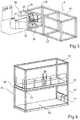
- the standard shipping container 10 has attachment points 28 to, as in Fig. 4 represented, for example, to attach an additional standard transport container 30 in particular above the production facility 8 with the standard transport container.
- the additional standard transport container 30 may have, for example, storage containers connected to the supply network 14 and / or a heat exchange system, in particular a cryogenic system for providing cold.
- the bottom of the standard transport container 10 can be formed by a plurality of light grids 32 resting on the crossbars 22, which can be removed in order to fix a process unit 12 with the transverse bars 22 at this point.
Landscapes
- Chemical & Material Sciences (AREA)
- Engineering & Computer Science (AREA)
- General Engineering & Computer Science (AREA)
- Organic Chemistry (AREA)
- Chemical Kinetics & Catalysis (AREA)
- Mechanical Engineering (AREA)
- Manufacturing & Machinery (AREA)
- Physical Or Chemical Processes And Apparatus (AREA)
- Warehouses Or Storage Devices (AREA)
- Details Of Rigid Or Semi-Rigid Containers (AREA)
Description
- Die Arbeiten, die zu dieser Erfindung geführt haben, wurden gemäß der Finanzhilfevereinbarung Nr. 228867 im Zuge des Siebten Rahmenprogramms der Europäischen Union RP7/2007-2013 gefördert.
- Die Erfindung betrifft eine Produktionseinrichtung, mit deren Hilfe eine chemische Reaktion durchgeführt werden kann, sowie die Verwendung eines Standard-Transportcontainers, wie er insbesondere zum Transport mit einem LKW und/oder einem Hochsee-Containerschiff genutzt werden kann.
- Für die Herstellung eines chemischen Produkts ist es erforderlich für die gewünschte Synthese des herzustellenden chemischen Produkts eine individuell gestaltete Anlagenstruktur zusammenzubauen, um die erforderlichen verfahrenstechnischen Prozessschritte durchführen zu können. Wenn die Herstellung dieses Produkts nicht mehr gewünscht ist, wird die Anlagenstruktur üblicherweise wieder abgerissen oder demontiert, um an der selben Stelle eine andere individuell gestaltete Anlagenstruktur zusammenzubauen, mit der ein anderes chemisches Produkt hergestellt werden kann.
- Die
DE 10 2008 041 950 A1 beschreibt eine Produktionseinrichtung zur Durchführung einer chemischen Reaktion, mit einem Container zur Aufnahme von mehreren innerhalb des Containers angeordneten Prozessaggregaten zur Unterstützung und/oder Durchführung einer verfahrenstechnischen Grundoperation, und einem innerhalb des Containers angeordneten Versorgungsnetz zur Versorgung der Prozessaggregate mit Stoff und/oder Energie und/oder Information. - Es besteht ein ständiges Bedürfnis den Aufwand zur Durchführung von verschiedenen chemischen Reaktionen zu verringen.
- Es ist die Aufgabe der Erfindung Maßnahmen anzugeben, die eine Durchführung von verschiedenen chemischen Reaktionen mit einem geringen Aufwand ermöglichen.
- Die Lösung erfolgt erfindungsgemäß durch eine Produktionseinrichtung zur Durchführung einer chemischen Reaktion mit den Merkmalen des Anspruchs 1 sowie eine Verwendung eines Standard-Transportcontainers mit den Merkmalen des Anspruchs 10. Bevorzugte Ausgestaltungen der Erfindung sind in den Unteransprüchen angegeben, die jeweils einzeln oder in Kombination einen Aspekt der Erfindung darstellen können.
- Erfindungsgemäß ist eine Produktionseinrichtung zur Durchführung einer chemischen Reaktion vorgesehen mit einem Standard-Transportcontainer, insbesondere nach DIN ISO 668, zur Aufnahme von mehreren innerhalb des Standard-Transportcontainers angeordneten Prozessaggregaten zur Unterstützung und/oder Durchführung einer verfahrenstechnischen Grundoperation, und einem innerhalb des Standard-Transportcontainers angeordnetem Versorgungsnetz zur Versorgung der Prozessaggregate mit Stoff und/oder Energie und/oder Information.
- Durch das Versorgungsnetz kann innerhalb des Standard-Transportcontainers die Versorgung der Prozessaggregate mit Stoff und/oder Energie und/oder Information sichergestellt werden, so dass innerhalb des Standard-Transportcontainers im Wesentlichen autonom eine chemische Batch-Reaktion und/oder insbesondere eine kontinuierliche Reaktion durchgeführt werden kann. Das Versorgungsnetz kann insbesondere Anschlussmöglichkeiten für Prozessaggregate vorhalten, die über die gesamte Grundfläche des Standard-Transportcontainers verteilt angeordnet sein können. Beispielsweise kann das Versorgungsnetz eine Druckluftleitung aufweisen, die aus einem insbesondere außerhalb des Standard-Transportcontainers vorgesehenen Druckspeicher Druckluft entnehmen kann und mit mehreren über die Grundfläche und/oder das Innenvolumen des Standard-Transportcontainers verteilten Druckluftanschlüssen verbunden ist, so dass ein Druckluft benötigendes Prozessaggregat an nahezu jeder beliebigen Stelle innerhalb des Standard-Transportcontainers positioniert werden kann. Entsprechendes gilt, wenn das Versorgungsnetz beispielsweise ein Speisewasserleitung zur Zufuhr von Wasser, eine Elektroleitung zur Zufuhr von elektrischer Energie, eine Stoffleitung zur Zufuhr von Edukten und/oder Hilfsstoffen und/oder Abfuhr von Produkten und/oder Nebenprodukten und/oder Abfallstoffen, eine Datenleitung zum Austausch von für das Prozessaggregat relevanten Daten, insbesondere zur Steuerung von Reglern zum Betrieb des Prozessaggregats, eine Kühlleitung zur Zufuhr von Kälte beziehungsweise Abfuhr von Wärme und/oder eine Heizleitung zur Zufuhr von Wärme beziehungsweise Abfuhr von Kälte aufweist. Zusätzlich oder alternativ kann innerhalb des Standard-Transportcontainers ein an dem Versorgungsnetz angeschlossener Speicher für Stoff, Energie und/oder Information, beispielsweise ein Druckluftspeicher, ein Vorratsbehälter für flüssige, feste und/oder gasförmige Stoffe und/oder ein Datenträger, vorgesehen sein, so dass die chemische Reaktion innerhalb des Standard-Transportcontainers ganz oder teilweise autonom und unabhängig von einer externen Versorgung erfolgen kann. Über das Versorgungsnetz können insbesondere feste, flüssige und/oder gasförmige Stoffe oder Stoffgemische transportiert werden, die einphasig oder mehrphasig, beispielsweise als Suspension oder Emulsion, vorliegen. Die Prozessaggregate können beispielsweise Funktionalitäten zum Heizen und/oder Kühlen und/oder Vermischen und/oder Trennen und/oder Druckregelen und/oder Belüften und/oder Entlüften aufweisen, die es ermöglichen eine chemische Reaktion durchzuführen und beabsichtigte Reaktionsbedingungen zu regeln. Durch das innerhalb des Standard-Transportcontainers angeordnete Versorgungsnetz kann die Verfügbarkeit von Stoff und/oder Energie und/oder Information über einen großen Bereich des Standard-Transportcontainers sichergestellt werden, so dass es möglich ist den selben Standard-Transportcontainer mit dem selben Versorgungsnetz für unterschiedliche Zusammenstellungen von Prozessaggregaten wiederzuverwenden und bei einem Umbau zur Durchführung einer anderen chemischen Reaktion lediglich die Prozessaggregate auszuwechseln, so dass die Durchführung von verschiedenen chemischen Reaktionen mit einem geringen Aufwand erfolgen kann.
- Der Standard-Transportcontainer, bei dem es sich insbesondere um einen Transportcontainer der Gattung 1C ("20 Fuß Container") nach DIN ISO 668 oder der Gattung 1D ("10 Fuß Container") nach DIN ISO 668 handelt, stellt einen weltweit gebräuchlichen Standard dar, dessen Erstreckung in Längsrichtung, Querrichtung und Höhe im Wesentlichen weltweit standardisiert ist. Bei einer rechteckigen Grundfläche des Innenraums des Standard-Transportcontainer definiert die längere Seite die Längsrichtung und die kürzere Seite die Querrichtung. Ein derartiger Standard-Transportcontainer kann insbesondere zum Transport mit einem LKW und/oder einem Hochsee-Containerschiff genutzt werden. So weist der Innenraum des Standard-Transportcontainer der Gattung 1C eine Länge LL von 5867 mm, eine Breite LQ von 2330 mm und eine Höhe LH von 2197 mm auf, während der Innenraum des Standard-Transportcontainer der Gattung 1D eine Länge LL von 2802 mm, eine Breite LQ von 2330 mm und eine Höhe LH von 2197 mm aufweist. Die verfügbare Stellfläche dieses Standard-Transportcontainers wird in mehrere gleichgroße gedachte logische Flächen unterteilt. Die Standfläche des Prozessaggregats entspricht im Wesentlichen genau dieser logischen Fläche oder einem ganzzahligen Vielfachen dieser logischen Fläche, wobei bei der Bemessung der Standfläche des Prozessaggregats etwas Luft zwischen benachbarten logischen Flächen des Standard-Transportcontainers vorgesehen sein kann ("Spaltmaß").
- Das Versorgungsnetz ist insbesondere fest mit dem Standard-Transportcontainer verbunden und ein integraler Bestandteil des Standard-Transportcontainers, der nicht für einen Austausch vorgesehen ist, wenn die Produktionseinrichtung auf eine andere Reaktion umgestellt werden soll. Das Versorgungsnetz kann insbesondere zumindest in Teilen im Wesentlichen unlösbar mit dem Standard-Transportcontainer verbunden sein. Das Versorgungsnetz weist insbesondere mehrere Leitungen für Stoff und/oder Energie und/oder Information auf. Vorzugsweise weist die jeweilige Leitung einen Eingang und mehrere Ausgänge auf, wobei die Ausgänge über die Leitung mit dem gemeinsamen Eingang verbunden sind. Dies ermöglicht es von einer einzigen Quelle und/oder Schnittstelle aus sämtliche Prozessaggregate zu versorgen. Insbesondere kann vorgesehen sein, dass eine bestimmte Leitung zur Versorgung von mehr als einem Prozessaggregat vorgesehen ist. Zusätzlich oder alternativ kann eine bestimmte Art Leitung mehr als einmal vorgesehen sein, so dass die einzelne Leitung entsprechend kleiner und für eine geringere Beanspruchung dimensioniert werden kann, während es möglich ist für einen entsprechend größeren Bedarf diesen Bedarf durch mehr als eine Leitung zu decken. Beispielsweise kann mehr als eine gleichartige Druckluftleitung vorgesehen sein, damit die mehreren gleichartigen Druckluftleitungen für einen kleineren maximalen Volumenstrom ausgelegt sein können. Erforderlichenfalls kann bei einem entsprechend geringen Bedarf bei einer bestimmten durchzuführenden chemischen Reaktion die nicht benötigte Leitung stillgelegt sein.
- Erfindungsgemäß ist das Versorgungsnetz in Schwerkraftrichtung oberhalb der Prozessaggregate zur Versorgung der Prozessaggregate über Kopf angeordnet. Dadurch ist es insbesondere möglich einen Stofftransport vom Versorgungsnetz zu einem Prozessaggregat schwerkraftunterstützt durchzuführen. Beispielsweise kann es ausreichend sein lediglich den Öffnungsquerschnitt und/oder die Öffnungsdauer eines Ventils an einem Ausgang einer Leitung zu regeln, um eine definierte Menge eines Stoffes dem Prozessaggregat zuzudosieren. Insbesondere können Leitungen des Versorgungsnetzes und/oder mit einer Leitung verbundene Vorratsbehälter unter der Decke des Standard-Transportcontainers befestigt werden.
- Vorzugsweise weist der Standard-Transportcontainer eine Multikupplung zum Ankuppeln an eine Andockstation einer Backbone-Struktur für den Austausch von Stoff und/oder Energie und/oder Information auf, wobei die Multikupplung, insbesondere über das Versorgungsnetz, mit den Prozessaggregaten verbindbar ist. Besonders bevorzugt ist die Multikupplung zur Zufuhr von Stoff und/oder Energie und/oder Information nur mit dem Versorgungsnetz direkt verbunden, so dass eine Zufuhr an die Prozessaggregate ausschließlich über das Versorgungsnetz erfolgt. Zur Abfuhr von Produkten und/oder Nebenprodukten und/oder Zwischenprodukten und/oder Abfallstoffen kann eine Verbindung der Prozessaggregate mit einem zur Multikupplung separaten Anschluss erfolgen. Es ist aber auch möglich zur Abfuhr von Produkten und/oder Nebenprodukten und/oder Zwischenprodukten und/oder Abfallstoffen eine Verbindung der Prozessaggregate mit der Multikupplung über das Versorgungsnetz oder auch direkt mit der Multikupplung vorzusehen. Der Standard-Transportcontainer kann über die Multikupplung während der Durchführung der chemischen Reaktion angekoppelt bleiben, so dass externe Speichermöglichkeiten und/oder eine externe Prozessleittechnik ("PLT") genutzt werden kann. Es ist aber möglich, dass der Standard-Transportcontainer lediglich zur Vorbereitung der chemischen Reaktion über die Multikupplung angekoppelt wird, um beispielsweise aufladbare Batterien (Akkumulatoren) für eine ausreichende Energieversorgung aufzuladen, ausreichende Mengen an Edukten und Hilfsstoffen zu bunkern und/oder ein Steuerungsprogramm zur Regelung und Durchführung der chemischen Reaktion auf einem geeigneten Datenträger zu speichern. Dies ermöglicht es die chemische Reaktion autonom innerhalb des Standard-Transportcontainers im von der Andockstation abgekoppelten Zustand der Multikupplung an einem anderen Ort durchzuführen. Eine geeignete Multikupplung ist beispielsweise in
DE 10 2011 053 800.3 dargestellt, auf deren Inhalt als Teil der Erfindung hiermit Bezug genommen wird. - Besonders bevorzugt ist innerhalb des Standard-Transportcontainers eine Abwasserleitung zur Abfuhr von Abwasser, Produkt oder sonstiger Stoffe vorgesehen, wobei sich die Abwasserleitung durch mindestens zwei designierte Prozessaggregate hindurch erstreckt, wobei die Abwasserleitung mit dem jeweiligen Prozessaggregat verbindbar oder unverbindbar ist. Das Prozessaggregat kann insbesondere einen, vorzugsweise mindestens zwei, aus dem Prozessaggregat seitlich heraus weisenden Rohrflansch aufweisen, über den Teilstücke der Abwasserleitung miteinander verbunden werden können. Nicht mehr benötigte Stoffe und/oder erwünschte Produkte können dadurch vorzugsweise schwerkraftbedingt aus dem Prozessaggregat der Abwasserleitung zugeführt werden, wobei es möglich ist für verschiedene Stoffströme verschiedene Leitungen vorzusehen. Hierbei ist es möglich, dass diese Abwasserleitung von dem Prozessaggregat mitgenutzt wird, indem die Abwasserleitung in geeigneter Form mit dem Prozessaggregat verbunden ist. Insbesondere ist es möglich, dass die Abwasserleitung zur Durchfuhr eines Stoffstroms von einem anderen Prozessaggregat vorgesehen ist. Dadurch kann auch von einem Prozessaggregat, das vergleichsweise weit weg von einem zugehörigen Auslass und/oder einem zugehörigen Speicher positioniert ist, ein Stoffstrom leicht durch dazwischen positionierte andere Prozessaggregate hindurchgeführt werden. Hierfür ist es insbesondere nicht erforderlich eine gesonderte an dazwischen positionierten Prozessaggregaten vorbei geführte Leitung vorzusehen. Stattdessen kann auch ein Prozessaggregat, das diese Abwasserleitung nicht benötigt, einen entsprechenden Teil der erforderlichen Leitungsstrecke bereitstellen. Die Abwasserleitung kann insbesondere mit einem innerhalb des Standard-Transportcontainers vorgesehenen Speicher und/oder mit der Multikupplung oder einem zur Multikupplung verschiedenen separaten Anschluss verbunden sein. Vorzugsweise können die über die jeweilige Abwasserleitung transportierten Stoffe innerhalb des Standard-Transportcontainers gespeichert und nach Durchführung der chemischen Reaktion abgeführt werden.
- Insbesondere weist der Standard-Transportcontainer versteifende Querbalken und/oder Längsbalken auf, wobei die Mittellinien der Querbalken um einen Abstand dL,min und/oder die Längsbalken um einen Abstand dQ,min zueinander beabstandet angeordnet sind, wobei die Querbalken und/oder Längsbalken zur Befestigung mit mindestens einem Prozessaggregat hergerichtet sind. Insbesondere entspricht dL,min im Wesentlichem einem ganzzahligen Teil NL einer Erstreckung LL in Längsrichtung eines Innenraums des Standard-Transportcontainers und/oder dQ,min einem ganzzahligen Teil NQ einer Erstreckung LQ in Querrichtung eines Innenraums des Standard-Transportcontainers. Die Prozessaggregate können mit den Querbalken und/oder Längsbalken lösbar verbunden, insbesondere verschraubt, werden. Die Querbalken und/oder Längsbalken können hierbei nicht nur die Funktion erfüllen den Standard-Transportcontainer zu versteifen, sondern auch die Funktion die Gewichtskräfte der Prozessaggregate abzutragen. Dadurch können auch sehr kompakt gebaute Prozessaggregate mit einem vergleichsweise großen Eigengewicht in dem Standard-Transportcontainer verbaut werden.
- Vorzugsweise sind innerhalb des Standard-Transportcontainers mehrere mit dem Standard-Transportcontainer befestigte Prozessaggregate zur Durchführung der chemischen Reaktion angeordnet, wobei das jeweilige Prozessaggregat eine Erstreckung dL in Längsrichtung aufweist, die im Wesentlichen einem ganzzahligen Vielfachen ZL von dL,min entspricht und/oder das jeweilige Prozessaggregat eine Erstreckung dQ in Querrichtung aufweist, die im Wesentlichen einem ganzzahligen Vielfachen ZQ von dQ,min entspricht, wobei insbesondere dL,min im Wesentlichem einem ganzzahligen Teil NL einer Erstreckung LL in Längsrichtung eines Innenraums des Standard-Transportcontainers und/oder dQ,min einem ganzzahligen Teil NQ einer Erstreckung LQ in Querrichtung eines Innenraums des Standard-Transportcontainers entspricht. Seitenflächen der Prozessaggregate können in vertikaler Richtung mit den Querbalken und/oder mit den Längsbalken fluchten. Durch die gleichgroßen Abstände der Querbalken und/oder Längsbalken zu einander und der Abstimmung der Erstreckung der Prozessaggregate auf diese Abstände ergibt sich für die Prozessaggregate eine an den Querbalken und/oder Längsbalken orientierte Rasterung, welche eine Positionierung der Prozessaggregate in dem Standard-Transportcontainer in diskreten Abständen vorgibt. Dies erleichtert es einen Teil der Prozessaggregate oder alle Prozessaggregate auszutauschen, um den Standard-Transportcontainer für die Durchführung einer anderen chemischen Reaktion vorzubereiten.
- Besonders bevorzugt weist der Standard-Transportcontainer einen mit Lichtgittern abdeckbaren Boden auf, wobei insbesondere der Boden zum Auffangen von ausgelaufenen Flüssigkeiten, vorzugsweise wannenförmig, ausgestaltet ist. Die Lichtgitter können insbesondere auf Querbalken und/oder Längsbalken des Standard-Transportcontainer aufliegen. Vorzugsweise weisen die Lichtgitter in Längsrichtung eine Erstreckung von dL,min und in Querrichtung eine Erstreckung von dQ,min auf, wobei insbesondere dL,min im Wesentlichem einem ganzzahligen Teil NL einer Erstreckung LL in Längsrichtung eines Innenraums des Standard-Transportcontainers und/oder dQ,min einem ganzzahligen Teil NQ einer Erstreckung LQ in Querrichtung eines Innenraums des Standard-Transportcontainers entspricht. Die Erstreckung des Lichtgitters kann dadurch der Erstreckung des kleinsten Prozessaggregats entsprechen, so dass das Lichtgitter leicht durch ein Prozessaggregat ersetzt werden kann, während die übrigen nicht von Prozessaggregaten belegten Rasterplätze des Standard-Transportcontainers von Lichtgittern abgedeckt bleiben können. Bei einem größer dimensionierten Prozessaggregat kann eine entsprechende Anzahl an Lichtgittern, die der Stellfläche dieses Prozessaggregats entspricht, entfernt werden, um das Prozessaggregat mit dem Standard-Transportcontainer zu befestigen. Das Lichtgitter ermöglicht es beabstandet zu dem insbesondere als Auffangwanne für Flüssigkeiten wirkenden Boden das Innere des Standard-Transportcontainers zu betreten. Gleichzeitig erlaubt das Lichtgitter einen Blick auf den Boden, so dass überprüft werden kann, ob beispielsweise infolge einer Fehlfunktion eine Flüssigkeit ausgelaufen ist und sich auf dem Boden sammelt. Vorzugsweise kann in diesem Fall im laufenden Betrieb mindestens ein Lichtgitter entfernt werden, um die ausgelaufenen Flüssigkeiten zu entfernen und/oder den Boden zu reinigen.
- Insbesondere weist der Standard-Transportcontainer mindestens ein von außen manipulierbares PLT-Modul zur Beeinflussung der Betriebsweise eines dem PLT-Modul zugeordneten Prozessaggregats auf, wobei der Standard-Transportcontainer und/oder das PLT-Modul vorzugsweise explosionsgeschützt ausgestaltet ist. Mit Hilfe des PLT-Moduls kann die einem Prozessaggregat zugeordnete Prozessleittechnik ("PLT") bedient werden. Beispielsweise können Regelparameter geändert werden, um das zugeordnete Prozessaggregat für die Durchführung einer anderen chemischen Reaktion umzustellen und/oder im laufenden Betrieb die Produktionsweise zu ändern. Hierbei ist es nicht erforderlich den Standard-Transportcontainer zu betreten, wodurch eine unabsichtliche Beschädigung von Prozessaggregaten und eine nachteilige Beeinflussung der chemischen Reaktion durch Unachtsamkeiten vermieden sind. Insbesondere können elektrische Schaltungen des PLT-Moduls außerhalb eines explosionsgeschützten Bereichs des Standard-Transportcontainers positioniert werden, so dass die Arbeitssicherheit erhöht ist. Ferner können bei der Bedienung des PLT-Moduls elektrische Entladungen und/oder elektrische Funken nur außerhalb des explosionsgeschützten Bereichs des Standard-Transportcontainers auftreten, so dass die Gefahr durch die Bedienung elektrischer Geräte in einer explosiven Atmosphäre eine Explosion auszulösen reduziert ist. Das PLT-Modul kann beispielsweise an der Außenseite des Standard-Transportcontainers vorgesehen sein und eine Öffnungsmöglichkeit nach außen aufweisen, so dass vor der Inbetriebnahme erforderliche Einstellungen vorgenommen werden können und nach den Einstellungen das PLT-Modul insbesondere derart geschlossen werden kann, dass das PLT-Modul im geschlossenen Zustand explosionsgeschützt ist. Vorzugsweise ist mindestens eine Datenleitung vorgesehen, über die Signale in einen explosionsgeschützen Bereich, beispielsweise ein ausreichend abgesicherter separater Raum, durchgeschleust werden können. Dies ermöglicht es auch nach der Inbetriebnahme Einstellungen bei dem PLT-Modul durchzuführen ohne sich einer Explosionsgefahr aussetzen zu müssen. Für die explosionsgeschütze Ausgestaltung des Standard-Transportcontainers und/oder des PLT-Moduls kann insbesondere rostfreier Stahl verwendet werden, so dass Materialien auf der Basis von Aluminium vermieden werden können.
- Vorzugsweise weist der Standard-Transportcontainer Befestigungsstellen zur Befestigung eines gleichartig dimensionierten zusätzlichen Standard-Transportcontainers und/oder eines Zusatzaggregats, insbesondere Kryoanlage, oberhalb, unterhalb und/oder seitlich mit dem Standard-Transportcontainer auf, wobei insbesondere eine Zusatz-Multikupplung zum Austausch von Stoff und/oder Energie und/oder Information des zusätzlichen Standard-Transportcontainers und/oder des Zusatzaggregats mit den Prozessaggregaten vorgesehen ist. Bei den Befestigungsstellen kann es sich beispielsweise um Steckverbindungen handeln, die für das Stapeln von Standard-Transportcontainer gemäß DIN ISO 668 sowieso vorgesehen sein können. Vorzugsweise kann die Einstecktiefe dieser Steckverbindungen vergrößert sein und/oder es können zusätzliche, vorzugsweise gleichartig ausgestaltete, Steckverbindungen vorgesehen sein, um die Stabilität der Verbindung zu erhöhen. Zusätzlich oder alternativ können an den Befestigungsstellen Klemmen vorgesehen sein, um einen möglichst großflächigen Kontakt zu ermöglichen. Dies ermöglicht es insbesondere einen Wärmeaustausch über eine Deckenwand des Standard-Transportcontainer vorzusehen, ohne hierfür einen Durchbruch vorsehen zu müssen. Durch die Verbindung von mehr als einem Standard-Transportcontainers und der Möglichkeit einen Austausch von Stoff und/oder Energie und/oder Information über die Zusatz-Multikupplung vorzusehen, kann das Innenvolumen von zwei und mehr miteinander verbundener Standard-Transportcontainer für die Positionierung und Verschaltung von Prozessaggregaten genutzt werden, so dass auch apparateintensive chemische Reaktionen realisiert werden können. Vorzugsweise kann der zusätzliche Standard-Transportcontainer und/oder das Zusatzaggregat Speicherbehälter für einzelne Stoffe, insbesondere Edukte, Hilfsstoff, Produkte, Nebenprodukte, Abfallstoffe aufweisen, wobei der mindestens eine Speicherbehälter vorzugsweise oberhalb der Produktionseinrichtung vorgesehen ist. Vorzugsweise erfüllt in diesem Fall der zusätzliche Standard-Transportcontainer und/oder das Zusatzaggregat ausschließlich eine Speicherfunktion für Stoff, Energie und/oder Information ohne selbst verfahrenstechnische Grundoperationen zur Durchführung der chemischen Reaktion auszuführen. Dies erleichtert es im laufenden Betrieb der Produktionseinrichtung den Standard-Transportcontainer und/oder das Zusatzaggregat auszutauschen und die Produktionseinrichtung für die Umwandlung größerer Stoffmengen zu verwenden. Es ist aber auch möglich mehrere Produktionseinrichtung mit oder ohne Zusatz-Transportcontainer über die Zusatz-Multikupplung und/oder weitere Anschlüsse miteinander zu verbinden, beispielsweise um eine einsprechend apparateintensive chemische Reaktion durchführen zu können und/oder eine Kaskadierung von Verfahrensschritten durch eine entsprechend hohe Anzahl an Prozessaggregaten vorzusehen.
- Die Erfindung betrifft ferner eine Verwendung eines Standard-Transportcontainers, insbesondere nach DIN ISO 668, zur Durchführung einer chemischen Reaktion innerhalb des Standard-Transportcontainers mit einem innerhalb des Standard-Transportcontainers angeordnetem Versorgungsnetz zur Versorgung von Prozessaggregaten mit Stoff und/oder Energie und/oder Information, wobei der Standard-Transportcontainer insbesondere in einer Produktionseinrichtung, die wie vorstehend beschrieben aus- und weitergebildet sein kann, verwendet wird. Durch das innerhalb des Standard-Transportcontainers angeordnete Versorgungsnetz kann die Verfügbarkeit von Stoff und/oder Energie und/oder Information über einen großen Bereich des Standard-Transportcontainers sichergestellt werden, so dass es möglich ist den selben Standard-Transportcontainer mit dem selben Versorgungsnetz für unterschiedliche Zusammenstellungen von Prozessaggregaten wiederzuverwenden und bei einem Umbau zur Durchführung einer anderen chemischen Reaktion lediglich die Prozessaggregate auszuwechseln, so dass die Durchführung von verschiedenen chemischen Reaktionen mit einem geringen Aufwand erfolgen kann. Der Standard-Transportcontainer wird insbesondere durch Durchführung einer kontinuierlichen chemischen Reaktion und/oder einer chemischen Batch-Reaktion verwendet.
- Nachfolgend wird die Erfindung unter Bezugnahme auf die anliegenden Zeichnungen anhand eines bevorzugten Ausführungsbeispiels exemplarisch erläutert, wobei die nachfolgend dargestellten Merkmale sowohl jeweils einzeln als auch in Kombination einen Aspekt der Erfindung darstellen können. Es zeigen:
-
Fig. 1 : eine schematische perspektivische Konzeptansicht einer Produktionseinrichtung, -
Fig. 2 : eine schematische perspektivische Konzeptansicht der Produktionseinrichtung ausFig. 1 mit verschiedenen konzeptionell dargestellten Prozessaggregaten, -
Fig. 3 : eine schematische perspektivische vereinfachte Ansicht der Produktionseinrichtung ausFig. 1 im angedockten Zustand und -
Fig. 4 : eine schematische perspektivische vereinfachte Ansicht der Produktionseinrichtung ausFig. 1 mit einem zusätzlichen Standard-Transportcontainer. - Die in
Fig. 1 dargestellte Produktionseinrichtung 8 weist einen Standard-Transportcontainer 10 der Gattung 1C nach DIN ISO 668 auf, dessen Innenraum in Längsrichtung eine Erstreckung von LL = 5867 mm, in Querrichtung eine Erstreckung von LQ = 2300 mm und eine Höhe von LH = 2197 mm aufweist. Die Erstreckung LL in Längsrichtung ist in NL = 10 im Wesentlichen gleich große gedachte logische Einheiten unterteilt, so dass sich für jede logische Einheit eine Strecke in Längsrichtung von im Wesentlichen dL,min = 570 mm ergibt. Die Erstreckung LQ in Querrichtung ist in NQ = 4 im Wesentlichen gleich große gedachte logische Einheiten unterteilt, so dass sich für jede logische Einheit eine Strecke in Querrichtung von ebenfalls im Wesentlichen dQ,min = 570 mm ergibt. Wie inFig. 2 dargestellt, können in dem Innenraum des Standard-Transportcontainers 10 mehrere Prozessaggregate 12 angeordnet werden, die sich an der gedachten Rasterung des Standard-Transportcontainers 10 orientieren. Das bedeutet, dass jeder der vorgesehenen Prozessaggregate 12 in Längsrichtung eine Erstreckung von dL und in Querrichtung eine Erstreckung von dQ aufweist, die jeweils im Wesentlichen ein ganzzahliges Vielfaches von dL,min beziehungsweise dQ,min ist. Für das Prozessaggregat 12 ist ferner eine minimale Höhe von dH,min = 570 mm vorgegeben, so dass das kleinste Prozessaggregat 12 die Größe eines Würfels mit einer Kantenlänge von 570 mm aufweist. Die Abmessungen jedes verwendeten größeren Prozessaggregats 12 entsprechen im Wesentlichen einem ganzzahligen Vielfachen dieses Würfels. - Durch die Wahl der minimale Höhen für das Prozessaggregat 12 von dH,min = 570 mm kann für das Prozessaggregat 12 eine maximal Höhe vorgesehen werden, die um den Faktor ZH = 3 ein Vielfaches von dH,min sein kann, um noch in den Innenraum des Standard-Transportcontainers 10 zu passen. Dadurch verbleibt in dem dargestellten Ausführungsbeispiel ein oberer Bereich mit einer Höhe von 460 mm. Dieser Bereich ist groß genug, um dort ein Versorgungsnetz 14 vorzusehen, das an nahezu jeder beliebigen Stelle innerhalb des Standard-Transportcontainers 10 über Kopf das jeweilige Prozessaggregat 12 mit Stoff, Energie und/oder Information versorgen kann. Der obere Bereich ist insbesondere frei von Teilen des Prozessaggregats 12. Es ist jedoch möglich, dass das Versorgungsnetz 14 genügend Volumen in dem oberen Bereich frei lässt, dass ein Prozessaggregat 12 in das freigelassene Volumen des oberen Bereichs hineinragen kann. Das Versorgungsnetz erstreckt sich insbesondere über ein Volumen an einer Stirnseite 16 des Standard-Transportcontainers 10, das der vorgegeben Rasterung entspricht oder eine in Längsrichtung hiervon abweichende Erstreckung aufweisen kann. An dieser Stirnseite 16 des Standard-Transportcontainers 10 kann eine mit dem Versorgungsnetz verbundene Multikupplung 18 vorgesehen sein, über die der Standard-Transportcontainer 10 an eine Andockstation 20 angedockt werden kann. Die Andockstation 20 kann wiederum mit einer Backbone-Struktur verbunden sein, mit der über die Multikupplung 18 und die Andockstation 20 Stoff, Energie und/oder Information ausgetauscht werden kann. Insbesondere kann dadurch die Produktionseinrichtung 8 mit genügend Stoff, Energie und/oder Information versorgt werden, um mit Hilfe der in dem Standard-Transportcontainer 10 vorgesehenen und über das Versorgungsnetz 14 angebundenen Prozessaggregaten 12 eine chemische Reaktion, insbesondere kontinuierliche Reaktion, durchzuführen. Die Produkte und/oder Rest- und Abfallstoffe können nach Durchführung der chemischen Reaktion gegebenenfalls über die Multikupplung 18 und die Andockstation 20 der Backbone-Struktur zugeführt werden. Insbesondere ist es möglich die chemischen Reaktion innerhalb des Standard-Transportcontainers 10 autonom durchzuführen, das heißt der Standard-Transportcontainer 10 kann von der Andockstation 20 getrennt positioniert sein, wenn die chemische Reaktion durchgeführt wird. Es ist aber auch möglich, dass der Standard-Transportcontainer 10 mit der Andockstation 20 verbunden bleibt, insbesondere um eine kontinuierliche chemische Reaktion durchzuführen.
- Wie in
Fig. 3 dargestellt kann der Standard-Transportcontainer 10 beispielsweise Querbalken 22 aufweisen, die insbesondere in einem Abstand von ca. 570 mm zueinander beabstandet sind. Die Querbalken 22 können den Standard-Transportcontainer 10 versteifen und als Basis zur Befestigung der Prozessaggregate 12 dienen. Im dargestellten Ausführungsbeispiel wird die Multikupplung 18 ausschließlich zum Austausch von Stoffströmen verwendet. Für elektrische Leitungen und Datenleitungen sind gesonderte Elektroanschlüsse 24 vorgesehen, während beispielsweise zum Einfüllen von Edukten und/oder Abführen von Produkten und/oder Abfallstoffen gesonderte Stoffanschlüsse 26 vorgesehen sein können. Über die Multikupplung 18 können beispielsweise gasförmige Stoffe, insbesondere Druckluft mit verschiedenen Nenndrucken, Sauerstoff oder Stickstoff, ausgetauscht werden, während über die gesonderten Stoffanschlüsse 26 vorzugsweise flüssige und/oder gasförmige Stoffe ausgetauscht werden. - Ferner weist der Standard-Transportcontainer 10 Befestigungsstellen 28 auf, um wie in
Fig. 4 dargestellt, beispielsweise einen zusätzlichen Standard-Transportcontainer 30 insbesondere oberhalb zur Produktionseinrichtung 8 mit dem Standard-Transportcontainer befestigen zu können. Der zusätzliche Standard-Transportcontainer 30 kann beispielsweise mit dem Versorgungsnetz 14 verbundene Speicherbehälter und/oder eine Wärmeaustauschanlage, insbesondere eine Kryoanlage zur Bereitstellung von Kälte, aufweisen. Der Boden des Standard-Transportcontainers 10 kann durch mehrere auf den Querbalken 22 aufliegende Lichtgitter 32 ausgebildet werden, die entnommen werden können, um an dieser Stelle ein Prozessaggregat 12 mit den Querbalken 22 zu befestigen.
Claims (10)
- Produktionseinrichtung zur Durchführung einer chemischen Reaktion, mit
einem Standard-Transportcontainer (10), insbesondere nach DIN ISO 668, zur Aufnahme von mehreren innerhalb des Standard-Transportcontainers (10) angeordneten Prozessaggregaten (12) zur Unterstützung und/oder Durchführung einer verfahrenstechnischen Grundoperation, und
einem innerhalb des Standard-Transportcontainers (10) angeordnetem Versorgungsnetz (14) zur Versorgung der Prozessaggregate (12) mit Stoff und/oder Energie und/oder Information,
dadurch gekennzeichnet, dass das Versorgungsnetz (14) in Schwerkraftrichtung oberhalb der Prozessaggregate (12) zur Versorgung der Prozessaggregate (12) über Kopf angeordnet ist. - Produktionseinrichtung nach Anspruch 1 dadurch gekennzeichnet, dass durch das Versorgungsnetz (14) die Verfügbarkeit von Stoff und/oder Energie und/oder Information über einen großen Bereich des Standard-Transportcontainers (10) derart sicherstellbar ist, dass es möglich ist, den Standard-Transportcontainer (10) mit dem Versorgungsnetz (14) für unterschiedliche Zusammenstellungen von Prozessaggregaten (12) wiederzuverwenden und bei einem Umbau zur Durchführung einer anderen chemischen Reaktion lediglich die Prozessaggregate (12) auszuwechseln.
- Produktionseinrichtung nach Anspruch 1 oder 2 dadurch gekennzeichnet, dass der Standard-Transportcontainer (10) eine Multikupplung (18) zum Ankuppeln an eine Andockstation (20) einer Backbone-Struktur für den Austausch von Stoff und/oder Energie und/oder Information aufweist, wobei die Multikupplung (18), insbesondere über das Versorgungsnetz (14), mit den Prozessaggregaten (12) verbindbar ist.
- Produktionseinrichtung nach einem der Ansprüche 1 bis 3 dadurch gekennzeichnet, dass innerhalb des Standard-Transportcontainers (10) eine Abwasserleitung zur Abfuhr von Abwasser, Produkt oder sonstiger Stoffe vorgesehen ist, wobei sich die Abwasserleitung durch mindestens zwei designierte Prozessaggregate (12) hindurch erstreckt, wobei die Abwasserleitung mit dem jeweiligen Prozessaggregat (12) verbindbar oder unverbindbar ist.
- Produktionseinrichtung nach einem der Ansprüche 1 bis 4 dadurch gekennzeichnet, dass der Standard-Transportcontainer (10) versteifende Querbalken (22) und/oder Längsbalken aufweist, wobei die Mittellinien der Querbalken (22) um einen Abstand dL,min und/oder die Längsbalken um einen Abstand dQ,min zueinander beabstandet angeordnet sind, wobei die Querbalken (22) und/oder Längsbalken zur Befestigung mit mindestens einem Prozessaggregat (12) hergerichtet sind.
- Produktionseinrichtung nach einem der Ansprüche 1 bis 5 dadurch gekennzeichnet, dass innerhalb des Standard-Transportcontainers (10) mehrere mit dem Standard-Transportcontainer (10) befestigte Prozessaggregate (12) zur Durchführung der chemischen Reaktion angeordnet sind, wobei das jeweilige Prozessaggregat (12) eine Erstreckung dL in Längsrichtung aufweist, die im Wesentlichen einem ganzzahligen Vielfachen ZL von dL,min entspricht und/oder das jeweilige Prozessaggregat (12) eine Erstreckung dQ in Querrichtung aufweist, die im Wesentlichen einem ganzzahligen Vielfachen ZQ von dQ,min entspricht, wobei insbesondere dL,min im Wesentlichem einem ganzzahligen Teil NL einer Erstreckung LL in Längsrichtung eines Innenraums des Standard-Transportcontainers (10) und/oder dQ,min einem ganzzahligen Teil NQ einer Erstreckung LQ in Querrichtung eines Innenraums des Standard-Transportcontainers (10) entspricht.
- Produktionseinrichtung nach einem der Ansprüche 1 bis 6 dadurch gekennzeichnet, dass der Standard-Transportcontainer (10) einen mit Lichtgittern (32) abdeckbaren Boden aufweist, wobei insbesondere der Boden zum Auffangen von ausgelaufenen Flüssigkeiten, vorzugsweise wannenförmig, ausgestaltet ist.
- Produktionseinrichtung nach einem der Ansprüche 1 bis 7 dadurch gekennzeichnet, dass der Standard-Transportcontainer (10) mindestens ein von außen manipulierbares PLT-Modul (Prozessleittechnik-Modul) zur Beeinflussung der Betriebsweise eines dem PLT-Modul zugeordneten Prozessaggregats (12) aufweist, wobei der Standard-Transportcontainer (10) und/oder das PLT-Modul vorzugsweise explosionsgeschützt ausgestaltet ist.
- Produktionseinrichtung nach einem der Ansprüche 1 bis 8 dadurch gekennzeichnet, dass der Standard-Transportcontainer (10) Befestigungsstellen (28) zur Befestigung eines gleichartig dimensionierten zusätzlichen Standard-Transportcontainers (30) und/oder eines Zusatzaggregats, insbesondere Kryoanlage, oberhalb, unterhalb und/oder seitlich mit dem Standard-Transportcontainer (10) ausweist, wobei insbesondere eine Zusatz-Multikupplung zum Austausch von Stoff und/oder Energie und/oder Information des zusätzlichen Standard-Transportcontainers (30) und/oder des Zusatzaggregats mit den Prozessaggregaten (12) vorgesehen ist.
- Verwendung eines Standard-Transportcontainers (10), insbesondere nach DIN ISO 668, zur Durchführung einer chemischen Reaktion innerhalb des Standard-Transportcontainers (10) mit einem innerhalb des Standard-Transportcontainers (10) angeordnetem Versorgungsnetz (14) zur Versorgung von Prozessaggregaten (12) mit Stoff und/oder Energie und/oder Information, wobei der Standard-Transportcontainer (10) in einer Produktionseinrichtung (8) nach einem der Ansprüche 1 bis 9 verwendet wird.
Priority Applications (1)
| Application Number | Priority Date | Filing Date | Title |
|---|---|---|---|
| PL13815717T PL2934734T3 (pl) | 2012-12-20 | 2013-12-18 | Urządzenie produkcyjne do przeprowadzania reakcji chemicznej i zastosowanie standardowego kontenera transportowego |
Applications Claiming Priority (2)
| Application Number | Priority Date | Filing Date | Title |
|---|---|---|---|
| DE102012112816.2A DE102012112816A1 (de) | 2012-12-20 | 2012-12-20 | Produktionseinrichtung zur Durchführung einer chemischen Reaktion und Verwendung eines Standard-Transportcontainers |
| PCT/EP2013/077058 WO2014095976A1 (de) | 2012-12-20 | 2013-12-18 | Produktionseinrichtung zur durchführung einer chemischen reaktion und verwendung eines standard-transportcontainers |
Publications (2)
| Publication Number | Publication Date |
|---|---|
| EP2934734A1 EP2934734A1 (de) | 2015-10-28 |
| EP2934734B1 true EP2934734B1 (de) | 2019-02-20 |
Family
ID=49917051
Family Applications (1)
| Application Number | Title | Priority Date | Filing Date |
|---|---|---|---|
| EP13815717.7A Active EP2934734B1 (de) | 2012-12-20 | 2013-12-18 | Produktionseinrichtung zur durchführung einer chemischen reaktion und verwendung eines standard-transportcontainers |
Country Status (9)
| Country | Link |
|---|---|
| US (1) | US10035123B2 (de) |
| EP (1) | EP2934734B1 (de) |
| CN (2) | CN109589887A (de) |
| DE (1) | DE102012112816A1 (de) |
| DK (1) | DK2934734T3 (de) |
| ES (1) | ES2721626T3 (de) |
| PL (1) | PL2934734T3 (de) |
| TR (1) | TR201905360T4 (de) |
| WO (1) | WO2014095976A1 (de) |
Families Citing this family (7)
| Publication number | Priority date | Publication date | Assignee | Title |
|---|---|---|---|---|
| US20160097011A1 (en) * | 2014-10-07 | 2016-04-07 | Pride of the Hills Manufacturing, Inc. | Housing for a gas processing apparatus |
| US10005976B2 (en) | 2014-10-07 | 2018-06-26 | Pride of the Hills Manufacturing, Inc. | Heat exchanger on a fossil fuel processing assembly |
| CN110709659B (zh) * | 2017-03-14 | 2022-03-08 | 伍德赛德能量科技私人有限公司 | 集装箱化的lng液化单元及生产lng的相关方法 |
| DE102019107429A1 (de) * | 2019-03-21 | 2020-09-24 | Stetter Gesellschaft mit beschränkter Haftung | Mischanlage und Einhausung für eine Mischanlage |
| CN114683061B (zh) * | 2020-12-25 | 2024-11-15 | 宜宾市创世纪机械有限公司 | 一种龙门数控机床架 |
| US20250256916A1 (en) * | 2022-04-29 | 2025-08-14 | Niterra Co., Ltd. | Container module and functional unit |
| DE102022128404A1 (de) * | 2022-10-26 | 2024-05-02 | Coperion Gmbh | Modulare Produktionsanlage und Verfahren zum Auslegen einer Produktionsanlage |
Family Cites Families (8)
| Publication number | Priority date | Publication date | Assignee | Title |
|---|---|---|---|---|
| DE19958142A1 (de) | 1999-08-19 | 2001-02-22 | Schmack Biogas Gmbh | Mobile Biogasanlage |
| FR2837495B1 (fr) * | 2002-03-19 | 2007-08-24 | Traidec Sa | Installation modulable, demontable, transportable, pour le traitement par thermolyse et pour la valorisation energetique des dechets |
| US7510647B2 (en) | 2003-11-19 | 2009-03-31 | Intercat Equipment, Inc. | Mobile fluid catalytic cracking injection system |
| GR1005442B (el) * | 2006-03-14 | 2007-02-15 | Τεκ Ε.Π.Ε. | Επικαθημενο συγκροτημα παραγωγης νωπου σκυροδεματος διαφορετικων συνθεσεων |
| US20090093558A1 (en) | 2007-10-04 | 2009-04-09 | Nova Chemicals Inc. | Mobile expanded polymer processing systems and methods |
| DE102008041950A1 (de) * | 2008-09-10 | 2010-03-11 | Evonik Degussa Gmbh | System zur Bereitstellung einer universellen Infrastruktur für chemische Prozesse |
| EP2166064A1 (de) * | 2008-09-19 | 2010-03-24 | Siemens Aktiengesellschaft | System zur Ausgabe eines chemischen Produkts und Verfahren zur Ausgabe eines chemischen Produkts |
| DE102011053800A1 (de) | 2011-09-20 | 2013-03-21 | Invite GmbH | Haltegestell für eine Multikupplung zum Befüllen und/oder Entleeren eines Chemieanlagencontainers |
-
2012
- 2012-12-20 DE DE102012112816.2A patent/DE102012112816A1/de not_active Withdrawn
-
2013
- 2013-12-18 WO PCT/EP2013/077058 patent/WO2014095976A1/de not_active Ceased
- 2013-12-18 PL PL13815717T patent/PL2934734T3/pl unknown
- 2013-12-18 EP EP13815717.7A patent/EP2934734B1/de active Active
- 2013-12-18 TR TR2019/05360T patent/TR201905360T4/tr unknown
- 2013-12-18 CN CN201811339271.4A patent/CN109589887A/zh active Pending
- 2013-12-18 DK DK13815717.7T patent/DK2934734T3/da active
- 2013-12-18 ES ES13815717T patent/ES2721626T3/es active Active
- 2013-12-18 CN CN201380067087.8A patent/CN104955557A/zh active Pending
- 2013-12-18 US US14/652,201 patent/US10035123B2/en active Active
Non-Patent Citations (1)
| Title |
|---|
| None * |
Also Published As
| Publication number | Publication date |
|---|---|
| DE102012112816A1 (de) | 2014-06-26 |
| WO2014095976A1 (de) | 2014-06-26 |
| ES2721626T3 (es) | 2019-08-02 |
| PL2934734T3 (pl) | 2019-08-30 |
| DK2934734T3 (da) | 2019-05-13 |
| EP2934734A1 (de) | 2015-10-28 |
| US20150343408A1 (en) | 2015-12-03 |
| CN104955557A (zh) | 2015-09-30 |
| CN109589887A (zh) | 2019-04-09 |
| US10035123B2 (en) | 2018-07-31 |
| TR201905360T4 (tr) | 2019-05-21 |
Similar Documents
| Publication | Publication Date | Title |
|---|---|---|
| DE102012112816A1 (de) | Produktionseinrichtung zur Durchführung einer chemischen Reaktion und Verwendung eines Standard-Transportcontainers | |
| EP3074118B1 (de) | Anlage zur herstellung von holzpellets oder anderen festen granulaten aus kleinstückigem material organischen/pflanzlichen ursprungs | |
| EP2234713B1 (de) | Verwendung eines Wärmetauschers zur Durchführung chemischer Reaktionen | |
| DE60109326T2 (de) | Katalytischer reaktor mit wärmetauscher für endothermischer und exothermischer chemischer reaktionen | |
| EP1147807B1 (de) | Reaktor für die katalytische Umsetzung von Reaktionsmedien, insbesondere von gasförmigen Reaktionsmedien | |
| EP2950918B1 (de) | Prozessaggregat und verwendung mehrerer prozessaggregate | |
| DE212009000008U1 (de) | Universelle Infrastruktur für chemische Prozesse | |
| DE19619669A1 (de) | Modulares Über- oder Auslaufdeck bzw. modularer Über- oder Auslaufboden | |
| EP2916943B1 (de) | Produktionsanlage eines chemischen oder pharmazeutischen produktes | |
| DE202009017416U1 (de) | Reaktor und Satz aus Reaktoren | |
| DE3825724A1 (de) | Behaelter | |
| EP3083032B1 (de) | Verfahren zum betreiben einer modular aufgebauten produktionsanlage | |
| DE10206132A1 (de) | Reaktorkaskade aus Haupt- und Nachreaktor | |
| WO2017005335A1 (de) | Behältervorrichtung | |
| DE102023204862A1 (de) | Aggregatlagervorrichtung, Aggregatvorrichtung, Infrastrukturvorrichtung und elektrochemisches System | |
| EP1016439B1 (de) | Vorrichtung zur Durchführung von Destillationen und heterogen katalysierten Reaktionen | |
| EP3272960B1 (de) | Transportcontainer | |
| EP3214387A1 (de) | Transportables wasseraufbereitungsgerät für die luftbefeuchtung und stationärer anlagenteil einer luftbefeuchtung | |
| WO2014095972A1 (de) | Computerimplementiertes verfahren zum herstellen eines produktionsanlagenmodells | |
| DD270703A1 (de) | Einrichtung zur behandlung von wasser | |
| CH629116A5 (en) | Combinable cascade reaction vessel for optional use as an open or closed vessel for multi-step chemical reactions proceeding continuously | |
| EP3515842A1 (de) | Beschattungsvorrichtung | |
| EP1512155A1 (de) | Verfahren und vorrichtung zum entsorgen eines brennelementkastens einer siedewasserreaktoranlage | |
| DE19545252A1 (de) | Aggregatkapsel als Verfahrensbaustein | |
| DD254638A1 (de) | Einrichtung zur einleitung von wirbelluft in wirbelschichtanlagen |
Legal Events
| Date | Code | Title | Description |
|---|---|---|---|
| PUAI | Public reference made under article 153(3) epc to a published international application that has entered the european phase |
Free format text: ORIGINAL CODE: 0009012 |
|
| 17P | Request for examination filed |
Effective date: 20150720 |
|
| AK | Designated contracting states |
Kind code of ref document: A1 Designated state(s): AL AT BE BG CH CY CZ DE DK EE ES FI FR GB GR HR HU IE IS IT LI LT LU LV MC MK MT NL NO PL PT RO RS SE SI SK SM TR |
|
| AX | Request for extension of the european patent |
Extension state: BA ME |
|
| DAX | Request for extension of the european patent (deleted) | ||
| RAP1 | Party data changed (applicant data changed or rights of an application transferred) |
Owner name: BAYER AKTIENGESELLSCHAFT |
|
| GRAP | Despatch of communication of intention to grant a patent |
Free format text: ORIGINAL CODE: EPIDOSNIGR1 |
|
| STAA | Information on the status of an ep patent application or granted ep patent |
Free format text: STATUS: GRANT OF PATENT IS INTENDED |
|
| INTG | Intention to grant announced |
Effective date: 20181029 |
|
| GRAS | Grant fee paid |
Free format text: ORIGINAL CODE: EPIDOSNIGR3 |
|
| GRAA | (expected) grant |
Free format text: ORIGINAL CODE: 0009210 |
|
| STAA | Information on the status of an ep patent application or granted ep patent |
Free format text: STATUS: THE PATENT HAS BEEN GRANTED |
|
| AK | Designated contracting states |
Kind code of ref document: B1 Designated state(s): AL AT BE BG CH CY CZ DE DK EE ES FI FR GB GR HR HU IE IS IT LI LT LU LV MC MK MT NL NO PL PT RO RS SE SI SK SM TR |
|
| REG | Reference to a national code |
Ref country code: GB Ref legal event code: FG4D Free format text: NOT ENGLISH |
|
| REG | Reference to a national code |
Ref country code: CH Ref legal event code: EP |
|
| REG | Reference to a national code |
Ref country code: DE Ref legal event code: R096 Ref document number: 502013012251 Country of ref document: DE |
|
| REG | Reference to a national code |
Ref country code: AT Ref legal event code: REF Ref document number: 1097443 Country of ref document: AT Kind code of ref document: T Effective date: 20190315 |
|
| REG | Reference to a national code |
Ref country code: IE Ref legal event code: FG4D Free format text: LANGUAGE OF EP DOCUMENT: GERMAN |
|
| REG | Reference to a national code |
Ref country code: DK Ref legal event code: T3 Effective date: 20190506 |
|
| REG | Reference to a national code |
Ref country code: SE Ref legal event code: TRGR |
|
| REG | Reference to a national code |
Ref country code: NL Ref legal event code: FP |
|
| REG | Reference to a national code |
Ref country code: LT Ref legal event code: MG4D |
|
| PG25 | Lapsed in a contracting state [announced via postgrant information from national office to epo] |
Ref country code: FI Free format text: LAPSE BECAUSE OF FAILURE TO SUBMIT A TRANSLATION OF THE DESCRIPTION OR TO PAY THE FEE WITHIN THE PRESCRIBED TIME-LIMIT Effective date: 20190220 Ref country code: LT Free format text: LAPSE BECAUSE OF FAILURE TO SUBMIT A TRANSLATION OF THE DESCRIPTION OR TO PAY THE FEE WITHIN THE PRESCRIBED TIME-LIMIT Effective date: 20190220 Ref country code: NO Free format text: LAPSE BECAUSE OF FAILURE TO SUBMIT A TRANSLATION OF THE DESCRIPTION OR TO PAY THE FEE WITHIN THE PRESCRIBED TIME-LIMIT Effective date: 20190520 Ref country code: PT Free format text: LAPSE BECAUSE OF FAILURE TO SUBMIT A TRANSLATION OF THE DESCRIPTION OR TO PAY THE FEE WITHIN THE PRESCRIBED TIME-LIMIT Effective date: 20190620 |
|
| REG | Reference to a national code |
Ref country code: ES Ref legal event code: FG2A Ref document number: 2721626 Country of ref document: ES Kind code of ref document: T3 Effective date: 20190802 |
|
| PG25 | Lapsed in a contracting state [announced via postgrant information from national office to epo] |
Ref country code: RS Free format text: LAPSE BECAUSE OF FAILURE TO SUBMIT A TRANSLATION OF THE DESCRIPTION OR TO PAY THE FEE WITHIN THE PRESCRIBED TIME-LIMIT Effective date: 20190220 Ref country code: LV Free format text: LAPSE BECAUSE OF FAILURE TO SUBMIT A TRANSLATION OF THE DESCRIPTION OR TO PAY THE FEE WITHIN THE PRESCRIBED TIME-LIMIT Effective date: 20190220 Ref country code: GR Free format text: LAPSE BECAUSE OF FAILURE TO SUBMIT A TRANSLATION OF THE DESCRIPTION OR TO PAY THE FEE WITHIN THE PRESCRIBED TIME-LIMIT Effective date: 20190521 Ref country code: HR Free format text: LAPSE BECAUSE OF FAILURE TO SUBMIT A TRANSLATION OF THE DESCRIPTION OR TO PAY THE FEE WITHIN THE PRESCRIBED TIME-LIMIT Effective date: 20190220 Ref country code: IS Free format text: LAPSE BECAUSE OF FAILURE TO SUBMIT A TRANSLATION OF THE DESCRIPTION OR TO PAY THE FEE WITHIN THE PRESCRIBED TIME-LIMIT Effective date: 20190620 Ref country code: BG Free format text: LAPSE BECAUSE OF FAILURE TO SUBMIT A TRANSLATION OF THE DESCRIPTION OR TO PAY THE FEE WITHIN THE PRESCRIBED TIME-LIMIT Effective date: 20190520 |
|
| PG25 | Lapsed in a contracting state [announced via postgrant information from national office to epo] |
Ref country code: EE Free format text: LAPSE BECAUSE OF FAILURE TO SUBMIT A TRANSLATION OF THE DESCRIPTION OR TO PAY THE FEE WITHIN THE PRESCRIBED TIME-LIMIT Effective date: 20190220 Ref country code: RO Free format text: LAPSE BECAUSE OF FAILURE TO SUBMIT A TRANSLATION OF THE DESCRIPTION OR TO PAY THE FEE WITHIN THE PRESCRIBED TIME-LIMIT Effective date: 20190220 Ref country code: SK Free format text: LAPSE BECAUSE OF FAILURE TO SUBMIT A TRANSLATION OF THE DESCRIPTION OR TO PAY THE FEE WITHIN THE PRESCRIBED TIME-LIMIT Effective date: 20190220 Ref country code: AL Free format text: LAPSE BECAUSE OF FAILURE TO SUBMIT A TRANSLATION OF THE DESCRIPTION OR TO PAY THE FEE WITHIN THE PRESCRIBED TIME-LIMIT Effective date: 20190220 |
|
| REG | Reference to a national code |
Ref country code: DE Ref legal event code: R097 Ref document number: 502013012251 Country of ref document: DE |
|
| PG25 | Lapsed in a contracting state [announced via postgrant information from national office to epo] |
Ref country code: SM Free format text: LAPSE BECAUSE OF FAILURE TO SUBMIT A TRANSLATION OF THE DESCRIPTION OR TO PAY THE FEE WITHIN THE PRESCRIBED TIME-LIMIT Effective date: 20190220 |
|
| PLBE | No opposition filed within time limit |
Free format text: ORIGINAL CODE: 0009261 |
|
| STAA | Information on the status of an ep patent application or granted ep patent |
Free format text: STATUS: NO OPPOSITION FILED WITHIN TIME LIMIT |
|
| 26N | No opposition filed |
Effective date: 20191121 |
|
| PG25 | Lapsed in a contracting state [announced via postgrant information from national office to epo] |
Ref country code: SI Free format text: LAPSE BECAUSE OF FAILURE TO SUBMIT A TRANSLATION OF THE DESCRIPTION OR TO PAY THE FEE WITHIN THE PRESCRIBED TIME-LIMIT Effective date: 20190220 |
|
| PG25 | Lapsed in a contracting state [announced via postgrant information from national office to epo] |
Ref country code: MC Free format text: LAPSE BECAUSE OF FAILURE TO SUBMIT A TRANSLATION OF THE DESCRIPTION OR TO PAY THE FEE WITHIN THE PRESCRIBED TIME-LIMIT Effective date: 20190220 |
|
| PG25 | Lapsed in a contracting state [announced via postgrant information from national office to epo] |
Ref country code: LU Free format text: LAPSE BECAUSE OF NON-PAYMENT OF DUE FEES Effective date: 20191218 |
|
| PG25 | Lapsed in a contracting state [announced via postgrant information from national office to epo] |
Ref country code: CY Free format text: LAPSE BECAUSE OF FAILURE TO SUBMIT A TRANSLATION OF THE DESCRIPTION OR TO PAY THE FEE WITHIN THE PRESCRIBED TIME-LIMIT Effective date: 20190220 |
|
| PG25 | Lapsed in a contracting state [announced via postgrant information from national office to epo] |
Ref country code: HU Free format text: LAPSE BECAUSE OF FAILURE TO SUBMIT A TRANSLATION OF THE DESCRIPTION OR TO PAY THE FEE WITHIN THE PRESCRIBED TIME-LIMIT; INVALID AB INITIO Effective date: 20131218 Ref country code: MT Free format text: LAPSE BECAUSE OF FAILURE TO SUBMIT A TRANSLATION OF THE DESCRIPTION OR TO PAY THE FEE WITHIN THE PRESCRIBED TIME-LIMIT Effective date: 20190220 |
|
| REG | Reference to a national code |
Ref country code: DE Ref legal event code: R079 Ref document number: 502013012251 Country of ref document: DE Free format text: PREVIOUS MAIN CLASS: B01F0013000000 Ipc: B01F0033000000 |
|
| PGFP | Annual fee paid to national office [announced via postgrant information from national office to epo] |
Ref country code: SE Payment date: 20211126 Year of fee payment: 9 Ref country code: AT Payment date: 20211129 Year of fee payment: 9 Ref country code: CZ Payment date: 20211129 Year of fee payment: 9 Ref country code: IE Payment date: 20211123 Year of fee payment: 9 Ref country code: DK Payment date: 20211209 Year of fee payment: 9 |
|
| PGFP | Annual fee paid to national office [announced via postgrant information from national office to epo] |
Ref country code: IT Payment date: 20211129 Year of fee payment: 9 Ref country code: BE Payment date: 20211203 Year of fee payment: 9 |
|
| PGFP | Annual fee paid to national office [announced via postgrant information from national office to epo] |
Ref country code: PL Payment date: 20211130 Year of fee payment: 9 |
|
| PGFP | Annual fee paid to national office [announced via postgrant information from national office to epo] |
Ref country code: TR Payment date: 20211215 Year of fee payment: 9 Ref country code: ES Payment date: 20220104 Year of fee payment: 9 |
|
| PG25 | Lapsed in a contracting state [announced via postgrant information from national office to epo] |
Ref country code: MK Free format text: LAPSE BECAUSE OF FAILURE TO SUBMIT A TRANSLATION OF THE DESCRIPTION OR TO PAY THE FEE WITHIN THE PRESCRIBED TIME-LIMIT Effective date: 20190220 |
|
| PGFP | Annual fee paid to national office [announced via postgrant information from national office to epo] |
Ref country code: NL Payment date: 20221114 Year of fee payment: 10 Ref country code: GB Payment date: 20221027 Year of fee payment: 10 |
|
| PGFP | Annual fee paid to national office [announced via postgrant information from national office to epo] |
Ref country code: CH Payment date: 20230101 Year of fee payment: 10 |
|
| REG | Reference to a national code |
Ref country code: DK Ref legal event code: EBP Effective date: 20221231 |
|
| PG25 | Lapsed in a contracting state [announced via postgrant information from national office to epo] |
Ref country code: CZ Free format text: LAPSE BECAUSE OF NON-PAYMENT OF DUE FEES Effective date: 20221218 |
|
| REG | Reference to a national code |
Ref country code: SE Ref legal event code: EUG |
|
| REG | Reference to a national code |
Ref country code: AT Ref legal event code: MM01 Ref document number: 1097443 Country of ref document: AT Kind code of ref document: T Effective date: 20221218 |
|
| REG | Reference to a national code |
Ref country code: BE Ref legal event code: MM Effective date: 20221231 |
|
| PG25 | Lapsed in a contracting state [announced via postgrant information from national office to epo] |
Ref country code: SE Free format text: LAPSE BECAUSE OF NON-PAYMENT OF DUE FEES Effective date: 20221219 Ref country code: IE Free format text: LAPSE BECAUSE OF NON-PAYMENT OF DUE FEES Effective date: 20221218 Ref country code: AT Free format text: LAPSE BECAUSE OF NON-PAYMENT OF DUE FEES Effective date: 20221218 |
|
| PG25 | Lapsed in a contracting state [announced via postgrant information from national office to epo] |
Ref country code: BE Free format text: LAPSE BECAUSE OF NON-PAYMENT OF DUE FEES Effective date: 20221231 |
|
| PG25 | Lapsed in a contracting state [announced via postgrant information from national office to epo] |
Ref country code: IT Free format text: LAPSE BECAUSE OF NON-PAYMENT OF DUE FEES Effective date: 20221218 Ref country code: DK Free format text: LAPSE BECAUSE OF NON-PAYMENT OF DUE FEES Effective date: 20221231 |
|
| REG | Reference to a national code |
Ref country code: ES Ref legal event code: FD2A Effective date: 20240201 |
|
| PG25 | Lapsed in a contracting state [announced via postgrant information from national office to epo] |
Ref country code: ES Free format text: LAPSE BECAUSE OF NON-PAYMENT OF DUE FEES Effective date: 20221219 |
|
| PG25 | Lapsed in a contracting state [announced via postgrant information from national office to epo] |
Ref country code: ES Free format text: LAPSE BECAUSE OF NON-PAYMENT OF DUE FEES Effective date: 20221219 |
|
| REG | Reference to a national code |
Ref country code: CH Ref legal event code: PL |
|
| REG | Reference to a national code |
Ref country code: NL Ref legal event code: MM Effective date: 20240101 |
|
| GBPC | Gb: european patent ceased through non-payment of renewal fee |
Effective date: 20231218 |
|
| PG25 | Lapsed in a contracting state [announced via postgrant information from national office to epo] |
Ref country code: NL Free format text: LAPSE BECAUSE OF NON-PAYMENT OF DUE FEES Effective date: 20240101 |
|
| PG25 | Lapsed in a contracting state [announced via postgrant information from national office to epo] |
Ref country code: TR Free format text: LAPSE BECAUSE OF NON-PAYMENT OF DUE FEES Effective date: 20221218 Ref country code: NL Free format text: LAPSE BECAUSE OF NON-PAYMENT OF DUE FEES Effective date: 20240101 |
|
| PG25 | Lapsed in a contracting state [announced via postgrant information from national office to epo] |
Ref country code: GB Free format text: LAPSE BECAUSE OF NON-PAYMENT OF DUE FEES Effective date: 20231218 |
|
| PG25 | Lapsed in a contracting state [announced via postgrant information from national office to epo] |
Ref country code: CH Free format text: LAPSE BECAUSE OF NON-PAYMENT OF DUE FEES Effective date: 20231231 |
|
| PG25 | Lapsed in a contracting state [announced via postgrant information from national office to epo] |
Ref country code: GB Free format text: LAPSE BECAUSE OF NON-PAYMENT OF DUE FEES Effective date: 20231218 Ref country code: CH Free format text: LAPSE BECAUSE OF NON-PAYMENT OF DUE FEES Effective date: 20231231 |
|
| PG25 | Lapsed in a contracting state [announced via postgrant information from national office to epo] |
Ref country code: PL Free format text: LAPSE BECAUSE OF NON-PAYMENT OF DUE FEES Effective date: 20221218 |
|
| PGFP | Annual fee paid to national office [announced via postgrant information from national office to epo] |
Ref country code: DE Payment date: 20251216 Year of fee payment: 13 |
|
| PGFP | Annual fee paid to national office [announced via postgrant information from national office to epo] |
Ref country code: FR Payment date: 20251222 Year of fee payment: 13 |