EP2920249B1 - Selbstdispergierende pigmente - Google Patents
Selbstdispergierende pigmente Download PDFInfo
- Publication number
- EP2920249B1 EP2920249B1 EP13786828.7A EP13786828A EP2920249B1 EP 2920249 B1 EP2920249 B1 EP 2920249B1 EP 13786828 A EP13786828 A EP 13786828A EP 2920249 B1 EP2920249 B1 EP 2920249B1
- Authority
- EP
- European Patent Office
- Prior art keywords
- group
- pigment
- self
- alkyl
- dispersing pigment
- Prior art date
- Legal status (The legal status is an assumption and is not a legal conclusion. Google has not performed a legal analysis and makes no representation as to the accuracy of the status listed.)
- Active
Links
Classifications
-
- C—CHEMISTRY; METALLURGY
- C09—DYES; PAINTS; POLISHES; NATURAL RESINS; ADHESIVES; COMPOSITIONS NOT OTHERWISE PROVIDED FOR; APPLICATIONS OF MATERIALS NOT OTHERWISE PROVIDED FOR
- C09D—COATING COMPOSITIONS, e.g. PAINTS, VARNISHES OR LACQUERS; FILLING PASTES; CHEMICAL PAINT OR INK REMOVERS; INKS; CORRECTING FLUIDS; WOODSTAINS; PASTES OR SOLIDS FOR COLOURING OR PRINTING; USE OF MATERIALS THEREFOR
- C09D17/00—Pigment pastes, e.g. for mixing in paints
- C09D17/004—Pigment pastes, e.g. for mixing in paints containing an inorganic pigment
- C09D17/007—Metal oxide
- C09D17/008—Titanium dioxide
-
- C—CHEMISTRY; METALLURGY
- C09—DYES; PAINTS; POLISHES; NATURAL RESINS; ADHESIVES; COMPOSITIONS NOT OTHERWISE PROVIDED FOR; APPLICATIONS OF MATERIALS NOT OTHERWISE PROVIDED FOR
- C09C—TREATMENT OF INORGANIC MATERIALS, OTHER THAN FIBROUS FILLERS, TO ENHANCE THEIR PIGMENTING OR FILLING PROPERTIES ; PREPARATION OF CARBON BLACK ; PREPARATION OF INORGANIC MATERIALS WHICH ARE NO SINGLE CHEMICAL COMPOUNDS AND WHICH ARE MAINLY USED AS PIGMENTS OR FILLERS
- C09C1/00—Treatment of specific inorganic materials other than fibrous fillers; Preparation of carbon black
- C09C1/02—Compounds of alkaline earth metals or magnesium
- C09C1/021—Calcium carbonates
-
- C—CHEMISTRY; METALLURGY
- C09—DYES; PAINTS; POLISHES; NATURAL RESINS; ADHESIVES; COMPOSITIONS NOT OTHERWISE PROVIDED FOR; APPLICATIONS OF MATERIALS NOT OTHERWISE PROVIDED FOR
- C09C—TREATMENT OF INORGANIC MATERIALS, OTHER THAN FIBROUS FILLERS, TO ENHANCE THEIR PIGMENTING OR FILLING PROPERTIES ; PREPARATION OF CARBON BLACK ; PREPARATION OF INORGANIC MATERIALS WHICH ARE NO SINGLE CHEMICAL COMPOUNDS AND WHICH ARE MAINLY USED AS PIGMENTS OR FILLERS
- C09C1/00—Treatment of specific inorganic materials other than fibrous fillers; Preparation of carbon black
- C09C1/02—Compounds of alkaline earth metals or magnesium
- C09C1/027—Barium sulfates
-
- C—CHEMISTRY; METALLURGY
- C09—DYES; PAINTS; POLISHES; NATURAL RESINS; ADHESIVES; COMPOSITIONS NOT OTHERWISE PROVIDED FOR; APPLICATIONS OF MATERIALS NOT OTHERWISE PROVIDED FOR
- C09C—TREATMENT OF INORGANIC MATERIALS, OTHER THAN FIBROUS FILLERS, TO ENHANCE THEIR PIGMENTING OR FILLING PROPERTIES ; PREPARATION OF CARBON BLACK ; PREPARATION OF INORGANIC MATERIALS WHICH ARE NO SINGLE CHEMICAL COMPOUNDS AND WHICH ARE MAINLY USED AS PIGMENTS OR FILLERS
- C09C1/00—Treatment of specific inorganic materials other than fibrous fillers; Preparation of carbon black
- C09C1/04—Compounds of zinc
- C09C1/043—Zinc oxide
-
- C—CHEMISTRY; METALLURGY
- C09—DYES; PAINTS; POLISHES; NATURAL RESINS; ADHESIVES; COMPOSITIONS NOT OTHERWISE PROVIDED FOR; APPLICATIONS OF MATERIALS NOT OTHERWISE PROVIDED FOR
- C09C—TREATMENT OF INORGANIC MATERIALS, OTHER THAN FIBROUS FILLERS, TO ENHANCE THEIR PIGMENTING OR FILLING PROPERTIES ; PREPARATION OF CARBON BLACK ; PREPARATION OF INORGANIC MATERIALS WHICH ARE NO SINGLE CHEMICAL COMPOUNDS AND WHICH ARE MAINLY USED AS PIGMENTS OR FILLERS
- C09C1/00—Treatment of specific inorganic materials other than fibrous fillers; Preparation of carbon black
- C09C1/14—Compounds of lead
- C09C1/16—White lead
-
- C—CHEMISTRY; METALLURGY
- C09—DYES; PAINTS; POLISHES; NATURAL RESINS; ADHESIVES; COMPOSITIONS NOT OTHERWISE PROVIDED FOR; APPLICATIONS OF MATERIALS NOT OTHERWISE PROVIDED FOR
- C09C—TREATMENT OF INORGANIC MATERIALS, OTHER THAN FIBROUS FILLERS, TO ENHANCE THEIR PIGMENTING OR FILLING PROPERTIES ; PREPARATION OF CARBON BLACK ; PREPARATION OF INORGANIC MATERIALS WHICH ARE NO SINGLE CHEMICAL COMPOUNDS AND WHICH ARE MAINLY USED AS PIGMENTS OR FILLERS
- C09C1/00—Treatment of specific inorganic materials other than fibrous fillers; Preparation of carbon black
- C09C1/36—Compounds of titanium
- C09C1/3607—Titanium dioxide
- C09C1/3653—Treatment with inorganic compounds
- C09C1/3661—Coating
-
- C—CHEMISTRY; METALLURGY
- C09—DYES; PAINTS; POLISHES; NATURAL RESINS; ADHESIVES; COMPOSITIONS NOT OTHERWISE PROVIDED FOR; APPLICATIONS OF MATERIALS NOT OTHERWISE PROVIDED FOR
- C09C—TREATMENT OF INORGANIC MATERIALS, OTHER THAN FIBROUS FILLERS, TO ENHANCE THEIR PIGMENTING OR FILLING PROPERTIES ; PREPARATION OF CARBON BLACK ; PREPARATION OF INORGANIC MATERIALS WHICH ARE NO SINGLE CHEMICAL COMPOUNDS AND WHICH ARE MAINLY USED AS PIGMENTS OR FILLERS
- C09C1/00—Treatment of specific inorganic materials other than fibrous fillers; Preparation of carbon black
- C09C1/36—Compounds of titanium
- C09C1/3607—Titanium dioxide
- C09C1/3669—Treatment with low-molecular organic compounds
-
- C—CHEMISTRY; METALLURGY
- C09—DYES; PAINTS; POLISHES; NATURAL RESINS; ADHESIVES; COMPOSITIONS NOT OTHERWISE PROVIDED FOR; APPLICATIONS OF MATERIALS NOT OTHERWISE PROVIDED FOR
- C09C—TREATMENT OF INORGANIC MATERIALS, OTHER THAN FIBROUS FILLERS, TO ENHANCE THEIR PIGMENTING OR FILLING PROPERTIES ; PREPARATION OF CARBON BLACK ; PREPARATION OF INORGANIC MATERIALS WHICH ARE NO SINGLE CHEMICAL COMPOUNDS AND WHICH ARE MAINLY USED AS PIGMENTS OR FILLERS
- C09C1/00—Treatment of specific inorganic materials other than fibrous fillers; Preparation of carbon black
- C09C1/36—Compounds of titanium
- C09C1/3692—Combinations of treatments provided for in groups C09C1/3615 - C09C1/3684
-
- C—CHEMISTRY; METALLURGY
- C09—DYES; PAINTS; POLISHES; NATURAL RESINS; ADHESIVES; COMPOSITIONS NOT OTHERWISE PROVIDED FOR; APPLICATIONS OF MATERIALS NOT OTHERWISE PROVIDED FOR
- C09C—TREATMENT OF INORGANIC MATERIALS, OTHER THAN FIBROUS FILLERS, TO ENHANCE THEIR PIGMENTING OR FILLING PROPERTIES ; PREPARATION OF CARBON BLACK ; PREPARATION OF INORGANIC MATERIALS WHICH ARE NO SINGLE CHEMICAL COMPOUNDS AND WHICH ARE MAINLY USED AS PIGMENTS OR FILLERS
- C09C1/00—Treatment of specific inorganic materials other than fibrous fillers; Preparation of carbon black
- C09C1/40—Compounds of aluminium
- C09C1/407—Aluminium oxides or hydroxides
-
- C—CHEMISTRY; METALLURGY
- C09—DYES; PAINTS; POLISHES; NATURAL RESINS; ADHESIVES; COMPOSITIONS NOT OTHERWISE PROVIDED FOR; APPLICATIONS OF MATERIALS NOT OTHERWISE PROVIDED FOR
- C09C—TREATMENT OF INORGANIC MATERIALS, OTHER THAN FIBROUS FILLERS, TO ENHANCE THEIR PIGMENTING OR FILLING PROPERTIES ; PREPARATION OF CARBON BLACK ; PREPARATION OF INORGANIC MATERIALS WHICH ARE NO SINGLE CHEMICAL COMPOUNDS AND WHICH ARE MAINLY USED AS PIGMENTS OR FILLERS
- C09C3/00—Treatment in general of inorganic materials, other than fibrous fillers, to enhance their pigmenting or filling properties
- C09C3/006—Combinations of treatments provided for in groups C09C3/04 - C09C3/12
-
- C—CHEMISTRY; METALLURGY
- C09—DYES; PAINTS; POLISHES; NATURAL RESINS; ADHESIVES; COMPOSITIONS NOT OTHERWISE PROVIDED FOR; APPLICATIONS OF MATERIALS NOT OTHERWISE PROVIDED FOR
- C09C—TREATMENT OF INORGANIC MATERIALS, OTHER THAN FIBROUS FILLERS, TO ENHANCE THEIR PIGMENTING OR FILLING PROPERTIES ; PREPARATION OF CARBON BLACK ; PREPARATION OF INORGANIC MATERIALS WHICH ARE NO SINGLE CHEMICAL COMPOUNDS AND WHICH ARE MAINLY USED AS PIGMENTS OR FILLERS
- C09C3/00—Treatment in general of inorganic materials, other than fibrous fillers, to enhance their pigmenting or filling properties
- C09C3/06—Treatment with inorganic compounds
- C09C3/063—Coating
-
- C—CHEMISTRY; METALLURGY
- C09—DYES; PAINTS; POLISHES; NATURAL RESINS; ADHESIVES; COMPOSITIONS NOT OTHERWISE PROVIDED FOR; APPLICATIONS OF MATERIALS NOT OTHERWISE PROVIDED FOR
- C09C—TREATMENT OF INORGANIC MATERIALS, OTHER THAN FIBROUS FILLERS, TO ENHANCE THEIR PIGMENTING OR FILLING PROPERTIES ; PREPARATION OF CARBON BLACK ; PREPARATION OF INORGANIC MATERIALS WHICH ARE NO SINGLE CHEMICAL COMPOUNDS AND WHICH ARE MAINLY USED AS PIGMENTS OR FILLERS
- C09C3/00—Treatment in general of inorganic materials, other than fibrous fillers, to enhance their pigmenting or filling properties
- C09C3/08—Treatment with low-molecular-weight non-polymer organic compounds
-
- D—TEXTILES; PAPER
- D21—PAPER-MAKING; PRODUCTION OF CELLULOSE
- D21H—PULP COMPOSITIONS; PREPARATION THEREOF NOT COVERED BY SUBCLASSES D21C OR D21D; IMPREGNATING OR COATING OF PAPER; TREATMENT OF FINISHED PAPER NOT COVERED BY CLASS B31 OR SUBCLASS D21G; PAPER NOT OTHERWISE PROVIDED FOR
- D21H17/00—Non-fibrous material added to the pulp, characterised by its constitution; Paper-impregnating material characterised by its constitution
- D21H17/63—Inorganic compounds
- D21H17/67—Water-insoluble compounds, e.g. fillers, pigments
- D21H17/675—Oxides, hydroxides or carbonates
-
- D—TEXTILES; PAPER
- D21—PAPER-MAKING; PRODUCTION OF CELLULOSE
- D21H—PULP COMPOSITIONS; PREPARATION THEREOF NOT COVERED BY SUBCLASSES D21C OR D21D; IMPREGNATING OR COATING OF PAPER; TREATMENT OF FINISHED PAPER NOT COVERED BY CLASS B31 OR SUBCLASS D21G; PAPER NOT OTHERWISE PROVIDED FOR
- D21H17/00—Non-fibrous material added to the pulp, characterised by its constitution; Paper-impregnating material characterised by its constitution
- D21H17/63—Inorganic compounds
- D21H17/67—Water-insoluble compounds, e.g. fillers, pigments
- D21H17/69—Water-insoluble compounds, e.g. fillers, pigments modified, e.g. by association with other compositions prior to incorporation in the pulp or paper
-
- D—TEXTILES; PAPER
- D21—PAPER-MAKING; PRODUCTION OF CELLULOSE
- D21H—PULP COMPOSITIONS; PREPARATION THEREOF NOT COVERED BY SUBCLASSES D21C OR D21D; IMPREGNATING OR COATING OF PAPER; TREATMENT OF FINISHED PAPER NOT COVERED BY CLASS B31 OR SUBCLASS D21G; PAPER NOT OTHERWISE PROVIDED FOR
- D21H27/00—Special paper not otherwise provided for, e.g. made by multi-step processes
- D21H27/18—Paper- or board-based structures for surface covering
- D21H27/22—Structures being applied on the surface by special manufacturing processes, e.g. in presses
- D21H27/26—Structures being applied on the surface by special manufacturing processes, e.g. in presses characterised by the overlay sheet or the top layers of the structures
-
- D—TEXTILES; PAPER
- D21—PAPER-MAKING; PRODUCTION OF CELLULOSE
- D21H—PULP COMPOSITIONS; PREPARATION THEREOF NOT COVERED BY SUBCLASSES D21C OR D21D; IMPREGNATING OR COATING OF PAPER; TREATMENT OF FINISHED PAPER NOT COVERED BY CLASS B31 OR SUBCLASS D21G; PAPER NOT OTHERWISE PROVIDED FOR
- D21H27/00—Special paper not otherwise provided for, e.g. made by multi-step processes
- D21H27/30—Multi-ply
-
- C—CHEMISTRY; METALLURGY
- C01—INORGANIC CHEMISTRY
- C01P—INDEXING SCHEME RELATING TO STRUCTURAL AND PHYSICAL ASPECTS OF SOLID INORGANIC COMPOUNDS
- C01P2002/00—Crystal-structural characteristics
- C01P2002/02—Amorphous compounds
-
- C—CHEMISTRY; METALLURGY
- C01—INORGANIC CHEMISTRY
- C01P—INDEXING SCHEME RELATING TO STRUCTURAL AND PHYSICAL ASPECTS OF SOLID INORGANIC COMPOUNDS
- C01P2004/00—Particle morphology
- C01P2004/80—Particles consisting of a mixture of two or more inorganic phases
- C01P2004/82—Particles consisting of a mixture of two or more inorganic phases two phases having the same anion, e.g. both oxidic phases
- C01P2004/84—Particles consisting of a mixture of two or more inorganic phases two phases having the same anion, e.g. both oxidic phases one phase coated with the other
-
- C—CHEMISTRY; METALLURGY
- C01—INORGANIC CHEMISTRY
- C01P—INDEXING SCHEME RELATING TO STRUCTURAL AND PHYSICAL ASPECTS OF SOLID INORGANIC COMPOUNDS
- C01P2006/00—Physical properties of inorganic compounds
- C01P2006/12—Surface area
Definitions
- the present disclosure pertains to self-dispersing titanium dioxide pigments and their use in decor paper and paper laminates made from such paper.
- Paper laminates are in general well-known in the art, being suitable for a variety of uses including table and desk tops, countertops, wall panels, floor surfacing and the like. Paper laminates have such a wide variety of uses because they can be made to be extremely durable, and can be also made to resemble (both in appearance and texture) a wide variety of construction materials, including wood, stone, marble and tile, and they can be decorated to carry images and colors.
- the paper laminates are made from decor paper by impregnating the paper with resins of various kinds, assembling several layers of one or more types of laminate papers, and consolidating the assembly into a unitary core structure while converting the resin to a cured state.
- the type of resin and laminate paper used, and composition of the final assembly, are generally dictated by the end use of the laminate.
- Decorative paper laminates can be made by utilizing a decorated paper layer as the visible paper layer in the unitary core structure.
- the remainder of the core structure typically comprises various support paper layers, and may include one or more highly-opaque intermediate layers between the decorative and support layers so that the appearance of the support layers does not adversely impact the appearance of decorative layer.
- Paper laminates may be produced by both low- and high-pressure lamination processes.
- Decor papers typically comprise fillers such as titanium dioxide to increase brightness and opacity to the paper.
- these fillers are incorporated into the fibrous paper web by wet end addition.
- EP0632109 discloses a pearl lustre pigment comprising a plate like substrate coated with a layer of metal oxides and a top layer comprising silicon dioxide.
- US2006275597 discloses a laminate paper which contains an amino organosilane surface-modified titanium dioxide pigment.
- the disclosure provides a self-dispersing pigment having an isoelectric point of at least about 8, more typically about 8 to about 10, comprising an inorganic particle, namely a titanium dioxide (TiO 2 ) pigment having a surface area of at least about 10 m 2 /g, preferably > about 15 m 2 /g, treated sequentially by:
- the disclosure provides a self-dispersing pigment wherein the anchoring group is a carboxylic acid functional group comprising an acetate or salts thereof; a di-carboxylic acid group comprising malonate, succinate, glutarate, adipate or salts thereof; an oxoanion functional group comprising a phosphate, phosphonate, sulfate, or sulfonate; or a substituted 1,3-diketone or a substituted 3-ketoamide.
- the anchoring group is a carboxylic acid functional group comprising an acetate or salts thereof; a di-carboxylic acid group comprising malonate, succinate, glutarate, adipate or salts thereof; an oxoanion functional group comprising a phosphate, phosphonate, sulfate, or sulfonate; or a substituted 1,3-diketone or a substituted 3-ketoamide.
- the disclosure provides a self-dispersing pigment wherein the basic amine group is ammine; N -methyl, ethyl, propyl, butyl, cyclopentyl, or cyclohexylamine; or N , N -dimethyl, diethyl, dipropyl, dibutyl, dicyclopentyl, dicyclohexyl amine or mixed dialkylamines such as N,N- methylethyl, etc. More typically utilized amine groups comprise ammine (-NH 2 ), N-methyl amine, or N,N-dimethyl amine.
- the disclosure provides a self-dispersing pigment further comprising a tethering group that chemically connects the anchoring group to the basic amine group, wherein the tethering group comprises:
- the disclosure provides a self-dispersing pigment wherein the dual functional compound comprises alpha-omega aminoacids such as beta-alanine, gamma-aminobutyric acid, and epsilon-aminocaproic acid; alpha-amino acids such as lysine, argenine, aspartic acid or salts thereof.
- alpha-omega aminoacids such as beta-alanine, gamma-aminobutyric acid, and epsilon-aminocaproic acid
- alpha-amino acids such as lysine, argenine, aspartic acid or salts thereof.
- the disclosure provides a self-dispersing pigment wherein the dual-functional compound comprises:
- the disclosure provides slurry comprising a self-dispersing pigment comprising pigment solids of 10% and having a pH of the pigment slurry less than about 7, more typically about 5 to about 7.
- the disclosure provides a self-dispersing pigment having a surface area of at least 15 m 2 /g.
- self-dispersing pigment we mean a pigment with an attribute that is achieved when the pigment zeta potential becomes a dominant force keeping pigment particles separated, i.e., dispersed in the aqueous phase. This force may be strong enough to separate weakly agglomerated pigment particles when suspended in an aqueous medium under low shear conditions. Since the zeta potential varies as a function of solution pH and ionic strength, ideally pigment particles maintain sufficient like-charge providing a repulsive force thereby keeping the particles separated and suspended.
- TiO 2 particle the TiO 2 particle
- TiO 2 particle also includes a plurality of TiO 2 particles.
- the inorganic particle is a titanium dioxide pigment, wherein the titanium dioxide pigment particle provides enhanced compatibility in a decor paper furnish.
- titanium dioxide pigment particle it is meant a titanium dioxide pigment material that becomes dispersed throughout a final product such as a decor paper composition and imparts color and opacity to it.
- Titanium dioxide pigment
- Titanium dioxide (TiO 2 ) pigment useful in the present disclosure may be in the rutile or anatase crystalline form, with the rutile form being typical. It is commonly made by either a chloride process or a sulfate process. In the chloride process, TiCl 4 is oxidized to TiO 2 particles. In the sulfate process, sulfuric acid and ore containing titanium are dissolved, and the resulting solution goes through a series of steps to yield TiO 2 . Both the sulfate and chloride processes are described in greater detail in " The Pigment Handbook", Vol. 1, 2nd Ed., John Wiley & Sons, NY (1988 ), the relevant teachings of which are incorporated herein by reference for all purposes as if fully set forth.
- pigment it is meant that the titanium dioxide particles have an average size of less than about 1 micron. Typically, the particles have an average size of from about 0.020 to about 0.95 microns, more typically from about 0.050 to about 0.75 microns, and most typically from about 0.075 to about 0.50 microns. Also typical are pigments with a specific gravity in the range of about 3.5 to about 6 g/cc.
- the untreated titanium dioxide pigment is surface treated.
- surface treated it is meant titanium dioxide pigment particles have been contacted with the compounds described herein wherein the compounds are adsorbed on the surface of the titanium dioxide particle, or a reaction product of at least one of the compounds with the titanium dioxide particle is present on the surface as an adsorbed species or chemically bonded to the surface.
- the compounds or their reaction products or combination thereof may be present as a treatment, in particular a coating, either single layer or double layer, continuous or non-continuous, on the surface of the pigment.
- the titanium dioxide pigment particle bears one or more surface treatments.
- the outermost treatment may be obtained by sequentially
- the aluminum compound or basic aluminate results in an hydrous alumina treatment on the surface, typically the outermost surface, of the titanium dioxide particle and it is typically present in the amount of at least about 3% of alumina, more typically about 4.5 to about 7%, based on the total weight of the treated titanium dioxide particle.
- suitable aluminum compounds and basic aluminates include aluminum sulfate hydrate, aluminum chloride hydrate, or aluminum nitrate hydrate and alkali aluminates, and more typically sodium or potassium aluminate.
- the dual-functional compound comprises an anchoring group that attaches the dual-functional compound to the pigment surface, typically the outermost surface, and a basic amine group comprising a primary, secondary or tertiary amine.
- the anchoring group may be a carboxylic acid functional group comprising an acetate or salts thereof; a di-carboxylic acid group comprising malonate, succinate, glutarate, adipate or salts thereof; an oxoanion functional group comprising a phosphate, phosphonate, sulfate, or sulfonate; or a diketone such as a C3 substituted 2,4-pentanedione or a substituted 3-ketobutanamide derivative.
- the dual functional compound is present in an amount of less than 10% by weight, based on the weight of treated pigment, more typically about 0.4% to about 3%, based on the weight of treated pigment.
- Substituents on the basic amine group are selected from the group consisting of hydrogen, alkyl, cycloalkyl, alkenyl, cycloalkenyl, alkene, alkylene, or cycloalkylene, more typically short chain alkyls comprising methyl, ethyl, or propyl, and still more typically ammine.
- the dual functional compound may comprise alpha-omega aminoacids such as beta-alanine, gamma-aminobutyric acid, and epsilon-aminocaproic acid; alpha-amino acids such as lysine, argenine, aspartic acid or salts thereof.
- the dual-functional compound comprises an aminomalonate derivative having the structure:
- n ranges from 2.5 to 50, more typically 6 - 18.
- aminomalonate derivatives include methyl and ethyl esters of 2-(2-aminoethyl)malonic acid, more typically 2-(2-aminoethyl)dimethylmalonate.
- the dual functional compound may alternately comprise an aminosuccinate derivative having the structure:
- the dual functional compound may alternately comprise an acetoacetate derivative having the structure:
- the dual functional compound may alternately comprise a 3-ketoamide (amidoacetate) derivative having the structure:
- the tendency to raise the pigment IEP is proportional to the amount of amine functionality imparted to the pigment surface, it is appropriate to express the molar amount of dual functional compound added to 100 g of treated pigment as the millimolar % of N-added.
- amounts of dual functional compound used to effectively raise pigment IEP ranged from 2 mmole% to 10 mmole%, more typically 4 mmole% to 8 mmole%.
- a dosage of 5 mmole% translates into 0.45 weight %.
- the Jeffamine ED-2003 m.w. ⁇ 2000
- 3-ketobutanamide requires 10.4 weight % to deliver 5 mmole% amine equivalents.
- the dual functional compound further comprises a tethering group that chemically connects the anchoring group to the basic amine group, wherein the tethering group comprises,
- a carbon, oxygen, nitrogen, phosphorous, or sulfur atom can be at the attachment point from the tether to the anchoring group.
- the pigment solids comprise at least about 10%, more typically 35% and the pH of the pigment slurry is less than about 7, more typically about 5 to about 7.
- the self-dispersing pigment has surface area at least 15 m 2 /g, more typically 25 - 35 m 2 /g.
- the treated titanium dioxide particle may comprise at least one further oxide treatment, for example silica, alumina, zirconia or ceria, aluminosilicate or aluminophosphate.
- This alternate treatment may be present in the amount of the amount about 0.1 wt% to about 20 wt%, typically from about 0.5 wt% to about 5 wt%, and more typically from about 0.5 wt% to about 1.5 wt%, based on the total weight of the treated titanium dioxide particle.
- the treatment may be applied by methods known to one skilled in the art.
- a typical method of adding a silica treatment to the TiO 2 particle is by wet treatment similar to that disclosed in US 5,993,533 .
- An alternate method of adding a silica treatment to the TiO 2 particle is by deposition of pyrogenic silica onto a pyrogenic titanium dioxide particle, as described in US5,992,120 , or by co-oxygenation of silicon tetrachloride with titanium tetrachloride, as described in US5,562,764 , and U.S. Patent 7,029,648 .
- Other pyrogenically-deposited metal oxide treatments include the use of doped aluminum alloys that result in the generation of a volatile metal chloride that is subsequently oxidized and deposited on the pigment particle surface in the gas phase. Co-oxygenation of the metal chloride species yields the corresponding metal oxide.
- Patent Publications WO2011/059938A1 and WO2012/039730A1 describe these procedures in greater detail.
- the oxide treatment provided may be in two layers wherein the first layer comprises at least about 3.0% of alumina, more typically about 5.5 to about 6%, based on the total weight of the treated titanium dioxide particle, and at least about 1% of phosphorous pentoxide, P 2 O 5 , more typically about 1.5% to about 3.0% of phosphorous pentoxide, P 2 O 5 , based on the total weight of the treated titanium dioxide particle.
- the second layer of oxide on the titanium dioxide pigment comprises silica present in the amount of at least about 1.5%, more typically about 6 to about 14%, and still more typically about 9.5 to about 12%, based on the total weight of the treated titanium dioxide particle.
- the titanium dioxide pigment that is to be surface treated may also bear one or more metal oxide and/or phosphated surface treatments, such as disclosed in US4461810 , US4737194 and WO2004/061013 . These coatings may be applied using techniques known by those skilled in the art.
- Typical are the phosphated metal oxide coated titanium dioxide pigments, such as the phosphated alumina and phosphated alumina/ceria oxide coated varieties.
- titanium dioxide pigments examples include alumina-coated titanium dioxide pigments such as R700 and R706 (available from E. I. duPont de Nemours and Company, Wilmington DE), alumina/phosphate coated titanium-dioxide pigments such as R796+ (available from E. I. duPont de Nemours and Company, Wilmington DE); and alumina/phosphate/ceria coated titanium-dioxide pigments such as R794 (available from E. I. duPont de Nemours and Company, Wilmington DE).
- alumina-coated titanium dioxide pigments such as R700 and R706 (available from E. I. duPont de Nemours and Company, Wilmington DE)
- alumina/phosphate coated titanium-dioxide pigments such as R796+ (available from E. I. duPont de Nemours and Company, Wilmington DE)
- alumina/phosphate/ceria coated titanium-dioxide pigments such as R794 (available from E. I. duPont de Ne
- the process for preparing a self-dispersing pigment comprises:
- the acidic aluminum salt comprises aluminium sulfate hydrate, or aluminum nitrate hydrate, more typically aluminum chloride hydrate, and wherein the base comprises sodium hydroxide, sodium carbonate, or more typically ammonium hydroxide.
- the accompanying amount of acidic aluminum salt is chosen such that the molar ratio of dual functional compound to AI is ⁇ 3, more typically about 1 to about 2.5. In this manner a mixture more prone to hydrolysis and ensuing deposition is used to augment the pigment surface.
- Less desirable here are the aluminum complexes of bidentate ligands such as the anion of acetylacetone (i.e. 2,4-pentanedione).
- Such complexes are well-known from the coordination chemistry literature, with the tris(acetylacetonato)aluminum complex known for its stability (boiling point of 314°C) and non-polar nature, being insoluble in water.
- the titanium dioxide particle can be surface treated in any number of ways well-known to those of ordinary skill in the relevant art, as exemplified by the previously incorporated references mentioned above.
- the treatments can be applied by injector treatment, addition to a micronizer, or by simple blending with a slurry of the titanium dioxide.
- the surface-modified titanium dioxide can be dispersed in water at a concentration of below about 10 weight percent, based on the entire weight of the dispersion, typically about 3 to about 5 weight percent using any suitable technique known in the art.
- An example of a suitable dispersion technique is sonication.
- the surface-modified titanium dioxide of this disclosure is cationic.
- the isoelectric point, determined by the pH value when the zeta potential has a value of zero, of the surface-modified titanium dioxide of this disclosure has an isoelectric point greater than 8, typically greater than 9, even more typically in the range of about 9 to about 10.
- the isoelectric point can be determined using the zeta potential measurement procedure described in the Examples set forth herein below.
- the amount of deposited dual functional compound allows control of the isoelectric point of at least 8.0, more typically between 8.0 and 9.0, which can be beneficial in facilitating the dispersion and/or flocculation of the particulate compositions during plant processing and decor paper production.
- Having a high IEP means that the pigment particle possesses a cationic charge under conditions when the pigment is introduced into the decor paper furnish.
- the cationic pigment surface, possessing sufficient charge at pH ⁇ 7, is more likely to interact with the negatively charged paper fibers and less likely to adsorb cationic wet strength resin.
- the particle to particle surface treatments are substantially homogenous.
- each core particle has attached to its surface an amount of alumina or aluminophosphate such that the variability in alumina and phosphate levels among particles is so low as to make all particles interact with water, organic solvent or dispersant molecules in the same manner (that is, all particles interact with their chemical environment in a common manner and to a common extent).
- the treated titanium dioxide particles are completely dispersed in water to form a slurry in less than 10 minutes, more typically less than about 5 minutes.
- completely dispersed we mean that the dispersion is composed of individual particles or small groups of particles created during the particle formation stage (hard aggregates) and that all soft agglomerates have been reduced to individual particles.
- the pigment is recovered by known procedures including neutralization of the slurry and if necessary, filtration, washing, drying and frequently a dry grinding step such as micronizing. Drying is not necessary, however, as a slurry of the product can be used directly in preparing paper dispersions where water is the liquid phase.
- the treated titanium dioxide particles may be used in paper laminates.
- the paper laminates of this disclosure are useful as flooring, furniture, countertops, artificial wood surface, and artificial stone surface.
- Decor paper may contain fillers such as treated titanium dioxide prepared as described above and also additional fillers.
- additional fillers include talcum, zinc oxide, kaolin, calcium carbonate and mixtures thereof.
- the filler component of the decorative paper can be about 10 to about 65% by weight, in particular about 30 to about 45 % by weight, based on the total weight of the decor paper.
- the basis weight of the decor paper base can be in the range of about 30 to about 300 g/m 2 , and in particular about 90 to about 110 g/m 2 .
- the basis weights are selected as a function of the particular application.
- the titanium dioxide suspension can be mixed with pulp, for example refined wood pulp such as eucalyptus pulp, in an aqueous dispersion.
- pulp for example refined wood pulp such as eucalyptus pulp
- the pH of the pulp dispersion is typically about 6 to about 8, more typically about 7 to about 7.5.
- the pulp dispersion can be used to form paper by conventional techniques.
- Coniferous wood pulps long fiber pulps
- hardwood pulps such as eucalyptus (short fibered pulps) and mixtures thereof are useful as pulps in the manufacture of decor paper base. It is also possible to use cotton fibers or mixtures all these types of pulps.
- the pulp can have a degree of beating of 20° to about 60° SR according to Schopper-Riegler.
- the decor paper may also contain a cationic polymer that may comprise an epichlorohydrin and tertiary amine or a quaternary ammonium compound such as chlorohydroxypropyl trimethyl ammonium chloride or glycidyl trimethyl ammonium chloride. Most typically the cationic polymer is a quaternary ammonium compound.
- Cationic polymers such as wet strength enhancing agents that include polyamide/polyamine epichlorohydrin resins, other polyamine derivatives or polyamide derivatives, cationic polyacrylates, modified melamine formaldehyde resins or cationized starches are also useful and can be added to form the dispersion.
- resins include, for example, diallyl phthalates, epoxide resins, urea formaldehyde resins, urea-acrylic acid ester copolyesters, melamine formaldehyde resins, melamine phenol formaldehyde resins, phenol formaldehyde resins, poly(meth)acrylates and/or unsaturated polyester resins.
- the cationic polymer is present in the amount of about 0.5 to about 1.5 %, based on the dry polymer weight to the total dry weight pulp fibers used in the paper.
- Retention aids wet-strength, retention, sizing (internal and surface) and fixing agents and other substances such as organic and inorganic colored pigments, dyes, optical brighteners and dispersants may also be useful in forming the dispersions and may also be added as required to achieve the desired end properties of the paper.
- Retention aids are added in order to minimize losses of titanium dioxide and other fine components during the papermaking process, which adds cost, as do the use of other additives such as wet-strength agents.
- the paper typically comprises a number of components including, for example, various pigments, retention agents and wet-strength agents.
- the pigments for example, impart desired properties such as opacity and whiteness to the final paper, and a commonly used pigment is titanium dioxide.
- the treated titanium dioxide particle can be used to prepare the decor paper in any of the customary ways, wherein at least a portion, and typically all of the titanium dioxide pigment typically used in such papermaking is replaced with the treated titanium dioxide pigment.
- the decor paper in accordance with the present disclosure is an opaque, cellulose pulp-based sheet containing a titanium dioxide pigment component in an amount of about 45 wt% or less, more typically from about 10 wt% to about 45 wt%, and still more typically from about 25 wt% to about 42 wt%, wherein the titanium dioxide pigment component comprises the all or some of the treated titanium dioxide particle of this disclosure.
- the treated titanium dioxide pigment component comprises at least about 25 wt%, and more typically at least about 40 wt% (based on the weight of the titanium dioxide pigment component) of the treated titanium dioxide pigment of this disclosure.
- the titanium dioxide pigment component consists essentially of the treated titanium dioxide pigment of this disclosure.
- the titanium dioxide pigment component comprises substantially only the treated titanium dioxide pigment of this disclosure.
- Paper laminates in accordance with the present disclosure can be made by any of the conventional processes well known to those of ordinary skill in the relevant art, as described in many of the previously incorporated references.
- the process of making paper laminates begins with raw materials - impregnating resins such as phenolic and melamine resins, brown paper (such as kraft paper) and high-grade print paper (a laminate paper in accordance with the present disclosure).
- resins such as phenolic and melamine resins
- brown paper such as kraft paper
- high-grade print paper a laminate paper in accordance with the present disclosure
- the brown paper serves as a carrier for the impregnating resins, and lends reinforcing strength and thickness to the finished laminate.
- the high-grade paper is the decorative sheet, for example, a solid color, a printed pattern or a printed wood grain.
- rolls of paper are typically loaded on a spindle at the "wet end" of a resin treater for impregnation with a resin.
- the high-grade (decorative) surface papers are treated with a clear resin, such as melamine resin, so as to not affect the surface (decorative) appearance of the paper. Since appearance is not critical for the brown paper, it may be treated with a colored resin such as phenolic resin.
- reverse-roll coating Two methods are commonly used to impregnate the paper with resin.
- the usual way (and the fastest and most efficient) is called "reverse-roll coating.”
- the paper is drawn between two big rollers, one of which applies a thin coating of resin to one side of the paper. This thin coating is given time to soak through the paper as it passes through to a drying oven. Almost all of the brown paper is treated by the reverse-roll process, because it is more efficient and permits full coating with less resin and waste.
- the paper After being impregnated with resin, the paper (as a continuous sheet) is passed through a drying (treater) oven to the "dry end,” where it is cut into sheets.
- the resin-impregnated paper should have a consistent thickness to avoid unevenness in the finished laminate.
- the top is generally the surface paper since what the finished laminate looks like depends mainly on the surface paper.
- a topmost "overlay" sheet that is substantially transparent when cured may, however, be placed over the decorative sheet, for example, to give depth of appearance and wear resistance to the finished laminate.
- an extra sheet of fine, white paper may be placed beneath the printed surface sheet to prevent the amber-colored phenolic filler sheet from interfering with the lighter surface color.
- the texture of the laminate surface is determined by textured paper and/or a plate that is inserted with the buildup into the press.
- textured paper typically, steel plates are used, with a highly polished plate producing a glossy finish, and an etched textured plate producing a matte finish.
- the finished buildups are sent to a press, with each buildup (a pair of laminates) is separated from the next by the above-mentioned steel plate.
- pressure is applied to the buildups by hydraulic rams or the like.
- Low and high pressure methods are used to make paper laminates.
- at least 800 psi, and sometimes as much as 1,500 psi pressure is applied, while the temperature is raised to more than 250°F by passing superheated water or steam through jacketing built into the press.
- the buildup is maintained under these temperature and pressure conditions for a time (typically about one hour) required for the resins in the resin-impregnated papers to re-liquefy, flow and cure, bonding the stack together into a single sheet of finished, decorative laminate.
- the laminate sheets are separated and trimmed to the desired finished size.
- the reverse side of the laminate is also roughened (such as by sanding) to provide a good adhesive surface for bonding to one or more substrates such as plywood, hardboard, particle board, composites and the like.
- substrates such as plywood, hardboard, particle board, composites and the like.
- a 4% solids slurry of the pigment was placed into the analysis cup.
- the electrokinetic sonic amplitude (ESA) probe and pH probe were submerged into the agitated pigment suspension. Subsequent titration of the stirred suspension was accomplished using 2 N KOH as base and 2 N HNO 3 as acid titrants. Machine parameters were chosen so that the acid-bearing leg was titrated down to pH 4 and the base-bearing leg was titrated up to pH 9.
- the zeta potential was determined from the particle dynamic mobility spectrum which was measured using the ESA technique described by O'Brian, et.al*.
- the pigment isoelectric point was typically determined by interpolating where the zeta potential equals zero along the pH / zeta potential curve.
- the pH is allowed to rise to 10, at which pH simultaneous addition of 20% HCl solution is commenced to maintain a pH of 10.
- 0.6 g. (7 mmol%) of 3-(2-aminoethyl)-2,4-pentanedione is added to the stirred slurry. pH is adjusted to 10 and held for 30 min. After this period the pH is decreased to 5.5 by further addition of 20% HCl and held at pH 5.5 for 30 min.
- the slurry is vacuum filtered through a Buchner funnel fitted with a Whatman #2 paper. The resulting cake is washed with 4 x 100 mL of deionized water, transferred onto a Petri dish, and dried at 110°C for 16 hrs.
- the dried cake is ground with a mortar and pestle.
- a 10% solids slurry of this pigment is expected to give a pH of 6.5.
- a 4% solids slurry of this pigment is expected to give an IEP (ZetaProbe) of 8.9.
- the starting R-796 pigment alone gave an IEP of 6.9.
Landscapes
- Chemical & Material Sciences (AREA)
- Organic Chemistry (AREA)
- Inorganic Chemistry (AREA)
- Life Sciences & Earth Sciences (AREA)
- Engineering & Computer Science (AREA)
- Materials Engineering (AREA)
- Wood Science & Technology (AREA)
- Pigments, Carbon Blacks, Or Wood Stains (AREA)
- Paper (AREA)
- Inorganic Compounds Of Heavy Metals (AREA)
Claims (15)
- Selbstdispergierendes Pigment mit einem isoelektrischen Punkt von mindestens etwa 8, bevorzugt etwa 8 bis etwa 10, umfassend ein anorganisches Partikel, das nacheinander behandelt wird durch(a) Hydrolysieren einer Aluminiumverbindung oder eines basischen Aluminats, um eine Oberfläche von wasserhaltigem Aluminiumoxid abzuscheiden; und(b) Hinzufügen einer zweifach funktionellen Verbindung, umfassendwobei das anorganische Partikel ein Titandioxid-Pigment ist, das eine Oberfläche von mindestens etwa 10 m2/g, bevorzugt mehr als etwa 15 m2/g aufweist.i. eine verankernde Gruppe, die die zweifach funktionelle Verbindung an die Pigmentoberfläche anlagert, wobei die verankernde Gruppe eine Carbonsäure funktionelle Gruppe, eine Dicarbonsäure-Gruppe, eine Oxo-Anion funktionelle Gruppe, ein 1,3-Diketon, 3-Ketoamid, Derivat von 1,3-Diketon oder Derivat von 3-Ketoamid ist,ii. eine basische Amin-Gruppe, die ein primäres, sekundäres oder tertiäres Amin umfasst, und
- Selbstdispergierendes Pigment nach Anspruch 1, wobei die Carbonsäure funktionelle Gruppe Acetat oder Salze davon umfasst und die Dicarbonsäure-Gruppe Malonat, Succinat, Glutarat, Adipat oder Salze davon umfasst.
- Selbstdispergierendes Pigment nach Anspruch 1, wobei das Diketon 2,4-Pentandion oder 3- (2-Aminoethyl)-2,4-pentandion oder ein Derivat von 2,4-Pentandion ist, das an C-3 mit Amin oder einer Amin enthaltenden funktionellen Gruppe oder Salzen davon substituiert ist.
- Selbstdispergierendes Pigment nach Anspruch 1, wobei die Oxo-Anion funktionelle Gruppe ein substituiertes Phosphat, Phosphonat, Sulfat oder Sulfonat umfasst.
- Selbstdispergierendes Pigment nach Anspruch 1, wobei das basische Amin Amin umfasst; ein N-Alkylamin mit 1 bis 8 Kohlenstoffatomen; ein N-Cycloalkylamin mit 3 bis 6 Kohlenstoffatomen; ein N,N-Dialkylamin mit 2 bis 16 Kohlenstoffatomen; ein N,N-Dicycloalkylamin mit 6 bis 12 Kohlenstoffatomen; oder Mischungen von sowohl Alkylals auch Cycloalkyl-Substituenten.
- Selbstdispergierendes Pigment nach Anspruch 1, ferner umfassend eine verkettende Gruppe Xn, die die verankernde Gruppe chemisch an die basische Amin-Gruppe bindet, wobei die verkettende Gruppe eine Alkylkette mit 1 bis 8 Kohlenstoffatomen umfasst; ein Polyetheramin, umfassend Poly(oxyethylen) oder Poly(oxypropylen) oder Mischungen davon, wodurch das massegemittelte Molekulargewicht der Verkettung etwa 220 bis etwa 2.000 beträgt; oder ein Kohlenstoff-, Sauerstoff-, Stickstoff-, Phosphor- oder Schwefelatom an der Stelle der Anlagerung an die verankernde Gruppe.
- Selbstdispergierendes Pigment nach Anspruch 1, wobei die zweifach funktionelle Verbindung Alpha-Aminosäuren umfasst, die ausgewählt sind aus der Gruppe bestehend aus Lysin, Argenin, Asparaginsäure und Salzen davon oder Alpha-Omega-Aminosäuren, die ausgewählt sind aus der Gruppe bestehend aus Beta-Alanin, Gamma-Aminobuttersäure, Epsilon-Aminocapronsäure und Salzen davon.
- Selbstdispergierendes Pigment nach Anspruch 1, wobei die zweifach funktionelle Verbindung umfasst:(i) ein Aminomalonat-Derivat, das die Struktur aufweist:
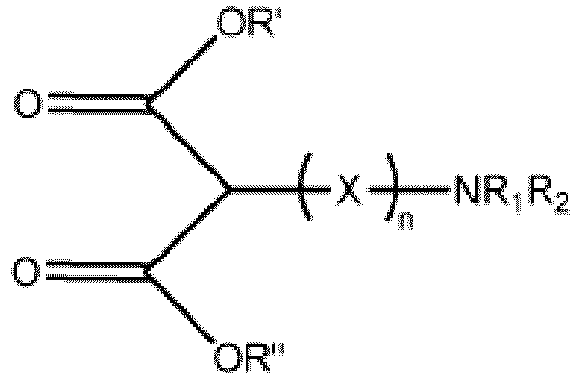 worin X eine verkettende Gruppe ist, die die verankernde Gruppe chemisch an die basische Amin-Gruppe bindet;R' und R" jeweils einzeln ausgewählt sind aus Wasserstoff, Alkyl, bevorzugt Methyl oder Ethyl; Cycloalkyl; Alkyl-Aryl; Alkenyl; Cycloalkenyl; Alken; Alkylen; Arylen; Alkylarylen; Arylalkylen; oder Cycloalkylen;R1 und R2 jeweils einzeln ausgewählt sind aus Wasserstoff, Alkyl, bevorzugt Methyl oder Ethyl oder Propyl; Cycloalkyl; Alkenyl; Cycloalkenyl; Alken; Alkylen oder Cycloalkylen; undn = 0 bis 50 ;(ii) ein Aminosuccinat-Derivat, das die Struktur aufweist:
 worin X eine verkettende Gruppe ist, die die verankernde Gruppe chemisch an die basische Amin-Gruppe bindet;R' und R" jeweils einzeln ausgewählt sind aus Wasserstoff, Alkyl, bevorzugt Methyl oder Ethyl; Cycloalkyl; Alkyl-Aryl; Alkenyl; Cycloalkenyl; Alken; Alkylen; Arylen; Alkylarylen; Arylalkylen; oder Cycloalkylen;R1 und R2 jeweils einzeln ausgewählt sind aus Wasserstoff, Alkyl, bevorzugt Methyl, Ethyl oder Propyl; Cycloalkyl; Alkenyl; Cycloalkenyl; Alken; Alkylen oder Cycloalkylen; undn = 0 bis 50 ;(iii) ein 2,4-Pentandion-Derivat, das die Struktur aufweist:
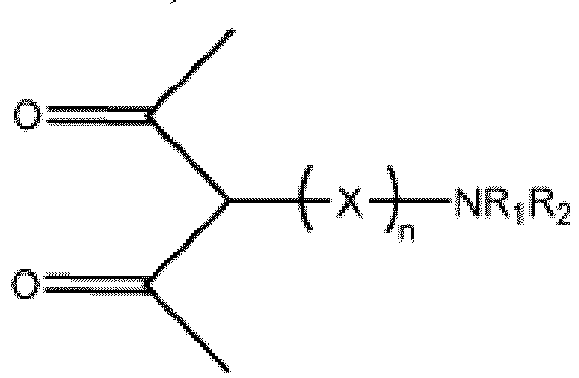 worin X eine verkettende Gruppe ist, die die verankernde Gruppe chemisch an die basische Amin-Gruppe bindet;R1 und R2 jeweils einzeln ausgewählt sind aus Wasserstoff, Alkyl, bevorzugt Methyl oder Ethyl oder Propyl; Cycloalkyl; Alkenyl; Cycloalkenyl; Alken; Alkylen oder Cycloalkylen; undn = 0 bis 50 ; oder(iv) ein 3-Ketobutanamid-Derivat, das die Struktur aufweist:
 worin X eine verkettende Gruppe ist, die die verankernde Gruppe chemisch an die basische Amin-Gruppe bindet;R1 und R2 jeweils einzeln ausgewählt sind aus Wasserstoff, Alkyl, bevorzugt Methyl oder Ethyl oder Propyl; Cycloalkyl; Alkenyl; Cycloalkenyl; Alken; Alkylen oder Cycloalkylen.
 - Selbstdispergierendes Pigment nach Anspruch 8, wobei die verkettende Gruppe "X" umfasst:(a) eine Alkyl-Kette von 1 bis 8 Kohlenstoffatomen;(b) eine Polyether-Kette, umfassend Poly(oxyethylen) oder Poly(oxypropylen) oder Mischungen davon, wodurch das massegemittelte Molekulargewicht der verkettenden Gruppe etwa 220 bis etwa 2.000 beträgt; oder(c) Polyetheramin-Copolymere, die sowohl Oxoethlen- als auch Oxopropylen-Monomere umfassen.
- Selbstdispergierendes Pigment nach Anspruch 8, wobei das Aminomalonat-Derivat ein Methylester von 2-(2-Aminoethyl)malonsäure oder ein Ethylester von 2-(2-Aminoethyl)malonsäure oder 2-(2-Aminoethyl)dimethylmalonat ist.
- Selbstdispergierendes Pigment nach Anspruch 8, wobei das Aminosuccinat-Derivat ein Methylester von N-substituierter Asparaginsäure, ein Ethylester von N-substituierter Asparaginsäure oder N-(2-Aminoethyl)asparaginsäure ist.
- Selbstdispergierendes Pigment nach Anspruch 8, wobei das Ketobutanamid(amidoacetat)-Derivat ein Ethylendiaminamid oder ein Diethylentriaminamid oder N-2-Aminoethyl)-3-oxo-butanamid ist.
- Selbstdispergierendes Pigment nach Anspruch 1, wobei die Aluminiumverbindung hergestellt wird aus Salzen, umfassend Aluminiumchlorid, Aluminiumsulfat, Aluminiumnitrat oder Mischungen davon, oder ein basisches Aluminat aus Ausgangsstoffen, die Natrium- oder Kaliumaluminat umfassen.
- Selbstdispergierendes Pigment nach Anspruch 1, ferner umfassend mindestens eine Oxid-Behandlung, die Aluminiumoxid, Siliciumdioxid, Zirconiumoxid, Ceroxid, Aluminosilicat oder Aluminophosphat.
- Selbstdispergierendes Pigment nach Anspruch 1, wobei das Titandioxid-Pigment erst eine Oxidschicht umfasst, die mindestens etwa 4% Al2O3 und mindestens etwa 1,5% P2O5 umfasst, und eine zweite Schicht, die mindestens etwa 3% Al2O3 und etwa 2 mMol% der zweifach funktionellen Verbindung umfasst, die auf das Gesamtgewicht des behandelten Pigments bezogen ist.
Applications Claiming Priority (2)
| Application Number | Priority Date | Filing Date | Title |
|---|---|---|---|
| US201261725597P | 2012-11-13 | 2012-11-13 | |
| PCT/US2013/066480 WO2014078039A1 (en) | 2012-11-13 | 2013-10-24 | Self-dispersing pigments |
Publications (2)
| Publication Number | Publication Date |
|---|---|
| EP2920249A1 EP2920249A1 (de) | 2015-09-23 |
| EP2920249B1 true EP2920249B1 (de) | 2020-04-01 |
Family
ID=49551785
Family Applications (1)
| Application Number | Title | Priority Date | Filing Date |
|---|---|---|---|
| EP13786828.7A Active EP2920249B1 (de) | 2012-11-13 | 2013-10-24 | Selbstdispergierende pigmente |
Country Status (8)
| Country | Link |
|---|---|
| US (1) | US10316209B2 (de) |
| EP (1) | EP2920249B1 (de) |
| JP (1) | JP6231119B2 (de) |
| CN (1) | CN104937040B (de) |
| AU (1) | AU2013345216B2 (de) |
| CA (1) | CA2890928C (de) |
| ES (1) | ES2790978T3 (de) |
| WO (1) | WO2014078039A1 (de) |
Families Citing this family (11)
| Publication number | Priority date | Publication date | Assignee | Title |
|---|---|---|---|---|
| CN104919009B (zh) * | 2012-11-13 | 2017-08-29 | 纳幕尔杜邦公司 | 由包含自分散性颜料的装饰纸制得的层合体 |
| AU2013345225A1 (en) * | 2012-11-13 | 2015-05-28 | E. I. Du Pont De Nemours And Company | Decor paper comprising self-dispersing pigments |
| US9551112B2 (en) * | 2012-11-13 | 2017-01-24 | The Chemours Company Tt, Llc | Decor paper comprising self-dispersing pigments |
| ES2755951T3 (es) | 2012-11-13 | 2020-04-24 | Chemours Co Fc Llc | Proceso para preparar pigmentos autodispersantes |
| JP6570326B2 (ja) * | 2014-06-30 | 2019-09-04 | キヤノン株式会社 | 自己分散顔料の製造方法、インクの製造方法、及びインクジェット記録方法 |
| ES2848113T3 (es) * | 2015-03-10 | 2021-08-05 | Kronos Int Inc | Pigmentos compuestos que contienen hidróxido de aluminio y procedimiento para su preparación |
| EP3081602A1 (de) * | 2015-04-17 | 2016-10-19 | Kronos International, Inc. | Aluminiumhydroxid-haltige kompositpigmente und verfahren zu ihrer herstellung |
| CN109689800B (zh) * | 2016-09-14 | 2021-10-26 | 3M创新有限公司 | 紫外线吸收硬涂层 |
| CN107774284B (zh) * | 2017-11-10 | 2020-01-10 | 纳琦环保科技有限公司 | 水性纳米抗菌光催化钛氧化物复合溶胶的制备方法 |
| CN108085089B (zh) * | 2017-12-07 | 2020-12-01 | 中国科学院兰州化学物理研究所 | 一种无溶剂二氧化硅纳米类流体及其应用 |
| US12091556B2 (en) | 2018-02-14 | 2024-09-17 | Tronox Llc | Stir-in titanium dioxide pigment composition |
Citations (1)
| Publication number | Priority date | Publication date | Assignee | Title |
|---|---|---|---|---|
| WO2009101016A2 (de) * | 2008-02-12 | 2009-08-20 | Basf Se | Modifizierte hybride nanopartikel |
Family Cites Families (38)
| Publication number | Priority date | Publication date | Assignee | Title |
|---|---|---|---|---|
| US3573081A (en) * | 1969-08-15 | 1971-03-30 | Ppg Industries Inc | Method for producing pigments of improved dispersibility |
| US4461810A (en) | 1983-04-04 | 1984-07-24 | E. I. Du Pont De Nemours And Company | TiO2 Pigment bearing a coating with cerium cations and sulfate-, phosphate- or silicate anions and laminate and coating containing same |
| US4737194A (en) | 1986-04-30 | 1988-04-12 | E. I. Du Pont De Nemours And Company | Titanium dioxide pigment coated with cerium cations, selected acid anions, and alumina |
| FR2685704B1 (fr) * | 1991-12-30 | 2002-06-14 | Rhone Poulenc Chimie | Nouvelles particules de dioxyde de titane, leur utilisation comme pigments opacifiants pour papiers et lamifies de papier. |
| DE4321005A1 (de) * | 1993-06-24 | 1995-01-05 | Merck Patent Gmbh | Perlglanzpigment für Wasserlacksysteme |
| US5562764A (en) | 1994-06-28 | 1996-10-08 | E. I. Du Pont De Nemours And Company | Process for preparing improved TIO2 by silicon halide addition |
| US5787671A (en) | 1994-09-28 | 1998-08-04 | Nippon Telegraph And Telephone Corp. | Modular deployable antenna |
| DE4437118A1 (de) | 1994-10-05 | 1996-04-11 | Technocell Dekor Gmbh & Co Kg | Basispapier für dekorative Beschichtungssysteme |
| FR2727125B1 (fr) | 1994-11-23 | 1999-01-29 | Rhone Poulenc Chimie | Procede de traitement de pigments de dioxyde de titane, nouveau pigment de dioxyde de titane et son utilisation dans la fabrication du papier |
| FR2758826B1 (fr) * | 1997-01-27 | 1999-04-16 | Rhodia Chimie Sa | Nouveau pigment de dioxide de titane, son procede de preparation et son utilisation dans les compositions de peinture |
| US5976237A (en) * | 1997-02-27 | 1999-11-02 | Kerr-Mcgee Chemical Corporation | Pigment process for durable pigments |
| FR2773180B1 (fr) | 1997-12-30 | 2000-02-04 | Arjo Wiggins Sa | Feuille papetiere decorative comprenant une composition de dioxyde de titane et stratifie decoratif la comportant |
| US5993533A (en) | 1998-07-02 | 1999-11-30 | E. I. Du Pont De Nemours And Company | Continuous wet treatment process to prepare durable, high gloss titanium dioxide pigment |
| JP2000110098A (ja) * | 1998-10-05 | 2000-04-18 | Nippon Paper Industries Co Ltd | 酸化チタン複合粒子担持シートおよび酸化チタン複合粒子の製造方法 |
| DE19916546C2 (de) | 1999-04-13 | 2001-05-03 | Technocell Dekor Gmbh & Co Kg | Tintenstrahl-Aufnahmeschicht |
| US6231662B1 (en) * | 1999-10-25 | 2001-05-15 | George K. Atkinson | Surface treatments for titanium dioxide and other industrial pigments |
| DE19955081C1 (de) | 1999-11-15 | 2001-08-09 | Schoeller Felix Jun Foto | Basispapier für ein Aufzeichnungsmaterial für das Tintenstrahl-Druckverfahren |
| EP1276817B1 (de) | 2000-04-27 | 2015-08-26 | E. I. du Pont de Nemours and Company | Verfahren zur herstellung von dauerhaften titandioxidpigmenten mittels gasphasenabscheidung |
| ES2234748T3 (es) | 2000-11-17 | 2005-07-01 | TECHNOCELL DEKOR GMBH & CO. KG | Papel soporte decorativo de una elevada opacidad. |
| DE10115570B4 (de) | 2001-03-28 | 2005-09-08 | Technocell Dekor Gmbh & Co. Kg | Dekorrohpapier mit verbesserter Opazität |
| DE10115544A1 (de) | 2001-03-28 | 2002-10-10 | Kronos Titan Gmbh & Co Ohg | Titandioxid-Pigmentzusammensetzung |
| US7285162B2 (en) | 2001-07-30 | 2007-10-23 | Millennium Inorganic Chemicals, Inc. | Titanium dioxide pigment having improved light stability |
| US6743286B2 (en) | 2001-07-30 | 2004-06-01 | Millennium Inorganic Chemicals, Inc. | Inorganic particles and methods of making |
| US20060078485A1 (en) | 2002-12-30 | 2006-04-13 | Thiele Erik S | Process of making a water dispersible titanium dioxide pigment useful in paper laminates |
| JP2006124684A (ja) * | 2004-09-30 | 2006-05-18 | Mitsubishi Materials Corp | 光触媒塗料及び該塗料を用いた光触媒膜の製造方法 |
| US7276231B2 (en) * | 2005-05-23 | 2007-10-02 | E I Du Pont De Nemours And Company | Lower-energy process for preparing passivated inorganic nanoparticles |
| DE112006001459B4 (de) * | 2005-06-07 | 2019-05-29 | The Chemours Company Fc, Llc | Papier und lammatpapiere, die modifiziertes titandioxid enthalten |
| US7842131B2 (en) | 2006-01-30 | 2010-11-30 | Kronos International Inc | High opacity TiO2 pigment and production method |
| US7288146B1 (en) | 2006-03-16 | 2007-10-30 | Kronos International, Inc. | Titanium dioxide pigment coated with hollow bodies and method for its manufacture |
| JP2010006629A (ja) | 2008-06-25 | 2010-01-14 | Ishihara Sangyo Kaisha Ltd | 二酸化チタン微粒子及びその製造方法 |
| CN102612493B (zh) | 2009-11-10 | 2015-03-11 | 纳幕尔杜邦公司 | 在二氧化钛的制备中用于原位形成硅和铝的氯化物的方法 |
| CN102686516A (zh) | 2010-09-21 | 2012-09-19 | 纳幕尔杜邦公司 | 具有改善的光稳定性的含钨无机颗粒 |
| WO2012148907A1 (en) * | 2011-04-28 | 2012-11-01 | E. I. Du Pont De Nemours And Company | Treated inorganic pigments having improved bulk flow and their use in paper slurries |
| CN102585559B (zh) * | 2011-12-23 | 2014-03-26 | 中国科学院宁波材料技术与工程研究所 | 一种高耐光性二氧化钛颜料的制备方法 |
| US9551112B2 (en) * | 2012-11-13 | 2017-01-24 | The Chemours Company Tt, Llc | Decor paper comprising self-dispersing pigments |
| CN104919009B (zh) * | 2012-11-13 | 2017-08-29 | 纳幕尔杜邦公司 | 由包含自分散性颜料的装饰纸制得的层合体 |
| EP2920250A1 (de) | 2012-11-13 | 2015-09-23 | E. I. du Pont de Nemours and Company | Verfahren zur herstellung von kieselsäure mit selbstdispergierenden pigmenten |
| ES2755951T3 (es) | 2012-11-13 | 2020-04-24 | Chemours Co Fc Llc | Proceso para preparar pigmentos autodispersantes |
-
2013
- 2013-10-24 AU AU2013345216A patent/AU2013345216B2/en active Active
- 2013-10-24 JP JP2015543057A patent/JP6231119B2/ja active Active
- 2013-10-24 US US14/441,235 patent/US10316209B2/en active Active
- 2013-10-24 EP EP13786828.7A patent/EP2920249B1/de active Active
- 2013-10-24 CA CA2890928A patent/CA2890928C/en active Active
- 2013-10-24 CN CN201380070292.XA patent/CN104937040B/zh active Active
- 2013-10-24 ES ES13786828T patent/ES2790978T3/es active Active
- 2013-10-24 WO PCT/US2013/066480 patent/WO2014078039A1/en not_active Ceased
Patent Citations (1)
| Publication number | Priority date | Publication date | Assignee | Title |
|---|---|---|---|---|
| WO2009101016A2 (de) * | 2008-02-12 | 2009-08-20 | Basf Se | Modifizierte hybride nanopartikel |
Also Published As
| Publication number | Publication date |
|---|---|
| JP2016505654A (ja) | 2016-02-25 |
| CN104937040A (zh) | 2015-09-23 |
| AU2013345216A1 (en) | 2015-05-21 |
| CN104937040B (zh) | 2017-11-21 |
| JP6231119B2 (ja) | 2017-11-15 |
| AU2013345216B2 (en) | 2017-01-12 |
| WO2014078039A1 (en) | 2014-05-22 |
| EP2920249A1 (de) | 2015-09-23 |
| CA2890928C (en) | 2021-06-22 |
| CA2890928A1 (en) | 2014-05-22 |
| US20150291822A1 (en) | 2015-10-15 |
| US10316209B2 (en) | 2019-06-11 |
| ES2790978T3 (es) | 2020-10-30 |
Similar Documents
| Publication | Publication Date | Title |
|---|---|---|
| AU2013345216B2 (en) | Self-dispersing pigments | |
| EP2920251B1 (de) | Verfahren zur herstellung selbstdispergierender pigmente | |
| EP2920361B1 (de) | Dekorpapier mit selbstdispergierenden pigmenten | |
| EP2920252B1 (de) | Aus dekorpapier hergestellte laminate mit selbstdispergierenden pigmenten | |
| US20150259855A1 (en) | Decor paper comprising self-dispersing pigments | |
| WO2014078050A1 (en) | Laminates prepared from décor paper comprising self-dispersing pigments | |
| EP2920250A1 (de) | Verfahren zur herstellung von kieselsäure mit selbstdispergierenden pigmenten | |
| WO2014078044A1 (en) | Silica containing self-dispersing pigments |
Legal Events
| Date | Code | Title | Description |
|---|---|---|---|
| PUAI | Public reference made under article 153(3) epc to a published international application that has entered the european phase |
Free format text: ORIGINAL CODE: 0009012 |
|
| 17P | Request for examination filed |
Effective date: 20150513 |
|
| AK | Designated contracting states |
Kind code of ref document: A1 Designated state(s): AL AT BE BG CH CY CZ DE DK EE ES FI FR GB GR HR HU IE IS IT LI LT LU LV MC MK MT NL NO PL PT RO RS SE SI SK SM TR |
|
| AX | Request for extension of the european patent |
Extension state: BA ME |
|
| DAX | Request for extension of the european patent (deleted) | ||
| RAP1 | Party data changed (applicant data changed or rights of an application transferred) |
Owner name: THE CHEMOURS COMPANY TT, LLC |
|
| RAP1 | Party data changed (applicant data changed or rights of an application transferred) |
Owner name: THE CHEMOURS COMPANY FC, LLC |
|
| STAA | Information on the status of an ep patent application or granted ep patent |
Free format text: STATUS: EXAMINATION IS IN PROGRESS |
|
| 17Q | First examination report despatched |
Effective date: 20180926 |
|
| GRAP | Despatch of communication of intention to grant a patent |
Free format text: ORIGINAL CODE: EPIDOSNIGR1 |
|
| STAA | Information on the status of an ep patent application or granted ep patent |
Free format text: STATUS: GRANT OF PATENT IS INTENDED |
|
| INTG | Intention to grant announced |
Effective date: 20191014 |
|
| GRAS | Grant fee paid |
Free format text: ORIGINAL CODE: EPIDOSNIGR3 |
|
| GRAA | (expected) grant |
Free format text: ORIGINAL CODE: 0009210 |
|
| STAA | Information on the status of an ep patent application or granted ep patent |
Free format text: STATUS: THE PATENT HAS BEEN GRANTED |
|
| AK | Designated contracting states |
Kind code of ref document: B1 Designated state(s): AL AT BE BG CH CY CZ DE DK EE ES FI FR GB GR HR HU IE IS IT LI LT LU LV MC MK MT NL NO PL PT RO RS SE SI SK SM TR |
|
| REG | Reference to a national code |
Ref country code: GB Ref legal event code: FG4D |
|
| REG | Reference to a national code |
Ref country code: CH Ref legal event code: EP Ref country code: AT Ref legal event code: REF Ref document number: 1251301 Country of ref document: AT Kind code of ref document: T Effective date: 20200415 |
|
| REG | Reference to a national code |
Ref country code: DE Ref legal event code: R096 Ref document number: 602013067484 Country of ref document: DE |
|
| REG | Reference to a national code |
Ref country code: IE Ref legal event code: FG4D |
|
| REG | Reference to a national code |
Ref country code: FI Ref legal event code: FGE |
|
| REG | Reference to a national code |
Ref country code: SE Ref legal event code: TRGR |
|
| PG25 | Lapsed in a contracting state [announced via postgrant information from national office to epo] |
Ref country code: BG Free format text: LAPSE BECAUSE OF FAILURE TO SUBMIT A TRANSLATION OF THE DESCRIPTION OR TO PAY THE FEE WITHIN THE PRESCRIBED TIME-LIMIT Effective date: 20200701 |
|
| REG | Reference to a national code |
Ref country code: NL Ref legal event code: MP Effective date: 20200401 |
|
| REG | Reference to a national code |
Ref country code: LT Ref legal event code: MG4D |
|
| PG25 | Lapsed in a contracting state [announced via postgrant information from national office to epo] |
Ref country code: CZ Free format text: LAPSE BECAUSE OF FAILURE TO SUBMIT A TRANSLATION OF THE DESCRIPTION OR TO PAY THE FEE WITHIN THE PRESCRIBED TIME-LIMIT Effective date: 20200401 Ref country code: IS Free format text: LAPSE BECAUSE OF FAILURE TO SUBMIT A TRANSLATION OF THE DESCRIPTION OR TO PAY THE FEE WITHIN THE PRESCRIBED TIME-LIMIT Effective date: 20200801 Ref country code: LT Free format text: LAPSE BECAUSE OF FAILURE TO SUBMIT A TRANSLATION OF THE DESCRIPTION OR TO PAY THE FEE WITHIN THE PRESCRIBED TIME-LIMIT Effective date: 20200401 Ref country code: PT Free format text: LAPSE BECAUSE OF FAILURE TO SUBMIT A TRANSLATION OF THE DESCRIPTION OR TO PAY THE FEE WITHIN THE PRESCRIBED TIME-LIMIT Effective date: 20200817 Ref country code: NL Free format text: LAPSE BECAUSE OF FAILURE TO SUBMIT A TRANSLATION OF THE DESCRIPTION OR TO PAY THE FEE WITHIN THE PRESCRIBED TIME-LIMIT Effective date: 20200401 Ref country code: GR Free format text: LAPSE BECAUSE OF FAILURE TO SUBMIT A TRANSLATION OF THE DESCRIPTION OR TO PAY THE FEE WITHIN THE PRESCRIBED TIME-LIMIT Effective date: 20200702 Ref country code: NO Free format text: LAPSE BECAUSE OF FAILURE TO SUBMIT A TRANSLATION OF THE DESCRIPTION OR TO PAY THE FEE WITHIN THE PRESCRIBED TIME-LIMIT Effective date: 20200701 |
|
| REG | Reference to a national code |
Ref country code: ES Ref legal event code: FG2A Ref document number: 2790978 Country of ref document: ES Kind code of ref document: T3 Effective date: 20201030 |
|
| REG | Reference to a national code |
Ref country code: AT Ref legal event code: MK05 Ref document number: 1251301 Country of ref document: AT Kind code of ref document: T Effective date: 20200401 |
|
| PG25 | Lapsed in a contracting state [announced via postgrant information from national office to epo] |
Ref country code: LV Free format text: LAPSE BECAUSE OF FAILURE TO SUBMIT A TRANSLATION OF THE DESCRIPTION OR TO PAY THE FEE WITHIN THE PRESCRIBED TIME-LIMIT Effective date: 20200401 Ref country code: HR Free format text: LAPSE BECAUSE OF FAILURE TO SUBMIT A TRANSLATION OF THE DESCRIPTION OR TO PAY THE FEE WITHIN THE PRESCRIBED TIME-LIMIT Effective date: 20200401 Ref country code: RS Free format text: LAPSE BECAUSE OF FAILURE TO SUBMIT A TRANSLATION OF THE DESCRIPTION OR TO PAY THE FEE WITHIN THE PRESCRIBED TIME-LIMIT Effective date: 20200401 |
|
| PG25 | Lapsed in a contracting state [announced via postgrant information from national office to epo] |
Ref country code: AL Free format text: LAPSE BECAUSE OF FAILURE TO SUBMIT A TRANSLATION OF THE DESCRIPTION OR TO PAY THE FEE WITHIN THE PRESCRIBED TIME-LIMIT Effective date: 20200401 |
|
| REG | Reference to a national code |
Ref country code: DE Ref legal event code: R097 Ref document number: 602013067484 Country of ref document: DE |
|
| PG25 | Lapsed in a contracting state [announced via postgrant information from national office to epo] |
Ref country code: AT Free format text: LAPSE BECAUSE OF FAILURE TO SUBMIT A TRANSLATION OF THE DESCRIPTION OR TO PAY THE FEE WITHIN THE PRESCRIBED TIME-LIMIT Effective date: 20200401 Ref country code: DK Free format text: LAPSE BECAUSE OF FAILURE TO SUBMIT A TRANSLATION OF THE DESCRIPTION OR TO PAY THE FEE WITHIN THE PRESCRIBED TIME-LIMIT Effective date: 20200401 Ref country code: SM Free format text: LAPSE BECAUSE OF FAILURE TO SUBMIT A TRANSLATION OF THE DESCRIPTION OR TO PAY THE FEE WITHIN THE PRESCRIBED TIME-LIMIT Effective date: 20200401 Ref country code: EE Free format text: LAPSE BECAUSE OF FAILURE TO SUBMIT A TRANSLATION OF THE DESCRIPTION OR TO PAY THE FEE WITHIN THE PRESCRIBED TIME-LIMIT Effective date: 20200401 Ref country code: RO Free format text: LAPSE BECAUSE OF FAILURE TO SUBMIT A TRANSLATION OF THE DESCRIPTION OR TO PAY THE FEE WITHIN THE PRESCRIBED TIME-LIMIT Effective date: 20200401 |
|
| PLBE | No opposition filed within time limit |
Free format text: ORIGINAL CODE: 0009261 |
|
| STAA | Information on the status of an ep patent application or granted ep patent |
Free format text: STATUS: NO OPPOSITION FILED WITHIN TIME LIMIT |
|
| PG25 | Lapsed in a contracting state [announced via postgrant information from national office to epo] |
Ref country code: SK Free format text: LAPSE BECAUSE OF FAILURE TO SUBMIT A TRANSLATION OF THE DESCRIPTION OR TO PAY THE FEE WITHIN THE PRESCRIBED TIME-LIMIT Effective date: 20200401 Ref country code: PL Free format text: LAPSE BECAUSE OF FAILURE TO SUBMIT A TRANSLATION OF THE DESCRIPTION OR TO PAY THE FEE WITHIN THE PRESCRIBED TIME-LIMIT Effective date: 20200401 |
|
| 26N | No opposition filed |
Effective date: 20210112 |
|
| PG25 | Lapsed in a contracting state [announced via postgrant information from national office to epo] |
Ref country code: SI Free format text: LAPSE BECAUSE OF FAILURE TO SUBMIT A TRANSLATION OF THE DESCRIPTION OR TO PAY THE FEE WITHIN THE PRESCRIBED TIME-LIMIT Effective date: 20200401 |
|
| REG | Reference to a national code |
Ref country code: CH Ref legal event code: PL |
|
| PG25 | Lapsed in a contracting state [announced via postgrant information from national office to epo] |
Ref country code: MC Free format text: LAPSE BECAUSE OF FAILURE TO SUBMIT A TRANSLATION OF THE DESCRIPTION OR TO PAY THE FEE WITHIN THE PRESCRIBED TIME-LIMIT Effective date: 20200401 Ref country code: LU Free format text: LAPSE BECAUSE OF NON-PAYMENT OF DUE FEES Effective date: 20201024 |
|
| REG | Reference to a national code |
Ref country code: BE Ref legal event code: MM Effective date: 20201031 |
|
| PG25 | Lapsed in a contracting state [announced via postgrant information from national office to epo] |
Ref country code: BE Free format text: LAPSE BECAUSE OF NON-PAYMENT OF DUE FEES Effective date: 20201031 Ref country code: CH Free format text: LAPSE BECAUSE OF NON-PAYMENT OF DUE FEES Effective date: 20201031 Ref country code: LI Free format text: LAPSE BECAUSE OF NON-PAYMENT OF DUE FEES Effective date: 20201031 |
|
| PG25 | Lapsed in a contracting state [announced via postgrant information from national office to epo] |
Ref country code: IE Free format text: LAPSE BECAUSE OF NON-PAYMENT OF DUE FEES Effective date: 20201024 |
|
| PG25 | Lapsed in a contracting state [announced via postgrant information from national office to epo] |
Ref country code: TR Free format text: LAPSE BECAUSE OF FAILURE TO SUBMIT A TRANSLATION OF THE DESCRIPTION OR TO PAY THE FEE WITHIN THE PRESCRIBED TIME-LIMIT Effective date: 20200401 Ref country code: MT Free format text: LAPSE BECAUSE OF FAILURE TO SUBMIT A TRANSLATION OF THE DESCRIPTION OR TO PAY THE FEE WITHIN THE PRESCRIBED TIME-LIMIT Effective date: 20200401 Ref country code: CY Free format text: LAPSE BECAUSE OF FAILURE TO SUBMIT A TRANSLATION OF THE DESCRIPTION OR TO PAY THE FEE WITHIN THE PRESCRIBED TIME-LIMIT Effective date: 20200401 |
|
| PG25 | Lapsed in a contracting state [announced via postgrant information from national office to epo] |
Ref country code: MK Free format text: LAPSE BECAUSE OF FAILURE TO SUBMIT A TRANSLATION OF THE DESCRIPTION OR TO PAY THE FEE WITHIN THE PRESCRIBED TIME-LIMIT Effective date: 20200401 |
|
| P01 | Opt-out of the competence of the unified patent court (upc) registered |
Effective date: 20230527 |
|
| PGFP | Annual fee paid to national office [announced via postgrant information from national office to epo] |
Ref country code: FI Payment date: 20250923 Year of fee payment: 13 |
|
| PGFP | Annual fee paid to national office [announced via postgrant information from national office to epo] |
Ref country code: IT Payment date: 20250923 Year of fee payment: 13 |
|
| PGFP | Annual fee paid to national office [announced via postgrant information from national office to epo] |
Ref country code: GB Payment date: 20250923 Year of fee payment: 13 |
|
| PGFP | Annual fee paid to national office [announced via postgrant information from national office to epo] |
Ref country code: FR Payment date: 20250923 Year of fee payment: 13 |
|
| PGFP | Annual fee paid to national office [announced via postgrant information from national office to epo] |
Ref country code: SE Payment date: 20250923 Year of fee payment: 13 |
|
| PGFP | Annual fee paid to national office [announced via postgrant information from national office to epo] |
Ref country code: DE Payment date: 20250923 Year of fee payment: 13 |
|
| PGFP | Annual fee paid to national office [announced via postgrant information from national office to epo] |
Ref country code: ES Payment date: 20251103 Year of fee payment: 13 |