EP2915838A1 - Surface modification method and surface-modified elastic body - Google Patents
Surface modification method and surface-modified elastic body Download PDFInfo
- Publication number
- EP2915838A1 EP2915838A1 EP13857067.6A EP13857067A EP2915838A1 EP 2915838 A1 EP2915838 A1 EP 2915838A1 EP 13857067 A EP13857067 A EP 13857067A EP 2915838 A1 EP2915838 A1 EP 2915838A1
- Authority
- EP
- European Patent Office
- Prior art keywords
- monomer
- functional monomer
- functional polymer
- polymer chains
- functional
- Prior art date
- Legal status (The legal status is an assumption and is not a legal conclusion. Google has not performed a legal analysis and makes no representation as to the accuracy of the status listed.)
- Granted
Links
- 238000002715 modification method Methods 0.000 title description 17
- 239000000178 monomer Substances 0.000 claims abstract description 88
- 229920001002 functional polymer Polymers 0.000 claims abstract description 61
- 238000000034 method Methods 0.000 claims abstract description 48
- 230000004048 modification Effects 0.000 claims abstract description 45
- 238000012986 modification Methods 0.000 claims abstract description 45
- 238000006116 polymerization reaction Methods 0.000 claims abstract description 37
- 229920001971 elastomer Polymers 0.000 claims abstract description 36
- 239000005060 rubber Substances 0.000 claims abstract description 36
- 229920002725 thermoplastic elastomer Polymers 0.000 claims abstract description 24
- 230000000977 initiatory effect Effects 0.000 claims abstract description 22
- 230000000379 polymerizing effect Effects 0.000 claims abstract description 18
- 229920000642 polymer Polymers 0.000 claims description 35
- -1 benzophenone compound Chemical class 0.000 claims description 33
- 239000012965 benzophenone Substances 0.000 claims description 23
- XLYOFNOQVPJJNP-UHFFFAOYSA-N water Substances O XLYOFNOQVPJJNP-UHFFFAOYSA-N 0.000 claims description 22
- 239000003999 initiator Substances 0.000 claims description 18
- 238000006243 chemical reaction Methods 0.000 claims description 17
- 239000003963 antioxidant agent Substances 0.000 claims description 16
- 230000003078 antioxidant effect Effects 0.000 claims description 16
- 235000006708 antioxidants Nutrition 0.000 claims description 16
- 239000003638 chemical reducing agent Substances 0.000 claims description 16
- NIXOWILDQLNWCW-UHFFFAOYSA-N 2-Propenoic acid Natural products OC(=O)C=C NIXOWILDQLNWCW-UHFFFAOYSA-N 0.000 claims description 11
- CIWBSHSKHKDKBQ-JLAZNSOCSA-N Ascorbic acid Chemical compound OC[C@H](O)[C@H]1OC(=O)C(O)=C1O CIWBSHSKHKDKBQ-JLAZNSOCSA-N 0.000 claims description 11
- 229910052731 fluorine Inorganic materials 0.000 claims description 11
- 239000007788 liquid Substances 0.000 claims description 11
- AUNGANRZJHBGPY-SCRDCRAPSA-N Riboflavin Chemical compound OC[C@@H](O)[C@@H](O)[C@@H](O)CN1C=2C=C(C)C(C)=CC=2N=C2C1=NC(=O)NC2=O AUNGANRZJHBGPY-SCRDCRAPSA-N 0.000 claims description 10
- 125000004435 hydrogen atom Chemical group [H]* 0.000 claims description 10
- 238000010526 radical polymerization reaction Methods 0.000 claims description 10
- GVJHHUAWPYXKBD-IEOSBIPESA-N α-tocopherol Chemical compound OC1=C(C)C(C)=C2O[C@@](CCC[C@H](C)CCC[C@H](C)CCCC(C)C)(C)CCC2=C1C GVJHHUAWPYXKBD-IEOSBIPESA-N 0.000 claims description 8
- 239000003112 inhibitor Substances 0.000 claims description 7
- 239000010702 perfluoropolyether Substances 0.000 claims description 7
- 229910052783 alkali metal Inorganic materials 0.000 claims description 6
- 229910052799 carbon Inorganic materials 0.000 claims description 6
- 125000001153 fluoro group Chemical group F* 0.000 claims description 6
- 229910052739 hydrogen Inorganic materials 0.000 claims description 6
- 239000011261 inert gas Substances 0.000 claims description 6
- IWDCLRJOBJJRNH-UHFFFAOYSA-N p-cresol Chemical group CC1=CC=C(O)C=C1 IWDCLRJOBJJRNH-UHFFFAOYSA-N 0.000 claims description 6
- SMZOUWXMTYCWNB-UHFFFAOYSA-N 2-(2-methoxy-5-methylphenyl)ethanamine Chemical compound COC1=CC=C(C)C=C1CCN SMZOUWXMTYCWNB-UHFFFAOYSA-N 0.000 claims description 5
- AUNGANRZJHBGPY-UHFFFAOYSA-N D-Lyxoflavin Natural products OCC(O)C(O)C(O)CN1C=2C=C(C)C(C)=CC=2N=C2C1=NC(=O)NC2=O AUNGANRZJHBGPY-UHFFFAOYSA-N 0.000 claims description 5
- 235000010323 ascorbic acid Nutrition 0.000 claims description 5
- 239000011668 ascorbic acid Substances 0.000 claims description 5
- 229960005070 ascorbic acid Drugs 0.000 claims description 5
- 235000019192 riboflavin Nutrition 0.000 claims description 5
- 239000002151 riboflavin Substances 0.000 claims description 5
- 229960002477 riboflavin Drugs 0.000 claims description 5
- WKBOTKDWSSQWDR-UHFFFAOYSA-N Bromine atom Chemical group [Br] WKBOTKDWSSQWDR-UHFFFAOYSA-N 0.000 claims description 4
- LEHOTFFKMJEONL-UHFFFAOYSA-N Uric Acid Chemical compound N1C(=O)NC(=O)C2=C1NC(=O)N2 LEHOTFFKMJEONL-UHFFFAOYSA-N 0.000 claims description 4
- TVWHNULVHGKJHS-UHFFFAOYSA-N Uric acid Natural products N1C(=O)NC(=O)C2NC(=O)NC21 TVWHNULVHGKJHS-UHFFFAOYSA-N 0.000 claims description 4
- OENHQHLEOONYIE-UKMVMLAPSA-N all-trans beta-carotene Natural products CC=1CCCC(C)(C)C=1/C=C/C(/C)=C/C=C/C(/C)=C/C=C/C=C(C)C=CC=C(C)C=CC1=C(C)CCCC1(C)C OENHQHLEOONYIE-UKMVMLAPSA-N 0.000 claims description 4
- 229940087168 alpha tocopherol Drugs 0.000 claims description 4
- 235000013734 beta-carotene Nutrition 0.000 claims description 4
- 239000011648 beta-carotene Substances 0.000 claims description 4
- TUPZEYHYWIEDIH-WAIFQNFQSA-N beta-carotene Natural products CC(=C/C=C/C=C(C)/C=C/C=C(C)/C=C/C1=C(C)CCCC1(C)C)C=CC=C(/C)C=CC2=CCCCC2(C)C TUPZEYHYWIEDIH-WAIFQNFQSA-N 0.000 claims description 4
- 229960002747 betacarotene Drugs 0.000 claims description 4
- 229910052801 chlorine Inorganic materials 0.000 claims description 4
- 229960000984 tocofersolan Drugs 0.000 claims description 4
- 229940116269 uric acid Drugs 0.000 claims description 4
- 235000004835 α-tocopherol Nutrition 0.000 claims description 4
- 239000002076 α-tocopherol Substances 0.000 claims description 4
- OENHQHLEOONYIE-JLTXGRSLSA-N β-Carotene Chemical compound CC=1CCCC(C)(C)C=1\C=C\C(\C)=C\C=C\C(\C)=C\C=C\C=C(/C)\C=C\C=C(/C)\C=C\C1=C(C)CCCC1(C)C OENHQHLEOONYIE-JLTXGRSLSA-N 0.000 claims description 4
- XLPJNCYCZORXHG-UHFFFAOYSA-N 1-morpholin-4-ylprop-2-en-1-one Chemical compound C=CC(=O)N1CCOCC1 XLPJNCYCZORXHG-UHFFFAOYSA-N 0.000 claims description 3
- BONVROUPOZRCDU-UHFFFAOYSA-N 2-hydroxyprop-2-enamide Chemical compound NC(=O)C(O)=C BONVROUPOZRCDU-UHFFFAOYSA-N 0.000 claims description 3
- UVRCNEIYXSRHNT-UHFFFAOYSA-N 3-ethylpent-2-enamide Chemical compound CCC(CC)=CC(N)=O UVRCNEIYXSRHNT-UHFFFAOYSA-N 0.000 claims description 3
- WHNPOQXWAMXPTA-UHFFFAOYSA-N 3-methylbut-2-enamide Chemical compound CC(C)=CC(N)=O WHNPOQXWAMXPTA-UHFFFAOYSA-N 0.000 claims description 3
- HRPVXLWXLXDGHG-UHFFFAOYSA-N Acrylamide Chemical compound NC(=O)C=C HRPVXLWXLXDGHG-UHFFFAOYSA-N 0.000 claims description 3
- NLHHRLWOUZZQLW-UHFFFAOYSA-N Acrylonitrile Chemical compound C=CC#N NLHHRLWOUZZQLW-UHFFFAOYSA-N 0.000 claims description 3
- CERQOIWHTDAKMF-UHFFFAOYSA-N Methacrylic acid Chemical compound CC(=C)C(O)=O CERQOIWHTDAKMF-UHFFFAOYSA-N 0.000 claims description 3
- 125000005396 acrylic acid ester group Chemical group 0.000 claims description 3
- 125000001309 chloro group Chemical group Cl* 0.000 claims description 3
- 125000001495 ethyl group Chemical group [H]C([H])([H])C([H])([H])* 0.000 claims description 3
- FQPSGWSUVKBHSU-UHFFFAOYSA-N methacrylamide Chemical compound CC(=C)C(N)=O FQPSGWSUVKBHSU-UHFFFAOYSA-N 0.000 claims description 3
- 125000005397 methacrylic acid ester group Chemical group 0.000 claims description 3
- 125000002496 methyl group Chemical group [H]C([H])([H])* 0.000 claims description 3
- QNILTEGFHQSKFF-UHFFFAOYSA-N n-propan-2-ylprop-2-enamide Chemical compound CC(C)NC(=O)C=C QNILTEGFHQSKFF-UHFFFAOYSA-N 0.000 claims description 3
- 239000007787 solid Substances 0.000 claims description 3
- 239000000243 solution Substances 0.000 description 33
- 150000003839 salts Chemical class 0.000 description 19
- CSCPPACGZOOCGX-UHFFFAOYSA-N Acetone Chemical compound CC(C)=O CSCPPACGZOOCGX-UHFFFAOYSA-N 0.000 description 9
- RWCCWEUUXYIKHB-UHFFFAOYSA-N benzophenone Chemical group C=1C=CC=CC=1C(=O)C1=CC=CC=C1 RWCCWEUUXYIKHB-UHFFFAOYSA-N 0.000 description 9
- 230000000052 comparative effect Effects 0.000 description 8
- 150000001875 compounds Chemical class 0.000 description 8
- 238000007789 sealing Methods 0.000 description 8
- QVGXLLKOCUKJST-UHFFFAOYSA-N atomic oxygen Chemical compound [O] QVGXLLKOCUKJST-UHFFFAOYSA-N 0.000 description 7
- 239000001301 oxygen Substances 0.000 description 7
- 229910052760 oxygen Inorganic materials 0.000 description 7
- 239000004636 vulcanized rubber Substances 0.000 description 7
- 238000004132 cross linking Methods 0.000 description 6
- 230000000694 effects Effects 0.000 description 5
- 230000001965 increasing effect Effects 0.000 description 5
- 239000004810 polytetrafluoroethylene Substances 0.000 description 5
- 229920001343 polytetrafluoroethylene Polymers 0.000 description 5
- XKRFYHLGVUSROY-UHFFFAOYSA-N Argon Chemical compound [Ar] XKRFYHLGVUSROY-UHFFFAOYSA-N 0.000 description 4
- RRHGJUQNOFWUDK-UHFFFAOYSA-N Isoprene Chemical group CC(=C)C=C RRHGJUQNOFWUDK-UHFFFAOYSA-N 0.000 description 4
- 239000007789 gas Substances 0.000 description 4
- 238000007654 immersion Methods 0.000 description 4
- 238000005507 spraying Methods 0.000 description 4
- JNELGWHKGNBSMD-UHFFFAOYSA-N xanthone Chemical compound C1=CC=C2C(=O)C3=CC=CC=C3OC2=C1 JNELGWHKGNBSMD-UHFFFAOYSA-N 0.000 description 4
- JYEUMXHLPRZUAT-UHFFFAOYSA-N 1,2,3-triazine Chemical compound C1=CN=NN=C1 JYEUMXHLPRZUAT-UHFFFAOYSA-N 0.000 description 3
- ZWEHNKRNPOVVGH-UHFFFAOYSA-N 2-Butanone Chemical compound CCC(C)=O ZWEHNKRNPOVVGH-UHFFFAOYSA-N 0.000 description 3
- UHOVQNZJYSORNB-UHFFFAOYSA-N Benzene Chemical compound C1=CC=CC=C1 UHOVQNZJYSORNB-UHFFFAOYSA-N 0.000 description 3
- LFQSCWFLJHTTHZ-UHFFFAOYSA-N Ethanol Chemical compound CCO LFQSCWFLJHTTHZ-UHFFFAOYSA-N 0.000 description 3
- XEKOWRVHYACXOJ-UHFFFAOYSA-N Ethyl acetate Chemical compound CCOC(C)=O XEKOWRVHYACXOJ-UHFFFAOYSA-N 0.000 description 3
- OKKJLVBELUTLKV-UHFFFAOYSA-N Methanol Chemical compound OC OKKJLVBELUTLKV-UHFFFAOYSA-N 0.000 description 3
- YXFVVABEGXRONW-UHFFFAOYSA-N Toluene Chemical compound CC1=CC=CC=C1 YXFVVABEGXRONW-UHFFFAOYSA-N 0.000 description 3
- 239000002253 acid Substances 0.000 description 3
- 125000000217 alkyl group Chemical group 0.000 description 3
- FPIPGXGPPPQFEQ-OVSJKPMPSA-N all-trans-retinol Chemical compound OC\C=C(/C)\C=C\C=C(/C)\C=C\C1=C(C)CCCC1(C)C FPIPGXGPPPQFEQ-OVSJKPMPSA-N 0.000 description 3
- 150000001721 carbon Chemical group 0.000 description 3
- 150000001728 carbonyl compounds Chemical class 0.000 description 3
- 239000003795 chemical substances by application Substances 0.000 description 3
- XMOCLSLCDHWDHP-IUODEOHRSA-N epi-Gallocatechin Chemical compound C1([C@H]2OC3=CC(O)=CC(O)=C3C[C@H]2O)=CC(O)=C(O)C(O)=C1 XMOCLSLCDHWDHP-IUODEOHRSA-N 0.000 description 3
- 239000012530 fluid Substances 0.000 description 3
- 239000011521 glass Substances 0.000 description 3
- 229920005555 halobutyl Polymers 0.000 description 3
- 125000005843 halogen group Chemical group 0.000 description 3
- 239000001257 hydrogen Substances 0.000 description 3
- 230000001678 irradiating effect Effects 0.000 description 3
- 239000003960 organic solvent Substances 0.000 description 3
- 125000004430 oxygen atom Chemical group O* 0.000 description 3
- YRHRIQCWCFGUEQ-UHFFFAOYSA-N thioxanthen-9-one Chemical class C1=CC=C2C(=O)C3=CC=CC=C3SC2=C1 YRHRIQCWCFGUEQ-UHFFFAOYSA-N 0.000 description 3
- BTJPUDCSZVCXFQ-UHFFFAOYSA-N 2,4-diethylthioxanthen-9-one Chemical compound C1=CC=C2C(=O)C3=CC(CC)=CC(CC)=C3SC2=C1 BTJPUDCSZVCXFQ-UHFFFAOYSA-N 0.000 description 2
- NOYRFDHEJYWIHG-UHFFFAOYSA-N 2-methoxythioxanthen-9-one Chemical compound C1=CC=C2C(=O)C3=CC(OC)=CC=C3SC2=C1 NOYRFDHEJYWIHG-UHFFFAOYSA-N 0.000 description 2
- OTXNTMVVOOBZCV-UHFFFAOYSA-N 2R-gamma-tocotrienol Natural products OC1=C(C)C(C)=C2OC(CCC=C(C)CCC=C(C)CCC=C(C)C)(C)CCC2=C1 OTXNTMVVOOBZCV-UHFFFAOYSA-N 0.000 description 2
- YQUVCSBJEUQKSH-UHFFFAOYSA-N 3,4-dihydroxybenzoic acid Chemical compound OC(=O)C1=CC=C(O)C(O)=C1 YQUVCSBJEUQKSH-UHFFFAOYSA-N 0.000 description 2
- VVBLNCFGVYUYGU-UHFFFAOYSA-N 4,4'-Bis(dimethylamino)benzophenone Chemical compound C1=CC(N(C)C)=CC=C1C(=O)C1=CC=C(N(C)C)C=C1 VVBLNCFGVYUYGU-UHFFFAOYSA-N 0.000 description 2
- ZCYVEMRRCGMTRW-UHFFFAOYSA-N 7553-56-2 Chemical compound [I] ZCYVEMRRCGMTRW-UHFFFAOYSA-N 0.000 description 2
- BPYKTIZUTYGOLE-IFADSCNNSA-N Bilirubin Chemical compound N1C(=O)C(C)=C(C=C)\C1=C\C1=C(C)C(CCC(O)=O)=C(CC2=C(C(C)=C(\C=C/3C(=C(C=C)C(=O)N\3)C)N2)CCC(O)=O)N1 BPYKTIZUTYGOLE-IFADSCNNSA-N 0.000 description 2
- JMGZEFIQIZZSBH-UHFFFAOYSA-N Bioquercetin Natural products CC1OC(OCC(O)C2OC(OC3=C(Oc4cc(O)cc(O)c4C3=O)c5ccc(O)c(O)c5)C(O)C2O)C(O)C(O)C1O JMGZEFIQIZZSBH-UHFFFAOYSA-N 0.000 description 2
- KAKZBPTYRLMSJV-UHFFFAOYSA-N Butadiene Chemical compound C=CC=C KAKZBPTYRLMSJV-UHFFFAOYSA-N 0.000 description 2
- VTYYLEPIZMXCLO-UHFFFAOYSA-L Calcium carbonate Chemical compound [Ca+2].[O-]C([O-])=O VTYYLEPIZMXCLO-UHFFFAOYSA-L 0.000 description 2
- QRYRORQUOLYVBU-VBKZILBWSA-N Carnosic acid Natural products CC([C@@H]1CC2)(C)CCC[C@]1(C(O)=O)C1=C2C=C(C(C)C)C(O)=C1O QRYRORQUOLYVBU-VBKZILBWSA-N 0.000 description 2
- RGRXZGKXEJHPQQ-UHFFFAOYSA-N Flavoglaucin Chemical compound CCCCCCCC1=C(O)C=C(CC=C(C)C)C(O)=C1C=O RGRXZGKXEJHPQQ-UHFFFAOYSA-N 0.000 description 2
- YCKRFDGAMUMZLT-UHFFFAOYSA-N Fluorine atom Chemical compound [F] YCKRFDGAMUMZLT-UHFFFAOYSA-N 0.000 description 2
- 244000043261 Hevea brasiliensis Species 0.000 description 2
- NTYJJOPFIAHURM-UHFFFAOYSA-N Histamine Chemical compound NCCC1=CN=CN1 NTYJJOPFIAHURM-UHFFFAOYSA-N 0.000 description 2
- UFHFLCQGNIYNRP-UHFFFAOYSA-N Hydrogen Chemical compound [H][H] UFHFLCQGNIYNRP-UHFFFAOYSA-N 0.000 description 2
- XMOCLSLCDHWDHP-UHFFFAOYSA-N L-Epigallocatechin Natural products OC1CC2=C(O)C=C(O)C=C2OC1C1=CC(O)=C(O)C(O)=C1 XMOCLSLCDHWDHP-UHFFFAOYSA-N 0.000 description 2
- QIVBCDIJIAJPQS-VIFPVBQESA-N L-tryptophane Chemical compound C1=CC=C2C(C[C@H](N)C(O)=O)=CNC2=C1 QIVBCDIJIAJPQS-VIFPVBQESA-N 0.000 description 2
- BAPJBEWLBFYGME-UHFFFAOYSA-N Methyl acrylate Chemical compound COC(=O)C=C BAPJBEWLBFYGME-UHFFFAOYSA-N 0.000 description 2
- 239000004677 Nylon Substances 0.000 description 2
- 239000004721 Polyphenylene oxide Substances 0.000 description 2
- 239000004743 Polypropylene Substances 0.000 description 2
- ZTHYODDOHIVTJV-UHFFFAOYSA-N Propyl gallate Chemical compound CCCOC(=O)C1=CC(O)=C(O)C(O)=C1 ZTHYODDOHIVTJV-UHFFFAOYSA-N 0.000 description 2
- RADKZDMFGJYCBB-UHFFFAOYSA-N Pyridoxal Chemical compound CC1=NC=C(CO)C(C=O)=C1O RADKZDMFGJYCBB-UHFFFAOYSA-N 0.000 description 2
- REFJWTPEDVJJIY-UHFFFAOYSA-N Quercetin Chemical compound C=1C(O)=CC(O)=C(C(C=2O)=O)C=1OC=2C1=CC=C(O)C(O)=C1 REFJWTPEDVJJIY-UHFFFAOYSA-N 0.000 description 2
- VYGQUTWHTHXGQB-FFHKNEKCSA-N Retinol Palmitate Chemical compound CCCCCCCCCCCCCCCC(=O)OC\C=C(/C)\C=C\C=C(/C)\C=C\C1=C(C)CCCC1(C)C VYGQUTWHTHXGQB-FFHKNEKCSA-N 0.000 description 2
- VYPSYNLAJGMNEJ-UHFFFAOYSA-N Silicium dioxide Chemical compound O=[Si]=O VYPSYNLAJGMNEJ-UHFFFAOYSA-N 0.000 description 2
- 229920002125 Sokalan® Polymers 0.000 description 2
- WYURNTSHIVDZCO-UHFFFAOYSA-N Tetrahydrofuran Chemical compound C1CCOC1 WYURNTSHIVDZCO-UHFFFAOYSA-N 0.000 description 2
- QIVBCDIJIAJPQS-UHFFFAOYSA-N Tryptophan Natural products C1=CC=C2C(CC(N)C(O)=O)=CNC2=C1 QIVBCDIJIAJPQS-UHFFFAOYSA-N 0.000 description 2
- XWCYDHJOKKGVHC-UHFFFAOYSA-N Vitamin A2 Chemical compound OCC=C(C)C=CC=C(C)C=CC1=C(C)C=CCC1(C)C XWCYDHJOKKGVHC-UHFFFAOYSA-N 0.000 description 2
- XLOMVQKBTHCTTD-UHFFFAOYSA-N Zinc monoxide Chemical compound [Zn]=O XLOMVQKBTHCTTD-UHFFFAOYSA-N 0.000 description 2
- 239000000370 acceptor Substances 0.000 description 2
- ANVAOWXLWRTKGA-XHGAXZNDSA-N all-trans-alpha-carotene Chemical compound CC=1CCCC(C)(C)C=1/C=C/C(/C)=C/C=C/C(/C)=C/C=C/C=C(C)C=CC=C(C)C=CC1C(C)=CCCC1(C)C ANVAOWXLWRTKGA-XHGAXZNDSA-N 0.000 description 2
- RZFHLOLGZPDCHJ-DLQZEEBKSA-N alpha-Tocotrienol Natural products Oc1c(C)c(C)c2O[C@@](CC/C=C(/CC/C=C(\CC/C=C(\C)/C)/C)\C)(C)CCc2c1C RZFHLOLGZPDCHJ-DLQZEEBKSA-N 0.000 description 2
- 239000007864 aqueous solution Substances 0.000 description 2
- 229910052786 argon Inorganic materials 0.000 description 2
- 229920005549 butyl rubber Polymers 0.000 description 2
- 229920005556 chlorobutyl Polymers 0.000 description 2
- HVYWMOMLDIMFJA-DPAQBDIFSA-N cholesterol Chemical compound C1C=C2C[C@@H](O)CC[C@]2(C)[C@@H]2[C@@H]1[C@@H]1CC[C@H]([C@H](C)CCCC(C)C)[C@@]1(C)CC2 HVYWMOMLDIMFJA-DPAQBDIFSA-N 0.000 description 2
- VFLDPWHFBUODDF-FCXRPNKRSA-N curcumin Chemical compound C1=C(O)C(OC)=CC(\C=C\C(=O)CC(=O)\C=C\C=2C=C(OC)C(O)=CC=2)=C1 VFLDPWHFBUODDF-FCXRPNKRSA-N 0.000 description 2
- AUZONCFQVSMFAP-UHFFFAOYSA-N disulfiram Chemical compound CCN(CC)C(=S)SSC(=S)N(CC)CC AUZONCFQVSMFAP-UHFFFAOYSA-N 0.000 description 2
- 238000001035 drying Methods 0.000 description 2
- 230000002708 enhancing effect Effects 0.000 description 2
- DZYNKLUGCOSVKS-UHFFFAOYSA-N epigallocatechin Natural products OC1Cc2cc(O)cc(O)c2OC1c3cc(O)c(O)c(O)c3 DZYNKLUGCOSVKS-UHFFFAOYSA-N 0.000 description 2
- 235000010350 erythorbic acid Nutrition 0.000 description 2
- 239000000945 filler Substances 0.000 description 2
- XHEFDIBZLJXQHF-UHFFFAOYSA-N fisetin Chemical compound C=1C(O)=CC=C(C(C=2O)=O)C=1OC=2C1=CC=C(O)C(O)=C1 XHEFDIBZLJXQHF-UHFFFAOYSA-N 0.000 description 2
- YLQWCDOCJODRMT-UHFFFAOYSA-N fluoren-9-one Chemical compound C1=CC=C2C(=O)C3=CC=CC=C3C2=C1 YLQWCDOCJODRMT-UHFFFAOYSA-N 0.000 description 2
- 239000011737 fluorine Substances 0.000 description 2
- LNTHITQWFMADLM-UHFFFAOYSA-N gallic acid Chemical compound OC(=O)C1=CC(O)=C(O)C(O)=C1 LNTHITQWFMADLM-UHFFFAOYSA-N 0.000 description 2
- RWSXRVCMGQZWBV-WDSKDSINSA-N glutathione Chemical compound OC(=O)[C@@H](N)CCC(=O)N[C@@H](CS)C(=O)NCC(O)=O RWSXRVCMGQZWBV-WDSKDSINSA-N 0.000 description 2
- HNDVDQJCIGZPNO-UHFFFAOYSA-N histidine Natural products OC(=O)C(N)CC1=CN=CN1 HNDVDQJCIGZPNO-UHFFFAOYSA-N 0.000 description 2
- 230000005764 inhibitory process Effects 0.000 description 2
- 229910052740 iodine Inorganic materials 0.000 description 2
- 239000011630 iodine Substances 0.000 description 2
- QSHDDOUJBYECFT-UHFFFAOYSA-N mercury Chemical compound [Hg] QSHDDOUJBYECFT-UHFFFAOYSA-N 0.000 description 2
- 229910052753 mercury Inorganic materials 0.000 description 2
- 239000000203 mixture Substances 0.000 description 2
- 229920003052 natural elastomer Polymers 0.000 description 2
- 229920001194 natural rubber Polymers 0.000 description 2
- 229920001778 nylon Polymers 0.000 description 2
- 239000004033 plastic Substances 0.000 description 2
- 229920003023 plastic Polymers 0.000 description 2
- 239000004584 polyacrylic acid Substances 0.000 description 2
- 229920000570 polyether Polymers 0.000 description 2
- 239000003505 polymerization initiator Substances 0.000 description 2
- 229920001155 polypropylene Polymers 0.000 description 2
- 229920002635 polyurethane Polymers 0.000 description 2
- 239000004814 polyurethane Substances 0.000 description 2
- NHZMQXZHNVQTQA-UHFFFAOYSA-N pyridoxamine Chemical compound CC1=NC=C(CO)C(CN)=C1O NHZMQXZHNVQTQA-UHFFFAOYSA-N 0.000 description 2
- LXNHXLLTXMVWPM-UHFFFAOYSA-N pyridoxine Chemical compound CC1=NC=C(CO)C(CO)=C1O LXNHXLLTXMVWPM-UHFFFAOYSA-N 0.000 description 2
- 230000005855 radiation Effects 0.000 description 2
- NPCOQXAVBJJZBQ-UHFFFAOYSA-N reduced coenzyme Q9 Natural products COC1=C(O)C(C)=C(CC=C(C)CCC=C(C)CCC=C(C)CCC=C(C)CCC=C(C)CCC=C(C)CCC=C(C)CCC=C(C)CCC=C(C)C)C(O)=C1OC NPCOQXAVBJJZBQ-UHFFFAOYSA-N 0.000 description 2
- 230000009467 reduction Effects 0.000 description 2
- 239000011347 resin Substances 0.000 description 2
- 229920005989 resin Polymers 0.000 description 2
- 235000005493 rutin Nutrition 0.000 description 2
- 229920002545 silicone oil Polymers 0.000 description 2
- 239000002904 solvent Substances 0.000 description 2
- 229920006132 styrene block copolymer Polymers 0.000 description 2
- 238000010059 sulfur vulcanization Methods 0.000 description 2
- LBTVHXHERHESKG-UHFFFAOYSA-N tetrahydrocurcumin Chemical compound C1=C(O)C(OC)=CC(CCC(=O)CC(=O)CCC=2C=C(OC)C(O)=CC=2)=C1 LBTVHXHERHESKG-UHFFFAOYSA-N 0.000 description 2
- QAIPRVGONGVQAS-DUXPYHPUSA-N trans-caffeic acid Chemical compound OC(=O)\C=C\C1=CC=C(O)C(O)=C1 QAIPRVGONGVQAS-DUXPYHPUSA-N 0.000 description 2
- 238000004073 vulcanization Methods 0.000 description 2
- OJYLAHXKWMRDGS-UHFFFAOYSA-N zingerone Chemical compound COC1=CC(CCC(C)=O)=CC=C1O OJYLAHXKWMRDGS-UHFFFAOYSA-N 0.000 description 2
- WGVKWNUPNGFDFJ-DQCZWYHMSA-N β-tocopherol Chemical compound OC1=CC(C)=C2O[C@@](CCC[C@H](C)CCC[C@H](C)CCCC(C)C)(C)CCC2=C1C WGVKWNUPNGFDFJ-DQCZWYHMSA-N 0.000 description 2
- XMOCLSLCDHWDHP-SWLSCSKDSA-N (+)-Epigallocatechin Natural products C1([C@H]2OC3=CC(O)=CC(O)=C3C[C@@H]2O)=CC(O)=C(O)C(O)=C1 XMOCLSLCDHWDHP-SWLSCSKDSA-N 0.000 description 1
- PFTAWBLQPZVEMU-DZGCQCFKSA-N (+)-catechin Chemical compound C1([C@H]2OC3=CC(O)=CC(O)=C3C[C@@H]2O)=CC=C(O)C(O)=C1 PFTAWBLQPZVEMU-DZGCQCFKSA-N 0.000 description 1
- PFTAWBLQPZVEMU-ZFWWWQNUSA-N (+)-epicatechin Natural products C1([C@@H]2OC3=CC(O)=CC(O)=C3C[C@@H]2O)=CC=C(O)C(O)=C1 PFTAWBLQPZVEMU-ZFWWWQNUSA-N 0.000 description 1
- WMBWREPUVVBILR-WIYYLYMNSA-N (-)-Epigallocatechin-3-o-gallate Chemical compound O([C@@H]1CC2=C(O)C=C(C=C2O[C@@H]1C=1C=C(O)C(O)=C(O)C=1)O)C(=O)C1=CC(O)=C(O)C(O)=C1 WMBWREPUVVBILR-WIYYLYMNSA-N 0.000 description 1
- PFTAWBLQPZVEMU-UKRRQHHQSA-N (-)-epicatechin Chemical compound C1([C@H]2OC3=CC(O)=CC(O)=C3C[C@H]2O)=CC=C(O)C(O)=C1 PFTAWBLQPZVEMU-UKRRQHHQSA-N 0.000 description 1
- LSHVYAFMTMFKBA-TZIWHRDSSA-N (-)-epicatechin-3-O-gallate Chemical compound O([C@@H]1CC2=C(O)C=C(C=C2O[C@@H]1C=1C=C(O)C(O)=CC=1)O)C(=O)C1=CC(O)=C(O)C(O)=C1 LSHVYAFMTMFKBA-TZIWHRDSSA-N 0.000 description 1
- HCCPWBWOSASKLG-UHFFFAOYSA-N (2,3,4,5,6-pentafluorophenyl)-phenylmethanone Chemical compound FC1=C(F)C(F)=C(F)C(F)=C1C(=O)C1=CC=CC=C1 HCCPWBWOSASKLG-UHFFFAOYSA-N 0.000 description 1
- VLTYTTRXESKBKI-UHFFFAOYSA-N (2,4-dichlorophenyl)-phenylmethanone Chemical compound ClC1=CC(Cl)=CC=C1C(=O)C1=CC=CC=C1 VLTYTTRXESKBKI-UHFFFAOYSA-N 0.000 description 1
- DWFDQVMFSLLMPE-UHFFFAOYSA-N (2-fluorophenyl)-phenylmethanone Chemical class FC1=CC=CC=C1C(=O)C1=CC=CC=C1 DWFDQVMFSLLMPE-UHFFFAOYSA-N 0.000 description 1
- DIGQNXIGRZPYDK-WKSCXVIASA-N (2R)-6-amino-2-[[2-[[(2S)-2-[[2-[[(2R)-2-[[(2S)-2-[[(2R,3S)-2-[[2-[[(2S)-2-[[2-[[(2S)-2-[[(2S)-2-[[(2R)-2-[[(2S,3S)-2-[[(2R)-2-[[(2S)-2-[[(2S)-2-[[(2S)-2-[[2-[[(2S)-2-[[(2R)-2-[[2-[[2-[[2-[(2-amino-1-hydroxyethylidene)amino]-3-carboxy-1-hydroxypropylidene]amino]-1-hydroxy-3-sulfanylpropylidene]amino]-1-hydroxyethylidene]amino]-1-hydroxy-3-sulfanylpropylidene]amino]-1,3-dihydroxypropylidene]amino]-1-hydroxyethylidene]amino]-1-hydroxypropylidene]amino]-1,3-dihydroxypropylidene]amino]-1,3-dihydroxypropylidene]amino]-1-hydroxy-3-sulfanylpropylidene]amino]-1,3-dihydroxybutylidene]amino]-1-hydroxy-3-sulfanylpropylidene]amino]-1-hydroxypropylidene]amino]-1,3-dihydroxypropylidene]amino]-1-hydroxyethylidene]amino]-1,5-dihydroxy-5-iminopentylidene]amino]-1-hydroxy-3-sulfanylpropylidene]amino]-1,3-dihydroxybutylidene]amino]-1-hydroxy-3-sulfanylpropylidene]amino]-1,3-dihydroxypropylidene]amino]-1-hydroxyethylidene]amino]-1-hydroxy-3-sulfanylpropylidene]amino]-1-hydroxyethylidene]amino]hexanoic acid Chemical compound C[C@@H]([C@@H](C(=N[C@@H](CS)C(=N[C@@H](C)C(=N[C@@H](CO)C(=NCC(=N[C@@H](CCC(=N)O)C(=NC(CS)C(=N[C@H]([C@H](C)O)C(=N[C@H](CS)C(=N[C@H](CO)C(=NCC(=N[C@H](CS)C(=NCC(=N[C@H](CCCCN)C(=O)O)O)O)O)O)O)O)O)O)O)O)O)O)O)N=C([C@H](CS)N=C([C@H](CO)N=C([C@H](CO)N=C([C@H](C)N=C(CN=C([C@H](CO)N=C([C@H](CS)N=C(CN=C(C(CS)N=C(C(CC(=O)O)N=C(CN)O)O)O)O)O)O)O)O)O)O)O)O DIGQNXIGRZPYDK-WKSCXVIASA-N 0.000 description 1
- RTLGBMHNPCQHGH-VIFPVBQESA-N (2r)-2-(octanoylamino)-3-sulfanylpropanoic acid Chemical compound CCCCCCCC(=O)N[C@@H](CS)C(O)=O RTLGBMHNPCQHGH-VIFPVBQESA-N 0.000 description 1
- REYLLNRLWCBKCM-YFKPBYRVSA-N (2s)-2-acetamido-4-sulfanylbutanoic acid Chemical compound CC(=O)N[C@H](C(O)=O)CCS REYLLNRLWCBKCM-YFKPBYRVSA-N 0.000 description 1
- GPZFXSWMDFBRGS-RYBZSIHZSA-N (2s)-3-(3,4-dihydroxyphenyl)-2-[[(z)-3-(3,4-dihydroxyphenyl)prop-2-enoyl]amino]propanoic acid Chemical compound C([C@@H](C(=O)O)NC(=O)\C=C/C=1C=C(O)C(O)=CC=1)C1=CC=C(O)C(O)=C1 GPZFXSWMDFBRGS-RYBZSIHZSA-N 0.000 description 1
- DMASLKHVQRHNES-UPOGUZCLSA-N (3R)-beta,beta-caroten-3-ol Chemical compound C([C@H](O)CC=1C)C(C)(C)C=1/C=C/C(/C)=C/C=C/C(/C)=C/C=C/C=C(C)C=CC=C(C)C=CC1=C(C)CCCC1(C)C DMASLKHVQRHNES-UPOGUZCLSA-N 0.000 description 1
- OQWKEEOHDMUXEO-UHFFFAOYSA-N (6)-shogaol Natural products CCCCCC=CC(=O)CCC1=CC=C(O)C(OC)=C1 OQWKEEOHDMUXEO-UHFFFAOYSA-N 0.000 description 1
- 125000004178 (C1-C4) alkyl group Chemical group 0.000 description 1
- ACEAELOMUCBPJP-UHFFFAOYSA-N (E)-3,4,5-trihydroxycinnamic acid Natural products OC(=O)C=CC1=CC(O)=C(O)C(O)=C1 ACEAELOMUCBPJP-UHFFFAOYSA-N 0.000 description 1
- KSEBMYQBYZTDHS-HWKANZROSA-M (E)-Ferulic acid Natural products COC1=CC(\C=C\C([O-])=O)=CC=C1O KSEBMYQBYZTDHS-HWKANZROSA-M 0.000 description 1
- FGYKUFVNYVMTAM-UHFFFAOYSA-N (R)-2,5,8-trimethyl-2-(4,8,12-trimethyl-trideca-3t,7t,11-trienyl)-chroman-6-ol Natural products OC1=CC(C)=C2OC(CCC=C(C)CCC=C(C)CCC=C(C)C)(C)CCC2=C1C FGYKUFVNYVMTAM-UHFFFAOYSA-N 0.000 description 1
- AGBQKNBQESQNJD-SSDOTTSWSA-N (R)-lipoic acid Chemical compound OC(=O)CCCC[C@@H]1CCSS1 AGBQKNBQESQNJD-SSDOTTSWSA-N 0.000 description 1
- PQUXFUBNSYCQAL-UHFFFAOYSA-N 1-(2,3-difluorophenyl)ethanone Chemical compound CC(=O)C1=CC=CC(F)=C1F PQUXFUBNSYCQAL-UHFFFAOYSA-N 0.000 description 1
- TUSDEZXZIZRFGC-UHFFFAOYSA-N 1-O-galloyl-3,6-(R)-HHDP-beta-D-glucose Natural products OC1C(O2)COC(=O)C3=CC(O)=C(O)C(O)=C3C3=C(O)C(O)=C(O)C=C3C(=O)OC1C(O)C2OC(=O)C1=CC(O)=C(O)C(O)=C1 TUSDEZXZIZRFGC-UHFFFAOYSA-N 0.000 description 1
- VKQJCUYEEABXNK-UHFFFAOYSA-N 1-chloro-4-propoxythioxanthen-9-one Chemical compound S1C2=CC=CC=C2C(=O)C2=C1C(OCCC)=CC=C2Cl VKQJCUYEEABXNK-UHFFFAOYSA-N 0.000 description 1
- FPIPGXGPPPQFEQ-UHFFFAOYSA-N 13-cis retinol Natural products OCC=C(C)C=CC=C(C)C=CC1=C(C)CCCC1(C)C FPIPGXGPPPQFEQ-UHFFFAOYSA-N 0.000 description 1
- FEPAFOYQTIEEIS-UHFFFAOYSA-N 2',5'-Bis(3,4,5-trihydroxybenzoyl)-beta-D-Furanose-2-C-Hydroxymethylribose Natural products OC1C(COC(=O)C=2C=C(O)C(O)=C(O)C=2)(O)C(O)OC1COC(=O)C1=CC(O)=C(O)C(O)=C1 FEPAFOYQTIEEIS-UHFFFAOYSA-N 0.000 description 1
- SPSPIUSUWPLVKD-UHFFFAOYSA-N 2,3-dibutyl-6-methylphenol Chemical compound CCCCC1=CC=C(C)C(O)=C1CCCC SPSPIUSUWPLVKD-UHFFFAOYSA-N 0.000 description 1
- IQHHBXCEQVIZEF-UHFFFAOYSA-N 2,3-diethylthioxanthen-9-one Chemical compound S1C2=CC=CC=C2C(=O)C2=C1C=C(CC)C(CC)=C2 IQHHBXCEQVIZEF-UHFFFAOYSA-N 0.000 description 1
- UGZADCUCQJGKFX-UHFFFAOYSA-N 2,4-bis(ethenyl)thioxanthen-9-one Chemical compound C1=CC=C2C(=O)C3=CC(C=C)=CC(C=C)=C3SC2=C1 UGZADCUCQJGKFX-UHFFFAOYSA-N 0.000 description 1
- UXCIJKOCUAQMKD-UHFFFAOYSA-N 2,4-dichlorothioxanthen-9-one Chemical compound C1=CC=C2C(=O)C3=CC(Cl)=CC(Cl)=C3SC2=C1 UXCIJKOCUAQMKD-UHFFFAOYSA-N 0.000 description 1
- LOEUTAUAOGBXIL-UHFFFAOYSA-N 2,4-diphenylthioxanthen-9-one Chemical compound C1=C2C(=O)C3=CC=CC=C3SC2=C(C=2C=CC=CC=2)C=C1C1=CC=CC=C1 LOEUTAUAOGBXIL-UHFFFAOYSA-N 0.000 description 1
- VADKRMSMGWJZCF-UHFFFAOYSA-N 2-bromophenol Chemical compound OC1=CC=CC=C1Br VADKRMSMGWJZCF-UHFFFAOYSA-N 0.000 description 1
- AYCNOIJHAJUAIH-UHFFFAOYSA-N 2-but-1-enyl-4-phenylthioxanthen-9-one Chemical compound C(=CCC)C1=CC=2C(C3=CC=CC=C3SC2C(=C1)C1=CC=CC=C1)=O AYCNOIJHAJUAIH-UHFFFAOYSA-N 0.000 description 1
- FIMVHLLUSOFQSR-UHFFFAOYSA-N 2-cyclohexylthioxanthen-9-one Chemical compound C1=C2C(=O)C3=CC=CC=C3SC2=CC=C1C1CCCCC1 FIMVHLLUSOFQSR-UHFFFAOYSA-N 0.000 description 1
- KHDGCKOTVWKNMB-UHFFFAOYSA-N 2-ethenylthioxanthen-9-one Chemical compound C1=CC=C2C(=O)C3=CC(C=C)=CC=C3SC2=C1 KHDGCKOTVWKNMB-UHFFFAOYSA-N 0.000 description 1
- UHKPXKGJFOKCGG-UHFFFAOYSA-N 2-methylprop-1-ene;styrene Chemical compound CC(C)=C.C=CC1=CC=CC=C1.C=CC1=CC=CC=C1 UHKPXKGJFOKCGG-UHFFFAOYSA-N 0.000 description 1
- VAPQAGMSICPBKJ-UHFFFAOYSA-N 2-nitroacridine Chemical compound C1=CC=CC2=CC3=CC([N+](=O)[O-])=CC=C3N=C21 VAPQAGMSICPBKJ-UHFFFAOYSA-N 0.000 description 1
- KTALPKYXQZGAEG-UHFFFAOYSA-N 2-propan-2-ylthioxanthen-9-one Chemical compound C1=CC=C2C(=O)C3=CC(C(C)C)=CC=C3SC2=C1 KTALPKYXQZGAEG-UHFFFAOYSA-N 0.000 description 1
- ODADKLYLWWCHNB-UHFFFAOYSA-N 2R-delta-tocotrienol Natural products OC1=CC(C)=C2OC(CCC=C(C)CCC=C(C)CCC=C(C)C)(C)CCC2=C1 ODADKLYLWWCHNB-UHFFFAOYSA-N 0.000 description 1
- ANRUJJLGVODXIK-UHFFFAOYSA-N 3-amino-N-[2-(1H-imidazol-5-yl)ethyl]propanamide Chemical compound NCCC(=O)NCCC1=CN=CN1 ANRUJJLGVODXIK-UHFFFAOYSA-N 0.000 description 1
- PGSWEKYNAOWQDF-UHFFFAOYSA-N 3-methylcatechol Chemical compound CC1=CC=CC(O)=C1O PGSWEKYNAOWQDF-UHFFFAOYSA-N 0.000 description 1
- NCLVBVXPXLVABY-UHFFFAOYSA-N 4-cyclohexylthioxanthen-9-one Chemical compound C1=CC=C2C(=O)C3=CC=CC=C3SC2=C1C1CCCCC1 NCLVBVXPXLVABY-UHFFFAOYSA-N 0.000 description 1
- TZZAKSLHHIJRLL-UHFFFAOYSA-N 4-hydroxy-3-methoxybenzamide Chemical compound COC1=CC(C(N)=O)=CC=C1O TZZAKSLHHIJRLL-UHFFFAOYSA-N 0.000 description 1
- IKVYHNPVKUNCJM-UHFFFAOYSA-N 4-propan-2-ylthioxanthen-9-one Chemical compound S1C2=CC=CC=C2C(=O)C2=C1C(C(C)C)=CC=C2 IKVYHNPVKUNCJM-UHFFFAOYSA-N 0.000 description 1
- 102100027211 Albumin Human genes 0.000 description 1
- 108010088751 Albumins Proteins 0.000 description 1
- 108010085443 Anserine Proteins 0.000 description 1
- 239000004261 Ascorbyl stearate Substances 0.000 description 1
- LITUBCVUXPBCGA-WMZHIEFXSA-N Ascorbyl stearate Chemical compound CCCCCCCCCCCCCCCCCC(=O)OC[C@H](O)[C@H]1OC(=O)C(O)=C1O LITUBCVUXPBCGA-WMZHIEFXSA-N 0.000 description 1
- JEBFVOLFMLUKLF-IFPLVEIFSA-N Astaxanthin Natural products CC(=C/C=C/C(=C/C=C/C1=C(C)C(=O)C(O)CC1(C)C)/C)C=CC=C(/C)C=CC=C(/C)C=CC2=C(C)C(=O)C(O)CC2(C)C JEBFVOLFMLUKLF-IFPLVEIFSA-N 0.000 description 1
- IJGRMHOSHXDMSA-UHFFFAOYSA-N Atomic nitrogen Chemical compound N#N IJGRMHOSHXDMSA-UHFFFAOYSA-N 0.000 description 1
- 241000894006 Bacteria Species 0.000 description 1
- HRQKOYFGHJYEFS-UHFFFAOYSA-N Beta psi-carotene Chemical compound CC(C)=CCCC(C)=CC=CC(C)=CC=CC(C)=CC=CC=C(C)C=CC=C(C)C=CC1=C(C)CCCC1(C)C HRQKOYFGHJYEFS-UHFFFAOYSA-N 0.000 description 1
- NLZUEZXRPGMBCV-UHFFFAOYSA-N Butylhydroxytoluene Chemical compound CC1=CC(C(C)(C)C)=C(O)C(C(C)(C)C)=C1 NLZUEZXRPGMBCV-UHFFFAOYSA-N 0.000 description 1
- 108010087806 Carnosine Proteins 0.000 description 1
- XUSYGBPHQBWGAD-PJSUUKDQSA-N Carnosol Chemical compound CC([C@@H]1C2)(C)CCC[C@@]11C(=O)O[C@@H]2C2=C1C(O)=C(O)C(C(C)C)=C2 XUSYGBPHQBWGAD-PJSUUKDQSA-N 0.000 description 1
- MMFRMKXYTWBMOM-UHFFFAOYSA-N Carnosol Natural products CCc1cc2C3CC4C(C)(C)CCCC4(C(=O)O3)c2c(O)c1O MMFRMKXYTWBMOM-UHFFFAOYSA-N 0.000 description 1
- 102000016938 Catalase Human genes 0.000 description 1
- 108010053835 Catalase Proteins 0.000 description 1
- 102100023321 Ceruloplasmin Human genes 0.000 description 1
- 108010075016 Ceruloplasmin Proteins 0.000 description 1
- ZAMOUSCENKQFHK-UHFFFAOYSA-N Chlorine atom Chemical compound [Cl] ZAMOUSCENKQFHK-UHFFFAOYSA-N 0.000 description 1
- ACTIUHUUMQJHFO-UHFFFAOYSA-N Coenzym Q10 Natural products COC1=C(OC)C(=O)C(CC=C(C)CCC=C(C)CCC=C(C)CCC=C(C)CCC=C(C)CCC=C(C)CCC=C(C)CCC=C(C)CCC=C(C)CCC=C(C)C)=C(C)C1=O ACTIUHUUMQJHFO-UHFFFAOYSA-N 0.000 description 1
- 239000004212 Cryptoxanthin Substances 0.000 description 1
- FBPFZTCFMRRESA-KVTDHHQDSA-N D-Mannitol Chemical compound OC[C@@H](O)[C@@H](O)[C@H](O)[C@H](O)CO FBPFZTCFMRRESA-KVTDHHQDSA-N 0.000 description 1
- ZAKOWWREFLAJOT-CEFNRUSXSA-N D-alpha-tocopherylacetate Chemical compound CC(=O)OC1=C(C)C(C)=C2O[C@@](CCC[C@H](C)CCC[C@H](C)CCCC(C)C)(C)CCC2=C1C ZAKOWWREFLAJOT-CEFNRUSXSA-N 0.000 description 1
- CIWBSHSKHKDKBQ-DUZGATOHSA-N D-araboascorbic acid Natural products OC[C@@H](O)[C@H]1OC(=O)C(O)=C1O CIWBSHSKHKDKBQ-DUZGATOHSA-N 0.000 description 1
- 108010016626 Dipeptides Proteins 0.000 description 1
- LSHVYAFMTMFKBA-UHFFFAOYSA-N ECG Natural products C=1C=C(O)C(O)=CC=1C1OC2=CC(O)=CC(O)=C2CC1OC(=O)C1=CC(O)=C(O)C(O)=C1 LSHVYAFMTMFKBA-UHFFFAOYSA-N 0.000 description 1
- DYEFUKCXAQOFHX-UHFFFAOYSA-N Ebselen Chemical compound [se]1C2=CC=CC=C2C(=O)N1C1=CC=CC=C1 DYEFUKCXAQOFHX-UHFFFAOYSA-N 0.000 description 1
- AFSDNFLWKVMVRB-UHFFFAOYSA-N Ellagic acid Chemical compound OC1=C(O)C(OC2=O)=C3C4=C2C=C(O)C(O)=C4OC(=O)C3=C1 AFSDNFLWKVMVRB-UHFFFAOYSA-N 0.000 description 1
- ATJXMQHAMYVHRX-CPCISQLKSA-N Ellagic acid Natural products OC1=C(O)[C@H]2OC(=O)c3cc(O)c(O)c4OC(=O)C(=C1)[C@H]2c34 ATJXMQHAMYVHRX-CPCISQLKSA-N 0.000 description 1
- 229920002079 Ellagic acid Polymers 0.000 description 1
- JIGUQPWFLRLWPJ-UHFFFAOYSA-N Ethyl acrylate Chemical compound CCOC(=O)C=C JIGUQPWFLRLWPJ-UHFFFAOYSA-N 0.000 description 1
- 239000001263 FEMA 3042 Substances 0.000 description 1
- UIOFUWFRIANQPC-JKIFEVAISA-N Floxacillin Chemical compound N([C@@H]1C(N2[C@H](C(C)(C)S[C@@H]21)C(O)=O)=O)C(=O)C1=C(C)ON=C1C1=C(F)C=CC=C1Cl UIOFUWFRIANQPC-JKIFEVAISA-N 0.000 description 1
- WMBWREPUVVBILR-UHFFFAOYSA-N GCG Natural products C=1C(O)=C(O)C(O)=CC=1C1OC2=CC(O)=CC(O)=C2CC1OC(=O)C1=CC(O)=C(O)C(O)=C1 WMBWREPUVVBILR-UHFFFAOYSA-N 0.000 description 1
- 108010024636 Glutathione Proteins 0.000 description 1
- 102000006587 Glutathione peroxidase Human genes 0.000 description 1
- 108700016172 Glutathione peroxidases Proteins 0.000 description 1
- PWKSKIMOESPYIA-BYPYZUCNSA-N L-N-acetyl-Cysteine Chemical compound CC(=O)N[C@@H](CS)C(O)=O PWKSKIMOESPYIA-BYPYZUCNSA-N 0.000 description 1
- SLRNWACWRVGMKD-UHFFFAOYSA-N L-anserine Natural products CN1C=NC(CC(NC(=O)CCN)C(O)=O)=C1 SLRNWACWRVGMKD-UHFFFAOYSA-N 0.000 description 1
- 239000011786 L-ascorbyl-6-palmitate Substances 0.000 description 1
- QAQJMLQRFWZOBN-LAUBAEHRSA-N L-ascorbyl-6-palmitate Chemical compound CCCCCCCCCCCCCCCC(=O)OC[C@H](O)[C@H]1OC(=O)C(O)=C1O QAQJMLQRFWZOBN-LAUBAEHRSA-N 0.000 description 1
- LEVWYRKDKASIDU-IMJSIDKUSA-N L-cystine Chemical class [O-]C(=O)[C@@H]([NH3+])CSSC[C@H]([NH3+])C([O-])=O LEVWYRKDKASIDU-IMJSIDKUSA-N 0.000 description 1
- CCLQKVKJOGVQLU-QMMMGPOBSA-N L-homocarnosine Chemical compound NCCCC(=O)N[C@H](C(O)=O)CC1=CNC=N1 CCLQKVKJOGVQLU-QMMMGPOBSA-N 0.000 description 1
- 108010063045 Lactoferrin Proteins 0.000 description 1
- 102100032241 Lactotransferrin Human genes 0.000 description 1
- 229930195725 Mannitol Natural products 0.000 description 1
- 102000003792 Metallothionein Human genes 0.000 description 1
- 108090000157 Metallothionein Proteins 0.000 description 1
- NQSMEZJWJJVYOI-UHFFFAOYSA-N Methyl 2-benzoylbenzoate Chemical compound COC(=O)C1=CC=CC=C1C(=O)C1=CC=CC=C1 NQSMEZJWJJVYOI-UHFFFAOYSA-N 0.000 description 1
- VVQNEPGJFQJSBK-UHFFFAOYSA-N Methyl methacrylate Chemical compound COC(=O)C(C)=C VVQNEPGJFQJSBK-UHFFFAOYSA-N 0.000 description 1
- IKMDFBPHZNJCSN-UHFFFAOYSA-N Myricetin Chemical compound C=1C(O)=CC(O)=C(C(C=2O)=O)C=1OC=2C1=CC(O)=C(O)C(O)=C1 IKMDFBPHZNJCSN-UHFFFAOYSA-N 0.000 description 1
- AFCARXCZXQIEQB-UHFFFAOYSA-N N-[3-oxo-3-(2,4,6,7-tetrahydrotriazolo[4,5-c]pyridin-5-yl)propyl]-2-[[3-(trifluoromethoxy)phenyl]methylamino]pyrimidine-5-carboxamide Chemical compound O=C(CCNC(=O)C=1C=NC(=NC=1)NCC1=CC(=CC=C1)OC(F)(F)F)N1CC2=C(CC1)NN=N2 AFCARXCZXQIEQB-UHFFFAOYSA-N 0.000 description 1
- CQOVPNPJLQNMDC-UHFFFAOYSA-N N-beta-alanyl-L-histidine Natural products NCCC(=O)NC(C(O)=O)CC1=CN=CN1 CQOVPNPJLQNMDC-UHFFFAOYSA-N 0.000 description 1
- LRBQNJMCXXYXIU-PPKXGCFTSA-N Penta-digallate-beta-D-glucose Natural products OC1=C(O)C(O)=CC(C(=O)OC=2C(=C(O)C=C(C=2)C(=O)OC[C@@H]2[C@H]([C@H](OC(=O)C=3C=C(OC(=O)C=4C=C(O)C(O)=C(O)C=4)C(O)=C(O)C=3)[C@@H](OC(=O)C=3C=C(OC(=O)C=4C=C(O)C(O)=C(O)C=4)C(O)=C(O)C=3)[C@H](OC(=O)C=3C=C(OC(=O)C=4C=C(O)C(O)=C(O)C=4)C(O)=C(O)C=3)O2)OC(=O)C=2C=C(OC(=O)C=3C=C(O)C(O)=C(O)C=3)C(O)=C(O)C=2)O)=C1 LRBQNJMCXXYXIU-PPKXGCFTSA-N 0.000 description 1
- 241000210053 Potentilla elegans Species 0.000 description 1
- ZVOLCUVKHLEPEV-UHFFFAOYSA-N Quercetagetin Natural products C1=C(O)C(O)=CC=C1C1=C(O)C(=O)C2=C(O)C(O)=C(O)C=C2O1 ZVOLCUVKHLEPEV-UHFFFAOYSA-N 0.000 description 1
- LUJAXSNNYBCFEE-UHFFFAOYSA-N Quercetin 3,7-dimethyl ether Natural products C=1C(OC)=CC(O)=C(C(C=2OC)=O)C=1OC=2C1=CC=C(O)C(O)=C1 LUJAXSNNYBCFEE-UHFFFAOYSA-N 0.000 description 1
- PUTDIROJWHRSJW-UHFFFAOYSA-N Quercitrin Natural products CC1OC(Oc2cc(cc(O)c2O)C3=CC(=O)c4c(O)cc(O)cc4O3)C(O)C(O)C1O PUTDIROJWHRSJW-UHFFFAOYSA-N 0.000 description 1
- HWTZYBCRDDUBJY-UHFFFAOYSA-N Rhynchosin Natural products C1=C(O)C(O)=CC=C1C1=C(O)C(=O)C2=CC(O)=C(O)C=C2O1 HWTZYBCRDDUBJY-UHFFFAOYSA-N 0.000 description 1
- MJNIWUJSIGSWKK-BBANNHEPSA-N Riboflavin butyrate Chemical compound CCCC(=O)OC[C@@H](OC(=O)CCC)[C@@H](OC(=O)CCC)[C@@H](OC(=O)CCC)CN1C2=CC(C)=C(C)C=C2N=C2C1=NC(=O)NC2=O MJNIWUJSIGSWKK-BBANNHEPSA-N 0.000 description 1
- ZONYXWQDUYMKFB-UHFFFAOYSA-N SJ000286395 Natural products O1C2=CC=CC=C2C(=O)CC1C1=CC=CC=C1 ZONYXWQDUYMKFB-UHFFFAOYSA-N 0.000 description 1
- RJFAYQIBOAGBLC-BYPYZUCNSA-N Selenium-L-methionine Chemical compound C[Se]CC[C@H](N)C(O)=O RJFAYQIBOAGBLC-BYPYZUCNSA-N 0.000 description 1
- RJFAYQIBOAGBLC-UHFFFAOYSA-N Selenomethionine Natural products C[Se]CCC(N)C(O)=O RJFAYQIBOAGBLC-UHFFFAOYSA-N 0.000 description 1
- LUSZGTFNYDARNI-UHFFFAOYSA-N Sesamol Natural products OC1=CC=C2OCOC2=C1 LUSZGTFNYDARNI-UHFFFAOYSA-N 0.000 description 1
- ZZMNWJVJUKMZJY-UHFFFAOYSA-N Sesamolin Natural products C1=C2OCOC2=CC(C2OCC3C2COC3OC2=CC=C3OCOC3=C2)=C1 ZZMNWJVJUKMZJY-UHFFFAOYSA-N 0.000 description 1
- ZZMNWJVJUKMZJY-AFHBHXEDSA-N Sesamolin Chemical compound C1=C2OCOC2=CC([C@H]2OC[C@H]3[C@@H]2CO[C@@H]3OC2=CC=C3OCOC3=C2)=C1 ZZMNWJVJUKMZJY-AFHBHXEDSA-N 0.000 description 1
- 239000006087 Silane Coupling Agent Substances 0.000 description 1
- 102000019197 Superoxide Dismutase Human genes 0.000 description 1
- 108010012715 Superoxide dismutase Proteins 0.000 description 1
- GAMYVSCDDLXAQW-AOIWZFSPSA-N Thermopsosid Natural products O(C)c1c(O)ccc(C=2Oc3c(c(O)cc(O[C@H]4[C@H](O)[C@@H](O)[C@H](O)[C@H](CO)O4)c3)C(=O)C=2)c1 GAMYVSCDDLXAQW-AOIWZFSPSA-N 0.000 description 1
- MSCCTZZBYHQMQJ-AZAGJHQNSA-N Tocopheryl nicotinate Chemical compound C([C@@](OC1=C(C)C=2C)(C)CCC[C@H](C)CCC[C@H](C)CCCC(C)C)CC1=C(C)C=2OC(=O)C1=CC=CN=C1 MSCCTZZBYHQMQJ-AZAGJHQNSA-N 0.000 description 1
- 102000004338 Transferrin Human genes 0.000 description 1
- 108090000901 Transferrin Proteins 0.000 description 1
- GLEVLJDDWXEYCO-UHFFFAOYSA-N Trolox Chemical compound O1C(C)(C(O)=O)CCC2=C1C(C)=C(C)C(O)=C2C GLEVLJDDWXEYCO-UHFFFAOYSA-N 0.000 description 1
- MECHNRXZTMCUDQ-UHFFFAOYSA-N Vitamin D2 Natural products C1CCC2(C)C(C(C)C=CC(C)C(C)C)CCC2C1=CC=C1CC(O)CCC1=C MECHNRXZTMCUDQ-UHFFFAOYSA-N 0.000 description 1
- QYSXJUFSXHHAJI-XFEUOLMDSA-N Vitamin D3 Natural products C1(/[C@@H]2CC[C@@H]([C@]2(CCC1)C)[C@H](C)CCCC(C)C)=C/C=C1\C[C@@H](O)CCC1=C QYSXJUFSXHHAJI-XFEUOLMDSA-N 0.000 description 1
- FEPAFOYQTIEEIS-IZUGRSKYSA-N [(2r,3r,4r)-3,4,5-trihydroxy-4-[(3,4,5-trihydroxybenzoyl)oxymethyl]oxolan-2-yl]methyl 3,4,5-trihydroxybenzoate Chemical compound C([C@H]1OC([C@@]([C@@H]1O)(O)COC(=O)C=1C=C(O)C(O)=C(O)C=1)O)OC(=O)C1=CC(O)=C(O)C(O)=C1 FEPAFOYQTIEEIS-IZUGRSKYSA-N 0.000 description 1
- OQWKEEOHDMUXEO-BQYQJAHWSA-N [6]-Shogaol Chemical compound CCCCC\C=C\C(=O)CCC1=CC=C(O)C(OC)=C1 OQWKEEOHDMUXEO-BQYQJAHWSA-N 0.000 description 1
- OXGUCUVFOIWWQJ-XIMSSLRFSA-N acanthophorin B Natural products O[C@H]1[C@H](O)[C@H](O)[C@H](C)O[C@H]1OC1=C(C=2C=C(O)C(O)=CC=2)OC2=CC(O)=CC(O)=C2C1=O OXGUCUVFOIWWQJ-XIMSSLRFSA-N 0.000 description 1
- 229960004308 acetylcysteine Drugs 0.000 description 1
- 230000002411 adverse Effects 0.000 description 1
- 125000003342 alkenyl group Chemical group 0.000 description 1
- 125000003545 alkoxy group Chemical group 0.000 description 1
- 125000002947 alkylene group Chemical group 0.000 description 1
- 229930002945 all-trans-retinaldehyde Natural products 0.000 description 1
- SHGAZHPCJJPHSC-YCNIQYBTSA-N all-trans-retinoic acid Chemical compound OC(=O)\C=C(/C)\C=C\C=C(/C)\C=C\C1=C(C)CCCC1(C)C SHGAZHPCJJPHSC-YCNIQYBTSA-N 0.000 description 1
- 150000004347 all-trans-retinol derivatives Chemical class 0.000 description 1
- 239000000956 alloy Substances 0.000 description 1
- 229910045601 alloy Inorganic materials 0.000 description 1
- 229940064063 alpha tocotrienol Drugs 0.000 description 1
- AGBQKNBQESQNJD-UHFFFAOYSA-N alpha-Lipoic acid Natural products OC(=O)CCCCC1CCSS1 AGBQKNBQESQNJD-UHFFFAOYSA-N 0.000 description 1
- DPRNENKPXAZQBI-UHFFFAOYSA-N alpha-Vitamin A Natural products OCC=C(C)C=CC=C(C)C=CC1C(C)=CCCC1(C)C DPRNENKPXAZQBI-UHFFFAOYSA-N 0.000 description 1
- 239000011795 alpha-carotene Substances 0.000 description 1
- 235000003903 alpha-carotene Nutrition 0.000 description 1
- ANVAOWXLWRTKGA-HLLMEWEMSA-N alpha-carotene Natural products C(=C\C=C\C=C(/C=C/C=C(\C=C\C=1C(C)(C)CCCC=1C)/C)\C)(\C=C\C=C(/C=C/[C@H]1C(C)=CCCC1(C)C)\C)/C ANVAOWXLWRTKGA-HLLMEWEMSA-N 0.000 description 1
- MYYIAHXIVFADCU-QMMMGPOBSA-N anserine Chemical compound CN1C=NC=C1C[C@H](NC(=O)CC[NH3+])C([O-])=O MYYIAHXIVFADCU-QMMMGPOBSA-N 0.000 description 1
- 229930014669 anthocyanidin Natural products 0.000 description 1
- 235000008758 anthocyanidins Nutrition 0.000 description 1
- 150000001453 anthocyanidins Chemical class 0.000 description 1
- 235000010208 anthocyanin Nutrition 0.000 description 1
- 239000004410 anthocyanin Substances 0.000 description 1
- 229930002877 anthocyanin Natural products 0.000 description 1
- 150000004636 anthocyanins Chemical class 0.000 description 1
- 125000003118 aryl group Chemical group 0.000 description 1
- 125000004104 aryloxy group Chemical group 0.000 description 1
- KQZNFGJQTPAURD-NBWQQBAWSA-N ascorbyl dipalmitate Chemical compound CCCCCCCCCCCCCCCC(=O)OC[C@H](OC(=O)CCCCCCCCCCCCCCC)[C@H]1OC(=O)C(O)=C1O KQZNFGJQTPAURD-NBWQQBAWSA-N 0.000 description 1
- 235000010385 ascorbyl palmitate Nutrition 0.000 description 1
- 235000019276 ascorbyl stearate Nutrition 0.000 description 1
- 235000013793 astaxanthin Nutrition 0.000 description 1
- 239000001168 astaxanthin Substances 0.000 description 1
- MQZIGYBFDRPAKN-ZWAPEEGVSA-N astaxanthin Chemical compound C([C@H](O)C(=O)C=1C)C(C)(C)C=1/C=C/C(/C)=C/C=C/C(/C)=C/C=C/C=C(C)C=CC=C(C)C=CC1=C(C)C(=O)[C@@H](O)CC1(C)C MQZIGYBFDRPAKN-ZWAPEEGVSA-N 0.000 description 1
- 229940022405 astaxanthin Drugs 0.000 description 1
- 125000000751 azo group Chemical group [*]N=N[*] 0.000 description 1
- 150000008366 benzophenones Chemical class 0.000 description 1
- 229940066595 beta tocopherol Drugs 0.000 description 1
- FGYKUFVNYVMTAM-YMCDKREISA-N beta-Tocotrienol Natural products Oc1c(C)c2c(c(C)c1)O[C@@](CC/C=C(\CC/C=C(\CC/C=C(\C)/C)/C)/C)(C)CC2 FGYKUFVNYVMTAM-YMCDKREISA-N 0.000 description 1
- 235000002360 beta-cryptoxanthin Nutrition 0.000 description 1
- DMASLKHVQRHNES-ITUXNECMSA-N beta-cryptoxanthin Natural products CC(=C/C=C/C=C(C)/C=C/C=C(C)/C=C/C1=C(C)CC(O)CC1(C)C)C=CC=C(/C)C=CC2=C(C)CCCC2(C)C DMASLKHVQRHNES-ITUXNECMSA-N 0.000 description 1
- WWQLXRAKBJVNCC-UHFFFAOYSA-N bis(2,3,4,5,6-pentafluorophenyl)methanone Chemical compound FC1=C(F)C(F)=C(F)C(F)=C1C(=O)C1=C(F)C(F)=C(F)C(F)=C1F WWQLXRAKBJVNCC-UHFFFAOYSA-N 0.000 description 1
- VYHBFRJRBHMIQZ-UHFFFAOYSA-N bis[4-(diethylamino)phenyl]methanone Chemical compound C1=CC(N(CC)CC)=CC=C1C(=O)C1=CC=C(N(CC)CC)C=C1 VYHBFRJRBHMIQZ-UHFFFAOYSA-N 0.000 description 1
- GDTBXPJZTBHREO-UHFFFAOYSA-N bromine Substances BrBr GDTBXPJZTBHREO-UHFFFAOYSA-N 0.000 description 1
- 229910052794 bromium Inorganic materials 0.000 description 1
- FACXGONDLDSNOE-UHFFFAOYSA-N buta-1,3-diene;styrene Chemical compound C=CC=C.C=CC1=CC=CC=C1.C=CC1=CC=CC=C1 FACXGONDLDSNOE-UHFFFAOYSA-N 0.000 description 1
- CZBZUDVBLSSABA-UHFFFAOYSA-N butylated hydroxyanisole Chemical compound COC1=CC=C(O)C(C(C)(C)C)=C1.COC1=CC=C(O)C=C1C(C)(C)C CZBZUDVBLSSABA-UHFFFAOYSA-N 0.000 description 1
- 235000010354 butylated hydroxytoluene Nutrition 0.000 description 1
- 235000004883 caffeic acid Nutrition 0.000 description 1
- 229940074360 caffeic acid Drugs 0.000 description 1
- JRXLVUMFJASLDR-XBXARRHUSA-N caffeoyl tyrosine Chemical compound C=1C=C(O)C(O)=CC=1/C=C/C(=O)NC(C(=O)O)CC1=CC=C(O)C=C1 JRXLVUMFJASLDR-XBXARRHUSA-N 0.000 description 1
- 229910000019 calcium carbonate Inorganic materials 0.000 description 1
- YKPUWZUDDOIDPM-SOFGYWHQSA-N capsaicin Chemical compound COC1=CC(CNC(=O)CCCC\C=C\C(C)C)=CC=C1O YKPUWZUDDOIDPM-SOFGYWHQSA-N 0.000 description 1
- 229960002504 capsaicin Drugs 0.000 description 1
- 125000004432 carbon atom Chemical group C* 0.000 description 1
- 239000006229 carbon black Substances 0.000 description 1
- 108700021352 carcinine Proteins 0.000 description 1
- 229940044199 carnosine Drugs 0.000 description 1
- CQOVPNPJLQNMDC-ZETCQYMHSA-N carnosine Chemical compound [NH3+]CCC(=O)N[C@H](C([O-])=O)CC1=CNC=N1 CQOVPNPJLQNMDC-ZETCQYMHSA-N 0.000 description 1
- 235000004654 carnosol Nutrition 0.000 description 1
- 235000021466 carotenoid Nutrition 0.000 description 1
- 150000001747 carotenoids Chemical class 0.000 description 1
- ADRVNXBAWSRFAJ-UHFFFAOYSA-N catechin Natural products OC1Cc2cc(O)cc(O)c2OC1c3ccc(O)c(O)c3 ADRVNXBAWSRFAJ-UHFFFAOYSA-N 0.000 description 1
- 235000005487 catechin Nutrition 0.000 description 1
- 239000000460 chlorine Substances 0.000 description 1
- 235000012000 cholesterol Nutrition 0.000 description 1
- 229940107161 cholesterol Drugs 0.000 description 1
- 229950001002 cianidanol Drugs 0.000 description 1
- GPZFXSWMDFBRGS-UHFFFAOYSA-N cis-Clovamid Natural products C=1C=C(O)C(O)=CC=1C=CC(=O)NC(C(=O)O)CC1=CC=C(O)C(O)=C1 GPZFXSWMDFBRGS-UHFFFAOYSA-N 0.000 description 1
- QAIPRVGONGVQAS-UHFFFAOYSA-N cis-caffeic acid Natural products OC(=O)C=CC1=CC=C(O)C(O)=C1 QAIPRVGONGVQAS-UHFFFAOYSA-N 0.000 description 1
- 239000004927 clay Substances 0.000 description 1
- 229910052570 clay Inorganic materials 0.000 description 1
- 239000011248 coating agent Substances 0.000 description 1
- 238000000576 coating method Methods 0.000 description 1
- 235000017471 coenzyme Q10 Nutrition 0.000 description 1
- ACTIUHUUMQJHFO-UPTCCGCDSA-N coenzyme Q10 Chemical compound COC1=C(OC)C(=O)C(C\C=C(/C)CC\C=C(/C)CC\C=C(/C)CC\C=C(/C)CC\C=C(/C)CC\C=C(/C)CC\C=C(/C)CC\C=C(/C)CC\C=C(/C)CCC=C(C)C)=C(C)C1=O ACTIUHUUMQJHFO-UPTCCGCDSA-N 0.000 description 1
- 238000013329 compounding Methods 0.000 description 1
- 239000003431 cross linking reagent Substances 0.000 description 1
- 235000019244 cryptoxanthin Nutrition 0.000 description 1
- 235000012754 curcumin Nutrition 0.000 description 1
- 239000004148 curcumin Substances 0.000 description 1
- 229940109262 curcumin Drugs 0.000 description 1
- 125000006165 cyclic alkyl group Chemical group 0.000 description 1
- 125000004122 cyclic group Chemical group 0.000 description 1
- 150000001944 cysteine derivatives Chemical class 0.000 description 1
- 238000006356 dehydrogenation reaction Methods 0.000 description 1
- BTNBMQIHCRIGOU-UHFFFAOYSA-N delta-tocotrienol Natural products CC(=CCCC(=CCCC(=CCCOC1(C)CCc2cc(O)cc(C)c2O1)C)C)C BTNBMQIHCRIGOU-UHFFFAOYSA-N 0.000 description 1
- GDVKFRBCXAPAQJ-UHFFFAOYSA-A dialuminum;hexamagnesium;carbonate;hexadecahydroxide Chemical compound [OH-].[OH-].[OH-].[OH-].[OH-].[OH-].[OH-].[OH-].[OH-].[OH-].[OH-].[OH-].[OH-].[OH-].[OH-].[OH-].[Mg+2].[Mg+2].[Mg+2].[Mg+2].[Mg+2].[Mg+2].[Al+3].[Al+3].[O-]C([O-])=O GDVKFRBCXAPAQJ-UHFFFAOYSA-A 0.000 description 1
- 150000008049 diazo compounds Chemical class 0.000 description 1
- 229920003244 diene elastomer Polymers 0.000 description 1
- VFLDPWHFBUODDF-UHFFFAOYSA-N diferuloylmethane Natural products C1=C(O)C(OC)=CC(C=CC(=O)CC(=O)C=CC=2C=C(OC)C(O)=CC=2)=C1 VFLDPWHFBUODDF-UHFFFAOYSA-N 0.000 description 1
- 229910001873 dinitrogen Inorganic materials 0.000 description 1
- 229950010033 ebselen Drugs 0.000 description 1
- 229960002852 ellagic acid Drugs 0.000 description 1
- 235000004132 ellagic acid Nutrition 0.000 description 1
- PEYUIKBAABKQKQ-UHFFFAOYSA-N epiasarinin Natural products C1=C2OCOC2=CC(C2OCC3C2COC3C2=CC=C3OCOC3=C2)=C1 PEYUIKBAABKQKQ-UHFFFAOYSA-N 0.000 description 1
- LPTRNLNOHUVQMS-UHFFFAOYSA-N epicatechin Natural products Cc1cc(O)cc2OC(C(O)Cc12)c1ccc(O)c(O)c1 LPTRNLNOHUVQMS-UHFFFAOYSA-N 0.000 description 1
- 235000012734 epicatechin Nutrition 0.000 description 1
- 229940030275 epigallocatechin gallate Drugs 0.000 description 1
- FGYKUFVNYVMTAM-MUUNZHRXSA-N epsilon-Tocopherol Natural products OC1=CC(C)=C2O[C@@](CCC=C(C)CCC=C(C)CCC=C(C)C)(C)CCC2=C1C FGYKUFVNYVMTAM-MUUNZHRXSA-N 0.000 description 1
- 229960002061 ergocalciferol Drugs 0.000 description 1
- IVTMALDHFAHOGL-UHFFFAOYSA-N eriodictyol 7-O-rutinoside Natural products OC1C(O)C(O)C(C)OC1OCC1C(O)C(O)C(O)C(OC=2C=C3C(C(C(O)=C(O3)C=3C=C(O)C(O)=CC=3)=O)=C(O)C=2)O1 IVTMALDHFAHOGL-UHFFFAOYSA-N 0.000 description 1
- 239000004318 erythorbic acid Substances 0.000 description 1
- SUPCQIBBMFXVTL-UHFFFAOYSA-N ethyl 2-methylprop-2-enoate Chemical compound CCOC(=O)C(C)=C SUPCQIBBMFXVTL-UHFFFAOYSA-N 0.000 description 1
- 230000005284 excitation Effects 0.000 description 1
- KSEBMYQBYZTDHS-HWKANZROSA-N ferulic acid Chemical compound COC1=CC(\C=C\C(O)=O)=CC=C1O KSEBMYQBYZTDHS-HWKANZROSA-N 0.000 description 1
- 235000001785 ferulic acid Nutrition 0.000 description 1
- 229940114124 ferulic acid Drugs 0.000 description 1
- KSEBMYQBYZTDHS-UHFFFAOYSA-N ferulic acid Natural products COC1=CC(C=CC(O)=O)=CC=C1O KSEBMYQBYZTDHS-UHFFFAOYSA-N 0.000 description 1
- 235000011990 fisetin Nutrition 0.000 description 1
- 229930003949 flavanone Natural products 0.000 description 1
- 150000002207 flavanone derivatives Chemical class 0.000 description 1
- 235000011981 flavanones Nutrition 0.000 description 1
- 229940013640 flavin mononucleotide Drugs 0.000 description 1
- 239000011768 flavin mononucleotide Substances 0.000 description 1
- FVTCRASFADXXNN-SCRDCRAPSA-N flavin mononucleotide Chemical compound OP(=O)(O)OC[C@@H](O)[C@@H](O)[C@@H](O)CN1C=2C=C(C)C(C)=CC=2N=C2C1=NC(=O)NC2=O FVTCRASFADXXNN-SCRDCRAPSA-N 0.000 description 1
- FVTCRASFADXXNN-UHFFFAOYSA-N flavin mononucleotide Natural products OP(=O)(O)OCC(O)C(O)C(O)CN1C=2C=C(C)C(C)=CC=2N=C2C1=NC(=O)NC2=O FVTCRASFADXXNN-UHFFFAOYSA-N 0.000 description 1
- 229930003944 flavone Natural products 0.000 description 1
- 150000002212 flavone derivatives Chemical class 0.000 description 1
- 235000011949 flavones Nutrition 0.000 description 1
- 229930003935 flavonoid Natural products 0.000 description 1
- 150000002215 flavonoids Chemical class 0.000 description 1
- 235000017173 flavonoids Nutrition 0.000 description 1
- HVQAJTFOCKOKIN-UHFFFAOYSA-N flavonol Natural products O1C2=CC=CC=C2C(=O)C(O)=C1C1=CC=CC=C1 HVQAJTFOCKOKIN-UHFFFAOYSA-N 0.000 description 1
- 150000007946 flavonol Chemical class 0.000 description 1
- 235000011957 flavonols Nutrition 0.000 description 1
- AQLRNQCFQNNMJA-UHFFFAOYSA-N fucoxanthin Natural products CC(=O)OC1CC(C)(C)C(=C=CC(=CC=CC(=CC=CC=C(/C)C=CC=C(/C)C(=O)CC23OC2(C)CC(O)CC3(C)C)C)CO)C(C)(O)C1 AQLRNQCFQNNMJA-UHFFFAOYSA-N 0.000 description 1
- SJWWTRQNNRNTPU-ABBNZJFMSA-N fucoxanthin Chemical compound C[C@@]1(O)C[C@@H](OC(=O)C)CC(C)(C)C1=C=C\C(C)=C\C=C\C(\C)=C\C=C\C=C(/C)\C=C\C=C(/C)C(=O)C[C@]1(C(C[C@H](O)C2)(C)C)[C@]2(C)O1 SJWWTRQNNRNTPU-ABBNZJFMSA-N 0.000 description 1
- 235000004515 gallic acid Nutrition 0.000 description 1
- 229940074391 gallic acid Drugs 0.000 description 1
- OTXNTMVVOOBZCV-YMCDKREISA-N gamma-Tocotrienol Natural products Oc1c(C)c(C)c2O[C@@](CC/C=C(\CC/C=C(\CC/C=C(\C)/C)/C)/C)(C)CCc2c1 OTXNTMVVOOBZCV-YMCDKREISA-N 0.000 description 1
- 239000011663 gamma-carotene Substances 0.000 description 1
- 235000000633 gamma-carotene Nutrition 0.000 description 1
- HRQKOYFGHJYEFS-RZWPOVEWSA-N gamma-carotene Natural products C(=C\C=C\C(=C/C=C/C=C(\C=C\C=C(/C=C/C=1C(C)(C)CCCC=1C)\C)/C)\C)(\C=C\C=C(/CC/C=C(\C)/C)\C)/C HRQKOYFGHJYEFS-RZWPOVEWSA-N 0.000 description 1
- 235000010382 gamma-tocopherol Nutrition 0.000 description 1
- WIGCFUFOHFEKBI-UHFFFAOYSA-N gamma-tocopherol Natural products CC(C)CCCC(C)CCCC(C)CCCC1CCC2C(C)C(O)C(C)C(C)C2O1 WIGCFUFOHFEKBI-UHFFFAOYSA-N 0.000 description 1
- 229960003180 glutathione Drugs 0.000 description 1
- 229920000578 graft copolymer Polymers 0.000 description 1
- 230000005484 gravity Effects 0.000 description 1
- 229910052736 halogen Inorganic materials 0.000 description 1
- 150000002366 halogen compounds Chemical class 0.000 description 1
- 150000002367 halogens Chemical class 0.000 description 1
- 229960001340 histamine Drugs 0.000 description 1
- 108700002498 homocarnosine Proteins 0.000 description 1
- 150000002430 hydrocarbons Chemical group 0.000 description 1
- 229960001545 hydrotalcite Drugs 0.000 description 1
- 229910001701 hydrotalcite Inorganic materials 0.000 description 1
- 125000002887 hydroxy group Chemical group [H]O* 0.000 description 1
- 230000006872 improvement Effects 0.000 description 1
- 239000004615 ingredient Substances 0.000 description 1
- 238000002347 injection Methods 0.000 description 1
- 239000007924 injection Substances 0.000 description 1
- 229940026239 isoascorbic acid Drugs 0.000 description 1
- MWDZOUNAPSSOEL-UHFFFAOYSA-N kaempferol Natural products OC1=C(C(=O)c2cc(O)cc(O)c2O1)c3ccc(O)cc3 MWDZOUNAPSSOEL-UHFFFAOYSA-N 0.000 description 1
- CSSYQJWUGATIHM-IKGCZBKSSA-N l-phenylalanyl-l-lysyl-l-cysteinyl-l-arginyl-l-arginyl-l-tryptophyl-l-glutaminyl-l-tryptophyl-l-arginyl-l-methionyl-l-lysyl-l-lysyl-l-leucylglycyl-l-alanyl-l-prolyl-l-seryl-l-isoleucyl-l-threonyl-l-cysteinyl-l-valyl-l-arginyl-l-arginyl-l-alanyl-l-phenylal Chemical compound C([C@H](N)C(=O)N[C@@H](CCCCN)C(=O)N[C@@H](CS)C(=O)N[C@@H](CCCNC(N)=N)C(=O)N[C@@H](CCCNC(N)=N)C(=O)N[C@@H](CC=1C2=CC=CC=C2NC=1)C(=O)N[C@@H](CCC(N)=O)C(=O)N[C@@H](CC=1C2=CC=CC=C2NC=1)C(=O)N[C@@H](CCCNC(N)=N)C(=O)N[C@@H](CCSC)C(=O)N[C@@H](CCCCN)C(=O)N[C@@H](CCCCN)C(=O)N[C@@H](CC(C)C)C(=O)NCC(=O)N[C@@H](C)C(=O)N1CCC[C@H]1C(=O)N[C@@H](CO)C(=O)N[C@@H]([C@@H](C)CC)C(=O)N[C@@H]([C@@H](C)O)C(=O)N[C@@H](CS)C(=O)N[C@@H](C(C)C)C(=O)N[C@@H](CCCNC(N)=N)C(=O)N[C@@H](CCCNC(N)=N)C(=O)N[C@@H](C)C(=O)N[C@@H](CC=1C=CC=CC=1)C(O)=O)C1=CC=CC=C1 CSSYQJWUGATIHM-IKGCZBKSSA-N 0.000 description 1
- 229940078795 lactoferrin Drugs 0.000 description 1
- 235000021242 lactoferrin Nutrition 0.000 description 1
- 235000019136 lipoic acid Nutrition 0.000 description 1
- 229940078752 magnesium ascorbyl phosphate Drugs 0.000 description 1
- ZLNQQNXFFQJAID-UHFFFAOYSA-L magnesium carbonate Chemical compound [Mg+2].[O-]C([O-])=O ZLNQQNXFFQJAID-UHFFFAOYSA-L 0.000 description 1
- 239000001095 magnesium carbonate Substances 0.000 description 1
- 229910000021 magnesium carbonate Inorganic materials 0.000 description 1
- 239000000594 mannitol Substances 0.000 description 1
- 235000010355 mannitol Nutrition 0.000 description 1
- 229960001855 mannitol Drugs 0.000 description 1
- 238000004519 manufacturing process Methods 0.000 description 1
- 239000000463 material Substances 0.000 description 1
- 229910001507 metal halide Inorganic materials 0.000 description 1
- 150000005309 metal halides Chemical class 0.000 description 1
- ZTTORBNKJFMGIM-UWVGGRQHSA-N methyl (2r)-2-acetamido-3-[[(2r)-2-acetamido-3-methoxy-3-oxopropyl]disulfanyl]propanoate Chemical compound COC(=O)[C@@H](NC(C)=O)CSSC[C@H](NC(C)=O)C(=O)OC ZTTORBNKJFMGIM-UWVGGRQHSA-N 0.000 description 1
- QTKAQJWFVXPIFV-YFKPBYRVSA-N methyl (2r)-2-acetamido-3-sulfanylpropanoate Chemical compound COC(=O)[C@H](CS)NC(C)=O QTKAQJWFVXPIFV-YFKPBYRVSA-N 0.000 description 1
- IABUADDNIJQRPX-PMACEKPBSA-N methyl (2r)-3-[[(2r)-3-methoxy-2-(octanoylamino)-3-oxopropyl]disulfanyl]-2-(octanoylamino)propanoate Chemical compound CCCCCCCC(=O)N[C@H](C(=O)OC)CSSC[C@@H](C(=O)OC)NC(=O)CCCCCCC IABUADDNIJQRPX-PMACEKPBSA-N 0.000 description 1
- VZWFVDSCEQQLRH-VXKWHMMOSA-N methyl (2s)-4-[[(3s)-4-methoxy-3-(octanoylamino)-4-oxobutyl]disulfanyl]-2-(octanoylamino)butanoate Chemical compound CCCCCCCC(=O)N[C@H](C(=O)OC)CCSSCC[C@@H](C(=O)OC)NC(=O)CCCCCCC VZWFVDSCEQQLRH-VXKWHMMOSA-N 0.000 description 1
- FAARLWTXUUQFSN-UHFFFAOYSA-N methylellagic acid Natural products O1C(=O)C2=CC(O)=C(O)C3=C2C2=C1C(OC)=C(O)C=C2C(=O)O3 FAARLWTXUUQFSN-UHFFFAOYSA-N 0.000 description 1
- 238000002156 mixing Methods 0.000 description 1
- PCOBUQBNVYZTBU-UHFFFAOYSA-N myricetin Natural products OC1=C(O)C(O)=CC(C=2OC3=CC(O)=C(O)C(O)=C3C(=O)C=2)=C1 PCOBUQBNVYZTBU-UHFFFAOYSA-N 0.000 description 1
- 235000007743 myricetin Nutrition 0.000 description 1
- 229940116852 myricetin Drugs 0.000 description 1
- 229910052757 nitrogen Inorganic materials 0.000 description 1
- 125000004433 nitrogen atom Chemical group N* 0.000 description 1
- 150000002898 organic sulfur compounds Chemical class 0.000 description 1
- LEEDEKWKJVUWGA-UHFFFAOYSA-N p-coumaroyl tyrosine Natural products C=1C=C(O)C=CC=1C=CC(=O)NC(C(=O)O)CC1=CC=C(O)C=C1 LEEDEKWKJVUWGA-UHFFFAOYSA-N 0.000 description 1
- PNJWIWWMYCMZRO-UHFFFAOYSA-N pent‐4‐en‐2‐one Natural products CC(=O)CC=C PNJWIWWMYCMZRO-UHFFFAOYSA-N 0.000 description 1
- 239000000049 pigment Substances 0.000 description 1
- 229920002857 polybutadiene Polymers 0.000 description 1
- 239000004417 polycarbonate Substances 0.000 description 1
- 229920000515 polycarbonate Polymers 0.000 description 1
- 229920000728 polyester Polymers 0.000 description 1
- 239000005020 polyethylene terephthalate Substances 0.000 description 1
- 229920001195 polyisoprene Polymers 0.000 description 1
- LLLCSBYSPJHDJX-UHFFFAOYSA-M potassium;2-methylprop-2-enoate Chemical compound [K+].CC(=C)C([O-])=O LLLCSBYSPJHDJX-UHFFFAOYSA-M 0.000 description 1
- 229940071643 prefilled syringe Drugs 0.000 description 1
- 238000002360 preparation method Methods 0.000 description 1
- 235000010388 propyl gallate Nutrition 0.000 description 1
- 239000000473 propyl gallate Substances 0.000 description 1
- 229940075579 propyl gallate Drugs 0.000 description 1
- 230000010349 pulsation Effects 0.000 description 1
- 229960003581 pyridoxal Drugs 0.000 description 1
- 235000008164 pyridoxal Nutrition 0.000 description 1
- 239000011674 pyridoxal Substances 0.000 description 1
- NGVDGCNFYWLIFO-UHFFFAOYSA-N pyridoxal 5'-phosphate Chemical compound CC1=NC=C(COP(O)(O)=O)C(C=O)=C1O NGVDGCNFYWLIFO-UHFFFAOYSA-N 0.000 description 1
- 235000007682 pyridoxal 5'-phosphate Nutrition 0.000 description 1
- 239000011589 pyridoxal 5'-phosphate Substances 0.000 description 1
- 229960001327 pyridoxal phosphate Drugs 0.000 description 1
- 235000008151 pyridoxamine Nutrition 0.000 description 1
- 239000011699 pyridoxamine Substances 0.000 description 1
- 235000008160 pyridoxine Nutrition 0.000 description 1
- 239000011677 pyridoxine Substances 0.000 description 1
- 235000005875 quercetin Nutrition 0.000 description 1
- 229960001285 quercetin Drugs 0.000 description 1
- OEKUVLQNKPXSOY-UHFFFAOYSA-N quercetin 3-O-beta-D-glucopyranosyl(1->3)-alpha-L-rhamnopyranosyl(1->6)-beta-d-galactopyranoside Natural products OC1C(O)C(C(O)C)OC1OC1=C(C=2C=C(O)C(O)=CC=2)OC2=CC(O)=CC(O)=C2C1=O OEKUVLQNKPXSOY-UHFFFAOYSA-N 0.000 description 1
- FDRQPMVGJOQVTL-UHFFFAOYSA-N quercetin rutinoside Natural products OC1C(O)C(O)C(CO)OC1OCC1C(O)C(O)C(O)C(OC=2C(C3=C(O)C=C(O)C=C3OC=2C=2C=C(O)C(O)=CC=2)=O)O1 FDRQPMVGJOQVTL-UHFFFAOYSA-N 0.000 description 1
- QPHXPNUXTNHJOF-UHFFFAOYSA-N quercetin-7-O-beta-L-rhamnopyranoside Natural products OC1C(O)C(O)C(C)OC1OC1=CC(O)=C2C(=O)C(O)=C(C=3C=C(O)C(O)=CC=3)OC2=C1 QPHXPNUXTNHJOF-UHFFFAOYSA-N 0.000 description 1
- OXGUCUVFOIWWQJ-HQBVPOQASA-N quercitrin Chemical compound O[C@@H]1[C@H](O)[C@@H](O)[C@H](C)O[C@H]1OC1=C(C=2C=C(O)C(O)=CC=2)OC2=CC(O)=CC(O)=C2C1=O OXGUCUVFOIWWQJ-HQBVPOQASA-N 0.000 description 1
- 239000002994 raw material Substances 0.000 description 1
- 235000020945 retinal Nutrition 0.000 description 1
- 239000011604 retinal Substances 0.000 description 1
- 230000002207 retinal effect Effects 0.000 description 1
- NCYCYZXNIZJOKI-OVSJKPMPSA-N retinal group Chemical group C\C(=C/C=O)\C=C\C=C(\C=C\C1=C(CCCC1(C)C)C)/C NCYCYZXNIZJOKI-OVSJKPMPSA-N 0.000 description 1
- 229930002330 retinoic acid Natural products 0.000 description 1
- 229960003471 retinol Drugs 0.000 description 1
- 235000020944 retinol Nutrition 0.000 description 1
- 239000011607 retinol Substances 0.000 description 1
- 229960000342 retinol acetate Drugs 0.000 description 1
- QGNJRVVDBSJHIZ-QHLGVNSISA-N retinyl acetate Chemical compound CC(=O)OC\C=C(/C)\C=C\C=C(/C)\C=C\C1=C(C)CCCC1(C)C QGNJRVVDBSJHIZ-QHLGVNSISA-N 0.000 description 1
- 235000019173 retinyl acetate Nutrition 0.000 description 1
- 239000011770 retinyl acetate Substances 0.000 description 1
- 229940108325 retinyl palmitate Drugs 0.000 description 1
- 235000019172 retinyl palmitate Nutrition 0.000 description 1
- 239000011769 retinyl palmitate Substances 0.000 description 1
- 235000019231 riboflavin-5'-phosphate Nutrition 0.000 description 1
- IKGXIBQEEMLURG-BKUODXTLSA-N rutin Chemical compound O[C@H]1[C@H](O)[C@@H](O)[C@H](C)O[C@@H]1OC[C@H]1[C@H](O)[C@@H](O)[C@H](O)[C@@H](OC=2C(C3=C(O)C=C(O)C=C3OC=2C=2C=C(O)C(O)=CC=2)=O)O1 IKGXIBQEEMLURG-BKUODXTLSA-N 0.000 description 1
- ALABRVAAKCSLSC-UHFFFAOYSA-N rutin Natural products CC1OC(OCC2OC(O)C(O)C(O)C2O)C(O)C(O)C1OC3=C(Oc4cc(O)cc(O)c4C3=O)c5ccc(O)c(O)c5 ALABRVAAKCSLSC-UHFFFAOYSA-N 0.000 description 1
- 229960004555 rutoside Drugs 0.000 description 1
- 230000002000 scavenging effect Effects 0.000 description 1
- 229960002718 selenomethionine Drugs 0.000 description 1
- 239000000377 silicon dioxide Substances 0.000 description 1
- 229940047670 sodium acrylate Drugs 0.000 description 1
- 235000010378 sodium ascorbate Nutrition 0.000 description 1
- PPASLZSBLFJQEF-RKJRWTFHSA-M sodium ascorbate Substances [Na+].OC[C@@H](O)[C@H]1OC(=O)C(O)=C1[O-] PPASLZSBLFJQEF-RKJRWTFHSA-M 0.000 description 1
- 229960005055 sodium ascorbate Drugs 0.000 description 1
- 235000010352 sodium erythorbate Nutrition 0.000 description 1
- 239000004320 sodium erythorbate Substances 0.000 description 1
- PPASLZSBLFJQEF-RXSVEWSESA-M sodium-L-ascorbate Chemical compound [Na+].OC[C@H](O)[C@H]1OC(=O)C(O)=C1[O-] PPASLZSBLFJQEF-RXSVEWSESA-M 0.000 description 1
- RBWSWDPRDBEWCR-RKJRWTFHSA-N sodium;(2r)-2-[(2r)-3,4-dihydroxy-5-oxo-2h-furan-2-yl]-2-hydroxyethanolate Chemical compound [Na+].[O-]C[C@@H](O)[C@H]1OC(=O)C(O)=C1O RBWSWDPRDBEWCR-RKJRWTFHSA-N 0.000 description 1
- SONHXMAHPHADTF-UHFFFAOYSA-M sodium;2-methylprop-2-enoate Chemical compound [Na+].CC(=C)C([O-])=O SONHXMAHPHADTF-UHFFFAOYSA-M 0.000 description 1
- 230000003068 static effect Effects 0.000 description 1
- 229920003048 styrene butadiene rubber Polymers 0.000 description 1
- 229920000468 styrene butadiene styrene block copolymer Polymers 0.000 description 1
- 229910052717 sulfur Inorganic materials 0.000 description 1
- 125000004434 sulfur atom Chemical group 0.000 description 1
- 238000004381 surface treatment Methods 0.000 description 1
- 239000000454 talc Substances 0.000 description 1
- 229910052623 talc Inorganic materials 0.000 description 1
- 235000015523 tannic acid Nutrition 0.000 description 1
- 229920002258 tannic acid Polymers 0.000 description 1
- LRBQNJMCXXYXIU-NRMVVENXSA-N tannic acid Chemical compound OC1=C(O)C(O)=CC(C(=O)OC=2C(=C(O)C=C(C=2)C(=O)OC[C@@H]2[C@H]([C@H](OC(=O)C=3C=C(OC(=O)C=4C=C(O)C(O)=C(O)C=4)C(O)=C(O)C=3)[C@@H](OC(=O)C=3C=C(OC(=O)C=4C=C(O)C(O)=C(O)C=4)C(O)=C(O)C=3)[C@@H](OC(=O)C=3C=C(OC(=O)C=4C=C(O)C(O)=C(O)C=4)C(O)=C(O)C=3)O2)OC(=O)C=2C=C(OC(=O)C=3C=C(O)C(O)=C(O)C=3)C(O)=C(O)C=2)O)=C1 LRBQNJMCXXYXIU-NRMVVENXSA-N 0.000 description 1
- 229940033123 tannic acid Drugs 0.000 description 1
- 125000001302 tertiary amino group Chemical group 0.000 description 1
- 229920001169 thermoplastic Polymers 0.000 description 1
- 239000004416 thermosoftening plastic Substances 0.000 description 1
- 229960002663 thioctic acid Drugs 0.000 description 1
- 125000003396 thiol group Chemical group [H]S* 0.000 description 1
- 239000011732 tocopherol Substances 0.000 description 1
- 229960001295 tocopherol Drugs 0.000 description 1
- 229940042585 tocopherol acetate Drugs 0.000 description 1
- 150000003611 tocopherol derivatives Chemical class 0.000 description 1
- 229950009883 tocopheryl nicotinate Drugs 0.000 description 1
- QURCVMIEKCOAJU-UHFFFAOYSA-N trans-isoferulic acid Natural products COC1=CC=C(C=CC(O)=O)C=C1O QURCVMIEKCOAJU-UHFFFAOYSA-N 0.000 description 1
- 239000012581 transferrin Substances 0.000 description 1
- 229960001727 tretinoin Drugs 0.000 description 1
- HTJNEBVCZXHBNJ-XCTPRCOBSA-H trimagnesium;(2r)-2-[(1s)-1,2-dihydroxyethyl]-3,4-dihydroxy-2h-furan-5-one;diphosphate Chemical compound [Mg+2].[Mg+2].[Mg+2].[O-]P([O-])([O-])=O.[O-]P([O-])([O-])=O.OC[C@H](O)[C@H]1OC(=O)C(O)=C1O HTJNEBVCZXHBNJ-XCTPRCOBSA-H 0.000 description 1
- 229940040064 ubiquinol Drugs 0.000 description 1
- QNTNKSLOFHEFPK-UPTCCGCDSA-N ubiquinol-10 Chemical compound COC1=C(O)C(C)=C(C\C=C(/C)CC\C=C(/C)CC\C=C(/C)CC\C=C(/C)CC\C=C(/C)CC\C=C(/C)CC\C=C(/C)CC\C=C(/C)CC\C=C(/C)CCC=C(C)C)C(O)=C1OC QNTNKSLOFHEFPK-UPTCCGCDSA-N 0.000 description 1
- 229940035936 ubiquinone Drugs 0.000 description 1
- 235000019155 vitamin A Nutrition 0.000 description 1
- 239000011719 vitamin A Substances 0.000 description 1
- NCYCYZXNIZJOKI-UHFFFAOYSA-N vitamin A aldehyde Natural products O=CC=C(C)C=CC=C(C)C=CC1=C(C)CCCC1(C)C NCYCYZXNIZJOKI-UHFFFAOYSA-N 0.000 description 1
- 235000019156 vitamin B Nutrition 0.000 description 1
- 239000011720 vitamin B Substances 0.000 description 1
- 235000019154 vitamin C Nutrition 0.000 description 1
- 239000011718 vitamin C Substances 0.000 description 1
- 235000019166 vitamin D Nutrition 0.000 description 1
- 239000011710 vitamin D Substances 0.000 description 1
- 235000001892 vitamin D2 Nutrition 0.000 description 1
- 239000011653 vitamin D2 Substances 0.000 description 1
- MECHNRXZTMCUDQ-RKHKHRCZSA-N vitamin D2 Chemical compound C1(/[C@@H]2CC[C@@H]([C@]2(CCC1)C)[C@H](C)/C=C/[C@H](C)C(C)C)=C\C=C1\C[C@@H](O)CCC1=C MECHNRXZTMCUDQ-RKHKHRCZSA-N 0.000 description 1
- 235000005282 vitamin D3 Nutrition 0.000 description 1
- 239000011647 vitamin D3 Substances 0.000 description 1
- QYSXJUFSXHHAJI-YRZJJWOYSA-N vitamin D3 Chemical compound C1(/[C@@H]2CC[C@@H]([C@]2(CCC1)C)[C@H](C)CCCC(C)C)=C\C=C1\C[C@@H](O)CCC1=C QYSXJUFSXHHAJI-YRZJJWOYSA-N 0.000 description 1
- 235000019165 vitamin E Nutrition 0.000 description 1
- 239000011709 vitamin E Substances 0.000 description 1
- 229940011671 vitamin b6 Drugs 0.000 description 1
- 229940021056 vitamin d3 Drugs 0.000 description 1
- VHBFFQKBGNRLFZ-UHFFFAOYSA-N vitamin p Natural products O1C2=CC=CC=C2C(=O)C=C1C1=CC=CC=C1 VHBFFQKBGNRLFZ-UHFFFAOYSA-N 0.000 description 1
- 239000011787 zinc oxide Substances 0.000 description 1
- RZFHLOLGZPDCHJ-XZXLULOTSA-N α-Tocotrienol Chemical compound OC1=C(C)C(C)=C2O[C@@](CC/C=C(C)/CC/C=C(C)/CCC=C(C)C)(C)CCC2=C1C RZFHLOLGZPDCHJ-XZXLULOTSA-N 0.000 description 1
- 235000019145 α-tocotrienol Nutrition 0.000 description 1
- 239000011730 α-tocotrienol Substances 0.000 description 1
- 235000007680 β-tocopherol Nutrition 0.000 description 1
- 239000011590 β-tocopherol Substances 0.000 description 1
- 235000019151 β-tocotrienol Nutrition 0.000 description 1
- 239000011723 β-tocotrienol Substances 0.000 description 1
- FGYKUFVNYVMTAM-WAZJVIJMSA-N β-tocotrienol Chemical compound OC1=CC(C)=C2O[C@@](CC/C=C(C)/CC/C=C(C)/CCC=C(C)C)(C)CCC2=C1C FGYKUFVNYVMTAM-WAZJVIJMSA-N 0.000 description 1
- 239000002478 γ-tocopherol Substances 0.000 description 1
- QUEDXNHFTDJVIY-DQCZWYHMSA-N γ-tocopherol Chemical compound OC1=C(C)C(C)=C2O[C@@](CCC[C@H](C)CCC[C@H](C)CCCC(C)C)(C)CCC2=C1 QUEDXNHFTDJVIY-DQCZWYHMSA-N 0.000 description 1
- 235000019150 γ-tocotrienol Nutrition 0.000 description 1
- 239000011722 γ-tocotrienol Substances 0.000 description 1
- OTXNTMVVOOBZCV-WAZJVIJMSA-N γ-tocotrienol Chemical compound OC1=C(C)C(C)=C2O[C@@](CC/C=C(C)/CC/C=C(C)/CCC=C(C)C)(C)CCC2=C1 OTXNTMVVOOBZCV-WAZJVIJMSA-N 0.000 description 1
- 235000019144 δ-tocotrienol Nutrition 0.000 description 1
- 239000011729 δ-tocotrienol Substances 0.000 description 1
- ODADKLYLWWCHNB-LDYBVBFYSA-N δ-tocotrienol Chemical compound OC1=CC(C)=C2O[C@@](CC/C=C(C)/CC/C=C(C)/CCC=C(C)C)(C)CCC2=C1 ODADKLYLWWCHNB-LDYBVBFYSA-N 0.000 description 1
Images


Classifications
-
- C—CHEMISTRY; METALLURGY
- C08—ORGANIC MACROMOLECULAR COMPOUNDS; THEIR PREPARATION OR CHEMICAL WORKING-UP; COMPOSITIONS BASED THEREON
- C08F—MACROMOLECULAR COMPOUNDS OBTAINED BY REACTIONS ONLY INVOLVING CARBON-TO-CARBON UNSATURATED BONDS
- C08F136/00—Homopolymers of compounds having one or more unsaturated aliphatic radicals, at least one having two or more carbon-to-carbon double bonds
- C08F136/02—Homopolymers of compounds having one or more unsaturated aliphatic radicals, at least one having two or more carbon-to-carbon double bonds the radical having only two carbon-to-carbon double bonds
- C08F136/04—Homopolymers of compounds having one or more unsaturated aliphatic radicals, at least one having two or more carbon-to-carbon double bonds the radical having only two carbon-to-carbon double bonds conjugated
- C08F136/14—Homopolymers of compounds having one or more unsaturated aliphatic radicals, at least one having two or more carbon-to-carbon double bonds the radical having only two carbon-to-carbon double bonds conjugated containing elements other than carbon and hydrogen
- C08F136/16—Homopolymers of compounds having one or more unsaturated aliphatic radicals, at least one having two or more carbon-to-carbon double bonds the radical having only two carbon-to-carbon double bonds conjugated containing elements other than carbon and hydrogen containing halogen
- C08F136/18—Homopolymers of compounds having one or more unsaturated aliphatic radicals, at least one having two or more carbon-to-carbon double bonds the radical having only two carbon-to-carbon double bonds conjugated containing elements other than carbon and hydrogen containing halogen containing chlorine
-
- A—HUMAN NECESSITIES
- A61—MEDICAL OR VETERINARY SCIENCE; HYGIENE
- A61M—DEVICES FOR INTRODUCING MEDIA INTO, OR ONTO, THE BODY; DEVICES FOR TRANSDUCING BODY MEDIA OR FOR TAKING MEDIA FROM THE BODY; DEVICES FOR PRODUCING OR ENDING SLEEP OR STUPOR
- A61M5/00—Devices for bringing media into the body in a subcutaneous, intra-vascular or intramuscular way; Accessories therefor, e.g. filling or cleaning devices, arm-rests
- A61M5/178—Syringes
- A61M5/28—Syringe ampoules or carpules, i.e. ampoules or carpules provided with a needle
-
- A—HUMAN NECESSITIES
- A61—MEDICAL OR VETERINARY SCIENCE; HYGIENE
- A61M—DEVICES FOR INTRODUCING MEDIA INTO, OR ONTO, THE BODY; DEVICES FOR TRANSDUCING BODY MEDIA OR FOR TAKING MEDIA FROM THE BODY; DEVICES FOR PRODUCING OR ENDING SLEEP OR STUPOR
- A61M5/00—Devices for bringing media into the body in a subcutaneous, intra-vascular or intramuscular way; Accessories therefor, e.g. filling or cleaning devices, arm-rests
- A61M5/178—Syringes
- A61M5/31—Details
- A61M5/315—Pistons; Piston-rods; Guiding, blocking or restricting the movement of the rod or piston; Appliances on the rod for facilitating dosing ; Dosing mechanisms
- A61M5/31511—Piston or piston-rod constructions, e.g. connection of piston with piston-rod
- A61M5/31513—Piston constructions to improve sealing or sliding
-
- B—PERFORMING OPERATIONS; TRANSPORTING
- B60—VEHICLES IN GENERAL
- B60C—VEHICLE TYRES; TYRE INFLATION; TYRE CHANGING; CONNECTING VALVES TO INFLATABLE ELASTIC BODIES IN GENERAL; DEVICES OR ARRANGEMENTS RELATED TO TYRES
- B60C1/00—Tyres characterised by the chemical composition or the physical arrangement or mixture of the composition
-
- B—PERFORMING OPERATIONS; TRANSPORTING
- B60—VEHICLES IN GENERAL
- B60C—VEHICLE TYRES; TYRE INFLATION; TYRE CHANGING; CONNECTING VALVES TO INFLATABLE ELASTIC BODIES IN GENERAL; DEVICES OR ARRANGEMENTS RELATED TO TYRES
- B60C1/00—Tyres characterised by the chemical composition or the physical arrangement or mixture of the composition
- B60C1/0016—Compositions of the tread
-
- B—PERFORMING OPERATIONS; TRANSPORTING
- B60—VEHICLES IN GENERAL
- B60C—VEHICLE TYRES; TYRE INFLATION; TYRE CHANGING; CONNECTING VALVES TO INFLATABLE ELASTIC BODIES IN GENERAL; DEVICES OR ARRANGEMENTS RELATED TO TYRES
- B60C11/00—Tyre tread bands; Tread patterns; Anti-skid inserts
- B60C11/03—Tread patterns
- B60C11/13—Tread patterns characterised by the groove cross-section, e.g. for buttressing or preventing stone-trapping
- B60C11/1307—Tread patterns characterised by the groove cross-section, e.g. for buttressing or preventing stone-trapping with special features of the groove walls
- B60C11/1346—Tread patterns characterised by the groove cross-section, e.g. for buttressing or preventing stone-trapping with special features of the groove walls covered by a rubber different from the tread rubber
-
- C—CHEMISTRY; METALLURGY
- C08—ORGANIC MACROMOLECULAR COMPOUNDS; THEIR PREPARATION OR CHEMICAL WORKING-UP; COMPOSITIONS BASED THEREON
- C08F—MACROMOLECULAR COMPOUNDS OBTAINED BY REACTIONS ONLY INVOLVING CARBON-TO-CARBON UNSATURATED BONDS
- C08F136/00—Homopolymers of compounds having one or more unsaturated aliphatic radicals, at least one having two or more carbon-to-carbon double bonds
- C08F136/02—Homopolymers of compounds having one or more unsaturated aliphatic radicals, at least one having two or more carbon-to-carbon double bonds the radical having only two carbon-to-carbon double bonds
- C08F136/04—Homopolymers of compounds having one or more unsaturated aliphatic radicals, at least one having two or more carbon-to-carbon double bonds the radical having only two carbon-to-carbon double bonds conjugated
- C08F136/14—Homopolymers of compounds having one or more unsaturated aliphatic radicals, at least one having two or more carbon-to-carbon double bonds the radical having only two carbon-to-carbon double bonds conjugated containing elements other than carbon and hydrogen
- C08F136/16—Homopolymers of compounds having one or more unsaturated aliphatic radicals, at least one having two or more carbon-to-carbon double bonds the radical having only two carbon-to-carbon double bonds conjugated containing elements other than carbon and hydrogen containing halogen
-
- C—CHEMISTRY; METALLURGY
- C08—ORGANIC MACROMOLECULAR COMPOUNDS; THEIR PREPARATION OR CHEMICAL WORKING-UP; COMPOSITIONS BASED THEREON
- C08J—WORKING-UP; GENERAL PROCESSES OF COMPOUNDING; AFTER-TREATMENT NOT COVERED BY SUBCLASSES C08B, C08C, C08F, C08G or C08H
- C08J7/00—Chemical treatment or coating of shaped articles made of macromolecular substances
- C08J7/12—Chemical modification
- C08J7/16—Chemical modification with polymerisable compounds
- C08J7/18—Chemical modification with polymerisable compounds using wave energy or particle radiation
-
- C—CHEMISTRY; METALLURGY
- C08—ORGANIC MACROMOLECULAR COMPOUNDS; THEIR PREPARATION OR CHEMICAL WORKING-UP; COMPOSITIONS BASED THEREON
- C08L—COMPOSITIONS OF MACROMOLECULAR COMPOUNDS
- C08L101/00—Compositions of unspecified macromolecular compounds
-
- C—CHEMISTRY; METALLURGY
- C08—ORGANIC MACROMOLECULAR COMPOUNDS; THEIR PREPARATION OR CHEMICAL WORKING-UP; COMPOSITIONS BASED THEREON
- C08J—WORKING-UP; GENERAL PROCESSES OF COMPOUNDING; AFTER-TREATMENT NOT COVERED BY SUBCLASSES C08B, C08C, C08F, C08G or C08H
- C08J2300/00—Characterised by the use of unspecified polymers
- C08J2300/26—Elastomers
-
- C—CHEMISTRY; METALLURGY
- C08—ORGANIC MACROMOLECULAR COMPOUNDS; THEIR PREPARATION OR CHEMICAL WORKING-UP; COMPOSITIONS BASED THEREON
- C08J—WORKING-UP; GENERAL PROCESSES OF COMPOUNDING; AFTER-TREATMENT NOT COVERED BY SUBCLASSES C08B, C08C, C08F, C08G or C08H
- C08J2321/00—Characterised by the use of unspecified rubbers
Definitions
- the present invention relates to surface modification methods and surface-modified elastic bodies, such as a gasket for syringes at least part of whose surface is modified by the modification method, and a tire at least part of whose groove surface is modified by the modification method.
- Patent Literature 2 a coating technique using a self-lubricating PTFE film has been proposed (see Patent Literature 2).
- PTFE films are generally expensive and increase the production cost of processed products. Thus, the range of applications of these films is limited. Also, products coated with PTFE films might not be reliable when they are used in applications where sliding or the like is repeated and thus durability is required. Furthermore, since PTFE is vulnerable to radiation, the PTFE-coated products unfortunately cannot be sterilized by radiation.
- water can be delivered without a loss by reducing the fluid resistance of the inner surface of a pre-filled syringe or of the inner surface of a pipe or tube for delivering water, or by increasing or markedly reducing the contact angle with water. Drainage of water on wet roads and of snow on snowy roads can be improved by reducing the fluid resistance of the groove surfaces of tires, or by increasing or markedly reducing the contact angle with water. This results in enhanced grip performance and improved hydroplaning performance and therefore better safety. In addition, less adhesion of dirt and dusts can be expected when the sliding resistance of the sidewall surfaces of tires or the walls of buildings is reduced, or when their contact angle with water is increased.
- the present invention aims to solve the above problems and provide methods for surface-modifying a rubber vulcanizate or a thermoplastic elastomer, which can cost-effectively provide a variety of functions, such as sliding properties, according to the application.
- the present invention also aims to provide surface-modified elastic bodies, such as a gasket for syringes at least part of whose surface is modified by the surface modification method, and a tire at least part of whose groove surface is modified by the method.
- the present invention relates to a method for surface-modifying a rubber vulcanizate or a thermoplastic elastomer as a target for modification, the method including: step 1 of forming polymerization initiation points on a surface of the modification target; and step 2 of radically polymerizing a non-functional monomer, starting from the polymerization initiation points, to grow non-functional polymer chains, and then radically polymerizing a fluoropolyether segment-containing functional monomer to grow functional polymer chains.
- the step 1 preferably includes adsorbing a photopolymerization initiator onto a surface of the modification target, optionally followed by irradiation with LED light having a wavelength of 300 to 400 nm, to form polymerization initiation points from the photopolymerization initiator on the surface.
- the step 2 preferably includes radically polymerizing a non-functional monomer, starting from the polymerization initiation points, by irradiation with LED light having a wavelength of 300 to 450 nm to grow non-functional polymer chains, and then radically polymerizing a fluoropolyether segment-containing functional monomer by irradiation with LED light having a wavelength of 300 to 450 nm to grow functional polymer chains.
- the rubber vulcanizate or thermoplastic elastomer preferably contains an allylic carbon atom which is adjacent to a double bond.
- the photopolymerization initiator is preferably at least one of a benzophenone compound and a thioxanthone compound.
- a reducing agent or an antioxidant is preferably added in the radical polymerization of the non-functional monomer and/or of the fluoropolyether segment-containing functional monomer.
- the reducing agent or antioxidant is preferably at least one selected from the group consisting of riboflavin, ascorbic acid, ⁇ -tocopherol, ⁇ -carotene, and uric acid.
- the surface modification method preferably includes inserting an inert gas into a reaction container and a reaction solution during or before the light irradiation, and polymerizing the monomer in an atmosphere replaced with the inert gas.
- the non-functional monomer is preferably at least one selected from the group consisting of acrylic acid, acrylic acid esters, acrylamide, dimethylacrylamide, diethylacrylamide, isopropylacrylamide, hydroxyacrylamide, acryloylmorpholine, acrylic acid alkali metal salts, acrylic acid amine salts, methacrylic acid, methacrylic acid esters, methacrylamide, methacrylic acid alkali metal salts, methacrylic acid amine salts, and acrylonitrile.
- the fluoropolyether segment in the fluoropolyether segment-containing functional monomer is a perfluoropolyether segment having at least one of the following units (A) to (D):
- the fluoropolyether segment-containing functional monomer is a monomer represented by the following formula: wherein R 101 represents a methyl group, an ethyl group, a hydrogen atom, a fluorine atom, a chlorine atom, or a bromine atom; m 101 represents an integer of 0 to 5; X 101 represents a hydrogen atom or a fluorine atom; and the fluoropolyether segment is a perfluoropolyether segment having at least one of the following units (A) to (D):
- the fluoropolyether segment-containing functional monomer is a monomer represented by the following formula: wherein n 102 represents an integer of 0 to 100; and X 102 represents H or F.
- the (liquid) non-functional monomer, the (liquid) fluoropolyether segment-containing functional monomer, or a solution thereof contains a polymerization inhibitor, and is polymerized in the presence of the polymerization inhibitor.
- the polymerization inhibitor is preferably 4-methylphenol.
- a length of the entire polymer chain, including the non-functional polymer chain and the functional polymer chain is 10 to 50000 nm.
- a ratio in length of the non-functional polymer chain to the functional polymer chain is 50:50 to 99.9:0.1.
- the present invention relates to a surface-modified elastic body, which is obtained by the surface modification method.
- the present invention relates to a surface-modified elastic body, which is obtained by the surface modification method, the elastic body being required to have sliding properties, low friction, or low water resistance in the presence of water or in a dry state.
- the present invention relates to a surface-modified elastic body, including a three-dimensional solid at least part of whose surface is modified by the surface modification method.
- the surface-modified elastic body preferably includes a polymer brush.
- the present invention relates to a gasket for syringes, at least part of whose surface is modified by the surface modification method.
- the present invention also relates to a tire, at least part of whose groove surface is modified by the surface modification method.
- the present invention provides a method for surface-modifying a rubber vulcanizate or a thermoplastic elastomer as a target for modification, the method including: step 1 of forming polymerization initiation points on a surface of the modification target; and step 2 of radically polymerizing a non-functional monomer, starting from the polymerization initiation points, to grow non-functional polymer chains, and then radically polymerizing a fluoropolyether segment-containing functional monomer to grow functional polymer chains.
- Such a method can cost-effectively provide a variety of functions, such as excellent sliding properties, to the surface of the modification target and, at the same time, can also provide good sealing properties.
- surface-modified elastic bodies such as a gasket for syringes, can be provided which are excellent in the above properties.
- the present invention relates to a method for surface-modifying a rubber vulcanizate or a thermoplastic elastomer as a target for modification, the method including: step 1 of forming polymerization initiation points on a surface of the modification target; and step 2 of radically polymerizing a non-functional monomer, starting from the polymerization initiation points, to grow non-functional polymer chains, and then radically polymerizing a fluoropolyether segment-containing functional monomer to grow functional polymer chains (fluoropolyether segment-containing functional polymer chains).
- the present invention provides a surface modification method in which polymer chains are first formed from inexpensive non-functional monomers on the surface of a modification target to build a certain scaffold, and then a fluoropolyether segment-containing functional monomer is polymerized to build up a minimum amount of functional polymer chains on the scaffold, whereby a functional polymer layer is formed on the outermost surface.
- the present invention can very cost-effectively provide surface-modified elastic bodies that are imparted with desired functions, such as sliding properties.
- the fluoropolyether segment-containing functional monomer used in the present invention has low surface free energy, forming functional polymer chains from the monomer on the outermost surface provides a surface having high sliding properties.
- the step 1 includes forming polymerization initiation points on a surface of a vulcanized rubber or a molded thermoplastic elastomer (modification target).
- the rubber vulcanizate or thermoplastic elastomer may suitably contain a carbon atom adjacent to a double bond (i.e., allylic carbon atom).
- Examples of rubber that may be used as the modification target include diene rubbers such as styrenebutadiene rubber, polybutadiene rubber, polyisoprene rubber, natural rubber, and deproteinized natural rubber; and butyl rubber and halogenated butyl rubber which have a degree of unsaturation of a few percent of isoprene units.
- the butyl rubber or halogenated butyl rubber, if used, is preferably a rubber cross-linked by triazine because the amount of matter extracted from the rubber vulcanizate is small.
- the rubber may contain an acid acceptor. Examples of suitable acid acceptors include hydrotalcite and magnesium carbonate.
- sulfur vulcanization is performed.
- compounding ingredients commonly used for sulfur vulcanization may be added, such as vulcanization accelerators, zinc oxide, filler, and silane coupling agents.
- vulcanization accelerators such as zinc oxide, filler, and silane coupling agents.
- filler include carbon black, silica, clay, talc, and calcium carbonate.
- the vulcanization conditions for the rubber may be appropriately set.
- the rubber is preferably vulcanized at 150°C or higher, more preferably 170°C or higher, still more preferably 175°C or higher.
- thermoplastic elastomer examples include polymer compounds that have rubber elasticity at room temperature owing to aggregates of plastic components (hard segments) serving as crosslinking points (e.g., thermoplastic elastomers (TPE) such as styrene-butadienestyrene copolymer); and polymer compounds having rubber elasticity, obtained by mixing a thermoplastic component and a rubber component and dynamically crosslinking the mixture by a crosslinking agent (e.g., thermoplastic elastomers (TPV) such as polymer alloys containing a styrenic block copolymer or olefinic resin and a cross-linked rubber component).
- TPE thermoplastic elastomers
- TPV thermoplastic elastomers
- thermoplastic elastomers include nylon, polyester, polyurethane, polypropylene, and dynamically cross-linked thermoplastic elastomers thereof.
- dynamically cross-linked thermoplastic elastomers are those obtained by dynamically crosslinking halogenated butyl rubber in a thermoplastic elastomer.
- This thermoplastic elastomer is preferably nylon, polyurethane, polypropylene, styrene-isobutylene-styrene block copolymer (SIBS), or the like.
- the polymerization initiation points may be formed, for example, by adsorbing a photopolymerization initiator onto a surface of the modification target.
- a photopolymerization initiator include carbonyl compounds, organic sulfur compounds such as tetraethylthiuram disulfide, persulfides, redox compounds, azo compounds, diazo compounds, halogen compounds, and photoreductive pigments. Carbonyl compounds are especially preferred.
- the carbonyl compound as the photopolymerization initiator is preferably benzophenone or its derivative, and may suitably be a benzophenone compound represented by the following formula: wherein R 1 to R 5 and R 1 ' to R 5 ' are the same as or different from one another and each represent a hydrogen atom, an alkyl group, a halogen (fluorine, chlorine, bromine, or iodine), a hydroxy group, a primary to tertiary amino group, a mercapto group, or a hydrocarbon group optionally containing an oxygen atom, a nitrogen atom, or a sulfur atom; and any two adjacent groups thereof may be joined to each other to form a cyclic structure together with the carbon atoms to which they are attached.
- R 1 to R 5 and R 1 ' to R 5 ' are the same as or different from one another and each represent a hydrogen atom, an alkyl group, a halogen (fluorine, chlorine, bromine, or iod
- benzophenone compound examples include benzophenone, xanthone, 9-fluorenone, 2,4-dichlorobenzophenone, methyl o-benzoylbenzoate, 4,4'-bis(dimethylamino)benzophenone, and 4,4'-bis(diethylamino)benzophenone.
- Benzophenone, xanthone, and 9-fluorenone are particularly preferred because then good polymer brushes can be formed.
- suitable benzophenone compounds include fluorobenzophenone compounds, such as 2,3,4,5,6-pentafluorobenzophenone and decafluorobenzophenone.
- Thioxanthone compounds can also be suitably used as the polymerization initiator because they provide a high polymerization rate and also can easily be adsorbed on and/or reacted with rubber or the like.
- compounds represented by the following formula can be suitably used.
- R 11 to R 14 and R 11' to R 14' are the same as or different from one another and each represent a hydrogen atom, a halogen atom, an alkyl group, a cyclic alkyl group, an aryl group, an alkenyl group, an alkoxy group, or an aryloxy group.
- thioxanthone compounds represented by the formula include thioxanthone, 2-isopropylthioxanthone, 4-isopropylthioxanthone, 2,3-diethylthioxanthone, 2,4-diethylthioxanthone, 2,4-dichlorothioxanthone, 2-methoxythioxanthone, 1-chloro-4-propoxythioxanthone, 2-cyclohexylthioxanthone, 4-cyclohexylthioxanthone, 2-vinylthioxanthone, 2,4-divinylthioxanthone, 2,4-diphenylthioxanthone, 2-butenyl-4-phenylthioxanthone, 2-methoxythioxanthone, and 2-p-octyloxyphenyl-4-ethylthioxanthone. Preferred among these are the compounds in which one or two, particularly two of the
- the photopolymerization initiator such as benzophenone compound may be adsorbed onto the surface of the modification target by conventionally known methods.
- the benzophenone compound is dissolved in an organic solvent to prepare a solution; a surface portion of the target to be modified is treated with this solution so that the compound is adsorbed on the surface; and if necessary, the organic solvent is evaporated off by drying, whereby polymerization initiation points are formed.
- the surface may be treated by any method that allows the solution of the benzophenone compound to be brought into contact with the surface of the modification target. Suitable methods include application or spraying of the benzophenone compound solution, and immersion into the solution.
- the surface needs to be modified, it is sufficient to adsorb the photopolymerization initiator only onto such part of the surface.
- the solvent include methanol, ethanol, acetone, benzene, toluene, methyl ethyl ketone, ethyl acetate, and THF.
- Acetone is preferred because it does not swell the modification target and it can be rapidly dried and evaporated off.
- the surface of the modification target portion is treated with the benzophenone compound solution so that the photopolymerization initiator is adsorbed on the surface
- the surface of the modification target is preferably further irradiated with light so that the polymerization initiator is chemically bonded to the surface.
- the benzophenone compound may be fixed on the surface by irradiation with ultraviolet light having a wavelength of 300 to 450 nm, preferably 300 to 400 nm, more preferably 350 to 400 nm.
- the rubber preferably contains a butadiene or isoprene unit that contains an allylic hydrogen atom.
- R hydrogen or C1-C4 alkyl group
- the polymerization initiation points are preferably formed by treating the surface of the modification target with the photopolymerization initiator so that the photopolymerization initiator is adsorbed on the surface, and then irradiating the treated surface with LED light having a wavelength of 300 to 400 nm.
- the treated surface is further irradiated with LED light having a wavelength of 300 to 400 nm so that the adsorbed photopolymerization initiator is chemically bonded to the surface.
- the LED light suitably has a wavelength of 355 to 380 nm.
- the step 2 includes radically polymerizing a non-functional monomer, starting from the polymerization initiation points, to grow non-functional polymer chains, and then radically polymerizing a fluoropolyether segment-containing functional monomer to grow functional polymer chains.
- a non-functional monomer is first radically polymerized, starting from the polymerization initiation points formed in the step 1, to form non-functional polymer chains.
- a fluoropolyether segment-containing functional monomer is radically polymerized on the resultant non-functional polymer chains to form functional polymer chains while extending the polymer chains.
- a surface-modified elastic body having a functional polymer layer formed on the outermost surface thereof can be prepared.
- the non-functional monomer in the step 2 refers to a monomer that forms non-functional polymer chains which do not have functions appropriately chosen according to the application or the like.
- the non-functional monomer is one which does not provide such functions, and may be appropriately selected in view of economic efficiency or the like.
- the fluoropolyether segment-containing functional monomer may be one with a fluorine-containing polyether group obtained by replacing a part or all of the hydrogen atoms in a polyether group represented by, for example, -(C(R) 2 O) n -(e.g., an alkylene oxide group) with a halogen atom, and is capable of providing sliding properties or other properties.
- the non-functional monomer may be appropriately selected from the above-mentioned standpoint.
- examples include acrylic acid, acrylic acid esters such as methyl acrylate or ethyl acrylate, acrylamide, dimethylacrylamide, diethylacrylamide, isopropylacrylamide, hydroxyacrylamide, acryloylmorpholine, acrylic acid alkali metal salts such as sodium acrylate or potassium acrylate, acrylic acid amine salts, methacrylic acid, methacrylic acid esters such as methyl methacrylate or ethyl methacrylate, methacrylamide, methacrylic acid alkali metal salts such as sodium methacrylate or potassium methacrylate, methacrylic acid amine salts, and acrylonitrile. These may be used alone, or two or more thereof may be used in combination.
- the fluoropolyether segment-containing functional monomer is suitably a monomer in which the fluoropolyether segment is a perfluoropolyether segment having at least one of the following units (A) to (D):
- the fluoropolyether segment-containing functional monomer is also suitably a monomer represented by the following formula: wherein R 101 represents a methyl group, an ethyl group, a hydrogen atom, a fluorine atom, a chlorine atom, or a bromine atom; m 101 represents an integer of 0 to 5; X 101 represents a hydrogen atom or a fluorine atom; and the fluoropolyether segment is a perfluoropolyether segment having at least one of the following units (A) to (D):
- the a, b, c, and d are each preferably an integer of 2 to 200, more preferably an integer of 4 to 180, and they preferably satisfy the relation: 4 ⁇ a + b + c + d ⁇ 180.
- the fluoropolyether segment-containing functional monomer is also suitably a monomer represented by the following formula: wherein n 102 represents an integer of 0 to 100; and X 102 represents H or F.
- the n 102 is preferably an integer of 2 to 80, more preferably an integer of 2 to 20.
- the non-functional monomer and the fluoropolyether segment-containing functional monomer may each be radically polymerized as follows.
- the (liquid) non-functional monomer or fluoropolyether segment-containing functional monomer, or a solution thereof is applied (sprayed) to the surface of the modification target to which a benzophenone compound or the like is adsorbed or covalently bonded, or to the modification target on which non-functional polymer chains are formed.
- the modification target or the modification target on which non-functional polymer chains are formed is immersed in the (liquid) non-functional monomer or fluoropolyether segment-containing functional monomer, or a solution thereof.
- the modification target is irradiated with light, such as ultraviolet light, to allow the radical polymerization (photoradical polymerization) of the corresponding monomer to proceed.
- light such as ultraviolet light
- the surface may be covered with a transparent sheet of glass, PET, polycarbonate, or the like, followed by irradiating the covered surface with light, such as ultraviolet light, to allow the radical polymerization (photoradical polymerization) of the corresponding monomer to proceed.
- light such as ultraviolet light
- radical polymerization photoradical polymerization
- the non-functional monomer or fluoropolyether segment-containing functional monomer which contains a reducing agent or an antioxidant added is preferably allowed to proceed by irradiating with light the non-functional monomer or fluoropolyether segment-containing functional monomer which contains a reducing agent or an antioxidant added.
- these components may be mixed with or separated from each other.
- a reducing agent or antioxidant may further be added thereto.
- these components may be mixed together in advance before the material mixture is brought into contact with the modification target or the modification target on which non-functional polymer chains are formed.
- non-functional polymer chains and functional polymer chains may be sequentially formed by radical polymerization of the respective monomers as follows. For example, a step is performed in which light is irradiated after the modification target obtained in the step 1, on the surface of which polymerization initiation points are formed from the photopolymerization initiator, is brought into contact (e.g., immersion, application) with the (liquid) non-functional monomer or a solution thereof, which contains a solution of a reducing agent or antioxidant added, or after the modification target is brought into contact with the (liquid) non-functional monomer or a solution thereof and then a solution of a reducing agent or antioxidant is put thereon. Then, the modification target on which non-functional polymer chains are formed is subjected to a similar step using the (liquid) fluoropolyether segment-containing functional monomer or a solution thereof, and a solution of a reducing agent or antioxidant.
- a solution of a reducing agent or antioxidant is located over the (liquid) radically polymerizable monomer or a solution thereof while being separated therefrom.
- the reducing agent or antioxidant is not particularly limited and may be any appropriate compound that functions as such an agent.
- examples include vitamins A such as retinol, dehydroretinol, retinol acetate, retinol palmitate, retinal, retinoic acid, and vitamin A oil, and derivatives or salts thereof; carotenoids such as ⁇ -carotene, ⁇ -carotene, ⁇ -carotene, cryptoxanthin, astaxanthin, and fucoxanthin, and derivatives thereof; vitamins B such as pyridoxine, pyridoxal, pyridoxal-5-phosphate, and pyridoxamine, and derivatives or salts thereof; vitamins C such as ascorbic acid, sodium ascorbate, ascorbyl stearate, ascorbyl palmitate, ascorbyl dipalmitate, and magnesium ascorbyl phosphate, and derivatives or salts thereof; vitamins D such as ergocalciferol, cholecalciferol
- riboflavin, ascorbic acid, ⁇ -tocopherol, ⁇ -carotene, and uric acid are preferred, and riboflavin and ascorbic acid are particularly preferred, because of their high oxygen-scavenging capability.
- the concentration of the reducing agent or antioxidant is preferably 10 -4 to 1% by mass, more preferably 10 -3 to 0.1% by mass.
- the amounts of the radically polymerizable monomers may be appropriately set depending on, for example, the length of polymer chain to be formed, or the properties to be provided by the chains. Also, the amount of the reducing agent or antioxidant may be appropriately set in view of the capability of scavenging oxygen in the system, or the like.
- the solvent for application (spraying), the method for application (spraying), the method for immersion, the conditions for irradiation, and the like may be conventionally known materials or methods.
- the solutions of the radically polymerizable monomers may each be an aqueous solution, or a solution in an organic solvent that does not dissolve the photopolymerization initiator used, e.g., benzophenone compound.
- the (liquid) radically polymerizable monomers, or a solution thereof may contain a known polymerization inhibitor such as 4-methylphenol.
- the radical polymerization of the non-functional monomer or the fluoropolyether segment-containing functional monomer is allowed to proceed by light irradiation after the application of the (liquid) monomer or a solution thereof or after the immersion in the monomer or a solution thereof.
- UV light sources with an emission wavelength mainly in the ultraviolet region, such as high-pressure mercury lamps, metal halide lamps, and LED lamps, can be suitably used.
- the light dose may be appropriately set in view of polymerization time and uniformity of the reaction.
- oxygen is preferably removed from the reaction container and the reaction solution during or before the light irradiation.
- a method may appropriately be employed in which an inert gas, such as nitrogen gas or argon gas, is inserted into the reaction container and the reaction solution to discharge active gas such as oxygen from the reaction system and thereby replace the atmosphere in the reaction system with the inert gas.
- an inert gas such as nitrogen gas or argon gas
- active gas such as oxygen from the reaction system and thereby replace the atmosphere in the reaction system with the inert gas.
- a measure may appropriately be taken in which a UV light source is disposed so that no air layer (oxygen content: 15% or higher) exists between the reaction container made of glass, plastics or the like and the reaction solution or the modification target.
- the ultraviolet light preferably has a wavelength of 300 to 450 nm, more preferably 300 to 400 nm.
- the light source may be a high-pressure mercury lamp, an LED with a center wavelength of 365 nm, an LED with a center wavelength of 375 nm, or the like.
- LEDs or the like which have a center wavelength of 365 nm, which is close to the excitation wavelength 366 nm of benzophenone, are particularly preferred in view of efficiency.
- the polymer chains including functional polymer chains formed in the step 2 provide excellent sliding properties and excellent durability while maintaining good sealing properties.
- the formed polymer chains preferably each have a polymerization degree of 20 to 200000, more preferably 350 to 50000.
- the length of the entire polymer chain, including the non-functional polymer chain and the functional polymer chain, formed in the step 2, is preferably 10 to 50000 nm, more preferably 100 to 50000 nm. If the length is shorter than 10 nm, good sliding properties tend not to be achieved. If the length is longer than 50000 nm, a further improvement in sliding properties cannot be expected while the cost of raw materials tends to increase due to the use of the expensive monomer. In addition, surface patterns generated by the surface treatment tend to be visible to the naked eyes and thereby spoil the appearance and decrease sealing properties.
- the ratio in length of the non-functional polymer chain to the functional polymer chain is preferably 50:50 to 99.9:0.1, more preferably 90:10 to 99.5:0.5. If the length of the functional polymer chain is shorter than 0.1%, desired functions may not be provided, while if it exceeds 50%, there tends to be an economic disadvantage.
- two or more types of non-functional monomers may simultaneously be radically polymerized starting from the polymerization initiation points, and two or more types of fluoropolyether segment-containing functional monomers may simultaneously be radically polymerized.
- two or more layers of non-functional or functional polymer chains may be stacked.
- multiple types of polymer chains may be grown on the surface of the modification target.
- the polymer chains may be cross-linked to one another.
- the polymer chains may be cross-linked to one another by ionic crosslinking, crosslinking by a hydrophilic group containing an oxygen atom, or crosslinking by a halogen group such as iodine.
- the surface modification method may be applied to a rubber vulcanizate or a thermoplastic elastomer to prepare a surface-modified elastic body.
- surface-modified elastic bodies that are excellent in sliding properties in the presence of water or in a dry state can be prepared. Such surface-modified elastic bodies are also excellent in that they have low friction and low water resistance or drag.
- the method may be applied to at least a part of a three-dimensional solid (e.g. elastic body) to prepare a surface-modified elastic body with modified properties.
- preferred examples of such surface-modified elastic bodies include polymer brushes.
- the polymer brush as used herein means an assembly of graft polymer molecules obtained in the "grafting from" approach by surface-initiated living radical polymerization.
- the graft chains are preferably oriented in a direction substantially vertical to the surface of the modification target because then entropy is reduced and thus the molecular mobility of the graft chains is reduced to provide sliding properties. Moreover, semidilute or concentrated brushes which have a brush density of 0.01 chains/nm 2 or higher are preferred.
- the surface modification method may be applied to a rubber vulcanizate or a thermoplastic elastomer to prepare a gasket for syringes at least part of whose surface is modified.
- a gasket for syringes at least part of whose surface is modified.
- at least the sliding portion of the surface of the gasket is modified.
- the entire surface of the gasket may be modified.
- FIG. 1 is an exemplary side view of an embodiment of a gasket for syringes.
- a gasket 1 shown in Fig. 1 has three circular protruding portions 11a, 11b and 11c which continuously protrude along the circumferential direction on the outer periphery that is to be in contact with the inner periphery of a syringe barrel.
- portions of the gasket 1 to which the surface modification can be applied include: (1) the surfaces of protruding portions to be in contact with a syringe barrel, such as the circular protruding portions 11a, 11b and 11c; (2) the entire side surface including the circular protruding portions 11a, 11b and 11c; and (3) both the entire side surface and a bottom surface 13.
- the surface modification method is applied to the grooves formed on the tread of tires for use on vehicles such as passenger cars to create a polymer brush on the grooves, the fluid resistance of the groove surface on wet or snowy roads is reduced, and the contact angle with water is increased.
- the abilities to remove and drain water or snow can be enhanced, resulting in improved grip performance.
- Fig. 2 is an exemplary development view of a tread portion 2 of a pneumatic tire (the whole tire is not shown).
- Fig. 3 is an exemplary A1-A1 cross-sectional view of Fig. 2 .
- a longitudinal center groove 3a (groove depth D1) and longitudinal shoulder grooves 3b (groove depth D2) are straight grooves linearly extending in the circumferential direction of the tire. Such straight grooves can contribute to low drainage resistance and high drainage performance during straight travelling.
- the pneumatic tire also has fine grooves 5 (groove depth D3) extending in the tire circumferential direction on the side of the longitudinal shoulder groove 3b; beveled intermediate grooves 6 (groove depth D4) extending with an inclination from the fine groove 5 toward the longitudinal center groove 3a; connecting grooves 7 (groove depth D5) located inward of the fine groove 5 in the axis direction of the tire and connecting the beveled intermediate grooves 6 next to one another in the circumferential direction of the tire; lateral shoulder grooves 8, 8a and 8b (groove depth D6) extending from the longitudinal shoulder groove 3b toward the outside of the tire; and the like.
- These grooves can also contribute to drainage performance. If the method is applied to these grooves, the above-mentioned effects can be achieved.
- a chlorobutyl rubber (degree of unsaturation: 1 to 2%) containing isoprene units was cross-linked by triazine to prepare a vulcanized rubber gasket (vulcanized at 180°C for 10 minutes), which was then immersed in a 3 wt% acetone solution of benzophenone so that benzophenone was adsorbed onto the surface of the rubber vulcanizate, followed by drying. Then the surface of the vulcanized rubber gasket was irradiated with LED-UV light having a wavelength of 365 nm for 30 minutes to chemically bond benzophenone to the surface. Thereafter, the surface was washed with acetone to remove unreacted benzophenone. The resulting rubber vulcanizate was taken out and dried.
- the dried vulcanized rubber gasket was immersed in an aqueous acrylic acid solution (2.5 M, 18 g of acrylic acid dissolved in 100 mL of water) in a glass reaction container. Then the gasket was irradiated with LED-UV light having a wavelength of 365 nm for 30 minutes to cause radical polymerization and grow non-functional polymer chains (polyacrylic chains) on the surface of the rubber. Then, the surface was washed with water and dried.
- a 20% by mass solution of a fluoropolyether segment-containing functional monomer (DAC-HP produced by Daikin Industries, Ltd.) was applied to the surface of the vulcanized rubber gasket where polyacrylic acid was grown. Then the surface was irradiated with LED-UV light having a wavelength of 365 nm for 10 minutes in an argon gas atmosphere to cause radical polymerization and further grow fluoropolyether segment-containing functional polymer chains on the polyacrylic acid chains (non-functional polymer chains). In this manner, a surface-modified elastic body (a polymer brush layer on the surface) was obtained.
- DAC-HP produced by Daikin Industries, Ltd.
- a surface-modified elastic body was obtained as in Example 1, except that the polymerization time of the functional monomer was changed to 15 minutes.
- a chlorobutyl rubber (degree of unsaturation: 1 to 2%) containing isoprene units was cross-linked by triazine to prepare a rubber vulcanizate (vulcanized at 180°C for 10 minutes), which was then used as it was.
- a surface-modified elastic body was obtained as in Example 1, except that only the fluoropolyether segment-containing functional polymer chains were grown without forming the non-functional polymer chains on the surface of the vulcanized rubber gasket.
- the surface-modified elastic bodies prepared in the examples and comparative examples were evaluated by the methods mentioned below.
- the vulcanized rubber gaskets prepared in the examples and comparative examples were each inserted into a COP resin barrel of a syringe and then pushed towards the end of the barrel (push rate: 30 mm/min) using a tensile tester while friction resistance was measured.
- the values of the examples are expressed as a friction resistance index using the equation below, with the friction resistance of Comparative Example 1 being set equal to 100.
- a lower index indicates a lower friction resistance.
- Friction resistance index Friction resistance of each example / Friction resistance of Comparative Example 1 ⁇ 100 [Table 1]
- Example Comparative Example 1 2 1 2 Length of entire polymer chain (nm) 11500 12000 - 1800 [Non-functional polymer chain]: [Functional polymer chain] (in length) 98:2 97:3 - - Friction resistance index 1.25 1.63 100 60
- these surface-modified elastic bodies when used as gaskets for syringe plungers, they provide sufficient sealing properties while reducing the friction of the plunger with the syringe barrel, and therefore they enable easy and accurate treatment with syringes. Moreover, since they have a small difference between static and kinetic friction coefficients, the start of pushing the plunger and the subsequent inward movement of the plunger can be smoothly carried out without pulsation. Also, if polymer chains are formed on the inner surface of a syringe barrel made of a thermoplastic elastomer, treatment with the syringe can be readily carried out, similarly as described above.
Landscapes
- Health & Medical Sciences (AREA)
- Chemical & Material Sciences (AREA)
- Engineering & Computer Science (AREA)
- Chemical Kinetics & Catalysis (AREA)
- Medicinal Chemistry (AREA)
- Polymers & Plastics (AREA)
- Organic Chemistry (AREA)
- Mechanical Engineering (AREA)
- Biomedical Technology (AREA)
- General Health & Medical Sciences (AREA)
- Vascular Medicine (AREA)
- Anesthesiology (AREA)
- Veterinary Medicine (AREA)
- Heart & Thoracic Surgery (AREA)
- Hematology (AREA)
- Life Sciences & Earth Sciences (AREA)
- Animal Behavior & Ethology (AREA)
- Public Health (AREA)
- General Chemical & Material Sciences (AREA)
- Toxicology (AREA)
- Treatments Of Macromolecular Shaped Articles (AREA)
- Tires In General (AREA)
- Compositions Of Macromolecular Compounds (AREA)
- Graft Or Block Polymers (AREA)
- Infusion, Injection, And Reservoir Apparatuses (AREA)
Abstract
Description
- The present invention relates to surface modification methods and surface-modified elastic bodies, such as a gasket for syringes at least part of whose surface is modified by the modification method, and a tire at least part of whose groove surface is modified by the modification method.
- In view of the importance of sealing properties, elastic bodies such as rubber are used in parts which slide while maintaining their sealing performance, for example a gasket which is integrated with a syringe plunger and forms a seal between the plunger and barrel. Unfortunately, such elastic bodies have a slight problem with the sliding properties (see Patent Literature 1). Thus, a sliding property improving agent, for example silicone oil, is applied to the sliding surface. However, a concern has been raised over the potential adverse effects of silicone oil on recently marketed bio-preparations. On the other hand, gaskets not coated with a sliding property improving agent have poor sliding properties and thus do not allow plungers to be smoothly pushed but cause them to pulsate during administration, leading to problems such as an inaccurate injection amount and infliction of pain on patients.
- To satisfy the conflicting requirements, sealing properties and sliding properties, a coating technique using a self-lubricating PTFE film has been proposed (see Patent Literature 2). Unfortunately, such PTFE films are generally expensive and increase the production cost of processed products. Thus, the range of applications of these films is limited. Also, products coated with PTFE films might not be reliable when they are used in applications where sliding or the like is repeated and thus durability is required. Furthermore, since PTFE is vulnerable to radiation, the PTFE-coated products unfortunately cannot be sterilized by radiation.
- Consideration may also be given to the use in other applications where sliding properties are required in the presence of water. Specifically, water can be delivered without a loss by reducing the fluid resistance of the inner surface of a pre-filled syringe or of the inner surface of a pipe or tube for delivering water, or by increasing or markedly reducing the contact angle with water. Drainage of water on wet roads and of snow on snowy roads can be improved by reducing the fluid resistance of the groove surfaces of tires, or by increasing or markedly reducing the contact angle with water. This results in enhanced grip performance and improved hydroplaning performance and therefore better safety. In addition, less adhesion of dirt and dusts can be expected when the sliding resistance of the sidewall surfaces of tires or the walls of buildings is reduced, or when their contact angle with water is increased.
- Further advantageous effects can be expected, including, for example: less pressure loss upon delivering water, an aqueous solution or the like through a diaphragm such as a diaphragm pump or valve; easy sliding of skis and snowboards achieved by enhancing the sliding properties of the sliding surfaces thereof; better noticeability of road signs and signboards achieved by enhancing the sliding properties thereof to allow snow to readily slide on the surface; reduction in water resistance or drag on the outer peripheries of ships and less adhesion of bacteria on the outer peripheries, achieved by reducing the sliding resistance of the outer peripheries or by increasing the contact angle with water; and reduction in water resistance or drag of swimsuits achieved by improving the sliding properties of the thread surfaces thereof.
-
- Patent Literature 1:
JP 2004-298220 A - Patent Literature 2:
JP 2010-142573 A - The present invention aims to solve the above problems and provide methods for surface-modifying a rubber vulcanizate or a thermoplastic elastomer, which can cost-effectively provide a variety of functions, such as sliding properties, according to the application. The present invention also aims to provide surface-modified elastic bodies, such as a gasket for syringes at least part of whose surface is modified by the surface modification method, and a tire at least part of whose groove surface is modified by the method.
- The present invention relates to a method for surface-modifying a rubber vulcanizate or a thermoplastic elastomer as a target for modification, the method including: step 1 of forming polymerization initiation points on a surface of the modification target; and
step 2 of radically polymerizing a non-functional monomer, starting from the polymerization initiation points, to grow non-functional polymer chains, and then radically polymerizing a fluoropolyether segment-containing functional monomer to grow functional polymer chains. - The step 1 preferably includes adsorbing a photopolymerization initiator onto a surface of the modification target, optionally followed by irradiation with LED light having a wavelength of 300 to 400 nm, to form polymerization initiation points from the photopolymerization initiator on the surface.
- The
step 2 preferably includes radically polymerizing a non-functional monomer, starting from the polymerization initiation points, by irradiation with LED light having a wavelength of 300 to 450 nm to grow non-functional polymer chains, and then radically polymerizing a fluoropolyether segment-containing functional monomer by irradiation with LED light having a wavelength of 300 to 450 nm to grow functional polymer chains. - The rubber vulcanizate or thermoplastic elastomer preferably contains an allylic carbon atom which is adjacent to a double bond.
- The photopolymerization initiator is preferably at least one of a benzophenone compound and a thioxanthone compound.
- In the
step 2, a reducing agent or an antioxidant is preferably added in the radical polymerization of the non-functional monomer and/or of the fluoropolyether segment-containing functional monomer. The reducing agent or antioxidant is preferably at least one selected from the group consisting of riboflavin, ascorbic acid, α-tocopherol, β-carotene, and uric acid. - The surface modification method preferably includes inserting an inert gas into a reaction container and a reaction solution during or before the light irradiation, and polymerizing the monomer in an atmosphere replaced with the inert gas.
- The non-functional monomer is preferably at least one selected from the group consisting of acrylic acid, acrylic acid esters, acrylamide, dimethylacrylamide, diethylacrylamide, isopropylacrylamide, hydroxyacrylamide, acryloylmorpholine, acrylic acid alkali metal salts, acrylic acid amine salts, methacrylic acid, methacrylic acid esters, methacrylamide, methacrylic acid alkali metal salts, methacrylic acid amine salts, and acrylonitrile.
- Preferably, the fluoropolyether segment in the fluoropolyether segment-containing functional monomer is a perfluoropolyether segment having at least one of the following units (A) to (D):
- (A) : -(CF2O)a-,
- (B) : -(CF2CF2O)b-,
- (C) : -(CF2CF2CF2O)c-, and
- (D) : -(CF(CF3)CF2O)d-
- Preferably, the fluoropolyether segment-containing functional monomer is a monomer represented by the following formula:

- (A) : -(CF2O)a-,
- (B) : -(CF2CF2O)b-,
- (C) : - (CF2CF2CF2O)c-, and
- (D): -(CF(CF3)CF2O)d-
- Preferably, the fluoropolyether segment-containing functional monomer is a monomer represented by the following formula:

- In the surface modification method, preferably the (liquid) non-functional monomer, the (liquid) fluoropolyether segment-containing functional monomer, or a solution thereof contains a polymerization inhibitor, and is polymerized in the presence of the polymerization inhibitor. The polymerization inhibitor is preferably 4-methylphenol.
- Preferably, a length of the entire polymer chain, including the non-functional polymer chain and the functional polymer chain, is 10 to 50000 nm.
- Preferably, a ratio in length of the non-functional polymer chain to the functional polymer chain is 50:50 to 99.9:0.1.
- The present invention relates to a surface-modified elastic body, which is obtained by the surface modification method.
- The present invention relates to a surface-modified elastic body, which is obtained by the surface modification method, the elastic body being required to have sliding properties, low friction, or low water resistance in the presence of water or in a dry state.
- The present invention relates to a surface-modified elastic body, including a three-dimensional solid at least part of whose surface is modified by the surface modification method.
- The surface-modified elastic body preferably includes a polymer brush.
- The present invention relates to a gasket for syringes, at least part of whose surface is modified by the surface modification method.
- The present invention also relates to a tire, at least part of whose groove surface is modified by the surface modification method.
- The present invention provides a method for surface-modifying a rubber vulcanizate or a thermoplastic elastomer as a target for modification, the method including: step 1 of forming polymerization initiation points on a surface of the modification target; and
step 2 of radically polymerizing a non-functional monomer, starting from the polymerization initiation points, to grow non-functional polymer chains, and then radically polymerizing a fluoropolyether segment-containing functional monomer to grow functional polymer chains. Such a method can cost-effectively provide a variety of functions, such as excellent sliding properties, to the surface of the modification target and, at the same time, can also provide good sealing properties. Thus, by forming polymer chains on the surface of targets by the method, surface-modified elastic bodies, such as a gasket for syringes, can be provided which are excellent in the above properties. -
-
Fig. 1 is an exemplary side view of an embodiment of a gasket for syringes. -
Fig. 2 is an exemplary development view of a tread portion of a pneumatic tire (the whole tire is not shown). -
Fig. 3 is an exemplary A1-A1 cross-sectional view ofFig. 2 . - The present invention relates to a method for surface-modifying a rubber vulcanizate or a thermoplastic elastomer as a target for modification, the method including: step 1 of forming polymerization initiation points on a surface of the modification target; and
step 2 of radically polymerizing a non-functional monomer, starting from the polymerization initiation points, to grow non-functional polymer chains, and then radically polymerizing a fluoropolyether segment-containing functional monomer to grow functional polymer chains (fluoropolyether segment-containing functional polymer chains). - To provide a desired function by forming polymer chains on the surface of a rubber vulcanizate or thermoplastic elastomer which usually has large irregularities, it is necessary to form polymer chains having a certain height (length) from the surface with functional polymer chains being disposed on the top. Since functional monomers are usually very expensive, the use of these monomers is economically disadvantageous unless the amount of polymer chains formed from these monomers is the minimum amount required to produce the desired function. In contrast, the present invention provides a surface modification method in which polymer chains are first formed from inexpensive non-functional monomers on the surface of a modification target to build a certain scaffold, and then a fluoropolyether segment-containing functional monomer is polymerized to build up a minimum amount of functional polymer chains on the scaffold, whereby a functional polymer layer is formed on the outermost surface. Thus, the present invention can very cost-effectively provide surface-modified elastic bodies that are imparted with desired functions, such as sliding properties.
- Moreover, since the fluoropolyether segment-containing functional monomer used in the present invention has low surface free energy, forming functional polymer chains from the monomer on the outermost surface provides a surface having high sliding properties.
- The step 1 includes forming polymerization initiation points on a surface of a vulcanized rubber or a molded thermoplastic elastomer (modification target).
- The rubber vulcanizate or thermoplastic elastomer may suitably contain a carbon atom adjacent to a double bond (i.e., allylic carbon atom).
- Examples of rubber that may be used as the modification target include diene rubbers such as styrenebutadiene rubber, polybutadiene rubber, polyisoprene rubber, natural rubber, and deproteinized natural rubber; and butyl rubber and halogenated butyl rubber which have a degree of unsaturation of a few percent of isoprene units. The butyl rubber or halogenated butyl rubber, if used, is preferably a rubber cross-linked by triazine because the amount of matter extracted from the rubber vulcanizate is small. In this case, the rubber may contain an acid acceptor. Examples of suitable acid acceptors include hydrotalcite and magnesium carbonate.
- If other rubbers are used, preferably sulfur vulcanization is performed. In such cases, compounding ingredients commonly used for sulfur vulcanization may be added, such as vulcanization accelerators, zinc oxide, filler, and silane coupling agents. Suitable examples of the filler include carbon black, silica, clay, talc, and calcium carbonate.
- The vulcanization conditions for the rubber may be appropriately set. The rubber is preferably vulcanized at 150°C or higher, more preferably 170°C or higher, still more preferably 175°C or higher.
- Examples of the thermoplastic elastomer include polymer compounds that have rubber elasticity at room temperature owing to aggregates of plastic components (hard segments) serving as crosslinking points (e.g., thermoplastic elastomers (TPE) such as styrene-butadienestyrene copolymer); and polymer compounds having rubber elasticity, obtained by mixing a thermoplastic component and a rubber component and dynamically crosslinking the mixture by a crosslinking agent (e.g., thermoplastic elastomers (TPV) such as polymer alloys containing a styrenic block copolymer or olefinic resin and a cross-linked rubber component).
- Other examples of suitable thermoplastic elastomers include nylon, polyester, polyurethane, polypropylene, and dynamically cross-linked thermoplastic elastomers thereof. Preferred among dynamically cross-linked thermoplastic elastomers are those obtained by dynamically crosslinking halogenated butyl rubber in a thermoplastic elastomer. This thermoplastic elastomer is preferably nylon, polyurethane, polypropylene, styrene-isobutylene-styrene block copolymer (SIBS), or the like.
- The polymerization initiation points may be formed, for example, by adsorbing a photopolymerization initiator onto a surface of the modification target. Examples of the photopolymerization initiator include carbonyl compounds, organic sulfur compounds such as tetraethylthiuram disulfide, persulfides, redox compounds, azo compounds, diazo compounds, halogen compounds, and photoreductive pigments. Carbonyl compounds are especially preferred.
- The carbonyl compound as the photopolymerization initiator is preferably benzophenone or its derivative, and may suitably be a benzophenone compound represented by the following formula:

wherein R1 to R5 and R1' to R5' are the same as or different from one another and each represent a hydrogen atom, an alkyl group, a halogen (fluorine, chlorine, bromine, or iodine), a hydroxy group, a primary to tertiary amino group, a mercapto group, or a hydrocarbon group optionally containing an oxygen atom, a nitrogen atom, or a sulfur atom; and any two adjacent groups thereof may be joined to each other to form a cyclic structure together with the carbon atoms to which they are attached. - Specific examples of the benzophenone compound include benzophenone, xanthone, 9-fluorenone, 2,4-dichlorobenzophenone, methyl o-benzoylbenzoate, 4,4'-bis(dimethylamino)benzophenone, and 4,4'-bis(diethylamino)benzophenone. Benzophenone, xanthone, and 9-fluorenone are particularly preferred because then good polymer brushes can be formed. Other examples of suitable benzophenone compounds include fluorobenzophenone compounds, such as 2,3,4,5,6-pentafluorobenzophenone and decafluorobenzophenone.
- Thioxanthone compounds can also be suitably used as the polymerization initiator because they provide a high polymerization rate and also can easily be adsorbed on and/or reacted with rubber or the like. For example, compounds represented by the following formula can be suitably used.

- In the formula, R11 to R14 and R11' to R14' are the same as or different from one another and each represent a hydrogen atom, a halogen atom, an alkyl group, a cyclic alkyl group, an aryl group, an alkenyl group, an alkoxy group, or an aryloxy group.
- Examples of thioxanthone compounds represented by the formula include thioxanthone, 2-isopropylthioxanthone, 4-isopropylthioxanthone, 2,3-diethylthioxanthone, 2,4-diethylthioxanthone, 2,4-dichlorothioxanthone, 2-methoxythioxanthone, 1-chloro-4-propoxythioxanthone, 2-cyclohexylthioxanthone, 4-cyclohexylthioxanthone, 2-vinylthioxanthone, 2,4-divinylthioxanthone, 2,4-diphenylthioxanthone, 2-butenyl-4-phenylthioxanthone, 2-methoxythioxanthone, and 2-p-octyloxyphenyl-4-ethylthioxanthone. Preferred among these are the compounds in which one or two, particularly two of the R11 to R14 and R11' to R14' are substituted with alkyl groups, and more preferred is 2,4-diethylthioxanthone.
- The photopolymerization initiator such as benzophenone compound may be adsorbed onto the surface of the modification target by conventionally known methods. In the case of using a benzophenone compound, for example, the benzophenone compound is dissolved in an organic solvent to prepare a solution; a surface portion of the target to be modified is treated with this solution so that the compound is adsorbed on the surface; and if necessary, the organic solvent is evaporated off by drying, whereby polymerization initiation points are formed. The surface may be treated by any method that allows the solution of the benzophenone compound to be brought into contact with the surface of the modification target. Suitable methods include application or spraying of the benzophenone compound solution, and immersion into the solution. If only part of the surface needs to be modified, it is sufficient to adsorb the photopolymerization initiator only onto such part of the surface. In this case, for example, application or spraying of the solution is suitable. Examples of the solvent include methanol, ethanol, acetone, benzene, toluene, methyl ethyl ketone, ethyl acetate, and THF. Acetone is preferred because it does not swell the modification target and it can be rapidly dried and evaporated off.
- Moreover, after the surface of the modification target portion is treated with the benzophenone compound solution so that the photopolymerization initiator is adsorbed on the surface, the surface of the modification target is preferably further irradiated with light so that the polymerization initiator is chemically bonded to the surface. For example, the benzophenone compound may be fixed on the surface by irradiation with ultraviolet light having a wavelength of 300 to 450 nm, preferably 300 to 400 nm, more preferably 350 to 400 nm. During the step 1 and the fixing, hydrogen is abstracted from the rubber surface and a carbon atom on the rubber surface is then covalently bonded to the carbon atom in C=O of benzophenone while the abstracted hydrogen is bonded to the oxygen atom in C=O to form C-O-H. Moreover, since this hydrogen abstraction reaction selectively occurs on allylic hydrogen atoms in the modification target, the rubber preferably contains a butadiene or isoprene unit that contains an allylic hydrogen atom.
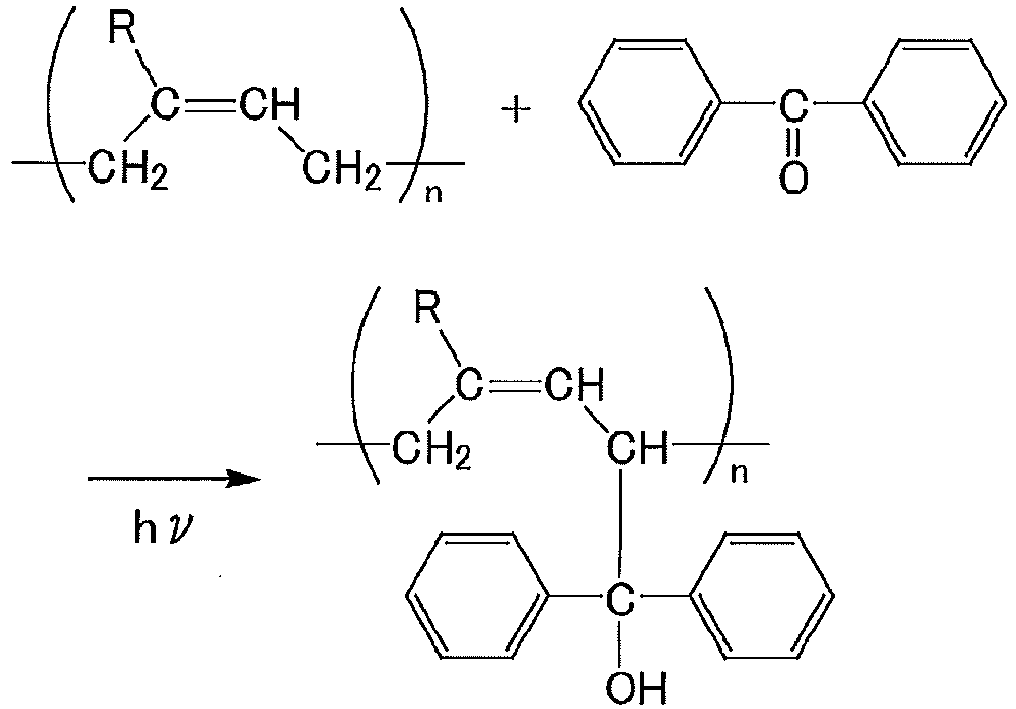
- In particular, the polymerization initiation points are preferably formed by treating the surface of the modification target with the photopolymerization initiator so that the photopolymerization initiator is adsorbed on the surface, and then irradiating the treated surface with LED light having a wavelength of 300 to 400 nm. Particularly preferably, after the surface of the modification target is treated with the benzophenone compound solution so that the photopolymerization initiator is adsorbed, the treated surface is further irradiated with LED light having a wavelength of 300 to 400 nm so that the adsorbed photopolymerization initiator is chemically bonded to the surface. The LED light suitably has a wavelength of 355 to 380 nm.
- The
step 2 includes radically polymerizing a non-functional monomer, starting from the polymerization initiation points, to grow non-functional polymer chains, and then radically polymerizing a fluoropolyether segment-containing functional monomer to grow functional polymer chains. Specifically, a non-functional monomer is first radically polymerized, starting from the polymerization initiation points formed in the step 1, to form non-functional polymer chains. Then, a fluoropolyether segment-containing functional monomer is radically polymerized on the resultant non-functional polymer chains to form functional polymer chains while extending the polymer chains. In this manner, a surface-modified elastic body having a functional polymer layer formed on the outermost surface thereof can be prepared. - The non-functional monomer in the
step 2 refers to a monomer that forms non-functional polymer chains which do not have functions appropriately chosen according to the application or the like. For example, in cases where sliding properties or other functions are intended to be provided to the modification target, the non-functional monomer is one which does not provide such functions, and may be appropriately selected in view of economic efficiency or the like. The fluoropolyether segment-containing functional monomer, on the other hand, may be one with a fluorine-containing polyether group obtained by replacing a part or all of the hydrogen atoms in a polyether group represented by, for example, -(C(R)2O)n-(e.g., an alkylene oxide group) with a halogen atom, and is capable of providing sliding properties or other properties. - The non-functional monomer may be appropriately selected from the above-mentioned standpoint. Examples include acrylic acid, acrylic acid esters such as methyl acrylate or ethyl acrylate, acrylamide, dimethylacrylamide, diethylacrylamide, isopropylacrylamide, hydroxyacrylamide, acryloylmorpholine, acrylic acid alkali metal salts such as sodium acrylate or potassium acrylate, acrylic acid amine salts, methacrylic acid, methacrylic acid esters such as methyl methacrylate or ethyl methacrylate, methacrylamide, methacrylic acid alkali metal salts such as sodium methacrylate or potassium methacrylate, methacrylic acid amine salts, and acrylonitrile. These may be used alone, or two or more thereof may be used in combination.
- The fluoropolyether segment-containing functional monomer is suitably a monomer in which the fluoropolyether segment is a perfluoropolyether segment having at least one of the following units (A) to (D):
- (A): -(CF2O)a-,
- (B) : -(CF2CF2O)b-,
- (C): -(CF2CF2CF2O)c-, and
- (D) : -(CF(CF3)CF2O)d-
- The fluoropolyether segment-containing functional monomer is also suitably a monomer represented by the following formula:

- (A) : -(CF2O)a-,
- (B) : -(CF2CF2O)b-,
- (C): -(CF2CF2CF2O)c-, and
- (D) : -(CF(CF3)CF2O)d-
- In the perfluoropolyether segment having at least one of the units (A) to (D), the a, b, c, and d are each preferably an integer of 2 to 200, more preferably an integer of 4 to 180, and they preferably satisfy the relation: 4 ≤ a + b + c + d ≤ 180.
- The fluoropolyether segment-containing functional monomer is also suitably a monomer represented by the following formula:

- The n102 is preferably an integer of 2 to 80, more preferably an integer of 2 to 20.
- In the
step 2, the non-functional monomer and the fluoropolyether segment-containing functional monomer may each be radically polymerized as follows. The (liquid) non-functional monomer or fluoropolyether segment-containing functional monomer, or a solution thereof is applied (sprayed) to the surface of the modification target to which a benzophenone compound or the like is adsorbed or covalently bonded, or to the modification target on which non-functional polymer chains are formed. Alternatively, the modification target or the modification target on which non-functional polymer chains are formed is immersed in the (liquid) non-functional monomer or fluoropolyether segment-containing functional monomer, or a solution thereof. Then, the modification target is irradiated with light, such as ultraviolet light, to allow the radical polymerization (photoradical polymerization) of the corresponding monomer to proceed. Thus, non-functional polymer chains and functional polymer chains can be grown in this order on the surface of the modification target. In another method, after the application, the surface may be covered with a transparent sheet of glass, PET, polycarbonate, or the like, followed by irradiating the covered surface with light, such as ultraviolet light, to allow the radical polymerization (photoradical polymerization) of the corresponding monomer to proceed. Thus, non-functional polymer chains and functional polymer chains can be grown in this order on the surface of the modification target. - In the
step 2, radical polymerization (photoradical polymerization) is preferably allowed to proceed by irradiating with light the non-functional monomer or fluoropolyether segment-containing functional monomer which contains a reducing agent or an antioxidant added. This is desirable because the reducing agent or antioxidant scavenges oxygen in the system. Regarding the monomer which contains a reducing agent or antioxidant added, these components may be mixed with or separated from each other. Moreover, after the modification target obtained in the step 1 is brought into contact with the non-functional monomer, or after the modification target on which non-functional polymer chains are formed is brought into contact with the fluoropolyether segment-containing functional monomer, a reducing agent or antioxidant may further be added thereto. Alternatively, these components may be mixed together in advance before the material mixture is brought into contact with the modification target or the modification target on which non-functional polymer chains are formed. - Specifically, non-functional polymer chains and functional polymer chains may be sequentially formed by radical polymerization of the respective monomers as follows. For example, a step is performed in which light is irradiated after the modification target obtained in the step 1, on the surface of which polymerization initiation points are formed from the photopolymerization initiator, is brought into contact (e.g., immersion, application) with the (liquid) non-functional monomer or a solution thereof, which contains a solution of a reducing agent or antioxidant added, or after the modification target is brought into contact with the (liquid) non-functional monomer or a solution thereof and then a solution of a reducing agent or antioxidant is put thereon. Then, the modification target on which non-functional polymer chains are formed is subjected to a similar step using the (liquid) fluoropolyether segment-containing functional monomer or a solution thereof, and a solution of a reducing agent or antioxidant.
- For example, in the case of using a fluoropolyether segment-containing functional monomer that has a specific gravity of more than 1 and is not miscible with water, a solution of a reducing agent or antioxidant is located over the (liquid) radically polymerizable monomer or a solution thereof while being separated therefrom.
- The reducing agent or antioxidant is not particularly limited and may be any appropriate compound that functions as such an agent. Examples include vitamins A such as retinol, dehydroretinol, retinol acetate, retinol palmitate, retinal, retinoic acid, and vitamin A oil, and derivatives or salts thereof; carotenoids such as α-carotene, β-carotene, γ-carotene, cryptoxanthin, astaxanthin, and fucoxanthin, and derivatives thereof; vitamins B such as pyridoxine, pyridoxal, pyridoxal-5-phosphate, and pyridoxamine, and derivatives or salts thereof; vitamins C such as ascorbic acid, sodium ascorbate, ascorbyl stearate, ascorbyl palmitate, ascorbyl dipalmitate, and magnesium ascorbyl phosphate, and derivatives or salts thereof; vitamins D such as ergocalciferol, cholecalciferol, and 1,2,5-dihydroxy-cholecalciferol, and derivatives or salts thereof; vitamins E such as α-tocopherol, β-tocopherol, γ-tocopherol, 5-tocopherol, α-tocotrienol, β-tocotrienol, γ-tocotrienol, δ-tocotrienol, tocopherol acetate, and tocopherol nicotinate, and derivatives or salts thereof; trolox and derivatives or salts thereof; dihydroxytoluene, butylhydroxytoluene, butylhydroxyanisole, dibutylhydroxytoluene, α-lipoic acid, dehydrolipoic acid, and glutathione, and derivatives or salts thereof; uric acid, erythorbic acid, and erythorbates such as sodium erythorbate, and derivatives or salts thereof; gallic acid and gallates such as propyl gallate, and derivatives or salts thereof; rutin and rutins such as α-glycosylrutin, and derivatives or salts thereof; tryptophan and derivatives or salts thereof; histidine and derivatives or salts thereof; cysteine derivatives or salts such as N-acetylcysteine, N-acetylhomocysteine, N-octanoylcysteine, and N-acetylcysteine methyl ester; cystine derivatives or salts such as N,N'-diacetylcystine dimethyl ester, N,N'-dioctanoylcystine dimethyl ester, and N,N'-dioctanoylhomocystine dimethyl ester; carnosine and derivatives or salts thereof; homocarnosine and derivatives or salts thereof; anserine and derivatives or salts thereof; carcinine and derivatives or salts thereof; dipeptide or tripeptide derivatives or salts containing histidine and/or tryptophan and/or histamine; flavonoids such as flavanone, flavone, anthocyanin, anthocyanidin, flavonol, quercetin, quercitrin, myricetin, fisetin, hamamelitannin, catechin, epicatechin, gallocatechin, epigallocatechin, epicatechin gallate, and epigallocatechin gallate; tannic acid, caffeic acid, ferulic acid, protocatechuic acid, calcone, oryzanol, carnosol, sesamol, sesamine, sesamolin, zingerone, curcumin, tetrahydrocurcumin, clovamide, deoxyclovamide, shogaol, capsaicine, vanillylamide, ellagic acid, bromphenol, flavoglaucin, melanoidin, riboflavin, riboflavin butyrate, flavin mononucleotide, flavin adenine nucleotide, ubiquinone, ubiquinol, mannitol, bilirubin, cholesterol, ebselen, selenomethionine, ceruloplasmin, transferrin, lactoferrin, albumin, superoxide dismutase, catalase, glutathione peroxidase, metallothionein, and O-phosphono-pyridoxylidene rhodamine. These compounds may be used alone or in combination of two or more.
- Among these, riboflavin, ascorbic acid, α-tocopherol, β-carotene, and uric acid are preferred, and riboflavin and ascorbic acid are particularly preferred, because of their high oxygen-scavenging capability.
- In the case of using a solution of a reducing agent or antioxidant, the concentration of the reducing agent or antioxidant is preferably 10-4 to 1% by mass, more preferably 10-3 to 0.1% by mass.
- Moreover, the amounts of the radically polymerizable monomers may be appropriately set depending on, for example, the length of polymer chain to be formed, or the properties to be provided by the chains. Also, the amount of the reducing agent or antioxidant may be appropriately set in view of the capability of scavenging oxygen in the system, or the like.
- The solvent for application (spraying), the method for application (spraying), the method for immersion, the conditions for irradiation, and the like may be conventionally known materials or methods. The solutions of the radically polymerizable monomers may each be an aqueous solution, or a solution in an organic solvent that does not dissolve the photopolymerization initiator used, e.g., benzophenone compound. Furthermore, the (liquid) radically polymerizable monomers, or a solution thereof may contain a known polymerization inhibitor such as 4-methylphenol.
- In the present invention, the radical polymerization of the non-functional monomer or the fluoropolyether segment-containing functional monomer is allowed to proceed by light irradiation after the application of the (liquid) monomer or a solution thereof or after the immersion in the monomer or a solution thereof. Here, UV light sources with an emission wavelength mainly in the ultraviolet region, such as high-pressure mercury lamps, metal halide lamps, and LED lamps, can be suitably used. The light dose may be appropriately set in view of polymerization time and uniformity of the reaction. Moreover, in order to prevent inhibition of polymerization due to active gas such as oxygen in the reaction container, oxygen is preferably removed from the reaction container and the reaction solution during or before the light irradiation. Thus, for example, a method may appropriately be employed in which an inert gas, such as nitrogen gas or argon gas, is inserted into the reaction container and the reaction solution to discharge active gas such as oxygen from the reaction system and thereby replace the atmosphere in the reaction system with the inert gas. Also, in order to prevent inhibition of the reaction due to oxygen or the like, for example, a measure may appropriately be taken in which a UV light source is disposed so that no air layer (oxygen content: 15% or higher) exists between the reaction container made of glass, plastics or the like and the reaction solution or the modification target.
- In the case of irradiation with ultraviolet light, the ultraviolet light preferably has a wavelength of 300 to 450 nm, more preferably 300 to 400 nm. Such light allows polymer chains to be formed well on the surface of the modification target. The light source may be a high-pressure mercury lamp, an LED with a center wavelength of 365 nm, an LED with a center wavelength of 375 nm, or the like. In particular, preferred is irradiation with LED light having a wavelength of 300 to 400 nm, more preferably LED light having a wavelength of 355 to 380 nm. LEDs or the like which have a center wavelength of 365 nm, which is close to the excitation wavelength 366 nm of benzophenone, are particularly preferred in view of efficiency.
- Moreover, the polymer chains including functional polymer chains formed in the
step 2 provide excellent sliding properties and excellent durability while maintaining good sealing properties. The formed polymer chains preferably each have a polymerization degree of 20 to 200000, more preferably 350 to 50000. - The length of the entire polymer chain, including the non-functional polymer chain and the functional polymer chain, formed in the
step 2, is preferably 10 to 50000 nm, more preferably 100 to 50000 nm. If the length is shorter than 10 nm, good sliding properties tend not to be achieved. If the length is longer than 50000 nm, a further improvement in sliding properties cannot be expected while the cost of raw materials tends to increase due to the use of the expensive monomer. In addition, surface patterns generated by the surface treatment tend to be visible to the naked eyes and thereby spoil the appearance and decrease sealing properties. - Regarding the entire polymer chain formed in the
step 2, the ratio in length of the non-functional polymer chain to the functional polymer chain [(length of non-functional polymer chain):(length of functional polymer chain)] is preferably 50:50 to 99.9:0.1, more preferably 90:10 to 99.5:0.5. If the length of the functional polymer chain is shorter than 0.1%, desired functions may not be provided, while if it exceeds 50%, there tends to be an economic disadvantage. - In the
step 2, two or more types of non-functional monomers may simultaneously be radically polymerized starting from the polymerization initiation points, and two or more types of fluoropolyether segment-containing functional monomers may simultaneously be radically polymerized. Moreover, two or more layers of non-functional or functional polymer chains may be stacked. Furthermore, multiple types of polymer chains may be grown on the surface of the modification target. In the surface modification method of the present invention, the polymer chains may be cross-linked to one another. In this case, the polymer chains may be cross-linked to one another by ionic crosslinking, crosslinking by a hydrophilic group containing an oxygen atom, or crosslinking by a halogen group such as iodine. - The surface modification method may be applied to a rubber vulcanizate or a thermoplastic elastomer to prepare a surface-modified elastic body. For example, surface-modified elastic bodies that are excellent in sliding properties in the presence of water or in a dry state can be prepared. Such surface-modified elastic bodies are also excellent in that they have low friction and low water resistance or drag. Moreover, the method may be applied to at least a part of a three-dimensional solid (e.g. elastic body) to prepare a surface-modified elastic body with modified properties. Furthermore, preferred examples of such surface-modified elastic bodies include polymer brushes. The polymer brush as used herein means an assembly of graft polymer molecules obtained in the "grafting from" approach by surface-initiated living radical polymerization. The graft chains are preferably oriented in a direction substantially vertical to the surface of the modification target because then entropy is reduced and thus the molecular mobility of the graft chains is reduced to provide sliding properties. Moreover, semidilute or concentrated brushes which have a brush density of 0.01 chains/nm2 or higher are preferred.
- Furthermore, the surface modification method may be applied to a rubber vulcanizate or a thermoplastic elastomer to prepare a gasket for syringes at least part of whose surface is modified. Preferably, at least the sliding portion of the surface of the gasket is modified. The entire surface of the gasket may be modified.
-
Fig. 1 is an exemplary side view of an embodiment of a gasket for syringes. A gasket 1 shown inFig. 1 has three circular protrudingportions portions portions bottom surface 13. - Furthermore, if the surface modification method is applied to the grooves formed on the tread of tires for use on vehicles such as passenger cars to create a polymer brush on the grooves, the fluid resistance of the groove surface on wet or snowy roads is reduced, and the contact angle with water is increased. Thus, the abilities to remove and drain water or snow can be enhanced, resulting in improved grip performance.
-
Fig. 2 is an exemplary development view of atread portion 2 of a pneumatic tire (the whole tire is not shown).Fig. 3 is an exemplary A1-A1 cross-sectional view ofFig. 2 . - In
Figs. 2 and3 , alongitudinal center groove 3a (groove depth D1) andlongitudinal shoulder grooves 3b (groove depth D2) are straight grooves linearly extending in the circumferential direction of the tire. Such straight grooves can contribute to low drainage resistance and high drainage performance during straight travelling. - The pneumatic tire also has fine grooves 5 (groove depth D3) extending in the tire circumferential direction on the side of the
longitudinal shoulder groove 3b; beveled intermediate grooves 6 (groove depth D4) extending with an inclination from thefine groove 5 toward thelongitudinal center groove 3a; connecting grooves 7 (groove depth D5) located inward of thefine groove 5 in the axis direction of the tire and connecting the beveledintermediate grooves 6 next to one another in the circumferential direction of the tire;lateral shoulder grooves longitudinal shoulder groove 3b toward the outside of the tire; and the like. These grooves can also contribute to drainage performance. If the method is applied to these grooves, the above-mentioned effects can be achieved. - The following will describe the present invention in more detail referring to non-limiting examples.
- A chlorobutyl rubber (degree of unsaturation: 1 to 2%) containing isoprene units was cross-linked by triazine to prepare a vulcanized rubber gasket (vulcanized at 180°C for 10 minutes), which was then immersed in a 3 wt% acetone solution of benzophenone so that benzophenone was adsorbed onto the surface of the rubber vulcanizate, followed by drying. Then the surface of the vulcanized rubber gasket was irradiated with LED-UV light having a wavelength of 365 nm for 30 minutes to chemically bond benzophenone to the surface. Thereafter, the surface was washed with acetone to remove unreacted benzophenone. The resulting rubber vulcanizate was taken out and dried.
- The dried vulcanized rubber gasket was immersed in an aqueous acrylic acid solution (2.5 M, 18 g of acrylic acid dissolved in 100 mL of water) in a glass reaction container. Then the gasket was irradiated with LED-UV light having a wavelength of 365 nm for 30 minutes to cause radical polymerization and grow non-functional polymer chains (polyacrylic chains) on the surface of the rubber. Then, the surface was washed with water and dried.
- Next, a 20% by mass solution of a fluoropolyether segment-containing functional monomer (DAC-HP produced by Daikin Industries, Ltd.) was applied to the surface of the vulcanized rubber gasket where polyacrylic acid was grown. Then the surface was irradiated with LED-UV light having a wavelength of 365 nm for 10 minutes in an argon gas atmosphere to cause radical polymerization and further grow fluoropolyether segment-containing functional polymer chains on the polyacrylic acid chains (non-functional polymer chains). In this manner, a surface-modified elastic body (a polymer brush layer on the surface) was obtained.
- A surface-modified elastic body was obtained as in Example 1, except that the polymerization time of the functional monomer was changed to 15 minutes.
- A chlorobutyl rubber (degree of unsaturation: 1 to 2%) containing isoprene units was cross-linked by triazine to prepare a rubber vulcanizate (vulcanized at 180°C for 10 minutes), which was then used as it was.
- A surface-modified elastic body was obtained as in Example 1, except that only the fluoropolyether segment-containing functional polymer chains were grown without forming the non-functional polymer chains on the surface of the vulcanized rubber gasket.
- The surface-modified elastic bodies prepared in the examples and comparative examples were evaluated by the methods mentioned below.
- To determine the length of the polymer chain formed on the surface of the rubber vulcanizate, a cross section of the modified rubber having polymer chains formed thereon was measured with an SEM at an accelerating voltage of 15 kV and a magnification of 1000 times. The thickness of the polymer layer photographed was determined and used as the length of the polymer chain.
- To determine the friction resistance of the surface of the surface-modified elastic body, the vulcanized rubber gaskets prepared in the examples and comparative examples were each inserted into a COP resin barrel of a syringe and then pushed towards the end of the barrel (push rate: 30 mm/min) using a tensile tester while friction resistance was measured. The values of the examples are expressed as a friction resistance index using the equation below, with the friction resistance of Comparative Example 1 being set equal to 100. A lower index indicates a lower friction resistance.

[Table 1] Example Comparative Example 1 2 1 2 Length of entire polymer chain (nm) 11500 12000 - 1800 [Non-functional polymer chain]: [Functional polymer chain] (in length) 98:2 97:3 - - Friction resistance index 1.25 1.63 100 60 - The results of Table 1 demonstrate that the surfaces of the surface-modified elastic bodies of the examples exhibited greatly reduced friction resistances and therefore had good sliding properties. In addition, since only the surface was modified, the sealing properties of these surface-modified elastic bodies were similar to Comparative Example 1.
- Thus, when these surface-modified elastic bodies are used as gaskets for syringe plungers, they provide sufficient sealing properties while reducing the friction of the plunger with the syringe barrel, and therefore they enable easy and accurate treatment with syringes. Moreover, since they have a small difference between static and kinetic friction coefficients, the start of pushing the plunger and the subsequent inward movement of the plunger can be smoothly carried out without pulsation. Also, if polymer chains are formed on the inner surface of a syringe barrel made of a thermoplastic elastomer, treatment with the syringe can be readily carried out, similarly as described above.
- Furthermore, the above-mentioned effects can also be expected when polymer chains are formed on the surfaces of the grooves formed on the tread or of the sidewalls of tires for use on vehicles such as passenger cars, on the surfaces of diaphragms, on the sliding surfaces of skis or snowboards, or on the surfaces of swimsuits, road signs, sign boards, or the like.
-
- 1: Gasket
- 11a, 11b, 11c: Circular protruding portion
- 13: Bottom surface
- 2: Tread portion
- 3a: Longitudinal center groove
- 3b: Longitudinal shoulder groove
- 5: Fine groove
- 6: Beveled intermediate groove
- 7: Connecting groove
- 8, 8a, 8b: Lateral shoulder groove
Claims (22)
- A method for surface-modifying a rubber vulcanizate or a thermoplastic elastomer as a target for modification, the method comprising:step 1 of forming polymerization initiation points on a surface of the modification target; andstep 2 of radically polymerizing a non-functional monomer, starting from the polymerization initiation points, to grow non-functional polymer chains, and then radically polymerizing a fluoropolyether segment-containing functional monomer to grow functional polymer chains.
- The method according to claim 1,
wherein the step 1 comprises adsorbing a photopolymerization initiator onto a surface of the modification target, optionally followed by irradiation with LED light having a wavelength of 300 to 400 nm, to form polymerization initiation points from the photopolymerization initiator on the surface. - The method according to claim 1 or 2,
wherein the step 2 comprises radically polymerizing a non-functional monomer, starting from the polymerization initiation points, by irradiation with LED light having a wavelength of 300 to 450 nm to grow non-functional polymer chains, and then radically polymerizing a fluoropolyether segment-containing functional monomer by irradiation with LED light having a wavelength of 300 to 450 nm to grow functional polymer chains. - The method according to any one of claims 1 to 3,
wherein the rubber vulcanizate or thermoplastic elastomer contains an allylic carbon atom which is adjacent to a double bond. - The method according to any one of claims 1 to 4,
wherein the photopolymerization initiator is at least one of a benzophenone compound and a thioxanthone compound. - The method according to any one of claims 1 to 5,
wherein in the step 2, a reducing agent or an antioxidant is added in the radical polymerization of the non-functional monomer and/or of the fluoropolyether segment-containing functional monomer. - The method according to claim 6,
wherein the reducing agent or antioxidant is at least one selected from the group consisting of riboflavin, ascorbic acid, α-tocopherol, β-carotene, and uric acid. - The method according to any one of claims 2 to 7,
wherein the method comprises inserting an inert gas into a reaction container and a reaction solution during or before the light irradiation, and polymerizing the monomer in an atmosphere replaced with the inert gas. - The method according to any one of claims 1 to 8,
wherein the non-functional monomer is at least one selected from the group consisting of acrylic acid, acrylic acid esters, acrylamide, dimethylacrylamide, diethylacrylamide, isopropylacrylamide, hydroxyacrylamide, acryloylmorpholine, acrylic acid alkali metal salts, acrylic acid amine salts, methacrylic acid, methacrylic acid esters, methacrylamide, methacrylic acid alkali metal salts, methacrylic acid amine salts, and acrylonitrile. - The method according to any one of claims 1 to 9,
wherein the fluoropolyether segment in the fluoropolyether segment-containing functional monomer is a perfluoropolyether segment comprising at least one of the following units (A) to (D):(A) : -(CF2O)a-,(B) : -(CF2CF2O)b-,(C) : -(CF2CF2CF2O)c-, and(D) : -(CF(CF3)CF2O)d-
wherein a, b, c, and d each represent 0 or a positive integer and satisfy the relation: 2 ≤ a + b + c + d ≤ 200. - The method according to any one of claims 1 to 9,
wherein the fluoropolyether segment-containing functional monomer is a monomer represented by the following formula: (A) : -(CF2O)a-,(B) : -(CF2CF2O)b-,(C) : -(CF2CF2CF2O)c-, and(D) : -(CF(CF3)CF2O)d-wherein a, b, c, and d each represent 0 or a positive integer and satisfy the relation: 2 ≤ a + b + c + d ≤ 200.
 - The method according to any one of claims 1 to 9,
wherein the fluoropolyether segment-containing functional monomer is a monomer represented by the following formula:
- The method according to any one of claims 1 to 12,
wherein the (liquid) monomer or a solution thereof contains a polymerization inhibitor, and is polymerized in the presence of the polymerization inhibitor. - The method according to claim 13,
wherein the polymerization inhibitor is 4-methylphenol. - The method according to any one of claims 1 to 14,
wherein a length of the entire polymer chain, including the non-functional polymer chain and the functional polymer chain, is 10 to 50000 nm. - The method according to any one of claims 1 to 15,
wherein a ratio in length of the non-functional polymer chain to the functional polymer chain is 50:50 to 99.9:0.1. - A surface-modified elastic body, which is obtained by the method according to any one of claims 1 to 16.
- A surface-modified elastic body, which is obtained by the method according to any one of claims 1 to 16, the elastic body being required to have sliding properties, low friction, or low water resistance in the presence of water or in a dry state.
- A surface-modified elastic body, comprising a three-dimensional solid at least part of whose surface is modified by the method according to any one of claims 1 to 16.
- The surface-modified elastic body according to any one of claims 17 to 19, which comprises a polymer brush.
- A gasket for syringes, at least part of whose surface is modified by the method according to any one of claims 1 to 16.
- A tire, at least part of whose groove surface is modified by the method according to any one of claims 1 to 16.
Applications Claiming Priority (2)
| Application Number | Priority Date | Filing Date | Title |
|---|---|---|---|
| JP2012254328A JP5620456B2 (en) | 2012-11-20 | 2012-11-20 | Surface modification method and surface modified elastic body |
| PCT/JP2013/081090 WO2014080873A1 (en) | 2012-11-20 | 2013-11-19 | Surface modification method and surface-modified elastic body |
Publications (3)
| Publication Number | Publication Date |
|---|---|
| EP2915838A1 true EP2915838A1 (en) | 2015-09-09 |
| EP2915838A4 EP2915838A4 (en) | 2016-07-27 |
| EP2915838B1 EP2915838B1 (en) | 2019-01-09 |
Family
ID=50776055
Family Applications (1)
| Application Number | Title | Priority Date | Filing Date |
|---|---|---|---|
| EP13857067.6A Not-in-force EP2915838B1 (en) | 2012-11-20 | 2013-11-19 | Surface modification method and surface-modified elastic body |
Country Status (5)
| Country | Link |
|---|---|
| US (1) | US9758605B2 (en) |
| EP (1) | EP2915838B1 (en) |
| JP (1) | JP5620456B2 (en) |
| CN (1) | CN104769026B (en) |
| WO (1) | WO2014080873A1 (en) |
Cited By (1)
| Publication number | Priority date | Publication date | Assignee | Title |
|---|---|---|---|---|
| EP2752436B1 (en) | 2013-01-07 | 2015-07-29 | Sumitomo Rubber Industries, Ltd. | Surface modification method and surface-modified elastic body |
Families Citing this family (15)
| Publication number | Priority date | Publication date | Assignee | Title |
|---|---|---|---|---|
| CN104583286B (en) | 2012-09-10 | 2018-09-11 | 住友橡胶工业株式会社 | Surface modifying method and surface modified elastic body |
| JP5816222B2 (en) | 2013-04-25 | 2015-11-18 | 住友ゴム工業株式会社 | Surface modification method and surface modified elastic body |
| US10647829B2 (en) | 2013-06-20 | 2020-05-12 | Sumitomo Rubber Industries, Ltd. | Surface modification method and surface modification body |
| JP5820489B2 (en) * | 2014-01-06 | 2015-11-24 | 住友ゴム工業株式会社 | Surface modification method and surface modified elastic body |
| JP6352706B2 (en) * | 2014-07-04 | 2018-07-04 | 住友ゴム工業株式会社 | Surface modification method and surface modified elastic body |
| JP6259392B2 (en) | 2014-12-26 | 2018-01-10 | 住友ゴム工業株式会社 | Surface-modified rubber or surface-modified thermoplastic elastomer and method for modifying the surface of rubber or thermoplastic elastomer |
| JP6551022B2 (en) | 2015-08-03 | 2019-07-31 | 住友ゴム工業株式会社 | Surface modification method and surface modified body |
| JP6613692B2 (en) | 2015-08-03 | 2019-12-04 | 住友ゴム工業株式会社 | Surface modification method and surface modified elastic body |
| CN109415643A (en) * | 2016-03-31 | 2019-03-01 | 国立大学法人京都大学 | Lubriation material and SRT material |
| JP2018023467A (en) * | 2016-08-08 | 2018-02-15 | 住友ゴム工業株式会社 | gasket |
| EP3753986A4 (en) | 2018-02-13 | 2021-12-15 | Sumitomo Chemical Company Limited | COMPOSITION, AND MOLDED BODY |
| WO2021193349A1 (en) | 2020-03-24 | 2021-09-30 | 住友化学株式会社 | Hydrophilic oil repellent polymer |
| US20220081534A1 (en) * | 2020-09-14 | 2022-03-17 | The Goodyear Tire & Rubber Company | Pneumatic tire with plant based antioxidant |
| EP4578894A1 (en) | 2022-08-26 | 2025-07-02 | Sumitomo Chemical Company, Limited | Hydrophilic oil repellent polymer |
| JPWO2024043327A1 (en) | 2022-08-26 | 2024-02-29 |
Family Cites Families (94)
| Publication number | Priority date | Publication date | Assignee | Title |
|---|---|---|---|---|
| GB1120804A (en) * | 1965-01-13 | 1968-07-24 | Richard George Christopher Jen | Method of reducing the coefficient of friction of elastomer surfaces |
| US3418066A (en) | 1966-11-08 | 1968-12-24 | Eastman Kodak Co | Surface oxidation and treatment of polymers |
| US5154727A (en) | 1981-01-07 | 1992-10-13 | Intera Corporation | Process for improving polymer fiber properties and fibers produced thereby |
| JPS61209667A (en) | 1985-03-13 | 1986-09-17 | 株式会社 日本メデイカル・サプライ | Syringe excellent in slidability |
| JPH084618B2 (en) | 1985-10-14 | 1996-01-24 | 義人 筏 | Manufacturing method of antithrombogenic material |
| JPS6392658A (en) | 1986-10-07 | 1988-04-23 | Bio Material Yunibaasu:Kk | Radical polymerization method in the presence of dissolved air oxygen to modify surface of high-molecular material |
| US5100689A (en) | 1987-04-10 | 1992-03-31 | University Of Florida | Surface modified surgical instruments, devices, implants, contact lenses and the like |
| JPH07100744B2 (en) | 1990-11-30 | 1995-11-01 | テルモ株式会社 | Medical device having surface lubricity when wet and method for producing the same |
| JP3192680B2 (en) * | 1991-04-26 | 2001-07-30 | 旭硝子株式会社 | Method of coating substrate |
| JPH0543634A (en) | 1991-06-06 | 1993-02-23 | Takeda Chem Ind Ltd | Graft polymer |
| GB9118597D0 (en) | 1991-08-30 | 1991-10-16 | Biocompatibles Ltd | Polymer treatments |
| JPH081793A (en) | 1991-11-26 | 1996-01-09 | Polytec Design:Kk | Method for curing molded rubber using photopolymerizable substance |
| JPH0780295B2 (en) | 1991-12-26 | 1995-08-30 | 住友ゴム工業株式会社 | Offset blanket for printing |
| JPH0625450A (en) * | 1992-03-11 | 1994-02-01 | Sumitomo Rubber Ind Ltd | Surface-modified rubber product and manufacturing method thereof |
| DE4208793A1 (en) | 1992-03-19 | 1993-09-23 | Bayer Ag | POLYMER RESINS AND THEIR USE |
| US5414075A (en) | 1992-11-06 | 1995-05-09 | Bsi Corporation | Restrained multifunctional reagent for surface modification |
| DE19709075A1 (en) * | 1997-03-06 | 1998-09-10 | Huels Chemische Werke Ag | Process for the production of antimicrobial plastics |
| US5688252A (en) | 1994-09-30 | 1997-11-18 | Takeda Chemical Industries, Ltd. | Syringe |
| JP3658806B2 (en) * | 1995-07-20 | 2005-06-08 | 大日本インキ化学工業株式会社 | UV curable composition |
| JPH0967457A (en) | 1995-08-31 | 1997-03-11 | Kureha Elastomer Kk | Production of hydrophilic silicone rubber film |
| JPH09108359A (en) | 1995-10-16 | 1997-04-28 | Terumo Corp | Catheter |
| JPH09313594A (en) | 1996-05-30 | 1997-12-09 | Terumo Corp | Catheter and manufacturing method thereof |
| KR100488225B1 (en) | 1996-09-04 | 2005-06-16 | 도요 잉키 세이조 가부시끼가이샤 | Electron beam irradiating method and object to be irradiated with electron beam |
| JP3141790B2 (en) | 1996-09-20 | 2001-03-05 | 東洋インキ製造株式会社 | Active energy ray irradiation method and active energy ray irradiated object |
| US5855623A (en) | 1996-09-20 | 1999-01-05 | Intera Technologies, Inc. | Process for improving polyamide, acrylic, aramid, cellulosic and polyester properties, and modified polymers produced thereby |
| US5885566A (en) | 1996-09-25 | 1999-03-23 | University Of Florida | Surface modified surgical instruments, medical devices, implants, contact lenses and the like |
| DE59800682D1 (en) * | 1997-04-14 | 2001-06-13 | Degussa | Process for modifying the surface of polymer substrates by graft polymerization |
| GB2325467B (en) | 1997-05-21 | 2000-11-01 | Dainippon Ink & Chemicals | Process for producing material with hydrophilic surface |
| JPH11192305A (en) | 1997-12-26 | 1999-07-21 | Nippon Zeon Co Ltd | Balloon catheter and method of manufacturing the same |
| US6228172B1 (en) | 1998-10-29 | 2001-05-08 | The Boc Group Plc | Tumble coating |
| JP2000273229A (en) | 1999-03-25 | 2000-10-03 | Nitto Denko Corp | Method for producing hydrophilized hydrophobic substrate |
| DE19921900A1 (en) | 1999-05-12 | 2000-11-16 | Creavis Tech & Innovation Gmbh | Preparation of antimicrobial polymer for medical and hygiene articles, varnishes, paints and coatings comprises polymerizing monomers that have been functionalized by a sec. amino group |
| JP4292634B2 (en) | 1999-07-21 | 2009-07-08 | 凸版印刷株式会社 | Method for manufacturing antireflection laminate |
| JP2001046956A (en) | 1999-08-10 | 2001-02-20 | Dainippon Ink & Chem Inc | Cured film forming method and cured film coated product |
| US6358557B1 (en) | 1999-09-10 | 2002-03-19 | Sts Biopolymers, Inc. | Graft polymerization of substrate surfaces |
| JP2001095621A (en) | 1999-09-29 | 2001-04-10 | Nishikawa Rubber Co Ltd | Surface treatment method for cosmetic applicator |
| JP3945982B2 (en) | 2000-11-13 | 2007-07-18 | 独立行政法人科学技術振興機構 | Nanostructured functional body |
| AU2002235694B2 (en) | 2001-02-28 | 2007-06-14 | Covalon Technologies Inc. | Method of making anti-microbial polymeric surfaces |
| WO2002081561A1 (en) | 2001-04-04 | 2002-10-17 | Kaneka Corporation | Thermoplastic resin composition and elastomer composition |
| JP4671214B2 (en) | 2001-06-20 | 2011-04-13 | 藤倉ゴム工業株式会社 | Rubber surface modification method |
| US7348055B2 (en) | 2001-12-21 | 2008-03-25 | Surmodics, Inc. | Reagent and method for providing coatings on surfaces |
| ATE348643T1 (en) | 2002-02-15 | 2007-01-15 | Cv Therapeutics Inc | POLYMER COATING FOR MEDICAL DEVICES |
| US7008979B2 (en) | 2002-04-30 | 2006-03-07 | Hydromer, Inc. | Coating composition for multiple hydrophilic applications |
| EP1382628A1 (en) | 2002-07-16 | 2004-01-21 | Polyganics B.V. | Biodegradable phase separated segmented/block co-polyesters |
| JP2004298220A (en) | 2003-03-28 | 2004-10-28 | Terumo Corp | Prefilled syringe |
| DE10331450A1 (en) | 2003-07-10 | 2005-01-27 | Basf Ag | (Meth) acrylic esters of monoalkoxylated polyols and their preparation |
| US6995222B2 (en) * | 2003-12-17 | 2006-02-07 | 3M Innovative Properties Company | Coating compositions with reactive fluorinated copolymers having pendant perfluoropolyether groups |
| JP2005253538A (en) | 2004-03-09 | 2005-09-22 | Sekisui Chem Co Ltd | Vacuum blood collection tube |
| JP4523532B2 (en) | 2004-10-07 | 2010-08-11 | 株式会社リコー | Electrophotographic photoreceptor, image forming method, image forming apparatus, and process cartridge |
| JP3742647B2 (en) | 2005-03-23 | 2006-02-08 | 積水化学工業株式会社 | Substrate surface treatment method |
| US7691282B2 (en) * | 2005-09-08 | 2010-04-06 | 3M Innovative Properties Company | Hydrofluoroether compounds and processes for their preparation and use |
| JP2007077286A (en) | 2005-09-14 | 2007-03-29 | Mitsubishi Cable Ind Ltd | Surface modification method for fluorine-containing elastomer, fluorine-containing elastomer surface-modified by the method, and sealing material and seal using the surface-modified fluorine-containing elastomer |
| JP2007119563A (en) | 2005-10-27 | 2007-05-17 | Kaneka Corp | Fluorine-containing (meth)acrylic ester polymer and its manufacturing method |
| JP4496434B2 (en) | 2005-11-24 | 2010-07-07 | 信越化学工業株式会社 | Polyfunctional (meth) acrylate compound, photocurable resin composition and article |
| US8133580B2 (en) | 2005-12-09 | 2012-03-13 | Dsm Ip Assets B.V. | Coating composition for a urinary catheter |
| WO2007078819A2 (en) | 2005-12-16 | 2007-07-12 | Arkema Inc. | Low surface energy block co-polymer preparation methods and applications |
| JP5163872B2 (en) | 2005-12-22 | 2013-03-13 | ジェイエスアール クレイトン エラストマー株式会社 | Elastomer structure and photosensitive composition using the same |
| JP2008024091A (en) | 2006-07-19 | 2008-02-07 | Mitsuba Corp | Surface-modified blade rubber, wiper device, and blade rubber surface modification method |
| EP1918307A3 (en) | 2006-10-30 | 2010-01-20 | The Yokohama Rubber Co., Ltd. | Thermoplastic elastomer and thermoplastic elastomer composition |
| JP2009138169A (en) | 2007-12-06 | 2009-06-25 | Sunrise Msi Corp | Ultraviolet-curable adhesive composition |
| JP4912344B2 (en) | 2008-03-21 | 2012-04-11 | 富士フイルム株式会社 | Barrier laminate and production method thereof, barrier film substrate, device and optical member |
| JP2009227842A (en) | 2008-03-24 | 2009-10-08 | Sekisui Plastics Co Ltd | Method for producing polymer gel |
| WO2009124034A1 (en) | 2008-04-01 | 2009-10-08 | The Government Of The United States Of America, As Represented By The Secretary Of The Air Force | Layers durably bonded to surfaces |
| EP2276754B1 (en) | 2008-04-17 | 2014-12-03 | Basf Se | Stabilization and surface modification of organic materials |
| JP2010023710A (en) | 2008-07-22 | 2010-02-04 | Mitsuba Corp | Manufacturing method of blade rubber and wiper blade |
| JP5566906B2 (en) | 2008-11-21 | 2014-08-06 | 京セラメディカル株式会社 | Graft polymerization method and product thereof |
| JP2010142573A (en) | 2008-12-22 | 2010-07-01 | Coki Engineering Inc | Gasket for syringe, method for manufacturing the same, and prefilled syringe using the gasket |
| JP2010142537A (en) | 2008-12-22 | 2010-07-01 | Yoshinari Umemura | Surgical guide for dental implant operation |
| JP5265335B2 (en) | 2008-12-24 | 2013-08-14 | ディーエイチ・マテリアル株式会社 | Radical polymerizable composition |
| JP5577502B2 (en) | 2009-03-16 | 2014-08-27 | 富山県 | Functional microchip and manufacturing method thereof |
| WO2010131652A1 (en) * | 2009-05-12 | 2010-11-18 | ダイキン工業株式会社 | Transfer sheet and process for producing same |
| CN101565489B (en) | 2009-06-02 | 2011-05-11 | 中山大学 | Preparation method of polystyrene with thermo-sensitive surface |
| JP5526321B2 (en) | 2009-08-24 | 2014-06-18 | 独立行政法人 宇宙航空研究開発機構 | Curable composition for outer space, cured product for outer space, and composite film for outer space |
| US8299139B1 (en) | 2009-09-08 | 2012-10-30 | Ovation Polymer Technology And Engineered Materials, Inc. | Process and reactor for synthesis of ultra-high molecular weight acrylic polymers |
| JP5503239B2 (en) | 2009-09-25 | 2014-05-28 | 株式会社朝日Fr研究所 | Method for forming slidable coating on syringe gasket, gasket for syringe having slidable coating, and prefilled syringe |
| EP2483358B1 (en) | 2009-09-29 | 2014-12-10 | Covalon Technologies Inc. | System and method for coating medical devices |
| JP5477071B2 (en) | 2010-03-12 | 2014-04-23 | ニプロ株式会社 | Medical device with lubricity when wet |
| JP4941794B2 (en) | 2010-03-12 | 2012-05-30 | 等 金澤 | Medical equipment |
| JP5418321B2 (en) | 2010-03-12 | 2014-02-19 | 株式会社豊田自動織機 | Vehicle member and manufacturing method thereof |
| JP2011219520A (en) | 2010-04-05 | 2011-11-04 | Yokohama Rubber Co Ltd:The | Method for producing surface-modified rubber molded product |
| US20120021151A1 (en) | 2010-04-15 | 2012-01-26 | Tatarka Paul D | Transparent, Flexible Products Made With Partially Crystalline Cycloolefin Elastomer |
| JP5477160B2 (en) * | 2010-05-20 | 2014-04-23 | 信越化学工業株式会社 | Fluorine-containing (meth) acryl-modified organosilicon compound and curable composition containing the same |
| JP6474540B2 (en) | 2010-11-17 | 2019-02-27 | 国立大学法人山形大学 | Cell separation method for separating cells from solution, hydrating composition for cell adsorption, and cell separation system |
| JP5688100B2 (en) * | 2010-12-27 | 2015-03-25 | 住友ゴム工業株式会社 | Surface modification method, surface modified elastic body, gasket for syringe, syringe and tire |
| JP5634287B2 (en) * | 2011-02-07 | 2014-12-03 | Dicグラフィックス株式会社 | UV light emitting diode curable ink |
| EP2716669B1 (en) | 2011-06-03 | 2018-11-07 | Sumitomo Rubber Industries, Ltd. | Tire and gasket for syringes |
| JP5763564B2 (en) | 2012-02-01 | 2015-08-12 | 住友ゴム工業株式会社 | Surface modification method and surface modified elastic body |
| JP5763565B2 (en) | 2012-02-02 | 2015-08-12 | 住友ゴム工業株式会社 | Surface modification method and surface modified elastic body |
| JP5945927B2 (en) | 2012-03-30 | 2016-07-05 | 大日本印刷株式会社 | Method for producing protective layer transfer sheet |
| JP2013237802A (en) | 2012-05-16 | 2013-11-28 | Sumitomo Rubber Ind Ltd | Surface modification method and surface-modified elastic body |
| JP5812935B2 (en) | 2012-05-16 | 2015-11-17 | 住友ゴム工業株式会社 | Surface modification method and surface modified elastic body |
| JP6063167B2 (en) | 2012-08-02 | 2017-01-18 | 住友ゴム工業株式会社 | Surface modification method and surface modified elastic body |
| CN104583286B (en) * | 2012-09-10 | 2018-09-11 | 住友橡胶工业株式会社 | Surface modifying method and surface modified elastic body |
| JP5816222B2 (en) | 2013-04-25 | 2015-11-18 | 住友ゴム工業株式会社 | Surface modification method and surface modified elastic body |
-
2012
- 2012-11-20 JP JP2012254328A patent/JP5620456B2/en not_active Expired - Fee Related
-
2013
- 2013-11-19 EP EP13857067.6A patent/EP2915838B1/en not_active Not-in-force
- 2013-11-19 US US14/437,584 patent/US9758605B2/en not_active Expired - Fee Related
- 2013-11-19 CN CN201380058107.5A patent/CN104769026B/en not_active Expired - Fee Related
- 2013-11-19 WO PCT/JP2013/081090 patent/WO2014080873A1/en not_active Ceased
Cited By (1)
| Publication number | Priority date | Publication date | Assignee | Title |
|---|---|---|---|---|
| EP2752436B1 (en) | 2013-01-07 | 2015-07-29 | Sumitomo Rubber Industries, Ltd. | Surface modification method and surface-modified elastic body |
Also Published As
| Publication number | Publication date |
|---|---|
| US20150284487A1 (en) | 2015-10-08 |
| US9758605B2 (en) | 2017-09-12 |
| EP2915838B1 (en) | 2019-01-09 |
| WO2014080873A1 (en) | 2014-05-30 |
| EP2915838A4 (en) | 2016-07-27 |
| JP2014101451A (en) | 2014-06-05 |
| CN104769026A (en) | 2015-07-08 |
| CN104769026B (en) | 2018-09-18 |
| JP5620456B2 (en) | 2014-11-05 |
Similar Documents
| Publication | Publication Date | Title |
|---|---|---|
| EP2915838B1 (en) | Surface modification method and surface-modified elastic body | |
| EP2894191B1 (en) | Surface modification method and surface-modified elastic body | |
| EP2664627B1 (en) | Surface modification method and surface-modified elastic body | |
| US9321872B2 (en) | Surface modification method and surface-modified elastic body | |
| EP2752436B1 (en) | Surface modification method and surface-modified elastic body | |
| JP5763564B2 (en) | Surface modification method and surface modified elastic body | |
| EP2743294B1 (en) | Surface-modified elastic body | |
| JP2013237802A (en) | Surface modification method and surface-modified elastic body | |
| EP3070117B1 (en) | Surface modification method and surface-modified elastic object | |
| JP5763563B2 (en) | Surface modification method and surface modified elastic body | |
| JP6181710B2 (en) | Catheter manufacturing method | |
| JP6352706B2 (en) | Surface modification method and surface modified elastic body |
Legal Events
| Date | Code | Title | Description |
|---|---|---|---|
| PUAI | Public reference made under article 153(3) epc to a published international application that has entered the european phase |
Free format text: ORIGINAL CODE: 0009012 |
|
| 17P | Request for examination filed |
Effective date: 20150603 |
|
| AK | Designated contracting states |
Kind code of ref document: A1 Designated state(s): AL AT BE BG CH CY CZ DE DK EE ES FI FR GB GR HR HU IE IS IT LI LT LU LV MC MK MT NL NO PL PT RO RS SE SI SK SM TR |
|
| AX | Request for extension of the european patent |
Extension state: BA ME |
|
| DAX | Request for extension of the european patent (deleted) | ||
| RA4 | Supplementary search report drawn up and despatched (corrected) |
Effective date: 20160627 |
|
| RIC1 | Information provided on ipc code assigned before grant |
Ipc: A61M 5/315 20060101ALI20160621BHEP Ipc: C08F 136/16 20060101ALI20160621BHEP Ipc: A61M 5/28 20060101ALI20160621BHEP Ipc: C08L 101/00 20060101ALI20160621BHEP Ipc: C08L 27/12 20060101ALI20160621BHEP Ipc: B60C 1/00 20060101ALI20160621BHEP Ipc: C08J 7/18 20060101ALI20160621BHEP Ipc: C08J 7/16 20060101AFI20160621BHEP |
|
| GRAP | Despatch of communication of intention to grant a patent |
Free format text: ORIGINAL CODE: EPIDOSNIGR1 |
|
| STAA | Information on the status of an ep patent application or granted ep patent |
Free format text: STATUS: GRANT OF PATENT IS INTENDED |
|
| INTG | Intention to grant announced |
Effective date: 20180528 |
|
| GRAS | Grant fee paid |
Free format text: ORIGINAL CODE: EPIDOSNIGR3 |
|
| GRAA | (expected) grant |
Free format text: ORIGINAL CODE: 0009210 |
|
| STAA | Information on the status of an ep patent application or granted ep patent |
Free format text: STATUS: THE PATENT HAS BEEN GRANTED |
|
| AK | Designated contracting states |
Kind code of ref document: B1 Designated state(s): AL AT BE BG CH CY CZ DE DK EE ES FI FR GB GR HR HU IE IS IT LI LT LU LV MC MK MT NL NO PL PT RO RS SE SI SK SM TR |
|
| REG | Reference to a national code |
Ref country code: GB Ref legal event code: FG4D |
|
| REG | Reference to a national code |
Ref country code: CH Ref legal event code: EP Ref country code: AT Ref legal event code: REF Ref document number: 1087211 Country of ref document: AT Kind code of ref document: T Effective date: 20190115 |
|
| REG | Reference to a national code |
Ref country code: DE Ref legal event code: R096 Ref document number: 602013049717 Country of ref document: DE |
|
| REG | Reference to a national code |
Ref country code: IE Ref legal event code: FG4D |
|
| REG | Reference to a national code |
Ref country code: NL Ref legal event code: MP Effective date: 20190109 |
|
| REG | Reference to a national code |
Ref country code: LT Ref legal event code: MG4D |
|
| PG25 | Lapsed in a contracting state [announced via postgrant information from national office to epo] |
Ref country code: NL Free format text: LAPSE BECAUSE OF FAILURE TO SUBMIT A TRANSLATION OF THE DESCRIPTION OR TO PAY THE FEE WITHIN THE PRESCRIBED TIME-LIMIT Effective date: 20190109 |
|
| REG | Reference to a national code |
Ref country code: AT Ref legal event code: MK05 Ref document number: 1087211 Country of ref document: AT Kind code of ref document: T Effective date: 20190109 |
|
| PG25 | Lapsed in a contracting state [announced via postgrant information from national office to epo] |
Ref country code: FI Free format text: LAPSE BECAUSE OF FAILURE TO SUBMIT A TRANSLATION OF THE DESCRIPTION OR TO PAY THE FEE WITHIN THE PRESCRIBED TIME-LIMIT Effective date: 20190109 Ref country code: LT Free format text: LAPSE BECAUSE OF FAILURE TO SUBMIT A TRANSLATION OF THE DESCRIPTION OR TO PAY THE FEE WITHIN THE PRESCRIBED TIME-LIMIT Effective date: 20190109 Ref country code: SE Free format text: LAPSE BECAUSE OF FAILURE TO SUBMIT A TRANSLATION OF THE DESCRIPTION OR TO PAY THE FEE WITHIN THE PRESCRIBED TIME-LIMIT Effective date: 20190109 Ref country code: PT Free format text: LAPSE BECAUSE OF FAILURE TO SUBMIT A TRANSLATION OF THE DESCRIPTION OR TO PAY THE FEE WITHIN THE PRESCRIBED TIME-LIMIT Effective date: 20190509 Ref country code: NO Free format text: LAPSE BECAUSE OF FAILURE TO SUBMIT A TRANSLATION OF THE DESCRIPTION OR TO PAY THE FEE WITHIN THE PRESCRIBED TIME-LIMIT Effective date: 20190409 Ref country code: ES Free format text: LAPSE BECAUSE OF FAILURE TO SUBMIT A TRANSLATION OF THE DESCRIPTION OR TO PAY THE FEE WITHIN THE PRESCRIBED TIME-LIMIT Effective date: 20190109 Ref country code: PL Free format text: LAPSE BECAUSE OF FAILURE TO SUBMIT A TRANSLATION OF THE DESCRIPTION OR TO PAY THE FEE WITHIN THE PRESCRIBED TIME-LIMIT Effective date: 20190109 |
|
| PG25 | Lapsed in a contracting state [announced via postgrant information from national office to epo] |
Ref country code: RS Free format text: LAPSE BECAUSE OF FAILURE TO SUBMIT A TRANSLATION OF THE DESCRIPTION OR TO PAY THE FEE WITHIN THE PRESCRIBED TIME-LIMIT Effective date: 20190109 Ref country code: LV Free format text: LAPSE BECAUSE OF FAILURE TO SUBMIT A TRANSLATION OF THE DESCRIPTION OR TO PAY THE FEE WITHIN THE PRESCRIBED TIME-LIMIT Effective date: 20190109 Ref country code: IS Free format text: LAPSE BECAUSE OF FAILURE TO SUBMIT A TRANSLATION OF THE DESCRIPTION OR TO PAY THE FEE WITHIN THE PRESCRIBED TIME-LIMIT Effective date: 20190509 Ref country code: HR Free format text: LAPSE BECAUSE OF FAILURE TO SUBMIT A TRANSLATION OF THE DESCRIPTION OR TO PAY THE FEE WITHIN THE PRESCRIBED TIME-LIMIT Effective date: 20190109 Ref country code: BG Free format text: LAPSE BECAUSE OF FAILURE TO SUBMIT A TRANSLATION OF THE DESCRIPTION OR TO PAY THE FEE WITHIN THE PRESCRIBED TIME-LIMIT Effective date: 20190409 Ref country code: GR Free format text: LAPSE BECAUSE OF FAILURE TO SUBMIT A TRANSLATION OF THE DESCRIPTION OR TO PAY THE FEE WITHIN THE PRESCRIBED TIME-LIMIT Effective date: 20190410 |
|
| REG | Reference to a national code |
Ref country code: DE Ref legal event code: R097 Ref document number: 602013049717 Country of ref document: DE |
|
| PG25 | Lapsed in a contracting state [announced via postgrant information from national office to epo] |
Ref country code: EE Free format text: LAPSE BECAUSE OF FAILURE TO SUBMIT A TRANSLATION OF THE DESCRIPTION OR TO PAY THE FEE WITHIN THE PRESCRIBED TIME-LIMIT Effective date: 20190109 Ref country code: AT Free format text: LAPSE BECAUSE OF FAILURE TO SUBMIT A TRANSLATION OF THE DESCRIPTION OR TO PAY THE FEE WITHIN THE PRESCRIBED TIME-LIMIT Effective date: 20190109 Ref country code: RO Free format text: LAPSE BECAUSE OF FAILURE TO SUBMIT A TRANSLATION OF THE DESCRIPTION OR TO PAY THE FEE WITHIN THE PRESCRIBED TIME-LIMIT Effective date: 20190109 Ref country code: CZ Free format text: LAPSE BECAUSE OF FAILURE TO SUBMIT A TRANSLATION OF THE DESCRIPTION OR TO PAY THE FEE WITHIN THE PRESCRIBED TIME-LIMIT Effective date: 20190109 Ref country code: AL Free format text: LAPSE BECAUSE OF FAILURE TO SUBMIT A TRANSLATION OF THE DESCRIPTION OR TO PAY THE FEE WITHIN THE PRESCRIBED TIME-LIMIT Effective date: 20190109 Ref country code: IT Free format text: LAPSE BECAUSE OF FAILURE TO SUBMIT A TRANSLATION OF THE DESCRIPTION OR TO PAY THE FEE WITHIN THE PRESCRIBED TIME-LIMIT Effective date: 20190109 Ref country code: SK Free format text: LAPSE BECAUSE OF FAILURE TO SUBMIT A TRANSLATION OF THE DESCRIPTION OR TO PAY THE FEE WITHIN THE PRESCRIBED TIME-LIMIT Effective date: 20190109 Ref country code: DK Free format text: LAPSE BECAUSE OF FAILURE TO SUBMIT A TRANSLATION OF THE DESCRIPTION OR TO PAY THE FEE WITHIN THE PRESCRIBED TIME-LIMIT Effective date: 20190109 |
|
| PLBE | No opposition filed within time limit |
Free format text: ORIGINAL CODE: 0009261 |
|
| STAA | Information on the status of an ep patent application or granted ep patent |
Free format text: STATUS: NO OPPOSITION FILED WITHIN TIME LIMIT |
|
| PG25 | Lapsed in a contracting state [announced via postgrant information from national office to epo] |
Ref country code: SM Free format text: LAPSE BECAUSE OF FAILURE TO SUBMIT A TRANSLATION OF THE DESCRIPTION OR TO PAY THE FEE WITHIN THE PRESCRIBED TIME-LIMIT Effective date: 20190109 |
|
| 26N | No opposition filed |
Effective date: 20191010 |
|
| PG25 | Lapsed in a contracting state [announced via postgrant information from national office to epo] |
Ref country code: SI Free format text: LAPSE BECAUSE OF FAILURE TO SUBMIT A TRANSLATION OF THE DESCRIPTION OR TO PAY THE FEE WITHIN THE PRESCRIBED TIME-LIMIT Effective date: 20190109 |
|
| PG25 | Lapsed in a contracting state [announced via postgrant information from national office to epo] |
Ref country code: TR Free format text: LAPSE BECAUSE OF FAILURE TO SUBMIT A TRANSLATION OF THE DESCRIPTION OR TO PAY THE FEE WITHIN THE PRESCRIBED TIME-LIMIT Effective date: 20190109 |
|
| REG | Reference to a national code |
Ref country code: DE Ref legal event code: R119 Ref document number: 602013049717 Country of ref document: DE |
|
| REG | Reference to a national code |
Ref country code: CH Ref legal event code: PL |
|
| PG25 | Lapsed in a contracting state [announced via postgrant information from national office to epo] |
Ref country code: MC Free format text: LAPSE BECAUSE OF FAILURE TO SUBMIT A TRANSLATION OF THE DESCRIPTION OR TO PAY THE FEE WITHIN THE PRESCRIBED TIME-LIMIT Effective date: 20190109 Ref country code: LU Free format text: LAPSE BECAUSE OF NON-PAYMENT OF DUE FEES Effective date: 20191119 Ref country code: CH Free format text: LAPSE BECAUSE OF NON-PAYMENT OF DUE FEES Effective date: 20191130 Ref country code: LI Free format text: LAPSE BECAUSE OF NON-PAYMENT OF DUE FEES Effective date: 20191130 |
|
| REG | Reference to a national code |
Ref country code: BE Ref legal event code: MM Effective date: 20191130 |
|
| GBPC | Gb: european patent ceased through non-payment of renewal fee |
Effective date: 20191119 |
|
| PG25 | Lapsed in a contracting state [announced via postgrant information from national office to epo] |
Ref country code: IE Free format text: LAPSE BECAUSE OF NON-PAYMENT OF DUE FEES Effective date: 20191119 Ref country code: GB Free format text: LAPSE BECAUSE OF NON-PAYMENT OF DUE FEES Effective date: 20191119 Ref country code: FR Free format text: LAPSE BECAUSE OF NON-PAYMENT OF DUE FEES Effective date: 20191130 Ref country code: DE Free format text: LAPSE BECAUSE OF NON-PAYMENT OF DUE FEES Effective date: 20200603 |
|
| PG25 | Lapsed in a contracting state [announced via postgrant information from national office to epo] |
Ref country code: BE Free format text: LAPSE BECAUSE OF NON-PAYMENT OF DUE FEES Effective date: 20191130 |
|
| PG25 | Lapsed in a contracting state [announced via postgrant information from national office to epo] |
Ref country code: CY Free format text: LAPSE BECAUSE OF FAILURE TO SUBMIT A TRANSLATION OF THE DESCRIPTION OR TO PAY THE FEE WITHIN THE PRESCRIBED TIME-LIMIT Effective date: 20190109 |
|
| PG25 | Lapsed in a contracting state [announced via postgrant information from national office to epo] |
Ref country code: MT Free format text: LAPSE BECAUSE OF FAILURE TO SUBMIT A TRANSLATION OF THE DESCRIPTION OR TO PAY THE FEE WITHIN THE PRESCRIBED TIME-LIMIT Effective date: 20190109 Ref country code: HU Free format text: LAPSE BECAUSE OF FAILURE TO SUBMIT A TRANSLATION OF THE DESCRIPTION OR TO PAY THE FEE WITHIN THE PRESCRIBED TIME-LIMIT; INVALID AB INITIO Effective date: 20131119 |
|
| PG25 | Lapsed in a contracting state [announced via postgrant information from national office to epo] |
Ref country code: MK Free format text: LAPSE BECAUSE OF FAILURE TO SUBMIT A TRANSLATION OF THE DESCRIPTION OR TO PAY THE FEE WITHIN THE PRESCRIBED TIME-LIMIT Effective date: 20190109 |