EP2913401A2 - Lyophilisat aus stoffbindendem Festphasenträger, Behälter für einen bindenden Stoff in der stoffhaltigen Flüssigkeit zu dem stoffbindenden Festphasenträger und Herstellungsverfahren von Lyophilisat mit einem stoffbindenden Festphasenträger - Google Patents
Lyophilisat aus stoffbindendem Festphasenträger, Behälter für einen bindenden Stoff in der stoffhaltigen Flüssigkeit zu dem stoffbindenden Festphasenträger und Herstellungsverfahren von Lyophilisat mit einem stoffbindenden Festphasenträger Download PDFInfo
- Publication number
- EP2913401A2 EP2913401A2 EP15156290.7A EP15156290A EP2913401A2 EP 2913401 A2 EP2913401 A2 EP 2913401A2 EP 15156290 A EP15156290 A EP 15156290A EP 2913401 A2 EP2913401 A2 EP 2913401A2
- Authority
- EP
- European Patent Office
- Prior art keywords
- substance
- plug
- vessel
- phase carrier
- nucleic acid
- Prior art date
- Legal status (The legal status is an assumption and is not a legal conclusion. Google has not performed a legal analysis and makes no representation as to the accuracy of the status listed.)
- Withdrawn
Links
- 239000007788 liquid Substances 0.000 title claims abstract description 100
- 239000000126 substance Substances 0.000 title claims abstract description 83
- 239000007790 solid phase Substances 0.000 title claims abstract description 43
- 238000000034 method Methods 0.000 title claims abstract description 25
- 239000000654 additive Substances 0.000 claims abstract description 15
- 230000000996 additive effect Effects 0.000 claims abstract description 15
- 108020004707 nucleic acids Proteins 0.000 claims description 84
- 102000039446 nucleic acids Human genes 0.000 claims description 84
- 150000007523 nucleic acids Chemical class 0.000 claims description 84
- 108090000623 proteins and genes Proteins 0.000 claims description 42
- 239000006249 magnetic particle Substances 0.000 claims description 40
- 102000004169 proteins and genes Human genes 0.000 claims description 38
- HDTRYLNUVZCQOY-UHFFFAOYSA-N α-D-glucopyranosyl-α-D-glucopyranoside Natural products OC1C(O)C(O)C(CO)OC1OC1C(O)C(O)C(O)C(CO)O1 HDTRYLNUVZCQOY-UHFFFAOYSA-N 0.000 claims description 5
- HDTRYLNUVZCQOY-WSWWMNSNSA-N Trehalose Natural products O[C@@H]1[C@@H](O)[C@@H](O)[C@@H](CO)O[C@@H]1O[C@@H]1[C@H](O)[C@@H](O)[C@@H](O)[C@@H](CO)O1 HDTRYLNUVZCQOY-WSWWMNSNSA-N 0.000 claims description 5
- HDTRYLNUVZCQOY-LIZSDCNHSA-N alpha,alpha-trehalose Chemical compound O[C@@H]1[C@@H](O)[C@H](O)[C@@H](CO)O[C@@H]1O[C@@H]1[C@H](O)[C@@H](O)[C@H](O)[C@@H](CO)O1 HDTRYLNUVZCQOY-LIZSDCNHSA-N 0.000 claims description 5
- 229920002134 Carboxymethyl cellulose Polymers 0.000 claims description 4
- 229920000858 Cyclodextrin Polymers 0.000 claims description 4
- 229920002307 Dextran Polymers 0.000 claims description 4
- 239000004375 Dextrin Substances 0.000 claims description 4
- 229920001353 Dextrin Polymers 0.000 claims description 4
- 229920002774 Maltodextrin Polymers 0.000 claims description 4
- 239000005913 Maltodextrin Substances 0.000 claims description 4
- 239000002202 Polyethylene glycol Substances 0.000 claims description 4
- 229930006000 Sucrose Natural products 0.000 claims description 4
- CZMRCDWAGMRECN-UGDNZRGBSA-N Sucrose Chemical compound O[C@H]1[C@H](O)[C@@H](CO)O[C@@]1(CO)O[C@@H]1[C@H](O)[C@@H](O)[C@H](O)[C@@H](CO)O1 CZMRCDWAGMRECN-UGDNZRGBSA-N 0.000 claims description 4
- 239000001768 carboxy methyl cellulose Substances 0.000 claims description 4
- 235000010948 carboxy methyl cellulose Nutrition 0.000 claims description 4
- 239000008112 carboxymethyl-cellulose Substances 0.000 claims description 4
- 235000019425 dextrin Nutrition 0.000 claims description 4
- 229940035034 maltodextrin Drugs 0.000 claims description 4
- 229920001223 polyethylene glycol Polymers 0.000 claims description 4
- 239000001267 polyvinylpyrrolidone Substances 0.000 claims description 4
- 229920000036 polyvinylpyrrolidone Polymers 0.000 claims description 4
- 235000013855 polyvinylpyrrolidone Nutrition 0.000 claims description 4
- HFHDHCJBZVLPGP-UHFFFAOYSA-N schardinger α-dextrin Chemical compound O1C(C(C2O)O)C(CO)OC2OC(C(C2O)O)C(CO)OC2OC(C(C2O)O)C(CO)OC2OC(C(O)C2O)C(CO)OC2OC(C(C2O)O)C(CO)OC2OC2C(O)C(O)C1OC2CO HFHDHCJBZVLPGP-UHFFFAOYSA-N 0.000 claims description 4
- 239000005720 sucrose Substances 0.000 claims description 4
- 238000001914 filtration Methods 0.000 claims description 2
- 239000002245 particle Substances 0.000 description 25
- 239000003921 oil Substances 0.000 description 21
- 239000000463 material Substances 0.000 description 19
- 238000005406 washing Methods 0.000 description 18
- 239000003480 eluent Substances 0.000 description 17
- 238000000605 extraction Methods 0.000 description 16
- 238000003752 polymerase chain reaction Methods 0.000 description 13
- LFQSCWFLJHTTHZ-UHFFFAOYSA-N Ethanol Chemical compound CCO LFQSCWFLJHTTHZ-UHFFFAOYSA-N 0.000 description 12
- 239000000523 sample Substances 0.000 description 10
- 210000004027 cell Anatomy 0.000 description 8
- 230000000694 effects Effects 0.000 description 8
- 239000010419 fine particle Substances 0.000 description 8
- 238000012360 testing method Methods 0.000 description 8
- 239000000872 buffer Substances 0.000 description 7
- XLYOFNOQVPJJNP-UHFFFAOYSA-N water Substances O XLYOFNOQVPJJNP-UHFFFAOYSA-N 0.000 description 7
- 230000003196 chaotropic effect Effects 0.000 description 6
- 238000009434 installation Methods 0.000 description 6
- 229920000642 polymer Polymers 0.000 description 6
- 239000000243 solution Substances 0.000 description 6
- 239000004094 surface-active agent Substances 0.000 description 5
- YBJHBAHKTGYVGT-ZKWXMUAHSA-N (+)-Biotin Chemical compound N1C(=O)N[C@@H]2[C@H](CCCCC(=O)O)SC[C@@H]21 YBJHBAHKTGYVGT-ZKWXMUAHSA-N 0.000 description 4
- -1 DNA or RNA Chemical class 0.000 description 4
- KCXVZYZYPLLWCC-UHFFFAOYSA-N EDTA Chemical compound OC(=O)CN(CC(O)=O)CCN(CC(O)=O)CC(O)=O KCXVZYZYPLLWCC-UHFFFAOYSA-N 0.000 description 4
- 239000007864 aqueous solution Substances 0.000 description 4
- 238000003745 diagnosis Methods 0.000 description 4
- 229920001971 elastomer Polymers 0.000 description 4
- RWSXRVCMGQZWBV-WDSKDSINSA-N glutathione Chemical compound OC(=O)[C@@H](N)CCC(=O)N[C@@H](CS)C(=O)NCC(O)=O RWSXRVCMGQZWBV-WDSKDSINSA-N 0.000 description 4
- 239000012139 lysis buffer Substances 0.000 description 4
- 239000011148 porous material Substances 0.000 description 4
- 238000001742 protein purification Methods 0.000 description 4
- QTBSBXVTEAMEQO-UHFFFAOYSA-N Acetic acid Chemical compound CC(O)=O QTBSBXVTEAMEQO-UHFFFAOYSA-N 0.000 description 3
- WEVYAHXRMPXWCK-UHFFFAOYSA-N Acetonitrile Chemical compound CC#N WEVYAHXRMPXWCK-UHFFFAOYSA-N 0.000 description 3
- 229920000742 Cotton Polymers 0.000 description 3
- OKKJLVBELUTLKV-UHFFFAOYSA-N Methanol Chemical compound OC OKKJLVBELUTLKV-UHFFFAOYSA-N 0.000 description 3
- KRKNYBCHXYNGOX-UHFFFAOYSA-N citric acid Chemical compound OC(=O)CC(O)(C(O)=O)CC(O)=O KRKNYBCHXYNGOX-UHFFFAOYSA-N 0.000 description 3
- 239000000356 contaminant Substances 0.000 description 3
- 238000005516 engineering process Methods 0.000 description 3
- 238000004108 freeze drying Methods 0.000 description 3
- 229960000789 guanidine hydrochloride Drugs 0.000 description 3
- PJJJBBJSCAKJQF-UHFFFAOYSA-N guanidinium chloride Chemical compound [Cl-].NC(N)=[NH2+] PJJJBBJSCAKJQF-UHFFFAOYSA-N 0.000 description 3
- ZJYYHGLJYGJLLN-UHFFFAOYSA-N guanidinium thiocyanate Chemical compound SC#N.NC(N)=N ZJYYHGLJYGJLLN-UHFFFAOYSA-N 0.000 description 3
- RAXXELZNTBOGNW-UHFFFAOYSA-N imidazole Natural products C1=CNC=N1 RAXXELZNTBOGNW-UHFFFAOYSA-N 0.000 description 3
- 229910052751 metal Inorganic materials 0.000 description 3
- 239000002184 metal Substances 0.000 description 3
- 238000002156 mixing Methods 0.000 description 3
- 239000002736 nonionic surfactant Substances 0.000 description 3
- 239000004033 plastic Substances 0.000 description 3
- 229920003023 plastic Polymers 0.000 description 3
- NLKNQRATVPKPDG-UHFFFAOYSA-M potassium iodide Chemical compound [K+].[I-] NLKNQRATVPKPDG-UHFFFAOYSA-M 0.000 description 3
- FVAUCKIRQBBSSJ-UHFFFAOYSA-M sodium iodide Chemical compound [Na+].[I-] FVAUCKIRQBBSSJ-UHFFFAOYSA-M 0.000 description 3
- QKNYBSVHEMOAJP-UHFFFAOYSA-N 2-amino-2-(hydroxymethyl)propane-1,3-diol;hydron;chloride Chemical compound Cl.OCC(N)(CO)CO QKNYBSVHEMOAJP-UHFFFAOYSA-N 0.000 description 2
- IVLXQGJVBGMLRR-UHFFFAOYSA-N 2-aminoacetic acid;hydron;chloride Chemical compound Cl.NCC(O)=O IVLXQGJVBGMLRR-UHFFFAOYSA-N 0.000 description 2
- 208000035473 Communicable disease Diseases 0.000 description 2
- 108010024636 Glutathione Proteins 0.000 description 2
- VEXZGXHMUGYJMC-UHFFFAOYSA-N Hydrochloric acid Chemical compound Cl VEXZGXHMUGYJMC-UHFFFAOYSA-N 0.000 description 2
- 229920001213 Polysorbate 20 Polymers 0.000 description 2
- 230000002378 acidificating effect Effects 0.000 description 2
- 230000009471 action Effects 0.000 description 2
- 229960002685 biotin Drugs 0.000 description 2
- 235000020958 biotin Nutrition 0.000 description 2
- 239000011616 biotin Substances 0.000 description 2
- 239000003638 chemical reducing agent Substances 0.000 description 2
- 239000003795 chemical substances by application Substances 0.000 description 2
- 239000002299 complementary DNA Substances 0.000 description 2
- 238000011109 contamination Methods 0.000 description 2
- 238000007598 dipping method Methods 0.000 description 2
- 239000000806 elastomer Substances 0.000 description 2
- 239000011521 glass Substances 0.000 description 2
- 229960003180 glutathione Drugs 0.000 description 2
- 229960001269 glycine hydrochloride Drugs 0.000 description 2
- 208000015181 infectious disease Diseases 0.000 description 2
- 206010022000 influenza Diseases 0.000 description 2
- 150000002500 ions Chemical class 0.000 description 2
- 230000005389 magnetism Effects 0.000 description 2
- 238000012986 modification Methods 0.000 description 2
- 230000004048 modification Effects 0.000 description 2
- 229920002113 octoxynol Polymers 0.000 description 2
- 239000000256 polyoxyethylene sorbitan monolaurate Substances 0.000 description 2
- 235000010486 polyoxyethylene sorbitan monolaurate Nutrition 0.000 description 2
- 229920000136 polysorbate Polymers 0.000 description 2
- 108700004121 sarkosyl Proteins 0.000 description 2
- KSAVQLQVUXSOCR-UHFFFAOYSA-M sodium lauroyl sarcosinate Chemical compound [Na+].CCCCCCCCCCCC(=O)N(C)CC([O-])=O KSAVQLQVUXSOCR-UHFFFAOYSA-M 0.000 description 2
- 239000012064 sodium phosphate buffer Substances 0.000 description 2
- GPRLSGONYQIRFK-MNYXATJNSA-N triton Chemical compound [3H+] GPRLSGONYQIRFK-MNYXATJNSA-N 0.000 description 2
- DGVVWUTYPXICAM-UHFFFAOYSA-N β‐Mercaptoethanol Chemical compound OCCS DGVVWUTYPXICAM-UHFFFAOYSA-N 0.000 description 2
- 108091032973 (ribonucleotides)n+m Proteins 0.000 description 1
- 108090001008 Avidin Proteins 0.000 description 1
- 102000004856 Lectins Human genes 0.000 description 1
- 108090001090 Lectins Proteins 0.000 description 1
- 239000000020 Nitrocellulose Substances 0.000 description 1
- 108091005461 Nucleic proteins Proteins 0.000 description 1
- 239000007990 PIPES buffer Substances 0.000 description 1
- 239000004698 Polyethylene Substances 0.000 description 1
- 239000004743 Polypropylene Substances 0.000 description 1
- 239000004793 Polystyrene Substances 0.000 description 1
- VYPSYNLAJGMNEJ-UHFFFAOYSA-N Silicium dioxide Chemical compound O=[Si]=O VYPSYNLAJGMNEJ-UHFFFAOYSA-N 0.000 description 1
- DBMJMQXJHONAFJ-UHFFFAOYSA-M Sodium laurylsulphate Chemical compound [Na+].CCCCCCCCCCCCOS([O-])(=O)=O DBMJMQXJHONAFJ-UHFFFAOYSA-M 0.000 description 1
- 101710120037 Toxin CcdB Proteins 0.000 description 1
- 241000700605 Viruses Species 0.000 description 1
- 239000002253 acid Substances 0.000 description 1
- 239000003929 acidic solution Substances 0.000 description 1
- 239000003945 anionic surfactant Substances 0.000 description 1
- 150000001450 anions Chemical class 0.000 description 1
- 230000008901 benefit Effects 0.000 description 1
- 239000012620 biological material Substances 0.000 description 1
- 239000012472 biological sample Substances 0.000 description 1
- 239000008280 blood Substances 0.000 description 1
- 210000004369 blood Anatomy 0.000 description 1
- KGBXLFKZBHKPEV-UHFFFAOYSA-N boric acid Chemical compound OB(O)O KGBXLFKZBHKPEV-UHFFFAOYSA-N 0.000 description 1
- 239000004327 boric acid Substances 0.000 description 1
- 210000000170 cell membrane Anatomy 0.000 description 1
- 239000003153 chemical reaction reagent Substances 0.000 description 1
- 230000003247 decreasing effect Effects 0.000 description 1
- 238000004925 denaturation Methods 0.000 description 1
- 230000036425 denaturation Effects 0.000 description 1
- 229940009976 deoxycholate Drugs 0.000 description 1
- KXGVEGMKQFWNSR-LLQZFEROSA-N deoxycholic acid Chemical compound C([C@H]1CC2)[C@H](O)CC[C@]1(C)[C@@H]1[C@@H]2[C@@H]2CC[C@H]([C@@H](CCC(O)=O)C)[C@@]2(C)[C@@H](O)C1 KXGVEGMKQFWNSR-LLQZFEROSA-N 0.000 description 1
- 125000000118 dimethyl group Chemical group [H]C([H])([H])* 0.000 description 1
- 239000012153 distilled water Substances 0.000 description 1
- VHJLVAABSRFDPM-QWWZWVQMSA-N dithiothreitol Chemical compound SC[C@@H](O)[C@H](O)CS VHJLVAABSRFDPM-QWWZWVQMSA-N 0.000 description 1
- 238000010828 elution Methods 0.000 description 1
- DEFVIWRASFVYLL-UHFFFAOYSA-N ethylene glycol bis(2-aminoethyl)tetraacetic acid Chemical compound OC(=O)CN(CC(O)=O)CCOCCOCCN(CC(O)=O)CC(O)=O DEFVIWRASFVYLL-UHFFFAOYSA-N 0.000 description 1
- 238000001704 evaporation Methods 0.000 description 1
- 230000008020 evaporation Effects 0.000 description 1
- 238000001415 gene therapy Methods 0.000 description 1
- 239000003365 glass fiber Substances 0.000 description 1
- 150000002357 guanidines Chemical class 0.000 description 1
- 230000002209 hydrophobic effect Effects 0.000 description 1
- 230000006872 improvement Effects 0.000 description 1
- 239000002523 lectin Substances 0.000 description 1
- 239000003446 ligand Substances 0.000 description 1
- 244000144972 livestock Species 0.000 description 1
- 230000002934 lysing effect Effects 0.000 description 1
- 239000000696 magnetic material Substances 0.000 description 1
- 230000014759 maintenance of location Effects 0.000 description 1
- 230000007246 mechanism Effects 0.000 description 1
- 108020004999 messenger RNA Proteins 0.000 description 1
- 239000011325 microbead Substances 0.000 description 1
- 239000002480 mineral oil Substances 0.000 description 1
- 239000000203 mixture Substances 0.000 description 1
- 210000002200 mouth mucosa Anatomy 0.000 description 1
- 210000003097 mucus Anatomy 0.000 description 1
- 230000007935 neutral effect Effects 0.000 description 1
- 229920001220 nitrocellulos Polymers 0.000 description 1
- 239000012188 paraffin wax Substances 0.000 description 1
- 239000002985 plastic film Substances 0.000 description 1
- 229920000573 polyethylene Polymers 0.000 description 1
- 229920001155 polypropylene Polymers 0.000 description 1
- 229920001296 polysiloxane Polymers 0.000 description 1
- 229920002223 polystyrene Polymers 0.000 description 1
- 239000008057 potassium phosphate buffer Substances 0.000 description 1
- 238000002360 preparation method Methods 0.000 description 1
- BDERNNFJNOPAEC-UHFFFAOYSA-N propan-1-ol Chemical compound CCCO BDERNNFJNOPAEC-UHFFFAOYSA-N 0.000 description 1
- 238000000746 purification Methods 0.000 description 1
- 239000008213 purified water Substances 0.000 description 1
- 239000011541 reaction mixture Substances 0.000 description 1
- 238000007789 sealing Methods 0.000 description 1
- 229920002545 silicone oil Polymers 0.000 description 1
- 235000009518 sodium iodide Nutrition 0.000 description 1
- BAZAXWOYCMUHIX-UHFFFAOYSA-M sodium perchlorate Chemical compound [Na+].[O-]Cl(=O)(=O)=O BAZAXWOYCMUHIX-UHFFFAOYSA-M 0.000 description 1
- 229910001488 sodium perchlorate Inorganic materials 0.000 description 1
- 239000007787 solid Substances 0.000 description 1
- 238000001179 sorption measurement Methods 0.000 description 1
- 239000008223 sterile water Substances 0.000 description 1
- 239000006228 supernatant Substances 0.000 description 1
- 238000011282 treatment Methods 0.000 description 1
- 238000011144 upstream manufacturing Methods 0.000 description 1
Images

Classifications
-
- C—CHEMISTRY; METALLURGY
- C12—BIOCHEMISTRY; BEER; SPIRITS; WINE; VINEGAR; MICROBIOLOGY; ENZYMOLOGY; MUTATION OR GENETIC ENGINEERING
- C12Q—MEASURING OR TESTING PROCESSES INVOLVING ENZYMES, NUCLEIC ACIDS OR MICROORGANISMS; COMPOSITIONS OR TEST PAPERS THEREFOR; PROCESSES OF PREPARING SUCH COMPOSITIONS; CONDITION-RESPONSIVE CONTROL IN MICROBIOLOGICAL OR ENZYMOLOGICAL PROCESSES
- C12Q1/00—Measuring or testing processes involving enzymes, nucleic acids or microorganisms; Compositions therefor; Processes of preparing such compositions
- C12Q1/68—Measuring or testing processes involving enzymes, nucleic acids or microorganisms; Compositions therefor; Processes of preparing such compositions involving nucleic acids
- C12Q1/6806—Preparing nucleic acids for analysis, e.g. for polymerase chain reaction [PCR] assay
-
- C—CHEMISTRY; METALLURGY
- C12—BIOCHEMISTRY; BEER; SPIRITS; WINE; VINEGAR; MICROBIOLOGY; ENZYMOLOGY; MUTATION OR GENETIC ENGINEERING
- C12N—MICROORGANISMS OR ENZYMES; COMPOSITIONS THEREOF; PROPAGATING, PRESERVING, OR MAINTAINING MICROORGANISMS; MUTATION OR GENETIC ENGINEERING; CULTURE MEDIA
- C12N15/00—Mutation or genetic engineering; DNA or RNA concerning genetic engineering, vectors, e.g. plasmids, or their isolation, preparation or purification; Use of hosts therefor
- C12N15/09—Recombinant DNA-technology
- C12N15/10—Processes for the isolation, preparation or purification of DNA or RNA
- C12N15/1003—Extracting or separating nucleic acids from biological samples, e.g. pure separation or isolation methods; Conditions, buffers or apparatuses therefor
- C12N15/1006—Extracting or separating nucleic acids from biological samples, e.g. pure separation or isolation methods; Conditions, buffers or apparatuses therefor by means of a solid support carrier, e.g. particles, polymers
- C12N15/1013—Extracting or separating nucleic acids from biological samples, e.g. pure separation or isolation methods; Conditions, buffers or apparatuses therefor by means of a solid support carrier, e.g. particles, polymers by using magnetic beads
-
- B—PERFORMING OPERATIONS; TRANSPORTING
- B01—PHYSICAL OR CHEMICAL PROCESSES OR APPARATUS IN GENERAL
- B01L—CHEMICAL OR PHYSICAL LABORATORY APPARATUS FOR GENERAL USE
- B01L3/00—Containers or dishes for laboratory use, e.g. laboratory glassware; Droppers
- B01L3/56—Labware specially adapted for transferring fluids
- B01L3/563—Joints or fittings ; Separable fluid transfer means to transfer fluids between at least two containers, e.g. connectors
- B01L3/5635—Joints or fittings ; Separable fluid transfer means to transfer fluids between at least two containers, e.g. connectors connecting two containers face to face, e.g. comprising a filter
-
- B—PERFORMING OPERATIONS; TRANSPORTING
- B01—PHYSICAL OR CHEMICAL PROCESSES OR APPARATUS IN GENERAL
- B01L—CHEMICAL OR PHYSICAL LABORATORY APPARATUS FOR GENERAL USE
- B01L2200/00—Solutions for specific problems relating to chemical or physical laboratory apparatus
- B01L2200/06—Fluid handling related problems
- B01L2200/0647—Handling flowable solids, e.g. microscopic beads, cells, particles
- B01L2200/0668—Trapping microscopic beads
-
- B—PERFORMING OPERATIONS; TRANSPORTING
- B01—PHYSICAL OR CHEMICAL PROCESSES OR APPARATUS IN GENERAL
- B01L—CHEMICAL OR PHYSICAL LABORATORY APPARATUS FOR GENERAL USE
- B01L2300/00—Additional constructional details
- B01L2300/04—Closures and closing means
- B01L2300/041—Connecting closures to device or container
- B01L2300/042—Caps; Plugs
-
- B—PERFORMING OPERATIONS; TRANSPORTING
- B01—PHYSICAL OR CHEMICAL PROCESSES OR APPARATUS IN GENERAL
- B01L—CHEMICAL OR PHYSICAL LABORATORY APPARATUS FOR GENERAL USE
- B01L2300/00—Additional constructional details
- B01L2300/06—Auxiliary integrated devices, integrated components
- B01L2300/0681—Filter
-
- B—PERFORMING OPERATIONS; TRANSPORTING
- B01—PHYSICAL OR CHEMICAL PROCESSES OR APPARATUS IN GENERAL
- B01L—CHEMICAL OR PHYSICAL LABORATORY APPARATUS FOR GENERAL USE
- B01L2400/00—Moving or stopping fluids
- B01L2400/04—Moving fluids with specific forces or mechanical means
- B01L2400/0403—Moving fluids with specific forces or mechanical means specific forces
- B01L2400/043—Moving fluids with specific forces or mechanical means specific forces magnetic forces
-
- B—PERFORMING OPERATIONS; TRANSPORTING
- B01—PHYSICAL OR CHEMICAL PROCESSES OR APPARATUS IN GENERAL
- B01L—CHEMICAL OR PHYSICAL LABORATORY APPARATUS FOR GENERAL USE
- B01L2400/00—Moving or stopping fluids
- B01L2400/04—Moving fluids with specific forces or mechanical means
- B01L2400/0475—Moving fluids with specific forces or mechanical means specific mechanical means and fluid pressure
- B01L2400/0481—Moving fluids with specific forces or mechanical means specific mechanical means and fluid pressure squeezing of channels or chambers
-
- B—PERFORMING OPERATIONS; TRANSPORTING
- B01—PHYSICAL OR CHEMICAL PROCESSES OR APPARATUS IN GENERAL
- B01L—CHEMICAL OR PHYSICAL LABORATORY APPARATUS FOR GENERAL USE
- B01L3/00—Containers or dishes for laboratory use, e.g. laboratory glassware; Droppers
- B01L3/02—Burettes; Pipettes
- B01L3/0241—Drop counters; Drop formers
- B01L3/0272—Dropper bottles
Definitions
- the present invention relates to a lyophilizate of a substance-binding solid-phase carrier, a vessel for binding a substance in a substance-containing liquid to a substance-binding solid-phase carrier, and a method of producing a lyophilizate containing a substance-binding solid-phase carrier.
- PCR Polymerase Chain Reaction
- the diagnosis of an infectious disease as represented by influenza in medical practice is currently carried out mainly by using a simple test kit such as an immunochromatograph.
- a simple test kit such as an immunochromatograph.
- PCR which can be expected to provide higher test accuracy
- the diagnosis of an infectious disease has been eagerly awaited.
- the consultation time is limited, the time that can be spent for testing is limited to a short period. Due to this, the current situation is that, for example, the diagnosis of influenza is carried out by a simple test using an immunochromatograph or the like in a shorter time at the sacrifice of test accuracy.
- JP-A-2009-207459 discloses a method in which a nucleic acid is adhered to microbeads having magnetism and an operation is performed using a magnet.
- a nucleic acid-binding solid-phase carrier (such as magnetic particles) is generally aggregated by its magnetism or the like when it is left to stand. Therefore, immediately before it is used for PCR or the like, it is necessary to disperse the nucleic acid-binding solid-phase carrier in a liquid.
- An advantage of some aspects of the invention is to provide a vessel for binding a substance to a substance-binding solid-phase carrier in a shorter time by omitting an operation for dispersing the substance-binding solid-phase carrier.
- a lyophilizate of a substance-binding solid-phase carrier is configured such that a substance-binding solid-phase carrier is lyophilized together with an additive.
- the substance-binding solid-phase carrier is preferably a magnetic particle.
- the additive may be trehalose, sucrose, polyvinylpyrrolidone, carboxymethyl cellulose, dextrin, dextran, polyethylene glycol, cyclodextrin, or maltodextrin.
- a vessel for binding a substance in a substance-containing liquid to a substance-binding solid-phase carrier is configured such that a lyophilizate obtained by lyophilizing the substance-binding solid-phase carrier together with an additive is provided in the vessel.
- the vessel may include an opening section for introducing the substance-containing liquid; a filter section for filtering the substance-containing liquid introduced from the opening section; a contact section for bringing the substance-containing liquid passing through the filter section and the lyophilizate into contact with each other; and an outflow section for allowing the substance-containing liquid brought into contact with the lyophilizate in the contact section to flow out to the outside of the vessel.
- a method of producing a lyophilizate containing a substance-binding solid-phase carrier includes lyophilizing the substance-binding solid-phase carrier together with an additive.
- the substance-binding solid-phase carrier is preferably a magnetic particle.
- the additive may be trehalose, sucrose, polyvinylpyrrolidone, carboxymethyl cellulose, dextrin, dextran, polyethylene glycol, cyclodextrin, or maltodextrin.
- FIG. 1 is a schematic cross-sectional view of a vessel for bringing a substance in a substance-containing liquid and a substance-binding solid-phase carrier into contact with each other according to this embodiment.
- the "substance” as used herein refers to, for example, a nucleic acid such as DNA or RNA, a protein, or the like.
- a vessel 100 according to the invention includes a filter installation section 112, a lyophilizate 114, a concave section 118, and an outlet port 110.
- the filter installation section 112 is, for example, a plastic plate with holes each having a diameter of several millimeters or a side of several millimeters.
- a two-layer filter including a fine-mesh filter and a coarse-mesh filter is installed in the filter installation section 112.
- the fine-mesh filter is installed downstream of the coarse-mesh filter.
- the fine-mesh filter and the coarse-mesh filter may be any as long as they have pores through which the substance can pass.
- the size of the pores of the coarse-mesh filter can be set to 50 to 200 ⁇ m, and the size of the pores of the fine-mesh filter can be set to 10 to 30 ⁇ m.
- the material of the coarse-mesh filter and the fine-mesh filter is not particularly limited, however, for example, they can be prepared using polypropylene, polyethylene, polystyrene, nitrocellulose, or glass fiber.
- the filter in order to prevent the filter from clogging up, is composed of two layers including the coarse-mesh filter and the fine-mesh filter, but may be composed only of one layer. Further, the filter may not be provided depending on the amount of contaminants in the substance-containing liquid.
- the substance-containing liquid When the substance-containing liquid is introduced into the vessel 100 from an opening section 106, the substance-containing liquid is filtered through the two-layer filter, whereby residues such as cells or viruses are removed from the substance-containing liquid.
- the substance-containing liquid passing through the pores of the filter comes in contact with the lyophilizate 114 to dissolve the lyophilizate.
- the substance in the substance-containing liquid is bound to the substance-binding solid-phase carrier in the lyophilizate 114. From the thus obtained carrier having the substance bound thereto, the substance can be isolated according to, for example, a substance extraction method as described below.
- the material of the vessel 100 is not particularly limited, and a plastic made of a polymer, a metal, or the like can be used. FIG.
- FIG. 2 schematically shows the cross section of the vessel taken along the line A-A in FIG. 1 .
- holes 116 of the filter installation section 112 are provided in a portion of the surface so that the substance-containing liquid passing through the holes 116 flows to the lyophilizate 114.
- the holes of the filter installation section 112 may be provided on the entire surface, and a plastic sheet or the like with holes 116 in a portion thereof is interposed between the filter installation section 112 and the filter, so that the substance-containing liquid flows to the lyophilizate 114.
- the lyophilizate 114 is a material obtained by lyophilizing an additive and a substance-binding solid-phase carrier, and is prepared by dispersing the substance-binding solid-phase carrier in a liquid to which the additive is added, followed by lyophilization while keeping the substance-binding solid-phase carrier in a dispersed state.
- the substance-binding solid-phase carrier is present in a dispersed state.
- the additive to be lyophilized together with the substance-binding solid-phase carrier may be any as long as it is a substance which can keep the substance-binding solid-phase carrier in a dispersed state after lyophilization and is easily dissolved when it is brought into contact with water, and for example, trehalose, sucrose, polyvinylpyrrolidone, carboxymethyl cellulose, dextrin, dextran, polyethylene glycol, cyclodextrin, maltodextrin, or the like can be used.
- the addition amount of the additive to be lyophilized together with the substance-binding solid-phase carrier in the liquid may be any as long as the amount can keep the substance-binding solid-phase carrier in a dispersed state after lyophilization, and for example, it is preferred to add trehalose in an amount of 200 to 2000 ⁇ g per 10 ⁇ L of the liquid.
- the substance-binding solid-phase carrier may be any as long as it can bind the substance on the surface thereof, and for example, a known substance such as silica particles, polymer particles, or magnetic particles can be used, however, it is preferred to use magnetic particles.
- FIG. 3 is a cross-sectional view schematically showing the cross section of the vessel according to the embodiment taken along the line B-B in FIG. 1 .
- the concave section 118 is a part in which the substance-containing liquid is brought into contact with the lyophilizate 114.
- the concave section 118 is a part in the form of a basin with a bottom surface 119 of the vessel 100.
- the lyophilizate 114 is adhered, and also the outlet port 110 is formed therein.
- the substance-containing liquid passing through the filter flows along the concave section 118 on the bottom surface 119 and flows out to the outside of the vessel through the outlet port 110.
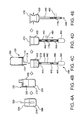
- FIGS. 4A to 4E are schematic views showing the nucleic acid extraction method using the vessel according to the embodiment.
- the vessel 100, a bottle 200, and a nucleic acid extraction device 400 to be used in the nucleic acid extraction method will be described.
- An upper portion of the bottle 200 has an opening section 220.
- the opening section 220 of the bottle 200 is configured to be capable of being fitted with the opening section 106 of the vessel 100, and by fitting these opening sections together, the inside of the bottle 200 and the inside of the vessel 100 can communicate with each other.
- the internal volume of the bottle 200 is not particularly limited, but can be set to, for example, 0.1 mL or more and 100 mL or less.
- the material of the bottle 200 is not particularly limited, and a plastic, a metal, or the like can be used.
- a liquid is placed in the bottle 200.
- the liquid is not particularly limited as long as it contains a chaotropic substance, but may contain a surfactant for the purpose of disrupting cell membranes or denaturing proteins contained in cells.
- This surfactant is not particularly limited as long as it is generally used for extracting nucleic acids from cells or the like.
- Specific examples thereof include nonionic surfactants such as Triton surfactants (such as Triton-X) and Tween surfactants (such as Tween 20) and anionic surfactants such as sodium N-lauroylsarcosinate (SLS).
- a nonionic surfactant in an amount ranging from 0.1 to 2%.
- the liquid preferably contains a reducing agent such as 2-mercaptoethanol or dithiothreitol.
- the liquid may be a buffer, but preferably has a neutral pH ranging from 6 to 8.
- the liquid preferably contains a guanidine salt (3 to 7 M), a nonionic surfactant (0 to 5%), EDTA (0 to 0.2 mM), a reducing agent (0 to 0.2 M), etc.
- the chaotropic substance is not particularly limited as long as it generates a chaotropic ion (a monovalent anion having a large ionic radius) in an aqueous solution, has an activity to increase the water solubility of a hydrophobic molecule, and contributes to the adsorption of a nucleic acid on the fine particles.
- Specific examples thereof include guanidine thiocyanate, guanidine hydrochloride, sodium iodide, potassium iodide, and sodium perchlorate.
- guanidine thiocyanate or guanidine hydrochloride having a high protein denaturation activity is preferred.
- the concentration of such a chaotropic substance varies depending on the respective substances, and for example, when guanidine thiocyanate is used, the concentration thereof is preferably in the range of 3 to 5.5 M, and when guanidine hydrochloride is used, the concentration thereof is preferably 5 M or more.
- the liquid preferably contains an alcohol or acetonitrile.
- the concentration of the alcohol or the like is not particularly limited, however, the lower limit thereof may be 10% or more, or may be 20% or more, or may be 30% or more, but most preferably 40% or more.
- the upper limit thereof may be 80% or less, or may be 70% or less, or may be 60% or less, but most preferably 50% or less.
- the type of the alcohol is not particularly limited, but examples thereof include methanol, ethanol, and propanol.
- a sample containing a nucleic acid to be a target is added, whereby a nucleic acid-containing liquid 210 containing the nucleic acid is prepared.
- the nucleic acid to be a target is sometimes simply referred to as "target nucleic acid”.
- the target nucleic acid is extracted from the sample and eluted in an eluate by the nucleic acid extraction method of this embodiment. Thereafter, for example, in the case where the nucleic acid is an mRNA, the nucleic acid is reverse-transcribed into a cDNA and is used as a template for PCR. In the case where the nucleic acid is a cDNA or a genomic DNA, the nucleic acid is directly used as a template for PCR.
- a partially purified nucleic acid solution or the like can be used as the sample.
- the nucleic acid extraction device 400 includes a tube section 440, a cup section 420 which is connected to one end of the tube section 440, and a detachable stopper 460 which seals the other end of the tube section 440.
- the tube section 440 is a cylindrical part having a hollow interior portion and capable of allowing a liquid to flow through the hollow interior portion in the longitudinal direction.
- the tube section 440 may be bent.
- the size and shape of the hollow interior portion of the tube section 440 are not particularly limited as long as a liquid to be contained therein can maintain the shape of a plug in the tube section 440. Further, the size of the hollow interior portion of the tube section 440 or the shape of the cross section perpendicular to the longitudinal direction thereof may vary along the longitudinal direction of the tube section 440.
- the shape of the cross section perpendicular to the longitudinal direction of the tube section 440 is designed appropriately within the scope in which the liquid can maintain the shape of a plug in the tube section 440.
- the shape of the cross section perpendicular to the longitudinal direction of the external shape of the tube section 440 is also not limited.
- the thickness (the length from the side surface of the hollow interior portion to the outer surface) of the tube section 440 is also not particularly limited.
- the inner diameter (the diameter of a circle of the cross section perpendicular to the longitudinal direction of the hollow interior portion) of the tube section 440 can be set to, for example, 0.5 mm or more and 3 mm or less. If the inner diameter of the tube section 440 is within this range, the plug composed of a liquid is easily formed in a wide range of the material of the tube section 440 and the type of the liquid, and therefore, such an inner diameter is preferred.
- the material of the tube section 440 is not particularly limited, and for example, a glass, a polymer, a metal, or the like can be used.
- a material transparent for visible light such as a glass or a polymer
- the interior portion can be observed from the outside of the tube section 440, and therefore, such a material is preferred.
- the material of the tube section 440 when a material through which a magnetic force is transmitted or a non-magnetic material is selected as the material of the tube section 440, in the case where magnetic particles are allowed to pass through the tube section 440 or the like, by applying a magnetic force from the outside of the tube section 440, the magnetic particles can be easily allowed to pass through the tube section, and thus, such a material is more preferred.
- a material through which a magnetic force is transmitted is selected as the material of the cup section 420 and the tube section 440, and by applying a magnetic force from the outside of the cup section 420 and the tube section 440, magnetic particles 114a are moved in the cup section 420 and the tube section 440.
- the tube section 440 is internally provided, in the following order, with a first plug 441 composed of a first oil, a second plug 442 composed of a washing liquid, which is phase-separated when mixed with an oil, and with which fine particles having a nucleic acid bound thereto are washed, a third plug 443 composed of a second oil, which is immiscible with the washing liquid, a fourth plug 444 composed of an eluent, which is phase-separated when mixed with an oil, and with which the nucleic acid is eluted from the fine particles having a nucleic acid bound thereto, and a fifth plug 445 composed of a third oil, which is immiscible with the eluent.
- the first plug 441, the third plug 443, and the fifth plug 445 are all composed of an oil.
- the oils of the first plug 441, the third plug 443, and the fifth plug 445 may be different types of oils or the same type of oil.
- As the oil for example, one type of oil selected from silicone-based oils such as dimethyl silicone oil, paraffin-based oils, mineral oils, and mixtures thereof can be used.
- the liquids forming the adjacent plugs of the first plug 441, the second plug 442, the third plug 443, the fourth plug 444, and the fifth plug 445 are selected so that the adjacent plugs are not mixed with each other.
- the second plug 442 is disposed. In a region on the opposite side from the second plug 442 of the first plug 441, a plug composed of another liquid may be disposed. It is preferred that air bubbles or other liquids are not present in the first plug 441, however, air bubbles or other liquids may be present as long as the particles or the like having a nucleic acid adsorbed thereon can pass through the first plug 441. It is also preferred that air bubbles or other liquids are not present between the first plug 441 and the second plug 442, however, air bubbles or other liquids may be present as long as the particles or the like having a nucleic acid adsorbed thereon can pass through from the first plug 441 to the second plug 442.
- air bubbles or other liquids are not present between the second plug 442 and the third plug 443, however, air bubbles or other liquids may be present as long as the particles or the like having a nucleic acid adsorbed thereon can pass through from the second plug 442 to the third plug 443.
- the fourth plug 444 is disposed between the third plug 443 and the fifth plug 445.
- a plug composed of another liquid may be disposed in a region on the opposite side from the fourth plug 444 of the fifth plug 445. It is preferred that air bubbles or other liquids are not present in the third plug 443, however, air bubbles or other liquids may be present as long as the particles or the like having a nucleic acid adsorbed thereon can pass through the third plug 443. It is also preferred that air bubbles or other liquids are not present between the third plug 443 and the fourth plug 444, however, air bubbles or other liquids may be present as long as the particles or the like having a nucleic acid adsorbed thereon can pass through from the third plug 443 to the fourth plug 444.
- air bubbles or other liquids are not present between the fourth plug 444 and the fifth plug 445, however, air bubbles or other liquids may be present as long as the particles or the like having a nucleic acid adsorbed thereon can pass through from the fourth plug 444 to the fifth plug 445. Further, it is preferred that air bubbles or other liquids are not present in the fifth plug 445.
- the length of each of the first plug 441, the third plug 443, and the fifth plug 445 in the longitudinal direction of the tube section 440 is not particularly limited as long as it is within a range capable of forming the plug.
- a specific length of each of the first plug 441, the third plug 443, and the fifth plug 445 in the longitudinal direction of the tube section 440 is 1 mm or more and 50 mm or less, and preferably 1 mm or more and 30 mm or less, more preferably 5 mm or more and 20 mm or less so that the moving distance of the particles or the like is not too long.
- a specific length of the third plug 443 can be set to 10 mm or more and 50 mm or less.
- the first plug 441 and the fifth plug 445 each have a function of preventing substance exchange with the outside air such as evaporation or contamination from the outside of the washing liquid (the second plug 442) and the eluent (the fourth plug 444) even if at least one end of the tube section 440 is opened. Therefore, even if at least one end of the tube section 440 is opened to the outside air, the volume of the washing liquid or the eluent can be maintained constant, and a variation in concentration of each liquid or contamination thereof can be prevented. Due to this, the accuracy of concentration of a nucleic acid or each agent in nucleic acid extraction can be enhanced.
- the third plug 443 has a function of preventing mixing of the washing liquid (the second plug 442) and the eluent (the fourth plug 444) with each other. Further, by using an oil having a higher viscosity as the third plug 443, a "wipe-off effect" of the oil at the interface between the third plug 443 and the washing liquid (the second plug 442) can be enhanced when the particles or the like are moved. Accordingly, when the particles or the like are moved to the third plug 443 composed of the oil from the plug composed of the washing liquid (the second plug 442), it can make it more difficult to carry over water-soluble components adhered to the particles or the like into the third plug 443 (oil).
- the second plug 442 is disposed at a position between the first plug 441 and the third plug 443 in the tube section 440.
- the second plug 442 is composed of the washing liquid for washing fine particles having a nucleic acid bound thereto.
- the washing liquid is a liquid immiscible with both of the oil constituting the first plug 441 and the oil constituting the third plug 443.
- the washing liquid is an acidic solution, and is particularly preferably an acidic aqueous solution.
- the acid to be contained is not particularly limited, however, an aqueous solution of citric acid, acetic acid, glycine hydrochloride, or the like is preferred.
- the washing liquid may contain EDTA (ethylenediaminetetraacetic acid), a surfactant (such as Triton, Tween, or SDS), or the like, but is preferably a solution which does not substantially contain chaotropic substances.
- the pH of the solution is not particularly limited as long as the washing solution is acidic, but the lower limit of the pH is preferably 1 or more, more preferably 2 or more, further more preferably 3 or more, and most preferably 4 or more.
- the upper limit of the pH is preferably 6 or less, more preferably 5 or less, and most preferably 4 or less.
- the volume of the second plug 442 is not particularly limited, and can be appropriately set by using the amount of the particles or the like having a nucleic acid adsorbed thereon or the like as an index.
- the volume of the particles or the like is 0.5 ⁇ L
- it is sufficient that the volume of the second plug 442 is 10 ⁇ L or more, and it is set to preferably 20 ⁇ L or more and 50 ⁇ L or less, more preferably 20 ⁇ L or more and 30 ⁇ L or less. If the volume of the second plug 442 is within this range, when the volume of the particles or the like is 0.5 ⁇ L, the particles or the like can be sufficiently washed.
- the volume of the second plug 442 is preferably larger for washing the particles or the like, but can be appropriately set in consideration of the length or diameter of the tube section 440, the length or the like of the second plug 442 in the longitudinal direction of the tube section 440 depending thereon.
- the fourth plug 444 is disposed at a position between the third plug 443 and the fifth plug 445 in the tube section 440 and is composed of an eluent with which a nucleic acid is eluted from fine particles having a nucleic acid bound thereto.
- the eluent for example, purified water such as sterile water, distilled water, or ion exchanged water, or a buffer can be used.
- purified water such as sterile water, distilled water, or ion exchanged water, or a buffer
- a buffer When water or an aqueous solution is used as the eluent, by dipping the particles or the like having a nucleic acid adsorbed thereon in an eluent, the nucleic acid adsorbed on the particles or the like can be eluted.
- the eluent is a liquid immiscible with both of the oil constituting the third plug 443 and the oil constituting the fifth plug 445.
- the volume of the fourth plug 444 composed of the eluent is not particularly limited, and can be appropriately set by using the amount of the particles or the like having a nucleic acid adsorbed thereon or the like as an index.
- the volume of the particles or the like is 0.5 ⁇ L
- it is sufficient that the volume of the fourth plug 444 composed of the eluent is 0.5 ⁇ L or more, and it is set to preferably 0.8 ⁇ L or more and 5 ⁇ L or less, more preferably 1 ⁇ L or more and 3 ⁇ L or less. If the volume of the plug composed of the eluent is within this range, even when the volume of the fine particles is set to 0.5 ⁇ L, the nucleic acid can be sufficiently eluted from the fine particles.
- the material of the stopper 460 may be any as long as it is a material capable of detachably sealing the other end of the tube section 440, and the stopper 460 is formed from, for example, a rubber, an elastomer, a polymer, or the like.
- the stopper 460 may be in contact with the fifth plug 445 when it seals the end, or a gas such as air may be disposed between the fifth plug 445 and the stopper 460.
- the stopper 460 is freely detachable, but its mechanism is not particularly limited.
- the cup section 420 has a shape capable of pouring the liquid ejected from the outlet port 110 of the vessel 100 in the cup section 420.
- the material of the cup section 420 is a material having flexibility such as a rubber, an elastomer, or a polymer.
- pressure can be applied to the inside of the tube section 440 of the nucleic acid extraction device 400.
- it is easy to apply pressure to the tube section 440 from the connection side of the vessel 100 for ejecting the eluate (fourth plug 444) from the end of the tube section 440. Accordingly, the eluate can be dispensed in, for example, a reaction vessel or the like for PCR.
- the sample is introduced into the bottle 200, whereby the nucleic acid-containing liquid 210 is prepared ( FIG. 4A ).
- the preparation of the nucleic acid-containing liquid 210 can be performed by adhering the sample to a cotton swab 300, inserting the cotton swab 300 from the opening section 220 of the bottle 200 and dipping the cotton swab 300 in the liquid in the bottle 200.
- the sample may also be introduced from the opening section 220 of the bottle 200 using a pipette or the like.
- the sample may be adhered to the inner wall of the bottle 200 or thrown into the bottle 200 from the opening section 220 of the bottle 200 using a spoon, forceps, or the like.
- the opening section 106 of the vessel 100 according to the invention and the opening section 220 of the bottle 200 are fitted together, whereby the vessel 100 and the bottle 200 are integrated ( FIG. 4B ).
- a nucleic acid in the liquid 210 is bound to the magnetic particles ( FIG. 4C ).
- the nucleic acid-containing liquid 210 is sent into the vessel 100 from the inside of the bottle 200.
- the nucleic acid-containing liquid passing through the coarse-mesh filter passes through the fine-mesh filter.
- the nucleic acid-containing liquid passing through the fine-mesh filter comes in contact with the lyophilizate disposed on a bottom portion of the vessel 100.
- the magnetic particles in the lyophilizate are mixed in the nucleic acid-containing liquid.
- the target nucleic acid is adsorbed on the surfaces of the magnetic particles by the action of a chaotropic agent and bound thereto.
- nucleic acids other than the target nucleic acid, or proteins passing through the filter may be adsorbed on the surfaces of the magnetic particles.
- the nucleic acid can be bound to the nucleic acid-binding solid-phase carrier in a shorter time by omitting an operation for dispersing the nucleic acid-binding solid-phase carrier.
- the nucleic acid bound to the magnetic particles is eluted in an eluate in the tube section 440 ( FIG. 4D ).
- a method utilizing a gravitational force or a centrifugal force may be used, and there is no particular limitation on the method, however, in this embodiment, a method in which a magnetic force is applied using a permanent magnet 480 from the outside of the cup section 420 and the tube section 440 is used.
- a magnetic force can be applied using, for example, an electromagnet, or the like other than the permanent magnet, however, from the viewpoint that heat is not generated and so on, it is more preferred to apply a magnetic force using a permanent magnet.
- the magnet may be moved by an operator with hand or by using a mechanical device or the like.
- the magnetic particles have a property to be attracted by a magnetic force, and therefore, by utilizing the property, the magnetic particles are moved from the inside of the cup section 420 to the tube section 440 by changing the relative position of the permanent magnet to the cup section 420 and the tube section 440.
- the magnetic particles are moved by moving the permanent magnet 480 in the direction indicated by the arrow in FIG. 4D .
- the magnetic particles are moved from the first plug 441 to the fourth plug 444 by sequentially passing the particles through the respective plugs.
- the retention time of the magnetic particles in each plug when the magnetic particles pass through the plug is not particularly limited, and also the magnetic particles may be moved reciprocatively along the longitudinal direction of the tube section 440 within the same plug.
- the nucleic acid adsorbed on the magnetic particles is eluted in an eluate in the fourth plug 444 by the action of the eluent.
- the nucleic acid is eluted with the eluent from the sample, and the nucleic acid is brought to a state of being extracted from the sample.
- the eluate in the fourth plug 444 is ejected from the tube section 440 ( FIG. 4E ).
- the cap 470 is attached to the cup section 420, and the stopper 460 is detached from the tube section 440 of the nucleic acid extraction device 400 to open the end of the tube section 440 on the fifth plug 445 side.
- the cup section 420 is deformed by applying an external force to the cup section 420 in the direction indicated by the arrows in FIG. 4E to increase the internal pressure of the tube section 440, the respective plugs in the tube section 440 are moved from the first plug 441 side to the fifth plug 445 side due to the pressure. Accordingly, the fifth plug 445 and the fourth plug 444 are ejected in this order from the end of the tube section 440 on the fifth plug 445 side.
- the time and labor required for dispersing the nucleic acid-binding carrier in the pretreatment for preparing a nucleic acid for use in PCR or the like in the related art can be reduced.
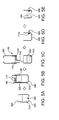
- FIGS. 5A to 5E are schematic views showing a protein purification method using the vessel according to the embodiment.
- a vessel 100 and a bottle 200 to be used in the protein purification method are configured such that an upper portion of the bottle 200 has an opening section 220 in the same manner as that used in the nucleic acid extraction method.
- the opening section 220 of the bottle 200 is configured to be capable of being fitted with an opening section 106 of the vessel 100, and by fitting the opening sections together, the inside of the bottle 200 and the inside of the vessel 100 can communicate with each other.
- a lyophilizate 114 in the vessel 100 magnetic particles surface-modified with a substance having affinity for a protein in cells to be a target for purification (hereinafter referred to as "target protein"), for example, protein A, protein G, biotin, avidin, glutathione, lectin, or an antibody are contained.
- target protein a substance having affinity for a protein in cells to be a target for purification
- the substance bound to the magnetic particles can specifically bind to a protein having an activity to be specifically adsorbed on the substance.
- a lysis buffer 510 is placed in the bottle 200 ( FIG. 5A ).
- the lysis buffer 510 may be any as long as it is a liquid capable of lysing cells without denaturing the target protein.
- a liquid containing Tris-HCl, EDTA, EGTA, SDS, a deoxycholate, and Triton-X or NP-40 can be used after the pH of the liquid is adjusted to be most suitable for obtaining the target protein.
- cells 500 are introduced into the lysis buffer 510 in the bottle 200, whereby a protein-containing liquid 510 is prepared.
- the opening section 106 of the vessel 100 according to the invention and the opening section 220 of the bottle 200 are fitted together to integrate the vessel 100 with the bottle 200 ( FIG. 5B ).
- the protein in the lysis buffer 510 is bound to the substance having affinity for the protein on the substances of the magnetic particles ( FIG. 5C ).
- the integrated body of the vessel 100 and the bottle 200 is turned upside down, whereby the protein-containing liquid 510 is sent into the vessel 100 from the bottle 200.
- the protein-containing liquid passing through the coarse-mesh filter passes through the fine-mesh filter.
- the protein-containing liquid passing through the fine-mesh filter comes in contact with the lyophilizate 114 disposed on a bottom portion of the vessel 100.
- the magnetic particles in the lyophilizate are mixed in the protein-containing liquid.
- the target protein is bound to the substance having affinity for the protein on the surfaces of the magnetic particles.
- proteins other than the target protein passing through the filter may be adsorbed on the surfaces of the magnetic particles.
- the protein-containing liquid flowing out from the outlet port 110 of the vessel 100 is allowed to flow in a vessel 600.
- the protein can be bound to the protein-binding solid-phase carrier in a shorter time by omitting an operation for dispersing the protein-binding solid-phase carrier.
- a permanent magnet 680 is brought closer to the outer surface of the vessel 600, and by the magnetic force thereof, the liquid is discharged to the outside of the vessel 600 while keeping the magnetic particles on the side wall of the vessel 600 ( FIG. 5D ).
- the protein is eluted from the magnetic particles ( FIG. 5E ).
- the liquid which is the supernatant is collected from the vessel 600 while keeping the magnetic particles in the vicinity of the side wall of the vessel 600 by bringing the permanent magnet 680 closer to the side wall of the vessel 600 from the outside, whereby the protein bound to the magnetic particles can be recovered.
- the eluent for eluting the protein a liquid having an effect of decreasing the affinity between the protein and the ligand is preferred.
- the liquid include a buffer containing hydrochloric acid, imidazole, glutathione, and biotin.
- the buffer include potassium phosphate buffer, sodium phosphate buffer, Tris-HCl buffer, PIPES buffer, boric acid buffer, and glycine hydrochloride buffer.
- the magnetic particles may be washed before the protein is eluted from the magnetic particles to remove contaminants.
- Specific examples of the washing method include a method in which redispersion of the magnetic particles is repeated by adding the magnetic particles having the protein bound thereto to sodium phosphate buffer containing Tween 20 (0.5% by mass) to remove contaminants adsorbed on the magnetic fine particles.
- the time and labor required for dispersing the protein-binding carrier in the pretreatment for preparing a protein in the related art can be reduced.
- the invention includes substantially the same configurations (for example, configurations having the same functions, methods, and results, or configurations having the same objects and effects) as the configurations described in the embodiments.
- the invention includes configurations in which parts which are not essential in the configurations described in the embodiments are substituted.
- the invention includes configurations that exhibit the same operations and effects as those of the configurations described in the embodiments, or configurations that can achieve the same objects.
- the invention includes configurations in which well-known techniques are added to the configurations described in the embodiments.
Landscapes
- Chemical & Material Sciences (AREA)
- Health & Medical Sciences (AREA)
- Engineering & Computer Science (AREA)
- Life Sciences & Earth Sciences (AREA)
- Organic Chemistry (AREA)
- Genetics & Genomics (AREA)
- Zoology (AREA)
- Wood Science & Technology (AREA)
- Biomedical Technology (AREA)
- Bioinformatics & Cheminformatics (AREA)
- General Engineering & Computer Science (AREA)
- Biotechnology (AREA)
- Analytical Chemistry (AREA)
- Microbiology (AREA)
- Chemical Kinetics & Catalysis (AREA)
- Biophysics (AREA)
- Physics & Mathematics (AREA)
- Molecular Biology (AREA)
- Biochemistry (AREA)
- General Health & Medical Sciences (AREA)
- Proteomics, Peptides & Aminoacids (AREA)
- Crystallography & Structural Chemistry (AREA)
- Clinical Laboratory Science (AREA)
- Plant Pathology (AREA)
- Immunology (AREA)
- Apparatus Associated With Microorganisms And Enzymes (AREA)
- Peptides Or Proteins (AREA)
- Measuring Or Testing Involving Enzymes Or Micro-Organisms (AREA)
- Sampling And Sample Adjustment (AREA)
- Pharmaceuticals Containing Other Organic And Inorganic Compounds (AREA)
Applications Claiming Priority (1)
| Application Number | Priority Date | Filing Date | Title |
|---|---|---|---|
| JP2014035262A JP2015159733A (ja) | 2014-02-26 | 2014-02-26 | 物質結合用固相担体の凍結乾燥体、物質含有液中の物質を物質結合用固相担体と結合させるための容器、および、物質結合用固相担体を含む凍結乾燥体の製造方法 |
Publications (2)
| Publication Number | Publication Date |
|---|---|
| EP2913401A2 true EP2913401A2 (de) | 2015-09-02 |
| EP2913401A3 EP2913401A3 (de) | 2015-09-09 |
Family
ID=52544401
Family Applications (1)
| Application Number | Title | Priority Date | Filing Date |
|---|---|---|---|
| EP15156290.7A Withdrawn EP2913401A3 (de) | 2014-02-26 | 2015-02-24 | Lyophilisat aus stoffbindendem Festphasenträger, Behälter für einen bindenden Stoff in der stoffhaltigen Flüssigkeit zu dem stoffbindenden Festphasenträger und Herstellungsverfahren von Lyophilisat mit einem stoffbindenden Festphasenträger |
Country Status (4)
| Country | Link |
|---|---|
| US (1) | US20150240291A1 (de) |
| EP (1) | EP2913401A3 (de) |
| JP (1) | JP2015159733A (de) |
| CN (1) | CN104862208A (de) |
Families Citing this family (3)
| Publication number | Priority date | Publication date | Assignee | Title |
|---|---|---|---|---|
| KR20220152290A (ko) | 2020-03-09 | 2022-11-15 | 아이덱스 래보러토리즈, 인코포레이티드 | 화학 시약 시험 슬라이드에 액체 샘플을 분배하기 전에 그의 간섭 성분을 제거하는 방법 |
| JP7625614B2 (ja) | 2020-03-09 | 2025-02-03 | アイデックス ラボラトリーズ インコーポレイテッド | 液体サンプルの成分を除去するために使用されるマトリックスならびに関連のサンプルカップまたは混合カップ |
| CN112958248B (zh) * | 2021-02-02 | 2022-08-02 | 云南中医药大学 | 一种分子生物学实验用研磨装置 |
Citations (1)
| Publication number | Priority date | Publication date | Assignee | Title |
|---|---|---|---|---|
| JP2009207459A (ja) | 2008-03-06 | 2009-09-17 | Sony Corp | 核酸抽出装置、及び核酸抽出方法 |
Family Cites Families (10)
| Publication number | Priority date | Publication date | Assignee | Title |
|---|---|---|---|---|
| EP0156537A3 (de) * | 1984-03-02 | 1987-05-13 | Board Of Regents University Of Texas System | Biologische magnetische Flüssigkeiten |
| DE69909090T2 (de) * | 1998-05-26 | 2004-05-19 | Bar-Ilan University | Keimbildung und wachstum von metalloxid-nanopartikeln und verwendung |
| US20050069898A1 (en) * | 2003-09-25 | 2005-03-31 | Cepheid | Lyophilized beads containing mannitol |
| US20060257958A1 (en) * | 2005-05-13 | 2006-11-16 | Pronucleotein Biotechnologies, Llc | Magnetically-assisted test strip cartridge and method for using same |
| EP1970705A1 (de) * | 2007-03-15 | 2008-09-17 | Koninklijke Philips Electronics N.V. | Analytnachweis anhand von Kügelchen |
| DE102007045474A1 (de) * | 2007-09-21 | 2009-04-02 | Qiagen Gmbh | Vorrichtung und Verfahren zum Behandeln von Flüssigkeiten mit magnetischen Partikeln |
| EP2388592A1 (de) * | 2010-05-19 | 2011-11-23 | Stichting Dutch Polymer Institute | Kügelchen und Verfahren zu deren Herstellung und Sensorvorrichtung |
| EP2765424B1 (de) * | 2011-10-05 | 2018-12-05 | Hitachi High-Technologies Corporation | Verfahren zur analyse von biomolekülen |
| CN104066849B (zh) * | 2011-10-11 | 2017-04-19 | 凯杰有限公司 | 样品处理方法和样品处理盒 |
| JP2014093988A (ja) * | 2012-11-12 | 2014-05-22 | Seiko Epson Corp | 固相担体の操作方法及び固相担体の操作装置 |
-
2014
- 2014-02-26 JP JP2014035262A patent/JP2015159733A/ja active Pending
-
2015
- 2015-02-15 CN CN201510082331.9A patent/CN104862208A/zh active Pending
- 2015-02-20 US US14/627,429 patent/US20150240291A1/en not_active Abandoned
- 2015-02-24 EP EP15156290.7A patent/EP2913401A3/de not_active Withdrawn
Patent Citations (1)
| Publication number | Priority date | Publication date | Assignee | Title |
|---|---|---|---|---|
| JP2009207459A (ja) | 2008-03-06 | 2009-09-17 | Sony Corp | 核酸抽出装置、及び核酸抽出方法 |
Also Published As
| Publication number | Publication date |
|---|---|
| JP2015159733A (ja) | 2015-09-07 |
| US20150240291A1 (en) | 2015-08-27 |
| EP2913401A3 (de) | 2015-09-09 |
| CN104862208A (zh) | 2015-08-26 |
Similar Documents
| Publication | Publication Date | Title |
|---|---|---|
| US9347056B2 (en) | Nucleic acid extraction device, and nucleic acid extraction method, nucleic acid extraction kit, and nucleic acid extraction apparatus, each using the same | |
| US20240082838A1 (en) | Nucleic acid extraction and purification cartridges | |
| CN101883776B (zh) | 用于纯化核酸的装置、系统和方法 | |
| JP6350654B2 (ja) | 磁性体粒子の操作方法 | |
| KR20120044918A (ko) | 핵산 정제 | |
| CN106102898A (zh) | 磁性体颗粒的操作方法及磁性体颗粒操作用装置 | |
| CN105936868A (zh) | 容器、生物体相关物质精制筒以及其组装试剂盒 | |
| CN107107021A (zh) | 磁性体粒子操作用元件及磁性体粒子的操作方法 | |
| CN104673622A (zh) | 核酸扩增反应用筒和核酸扩增反应用筒试剂盒 | |
| JP6323550B2 (ja) | 磁性体粒子の操作方法 | |
| EP2913401A2 (de) | Lyophilisat aus stoffbindendem Festphasenträger, Behälter für einen bindenden Stoff in der stoffhaltigen Flüssigkeit zu dem stoffbindenden Festphasenträger und Herstellungsverfahren von Lyophilisat mit einem stoffbindenden Festphasenträger | |
| CN101153264B (zh) | 微通道、用于回收核酸的装置和回收核酸的方法 | |
| US10564077B2 (en) | Device for and method of isolating and analyzing a fraction in a biological sample | |
| JP2008519986A (ja) | 生物学的物質の精製のための器具及び方法 | |
| US20150284710A1 (en) | Method of manipulating solid carriers and an apparatus of manipulating solid carriers | |
| CN104946509A (zh) | 核酸扩增反应用筒和核酸扩增装置 | |
| CN104877897A (zh) | 靶物质的精制装置和精制方法 | |
| US20150099279A1 (en) | Nucleic acid amplification method, nucleic acid extraction device, nucleic acid amplification reaction cartridge, and nucleic acid amplification reaction kit | |
| CN104419638A (zh) | 核酸扩增反应用盒 | |
| JP2014033663A (ja) | 核酸抽出装置及び核酸抽出方法 | |
| JP2014083041A (ja) | 核酸抽出用装置 | |
| JP2015019590A (ja) | 核酸増幅反応装置 | |
| US20210222154A1 (en) | Operation method of magnetic particles | |
| CN107073471A (zh) | 物质纯化装置和盒 | |
| WO2016113808A1 (ja) | 生体関連物質精製カートリッジ、夾雑物の除去方法、及び生体関連物質精製カートリッジ組立キット |
Legal Events
| Date | Code | Title | Description |
|---|---|---|---|
| PUAL | Search report despatched |
Free format text: ORIGINAL CODE: 0009013 |
|
| PUAI | Public reference made under article 153(3) epc to a published international application that has entered the european phase |
Free format text: ORIGINAL CODE: 0009012 |
|
| AK | Designated contracting states |
Kind code of ref document: A2 Designated state(s): AL AT BE BG CH CY CZ DE DK EE ES FI FR GB GR HR HU IE IS IT LI LT LU LV MC MK MT NL NO PL PT RO RS SE SI SK SM TR |
|
| AX | Request for extension of the european patent |
Extension state: BA ME |
|
| AK | Designated contracting states |
Kind code of ref document: A3 Designated state(s): AL AT BE BG CH CY CZ DE DK EE ES FI FR GB GR HR HU IE IS IT LI LT LU LV MC MK MT NL NO PL PT RO RS SE SI SK SM TR |
|
| AX | Request for extension of the european patent |
Extension state: BA ME |
|
| RIC1 | Information provided on ipc code assigned before grant |
Ipc: B01L 3/00 20060101ALI20150804BHEP Ipc: G01N 35/00 20060101ALI20150804BHEP Ipc: C12N 15/10 20060101AFI20150804BHEP |
|
| STAA | Information on the status of an ep patent application or granted ep patent |
Free format text: STATUS: THE APPLICATION IS DEEMED TO BE WITHDRAWN |
|
| 18D | Application deemed to be withdrawn |
Effective date: 20160310 |