EP2902402B1 - Wasserlösliches photochromes molekül - Google Patents
Wasserlösliches photochromes molekül Download PDFInfo
- Publication number
- EP2902402B1 EP2902402B1 EP13837714.8A EP13837714A EP2902402B1 EP 2902402 B1 EP2902402 B1 EP 2902402B1 EP 13837714 A EP13837714 A EP 13837714A EP 2902402 B1 EP2902402 B1 EP 2902402B1
- Authority
- EP
- European Patent Office
- Prior art keywords
- compound
- formula
- sugar
- group
- mmol
- Prior art date
- Legal status (The legal status is an assumption and is not a legal conclusion. Google has not performed a legal analysis and makes no representation as to the accuracy of the status listed.)
- Active
Links
- 0 C[C@](C(COC(C)=O)O*(C(CO)OC(C)=O)Br)OC(C)=O Chemical compound C[C@](C(COC(C)=O)O*(C(CO)OC(C)=O)Br)OC(C)=O 0.000 description 2
- ISGWSKVBTRPBMB-HUYYJVOLSA-N CCC1=C(/C(/[C@](C)(CF)F)=C(/C(CF)(F)F)\C(c(c2c3)ccc3-c(cc3)ccc3C(O[C@H]([C@@H]([C@H]([C@@H]([C@H]3O)O)O)O)[C@H]3O)=O)=C(CC)/S2=C/C)c(ccc(-c(cc2)ccc2C(O[C@@H]([C@H](C[C@H](C2)O)O)C2=O)=O)c2)c2/S1=C/C Chemical compound CCC1=C(/C(/[C@](C)(CF)F)=C(/C(CF)(F)F)\C(c(c2c3)ccc3-c(cc3)ccc3C(O[C@H]([C@@H]([C@H]([C@@H]([C@H]3O)O)O)O)[C@H]3O)=O)=C(CC)/S2=C/C)c(ccc(-c(cc2)ccc2C(O[C@@H]([C@H](C[C@H](C2)O)O)C2=O)=O)c2)c2/S1=C/C ISGWSKVBTRPBMB-HUYYJVOLSA-N 0.000 description 1
- ZETSWAOUNVKQQH-UCSFQTCVSA-N Cc([s]c(CO[C@@H]([C@@H]([C@H]1O)O)O[C@H](CO)[C@H]1O)c1)c1C(C(C(C1(F)F)(F)F)(F)F)=C1c1c(C)[s]c(CO[C@@H]([C@@H]([C@H]2O)O)O[C@H](CO)[C@H]2O)c1 Chemical compound Cc([s]c(CO[C@@H]([C@@H]([C@H]1O)O)O[C@H](CO)[C@H]1O)c1)c1C(C(C(C1(F)F)(F)F)(F)F)=C1c1c(C)[s]c(CO[C@@H]([C@@H]([C@H]2O)O)O[C@H](CO)[C@H]2O)c1 ZETSWAOUNVKQQH-UCSFQTCVSA-N 0.000 description 1
Images


Classifications
-
- C—CHEMISTRY; METALLURGY
- C07—ORGANIC CHEMISTRY
- C07H—SUGARS; DERIVATIVES THEREOF; NUCLEOSIDES; NUCLEOTIDES; NUCLEIC ACIDS
- C07H15/00—Compounds containing hydrocarbon or substituted hydrocarbon radicals directly attached to hetero atoms of saccharide radicals
- C07H15/26—Acyclic or carbocyclic radicals, substituted by hetero rings
-
- C—CHEMISTRY; METALLURGY
- C07—ORGANIC CHEMISTRY
- C07D—HETEROCYCLIC COMPOUNDS
- C07D333/00—Heterocyclic compounds containing five-membered rings having one sulfur atom as the only ring hetero atom
- C07D333/02—Heterocyclic compounds containing five-membered rings having one sulfur atom as the only ring hetero atom not condensed with other rings
- C07D333/04—Heterocyclic compounds containing five-membered rings having one sulfur atom as the only ring hetero atom not condensed with other rings not substituted on the ring sulphur atom
- C07D333/26—Heterocyclic compounds containing five-membered rings having one sulfur atom as the only ring hetero atom not condensed with other rings not substituted on the ring sulphur atom with hetero atoms or with carbon atoms having three bonds to hetero atoms with at the most one bond to halogen, e.g. ester or nitrile radicals, directly attached to ring carbon atoms
- C07D333/38—Carbon atoms having three bonds to hetero atoms with at the most one bond to halogen, e.g. ester or nitrile radicals
-
- C—CHEMISTRY; METALLURGY
- C07—ORGANIC CHEMISTRY
- C07D—HETEROCYCLIC COMPOUNDS
- C07D333/00—Heterocyclic compounds containing five-membered rings having one sulfur atom as the only ring hetero atom
- C07D333/50—Heterocyclic compounds containing five-membered rings having one sulfur atom as the only ring hetero atom condensed with carbocyclic rings or ring systems
- C07D333/52—Benzo[b]thiophenes; Hydrogenated benzo[b]thiophenes
- C07D333/54—Benzo[b]thiophenes; Hydrogenated benzo[b]thiophenes with only hydrogen atoms, hydrocarbon or substituted hydrocarbon radicals, directly attached to carbon atoms of the hetero ring
-
- C—CHEMISTRY; METALLURGY
- C07—ORGANIC CHEMISTRY
- C07D—HETEROCYCLIC COMPOUNDS
- C07D409/00—Heterocyclic compounds containing two or more hetero rings, at least one ring having sulfur atoms as the only ring hetero atoms
- C07D409/02—Heterocyclic compounds containing two or more hetero rings, at least one ring having sulfur atoms as the only ring hetero atoms containing two hetero rings
- C07D409/08—Heterocyclic compounds containing two or more hetero rings, at least one ring having sulfur atoms as the only ring hetero atoms containing two hetero rings linked by a carbon chain containing alicyclic rings
-
- C—CHEMISTRY; METALLURGY
- C09—DYES; PAINTS; POLISHES; NATURAL RESINS; ADHESIVES; COMPOSITIONS NOT OTHERWISE PROVIDED FOR; APPLICATIONS OF MATERIALS NOT OTHERWISE PROVIDED FOR
- C09K—MATERIALS FOR MISCELLANEOUS APPLICATIONS, NOT PROVIDED FOR ELSEWHERE
- C09K9/00—Tenebrescent materials, i.e. materials for which the range of wavelengths for energy absorption is changed as a result of excitation by some form of energy
- C09K9/02—Organic tenebrescent materials
Definitions
- the present invention relates to a water-soluble photochromic molecule, and more specifically to a water-soluble diarylethene compound.
- Photochromic molecules are molecules that reversibly transform between two isomers with different absorption spectra while maintaining the same molecular weight when irradiated with appropriate wavelength of light.
- the diarylethene compound is known to exhibit excellent photochromic performance (Non-Patent Document 1).
- the diarylethene has a following structure, and it undergoes cyclization/cycoreversion reactions upon irradiation with light as shown in the following scheme.
- Photochromic molecules as optical memory media that can optically store information (Patent Document 1, etc.).
- the media were prepared by dissolving photochromic molecules in an organic solvent, then spreading the resulting solution over a substrate.
- Patent Document 1 does not mention anything about a water-soluble diarylethene compound.
- Concerning water-solubility, Non-Patent Documents 3, 4 and 7 teach diarylethene compounds that have ionic groups or amphiphilic groups. However, these compounds tend to be aggregated in water, and would excessively affect the target molecule due to their strong ionic interaction, so they are hardly applied to bioimaging. Under such situation, a highly water-soluble diarylethene compound obtained by a different means was desired.
- Patent Document 1 Japanese Publication No. 2005-325087
- the object of the present invention is to provide a highly water-soluble diarylethene compound.
- the present inventors found that a diarylethene compound having sugar groups has good water-solubility, and completed the present invention.
- the above object is achieved by compounds of the present invention, as defined in appended claim 1.
- the present disclosure also relates to:
- the present invention can provide a diarylethene compound having a high water-solubility.
- the compound has sugar-type residues Sg.
- Sugar-type residue is a group derived from sugar or a similar compound.
- Sg is a monovalent sugar-type residue consisting of a sugar-type compound excluding one hydroxyl group, the sugar-type compound being selected from a group consisting of a six-membered ring sugar, a five-membered ring sugar, cyclitol and oligosaccharides containing a six-membered ring sugar, a five-membered ring sugar, or cyclitol. Some of the hydroxyls in the sugar-type residue may be protected by protection groups.
- the sugar-type compound is referred to hereinafter as simply "sugar” and the sugar-type residue is referred to hereinafter as simply "sugar residue" for convenience.
- a six-membered ring sugar is sugar with 6-membered ring structure, including glucopyranose, arabinopyranose, xylopyranose, lyxopyranose, allopyranose, altropyranose, mannopyranose, gulopyranose, idopyranose, galactopyranose, talopyranose, and glucuronic acid, without being limited thereby.
- a five-membered ring sugar is sugar with 5-membered ring structure, including ribofuranose, arabinofuranose, xylofuranose, erythrofuranose, threofuranose, and lyxofuranose, without being limited thereby.
- Cyclitol is a cycloalkane polyol (polyhydroxy cycloalkane), that is, a cyclic sugar alcohol, and it includes inositol as an example.
- An oligosaccharide is a compound composed of about 2 to 15 units of compounds that are a six-membered ring sugar, a five-membered ring sugar, and a cyclitol sugar bound to each other by the glycoside linkage, etc.
- examples of oligosaccharides include sucrose, raffinose, stachyose, trehalose, lactose, etc., without being limited thereby.
- a preferable sugar in the present invention is glucopyranose.
- Sg is a monovalent sugar residue excluding a hydroxyl group from the above sugars. Any hydroxyl group can be removed, but a hydroxyl group bound to a carbon atom in the ring is preferable, and a hydroxyl group on the position-1 carbon atom (hemiacetal hydroxyl group) is more preferable.
- a sugar residue of glucopyranose excluding the hemiacetal hydroxyl group is a glucosyl group, and it is represented by the following chemical formula.
- a glucosyl group may be either an ⁇ -glucosyl group, or a ⁇ -glucosyl group, but the ⁇ -glucosyl group is preferable from the viewpoint of reducing the steric hindrance.
- hydroxyl groups can be protected in the sugar residue.
- an acyl group such as an acetyl group, is preferable. If there is a protection group, it should preferably exist in a number of 1 to 2, and more preferably 1 per 1 sugar residue.
- Ar is an aromatic group represented by the following formula (A1) or (A2).
- X is S, SO 2 , NR 3 (R 3 is a C1-C3 alkyl group), or O, of which S or SO 2 is preferable to obtain a good photochromic property.
- S is preferable as X in formula (A1)
- S or SO 2 is preferable as X in formula (A2).
- R is a C1-C4 alkyl group.
- the alkyl group includes chain-shaped and a branch-shaped groups.
- C1-C4 alkyl group is specifically a methyl group, an ethyl group, an n-propyl group, an i-propyl group, an n-butyl group, and a t-butyl group.
- R 1 , R 2 are independently C1-C3 alkyl groups. When we say “independently,” it means that R 1 , R 2 can be the same or they may differ.
- R 1 is a substituent at position-4 or position-5 of a 5 membered-ring in formula (A1). a is the number of R 1 , which is either 0 or 1.
- R 2 is a C1-C3 alkyl group, and it is a substituent at positions 4 to 7 of the heterocyclic ring in formula (A2).
- b is the number of R 2 s, which is an integer between 0 to 3.
- * indicates a linkage of the 5-membered ring with the linkage group U. To reduce the steric hindrance, the position-5 carbon atom of the 5 membered-ring should bind with U. If there is an R 1 , it will bind to position-4. Similarly in formula (A2), * indicates a linkage of the benzene ring with the linkage group U. To reduce the steric hindrance, the position-6 carbon atom should bind with U.
- n is an integer of 1 to 5.
- a large n may reduce the water-solubility of the diarylethene compound to be obtained, so n should preferably be 1 to 3, and more preferably 1.
- U' is a C1-C10 alkyl group binding with Ar.
- the water-solubility of diarylethene compound may decrease for a large number of carbons, so the number of carbons should preferably be 1 or 2, and more preferably 1.
- the alkyl group includes chain-shaped and branch-shaped groups.
- Y is a hydrogen atom or a halogen atom.
- Y should preferably be a halogen atom, and more preferably a fluorine atom.
- m is an integer of 5 to 7 and it should preferably be 5 for the same reason.
- the diarylethene compound of the present disclosure is produced by any given method, but a preferable production method is provided below.
- the present method includes:
- halogenated sugar derivative is acyl halogenated sugar
- the etherification step includes a glycosylation reaction
- the acyl halogenated sugar used is derived from a sugar selected from a group consisting of a six-membered ring sugar, a five-membered ring sugar, cyclitol and oligosaccharides containing a six-membered ring sugar, a five-membered ring sugar, or cyclitol, and it includes 1 hydroxyl group substituted with a halogen atom, and all other hydroxyl groups protected by protection groups.
- the acyl halogenated sugar is represented by PSg-halo.
- the hydroxyl group substituting the halogen atom should preferably be the hydroxyl group on the anomer position.
- a protection group is a group for protecting the hydroxyl group to prevent side reaction of the hydroxyl group in the sugar.
- the hydroxyl group can be protected by a group that is commonly used. Examples of such protection group includes an acyl group, an acetal group, and a silyl ether group. Among these, the acyl group is preferable since it is easy to deprotect, and an acetyl group is more preferable.
- the acyl halogenated sugar can be prepared by a known method. For example, it can be produced by reacting pentaacetyl glucopyranose with HOAc-HBr (hydrogen bromide-acetic acid solution). The hydroxyl group on the anomer position (a hydroxyl group on the position-1 carbon atom) is normally halogenated. The above step can be performed by dissolving the protected sugar in a hydrogen bromide-acetic acid solution, then sealing it and reacting it for a day and a night.
- a preferable acyl halogenated sugar is represented by formula (s1) below.
- This step is a reaction of the acyl halogenated sugar and diols represented by formula (a).
- U, Ar, Y and m are as defined above.
- U in the present production method should preferably be -(CH 2 )n- or -CH 2 -U'-.
- the diol can be prepared by a known method.
- a -U-OH group may be introduced in the aromatic group Ar of the diarylethene compound of formula (j) shown in the following scheme.
- diarylethene compound of formula (j) and dichloromethylmethyl ether are reacted under the presence of AlCl 3 , etc. to introduce a formyl group in the Ar group, and a reduction of the formyl group will provide a diol in which -CH 2 -OH is introduced as the -U-OH group.
- a reaction of the diol of formula (a) and an acyl halogenated sugar induces a glycosylation reaction that generates an intermediate represented by formula (b).
- PSg is a sugar residue of the Sg in which all hydroxyl groups are protected.
- This reaction occurs by the detachment of a hydrogen atom of the compound of formula (a) and a halogen at the anomer position of the acyl halogenated sugar, so it should preferably be performed under the presence of a reaction accelerator that accelerates the detachment of the hydrogen atom and halogen.
- the reaction accelerator include silver oxide, such as Ag 2 O, and mercury salts, such as HgBr 2 , Hg(CN) 2 . It is preferable to use Ag 2 O, since it is more capable of accelerating reaction.
- the amount of Ag 2 O to be used should preferably be 5 to 10 mols against 1 mol of a compound of formula (a).
- reaction can be further accelerated by also using a dehydrator.
- a known dehydrator can be used, but a dehydrator that can be easily removed, such as a molecular sieve, etc., is preferable.
- the amount of molecular sieve 4 ⁇ to be used should preferably be 0.10 g/2 mL of the solvent.
- the solvent to be used in the present step is not limited, but a solvent having low solubility to water is preferable, since removing water from the system further accelerates the reaction as mentioned above.
- An example of a preferable solvent includes a chlorine-type hydrocarbon, such as methylene chloride, and an aromatic hydrocarbon, such as toluene. In particular, a chlorine-type hydrocarbon is more preferable.
- the reaction temperature is determined as necessary from the viewpoint of accelerating reaction and regulating side reaction. A temperature between 10 to 40°C is preferable.
- an acyl halogenated sugar that includes a halogenated hydroxyl group on the position-1 carbon atom and other hydroxyl groups protected for ease of synthesis or other reasons, but such acyl halogenated sugar has an ⁇ -isomer and a ⁇ -isomer.
- the neighboring hydroxyl group on position-2 is protected by an acyl group, and the neighboring-group participation brings about a preferential generation of ⁇ -glycosyl isomer. So when the above acyl halogenated sugar of formula (s1) is used to obtain the compound of formula (a), the PSg in the obtained compound is a group derived from the ⁇ -glycosyl group.
- This step removes the protection group of the intermediate represented by formula (b).
- the protection group can be removed by a known method.
- the protection group can be readily removed by reacting the protected hydroxyl group with alkali, such as lithium hydroxide, sodium hydroxide, potassium carbonate. It is preferable to use lithium hydroxide, and it is more preferable for the amount of use to be 5 to 10 mol against 1 mol of the intermediate represented by formula (b).
- the solvent to be used in the present reaction is not limited, but alcohol such as methanol is preferable.
- the reaction temperature is not limited, but a temperature of 10 to 30°C is preferable.
- the method comprises:
- protected sugar is referred to hereinafter simply as "protected sugar" for the reason mentioned above.
- protected sugar The scheme of the method is shown below.
- the protected sugar is shown as PSg-OH in the scheme.
- the protected sugar is a sugar that has all of its hydroxyl groups excluding one protected by protection groups. Those protection groups mentioned above can be used, but the group preferable in the present production method is the acetal group, and a more preferable group is the methoxymethyl group.
- the protected sugar can be prepared by a known method. For example, it can be produced by introducing a protection group in sugar, such as furanose. All hydroxyl groups excluding the hydroxyl group on the anomer position (a hydroxyl group on the position-1 carbon atom) should preferably be protected.
- Protected sugars include the compound represented by formula (s2) below.
- R' is a methyl group or an ethyl group, and the methyl group is preferable, since it can easily be deprotected.
- This step performs a reaction of a protected sugar and dicarboxylic acids represented by formula (p).
- Ar, Y and m are defined as shown above.
- the dicarboxylic acids can be prepared by a known method.
- a dicarboxylic acid of formula (p) can be produced by introducing a formyl group to the aromatic group Ar of the diarylethene compound of formula (j) to obtain a diformyl, then oxidating the formyl group to produce a dicarboxylic acid of formula (p), as indicated in the first production method.
- a reaction of the dicarboxylic acids of formula (p) and protected sugar generates intermediates represented by formula (q).
- Ar, Y, m and PSg are defined as shown above.
- the reaction is an esterification reaction, so it should be carried out under the presence of a known reaction accelerator.
- the reaction accelerator include a dehydrator, such as DCC.
- the amount of DCC to be used should preferably be 2 to 5 mols against 1 mol of the compound of formula (p).
- the solvent to be used in the present step is not limited, but a removal of water from the system accelerates reaction as mentioned above, so a solvent having low water-solubility is preferable.
- the preferable solvents are as already mentioned above.
- the reaction temperature is determined as necessary from the viewpoint of accelerating reaction and regulating side reaction. A temperature between 10 to 40°C is preferable.
- This step removes the protection group of the intermediate of formula (q).
- the protection group can be removed by a known method.
- deprotection can be carried out by an excessive amount of acid, such as chloride.
- the solvent to be used in the present reaction is not limited, but alcohol, such as methanol, is preferable.
- the reaction temperature should preferably be 10 to 30°C without being limited thereby.
- the target compound can be obtained.
- the diarylethene compound of the present invention is soluble in water or an aqueous solvent.
- the compound in the present invention, is water-soluble if it dissolves in water or in a water/organic solvent (mixed solvent) having water concentration of 70 wt% or higher, preferably 80 wt% or higher, and more preferably 90 wt% or higher.
- the diarylethene compound of the present invention contains sugar residues, so the sugar residues can be further modified to introduce labeling groups or enhance biocompatibility. Accordingly, the diarylethene compound of the present invention can be readily incorporated into biological sample to achieve bioimaging at a high resolution.
- the diarylethene compound of the present invention can achieve high resolution bioimaging when used for super-resolution microscopy (PALM/STORM).
- the ON (open-ring) molecules can be turned to OFF (close- ring) state by irradiation with different light, then a small number of molecules can be turned on by irradiation with UV light again for observation, and repetition of this process allows the position of the independent molecules to be detected and an image with higher resolution to be obtained.
- a compound (bromotetraacetoglucose) composed of glucopyranose having the hydroxyl group on the position-1 carbon atom substituted with Br, and having all other hydroxyl groups protected with acetyl groups, was prepared as an acyl halogenated sugar. Specifically, the compound was synthesized in the following manner. Pentaacetyl glucopyranose (TCI) was dissolved in an excessive amount of hydrogen bromide-acetic acid solution (hydrogen bromide: acetic acid 1:1 (mol rate)), then, it was sealed and reacted for a day and a night at room temperature to quantitatively obtain bromotetraacetoglucose.
- TCI Pentaacetyl glucopyranose
- the compound is a diol in which linking group U (methylene group) binds to position-5 of the thiophene ring.
- the diol was prepared by the following reaction.
- the method of Non-Patent Document 5 was used to prepare a compound of formula (j1), then the compound was used to obtain a diformyl of formula (k1).
- NaBH 4 51 mg, 2 eq.
- THF-MeOH 3 mL/3 mL
- reaction solution was diluted with ethyl acetate, then the organic layer was washed with water (3 times) and with saturated saline solution (once) in that sequence, and dried with sodium sulfuric acid.
- the diol of formula (a1) (69 mg, 0.16 mmol) and bromotetraacetoglucose (197 mg, 0.48 mmol) were dissolved in CH 2 Cl 2 (3 mL), and 0.2 g of molecular sieve 4 ⁇ (by NACALAI TESQUE, INC.) was added to the mixture to be agitated for 1 hour at room temperature.
- Ag 2 O (111 mg, 0.48 mmol) was further added under an argon airflow at room temperature with the light blocked, then the mixture was agitated for 24 hours.
- the analysis was measured by the ESI positive mode, so the result included the target and Na (atomic weight 23) derived from the solvent or glass. Hence, the peak is a result of the target mass 1088, indicating that the obtained compound is a compound of formula (b1).
- HR-ESI-MS m/z: 1111.21787 [M + Na] + (Calcd for C 45 H 50 F 6 NaO 20 S 2 , 1111.21387).
- a compound represented by formula (b1) 38 mg, 0.03 mmol
- 2 mL of methanol 2 mL
- Potassium carbonate 13 mg, 0.3 mmol
- the reaction mixture was subjected to gel filtration/refinement by Bio-Gel P-2 Gel (by Bio-Rad) to obtain a compound of formula (1-1) in which 2 hydroxyl groups are protected by acetyl groups.
- the yield of the deprotection reaction was 56%.
- a compound of formula (I-1) was produced similarly to Example 1-1, except for using lithium hydroxide instead of potassium carbonate (5 mol equivalent against diaryl ethene).
- a compound of formula (I-1) having 2 hydroxyl groups protected by acetyl groups was obtained as a result.
- the obtained compound included 2 acetyl groups.
- the yield in the deprotection reaction was 56%.
- the compound is a diol including benzothiophene rings binding to linkage groups U (methylene group) at position-6.
- the diol was prepared by the following reaction.
- a compound of formula (j2) prepared by the method of Non-Patent Document 6 was formylated to obtain a diformyl of formula (k2).
- the compound was prepared by the following reaction.
- Acetic acid (2.5 mL) was added to the diol of a2 (50 mg, 95 ⁇ mol), and the mixture was heated to dissolve the diol.
- Hydrogen peroxide solution (35%, 370 ⁇ L) was added to the reaction solution and agitated at 90°C for 2 hours. After cooling, the reaction solution was diluted with ethyl acetate, then the organic layer was washed with water (3 times) and with saturated saline solution (once) in that sequence, and dried with sodium sulfuric acid.
- the diol (14 mg, 0.024 mmol) of formula (a3) and bromotetraacetoglucose (97 mg, 0.24 mmol) were dissolved in CH 2 Cl 2 (2 mL), and 0.1 g of molecular sieve 4 ⁇ was added to the mixture to be agitated at room temperature for 1 hour.
- Ag 2 O (56 mg, 0.24 mmol) was further added under an argon airflow at room temperature with the light blocked, then the mixture was agitated for 24 hours.
- the intermediate (10 mg, 0.008 mmol) represented by formula (b3) is dissolved in methanol (2 mL), to which lithium hydroxide (3 mg, 0.08 mmol) was added at room temperature, then the mixture was agitated for 24 hours. After the reaction ended, the reaction solution was decompressed/concentrated, and the residue was separated/refined with Bio-Gel P-2 (H 2 O) to obtain a reaction mixture. When the reaction mixture was mass analyzed, the peak was 917. The peak is derived from the target compound mass 916, indicating that the obtained compound is the compound of formula (I-2). ESI-MS m/z: 917 [M + H] + .
- the water solubility of a compound of formula (I-2) was assessed similarly to Example 1, to check that the compound is water soluble. Specifically, the compound of (I-2) was dissolved in a small amount of methanol (0.2 mL), and distilled water (4 mL) was added to prepare a 95% aqueous solution, and an absorption spectrum of Fig. 2 (by Hitachi, using U-4100) was obtained as a result. The spectrum of the open ring form is shown by dotted line 10. Irradiation with a UV light (313 nm) turned the solution yellow, and a spectrum shown by solid line 20 was observed. In addition, the irradiation with the UV light made the compound fluorescent, and a spectrum of solid line 30 was obtained.
- Myo-inositol (Tokyo Chemical Industry, 11.0 g, 61.1 mmol) and triethylorthoacetate (16.5 mL, 90.5 mmol) were added to dry DMF (80 mL). After reflux at 100°C for 30 minutes, p-toluenesulfonic acid monohydrade (Tokyo Chemical Industry, 1.14 g, 5.99 mmol) was added after dissolution in dry DMF (10 mL). Then, reflux of the content per se was performed at 100°C for 7.5 hours. The content temperature was readjusted to room temperature, trimethyl amine (Tokyo Chemical Industry, 4.0 mL, 28.9 mmol) was added, and the resulting material was agitated for 30 minutes.
- a compound of formula (r3) (1.77 g, 5.56 mmol) was dissolved in the dry DMF (30 mL) in a flask under a nitrogen atmosphere. N,N-Diisopropylethylamine (Tokyo Chemical Industry, 4.0 mL, 40.7 mmol) was added and methoxymethyl chloride (Tokyo Chemical Industry, 2.5 mL, 33.2 mmol) was dropped thereto. Reflux of the content was performed at 65°C for 36 hours. The solvent was decompressed/removed, and extraction was performed using ethyl acetate.
- N,N-Diisopropylethylamine Tokyo Chemical Industry, 4.0 mL, 40.7 mmol
- methoxymethyl chloride Tokyo Chemical Industry, 2.5 mL, 33.2 mmol
- the compound of formula (r4) (1.59 g, 3.91 mmol) was dissolved in THF (15 mL) in the flask. Then, 1.0 mol/L of tetrabutylammonium fluoride (Tokyo Chemical Industry)-THF solution (5.1 mL, 5.1 mmol) was added and the mixture was agitated for 16 hours. The reaction was terminated with water (10 mL), then extraction was performed using diethylether, and drying was performed using magnesium sulfate.
- THF tetrabutylammonium fluoride
- the dicarboxylic acid of formula (p1) (320 mg, 0.701 mmol), N,N'-dicyclohexylcarbodiimide (0.415 mg, 2.01 mmol), 4-dimethylaminopyridine (30 mg, 0.246 mmol) were dissolved in dry CH 2 Cl 2 (6mL), and the mixture was agitated at room temperature for 30 minutes.
- FIG. 3 The absorption spectrum (using U-4100 of Hitachi) of the aqueous solution thus obtained is shown in Fig. 3 .
- Curve 10 is a spectrum of the compound (open ring form) of formula (1-3), and the maximum absorption wave length was 254 nm.
- an aqueous solution of the compound of formula (1-3) was irradiated with light of 254 nm to obtain a photostationary state (PSS), in which the ring closing reaction has ended.
- PSD photostationary state
- the spectrum at this state is shown as curve 20.
- the maximum absorption wavelength of the closed ring form was 595 nm.
- the spectrum returned to the original spectrum upon irradiation with visible light longer than 600 nm indicating the reversible photochromism (the following scheme).
- the compound of formula (j3) was synthesized according to Non-Patent Document 6.
- the compound of formula (j4) was synthesized according to the synthesis method in 2) of Example 2.
- the compound of formula (j5) was synthesized by applying a common method using iodine and H 5 IO 6 and introducing iodine in the compound of formula (j4)
- the compound of formula (j5) (450 mg, 0.450 mmol) and 4-formylphenylboronic acid (199 mg, 1.33 mmol) were dissolved in THF (10 mL). Tris(dibenzylideneacetone)dipalladium (0) (95 mg, 0.104 mmol), potassium carbonate solution (10 mL), and an 18% toluene solution of tricyclohexylphosphine (0.1 mL) were added to the solution, then the resulting solution was agitated at room temperature for 20 minutes. The reaction product was treated with hydrochloric acid, then extraction was performed using chloroform.
- the compound of formula (p2) (366 mg, 0.457 mmol), N,N-dicyclohexylcarbodiimide (283 mg, 1.37 mmol), 4-dimethylaminopyridine (19 mg, 0.152 mmol) were dissolved in dry dichloromethane (DCM) (12 mL) and agitated at room temperature for 30 minutes.
- a compound of formula (s3) (401 mg, 1.37 mmol), prepared in the above manner, was dissolved in dry dichloromethane (1 mL) to prepare a solution, then, the solution was added to a mixture containing the compound of formula (p2) and the resulting mixture was agitated overnight. The precipitation was removed by filtration under reduced pressure, and the solvent was decompressed/removed.
- a solution About 0.5 mg of the given compound was dissolved in each of 0.5 mL of water/methanol (weight rate of 90/10) and 0.5 mL of only methanol to prepare a solution.
- the former will be referred to as an aqueous solution, and the latter will be referred to as a methanol solution.
- the absorption spectrum of the solutions are shown in Figs. 4, 5 .
- Curve 10 is a spectrum of the compound of formula (1-4) (open ring form).
- the maximum absorption wavelength is 450 nm
- the molar absorption coefficient was 39000 M -1 cm -1 . The absorption disappeared when irradiated with visible light, and the solution returned to a colorless state.
- Curve 20 is a spectrum of the closed ring form.
- the closed ring form showed a light green fluorescence (curve 30), the fluorescence maximum was observed at 520 nm, and the fluorescent quantum yield was 0.71. Further, the fluorescence disappeared when the compound returned to the open ring form. It was thus shown that the compound of formula (1-4) shows reversible photochromism and switching of fluorescence in methanol.
- the maximum absorption wavelength of the open ring form was 458 nm, and the molar absorption coefficient was 36000 M -1 cm -1 .
- the closed ring form showed a yellow fluorescence (curve 30), the maximum luminescence was observed at 540 nm, and the fluorescent quantum yield was 0.44. Further, the fluorescence disappeared when the compound returned to the open ring form. It was thus shown that the compound of formula (1-4) shows reversible photochromism and switching of fluorescence in a mixed water/methanol (weight ratio of 90/10) solvent.
- diarylethene of formula (1-4) was dissolved in 0.5 mL of methanol, to which water was added to prepare a water/methanol (weight ratio of 5/1) mixture.
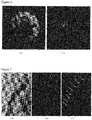
- the solution was injected in the 4-cell stage embryo of a Xenopus. The state immediately after injection is shown in Fig. 6(a) .
- the black spot at the upper left blastomere is the injection site.
- the cell was left untouched for about an hour to allow cell division (32-cell stage).
- the cells were irradiated with a UV light of 470 to 495 nm wavelength. Then, the cells were checked to see if there were any fluorescence, and fluorescence was confirmed around the injection site ( Fig. 6 (b) ).
- Example 5 The solution prepared in Example 5 was placed on a 10 ⁇ m slice of tail-bud embryo head of a Xenopus and left untouched at room temperature for 30 minutes. Then, the tail-bud embryo head was washed with 10% methanol aqueous solution, and irradiated at a wavelength of 470-495 nm. Observation under bright field is shown in Fig. 7(a) . The wavelength of 515 to 550 nm was detected under the dark field, but almost no light emission was seen as shown in Fig. 7(b) . The subject was then irradiated with UV ray having a wavelength of 360 to 370 nm for 30 seconds, after which a wavelength of 515 to 550 nm was detected again ( Fig. 7(c) ). As shown in Fig. 7(c) , the fluorescent signal was observed particularly on the outer layer of the epidermis of the embryo.
Landscapes
- Chemical & Material Sciences (AREA)
- Organic Chemistry (AREA)
- Engineering & Computer Science (AREA)
- Biotechnology (AREA)
- Life Sciences & Earth Sciences (AREA)
- Biochemistry (AREA)
- Health & Medical Sciences (AREA)
- General Health & Medical Sciences (AREA)
- Genetics & Genomics (AREA)
- Molecular Biology (AREA)
- Materials Engineering (AREA)
- Saccharide Compounds (AREA)
- Heterocyclic Compounds Containing Sulfur Atoms (AREA)
- Heterocyclic Carbon Compounds Containing A Hetero Ring Having Oxygen Or Sulfur (AREA)
Claims (1)
- Verbindung, die eine der nachfolgend dargestellten Strukturen aufweist:


Applications Claiming Priority (2)
| Application Number | Priority Date | Filing Date | Title |
|---|---|---|---|
| JP2012199292 | 2012-09-11 | ||
| PCT/JP2013/074052 WO2014042087A1 (ja) | 2012-09-11 | 2013-09-06 | 水溶性フォトクロミック分子 |
Publications (3)
| Publication Number | Publication Date |
|---|---|
| EP2902402A1 EP2902402A1 (de) | 2015-08-05 |
| EP2902402A4 EP2902402A4 (de) | 2016-04-13 |
| EP2902402B1 true EP2902402B1 (de) | 2019-03-13 |
Family
ID=50278200
Family Applications (1)
| Application Number | Title | Priority Date | Filing Date |
|---|---|---|---|
| EP13837714.8A Active EP2902402B1 (de) | 2012-09-11 | 2013-09-06 | Wasserlösliches photochromes molekül |
Country Status (4)
| Country | Link |
|---|---|
| US (1) | US9738675B2 (de) |
| EP (1) | EP2902402B1 (de) |
| JP (1) | JP6214055B2 (de) |
| WO (1) | WO2014042087A1 (de) |
Families Citing this family (1)
| Publication number | Priority date | Publication date | Assignee | Title |
|---|---|---|---|---|
| CN107011318B (zh) * | 2017-03-13 | 2019-05-14 | 华南理工大学 | 齐聚噻吩衍生物电致变色材料及其制备方法 |
Family Cites Families (5)
| Publication number | Priority date | Publication date | Assignee | Title |
|---|---|---|---|---|
| DE60238405D1 (de) * | 2001-06-15 | 2011-01-05 | Masahiro Irie | Photochromes material und darauf basierender farbdosimeter |
| JP2005082507A (ja) | 2003-09-05 | 2005-03-31 | Mitsubishi Chemicals Corp | ジアリールエテン化合物、フォトクロミック材料、カラー線量計および光メモリ素子 |
| JP2005325087A (ja) | 2004-05-17 | 2005-11-24 | Mitsubishi Chemicals Corp | ジアリールエテン系化合物、フォトクロミック材料および光機能素子 |
| RU2345997C2 (ru) * | 2004-09-24 | 2009-02-10 | Самсунг Электроникс Ко., Лтд. | Фотохромные полимеры для трехмерной оперативной оптической памяти |
| CN103130846A (zh) * | 2012-11-27 | 2013-06-05 | 江西科技师范大学 | 光致变色噻吩联六元糖水溶性对称全氟环戊烯化合物及制备方法和应用 |
-
2013
- 2013-09-06 US US14/427,635 patent/US9738675B2/en active Active
- 2013-09-06 WO PCT/JP2013/074052 patent/WO2014042087A1/ja not_active Ceased
- 2013-09-06 JP JP2014535526A patent/JP6214055B2/ja active Active
- 2013-09-06 EP EP13837714.8A patent/EP2902402B1/de active Active
Non-Patent Citations (1)
| Title |
|---|
| None * |
Also Published As
| Publication number | Publication date |
|---|---|
| US20150307541A1 (en) | 2015-10-29 |
| US9738675B2 (en) | 2017-08-22 |
| JPWO2014042087A1 (ja) | 2016-08-18 |
| WO2014042087A1 (ja) | 2014-03-20 |
| JP6214055B2 (ja) | 2017-10-18 |
| EP2902402A1 (de) | 2015-08-05 |
| EP2902402A4 (de) | 2016-04-13 |
Similar Documents
| Publication | Publication Date | Title |
|---|---|---|
| EP3925951A1 (de) | Verfahren zur cycloaddition einer hetero(aryl)-1,3-dipol-verbindung mit einem (hetero)cycloalkyn | |
| Adams et al. | Second generation tumour photosensitisers: the synthesis and biological activity of octaalkyl chlorins and bacteriochlorins with graded amphiphilic character | |
| KR20230147042A (ko) | 광역학 요법 및 진단 | |
| Akagi et al. | Biochemical Studies on Thiosugars. IV. Synthesis of 1, 6-Anhydro-1, 6-sulfide-β-D-glucopyranose (Thiolevoglucosan) and 6-Deoxy-6-mercapto-1-thio-D-glucose. | |
| Lindhorst et al. | Cluster Mannosides as Inhibitors of Type 1 Fimbriae‐Mediated Adhesion of Escherichia coli: Pentaerythritol Derivatives as Scaffolds | |
| Agarwal et al. | Fabrication of deoxycholic acid tethered α-cyanostilbenes as smart low molecular weight gelators and AIEE probes for bio-imaging | |
| Meng et al. | Synthesis of 2′-paclitaxel 2-deoxy-2-fluoro-glucopyranosyl carbonate for specific targeted delivery to cancer cells | |
| Gomez et al. | A Concise Route to Water-Soluble 2, 6-Disubstituted BODIPY-Carbohydrate Fluorophores by Direct Ferrier-Type C-Glycosylation | |
| EP4585601A1 (de) | Neues oligosaccharid, herstellungsverfahren für neues oligosaccharid, herstellungsverfahren für neues oligosaccharid und herstellungsverfahren für neues oligosaccharid | |
| EP2902402A1 (de) | Wasserlösliches photochromes molekül | |
| Grin et al. | " Click chemistry" in the synthesis of the first glycoconjugates of bacteriochlorin series | |
| CN1039123C (zh) | 3'-氮丙啶基蒽环衍生物、其制备方法及其应用 | |
| ES2464123T3 (es) | Procedimiento para la 2-sulfatación de glucósidos | |
| Xia et al. | A bola-phospholipid bearing tetrafluorophenylazido chromophore as a promising lipid probe for biomembrane photolabeling studies | |
| TW202334175A (zh) | 新穎寡糖、該寡糖之製造中間體及其等之製造方法 | |
| Sollert et al. | C-glycosylated pyrroles and their application in dipyrromethane and porphyrin synthesis | |
| JP7670272B2 (ja) | 環状オリゴ糖の製造方法、環状オリゴ糖および包接剤 | |
| Saito et al. | Preparation of a squaraine-bounded cellulose derivative for photocurrent generation system | |
| KR20240127980A (ko) | 광역학 요법 및 진단 | |
| Rigol et al. | Synthesis of 13C-labeled and functionalized Hyaluronan derivatives for biophysical studies and surface modifications | |
| WO2005063263A1 (fr) | Nouveaux derives de la morphine-6-glucuronide, compositions pharmaceutiques les contenant, leur procede de preparation et leurs utilisations | |
| Zhu et al. | Address-crossing digital information processing on a self-aggregatable cyclodextrin derivative based nanosystem | |
| JP2005502671A5 (de) | ||
| JP4546041B2 (ja) | 新規アズレン化合物 | |
| CN1724551A (zh) | 一种α-熊果苷的制备方法 |
Legal Events
| Date | Code | Title | Description |
|---|---|---|---|
| PUAI | Public reference made under article 153(3) epc to a published international application that has entered the european phase |
Free format text: ORIGINAL CODE: 0009012 |
|
| 17P | Request for examination filed |
Effective date: 20150410 |
|
| AK | Designated contracting states |
Kind code of ref document: A1 Designated state(s): AL AT BE BG CH CY CZ DE DK EE ES FI FR GB GR HR HU IE IS IT LI LT LU LV MC MK MT NL NO PL PT RO RS SE SI SK SM TR |
|
| AX | Request for extension of the european patent |
Extension state: BA ME |
|
| DAX | Request for extension of the european patent (deleted) | ||
| RA4 | Supplementary search report drawn up and despatched (corrected) |
Effective date: 20160311 |
|
| RIC1 | Information provided on ipc code assigned before grant |
Ipc: C07D 409/08 20060101ALI20160315BHEP Ipc: C07D 333/54 20060101ALI20160315BHEP Ipc: C07H 15/26 20060101AFI20160315BHEP Ipc: C07D 333/38 20060101ALI20160315BHEP |
|
| STAA | Information on the status of an ep patent application or granted ep patent |
Free format text: STATUS: EXAMINATION IS IN PROGRESS |
|
| 17Q | First examination report despatched |
Effective date: 20161108 |
|
| RIC1 | Information provided on ipc code assigned before grant |
Ipc: C07D 333/38 20060101ALI20181009BHEP Ipc: C07D 333/54 20060101ALI20181009BHEP Ipc: C07H 15/26 20060101AFI20181009BHEP Ipc: C07D 409/08 20060101ALI20181009BHEP |
|
| GRAP | Despatch of communication of intention to grant a patent |
Free format text: ORIGINAL CODE: EPIDOSNIGR1 |
|
| STAA | Information on the status of an ep patent application or granted ep patent |
Free format text: STATUS: GRANT OF PATENT IS INTENDED |
|
| INTG | Intention to grant announced |
Effective date: 20181130 |
|
| GRAS | Grant fee paid |
Free format text: ORIGINAL CODE: EPIDOSNIGR3 |
|
| GRAA | (expected) grant |
Free format text: ORIGINAL CODE: 0009210 |
|
| STAA | Information on the status of an ep patent application or granted ep patent |
Free format text: STATUS: THE PATENT HAS BEEN GRANTED |
|
| AK | Designated contracting states |
Kind code of ref document: B1 Designated state(s): AL AT BE BG CH CY CZ DE DK EE ES FI FR GB GR HR HU IE IS IT LI LT LU LV MC MK MT NL NO PL PT RO RS SE SI SK SM TR |
|
| REG | Reference to a national code |
Ref country code: GB Ref legal event code: FG4D |
|
| REG | Reference to a national code |
Ref country code: CH Ref legal event code: EP Ref country code: AT Ref legal event code: REF Ref document number: 1107537 Country of ref document: AT Kind code of ref document: T Effective date: 20190315 |
|
| REG | Reference to a national code |
Ref country code: DE Ref legal event code: R096 Ref document number: 602013052425 Country of ref document: DE |
|
| REG | Reference to a national code |
Ref country code: IE Ref legal event code: FG4D |
|
| REG | Reference to a national code |
Ref country code: NL Ref legal event code: MP Effective date: 20190313 |
|
| REG | Reference to a national code |
Ref country code: LT Ref legal event code: MG4D |
|
| PG25 | Lapsed in a contracting state [announced via postgrant information from national office to epo] |
Ref country code: FI Free format text: LAPSE BECAUSE OF FAILURE TO SUBMIT A TRANSLATION OF THE DESCRIPTION OR TO PAY THE FEE WITHIN THE PRESCRIBED TIME-LIMIT Effective date: 20190313 Ref country code: NO Free format text: LAPSE BECAUSE OF FAILURE TO SUBMIT A TRANSLATION OF THE DESCRIPTION OR TO PAY THE FEE WITHIN THE PRESCRIBED TIME-LIMIT Effective date: 20190613 Ref country code: SE Free format text: LAPSE BECAUSE OF FAILURE TO SUBMIT A TRANSLATION OF THE DESCRIPTION OR TO PAY THE FEE WITHIN THE PRESCRIBED TIME-LIMIT Effective date: 20190313 Ref country code: LT Free format text: LAPSE BECAUSE OF FAILURE TO SUBMIT A TRANSLATION OF THE DESCRIPTION OR TO PAY THE FEE WITHIN THE PRESCRIBED TIME-LIMIT Effective date: 20190313 |
|
| PG25 | Lapsed in a contracting state [announced via postgrant information from national office to epo] |
Ref country code: NL Free format text: LAPSE BECAUSE OF FAILURE TO SUBMIT A TRANSLATION OF THE DESCRIPTION OR TO PAY THE FEE WITHIN THE PRESCRIBED TIME-LIMIT Effective date: 20190313 Ref country code: HR Free format text: LAPSE BECAUSE OF FAILURE TO SUBMIT A TRANSLATION OF THE DESCRIPTION OR TO PAY THE FEE WITHIN THE PRESCRIBED TIME-LIMIT Effective date: 20190313 Ref country code: RS Free format text: LAPSE BECAUSE OF FAILURE TO SUBMIT A TRANSLATION OF THE DESCRIPTION OR TO PAY THE FEE WITHIN THE PRESCRIBED TIME-LIMIT Effective date: 20190313 Ref country code: GR Free format text: LAPSE BECAUSE OF FAILURE TO SUBMIT A TRANSLATION OF THE DESCRIPTION OR TO PAY THE FEE WITHIN THE PRESCRIBED TIME-LIMIT Effective date: 20190614 Ref country code: BG Free format text: LAPSE BECAUSE OF FAILURE TO SUBMIT A TRANSLATION OF THE DESCRIPTION OR TO PAY THE FEE WITHIN THE PRESCRIBED TIME-LIMIT Effective date: 20190613 Ref country code: LV Free format text: LAPSE BECAUSE OF FAILURE TO SUBMIT A TRANSLATION OF THE DESCRIPTION OR TO PAY THE FEE WITHIN THE PRESCRIBED TIME-LIMIT Effective date: 20190313 |
|
| REG | Reference to a national code |
Ref country code: AT Ref legal event code: MK05 Ref document number: 1107537 Country of ref document: AT Kind code of ref document: T Effective date: 20190313 |
|
| PG25 | Lapsed in a contracting state [announced via postgrant information from national office to epo] |
Ref country code: PT Free format text: LAPSE BECAUSE OF FAILURE TO SUBMIT A TRANSLATION OF THE DESCRIPTION OR TO PAY THE FEE WITHIN THE PRESCRIBED TIME-LIMIT Effective date: 20190713 Ref country code: ES Free format text: LAPSE BECAUSE OF FAILURE TO SUBMIT A TRANSLATION OF THE DESCRIPTION OR TO PAY THE FEE WITHIN THE PRESCRIBED TIME-LIMIT Effective date: 20190313 Ref country code: AL Free format text: LAPSE BECAUSE OF FAILURE TO SUBMIT A TRANSLATION OF THE DESCRIPTION OR TO PAY THE FEE WITHIN THE PRESCRIBED TIME-LIMIT Effective date: 20190313 Ref country code: CZ Free format text: LAPSE BECAUSE OF FAILURE TO SUBMIT A TRANSLATION OF THE DESCRIPTION OR TO PAY THE FEE WITHIN THE PRESCRIBED TIME-LIMIT Effective date: 20190313 Ref country code: RO Free format text: LAPSE BECAUSE OF FAILURE TO SUBMIT A TRANSLATION OF THE DESCRIPTION OR TO PAY THE FEE WITHIN THE PRESCRIBED TIME-LIMIT Effective date: 20190313 Ref country code: IT Free format text: LAPSE BECAUSE OF FAILURE TO SUBMIT A TRANSLATION OF THE DESCRIPTION OR TO PAY THE FEE WITHIN THE PRESCRIBED TIME-LIMIT Effective date: 20190313 Ref country code: EE Free format text: LAPSE BECAUSE OF FAILURE TO SUBMIT A TRANSLATION OF THE DESCRIPTION OR TO PAY THE FEE WITHIN THE PRESCRIBED TIME-LIMIT Effective date: 20190313 Ref country code: SK Free format text: LAPSE BECAUSE OF FAILURE TO SUBMIT A TRANSLATION OF THE DESCRIPTION OR TO PAY THE FEE WITHIN THE PRESCRIBED TIME-LIMIT Effective date: 20190313 |
|
| PG25 | Lapsed in a contracting state [announced via postgrant information from national office to epo] |
Ref country code: PL Free format text: LAPSE BECAUSE OF FAILURE TO SUBMIT A TRANSLATION OF THE DESCRIPTION OR TO PAY THE FEE WITHIN THE PRESCRIBED TIME-LIMIT Effective date: 20190313 Ref country code: SM Free format text: LAPSE BECAUSE OF FAILURE TO SUBMIT A TRANSLATION OF THE DESCRIPTION OR TO PAY THE FEE WITHIN THE PRESCRIBED TIME-LIMIT Effective date: 20190313 |
|
| REG | Reference to a national code |
Ref country code: DE Ref legal event code: R097 Ref document number: 602013052425 Country of ref document: DE |
|
| PG25 | Lapsed in a contracting state [announced via postgrant information from national office to epo] |
Ref country code: IS Free format text: LAPSE BECAUSE OF FAILURE TO SUBMIT A TRANSLATION OF THE DESCRIPTION OR TO PAY THE FEE WITHIN THE PRESCRIBED TIME-LIMIT Effective date: 20190713 Ref country code: AT Free format text: LAPSE BECAUSE OF FAILURE TO SUBMIT A TRANSLATION OF THE DESCRIPTION OR TO PAY THE FEE WITHIN THE PRESCRIBED TIME-LIMIT Effective date: 20190313 |
|
| PLBE | No opposition filed within time limit |
Free format text: ORIGINAL CODE: 0009261 |
|
| STAA | Information on the status of an ep patent application or granted ep patent |
Free format text: STATUS: NO OPPOSITION FILED WITHIN TIME LIMIT |
|
| PG25 | Lapsed in a contracting state [announced via postgrant information from national office to epo] |
Ref country code: DK Free format text: LAPSE BECAUSE OF FAILURE TO SUBMIT A TRANSLATION OF THE DESCRIPTION OR TO PAY THE FEE WITHIN THE PRESCRIBED TIME-LIMIT Effective date: 20190313 |
|
| 26N | No opposition filed |
Effective date: 20191216 |
|
| PG25 | Lapsed in a contracting state [announced via postgrant information from national office to epo] |
Ref country code: SI Free format text: LAPSE BECAUSE OF FAILURE TO SUBMIT A TRANSLATION OF THE DESCRIPTION OR TO PAY THE FEE WITHIN THE PRESCRIBED TIME-LIMIT Effective date: 20190313 |
|
| PG25 | Lapsed in a contracting state [announced via postgrant information from national office to epo] |
Ref country code: TR Free format text: LAPSE BECAUSE OF FAILURE TO SUBMIT A TRANSLATION OF THE DESCRIPTION OR TO PAY THE FEE WITHIN THE PRESCRIBED TIME-LIMIT Effective date: 20190313 |
|
| PG25 | Lapsed in a contracting state [announced via postgrant information from national office to epo] |
Ref country code: MC Free format text: LAPSE BECAUSE OF FAILURE TO SUBMIT A TRANSLATION OF THE DESCRIPTION OR TO PAY THE FEE WITHIN THE PRESCRIBED TIME-LIMIT Effective date: 20190313 |
|
| REG | Reference to a national code |
Ref country code: CH Ref legal event code: PL |
|
| PG25 | Lapsed in a contracting state [announced via postgrant information from national office to epo] |
Ref country code: LU Free format text: LAPSE BECAUSE OF NON-PAYMENT OF DUE FEES Effective date: 20190906 Ref country code: LI Free format text: LAPSE BECAUSE OF NON-PAYMENT OF DUE FEES Effective date: 20190930 Ref country code: CH Free format text: LAPSE BECAUSE OF NON-PAYMENT OF DUE FEES Effective date: 20190930 Ref country code: IE Free format text: LAPSE BECAUSE OF NON-PAYMENT OF DUE FEES Effective date: 20190906 |
|
| REG | Reference to a national code |
Ref country code: BE Ref legal event code: MM Effective date: 20190930 |
|
| PG25 | Lapsed in a contracting state [announced via postgrant information from national office to epo] |
Ref country code: BE Free format text: LAPSE BECAUSE OF NON-PAYMENT OF DUE FEES Effective date: 20190930 |
|
| PG25 | Lapsed in a contracting state [announced via postgrant information from national office to epo] |
Ref country code: CY Free format text: LAPSE BECAUSE OF FAILURE TO SUBMIT A TRANSLATION OF THE DESCRIPTION OR TO PAY THE FEE WITHIN THE PRESCRIBED TIME-LIMIT Effective date: 20190313 |
|
| PG25 | Lapsed in a contracting state [announced via postgrant information from national office to epo] |
Ref country code: MT Free format text: LAPSE BECAUSE OF FAILURE TO SUBMIT A TRANSLATION OF THE DESCRIPTION OR TO PAY THE FEE WITHIN THE PRESCRIBED TIME-LIMIT Effective date: 20190313 Ref country code: HU Free format text: LAPSE BECAUSE OF FAILURE TO SUBMIT A TRANSLATION OF THE DESCRIPTION OR TO PAY THE FEE WITHIN THE PRESCRIBED TIME-LIMIT; INVALID AB INITIO Effective date: 20130906 |
|
| PG25 | Lapsed in a contracting state [announced via postgrant information from national office to epo] |
Ref country code: MK Free format text: LAPSE BECAUSE OF FAILURE TO SUBMIT A TRANSLATION OF THE DESCRIPTION OR TO PAY THE FEE WITHIN THE PRESCRIBED TIME-LIMIT Effective date: 20190313 |
|
| PGFP | Annual fee paid to national office [announced via postgrant information from national office to epo] |
Ref country code: DE Payment date: 20250929 Year of fee payment: 13 |
|
| PGFP | Annual fee paid to national office [announced via postgrant information from national office to epo] |
Ref country code: GB Payment date: 20250923 Year of fee payment: 13 |
|
| PGFP | Annual fee paid to national office [announced via postgrant information from national office to epo] |
Ref country code: FR Payment date: 20250722 Year of fee payment: 13 |