EP2900771B1 - Verwendung eines polymeren korrosionsinhibitors zur behandlung von anodisierten metalloberflächen - Google Patents
Verwendung eines polymeren korrosionsinhibitors zur behandlung von anodisierten metalloberflächen Download PDFInfo
- Publication number
- EP2900771B1 EP2900771B1 EP13766382.9A EP13766382A EP2900771B1 EP 2900771 B1 EP2900771 B1 EP 2900771B1 EP 13766382 A EP13766382 A EP 13766382A EP 2900771 B1 EP2900771 B1 EP 2900771B1
- Authority
- EP
- European Patent Office
- Prior art keywords
- polymeric
- alloys
- units
- corrosion inhibitor
- group
- Prior art date
- Legal status (The legal status is an assumption and is not a legal conclusion. Google has not performed a legal analysis and makes no representation as to the accuracy of the status listed.)
- Not-in-force
Links
Images

Classifications
-
- C—CHEMISTRY; METALLURGY
- C09—DYES; PAINTS; POLISHES; NATURAL RESINS; ADHESIVES; COMPOSITIONS NOT OTHERWISE PROVIDED FOR; APPLICATIONS OF MATERIALS NOT OTHERWISE PROVIDED FOR
- C09D—COATING COMPOSITIONS, e.g. PAINTS, VARNISHES OR LACQUERS; FILLING PASTES; CHEMICAL PAINT OR INK REMOVERS; INKS; CORRECTING FLUIDS; WOODSTAINS; PASTES OR SOLIDS FOR COLOURING OR PRINTING; USE OF MATERIALS THEREFOR
- C09D5/00—Coating compositions, e.g. paints, varnishes or lacquers, characterised by their physical nature or the effects produced; Filling pastes
- C09D5/08—Anti-corrosive paints
-
- C—CHEMISTRY; METALLURGY
- C09—DYES; PAINTS; POLISHES; NATURAL RESINS; ADHESIVES; COMPOSITIONS NOT OTHERWISE PROVIDED FOR; APPLICATIONS OF MATERIALS NOT OTHERWISE PROVIDED FOR
- C09D—COATING COMPOSITIONS, e.g. PAINTS, VARNISHES OR LACQUERS; FILLING PASTES; CHEMICAL PAINT OR INK REMOVERS; INKS; CORRECTING FLUIDS; WOODSTAINS; PASTES OR SOLIDS FOR COLOURING OR PRINTING; USE OF MATERIALS THEREFOR
- C09D171/00—Coating compositions based on polyethers obtained by reactions forming an ether link in the main chain; Coating compositions based on derivatives of such polymers
- C09D171/02—Polyalkylene oxides
-
- C—CHEMISTRY; METALLURGY
- C23—COATING METALLIC MATERIAL; COATING MATERIAL WITH METALLIC MATERIAL; CHEMICAL SURFACE TREATMENT; DIFFUSION TREATMENT OF METALLIC MATERIAL; COATING BY VACUUM EVAPORATION, BY SPUTTERING, BY ION IMPLANTATION OR BY CHEMICAL VAPOUR DEPOSITION, IN GENERAL; INHIBITING CORROSION OF METALLIC MATERIAL OR INCRUSTATION IN GENERAL
- C23C—COATING METALLIC MATERIAL; COATING MATERIAL WITH METALLIC MATERIAL; SURFACE TREATMENT OF METALLIC MATERIAL BY DIFFUSION INTO THE SURFACE, BY CHEMICAL CONVERSION OR SUBSTITUTION; COATING BY VACUUM EVAPORATION, BY SPUTTERING, BY ION IMPLANTATION OR BY CHEMICAL VAPOUR DEPOSITION, IN GENERAL
- C23C22/00—Chemical surface treatment of metallic material by reaction of the surface with a reactive liquid, leaving reaction products of surface material in the coating, e.g. conversion coatings, passivation of metals
- C23C22/82—After-treatment
- C23C22/83—Chemical after-treatment
-
- C—CHEMISTRY; METALLURGY
- C25—ELECTROLYTIC OR ELECTROPHORETIC PROCESSES; APPARATUS THEREFOR
- C25D—PROCESSES FOR THE ELECTROLYTIC OR ELECTROPHORETIC PRODUCTION OF COATINGS; ELECTROFORMING; APPARATUS THEREFOR
- C25D11/00—Electrolytic coating by surface reaction, i.e. forming conversion layers
- C25D11/02—Anodisation
- C25D11/04—Anodisation of aluminium or alloys based thereon
-
- C—CHEMISTRY; METALLURGY
- C25—ELECTROLYTIC OR ELECTROPHORETIC PROCESSES; APPARATUS THEREFOR
- C25D—PROCESSES FOR THE ELECTROLYTIC OR ELECTROPHORETIC PRODUCTION OF COATINGS; ELECTROFORMING; APPARATUS THEREFOR
- C25D11/00—Electrolytic coating by surface reaction, i.e. forming conversion layers
- C25D11/02—Anodisation
- C25D11/04—Anodisation of aluminium or alloys based thereon
- C25D11/18—After-treatment, e.g. pore-sealing
- C25D11/24—Chemical after-treatment
-
- C—CHEMISTRY; METALLURGY
- C25—ELECTROLYTIC OR ELECTROPHORETIC PROCESSES; APPARATUS THEREFOR
- C25D—PROCESSES FOR THE ELECTROLYTIC OR ELECTROPHORETIC PRODUCTION OF COATINGS; ELECTROFORMING; APPARATUS THEREFOR
- C25D11/00—Electrolytic coating by surface reaction, i.e. forming conversion layers
- C25D11/02—Anodisation
- C25D11/04—Anodisation of aluminium or alloys based thereon
- C25D11/18—After-treatment, e.g. pore-sealing
- C25D11/24—Chemical after-treatment
- C25D11/246—Chemical after-treatment for sealing layers
-
- C—CHEMISTRY; METALLURGY
- C25—ELECTROLYTIC OR ELECTROPHORETIC PROCESSES; APPARATUS THEREFOR
- C25D—PROCESSES FOR THE ELECTROLYTIC OR ELECTROPHORETIC PRODUCTION OF COATINGS; ELECTROFORMING; APPARATUS THEREFOR
- C25D11/00—Electrolytic coating by surface reaction, i.e. forming conversion layers
- C25D11/02—Anodisation
- C25D11/26—Anodisation of refractory metals or alloys based thereon
-
- C—CHEMISTRY; METALLURGY
- C25—ELECTROLYTIC OR ELECTROPHORETIC PROCESSES; APPARATUS THEREFOR
- C25D—PROCESSES FOR THE ELECTROLYTIC OR ELECTROPHORETIC PRODUCTION OF COATINGS; ELECTROFORMING; APPARATUS THEREFOR
- C25D11/00—Electrolytic coating by surface reaction, i.e. forming conversion layers
- C25D11/02—Anodisation
- C25D11/04—Anodisation of aluminium or alloys based thereon
- C25D11/06—Anodisation of aluminium or alloys based thereon characterised by the electrolytes used
- C25D11/08—Anodisation of aluminium or alloys based thereon characterised by the electrolytes used containing inorganic acids
Definitions
- the invention relates to the field of corrosion protection for metals, in particular the use of a polymeric corrosion inhibitor or a mixture containing at least one polymeric corrosion inhibitor, for the treatment of metal surfaces and a corresponding method for the treatment of metal surfaces.
- the corrosion of metallic components is a significant problem and can lead to impairment of the functionality of the component.
- Particular attention is paid to the corrosion protection of so-called valve metals such as aluminum, titanium and vanadium and their alloys due to the widespread use in the aerospace and in part also in the automotive industry.
- To inhibit or prevent corrosion it is known to coat the metal surface with a corrosion-inhibiting protective layer.
- a particularly effective corrosion protection for many metals, especially aluminum, has long been achieved by a coating with chromate. Chromates are usually toxic, chromium (VI) is considered carcinogenic. The use of chromium (VI) as a corrosion inhibitor is therefore prohibited.
- Substitute formulations eg chromium (III), zinc phosphate, other inorganic anticorrosive pigments etc.
- chromium (III) generally do not show the good corrosion-inhibiting properties of chromium (VI) and / or are in part metal-specific, so that a broad multi-metal protection can not be achieved.
- some prior art corrosion inhibitors encounter health and / or environmental concerns. Thus, there is a need for alternative formulations that provide effective corrosion protection.
- Organic corrosion inhibitors are chemicals that can strongly and partially adsorb on metal surfaces and in some cases can even bind after a chemical reaction. They can lead to a certain seal and thus build up a barrier effect or inhibit anodic or cathodic corrosion reactions. These corrosion inhibitors are usually in the form of weak acids and their derivatives, which form insoluble salts on the metal surface.
- Organic corrosion inhibitors are to be distinguished from conventional organic paint or paint protective layers. The latter usually have only an insufficient barrier effect against corrosive substances. For this reason, conventional paint or varnish layers predominantly not applied directly to the metal surface, but mostly to a usually corrosion-inhibiting Substances containing primer or primer layer.
- the primer layer may be a paint layer containing corrosion inhibitors as additives.
- conductive polymers as corrosion inhibitors.
- a disadvantage of conductive polymers is that coatings can usually only be applied to the substrate with great difficulty (eg by means of electropolymerization).
- FR 75.182 E discloses to bring aluminum components with polyamide-containing solution in contact and the BE 807 939 A1 discloses contacting aluminum components with polyimide-containing solution.
- the polymeric corrosion inhibitor used in the invention differs from the polyamides and polyimides of the prior art and has advantageous properties which are nowhere mentioned in the prior art (see in particular Examples 1 to 5).
- the invention has recognized that a corrosion inhibitor according to the invention or a mixture containing at least one polymeric corrosion inhibitor forms on metal surfaces a thin, long-term stable polymer layer which exhibits a good corrosion-inhibiting action.
- corrosion inhibitor refers to a substance that can slow, inhibit or prevent the corrosion of metals.
- a polymeric corrosion inhibitor has at least one polymeric backbone having at least two interconnected monomer units. These may be the same monomer units (homopolymer), z. Example, propoxy units, or uneven monomer units (co-polymer), for. Ethoxy, propoxy or butoxy units.
- a polymeric corrosion inhibitor used according to the invention can have up to six polymeric skeletons which are linked to one another via a bridge structural unit.
- the term bridge structural unit denotes a non-polymeric organic structural element to which the at least one polymeric backbone is linked.
- the starting point for the bridge structural unit a starter molecule for the polymerization, for example, an alcohol or polyol such. As glycerol or dipentaerithrol, be, wherein the bridge structural unit does not necessarily have to be identifiable as a former starter molecule.
- the bridge structural unit may also be a carbon atom to which the at least one polymeric backbone is linked.
- the molecular weights given are, as usual with polymers, average molecular weights.
- a polymeric corrosion inhibitor may include by-products such as residual amounts of catalyst or unreacted monomers. The invention has recognized that these by-products do not adversely affect the action of the polymeric corrosion inhibitor.
- This polymer or a mixture containing at least one such polymer is used according to the invention as a corrosion inhibitor for the surface of anodized metals selected from the group consisting of aluminum, titanium, vanadium and alloys of the aforementioned metals. All of these are valve metals or their alloys, on the surface of which an oxide layer has already been prepared by anodization.
- the invention has recognized that, surprisingly, these polymers exhibit an extraordinarily good corrosion-inhibiting action on the porous oxide layer formed by anodization, the corrosion protection can be improved according to the invention against corrosion protection merely by anodization, for example by a factor of 10 or more, as will be explained below.
- the polymeric backbone R 2 is a homopolymer of ethoxy units, a co-polymer based on a mixture of ethoxy and propoxy units, or a homopolymer of propoxy units.
- the backbone R 2 comprises 3 to 200, more preferably 5 to 100 monomer units.
- the polymeric backbone may be branched, but it is preferably a linear backbone.
- the metals protected against corrosion in the context of the inventive use are preferably anodized aluminum and titanium alloys, more preferably anodized alloys selected from the group consisting of AA 2024, AW 5005, AW 5052, AAW 5754, AW 6006, AW 6060, AW 7020 , AW7075, AW7475, AW2024, Al 3.3541, Al 3.3241, Al 3.3561, Al 3.3261, TiA16V4, Ti-Zr-Nb alloys such as Ti-28Zr-8Nb, NiTi alloys such as SM495 and SE 508.
- the corrosion inhibitor used or a mixture which contains at least one such polymeric corrosion inhibitor and the anodized metals provided therewith are preferably designed or selected as described above in the context of the use according to the invention.
- the anodizing carried out in the context of the process according to the invention can preferably be carried out as sulfuric acid anodisers, chromic acid anodization and tartaric acid-sulfuric acid anodization.
- SAA sulfuric acid anodizing
- GS anodizing Sulfuric acid anodizing
- CAA Chromic acid anosizing
- TSA tartaric acid sulfuric acid anodizing
- the layer (oxide layer) produced by anodizing in the context of the method according to the invention preferably has an average thickness of about 1 to 3 ⁇ m, in particular about 2 ⁇ m.
- the pores of the layer produced by anodization preferably have a mean diameter, determined by transmission electron microscopy on sections perpendicular to the surface of the anodized oxide layer, of 2 to 200 nm, more preferably 2 to 50 nm, further preferably about 5 to 20 nm.
- the polymeric corrosion inhibitor or a mixture containing at least one such polymeric corrosion inhibitor is applied out of a two-phase mixture (dispersion or emulsion), preferably an aqueous dispersion.
- a dispersing aid which may be, for example, surfactants or, preferably, alkanolamines, in particular triethanolamine.
- concentration of the polymeric corrosion inhibitor in the preferably aqueous dispersion is preferably 0.01 to 2 wt .-%, more preferably 0.05 to 0.5 wt .-%.
- the weight ratio of polymeric corrosion inhibitor to dispersing aid in the dispersion may preferably be between 3: 1 and 5: 1, in particular about 4: 1.
- the polymeric corrosion inhibitor or a mixture containing at least one such polymeric corrosion inhibitor out of solution.
- Suitable organic solvents for example polar solvents, in particular alcohols, such as isopropanol, or apolar organic solvents, such as, for example, petroleum ether, xylene or, in particular, petroleum ether / xylene mixtures, may be used.
- the concentration of the corrosion inhibitor in the solution is preferably 0.01 to 10% by weight, more preferably 0.05 to 2% by weight, further preferably 0.5 to 2% by weight.
- the application of the corrosion inhibitor or a mixture containing at least one such polymeric corrosion inhibitor on the anodized metal surface can preferably be done according to the invention by immersion, the gas space above the solution or dispersion is preferably under reduced pressure to escape gas from the pores of the anodized oxide layer to facilitate.
- the period of contact (immersion) may preferably be 10 minutes to 6 hours, more preferably 1 to 3 hours.
- the invention further relates to a metal workpiece, obtainable by the method according to the invention.
- a metal workpiece is distinguished from the prior art in that the inventively used polymeric corrosion inhibitor, or a mixture containing at least one such polymeric corrosion inhibitor, is present in the pores of an anodized oxide layer and provides effective corrosion protection also and especially during or after injury of this oxide layer by mechanical action.
- the polymeric corrosion inhibitor used according to the invention or a mixture containing at least one such polymeric corrosion inhibitor may not have fully reacted or not completely reacted functional groups on the polymeric backbone.
- the invention has recognized that the effect of the polymeric corrosion inhibitor is not adversely affected thereby.
- the thickness of the polymer layer disposed on the metal surface is determined by X-ray photoelectron spectroscopy (XPS). This method also allows conclusions about the atomic composition of the layer.
- Salt spray tests were carried out in a salt spray chamber (manufacturer Liebisch GmbH) in accordance with DIN EN ISO 9227 as NSS (neutral salt spray).
- the layer thickness of the oxide layer is about 2 microns. A scanning electron micrograph of these layers is in FIG. 1 shown.
- the pore diameters are lower in a near-surface, outer layer than in the interior of the layer. The diameters are typically in the range between 2 nm and 200 nm, near the surface typically in the range between 2 nm and 50 nm, in the narrower sense between 5 nm and 20 nm.
- the corrosion inhibitor was applied to the anodized oxide layer on anodized sheets of Example 2 by immersion in solutions and dispersions of PKI of different concentrations.
- the surface loadings were then determined by XPS. Higher C concentrations indicate loading with the organic PKI.
- PKI can be applied well from aqueous dispersion, in particular with the aid of the dispersing aid TEA. Also well possible is an application of organic solvents.
- Example 2 Of three sheets of Example 2, one as a comparative example remained unchanged (TSA_Probe4), one was as indicated in Example 3 from an isopropanolic solution of 0.2 wt .-% PKI with the corrosion inhibitor occupied (TSA_Probe5), the third of a 0.5 Wt% PKI + TEA solution with PKI (TSA_Probe6).
- the non-PKI anodised AA2024 sheet TSA_Probe4 shows significantly more whitish-streaky traces of corrosion products than the PKI-treated sheets TSA_Probe5 and TSA_Probe6.
- the PKI treatment thus increases the corrosion resistance of the anodised AA2024 sheets.
- the corrosion resistance is particularly pronounced in the case of the PKI-treated sheet TSA_Probe6; Here first occur during the aging period between 264 h and 432 h first signs of corrosion, so at least eleven times later than the non-PKI treated anodized AA2024 plate TSA_Probe4.
- Example 2 Of two sheets of Example 2, one remained unchanged as a comparative example (TSA_Probe1), a second was coated under the process conditions of Example 3 from a 0.5% by weight PKI + TEA solution with PKI (TSA_Probe3).
- the general industrial paint system used in painting was a conventional two-component (2K) water-based epoxy primer that was conventionally blended and processed.
- the primer contains no corrosion inhibitors and / or chromates and other additives.
- the application of the water-based paint system was carried out by a conventional spraying process, whereby the paint system in the low pressure process (3 bar inlet pressure, nozzle size 1.2 mm) was applied.
- the distance between spray gun and substrate was about 20 cm.
- the paint system was cured at 80 ° C for 45 min. There were obtained dry film thicknesses of about 90 microns.
- the sheets TSA_Probe_1 and TSA_Probe_3 were accelerated by means of a filiform test according to DIN EN 3665. For this purpose, a Ritz was introduced on one side.
- TSA_Probe_1 After a storage time of 1000 h, filiform filaments with a typical length of approx. 1.2 mm are observed in the reference sample TSA_Probe_1, the maximum length being approx. 3.1 mm. In contrast, TSA_Probe_3 has shorter filiform filaments (typical length about 0.8 mm, maximum length 2 mm), indicating improved resistance to filiform corrosion compared to a non-PKI reference sample.
Landscapes
- Chemical & Material Sciences (AREA)
- Organic Chemistry (AREA)
- Engineering & Computer Science (AREA)
- Materials Engineering (AREA)
- Chemical Kinetics & Catalysis (AREA)
- Metallurgy (AREA)
- Electrochemistry (AREA)
- General Chemical & Material Sciences (AREA)
- Life Sciences & Earth Sciences (AREA)
- Wood Science & Technology (AREA)
- Mechanical Engineering (AREA)
- Preventing Corrosion Or Incrustation Of Metals (AREA)
- Paints Or Removers (AREA)
Description
- Die Erfindung betrifft das Gebiet des Korrosionsschutzes für Metalle, insbesondere die Verwendung eines polymeren Korrosionsinhibitors bzw. einer Mischung, die mindestens einen polymeren Korrosionsinhibitor enthält, zur Behandlung von Metalloberflächen sowie ein entsprechendes Verfahren zur Behandlung von Metalloberflächen.
- Die Korrosion an metallischen Bauteilen ist ein erhebliches Problem und kann zur Beeinträchtigung der Funktionalität des Bauteils führen. Besonderes Augenmerk findet der Korrosionsschutz von sogenannten Ventilmetallen wie Aluminium, Titan und Vanadium sowie deren Legierungen aufgrund der weiten Verbreitung von in der Luftfahrt- und teilweise auch in der Autoindustrie. Zur Hemmung bzw. Verhinderung von Korrosion ist es bekannt, die Metalloberfläche mit einer korrosionsinhibierenden Schutzschicht zu überziehen. Ein besonders effektiver Korrosionsschutz für viele Metalle, insbesondere Aluminium, wurde lange durch eine Beschichtung mit Chromat erreicht. Chromate sind in der Regel giftig, Chrom(VI) gilt als krebserzeugend. Die Verwendung von Chrom(VI) als Korrosionsinhibitor ist deshalb mittlerweile verboten. Ersatzformulierungen (z. B. Chrom(III), Zinkphosphat, andere anorganische Korrosionsschutzpigmente etc.) zeigen zumeist nicht die guten korrosionsinhibierenden Eigenschaften von Chrom(VI) und/oder sind teilweise metallspezifisch, so dass ein breiter Multimetallschutz nicht erreicht werden kann. Auch begegnen einige Korrosionsinhibitoren im Stand der Technik gesundheitlichen und/oder ökologischen Bedenken. Es besteht somit ein Bedarf an alternativen Formulierungen, die einen effektiven Korrosionsschutz bieten.
- Organische Korrosionsinhibitoren sind Chemikalien, die auf Metalloberflächen stark und teilweise spezifisch adsorbieren und teilweise sogar nach chemischer Reaktion anbinden können. Sie können zu einer gewissen Versiegelung führen und so eine Barrierewirkung aufbauen oder auch anodische oder kathodische Korrosionsreaktionen hemmen. Diese Korrosionsinhibitoren liegen meist in Form schwacher Säuren und ihrer Derivate vor, die auf der Metalloberfläche unlösliche Salze bilden.
- Die meisten organischen Inhibitoren sind relativ kleine Moleküle, die auf der Metalloberfläche meist dicke unorganisierte Schichten ausbilden, bei denen der Schutzmechanismus auf Physisorption beruht. Nachteilig daran ist, dass diese Schichten leicht abrasiv ablösbar sind oder ausschließlich durch ihre Wasserunlöslichkeit wirken. Im letzteren Fall müssen die Korrosionsinhibitoren mit Lösungsmittel appliziert werden.
- Organische Korrosionsinhibitoren sind von konventionellen organischen Farb- bzw. Lackschutzschichten zu unterscheiden. Letztere weisen zumeist nur eine unzureichende Barrierewirkung gegenüber korrosionsfördernden Stoffen auf. Aus diesem Grund werden konventionelle Farb- bzw. Lackschichten ganz überwiegend nicht direkt auf die Metalloberfläche aufgetragen, sondern zumeist auf eine in der Regel korrosionsinhibierende Substanzen enthaltende Grundierung oder Primerschicht. Bei der Primerschicht kann es sich um eine Lackschichthandeln, die Korrosionsinhibitoren als Additive enthält.
- Ferner ist die Verwendung von leitfähigen Polymeren als Korrosionsschutzmittel bekannt. Nachteilig an leitfähigen Polymeren ist, dass Beschichtungen meist nur sehr aufwändig (z. B. mittels Elektropolymerisation) auf das Substrat aufbringbar sind.
-
FR 75.182 E BE 807 939 A1 - Es ist die Aufgabe der vorliegenden Erfindung, einen Korrosionsschutz für die eingangs genannte anodisierte metallische Substrate bereitzustellen, der eine gute korrosionsinhibierende Wirkung zeigt und einfach zu applizieren ist.
- Gelöst wird diese Aufgabe durch den Gegenstand der unabhängigen Ansprüche. Vorteilhafte Weiterbildungen sind in den abhängigen Ansprüchen genannt.
- Die Erfindung hat erkannt, dass ein erfindungsgemäßer Korrosionsinhibitor bzw. eine Mischung, die mindestens einen polymeren Korrosionsinhibitor enthält, auf Metalloberflächen eine dünne, langzeitstabile Polymerschicht ausbildet, die eine gute korrosionsinhibierende Wirkung zeigt.
- Zunächst seien einige im Rahmen der Erfindung verwendete Begriffe erläutert.
- Der Begriff Korrosionsinhibitor bezeichnet eine Substanz, die die Korrosion von Metallen verlangsamen, hemmen oder verhindern kann.
- Ein polymerer Korrosionsinhibitor weist wenigstens ein polymeres Grundgerüst auf, das wenigstens zwei miteinander verknüpfte Monomereinheiten aufweist. Hierbei kann es sich um die gleichen Monomereinheiten (Homopolymer), z. B. Propoxy-Einheiten, oder um ungleiche Monomereinheiten (CoPolymer), z. B. Ethoxy-, Propoxy oder Butoxy-Einheiten, handeln.
- Die Begriffe "Polymer", "Monomereinheit" und "Monomer" sind im Rahmen der Erfindung wie in der REACH-Verordnung (EG) Nr. 1907/2006 veröffentlicht am 30.12.2006 im Amtsblatt der Europäischen Union Nr. 396 S. 54 definiert.
- Ein erfindungsgemäß verwendeter polymerer Korrosionsinhibitor kann bis zu sechs polymere Grundgerüste aufweisen, die über eine Brückenstruktureinheit miteinander verknüpft sind. Im Rahmen der Erfindung bezeichnet der Begriff Brückenstruktureinheit ein nichtpolymeres organisches Strukturelement, mit dem das wenigstens eine polymere Grundgerüst verknüpft ist. Der Ausgangspunkt für die Brückenstruktureinheit kann ein Startermolekül für die Polymerisation, beispielsweise ein Alkohol oder Polyol wie z. B. Glycerin oder Dipentaerithrol, sein, wobei die Brückenstruktureinheit nicht zwangsläufig als ehemaliges Startermolekül identifizierbar sein muss. Die Brückenstruktureinheit kann auch ein C-Atom sein, mit dem das wenigstens eine polymere Grundgerüst verknüpft ist.
- Ein erfindungsgemäß verwendeter polymerer Korrosionsinhibitor weist die folgende Formel auf:
(R1)aA(R2X)b
wobei -

-

- A eine Brückenstruktureinheit ist,
- R1 gleich oder verschieden H oder ein aliphatischer, aromatischer, olefinischer, cyclischer, heterocyclischer, polycyclischer oder polyheterocyclischer Rest ist,
- R2 gleich oder verschieden ein polymeres Grundgerüst ist, wobei das polymere Grundgerüst R2 Ethoxy- (EO), Propoxy-(PO), Butoxy- (BO), -Einheiten oder Mischungen dieser Einheiten aufweist,
- X gleich oder verschieden eine funktionelle Gruppe ist ausgewählt aus der Gruppe bestehend aus Amiden und Imiden von Carbonsäuren, Dicarbonsäuren und Polycarbonsäuren,
- die Molmasse des Polymers zwischen 200 und 10.000, vorzugsweise 400 und 6.000 liegt.
- Bei den angegebenen Molmassen handelt es sich, wie bei Polymeren üblich, um mittlere Molmassen.
- Im Rahmen der Definition des Begriffs Polymers kann ein polymerer Korrosionsinhibitor Nebenprodukte wie beispielsweise Restmengen an Katalysator oder nicht reagierte Monomere enthalten. Die Erfindung hat erkannt, dass diese Nebenprodukte die Wirkung des polymeren Korrosionsinhibitors nicht negativ beeinflussen.
- Dieses Polymer bzw. eine Mischung, die mindestens ein solches Polymer enthält, wird erfindungsgemäß verwendet als Korrosionsinhibitor für die Oberfläche von anodisierten Metallen ausgewählt aus der Gruppe bestehend aus Aluminium, Titan, Vanadium sowie Legierungen der vorgenannten Metalle. Es handelt sich hier sämtlich um Ventilmetalle bzw. deren Legierungen, auf deren Oberfläche durch Anodisation bereits eine Oxidschicht hergestellt worden ist.
- Die Erfindung hat erkannt, dass überraschenderweise diese Polymere auf der durch Anodisation entstandenen porösen Oxidschicht eine außerordentlich gute korrosionsinhibierende Wirkung entfalten, der Korrosionsschutz kann erfindungsgemäß gegenüber einem Korrosionsschutz lediglich durch Anodisation beispielsweise um den Faktor 10 oder mehr verbessert werden, wie unten noch darzulegen sein wird.
- Ein den Schutzbereich nicht beschränkender und die Anmelderinnen nicht bindender Erklärungsversuch für diese überraschende Wirkung besteht darin, dass möglicherweise das Polymer auf der porösen Oxidoberfläche keine kontinuierliche Schutzschicht bilden kann, sondern in den Porenhohlräumen Depots von möglicherweise flüssigem Polymer gebildet werden. Kommt es zu einer Beschädigung der durch Anodisation entstandenen Oxidschicht, wandert der Korrosionsinhibitor aus diesen Depots zu der durch die Beschädigung freigelegten Metalloberfläche und wird dort durch die funktionellen Gruppen X (siehe Anspruch 1) chemisorbiert.
- Es ist somit insbesondere überraschend, dass ein Polymer, das seine korrosionsinhibierende Wirkung eigentlich durch Chemisorption an einer reinen Metalloberfläche entfalten soll, eine siginifikante korrosionsinhibierende Wirkung auf der völlig anders aufgebauten Oxidschicht von anodisierten Ventilmetallen entfalten kann.
- In einer bevorzugten Ausführungsform ist das polymere Grundgerüst R2 ein Homopolymer von Ethoxy-Einheiten, ein Co-Polymer auf Basis einer Mischung von Ethoxy- und Propoxy-Einheiten, oder ein Homopolymer von Propoxy-Einheiten.
- Vorzugsweise umfasst das Grundgerüst R2 3 bis 200, besonders bevorzugt 5 bis 100 Monomereinheiten. Das polymere Grundgerüst kann verzweigt sein, vörteilhafterweise handelt es sich jedoch um ein lineares Grundgerüst.
- Bei den im Rahmen der erfindungsgemäßen Verwendung korrosionsgeschützten Metallen handelt es sich bevorzugt um anodisierte Aluminium- und Titanlegierungen, weiter vorzugsweise anodisierte Legierungen ausgewählt aus der Gruppe bestehend aus AA 2024, AW 5005, AW 5052, AAW 5754, AW 6006, AW 6060, AW 7020, AW7075, AW7475, AW2024, Al 3.3541, Al 3.3241, Al 3.3561, Al 3.3261, TiA16V4, Ti-Zr-Nb-Legierungen wie Ti-28Zr-8Nb, NiTi-Legierungen wie SM495 und SE 508.
- Gegenstand der Erfindung ist ferner ein Verfahren zur Behandlung der Oberfläche von Metallen ausgewählt aus der Gruppe bestehend aus Aluminium, Titan, Vanadium sowie Legierungen der vorgenannten Metalle, mit den Schritten:
- Anodisieren der Metalloberfläche;
- Inkontaktbringen der anodisierten Metalloberfläche mit einem polymeren Korrosionsinhibitor der Formel
(R1)aA(R2X)b
wobei-

-

- A eine Brückenstruktureinheit ist,
- R1 gleich oder verschieden H oder ein aliphatischer, aromatischer, olefinischer, cyclischer, heterocyclischer, polycyclischer oder polyheterocyclischer Rest ist,
- R2 gleich oder verschieden ein polymeres Grundgerüst ist, wobei das polymere Grundgerüst Ethoxy- (EO), Propoxy- (PO), Butoxy-(BO), -Einheiten oder Mischungen dieser Einheiten aufweist,
- X gleich oder verschieden eine funktionelle Gruppe ist ausgewählt aus der Gruppe bestehend aus Amiden und Imiden von Carbonsäuren, Dicarbonsäuren und Polycarbonsäuren,
- die Molmasse des Polymers zwischen 200 und 10.000, vorzugsweise 400 und 6.000 liegt.
-
- Im Rahmen des erfindungsgemäßen Verfahrens sind der verwendete Korrosionsinhibitor bzw. eine Mischung, die mindestens einen solchen polymeren Korrosionsinhibitor enthält, sowie die damit versehenen anodisierten Metalle bevorzugt so ausgestaltet bzw. ausgewählt wie vorstehend im Rahmen der erfindungsgemäßen Verwendung beschrieben.
- Das im Rahmen des erfindungsgemäßen Verfahrens durchgeführte Anodisieren kann bevorzugt ausgeführt werden als Schwefelsäure-Anodiseren, Chromsäure-Anodisieren und Weinsäure-Schwefelsäure-Anodisieren.
- Das Schwefelsäure-Anodisieren (SAA, auch GS-Anodisieren genannt) wird z.B. mit ca. 20 Vol.-% Schwefelsäure bei ca. 20 °C und bei ca. 20 V Gleichspannung betrieben. Das Chromsäure-Anosisieren (CAA, Bengough-Stuart Prozess) wird z.B. mit 30-100 g/l Chromsäure bei ca. 40 °C und bei 40 bis 50 V Gleichspannung betrieben. Das erfindungsgemäß bevorzugte Weinsäure-Schwefelsäure-Anodisieren (TSA) wird z.B. mit 80 g/l Weinsäure und 40 g/l Schwefelsäure bei ca. 37°C und bei ca. 14 V für 25 min betrieben (vgl. DIN EN 4704:2012-05).
- Die im Rahmen des erfindungsgemäßen Verfahrens durch Anodisieren hergestellte Schicht (Oxidschicht) weist bevorzugt eine mittlere Dicke von etwa 1 bis 3 µm, insbesondere etwa 2 µm auf. Bevorzugt weisen die Poren der durch Anodisieren hergestellten Schicht einen mittleren, mittels Transmissionselektronenmikroskopie an Schnitten senkrecht zur Oberfläche der anodisierten Oxidschicht ermittelten Durchmesser von 2 bis 200 nm, weiter vorzugsweise 2 bis 50 nm, weiter vorzugsweise etwa 5 bis 20 nm auf.
- Erfindungsgemäß ist es bevorzugt, dass der polymere Korrosionsinhibitor bzw. eine Mischung, die mindestens einen solchen polymeren Korrosionsinhibitor enthält, aus einem Zweiphasengemisch (Dispersion bzw. Emulsion) heraus appliziert wird, vorzugsweise einer wässrigen Dispersion. Bevorzugt kann ein Dispergierhilfsmittel zugegen sein, dabei kann es sich beispielsweise um Tenside oder bevorzugt um Alkanolamine wie insbesondere Triethanolamin handeln. Die Konzentration des polymeren Korrosionsinhibitors in der bevorzugt wässrigen Dispersion beträgt vorzugsweise 0,01 bis 2 Gew.-%, weiter vorzugsweise 0,05 bis 0,5 Gew.-%.
- Bei Verwendung eines Dispergierhilfsmittels wie insbesondere Triethanolamin kann das Gewichtsverhältnis von polymeren Korisionsinhibitor zu Dispergierhilfsmittel in der Dispersion bevorzugt zwischen 3:1 und 5:1, insbesondere bei etwa 4:1 liegen.
- Erfindungsgemäß ist es alternativ möglich, den polymeren Korrosionsinhibitor bzw. eine Mischung, die mindestens einen solchen polymeren Korrosionsinhibitor enthält, aus einer Lösung heraus zu applizieren. Es können geeignete organische Lösungsmittel, beispielsweise polare Lösungsmittel, insbesondere Alkohole, wie Isopropanol, oder apolare organische Lösungsmittel wie beispielsweise Petrolether, Xylol oder insbesondere Petrolether/Xylol-Gemische verwendet werden. Die Konzentration des Korrosionsinhibitors in der Lösung beträgt bevorzugt 0,01 bis 10 Gew.-%, weiter vorzugsweise 0,05 bis 2 Gew.-%, weiter vorzugsweise 0,5 bis 2 Gew.-%.
- Das Aufbringen des Korrosionsinhibitors bzw. eine Mischung, die mindestens einen solchen polymeren Korrosionsinhibitor enthält, auf die anodisierte Metalloberfläche kann erfindungsgemäß bevorzugt geschehen durch Eintauchen, der Gasraum über der Lösung oder Dispersion steht bevorzugt unter vermindertem Druck, um eine Entweichen von Gas aus den Poren der anodisierten Oxidschicht zu erleichtern. Der Zeitraum des Inkontaktbringens (Eintauchens) kann bevorzugt 10 min bis 6 h, weiter vorzugsweise 1 bis 3 h betragen.
- Gegenstand der Erfindung ist ferner ein Metallwerkstück, erhältlich durch das erfindungsgemäße Verfahren. Ein solches Metallwerkstück zeichnet sich gegenüber dem Stand der Technik dadurch aus, dass der erfindungsgemäß verwendete polymere Korrosionsinhibitor bzw. ein Gemisch, das mindestens einen solchen polymeren Korrosionsinhibitor enthält, in den Poren einer anodisierten Oxidschicht zugegen ist und einen wirksamen Korrosionsschutz auch und gerade bei oder nach einer Verletzung dieser Oxidschicht durch mechanische Einwirkung bietet.
- Der erfindungsgemäße verwendete polymere Korrosionsinhibitor bzw. eine Mischung, die mindestens einen solchen polymeren Korrosionsinhibitor enthält, kann nicht vollständig durchreagierte bzw. nicht vollständig umgesetzte funktionelle Gruppen am polymeren Grundgerüst aufweisen. Die Erfindung hat erkannt, dass die Wirkung des polymeren Korrosionsinhibitors dadurch nicht negativ beeinflusst wird.
- Die Erfindung wird nachstehend anhand von Ausführungsbeispielen erläutert. Zunächst werden verschiedene Mess- und Prüfverfahren erläutert, anschließend folgen Beispiele und Vergleichsbeispiele.
- In den Figuren zeigen:
- Fig. 1
- Rasterelektronenmikroskopische Aufnahme einer Bruchkante (nach oben ist die Oberfläche gerichtet, nach unten das Basismaterial) einer mittels Weinsäure-Schwefelsäüre-Anodisieren hergestellten Oxidschicht (unverdichtet) auf AA2024 unplattiert;
- Fig. 2:
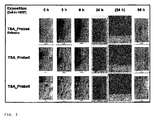
- Photographische Aufnahmen von den Oberflächen von mit einer PKI enthaltenden Korrosionsinhibitorschicht belegten anodisierten Aluminium AA2024-Blechen (aus isopropanolischer (i-PrOH) Lösung belegtes TSA_Blech5 und aus wässriger Lösung mit TEA-Zusatz belegtes TSA_Blech6) im Vergleich zu einer nicht mit PKI belegten Referenz (TSA_Blech4) nach unterschiedlich langer Lagerung im Salzsprühtest NSS-Test
- Die Dicke der auf der Metalloberfläche angeordneten Polymerschicht wird mittels Röntgenphotoelektronenspektroskopie (XPS) bestimmt. Diese Methode erlaubt zudem Rückschlüsse auf die atomare Zusammensetzung der Schicht.
- Salzsprühtests wurde in einer Salzsprühkammer (Hersteller Liebisch GmbH) entsprechend DIN EN ISO 9227 als NSS (neutral salt spray) durchgeführt.
- Die Erfindung wird nachfolgend anhand von Beispielen erläutert.
- Ein Polymer mit einem mittleren Molekulargewicht von ca. 6000 der Formel
(R1)aA(R2Y)b
wobei - A = -CH2-CH-CH2-,
- a = 0,
- b = 3,
- Y eine NH2-Gruppe,
- das polymere Grundgerüst R2 ein Homopolymer von Propoxy-Einheiten ist,
- wird mit einer equifunktionalen Menge Polymaleinsäureanhydrid amidiert. Diese Polyamidocarbonsäure PAC wird mit Amin, vorzugsweise Triethanolamin (TEA), neutralisiert. Der so erhaltene polymere Korrosionsinhibitor wird nachfolgend als PKI bezeichnet.
- Bleche der Aluminiumlegierung AA 2024 wurden wie folgt anodisiert:
- Weinsäure-Schwefelsäure-Anodisation (TSA) mit 80 g/l Weinsäure und 40 g/l Schwefelsäure bei 37°C und 14 V für 25 min.
- Die Schichtdicke der Oxidschicht beträgt ca. 2 µm. Eine rasterelektronenmikroskopische Aufnahme dieser Schichten ist in
Figur 1 dargestellt. Die Porendurchmesser sind in einer oberflächennahen, äußeren Schicht geringer als im Inneren der Schicht. Die Durchmesser liegen typischerweise im Bereich zwischen 2 nm und 200 nm, oberflächennah typischerweise im Bereich zwischen 2 nm und 50 nm, im engeren Sinne zwischen 5 nm und 20 nm. - In diesem Beispiel wurde auf anodisierte Bleche des Beispiels 2 durch Eintauchen in Lösungen und Dispersionen von PKI unterschiedlicher Konzentration der Korrosionsinhibitor auf die anodisierte Oxidschicht aufgebracht. Die Oberflächenbeladungen wurden anschließend mittels XPS bestimmt. Höhere C-Konzentrationen zeigen eine Beladung mit dem organischen PKI an.
- Die anodisierten AA 2024-Bleche wurden gebeizt und die Oberfläche luftgetrocknet. Anschließend erfolgte ein Eintauchen in die jeweilge PKI-Lösung/Dispersion bei Raumtemperatur für 2 h bei Unterdruck im Gasraum über der Flüssigphase.
Tabelle 1: XPS-Untersuchungsergebnisse der Oberflächenbeladungen von gebeizten AA2024-Blechen nach Immersion in wässrigen PKI-Dispersionen. Die PKI-Konzentrationen sind in Gewichts-% angegeben. Eine visuell erkennbare Trübung der Dispersionen bzw. eine nach dem Vermischen mittels Rühren eintretende Ausbildung einer ölig erscheinenden, aufschwimmenden zweiten Phase ist durch die Kennzeichnung "t" angemerkt. Elementkonzentrationen sind in at% angegeben. Die mittels Lichtstreuung ermittelte durchschnittliche Größe dD von über 50 nm großen Tröpfchen ist in µm angegeben, falls die Lichtstreuintensität bei der Messung ausreichend war. aq. PKID dD Cu Fe F O N K Ca C S Cl P Al 0,5 %t 0,23 0,2 1,0 2,2 34,8 0,5 - - 37,5 0,2 - 2,1 21,4 0,15 % 1,02 0,3 1,1 2,6 36,4 0,6 - - 33,7 0,1 - 2,2 22,9 0,05 % 1,87 0,4 0,9 2,9 40,0 0,5 - - 26,1 0,1 - 2,9 26,0 0,014 % 0,9 0,3 1,1 2,1 42,1 0,5 - 0,2 27,0 0,1 - 3,2 23,4 0,0042 % 0,4 0,9 2,8 39,9 0,3 - - 27,2 - - 2,3 26,0 0,0013 % 0,5 1,1 3,2 42,9 0,3 - 0,2 20,7 0,2 - 2,6 28,2 0,00039 % 0,5 1,1 3,2 43,8 0,3 - 0,2 19,5 0,2 - 2,6 28,6 Tabelle 2: XPS-Untersuchungsergebnisse der Oberflächenbeladungen von gebeizten AA2024-Blechen nach Immersion in wässrigen PKI-Dispersionen mit Zusatz von TEA Triethanolamin) im Gewichtsverhältnis 4:1. Die PKI-Konzentrationen sind in Gewichts-% angegeben. Eine visuell erkennbare Trübung der Dispersionen bzw. eine nach dem Vermischen mittels Rühren eintretende Ausbildung einer ölig erscheinenden, aufschwimmenden zweiten Phase ist durch die Kennzeichnung "t" angemerkt. Elementkonzentrationen sind in at% angegeben. aq. PKI + TEA Na Cu Fe F O N K Ca C S Cl P Al 0,40 % - 0,1 0,3 0,4 26,0 1,6 - - 62,9 - - 0,4 7,7 0,11 % - 0,2 0,5 1,2 32,6 1,2 - 0,1 47,7 - - 1,1 15,4 0,033 % - 0,4 0,4 1,9 34,4 1,2 - 0,1 39,2 0,1 - 1,2 21,2 0,010 % - 0,3 0,3 1,9 37,2 0,8 - 0,1 36,5 - - 1,3 21,4 0,031 % - 0,5 0,2 2,9 39,6 0,6 - 0,1 25,7 - - 0,3 28,5 Tabelle 3: XPS-Untersuchungsergebnisse der Oberflächenbeladungen von gebeizten AA2024-Blechen nach Immersion in isopropanolischen PKI-Dispersionen. Die PKI-Konzentrationen sind in Gewichts-% angegeben. Eine visuell erkennbare Trübung der Dispersionen bzw. eine nach dem Vermischen mittels Rühren eintretende Ausbildung einer ölig erscheinenden, aufschwimmenden zweiten Phase ist durch die Kennzeichnung "t" angemerkt. Elementkonzentrationen sind in at% angegeben. PKI i-PrOH Na Cu Fe F O N K Ca C S Cl P Al 6 %t - - - - 21,2 1,2 - - 77,6 - - - 0,1 2 %t - - - - 21,6 1,2 - - 77,0 - - - 0,2 0,5 % - - - - 24,5 1,7 - - 68,1 - - 0,2 4,9 0,15 % 0,1 0,3 1,0 2,6 35,0 1,4 - 0,1 38,4 0,2 - 1,3 19,5 0,05 % 0,1 0,5 0,6 3,6 37,4 1,0 - - 30,6 - - 2,0 24,1 0,014 % - 0,5 0,7 3,9 39,2 0,6 - 0,3 27,4 0,2 - 1,6 25,5 0,0042 % 0,1 0,5 0,8 4,1 38,6 0,7 - 0,2 27,8 0,2 - 1,8 25,2 0,0013 % 0,1 0,6 0,6 4,5 39,2 0,6 - 0,3 24,5 0,3 - 1,9 27,4 Tabelle 4: XPS-Untersuchungsergebnisse der Oberflächenbeladungen von gebeizten AA2024-Blechen nach Immersion in PKI-Dispersionen in Petrolether/Xylol-Gemischen (PE/X). Die PKI-Konzentrationen sind in Gewichts-% angegeben. Elementkonzentrationen sind in at% angegeben. PKI PE/X Na Cu Fe F O N K Ca C S Cl P Al 2 % - - - - 21,5 1,1 - - 76,9 - - - 0,4 0,5 % - - - 0,3 22,9 1,2 - - 72,8 - - - 2,8 0,15 % - 0,1 - 0,8 26,1 1,7 - - 65,4 0,9 - - 5,0 0,05 % - 0,2 - 1,7 29,1 1,1 - - 53,8 0,4 - - 13,8 0,014 % - 0,6 - 4,0 33,9 0,6 - - 34,8 0,4 - - 25,8 0,0042 % - 0,6 - 9,8 33,6 0,9 - - 26,5 0,6 - - 28,1 0,0013 % 0,7 0,7 - 5,1 35,8 0,5 - - 28,8 0,9 - - 27,4 0,00039 % - 0,5 - 4,8 36,9 0,7 - - 30,8 1,1 - - 25,2 - Man erkennt, dass sich PKI aus wässriger Dispersion insbesondere unter Zuhilfenahme des Dispergierhilfsmittels TEA gut aufbringen lässt. Ebenfalls gut möglich ist ein Aufbringen aus organischen Lösungsmitteln.
- Von drei Blechen des Beispiels 2 blieb eines als Vergleichsbeispiel unverändert (TSA_Probe4), eines wurde wie in Beispiel 3 angegeben aus einer isopropanolischen Lösung von 0,2 Gew.-% PKI mit dem Korrosionsinhibitor belegt (TSA_Probe5), das dritte aus einer 0,5 Gew.-% PKI + TEA-Lösung mit PKI belegt (TSA_Probe6).
- Nach unterschiedlich lange Zeit erfolgenden Lagerungen im Salzsprühtest NSS werden Unterschiede zwischen den verschiedenen AA2024-Blechen insbesondere nach 24 h Lagerungszeit erkennbar. Das nicht mit PKI behandelte anodisierte AA2024-Blech TSA_Probe4 zeigt deutlich mehr weißlich-schlierige Spuren von Korrosionsprodukten als die mit PKI behandelten Bleche TSA_Probe5 und TSA_Probe6. Die PKI-Behandlung erhöht also die Korrosionsbeständigkeit der anodisierten AA2024-Bleche. Besonders ausgeprägt ist die Korrosionsbeständigkeit bei dem mit PKI behandelten Blech TSA_Probe6; hier erst treten im Auslagerungszeitraum zwischen 264 h und 432 h erste Körrosionserscheinungen auf, also mindestens elf Mal später als beim nicht mit PKI behandelten anodisierten AA2024-Blech TSA_Probe4.
- Von zwei Blechen des Beispiels 2 blieb eines als Vergleichsbeispiel unverändert (TSA_Probe1), ein zweites wurde unter den Verfahrensbedingungen des Beispiels 3 aus einer 0,5 Gew.-% PKI + TEA-Lösung mit PKI belegt (TSA_Probe3).
- Auf diese Bleche wurde eine Lackschicht aufgebracht.
- Das beim Lackieren eingesetzte Lacksystem für allgemeine Industrielackierung war eine herkömmliche zweikomponentige (2K) wasserbasierende epoxidhaltige Grundierung, die in herkömmlicher Weise angemischt und verarbeitet wurde. Die Grundierung enthält keine Korrosionsinhibitoren und/oder Chromate sowie weitere Additive. Die Applikation des wasserbasierenden Lacksystem erfolgte durch ein konventionelles Sprühverfahren, wodurch das Lacksystem im Niederdruckverfahren (3 bar Eingangsdruck; Düsengröße 1,2 mm) aufgetragen wurde. Der Abstand zwischen Lackierpistole und Substrat betrug ca. 20 cm. Nach einer Ablüftzeit von 15 min wurde das Lacksystem bei 80 °C für 45 min ausgehärtet. Es wurden Lack-Trockenschichtdicken von etwa 90 µm erhalten.
- Die Bleche TSA_Probe_1 und TSA_Probe_3, wurden mittels eines Filiformtests nach DIN EN 3665 beschleunigt gealtert. Dazu wurde auf der einer Seite ein Ritz eingebracht.
- Nach einer Auslagerungsdauer von 1000 h werden bei der Referenzprobe TSA_Probe_1 Filiformfäden mit einer typischen Länge von ca. 1.2 mm beobachtet, wobei die maximale Länge ca. 3.1 mm beträgt. Dagegen weist TSA_Probe_3 kürzere Filiform-Fäden auf (typische Länge ca. 0.8 mm, max. Länge 2 mm), was auf eine verbesserte Beständigkeit gegenüber Filiformkorrosion im Vergleich zu einer nicht mit PKI belegten Referenzprobe hindeutet.
Claims (13)
- Verwendung eines polymeren Korrosionsinhibitors oder einer Mischung, die mindestens einen polymeren Korrosionsinhibitor enthält, der Formel
(R1)aA(R2X)b
wobei
 A eine Brückenstruktureinheit ist,R1 gleich oder verschieden H oder ein aliphatischer, aromatischer, olefinischer, cyclischer, heterocyclischer, polycyclischer oder polyheterocyclischer Rest ist,R2 gleich oder verschieden ein polymeres Grundgerüst ist, wobei das polymere Grundgerüst R2 Ethoxy- (EO), Propoxy- (PO), Butoxy- (BO), -Einheiten oder Mischungen dieser Einheiten aufweist,X gleich oder verschieden eine funktionelle Gruppe ist ausgewählt aus der Gruppe bestehend aus Amiden und Imiden von Carbonsäuren, Dicarbonsäuren und Polycarbonsäuren,die Molmasse des Polymers zwischen 200 und 10.000, vorzugsweise 400 und 6.000 liegt;als Korrosionsinhibitor für die Oberfläche von anodisierten Metallen ausgewählt aus der Gruppe bestehend aus Aluminium, Titan, Vanadium sowie Legierungen der vorgenannten Metalle.
 - Verwendung nach Anspruch 1 , dadurch gekennzeichnet, dass das polymere Grundgerüst R2 ein Homopolymer von Ethoxy-Einheiten, ein Co-Polymer auf Basis einer Mischung von Ethoxy- und Propoxy-Einheiten, oder ein Homopolymer von Propoxy-Einheiten ist; und/oder dadurch, dass das Grundgerüst R2 3 bis 200, vorzugsweise 5 bis 100 Monomereinheiten umfasst.
- Verwendung nach einem der Ansprüche 1 bis 2, dadurch gekennzeichnet, dass die Metalle ausgewählt sind aus der Gruppe bestehend aus anodisierten Aluminium- und Titanlegierungen, vorzugsweise anodisierten Legierungen ausgewählt aus der Gruppe bestehend aus AA 2024, AW 5005, AW 5052, AAW 5754, AW 6006, AW 6060, AW 7020, AW7075, AW7475, AW2024, Al 3.3541, Al 3.3241, Al 3.3561, Al 3.3261, TiA16V4, Ti-Zr-Nb-Legierungen wie Ti-28Zr-8Nb, NiTi-Legierungen wie SM495 und SE 508.
- Verfahren zur Behandlung der Oberfläche von Metallen ausgewählt aus der Gruppe bestehend aus Aluminium, Titan, Vanadium sowie Legierungen der vorgenannten Metalle, mit den Schritten:- Anodisieren der Metalloberfläche;- Inkontaktbringen der anodisierten Metalloberfläche mit einem polymeren Korrosionsinhibitor oder einer Mischung, die mindestens einen polymeren Korrosionsinhibitor enthält, der Formel
(R1)aA(R2X)b
wobei
 A eine Brückenstruktureinheit ist,R1 gleich oder verschieden H oder ein aliphatischer, aromatischer, olefinischer, cyclischer, heterocyclischer, polycyclischer oder polyheterocyclischer Rest ist,R2 gleich oder verschieden ein polymeres Grundgerüst ist, wobei das polymere Grundgerüst R2 Ethoxy- (EO), Propoxy- (PO), Butoxy- (BO), -Einheiten oder Mischungen dieser Einheiten aufweist,X gleich oder verschieden eine funktionelle Gruppe ist ausgewählt aus der Gruppe bestehend aus Amiden und Imiden von Carbonsäuren, Dicarbonsäuren und Polycarbonsäuren,die Molmasse des Polymers zwischen 200 und 10.000, vorzugsweise 400 und 6.000 liegt.
 - Verfahren nach Anspruch 4, dadurch gekennzeichnet, dass das polymere Grundgerüst R2 ein Homopolymer von Ethoxy-Einheiten, ein Co-Polymer auf Basis einer Mischung von Ethoxy- und Propoxy-Einheiten, oder ein Homopolymer von Propoxy-Einheiten ist; und/oder dadurch, dass das Grundgerüst R2 3 bis 200, vorzugsweise 5 bis 100 Monomereinheiten umfasst.
- Verfahren nach einem der Ansprüche 4 bis 6, dadurch gekennzeichnet, dass die Metalle ausgewählt sind aus der Gruppe bestehend aus anodisierten Aluminium- und Titanlegierungen, vorzugsweise anodisierten Legierungen ausgewählt aus der Gruppe bestehend aus AA 2024, AW 5005, AW 5052, AAW 5754, AW 6006, AW 6060, AW 7020, AW7075, AW7475, AW2024, Al 3.3541, Al 3.3241, Al 3.3561, Al 3.3261, TiA16V4, Ti-Zr-Nb-Legierungen wie Ti-28Zr-8Nb, NiTi-Legierungen wie SM495 und SE 508.
- Verfahren nach einem der Ansprüche 4 bis 6, dadurch gekennzeichnet, dass das Anodisieren ausgewählt ist aus der Gruppe bestehend aus Schwefelsäure-Anodisieren, Chromsäure-Anodisieren und Weinsäure-Schwefelsäure-Anodisieren.
- Verfahren nach einem der Ansprüche 4 bis 7, dadurch gekennzeichnet, dass die durch Anodisieren hergestellte Schicht eine Dicke von 1 bis 3 µm aufweist.
- Verfahren nach einem der Ansprüche 4 bis 8, dadurch gekennzeichnet, dass die Poren der durch Anodisieren hergestellten Schicht einen Durchmesser von 2 bis 200 nm, vorzugsweise 2 bis 50 nm, weiter vorzugsweise 5 bis 20 nm aufweisen.
- Verfahren nach einem der Ansprüche 4 bis 9, dadurch gekennzeichnet, dass der polymere Korrosionsinhibitor aus einer Dispersion heraus appliziert wird, vorzugsweise einer wässrigen Dispersion.
- Verfahren nach Anspruch 10, dadurch gekennzeichnet, dass ein Dispergierhilfsmittel, vorzugsweise Triethanolamin, verwendet wird.
- Verfahren nach einem der Ansprüche 4 bis 9, dadurch gekennzeichnet, dass der polymere Korrosionsinhibitor aus einer Lösung heraus appliziert wird; wobei vorzugsweise als Lösungsmittel Isopropanol, Petrolether und/oder Xylol verwendet wird.
- Metallwerkstück, erhältlich durch ein Verfahren nach einem der Ansprüche 4 bis 12.
Applications Claiming Priority (2)
| Application Number | Priority Date | Filing Date | Title |
|---|---|---|---|
| DE102012217693.4A DE102012217693A1 (de) | 2012-09-28 | 2012-09-28 | Verwendung eines polymeren Korrosionsinhibitors zur Behandlung von Metalloberflächen |
| PCT/EP2013/070119 WO2014049081A1 (de) | 2012-09-28 | 2013-09-26 | Verwendung eines polymeren korrosionsinhibitors zur behandlung von anodisierten metalloberflächen |
Publications (2)
| Publication Number | Publication Date |
|---|---|
| EP2900771A1 EP2900771A1 (de) | 2015-08-05 |
| EP2900771B1 true EP2900771B1 (de) | 2016-11-30 |
Family
ID=49231506
Family Applications (1)
| Application Number | Title | Priority Date | Filing Date |
|---|---|---|---|
| EP13766382.9A Not-in-force EP2900771B1 (de) | 2012-09-28 | 2013-09-26 | Verwendung eines polymeren korrosionsinhibitors zur behandlung von anodisierten metalloberflächen |
Country Status (3)
| Country | Link |
|---|---|
| EP (1) | EP2900771B1 (de) |
| DE (1) | DE102012217693A1 (de) |
| WO (1) | WO2014049081A1 (de) |
Families Citing this family (1)
| Publication number | Priority date | Publication date | Assignee | Title |
|---|---|---|---|---|
| DE102017108831A1 (de) | 2017-04-25 | 2018-10-25 | Fraunhofer-Gesellschaft zur Förderung der angewandten Forschung e.V. | Elektrisch leitfähiger Haftfilm |
Family Cites Families (9)
| Publication number | Priority date | Publication date | Assignee | Title |
|---|---|---|---|---|
| FR75182E (de) * | 1961-09-08 | |||
| BE807939A (en) * | 1973-11-28 | 1974-03-15 | Bereday Sigmund | Coating aluminium with resin - by first applying a controlled thickness of active anodising, then applying the resin |
| US3961111A (en) * | 1975-03-18 | 1976-06-01 | Pennwalt Corporation | Method of increasing corrosion resistance of anodized aluminum |
| GB8400848D0 (en) * | 1984-01-13 | 1984-02-15 | Ciba Geigy Ag | Cotelomer compounds |
| DE3434668A1 (de) * | 1984-09-21 | 1986-04-03 | Henkel KGaA, 4000 Düsseldorf | Konservierungsmittel fuer aluminium-oberflaechen |
| US5904990A (en) * | 1997-05-28 | 1999-05-18 | The United States Of America As Represented By The Secretary Of The Navy | Amino functional poly (para-phenylene vinylene)s as protective coatings |
| DE102007044159A1 (de) * | 2007-09-11 | 2009-03-12 | Leibniz-Institut Für Polymerforschung Dresden E.V. | Metallwerkstoffe mit hybrid-stabilisierter Oxidschicht, Verfahren zu der Herstellung sowie deren Verwendung |
| US8628689B2 (en) * | 2009-04-03 | 2014-01-14 | Akzo Nobel Coatings International B.V. | Anti-corrosive coating composition |
| EP2505690A1 (de) * | 2011-03-28 | 2012-10-03 | Straetmans high TAC GmbH | Polymerer Korrosionsinhibitor für metallischen Oberflächen und deren Herstellung |
-
2012
- 2012-09-28 DE DE102012217693.4A patent/DE102012217693A1/de not_active Ceased
-
2013
- 2013-09-26 WO PCT/EP2013/070119 patent/WO2014049081A1/de not_active Ceased
- 2013-09-26 EP EP13766382.9A patent/EP2900771B1/de not_active Not-in-force
Also Published As
| Publication number | Publication date |
|---|---|
| DE102012217693A1 (de) | 2014-04-03 |
| EP2900771A1 (de) | 2015-08-05 |
| WO2014049081A1 (de) | 2014-04-03 |
Similar Documents
| Publication | Publication Date | Title |
|---|---|---|
| EP0948666B2 (de) | Verfahren zur behandlung metallischer oberflächen | |
| EP2945987B1 (de) | Verfahren zur herstellung einer korrosionsschutzbeschichtung | |
| EP1978052B1 (de) | Beschichtung eines Bauteils | |
| EP2499205B1 (de) | Korrosionsschutzbeschichtungen, insbesondere für metalle ausgewählt aus der gruppe bestehend aus aluminium, aluminiumlegierungen, stahl und mit einem zinkhaltigen überzug versehenem stahl, und mischungen zu ihrer herstellung | |
| DE102009044821B4 (de) | Behandlungslösung und Verfahren zur Beschichtung von Metalloberflächen | |
| DE1184588B (de) | Verfahren und Loesung zum Aufbringen von festhaftenden UEberzuegen aus Polyvinylphosphonsaeure auf Metallteilen | |
| EP1883679B1 (de) | Lackschichtbildendes korrosionsschutzmittel und verfahren zu dessen stromfreier applikation | |
| DE69612216T2 (de) | Metallblech mit rostpreventiver organischer beschichtung, verfahren zu dessen herstellung und behandlungsflüssigkeit dafür | |
| EP2094793A1 (de) | LACKSCHICHTBILDENDES KORROSIONSSCHUTZMITTEL MIT VERMINDERTER RIßBILDUNG UND VERFAHREN ZU DESSEN STROMFREIER APPLIKATION | |
| EP2743288A1 (de) | Verfahren zur Herstellung chloridfreier Polyethylenimine | |
| EP2992127B1 (de) | Verfahren zur oberflächenbehandlung eines metallischen substrats | |
| EP3449040B1 (de) | Zusammensetzung zur verminderung des beizabtrags beim beizen von metallischen oberflächen enthaltend blanken und/oder verzinkten stahl | |
| DE102012217693A1 (de) | Verwendung eines polymeren Korrosionsinhibitors zur Behandlung von Metalloberflächen | |
| WO2013045258A1 (de) | Modifizierte schichtsilikate als korrosionsschutz | |
| EP2505690A1 (de) | Polymerer Korrosionsinhibitor für metallischen Oberflächen und deren Herstellung | |
| DE2251611A1 (de) | Verfahren zum vorbehandeln von metalloberflaechen | |
| DE102012223356A1 (de) | Verfahren zur Herstellung beschichteter Dosendeckel | |
| WO2016193004A1 (de) | Konditionierung vor einer konversionsbehandlung von metalloberflächen | |
| DE202007002788U1 (de) | Korrosionsbeständiges Substrat | |
| DE102008034757B4 (de) | Schichtüberzüge von Polyanilin und Polyanin-Derivaten auf Zinkoberflächen | |
| EP4458914A1 (de) | Beschichtungsmischung zur beschichtung von substraten, verfahren zur herstellung beschichteter substrate, sowie beschichtetes substrat und dessen verwendung | |
| DE2706613A1 (de) | Verfahren zum beschichten von substraten | |
| DE10115747A1 (de) | Wäßriger Primer enthaltend blockierte Isocyanate und dessen Verwendung zur Vorbehandlung von aluminiumhaltigen Oberflächen für eine nachfolgende Pulverlackierung | |
| DE2759361B2 (de) |
Legal Events
| Date | Code | Title | Description |
|---|---|---|---|
| PUAI | Public reference made under article 153(3) epc to a published international application that has entered the european phase |
Free format text: ORIGINAL CODE: 0009012 |
|
| 17P | Request for examination filed |
Effective date: 20150424 |
|
| AK | Designated contracting states |
Kind code of ref document: A1 Designated state(s): AL AT BE BG CH CY CZ DE DK EE ES FI FR GB GR HR HU IE IS IT LI LT LU LV MC MK MT NL NO PL PT RO RS SE SI SK SM TR |
|
| AX | Request for extension of the european patent |
Extension state: BA ME |
|
| DAX | Request for extension of the european patent (deleted) | ||
| GRAP | Despatch of communication of intention to grant a patent |
Free format text: ORIGINAL CODE: EPIDOSNIGR1 |
|
| INTG | Intention to grant announced |
Effective date: 20160513 |
|
| GRAS | Grant fee paid |
Free format text: ORIGINAL CODE: EPIDOSNIGR3 |
|
| GRAA | (expected) grant |
Free format text: ORIGINAL CODE: 0009210 |
|
| AK | Designated contracting states |
Kind code of ref document: B1 Designated state(s): AL AT BE BG CH CY CZ DE DK EE ES FI FR GB GR HR HU IE IS IT LI LT LU LV MC MK MT NL NO PL PT RO RS SE SI SK SM TR |
|
| REG | Reference to a national code |
Ref country code: CH Ref legal event code: EP Ref country code: GB Ref legal event code: FG4D Free format text: NOT ENGLISH |
|
| REG | Reference to a national code |
Ref country code: AT Ref legal event code: REF Ref document number: 849776 Country of ref document: AT Kind code of ref document: T Effective date: 20161215 |
|
| REG | Reference to a national code |
Ref country code: IE Ref legal event code: FG4D Free format text: LANGUAGE OF EP DOCUMENT: GERMAN |
|
| REG | Reference to a national code |
Ref country code: DE Ref legal event code: R096 Ref document number: 502013005596 Country of ref document: DE |
|
| PG25 | Lapsed in a contracting state [announced via postgrant information from national office to epo] |
Ref country code: LV Free format text: LAPSE BECAUSE OF FAILURE TO SUBMIT A TRANSLATION OF THE DESCRIPTION OR TO PAY THE FEE WITHIN THE PRESCRIBED TIME-LIMIT Effective date: 20161130 |
|
| REG | Reference to a national code |
Ref country code: LT Ref legal event code: MG4D |
|
| REG | Reference to a national code |
Ref country code: NL Ref legal event code: MP Effective date: 20161130 |
|
| PG25 | Lapsed in a contracting state [announced via postgrant information from national office to epo] |
Ref country code: NO Free format text: LAPSE BECAUSE OF FAILURE TO SUBMIT A TRANSLATION OF THE DESCRIPTION OR TO PAY THE FEE WITHIN THE PRESCRIBED TIME-LIMIT Effective date: 20170228 Ref country code: LT Free format text: LAPSE BECAUSE OF FAILURE TO SUBMIT A TRANSLATION OF THE DESCRIPTION OR TO PAY THE FEE WITHIN THE PRESCRIBED TIME-LIMIT Effective date: 20161130 Ref country code: GR Free format text: LAPSE BECAUSE OF FAILURE TO SUBMIT A TRANSLATION OF THE DESCRIPTION OR TO PAY THE FEE WITHIN THE PRESCRIBED TIME-LIMIT Effective date: 20170301 Ref country code: SE Free format text: LAPSE BECAUSE OF FAILURE TO SUBMIT A TRANSLATION OF THE DESCRIPTION OR TO PAY THE FEE WITHIN THE PRESCRIBED TIME-LIMIT Effective date: 20161130 |
|
| PG25 | Lapsed in a contracting state [announced via postgrant information from national office to epo] |
Ref country code: RS Free format text: LAPSE BECAUSE OF FAILURE TO SUBMIT A TRANSLATION OF THE DESCRIPTION OR TO PAY THE FEE WITHIN THE PRESCRIBED TIME-LIMIT Effective date: 20161130 Ref country code: HR Free format text: LAPSE BECAUSE OF FAILURE TO SUBMIT A TRANSLATION OF THE DESCRIPTION OR TO PAY THE FEE WITHIN THE PRESCRIBED TIME-LIMIT Effective date: 20161130 Ref country code: PL Free format text: LAPSE BECAUSE OF FAILURE TO SUBMIT A TRANSLATION OF THE DESCRIPTION OR TO PAY THE FEE WITHIN THE PRESCRIBED TIME-LIMIT Effective date: 20161130 Ref country code: FI Free format text: LAPSE BECAUSE OF FAILURE TO SUBMIT A TRANSLATION OF THE DESCRIPTION OR TO PAY THE FEE WITHIN THE PRESCRIBED TIME-LIMIT Effective date: 20161130 Ref country code: PT Free format text: LAPSE BECAUSE OF FAILURE TO SUBMIT A TRANSLATION OF THE DESCRIPTION OR TO PAY THE FEE WITHIN THE PRESCRIBED TIME-LIMIT Effective date: 20170330 Ref country code: ES Free format text: LAPSE BECAUSE OF FAILURE TO SUBMIT A TRANSLATION OF THE DESCRIPTION OR TO PAY THE FEE WITHIN THE PRESCRIBED TIME-LIMIT Effective date: 20161130 |
|
| PG25 | Lapsed in a contracting state [announced via postgrant information from national office to epo] |
Ref country code: NL Free format text: LAPSE BECAUSE OF FAILURE TO SUBMIT A TRANSLATION OF THE DESCRIPTION OR TO PAY THE FEE WITHIN THE PRESCRIBED TIME-LIMIT Effective date: 20161130 |
|
| PG25 | Lapsed in a contracting state [announced via postgrant information from national office to epo] |
Ref country code: RO Free format text: LAPSE BECAUSE OF FAILURE TO SUBMIT A TRANSLATION OF THE DESCRIPTION OR TO PAY THE FEE WITHIN THE PRESCRIBED TIME-LIMIT Effective date: 20161130 Ref country code: CZ Free format text: LAPSE BECAUSE OF FAILURE TO SUBMIT A TRANSLATION OF THE DESCRIPTION OR TO PAY THE FEE WITHIN THE PRESCRIBED TIME-LIMIT Effective date: 20161130 Ref country code: DK Free format text: LAPSE BECAUSE OF FAILURE TO SUBMIT A TRANSLATION OF THE DESCRIPTION OR TO PAY THE FEE WITHIN THE PRESCRIBED TIME-LIMIT Effective date: 20161130 Ref country code: EE Free format text: LAPSE BECAUSE OF FAILURE TO SUBMIT A TRANSLATION OF THE DESCRIPTION OR TO PAY THE FEE WITHIN THE PRESCRIBED TIME-LIMIT Effective date: 20161130 Ref country code: SK Free format text: LAPSE BECAUSE OF FAILURE TO SUBMIT A TRANSLATION OF THE DESCRIPTION OR TO PAY THE FEE WITHIN THE PRESCRIBED TIME-LIMIT Effective date: 20161130 |
|
| PG25 | Lapsed in a contracting state [announced via postgrant information from national office to epo] |
Ref country code: BG Free format text: LAPSE BECAUSE OF FAILURE TO SUBMIT A TRANSLATION OF THE DESCRIPTION OR TO PAY THE FEE WITHIN THE PRESCRIBED TIME-LIMIT Effective date: 20170228 Ref country code: IT Free format text: LAPSE BECAUSE OF FAILURE TO SUBMIT A TRANSLATION OF THE DESCRIPTION OR TO PAY THE FEE WITHIN THE PRESCRIBED TIME-LIMIT Effective date: 20161130 Ref country code: SM Free format text: LAPSE BECAUSE OF FAILURE TO SUBMIT A TRANSLATION OF THE DESCRIPTION OR TO PAY THE FEE WITHIN THE PRESCRIBED TIME-LIMIT Effective date: 20161130 |
|
| REG | Reference to a national code |
Ref country code: DE Ref legal event code: R097 Ref document number: 502013005596 Country of ref document: DE |
|
| REG | Reference to a national code |
Ref country code: FR Ref legal event code: PLFP Year of fee payment: 5 |
|
| PLBE | No opposition filed within time limit |
Free format text: ORIGINAL CODE: 0009261 |
|
| STAA | Information on the status of an ep patent application or granted ep patent |
Free format text: STATUS: NO OPPOSITION FILED WITHIN TIME LIMIT |
|
| 26N | No opposition filed |
Effective date: 20170831 |
|
| PG25 | Lapsed in a contracting state [announced via postgrant information from national office to epo] |
Ref country code: SI Free format text: LAPSE BECAUSE OF FAILURE TO SUBMIT A TRANSLATION OF THE DESCRIPTION OR TO PAY THE FEE WITHIN THE PRESCRIBED TIME-LIMIT Effective date: 20161130 |
|
| REG | Reference to a national code |
Ref country code: CH Ref legal event code: PL |
|
| PG25 | Lapsed in a contracting state [announced via postgrant information from national office to epo] |
Ref country code: MC Free format text: LAPSE BECAUSE OF FAILURE TO SUBMIT A TRANSLATION OF THE DESCRIPTION OR TO PAY THE FEE WITHIN THE PRESCRIBED TIME-LIMIT Effective date: 20161130 |
|
| REG | Reference to a national code |
Ref country code: IE Ref legal event code: MM4A |
|
| REG | Reference to a national code |
Ref country code: BE Ref legal event code: MM Effective date: 20170930 |
|
| PG25 | Lapsed in a contracting state [announced via postgrant information from national office to epo] |
Ref country code: LU Free format text: LAPSE BECAUSE OF NON-PAYMENT OF DUE FEES Effective date: 20170926 |
|
| PG25 | Lapsed in a contracting state [announced via postgrant information from national office to epo] |
Ref country code: LI Free format text: LAPSE BECAUSE OF NON-PAYMENT OF DUE FEES Effective date: 20170930 Ref country code: IE Free format text: LAPSE BECAUSE OF NON-PAYMENT OF DUE FEES Effective date: 20170926 Ref country code: CH Free format text: LAPSE BECAUSE OF NON-PAYMENT OF DUE FEES Effective date: 20170930 |
|
| PG25 | Lapsed in a contracting state [announced via postgrant information from national office to epo] |
Ref country code: BE Free format text: LAPSE BECAUSE OF NON-PAYMENT OF DUE FEES Effective date: 20170930 |
|
| REG | Reference to a national code |
Ref country code: FR Ref legal event code: PLFP Year of fee payment: 6 |
|
| PG25 | Lapsed in a contracting state [announced via postgrant information from national office to epo] |
Ref country code: MT Free format text: LAPSE BECAUSE OF FAILURE TO SUBMIT A TRANSLATION OF THE DESCRIPTION OR TO PAY THE FEE WITHIN THE PRESCRIBED TIME-LIMIT Effective date: 20161130 |
|
| PGFP | Annual fee paid to national office [announced via postgrant information from national office to epo] |
Ref country code: AT Payment date: 20180918 Year of fee payment: 6 Ref country code: GB Payment date: 20180924 Year of fee payment: 6 |
|
| PG25 | Lapsed in a contracting state [announced via postgrant information from national office to epo] |
Ref country code: HU Free format text: LAPSE BECAUSE OF FAILURE TO SUBMIT A TRANSLATION OF THE DESCRIPTION OR TO PAY THE FEE WITHIN THE PRESCRIBED TIME-LIMIT; INVALID AB INITIO Effective date: 20130926 |
|
| PG25 | Lapsed in a contracting state [announced via postgrant information from national office to epo] |
Ref country code: CY Free format text: LAPSE BECAUSE OF FAILURE TO SUBMIT A TRANSLATION OF THE DESCRIPTION OR TO PAY THE FEE WITHIN THE PRESCRIBED TIME-LIMIT Effective date: 20161130 |
|
| PG25 | Lapsed in a contracting state [announced via postgrant information from national office to epo] |
Ref country code: MK Free format text: LAPSE BECAUSE OF FAILURE TO SUBMIT A TRANSLATION OF THE DESCRIPTION OR TO PAY THE FEE WITHIN THE PRESCRIBED TIME-LIMIT Effective date: 20161130 |
|
| PG25 | Lapsed in a contracting state [announced via postgrant information from national office to epo] |
Ref country code: TR Free format text: LAPSE BECAUSE OF FAILURE TO SUBMIT A TRANSLATION OF THE DESCRIPTION OR TO PAY THE FEE WITHIN THE PRESCRIBED TIME-LIMIT Effective date: 20161130 |
|
| PG25 | Lapsed in a contracting state [announced via postgrant information from national office to epo] |
Ref country code: AL Free format text: LAPSE BECAUSE OF FAILURE TO SUBMIT A TRANSLATION OF THE DESCRIPTION OR TO PAY THE FEE WITHIN THE PRESCRIBED TIME-LIMIT Effective date: 20161130 Ref country code: IS Free format text: LAPSE BECAUSE OF FAILURE TO SUBMIT A TRANSLATION OF THE DESCRIPTION OR TO PAY THE FEE WITHIN THE PRESCRIBED TIME-LIMIT Effective date: 20170330 |
|
| REG | Reference to a national code |
Ref country code: AT Ref legal event code: MM01 Ref document number: 849776 Country of ref document: AT Kind code of ref document: T Effective date: 20190926 |
|
| GBPC | Gb: european patent ceased through non-payment of renewal fee |
Effective date: 20190926 |
|
| PG25 | Lapsed in a contracting state [announced via postgrant information from national office to epo] |
Ref country code: GB Free format text: LAPSE BECAUSE OF NON-PAYMENT OF DUE FEES Effective date: 20190926 |
|
| PG25 | Lapsed in a contracting state [announced via postgrant information from national office to epo] |
Ref country code: AT Free format text: LAPSE BECAUSE OF NON-PAYMENT OF DUE FEES Effective date: 20190926 |
|
| PGFP | Annual fee paid to national office [announced via postgrant information from national office to epo] |
Ref country code: FR Payment date: 20210927 Year of fee payment: 9 |
|
| PGFP | Annual fee paid to national office [announced via postgrant information from national office to epo] |
Ref country code: DE Payment date: 20220920 Year of fee payment: 10 |
|
| P01 | Opt-out of the competence of the unified patent court (upc) registered |
Effective date: 20230524 |
|
| PG25 | Lapsed in a contracting state [announced via postgrant information from national office to epo] |
Ref country code: FR Free format text: LAPSE BECAUSE OF NON-PAYMENT OF DUE FEES Effective date: 20220930 |
|
| REG | Reference to a national code |
Ref country code: DE Ref legal event code: R119 Ref document number: 502013005596 Country of ref document: DE |
|
| PG25 | Lapsed in a contracting state [announced via postgrant information from national office to epo] |
Ref country code: DE Free format text: LAPSE BECAUSE OF NON-PAYMENT OF DUE FEES Effective date: 20240403 |