EP2899304A1 - Verfahren zum Bezug zumindest zweier Sitze einer Sitzanordnung - Google Patents
Verfahren zum Bezug zumindest zweier Sitze einer Sitzanordnung Download PDFInfo
- Publication number
- EP2899304A1 EP2899304A1 EP14001020.8A EP14001020A EP2899304A1 EP 2899304 A1 EP2899304 A1 EP 2899304A1 EP 14001020 A EP14001020 A EP 14001020A EP 2899304 A1 EP2899304 A1 EP 2899304A1
- Authority
- EP
- European Patent Office
- Prior art keywords
- style
- longitudinal
- fabric
- web
- seat
- Prior art date
- Legal status (The legal status is an assumption and is not a legal conclusion. Google has not performed a legal analysis and makes no representation as to the accuracy of the status listed.)
- Granted
Links
Images



Classifications
-
- B—PERFORMING OPERATIONS; TRANSPORTING
- B68—SADDLERY; UPHOLSTERY
- B68G—METHODS, EQUIPMENT, OR MACHINES FOR USE IN UPHOLSTERING; UPHOLSTERY NOT OTHERWISE PROVIDED FOR
- B68G7/00—Making upholstery
- B68G7/05—Covering or enveloping cores of pads
- B68G7/052—Covering or enveloping cores of pads with webs secured to the core, e.g. by stitching
-
- B—PERFORMING OPERATIONS; TRANSPORTING
- B60—VEHICLES IN GENERAL
- B60N—SEATS SPECIALLY ADAPTED FOR VEHICLES; VEHICLE PASSENGER ACCOMMODATION NOT OTHERWISE PROVIDED FOR
- B60N2/00—Seats specially adapted for vehicles; Arrangement or mounting of seats in vehicles
- B60N2/58—Seat coverings
- B60N2/5891—Seat coverings characterised by the manufacturing process; manufacturing seat coverings not otherwise provided for
-
- B—PERFORMING OPERATIONS; TRANSPORTING
- B60—VEHICLES IN GENERAL
- B60N—SEATS SPECIALLY ADAPTED FOR VEHICLES; VEHICLE PASSENGER ACCOMMODATION NOT OTHERWISE PROVIDED FOR
- B60N2/00—Seats specially adapted for vehicles; Arrangement or mounting of seats in vehicles
- B60N2/58—Seat coverings
-
- B—PERFORMING OPERATIONS; TRANSPORTING
- B64—AIRCRAFT; AVIATION; COSMONAUTICS
- B64D—EQUIPMENT FOR FITTING IN OR TO AIRCRAFT; FLIGHT SUITS; PARACHUTES; ARRANGEMENT OR MOUNTING OF POWER PLANTS OR PROPULSION TRANSMISSIONS IN AIRCRAFT
- B64D11/00—Passenger or crew accommodation; Flight-deck installations not otherwise provided for
- B64D11/06—Arrangements of seats, or adaptations or details specially adapted for aircraft seats
-
- B—PERFORMING OPERATIONS; TRANSPORTING
- B64—AIRCRAFT; AVIATION; COSMONAUTICS
- B64D—EQUIPMENT FOR FITTING IN OR TO AIRCRAFT; FLIGHT SUITS; PARACHUTES; ARRANGEMENT OR MOUNTING OF POWER PLANTS OR PROPULSION TRANSMISSIONS IN AIRCRAFT
- B64D11/00—Passenger or crew accommodation; Flight-deck installations not otherwise provided for
- B64D11/06—Arrangements of seats, or adaptations or details specially adapted for aircraft seats
- B64D11/0647—Seats characterised by special upholstery or cushioning features
Definitions
- the invention relates to a method for obtaining at least two seats of a seat arrangement, in particular seats of an aircraft cabin, wherein each seat has at least one seat cushion and a backrest.
- the colors are based on the color scheme of the logo of the passenger transport service provider, such as an airline.
- the passengers transport service provider such as an airline.
- unicolor fabrics or fabrics are used with a small pattern to reduce the pattern matching at the cut edges or to obtain only a small waste due to the pattern size.
- the object of the invention is to provide a method for obtaining at least two seats of a seat assembly with a panel, which allows individualization of the visual appearance of individual seats or parts thereof while maintaining a uniform overall appearance, without having to use several differently shaped panels.
- the process is essential on the one hand, the design of the fabric used and on the other hand, the use of blanks from the fabric, which are cut at considerable reduction of waste from the fabric to cover the individual parts of the seats, such as seat cushions, backrests, footrests, headrests, armrests and optionally the seat shield.
- the design elements should always be located at the same location of the seat or parts thereof, to achieve an identical appearance of the seats or parts thereof .
- the fabric used for the seat cover has several strips extending across the width of the fabric and spaced apart from each other, and if a strip is always to be arranged in the middle of the seat parts (backrests, armrests, etc.), then the cover parts must be used provided blanks are cut out of the fabric such that a strip extends through the center thereof. With greater distance of the strips on the fabric, there is a significant waste.
- the inventive method allows the individualization of a mass product, which is in a preferred embodiment in the mass product to the seats of an aircraft cabin, since many airlines, especially the large, numerous types of aircraft for Use passenger transport.
- a fabric in the embodiment of the invention leads to a clearly visible individualization of the individual seats or parts thereof, so that the visual appearance of the seats is different from each other.
- the color scheme of the style elements or the coloring of the basic color tone ensures the uniform overall appearance with simultaneous individualization of a seat or parts thereof. This aspect of the individualization of individual seats or parts thereof, while maintaining a uniform overall appearance, is in addition to the reduction of waste the essential aspect of the method according to the invention.
- style element The accumulation of a style element is understood here to mean that at least three identical style elements are present in greater numbers on one section of the longitudinal repeat than on an equally large other section.
- the particular advantage of such a woven fabric is that all blanks do not have to be cut at a fixed location from the fabric, but so can be cut from the fabric that the blend is as low as possible, with an individualization of the seats and seat parts automatically in that the at least one style element is arranged in the form of at least one local cluster on the fabric web.
- the shape and / or the arrangement and / or the color of the style elements may be chosen so that the transition from one longitudinal repeat to the other is fluent. This can be done, for example, by passing the same style elements from one longitudinal repeat to the next.
- the method according to the invention is preferably used to purchase seats of an aircraft cabin.
- the fabric is designed such that the longitudinal repeat has a length of at least 1.20 m, but preferably a length of 3 m to 10 m.
- This measure results from the fact that the seats of the economy class of an aircraft cabin have a seat cushion with a length of at least 45 cm and a backrest with a length of at least 75 cm.
- at least one seat cushion and a backrest with blanks can be obtained from a longitudinal repeat, but the desired individualization effect only occurs when a plurality of seat cushions and backrests are obtained with blanks from a longitudinal repeat.
- the larger the longitudinal repeat the greater the individualization of the individual seats or parts thereof, but the length of the L jossrapportes is limited by the design effort and the production cost.
- a longitudinal repeat of 3 m to 10 m is used for the purchase of aircraft seats, so that the covers of several seat cushions and backrests can be cut from a longitudinal repeat, whereby the individual seats or their parts receive a uniform overall appearance, the optical designs but still by the heaped arrangement of at least one style element on the fabric are each individualized, since not every section of the L jossrapportes inevitably on every seat or a part thereof is present.
- the cut variation and optimization possibilities are improved, so that an extremely low waste is achieved and thus the cost of a single seat cover can be reduced.
- the styling element has a different surface density within an accumulation in the longitudinal direction and / or transverse direction of the fabric web. Due to a different surface density of a style element within a cluster, a further variation possibility of the optical design is given, since an accumulation within a L Lucassrapportes also over larger areas may extend, which may be a style element in one color or in different colors and / or different or equal sizes.
- one or more style elements may also be present within a longitudinal repeat, which may have different or the same colors and / or different or identical sizes. It is also possible that several style elements are arranged within a longitudinal repeat, which always have the same color. Furthermore, it is possible that within a longitudinal repeat several style elements are present, which always have the same color, but each have different sizes.
- Said area density of the style elements arranged on the fabric is based on a section of the fabric with a length of 0.1 m to 2 m, preferably of 0.2 m. This means that the area density of a style element is determined from the number of style element on a square section of the fabric with an edge length of 0.1 m to 2 m.
- the fabric web has two or more clusters of a style element within the longitudinal repeat in the longitudinal and / or transverse direction.
- the fabric has two or more clusters of several style elements within the Lssensrapportes in the longitudinal and / or transverse direction.
- the clusters may have a different density of styling elements, individualization of the visual appearance of a seat and the parts thereof while sustaining an overall appearance can be sustainably effected. It is the designer of the fabric is left to consider the individualization of the visual appearance of individual blanks only to the extent that a uniform overall appearance is maintained.
- At least one style element is present only within a cluster, and / or that at least one style element is arranged outside of existing clusters.
- a style element on the fabric can be arranged several times in the form of an accumulation and is not present outside of this accumulation on the fabric.
- a style element may be multiple times arranged on the fabric in the form of an aggregate, it may be located off the accumulation of the fabric, with the frequency of occurrence of the style element off the accumulation decreasing, increasing or otherwise, for example, proportional to the distance from the accumulation can vary.
- the at least one style element may consist of a linear or planar figure that is open or closed, a geometric, amorphous or floral shape of a polygonal line, or individual self-contained style elements.
- the linear figures may be circles, stars, diamonds or flowers, etc.
- the line-shaped figures may also be simple straight lines, which are perpendicular to the longitudinal extent of the fabric, at any other or even fluctuating angle extend.
- Under surface figures are figures to understand, which consist of flat areas of color, the color of the area areas, as already stated, is different from the base color.
- a polygonal line is understood to mean a line which consists of individual, adjoining, straight lines.
- Individual, self-contained style elements are understood to mean those style elements which consist of straight or curved lines and have no open ends, such as circles, squares, rhombuses, flower representations or other geometric figures.
- the fabric has a uniform base color.
- the preservation of a uniform overall appearance can advantageously be achieved by the base color, which is present on the entire longitudinal repeat and is present between several identical or different style elements and / or within style elements.
- Base color is understood to mean the color that fills the largest area on the fabric and is present on the entire longitudinal repeat.
- the basic color can be bordered by linear style elements, so that the base color is also within the style elements. It may be provided that the style elements have a different color from the base color, the base color is present on the entire longitudinal repeat between the multiply arranged style elements and / or within the style elements.
- the fabric over the entire length of a Leksrapportes has a gradient, a uniform overall appearance is then effected by the color of the arranged on the fabric style elements, which can always be the same or only slightly different from each other.
- the invention further relates to an aircraft seat whose parts are covered with a woven fabric web with the described features.
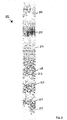
- FIG. 1 shows a first embodiment of a longitudinal repeat of a fabric web 10 for applying the method according to the invention.
- the fabric 10 has a base color 11 and style elements 12, 13, 14, 15.
- the style elements 12, 13, 14, 15 are arranged in the form of local clusters within the L Lucassrapportes the fabric 10.
- the style elements 12 are line figures which envelop floral patterns 15.
- the style elements 13 are line figures in the form of squares of different sizes.
- the style elements 14 are flat figures in the form of circles.
- FIG. 2 shows a second embodiment of a longitudinal repeat of a fabric web 20 for applying the method according to the invention.
- the panel 20 has a base color 27 and a plurality of different style elements 21, 22, 23, 24, 25, 26, 28.
- the style elements 21, 22, 23, 24, 25, 26, 28 are arranged in the form of local clusters within a longitudinal repeat of the panel 20.
- the style elements 21 are flat flower figures.
- the style elements 22 are planar, but structured and inclined with respect to the direction of extension of the fabric web 20, square figures.
- the style elements 23 are two-dimensional circles of a first color different from the base color 27.
- the style elements 28 are likewise flat circles of a second color different from the base color 27.
- the style elements 24 are linear spider web patterns.
- the style elements 25 are compared to the style elements 23, 28 very small color filled dots.
- the style elements 26 are linear flower figures. All style elements 21, 22, 23, 24, 25, 26, 28 are arranged several times on the web 20 in the form of local clusters.
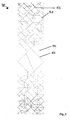
- FIG. 3 shows a third embodiment of a fabric 50 for applying the method according to the invention.
- the fabric 50 has a base color 54 and style elements 51, 52, 53, wherein the style element 51 is a Dashed line in a first color, in which style element 52 is a solid line in the first color and the style element 53 is a dashed line in a second color.
- the style elements 51 and 52 accumulate in the vicinity of the beginning and the end of the longitudinal repeat, whereas they are not arranged on the fabric 50 in the middle of the longitudinal repeat.
- the style element 53 also accumulates in the vicinity of the beginning and the end of the longitudinal repeat, with the clusters of the style element 53 extending beyond the clusters of the style elements 51 and 52 on the longitudinal repeat of the fabric 50.
- the style element 53 is arranged isolated, whereas the style elements 51 and 52 are not arranged in the central region of the longitudinal repeat.
- FIG. 4 shows a fourth embodiment of a longitudinal repeat of a fabric 60 for applying the method according to the invention.
- the fabric 60 has a base color 61 and style elements 62, 63, 64, 65.
- the fabric 60 has four accumulations within the longitudinal repeat shown.
- the style element 63 has four clumps within the longitudinal repeat, the style element 62 has two clumps within the longitudinal repeat and the style element 65 has several clumps within the longitudinal repeat.
- the style element 65 is a straight line that extends perpendicular to the extending direction of the fabric, so that clusters of the style element 65 have the shape of wider stripes.
- the style elements 62, 63, 64 are letters, the style elements 62, 63, 64 having different colors from each other.
- FIG. 5 shows a part 30 of a seat assembly, which consists of three seats 31, 32, 33.
- the seat parts of the seats 31, 32, 33 that is the seat cushions and backrests are covered with a fabric according to the method of the invention.
- the seat cushions of the seats 31, 32, 33 have a length of about 45 cm and the backrests of the seats 31, 32, 33 have a length from about 75 cm up.
- the seat parts of the seats 31, 32, 33 are covered with blanks of the same fabric, wherein the fabric has a longitudinal repeat of 6 m.
- style element 36 On the back of the seat 31, the style element 36 accumulates in the form of small flat circles, whereas style elements 37 are arranged in the form of larger area circles, style elements 38 in the form of hexagons or style elements 39 only isolated or with greater distance from each other on the backrest.
- style elements 40, 41 On the seat cushion of the seat 32 style elements 40, 41 accumulate in the form of flat hexagons, with the style elements 40, 41 differ from each other by their color.
- piling style elements 45 in the form of small area circles and style elements 46 in the form of small area squares On the seat surface of the seat 33 piling style elements 45 in the form of small area circles and style elements 46 in the form of small area squares.
- style element 47 in the form of a linear flower figure is only sporadically arranged on the seat.
- Style elements 45 in the form of small flat circles also accumulate on the backrest of the seat 33, but the style elements 46 are not arranged on the backrest of the seat 33.
- isolated style elements 40 are arranged in the form of flat hexagons on the backrest.
- the dominant basic color ensures a uniform overall impression. Due to the different style elements, which pile up on the parts of the seats 31, 32, 33, but at the same time an individualization of the individual seats and the parts thereof is effected. Through this desired individualization, the blanks can be optimized and lead to a reduction of the waste, so that in addition to the individualization of the seats and parts thereof a reduction in the manufacturing cost of the seat cover is achieved.
- the occasional occurrence of stylistic elements is due to the fact that they are also arranged away from accumulations. However, each style element is arranged at least in a cluster within the longitudinal repeat. The fabric, with which the seats 31, 32, 33 according to FIG.
Landscapes
- Engineering & Computer Science (AREA)
- Aviation & Aerospace Engineering (AREA)
- Mechanical Engineering (AREA)
- Transportation (AREA)
- Textile Engineering (AREA)
- Manufacturing & Machinery (AREA)
- Mattresses And Other Support Structures For Chairs And Beds (AREA)
- Treatment Of Fiber Materials (AREA)
- Laminated Bodies (AREA)
Abstract
Description
- Die Erfindung betrifft ein Verfahren zum Bezug zumindest zweier Sitze einer Sitzanordnung, insbesondere Sitze einer Flugzeugkabine, wobei jeder Sitz wenigstens ein Sitzkissen und eine Rückenlehne aufweist.
- Bei dem aus dem Stand der Technik bekannten Verfahren zum Bezug mehrerer Sitze einer Sitzanordnung werden Stoffbahnen mit verschiedensten farblichen Gestaltungen verwendet. Hierbei kann es sich um unifarbige Stoffe oder um bemusterte Stoffe handeln. Dabei werden aus der Stoffbahn Zuschnitte ausgeschnitten, mit welchen anschließend die Sitzkissen, Rückenlehnen und gegebenenfalls Fußstützen, Kopfstützen und Armlehnen bezogen werden. Die Stoffbahn ist so gestaltet, dass die aus ihr erstellten Zuschnitte zu einem identischen optischen Erscheinungsbild der einzelnen Sitze und eventuell der Teile eines Sitzes wie Sitzkissen, Rückenlehnen usw. führen. Das optische Erscheinungsbild ist im Wesentlichen durch die Farben und übereinstimmenden Muster der Zuschnitte bestimmt. Die Farben sind so gewählt, dass sie mit der Umgebung beispielsweise der Seiten- und Bodenverkleidung einer Flugzeugkabine ein stimmiges Gesamtbild ergeben. Bisweilen orientieren sich die Farben an der Farbgebung des Firmenzeichens des Personentransportdienstleisters, wie zum Beispiel einer Airline. Hierbei werden vorzugsweise unifarbige Stoffe oder Stoffe mit einem kleinen Muster verwendet, um an den Schnitträndern die Musterangleichung zu reduzieren oder nur einen geringen Verschnitt aufgrund der Mustergröße zu erhalten.
- Aus der
DE 20 2005 011 116 U1 ist eine endlose textile Warenbahn zum Herstellen von Innenverkleidungen von Kraftfahrzeugen und Flugzeugen bekannt, welche eine durch vollflächige Wärmewalzprägung erzeugte reliefartige, dreidimensionale, unregelmäßig gemusterte Oberfläche mit bestimmter Rapportlänge aufweist. Bei Verwendung dieser textilen Warenbahn zum Bezug von Kraftfahrzeug- oder Flugzeugsitzen kommt es nach Angabe dieser Druckschrift nicht zu einem optisch wahrnehmbaren Verzug der textilen Warenbahn, sodass das optische Erscheinungsbild der bezogenen Sitze verbessert ist. Das Erscheinungsbild dieser Sitze ist bei jedem Sitz nahezu identisch. - Aufgabe der Erfindung ist es, ein Verfahren zum Bezug zumindest zweier Sitze einer Sitzanordnung mit einer Stoffbahn anzugeben, welches eine Individualisierung des optischen Erscheinungsbildes einzelner Sitze oder Teile davon bei gleichzeitiger Wahrung eines einheitlichen Gesamterscheinungsbildes ermöglicht, ohne dass mehrere unterschiedlich gestaltete Stoffbahnen verwendet werden müssen.
- Zur Lösung der Aufgabe ist ein Verfahren vorgesehen, welches durch
- Bereitstellen einer gewebten Stoffbahn, wobei die Stoffbahn zumindest ein innerhalb eines Längsrapportes mehrfach auf der Stoffbahn angeordnetes Stilelement aufweist, welches in Form von zumindest einer lokalen Anhäufung auf der Stoffbahn angeordnet ist und der Längsrapport eine Länge von mindestens 1,20 m aufweist,
- Ausschneiden mehrerer Zuschnitte aus der Stoffbahn und
- Bezug zumindest der Sitzkissen und Rückenlehnen der Sitze mit den Zuschnitten
- Verfahrenswesentlich ist zum einen die Gestaltung der verwendeten Stoffbahn und zum anderen die Verwendung von Zuschnitten aus der Stoffbahn, welche bei erheblicher Reduzierung des Verschnittes aus der Stoffbahn geschnitten werden, zum Bezug der einzelnen Teile der Sitze, wie Sitzkissen, Rückenlehnen, Fußstützen, Kopfstützen, Armlehnen und gegebenenfalls dem Sitzshield. Bei den aus dem Stand der Technik bekannten Sitzbezügen, welche graphische Gestaltungselemente aufweisen, ergibt sich dadurch ein kostenrelevanter Verschnitt, dass die Gestaltungselemente stets an der gleichen Stelle des Sitzes oder Teilen davon angeordnet sein sollen, um ein identisches Erscheinungsbild der Sitze oder Teilen davon zu erreichen. Weist die für den Sitzbezug verwendete Stoffbahn beispielsweise mehrere sich über die Breite der Stoffbahn erstreckende und voneinander beabstandete Streifen auf und soll stets ein Streifen in der Mitte der Sitzteile (Rückenlehnen, Armlehnen, etc.) angeordnet sein, so müssen die für den Bezug der Sitzteile vorgesehenen Zuschnitte derart aus der Stoffbahn geschnitten werden, dass sich ein Streifen durch deren Mitte erstreckt. Bei größerem Abstand der Streifen auf der Stoffbahn kommt es dabei zu einem erheblichen Verschnitt. Auch bei unterschiedlichen Abmessungen der Sitzteile, wie beispielsweise den Sitzen verschiedener Komfortklassen einer Flugzeugkabine (Economy-Klasse, Business-Klasse) oder den Flugzeugkabinensitzen verschiedener Flugzeugtypen ergibt sich bei identischem Erscheinungsbild der Sitze ein kostenrelevanter Verschnitt. Die Reduzierung des Verschnittes vermindert die Kosten der Herstellung der Sitzbezüge. Unter Verschnitt ist dabei zu verstehen, dass die aus der Stoffbahn auszuschneidenden Zuschnitte nicht unmittelbar aneinandergrenzen, was dazu führt, dass der Bereich zwischen den Zuschnitten nicht verwendet wird und als Abfall entsorgt werden muss.
- Das erfindungsgemäße Verfahren ermöglicht demgegenüber die Individualisierung eines Massenproduktes, wobei es sich in einem bevorzugten Ausführungsbeispiel bei dem Massenprodukt um die Sitze einer Flugzeugkabine handelt, da viele Airlines, zumal die großen, zahlreiche Flugzeugtypen zum Personentransport verwenden. Die Verwendung einer Stoffbahn in der erfindungsgemäßen Ausführung führt zu einer deutlich sichtbaren Individualisierung der einzelnen Sitze oder Teilen davon, sodass das optische Erscheinungsbild der Sitze voneinander verschieden ist. Durch die Gestaltung der Stoffbahn mit zumindest einem mehrfach auf der Stoffbahn angeordneten Stilelement, welches in Form von zumindest einer Anhäufung auf der Stoffbahn angeordnet ist. Durch die Farbgebung der Stilelemente oder die Farbgebung des Grundfarbtons wird aber das einheitliche Gesamterscheinungsbild bei gleichzeitiger Individualisierung eines Sitzes oder Teilen davon gewährleistet. Dieser Aspekt der Individualisierung einzelner Sitze oder Teile davon, bei gleichzeitiger Wahrung eines einheitlichen Gesamterscheinungsbildes, ist neben der Reduzierung des Verschnittes der wesentliche Aspekt des erfindungsgemäßen Verfahrens.
- Unter Anhäufung eines Stilelementes wird hierbei verstanden, dass mindestens drei gleiche Stilelemente auf einem Abschnitt des Längsrapportes in größerer Zahl vorhanden sind als auf einem gleich großen anderen Abschnitt.
- Der besondere Vorteil einer solchen gewebten Stoffbahn besteht darin, dass sämtliche Zuschnitte nicht an fest vorgegebener Stelle aus der Stoffbahn geschnitten werden müssen, sondern so aus der Stoffbahn geschnitten werden können, dass der Verschnitt möglichst gering ist, wobei automatisch eine Individualisierung der Sitze und Sitzteile erfolgt, da das wenigstens eine Stilelement in Form von zumindest einer lokalen Anhäufung auf der Stoffbahn angeordnet ist. Die Form und/oder die Anordnung und/oder die Farbe der Stilelemente kann so gewählt sein, dass der Übergang von einem Längsrapport zum anderen fließend ist. Dies kann zum Beispiel dadurch geschehen, dass gleiche Stilelemente von einem Längsrapport in den nächsten übergehen.
- Das erfindungsgemäße Verfahren wird bevorzugt zum Bezug von Sitzen einer Flugzeugkabine angewendet.
- Die Stoffbahn ist derart gestaltet, dass der Längsrapport eine Länge von mindestens 1,20 m aufweist, vorzugsweise jedoch eine Länge von 3 m bis 10 m. Dieses Maß ergibt sich daraus, dass die Sitze der Economy-Klasse einer Flugzeugkabine ein Sitzkissen mit einer Länge von mindestens 45 cm und eine Rückenlehne mit einer Länge von mindestens 75 cm aufweisen. Dadurch kann zumindest ein Sitzkissen und eine Rückenlehen mit Zuschnitten aus einem Längsrapport bezogen werden, wobei jedoch der angestrebte Individualisierungseffekt erst eintritt, wenn mehrere Sitzkissen und Rückenlehnen mit Zuschnitten aus einem Längsrapport bezogen werden. Je größer der Längsrapport ist, desto größer ist auch die Individualisierung der einzelnen Sitze oder Teilen davon, wobei jedoch die Länge des Längsrapportes durch den Gestaltungsaufwand und den Herstellungsaufwand begrenzt ist. Vorzugsweise wird zum Bezug von Flugzeugsitzen ein Längsrapport von 3 m bis 10 m verwendet, sodass die Bezüge mehrerer Sitzkissen und Rückenlehnen aus einem Längsrapport geschnitten werden können, wodurch die einzelnen Sitze beziehungsweise deren Teile zwar ein einheitliches Gesamterscheinungsbild erhalten, deren optische Gestaltungen aber dennoch durch die gehäufte Anordnung zumindest eines Stilelementes auf der Stoffbahn jeweils individualisiert sind, da nicht jeder Abschnitt des Längsrapportes zwangsläufig auf jedem Sitz oder einem Teil davon vorhanden ist. Durch einen größeren Längsrapport wird hierbei die Zuschnittvariation und Optimierungsmöglichkeit verbessert, sodass ein äußerst geringer Verschnitt erzielt wird und damit die Kosten eines einzelnen Sitzbezuges reduziert werden können.
- In besonderer Ausgestaltung des erfindungsgemäßen Verfahrens weist das Stilelement innerhalb einer Anhäufung in Längsrichtung und/oder Querrichtung der Stoffbahn eine unterschiedliche Flächendichte auf. Durch eine unterschiedliche Flächendichte eines Stilelementes innerhalb einer Anhäufung ist eine weitere Variationsmöglichkeit der optischen Gestaltung gegeben, da sich eine Anhäufung innerhalb eines Längsrapportes auch über größere Bereiche erstrecken kann, wobei es sich um ein Stilelement in einer Farbe oder in unterschiedlichen Farben und/oder unterschiedlichen oder gleichen Größen handeln kann.
- Auf der Stoffbahn können innerhalb eines Längsrapportes ebenso ein oder mehrere Stilelemente vorhanden sein, welche unterschiedliche oder gleiche Farben und/oder unterschiedliche oder gleiche Größen aufweisen können. Ebenso ist es möglich, dass mehrere Stilelemente innerhalb eines Längsrapportes angeordnet sind, welche stets die gleiche Farbe aufweisen. Ferner ist es möglich, dass innerhalb eines Längsrapportes mehrere Stilelemente vorhanden sind, welche stets die gleiche Farbe, aber jeweils unterschiedliche Größen aufweisen.
- Die genannte Flächendichte der auf der Stoffbahn angeordneten Stilelemente ist auf einen Abschnitt der Stoffbahn mit einer Länge von 0,1 m bis 2 m, vorzugsweise von 0,2 m, bezogen. Dies bedeutet, dass die Flächendichte eines Stilelementes aus der Anzahl des Stilelementes auf einem quadratischen Abschnitt der Stoffbahn mit einer Kantenlänge von 0,1 m bis 2 m ermittelt wird.
- In besonders bevorzugter Ausgestaltung des erfindungsgemäßen Verfahrens weist die Stoffbahn zwei oder mehr Anhäufungen eines Stilelementes innerhalb des Längsrapportes in Längs- und/oder Querrichtung auf. Durch die Anordnung des zumindest einen Stilelementes in Form von mehreren Anhäufungen wird besonders augenscheinlich eine Individualisierung des optischen Erscheinungsbildes bewirkt, insbesondere ohne dass es dabei notwendig ist, das Stilelement in verschiedenen Farben auf der Stoffbahn anzuordnen. Ein Betrachter wird in dieser Ausgestaltung der Stoffbahn auch bei gleicher Farbgebung des Stilelementes sofort den individuellen Charakter des optischen Erscheinungsbildes der Sitze und Sitzteile erkennen.
- In weiterer Ausgestaltung des erfindungsgemäßen Verfahrens kann vorgesehen sein, dass die Stoffbahn zwei oder mehr Anhäufungen mehrerer Stilelemente innerhalb des Längsrapportes in Längs- und/oder Querrichtung aufweist. Durch die Anordnung mehrerer Anhäufungen von zwei oder mehr Stilelementen, wobei die Anhäufungen eine unterschiedliche Dichte an Stilelementen aufweisen können, kann eine Individualisierung des optischen Erscheinungsbildes eines Sitzes und der Teile davon bei gleichzeitiger Wahrung eines Gesamterscheinungsbildes nachhaltig bewirkt werden. Dabei ist es dem Entwerfer der Stoffbahn überlassen ist, die Individualisierung des optischen Erscheinungsbildes einzelner Zuschnitte nur soweit zu berücksichtigen, dass ein einheitliches Gesamterscheinungsbild gewahrt bleibt.
- Es kann ferner vorgesehen sein, dass zumindest ein Stilelement nur innerhalb einer Anhäufung vorhanden ist, und/oder dass zumindest ein Stilelement außerhalb von vorhandenen Anhäufungen angeordnet ist. In ersterem Fall kann ein Stilelement auf der Stoffbahn mehrfach in Form einer Anhäufung angeordnet sein und ist außerhalb dieser Anhäufung auf der Stoffbahn nicht vorhanden. In letzterem Fall kann ein Stilelement zwar mehrfach auf der Stoffbahn in Form einer Anhäufung angeordnet, jedoch auch abseits dieser Anhäufung auf der Stoffbahn angeordnet sein, wobei die Häufigkeit des Vorkommens des Stilelementes abseits der Anhäufung beispielsweise proportional zum Abstand von der Anhäufung abnehmen, zunehmen oder anderweitig variieren kann.
- Das wenigstens eine Stilelement kann aus einer linienförmigen oder flächigen Figur, die offen oder geschlossen sind, einer geometrischen, amorphen oder floralen Form einer polygonförmigen Linie oder einzelnen, in sich abgeschlossenen Stilelementen bestehen. Bei den linienförmigen Figuren kann es sich um Kreis-, Stern-, Rauten- oder Blumenmuster etc. handeln. Im einfachsten Fall kann es sich bei den linienförmigen Figuren auch um einfache gerade Linien handeln, welche sich senkrecht zu der Längserstreckung der Stoffbahn, in einem beliebigen anderen oder sogar schwankenden Winkel erstrecken. Unter flächigen Figuren sind Figuren zu verstehen, welche aus flächigen farblichen Bereichen bestehen, wobei die Farbe der flächigen Bereiche, wie bereits angegeben, von der Grundfarbe verschieden ist. Unter einer polygonförmigen Linie wird eine Linie verstanden, welche aus einzelnen, sich aneinander anschließenden, geraden Linienzügen besteht. Unter einzelnen, in sich abgeschlossenen Stilelementen werden solche Stilelemente verstanden, welche aus geraden oder gekrümmten Linien bestehen und keine offenen Enden aufweisen, wie beispielsweise Kreise, Vierecke, Rauten, Blumendarstellungen oder andere geometrische Figuren.
- In weiterer Ausgestaltung der Erfindung kann vorgesehen sein, dass die Stoffbahn eine einheitliche Grundfarbe aufweist. Die Wahrung eines einheitlichen Gesamterscheinungsbildes kann vorteilhaft durch die Grundfarbe, welche auf dem gesamtem Längsrapport vorhanden ist und dabei zwischen mehreren gleichen oder verschiedenen Stilelementen und/oder innerhalb von Stilelementen vorhanden ist, erreicht werden. Unter Grundfarbe wird hierbei die Farbe verstanden, die die größte Fläche auf der Stoffbahn ausfüllt und auf dem gesamten Längsrapport vorhanden ist. Die Grundfarbe kann hierbei durch linienförmige Stilelemente eingefasst sein, sodass sich die Grundfarbe auch innerhalb der Stilelemente befindet. Es kann dabei vorgesehen sein, dass die Stilelemente eine von der Grundfarbe abweichende Farbe aufweisen, wobei die Grundfarbe auf dem gesamten Längsrapport zwischen den mehrfach angeordneten Stilelementen und/oder innerhalb der Stilelemente vorhanden ist. Ferner kann vorgesehen sein, dass die Stoffbahn über die gesamte Länge eines Längsrapportes einen Farbverlauf aufweist, wobei ein einheitliches Gesamterscheinungsbild dann durch die Farbe der auf der Stoffbahn angeordneten Stilelemente bewirkt wird, welche stets gleich oder nur geringfügig voneinander abweichend gewählt sein kann.
- Die Verwendung einer gewebten Stoffbahn mit den geschilderten Merkmalen zum Bezug zumindest zweier Sitze einer Sitzanordnung, insbesondere Sitzen einer Flugzeugkabine, ist unabhängig weiterer Verfahrensschritte ebenfalls Gegenstand der Erfindung.
- Gegenstand der Erfindung ist ferner ein Flugzeugsitz, dessen Teile mit einer gewebten Stoffbahn mit den geschilderten Merkmalen bezogen sind.
- Die Erfindung wird im Weiteren anhand der Figuren näher erläutert.
- Es zeigt
- Fig. 1
- eine erste Ausgestaltung eines Längsrapportes einer Stoffbahn zur Anwendung des erfindungsgemäßen Verfahrens,
- Fig. 2
- eine zweite Ausgestaltung eines Längsrapportes einer Stoffbahn zur Anwendung des erfindungsgemäßen Verfahrens,
- Fig. 3
- eine dritte Ausgestaltung eines Längsrapportes einer Stoffbahn zur Anwendung des erfindungsgemäßen Verfahrens,
- Fig. 4
- eine vierte Ausgestaltung eines Längsrapportes einer Stoffbahn zur Anwendung des erfindungsgemäßen Verfahrens und
- Fig. 5
- einen Teil einer Sitzanordnung, welcher aus drei gemäß dem erfindungsgemäßen Verfahren mit einer Stoffbahn bezogenen Sitzen besteht.
-
Figur 1 zeigt eine erste Ausgestaltung eines Längsrapportes einer Stoffbahn 10 zur Anwendung des erfindungsgemäßen Verfahrens. Die Stoffbahn 10 weist eine Grundfarbe 11 und Stilelemente 12, 13, 14, 15 auf. Die Stilelemente 12, 13, 14, 15 sind in Form von lokalen Anhäufungen innerhalb des Längsrapportes der Stoffbahn 10 angeordnet. Bei den Stilelementen 12 handelt es sich um Linienfiguren, welche Blumenmuster 15 umhüllen. Bei den Stilelementen 13 handelt es sich um Linienfiguren in Form von unterschiedlich großen Quadraten. Bei den Stilelementen 14 handelt es sich um flächige Figuren in Form von Kreisen. -
Figur 2 zeigt eine zweite Ausgestaltung eines Längsrapportes einer Stoffbahn 20 zur Anwendung des erfindungsgemäßen Verfahrens. Die Stoffbahn 20 weist eine Grundfarbe 27 und mehrere verschiedene Stilelemente 21, 22, 23, 24, 25, 26, 28 auf. Die Stilelemente 21, 22, 23, 24, 25, 26, 28 sind in Form von lokalen Anhäufungen innerhalb eines Längsrapportes der Stoffbahn 20 angeordnet. Bei den Stilelementen 21 handelt es sich um flächige Blumenfiguren. Bei den Stilelementen 22 handelt es sich um flächige, aber strukturierte und gegenüber der Erstreckungsrichtung der Stoffbahn 20 geneigte, quadratische Figuren. Bei den Stilelementen 23 handelt es sich um flächige Kreise einer ersten von der Grundfarbe 27 verschiedenen Farbe. Bei den Stilelementen 28 handelt es sich ebenfalls um flächige Kreise einer zweiten von der Grundfarbe 27 verschiedenen Farbe. Bei den Stilelementen 24 handelt es sich um linienförmige Spinnennetzmuster. Bei den Stilelementen 25 handelt es sich um im Vergleich zu den Stilelementen 23, 28 sehr kleine farblich gefüllte Punkte. Bei den Stilelementen 26 handelt es sich um linienförmige Blumenfiguren. Alle Stilelemente 21, 22, 23, 24, 25, 26, 28 sind mehrfach auf der Stoffbahn 20 in Form von lokalen Anhäufungen angeordnet. -
Figur 3 zeigt eine dritte Ausgestaltung einer Stoffbahn 50 zur Anwendung des erfindungsgemäßen Verfahrens. Die Stoffbahn 50 weist eine Grundfarbe 54 und Stilelemente 51, 52, 53 auf, wobei es sich bei dem Stilelement 51 um eine gestrichelte Linie in einer ersten Farbe, bei dem Stilelement 52 um eine durchgezogene Linie in der ersten Farbe und bei dem Stilelement 53 um eine gestrichelte Linie in einer zweiten Farbe handelt. Die Stilelemente 51 und 52 häufen sich in der Umgebung des Anfangs und des Endes des Längsrapportes, wohingegen sie in der Mitte des Längsrapportes nicht auf der Stoffbahn 50 angeordnet sind. Das Stilelement 53 häuft sich ebenfalls in der Umgebung des Anfangs und des Endes des Längsrapportes, wobei sich die Anhäufungen des Stilelementes 53 über die Anhäufungen der Stilelemente 51 und 52 hinaus auf dem Längsrapport der Stoffbahn 50 erstrecken. Im Mittelbereich eines Längsrapportes der Stoffbahn 50 ist das Stilelement 53 vereinzelt angeordnet, wohingegen die Stilelemente 51 und 52 im Mittelbereich des Längsrapportes nicht angeordnet sind. -
Figur 4 zeigt eine vierte Ausgestaltung eines Längsrapportes einer Stoffbahn 60 zur Anwendung des erfindungsgemäßen Verfahrens. Die Stoffbahn 60 weist eine Grundfarbe 61 und Stilelemente 62, 63, 64, 65 auf. Die Stoffbahn 60 weist innerhalb des dargestellten Längsrapportes vier Anhäufungen auf. Das Stilelement 63 weist innerhalb des Längsrapportes vier Anhäufungen auf, das Stilelement 62 weist innerhalb des Längsrapportes zwei Anhäufungen auf und das Stilelement 65 weist innerhalb des Längsrapportes mehrere Anhäufungen auf. Bei dem Stilelement 65 handelt es sich um eine gerade Linie, welche sich senkrecht zu der Erstreckungsrichtung der Stoffbahn erstreckt, sodass Anhäufungen des Stilelementes 65 die Form von breiteren Streifen aufweisen. Bei den Stilelementen 62, 63, 64 handelt es sich um Buchstaben, wobei die Stilelemente 62, 63, 64 voneinander abweichende Farben aufweisen. -
Figur 5 zeigt einen Teil 30 einer Sitzanordnung, welcher aus drei Sitzen 31, 32, 33 besteht. Die Sitzteile der Sitze 31, 32, 33, das heißt die Sitzkissen und Rückenlehnen sind mit einer Stoffbahn gemäß dem erfindungsgemäßen Verfahren bezogen. Die Sitzkissen der Sitze 31, 32, 33 weisen eine Länge von ca. 45 cm auf und die Rückenlehnen der Sitze 31, 32, 33 weisen eine Länge von ungefähr 75 cm auf. Die Sitzteile der Sitze 31, 32, 33 sind mit Zuschnitten derselben Stoffbahn bezogen, wobei die Stoffbahn einen Längsrapport von 6 m aufweist. Durch die Gestaltung der Stoffbahn mit einer Grundfarbe und mehreren, mehrfach auf der Stoffbahn in Form von lokalen Anhäufungen angeordneten Stilelementen 34, 35, 36, 37, 38, 39, 40, 41, 42, 43, 44, 45, 46, 47 weisen sowohl die Sitzkissen als auch die Rückenlehnen der Sitze 31, 32, 33 ein individualisiertes Erscheinungsbild bei gleichzeitig gewahrtem Gesamteindruck auf. So häufen sich auf dem Sitzkissen des Sitzes 31 Stilelemente 34 in Form von flächigen Blumenfiguren, wohingegen das Stilelement 35 in Form eines geneigten Quadrates mit Innenstruktur nur vereinzelt auf dem Sitzkissen angeordnet ist. Auf der Rückenlehne des Sitzes 31 häuft sich das Stilelement 36 in Form von kleinen flächigen Kreisen, wohingegen Stilelemente 37 in Form von größeren flächigen Kreisen, Stilelemente 38 in Form von Sechsecken oder Stilelemente 39 nur vereinzelt oder mit größerem Abstand zueinander auf der Rückenlehne angeordnet sind. Auf dem Sitzkissen des Sitzes 32 häufen sich Stilelemente 40, 41 in Form von flächigen Sechsecken, wobei sich die Stilelemente 40, 41 durch ihre Farbe voneinander unterscheiden. Auf der Rückenlehne des Sitzes 32 häufen sich Stilelemente 42, 43 in Form eines geneigten Quadrates und Stilelement 44 in Form von Sechsecken, welche dagegen nicht auf der Sitzfläche des Sitzes 32 angeordnet sind. Auf der Sitzfläche des Sitzes 33 häufen sich Stilelemente 45 in Form von kleinen flächigen Kreisen und Stilelemente 46 in Form von kleinen flächigen Quadraten. Das Stilelement 47 in Form einer linienförmigen Blumenfigur ist dagegen nur vereinzelt auf der Sitzfläche angeordnet. Auf der Rückenlehne des Sitzes 33 häufen sich ebenfalls Stilelemente 45 in Form von kleinen flächigen Kreisen, wobei jedoch die Stilelemente 46 nicht auf der Rückenlehne des Sitzes 33 angeordnet sind. Dagegen sind vereinzelt Stilelemente 40 in Form von flächigen Sechsecken auf der Rückenlehne angeordnet. - Bei diesem Teil der Sitzanordnung sorgt die dominierende Grundfarbe für einen einheitlichen Gesamteindruck. Durch die verschiedenen Stilelemente, welche sich auf den Teilen der Sitze 31, 32, 33 häufen, wird zugleich jedoch eine Individualisierung der einzelnen Sitze und der Teile davon bewirkt. Durch diese angestrebte Individualisierung können die Zuschnitte optimiert werden und führen zu einer Reduzierung des Verschnittes, sodass neben der Individualisierung der Sitze und Teilen davon eine Senkung der Herstellungskosten des Sitzbezuges erreicht wird. Das vereinzelte Vorkommen von Stilelementen kommt dadurch zustande, dass diese auch abseits von Anhäufungen angeordnet sind. Jedes Stilelement ist jedoch mindestens in einer Anhäufung innerhalb des Längsrapportes angeordnet. Die Stoffbahn, mit welcher die Sitze 31, 32, 33 gemäß
Figur 5 bezogen sind, weist einen Längsrapport von 6 m auf, wobei die auf dem gesamten Längsrapport vorhandene Grundfarbe die Wahrung eines einheitlichen Gesamterscheinungsbildes bewirkt - bei gleichzeitiger Individualisierung der Sitze und deren Teilen durch die Stilelemente. Diese Wirkung kann in befriedigender Weise nur mit einer Stoffbahn mit einem Längsrapport von mindestens 1,20 m erreicht werden, da dann nicht zwangsläufig jeder Abschnitt des Längsrapportes auf jedem Sitz vorhanden ist. -
- 10
- Stoffbahn
- 11
- Grundfarbe
- 12
- Stilelement
- 13
- Stilelement
- 14
- Stilelement
- 15
- Stilelement
- 20
- Stoffbahn
- 21
- Stilelement
- 22
- Stilelement
- 23
- Stilelement
- 24
- Stilelement
- 25
- Stilelement
- 26
- Stilelement
- 27
- Grundfarbe
- 28
- Stilelement
- 30
- Teil einer Sitzanordnung
- 31
- Sitz
- 32
- Sitz
- 33
- Sitz
- 34
- Stilelement
- 35
- Stilelement
- 36
- Stilelement
- 37
- Stilelement
- 38
- Stilelement
- 39
- Stilelement
- 40
- Stilelement
- 41
- Stilelement
- 42
- Stilelement
- 43
- Stilelement
- 44
- Stilelement
- 45
- Stilelement
- 46
- Stilelement
- 47
- Stilelement
- 50
- Stoffbahn
- 51
- Stilelement
- 52
- Stilelement
- 53
- Stilelement
- 54
- Grundfarbe
- 60
- Stoffbahn
- 61
- Grundfarbe
- 62
- Stilelement
- 63
- Stilelement
- 64
- Stilelement
- 65
- Stilelement
Claims (17)
- Verfahren zum Bezug zumindest zweier Sitze (31, 32, 33) einer Sitzanordnung, insbesondere Sitze (31, 32, 33) einer Flugzeugkabine, wobei jeder Sitz (31, 32, 33) wenigstens ein Sitzkissen und eine Rückenlehne aufweist,
gekennzeichnet durch- Bereitstellen einer gewebten Stoffbahn (10, 20, 50, 60), wobei die Stoffbahn (10, 20, 50, 60) zumindest ein innerhalb eines Längsrapportes mehrfach auf der Stoffbahn (10, 20, 50, 60) angeordnetes Stilelement (12, 13, 14, 15, 21, 22, 23, 24, 25, 26, 28, 34, 35, 36, 37, 38, 39, 40, 41, 42, 43, 44, 45, 46, 47, 51, 52, 53, 62, 63, 64, 65) aufweist, welches in Form von zumindest einer lokalen Anhäufung auf der Stoffbahn (10, 20, 50, 60) angeordnet ist und der Längsrapport eine Länge von mindestens 1,20 m aufweist,- Ausschneiden mehrerer Zuschnitte aus der Stoffbahn (10, 20, 50, 60) und- Bezug zumindest der Sitzkissen und Rückenlehnen der Sitze (31, 32, 33) mit den Zuschnitten. - Verfahren nach Anspruch 1,
dadurch gekennzeichnet,
dass der Längsrapport eine Länge von 3 m bis 10 m aufweist. - Verfahren nach Anspruch 1 oder 2,
dadurch gekennzeichnet,
dass das Stilelement (12, 13, 14, 15, 21, 22, 23, 24, 25, 26, 28, 34, 35, 36, 37, 38, 39, 40, 41, 42, 43, 44, 45, 46, 47, 51, 52, 53, 62, 63, 64, 65) innerhalb einer Anhäufung in Längsrichtung und/oder Querrichtung der Stoffbahn (10, 20, 50, 60) eine unterschiedliche Flächendichte aufweist. - Verfahren nach wenigstens einem der Ansprüche 1 bis 3,
dadurch gekennzeichnet,
dass ein Stilelement (12, 13, 14, 15, 21, 22, 23, 24, 25, 26, 28, 34, 35, 36, 37, 38, 39, 40, 41, 42, 43, 44, 45, 46, 47, 51, 52, 53, 62, 63, 64, 65) in verschiedenen oder identischen Farben und/oder Größen innerhalb eines Längsrapportes angeordnet ist. - Verfahren nach wenigstens einem der Ansprüche 1 bis 4,
dadurch gekennzeichnet,
dass mehrere Stilelemente (12, 13, 14, 15, 21, 22, 23, 24, 25, 26, 28, 34, 35, 36, 37, 38, 39, 40, 41, 42, 43, 44, 45, 46, 47, 51, 52, 53, 62, 63, 64, 65) vorhanden sind, welche unterschiedliche oder gleiche Farben und/oder unterschiedliche oder gleiche Größen aufweisen. - Verfahren nach Anspruch 3,
dadurch gekennzeichnet,
dass die Flächendichte auf einen Abschnitt der Stoffbahn (10, 20, 50, 60) mit einer Länge von 0,1 m bis 2 m, vorzugsweise 0,2 m, bezogen ist. - Verfahren nach wenigstens einem der Ansprüche 1 bis 6,
dadurch gekennzeichnet,
dass die Stoffbahn (10, 20, 50, 60) zwei oder mehr Anhäufungen eines Stilelementes (12, 13, 14, 15, 21, 22, 23, 24, 25, 26, 28, 34, 35, 36, 37, 38, 39, 40, 41, 42, 43, 44, 45, 46, 47, 51, 52, 53, 62, 63, 64, 65) innerhalb des Längsrapportes in Längs- und/oder Querrichtung aufweist, und/oder dass die Stoffbahn (10, 20, 50, 60) zwei oder mehr Anhäufungen mehrerer Stilelemente (12, 13, 14, 15, 21, 22, 23, 24, 25, 26, 28, 34, 35, 36, 37, 38, 39, 40, 41, 42, 43, 44, 45, 46, 47, 51, 52, 53, 62, 63, 64, 65) innerhalb des Längsrapports in Längs- und/oder Querrichtung aufweist. - Verfahren nach wenigstens einem der Ansprüche 1 bis 7,
dadurch gekennzeichnet,
dass zumindest ein Stilelement (12, 13, 14, 15, 21, 22, 23, 24, 25, 26, 28, 34, 35, 36, 37, 38, 39, 40, 41, 42, 43, 44, 45, 46, 47, 51, 52, 53, 62, 63, 64, 65) nur innerhalb einer Anhäufung vorhanden ist, und/oder dass zumindest ein Stilelement (12, 13, 14, 15, 21, 22, 23, 24, 25, 26, 28, 34, 35, 36, 37, 38, 39, 40, 41, 42, 43, 44, 45, 46, 47, 51, 52, 53, 62, 63, 64, 65) außerhalb von vorhandenen Anhäufungen angeordnet ist. - Verfahren nach wenigstens einem der Ansprüche 1 bis 8,
dadurch gekennzeichnet,
dass das wenigstens eine Stilelement (12, 13, 14, 15, 21, 22, 23, 24, 25, 26, 28, 34, 35, 36, 37, 38, 39, 40, 41, 42, 43, 44, 45, 46, 47, 51, 52, 53, 62, 63, 64, 65) aus einer linienförmigen oder flächigen Figur, die offen oder geschlossen sind, einer geometrischen, amorphen oder floralen Form, einer polygonförmigen Linie oder einzelnen, in sich abgeschlossenen Stilelementen (12, 13, 14, 15, 21, 22, 23, 24, 25, 26, 28, 34, 35, 36, 37, 38, 39, 40, 41, 42, 43, 44, 45, 46, 47, 51, 52, 53, 62, 63, 64, 65) besteht. - Verfahren nach wenigstens einem der Ansprüche 1 bis 9,
dadurch gekennzeichnet,
dass die Stoffbahn (10, 20, 50, 60) eine einheitliche Grundfarbe (11, 27, 54, 61) aufweist, oder dass die Stoffbahn (10, 20, 50, 60) über die gesamte Länge eines Längsrapports einen Farbverlauf aufweist. - Verfahren nach wenigstens einem der Ansprüche 1 bis 10,
dadurch gekennzeichnet,
dass die Stilelemente (12, 13, 14, 15, 21, 22, 23, 24, 25, 26, 28, 34, 35, 36, 37, 38, 39, 40, 41, 42, 43, 44, 45, 46, 47, 51, 52, 53, 62, 63, 64, 65) eine von der Grundfarbe (11, 27, 54, 61) abweichende Farbe aufweisen, wobei die Grundfarbe (11, 27, 54, 61) auf dem gesamten Längsrapport zwischen den mehrfach angeordneten Stilelementen (12, 13, 14, 15, 21, 22, 23, 24, 25, 26, 28, 34, 35, 36, 37, 38, 39, 40, 41, 42, 43, 44, 45, 46, 47, 51, 52, 53, 62, 63, 64, 65) und/oder innerhalb der Stilelemente (12, 13, 14, 15, 21, 22, 23, 24, 25, 26, 28, 34, 35, 36, 37, 38, 39, 40, 41, 42, 43, 44, 45, 46, 47, 51, 52, 53, 62, 63, 64, 65) vorhanden ist. - Verwendung einer gewebten Stoffbahn (10, 20, 50, 60) zum Bezug zumindest zweier Sitze (31, 32, 33) einer Sitzanordnung, insbesondere Sitze (31, 32, 33) einer Flugzeugkabine, wobei jeder Sitz (31, 32, 33) wenigstens ein Sitzkissen und eine Rückenlehne aufweist,
dadurch gekennzeichnet,
dass die Stoffbahn (10, 20, 50, 60) einen Längsrapport mit einer Länge von mindestens 1,20 m aufweist, wobei die Stoffbahn (10, 20, 50, 60) zumindest ein innerhalb eines Längsrapportes mehrfach auf der Stoffbahn (10, 20, 50, 60) angeordnetes Stilelement (12, 13, 14, 15, 21, 22, 23, 24, 25, 26, 28, 34, 35, 36, 37, 38, 39, 40, 41, 42, 43, 44, 45, 46, 47, 51, 52, 53, 62, 63, 64, 65) aufweist, welches in Form von zumindest einer lokalen Anhäufung auf der Stoffbahn (10, 20, 50, 60) angeordnet ist. - Verwendung nach Anspruch 12,
dadurch gekennzeichnet,
dass das Stilelement (12, 13, 14, 15, 21, 22, 23, 24, 25, 26, 28, 34, 35, 36, 37, 38, 39, 40, 41, 42, 43, 44, 45, 46, 47, 51, 52, 53, 62, 63, 64, 65) innerhalb einer Anhäufung in Längsrichtung und/oder Querrichtung der Stoffbahn (10, 20, 50, 60) eine unterschiedliche Flächendichte aufweist, und/oder dass ein Stilelement (12, 13, 14, 15, 21, 22, 23, 24, 25, 26, 28, 34, 35, 36, 37, 38, 39, 40, 41, 42, 43, 44, 45, 46, 47, 51, 52, 53, 62, 63, 64, 65) in verschiedenen oder identischen Farben und/oder innerhalb eines Längsrapportes angeordnet ist, und/oder dass mehrere Stilelemente (12, 13, 14, 15, 21, 22, 23, 24, 25, 26, 28, 34, 35, 36, 37, 38, 39, 40, 41, 42, 43, 44, 45, 46, 47, 51, 52, 53, 62, 63, 64, 65) vorhanden sind, welche unterschiedliche oder gleiche Farben und/oder unterschiedliche oder gleiche Größen aufweisen. - Verwendung nach Anspruch 12 oder 13,
dadurch gekennzeichnet,
dass die Stoffbahn (10, 20, 50, 60) zwei oder mehr Anhäufungen eines Stilelementes (12, 13, 14, 15, 21, 22, 23, 24, 25, 26, 28, 34, 35, 36, 37, 38, 39, 40, 41, 42, 43, 44, 45, 46, 47, 51, 52, 53, 62, 63, 64, 65) innerhalb des Längsrapportes in Längs- und/oder Querrichtung aufweist, und/oder dass die Stoffbahn (10, 20, 50, 60) zwei oder mehr Anhäufungen mehrerer Stilelemente (12, 13, 14, 15, 21, 22, 23, 24, 25, 26, 28, 34, 35, 36, 37, 38, 39, 40, 41, 42, 43, 44, 45, 46, 47, 51, 52, 53, 62, 63, 64, 65) innerhalb des Längsrapportes in Längs- und/oder Querrichtung aufweist. - Verwendung nach Anspruch 12, 13 oder 14,
dadurch gekennzeichnet,
dass das Stilelement (12, 13, 14, 15, 21, 22, 23, 24, 25, 26, 28, 34, 35, 36, 37, 38, 39, 40, 41, 42, 43, 44, 45, 46, 47, 51, 52, 53, 62, 63, 64, 65) aus einer linienförmigen oder flächigen Figur, die offen oder geschlossen sind, einer geometrischen, amorphen oder floralen Form, einer polygonförmigen Linie oder einzelnen, in sich abgeschlossenen Stilelementen (12, 13, 14, 15, 21, 22, 23, 24, 25, 26, 28, 34, 35, 36, 37, 38, 39, 40, 41, 42, 43, 44, 45, 46, 47, 51, 52, 53, 62, 63, 64, 65) besteht. - Verwendung nach wenigstens einem der Ansprüche 12 bis 15,
dadurch gekennzeichnet,
dass die Stoffbahn (10, 20, 50, 60) eine einheitliche Grundfarbe (11, 27, 54, 61) aufweist, oder dass die Stoffbahn (10, 20, 50, 60) über die gesamte Länge eines Längsrapports einen Farbverlauf aufweist, und/oder dass die Stilelemente (12, 13, 14, 15, 21, 22, 23, 24, 25, 26, 28, 34, 35, 36, 37, 38, 39, 40, 41, 42, 43, 44, 45, 46, 47, 51, 52, 53, 62, 63, 64, 65) eine von der Grundfarbe (11, 27, 54, 61) abweichende Farbe aufweisen, wobei die Grundfarbe (11, 27, 54, 61) auf dem gesamten Längsrapport zwischen den mehrfach angeordneten Stilelementen (12, 13, 14, 15, 21, 22, 23, 24, 25, 26, 28, 34, 35, 36, 37, 38, 39, 40, 41, 42, 43, 44, 45, 46, 47, 51, 52, 53, 62, 63, 64, 65) und/oder innerhalb der Stilelemente (12, 13, 14, 15, 21, 22, 23, 24, 25, 26, 28, 34, 35, 36, 37, 38, 39, 40, 41, 42, 43, 44, 45, 46, 47, 51, 52, 53, 62, 63, 64, 65) vorhanden ist. - Verwendung nach Anspruch 14,
dadurch gekennzeichnet,
dass die Sitzteile nach wenigstens einem der Ansprüche 1 bis 16 mit einer gewebten Stoffbahn (10, 20, 50, 60) bezogen sind.
Priority Applications (4)
| Application Number | Priority Date | Filing Date | Title |
|---|---|---|---|
| PL14001020T PL2899304T3 (pl) | 2014-01-22 | 2014-03-20 | Proces dla pokrycia co najmniej dwóch foteli z zespołu foteli |
| US14/599,458 US20160009543A1 (en) | 2014-01-22 | 2015-01-17 | Method of Covering at Least Two Seats of a Seating Arrangement |
| CN201510172416.6A CN104786886A (zh) | 2014-01-22 | 2015-01-22 | 用于给座椅布置的至少两个座椅装套的方法 |
| HK15112459.2A HK1211546A1 (en) | 2014-01-22 | 2015-12-17 | Method for covering at least two seats of a seating arrangement |
Applications Claiming Priority (1)
| Application Number | Priority Date | Filing Date | Title |
|---|---|---|---|
| DE102014000665 | 2014-01-22 |
Publications (2)
| Publication Number | Publication Date |
|---|---|
| EP2899304A1 true EP2899304A1 (de) | 2015-07-29 |
| EP2899304B1 EP2899304B1 (de) | 2017-01-25 |
Family
ID=50349414
Family Applications (1)
| Application Number | Title | Priority Date | Filing Date |
|---|---|---|---|
| EP14001020.8A Revoked EP2899304B1 (de) | 2014-01-22 | 2014-03-20 | Verfahren zum Bezug zumindest zweier Sitze einer Sitzanordnung |
Country Status (7)
| Country | Link |
|---|---|
| US (1) | US20160009543A1 (de) |
| EP (1) | EP2899304B1 (de) |
| CN (1) | CN104786886A (de) |
| ES (1) | ES2619605T3 (de) |
| HK (1) | HK1211546A1 (de) |
| PL (1) | PL2899304T3 (de) |
| PT (1) | PT2899304T (de) |
Citations (1)
| Publication number | Priority date | Publication date | Assignee | Title |
|---|---|---|---|---|
| DE202005011116U1 (de) | 2005-07-12 | 2005-12-15 | Mattes & Ammann Kg | Endlose textile Warenbahn zum Herstellen von Innenverkleidungen von Kraftfahrzeugen und Flugzeugen, sowie Innenverkleidung selbst |
Family Cites Families (16)
| Publication number | Priority date | Publication date | Assignee | Title |
|---|---|---|---|---|
| US1934282A (en) * | 1933-03-25 | 1933-11-07 | Alma D Telzerow | Garment material and pattern |
| DE9306999U1 (de) * | 1993-05-08 | 1993-07-22 | Adam Opel AG, 65428 Rüsselsheim | Polsterauflage für einen Kraftfahrzeugsitz |
| US5818720A (en) * | 1996-09-06 | 1998-10-06 | Sunbury Textile Mills, Inc. | Process for large repeat fabric design and weaving |
| US6144890A (en) * | 1997-10-31 | 2000-11-07 | Lear Corporation | Computerized method and system for designing an upholstered part |
| US6877916B2 (en) * | 2003-03-17 | 2005-04-12 | Irena Khaikin | Method for generating non-repeating patterns for printing |
| US7177719B2 (en) * | 2003-06-16 | 2007-02-13 | Skidmore, Owings & Merrill Llp | Pattern builder |
| WO2005026863A2 (en) * | 2003-09-18 | 2005-03-24 | Studiostampa Inc. | Method for generating a non-periodic visual pattern |
| US6997127B2 (en) * | 2004-01-22 | 2006-02-14 | Michigan Industrial Trim | Method of upholstering an automotive seat |
| CA2487226C (en) * | 2004-11-10 | 2008-11-04 | Kerry J. Hampton | Chair upholstered with sports jersey |
| US20070210043A1 (en) * | 2005-09-13 | 2007-09-13 | Mastin John J | Method of preparing upholstery for installation on an article of furniture |
| US8145345B2 (en) * | 2006-04-24 | 2012-03-27 | Milliken & Company | Automated pattern generation processes |
| US20080041286A1 (en) * | 2006-06-07 | 2008-02-21 | Suzanne Tick | Patterning technique for textiles |
| WO2007146118A2 (en) * | 2006-06-09 | 2007-12-21 | Mannington Mills, Inc. | Carpet |
| CN101765390A (zh) * | 2007-02-23 | 2010-06-30 | 柯林斯阿克曼地板覆盖物公司 | 图案技术 |
| CN102211491B (zh) * | 2011-02-25 | 2013-02-06 | 杭州宏华数码科技股份有限公司 | 一种带有装饰图案的沙发的制作方法 |
| CN103409877A (zh) * | 2013-09-05 | 2013-11-27 | 南通纺织职业技术学院 | 一种绘经艺术面料及其加工方法 |
-
2014
- 2014-03-20 PT PT140010208T patent/PT2899304T/pt unknown
- 2014-03-20 EP EP14001020.8A patent/EP2899304B1/de not_active Revoked
- 2014-03-20 PL PL14001020T patent/PL2899304T3/pl unknown
- 2014-03-20 ES ES14001020.8T patent/ES2619605T3/es active Active
-
2015
- 2015-01-17 US US14/599,458 patent/US20160009543A1/en not_active Abandoned
- 2015-01-22 CN CN201510172416.6A patent/CN104786886A/zh active Pending
- 2015-12-17 HK HK15112459.2A patent/HK1211546A1/xx unknown
Patent Citations (1)
| Publication number | Priority date | Publication date | Assignee | Title |
|---|---|---|---|---|
| DE202005011116U1 (de) | 2005-07-12 | 2005-12-15 | Mattes & Ammann Kg | Endlose textile Warenbahn zum Herstellen von Innenverkleidungen von Kraftfahrzeugen und Flugzeugen, sowie Innenverkleidung selbst |
Also Published As
| Publication number | Publication date |
|---|---|
| CN104786886A (zh) | 2015-07-22 |
| EP2899304B1 (de) | 2017-01-25 |
| ES2619605T3 (es) | 2017-06-26 |
| HK1211546A1 (en) | 2016-05-27 |
| US20160009543A1 (en) | 2016-01-14 |
| PL2899304T3 (pl) | 2017-07-31 |
| PT2899304T (pt) | 2017-03-13 |
Similar Documents
| Publication | Publication Date | Title |
|---|---|---|
| EP2509825B1 (de) | JALOUSIE ZUM VERSCHLIEßEN VON ÖFFNUNGEN IN KFZ-INNENRÄUMEN, ROLLOBOX MIT EINER JALOUSIE, MITTELKONSOLE MIT EINER ROLLOBOX SOWIE VERFAHREN ZUR HERSTELLUNG EINER JALOUSIE | |
| EP1980455A2 (de) | Airbagschwächung bei Leder mit Schärfen und Schneiden | |
| DE102010035845A1 (de) | Fahrzeugsitzbezug | |
| AT520090B1 (de) | Schonbezug für einen Kraftfahrzeugsitz | |
| DE102011114546A1 (de) | Querelement für integrierte und separateKopfstützen | |
| DE102015111590B3 (de) | Verfahren zur Herstellung eines Dekorverbunds mit wenigstens einer örtlichen Schwächung und eines geschwächten Abstandsgewirkes | |
| WO2021043445A1 (de) | Presswerkzeug, werkstück, verfahren zum herstellen eines presswerkzeugs und verfahren zum herstellen eines werkstücks | |
| EP2899304B1 (de) | Verfahren zum Bezug zumindest zweier Sitze einer Sitzanordnung | |
| DE69937026T2 (de) | Nach wahl durchtrennbarer kabelkanal | |
| DE202020105708U1 (de) | Dachhimmel für ein Fahrzeug | |
| DE10356172A1 (de) | Einrichtung aus Führungen und einem Gleitpaneel, und Sonnenblende zur Anwendung darin | |
| EP2229495B1 (de) | Verfahren zur herstellung eines lamellensystem | |
| DE2619512C3 (de) | Tarnfolie mit Lochmusterung | |
| DE102017126315A1 (de) | Streckmetall mit Maschen unterschiedlicher Maschenform | |
| EP3885153A1 (de) | Verfahren zur herstellung eines sicherheitselements | |
| CH263884A (de) | Stab für Jalousien. | |
| DE19714804C1 (de) | Polsterkörper aus Schaumstoff | |
| DE102008013836B4 (de) | Polsterelement zur Herstellung eines Fahrzeugsitzes | |
| DE102016112781A1 (de) | Teilesatz für eine Matratze | |
| EP3088173B1 (de) | Endlosband mit einem bandkörper aus metall | |
| DE102023206422A1 (de) | Abdeckung für eine Befestigungsvorrichtung und Fahrzeugsitz | |
| DE20304105U1 (de) | Stanzvorrichtung | |
| DE10045503A1 (de) | Fortlaufender Lederkeder und Verfahren zum Herstellen eines fortlaufenden Lederkeders | |
| DE102020209384A1 (de) | Anordnung aus mindestens einem ersten Bauteil und mindestens einem zweiten Bauteil, Verfahren zur Herstellung einer solchen Anordnung und Kraftfahrzeug mit einer solchen Anordnung | |
| EP1656052A2 (de) | Lordosenstützkorb |
Legal Events
| Date | Code | Title | Description |
|---|---|---|---|
| PUAI | Public reference made under article 153(3) epc to a published international application that has entered the european phase |
Free format text: ORIGINAL CODE: 0009012 |
|
| 17P | Request for examination filed |
Effective date: 20140320 |
|
| AK | Designated contracting states |
Kind code of ref document: A1 Designated state(s): AL AT BE BG CH CY CZ DE DK EE ES FI FR GB GR HR HU IE IS IT LI LT LU LV MC MK MT NL NO PL PT RO RS SE SI SK SM TR |
|
| AX | Request for extension of the european patent |
Extension state: BA ME |
|
| 17P | Request for examination filed |
Effective date: 20150903 |
|
| RAX | Requested extension states of the european patent have changed |
Extension state: BA Payment date: 20150903 Extension state: ME Payment date: 20150903 |
|
| RBV | Designated contracting states (corrected) |
Designated state(s): AL AT BE BG CH CY CZ DE DK EE ES FI FR GB GR HR HU IE IS IT LI LT LU LV MC MK MT NL NO PL PT RO RS SE SI SK SM TR |
|
| GRAP | Despatch of communication of intention to grant a patent |
Free format text: ORIGINAL CODE: EPIDOSNIGR1 |
|
| STAA | Information on the status of an ep patent application or granted ep patent |
Free format text: STATUS: GRANT OF PATENT IS INTENDED |
|
| INTG | Intention to grant announced |
Effective date: 20161110 |
|
| GRAS | Grant fee paid |
Free format text: ORIGINAL CODE: EPIDOSNIGR3 |
|
| GRAA | (expected) grant |
Free format text: ORIGINAL CODE: 0009210 |
|
| STAA | Information on the status of an ep patent application or granted ep patent |
Free format text: STATUS: THE PATENT HAS BEEN GRANTED |
|
| AK | Designated contracting states |
Kind code of ref document: B1 Designated state(s): AL AT BE BG CH CY CZ DE DK EE ES FI FR GB GR HR HU IE IS IT LI LT LU LV MC MK MT NL NO PL PT RO RS SE SI SK SM TR |
|
| AX | Request for extension of the european patent |
Extension state: BA ME |
|
| REG | Reference to a national code |
Ref country code: GB Ref legal event code: FG4D Free format text: NOT ENGLISH |
|
| REG | Reference to a national code |
Ref country code: CH Ref legal event code: EP |
|
| REG | Reference to a national code |
Ref country code: AT Ref legal event code: REF Ref document number: 864205 Country of ref document: AT Kind code of ref document: T Effective date: 20170215 |
|
| REG | Reference to a national code |
Ref country code: IE Ref legal event code: FG4D Free format text: LANGUAGE OF EP DOCUMENT: GERMAN |
|
| REG | Reference to a national code |
Ref country code: DE Ref legal event code: R096 Ref document number: 502014002512 Country of ref document: DE |
|
| REG | Reference to a national code |
Ref country code: PT Ref legal event code: SC4A Ref document number: 2899304 Country of ref document: PT Date of ref document: 20170313 Kind code of ref document: T Free format text: AVAILABILITY OF NATIONAL TRANSLATION Effective date: 20170307 |
|
| REG | Reference to a national code |
Ref country code: FR Ref legal event code: PLFP Year of fee payment: 4 |
|
| REG | Reference to a national code |
Ref country code: DE Ref legal event code: R026 Ref document number: 502014002512 Country of ref document: DE |
|
| REG | Reference to a national code |
Ref country code: LT Ref legal event code: MG4D |
|
| PLBI | Opposition filed |
Free format text: ORIGINAL CODE: 0009260 |
|
| REG | Reference to a national code |
Ref country code: NL Ref legal event code: MP Effective date: 20170125 |
|
| REG | Reference to a national code |
Ref country code: ES Ref legal event code: FG2A Ref document number: 2619605 Country of ref document: ES Kind code of ref document: T3 Effective date: 20170626 |
|
| 26 | Opposition filed |
Opponent name: BOTANY WEAVING MILL LIMITED Effective date: 20170522 |
|
| PG25 | Lapsed in a contracting state [announced via postgrant information from national office to epo] |
Ref country code: NL Free format text: LAPSE BECAUSE OF FAILURE TO SUBMIT A TRANSLATION OF THE DESCRIPTION OR TO PAY THE FEE WITHIN THE PRESCRIBED TIME-LIMIT Effective date: 20170125 |
|
| PG25 | Lapsed in a contracting state [announced via postgrant information from national office to epo] |
Ref country code: NO Free format text: LAPSE BECAUSE OF FAILURE TO SUBMIT A TRANSLATION OF THE DESCRIPTION OR TO PAY THE FEE WITHIN THE PRESCRIBED TIME-LIMIT Effective date: 20170425 Ref country code: HR Free format text: LAPSE BECAUSE OF FAILURE TO SUBMIT A TRANSLATION OF THE DESCRIPTION OR TO PAY THE FEE WITHIN THE PRESCRIBED TIME-LIMIT Effective date: 20170125 Ref country code: IS Free format text: LAPSE BECAUSE OF FAILURE TO SUBMIT A TRANSLATION OF THE DESCRIPTION OR TO PAY THE FEE WITHIN THE PRESCRIBED TIME-LIMIT Effective date: 20170525 Ref country code: FI Free format text: LAPSE BECAUSE OF FAILURE TO SUBMIT A TRANSLATION OF THE DESCRIPTION OR TO PAY THE FEE WITHIN THE PRESCRIBED TIME-LIMIT Effective date: 20170125 Ref country code: GR Free format text: LAPSE BECAUSE OF FAILURE TO SUBMIT A TRANSLATION OF THE DESCRIPTION OR TO PAY THE FEE WITHIN THE PRESCRIBED TIME-LIMIT Effective date: 20170426 Ref country code: LT Free format text: LAPSE BECAUSE OF FAILURE TO SUBMIT A TRANSLATION OF THE DESCRIPTION OR TO PAY THE FEE WITHIN THE PRESCRIBED TIME-LIMIT Effective date: 20170125 |
|
| PG25 | Lapsed in a contracting state [announced via postgrant information from national office to epo] |
Ref country code: SE Free format text: LAPSE BECAUSE OF FAILURE TO SUBMIT A TRANSLATION OF THE DESCRIPTION OR TO PAY THE FEE WITHIN THE PRESCRIBED TIME-LIMIT Effective date: 20170125 Ref country code: RS Free format text: LAPSE BECAUSE OF FAILURE TO SUBMIT A TRANSLATION OF THE DESCRIPTION OR TO PAY THE FEE WITHIN THE PRESCRIBED TIME-LIMIT Effective date: 20170125 Ref country code: BG Free format text: LAPSE BECAUSE OF FAILURE TO SUBMIT A TRANSLATION OF THE DESCRIPTION OR TO PAY THE FEE WITHIN THE PRESCRIBED TIME-LIMIT Effective date: 20170425 Ref country code: LV Free format text: LAPSE BECAUSE OF FAILURE TO SUBMIT A TRANSLATION OF THE DESCRIPTION OR TO PAY THE FEE WITHIN THE PRESCRIBED TIME-LIMIT Effective date: 20170125 |
|
| PG25 | Lapsed in a contracting state [announced via postgrant information from national office to epo] |
Ref country code: RO Free format text: LAPSE BECAUSE OF FAILURE TO SUBMIT A TRANSLATION OF THE DESCRIPTION OR TO PAY THE FEE WITHIN THE PRESCRIBED TIME-LIMIT Effective date: 20170125 Ref country code: EE Free format text: LAPSE BECAUSE OF FAILURE TO SUBMIT A TRANSLATION OF THE DESCRIPTION OR TO PAY THE FEE WITHIN THE PRESCRIBED TIME-LIMIT Effective date: 20170125 Ref country code: SK Free format text: LAPSE BECAUSE OF FAILURE TO SUBMIT A TRANSLATION OF THE DESCRIPTION OR TO PAY THE FEE WITHIN THE PRESCRIBED TIME-LIMIT Effective date: 20170125 Ref country code: CZ Free format text: LAPSE BECAUSE OF FAILURE TO SUBMIT A TRANSLATION OF THE DESCRIPTION OR TO PAY THE FEE WITHIN THE PRESCRIBED TIME-LIMIT Effective date: 20170125 |
|
| PLAX | Notice of opposition and request to file observation + time limit sent |
Free format text: ORIGINAL CODE: EPIDOSNOBS2 |
|
| PG25 | Lapsed in a contracting state [announced via postgrant information from national office to epo] |
Ref country code: MC Free format text: LAPSE BECAUSE OF FAILURE TO SUBMIT A TRANSLATION OF THE DESCRIPTION OR TO PAY THE FEE WITHIN THE PRESCRIBED TIME-LIMIT Effective date: 20170125 Ref country code: SM Free format text: LAPSE BECAUSE OF FAILURE TO SUBMIT A TRANSLATION OF THE DESCRIPTION OR TO PAY THE FEE WITHIN THE PRESCRIBED TIME-LIMIT Effective date: 20170125 Ref country code: DK Free format text: LAPSE BECAUSE OF FAILURE TO SUBMIT A TRANSLATION OF THE DESCRIPTION OR TO PAY THE FEE WITHIN THE PRESCRIBED TIME-LIMIT Effective date: 20170125 |
|
| PG25 | Lapsed in a contracting state [announced via postgrant information from national office to epo] |
Ref country code: LU Free format text: LAPSE BECAUSE OF NON-PAYMENT OF DUE FEES Effective date: 20170320 |
|
| PG25 | Lapsed in a contracting state [announced via postgrant information from national office to epo] |
Ref country code: SI Free format text: LAPSE BECAUSE OF FAILURE TO SUBMIT A TRANSLATION OF THE DESCRIPTION OR TO PAY THE FEE WITHIN THE PRESCRIBED TIME-LIMIT Effective date: 20170125 |
|
| REG | Reference to a national code |
Ref country code: BE Ref legal event code: MM Effective date: 20170331 |
|
| REG | Reference to a national code |
Ref country code: FR Ref legal event code: PLFP Year of fee payment: 5 |
|
| PLBB | Reply of patent proprietor to notice(s) of opposition received |
Free format text: ORIGINAL CODE: EPIDOSNOBS3 |
|
| PG25 | Lapsed in a contracting state [announced via postgrant information from national office to epo] |
Ref country code: BE Free format text: LAPSE BECAUSE OF NON-PAYMENT OF DUE FEES Effective date: 20170331 |
|
| PG25 | Lapsed in a contracting state [announced via postgrant information from national office to epo] |
Ref country code: MT Free format text: LAPSE BECAUSE OF FAILURE TO SUBMIT A TRANSLATION OF THE DESCRIPTION OR TO PAY THE FEE WITHIN THE PRESCRIBED TIME-LIMIT Effective date: 20170125 |
|
| PLAB | Opposition data, opponent's data or that of the opponent's representative modified |
Free format text: ORIGINAL CODE: 0009299OPPO |
|
| PLAB | Opposition data, opponent's data or that of the opponent's representative modified |
Free format text: ORIGINAL CODE: 0009299OPPO |
|
| R26 | Opposition filed (corrected) |
Opponent name: BOTANY WEAVING MILL LIMITED Effective date: 20170522 |
|
| R26 | Opposition filed (corrected) |
Opponent name: BOTANY WEAVING MILL LIMITED Effective date: 20170522 |
|
| PG25 | Lapsed in a contracting state [announced via postgrant information from national office to epo] |
Ref country code: HU Free format text: LAPSE BECAUSE OF FAILURE TO SUBMIT A TRANSLATION OF THE DESCRIPTION OR TO PAY THE FEE WITHIN THE PRESCRIBED TIME-LIMIT; INVALID AB INITIO Effective date: 20140320 |
|
| PG25 | Lapsed in a contracting state [announced via postgrant information from national office to epo] |
Ref country code: CY Free format text: LAPSE BECAUSE OF FAILURE TO SUBMIT A TRANSLATION OF THE DESCRIPTION OR TO PAY THE FEE WITHIN THE PRESCRIBED TIME-LIMIT Effective date: 20170125 |
|
| PG25 | Lapsed in a contracting state [announced via postgrant information from national office to epo] |
Ref country code: MK Free format text: LAPSE BECAUSE OF FAILURE TO SUBMIT A TRANSLATION OF THE DESCRIPTION OR TO PAY THE FEE WITHIN THE PRESCRIBED TIME-LIMIT Effective date: 20170125 |
|
| PG25 | Lapsed in a contracting state [announced via postgrant information from national office to epo] |
Ref country code: TR Free format text: LAPSE BECAUSE OF FAILURE TO SUBMIT A TRANSLATION OF THE DESCRIPTION OR TO PAY THE FEE WITHIN THE PRESCRIBED TIME-LIMIT Effective date: 20170125 |
|
| PGFP | Annual fee paid to national office [announced via postgrant information from national office to epo] |
Ref country code: AT Payment date: 20200319 Year of fee payment: 7 Ref country code: IT Payment date: 20200325 Year of fee payment: 7 Ref country code: PL Payment date: 20200306 Year of fee payment: 7 Ref country code: PT Payment date: 20200311 Year of fee payment: 7 |
|
| PG25 | Lapsed in a contracting state [announced via postgrant information from national office to epo] |
Ref country code: AL Free format text: LAPSE BECAUSE OF FAILURE TO SUBMIT A TRANSLATION OF THE DESCRIPTION OR TO PAY THE FEE WITHIN THE PRESCRIBED TIME-LIMIT Effective date: 20170125 |
|
| REG | Reference to a national code |
Ref country code: AT Ref legal event code: MM01 Ref document number: 864205 Country of ref document: AT Kind code of ref document: T Effective date: 20210320 |
|
| PG25 | Lapsed in a contracting state [announced via postgrant information from national office to epo] |
Ref country code: PT Free format text: LAPSE BECAUSE OF NON-PAYMENT OF DUE FEES Effective date: 20210920 |
|
| PG25 | Lapsed in a contracting state [announced via postgrant information from national office to epo] |
Ref country code: AT Free format text: LAPSE BECAUSE OF NON-PAYMENT OF DUE FEES Effective date: 20210320 |
|
| PG25 | Lapsed in a contracting state [announced via postgrant information from national office to epo] |
Ref country code: IT Free format text: LAPSE BECAUSE OF NON-PAYMENT OF DUE FEES Effective date: 20210320 |
|
| RDAF | Communication despatched that patent is revoked |
Free format text: ORIGINAL CODE: EPIDOSNREV1 |
|
| APBM | Appeal reference recorded |
Free format text: ORIGINAL CODE: EPIDOSNREFNO |
|
| APBP | Date of receipt of notice of appeal recorded |
Free format text: ORIGINAL CODE: EPIDOSNNOA2O |
|
| APAH | Appeal reference modified |
Free format text: ORIGINAL CODE: EPIDOSCREFNO |
|
| PGFP | Annual fee paid to national office [announced via postgrant information from national office to epo] |
Ref country code: IE Payment date: 20230320 Year of fee payment: 10 Ref country code: FR Payment date: 20230320 Year of fee payment: 10 |
|
| APBQ | Date of receipt of statement of grounds of appeal recorded |
Free format text: ORIGINAL CODE: EPIDOSNNOA3O |
|
| PGFP | Annual fee paid to national office [announced via postgrant information from national office to epo] |
Ref country code: GB Payment date: 20230323 Year of fee payment: 10 |
|
| PGFP | Annual fee paid to national office [announced via postgrant information from national office to epo] |
Ref country code: ES Payment date: 20230414 Year of fee payment: 10 Ref country code: DE Payment date: 20230531 Year of fee payment: 10 Ref country code: CH Payment date: 20230402 Year of fee payment: 10 |
|
| PG25 | Lapsed in a contracting state [announced via postgrant information from national office to epo] |
Ref country code: PL Free format text: LAPSE BECAUSE OF NON-PAYMENT OF DUE FEES Effective date: 20210320 |
|
| REG | Reference to a national code |
Ref country code: DE Ref legal event code: R082 Ref document number: 502014002512 Country of ref document: DE Representative=s name: SEYER & NOBBE PATENTANWAELTE PARTNERSCHAFTSGES, DE |
|
| REG | Reference to a national code |
Ref country code: DE Ref legal event code: R103 Ref document number: 502014002512 Country of ref document: DE Ref country code: DE Ref legal event code: R064 Ref document number: 502014002512 Country of ref document: DE |
|
| APBU | Appeal procedure closed |
Free format text: ORIGINAL CODE: EPIDOSNNOA9O |
|
| RDAG | Patent revoked |
Free format text: ORIGINAL CODE: 0009271 |
|
| STAA | Information on the status of an ep patent application or granted ep patent |
Free format text: STATUS: PATENT REVOKED |
|
| REG | Reference to a national code |
Ref country code: CH Ref legal event code: PL |
|
| 27W | Patent revoked |
Effective date: 20240605 |
|
| GBPR | Gb: patent revoked under art. 102 of the ep convention designating the uk as contracting state |
Effective date: 20240605 |
|
| REG | Reference to a national code |
Ref country code: AT Ref legal event code: MA03 Ref document number: 864205 Country of ref document: AT Kind code of ref document: T Effective date: 20240605 |
|
| PG25 | Lapsed in a contracting state [announced via postgrant information from national office to epo] |
Ref country code: FR Free format text: LAPSE BECAUSE OF NON-PAYMENT OF DUE FEES Effective date: 20240320 |
|
| PG25 | Lapsed in a contracting state [announced via postgrant information from national office to epo] |
Ref country code: ES Free format text: LAPSE BECAUSE OF NON-PAYMENT OF DUE FEES Effective date: 20240321 |
|
| PG25 | Lapsed in a contracting state [announced via postgrant information from national office to epo] |
Ref country code: GB Free format text: LAPSE BECAUSE OF NON-PAYMENT OF DUE FEES Effective date: 20240320 |