EP2894641A1 - Silver paste composition and semiconductor device using same - Google Patents
Silver paste composition and semiconductor device using same Download PDFInfo
- Publication number
- EP2894641A1 EP2894641A1 EP13835695.1A EP13835695A EP2894641A1 EP 2894641 A1 EP2894641 A1 EP 2894641A1 EP 13835695 A EP13835695 A EP 13835695A EP 2894641 A1 EP2894641 A1 EP 2894641A1
- Authority
- EP
- European Patent Office
- Prior art keywords
- silver
- paste composition
- solvent
- silver paste
- particles
- Prior art date
- Legal status (The legal status is an assumption and is not a legal conclusion. Google has not performed a legal analysis and makes no representation as to the accuracy of the status listed.)
- Granted
Links
Images



Classifications
-
- B—PERFORMING OPERATIONS; TRANSPORTING
- B23—MACHINE TOOLS; METAL-WORKING NOT OTHERWISE PROVIDED FOR
- B23K—SOLDERING OR UNSOLDERING; WELDING; CLADDING OR PLATING BY SOLDERING OR WELDING; CUTTING BY APPLYING HEAT LOCALLY, e.g. FLAME CUTTING; WORKING BY LASER BEAM
- B23K35/00—Rods, electrodes, materials, or media, for use in soldering, welding, or cutting
- B23K35/22—Rods, electrodes, materials, or media, for use in soldering, welding, or cutting characterised by the composition or nature of the material
- B23K35/24—Selection of soldering or welding materials proper
- B23K35/30—Selection of soldering or welding materials proper with the principal constituent melting at less than 1550°C
- B23K35/3006—Ag as the principal constituent
-
- B—PERFORMING OPERATIONS; TRANSPORTING
- B23—MACHINE TOOLS; METAL-WORKING NOT OTHERWISE PROVIDED FOR
- B23K—SOLDERING OR UNSOLDERING; WELDING; CLADDING OR PLATING BY SOLDERING OR WELDING; CUTTING BY APPLYING HEAT LOCALLY, e.g. FLAME CUTTING; WORKING BY LASER BEAM
- B23K35/00—Rods, electrodes, materials, or media, for use in soldering, welding, or cutting
- B23K35/02—Rods, electrodes, materials, or media, for use in soldering, welding, or cutting characterised by mechanical features, e.g. shape
- B23K35/0222—Rods, electrodes, materials, or media, for use in soldering, welding, or cutting characterised by mechanical features, e.g. shape for use in soldering or brazing
- B23K35/0244—Powders, particles or spheres; Preforms made therefrom
- B23K35/025—Pastes, creams or slurries
-
- B—PERFORMING OPERATIONS; TRANSPORTING
- B23—MACHINE TOOLS; METAL-WORKING NOT OTHERWISE PROVIDED FOR
- B23K—SOLDERING OR UNSOLDERING; WELDING; CLADDING OR PLATING BY SOLDERING OR WELDING; CUTTING BY APPLYING HEAT LOCALLY, e.g. FLAME CUTTING; WORKING BY LASER BEAM
- B23K35/00—Rods, electrodes, materials, or media, for use in soldering, welding, or cutting
- B23K35/22—Rods, electrodes, materials, or media, for use in soldering, welding, or cutting characterised by the composition or nature of the material
- B23K35/36—Selection of non-metallic compositions, e.g. coatings or fluxes; Selection of soldering or welding materials, conjoint with selection of non-metallic compositions, both selections being of interest
- B23K35/362—Selection of compositions of fluxes
-
- C—CHEMISTRY; METALLURGY
- C22—METALLURGY; FERROUS OR NON-FERROUS ALLOYS; TREATMENT OF ALLOYS OR NON-FERROUS METALS
- C22C—ALLOYS
- C22C5/00—Alloys based on noble metals
- C22C5/06—Alloys based on silver
-
- H—ELECTRICITY
- H01—ELECTRIC ELEMENTS
- H01B—CABLES; CONDUCTORS; INSULATORS; SELECTION OF MATERIALS FOR THEIR CONDUCTIVE, INSULATING OR DIELECTRIC PROPERTIES
- H01B1/00—Conductors or conductive bodies characterised by the conductive materials; Selection of materials as conductors
- H01B1/20—Conductive material dispersed in non-conductive organic material
- H01B1/22—Conductive material dispersed in non-conductive organic material the conductive material comprising metals or alloys
-
- H—ELECTRICITY
- H10—SEMICONDUCTOR DEVICES; ELECTRIC SOLID-STATE DEVICES NOT OTHERWISE PROVIDED FOR
- H10W—GENERIC PACKAGES, INTERCONNECTIONS, CONNECTORS OR OTHER CONSTRUCTIONAL DETAILS OF DEVICES COVERED BY CLASS H10
- H10W72/00—Interconnections or connectors in packages
- H10W72/01—Manufacture or treatment
- H10W72/013—Manufacture or treatment of die-attach connectors
- H10W72/01321—Manufacture or treatment of die-attach connectors using local deposition
- H10W72/01323—Manufacture or treatment of die-attach connectors using local deposition in liquid form, e.g. by dispensing droplets or by screen printing
-
- H—ELECTRICITY
- H10—SEMICONDUCTOR DEVICES; ELECTRIC SOLID-STATE DEVICES NOT OTHERWISE PROVIDED FOR
- H10W—GENERIC PACKAGES, INTERCONNECTIONS, CONNECTORS OR OTHER CONSTRUCTIONAL DETAILS OF DEVICES COVERED BY CLASS H10
- H10W72/00—Interconnections or connectors in packages
- H10W72/071—Connecting or disconnecting
- H10W72/073—Connecting or disconnecting of die-attach connectors
-
- H—ELECTRICITY
- H10—SEMICONDUCTOR DEVICES; ELECTRIC SOLID-STATE DEVICES NOT OTHERWISE PROVIDED FOR
- H10W—GENERIC PACKAGES, INTERCONNECTIONS, CONNECTORS OR OTHER CONSTRUCTIONAL DETAILS OF DEVICES COVERED BY CLASS H10
- H10W72/00—Interconnections or connectors in packages
- H10W72/071—Connecting or disconnecting
- H10W72/073—Connecting or disconnecting of die-attach connectors
- H10W72/07331—Connecting techniques
-
- H—ELECTRICITY
- H10—SEMICONDUCTOR DEVICES; ELECTRIC SOLID-STATE DEVICES NOT OTHERWISE PROVIDED FOR
- H10W—GENERIC PACKAGES, INTERCONNECTIONS, CONNECTORS OR OTHER CONSTRUCTIONAL DETAILS OF DEVICES COVERED BY CLASS H10
- H10W72/00—Interconnections or connectors in packages
- H10W72/071—Connecting or disconnecting
- H10W72/075—Connecting or disconnecting of bond wires
-
- H—ELECTRICITY
- H10—SEMICONDUCTOR DEVICES; ELECTRIC SOLID-STATE DEVICES NOT OTHERWISE PROVIDED FOR
- H10W—GENERIC PACKAGES, INTERCONNECTIONS, CONNECTORS OR OTHER CONSTRUCTIONAL DETAILS OF DEVICES COVERED BY CLASS H10
- H10W72/00—Interconnections or connectors in packages
- H10W72/30—Die-attach connectors
- H10W72/321—Structures or relative sizes of die-attach connectors
- H10W72/325—Die-attach connectors having a filler embedded in a matrix
-
- H—ELECTRICITY
- H10—SEMICONDUCTOR DEVICES; ELECTRIC SOLID-STATE DEVICES NOT OTHERWISE PROVIDED FOR
- H10W—GENERIC PACKAGES, INTERCONNECTIONS, CONNECTORS OR OTHER CONSTRUCTIONAL DETAILS OF DEVICES COVERED BY CLASS H10
- H10W72/00—Interconnections or connectors in packages
- H10W72/30—Die-attach connectors
- H10W72/351—Materials of die-attach connectors
- H10W72/352—Materials of die-attach connectors comprising metals or metalloids, e.g. solders
-
- H—ELECTRICITY
- H10—SEMICONDUCTOR DEVICES; ELECTRIC SOLID-STATE DEVICES NOT OTHERWISE PROVIDED FOR
- H10W—GENERIC PACKAGES, INTERCONNECTIONS, CONNECTORS OR OTHER CONSTRUCTIONAL DETAILS OF DEVICES COVERED BY CLASS H10
- H10W72/00—Interconnections or connectors in packages
- H10W72/30—Die-attach connectors
- H10W72/351—Materials of die-attach connectors
- H10W72/353—Materials of die-attach connectors not comprising solid metals or solid metalloids, e.g. ceramics
- H10W72/354—Materials of die-attach connectors not comprising solid metals or solid metalloids, e.g. ceramics comprising polymers
-
- H—ELECTRICITY
- H10—SEMICONDUCTOR DEVICES; ELECTRIC SOLID-STATE DEVICES NOT OTHERWISE PROVIDED FOR
- H10W—GENERIC PACKAGES, INTERCONNECTIONS, CONNECTORS OR OTHER CONSTRUCTIONAL DETAILS OF DEVICES COVERED BY CLASS H10
- H10W72/00—Interconnections or connectors in packages
- H10W72/851—Dispositions of multiple connectors or interconnections
- H10W72/874—On different surfaces
- H10W72/884—Die-attach connectors and bond wires
-
- H—ELECTRICITY
- H10—SEMICONDUCTOR DEVICES; ELECTRIC SOLID-STATE DEVICES NOT OTHERWISE PROVIDED FOR
- H10W—GENERIC PACKAGES, INTERCONNECTIONS, CONNECTORS OR OTHER CONSTRUCTIONAL DETAILS OF DEVICES COVERED BY CLASS H10
- H10W74/00—Encapsulations, e.g. protective coatings
-
- H—ELECTRICITY
- H10—SEMICONDUCTOR DEVICES; ELECTRIC SOLID-STATE DEVICES NOT OTHERWISE PROVIDED FOR
- H10W—GENERIC PACKAGES, INTERCONNECTIONS, CONNECTORS OR OTHER CONSTRUCTIONAL DETAILS OF DEVICES COVERED BY CLASS H10
- H10W74/00—Encapsulations, e.g. protective coatings
- H10W74/10—Encapsulations, e.g. protective coatings characterised by their shape or disposition
- H10W74/111—Encapsulations, e.g. protective coatings characterised by their shape or disposition the semiconductor body being completely enclosed
-
- H—ELECTRICITY
- H10—SEMICONDUCTOR DEVICES; ELECTRIC SOLID-STATE DEVICES NOT OTHERWISE PROVIDED FOR
- H10W—GENERIC PACKAGES, INTERCONNECTIONS, CONNECTORS OR OTHER CONSTRUCTIONAL DETAILS OF DEVICES COVERED BY CLASS H10
- H10W74/00—Encapsulations, e.g. protective coatings
- H10W74/10—Encapsulations, e.g. protective coatings characterised by their shape or disposition
- H10W74/111—Encapsulations, e.g. protective coatings characterised by their shape or disposition the semiconductor body being completely enclosed
- H10W74/114—Encapsulations, e.g. protective coatings characterised by their shape or disposition the semiconductor body being completely enclosed by a substrate and the encapsulations
-
- H—ELECTRICITY
- H10—SEMICONDUCTOR DEVICES; ELECTRIC SOLID-STATE DEVICES NOT OTHERWISE PROVIDED FOR
- H10W—GENERIC PACKAGES, INTERCONNECTIONS, CONNECTORS OR OTHER CONSTRUCTIONAL DETAILS OF DEVICES COVERED BY CLASS H10
- H10W90/00—Package configurations
- H10W90/701—Package configurations characterised by the relative positions of pads or connectors relative to package parts
- H10W90/731—Package configurations characterised by the relative positions of pads or connectors relative to package parts of die-attach connectors
-
- H—ELECTRICITY
- H10—SEMICONDUCTOR DEVICES; ELECTRIC SOLID-STATE DEVICES NOT OTHERWISE PROVIDED FOR
- H10W—GENERIC PACKAGES, INTERCONNECTIONS, CONNECTORS OR OTHER CONSTRUCTIONAL DETAILS OF DEVICES COVERED BY CLASS H10
- H10W90/00—Package configurations
- H10W90/701—Package configurations characterised by the relative positions of pads or connectors relative to package parts
- H10W90/731—Package configurations characterised by the relative positions of pads or connectors relative to package parts of die-attach connectors
- H10W90/734—Package configurations characterised by the relative positions of pads or connectors relative to package parts of die-attach connectors between a chip and a stacked insulating package substrate, interposer or RDL
-
- H—ELECTRICITY
- H10—SEMICONDUCTOR DEVICES; ELECTRIC SOLID-STATE DEVICES NOT OTHERWISE PROVIDED FOR
- H10W—GENERIC PACKAGES, INTERCONNECTIONS, CONNECTORS OR OTHER CONSTRUCTIONAL DETAILS OF DEVICES COVERED BY CLASS H10
- H10W90/00—Package configurations
- H10W90/701—Package configurations characterised by the relative positions of pads or connectors relative to package parts
- H10W90/731—Package configurations characterised by the relative positions of pads or connectors relative to package parts of die-attach connectors
- H10W90/736—Package configurations characterised by the relative positions of pads or connectors relative to package parts of die-attach connectors between a chip and a stacked lead frame, conducting package substrate or heat sink
-
- H—ELECTRICITY
- H10—SEMICONDUCTOR DEVICES; ELECTRIC SOLID-STATE DEVICES NOT OTHERWISE PROVIDED FOR
- H10W—GENERIC PACKAGES, INTERCONNECTIONS, CONNECTORS OR OTHER CONSTRUCTIONAL DETAILS OF DEVICES COVERED BY CLASS H10
- H10W90/00—Package configurations
- H10W90/701—Package configurations characterised by the relative positions of pads or connectors relative to package parts
- H10W90/751—Package configurations characterised by the relative positions of pads or connectors relative to package parts of bond wires
- H10W90/754—Package configurations characterised by the relative positions of pads or connectors relative to package parts of bond wires between a chip and a stacked insulating package substrate, interposer or RDL
-
- H—ELECTRICITY
- H10—SEMICONDUCTOR DEVICES; ELECTRIC SOLID-STATE DEVICES NOT OTHERWISE PROVIDED FOR
- H10W—GENERIC PACKAGES, INTERCONNECTIONS, CONNECTORS OR OTHER CONSTRUCTIONAL DETAILS OF DEVICES COVERED BY CLASS H10
- H10W90/00—Package configurations
- H10W90/701—Package configurations characterised by the relative positions of pads or connectors relative to package parts
- H10W90/751—Package configurations characterised by the relative positions of pads or connectors relative to package parts of bond wires
- H10W90/756—Package configurations characterised by the relative positions of pads or connectors relative to package parts of bond wires between a chip and a stacked lead frame, conducting package substrate or heat sink
Definitions
- the present invention relates to a silver paste composition and a semiconductor device using the same. More specifically, the present invention relates to a silver paste composition used for bonding a semiconductor element, such as a power semiconductor, an LSI, or a light-emitting diode (LED), to a substrate, such as a lead frame, a ceramic wiring board, a glass epoxy wiring board, or a polyimide wiring board, and a semiconductor device using the same.
- a semiconductor element such as a power semiconductor, an LSI, or a light-emitting diode (LED)
- a substrate such as a lead frame, a ceramic wiring board, a glass epoxy wiring board, or a polyimide wiring board
- a method for bonding a semiconductor element to a lead frame there is a method in which a paste formed by dispersing a filler such as silver powders in a binder resin such as an epoxy resin or a polyimide resin is used as an adhesive agent.
- a paste adhesive agent is used as an adhesive agent.
- a semiconductor element is die-bonded and bonded by heat hardening to form a semiconductor device.
- an adhesive agent used for such an intended purpose for example, a composition in which a binder resin is highly filled with silver particles having high thermal conductivity, disclosed in Patent Literatures 1 to 3, a composition using solder particles, disclosed in Patent Literature 4, a composition using metallic nanoparticles which excel in a sintering property, disclosed in Patent Literature 5, and an adhesive composition in which micro-size silver particles subjected to special surface treatment are used and the silver particles are sintered by application of heat at 100°C or more and 400°C or less, disclosed in Patent Literature 6 have been proposed.
- the adhesive composition used for the above-described intended purpose in the case where the number of steps required for bonding is reduced so as to save manufacturing cost of the semiconductor device, for example, a high adhesive property is strongly required even when a preheating process is omitted.
- a sufficient thermal conductive property and electrical conductive property are also required.
- the conventional adhesive composition cannot satisfy all of these necessary properties.
- a silver paste composition comprising silver particles having a particle diameter of 0.1 ⁇ m to 20 ⁇ m, and a solvent, wherein the above-described solvent comprises a solvent having a boiling point of 300°C or more, exhibits a high adhesive property by only a one-step hardening step, and that a silver hardened body obtained by hardening the silver paste composition after bonding has a sufficient thermal conductive property and electrical conductive property.
- the above-described silver particles are preferably flaky silver particles and/or spherical silver particles.
- the above-described solvent preferably has at least one of an ether structure, an ester structure, and a hydroxyl structure.
- the silver particles are sintered by application of heat at less than 300°C so that a silver sintered body is formed, and volume resistivity, thermal conductivity, and adhesive strength of the silver sintered body are preferably 1 ⁇ 10 -4 ⁇ cm or less, 30 W/m ⁇ K or more, and 10 MPa or more respectively.
- the above-described adhesive strength means adhesive strength when sintering the silver particles for 10 to 120 minutes at 180 to 300°C in the atmosphere, using a noble metal (Ag, Au, Pd, Pt) as an object to be bonded.
- the present invention provides a semiconductor device having a structure in which a semiconductor element and a supporting member for mounting a semiconductor element are bonded via the above-described silver paste composition.
- a silver paste composition which exhibits a high adhesive property by only a one-step sintering step and in which a silver hardened body obtained by hardening the silver paste composition after bonding has a sufficient thermal conductive property and electrical conductive property, and a semiconductor device using the same can be provided.
- silver particles of the present embodiment those having a particle diameter of 0.1 ⁇ m to 20 ⁇ m are used.
- the particle diameter becomes less than 0.1 ⁇ m, the volume ratio of the silver particles to organic substances adsorbed on the surface of the silver particles, such as a solvent, becomes relatively small.
- the degree of volumetric shrinkage becomes large, and voids are easy to be formed in the silver sintered body.
- such silver particles having a particle diameter of less than 0.1 ⁇ m are not preferable because the electrical conductive property, the thermal conductive property, and the adhesive strength are decreased.
- the manufacturing cost tends to be higher than in the case of the silver particles having a particle diameter within the above-described range.
- the particle diameter exceeds 20 ⁇ m voids in the case where the particles are close-packed become large, thereby resulting in a decrease in the density in the silver sintered body.
- the particle diameter of the silver particles is preferably 0.5 ⁇ m to 15 ⁇ m, and more preferably 1 to 10 ⁇ m.
- the particle diameter of the silver particles in the present description is a sphere equivalent diameter that is a volume average of primary particles, determined by the laser scattering particle size distribution measurement. Specifically, the particle diameter in the silver paste composition is determined by the laser scattering particle size distribution measurement.
- a laser scattering particle size distribution analyzer LS 13 320 (manufactured by Beckman Coulter, Inc.) fitted with a universal liquid module having an ultrasonic dispersion unit is left to stand for 30 minutes after turning on a main unit power source for stabilizing a light source, the distilled water to which 0.1 mass% of sodium dodecylbenzenesulfonate is added is charged in the liquid module with a Rinse command of a measurement program, and De-bubble, Measure Offset, Align, and Measure Background of the measurement program are performed.
- the water dispersion that has been shaken to become uniform is added to the liquid module with a dropper until the sample amount turns from Low to OK in the measurement program.
- dispersion treatment is performed for 1 minute with Power 5 by the ultrasonic dispersion unit, and then, degassing is performed.
- measurement of the measurement program is performed to obtain particle size distribution.
- Pump Speed 70%
- Include PIDS data: ON, Run Length: 90 seconds, dispersing medium refractive index: 1.332, and dispersed substance refractive index: 0.23 are used.
- particle size distribution having a plurality of peaks including peaks of aggregates other than the primary particles is usually obtained by this measurement, the particle size distribution of the primary particles is obtained using one peak of the lowest particle diameter as a processing range.
- the shape of the silver particles is not particularly limited, and spherical particles, flaky particles, plate-like particles, columnar particles, and the like can be arbitrarily used.
- flaky particles or plate-like particles in order to increase the adhesive strength for a semiconductor element or a supporting member, it is preferable to use flaky particles or plate-like particles by which the adhesive area to the semiconductor element or the supporting member becomes large.
- two or more types of particles having a different particle diameter or shape can be mixed to be used.
- the amount of the silver particles in the silver paste composition can be arbitrarily decided in accordance with the viscosity and the thixotropy of the intended silver paste composition.
- the silver particles are preferably 80 parts by mass or more in 100 parts by mass of the silver paste composition so as to exhibit a sufficient thermal conductive property of the silver sintered body. It is to be noted that, although the upper limit of the amount of the silver particles in the silver paste composition is not particularly limited, for example, it can be less than 97 parts by mass in 100 parts by mass of the silver paste composition.
- the state ratio of oxygen derived from a silver oxide is preferably less than 15%.
- a silver oxide exists on the surface if a silver oxide exists on the surface, sintering may be inhibited.
- another surface protective agent that covers the surface of the silver particles may be adsorbed.
- carboxylic acids, alcohols, and the like having a boiling point of 300°C or more are preferable.
- the solvent in the present embodiment one having a boiling point of 300°C or more is used.
- the term boiling point here is a value measured by either method of distillation or GC-MS at atmospheric pressure (1013 hPa).
- the solvent in the present embodiment may be either a liquid or a solid at ordinary temperature.
- the solvent can be selected from the group of alcohols, aldehydes, ethers, esters, amines, monosaccharides, polysaccharides, straight-chain hydrocarbons, fatty acids, and aromatics having a boiling point of 300°C or more.
- One of these solvents can be used alone or a plurality of these solvents can be used in combination.
- the solvent suitable for dispersion of the silver particles from the above-described group. Specifically, it is particularly preferable to use a solvent having an ether structure, an ester structure, or a hydroxyl structure because the thermal conductive property, the electrical conductive property, and the adhesive strength of the silver sintered body after the sintering become better.
- the boiling point of the solvent is preferably more than 300°C, and more preferably 305°C or more.
- the upper limit of the boiling point of the solvent in the present embodiment is not particularly limited, it can be 400°C or less.
- the solvent having a boiling point of 300°C or more include isobornyl cyclohexanol, tributyrin, stearic acid, methyl stearate, ethyl stearate, propyl stearate, butyl stearate, 2-ethylhexyl stearate, octyl stearate, stearyl stearate, octyl octanoate, ethyl myristate, methyl myristate, methyl linoleate, tributyl citrate, bis ethylhexyl adipate, adipic acid dibutyl ester, diethyl sebacate, dibutyl sebacate, oleyl alcohol, cetyl alcohol, methoxyphenethyl alcohol, diglycerine, tetraethylene glycol, pentaethylene glycol, hexaethylene glycol, benzyl
- the boiling point of the solvent contained in the silver paste composition can be measured by a method of distillation or GC-MS.
- the boiling point measurement method by distillation will be described using a silver paste composition of Example 2 as an example.
- 440 g of acetone is added to 1050 g of the silver paste composition, and stirring is performed.
- This solution is suction-filtered using filter paper having a micropore diameter of about 1 ⁇ m (manufactured by ADVANTEC, for quantitative analysis No. 4A) to separate into a solid component and a solvent component.
- About 930 g of the solid component and about 560 g of the solvent component are obtained.
- the composition of the solid component is about 920 g of the Ag particles and about 10 g of stearic acid that has low solubility in acetone.
- the composition of the solvent component is about 440 g of acetone and about 120 g of tributyrin. 560 g of the recovered solvent component is heated at 50°C for 3 hours while stirring to evaporate acetone. After the heating, about 120 g of the solvent remains.
- This solvent is charged in a distillation flask (NIPPON RIKAGAKU KIKAI CO., LTD., capacity: 500 mL) to which a condenser is connected.
- a probe of a digital temperature indicator (Anritsu Meter Co., Ltd., HFT-50) is placed on the position of a distillation head of the distillation flask.
- the distillation flask is gradually heated in a sand bath while letting water flow in the condenser, and the solvent is confirmed to boil at 303°C to 305°C. Accordingly, it can be decided that the boiling point of the solvent, tributyrin is 303°C to 305°C under atmospheric pressure.
- boiling point measurement of the respective solvents is possible by distillation.
- the boiling points of the respective solvents can be determined by arbitrarily using a method for measuring the boiling points after separating the solvents by fractional distillation, or a method of GC-MS described below.
- the gas generated in the pyrolyzer is introduced into the capillary column, and the gas component is adsorbed, and then, the temperature of the column is elevated from 50°C to 300°C at 10°C/min, and the desorbed gas is analyzed by mass spectrum.
- the solvent can be identified by checking the data of the mass spectrum against the database. When the solvent is identified, the boiling point thereof, as a substance-specific value, can be obtained from the database.
- the amount of the solvent in the silver paste composition is preferably less than 20 parts by mass in 100 parts by mass of the silver paste composition.
- the solvent is 20 parts by mass or more, the degree of volumetric shrinkage due to the volatilization of the solvent when sintering the silver paste composition becomes large, and the compactness of the formed silver sintered body may be decreased.
- the lower limit of the amount of the solvent in the silver paste composition is not particularly limited, for example, it can be 3 parts by mass or more in 100 parts by mass of the silver paste composition.
- the silver paste composition of the present embodiment by arbitrarily combining dispersing/dissolving devices such as a stirrer, a stone mill, a three-roll mill, and a planetary mixer, the silver particles and the solvent having a boiling point of 300°C or more are collectively or separately heated if needed, mixed, dissolved, disaggregated/kneaded, or dispersed, together with various additive agents added if needed, to be a uniform paste.
- dispersing/dissolving devices such as a stirrer, a stone mill, a three-roll mill, and a planetary mixer
- a method for heating the silver paste composition of the present embodiment may follow a conventional method.
- an ultraviolet lamp, a laser, a microwave, and the like can be preferably used.
- the heating temperature is preferably less than 300°C. Heating at 300°C or more causes bumping of the solvent, and voids are formed in the silver sintered body. As a result, the density of the silver sintered body is decreased, and properties such as the thermal conductive property, the electrical conductive property, and the adhesive strength are also decreased.
- the more preferable range is 150°C or more and 280°C or less. When the temperature is less than 150°C, the volatilization of the solvent hardly occurs, and it becomes difficult to sinter the silver paste composition. In the range of 150°C or more and 280°C or less, the volatilization of the solvent occurs moderately, and the sintering of the silver particles proceeds well at the same time.
- the presence or absence of a preheating step when heating the silver paste composition can be arbitrarily decided.
- preheating is usually performed to prevent the solvent from bumping, and the solvent is made to be volatilized in advance.
- a preheating step is unnecessary. Therefore, a manufacturing process of a semiconductor device can be simplified, and manufacturing cost can be decreased.
- the rate of temperature increase when heating the silver paste composition is not particularly limited as long as the attainment temperature is less than 300°C.
- the rate of temperature increase it is preferable to make the rate of temperature increase be 1°C/sec or less, or to perform a preheating step.
- the sintering of the silver paste composition of the present embodiment is described as follows.
- the solvent having a boiling point of 300°C or more gradually volatilizes at the temperature.
- sintering starts between the silver particles.
- a sintering reaction proceeds in the presence of the solvent (liquid phase).
- the sintering proceeds in a state where it is easy to be a more compact state. Accordingly, a more compact silver sintered body than a conventional silver paste composition can be formed, and one which excels in bonding strength and has a sufficient thermal conductive property and electrical conductive property can be obtained.
- the volume resistivity of the hardened adhesive composition is preferably 1 ⁇ 10 -4 ⁇ cm or less, and the thermal conductivity is preferably 30 W/m ⁇ K or more. It is to be noted that, although the lower limit of the volume resistivity of the silver sintered body is not particularly limited, it is, for example, 1.6 ⁇ 10 -6 ⁇ cm. In addition, although the upper limit of the thermal conductivity is not particularly limited, it is, for example, 300 W/m ⁇ K or less.
- a semiconductor device of the present embodiment can be obtained by bonding a semiconductor element to a supporting member using the above-described silver paste composition. After bonding the semiconductor element to the supporting member, a wire bonding step and a sealing step are performed if needed.
- the supporting member include lead frames such as a 42 alloy lead frame, a copper lead frame, and a palladium PPF lead frame; and organic substrates such as a glass epoxy substrate (substrate made of glass fiber-reinforced epoxy resin), and a BT substrate (substrate using BT resin made of cyanate monomer and oligomer thereof, and bismaleimide).
- the adhesive composition is first applied to the supporting member by a dispensing method, a screen printing method, a stamping method, or the like, then the semiconductor element is mounted, and the sintering is performed using a heating device. After the sintering, a wire bonding step is performed and sealing is performed to complete the semiconductor device.
- the semiconductor device can be used for a power module such as a diode, a rectifier, a thyristor, a MOS gate driver, a power switch, a power MOSFET, an IGBT, a schottky diode, and a fast recovery diode; a transmitter; an amplifier; an LED module; and the like.
- the power module, transmitter, amplifier, and LED module to be obtained have a high adhesion property, high thermal conductive property, high conductive property, and high heat resistance property between the semiconductor element and the supporting member for mounting a semiconductor element.
- FIG 3 is a schematic cross-sectional diagram illustrating an example of the semiconductor device manufactured by using the adhesive composition of the present embodiment.
- a semiconductor device illustrated in Figure 3 comprises three lead frames (heat radiators) 12a, 12b, 12c, a chip (heat generator) 11 connected to the lead frame 12a via the adhesive composition 13 of the present embodiment, and a mold resin 15 for molding these.
- the chip 11 is connected to the lead frames 12b, 12c via two wires 14, respectively.
- FIG 4 is a schematic cross-sectional diagram illustrating another example of the semiconductor device manufactured by using the adhesive composition of the present embodiment.
- a semiconductor device illustrated in Figure 4 comprises a substrate 16, two lead frames 17 formed so as to surround the substrate 16, an LED chip 18 connected to the lead frame 17 via the adhesive composition 13 of the present embodiment, and a translucent resin 19 for sealing these.
- the LED chip 18 is connected to the lead frame 17 via a wire 14.
- 0.1 mg of the silver paste composition was applied onto a PPF-Cu lead frame (land: 10 ⁇ 5 mm), and a 1 mm ⁇ 1 mm Au-plated Si chip (Au plating thickness: 0.1 ⁇ m, chip thickness: 400 ⁇ m) was bonded thereon. This was heated for 60 minutes at 200°C on a hot plate (Iuchi Seieido Co. Ltd., SHAMAL HOTPLATE HHP-401) to manufacture a silver sintered body. It is to be noted that the rate of temperature increase until the temperature reached 200°C from room temperature (25°C) was about 27°C/sec.
- the above-described PPF is an abbreviation for Palladium Pre Plated, and moreover, the above-described PPF-Cu lead frame is one in which Ni plating is performed on a Cu lead frame, palladium plating is performed thereon, and Au plating is further performed thereon.
- Figure 1 is an X-ray image of a silver sintered body obtained in Example 1
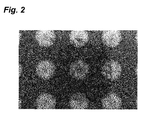
- Figure 2 is an X-ray image of a silver sintered body obtained in Comparative Example 1.
- Voids are not observed in the silver sintered body obtained in Example 1.
- a patchy pattern was observed in the silver sintered body obtained in Comparative Example 1. This indicates that rough parts (voids) exist in the silver sintered body.
- white circles are observed in Figures 1 and 2 , but these are dents provided for improving the adhesion property of the silver paste composition to the lead frame, and do not particularly require to be positioned.
- 0.1 mg of the silver paste composition was applied onto a PPF-Cu lead frame (land: 10 ⁇ 5 mm), and a 1 mm ⁇ 1 mm Au-plated Si chip (Au plating thickness: 0.1 ⁇ m, chip thickness: 400 ⁇ m) was bonded thereon. This was heated for 60 minutes at 220°C on a hot plate (Iuchi Seieido Co. Ltd., SHAMAL HOTPLATE HHP-401) to manufacture a silver sintered body. It is to be noted that the rate of temperature increase until the temperature reached 200°C from room temperature (25°C) was about 27°C/sec.
- the adhesive strength of the above-described silver sintered body was evaluated by die shear strength.
- the Au-plated Si chip was pressed in a horizontal direction at a measuring speed of 500 ⁇ m/sec and a measuring height of 100 ⁇ m, using a multipurpose bondtester (manufactured by DAGE, 4000 Series), and the die shear strength (MPa) of the silver sintered body was measured.
- the silver paste composition was subjected to heating treatment for 1 hour at 200°C in a clean oven (manufactured by TABAIESPEC CORP., PVHC-210) to obtain a 10 mm ⁇ 10 mm ⁇ 1 mm silver sintered body.
- the thermal diffusivity coefficient of this silver sintered body was measured by a laser flash method (manufactured by NETZSCH, LFA 447, 25°C). Furthermore, a product of this thermal diffusivity coefficient, the specific heat capacity measured by a differential scanning calorimetry device (manufactured by PerkinElmer Co., Ltd., Pyris1), and the specific gravity measured by an Archimedean method was determined to calculate the thermal conductivity (W/m ⁇ K) of the silver sintered body at 25°C.
- the silver paste composition was applied onto a glass plate and subjected to heating treatment for 1 hour at 200°C in a clean oven (manufactured by TABAIESPEC CORP., PVHC-210) to obtain a 1 mm ⁇ 50 mm ⁇ 0.03 mm silver sintered body.
- the volume resistivity of this silver sintered body was measured by a four-terminal method (manufactured by ADVANTEST CORPORATION, R687E DIGTAL MULTIMETER).
- silver particles AgC239 (particle diameter 5.42 ⁇ m, flake, FUKUDA METAL FOIL & POWDER Co., Ltd.) and K-0082P (particle diameter 1.64 ⁇ m, sphere, METALOR) were used.
- solvent isobornyl cyclohexanol (boiling point 308°C, hereinafter, sometimes abbreviated as MTPH), tributyrin (boiling point 305°C, Wako Pure Chemical Industries, Ltd.), and stearic acid (boiling point 376°C, Wako Pure Chemical Industries, Ltd.) were used.
- the silver particles and the solvent were kneaded for 15 minutes with a stone mill at the blending ratio shown in Table 1 to manufacture a silver paste composition. The properties of this silver paste composition were measured to obtain the result shown in Table 1.
- silver particles AgC239 (FUKUDA METAL FOIL & POWDER Co., Ltd.) and K-0082P (METALOR) were used.
- solvent tributyrin (boiling point 305°C, Wako Pure Chemical Industries, Ltd.) and stearic acid (boiling point 376°C, Wako Pure Chemical Industries, Ltd.) were used.
- the silver particles and the solvent were kneaded for 15 minutes with a stone mill at the blending ratio shown in Table 1 to manufacture a silver paste composition. The properties of this silver paste composition were measured to obtain the result shown in Table 1.
- silver particles AgC239 (FUKUDA METAL FOIL & POWDER Co., Ltd.) and IK-0082P (METALOR) were used.
- solvent tributyrin (boiling point 305°C, Wako Pure Chemical Industries, Ltd.), butyl stearate (boiling point 343°C, Wako Pure Chemical Industries, Ltd.), and stearic acid (boiling point 376°C, Wako Pure Chemical Industries, Ltd.) were used.
- the silver particles and the solvent were kneaded for 15 minutes with a stone mill at the blending ratio shown in Table 1 to manufacture a silver paste composition. The properties of this silver paste composition were measured to obtain the result shown in Table 1.
- silver particles AgC239 (FUKUDA METAL FOIL & POWDER Co., Ltd.) was used.
- solvent tributyrin (boiling point 305°C, Wako Pure Chemical Industries, Ltd.), butyl stearate (boiling point 343°C, Wako Pure Chemical Industries, Ltd.), and stearic acid (boiling point 376°C, Wako Pure Chemical Industries, Ltd.) were used.
- the silver particles and the solvent were kneaded for 15 minutes with a stone mill at the blending ratio shown in Table 1 to manufacture a silver paste composition. The properties of this silver paste composition were measured to obtain the result shown in Table 1.
- K-0082P (METALOR) was used.
- solvent tributyrin (boiling point 305°C, Wako Pure Chemical Industries, Ltd.), butyl stearate (boiling point 343°C, Wako Pure Chemical Industries, Ltd.), and stearic acid (boiling point 376°C, Wako Pure Chemical Industries, Ltd.) were used.
- the silver particles and the solvent were kneaded for 15 minutes with a stone mill at the blending ratio shown in Table 1 to manufacture a silver paste composition. The properties of this silver paste composition were measured to obtain the result shown in Table 1.
- silver particles AgC239 (FUKUDA METAL FOIL & POWDER Co., Ltd.) and K-0082P (METALOR) were used.
- solvent isobornyl cyclohexanol (boiling point 308°C), dipropylene glycol methyl ether acetate (boiling point 209°C, Daicel Corporation, hereinafter, abbreviated as DPMA), and stearic acid (boiling point 376°C, Wako Pure Chemical Industries, Ltd.) were used.
- the silver particles and the solvent were kneaded for 15 minutes with a stone mill at the blending ratio shown in Table 1 to manufacture a silver paste composition. The properties of this silver paste composition were measured to obtain the result shown in Table 1.
Landscapes
- Engineering & Computer Science (AREA)
- Mechanical Engineering (AREA)
- Chemical & Material Sciences (AREA)
- Organic Chemistry (AREA)
- Dispersion Chemistry (AREA)
- Spectroscopy & Molecular Physics (AREA)
- Materials Engineering (AREA)
- Metallurgy (AREA)
- Physics & Mathematics (AREA)
- Conductive Materials (AREA)
- Die Bonding (AREA)
- Powder Metallurgy (AREA)
- Manufacture Of Metal Powder And Suspensions Thereof (AREA)
- Adhesives Or Adhesive Processes (AREA)
- Microelectronics & Electronic Packaging (AREA)
- Manufacturing & Machinery (AREA)
Abstract
Description
- The present invention relates to a silver paste composition and a semiconductor device using the same. More specifically, the present invention relates to a silver paste composition used for bonding a semiconductor element, such as a power semiconductor, an LSI, or a light-emitting diode (LED), to a substrate, such as a lead frame, a ceramic wiring board, a glass epoxy wiring board, or a polyimide wiring board, and a semiconductor device using the same.
- In manufacturing a semiconductor device, as a method for bonding a semiconductor element to a lead frame, there is a method in which a paste formed by dispersing a filler such as silver powders in a binder resin such as an epoxy resin or a polyimide resin is used as an adhesive agent. In this method, after applying the paste adhesive agent to a die pad of a lead frame using a dispenser, a printing machine, a stamping machine, or the like, a semiconductor element is die-bonded and bonded by heat hardening to form a semiconductor device.
- As an adhesive agent used for such an intended purpose, for example, a composition in which a binder resin is highly filled with silver particles having high thermal conductivity, disclosed in Patent Literatures 1 to 3, a composition using solder particles, disclosed in Patent Literature 4, a composition using metallic nanoparticles which excel in a sintering property, disclosed in Patent Literature 5, and an adhesive composition in which micro-size silver particles subjected to special surface treatment are used and the silver particles are sintered by application of heat at 100°C or more and 400°C or less, disclosed in Patent Literature 6 have been proposed.
-
- Patent Literature 1: Japanese Patent Application Laid-Open No.
2006-73811 - Patent Literature 2: Japanese Patent Application Laid-Open No.
2006-302834 - Patent Literature 3: Japanese Patent Application Laid-Open No.
11-66953 - Patent Literature 4: Japanese Patent Application Laid-Open No.
2005-93996 - Patent Literature 5: Japanese Patent Application Laid-Open No.
2006-83377 - Patent Literature 6: Japanese Patent No.
4353380 - Incidentally, regarding the adhesive composition used for the above-described intended purpose, in the case where the number of steps required for bonding is reduced so as to save manufacturing cost of the semiconductor device, for example, a high adhesive property is strongly required even when a preheating process is omitted. In addition, for securing the operational stability of the semiconductor device, a sufficient thermal conductive property and electrical conductive property are also required. However, the conventional adhesive composition cannot satisfy all of these necessary properties.
- In view of such a problem, it is an object of the present invention to provide a silver paste composition which exhibits a high adhesive property by only a one-step sintering step and in which a silver hardened body obtained by hardening the silver paste composition after bonding has a sufficient thermal conductive property and electrical conductive property, and a semiconductor device using the same.
- The present inventors found that a silver paste composition comprising silver particles having a particle diameter of 0.1 µm to 20 µm, and a solvent, wherein the above-described solvent comprises a solvent having a boiling point of 300°C or more, exhibits a high adhesive property by only a one-step hardening step, and that a silver hardened body obtained by hardening the silver paste composition after bonding has a sufficient thermal conductive property and electrical conductive property.
- From the viewpoint of more increasing the adhesive strength, the above-described silver particles are preferably flaky silver particles and/or spherical silver particles.
- Moreover, from the viewpoint that the adhesive property, the thermal conductive property, and the electrical conductive property of the silver sintered body obtained by sintering the silver paste composition become better, the above-described solvent preferably has at least one of an ether structure, an ester structure, and a hydroxyl structure.
- Furthermore, in the silver paste composition, the silver particles are sintered by application of heat at less than 300°C so that a silver sintered body is formed, and volume resistivity, thermal conductivity, and adhesive strength of the silver sintered body are preferably 1×10⁻⁴ Ω·cm or less, 30 W/m·K or more, and 10 MPa or more respectively. It is to be noted that the above-described adhesive strength means adhesive strength when sintering the silver particles for 10 to 120 minutes at 180 to 300°C in the atmosphere, using a noble metal (Ag, Au, Pd, Pt) as an object to be bonded.
- Moreover, the present invention provides a semiconductor device having a structure in which a semiconductor element and a supporting member for mounting a semiconductor element are bonded via the above-described silver paste composition.
- According to the present invention, a silver paste composition which exhibits a high adhesive property by only a one-step sintering step and in which a silver hardened body obtained by hardening the silver paste composition after bonding has a sufficient thermal conductive property and electrical conductive property, and a semiconductor device using the same can be provided.
-
- [
Figure 1] Figure 1 is an X-ray image of a silver sintered body obtained in Example 1. - [
Figure 2] Figure 2 is an X-ray image of a silver sintered body obtained in Comparative Example 1. - [
Figure 3] Figure 3 is a schematic cross-sectional diagram illustrating an example of a semiconductor device manufactured by using an adhesive composition of the present embodiment. - [
Figure 4] Figure 4 is a schematic cross-sectional diagram illustrating another example of the semiconductor device manufactured by using the adhesive composition of the present embodiment. - Hereinafter, one embodiment of the present invention will be described in detail, but the present invention is not limited thereto.
- As silver particles of the present embodiment, those having a particle diameter of 0.1 µm to 20 µm are used. When the particle diameter becomes less than 0.1 µm, the volume ratio of the silver particles to organic substances adsorbed on the surface of the silver particles, such as a solvent, becomes relatively small. By sintering such silver particles, the degree of volumetric shrinkage becomes large, and voids are easy to be formed in the silver sintered body. As a result, such silver particles having a particle diameter of less than 0.1 µm are not preferable because the electrical conductive property, the thermal conductive property, and the adhesive strength are decreased. In addition, in the case of the silver particles having a particle diameter of less than 0.1 µm, the manufacturing cost tends to be higher than in the case of the silver particles having a particle diameter within the above-described range. On the other hand, when the particle diameter exceeds 20 µm, voids in the case where the particles are close-packed become large, thereby resulting in a decrease in the density in the silver sintered body. As a result, such silver particles having a particle diameter of more than 20 µm are not preferable because the electrical conductive property, the thermal conductive property, and the adhesive strength are decreased. It is to be noted that the particle diameter of the silver particles is preferably 0.5 µm to 15 µm, and more preferably 1 to 10 µm.
- The particle diameter of the silver particles in the present description is a sphere equivalent diameter that is a volume average of primary particles, determined by the laser scattering particle size distribution measurement. Specifically, the particle diameter in the silver paste composition is determined by the laser scattering particle size distribution measurement.
- An example of the measurement method is shown below. 0.01 g of the silver paste composition, 0.1 g of sodium dodecylbenzenesulfonate (manufactured by Wako Pure Chemical Industries, Ltd.), and 99.9 g of distilled water (manufactured by Wako Pure Chemical Industries, Ltd.) are mixed and subjected to treatment with an ultrasonic bath for 5 minutes to obtain a water dispersion. A laser scattering particle size
distribution analyzer LS 13 320 (manufactured by Beckman Coulter, Inc.) fitted with a universal liquid module having an ultrasonic dispersion unit is left to stand for 30 minutes after turning on a main unit power source for stabilizing a light source, the distilled water to which 0.1 mass% of sodium dodecylbenzenesulfonate is added is charged in the liquid module with a Rinse command of a measurement program, and De-bubble, Measure Offset, Align, and Measure Background of the measurement program are performed. Subsequently, using Measure Loading of the measurement program, the water dispersion that has been shaken to become uniform is added to the liquid module with a dropper until the sample amount turns from Low to OK in the measurement program. Subsequently, dispersion treatment is performed for 1 minute with Power 5 by the ultrasonic dispersion unit, and then, degassing is performed. Then, measurement of the measurement program is performed to obtain particle size distribution. As the settings for the laser scattering particle size distribution analyzer, Pump Speed: 70%, Include PIDS data: ON, Run Length: 90 seconds, dispersing medium refractive index: 1.332, and dispersed substance refractive index: 0.23 are used. - Although particle size distribution having a plurality of peaks including peaks of aggregates other than the primary particles is usually obtained by this measurement, the particle size distribution of the primary particles is obtained using one peak of the lowest particle diameter as a processing range.
- The shape of the silver particles is not particularly limited, and spherical particles, flaky particles, plate-like particles, columnar particles, and the like can be arbitrarily used. In particular, in order to increase the adhesive strength for a semiconductor element or a supporting member, it is preferable to use flaky particles or plate-like particles by which the adhesive area to the semiconductor element or the supporting member becomes large. Furthermore, in order to increase the packing density between particles, two or more types of particles having a different particle diameter or shape can be mixed to be used.
- The amount of the silver particles in the silver paste composition can be arbitrarily decided in accordance with the viscosity and the thixotropy of the intended silver paste composition. The silver particles are preferably 80 parts by mass or more in 100 parts by mass of the silver paste composition so as to exhibit a sufficient thermal conductive property of the silver sintered body. It is to be noted that, although the upper limit of the amount of the silver particles in the silver paste composition is not particularly limited, for example, it can be less than 97 parts by mass in 100 parts by mass of the silver paste composition.
- As the surface state of the silver particles, the state ratio of oxygen derived from a silver oxide is preferably less than 15%. Depending on a combination with a solvent, if a silver oxide exists on the surface, sintering may be inhibited. In order to remove the silver oxide on the surface, by arbitrarily performing acid treatment or the like, another surface protective agent that covers the surface of the silver particles may be adsorbed. As the surface protective agent, carboxylic acids, alcohols, and the like having a boiling point of 300°C or more are preferable.
- As the solvent in the present embodiment, one having a boiling point of 300°C or more is used. The term boiling point here is a value measured by either method of distillation or GC-MS at atmospheric pressure (1013 hPa). In addition, the solvent in the present embodiment may be either a liquid or a solid at ordinary temperature. For example, the solvent can be selected from the group of alcohols, aldehydes, ethers, esters, amines, monosaccharides, polysaccharides, straight-chain hydrocarbons, fatty acids, and aromatics having a boiling point of 300°C or more. One of these solvents can be used alone or a plurality of these solvents can be used in combination. It is preferable to select the solvent suitable for dispersion of the silver particles, from the above-described group. Specifically, it is particularly preferable to use a solvent having an ether structure, an ester structure, or a hydroxyl structure because the thermal conductive property, the electrical conductive property, and the adhesive strength of the silver sintered body after the sintering become better. It is to be noted that the boiling point of the solvent is preferably more than 300°C, and more preferably 305°C or more. In addition, although the upper limit of the boiling point of the solvent in the present embodiment is not particularly limited, it can be 400°C or less.
- Specific examples of the solvent having a boiling point of 300°C or more include isobornyl cyclohexanol, tributyrin, stearic acid, methyl stearate, ethyl stearate, propyl stearate, butyl stearate, 2-ethylhexyl stearate, octyl stearate, stearyl stearate, octyl octanoate, ethyl myristate, methyl myristate, methyl linoleate, tributyl citrate, bis ethylhexyl adipate, adipic acid dibutyl ester, diethyl sebacate, dibutyl sebacate, oleyl alcohol, cetyl alcohol, methoxyphenethyl alcohol, diglycerine, tetraethylene glycol, pentaethylene glycol, hexaethylene glycol, benzyl benzoate, γ-phenyl-γ-butyrolactone, dibenzo(a,h)anthracene, benzo(a)anthracene, palmitic acid, cholesterol, linolenic acid, alizarin, triphenylmethanol, 9,10-phenanthrenequinone, o-terphenyl, anthraquinone, dibutyl phthalate, phenanthrene, butyl benzyl phthalate, 1-naphthoic acid (α-naphthoic acid), pyrogallol, L-dibutyl tartrate, xanthone, coumarin, m-terphenyl, 6-methylcoumarin, 4-phenylphenol, xanthene, 4-acetylbiphenyl, 1,4-diphenylbenzene, 2-acetylnaphthalene, 2-naphthoic acid (β-naphthoic acid), benzoic anhydride, phenyl benzoate, chalcone, 4-benzylphenol, dibenzyl ketone, diphenyl carbonate, trans-stilbene, benzyl benzeneacrylate, stearic acid 11-hydroxy-3,6,9-trioxaundecane-1-yl ester, fumaric acid, glutaric acid, squalane, pimelic acid, oleic acid, eicosane, α-santalol, bis(2-ethylhexyl)phthalate, bis(2-methoxyethyl)phthalate, benzyl salicylate, benzoin, benzophenone, anthracene, dodecylbenzene, tridecylbenzene, 4-hydroxybenzaldehyde, adipic acid, MGK Repellent 11, methyl abietate, pyrene, dipropyl phthalate, dipentyl phthalate, 2-methylbenzophenone, benzyl, 4-hexylresorcinol, cinnamic acid, erythritol, coronene, benzo[ghi]perylene, indeno[1,2,3-cd]pyrene, 4H-cyclopenta[def]phenanthrene, fluoranthene, benzo[k]fluoranthene, picene, dibenzo[a,c]anthracene, triphenylene, chrysene, 11H-benzo[a]fluorene, deoxybenzoin, retene, fluorenone, 2,4,5-trimethoxybenzoate, flavan, dypnone, benzofuran-2-carboxylic acid, diphenylacetylene, suberic acid, heptadecanoic acid, arachidic acid, triphenylmethane, muscone, myristic acid, dotriacontane, trimellitic anhydride, tripalmitin, trimyristin, biphenyl-3-ol, stilbene, octadecane, heptacosane, 9-phenylanthracene, 1-phenylnaphthalene, bis(2-ethoxyethyl)phthalate, methyl 2-benzoylbenzoate, diethyl 2-benzylmalonate, 1-benzylnaphthalene, 4-methoxybenzophenone, 4,4'-dimethylbenzophenone, 1,3,5-triphenylbenzene, 2,2'-binaphthyl, 2-phenylnaphthalene, 1,2,4-triacetoxybenzene, 9,10-dihydroanthracene, 2-benzylnaphthalene, 4-methylphenyl benzoate, 2-methylphenyl benzoate, triisovalerin, diphenyl succinate, benzeneacrylic acid, heptadecane, nonadecane, henicosane, 1-icosanol, docosane, pentacosane, hexacosane, octacosane, nonacosane, hentriacontane, pentatriacontane, tetraphenylmethane, tetraphenylethene, diethyl terephthalate, diethyl isophthalate, tridecanoic acid, tricosane, triacontane, o-quaterphenyl, 3-methylbenzophenone, nonadecanoic acid, tetracosane, 1-phenyl-3-(2-furanyl)-2-propene-1-one, 1,1-diphenylacetone, 3-methylphenanthrene, 2,2'-dihydroxybenzophenone, 2'-methyl-4'-hydroxyacetophenone, 1,4-diphenyl-1,3-butadiene, biphenyl-2-carboxylic acid, 2,5-diphenylfurane, pentadecanoic acid, 1,3-diphenylpropane, 1,4-diphenylbutane, 2,4-dimethylbenzophenone, phthalic acid 1-(8-methylnonyl)2-octyl ester, 1-heptadecanol, hexadecylbenzene, tetradecylbenzene, dimethyl brassylate, 2-methylheptadecane, 1-docosene, tricyclohexylmethane, dodecylcyclohexane, tetradecylcyclohexane, 2,2'-biphenol, perhydrochrysene, pentadecylbenzene, L-tartaric acid dipropyl, 2-phenoxybenzoic acid, 4-phenyl-3-butenoic acid, octyl octanoate, icosylbenzene, 3,4-dimethylbenzophenone, 2-heptadecanone, 2-naphthoic acid ethyl ester, 1-naphthoic acid ethyl ester, 1-(2,4-dihydroxyphenyl)-1-hexanone, trimellitic acid tris(2-ethylhexyl)ester, 1-icosene, β-phenylbenzene-1-propanol, 1,1,3-trimethyl-3-phenylindane, icosylcyclohexane, octadecylcyclohexane, octadecylbenzene, 1-naphthalenemethanol, tridecylcyclohexane, pentadecylcyclohexane, 2-hydroxyhexanoic acid, 3,3'-dimethoxy biphenyl, 1,4-dicyclohexylbutane, 1-(2-naphthyl)-11-propanone, bis(2-ethylhexyl)terephthalate, henicosylcyclopentane, undecylbenzene, 1-heptadecene, hexadecylcyclohexane, tetratetracontane, heptatriacontane, octatriacontane, tetratriacontane, heptadecylbenzene, 2-hexadecanol, 1-nonadecene, heptadecylcyclohexane, nonadecylcyclohexane, 1-nonylnaphthalene, dodecylphenol, (Z)-9-tricosene, 2-benzylphenol, nonadecylbenzene, 1-hexadecanol, 1,1'-(1,5-pentanediyl)biscyclohexane, 1,1'-(2-ethyl-1,3-propanediyl)biscyclohexane, 2-nonylnaphthalene, civetone, cinmethylin, benzyldiglycol, and polyoxyethylene glyceryl isostearate.
- The boiling point of the solvent contained in the silver paste composition can be measured by a method of distillation or GC-MS.
- The boiling point measurement method by distillation will be described using a silver paste composition of Example 2 as an example. 440 g of acetone is added to 1050 g of the silver paste composition, and stirring is performed. This solution is suction-filtered using filter paper having a micropore diameter of about 1 µm (manufactured by ADVANTEC, for quantitative analysis No. 4A) to separate into a solid component and a solvent component. About 930 g of the solid component and about 560 g of the solvent component are obtained. The composition of the solid component is about 920 g of the Ag particles and about 10 g of stearic acid that has low solubility in acetone. The composition of the solvent component is about 440 g of acetone and about 120 g of tributyrin. 560 g of the recovered solvent component is heated at 50°C for 3 hours while stirring to evaporate acetone. After the heating, about 120 g of the solvent remains. This solvent is charged in a distillation flask (NIPPON RIKAGAKU KIKAI CO., LTD., capacity: 500 mL) to which a condenser is connected. Moreover, a probe of a digital temperature indicator (Anritsu Meter Co., Ltd., HFT-50) is placed on the position of a distillation head of the distillation flask. The distillation flask is gradually heated in a sand bath while letting water flow in the condenser, and the solvent is confirmed to boil at 303°C to 305°C. Accordingly, it can be decided that the boiling point of the solvent, tributyrin is 303°C to 305°C under atmospheric pressure.
- In the case where two or more types of solvents are contained, when a boiling point difference between the solvents is sufficient, boiling point measurement of the respective solvents is possible by distillation. In the case where the boiling points are close, the boiling points of the respective solvents can be determined by arbitrarily using a method for measuring the boiling points after separating the solvents by fractional distillation, or a method of GC-MS described below.
- The boiling point measurement method by GC-MS will be described. By using GC/MS QP-5050A (manufactured by Shimadzu Corporation) having Curie Point Pyrolyzer JHP-3 (manufactured by Japan Analytical Industry Co., Ltd.) as an introduction device, 0.1 mL of the silver paste composition is introduced into the pyrolyzer and gasified under the condition of 315°C/10 sec to be introduced into the GC/MS. Capillary Column UA-5 (manufactured by Frontier Laboratories Ltd.) having a diameter of 0.25 mm and a length of 30 m is attached to the GC/MS, and helium is used as a carrier gas at 50 mL/min. The gas generated in the pyrolyzer is introduced into the capillary column, and the gas component is adsorbed, and then, the temperature of the column is elevated from 50°C to 300°C at 10°C/min, and the desorbed gas is analyzed by mass spectrum. The solvent can be identified by checking the data of the mass spectrum against the database. When the solvent is identified, the boiling point thereof, as a substance-specific value, can be obtained from the database.
- The amount of the solvent in the silver paste composition is preferably less than 20 parts by mass in 100 parts by mass of the silver paste composition. When the solvent is 20 parts by mass or more, the degree of volumetric shrinkage due to the volatilization of the solvent when sintering the silver paste composition becomes large, and the compactness of the formed silver sintered body may be decreased. It is to be noted that, although the lower limit of the amount of the solvent in the silver paste composition is not particularly limited, for example, it can be 3 parts by mass or more in 100 parts by mass of the silver paste composition.
- In order to manufacture the silver paste composition of the present embodiment, by arbitrarily combining dispersing/dissolving devices such as a stirrer, a stone mill, a three-roll mill, and a planetary mixer, the silver particles and the solvent having a boiling point of 300°C or more are collectively or separately heated if needed, mixed, dissolved, disaggregated/kneaded, or dispersed, together with various additive agents added if needed, to be a uniform paste.
- A method for heating the silver paste composition of the present embodiment may follow a conventional method. In addition to external heating by a heater, an ultraviolet lamp, a laser, a microwave, and the like can be preferably used. The heating temperature is preferably less than 300°C. Heating at 300°C or more causes bumping of the solvent, and voids are formed in the silver sintered body. As a result, the density of the silver sintered body is decreased, and properties such as the thermal conductive property, the electrical conductive property, and the adhesive strength are also decreased. The more preferable range is 150°C or more and 280°C or less. When the temperature is less than 150°C, the volatilization of the solvent hardly occurs, and it becomes difficult to sinter the silver paste composition. In the range of 150°C or more and 280°C or less, the volatilization of the solvent occurs moderately, and the sintering of the silver particles proceeds well at the same time.
- In addition, the presence or absence of a preheating step when heating the silver paste composition can be arbitrarily decided. When sintering the silver paste composition, preheating is usually performed to prevent the solvent from bumping, and the solvent is made to be volatilized in advance. However, since a solvent having a high boiling point is used in the silver paste composition in the present embodiment and bumping of the solvent does not occur at less than 300°C that is a usual temperature to connect a semiconductor device, a preheating step is unnecessary. Therefore, a manufacturing process of a semiconductor device can be simplified, and manufacturing cost can be decreased.
- The rate of temperature increase when heating the silver paste composition is not particularly limited as long as the attainment temperature is less than 300°C. When sintering at 300°C or more, in order to prevent the solvent from bumping, it is preferable to make the rate of temperature increase be 1°C/sec or less, or to perform a preheating step.
- The sintering of the silver paste composition of the present embodiment is described as follows. When the silver paste composition is heated at 150°C or more and less than 300°C, the solvent having a boiling point of 300°C or more gradually volatilizes at the temperature. During the volatilization of the solvent, sintering starts between the silver particles. In other words, a sintering reaction proceeds in the presence of the solvent (liquid phase). This means that, since the silver particles have fluidity, the sintering proceeds in a state where it is easy to be a more compact state. Accordingly, a more compact silver sintered body than a conventional silver paste composition can be formed, and one which excels in bonding strength and has a sufficient thermal conductive property and electrical conductive property can be obtained.
- The volume resistivity of the hardened adhesive composition (silver sintered body) is preferably 1×10⁻⁴ Ω·cm or less, and the thermal conductivity is preferably 30 W/m·K or more. It is to be noted that, although the lower limit of the volume resistivity of the silver sintered body is not particularly limited, it is, for example, 1.6×10⁻⁶ Ω·cm. In addition, although the upper limit of the thermal conductivity is not particularly limited, it is, for example, 300 W/m·K or less.
- A semiconductor device of the present embodiment can be obtained by bonding a semiconductor element to a supporting member using the above-described silver paste composition. After bonding the semiconductor element to the supporting member, a wire bonding step and a sealing step are performed if needed. Examples of the supporting member include lead frames such as a 42 alloy lead frame, a copper lead frame, and a palladium PPF lead frame; and organic substrates such as a glass epoxy substrate (substrate made of glass fiber-reinforced epoxy resin), and a BT substrate (substrate using BT resin made of cyanate monomer and oligomer thereof, and bismaleimide).
- In order to bond the semiconductor element to the supporting member, such as a lead frame, using the silver paste composition of the present embodiment, the adhesive composition is first applied to the supporting member by a dispensing method, a screen printing method, a stamping method, or the like, then the semiconductor element is mounted, and the sintering is performed using a heating device. After the sintering, a wire bonding step is performed and sealing is performed to complete the semiconductor device.
- The semiconductor device can be used for a power module such as a diode, a rectifier, a thyristor, a MOS gate driver, a power switch, a power MOSFET, an IGBT, a schottky diode, and a fast recovery diode; a transmitter; an amplifier; an LED module; and the like. The power module, transmitter, amplifier, and LED module to be obtained have a high adhesion property, high thermal conductive property, high conductive property, and high heat resistance property between the semiconductor element and the supporting member for mounting a semiconductor element.
-
Figure 3 is a schematic cross-sectional diagram illustrating an example of the semiconductor device manufactured by using the adhesive composition of the present embodiment. A semiconductor device illustrated inFigure 3 comprises three lead frames (heat radiators) 12a, 12b, 12c, a chip (heat generator) 11 connected to thelead frame 12a via theadhesive composition 13 of the present embodiment, and amold resin 15 for molding these. Thechip 11 is connected to the lead frames 12b, 12c via twowires 14, respectively. -
Figure 4 is a schematic cross-sectional diagram illustrating another example of the semiconductor device manufactured by using the adhesive composition of the present embodiment. A semiconductor device illustrated inFigure 4 comprises asubstrate 16, twolead frames 17 formed so as to surround thesubstrate 16, anLED chip 18 connected to thelead frame 17 via theadhesive composition 13 of the present embodiment, and atranslucent resin 19 for sealing these. TheLED chip 18 is connected to thelead frame 17 via awire 14. - Examples are described below, and the present invention will be more specifically described, but the present invention is not limited to these Examples.
- The measurement of each property in each Example was performed as follows.
- 0.1 mg of the silver paste composition was applied onto a PPF-Cu lead frame (land: 10×5 mm), and a 1 mm×1 mm Au-plated Si chip (Au plating thickness: 0.1 µm, chip thickness: 400 µm) was bonded thereon. This was heated for 60 minutes at 200°C on a hot plate (Iuchi Seieido Co. Ltd., SHAMAL HOTPLATE HHP-401) to manufacture a silver sintered body. It is to be noted that the rate of temperature increase until the temperature reached 200°C from room temperature (25°C) was about 27°C/sec. Here, the above-described PPF is an abbreviation for Palladium Pre Plated, and moreover, the above-described PPF-Cu lead frame is one in which Ni plating is performed on a Cu lead frame, palladium plating is performed thereon, and Au plating is further performed thereon.
- By directly observing the above-described silver sintered body with a micro focus X-ray device (Hitachi Kenki Fine Tech Co., Ltd., MF160), the presence or absence of voids was evaluated.
Figure 1 is an X-ray image of a silver sintered body obtained in Example 1, andFigure 2 is an X-ray image of a silver sintered body obtained in Comparative Example 1. Voids are not observed in the silver sintered body obtained in Example 1. On the other hand, a patchy pattern was observed in the silver sintered body obtained in Comparative Example 1. This indicates that rough parts (voids) exist in the silver sintered body. It is to be noted that white circles are observed inFigures 1 and2 , but these are dents provided for improving the adhesion property of the silver paste composition to the lead frame, and do not particularly require to be positioned. - 0.1 mg of the silver paste composition was applied onto a PPF-Cu lead frame (land: 10×5 mm), and a 1 mm×1 mm Au-plated Si chip (Au plating thickness: 0.1 µm, chip thickness: 400 µm) was bonded thereon. This was heated for 60 minutes at 220°C on a hot plate (Iuchi Seieido Co. Ltd., SHAMAL HOTPLATE HHP-401) to manufacture a silver sintered body. It is to be noted that the rate of temperature increase until the temperature reached 200°C from room temperature (25°C) was about 27°C/sec.
- The adhesive strength of the above-described silver sintered body was evaluated by die shear strength. The Au-plated Si chip was pressed in a horizontal direction at a measuring speed of 500 µm/sec and a measuring height of 100 µm, using a multipurpose bondtester (manufactured by DAGE, 4000 Series), and the die shear strength (MPa) of the silver sintered body was measured.
- The silver paste composition was subjected to heating treatment for 1 hour at 200°C in a clean oven (manufactured by TABAIESPEC CORP., PVHC-210) to obtain a 10 mm×10 mm×1 mm silver sintered body. The thermal diffusivity coefficient of this silver sintered body was measured by a laser flash method (manufactured by NETZSCH, LFA 447, 25°C). Furthermore, a product of this thermal diffusivity coefficient, the specific heat capacity measured by a differential scanning calorimetry device (manufactured by PerkinElmer Co., Ltd., Pyris1), and the specific gravity measured by an Archimedean method was determined to calculate the thermal conductivity (W/m·K) of the silver sintered body at 25°C.
- The silver paste composition was applied onto a glass plate and subjected to heating treatment for 1 hour at 200°C in a clean oven (manufactured by TABAIESPEC CORP., PVHC-210) to obtain a 1 mm×50 mm×0.03 mm silver sintered body. The volume resistivity of this silver sintered body was measured by a four-terminal method (manufactured by ADVANTEST CORPORATION, R687E DIGTAL MULTIMETER).
- As the silver particles, AgC239 (particle diameter 5.42 µm, flake, FUKUDA METAL FOIL & POWDER Co., Ltd.) and K-0082P (particle diameter 1.64 µm, sphere, METALOR) were used. As the solvent, isobornyl cyclohexanol (boiling point 308°C, hereinafter, sometimes abbreviated as MTPH), tributyrin (boiling point 305°C, Wako Pure Chemical Industries, Ltd.), and stearic acid (boiling point 376°C, Wako Pure Chemical Industries, Ltd.) were used. The silver particles and the solvent were kneaded for 15 minutes with a stone mill at the blending ratio shown in Table 1 to manufacture a silver paste composition. The properties of this silver paste composition were measured to obtain the result shown in Table 1.
- As the silver particles, AgC239 (FUKUDA METAL FOIL & POWDER Co., Ltd.) and K-0082P (METALOR) were used. As the solvent, tributyrin (boiling point 305°C, Wako Pure Chemical Industries, Ltd.) and stearic acid (boiling point 376°C, Wako Pure Chemical Industries, Ltd.) were used. The silver particles and the solvent were kneaded for 15 minutes with a stone mill at the blending ratio shown in Table 1 to manufacture a silver paste composition. The properties of this silver paste composition were measured to obtain the result shown in Table 1.
- As the silver particles, AgC239 (FUKUDA METAL FOIL & POWDER Co., Ltd.) and IK-0082P (METALOR) were used. As the solvent, tributyrin (boiling point 305°C, Wako Pure Chemical Industries, Ltd.), butyl stearate (boiling point 343°C, Wako Pure Chemical Industries, Ltd.), and stearic acid (boiling point 376°C, Wako Pure Chemical Industries, Ltd.) were used. The silver particles and the solvent were kneaded for 15 minutes with a stone mill at the blending ratio shown in Table 1 to manufacture a silver paste composition. The properties of this silver paste composition were measured to obtain the result shown in Table 1.
- As the silver particles, AgC239 (FUKUDA METAL FOIL & POWDER Co., Ltd.) was used. As the solvent, tributyrin (boiling point 305°C, Wako Pure Chemical Industries, Ltd.), butyl stearate (boiling point 343°C, Wako Pure Chemical Industries, Ltd.), and stearic acid (boiling point 376°C, Wako Pure Chemical Industries, Ltd.) were used. The silver particles and the solvent were kneaded for 15 minutes with a stone mill at the blending ratio shown in Table 1 to manufacture a silver paste composition. The properties of this silver paste composition were measured to obtain the result shown in Table 1.
- As the silver particles, K-0082P (METALOR) was used. As the solvent, tributyrin (boiling point 305°C, Wako Pure Chemical Industries, Ltd.), butyl stearate (boiling point 343°C, Wako Pure Chemical Industries, Ltd.), and stearic acid (boiling point 376°C, Wako Pure Chemical Industries, Ltd.) were used. The silver particles and the solvent were kneaded for 15 minutes with a stone mill at the blending ratio shown in Table 1 to manufacture a silver paste composition. The properties of this silver paste composition were measured to obtain the result shown in Table 1.
- As the silver particles, AgC239 (FUKUDA METAL FOIL & POWDER Co., Ltd.) and K-0082P (METALOR) were used. As the solvent, isobornyl cyclohexanol (boiling point 308°C), dipropylene glycol methyl ether acetate (boiling point 209°C, Daicel Corporation, hereinafter, abbreviated as DPMA), and stearic acid (boiling point 376°C, Wako Pure Chemical Industries, Ltd.) were used. The silver particles and the solvent were kneaded for 15 minutes with a stone mill at the blending ratio shown in Table 1 to manufacture a silver paste composition. The properties of this silver paste composition were measured to obtain the result shown in Table 1.

Claims (5)
- A silver paste composition comprising:silver particles having a particle diameter of 0.1 µm to 20 µm; anda solvent,wherein the solvent comprises a solvent having a boiling point of 300°C or more.
- The silver paste composition according to claim 1, wherein the silver particles are flaky silver particles and/or spherical silver particles.
- The silver paste composition according to claim 1 or 2, wherein the solvent has at least one of an ether structure, an ester structure, and a hydroxyl structure.
- The silver paste composition according to any one of claims 1 to 3, wherein the silver particles are sintered by application of heat at less than 300°C so that a silver sintered body is formed, and volume resistivity, thermal conductivity, and adhesive strength of the silver sintered body are 1×10⁻⁴ Ω·cm or less, 30 W/m·K or more, and 10 MPa or more respectively.
- A semiconductor device having a structure containing a semiconductor element and a supporting member for mounting a semiconductor element, wherein the semiconductor element and the supporting member are bonded each other via the silver paste composition according to any one of claims 1 to 4.
Applications Claiming Priority (2)
| Application Number | Priority Date | Filing Date | Title |
|---|---|---|---|
| JP2012195392 | 2012-09-05 | ||
| PCT/JP2013/071170 WO2014038331A1 (en) | 2012-09-05 | 2013-08-05 | Silver paste composition and semiconductor device using same |
Publications (3)
| Publication Number | Publication Date |
|---|---|
| EP2894641A1 true EP2894641A1 (en) | 2015-07-15 |
| EP2894641A4 EP2894641A4 (en) | 2016-02-24 |
| EP2894641B1 EP2894641B1 (en) | 2017-07-26 |
Family
ID=50236947
Family Applications (1)
| Application Number | Title | Priority Date | Filing Date |
|---|---|---|---|
| EP13835695.1A Active EP2894641B1 (en) | 2012-09-05 | 2013-08-05 | Silver paste composition and semiconductor device using same |
Country Status (7)
| Country | Link |
|---|---|
| US (1) | US10201879B2 (en) |
| EP (1) | EP2894641B1 (en) |
| JP (1) | JP6179520B2 (en) |
| KR (1) | KR102020093B1 (en) |
| CN (1) | CN104584140B (en) |
| TW (1) | TWI594271B (en) |
| WO (1) | WO2014038331A1 (en) |
Cited By (1)
| Publication number | Priority date | Publication date | Assignee | Title |
|---|---|---|---|---|
| EP3321339A4 (en) * | 2015-07-08 | 2018-11-21 | Sumitomo Bakelite Co.,Ltd. | Thermally conductive composition, semiconductor device, process for producing semiconductor device, and method for bonding heat sink plate |
Families Citing this family (20)
| Publication number | Priority date | Publication date | Assignee | Title |
|---|---|---|---|---|
| KR101935272B1 (en) * | 2013-10-31 | 2019-01-04 | 쇼와 덴코 가부시키가이샤 | Electrically conductive composition for thin film printing, and method for forming thin film conductive pattern |
| JP6511721B2 (en) * | 2014-03-26 | 2019-05-15 | 住友ベークライト株式会社 | Die attach paste and semiconductor device |
| JP6376802B2 (en) * | 2014-03-31 | 2018-08-22 | 株式会社タムラ製作所 | Metal bonding material |
| EP3128540B1 (en) * | 2014-04-04 | 2019-06-12 | KYOCERA Corporation | Thermosetting resin composition, semiconductor device and electrical/electronic component |
| JP6845015B2 (en) * | 2014-05-30 | 2021-03-17 | エレクトロニンクス ライタブルズ, インコーポレイテッド | Rollerball pens formed on the substrate and conductive ink for conductive tracing |
| JP6396189B2 (en) * | 2014-11-27 | 2018-09-26 | 日東電工株式会社 | Conductive film adhesive, dicing tape with film adhesive, and method for manufacturing semiconductor device |
| DE102015103779A1 (en) * | 2015-03-16 | 2016-09-22 | Pac Tech-Packaging Technologies Gmbh | Chip arrangement and method for forming a contact connection |
| US11416046B2 (en) * | 2015-11-05 | 2022-08-16 | Henkel Ag & Co. Kgaa | Compositions having a matrix and encapsulated phase change materials dispersed therein, and electronic devices assembled therewith |
| JP7005121B2 (en) * | 2015-12-04 | 2022-01-21 | 昭和電工マテリアルズ株式会社 | Copper paste for non-pressurized bonding, bonded bodies, and semiconductor devices |
| CN107828351B (en) * | 2016-09-15 | 2021-07-27 | E·I·内穆尔杜邦公司 | Conductive paste for bonding |
| US9865527B1 (en) | 2016-12-22 | 2018-01-09 | Texas Instruments Incorporated | Packaged semiconductor device having nanoparticle adhesion layer patterned into zones of electrical conductance and insulation |
| EP3569329B1 (en) | 2017-01-11 | 2023-11-01 | Resonac Corporation | Copper paste for pressureless bonding, bonded body and semiconductor device |
| US9941194B1 (en) | 2017-02-21 | 2018-04-10 | Texas Instruments Incorporated | Packaged semiconductor device having patterned conductance dual-material nanoparticle adhesion layer |
| JP2018138687A (en) * | 2017-02-24 | 2018-09-06 | 日立化成株式会社 | Connection texture, method for manufacturing connection texture, connection structure, and semiconductor device |
| JP7366337B2 (en) * | 2018-12-25 | 2023-10-23 | 日亜化学工業株式会社 | Manufacturing method of light source device and light source device |
| EP3675190B1 (en) * | 2018-12-25 | 2023-05-03 | Nichia Corporation | Method of manufacturing light source device and light source device |
| CN112530817A (en) * | 2020-12-01 | 2021-03-19 | 浙江清华柔性电子技术研究院 | Flexible packaging method for power management chip and flexible packaging chip |
| TW202302795A (en) * | 2021-04-30 | 2023-01-16 | 德商漢高智慧財產控股公司 | Electrically conductive compositions capable of sintering |
| TWI837666B (en) * | 2022-01-04 | 2024-04-01 | 達方電子股份有限公司 | Lighting board and lighting board manufacturing method |
| CN119609459B (en) * | 2024-12-17 | 2025-12-02 | 深圳市同方电子新材料有限公司 | An environmentally friendly and highly stable flux and its preparation method |
Family Cites Families (21)
| Publication number | Priority date | Publication date | Assignee | Title |
|---|---|---|---|---|
| JP3837858B2 (en) | 1997-08-22 | 2006-10-25 | 住友金属鉱山株式会社 | Conductive adhesive and method of using the same |
| JP4414145B2 (en) * | 2003-03-06 | 2010-02-10 | ハリマ化成株式会社 | Conductive nanoparticle paste |
| US20050056365A1 (en) | 2003-09-15 | 2005-03-17 | Albert Chan | Thermal interface adhesive |
| JP4828178B2 (en) | 2004-08-18 | 2011-11-30 | ハリマ化成株式会社 | Conductive adhesive and method for producing article using the conductive adhesive |
| JP2006073811A (en) | 2004-09-02 | 2006-03-16 | Kyocera Chemical Corp | Die bonding paste |
| JP2006302834A (en) | 2005-04-25 | 2006-11-02 | Kyocera Chemical Corp | Die bonding paste |
| EP1950767B1 (en) | 2005-09-21 | 2012-08-22 | Nihon Handa Co., Ltd. | Pasty silver particle composition, process for producing solid silver, solid silver, joining method, and process for producing printed wiring board |
| JP2007194122A (en) * | 2006-01-20 | 2007-08-02 | Sumitomo Electric Ind Ltd | Conductive paste and wiring board using the same |
| WO2009090915A1 (en) | 2008-01-17 | 2009-07-23 | Nichia Corporation | Method for producing conductive material, conductive material obtained by the method, electronic device containing the conductive material, light-emitting device, and method for manufacturing light-emitting device |
| US8044330B2 (en) | 2008-01-17 | 2011-10-25 | E.I. Du Pont De Nemours And Company | Electrically conductive adhesive |
| JP2009245844A (en) | 2008-03-31 | 2009-10-22 | Sumitomo Rubber Ind Ltd | Conductive paste |
| DE102008039828A1 (en) * | 2008-08-27 | 2010-03-04 | W.C. Heraeus Gmbh | Control of the porosity of metal pastes for the pressure-free low-temperature sintering process |
| JP5611537B2 (en) * | 2009-04-28 | 2014-10-22 | 日立化成株式会社 | Conductive bonding material, bonding method using the same, and semiconductor device bonded thereby |
| US20100301479A1 (en) * | 2009-05-28 | 2010-12-02 | E. I. Du Pont De Nemours And Company | Devices containing silver compositions deposited by micro-deposition direct writing silver conductor lines |
| US20110180139A1 (en) | 2010-01-25 | 2011-07-28 | Hitachi Chemical Company, Ltd. | Paste composition for electrode and photovoltaic cell |
| KR20130061671A (en) * | 2010-03-18 | 2013-06-11 | 후루카와 덴키 고교 가부시키가이샤 | Electrically conductive paste and electrically conductive connection member produced using the paste |
| JP5525335B2 (en) | 2010-05-31 | 2014-06-18 | 株式会社日立製作所 | Sintered silver paste material and semiconductor chip bonding method |
| WO2011155055A1 (en) | 2010-06-11 | 2011-12-15 | Dowaエレクトロニクス株式会社 | Low-temperature-sintering bonding material and bonding method using the bonding material |
| JP2012023088A (en) * | 2010-07-12 | 2012-02-02 | Yokohama Rubber Co Ltd:The | Paste for solar cell electrode, and solar cell |
| WO2012014481A1 (en) | 2010-07-30 | 2012-02-02 | 太陽ホールディングス株式会社 | Conductive paste for offset printing |
| JP6001265B2 (en) * | 2011-12-21 | 2016-10-05 | 太陽ホールディングス株式会社 | Conductive paste |
-
2013
- 2013-08-05 EP EP13835695.1A patent/EP2894641B1/en active Active
- 2013-08-05 US US14/425,980 patent/US10201879B2/en active Active
- 2013-08-05 CN CN201380043064.3A patent/CN104584140B/en active Active
- 2013-08-05 WO PCT/JP2013/071170 patent/WO2014038331A1/en not_active Ceased
- 2013-08-05 JP JP2014534251A patent/JP6179520B2/en active Active
- 2013-08-05 KR KR1020157003305A patent/KR102020093B1/en active Active
- 2013-08-16 TW TW102129510A patent/TWI594271B/en active
Cited By (2)
| Publication number | Priority date | Publication date | Assignee | Title |
|---|---|---|---|---|
| EP3321339A4 (en) * | 2015-07-08 | 2018-11-21 | Sumitomo Bakelite Co.,Ltd. | Thermally conductive composition, semiconductor device, process for producing semiconductor device, and method for bonding heat sink plate |
| EP3677658A1 (en) * | 2015-07-08 | 2020-07-08 | Sumitomo Bakelite Co.,Ltd. | Thermally conductive composition, semiconductor device, method for manufacturing semiconductor device, and method for bonding heatsink |
Also Published As
| Publication number | Publication date |
|---|---|
| JP6179520B2 (en) | 2017-08-16 |
| CN104584140A (en) | 2015-04-29 |
| EP2894641A4 (en) | 2016-02-24 |
| TWI594271B (en) | 2017-08-01 |
| WO2014038331A1 (en) | 2014-03-13 |
| CN104584140B (en) | 2018-01-02 |
| US10201879B2 (en) | 2019-02-12 |
| KR20150053754A (en) | 2015-05-18 |
| US20150217411A1 (en) | 2015-08-06 |
| JPWO2014038331A1 (en) | 2016-08-08 |
| TW201415486A (en) | 2014-04-16 |
| KR102020093B1 (en) | 2019-09-09 |
| EP2894641B1 (en) | 2017-07-26 |
Similar Documents
| Publication | Publication Date | Title |
|---|---|---|
| EP2894641B1 (en) | Silver paste composition and semiconductor device using same | |
| US9486879B2 (en) | Bonding material and bonding body, and bonding method | |
| CN104379689B (en) | Adhesive composite and use its semiconductor device | |
| JP5940782B2 (en) | Use of aliphatic hydrocarbons and paraffins as solvents in sintered silver pastes | |
| US10144095B2 (en) | Sinter paste with coated silver oxide on noble and non-noble surfaces that are difficult to sinter | |
| CN109070206A (en) | The engagement manufacturing method of copper thickener, the manufacturing method of conjugant and semiconductor device | |
| KR20190126297A (en) | Metal paste for joining, a joined body and a method for manufacturing the same, and a semiconductor device and a method for manufacturing the same | |
| JP2012052198A (en) | Paste-like silver particle composition, method for manufacturing metallic member joined body, and metallic member joined body | |
| US10207373B2 (en) | Nickel particle composition, bonding material, and bonding method in which said material is used | |
| JP2011236494A (en) | Method for manufacturing metal member joined body, and metal member joined body | |
| JP6164256B2 (en) | Thermally conductive composition, semiconductor device, method for manufacturing semiconductor device, and method for bonding heat sink | |
| JP5011225B2 (en) | Metal member bonding agent, metal member bonded body manufacturing method, metal member bonded body, and electric circuit connecting bump manufacturing method | |
| WO2015060173A1 (en) | Silver paste and semiconductor device using same | |
| JP6659026B2 (en) | Low temperature joining method using copper particles | |
| JP2017179403A (en) | Coated silver particle and manufacturing method therefor, conductive composition and conductor | |
| TW201700681A (en) | Paste adhesive composition, semiconductor device, method of manufacturing semiconductor device, and method of following heat sink | |
| CN110036450A (en) | The manufacturing method of conductive bonding material and semiconductor device | |
| JP2016069710A (en) | Nickel particle composition, bonding material and bonding method | |
| JP6463195B2 (en) | Nickel particle composition, bonding material, and bonding method using the same | |
| WO2017006531A1 (en) | Joining composition and joining method | |
| JP7317397B2 (en) | COPPER OXIDE PASTE AND METHOD FOR MANUFACTURING ELECTRONIC COMPONENT | |
| CN116745048A (en) | Conductive composition for bonding, bonding structure using the same, and manufacturing method | |
| JP6556302B1 (en) | Paste-like silver particle composition, method for producing metal member assembly, and method for producing composite of sintered porous silver particle and cured resin | |
| JP6338419B2 (en) | Metal particle composition, bonding material, and bonding method using the same | |
| TWI789698B (en) | Copper oxide paste and method for producing electronic parts |
Legal Events
| Date | Code | Title | Description |
|---|---|---|---|
| PUAI | Public reference made under article 153(3) epc to a published international application that has entered the european phase |
Free format text: ORIGINAL CODE: 0009012 |
|
| 17P | Request for examination filed |
Effective date: 20150216 |
|
| AK | Designated contracting states |
Kind code of ref document: A1 Designated state(s): AL AT BE BG CH CY CZ DE DK EE ES FI FR GB GR HR HU IE IS IT LI LT LU LV MC MK MT NL NO PL PT RO RS SE SI SK SM TR |
|
| AX | Request for extension of the european patent |
Extension state: BA ME |
|
| DAX | Request for extension of the european patent (deleted) | ||
| RA4 | Supplementary search report drawn up and despatched (corrected) |
Effective date: 20160125 |
|
| RIC1 | Information provided on ipc code assigned before grant |
Ipc: H01B 1/22 20060101AFI20160119BHEP Ipc: H01L 21/52 20060101ALI20160119BHEP |
|
| 17Q | First examination report despatched |
Effective date: 20160602 |
|
| GRAP | Despatch of communication of intention to grant a patent |
Free format text: ORIGINAL CODE: EPIDOSNIGR1 |
|
| INTG | Intention to grant announced |
Effective date: 20170320 |
|
| GRAS | Grant fee paid |
Free format text: ORIGINAL CODE: EPIDOSNIGR3 |
|
| GRAA | (expected) grant |
Free format text: ORIGINAL CODE: 0009210 |
|
| AK | Designated contracting states |
Kind code of ref document: B1 Designated state(s): AL AT BE BG CH CY CZ DE DK EE ES FI FR GB GR HR HU IE IS IT LI LT LU LV MC MK MT NL NO PL PT RO RS SE SI SK SM TR |
|
| REG | Reference to a national code |
Ref country code: GB Ref legal event code: FG4D |
|
| REG | Reference to a national code |
Ref country code: CH Ref legal event code: EP |
|
| REG | Reference to a national code |
Ref country code: AT Ref legal event code: REF Ref document number: 913000 Country of ref document: AT Kind code of ref document: T Effective date: 20170815 |
|
| REG | Reference to a national code |
Ref country code: IE Ref legal event code: FG4D |
|
| REG | Reference to a national code |
Ref country code: DE Ref legal event code: R096 Ref document number: 602013024191 Country of ref document: DE |
|
| REG | Reference to a national code |
Ref country code: NL Ref legal event code: MP Effective date: 20170726 |
|
| REG | Reference to a national code |
Ref country code: LT Ref legal event code: MG4D |
|
| REG | Reference to a national code |
Ref country code: AT Ref legal event code: MK05 Ref document number: 913000 Country of ref document: AT Kind code of ref document: T Effective date: 20170726 |
|
| PG25 | Lapsed in a contracting state [announced via postgrant information from national office to epo] |
Ref country code: FI Free format text: LAPSE BECAUSE OF FAILURE TO SUBMIT A TRANSLATION OF THE DESCRIPTION OR TO PAY THE FEE WITHIN THE PRESCRIBED TIME-LIMIT Effective date: 20170726 Ref country code: SE Free format text: LAPSE BECAUSE OF FAILURE TO SUBMIT A TRANSLATION OF THE DESCRIPTION OR TO PAY THE FEE WITHIN THE PRESCRIBED TIME-LIMIT Effective date: 20170726 Ref country code: AT Free format text: LAPSE BECAUSE OF FAILURE TO SUBMIT A TRANSLATION OF THE DESCRIPTION OR TO PAY THE FEE WITHIN THE PRESCRIBED TIME-LIMIT Effective date: 20170726 Ref country code: NL Free format text: LAPSE BECAUSE OF FAILURE TO SUBMIT A TRANSLATION OF THE DESCRIPTION OR TO PAY THE FEE WITHIN THE PRESCRIBED TIME-LIMIT Effective date: 20170726 Ref country code: NO Free format text: LAPSE BECAUSE OF FAILURE TO SUBMIT A TRANSLATION OF THE DESCRIPTION OR TO PAY THE FEE WITHIN THE PRESCRIBED TIME-LIMIT Effective date: 20171026 Ref country code: LT Free format text: LAPSE BECAUSE OF FAILURE TO SUBMIT A TRANSLATION OF THE DESCRIPTION OR TO PAY THE FEE WITHIN THE PRESCRIBED TIME-LIMIT Effective date: 20170726 Ref country code: HR Free format text: LAPSE BECAUSE OF FAILURE TO SUBMIT A TRANSLATION OF THE DESCRIPTION OR TO PAY THE FEE WITHIN THE PRESCRIBED TIME-LIMIT Effective date: 20170726 |
|
| PG25 | Lapsed in a contracting state [announced via postgrant information from national office to epo] |
Ref country code: RS Free format text: LAPSE BECAUSE OF FAILURE TO SUBMIT A TRANSLATION OF THE DESCRIPTION OR TO PAY THE FEE WITHIN THE PRESCRIBED TIME-LIMIT Effective date: 20170726 Ref country code: PL Free format text: LAPSE BECAUSE OF FAILURE TO SUBMIT A TRANSLATION OF THE DESCRIPTION OR TO PAY THE FEE WITHIN THE PRESCRIBED TIME-LIMIT Effective date: 20170726 Ref country code: BG Free format text: LAPSE BECAUSE OF FAILURE TO SUBMIT A TRANSLATION OF THE DESCRIPTION OR TO PAY THE FEE WITHIN THE PRESCRIBED TIME-LIMIT Effective date: 20171026 Ref country code: LV Free format text: LAPSE BECAUSE OF FAILURE TO SUBMIT A TRANSLATION OF THE DESCRIPTION OR TO PAY THE FEE WITHIN THE PRESCRIBED TIME-LIMIT Effective date: 20170726 Ref country code: IS Free format text: LAPSE BECAUSE OF FAILURE TO SUBMIT A TRANSLATION OF THE DESCRIPTION OR TO PAY THE FEE WITHIN THE PRESCRIBED TIME-LIMIT Effective date: 20171126 Ref country code: GR Free format text: LAPSE BECAUSE OF FAILURE TO SUBMIT A TRANSLATION OF THE DESCRIPTION OR TO PAY THE FEE WITHIN THE PRESCRIBED TIME-LIMIT Effective date: 20171027 Ref country code: ES Free format text: LAPSE BECAUSE OF FAILURE TO SUBMIT A TRANSLATION OF THE DESCRIPTION OR TO PAY THE FEE WITHIN THE PRESCRIBED TIME-LIMIT Effective date: 20170726 |
|
| REG | Reference to a national code |
Ref country code: CH Ref legal event code: PL |
|
| PG25 | Lapsed in a contracting state [announced via postgrant information from national office to epo] |
Ref country code: RO Free format text: LAPSE BECAUSE OF FAILURE TO SUBMIT A TRANSLATION OF THE DESCRIPTION OR TO PAY THE FEE WITHIN THE PRESCRIBED TIME-LIMIT Effective date: 20170726 Ref country code: MC Free format text: LAPSE BECAUSE OF FAILURE TO SUBMIT A TRANSLATION OF THE DESCRIPTION OR TO PAY THE FEE WITHIN THE PRESCRIBED TIME-LIMIT Effective date: 20170726 Ref country code: CZ Free format text: LAPSE BECAUSE OF FAILURE TO SUBMIT A TRANSLATION OF THE DESCRIPTION OR TO PAY THE FEE WITHIN THE PRESCRIBED TIME-LIMIT Effective date: 20170726 Ref country code: DK Free format text: LAPSE BECAUSE OF FAILURE TO SUBMIT A TRANSLATION OF THE DESCRIPTION OR TO PAY THE FEE WITHIN THE PRESCRIBED TIME-LIMIT Effective date: 20170726 Ref country code: LI Free format text: LAPSE BECAUSE OF NON-PAYMENT OF DUE FEES Effective date: 20170831 Ref country code: CH Free format text: LAPSE BECAUSE OF NON-PAYMENT OF DUE FEES Effective date: 20170831 |
|
| REG | Reference to a national code |
Ref country code: DE Ref legal event code: R097 Ref document number: 602013024191 Country of ref document: DE |
|
| REG | Reference to a national code |
Ref country code: IE Ref legal event code: MM4A |
|
| PG25 | Lapsed in a contracting state [announced via postgrant information from national office to epo] |
Ref country code: SK Free format text: LAPSE BECAUSE OF FAILURE TO SUBMIT A TRANSLATION OF THE DESCRIPTION OR TO PAY THE FEE WITHIN THE PRESCRIBED TIME-LIMIT Effective date: 20170726 Ref country code: EE Free format text: LAPSE BECAUSE OF FAILURE TO SUBMIT A TRANSLATION OF THE DESCRIPTION OR TO PAY THE FEE WITHIN THE PRESCRIBED TIME-LIMIT Effective date: 20170726 Ref country code: IT Free format text: LAPSE BECAUSE OF FAILURE TO SUBMIT A TRANSLATION OF THE DESCRIPTION OR TO PAY THE FEE WITHIN THE PRESCRIBED TIME-LIMIT Effective date: 20170726 Ref country code: SM Free format text: LAPSE BECAUSE OF FAILURE TO SUBMIT A TRANSLATION OF THE DESCRIPTION OR TO PAY THE FEE WITHIN THE PRESCRIBED TIME-LIMIT Effective date: 20170726 |
|
| PLBE | No opposition filed within time limit |
Free format text: ORIGINAL CODE: 0009261 |
|
| STAA | Information on the status of an ep patent application or granted ep patent |
Free format text: STATUS: NO OPPOSITION FILED WITHIN TIME LIMIT |
|
| REG | Reference to a national code |
Ref country code: BE Ref legal event code: MM Effective date: 20170831 |
|
| GBPC | Gb: european patent ceased through non-payment of renewal fee |
Effective date: 20171026 |
|
| PG25 | Lapsed in a contracting state [announced via postgrant information from national office to epo] |
Ref country code: LU Free format text: LAPSE BECAUSE OF NON-PAYMENT OF DUE FEES Effective date: 20170805 |
|
| 26N | No opposition filed |
Effective date: 20180430 |
|
| REG | Reference to a national code |
Ref country code: FR Ref legal event code: ST Effective date: 20180607 |
|
| PG25 | Lapsed in a contracting state [announced via postgrant information from national office to epo] |
Ref country code: IE Free format text: LAPSE BECAUSE OF NON-PAYMENT OF DUE FEES Effective date: 20170805 Ref country code: GB Free format text: LAPSE BECAUSE OF NON-PAYMENT OF DUE FEES Effective date: 20171026 |
|
| PG25 | Lapsed in a contracting state [announced via postgrant information from national office to epo] |
Ref country code: FR Free format text: LAPSE BECAUSE OF NON-PAYMENT OF DUE FEES Effective date: 20170926 Ref country code: BE Free format text: LAPSE BECAUSE OF NON-PAYMENT OF DUE FEES Effective date: 20170831 Ref country code: SI Free format text: LAPSE BECAUSE OF FAILURE TO SUBMIT A TRANSLATION OF THE DESCRIPTION OR TO PAY THE FEE WITHIN THE PRESCRIBED TIME-LIMIT Effective date: 20170726 |
|
| PG25 | Lapsed in a contracting state [announced via postgrant information from national office to epo] |
Ref country code: MT Free format text: LAPSE BECAUSE OF NON-PAYMENT OF DUE FEES Effective date: 20170805 |
|
| PG25 | Lapsed in a contracting state [announced via postgrant information from national office to epo] |
Ref country code: HU Free format text: LAPSE BECAUSE OF FAILURE TO SUBMIT A TRANSLATION OF THE DESCRIPTION OR TO PAY THE FEE WITHIN THE PRESCRIBED TIME-LIMIT; INVALID AB INITIO Effective date: 20130805 |
|
| PG25 | Lapsed in a contracting state [announced via postgrant information from national office to epo] |
Ref country code: CY Free format text: LAPSE BECAUSE OF FAILURE TO SUBMIT A TRANSLATION OF THE DESCRIPTION OR TO PAY THE FEE WITHIN THE PRESCRIBED TIME-LIMIT Effective date: 20170726 |
|
| PG25 | Lapsed in a contracting state [announced via postgrant information from national office to epo] |
Ref country code: MK Free format text: LAPSE BECAUSE OF FAILURE TO SUBMIT A TRANSLATION OF THE DESCRIPTION OR TO PAY THE FEE WITHIN THE PRESCRIBED TIME-LIMIT Effective date: 20170726 |
|
| PG25 | Lapsed in a contracting state [announced via postgrant information from national office to epo] |
Ref country code: TR Free format text: LAPSE BECAUSE OF FAILURE TO SUBMIT A TRANSLATION OF THE DESCRIPTION OR TO PAY THE FEE WITHIN THE PRESCRIBED TIME-LIMIT Effective date: 20170726 |
|
| PG25 | Lapsed in a contracting state [announced via postgrant information from national office to epo] |
Ref country code: PT Free format text: LAPSE BECAUSE OF FAILURE TO SUBMIT A TRANSLATION OF THE DESCRIPTION OR TO PAY THE FEE WITHIN THE PRESCRIBED TIME-LIMIT Effective date: 20170726 |
|
| PG25 | Lapsed in a contracting state [announced via postgrant information from national office to epo] |
Ref country code: AL Free format text: LAPSE BECAUSE OF FAILURE TO SUBMIT A TRANSLATION OF THE DESCRIPTION OR TO PAY THE FEE WITHIN THE PRESCRIBED TIME-LIMIT Effective date: 20170726 |
|
| REG | Reference to a national code |
Ref country code: DE Ref legal event code: R081 Ref document number: 602013024191 Country of ref document: DE Owner name: RESONAC CORPORATION, JP Free format text: FORMER OWNER: HITACHI CHEMICAL COMPANY, LTD., TOKYO, JP |
|
| PGFP | Annual fee paid to national office [announced via postgrant information from national office to epo] |
Ref country code: DE Payment date: 20250820 Year of fee payment: 13 |