EP2885361B1 - Wasserdichte membran mit guter haftung zu beton - Google Patents
Wasserdichte membran mit guter haftung zu beton Download PDFInfo
- Publication number
- EP2885361B1 EP2885361B1 EP13755997.7A EP13755997A EP2885361B1 EP 2885361 B1 EP2885361 B1 EP 2885361B1 EP 13755997 A EP13755997 A EP 13755997A EP 2885361 B1 EP2885361 B1 EP 2885361B1
- Authority
- EP
- European Patent Office
- Prior art keywords
- functional layer
- layer
- waterproof membrane
- adhesive
- concrete
- Prior art date
- Legal status (The legal status is an assumption and is not a legal conclusion. Google has not performed a legal analysis and makes no representation as to the accuracy of the status listed.)
- Active
Links
Images
Classifications
-
- B—PERFORMING OPERATIONS; TRANSPORTING
- B32—LAYERED PRODUCTS
- B32B—LAYERED PRODUCTS, i.e. PRODUCTS BUILT-UP OF STRATA OF FLAT OR NON-FLAT, e.g. CELLULAR OR HONEYCOMB, FORM
- B32B5/00—Layered products characterised by the non- homogeneity or physical structure, i.e. comprising a fibrous, filamentary, particulate or foam layer; Layered products characterised by having a layer differing constitutionally or physically in different parts
- B32B5/02—Layered products characterised by the non- homogeneity or physical structure, i.e. comprising a fibrous, filamentary, particulate or foam layer; Layered products characterised by having a layer differing constitutionally or physically in different parts characterised by structural features of a fibrous or filamentary layer
- B32B5/022—Non-woven fabric
-
- B—PERFORMING OPERATIONS; TRANSPORTING
- B32—LAYERED PRODUCTS
- B32B—LAYERED PRODUCTS, i.e. PRODUCTS BUILT-UP OF STRATA OF FLAT OR NON-FLAT, e.g. CELLULAR OR HONEYCOMB, FORM
- B32B27/00—Layered products comprising a layer of synthetic resin
- B32B27/06—Layered products comprising a layer of synthetic resin as the main or only constituent of a layer, which is next to another layer of the same or of a different material
- B32B27/08—Layered products comprising a layer of synthetic resin as the main or only constituent of a layer, which is next to another layer of the same or of a different material of synthetic resin
-
- B—PERFORMING OPERATIONS; TRANSPORTING
- B32—LAYERED PRODUCTS
- B32B—LAYERED PRODUCTS, i.e. PRODUCTS BUILT-UP OF STRATA OF FLAT OR NON-FLAT, e.g. CELLULAR OR HONEYCOMB, FORM
- B32B27/00—Layered products comprising a layer of synthetic resin
- B32B27/06—Layered products comprising a layer of synthetic resin as the main or only constituent of a layer, which is next to another layer of the same or of a different material
- B32B27/065—Layered products comprising a layer of synthetic resin as the main or only constituent of a layer, which is next to another layer of the same or of a different material of foam
-
- B—PERFORMING OPERATIONS; TRANSPORTING
- B32—LAYERED PRODUCTS
- B32B—LAYERED PRODUCTS, i.e. PRODUCTS BUILT-UP OF STRATA OF FLAT OR NON-FLAT, e.g. CELLULAR OR HONEYCOMB, FORM
- B32B27/00—Layered products comprising a layer of synthetic resin
- B32B27/12—Layered products comprising a layer of synthetic resin next to a fibrous or filamentary layer
-
- B—PERFORMING OPERATIONS; TRANSPORTING
- B32—LAYERED PRODUCTS
- B32B—LAYERED PRODUCTS, i.e. PRODUCTS BUILT-UP OF STRATA OF FLAT OR NON-FLAT, e.g. CELLULAR OR HONEYCOMB, FORM
- B32B27/00—Layered products comprising a layer of synthetic resin
- B32B27/30—Layered products comprising a layer of synthetic resin comprising vinyl (co)polymers; comprising acrylic (co)polymers
- B32B27/306—Layered products comprising a layer of synthetic resin comprising vinyl (co)polymers; comprising acrylic (co)polymers comprising vinyl acetate or vinyl alcohol (co)polymers
-
- B—PERFORMING OPERATIONS; TRANSPORTING
- B32—LAYERED PRODUCTS
- B32B—LAYERED PRODUCTS, i.e. PRODUCTS BUILT-UP OF STRATA OF FLAT OR NON-FLAT, e.g. CELLULAR OR HONEYCOMB, FORM
- B32B27/00—Layered products comprising a layer of synthetic resin
- B32B27/36—Layered products comprising a layer of synthetic resin comprising polyesters
-
- B—PERFORMING OPERATIONS; TRANSPORTING
- B32—LAYERED PRODUCTS
- B32B—LAYERED PRODUCTS, i.e. PRODUCTS BUILT-UP OF STRATA OF FLAT OR NON-FLAT, e.g. CELLULAR OR HONEYCOMB, FORM
- B32B27/00—Layered products comprising a layer of synthetic resin
- B32B27/40—Layered products comprising a layer of synthetic resin comprising polyurethanes
-
- B—PERFORMING OPERATIONS; TRANSPORTING
- B32—LAYERED PRODUCTS
- B32B—LAYERED PRODUCTS, i.e. PRODUCTS BUILT-UP OF STRATA OF FLAT OR NON-FLAT, e.g. CELLULAR OR HONEYCOMB, FORM
- B32B37/00—Methods or apparatus for laminating, e.g. by curing or by ultrasonic bonding
- B32B37/14—Methods or apparatus for laminating, e.g. by curing or by ultrasonic bonding characterised by the properties of the layers
- B32B37/24—Methods or apparatus for laminating, e.g. by curing or by ultrasonic bonding characterised by the properties of the layers with at least one layer not being coherent before laminating, e.g. made up from granular material sprinkled onto a substrate
-
- B—PERFORMING OPERATIONS; TRANSPORTING
- B32—LAYERED PRODUCTS
- B32B—LAYERED PRODUCTS, i.e. PRODUCTS BUILT-UP OF STRATA OF FLAT OR NON-FLAT, e.g. CELLULAR OR HONEYCOMB, FORM
- B32B7/00—Layered products characterised by the relation between layers; Layered products characterised by the relative orientation of features between layers, or by the relative values of a measurable parameter between layers, i.e. products comprising layers having different physical, chemical or physicochemical properties; Layered products characterised by the interconnection of layers
- B32B7/04—Interconnection of layers
- B32B7/12—Interconnection of layers using interposed adhesives or interposed materials with bonding properties
-
- C—CHEMISTRY; METALLURGY
- C09—DYES; PAINTS; POLISHES; NATURAL RESINS; ADHESIVES; COMPOSITIONS NOT OTHERWISE PROVIDED FOR; APPLICATIONS OF MATERIALS NOT OTHERWISE PROVIDED FOR
- C09J—ADHESIVES; NON-MECHANICAL ASPECTS OF ADHESIVE PROCESSES IN GENERAL; ADHESIVE PROCESSES NOT PROVIDED FOR ELSEWHERE; USE OF MATERIALS AS ADHESIVES
- C09J7/00—Adhesives in the form of films or foils
- C09J7/20—Adhesives in the form of films or foils characterised by their carriers
- C09J7/22—Plastics; Metallised plastics
-
- C—CHEMISTRY; METALLURGY
- C09—DYES; PAINTS; POLISHES; NATURAL RESINS; ADHESIVES; COMPOSITIONS NOT OTHERWISE PROVIDED FOR; APPLICATIONS OF MATERIALS NOT OTHERWISE PROVIDED FOR
- C09J—ADHESIVES; NON-MECHANICAL ASPECTS OF ADHESIVE PROCESSES IN GENERAL; ADHESIVE PROCESSES NOT PROVIDED FOR ELSEWHERE; USE OF MATERIALS AS ADHESIVES
- C09J7/00—Adhesives in the form of films or foils
- C09J7/30—Adhesives in the form of films or foils characterised by the adhesive composition
-
- B—PERFORMING OPERATIONS; TRANSPORTING
- B32—LAYERED PRODUCTS
- B32B—LAYERED PRODUCTS, i.e. PRODUCTS BUILT-UP OF STRATA OF FLAT OR NON-FLAT, e.g. CELLULAR OR HONEYCOMB, FORM
- B32B2260/00—Layered product comprising an impregnated, embedded, or bonded layer wherein the layer comprises an impregnation, embedding, or binder material
- B32B2260/02—Composition of the impregnated, bonded or embedded layer
- B32B2260/021—Fibrous or filamentary layer
-
- B—PERFORMING OPERATIONS; TRANSPORTING
- B32—LAYERED PRODUCTS
- B32B—LAYERED PRODUCTS, i.e. PRODUCTS BUILT-UP OF STRATA OF FLAT OR NON-FLAT, e.g. CELLULAR OR HONEYCOMB, FORM
- B32B2260/00—Layered product comprising an impregnated, embedded, or bonded layer wherein the layer comprises an impregnation, embedding, or binder material
- B32B2260/04—Impregnation, embedding, or binder material
- B32B2260/046—Synthetic resin
-
- B—PERFORMING OPERATIONS; TRANSPORTING
- B32—LAYERED PRODUCTS
- B32B—LAYERED PRODUCTS, i.e. PRODUCTS BUILT-UP OF STRATA OF FLAT OR NON-FLAT, e.g. CELLULAR OR HONEYCOMB, FORM
- B32B2274/00—Thermoplastic elastomer material
-
- B—PERFORMING OPERATIONS; TRANSPORTING
- B32—LAYERED PRODUCTS
- B32B—LAYERED PRODUCTS, i.e. PRODUCTS BUILT-UP OF STRATA OF FLAT OR NON-FLAT, e.g. CELLULAR OR HONEYCOMB, FORM
- B32B2307/00—Properties of the layers or laminate
- B32B2307/70—Other properties
- B32B2307/712—Weather resistant
-
- B—PERFORMING OPERATIONS; TRANSPORTING
- B32—LAYERED PRODUCTS
- B32B—LAYERED PRODUCTS, i.e. PRODUCTS BUILT-UP OF STRATA OF FLAT OR NON-FLAT, e.g. CELLULAR OR HONEYCOMB, FORM
- B32B2307/00—Properties of the layers or laminate
- B32B2307/70—Other properties
- B32B2307/726—Permeability to liquids, absorption
- B32B2307/7265—Non-permeable
-
- B—PERFORMING OPERATIONS; TRANSPORTING
- B32—LAYERED PRODUCTS
- B32B—LAYERED PRODUCTS, i.e. PRODUCTS BUILT-UP OF STRATA OF FLAT OR NON-FLAT, e.g. CELLULAR OR HONEYCOMB, FORM
- B32B2419/00—Buildings or parts thereof
-
- C—CHEMISTRY; METALLURGY
- C09—DYES; PAINTS; POLISHES; NATURAL RESINS; ADHESIVES; COMPOSITIONS NOT OTHERWISE PROVIDED FOR; APPLICATIONS OF MATERIALS NOT OTHERWISE PROVIDED FOR
- C09J—ADHESIVES; NON-MECHANICAL ASPECTS OF ADHESIVE PROCESSES IN GENERAL; ADHESIVE PROCESSES NOT PROVIDED FOR ELSEWHERE; USE OF MATERIALS AS ADHESIVES
- C09J2301/00—Additional features of adhesives in the form of films or foils
- C09J2301/20—Additional features of adhesives in the form of films or foils characterized by the structural features of the adhesive itself
- C09J2301/208—Additional features of adhesives in the form of films or foils characterized by the structural features of the adhesive itself the adhesive layer being constituted by at least two or more adjacent or superposed adhesive layers, e.g. multilayer adhesive
-
- C—CHEMISTRY; METALLURGY
- C09—DYES; PAINTS; POLISHES; NATURAL RESINS; ADHESIVES; COMPOSITIONS NOT OTHERWISE PROVIDED FOR; APPLICATIONS OF MATERIALS NOT OTHERWISE PROVIDED FOR
- C09J—ADHESIVES; NON-MECHANICAL ASPECTS OF ADHESIVE PROCESSES IN GENERAL; ADHESIVE PROCESSES NOT PROVIDED FOR ELSEWHERE; USE OF MATERIALS AS ADHESIVES
- C09J2423/00—Presence of polyolefin
- C09J2423/006—Presence of polyolefin in the substrate
-
- C—CHEMISTRY; METALLURGY
- C09—DYES; PAINTS; POLISHES; NATURAL RESINS; ADHESIVES; COMPOSITIONS NOT OTHERWISE PROVIDED FOR; APPLICATIONS OF MATERIALS NOT OTHERWISE PROVIDED FOR
- C09J—ADHESIVES; NON-MECHANICAL ASPECTS OF ADHESIVE PROCESSES IN GENERAL; ADHESIVE PROCESSES NOT PROVIDED FOR ELSEWHERE; USE OF MATERIALS AS ADHESIVES
- C09J2423/00—Presence of polyolefin
- C09J2423/04—Presence of homo or copolymers of ethene
-
- C—CHEMISTRY; METALLURGY
- C09—DYES; PAINTS; POLISHES; NATURAL RESINS; ADHESIVES; COMPOSITIONS NOT OTHERWISE PROVIDED FOR; APPLICATIONS OF MATERIALS NOT OTHERWISE PROVIDED FOR
- C09J—ADHESIVES; NON-MECHANICAL ASPECTS OF ADHESIVE PROCESSES IN GENERAL; ADHESIVE PROCESSES NOT PROVIDED FOR ELSEWHERE; USE OF MATERIALS AS ADHESIVES
- C09J2423/00—Presence of polyolefin
- C09J2423/10—Presence of homo or copolymers of propene
- C09J2423/106—Presence of homo or copolymers of propene in the substrate
-
- C—CHEMISTRY; METALLURGY
- C09—DYES; PAINTS; POLISHES; NATURAL RESINS; ADHESIVES; COMPOSITIONS NOT OTHERWISE PROVIDED FOR; APPLICATIONS OF MATERIALS NOT OTHERWISE PROVIDED FOR
- C09J—ADHESIVES; NON-MECHANICAL ASPECTS OF ADHESIVE PROCESSES IN GENERAL; ADHESIVE PROCESSES NOT PROVIDED FOR ELSEWHERE; USE OF MATERIALS AS ADHESIVES
- C09J2429/00—Presence of polyvinyl alcohol
-
- C—CHEMISTRY; METALLURGY
- C09—DYES; PAINTS; POLISHES; NATURAL RESINS; ADHESIVES; COMPOSITIONS NOT OTHERWISE PROVIDED FOR; APPLICATIONS OF MATERIALS NOT OTHERWISE PROVIDED FOR
- C09J—ADHESIVES; NON-MECHANICAL ASPECTS OF ADHESIVE PROCESSES IN GENERAL; ADHESIVE PROCESSES NOT PROVIDED FOR ELSEWHERE; USE OF MATERIALS AS ADHESIVES
- C09J2431/00—Presence of polyvinyl acetate
-
- C—CHEMISTRY; METALLURGY
- C09—DYES; PAINTS; POLISHES; NATURAL RESINS; ADHESIVES; COMPOSITIONS NOT OTHERWISE PROVIDED FOR; APPLICATIONS OF MATERIALS NOT OTHERWISE PROVIDED FOR
- C09J—ADHESIVES; NON-MECHANICAL ASPECTS OF ADHESIVE PROCESSES IN GENERAL; ADHESIVE PROCESSES NOT PROVIDED FOR ELSEWHERE; USE OF MATERIALS AS ADHESIVES
- C09J2433/00—Presence of (meth)acrylic polymer
-
- C—CHEMISTRY; METALLURGY
- C09—DYES; PAINTS; POLISHES; NATURAL RESINS; ADHESIVES; COMPOSITIONS NOT OTHERWISE PROVIDED FOR; APPLICATIONS OF MATERIALS NOT OTHERWISE PROVIDED FOR
- C09J—ADHESIVES; NON-MECHANICAL ASPECTS OF ADHESIVE PROCESSES IN GENERAL; ADHESIVE PROCESSES NOT PROVIDED FOR ELSEWHERE; USE OF MATERIALS AS ADHESIVES
- C09J2467/00—Presence of polyester
-
- C—CHEMISTRY; METALLURGY
- C09—DYES; PAINTS; POLISHES; NATURAL RESINS; ADHESIVES; COMPOSITIONS NOT OTHERWISE PROVIDED FOR; APPLICATIONS OF MATERIALS NOT OTHERWISE PROVIDED FOR
- C09J—ADHESIVES; NON-MECHANICAL ASPECTS OF ADHESIVE PROCESSES IN GENERAL; ADHESIVE PROCESSES NOT PROVIDED FOR ELSEWHERE; USE OF MATERIALS AS ADHESIVES
- C09J2475/00—Presence of polyurethane
-
- Y—GENERAL TAGGING OF NEW TECHNOLOGICAL DEVELOPMENTS; GENERAL TAGGING OF CROSS-SECTIONAL TECHNOLOGIES SPANNING OVER SEVERAL SECTIONS OF THE IPC; TECHNICAL SUBJECTS COVERED BY FORMER USPC CROSS-REFERENCE ART COLLECTIONS [XRACs] AND DIGESTS
- Y10—TECHNICAL SUBJECTS COVERED BY FORMER USPC
- Y10T—TECHNICAL SUBJECTS COVERED BY FORMER US CLASSIFICATION
- Y10T428/00—Stock material or miscellaneous articles
- Y10T428/249921—Web or sheet containing structurally defined element or component
- Y10T428/249953—Composite having voids in a component [e.g., porous, cellular, etc.]
- Y10T428/249982—With component specified as adhesive or bonding agent
- Y10T428/249983—As outermost component
-
- Y—GENERAL TAGGING OF NEW TECHNOLOGICAL DEVELOPMENTS; GENERAL TAGGING OF CROSS-SECTIONAL TECHNOLOGIES SPANNING OVER SEVERAL SECTIONS OF THE IPC; TECHNICAL SUBJECTS COVERED BY FORMER USPC CROSS-REFERENCE ART COLLECTIONS [XRACs] AND DIGESTS
- Y10—TECHNICAL SUBJECTS COVERED BY FORMER USPC
- Y10T—TECHNICAL SUBJECTS COVERED BY FORMER US CLASSIFICATION
- Y10T428/00—Stock material or miscellaneous articles
- Y10T428/26—Web or sheet containing structurally defined element or component, the element or component having a specified physical dimension
- Y10T428/269—Web or sheet containing structurally defined element or component, the element or component having a specified physical dimension including synthetic resin or polymer layer or component
-
- Y—GENERAL TAGGING OF NEW TECHNOLOGICAL DEVELOPMENTS; GENERAL TAGGING OF CROSS-SECTIONAL TECHNOLOGIES SPANNING OVER SEVERAL SECTIONS OF THE IPC; TECHNICAL SUBJECTS COVERED BY FORMER USPC CROSS-REFERENCE ART COLLECTIONS [XRACs] AND DIGESTS
- Y10—TECHNICAL SUBJECTS COVERED BY FORMER USPC
- Y10T—TECHNICAL SUBJECTS COVERED BY FORMER US CLASSIFICATION
- Y10T428/00—Stock material or miscellaneous articles
- Y10T428/27—Web or sheet containing structurally defined element or component, the element or component having a specified weight per unit area [e.g., gms/sq cm, lbs/sq ft, etc.]
- Y10T428/273—Web or sheet containing structurally defined element or component, the element or component having a specified weight per unit area [e.g., gms/sq cm, lbs/sq ft, etc.] of coating
-
- Y—GENERAL TAGGING OF NEW TECHNOLOGICAL DEVELOPMENTS; GENERAL TAGGING OF CROSS-SECTIONAL TECHNOLOGIES SPANNING OVER SEVERAL SECTIONS OF THE IPC; TECHNICAL SUBJECTS COVERED BY FORMER USPC CROSS-REFERENCE ART COLLECTIONS [XRACs] AND DIGESTS
- Y10—TECHNICAL SUBJECTS COVERED BY FORMER USPC
- Y10T—TECHNICAL SUBJECTS COVERED BY FORMER US CLASSIFICATION
- Y10T428/00—Stock material or miscellaneous articles
- Y10T428/28—Web or sheet containing structurally defined element or component and having an adhesive outermost layer
-
- Y—GENERAL TAGGING OF NEW TECHNOLOGICAL DEVELOPMENTS; GENERAL TAGGING OF CROSS-SECTIONAL TECHNOLOGIES SPANNING OVER SEVERAL SECTIONS OF THE IPC; TECHNICAL SUBJECTS COVERED BY FORMER USPC CROSS-REFERENCE ART COLLECTIONS [XRACs] AND DIGESTS
- Y10—TECHNICAL SUBJECTS COVERED BY FORMER USPC
- Y10T—TECHNICAL SUBJECTS COVERED BY FORMER US CLASSIFICATION
- Y10T428/00—Stock material or miscellaneous articles
- Y10T428/28—Web or sheet containing structurally defined element or component and having an adhesive outermost layer
- Y10T428/2852—Adhesive compositions
-
- Y—GENERAL TAGGING OF NEW TECHNOLOGICAL DEVELOPMENTS; GENERAL TAGGING OF CROSS-SECTIONAL TECHNOLOGIES SPANNING OVER SEVERAL SECTIONS OF THE IPC; TECHNICAL SUBJECTS COVERED BY FORMER USPC CROSS-REFERENCE ART COLLECTIONS [XRACs] AND DIGESTS
- Y10—TECHNICAL SUBJECTS COVERED BY FORMER USPC
- Y10T—TECHNICAL SUBJECTS COVERED BY FORMER US CLASSIFICATION
- Y10T428/00—Stock material or miscellaneous articles
- Y10T428/28—Web or sheet containing structurally defined element or component and having an adhesive outermost layer
- Y10T428/2852—Adhesive compositions
- Y10T428/2878—Adhesive compositions including addition polymer from unsaturated monomer
- Y10T428/2891—Adhesive compositions including addition polymer from unsaturated monomer including addition polymer from alpha-beta unsaturated carboxylic acid [e.g., acrylic acid, methacrylic acid, etc.] Or derivative thereof
-
- Y—GENERAL TAGGING OF NEW TECHNOLOGICAL DEVELOPMENTS; GENERAL TAGGING OF CROSS-SECTIONAL TECHNOLOGIES SPANNING OVER SEVERAL SECTIONS OF THE IPC; TECHNICAL SUBJECTS COVERED BY FORMER USPC CROSS-REFERENCE ART COLLECTIONS [XRACs] AND DIGESTS
- Y10—TECHNICAL SUBJECTS COVERED BY FORMER USPC
- Y10T—TECHNICAL SUBJECTS COVERED BY FORMER US CLASSIFICATION
- Y10T428/00—Stock material or miscellaneous articles
- Y10T428/28—Web or sheet containing structurally defined element or component and having an adhesive outermost layer
- Y10T428/2852—Adhesive compositions
- Y10T428/2896—Adhesive compositions including nitrogen containing condensation polymer [e.g., polyurethane, polyisocyanate, etc.]
-
- Y—GENERAL TAGGING OF NEW TECHNOLOGICAL DEVELOPMENTS; GENERAL TAGGING OF CROSS-SECTIONAL TECHNOLOGIES SPANNING OVER SEVERAL SECTIONS OF THE IPC; TECHNICAL SUBJECTS COVERED BY FORMER USPC CROSS-REFERENCE ART COLLECTIONS [XRACs] AND DIGESTS
- Y10—TECHNICAL SUBJECTS COVERED BY FORMER USPC
- Y10T—TECHNICAL SUBJECTS COVERED BY FORMER US CLASSIFICATION
- Y10T428/00—Stock material or miscellaneous articles
- Y10T428/31504—Composite [nonstructural laminate]
- Y10T428/31551—Of polyamidoester [polyurethane, polyisocyanate, polycarbamate, etc.]
- Y10T428/31565—Next to polyester [polyethylene terephthalate, etc.]
-
- Y—GENERAL TAGGING OF NEW TECHNOLOGICAL DEVELOPMENTS; GENERAL TAGGING OF CROSS-SECTIONAL TECHNOLOGIES SPANNING OVER SEVERAL SECTIONS OF THE IPC; TECHNICAL SUBJECTS COVERED BY FORMER USPC CROSS-REFERENCE ART COLLECTIONS [XRACs] AND DIGESTS
- Y10—TECHNICAL SUBJECTS COVERED BY FORMER USPC
- Y10T—TECHNICAL SUBJECTS COVERED BY FORMER US CLASSIFICATION
- Y10T428/00—Stock material or miscellaneous articles
- Y10T428/31504—Composite [nonstructural laminate]
- Y10T428/31551—Of polyamidoester [polyurethane, polyisocyanate, polycarbamate, etc.]
- Y10T428/31573—Next to addition polymer of ethylenically unsaturated monomer
-
- Y—GENERAL TAGGING OF NEW TECHNOLOGICAL DEVELOPMENTS; GENERAL TAGGING OF CROSS-SECTIONAL TECHNOLOGIES SPANNING OVER SEVERAL SECTIONS OF THE IPC; TECHNICAL SUBJECTS COVERED BY FORMER USPC CROSS-REFERENCE ART COLLECTIONS [XRACs] AND DIGESTS
- Y10—TECHNICAL SUBJECTS COVERED BY FORMER USPC
- Y10T—TECHNICAL SUBJECTS COVERED BY FORMER US CLASSIFICATION
- Y10T428/00—Stock material or miscellaneous articles
- Y10T428/31504—Composite [nonstructural laminate]
- Y10T428/31652—Of asbestos
- Y10T428/31663—As siloxane, silicone or silane
-
- Y—GENERAL TAGGING OF NEW TECHNOLOGICAL DEVELOPMENTS; GENERAL TAGGING OF CROSS-SECTIONAL TECHNOLOGIES SPANNING OVER SEVERAL SECTIONS OF THE IPC; TECHNICAL SUBJECTS COVERED BY FORMER USPC CROSS-REFERENCE ART COLLECTIONS [XRACs] AND DIGESTS
- Y10—TECHNICAL SUBJECTS COVERED BY FORMER USPC
- Y10T—TECHNICAL SUBJECTS COVERED BY FORMER US CLASSIFICATION
- Y10T428/00—Stock material or miscellaneous articles
- Y10T428/31504—Composite [nonstructural laminate]
- Y10T428/31786—Of polyester [e.g., alkyd, etc.]
-
- Y—GENERAL TAGGING OF NEW TECHNOLOGICAL DEVELOPMENTS; GENERAL TAGGING OF CROSS-SECTIONAL TECHNOLOGIES SPANNING OVER SEVERAL SECTIONS OF THE IPC; TECHNICAL SUBJECTS COVERED BY FORMER USPC CROSS-REFERENCE ART COLLECTIONS [XRACs] AND DIGESTS
- Y10—TECHNICAL SUBJECTS COVERED BY FORMER USPC
- Y10T—TECHNICAL SUBJECTS COVERED BY FORMER US CLASSIFICATION
- Y10T428/00—Stock material or miscellaneous articles
- Y10T428/31504—Composite [nonstructural laminate]
- Y10T428/31786—Of polyester [e.g., alkyd, etc.]
- Y10T428/31797—Next to addition polymer from unsaturated monomers
-
- Y—GENERAL TAGGING OF NEW TECHNOLOGICAL DEVELOPMENTS; GENERAL TAGGING OF CROSS-SECTIONAL TECHNOLOGIES SPANNING OVER SEVERAL SECTIONS OF THE IPC; TECHNICAL SUBJECTS COVERED BY FORMER USPC CROSS-REFERENCE ART COLLECTIONS [XRACs] AND DIGESTS
- Y10—TECHNICAL SUBJECTS COVERED BY FORMER USPC
- Y10T—TECHNICAL SUBJECTS COVERED BY FORMER US CLASSIFICATION
- Y10T428/00—Stock material or miscellaneous articles
- Y10T428/31504—Composite [nonstructural laminate]
- Y10T428/31855—Of addition polymer from unsaturated monomers
- Y10T428/31938—Polymer of monoethylenically unsaturated hydrocarbon
-
- Y—GENERAL TAGGING OF NEW TECHNOLOGICAL DEVELOPMENTS; GENERAL TAGGING OF CROSS-SECTIONAL TECHNOLOGIES SPANNING OVER SEVERAL SECTIONS OF THE IPC; TECHNICAL SUBJECTS COVERED BY FORMER USPC CROSS-REFERENCE ART COLLECTIONS [XRACs] AND DIGESTS
- Y10—TECHNICAL SUBJECTS COVERED BY FORMER USPC
- Y10T—TECHNICAL SUBJECTS COVERED BY FORMER US CLASSIFICATION
- Y10T442/00—Fabric [woven, knitted, or nonwoven textile or cloth, etc.]
- Y10T442/60—Nonwoven fabric [i.e., nonwoven strand or fiber material]
Definitions
- the invention relates to a waterproof membrane comprising a bulkhead layer and a functional layer.
- the invention also relates to a method for sealing substrates and a method for producing a waterproof membrane.
- Waterproof membranes are known in the construction industry for sealing substrates against water penetration.
- U.S. 4,065,924 a bulkhead layer connected to a top layer, the bulkhead layer being arranged on the subsoil and the top layer ensuring bonding with the applied concrete by being interspersed with the applied concrete.
- the disadvantage of this structure is that before the concrete layer is applied, the adhesive layer can be contaminated with dust and other particulate material, especially if work is carried out on it after the membrane has been laid out. As a result, their adhesive strength can be significantly reduced and a stable connection between the membrane and the concrete can no longer be guaranteed, especially over long periods of time.
- the EP 2 299 005 A1 describes waterproof membranes with a contact layer that includes an adhesive and a contact agent.
- Fiber materials made of natural or synthetic fibers, such as polyethylene terephthalate, through which concrete can be penetrated, are specifically proposed as contact mediators. After the concrete has hardened, the interlocking of the contact agent with the concrete forms a bond that is firmly held together.
- the adhesive serves to attach the contactor to the membrane.
- the WO 2011/041263 A1 describes a waterproof membrane consisting of a waterproof layer, a pressure-sensitive adhesive applied thereto and a protective layer of polyvinyl acetate.
- the protective layer serves to protect the pressure-sensitive adhesive, so that the membrane can be walked on during processing.
- the polyvinyl acetate hydrolyzes under the influence of the concrete to form polyvinyl alcohol, which is soluble in the concrete. This exposes the pressure-sensitive adhesive under the protective layer, which can then react with the poured concrete and form a strong bond.
- the object of the present invention is to improve the waterproofing membrane as known in the prior art as above, while preventing as much as possible contamination of the adhesive layer to be applied to the cement layer during processing, and at the same time stable bonding with the concrete layer after application of the liquid concrete can be achieved.
- the functional layer contains a thermoplastic polymer, which changes its consistency under the influence of a strongly alkaline medium with a pH of 9 to 14 and is in the form of a thermoplastic copolyester, and an adhesive, the adhesive together with the thermoplastic polymer forms the functional layer.
- a strongly alkaline medium is understood as meaning a pH of from 9 to 14, preferably from 12 to 13.
- thermoplastic polymer changes its consistency under the influence of a strongly alkaline medium in such a way that a self-adhesive effect of the adhesive can develop after the consistency change, while this is not the case before the consistency change.
- This can be brought about, for example, by dissolving the thermoplastic polymer in the strongly alkaline medium, which allows the adhesive to bond to liquid concrete, for example.
- self-adhesive action is meant that an adhesive bond occurs without the use of heat, water and solvents to activate the adhesive, i.e. by the application of pressure to bring the adhesive into contact with the substrate.
- the functional layer is preferably inert to aqueous solutions with a pH in the acidic to slightly basic range (such as rain), while contact with strongly alkaline solutions such as liquid concrete initiates a chemical reaction that leads to the release of the adhesive.
- a pH range of 4 to 8 is understood to be acidic to slightly basic.
- the advantages of the invention can be seen, inter alia, in the fact that the films according to the invention can be processed under adverse weather conditions without reducing the adhesiveness of the membrane. This prevents dirt and dust, for example, from settling on the contact surface with the liquid concrete and reducing the adhesion of the membrane to the concrete.
- the structure of the functional layer and its shape are not subject to any particular restrictions.
- the functional layer can be in the form of a film, a coating or a fiber fleece.
- the functional layer can contain other components with a low melting point, for example additional thermoplastics that lead to a lowering of the melting point, fillers, or concrete components that improve the connection to the concrete.
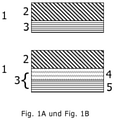
- FIG. 1A 1 shows a waterproof membrane 1 according to the invention, comprising a bulkhead layer 2 and a functional layer 3, the functional layer containing a thermoplastic polymer which changes its consistency under the influence of strongly alkaline media and containing an adhesive.
- a membrane 1 according to the invention which has a layer of an adhesive 4 between the bulkhead layer 2 and a layer of a thermoplastic polymer 5, the layer of the adhesive together with the thermoplastic polymer forming the functional layer 3 and the bulkhead layer with the functional layer connects.
- a “low melting point ” is understood to mean a melting temperature in the range from 50 to 190° C. in connection with polymers.
- the bulkhead layer 2 is preferably made of a material that ensures adequate tightness even at high liquid pressures.
- the bulkhead layer 2 has a high resistance to water pressure and shows good values in tear propagation tests and perforation tests, which is particularly advantageous in the case of mechanical loads on construction sites.
- the bulkhead layer 2 comprises a thermoplastic layer, preferably a layer made of thermoplastic polyolefins or polyvinyl chloride (PVC), in particular a layer made of polypropylene (PP) or polyethylene (PE), particularly preferably made of polypropylene, since these materials ensure high resistance to environmental influences.
- a thermoplastic layer preferably a layer made of thermoplastic polyolefins or polyvinyl chloride (PVC), in particular a layer made of polypropylene (PP) or polyethylene (PE), particularly preferably made of polypropylene, since these materials ensure high resistance to environmental influences.
- PVC polyvinyl chloride
- PP polypropylene
- PE polyethylene
- the bulkhead layer 2 is selected from materials from the group consisting of high-density polyethylene (HDPE), medium-density polyethylene (MDPE), low-density polyethylene (LDPE), polyethylene (PE), polyethylene terephthalate (PET), polystyrene (PS ), polyvinyl chloride (PVC), polyamides (PA), ethylene/vinyl acetate copolymer (EVA), chlorosulfonated polyethylene, olefin-based thermoplastic elastomers (TPE-O, TPO), ethylene propylene diene rubber (EPDM) and blends thereof.
- HDPE high-density polyethylene
- MDPE medium-density polyethylene
- LDPE low-density polyethylene
- PE polyethylene
- PET polyethylene terephthalate
- PS polystyrene
- PVC polyvinyl chloride
- PA polyamides
- EVA ethylene/vinyl acetate copolymer
- EVA chlor
- the bulkhead layer 2 can have a thickness of 0.05-2 mm, preferably 0.07-1.5 mm, in particular 0.08-1.2 mm.
- the bulkhead layer 2 is a flexible plastic layer.
- the waterproof membrane 1 can be wound up into rolls, typically during manufacture, and easily attached to a substrate.
- the functional layer 3 is preferably in the form of a film, a coating or a non-woven fabric in which the fibers comprise a hard core surrounded by a layer of the thermoplastic polymer.
- thermoplastic polymers which change their consistency under the influence of strongly alkaline media.
- An example of such polymers are polyvinyl alcohols, which partially dissolve under the influence of aqueous media.
- vinyl alcohols are used, for example, for the production of so-called “soluble bags” for packaging concrete additives, since these "soluble bags” can be added directly to concrete mixtures. After the polyvinyl alcohol film has dissolved, the concrete additives it contains mix with the concrete.
- copolyesters Another example of polymers that change consistency under strongly alkaline conditions are copolyesters, since the ester functionality of these polymers are hydrolyzed in strongly alkaline media and the polymers thus decompose.
- polymers which change their consistency under the influence of strongly alkaline media are polyvinyl acetates and copolymers thereof, since the vinyl acetate units within the polymers are subject to hydrolysis in strongly alkaline media and are thus converted into polyvinyl alcohols. These in turn are readily soluble in water, so that the polymer as a whole dissolves in the strongly alkylic medium.
- thermoplastic copolyester is used as the thermoplastic polymer which changes its consistency under the influence of strongly alkaline media.
- a preferred thermoplastic copolyester is based on copolyethylene terephthalate.
- polyvinyl alcohols are those with a degree of hydrolysis of more than 50 mole % (ie 50.1 to 100 mole %, in particular 70 to 100 mole %), preferably 85 to 100 mole %, and in particular 90 to 100 mole %. suitable.
- Corresponding polymers are for example in DE 10 2007 026 166 A1 described.
- the degree of hydrolysis indicates what percentage of a basic polyvinyl acetate molecule has been saponified to form polyvinyl alcohol.
- H 100 ⁇ 100 ⁇ 0.1535 ⁇ single / 100 ⁇ 0.0749 ⁇ single .
- the polyvinyl alcohol polymer is preferably in a form such that the polymer does not dissolve under the influence of neutral water and at room temperature, but only at a slightly elevated temperature and under the influence of alkaline media. Accordingly, it is advantageous if the polyvinyl alcohol is not in a fully hydrolyzed form.
- ethylene-vinyl acetate copolymers with vinyl acetate contents in the range of 5 to 40 mol% vinyl acetate are not suitable as a thermoplastic polymer that changes its consistency under the influence of strongly alkaline media, because partial hydrolysis does not change the properties of the polymer so significantly, that the polymer could be dissolved in the aqueous medium.
- suitable vinyl acetate copolymers are only those which contain a maximum proportion of non-polar monomers of 50 mol %, based on the total molar amount of all monomers in the polymer.
- non-polar monomers are preferably not more than 30 mol %, more preferably not more than 20 mol % and very particularly preferably not more than 10 mol %.
- non-polar monomers are understood to mean, inter alia, monomers which are based on hydrocarbons.
- thermoplastic polymer which changes its consistency under the influence of strongly alkaline media
- material forming the bulkhead layer since the material forming the bulkhead layer in case of accidental contact with concrete must not be damaged. For this reason, polymers that are inert to strongly alkaline media are preferred as the material for the bulkhead layer.
- thermoplastic copolyesters such as those based on polyethylene terephthalate, are most preferred as thermoplastic polymers which change their consistency under the influence of strongly alkaline media.
- this type of polymer has the advantage that hydrolysis takes place within the side chain of the polymer, while in the case of polyvinyl acetate only the side chains of the polymer are hydrolyzed.
- copolyesters it is thus possible to achieve a very significant change in consistency with a relatively small number of hydroxyl groups, while this requires essentially complete hydrolysis of the acetate groups in the case of polyvinyl acetate.
- thermoplastic polymer has a low melting point as defined above. It is particularly preferred if the thermoplastic polymer has a melting point in the range from 60 to 120.degree. C. and in particular from 70 to 90.degree.
- the functional layer can contain an additional thermoplastic polymer.
- This additional polymer need not necessarily change consistency in strongly alkaline media, and is even preferred when it does not.
- this is a temperature-resistant thermoplastic or a thermoplastic elastomer that is solid at room temperature.
- room temperature means a temperature of 23°C.
- the thermoplastic polymer comprises a polymer selected from the group consisting of a) ethylene/alkyl acrylate copolymers, preferably ethylene/methyl acrylate, ethylene/ethyl acrylate or ethylene/N-butyl acrylate copolymers, b) polyethylenes, preferably produced by the metallocene process, particularly preferably copolymers of ethylene and octene or ethylene and hexene and c) ethylene vinyl acetate (EVA).
- the additional thermoplastic polymer is ethylene vinyl acetate (EVA), which can be used on the one hand to lower the melting point of the copolyester polymer in the functional layer and on the other hand to reduce stickiness.
- the additional thermoplastic polymer is an ethylene/methyl acrylate, ethylene/ethyl acrylate or ethylene/N-butyl acrylate copolymer. These copolymers work by lowering the melting point of the polymer in the functional layer (3) and thus reducing the stickiness of the functional layer.
- the amount of such additional thermoplastic polymers should be sufficient to produce the desired effect, but not so great as to impair the property of changing the consistency in strongly alkaline media. This is particularly critical when the additional thermoplastic polymer does not change its consistency in strongly alkaline media. It is therefore expedient if the proportion of additional thermoplastic polymers which do not change their consistency in strongly alkaline media does not exceed 40% by weight, based on the total weight of the thermoplastic polymers.
- the proportion of the additional thermoplastic polymers is preferably no more than 30% by weight, more preferably no more than 20% by weight and most preferably no more than 10% by weight.
- the functional layer contains an adhesive in addition to the thermoplastic polymer.
- the adhesive forms the functional layer 3 together with the thermoplastic polymer, the adhesive preferably being mixed with the thermoplastic polymer in such a way that it has no self-adhesive effect in the mixture.
- the adhesive may be a room temperature solid thermoplastic or a room temperature solid thermoplastic elastomer.
- Thermoplastic elastomers have the advantage that the adhesive has good elasticity with respect to horizontal and vertical displacements, in particular with respect to displacements of the bulkhead layer 2 relative to the functional layer 3 . Good resilience of the adhesive prevents tearing or delamination of the layers and hence failure of the adhesive.
- the adhesive has a tear strength ⁇ B of 1.5 - 20 MPa at room temperature and/or an elongation at break ⁇ R of 5 - 1000%, both measured according to DIN ISO 527-1 from 1996.
- thermoplastics and thermoplastic elastomers are selected in particular from the group consisting of polyethylene (PE), polyethylene with a lower Density (LDPE), Ethylene/Vinyl Acetate Copolymer (EVA), Polybutene (PB); olefin-based thermoplastic elastomers (TPE-O, TPO) such as ethylene-propylene-diene/polypropylene copolymers; crosslinked thermoplastic elastomers based on olefins (TPE-V, TPV); Thermoplastic polyurethanes (TPE-U, TPU) such as TPU with aromatic hard segments and polyester soft segments (TPU-ARES), polyether soft segments (TPU-ARET), polyester and polyether soft segments (TPU-AREE) or polycarbonate soft segments (TPU -ARCE); thermoplastic copolyesters (TPE-E, TPC) such as TPC with polyester soft segments (TPC-ES), polyether soft segments (TPC-ET
- Suitable adhesives can be selected from the group consisting of acrylate compounds, polyurethane polymers, silane-terminated polymers and polyolefins.
- Preferred acrylate compounds are, in particular, acrylate compounds based on acrylic monomers, in particular acrylic and methacrylic acid esters.
- polyurethane polymer includes all polymers which are produced by the so-called diisocyanate polyaddition process. This also includes those polymers that are almost or entirely free of urethane groups. Examples of polyurethane polymers are polyether-polyurethanes, polyester-polyurethanes, polyether-polyureas, polyureas, polyester-polyureas, polyisocyanurates and polycarbodiimides.
- the adhesive is a hot-melt adhesive. This ensures a good bond and good adhesion of the adhesive to the bulkhead layer 2, or to any other components of the waterproof membrane, and thus reduces the detachment of the adhesive.
- Hot-melt adhesives are well known to those skilled in the art and are described, for example, in CD Römpp Chemie Lexikon, Version 1.0, Georg Thieme Verlag, Stuttgart, 1995 .
- the adhesive has a melting point (determined by the ring and ball method) of 50-190°C, in particular 60-120°C, preferably 70-90°C. This is particularly advantageous for the production of watertight membranes 1, in which materials are used for the bulkhead layer 2, which are affected by high production temperatures.
- the functional layer can contain further components, in particular concrete components and/or mortar components.
- all substances that are used for the production of concrete and/or mortar are suitable as concrete components and/or mortar components, in particular cement particles.
- Additives such as gravel or sand, binders such as non-hydraulic, latently hydraulic pozzolanic or hydraulic binders are suitable as concrete components and/or mortar components. These additives can improve the bond between the waterproof membrane and the cast concrete in its hardened form.
- Preferred as concrete components and/or mortar components are hydraulic binders, which are preferably selected from the group consisting of cement, mortar, gypsum, silica fume, fly ash and blast furnace slag, alumina trihydrate, silicon dioxide, alkali or alkaline earth metal salts or a mixture thereof.
- the concrete components typically have an average particle size of 0.1-1000 ⁇ m, preferably 2 to 500 ⁇ m.
- the functional layer in the waterproof membrane can be in the form of a film of the polymer and the adhesive, in the form of a coating of the polymer and the adhesive, or in the form of a nonwoven fabric in which the fibers comprise a hard core surrounded by a layer of the polymer and the adhesive.
- the functional layer is in the form of a film or coating
- the film or coating it is also possible for the film or coating to be a foamed material. This has the advantage that the resistance of the material to impact loads can be improved.
- this film expediently has a thickness in the range from 0.05 to 1 mm, in particular 0.07 to 0.9 mm and particularly preferably 0.1 to 0.7 mm.
- this coating is applied with an application weight in the range from 10 to 500 g/m 2 , in particular in the range from 50 to 300 g/m 2 .
- this expediently has a weight per unit area in the range from 10 to 500 g/m 2 , and in particular in the range from 20 to 300 g/m 2 .
- the exact thickness of the film, coating or fleece to be incorporated into the membrane will also depend on whether the membrane is a two-layer construction (with no middle layer of adhesive between the bulkhead layer and the functional layer), a three-layer construction with an adhesive layer between the bulkhead layer and the functional layer or has a construction with more than three layers.
- the membrane according to the invention is a two-layer or three-layer membrane.
- the foil has a thickness in the range from 0.2 to 0.7 mm, in particular from 0.4 to 0.6 mm.
- the functional layer is a coating, it is preferred that this is applied with an application weight in the range of between 150 and 350 g/m 2 , in particular between 200 and 300 g/m 2 .
- the weight per unit area in a two-layer construction is preferably 150 to 350 g/m 2 and in particular 200 to 300 g/m 2 .
- the thickness of the functional layer can be less than in a two-layer construction. If the functional layer consists of a film, the thickness is preferably in the range between 0.1 and 0.4 mm, in particular between 0.15 and 0.3 mm. In the case of a coating, the application weight can be reduced to an amount in the range from 50 to 200 g/m 2 , in particular in the range from 80 to 150 g/m 2 . In the case of a fleece, it is sufficient if the basis weight of the fleece is between 10 and 120 g/m 2 , in particular between 30 and 80 g/m 2 .
- the fibers on which the fleece is based consist of organic or synthetic material.
- they are cellulose-cotton fibers, protein fibers or synthetic fibers.
- Fibers made from polyester or from a homo- or copolymer of ethylene and/or propylene, from a polyamide or from viscose are particularly preferred as synthetic fibers.
- the fibers can be short fibers or long fibers, spun, woven or non-woven fibers or filaments.
- the fibers can be oriented or stretched fibers. Furthermore, it can be advantageous to use different fibers together, both in terms of geometry and compositions.
- the fleece made up of fibers can be produced using various methods known to those skilled in the art.
- the matrix fibers made of a solid material
- Such fibers are also familiar to the person skilled in the art under the designation "Biko" (for bi-component) fibers.
- the fleece includes interstices that can be produced by suitable manufacturing processes.
- the interstices are at least partially open and allow liquid concrete and/or adhesive to penetrate.
- the waterproof membrane prefferably has additional functional layers, in particular layers of swellable Materials and electrically conductive materials, as specified in the EP 2 299 005 A1 are described in [0057], [0058] and [0059] to [0063].
- the invention also includes a method for sealing substrates, comprising the steps i) applying a waterproof membrane (1), as set out above, to a substrate, the functional layer of the waterproof membrane being directed towards the substrate, and ii) applying liquid concrete on the functional layer (3) of the waterproof membrane (1).
- liquid concrete in this document is meant concrete before hardening.
- the concrete can be part of a structure, in particular a structure from structural or civil engineering, such as a building, garage, tunnel, landfill, water retention basin, dike or an element for prefabricated construction.
- the liquid concrete is usually poured onto and/or onto the functional layer and can react with the functional layer. If the functional layer is a fiber fleece, it is advantageous if the liquid concrete penetrates the functional layer completely.
- the concrete hardens, an essentially solid bond is typically formed between the hardened concrete and the functional layer and thus to the watertight membrane 1, in particular when the concrete has completely penetrated the functional layer in its liquid state. This bond is additionally reinforced by the formation of a self-adhesive effect through the contact of the fleece with the liquid concrete.
- this adhesive has a self-adhesive effect and can thus ensure strong adhesion between the functional layer and the hardened concrete.
- the invention also includes a method for producing waterproof membranes as described above, the method including the application of a functional layer to a bulkhead layer.
- a functional layer is a film
- it can be applied to the Schott layer or to an adhesive layer introduced between them, preferably by lamination or lining, in particular by lining, to the Schott layer.
- the functional layer is a coating
- it can be applied to the bulkhead layer or to an adhesive layer applied to the bulkhead layer by melt die extrusion, melt calendering, powder spreading processes or spray lamination.
- Waterproof membranes according to the present invention are expediently produced as endless goods, with the individual layers being connected to one another by calendering and/or lamination, in particular lamination. The membranes are then rolled up onto rollers, for example.
- the adhesive can expediently be applied to the bulkhead layer during production by slot die extrusion, in the powder scattering process, by melt calendering or spray lamination, in particular with the aid of a powder scattering process.
- the adhesive preferably has a composition and a stability that is compatible with the temperatures at which the waterproof membrane 1 is manufactured.
- the membranes according to the invention it is possible to seal foundations and other structures in a way that prevents them from leaking back and to build up a good connection to the concrete without further pretreatment measures.
- the functional layers of the membrane sheets described are inert before contact with liquid concrete and thus protect the sheet from premature aging and enable work to be carried out on the waterproofing.
- the functional layer develops a self-adhesive effect and thus enables good adhesion to the concrete.
- the functional layer acts as a sealing compound and means that the seal is leak-proof.
Landscapes
- Chemical & Material Sciences (AREA)
- Organic Chemistry (AREA)
- Engineering & Computer Science (AREA)
- Textile Engineering (AREA)
- Laminated Bodies (AREA)
Description
- Die Erfindung betrifft eine wasserdichte Membran, umfassend eine Schottschicht und eine Funktionsschicht. Die Erfindung betrifft ferner ein Verfahren zur Abdichtung von Untergründen sowie ein Verfahren zur Herstellung einer wasserdichten Membran.
- Zur Abdichtung von Untergründen gegen Wasserdurchstoß sind in der Baubranche wasserdichte Membranen bekannt. Beispielsweise beschreibt die
US 4,065,924 eine Schottschicht, verbunden mit einer Oberschicht, wobei die Schottschicht auf dem Untergrund angeordnet ist und die Oberschicht den Verbund mit dem aufgetragenen Beton gewährleistet, indem sie von dem aufgetragenen Beton durchsetzt wird. - Nachteil solcher Abdichtungen ist es jedoch, dass sich im Laufe ihrer Verwendung zwischen der Oberschicht und der Schottschicht durch das Ablösen der Schichten voneinander oder durch Materialermüdung Hohlräume bilden können. Durch diese können sich Flüssigkeiten ausbreiten. Im Falle eines Lecks in der Schottschicht, beispielsweise durch hineinwachsende Wurzeln, Materialermüdung oder durch Zugoder Scherkräfte, kann eindringendes Wasser die Schottschicht durch diese zusammenhängenden Hohlräume hinterlaufen. Dadurch werden einerseits große Bereiche von eingedrungenem Wasser betroffen und andererseits die genaue Lokalisierung des Lecks schwierig.
- Darüber hinaus ist es aus der
US 5,313,848 bekannt, dass der Kontakt mit einem Untergrund, insbesondere einem Betonuntergrund, verbessert werden kann, indem eine Membran, bestehend aus einer Schottschicht, einer darauf aufgebrachten Schicht aus einem synthetischen Klebstoff sowie einer abschließenden Schutzschicht, verwendet wird. Solche Membranen erlauben die Applikation von flüssigem Beton an die Membran und können insbesondere in Applikationen verwendet werden, in denen ein nachträgliches Anbringen an einer gegossenen Betonfläche nicht möglich ist. - In der
US 5,496,615 ist eine Weiterentwicklung dieser Membran beschrieben, in der auf der der Zementschicht zugewandten Seite der Trägerschicht eine weitere Klebstoffschicht aufgebracht ist, mit der die Trägerschicht mit dem Beton verbunden werden kann. Diese Membran-Struktur gewährleitstet eine bessere Verbindung mit der Betonschicht. - Nachteil dieser Struktur ist es jedoch, dass vor dem Aufbringen der Betonschicht die Klebstoffschicht mit Staub und anderen partikulärem Material verunreinigt werden kann, insbesondere wenn nach Auslegen der Membran auf dieser Arbeiten verrichtet werden. Dadurch kann deren Klebkraft signifikant reduziert und eine stabile Verbindung der Membran mit dem Beton nicht mehr gewährleisten werden, insbesondere nicht über längere Zeiträume.
- Die
EP 2 299 005 A1 beschriebt wasserdichte Membranen mit einer Kontaktschicht, die ein Haftmittel und einen Kontaktvermittler aufweist. Als Kontaktvermittler werden speziell Faserwerkstoffe aus natürlichen oder synthetischen Fasern, wie aus Polyethylenterephthalat, vorgeschlagen, die von Beton durchdrungen werden können. Nach Aushärtung des Betons bildet sich durch das Ineinandergreifen des Kontaktvermittlers mit dem Beton ein fest aneinanderhaltender Verbund. In diesem System dient das Haftmittel der Befestigung des Kontaktvermittlers an der Membran. - Die
WO 2011/041263 A1 beschreibt eine wasserdichte Membran, die aus einer wasserdichten Schicht, einem darauf aufgebrachten Haftklebstoff und eine Schutzschicht aus Polyvinylacetat besteht. Die Schutzschicht dient in dieser Membran dem Schutz des Haftklebstoffs, so dass die Membran während der Verarbeitung begehbar ist. Wird an die Schutzschicht jedoch Beton gegossen, so hydrolysiert das Polyvinylacetat unter Einfluss des Betons zu Polyvinylalkohol, der im Beton löslich ist. Dadurch wird der unter der Schutzschicht befindliche Haftklebstoff freigelegt, der dann mit dem angegossenen Beton reagieren und einen festen Verbund ausbilden kann. - Aufgabe der vorliegenden Erfindung ist es, die wie vorstehend aus dem Stand der Technik bekannte wasserdichte Membran zu verbessern, wobei eine Verunreinigung der auf die Zementschicht aufzubringenden Klebstoffschicht während der Verarbeitung möglichst verhindert wird, und gleichzeitig nach Aufbringen des flüssigen Betons eine stabile Bindung mit der Betonschicht erzielt werden kann.
- Erfindungsgemäß wird dies durch die wasserdichte Membran nach Anspruch 1 erreicht.
- Kern der Erfindung ist, dass die Funktionsschicht ein thermoplastisches Polymer, das unter dem Einfluss eines stark alkalischen Mediums mit einem pH Wert von 9 bis 14 seine Konsistenz ändert und in Form eines thermoplastischen Copolyester vorliegt, und ein Haftmittel enthält, wobei das Haftmittel zusammen mit dem thermoplastischen Polymer die Funktionsschicht bildet.
- Unter stark alkalischem Medium wird ein pH von 9 bis 14, vorzugsweise von 12 bis 13, verstanden.
- Das thermoplastische Polymer ändert unter dem Einfluss eines stark alkalischen Mediums seine Konsistenz dergestalt, dass sich eine selbstklebende Wirkung des Haftmittels nach der Änderung der Konsistenz entfalten kann, während dies vor der Konsistenzänderung nicht der Fall ist. Dies kann beispielsweise durch Auflösung des thermoplastischen Polymers in dem stark alkalischen Medium bewirkt werden, was eine Anbindung des Haftmittels beispielsweise an flüssigen Beton erlaubt. Unter selbstklebender Wirkung wird verstanden, dass eine Klebeverbindung ohne Einwirkung von Wärme, Wasser und Lösungsmitteln zur Aktivierung des Klebstoffs stattfindet, d.h. durch die Anwendung von Druck, um den Klebstoff mit dem Substrat in Kontakt zu bringen.
- Vorzugsweise ist die Funktionsschicht inert gegen wässrige Lösungen mit einem pH-Wert im sauren bis leicht basischen Bereich (wie beispielsweise Regen), während bei Kontakt mit stark alkalischen Lösungen, wie z.B. flüssigem Beton, eine chemische Reaktion einsetzt, die zur Freisetzung des Haftmittels führt.
- Unter saurem bis leicht basischem Bereich wird ein pH-Bereich von 4 bis 8 verstanden.
- Die Vorteile der Erfindung sind unter anderem darin zu sehen, dass eine Verarbeitung der erfindungsgemäßen Folien bei widrigen Wetterbedingungen möglich ist, ohne dass die Klebfähigkeit der Membran vermindert wird. Dies verhindert, dass sich beispielsweise Dreck und Staub auf der Kontaktfläche mit dem flüssigen Beton absetzen und die Klebfähigkeit der Membran gegenüber dem Beton reduzieren.
- Der Aufbau der Funktionsschicht und deren Form unterliegt dabei keinen besonderen Beschränkungen, Die Funktionsschicht kann in Form einer Folie, einer Beschichtung oder eines Faservlieses vorliegen.
- Die Funktionsschicht kann neben dem beschriebenen thermoplastischen Polymer weitere Komponenten mit niedrigem Schmelzpunkt enthalten, beispielsweise zusätzliche Thermoplaste, die zu einer Absenkung des Schmelzpunkts führen, Füllstoffe, oder Betonbestandteile, die die Anbindung an den Beton verbessern.
- Weitere Aspekte der Erfindung betreffen Verfahren zur Abdichtung von Untergründen sowie Verfahren zur Herstellung der beschriebenen Membranen. Besonders bevorzugte Ausführungsformen der Erfindung sind Gegenstand der abhängigen Ansprüche.
- In
Fig. 1A ist eine erfindungsgemäße wasserdichte Membran 1 dargestellt, umfassend eine Schottschicht 2 und eine Funktionsschicht 3, wobei die Funktionsschicht ein thermoplastisches Polymer enthält, das unter dem Einfluss von stark alkalischen Medien seine Konsistenz ändert, und ein Haftmittel enthält. - In
Fig. 1B ist eine erfindungsgemäße Membran 1 dargestellt, die zwischen der Schottschicht 2 und einer Schicht aus einem thermoplastischen Polymer 5 eine Schicht aus einem Haftmittel 4 aufweist, wobei die Schicht aus dem Haftmittel mit dem thermoplastischen Polymer zusammen die Funktionsschicht 3 ausbilden und die die Schottschicht mit der Funktionsschicht verbindet. - Unter einem "niedrigen Schmelzpunkt" wird im Zusammenhang mit Polymeren im Rahmen der vorliegenden Erfindung eine Schmelztemperatur im Bereich von 50 bis 190°C verstanden.
- Die Schottschicht 2 besteht vorzugsweise aus einem Material, das auch bei hohen Flüssigkeitsdrücken eine ausreichende Dichtheit gewährleistet.
- Es ist demzufolge von Vorteil, wenn die Schottschicht 2 eine hohe Beständigkeit gegen Wasserdruck aufweist sowie gute Werte in Weiterreißversuchen und Perforationsversuchen zeigt, was besonders bei mechanischen Belastungen auf Baustellen von Vorteil ist.
- Es ist insbesondere von Vorteil, wenn die Schottschicht 2 eine thermoplastische Schicht, vorzugsweise eine Schicht aus thermoplastischen Polyolefinen oder Polyvinylchlorid (PVC), insbesondere eine Schicht aus Polypropylen (PP) oder Polyethylen (PE), insbesondere bevorzugt aus Polypropylen, umfasst, da diese Materialien eine hohe Widerstandsfähigkeit gegenüber Umwelteinflüssen gewährleisten.
- Erfindungsgemäss ist die Schottschicht 2 ausgewählt aus Materialien aus der Gruppe bestehend aus Polyethylen mit hoher Dichte (HDPE), Polyethylen mit mittlerer Dichte (MDPE), Polyethylen mit niedriger Dichte (LDPE), Polyethylen (PE), Polyethylenterephthalat (PET), Polystyrol (PS), Polyvinylchlorid (PVC), Polyamiden (PA), Ethylen/Vinylacetat-Copolymer (EVA), chlorsulfoniertes Polyethylen, thermoplastische Elastomere auf Olefinbasis (TPE-O, TPO), Ethylen-Propylen-Dien-Kautschuk (EPDM) und Mischungen davon.
- Die Schottschicht 2 kann eine Dicke von 0,05 - 2 mm, bevorzugt 0,07 - 1.5 mm, insbesondere 0,08 - 1.2 mm, aufweisen.
- Es ist insbesondere von Vorteil, wenn die Schottschicht 2 eine flexible Kunststoffschicht ist. Dadurch lässt sich die wasserdichte Membran 1, typischerweise bei der Herstellung, zu Rollen aufwickeln und leicht auf einem Untergrund anbringen.
- Die Funktionsschicht 3 hat vorzugsweise die Form einer Folie, einer Beschichtung oder eines Faservlies, in dem die Fasern einen harten Kern umfassen, der von einer Schicht aus dem thermoplastischen Polymer umgeben ist.
- Thermoplastische Polymere, die unter Einfluss stark alkalischer Medien ihre Konsistenz ändern, sind dem Fachmann geläufig. Ein Beispiel für solche Polymere sind Polyvinylalkohole, die sich unter dem Einfluss von wässrigen Medien teilweise auflösen. Solche Vinylalkohole werden beispielsweise für die Herstellung von sogenannten "soluble bags" für die Verpackung von Betonadditiven eingesetzt, da diese "soluble bags" direkt in Betonmischungen zugegeben werden können. Nach Auflösung der Polyvinylalkoholfolie vermischen sich die darin enthaltenen Betonadditive mit dem Beton.
- Ein weiteres Beispiel für Polymere, die unter stark alkalischen Bedingungen ihre Konsistenz ändern, sind Copolyester, da die Esterfunktionalität dieser Polymere in stark alkalischen Medien hydrolysiert werden und die Polymere damit zerfallen.
- Ein weiteres Beispiel für Polymere, die unter Einfluss stark alkalischer Medien ihre Konsistenz ändern, sind Polyvinylacetate und Copolymere hiervon, da die Vinylacetateinheiten innerhalb der Polymere in stark alkalischen Medien einer Hydrolyse unterliegen und so in Polyvinylalkohole umgewandelt werden. Diese sind wiederum gut in Wasser löslich, so dass sich der das Polymer insgesamt in dem stark alkylischen Medium auflöst.
- Erfindungsgemäss kommt als thermoplastisches Polymer, das unter dem Einfluss stark alkalischer Medien seine Konsistenz verändert, ein thermoplastischer Copolyester zum Einsatz. Ein bevorzugter thermoplastischer Copolyester basiert auf Copolyethylenterephthalat.
- Als Polyvinylalkohole sind beispielsweise solche mit einem Hydrolysegrad von über 50 Mol-% (d.h. 50,1 bis 100 Mol-%, insbesondere 70 bis 100 Mol-%), bevorzugt 85 bis 100 Mol-%, und insbesondere 90 bis 100 Mol-% geeignet. Entsprechende Polymere sind beispielsweise in der
DE 10 2007 026 166 A1 beschrieben. Dabei gibt der Hydrolysegrad (Verseifungsgrad) an, wie viel Prozent eines Polyvinylacetatgrundmoleküls zu Polyvinylalkohol verseift wurden. Aus dem Gehalt an Restacetylgruppen und damit aus der Esterzahl (EZ) wird der Hydrolysegrad H nachfolgender Formel berechnet und in Mol-% angegeben:
- Das Polyvinylalkoholpolymer liegt vorzugsweise in einer Form vor, dass sich das Polymer unter Einwirkung von neutralem Wasser und bei Raumtemperatur nicht auflöst, sondern erst bei etwas erhöhter Temperatur und bei Einwirkung von alkalischen Medien. Demzufolge ist es vorteilhaft, wenn der Polyvinylalkohol nicht in vollständig hydrolysierter Form vorliegt.
- Hinsichtlich der Copolymeren von Vinylacetat ist es entscheidend, dass diese keinen zu hohen Anteil an unpolaren Monomeren, wie beispielsweise Ethylen, enthalten. Ein zu hoher Anteil solcher unpolaren Monomere würde dazu führen, dass bei Kontakt mit flüssigem Beton keine wesentliche Änderung der Konsistenz des Materials eintritt, beispielsweise weil sich zu viele unpolare Seitengruppen an der Oberfläche des Materials befinden, während die Vinylacetateinheiten von einem Kontakt mit dem Beton abgeschirmt sind. So sind beispielsweise Ethylen-Vinylacetat-Copolymere mit Vinylacetatgehalten im Bereich von 5 bis 40 Mol% Vinylacetat nicht als thermoplastisches Polymer, das unter Einfluss von stark alkalischen Medien seine Konsistenz ändert, geeignet, weil eine partielle Hydrolyse die Eigenschaften des Polymers nicht so wesentlich verändert, dass das Polymer im wässrigen Medium gelöst werden könnte. Im Rahmen der vorliegenden Erfindung sind daher als Copolymere von Vinylacetat nur solche geeignet, die einen Anteil an unpolaren Monomeren von maximal 50 Mol%, bezogen auf die Gesamtmolmenge aller Monomeren im Polymer, enthalten. Bevorzugt beträgt der Anteil unpolarer Monomere nicht mehr als 30 Mol%, noch bevorzugter nicht mehr als 20 Mol% und ganz besonders bevorzugt nicht mehr als 10 Mol%. Unter unpolaren Monomeren werden im Rahmen der vorliegenden Erfindung unter anderem Monomere verstanden, die auf Kohlenwasserstoffen beruhen.
- Es ist selbstverständlich, dass es zwischen dem thermoplastischen Polymer, das unter Einfluss von stark alkalischen Medien seine Konsistenz ändert, und dem Material, dass die Schottschicht bildet, keine Überschneidungen bestehen, da das Material, dass die Schottschicht bildet, bei versehentlichem Kontakt mit Beton nicht beschädigt werden darf. Daher sind als Material für die Schottschicht solche Polymere bevorzugt, die gegenüber stark alkalischen Medien innert sind.
- Am meisten bevorzugt als thermoplastische Polymere, die unter Einfluss von stark alkalischen Medien ihre Konsistenz ändern, sind thermoplastische Copolyester, wie beispielsweise solche auf Basis von Polyethylenterephtalat. Gegenüber Polyvinylacetat oder Copolymeren davon besteht bei diesem Polymertyp der Vorteil, dass eine Hydrolyse innerhalb der Seitenkette des Polymers erfolgt, während bei Polyvinylacetat nur die Seitenketten des Polymers hydrolysiert werden. Damit ist es bei Copolyestern möglich mit einer relativ geringen Anzahl an Hydroylsen eine sehr wesentliche Konsistenzänderung zu erzielen, während dazu bei Polyvinylacetat eine im Wesentlichen vollständige Hydrolyse der Acetatgruppen erforderlich ist.
- Im Rahmen der vorliegenden Erfindung ist es ebenfalls bevorzugt, wenn das thermoplastische Polymer einen niedrigen Schmelzpunkt im Sinne der vorstehenden Definition aufweist. Besonders bevorzugt ist es, wenn das thermoplastische Polymer einen Schmelzpunkt im Bereich von 60 bis 120 °C und insbesondere 70 bis 90 °C aufweist.
- Die Funktionsschicht kann neben dem thermoplastischen Polymer ein zusätzliches weiteres thermoplastisches Polymer enthalten. Dieses zusätzliche Polymer muss in stark alkalischen Medien nicht notwendigerweise seine Konsistenz ändern, und es ist sogar bevorzugt wenn dies nicht der Fall ist. Vorteilhafterweise ist dieses ein temperaturfester Thermoplast oder ein bei Raumtemperatur festes thermoplastisches Elastomer. Unter dem Begriff "Raumtemperatur" wird im vorliegenden Dokument eine Temperatur von 23°C verstanden. Vorteilhafterweise umfasst das thermoplastische Polymer ein Polymer, ausgewählt aus der Gruppe, bestehend aus a) Ethylen/Alkylacrylatcopolymeren, bevorzugt Ethylen/Methylacrylat-, Ethylen/Ethylacrylat- oder Ethylen/N-Butylacrylatcopolymeren, b) Polyethylenen, vorzugsweise hergestellt nach dem Metallocenverfahren, besonders bevorzugt Copolymere von Ethylen und Octen oder Ethylen und Hexen und c) Ethylenvinylacetat (EVA). In einer besonders bevorzugten Ausführungsform handelt es sich bei dem zusätzlichen thermoplastischen Polymer um Ethylenvinylacetat (EVA), das einerseits zur Absenkung des Schmelzpunktes des Copolyesterpolymers in der Funktionsschicht verwendet werden kann und andererseits eine Verminderung der Klebrigkeit bewirkt. In einer weiteren besonders bevorzugten Ausführungsform handelt es sich bei dem zusätzlichen thermoplastischen Polymer um ein Ethylen/Methylacrylat, Ethylen/Ethylacrylat oder Ethylen/N-Butylacrylatcopolymeren. Diese Copolymere wirken, indem sie den Schmelzpunkt des Polymers in der Funktionsschicht (3) vermindern und somit die Klebrigkeit der Funktionsschicht herabsetzen.
- Die Menge solcher zusätzlichen thermoplastischen Polymeren sollte ausreichend sein, um den gewünschten Effekt zu bewirken, nicht jedoch so groß sein, dass die Eigenschaft der Konsistenzänderung in stark alkalischen Medien beeinträchtigt wird. Dies ist insbesondere dann kritisch, wenn das zusätzliche thermoplastische Polymer in stark alkalischen Medien seine Konsistenz nicht ändert. Es ist demzufolge zweckmäßig, wenn der Anteil von zusätzlichen thermoplastischen Polymeren, die ihre Konsistenz in stark alkalischen Medien nicht ändern, 40 Gew.-%, bezogen auf das Gesamtgewicht der thermoplastischen Polymeren, nicht übersteigt. Vorzugsweise beträgt der Anteil der zusätzlichen thermoplastischen Polymeren nicht mehr als 30 Gew.-%, besonders bevorzugt nicht mehr als 20 Gew.-% und am meisten bevorzugt nicht mehr als 10 Gew.-%.
- Wie vorstehend beschrieben, enthält die Funktionsschicht neben dem thermoplastischen Polymer ein Haftmittel. Erfindungsgemäss bildet das Haftmittel zusammen mit dem thermoplastischen Polymer die Funktionsschicht 3, wobei das Haftmittel mit dem thermoplastischen Polymer vorzugsweise derart vermischt ist, dass es in der Vermischung keine selbstklebende Wirkung aufweist. Bei dem Haftmittel handelt kann es sich um einen bei Raumtemperatur festen Thermoplast oder ein bei Raumtemperatur festes thermoplastisches Elastomer handeln. Thermoplastische Elastomere haben den Vorteil, dass das Haftmittel dadurch über eine gute Elastizität gegenüber Horizontal- und Vertikalverschiebungen, insbesondere gegenüber Verschiebungen der Schottschicht 2 gegenüber der Funktionsschicht 3 verfügt. Eine gute Elastizität des Haftmittels verhindert ein Reißen oder Ablösen der Schichten und somit ein Versagen des Haftmittels. Idealerweise weist das Haftmittel eine Reißfestigkeit σB von 1,5 - 20 MPa bei Raumtemperatur auf und/oder eine Reißdehnung εR von 5 - 1000 %, beide gemessen nach DIN ISO 527-1 von 1996.
- Bevorzugte Thermoplaste und thermoplastische Elastomere sind insbesondere ausgewählt aus der Gruppe bestehend aus Polyethylen (PE), Polyethylen mit niedriger Dichte (LDPE), Ethylen/Vinylacetat-Copolymer (EVA), Polybuten (PB); thermoplastische Elastomere auf Olefinbasis (TPE-O, TPO) wie Ethylen-Propylen-Dien/Polypropylen-Copolymere; vernetzte thermoplastische Elastomere auf Olefinbasis (TPE-V, TPV); thermoplastische Polyurethane (TPE-U, TPU) wie TPU mit aromatischen Hartsegmenten und Polyester-Weichsegmenten (TPU-ARES), Polyether-Weichsegmenten (TPU-ARET), Polyester- und Polyether-Weichsegmenten (TPU-AREE) oder Polycarbonat-Weichsegmenten (TPU-ARCE); thermoplastische Copolyester (TPE-E, TPC) wie TPC mit Polyester-Weichsegmenten (TPC-ES), Polyether-Weichsegmenten (TPC-ET) oder mit Polyester- und Polyether-Weichsegmenten (TPC-EE); Styrol-Block-Copolymere (TPE-S, TPS) wie Styrol/Butadien-Block-Copolymer (TPS-SBS), Styrol/Isopren-Block-Copolymer (TPS-SIS), Styrol/Ethylen-Butylen/Styrol-Block-Copolymer (TPS-SEBS), Styrol/Ethylen-Propylen/Styrol-Block-Copolymer (TPS-SEPS); und thermoplastische Copolyamide (TPE-A, TPA).
- Weitere vorteilhafte Haftmittel können ausgewählt sein aus der Gruppe bestehend aus Acrylatverbindungen, Polyurethanpolymeren, Silan-terminierten Polymeren und Polyolefinen.
- Bevorzugte Acrylatverbindungen sind insbesondere Acrylatverbindungen auf Basis von Acryl-Monomeren, insbesondere von Acryl- und Methacrylsäureestern.
- Der Begriff "Polyurethanpolymer" umfasst sämtliche Polymere, welche nach dem so genannten Diisocyanat-Polyadditions-Verfahren hergestellt werden. Dies schließt auch solche Polymere ein, die nahezu oder gänzlich frei von Urethangruppen sind. Beispiele für Polyurethanpolymere sind Polyether-Polyurethane, Polyester-Polyurethane, Polyether-Polyharnstoffe, Polyharnstoffe, Polyester-Polyharnstoffe, Polyisocyanurate und Polycarbodiimide.
- Wie vorstehend erwähnt, ist es weiterhin von Vorteil, wenn das Haftmittel ein Schmelzklebstoff ist. Dies gewährleistet einen guten Verbund und eine gute Haftung des Haftmittels auf der Schottschicht 2, respektive auf möglichen weiteren Komponenten der wasserdichten Membran, und vermindert somit das Ablösen des Haftmittels.
- Schmelzklebstoffe sind dem Fachmann allgemein bekannt und sind beispielsweise beschrieben in CD Römpp Chemie Lexikon, Version 1.0, Georg Thieme Verlag, Stuttgart, 1995 .
- Des Weiteren ist es von Vorteil, wenn das Haftmittel einen Schmelzpunkt (bestimmt nach der Ring & Kugel-Methode) von 50 - 190°C, insbesondere von 60 - 120°C, bevorzugt von 70 - 90°C, aufweist. Dies ist insbesondere für die Herstellung von wasserdichten Membranen 1 vorteilhaft, bei denen Materialien für die Schottschicht 2 verwendet werden, die bei hohen Herstellungstemperaturen in Mitleidenschaft gezogen werden.
- Neben dem thermoplastischen Polymer, dem Haftmittel und den optionalen weiteren thermoplastischen Polymeren kann die Funktionsschicht weitere Komponenten enthalten, insbesondere Betonbestandteile und/oder Mörtelbestandteile. Als Betonbestandteile und/oder Mörtelbestandteile sind prinzipiell alle Stoffe, die für die Herstellung von Beton und/oder Mörtel verwendet werden, geeignet, insbesondere Zementpartikel. Als Betonbestandteile und/oder Mörtelbestandteile sind beispielsweise Zusatzstoffe wie Kies oder Sand, Bindemittel, wie nichthydraulische, latent hydraulische puzzolanische oder hydraulische Bindemittel geeignet. Durch diese Zusatzstoffe kann die Verbindung der wasserdichten Membran mit dem angegossenen Beton in seiner ausgehärteten Form verbessert werden. Bevorzugt als Betonbestandteile und/oder Mörtelbestandteile sind hydraulische Bindemittel, welche vorzugsweise ausgewählt sind aus der Gruppe, bestehend aus Zement, Mörtel, Gips, Silikafume, Flugasche und Hüttensand, Aluminiumoxidtrihydrat, Siliziumdioxid, Alkali- oder Erdalkalimetallsalze oder eine Mischung davon. Die Betonbestandteile haben typischerweise eine durchschnittliche Partikelgröße von 0,1 - 1000 µm, bevorzugt von 2 bis 500 µm.
- Die Funktionsschicht in der wasserdichten Membran kann in Form einer Folie aus dem Polymer und dem Haftmittel, in Form einer Beschichtung aus dem Polymer und dem Haftmittel oder in Form eines Faservlieses vorliegen, in dem die Fasern einen harten Kern umfassen, der von einer Schicht aus dem Polymer und dem Haftmittel umgeben ist.
- Liegt die Funktionsschicht in Form einer Folie oder Beschichtung vor, so ist es ebenfalls möglich, dass es sich bei der Folie oder der Beschichtung um ein geschäumtes Material handelt. Dies hat den Vorteil, dass sich damit die Widerstandsfähigkeit des Materials gegenüber stoßartigen Belastungen verbessern lässt.
- Liegt die Funktionsschicht in Form einer Folie vor, so weist diese Folie zweckmäßig eine Dicke im Bereich von 0,05 bis 1 mm, insbesondere 0,07 bis 0,9 mm und besonders bevorzugt 0,1 bis 0,7 mm, auf. Liegt die Funktionsschicht hingegen in Form einer Beschichtung vor, so wird diese Beschichtung mit einem Auftragsgewicht im Bereich von 10 bis 500 g/m2, insbesondere im Bereich von 50 bis 300 g/m2, aufgetragen. Für die weitere Alternative, dass die Funktionsschicht in Form eines Vlieses vorliegt, weist dieses zweckmäßig ein Flächengewicht im Bereich von 10 bis 500 g/m2, und insbesondere im Bereich von 20 bis 300 g/m2, auf.
- Dem Fachmann ist ersichtlich, dass sich die exakte Dicke der in die Membran einzubeziehenden Folie, Beschichtung oder des Vlieses auch danach richtet, ob die Membran eine zweilagige Konstruktion (ohne Mittelschicht aus Haftmittel zwischen der Schottschicht und der Funktionsschicht), eine dreilagige Konstruktion mit einer Haftschicht zwischen Schottschicht und Funktionsschicht oder eine Konstruktion mit mehr als drei Schichten aufweist. In besonders bevorzugten Ausführungsformen handelt es sich bei der erfindungsgemäßen Membran um eine zweilagige oder dreilagige Membran.
- Im Fall einer zweilagigen Konstruktion ist es bevorzugt, dass die Folie eine Dicke im Bereich von 0,2 bis 0,7 mm, insbesondere von 0,4 bis 0,6 mm, aufweist. Handelt es sich bei der Funktionsschicht um eine Beschichtung, so ist es bevorzugt, dass diese mit einem Auftragsgewicht im Bereich von zwischen 150 und 350 g/m2, insbesondere zwischen 200 und 300 g/m2, aufgetragen wird. Bei Verwendung eines Vlieses als Funktionsschicht beträgt das Flächengewicht bei zweilagiger Konstruktion vorzugsweise 150 bis 350 g/m2, und insbesondere 200 bis 300 g/m2.
- Liegt eine dreilagige Konstruktion vor, kann die Dicke der Funktionsschicht geringer sein als bei einer zweilagigen Konstruktion. Vorzugsweise liegt die Dicke der Funktionsschicht, wenn diese aus einer Folie besteht, im Bereich zwischen 0,1 bis 0,4 mm, insbesondere zwischen 0,15 und 0,3 mm. Im Fall einer Beschichtung kann das Auftragsgewicht auf eine Menge im Bereich von 50 bis 200 g/m2, insbesondere im Bereich von 80 bis 150 g/m2, reduziert werden. Bei einem Vlies ist es ausreichend, wenn das Flächengewicht des Vlieses zwischen 10 und 120 g/m2, insbesondere zwischen 30 bis 80 g/m2, beträgt.
- Die dem Vlies zugrunde liegenden Fasern bestehen aus organischem oder synthetischem Material. Insbesondere handelt es sich um Cellulose-Baumwollfasern, Proteinfasern oder um synthetische Fasern. Als synthetische Fasern sind vor allem Fasern aus Polyester oder aus einem Homo- oder Copolymeren von Ethylen und/oder Propylen, aus einem Polyamid oder aus Viskose bevorzugt. Die Fasern können hierbei Kurzfasern oder Langfasern, gesponnene, gewebte oder ungewebte Fasern oder Filamente sein. Weiterhin können die Fasern gerichtete oder gestreckte Fasern sein. Ferner kann es vorteilhaft sein, unterschiedliche Fasern sowohl in Geometrie als auch Zusammensetzungen, miteinander zu verwenden.
- Das aus Fasern aufgebaute Vlies kann mit verschiedenen, dem Fachmann bekannten Verfahren hergestellt werden. So werden in der Regel zunächst die Matrixfasern (aus einem festen Material) erzeugt, auf die anschließend eine Schicht aus dem thermoplastischen Copolyester aufgebracht wird. Solche Fasern sind dem Fachmann auch unter der Bezeichnung "Biko"(für Bi-Komponenten)-Fasern geläufig.
- Das Vlies umfasst Zwischenräume, die durch geeignete Herstellungsverfahren erzeugt werden können. Vorzugsweise sind die Zwischenräume zumindest teilweise offen und erlauben das Eindringen von flüssigem Beton und/oder von Haftmittel.
- Es ist weiterhin möglich, dass die wasserdichte Membran im Rahmen der Erfindung zusätzliche funktionelle Schichten, insbesondere Schichten aus quellfähigen Materialien und elektrisch leitfähigen Materialien enthält, wie sie in der
EP 2 299 005 A1 in [0057], [0058] und [0059] bis [0063] beschrieben sind. - Des Weiteren umfasst die Erfindung ein Verfahren zur Abdichtung von Untergründen, umfassend die Schritte i) Aufbringen einer wasserdichten Membran (1), wie vorstehend ausgeführt, auf einen Untergrund, wobei die Funktionsschicht der wasserdichten Membran entgegen dem Untergrund gerichtet ist, und ii) Aufbringen von flüssigem Beton auf die Funktionsschicht (3) der wasserdichten Membran (1). Unter "flüssigem Beton" wird in diesem Dokument Beton vor dem Aushärten verstanden. Der Beton kann Teil eines Bauwerk, insbesondere eines Bauwerk aus dem Hochoder Tiefbau, wie beispielsweise einem Gebäude, Garage, Tunnel, Deponie, Wasserrückhaltebecken, Deich oder ein Element für den Fertigteilbau sein.
- Der flüssige Beton wird üblicherweise auf und/oder an die Funktionsschicht gegossen, und kann mit der Funktionsschicht reagieren. Handelt es sich bei der Funktionsschicht um ein Faservlies, ist es von Vorteil, wenn der flüssige Beton die Funktionsschicht vollständig durchsetzt. Bei dem Aushärten des Betons bildet sich dabei typischerweise ein im Wesentlichen fester Verbund zwischen dem ausgehärteten Beton und der Funktionsschicht und somit zu der wasserdichten Membran 1, insbesondere wenn der Beton in seinem flüssigen Zustand die Funktionsschicht vollständig durchsetzt hat. Dieser Verbund wird zusätzlich durch die Ausbildung einer selbstklebenden Wirkung durch den Kontakt des Vlieses mit dem flüssigen Beton verstärkt.
- So wird beim Inkontakttreten des flüssigen Betons mit der Funktionsschicht durch den stark alkalischen pH-Wert des Betons eine chemische Reaktion mit dem thermoplastischen Polymer ausgelöst, die zu einem Abbau des Polymers oder einem Auflösen des Polymers führt und so das Haftmittel aus der Funktionsschicht freigibt. Dieses Haftmittel weist in freier Form eine selbstklebende Wirkung auf und kann damit eine starke Haftung zwischen der Funktionsschicht und dem ausgehärteten Beton gewährleisten.
- Des Weiteren umfasst die Erfindung ein Verfahren zur Herstellung von wasserdichten Membranen, wie sie vorstehend beschrieben sind, wobei das Verfahren das Aufbringen einer Funktionsschicht auf eine Schottschicht beinhaltet. Handelt es sich bei der Funktionsschicht um eine Folie, so kann das Aufbringen auf die Schottschicht oder auf eine dazwischen eingeführte Haftmittelschicht vorzugsweise durch Laminieren oder Kaschieren, insbesondere durch Kaschieren, auf die Schottschicht erfolgen. Handelt es sich bei der Funktionsschicht um eine Beschichtung, so kann diese zweckmäßig durch Schmelzdüsenextrusion, Schmelzkalandrierung, Pulverstreuverfahren oder Sprühkaschierung auf die Schottschicht oder auf eine auf der Schottschicht aufgebrachten Haftmittelschicht aufgebracht werden.
- Die Herstellung von wasserdichten Membranen gemäß der vorliegenden Erfindung erfolgt zweckmäßig als Endlosware, wobei die einzelnen Schichten durch Kalandrieren und/oder Kaschieren, insbesondere durch Kaschieren, miteinander verbunden werden. Danach werden die Membranen beispielsweise auf Rollen aufgerollt.
- Das Haftmittel kann bei der Herstellung zweckmäßig durch Schlitzdüsenextrusion, im Pulverstreuverfahren, durch Schmelzkalandrieren oder Sprühkaschierung, insbesondere mit Hilfe eines Pulverstreuverfahrens, auf die Schottschicht aufgebracht werden. Dabei weist das Haftmittel vorzugsweise eine Zusammensetzung und eine Standfestigkeit auf, die mit den Temperaturen der Herstellung der wasserdichten Membran 1 verträglich ist.
- Anlagen zur Herstellung erfindungsgemäßer Membranen sind dem Fachmann ohne Weiteres geläufig. Der Vollständigkeit halber wird hier auf die in der
EP 2 299 005 beschriebenen Apparaturen verwiesen, die im Rahmen der vorliegenden Erfindung für die Herstellung von Membranen verwendet werden können. - Mit den erfindungsgemäßen Membranen ist es möglich Fundamente und andere Bauwerke hinterlaufsicher abzudichten und dabei zum Beton ohne weitere Vorbehandlungsmaßnahmen eine gute Verbindung aufzubauen. Die beschriebenen Funktionsschichten der Membranbahnen sind vor dem Kontakt mit flüssigem Beton inert und schützen so die Bahn vor frühzeitiger Alterung und ermöglichen das Arbeiten auf der Abdichtung. Bei der Betonierung, d.h. wenn die Membran mit flüssigem Beton in Kontakt kommt, entwickelt die Funktionsschicht selbstklebende Wirkung und ermöglicht damit eine gute Haftung am Beton. Gleichzeitig wirkt die Funktionsschicht als Dichtmasse und führt dazu, dass die Abdichtung hinterlaufsicher ist.
- Bei einer zweilagigen Konstruktion der Membran besteht zusätzlich der Vorteil, dass deren Aufbau deutlich einfacher ist und dass das Aufbringen eines Haftmittels beispielsweise in Form eines Heißschmelzklebstoffes entfallen kann. Die für die Hinterläufigkeit erforderliche Dichtmasse bildet sich in diesem Fall in-situ beim Betonieren.
-
- 1
- Wasserdichte Membran
- 2
- Schottschicht
- 3
- Kontaktschicht
- 4
- Haftmittelschicht
- 5
- Schicht, umfassend ein thermoplastisches Polymer
Claims (14)
- Wasserdichte Membran (1) umfassend:eine Schottschicht (2),eine Funktionsschicht (3), wobei die Funktionsschicht ein thermoplastisches Polymer, das unter dem Einfluss eines stark alkalischen Mediums mit einem pH Wert von 9 bis 14 seine Konsistenz ändert und in Form eines thermoplastischen Copolyester vorliegt und ein Haftmitttel enthält, wobei das Haftmittel zusammen mit dem thermoplastischen Polymer die Funktionsschicht (3) bildet, wobei das Haftmittel mit dem thermoplastischen Polymer derart vermischt ist, dass es in dieser Vermischung keine selbstklebende Wirkung aufweist dadurch gekennzeichnet, dass das Haftmittel in der Funktionsschicht einen Acrylatklebstoff, einen Polyurethanklebstoff oder einen silanterminierten Polymerklebstoff umfasst und dass die Schottschicht (2) ausgewählt aus Materialien aus der Gruppe bestehend aus Polyethylen mit hoher Dichte (HDPE), Polyethylen mit mittlerer Dichte (MDPE), Polyethylen mit niedriger Dichte (LDPE), Polyethylen (PE), Polyethylenterephthalat (PET), Polystyrol (PS), Polyvinylchlorid (PVC), Polyamiden (PA), Ethylen/Vinylacetat-Copolymer (EVA),chlorsulfoniertes Polyethylen, thermoplastische Elastomere auf Olefinbasis (TPE-O, TPO),Ethylen-Propylen-Dien-Kautschuk (EPDM) und Mischungen davon.
- Wasserdichte Membran gemäß Anspruch 1, dadurch gekennzeichnet, dass die Funktionsschicht (3) in Form einer Folie aus dem thermoplastischen Polymer und dem Haftmittel oder in Form einer Beschichtung aus dem thermoplastischen Polymer und dem Haftmittel vorliegt.
- Wasserdichte Membran gemäß einem der vorstehenden Ansprüche, dadurch gekennzeichnet, dass die Funktionsschicht (3) zusätzlich ein weiteres thermoplastisches Polymerenthält.
- Wasserdichte Membran gemäß einem der vorstehenden Ansprüche, dadurch gekennzeichnet, dass die Funktionsschicht (3) in Form eines geschäumten Materials vorliegt.
- Wasserdichte Membran gemäß einem der vorstehenden Ansprüche, dadurch gekennzeichnet, dass die Funktionsschicht (3) zusätzlich Betonbestandteile enthält.
- Wasserdichte Membran gemäß einem der vorstehenden Ansprüche, dadurch gekennzeichnet, dass die Schottschicht (2) eine thermoplastische Schicht umfasst.
- Wasserdichte Membran gemäß Anspruch 2 oder einem davon abhängigen Anspruch, dadurch gekennzeichnet, dass die Funktionsschicht (3) in Form einer Folie eine Dicke von 0,05 bis 1,0 mm aufweist.
- Wasserdichte Membran gemäß Anspruch 2 oder einem davon abhängigen Anspruch, dadurch gekennzeichnet, dass die Funktionsschicht (3) in Form einer Beschichtung mit einem Auftragsgewicht im Bereich von 10 bis 500 g/m2 aufgetragen wird.
- Verfahren zur Abdichtung von Untergründen umfassend die Schritte:i) Aufbringen einer wasserdichten Membran (1) nach einem der Ansprüche 1 bis 8 auf einen Untergrund, wobei die Funktionsschicht (3) der wasserdichten Membran (1) entgegen dem Untergrund gerichtet ist,ii) Aufbringen von flüssigem Beton auf die Funktionsschicht (3) der wasserdichten Membran (1).
- Verfahren zur Herstellung einer wasserdichten Membran (1) gemäß einem der Ansprüche 1 bis 8, dadurch gekennzeichnet, dass eine Funktionsschicht (3) gemäß den Vorgaben aus Anspruch 1 enthaltend ein thermoplastisches Polymer und ein Haftmittel, auf eine Schottschicht (2) aufgebracht wird.
- Verfahren nach Anspruch 10, dadurch gekennzeichnet, dass die Funktionsschicht (3) in Form einer Folie durch Laminierung oder Kaschierung auf der Schottschicht (2), oder dass die Funktionsschicht (3) in Form einer Beschichtung durch Schmelzdüsenextrusion, Schmelzkalandrierung, Pulverstreuverfahren oder Sprühkaschierung auf die Schottschicht (2) aufgebracht wird.
- Verwendung einer Membran (1) gemäß einem der Ansprüche 1 bis 8 zum Abdichten eines Bauwerks aus dem Hoch- und Tiefbau.
- Verwendung nach Anspruch 12, dadurch gekennzeichnet, dass das Bauwerk aus dem Hoch- und Tiefbau ein Gebäude, eine Garage, ein Tunnel, eine Deponie, ein Wasserrückhaltebecken, ein Deich oder ein Element für den Fertigteilebau, ist.
- Verwendung nach Anspruch 12 oder 13, dadurch gekennzeichnet, dass die Membran (1) durch Aufbringen von flüssigem Beton mit dem Bauwerk verbunden wird.
Applications Claiming Priority (2)
| Application Number | Priority Date | Filing Date | Title |
|---|---|---|---|
| EP12181011 | 2012-08-20 | ||
| PCT/EP2013/067296 WO2014029763A1 (de) | 2012-08-20 | 2013-08-20 | Wasserdichte membran mit guter haftung zu beton |
Publications (2)
| Publication Number | Publication Date |
|---|---|
| EP2885361A1 EP2885361A1 (de) | 2015-06-24 |
| EP2885361B1 true EP2885361B1 (de) | 2022-02-23 |
Family
ID=46967938
Family Applications (1)
| Application Number | Title | Priority Date | Filing Date |
|---|---|---|---|
| EP13755997.7A Active EP2885361B1 (de) | 2012-08-20 | 2013-08-20 | Wasserdichte membran mit guter haftung zu beton |
Country Status (4)
| Country | Link |
|---|---|
| US (1) | US10759150B2 (de) |
| EP (1) | EP2885361B1 (de) |
| CN (1) | CN104583351B (de) |
| WO (1) | WO2014029763A1 (de) |
Cited By (1)
| Publication number | Priority date | Publication date | Assignee | Title |
|---|---|---|---|---|
| EP4670958A1 (de) | 2024-06-28 | 2025-12-31 | an.kox GmbH | Abdichtungselement zur bauwerksabdichtung |
Families Citing this family (29)
| Publication number | Priority date | Publication date | Assignee | Title |
|---|---|---|---|---|
| EP3002120A1 (de) * | 2014-09-30 | 2016-04-06 | Sika Technology AG | Barriereschichten auf Abdichtungsmembranen |
| US9650300B2 (en) * | 2015-01-30 | 2017-05-16 | Caterpillar Inc. | Dissolvable cementitious composite ingredient packet |
| EP3064561A1 (de) | 2015-03-04 | 2016-09-07 | Sika Technology AG | Schmelzklebstoff mit verbesserter uv-stabilität und verwendung zur herstellung einer mehrschichtigen kunststoffbahn |
| CN104943300A (zh) * | 2015-05-19 | 2015-09-30 | 北京宇阳泽丽防水材料有限责任公司 | 一种直埋式高分子预铺防水卷材及其制备方法 |
| US9648889B2 (en) | 2015-09-11 | 2017-05-16 | John Pallas | Liquid-egg replacement composition |
| WO2017058154A1 (en) | 2015-09-29 | 2017-04-06 | Gcp Applied Technologies Inc. | Facilitated detailing for pre-applied waterproofing membranes |
| US10328671B2 (en) | 2015-11-09 | 2019-06-25 | Seaman Corporation | Solid-phase composite structure and related methods |
| US20180281347A1 (en) | 2015-12-23 | 2018-10-04 | Sika Technology Ag | Waterproofing membrane with mineral binder component |
| EP3909932A1 (de) | 2015-12-23 | 2021-11-17 | Sika Technology AG | Kontaktschicht mit einer festen füllstoffkomponente |
| WO2017108843A1 (en) * | 2015-12-23 | 2017-06-29 | Sika Technology Ag | Waterproofing membrane with a solid filler component |
| CN108290378B (zh) * | 2015-12-23 | 2021-10-29 | Sika技术股份公司 | 具有矿物粘结剂组分的接触层 |
| WO2017165870A1 (en) * | 2016-03-25 | 2017-09-28 | Firestone Building Products Co., LLC | Fabric-backed roofing membrane composite |
| EP3228676B1 (de) | 2016-04-04 | 2019-02-27 | Sika Technology AG | Schmelzklebstoff mit verbesserter uv- und temperaturstabilität und verwendung zur herstellung einer mehrschichtigen kunststoffbahn |
| JP6860417B2 (ja) | 2017-05-18 | 2021-04-14 | 川崎重工業株式会社 | 減速機角度伝達誤差同定システム及び減速機角度伝達誤差同定方法 |
| EP3418050A1 (de) * | 2017-06-23 | 2018-12-26 | Sika Technology Ag | Wasserdichtes system |
| WO2019001805A1 (en) * | 2017-06-28 | 2019-01-03 | Sika Technology Ag | WATER BAR ENTIRELY GLUE |
| CA3081111A1 (en) | 2017-11-03 | 2019-05-09 | Gcp Applied Technologies Inc. | Pre-applied membrane having granular polymer outer protective layer |
| AU2018376334B2 (en) * | 2017-11-29 | 2023-03-16 | Sika Technology Ag | A sealing tape with a functional layer |
| CN108410385A (zh) * | 2018-03-16 | 2018-08-17 | 佛山市利丰日用品有限公司 | 一种环保型装饰贴面材料及其制备方法 |
| EP3546541A1 (de) | 2018-03-27 | 2019-10-02 | Sika Technology Ag | Abdichtungsmembran mit einer funktionsschicht |
| EP3788211B1 (de) * | 2018-05-03 | 2024-09-18 | Sika Technology Ag | Verfahren zum einbau eines abdichtelements für eine betonfuge |
| CN116044098B (zh) * | 2018-08-17 | 2025-10-17 | Sika技术股份公司 | 自粘性屋面膜 |
| ES2908262T3 (es) | 2018-10-25 | 2022-04-28 | Sika Tech Ag | Un dispositivo de sellado con una capa a base de fibra soldable |
| ES3036591T3 (en) * | 2019-12-18 | 2025-09-22 | Sika Tech Ag | A sealing device with high surface roughness |
| JP7412370B2 (ja) * | 2020-02-27 | 2024-01-12 | 株式会社クラレ | 土木用防水シート |
| CN116917120A (zh) * | 2021-02-26 | 2023-10-20 | Sika技术股份公司 | 具有改进的耐老化性的屋面膜 |
| EP4105267A1 (de) * | 2021-06-16 | 2022-12-21 | Sika Technology AG | Dichtungselement mit verbesserter haftung auf beton und verfahren zur herstellung davon |
| CN113717651B (zh) * | 2021-07-26 | 2022-09-02 | 安徽大禹防水科技发展有限公司 | 一种tpo高分子自粘胶膜防水卷材 |
| CN114347597B (zh) * | 2021-12-03 | 2024-03-19 | 山东泰鹏环保材料股份有限公司 | 一种木质建筑用防水复合无纺布 |
Family Cites Families (18)
| Publication number | Priority date | Publication date | Assignee | Title |
|---|---|---|---|---|
| GB1518263A (en) | 1974-06-20 | 1978-07-19 | Butyl Products Ltd | Method of lining a waterway or reservoir and a laminate suitable for such purpose |
| US4775567A (en) * | 1986-10-24 | 1988-10-04 | Hyload Corporation | Waterproofing laminate |
| US5496615A (en) | 1991-03-01 | 1996-03-05 | W. R. Grace & Co.-Conn. | Waterproofing membrane |
| US5313848A (en) | 1991-10-18 | 1994-05-24 | Sensitech, Inc. | Disposable electronic monitor device |
| US5397614A (en) * | 1993-07-16 | 1995-03-14 | Minnesota Mining And Manufacturing Company | Pressure sensitive adhesive composition which is water dispersible under alkaline pH conditions |
| WO2001040395A1 (en) | 1999-11-30 | 2001-06-07 | D & K Custom Machine Design, Inc. | Thermal laminating film |
| US6872268B2 (en) * | 2002-06-11 | 2005-03-29 | 3M Innovative Properties Company | Method of conforming an adherent film to a substrate by application of vacuum |
| US7431869B2 (en) * | 2003-06-04 | 2008-10-07 | Hills, Inc. | Methods of forming ultra-fine fibers and non-woven webs |
| US7241838B2 (en) * | 2003-12-19 | 2007-07-10 | Eastman Chemical Company | Blends of aliphatic-aromatic copolyesters with ethylene-vinyl acetate copolymers |
| US7968171B2 (en) * | 2004-03-03 | 2011-06-28 | W. R. Grace & Co.-Conn. | Three-dimensional reverse tanking membranes |
| EP2102298B1 (de) * | 2006-12-27 | 2017-09-06 | Jacret | Zusammensetzung für strukturellen klebstoff |
| DE102007026166A1 (de) | 2007-06-04 | 2008-12-11 | Kuraray Europe Gmbh | Verfahren zur thermoplastischen Formgebung von Polyvinylalkohol und hiermit hergestellte Formkörper oder Granulate |
| EP2231400B1 (de) * | 2007-12-21 | 2012-08-01 | 3M Innovative Properties Company | Mehrlagiges blinkband |
| EP2177349A1 (de) * | 2008-10-15 | 2010-04-21 | Sika Technology AG | Wasserdichte Membran |
| CA2739552C (en) * | 2008-10-23 | 2017-08-01 | W.R. Grace & Co.-Conn. | Waterproofing membrane |
| EP2299005A1 (de) | 2009-09-21 | 2011-03-23 | Sika Technology AG | Wasserdichte Membran |
| SA109300669B1 (ar) | 2009-09-30 | 2014-09-02 | Grace W R & Co | غشاء مقاوم للماء |
| JP5788249B2 (ja) | 2010-08-05 | 2015-09-30 | 株式会社イシダ | ヒートシールテープおよび商品展示体 |
-
2013
- 2013-08-20 EP EP13755997.7A patent/EP2885361B1/de active Active
- 2013-08-20 WO PCT/EP2013/067296 patent/WO2014029763A1/de not_active Ceased
- 2013-08-20 CN CN201380042788.6A patent/CN104583351B/zh not_active Expired - Fee Related
- 2013-08-20 US US14/422,306 patent/US10759150B2/en active Active
Cited By (2)
| Publication number | Priority date | Publication date | Assignee | Title |
|---|---|---|---|---|
| EP4670958A1 (de) | 2024-06-28 | 2025-12-31 | an.kox GmbH | Abdichtungselement zur bauwerksabdichtung |
| DE102024118398A1 (de) * | 2024-06-28 | 2025-12-31 | an.kox GmbH | Abdichtungselement zur Bauwerksabdichtung |
Also Published As
| Publication number | Publication date |
|---|---|
| CN104583351B (zh) | 2018-05-15 |
| WO2014029763A1 (de) | 2014-02-27 |
| EP2885361A1 (de) | 2015-06-24 |
| US10759150B2 (en) | 2020-09-01 |
| US20150231863A1 (en) | 2015-08-20 |
| CN104583351A (zh) | 2015-04-29 |
Similar Documents
| Publication | Publication Date | Title |
|---|---|---|
| EP2885361B1 (de) | Wasserdichte membran mit guter haftung zu beton | |
| EP3235637B1 (de) | Abdecklaminat oder -schichtsystem | |
| DE69213507T2 (de) | Wasserdichte Membran | |
| EP2480725B1 (de) | Wasserdichte membran | |
| EP2349707B1 (de) | Wasserdichte membran | |
| DE69427306T2 (de) | Wasserundurchlässigkeitsmembran | |
| EP3256655B1 (de) | Dichtungsbahn und klebeband für nasszellen | |
| CH666224A5 (de) | Laminierte bituminoese dachdichtungsbahn. | |
| DE3020641A1 (de) | Thermisch isolierende und bitumenhaltige wasserdichte platte sowie deren verwendung | |
| EP2662214A1 (de) | Abdichtungsvorrichtung mit verbesserter Haftung | |
| WO2012034983A1 (de) | Abdichtungsmembran mit verbesserter haftung | |
| EP3744519B1 (de) | Abdeckschichtsystem sowie verfahren zum herstellen eines solchen | |
| EP3697614B1 (de) | Bauwerksabdichtbahn sowie verfahren zum herstellen einer solchen | |
| WO2012098115A1 (de) | Dichtungsmasse und dichtungselement zur bauwerksabdichtung | |
| EP1741551B1 (de) | Mehrschichtbahn | |
| EP2907832A1 (de) | Verfahren zur druckwasserfesten Abdichtung von Bauwerken | |
| JP2008190157A (ja) | 屋上用防水シート材 | |
| JP4551149B2 (ja) | 地中構造物外壁用止水材 | |
| WO2018050287A1 (de) | Verfahren und verwendung eines fugenbands zum abdichten von fugen | |
| DE102013104818A1 (de) | Abdichtelement für Baukörper | |
| EP2896647A1 (de) | Kunststofffolie für ein Klebeband sowie Klebeband | |
| EP4670958A1 (de) | Abdichtungselement zur bauwerksabdichtung | |
| EP1983120A2 (de) | Fugenabdichtungselement | |
| DE202013102027U1 (de) | Abdichtelement für Baukörper | |
| DE102006033803A1 (de) | Bahn, insbesondere zur Verwendung im Baubereich |
Legal Events
| Date | Code | Title | Description |
|---|---|---|---|
| PUAI | Public reference made under article 153(3) epc to a published international application that has entered the european phase |
Free format text: ORIGINAL CODE: 0009012 |
|
| 17P | Request for examination filed |
Effective date: 20150320 |
|
| AK | Designated contracting states |
Kind code of ref document: A1 Designated state(s): AL AT BE BG CH CY CZ DE DK EE ES FI FR GB GR HR HU IE IS IT LI LT LU LV MC MK MT NL NO PL PT RO RS SE SI SK SM TR |
|
| AX | Request for extension of the european patent |
Extension state: BA ME |
|
| DAX | Request for extension of the european patent (deleted) | ||
| STAA | Information on the status of an ep patent application or granted ep patent |
Free format text: STATUS: EXAMINATION IS IN PROGRESS |
|
| 17Q | First examination report despatched |
Effective date: 20180328 |
|
| REG | Reference to a national code |
Ref country code: DE Ref legal event code: R079 Ref document number: 502013016079 Country of ref document: DE Free format text: PREVIOUS MAIN CLASS: C09J0007020000 Ipc: C09J0007220000 |
|
| GRAP | Despatch of communication of intention to grant a patent |
Free format text: ORIGINAL CODE: EPIDOSNIGR1 |
|
| STAA | Information on the status of an ep patent application or granted ep patent |
Free format text: STATUS: GRANT OF PATENT IS INTENDED |
|
| RIC1 | Information provided on ipc code assigned before grant |
Ipc: B32B 27/36 20060101ALI20210909BHEP Ipc: B32B 27/30 20060101ALI20210909BHEP Ipc: B32B 27/12 20060101ALI20210909BHEP Ipc: B32B 27/06 20060101ALI20210909BHEP Ipc: B32B 7/12 20060101ALI20210909BHEP Ipc: B32B 5/02 20060101ALI20210909BHEP Ipc: C09J 7/30 20180101ALI20210909BHEP Ipc: C09J 7/22 20180101AFI20210909BHEP |
|
| INTG | Intention to grant announced |
Effective date: 20210923 |
|
| GRAS | Grant fee paid |
Free format text: ORIGINAL CODE: EPIDOSNIGR3 |
|
| GRAA | (expected) grant |
Free format text: ORIGINAL CODE: 0009210 |
|
| STAA | Information on the status of an ep patent application or granted ep patent |
Free format text: STATUS: THE PATENT HAS BEEN GRANTED |
|
| AK | Designated contracting states |
Kind code of ref document: B1 Designated state(s): AL AT BE BG CH CY CZ DE DK EE ES FI FR GB GR HR HU IE IS IT LI LT LU LV MC MK MT NL NO PL PT RO RS SE SI SK SM TR |
|
| REG | Reference to a national code |
Ref country code: GB Ref legal event code: FG4D Free format text: NOT ENGLISH |
|
| REG | Reference to a national code |
Ref country code: CH Ref legal event code: EP |
|
| REG | Reference to a national code |
Ref country code: AT Ref legal event code: REF Ref document number: 1470475 Country of ref document: AT Kind code of ref document: T Effective date: 20220315 |
|
| REG | Reference to a national code |
Ref country code: IE Ref legal event code: FG4D Free format text: LANGUAGE OF EP DOCUMENT: GERMAN |
|
| REG | Reference to a national code |
Ref country code: DE Ref legal event code: R096 Ref document number: 502013016079 Country of ref document: DE |
|
| REG | Reference to a national code |
Ref country code: LT Ref legal event code: MG9D |
|
| REG | Reference to a national code |
Ref country code: NL Ref legal event code: MP Effective date: 20220223 |
|
| PG25 | Lapsed in a contracting state [announced via postgrant information from national office to epo] |
Ref country code: SE Free format text: LAPSE BECAUSE OF FAILURE TO SUBMIT A TRANSLATION OF THE DESCRIPTION OR TO PAY THE FEE WITHIN THE PRESCRIBED TIME-LIMIT Effective date: 20220223 Ref country code: RS Free format text: LAPSE BECAUSE OF FAILURE TO SUBMIT A TRANSLATION OF THE DESCRIPTION OR TO PAY THE FEE WITHIN THE PRESCRIBED TIME-LIMIT Effective date: 20220223 Ref country code: PT Free format text: LAPSE BECAUSE OF FAILURE TO SUBMIT A TRANSLATION OF THE DESCRIPTION OR TO PAY THE FEE WITHIN THE PRESCRIBED TIME-LIMIT Effective date: 20220623 Ref country code: NO Free format text: LAPSE BECAUSE OF FAILURE TO SUBMIT A TRANSLATION OF THE DESCRIPTION OR TO PAY THE FEE WITHIN THE PRESCRIBED TIME-LIMIT Effective date: 20220523 Ref country code: NL Free format text: LAPSE BECAUSE OF FAILURE TO SUBMIT A TRANSLATION OF THE DESCRIPTION OR TO PAY THE FEE WITHIN THE PRESCRIBED TIME-LIMIT Effective date: 20220223 Ref country code: LT Free format text: LAPSE BECAUSE OF FAILURE TO SUBMIT A TRANSLATION OF THE DESCRIPTION OR TO PAY THE FEE WITHIN THE PRESCRIBED TIME-LIMIT Effective date: 20220223 Ref country code: HR Free format text: LAPSE BECAUSE OF FAILURE TO SUBMIT A TRANSLATION OF THE DESCRIPTION OR TO PAY THE FEE WITHIN THE PRESCRIBED TIME-LIMIT Effective date: 20220223 Ref country code: ES Free format text: LAPSE BECAUSE OF FAILURE TO SUBMIT A TRANSLATION OF THE DESCRIPTION OR TO PAY THE FEE WITHIN THE PRESCRIBED TIME-LIMIT Effective date: 20220223 Ref country code: BG Free format text: LAPSE BECAUSE OF FAILURE TO SUBMIT A TRANSLATION OF THE DESCRIPTION OR TO PAY THE FEE WITHIN THE PRESCRIBED TIME-LIMIT Effective date: 20220523 |
|
| PG25 | Lapsed in a contracting state [announced via postgrant information from national office to epo] |
Ref country code: PL Free format text: LAPSE BECAUSE OF FAILURE TO SUBMIT A TRANSLATION OF THE DESCRIPTION OR TO PAY THE FEE WITHIN THE PRESCRIBED TIME-LIMIT Effective date: 20220223 Ref country code: LV Free format text: LAPSE BECAUSE OF FAILURE TO SUBMIT A TRANSLATION OF THE DESCRIPTION OR TO PAY THE FEE WITHIN THE PRESCRIBED TIME-LIMIT Effective date: 20220223 Ref country code: GR Free format text: LAPSE BECAUSE OF FAILURE TO SUBMIT A TRANSLATION OF THE DESCRIPTION OR TO PAY THE FEE WITHIN THE PRESCRIBED TIME-LIMIT Effective date: 20220524 Ref country code: FI Free format text: LAPSE BECAUSE OF FAILURE TO SUBMIT A TRANSLATION OF THE DESCRIPTION OR TO PAY THE FEE WITHIN THE PRESCRIBED TIME-LIMIT Effective date: 20220223 |
|
| PG25 | Lapsed in a contracting state [announced via postgrant information from national office to epo] |
Ref country code: IS Free format text: LAPSE BECAUSE OF FAILURE TO SUBMIT A TRANSLATION OF THE DESCRIPTION OR TO PAY THE FEE WITHIN THE PRESCRIBED TIME-LIMIT Effective date: 20220623 |
|
| PG25 | Lapsed in a contracting state [announced via postgrant information from national office to epo] |
Ref country code: SM Free format text: LAPSE BECAUSE OF FAILURE TO SUBMIT A TRANSLATION OF THE DESCRIPTION OR TO PAY THE FEE WITHIN THE PRESCRIBED TIME-LIMIT Effective date: 20220223 Ref country code: SK Free format text: LAPSE BECAUSE OF FAILURE TO SUBMIT A TRANSLATION OF THE DESCRIPTION OR TO PAY THE FEE WITHIN THE PRESCRIBED TIME-LIMIT Effective date: 20220223 Ref country code: RO Free format text: LAPSE BECAUSE OF FAILURE TO SUBMIT A TRANSLATION OF THE DESCRIPTION OR TO PAY THE FEE WITHIN THE PRESCRIBED TIME-LIMIT Effective date: 20220223 Ref country code: EE Free format text: LAPSE BECAUSE OF FAILURE TO SUBMIT A TRANSLATION OF THE DESCRIPTION OR TO PAY THE FEE WITHIN THE PRESCRIBED TIME-LIMIT Effective date: 20220223 Ref country code: DK Free format text: LAPSE BECAUSE OF FAILURE TO SUBMIT A TRANSLATION OF THE DESCRIPTION OR TO PAY THE FEE WITHIN THE PRESCRIBED TIME-LIMIT Effective date: 20220223 Ref country code: CZ Free format text: LAPSE BECAUSE OF FAILURE TO SUBMIT A TRANSLATION OF THE DESCRIPTION OR TO PAY THE FEE WITHIN THE PRESCRIBED TIME-LIMIT Effective date: 20220223 |
|
| REG | Reference to a national code |
Ref country code: DE Ref legal event code: R097 Ref document number: 502013016079 Country of ref document: DE |
|
| PG25 | Lapsed in a contracting state [announced via postgrant information from national office to epo] |
Ref country code: AL Free format text: LAPSE BECAUSE OF FAILURE TO SUBMIT A TRANSLATION OF THE DESCRIPTION OR TO PAY THE FEE WITHIN THE PRESCRIBED TIME-LIMIT Effective date: 20220223 |
|
| PLBE | No opposition filed within time limit |
Free format text: ORIGINAL CODE: 0009261 |
|
| STAA | Information on the status of an ep patent application or granted ep patent |
Free format text: STATUS: NO OPPOSITION FILED WITHIN TIME LIMIT |
|
| 26N | No opposition filed |
Effective date: 20221124 |
|
| PG25 | Lapsed in a contracting state [announced via postgrant information from national office to epo] |
Ref country code: SI Free format text: LAPSE BECAUSE OF FAILURE TO SUBMIT A TRANSLATION OF THE DESCRIPTION OR TO PAY THE FEE WITHIN THE PRESCRIBED TIME-LIMIT Effective date: 20220223 |
|
| PG25 | Lapsed in a contracting state [announced via postgrant information from national office to epo] |
Ref country code: MC Free format text: LAPSE BECAUSE OF FAILURE TO SUBMIT A TRANSLATION OF THE DESCRIPTION OR TO PAY THE FEE WITHIN THE PRESCRIBED TIME-LIMIT Effective date: 20220223 |
|
| PG25 | Lapsed in a contracting state [announced via postgrant information from national office to epo] |
Ref country code: LU Free format text: LAPSE BECAUSE OF NON-PAYMENT OF DUE FEES Effective date: 20220820 |
|
| REG | Reference to a national code |
Ref country code: BE Ref legal event code: MM Effective date: 20220831 |
|
| PG25 | Lapsed in a contracting state [announced via postgrant information from national office to epo] |
Ref country code: IT Free format text: LAPSE BECAUSE OF FAILURE TO SUBMIT A TRANSLATION OF THE DESCRIPTION OR TO PAY THE FEE WITHIN THE PRESCRIBED TIME-LIMIT Effective date: 20220223 Ref country code: IE Free format text: LAPSE BECAUSE OF NON-PAYMENT OF DUE FEES Effective date: 20220820 |
|
| PG25 | Lapsed in a contracting state [announced via postgrant information from national office to epo] |
Ref country code: BE Free format text: LAPSE BECAUSE OF NON-PAYMENT OF DUE FEES Effective date: 20220831 |
|
| REG | Reference to a national code |
Ref country code: AT Ref legal event code: MM01 Ref document number: 1470475 Country of ref document: AT Kind code of ref document: T Effective date: 20220820 |
|
| PG25 | Lapsed in a contracting state [announced via postgrant information from national office to epo] |
Ref country code: AT Free format text: LAPSE BECAUSE OF NON-PAYMENT OF DUE FEES Effective date: 20220820 |
|
| PG25 | Lapsed in a contracting state [announced via postgrant information from national office to epo] |
Ref country code: HU Free format text: LAPSE BECAUSE OF FAILURE TO SUBMIT A TRANSLATION OF THE DESCRIPTION OR TO PAY THE FEE WITHIN THE PRESCRIBED TIME-LIMIT; INVALID AB INITIO Effective date: 20130820 |
|
| PG25 | Lapsed in a contracting state [announced via postgrant information from national office to epo] |
Ref country code: CY Free format text: LAPSE BECAUSE OF FAILURE TO SUBMIT A TRANSLATION OF THE DESCRIPTION OR TO PAY THE FEE WITHIN THE PRESCRIBED TIME-LIMIT Effective date: 20220223 |
|
| PG25 | Lapsed in a contracting state [announced via postgrant information from national office to epo] |
Ref country code: MK Free format text: LAPSE BECAUSE OF FAILURE TO SUBMIT A TRANSLATION OF THE DESCRIPTION OR TO PAY THE FEE WITHIN THE PRESCRIBED TIME-LIMIT Effective date: 20220223 |
|
| PG25 | Lapsed in a contracting state [announced via postgrant information from national office to epo] |
Ref country code: MT Free format text: LAPSE BECAUSE OF FAILURE TO SUBMIT A TRANSLATION OF THE DESCRIPTION OR TO PAY THE FEE WITHIN THE PRESCRIBED TIME-LIMIT Effective date: 20220223 |
|
| PGFP | Annual fee paid to national office [announced via postgrant information from national office to epo] |
Ref country code: DE Payment date: 20240723 Year of fee payment: 12 |
|
| PGFP | Annual fee paid to national office [announced via postgrant information from national office to epo] |
Ref country code: GB Payment date: 20240723 Year of fee payment: 12 |
|
| PGFP | Annual fee paid to national office [announced via postgrant information from national office to epo] |
Ref country code: FR Payment date: 20240723 Year of fee payment: 12 |
|
| PGFP | Annual fee paid to national office [announced via postgrant information from national office to epo] |
Ref country code: CH Payment date: 20240901 Year of fee payment: 12 |
|
| PG25 | Lapsed in a contracting state [announced via postgrant information from national office to epo] |
Ref country code: TR Free format text: LAPSE BECAUSE OF FAILURE TO SUBMIT A TRANSLATION OF THE DESCRIPTION OR TO PAY THE FEE WITHIN THE PRESCRIBED TIME-LIMIT Effective date: 20220223 |
|
| REG | Reference to a national code |
Ref country code: DE Ref legal event code: R119 Ref document number: 502013016079 Country of ref document: DE |
|
| REG | Reference to a national code |
Ref country code: CH Ref legal event code: H13 Free format text: ST27 STATUS EVENT CODE: U-0-0-H10-H13 (AS PROVIDED BY THE NATIONAL OFFICE) Effective date: 20260324 |
|
| PG25 | Lapsed in a contracting state [announced via postgrant information from national office to epo] |
Ref country code: CH Free format text: LAPSE BECAUSE OF NON-PAYMENT OF DUE FEES Effective date: 20250831 |