EP2882690B1 - Production of a spinel material - Google Patents
Production of a spinel material Download PDFInfo
- Publication number
- EP2882690B1 EP2882690B1 EP13773389.5A EP13773389A EP2882690B1 EP 2882690 B1 EP2882690 B1 EP 2882690B1 EP 13773389 A EP13773389 A EP 13773389A EP 2882690 B1 EP2882690 B1 EP 2882690B1
- Authority
- EP
- European Patent Office
- Prior art keywords
- process according
- powder
- lmn
- compound
- lithium
- Prior art date
- Legal status (The legal status is an assumption and is not a legal conclusion. Google has not performed a legal analysis and makes no representation as to the accuracy of the status listed.)
- Active
Links
Images


Classifications
-
- C—CHEMISTRY; METALLURGY
- C01—INORGANIC CHEMISTRY
- C01G—COMPOUNDS CONTAINING METALS NOT COVERED BY SUBCLASSES C01D OR C01F
- C01G53/00—Compounds of nickel
- C01G53/40—Complex oxides containing nickel and at least one other metal element
- C01G53/42—Complex oxides containing nickel and at least one other metal element containing alkali metals, e.g. LiNiO2
- C01G53/44—Complex oxides containing nickel and at least one other metal element containing alkali metals, e.g. LiNiO2 containing manganese
- C01G53/54—Complex oxides containing nickel and at least one other metal element containing alkali metals, e.g. LiNiO2 containing manganese of the type (Mn2O4)-, e.g. Li(NixMn2-x)O4 or Li(MyNixMn2-x-y)O4
-
- C—CHEMISTRY; METALLURGY
- C30—CRYSTAL GROWTH
- C30B—SINGLE-CRYSTAL GROWTH; UNIDIRECTIONAL SOLIDIFICATION OF EUTECTIC MATERIAL OR UNIDIRECTIONAL DEMIXING OF EUTECTOID MATERIAL; REFINING BY ZONE-MELTING OF MATERIAL; PRODUCTION OF A HOMOGENEOUS POLYCRYSTALLINE MATERIAL WITH DEFINED STRUCTURE; SINGLE CRYSTALS OR HOMOGENEOUS POLYCRYSTALLINE MATERIAL WITH DEFINED STRUCTURE; AFTER-TREATMENT OF SINGLE CRYSTALS OR A HOMOGENEOUS POLYCRYSTALLINE MATERIAL WITH DEFINED STRUCTURE; APPARATUS THEREFOR
- C30B1/00—Single-crystal growth directly from the solid state
- C30B1/02—Single-crystal growth directly from the solid state by thermal treatment, e.g. strain annealing
- C30B1/04—Isothermal recrystallisation
-
- C—CHEMISTRY; METALLURGY
- C30—CRYSTAL GROWTH
- C30B—SINGLE-CRYSTAL GROWTH; UNIDIRECTIONAL SOLIDIFICATION OF EUTECTIC MATERIAL OR UNIDIRECTIONAL DEMIXING OF EUTECTOID MATERIAL; REFINING BY ZONE-MELTING OF MATERIAL; PRODUCTION OF A HOMOGENEOUS POLYCRYSTALLINE MATERIAL WITH DEFINED STRUCTURE; SINGLE CRYSTALS OR HOMOGENEOUS POLYCRYSTALLINE MATERIAL WITH DEFINED STRUCTURE; AFTER-TREATMENT OF SINGLE CRYSTALS OR A HOMOGENEOUS POLYCRYSTALLINE MATERIAL WITH DEFINED STRUCTURE; APPARATUS THEREFOR
- C30B29/00—Single crystals or homogeneous polycrystalline material with defined structure characterised by the material or by their shape
- C30B29/10—Inorganic compounds or compositions
- C30B29/16—Oxides
- C30B29/22—Complex oxides
-
- C—CHEMISTRY; METALLURGY
- C30—CRYSTAL GROWTH
- C30B—SINGLE-CRYSTAL GROWTH; UNIDIRECTIONAL SOLIDIFICATION OF EUTECTIC MATERIAL OR UNIDIRECTIONAL DEMIXING OF EUTECTOID MATERIAL; REFINING BY ZONE-MELTING OF MATERIAL; PRODUCTION OF A HOMOGENEOUS POLYCRYSTALLINE MATERIAL WITH DEFINED STRUCTURE; SINGLE CRYSTALS OR HOMOGENEOUS POLYCRYSTALLINE MATERIAL WITH DEFINED STRUCTURE; AFTER-TREATMENT OF SINGLE CRYSTALS OR A HOMOGENEOUS POLYCRYSTALLINE MATERIAL WITH DEFINED STRUCTURE; APPARATUS THEREFOR
- C30B30/00—Production of single crystals or homogeneous polycrystalline material with defined structure characterised by the action of electric or magnetic fields, wave energy or other specific physical conditions
- C30B30/02—Production of single crystals or homogeneous polycrystalline material with defined structure characterised by the action of electric or magnetic fields, wave energy or other specific physical conditions using electric fields, e.g. electrolysis
-
- H—ELECTRICITY
- H01—ELECTRIC ELEMENTS
- H01M—PROCESSES OR MEANS, e.g. BATTERIES, FOR THE DIRECT CONVERSION OF CHEMICAL ENERGY INTO ELECTRICAL ENERGY
- H01M4/00—Electrodes
- H01M4/02—Electrodes composed of, or comprising, active material
- H01M4/36—Selection of substances as active materials, active masses, active liquids
- H01M4/48—Selection of substances as active materials, active masses, active liquids of inorganic oxides or hydroxides
- H01M4/50—Selection of substances as active materials, active masses, active liquids of inorganic oxides or hydroxides of manganese
- H01M4/505—Selection of substances as active materials, active masses, active liquids of inorganic oxides or hydroxides of manganese of mixed oxides or hydroxides containing manganese for inserting or intercalating light metals, e.g. LiMn2O4 or LiMn2OxFy
-
- H—ELECTRICITY
- H01—ELECTRIC ELEMENTS
- H01M—PROCESSES OR MEANS, e.g. BATTERIES, FOR THE DIRECT CONVERSION OF CHEMICAL ENERGY INTO ELECTRICAL ENERGY
- H01M4/00—Electrodes
- H01M4/02—Electrodes composed of, or comprising, active material
- H01M4/36—Selection of substances as active materials, active masses, active liquids
- H01M4/48—Selection of substances as active materials, active masses, active liquids of inorganic oxides or hydroxides
- H01M4/52—Selection of substances as active materials, active masses, active liquids of inorganic oxides or hydroxides of nickel, cobalt or iron
- H01M4/525—Selection of substances as active materials, active masses, active liquids of inorganic oxides or hydroxides of nickel, cobalt or iron of mixed oxides or hydroxides containing iron, cobalt or nickel for inserting or intercalating light metals, e.g. LiNiO2, LiCoO2 or LiCoOxFy
-
- C—CHEMISTRY; METALLURGY
- C01—INORGANIC CHEMISTRY
- C01P—INDEXING SCHEME RELATING TO STRUCTURAL AND PHYSICAL ASPECTS OF SOLID INORGANIC COMPOUNDS
- C01P2002/00—Crystal-structural characteristics
- C01P2002/30—Three-dimensional structures
- C01P2002/32—Three-dimensional structures spinel-type (AB2O4)
-
- C—CHEMISTRY; METALLURGY
- C01—INORGANIC CHEMISTRY
- C01P—INDEXING SCHEME RELATING TO STRUCTURAL AND PHYSICAL ASPECTS OF SOLID INORGANIC COMPOUNDS
- C01P2002/00—Crystal-structural characteristics
- C01P2002/50—Solid solutions
- C01P2002/52—Solid solutions containing elements as dopants
- C01P2002/54—Solid solutions containing elements as dopants one element only
-
- C—CHEMISTRY; METALLURGY
- C01—INORGANIC CHEMISTRY
- C01P—INDEXING SCHEME RELATING TO STRUCTURAL AND PHYSICAL ASPECTS OF SOLID INORGANIC COMPOUNDS
- C01P2002/00—Crystal-structural characteristics
- C01P2002/70—Crystal-structural characteristics defined by measured X-ray, neutron or electron diffraction data
- C01P2002/72—Crystal-structural characteristics defined by measured X-ray, neutron or electron diffraction data by d-values or two theta-values, e.g. as X-ray diagram
-
- C—CHEMISTRY; METALLURGY
- C01—INORGANIC CHEMISTRY
- C01P—INDEXING SCHEME RELATING TO STRUCTURAL AND PHYSICAL ASPECTS OF SOLID INORGANIC COMPOUNDS
- C01P2002/00—Crystal-structural characteristics
- C01P2002/70—Crystal-structural characteristics defined by measured X-ray, neutron or electron diffraction data
- C01P2002/74—Crystal-structural characteristics defined by measured X-ray, neutron or electron diffraction data by peak-intensities or a ratio thereof only
-
- C—CHEMISTRY; METALLURGY
- C01—INORGANIC CHEMISTRY
- C01P—INDEXING SCHEME RELATING TO STRUCTURAL AND PHYSICAL ASPECTS OF SOLID INORGANIC COMPOUNDS
- C01P2002/00—Crystal-structural characteristics
- C01P2002/70—Crystal-structural characteristics defined by measured X-ray, neutron or electron diffraction data
- C01P2002/77—Crystal-structural characteristics defined by measured X-ray, neutron or electron diffraction data by unit-cell parameters, atom positions or structure diagrams
-
- C—CHEMISTRY; METALLURGY
- C01—INORGANIC CHEMISTRY
- C01P—INDEXING SCHEME RELATING TO STRUCTURAL AND PHYSICAL ASPECTS OF SOLID INORGANIC COMPOUNDS
- C01P2002/00—Crystal-structural characteristics
- C01P2002/80—Crystal-structural characteristics defined by measured data other than those specified in group C01P2002/70
- C01P2002/85—Crystal-structural characteristics defined by measured data other than those specified in group C01P2002/70 by XPS, EDX or EDAX data
-
- C—CHEMISTRY; METALLURGY
- C01—INORGANIC CHEMISTRY
- C01P—INDEXING SCHEME RELATING TO STRUCTURAL AND PHYSICAL ASPECTS OF SOLID INORGANIC COMPOUNDS
- C01P2004/00—Particle morphology
- C01P2004/01—Particle morphology depicted by an image
- C01P2004/03—Particle morphology depicted by an image obtained by SEM
-
- H—ELECTRICITY
- H01—ELECTRIC ELEMENTS
- H01M—PROCESSES OR MEANS, e.g. BATTERIES, FOR THE DIRECT CONVERSION OF CHEMICAL ENERGY INTO ELECTRICAL ENERGY
- H01M4/00—Electrodes
- H01M4/02—Electrodes composed of, or comprising, active material
- H01M2004/026—Electrodes composed of, or comprising, active material characterised by the polarity
- H01M2004/028—Positive electrodes
-
- Y—GENERAL TAGGING OF NEW TECHNOLOGICAL DEVELOPMENTS; GENERAL TAGGING OF CROSS-SECTIONAL TECHNOLOGIES SPANNING OVER SEVERAL SECTIONS OF THE IPC; TECHNICAL SUBJECTS COVERED BY FORMER USPC CROSS-REFERENCE ART COLLECTIONS [XRACs] AND DIGESTS
- Y02—TECHNOLOGIES OR APPLICATIONS FOR MITIGATION OR ADAPTATION AGAINST CLIMATE CHANGE
- Y02E—REDUCTION OF GREENHOUSE GAS [GHG] EMISSIONS, RELATED TO ENERGY GENERATION, TRANSMISSION OR DISTRIBUTION
- Y02E60/00—Enabling technologies; Technologies with a potential or indirect contribution to GHG emissions mitigation
- Y02E60/10—Energy storage using batteries
Definitions
- THIS INVENTION relates to the production of a spinel material. More particularly, it relates to a process for producing a lithium-manganese-nickel oxide spinel material suitable for use as a cathode material in a lithium-ion electrochemical cell or battery.
- Lithium-ion batteries are viewed as the next generation of energy-storage devices for a variety of everyday applications such as hybrid electric vehicles, laptop computers, cell phones, etc.
- a particular lithium-manganese-nickel oxide material, LiMn 1.5 Ni 0.5 O 4 has been receiving major research attention as a spinel cathode material for lithium-ion electrochemical cells or batteries because of its high operating voltage ( ⁇ 4.8 V) and its high intrinsic rate capability.
- LiMn 1.5 Ni 0.5 O 4 still encounters many obstacles for high-rate applications.
- Li 1-x [Ni 0.5 Mn 1.5 ]O 4 spinel Li y Ni 1-y O (an impurity) appears as a second phase, negatively impacting on the electrochemical behaviour.
- Hugues Duncan et al.,215th ESC Meeting Abstracts, 1 January 2009 discloses a microwave-assisted modified Pechini method for synthesising LiMn 1.5 Ni 0.5 O 4 . However, the exact point during the reaction when the microwave treatment should take place is not disclosed.
- a process for producing a lithium-manganese-nickel oxide spinel material which process comprises
- the annealed material when the calcined material is microwave treated, and the annealed material is not microwave treated, the annealed material will be the lithium-manganese-nickel oxide spinel material that is the product of the process.
- both the microwave treatment of the calcined material and the microwave treatment of the annealed material can be employed.
- the lithium-manganese-nickel oxide spinel material may be undoped.
- the lithium-manganese-nickel oxide spinel material may then, in particular, be LiMn 1.5 Ni 0.5 O 4 , which, as indicated hereinbefore, is particularly suited for use as a cathode material in a lithiumion electrochemical cell or battery.
- the lithium-manganese-nickel oxide spinel material may be doped. While the effect of such doping could be to control the amount of Mn 3+ in the final lattice structure or the degree of disorder, as discussed hereunder, the primary aim thereof would be to improve other properties of the spinel material such as cycle stability.
- the lithium-manganese-nickel oxide spinel material may be ordered, i.e. not be oxygen deficient. However, instead, the spinel material produced by the process of the invention could be disordered or oxygen-deficient.
- the lithium-manganese-nickel oxide spinel material may be LiMn 1.5 Ni 0.5 O 4- ⁇ X ⁇ where ⁇ 1 and X is an anion such as fluoride. This compound is both doped and disordered.
- the process may include forming the solution of the lithium compound, the manganese compound, the nickel compound, the hydroxycarboxylic acid, and the polyhydroxy alcohol.
- the formulation of the solution may then include admixing a solution of the lithium compound dissolved in a solvent, a solution of the manganese compound dissolved in a solvent, a solution of the nickel compound dissolved in a solid, the hydroxycarboxylic acid and the polyhydroxy alcohol.
- the lithium compound, the manganese compound, and the nickel compound can initially each be in the form of a separate solution in which each is dissolved, they are preferably all dissolved in the same solvent so that a single solution containing the dissolved lithium, manganese and nickel compounds is then admixed with the hydroxycarboxylic acid and the polyhydroxy alcohol.
- the lithium, manganese and nickel compounds are preferably water soluble so that water, preferably deionized water, can be used as the solvent of the solution.
- nitrates of lithium, manganese and nickel may be used, i.e.
- LiNO 3 , Mn(NO 3 ) 2 (more particularly Mn(NO 3 ) 2 .4H 2 O) and Ni(NO 3 ) 2 (more particularly Ni(NO 3 ) 2 .6H 2 O) may be used.
- the solution may thus contain the necessary stoichiometric amounts of LiNO 3 , Mn(NO 3 ) 2 .4H 2 O and Ni(NO 3 ) 2 .6H 2 O to obtain LiMn 1.5 Ni 0.5 O 4 as the end product.
- the additional metallic compound when present, will be selected to improve stability of the resultant spinel material.
- the additional metallic compound may be a compound of aluminium or zirconium.
- Such additional metallic compound will thus also be water soluble, and may be a nitrate of the metal in question.
- the metallic compounds i.e. the lithium, manganese, nickel, and additional metal compounds, may instead be any other metallic salts (derived from both weak and strong acids such as the sulphates, carbonates, halides, and the acetates) other than the nitrates.
- the hydroxycarboxylic acid acts as a reduction agent, and may be citric acid.
- the polyhydroxy alcohol may be ethylene glycol or polyethylene glycol.
- the citric acid and the ethylene glycol may be present in the solution in an appropriate molar ratio of citric acid to ethylene glycol, e.g. about 1:4.
- the citric acid may initially be in the form of a solution thereof in water, particularly deionized water.
- the process may comprise initially heating the mixture of the citric acid solution and the ethylene glycol to the temperature T 1 with stirring; thereafter, the solution of the lithium, manganese and nickel nitrates may be added slowly, e.g. dropwise, to the citric acid/ethylene glycol solution.
- T 1 is below the boiling point of the solution comprising the solvent for the lithium, manganese and nickel compounds; the dissolved lithium, manganese and nickel compounds; the hydroxycarboxylic acid and the polyhydroxy alcohol. It is important that T 1 be below the boiling point of the solution, to prevent premature evaporation of the solvent and other components of the solution, i.e. to prevent such evaporation before the gel-forming reaction (polymer gel formation) is complete.
- the solvent is water as hereinbefore set out, then 90°C ⁇ T 1 ⁇ 100°C.
- T 1 may then be about 90°C.
- the elevated temperature at which the gel is maintained may be T 2 , where 90°C ⁇ T 2 ⁇ 100°C.
- T 2 is the same as T 1 .
- the solution is maintained at T 1 until there has been complete or adequate gel formation, and the gel is then maintained at T 1 until it ignites and burns to form the Li-Mn-Ni-O powder.
- the time t 1 that the solution must be maintained at T 1 for complete gel formation and evaporation of liquid components of the solution, and that the gel must be maintained at until it ignites, is dependent on factors such as the volume of the solution, T 1 , etc, but is typically at least 30 minutes.
- Li-Mn-Ni-O powder a modified, one-step, powder-forming Pechini method is thus used.
- the calcination of the Li-MN-Ni-O powder may be effected at a temperature T 3 .
- T 3 will thus be sufficiently high for carbon and/or other impurities present in the powder to burn off.
- the calcination will thus be effected in a nonreducing atmosphere, preferably in an oxidizing atmosphere.
- T 3 may be as low as 300°C to 350°C. However, more preferred is 400°C ⁇ T 3 ⁇ 600°C; typically, T 3 is about 500°C.
- the calcination may be continued for a period of time t 2 , with t 2 thus being long enough to achieve burning off of carbon and/or other impurities to a desired degree, and with t 2 also being dependent on factors such as the quantity of powder, T 3 , etc.
- t 2 ⁇ 12 hours; typically, t 2 may be about 6 hours.
- the annealing of the calcined or the treated powder may be effected at a temperature T 4 .
- T 4 will thus be sufficiently high to crystallize the powder.
- T 4 may be about 700°C or about 800°C.
- the annealing may be effected for a period of time t 3 , with t 3 thus being long enough to achieve a desired degree of annealing, i.e. to achieve a desired degree of crystallinity of the powder.
- t 3 will be less than 12 hours, e.g. about 8 hours.
- the microwave power may be less than or greater than 600W.
- the inventors surprisingly found that by producing LiMn 1.5 Ni 0.5 O 4 using a modified, one step, powder forming Pechini method, coupled with a microwave irradiation of the powder, the Mn 3+ content and site disorder can be controlled, thereby enhancing/maintaining electrochemical performance, e.g. capacity, cyclability, elimination of impurities, etc. It is thus not necessary to partially substitute Ni and/or Mn with metallic elements such as Ti, Fe, Cr, Ru or Mg to achieve this purpose.
- the process of the invention is thus characterized thereby that it does not include adding to any of the solutions and/or to the powder a metallic element such as Ti, Fe, Cr, Ru or Mg for purposes of partially replacing some of the Ni and/or Mn in Li Mn 1.5 Ni 0.5 0 4 .
- the end product does not contain any Ti, Fe, Cr, Ru or Mg.
- LiMn 1.5 Ni 0.5 O 4 was prepared by a one-step powder-forming, Pechini modified method involving the use of citric acid (CA), ethylene glycol (EG) and nitrate salts.
- the reducing agent, CA dissolved in deionised water
- EG ethylene glycol
- nitrate salts The reducing agent, CA (dissolved in deionised water) and EG was mixed in the ratio 1:4 (CA : EG) and heated at 90°C while constantly stirred for 30 min.
- Stoichiometric amounts of LiNO 3 , Ni(NO 3 ) 2 ⁇ 6H 2 O and Mn(NO 3 ) 2 ⁇ 4H 2 O were dissolved in deionised water and introduced drop-wise to the CA/EG solution.
- the viscosity of the solution increased constantly due to evaporation of the water; the viscous solution subsequently dehydrated into a gel.
- the gel was kept at a temperature of 90°C until the gel spontaneously burnt (typically about 30 minutes after the salt-containing solution was added to the reducing agent) to form the desired powder.
- the powder was pre-heated, i.e. calcined, at 500°C for 6 h to get rid of carbonaneous materials present on the powder from the burning, and then annealed at 700°C or 800°C for 8 h (herein referred to as LMN-700 or LMN-800, respectively).
- the scanning speed was 0.02° per step with a dwell time of 5 s for all samples.
- the LMN-700 / LMN-700-mic and LMN-800 / LMN-800-mic powders were mounted in a PHI 5400 ESCA and PHI 5000 Versaprobe-Scanning ESCA Microprobe vacuum chambers with base pressures ⁇ 1 ⁇ 10 -8 Torr.
- XPS was performed for LMN-700 / LMN-700-mic and LMN-800 / LMN-800-mic using a non-monochromatic aluminium (Al) K ⁇ source (1486.6 eV) and an Al monochromatic K ⁇ source (1486.6 eV), respectively.
- the XPS data analysis was performed with the XPS Peak 4.1 program and a Shirley function was used to subtract the background.
- Electrochemical measurements were performed in a two-electrode coin cell (LIR-2032) assembled with the LMN materials as the positive electrode and lithium metal foil as the negative electrode using a MACCOR series 4000 tester.
- the cathodes were prepared by coating the slurry of a mixture composed of 80 % active material, 10 % acetylene black, and 10 % polyvinylidene fluoride onto cleaned and polished aluminium foil. Subsequently, the materials were dried at 90 °C under vacuum ( ⁇ 10 -1 Torr) for 24 h.
- the cells were assembled in an argon-filled MBraun glovebox (O 2 , H 2 O ⁇ 0.5 ppm).
- the electrolyte was 1M LiPF 6 in a mixture of 1:1 (v/v) EC:DMC.
- a polypropylene film (Celgard 2300, Celgard LLC, Charlotte, North Carolina, USA) was used as the separator.
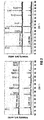
- Figure 2 compares the XRD patterns of the LMN and LMN-microwave samples.
- the diffraction peaks are ascribed to a cubic structure with a space group of Fd3m, indicating the formation of a single-phase LiMn 1.5 Ni 0.5 O 4 . All fundamental peaks are sharp, which indicates that the prepared powders are well crystallized.
- the ratio of the / (311) and / (400) peaks (0.86-0.88) is an indication of the structural stability of the [Mn 2 ]O 4 spinel framework.
- the high intensity ratio of the sample treated with microwave shows a better structural stability.
- the LMN-microwave contains more Mn 3+ ion than the parent LMN.
- the slight increase in the cubic lattice parameter for the LMN-microwave is due to the larger size of the Mn 3+ ion.
- the powder XRD patterns ( Figure 2 ) are characteristic of the cubic spinel structures with the microwave-treated samples showing sharper diffraction peaks than the bare samples, meaning that microwave irradiation enhanced crystallinity in the spinel.
- the impurity phase is virtually non-existent in the materials.
- the lattice parameters ( a -value/ ⁇ and unit cell volume/ ⁇ 3 ) were calculated as 8.153 ⁇ and 541.907 ⁇ 3 for the LMN-700; 8.160 ⁇ and 543.170 ⁇ 3 for the LMN-700-mic; 8.180 ⁇ and 547.417 ⁇ 3 for the LMN-800; 8.179 ⁇ and 547.109 ⁇ 3 for the LMN-800-mic. These values are comparable to values in literature.
- the LMN-700 and LMN-700-mic show preferential crystal growth according the (111) reflection, which may be ascribed to the microwave irradiation that changes the crystal growth kinetics.
- the slight increase in the lattice parameters for the pristine 800 sample compared to its 700 counterpart further proves that the 800 sample is Mn 3+ -enriched (disordered phase).
- the increase in the lattice parameter for the LMN-700-mic indicates the creation of some oxygen vacancies in the spinel structure following the microwave irradiation process which causes some Mn 4+ ions to be converted to Mn 3+ due to charge compensation.
- the lattice parameters for the LMN-800 and LMN-800-mic suggests a slight decrease in the oxygen vacancies for the microwave-irradiated disordered material. This suggests that at the experimental conditions employed, microwave irradiation simply adjusts the Mn 3+ content to a lower value. As set out hereinafter, these adjustments of the Mn 3+ /Mn 4+ ratios (or oxygen vacancy concentration) have profound effects on the electrochemical properties of the spinel as a cathode material for lithium ion battery.
- Figure 3 shows the deconvoluted, detailed XPS of the Mn 2p 3/2 peaks of the LMN-700 / LMN-700-mic and LMN-800 / LMN-800-mic samples. Two peaks (as marked) are attributed to Mn 3+ and Mn 4+ and another (in the LMN-700 / LMN-700-mic spectra) to a Ni Auger peak. The binding energy peak positions corresponding to Mn 4+ and Mn 3+ are comparable with other binding energy values reported in literature.
- the ratio of Mn 3+ to Mn 4+ is 2.2 and 3.3 for the LMN-700 and LMN-700-mic, respectively.
- This increase in the Mn 3+ content in in good agreement with the XRD data of increased a- lattice parameter, further confirming that microwave irradiation causes oxygen deficiency causing the Mn 4+ to be converted to Mn 3+ in the ordered spinel.
- the Mn 3+ /Mn 4+ is 2.6 and 1.7, respectively.
- Table 1 Mn 2p 3/2 peak positions and cation distribution Sample Binding energy position (eV) Cation distribution Mn 4+ Mn 3+ Mn 4+ Mn 3+ Mn 3+ /Mn 4+ LMN-700 643.2 642.1 31.5 % 68.5 % 2.17 LMN-700-mic 643.4 642.2 23.4 % 76.6 % 3.27 LMN-800 643.4 642.1 27.9 % 72.1 % 2.58 LMN-800-mic 643.3 641.9 37.5 % 62.5 % 1.67
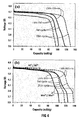
- Figure 4 compares the 1 st and 25 th discharge profiles of LMN-700 / LMN-700-mic and LMN-800 / LMN-800-mic discharged at 0.1C (14 mA.g -1 ). Unlike the materials obtained at 700°C, the samples from 800°C showed well-defined plateaus at 4 V due to the Mn 3+ /Mn 4+ redox couple, signature of 'disordered' spinel. In addition, the Ni 2+ /Ni 3+ and Ni 3+ /Ni 4+ redox couples of the disordered spinel are activated upon cycling, suggesting some structural changes induced by electrochemical cycling.
- the Mn 3+ /Mn 4+ peaks are well-defined in the 800°C compared to the 700°C samples.
- the capacity of the LMN-700 decreased from the 1 st cycle (103 mAh/g) to the 25 th cycle (96 mAh/g), which is typical of ordered spinel.
- the initial capacity of the LMN-700-mic 117 mAh/g
- the initial cycles of the bare and the microwave-treated samples (105 and 125 mAh/g, respectively) increased upon cycling (117 and 138 mAh/g at the 25 th cycle, respectively).
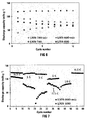
- Figure 5 compares the cycle stability of the bare and microwave-treated samples, which clearly proves that microwave irradiation improves the cyclability of the spinels (for both the ordered and disordered structures, with the latter benefitting the most).
- the discharge capacities differ (103, 96 and 34 mAh/g for the 1 st , 25 th and 50th cycles, respectively).
- the LMN-700-mic it was 117, 130 and 110 mAh/g for the 1 st , 25 th and 50th cycles, respectively.
- microwave irradiation may serve as a viable strategy to improve the capacity retention for such LMN at 700°C.
- the discharge capacities also differ (105, 117 and 113 mAh/g for the 1 st , 25 th and 50th cycles, respectively.
- the LMN-800-mic it was 125, 138 and 136 mAh/g for the 1 st , 25 th and 50th cycles, respectively.
- the best performance is always obtained by the LMN-800-mic sample, with a capacity retention of ca. 100% between the 10 th and 50 th cycle, compared to the capacity retentions of ⁇ 97 and 84% for LMN-800 and LMN-700-mic, respectively.
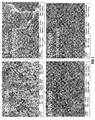
- the excellent capacity retention of the LMN-800-mic may be partly due to the higher connectivity of the nanoparticles as seen in the FESEM pictures, and partly to the 'appropriate' amount of Mn 3+ induced by the microwave irradiation.
- LMN sample obtained at higher temperature 800°C, disordered
- the electrochemical performance of LiMn 1.5 Ni 0.5 O 4 as a lithium ion battery cathode material is intricately linked to the (i) presence of Mn 3+ ions, (ii) doping/substitution, (iii) degree of disorder, and (iv) impurities, which explains why it still remains a huge challenge to correlate synthesis, structure and performance of this cathode material.
- Mn 3+ ion is electrochemically active, usually identified by the presence of a small plateau at around 4V; however, a portion of the Mn 3+ ions may also form Mn 2+ through the disproportion reaction; Mn 2+ dissolves into the electrolyte at elevated temperatures, causing significant capacity loss during cycling ( J.
- LiMn 1.5 Ni 0.5 O 4- ⁇ is usually accompanied by an impurity (Li y Ni 1-y O) that appears as a secondary phase in the products, which lowers the obtainable capacity.
- impurity Li y Ni 1-y O
- the cycling performance of the disordered spinel is better than the ordered spinel as the former gives a significantly higher Li + diffusion coefficient than the latter.
- ordered P 4 3 32 phase Mn 4+ and Ni 2+ ions are ordered on octahedral sites in a 3:1 ratio as opposed to random distribution in disordered Fd 3m phase.
- the Xiao et al reference referred to above indicates 'careful control of the amount of Mn 3 ions and, thus, the disordered phase, is the key for synthesis of high performance spinel and provides valuable clues for understanding the structure-property relationships in energy materials '.
- the electrochemical performance of any chemical material is strongly dependent on the synthesis strategy. It is evident from what is set out above that the preferred synthesis strategy for the high-voltage LiMn 1.5 Ni 0.5 O 4 spinel should be able to (i) control the amount of the Mn 3+ in the final lattice structure, and hence the site disorder, (ii) limit the amount of the Li y Ni 1-y O impurity, and (iii) maintain its high voltage (4.8-5V) and achieve capacity close or better than the theoretical value of ⁇ 140mAh/g -1 .
- the inventors thus surprisingly found that by using a modified Pechini synthesis strategy coupled with microwave irradiation, a LiMn 1.5 Ni 0.5 O 4 spinel cathode material with desired properties could be obtained.
- the inventors proved, for the first time, that it is possible to control the Mn 3+ content and site disorder by a simple microwave treatment.
- the inventors thus found that they could achieve the same or better results to those achievable by known processes, and using shorter processing times, by using low temperature annealing coupled with short duration ( ⁇ 20 minutes) microwave irradiation.
Landscapes
- Chemical & Material Sciences (AREA)
- Organic Chemistry (AREA)
- Inorganic Chemistry (AREA)
- Chemical Kinetics & Catalysis (AREA)
- Electrochemistry (AREA)
- Crystallography & Structural Chemistry (AREA)
- Engineering & Computer Science (AREA)
- Materials Engineering (AREA)
- Metallurgy (AREA)
- General Chemical & Material Sciences (AREA)
- Physics & Mathematics (AREA)
- Thermal Sciences (AREA)
- Battery Electrode And Active Subsutance (AREA)
- Inorganic Compounds Of Heavy Metals (AREA)
Applications Claiming Priority (2)
| Application Number | Priority Date | Filing Date | Title |
|---|---|---|---|
| ZA201206016 | 2012-08-10 | ||
| PCT/IB2013/056103 WO2014024075A1 (en) | 2012-08-10 | 2013-07-25 | Production of a spinel material |
Publications (2)
| Publication Number | Publication Date |
|---|---|
| EP2882690A1 EP2882690A1 (en) | 2015-06-17 |
| EP2882690B1 true EP2882690B1 (en) | 2016-10-12 |
Family
ID=49304034
Family Applications (1)
| Application Number | Title | Priority Date | Filing Date |
|---|---|---|---|
| EP13773389.5A Active EP2882690B1 (en) | 2012-08-10 | 2013-07-25 | Production of a spinel material |
Country Status (10)
| Country | Link |
|---|---|
| US (1) | US9834854B2 (enExample) |
| EP (1) | EP2882690B1 (enExample) |
| JP (1) | JP6316812B2 (enExample) |
| KR (1) | KR102085903B1 (enExample) |
| CN (1) | CN104703920A (enExample) |
| AR (1) | AR092069A1 (enExample) |
| BR (1) | BR112015002884B1 (enExample) |
| CA (1) | CA2880876C (enExample) |
| WO (1) | WO2014024075A1 (enExample) |
| ZA (1) | ZA201501121B (enExample) |
Families Citing this family (12)
| Publication number | Priority date | Publication date | Assignee | Title |
|---|---|---|---|---|
| BR112017000017A2 (pt) | 2014-07-03 | 2018-11-06 | Csir | produção de material óxido de lítio, manganês, níquel e cobalto, em camadas |
| US9979011B2 (en) * | 2014-09-26 | 2018-05-22 | The United States Of America As Represented By The Secretary Of The Army | LixMn2O4-y(C1z) spinal cathode material, method of preparing the same, and rechargeable lithium and li-ion electrochemical systems containing the same |
| EP3212578A2 (en) * | 2014-10-31 | 2017-09-06 | Csir | Production of a spinel material |
| US10505188B2 (en) * | 2015-03-03 | 2019-12-10 | The Government Of The United States As Represented By The Secretary Of The Army | “B” and “O” site doped AB2O4 spinel cathode material, method of preparing the same, and rechargeable lithium and Li-ion electrochemical systems containing the same |
| WO2017109646A1 (en) * | 2015-12-22 | 2017-06-29 | Csir | Spinel material |
| CN105576231A (zh) * | 2016-02-25 | 2016-05-11 | 江南大学 | 一种具有尖晶石结构的高电压锂离子电池正极材料及其制备方法 |
| EP3435157B1 (en) | 2016-03-24 | 2021-01-06 | FUJIFILM Corporation | Active light sensitive or radiation sensitive composition, method for producing active light sensitive or radiation sensitive composition, pattern forming method, and electronic device producing method |
| EP3435159A4 (en) | 2016-03-24 | 2019-04-10 | Fujifilm Corporation | ACTIVE RADIATION SENSITIVE OR RADIATION-SENSITIVE COMPOSITION, METHODS FOR CLEANING OF ACTIVE RADIATION SENSITIVE OR RADIATION-SENSITIVE COMPOSITION, PROCESS FOR PRODUCING THE ACTIVE RADIATION SENSITIVE OR RADIATION-SENSITIVE COMPOSITION, PATTERN FORMATION METHOD AND METHOD FOR PRODUCING AN ELECTRONIC DEVICE |
| JP6796635B2 (ja) | 2016-03-24 | 2020-12-09 | 富士フイルム株式会社 | 感活性光線性又は感放射線性組成物、感活性光線性又は感放射線性組成物の精製方法、パターン形成方法、及び電子デバイスの製造方法 |
| US10516156B2 (en) * | 2016-05-25 | 2019-12-24 | The Government Of The United States As Represented By The Secretary Of The Army | Chlorinated lithium manganese oxide spinel cathode material with charge transfer catalyst coating, method of preparing the same, and Li electrochemical cell containing the same |
| KR101963251B1 (ko) * | 2017-10-17 | 2019-03-29 | 한국과학기술연구원 | 양극 활물질 제조방법 및 이를 이용한 이차전지 |
| CN114369863B (zh) * | 2021-12-08 | 2023-02-14 | 中国科学院地球化学研究所 | 一种高温高压下制备锰铝榴石单晶的方法 |
Family Cites Families (9)
| Publication number | Priority date | Publication date | Assignee | Title |
|---|---|---|---|---|
| GB2221213B (en) * | 1988-07-12 | 1991-09-04 | Csir | Synthesizing lithium manganese oxide |
| CN1042377C (zh) * | 1996-05-10 | 1999-03-03 | 中国科学院物理研究所 | 一种合成锂离子电池中正极材料的方法 |
| JP2973299B2 (ja) * | 1996-06-27 | 1999-11-08 | 本荘ケミカル株式会社 | スピネル型構造を有するリチウム−マンガン複合酸化物の製造方法 |
| US6348182B1 (en) * | 1996-06-27 | 2002-02-19 | The Honjo Chemical Corporation | Process for producing lithium manganese oxide with spinel structure |
| JP3411488B2 (ja) * | 1997-12-01 | 2003-06-03 | 本荘ケミカル株式会社 | リチウムイオン二次電池用正極活物質の製造方法 |
| JP2000281355A (ja) * | 1999-03-29 | 2000-10-10 | Nippon Chem Ind Co Ltd | リチウム複合酸化物の製造方法 |
| US8728666B2 (en) * | 2005-04-28 | 2014-05-20 | Nissan Motor Co., Ltd. | Positive electrode material for lithium ion battery with nonaqueous electrolyte, and battery using the same |
| US8496855B2 (en) * | 2009-07-27 | 2013-07-30 | Samsung Electronics Co., Ltd. | Cathode active material, cathode including cathode active material, and lithium battery including cathode |
| JP2011210463A (ja) * | 2010-03-29 | 2011-10-20 | Jx Nippon Mining & Metals Corp | リチウムイオン電池用正極活物質の製造方法 |
-
2013
- 2013-07-25 CN CN201380052901.9A patent/CN104703920A/zh active Pending
- 2013-07-25 JP JP2015525969A patent/JP6316812B2/ja active Active
- 2013-07-25 EP EP13773389.5A patent/EP2882690B1/en active Active
- 2013-07-25 BR BR112015002884-5A patent/BR112015002884B1/pt not_active IP Right Cessation
- 2013-07-25 KR KR1020157005781A patent/KR102085903B1/ko active Active
- 2013-07-25 CA CA2880876A patent/CA2880876C/en active Active
- 2013-07-25 WO PCT/IB2013/056103 patent/WO2014024075A1/en not_active Ceased
- 2013-07-25 US US14/420,209 patent/US9834854B2/en active Active
- 2013-08-07 AR ARP130102807A patent/AR092069A1/es active IP Right Grant
-
2015
- 2015-02-18 ZA ZA2015/01121A patent/ZA201501121B/en unknown
Also Published As
| Publication number | Publication date |
|---|---|
| BR112015002884B1 (pt) | 2021-06-08 |
| JP2015525734A (ja) | 2015-09-07 |
| CA2880876A1 (en) | 2014-02-13 |
| JP6316812B2 (ja) | 2018-04-25 |
| ZA201501121B (en) | 2016-01-27 |
| US20150197872A1 (en) | 2015-07-16 |
| CN104703920A (zh) | 2015-06-10 |
| WO2014024075A1 (en) | 2014-02-13 |
| EP2882690A1 (en) | 2015-06-17 |
| CA2880876C (en) | 2020-07-07 |
| AR092069A1 (es) | 2015-03-18 |
| US9834854B2 (en) | 2017-12-05 |
| BR112015002884A2 (pt) | 2019-10-08 |
| KR20150056542A (ko) | 2015-05-26 |
| KR102085903B1 (ko) | 2020-03-06 |
Similar Documents
| Publication | Publication Date | Title |
|---|---|---|
| EP2882690B1 (en) | Production of a spinel material | |
| US11183692B2 (en) | Production of a layered lithium-manganese-nickel-cobalt oxide material | |
| Zheng et al. | Improved electrochemical performance of Li [Li0. 2Mn0. 54Ni0. 13Co0. 13] O2 cathode material by fluorine incorporation | |
| EP3285315B1 (en) | Metal halide coatings on lithium ion battery positive electrode materials and corresponding batteries | |
| US9070489B2 (en) | Mixed phase lithium metal oxide compositions with desirable battery performance | |
| Zong et al. | Influence of Ti doping on microstructure and electrochemical performance of LiNi0. 5Mn1. 5O4 cathode material for lithium-ion batteries | |
| US20110065001A1 (en) | Iron Oxyfluoride Electrodes for Electrochemical Energy Storage | |
| US9203082B2 (en) | Iron oxyfluoride electrodes for electrochemical energy storage | |
| WO2008039808A2 (en) | Cation-substituted spinel oxide and oxyfluoride cathodes for lithium ion batteries | |
| KR20110076955A (ko) | 비용량이 높은 불소 도핑된 리튬 풍부 금속 산화물 양극 배터리 재료 및 상당하는 배터리 | |
| CN107108260B (zh) | 尖晶石材料的制备 | |
| Ma et al. | Effect of calcination temperature on microstructure and electrochemical performance of lithium-rich layered oxide cathode materials | |
| Zhu et al. | A layered/spinel heterostructured cathode for Li-ion batteries prepared by ultrafast Joule heating | |
| Mohan et al. | Structure and Electrochemical Performances of Co-Substituted LiCo x Li x− y Mn2− x O4 Cathode Materials for the Rechargeable Lithium Ion Batteries | |
| KR20250000701A (ko) | 양극 활물질의 제조 방법, 이를 이용하여 제조된 양극 활물질 및 리튬 이차 전지 | |
| JULIEN | STRUCTURE AND ELECTROCHEMISTRY OF DOPED |
Legal Events
| Date | Code | Title | Description |
|---|---|---|---|
| PUAI | Public reference made under article 153(3) epc to a published international application that has entered the european phase |
Free format text: ORIGINAL CODE: 0009012 |
|
| 17P | Request for examination filed |
Effective date: 20150225 |
|
| AK | Designated contracting states |
Kind code of ref document: A1 Designated state(s): AL AT BE BG CH CY CZ DE DK EE ES FI FR GB GR HR HU IE IS IT LI LT LU LV MC MK MT NL NO PL PT RO RS SE SI SK SM TR |
|
| AX | Request for extension of the european patent |
Extension state: BA ME |
|
| DAX | Request for extension of the european patent (deleted) | ||
| GRAP | Despatch of communication of intention to grant a patent |
Free format text: ORIGINAL CODE: EPIDOSNIGR1 |
|
| RIC1 | Information provided on ipc code assigned before grant |
Ipc: C01G 53/00 20060101AFI20160329BHEP Ipc: C30B 30/02 20060101ALI20160329BHEP Ipc: H01M 4/02 20060101ALI20160329BHEP Ipc: C30B 29/22 20060101ALI20160329BHEP Ipc: H01M 4/525 20100101ALI20160329BHEP Ipc: C30B 1/04 20060101ALI20160329BHEP Ipc: H01M 4/505 20100101ALI20160329BHEP |
|
| INTG | Intention to grant announced |
Effective date: 20160425 |
|
| GRAS | Grant fee paid |
Free format text: ORIGINAL CODE: EPIDOSNIGR3 |
|
| GRAA | (expected) grant |
Free format text: ORIGINAL CODE: 0009210 |
|
| AK | Designated contracting states |
Kind code of ref document: B1 Designated state(s): AL AT BE BG CH CY CZ DE DK EE ES FI FR GB GR HR HU IE IS IT LI LT LU LV MC MK MT NL NO PL PT RO RS SE SI SK SM TR |
|
| REG | Reference to a national code |
Ref country code: GB Ref legal event code: FG4D |
|
| REG | Reference to a national code |
Ref country code: CH Ref legal event code: EP |
|
| REG | Reference to a national code |
Ref country code: AT Ref legal event code: REF Ref document number: 836327 Country of ref document: AT Kind code of ref document: T Effective date: 20161015 |
|
| REG | Reference to a national code |
Ref country code: IE Ref legal event code: FG4D |
|
| REG | Reference to a national code |
Ref country code: CH Ref legal event code: NV Representative=s name: BRAUNPAT BRAUN EDER AG, CH |
|
| REG | Reference to a national code |
Ref country code: DE Ref legal event code: R096 Ref document number: 602013012777 Country of ref document: DE |
|
| REG | Reference to a national code |
Ref country code: LT Ref legal event code: MG4D |
|
| REG | Reference to a national code |
Ref country code: EE Ref legal event code: FG4A Ref document number: E012981 Country of ref document: EE Effective date: 20161212 Ref country code: NL Ref legal event code: MP Effective date: 20161012 |
|
| PG25 | Lapsed in a contracting state [announced via postgrant information from national office to epo] |
Ref country code: LV Free format text: LAPSE BECAUSE OF FAILURE TO SUBMIT A TRANSLATION OF THE DESCRIPTION OR TO PAY THE FEE WITHIN THE PRESCRIBED TIME-LIMIT Effective date: 20161012 |
|
| REG | Reference to a national code |
Ref country code: AT Ref legal event code: MK05 Ref document number: 836327 Country of ref document: AT Kind code of ref document: T Effective date: 20161012 |
|
| PG25 | Lapsed in a contracting state [announced via postgrant information from national office to epo] |
Ref country code: SE Free format text: LAPSE BECAUSE OF FAILURE TO SUBMIT A TRANSLATION OF THE DESCRIPTION OR TO PAY THE FEE WITHIN THE PRESCRIBED TIME-LIMIT Effective date: 20161012 Ref country code: GR Free format text: LAPSE BECAUSE OF FAILURE TO SUBMIT A TRANSLATION OF THE DESCRIPTION OR TO PAY THE FEE WITHIN THE PRESCRIBED TIME-LIMIT Effective date: 20170113 Ref country code: NO Free format text: LAPSE BECAUSE OF FAILURE TO SUBMIT A TRANSLATION OF THE DESCRIPTION OR TO PAY THE FEE WITHIN THE PRESCRIBED TIME-LIMIT Effective date: 20170112 Ref country code: LT Free format text: LAPSE BECAUSE OF FAILURE TO SUBMIT A TRANSLATION OF THE DESCRIPTION OR TO PAY THE FEE WITHIN THE PRESCRIBED TIME-LIMIT Effective date: 20161012 |
|
| PG25 | Lapsed in a contracting state [announced via postgrant information from national office to epo] |
Ref country code: RS Free format text: LAPSE BECAUSE OF FAILURE TO SUBMIT A TRANSLATION OF THE DESCRIPTION OR TO PAY THE FEE WITHIN THE PRESCRIBED TIME-LIMIT Effective date: 20161012 Ref country code: ES Free format text: LAPSE BECAUSE OF FAILURE TO SUBMIT A TRANSLATION OF THE DESCRIPTION OR TO PAY THE FEE WITHIN THE PRESCRIBED TIME-LIMIT Effective date: 20161012 Ref country code: PL Free format text: LAPSE BECAUSE OF FAILURE TO SUBMIT A TRANSLATION OF THE DESCRIPTION OR TO PAY THE FEE WITHIN THE PRESCRIBED TIME-LIMIT Effective date: 20161012 Ref country code: AT Free format text: LAPSE BECAUSE OF FAILURE TO SUBMIT A TRANSLATION OF THE DESCRIPTION OR TO PAY THE FEE WITHIN THE PRESCRIBED TIME-LIMIT Effective date: 20161012 Ref country code: PT Free format text: LAPSE BECAUSE OF FAILURE TO SUBMIT A TRANSLATION OF THE DESCRIPTION OR TO PAY THE FEE WITHIN THE PRESCRIBED TIME-LIMIT Effective date: 20170213 Ref country code: HR Free format text: LAPSE BECAUSE OF FAILURE TO SUBMIT A TRANSLATION OF THE DESCRIPTION OR TO PAY THE FEE WITHIN THE PRESCRIBED TIME-LIMIT Effective date: 20161012 Ref country code: NL Free format text: LAPSE BECAUSE OF FAILURE TO SUBMIT A TRANSLATION OF THE DESCRIPTION OR TO PAY THE FEE WITHIN THE PRESCRIBED TIME-LIMIT Effective date: 20161012 Ref country code: IS Free format text: LAPSE BECAUSE OF FAILURE TO SUBMIT A TRANSLATION OF THE DESCRIPTION OR TO PAY THE FEE WITHIN THE PRESCRIBED TIME-LIMIT Effective date: 20170212 Ref country code: BE Free format text: LAPSE BECAUSE OF FAILURE TO SUBMIT A TRANSLATION OF THE DESCRIPTION OR TO PAY THE FEE WITHIN THE PRESCRIBED TIME-LIMIT Effective date: 20161012 Ref country code: FI Free format text: LAPSE BECAUSE OF FAILURE TO SUBMIT A TRANSLATION OF THE DESCRIPTION OR TO PAY THE FEE WITHIN THE PRESCRIBED TIME-LIMIT Effective date: 20161012 |
|
| REG | Reference to a national code |
Ref country code: FR Ref legal event code: PLFP Year of fee payment: 5 |
|
| REG | Reference to a national code |
Ref country code: DE Ref legal event code: R097 Ref document number: 602013012777 Country of ref document: DE |
|
| PG25 | Lapsed in a contracting state [announced via postgrant information from national office to epo] |
Ref country code: CZ Free format text: LAPSE BECAUSE OF FAILURE TO SUBMIT A TRANSLATION OF THE DESCRIPTION OR TO PAY THE FEE WITHIN THE PRESCRIBED TIME-LIMIT Effective date: 20161012 Ref country code: SK Free format text: LAPSE BECAUSE OF FAILURE TO SUBMIT A TRANSLATION OF THE DESCRIPTION OR TO PAY THE FEE WITHIN THE PRESCRIBED TIME-LIMIT Effective date: 20161012 Ref country code: DK Free format text: LAPSE BECAUSE OF FAILURE TO SUBMIT A TRANSLATION OF THE DESCRIPTION OR TO PAY THE FEE WITHIN THE PRESCRIBED TIME-LIMIT Effective date: 20161012 Ref country code: RO Free format text: LAPSE BECAUSE OF FAILURE TO SUBMIT A TRANSLATION OF THE DESCRIPTION OR TO PAY THE FEE WITHIN THE PRESCRIBED TIME-LIMIT Effective date: 20161012 |
|
| PLBE | No opposition filed within time limit |
Free format text: ORIGINAL CODE: 0009261 |
|
| STAA | Information on the status of an ep patent application or granted ep patent |
Free format text: STATUS: NO OPPOSITION FILED WITHIN TIME LIMIT |
|
| PG25 | Lapsed in a contracting state [announced via postgrant information from national office to epo] |
Ref country code: SM Free format text: LAPSE BECAUSE OF FAILURE TO SUBMIT A TRANSLATION OF THE DESCRIPTION OR TO PAY THE FEE WITHIN THE PRESCRIBED TIME-LIMIT Effective date: 20161012 |
|
| 26N | No opposition filed |
Effective date: 20170713 |
|
| PG25 | Lapsed in a contracting state [announced via postgrant information from national office to epo] |
Ref country code: SI Free format text: LAPSE BECAUSE OF FAILURE TO SUBMIT A TRANSLATION OF THE DESCRIPTION OR TO PAY THE FEE WITHIN THE PRESCRIBED TIME-LIMIT Effective date: 20161012 |
|
| REG | Reference to a national code |
Ref country code: CH Ref legal event code: PCAR Free format text: NEW ADDRESS: HOLEESTRASSE 87, 4054 BASEL (CH) |
|
| PG25 | Lapsed in a contracting state [announced via postgrant information from national office to epo] |
Ref country code: LU Free format text: LAPSE BECAUSE OF NON-PAYMENT OF DUE FEES Effective date: 20170725 |
|
| REG | Reference to a national code |
Ref country code: FR Ref legal event code: PLFP Year of fee payment: 6 |
|
| PG25 | Lapsed in a contracting state [announced via postgrant information from national office to epo] |
Ref country code: MT Free format text: LAPSE BECAUSE OF NON-PAYMENT OF DUE FEES Effective date: 20170725 |
|
| PG25 | Lapsed in a contracting state [announced via postgrant information from national office to epo] |
Ref country code: HU Free format text: LAPSE BECAUSE OF FAILURE TO SUBMIT A TRANSLATION OF THE DESCRIPTION OR TO PAY THE FEE WITHIN THE PRESCRIBED TIME-LIMIT; INVALID AB INITIO Effective date: 20130725 Ref country code: MC Free format text: LAPSE BECAUSE OF FAILURE TO SUBMIT A TRANSLATION OF THE DESCRIPTION OR TO PAY THE FEE WITHIN THE PRESCRIBED TIME-LIMIT Effective date: 20161012 |
|
| PG25 | Lapsed in a contracting state [announced via postgrant information from national office to epo] |
Ref country code: CY Free format text: LAPSE BECAUSE OF FAILURE TO SUBMIT A TRANSLATION OF THE DESCRIPTION OR TO PAY THE FEE WITHIN THE PRESCRIBED TIME-LIMIT Effective date: 20161012 |
|
| PG25 | Lapsed in a contracting state [announced via postgrant information from national office to epo] |
Ref country code: MK Free format text: LAPSE BECAUSE OF FAILURE TO SUBMIT A TRANSLATION OF THE DESCRIPTION OR TO PAY THE FEE WITHIN THE PRESCRIBED TIME-LIMIT Effective date: 20161012 |
|
| PG25 | Lapsed in a contracting state [announced via postgrant information from national office to epo] |
Ref country code: TR Free format text: LAPSE BECAUSE OF FAILURE TO SUBMIT A TRANSLATION OF THE DESCRIPTION OR TO PAY THE FEE WITHIN THE PRESCRIBED TIME-LIMIT Effective date: 20161012 |
|
| PG25 | Lapsed in a contracting state [announced via postgrant information from national office to epo] |
Ref country code: AL Free format text: LAPSE BECAUSE OF FAILURE TO SUBMIT A TRANSLATION OF THE DESCRIPTION OR TO PAY THE FEE WITHIN THE PRESCRIBED TIME-LIMIT Effective date: 20161012 |
|
| REG | Reference to a national code |
Ref country code: EE Ref legal event code: MM4A Ref document number: E012981 Country of ref document: EE Effective date: 20200731 |
|
| REG | Reference to a national code |
Ref country code: EE Ref legal event code: HH1A Ref document number: E012981 Country of ref document: EE |
|
| PGFP | Annual fee paid to national office [announced via postgrant information from national office to epo] |
Ref country code: GB Payment date: 20250605 Year of fee payment: 13 |
|
| PGFP | Annual fee paid to national office [announced via postgrant information from national office to epo] |
Ref country code: EE Payment date: 20250620 Year of fee payment: 13 Ref country code: FR Payment date: 20250610 Year of fee payment: 13 |
|
| PGFP | Annual fee paid to national office [announced via postgrant information from national office to epo] |
Ref country code: BG Payment date: 20250613 Year of fee payment: 13 |
|
| PGFP | Annual fee paid to national office [announced via postgrant information from national office to epo] |
Ref country code: IE Payment date: 20250610 Year of fee payment: 13 |
|
| PGFP | Annual fee paid to national office [announced via postgrant information from national office to epo] |
Ref country code: DE Payment date: 20250611 Year of fee payment: 13 |
|
| PGFP | Annual fee paid to national office [announced via postgrant information from national office to epo] |
Ref country code: IT Payment date: 20250623 Year of fee payment: 13 |
|
| PGFP | Annual fee paid to national office [announced via postgrant information from national office to epo] |
Ref country code: CH Payment date: 20250801 Year of fee payment: 13 |