EP2864483B1 - Anordnung zur transkription einer aktivatorähnlichen effektoranordnung - Google Patents
Anordnung zur transkription einer aktivatorähnlichen effektoranordnung Download PDFInfo
- Publication number
- EP2864483B1 EP2864483B1 EP13837579.5A EP13837579A EP2864483B1 EP 2864483 B1 EP2864483 B1 EP 2864483B1 EP 13837579 A EP13837579 A EP 13837579A EP 2864483 B1 EP2864483 B1 EP 2864483B1
- Authority
- EP
- European Patent Office
- Prior art keywords
- dna
- tale
- restriction enzymes
- dna segments
- segments
- Prior art date
- Legal status (The legal status is an assumption and is not a legal conclusion. Google has not performed a legal analysis and makes no representation as to the accuracy of the status listed.)
- Not-in-force
Links
Images


Classifications
-
- C—CHEMISTRY; METALLURGY
- C12—BIOCHEMISTRY; BEER; SPIRITS; WINE; VINEGAR; MICROBIOLOGY; ENZYMOLOGY; MUTATION OR GENETIC ENGINEERING
- C12P—FERMENTATION OR ENZYME-USING PROCESSES TO SYNTHESISE A DESIRED CHEMICAL COMPOUND OR COMPOSITION OR TO SEPARATE OPTICAL ISOMERS FROM A RACEMIC MIXTURE
- C12P19/00—Preparation of compounds containing saccharide radicals
- C12P19/26—Preparation of nitrogen-containing carbohydrates
- C12P19/28—N-glycosides
- C12P19/30—Nucleotides
- C12P19/34—Polynucleotides, e.g. nucleic acids, oligoribonucleotides
-
- C—CHEMISTRY; METALLURGY
- C07—ORGANIC CHEMISTRY
- C07H—SUGARS; DERIVATIVES THEREOF; NUCLEOSIDES; NUCLEOTIDES; NUCLEIC ACIDS
- C07H21/00—Compounds containing two or more mononucleotide units having separate phosphate or polyphosphate groups linked by saccharide radicals of nucleoside groups, e.g. nucleic acids
-
- C—CHEMISTRY; METALLURGY
- C12—BIOCHEMISTRY; BEER; SPIRITS; WINE; VINEGAR; MICROBIOLOGY; ENZYMOLOGY; MUTATION OR GENETIC ENGINEERING
- C12N—MICROORGANISMS OR ENZYMES; COMPOSITIONS THEREOF; PROPAGATING, PRESERVING, OR MAINTAINING MICROORGANISMS; MUTATION OR GENETIC ENGINEERING; CULTURE MEDIA
- C12N15/00—Mutation or genetic engineering; DNA or RNA concerning genetic engineering, vectors, e.g. plasmids, or their isolation, preparation or purification; Use of hosts therefor
- C12N15/09—Recombinant DNA-technology
- C12N15/10—Processes for the isolation, preparation or purification of DNA or RNA
-
- C—CHEMISTRY; METALLURGY
- C12—BIOCHEMISTRY; BEER; SPIRITS; WINE; VINEGAR; MICROBIOLOGY; ENZYMOLOGY; MUTATION OR GENETIC ENGINEERING
- C12N—MICROORGANISMS OR ENZYMES; COMPOSITIONS THEREOF; PROPAGATING, PRESERVING, OR MAINTAINING MICROORGANISMS; MUTATION OR GENETIC ENGINEERING; CULTURE MEDIA
- C12N15/00—Mutation or genetic engineering; DNA or RNA concerning genetic engineering, vectors, e.g. plasmids, or their isolation, preparation or purification; Use of hosts therefor
- C12N15/09—Recombinant DNA-technology
- C12N15/10—Processes for the isolation, preparation or purification of DNA or RNA
- C12N15/102—Mutagenizing nucleic acids
-
- C—CHEMISTRY; METALLURGY
- C12—BIOCHEMISTRY; BEER; SPIRITS; WINE; VINEGAR; MICROBIOLOGY; ENZYMOLOGY; MUTATION OR GENETIC ENGINEERING
- C12N—MICROORGANISMS OR ENZYMES; COMPOSITIONS THEREOF; PROPAGATING, PRESERVING, OR MAINTAINING MICROORGANISMS; MUTATION OR GENETIC ENGINEERING; CULTURE MEDIA
- C12N15/00—Mutation or genetic engineering; DNA or RNA concerning genetic engineering, vectors, e.g. plasmids, or their isolation, preparation or purification; Use of hosts therefor
- C12N15/09—Recombinant DNA-technology
- C12N15/10—Processes for the isolation, preparation or purification of DNA or RNA
- C12N15/102—Mutagenizing nucleic acids
- C12N15/1027—Mutagenizing nucleic acids by DNA shuffling, e.g. RSR, STEP, RPR
-
- C—CHEMISTRY; METALLURGY
- C12—BIOCHEMISTRY; BEER; SPIRITS; WINE; VINEGAR; MICROBIOLOGY; ENZYMOLOGY; MUTATION OR GENETIC ENGINEERING
- C12N—MICROORGANISMS OR ENZYMES; COMPOSITIONS THEREOF; PROPAGATING, PRESERVING, OR MAINTAINING MICROORGANISMS; MUTATION OR GENETIC ENGINEERING; CULTURE MEDIA
- C12N15/00—Mutation or genetic engineering; DNA or RNA concerning genetic engineering, vectors, e.g. plasmids, or their isolation, preparation or purification; Use of hosts therefor
- C12N15/09—Recombinant DNA-technology
- C12N15/10—Processes for the isolation, preparation or purification of DNA or RNA
- C12N15/102—Mutagenizing nucleic acids
- C12N15/1031—Mutagenizing nucleic acids mutagenesis by gene assembly, e.g. assembly by oligonucleotide extension PCR
-
- C—CHEMISTRY; METALLURGY
- C12—BIOCHEMISTRY; BEER; SPIRITS; WINE; VINEGAR; MICROBIOLOGY; ENZYMOLOGY; MUTATION OR GENETIC ENGINEERING
- C12N—MICROORGANISMS OR ENZYMES; COMPOSITIONS THEREOF; PROPAGATING, PRESERVING, OR MAINTAINING MICROORGANISMS; MUTATION OR GENETIC ENGINEERING; CULTURE MEDIA
- C12N15/00—Mutation or genetic engineering; DNA or RNA concerning genetic engineering, vectors, e.g. plasmids, or their isolation, preparation or purification; Use of hosts therefor
- C12N15/09—Recombinant DNA-technology
- C12N15/63—Introduction of foreign genetic material using vectors; Vectors; Use of hosts therefor; Regulation of expression
- C12N15/64—General methods for preparing the vector, for introducing it into the cell or for selecting the vector-containing host
-
- C—CHEMISTRY; METALLURGY
- C12—BIOCHEMISTRY; BEER; SPIRITS; WINE; VINEGAR; MICROBIOLOGY; ENZYMOLOGY; MUTATION OR GENETIC ENGINEERING
- C12N—MICROORGANISMS OR ENZYMES; COMPOSITIONS THEREOF; PROPAGATING, PRESERVING, OR MAINTAINING MICROORGANISMS; MUTATION OR GENETIC ENGINEERING; CULTURE MEDIA
- C12N15/00—Mutation or genetic engineering; DNA or RNA concerning genetic engineering, vectors, e.g. plasmids, or their isolation, preparation or purification; Use of hosts therefor
- C12N15/09—Recombinant DNA-technology
- C12N15/63—Introduction of foreign genetic material using vectors; Vectors; Use of hosts therefor; Regulation of expression
- C12N15/66—General methods for inserting a gene into a vector to form a recombinant vector using cleavage and ligation; Use of non-functional linkers or adaptors, e.g. linkers containing the sequence for a restriction endonuclease
-
- C—CHEMISTRY; METALLURGY
- C12—BIOCHEMISTRY; BEER; SPIRITS; WINE; VINEGAR; MICROBIOLOGY; ENZYMOLOGY; MUTATION OR GENETIC ENGINEERING
- C12N—MICROORGANISMS OR ENZYMES; COMPOSITIONS THEREOF; PROPAGATING, PRESERVING, OR MAINTAINING MICROORGANISMS; MUTATION OR GENETIC ENGINEERING; CULTURE MEDIA
- C12N9/00—Enzymes; Proenzymes; Compositions thereof; Processes for preparing, activating, inhibiting, separating or purifying enzymes
- C12N9/14—Hydrolases (3)
- C12N9/16—Hydrolases (3) acting on ester bonds (3.1)
- C12N9/22—Ribonucleases [RNase]; Deoxyribonucleases [DNase]
-
- C—CHEMISTRY; METALLURGY
- C12—BIOCHEMISTRY; BEER; SPIRITS; WINE; VINEGAR; MICROBIOLOGY; ENZYMOLOGY; MUTATION OR GENETIC ENGINEERING
- C12Q—MEASURING OR TESTING PROCESSES INVOLVING ENZYMES, NUCLEIC ACIDS OR MICROORGANISMS; COMPOSITIONS OR TEST PAPERS THEREFOR; PROCESSES OF PREPARING SUCH COMPOSITIONS; CONDITION-RESPONSIVE CONTROL IN MICROBIOLOGICAL OR ENZYMOLOGICAL PROCESSES
- C12Q1/00—Measuring or testing processes involving enzymes, nucleic acids or microorganisms; Compositions therefor; Processes of preparing such compositions
- C12Q1/68—Measuring or testing processes involving enzymes, nucleic acids or microorganisms; Compositions therefor; Processes of preparing such compositions involving nucleic acids
Definitions
- This disclosure relates to genome engineering. More specifically, the disclosure relates to designed transcription activator-like effector assemblies.
- Target genome engineering is desirable for many scientists. By deleting or inserting a designed and specific nucleotide sequence in an endogenous genome, scientists can generate various animal models for performing fundamental biological research and studying mechanisms of disease. In addition, scientists can create transgenic animals to produce biological compositions and/or components, which may be difficult to obtain from other resources. However, it is challenging to perform targeted and specific genome modifications using traditional techniques.
- the traditional techniques rely on random fragment exchanges of homologous chromosomes in natural cellular processes. Therefore, the efficiency for the traditional techniques is low (e.g., 10 -6 -10 -8 as a successfully rate). Because of this low efficiency, these techniques are generally applied in mice rather than other animal models (e.g., large mammalians).
- TALE transcription activator-like effector
- TALEN transcription activator-like effector nuclease
- RVDs repeat variable di-residues
- TALE related techniques have increased the efficiency and usages of genome engineering, and make the genome engineering more convenient.
- assembling ten to twenty highly conserved DNA modules into a vector is a big challenge.
- the present invention provides a method for assembling a polynucleotide encoding a transcription activator-like effector (TALE), the method comprising:
- Embodiments of this disclosure relate to a transcription activator-like effector nuclease (TALEN) assembly library, which can be used for ligation of multiple repeat DNA modules encoding TALENs.
- the number of the multiple repeat modules is greater than 14.
- the TAL assembly library may include 16 sets, and each set includes n dimers, wherein n is an integer.
- the TAL assembly library may include 4 sets, and each set includes m monomers, wherein m is an integer and is not greater than n.
- a DNA module for TALE assembles may encode a single nucleotide recognition domain, and is therefore referred as a monomer DNA module (i.e., monomer).
- the single nucleotide recognition domain includes two amino acids recognizing one of A, T, C, and G.
- a DNA module for TALE assembles may encode a double nucleotide recognition domain, and therefore is referred as a dimer DNA module (i.e., dimer), which includes amino acids that recognize one of AA, AT, AC, AG, TT, TA, TC, TG, CC, CA, CT, CG, GG, GA, GT, and GC.
- a set of monomers or dimers may recognize the same single nucleotide and the same pair of nucleotides respectively.
- each dimer or monomer may contain a 1 st overhang and a 2 nd overhang that are generated from digestion of type II restriction endonucleases, such as BsaI, BsmB1, BsmA1, and BbsI. In some instances, the digestion and later ligation are performed using only Bsal.
- a sequence of the 2 nd overhang of a dimer e.g., dimer i
- a sequence 2 nd overhang of a monomer may be complementary to a sequence 1 st overhang of a monomer that is located after and adjacent to the monomer j , wherein j is an integer greater than 1 but less than m.
- the overhang there are four nucleotides at the overhang, from 5' to 3'.
- the 2 nd to 4 th nucleotides are a codon for Leu
- the first nucleotide in sense strand is the last nucleotide for a codon for Gly.
- the last two nucleotides are the first two nucleotides of a codon for Gly, while the first three nucleotides are complementary to a codon for Leu.
- dimers may be numbered as 1, ... I, ... and n, and monomers may be numbered as 1, ... j, ... and m.
- n is not less than 7, more than 14 modules are assembled; when n is 9 and m is 7,19 modules are assembled.
- DNA modules may be inserted into a plasmid in a circular structure for better storage and amplification.
- each DNA segment may contain a module component and one or more fusion components fused to another DNA segment.
- Each DNA segment may also have cutting sites of type II restriction endonucleases. Therefore, DNA segments may be flanked by a type II restriction endonuclease to obtain DNA modules for TALE assemblies.
- the DNA segments may be PCR amplification products or recombinant plasmids, such as pMD18-T, TOPO® plasmids, pUC 19, and pUC18.
- Embodiments of this disclosure relate to methods for transcription activator-like effector nuclease plasmid assembly.
- the method may include identifying target gene sequences, and designing corresponding TALENs, such as repeat domains of a TALE. Based on repeat domains, multiple DNA segments may be selected from a DNA library. In these instances, in a single cloning reaction reactor, the multiple DNA segments, type II restriction endonucleases, DNA ligases, and TALE backbone vector (e.g., plasmids) may be mixed together to generate a polynucleotide encoding a TALEN.
- TALE backbone vector e.g., plasmids
- the multiple DNA segments may be inserted into a backbone plasmid that contains a polynucleotide encoding a DNA restriction enzyme.
- the polynucleotides encoding TALENs may be purified by removing incomplete ligation products (e.g., linear DNA segments) using a plasmid-safe Deoxyribonuclease (DNase).
- DNase plasmid-safe Deoxyribonuclease
- individual DNA modules may be ligated to other DNA modules in an order. During ligations of a module to another module or a module to a plasmid, type II restriction endonucleases may not be able to cut additional nucleotides.
- the multiple DNA segments e.g., all DNA segments encoding a TALE
- the backbone plasmids, the type II restriction endonucleases, and DNA ligases may be put in a single reactor to generate polynucleotides encoding TALENs, wherein digestion and ligation occur at substantially the same time.
- the type II restriction endonuclease may be Bsal
- the DNA ligase may be T4 ligase.
- a single ligation reactor or assembly reactor may include 40-200 ng plasmids, 20-200 DNA segments, 0.5-2 ⁇ l type II restriction endonuclease, 0.5-2 ⁇ l DNA ligase, 2 ⁇ l DNA ligation buffer, and double-distilled water (ddH 2 O) to be added to reach a final volume of 20 ⁇ l.
- the ligation process may include 15 cycles: 37 °C for 5 min, 16°C for 10 min, and followed by 80°C for 10 min.
- a polynucleotide sequence of a TALEN plasmid includes a DNA restriction enzyme, N-terminal and C-terminal may be set forth in any of SEQ ID NO. 41 and SEQ ID NO. 42.
- the TALEN backbone plasmid may be cut by type II restriction endonuclease to create a linear DNA segment with two overhangs.
- An overhang may be ligated to the 1 st overhang of a monomer j or dimer i ; and the other overhang may be ligated to the 2 nd overhang of the monomer j or dimer i.
- incomplete products may be removed using Plasmid-Safe nucleases.
- the incomplete linear or linearized DNA segments reduce the ligation efficiency by recombination.
- Plasmid-SafeTM ATP-Dependent DNase (Epicentre, cat no: E3105K) may be used to digest linear or linearized DNA segments to increase the ligation efficiency.
- a designed TALEN may include 20 repeat domains, and thus a polynucleotide encoding the designed TALEN may be generated using 20 DNA modules from a DNA library for TALEN assembles.
- the DNA library for TALENs assembly may be obtained.
- the DNA library may contain multiple DNA modules (e.g., 172 modules). These DNA modules may be monomers each corresponding to a TALE recognition module recognizing one nucleotide, and/or dimers each corresponding to two TALE recognition modules recognizing two nucleotides. Each of the monomers and dimers contains type II restriction endonuclease cutting sites.
- DNA modules are plasmids or corresponding PCR products, certain risks (e.g., tail end damages and DNA degradations) are avoided. This simplifies TALEN generation procedures, and therefore reduces the cost.
- a polynucleotide encoding TALEN including 20 repeat domains may be assembled in a single reaction reactor or system.
- an individual TALE repeat modules of these 20 repeat modules may identify each of 4 monomers (A, T, C, and G) or each of 16 dimers (AA, AT, AC, AG, TA, TT, TC, TG, CA, CT, CC, CG, GA, GT, GC, and GG).
- RVDs of the TALE repeat module may be NI, NG, HD, and NN if the TALE repeat module identifies one nucleotide, or NI-NI, NI-NG, NI-HD, NI-NN, NG-NI, NG-NG, NG-HD, NG-NN, HD-NI, HD-NG, HD-HD, HD-NN, NN-NI, NN-NG, NN-HD, NN-NN if the TALE repeat module identifies two nucleotides. Exemplary sequences of polynucleotides encoding the TALE repeat modules are listed in Table 1.
- a DNA library including 172 DNA segments was established by modifying the TALE repeat modules described above. PCR amplification was applied to add restriction enzyme cutting sites and adaptors. For dimers, PCR was performed using T-vectors containing 16 dimers and primer pairs including F1 and R1, F2 and R2, F3 and R3, F4 and R4, F5 and R5, F6 and R6, F7 and R7, F8 and R8, as well as F9 and R9. There were 144 (i.e., 16 X 9) PCR products. For monomers, PCR was performed using T-vectors containing 4 monomers and primer pairs including F1 and R1, F2 and R2, F3 and R3, F4 and R4, F5 and R5, F6 and R6, as well as F7 and R7.
- the DNA library includes 172 PCT products (i.e., 144 plus 28).
- Exemplary sequences of primer pairs F1 and R1, F2 and R2, F3 and R3, F4 and R4, F5 and R5, F6 and R6, F7 and R7, F8 and R8, as well as F9 and R9 may be listed in Table 2, and lower case letter indicates Bsal cutting sites.
- TALE-F1 SEQ ID NO:21 TALE-R1 SEQ ID NO:22 TALE-F2 SEQ ID NO:23 TALE-R2 SEQ ID NO:24 TALE-F3 SEQ ID NO:25 TALE-R3 SEQ ID NO:26 TALE-F4 SEQ ID NO:27 TALE-R4 SEQ ID NO:28 TALE-F5 SEQ ID NO:29 TALE-R5 SEQ ID NO:30 TALE-F6 SEQ ID NO:31 TALE-R6 SEQ ID NO:32 TALE-F7 SEQ ID NO:33 TALE-R7 SEQ ID NO:34 TALE-F8 SEQ ID NO:35 TALE-R8 SEQ ID NO:36 TALE-F9 SEQ ID NO:37 TALE-R9 SEQ ID NO:38
- PCR approximately 1 ⁇ l Plasmid was mixed with a solution containing 0.2 ⁇ l Primers (0.1 ⁇ l for each of the primer pair), 1.5 ⁇ l Buffer, 0.8 ⁇ l dNTP, 0.35 ⁇ l MgSO4, 11.48 ⁇ l ddH2O, and 1 Unit DNA Polymerase.
- the following PCR reaction was used: 36 cycles 95 °C for 2 min, 95 °C for 15 sec, 55.8 °C for 30 sec, 68 °C for 30 sec, 68 °C for 2 sec, and followed by 68 °C for 1 min.
- All 18 primers contain a Bsal cutting site: GGTCTCN'NNNN, wherein N represents a nucleotide.
- Bsal belongs to type II restriction endonuclease, and one cutting site can generate various overhangs.
- 24 fusion sites were generated with respect to 4 codons for Gly and 6 codons for Leu.
- 10 of those 24 were selected for primer designs.
- Fk can specifically ligate to Rk-1, but not other primers, wherein k is an integer between 3 and 9.
- the 172 PCR products were purified by gel extraction, ligated and inserted into pMD18-T plasmids.
- a PCR product library was generated using assem-F and assem-R as primers (e.g., sequences in Table 3) and plasmids of the 172 plasmid library as PCR templates.
- the binding sites of primers are 400 bp upstream and downstream of polynucleotides encoding individual TALE repeat modules.
- the PCR products for dimers are about 1050 bp and for monomers are about 950 bp.
- PCR amplification program 36 cycles 95 °C for 2 min, 95 °C for 15 sec, 68 °C for 30 sec, 68 °C for 50 sec, and followed by 68 °C for 5 min.
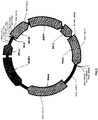
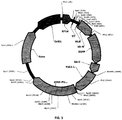
- the PCR products were purified using DNA purification kits (Taingen), and measured concentrations by agar gel electrophoresis. Enzyme digestion sites of two TALEN plasmids: pEF1a-NLS-TALE backbone-Fok1(R)-pA and pEF1a-NLS-TALE backbone-Fok1(L)-IRES-PURO-pA, were illustrated in FIGS. 2 and 3 respectively.
- SEQ ID NO: 41 and SEQ ID NO: 42 Sequences of N-terminal and C-terminal of transcription activator-like effectors are shown as SEQ ID NO: 43 and SEQ ID NO: 44.
- Bsal was added to digest TALEN vectors to obtain overhangs for repeats modules. Digested TALEN vectors were purified by gel extraction, and concentrations were determined by gel electrophoresis. With respect to TALEN ligation, except? for F1 and R9 (F1 ligates to left end of TALEN vector, R9 ligates to right end of backbone vector), Fk can ligate to Rk-1 at overhangs, but not to others.
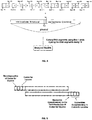
- FIG. 4 illustrates a process for assembling a TALEN containing 19 repeat segments. As illustrated, the last half DNA segment encoding a module recognizing T is in the backbone vector already; thus the ligation of 18 modules is enough. 9 DNA segments may be selected based on target sequences, and mixed with a solution containing TALEN backbone vector, Bsal, and T4 ligase to digest and ligate in the same reactor or system.
- the following assembly system was used: 150 ng vector, 50 ng each DNA segment, 1 ⁇ l Bsal (NEB), 1 ⁇ l T4 ligase (Fermentas), 2 ⁇ l T4 Buffer (NEB), and double-distilled water (ddH 2 O) to make to final 20 ⁇ l.
- the following ligation program was used: 15 cycles 37 °C for 5 min, 16 °C for 10 min, and followed by 80 °C for 10 min. If occasional incomplete ligation happens (e.g., only 1 to 8 modules are ligated), this incomplete ligation may slow down the ligation efficiency by recombination.
- Plasmid-SafeTM ATP-Dependent DNase (Epicentre, cat no: E3105K) may be used to digest the linear plasmids.
- 1 ⁇ l plasmid-safe DNases and 0.5 ⁇ l ATP were added into a 20 ⁇ l ligation system for an additional incubation at 37 °C for 1 hour.
- 10 ⁇ l of ligation products were taken to transform Trans-T1 competent cells. Colonies were selected to obtain isolated vectors. Restriction analysis was performed by using BamH1/Pst1. The expected size of smaller fragment is the length of ligated size plus 550 bp.
- the final precuts were sent for sequencing. Exemplary sequencing primers are listed in table 4. Table 4 Name Sequence SEQ ID Sequence-F CTCCCCTTCAGCTGGACAC SEQ ID NO:45 Sequence-R AGCTGGGCCACGATTGAC SEQ ID NO:46
- Embodiments of this disclosure allow obtaining sequence-confirmed TALEN vectors within 3 days.
- the ligation (4.5 hours), plasmid-safe DNase digestion (1 hour), and transformation (1 hour) may be performed in the first day.
- Colonies selection and bacterial inculcation may be performed in day 2.
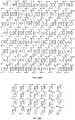
- the sequence analysis results may be received in day 3. If the target sequence is 12-18 but not 19, the modules located in the front part can be changed from dimers into monomers, and thus the change of dimer to monomer can reduce a module. Exemplary options for different monomers or dimers specific to the targeting nucleotide(s) are shown in picture 6.
- polynucleotides encoding TALENs for targeting certain sequences may be assembled in a single reaction. Examples of the sequences may be found in table 5. Table 5 Name Sequence SEQ ID Sequence 1 CGCGCGCGCGCGCGCGCGCGCGCGT SEQ ID NO:47 Sequence 2 CCCACTCCCCATCCAGT SEQ ID NO:48
- DNA segments encoding repeat modules were selected from the PCR library. For example, for sequence 1, DNA segments corresponding to CG-1, CG-2, CG-3, CG-4, CG-5, CG-6, CG-7, CG-8, and CG-9 were chosen, and TALEN vectors containing pEF1a-NLS-TALE backbone-Fok1(R)-pA were used. For sequence 2, DNA segments corresponding to C-1, A-2, C-3, TC-4, CC-5, CA-6, TC-7, CA-8, and GT-9 were chosen, and TALEN vectors containing pEF1a-NLS-TALE backbone-Fokl (L)-IRES-PURO-pA were used.
- the following assembly system was used: 150 ng vector, 50ng each modules, 1 ⁇ l BsaI (NEB), 1 ⁇ l T4 Ligase (fermentas), 2 ⁇ l T4 Buffer (NEB), and H 2 O to make the system solution to final 20 ⁇ l.
- the following Ligation program was used for 15 cycles: 37 °C for 5 min, and 16 °C for 10 min, and followed by 80 °C for 10 min.
- FIG. 7 is a photograph of an agarose gel electrophoresis showing confirmation of assembly clones by restriction digestion analysis. As illustrated, enzyme digestion bands include: 1 kb DNA marker in the middle lane, ligation I indicating 3.1 kb and 2.2 kb on the right of the DNA marker, and ligation II indicating 4.2 kb and 3.7 kb on the left of the DNA marker. Cloning efficiency for assembling TALENs containing recognition domains to identify Sequence 1 and Sequence 2 in a single reaction is 70% and 80% respectively.
Landscapes
- Health & Medical Sciences (AREA)
- Life Sciences & Earth Sciences (AREA)
- Genetics & Genomics (AREA)
- Chemical & Material Sciences (AREA)
- Engineering & Computer Science (AREA)
- Organic Chemistry (AREA)
- Wood Science & Technology (AREA)
- Zoology (AREA)
- Bioinformatics & Cheminformatics (AREA)
- Biotechnology (AREA)
- General Engineering & Computer Science (AREA)
- Biomedical Technology (AREA)
- Molecular Biology (AREA)
- Biochemistry (AREA)
- General Health & Medical Sciences (AREA)
- Microbiology (AREA)
- Biophysics (AREA)
- Physics & Mathematics (AREA)
- Plant Pathology (AREA)
- Crystallography & Structural Chemistry (AREA)
- Proteomics, Peptides & Aminoacids (AREA)
- Cell Biology (AREA)
- Medicinal Chemistry (AREA)
- Chemical Kinetics & Catalysis (AREA)
- General Chemical & Material Sciences (AREA)
- Analytical Chemistry (AREA)
- Immunology (AREA)
- Enzymes And Modification Thereof (AREA)
- Micro-Organisms Or Cultivation Processes Thereof (AREA)
Claims (8)
- Ein Verfahren zum Assemblieren eines Polynukleotids, das einen Transkriptionsaktivator-artigen Effektor (TALE) kodiert, wobei das Verfahren umfasst:Erzeugen mehrerer Desoxyribonukleinsäure(DNA)-Segmente, wobei ein einzelnes DNA-Segment der mehreren DNA-Segmente einer Wiederholungssequenz des TALE entspricht, undMischen der mehreren DNA-Segmente mit Restriktionsenzymen, DNA-Ligasen und einem Vektor, um das Polynukleotid zu erzeugen,wobei die mehreren DNA-Segmente Polymerase-Kettenreaktion(PCR)-Amplifikate sind und die Anzahl der mehreren DNA-Segmente größer als 18 ist, undwobei das Mischen der mehreren DNA-Segmente mit den Restriktionsenzymen, DNA-Ligasen und dem Vektor das Mischen der mehreren DNA-Segmente mit den Restriktionsenzymen, DNA-Ligasen und dem Vektor unter einer Bedingung umfasst, die mehrere Temperaturzyklen beinhaltet.
- Das Verfahren nach Anspruch 1, wobei das Mischen der mehreren DNA-Segmente mit Restriktionsenzymen, den DNA-Ligasen und dem Vektor das Mischen der mehreren DNA-Segmente mit den Restriktionsenzymen, den DNA-Ligasen und dem Vektor im Wesentlichen gleichzeitig umfasst.
- Das Verfahren nach Anspruch 1, ferner umfassend die Reinigung des Polypeptids unter Verwendung einer Plasmid-Safe-Desoxyribonuklease (DNase).
- Das Verfahren nach Anspruch 1, wobei sich an die mehreren Temperaturzyklen die Inaktivierung der Restriktionsenzyme anschließt.
- Das Verfahren nach Anspruch 1, wobei das Mischen der mehreren DNA-Segmente mit den Restriktionsenzymen, DNA-Ligasen und dem Vektor das Mischen der mehreren DNA-Segmente mit den Restriktionsenzymen, die zu einem Typ von Typ-II-Restriktionsenzymen gehören, DNA-Ligasen und dem Vektor ohne andere Typen der Typ-II-Restriktionsenzyme umfasst.
- Das Verfahren nach Anspruch 1, wobei das einzelne DNA-Segment der mehreren DNA-Segmente zwei Spaltstellen besitzt, die unter Verwendung von Typ-II-Restriktionsenzymen erzeugt werden, und die Restriktionsenzyme Typ-II-Restriktionsenzyme sind.
- Das Verfahren nach Anspruch 1, wobei eine Wiederholungssequenz der mehreren Wiederholungssequenzen ein einzelnes Nukleotid eines speziellen Polynukleotids oder zwei zusammenhängende Nukleotide eines speziellen Polynukleotids identifiziert.
- Das Verfahren nach Anspruch 1, wobei die mehreren DNA-Segmente in einem Klonierungsreaktor assembliert werden oder in einer einzigen Klonierungsreaktion assembliert werden.
Priority Applications (1)
| Application Number | Priority Date | Filing Date | Title |
|---|---|---|---|
| EP16180856.3A EP3118319B1 (de) | 2012-09-12 | 2013-09-06 | Anordnung zur transkription einer aktivatorähnlichen effektoranordnung |
Applications Claiming Priority (2)
| Application Number | Priority Date | Filing Date | Title |
|---|---|---|---|
| CN201210336604.4A CN103668470B (zh) | 2012-09-12 | 2012-09-12 | 一种dna文库及构建转录激活子样效应因子核酸酶质粒的方法 |
| PCT/CN2013/001045 WO2014040370A1 (en) | 2012-09-12 | 2013-09-06 | Transcription Activator-Like Effector Assembly |
Related Child Applications (2)
| Application Number | Title | Priority Date | Filing Date |
|---|---|---|---|
| EP16180856.3A Division EP3118319B1 (de) | 2012-09-12 | 2013-09-06 | Anordnung zur transkription einer aktivatorähnlichen effektoranordnung |
| EP16180856.3A Division-Into EP3118319B1 (de) | 2012-09-12 | 2013-09-06 | Anordnung zur transkription einer aktivatorähnlichen effektoranordnung |
Publications (4)
| Publication Number | Publication Date |
|---|---|
| EP2864483A1 EP2864483A1 (de) | 2015-04-29 |
| EP2864483A4 EP2864483A4 (de) | 2015-06-10 |
| EP2864483B1 true EP2864483B1 (de) | 2017-02-15 |
| EP2864483B8 EP2864483B8 (de) | 2017-04-26 |
Family
ID=50233643
Family Applications (2)
| Application Number | Title | Priority Date | Filing Date |
|---|---|---|---|
| EP13837579.5A Not-in-force EP2864483B8 (de) | 2012-09-12 | 2013-09-06 | Anordnung zur transkription einer aktivatorähnlichen effektoranordnung |
| EP16180856.3A Not-in-force EP3118319B1 (de) | 2012-09-12 | 2013-09-06 | Anordnung zur transkription einer aktivatorähnlichen effektoranordnung |
Family Applications After (1)
| Application Number | Title | Priority Date | Filing Date |
|---|---|---|---|
| EP16180856.3A Not-in-force EP3118319B1 (de) | 2012-09-12 | 2013-09-06 | Anordnung zur transkription einer aktivatorähnlichen effektoranordnung |
Country Status (4)
| Country | Link |
|---|---|
| US (2) | US9040677B2 (de) |
| EP (2) | EP2864483B8 (de) |
| CN (1) | CN103668470B (de) |
| WO (1) | WO2014040370A1 (de) |
Families Citing this family (37)
| Publication number | Priority date | Publication date | Assignee | Title |
|---|---|---|---|---|
| CN103668470B (zh) * | 2012-09-12 | 2015-07-29 | 上海斯丹赛生物技术有限公司 | 一种dna文库及构建转录激活子样效应因子核酸酶质粒的方法 |
| CN107429241B (zh) | 2014-08-14 | 2025-10-24 | 百奥赛图(北京)医药科技股份有限公司 | Dna敲入系统 |
| US10752905B2 (en) | 2015-01-20 | 2020-08-25 | Mayo Foundation For Medical Education And Research | Methods and materials for assembling nucleic acid constructs |
| CN104673832B (zh) * | 2015-02-09 | 2019-08-09 | 江苏大学附属医院 | 一种组装tale/talen模块的方法 |
| IL254038B2 (en) | 2015-02-18 | 2023-03-01 | Univ Iowa State Res Found Inc | Modification of the binding site of transcriptional suppressor in the nf-yc4 promoter to increase protein content and stress resistance |
| CN104694539A (zh) * | 2015-03-09 | 2015-06-10 | 上海市同济医院 | 一种利用talen技术构建可敲除小鼠cramp基因质粒的方法 |
| EP3277805B1 (de) | 2015-03-31 | 2025-05-07 | SOHM, Inc. | Cas-9-retrovirale integrasesysteme zum gezielten einschluss einer dna-sequenz in ein genom einer zelle |
| CN105838691B (zh) * | 2016-04-18 | 2018-07-06 | 浙江大学 | 一对转录激活子样效应因子核酸酶及其编码基因与应用 |
| CN107312788B (zh) * | 2016-04-26 | 2020-07-28 | 中国科学院动物研究所 | 一种tale重复序列载体的构建方法 |
| WO2018144097A1 (en) | 2016-11-04 | 2018-08-09 | Akeagen Llc | Genetically modified non-human animals and methods for producing heavy chain-only antibodies |
| WO2019217837A1 (en) | 2018-05-11 | 2019-11-14 | Memorial Sloan-Kettering Cancer Center | T cell receptors targeting pik3ca mutations and uses thereof |
| EP3986450A4 (de) | 2019-06-20 | 2023-06-28 | Memorial Sloan Kettering Cancer Center | Gegen pik3ca-mutationen gerichtete t-zell-rezeptoren und ihre anwendungen |
| KR20230017783A (ko) | 2020-04-28 | 2023-02-06 | 인텔리아 테라퓨틱스, 인크. | 시험관내 세포 전달 방법 |
| CA3191396A1 (en) | 2020-09-01 | 2022-03-10 | Alexis ROVNER | Mammalian cells and methods for engineering the same |
| CR20230303A (es) | 2020-12-11 | 2023-09-01 | Intellia Therapeutics Inc | Composiciones y métodos para reducir el mhc de clase ii en una célula |
| AU2021409732A1 (en) | 2020-12-23 | 2023-07-20 | Intellia Therapeutics, Inc. | Compositions and methods for reducing hla-a in a cell |
| EP4267723A1 (de) | 2020-12-23 | 2023-11-01 | Intellia Therapeutics, Inc. | Zusammensetzungen und verfahren zur genetischen veränderung von ciita in einer zelle |
| CN116848235A (zh) | 2020-12-30 | 2023-10-03 | 因特利亚治疗公司 | 工程化t细胞 |
| MX2023012236A (es) | 2021-04-17 | 2024-01-23 | Intellia Therapeutics Inc | Inhibidores de proteína cinasa dependente de acido desoxirribonucleico (and) y composiciones y usos de los mismos. |
| MX2023012235A (es) | 2021-04-17 | 2024-01-23 | Intellia Therapeutics Inc | Composiciones de nanopartículas lípidicas. |
| US20240200106A1 (en) | 2021-04-17 | 2024-06-20 | Intellia Thrapeutics, Inc. | Lipid nanoparticles compositions |
| WO2023122805A1 (en) | 2021-12-20 | 2023-06-29 | Vestaron Corporation | Sorbitol driven selection pressure method |
| EP4511397A1 (de) | 2022-04-19 | 2025-02-26 | Intellia Therapeutics, Inc. | Chimäre antigenrezeptorzusammensetzungen und verwendungen |
| CN120129746A (zh) | 2022-06-16 | 2025-06-10 | 因特利亚治疗公司 | 用于减少细胞中的mhc i类的组合物和方法 |
| JP2025525437A (ja) | 2022-06-29 | 2025-08-05 | インテリア セラピューティクス,インコーポレイテッド | 操作されたt細胞 |
| WO2024039576A2 (en) | 2022-08-19 | 2024-02-22 | Memorial Sloan-Kettering Cancer Center | T cell receptors targeting ras mutations and uses thereof |
| CN121511259A (zh) | 2023-05-18 | 2026-02-10 | 分化枝治疗有限公司 | 抑制自然杀伤细胞对细胞疗法的细胞毒性 |
| KR20260026021A (ko) | 2023-05-19 | 2026-02-25 | 인텔리아 테라퓨틱스, 인크. | 이온화 가능한 아민 지질 |
| WO2025038648A1 (en) | 2023-08-14 | 2025-02-20 | Intellia Therapeutics, Inc. | Compositions and methods for genetically modifying transforming growth factor beta receptor type 2 (tgfβr2) |
| TW202521564A (zh) | 2023-08-14 | 2025-06-01 | 美商英特利亞醫療公司 | 用於基於細胞之療法的cd70 car-t組合物及方法 |
| TW202515994A (zh) | 2023-08-14 | 2025-04-16 | 美商英特利亞醫療公司 | 用於對cd70進行基因修飾之組合物及方法 |
| WO2025038637A1 (en) | 2023-08-14 | 2025-02-20 | Intellia Therapeutics, Inc. | Compositions and methods for genetically modifying transforming growth factor beta receptor type 2 (tgfβr2) |
| WO2025049481A1 (en) | 2023-08-28 | 2025-03-06 | Intellia Therapeutics, Inc. | Methods of editing an hla-a gene in vitro |
| WO2025128981A1 (en) | 2023-12-14 | 2025-06-19 | Sohm, Inc. | Compositions and methods for genome editing |
| TW202542303A (zh) | 2023-12-20 | 2025-11-01 | 美商英特利亞醫療公司 | 經工程改造之t細胞 |
| WO2025240946A1 (en) | 2024-05-17 | 2025-11-20 | Intellia Therapeutics, Inc. | Lipid nanoparticles and lipid nanoparticle compositions |
| WO2025255308A1 (en) | 2024-06-07 | 2025-12-11 | Intellia Therapeutics, Inc. | Cd8 co-receptor chimeric polypeptides in tcr cell therapy |
Family Cites Families (3)
| Publication number | Priority date | Publication date | Assignee | Title |
|---|---|---|---|---|
| WO2012093833A2 (en) * | 2011-01-03 | 2012-07-12 | Toolgen Incorporation | Genome engineering via designed tal effector nucleases |
| JP5996630B2 (ja) * | 2011-04-05 | 2016-09-21 | セレクティスCellectis | コンパクトtale−ヌクレアーゼを作製する方法及びその使用 |
| CN103668470B (zh) * | 2012-09-12 | 2015-07-29 | 上海斯丹赛生物技术有限公司 | 一种dna文库及构建转录激活子样效应因子核酸酶质粒的方法 |
-
2012
- 2012-09-12 CN CN201210336604.4A patent/CN103668470B/zh active Active
-
2013
- 2013-08-13 US US13/965,469 patent/US9040677B2/en active Active
- 2013-09-06 EP EP13837579.5A patent/EP2864483B8/de not_active Not-in-force
- 2013-09-06 WO PCT/CN2013/001045 patent/WO2014040370A1/en not_active Ceased
- 2013-09-06 EP EP16180856.3A patent/EP3118319B1/de not_active Not-in-force
- 2013-09-26 US US14/037,673 patent/US8748134B2/en active Active
Non-Patent Citations (4)
| Title |
|---|
| HUANG PENG ET AL: "Heritable gene targeting in zebrafish using customized TALENs", NATURE BIOTECHNOLOGY, NATURE PUBLISHING GROUP, US, vol. 29, no. 8, 1 August 2011 (2011-08-01), pages 699 - 700, XP002681971, ISSN: 1087-0156 * |
| JEFFRY D SANDER ET AL: "Targeted gene disruption in somatic zebrafish cells using engineered TALENs", NATURE BIOTECHNOLOGY, vol. 29, no. 8, 5 August 2011 (2011-08-05), US, pages 697 - 698, XP055263701, ISSN: 1087-0156, DOI: 10.1038/nbt.1934 * |
| JEFFRY D SANDER: "Supplementary Methods Construction of TALE repeat arrays and TALE nuclease expression vectors", 5 February 2012 (2012-02-05), SUPPLEMENTARY MATERIAL PUBLISHED ON LINE, XP055263704, Retrieved from the Internet <URL:http://www.ncbi.nlm.nih.gov/pmc/articles/PMC3154023/> [retrieved on 20160408] * |
| T. CERMAK ET AL: "Efficient design and assembly of custom TALEN and other TAL effector-based constructs for DNA targeting", NUCLEIC ACIDS RESEARCH, vol. 39, no. 12, E82, 1 July 2011 (2011-07-01), pages 1 - 11, XP055130093, ISSN: 0305-1048, DOI: 10.1093/nar/gkr218 * |
Also Published As
| Publication number | Publication date |
|---|---|
| US9040677B2 (en) | 2015-05-26 |
| US8748134B2 (en) | 2014-06-10 |
| EP2864483A4 (de) | 2015-06-10 |
| EP3118319A1 (de) | 2017-01-18 |
| EP2864483B8 (de) | 2017-04-26 |
| US20140073014A1 (en) | 2014-03-13 |
| CN103668470B (zh) | 2015-07-29 |
| WO2014040370A1 (en) | 2014-03-20 |
| CN103668470A (zh) | 2014-03-26 |
| EP3118319B1 (de) | 2019-05-22 |
| EP2864483A1 (de) | 2015-04-29 |
| US20140073015A1 (en) | 2014-03-13 |
Similar Documents
| Publication | Publication Date | Title |
|---|---|---|
| EP3118319B1 (de) | Anordnung zur transkription einer aktivatorähnlichen effektoranordnung | |
| CN109136248B (zh) | 多靶点编辑载体及其构建方法和应用 | |
| CA3130135A1 (en) | Enzymes with ruvc domains | |
| JP2022539338A5 (de) | ||
| CN107604003A (zh) | 一种基于线性化crispr‑cas9慢病毒载体基因敲除试剂盒及其应用 | |
| WO2018031950A1 (en) | Protein engineering methods | |
| CN107012164A (zh) | CRISPR/Cpf1植物基因组定向修饰功能单元、包含该功能单元的载体及其应用 | |
| IL288263B (en) | CRISPR DNA/RNA hybrid polynucleotides and methods of using them | |
| CN104109687A (zh) | 运动发酵单胞菌CRISPR-Cas9系统的构建与应用 | |
| CN110607320A (zh) | 一种植物基因组定向碱基编辑骨架载体及其应用 | |
| EP3924477A1 (de) | Enzyme mit ruvc-domänen | |
| CN1427079A (zh) | 多基因载体的构建方法与应用 | |
| CN102787125A (zh) | 一种构建tale重复序列的方法 | |
| CN110331146A (zh) | 一种调控sgRNA转录的启动子、表达载体,及其基因组编辑系统和应用 | |
| CN103820452B (zh) | 一种sgRNA片段及其应用 | |
| EP4217499A1 (de) | Systeme und verfahren zur transponierung von frachtnukleotidsequenzen | |
| KR102151064B1 (ko) | 매칭된 5' 뉴클레오타이드를 포함하는 가이드 rna를 포함하는 유전자 교정용 조성물 및 이를 이용한 유전자 교정 방법 | |
| JP2024509047A (ja) | Crispr関連トランスポゾンシステム及びその使用方法 | |
| JP2024509048A (ja) | Crispr関連トランスポゾンシステム及びその使用方法 | |
| US10752905B2 (en) | Methods and materials for assembling nucleic acid constructs | |
| CA3190758A1 (en) | Systems and methods for transposing cargo nucleotide sequences | |
| WO2025010350A2 (en) | Compositions and methods for precise genome editing using retrons | |
| CN103497966B (zh) | 一种单模块DNA文库及TALENs识别模块的连接方法 | |
| CN103695452B (zh) | 一种多模块dna文库及转录激活子样效应因子核酸酶质粒的构建方法 | |
| US20200377909A1 (en) | Directed genome engineering using enhanced targeted editing technologies |
Legal Events
| Date | Code | Title | Description |
|---|---|---|---|
| PUAI | Public reference made under article 153(3) epc to a published international application that has entered the european phase |
Free format text: ORIGINAL CODE: 0009012 |
|
| 17P | Request for examination filed |
Effective date: 20150126 |
|
| AK | Designated contracting states |
Kind code of ref document: A1 Designated state(s): AL AT BE BG CH CY CZ DE DK EE ES FI FR GB GR HR HU IE IS IT LI LT LU LV MC MK MT NL NO PL PT RO RS SE SI SK SM TR |
|
| AX | Request for extension of the european patent |
Extension state: BA ME |
|
| RA4 | Supplementary search report drawn up and despatched (corrected) |
Effective date: 20150513 |
|
| RIC1 | Information provided on ipc code assigned before grant |
Ipc: C12N 15/66 20060101AFI20150507BHEP |
|
| DAX | Request for extension of the european patent (deleted) | ||
| 17Q | First examination report despatched |
Effective date: 20160415 |
|
| GRAP | Despatch of communication of intention to grant a patent |
Free format text: ORIGINAL CODE: EPIDOSNIGR1 |
|
| INTG | Intention to grant announced |
Effective date: 20160909 |
|
| STAA | Information on the status of an ep patent application or granted ep patent |
Free format text: STATUS: GRANT OF PATENT IS INTENDED |
|
| GRAS | Grant fee paid |
Free format text: ORIGINAL CODE: EPIDOSNIGR3 |
|
| GRAA | (expected) grant |
Free format text: ORIGINAL CODE: 0009210 |
|
| STAA | Information on the status of an ep patent application or granted ep patent |
Free format text: STATUS: THE PATENT HAS BEEN GRANTED |
|
| AK | Designated contracting states |
Kind code of ref document: B1 Designated state(s): AL AT BE BG CH CY CZ DE DK EE ES FI FR GB GR HR HU IE IS IT LI LT LU LV MC MK MT NL NO PL PT RO RS SE SI SK SM TR |
|
| REG | Reference to a national code |
Ref country code: CH Ref legal event code: EP Ref country code: GB Ref legal event code: FG4D |
|
| GRAT | Correction requested after decision to grant or after decision to maintain patent in amended form |
Free format text: ORIGINAL CODE: EPIDOSNCDEC |
|
| RAP2 | Party data changed (patent owner data changed or rights of a patent transferred) |
Owner name: SIDANSAI BIOTECHNOLOGY CO., LTD |
|
| REG | Reference to a national code |
Ref country code: IE Ref legal event code: FG4D |
|
| REG | Reference to a national code |
Ref country code: AT Ref legal event code: REF Ref document number: 867916 Country of ref document: AT Kind code of ref document: T Effective date: 20170315 |
|
| RAP2 | Party data changed (patent owner data changed or rights of a patent transferred) |
Owner name: INNOVATIVE CELLULAR THERAPEUTICS CO., LTD. |
|
| REG | Reference to a national code |
Ref country code: DE Ref legal event code: R096 Ref document number: 602013017581 Country of ref document: DE |
|
| REG | Reference to a national code |
Ref country code: NL Ref legal event code: MP Effective date: 20170215 |
|
| REG | Reference to a national code |
Ref country code: LT Ref legal event code: MG4D |
|
| REG | Reference to a national code |
Ref country code: AT Ref legal event code: MK05 Ref document number: 867916 Country of ref document: AT Kind code of ref document: T Effective date: 20170215 |
|
| PG25 | Lapsed in a contracting state [announced via postgrant information from national office to epo] |
Ref country code: LT Free format text: LAPSE BECAUSE OF FAILURE TO SUBMIT A TRANSLATION OF THE DESCRIPTION OR TO PAY THE FEE WITHIN THE PRESCRIBED TIME-LIMIT Effective date: 20170215 Ref country code: FI Free format text: LAPSE BECAUSE OF FAILURE TO SUBMIT A TRANSLATION OF THE DESCRIPTION OR TO PAY THE FEE WITHIN THE PRESCRIBED TIME-LIMIT Effective date: 20170215 Ref country code: NO Free format text: LAPSE BECAUSE OF FAILURE TO SUBMIT A TRANSLATION OF THE DESCRIPTION OR TO PAY THE FEE WITHIN THE PRESCRIBED TIME-LIMIT Effective date: 20170515 Ref country code: HR Free format text: LAPSE BECAUSE OF FAILURE TO SUBMIT A TRANSLATION OF THE DESCRIPTION OR TO PAY THE FEE WITHIN THE PRESCRIBED TIME-LIMIT Effective date: 20170215 Ref country code: GR Free format text: LAPSE BECAUSE OF FAILURE TO SUBMIT A TRANSLATION OF THE DESCRIPTION OR TO PAY THE FEE WITHIN THE PRESCRIBED TIME-LIMIT Effective date: 20170516 |
|
| REG | Reference to a national code |
Ref country code: FR Ref legal event code: PLFP Year of fee payment: 5 |
|
| PG25 | Lapsed in a contracting state [announced via postgrant information from national office to epo] |
Ref country code: AT Free format text: LAPSE BECAUSE OF FAILURE TO SUBMIT A TRANSLATION OF THE DESCRIPTION OR TO PAY THE FEE WITHIN THE PRESCRIBED TIME-LIMIT Effective date: 20170215 Ref country code: BG Free format text: LAPSE BECAUSE OF FAILURE TO SUBMIT A TRANSLATION OF THE DESCRIPTION OR TO PAY THE FEE WITHIN THE PRESCRIBED TIME-LIMIT Effective date: 20170515 Ref country code: RS Free format text: LAPSE BECAUSE OF FAILURE TO SUBMIT A TRANSLATION OF THE DESCRIPTION OR TO PAY THE FEE WITHIN THE PRESCRIBED TIME-LIMIT Effective date: 20170215 Ref country code: NL Free format text: LAPSE BECAUSE OF FAILURE TO SUBMIT A TRANSLATION OF THE DESCRIPTION OR TO PAY THE FEE WITHIN THE PRESCRIBED TIME-LIMIT Effective date: 20170215 Ref country code: ES Free format text: LAPSE BECAUSE OF FAILURE TO SUBMIT A TRANSLATION OF THE DESCRIPTION OR TO PAY THE FEE WITHIN THE PRESCRIBED TIME-LIMIT Effective date: 20170215 Ref country code: LV Free format text: LAPSE BECAUSE OF FAILURE TO SUBMIT A TRANSLATION OF THE DESCRIPTION OR TO PAY THE FEE WITHIN THE PRESCRIBED TIME-LIMIT Effective date: 20170215 Ref country code: PT Free format text: LAPSE BECAUSE OF FAILURE TO SUBMIT A TRANSLATION OF THE DESCRIPTION OR TO PAY THE FEE WITHIN THE PRESCRIBED TIME-LIMIT Effective date: 20170615 Ref country code: SE Free format text: LAPSE BECAUSE OF FAILURE TO SUBMIT A TRANSLATION OF THE DESCRIPTION OR TO PAY THE FEE WITHIN THE PRESCRIBED TIME-LIMIT Effective date: 20170215 |
|
| PG25 | Lapsed in a contracting state [announced via postgrant information from national office to epo] |
Ref country code: CZ Free format text: LAPSE BECAUSE OF FAILURE TO SUBMIT A TRANSLATION OF THE DESCRIPTION OR TO PAY THE FEE WITHIN THE PRESCRIBED TIME-LIMIT Effective date: 20170215 Ref country code: IT Free format text: LAPSE BECAUSE OF FAILURE TO SUBMIT A TRANSLATION OF THE DESCRIPTION OR TO PAY THE FEE WITHIN THE PRESCRIBED TIME-LIMIT Effective date: 20170215 Ref country code: SK Free format text: LAPSE BECAUSE OF FAILURE TO SUBMIT A TRANSLATION OF THE DESCRIPTION OR TO PAY THE FEE WITHIN THE PRESCRIBED TIME-LIMIT Effective date: 20170215 Ref country code: RO Free format text: LAPSE BECAUSE OF FAILURE TO SUBMIT A TRANSLATION OF THE DESCRIPTION OR TO PAY THE FEE WITHIN THE PRESCRIBED TIME-LIMIT Effective date: 20170215 Ref country code: EE Free format text: LAPSE BECAUSE OF FAILURE TO SUBMIT A TRANSLATION OF THE DESCRIPTION OR TO PAY THE FEE WITHIN THE PRESCRIBED TIME-LIMIT Effective date: 20170215 |
|
| REG | Reference to a national code |
Ref country code: DE Ref legal event code: R097 Ref document number: 602013017581 Country of ref document: DE |
|
| PG25 | Lapsed in a contracting state [announced via postgrant information from national office to epo] |
Ref country code: DK Free format text: LAPSE BECAUSE OF FAILURE TO SUBMIT A TRANSLATION OF THE DESCRIPTION OR TO PAY THE FEE WITHIN THE PRESCRIBED TIME-LIMIT Effective date: 20170215 Ref country code: PL Free format text: LAPSE BECAUSE OF FAILURE TO SUBMIT A TRANSLATION OF THE DESCRIPTION OR TO PAY THE FEE WITHIN THE PRESCRIBED TIME-LIMIT Effective date: 20170215 Ref country code: SM Free format text: LAPSE BECAUSE OF FAILURE TO SUBMIT A TRANSLATION OF THE DESCRIPTION OR TO PAY THE FEE WITHIN THE PRESCRIBED TIME-LIMIT Effective date: 20170215 |
|
| PLBE | No opposition filed within time limit |
Free format text: ORIGINAL CODE: 0009261 |
|
| STAA | Information on the status of an ep patent application or granted ep patent |
Free format text: STATUS: NO OPPOSITION FILED WITHIN TIME LIMIT |
|
| 26N | No opposition filed |
Effective date: 20171116 |
|
| PG25 | Lapsed in a contracting state [announced via postgrant information from national office to epo] |
Ref country code: SI Free format text: LAPSE BECAUSE OF FAILURE TO SUBMIT A TRANSLATION OF THE DESCRIPTION OR TO PAY THE FEE WITHIN THE PRESCRIBED TIME-LIMIT Effective date: 20170215 |
|
| REG | Reference to a national code |
Ref country code: CH Ref legal event code: PL |
|
| PG25 | Lapsed in a contracting state [announced via postgrant information from national office to epo] |
Ref country code: MC Free format text: LAPSE BECAUSE OF FAILURE TO SUBMIT A TRANSLATION OF THE DESCRIPTION OR TO PAY THE FEE WITHIN THE PRESCRIBED TIME-LIMIT Effective date: 20170215 |
|
| REG | Reference to a national code |
Ref country code: IE Ref legal event code: MM4A |
|
| REG | Reference to a national code |
Ref country code: BE Ref legal event code: MM Effective date: 20170930 |
|
| PG25 | Lapsed in a contracting state [announced via postgrant information from national office to epo] |
Ref country code: LU Free format text: LAPSE BECAUSE OF NON-PAYMENT OF DUE FEES Effective date: 20170906 |
|
| PG25 | Lapsed in a contracting state [announced via postgrant information from national office to epo] |
Ref country code: CH Free format text: LAPSE BECAUSE OF NON-PAYMENT OF DUE FEES Effective date: 20170930 Ref country code: IE Free format text: LAPSE BECAUSE OF NON-PAYMENT OF DUE FEES Effective date: 20170906 Ref country code: LI Free format text: LAPSE BECAUSE OF NON-PAYMENT OF DUE FEES Effective date: 20170930 |
|
| REG | Reference to a national code |
Ref country code: FR Ref legal event code: PLFP Year of fee payment: 6 |
|
| PG25 | Lapsed in a contracting state [announced via postgrant information from national office to epo] |
Ref country code: BE Free format text: LAPSE BECAUSE OF NON-PAYMENT OF DUE FEES Effective date: 20170930 |
|
| PG25 | Lapsed in a contracting state [announced via postgrant information from national office to epo] |
Ref country code: MT Free format text: LAPSE BECAUSE OF NON-PAYMENT OF DUE FEES Effective date: 20170906 |
|
| PG25 | Lapsed in a contracting state [announced via postgrant information from national office to epo] |
Ref country code: HU Free format text: LAPSE BECAUSE OF FAILURE TO SUBMIT A TRANSLATION OF THE DESCRIPTION OR TO PAY THE FEE WITHIN THE PRESCRIBED TIME-LIMIT; INVALID AB INITIO Effective date: 20130906 |
|
| PG25 | Lapsed in a contracting state [announced via postgrant information from national office to epo] |
Ref country code: CY Free format text: LAPSE BECAUSE OF FAILURE TO SUBMIT A TRANSLATION OF THE DESCRIPTION OR TO PAY THE FEE WITHIN THE PRESCRIBED TIME-LIMIT Effective date: 20170215 |
|
| PG25 | Lapsed in a contracting state [announced via postgrant information from national office to epo] |
Ref country code: MK Free format text: LAPSE BECAUSE OF FAILURE TO SUBMIT A TRANSLATION OF THE DESCRIPTION OR TO PAY THE FEE WITHIN THE PRESCRIBED TIME-LIMIT Effective date: 20170215 |
|
| PG25 | Lapsed in a contracting state [announced via postgrant information from national office to epo] |
Ref country code: TR Free format text: LAPSE BECAUSE OF FAILURE TO SUBMIT A TRANSLATION OF THE DESCRIPTION OR TO PAY THE FEE WITHIN THE PRESCRIBED TIME-LIMIT Effective date: 20170215 |
|
| PG25 | Lapsed in a contracting state [announced via postgrant information from national office to epo] |
Ref country code: AL Free format text: LAPSE BECAUSE OF FAILURE TO SUBMIT A TRANSLATION OF THE DESCRIPTION OR TO PAY THE FEE WITHIN THE PRESCRIBED TIME-LIMIT Effective date: 20170215 Ref country code: IS Free format text: LAPSE BECAUSE OF FAILURE TO SUBMIT A TRANSLATION OF THE DESCRIPTION OR TO PAY THE FEE WITHIN THE PRESCRIBED TIME-LIMIT Effective date: 20170615 |
|
| P01 | Opt-out of the competence of the unified patent court (upc) registered |
Effective date: 20230508 |
|
| PGFP | Annual fee paid to national office [announced via postgrant information from national office to epo] |
Ref country code: GB Payment date: 20230926 Year of fee payment: 11 |
|
| PGFP | Annual fee paid to national office [announced via postgrant information from national office to epo] |
Ref country code: FR Payment date: 20230926 Year of fee payment: 11 Ref country code: DE Payment date: 20230928 Year of fee payment: 11 |
|
| REG | Reference to a national code |
Ref country code: DE Ref legal event code: R119 Ref document number: 602013017581 Country of ref document: DE |
|
| GBPC | Gb: european patent ceased through non-payment of renewal fee |
Effective date: 20240906 |
|
| PG25 | Lapsed in a contracting state [announced via postgrant information from national office to epo] |
Ref country code: DE Free format text: LAPSE BECAUSE OF NON-PAYMENT OF DUE FEES Effective date: 20250401 |
|
| PG25 | Lapsed in a contracting state [announced via postgrant information from national office to epo] |
Ref country code: GB Free format text: LAPSE BECAUSE OF NON-PAYMENT OF DUE FEES Effective date: 20240906 |
|
| PG25 | Lapsed in a contracting state [announced via postgrant information from national office to epo] |
Ref country code: FR Free format text: LAPSE BECAUSE OF NON-PAYMENT OF DUE FEES Effective date: 20240930 |