EP2849563B1 - Insektizide wasser-in-öl (w/o) formulierung - Google Patents
Insektizide wasser-in-öl (w/o) formulierung Download PDFInfo
- Publication number
- EP2849563B1 EP2849563B1 EP13723472.0A EP13723472A EP2849563B1 EP 2849563 B1 EP2849563 B1 EP 2849563B1 EP 13723472 A EP13723472 A EP 13723472A EP 2849563 B1 EP2849563 B1 EP 2849563B1
- Authority
- EP
- European Patent Office
- Prior art keywords
- oil
- approximately
- water
- active agent
- insecticidal
- Prior art date
- Legal status (The legal status is an assumption and is not a legal conclusion. Google has not performed a legal analysis and makes no representation as to the accuracy of the status listed.)
- Active
Links
Images
Classifications
-
- A—HUMAN NECESSITIES
- A01—AGRICULTURE; FORESTRY; ANIMAL HUSBANDRY; HUNTING; TRAPPING; FISHING
- A01N—PRESERVATION OF BODIES OF HUMANS OR ANIMALS OR PLANTS OR PARTS THEREOF; BIOCIDES, e.g. AS DISINFECTANTS, AS PESTICIDES OR AS HERBICIDES; PEST REPELLANTS OR ATTRACTANTS; PLANT GROWTH REGULATORS
- A01N25/00—Biocides, pest repellants or attractants, or plant growth regulators, characterised by their forms, or by their non-active ingredients or by their methods of application, e.g. seed treatment or sequential application; Substances for reducing the noxious effect of the active ingredients to organisms other than pests
- A01N25/02—Biocides, pest repellants or attractants, or plant growth regulators, characterised by their forms, or by their non-active ingredients or by their methods of application, e.g. seed treatment or sequential application; Substances for reducing the noxious effect of the active ingredients to organisms other than pests containing liquids as carriers, diluents or solvents
- A01N25/04—Dispersions, emulsions, suspoemulsions, suspension concentrates or gels
-
- A—HUMAN NECESSITIES
- A01—AGRICULTURE; FORESTRY; ANIMAL HUSBANDRY; HUNTING; TRAPPING; FISHING
- A01N—PRESERVATION OF BODIES OF HUMANS OR ANIMALS OR PLANTS OR PARTS THEREOF; BIOCIDES, e.g. AS DISINFECTANTS, AS PESTICIDES OR AS HERBICIDES; PEST REPELLANTS OR ATTRACTANTS; PLANT GROWTH REGULATORS
- A01N25/00—Biocides, pest repellants or attractants, or plant growth regulators, characterised by their forms, or by their non-active ingredients or by their methods of application, e.g. seed treatment or sequential application; Substances for reducing the noxious effect of the active ingredients to organisms other than pests
- A01N25/18—Vapour or smoke emitting compositions with delayed or sustained release
-
- A—HUMAN NECESSITIES
- A01—AGRICULTURE; FORESTRY; ANIMAL HUSBANDRY; HUNTING; TRAPPING; FISHING
- A01N—PRESERVATION OF BODIES OF HUMANS OR ANIMALS OR PLANTS OR PARTS THEREOF; BIOCIDES, e.g. AS DISINFECTANTS, AS PESTICIDES OR AS HERBICIDES; PEST REPELLANTS OR ATTRACTANTS; PLANT GROWTH REGULATORS
- A01N25/00—Biocides, pest repellants or attractants, or plant growth regulators, characterised by their forms, or by their non-active ingredients or by their methods of application, e.g. seed treatment or sequential application; Substances for reducing the noxious effect of the active ingredients to organisms other than pests
- A01N25/20—Combustible or heat-generating compositions
-
- A—HUMAN NECESSITIES
- A01—AGRICULTURE; FORESTRY; ANIMAL HUSBANDRY; HUNTING; TRAPPING; FISHING
- A01N—PRESERVATION OF BODIES OF HUMANS OR ANIMALS OR PLANTS OR PARTS THEREOF; BIOCIDES, e.g. AS DISINFECTANTS, AS PESTICIDES OR AS HERBICIDES; PEST REPELLANTS OR ATTRACTANTS; PLANT GROWTH REGULATORS
- A01N25/00—Biocides, pest repellants or attractants, or plant growth regulators, characterised by their forms, or by their non-active ingredients or by their methods of application, e.g. seed treatment or sequential application; Substances for reducing the noxious effect of the active ingredients to organisms other than pests
- A01N25/34—Shaped forms, e.g. sheets, not provided for in any other sub-group of this main group
-
- A—HUMAN NECESSITIES
- A01—AGRICULTURE; FORESTRY; ANIMAL HUSBANDRY; HUNTING; TRAPPING; FISHING
- A01N—PRESERVATION OF BODIES OF HUMANS OR ANIMALS OR PLANTS OR PARTS THEREOF; BIOCIDES, e.g. AS DISINFECTANTS, AS PESTICIDES OR AS HERBICIDES; PEST REPELLANTS OR ATTRACTANTS; PLANT GROWTH REGULATORS
- A01N53/00—Biocides, pest repellants or attractants, or plant growth regulators containing cyclopropane carboxylic acids or derivatives thereof
Definitions
- the invention relates to an insecticidal water-in-oil (W / O) formulation with at least one insecticidal active ingredient and at least one fire salt, and to the preparation of this formulation.
- the formulation according to the invention is particularly suitable for the treatment of suitable carrier materials, in particular paper carriers, in a cost-effective one-step process using conventional application methods.
- the present invention relates to insecticidal, mimmable products which can be produced by treating a carrier material with the formulation according to the invention.
- US-A-2009/0163582 describes a water-in-oil (W / O) formulation in which a polyglycerol fatty acid ester or a sorbitan fatty acid ester is used as the emulsifying agent, a pesticide, for example a pyrethroid, and an acetylic ester, a methyl ester, an acetyltributyl citrate, a white mineral oil or a combination thereof as solvent ,
- This formulation is an end-user aerosol formulation.
- WO 2007/131679 describes a paper soaked with an insecticidal active ingredient.
- the paper is produced in a two-step process, in which the paper is first pretreated with an aqueous 6% potassium nitrate solution, then dried and then impregnated with an active ingredient solution in a further step.
- WO 2007/131679 does not disclose a formulation in which the paper can be treated in a one-step process, in particular with an insecticidal active ingredient and the potassium nitrate salt.
- WO-A-2011/092722 describes a paper soaked with an insecticidal active ingredient, which is also produced in a two-step process. Analogous to the procedure of WO 2007/131679 the paper is first treated with a potassium nitrate before the paper is impregnated with the active ingredient after drying.
- the object of the present invention was to provide a formulation which is physically and chemically stable in view of an insecticidal active ingredient (ie, for example a pyrethroid) and an incinerator salt and is particularly suitable for the treatment of a carrier material such as paper.
- the formulation should preferably enable the carrier material to be treated in an inexpensive and industrially robust one-step process.
- the required application weight of the formulation according to the invention is applied to the carrier material in one process step, so that the carrier material then contains the functional formulation components, such as the active ingredient and the fire salt, sufficiently and homogeneously distributed.
- formulations described in the prior art are not suitable for solving this problem.
- such formulations are not physically and chemically sufficiently stable (against coalescence and creaming) and do not have the rheological properties necessary for the purpose required according to the invention or cannot be readily adapted to conventional machines and methods for applying the formulation to a suitable carrier material.
- a W / O formulation generally describes a multi-phase system in which an aqueous phase is dispersed in a continuous oil phase.
- oil in this context stands for water-insoluble liquids and solvents, which are mixed with water or aqueous salt solutions cause phase separation. Examples are aliphatic and aromatic solvents, vegetable and animal oils and their derivatives, fragrances or mixtures thereof.
- Aqueous salt solutions with a salt concentration of 5% by weight and higher typically have a high specific conductivity in the mS / cm range, while the specific conductivity of aliphatic and aromatic solvents are typically in the ⁇ S / cm range or below.
- a fire salt formulation is experimentally classified as a W / O formulation if its specific conductivity is less than 0.1 mS / cm.
- the conductivity of the present W / O formulation according to the invention is therefore preferably less than 0.1 mS / cm, measured at room temperature (20 ° C.).
- Suitable as a surface-active emulsifying system for the W / O formulations according to the invention are surface-active emulsifiers, each of which has a solubility in a 16% potassium nitrate salt solution (the solubility being measured using conventional methods at a temperature of 20 ° C.) of less than 1 g / L ,
- Suitable surface-active emulsifying systems which have a solubility of less than 1 g / L in a 16% potassium nitrate salt solution are non-ionic, surface-active emulsifiers (also referred to as non-ionic surface-active agents) with an HLB value in the range from approximately 2 to approximately 10, preferably 2 to 10, more preferably between about 2 to about 8, preferably 2 to 8 and particularly preferably between about 3 and about 6, preferably between 3 and 6.
- Some of the surfactants which can be used according to the invention are, for example, in Kirk-Othmer, "Encyclopedia of Chemical Technology", 3rd ed., 1979, volume 8, page 913 , listed.
- the HLB value (hydrophile-lipophile balance) is one of WC Griffin (J. Soc.Cosmetic Chemists, 1, 311 (1949 )) defined empirical scale that expresses the amphiphilic nature of emulsifying agents (especially non-ionic surfactants). The lowest HLB values are assigned to the least hydrophilic surfactants. Methods for determining HLB are well known in the art and any of such methods can be used for HLB determination. A description of the HLB system and procedures for HLB determination are given in " The HLB system: a time saving guide to emulsifier selection ", ICI Americas Inc., Wilmington, Delaware, 1976 , described.
- Nonionic surface-active emulsifiers suitable according to the invention are preferably selected from the group consisting of alkylphenol ethoxylates, alkanol ethoxylates, alkylamine ethoxylates, sorbitan esters (such as spans) and their ethoxylates (such as Tweens), castor oil ethoxylates, Ethylene oxide / propylene oxide block copolymers, alkanol / propylene oxide / ethylene oxide copolymers, polyglycerols and polyglycerol esters.
- hydrophilicity / lipophilicity balance (HLB value) can be adjusted in the case of nonionic surfactants.
- nonionic surface-active emulsifiers for W / O formulations which can be used for the invention are (order of listing: brand name, HLB value, company); Brij 52 POE- (2) cetyl alcohol; 5.3; Croda; Brij 72 POE- (2) stearyl alcohol, 4.9, Croda; Brij 92V POE- (2) oleyl alcohol, 4.9, Croda; Disponil TA 1, 3, Cognis; Span 20, sorbitan monolaurate, 8.6, Croda; Span 40 sorbitan monopalmitate, 6.7, croda; Span 60 sorbitan monostearate, 4.7, Croda; Span 80 sorbitan monooleate, 4.3, croda; Span 85, Sorbitan trioleate, 1.8, Croda; Hostacerin SFO, 3-4, Clariant; AGNIQUE® FOH 7OC-2 EO (Synative 3370) Cognis; Dehypon OCP 502,
- ionic surface-active agents which have a solubility in a 16% potassium nitrate salt solution (the solubility being measured using conventional methods at a temperature of 20 ° C.) of less than 1 g / L.
- the nonionic surfactants for the emulsifying system are selected from the group of anionic surfactants consisting of alkyl sulfonates, aryl sulfonates, alkylaryl sulfonates, Arylethersulfonate, lignin sulfonates, alkyl sulfates, alkyl ether sulfates, sulfosuccinates, aliphatic and aromatic Phosphatester, alkoxylated Phosphatester, alkyl carboxylates and polycarboxylates; in each case as salts with monovalent or polyvalent cations (for example alkali metal salts, alkaline earth metal salts, ammonium salts) or together with a cationic surfactant (such as, for example, aliphatic primary, secondary and tertiary amines from the Armies® series from AkzoNobel).
- anionic surfactants consisting of alkyl sulfonates,
- Anionic surfactants for the emulsifying system are particularly preferably selected from the group consisting of aliphatic alcohol sulfates, alkylarylsulfonates or lignosulfonates; in each case as salts with monovalent or polyvalent cations.
- the anionic surface-active agents are preferably present in the formulation according to the invention in each case as metal salts with a polyvalent cation (for example calcium salt, magnesium salt, aluminum salt and iron salt).
- a polyvalent cation for example calcium salt, magnesium salt, aluminum salt and iron salt.
- Alkaline earth metal salts and more preferably calcium salts are preferably used as salts of polyvalent cations.
- an emulsifying system is selected for the formulation as at least one emulsifying system for W / O formulations from the group consisting of: alkyl sulfonates, aryl sulfonates, alkyl aryl sulfonates, aryl ether sulfonates, lignin sulfonates, alkyl sulfates, alkyl ether sulfates, sulfosuccinates, aliphatic and aliphatic and aliphatic , alkoxylated phosphate esters, alkyl carboxylates and polycarboxylates; in each case as salts of polyvalent cations, preferably alkaline earth metal salts and more preferably calcium salts.
- Examples of such an emulsifying system are calcium salts of alkylarylsulfonates CALSOGEN® 4814 (Clariant) and NANSA EVM 70 / 2E (Huntsmann), emulsifier 1371 A (Clariant) and, for example, calcium, magnesium and aluminum soaps of various fatty acids (such as Liga calcium stearate CPR-5 , Ligamed MF-2-V and Ligastar ALG-V from Peter Greven Fett-Chemie GmbH & Co. KG).
- a nonionic, surface-active agent is selected from the group consisting of alkylphenol ethoxylates, alkanol ethoxylates, alkyl amine ethoxylates, sorbitan esters and their ethoxylates, castor oil ethoxylates, ethylene oxide / propylene oxide block copolymers, alkanol for the formulation as at least one emulsifying system for W / O formulations / propylene oxide / ethylene oxide copolymers, polyglycerols, polyglycerol esters or a emulsifier selected from the group consisting of alkyl sulfonates, aryl sulfonates, alkylaryl sulfonates, Arylethersulfonate, lignin sulfonates, alkyl sulfates, alkyl ether sulfates, sulfosuccinates, alipha
- the W / O formulation comprises 0.1 to 15% by weight, preferably 0.5 to 10% by weight, more preferably between 1.5 to 5% by weight, of at least one surface-active emulsifying system, which in a 16% Potassium nitrate salt solution has a solubility of less than 1g / L.
- the water-in-oil formulation according to the invention additionally contains at least one further nonionic surfactant, this further surfactant having an HLB value in the range from about 8 to about 18, preferably 8 to 18, more preferably between about 10 to about 16, preferably 10 to 16, more preferably between about 11 to about 16, preferably 11 to 16 having.
- the weight fraction of this further nonionic surfactant is preferably between 0.1 to 10% by weight, preferably 1 to 7% by weight, based on the W / O formulation.
- second surfactants examples are (order of listing: brand name, HLB value, company); Arkopal N 040, 9, Clariant; Arkopal N 100, 13, Clariant; Arkopal N 150, 15, Clariant; Brij 30 POE- (4) lauryl alcohol, 9.7, Croda; Brij 58 POE- (20) cetyl alcohol, 15.7, croda; Brij 76 POE (10) stearyl alcohol, 12.4, croda; Brij 96V POE- (10) oleyl alcohol, 12.4, Croda; Brij 98V POE- (20) oleyl alcohol, 15.3, Croda; Lubrol 17A17 POE- (17) oleyl alcohol, 14.9, Croda; Synperonic L11 POE- (11) lauryl alcohol, 15, Croda; Tween 20 POE- (20) sorbitan monolaurate 16.7; Tween 21 POE (4) sorbitan monolaurate, 13.3; Tween
- a further (third) anionic surfactant is preferably added to the W / O formulation in order in particular to fine-tune the viscosity and foam properties of the formulation.
- this anionic surfactant is in the form of salts with monovalent cations.
- the weight fraction of this further anionic surfactant is preferably between 0 to 10% by weight, preferably 1 to 4% by weight, based on the W / O formulation.
- Non-aqueous solvents that are useful in the present invention are extensive and have low solubility in water.
- Particularly suitable non-aqueous solvents for use in the present W / O formulation include aromatic hydrocarbons, such as, for example, alkylbenzenes or alkylnaphthalenes (for example SOLVESSO 100, SOLVES-SO 150 and SOLVESSO 200, SOLVESSO is a registered trademark; xylenes; Reutasolv DI, Reutasolv MP, Reutasolv BP 4201, Reutasolv is a registered trademark); aliphatic solvents (e.g. kerosene, Exxsol D60 and D80 from ExxonMobil), ketones (e.g.
- cyclohexanone or methylcyclohexanone cyclohexanone or methylcyclohexanone
- Alcohols eg benzyl alcohol, furfuryl alcohol or butanol
- N-alkyl pyrrolidones eg N-methyl pyrrolidone or N-octyl pyrrolidone
- Dimethylamides of fatty acids e.g. C 8 -C 10 fatty acid dimethylamide
- vegetable and animal oils and chlorinated hydrocarbons e.g. chlorobenzenes.
- vegetable oils as used here includes oils from all oil-producing plants, such as rapeseed oil, soybean oil, palm oil, sunflower oil, cotton oil, corn oil, linseed oil, coconut oil, Safflower oil or castor oil.
- animal oil as used herein includes oils from oil producing animals, such as tallow oil.
- Further examples of non-aqueous solvents are the transesterification products of these oils, such as alkyl esters, for example rapeseed oil methyl esters, such as Radia 7961 (Fina Chemicals, Belgium), or rapeseed oil ethyl ester.
- Vegetable oils are preferably esters of C 10 -C 22 , preferably C 12 -C 22 fatty acids.
- Such C 10 -C 22 fatty acid esters are, for example, esters of unsaturated or saturated C 10 -C 22 fatty acids, in particular with an even number of carbon atoms, such as, for example, cis-erucic acid, isoerucic acid, lauric acid, palmitic acid, myristic acid, in particular C 18 fatty acids such as stearic acid, linoleic acid or linolenic acid.
- C 10 -C 22 fatty acid esters are those esters which can be obtained by reacting glycerol or glycol with C 10 -C 22 fatty acids and which are contained, for example, in oils from oil-producing plants, and (C 1 -C 20 ) alkyl (C 10 -C 22 ) fatty acid esters, which can be obtained, for example, by transesterification of these glycerol or glycol C 10 -C 22 fatty acid esters with C 1 -C 20 alcohols (such as methanol, ethanol, propanol or butanol).
- the transesterification can be carried out according to methods which are generally known in the art, for example in Römpps Chemie Lexikon, 9th ed., Vol.
- C 1 -C 20 alkyl-C 1 -C 22 fatty acid esters are methyl esters, ethyl esters, n-propyl esters, isopropyl esters, n-butyl esters, isobutyl esters, n-pentyl esters, isopentyl esters, neopentyl esters, n-hexyl esters, isohexyl esters, n -Heptyl ester, isoheptyl ester, n-octyl ester, 2-ethylhexyl ester, n-nonyl ester, isononyl ester and dodecyl ester.
- the preferred glycerol and glycol C 10 -C 22 fatty acid esters are the uniform or mixed glycerol or glycol esters of C 10 -C 22 fatty acids, in particular fatty acids with an even number of carbon atoms, such as cis-erucic acid, isoerucic acid, lauric acid , Palmitic acid, myristic acid, in particular a C 18 fatty acid, such as stearic acid, linoleic acid or linolenic acid.
- Non-aqueous solvents which are particularly preferred according to the invention are dimethylamides of fatty acids (such as, for example, genagen), vegetable oils (such as, for example, rapeseed oil methyl ester) and alkyl naphthalenes (such as, for example, SOLVESSO).
- fatty acids such as, for example, genagen
- vegetable oils such as, for example, rapeseed oil methyl ester
- alkyl naphthalenes such as, for example, SOLVESSO
- the active ingredient is soluble in the selected solvent. It may be advantageous to include one or more co-solvents, especially if the active substance is not very readily soluble in the above-mentioned solvent.
- the W / O formulation preferably comprises 5 to 75% by weight, preferably 15 to 55% by weight, of at least one non-aqueous solvent as part of the W / O formulation according to the invention.
- Fire salts can be used to control and evenly support materials which are treated with the formulation according to the invention after lighting and then extinguishing the flame fade.
- the fire salt can thus ensure the combustibility of the treated carrier material with regard to the speed and completeness of the combustion, without allowing spontaneous ignition.
- a fire salt is preferably selected from the group of nitrate salts (e.g. potassium nitrate, chromium nitrate, iron nitrate, copper nitrate, sodium nitrate). Potassium nitrate is preferably used as the fire salt.
- nitrate salts e.g. potassium nitrate, chromium nitrate, iron nitrate, copper nitrate, sodium nitrate.
- the W / O formulation preferably comprises 6 to 25% by weight, preferably 8 to 15% by weight, of at least one fire salt as a component of the W / O formulation according to the invention.
- At least one insecticidal active ingredient selected from the group of pyrethroids is used in the W / O formulation according to the invention.
- two or more insecticidal active substances can also be provided simultaneously on the carrier material, in particular the paper carrier material, such as 2, 3, 4 or more insecticidal active substances.
- Pyrethroids in the sense of the invention are in particular selected from the group consisting of acrinathrin, allethrin, d-allethrin, d-trans allethrin, d-cis-trans allethrin, alphamethrin, bathrin, bifenthrin, bioallethrin, S-bioallethrin, bioallethrin-S-cyclopentenyl -isomer, bioethanomethrin, biopermethrin, bioresmethrin, clocythrin, chlovaporthrin, cycloprothrin, cyfluthrin, beta-cyfluthrin, cyhalothrin, gamma-cyhalothrin, lambda-cyhalothrin, cypermethrin, alpha-beta -Cypermethrin, Cyphenotrin, Deltamethrin, Depal
- Esbiothrin, lambda-cyhalothrin, d-allethrin, S-bioallethrin, prallethrin, metofluthrin, pyrethrum and / or transfluthrin are particularly preferably used as pyrethroid.
- Transfluthrin is very particularly preferred.
- the W / O formulation preferably comprises 0.1 to 20% by weight, preferably 1 to 10% by weight, of at least one insecticide as a constituent of the W / O formulation according to the invention.
- the present W / O formulation also contains water.
- the W / O formulation according to the invention preferably comprises 20 to 85% by weight, more preferably 35 to 60% by weight of water.
- the W / O formulation according to the invention preferably further comprises at least one dye and / or at least one fragrance.
- the formulation according to the invention preferably comprises at least one dye and at least one fragrance.
- Inorganic pigments for example iron oxide, titanium oxide, ferrocyan blue, organic pigments and dyes, such as triphenylmethane, diphenylmethane, oxazine, xanthene, iminononaphthoquinone, azomethine and anthraquinone, such as, for example, Oil Yellow # 101, Oil Yellow # 103, Oil Pink # 312, can be used as the dye.
- organic pigments and dyes such as triphenylmethane, diphenylmethane, oxazine, xanthene, iminononaphthoquinone, azomethine and anthraquinone, such as, for example, Oil Yellow # 101, Oil Yellow # 103, Oil Pink # 312, can be used as the dye.
- Anionic, cationic or basic dyes such as, for example, xanthene dyes Ceravon Fast Rhodamine B 400% (DixonChew) and Sanolin Rhodamine B02 (Clariant), the direct dye Levacell Violett BB fl. 40% (Lanxess), the azo dye Bayscript Magenta LB fl. (Lanxess ), Ceracryl Magenta (DixonChew), Astra Red Violett 3RC liq. (Lanxess), Astra Phloxin G (Lanxess) and Cartazine Violet 4EK liq. (Clariant).
- Anionic dyes such as the xanthene dyes Ceravon Fast Rhodamine B 400% (DixonChew) and Sanolin Rhodamine B02 (Clariant), the direct dye Levacell Violett BB fl. 40% (Lanxess) and the azo dye Bayscript Magenta LB fl. (Lanxess) are particularly preferred. used.
- further surface-active substances are used according to the invention to dissolve the dyes.
- the dye when using a triaminotriphenylmethane, the dye is dissolved with water and a surface-active substance preferably at elevated temperatures (up to 70 ° C.) before being added to the formulation according to the invention.
- a non-ionic surfactant made from ethoxylated alcohol is suitable as the surface-active substance.
- Natural fragrances can, for example, be selected from the group consisting of lavender, musk, civet, amber, castereum and similar fragrances: ajowa oil, almond oil, absolute ambrette seeds, angelica root oil, anisole, basil oil, laurel oil, benzoin resinoid, bergamot essence, birch oil, rosewood oil, whole herb .
- Cajeput oil cananga oil, gapiscum oil, caraway oil, cardamon oil, carrot sainen oil, cassia oil, cedarwood oil, celery seed oil, cinnamon bark oil, lemon oil, musk sage oil, clove oil, cognac oil, coriander oil, cubeb oil, camphor oil, dill oil, eucalyptus oil, eucalyptus oil, eucalyptus oil, eucalyptus oil, eucalyptus oil, eucalyptus oil, eucalyptus oil, e
- fragrances can be added as synthetic fragrances to the formulation according to the invention: pinene, limonene and similar hydrocarbons, 3,3,5-trimethylcyclohexanol, linalool, geraniol, nerol, citronellol, menthol, borneol, borneylmethoxycyclohexanol, benzyl alcohol, anise alcohol, cinnamon alcohol, ⁇ -phenylethyl alcohol, cis -3-hexanol, terpineol and like alcohols; Anethole, musk xylene, isoeugenol, methyleugenol and like phenols; Amylcinnamaldehyde, anisaldehyde, n-butyraldehyde, cuminaldehyde, cyclamenaldehyde, decylaldehyde, isobutyraldehyde, hexylaldehyde, h
- fragrances can be used individually or at least two of them can be used in a mixture with each other.
- the formulation according to the invention can optionally additionally contain the additives customary in the fragrance industry, such as patchouli oil or similar volatile inhibitors, such as eugenol or similar viscosity regulators.
- the formulation of the invention may also contain deodorants, e.g. Lauryl methacrylate, geranyl crotonate, acetophenone myristat, p-methyl acetophenone benzaldehyde, benzyl acetate, benzyl propionate, amyl cinnamaldehyde, anisaldehyde, diphenyl oxide, methyl benzoate, ethyl benzoate, methyl phenyl acetate, ethyl phenyl acetate, neolin, safrol
- deodorants e.g. Lauryl methacrylate, geranyl crotonate, acetophenone myristat, p-methyl acetophenone benzaldehyde, benzyl acetate, benzyl propionate, amyl cinnamaldehyde, anisaldehyde, diphenyl oxide, methyl benzoate
- the fragrances are preferably already part of the non-aqueous solvent.
- the W / O formulation preferably comprises 1 to 75% by weight, more preferably 2 to 55% by weight of a fragrance, more preferably 5 to 15% by weight.
- the W / O formulation preferably comprises 0.01 to 5% by weight, more preferably 0.01 to 1% by weight of a dye. All percentages by weight of the components described above relating to the W / O formulation total at most 100%.
- the W / O formulation according to the invention further comprises additives or auxiliaries, preferably antifreezes, bitter substances, stabilizers, antifoams, wetting agents, defoamers and preservatives.
- suitable antifreezes are ethylene glycol, monopropylene glycol, glycerol, hexylene glycol, 1-methoxy-2-propanol, cyclohexanol, in particular monopropylene glycol.
- Particularly suitable bitter substances are aromatic oils, preferably peppermint oil, eucalyptus oil, bitter almond oil, menthol, fruit flavorings, preferably flavoring substances from lemons, oranges, limes, grapefruit or mixtures thereof, and / or denatonium benzoate.
- Stabilizers that are optionally added to the formulation are acids, preferably organic acids, such as dodecylbenzenesulfonic acid, acetic acid, propionic acid or citric acid, in particular citric acid, and antioxidants, such as butylated hydroxytoluene (BHT), butylated hydroxyanisole (BHA), in particular butylated hydroxytoluene.
- organic acids such as dodecylbenzenesulfonic acid, acetic acid, propionic acid or citric acid, in particular citric acid
- antioxidants such as butylated hydroxytoluene (BHT), butylated hydroxyanisole (BHA), in particular butylated hydroxytoluene.
- Preferred anti-foaming agents and defoamers are based on silicone, particularly preferred are an aqueous emulsion of dialkylpolysiloxanes, commercially available as Rhodorsil®; 426R from Rhodia Chimie France, Wacker SE series from Wacker, Germany, and a mixture of dialkylpolysiloxanes as an oil, commercially available as Rhodorsil®; 416 from Rhodia Chimie, France, Wacker 5184 or Wacker SL from Wacker, Germany.
- the formulations according to the invention optionally also contain further functional additives which influence the burning or other properties of carrier materials which are treated with the formulation according to the invention.
- additives include phosphate salts (such as sodium phosphates, monoammonium phosphates), organic acids (e.g. trisodium citrate, tripotassium citrate, sodium acetate, sodium tartrate, succinic acid, malonic acid, etc.) and waxes.
- phosphate salts such as sodium phosphates, monoammonium phosphates
- organic acids e.g. trisodium citrate, tripotassium citrate, sodium acetate, sodium tartrate, succinic acid, malonic acid, etc.
- waxes e.g. trisodium citrate, tripotassium citrate, sodium acetate, sodium tartrate, succinic acid, malonic acid, etc.
- Other examples of such additives are mineral inorganic substances such as titanium dioxide, calcium carbonate, layered silicates such as
- Another object of the invention relates to the use of a formulation according to the invention for treating a carrier material.
- treatment refers to a process in which a carrier material is brought into contact with the formulation.
- a suitable treatment method is impregnation, for example, by spraying the carrier material with the formulation according to the invention and then drying, for. B. in the air, or immersing the carrier material in the formulation according to the invention and subsequent drying, for. B. in the air.
- Other suitable impregnation methods are impregnation using a pipette.
- the printing of the carrier material with the formulation according to the invention is particularly suitable as a further suitable and preferred treatment method.
- Established application methods or coating systems for continuous operation are preferably used for printing on the carrier material with the formulation.
- suitable printing methods and corresponding systems are known from the graphics industry (direct and indirect printing processes) and from the paper industry (coating and impregnation methods).
- Other known systems / methods are the doctor blade press, the film press, the size press, the curtain coating and others.
- Gravure printing methods are particularly preferred, in which the formulation according to the invention is transferred directly from the rotating gravure roller to the carrier material.
- the present formulation is particularly suitable for being homogeneously applied to a carrier material by means of a gravure printing method.
- the formulations according to the invention remain physically stable and can easily be adapted to the selected gravure method with regard to the rheological properties (in particular viscosity and wetting properties).
- the term “physically stable” means that there is no significant or macroscopic phase separation of the water and oil phase or creaming in a relevant time scale for the application of the formulation in the one-step coating process, in particular by means of a gravure printing method.
- the viscosity properties are preferably controlled by changing the proportions by weight of the surface-active emulsifying system and / or by changing the composition of the surface-active emulsifying system and / or by changing the proportions of the aqueous phase to form the continuous "oil phase".
- the determination of the Bingham viscosity is based on the measurement of the shear stress with increasing shear rate.
- the resulting shear stress values [Pa] are plotted against the shear rate [s -1 ].
- the Bingham viscosity is derived at higher shear rates than the slope of the regression line.
- the viscosity is measured at a temperature of 20 ° C with a rotary viscometer with measuring systems of the cylinder type (also double-gap systems) standardized according to DIN EN ISO 321 and defines adjustable shear rate, e.g. B. from the companies Haake, Bohlin, Mettler, Contraves and others.
- the viscometer should enable measurements in a shear rate range from 0.1 to 1200 s -1 .
- An advantage of the W / O formulations according to the invention is that the Bingham viscosity can be set without the use of polymeric thickeners, and thus a very good and homogeneous transfer from the formulation from the gravure roll to the carrier material can be ensured, even at an increased production speed.
- formulation residues - unlike formulations with polymeric thickeners - can be easily removed on the gravure roller with water or with conventional aqueous cleaning agents.
- solid combustible materials such as cellulose materials, textile materials, plastic materials, etc. are particularly suitable as carrier materials.
- Carrier materials based on cellulose are, for example, paper, cardboard, wood, wood chips, wood chips or sawdust, rice husks, spindles of the corn cob (preferably without grains), pecan shells and peanut shells.
- Thin clamping plates can also be used as a carrier material.
- a corresponding cellulose-based carrier is, for example, in the German patent application DE 43 223 76 A1 described, the disclosure of which is incorporated by reference into the present application.
- Carrier materials made of textile materials are, for example, synthetic fibers made of polyester or nylon or natural fibers such as cotton, viscose, a linen-viscose mixture or a mixture of synthetic and natural fibers such as cellulose polyester (synthetic paper) or cotton-polyester. Other examples are wool feltine and Trevira satin.
- Carrier materials made of plastic materials are, for example, polycarbonates, polyesters, polyamides and polyterephthalates.
- a carrier material based on cellulose in particular a paper carrier, is particularly preferred.
- the paper carrier used is not subject to any particular restrictions, as long as it is generally suitable for taking up at least one corresponding insecticidal active ingredient and releasing the at least one insecticidal active ingredient after igniting and extinguishing the paper carrier without essentially decomposing it.
- the thickness of the paper carrier is in a range from 0.05 to 0.50 mm, particularly preferably 0.07 to 0.40 mm, very particularly preferably 0.08 to 0.35, and very particularly preferably is between 0.08 and 0.25 mm, especially 0.08 to 0.20 mm.
- Suitable carrier materials and methods for treating the carrier materials are also in the published patent application WO2007 / 131679A2 described.
- the present invention further relates to the use of the water-in-oil formulation according to the invention for treating a carrier material.
- the "treatment” is preferably carried out by printing on the carrier material. Even more preferably, the substrate is printed using a gravure printing process, preferably a "one-step” printing process.
- Another object of the present invention relates to a carrier material which has been treated with a water-in-oil formulation according to the invention.
- the application weight of the (W / O) formulation on the carrier is in a range from 5 to 30 ml / m 2 , particularly preferably from 12 to 22 ml / m 2 and very particularly preferably from 15 to 20 ml / m 2 .
- the content of insecticidal active ingredient on a carrier material according to the invention is preferably between 0.05 to 5.0% by weight, more preferably between 0.1 to 2.5% by weight and even more preferably between 0.2 and 1.5% by weight.
- the incineration salt content of the treated carrier material is in a range from 0.1 to 6% by weight, particularly preferably from 1 to 5% by weight and very particularly preferably from 1.5 to 3 wt .-% is.
- the carrier material according to the invention preferably comprises 0.01 to 10% by weight, more preferably 0.05 to 5% by weight, particularly preferably 0.1 to 2% by weight, of at least one surface-active emulsifier system, wherein a nonionic surfactant with an HLB value in the range of about 2 to about 10 or an ionic surfactant selected from the group consisting of alkyl sulfonates, aryl sulfonates, alkylarylsulfonates, aryl ether sulfonates, lignin sulfonates, alkyl sulfates, alkyl ether sulfates, sulfosuccinates and aliphatic aromatic phosphate esters, alkoxylated phosphate esters, alkyl carboxylates and polycarboxylates; is used in each case as a salt with monovalent or polyvalent cations.
- the carrier material according to the invention (preferably a paper carrier) contains, in addition to the above-described surface-active emulsifier system, at least one further nonionic surface-active agent, this further surface-active agent having an HLB value in the range from about 8 to about 18, preferably 8 to 18, more preferably between about 10 to about 16, preferably 10 to 16, more preferably between about 11 to about 16, preferably 11 to 16.
- the weight fraction of this further nonionic surfactant is preferably between 0.1 to 4% by weight, preferably 0.3 to 1.5% by weight, based on the carrier material according to the invention.
- the treated carrier material contains a fragrance which has a positive influence on the smell of the smolderable end product before and after smoldering.
- the fragrance content of the treated carrier material is in a range from 0.1 to 10% by weight, particularly preferably from 0.5 to 5% by weight and very particularly preferably from 1, 0 to 3 wt .-% is.
- the carrier material according to the invention (preferably a paper carrier) also contains a further (third) anionic surfactant.
- the proportion by weight of this further anionic surfactant is preferably between 0 and 5% by weight, preferably 0.1 to 2.5% by weight, based on the carrier material according to the invention.
- the remaining weight percentages, which add up to at most 100%, relate to the carrier material (preferably to a paper carrier) itself.
- optional additional water-soluble formulation components (such as cationic or anionic dyes, other additives) are to be part of the W / O formulation, these are added to the water at the same time as the fire salt in step a).
- step c) Mixing to a W / O formulation according to the invention in step c) is carried out by homogenization by simple stirring or by a conventional emulsification process.
- Another object of the present invention relates to an insecticidal, mimmable product comprising an above-described carrier material and the constituents of the water-in-oil formulation according to the invention described above, the non-aqueous solvent being used in the preparation (for example in a drying step downstream of the preparation) or later) can evaporate from the carrier material.
- Another object of the invention is a method for producing an insecticidal, mimmable product, characterized in that a carrier material is treated with a water-in-oil formulation according to the invention.
- the preparation is preferably carried out by printing on the carrier material with the water-in-oil formulation according to the invention.
- the substrate is printed using a gravure printing process, preferably a "one-step" printing process.
- Example 1 Description of the preparation of the formulation according to the invention
- non-inventive formulations with transfluthrin were also prepared according to the same preparation instructions mentioned above: ⁇ u> Table 2: ⁇ /u> Non-inventive formulation A (Fl A) and C (Fl C) for comparison.
- the specific conductivity was characterized using a Knick laboratory device (Portamess® 911 Cond in combination with the SE 204 conductivity sensor).
- the Bingham viscosity of the homogenized formulations was determined using a Haake rheometer (Haake RS-150, sensor Z20 Din Ti) at 20 ° C. The results of both tests are shown in Table 3 below: ⁇ u> Table 3: ⁇ /u> Bingham viscosity and specific conductivity of the formulations prepared according to Example 1.
- Example 2 Descriptions of the preparation of the insecticidal, mimmable product according to the invention
- Example 1 the active substance formulations described in Example 1 (Fl A, Fl B and Fl C as a control) were applied to the substrate over the entire surface and homogeneously in a gravure printing process with a defined application weight.
- the offset paper Tauro Offset 90 gm Robot Horn Group
- the formulations were applied in one step with the printability tester PhantomQD TM Proofer (HARPER Graphics GmbH) and the anilox roller 306 140 100 20.0C (theoretical scoop volume approx. 31 cm 3 / m 2 and 60 degree engraving angle, HARPER Graphics GmbH).
- the formulation was transferred directly from the rotogravure roller onto a paper strip at constant pressure and with an application weight of approximately 16 g / m 2 .
- the printed paper strips were dried in the ambient air for at least one hour and then checked for print quality (via visual assessment of the homogeneity of the paper coloring) and glow behavior.
- the glow behavior was checked by folding the coated paper strips lengthways, lighting one side, blowing out the resulting flame and placing it on a refractory substrate for complete glowing.
- the completeness of the smoldering or fading of the paper strip is a measure of the glow behavior of the coated paper strip.
- Table 4 ⁇ /u> Quality of the coating and glow behavior of the insecticidal, glowable products produced according to Example 2.
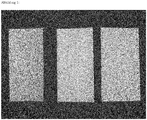
- illustration 1 shows the quality of the coating of the insecticidal, mimmable products produced according to Example 2 (formulations applied from left to right: Fl A, Fl B and Fl C). While Fl A and Fl B have a homogeneous coating, Fl C shows an inhomogeneous coating.
- Example 3 Description of the preparation of a formulation according to the invention without fragrance and insecticidal, smolderable product
- formulation D (FL D) according to the invention without perfume was prepared with transfluthrin in accordance with the preparation instructions given above (see page 21).
- formulation Fl D composition Wt% Transfluthrin technically 3.30 Solvesso 100 20.00 Span 80 5.70 Tween 80 1.95 Potassium nitrate 12.50 water 56.55 total 100.00
- formulation D was used to produce an insecticidal paper.
- the formulations were applied in one step with the printability tester PhantomQD TM Proofer (HARPER Graphics GmbH) and the anilox roller 306 140 100 20.0C (theoretical scoop volume approx. 31 cm 3 / m 2 and 60 degree engraving angle, HARPER Graphics GmbH) on the offset paper Tauro offset 90 gm (Robert Horn Group).
- the W / O formulation with a specific conductivity ⁇ 0.1 mS / cm was transferred directly from the rotogravure roller onto a paper strip at constant pressure and with an effective weight of approximately 16 g / m 2 .
- the insecticidal paper faded completely.
Landscapes
- Life Sciences & Earth Sciences (AREA)
- General Health & Medical Sciences (AREA)
- Health & Medical Sciences (AREA)
- Zoology (AREA)
- Agronomy & Crop Science (AREA)
- Pest Control & Pesticides (AREA)
- Plant Pathology (AREA)
- Engineering & Computer Science (AREA)
- Dentistry (AREA)
- Wood Science & Technology (AREA)
- Environmental Sciences (AREA)
- Toxicology (AREA)
- Dispersion Chemistry (AREA)
- Chemical & Material Sciences (AREA)
- Agricultural Chemicals And Associated Chemicals (AREA)
- Catching Or Destruction (AREA)
Priority Applications (1)
| Application Number | Priority Date | Filing Date | Title |
|---|---|---|---|
| EP13723472.0A EP2849563B1 (de) | 2012-05-16 | 2013-05-14 | Insektizide wasser-in-öl (w/o) formulierung |
Applications Claiming Priority (3)
| Application Number | Priority Date | Filing Date | Title |
|---|---|---|---|
| EP12168250 | 2012-05-16 | ||
| EP13723472.0A EP2849563B1 (de) | 2012-05-16 | 2013-05-14 | Insektizide wasser-in-öl (w/o) formulierung |
| PCT/EP2013/059917 WO2013171199A1 (de) | 2012-05-16 | 2013-05-14 | Insektizide wasser-in-öl (w/o) formulierung |
Publications (2)
| Publication Number | Publication Date |
|---|---|
| EP2849563A1 EP2849563A1 (de) | 2015-03-25 |
| EP2849563B1 true EP2849563B1 (de) | 2020-01-22 |
Family
ID=48463973
Family Applications (1)
| Application Number | Title | Priority Date | Filing Date |
|---|---|---|---|
| EP13723472.0A Active EP2849563B1 (de) | 2012-05-16 | 2013-05-14 | Insektizide wasser-in-öl (w/o) formulierung |
Country Status (23)
| Country | Link |
|---|---|
| US (1) | US10104884B2 (enExample) |
| EP (1) | EP2849563B1 (enExample) |
| JP (1) | JP6165847B2 (enExample) |
| KR (1) | KR102145261B1 (enExample) |
| CN (1) | CN104470356B (enExample) |
| AP (1) | AP2014008101A0 (enExample) |
| AR (1) | AR091061A1 (enExample) |
| AU (1) | AU2013261868B2 (enExample) |
| BR (1) | BR112014028369A2 (enExample) |
| CR (1) | CR20140521A (enExample) |
| EA (1) | EA026033B1 (enExample) |
| ES (1) | ES2780356T3 (enExample) |
| GE (1) | GEP201706644B (enExample) |
| IN (1) | IN2014DN09841A (enExample) |
| MX (1) | MX365746B (enExample) |
| MY (1) | MY172146A (enExample) |
| NI (1) | NI201400131A (enExample) |
| PE (1) | PE20142455A1 (enExample) |
| PH (1) | PH12014502546A1 (enExample) |
| SG (1) | SG11201407113PA (enExample) |
| UA (1) | UA115059C2 (enExample) |
| WO (1) | WO2013171199A1 (enExample) |
| ZA (1) | ZA201408348B (enExample) |
Families Citing this family (5)
| Publication number | Priority date | Publication date | Assignee | Title |
|---|---|---|---|---|
| UY36181A (es) | 2014-06-24 | 2016-09-30 | Fmc Corp | Formulaciones de espumas y concentrados emulsionables |
| CN107638313A (zh) * | 2017-09-04 | 2018-01-30 | 上海千紫香料有限公司 | 一种驱蚊精油及其制备方法 |
| CN109169646B (zh) * | 2018-10-15 | 2020-12-29 | 深圳诺普信农化股份有限公司 | 一种呋虫胺可分散油悬浮剂及其制备方法 |
| US20220201976A1 (en) * | 2020-12-30 | 2022-06-30 | Thermacell Repellents, Inc. | Tick control device having oral deterrent material |
| CN116076517B (zh) * | 2023-02-17 | 2025-11-04 | 江西红土地化工有限公司 | 含溴氰虫酰胺与杀虫环可分散油悬浮剂及其制备与应用 |
Citations (3)
| Publication number | Priority date | Publication date | Assignee | Title |
|---|---|---|---|---|
| US20070191230A1 (en) * | 2006-02-15 | 2007-08-16 | Pompeo Michael P | Emulsifier system and pesticidal formulations containing the emulsifier system |
| WO2007131679A2 (de) * | 2006-05-17 | 2007-11-22 | Bayer Cropscience Ag | Mit insektiziden wirkstoffen getränktes papier |
| US20080318786A1 (en) * | 2007-06-19 | 2008-12-25 | Bayer Cropscience Ag | Synergistic combinations which are compatible with cultivated plants and which comprise herbicides selected from the group consisting of benzoylcyclohexanediones for use in rice crops |
Family Cites Families (45)
| Publication number | Priority date | Publication date | Assignee | Title |
|---|---|---|---|---|
| FR992736A (fr) * | 1944-08-18 | 1951-10-22 | Le Fly Tox | Produit fumigène pour la destruction des insectes et de leurs larves |
| GB727577A (en) | 1951-11-14 | 1955-04-06 | Frederick William Sutton | Improvements in or relating to devices for distributing insecticidal compositions |
| EP0539588A1 (en) | 1990-07-05 | 1993-05-05 | Nippon Soda Co., Ltd. | Amine derivative |
| US5207389A (en) | 1992-07-06 | 1993-05-04 | The Andersons | Cellulosic carrier |
| CN1087228A (zh) * | 1992-11-27 | 1994-06-01 | 郭静峰 | 制造无毒性灭蚊蝇剂的方法 |
| ZA96514B (en) * | 1995-01-27 | 1996-08-13 | Johnson & Son Inc S C | Insecticidally-active composition |
| TW529911B (en) * | 1998-11-20 | 2003-05-01 | Sumitomo Chemical Co | Pyrethroid compounds and composition for controlling pest containing the same |
| GB9915085D0 (en) | 1999-06-29 | 1999-08-25 | Raman Boards Limited | An insect repellant device |
| GB0020622D0 (en) | 2000-08-22 | 2000-10-11 | Reckitt Benckiser Au Pty Ltd | A device |
| ATE536345T1 (de) | 2001-05-31 | 2011-12-15 | Nihon Nohyaku Co Ltd | Substituierte anilidderivate, deren zwischenprodukte, chemikalien für die landwirtschaft und den gartenbau und deren verwendung |
| CN1452864A (zh) * | 2002-04-28 | 2003-11-05 | 王晓义 | 灭蚊片 |
| GB0213715D0 (en) | 2002-06-14 | 2002-07-24 | Syngenta Ltd | Chemical compounds |
| TWI312272B (en) | 2003-05-12 | 2009-07-21 | Sumitomo Chemical Co | Pyrimidine compound and pests controlling composition containing the same |
| UA79404C2 (en) | 2003-10-02 | 2007-06-11 | Basf Ag | 2-cyanobenzenesulfonamide for controlling pests |
| GB0329744D0 (en) | 2003-12-23 | 2004-01-28 | Koninkl Philips Electronics Nv | A beverage maker incorporating multiple beverage collection chambers |
| CA2553715C (en) | 2004-02-18 | 2012-08-28 | Ishihara Sangyo Kaisha, Ltd. | Anthranilamide compounds, process for their production and pesticides containing them |
| JP4883296B2 (ja) | 2004-03-05 | 2012-02-22 | 日産化学工業株式会社 | イソキサゾリン置換ベンズアミド化合物及び有害生物防除剤 |
| WO2006043635A1 (ja) | 2004-10-20 | 2006-04-27 | Kumiai Chemical Industry Co., Ltd. | 3-トリアゾリルフェニルスルフィド誘導体及びそれを有効成分として含有する殺虫・殺ダニ・殺線虫剤 |
| ES2347806T3 (es) | 2004-11-26 | 2010-11-04 | Basf Se | Compuestos de 2-ciano-3-(halo)alcoxi-bencenosulfonamida novedosos para combatir plagas de animales. |
| DE102005008021A1 (de) | 2005-02-22 | 2006-08-24 | Bayer Cropscience Ag | Spiroketal-substituierte cyclische Ketoenole |
| DE602006019560D1 (de) | 2005-03-24 | 2011-02-24 | Basf Se | 2-cyanobenzolsulfonamidverbindungen zur behandlung von samen |
| EP1865776A4 (en) * | 2005-04-04 | 2013-04-10 | Valent Biosciences Corp | STABLE PESTICIDE CONCENTRATES AND END-USER EMULSIONS |
| WO2007040280A1 (ja) | 2005-10-06 | 2007-04-12 | Nippon Soda Co., Ltd. | 環状アミン化合物および有害生物防除剤 |
| WO2007057407A2 (en) | 2005-11-21 | 2007-05-24 | Basf Se | Insecticidal methods using 3-amino-1,2-benzisothiazole derivatives |
| TW200803740A (en) | 2005-12-16 | 2008-01-16 | Du Pont | 5-aryl isoxazolines for controlling invertebrate pests |
| WO2007101369A1 (fr) | 2006-03-09 | 2007-09-13 | East China University Of Science And Technology | Méthode de préparation et utilisation de composés présentant une action biocide |
| DE102006015470A1 (de) | 2006-03-31 | 2007-10-04 | Bayer Cropscience Ag | Substituierte Enaminocarbonylverbindungen |
| DE102006015467A1 (de) | 2006-03-31 | 2007-10-04 | Bayer Cropscience Ag | Substituierte Enaminocarbonylverbindungen |
| DE102006015468A1 (de) | 2006-03-31 | 2007-10-04 | Bayer Cropscience Ag | Substituierte Enaminocarbonylverbindungen |
| TWI381811B (zh) | 2006-06-23 | 2013-01-11 | Dow Agrosciences Llc | 用以防治可抵抗一般殺蟲劑之昆蟲的方法 |
| DE102006033572A1 (de) | 2006-07-20 | 2008-01-24 | Bayer Cropscience Ag | N'-Cyano-N-halogenalkyl-imidamid Derivate |
| US8202890B2 (en) | 2006-11-30 | 2012-06-19 | Meiji Seika Pharma Co., Ltd. | Pest control agent |
| DE102006057036A1 (de) | 2006-12-04 | 2008-06-05 | Bayer Cropscience Ag | Biphenylsubstituierte spirocyclische Ketoenole |
| KR20090116821A (ko) | 2007-03-01 | 2009-11-11 | 바스프 에스이 | 아미노티아졸린 화합물을 포함하는 살충 활성 혼합물 |
| GB0720126D0 (en) | 2007-10-15 | 2007-11-28 | Syngenta Participations Ag | Chemical compounds |
| WO2010005692A2 (en) | 2008-06-16 | 2010-01-14 | E. I. Du Pont De Nemours And Company | Insecticidal cyclic carbonyl amidines |
| JP5268461B2 (ja) | 2008-07-14 | 2013-08-21 | Meiji Seikaファルマ株式会社 | Pf1364物質、その製造方法、生産菌株、及び、それを有効成分とする農園芸用殺虫剤 |
| MX2011000477A (es) | 2008-07-17 | 2011-03-15 | Bayer Cropscience Ag | Compuestos heterociclicos como pesticidas. |
| KR101687743B1 (ko) | 2008-12-18 | 2016-12-19 | 바이엘 인텔렉쳐 프로퍼티 게엠베하 | 살해충제로서의 테트라졸 치환된 안트라닐산 아미드 |
| ES2589007T3 (es) | 2008-12-26 | 2016-11-08 | Dow Agrosciences, Llc | Composiciones estables de insecticida de tipo sulfoximina |
| BRPI0923702B8 (pt) | 2008-12-26 | 2022-10-11 | Dow Agrosciences Llc | Composições inseticidas estáveis compreendendo spinosin e uma mistura esteroisomérica de sulfoxaflor, e seu método de produção |
| JP5301323B2 (ja) | 2009-03-16 | 2013-09-25 | 株式会社エヌ・ティ・ティ・ドコモ | 移動端末装置及び無線通信方法 |
| AU2010308871A1 (en) | 2009-10-23 | 2012-05-03 | Sumitomo Chemical Company, Limited | Pest control composition |
| WO2011092722A1 (en) | 2010-02-01 | 2011-08-04 | A G N V S A Ramachandra Rao | Aromatic paper mosquito repellant and method of preparing it |
| CN102057925B (zh) | 2011-01-21 | 2013-04-10 | 陕西上格之路生物科学有限公司 | 一种含噻虫酰胺和生物源类杀虫剂的杀虫组合物 |
-
2013
- 2013-05-14 SG SG11201407113PA patent/SG11201407113PA/en unknown
- 2013-05-14 KR KR1020147031712A patent/KR102145261B1/ko active Active
- 2013-05-14 AU AU2013261868A patent/AU2013261868B2/en active Active
- 2013-05-14 WO PCT/EP2013/059917 patent/WO2013171199A1/de not_active Ceased
- 2013-05-14 IN IN9841DEN2014 patent/IN2014DN09841A/en unknown
- 2013-05-14 GE GEAP201313630A patent/GEP201706644B/en unknown
- 2013-05-14 US US14/400,574 patent/US10104884B2/en active Active
- 2013-05-14 EA EA201492037A patent/EA026033B1/ru not_active IP Right Cessation
- 2013-05-14 JP JP2015512028A patent/JP6165847B2/ja active Active
- 2013-05-14 UA UAA201413415A patent/UA115059C2/uk unknown
- 2013-05-14 MY MYPI2014703371A patent/MY172146A/en unknown
- 2013-05-14 CN CN201380037492.5A patent/CN104470356B/zh active Active
- 2013-05-14 EP EP13723472.0A patent/EP2849563B1/de active Active
- 2013-05-14 ES ES13723472T patent/ES2780356T3/es active Active
- 2013-05-14 AP AP2014008101A patent/AP2014008101A0/xx unknown
- 2013-05-14 BR BR112014028369A patent/BR112014028369A2/pt not_active Application Discontinuation
- 2013-05-14 PE PE2014002020A patent/PE20142455A1/es active IP Right Grant
- 2013-05-14 MX MX2014013886A patent/MX365746B/es active IP Right Grant
- 2013-05-15 AR ARP130101689A patent/AR091061A1/es active IP Right Grant
-
2014
- 2014-11-13 ZA ZA2014/08348A patent/ZA201408348B/en unknown
- 2014-11-14 NI NI201400131A patent/NI201400131A/es unknown
- 2014-11-14 PH PH12014502546A patent/PH12014502546A1/en unknown
- 2014-11-14 CR CR20140521A patent/CR20140521A/es unknown
Patent Citations (3)
| Publication number | Priority date | Publication date | Assignee | Title |
|---|---|---|---|---|
| US20070191230A1 (en) * | 2006-02-15 | 2007-08-16 | Pompeo Michael P | Emulsifier system and pesticidal formulations containing the emulsifier system |
| WO2007131679A2 (de) * | 2006-05-17 | 2007-11-22 | Bayer Cropscience Ag | Mit insektiziden wirkstoffen getränktes papier |
| US20080318786A1 (en) * | 2007-06-19 | 2008-12-25 | Bayer Cropscience Ag | Synergistic combinations which are compatible with cultivated plants and which comprise herbicides selected from the group consisting of benzoylcyclohexanediones for use in rice crops |
Also Published As
| Publication number | Publication date |
|---|---|
| HK1203765A1 (en) | 2015-11-06 |
| JP6165847B2 (ja) | 2017-07-19 |
| AU2013261868A1 (en) | 2014-12-04 |
| AR091061A1 (es) | 2014-12-30 |
| UA115059C2 (uk) | 2017-09-11 |
| MY172146A (en) | 2019-11-14 |
| KR20150017330A (ko) | 2015-02-16 |
| CN104470356B (zh) | 2017-10-31 |
| MX2014013886A (es) | 2015-01-16 |
| CN104470356A (zh) | 2015-03-25 |
| SG11201407113PA (en) | 2014-12-30 |
| WO2013171199A1 (de) | 2013-11-21 |
| US20150098975A1 (en) | 2015-04-09 |
| ZA201408348B (en) | 2016-08-31 |
| JP2015521181A (ja) | 2015-07-27 |
| EP2849563A1 (de) | 2015-03-25 |
| AP2014008101A0 (en) | 2014-12-31 |
| US10104884B2 (en) | 2018-10-23 |
| CR20140521A (es) | 2014-12-08 |
| NI201400131A (es) | 2015-12-10 |
| PH12014502546A1 (en) | 2015-01-21 |
| PE20142455A1 (es) | 2015-01-17 |
| MX365746B (es) | 2019-06-12 |
| EA026033B1 (ru) | 2017-02-28 |
| KR102145261B1 (ko) | 2020-08-18 |
| IN2014DN09841A (enExample) | 2015-08-07 |
| ES2780356T3 (es) | 2020-08-25 |
| AU2013261868B2 (en) | 2016-05-26 |
| BR112014028369A2 (pt) | 2017-07-18 |
| EA201492037A1 (ru) | 2015-05-29 |
| GEP201706644B (en) | 2017-03-27 |
Similar Documents
| Publication | Publication Date | Title |
|---|---|---|
| EP2849563B1 (de) | Insektizide wasser-in-öl (w/o) formulierung | |
| RU2294641C2 (ru) | Инсектицидное средство | |
| TWI578908B (zh) | 包含芬普尼和百滅寧的局部施用組成物和使用方法 | |
| EP2477488B1 (de) | Alkylpolypropylenglycolpolyethylenglycol enthaltende agrochemische zusammensetzungen | |
| EP0693254A1 (de) | Insektizid-enthaltende Gelformulieringen für Verdampfersysteme | |
| WO2016001285A1 (de) | Einfache und kostengünstige herstellung von einer insektizid-wachs-partikel enthaltenden zusammensetzung | |
| EP2849562B1 (de) | Insektizide öl-in-wasser (o/w) formulierung | |
| DE60007165T2 (de) | Pestizide und/oder pflanzenwuchsregulierende zusammensetzungen mit nichtionischer tenside | |
| DE102008006998A1 (de) | Flüssige Agrochemikalienzusammensetzung, die einen hydrophoben agrochemischen Wirkstoff enthält | |
| EP2560485B1 (de) | Triglyzerid-enthaltende winterspritzmittel | |
| RU2395201C1 (ru) | Инсектицидная композиция и способ борьбы с насекомыми-вредителями культурных растений | |
| FR2984079A1 (fr) | Une nouvelle suspo-emulsion aqueuse | |
| CN103327812A (zh) | 包含n-取代的2-吡咯烷酮-4-甲酸酯的农药制剂 | |
| CN101703069A (zh) | 毒死蜱水分散组合物及其制备方法 | |
| WO2017061959A1 (en) | A pesticide composition comprising a combination of bifenthrin and abamectin molecules in capsule form | |
| OA17178A (en) | Insecticidal water-in-oil (W/O) formulation. | |
| HK1203765B (en) | Insecticidal water-in-oil (w/o) formulation | |
| DE102008006997B4 (de) | Flüssige Agrochemikalienzusammensetzung, die einen hydrophoben agrochemischen Wirkstoff enthält | |
| WO2007112905A1 (de) | Penetrationsförderer für insektizide wirkstoffe | |
| EP2117318A2 (de) | Penetrationsförderer für insektizide | |
| DK176371B1 (da) | Olie-i-vand-formulering af avermectiner, fremgangsmåde til fremstilling af en olie-i-vand-formulering af avermectiner samt anvendelse deraf | |
| OA20624A (en) | Stable Agrochemical Composition | |
| DE102007013360A1 (de) | Penetrationsförderer für insektizide Wirkstoffe |
Legal Events
| Date | Code | Title | Description |
|---|---|---|---|
| PUAI | Public reference made under article 153(3) epc to a published international application that has entered the european phase |
Free format text: ORIGINAL CODE: 0009012 |
|
| 17P | Request for examination filed |
Effective date: 20141216 |
|
| AK | Designated contracting states |
Kind code of ref document: A1 Designated state(s): AL AT BE BG CH CY CZ DE DK EE ES FI FR GB GR HR HU IE IS IT LI LT LU LV MC MK MT NL NO PL PT RO RS SE SI SK SM TR |
|
| AX | Request for extension of the european patent |
Extension state: BA ME |
|
| DAX | Request for extension of the european patent (deleted) | ||
| 17Q | First examination report despatched |
Effective date: 20160804 |
|
| STAA | Information on the status of an ep patent application or granted ep patent |
Free format text: STATUS: EXAMINATION IS IN PROGRESS |
|
| GRAP | Despatch of communication of intention to grant a patent |
Free format text: ORIGINAL CODE: EPIDOSNIGR1 |
|
| STAA | Information on the status of an ep patent application or granted ep patent |
Free format text: STATUS: GRANT OF PATENT IS INTENDED |
|
| INTG | Intention to grant announced |
Effective date: 20191011 |
|
| GRAS | Grant fee paid |
Free format text: ORIGINAL CODE: EPIDOSNIGR3 |
|
| GRAA | (expected) grant |
Free format text: ORIGINAL CODE: 0009210 |
|
| STAA | Information on the status of an ep patent application or granted ep patent |
Free format text: STATUS: THE PATENT HAS BEEN GRANTED |
|
| AK | Designated contracting states |
Kind code of ref document: B1 Designated state(s): AL AT BE BG CH CY CZ DE DK EE ES FI FR GB GR HR HU IE IS IT LI LT LU LV MC MK MT NL NO PL PT RO RS SE SI SK SM TR |
|
| REG | Reference to a national code |
Ref country code: GB Ref legal event code: FG4D Free format text: NOT ENGLISH |
|
| REG | Reference to a national code |
Ref country code: CH Ref legal event code: EP |
|
| REG | Reference to a national code |
Ref country code: DE Ref legal event code: R096 Ref document number: 502013014243 Country of ref document: DE |
|
| REG | Reference to a national code |
Ref country code: AT Ref legal event code: REF Ref document number: 1226342 Country of ref document: AT Kind code of ref document: T Effective date: 20200215 |
|
| REG | Reference to a national code |
Ref country code: IE Ref legal event code: FG4D Free format text: LANGUAGE OF EP DOCUMENT: GERMAN |
|
| REG | Reference to a national code |
Ref country code: NL Ref legal event code: MP Effective date: 20200122 |
|
| REG | Reference to a national code |
Ref country code: LT Ref legal event code: MG4D |
|
| PG25 | Lapsed in a contracting state [announced via postgrant information from national office to epo] |
Ref country code: RS Free format text: LAPSE BECAUSE OF FAILURE TO SUBMIT A TRANSLATION OF THE DESCRIPTION OR TO PAY THE FEE WITHIN THE PRESCRIBED TIME-LIMIT Effective date: 20200122 Ref country code: NL Free format text: LAPSE BECAUSE OF FAILURE TO SUBMIT A TRANSLATION OF THE DESCRIPTION OR TO PAY THE FEE WITHIN THE PRESCRIBED TIME-LIMIT Effective date: 20200122 Ref country code: NO Free format text: LAPSE BECAUSE OF FAILURE TO SUBMIT A TRANSLATION OF THE DESCRIPTION OR TO PAY THE FEE WITHIN THE PRESCRIBED TIME-LIMIT Effective date: 20200422 Ref country code: PT Free format text: LAPSE BECAUSE OF FAILURE TO SUBMIT A TRANSLATION OF THE DESCRIPTION OR TO PAY THE FEE WITHIN THE PRESCRIBED TIME-LIMIT Effective date: 20200614 Ref country code: FI Free format text: LAPSE BECAUSE OF FAILURE TO SUBMIT A TRANSLATION OF THE DESCRIPTION OR TO PAY THE FEE WITHIN THE PRESCRIBED TIME-LIMIT Effective date: 20200122 |
|
| REG | Reference to a national code |
Ref country code: ES Ref legal event code: FG2A Ref document number: 2780356 Country of ref document: ES Kind code of ref document: T3 Effective date: 20200825 |
|
| PG25 | Lapsed in a contracting state [announced via postgrant information from national office to epo] |
Ref country code: BG Free format text: LAPSE BECAUSE OF FAILURE TO SUBMIT A TRANSLATION OF THE DESCRIPTION OR TO PAY THE FEE WITHIN THE PRESCRIBED TIME-LIMIT Effective date: 20200422 Ref country code: LV Free format text: LAPSE BECAUSE OF FAILURE TO SUBMIT A TRANSLATION OF THE DESCRIPTION OR TO PAY THE FEE WITHIN THE PRESCRIBED TIME-LIMIT Effective date: 20200122 Ref country code: SE Free format text: LAPSE BECAUSE OF FAILURE TO SUBMIT A TRANSLATION OF THE DESCRIPTION OR TO PAY THE FEE WITHIN THE PRESCRIBED TIME-LIMIT Effective date: 20200122 Ref country code: IS Free format text: LAPSE BECAUSE OF FAILURE TO SUBMIT A TRANSLATION OF THE DESCRIPTION OR TO PAY THE FEE WITHIN THE PRESCRIBED TIME-LIMIT Effective date: 20200522 Ref country code: HR Free format text: LAPSE BECAUSE OF FAILURE TO SUBMIT A TRANSLATION OF THE DESCRIPTION OR TO PAY THE FEE WITHIN THE PRESCRIBED TIME-LIMIT Effective date: 20200122 Ref country code: GR Free format text: LAPSE BECAUSE OF FAILURE TO SUBMIT A TRANSLATION OF THE DESCRIPTION OR TO PAY THE FEE WITHIN THE PRESCRIBED TIME-LIMIT Effective date: 20200423 |
|
| REG | Reference to a national code |
Ref country code: DE Ref legal event code: R097 Ref document number: 502013014243 Country of ref document: DE |
|
| PG25 | Lapsed in a contracting state [announced via postgrant information from national office to epo] |
Ref country code: SK Free format text: LAPSE BECAUSE OF FAILURE TO SUBMIT A TRANSLATION OF THE DESCRIPTION OR TO PAY THE FEE WITHIN THE PRESCRIBED TIME-LIMIT Effective date: 20200122 Ref country code: LT Free format text: LAPSE BECAUSE OF FAILURE TO SUBMIT A TRANSLATION OF THE DESCRIPTION OR TO PAY THE FEE WITHIN THE PRESCRIBED TIME-LIMIT Effective date: 20200122 Ref country code: DK Free format text: LAPSE BECAUSE OF FAILURE TO SUBMIT A TRANSLATION OF THE DESCRIPTION OR TO PAY THE FEE WITHIN THE PRESCRIBED TIME-LIMIT Effective date: 20200122 Ref country code: SM Free format text: LAPSE BECAUSE OF FAILURE TO SUBMIT A TRANSLATION OF THE DESCRIPTION OR TO PAY THE FEE WITHIN THE PRESCRIBED TIME-LIMIT Effective date: 20200122 Ref country code: EE Free format text: LAPSE BECAUSE OF FAILURE TO SUBMIT A TRANSLATION OF THE DESCRIPTION OR TO PAY THE FEE WITHIN THE PRESCRIBED TIME-LIMIT Effective date: 20200122 Ref country code: RO Free format text: LAPSE BECAUSE OF FAILURE TO SUBMIT A TRANSLATION OF THE DESCRIPTION OR TO PAY THE FEE WITHIN THE PRESCRIBED TIME-LIMIT Effective date: 20200122 Ref country code: CZ Free format text: LAPSE BECAUSE OF FAILURE TO SUBMIT A TRANSLATION OF THE DESCRIPTION OR TO PAY THE FEE WITHIN THE PRESCRIBED TIME-LIMIT Effective date: 20200122 |
|
| PLBE | No opposition filed within time limit |
Free format text: ORIGINAL CODE: 0009261 |
|
| STAA | Information on the status of an ep patent application or granted ep patent |
Free format text: STATUS: NO OPPOSITION FILED WITHIN TIME LIMIT |
|
| 26N | No opposition filed |
Effective date: 20201023 |
|
| PG25 | Lapsed in a contracting state [announced via postgrant information from national office to epo] |
Ref country code: MC Free format text: LAPSE BECAUSE OF FAILURE TO SUBMIT A TRANSLATION OF THE DESCRIPTION OR TO PAY THE FEE WITHIN THE PRESCRIBED TIME-LIMIT Effective date: 20200122 Ref country code: LI Free format text: LAPSE BECAUSE OF NON-PAYMENT OF DUE FEES Effective date: 20200531 Ref country code: CH Free format text: LAPSE BECAUSE OF NON-PAYMENT OF DUE FEES Effective date: 20200531 |
|
| PG25 | Lapsed in a contracting state [announced via postgrant information from national office to epo] |
Ref country code: SI Free format text: LAPSE BECAUSE OF FAILURE TO SUBMIT A TRANSLATION OF THE DESCRIPTION OR TO PAY THE FEE WITHIN THE PRESCRIBED TIME-LIMIT Effective date: 20200122 Ref country code: PL Free format text: LAPSE BECAUSE OF FAILURE TO SUBMIT A TRANSLATION OF THE DESCRIPTION OR TO PAY THE FEE WITHIN THE PRESCRIBED TIME-LIMIT Effective date: 20200122 |
|
| REG | Reference to a national code |
Ref country code: BE Ref legal event code: MM Effective date: 20200531 |
|
| PG25 | Lapsed in a contracting state [announced via postgrant information from national office to epo] |
Ref country code: LU Free format text: LAPSE BECAUSE OF NON-PAYMENT OF DUE FEES Effective date: 20200514 |
|
| PG25 | Lapsed in a contracting state [announced via postgrant information from national office to epo] |
Ref country code: IE Free format text: LAPSE BECAUSE OF NON-PAYMENT OF DUE FEES Effective date: 20200514 |
|
| PG25 | Lapsed in a contracting state [announced via postgrant information from national office to epo] |
Ref country code: BE Free format text: LAPSE BECAUSE OF NON-PAYMENT OF DUE FEES Effective date: 20200531 |
|
| REG | Reference to a national code |
Ref country code: AT Ref legal event code: MM01 Ref document number: 1226342 Country of ref document: AT Kind code of ref document: T Effective date: 20200514 |
|
| PG25 | Lapsed in a contracting state [announced via postgrant information from national office to epo] |
Ref country code: AT Free format text: LAPSE BECAUSE OF NON-PAYMENT OF DUE FEES Effective date: 20200514 |
|
| PG25 | Lapsed in a contracting state [announced via postgrant information from national office to epo] |
Ref country code: MT Free format text: LAPSE BECAUSE OF FAILURE TO SUBMIT A TRANSLATION OF THE DESCRIPTION OR TO PAY THE FEE WITHIN THE PRESCRIBED TIME-LIMIT Effective date: 20200122 Ref country code: CY Free format text: LAPSE BECAUSE OF FAILURE TO SUBMIT A TRANSLATION OF THE DESCRIPTION OR TO PAY THE FEE WITHIN THE PRESCRIBED TIME-LIMIT Effective date: 20200122 |
|
| PG25 | Lapsed in a contracting state [announced via postgrant information from national office to epo] |
Ref country code: MK Free format text: LAPSE BECAUSE OF FAILURE TO SUBMIT A TRANSLATION OF THE DESCRIPTION OR TO PAY THE FEE WITHIN THE PRESCRIBED TIME-LIMIT Effective date: 20200122 Ref country code: AL Free format text: LAPSE BECAUSE OF FAILURE TO SUBMIT A TRANSLATION OF THE DESCRIPTION OR TO PAY THE FEE WITHIN THE PRESCRIBED TIME-LIMIT Effective date: 20200122 |
|
| REG | Reference to a national code |
Ref country code: DE Ref legal event code: R081 Ref document number: 502013014243 Country of ref document: DE Owner name: DISCOVERY PURCHASER CORPORATION, WILMINGTON, US Free format text: FORMER OWNER: BAYER CROPSCIENCE AG, 40789 MONHEIM, DE |
|
| P01 | Opt-out of the competence of the unified patent court (upc) registered |
Effective date: 20230421 |
|
| REG | Reference to a national code |
Ref country code: GB Ref legal event code: 732E Free format text: REGISTERED BETWEEN 20230817 AND 20230823 |
|
| REG | Reference to a national code |
Ref country code: ES Ref legal event code: PC2A Owner name: DISCOVERY PURCHASER CORPORATION Effective date: 20240813 |
|
| PGFP | Annual fee paid to national office [announced via postgrant information from national office to epo] |
Ref country code: TR Payment date: 20240426 Year of fee payment: 12 |
|
| PGFP | Annual fee paid to national office [announced via postgrant information from national office to epo] |
Ref country code: DE Payment date: 20250528 Year of fee payment: 13 |
|
| PGFP | Annual fee paid to national office [announced via postgrant information from national office to epo] |
Ref country code: GB Payment date: 20250520 Year of fee payment: 13 Ref country code: ES Payment date: 20250611 Year of fee payment: 13 |
|
| PGFP | Annual fee paid to national office [announced via postgrant information from national office to epo] |
Ref country code: IT Payment date: 20250522 Year of fee payment: 13 |
|
| PGFP | Annual fee paid to national office [announced via postgrant information from national office to epo] |
Ref country code: FR Payment date: 20250526 Year of fee payment: 13 |