EP2826784B1 - Composition comprising a HCV NS3 protease inhibitor and a phosphoramidate prodrug of 2'-deoxy-2'-fluoro-2'-C-methyluridine nucleoside - Google Patents
Composition comprising a HCV NS3 protease inhibitor and a phosphoramidate prodrug of 2'-deoxy-2'-fluoro-2'-C-methyluridine nucleoside Download PDFInfo
- Publication number
- EP2826784B1 EP2826784B1 EP14179358.8A EP14179358A EP2826784B1 EP 2826784 B1 EP2826784 B1 EP 2826784B1 EP 14179358 A EP14179358 A EP 14179358A EP 2826784 B1 EP2826784 B1 EP 2826784B1
- Authority
- EP
- European Patent Office
- Prior art keywords
- alkyl
- hcv
- dmso
- nmr
- compound
- Prior art date
- Legal status (The legal status is an assumption and is not a legal conclusion. Google has not performed a legal analysis and makes no representation as to the accuracy of the status listed.)
- Active
Links
- 0 CC(C(*)=O)(C#C)N(*)P(C)=O Chemical compound CC(C(*)=O)(C#C)N(*)P(C)=O 0.000 description 2
- ARKKGZQTGXJVKW-VPCXQMTMSA-N C[C@@]1([C@H](N(C=CC(N2)=O)C2=O)O[C@H](CO)[C@H]1O)F Chemical compound C[C@@]1([C@H](N(C=CC(N2)=O)C2=O)O[C@H](CO)[C@H]1O)F ARKKGZQTGXJVKW-VPCXQMTMSA-N 0.000 description 2
- MLJXBURFCCWNCL-MDEDWAGZSA-N CC(C)[C@@H](C(OC)=O)NP(OC[C@H](C[C@@H]1C)O[C@H]1N(C=CC(N)=N1)C1=O)(Oc(cc1)ccc1Br)=O Chemical compound CC(C)[C@@H](C(OC)=O)NP(OC[C@H](C[C@@H]1C)O[C@H]1N(C=CC(N)=N1)C1=O)(Oc(cc1)ccc1Br)=O MLJXBURFCCWNCL-MDEDWAGZSA-N 0.000 description 1
- RYYQXARSDVNCBR-ZOZMEPSFSA-N CC(C)[C@@H](C(OC)=O)NP(Oc(cc1)ccc1Br)(Cl)=O Chemical compound CC(C)[C@@H](C(OC)=O)NP(Oc(cc1)ccc1Br)(Cl)=O RYYQXARSDVNCBR-ZOZMEPSFSA-N 0.000 description 1
- MAZOVSPSPJRGKY-SOZZXGSXSA-N C[C@@H](C(OC)=O)NP(OC[C@H]([C@H]([C@@]1(C)F)O)O[C@H]1N(C=CC(N1)=O)C1=O)(Oc(cc1)ccc1Br)=O Chemical compound C[C@@H](C(OC)=O)NP(OC[C@H]([C@H]([C@@]1(C)F)O)O[C@H]1N(C=CC(N1)=O)C1=O)(Oc(cc1)ccc1Br)=O MAZOVSPSPJRGKY-SOZZXGSXSA-N 0.000 description 1
- ZYOKZJKKIPUATH-QNUGLTPUSA-N C[C@@H](C(OC)=O)NP(Oc(cc1)ccc1Br)(Cl)=O Chemical compound C[C@@H](C(OC)=O)NP(Oc(cc1)ccc1Br)(Cl)=O ZYOKZJKKIPUATH-QNUGLTPUSA-N 0.000 description 1
- JMPXXSAUCCWJBP-IZJFDVHYSA-N C[C@@H]1[C@H](N(C=CC(/N=C/N(C)C)=N2)C2=O)O[C@H](CO)C1 Chemical compound C[C@@H]1[C@H](N(C=CC(/N=C/N(C)C)=N2)C2=O)O[C@H](CO)C1 JMPXXSAUCCWJBP-IZJFDVHYSA-N 0.000 description 1
- NYPIRLYMDJMKGW-VPCXQMTMSA-N C[C@@]1([C@H](N(C=CC(N)=N2)C2=O)O[C@H](CO)[C@H]1O)F Chemical compound C[C@@]1([C@H](N(C=CC(N)=N2)C2=O)O[C@H](CO)[C@H]1O)F NYPIRLYMDJMKGW-VPCXQMTMSA-N 0.000 description 1
- OUDQYAYIRAUNLO-PDKZGUECSA-N C[C@@]1([C@H](N(C=CC(N2)=O)C2=O)O[C@H](COC(c2ccccc2)=O)[C@H]1OC(c1ccccc1)=O)F Chemical compound C[C@@]1([C@H](N(C=CC(N2)=O)C2=O)O[C@H](COC(c2ccccc2)=O)[C@H]1OC(c1ccccc1)=O)F OUDQYAYIRAUNLO-PDKZGUECSA-N 0.000 description 1
Classifications
-
- C—CHEMISTRY; METALLURGY
- C07—ORGANIC CHEMISTRY
- C07H—SUGARS; DERIVATIVES THEREOF; NUCLEOSIDES; NUCLEOTIDES; NUCLEIC ACIDS
- C07H19/00—Compounds containing a hetero ring sharing one ring hetero atom with a saccharide radical; Nucleosides; Mononucleotides; Anhydro-derivatives thereof
- C07H19/02—Compounds containing a hetero ring sharing one ring hetero atom with a saccharide radical; Nucleosides; Mononucleotides; Anhydro-derivatives thereof sharing nitrogen
- C07H19/04—Heterocyclic radicals containing only nitrogen atoms as ring hetero atom
- C07H19/06—Pyrimidine radicals
- C07H19/10—Pyrimidine radicals with the saccharide radical esterified by phosphoric or polyphosphoric acids
-
- C—CHEMISTRY; METALLURGY
- C07—ORGANIC CHEMISTRY
- C07H—SUGARS; DERIVATIVES THEREOF; NUCLEOSIDES; NUCLEOTIDES; NUCLEIC ACIDS
- C07H19/00—Compounds containing a hetero ring sharing one ring hetero atom with a saccharide radical; Nucleosides; Mononucleotides; Anhydro-derivatives thereof
- C07H19/02—Compounds containing a hetero ring sharing one ring hetero atom with a saccharide radical; Nucleosides; Mononucleotides; Anhydro-derivatives thereof sharing nitrogen
- C07H19/04—Heterocyclic radicals containing only nitrogen atoms as ring hetero atom
- C07H19/16—Purine radicals
-
- A—HUMAN NECESSITIES
- A61—MEDICAL OR VETERINARY SCIENCE; HYGIENE
- A61K—PREPARATIONS FOR MEDICAL, DENTAL OR TOILETRY PURPOSES
- A61K31/00—Medicinal preparations containing organic active ingredients
- A61K31/70—Carbohydrates; Sugars; Derivatives thereof
- A61K31/7042—Compounds having saccharide radicals and heterocyclic rings
- A61K31/7052—Compounds having saccharide radicals and heterocyclic rings having nitrogen as a ring hetero atom, e.g. nucleosides, nucleotides
- A61K31/706—Compounds having saccharide radicals and heterocyclic rings having nitrogen as a ring hetero atom, e.g. nucleosides, nucleotides containing six-membered rings with nitrogen as a ring hetero atom
- A61K31/7064—Compounds having saccharide radicals and heterocyclic rings having nitrogen as a ring hetero atom, e.g. nucleosides, nucleotides containing six-membered rings with nitrogen as a ring hetero atom containing condensed or non-condensed pyrimidines
- A61K31/7068—Compounds having saccharide radicals and heterocyclic rings having nitrogen as a ring hetero atom, e.g. nucleosides, nucleotides containing six-membered rings with nitrogen as a ring hetero atom containing condensed or non-condensed pyrimidines having oxo groups directly attached to the pyrimidine ring, e.g. cytidine, cytidylic acid
- A61K31/7072—Compounds having saccharide radicals and heterocyclic rings having nitrogen as a ring hetero atom, e.g. nucleosides, nucleotides containing six-membered rings with nitrogen as a ring hetero atom containing condensed or non-condensed pyrimidines having oxo groups directly attached to the pyrimidine ring, e.g. cytidine, cytidylic acid having two oxo groups directly attached to the pyrimidine ring, e.g. uridine, uridylic acid, thymidine, zidovudine
-
- A—HUMAN NECESSITIES
- A61—MEDICAL OR VETERINARY SCIENCE; HYGIENE
- A61K—PREPARATIONS FOR MEDICAL, DENTAL OR TOILETRY PURPOSES
- A61K31/00—Medicinal preparations containing organic active ingredients
- A61K31/70—Carbohydrates; Sugars; Derivatives thereof
- A61K31/7042—Compounds having saccharide radicals and heterocyclic rings
- A61K31/7052—Compounds having saccharide radicals and heterocyclic rings having nitrogen as a ring hetero atom, e.g. nucleosides, nucleotides
- A61K31/706—Compounds having saccharide radicals and heterocyclic rings having nitrogen as a ring hetero atom, e.g. nucleosides, nucleotides containing six-membered rings with nitrogen as a ring hetero atom
-
- A—HUMAN NECESSITIES
- A61—MEDICAL OR VETERINARY SCIENCE; HYGIENE
- A61K—PREPARATIONS FOR MEDICAL, DENTAL OR TOILETRY PURPOSES
- A61K31/00—Medicinal preparations containing organic active ingredients
- A61K31/70—Carbohydrates; Sugars; Derivatives thereof
- A61K31/7042—Compounds having saccharide radicals and heterocyclic rings
- A61K31/7052—Compounds having saccharide radicals and heterocyclic rings having nitrogen as a ring hetero atom, e.g. nucleosides, nucleotides
- A61K31/706—Compounds having saccharide radicals and heterocyclic rings having nitrogen as a ring hetero atom, e.g. nucleosides, nucleotides containing six-membered rings with nitrogen as a ring hetero atom
- A61K31/7064—Compounds having saccharide radicals and heterocyclic rings having nitrogen as a ring hetero atom, e.g. nucleosides, nucleotides containing six-membered rings with nitrogen as a ring hetero atom containing condensed or non-condensed pyrimidines
-
- A—HUMAN NECESSITIES
- A61—MEDICAL OR VETERINARY SCIENCE; HYGIENE
- A61K—PREPARATIONS FOR MEDICAL, DENTAL OR TOILETRY PURPOSES
- A61K31/00—Medicinal preparations containing organic active ingredients
- A61K31/70—Carbohydrates; Sugars; Derivatives thereof
- A61K31/7042—Compounds having saccharide radicals and heterocyclic rings
- A61K31/7052—Compounds having saccharide radicals and heterocyclic rings having nitrogen as a ring hetero atom, e.g. nucleosides, nucleotides
- A61K31/706—Compounds having saccharide radicals and heterocyclic rings having nitrogen as a ring hetero atom, e.g. nucleosides, nucleotides containing six-membered rings with nitrogen as a ring hetero atom
- A61K31/7064—Compounds having saccharide radicals and heterocyclic rings having nitrogen as a ring hetero atom, e.g. nucleosides, nucleotides containing six-membered rings with nitrogen as a ring hetero atom containing condensed or non-condensed pyrimidines
- A61K31/7076—Compounds having saccharide radicals and heterocyclic rings having nitrogen as a ring hetero atom, e.g. nucleosides, nucleotides containing six-membered rings with nitrogen as a ring hetero atom containing condensed or non-condensed pyrimidines containing purines, e.g. adenosine, adenylic acid
-
- A—HUMAN NECESSITIES
- A61—MEDICAL OR VETERINARY SCIENCE; HYGIENE
- A61K—PREPARATIONS FOR MEDICAL, DENTAL OR TOILETRY PURPOSES
- A61K45/00—Medicinal preparations containing active ingredients not provided for in groups A61K31/00 - A61K41/00
- A61K45/06—Mixtures of active ingredients without chemical characterisation, e.g. antiphlogistics and cardiaca
-
- A—HUMAN NECESSITIES
- A61—MEDICAL OR VETERINARY SCIENCE; HYGIENE
- A61P—SPECIFIC THERAPEUTIC ACTIVITY OF CHEMICAL COMPOUNDS OR MEDICINAL PREPARATIONS
- A61P31/00—Antiinfectives, i.e. antibiotics, antiseptics, chemotherapeutics
-
- A—HUMAN NECESSITIES
- A61—MEDICAL OR VETERINARY SCIENCE; HYGIENE
- A61P—SPECIFIC THERAPEUTIC ACTIVITY OF CHEMICAL COMPOUNDS OR MEDICINAL PREPARATIONS
- A61P31/00—Antiinfectives, i.e. antibiotics, antiseptics, chemotherapeutics
- A61P31/12—Antivirals
-
- A—HUMAN NECESSITIES
- A61—MEDICAL OR VETERINARY SCIENCE; HYGIENE
- A61P—SPECIFIC THERAPEUTIC ACTIVITY OF CHEMICAL COMPOUNDS OR MEDICINAL PREPARATIONS
- A61P31/00—Antiinfectives, i.e. antibiotics, antiseptics, chemotherapeutics
- A61P31/12—Antivirals
- A61P31/14—Antivirals for RNA viruses
-
- A—HUMAN NECESSITIES
- A61—MEDICAL OR VETERINARY SCIENCE; HYGIENE
- A61P—SPECIFIC THERAPEUTIC ACTIVITY OF CHEMICAL COMPOUNDS OR MEDICINAL PREPARATIONS
- A61P31/00—Antiinfectives, i.e. antibiotics, antiseptics, chemotherapeutics
- A61P31/12—Antivirals
- A61P31/14—Antivirals for RNA viruses
- A61P31/16—Antivirals for RNA viruses for influenza or rhinoviruses
-
- A—HUMAN NECESSITIES
- A61—MEDICAL OR VETERINARY SCIENCE; HYGIENE
- A61P—SPECIFIC THERAPEUTIC ACTIVITY OF CHEMICAL COMPOUNDS OR MEDICINAL PREPARATIONS
- A61P31/00—Antiinfectives, i.e. antibiotics, antiseptics, chemotherapeutics
- A61P31/12—Antivirals
- A61P31/14—Antivirals for RNA viruses
- A61P31/18—Antivirals for RNA viruses for HIV
-
- A—HUMAN NECESSITIES
- A61—MEDICAL OR VETERINARY SCIENCE; HYGIENE
- A61P—SPECIFIC THERAPEUTIC ACTIVITY OF CHEMICAL COMPOUNDS OR MEDICINAL PREPARATIONS
- A61P31/00—Antiinfectives, i.e. antibiotics, antiseptics, chemotherapeutics
- A61P31/12—Antivirals
- A61P31/20—Antivirals for DNA viruses
-
- A—HUMAN NECESSITIES
- A61—MEDICAL OR VETERINARY SCIENCE; HYGIENE
- A61P—SPECIFIC THERAPEUTIC ACTIVITY OF CHEMICAL COMPOUNDS OR MEDICINAL PREPARATIONS
- A61P43/00—Drugs for specific purposes, not provided for in groups A61P1/00-A61P41/00
-
- C—CHEMISTRY; METALLURGY
- C07—ORGANIC CHEMISTRY
- C07D—HETEROCYCLIC COMPOUNDS
- C07D417/00—Heterocyclic compounds containing two or more hetero rings, at least one ring having nitrogen and sulfur atoms as the only ring hetero atoms, not provided for by group C07D415/00
- C07D417/14—Heterocyclic compounds containing two or more hetero rings, at least one ring having nitrogen and sulfur atoms as the only ring hetero atoms, not provided for by group C07D415/00 containing three or more hetero rings
-
- C—CHEMISTRY; METALLURGY
- C07—ORGANIC CHEMISTRY
- C07H—SUGARS; DERIVATIVES THEREOF; NUCLEOSIDES; NUCLEOTIDES; NUCLEIC ACIDS
- C07H17/00—Compounds containing heterocyclic radicals directly attached to hetero atoms of saccharide radicals
- C07H17/02—Heterocyclic radicals containing only nitrogen as ring hetero atoms
-
- C—CHEMISTRY; METALLURGY
- C07—ORGANIC CHEMISTRY
- C07H—SUGARS; DERIVATIVES THEREOF; NUCLEOSIDES; NUCLEOTIDES; NUCLEIC ACIDS
- C07H19/00—Compounds containing a hetero ring sharing one ring hetero atom with a saccharide radical; Nucleosides; Mononucleotides; Anhydro-derivatives thereof
- C07H19/02—Compounds containing a hetero ring sharing one ring hetero atom with a saccharide radical; Nucleosides; Mononucleotides; Anhydro-derivatives thereof sharing nitrogen
- C07H19/04—Heterocyclic radicals containing only nitrogen atoms as ring hetero atom
-
- C—CHEMISTRY; METALLURGY
- C07—ORGANIC CHEMISTRY
- C07H—SUGARS; DERIVATIVES THEREOF; NUCLEOSIDES; NUCLEOTIDES; NUCLEIC ACIDS
- C07H19/00—Compounds containing a hetero ring sharing one ring hetero atom with a saccharide radical; Nucleosides; Mononucleotides; Anhydro-derivatives thereof
- C07H19/02—Compounds containing a hetero ring sharing one ring hetero atom with a saccharide radical; Nucleosides; Mononucleotides; Anhydro-derivatives thereof sharing nitrogen
- C07H19/04—Heterocyclic radicals containing only nitrogen atoms as ring hetero atom
- C07H19/06—Pyrimidine radicals
-
- C—CHEMISTRY; METALLURGY
- C07—ORGANIC CHEMISTRY
- C07H—SUGARS; DERIVATIVES THEREOF; NUCLEOSIDES; NUCLEOTIDES; NUCLEIC ACIDS
- C07H19/00—Compounds containing a hetero ring sharing one ring hetero atom with a saccharide radical; Nucleosides; Mononucleotides; Anhydro-derivatives thereof
- C07H19/02—Compounds containing a hetero ring sharing one ring hetero atom with a saccharide radical; Nucleosides; Mononucleotides; Anhydro-derivatives thereof sharing nitrogen
- C07H19/04—Heterocyclic radicals containing only nitrogen atoms as ring hetero atom
- C07H19/16—Purine radicals
- C07H19/20—Purine radicals with the saccharide radical esterified by phosphoric or polyphosphoric acids
-
- A—HUMAN NECESSITIES
- A61—MEDICAL OR VETERINARY SCIENCE; HYGIENE
- A61K—PREPARATIONS FOR MEDICAL, DENTAL OR TOILETRY PURPOSES
- A61K31/00—Medicinal preparations containing organic active ingredients
- A61K31/70—Carbohydrates; Sugars; Derivatives thereof
- A61K31/7042—Compounds having saccharide radicals and heterocyclic rings
- A61K31/7052—Compounds having saccharide radicals and heterocyclic rings having nitrogen as a ring hetero atom, e.g. nucleosides, nucleotides
- A61K31/706—Compounds having saccharide radicals and heterocyclic rings having nitrogen as a ring hetero atom, e.g. nucleosides, nucleotides containing six-membered rings with nitrogen as a ring hetero atom
- A61K31/7064—Compounds having saccharide radicals and heterocyclic rings having nitrogen as a ring hetero atom, e.g. nucleosides, nucleotides containing six-membered rings with nitrogen as a ring hetero atom containing condensed or non-condensed pyrimidines
- A61K31/7068—Compounds having saccharide radicals and heterocyclic rings having nitrogen as a ring hetero atom, e.g. nucleosides, nucleotides containing six-membered rings with nitrogen as a ring hetero atom containing condensed or non-condensed pyrimidines having oxo groups directly attached to the pyrimidine ring, e.g. cytidine, cytidylic acid
-
- C—CHEMISTRY; METALLURGY
- C07—ORGANIC CHEMISTRY
- C07H—SUGARS; DERIVATIVES THEREOF; NUCLEOSIDES; NUCLEOTIDES; NUCLEIC ACIDS
- C07H19/00—Compounds containing a hetero ring sharing one ring hetero atom with a saccharide radical; Nucleosides; Mononucleotides; Anhydro-derivatives thereof
- C07H19/02—Compounds containing a hetero ring sharing one ring hetero atom with a saccharide radical; Nucleosides; Mononucleotides; Anhydro-derivatives thereof sharing nitrogen
- C07H19/04—Heterocyclic radicals containing only nitrogen atoms as ring hetero atom
- C07H19/06—Pyrimidine radicals
- C07H19/073—Pyrimidine radicals with 2-deoxyribosyl as the saccharide radical
-
- Y—GENERAL TAGGING OF NEW TECHNOLOGICAL DEVELOPMENTS; GENERAL TAGGING OF CROSS-SECTIONAL TECHNOLOGIES SPANNING OVER SEVERAL SECTIONS OF THE IPC; TECHNICAL SUBJECTS COVERED BY FORMER USPC CROSS-REFERENCE ART COLLECTIONS [XRACs] AND DIGESTS
- Y02—TECHNOLOGIES OR APPLICATIONS FOR MITIGATION OR ADAPTATION AGAINST CLIMATE CHANGE
- Y02A—TECHNOLOGIES FOR ADAPTATION TO CLIMATE CHANGE
- Y02A50/00—TECHNOLOGIES FOR ADAPTATION TO CLIMATE CHANGE in human health protection, e.g. against extreme weather
- Y02A50/30—Against vector-borne diseases, e.g. mosquito-borne, fly-borne, tick-borne or waterborne diseases whose impact is exacerbated by climate change
Definitions
- the present invention pertains to nucleoside phosphoramidates and their use as agents for treating viral diseases. These compounds are inhibitors of RNA-dependent RNA viral replication and are useful as inhibitors of HCV NS5B polymerase, as inhibitors of HCV replication and for treatment of hepatitis C infection in mammals.
- the invention provides novel chemical compounds, and the use of these compounds in combination with other antiviral agents for treating HCV infection.
- Hepatitis C virus (HCV) infection is a major health problem that leads to chronic liver disease, such as cirrhosis and hepatocellular carcinoma, in a substantial number of infected individuals, estimated to be 2-15% of the world's population.
- chronic liver disease such as cirrhosis and hepatocellular carcinoma
- According to the World Health Organization there are more than 200 million infected individuals worldwide, with at least 3 to 4 million people being infected each year. Once infected, about 20% of people clear the virus, but the rest can harbor HCV the rest of their lives.
- Ten to twenty percent of chronically infected individuals eventually develop liver-destroying cirrhosis or cancer.
- the viral disease is transmitted parenterally by contaminated blood and blood products, contaminated needles, or sexually and vertically from infected mothers or carrier mothers to their offspring.
- Current treatments for HCV infection which are restricted to immunotherapy with recombinant interferon-a alone or in combination with the nucleoside analog ribavirin, are of limited clinical benefit.
- the HCV virion is an enveloped positive-strand RNA virus with a single oligoribonucleotide genomic sequence of about 9600 bases which encodes a polyprotein of about 3,010 amino acids.
- the protein products of the HCV gene consist of the structural proteins C, E1, and E2, and the non-structural proteins NS2, NS3, NS4A and NS4B, and NS5A and NS5B.
- the nonstructural (NS) proteins are believed to provide the catalytic machinery for viral replication.
- the NS3 protease releases NS5B, the RNA-dependent RNA polymerase from the polyprotein chain.
- HCV NS5B polymerase is required for the synthesis of a double-stranded RNA from a single-stranded viral RNA that serves as a template in the replication cycle of HCV. Therefore, NS5B polymerase is considered to be an essential component in the HCV replication complex ( K. Ishi, et al, Heptology, 1999, 29: 1227-1235 ; V. Lohmann, et al., Virology, 1998, 249: 108-118 ). Inhibition of HCV NS5B polymerase prevents formation of the double-stranded HCV RNA and therefore constitutes an attractive approach to the development of HCV-specific antiviral therapies.
- HCV belongs to a much larger family of viruses that share many common features.
- the Flaviviridae family of viruses comprises at least three distinct genera: pestiviruses, which cause disease in cattle and pigs; flavivruses, which are the primary cause of diseases such as dengue fever and yellow fever; and hepaciviruses, whose sole member is HCV.
- the flavivirus genus includes more than 68 members separated into groups on the basis of serological relatedness ( Calisher et al., J. Gen. Virol, 1993,70,37-43 ). Clinical symptoms vary and include fever, encephalitis and hemorrhagic fever ( Fields Virology, Editors: Fields, B. N., Knipe, D. M., and Howley, P.
- Flaviviruses of global concern that are associated with human disease include the Dengue Hemorrhagic Fever viruses (DHF), yellow fever virus, shock syndrome and Japanese encephalitis virus ( Halstead, S. B., Rev. Infect. Dis., 1984, 6, 251-264 ; Halstead, S. B., Science, 239:476-481, 1988 ; Monath, T. P., New Eng. J. Med, 1988, 319, 64 1-643 ).
- DHF Dengue Hemorrhagic Fever viruses
- yellow fever virus yellow fever virus
- shock syndrome and Japanese encephalitis virus
- the pestivirus genus includes bovine viral diarrhea virus (BVDV), classical swine fever virus (CSFV, also called hog cholera virus) and border disease virus (BDV) of sheep ( Moennig, V. et al. Adv. Vir. Res. 1992, 41, 53-98 ).
- BVDV bovine viral diarrhea virus
- CSFV classical swine fever virus
- BDV border disease virus
- Pestivirus infections of domesticated livestock (cattle, pigs and sheep) cause significant economic losses worldwide.
- BVDV causes mucosal disease in cattle and is of significant economic importance to the livestock industry ( Meyers, G. and Thiel, H.J., Advances in Virus Research, 1996, 47, 53-118 ; Moennig V., et al, Adv. Vir. Res. 1992, 41, 53-98 ).
- Human pestiviruses have not been as extensively characterized as the animal pestiviruses. However, serological surveys indicate considerable pestivirus exposure in humans.
- Pestiviruses and hepaciviruses are closely related virus groups within the Flaviviridae family.
- Other closely related viruses in this family include the GB virus A, GB virus A-like agents, GB virus-B and GB virus-C (also called hepatitis G virus, HGV).
- the hepacivirus group (hepatitis C virus; HCV) consists of a number of closely related but genotypically distinguishable viruses that infect humans. There are at least 6 HCV genotypes and more than 50 subtypes.
- bovine viral diarrhea virus Due to the similarities between pestiviruses and hepaciviruses, combined with the poor ability of hepaciviruses to grow efficiently in cell culture, bovine viral diarrhea virus (BVDV) is often used as a surrogate to study the HCV virus.
- BVDV bovine viral diarrhea virus
- RNA viruses possess a single large open reading frame (ORF) encoding all the viral proteins necessary for virus replication. These proteins are expressed as a polyprotein that is co- and post-translationally processed by both cellular and virus-encoded proteinases to yield the mature viral proteins.
- the viral proteins responsible for the replication of the viral genome RNA are located within approximately the carboxy-terminal. Two-thirds of the ORF are termed nonstructural (NS) proteins.
- NS nonstructural
- the mature nonstructural (NS) proteins in sequential order from the amino-terminus of the nonstructural protein coding region to the carboxy-terminus of the ORF, consist of p7, NS2, NS3, NS4A, NS4B, NS5A, and NS5B.
- the NS proteins of pestiviruses and hepaciviruses share sequence domains that are characteristic of specific protein functions.
- the NS3 proteins of viruses in both groups possess amino acid sequence motifs characteristic of serine proteinases and of helicases ( Gorbalenya et al., Nature, 1988, 333, 22 ; Bazan and Fletterick Virology, 1989,171,637-639 ; Gorbalenya et al., Nucleic Acid Res., 1989, 17, 3889-3897 ).
- the NS5B proteins of pestiviruses and hepaciviruses have the motifs characteristic of RNA-directed RNA polymerases ( Koonin, E.V. and Dolja, V.V., Crir. Rev. Biochem. Molec. Biol. 1993, 28, 375-430 ).
- NS3 serine proteinase is responsible for all proteolytic processing of polyprotein precursors downstream of its position in the ORF ( Wiskerchen and Collett, Virology, 1991, 184, 341-350 ; Bartenschlager et al., J. Virol. 1993, 67, 3835-3844 ; Eckart et al. Biochem. Biophys. Res. Comm. 1993,192, 399-406 ; Grakoui et al., J. Virol. 1993, 67, 2832-2843 ; Grakoui et al., Proc.
- NS4A protein acts as a cofactor with the NS3 serine protease ( Bartenschlager et al., J. Virol. 1994, 68, 5045-5055 ; Failla et al., J. Virol. 1994, 68, 3753-3760 ; Xu et al., J. Virol., 1997, 71:53 12-5322 ).
- the NS3 protein of both viruses also functions as a helicase ( Kim et al., Biochem. Biophys. Res. Comm., 1995, 215, 160-166 ; Jin and Peterson, Arch. Biochem. Biophys., 1995, 323, 47-53 ; Warrener and Collett, J. Virol. 1995, 69,1720-1726 ).
- the NS5B proteins of pestiviruses and hepaciviruses have the predicted RNA-directed RNA polymerases activity ( Behrens et al., EMBO, 1996, 15, 12-22 ; Lechmann et al., J. Virol., 1997, 71, 8416-8428 ; Yuan et al., Biochem. Biophys. Res. Comm. 1997, 232, 231-235 ; Hagedorn, PCT WO 97/12033 ; Zhong et al, J. Virol., 1998, 72, 9365-9369 ).
- RNA-dependent RNA polymerase is absolutely essential for replication of the single-stranded, positive sense, RNA genome and this enzyme has elicited significant interest among medicinal chemists.
- Inhibitors of HCV NS5B as potential therapies for HCV infection have been reviewed: Tan, S.-L., et al., Nature Rev. Drug Discov., 2002, 1, 867-881 ; Walker, M.P. et al., Exp. Opin. Investigational Drugs, 2003, 12, 1269-1280 ; Ni, Z-J., et al., Current Opinion in Drug Discovery and Development, 2004, 7, 446-459 ; Beaulieu, P.
- Nucleoside inhibitors of NS5B polymerase can act either as a non-natural substrate that results in chain termination or as a competitive inhibitor which competes with nucleotide binding to the polymerase.
- the nucleoside analog must be taken up by the cell and converted in vivo to a triphosphate to compete for the polymerase nucleotide binding site. This conversion to the triphosphate is commonly mediated by cellular kinases which imparts additional structural requirements on a potential nucleoside polymerase inhibitor. Unfortunately, this limits the direct evaluation of nucleosides as inhibitors of HCV replication to cell-based assays capable of in situ phosphorylation.
- nucleoside phosphoramidate prodrugs have been shown to be precursors of the active nucleoside triphosphate and to inhibit viral replication when administered to viral infected whole cells ( McGuigan, C., et al., J. Med.
- nucleosides are also limiting the utility of nucleosides as viable therapeutic agents. These poor properties can limit the intestinal absorption of an agent and limit uptake into the target tissue or cell.
- prodrugs of nucleosides have been employed. It has been demonstrated that preparation of nucleoside phosphoramidates improves the systemic absorption of a nucleoside and furthermore, the phosphoramidate moiety of these "pronucleotides" is masked with neutral lipophilic groups to obtain a suitable partition coefficient to optimize uptake and transport into the cell dramatically enhancing the intracellular concentration of the nucleoside monophosphate analog relative to administering the parent nucleoside alone. Enzyme-mediated hydrolysis of the phosphate ester moiety produces a nucleoside monophosphate wherein the rate limiting initial phosphorylation is unnecessary.
- WO 2005/003147 discloses compositions and methods of treating a Flaviviridae infection, including hepatitis C virus.
- Clark et al. discloses 2'-deoxy-2'-fluoro-2'-C-methylcytidine as an inhibitor of hepatitis C virus Bioorg. & Med. Chem. Letters, 2006, 16, 1712-1715, Clark et al., discloses 2'-deoxy-2'-fluoro-2'-C-methylpurine nucleosides as an inhibitor of hepatitis C virus.
- the present disclosure is directed toward novel phosphoramidate prodrugs of nucleoside derivatives for the treatment of viral infections in mammals, which is a compound, its stereoisomers, salts (acid or basic addition salts), hydrates, solvates, or crystalline forms thereof, represented by the following structure: wherein
- the compounds recited below embody compounds in which R 3a projects toward the viewer while R 3b projects away from the viewer. Moreover, it is contemplated that the compounds recited below also embody compounds in which R 3a projects away from the viewer while R 3b projects towards the viewer. Not meant to be limiting, however, it is contemplated that preferred compounds are those in which R 3a projects towards the viewer and R 3b projects away from the viewer such that the natural L-amino acid (S)-configuration is presented. Additionally, the inventors recognize that the phosphorus atom of the phosphoramidate moiety is another source of chirality.
- the structures below do not specifically depict chirality at phosphorus, the inventors recognize that stereochemical configurations are possible such that in a staggered (or zigzag) line structure the oxo-substitutent projects towards the viewer while the OR 1 substitutent projects away from the viewer, and vice versa, i.e., where the Cahn-Ingold-Prelog stereochemical designation of phosphorous is either R or S. Therefore, the structures below include all possible stereochemical configurations possible for phosphorus. Table IX-1.
- a further aspect of the present disclosure is directed to a composition for the treatment of any of the viral agents disclosed herein said composition comprising a pharmaceutically acceptable medium selected from among an excipient, carrier, diluent, and equivalent medium and a compound, that is intended to include its salts (acid or basic addition salts), hydrates, solvates, and crystalline forms can be obtained, represented by formula I.
- formulation according to this aspect of the present disclosure can contain any of the compounds contemplated in any other aspect of the present disclosure or those specifically recited in the tables above or exemplified herein, either alone or in combination with another compound of the present invention.
- compositions of the present invention may be formulated in a wide variety of oral administration dosage forms and carriers.
- Oral administration can be in the form of tablets, coated tablets, hard and soft gelatin capsules, solutions, emulsions, syrups, or suspensions.
- Compounds comprised in the compositions of the present invention are efficacious when administered by suppository administration, among other routes of administration.
- the most convenient manner of administration is generally oral using a convenient daily dosing regimen which can be adjusted according to the severity of the disease and the patient's response to the antiviral medication.
- a compound or compounds comprised in the compositions of the present invention, as well as their pharmaceutically acceptable salts, together with one or more conventional excipients, carriers, or diluents, may be placed into the form of pharmaceutical compositions and unit dosages.
- the pharmaceutical compositions and unit dosage forms may be comprised of conventional ingredients in conventional proportions, with or without additional active compounds and the unit dosage forms may contain any suitable effective amount of the active ingredient commensurate with the intended daily dosage range to be employed.
- the pharmaceutical compositions may be employed as solids, such as tablets or filled capsules, semisolids, powders, sustained release formulations, or liquids such as suspensions, emulsions, or filled capsules for oral use; or in the form of suppositories for rectal or vaginal administration.
- a typical preparation will contain from about 5% to about 95% active compound or compounds (w/w).
- preparation or “dosage form” is intended to include both solid and liquid formulations of the active compound and one skilled in the art will appreciate that an active ingredient can exist in different preparations depending on the desired dose and pharmacokinetic parameters.
- excipient refers to a compound that is used to prepare a pharmaceutical composition, and is generally safe, non-toxic and neither biologically nor otherwise undesirable, and includes excipients that are acceptable for veterinary use as well as human pharmaceutical use.
- the compounds of this invention can be administered alone but will generally be administered in admixture with one or more suitable pharmaceutical excipients, diluents or carriers selected with regard to the intended route of administration and standard pharmaceutical practice.
- a “pharmaceutically acceptable salt” form of an active ingredient may also initially confer a desirable pharmacokinetic property on the active ingredient which were absent in the non-salt form, and may even positively affect the pharmacodynamics of the active ingredient with respect to its therapeutic activity in the body.
- pharmaceutically acceptable salt of a compound as used herein means a salt that is pharmaceutically acceptable and that possesses the desired pharmacological activity of the parent compound.
- Such salts include: (1) acid addition salts, formed with inorganic acids such as hydrochloric acid, hydrobromic acid, sulfuric acid, nitric acid, phosphoric acid, and the like; or formed with organic acids such as glycolic acid, pyruvic acid, lactic acid, malonic acid, malic acid, maleic acid, fumaric acid, tartaric acid, citric acid, 3-(4-hydroxybenzoyl)benzoic acid, cinnamic acid, mandelic acid, methanesulfonic acid, ethanesulfonic acid, 1,2-ethane-disulfonic acid, 2-hydroxyethanesulfonic acid, benzenesulfonic acid, 4-chlorobenzenesulfonic acid, 2-naphthalenesulfonic acid, 4-toluenesulfonic acid, camphorsulfonic acid, lauryl sulfuric acid, gluconic acid, glutamic acid, salicylic acid, muconic acid, and the like or
- Solid form preparations include powders, tablets, pills, capsules, suppositories, and dispersible granules.
- a solid carrier may be one or more substances which may also act as diluents, flavoring agents, solubilizers, lubricants, suspending agents, binders, preservatives, tablet disintegrating agents, or an encapsulating material.
- the carrier In powders, the carrier generally is a finely divided solid which is a mixture with the finely divided active component.
- the active component In tablets, the active component generally is mixed with the carrier having the necessary binding capacity in suitable proportions and compacted in the shape and size desired.
- Suitable carriers include but are not limited to magnesium carbonate, magnesium stearate, talc, sugar, lactose, pectin, dextrin, starch, gelatin, tragacanth, methylcellulose, sodium carboxymethylcellulose, a low melting wax, cocoa butter, and the like.
- Solid form preparations may contain, in addition to the active component, colorants, flavors, stabilizers, buffers, artificial and natural sweeteners, dispersants, thickeners, solubilizing agents, and the like.
- Liquid formulations also are suitable for oral administration include liquid formulation including emulsions, syrups, elixirs and aqueous suspensions. These include solid form preparations which are intended to be converted to liquid form preparations shortly before use. Emulsions may be prepared in solutions, for example, in aqueous propylene glycol solutions or may contain emulsifying agents such as lecithin, sorbitan monooleate, or acacia. Aqueous suspensions can be prepared by dispersing the finely divided active component in water with viscous material, such as natural or synthetic gums, resins, methylcellulose, sodium carboxymethylcellulose, and other well known suspending agents.
- viscous material such as natural or synthetic gums, resins, methylcellulose, sodium carboxymethylcellulose, and other well known suspending agents.
- the compounds comprised in the compositions of the present invention may be formulated for administration as suppositories.
- a low melting wax such as a mixture of fatty acid glycerides or cocoa butter is first melted and the active component is dispersed homogeneously, for example, by stirring. The molten homogeneous mixture is then poured into convenient sized molds, allowed to cool, and to solidify.
- compositions of the present invention may be formulated for vaginal administration.
- compositions of the present invention can also be encapsulated in liposomes, such as those disclosed in U.S. Patent Nos. 6,180,134 , 5,192,549 , 5,376,380 , 6,060,080 , 6,132,763 .
- a skilled formulation scientist may modify the formulations within the teachings of the specification to provide numerous formulations for a particular route of administration without rendering the compositions of the present invention unstable or compromising their therapeutic activity.
- the modification of the present compounds to render them more soluble in water or other vehicle may be easily accomplished by minor modifications (e.g., salt formulation), which are well within the ordinary skill in the art. It is also well within the ordinary skill of the art to modify the route of administration and dosage regimen of a particular compound in order to manage the pharmacokinetics of the present compounds for maximum beneficial effect in patients.
- a further aspect of the present disclosure is directed to a use of the compound represented by formula I in the manufacture of a medicament for the treatment of any condition the result of an infection by any one of the following viral agents: hepatitis C virus, West Nile virus, yellow fever virus, dengue virus, rhinovirus, polio virus, hepatitis A virus, bovine viral diarrhea virus and Japanese encephalitis virus.
- the term “medicament” means a substance used in a method of treatment and/or prophylaxis of a subject in need thereof, wherein the substance includes, but is not limited to, a composition, a formulation, a dosage form, and the like, comprising the compounds comprised in the compositions of the present invention.
- subject means a mammal, which includes, but is not limited to, cattle, pigs, sheep, chicken, turkey, buffalo, llama, ostrich, dogs, cats, and humans, preferably the subject is a human.
- terapéuticaally effective amount means an amount required to reduce symptoms of the disease in an individual.
- the dose will be adjusted to the individual requirements in each particular case. That dosage can vary within wide limits depending upon numerous factors such as the severity of the disease to be treated, the age and general health condition of the patient, other medicaments with which the patient is being treated, the route and form of administration and the preferences and experience of the medical practitioner involved.
- a daily dosage of between about 0.1 and about 10 g, including all values in between, such as 0.25, 0.5, 0.75, 1, 1.5, 2, 2.5, 3, 3.5, 4, 4.5, 5, 5.5, 6, 6.5, 7, 7.5, 8, 8.5, 9, and 9.5, per day should be appropriate in monotherapy and/or in combination therapy.
- a preferred daily dosage is between about 0.5 and about 7.5 g per day, more preferred 1.5 and about 6.0 g per day.
- treatment is initiated with a large initial "loading dose" to rapidly reduce or eliminate the virus following by a decreasing the dose to a level sufficient to prevent resurgence of the infection.
- Therapeutic efficacy can be ascertained from tests of liver function including, but not limited to protein levels such as serum proteins (e.g., albumin, clotting factors, alkaline phosphatase, aminotransferases (e.g., alanine transaminase, aspartate transaminase), 5'-nucleosidase, ⁇ -glutaminyltranspeptidase, etc.), synthesis of bilirubin, synthesis of cholesterol, and synthesis of bile acids; a liver metabolic function, including, but not limited to, carbohydrate metabolism, amino acid and ammonia metabolism. Alternatively the therapeutic effectiveness may be monitored by measuring HCV-RNA. The results of these tests will allow the dose to be optimized.
- serum proteins e.g., albumin, clotting factors, alkaline phosphatase, aminotransferases (e.g., alanine transaminase, aspartate transaminase), 5'-nucleos
- a further aspect of the present disclosure is directed to a method of treatment and/or prophylaxis in a subject in need thereof said method comprises administering to the subject a therapeutically effective of a compound comprised in the composition according to the present invention and a therapeutically effective amount of a HCV NS3 protease inhibitor as another antiviral agent; wherein the administration is concurrent or alternative.
- the time between alternative administration can range between 1-24 hours, which includes any sub-range in between including, 2, 3, 4, 5, 6, 7, 8, 9, 10, 11, 12, 13, 14, 15, 16, 17, 18, 19, 20, 21, 22, and 23 hours.
- HCV NS3 protease inhibitors include, but are not limited to the one disclosed in WO 2008010921 , WO 2008010921 , EP 1881001 , WO 2007015824 , WO 2007014925 , WO 2007014926 , WO 2007014921 , WO 2007014920 , WO 2007014922 , US 2005267018 , WO 2005095403 , WO 2005037214 , WO 2004094452 , US 2003187018 , WO 200364456 , WO 2005028502 , and WO 2003006490 .
- another antiviral agents including, but not limited to HCV NS5B Inhibitors (see US 2007275947 , US20072759300 , WO2007095269 , WO 2007092000 , WO 2007076034 , WO 200702602 , US 2005-98125 , WO 2006093801 , US 2006166964 , WO 2006065590 , WO 2006065335 , US 2006040927 , US 2006040890 , WO 2006020082 , WO 2006012078 , WO 2005123087 , US 2005154056 , US 2004229840 , WO 2004065367 , WO 2004003138 , WO 2004002977 , WO 2004002944 , WO 2004002940 , WO 2004000858 , WO 2003105770 , WO 2003010141 , WO 2002057425 , WO 2002057287 , WO 2005021568 , WO
- a further aspect of the present disclosure is directed to a method of treatment in a subject in need thereof said method comprises alternatively or concurrently administering a therapeutically effective of a compound comprised in the composition according to the present invention and a HCV NS3 protease inhibitor as another antiviral agent to the subject.
- a therapeutically effective of a compound comprised in the composition according to the present invention and a HCV NS3 protease inhibitor as another antiviral agent to the subject.
- the time between alternative administration can range between 1-24 hours, which includes any sub-range in between including, 2, 3, 4, 5, 6, 7, 8, 9, 10, 11, 12, 13, 14, 15, 16, 17, 18, 19, 20, 21, 22, and 23 hours.
- a further aspect of the present disclosure is directed to a method of treatment and/or prophylaxis in a subject in need thereof said method comprises administering to the subject a therapeutically effective of at least one compound comprised in the composition according to the present invention and a therapeutically effective amount of a HCV NS3 protease inhibitor as another antiviral agent; wherein the administration is concurrent or alternative.
- the time between alternative administration can range between 1-24 hours, which includes any sub-range in between including, 2, 3, 4, 5, 6, 7, 8, 9, 10, 11, 12, 13, 14, 15, 16, 17, 18, 19, 20, 21, 22, and 23 hours.
- a further aspect of the present disclosure is directed to a method of treatment in a subject in need thereof said method comprises alternatively or concurrently administering a therapeutically effective of at least one compound comprised in the composition according to the present invention and a HCV NS3 protease inhibitor as another antiviral agent to the subject.
- a therapeutically effective of at least one compound comprised in the composition according to the present invention and a HCV NS3 protease inhibitor as another antiviral agent to the subject.
- the time between alternative administration can range between 1-24 hours, which includes any sub-range in between including, 2, 3, 4, 5, 6, 7, 8, 9, 10, 11, 12, 13, 14, 15, 16, 17, 18, 19, 20, 21, 22, and 23 hours.
- the another antiviral agent includes, but is not limited to interferon - ⁇ , interferon- ⁇ , pegylated interferon- ⁇ , ribavirin, levovirin, viramidine, another nucleoside HCV polymerase inhibitor, a HCV non-nucleoside polymerase inhibitor, a HCV protease inhibitor, a HCV helicase inhibitor or a HCV fusion inhibitor.
- the active compound or its derivative or salt are administered in combination with another antiviral agent the activity may be increased over the parent compound.
- the treatment is combination therapy, such administration may be concurrent or sequential with respect to that of the nucleoside derivatives.
- Constant administration thus includes administration of the agents at the same time or at different times. Administration of two or more agents at the same time can be achieved by a single formulation containing two or more active ingredients or by substantially simultaneous administration of two or more dosage forms with a single active agent.
- references herein to treatment extend to prophylaxis as well as to the treatment of existing conditions.
- treatment also includes treatment or prophylaxis of a disease or a condition associated with or mediated by HCV infection, or the clinical symptoms thereof.
- An aspect of the present disclosure is directed to a process for preparing the compound comprised in the composition of the invention, which comprises reacting a suitably substituted phosphochloridate compound 4 with a nucleoside analog 5 wherein the substituents R 1 , R 2 , R 3a , R 3b , R 4 , R 5 , X, Y, R 6 , and base have their meanings as disclosed in the Detailed Description of the Invention and X' is a leaving group, such as Cl, Br, I, tosylate, mesylate, trifluoroacetate, trifluorosulfonate, pentafluorophenoxide, p-NO 2 -phenoxide, or other commonly used leaving groups as disclosed in Advanced Organic Chemistry by March, Fourth Editi on. Leaving groups and methods that can be used to effect the formation of a phosphoramidate nucleoside conjugate are found in US 20060142238 and WO 2007095269 .
- the leaving group is Cl.
- This reaction is performed in an anhydrous aprotic solvent such tetrahydrofuran, dioxane, or both tetrahydrofuran and dioxane, or any functional equivalent thereof, with tetrahydrofuran being the preferred solvent.
- the reaction is typically initiated at a temperature range from -78°C to 40°C with the preferred reaction temperature being between 0°C and room temperature.
- the nucleoside is first stirred with a base (5 to 12 equivalents) such as N-methylimidazole, collidine, pyridine, 2,6-lutidine, 2, 6- t Bu-pyridine, etc.
- a tertiary amine base such as triethylamine, diisopropylethylamine, etc.
- an alkyl Grignard reagent such as tBuMgCl, tBuMgBr, MeMgCl, MeMgBr, etc.
- the phosphorochloridate (3-10 equivalents) is dissolved in the reaction solvent and added to the mixture of the nucleoside and base.
- the reaction is then allowed to stir over a period of time at a temperature between room temperature and 40°C for a period of 30 min to 24 hr. with the preferred reaction temperature being room temperature and time being 24 hr.
- the solvent is removed from the reaction mixture and the product is purified by chromatography on silica gel.
- An aspect of the present disclosure is directed to a product obtained by a process which comprises reacting a suitably substituted phosphochloridate compound 4 with a nucleoside analog 5 wherein the substituents R 1 , R 2 , R 3a , R 3b , R 4 , R 5 , X, Y, R 6 , X', and base have their meanings as disclosed in the Detailed Description of the Invention.
- This reaction can be performed in an anhydrous aprotic solvent or other suitable solvent, such as tetrahydrofuran, dioxane, or a mixture of tetrahydrofuran and dioxane, with tetrahydrofuran being the preferred solvent.
- the reaction is typically initiated at a temperature range from -78°C to 40°C with the preferred reaction temperature being between 0°C and room temperature.
- the nucleoside is first stirred with a base (5 to 12 equivalents) such as N-methylimidazole, a tertiary amine base or tButyl Magnesium Chloride.
- a phosphorochloridate (3-10 equivalents (or suitable "phosphoro-(leaving group)-date") is dissolved in the reaction solvent and added to the mixture of the nucleoside and base.
- the reaction is then allowed to stir over a period of time at a temperature between room temperature and 40°C for a period of 30 min to 24 hr. with the preferred reaction temperature being room temperature and time being 24 hr.
- the solvent is removed from the reaction mixture and the product is purified by chromatography on silica gel.
- Phosphoramidate compounds comprised in the composition of the present invention can be prepared by condensation of a nucleoside analog 5 with a suitably substituted phosphochloridate compound 4 (Scheme 1).
- the nucleoside analog is made by conventional procedures disclosed in any one of U.S. Published Application Nos. 2005/0009737 , 2006/0199783 , 2006/0122146 , and 2007/0197463 .
- a suitably substituted phenol can be reacted with phosphorus oxychloride ( 1 ) to afford an aryloxy phosphorodichloridate 2 (see Example 1) which is subsequently treated with a acid addition salt of an ⁇ -amino acid ester in the presence of TEA to afford an aryloxy phosphorochloridate 4.
- This arylalkoxy-amino acid phosphoramidate is reacted with the nucleoside analog to provide the product I (for procedure see, e.g., C. McGuigan et al. Antiviral Res. 1992 17:311-321 ; D. Curley et al. Antiviral Res. 1990 14:345-356 ; McGuigan et al. Antiviral Chem. Chemother 1990 1(2):107-113 ).
- nucleoside phosphoramidates require reacting an appropriately substituted phosphochloridate with a nucleoside containing a free 5'-hydroxyl moiety. In cases where only one hydroxyl group is present, preparation of the phosphoramidate usually proceeds smoothly when the phosphochloridate is reacted with the desired nucleoside. In cases where the nucleoside contains more than one free hydroxyl group, preparation of the appropriately protected nucleoside might be required. Silyl, acetonide or other alcohol protecting groups known in the art might be warranted for protection of the sugar moiety. For protection of the nucleoside base, protecting a free amino group may require amidine protection strategy.
- N 4 ,3',5'-tribenzoyl-2'-Deoxy-2'-fluoro-2'- C -methylcytidine (2.0g, 1 eq) was refluxed in 80% aqueous AcOH overnight. After cooling and standing at room temperature (15 °C), most of the product precipitated and then was filtered through a sintered funnel. White precipitate was washed with water and co-evaporated with toluene to give a white solid. The filtrate was concentrated and co-evaporated with toluene to give additional product which was washed with water to give a white solid. Combining the two batches of white solid gave 1.50g of 3',5'-dibenzoyl-2'-Deoxy-2'-fluoro-2'- C -methyluridine (Yield: 91%).
- Phenyl methoxyalaninyl phosphorochloridate (1 g, 6.5 eq) dissolved in 3 mL of THF was added to a mixture of 2'-Deoxy-2'-fluoro-2'- C -methyluridine (0.15 g,1 eq) and N-methylimidazole (0.3 g, 8 eq) in 3 mL THF with vigorous stirring at room temperature, then the reaction was stirred overnight. Solvent was removed by reduced pressure. The resulting crude product was dissolved in methanol purified by prep-HPLC on a YMC 25x30X2 mm column using a water / acetonitrile gradient elution mobile phase.
- Phenyl methoxy-valyl phosphorochloridate (0.6 g, 3.6 eq) dissolved in 3 mL of THF was added to a mixture of 2'-Deoxy-2'-fluoro-2'- C -methyluridine (0.15 g,1 eq) and N-methylimidazole (0.44 g, 9 eq) in 3 mL THF with vigorous stirring at room temperature, then the reaction was stirred overnight. Solvent was removed by reduced pressure. The resulting crude product was dissolved in methanol purified by prep-HPLC on a YMC 25x30X2 mm column using a water / acetonitrile gradient elution mobile phase.
- Phenyl methoxyalaninyl phosphorochloridate (0.6 g, 6 eq) dissolved in 3 mL of THF was added to a mixture of N 4 -( N,N -dimethylformamidinyl)-2'-deoxy-2'-fluoro-2'- C -methylcytidine (0.15 g,1 eq) and N-methylimidazole (0.3 g, 7.8 eq) in 3 mL THF with vigorous stirring at room temperature, then the reaction was stirred overnight. Solvent was removed by reduced pressure.
- the resulting crude product was dissolved in methanol purified by prep-HPLC on a YMC 25x30X2 mm column using a water / acetonitrile gradient elution mobile phase. The acetonitrile and water were removed under reduced pressure to give the desired product (62 mg, 20.6%).
- Phenyl methoxy-valyl phosphorochloridate (0.6 g, 6 eq) dissolved in 3 mL of THF was added to a mixture of N 4 -( N,N -dimethylformamidinyl)-2'-deoxy-2'-fluoro-2'- C -methylcytidine (0.15 g,1 eq) and N-methylimidazole (0.3 g, 7.8 eq) in 3 mL THF with vigorous stirring at room temperature, then the reaction was stirred overnight.
- Example numbers 13-54 and 56-66 are prepared using similar procedures described for examples 5-8. The example number, compound identification, and NMR/MS details are shown below: Ex. R 1 R 2 R 3a R 3b R 4 NMR/MS 13 Ph H H Me Et 1H NMR (DMSO- d 6 ) ⁇ 1.12-1.16 (m, 3H), 1.20-1.28(m,6H), 3.70-3.90 (m, 2H), 4.00-4.08 (m, 3H), 4.18-4.45 (m, 2H), 5.52-5.58 (m, 1H), 5.85-5.98 (m, 1H), 6.00-6.20 (m, 2H), 7.16-7.23 (m, 3H), 7.37-7.40 (m, 2H), 7.54-7.60 (m, 1H), 11.54 (s.1H); MS, m/e 516.1 (M+1)+ 14 1-Napth H H Me Bn 1H NMR (DMSO- d 6 ) ⁇ 1.18-1.30 (m, 6H),
- the preparative HPLC system including 2 sets of Gilson 306 pumps, a Gilson 156 UV/Vis detector, a Gilson 215 injector & fraction collector, with Unipoint control software.
- a Ymc 25 ⁇ 30 ⁇ 2 mm column was used.
- the mobile phase was HPLC grade water (A), and HPLC grade acetonitrile (B). Fractions were collected into 100 ⁇ 15mm glass tubes.
- HPLC gradient is shown in Table 1. Once the gradient was selected, acetonitrile solution was injected into HPLC system, and then fractions collected according to UV peaks. After the separation, each glass tubes were run MS test to collect the desired compounds. The fractions with target MS were combined in a well-weighted flask. Most of acetonitrile was removed under reduce pressure and the remaining solution was freeze-dried to give desired compound. Table 1: Preparative HPLC gradient Time (min) Flow rate (mL/min) % A % B 0 15 90 10 30 15 60 40
- Example numbers 75-80 are prepared using similar procedures disclosed for Example 66, above.
- Example R 11 R 10 75 H n-propyl-NH- 76 H c-Butyl-NH- 77 H c-Pentyl-NH- 78 H 79 H 80 H
- Example 15 (Diastereomeric mixture) 0.86 Fast Moving isomer of Example 15 1.35 Slow Moving isomer of Example 15 0.26
- Example 39 (Diastereomeric mixture) 0.47 Fast Moving isomer of Example 39 0.78 Slow Moving isomer of Example 39 0.02
- Example 49 (Diastereomeric mixture) 0.126 Fast Moving isomer of Example 49 0.03 Slow Moving isomer of Example 49 5.78
- HCV replicon assay HCV replicon assay.
- HCV replicon RNA-containing Huh7 cells (clone A cells; Apath, LLC, St. Louis, Mo.) were kept at exponential growth in Dulbecco's modified Eagle's medium (high glucose) containing 10% fetal bovine serum, 4 mM L-glutamine and 1 mM sodium pyruvate, 1 ⁇ nonessential amino acids, and G418 (1,000 ⁇ g/ml).
- Antiviral assays were performed in the same medium without G418. Cells were seeded in a 96-well plate at 1,500 cells per well, and test compounds were added immediately after seeding. Incubation time 4 days.
- Replicon RNA and an internal control (TaqMan rRNA control reagents; Applied Biosystems) were amplified in a single-step multiplex RT-PCR protocol as recommended by the manufacturer.
- the HCV primers and probe were designed with Primer Express software (Applied Biosystems) and covered highly conserved 5'-untranslated region (UTR) sequences (sense, 5'-AGCCATGGCGTTAGTA(T)GAGTGT-3', and antisense, 5'-TTCCGCAGACCACTATGG-3'; probe, 5'-FAM-CCTCCAGGACCCCCCCTCCC-TAMRA-3').
- the threshold RT-PCR cycle of the test compound was subtracted from the average threshold RT-PCR cycle of the no-drug control ( ⁇ Ct HCV ).
- a ⁇ Ct of 3.3 equals a 1-log 10 reduction (equal to the 90% effective concentration [EC 90 ]) in replicon RNA levels.
- the cytotoxicity of the test compound could also be expressed by calculating the ⁇ Ct rRNA values.
- the ⁇ Ct specificity parameter could then be introduced ( ⁇ Ct HCV - ⁇ Ct rRNA ), in which the levels of HCV RNA are normalized for the rRNA levels and calibrated against the no-drug control.
Landscapes
- Health & Medical Sciences (AREA)
- Chemical & Material Sciences (AREA)
- Life Sciences & Earth Sciences (AREA)
- Organic Chemistry (AREA)
- General Health & Medical Sciences (AREA)
- Molecular Biology (AREA)
- Medicinal Chemistry (AREA)
- Veterinary Medicine (AREA)
- Public Health (AREA)
- Pharmacology & Pharmacy (AREA)
- Animal Behavior & Ethology (AREA)
- Epidemiology (AREA)
- Engineering & Computer Science (AREA)
- Biotechnology (AREA)
- Genetics & Genomics (AREA)
- Biochemistry (AREA)
- Virology (AREA)
- Nuclear Medicine, Radiotherapy & Molecular Imaging (AREA)
- General Chemical & Material Sciences (AREA)
- Chemical Kinetics & Catalysis (AREA)
- Communicable Diseases (AREA)
- Oncology (AREA)
- Pulmonology (AREA)
- Tropical Medicine & Parasitology (AREA)
- AIDS & HIV (AREA)
- Bioinformatics & Cheminformatics (AREA)
- Pharmaceuticals Containing Other Organic And Inorganic Compounds (AREA)
- Saccharide Compounds (AREA)
- Medicines That Contain Protein Lipid Enzymes And Other Medicines (AREA)
- Medicinal Preparation (AREA)
- Micro-Organisms Or Cultivation Processes Thereof (AREA)
Description
- The present invention pertains to nucleoside phosphoramidates and their use as agents for treating viral diseases. These compounds are inhibitors of RNA-dependent RNA viral replication and are useful as inhibitors of HCV NS5B polymerase, as inhibitors of HCV replication and for treatment of hepatitis C infection in mammals. The invention provides novel chemical compounds, and the use of these compounds in combination with other antiviral agents for treating HCV infection.
- Hepatitis C virus (HCV) infection is a major health problem that leads to chronic liver disease, such as cirrhosis and hepatocellular carcinoma, in a substantial number of infected individuals, estimated to be 2-15% of the world's population. There are an estimated 4.5 million infected people in the United States alone, according to the U.S. Center for Disease Control. According to the World Health Organization, there are more than 200 million infected individuals worldwide, with at least 3 to 4 million people being infected each year. Once infected, about 20% of people clear the virus, but the rest can harbor HCV the rest of their lives. Ten to twenty percent of chronically infected individuals eventually develop liver-destroying cirrhosis or cancer. The viral disease is transmitted parenterally by contaminated blood and blood products, contaminated needles, or sexually and vertically from infected mothers or carrier mothers to their offspring. Current treatments for HCV infection, which are restricted to immunotherapy with recombinant interferon-a alone or in combination with the nucleoside analog ribavirin, are of limited clinical benefit. Moreover, there is no established vaccine for HCV. Consequently, there is an urgent need for improved therapeutic agents that effectively combat chronic HCV infection.
- The HCV virion is an enveloped positive-strand RNA virus with a single oligoribonucleotide genomic sequence of about 9600 bases which encodes a polyprotein of about 3,010 amino acids. The protein products of the HCV gene consist of the structural proteins C, E1, and E2, and the non-structural proteins NS2, NS3, NS4A and NS4B, and NS5A and NS5B. The nonstructural (NS) proteins are believed to provide the catalytic machinery for viral replication. The NS3 protease releases NS5B, the RNA-dependent RNA polymerase from the polyprotein chain. HCV NS5B polymerase is required for the synthesis of a double-stranded RNA from a single-stranded viral RNA that serves as a template in the replication cycle of HCV. Therefore, NS5B polymerase is considered to be an essential component in the HCV replication complex (K. Ishi, et al, Heptology, 1999, 29: 1227-1235; V. Lohmann, et al., Virology, 1998, 249: 108-118). Inhibition of HCV NS5B polymerase prevents formation of the double-stranded HCV RNA and therefore constitutes an attractive approach to the development of HCV-specific antiviral therapies.
- HCV belongs to a much larger family of viruses that share many common features.
- The Flaviviridae family of viruses comprises at least three distinct genera: pestiviruses, which cause disease in cattle and pigs; flavivruses, which are the primary cause of diseases such as dengue fever and yellow fever; and hepaciviruses, whose sole member is HCV. The flavivirus genus includes more than 68 members separated into groups on the basis of serological relatedness (Calisher et al., J. Gen. Virol, 1993,70,37-43). Clinical symptoms vary and include fever, encephalitis and hemorrhagic fever ( Fields Virology, Editors: Fields, B. N., Knipe, D. M., and Howley, P. M., Lippincott-Raven Publishers, Philadelphia, PA, 1996, Chapter 31, 931-959). Flaviviruses of global concern that are associated with human disease include the Dengue Hemorrhagic Fever viruses (DHF), yellow fever virus, shock syndrome and Japanese encephalitis virus (Halstead, S. B., Rev. Infect. Dis., 1984, 6, 251-264; Halstead, S. B., Science, 239:476-481, 1988; Monath, T. P., New Eng. J. Med, 1988, 319, 64 1-643).
- The pestivirus genus includes bovine viral diarrhea virus (BVDV), classical swine fever virus (CSFV, also called hog cholera virus) and border disease virus (BDV) of sheep (Moennig, V. et al. Adv. Vir. Res. 1992, 41, 53-98). Pestivirus infections of domesticated livestock (cattle, pigs and sheep) cause significant economic losses worldwide. BVDV causes mucosal disease in cattle and is of significant economic importance to the livestock industry (Meyers, G. and Thiel, H.J., Advances in Virus Research, 1996, 47, 53-118; Moennig V., et al, Adv. Vir. Res. 1992, 41, 53-98). Human pestiviruses have not been as extensively characterized as the animal pestiviruses. However, serological surveys indicate considerable pestivirus exposure in humans.
- Pestiviruses and hepaciviruses are closely related virus groups within the Flaviviridae family. Other closely related viruses in this family include the GB virus A, GB virus A-like agents, GB virus-B and GB virus-C (also called hepatitis G virus, HGV). The hepacivirus group (hepatitis C virus; HCV) consists of a number of closely related but genotypically distinguishable viruses that infect humans. There are at least 6 HCV genotypes and more than 50 subtypes. Due to the similarities between pestiviruses and hepaciviruses, combined with the poor ability of hepaciviruses to grow efficiently in cell culture, bovine viral diarrhea virus (BVDV) is often used as a surrogate to study the HCV virus.
- The genetic organization of pestiviruses and hepaciviruses is very similar. These positive stranded RNA viruses possess a single large open reading frame (ORF) encoding all the viral proteins necessary for virus replication. These proteins are expressed as a polyprotein that is co- and post-translationally processed by both cellular and virus-encoded proteinases to yield the mature viral proteins. The viral proteins responsible for the replication of the viral genome RNA are located within approximately the carboxy-terminal. Two-thirds of the ORF are termed nonstructural (NS) proteins. The genetic organization and polyprotein processing of the nonstructural protein portion of the ORF for pestiviruses and hepaciviruses is very similar. For both the pestiviruses and hepaciviruses, the mature nonstructural (NS) proteins, in sequential order from the amino-terminus of the nonstructural protein coding region to the carboxy-terminus of the ORF, consist of p7, NS2, NS3, NS4A, NS4B, NS5A, and NS5B.
- The NS proteins of pestiviruses and hepaciviruses share sequence domains that are characteristic of specific protein functions. For example, the NS3 proteins of viruses in both groups possess amino acid sequence motifs characteristic of serine proteinases and of helicases (Gorbalenya et al., Nature, 1988, 333, 22; Bazan and Fletterick Virology, 1989,171,637-639; Gorbalenya et al., Nucleic Acid Res., 1989, 17, 3889-3897). Similarly, the NS5B proteins of pestiviruses and hepaciviruses have the motifs characteristic of RNA-directed RNA polymerases (Koonin, E.V. and Dolja, V.V., Crir. Rev. Biochem. Molec. Biol. 1993, 28, 375-430).
- The actual roles and functions of the NS proteins of pestiviruses and hepaciviruses in the lifecycle of the viruses are directly analogous. In both cases, the NS3 serine proteinase is responsible for all proteolytic processing of polyprotein precursors downstream of its position in the ORF (Wiskerchen and Collett, Virology, 1991, 184, 341-350; Bartenschlager et al., J. Virol. 1993, 67, 3835-3844; Eckart et al. Biochem. Biophys. Res. Comm. 1993,192, 399-406; Grakoui et al., J. Virol. 1993, 67, 2832-2843; Grakoui et al., Proc. Natl. Acad Sci. USA 1993, 90, 10583-10587; Hijikata et al., J. Virol. 1993, 67, 4665-4675; Tome et al., J. Virol., 1993, 67, 4017-4026). The NS4A protein, in both cases, acts as a cofactor with the NS3 serine protease (Bartenschlager et al., J. Virol. 1994, 68, 5045-5055; Failla et al., J. Virol. 1994, 68, 3753-3760; Xu et al., J. Virol., 1997, 71:53 12-5322). The NS3 protein of both viruses also functions as a helicase (Kim et al., Biochem. Biophys. Res. Comm., 1995, 215, 160-166; Jin and Peterson, Arch. Biochem. Biophys., 1995, 323, 47-53; Warrener and Collett, J. Virol. 1995, 69,1720-1726). Finally, the NS5B proteins of pestiviruses and hepaciviruses have the predicted RNA-directed RNA polymerases activity (Behrens et al., EMBO, 1996, 15, 12-22; Lechmann et al., J. Virol., 1997, 71, 8416-8428; Yuan et al., Biochem. Biophys. Res. Comm. 1997, 232, 231-235; Hagedorn,
PCT WO 97/12033 - Currently, there are limited treatment options for individuals infected with hepatitis C virus. The current approved therapeutic option is the use of immunotherapy with recombinant interferon-a alone or in combination with the nucleoside analog ribavirin. This therapy is limited in its clinical effectiveness and only 50% of treated patients respond to therapy. Therefore, there is significant need for more effective and novel therapies to address the unmet medical need posed by HCV infection.
- A number of potential molecular targets for drug development of direct acting antivirals as anti -HCV therapeutics have now been identified including, but not limited to, the NS2-NS3 autoprotease, the N3 protease, the N3 helicase and the NS5B polymerase. The RNA-dependent RNA polymerase is absolutely essential for replication of the single-stranded, positive sense, RNA genome and this enzyme has elicited significant interest among medicinal chemists.
- Inhibitors of HCV NS5B as potential therapies for HCV infection have been reviewed: Tan, S.-L., et al., Nature Rev. Drug Discov., 2002, 1, 867-881; Walker, M.P. et al., Exp. Opin. Investigational Drugs, 2003, 12, 1269-1280; Ni, Z-J., et al., Current Opinion in Drug Discovery and Development, 2004, 7, 446-459; Beaulieu, P. L., et al., Current Opinion in Investigational Drugs, 2004, 5, 838-850; Wu, J., et al., Current Drug Targets-Infectious Disorders, 2003, 3, 207-219; Griffith, R.C., et al, Annual Reports in Medicinal Chemistry, 2004, 39, 223-237; Carrol, S., et al., Infectious Disorders-Drug Targets, 2006, 6, 17-29. The potential for the emergence of resistant HCV strains and the need to identify agents with broad genotype coverage supports the need for continuing efforts to identify novel and more effective nucleosides as HCV NS5B inhibitors.
- Nucleoside inhibitors of NS5B polymerase can act either as a non-natural substrate that results in chain termination or as a competitive inhibitor which competes with nucleotide binding to the polymerase. To function as a chain terminator the nucleoside analog must be taken up by the cell and converted in vivo to a triphosphate to compete for the polymerase nucleotide binding site. This conversion to the triphosphate is commonly mediated by cellular kinases which imparts additional structural requirements on a potential nucleoside polymerase inhibitor. Unfortunately, this limits the direct evaluation of nucleosides as inhibitors of HCV replication to cell-based assays capable of in situ phosphorylation.
- In some cases, the biological activity of a nucleoside is hampered by its poor substrate characteristics for one or more of the kinases needed to convert it to the active triphosphate form. Formation of the monophosphate by a nucleoside kinase is generally viewed as the rate limiting step of the three phosphorylation events. To circumvent the need for the initial phosphorylation step in the metabolism of a nucleoside to the active triphosphate analog, the preparation of stable phosphate prodrugs has been reported. Nucleoside phosphoramidate prodrugs have been shown to be precursors of the active nucleoside triphosphate and to inhibit viral replication when administered to viral infected whole cells (McGuigan, C., et al., J. Med. Chem., 1996, 39, 1748-1753; Valette, G., et al., J. Med. Chem., 1996, 39, 1981-1990; Balzarini, J., et al., Proc. National Acad Sci USA, 1996, 93, 7295-7299; Siddiqui, A. Q., et al., J. Med. Chem., 1999, 42, 4122-4128; Eisenberg, E. J., et al., Nucleosides, Nucleotides and Nucleic Acids, 2001, 20, 1091-1098; Lee, W.A., et al., Antimicrobial Agents and Chemotherapy, 2005, 49, 1898);
US 2006/0241064 ; andWO 2007/095269 . - Also limiting the utility of nucleosides as viable therapeutic agents is their sometimes poor physicochemical and pharmacokinetic properties. These poor properties can limit the intestinal absorption of an agent and limit uptake into the target tissue or cell. To improve on their properties prodrugs of nucleosides have been employed. It has been demonstrated that preparation of nucleoside phosphoramidates improves the systemic absorption of a nucleoside and furthermore, the phosphoramidate moiety of these "pronucleotides" is masked with neutral lipophilic groups to obtain a suitable partition coefficient to optimize uptake and transport into the cell dramatically enhancing the intracellular concentration of the nucleoside monophosphate analog relative to administering the parent nucleoside alone. Enzyme-mediated hydrolysis of the phosphate ester moiety produces a nucleoside monophosphate wherein the rate limiting initial phosphorylation is unnecessary.
-
WO 2005/003147 discloses compositions and methods of treating a Flaviviridae infection, including hepatitis C virus. - J. Med. Chem., 2005, 48, 5504-5508, Clark et al., discloses 2'-deoxy-2'-fluoro-2'-C-methylcytidine as an inhibitor of hepatitis C virus Bioorg. & Med. Chem. Letters, 2006, 16, 1712-1715, Clark et al., discloses 2'-deoxy-2'-fluoro-2'-C-methylpurine nucleosides as an inhibitor of hepatitis C virus.
- The present invention is as set out in the claims.
- The present disclosure is directed toward novel phosphoramidate prodrugs of nucleoside derivatives for the treatment of viral infections in mammals, which is a compound, its stereoisomers, salts (acid or basic addition salts), hydrates, solvates, or crystalline forms thereof, represented by the following structure:

- (a) R1 is hydrogen, n-alkyl; branched alkyl; cycloalkyl; or aryl, which includes, but is not limited to, phenyl or naphthyl, where phenyl or naphthyl are optionally substituted with at least one of C1-6 alkyl, C2-6 alkenyl, C2-6 alkynyl, C1-6 alkoxy, F, Cl, Br, I, nitro, cyano, C1-6 haloalkyl, -N(R1')2, C1-6 acylamino, - NHSO2C1-6 alkyl, -SO2N(R1')2, COR1", and -SO2C1-6 alkyl; (R1' is independently hydrogen or alkyl, which includes, but is not limited to, C1-20 alkyl, C1-10 alkyl, or C1-6 alkyl, R1" is -OR' or -N(R1')2);
- (b) R2 is hydrogen, C1-10 alkyl, R3a or R3b and R2 together are (CH2)n so as to form a cyclic ring that includes the adjoining N and C atoms, C(O)CR3aR3bNHR1, where n is 2 to 4 and R1, R3a, and R3b;
- (c) R3a and R3b are (i) independently selected from hydrogen, C1-10 alkyl, cycloalkyl, -(CH2)c(NR3')2, C1-6 hydroxyalkyl, -CH2SH, -(CH2)2S(O)dMe, - (CH2)3NHC(=NH)NH2, (1H-indol-3-yl)methyl, (1H-imidazol-4-yl)methyl, - (CH2)eCOR3", aryl and aryl C1-3 alkyl, said aryl groups optionally substituted with a group selected from hydroxyl, C1-10 alkyl, C1-6 alkoxy, halogen, nitro and cyano; (ii) R3a and R3b both are C1-6 alkyl; (iii) R3a and R3b together are (CH2)f so as to form a spiro ring; (iv) R3a is hydrogen and R3b and R2 together are (CH2)n so as to form a cyclic ring that includes the adjoining N and C atoms (v) R3b is hydrogen and R3a and R2 together are (CH2)n so as to form a cyclic ring that includes the adjoining N and C atoms, where c is 1 to 6, d is 0 to 2, e is 0 to 3, f is 2 to 5, n is 2 to 4, and where R3' is independently hydrogen or C1-6 alkyl and R3" is -OR' or -N(R3')2); (vi) R3a is H and R3b is H, CH3, CH2CH3, CH(CH3)2, CH2CH(CH3)2, CH(CH3)CH2CH3, CH2Ph, CH2-indol-3-yl, -CH2CH2SCH3, CH2CO2H, CH2C(O)NH2, CH2CH2COOH, CH2CH2C(O)NH2, CH2CH2CH2CH2NH2, -CH2CH2CH2NHC(NH)NH2, CH2-imidazol-4-yl, CH2OH, CH(OH)CH3, CH2((4'-OH)-Ph), CH2SH, or lower cycloalkyl; or (viii) R3a is CH3, -CH2CH3, CH(CH3)2, CH2CH(CH3)2, CH(CH3)CH2CH3, CH2Ph, CH2-indol-3-yl, -CH2CH2SCH3, CH2CO2H, CH2C(O)NH2, CH2CH2COOH, CH2CH2C(O)NH2, CH2CH2CH2CH2NH2, -CH2CH2CH2NHC(NH)NH2, CH2-imidazol-4-yl, CH2OH, CH(OH)CH3, CH2((4'-OH)-Ph), CH2SH, or lower cycloalkyl and R3b is H, where R3' is independently hydrogen or alkyl, which includes, but is not limited to, C1-20 alkyl, C1-10 alkyl, or C1-6 alkyl, R3" is -OR' or -N(R3')2);
- (d) R4 is hydrogen, C1-10 alkyl, C1-10 alkyl optionally substituted with a lower alkyl, alkoxy, di(lower alkyl)-amino, or halogen, C1-10 haloalkyl, C3-10 cycloalkyl, cycloalkyl alkyl, cycloheteroalkyl, aminoacyl, aryl, such as phenyl, heteroaryl, such as, pyridinyl, substituted aryl, or substituted heteroaryl;
- (e) R5 is H, a lower alkyl, CN, vinyl, O-(lower alkyl), hydroxyl lower alkyl, i.e., -(CH2)pOH, where p is 1 -6, including hydroxyl methyl (CH2OH), CH2F, N3, CH2CN, CH2NH2, CH2NHCH3, CH2N(CH3)2, alkyne (optionally substituted), or halogen, including F, Cl, Br, or I, with the provisos that when X is OH, base is cytosine and R6 is H, R5 cannot be N3 and when X is OH, R6 is CH3 or CH2F and B is a purine base, R5 cannot be H;
- (f) R6 is H, CH3, CH2F, CHF2, CF3, F, or CN;
- (g) X is H, OH, F, OMe, halogen, NH2, or N3;
- (h) Y is OH, H, C1-4 alkyl, C2-4 alkenyl, C2-4 alkynyl, vinyl, N3, CN, Cl, Br, F, I, NO2, OC(O)O(C1-4 alkyl), OC(O)O(C1-4 alkyl), OC(O)O(C2-4 alkynyl), OC(O)O(C2-4 alkenyl), OC1-10 haloalkyl, O(aminoacyl), O(C1-10 acyl), O(C1-4 alkyl), O(C2-4 alkenyl), S(C1-4 acyl), S(C1-4 alkyl), S(C2-4 alkynyl), S(C2-4 alkenyl), SO(C1-4 acyl), SO(C1-4 alkyl), SO(C2-4 alkynyl), SO(C2-4 alkenyl), SO2(C1-4 acyl), SO2(C1-4 alkyl), SO2(C2-4 alkynyl), SO2(C2-4 alkenyl), OS(O)2(C1-4 acyl), OS(O)2(C1-4 alkyl), OS(O)2(C2-4 alkenyl), NH2, NH(C1-4 alkyl), NH(C2-4 alkenyl), NH(C2-4 alkynyl), NH(C1-4 acyl), N(C1-4 alkyl)2, N(C1-18 acyl)2, wherein alkyl, alkynyl, alkenyl and vinyl are optionally substituted by N3, CN, one to three halogen (Cl, Br, F, I), NO2, C(O)O(C1-4 alkyl), C(O)O(C1-4 alkyl), C(O)O(C2-4 alkynyl), C(O)O(C2-4 alkenyl), O(C1-4 acyl), O(C1-4 alkyl), O(C2-4 alkenyl), S(C1-4 acyl), S(C1-4 alkyl), S(C2-4 alkynyl), S(C2-4 alkenyl), SO(C1-4 acyl), SO(C1-4 alkyl), SO(C2-4 alkynyl), SO(C2-4 alkenyl), SO2(C1-4 acyl), SO2(C1-4 alkyl), SO2(C2-4 alkynyl), SO2(C2-4 alkenyl), OS(O)2(C1-4 acyl), OS(O)2(C1-4 alkyl), OS(O)2(C2-4 alkenyl), NH2, NH(C1-4 alkyl), NH(C2-4 alkenyl), NH(C2-4 alkynyl), NH(C1-4 acyl), N(C1-4 alkyl)2, N(C1-4 acyl)2;
- Z is N or CR12;
- R7, R8, R9, R10, and R11 are independently H, F, Cl, Br, I, OH, OR', SH, SR', NH2, NHR', NR'2, lower alkyl of C1-C6, halogenated (F, Cl, Br, I) lower alkyl of C1-C6, lower alkenyl of C2-C6, halogenated (F, Cl, Br, I) lower alkenyl of C2-C6, lower alkynyl of C2-C6 such as C=CH, halogenated (F, Cl, Br, I) lower alkynyl of C2-C6, lower alkoxy of C1-C6, halogenated (F, Cl, Br, I) lower alkoxy of C1-C6, CO2H, CO2R', CONH2, CONHR', CONR'2, CH=CHCO2H, or CH=CHCO2R',
- wherein R' is an optionally substituted alkyl, which includes, but is not limited to, an optionally substituted C1-20 alkyl, an optionally substituted C1-10 alkyl, an optionally substituted lower alkyl; an optionally substituted cycloalkyl; an optionally substituted alkynyl of C2-C6, an optionally substituted lower alkenyl of C2-C6, or optionally substituted acyl, which includes but is not limited to C(O) alkyl, C(O)(C1-20 alkyl), C(O)(C1-10 alkyl), or C(O)(lower alkyl) or alternatively, in the instance of NR'2, each R' comprise at least one C atom that are joined to form a heterocycle comprising at least two carbon atoms; and
- R12 is H, halogen (including F, Cl, Br, I), OH, OR', SH, SR', NH2, NHR', NR'2, NO2 lower alkyl of C1-C6, halogenated (F, Cl, Br, I) lower alkyl of C1-C6, lower alkenyl of C2-C6, halogenated (F, Cl, Br, I) lower alkenyl of C2-C6, lower alkynyl of C2-C6, halogenated (F, Cl, Br, I) lower alkynyl of C2-C6, lower alkoxy of C1-C6, halogenated (F, Cl, Br, I) lower alkoxy of C1-C6, CO2H, CO2R', CONH2, CONHR', CONR'2, CH=CHCO2H, or CH=CHCO2R'; with the proviso that when base is represented by the structure c with R11 being hydrogen, R12 is not a: (i) -C≡C-H, (ii) -C=CH2, or (iii) -NO2.
-
- The phrase "a" or "an" entity as used herein refers to one or more of that entity; for example, a compound refers to one or more compounds or at least one compound. As such, the terms "a" (or "an"), "one or more", and "at least one" can be used interchangeably herein.
- The phrase "as defined herein above" refers to the first definition provided in the Summary of the Invention.
- The terms "optional" or "optionally" as used herein means that a subsequently described event or circumstance may but need not occur, and that the description includes instances where the event or circumstance occurs and instances in which it does not. For example, "optional bond" means that the bond may or may not be present, and that the description includes single, double, or triple bonds.
- The term "independently" is used herein to indicate that a variable is applied in any one instance without regard to the presence or absence of a variable having that same or a different definition within the same compound. Thus, in a compound in which R appears twice and is defined as "independently carbon or nitrogen", both R's can be carbon, both R's can be nitrogen, or one R' can be carbon and the other nitrogen.
- The term "alkenyl" refers to an unsubstituted hydrocarbon chain radical having from 2 to 10 carbon atoms having one or two olefinic double bonds, preferably one olefinic double bond. The term "C2-N alkenyl" refers to an alkenyl comprising 2 to N carbon atoms, where N is an integer having the following values: 3, 4, 5, 6, 7, 8, 9, or 10. The term "C2-10 alkenyl" refers to an alkenyl comprising 2 to 10 carbon atoms. The term "C2-4 alkenyl" refers to an alkenyl comprising 2 to 4 carbon atoms. Examples include, but are not limited to, vinyl, 1-propenyl, 2-propenyl (allyl) or 2-butenyl (crotyl).
- The term "halogenated alkenyl" refers to an alkenyl comprising at least one of F, Cl, Br, and I.
- The term "alkyl" refers to an unbranched or branched chain, saturated, monovalent hydrocarbon residue containing 1 to 30 carbon atoms. The term "C1-M alkyl" refers to an alkyl comprising 1 to M carbon atoms, where M is an integer having the following values: 2, 3, 4, 5, 6, 7, 8, 9, 10, 11, 12, 13, 14, 15, 16, 17, 18, 19, 20, 21, 22, 23, 24, 25, 26, 27, 28, 29, or 30. The term "C1-4 alkyl" refers to an alkyl containing 1 to 4 carbon atoms. The term "lower alkyl" denotes a straight or branched chain hydrocarbon residue comprising 1 to 6 carbon atoms. "C1-20 alkyl" as used herein refers to an alkyl comprising 1 to 20 carbon atoms. "C1-10 alkyl" as used herein refers to an alkyl comprising 1 to 10 carbons. Examples of alkyl groups include, but are not limited to, lower alkyl groups include methyl, ethyl, propyl, i-propyl, n-butyl, i-butyl, t-butyl or pentyl, isopentyl, neopentyl, hexyl, heptyl, and octyl. The term (ar)alkyl or (heteroaryl)alkyl indicate the alkyl group is optionally substituted by an aryl or a heteroaryl group respectively.
- The term "cycloalkyl" refers to an unsubstituted or substituted carbocycle, in which the carbocycle contains 3 to 10 carbon atoms; preferably 3 to 8 carbon atoms; more preferably 3 to 6 carbon atoms (i.e., lower cycloalkyls). Examples of cycloalkyl groups include, but are not limited to, cyclopropyl, 2-methyl-cyclopropyl, cyclobutyl, cyclopentyl, and cyclohexyl.
- The term "cycloalkyl alkyl" refers to an additionally unsubstituted or substituted alkyl substituted by a lower cycloalkyl. Examples of cycloalkyl alkyls include, but are not limited to, any one of methyl, ethyl, propyl, i-propyl, n-butyl, i-butyl, t-butyl or pentyl, isopentyl, neopentyl, hexyl, heptyl, and octyl that is substituted with cyclopropyl, 2-methyl-cyclopropyl, cyclobutyl, cyclopentyl, and cyclohexyl.
- The term "cycloheteroalkyl" refers to an unsubstituted or substituted heterocycle, in which the heterocycle contains 2 to 9 carbon atoms; preferably 2 to 7 carbon atoms; more preferably 2 to 5 carbon atoms. Examples of cycloheteroalkyls include, but are not limited to, aziridin-2-yl, N-C1-3-alkyl-aziridin-2-yl, azetidinyl, N-C1-3-alkyl-azetidin-m'-yl, pyrrolidin-m'-yl, N-C1-3-alkyl-pyrrolidin-m'-yl, piperidin-m'-yl, and N-C1-3-alkyl-piperidin-m'-yl, where m' is 2, 3, or 4 depending on the cycloheteroalkyl. Specific examples of N-C1-3-alkyl-cycloheteroalkyls include, but are not limited to, N-methyl-aziridin-2-yl, N-methyl-azetidin-3-yl, N-methyl-pyrrolidin-3-yl, N-methyl-pyrrolidin-4-yl, N-methyl-piperidin-2-yl, N-methyl-piperidin-3-yl, and N-methyl-piperidin-4-yl. In the instance of R4, the point of attachment between the cycloheteroalkyl ring carbon and the oxygen occurs at any one of m'
- The term "heterocycle" refers to an unsubstituted or substituted heterocycle containing carbon, hydrogen, and at least one of N, O, and S, where the C and N can be trivalent or tetravalent, i.e., sp2- or sp3-hybridized. Examples of heterocycles include, but are not limited to, aziridine, azetidine, pyrrolidine, piperidine, imidazole, oxazole, piperazine, etc. In the instance of piperazine, as related to R10 for NR'2, the corresponding opposite nitrogen atom of the piperazinyl is substituted by a lower alkyl represented by the following structure:

- The term "halogenated alkyl" (or "haloalkyl") refers to an unbranched or branched chain alkyl comprising at least one of F, Cl, Br, and I. The term "C1-M haloalkyl" refers to an alkyl comprising 1 to M carbon atoms that comprises at least one of F, Cl, Br, and I, where M is an integer having the following values: 2, 3, 4, 5, 6, 7, 8, 9, 10, 11, 12, 13, 14, 15, 16, 17, 18, 19, 20, 21, 22, 23, 24, 25, 26, 27, 28, 29, or 30. "C1-3 haloalkyl" refers to a haloalkyl comprising 1 to 3 carbons and at least one of F, Cl, Br, and I. The term "halogenated lower alkyl" (or "lower haloalkyl") refers to a haloalkyl comprising 1 to 6 carbon atoms and at least one of F, Cl, Br, and I. Examples include, but are not limited to, fluoromethyl, chloromethyl, bromomethyl, iodomethyl, difluoromethyl, dichloromethyl, dibromomethyl, diiodomethyl, trifluoromethyl, trichloromethyl, tribromomethyl, triiodomethyl, 1-fluoroethyl, 1-chloroethyl, 1-bromoethyl, 1-iodoethyl, 2-fluoroethyl, 2-chloroethyl, 2-bromoethyl, 2-iodoethyl, 2,2-difluoroethyl, 2,2-dichloroethyl, 2,2-dibromomethyl, 2-2-diiodomethyl, 3-fluoropropyl, 3-chloropropyl, 3-bromopropyl, 2,2,2-trifluoroethyl or 1,1,2,2,2-pentafluoroethyl.
- The term "alkynyl" refers to an unbranched or branched hydrocarbon chain radical having from 2 to 10 carbon atoms, preferably 2 to 5 carbon atoms, and having one triple bond. The term "C2-N alkynyl" refers to an alkynyl comprising 2 to N carbon atoms, where N is an integer having the following values: 3, 4, 5, 6, 7, 8, 9, or 10. The term "C C2-4 alkynyl" refers to an alkynyl comprising 2 to 4 carbon atoms. The term "C2-10 alkynyl" refers to an alkynyl comprising 2 to 10 carbons. Examples include, but are limited to, ethynyl, 1-propynyl, 2-propynyl, 1-butynyl, 2-butynyl or 3-butynyl.
- The term "halogenated alkynyl" refers to an unbranched or branched hydrocarbon chain radical having from 2 to 10 carbon atoms, preferably 2 to 5 carbon atoms, and having one triple bond and at least one of F, Cl, Br, and I.
- The term "cycloalkyl" refers to a saturated carbocyclic ring comprising 3 to 8 carbon atoms, i.e. cyclopropyl, cyclobutyl, cyclopentyl, cyclohexyl, cycloheptyl or cyclooctyl. The term "C3-7 cycloalkyl" as used herein refers to a cycloalkyl comprising 3 to 7 carbons in the carbocyclic ring.
- The term "alkoxy" refers to an -O-alkyl group or an -O-cycloalkyl group, wherein alkyl and cycloalkyl are as defined above. Examples of -O-alkyl groups include, but are not limited to, methoxy, ethoxy, n-propyloxy, i-propyloxy, n-butyloxy, i-butyloxy, t-butyloxy. "Lower alkoxy" as used herein denotes an alkoxy group with a "lower alkyl" group as previously defined. "C1-10 alkoxy" refers to an-O-alkyl wherein alkyl is C1-10. Examples of -O-cycloalkyl groups include, but are not limited to, -O-c-propyl, -O-c-butyl, -O-c-pentyl, and -O-c-hexyl.
- The term "halogenated alkoxy" refers to an -O-alkyl group in which the alkyl group comprises at least one of F, Cl, Br, and I.
- The term "halogenated lower alkoxy" refers to an -O-(lower alkyl) group in which the lower alkyl group comprises at least one of F, Cl, Br, and I.
- The term "amino acid" includes naturally occurring and synthetic α, β γ or δ amino acids, and includes but is not limited to, amino acids found in proteins, i.e. glycine, alanine, valine, leucine, isoleucine, methionine, phenylalanine, tryptophan, proline, serine, threonine, cysteine, tyrosine, asparagine, glutamine, aspartate, glutamate, lysine, arginine and histidine. In a preferred embodiment, the amino acid is in the L-configuration. Alternatively, the amino acid can be a derivative of alanyl, valinyl, leucinyl, isoleucinyl, prolinyl, phenylalaninyl, tryptophanyl, methioninyl, glycinyl, serinyl, threoninyl, cysteinyl, tyrosinyl, asparaginyl, glutaminyl, aspartoyl, glutaroyl, lysinyl, argininyl, histidinyl, β-alanyl, β-valinyl, β-leucinyl, β-isoleucinyl, β-prolinyl, β-phenylalaninyl, β-tryptophanyl, β-methioninyl, β-glycinyl, β-serinyl, β-threoninyl, β-cysteinyl, β-tyrosinyl, β-asparaginyl, β-glutaminyl, β-aspartoyl, β-glutaroyl, β-lysinyl, β-argininyl or β-histidinyl. When the term amino acid is used, it is considered to be a specific and independent disclosure of each of the esters of α, β γ or δ glycine, alanine, valine, leucine, isoleucine, methionine, phenylalanine, tryptophan, proline, serine, threonine, cysteine, tyrosine, asparagine, glutamine, aspartate, glutamate, lysine, arginine and histidine in the D and L-configurations.
- The term "aminoacyl" includes N,N-unsubstituted, N,N-monosubstituted, and N,N-disubstituted derivatives of naturally occurring and synthetic α, β γ or δ amino acyls, where the amino acyls are derived from amino acids. The amino-nitrogen can be substituted or unsubstituted. When the amino-nitrogen is substituted, the nitrogen is either mono- or di-substituted, where the substituent bound to the amino-nitrogen is a lower alkyl or an alkaryl. In the instance of its use for Y, the expression "O(aminoacyl)" is used. It is understood that the C3' carbon of the ribose is bound to the oxygen "O", which is then bound to the carbonyl carbon of the aminoacyl.
- The terms "alkylamino" or "arylamino" refer to an amino group that has one or two alkyl or aryl substituents, respectively.
- The term "protected," as used herein and unless otherwise defined, refers to a group that is added to an oxygen, nitrogen, or phosphorus atom to prevent its further reaction or for other purposes. A wide variety of oxygen and nitrogen protecting groups are known to those skilled in the art of organic synthesis. Nonlimiting examples include: C(O)-alkyl, C(O)Ph, C(O)aryl, CH3, CH2-alkyl, CH2-alkenyl, CH2Ph, CH2-aryl, CH2O-alkyl, CH2O-aryl, SO2-alkyl, SO2-aryl, tert-butyldimethylsilyl, tert-butyldiphenylsilyl, and 1,3-(1,1,3,3-tetraisopropyldisiloxanylidene).
- The term "aryl," as used herein, and unless otherwise specified, refers to substituted or unsubstituted phenyl (Ph), biphenyl, or naphthyl, preferably the term aryl refers to substituted or unsubstituted phenyl. The aryl group can be substituted with one or more moieties selected from among hydroxyl, F, Cl, Br, I, amino, alkylamino, arylamino, alkoxy, aryloxy, nitro, cyano, sulfonic acid, sulfate, phosphonic acid, phosphate, and phosphonate, either unprotected, or protected as necessary, as known to those skilled in the art, for example, as taught in T.W. Greene and P.G. M. Wuts, "Protective Groups in Organic Synthesis," 3rd ed., John Wiley & Sons, 1999.
- The terms "alkaryl" or "alkylaryl" refer to an alkyl group with an aryl substituent, such as benzyl. The terms "aralkyl" or "arylalkyl" refer to an aryl group with an alkyl substituent.
- The term "di(lower alkyl)amino-lower alkyl" refers to a lower alkyl substituted by an amino group that is itself substituted by two lower alkyl groups. Examples include, but are not limited to, (CH3)2NCH2, (CH3)2NCH2CH2, (CH3)2NCH2CH2CH2, etc. The examples above show lower alkyls substituted at the terminus carbon atom with an N,N-dimethyl-amino substituent. These are intended as examples only and are not intended to limit the meaning of the term "di(lower alkyl)amino-lower alkyl" so as to require the same. It is contemplated that the lower alkyl chain can be substituted with an N,N-di(lower alkyl)-amino at any point along the chain, e.g., CH3CH(N-(lower alkyl)2)CH2CH2.
- The term "halo," as used herein, includes chloro, bromo, iodo and fluoro.
- The term "acyl" refers to a substituent containing a carbonyl moiety and a non-carbonyl moiety. The carbonyl moiety contains a double-bond between the carbonyl carbon and a heteroatom, where the heteroatom is selected from among O, N and S. When the heteroatom is N, the N is substituted by a lower alkyl. The non-carbonyl moiety is selected from straight, branched, and cyclic alkyl, which includes, but is not limited to, a straight, branched, or cyclic C1-20 alkyl, C1-10 alkyl, or lower alkyl; alkoxyalkyl, including methoxymethyl; aralkyl, including benzyl; aryloxyalkyl, such as phenoxymethyl; or aryl, including phenyl optionally substituted with halogen (F, Cl, Br, I), hydroxyl, C1 to C4 alkyl, or C1 to C4 alkoxy, sulfonate esters, such as alkyl or aralkyl sulphonyl, including methanesulfonyl, the mono, di or triphosphate ester, trityl or monomethoxytrityl, substituted benzyl, trialkylsilyl (e.g. dimethyl-t-butylsilyl) or diphenylmethylsilyl. When at least one aryl group is present in the non-carbonyl moiety, it is preferred that the aryl group comprises a phenyl group.
- The term "lower acyl" refers to an acyl group in which the non-carbonyl moiety is lower alkyl.
- The term "purine" or "pyrimidine" base includes, but is not limited to, adenine, N6-alkylpurines, N6-acylpurines (wherein acyl is C(O)(alkyl, aryl, alkylaryl, or arylalkyl), N6-benzylpurine, N6-halopurine, N6-vinylpurine, N6-acetylenic purine, N6-acyl purine, N6-hydroxyalkyl purine, N6-allcylaminopurine, N6-thioallcyl purine, N2-alkylpurines, N2-alkyl-6-thiopurines, thymine, cytosine, 5-fluorocytosine, 5-methylcytosine, 6-azapyrimidine, including 6-azacytosine, 2- and/or 4-mercaptopyrmidine, uracil, 5-halouracil, including 5-fluorouracil, C5-alkylpyrimidines, C5-benzylpyrimidines, C5-halopyrimidines, C5-vinylpyrimidine, C5-acetylenic pyrimidine, C5-acyl pyrimidine, C5-hydroxyalkyl purine, C5-amidopyrimidine, C5-cyanopyrimidine, ,C5-iodopyrimidine, C6-Iodo-pyrimidine, C5-Br-vinyl pyrimidine, C6-Br-vinyl pyrimidine, C5-nitropyrimidine, C5-amino-pyrimidine, N2-alkylpurines, N2-alkyl-6-thiopurines, 5-azacytidinyl, 5-azauracilyl, triazolopyridinyl, imidazolopyridinyl, pyrrolopyrimidinyl, and pyrazolopyrimidinyl. Purine bases include, but are not limited to, guanine, adenine, hypoxanthine, 2,6-diaminopurine, and 6-chloropurine. Functional oxygen and nitrogen groups on the base can be protected as necessary or desired. Suitable protecting groups are well known to those skilled in the art, and include trimethylsilyl, dimethylhexylsilyl, t-butyldimethylsilyl, and t-butyldiphenylsilyl, trityl, alkyl groups, and acyl groups such as acetyl and propionyl, methanesulfonyl, and p-toluenesulfonyl.
- The term "tautomerism" and "tautomers" have their accepted plain meanings.
- The term "P*" means that the phosphorous atom is chiral and that it has a corresponding Cahn-Ingold-Prelog designation of "R" or "S" which have their accepted plain meanings. It is contemplated that compounds of the formula I are racemic because the chirality at phosphorous. Applicants contemplate use of the racemate and/or the resolved enantiomers. In some instances, an asterisk does not appear next to the phosphoroamidate phosphorous atom. In these instances, it is understood that the phosphorous atom is chiral and that one of ordinary skill understands this to be so unless the substituents bound to the phosphorous exclude the possibility of chirality at phosphorous, such as in P(O)Cl3.
- The present invention is set out in the following clauses:
- 1. A pharmaceutical composition comprising a HCV NS3 protease inhibitor and a compound represented by the following formula:

- 2. A pharmaceutical composition according to claim 1 for use in the treatment or prophylaxis of an infection by hepatitis C virus or a disease or condition associated with or mediated by hepatitis C infection, or the clinical symptoms thereof.
- 3. A compound represented by the following formula:

- 4. A compound for use according to claim 3 wherein the compound is concurrently administered with the HCV NS3 protease inhibitor.
- The following tables contain numeric identifiers associated with various substituent designators that should be viewed in light of the accompanying structure. These structures are contemplated species of the various aspects of the disclosed embodiments and are not intended to be limiting on full breadth of the contemplated compound represented by the structure of formula I. However, it is contemplated that any one of the exemplified nucleoside bases can be used in combination with any one of contemplated species that specify a particular combination of R1, R2, R3a, R3b, R4, R5, R6, X, and Y. In each of the presented tables, the phosphoramidate substituent containing the substituents R3a and R3b are depicted without reference to stereochemical structure. It is contemplated that the compounds recited below embody compounds in which R3a projects toward the viewer while R3b projects away from the viewer. Moreover, it is contemplated that the compounds recited below also embody compounds in which R3a projects away from the viewer while R3b projects towards the viewer. Not meant to be limiting, however, it is contemplated that preferred compounds are those in which R3a projects towards the viewer and R3b projects away from the viewer such that the natural L-amino acid (S)-configuration is presented. Additionally, the inventors recognize that the phosphorus atom of the phosphoramidate moiety is another source of chirality. Although the structures below do not specifically depict chirality at phosphorus, the inventors recognize that stereochemical configurations are possible such that in a staggered (or zigzag) line structure the oxo-substitutent projects towards the viewer while the OR1 substitutent projects away from the viewer, and vice versa, i.e., where the Cahn-Ingold-Prelog stereochemical designation of phosphorous is either R or S. Therefore, the structures below include all possible stereochemical configurations possible for phosphorus.

Table IX-1. Nº R1 R2 R3a R3b R4 R5 R6 X Y R7 R8 IX-1-1 CH3 H H H CH3 H CH3 F OH H H IX-1-2 CH3 H H CH3 CH3 H CH3 F OH H H IX-1-3 CH3 H H CH(CH3)2 CH3 H CH3 F OH H H IX-1-4 CH3 H H CH2CH(CH3)2 CH3 H CH3 F OH H H IX-1-5 CH3 H H CH2Ph CH3 H CH3 F OH H H IX-1-6 CH3 H H CH2-indol-3-yl CH3 H CH3 F OH H H IX-1-7 CH3 H H CH2CH2SCH3 CH3 H CH3 F OH H H IX-1-8 CH3 * H * CH3 H CH3 F OH H H *R2 and R3b joined together by (CH2)3 to form five-membered ring. Table IX-2. Nº R1 R2 R3a R3b R4 R5 R6 X Y R7 R8 IX-2-1 Et H H H CH3 H CH3 F OH H H IX-2-2 Et H H CH3 CH3 H CH3 F OH H H IX-2-3 Et H H CH(CH3)2 CH3 H CH3 F OH H H IX-2-4 Et H H CH2CH(CH3)2 CH3 H CH3 F OH H H IX-2-5 Et H H CH2Ph CH3 H CH3 F OH H H IX-2-6 Et H H CH2-indol-3-yl CH3 H CH3 F OH H H IX-2-7 Et H H CH2CH2SCH3 CH3 H CH3 F OH H H IX-2-8 Et * H * CH3 H CH3 F OH H H *R2 and R3b joined together by (CH2)3 to form five-membered ring. Table IX-3. Nº R1 R2 R3a R3b R4 R5 R6 X Y R7 R8 IX-3-1 i Pr H H H CH3 H CH3 F OH H H IX-3-2 i Pr H H CH3 CH3 H CH3 F OH H H IX-3-3 i Pr H H CH(CH3)2 CH3 H CH3 F OH H H IX-3-4 i Pr H H CH2CH(CH3)2 CH3 H CH3 F OH H H IX-3-5 i Pr H H CH2Ph CH3 H CH3 F OH H H IX-3-6 i Pr H H CH2-indol-3-yl CH3 H CH3 F OH H H IX-3-7 i Pr H H CH2CH2SCH3 CH3 H CH3 F OH H H IX-3-8 i Pr * H * CH3 H CH3 F OH H H *R2 and R3b joined together by (CH2)3 to form five-membered ring. Table IX-4. Nº R1 R2 R3a R3b R4 R5 R6 X Y R7 R8 IX-4-1 t Bu H H H CH3 H CH3 F OH H H IX-4-2 t Bu H H CH3 CH3 H CH3 F OH H H IX-4-3 t Bu H H CH(CH3)2 CH3 H CH3 F OH H H IX-4-4 t Bu H H CH2CH(CH3)2 CH3 H CH3 F OH H H IX-4-5 t Bu H H CH2Ph CH3 H CH3 F OH H H IX-4-6 t Bu H H CH2-indol-3-yl CH3 H CH3 F OH H H IX-4-7 t Bu H H CH2CH2SCH3 CH3 H CH3 F OH H H IX-4-8 t Bu * H * CH3 H CH3 F OH H H *R2 and R3b joined together by (CH2)3 to form five-membered ring. Table IX-5. Nº R1 R2 R3a R3b R4 R5 R6 X Y R7 R8 IX-5-1 Ph H H H CH3 H CH3 F OH H H IX-5-2 Ph H H CH3 CH3 H CH3 F OH H H IX-5-3 Ph H H CH(CH3)2 CH3 H CH3 F OH H H IX-5-4 Ph H H CH2CH(CH3)2 CH3 H CH3 F OH H H IX-5-5 Ph H H CH2Ph CH3 H CH3 F OH H H IX-5-6 Ph H H CH2-indol-3-yl CH3 H CH3 F OH H H IX-5-7 Ph H H CH2CH2SCH3 CH3 H CH3 F OH H H IX-5-8 Ph * H * CH3 H CH3 F OH H H *R2 and R3b joined together by (CH2)3 to form five-membered ring. Table IX-6. Nº R1 R2 R3a R3b R4 R5 R6 X Y R7 R8 IX-6-1 p-Me-Ph H H H CH3 H CH3 F OH H H IX-6-2 p-Me-Ph H H CH3 CH3 H CH3 F OH H H IX-6-3 p-Me-Ph H H CH(CH3)2 CH3 H CH3 F OH H H IX-6-4 p-Me-Ph H H CH2CH(CH3)2 CH3 H CH3 F OH H H IX-6-5 p-Me-Ph H H CH2Ph CH3 H CH3 F OH H H IX-6-6 p-Me-Ph H H CH2-indol-3-yl CH3 H CH3 F OH H H IX-6-7 p-Me-Ph H H CH2CH2SCH3 CH3 H CH3 F OH H H IX-6-8 p-Me-Ph * H * CH3 H CH3 F OH H H *R2 and R3b joined together by (CH2)3 to form five-membered ring. Table IX-7. Nº R1 R2 R3a R3b R4 R5 R6 X Y R7 R8 IX-7-1 p-F-Ph H H H CH3 H CH3 F OH H H IX-7-2 p-F-Ph H H CH3 CH3 H CH3 F OH H H IX-7-3 p-F-Ph H H CH(CH3)2 CH3 H CH3 F OH H H IX-7-4 p-F-Ph H H CH2CH(CH3)2 CH3 H CH3 F OH H H IX-7-6 p-F-Ph H H CH2Ph CH3 H CH3 F OH H H IX-7-7 p-F-Ph H H CH2-indol-3-yl CH3 H CH3 F OH H H IX-7-8 p-F-Ph H H CH2CH2SCH3 CH3 H CH3 F OH H H IX-7-20 p-F-Ph * H * CH3 H CH3 F OH H H *R2 and R3b joined together by (CH2)3 to form five-membered ring. Table IX-8. Nº R1 R2 R3a R3b R4 R5 R6 X Y R7 R8 IX-8-1 p-Cl-Ph H H H CH3 H CH3 F OH H H IX-8-2 p-Cl-Ph H H CH3 CH3 H CH3 F OH H H IX-8-3 p-Cl-Ph H H CH(CH3)2 CH3 H CH3 F OH H H IX-8-4 p-Cl-Ph H H CH2CH(CH3)2 CH3 H CH3 F OH H H IX-8-5 p-Cl-Ph H H CH2Ph CH3 H CH3 F OH H H IX-8-6 p-Cl-Ph H H CH2-indol-3-yl CH3 H CH3 F OH H H IX-8-7 p-Cl-Ph H H CH2CH2SCH3 CH3 H CH3 F OH H H IX-8-8 p-Cl-Ph * H * CH3 H CH3 F OH H H *R2 and R3b joined together by (CH2)3 to form five-membered ring. Table IX-9. Nº R1 R2 R3a R3b R4 R5 R6 X Y R7 R8 IX-9-1 p-Br-Ph H H H CH3 H CH3 F OH H H IX-9-2 p-Br-Ph H H CH3 CH3 H CH3 F OH H H IX-9-3 p-Br-Ph H H CH(CH3)2 CH3 H CH3 F OH H H IX-9-4 p-Br-Ph H H CH2CH(CH3)2 CH3 H CH3 F OH H H IX-9-6 p-Br-Ph H H CH2Ph CH3 H CH3 F OH H H IX-9-7 p-Br-Ph H H CH2-indol-3-yl CH3 H CH3 F OH H H IX-9-8 p-Br-Ph H H CH2CH2SCH3 CH3 H CH3 F OH H H IX-9-20 p-Br-Ph * H * CH3 H CH3 F OH H H *R2 and R3b joined together by (CH2)3 to form five-membered ring. Table IX-10. Nº R1 R2 R3a R3b R4 R5 R6 X Y R7 R8 IX-10-1 p-I-Ph H H H CH3 H CH3 F OH H H IX-10-2 p-I-Ph H H CH3 CH3 H CH3 F OH H H IX-10-3 p-I-Ph H H CH(CH3)2 CH3 H CH3 F OH H H IX-10-4 p-I-Ph H H CH2CH(CH3)2 CH3 H CH3 F OH H H IX-10-5 p-I-Ph H H CH2Ph CH3 H CH3 F OH H H IX-10-6 p-I-Ph H H CH2-indol-3-yl CH3 H CH3 F OH H H IX-10-7 p-I-Ph H H CH2CH2SCH3 CH3 H CH3 F OH H H IX-10-8 p-I-Ph * H * CH3 H CH3 F OH H H *R2 and R3b joined together by (CH2)3 to form five-membered ring. Table IX-11. Nº R1 R2 R3a R3b R4 R5 R6 X Y R7 R8 IX-11-1 CH3 H H H Et H CH3 F OH H H IX-11-2 CH3 H H CH3 Et H CH3 F OH H H IX-11-3 CH3 H H CH(CH3)2 Et H CH3 F OH H H IX-11-4 CH3 H H CH2CH(CH3)2 Et H CH3 F OH H H IX-11-5 CH3 H H CH2Ph Et H CH3 F OH H H IX-11-6 CH3 H H CH2-indol-3-yl Et H CH3 F OH H H IX-11-7 CH3 H H CH2CH2SCH3 Et H CH3 F OH H H IX-11-8 CH3 * H * Et H CH3 F OH H H *R2 and R3b joined together by (CH2)3 to form five-membered ring. Table IX-12. Nº R1 R2 R3a R3b R4 R5 R6 X Y R7 R8 IX-12-1 Et H H H Et H CH3 F OH H H IX-12-2 Et H H CH3 Et H CH3 F OH H H IX-12-3 Et H H CH(CH3)2 Et H CH3 F OH H H IX-12-4 Et H H CH2CH(CH3)2 Et H CH3 F OH H H IX-12-5 Et H H CH2Ph Et H CH3 F OH H H IX-12-6 Et H H CH2-indol-3-yl Et H CH3 F OH H H IX-12-7 Et H H CH2CH2SCH3 Et H CH3 F OH H H IX-12-8 Et * H * Et H CH3 F OH H H *R2 and R3b joined together by (CH2)3 to form five-membered ring. Table IX-13. Nº R1 R2 R3a R3b R4 R5 R6 X Y R7 R8 IX-13-1 i Pr H H H Et H CH3 F OH H H IX-13-2 i Pr H H CH3 Et H CH3 F OH H H IX-13-3 i Pr H H CH(CH3)2 Et H CH3 F OH H H IX-13-4 i Pr H H CH2CH(CH3)2 Et H CH3 F OH H H IX-13-5 i Pr H H CH2Ph Et H CH3 F OH H H IX-13-6 i Pr H H CH2-indol-3-yl Et H CH3 F OH H H IX-13-7 i Pr H H CH2CH2SCH3 Et H CH3 F OH H H IX-13-8 i Pr * H * Et H CH3 F OH H H *R2 and R3b joined together by (CH2)3 to form five-membered ring. Table IX-14. Nº R1 R2 R3a R3b R4 R5 R6 X Y R7 R8 IX-14-1 t Bu H H H Et H CH3 F OH H H IX-14-2 t Bu H H CH3 Et H CH3 F OH H H IX-14-3 t Bu H H CH(CH3)2 Et H CH3 F OH H H IX-14-4 t Bu H H CH2CH(CH3)2 Et H CH3 F OH H H IX-14-5 t Bu H H CH2Ph Et H CH3 F OH H H IX-14-6 t Bu H H CH2-indol-3-yl Et H CH3 F OH H H IX-14-7 t Bu H H CH2CH2SCH3 Et H CH3 F OH H H IX-14-8 t Bu * H * Et H CH3 F OH H H *R2 and R3b joined together by (CH2)3 to form five-membered ring. Table IX-15. Nº R1 R2 R3a R3b R4 R5 R6 X Y R7 R8 IX-15-1 Ph H H H Et H CH3 F OH H H IX-15-2 Ph H H CH3 Et H CH3 F OH H H IX-15-3 Ph H H CH(CH3)2 Et H CH3 F OH H H IX-15-4 Ph H H CH2CH(CH3)2 Et H CH3 F OH H H IX-15-5 Ph H H CH2Ph Et H CH3 F OH H H IX-15-6 Ph H H CH2-indol-3-yl Et H CH3 F OH H H IX-15-7 Ph H H CH2CH2SCH3 Et H CH3 F OH H H IX-15-8 Ph * H * Et H CH3 F OH H H *R2 and R3b joined together by (CH2)3 to form five-membered ring. Table IX-16. Nº R1 R2 R3a R3b R4 R5 R6 X Y R7 R8 IX-16-1 p-Me-Ph H H H Et H CH3 F OH H H IX-16-2 p-Me-Ph H H CH3 Et H CH3 F OH H H IX-16-3 p-Me-Ph H H CH(CH3)2 Et H CH3 F OH H H IX-16-4 p-Me-Ph H H CH2CH(CH3)2 Et H CH3 F OH H H IX-16-5 p-Me-Ph H H CH2Ph Et H CH3 F OH H H IX-16-6 p-Me-Ph H H CH2-indol-3-yl Et H CH3 F OH H H IX-16-7 p-Me-Ph H H CH2CH2SCH3 Et H CH3 F OH H H IX-16-8 p-Me-Ph * H * Et H CH3 F OH H H *R2 and R3b joined together by (CH2)3 to form five-membered ring. Table IX-17. Nº R1 R2 R3a R3b R4 R5 R6 X Y R7 R8 IX-17-1 p-F-Ph H H H Et H CH3 F OH H H IX-17-2 p-F-Ph H H CH3 Et H CH3 F OH H H IX-17-3 p-F-Ph H H CH(CH3)2 Et H CH3 F OH H H IX-17-4 p-F-Ph H H CH2CH(CH3)2 Et H CH3 F OH H H IX-17-5 p-F-Ph H H CH2Ph Et H CH3 F OH H H IX-17-6 p-F-Ph H H CH2-indol-3-yl Et H CH3 F OH H H IX-17-7 p-F-Ph H H CH2CH2SCH3 Et H CH3 F OH H H IX-17-8 p-F-Ph * H * Et H CH3 F OH H H *R2 and R3b joined together by (CH2)3 to form five-membered ring. Table IX-18. Nº R1 R2 R3a R3b R4 R5 R6 X Y R7 R8 IX-18-1 p-Cl-Ph H H H Et H CH3 F OH H H IX-18-2 p-Cl-Ph H H CH3 Et H CH3 F OH H H IX-18-3 p-Cl-Ph H H CH(CH3)2 Et H CH3 F OH H H IX-18-4 p-Cl-Ph H H CH2CH(CH3)2 Et H CH3 F OH H H IX-18-5 p-Cl-Ph H H CH2Ph Et H CH3 F OH H H IX-18-6 p-Cl-Ph H H CH2-indol-3-yl Et H CH3 F OH H H IX-18-7 p-Cl-Ph H H CH2CH2SCH3 Et H CH3 F OH H H IX-18-8 p-Cl-Ph * H * Et H CH3 F OH H H *R2 and R3b joined together by (CH2)3 to form five-membered ring. Table IX-19. Nº R1 R2 R3a R3b R4 R5 R6 X Y R7 R8 IX-19-1 p-Br-Ph H H H Et H CH3 F OH H H IX-19-2 p-Br-Ph H H CH3 Et H CH3 F OH H H IX-19-3 p-Br-Ph H H CH(CH3)2 Et H CH3 F OH H H IX-19-4 p-Br-Ph H H CH2CH(CH3)2 Et H CH3 F OH H H IX-19-5 p-Br-Ph H H CH2Ph Et H CH3 F OH H H IX-19-6 p-Br-Ph H H CH2-indol-3-yl Et H CH3 F OH H H IX-19-7 p-Br-Ph H H CH2CH2SCH3 Et H CH3 F OH H H IX-19-8 p-Br-Ph * H * Et H CH3 F OH H H *R2 and R3b joined together by (CH2)3 to form five-membered ring. Table IX-20. Nº R1 R2 R3a R3b R4 R5 R6 X Y R7 R8 IX-20-1 p-I-Ph H H H Et H CH3 F OH H H IX-20-2 p-I-Ph H H CH3 Et H CH3 F OH H H IX-20-3 p-I-Ph H H CH(CH3)2 Et H CH3 F OH H H IX-20-4 p-I-Ph H H CH2CH(CH3)2 Et H CH3 F OH H H IX-20-5 p-I-Ph H H CH2Ph Et H CH3 F OH H H IX-20-6 p-I-Ph H H CH2-indol-3-yl Et H CH3 F OH H H IX-20-7 p-I-Ph H H CH2CH2SCH3 Et H CH3 F OH H H IX-20-8 p-I-Ph * H * Et H CH3 F OH H H *R2 and R3b joined together by (CH2)3 to form five-membered ring. Table IX-21. Nº R1 R2 R3a R3b R4 R5 R6 X Y R7 R8 IX-21-1 CH3 H H H i Pr H CH3 F OH H H IX-21-2 CH3 H H CH3 i Pr H CH3 F OH H H IX-21-3 CH3 H H CH(CH3)2 i Pr H CH3 F OH H H IX-21-4 CH3 H H CH2CH(CH3)2 i Pr H CH3 F OH H H IX-21-5 CH3 H H CH2Ph i Pr H CH3 F OH H H IX-21-6 CH3 H H CH2-indol-3-yl i Pr H CH3 F OH H H IX-21-7 CH3 H H CH2CH2SCH3 i Pr H CH3 F OH H H IX-21-8 CH3 * H * i Pr H CH3 F OH H H *R2 and R3b joined together by (CH2)3 to form five-membered ring. Table IX-22. Nº R1 R2 R3a R3b R4 R5 R6 X Y R7 R8 IX-22-1 Et H H H i Pr H CH3 F OH H H IX-22-2 Et H H CH3 i Pr H CH3 F OH H H IX-22-3 Et H H CH(CH3)2 i Pr H CH3 F OH H H IX-22-4 Et H H CH2CH(CH3)2 i Pr H CH3 F OH H H IX-22-5 Et H H CH2Ph i Pr H CH3 F OH H H IX-22-6 Et H H CH2-indol-3-yl i Pr H CH3 F OH H H IX-22-7 Et H H CH2CH2SCH3 i Pr H CH3 F OH H H IX-22-8 Et * H * i Pr H CH3 F OH H H *R2 and R3b joined together by (CH2)3 to form five-membered ring. Table IX-23. Nº R1 R2 R3a R3b R4 R5 R6 X Y R7 R8 IX-23-1 i Pr H H H i Pr H CH3 F OH H H IX-23-2 i Pr H H CH3 i Pr H CH3 F OH H H IX-23-3 i Pr H H CH(CH3)2 i Pr H CH3 F OH H H IX-23-4 i Pr H H CH2CH(CH3)2 i Pr H CH3 F OH H H IX-23-5 i Pr H H CH2Ph i Pr H CH3 F OH H H IX-23-6 i Pr H H CH2-indol-3-yl i Pr H CH3 F OH H H IX-23-7 i Pr H H CH2CH2SCH3 i Pr H CH3 F OH H H IX-23-8 i Pr * H * i Pr H CH3 F OH H H *R2 and R3b joined together by (CH2)3 to form five-membered ring. Table IX-24. Nº R1 R2 R3a R3b R4 R5 R6 X Y R7 R8 IX-24-1 t Bu H H H i Pr H CH3 F OH H H IX-24-2 t Bu H H CH3 i Pr H CH3 F OH H H IX-24-3 t Bu H H CH(CH3)2 i Pr H CH3 F OH H H IX-24-4 t Bu H H CH2CH(CH3)2 i Pr H CH3 F OH H H IX-24-5 t Bu H H CH2Ph i Pr H CH3 F OH H H IX-24-6 t Bu H H CH2-indol-3-yl i Pr H CH3 F OH H H IX-24-7 t Bu H H CH2CH2SCH3 i Pr H CH3 F OH H H IX-24-8 t Bu * H * i Pr H CH3 F OH H H *R2 and R3b joined together by (CH2)3 to form five-membered ring. Table IX-25. Nº R1 R2 R3a R3b R4 R5 R6 X Y R7 R8 IX-25-1 Ph H H H i Pr H CH3 F OH H H IX-25-2 Ph H H CH3 i Pr H CH3 F OH H H IX-25-3 Ph H H CH(CH3)2 i Pr H CH3 F OH H H IX-25-4 Ph H H CH2CH(CH3)2 i Pr H CH3 F OH H H IX-25-5 Ph H H CH2Ph i Pr H CH3 F OH H H IX-25-6 Ph H H CH2-indol-3-yl i Pr H CH3 F OH H H IX-25-7 Ph H H CH2CH2SCH3 i Pr H CH3 F OH H H IX-25-8 Ph * H * i Pr H CH3 F OH H H *R2 and R3b joined together by (CH2)3 to form five-membered ring. Table IX-26. Nº R1 R2 R3a R3b R4 R5 R6 X Y R7 R8 IX-26-1 p-Me-Ph H H H i Pr H CH3 F OH H H IX-26-2 p-Me-Ph H H CH3 i Pr H CH3 F OH H H IX-26-3 p-Me-Ph H H CH(CH3)2 i Pr H CH3 F OH H H IX-26-4 p-Me-Ph H H CH2CH(CH3)2 i Pr H CH3 F OH H H IX-26-5 p-Me-Ph H H CH2Ph i Pr H CH3 F OH H H IX-26-6 p-Me-Ph H H CH2-indol-3-yl i Pr H CH3 F OH H H IX-26-7 p-Me-Ph H H CH2CH2SCH3 i Pr H CH3 F OH H H IX-26-8 p-Me-Ph * H * i Pr H CH3 F OH H H *R2 and R3b joined together by (CH2)3 to form five-membered ring. Table IX-27. Nº R1 R2 R3a R3b R4 R5 R6 X Y R7 R8 IX-27-1 p-F-Ph H H H i Pr H CH3 F OH H H IX-27-2 p-F-Ph H H CH3 i Pr H CH3 F OH H H IX-27-3 p-F-Ph H H CH(CH3)2 i Pr H CH3 F OH H H IX-27-4 p-F-Ph H H CH2CH(CH3)2 i Pr H CH3 F OH H H IX-27-5 p-F-Ph H H CH2Ph i Pr H CH3 F OH H H IX-27-6 p-F-Ph H H CH2-indol-3-yl i Pr H CH3 F OH H H IX-27-7 p-F-Ph H H CH2CH2SCH3 i Pr H CH3 F OH H H IX-27-8 p-F-Ph * H * i Pr H CH3 F OH H H *R2 and R3b joined together by (CH2)3 to form five-membered ring. Table IX-28. Nº R1 R2 R3a R3b R4 R5 R6 X Y R7 R8 IX-28-1 p-Cl-Ph H H H i Pr H CH3 F OH H H IX-28-2 p-Cl-Ph H H CH3 i Pr H CH3 F OH H H IX-28-3 p-Cl-Ph H H CH(CH3)2 i Pr H CH3 F OH H H IX-28-4 p-Cl-Ph H H CH2CH(CH3)2 i Pr H CH3 F OH H H IX-28-5 p-Cl-Ph H H CH2Ph i Pr H CH3 F OH H H IX-28-6 p-Cl-Ph H H CH2-indol-3-yl i Pr H CH3 F OH H H IX-28-7 p-Cl-Ph H H CH2CH2SCH3 i Pr H CH3 F OH H H IX-28-8 p-Cl-Ph * H * i Pr H CH3 F OH H H *R2 and R3b joined together by (CH2)3 to form five-membered ring. Table IX-29. Nº R1 R2 R3a R3b R4 R5 R6 X Y R7 R8 IX-29-1 p-Br-Ph H H H i Pr H CH3 F OH H H IX-29-2 p-Br-Ph H H CH3 i Pr H CH3 F OH H H IX-29-3 p-Br-Ph H H CH(CH3)2 i Pr H CH3 F OH H H IX-29-4 p-Br-Ph H H CH2CH(CH3)2 i Pr H CH3 F OH H H IX-29-5 p-Br-Ph H H CH2Ph i Pr H CH3 F OH H H IX-29-6 p-Br-Ph H H CH2-indol-3-yl i Pr H CH3 F OH H H IX-29-7 p-Br-Ph H H CH2CH2SCH3 i Pr H CH3 F OH H H IX-29-8 p-Br-Ph * H * i Pr H CH3 F OH H H *R2 and R3b joined together by (CH2)3 to form five-membered ring. Table IX-30. Nº R1 R2 R3a R3b R4 R5 R6 X Y R7 R8 IX-30-1 p-I-Ph H H H i Pr H CH3 F OH H H IX-30-2 p-I-Ph H H CH3 i Pr H CH3 F OH H H IX-30-3 p-I-Ph H H CH(CH3)2 i Pr H CH3 F OH H H IX-30-4 p-I-Ph H H CH2CH(CH3)2 i Pr H CH3 F OH H H IX-30-5 p-I-Ph H H CH2Ph i Pr H CH3 F OH H H IX-30-6 p-I-Ph H H CH2-indol-3-yl i Pr H CH3 F OH H H IX-30-7 p-I-Ph H H CH2CH2SCH3 i Pr H CH3 F OH H H IX-30-8 p-I-Ph * H * i Pr H CH3 F OH H H *R2 and R3b joined together by (CH2)3 to form five-membered ring. Table IX-31. Nº R1 R2 R3a R3b R4 R5 R6 X Y R7 R8 IX-31-1 CH3 H H H n Bu H CH3 F OH H H IX-31-2 CH3 H H CH3 n Bu H CH3 F OH H H IX-31-3 CH3 H H CH(CH3)2 n Bu H CH3 F OH H H IX-31-4 CH3 H H CH2CH(CH3)2 n Bu H CH3 F OH H H IX-31-5 CH3 H H CH2Ph n Bu H CH3 F OH H H IX-31-6 CH3 H H CH2-indol-3-yl n Bu H CH3 F OH H H IX-31-7 CH3 H H CH2CH2SCH3 n Bu H CH3 F OH H H IX-31-8 CH3 * H * n Bu H CH3 F OH H H *R2 and R3b joined together by (CH2)3 to form five-membered ring. Table IX-32. Nº R1 R2 R3a R3b R4 R5 R6 X Y R7 R8 IX-32-1 Et H H H n Bu H CH3 F OH H H IX-32-2 Et H H CH3 n Bu H CH3 F OH H H IX-32-3 Et H H CH(CH3)2 n Bu H CH3 F OH H H IX-32-4 Et H H CH2CH(CH3)2 n Bu H CH3 F OH H H IX-32-5 Et H H CH2Ph n Bu H CH3 F OH H H IX-32-6 Et H H CH2-indol-3-yl n Bu H CH3 F OH H H IX-32-7 Et H H CH2CH2SCH3 n Bu H CH3 F OH H H IX-32-8 Et * H * n Bu H CH3 F OH H H *R2 and R3b joined together by (CH2)3 to form five-membered ring. Table IX-33. Nº R1 R2 R3a R3b R4 R5 R6 X Y R7 R8 IX-33-1 i Pr H H H n Bu H CH3 F OH H H IX-33-2 i Pr H H CH3 n Bu H CH3 F OH H H IX-33-3 i Pr H H CH(CH3)2 n Bu H CH3 F OH H H IX-33-4 i Pr H H CH2CH(CH3)2 n Bu H CH3 F OH H H IX-33-5 i Pr H H CH2Ph n Bu H CH3 F OH H H IX-33-6 i Pr H H CH2-indol-3-yl n Bu H CH3 F OH H H IX-33-7 i Pr H H CH2CH2SCH3 n Bu H CH3 F OH H H IX-33-8 i Pr * H * n Bu H CH3 F OH H H *R2 and R3b joined together by (CH2)3 to form five-membered ring. Table IX-34. Nº R1 R2 R3a R3b R4 R5 R6 X Y R7 R8 IX-34-1 t Bu H H H n Bu H CH3 F OH H H IX-34-2 t Bu H H CH3 n Bu H CH3 F OH H H IX-34-3 t Bu H H CH(CH3)2 n Bu H CH3 F OH H H IX-34-4 t Bu H H CH2CH(CH3)2 n Bu H CH3 F OH H H IX-34-5 t Bu H H CH2Ph n Bu H CH3 F OH H H IX-34-6 t Bu H H CH2-indol-3-yl n Bu H CH3 F OH H H IX-34-7 t Bu H H CH2CH2SCH3 n Bu H CH3 F OH H H IX-34-8 t Bu * H * n Bu H CH3 F OH H H *R2 and R3b joined together by (CH2)3 to form five-membered ring. Table IX-35. Nº R1 R2 R3a R3b R4 R5 R6 X Y R7 R8 IX-35-1 Ph H H H n Bu H CH3 F OH H H IX-35-2 Ph H H CH3 n Bu H CH3 F OH H H IX-35-3 Ph H H CH(CH3)2 n Bu H CH3 F OH H H IX-35-4 Ph H H CH2CH(CH3)2 n Bu H CH3 F OH H H IX-35-5 Ph H H CH2Ph n Bu H CH3 F OH H H IX-35-6 Ph H H CH2-indol-3-yl n Bu H CH3 F OH H H IX-35-7 Ph H H CH2CH2SCH3 n Bu H CH3 F OH H H IX-35-8 Ph * H * n Bu H CH3 F OH H H *R2 and R3b joined together by (CH2)3 to form five-membered ring. Table IX-36. Nº R1 R2 R3a R3b R4 R5 R6 X Y R7 R8 IX-36-1 p-Me-Ph H H H n Bu H CH3 F OH H H IX-36-2 p-Me-Ph H H CH3 n Bu H CH3 F OH H H IX-36-3 p-Me-Ph H H CH(CH3)2 n Bu H CH3 F OH H H IX-36-4 p-Me-Ph H H CH2CH(CH3)2 n Bu H CH3 F OH H H IX-36-5 p-Me-Ph H H CH2Ph n Bu H CH3 F OH H H IX-36-6 p-Me-Ph H H CH2-indol-3-yl n Bu H CH3 F OH H H IX-36-7 p-Me-Ph H H CH2CH2SCH3 n Bu H CH3 F OH H H IX-36-8 p-Me-Ph * H * n Bu H CH3 F OH H H *R2 and R3b joined together by (CH2)3 to form five-membered ring. Table IX-37. Nº R1 R2 R3a R3b R4 R5 R6 X Y R7 R8 IX-37-1 p-F-Ph H H H n Bu H CH3 F OH H H IX-37-2 p-F-Ph H H CH3 n Bu H CH3 F OH H H IX-37-3 p-F-Ph H H CH(CH3)2 n Bu H CH3 F OH H H IX-37-4 p-F-Ph H H CH2CH(CH3)2 n Bu H CH3 F OH H H IX-37-5 p-F-Ph H H CH2Ph n Bu H CH3 F OH H H IX-37-6 p-F-Ph H H CH2-indol-3-yl n Bu H CH3 F OH H H IX-37-7 p-F-Ph H H CH2CH2SCH3 n Bu H CH3 F OH H H IX-37-8 p-F-Ph * H * n Bu H CH3 F OH H H *R2 and R3b joined together by (CH2)3 to form five-membered ring. Table IX-38. Nº R1 R2 R3a R3b R4 R5 R6 X Y R7 R8 IX-38-1 p-Cl-Ph H H H n Bu H CH3 F OH H H IX-38-2 p-Cl-Ph H H CH3 n Bu H CH3 F OH H H IX-38-3 p-Cl-Ph H H CH(CH3)2 n Bu H CH3 F OH H H IX-38-4 p-Cl-Ph H H CH2CH(CH3)2 n Bu H CH3 F OH H H IX-38-5 p-Cl-Ph H H CH2Ph n Bu H CH3 F OH H H IX-38-6 p-Cl-Ph H H CH2-indol-3-yl n Bu H CH3 F OH H H IX-38-7 p-Cl-Ph H H CH2CH2SCH3 n Bu H CH3 F OH H H IX-38-8 p-Cl-Ph * H * n Bu H CH3 F OH H H *R2 and R3b joined together by (CH2)3 to form five-membered ring. Table IX-39. Nº R1 R2 R3a R3b R4 R5 R6 X Y R7 R8 IX-39-1 p-Br-Ph H H H n Bu H CH3 F OH H H IX-39-2 p-Br-Ph H H CH3 n Bu H CH3 F OH H H IX-39-3 p-Br-Ph H H CH(CH3)2 n Bu H CH3 F OH H H IX-39-4 p-Br-Ph H H CH2CH(CH3)2 n Bu H CH3 F OH H H IX-39-5 p-Br-Ph H H CH2Ph n Bu H CH3 F OH H H IX-39-6 p-Br-Ph H H CH2-indol-3-yl n Bu H CH3 F OH H H IX-39-7 p-Br-Ph H H CH2CH2SCH3 n Bu H CH3 F OH H H IX-39-8 p-Br-Ph * H * n Bu H CH3 F OH H H *R2 and R3b joined together by (CH2)3 to form five-membered ring. Table IX-40. Nº R1 R2 R3a R3b R4 R5 R6 X Y R7 R8 IX-40-1 p-I-Ph H H H n Bu H CH3 F OH H H IX-40-2 p-I-Ph H H CH3 n Bu H CH3 F OH H H IX-40-3 p-I-Ph H H CH(CH3)2 n Bu H CH3 F OH H H IX-40-4 p-I-Ph H H CH2CH(CH3)2 n Bu H CH3 F OH H H IX-40-5 p-I-Ph H H CH2Ph n Bu H CH3 F OH H H IX-40-6 p-I-Ph H H CH2-indol-3-yl n Bu H CH3 F OH H H IX-40-7 p-I-Ph H H CH2CH2SCH3 n Bu H CH3 F OH H H IX-40-8 p-I-Ph * H * n Bu H CH3 F OH H H *R2 and R3b joined together by (CH2)3 to form five-membered ring. Table IX-41. Nº R1 R2 R3a R3b R4 R5 R6 X Y R7 R8 IX-41-1 CH3 H H H Bz H CH3 F OH H H IX-41-2 CH3 H H CH3 Bz H CH3 F OH H H IX-41-3 CH3 H H CH(CH3)2 Bz H CH3 F OH H H IX-41-4 CH3 H H CH2CH(CH3)2 Bz H CH3 F OH H H IX-41-5 CH3 H H CH2Ph Bz H CH3 F OH H H IX-41-6 CH3 H H CH2-indol-3-yl Bz H CH3 F OH H H IX-41-7 CH3 H H CH2CH2SCH3 Bz H CH3 F OH H H IX-41-8 CH3 * H * Bz H CH3 F OH H H *R2 and R3b joined together by (CH2)3 to form five-membered ring. Table IX-42. Nº R1 R2 R3a R3b R4 R5 R6 X Y R7 R8 IX-42-1 Et H H H Bz H CH3 F OH H H IX-42-2 Et H H CH3 Bz H CH3 F OH H H IX-42-3 Et H H CH(CH3)2 Bz H CH3 F OH H H IX-42-4 Et H H CH2CH(CH3)2 Bz H CH3 F OH H H IX-42-5 Et H H CH2Ph Bz H CH3 F OH H H IX-42-6 Et H H CH2-indol-3-yl Bz H CH3 F OH H H IX-42-7 Et H H CH2CH2SCH3 Bz H CH3 F OH H H IX-42-8 Et * H * Bz H CH3 F OH H H *R2 and R3b joined together by (CH2)3 to form five-membered ring. Table IX-43. Nº R1 R2 R3a R3b R4 R5 R6 X Y R7 R8 IX-43-1 i Pr H H H Bz H CH3 F OH H H IX-43-2 i Pr H H CH3 Bz H CH3 F OH H H IX-43-3 i Pr H H CH(CH3)2 Bz H CH3 F OH H H IX-43-4 i Pr H H CH2CH(CH3)2 Bz H CH3 F OH H H IX-43-5 i Pr H H CH2Ph Bz H CH3 F OH H H IX-43-6 i Pr H H CH2-indol-3-yl Bz H CH3 F OH H H IX-43-7 i Pr H H CH2CH2SCH3 Bz H CH3 F OH H H IX-43-8 i Pr * H * Bz H CH3 F OH H H *R2 and R3b joined together by (CH2)3 to form five-membered ring. Table IX-44. Nº R1 R2 R3a R3b R4 R5 R6 X Y R7 R8 IX-44-1 t Bu H H H Bz H CH3 F OH H H IX-44-2 t Bu H H CH3 Bz H CH3 F OH H H IX-44-3 t Bu H H CH(CH3)2 Bz H CH3 F OH H H IX-44-4 t Bu H H CH2CH(CH3)2 Bz H CH3 F OH H H IX-44-5 t Bu H H CH2Ph Bz H CH3 F OH H H IX-44-6 t Bu H H CH2-indol-3-yl Bz H CH3 F OH H H IX-44-7 t Bu H H CH2CH2SCH3 Bz H CH3 F OH H H IX-44-8 t Bu * H * Bz H CH3 F OH H H *R2 and R3b joined together by (CH2)3 to form five-membered ring. Table IX-45. Nº R1 R2 R3a R3b R4 R5 R6 X Y R7 R8 IX-45-1 Ph H H H Bz H CH3 F OH H H IX-45-2 Ph H H CH3 Bz H CH3 F OH H H IX-45-3 Ph H H CH(CH3)2 Bz H CH3 F OH H H IX-45-4 Ph H H CH2CH(CH3)2 Bz H CH3 F OH H H IX-45-5 Ph H H CH2Ph Bz H CH3 F OH H H IX-45-6 Ph H H CH2-indol-3-yl Bz H CH3 F OH H H IX-45-7 Ph H H CH2CH2SCH3 Bz H CH3 F OH H H IX-45-8 Ph * H * Bz H CH3 F OH H H *R2 and R3b joined together by (CH2)3 to form five-membered ring. Table IX-46. Nº R1 R2 R3a R3b R4 R5 R6 X Y R7 R8 IX-46-1 p-Me-Ph H H H Bz H CH3 F OH H H IX-46-2 p-Me-Ph H H CH3 Bz H CH3 F OH H H IX-46-3 p-Me-Ph H H CH(CH3)2 Bz H CH3 F OH H H IX-46-4 p-Me-Ph H H CH2CH(CH3)2 Bz H CH3 F OH H H IX-46-5 p-Me-Ph H H CH2Ph Bz H CH3 F OH H H IX-46-6 p-Me-Ph H H CH2-indol-3-yl Bz H CH3 F OH H H IX-46-7 p-Me-Ph H H CH2CH2SCH3 Bz H CH3 F OH H H IX-46-8 p-Me-Ph * H * Bz H CH3 F OH H H *R2 and R3b joined together by (CH2)3 to form five-membered ring. Table IX-47. Nº R1 R2 R3a R3b R4 R5 R6 X Y R7 R8 IX-47-1 p-F-Ph H H H Bz H CH3 F OH H H IX-47-2 p-F-Ph H H CH3 Bz H CH3 F OH H H IX-47-3 p-F-Ph H H CH(CH3)2 Bz H CH3 F OH H H IX-47-4 p-F-Ph H H CH2CH(CH3)2 Bz H CH3 F OH H H IX-47-5 p-F-Ph H H CH2Ph Bz H CH3 F OH H H IX-47-6 p-F-Ph H H CH2-indol-3-yl Bz H CH3 F OH H H IX-47-7 p-F-Ph H H CH2CH2SCH3 Bz H CH3 F OH H H IX-47-8 p-F-Ph * H * Bz H CH3 F OH H H *R2 and R3b joined together by (CH2)3 to form five-membered ring. Table IX-48. Nº R1 R2 R3a R3b R4 R5 R6 X Y R7 R8 IX-48-1 p-Cl-Ph H H H Bz H CH3 F OH H H IX-48-2 p-Cl-Ph H H CH3 Bz H CH3 F OH H H IX-48-3 p-Cl-Ph H H CH(CH3)2 Bz H CH3 F OH H H IX-48-4 p-Cl-Ph H H CH2CH(CH3)2 Bz H CH3 F OH H H IX-48-5 p-Cl-Ph H H CH2Ph Bz H CH3 F OH H H IX-48-6 p-Cl-Ph H H CH2-indol-3-yl Bz H CH3 F OH H H IX-48-7 p-Cl-Ph H H CH2CH2SCH3 Bz H CH3 F OH H H IX-48-8 p-Cl-Ph * H * Bz H CH3 F OH H H *R2 and R3b joined together by (CH2)3 to form five-membered ring. Table IX-49. Nº R1 R2 R3a R3b R4 R5 R6 X Y R7 R8 IX-49-1 p-Br-Ph H H H Bz H CH3 F OH H H IX-49-2 p-Br-Ph H H CH3 Bz H CH3 F OH H H IX-49-3 p-Br-Ph H H CH(CH3)2 Bz H CH3 F OH H H IX-49-4 p-Br-Ph H H CH2CH(CH3)2 Bz H CH3 F OH H H IX-49-5 p-Br-Ph H H CH2Ph Bz H CH3 F OH H H IX-49-6 p-Br-Ph H H CH2-indol-3-yl Bz H CH3 F OH H H IX-49-7 p-Br-Ph H H CH2CH2SCH3 Bz H CH3 F OH H H IX-49-8 p-Br-Ph * H * Bz H CH3 F OH H H *R2 and R3b joined together by (CH2)3 to form five-membered ring. Table IX-50. Nº R1 R2 R3a R3b R4 R5 R6 X Y R7 R8 IX-50-1 p-I-Ph H H H Bz H CH3 F OH H H IX-50-2 p-I-Ph H H CH3 Bz H CH3 F OH H H IX-50-3 p-I-Ph H H CH(CH3)2 Bz H CH3 F OH H H IX-50-4 p-I-Ph H H CH2CH(CH3)2 Bz H CH3 F OH H H IX-50-5 p-I-Ph H H CH2Ph Bz H CH3 F OH H H IX-50-6 p-I-Ph H H CH2-indol-3-yl Bz H CH3 F OH H H IX-50-7 p-I-Ph H H CH2CH2SCH3 Bz H CH3 F OH H H IX-50-8 p-I-Ph * H * Bz H CH3 F OH H H *R2 and R3b joined together by (CH2)3 to form five-membered ring. - A further aspect of the present disclosure is directed to a composition for the treatment of any of the viral agents disclosed herein said composition comprising a pharmaceutically acceptable medium selected from among an excipient, carrier, diluent, and equivalent medium and a compound, that is intended to include its salts (acid or basic addition salts), hydrates, solvates, and crystalline forms can be obtained, represented by formula I.
- It is contemplated that the formulation according to this aspect of the present disclosure can contain any of the compounds contemplated in any other aspect of the present disclosure or those specifically recited in the tables above or exemplified herein, either alone or in combination with another compound of the present invention.
- The compounds comprised in the compositions of the present invention may be formulated in a wide variety of oral administration dosage forms and carriers. Oral administration can be in the form of tablets, coated tablets, hard and soft gelatin capsules, solutions, emulsions, syrups, or suspensions. Compounds comprised in the compositions of the present invention are efficacious when administered by suppository administration, among other routes of administration. The most convenient manner of administration is generally oral using a convenient daily dosing regimen which can be adjusted according to the severity of the disease and the patient's response to the antiviral medication.
- A compound or compounds comprised in the compositions of the present invention, as well as their pharmaceutically acceptable salts, together with one or more conventional excipients, carriers, or diluents, may be placed into the form of pharmaceutical compositions and unit dosages. The pharmaceutical compositions and unit dosage forms may be comprised of conventional ingredients in conventional proportions, with or without additional active compounds and the unit dosage forms may contain any suitable effective amount of the active ingredient commensurate with the intended daily dosage range to be employed. The pharmaceutical compositions may be employed as solids, such as tablets or filled capsules, semisolids, powders, sustained release formulations, or liquids such as suspensions, emulsions, or filled capsules for oral use; or in the form of suppositories for rectal or vaginal administration. A typical preparation will contain from about 5% to about 95% active compound or compounds (w/w). The term "preparation" or "dosage form" is intended to include both solid and liquid formulations of the active compound and one skilled in the art will appreciate that an active ingredient can exist in different preparations depending on the desired dose and pharmacokinetic parameters.
- The term "excipient" as used herein refers to a compound that is used to prepare a pharmaceutical composition, and is generally safe, non-toxic and neither biologically nor otherwise undesirable, and includes excipients that are acceptable for veterinary use as well as human pharmaceutical use. The compounds of this invention can be administered alone but will generally be administered in admixture with one or more suitable pharmaceutical excipients, diluents or carriers selected with regard to the intended route of administration and standard pharmaceutical practice.
- A "pharmaceutically acceptable salt" form of an active ingredient may also initially confer a desirable pharmacokinetic property on the active ingredient which were absent in the non-salt form, and may even positively affect the pharmacodynamics of the active ingredient with respect to its therapeutic activity in the body. The phrase "pharmaceutically acceptable salt" of a compound as used herein means a salt that is pharmaceutically acceptable and that possesses the desired pharmacological activity of the parent compound. Such salts include: (1) acid addition salts, formed with inorganic acids such as hydrochloric acid, hydrobromic acid, sulfuric acid, nitric acid, phosphoric acid, and the like; or formed with organic acids such as glycolic acid, pyruvic acid, lactic acid, malonic acid, malic acid, maleic acid, fumaric acid, tartaric acid, citric acid, 3-(4-hydroxybenzoyl)benzoic acid, cinnamic acid, mandelic acid, methanesulfonic acid, ethanesulfonic acid, 1,2-ethane-disulfonic acid, 2-hydroxyethanesulfonic acid, benzenesulfonic acid, 4-chlorobenzenesulfonic acid, 2-naphthalenesulfonic acid, 4-toluenesulfonic acid, camphorsulfonic acid, lauryl sulfuric acid, gluconic acid, glutamic acid, salicylic acid, muconic acid, and the like or (2) basic addition salts formed with the conjugate bases of any of the inorganic acids listed above, wherein the conjugate bases comprise a cationic component selected from among Na+, K+, Mg2+, Ca2+, and NHgR''' 4-g +, in which R''' is a C1-3 alkyl and g is a number selected from among 0, 1,2,3, or 4. It should be understood that all references to pharmaceutically acceptable salts include solvent addition forms (solvates) or crystal forms (polymorphs) as defined herein, of the same acid addition salt.
- Solid form preparations include powders, tablets, pills, capsules, suppositories, and dispersible granules. A solid carrier may be one or more substances which may also act as diluents, flavoring agents, solubilizers, lubricants, suspending agents, binders, preservatives, tablet disintegrating agents, or an encapsulating material. In powders, the carrier generally is a finely divided solid which is a mixture with the finely divided active component. In tablets, the active component generally is mixed with the carrier having the necessary binding capacity in suitable proportions and compacted in the shape and size desired. Suitable carriers include but are not limited to magnesium carbonate, magnesium stearate, talc, sugar, lactose, pectin, dextrin, starch, gelatin, tragacanth, methylcellulose, sodium carboxymethylcellulose, a low melting wax, cocoa butter, and the like. Solid form preparations may contain, in addition to the active component, colorants, flavors, stabilizers, buffers, artificial and natural sweeteners, dispersants, thickeners, solubilizing agents, and the like.
- Liquid formulations also are suitable for oral administration include liquid formulation including emulsions, syrups, elixirs and aqueous suspensions. These include solid form preparations which are intended to be converted to liquid form preparations shortly before use. Emulsions may be prepared in solutions, for example, in aqueous propylene glycol solutions or may contain emulsifying agents such as lecithin, sorbitan monooleate, or acacia. Aqueous suspensions can be prepared by dispersing the finely divided active component in water with viscous material, such as natural or synthetic gums, resins, methylcellulose, sodium carboxymethylcellulose, and other well known suspending agents.
- The compounds comprised in the compositions of the present invention may be formulated for administration as suppositories. A low melting wax, such as a mixture of fatty acid glycerides or cocoa butter is first melted and the active component is dispersed homogeneously, for example, by stirring. The molten homogeneous mixture is then poured into convenient sized molds, allowed to cool, and to solidify.
- The compounds comprised in the compositions of the present invention may be formulated for vaginal administration. Pessaries, tampons, creams, gels, pastes, foams or sprays containing in addition to the active ingredient such carriers as are known in the art to be appropriate.
- Suitable formulations along with pharmaceutical carriers, diluents and expcipients are described in Remington: The Science and Practice of Pharmacy 1995, edited by E. W. Martin, Mack Publishing Company, 19th edition, Easton, Pennsylvania. The compounds comprised in the compositions of the present invention can also be encapsulated in liposomes, such as those disclosed in
U.S. Patent Nos. 6,180,134 ,5,192,549 ,5,376,380 ,6,060,080 ,6,132,763 . A skilled formulation scientist may modify the formulations within the teachings of the specification to provide numerous formulations for a particular route of administration without rendering the compositions of the present invention unstable or compromising their therapeutic activity. - The modification of the present compounds to render them more soluble in water or other vehicle, for example, may be easily accomplished by minor modifications (e.g., salt formulation), which are well within the ordinary skill in the art. It is also well within the ordinary skill of the art to modify the route of administration and dosage regimen of a particular compound in order to manage the pharmacokinetics of the present compounds for maximum beneficial effect in patients.
- A further aspect of the present disclosure is directed to a use of the compound represented by formula I in the manufacture of a medicament for the treatment of any condition the result of an infection by any one of the following viral agents: hepatitis C virus, West Nile virus, yellow fever virus, dengue virus, rhinovirus, polio virus, hepatitis A virus, bovine viral diarrhea virus and Japanese encephalitis virus.
- The term "medicament" means a substance used in a method of treatment and/or prophylaxis of a subject in need thereof, wherein the substance includes, but is not limited to, a composition, a formulation, a dosage form, and the like, comprising the compounds comprised in the compositions of the present invention.
- The term "subject" means a mammal, which includes, but is not limited to, cattle, pigs, sheep, chicken, turkey, buffalo, llama, ostrich, dogs, cats, and humans, preferably the subject is a human.
- The term "therapeutically effective amount" as used herein means an amount required to reduce symptoms of the disease in an individual. The dose will be adjusted to the individual requirements in each particular case. That dosage can vary within wide limits depending upon numerous factors such as the severity of the disease to be treated, the age and general health condition of the patient, other medicaments with which the patient is being treated, the route and form of administration and the preferences and experience of the medical practitioner involved. For oral administration, a daily dosage of between about 0.1 and about 10 g, including all values in between, such as 0.25, 0.5, 0.75, 1, 1.5, 2, 2.5, 3, 3.5, 4, 4.5, 5, 5.5, 6, 6.5, 7, 7.5, 8, 8.5, 9, and 9.5, per day should be appropriate in monotherapy and/or in combination therapy. A preferred daily dosage is between about 0.5 and about 7.5 g per day, more preferred 1.5 and about 6.0 g per day. Generally, treatment is initiated with a large initial "loading dose" to rapidly reduce or eliminate the virus following by a decreasing the dose to a level sufficient to prevent resurgence of the infection. One of ordinary skill in treating diseases described herein will be able, without undue experimentation and in reliance on personal knowledge, experience and the disclosures of this application, to ascertain a therapeutically effective amount of the compositions of the present invention for a given disease and patient.
- Therapeutic efficacy can be ascertained from tests of liver function including, but not limited to protein levels such as serum proteins (e.g., albumin, clotting factors, alkaline phosphatase, aminotransferases (e.g., alanine transaminase, aspartate transaminase), 5'-nucleosidase, γ-glutaminyltranspeptidase, etc.), synthesis of bilirubin, synthesis of cholesterol, and synthesis of bile acids; a liver metabolic function, including, but not limited to, carbohydrate metabolism, amino acid and ammonia metabolism. Alternatively the therapeutic effectiveness may be monitored by measuring HCV-RNA. The results of these tests will allow the dose to be optimized.
- A further aspect of the present disclosure, is directed to a method of treatment and/or prophylaxis in a subject in need thereof said method comprises administering to the subject a therapeutically effective of a compound comprised in the composition according to the present invention and a therapeutically effective amount of a HCV NS3 protease inhibitor as another antiviral agent; wherein the administration is concurrent or alternative. It is understood that the time between alternative administration can range between 1-24 hours, which includes any sub-range in between including, 2, 3, 4, 5, 6, 7, 8, 9, 10, 11, 12, 13, 14, 15, 16, 17, 18, 19, 20, 21, 22, and 23 hours. Examples of HCV NS3 protease inhibitors include, but are not limited to the one disclosed in
WO 2008010921 ,WO 2008010921 ,EP 1881001 ,WO 2007015824 ,WO 2007014925 ,WO 2007014926 ,WO 2007014921 ,WO 2007014920 ,WO 2007014922 ,US 2005267018 ,WO 2005095403 ,WO 2005037214 ,WO 2004094452 ,US 2003187018 ,WO 200364456 WO 2005028502 , andWO 2003006490 . Disclosed herein are "another antiviral agents" including, but not limited to HCV NS5B Inhibitors (seeUS 2007275947 ,US20072759300 ,WO2007095269 ,WO 2007092000 ,WO 2007076034 ,WO 200702602 US 2005-98125 ,WO 2006093801 ,US 2006166964 ,WO 2006065590 ,WO 2006065335 ,US 2006040927 ,US 2006040890 ,WO 2006020082 ,WO 2006012078 ,WO 2005123087 ,US 2005154056 ,US 2004229840 ,WO 2004065367 ,WO 2004003138 ,WO 2004002977 ,WO 2004002944 ,WO 2004002940 ,WO 2004000858 ,WO 2003105770 ,WO 2003010141 ,WO 2002057425 ,WO 2002057287 ,WO 2005021568 ,WO 2004041201 ,US 20060293306 ,US 20060194749 ,US 20060241064 ,US 6784166 ,WO 2007088148 ,WO 2007039142 ,WO 2005103045 ,WO 2007039145 ,WO 2004096210 , andWO 2003037895 ); HCV NS4 Inhibitors (seeWO 2007070556 andWO 2005067900 ); HCV NS5a Inhibitors (seeUS 2006276511 ,WO 2006120252 ,WO 2006120251 ,WO 2006100310 ,WO 2006035061 ); Toll-like receptor agonists (seeWO2007093901 ); and other inhibitors (seeWO 2004035571 ,WO 2004014852 ,WO 2004014313 ,WO 2004009020 ,WO 2003101993 ,WO 2000006529 ). - A further aspect of the present disclosure, is directed to a method of treatment in a subject in need thereof said method comprises alternatively or concurrently administering a therapeutically effective of a compound comprised in the composition according to the present invention and a HCV NS3 protease inhibitor as another antiviral agent to the subject. It is understood that the time between alternative administration can range between 1-24 hours, which includes any sub-range in between including, 2, 3, 4, 5, 6, 7, 8, 9, 10, 11, 12, 13, 14, 15, 16, 17, 18, 19, 20, 21, 22, and 23 hours.
- A further aspect of the present disclosure, is directed to a method of treatment and/or prophylaxis in a subject in need thereof said method comprises administering to the subject a therapeutically effective of at least one compound comprised in the composition according to the present invention and a therapeutically effective amount of a HCV NS3 protease inhibitor as another antiviral agent; wherein the administration is concurrent or alternative. It is understood that the time between alternative administration can range between 1-24 hours, which includes any sub-range in between including, 2, 3, 4, 5, 6, 7, 8, 9, 10, 11, 12, 13, 14, 15, 16, 17, 18, 19, 20, 21, 22, and 23 hours.
- A further aspect of the present disclosure, is directed to a method of treatment in a subject in need thereof said method comprises alternatively or concurrently administering a therapeutically effective of at least one compound comprised in the composition according to the present invention and a HCV NS3 protease inhibitor as another antiviral agent to the subject. It is understood that the time between alternative administration can range between 1-24 hours, which includes any sub-range in between including, 2, 3, 4, 5, 6, 7, 8, 9, 10, 11, 12, 13, 14, 15, 16, 17, 18, 19, 20, 21, 22, and 23 hours.
- In the present disclosure, it is contemplated that the another antiviral agent includes, but is not limited to interferon -α, interferon-β, pegylated interferon-α, ribavirin, levovirin, viramidine, another nucleoside HCV polymerase inhibitor, a HCV non-nucleoside polymerase inhibitor, a HCV protease inhibitor, a HCV helicase inhibitor or a HCV fusion inhibitor. When the active compound or its derivative or salt are administered in combination with another antiviral agent the activity may be increased over the parent compound. When the treatment is combination therapy, such administration may be concurrent or sequential with respect to that of the nucleoside derivatives. "Concurrent administration" as used herein thus includes administration of the agents at the same time or at different times. Administration of two or more agents at the same time can be achieved by a single formulation containing two or more active ingredients or by substantially simultaneous administration of two or more dosage forms with a single active agent.
- It will be understood that references herein to treatment extend to prophylaxis as well as to the treatment of existing conditions. Furthermore, the term "treatment" of a HCV infection, as used herein, also includes treatment or prophylaxis of a disease or a condition associated with or mediated by HCV infection, or the clinical symptoms thereof.
- An aspect of the present disclosure is directed to a process for preparing the compound comprised in the composition of the invention, which comprises reacting a suitably substituted phosphochloridate compound 4 with a nucleoside analog 5

US 20060142238 andWO 2007095269 . Preferably, the leaving group is Cl. - This reaction is performed in an anhydrous aprotic solvent such tetrahydrofuran, dioxane, or both tetrahydrofuran and dioxane, or any functional equivalent thereof, with tetrahydrofuran being the preferred solvent. The reaction is typically initiated at a temperature range from -78°C to 40°C with the preferred reaction temperature being between 0°C and room temperature. The nucleoside is first stirred with a base (5 to 12 equivalents) such as N-methylimidazole, collidine, pyridine, 2,6-lutidine, 2, 6- t Bu-pyridine, etc. a tertiary amine base, such as triethylamine, diisopropylethylamine, etc., or an alkyl Grignard reagent, such as tBuMgCl, tBuMgBr, MeMgCl, MeMgBr, etc. The phosphorochloridate (3-10 equivalents) is dissolved in the reaction solvent and added to the mixture of the nucleoside and base. The reaction is then allowed to stir over a period of time at a temperature between room temperature and 40°C for a period of 30 min to 24 hr. with the preferred reaction temperature being room temperature and time being 24 hr. The solvent is removed from the reaction mixture and the product is purified by chromatography on silica gel.
- An aspect of the present disclosure is directed to a product obtained by a process which comprises reacting a suitably substituted phosphochloridate compound 4 with a nucleoside analog 5

- This reaction can be performed in an anhydrous aprotic solvent or other suitable solvent, such as tetrahydrofuran, dioxane, or a mixture of tetrahydrofuran and dioxane, with tetrahydrofuran being the preferred solvent. The reaction is typically initiated at a temperature range from -78°C to 40°C with the preferred reaction temperature being between 0°C and room temperature. The nucleoside is first stirred with a base (5 to 12 equivalents) such as N-methylimidazole, a tertiary amine base or tButyl Magnesium Chloride. A phosphorochloridate (3-10 equivalents (or suitable "phosphoro-(leaving group)-date")) is dissolved in the reaction solvent and added to the mixture of the nucleoside and base. The reaction is then allowed to stir over a period of time at a temperature between room temperature and 40°C for a period of 30 min to 24 hr. with the preferred reaction temperature being room temperature and time being 24 hr. The solvent is removed from the reaction mixture and the product is purified by chromatography on silica gel.
- Phosphoramidate compounds comprised in the composition of the present invention can be prepared by condensation of a nucleoside analog 5 with a suitably substituted phosphochloridate compound 4 (Scheme 1). The nucleoside analog is made by conventional procedures disclosed in any one of
U.S. Published Application Nos. 2005/0009737 ,2006/0199783 ,2006/0122146 , and2007/0197463 . - Disclosed 1H-NMR values were recorded on a Varian AS-400 instrument. Mass spectral data were obtain using either a Micromass-Quattromicro API or a Waters Acquity.
- Thus, by way of example only, a suitably substituted phenol can be reacted with phosphorus oxychloride (1) to afford an aryloxy phosphorodichloridate 2 (see Example 1) which is subsequently treated with a acid addition salt of an α-amino acid ester in the presence of TEA to afford an aryloxy phosphorochloridate 4. This arylalkoxy-amino acid phosphoramidate is reacted with the nucleoside analog to provide the product I (for procedure see, e.g., C. McGuigan et al. Antiviral Res. 1992 17:311-321; D. Curley et al. Antiviral Res. 1990 14:345-356; McGuigan et al. Antiviral Chem. Chemother 1990 1(2):107-113).


- The preparation of nucleoside phosphoramidates requires reacting an appropriately substituted phosphochloridate with a nucleoside containing a free 5'-hydroxyl moiety. In cases where only one hydroxyl group is present, preparation of the phosphoramidate usually proceeds smoothly when the phosphochloridate is reacted with the desired nucleoside. In cases where the nucleoside contains more than one free hydroxyl group, preparation of the appropriately protected nucleoside might be required. Silyl, acetonide or other alcohol protecting groups known in the art might be warranted for protection of the sugar moiety. For protection of the nucleoside base, protecting a free amino group may require amidine protection strategy.
- Condensation of the phosphochloridate can be carried out on the unprotected nucleoside. Since the 5'-OH group of a nucleoside is much less hindered than the 3'-OH group, selective phosphoramidation is possible under carefully controlled conditions. After condensation to form a protected phosphoramidate nucleoside, deprotection to obtain the free phosphoramidate nucleoside can be carried out using standard protocols for nucleic acid chemistry. In many cases, the desired product is readily separated from the starting material using column chromatography on silica gel. The synthetic scheme is summarized in Scheme 1.
- A further understanding of the disclosed embodiments will be appreciated by consideration of the following examples, which are only meant to be illustrative. Any example lying outside the scope of claims does not form part of the invention and is only intended for illustrative as well as comparative purposes.
-

- A solution of the appropriate phenol R1-OH (1eq) and triethylamine (1 eq.) in anhydrous ether was added dropwise to a stirred solution of phosphoryl trichloride 1 (1eq) at 0 °C over a period of 3 hours under nitrogen. Then the temperature was warmed to room temperature, and the reaction was stirred overnight. The triethylamine salt was quickly removed with suction filtration and the filtrate concentrated in vacuo to dryness to afford 2 as an oil which was used without further purification.
-

- A solution of triethylamine (2eq) in anhydrous dichloromethane was added dropwise to a solution of aryloxy-phosphodichloridate 2 (1 eq) and the appropriate amino ester 3 (1 eq) in anhydrous dichloromethane with vigorous stirring at -78 °C over a period of 30 to 120 minutes. Then the reaction temperature was allowed to warm to room temperature and stirred over night. Solvent was removed. The residue was washed with ethyl ether and filtered, the filtrate was dried over reduced pressure to give 4.
-

- A solution of the appropriate phosphorochloridate 4 (6.5 equivalents) in anhydrous tetrahydrofuran (THF) was added to a mixture of nucleoside 5 (1 equivalent) and N-methylimidazole (8 equivalents) in anhydrous THF with vigorous stirring at room temperature and the reaction mixture was stirred overnight. The solvent was removed in vacuo and the crude was purified by column chromatography and/or preparative thin layer chromatography to give I.
-

- 2'-Deoxy-2'-fluoro-2'-C-methylcytidine (1.0g, 1 eq) (Clark, J., et al., J. Med. Chem., 2005, 48, 5504-5508) was dissolved in 10 ml of anhydrous pyridine and concentrated to dryness in vacuo. The resulting syrup was dissolved in 20 ml of anhydrous pyridine under nitrogen and cooled to 0°C with stirring. The brown solution was treated with benzoyl chloride (1.63g, 3eq) dropwise over 10 min. The ice bath was removed and stirring continued for 1.5h whereby thin-layer chromatography (TLC) showed no remaining starting material. The mixture was quenched by addition of water (0.5 ml) and concentrated to dryness. The residue was dissolved in 50 mL of dichloromethane (DCM) and washed with saturated NaHCO3 aqueous solution and H2O. The organic phase was dried over NaSO4 and filtered, concentrated to dryness to give N4,3',5'-tribenzoyl-2'-Deoxy-2'-fluoro-2'-C-methylcytidine (2.0 g, Yield: 91%).
- N4,3',5'-tribenzoyl-2'-Deoxy-2'-fluoro-2'-C-methylcytidine (2.0g, 1 eq) was refluxed in 80% aqueous AcOH overnight. After cooling and standing at room temperature (15 °C), most of the product precipitated and then was filtered through a sintered funnel. White precipitate was washed with water and co-evaporated with toluene to give a white solid. The filtrate was concentrated and co-evaporated with toluene to give additional product which was washed with water to give a white solid. Combining the two batches of white solid gave 1.50g of 3',5'-dibenzoyl-2'-Deoxy-2'-fluoro-2'-C-methyluridine (Yield: 91%).
- To a solution of 3',5'-dibenzoyl-2'-Deoxy-2'-fluoro-2'-C-methyluridine (1.5 g, 1eq) in MeOH (10 mL) was added a solution of saturated ammonia in MeOH (20mL). The reaction mixture was stirred at 0 °C for 30 min, and then warmed to room temperature slowly. After the reaction mixture was stirred for another 18 hours, the reaction mixture was evaporated under reduced pressure to give the residue, which was purified by column chromatography to afford pure compound 2'-deoxy-2'-fluoro-2'-C-methyluridine (500 mg, Yield: 60 %).
-

- Phenyl methoxyalaninyl phosphorochloridate (1 g, 6.5 eq) dissolved in 3 mL of THF was added to a mixture of 2'-Deoxy-2'-fluoro-2'-C-methyluridine (0.15 g,1 eq) and N-methylimidazole (0.3 g, 8 eq) in 3 mL THF with vigorous stirring at room temperature, then the reaction was stirred overnight. Solvent was removed by reduced pressure. The resulting crude product was dissolved in methanol purified by prep-HPLC on a YMC 25x30X2 mm column using a water / acetonitrile gradient elution mobile phase. The acetonitrile and water were removed under reduced pressure to give the desired product (50.1 mg, 15.6%). 1H NMR (DMSO-d 6) δ 1.20-1.27 (m, 6H), 3.58 (d, J = 16.0 Hz, 3H), 3.75-3.92 (m, 2H), 4.015-4.379 (m, 2H), 5.54 (t, J = 10.2 Hz, 1H), 5.83-5.91 (m, 1H), 6.00-6.16 (m, 1H), 7.18 (d, J = 8.0 Hz, 2H), 7.22 (s, 1H), 7.35 (t, J = 4.4 Hz, 2H), 7.55 (s, 1H), 11.52 (s, 1H); MS, m/e 502 (M+1)+.
-

- Phenyl methoxy-valyl phosphorochloridate (0.6 g, 3.6 eq) dissolved in 3 mL of THF was added to a mixture of 2'-Deoxy-2'-fluoro-2'-C-methyluridine (0.15 g,1 eq) and N-methylimidazole (0.44 g, 9 eq) in 3 mL THF with vigorous stirring at room temperature, then the reaction was stirred overnight. Solvent was removed by reduced pressure. The resulting crude product was dissolved in methanol purified by prep-HPLC on a YMC 25x30X2 mm column using a water / acetonitrile gradient elution mobile phase. The acetonitrile and water were removed under reduced pressure to give the desired product (60 mg, 20%). 1H NMR (DMSO-d 6) δ 0.74-0.847 (m, 6H), 1.20-1.28 (m, 3H), 1.89-1.92 (m, 1H), 3.50-3.54 (m, 1H), 3.58 (d, J = 10.4Hz, 3H), 3.72-3.95 (m, 1H), 4.03-4.05 (m, 1H), 4.23-4.43 (m, 2H), 5.56 (t, J = 16.0 Hz, 1H), 5.85-5.92 (m, 1H), 6.01-6.07 (m, 1H), 7.16-7.21 (m, 3H), 7.37 (t, J = 8 Hz, 2H), 7.55-7.60 (m, 1H), 11.52 (s, 1H); MS, m/e 530 (M+1)+.
-

- 4-Bromophenyl methoxy-valyl phosphorochloridate (1 g, 3.4 eq) dissolved in 3 mL of THF was added to a mixture of 2'-deoxy-2'-fluoro-2'-C-methyluridine (0.2 g,1 eq) and N-methylimidazole (0.35 g, 6 eq) in 3 mL THF with vigorous stirring at room temperature, then the reaction was stirred overnight. Solvent was removed by reduced pressure. The resulting crude product was dissolved in methanol purified by prep-HPLC on a YMC 25x30X2 mm column using a water / acetonitrile gradient elution mobile phase. The acetonitrile and water were removed reduced pressure to give the desired product (120 mg, 26%). 1H NMR (DMSO-d 6) δ 0.72-0.82 (m, 6H), 1.19-1.26 (m, 3H), 1.86-1.92 (m, 1H), 3.48-3.50 (m, 1H), 3.56 (d, J = 12.0 Hz, 3H), 3.72-3.89 (m, 1H), 3.96-4.03 (m, 1H), 4.22-4.37 (m, 2H), 5.54-5.60 (m, 1H), 5.85-5.91 (m, 1H), 5.98-6.13 (m, 1H), 7.15 (d, J = 8.0 Hz, 2H), 7.49-7.56 (m, 3H), 11.53 (s, 1H); MS, m/e 608 (M+1)+.
-

- 4-Bromophenyl methoxy-alanyl phosphorochloridate (0.6 g, 5 eq) dissolved in 3 mL of THF was added to a mixture of 2'-deoxy-2'-fluoro-2'-C-methyluridine (0.15 g,1 eq)and N-methylimidazole (0.3 g, 7.8 eq) in 3 mL THF with vigorous stirring at room temperature, then the reaction was stirred overnight. Solvent was removed by reduced pressure. The resulting crude product was dissolved in methanol purified by prep-HPLC on a YMC 25x30X2 mm column using a water / acetonitrile gradient elution mobile phase. The acetonitrile and water were removed under reduced pressure to give the desired product (40 mg, 12 %); 1H NMR (DMSO-d 6) δ 1.20-1.26 (m, 6H), 3.57 (d, J = 2.8 Hz, 3H), 3.84 (s, 1H), 3.97-4.03 (m, 1H), 4.21-4.25 (m, 1H), 4.33-4.37 (m, 2H), 5.54-5.60 (m, 1H), 5.83-5.89 (m, 1H), 5.98-6.19 (m, 1H), 7.16 (t, J = 10.2 Hz, 2H), 7.52-7.57 (m, 3H), 11.52 (s, 1 H); MS, m/e 580(M+1)+.
-

- 2'-Deoxy-2'-fluoro-2'-C-methylcytidine (500 mg, 1.9 mmol) was stirred with dimethylformamide dimethyl acetal in DMF (10 mL). The resulting mixture was stirred at room temperature overnight. After solvent removal the crude product was used for next step without further purification.
-

- Phenyl methoxyalaninyl phosphorochloridate (0.6 g, 6 eq) dissolved in 3 mL of THF was added to a mixture of N4-(N,N-dimethylformamidinyl)-2'-deoxy-2'-fluoro-2'-C-methylcytidine (0.15 g,1 eq) and N-methylimidazole (0.3 g, 7.8 eq) in 3 mL THF with vigorous stirring at room temperature, then the reaction was stirred overnight. Solvent was removed by reduced pressure. The resulting crude product was dissolved in methanol purified by prep-HPLC on a YMC 25x30X2 mm column using a water / acetonitrile gradient elution mobile phase. The acetonitrile and water were removed under reduced pressure to give the desired product (62 mg, 20.6%). 1H NMR (DMSO-d 6) δ 1.16 (d, J = 23.2 Hz, 3H), 1.22 (d, J = 7.2 Hz, 3H), 3.56 (S, 3H), 3.69-3.75 (d, J = 25.6 Hz, 1H), 3.82-3.86 (m, 1H), 3.96-3.98 (m, 1H), 4.21-4.34 (m, 2H), 5.68 (d, J = 7.2 Hz, 1H), 5.75-5.77 (m, 1H), 6.07-6.16 (m, 1H), 7.15-7.19 (m, 3H), 7.2 (d, J = 9.2 Hz, 2H), 7.39 (t, J = 7.8 Hz, 2H), 7.48 (d, J = 9.2 Hz, 1H); MS, m/e 501(M+1)+.
-

- 4-Bromophenyl methoxy-valyl phosphorochloridate (1.0 g, 3.4 eq.) dissolved in 3 mL of THF was added to a mixture of N4 -(N,N-dimethylformamidinyl)-2'-deoxy-2'-fluoro-2'-C-methylcytidine (0.2 g,1 eq.) and N-methylimidazole (0.35 g, 6 eq.) in 3 mL THF with vigorous stirring at room temperature, then the reaction was stirred overnight. Solvent was removed by reduced pressure. The resulting crude product was dissolved in methanol purified by prep-HPLC on a YMC 25x30X2 mm column using a water / acetonitrile gradient elution mobile phase. The acetonitrile and water were removed under reduced pressure to give the desired product as a white solid (59 mg, 13%); 1H NMR (DMSO-d 6) δ 0.74-0.83 (m, 6H), 1.12-1.20 (m, 3H), 1.89-1.92 (m, 1H), 3.49-3.51 (m, 1H), 3.55 (s, 3H), 3.59-3.68 (m, 1H), 3.72-.383 (m, 1H), 4.21-4.39 (m, 2H), 5.70-5.72 (m, 1H), 5.76-5.83 (m, 1H), 6.04-6.16 (m, 1H), 7.15 (d, J = 13.0 Hz, 2H), 7.26 (s, 1H), 7.33 (s, 1H), 7.46-7.55 (m, 1H), 7.56 (d, J = 4.4 Hz, 2H); MS, m/e 607 (M+1)+.
-

- Phenyl methoxy-valyl phosphorochloridate (0.6 g, 6 eq) dissolved in 3 mL of THF was added to a mixture of N4-(N,N-dimethylformamidinyl)-2'-deoxy-2'-fluoro-2'-C-methylcytidine (0.15 g,1 eq) and N-methylimidazole (0.3 g, 7.8 eq) in 3 mL THF with vigorous stirring at room temperature, then the reaction was stirred overnight. Solvent was removed by reduced pressure The resulting crude product was dissolved in methanol purified by prep-HPLC on a YMC 25x30X2 mm column using a water / acetonitrile gradient elution mobile phase. The acetonitrile and water were removed under reduced pressure to give the desired product as a white solid (86 mg, 42.9 %). 1H NMR (DMSO-d 6) δ 0.72-0.80 (m, 6H), 1.09-1.18 (m, 3H), 1.87-1.92 (m, 1H), 3.47-3.51 (m, 1H), 3.58 (s, 3H), 3.71-3.75 (m, 1H), 3.97 (t, J = 11.2 Hz,1H), 4.22-4.37 (m, 2H), 5.70 (d, J = 8.0 Hz,1H), 5.76-5.84 (m, 1H), 6.01-6.15 (m, 1H), 7.13-7.18 (m, 3H), 7.27 (s, 2H), 7.34 (d, J = 4.0 Hz, 2H), 7.46-7.50 (m, 1H); MS, m/e 529 (M+1)+.
- Example numbers 13-54 and 56-66 are prepared using similar procedures described for examples 5-8. The example number, compound identification, and NMR/MS details are shown below:

Ex. R1 R2 R3a R3b R4 NMR/MS 13 Ph H H Me Et 1H NMR (DMSO-d 6) δ 1.12-1.16 (m, 3H), 1.20-1.28(m,6H), 3.70-3.90 (m, 2H), 4.00-4.08 (m, 3H), 4.18-4.45 (m, 2H), 5.52-5.58 (m, 1H), 5.85-5.98 (m, 1H), 6.00-6.20 (m, 2H), 7.16-7.23 (m, 3H), 7.37-7.40 (m, 2H), 7.54-7.60 (m, 1H), 11.54 (s.1H); MS, m/e 516.1 (M+1)+ 14 1-Napth H H Me Bn 1H NMR (DMSO-d 6) δ 1.18-1.30 (m, 6H), 3.78-4.10 (m, 3H), 4.38-4.49 (m, 2H), 4.99-5.11 (m, 2H), 5.28-5.40 (m, 1H), 5.85-6.10 (m, 2H), 6.30-6.41 (m, 1H), 7.28-7.32 (m, 5H), 7.41-7.60 (m, 5H), 7.73-7.76(m, 1H), 7.94-8.11(m, 1H), 8.13-8.15(m, 1H), 11.50 (s.1H); MS, m/e 628.4 (M+1)+ 15 Ph H H H Me 1H NMR (DMSO-d 6) δ 1.22 (d, J=22.4 Hz, 3H), 3.59(s, 3H), 3.63-3.69 (m, 2H), 3.74-3.8(m, 1H), 4.02(d, J=11.2 Hz, 1H), 4.23-4.28(m, 1H), 4.40-4.43 (m, 1H), 5.57-5.60 (m, 1H), 5.89(d, J=6.8 Hz, 1H), 6.00-6.06(m, 2H), 7.15-7.23 (m, 3H), 7.35-7.39 (m, 2H),7.52(d, J=8 Hz, 1H), 11.52(s, 1H); MS, m/e 487.97 (M+1)+ 16 2,4-Cl-Ph H H Me Me 1H NMR (DMSO-d 6) δ 1.22-1.28 (m, 6H), 3.57-3.60 (m, 3H), 3.84-3.92 (m, 2H), 4.00-4.04 (m, 1H), 4.31-4.44 (m, 2H), 5.54-5.61 (m, 1H), 5.85-6.10 (m, 2H), 6.32-6.43 (m, 1H), 7.44-7.54 (m, 3H), 7.72-7.75 (m, 1H), 11.54 (s.1H); MS, m/e 570.2 (M+1)+ 17 1-Napth H H Me Me 1H NMR (DMSO-d 6) δ 1.15-1.27 (m, 6H), 3.51-3.55 (d, 3H), 3.85-3.96 (m, 2H), 4.00-4.10(m, 1H), 4.30-4.46 (m, 2H), 5.31-5.39 (m, 1H), 5.89-6.05 (m, 2H), 6.22-6.34 (m, 1H), 7.44-7.60 (m, 5H), 7.73-7.77 (m, 1H), 7.93-7.96 (m, 1H), 8.12-8.14 (m, 1H),11.50(s.1H); MS, m/e 552.1 (M+1)+ 18 Ph * H * Me 1H NMR (DMSO-d 6) δ 1.19 (d, J=22.8 Hz, 3H), 1.69-1.84 (m, 3H), 1.99-2.04 (m, 1H), 3.16-3.21 (m, 2H), 3.58 (s, 3H), 3.68-3.8 (m, 1H), 4.00 (m, 1H), 4.01-4.13 (m, 1H), 4.22-4.25 (m, 1 H), 4.5 (d, J = 11.2 Hz, 1H), 5.54 (d, J = 8.0 Hz, 1H), 5.86 (s, 1H), 5.6 (d, J = 19.6 Hz, 1H), 7.15-7.2 (m, 3H), 7.34 (t, J = 8.0 Hz, 2H), 7.51 (d, J = 8.0 Hz, 1H), 11.38 (s, 1H); MS, m/e 527.93(M+1)+ 19 Ph H H Me n-Bu 1H NMR (DMSO-d 6) δ 0.80-0.90 (m, 3H), 1.20-1.35 (m, 8H), 1.48-1.55 (m, 2H), 3.78-3.88 (m, 2H), 3.95-4.08 (m, 3H), 4.22-4.45 (m, 2H), 5.55-5.57(t, 1H), 5.85-6.18 (m, 3H), 7.14-7.23 (m, 3H), 7.35-7.40 (m, 2H), 7.51-7.60 (d, 1H), 11.50 (s.1H); MS, m/e 544.2 (M+1)+ 20 Ph H H Me Bn 1H NMR (DMSO-d 6) δ 1.20-1.30 (m, 6H), 3.72-4.05 (m, 3H), 4.23-4.27 (m, 1H), 4.32-4.45 (m, 1H), 5.07-5.10(t, 2H), 5.52-5.56(t , 1H), 5.86-6.10 (m, 2H), 6.13-6.21(m,1H), 7.15-7.21 (m, 3H), 7.29-7.40 (m, 7H), 7.51-7.56 (d, 1H), 11.50 (s.1H); MS, m/e 578.2 (M+1)+ 21 4-F-Ph H H Me Me 1H NMR (DMSO-d 6) δ 1.28-1.34 (m, 6H), 3.65(d, J= 4 Hz, 3H), 3.85-3.96 (m, 2H), 4.06-4.12 (m, 1H), 4.30-4.34 (m, 1H), 4.40-4.47 (m, 1H), 5.62-5.67 (m, 1H), 5.94-6.01(m, 1H), 6.09 (d, J=18.8 Hz, 1H), 6.17-6.26 (m, 1H), 7.27-7.33(m, 4H), 7.62 (d, J = 7.6 Hz, 1H), 11.61 (s, 1H) ; MS, m/e 519.94(M+1)+ 22 4-Cl-Ph H H Me Me 1H NMR (DMSO-d 6) δ 1.22-1.28 (m, 6H), 3.58 (d, 2H), 3.70-3.95(m,2H), 3.95-4.08 (m, 1H), 4.23-4.45 (m, 2H), 5.55-5.61(t , 1H), 5.85-6.10 (m, 2H), 6.15-6.23(m,1H), 7.20-7.26 (m, 2H), 7.43-7.46 (m, 2H), 7.54-7.57 (d, 1H), 11.50 (s.1H); MS, m/e 536.1 (M+1)+ 23 3,4-Cl-Ph H H Me Me 1H NMR (DMSO-d 6) δ 1.13 (m, 6H), 3.49 (s, 3H), 3.61-3.85 (m, 2H), 3.90-3.93 (m, 1H), 4.16-4.22 (m, 1H), 4.27-4.31 (m, 1H), 5.47-5.52 (m, 1H), 5.82 (d, J = 11.6 Hz, 1H), 5.93(d, J = 19.2 Hz, 1H), 6.15-6.25 (m, 1H), 7.13 (t, J = 9.6 Hz, 1H), 7.43 (d, J = 12Hz, 2H), 7.57 (d, J = 6.0 Hz, 1H), 11.43(s, 1H); MS, m/e 569.85 (M+1)+ 24 Ph H H Me 2-Bu 1H NMR (DMSO-d 6) δ 0.83 (d, J = 6.8 Hz, 6H), 1.20-1.26 (m, 6H), 1.79-1.86 (m, 1H), 3.73-3.90 (m, 4H), 4.01 (t, J = 11.2 Hz, 1H), 4.21-4.28 (m, 1H), 4.33-4.42 (m, 1H), 5.54 (t, J = 7.6 Hz, 1H), 5.85-5.92 (m, 1H), 5.99-6.13 (m, 2H), 7.19 (t, J = 8 Hz, 3H), 7.36 (t, J = 7.6 Hz, 2H), 7.53 (d, J = 7.6 Hz, 1H), 11.52 (s, 1H); MS, m/e 544.00 (M+1)+ 25 Ph H H Me i-Pr 1H NMR (DMSO-d 6) δ 1.13-1.28 (m, 12H), 3.74-3.81 (m, 2H), 3.95-4.08 (m, 1H), 4.20-4.45 (m, 2H), 4.83-4.87 (m, 1H), 5.52-5.58 (m, 1H), 5.84-6.15 (m, 3H), 7.17-7.23 (m, 3H), 7.35-7.39 (m, 2H), 7.54-7.57 (m, 1H), 11.50 (s.1H); MS, m/e 530.2 (M+1)+ 26 4-MeO-Ph H H Me n-Bu 1HNMR (400MHz, DMSO-d 6): δ =0.78-0.82 (m, 3H), 1.29-1.47 (m, 8H), 1.49-1.54 (m, 2H), 3.66-3.87 (m, 5H), 3.96-4.02 (m, 3H), 4.21-4.39 (m, 2H), 5.57 (t, J= 12.0Hz, 1H), 5.84-6.05 (m, 3H), 6.90 (dd, J1 -8.0Hz, J2-4.0Hz, 2H), 7.09-7.14 (dd, J1-16.0Hz, J2-4.0Hz, 2H), 7.55 (d, J=8.0Hz, 1H), 11.48-11.62 (s, 1H) 27 4-F-Ph H H Me Et 1H NMR (DMSO-d6 ) δ 1.12-1.28 (m, 9H), 3.72-3.94(m,2H) ,3.98-4.10 (m,3H), 4.21-4.42(m,2H), 5.55-5.61 (t, 1H), 5.85-6.20 (m, 3H), 7.18-7.25 (m,4H), 7.55-7.58 (d, 1H), 11.50 (s.1H); MS, m/e 533.90 (M+1)+ 28 4-F-Ph H H Me i-Pr 1H NMR (DMSO-d 6) δ 1.13-1.30 (m, 12H), 3.74-3.85(m,2H), 3.98-4.06 (m, 1H), 4.23-4.41(m,2H), 4.83-4.87 (m, 1H), 5.55-5.61 (t, 1H), 5.85-6.12 (m, 3H), 7.18-7.24 (m,4H), 7.55-7.58 (d, 1H), 11.50 (s.1H); MS, m/e 547.91 (M+1)+ 29 4-F-Ph H H Me Bn 1HNMR (DMSO-d6 ) δ 1.10-1.23 (m, 6H), 3.65-3.89(m,3H), 4.10-4.30 (m,2H), 4.96-5.00(m,2H), 5.46-5.50 (t, 1H), 5.75-5.96 (m, 2H), 6.04-6.12(m,1H), 7.05-7.11 (m,4H), 7.20-7.24 (d, 5H), 7.42-7.45(d,1H), 11.50 (s.1H); MS, m/e 595.94 (M+1)+ 30 4-MeO-Ph H H Me i-Pr 1HNMR (400MHz, DMSO-d 6): δ=1.15-1.27 (m, 12H), 3.71-3.89 (m, 5H), 3.98-4.02 (m, 1H), 4.22-4.25 (m, 1H), 4.33-4.39 (m, 1H), 4.84-4.87 (m, 1H), 5.57 (t, J= 12.0Hz, 1H), 5.91-6.03 (m, 3H), 6.90 (d, J= 8.0Hz, 2H), 7.09-7.14 (m, 2H), 7.55 (d, J= 8.0Hz, 1H), 11.51 (s, 1H) 31 2-Cl-Ph H H Me Bn 1H NMR (DMSO-d 6) δ 1.23 (m, 6 H), 3.93-4.00 (m, 3 H), 4.27-4.40 (m, 2H), 5.0(t, J= 7.2 Hz, 2 H), 5.53 (m ,1 H), 5.80-6.0(m , 2 H), 6.30(m, 1H), 7.15 (d, J= 2.4 Hz, 1 H), 7.27 (m, 6 H), 7.51 (m, 3 H), 11.5 (s, 1 H); MS, m/e 579.87(M+1)+ / 596.78 (M+18)+ 32 2,4-Cl-Ph H H Me n-Bu 1H NMR (DMSO-d6 ) δ=0.82 (m, 3 H), 1.23 (m, 8 H), 1.47 (m, 2H), 3.86 (m, 2 H), 3.84 (m, 3 H), 4.27-4.43 (m, 2H), 5.5 (m, 1 H), 6.02 (m ,2 H), 6.35(m, 1H), 7.44 (m, 3 H), 7.77 (m, 1 H), 11.5 (s, 1 H); MS, m/e 611.87(M+1)+ 33 4-Me-Ph H H Me i-Pr 1H NMR (DMSO-d 6) δ 1.14-1.27 (m, 12H), 2.17-2.26 (m, 3H), 3.73-3.82 (m, 1H), 3.99-4.02 (m, 1H), 4.23-4.26 (m, 1H), 4.37-4.40 (m, 1H), 4.82-4.88 (m, 1H), 5.52-5.58 (m, 1H), 5.85-6.07 (m, 3H), 7.01-7.20 (m, 4H), 7.55 (d, J = 16Hz, 1H), 11.51 (s, 1H); MS, m/e 543.98 (M+1)+; 1108.86 (2M+23)+ 34 4-F-Ph H H Me n-Bu 1H NMR (DMSO-d6 ) δ 0.82-0.89 (m,3H), 1.20-1.31 (m, 8H), 1.48-1.53 (m,2H), 3.77-3.90 (m,2H), 3.95-4.10 (m,3H), 4.21-4.45(m,2H), 5.56-5.61 (t, 1H), 5.83-6.20 (m, 3H), 7.18-7.25 (m,4H), 7.55-7.58 (d, 1H), 11.50 (s.1H); MS, m/e 584.1 (M+23)+ 35 3,4-diCl-Ph H H Me Et 1H NMR (DMSO-d6 ) δ1.12-1.31 (m, 9H), 3.77-3.92 (m,2H), 3.95-4.08 (m,3H), 4.21-4.45(m,2H), 5.56-5.62 (t, 1H), 5.80-6.11 (m, 2H), 6.18-6.33(m,1H), 7.18-7.25 (m, 1H), 7.49-7.56 (d, 2H), 7.62-7.67(m,1H), 11.50 (s.1H); MS, m/e 606.1 (M+23)+ 36 2-Cl-Ph H H Me i-Pr 1HNMR (400MHz, DMSO-d 6): δ =1.12-1.16 (m, 6H), 1.21-1.27 (m, 6H), 3.79-3.85 (m, 2H), 4.00-4.07 (m, 1H), 4.28-4.32 (m, 1H), 4.38-4.43 (m, 1H), 4.83-4.87 (m, 1H), 5.56 (dd, J1-16.0Hz, J2-8.0Hz, 1H), 5.85-6.12 (m, 2H), 6.20-6.33 (m, 1H), 7.19-7.22 (m, 1H), 7.33 (t, J= 16.0Hz, 1H), 7.48-7.55 (m, 3H), 11.55 (s, 1H) 37 4-MeO-Ph H H Me Bn 1HNMR(400MHz, DMSO-d6 ): δ=1.19-1.26 (m, 6H), 3.69-3.70 (s, 3H), 3.87 (m, 2H), 3.99 (m, 1H), 4.20-4.21 (m, 1H), 4.35 (m, 1H), 5.07-5.09 (m, 2H), 5.54 (t, J = 16.0Hz, 1H), 5.85-5.92 (m, 1H), 6.04-6.10 (m, 2H), 6.86 (d, J= 8.0Hz, 2H), 7.09 (dd, J1-16.0Hz, J2-4.0Hz, 2H), 7.30-7.34 (m, 5H), 7.53 (s, 1H), 11.52 (s, 1H) 38 Ph H H Me n-Pen 1H NMR (DMSO-d 6) δ 0.79-0.81 (m, 3H), 1.17-1.23 (m, 10H), 3.74-3.81 (m, 2H), 3.94-3.96 (m, 3H), 4.19-4.36 (m, 2H), 5.49-5.54 (m, 1H), 5.87-6.08 (m,3H), 7.14-7.33 (m, 3H), 7.31-7.35 (m, 2H), 7.51 (d, J = 8Hz, 1H), 11.51 (s, 1H); MS, m/e 557.9 (M+1)+; 1136.88 (2M+23)+ 39 4-Cl-Ph H H Me i-Pr 1H NMR (DMSO-d 6) δ 1.04-1.19 (m, 12H), 3.76-3.80 (m, 2H), 3.98-4.08 (m, 1H), 4.42-4.42 (m, 2H), 4.82-4.85 (m, 1H), 5.55-5.60 (m, 1H), 5.80-6.20 (m,3H),7.20-7.2 5(m, 2H), 7.43 (d, J = 8.8Hz, 1H), 7.54 (d, J = 8Hz, 1H), 11.51 (s, 1H); MS, m/e 563.88 (M+1)+; 1148.73 (2M+23)+ 40 4-Cl-Ph H H Me n-Bu 1H NMR (DMSO-d 6) δ 0.85 (t, J = 7.2 Hz, 3H), 1.22-1.33 (m, 8H),1.45-1.53 (m, 2H), 3.80-3.87 (m, 2H), 3.96-4.04 (m, 3H), 4.24-4.27 (m, 1H), 4.35-4.39 (m, 1H), 5.56-5.61 (m, 1H), 5.82-6.11 (m, 2H), 6.15-6.18 (m, 1H), 7.20-7.56 (m, 4H), 7.51-7.57 (m.1H), 11.54 (s, 1H); MS, m/e577.95(M+1)+ 41 4-Cl-Ph H H Me Et 1H NMR (DMSO-d 6) δ 1.14 (t, J = 7.0Hz, 3H), 1.20-1.28 (m, 6H),3.77-3.88 (m, 2H), 3.99-4.07 (m, 3H), 4.24-4.28 (m, 1H), 4.34-4.43 (m, 1H), 5.56-5.61 (m, 1H), 5.86-6.13 (m, 2H), 6.15-6.24 (m, 1H), 7.20-7.26 (m, 2H), 7.44 (d, J = 7.6Hz, 2H), 7.55 (d, J = 7.6Hz, 1H), 11.55 (s, 1H); MS, m/e549.11(M+1)+ 42 4-Me-Ph H H Me n-Bu 1H NMR (DMSO-d 6) δ 0.79-0.83 (m, 3H), 1.17-1.28 (m, 8H), 1.45-1.47 (m, 2H), 2.22 (d, J = 2.8Hz, 1H), 3.70-3.90 (m, 2H), 3.95-3.98 (m, 3H), 4.10-4.40 (m, 2H), 5.51 (t, 1H), 5.80-5.90 (m, 1H), 5.95-6.05 (m, 2H), 7.02-7.06 (m, 2H), 7.51 (t, J = 4.2Hz , 4H), 7.51 (d, 1H), 11.51 (s, 1H); MS, m/e 557.99(M+1)+; 1136.84(2M+23)+ 43 4-Me-Phe H H Me Bn 1H NMR (DMSO-d 6) δ 1.16-1.24 (m, 6H), 2.22 (s, 3H), 3.65-4.03 (m,3H), 4.11-4.38 (m, 2H), 5.04-5.05 (m, 2H), 5.48-5.50 (m, 1H), 5.77-5.87 (m,1H),5.90-6.11 (m, 2H), 6.98-7.10 (m, 4H), 7.28-7.32 (m, 5H), 7.50 (t,1H), 11.48 (s, 1H); MS, m/e 592.00 (M+1)+. 44 Ph H H Et Me 1H NMR (DMSO-d 6) δ 0.70-0.80 (m, 3H), 1.11-1.26 (m, 3H), 1.42-1.61 (m, 2H), 3.50-3.54 (m, 3H), 3.58-3.80 (m, 2H), 3.91-4.02 (m, 1H), 4.12-4.38 (m, 2H), 5.47-5.52 (m,1H), 5.90-6.03 (m, 2H), 7.08-7.16 (m, 3H), 7.26-7.35 (m, 2H),7.48 (t,1H), 11.45 (s, 1H); MS, m/e 515.95 (M+1)+; 1052.82 (2M+23)+ 45 Ph H H Me 4-F-Bn 1HNMR (400MHz, DMSO-d 6): δ 1.20-1.26 (m, 6H), 3.80-3.93 (m, 2H), 3.98 (s, 1H), 4.25-4.26 (m, 1H), 4.36-4.37 (m, 1H), 5.07 (s, 2H), 5.52-5.55 (m, 1H), 5.86-5.87(m, 1H), 5.98-6.04 (m, 1H), 6.14-6.17 (m, 1H), 7.15-7.20 (m, 5H), 7.36 (dd, J = 20.0, 8.0 Hz, 4H), 7.54 (s, 1H), 11.55 (s, 1H) 46 4-Cl-Ph H H Me n-Bu 1HNMR (400MHz, DMSO-d6 ): δ 1.21-1.28 (m, 6H), 3.71-3.88 (m, 1H), 3.91-3.98 (m, 1H), 4.00-4.01 (m, 1H), 4.23-4.27 (m, 1H), 4.35-4.38 (m, 1H), 5.08 (d, J = 4.0Hz, 2H), 5.57 (dd, J = 12.0, 8.0 Hz, 1H), 5.91 (d, J = 8.0 Hz, 1H), 6 01 (d, J = 8.0 Hz, 1H), 6.22-6.24 (m, 1H), 7.17-7.23 (m, 2H), 7.31-7.40 (m, 7H), 7.53 (s, 1H), 11.50 (s, 1H) 47 Ph H H Me 3-Me-1-Bu 1H NMR (DMSO-d 6) δ 0.80-0.82 (m, 6H), 1.18-1.40 (m, 8H), 1.50-1.58 (m, 1H), 3.71-3.82 (m, 3H), 3.97-3.4.01 (m, 3H), 4.21-4.40 (m, 2H), 5.30(t, J = 8.6 Hz, 1H), 5.81-6.10 (m, 3H), 7.15-7.20 (m, 3H), 7.32-7.36 (m, 2H), 7.48 (d, J = 8.4 Hz, 1H), 11.38 (s, 1H); MS, m/e 557.98 (M+1)+; 1136.88 (2M+23)+ 48 3,4-diCl-Ph H H Me Bn 1H NMR (DMSO-d 6) δ 1.05-1.37 (m, 6H), 3.71-3.82 (m, 1H), 3.87-4.02 (m, 2H), 4.28-4.29 (m, 1H), 4.36-4.38 (m, 1H), 5.04 (d, J = 5.2Hz, 2H), 5.55-5.64 (m, 1H), 5.85-5.94 (m, 1H), 6.00-6.05 (m, 1H), 6.29-6.40 (m, 1H), 7.17-7.24 (m, 1H), 7.30-7.41 (m, 5H), 7.45-7.58 (m, 2H), 7.61 (d, J = 4.0Hz, 1H), 11.53 (s, 1H); MS, m/e 545.80(M+1)+; 49 Ph H H Me c-Hex 1H NMR (DMSO-d 6) δ 1.18-1.41 (m, 12H), 1.59-1.67 (m, 4H), 3.74-13.80 (m, 1H), 3.96-4.02 (m, 1H), 4.19-4.26 (m, 1H), 4.31-4.39 (m, 1H), 4.60 (s, 1H), 5.52 (t, J = 7.8 Hz, 1H), 5.80-6.09 (m, 3H), 7.15-7.20 (m, 3H), 7.32-7.36 (m, 2H), 7.52 (d, J = 8 Hz, 1H), 11.50 (s, 1H); MS, m/e 569.98 (M+1)+; 592.14 (M+23)+ 50 Ph H Me H n-Bu 1H NMR (DMSO-d 6) δ 0.76 (t, J = 7.2Hz, 3H), 1.10-1.22 (m, 8H), 1.38-1.43 (m, 2H), 3.72-3.75 (m, 2H), 3.87-3.93 (m, 3H), 4.14-4.21 (m, 1H), 4.23-4.33 (m, 1H), 5.46-5.54 (m, 1H), 5.84-6.11 (m, 3H), 7.09-7.14 (m, 2H), 7.27-7.32 (m, 2H), 7.34-7.51 (m, 1H), 11.47 (s, 1H); MS, m/e543.98(M+1)+ 51 Ph H Me H i-Pr 1H NMR (DMSO-d 6) δ 1.39 (d, J = 7.2Hz, 6H), 1.19-1.29 (m, 6H), 3.65-3.75 (m, 2H), 3.95-4.05 (m, 1H), 4.20-4.22 (m, 1H), 4.31-4.33 (m, 1H), 4.79-4.82 (m, 1H), 5.48-5.57 (m, 1H), 5.84-5.91 (m, 1H), 5.96-6.07 (m, 2H), 7.12-7.35 (m, 5H), 7.44-7.54 (m.1H), 11.49(s, 1H); MS, m/e529.96 (M+1)+ 52 Ph H Me H Bn 1H NMR (DMSO-d6 ) δ 1.18-1.28 (m, 6H), 3.70-3.83 (m, 1H), 3.87-3.94 (m, 1H), 3.99-4.01 (m, 1H), 4.23-4.26 (m, 1H), 4.33-4.37 (m, 1H), 5.03-5.12 (m, 2H), 5.51-5.59 (m, 1H), 5.87-5.90 (m, 1H), 5.95-6.07 (m, 1H), 6.10-6.27 (m, 1H), 7.15-7.23 (m, 3H), 7.31-7.38 (m, 7H), 7.47-7.56 (m, 1H), 11.50 (s, 1H); MS, m/e577.99 (M+1)+ 53 2-Cl-Ph H H Me n-Bu 1HNMR (400MHz, DMSO-d 6): δ 0.81-0.86 (m, 3H), 1.21-1.31 (m, 8H), 1.46-1.52 (m, 2H), 3.84-3.90 (m, 2H), 3.97-4.04 (m, 3H), 4.27-4.41 (m, 2H), 5.53-5.58 (m, 1H), 5.82-5.95 (m, 1H), 5.96-6.10 (m, 1H), 6.27-6.31 (m, 1H), 7.19-7.22 (m, 1H), 7.34 (dd, J = 8.0, 4.0 Hz, 1H), 7.47-7.55 (m, 3H), 11.55 (s, 1H) 54 4-Br-Ph H H Me i-Pr 1HNMR (400MHz, DMSO-d 6): δ 1.10-1.14 (m, 6H), 1.20-1.27 (m, 6H), 3.74-3.81 (m, 2H), 3.99-4.01 (m, 1H), 4.21-4.25 (m, 1H), 4.37-4.38 (m, 1H), 4.81-4.85 (m, 1H), 5.58 (dd, J = 8.0, 4.0 Hz, 1H), 5.82-5.95 (m, 1H), 5.96-6.09 (m, 1H), 6.10-6.13 (m, 1H), 7.18 (dd, J = 12.0, 8.0 Hz, 2H), 7.53-7.57 (m, 3H), 11.52 (s, 1H) 55 4-F-Ph H H Me c-Hex 1H NMR(DMSO-d 6) δ 1.20-1.44 (m, 12H), 1.60-1.71 (m, 4H), 3.75-4.02 (m, 2H), 3.94-4.02 (m, 1H), 4.19-4.26 (m, 2H), 4.59-4.61 (m, 1H), 5.57 (t, J = 8.4 Hz, 1H), 5.85-6.06 (m, 3H), 7.17-7.23 (m, 4H), 7.54 (d, J = 8.4 Hz, 1H), 11.50 (s, 1H); MS, m/e 587.92 (M+1)+ 56 4-Br-Ph H H Me c-Hex 1HNMR (400MHz, DMSO-d 6): δ = 1.18-1.46 (m, 12H), 1.61-1.69 (m, 4H), 3.75-3.82 (m, 2H), 3.95-4.08 (m, 1H), 4.25-4.28 (m, 1H), 4.38 (s, 1H), 4.60-4.62 (m, 1H), 5.56-5.60 (m, 1H), 5.82-5.95 (m, 1H), 6.02-6.20 (m, 2H), 7.09-7.20 (m, 2H), 7.53-7.57 (m, 3H), 11.52 (s, 1H) MS, m/e 650.0 (M+3)+ 57 Ph H H Et i-Pr 1HNMR (400MHz, DMSO-d 6): δ =0.75-0.82 (m, 3H), 1.12-1.26 (m, 9H), 1.52-1.59 (m, 2H), 3.55-3.68 (m, 1H), 3.72-3.85 (m, 1H), 3.95-4.08 (m, 1H), 4.18-4.28 (m, 1H), 4.32-4.41 (m, 1H), 4.83-4.86 (m, 1H), 5.55 (m, J = 7.6Hz, 1H), 5.99-6.04 (m, 2H), 6.05-6.10 (m, 1H), 7.14-7.21 (m, 3H), 7.33-7.37 (m, 2H), 7.52-7.54 (m, 1H), 11.53 (s, 1H); MS, m/e 566.07(M+23)+ 58 Ph H H Et c-Hex 1HNMR (400MHz, DMSO-d 6): δ 0.75-0.88 (m, 3H), 1.26-1.46 (m, 9H), 1.52-1.69 (m, 6H), 3.60-3.63 (m, 1H), 3.72-3.90 (m, 1H), 4.02-4.03 (m, 1H), 4.24-4.27 (m, 1H), 4.37-4.38 (m, 1H), 4.63-4.65 (m, 1H), 5.55 (dd, J =8.0Hz, 4.4Hz, 1H), 5.80-5.95 (m, 1H), 6.00-6.07 (m, 2H), 7.15-7.22 (m, 3H), 7.34-7.38 (m, 2H), 7.54 (d, J =8.0Hz, 1H), 11.55 (s, 1H); MS, m/e 584.01 (M+1)+ , 606.17 (M+23)+ 59 4-F-Ph H H Et c-Hex 1H NMR (DMSO-d 6) δ 0.75-0.84 (m, 3H), 1.24 (d, J = 22.8Hz, 3H), 1.29-1.47 (m, 6H), 1.51-1.70 (m, 6H), 3.59-3.66 (m, 1H), 3.77-3.84 (m, 1H), 3.98-4.04 (m, 1H), 4.21-4.27 (m, 1H), 4.34-4.41 (m, 1H), 4.60-4.65 (m, 1H), 5.56-5.60 (m, 1H), 5.84-5.90 (m, 1H), 6.00-6.08 (m, 2H), 7.20-7.24 (m, 4H), 7.56(d, J = 8.0Hz, 1H), 11.49 (s, 1H); MS, m/e 602.00(M+1)+ 60 Ph H H Me F-CH2-CH2- 1H NMR (DMSO-d 6) δ 1.18-1.25(m, 6H), 3.71-3.89 (m, 2H), 3.92-3.99 (m, 1H), 4.19-4.27 (m, 4H), 4.48-4.61 (m, 2H), 3.94-3.98 (m, 2H), 4.11-4.23 (m, 4H), 5.47-5.52 (m, 1H), 6.01-6.11 (m, 1H), 5.90-6.14 (m, 2H), 7.15-7.21 (m, 3H), 7.32-7.36 (m, 2H), 7.46-7.57 (m, 1H), 11.49 (s,1H); MS, m/e 533.86 (M+1)+ 61 Ph H H Me F2CH-CH2- 1H NMR (DMSO-d 6) δ 1.17-1.24 (m, 6H), 3.67-3.81 (m, 1H), 3.89-3.98 (m, 2H), 4.21-4.36 (m, 4H), 5.48-5.53 (m, 1H), 5.82-6.05 (m, 2H), 6.18-6.22 (m, 2H), 7.15-7.20 (m, 3H), 7.32-7.36 (m, 2H), 7.51 (s, 1H), 11.50 (s, 1H); MS, m/e 551.92 (M+1)+; 62 Ph H H Me (CF3)2-CH- 1H NMR (DMSO-d 6) δ 1.13-1.29 (m, 6H), 3.67-3.81 (m, 1H), 3.94-4.32 (m, 4H), 5.47 (t, J = 8 Hz 1H), 5.82-6.01 (m, 2H), 6.33-6.36 (m, 1H), 6.70-6.78 (m, 1H), 7.09-7.15 (m, 3H), 7.28-7.32 (m, 2H), 7.43-7.46 (m, 1H), 11.44 (s, 1H); MS, m/e 637.90 (M+1)+ 63 Ph H H Me (CH2F)2 -CH- 1H NMR (DMSO-d 6) δ 1.20-1.29 (m, 6H), 3.70-3.90 (m, 1H), 3.91-4.12 (m, 2H), 4.20-4.33 (m, 1H), 4.35-4.48 (m, 1H), 4.52-4.55 (m, 2H), 4.63-4.67 (m, 2H), 5.20-5.35 (m, 1H), 5.56 (t, J = 8.4 Hz, 1H), 5.80-5.95 (m, 1H), 5.95-6.10 (m, 1H), 6.18-6.21 (m, 1H), 7.18-7.23 (m, 3H), 7.35-7.39 (m , 2H), 7.54 (s, 1H), 11.55 (s, 1H); MS, m/e 565.98 (M+1)+ 64 Ph H H Me c-Pr-CH2- 1H NMR (DMSO-d 6) δ 0.20-0.24(m, 2H), 0.47-0.48(m, 2H), 0.76-0.84(m, 3H), 1.03-1.05(m, 1H), 1.23(dd, J = 22.4 6.8 Hz 3H), 1.55-1.60(m, 2H), 3. 61-3.68(m, 1H), 3. 81-3.89 (m, 3H), 3.98-4.03(m, 1H), 4.23-4.29(m, 1H), 4.35-4.41(m, 1H), 5.56-6.00(m, 1H), 5.88-5.91(m, 1H), 6.04-6.10(m, 2H), 7.20-7.24(m, 4H), 7.55 (d, J= 7.6 Hz 1H),11.53 (s, 1H); MS, m/e 573.17 (M+1)+ 65 Ph H H Et c-Pen 1H NMR (DMSO-d 6) δ 0.75-0.83 (m, 3H), 1.20-1.28 (m, 3H), 1.49-1.63 (m, 8H), 1.76-1.80 (m, 2H), 3.58-3.60 (m, 1H), 3.70-3.82 (m, 1H), 3.98-4.05 (m, 1H), 4.24-4.26 (m, 1H), 4.37-4.42 (m, 1H), 5.03 (s, 1H), 5.54-5.57 (m, 1H), 5.90-6.00 (m, 1H), 6.02-6.07 (m, 2H), 7.15-7.22 (m, 3H), 7.35-7.39 (m, 2H) 7.55 (d, J = 8.0 Hz, 1H), 11.55 (s, 1H); MS, m/e 570.03 (M+1)+ *R2 and R3b together are -(CH2)3- as derived from L-proline - Crude products were dissolved in methanol. Injection volumes of these solutions were 5 mL.
- The preparative HPLC system including 2 sets of Gilson 306 pumps, a Gilson 156 UV/Vis detector, a Gilson 215 injector & fraction collector, with Unipoint control software. A Ymc 25×30×2 mm column was used. The mobile phase was HPLC grade water (A), and HPLC grade acetonitrile (B). Fractions were collected into 100∗15mm glass tubes.
- HPLC gradient is shown in Table 1. Once the gradient was selected, acetonitrile solution was injected into HPLC system, and then fractions collected according to UV peaks. After the separation, each glass tubes were run MS test to collect the desired compounds. The fractions with target MS were combined in a well-weighted flask. Most of acetonitrile was removed under reduce pressure and the remaining solution was freeze-dried to give desired compound.
Table 1: Preparative HPLC gradient Time (min) Flow rate (mL/min) % A % B 0 15 90 10 30 15 60 40 -

- To a solution of compound a (1 g, 2.69 mmol) in anhydrous THF (30 mL) was added dropwise 1 M solution of LiAl(OBu-t)3H in THF (2.69 mL, 2. 69 mmol) at -20 °C. The reaction mixture was stirred for 2-3 h at the same temperature. EtOAc (100 mL) was added followed by saturated NH4Cl solution (10 mL) and reaction mixture was slowly brought to room temperature. Reaction mixture was extracted with EtOAc and washed with IN HCl and water. Combined organic phase was evaporated to give 0.8 g of crude compound b as transparent oil, which was used directly for next reaction.
- To a solution of compound b (0.8 g, 2.1mmol), compound c (0.45 g, 2.5 mmol) and Ph3P (0.56 g, 2.1 mmol) in anhydrous THF (20 mL) under nitrogen atmosphere was added DEAD (1.8 mL). The reaction mixture was stirred at room temperature overnight. The reaction solution was concentrated under reduce pressure. The residue was separated by preparative layer chromatography (hexanes:EtOAc = 3:1) to give crude compound d (0.8 g). The crude compound d was used to the next step without further purification.
- Compound d (0.8 g, 1.57 mmol) was dissolved in THF (2 mL) and THF saturated with ammonia (5 mL) was then added to this solution. The reaction mixture was heated to 90 °C overnight. After 18 hours, the solution was cooled to room temperature by ice water, then the solvent was removed under reduced pressure and the residue was purified by column to give compound e (0.75 g) for the next step.
- Compound e (0.5 g, 1.01 mmol) was dissolved in methanol (2 mL) and methanol was saturated with ammonia (5 mL) was then added to this solution. The reaction mixture was stirred at room temperature overnight. After 18 hours, the solvent was removed under reduced pressure and the residue was purified by column to give crude compound f (0.15 g) for the next step.
- A solution of triethylamine (1.07 g, 10.6 mmol) in anhydrous dichloromethane (15 mL) was added dropwise to a solution of compound g (1.16 g, 5.3 mmol) and compound h (1.31 g, 5.3 mmol) in dichloromethane (10 mL) with vigorous stirring at -78 °C over a period of 2 hours. After completion of addition, the reaction temperature was allowed to warm to room temperature gradually and stirred over night. Then the solvent was removed under vacuum and anhydrous ether 20 mL was added and the precipitated salt was filtered and the precipitate was washed with ether. The combined organic phase was concentrated to give the colorless oil of compound i (1.0 g).
- To a solution of compound j (0.1 g, 0.35 mmol) dissolved in 10 mL of anhydrous THF, stirred and added 0.4g NMI till the solution became clear, added compound i (0.8 g, 2.89 mmol) in 10 mL THF dropwise, stirred at r.t. overnight. Compound purity and identification was confirmed by LCMS. The solvent was evaporated and purified by Prep-HPLC to afford 66. (25 mg, Yield: 13.6%). 1H NMR (DMSO-d 6) δ 1.08 (d, J = 22.8 Hz, 3H), 1.17-1.24 (m, 3H), 3.50-3.52 (m, 3H), 3.78-3.83 (m, 1H), 4.10-4.13 (m, 1H), 4.24-4.44 (m, 2H), 5.85-5.92 (m, 1H), 6.01-6.11 (m, 1H), 6.2.-6.27 (m, 1H), 7.08-7.19 (m, 4H), 7.31-7.38 (m, 3H), 8.15 (s, 1H), 8.26 (s, 1H); MS, m/e 525 (M+1)+.
- Example numbers 67-74, identified below, were prepared using similar procedures disclosed for Example 66, above.

Example R11 R10 NMR/MS 67 OH NH2 1H NMR (DMSO-d 6) δ 1.06-1.13 (m, 3H), 1.20-1.24 (m, 3H), 3.27-3.33(m, 3H), 3.56 (s, 1H), 3.82-3.88 (m, 1H), 4.07-4.13 (m, 1H), 4.25-4.40 (m, 2H), 5.85-5.87 (m, 1H), 5.98-6.09 (m, 2H), 6.59 (s, 32H), 7.14-7.37 (m, 3H), 7.35-7.37 (m, 2H), 7.79 (d, J=7.2 Hz, 1H), 10.69 (s, 1H); MS, m/e 541 (M+1)+; 68 NH2 NH2 1H NMR (DMSO-d 6) δ 1.07 (d, J=22.8 Hz, 3H), 1.19 (d, J=7.2 Hz, 3H), 3.51 (s, 3H), 3.62 (s, 1H), 3.75-3.81 (m, 1H), 4.05-4.11 (m, 1H), 4.27-4.42 (m, 2H), 5.79-5.83 (m, 1H), 5.92 (s, 2H), 6.00-6.09 (m, 2H), 6.75 (s, 2H), 7.08-7.17 (m, 3H), 7.31-7.35 (m, 2H), 7.78 (s, 1H); MS, m/e 540 (M+1)+; 69 NH2 c-Pentyl-NH- 1H NMR (DMSO-d 6) δ 1.05 (d, J=22.8 Hz, 3H), 1.09-1.19 (m, 3H), 1.48 (s, 4H), 1.66 (s, 1H), 1.86 (s, 1H), 3.54 (d, J=14 Hz, 3H), 3.65 (s, 1H), 4.25-4.43 (m, 4H), 5.71-5.82 (m, 1H), 5.94-6.04 (m, 4H), 7.11-7.24 (m, 3H), 7.26-7.34 (m, 2H), 7.77(d, J=3.6 Hz, 1H); MS, m/e 608(M+1)+ 70 NH2 
1H NMR (DMSO-d 6) δ 1.07 (d, J=22.4 Hz, 3H), 2.35-2.38 (m, 2H), 3.54 (d, J=9.2 Hz, 3H), 3.59-3.62 (m, 2H), 3.65 (s, 1H), 3.75-3.82 (m, 1H), 4.01-4.13 (m, 2H), 4.22-4.40 (m, 6H), 5.75-5.85 (m, 1H), 6.00-6.07 (m, 4H), 7.15-7.21 (m, 3H), 7.32-7.35 (m, 2H), 7.79 (d, J=4.0 Hz, 1H); MS, m/e 580 (M+1)+ 71 NH2 Et2N- 1H NMR (DMSO-d 6) δ 1.06-1.28 (m, 12H), 3.55 (d, J=4.8 Hz, 3H), 3.79-3.87 (m, 4H), 4.07-4.12 (m, 2H), 4.29-4.42 (m, 3H), 5.75-5.82 (m, 1H), 5.94 (s, 2H), 6.04-6.10 (m, 2H), 7.14-7.22 (m, 3H), 7.31-7.37 (m, 2H), 7.82 (d, J=4.4 Hz, 1H); MS, m/e 596 (M+1)+ 72 NH2 n-Propyl-NH- 1H NMR (DMSO-d 6) δ 0.84 (t, J=7.2 Hz, 3H), 1.01-1.01 (m, 3H), 1.09-1.12 (m, 3H), 1.51-1.56 (m, 2H), 3.48 (d, J=15.2 Hz, 3H), 3.79-3.82 (m, 1H), 4.04-4.05 (m, 1H), 4.27-4.38 (m, 3H), 5.72-5.79 (m, 1H), 5.98-6.04 (m, 4H), 7.13-7.20 (m, 3H), 7.26-7.32 (m, 2H), 7.76 (d, J=5.2 Hz, 1H); MS, m/e 582 (M+1)+ 73 NH2 c-Butyl-NH- 1H NMR (DMSO-d 6) δ 1.02-1.08 (m, 3H), 1.18 (d, J=4.8 Hz, 3H), 1.44-1.61 (m, 2H), 2.02-2.17 (m, 4H), 3.51 (d, J=10.8 Hz, 3H), 3.78-3.83 (m, 1H), 4.03-4.06 (m, 1H), 4.27-4.38 (m, 2H), 4.53-4.62 (m, 1H), 5.68-5.79 (m, 1H), 5.95-6.04 (m, 4H), 7.11-7.18 (m, 3H), 7.29-7.35 (m, 2H), 7.51-7.58 (m, 1H), 7.78 (d, J=5.2 Hz, 1H); MS, m/e 594 (M+1)+ 74 NH2 
1H NMR (DMSO-d 6) δ 0.97-1.20 (m, 6H), 2.18 (s, 3H), 2.19 (s, 4H), 3.43-3.47(m, 3H), 3.75 (s, 1H), 4.01-4.06 (m, 4 H), 4.22-4.35 (m, 3H), 5.69-5.75 (m, 1H), 5.98-6.05 (m, 3H), 7.09-7.15 (m, 3H), 7.25-7.29 (m, 2H), 7.77 (d, J=3.6 Hz, 1H); MS, m/e 623 (M+1)+ - Example numbers 75-80 are prepared using similar procedures disclosed for Example 66, above.

Example R11 R10 75 H n-propyl-NH- 76 H c-Butyl-NH- 77 H c-Pentyl-NH- 78 H 
79 H 
80 H 
- Certain exemplified compounds were obtained as mixture of diastereomers because of the chirality at phosphorous. The diastereomers were separated on a Chiralpak-AS-H (2 X 25 cm) column under Supercritical Fluid Chromatography (SFC) conditions using 20% methanol in carbon dioxide as solvent. The absolute stereochemistry of the P-chiral center of the diastereromers were not determined. However, chromatographic resolution of these two diastereomers provides for isomers that are characterized as fast eluting and slow eluting isomers. Some examples are shown below.
Compound EC90 (µ M) Example 15 (Diastereomeric mixture) 0.86 Fast Moving isomer of Example 15 1.35 Slow Moving isomer of Example 15 0.26 Example 39 (Diastereomeric mixture) 0.47 Fast Moving isomer of Example 39 0.78 Slow Moving isomer of Example 39 0.02 Example 49 (Diastereomeric mixture) 0.126 Fast Moving isomer of Example 49 0.03 Slow Moving isomer of Example 49 5.78 - HCV replicon assay. HCV replicon RNA-containing Huh7 cells (clone A cells; Apath, LLC, St. Louis, Mo.) were kept at exponential growth in Dulbecco's modified Eagle's medium (high glucose) containing 10% fetal bovine serum, 4 mM L-glutamine and 1 mM sodium pyruvate, 1 × nonessential amino acids, and G418 (1,000 µg/ml). Antiviral assays were performed in the same medium without G418. Cells were seeded in a 96-well plate at 1,500 cells per well, and test compounds were added immediately after seeding. Incubation time 4 days. At the end of the incubation step, total cellular RNA was isolated (RNeasy 96 kit; Qiagen). Replicon RNA and an internal control (TaqMan rRNA control reagents; Applied Biosystems) were amplified in a single-step multiplex RT-PCR protocol as recommended by the manufacturer. The HCV primers and probe were designed with Primer Express software (Applied Biosystems) and covered highly conserved 5'-untranslated region (UTR) sequences (sense, 5'-AGCCATGGCGTTAGTA(T)GAGTGT-3', and antisense, 5'-TTCCGCAGACCACTATGG-3'; probe, 5'-FAM-CCTCCAGGACCCCCCCTCCC-TAMRA-3').
- To express the antiviral effectiveness of a compound, the threshold RT-PCR cycle of the test compound was subtracted from the average threshold RT-PCR cycle of the no-drug control (ΔCtHCV). A ΔCt of 3.3 equals a 1-log 10 reduction (equal to the 90% effective concentration [EC90]) in replicon RNA levels. The cytotoxicity of the test compound could also be expressed by calculating the ΔCtrRNA values. The ΔΔCt specificity parameter could then be introduced (ΔCtHCV - ΔCtrRNA), in which the levels of HCV RNA are normalized for the rRNA levels and calibrated against the no-drug control.
Ex # Compound Log10 Reduction at 50µM EC90 (µM) 5 
-1.21 3.0 6 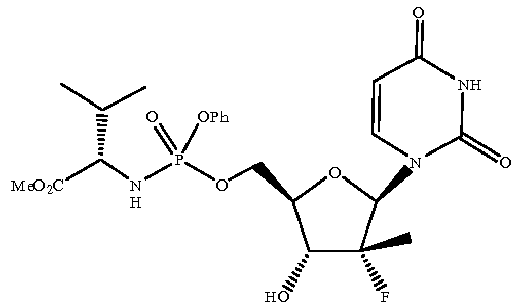
-0.45 ND 7 
0.31 ND 8 
-1.48 2.11 10 
-1.25 19.15 11 
-0.55 ND 12 
0.31 ND 15 
ND 0.86 25 
-2.22 0.39 27 
-2.25 0.66 28 
-2.16 0.75 36 
-1.64 21.9 39 
-1.78 0.47 49 
-2.69 0.126 53 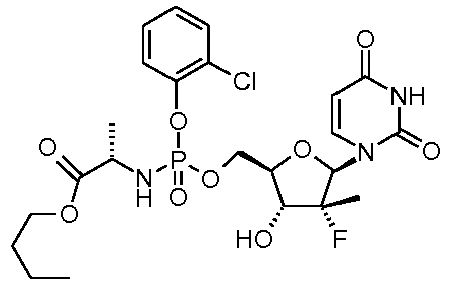
-1.33 <0.3 54 
-1.55 0.57 55 
-2.38 <0.3 69 
-2.25 < 0.3 70 
-2.25 <0.3 (4-BrPh): 4-bromo-phenyl. -
- <110> Gilead Pharmasset LLC
- <120> Nucleoside Phosphoramidate Prodrugs
- <130> PN813970EPD
- <150>
US12/053, 015
<151> 2008-03-21 - <150>
US60/982, 309
<151> 2007-10-24 - <150>
US60/909, 315
<151> 2007-03-30 - <160> 3
- <170> BiSSAP 1.3
- <210> 1
<211> 23
<212> DNA
<213> Artificial Sequence - <220>
<223> Primer - <400> 1
agccatggcg ttagtatgag tgt 23 - <210> 2
<211> 18
<212> DNA
<213> Artificial Sequence - <220>
<223> Primer - <400> 2
ttccgcagac cactatgg 18 - <210> 3
<211> 20
<212> DNA
<213> Artificial Sequence - <220>
<223> Primer - <400> 3
cctccaggac cccccctccc 20

Claims (4)
- A pharmaceutical composition comprising a HCV NS3 protease inhibitor and a compound represented by the following formula:

- A pharmaceutical composition according to claim 1 for use in the treatment or prophylaxis of an infection by hepatitis C virus or a disease or condition associated with or mediated by hepatitis C infection, or the clinical symptoms thereof.
- A compound represented by the following formula:

- A compound for use according to claim 3 wherein the compound is concurrently administered with the HCV NS3 protease inhibitor.
Priority Applications (2)
| Application Number | Priority Date | Filing Date | Title |
|---|---|---|---|
| SI200832077T SI2826784T1 (en) | 2007-03-30 | 2008-03-26 | Composition comprising a HCV NS3 protease inhibitor and a phosphoramidate prodrug of 2'-deoxy-2'-fluoro-2'-C-methyluridine nucleoside |
| PL14179358T PL2826784T3 (en) | 2007-03-30 | 2008-03-26 | Composition comprising a HCV NS3 protease inhibitor and a phosphoramidate prodrug of 2'-deoxy-2'-fluoro-2'-C-methyluridine nucleoside |
Applications Claiming Priority (6)
| Application Number | Priority Date | Filing Date | Title |
|---|---|---|---|
| US90931507P | 2007-03-30 | 2007-03-30 | |
| US98230907P | 2007-10-24 | 2007-10-24 | |
| US12/053,015 US7964580B2 (en) | 2007-03-30 | 2008-03-21 | Nucleoside phosphoramidate prodrugs |
| EP08732818.3A EP2203462B2 (en) | 2007-03-30 | 2008-03-26 | Nucleoside phosphoramidate prodrugs |
| PCT/US2008/058183 WO2008121634A2 (en) | 2007-03-30 | 2008-03-26 | Nucleoside phosphoramidate prodrugs |
| EP20140151876 EP2792680A1 (en) | 2007-03-30 | 2008-03-26 | Nucleoside phosphoramidate prodrugs |
Related Parent Applications (4)
| Application Number | Title | Priority Date | Filing Date |
|---|---|---|---|
| EP20140151876 Division-Into EP2792680A1 (en) | 2007-03-30 | 2008-03-26 | Nucleoside phosphoramidate prodrugs |
| EP20140151876 Division EP2792680A1 (en) | 2007-03-30 | 2008-03-26 | Nucleoside phosphoramidate prodrugs |
| EP08732818.3A Division EP2203462B2 (en) | 2007-03-30 | 2008-03-26 | Nucleoside phosphoramidate prodrugs |
| EP08732818.3A Division-Into EP2203462B2 (en) | 2007-03-30 | 2008-03-26 | Nucleoside phosphoramidate prodrugs |
Publications (2)
| Publication Number | Publication Date |
|---|---|
| EP2826784A1 EP2826784A1 (en) | 2015-01-21 |
| EP2826784B1 true EP2826784B1 (en) | 2019-06-26 |
Family
ID=39808855
Family Applications (7)
| Application Number | Title | Priority Date | Filing Date |
|---|---|---|---|
| EP14179593.0A Withdrawn EP2824109A1 (en) | 2007-03-30 | 2008-03-26 | Nucleoside phosphoramidate prodrugs |
| EP08732818.3A Active EP2203462B2 (en) | 2007-03-30 | 2008-03-26 | Nucleoside phosphoramidate prodrugs |
| EP20140151876 Withdrawn EP2792680A1 (en) | 2007-03-30 | 2008-03-26 | Nucleoside phosphoramidate prodrugs |
| EP14179358.8A Active EP2826784B1 (en) | 2007-03-30 | 2008-03-26 | Composition comprising a HCV NS3 protease inhibitor and a phosphoramidate prodrug of 2'-deoxy-2'-fluoro-2'-C-methyluridine nucleoside |
| EP14169060.2A Active EP2801580B1 (en) | 2007-03-30 | 2008-03-26 | Nucleoside phosphoramidate prodrugs |
| EP15165114.8A Withdrawn EP2933260A1 (en) | 2007-03-30 | 2008-03-26 | Nucleoside phosphoramidate prodrugs |
| EP23197008.8A Pending EP4282482A3 (en) | 2007-03-30 | 2008-03-26 | Nucleoside phosphoramidate prodrugs |
Family Applications Before (3)
| Application Number | Title | Priority Date | Filing Date |
|---|---|---|---|
| EP14179593.0A Withdrawn EP2824109A1 (en) | 2007-03-30 | 2008-03-26 | Nucleoside phosphoramidate prodrugs |
| EP08732818.3A Active EP2203462B2 (en) | 2007-03-30 | 2008-03-26 | Nucleoside phosphoramidate prodrugs |
| EP20140151876 Withdrawn EP2792680A1 (en) | 2007-03-30 | 2008-03-26 | Nucleoside phosphoramidate prodrugs |
Family Applications After (3)
| Application Number | Title | Priority Date | Filing Date |
|---|---|---|---|
| EP14169060.2A Active EP2801580B1 (en) | 2007-03-30 | 2008-03-26 | Nucleoside phosphoramidate prodrugs |
| EP15165114.8A Withdrawn EP2933260A1 (en) | 2007-03-30 | 2008-03-26 | Nucleoside phosphoramidate prodrugs |
| EP23197008.8A Pending EP4282482A3 (en) | 2007-03-30 | 2008-03-26 | Nucleoside phosphoramidate prodrugs |
Country Status (37)
| Country | Link |
|---|---|
| US (11) | US7964580B2 (en) |
| EP (7) | EP2824109A1 (en) |
| JP (8) | JP5318085B2 (en) |
| KR (3) | KR101432860B1 (en) |
| CN (8) | CN109776637B (en) |
| AR (1) | AR066898A1 (en) |
| AU (1) | AU2008232827C1 (en) |
| BR (2) | BRPI0823519A2 (en) |
| CA (1) | CA2682230C (en) |
| CL (1) | CL2008000902A1 (en) |
| CO (1) | CO6260023A2 (en) |
| CY (2) | CY1115488T1 (en) |
| DE (1) | DE202008018643U1 (en) |
| DK (1) | DK2203462T4 (en) |
| ES (3) | ES2963716T3 (en) |
| FI (2) | FI2203462T4 (en) |
| FR (1) | FR14C0082I2 (en) |
| HK (1) | HK1206033A1 (en) |
| HR (1) | HRP20140667T4 (en) |
| HU (1) | HUS1400059I1 (en) |
| IL (3) | IL201239A (en) |
| LT (1) | LTC2203462I2 (en) |
| LU (1) | LU92600I2 (en) |
| MX (1) | MX2009010401A (en) |
| MY (1) | MY147409A (en) |
| NL (1) | NL300704I1 (en) |
| NO (2) | NO2014029I1 (en) |
| NZ (2) | NZ579880A (en) |
| PH (1) | PH12014502771A1 (en) |
| PL (3) | PL2826784T3 (en) |
| PT (3) | PT2801580T (en) |
| RU (4) | RU2651892C3 (en) |
| SG (2) | SG179445A1 (en) |
| SI (2) | SI2826784T1 (en) |
| TW (1) | TWI357332B (en) |
| WO (1) | WO2008121634A2 (en) |
| ZA (2) | ZA200906647B (en) |
Families Citing this family (277)
| Publication number | Priority date | Publication date | Assignee | Title |
|---|---|---|---|---|
| MY164523A (en) | 2000-05-23 | 2017-12-29 | Univ Degli Studi Cagliari | Methods and compositions for treating hepatitis c virus |
| PL359169A1 (en) | 2000-05-26 | 2004-08-23 | Idenix (Cayman) Limited | Methods and compositions for treating flaviviruses and pestiviruses |
| MXPA03006514A (en) | 2001-01-22 | 2004-12-02 | Merck & Co Inc | Nucleoside derivatives as inhibitors of rna-dependent rna viral polymerase. |
| AU2003298658A1 (en) | 2002-11-15 | 2004-06-15 | Idenix (Cayman) Limited | 2'-branched nucleosides and flaviviridae mutation |
| RU2358979C2 (en) | 2003-05-30 | 2009-06-20 | Фармассет, Инк. | Modified fluorinated nucleoside analogues |
| EP1827460A4 (en) | 2004-12-09 | 2012-03-14 | Univ Minnesota | NUCLEOSIDES WITH ANTIVIRAL AND ANTICANCER ACTIVITY |
| GB0623493D0 (en) | 2006-11-24 | 2007-01-03 | Univ Cardiff | Chemical compounds |
| US7964580B2 (en) * | 2007-03-30 | 2011-06-21 | Pharmasset, Inc. | Nucleoside phosphoramidate prodrugs |
| US20090318380A1 (en) | 2007-11-20 | 2009-12-24 | Pharmasset, Inc. | 2',4'-substituted nucleosides as antiviral agents |
| PL2280973T3 (en) | 2008-04-23 | 2013-05-31 | Gilead Sciences Inc | Carb-nucleoside analogs for antiviral therapy |
| US8173621B2 (en) | 2008-06-11 | 2012-05-08 | Gilead Pharmasset Llc | Nucleoside cyclicphosphates |
| WO2010068708A2 (en) | 2008-12-09 | 2010-06-17 | Rfs Pharma, Llc | 3'-azido purine nucleotide prodrugs for treatment of viral infections |
| AR074897A1 (en) | 2008-12-23 | 2011-02-23 | Pharmasset Inc | NUCLEOSID PHOSPHORAMIDATES |
| MX2011006890A (en) | 2008-12-23 | 2011-07-20 | Pharmasset Inc | Nucleoside analogs. |
| CL2009002206A1 (en) * | 2008-12-23 | 2011-08-26 | Gilead Pharmasset Llc | Compounds derived from pyrrolo - (2-3-d] -pyrimidin-7 (6h) -tetrahydrofuran-2-yl phosphonamidate, pharmaceutical composition; and its use in the treatment of viral diseases. |
| CA2751458C (en) | 2009-02-06 | 2018-06-05 | Rfs Pharma, Llc | Purine nucleoside monophosphate prodrugs for treatment of cancer and viral infections |
| WO2010108140A1 (en) * | 2009-03-20 | 2010-09-23 | Alios Biopharma, Inc. | Substituted nucleoside and nucleotide analogs |
| SG176015A1 (en) | 2009-05-13 | 2011-12-29 | Gilead Sciences Inc | Antiviral compounds |
| TWI576352B (en) * | 2009-05-20 | 2017-04-01 | 基利法瑪席特有限責任公司 | Nucleoside phosphoramidates |
| AU2014274548B2 (en) * | 2009-05-20 | 2016-02-04 | Gilead Sciences, Inc. | N- [ (2 ' R) -2 ' -deoxy-2 ' -fluoro-2 ' -methyl-p-phenyl-5 ' -uridylyl] -L-alanine 1-methylethyl ester and process for its production |
| US8618076B2 (en) | 2009-05-20 | 2013-12-31 | Gilead Pharmasset Llc | Nucleoside phosphoramidates |
| AU2016200676B2 (en) * | 2009-05-20 | 2017-06-01 | Gilead Sciences, Inc. | N-[(2'R)-2 '-deoxy-2'-fluoro-2'-methyl-p-phenyl-5'-uridylyl] -L-alanine 1-methylethyl ester and process for its production |
| US8927513B2 (en) | 2009-07-07 | 2015-01-06 | Alnylam Pharmaceuticals, Inc. | 5′ phosphate mimics |
| NZ599404A (en) | 2009-09-21 | 2014-02-28 | Gilead Sciences Inc | Processes and intermediates for the preparation of 1’-substituted carba-nucleoside analogs |
| RU2553656C2 (en) * | 2009-09-29 | 2015-06-20 | ЯНССЕН ПРОДАКТС, Эл.Пи. | Phosphoramidate derivatives of nucleosides |
| KR20120106942A (en) | 2009-10-30 | 2012-09-27 | 베링거 인겔하임 인터내셔날 게엠베하 | Dosage regimens for hcv combination therapy comprising bi201335, interferon alpha and ribavirin |
| MX2012007076A (en) * | 2009-12-18 | 2012-07-20 | Boehringer Ingelheim Int | Hcv combination therapy. |
| PL3290428T3 (en) | 2010-03-31 | 2022-02-07 | Gilead Pharmasset Llc | Tablet comprising crystalline (s)-isopropyl 2-(((s)-(((2r,3r,4r,5r)-5-(2,4-dioxo-3,4-dihydropyrimidin-1 (2h)-yl)-4-fluoro-3-hydroxy-4-methyltetrahydrofuran-2-yl)methoxy)(phenoxy)phosphoryl)amino)propanoate |
| AP2012006535A0 (en) * | 2010-03-31 | 2012-10-31 | Gilead Pharmasset Llc | Stereoselective synthesis of phosphorous containing actives |
| TW201136945A (en) * | 2010-03-31 | 2011-11-01 | Pharmasset Inc | Purine nucleoside phosphoramidate |
| WO2011133212A1 (en) * | 2010-04-20 | 2011-10-27 | New York University | Methods, compounds and pharmaceutical compositions for treating anxiety and mood disorders |
| EA025311B1 (en) * | 2010-07-19 | 2016-12-30 | Гайлид Сайэнсиз, Инк. | Methods for the preparation of diasteromerically pure phosphoramidate prodrugs |
| PT2595980E (en) | 2010-07-22 | 2014-11-27 | Gilead Sciences Inc | METHODS AND COMPOUNDS FOR TREATING INFECTIONS BY THE PARAMYXOVIRIDAE FAMILY VIRUS |
| AU2011305652B2 (en) | 2010-09-22 | 2016-10-20 | Janssen Biopharma, Inc. | Azido nucleosides and nucleotide analogs |
| WO2012040127A1 (en) * | 2010-09-22 | 2012-03-29 | Alios Biopharma, Inc. | Substituted nucleotide analogs |
| ES2716158T3 (en) | 2010-11-30 | 2019-06-10 | Gilead Pharmasset Llc | 2'-spiro-nucleotides for the treatment of hepatitis C |
| US9095599B2 (en) | 2011-01-03 | 2015-08-04 | Nanjing Molecular Research, Inc. | O-(substituted benzyl) phosphoramidate compounds and therapeutic use |
| ES2569185T3 (en) | 2011-03-01 | 2016-05-09 | Nucana Biomed Limited | 5-Fluoro-2'-Deoxyuridine phosphoramidate derivatives for use in cancer treatment |
| US9085599B2 (en) | 2011-03-16 | 2015-07-21 | Enanta Pharmaceuticals, Inc. | 2′allene-substituted nucleoside derivatives |
| US9243025B2 (en) | 2011-03-31 | 2016-01-26 | Idenix Pharmaceuticals, Llc | Compounds and pharmaceutical compositions for the treatment of viral infections |
| EP2697241B1 (en) | 2011-04-13 | 2019-06-12 | Gilead Sciences, Inc. | 1'-substituted pyrimidine n-nucleoside analogs for antiviral treatment |
| WO2012158811A2 (en) * | 2011-05-19 | 2012-11-22 | Rfs Pharma, Llc | Purine monophosphate prodrugs for treatment of viral infections |
| US20130018011A1 (en) * | 2011-06-10 | 2013-01-17 | Hassan Javanbakht | Method of treating dengue fever |
| WO2013013009A2 (en) * | 2011-07-19 | 2013-01-24 | Nanjing Molecular Research, Inc. | 2',3'-DIDEOXY-2'-α-FLUORO-2'-β-C-METHYLNUCLEOSIDES AND PRODRUGS THEREOF |
| US9403863B2 (en) | 2011-09-12 | 2016-08-02 | Idenix Pharmaceuticals Llc | Substituted carbonyloxymethylphosphoramidate compounds and pharmaceutical compositions for the treatment of viral infections |
| HRP20180237T4 (en) | 2011-09-16 | 2020-12-11 | Gilead Pharmasset Llc | METHODS FOR THE TREATMENT OF HCV |
| JP6162125B2 (en) | 2011-09-30 | 2017-07-12 | タフツ・ユニバーシティ | Uridine diphosphate derivatives, compositions and methods for treating neurodegenerative disorders |
| AR089650A1 (en) | 2011-10-14 | 2014-09-10 | Idenix Pharmaceuticals Inc | PHOSPHATES 3,5-REPLACED CYCLES OF PURINE NUCLEOTIDE COMPOUNDS AND PHARMACEUTICAL COMPOSITIONS FOR THE TREATMENT OF VIRAL INFECTIONS |
| CN104023726A (en) * | 2011-10-21 | 2014-09-03 | 艾伯维公司 | Combination therapy with one or more DAAs used to treat HCV (eg, with ABT-072 or ABT-333) |
| DE112012003510T5 (en) | 2011-10-21 | 2015-03-19 | Abbvie Inc. | Method for the treatment of HCV comprising at least two direct-acting antiviral agents, ribavirin but not interferon |
| US8466159B2 (en) | 2011-10-21 | 2013-06-18 | Abbvie Inc. | Methods for treating HCV |
| US8492386B2 (en) | 2011-10-21 | 2013-07-23 | Abbvie Inc. | Methods for treating HCV |
| BR112014010295A2 (en) | 2011-10-31 | 2017-04-18 | Gilead Pharmassett Llc | methods and compositions for the treatment of hepatitis c virus |
| SG11201402609RA (en) | 2011-11-29 | 2014-06-27 | Gilead Pharmasset Llc | Compositions and methods for treating hepatitis c virus |
| US8889159B2 (en) | 2011-11-29 | 2014-11-18 | Gilead Pharmasset Llc | Compositions and methods for treating hepatitis C virus |
| US9089574B2 (en) | 2011-11-30 | 2015-07-28 | Emory University | Antiviral JAK inhibitors useful in treating or preventing retroviral and other viral infections |
| IN2014CN04530A (en) * | 2011-12-20 | 2015-09-11 | Hoffmann La Roche | |
| EA024297B1 (en) * | 2011-12-20 | 2016-09-30 | Рибосайенс Ллк | 2',4'-difluoro-2'-methyl substituted nucleoside derivatives as inhibitors of hcv rna replication |
| KR102072041B1 (en) * | 2011-12-22 | 2020-01-31 | 앨리오스 바이오파마 인크. | Substituted nucleosides, nucleotides and analogs thereof |
| EP2794630A4 (en) | 2011-12-22 | 2015-04-01 | Alios Biopharma Inc | Substituted phosphorothioate nucleotide analogs |
| JP5781706B2 (en) * | 2011-12-29 | 2015-09-24 | アッヴィ・アイルランド・アンリミテッド・カンパニー | Solid composition comprising an HCV inhibitor |
| US9303652B2 (en) | 2012-01-05 | 2016-04-05 | Archipelago Group Llc | Electric blower operable to provide combustion air to a fire |
| AU2013221571A1 (en) | 2012-02-14 | 2014-08-28 | University Of Georgia Research Foundation, Inc. | Spiro [2.4] heptanes for treatment of Flaviviridae infections |
| USRE48171E1 (en) | 2012-03-21 | 2020-08-25 | Janssen Biopharma, Inc. | Substituted nucleosides, nucleotides and analogs thereof |
| NZ631601A (en) | 2012-03-21 | 2016-06-24 | Alios Biopharma Inc | Solid forms of a thiophosphoramidate nucleotide prodrug |
| US9441007B2 (en) | 2012-03-21 | 2016-09-13 | Alios Biopharma, Inc. | Substituted nucleosides, nucleotides and analogs thereof |
| NZ630805A (en) | 2012-03-22 | 2016-01-29 | Alios Biopharma Inc | Pharmaceutical combinations comprising a thionucleotide analog |
| US8846638B2 (en) | 2012-05-17 | 2014-09-30 | Enanta Pharmaceuticals, Inc. | Macrocyclic nucleoside phosphoramidate derivatives |
| MD20140134A2 (en) * | 2012-05-22 | 2015-04-30 | Idenix Pharmaceuticals, Inc. | D-amino acid compounds for the treatment of liver diseases |
| EP2852604B1 (en) | 2012-05-22 | 2017-04-12 | Idenix Pharmaceuticals LLC | 3',5'-cyclic phosphoramidate prodrugs for hcv infection |
| WO2013177195A1 (en) | 2012-05-22 | 2013-11-28 | Idenix Pharmaceuticals, Inc. | 3',5'-cyclic phosphate prodrugs for hcv infection |
| PT2861611T (en) | 2012-05-25 | 2016-10-11 | Janssen Sciences Ireland Uc | Uracyl spirooxetane nucleosides |
| US9206412B2 (en) * | 2012-05-31 | 2015-12-08 | Colorado State University Research Foundation | Thioxothiazolidine inhibitors |
| WO2013187978A1 (en) * | 2012-06-16 | 2013-12-19 | Nanjing Molecular Research, Inc. | Double-liver-targeting phosphoramidate and phosphonoamidate prodrugs |
| EP2870169A1 (en) | 2012-07-03 | 2015-05-13 | Bristol-Myers Squibb Company | Process for preparing diastereomerically enriched phosphoramidate derivatives of nucleoside compounds for treatment of viral infections |
| WO2014047117A1 (en) | 2012-09-18 | 2014-03-27 | Bristol-Myers Squibb Company | Process for preparing phosphoramidate derivatives of nucleoside compounds for treatment of viral infections |
| WO2014052638A1 (en) | 2012-09-27 | 2014-04-03 | Idenix Pharmaceuticals, Inc. | Esters and malonates of sate prodrugs |
| US9163055B2 (en) * | 2012-09-28 | 2015-10-20 | Tufts University | Methods for treating glaucoma using uridine diphosphate derivatives |
| ES2674980T3 (en) * | 2012-10-08 | 2018-07-05 | Idenix Pharmaceuticals Llc | 2'-chloro nucleoside analogs for HCV infection |
| WO2014066239A1 (en) | 2012-10-22 | 2014-05-01 | Idenix Pharmaceuticals, Inc. | 2',4'-bridged nucleosides for hcv infection |
| WO2014078427A1 (en) | 2012-11-14 | 2014-05-22 | Idenix Pharmaceuticals, Inc. | D-alanine ester of rp-nucleoside analog |
| WO2014078436A1 (en) | 2012-11-14 | 2014-05-22 | Idenix Pharmaceuticals, Inc. | D-alanine ester of sp-nucleoside analog |
| AU2013346515B2 (en) * | 2012-11-16 | 2017-05-25 | NuCana plc | Process for preparing nucleoside prodrugs |
| US9211300B2 (en) | 2012-12-19 | 2015-12-15 | Idenix Pharmaceuticals Llc | 4′-fluoro nucleosides for the treatment of HCV |
| US9243022B2 (en) * | 2012-12-21 | 2016-01-26 | Alios Biopharma, Inc. | Substituted nucleosides, nucleotides and analogs thereof |
| EP2950786B1 (en) | 2013-01-31 | 2019-11-27 | Gilead Pharmasset LLC | Combination formulation of two antiviral compounds |
| US10034893B2 (en) * | 2013-02-01 | 2018-07-31 | Enanta Pharmaceuticals, Inc. | 5, 6-D2 uridine nucleoside/tide derivatives |
| WO2014137930A1 (en) | 2013-03-04 | 2014-09-12 | Idenix Pharmaceuticals, Inc. | Thiophosphate nucleosides for the treatment of hcv |
| WO2014137929A1 (en) | 2013-03-04 | 2014-09-12 | Gilead Pharmasset Llc | Methods for treating hepatitis c virus |
| WO2014137926A1 (en) * | 2013-03-04 | 2014-09-12 | Idenix Pharmaceuticals, Inc. | 3'-deoxy nucleosides for the treatment of hcv |
| KR101857337B1 (en) * | 2013-03-08 | 2018-05-11 | 난징 산홈 팔마세우티칼 컴퍼니 리미티드 | Novel nucleoside phosphoramidate compound and use thereof |
| EP2970357B1 (en) | 2013-03-13 | 2025-01-01 | Idenix Pharmaceuticals LLC | Amino acid phosphoramidate pronucleotides of 2'-cyano, azido and amino nucleosides for the treatment of hcv |
| PL2968385T3 (en) | 2013-03-13 | 2019-05-31 | Univ Tufts | Uridine nucleoside derivatives, compositions and methods of use |
| US10138265B2 (en) | 2013-03-13 | 2018-11-27 | Tufts University | Uridine nucleoside derivatives, compositions and methods of use |
| RU2534613C2 (en) * | 2013-03-22 | 2014-11-27 | Александр Васильевич Иващенко | Alkyl2-{[(2r,3s,5r)-5-(4-amino-2-oxo-2h-pyrimidine-1-yl)- -hydroxy- tetrahydro-furan-2-ylmethoxy]-phenoxy-phosphorylamino}-proptonates, nucleoside inhibitors of rna-polymerase hcv ns5b, methods for producing and using them |
| EP2981542B1 (en) | 2013-04-01 | 2021-09-15 | Idenix Pharmaceuticals LLC | 2',4'-fluoro nucleosides for the treatment of hcv |
| AU2014250762A1 (en) | 2013-04-12 | 2015-10-29 | Achillion Pharmaceuticals, Inc. | Highly active nucleoside derivative for the treatment of HCV |
| AU2014265293B2 (en) | 2013-05-16 | 2019-07-18 | Riboscience Llc | 4'-Fluoro-2'-methyl substituted nucleoside derivatives |
| US20180200280A1 (en) | 2013-05-16 | 2018-07-19 | Riboscience Llc | 4'-Fluoro-2'-Methyl Substituted Nucleoside Derivatives as Inhibitors of HCV RNA Replication |
| WO2014197400A1 (en) | 2013-06-04 | 2014-12-11 | Gilead Pharmasset Llc | Preventing and treating recurrence of hcv infection after liver transplant |
| EP3004130B1 (en) * | 2013-06-05 | 2019-08-07 | Idenix Pharmaceuticals LLC. | 1',4'-thio nucleosides for the treatment of hcv |
| WO2014194826A1 (en) * | 2013-06-06 | 2014-12-11 | 南京圣和药业有限公司 | Three-circle fused-heterocycle nucleoside phosphoramidate compound, preparation method therefor, and application thereof |
| AU2014302715B2 (en) | 2013-06-26 | 2018-12-06 | Alios Biopharma, Inc. | Substituted nucleosides, nucleotides and analogs thereof |
| US20150037282A1 (en) * | 2013-08-01 | 2015-02-05 | Idenix Pharmaceuticals, Inc. | D-amino acid phosphoramidate pronucleotides of halogeno pyrimidine compounds for liver disease |
| EA201690473A1 (en) | 2013-08-27 | 2017-03-31 | ГАЙЛИД ФАРМАССЕТ ЭлЭлСи | COMBINED COMPOSITION OF TWO ANTI-VIRUS COMPOUNDS |
| UA117375C2 (en) * | 2013-09-04 | 2018-07-25 | Медівір Аб | Hcv polymerase inhibitors |
| TW201542581A (en) | 2013-09-11 | 2015-11-16 | 艾默理大學 | Nucleotide and nucleoside therapeutic compositions and related uses |
| US9943604B2 (en) | 2013-09-20 | 2018-04-17 | Ionis Pharmaceuticals, Inc. | Targeted therapeutic nucleosides and their use |
| CN104447923B (en) * | 2013-09-23 | 2018-03-30 | 中国药科大学 | Methyl nucleoside derivatives of 2 ' deoxidation, 2 ' fluorine 2 ' and preparation method thereof and the purposes in pharmacy |
| CN105829333A (en) | 2013-10-11 | 2016-08-03 | 艾丽奥斯生物制药有限公司 | Substituted nucleosides, nucleotides and analogs thereof |
| US8889701B1 (en) | 2013-10-11 | 2014-11-18 | Alla Chem, Llc | Substituted (S)-(2R,3R,5R)-3-hydroxy-(5-pyrimidin-1-yl)tetrahydrofuran-2-ylmethyl aryl phosphoramidate |
| US20160271160A1 (en) | 2013-10-17 | 2016-09-22 | Medivir Ab | Hcv polymerase inhibitors |
| WO2015061683A1 (en) * | 2013-10-25 | 2015-04-30 | Idenix Pharmaceuticals, Inc. | D-amino acid phosphoramidate and d-alanine thiophosphoramidate pronucleotides of nucleoside compounds useful for the treatment of hcv |
| CN104650171A (en) * | 2013-11-25 | 2015-05-27 | 天津市汉康医药生物技术有限公司 | Sofosbuvir sesquihydrate compound |
| EP3074399A1 (en) * | 2013-11-27 | 2016-10-05 | Idenix Pharmaceuticals LLC | 2'-dichloro and 2'-fluoro-2'-chloro nucleoside analogues for hcv infection |
| RU2553996C1 (en) * | 2013-11-27 | 2015-06-20 | Андрей Александрович Иващенко | Substituted (2r,3r,5r)-3-hydroxy-(5-pyrimidin-1-yl)tetrahydrofuran-2-ylmethyl aryl phosphoramidates |
| US20150150897A1 (en) | 2013-12-02 | 2015-06-04 | Gilead Pharmasset Llc | Methods of treating hepatitis c virus infection in subjects with cirrhosis |
| WO2015097605A1 (en) | 2013-12-23 | 2015-07-02 | Mylan Laboratories Ltd. | Process for the preparation of sofosbuvir |
| TW201609785A (en) * | 2013-12-23 | 2016-03-16 | 吉李德製藥公司 | Solid forms of an antiviral compound |
| CN104761604A (en) * | 2014-01-02 | 2015-07-08 | 江苏豪森药业股份有限公司 | Uridine monophosphate analogue, and preparation method and applications thereof |
| WO2015126995A1 (en) | 2014-02-20 | 2015-08-27 | Ratiopharm Gmbh | Solid state forms of sofosbuvir |
| CN103804446A (en) * | 2014-02-27 | 2014-05-21 | 苏州东南药业股份有限公司 | Preparation method of 3,5-dibenzoyl-2-deoxy-2-fluoro-2-methyl-D-ribo-gamma-lactone |
| WO2015134560A1 (en) | 2014-03-05 | 2015-09-11 | Idenix Pharmaceuticals, Inc. | Solid forms of a flaviviridae virus inhibitor compound and salts thereof |
| US20170135990A1 (en) | 2014-03-05 | 2017-05-18 | Idenix Pharmaceuticals Llc | Pharmaceutical compositions comprising a 5,5-fused heteroarylene flaviviridae inhibitor and their use for treating or preventing flaviviridae infection |
| WO2015134780A1 (en) * | 2014-03-05 | 2015-09-11 | Idenix Pharmaceuticals, Inc. | Solid prodrug forms of 2'-chloro-2'-methyl uridine for hcv |
| CZ307789B6 (en) | 2014-04-15 | 2019-05-09 | Zentiva, K.S. | Method of producing biologically active phosphoramidate medicaments |
| EP3131914B1 (en) | 2014-04-16 | 2023-05-10 | Idenix Pharmaceuticals LLC | 3'-substituted methyl or alkynyl nucleosides for the treatment of hcv |
| CA2946867C (en) * | 2014-04-24 | 2023-03-07 | Cocrystal Pharma, Inc. | 2'-disubstituted nucleoside analogs for treatment of the flaviviridae family of viruses and cancer |
| TWI721947B (en) | 2014-06-11 | 2021-03-21 | 美商基利法瑪席特有限責任公司 | Solid forms of an antiviral compound |
| SI3154526T1 (en) | 2014-06-13 | 2019-08-30 | Ratiopharm Gmbh | Solid state forms of sofosbuvir |
| EP2959901A1 (en) | 2014-06-23 | 2015-12-30 | Sanovel Ilac Sanayi ve Ticaret A.S. | Pharmaceutical combinations of sofosbuvir and ribavirin |
| WO2015197549A1 (en) | 2014-06-23 | 2015-12-30 | Sanovel Ilac Sanayi Ve Ticaret A.S. | A novel pharmaceutical composition of sofosbuvir and ribavirin |
| EP2959891A1 (en) | 2014-06-23 | 2015-12-30 | Sanovel Ilac Sanayi ve Ticaret A.S. | Modified release pharmaceutical compositions of sofosbuvir and ribavirin |
| CZ2014502A3 (en) | 2014-07-17 | 2016-01-27 | Zentiva, K.S. | Sofosbuvir novel form and process for preparing thereof |
| WO2016015638A1 (en) * | 2014-07-30 | 2016-02-04 | 南京圣和药业股份有限公司 | Hepatitis c virus inhibitor and application thereof |
| EP3174888A1 (en) | 2014-08-01 | 2017-06-07 | Lupin Limited | A process for the preparation of nucleoside phosphoramidate |
| US10526363B2 (en) | 2014-08-15 | 2020-01-07 | Merck Sharp & Dohme Corp. | Substituted phosphoramidate compounds and uses thereof |
| US9675632B2 (en) | 2014-08-26 | 2017-06-13 | Enanta Pharmaceuticals, Inc. | Nucleoside and nucleotide derivatives |
| WO2016035006A1 (en) * | 2014-09-01 | 2016-03-10 | Dr. Reddy’S Laboratories Limited | Novel nucleotide analogs, process for the preparation of sofosbuvir and its analogs, novel forms of sofosbuvir and solid dispersion of sofosbuvir |
| WO2016038542A2 (en) | 2014-09-10 | 2016-03-17 | Mylan Laboratories Limited | Polymorphic forms of sofosbuvir |
| WO2016042576A1 (en) | 2014-09-16 | 2016-03-24 | Cadila Healthcare Limited | Co-crystal of sofosbuvir and amino acid and process for preparation thereof |
| WO2016064797A1 (en) * | 2014-10-20 | 2016-04-28 | Merck Sharp & Dohme Corp. | Process for making nucleoside phosphoramidate compounds |
| TWI698444B (en) | 2014-10-29 | 2020-07-11 | 美商基利科學股份有限公司 | Methods for the preparation of ribosides |
| CA2966033A1 (en) * | 2014-10-31 | 2016-05-06 | Cocrystal Pharma, Inc. | 2',2'-dihalo nucleoside analogs for treatment of the flaviviridae family of viruses and cancer |
| WO2016073756A1 (en) | 2014-11-06 | 2016-05-12 | Enanta Pharmaceuticals, Inc. | Deuterated nucleoside/tide derivatives |
| WO2016074596A1 (en) * | 2014-11-10 | 2016-05-19 | 南京曼杰生物科技有限公司 | Nucleoside phosphoramidate derivative and application thereof |
| RU2567854C1 (en) * | 2014-11-11 | 2015-11-10 | Александр Васильевич Иващенко | Nucleoside inhibitors of rna-polymerase hcv ns5b, methods for production and use thereof |
| WO2016078582A1 (en) * | 2014-11-20 | 2016-05-26 | 南京曼杰生物科技有限公司 | Novel nucleoside phosphoramidate derivatives and applications thereof |
| US9732110B2 (en) | 2014-12-05 | 2017-08-15 | Enanta Pharmaceuticals, Inc. | Nucleoside and nucleotide derivatives |
| WO2016099982A2 (en) * | 2014-12-15 | 2016-06-23 | Emory University | Phosphoramidates for the treatment of hepatitis b virus |
| CA2975813A1 (en) | 2015-02-13 | 2016-08-18 | Sandoz Ag | Pharmaceutical compositions comprising ledipasvir and sofosbuvir |
| ITUB20150109A1 (en) * | 2015-03-05 | 2016-09-05 | Hc Pharma Ag | USEFUL COMPOUNDS FOR THE TREATMENT OF HEPATITIS C |
| FI3265102T3 (en) * | 2015-03-06 | 2025-10-31 | Atea Pharmaceuticals Inc | BETA-D-2'-DEOXY-2'-ALPHA-FLUORO-2'-BETA-C-SUBSTITUTED-2-MODIFIED-N6-SUBSTITUTED PURINE NUCLEOTIDES FOR HCV TREATMENT |
| ITUB20152109A1 (en) * | 2015-07-13 | 2017-01-13 | Quim Sintetica S A | PHOSPHORAMIDATE NUCLEOSIDES USEFUL FOR THE TREATMENT OF VIRAL INFECTIONS AND THEIR PREPARATION |
| US10407456B2 (en) | 2015-03-26 | 2019-09-10 | Quimica Sintetica, S.A. | Nucleoside phosphoramidates useful for the treatment of viral infections and preparation thereof |
| CN106146588A (en) * | 2015-03-26 | 2016-11-23 | 常州制药厂有限公司 | A kind of preparation method of Suo Feibuwei |
| CN106188192B (en) * | 2015-04-29 | 2019-09-10 | 刘沛 | Nucleosides phosphoramidic acid/the phosphate derivatives and its medical usage of the amino-acid ester containing D- |
| CN106188193A (en) * | 2015-05-07 | 2016-12-07 | 苏州旺山旺水生物医药有限公司 | (2`R)-2`-deoxidation-2`-halo-2`-MU glycoside derivates, Preparation Method And The Use |
| CN104829672B (en) * | 2015-05-19 | 2018-03-13 | 江苏福瑞生物医药有限公司 | A kind of synthetic method of pharmaceutical intermediate |
| WO2016189443A2 (en) * | 2015-05-23 | 2016-12-01 | Virupaksha Organics Limited | Solid forms of nucleoside phosphoramidate |
| CN107646037A (en) | 2015-05-26 | 2018-01-30 | 桑多斯股份公司 | The method of selectivity synthesis nucleoside phosphoramidate class compound |
| EP3303362B1 (en) | 2015-06-03 | 2022-10-19 | Teva Pharmaceuticals International GmbH | Improved processes for the preparation of sofosbuvir and intermediates thereof |
| CZ2015443A3 (en) | 2015-06-26 | 2017-01-04 | Zentiva, K.S. | Sofosbuvir pharmaceutical formulation |
| AU2016301188A1 (en) | 2015-08-06 | 2018-02-15 | Chimerix, Inc. | Pyrrolopyrimidine nucleosides and analogs thereof useful as antiviral agents |
| EP3133062A1 (en) | 2015-08-19 | 2017-02-22 | Zaklady Farmaceutyczne Polpharma SA | Process for the preparation of a pharmaceutical agent |
| WO2017029408A1 (en) | 2015-08-20 | 2017-02-23 | Ratiopharm Gmbh | Solid state forms of sofosbuvir |
| CN105061535A (en) * | 2015-09-02 | 2015-11-18 | 江苏科本医药化学有限公司 | Synthetic method of sofosbuvir intermediate |
| JP6743135B2 (en) * | 2015-09-02 | 2020-08-19 | アッヴィ・インコーポレイテッド | Antiviral tetrahydrofuran derivative |
| DK3349758T3 (en) | 2015-09-16 | 2022-06-13 | Gilead Sciences Inc | PROCEDURES FOR THE TREATMENT OF ARENAVIRIDAE VIRUS INFECTIONS |
| WO2017077552A1 (en) | 2015-11-03 | 2017-05-11 | Mylan Laboratories Limited | Process for the preparation of sofosbuvir |
| CN106674320B (en) * | 2015-11-06 | 2020-04-21 | 博瑞生物医药(苏州)股份有限公司 | HCV (hepatitis C virus) treatment medicine |
| CN106674318B (en) * | 2015-11-06 | 2020-04-21 | 博瑞生物医药(苏州)股份有限公司 | NS5B polymerase inhibitor |
| CN106674319B (en) * | 2015-11-06 | 2020-04-21 | 博瑞生物医药(苏州)股份有限公司 | Compound for treating hepatitis C |
| EP3377512A4 (en) * | 2015-11-16 | 2019-09-18 | Ichorion Therapeutics, Inc. | NUCLEIC ACID PRODRUGS |
| WO2017093973A1 (en) * | 2015-12-02 | 2017-06-08 | Sun Pharmaceutical Industries Limited | Process for the preparation of pure sofosbuvir |
| ITUB20161079A1 (en) | 2016-02-25 | 2017-08-25 | Hc Pharma Ag | PROCEDURE FOR THE PREPARATION OF SOFOSBUVIR |
| EP3430023A1 (en) | 2016-03-17 | 2019-01-23 | Mylan Laboratories, Limited | Polymorphic forms of sofosbuvir |
| AU2017239338B2 (en) * | 2016-03-25 | 2020-08-27 | Jiangsu Tasly Diyi Pharmaceutical Co., Ltd. | Uridine phosphoramide prodrug, preparation method therefor, and medicinal uses thereof |
| WO2017184670A2 (en) | 2016-04-22 | 2017-10-26 | Gilead Sciences, Inc. | Methods for treating zika virus infections |
| JP7129703B2 (en) | 2016-04-28 | 2022-09-02 | エモリー ユニバーシティー | Alkyne-Containing Nucleotide and Nucleoside Therapeutic Compositions and Uses Associated Therewith |
| EP3452447A4 (en) | 2016-05-03 | 2019-12-18 | The Regents of The University of California | IRES-MEDIATED PROTEIN SYNTHESIS INHIBITORS |
| CZ2016257A3 (en) | 2016-05-05 | 2017-11-15 | Zentiva, K.S. | The amorphous form of sofosbuvir, the method of its preparation and its stabilization |
| CN121974842A (en) | 2016-05-10 | 2026-05-05 | C4医药公司 | Amine-linked C3-glutarimide degradation determinant for target protein degradation |
| CN109562113A (en) | 2016-05-10 | 2019-04-02 | C4医药公司 | Spiro degron for target protein degradation |
| CN109562107A (en) | 2016-05-10 | 2019-04-02 | C4医药公司 | Heterocyclic degrons for target protein degradation |
| WO2017197046A1 (en) | 2016-05-10 | 2017-11-16 | C4 Therapeutics, Inc. | C3-carbon linked glutarimide degronimers for target protein degradation |
| ES2969239T3 (en) | 2016-05-27 | 2024-05-17 | Gilead Sciences Inc | Combination of ledipasvir and sofosbuvir for use in the treatment of hepatitis B virus infections in humans |
| JOP20170127A1 (en) | 2016-06-02 | 2017-12-02 | Gilead Pharmasset Llc | A combined formula consisting of three antiviral compounds |
| CN107501247A (en) * | 2016-06-14 | 2017-12-22 | 安徽贝克联合制药有限公司 | A kind of preparation method of uridine analog derivative |
| EP3471739A4 (en) * | 2016-06-20 | 2020-02-26 | Merck Sharp & Dohme Corp. | USE OF PHOSPHATE-SUBSTITUTED CYCLIC NUCLEOSIDE DERIVATIVES FOR THE TREATMENT OF VIRAL DISEASES |
| US11364257B2 (en) | 2016-06-24 | 2022-06-21 | Emory University | Phosphoramidates for the treatment of hepatitis B virus |
| WO2018009623A1 (en) | 2016-07-08 | 2018-01-11 | Atea Pharmaceuticals, Inc. | β-D-2'-DEOXY-2'-SUBSTITUTED-4'-SUBSTITUTED-2-SUBSTITUTED-N6-SUBSTITUTED-6-AMINOPURINE NUCLEOTIDES FOR THE TREATMENT OF PARAMYXOVIRUS AND ORTHOMYXOVIRUS INFECTIONS |
| WO2018013937A1 (en) | 2016-07-14 | 2018-01-18 | Atea Pharmaceuticals, Inc. | Beta-d-2'-deoxy-2'-alpha-fluoro-2'-beta-c-substituted-4'-fluoro-n6-substituted-6-amino-2-substituted purine nucleotides for the treatment of hepatitis c virus infection |
| US10239910B2 (en) * | 2016-07-20 | 2019-03-26 | Optimus Drugs (P) Limited | Process for the preparation of sofosbuvir |
| US20180030080A1 (en) * | 2016-07-28 | 2018-02-01 | Alexandre Vasilievich Ivachtchenko | Phosphoramidate nucleoside prodrug for treating viral diseases and cancer, processes for their preparation and their use |
| MX2019002017A (en) | 2016-08-19 | 2019-06-06 | Sandoz Ag | Sofosbuvir derivatives for the treatment of hepatitis c. |
| PT3512863T (en) | 2016-09-07 | 2022-03-09 | Atea Pharmaceuticals Inc | 2'-substituted-n6-substituted purine nucleotides for rna virus treatment |
| WO2018078536A1 (en) | 2016-10-26 | 2018-05-03 | Lupin Limited | Stable solid dispersion of sofosbuvir and process for preparation thereof |
| KR20190100250A (en) | 2016-12-22 | 2019-08-28 | 머크 샤프 앤드 돔 코포레이션 | Antiviral Aliphatic Ester Prodrug of Tenofovir |
| WO2018134343A1 (en) | 2017-01-19 | 2018-07-26 | Sandoz Ag | Synthesis of phosphoramidates |
| WO2018136792A1 (en) | 2017-01-20 | 2018-07-26 | The Regents Of The University Of California | Inhibitors of the n-terminal domain of the androgen receptor |
| CN115477679A (en) | 2017-02-01 | 2022-12-16 | 阿堤亚制药公司 | Nucleotide hemisulfate for the treatment of hepatitis C virus |
| RU2650610C1 (en) | 2017-02-28 | 2018-04-16 | Васильевич Иващенко Александр | Antiviral composition and method of its application |
| RU2659388C1 (en) | 2017-02-28 | 2018-07-02 | Васильевич Иващенко Александр | Nucleotides including n-[(s)-1-cyclobutoxycarbonyl]phosphoramidate fragment, their analogs and their application |
| RU2644156C1 (en) * | 2017-02-28 | 2018-02-08 | Александр Васильевич Иващенко | Prodrug of polymerase ns5b hcv inhibitor, method for its preparation and application |
| CN110869028B (en) | 2017-03-14 | 2023-01-20 | 吉利德科学公司 | Method of treating feline coronavirus infection |
| EP4219513A1 (en) | 2017-05-01 | 2023-08-02 | Gilead Sciences, Inc. | Crystalline form of (s)-2-ethylbutyl 2-(((s)-(((2r,3s,4r,5r)-5-(4-aminopyrrolo[2,1-f] [1,2,4]triazin-7-yl)-5-cyano-3,4-dihydroxytetrahydrofuran2-yl)methoxy)(phenoxy) phosphoryl)amino)propanoate |
| RU2656228C9 (en) * | 2017-06-13 | 2019-04-16 | Олег Ростиславович Михайлов | WEAKLY CRYSTALLISED β-MODIFICATION OF (S)-ISOPROPYL 2-((S)-(((2R,3R,4R,5R)-5-(2,4-DIOXO-3,4-DIHYDROPYRIMIDIN-(2H)-YL)-4-FLUORO-3-HYDROXY-4-METHYLTETRAHYDROFURAN-2-YL)METHOXY)-(PHENOXY)PHOSPHORYLAMINO)PROPANOATE, METHOD FOR PRODUCTION THEREOF AND PHARMACEUTICAL COMPOSITION BASED THEREON |
| GB201709471D0 (en) | 2017-06-14 | 2017-07-26 | Nucana Biomed Ltd | Diastereoselective synthesis of hosphate derivatives |
| EP4717317A3 (en) | 2017-06-20 | 2026-06-03 | C4 Therapeutics, Inc. | N/o-linked degrons and degronimers for protein degradation |
| IL321754A (en) | 2017-06-30 | 2025-08-01 | Univ California | Compositions and methods for regulating hair growth |
| CN111093627B (en) | 2017-07-11 | 2024-03-08 | 吉利德科学公司 | Compositions containing RNA polymerase inhibitors and cyclodextrins for treating viral infections |
| EP3661944A1 (en) | 2017-08-03 | 2020-06-10 | Sandoz AG | Sofosbuvir hydrate |
| GB201715011D0 (en) | 2017-09-18 | 2017-11-01 | Nucana Biomed Ltd | Floxuridine synthesis |
| US11111264B2 (en) | 2017-09-21 | 2021-09-07 | Chimerix, Inc. | Morphic forms of 4-amino-7-(3,4-dihydroxy-5-(hydroxymethyl)tetrahydrofuran-2-yl)-2-methyl-7H-pyrrolo[2,3-d]pyrimidine-5-carboxamide and uses thereof |
| EP3684374B1 (en) * | 2017-09-21 | 2025-07-30 | Riboscience LLC | 4'-fluoro-2'-methyl substituted nucleoside derivatives as inhibitors of hcv rna replication |
| KR20240017986A (en) | 2017-09-26 | 2024-02-08 | 더 리전트 오브 더 유니버시티 오브 캘리포니아 | Compositions and methods for treating cancer |
| AU2019205798A1 (en) * | 2018-01-05 | 2020-07-23 | Cerecor, Inc. | Nucleotide prodrugs |
| US11708329B2 (en) | 2018-01-30 | 2023-07-25 | The Regents Of The University Of California | Inhibitors of the WNT/beta-catenin pathway |
| CN112351799A (en) | 2018-04-10 | 2021-02-09 | 阿堤亚制药公司 | Treatment of HCV infected patients with cirrhosis |
| NL2021049B1 (en) | 2018-06-04 | 2019-12-11 | Academisch Ziekenhuis Leiden | Use of 6'-fluoro-neplanocin a derivatives against chikungunya virus |
| US20210122771A1 (en) | 2018-06-29 | 2021-04-29 | The Regents Of The University Of California | New molecular tweezers against neurological disorders and viral infections |
| WO2020023917A1 (en) | 2018-07-27 | 2020-01-30 | California Institute Of Technology | Cdk inhibitors and uses thereof |
| EA202190558A1 (en) | 2018-09-17 | 2022-02-03 | Янгчжин Фарм. Ко., Лтд. | NEW THIAZOLE DERIVATIVES AND THEIR PHARMACEUTICALLY ACCEPTABLE SALTS |
| ES3066008T3 (en) | 2018-10-17 | 2026-05-11 | Univ California | Prodrugs of alpha-ketoglutarate, alpha-ketobutyrate, alpha-ketoisovalerate, and alpha-ketoisohexanoate, and uses thereof |
| EP3873912B1 (en) | 2018-10-31 | 2026-03-25 | Intocell, Inc. | Fused heterocyclic benzodiazepine derivatives and uses thereof |
| EP3947387B1 (en) | 2019-03-25 | 2024-10-23 | California Institute Of Technology | Prmt5 inhibitors and uses thereof |
| CA3141604A1 (en) | 2019-05-20 | 2020-11-26 | 1200 Pharma Llc | Kras g12c inhibitors and uses thereof |
| WO2021142221A1 (en) | 2020-01-10 | 2021-07-15 | The Regents Of The University Of California | Compositions and methods for the treatment of neurodegenerative diseases |
| KR20220132608A (en) | 2020-01-27 | 2022-09-30 | 길리애드 사이언시즈, 인코포레이티드 | Methods for treating SARS CoV-2 infection |
| US10874687B1 (en) | 2020-02-27 | 2020-12-29 | Atea Pharmaceuticals, Inc. | Highly active compounds against COVID-19 |
| TWI785528B (en) | 2020-03-12 | 2022-12-01 | 美商基利科學股份有限公司 | Methods of preparing 1’-cyano nucleosides |
| TW202143949A (en) | 2020-03-22 | 2021-12-01 | 盈擘醫藥股份有限公司 | Composition of antiviral agent for use in prophylactic or post-exposure treating infectious or respiratory diseases |
| WO2021202669A2 (en) | 2020-04-01 | 2021-10-07 | Reyoung Corporation | Nucleoside and nucleotide conjugate compounds and uses thereof |
| JP7482250B2 (en) | 2020-04-06 | 2024-05-13 | ギリアード サイエンシーズ, インコーポレイテッド | Inhalation formulations of 1'-cyano substituted carbanucleoside analogs |
| CN111467363A (en) * | 2020-04-07 | 2020-07-31 | 中国科学院深圳先进技术研究院 | Application of sofosbuvir in preparation of medicine for preventing and treating coronavirus |
| EP4157272B1 (en) | 2020-05-29 | 2025-07-02 | Gilead Sciences, Inc. | Remdesivir for the treatment of viral infections |
| IL299202A (en) | 2020-06-24 | 2023-02-01 | Gilead Sciences Inc | 1'-cyano nucleoside analogs and uses thereof |
| WO2021263072A1 (en) | 2020-06-25 | 2021-12-30 | Dana-Farber Cancer Institute, Inc. | Methods of treating disease |
| KR102711647B1 (en) | 2020-07-07 | 2024-09-30 | (주)아이랩 | A novel tnf activity inhibitor compound and its pharmaceutically acceptable salt |
| EP4192811A1 (en) | 2020-08-10 | 2023-06-14 | Dana-Farber Cancer Institute, Inc. | Substituted 3-amino-4-methylbenzenesulfonamides as small molecule inhibitors of ubiquitin-specific protease 28 |
| EP4192838A1 (en) | 2020-08-10 | 2023-06-14 | Dana-Farber Cancer Institute, Inc. | Fused tricyclic pyrimidine-thieno-pyridine small molecule inhibitors of ubiquitin-specific protease 28 |
| US20230265082A1 (en) | 2020-08-10 | 2023-08-24 | Dana-Farber Cancer Institute, Inc. | Substituted 1,2,4-oxadiazoles as small molecule inhibitors of ubiquitin-specific protease 28 |
| US11926645B2 (en) | 2020-08-27 | 2024-03-12 | Gilead Sciences, Inc. | Compounds and methods for treatment of viral infections |
| US20240083839A1 (en) | 2020-10-07 | 2024-03-14 | The Regents Of The University Of California | Compositions and methods for treating neurodegenerative diseases and disorders |
| WO2022076903A1 (en) * | 2020-10-09 | 2022-04-14 | Atea Pharmaceuticals, Inc. | Niran interfering drugs for sars-cov-2 mutant therapy |
| US12570620B2 (en) | 2020-10-23 | 2026-03-10 | Dana-Farber Cancer Institute, Inc. | Covalent inhibitors of creatine kinase (CK) and uses thereof for treating and preventing cancer |
| US12274700B1 (en) | 2020-10-30 | 2025-04-15 | Accencio LLC | Methods of treating symptoms of coronavirus infection with RNA polymerase inhibitors |
| US20240058344A1 (en) | 2020-12-18 | 2024-02-22 | Cornell University | Methods of treating neurodegenerative disorders and stat3-linked cancers using suppressors of electron leak |
| WO2022140289A1 (en) | 2020-12-21 | 2022-06-30 | Cornell University | Peptide-linked drug delivery system |
| WO2022150574A1 (en) | 2021-01-08 | 2022-07-14 | Cornell University | Inhibitors of mycobacterium tuberculosis lipoamide dehydrogenase |
| WO2022164941A1 (en) | 2021-01-26 | 2022-08-04 | Atea Pharmaceuticals, Inc. | Advantageous morphic form of at-527 hemi-sulfate salt |
| US20240190809A1 (en) | 2021-05-11 | 2024-06-13 | Awakn Ls Europe Holdings Limited | Therapeutic aminoindane compounds and compositions |
| AU2022279234B2 (en) | 2021-05-21 | 2025-08-28 | Gilead Sciences, Inc. | Pentacyclic derivatives as zika virus inhibitors |
| JP7723119B2 (en) | 2021-05-21 | 2025-08-13 | ギリアード サイエンシーズ, インコーポレイテッド | Tetracyclic compounds for the treatment of Zika virus infection |
| US20240197652A1 (en) | 2021-05-25 | 2024-06-20 | Awakn Ls Europe Holdings Limited | Ketamine in the treatment of behavioral addictions |
| AU2022291927A1 (en) | 2021-06-17 | 2024-01-04 | Atea Pharmaceuticals, Inc. | Advantageous anti-hcv combination therapy |
| CA3229910A1 (en) | 2021-08-23 | 2023-03-02 | Alexander Shulgin Research Institute, Inc. | Fluorinated empathogens |
| WO2023028091A1 (en) | 2021-08-23 | 2023-03-02 | Alexander Shulgin Research Institute | Deuterated empathogens |
| EP4396162A4 (en) | 2021-09-03 | 2025-11-12 | Alexander Shulgin Res Institute Inc | ASYMMETRIC ALLYL TRYPTAMINES |
| US12465578B2 (en) | 2021-09-25 | 2025-11-11 | Alexander Shulgin Research Institute, Inc. | Substituted alpha-ethyl phenylalkylamines |
| US11541071B1 (en) | 2021-12-16 | 2023-01-03 | Ascletis BioScience Co., Ltd | Nucleoside derivatives and methods of use thereof |
| EP4463462A4 (en) | 2022-01-14 | 2025-06-25 | Annexon, Inc. | INHIBITORS OF COMPLEMENT FACTORS AND USES THEREOF |
| WO2023139163A1 (en) | 2022-01-19 | 2023-07-27 | Awakn Ls Europe Holdings Limited | 1,3-benzodioxole esters and their therapeutic use |
| CA3252219A1 (en) | 2022-02-15 | 2023-08-24 | Rs Oncology, Llc | Thiostrepton-inspired compounds for treatment of cancer and preparation thereof |
| WO2023156565A1 (en) | 2022-02-16 | 2023-08-24 | Awakn Ls Europe Holdings Limited | Bridged ring compounds and their therapeutic use as cns agents |
| KR20240154647A (en) | 2022-03-02 | 2024-10-25 | 길리애드 사이언시즈, 인코포레이티드 | Compounds and methods for treating viral infections |
| CN119546620A (en) | 2022-03-15 | 2025-02-28 | 罗梅治疗股份有限公司 | Compounds and methods for treating disease |
| WO2023250157A1 (en) | 2022-06-24 | 2023-12-28 | Cornell University | Inhibitors of mycobacterium tuberculosis lipoamide dehydrogenase |
| EP4547665A1 (en) | 2022-06-30 | 2025-05-07 | Gilead Sciences, Inc. | Solid forms of a nucleoside analogue and uses thereof |
| JP2025525415A (en) | 2022-07-13 | 2025-08-05 | アストラゼネカ・アクチエボラーグ | PCSK9 inhibitors and methods of use thereof |
| US12357577B1 (en) | 2024-02-02 | 2025-07-15 | Gilead Sciences, Inc. | Pharmaceutical formulations and uses thereof |
| US20240207289A1 (en) | 2022-12-19 | 2024-06-27 | Prepaire Labs Limited | Method to identify and alleviate the symptoms of parkinsonism/parkinson’s disease |
| WO2025078883A2 (en) | 2023-05-06 | 2025-04-17 | Prepaire Labs Limited | Organic compound (oxime) to combat chemical warfare agents |
| WO2025017469A1 (en) | 2023-07-14 | 2025-01-23 | Feilding Amanda | Psychedelic "brain boost" combinations for enhancing cellular energy production |
| WO2025231452A1 (en) | 2024-05-02 | 2025-11-06 | Martinez Montemayor Michelle | Ergosterol peroxide derivatives and uses thereof |
| WO2026151964A1 (en) | 2025-01-10 | 2026-07-16 | Atea Pharmaceuticals, Inc. | Compositions and use thereof in treating hepatitis e infections with beta-d-2'-deoxy-2'-alpha-fluoro-2'-beta-c-substituted-4'-fluoro-n6-substituted-6-amino-2-substituted purine nucleotides |
Family Cites Families (305)
| Publication number | Priority date | Publication date | Assignee | Title |
|---|---|---|---|---|
| US2007275A (en) | 1933-01-09 | 1935-07-09 | Elizabeth Q Kendall | Ingot stripper |
| US2759300A (en) | 1954-08-11 | 1956-08-21 | Pest Control Ltd | Method and means for introducing a predetermined amount of a poisonous material beneath the surface of the soil |
| US3798209A (en) | 1971-06-01 | 1974-03-19 | Icn Pharmaceuticals | 1,2,4-triazole nucleosides |
| USRE29835E (en) | 1971-06-01 | 1978-11-14 | Icn Pharmaceuticals | 1,2,4-Triazole nucleosides |
| US3852267A (en) | 1972-08-04 | 1974-12-03 | Icn Pharmaceuticals | Phosphoramidates of 3{40 ,5{40 -cyclic purine nucleotides |
| JPS5116273A (en) | 1974-07-31 | 1976-02-09 | Hitachi Ltd | DATSUSHOSOCHINIOKERU NH3 CHUNYURYONO SEIGYOHO |
| JPS5238939U (en) | 1975-09-12 | 1977-03-18 | ||
| US4526988A (en) * | 1983-03-10 | 1985-07-02 | Eli Lilly And Company | Difluoro antivirals and intermediate therefor |
| NL8403224A (en) | 1984-10-24 | 1986-05-16 | Oce Andeno Bv | DIOXAPHOSPHORINANS, THEIR PREPARATION AND THE USE FOR SPLITTING OF OPTICALLY ACTIVE COMPOUNDS. |
| US5223263A (en) | 1988-07-07 | 1993-06-29 | Vical, Inc. | Liponucleotide-containing liposomes |
| GB8719367D0 (en) | 1987-08-15 | 1987-09-23 | Wellcome Found | Therapeutic compounds |
| JPH03501253A (en) | 1987-09-22 | 1991-03-22 | ザ リージェンツ オブ ザ ユニバーシティ オブ カリフォルニア | Liposome-based nucleoside analogs for the treatment of AIDS |
| IL91664A (en) * | 1988-09-28 | 1993-05-13 | Yissum Res Dev Co | Ammonium transmembrane gradient system for efficient loading of liposomes with amphipathic drugs and their controlled release |
| US6132763A (en) | 1988-10-20 | 2000-10-17 | Polymasc Pharmaceuticals Plc | Liposomes |
| US5705363A (en) | 1989-03-02 | 1998-01-06 | The Women's Research Institute | Recombinant production of human interferon τ polypeptides and nucleic acids |
| US5194654A (en) * | 1989-11-22 | 1993-03-16 | Vical, Inc. | Lipid derivatives of phosphonoacids for liposomal incorporation and method of use |
| US5411947A (en) * | 1989-06-28 | 1995-05-02 | Vestar, Inc. | Method of converting a drug to an orally available form by covalently bonding a lipid to the drug |
| US5463092A (en) | 1989-11-22 | 1995-10-31 | Vestar, Inc. | Lipid derivatives of phosphonacids for liposomal incorporation and method of use |
| US5026687A (en) * | 1990-01-03 | 1991-06-25 | The United States Of America As Represented By The Department Of Health And Human Services | Treatment of human retroviral infections with 2',3'-dideoxyinosine alone and in combination with other antiviral compounds |
| AU660925B2 (en) | 1990-04-06 | 1995-07-13 | Genelabs Technologies, Inc. | Hepatitis C virus epitopes |
| AU7872491A (en) | 1990-05-07 | 1991-11-27 | Vical, Inc. | Lipid prodrugs of salicylate and nonsteroidal anti-inflammatory drugs |
| EP0531452A4 (en) | 1990-05-29 | 1993-06-09 | Vical, Inc. | Synthesis of glycerol di- and triphosphate derivatives |
| ES2083580T3 (en) | 1990-06-13 | 1996-04-16 | Arnold Glazier | PHOSPHORIC DRUGS. |
| US6060080A (en) * | 1990-07-16 | 2000-05-09 | Daiichi Pharmaceutical Co., Ltd. | Liposomal products |
| JP2599492B2 (en) | 1990-08-21 | 1997-04-09 | 第一製薬株式会社 | Manufacturing method of liposome preparation |
| US5372808A (en) | 1990-10-17 | 1994-12-13 | Amgen Inc. | Methods and compositions for the treatment of diseases with consensus interferon while reducing side effect |
| US5149794A (en) * | 1990-11-01 | 1992-09-22 | State Of Oregon | Covalent lipid-drug conjugates for drug targeting |
| US5256641A (en) | 1990-11-01 | 1993-10-26 | State Of Oregon | Covalent polar lipid-peptide conjugates for immunological targeting |
| US5543389A (en) | 1990-11-01 | 1996-08-06 | State Of Oregon, Acting By And Through The Oregon State Board Of Higher Education On Behalf Of The Oregon Health Sciences University, A Non Profit Organization | Covalent polar lipid-peptide conjugates for use in salves |
| US5543390A (en) * | 1990-11-01 | 1996-08-06 | State Of Oregon, Acting By And Through The Oregon State Board Of Higher Education, Acting For And On Behalf Of The Oregon Health Sciences University | Covalent microparticle-drug conjugates for biological targeting |
| US5595732A (en) | 1991-03-25 | 1997-01-21 | Hoffmann-La Roche Inc. | Polyethylene-protein conjugates |
| US5157027A (en) | 1991-05-13 | 1992-10-20 | E. R. Squibb & Sons, Inc. | Bisphosphonate squalene synthetase inhibitors and method |
| CA2112803A1 (en) | 1991-07-12 | 1993-01-21 | Karl Y. Hostetler | Antiviral liponucleosides: treatment of hepatitis b |
| US5554728A (en) | 1991-07-23 | 1996-09-10 | Nexstar Pharmaceuticals, Inc. | Lipid conjugates of therapeutic peptides and protease inhibitors |
| TW224053B (en) | 1991-09-13 | 1994-05-21 | Paul B Chretien | |
| US5676942A (en) | 1992-02-10 | 1997-10-14 | Interferon Sciences, Inc. | Composition containing human alpha interferon species proteins and method for use thereof |
| US5405598A (en) | 1992-02-24 | 1995-04-11 | Schinazi; Raymond F. | Sensitizing agents for use in boron neutron capture therapy |
| JP3102945B2 (en) | 1992-02-27 | 2000-10-23 | 財団法人野田産業科学研究所 | Hepatitis treatment |
| US5610054A (en) | 1992-05-14 | 1997-03-11 | Ribozyme Pharmaceuticals, Inc. | Enzymatic RNA molecule targeted against Hepatitis C virus |
| EP0576231B1 (en) | 1992-06-22 | 1997-05-28 | Eli Lilly And Company | Process for preparing alpha-anomer enriched 1-halo-2-deoxy-2, 2-difluoro-D-ribofuranosyl derivatives |
| US5426183A (en) | 1992-06-22 | 1995-06-20 | Eli Lilly And Company | Catalytic stereoselective glycosylation process for preparing 2'-deoxy-2',2'-difluoronucleosides and 2'-deoxy-2'-fluoronucleosides |
| US5256798A (en) | 1992-06-22 | 1993-10-26 | Eli Lilly And Company | Process for preparing alpha-anomer enriched 2-deoxy-2,2-difluoro-D-ribofuranosyl sulfonates |
| US5301508A (en) | 1992-08-14 | 1994-04-12 | Rubbermaid Incorporated | Thermoelectric portable container |
| CA2105112C (en) * | 1992-09-01 | 2005-08-02 | Thomas C. Britton | A process for anomerizing nucleosides |
| GB9226729D0 (en) | 1992-12-22 | 1993-02-17 | Wellcome Found | Therapeutic combination |
| AU6247594A (en) * | 1993-02-24 | 1994-09-14 | Jui H. Wang | Compositions and methods of application of reactive antiviral polymers |
| US6180134B1 (en) * | 1993-03-23 | 2001-01-30 | Sequus Pharmaceuticals, Inc. | Enhanced ciruclation effector composition and method |
| JPH08510236A (en) | 1993-05-12 | 1996-10-29 | カール ワイ. ホステトラー | Acyclovir derivative for topical use |
| EP0773029A4 (en) | 1993-07-19 | 1997-09-03 | Tokyo Tanabe Co | HEPATITIS C VIRUS PROLIFERATION INHIBITOR |
| US7375198B2 (en) * | 1993-10-26 | 2008-05-20 | Affymetrix, Inc. | Modified nucleic acid probes |
| US6156501A (en) | 1993-10-26 | 2000-12-05 | Affymetrix, Inc. | Arrays of modified nucleic acid probes and methods of use |
| HUT75533A (en) | 1993-11-10 | 1997-05-28 | Schering Corp | Improved interferon polymer conjugates |
| US5951974A (en) | 1993-11-10 | 1999-09-14 | Enzon, Inc. | Interferon polymer conjugates |
| AU6550394A (en) | 1994-03-11 | 1995-09-25 | Isis Pharmaceuticals, Inc. | Novel pyrimidine nucleosides |
| DE4447588C2 (en) | 1994-05-03 | 1997-11-20 | Omer Osama Dr Dr Med | Treatment of herpes and hepatitis virus infections and bronchitis |
| JPH10501809A (en) * | 1994-06-22 | 1998-02-17 | ネクスター ファーマスーティカルズ,インコーポレイテッド | Novel method for producing known and novel 2'-nucleosides by intramolecular nucleophilic substitution |
| DE4432623A1 (en) | 1994-09-14 | 1996-03-21 | Huels Chemische Werke Ag | Process for bleaching aqueous surfactant solutions |
| US5738846A (en) | 1994-11-10 | 1998-04-14 | Enzon, Inc. | Interferon polymer conjugates and process for preparing the same |
| US5696277A (en) | 1994-11-15 | 1997-12-09 | Karl Y. Hostetler | Antiviral prodrugs |
| US5703058A (en) | 1995-01-27 | 1997-12-30 | Emory University | Compositions containing 5-fluoro-2',3'-didehydro-2',3'-dideoxycytidine or a mono-, di-, or triphosphate thereof and a second antiviral agent |
| US6391859B1 (en) * | 1995-01-27 | 2002-05-21 | Emory University | [5-Carboxamido or 5-fluoro]-[2′,3′-unsaturated or 3′-modified]-pyrimidine nucleosides |
| WO1996023506A1 (en) | 1995-02-01 | 1996-08-08 | Fraunhofer-Gesellschaft zur Förderung der angewandten Forschung e.V. | Use of 5'substituted nucleosides to provide resistance in cytostatic treatment and medicaments containing said nucleosides |
| GB9505025D0 (en) | 1995-03-13 | 1995-05-03 | Medical Res Council | Chemical compounds |
| DE19514523A1 (en) | 1995-04-12 | 1996-10-17 | Schering Ag | New cytosine and cytidine derivatives |
| CA2233309A1 (en) | 1995-09-27 | 1997-04-03 | Emory University | Recombinant hepatitis c virus rna replicase |
| US5908621A (en) | 1995-11-02 | 1999-06-01 | Schering Corporation | Polyethylene glycol modified interferon therapy |
| US5767097A (en) * | 1996-01-23 | 1998-06-16 | Icn Pharmaceuticals, Inc. | Specific modulation of Th1/Th2 cytokine expression by ribavirin in activated T-lymphocytes |
| GB9602028D0 (en) * | 1996-02-01 | 1996-04-03 | Amersham Int Plc | Nucleoside analogues |
| US5980884A (en) | 1996-02-05 | 1999-11-09 | Amgen, Inc. | Methods for retreatment of patients afflicted with Hepatitis C using consensus interferon |
| AU2064297A (en) | 1996-02-29 | 1997-09-16 | Immusol, Inc | Hepatitis c virus ribozymes |
| US5830905A (en) | 1996-03-29 | 1998-11-03 | Viropharma Incorporated | Compounds, compositions and methods for treatment of hepatitis C |
| US5633388A (en) | 1996-03-29 | 1997-05-27 | Viropharma Incorporated | Compounds, compositions and methods for treatment of hepatitis C |
| US5990276A (en) | 1996-05-10 | 1999-11-23 | Schering Corporation | Synthetic inhibitors of hepatitis C virus NS3 protease |
| GB9609932D0 (en) | 1996-05-13 | 1996-07-17 | Hoffmann La Roche | Use of IL-12 and IFN alpha for the treatment of infectious diseases |
| US5891874A (en) | 1996-06-05 | 1999-04-06 | Eli Lilly And Company | Anti-viral compound |
| US5837257A (en) | 1996-07-09 | 1998-11-17 | Sage R&D | Use of plant extracts for treatment of HIV, HCV and HBV infections |
| US5922757A (en) | 1996-09-30 | 1999-07-13 | The Regents Of The University Of California | Treatment and prevention of hepatic disorders |
| US6509320B1 (en) * | 1996-10-16 | 2003-01-21 | Icn Pharmaceuticals, Inc. | Purine L-nucleosides, analogs and uses thereof |
| US6455690B1 (en) * | 1996-10-16 | 2002-09-24 | Robert Tam | L-8-oxo-7-propyl-7,8-dihydro-(9H)-guanosine |
| SK284054B6 (en) * | 1996-10-16 | 2004-08-03 | Icn Pharmaceuticals, Inc. | Monocyclic L-nucleosides, analogs and uses thereof |
| AU727177B2 (en) * | 1996-10-16 | 2000-12-07 | Icn Pharmaceuticals, Inc. | Purine L-nucleosides, analogs and uses thereof |
| NZ335276A (en) | 1996-10-18 | 2000-09-29 | Vertex Pharma | Inhibitors of serine proteases, particularly hepatitis C virus (HCV) NS3 (Non Structural Protein 3) protease |
| GB9623908D0 (en) | 1996-11-18 | 1997-01-08 | Hoffmann La Roche | Amino acid derivatives |
| IL119833A (en) | 1996-12-15 | 2001-01-11 | Lavie David | Hypericum perforatum extracts for the preparation of pharmaceutical compositions for the treatment of hepatitis |
| US6004933A (en) | 1997-04-25 | 1999-12-21 | Cortech Inc. | Cysteine protease inhibitors |
| UA61962C2 (en) | 1997-06-30 | 2003-12-15 | Мерц Фарма Гмбх Унд Ко. Кгаа | 1-amino-alkylcyclohexane nmda receptors antagonists |
| PT1012180E (en) | 1997-08-11 | 2005-04-29 | Boehringer Ingelheim Ca Ltd | ANALYSIS OF HEPATITIS C INHIBITING PEPTIDES |
| PT903148E (en) | 1997-09-21 | 2002-02-28 | Schering Corp | COMBINATION THERAPY FOR THE ERADICATION OF HCV RNA DETECTABLE IN PATIENTS HAVING CHRONIC INFECTION BY HEPATITIS C VIRUS |
| US6703374B1 (en) * | 1997-10-30 | 2004-03-09 | The United States Of America As Represented By The Department Of Health And Human Services | Nucleosides for imaging and treatment applications |
| US5981709A (en) | 1997-12-19 | 1999-11-09 | Enzon, Inc. | α-interferon-polymer-conjugates having enhanced biological activity and methods of preparing the same |
| US7462605B2 (en) | 1998-01-23 | 2008-12-09 | Celmed Oncology (Usa), Inc. | Phosphoramidate compounds and methods of use |
| ES2172303T3 (en) | 1998-01-23 | 2002-09-16 | Newbiotics Inc | THERAPEUTIC AGENTS OBTAINED BY ENZYMATIC CATALYSIS. |
| EA200700564A1 (en) | 1998-02-25 | 2007-08-31 | Эмори Юниверсити | 2`-Fluoride |
| US6787305B1 (en) | 1998-03-13 | 2004-09-07 | Invitrogen Corporation | Compositions and methods for enhanced synthesis of nucleic acid molecules |
| US6475985B1 (en) | 1998-03-27 | 2002-11-05 | Regents Of The University Of Minnesota | Nucleosides with antiviral and anticancer activity |
| GB9806815D0 (en) | 1998-03-30 | 1998-05-27 | Hoffmann La Roche | Amino acid derivatives |
| AU3376699A (en) * | 1998-03-31 | 1999-10-18 | Vertex Pharmaceuticals Incorporated | Inhibitors of serine proteases, particularly hepatitis c virus ns3 protease |
| DE69901321T2 (en) | 1998-05-15 | 2002-12-12 | Schering Corp., Kenilworth | Combination therapy containing ribavirin and interferon alpha in patients with chronic hepatitis C infection who have not been previously treated with antiviral drugs |
| JP3839667B2 (en) | 1998-06-08 | 2006-11-01 | エフ.ホフマン−ラ ロシュ アーゲー | Use of Peg-INF-alpha and ribavirin for the treatment of chronic hepatitis C |
| CA2338490A1 (en) | 1998-07-27 | 2000-02-10 | Sergio Altamura | Diketoacid-derivatives as inhibitors of polymerases |
| US6323180B1 (en) | 1998-08-10 | 2001-11-27 | Boehringer Ingelheim (Canada) Ltd | Hepatitis C inhibitor tri-peptides |
| US6395716B1 (en) | 1998-08-10 | 2002-05-28 | Novirio Pharmaceuticals Limited | β-L-2′-deoxy-nucleosides for the treatment of hepatitis B |
| CA2354536A1 (en) | 1998-12-18 | 2000-06-29 | Schering Corporation | Ribavirin-pegylated interferon alfa induction hcv combination therapy |
| HK1053126A1 (en) | 1999-07-22 | 2003-10-10 | 新生物生物公司 | Enzyme catalyzed therapeutic activation |
| BR0012896A (en) | 1999-07-30 | 2002-06-18 | Abbott Gmbh & Co Kg | 2-pyrazolin-5-ones |
| CA2389745C (en) | 1999-11-04 | 2010-03-23 | Shire Biochem Inc. | Method for the treatment or prevention of flaviviridae viral infection using nucleoside analogues |
| TR200601782T2 (en) * | 1999-11-12 | 2006-09-21 | Pharmasset Ltd. | Synthesis of 2'-Deoxy-L-Nucleosides. |
| US6495677B1 (en) | 2000-02-15 | 2002-12-17 | Kanda S. Ramasamy | Nucleoside compounds |
| SK11922002A3 (en) | 2000-02-18 | 2003-06-03 | Shire Biochem Inc. | Method for the treatment or prevention of flavivirus infections using nucleoside analogues |
| JP2003532643A (en) | 2000-04-13 | 2003-11-05 | フアーマセツト・リミテツド | 3'- or 2'-hydroxymethyl-substituted nucleoside derivatives for treating hepatitis virus infection |
| US6924270B2 (en) | 2000-04-20 | 2005-08-02 | Schering Corporation | Ribavirin-interferon alfa combination therapy for eradicating detectable HCV-RNA in patients having chronic hepatitis C infection |
| MY164523A (en) * | 2000-05-23 | 2017-12-29 | Univ Degli Studi Cagliari | Methods and compositions for treating hepatitis c virus |
| PL359169A1 (en) | 2000-05-26 | 2004-08-23 | Idenix (Cayman) Limited | Methods and compositions for treating flaviviruses and pestiviruses |
| US6787526B1 (en) | 2000-05-26 | 2004-09-07 | Idenix Pharmaceuticals, Inc. | Methods of treating hepatitis delta virus infection with β-L-2′-deoxy-nucleosides |
| DE60105424T2 (en) | 2000-05-26 | 2005-09-22 | Idenix (Cayman) Ltd. | METHODS FOR TREATING DELTA HEPATITIS VIRUS INFECTIONS WITH BETA-L-2 'DEOXY NUCLEOSIDES |
| FR2810322B1 (en) * | 2000-06-14 | 2006-11-10 | Pasteur Institut | COMBINATORY PRODUCTION OF NUCLEOTIDE AND NUCLEOTIDE ANALOGUES (XiTP) |
| MY141594A (en) | 2000-06-15 | 2010-05-14 | Novirio Pharmaceuticals Ltd | 3'-PRODRUGS OF 2'-DEOXY-ß-L-NUCLEOSIDES |
| US6815542B2 (en) | 2000-06-16 | 2004-11-09 | Ribapharm, Inc. | Nucleoside compounds and uses thereof |
| UA72612C2 (en) * | 2000-07-06 | 2005-03-15 | Pyrido[2.3-d]pyrimidine and pyrimido[4.5-d]pyrimidine nucleoside analogues, prodrugs and method for inhibiting growth of neoplastic cells | |
| AR034127A1 (en) | 2000-07-21 | 2004-02-04 | Schering Corp | IMIDAZOLIDINONES AS INHIBITORS OF NS3-SERINA PROTEASA OF THE HEPATITIS C VIRUS, PHARMACEUTICAL COMPOSITION, A METHOD FOR THEIR PREPARATION, AND THE USE OF THE SAME FOR THE MANUFACTURE OF A MEDICINAL PRODUCT |
| AR029851A1 (en) | 2000-07-21 | 2003-07-16 | Dendreon Corp | NEW PEPTIDES AS INHIBITORS OF NS3-SERINA PROTEASA DEL VIRUS DE HEPATITIS C |
| SK742003A3 (en) | 2000-07-21 | 2003-06-03 | Schering Corp | Novel peptides as NS3-serine protease inhibitors of hepatitis C virus |
| US20020068702A1 (en) | 2000-07-21 | 2002-06-06 | Marguerita Lim-Wilby | Novel peptides as NS3-serine protease inhibitors of hepatitis C virus |
| HRP20030047B1 (en) | 2000-07-21 | 2016-02-26 | Gilead Sciences, Inc. | MEDICINES THAT ARE PHOSPHONATE ANALYSIS OF NUCLEOTIDS AND THE METHODS OF SELECTION AND PREPARATION thereof |
| AR039558A1 (en) * | 2000-08-21 | 2005-02-23 | Inspire Pharmaceuticals Inc | COMPOSITIONS AND METHOD FOR THE TREATMENT OF GLAUCOMA OR OCULAR HYPERTENSION |
| US6897201B2 (en) * | 2000-08-21 | 2005-05-24 | Inspire Pharmaceuticals, Inc. | Compositions and methods for the treatment of glaucoma or ocular hypertension |
| US7018985B1 (en) | 2000-08-21 | 2006-03-28 | Inspire Pharmaceuticals, Inc. | Composition and method for inhibiting platelet aggregation |
| US20030008841A1 (en) | 2000-08-30 | 2003-01-09 | Rene Devos | Anti-HCV nucleoside derivatives |
| AU2002213343A1 (en) | 2000-10-18 | 2002-04-29 | Schering Corporation | Ribavirin-pegylated interferon alfa HCV combination therapy |
| KR20090089922A (en) | 2000-10-18 | 2009-08-24 | 파마셋 인코포레이티드 | Modified nucleosides for the treatment of viral infections and abnormal cell proliferation |
| US6555677B2 (en) | 2000-10-31 | 2003-04-29 | Merck & Co., Inc. | Phase transfer catalyzed glycosidation of an indolocarbazole |
| MXPA03004299A (en) | 2000-11-20 | 2004-02-12 | Bristol Myers Squibb Co | Hepatitis c tripeptide inhibitors. |
| AU3659102A (en) | 2000-12-12 | 2002-06-24 | Schering Corp | Diaryl peptides as ns3-serine protease inhibitors of hepatits c virus |
| WO2002048116A2 (en) | 2000-12-13 | 2002-06-20 | Bristol-Myers Squibb Pharma Company | Inhibitors of hepatitis c virus ns3 protease |
| WO2002048157A2 (en) | 2000-12-13 | 2002-06-20 | Bristol-Myers Squibb Pharma Company | Imidazolidinones and their related derivatives as hepatitis c virus ns3 protease inhibitors |
| JP2005502580A (en) | 2000-12-15 | 2005-01-27 | フアーマセツト・リミテツド | Antiviral drugs for the treatment of flavivirus infection |
| US7105499B2 (en) * | 2001-01-22 | 2006-09-12 | Merck & Co., Inc. | Nucleoside derivatives as inhibitors of RNA-dependent RNA viral polymerase |
| MXPA03006514A (en) * | 2001-01-22 | 2004-12-02 | Merck & Co Inc | Nucleoside derivatives as inhibitors of rna-dependent rna viral polymerase. |
| GB0112617D0 (en) | 2001-05-23 | 2001-07-18 | Hoffmann La Roche | Antiviral nucleoside derivatives |
| GB0114286D0 (en) * | 2001-06-12 | 2001-08-01 | Hoffmann La Roche | Nucleoside Derivatives |
| EP1404694A1 (en) | 2001-06-21 | 2004-04-07 | Glaxo Group Limited | Nucleoside compounds in hcv |
| KR100926244B1 (en) | 2001-07-11 | 2009-11-12 | 버텍스 파마슈티칼스 인코포레이티드 | Bridged Bicyclic Serine Protease Inhibitors |
| EP2335700A1 (en) | 2001-07-25 | 2011-06-22 | Boehringer Ingelheim (Canada) Ltd. | Hepatitis C virus polymerase inhibitors with a heterobicylic structure |
| US6962991B2 (en) * | 2001-09-12 | 2005-11-08 | Epoch Biosciences, Inc. | Process for the synthesis of pyrazolopyrimidines |
| WO2003022861A1 (en) | 2001-09-13 | 2003-03-20 | Bristol-Myers Squibb Company | Process for the preparation of rebeccamycin and analogs thereof |
| WO2003024461A1 (en) | 2001-09-20 | 2003-03-27 | Schering Corporation | Hcv combination therapy |
| AU2002330154A1 (en) * | 2001-09-28 | 2003-04-07 | Centre National De La Recherche Scientifique | Methods and compositions for treating hepatitis c virus using 4'-modified nucleosides |
| DE60221875T2 (en) | 2001-11-02 | 2007-12-20 | Glaxo Group Ltd., Greenford | 4- (6-LOW) HETEROARYL ACYL-PYRROLIDINE DERIVATIVES AS HCV INHIBITORS |
| GB0129945D0 (en) | 2001-12-13 | 2002-02-06 | Mrc Technology Ltd | Chemical compounds |
| BR0214944A (en) | 2001-12-14 | 2005-06-07 | Pharmasset Ltd | N4-Acylcytosine Nucleosides for the Treatment of Viral Infections |
| WO2003051899A1 (en) | 2001-12-17 | 2003-06-26 | Ribapharm Inc. | Deazapurine nucleoside libraries and compounds |
| AU2002364216A1 (en) * | 2001-12-21 | 2003-07-15 | Micrologix Biotech Inc. | Anti-viral 7-deaza l-nucleosides |
| WO2003062256A1 (en) | 2002-01-17 | 2003-07-31 | Ribapharm Inc. | 2'-beta-modified-6-substituted adenosine analogs and their use as antiviral agents |
| US6642204B2 (en) | 2002-02-01 | 2003-11-04 | Boehringer Ingelheim International Gmbh | Hepatitis C inhibitor tri-peptides |
| CA2370396A1 (en) | 2002-02-01 | 2003-08-01 | Boehringer Ingelheim (Canada) Ltd. | Hepatitis c inhibitor tri-peptides |
| US7323453B2 (en) * | 2002-02-13 | 2008-01-29 | Merck & Co., Inc. | Methods of inhibiting orthopoxvirus replication with nucleoside compounds |
| WO2003073989A2 (en) | 2002-02-28 | 2003-09-12 | Biota, Inc. | Nucleoside 5'-monophosphate mimics and their prodrugs |
| RU2004128943A (en) * | 2002-02-28 | 2005-04-20 | Байота, Инк. (Us) | MEDICINES SIMULATING NUCLEOTIDES AND THEIR MEDICINAL FORMS |
| US20040014108A1 (en) * | 2002-05-24 | 2004-01-22 | Eldrup Anne B. | Oligonucleotides having modified nucleoside units |
| WO2003106477A1 (en) | 2002-06-01 | 2003-12-24 | Isis Pharmaceuticals, Inc. | Oligomeric compounds that include carbocyclic nucleosides and their use in gene modulation |
| WO2003101993A1 (en) | 2002-06-04 | 2003-12-11 | Neogenesis Pharmaceuticals, Inc. | Pyrazolo` 1,5a! pyrimidine compounds as antiviral agents |
| AU2003242672B2 (en) | 2002-06-07 | 2009-12-17 | Universitair Medisch Centrum Utrecht | New compounds for modulating the activity of exhange proteins directly activated by camp (EPACS) |
| WO2003105770A2 (en) | 2002-06-17 | 2003-12-24 | Merck & Co., Inc. | Carbocyclic nucleoside derivatives as inhibitors of rna-dependent rna viral polymerase |
| AU2003269890A1 (en) | 2002-06-21 | 2004-01-06 | Isis Pharmaceuticals, Inc. | Nucleoside derivatives as inhibitors of rna-dependent rna viral polymerase |
| US20060234962A1 (en) | 2002-06-27 | 2006-10-19 | Olsen David B | Nucleoside derivatives as inhibitors of rna-dependent rna viral polymerase |
| KR20050035194A (en) | 2002-06-28 | 2005-04-15 | 이데닉스 (케이만) 리미티드 | 2'-c-methyl-3'-o-l-valine ester ribofuranosyl cytidine for treatment of flaviviridae infections |
| US7608600B2 (en) * | 2002-06-28 | 2009-10-27 | Idenix Pharmaceuticals, Inc. | Modified 2′ and 3′-nucleoside prodrugs for treating Flaviviridae infections |
| KR20050055630A (en) | 2002-06-28 | 2005-06-13 | 이데닉스 (케이만) 리미티드 | 1'-, 2' and 3'-modified nucleoside derivatives for treating flaviviridae infections |
| CN101172992A (en) * | 2002-06-28 | 2008-05-07 | 埃迪尼克斯(开曼)有限公司 | Modified 2' and 3'-nucleoside prodrugs for treating flaviviridae infections |
| AU2003247084B9 (en) | 2002-06-28 | 2018-07-26 | Centre National De La Recherche Scientifique | Modified 2' and 3'-nucleoside prodrugs for treating flaviridae infections |
| US7041690B2 (en) | 2002-07-01 | 2006-05-09 | Pharmacia & Upjohn Company, Llc | Inhibitors of HCV NS5B polymerase |
| BR0305259A (en) | 2002-07-01 | 2004-10-05 | Upjohn Co | Hcv ns5b polymerase inhibitors |
| US6973905B2 (en) | 2002-07-01 | 2005-12-13 | Cinetic Automation Corporation | Valve lash adjustment apparatus and method |
| EP1556399A4 (en) | 2002-07-16 | 2007-09-26 | Merck & Co Inc | NUCLEOSIDE DERIVATIVES AS RNA-DEPENDENT VIRAL RNA POLYMERASE INHIBITORS |
| WO2004009020A2 (en) | 2002-07-24 | 2004-01-29 | Merck & Co., Inc. | Pyrrolopyrimidine thionucleoside analogs as antivirals |
| WO2004009610A2 (en) | 2002-07-24 | 2004-01-29 | Ptc Therapeutics, Inc. | Use of nucleoside compounds for nonsense suppression and the treatment of genetic diseases |
| CA2492607A1 (en) | 2002-07-25 | 2004-02-05 | Micrologix Biotech Inc. | Anti-viral 7-deaza d-nucleosides and uses thereof |
| AU2003261434A1 (en) | 2002-08-12 | 2004-02-25 | Bristol-Myers Squibb Company | Iminothiazolidinones as inhibitors of hcv replication |
| SI1572095T1 (en) * | 2002-09-13 | 2015-12-31 | Novartis Ag | Beta-l-2'-deoxynucleosides for use in the treatment of resistant hbv strains |
| JP2006505571A (en) | 2002-10-15 | 2006-02-16 | リゲル ファーマシューテイカルズ、インコーポレイテッド | Substituted indoles and their use as HCV inhibitors |
| US20040229840A1 (en) | 2002-10-29 | 2004-11-18 | Balkrishen Bhat | Nucleoside derivatives as inhibitors of RNA-dependent RNA viral polymerase |
| US7265152B2 (en) | 2002-11-01 | 2007-09-04 | Viropharma Incorporated | Benzofuran compounds, compositions and methods for treatment and prophylaxis of hepatitis C viral infections and associated diseases |
| AU2003298658A1 (en) | 2002-11-15 | 2004-06-15 | Idenix (Cayman) Limited | 2'-branched nucleosides and flaviviridae mutation |
| TWI332507B (en) * | 2002-11-19 | 2010-11-01 | Hoffmann La Roche | Antiviral nucleoside derivatives |
| US7598373B2 (en) * | 2002-12-12 | 2009-10-06 | Idenix Pharmaceuticals, Inc. | Process for the production of 2-C-methyl-D-ribonolactone |
| US7223785B2 (en) | 2003-01-22 | 2007-05-29 | Boehringer Ingelheim International Gmbh | Viral polymerase inhibitors |
| WO2004080466A1 (en) | 2003-03-07 | 2004-09-23 | Ribapharm Inc. | Cytidine analogs and methods of use |
| US7582748B2 (en) | 2003-03-20 | 2009-09-01 | Microbiologica Quimica E Farmaceutical Ltd. | Methods of manufacture of 2′-deoxy-β-L-nucleosides |
| ATE422895T1 (en) | 2003-04-16 | 2009-03-15 | Bristol Myers Squibb Co | MACROCYCLIC ISOQUINOLINE PEPTIDE INHIBITORS OF HEPATITIS C VIRUS |
| EP1617848A2 (en) | 2003-04-25 | 2006-01-25 | Gilead Sciences, Inc. | Anti-cancer phosphonate conjugates |
| US7470724B2 (en) | 2003-04-25 | 2008-12-30 | Gilead Sciences, Inc. | Phosphonate compounds having immuno-modulatory activity |
| SG182849A1 (en) | 2003-04-25 | 2012-08-30 | Gilead Sciences Inc | Antiviral phosphonate analogs |
| WO2005002626A2 (en) | 2003-04-25 | 2005-01-13 | Gilead Sciences, Inc. | Therapeutic phosphonate compounds |
| US20050261237A1 (en) | 2003-04-25 | 2005-11-24 | Boojamra Constantine G | Nucleoside phosphonate analogs |
| US7407965B2 (en) | 2003-04-25 | 2008-08-05 | Gilead Sciences, Inc. | Phosphonate analogs for treating metabolic diseases |
| US7452901B2 (en) * | 2003-04-25 | 2008-11-18 | Gilead Sciences, Inc. | Anti-cancer phosphonate analogs |
| EP1620109A2 (en) | 2003-04-25 | 2006-02-01 | Gilead Sciences, Inc. | Kinase inhibitor phosphonate conjugates |
| US20040259934A1 (en) | 2003-05-01 | 2004-12-23 | Olsen David B. | Inhibiting Coronaviridae viral replication and treating Coronaviridae viral infection with nucleoside compounds |
| WO2004096210A1 (en) | 2003-05-01 | 2004-11-11 | Glaxo Group Limited | Acylated indoline and tetrahydroquinoline derivatives as hcv inhibitors |
| WO2005020884A2 (en) | 2003-05-14 | 2005-03-10 | Idenix (Cayman) Limited | Nucleosides for treatment of infection by corona viruses, toga viruses and picorna viruses |
| US20040229839A1 (en) | 2003-05-14 | 2004-11-18 | Biocryst Pharmaceuticals, Inc. | Substituted nucleosides, preparation thereof and use as inhibitors of RNA viral polymerases |
| WO2004106356A1 (en) | 2003-05-27 | 2004-12-09 | Syddansk Universitet | Functionalized nucleotide derivatives |
| RU2358979C2 (en) * | 2003-05-30 | 2009-06-20 | Фармассет, Инк. | Modified fluorinated nucleoside analogues |
| EP1644479A4 (en) | 2003-06-16 | 2008-04-23 | Mark W Grinstaff | MACROMOLECULES AND FUNCTIONAL SYNTHETIC MOLECULES FOR GENES ADMINISTRATION |
| RU2243972C1 (en) | 2003-06-26 | 2005-01-10 | Государственный научный центр вирусологии и биотехнологии "Вектор" | Nucleoside analog phosphoramidates as inhibitors of human immunodeficiency virus reproduction |
| US20050059632A1 (en) | 2003-06-30 | 2005-03-17 | Richard Storer | Synthesis of beta-L-2'-deoxy nucleosides |
| GB0317009D0 (en) * | 2003-07-21 | 2003-08-27 | Univ Cardiff | Chemical compounds |
| ATE478886T1 (en) * | 2003-07-25 | 2010-09-15 | Idenix Pharmaceuticals Inc | PURINE NUCLEOSIDES FOR THE TREATMENT OF DISEASES CAUSED BY FLAVIVIDRAE, INCLUDING HEPATITIS C |
| WO2005021568A2 (en) | 2003-08-27 | 2005-03-10 | Biota, Inc. | Novel tricyclic nucleosides or nucleotides as therapeutic agents |
| EP1664091A1 (en) | 2003-09-18 | 2006-06-07 | Vertex Pharmaceuticals Incorporated | Inhibitors of serine proteases, particularly hcv ns3-ns4a protease |
| US7348389B2 (en) | 2003-09-22 | 2008-03-25 | E. I. Du Pont De Nemours And Company | Method for achieving recoat adhesion over a fluorinated topcoat |
| US20050148534A1 (en) * | 2003-09-22 | 2005-07-07 | Castellino Angelo J. | Small molecule compositions and methods for increasing drug efficiency using compositions thereof |
| US7491794B2 (en) | 2003-10-14 | 2009-02-17 | Intermune, Inc. | Macrocyclic compounds as inhibitors of viral replication |
| WO2005037214A2 (en) | 2003-10-14 | 2005-04-28 | Intermune, Inc. | Macrocyclic carboxylic acids and acylsulfonamides as inhibitors of hcv replication |
| JP2007509939A (en) * | 2003-10-27 | 2007-04-19 | ジェネラブズ テクノロジーズ インコーポレーティッド | Nucleoside compounds for treating viral infections |
| US7026339B2 (en) * | 2003-11-07 | 2006-04-11 | Fan Yang | Inhibitors of HCV NS5B polymerase |
| TW200528459A (en) | 2004-01-06 | 2005-09-01 | Achillion Pharmaceuticals Inc | Azabenzofuran substituted thioureas; inhibitors of viral replication |
| CN1913778A (en) | 2004-01-28 | 2007-02-14 | 默克公司 | Aminocyclopentyl pyridopyrazinone modulators of chemokine receptor activity |
| EP1718150A1 (en) | 2004-02-25 | 2006-11-08 | The Government of the United States of America, represented by the Secretary, Department of Health and Human Services | Methylation inhibitor compounds |
| WO2005087788A2 (en) | 2004-03-04 | 2005-09-22 | The Regents Of The University Of California | Methods for preparation of nucleoside phosphonate esters |
| EP1749007A2 (en) | 2004-03-30 | 2007-02-07 | Intermune, Inc. | Macrocyclic compounds as inhibitors of viral replication |
| GB0408995D0 (en) | 2004-04-22 | 2004-05-26 | Glaxo Group Ltd | Compounds |
| WO2005123087A2 (en) | 2004-06-15 | 2005-12-29 | Merck & Co., Inc. | C-purine nucleoside analogs as inhibitors of rna-dependent rna viral polymerase |
| US20060040944A1 (en) * | 2004-06-23 | 2006-02-23 | Gilles Gosselin | 5-Aza-7-deazapurine derivatives for treating Flaviviridae |
| US20070265222A1 (en) | 2004-06-24 | 2007-11-15 | Maccoss Malcolm | Nucleoside Aryl Phosphoramidates for the Treatment of Rna-Dependent Rna Viral Infection |
| US7217523B2 (en) * | 2004-07-02 | 2007-05-15 | Regents Of The University Of Minnesota | Nucleoside phosphoramidates and nucleoside phosphoramidases |
| ES2386005T3 (en) | 2004-07-21 | 2012-08-07 | Gilead Pharmasset Llc | Preparation of 2-deoxy-2-fluoro-d-ribofuranosyl pyrimidines and alkyl substituted purines and their derivatives |
| CN101023094B (en) | 2004-07-21 | 2011-05-18 | 法莫赛特股份有限公司 | Preparation of alkyl-substituted 2-deoxy-2-fluoro-d-ribofuranosyl pyrimidines and purines and their derivatives |
| PT2258376T (en) * | 2004-07-27 | 2019-05-31 | Gilead Sciences Inc | Phosphonate analogs of hiv inhibitor compounds |
| US7348425B2 (en) * | 2004-08-09 | 2008-03-25 | Bristol-Myers Squibb Company | Inhibitors of HCV replication |
| US7153848B2 (en) | 2004-08-09 | 2006-12-26 | Bristol-Myers Squibb Company | Inhibitors of HCV replication |
| WO2006021340A1 (en) * | 2004-08-23 | 2006-03-02 | F.Hoffmann-La Roche Ag | Heterocyclic antiviral compounds |
| ES2327252T3 (en) * | 2004-08-23 | 2009-10-27 | F. Hoffmann-La Roche Ag | 4'-AZIDO ANTIVIRAL NUCLEOSIDS. |
| WO2006029081A2 (en) | 2004-09-02 | 2006-03-16 | Neopharm, Inc. | Nucleoside-lipid conjugates, their method of preparation and uses thereof |
| ES2725457T3 (en) | 2004-09-14 | 2019-09-24 | Gilead Pharmasset Llc | Preparation of ribofuranosyl pyrimidines and 2'fluoro-2'-alkyl-substituted or other optionally substituted purines and their derivatives |
| AU2005289517A1 (en) | 2004-09-24 | 2006-04-06 | Centre National De La Recherche Scientifique | Methods and compositions for treating flaviviruses, pestiviruses and hepacivirus |
| KR20070058602A (en) | 2004-09-30 | 2007-06-08 | 티보텍 파마슈티칼즈 리미티드 | HCC inhibition bi-cyclic pyrimidine |
| AU2005317081A1 (en) * | 2004-10-21 | 2006-06-22 | Merck & Co., Inc. | Fluorinated pyrrolo[2,3-d]pyrimidine nucleosides for the treatment of RNA-dependent RNA viral infection |
| AU2005302448B2 (en) | 2004-10-29 | 2012-07-19 | Biocryst Pharmaceuticals, Inc. | Therapeutic furopyrimidines and thienopyrimidines |
| US20060116557A1 (en) | 2004-11-30 | 2006-06-01 | Alere Medical Incorporated | Methods and systems for evaluating patient data |
| EP1827460A4 (en) | 2004-12-09 | 2012-03-14 | Univ Minnesota | NUCLEOSIDES WITH ANTIVIRAL AND ANTICANCER ACTIVITY |
| WO2006065590A2 (en) | 2004-12-16 | 2006-06-22 | Xtl Biopharmaceuticals Inc. | Pyridine and pyrimidine antiviral compositions |
| WO2006063717A2 (en) | 2004-12-16 | 2006-06-22 | Febit Biotech Gmbh | Polymerase-independent analysis of the sequence of polynucleotides |
| EP1674104A1 (en) | 2004-12-24 | 2006-06-28 | Institut National De La Sante Et De La Recherche Medicale (Inserm) | Uridine derivatives as antiviral drugs against a flaviviridae, especially HCV |
| WO2006093801A1 (en) | 2005-02-25 | 2006-09-08 | Abbott Laboratories | Thiadiazine derivatives useful as anti-infective agents |
| HRP20070435A9 (en) * | 2005-02-28 | 2008-09-30 | Genelabs Technologies | Tricyclic-nucleoside compounds for treating viral infections |
| US20060199738A1 (en) | 2005-03-04 | 2006-09-07 | Sumitomo Chemical Company, Limited | Herbicidal composition |
| BRPI0609650A2 (en) | 2005-03-25 | 2010-04-20 | Tibotec Pharm Ltd | heterobicolytic hvc inhibitors |
| WO2006116557A1 (en) * | 2005-04-25 | 2006-11-02 | Genelabs Technologies, Inc. | Nucleoside compounds for treating viral infections |
| WO2006121820A1 (en) | 2005-05-05 | 2006-11-16 | Valeant Research & Development | Phosphoramidate prodrugs for treatment of viral infection |
| AR054122A1 (en) | 2005-05-12 | 2007-06-06 | Tibotec Pharm Ltd | PIRIDO [2,3-D] USEFUL PYRIMIDES AS HCV INHIBITORS, AND METHODS FOR THE PREPARATION OF THE SAME |
| AR056347A1 (en) | 2005-05-12 | 2007-10-03 | Tibotec Pharm Ltd | USE OF PTERIDINE COMPOUNDS TO MANUFACTURE PHARMACEUTICAL MEDICINES AND COMPOSITIONS |
| WO2007027248A2 (en) | 2005-05-16 | 2007-03-08 | Valeant Research & Development | 3', 5' - cyclic nucleoside analogues for treatment of hcv |
| US8143288B2 (en) | 2005-06-06 | 2012-03-27 | Bristol-Myers Squibb Company | Inhibitors of HCV replication |
| US20060293752A1 (en) | 2005-06-27 | 2006-12-28 | Missoum Moumene | Intervertebral disc prosthesis and associated methods |
| EP2305696A3 (en) | 2005-07-25 | 2011-10-12 | Intermune, Inc. | Macrocyclic inhibitors of Hepatitis C virus replication |
| BRPI0614637A2 (en) | 2005-07-29 | 2011-04-12 | Tibotec Pharm Ltd | macrocyclic hepatitis c virus inhibitors |
| EP1919904B1 (en) | 2005-07-29 | 2014-01-08 | Janssen R&D Ireland | Macrocyclic inhibitors of hepatitis c virus |
| AR055105A1 (en) | 2005-07-29 | 2007-08-08 | Tibotec Pharm Ltd | MACROCICLIC INHIBITORS OF HEPATITIS C VIRUS |
| PE20070211A1 (en) | 2005-07-29 | 2007-05-12 | Medivir Ab | MACROCYCLIC COMPOUNDS AS INHIBITORS OF HEPATITIS C VIRUS |
| WO2007014922A1 (en) | 2005-07-29 | 2007-02-08 | Tibotec Pharmaceuticals Ltd. | Macrocyclic inhibitors of hepatitis c virus |
| CN101287472B (en) * | 2005-08-15 | 2011-10-12 | 弗·哈夫曼-拉罗切有限公司 | Antiviral 4'-substituted pre-nucleotide phosphoramidates |
| GB0519478D0 (en) | 2005-09-23 | 2005-11-02 | Glaxo Group Ltd | Compounds |
| GB0519488D0 (en) | 2005-09-23 | 2005-11-02 | Glaxo Group Ltd | Compounds |
| BRPI0619563A2 (en) * | 2005-12-09 | 2011-10-04 | Pharmasset Inc | antiviral nucleosides |
| BRPI0619733A2 (en) | 2005-12-12 | 2011-10-11 | Genelabs Tech Inc | n- (6-membered aromatic ring) -amido antiviral compounds |
| ATE541844T1 (en) | 2005-12-21 | 2012-02-15 | Abbott Lab | ANTIVIRAL COMPOUNDS |
| GB0602046D0 (en) | 2006-02-01 | 2006-03-15 | Smithkline Beecham Corp | Compounds |
| WO2007092000A1 (en) | 2006-02-06 | 2007-08-16 | Bristol-Myers Squibb Company | Inhibitors of hcv replication |
| EP1987050A2 (en) | 2006-02-14 | 2008-11-05 | Merck & Co., Inc. | Nucleoside aryl phosphoramidates for the treatment of rna-dependent rna viral infection |
| AU2007216247A1 (en) | 2006-02-17 | 2007-08-23 | Pfizer Limited | 3 -deazapurine derivatives as TLR7 modulators |
| US8895531B2 (en) | 2006-03-23 | 2014-11-25 | Rfs Pharma Llc | 2′-fluoronucleoside phosphonates as antiviral agents |
| DE602007006796D1 (en) | 2006-05-25 | 2010-07-08 | Bristol Myers Squibb Co | CYCLOPROPYL-FUSED INDIGENOUS ZAZEPINE HCV NS5B HEMMER |
| KR101477822B1 (en) | 2006-07-07 | 2015-01-02 | 길리애드 사이언시즈, 인코포레이티드 | Modulators of pharmacokinetic properties of therapeutic agents |
| EP1881001A1 (en) | 2006-07-20 | 2008-01-23 | Tibotec Pharmaceuticals Ltd. | HCV NS-3 serine protease inhibitors |
| WO2008045419A1 (en) | 2006-10-10 | 2008-04-17 | Pharmasset, Inc. | Preparation of nucleosides ribofuranosyl pyrimidines |
| PL216525B1 (en) | 2006-10-17 | 2014-04-30 | Ct Badań Molekularnych I Makromolekularnych Polskiej Akademii Nauk | 5'-0-[(N-acyl) amidophosphate] - and 5'-0- [(N-acyl) amidothiophosphate]- and 5'-0- [N-acyl) amidodithiophosphate] and 5'-0- [N-acyl) amidoselenophosphate] - nucleosides and method for their manufacture |
| GB0623493D0 (en) | 2006-11-24 | 2007-01-03 | Univ Cardiff | Chemical compounds |
| JP2010513484A (en) | 2006-12-20 | 2010-04-30 | メルク・シャープ・エンド・ドーム・コーポレイション | Nucleoside cyclic phosphoramidates for the treatment of RNA-dependent RNA viral infections |
| US7951789B2 (en) | 2006-12-28 | 2011-05-31 | Idenix Pharmaceuticals, Inc. | Compounds and pharmaceutical compositions for the treatment of viral infections |
| AU2007342367B2 (en) * | 2007-01-05 | 2012-12-06 | Istituto Di Ricerche Di Biologia Molecolare P. Angeletti S.P.A. | Nucleoside aryl phosphoramidates for the treatment of RNA-dependent RNA viral infection |
| EP2144921A2 (en) | 2007-02-27 | 2010-01-20 | K.U. Leuven Research and Development | Phosphate modified nucleosides useful as substrates for polymerases and as antiviral agents |
| US7964580B2 (en) * | 2007-03-30 | 2011-06-21 | Pharmasset, Inc. | Nucleoside phosphoramidate prodrugs |
| GB0709791D0 (en) | 2007-05-22 | 2007-06-27 | Angeletti P Ist Richerche Bio | Antiviral agents |
| CN101108870A (en) | 2007-08-03 | 2008-01-23 | 冷一欣 | Process for preparation of nucleoside phosphoric acid ester compound and application thereof |
| JO2778B1 (en) | 2007-10-16 | 2014-03-15 | ايساي انك | Certain vehicles, installations and methods |
| JP5238939B2 (en) | 2007-11-07 | 2013-07-17 | 三菱化学株式会社 | Long fiber reinforced composite resin composition and molded product |
| WO2009086192A1 (en) | 2007-12-21 | 2009-07-09 | Alios Biopharma, Inc. | Biodegradable phosphate protected nucleotide derivatives and their use as cancer, anti viral and anti parasitic agents |
| US8227431B2 (en) | 2008-03-17 | 2012-07-24 | Hetero Drugs Limited | Nucleoside derivatives |
| WO2009120878A2 (en) | 2008-03-26 | 2009-10-01 | Alnylam Pharmaceuticals, Inc. | Non-natural ribonucleotides, and methods of use thereof |
| EP3042660A3 (en) | 2008-04-15 | 2016-10-26 | RFS Pharma, LLC. | Nucleoside derivatives for treatment of caliciviridae infections, including norovirus infections |
| US8173621B2 (en) | 2008-06-11 | 2012-05-08 | Gilead Pharmasset Llc | Nucleoside cyclicphosphates |
| US20110111434A1 (en) | 2008-07-15 | 2011-05-12 | Huang Emina H | Colon stem cells associated with colitisand colorectal cancer and methods of use |
| WO2010042834A1 (en) | 2008-10-09 | 2010-04-15 | Anadys Pharmaceuticals, Inc. | A method of inhibiting hepatitis c virus by combination of a 5,6-dihydro-1h-pyridin-2-one and one or more additional antiviral compounds |
| AR074897A1 (en) | 2008-12-23 | 2011-02-23 | Pharmasset Inc | NUCLEOSID PHOSPHORAMIDATES |
| MX2011006890A (en) | 2008-12-23 | 2011-07-20 | Pharmasset Inc | Nucleoside analogs. |
| CL2009002206A1 (en) | 2008-12-23 | 2011-08-26 | Gilead Pharmasset Llc | Compounds derived from pyrrolo - (2-3-d] -pyrimidin-7 (6h) -tetrahydrofuran-2-yl phosphonamidate, pharmaceutical composition; and its use in the treatment of viral diseases. |
| CN102271688A (en) | 2009-01-07 | 2011-12-07 | 西尼克斯公司 | Combination of a cyclosporine derivative and nucleosides for treating HCV |
| US8618076B2 (en) | 2009-05-20 | 2013-12-31 | Gilead Pharmasset Llc | Nucleoside phosphoramidates |
| TWI576352B (en) | 2009-05-20 | 2017-04-01 | 基利法瑪席特有限責任公司 | Nucleoside phosphoramidates |
| AP2012006535A0 (en) | 2010-03-31 | 2012-10-31 | Gilead Pharmasset Llc | Stereoselective synthesis of phosphorous containing actives |
| EA025311B1 (en) | 2010-07-19 | 2016-12-30 | Гайлид Сайэнсиз, Инк. | Methods for the preparation of diasteromerically pure phosphoramidate prodrugs |
| US20120107278A1 (en) | 2010-10-29 | 2012-05-03 | Pharmasset, Inc. | Abbreviated hcv therapy for hcv infected patients with il28b c/c genotype |
| BR112014010295A2 (en) | 2011-10-31 | 2017-04-18 | Gilead Pharmassett Llc | methods and compositions for the treatment of hepatitis c virus |
| US8889159B2 (en) | 2011-11-29 | 2014-11-18 | Gilead Pharmasset Llc | Compositions and methods for treating hepatitis C virus |
-
2008
- 2008-03-21 US US12/053,015 patent/US7964580B2/en active Active
- 2008-03-26 CN CN201811348434.5A patent/CN109776637B/en active Active
- 2008-03-26 CN CN201811280509.0A patent/CN109970818A/en active Pending
- 2008-03-26 EP EP14179593.0A patent/EP2824109A1/en not_active Withdrawn
- 2008-03-26 CA CA2682230A patent/CA2682230C/en active Active
- 2008-03-26 CN CN202310694712.7A patent/CN116731098A/en active Pending
- 2008-03-26 PT PT141690602T patent/PT2801580T/en unknown
- 2008-03-26 EP EP08732818.3A patent/EP2203462B2/en active Active
- 2008-03-26 PL PL14179358T patent/PL2826784T3/en unknown
- 2008-03-26 CN CN201410569402.3A patent/CN104402955A/en active Pending
- 2008-03-26 CN CN201811432281.2A patent/CN109970830A/en active Pending
- 2008-03-26 PT PT87328183T patent/PT2203462E/en unknown
- 2008-03-26 RU RU2009139968A patent/RU2651892C3/en active IP Right Grant
- 2008-03-26 DK DK08732818.3T patent/DK2203462T4/en active
- 2008-03-26 WO PCT/US2008/058183 patent/WO2008121634A2/en not_active Ceased
- 2008-03-26 ES ES14169060T patent/ES2963716T3/en active Active
- 2008-03-26 SG SG2012015913A patent/SG179445A1/en unknown
- 2008-03-26 ES ES08732818T patent/ES2492470T5/en active Active
- 2008-03-26 EP EP20140151876 patent/EP2792680A1/en not_active Withdrawn
- 2008-03-26 CN CN200880018024.2A patent/CN101918425B/en active Active
- 2008-03-26 EP EP14179358.8A patent/EP2826784B1/en active Active
- 2008-03-26 PT PT14179358T patent/PT2826784T/en unknown
- 2008-03-26 MX MX2009010401A patent/MX2009010401A/en active IP Right Grant
- 2008-03-26 DE DE202008018643.9U patent/DE202008018643U1/en not_active Expired - Lifetime
- 2008-03-26 BR BRPI0823519A patent/BRPI0823519A2/en not_active Application Discontinuation
- 2008-03-26 NZ NZ579880A patent/NZ579880A/en unknown
- 2008-03-26 EP EP14169060.2A patent/EP2801580B1/en active Active
- 2008-03-26 KR KR1020097022652A patent/KR101432860B1/en active Active
- 2008-03-26 CN CN201811280064.6A patent/CN109456373A/en active Pending
- 2008-03-26 KR KR1020147036573A patent/KR101527701B1/en active Active
- 2008-03-26 HR HRP20140667TT patent/HRP20140667T4/en unknown
- 2008-03-26 FI FIEP08732818.3T patent/FI2203462T4/en active
- 2008-03-26 KR KR1020127004146A patent/KR101525293B1/en active Active
- 2008-03-26 AU AU2008232827A patent/AU2008232827C1/en active Active
- 2008-03-26 BR BRPI0809654-6A patent/BRPI0809654A2/en not_active Application Discontinuation
- 2008-03-26 PL PL14169060.2T patent/PL2801580T3/en unknown
- 2008-03-26 RU RU2009139968K patent/RU2651892C2/en active Protection Beyond IP Right Term
- 2008-03-26 EP EP15165114.8A patent/EP2933260A1/en not_active Withdrawn
- 2008-03-26 CN CN202310695479.4A patent/CN116731099A/en active Pending
- 2008-03-26 SI SI200832077T patent/SI2826784T1/en unknown
- 2008-03-26 PL PL08732818T patent/PL2203462T3/en unknown
- 2008-03-26 MY MYPI20094079A patent/MY147409A/en unknown
- 2008-03-26 SG SG2014011704A patent/SG2014011704A/en unknown
- 2008-03-26 JP JP2010502196A patent/JP5318085B2/en active Active
- 2008-03-26 ES ES14179358T patent/ES2745462T3/en active Active
- 2008-03-26 SI SI200832216T patent/SI2801580T1/en unknown
- 2008-03-26 NZ NZ599206A patent/NZ599206A/en unknown
- 2008-03-26 EP EP23197008.8A patent/EP4282482A3/en active Pending
- 2008-03-28 CL CL2008000902A patent/CL2008000902A1/en unknown
- 2008-03-28 TW TW097111505A patent/TWI357332B/en active
- 2008-03-28 AR ARP080101286A patent/AR066898A1/en not_active Application Discontinuation
-
2009
- 2009-09-23 ZA ZA2009/06647A patent/ZA200906647B/en unknown
- 2009-09-29 IL IL201239A patent/IL201239A/en active IP Right Grant
- 2009-10-27 CO CO09120744A patent/CO6260023A2/en active IP Right Grant
-
2011
- 2011-05-03 US US13/099,671 patent/US8334270B2/en active Active
- 2011-12-27 IL IL217228A patent/IL217228A/en active IP Right Grant
-
2012
- 2012-01-16 ZA ZA2012/00310A patent/ZA201200310B/en unknown
- 2012-02-17 JP JP2012032352A patent/JP5539419B2/en active Active
- 2012-09-11 US US13/609,614 patent/US8580765B2/en active Active
- 2012-11-01 IL IL222810A patent/IL222810A0/en active IP Right Grant
- 2012-12-07 RU RU2012152811/04A patent/RU2012152811A/en not_active Application Discontinuation
-
2013
- 2013-08-29 US US14/013,237 patent/US9085573B2/en active Active
- 2013-10-18 US US14/057,675 patent/US8735372B2/en active Active
-
2014
- 2014-04-16 US US14/254,737 patent/US8957046B2/en active Active
- 2014-04-17 US US14/255,833 patent/US8906880B2/en active Active
- 2014-04-30 JP JP2014093905A patent/JP5774749B2/en active Active
- 2014-08-14 CY CY20141100659T patent/CY1115488T1/en unknown
- 2014-09-12 JP JP2014186366A patent/JP2015024998A/en active Pending
- 2014-11-18 CY CY2014047C patent/CY2014047I1/en unknown
- 2014-11-18 NO NO2014029C patent/NO2014029I1/en unknown
- 2014-11-18 FI FIC20140055C patent/FIC20140055I1/en unknown
- 2014-11-18 HU HUS1400059C patent/HUS1400059I1/en unknown
- 2014-11-19 LU LU92600C patent/LU92600I2/en unknown
- 2014-11-19 FR FR14C0082C patent/FR14C0082I2/en active Active
- 2014-11-19 NL NL300704C patent/NL300704I1/nl unknown
- 2014-11-21 LT LTPA2014040C patent/LTC2203462I2/en unknown
- 2014-12-10 PH PH12014502771A patent/PH12014502771A1/en unknown
-
2015
- 2015-03-12 US US14/656,546 patent/US9585906B2/en active Active
- 2015-07-08 HK HK15106528.1A patent/HK1206033A1/en unknown
- 2015-07-13 JP JP2015139458A patent/JP2016023187A/en not_active Withdrawn
-
2017
- 2017-01-04 JP JP2017000051A patent/JP6377781B2/en active Active
- 2017-01-20 US US15/411,506 patent/US10183037B2/en active Active
-
2018
- 2018-01-30 RU RU2018103329A patent/RU2018103329A/en unknown
- 2018-07-24 JP JP2018138161A patent/JP2018197245A/en active Pending
-
2019
- 2019-12-10 JP JP2019223231A patent/JP2020100617A/en active Pending
-
2020
- 2020-10-22 US US17/077,267 patent/US11642361B2/en active Active
-
2021
- 2021-07-26 NO NO2021031C patent/NO2021031I1/en unknown
-
2023
- 2023-11-16 US US18/511,973 patent/US12121529B2/en active Active
Non-Patent Citations (1)
| Title |
|---|
| None * |
Also Published As
Similar Documents
| Publication | Publication Date | Title |
|---|---|---|
| EP2203462B2 (en) | Nucleoside phosphoramidate prodrugs | |
| US8716263B2 (en) | Synthesis of purine nucleosides | |
| EP1633766B1 (en) | Modified fluorinated nucleoside analogues | |
| CA2887578A1 (en) | 2'-chloro nucleoside analogs for hcv infection | |
| AU2012241173B2 (en) | Nucleoside Phosphoramidate Prodrugs | |
| AU2014233579B2 (en) | Nucleoside phosphoramidate prodrugs | |
| HK1206034B (en) | Composition comprising a hcv ns3 protease inhibitor and a phosphoramidate prodrug of 2'-deoxy-2'-fluoro-2'-c-methyluridine nucleoside | |
| HK1229815B (en) | 2'-spiro-nucleosides for use in the therapy of hepatitis c | |
| HK1091661A (en) | Modified fluorinated nucleoside analogues |
Legal Events
| Date | Code | Title | Description |
|---|---|---|---|
| 17P | Request for examination filed |
Effective date: 20140731 |
|
| AC | Divisional application: reference to earlier application |
Ref document number: 2792680 Country of ref document: EP Kind code of ref document: P Ref document number: 2203462 Country of ref document: EP Kind code of ref document: P |
|
| AK | Designated contracting states |
Kind code of ref document: A1 Designated state(s): AT BE BG CH CY CZ DE DK EE ES FI FR GB GR HR HU IE IS IT LI LT LU LV MC MT NL NO PL PT RO SE SI SK TR |
|
| PUAI | Public reference made under article 153(3) epc to a published international application that has entered the european phase |
Free format text: ORIGINAL CODE: 0009012 |
|
| REG | Reference to a national code |
Ref country code: HK Ref legal event code: DE Ref document number: 1206034 Country of ref document: HK |
|
| 17Q | First examination report despatched |
Effective date: 20160224 |
|
| STAA | Information on the status of an ep patent application or granted ep patent |
Free format text: STATUS: EXAMINATION IS IN PROGRESS |
|
| GRAP | Despatch of communication of intention to grant a patent |
Free format text: ORIGINAL CODE: EPIDOSNIGR1 |
|
| STAA | Information on the status of an ep patent application or granted ep patent |
Free format text: STATUS: GRANT OF PATENT IS INTENDED |
|
| INTG | Intention to grant announced |
Effective date: 20190110 |
|
| GRAS | Grant fee paid |
Free format text: ORIGINAL CODE: EPIDOSNIGR3 |
|
| GRAA | (expected) grant |
Free format text: ORIGINAL CODE: 0009210 |
|
| STAA | Information on the status of an ep patent application or granted ep patent |
Free format text: STATUS: THE PATENT HAS BEEN GRANTED |
|
| AC | Divisional application: reference to earlier application |
Ref document number: 2203462 Country of ref document: EP Kind code of ref document: P Ref document number: 2792680 Country of ref document: EP Kind code of ref document: P |
|
| AK | Designated contracting states |
Kind code of ref document: B1 Designated state(s): AT BE BG CH CY CZ DE DK EE ES FI FR GB GR HR HU IE IS IT LI LT LU LV MC MT NL NO PL PT RO SE SI SK TR |
|
| REG | Reference to a national code |
Ref country code: GB Ref legal event code: FG4D |
|
| REG | Reference to a national code |
Ref country code: CH Ref legal event code: EP |
|
| REG | Reference to a national code |
Ref country code: AT Ref legal event code: REF Ref document number: 1148157 Country of ref document: AT Kind code of ref document: T Effective date: 20190715 |
|
| REG | Reference to a national code |
Ref country code: DE Ref legal event code: R096 Ref document number: 602008060553 Country of ref document: DE |
|
| REG | Reference to a national code |
Ref country code: IE Ref legal event code: FG4D |
|
| REG | Reference to a national code |
Ref country code: NL Ref legal event code: FP |
|
| REG | Reference to a national code |
Ref country code: PT Ref legal event code: SC4A Ref document number: 2826784 Country of ref document: PT Date of ref document: 20190912 Kind code of ref document: T Free format text: AVAILABILITY OF NATIONAL TRANSLATION Effective date: 20190826 |
|
| REG | Reference to a national code |
Ref country code: NO Ref legal event code: T2 Effective date: 20190626 |
|
| REG | Reference to a national code |
Ref country code: SE Ref legal event code: TRGR |
|
| PG25 | Lapsed in a contracting state [announced via postgrant information from national office to epo] |
Ref country code: HR Free format text: LAPSE BECAUSE OF FAILURE TO SUBMIT A TRANSLATION OF THE DESCRIPTION OR TO PAY THE FEE WITHIN THE PRESCRIBED TIME-LIMIT Effective date: 20190626 Ref country code: LT Free format text: LAPSE BECAUSE OF FAILURE TO SUBMIT A TRANSLATION OF THE DESCRIPTION OR TO PAY THE FEE WITHIN THE PRESCRIBED TIME-LIMIT Effective date: 20190626 Ref country code: FI Free format text: LAPSE BECAUSE OF FAILURE TO SUBMIT A TRANSLATION OF THE DESCRIPTION OR TO PAY THE FEE WITHIN THE PRESCRIBED TIME-LIMIT Effective date: 20190626 |
|
| REG | Reference to a national code |
Ref country code: SK Ref legal event code: T3 Ref document number: E 31900 Country of ref document: SK |
|
| REG | Reference to a national code |
Ref country code: LT Ref legal event code: MG4D |
|
| PG25 | Lapsed in a contracting state [announced via postgrant information from national office to epo] |
Ref country code: LV Free format text: LAPSE BECAUSE OF FAILURE TO SUBMIT A TRANSLATION OF THE DESCRIPTION OR TO PAY THE FEE WITHIN THE PRESCRIBED TIME-LIMIT Effective date: 20190626 Ref country code: BG Free format text: LAPSE BECAUSE OF FAILURE TO SUBMIT A TRANSLATION OF THE DESCRIPTION OR TO PAY THE FEE WITHIN THE PRESCRIBED TIME-LIMIT Effective date: 20190926 |
|
| REG | Reference to a national code |
Ref country code: GR Ref legal event code: EP Ref document number: 20190402749 Country of ref document: GR Effective date: 20191128 |
|
| PG25 | Lapsed in a contracting state [announced via postgrant information from national office to epo] |
Ref country code: EE Free format text: LAPSE BECAUSE OF FAILURE TO SUBMIT A TRANSLATION OF THE DESCRIPTION OR TO PAY THE FEE WITHIN THE PRESCRIBED TIME-LIMIT Effective date: 20190626 Ref country code: RO Free format text: LAPSE BECAUSE OF FAILURE TO SUBMIT A TRANSLATION OF THE DESCRIPTION OR TO PAY THE FEE WITHIN THE PRESCRIBED TIME-LIMIT Effective date: 20190626 |
|
| PG25 | Lapsed in a contracting state [announced via postgrant information from national office to epo] |
Ref country code: IS Free format text: LAPSE BECAUSE OF FAILURE TO SUBMIT A TRANSLATION OF THE DESCRIPTION OR TO PAY THE FEE WITHIN THE PRESCRIBED TIME-LIMIT Effective date: 20191026 |
|
| REG | Reference to a national code |
Ref country code: ES Ref legal event code: FG2A Ref document number: 2745462 Country of ref document: ES Kind code of ref document: T3 Effective date: 20200302 |
|
| PG25 | Lapsed in a contracting state [announced via postgrant information from national office to epo] |
Ref country code: DK Free format text: LAPSE BECAUSE OF FAILURE TO SUBMIT A TRANSLATION OF THE DESCRIPTION OR TO PAY THE FEE WITHIN THE PRESCRIBED TIME-LIMIT Effective date: 20190626 |
|
| PG25 | Lapsed in a contracting state [announced via postgrant information from national office to epo] |
Ref country code: IS Free format text: LAPSE BECAUSE OF FAILURE TO SUBMIT A TRANSLATION OF THE DESCRIPTION OR TO PAY THE FEE WITHIN THE PRESCRIBED TIME-LIMIT Effective date: 20200224 |
|
| REG | Reference to a national code |
Ref country code: DE Ref legal event code: R097 Ref document number: 602008060553 Country of ref document: DE |
|
| PLBE | No opposition filed within time limit |
Free format text: ORIGINAL CODE: 0009261 |
|
| STAA | Information on the status of an ep patent application or granted ep patent |
Free format text: STATUS: NO OPPOSITION FILED WITHIN TIME LIMIT |
|
| PG2D | Information on lapse in contracting state deleted |
Ref country code: IS |
|
| 26N | No opposition filed |
Effective date: 20200603 |
|
| REG | Reference to a national code |
Ref country code: AT Ref legal event code: UEP Ref document number: 1148157 Country of ref document: AT Kind code of ref document: T Effective date: 20190626 |
|
| PG25 | Lapsed in a contracting state [announced via postgrant information from national office to epo] |
Ref country code: MC Free format text: LAPSE BECAUSE OF FAILURE TO SUBMIT A TRANSLATION OF THE DESCRIPTION OR TO PAY THE FEE WITHIN THE PRESCRIBED TIME-LIMIT Effective date: 20190626 |
|
| PG25 | Lapsed in a contracting state [announced via postgrant information from national office to epo] |
Ref country code: LU Free format text: LAPSE BECAUSE OF NON-PAYMENT OF DUE FEES Effective date: 20200326 |
|
| PG25 | Lapsed in a contracting state [announced via postgrant information from national office to epo] |
Ref country code: MT Free format text: LAPSE BECAUSE OF FAILURE TO SUBMIT A TRANSLATION OF THE DESCRIPTION OR TO PAY THE FEE WITHIN THE PRESCRIBED TIME-LIMIT Effective date: 20190626 Ref country code: CY Free format text: LAPSE BECAUSE OF FAILURE TO SUBMIT A TRANSLATION OF THE DESCRIPTION OR TO PAY THE FEE WITHIN THE PRESCRIBED TIME-LIMIT Effective date: 20190626 |
|
| P01 | Opt-out of the competence of the unified patent court (upc) registered |
Effective date: 20230518 |
|
| P02 | Opt-out of the competence of the unified patent court (upc) changed |
Effective date: 20230527 |
|
| REG | Reference to a national code |
Ref country code: DE Ref legal event code: R081 Ref document number: 602008060553 Country of ref document: DE Owner name: GILEAD SCIENCES, INC., FOSTER CITY, US Free format text: FORMER OWNER: GILEAD PHARMASSET LLC, FOSTER CITY, CALIF., US |
|
| REG | Reference to a national code |
Ref country code: SI Ref legal event code: SP73 Owner name: GILEAD SCIENCES, INC.; US Effective date: 20240605 |
|
| REG | Reference to a national code |
Ref country code: AT Ref legal event code: PC Ref document number: 1148157 Country of ref document: AT Kind code of ref document: T Owner name: GILEAD SCIENCES, INC., US Effective date: 20240717 |
|
| PGFP | Annual fee paid to national office [announced via postgrant information from national office to epo] |
Ref country code: FR Payment date: 20251231 Year of fee payment: 19 |
|
| PGFP | Annual fee paid to national office [announced via postgrant information from national office to epo] |
Ref country code: NL Payment date: 20260106 Year of fee payment: 19 |
|
| REG | Reference to a national code |
Ref country code: CH Ref legal event code: U11 Free format text: ST27 STATUS EVENT CODE: U-0-0-U10-U11 (AS PROVIDED BY THE NATIONAL OFFICE) Effective date: 20260401 |
|
| PGFP | Annual fee paid to national office [announced via postgrant information from national office to epo] |
Ref country code: SE Payment date: 20260105 Year of fee payment: 19 |
|
| PGFP | Annual fee paid to national office [announced via postgrant information from national office to epo] |
Ref country code: GB Payment date: 20260106 Year of fee payment: 19 |
|
| PGFP | Annual fee paid to national office [announced via postgrant information from national office to epo] |
Ref country code: NO Payment date: 20260310 Year of fee payment: 19 Ref country code: DE Payment date: 20260102 Year of fee payment: 19 Ref country code: IE Payment date: 20260102 Year of fee payment: 19 |
|
| PGFP | Annual fee paid to national office [announced via postgrant information from national office to epo] |
Ref country code: AT Payment date: 20260225 Year of fee payment: 19 |
|
| PGFP | Annual fee paid to national office [announced via postgrant information from national office to epo] |
Ref country code: BE Payment date: 20260105 Year of fee payment: 19 Ref country code: IT Payment date: 20260220 Year of fee payment: 19 |
|
| PGFP | Annual fee paid to national office [announced via postgrant information from national office to epo] |
Ref country code: TR Payment date: 20260324 Year of fee payment: 19 |
|
| PGFP | Annual fee paid to national office [announced via postgrant information from national office to epo] |
Ref country code: CZ Payment date: 20260310 Year of fee payment: 19 Ref country code: PT Payment date: 20260324 Year of fee payment: 19 |
|
| PGFP | Annual fee paid to national office [announced via postgrant information from national office to epo] |
Ref country code: GR Payment date: 20260211 Year of fee payment: 19 Ref country code: PL Payment date: 20260113 Year of fee payment: 19 |
|
| PGFP | Annual fee paid to national office [announced via postgrant information from national office to epo] |
Ref country code: SK Payment date: 20260212 Year of fee payment: 19 |
|
| PGFP | Annual fee paid to national office [announced via postgrant information from national office to epo] |
Ref country code: SI Payment date: 20260126 Year of fee payment: 19 |
|
| PGFP | Annual fee paid to national office [announced via postgrant information from national office to epo] |
Ref country code: ES Payment date: 20260408 Year of fee payment: 19 |
|
| PGFP | Annual fee paid to national office [announced via postgrant information from national office to epo] |
Ref country code: CH Payment date: 20260401 Year of fee payment: 19 |