EP2811406A1 - Überwachung abhängiger Anwendungen - Google Patents
Überwachung abhängiger Anwendungen Download PDFInfo
- Publication number
- EP2811406A1 EP2811406A1 EP14170587.1A EP14170587A EP2811406A1 EP 2811406 A1 EP2811406 A1 EP 2811406A1 EP 14170587 A EP14170587 A EP 14170587A EP 2811406 A1 EP2811406 A1 EP 2811406A1
- Authority
- EP
- European Patent Office
- Prior art keywords
- application program
- application
- information processing
- report
- unique
- Prior art date
- Legal status (The legal status is an assumption and is not a legal conclusion. Google has not performed a legal analysis and makes no representation as to the accuracy of the status listed.)
- Withdrawn
Links
Images




Classifications
-
- G—PHYSICS
- G06—COMPUTING OR CALCULATING; COUNTING
- G06F—ELECTRIC DIGITAL DATA PROCESSING
- G06F9/00—Arrangements for program control, e.g. control units
- G06F9/06—Arrangements for program control, e.g. control units using stored programs, i.e. using an internal store of processing equipment to receive or retain programs
- G06F9/46—Multiprogramming arrangements
- G06F9/48—Program initiating; Program switching, e.g. by interrupt
- G06F9/4806—Task transfer initiation or dispatching
- G06F9/4843—Task transfer initiation or dispatching by program, e.g. task dispatcher, supervisor, operating system
- G06F9/485—Task life-cycle, e.g. stopping, restarting, resuming execution
-
- G—PHYSICS
- G06—COMPUTING OR CALCULATING; COUNTING
- G06F—ELECTRIC DIGITAL DATA PROCESSING
- G06F11/00—Error detection; Error correction; Monitoring
- G06F11/07—Responding to the occurrence of a fault, e.g. fault tolerance
- G06F11/0703—Error or fault processing not based on redundancy, i.e. by taking additional measures to deal with the error or fault not making use of redundancy in operation, in hardware, or in data representation
- G06F11/0706—Error or fault processing not based on redundancy, i.e. by taking additional measures to deal with the error or fault not making use of redundancy in operation, in hardware, or in data representation the processing taking place on a specific hardware platform or in a specific software environment
- G06F11/0709—Error or fault processing not based on redundancy, i.e. by taking additional measures to deal with the error or fault not making use of redundancy in operation, in hardware, or in data representation the processing taking place on a specific hardware platform or in a specific software environment in a distributed system consisting of a plurality of standalone computer nodes, e.g. clusters, client-server systems
-
- G—PHYSICS
- G06—COMPUTING OR CALCULATING; COUNTING
- G06F—ELECTRIC DIGITAL DATA PROCESSING
- G06F11/00—Error detection; Error correction; Monitoring
- G06F11/07—Responding to the occurrence of a fault, e.g. fault tolerance
- G06F11/0703—Error or fault processing not based on redundancy, i.e. by taking additional measures to deal with the error or fault not making use of redundancy in operation, in hardware, or in data representation
- G06F11/0766—Error or fault reporting or storing
- G06F11/0769—Readable error formats, e.g. cross-platform generic formats, human understandable formats
Definitions
- the present invention relates to an information processing system, an information processing method, and an information processing terminal.
- a service is provided by the cooperation of the application on the client side and the application on the server side.
- a service is provided by the cooperation of an application that assumes the role of an interface such as GUI (Graphical User Interface) and an application that assumes the role of a business logic.
- GUI Graphic User Interface
- UI application one of the applications that cooperate with each other
- logic application executes a process in the background.
- the present invention provides an information processing system, an information processing method, and an information processing terminal, in which one or more of the above-described disadvantages are eliminated.
- an information processing system including a detection unit configured to detect an end of a second application program that cooperates with a first application program operated by a user; a report unit configured to report the end to the first application program, and end the first application program; and a request unit configured to request a third application program to display information relevant to the end of the second application program.
- an information processing method executed by an information processing system including detecting an end of a second application program that cooperates with a first application program operated by a user; reporting the end to the first application program, and ending the first application program; and requesting a third application program to display information relevant to the end of the second application program.
- an information processing terminal including a detection unit configured to detect an end of a second application program that cooperates with a first application program operated by a user; a report unit configured to report the end to the first application program, and end the first application program; and a request unit configured to request a third application program to display information relevant to the end of the second application program.
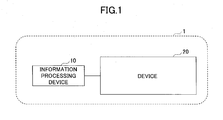
- FIG. 1 illustrates a configuration example of an information processing system according to an embodiment of the present invention.
- a device 20 is communicably connected to an information processing device 10. Communication between the device 20 and the information processing device 10 is performed via USB (Universal Serial Bus), or a network such as Near Field Communication, and LAN (wired or wireless).
- USB Universal Serial Bus
- LAN wireless or wireless
- the device 20 is a device having an operation panel, such as an image forming apparatus, a projector, a TV conference system, a digital camera, etc.
- the information processing device 10 is an electronic device that can execute complete image processing by itself, such as a smartphone and a tablet terminal.
- the information processing device 10 functions as an operation unit (operation panel) of the device 20.
- the information processing device 10 is provided by being fixed to a predetermined position of the device 20 (for example, a position where the operation panel is arranged). Therefore, the information processing device 10 and the device 20 may be recognized as a single device.
- the information processing device 10 may be detachable (separable) from the device 20. In a state where the information processing device 10 is detached, the information processing device 10 may function as an operation unit of the device 20 via wireless communication, etc.
- FIG. 2 illustrates a hardware configuration example of an information processing device according to an embodiment of the present invention.
- the information processing device 10 includes a CPU 101, a memory 102, a secondary storage device 103, a touch panel 104, a wireless communication device 105, and a device interface 106.
- the secondary storage device 103 stores programs, etc., installed in the information processing device 10.
- the memory 102 reads a program from the secondary storage device 103 and stores the program, when an instruction to activate the program is given.
- the CPU 101 realizes functions relevant to the information processing device 10 according to programs stored in the memory 102.
- the touch panel 104 is an electronic component including both an input function and a display function, and displays information and receives input from a user.
- the touch panel 104 includes a display device 111 and an input device 112.
- the display device 111 is a liquid crystal display, etc., and assumes the role of a display function of the touch panel 104.
- the input device 112 is an electronic component including a sensor for detecting the touch of an object touching the display device 111.
- the method of detecting the touch of a touching object may be any known method such as an electrostatic method, a resistance film method, or an optical method.
- a touch object is an object that touches the contact surface (front surface) of the touch panel 104. Examples of such an object are the user's finger, an exclusive-use pen, and a general pen.
- the wireless communication device 105 is an electronic component such as an antenna, which is needed for performing communication in a wireless LAN (Local Area Network) or a mobile communication network.
- the device interface 106 is an interface for communicating with the device 20.
- FIG. 3 illustrates a software configuration example of the information processing system 1 according to an embodiment of the present invention.
- the device 20 includes a device platform 21 and one or more device applications 22 that operate on the device platform 21. These elements are programs for causing a CPU of the device 20 to execute predetermined processes.
- the device platform 21 provides an environment for executing the device application 22.
- the device platform 21 implements control of activating and stopping the device application 22, and executes a function common to a plurality of device applications 22.
- the common function is used from the device applications 22 via an API (Application Program Interface) included in the device platform 21.
- An example of the device platform 21 is an OS (Operating System).
- a device application 22 platform such as an OS and a Java (registered trademark) virtual machine may constitute the device platform 21.
- the device application 22 is an application program for controlling the device 20 and causing the device 20 to execute a job (hereinafter, simply referred to as an "application").
- the device application 22A and the device application 22B are illustrated as examples of the device application 22.
- the functions of the device application 22A and the device application 22B are not limited to particular functions.
- the information processing device 10 includes a panel platform 11 and a plurality of applications that operate on the panel platform 11. These elements are programs for causing the CPU 101 to execute predetermined processes.
- the panel platform 11 provides an environment for executing applications.
- the panel platform 11 implements control of activating and stopping an application, and executes a function common to a plurality of applications.
- the common function is used from the applications via an API included in the panel platform 11.
- the panel platform 11 may control the login of the user to the information processing device 10.
- an example of the panel platform 11 is an OS (Operating System).
- application platforms such as an OS and a Java (registered trademark) virtual machine may constitute the panel platform 11.
- the applications of the information processing device 10 are classified into UI applications 12 and service applications 13 according to its role.
- the UI application 12 is an application that assumes the responsibility of cooperating with the device application 22 and providing a user interface such as a screen relevant to the device application 22 of the cooperation partner. That is to say, the UI application 12 is an application that is directly used by the user.
- the UI application 12A and the UI application 12B are illustrated as examples of the UI application 12.
- the UI application 12 and the device application 22 are associated with each other in a one-on-one manner.
- the UI application 12A is the UI application 12 for cooperating with the device application 22A.
- the UI application 12B is the UI application 12 for cooperating with the device application 22B.
- the service application 13 is an application for providing services that are commonly used by the UI application 12.
- a common screen application 13a and an error control application 13b are illustrated as examples of the service application 13.
- the common screen application 13a is the service application 13 that executes the displaying of a common screen (hereinafter, "common screen") to the UI applications 12.
- An example of such a common screen is a screen for displaying information relevant to abnormalities on the side of the device application 22. Functions of the error control application 13b are described below.
- FIG. 4 illustrates a functional configuration example of the UI applications 12 and the error control application 13b.
- the UI applications 12 such as the UI application 12A and the UI application 12B include a main part 121 and an application template 122.
- the main part 121 is the part on which a process unique to the UI application 12 has been executed. That is to say, the main part 121 is the part for realizing the essential function of the corresponding UI application 12.
- the application template 122 is a part common to the UI applications 12, and a part that is implemented as a template created in advance.
- the source code of the application template 122 may be distributed, or an object code in which the source code is compiled may be distributed.
- the information processing device 10 is preferably provided with a mechanism for checking whether the source code has been altered.
- the application template 122 includes a fixed part 1221 and a change part 1222.
- the fixed part 1221 includes an interface that can be called from outside (for example, the service application 13) and a fixed implementation with respect to the interface, which are to be included in the UI application 12.
- a fixed implementation is an implementation that is prohibited from being overwritten. Therefore, the fixed part 1221 is an implementation common to a plurality of UI applications 12.
- the fixed part 1221 includes an interface for receiving a report indicating the end of the device application 22 that is the cooperation partner, and an implementation of an ending (terminating) process in response to the report.
- the change part 1222 is a part for providing a mechanism for customizing part of the fixed part 1221.
- the change part 1222 it is possible to make a change unique to each UI application 12, with respect to the ending process executed by the fixed part 1221.
- the range in which customization is possible is limited according to the change part 1222.
- a new process is added, with respect to the ending process executed by the fixed part 1221.
- an example of customization in the change part 1222 is a process deleting an operation file unique to a particular UI application 12.
- the change part 1222 may be a sub class of the fixed part 1221. In this case, in the sub class, customization of the ending process is performed.
- the change part 1222 may be a predetermined function that the fixed part 1221 is scheduled to call at a predetermined timing. In this case, in the predetermined function, a customization process of a screen displayed by the fixed part 1221 is performed.
- the change part 1222 may be a script file that the fixed part 1221 reads at a predetermined timing. In this case, in the script file, a script is described, which indicates the customization process of the screen displayed by the fixed part 1221.
- the fixed part 1221 interprets the script, and executes the process defined in the script at the time of the ending process.
- the change part 1222 may be a setting file that the fixed part 1221 reads.
- the setting file for example, the fixed part 1221, in which a list of file names to be deleted is set, executes the deleting of files relevant to the file names described in the setting file.
- the error control application 13b includes a detection unit 131, a report unit 132, and a request unit 133.
- the detection unit 131 detects the end of the device application 22.
- the detection target may be limited to an ending caused by an abnormality.
- the report unit 132 reports the end of the device application 22 to the UI application 12 that cooperates with or corresponds to the device application 22 whose end is detected by the detection unit 131.
- the association relationship between the device application 22 and the UI application 12 can be identified by referring to an association information storage unit 14.
- the association information storage unit 14 stores, in association with each other, the identification information of the device application 22 and the identification information of the UI application 12 that cooperate with each other.
- the association information storage unit 14 may be realized with the use of the secondary storage device 103 or the memory 102.
- the identification information of the device application 22 and the identification information of the UI application 12 are hereinafter referred to as an "application 1D".
- the request unit 133 requests the common screen application 13a to display a screen indicating information relevant to the end of the device application 22, in response to the detection unit 131 detecting the end of the device application 22.
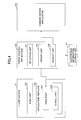
- FIG. 5 is a sequence diagram for describing a first example of processing procedures executed by the information processing system 1.
- the initial state of FIG. 5 is assumed to be a state in which the device application 22A and the UI application 12A are respectively activated, and by the cooperation of the device application 22A and the U1 application 12A, execution of a process requested by a user has started.
- the device platform 21 specifies the application ID of the device application 22A, and sends a report of the abnormal ending of the device application 22A, to the error control application 13b (step S102).
- the detection unit 131 of the error control application 13b detects the end of the device application 22A.
- the report may include information indicating the factor of the abnormal ending (for example, an error code).
- the report of the abnormal ending may be sent from the device platform 21 to the panel platform 11, and then the panel platform 11 may transmit the report to the error control application 13b.
- the report unit 132 of the error control application 13b refers to the association information storage unit 14 and identifies the application 1D of the UI application 12 corresponding to the application ID specified in the report of the abnormality ending (step S103).
- the application ID of the UI application 12A is identified.
- the report unit 132 sends the report of the abnormal ending of the device application 22A, to the UI application 12A (step S104).
- the communication between the applications may be realized by using a known technology such as inter-process communication, events, or signals.
- the fixed part 1221 of the UI application 12A starts the ending process in response to the report.
- the fixed part 1221 uses the change part 1222 to execute a customization process (step 5105).
- a customization process is an ending process unique to the UI application 12A.
- the customization process ends ends (step S106)
- the fixed part 1221 ends the process or the thread of the UI application 12A (step S107).
- the request unit 133 of the error control application 13b requests the common screen application 13a to output the error information indicating the abnormal ending of the device application 22 (step S109).
- This request may include information indicating the factor of the abnormal ending, included in the report of the abnormal ending.
- the common screen application 13a displays an error screen indicating error information in response to the request (step S110).
- the error screen may display that the device application 22A has abnormally ended, and may display the factor of the abnormal ending.
- FIG. 6 is a sequence diagram for describing a second example of processing procedures executed by the information processing system 1.
- the same steps as those of FIG. 5 are denoted by the same step numbers, and descriptions thereof are appropriately omitted.
- the request unit 133 of the error control application 13b requests the common screen application 13a to output error information without waiting for the UI application 12A to end, which is the point that is different from FIG. 5 . That is to say, the ending of the UI application 12A and the output of the error information are executed without being in synchronization with each other. In these procedures also, it is possible to report, to the user, the end of the device application 22A, which is the factor causing the end of the UI application 12A.
- the displaying of the screen indicating the ending is performed in an integrated manner by the common screen application 13a. Therefore, in each UI application 12, it is possible to reduce the need of performing the implementation for displaying the screen, and uniformity of the screens can be expected. Furthermore, in a part such as the panel platform 11 on which a plurality of programs depend, it is possible to reduce the need of performing the implementation for displaying the screen. Furthermore, compared to the case where the process of displaying the screen is implemented at the UI application 12, the usage amount of the memory can be expected to decrease.
- the process to be executed by the UI application 12 that is cooperating with the device application 22 is implemented in advance in the fixed part 1221 of the application template 122. Therefore, the man-hours for developing the UI application 12 can be expected to decrease. Furthermore, the operations of the UI application 12 can be expected to be uniform, when the device application 22 ends.
- the fixed part 1221 of the UI application 12 does not necessarily need to be distributed in the format of the application template 122.
- an interface to be implemented in the UI application 12 may be defined, and implementation of the part corresponding to the fixed part 1221 may be transferred to the developer of each UI application 12.
- the degree of freedom increases in the implementation with respect to the interface, and therefore the change part 1222 need not be provided.
- the present embodiment may be applied to a system including an application operating in one of the computers and an application which cooperates with the application and which operates in another computer, in computers connected to each other via a network.
- the UI application 12 is an example of a first application program
- the device application 22 is an example of a second application program
- a screen display application is an example of a third application program
- the fixed part 1221 is an example of a common part
- the change part 1222 is an example of a unique part.
- One approach to overcome the inconvenience is to display a screen indicating that an abnormality has occurred in the logic application.
- Such a screen is common to a plurality of UI applications, and therefore if the screen is displayed by a system providing an execution environment for the application such as an OS (Operating System) and an application platform, it is possible to reduce the man-hours for developing the application.
- OS Operating System
- an information processing system an information processing method, and an information processing terminal are provided, which are capable of providing a new display mechanism relevant to a screen common to a plurality of applications.
- the information processing system, the information processing method, and the information processing terminal are not limited to the specific embodiments described herein, and variations and modifications may be made without departing from the spirit and scope of the present invention.
Landscapes
- Engineering & Computer Science (AREA)
- Theoretical Computer Science (AREA)
- General Engineering & Computer Science (AREA)
- Physics & Mathematics (AREA)
- General Physics & Mathematics (AREA)
- Quality & Reliability (AREA)
- Software Systems (AREA)
- Computer Hardware Design (AREA)
- Stored Programmes (AREA)
Applications Claiming Priority (1)
| Application Number | Priority Date | Filing Date | Title |
|---|---|---|---|
| JP2013116700A JP6205861B2 (ja) | 2013-06-03 | 2013-06-03 | 情報処理システム、情報処理方法、及びプログラム |
Publications (1)
| Publication Number | Publication Date |
|---|---|
| EP2811406A1 true EP2811406A1 (de) | 2014-12-10 |
Family
ID=51133801
Family Applications (1)
| Application Number | Title | Priority Date | Filing Date |
|---|---|---|---|
| EP14170587.1A Withdrawn EP2811406A1 (de) | 2013-06-03 | 2014-05-30 | Überwachung abhängiger Anwendungen |
Country Status (4)
| Country | Link |
|---|---|
| US (1) | US9384041B2 (de) |
| EP (1) | EP2811406A1 (de) |
| JP (1) | JP6205861B2 (de) |
| CN (1) | CN104216775B (de) |
Families Citing this family (7)
| Publication number | Priority date | Publication date | Assignee | Title |
|---|---|---|---|---|
| JP6379699B2 (ja) | 2014-06-05 | 2018-08-29 | 株式会社リコー | 情報処理装置、情報処理システム、情報処理プログラム、および情報処理方法 |
| JP6876232B2 (ja) * | 2016-09-26 | 2021-05-26 | 富士フイルムビジネスイノベーション株式会社 | 画像形成装置及びプログラム |
| JP2018088117A (ja) | 2016-11-29 | 2018-06-07 | キヤノン株式会社 | 画像形成装置および制御方法 |
| JP7059696B2 (ja) | 2018-03-02 | 2022-04-26 | 株式会社リコー | 機器、情報処理システム、情報処理方法及びプログラム |
| JP7069969B2 (ja) | 2018-03-29 | 2022-05-18 | 株式会社リコー | 情報処理装置、情報処理方法及び情報処理プログラム |
| JP7400544B2 (ja) | 2019-03-13 | 2023-12-19 | 株式会社リコー | 情報処理システム、サーバ、プログラムおよびライセンス付与方法 |
| JP7294554B1 (ja) * | 2023-02-16 | 2023-06-20 | 凸版印刷株式会社 | 信号処理装置、信号処理方法、及びプログラム |
Citations (1)
| Publication number | Priority date | Publication date | Assignee | Title |
|---|---|---|---|---|
| US20120102373A1 (en) * | 2010-10-26 | 2012-04-26 | Timothy Mark Waugh | Method and apparatus for error video creation, playback and reporting |
Family Cites Families (12)
| Publication number | Priority date | Publication date | Assignee | Title |
|---|---|---|---|---|
| JP2001188726A (ja) * | 1999-12-28 | 2001-07-10 | Fujitsu Ltd | 監視事象通知システム |
| JP2002330246A (ja) | 2001-04-26 | 2002-11-15 | Canon Inc | 画像形成装置、制御方法及び記憶媒体並びにプログラム |
| JP4523991B2 (ja) * | 2003-03-25 | 2010-08-11 | 株式会社リコー | 端末装置、方法、システム、及びプログラム |
| CN1896965A (zh) * | 2005-07-13 | 2007-01-17 | 鸿富锦精密工业(深圳)有限公司 | 计算机启动记录监测系统及方法 |
| JP4544246B2 (ja) * | 2006-12-28 | 2010-09-15 | ソニー株式会社 | 制御装置および方法、プログラム、並びに記録媒体 |
| JP2008197885A (ja) * | 2007-02-13 | 2008-08-28 | Nec Corp | アプリケーション異常終了処理システムとその方法およびプログラム |
| US8438567B2 (en) * | 2007-11-07 | 2013-05-07 | Ricoh Company, Ltd. | Information processing device and image processing apparatus |
| JP4569846B2 (ja) * | 2008-04-02 | 2010-10-27 | 日本電気株式会社 | I/oノード制御方式及び方法 |
| JP2011103572A (ja) | 2009-11-11 | 2011-05-26 | Canon Inc | 画像処理装置のユーザインターフェース |
| KR101657545B1 (ko) * | 2010-05-11 | 2016-09-19 | 엘지전자 주식회사 | 휴대 단말기 및 그 동작 방법 |
| JP2012160129A (ja) | 2011-02-02 | 2012-08-23 | Ricoh Co Ltd | 画像形成装置、編集制御方法及び編集制御プログラム |
| JP5420576B2 (ja) | 2011-02-28 | 2014-02-19 | 京セラドキュメントソリューションズ株式会社 | 画像形成装置 |
-
2013
- 2013-06-03 JP JP2013116700A patent/JP6205861B2/ja active Active
-
2014
- 2014-05-30 EP EP14170587.1A patent/EP2811406A1/de not_active Withdrawn
- 2014-06-02 US US14/293,297 patent/US9384041B2/en active Active
- 2014-06-03 CN CN201410242053.4A patent/CN104216775B/zh active Active
Patent Citations (1)
| Publication number | Priority date | Publication date | Assignee | Title |
|---|---|---|---|---|
| US20120102373A1 (en) * | 2010-10-26 | 2012-04-26 | Timothy Mark Waugh | Method and apparatus for error video creation, playback and reporting |
Non-Patent Citations (1)
| Title |
|---|
| "Virtualizing Business-Critical Applications with Confidence Virtualizing Business-Critical Applications with Confidence Challenges Using Traditional High-Availability Solutions High Availability in VMware Environments", 28 April 2011 (2011-04-28), pages 1 - 9, XP055137131, Retrieved from the Internet <URL:http://www.vmware.com/files/pdf/techpaper/vsp4-virtualize-biz-critical-apps.pdf> [retrieved on 20140828] * |
Also Published As
| Publication number | Publication date |
|---|---|
| JP6205861B2 (ja) | 2017-10-04 |
| CN104216775A (zh) | 2014-12-17 |
| US9384041B2 (en) | 2016-07-05 |
| CN104216775B (zh) | 2017-10-10 |
| JP2014235576A (ja) | 2014-12-15 |
| US20140359631A1 (en) | 2014-12-04 |
Similar Documents
| Publication | Publication Date | Title |
|---|---|---|
| US9384041B2 (en) | Information processing system for ending a first program when a second program ends | |
| EP3966681B1 (de) | Automatische aktualisierung von anwendungsprogrammen während betriebssystem-upgrades | |
| CN112015475B (zh) | 一种应用程序启动方法及装置 | |
| US10694057B2 (en) | Apparatus, method and storage medium that stores program | |
| RU2652463C2 (ru) | Блок оборудования, терминал обработки информации, система обработки информации, способ управления отображением и программа | |
| US10506122B2 (en) | Information processing apparatus and method for controlling the same | |
| US20170013147A1 (en) | Information processing apparatus, image processing apparatus, medium, and user interface | |
| US10356267B2 (en) | Information processing apparatus, control method, and storage medium | |
| US10146886B2 (en) | Information processing system and method for adding additional modules | |
| EP2811395A1 (de) | Vorrichtung, Informationsverarbeitungsendgerät, Informationsverarbeitungssystem, Anzeigesteuerungsverfahren und Aufzeichnungsmedium | |
| US9794437B2 (en) | Information processing apparatus, information processing system, and information processing method | |
| JP6070423B2 (ja) | 情報処理装置、情報処理方法、及びプログラム | |
| JP2016151892A (ja) | 情報処理装置、インストール方法、及びインストールプログラム | |
| US10592265B2 (en) | Application execution apparatus equipped with virtual machine controlling installed application, control method therefor, and storage medium storing control program therefor | |
| JP2017102847A (ja) | 情報処理システム、中継装置、方法およびプログラム | |
| JP5707366B2 (ja) | Usb端末の制御方法及びこれを実行する装置 | |
| US11086575B2 (en) | Information processing apparatus and method | |
| US10387093B2 (en) | Image forming apparatus that sets a time-out value based on an executed application, information processing method, storage medium storing program | |
| US20240095050A1 (en) | Information processing apparatus and control method therefor | |
| US10101952B2 (en) | Driver installation system | |
| JP2014178998A (ja) | 情報処理装置、機器、インストールシステム、インストール方法、及びプログラム | |
| US8079016B2 (en) | Information processing apparatus and application management method |
Legal Events
| Date | Code | Title | Description |
|---|---|---|---|
| PUAI | Public reference made under article 153(3) epc to a published international application that has entered the european phase |
Free format text: ORIGINAL CODE: 0009012 |
|
| 17P | Request for examination filed |
Effective date: 20140530 |
|
| AK | Designated contracting states |
Kind code of ref document: A1 Designated state(s): AL AT BE BG CH CY CZ DE DK EE ES FI FR GB GR HR HU IE IS IT LI LT LU LV MC MK MT NL NO PL PT RO RS SE SI SK SM TR |
|
| AX | Request for extension of the european patent |
Extension state: BA ME |
|
| 17Q | First examination report despatched |
Effective date: 20160330 |
|
| STAA | Information on the status of an ep patent application or granted ep patent |
Free format text: STATUS: EXAMINATION IS IN PROGRESS |
|
| STAA | Information on the status of an ep patent application or granted ep patent |
Free format text: STATUS: THE APPLICATION IS DEEMED TO BE WITHDRAWN |
|
| 18D | Application deemed to be withdrawn |
Effective date: 20191123 |