EP2803069B1 - Holografisches aufzeichnungsmedium und herstellungsverfahren für ein holografisches aufzeichnungsmedium - Google Patents
Holografisches aufzeichnungsmedium und herstellungsverfahren für ein holografisches aufzeichnungsmedium Download PDFInfo
- Publication number
- EP2803069B1 EP2803069B1 EP12812753.7A EP12812753A EP2803069B1 EP 2803069 B1 EP2803069 B1 EP 2803069B1 EP 12812753 A EP12812753 A EP 12812753A EP 2803069 B1 EP2803069 B1 EP 2803069B1
- Authority
- EP
- European Patent Office
- Prior art keywords
- light
- compound
- article
- recording medium
- holographic recording
- Prior art date
- Legal status (The legal status is an assumption and is not a legal conclusion. Google has not performed a legal analysis and makes no representation as to the accuracy of the status listed.)
- Not-in-force
Links
Images




Classifications
-
- G—PHYSICS
- G11—INFORMATION STORAGE
- G11B—INFORMATION STORAGE BASED ON RELATIVE MOVEMENT BETWEEN RECORD CARRIER AND TRANSDUCER
- G11B7/00—Recording or reproducing by optical means, e.g. recording using a thermal beam of optical radiation by modifying optical properties or the physical structure, reproducing using an optical beam at lower power by sensing optical properties; Record carriers therefor
- G11B7/24—Record carriers characterised by shape, structure or physical properties, or by the selection of the material
- G11B7/2403—Layers; Shape, structure or physical properties thereof
- G11B7/24035—Recording layers
- G11B7/24044—Recording layers for storing optical interference patterns, e.g. holograms; for storing data in three dimensions, e.g. volume storage
-
- G—PHYSICS
- G11—INFORMATION STORAGE
- G11B—INFORMATION STORAGE BASED ON RELATIVE MOVEMENT BETWEEN RECORD CARRIER AND TRANSDUCER
- G11B7/00—Recording or reproducing by optical means, e.g. recording using a thermal beam of optical radiation by modifying optical properties or the physical structure, reproducing using an optical beam at lower power by sensing optical properties; Record carriers therefor
- G11B7/24—Record carriers characterised by shape, structure or physical properties, or by the selection of the material
- G11B7/241—Record carriers characterised by shape, structure or physical properties, or by the selection of the material characterised by the selection of the material
- G11B7/242—Record carriers characterised by shape, structure or physical properties, or by the selection of the material characterised by the selection of the material of recording layers
- G11B7/244—Record carriers characterised by shape, structure or physical properties, or by the selection of the material characterised by the selection of the material of recording layers comprising organic materials only
- G11B7/245—Record carriers characterised by shape, structure or physical properties, or by the selection of the material characterised by the selection of the material of recording layers comprising organic materials only containing a polymeric component
Definitions
- the present disclosure relates to molded articles that incorporate holograms, more particularly color transmission holograms. Methods of making and using the same are also disclosed.
- Holograms are an increasingly popular mechanism for the authentication of genuine articles, whether it is for security purposes or for brand protection.
- the use of holograms for these purposes is driven primarily by the relative difficulty with which they can be duplicated.
- Holograms are created by interfering two or more coherent beams of light to create an interference pattern and storing that pattern in a holographic recording medium.
- Information or imagery can be stored in a hologram by imparting the data or image to one of the two coherent beams prior to their interference.
- the hologram can be read out by illuminating it with beams matching either of the two original beams used to create the hologram and any data or images stored in the hologram will be displayed.
- articles such as credit cards, software, passports, clothing, electronics and the like.
- Two categories of holograms include surface relief structure holograms and volume holograms.
- Many of the holograms used in security or authentication applications are of the surface relief type, in which the pattern and any data or image contained therein is stored in the structure or deformations imparted to the surface of the recording medium.
- the first recorded hologram may be created by the interference of two coherent beams, but duplicates can be created by copying the surface structure using techniques such as embossing.
- the duplication of holograms is convenient for the mass production of articles such as credit cards or security labels, but it also has the disadvantage that it makes the unauthorized duplication and/or modification of these holograms for use in counterfeit parts possible from the originals using the same mechanism.
- holographic recording media Many types have been proposed, including silver halide emulsions, photoresists, photopolymers, and the like.
- Photoreactive dye-based holograms have also been proposed for volume holograms, and they provide advantages not achievable by other holographic recording media, such as processability by thermoplastic techniques (molding, extrusion, lamination, etc.), instant hologram viewability, and latent photosensitivity after the initial writing.
- processability by thermoplastic techniques molding, extrusion, lamination, etc.
- instant hologram viewability instant hologram viewability
- latent photosensitivity can lead to degradation of the recorded hologram.
- photostabilization techniques have been proposed, there is still a need for stabilization routes that reduce post-exposure processing requirements such as lamination of further layers onto the holographic structure after exposure.
- an article for recording a hologram comprises:
- a method for recording a hologram comprises:
- the photoreactive dye which is reacted with light to form a hologram, may be conveniently referred to as a "holographic photoreactive dye". Referring to it as such can help avoid confusion with the compound that can be converted from transparent to a converted compound that is opaque in the wavelength range to which the holographic photoreactive dye is sensitive, as such a compound can also be a type of photoreactive dye when the conversion to the converted compound is in response to certain types of light exposure.
- the first compound may be referred to for convenience as a “latent light-blocking compound” and the converted compound may be referred to as a "light-blocking compound”.
- Polyarylates that can be used in the binder composition refer to polyesters of aromatic dicarboxylic acids and bisphenols.
- Polyarylate copolymers include carbonate linkages in addition to the aryl ester linkages, known as polyester-carbonates. These aryl esters may be used alone or in combination with each other or more particularly in combination with bisphenol polycarbonates.
- These organic polymers can be prepared, for example, in solution or by melt polymerization from aromatic dicarboxylic acids or their ester forming derivatives and bisphenols and their derivatives.
- Binary blends, ternary blends and blends having more than three resins may also be used in the polymeric alloys.
- one of the polymeric resins in the alloy may comprise about 1 to about 99 weight percent (wt%) based on the total weight of the composition. Within this range, it is generally desirable to have the one of the polymeric resins in an amount greater than or equal to about 20, preferably greater than or equal to about 30 and more preferably greater than or equal to about 40 wt%, based on the total weight of the composition.
- diarylethenes that can be used as photoactive materials include diarylperfluorocyclopentenes, diarylmaleic anhydrides, diarylmaleimides, or a combination comprising at least one of the foregoing diarylethenes.
- the diarylethenes are present as open-ring or closed-ring isomers.
- the open ring isomers of diarylethenes have absorption bands at shorter wavelengths. Upon irradiation with ultraviolet light, new absorption bands appear at longer wavelengths, which are ascribed to the closed-ring isomers.
- the absorption spectra of the closed-ring isomers depend on the substituents of the thiophene rings, naphthalene rings or the phenyl rings.
- diarylethene closed ring isomers examples include: where iPr represents isopropyl; and combinations comprising at least one of the foregoing diarylethenes.
- the diarylethenes can be in the form of a polymer having the general formula (XXXXIV) below.
- the formula (XXXXIV) represents the open isomer form of the polymer. where Me represents methyl, R 1 , X and Z have the same meanings as explained above in formulas (XI) through (XV) and n is any number greater than 1.
- Nitrones can also be used as holographic photoreactive dyes in the holographic storage media. Nitrones have the general structure shown in the formula (XXXXV):
- the nitrones may be ⁇ -aryl-N-arylnitrones or conjugated analogs thereof in which the conjugation is between the aryl group and an ⁇ -carbon atom.
- the ⁇ -aryl group is frequently substituted, most often by a dialkylamino group in which the alkyl groups contain 1 to about 4 carbon atoms.
- the R 2 is hydrogen and R 6 is phenyl.
- Q can be monovalent, divalent or trivalent according as the value of "a" is 0, 1 or 2. Illustrative Q values are shown in the Table 1 below.
- the hologram may be recorded in the holographic medium by any of a number of exposure set-ups.
- Transmission holograms may be recorded by directing the object light source and the reference light source onto the same surface of the holographic recording medium.
- FIG. 1 A simplified diagram of an exemplary embodiment of an apparatus for recording a transmission hologram is shown in FIG. 1 .
- the output from a laser 10 is divided into two equal beams by beam splitter 20.
- One beam, the signal beam 40 is incident on a form of spatial light modulator (SLM), deformable mirror device (DMD), or object to be recorded 30, which imposes the data to be stored in signal beam 40.
- SLM or DMD device may be composed of a number of pixels that can block or transmit the light based upon input electrical signals.
- Each pixel can represent a bit or a part of a bit (a single bit can consume more than one pixel of the SLM or DMD 30) of data to be stored.
- the output of SLM/DMD/object 30 is then incident on the storage medium 60.
- the second beam, the reference beam 50 is transmitted all the way to storage medium 60 by reflection off first mirror 70 with minimal distortion.
- the two beams are coincident on the same area of holographic medium 60 at different angles. The net result is that the two beams create an interference pattern at their intersection in the holographic medium 60.
- the interference pattern is a unique function of the data imparted to signal beam 40 by SLM/DMD/object 30.
- Reflection holograms may be recorded by directing the object light source and the reference light source onto different surfaces of the recording medium, such as opposite sides of a holographic recording film.
- the refraction produced by the interference fringes that are often formed by such exposure results may only be viewable at a wavelength close to the exposure wavelength, in which case the use of a light-blocking layer as described herein may adversely impact the viewability of the hologram.
- a reflection hologram produced by directing the object light source and reference light source onto different sides of the recording medium may be viewable in a different wavelength than the recording wavelength if the angle of incidence ( ⁇ ) of the light beams onto the holographic medium is high (e.g., greater than or equal to about 40°).
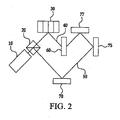
- the output from a laser 10 is divided into two equal beams by beam splitter 20.
- One beam, the signal beam 40 is incident on a form of spatial light modulator (SLM), digital light projector (DLP), deformable mirror device (DMD), mask or object to be recorded 30, which imposes the image or data to be stored in signal beam 40.
- SLM or DMD device may be composed of a number of pixels that can block or transmit the light based upon input electrical signals. Each pixel can represent a bit or a part of a bit (a single bit can consume more than one pixel of the SLM or DMD 30) of data to be stored.
- the output of SLM/DMD/object 30 in the form of the signal beam enters holographic recording medium 60.
- the second beam, the reference beam 50, is transmitted to holographic recording medium 60 by reflection off mirrors 70, 75, and 77 with minimal distortion.
- the two beams are coincident on the same area of holographic recording medium 60 from different directions. The net result is that the two beams create an interference pattern at their intersection in the holographic recording medium 60.
- the interference pattern is a unique function of the data or image information imparted to signal beam 40 by SLM/DMD/object 30.
- the latent light-blocking compound is disposed in the holographic recording medium. In another embodiment, the latent light-blocking compound is disposed in separate layer. In either of these embodiments, a layer or material comprising the latent light-blocking compound may be referred to herein as a "light blocking layer or material" even though it doesn't perform it's light-blocking function until after conversion of the first compound to the converted compound. Also, as used herein, "light” refers not only to light in the visible spectrum, but to actinic radiation of any wavelength effective to produce a change in the holographic photoreactive dye's optical properties capable of producing a hologram when exposed to mutually coherent beams of the actinic radiation.
- the light blocking layer should block transmission of light at wavelength(s) to which the holographic photoreactive dye in the holographic recording medium is sensitive while allowing transmission of light at other wavelengths for viewing the recorded hologram.
- opaque means that the light-blocking compound or layer absorbs sufficient levels of light at the wavelength(s) to which the holographic photoreactive dye is sensitive to provide a hologram with a desired level of stability; complete or absolute opacity is not required.
- the level of light blocking that is provided is a function not only of the spectral absorbance characteristics of the light-blocking compound, but also of its concentration in a light-blocking layer as well as the thickness of the light-blocking layer.
- absorbance of a light blocking layer or material extends to wavelengths above the wavelength at which the holographic photoreactive dye is written.
- a light blocking layer or material has less than or equal to 20% transmittance up to a wavelength of about 20 nm higher than the writing wavelength.
- a light blocking layer or material has less than or equal to 20% transmittance up to a wavelength of about 30 nm higher than the writing wavelength.
- some holographic photoreactive dyes exhibit sensitivity in lower wavelengths below the writing wavelength, such as in the UV range. For such dyes, a light blocking layer or material should also block light in those wavelengths, which may necessitate a combination of light-blocking compounds or moieties in the light blocking layer or material.
- the difference between the wavelength at which the light-blocking layer or material transmits 20% (20% transmittance) of the light and the wavelength at which it transmits 80% of the light (80% transmittance) is less than or equal to about 30 nm. In yet another exemplary embodiment, the difference between the wavelength at which the light-blocking layer or material transmits 20% (20% transmittance) of the light and the wavelength at which it transmits 80% of the light (80% transmittance) is less than or equal to about 15 nm.
- the light-blocking layer or material may include a polymeric binder, including but not limited to any of the polymeric binders described above with respect to the holographic recording medium.
- a light-blocking layer is extruded as a relatively thin layer or film, e.g., having a thickness of 0.5 to 1000 microns, which is thermally or adhesively laminated to the holographic layers prior to hologram recording.
- a layer or film of the light blocking material is coated onto, co-extruded with, thermally or adhesively laminated with a support.
- the support may be a planar support such as a film or card, or it may be virtually any other shape as well.
- the light-blocking compound into which the latent light-blocking compound is converted can be chosen from any of a number of known light-absorbing compounds, provided that a suitable functional group is attached thereto that can be removed or reacted to form the light-absorbing compound.
- the particular compound of course depends on the spectral sensitivity of the holographic photoreactive dye that the light-blocking compound is supposed to protect from exposure after the hologram has been formed.
- Exemplary optically absorptive species include, but are not limited to organic dyes, organometallic dyes, absorptive polymers, polymer-bound organic or organometallic dyes, and combinations of any of the above.
- organic dye molecules include 2-hydroxybenzophenones (e.g., (2-hydroxyphenyl)(phenyl)methanone, A), formamides (e.g., N-(2-ethoxy-phenyl)-N'-(2-ethyl-phenyl)-oxalamide, B), quinones (e.g., anthraquinones (1-[4-(1-methyl-1-phenyl-ethyl)-phenoxy]-anthraquinone, C), salicylates (e.g., 2-hydroxy-benzoic acid 4-tert-butyl-phenyl ester, D), benzotriazoles (e.g.
- a first compound i.e., latent light-blocking compound
- a light-blocking compound is converted to a light-blocking compound after the holographic photoreactive dye in the holographic recording medium has been exposed to light to form a hologram.
- the light-blocking compound can be formed in situ from structurally dissimilar precursor compound(s), in a number of exemplary embodiments it will be formed from a chromophore compound having one or more groups thereon that can be reacted to cause the spectral absorbance of the compound to shift toward longer or shorter wavelengths, thereby providing the spectral absorbance properties desired for the light-absorbing compound.
- Such reactive groups can undergo a reaction in response to exposure to a chemically reactive component such as an acid, base, oxidizing agent, or reducing agent.
- Chromophores having such reactive groups are well-known in the field of silver halide imaging, where they are known as dye-forming couplers.
- Dye-forming couplers in the field of silver halide imaging have groups thereon that are reactive with oxidized developer compound that was oxidized by reaction with grains of silver halide that have been exposed to light. Such compounds are very well-known and do not require further exemplification herein. A more detailed description of them can be found in T.H.
- the latent light-blocking compound is converted into the light-blocking compound by exposure to heat or light.
- Various groups can be appended to or included as part of chromophore molecules that will react to cause an absorbance wavelength shift upon exposure to heat or light, as is known in the art.
- Exemplary groups include endoperoxides that use dioxygen to form a cycloadduct from a diene-containing chromophore, or -benzoyl, -tosyl, -t-butoxy (e.g., t-butoxycarbonyl), -nitrophenyl, and -veratroyl groups used to protect oxygen atoms on aromatic ring structures (e.g., phenolic oxygens) in a chromophore molecule).
- endoperoxides that use dioxygen to form a cycloadduct from a diene-containing chromophore, or -benzoyl, -tosyl, -t-butoxy (e.g., t-butoxycarbonyl), -nitrophenyl, and -veratroyl groups used to protect oxygen atoms on aromatic ring structures (e.g., phenolic oxygens) in a chromophore molecule).
- Endoperoxides can be incorporated into aromatic or diene-containing molecules. Endoperoxides are formed by the reaction of molecular oxygen (O 2 ) with diene or aromatic carbons to form a ring made up of a C-O-O-C bridge within the parent molecule. This reaction occurs via a sensitization mechanism wherein a dye molecule absorbs an incident photon and transfers its excited state energy to a molecule of ground state oxygen (triplet oxygen) to form excited state oxygen (singlet oxygen). The singlet oxygen then attacks the dye molecules' reactive functionalities such as mono- or di-enes or aromatic double bonds, and adds to the molecule as an endoperoxide.
- O 2 molecular oxygen
- diene or aromatic carbons to form a ring made up of a C-O-O-C bridge within the parent molecule. This reaction occurs via a sensitization mechanism wherein a dye molecule absorbs an incident photon and transfers its excited state energy to a molecule of ground state oxygen (triplet
- the triplet energy (T 1 ) of the dye should be greater than 22 kcal/mol, which allows the singlet oxygen to be generated via tripet-to-triplet energy transfer (Dexter energy transfer) from the dye to the ground state oxygen when the oxygen molecule collides with the dye.
- the endoperoxide ring will spontaneously open to form hydroxyl or peroxy groups, but in certain cases, the endoperoxide moiety can be quite stable. Because the ring contains molecular oxygen, if the C-O bonds are cleaved (e.g., thermally), the dioxygen leaving group will diffuse into the atmosphere and return the parent compound ( Figure 10).
- Exemplary aromatic ring structures represented by Z in formula (1) have 10 to 22 carbon atoms and include anthracene derivatives (e.g., 9,10-diphenylanthracene, 9,10-dimethylanthracene), pteridine triones (e.g., 1,3,8-trimethyl-6-phenylpteridine-2,4,7(1H,3H,8H)-trione), highly substituted napthalenes (1,4-diphenylnapthalene or 1,4-dimethoxynapthalene) and various derivatives of phenanthrene, tetracene, Benz[a]anthracene, Benzo[a]fluorene , Benzo[c]phenanthrene , Chrysene ,Fluoranthene ,Tetracene , Triphenylene , and 5 ring derivatives such as pentacene.
- anthracene derivatives e.g., 9,10-diphen
- a latent light-blocking compound having an endoperoxide group is a pteridine trione having the formula (2) wherein R 1 , R 2 , R 3 , and R 4 each independently represents substituted or unsubstituted alkyl (e.g., of 1 to 4 carbon atoms) or substituted or unsubstituted aryl (e.g., of 6 to 10 carbon atoms), and R 5 represents substituted or unsubstituted aryl (e.g., of 6 to 10 carbon atoms).
- R 5 represents 4-methoxyphenyl, which compound could be synthesized by reacting 5,6-diamino-1,3-dimethyluracil hydrate and ethyl 2-(4-methoxyphenyl)-2-oxoacetate to form the corresponding imine product, followed by condensation of the imine and then N-methylation reaction with methyl iodide to yield the corresponding methoxyderivative of pteridine trione (MeO-PT).
- the ethyl 2-(4-methoxyphenyl)-2-oxoacetate could be prepared from the reaction of methoxybenzene and methylester carbonyl chlorideln yet another exemplary embodiment, a photostabilizer such as a singlet oxygen scavenger (e.g., 1,4-diazabicyclo[2.2.2]octane (i.e., DABCO), ⁇ -tocopherol, butazate, Naugard ® 445), a triplet quencher (e.g., trans-stilbene), a radical scanger (e.g., 2,2,6,6-tetramethylpiperidin-2-yl)oxidanyl (i.e., TEMPO)), or combinations thereof, is used in conjunction with the light-blocking compound such as a pteridine trione compound.
- a photostabilizer such as a singlet oxygen scavenger (e.g., 1,4-diazabicyclo[2.2.2]oc
- a latent light-blocking compound is an aryloxy compound having the formula (3) wherein R 6 represents a moiety that includes a functional group that can be cleaved from the oxygen atom to which it is attached to form a hydroxyl group, Z represents the atoms necessary to complete an aromatic ring structure, and Z' represents the atoms necessary to complete a conjugated structure with the proviso that Z' further includes a moiety capable of hydrogen bonding to the hydroxyl group formed by the cleavage of R 6 .
- R 8 can include, for example, substituted or unsubstituted aryl of 6 to 10 carbon atoms (e.g., phenyl, 4-nitrophenyl, alkyl of 4 to 10 carbon atoms (e.g., tertiary butyl).
- R 6 represents a substituted or unsubstituted benzoyl group, a substituted or unsubstituted alkoxycarbonyl group (e.g., tertiary-butoxycarbonyl), the atoms necessary to complete a tosyl group, or a 4-nitrophenyl carbonyl group.
- Z represents the atoms necessary to complete an aromatic ring structure, for example having 6 to 20 carbon atoms.
- the aromatic ring structure may be substituted or unsubstituted, and may also contain non-carbon heteroatoms such as nitrogen.
- aromatic ring groups formed by Z include, but are not limited to, benzene rings, naphthalene rings, anthracene rings, pyridine rings, quinolone rings.
- Z' represents the atoms necessary to complete a conjugated structure, with the proviso that it also includes a moiety capable of hydrogen bonding with the hydroxyl group formed by the cleavage of R 6 .
- the conjugated structure formed by Z' involves conjugation with the bond between the carbon atoms to which -OR 6 and Z' are attached, and can be formed, for example, by an ortho-positioned carbonyl group or by an aromatic group, as shown in the dyes structures exemplified as structures (A)-(K) above.
- Moieties capable of hydrogen bonding to ortho-positioned aromatic hydroxyl groups, and useful moieties for providing same, are well-known in the chromophore art, and include oxygen, nitrogen, or sulfur atom-containing groups.
- Examples of useful groups formed by Z' along with the rest of structure (3) to provide conjugation and hydrogen bonding include carbonyl groups (e.g., 2-hydroxybenzophenones such as structure A disclosed above, quinones such as structure C disclosed above, salicylates such as structure D disclosed above, hydroxyarylidene barbituric acid derivatives such as structure H disclosed above, or hydroxyarylidene thiobarbituric acid derivatives such as structure I disclosed above); and nitrogen atoms (e.g., formamides such as structure B disclosed above, benzotriazoles such as structure E disclosed above, benzoxazole derivatives such as structure J disclosed above, benzothiazole derivatives such as structure K disclosed above, triazines such as structure F disclosed above.
- carbonyl groups e.g., 2-hydroxybenzophenones such as structure A disclosed above, quinones such as structure C disclosed above, salicylates such as structure D disclosed above, hydroxyarylidene barbituric acid derivatives such as structure H disclosed above, or
- a latent light-blocking compound that can be photoactivated by light at wavelengths longer than the wavelength(s) to which the holographic photoreactive dye is sensitive would help avoid hologram degradation; however, such light-blocking compounds may also have intrinsic coloration that could adversely affect hologram aesthetics and/or viewability.
- a holographic recording medium having a holographic photoreactive dye that is sensitive to both blue and UV light is protected by a UV light-blocking layer over the holographic recording medium and a photoactivatable latent blue light-blocking layer over the UV light-blocking layer.
- chemistries can be adapted to the blue region of the spectrum for use as latent light-blocking compounds for a blue-sensitive holographic photoreactive dye as described herein.
- Various protecting group chemistries can be used, including but not limited to -benzoyl,- phenacyl, -tosyl, -t-butoxy (e.g., t-butoxycarbonyl), - nitrophenyl, and -veratroyl. While these chemistries tend to generate smaller blue shifts than those seen for endoperoxide formation, peak shifts of 60-100 nm have been demonstrated.
- the latent light-blocking compound may be disposed in a layer or material that is disposed directly onto the holographic recording medium, or it may have one or more other intervening layers between the holographic recording medium and the light blocking layer or material, as long as the light blocking compound is positioned to block light of the targeted wavelength(s) from reaching the holographic recording medium.
- the use herein of the term "over" with respect to the light blocking layer being disposed over the holographic recording medium is intended to include both embodiments where it is disposed directly on the holographic recording medium as well as embodiments where there are one or more other intervening layers.
- the light blocking layer may be applied by any of a number of technologies, including but not limited to spray coating, dip coating, inkjet printing, screen printing, or pre-forming a light-blocking film using solvent-casting, film extrusion, biaxial stretching and other techniques known to those skilled in the art, and applying it to the holographic recording medium with a pressure-sensitive or other adhesive, heat laminating, static charge adhesion, or mechanically affixing it to the holographic recording medium. Additionally, in some exemplary embodiments, a protective transparent top layer may be applied over the light blocking layer to protect it and the other underlying layers.
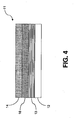
- an article 11 for recording a transmission hologram comprises support 12 having thereon light blocking layer 14', holographic recording layer 16, and light blocking layer 14.
- the support may be any transparent material, including but not limited to the materials described above as polymer binders for holographic recording media, glass, and the like.
- FIG. 3 depicts the light blocking layer 14 and light blocking layer 14 disposed over the entire area of the holographic medium 16.
- the light blocking layer need only be disposed over a portion of the holographic recording medium or a portion of the article, such as where a hologram is recorded in only a portion of the holographic recording medium or article.
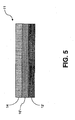
- an article 11 for recording a reflection hologram viewable as a reflection image comprises opaque support 12' having thereon a reflection holographic recording layer 16', and light blocking layer 14.
- the support may be any material, including but not limited to the materials described above as polymer binders for holographic recording media, glass, and the like, and may include opacifying agents such as pigments.
- a light-blocking material such as an opaque coating or layer (not shown) may be disposed on either side of support 12' to render provide opacity.
- an article for recording a hologram can comprise:
- the first compound is disposed over a first surface of the holographic recording medium from which the surface is viewed; and/or (ii) the holographic recording medium is a holographic film; and/or (iii) the article further comprises a second compound disposed over a second surface of the holographic recording medium, wherein the second compound is the same as or different from the first compound and is transparent to light in the wavelength range to which the photoreactive dye is sensitive and which is capable of being converted to a second converted compound that is opaque to light in the wavelength range to which the photoreactive dye is sensitive and transparent to light in a different wavelength range for viewing the hologram; and/or (iv) the article further comprises a reflecting material over a second surface of the holographic recording medium; and/or (v) the article further comprises a reflecting layer or material disposed over a second surface of the holographic recording medium that is opaque in the wavelength range to which the photoreactive dye is sensitive; and/or (vi) the article further comprises a
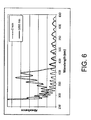
- a polymer film comprised of the endoperoxidized blocking dye (4 %w/w - 9,10-diphenylanthracene endoperoxide) and a polymeric host (high-flow, ductile polycarbonate) was spin-cast onto a glass slide at 2000RPM for 30 seconds from a 10wt% w/w solution of polymer in tetrachloroethane (TCE).
- TCE tetrachloroethane
- the sinusoidal undulations and low net signal seen in the graph are due to the thinness of the polymer films used ( ⁇ hundreds of nanometers).
- the light blocking dye 2-hydroxy-(5-methoxy)benzophenone (1g, 0.0044mole) was reacted with benzoyl chloride (0.7g, 0.005 mole) in pyridine (10ml) as a solvent.
- the reaction mixture was heated at 110°C in an oil-bath for 4 hrs.
- the reaction mixture was quenched with ice.
- a white-colored solid separated out and was filtered and washed with water followed by hexane to yield 5-methoxy-(2-benzoyloxy)benzophenone.
- Weight of the crude product was 1.1 g, and 0.6 g of the pure material was obtained on purification.
- a polymer film comprised of the latent dye (4% w/w in high-flow ductile polycarbonate) was spin-cast on glass at 500RPM for 30 seconds from a 10% w/w solution of polymer and dye in tetrachloroethylene. The film was then exposed to a fluorescent UV light source emitting in the UV-B region of the spectrum with peak emission at approximately 330nm (Luzchem photoreactor LZC 4V, ⁇ 8 W/cm 2 ) for up to 180 minutes. As shown in Figure 8 , the absorption at 405nm increased upon UV exposure approximately 12x in thin films over the course of exposure. This response is scalable for higher dye loadings or thicker films and would ensure sufficient coverage of the holographic layers to prevent further degradation of the written holograms.
Landscapes
- Holo Graphy (AREA)
- Non-Silver Salt Photosensitive Materials And Non-Silver Salt Photography (AREA)
Claims (15)
- Gegenstand zum Aufzeichnen eines Hologramms, umfassend:ein holografisches Aufzeichnungsmedium, umfassend ein transparentes polymeres Bindemittel und einen darin dispergierten fotoreaktiven Farbstoff; undeine erste Verbindung, dispergiert in dem holografischen Aufzeichnungsmedium oder angeordnet über einer ersten Oberfläche des holografischen Aufzeichnungsmediums, von welcher Oberfläche das Hologramm betrachtet wird,wobei die erste Verbindung für Licht in dem Wellenlängenbereich durchlässig ist, gegenüber dem der fotoreaktive Farbstoff empfindlich ist, und sie in eine erste umgewandelte Verbindung überführt werden kann, die für Licht in dem Wellenlängenbereich undurchlässig ist, gegenüber dem der fotoreaktive Farbstoff empfindlich ist, und für Licht in einem anderen Wellenlängenbereich zum Betrachten des Hologramms durchlässig ist.
- Gegenstand nach Anspruch 1, wobei die erste Verbindung über der ersten Oberfläche des holografischen Aufzeichnungsmediums, von welcher Oberfläche das Hologramm betrachtet wird, angeordnet ist.
- Gegenstand nach Anspruch 1 oder 2, wobei das holografische Aufzeichnungsmedium ein holografischer Film ist.
- Gegenstand nach einem der Ansprüche 1-3, weiterhin umfassend eine zweite Verbindung, angeordnet über einer zweiten Oberfläche des holografischen Aufzeichnungsmediums, wobei die zweite Verbindung die gleiche wie oder eine andere als die erste Verbindung ist und für Licht in dem Wellenlängenbereich durchlässig ist, gegenüber dem der fotoreaktive Farbstoff empfindlich ist, und in eine zweite umgewandelte Verbindung überführt werden kann, die für Licht in dem Wellenlängenbereich undurchlässig ist, gegenüber dem der fotoreaktive Farbstoff empfindlich ist, und für Licht in einem anderen Wellenlängenbereich zum Betrachten des Hologramms durchlässig ist.
- Gegenstand nach einem der Ansprüche 1-3, weiterhin umfassend ein lichtblockierendes Material über der zweiten Oberfläche des holografischen Aufzeichnungsmediums, wobei das lichtblockierende Material für Licht in dem Wellenlängenbereich undurchlässig ist, gegenüber dem der fotoreaktive Farbstoff empfindlich ist.
- Gegenstand nach einem der Ansprüche 1-5, wobei die erste Verbindung ein Endoperoxid mit der Formel ist:

- Gegenstand nach Anspruch 6, wobei die erste Verbindung ein Pteridintrion mit einer Endoperoxid-Einheit ist.
- Gegenstand nach Anspruch 7, wobei die erste Verbindung die Formel hat:

- Gegenstand nach Anspruch 8, wobei R5 4-Methoxyphenyl ist.
- Gegenstand nach einem der Ansprüche 1-5, wobei die erste Verbindung eine Aryloxyverbindung gemäß der Formel ist:
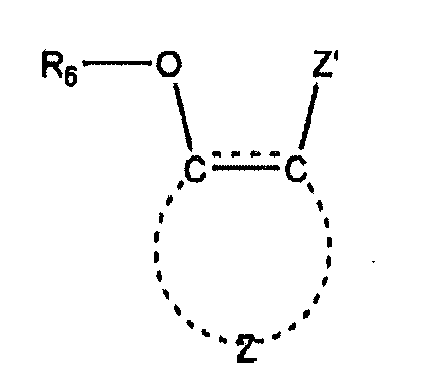
- Gegenstand nach Anspruch 10, wobei -R6 durch die Struktur -L-R8 wiedergegeben ist, wobei L, zusammen mit dem Sauerstoffatom, an das L gebunden ist, die zum Ausbilden einer spaltbaren Ester-, Carbonat- oder Sulfonatbindung erforderlichen Atome darstellt und R8 einen organischen Rest bedeutet.
- Gegenstand nach Anspruch 10, wobei R6 eine substituierte oder unsubstituierte Benzoylgruppe, einen substituierten oder unsubstituierten Alkoxycarbonylrest, die zum Vervollständigen einer Tosylgruppe erforderlichen Atome oder eine 4-Nitrophenylcarbonylgruppe bedeutet.
- Gegenstand nach einem der Ansprüche 12-15, wobei Z' eine Carbonylgruppe oder ein Stickstoffatom umfasst, die/das eine Wasserstoffbrücke mit der Hydroxylgruppe bilden kann.
- Gegenstand nach einem der Ansprüche 1-13, wobei die erste Verbindung in die umgewandelte Verbindung überführt werden kann, indem sie erwärmt oder Licht ausgesetzt wird.
- Verfahren zur Verwendung des Gegenstands nach einem der Ansprüche 1-14, umfassend:Aussetzen des holografischen Aufzeichnungsmediums miteinander interferierenden kohärenten Lichtstrahlen, um ein Hologramm zu erzeugen, und Überführen der ersten Verbindung in die umgewandelte Verbindung, indem die erste Verbindung erwärmt wird oder die erste Verbindung Licht ausgesetzt wird.
Applications Claiming Priority (2)
| Application Number | Priority Date | Filing Date | Title |
|---|---|---|---|
| US13/350,149 US8663873B2 (en) | 2012-01-13 | 2012-01-13 | Holographic recording medium and method of recording a hologram |
| PCT/US2012/067156 WO2013106138A1 (en) | 2012-01-13 | 2012-11-30 | Holographic recording medium and method of making holographic recording medium |
Publications (2)
| Publication Number | Publication Date |
|---|---|
| EP2803069A1 EP2803069A1 (de) | 2014-11-19 |
| EP2803069B1 true EP2803069B1 (de) | 2016-02-03 |
Family
ID=47521140
Family Applications (1)
| Application Number | Title | Priority Date | Filing Date |
|---|---|---|---|
| EP12812753.7A Not-in-force EP2803069B1 (de) | 2012-01-13 | 2012-11-30 | Holografisches aufzeichnungsmedium und herstellungsverfahren für ein holografisches aufzeichnungsmedium |
Country Status (4)
| Country | Link |
|---|---|
| US (1) | US8663873B2 (de) |
| EP (1) | EP2803069B1 (de) |
| JP (1) | JP2015509211A (de) |
| WO (1) | WO2013106138A1 (de) |
Families Citing this family (3)
| Publication number | Priority date | Publication date | Assignee | Title |
|---|---|---|---|---|
| US8728685B2 (en) * | 2009-06-25 | 2014-05-20 | Sabic Innovative Plastics Ip B.V. | Method of making holographic storage medium |
| US9086618B2 (en) * | 2011-06-10 | 2015-07-21 | Nikon Corporation | Projector having holographic recording medium and light modulation element |
| CN111138290B (zh) * | 2019-12-25 | 2021-07-02 | 山西大学 | 一种含芳香环二苯甲酮衍生物及其制备方法和应用 |
Family Cites Families (50)
| Publication number | Priority date | Publication date | Assignee | Title |
|---|---|---|---|---|
| DE2853953A1 (de) | 1978-12-14 | 1980-07-03 | Hoechst Ag | Identifikationskarte |
| DE2910668C2 (de) * | 1979-03-19 | 1982-07-22 | Hans-Dieter Prof.Dr. Brauer | Lichtempfindliches Aufzeichnungsmaterial und Verwendung von 9,10-Diphenylanthracenderivaten |
| DE8113747U1 (de) | 1981-05-09 | 1982-01-21 | Röhm GmbH, 6100 Darmstadt | "koextrudiertes lichtdurchlaessiges kunststoffprofil" |
| US4547002A (en) | 1983-11-10 | 1985-10-15 | U.S. Banknote Corporation | Credit and identification cards having pieces of diffraction grating therein |
| CA1294470C (en) | 1986-07-26 | 1992-01-21 | Toshihiro Suzuki | Process for the production of optical elements |
| GB8714202D0 (en) * | 1987-06-17 | 1987-07-22 | Plessey Co Plc | Contrast enthancement in optical data storage |
| DE3932505C2 (de) | 1989-09-28 | 2001-03-15 | Gao Ges Automation Org | Datenträger mit einem optisch variablen Element |
| JPH03144938A (ja) | 1989-10-30 | 1991-06-20 | Sharp Corp | 光メモリ素子 |
| JPH04128834A (ja) * | 1990-09-20 | 1992-04-30 | Toppan Printing Co Ltd | 光記録媒体 |
| GB9106128D0 (en) | 1991-03-22 | 1991-05-08 | Amblehurst Ltd | Article |
| JPH06220048A (ja) | 1992-12-04 | 1994-08-09 | Kanebo Ltd | 共役二重結合鎖を有するスルホン化ジアリールエテン系化合物 |
| JPH0777774A (ja) | 1993-06-18 | 1995-03-20 | Ricoh Co Ltd | 光情報記録媒体 |
| JPH07326076A (ja) * | 1994-05-30 | 1995-12-12 | Sanyo Electric Co Ltd | 追記型光記録媒体の再生方法及び追記型光記録媒体 |
| US5716695A (en) | 1996-02-15 | 1998-02-10 | Mobil Oil Corp | Cross-laminated multilayer film structures for use in the production of banknotes or the like |
| US6294267B1 (en) | 1994-06-27 | 2001-09-25 | Exxonmobil Oil Corporation | Core printed security documents |
| US6103161A (en) | 1997-02-03 | 2000-08-15 | Lopez; Jose Luis Santamaria | Procedure and device for manufacturing plastic extruded sheets |
| JPH1139725A (ja) * | 1997-07-16 | 1999-02-12 | Mitsubishi Chem Corp | 記録媒体及び記録方法 |
| US6063539A (en) * | 1997-07-22 | 2000-05-16 | Fuji Photo Film Co., Ltd. | Image recording medium and image recording method |
| DE19914325C1 (de) | 1999-03-30 | 2000-07-06 | Bayer Ag | Wiederbeschreibbares optisches Aufzeichnungsmaterial für blaue Laser |
| US7129008B2 (en) | 1999-10-12 | 2006-10-31 | Laser Photonics Technology Inc. | Holographic recording material |
| DE60110652T2 (de) | 2000-02-17 | 2006-02-02 | Denso Corp., Kariya | Beleuchtungsgerät mit Entladungslampe und entsprechende Montageanordnung |
| US7254105B2 (en) | 2001-12-07 | 2007-08-07 | Research Investment Network, Inc. | Method and apparatus for diffractive information storage |
| JP4146661B2 (ja) * | 2002-04-12 | 2008-09-10 | 株式会社リコー | 可逆画像表示媒体及び画像形成方法 |
| US20040045204A1 (en) | 2002-09-06 | 2004-03-11 | Rosemary Miano | Holographic product labeling method |
| US7223520B2 (en) * | 2003-02-03 | 2007-05-29 | General Electric Company | Limited play optical media device with barrier layers |
| US20040175656A1 (en) | 2003-03-06 | 2004-09-09 | Eric Baer | Photo-patternable nanomaterials |
| JP4193537B2 (ja) * | 2003-03-24 | 2008-12-10 | 富士ゼロックス株式会社 | 光記録媒体及び光記録媒体の製造方法 |
| US7820282B2 (en) | 2003-04-10 | 2010-10-26 | 3M Innovative Properties Company | Foam security substrate |
| JP4281416B2 (ja) * | 2003-05-29 | 2009-06-17 | パナソニック株式会社 | ホログラム記録媒体および記録再生装置 |
| JP2005077658A (ja) | 2003-08-29 | 2005-03-24 | Tdk Corp | ホログラフィック記録媒体及びホログラフィック記録再生方法 |
| JP4589008B2 (ja) | 2004-01-08 | 2010-12-01 | 大日本印刷株式会社 | 体積型ホログラム感光性組成物 |
| JP2005274629A (ja) | 2004-03-22 | 2005-10-06 | Fuji Xerox Co Ltd | 光記録媒体、並びに、その製造方法およびこれを用いた光記録再生装置。 |
| JP2005274610A (ja) * | 2004-03-22 | 2005-10-06 | Fuji Xerox Co Ltd | ホログラム記録媒体及び記録方法 |
| US7897296B2 (en) | 2004-09-30 | 2011-03-01 | General Electric Company | Method for holographic storage |
| JP4821969B2 (ja) | 2004-11-19 | 2011-11-24 | 大日本印刷株式会社 | レーザーマーキングホログラム及びホログラムレーザーマーキング方法 |
| US20080213625A1 (en) * | 2005-04-07 | 2008-09-04 | University Of Miami | Optical Data Storage and Retrieval Based on Fluorescent and Photochromic Components |
| US7166420B2 (en) * | 2005-05-27 | 2007-01-23 | Xerox Corporation | Protection of transient documents using a photochromic protective layer |
| US7745065B2 (en) | 2005-06-02 | 2010-06-29 | Dai Nippon Printing Co., Ltd. | Volume hologram transfer foil, and volume hologram multilayer structure |
| DE102005028145A1 (de) | 2005-06-17 | 2006-12-28 | Bayer Materialscience Ag | Optischer Datenspeicher, dessen Herstellung und Verwendung |
| US20070146835A1 (en) | 2005-10-27 | 2007-06-28 | General Electric Company | Methods for making holographic data storage articles |
| CN101305041B (zh) | 2005-11-09 | 2013-03-27 | 西巴控股有限公司 | 光潜体系 |
| JP4807049B2 (ja) | 2005-11-21 | 2011-11-02 | 富士ゼロックス株式会社 | ホログラム記録媒体およびこれを用いたホログラム記録方法 |
| US20070147214A1 (en) * | 2005-12-22 | 2007-06-28 | General Electric Company | Methods for storing holographic data and articles having enhanced data storage lifetime derived therefrom |
| US7102802B1 (en) | 2006-02-22 | 2006-09-05 | General Electric Company | Methods for storing holographic data and articles having enhanced data storage lifetime derived therefrom |
| CA2580321C (en) | 2006-03-06 | 2014-11-04 | Jds Uniphase Corporation | Security devices incorporating optically variable adhesive |
| JP2008281661A (ja) | 2007-05-09 | 2008-11-20 | Fujifilm Corp | ホログラフィック記録媒体の製造方法 |
| WO2009054981A1 (en) | 2007-10-23 | 2009-04-30 | Stx Aprilis, Inc. | Apparatus and methods for threshold control of photopolymerization for holographic data storage using at least two wavelengths |
| CA2635037A1 (en) | 2008-06-18 | 2008-10-01 | Yuri B. Boiko | Holographic photochromic recording material, its preparation, and photonic devices fabricated thereof with enhanced thermal stability |
| US20100328741A1 (en) * | 2009-06-25 | 2010-12-30 | General Electric Company | Holographic device |
| US8609300B2 (en) * | 2009-06-25 | 2013-12-17 | Sabic Innovative Plastics Ip B.V. | Method of making holographic recording materials and articles formed thereby |
-
2012
- 2012-01-13 US US13/350,149 patent/US8663873B2/en not_active Expired - Fee Related
- 2012-11-30 EP EP12812753.7A patent/EP2803069B1/de not_active Not-in-force
- 2012-11-30 JP JP2014552195A patent/JP2015509211A/ja active Pending
- 2012-11-30 WO PCT/US2012/067156 patent/WO2013106138A1/en not_active Ceased
Also Published As
| Publication number | Publication date |
|---|---|
| WO2013106138A1 (en) | 2013-07-18 |
| US8663873B2 (en) | 2014-03-04 |
| US20130183608A1 (en) | 2013-07-18 |
| EP2803069A1 (de) | 2014-11-19 |
| JP2015509211A (ja) | 2015-03-26 |
Similar Documents
| Publication | Publication Date | Title |
|---|---|---|
| US20140212792A1 (en) | Holographic storage medium and method of making holographic storage medium | |
| TWI500025B (zh) | 組合物,光學資料儲存媒體及使用該光學資料儲存媒體之方法 | |
| CN104540685B (zh) | 含有具有全息图的视觉可变窗口的安全文件和/或有价文件 | |
| US20130003151A1 (en) | Holographic storage method and article | |
| US8343608B2 (en) | Use of appended dyes in optical data storage media | |
| EP1508833A2 (de) | Zusammensetzung für ein Hologrammaufzeichnungsmaterial, Hologrammaufzeichnungsmaterial und Verfahren zur Aufzeichnung von Hologrammen | |
| EP2803069B1 (de) | Holografisches aufzeichnungsmedium und herstellungsverfahren für ein holografisches aufzeichnungsmedium | |
| TWI261153B (en) | Recording material for a holographic volume storage medium, holographic volume storage medium, the dyes used therein and process for the preparation thereof | |
| TWI454863B (zh) | 全像儲存方法 | |
| TW585890B (en) | Optical recording materials having high storage density | |
| EP2661747B1 (de) | Verfahren zur herstellung von holografischen aufzeichnungsmaterialien und damit hergestellte artikel | |
| JPWO2008123303A1 (ja) | 含フッ素体積型ホログラム光情報記録材料用組成物およびそれを用いた含フッ素体積型ホログラム光情報記録媒体 | |
| CN117015745A (zh) | 记录潜在全息光栅并放大其动态范围 | |
| CN116997827A (zh) | 全息光栅中的空间变化动态范围 | |
| JP2009031588A (ja) | ホログラフィック記録用組成物、ホログラフィック記録媒体、情報記録方法および新規化合物 | |
| JP2005107196A (ja) | ホログラム用記録材料、ホログラム用記録媒体、及び、ホログラム用記録材料の製造方法 |
Legal Events
| Date | Code | Title | Description |
|---|---|---|---|
| PUAI | Public reference made under article 153(3) epc to a published international application that has entered the european phase |
Free format text: ORIGINAL CODE: 0009012 |
|
| 17P | Request for examination filed |
Effective date: 20140526 |
|
| AK | Designated contracting states |
Kind code of ref document: A1 Designated state(s): AL AT BE BG CH CY CZ DE DK EE ES FI FR GB GR HR HU IE IS IT LI LT LU LV MC MK MT NL NO PL PT RO RS SE SI SK SM TR |
|
| DAX | Request for extension of the european patent (deleted) | ||
| GRAP | Despatch of communication of intention to grant a patent |
Free format text: ORIGINAL CODE: EPIDOSNIGR1 |
|
| INTG | Intention to grant announced |
Effective date: 20150729 |
|
| GRAS | Grant fee paid |
Free format text: ORIGINAL CODE: EPIDOSNIGR3 |
|
| GRAA | (expected) grant |
Free format text: ORIGINAL CODE: 0009210 |
|
| AK | Designated contracting states |
Kind code of ref document: B1 Designated state(s): AL AT BE BG CH CY CZ DE DK EE ES FI FR GB GR HR HU IE IS IT LI LT LU LV MC MK MT NL NO PL PT RO RS SE SI SK SM TR |
|
| REG | Reference to a national code |
Ref country code: GB Ref legal event code: FG4D |
|
| REG | Reference to a national code |
Ref country code: AT Ref legal event code: REF Ref document number: 774025 Country of ref document: AT Kind code of ref document: T Effective date: 20160215 Ref country code: CH Ref legal event code: EP |
|
| REG | Reference to a national code |
Ref country code: IE Ref legal event code: FG4D |
|
| REG | Reference to a national code |
Ref country code: DE Ref legal event code: R096 Ref document number: 602012014561 Country of ref document: DE |
|
| REG | Reference to a national code |
Ref country code: LT Ref legal event code: MG4D Ref country code: NL Ref legal event code: MP Effective date: 20160203 |
|
| REG | Reference to a national code |
Ref country code: AT Ref legal event code: MK05 Ref document number: 774025 Country of ref document: AT Kind code of ref document: T Effective date: 20160203 |
|
| PG25 | Lapsed in a contracting state [announced via postgrant information from national office to epo] |
Ref country code: NO Free format text: LAPSE BECAUSE OF FAILURE TO SUBMIT A TRANSLATION OF THE DESCRIPTION OR TO PAY THE FEE WITHIN THE PRESCRIBED TIME-LIMIT Effective date: 20160503 Ref country code: FI Free format text: LAPSE BECAUSE OF FAILURE TO SUBMIT A TRANSLATION OF THE DESCRIPTION OR TO PAY THE FEE WITHIN THE PRESCRIBED TIME-LIMIT Effective date: 20160203 Ref country code: IT Free format text: LAPSE BECAUSE OF FAILURE TO SUBMIT A TRANSLATION OF THE DESCRIPTION OR TO PAY THE FEE WITHIN THE PRESCRIBED TIME-LIMIT Effective date: 20160203 Ref country code: HR Free format text: LAPSE BECAUSE OF FAILURE TO SUBMIT A TRANSLATION OF THE DESCRIPTION OR TO PAY THE FEE WITHIN THE PRESCRIBED TIME-LIMIT Effective date: 20160203 Ref country code: GR Free format text: LAPSE BECAUSE OF FAILURE TO SUBMIT A TRANSLATION OF THE DESCRIPTION OR TO PAY THE FEE WITHIN THE PRESCRIBED TIME-LIMIT Effective date: 20160504 |
|
| RAP2 | Party data changed (patent owner data changed or rights of a patent transferred) |
Owner name: SABIC GLOBAL TECHNOLOGIES B.V. |
|
| PG25 | Lapsed in a contracting state [announced via postgrant information from national office to epo] |
Ref country code: RS Free format text: LAPSE BECAUSE OF FAILURE TO SUBMIT A TRANSLATION OF THE DESCRIPTION OR TO PAY THE FEE WITHIN THE PRESCRIBED TIME-LIMIT Effective date: 20160203 Ref country code: LV Free format text: LAPSE BECAUSE OF FAILURE TO SUBMIT A TRANSLATION OF THE DESCRIPTION OR TO PAY THE FEE WITHIN THE PRESCRIBED TIME-LIMIT Effective date: 20160203 Ref country code: AT Free format text: LAPSE BECAUSE OF FAILURE TO SUBMIT A TRANSLATION OF THE DESCRIPTION OR TO PAY THE FEE WITHIN THE PRESCRIBED TIME-LIMIT Effective date: 20160203 Ref country code: IS Free format text: LAPSE BECAUSE OF FAILURE TO SUBMIT A TRANSLATION OF THE DESCRIPTION OR TO PAY THE FEE WITHIN THE PRESCRIBED TIME-LIMIT Effective date: 20160603 Ref country code: PT Free format text: LAPSE BECAUSE OF FAILURE TO SUBMIT A TRANSLATION OF THE DESCRIPTION OR TO PAY THE FEE WITHIN THE PRESCRIBED TIME-LIMIT Effective date: 20160603 Ref country code: SE Free format text: LAPSE BECAUSE OF FAILURE TO SUBMIT A TRANSLATION OF THE DESCRIPTION OR TO PAY THE FEE WITHIN THE PRESCRIBED TIME-LIMIT Effective date: 20160203 Ref country code: LT Free format text: LAPSE BECAUSE OF FAILURE TO SUBMIT A TRANSLATION OF THE DESCRIPTION OR TO PAY THE FEE WITHIN THE PRESCRIBED TIME-LIMIT Effective date: 20160203 Ref country code: PL Free format text: LAPSE BECAUSE OF FAILURE TO SUBMIT A TRANSLATION OF THE DESCRIPTION OR TO PAY THE FEE WITHIN THE PRESCRIBED TIME-LIMIT Effective date: 20160203 Ref country code: NL Free format text: LAPSE BECAUSE OF FAILURE TO SUBMIT A TRANSLATION OF THE DESCRIPTION OR TO PAY THE FEE WITHIN THE PRESCRIBED TIME-LIMIT Effective date: 20160203 |
|
| REG | Reference to a national code |
Ref country code: FR Ref legal event code: PLFP Year of fee payment: 5 |
|
| PG25 | Lapsed in a contracting state [announced via postgrant information from national office to epo] |
Ref country code: EE Free format text: LAPSE BECAUSE OF FAILURE TO SUBMIT A TRANSLATION OF THE DESCRIPTION OR TO PAY THE FEE WITHIN THE PRESCRIBED TIME-LIMIT Effective date: 20160203 Ref country code: DK Free format text: LAPSE BECAUSE OF FAILURE TO SUBMIT A TRANSLATION OF THE DESCRIPTION OR TO PAY THE FEE WITHIN THE PRESCRIBED TIME-LIMIT Effective date: 20160203 |
|
| REG | Reference to a national code |
Ref country code: DE Ref legal event code: R097 Ref document number: 602012014561 Country of ref document: DE |
|
| PG25 | Lapsed in a contracting state [announced via postgrant information from national office to epo] |
Ref country code: SK Free format text: LAPSE BECAUSE OF FAILURE TO SUBMIT A TRANSLATION OF THE DESCRIPTION OR TO PAY THE FEE WITHIN THE PRESCRIBED TIME-LIMIT Effective date: 20160203 Ref country code: SM Free format text: LAPSE BECAUSE OF FAILURE TO SUBMIT A TRANSLATION OF THE DESCRIPTION OR TO PAY THE FEE WITHIN THE PRESCRIBED TIME-LIMIT Effective date: 20160203 Ref country code: RO Free format text: LAPSE BECAUSE OF FAILURE TO SUBMIT A TRANSLATION OF THE DESCRIPTION OR TO PAY THE FEE WITHIN THE PRESCRIBED TIME-LIMIT Effective date: 20160203 Ref country code: CZ Free format text: LAPSE BECAUSE OF FAILURE TO SUBMIT A TRANSLATION OF THE DESCRIPTION OR TO PAY THE FEE WITHIN THE PRESCRIBED TIME-LIMIT Effective date: 20160203 |
|
| PLBE | No opposition filed within time limit |
Free format text: ORIGINAL CODE: 0009261 |
|
| STAA | Information on the status of an ep patent application or granted ep patent |
Free format text: STATUS: NO OPPOSITION FILED WITHIN TIME LIMIT |
|
| PG25 | Lapsed in a contracting state [announced via postgrant information from national office to epo] |
Ref country code: BE Free format text: LAPSE BECAUSE OF FAILURE TO SUBMIT A TRANSLATION OF THE DESCRIPTION OR TO PAY THE FEE WITHIN THE PRESCRIBED TIME-LIMIT Effective date: 20160203 |
|
| 26N | No opposition filed |
Effective date: 20161104 |
|
| PGFP | Annual fee paid to national office [announced via postgrant information from national office to epo] |
Ref country code: GB Payment date: 20161130 Year of fee payment: 5 |
|
| PG25 | Lapsed in a contracting state [announced via postgrant information from national office to epo] |
Ref country code: BG Free format text: LAPSE BECAUSE OF FAILURE TO SUBMIT A TRANSLATION OF THE DESCRIPTION OR TO PAY THE FEE WITHIN THE PRESCRIBED TIME-LIMIT Effective date: 20160503 Ref country code: SI Free format text: LAPSE BECAUSE OF FAILURE TO SUBMIT A TRANSLATION OF THE DESCRIPTION OR TO PAY THE FEE WITHIN THE PRESCRIBED TIME-LIMIT Effective date: 20160203 |
|
| REG | Reference to a national code |
Ref country code: CH Ref legal event code: PL |
|
| PG25 | Lapsed in a contracting state [announced via postgrant information from national office to epo] |
Ref country code: CH Free format text: LAPSE BECAUSE OF NON-PAYMENT OF DUE FEES Effective date: 20161130 Ref country code: LI Free format text: LAPSE BECAUSE OF NON-PAYMENT OF DUE FEES Effective date: 20161130 |
|
| REG | Reference to a national code |
Ref country code: IE Ref legal event code: MM4A |
|
| PG25 | Lapsed in a contracting state [announced via postgrant information from national office to epo] |
Ref country code: LU Free format text: LAPSE BECAUSE OF NON-PAYMENT OF DUE FEES Effective date: 20161130 |
|
| REG | Reference to a national code |
Ref country code: FR Ref legal event code: PLFP Year of fee payment: 6 |
|
| PG25 | Lapsed in a contracting state [announced via postgrant information from national office to epo] |
Ref country code: IE Free format text: LAPSE BECAUSE OF NON-PAYMENT OF DUE FEES Effective date: 20161130 |
|
| PG25 | Lapsed in a contracting state [announced via postgrant information from national office to epo] |
Ref country code: ES Free format text: LAPSE BECAUSE OF FAILURE TO SUBMIT A TRANSLATION OF THE DESCRIPTION OR TO PAY THE FEE WITHIN THE PRESCRIBED TIME-LIMIT Effective date: 20160203 Ref country code: HU Free format text: LAPSE BECAUSE OF FAILURE TO SUBMIT A TRANSLATION OF THE DESCRIPTION OR TO PAY THE FEE WITHIN THE PRESCRIBED TIME-LIMIT; INVALID AB INITIO Effective date: 20121130 |
|
| PG25 | Lapsed in a contracting state [announced via postgrant information from national office to epo] |
Ref country code: MC Free format text: LAPSE BECAUSE OF FAILURE TO SUBMIT A TRANSLATION OF THE DESCRIPTION OR TO PAY THE FEE WITHIN THE PRESCRIBED TIME-LIMIT Effective date: 20160203 Ref country code: CY Free format text: LAPSE BECAUSE OF FAILURE TO SUBMIT A TRANSLATION OF THE DESCRIPTION OR TO PAY THE FEE WITHIN THE PRESCRIBED TIME-LIMIT Effective date: 20160203 Ref country code: MK Free format text: LAPSE BECAUSE OF FAILURE TO SUBMIT A TRANSLATION OF THE DESCRIPTION OR TO PAY THE FEE WITHIN THE PRESCRIBED TIME-LIMIT Effective date: 20160203 |
|
| GBPC | Gb: european patent ceased through non-payment of renewal fee |
Effective date: 20171130 |
|
| PG25 | Lapsed in a contracting state [announced via postgrant information from national office to epo] |
Ref country code: MT Free format text: LAPSE BECAUSE OF NON-PAYMENT OF DUE FEES Effective date: 20161130 |
|
| REG | Reference to a national code |
Ref country code: FR Ref legal event code: PLFP Year of fee payment: 7 |
|
| PG25 | Lapsed in a contracting state [announced via postgrant information from national office to epo] |
Ref country code: AL Free format text: LAPSE BECAUSE OF FAILURE TO SUBMIT A TRANSLATION OF THE DESCRIPTION OR TO PAY THE FEE WITHIN THE PRESCRIBED TIME-LIMIT Effective date: 20160203 Ref country code: TR Free format text: LAPSE BECAUSE OF FAILURE TO SUBMIT A TRANSLATION OF THE DESCRIPTION OR TO PAY THE FEE WITHIN THE PRESCRIBED TIME-LIMIT Effective date: 20160203 |
|
| PG25 | Lapsed in a contracting state [announced via postgrant information from national office to epo] |
Ref country code: GB Free format text: LAPSE BECAUSE OF NON-PAYMENT OF DUE FEES Effective date: 20171130 |
|
| PGFP | Annual fee paid to national office [announced via postgrant information from national office to epo] |
Ref country code: DE Payment date: 20191119 Year of fee payment: 8 |
|
| PGFP | Annual fee paid to national office [announced via postgrant information from national office to epo] |
Ref country code: FR Payment date: 20191014 Year of fee payment: 8 |
|
| REG | Reference to a national code |
Ref country code: DE Ref legal event code: R119 Ref document number: 602012014561 Country of ref document: DE |
|
| PG25 | Lapsed in a contracting state [announced via postgrant information from national office to epo] |
Ref country code: FR Free format text: LAPSE BECAUSE OF NON-PAYMENT OF DUE FEES Effective date: 20201130 |
|
| PG25 | Lapsed in a contracting state [announced via postgrant information from national office to epo] |
Ref country code: DE Free format text: LAPSE BECAUSE OF NON-PAYMENT OF DUE FEES Effective date: 20210601 |