EP2780453B1 - Microfluidic apparatus, method, and applications - Google Patents
Microfluidic apparatus, method, and applications Download PDFInfo
- Publication number
- EP2780453B1 EP2780453B1 EP12850325.7A EP12850325A EP2780453B1 EP 2780453 B1 EP2780453 B1 EP 2780453B1 EP 12850325 A EP12850325 A EP 12850325A EP 2780453 B1 EP2780453 B1 EP 2780453B1
- Authority
- EP
- European Patent Office
- Prior art keywords
- liquid
- tube
- tissue sample
- nucleic acid
- aqueous solution
- Prior art date
- Legal status (The legal status is an assumption and is not a legal conclusion. Google has not performed a legal analysis and makes no representation as to the accuracy of the status listed.)
- Active
Links
Images





Classifications
-
- C—CHEMISTRY; METALLURGY
- C12—BIOCHEMISTRY; BEER; SPIRITS; WINE; VINEGAR; MICROBIOLOGY; ENZYMOLOGY; MUTATION OR GENETIC ENGINEERING
- C12Q—MEASURING OR TESTING PROCESSES INVOLVING ENZYMES, NUCLEIC ACIDS OR MICROORGANISMS; COMPOSITIONS OR TEST PAPERS THEREFOR; PROCESSES OF PREPARING SUCH COMPOSITIONS; CONDITION-RESPONSIVE CONTROL IN MICROBIOLOGICAL OR ENZYMOLOGICAL PROCESSES
- C12Q1/00—Measuring or testing processes involving enzymes, nucleic acids or microorganisms; Compositions therefor; Processes of preparing such compositions
- C12Q1/68—Measuring or testing processes involving enzymes, nucleic acids or microorganisms; Compositions therefor; Processes of preparing such compositions involving nucleic acids
- C12Q1/6806—Preparing nucleic acids for analysis, e.g. for polymerase chain reaction [PCR] assay
-
- B—PERFORMING OPERATIONS; TRANSPORTING
- B01—PHYSICAL OR CHEMICAL PROCESSES OR APPARATUS IN GENERAL
- B01L—CHEMICAL OR PHYSICAL LABORATORY APPARATUS FOR GENERAL USE
- B01L3/00—Containers or dishes for laboratory use, e.g. laboratory glassware; Droppers
- B01L3/50—Containers for the purpose of retaining a material to be analysed, e.g. test tubes
- B01L3/502—Containers for the purpose of retaining a material to be analysed, e.g. test tubes with fluid transport, e.g. in multi-compartment structures
- B01L3/5027—Containers for the purpose of retaining a material to be analysed, e.g. test tubes with fluid transport, e.g. in multi-compartment structures by integrated microfluidic structures, i.e. dimensions of channels and chambers are such that surface tension forces are important, e.g. lab-on-a-chip
- B01L3/502715—Containers for the purpose of retaining a material to be analysed, e.g. test tubes with fluid transport, e.g. in multi-compartment structures by integrated microfluidic structures, i.e. dimensions of channels and chambers are such that surface tension forces are important, e.g. lab-on-a-chip characterised by interfacing components, e.g. fluidic, electrical, optical or mechanical interfaces
-
- C—CHEMISTRY; METALLURGY
- C07—ORGANIC CHEMISTRY
- C07H—SUGARS; DERIVATIVES THEREOF; NUCLEOSIDES; NUCLEOTIDES; NUCLEIC ACIDS
- C07H1/00—Processes for the preparation of sugar derivatives
- C07H1/06—Separation; Purification
- C07H1/08—Separation; Purification from natural products
-
- C—CHEMISTRY; METALLURGY
- C12—BIOCHEMISTRY; BEER; SPIRITS; WINE; VINEGAR; MICROBIOLOGY; ENZYMOLOGY; MUTATION OR GENETIC ENGINEERING
- C12N—MICROORGANISMS OR ENZYMES; COMPOSITIONS THEREOF; PROPAGATING, PRESERVING, OR MAINTAINING MICROORGANISMS; MUTATION OR GENETIC ENGINEERING; CULTURE MEDIA
- C12N15/00—Mutation or genetic engineering; DNA or RNA concerning genetic engineering, vectors, e.g. plasmids, or their isolation, preparation or purification; Use of hosts therefor
- C12N15/09—Recombinant DNA-technology
- C12N15/10—Processes for the isolation, preparation or purification of DNA or RNA
- C12N15/1003—Extracting or separating nucleic acids from biological samples, e.g. pure separation or isolation methods; Conditions, buffers or apparatuses therefor
-
- B—PERFORMING OPERATIONS; TRANSPORTING
- B01—PHYSICAL OR CHEMICAL PROCESSES OR APPARATUS IN GENERAL
- B01L—CHEMICAL OR PHYSICAL LABORATORY APPARATUS FOR GENERAL USE
- B01L2200/00—Solutions for specific problems relating to chemical or physical laboratory apparatus
- B01L2200/06—Fluid handling related problems
- B01L2200/0631—Purification arrangements, e.g. solid phase extraction [SPE]
Definitions
- FFPE formalin-fixed paraffin-embedded
- tissue from decay for later examination or research.
- Such tissues are often preserved by subjecting them to a chemical (often a formalin solution) that prevents decay both from autolysis and/or putrefaction of the tissue.
- Chemical fixatives may also preserve the tissue's structure by introducing chemical cross-linking among the amine groups of the tissue's proteins.
- the same tissues are then often embedded in a hydrocarbon matrix (often paraffin wax) to more conveniently store them in a solid phase and to more reliably remove thin slices of the fixed tissue for microscopic investigation.
- the tissues thus preserved are commonly termed formalin fixed paraffin embedded (FFPE).
- FFPE tissue samples are traditionally dewaxed from the paraffin wax by placing the embedded tissue sample in a xylene solution. The paraffin wax then dissolves into the xylene, whereafter the tissue sample is removed from the xylene and rehydrated with an ethanol/xylene mixture in series dilution processes.
- xylene may be sprayed onto a tissue sample and the dissolved paraffin "washes away" as new xylene is applied to the tissue sample.
- xylene is an efficient solvent for sample de-waxing, its introduction into tissue processing steps makes the chemistry used in molecular biology difficult; it is also a hazardous chemical for lab technicians to handle (generally requiring a ventilated hood and special waste disposal means), and its organic nature makes many aqueous buffer steps automation a challenge.
- a system that can accomplish the removal of the paraffin wax without the use of xylene is advantageous.
- the technique would be a significant improvement over the use of xylene.
- Tissue samples embedded in paraffin wax are often "fixed" chemically prior to embedding.
- the fixing is accomplished by formation of cross-linking methylene bridges between amino groups.
- This polymeric network structure results in low permeability of macromolecules in a protein's backbone but the structural features of the protein molecules are well preserved.
- the chemical cross-linking renders the tissue immune from decay. Therefore it can then be stored for long periods in ambient conditions.
- the chemically induced cross-linking needs to be reversed so that the nucleic acids can be purified out of the tissue sample.
- the de-cross-linking can be achieved through subjecting the tissue sample (once the paraffin has been removed) to a suitable buffer which may also contain a detergent or a surfactant and suitably elevated temperatures to reverse the cross-linking. Therefore a system and method that can easily remove the paraffin wax from the tissue and then proceed to de-crosslink the macromolecules thus rendering the tissue sample in a condition compatible with classical aqueous based sample preparation, purification and nucleic acid amplification would be very useful and, even more advantageous if the system can be performed automatically.
- nucleic acid purification comprising:
- Described herein is a liquid-liquid extraction system that is compatible with standard laboratory materials and techniques. It is also compatible with many established automation procedures used to perform nucleic acid extraction.
- the dewaxing occurs when the FFPE sample that is contained in an aqueous buffer solution is heated above the melting point of the paraffin.
- the aqueous solution is covered with an immiscible liquid such as silicon oil or some other oil that is less dense than the aqueous solution and with a boiling point higher than the boiling point of the aqueous solution.
- the paraffin since the paraffin is immiscible with the aqueous solution and it is also less dense than the aqueous solution, the melted paraffin floats to the surface of the aqueous solution and enters the oil phase in which it is miscible and thereby it is permanently separated from the aqueous solution in which the tissue sample resides.
- the method comprises a liquid-liquid extraction in a reaction vessel, a layer of oil that is a lower density than the aqueous buffer floats on top of a bottom layer aqueous solution containing the FFPE tissue sample.
- the FFPE tissue sample to be processed is placed and resides in the aqueous solution during the entire process.
- the aqueous solution is heated above the melting point of the paraffin wax in the tissue sample and since the paraffin wax is a lower density than the aqueous solution, the melted paraffin wax floats to the surface of the aqueous solution and in contact with the oil floating on the surface.
- the composition for use in an extraction reaction vessel may be a solid in the tube at room temperature and under expected storage temperatures and conditions, and which becomes a liquid that covers a solution's exposed surface in the tube upon a first rise in temperature during an extraction reaction.
- an oil such as silicone oil can be added to the tube either before, during or after the tissue sample and the aqueous buffer are added wherein the oil being of a lower density than the aqueous solution separates from the aqueous solution and floats on the surface of the aqueous solution containing the tissue sample.
- the disclosure also relates to a composition as mentioned immediately above, in the form of a controlled mixture of high purity silicone oil and wax.
- the mixture is a solid at typical room temperatures and under expected storage conditions (temperature, etc.).
- the mixture is disposed as a layer of solid material on the inside surface of an extraction tube below the opening of the tube; with or without a tissue sample being present in the tube.
- the temperature is raised above the melting point of the silicone oil wax mixture after the tissue and an aqueous solution is introduced into the tube, the mixture melts and covers the surface of the solution.
- an oil such as high purity silicone oil is added to the tube either before, during or after the tissue sample and aqueous solution are added to the tube.
- the floating immiscible layer prevents evaporation of the aqueous solution during the extended heating period.
- the process leaves the tissue sample free of paraffin wax and in the aqueous phase of the solution in the tube.
- the aqueous solution that contains the tissue in the tube can be a mixture of a chaotropic buffer and a surfactant.
- the tissue sample in the chaotropic buffer and surfactant mixture upon dewaxing will also be de-crosslinked by the action of the chaotropic buffer and surfactant mixture at an elevated temperature during which the chemical linkages formed by the chemical fixing agent in the tissue's protein network are hydrated.
- the oil or silicone oil wax mixture (now with the added paraffin wax from the tissue sample) continues to act as an evaporation barrier for the solution.
- the tissue sample containing nucleic acid may be lysed and the lysate removed from underneath the oil layer seal by inserting a tube, lumen, or pipette into the solution and extracting the solution through the tube, lumen, or pipette.
- the mixture consists of approximately 5% wax and 95% silicone oil.
- the wax may be standard PCR wax (e.g., Sigma Aldrich paraffin wax having a melting point of 58° C - 62° C).
- any high purity paraffin wax (C 20 H 42 - C 40 H 82 ) with melting points between 46° C - 68 C) may be used.
- the liquid oil may be any high purity silicone oil or a high purity hydrocarbon such as mineral oil.
- Described is a method for reducing or preventing evaporation of a solution in an extraction reaction tube while at the same time providing a selective phase for the paraffin that melts out of a tissue sample to mix and separate from the aqueous phase of the extraction reaction.
- the method includes the steps of coating at least a portion of the inner wall of the reaction tube with a controlled mixture of silicone and wax, in solid form, prior to an extraction reaction.
- the method includes the step of adding a liquid oil prior to, during, or after adding the tissue sample and an aqueous phase buffer to the tube.
- the reaction involves heating the tube and creating a condition that transforms the solid mixture into a (immiscible) liquid that floats on the surface of a solution in the tube and thereby seals the tube to prevent evaporation and, provides a liquid phase for the paraffin melted out of a tissue sample to mix into.
- the liquid oil floats to the top of the aqueous solution and while the solution is heated the oil seals the tube to prevent evaporation and provides a liquid phase for the paraffin melted out of a tissue sample to mix into.
- the condition that transforms the solid mixture into a liquid is (but is not limited to) a heating process.
- the method involves coating at least a portion of the inner wall of the tube with mixture of 1% to 20% by volume wax and the balance silicone oil. In an aspect, the method involves using a mixture of approximately 5% wax and 95% silicone oil. In an aspect, the method further involves using liquid-liquid extraction method in which an aqueous layer's surface is covered by a layer of an immiscible oil liquid mixture of lower density.
- a method for nucleic acid purification involves the steps of: providing a formalin-fixed paraffin-embedded (FFPE) tissue sample in an aqueous solution having a density and a boiling point, in a vessel; providing an immiscible liquid or a precursor phase thereof, having a density that is less than the density of the aqueous solution and a boiling point that is greater than the boiling point of the aqueous solution, in the vessel; and performing a liquid-liquid extraction to remove the paraffin from the tissue sample prior to a nucleic acid purification step.
- FFPE formalin-fixed paraffin-embedded
- the embodied invention may include the following features and/or characteristics:
- the device includes at least one dedicated liquid-liquid extraction process vessel; a nucleic acid purification process component fluidically coupled to the vessel via a first microfluidic channel; and at least one nucleic acid amplification reactor fluidically coupled to the nucleic acid purification process component via at least a second microfluidic channel that is different than the first microfluidic channel, wherein there is no direct microfluidic connection between the at least one dedicated liquid-liquid extraction process vessel and the at least one nucleic acid amplification reactor.
- the kit includes a microfluidic device capable of performing both a liquid-liquid extraction process and a nucleic acid purification process, including at least one dedicated liquid-liquid extraction process vessel, an immiscible liquid or a precursor phase thereof disposed in the at least one vessel, a nucleic acid purification process component fluidically coupled to the vessel, and at least one nucleic acid amplification reactor fluidically coupled to the nucleic acid purification process component; and a supply of reagents suitable to enable the liquid-liquid extraction process and the nucleic acid purification process.
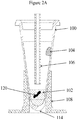
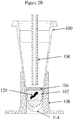
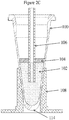
- a tube (dedicated liquid-liquid extraction process vessel) 100 is in the form of a cone-shaped ampule that tapers to a closed, bottom end 114.
- the tube may include a silicone oil (95%)/wax (5%) mixture 104 either placed low (towards the bottom) on the inside surface of the tube as in Figure 1A , or high (towards the top) on the inside surface of the tube as in Figure 1B , or as a ring coating a portion of the inside surface of the tube (either low or high) as shown in Figure 1C .
- a FFPE tissue sample 120 and an aqueous solution (hereinafter, the "solution") 102 are introduced into the tube and subjected to heating by associated tube heater 108.
- the solution 102 in the tube is subject to evaporation due to the elevated temperatures.
- the evaporation can be circumvented by installing a tightly sealed cap clamped under a pressurized lid at the top of the tube to prevent the cap from becoming loose; however, this type of cap arrangement will not meet the requirements of an automated workflow system design since an automated workflow needs the ability to access the fluid in the tube.
- the silicone oil (95%)/wax (5%) mixture 104 is designed to melt upon heating of the tube and cover the surface of the solution; or, a high purity silicone oil or another high purity mineral oil may be provided to cover the surface of the solution to prevent evaporation, in place of a capping system.
- the silicone oil (95%)/wax (5%) mixture 104 or the high purity oil is selected as an advantageous extraction media for the paraffin that is melted out of the FFPE tissue sample during heating of the solution containing the FFPE tissue sample.
- the lumen 106 provides a fluidic pathway to and from the tube for transporting solutions to and from the tube and to and from other reservoirs (e.g., purification system 125, Fig. 3 ) of the system while also minimizing evaporation from the tube during the elevated temperature duration(s) of the process.
- a layer of an immiscible liquid, e.g., a silicone oil (95%)/wax (5%) mixture 104 floats on the surface of the solution 102 and can efficiently prevent the solution from evaporating while, at the same time forms a layer for selectively extracting paraffin wax out of the solution after the paraffin melts out of the FFPE tissue sample.
- a high purity liquid oil may be dispensed into the tube after the FFPE tissue sample's introduction. The tube and its contents including the FFPE tissue sample, aqueous solution, and oil or wax/oil mixture are heated.
- the immiscible, liquefied wax/silicone mixture, upon re-solidifying, will be at the height of the solution's surface when the tube is cooled.
- the tube is penetrated by a lumen 106 or a pipette tip for filling the tube with solution or in some cases the oil, and removing the reacted solution from underneath the oil or silicone oil/wax layer upon completion of the extraction.
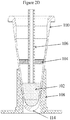
- aqueous phase reagents are additionally added to the tube.
- the reagents may include the same or a different solution than in the first volume of solution, lysing reagents, detergents, surfactants, protein digesting enzymes, or other reagents known in the art and used to prepare a biological sample for nucleic acid purification.
- the added aqueous solution increases the volume above the bottom of the lumen 106 to facilitate removal of a fraction of the aqueous solution from below the wax-oil layer 104.
- the added oil and all of the extracted wax from the FFPE sample may become a solidified wax/silicone layer 104 at lower temperatures or, the layer may remain liquid (which is depicted in Figure 2E following the removal of a fraction of the aqueous phase) but in either case it remains in the tube after a fraction of solution 102 is removed.
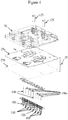
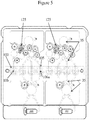
- Figures 3 , 4 , and 5 show various views of an exemplary microfluidic device 10 (e.g., Rheonix CARD Consumable) that can be employed in an automated microfluidic system (e.g., Rheonix Encompass platform). Further information is provided in US 2012/0045799 and US 2012/0129714 , the subject matters of which are herein incorporated by reference in their entireties to the fullest extent allowed by applicable laws and rules.
- a plan view of an illustrative dual system (side-by-side/top-bottom) microfluidic device is shown schematically in Fig. 5 . Referring to the 'top-half' system in Fig. 5 and to the exploded view in Fig.
- the device 10 includes at least one tube (dedicated liquid-liquid extraction process vessel) 100 and associated lumen 106, at least one nucleic acid amplification reactor 105 and associated lumen 106a, at least one heater 108 associated with each tube disposed to heat the at least one tube and the least one nucleic acid amplification reactor, and a nucleic acid purification system 125 fluidically coupled to the at least one tube 100 by a microfluidic channel 20a and to the at least one reactor 105 by a different microfluidic channel 20b.
- the microfluidic device 10 also shows a microarray chamber and a nucleic acid analyzer component on the left-hand side of Fig.
- This device 10 is capable of performing both a liquid-liquid extraction process and a nucleic acid purification process.
- Device 10 may also form the basis of an automated liquid-liquid extraction and nucleic acid purification kit, which further includes a supply of reagents suitable to enable the liquid-liquid extraction process and the nucleic acid purification process, as described herein.
- Figure 3 more particularly schematically illustrates a dual system microfluidic device 10 that incorporates in each system a single tube 100, three amplification reactor tubes 105, reservoirs 15, purifiers 125, and microfluidic channels 20a, 20b, which can be utilized to complete a fully integrated molecular assay from a FFPE sample to microarray analysis of the gene amplification products.
- the microfluidic system 10 is assembled from a two-layer microfluidic channel system 25 made up of a channel layer 25a and film layer 25b with an attached reservoir layer 30 (the reservoir layer 30 and the channel layer 25a-may be formed from the same substrate though, for clarity, they are shown as separate).
- a channel network is composed of the film layer 25b selectively bonded to channel layer 25a.
- the channels 20 are first prepared by creating a series of disconnected elongated depressions (open channels) in the face of the substrate of channel layer 25a facing film layer 25b.
- the channels 20 are then enclosed by selectively bonding the film layer while at the same time creating diaphragms 35 that, when actuated using instrument interface 50 ( Fig.
- the channels 20 provide a means for the channels 20 to communicate, and with coordinated actuation of the diaphragms 35 fluids can be pumped from one location in the system 10 to other locations for the purpose of completing an assay.
- Penetrating the film layer 25b and accessed by channels 20 are lumens 106 and 106a. Attached to the film layer, tube 100 is accessed by lumen 106 while lumens 106a access amplification reactors 105.
- Present in the reservoir layer is one or more purifiers 125, which may be composed of any known material capable of selectively binding nucleic acids in order to separate the nucleic acids from cell lysate.
- the purifier 125 may be composed of a silica matrix. In an alternative arrangement, the silica matrix may be composed of silica beads.
- tube 100 is accessed by lumen 106 that is incorporated into a separate channel network (20a) than the channel network (20b) for amplification reactors 105, which are accessed by lumens 106a.
- the FFPE tissue sample is first placed into tube 100 and then the tube strip containing tube 100 and amplification reactors 105 are assembled onto the microfluidic system 10.
- the liquid-liquid extraction is accomplished, and then certain reagents are added to the tube though lumen 106 to proceed through the chemical de-crosslinking and lysing of the sample; thereafter a fraction of the processed solution is withdrawn through lumen 106 and further purified to provide any nucleic acids that were withdrawn from the original liquid fraction using the other components of the system.
- the purified nucleic acids from the original tissue sample are then eluted from the purification system and delivered through lumens 106a to one or more amplification reactors 105 along with the required reagents to perform a nucleic acid amplification of selected sequences potentially included in the nucleic acids delivered to the amplification reactor from the original tissue sample.
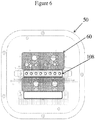
- Figure 6 shows a plan view of the instrument interface 50 for a multiple reactor system that may be employed by an automated microfluidic system.
- Diaphragms 35 ( Fig. 5 ) align with gasket layer 60 for pneumatic actuation of diaphragms 35 to pump fluids selectively through microfluidic system 10.
- At least two extraction reactors 100 seat into heater 108 (that may be a part of the same heater assembly as those used to heat the amplification reactors 105 or, heater 108 may be a separate heater assembly) to process the FFPE tissue samples to remove the paraffin embedding the tissue sample and prepare the tissue for automated purification of the nucleic acids from the cells in the tissue sample used to analyze the sample.
- the solution in the tube can be a mixture of a lysing buffer and a surfactant, among other reagents known in the art.
- the aqueous mixture while at an elevated temperature, acts to de-crosslink the macromolecules in the tissue sample.
- a protein digesting enzyme may be added to the solution to further prepare the nucleic acids in the reacted solution for purification and later analysis.
- the tissue sample in the aqueous mixture may be lysed with the aid of protein digesting enzyme at elevated temperatures followed by incubation at higher temperatures for de-cross-linking.
- Figure 7 shows the resulting purity of DNA recovered using a microfluidic system that performs the liquid-liquid extraction followed by de-crosslinking, lysing and traditional silica based affinity capture of nucleic acids with later elution.
- the purity estimate is accomplished using the traditional A260/A280 method of UV measurement.
- the results compare the liquid-liquid extraction system using various buffers and surfactants to the traditional xylene extraction method.
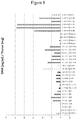
- Figure 8 shows the quantity of DNA recovered using a microfluidic system that performs the liquid-liquid extraction followed by de-crosslinking, lysing and traditional silica based affinity capture of nucleic acids with later elution. The results compare the liquid-liquid extraction system using various buffers and surfactants to the traditional xylene extraction method.
Landscapes
- Chemical & Material Sciences (AREA)
- Health & Medical Sciences (AREA)
- Organic Chemistry (AREA)
- Life Sciences & Earth Sciences (AREA)
- Engineering & Computer Science (AREA)
- Genetics & Genomics (AREA)
- Wood Science & Technology (AREA)
- Zoology (AREA)
- Biotechnology (AREA)
- Analytical Chemistry (AREA)
- General Health & Medical Sciences (AREA)
- Molecular Biology (AREA)
- Biochemistry (AREA)
- Bioinformatics & Cheminformatics (AREA)
- General Engineering & Computer Science (AREA)
- Biomedical Technology (AREA)
- Proteomics, Peptides & Aminoacids (AREA)
- Microbiology (AREA)
- Biophysics (AREA)
- Physics & Mathematics (AREA)
- Chemical Kinetics & Catalysis (AREA)
- Immunology (AREA)
- Crystallography & Structural Chemistry (AREA)
- Plant Pathology (AREA)
- Dispersion Chemistry (AREA)
- Hematology (AREA)
- Clinical Laboratory Science (AREA)
- Apparatus Associated With Microorganisms And Enzymes (AREA)
- Measuring Or Testing Involving Enzymes Or Micro-Organisms (AREA)
- Preparation Of Compounds By Using Micro-Organisms (AREA)
Applications Claiming Priority (2)
| Application Number | Priority Date | Filing Date | Title |
|---|---|---|---|
| US201161561007P | 2011-11-17 | 2011-11-17 | |
| PCT/US2012/065452 WO2013074885A1 (en) | 2011-11-17 | 2012-11-16 | Microfluidic apparatus, method, and applications |
Publications (3)
| Publication Number | Publication Date |
|---|---|
| EP2780453A1 EP2780453A1 (en) | 2014-09-24 |
| EP2780453A4 EP2780453A4 (en) | 2015-06-03 |
| EP2780453B1 true EP2780453B1 (en) | 2017-03-29 |
Family
ID=48430176
Family Applications (1)
| Application Number | Title | Priority Date | Filing Date |
|---|---|---|---|
| EP12850325.7A Active EP2780453B1 (en) | 2011-11-17 | 2012-11-16 | Microfluidic apparatus, method, and applications |
Country Status (7)
| Country | Link |
|---|---|
| US (4) | US8852919B2 (enExample) |
| EP (1) | EP2780453B1 (enExample) |
| JP (3) | JP2014533952A (enExample) |
| CN (1) | CN104053774B (enExample) |
| AU (1) | AU2012340344B2 (enExample) |
| IN (1) | IN2014CN04296A (enExample) |
| WO (1) | WO2013074885A1 (enExample) |
Cited By (2)
| Publication number | Priority date | Publication date | Assignee | Title |
|---|---|---|---|---|
| US11389794B2 (en) | 2018-01-15 | 2022-07-19 | Robert Bosch Gmbh | Method for providing a solution of the substance in a microfluidic device |
| DE102022111890B3 (de) | 2022-05-12 | 2023-03-16 | Dermagnostix GmbH | Verfahren zur Deparaffinierung von Formalin-fixiertem Paraffin-eingebettetem Gewebe |
Families Citing this family (9)
| Publication number | Priority date | Publication date | Assignee | Title |
|---|---|---|---|---|
| EP2468862A1 (en) * | 2010-12-23 | 2012-06-27 | Qiagen GmbH | Method and kit for processing wax-embedded biological samples |
| EP2900819B1 (en) * | 2012-09-28 | 2020-10-28 | Cepheid | Methods for dna and rna extraction from fixed paraffin-embedded tissue samples |
| CN104946510B (zh) | 2014-03-31 | 2017-06-06 | 博奥生物集团有限公司 | 集核酸扩增和微阵列检测于一体的微流控装置 |
| US9658142B2 (en) | 2015-04-14 | 2017-05-23 | Arizona Board Of Regents On Behalf Of Arizona State University | Method and apparatus for extracting and collecting single cells from formalin-fixed paraffin embedded tissues |
| DE102016208936A1 (de) * | 2016-05-24 | 2017-11-30 | Robert Bosch Gmbh | Mikrofluidische Vorrichtung und Verfahren zur Probenaufbereitung von Paraffin-eigebettetem Gewebe |
| EP3559271A1 (en) | 2016-12-22 | 2019-10-30 | Ventana Medical Systems, Inc. | Fully automated nucleic acid extraction method for tissue samples |
| US11513041B2 (en) | 2018-10-19 | 2022-11-29 | Polyvalor, Limited Partnership | Medium-embedded samples |
| EP3934809A4 (en) * | 2019-03-08 | 2023-01-25 | Rarecyte, Inc. | DEVICE, SYSTEM AND METHOD FOR SELECTING A TARGET ANALYTE OF A LIQUID |
| US11332777B1 (en) | 2021-10-28 | 2022-05-17 | URIT Medical Electronic Co., Ltd. | Methods and reagent kits for bisulfite conversion of DNA |
Family Cites Families (23)
| Publication number | Priority date | Publication date | Assignee | Title |
|---|---|---|---|---|
| US5552087A (en) * | 1993-11-15 | 1996-09-03 | Ventana Medical Systems, Inc. | High temperature evaporation inhibitor liquid |
| US5856174A (en) * | 1995-06-29 | 1999-01-05 | Affymetrix, Inc. | Integrated nucleic acid diagnostic device |
| US5863502A (en) * | 1996-01-24 | 1999-01-26 | Sarnoff Corporation | Parallel reaction cassette and associated devices |
| US6855559B1 (en) | 1998-09-03 | 2005-02-15 | Ventana Medical Systems, Inc. | Removal of embedding media from biological samples and cell conditioning on automated staining instruments |
| US7410753B2 (en) | 1998-09-03 | 2008-08-12 | Ventana Medical Systems, Inc. | Removal of embedding media from biological samples and cell conditioning on automated staining instruments |
| US6544798B1 (en) | 1999-02-26 | 2003-04-08 | Ventana Medical Systems, Inc. | Removal of embedding media from biological samples and cell conditioning on automated staining instruments |
| US6469159B1 (en) | 1999-04-26 | 2002-10-22 | Robert T. Belly | Methods for extracting nucleic acids from tissue samples and paraffin-embedded tissues |
| US6248535B1 (en) | 1999-12-20 | 2001-06-19 | University Of Southern California | Method for isolation of RNA from formalin-fixed paraffin-embedded tissue specimens |
| US7364846B2 (en) * | 2002-10-11 | 2008-04-29 | Molecular Devices Corporation | Gene expression profiling from FFPE samples |
| US20050142570A1 (en) * | 2003-12-24 | 2005-06-30 | 3M Innovative Properties Company | Methods for nucleic acid isolation and kits using a microfluidic device and sedimenting reagent |
| AU2006249956A1 (en) * | 2005-05-24 | 2006-11-30 | Angros, Lee H | In situ heat induced antigen recovery and staining apparatus and method |
| US7544471B2 (en) * | 2005-07-30 | 2009-06-09 | Agilent Technologies, Inc. | Preparing RNA from a wax-embedded tissue specimen |
| WO2009049268A1 (en) * | 2007-10-12 | 2009-04-16 | Rheonix, Inc. | Integrated microfluidic device and methods |
| DE102008029356A1 (de) | 2008-06-20 | 2009-12-24 | Siemens Healthcare Diagnostics Gmbh | Verfahren zur Aufreinigung von Nukleinsäuren, insbesondere aus fixiertem Gewebe |
| WO2010003463A1 (en) * | 2008-07-11 | 2010-01-14 | Metabolic Explorer | Method for polymerising glycolic acid with microorganisms |
| DE102008061714A1 (de) | 2008-12-12 | 2010-06-17 | Siemens Healthcare Diagnostics Inc., Deerfield | Verfahren zur Aufreinigung von Nukleinsäuren, inbesondere aus fixiertem Gewebe |
| DE202009018981U1 (de) * | 2009-07-01 | 2015-03-11 | Axagarius Gmbh & Co. Kg | Verwendung eines Kits für die Isolierung von Biomolekülen aus biologischen Proben sowie Kit dafür |
| EP2454378B1 (en) * | 2009-07-17 | 2015-12-23 | Canon U.S. Life Sciences, Inc. | Methods and systems for dna isolation on a microfluidic device |
| JP6204664B2 (ja) * | 2010-02-26 | 2017-09-27 | キアゲン ゲーエムベーハー | Rnaおよびdnaの並行単離および/または並行精製のためのプロセス |
| JP2011213804A (ja) * | 2010-03-31 | 2011-10-27 | Sumitomo Chemical Co Ltd | 予備重合方法、予備重合済付加重合触媒成分およびそれを用いる付加重合体の製造方法 |
| US20120045799A1 (en) | 2010-08-17 | 2012-02-23 | Rheonix, Inc. | Thermocycler seal composition, method, and application |
| WO2012051504A2 (en) | 2010-10-14 | 2012-04-19 | Rheonix, Inc. | Quantitative multiplexed identification of nucleic acid targets |
| EP2468862A1 (en) * | 2010-12-23 | 2012-06-27 | Qiagen GmbH | Method and kit for processing wax-embedded biological samples |
-
2012
- 2012-11-16 US US13/678,732 patent/US8852919B2/en active Active
- 2012-11-16 JP JP2014542481A patent/JP2014533952A/ja active Pending
- 2012-11-16 IN IN4296CHN2014 patent/IN2014CN04296A/en unknown
- 2012-11-16 AU AU2012340344A patent/AU2012340344B2/en active Active
- 2012-11-16 EP EP12850325.7A patent/EP2780453B1/en active Active
- 2012-11-16 CN CN201280056605.1A patent/CN104053774B/zh active Active
- 2012-11-16 WO PCT/US2012/065452 patent/WO2013074885A1/en not_active Ceased
-
2014
- 2014-09-05 US US14/478,049 patent/US10081828B2/en active Active
- 2014-09-05 US US14/478,012 patent/US10865436B2/en active Active
-
2016
- 2016-07-26 JP JP2016146351A patent/JP2016187355A/ja active Pending
-
2018
- 2018-05-08 JP JP2018089843A patent/JP6655652B2/ja not_active Expired - Fee Related
-
2020
- 2020-11-09 US US17/092,379 patent/US11795493B2/en active Active
Cited By (3)
| Publication number | Priority date | Publication date | Assignee | Title |
|---|---|---|---|---|
| US11389794B2 (en) | 2018-01-15 | 2022-07-19 | Robert Bosch Gmbh | Method for providing a solution of the substance in a microfluidic device |
| DE102022111890B3 (de) | 2022-05-12 | 2023-03-16 | Dermagnostix GmbH | Verfahren zur Deparaffinierung von Formalin-fixiertem Paraffin-eingebettetem Gewebe |
| WO2023217310A1 (de) | 2022-05-12 | 2023-11-16 | Dermagnostix GmbH | Verfahren zur deparaffinierung von formalin-fixiertem paraffin-eingebettetem gewebe |
Also Published As
| Publication number | Publication date |
|---|---|
| WO2013074885A1 (en) | 2013-05-23 |
| US10081828B2 (en) | 2018-09-25 |
| US11795493B2 (en) | 2023-10-24 |
| CN104053774B (zh) | 2016-09-07 |
| US20130164826A1 (en) | 2013-06-27 |
| US20150056650A1 (en) | 2015-02-26 |
| US10865436B2 (en) | 2020-12-15 |
| JP2018148904A (ja) | 2018-09-27 |
| EP2780453A1 (en) | 2014-09-24 |
| IN2014CN04296A (enExample) | 2015-09-04 |
| CN104053774A (zh) | 2014-09-17 |
| EP2780453A4 (en) | 2015-06-03 |
| US8852919B2 (en) | 2014-10-07 |
| JP2016187355A (ja) | 2016-11-04 |
| AU2012340344A1 (en) | 2014-05-01 |
| AU2012340344B2 (en) | 2015-10-29 |
| JP2014533952A (ja) | 2014-12-18 |
| JP6655652B2 (ja) | 2020-02-26 |
| US20210054440A1 (en) | 2021-02-25 |
| US20140377854A1 (en) | 2014-12-25 |
Similar Documents
| Publication | Publication Date | Title |
|---|---|---|
| US11795493B2 (en) | Microfluidic apparatus, method, and applications | |
| US10995331B2 (en) | Sample preparation method and apparatus | |
| EP2846910B1 (en) | Device and method for isolating an analyte from a sample | |
| EP3074131B1 (en) | Transportable composite liquid cells | |
| KR101794736B1 (ko) | 다이렉트 용리 반응에 의한 핵산 추출 및 증폭 방법 | |
| US11273439B2 (en) | System and method for target material retrieval from microwells | |
| ZA200606197B (en) | A diagnostic system for carrying out a nuclelc acid sequence amplification and detection process | |
| US20180257002A1 (en) | Methods for obtaining liquid from a solid phase | |
| EP3160643B1 (en) | Method for cell nuclei preparation | |
| KR101572683B1 (ko) | 오일과 친수성 자성 비드를 이용한 핵산 추출 및 증폭 방법 | |
| US10392651B2 (en) | Processed biological sample storage | |
| US20200190506A1 (en) | Device with controlled fluid dynamics, for isolation of an analyte from a sample |
Legal Events
| Date | Code | Title | Description |
|---|---|---|---|
| PUAI | Public reference made under article 153(3) epc to a published international application that has entered the european phase |
Free format text: ORIGINAL CODE: 0009012 |
|
| 17P | Request for examination filed |
Effective date: 20140512 |
|
| AK | Designated contracting states |
Kind code of ref document: A1 Designated state(s): AL AT BE BG CH CY CZ DE DK EE ES FI FR GB GR HR HU IE IS IT LI LT LU LV MC MK MT NL NO PL PT RO RS SE SI SK SM TR |
|
| DAX | Request for extension of the european patent (deleted) | ||
| RIC1 | Information provided on ipc code assigned before grant |
Ipc: C12N 15/10 20060101AFI20150415BHEP Ipc: C12Q 1/68 20060101ALI20150415BHEP |
|
| RA4 | Supplementary search report drawn up and despatched (corrected) |
Effective date: 20150506 |
|
| RIC1 | Information provided on ipc code assigned before grant |
Ipc: C12Q 1/68 20060101ALI20150424BHEP Ipc: C12N 15/10 20060101AFI20150424BHEP |
|
| 17Q | First examination report despatched |
Effective date: 20160302 |
|
| GRAP | Despatch of communication of intention to grant a patent |
Free format text: ORIGINAL CODE: EPIDOSNIGR1 |
|
| INTG | Intention to grant announced |
Effective date: 20161123 |
|
| GRAS | Grant fee paid |
Free format text: ORIGINAL CODE: EPIDOSNIGR3 |
|
| GRAA | (expected) grant |
Free format text: ORIGINAL CODE: 0009210 |
|
| RAP1 | Party data changed (applicant data changed or rights of an application transferred) |
Owner name: RHEONIX, INC. |
|
| AK | Designated contracting states |
Kind code of ref document: B1 Designated state(s): AL AT BE BG CH CY CZ DE DK EE ES FI FR GB GR HR HU IE IS IT LI LT LU LV MC MK MT NL NO PL PT RO RS SE SI SK SM TR |
|
| REG | Reference to a national code |
Ref country code: GB Ref legal event code: FG4D |
|
| REG | Reference to a national code |
Ref country code: CH Ref legal event code: EP |
|
| REG | Reference to a national code |
Ref country code: AT Ref legal event code: REF Ref document number: 879798 Country of ref document: AT Kind code of ref document: T Effective date: 20170415 |
|
| REG | Reference to a national code |
Ref country code: IE Ref legal event code: FG4D |
|
| REG | Reference to a national code |
Ref country code: CH Ref legal event code: NV Representative=s name: VOSSIUS AND PARTNER PATENTANWAELTE RECHTSANWAE, CH |
|
| REG | Reference to a national code |
Ref country code: DE Ref legal event code: R096 Ref document number: 602012030594 Country of ref document: DE |
|
| REG | Reference to a national code |
Ref country code: SE Ref legal event code: TRGR |
|
| PG25 | Lapsed in a contracting state [announced via postgrant information from national office to epo] |
Ref country code: HR Free format text: LAPSE BECAUSE OF FAILURE TO SUBMIT A TRANSLATION OF THE DESCRIPTION OR TO PAY THE FEE WITHIN THE PRESCRIBED TIME-LIMIT Effective date: 20170329 Ref country code: FI Free format text: LAPSE BECAUSE OF FAILURE TO SUBMIT A TRANSLATION OF THE DESCRIPTION OR TO PAY THE FEE WITHIN THE PRESCRIBED TIME-LIMIT Effective date: 20170329 Ref country code: GR Free format text: LAPSE BECAUSE OF FAILURE TO SUBMIT A TRANSLATION OF THE DESCRIPTION OR TO PAY THE FEE WITHIN THE PRESCRIBED TIME-LIMIT Effective date: 20170630 Ref country code: NO Free format text: LAPSE BECAUSE OF FAILURE TO SUBMIT A TRANSLATION OF THE DESCRIPTION OR TO PAY THE FEE WITHIN THE PRESCRIBED TIME-LIMIT Effective date: 20170629 Ref country code: LT Free format text: LAPSE BECAUSE OF FAILURE TO SUBMIT A TRANSLATION OF THE DESCRIPTION OR TO PAY THE FEE WITHIN THE PRESCRIBED TIME-LIMIT Effective date: 20170329 |
|
| REG | Reference to a national code |
Ref country code: NL Ref legal event code: MP Effective date: 20170329 |
|
| REG | Reference to a national code |
Ref country code: AT Ref legal event code: MK05 Ref document number: 879798 Country of ref document: AT Kind code of ref document: T Effective date: 20170329 |
|
| PG25 | Lapsed in a contracting state [announced via postgrant information from national office to epo] |
Ref country code: BG Free format text: LAPSE BECAUSE OF FAILURE TO SUBMIT A TRANSLATION OF THE DESCRIPTION OR TO PAY THE FEE WITHIN THE PRESCRIBED TIME-LIMIT Effective date: 20170629 Ref country code: LV Free format text: LAPSE BECAUSE OF FAILURE TO SUBMIT A TRANSLATION OF THE DESCRIPTION OR TO PAY THE FEE WITHIN THE PRESCRIBED TIME-LIMIT Effective date: 20170329 Ref country code: RS Free format text: LAPSE BECAUSE OF FAILURE TO SUBMIT A TRANSLATION OF THE DESCRIPTION OR TO PAY THE FEE WITHIN THE PRESCRIBED TIME-LIMIT Effective date: 20170329 |
|
| PG25 | Lapsed in a contracting state [announced via postgrant information from national office to epo] |
Ref country code: NL Free format text: LAPSE BECAUSE OF FAILURE TO SUBMIT A TRANSLATION OF THE DESCRIPTION OR TO PAY THE FEE WITHIN THE PRESCRIBED TIME-LIMIT Effective date: 20170329 |
|
| PG25 | Lapsed in a contracting state [announced via postgrant information from national office to epo] |
Ref country code: EE Free format text: LAPSE BECAUSE OF FAILURE TO SUBMIT A TRANSLATION OF THE DESCRIPTION OR TO PAY THE FEE WITHIN THE PRESCRIBED TIME-LIMIT Effective date: 20170329 Ref country code: RO Free format text: LAPSE BECAUSE OF FAILURE TO SUBMIT A TRANSLATION OF THE DESCRIPTION OR TO PAY THE FEE WITHIN THE PRESCRIBED TIME-LIMIT Effective date: 20170329 Ref country code: ES Free format text: LAPSE BECAUSE OF FAILURE TO SUBMIT A TRANSLATION OF THE DESCRIPTION OR TO PAY THE FEE WITHIN THE PRESCRIBED TIME-LIMIT Effective date: 20170329 Ref country code: SK Free format text: LAPSE BECAUSE OF FAILURE TO SUBMIT A TRANSLATION OF THE DESCRIPTION OR TO PAY THE FEE WITHIN THE PRESCRIBED TIME-LIMIT Effective date: 20170329 Ref country code: CZ Free format text: LAPSE BECAUSE OF FAILURE TO SUBMIT A TRANSLATION OF THE DESCRIPTION OR TO PAY THE FEE WITHIN THE PRESCRIBED TIME-LIMIT Effective date: 20170329 Ref country code: AT Free format text: LAPSE BECAUSE OF FAILURE TO SUBMIT A TRANSLATION OF THE DESCRIPTION OR TO PAY THE FEE WITHIN THE PRESCRIBED TIME-LIMIT Effective date: 20170329 |
|
| REG | Reference to a national code |
Ref country code: FR Ref legal event code: PLFP Year of fee payment: 6 |
|
| PG25 | Lapsed in a contracting state [announced via postgrant information from national office to epo] |
Ref country code: SM Free format text: LAPSE BECAUSE OF FAILURE TO SUBMIT A TRANSLATION OF THE DESCRIPTION OR TO PAY THE FEE WITHIN THE PRESCRIBED TIME-LIMIT Effective date: 20170329 Ref country code: PT Free format text: LAPSE BECAUSE OF FAILURE TO SUBMIT A TRANSLATION OF THE DESCRIPTION OR TO PAY THE FEE WITHIN THE PRESCRIBED TIME-LIMIT Effective date: 20170731 Ref country code: PL Free format text: LAPSE BECAUSE OF FAILURE TO SUBMIT A TRANSLATION OF THE DESCRIPTION OR TO PAY THE FEE WITHIN THE PRESCRIBED TIME-LIMIT Effective date: 20170329 Ref country code: IS Free format text: LAPSE BECAUSE OF FAILURE TO SUBMIT A TRANSLATION OF THE DESCRIPTION OR TO PAY THE FEE WITHIN THE PRESCRIBED TIME-LIMIT Effective date: 20170729 |
|
| REG | Reference to a national code |
Ref country code: DE Ref legal event code: R097 Ref document number: 602012030594 Country of ref document: DE |
|
| PG25 | Lapsed in a contracting state [announced via postgrant information from national office to epo] |
Ref country code: DK Free format text: LAPSE BECAUSE OF FAILURE TO SUBMIT A TRANSLATION OF THE DESCRIPTION OR TO PAY THE FEE WITHIN THE PRESCRIBED TIME-LIMIT Effective date: 20170329 |
|
| PLBE | No opposition filed within time limit |
Free format text: ORIGINAL CODE: 0009261 |
|
| STAA | Information on the status of an ep patent application or granted ep patent |
Free format text: STATUS: NO OPPOSITION FILED WITHIN TIME LIMIT |
|
| 26N | No opposition filed |
Effective date: 20180103 |
|
| PG25 | Lapsed in a contracting state [announced via postgrant information from national office to epo] |
Ref country code: SI Free format text: LAPSE BECAUSE OF FAILURE TO SUBMIT A TRANSLATION OF THE DESCRIPTION OR TO PAY THE FEE WITHIN THE PRESCRIBED TIME-LIMIT Effective date: 20170329 |
|
| PG25 | Lapsed in a contracting state [announced via postgrant information from national office to epo] |
Ref country code: MC Free format text: LAPSE BECAUSE OF FAILURE TO SUBMIT A TRANSLATION OF THE DESCRIPTION OR TO PAY THE FEE WITHIN THE PRESCRIBED TIME-LIMIT Effective date: 20170329 |
|
| PG25 | Lapsed in a contracting state [announced via postgrant information from national office to epo] |
Ref country code: LU Free format text: LAPSE BECAUSE OF NON-PAYMENT OF DUE FEES Effective date: 20171116 |
|
| REG | Reference to a national code |
Ref country code: BE Ref legal event code: MM Effective date: 20171130 |
|
| REG | Reference to a national code |
Ref country code: IE Ref legal event code: MM4A |
|
| PG25 | Lapsed in a contracting state [announced via postgrant information from national office to epo] |
Ref country code: MT Free format text: LAPSE BECAUSE OF NON-PAYMENT OF DUE FEES Effective date: 20171116 |
|
| PG25 | Lapsed in a contracting state [announced via postgrant information from national office to epo] |
Ref country code: IE Free format text: LAPSE BECAUSE OF NON-PAYMENT OF DUE FEES Effective date: 20171116 |
|
| PG25 | Lapsed in a contracting state [announced via postgrant information from national office to epo] |
Ref country code: BE Free format text: LAPSE BECAUSE OF NON-PAYMENT OF DUE FEES Effective date: 20171130 |
|
| PG25 | Lapsed in a contracting state [announced via postgrant information from national office to epo] |
Ref country code: HU Free format text: LAPSE BECAUSE OF FAILURE TO SUBMIT A TRANSLATION OF THE DESCRIPTION OR TO PAY THE FEE WITHIN THE PRESCRIBED TIME-LIMIT; INVALID AB INITIO Effective date: 20121116 |
|
| PG25 | Lapsed in a contracting state [announced via postgrant information from national office to epo] |
Ref country code: CY Free format text: LAPSE BECAUSE OF NON-PAYMENT OF DUE FEES Effective date: 20170329 |
|
| PG25 | Lapsed in a contracting state [announced via postgrant information from national office to epo] |
Ref country code: MK Free format text: LAPSE BECAUSE OF FAILURE TO SUBMIT A TRANSLATION OF THE DESCRIPTION OR TO PAY THE FEE WITHIN THE PRESCRIBED TIME-LIMIT Effective date: 20170329 |
|
| PG25 | Lapsed in a contracting state [announced via postgrant information from national office to epo] |
Ref country code: TR Free format text: LAPSE BECAUSE OF FAILURE TO SUBMIT A TRANSLATION OF THE DESCRIPTION OR TO PAY THE FEE WITHIN THE PRESCRIBED TIME-LIMIT Effective date: 20170329 |
|
| PG25 | Lapsed in a contracting state [announced via postgrant information from national office to epo] |
Ref country code: AL Free format text: LAPSE BECAUSE OF FAILURE TO SUBMIT A TRANSLATION OF THE DESCRIPTION OR TO PAY THE FEE WITHIN THE PRESCRIBED TIME-LIMIT Effective date: 20170329 |
|
| PGFP | Annual fee paid to national office [announced via postgrant information from national office to epo] |
Ref country code: GB Payment date: 20250925 Year of fee payment: 14 |
|
| PGFP | Annual fee paid to national office [announced via postgrant information from national office to epo] |
Ref country code: FR Payment date: 20250922 Year of fee payment: 14 |
|
| PGFP | Annual fee paid to national office [announced via postgrant information from national office to epo] |
Ref country code: SE Payment date: 20250929 Year of fee payment: 14 |
|
| REG | Reference to a national code |
Ref country code: CH Ref legal event code: U11 Free format text: ST27 STATUS EVENT CODE: U-0-0-U10-U11 (AS PROVIDED BY THE NATIONAL OFFICE) Effective date: 20251201 |
|
| PGFP | Annual fee paid to national office [announced via postgrant information from national office to epo] |
Ref country code: DE Payment date: 20250923 Year of fee payment: 14 |
|
| PGFP | Annual fee paid to national office [announced via postgrant information from national office to epo] |
Ref country code: IT Payment date: 20251022 Year of fee payment: 14 |
|
| PGFP | Annual fee paid to national office [announced via postgrant information from national office to epo] |
Ref country code: CH Payment date: 20251201 Year of fee payment: 14 |